Los Angeles Times, by Kim Murphy
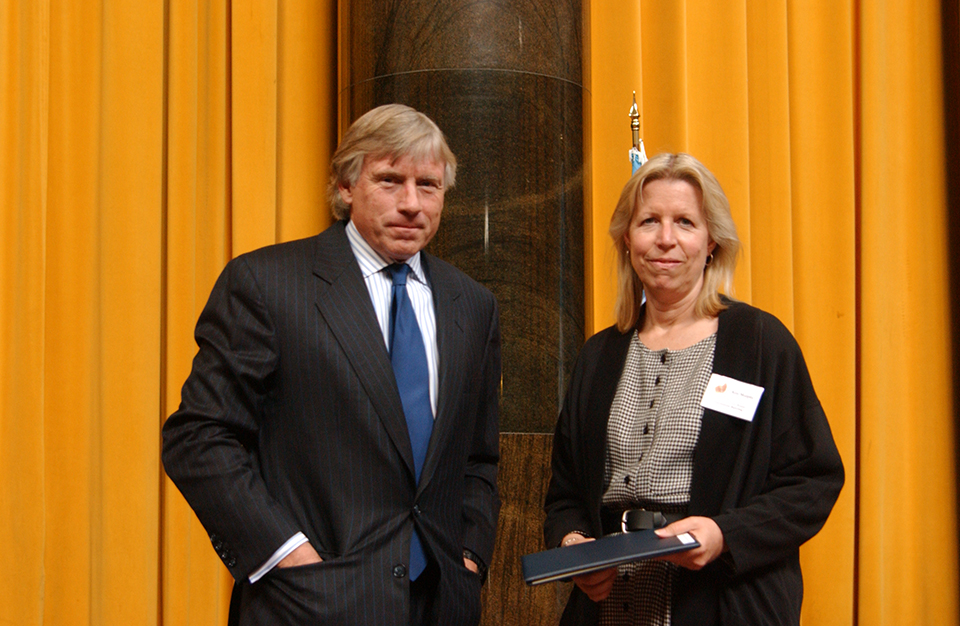
Columbia University President Lee C. Bollinger presents Kim Murphy with a 2005 Pulitzer Prize in International Reporting.
Winning Work
The 'black widows' of Chechnya -- suicide bombers who stalk Russia -- are driven by hatred, ideology, coercion and fear.
By Kim Murphy
LA Times Staff Writer
GROZNY, Russia -- Medna Bayrakova remembers the day a middle-aged woman showed up at her door and asked to speak to her 26-year-old daughter. They shut themselves in the bedroom for half an hour, and then her daughter left, saying she was walking the visitor to the bus stop.
An hour later, Zareta still hadn't returned and several men in camouflage knocked at the door of the family's ravaged apartment in this ruined Chechen capital.
"We have taken away your daughter. She has agreed to marry one of our men," one said.
Bayrakova protested. "She's a sick girl. She has tuberculosis. She was coughing up blood only this morning."
"We will cure her," they replied quietly.
The next time Bayrakova and her husband saw their daughter's face, it was 24 days later -- separatist Chechen rebels had seized Moscow's Dubrovka Theater, along with 800 hostages. Zareta's unmistakable dark eyes were visible above a black veil on the television screen. Her fingers were clasped below a belt of powerful explosives.
There was one last view, this one a postmortem photo taken after federal agents gassed and stormed the theater in the early morning hours of Oct. 26, 2002, leaving all 41 hostage-takers and 129 of the captives dead. This time, Zareta's face was swollen and bruised -- barely recognizable.
"They asked me, 'Is it your daughter?' " Bayrakova said. "But the face was all smashed. She looked all beaten up. And then I passed out."
In strapping the explosives belt to her waist that fall day in 2002, Zareta Bayrakova joined the cult of the "black widows," the female suicide bombers who have left much of Russia on wary watch for the mysterious, dark-eyed woman in a long fur coat who is believed to recruit them.
A nationwide alert has been issued for a middle-aged woman with a hooked nose and dark hair popularly known as "Black Fatima," who has been identified as a recruiter for the women known as shahidas, or martyrs. The woman reportedly has been seen lurking on the edges of terrorist bombings during a decade of tensions between Russia and the breakaway republic of Chechnya. Russian troops pulled out of the republic after a disastrous 1994-96 war, and the mostly Muslim region exercises self-rule.
Seven women have launched suicide attacks against Israel, the first one in January 2002. By that time, Russia had already recorded two such attacks, and since then their numbers have grown. More than three dozen Chechen women -- roughly half of the suicide bombers -- have launched or attempted attacks against Russian targets since the second Chechen war began in 1999. Russian authorities say many appear to be dazed and under the influence of drugs; some would-be bombers have reported that they were forced by relatives in the Chechen resistance into attempting such attacks.
Most recently, on Dec. 9, a young woman blew herself up in front of Moscow's historic National Hotel, killing six people. An older woman in a dark coat and fur hat reportedly was seen slipping away from the scene. On Dec. 5, suicide bombers blew up a commuter train in the southern region of Stavropol, killing at least 44 others and injuring more than 150. Authorities said three women and one man were involved in the attack.
Nearly 150 people died in black-widow attacks last summer -- so named in the Russian media because many of the female perpetrators have lost husbands, brothers and fathers in the war in Chechnya.
Abu Walid, a Saudi national who is one of many Arabs who have joined the Chechen militants, is believed to be the commander of the rebels' eastern front in Chechnya. He recently explained the use of female suicide bombers in an interview with the Al Jazeera television network.
"These women, particularly the wives of the moujahedeen who are martyred, are being threatened in their homes. Their honor and everything are being threatened," he said. "They do not accept being humiliated and living under occupation. They say that they want to serve the cause of almighty God and avenge the death of their husbands and persecuted people."
Sergei Ignatchenko, spokesman for Russia's Federal Security Service, said Arab militants "have abused the idea of Chechnya's independence to suit their own ends."
Chechen commander Shamil Basayev is said to have trained a force of up to 50 black widows for suicide attacks against Russian targets. Basayev claims to have masterminded several recent terrorist operations, including the Dubrovka Theater siege and the bombing at the National Hotel.
Meanwhile, the political leader of the separatists, Aslan Maskhadov, has repeatedly disavowed any connection with terrorism and even accused Russia's secret services of staging the Dubrovka siege for "propaganda purposes." But Russian security officials provided The Times with a videotape, dated Oct. 18, 2002 -- a week before the siege -- in which Maskhadov appeared to be referring to upcoming actions by Chechen rebels.
"We have practically accomplished a transition from guerrilla warfare to offensive combat operations," he says on the tape. "I am convinced, and I do not have a shadow of a doubt on this, that during the concluding stage of our struggle, we will definitely hold an even more unique operation, similar to jihad. And with this operation, we will liberate our land from Russian aggressors."
Another videotape, purportedly filmed at the same time, shows Maskhadov seated with Basayev, Abu Omar Seif -- an Islamic spiritual leader identified by the Russians as a link to Arab funding sources -- and Movsar Barayev, who led the hostage-takers at Dubrovka.
For the Russians, the tapes are proof that the moderate Chechen resistance, which has spoken out publicly against terrorism, is secretly organizing civilian terrorist operations. Russia has repeatedly sought to convince the U.S. that Moscow and Washington are facing the same enemy: the Al Qaeda terrorist network.
Maskhadov's aides have said he was talking about a strike against Russian military forces, not a terrorist act against civilians. And Chechen rebels say the Russians are ignoring the deep domestic rage that motivates suicide attacks.
"The Chechens do not have the right to stain with their blood the streets of Russian cities, which are rear bases of the aggressors' army?" the Chechen separatist website, Kavkaz Center, asked sarcastically. "A Russian tank driver, with intestines of Chechen children on its caterpillar track, and the pilot of a low-flying warplane shelling a bus with women and infants, are just unscrupulous uses of force, while a Chechen widow blowing herself up together with the pilots who have murdered her children is terrorism and cannot be justified.
"According to their logic, the Chechen nation must die magnanimously and in silence."
* * *
On a quiet side street in the former Cossack village of Asinovskaya in western Chechnya, there is a pile of rubble that used to be Sulumbek Ganiyev's house. It is the house in which he raised six sons and four daughters.
Only four children are alive, two of whom are in captivity. Islam was killed in a rocket attack in 1999. Daughter Petimat disappeared in July 2000 and is believed to have died in a bombing raid in Grozny. Rustam, a former rebel fighter, is in prison in North Ossetia. Hussein was fighting with the rebels when he was killed in 2000. Raisa, who resisted being recruited by her brother as a black widow, is being held by the Russian secret services at an undisclosed location. The youngest son, Tarkhan, died in a car accident last spring.
Daughters Fatima and Khadzhad died in the Dubrovka Theater siege, with unused explosives belts strapped around their waists.
A few days after the Dubrovka standoff, the family says, Russian troops arrived in the early evening and, without so much as a knock on the door, blew up their house.
Ganiyev, a former builder, says he is alive today only because he and his wife were watching television next door.
"We are not to blame. Before the war, all the children were at home. The Russians took them away from us," Ganiyev said recently.
He said the family's first encounter with Russian troops was in October 1999, not long after the beginning of the second war, when soldiers entered the village and shot the Ganiyevs' five cows, tied two of the carcasses to their vehicle and left.
In July 2000, he said, troops entered their home at gunpoint, stole their videocassette recorder, lambs and chickens, and threw a grenade into the cellar where goods for the winter were stored.
Not long after, Rustam and Hussein began fighting for the rebels. Russian soldiers came to the door in June 2002 and grabbed Tarkhan, then 21, Fatima, 23, and Raisa, 17. Ganiyev remembers daughter Khadzhad, 14, shouting defiantly, as her three siblings are being led away: "Are you really brave, when you take away girls?"
"They wanted to take her away, too, but her mother jumped in and prevented them," Ganiyev recalled.
For three agonizing days, the family knew nothing. Finally, Ganiyev said, he was able to negotiate a $1,000 ransom for his children's release. But when they came home, he says, they were different. "After that, the girls understood that they will never be in peace," he said.
"They were very angry," added his wife, Lyuba. "Otherwise, could you expect them to go to Moscow and take this death?"
Their daughters told them that they had been taken to a shed and that sometime later their brother, tied at the legs and hands and badly beaten, was thrown at their feet "like a dead body." The soldiers poured a bucket of water on him to awaken him and then led him away again.
"They tortured the girls with electric current. They put a metal spiral on their fingers and attached it to a current source, and they shocked them until they passed out," Ganiyev said. "They wanted to get information about what bandits they know, who are the rebels."
Lyuba Ganiyev tried to explain what drove Fatima, a law student who often helped her father bale hay, and Khadzhad, who had hoped to become a gynecologist, to join the terrorists in Moscow -- and Raisa, who eventually turned herself in to Russian authorities, to nearly follow them.
"After they beat them for three days, they had had enough. They came back and said, 'We are now in shame. They held us for three days. We can't live like this anymore.' It's not that they were crying. We never saw them crying. They were just sitting down, depressed."
On Sept. 29, 2002 -- the same day Zareta Bayrakova disappeared -- Fatima and Khadzhad left home, saying they were going to Dagestan to see their nephew. They never returned. Their parents next saw them, as Medna Bayrakova had seen her daughter, a month later in television footage of the Dubrovka siege.
"They didn't tell us," Ganiyev said. "If we had known, we wouldn't have let them. I would have broken their legs to stop them."
* * *
Some witnesses said they saw two women walking together just before the bombing at the National Hotel in the heart of Moscow in December.
"So, where is your parliament?" one of them asked. Then, the explosion. One witness said he saw a woman in a long coat fall to the pavement, get up and walk briskly away. Authorities believe that the woman may have been Black Fatima.
The bombing on the edge of Red Square crossed a red line of sorts for many Muscovites.
"Maybe they are doing this out of religious convictions, but I think it's against our God and against the soul of every human being. No normal woman would be likely to do this," said Tatyana Yezhova, a 19-year-old medical student injured in the bombing.
Many Russians see Chechnya's drive for independence as an assault on the nation's territorial integrity, and the carnage wrought by terrorists has only reinforced their support for President Vladimir V. Putin's war in the breakaway republic.
Russia has been widely criticized for atrocities and human rights violations -- Chechen men and women have been regularly kidnapped from their homes, tortured and even killed -- but the Russian public sees a military body count that often reaches half a dozen a day, as soldiers are ambushed in the hills or blown up by roadside explosive devices.
Chechen terrorists have attacked rock concerts, subway stations and commuter trains full of students. At the National Hotel, horrified witnesses described seeing severed heads and limbs strewn on the sidewalk. Others waited in fear for the next strike.
"We were immediately told on the radio that we should stand here and watch very, very carefully over the people who come here, because there was information that there are three other suicide bombers. So I am standing here breaking my eyes over everybody who comes in here," Yevgeny Petrov, a 23-year-old security guard, said as he anxiously watched passersby at a shopping center across the street on the morning of the hotel bombing.
"They told us they are women, and they will be constantly talking on the phone, as if somebody is hypnotizing them. Or we should look people in the eye, because their eyes will be weird, as if they are drugged," he said. "It's very scary. How can you uncover a terrorist if she looks like everybody else?"
After the hotel bombing, a composite drawing was distributed, purported to be a likeness of Black Fatima. By then, everyone in Moscow knew who she was, mostly thanks to Zarema Muzhikhoyeva, a would-be black widow who last July set out to blow herself up at a restaurant on Moscow's Tverskaya Street.
The 23-year-old resident of Chechnya was stopped by security guards, but her bomb later detonated accidentally and killed a Russian policeman trying to defuse it.
Muzhikhoyeva, whose husband was killed fighting the war while she was pregnant with their daughter, told her interrogators that she had been "a virtual slave" to rebels who convinced her that it was her religious duty to go to Moscow and detonate a bomb at a cafe on busy Tverskaya Street. Investigators told the Moscow paper Kommersant that a woman Muzhikhoyeva knew as Lyuba -- Black Fatima -- took her to a house near Moscow and visited her frequently during the next week. She told police that Lyuba often gave her orange juice that made her dizzy and gave her a headache.
On the last day, she said, Lyuba gave her more juice, handed her a rucksack containing a bomb and showed her how to set it off.
In a jailhouse interview published Tuesday in the newspaper Izvestia, Muzhikhoyeva said two Chechen men prepared her for the task and dropped her off near the cafe. After being confronted by three men, she said, she went back on the street.
She said she had already decided not to pull the switch but feared that her trainers would set it off by remote control.
"Neither I nor they knew what to do," she said. "I was walking along, waiting for death."
Finally, a police officer approached and ordered her to drop her bag.
"I carried out the command and stepped away from this terrible bag," she said.
Alexei Zakharov, who heads Moscow's Research and Applied Science Center and specializes in the psychology of extreme situations, has interviewed would-be black widows in Russian custody and said many have reported having been drugged. All, he said, demonstrated signs of mental trauma.
The fact that they often are literally widows is telling, he said, because of a sense that they have become a burden on their husbands' families.
"Sometimes these women are told: 'You've been a sinner all your life. Allah punished you by taking your husband. Now it's time to restore yourself by doing your duty.' "
Zakharov says he has seen evidence of brainwashing techniques, in which religious phrases in Arabic are recited repeatedly. "They're gathered in large auditoriums, and they repeat a combination of sounds whose meaning they have no idea of. At the same time, they're making very rhythmic body motions. That, in fact, is one of the simplest and most primitive entrancing technologies."
In Grozny, whatever understanding exists of suicide bombers appears to be more instinctive than scientific.
"You must either feel terribly bad to want to kill yourself, and others in the bargain, or you must be a complete lunatic. And when you see everything that's happened around here, you know the number of lunatics has increased," said Zarema Sadulayeva, an activist with the group Save the Generation in Grozny, which works to promote the welfare of Chechen youths.
In a region where large numbers of men have either joined the rebels or fled the country to avoid arrest by the Russians, women have taken on new roles, many said.
They are the teachers trying to keep the schools open when there is no electricity. They are the mothers standing each Monday outside the Russian government headquarters, demanding to know what has happened to their missing sons. They are the stooped shoulders hauling buckets of water up shattered stairways to 10th-floor apartments.
And some of them are suicide bombers.
"We know now that we can take care of ourselves. But nevertheless, it's difficult. Very difficult. We are suffering every minute," said Fatima Shabazova, 37, who lives in a war-battered apartment building with 12 other Chechen war widows.
"Men die on us. And we have to be strong. We just have to be," she said. "Otherwise, we won't survive."
© 2004, Los Angeles Times
Russia's answer to Count Basie celebrates 70 years of performing music that the Soviet Union couldn't repress: Amerikansky dzhazz.
By Kim Murphy
LA Times Staff Writer
MOSCOW -- Nikita Khrushchev's eloquent 1950s critique of jazz pretty much summed up the status of that "bourgeois" music in the Soviet Union: He remarked that listening to it gave him gas.
"Americans recognize three musicians as great American musicians: Duke Ellington, Count Basie and Stan Kenton. And I think they're absolutely right," Lundstrem said...
The early Russian jazz scene is most memorably explained by the night in 1941 when Eddie Rosner, known for his take-no-prisoners version of "St. Louis Blues" and for being able to play two trumpets at the same time, was called on to perform for Josef Stalin in the Black Sea resort town of Sochi. For two hours, the band swung and grooved and played its heart out, and when it was over, the house lights went up on an empty theater.
Had he heard? Was he pleased? Did Stalin have a boogie soul? A phone call came from the Kremlin the next morning: The Soviet leader had enjoyed the performance. Rosner was able to play for five more years before being banished, with a good number of other artists -- especially artists who played counterrevolutionary Amerikansky dzhazz -- to a Soviet penal camp.
Then during the years after World War II, when Charlie Parker and Dizzy Gillespie were jamming a new path to bebop in smoky, after-hours New York, saxophones were confiscated in some quarters of Moscow and songs like "Take the A Train" were scratched off concert playlists by the Ministry of Culture.
Even 20 years later, when Moscow's first jazz clubs had opened, Benny Goodman had toured five Soviet cities and the jazz festival scene in Estonia was thriving, there was a parable familiar to every Soviet citizen: "Today he's playing jazz. And tomorrow, he will sell the Motherland."
Against this backdrop stands the Russian State Chamber Orchestra of Jazz Music, popularly known as the Oleg Lundstrem Orchestra. Thanks to Lundstrem, an 87-year-old pianist, bandleader, composer and all-around jazzman, the orchestra can make a claim to being the oldest jazz band in the world.
Lundstrem is Russia's answer to Count Basie.
Basie has passed away and only his name presides over his band today, but Lundstrem is still on the scene, overseeing the artistic direction of his orchestra, and still, when his health is good enough that he can drive in from his dacha north of Moscow, tipping his baton.
Before a sold-out house of 1,900 at the Grand Hall of the Moscow Conservatory on Feb. 2, Lundstrem celebrated receiving one of Russia's most prestigious artistic recognitions, the Triumph Prize, and led the band in the first of a series of 70-year anniversary performances with a swinging rendition of Duke Ellington's decidedly Amerikansky "Old Circus Train Turn-Around Blues."
Lundstrem has never felt the need to apologize for his embrace of an American art form. Clad during his increasingly rare performances in an elegant tuxedo, with a shock of white hair and a debonair mustache, Lundstrem has an easy banter with audiences and, one suspects, would have been as comfortable in the Waldorf-Astoria as the sprawling old Rossia Hotel.
"Americans recognize three musicians as great American musicians: Duke Ellington, Count Basie and Stan Kenton. And I think they're absolutely right," Lundstrem said recently. "Those three made me one of the biggest bands in the world. I've always been aware of the fact that jazz was born in the United States."
The Soviet Politburo also was aware. But even though jazz took its share of hits during the 1930s and 1940s -- the Soviet cultural revolutionaries went so far as to ban American jazz standards and other compositions built on flatted fifths and "blue notes," characteristic of the genre -- it has always been irrepressible. Soviet army officers smuggled in records from West Berlin, and the Russian public took to the music enthusiastically.
Soviet jazz bands played to packed houses through the late 1950s, '60s and '70s, and Leningrad and Arkhangelsk, in the far north, became important intellectual centers of improvisational jazz. The music of Rosner, Alexander Tsfasman and Leonid Utesov still have devoted followings among the old babushka set, and today, Russian jazz musicians such as Igor Butman, Alexei Kozlov and Oleg Kireyev have international reputations and a domestic following large enough to pack Moscow nightclubs Le Club and the old Bluebird.
One night last month, people were turned away at the door for a standing-room-only tribute to Rosner at the Central House of Artists.
"I still have all the records recorded by our Soviet jazzmen, even though the Soviet leaders were saying things like jazz being the music of the fat people," Vladimir Tsoglin, a 79-year-old retired architect, said after the show.
"We recognized this as total stupidity. The literate people who love music -- and we have to say people do love music in this country, all sorts -- they loved jazz too.... Jazz is a joyful music."
Modern-day jazz fans often see Lundstrem as a dinosaur of the Soviet era whose easy-listening arrangements survived because they were less threatening -- and less interesting -- than the late Soviet era's jazz avant-garde.
"The advocates of a more 'serious' jazz consider him a kind of a joke.... Since I developed an interest in jazz, sometime in the '70s, Lundstrem has remained unchanged: a static, almost motionless figure with a ludicrous conductor's baton in his hand, presiding over the bland, tame, unadventurous orchestra -- an embodiment of everything alien to the innovative, improvising spirit of jazz," said Alexander Kan, who for years organized a new-music festival in St. Petersburg and now hosts a world music program for the BBC.
"However, paradoxically, he is treated with respect. And I share that respect," Kan added. "He has managed to live and preserve the orchestra and its dedication to jazz through the horrific Stalin years -- quite a heroic achievement in itself."
The fact is that Lundstrem presided over what was considered for three decades the No. 1 jazz orchestra in the Soviet Union. With sophisticated, uniquely Russian arrangements of jazz standards and unusual jazz arrangements of Russian folk classics, "this orchestra was probably one of the most progressive big bands in Europe in the 1970s," said Kyril Moshkov, managing editor of Moscow's jazz.ru Web portal.
"Look at 'Rhapsody in Blue,' " Moscow jazz concert promoter Maya Kochubeyeva said of the George Gershwin composition. "I caught myself thinking it was much more pleasant for me to listen to when Lundstrem was conducting it as opposed to when ... an American was conducting.
"The American musicians are more sort of energetic, more pushy, but they've got no heart to their music, whereas Russian musicians have a soul. And even now when Lundstrem is conducting, and he's an elderly person now, it's like a miracle. Because when they are playing, they play with their hearts."
For the last year, the Oleg Lundstrem Orchestra has been conducted by Russian saxophonist and band leader Georgy Garanian. He is preparing the ensemble for a Count Basie retrospective in honor of the 100th anniversary of Basie's birth, and the Oleg Lundstrem band's 70th year, on March 23 at the Tchaikovsky Concert Hall.
Garanian sees the band's closest musical equivalent as Duke Ellington, saying, "Oleg had his own style, but it was clearly noticeable as soon as you heard Oleg Lundstrem that he adored Duke Ellington."
In fact, it was Ellington who changed the course of Lundstrem's life and diverted him from his plan to be a railroad engineer, like his father, who had moved the family to the Manchurian city of Harbin to work on the Great Chinese Railroad.
Sitting in his small, rustic dacha one recent afternoon -- an old burgundy satin smoking jacket keeping off the winter chill, a biography of friend and idol Dmitri Shostakovich on his side table -- Lundstrem remembered going to the record store in Harbin one day in 1929 to pick up some new foxtrot tunes for a dance party.
He took one into the listening booth, and, as he tells it, "it was love at first sight." The record was Ellington's "Dear Old Southland."
"I was really staggered. And dumbfounded. I rushed out of the booth like a bullet out of a barrel.... We all gathered around the Victrola and put it on. And every single person had their jaw drop on the floor. My friends said, 'What is this?' It was 42 years between that moment and when Duke Ellington came to Russia."
Lundstrem, his brother Igor, a saxophonist, and several friends started up the jazz band in 1934, with Oleg as piano man and bandleader. Two years later they moved to Shanghai, signed on as the house band at the prestigious Paramount Ballroom and became the most popular swing band in that wartime city. After the war, they boarded a steamship bound for Russia, looking for a place to settle in their homeland.
S. Frederick Starr, in his book "Red and Hot: The Fate of Jazz in the Soviet Union," says Lundstrem's band headed straight to the Metropol Restaurant in Moscow and put on a jazz show. This was 1948, in the heat of the postwar crackdown on all things American, especially jazz. A scandal ensued, Starr says, and the Lundstrem band was banished to Kazan, the capital of the republic of Tatarstan.
Lundstrem, who has made a successful career out of skirting difficult political debates, says the group went to Kazan of its own accord.
"We didn't try to convince anybody of anything. We just arrived," he said. "And we figured while they figure out whether this nation needs jazz music or not, we'll get an education. We decided there was no point in arguing with Maxim Gorky [who had declared that jazz was 'music for fat cats.'] We knew that life would sort things out."
Lundstrem began listening to old Tatar folk melodies and -- for the pure challenge and fun of it -- turning them into complex jazz arrangements. A Georgian lullaby he overheard in a restaurant became one of his most famous recordings, the haunting "In Georgian Mountains."
Lundstrem figured it was his duty as a musician to creatively process the sounds around him.
"I'm a great fan of the words of Mikhail Glinka, the first Russian composer whom Europe discovered. Glinka said that music is composed by the people, and we composers simply arrange the music. And I believe the greatest thing that all the nations have created is their folklore."
This was music even Stalin could love. And down in Kazan, who cared that Lundstrem was also spinning arrangements of Glenn Miller, Fletcher Henderson and Ellington?
Mainstream jazz was rehabilitated after Stalin's death in 1953, Khrushchev's gassy stomach notwithstanding. Shostakovich, then head of the composers' union, listened to Lundstrem's recordings and liked them.
"He said, 'There's no need to argue. This is a living example of what our own Russian jazz should sound like,' " Lundstrem recalled.
(Later, when Lundstrem visited Shostakovich's home, the composer's son began entertaining them with boogie-woogie blues on the piano. "That's your influence," Shostakovich said with a shake of his head. "But I'm not against it.")
The band was invited to Moscow and on Oct. 1, 1956, Lundstrem was designated director of the state jazz orchestra. The band eventually toured 300 Russian cities and dozens abroad, including Santa Barbara for its 1999 jazz festival.
Jazz, at least Lundstrem-style jazz, had become politically correct.
From the beginning, jazz scholar Alexey Batashev said, the Soviet system was of two minds about jazz. On the one hand, it was reprehensibly American. On the other, some suggested it was a good kind of American, because it had originated with African Americans.
"The American communists suggested the idea that jazz music had proletarian roots, and was revolutionary, and that it was possible to make a revolution in the U.S.A. where the Southern states would decide to join the U.S.S.R.," Batashev said. Black American artists such as Paul Robeson and Langston Hughes were welcomed in Russia, he said, because Soviet authorities believed they shared a natural kinship and could help spread the message of communism in the United States.
Lundstrem has his own philosophy, which he says he applies to his life as much as his music. "The Chinese say the movement forward is the movement toward eternity. The movement backward is the movement against eternity.
"Having realized that we're just a tiny particle of the overall universe, we should all preoccupy ourselves with only one thing: Move forward. Because should we move backward, eternity will smack us in the head so hard we will never regain consciousness."
© 2004, Los Angeles Times
Militants offer a woman and her baby freedom -- but only if she leaves her other child behind.
By Kim Murphy
LA Times Staff Writer
BESLAN, Russia -- Zalina Dzandarova cradles her son Alan as he sleeps with his small face buried against her stomach. He is the child Dzandarova was able to save. The child she chose to save, really.
It is the other one, little Alana, her 6-year-old daughter, whose image torments her: Alana clutching her hand, Alana crying and calling after her. Alana's sobs disappearing into the distance as Dzandarova walked out of Middle School No. 1 here Thursday, clutching 2-year-old Alan in her arms.
Guerrillas armed with automatic rifles and explosive belts who are holding hundreds of hostages at the small provincial school in southern Russia allowed 26 women and children to leave. About a dozen mothers, like Dzandarova, were allowed to take only one child, forced to leave another behind.
"I didn't want to make this choice," a stunned-looking Dzandarova, 27, said in the reception room of her father-in-law's house a few miles from the school. "People say they are happy that my son and I are saved. But how can I be happy if my daughter's still inside there?"
Violence often selects its victims randomly, but seldom is a mother asked to make a Sophie's choice: Save one child and leave behind another, possibly to face death. The standoff in North Ossetia republic involving about 20 guerrillas -- most likely linked to the neighboring separatist republic of Chechnya or adjacent Ingushetia -- has stunned a nation accustomed to war and its horrors after the many ethnic and territorial conflicts that accompanied the breakup of the Soviet Union.
Even with the downing of two Russian jetliners and two street bombings coming in just one week, the thought of schoolchildren surrounded by veiled female suicide bombers and masked guerrillas has traumatized the country. "They Have Taken Hundreds of Our Children," read a banner headline in the daily newspaper Izvestia.
And they took Alana.
"They said they would let us go only after the [Russian] troops are withdrawn from Chechnya," said Dzandarova. She said the attackers had identified themselves as Chechens. "I said we have nothing to do with that, but they wouldn't listen."
Her description provided one of the first accounts of what was happening inside the school, where Dzandarova said as many as 1,000 children and parents were being held in a gymnasium planted with explosives. Authorities officially listed the number of hostages at 354, a figure Dzandarova disputed.
"The director of the school was taken to a TV where they were saying there were 354 of us in here, and the director came back and she was in a state of shock, because there were in fact many more people there," she said.
"There were definitely 1,000 people in that one room," she said, referring to the gym. "I saw it with my own eyes."
On Wednesday, Dzandarova took her daughter to the first day of first grade. As students and parents began lining up, they saw the attackers sweeping into the school. Dzandarova ran with her children to hide in a classroom, but they were rounded up with the others and taken to the gym.
"Everyone was ordered to sit down, and they began to set up booby-traps around the perimeter, right in front of our eyes. They had lots of guns and explosives with them."
At first, she said, everyone was allowed to drink water from the tap. But the hostage-takers soon stopped that, she said, because they were angry that officials, including the presidents of North Ossetia and Ingushetia, had not come to meet with them.
Without water, the powdered milk the guerrillas supplied for the children had to be spooned into their mouths.
The gym was sweltering, even after the window panes were broken out.
"They were telling us, 'Your government is not allowing enough water for your kids.' "
In just two days, she said, the problem became acute. "You see, the kids won't survive these negotiations," she said. "They're not getting enough water. What we have to hope is that they'll survive this night without water."
At the beginning, 20 men in the gym were led to a different room. On Thursday, Dzandarova said, 10 of the men returned. The hostages presumed that the others were dead.
"They told us that it was 'your own side' that had executed them, who had shot them dead," Dzandarova said.
Two women who had been wearing suicide belts apparently detonated them Wednesday in an adjoining room, she said.
"They left the gym, and all of a sudden we heard two loud explosions. We thought the storming [by Russian police] had begun. But then they told us, 'Our sisters have won a victory, and there's no other cause they want to pursue.' "
The male guerrillas, she said, "took it calmly."
Much of the time, she said, the guerrillas appeared tense: running around the room, waving their guns in the hostages' faces, shouting at them to sit still and stop talking.
When Alan began to cry from hunger, Dzandarova was allowed to join several other mothers in an adjacent room, which had its own water and was several degrees cooler.
After a former local political leader visited the school Thursday, the women in the adjacent room were told there was "good news": They would be released.
"They said, 'Pack your things quickly, and take your babies with you,' " Dzandarova said.
Shortly after, she learned that she would have to choose between taking her son or her daughter.
Dzandarova had both Alan and Alana with her and made a snap decision to pass Alana to her 16-year-old sister-in-law. But the guerrillas saw through the ruse and refused to allow her to take the older child.
"Alana was clinging to me and holding my hand firmly. But they separated us, and said: 'You go with the boy. Your sister can stay here with her.' I cried. I begged them. Alana cried. The women around us wept. One of the Chechens said: 'If you don't go now, you don't go at all. You stay here with your children ... and we will shoot all of you.' "
She couldn't save both of them. She could only die with both of them -- or save one of them and herself.
"I didn't have time to think what I was doing," she said. "I pressed Alan even stronger to myself, and I went out, and I heard all the time how my daughter was crying and calling for me behind my back. I thought my heart would break into pieces there and then."
Dzandarova cried as she talked. Her tears fell on Alan, who was sleeping. Even when his mother shook quietly with sobs as she cradled him, he didn't awaken.
Times staff writer Sergei L. Loiko in Moscow contributed to this report.
© 2004, Los Angeles Times
Troops Storm School; Death Toll Tops 250
By Kim Murphy
LA Times Staff Writer
BESLAN, Russia -- A three-day school hostage ordeal ended in bloodshed and pandemonium Friday when explosions tore apart the gym where more than 1,000 captives were being held, touching off an assault by Russian commandos and fierce gun battles in surrounding streets.
The official death toll was at least 250; more than 100 of the dead were children. In addition, 700 people were injured.
The explosions, apparently set off unintentionally by the hostage-takers, turned the gymnasium into a mass of twisted metal, shattered bones and charred flesh, with at least 100 bodies scattered on the floor. After the blasts, half-naked children weak with thirst, many covered in blood, ran crying from the burning building with their captors in pursuit.
"We were sitting next to the window and talking to each other. And then there were these two explosions. It deafened us, and as soon as the explosions sounded, the entire gym, the floors, the walls and the ceiling, were covered in blood," said Zaur Aboyev, 16. "And I knew it was time to run."
As Russian forces stormed the school complex and hunted for the hostage-takers, some of whom had fled, the sounds of battle filled this small Caucasian town in the Russian republic of North Ossetia for hours.
Russian officials said they had killed 20 hostage-takers, arrested three and believed three others were at large. A furious mob killed at least one man they believed to be a hostage-taker.
"Today has only brought death, nothing else," said Rimma Gazzayeva, who helped drag corpses -- possibly of people caught in the crossfire -- off the streets.
The militants who seized the school Wednesday, the first day of classes, were believed to be separatists from the nearby republic of Chechnya. Guerrillas in that republic have been fighting for independence from Russia for a decade.
The violent end to the 56-hour crisis stunned a nation in which a series of major terrorist attacks believed linked to Chechen separatists have killed about 370 people in the last two weeks. In addition to the school takeover, 90 people died in near-simultaneous downings of two airliners, a suicide bomber killed nine near a Moscow subway station, and militant attacks on police and government police in Chechnya's capital left at least 19 dead.
The events have renewed pressure on Russian President Vladimir V. Putin to resolve the situation in Chechnya, where two wars in 10 years have virtually leveled the capital, left thousands dead and brought international condemnation upon Russia for extensive human rights abuses by its soldiers.
Putin made no public statement about the bloody end of the standoff Friday.
Early today, the president visited survivors in Beslan's hospital. Television showed him standing stiffly as he patted a patient's arm.
Putin has long contended that Arab terrorist groups, including Al Qaeda, have played a role in the violence in Chechnya, where a majority of people are Muslim. Russia's Federal Security Service reported that 10 of the hostage-takers at the school were Arabs, which if substantiated would boost Putin's assertions.
Russian authorities said Friday that they believed the siege had been masterminded by Chechnya's most notorious warlord, Shamil Basayev, an Islamic militant whose funding channels are believed to be linked to Al Qaeda.
President Bush condemned the bloodshed. "This is yet another grim reminder of the lengths to which terrorists will go to threaten the civilized world," he told a campaign rally in Wisconsin.
Hostages described three days of sweltering heat in the crowded gym with little food and less water. Many said they had drunk urine from their own shoes and chewed the leaves of school plants to relieve their thirst.
One boy, 10-year-old Stanislav Tsarakhov, said another boy was so thirsty he approached one of the hostage-takers who was holding an assault rifle with a bayonet attached.
"The boy went to him and asked for a little water, and instead of giving him water, he drove his bayonet through the boy's body," Tsarakhov said. "I don't know if he died."
Tsarakhov's life may have been saved when a woman he had never met threw herself on top of him after the first big explosion, shielding him from the second. It is not known what happened to the woman.
The captives described three days of terror as the hostage-takers fired guns into the air to silence the children's constant crying.
"They didn't allow us to sleep. They kept us awake all the time. They would pour our own urine on our heads," said Arsen Khasigov, 11, whose mother had accompanied him to the school on Wednesday and was also taken captive.
"I got out because my mom threw me out the window," he said. "She's in the hospital now because some concrete blocks fell on her head. But she pushed me out of the window."
"The kids were crying all the time, almost all of them," said Serafima Bekoyeva, 44, a kindergarten teacher who had been held hostage with her two sons. "Because they were hungry. And how would you react if you were held by people who were waving their guns in your face and shouting at you, 'Shut up, you pigs!' ... They kept demanding that the kids stop crying, but how can you keep your kids quiet in such a situation? So they would start firing their guns in the air."
Russian authorities emphasized that they had not planned to storm the school and had been hoping to continue negotiations. But the situation spun out of control about 1 p.m., when a team arrived under an agreement with the hostage-takers to remove seven bodies that had lain in the courtyard since Wednesday.
"A blast came from inside the school just when rescuers were removing victims' bodies. Several more blasts closely followed in the heavily mined premises," said Valery Andreyev, head of the Federal Security Service in North Ossetia.
It is unclear what triggered the initial explosion. The leading theory is that one of the hostage-takers accidentally set off a booby trap, but some hostages suggested that an explosive fell off a basketball hoop in the gym. Others said a trip wire that had been taped to a wall was dislodged.
In any case, with many of the explosives electrically linked, the first blast set off at least one other, touching off a fire and causing the roof of the gym to collapse. About 30 hostages began leaping for the open windows to escape and their captors pursued them, shooting and battering them with their rifle butts.
The unexpected explosions and gunfire caused Russian commandos surrounding the school to open fire on the hostage-takers, and chaos ensued.
"I don't even realize to this moment how I managed to escape," said Bekoyeva, the kindergarten teacher. "There were deafening blasts all around us, and it was impossible to tell where they were coming from. We immediately started to push kids out the windows."
Hostages described running through intense gunfire and hiding in outbuildings before reaching a police command post.
"It looked very much like the terrorists were firing on the kids," said Aleksandr Zakaidza, who watched from nearby. Some of those hiding in a nearby building started calling for help. "They were saying, 'Mama, Papa, help us, we're here.' "
Tsarakhov, the 10-year-old boy, said he had been hiding behind some garages when a black Mercedes stopped.
"A man got out, just grabbed me and threw me in the car. He said, 'Where are you going?' I said, 'I'm going home.' He said, 'No, you're not.' And he took me to the hospital."
As the gunfights raged, the hostage-takers split into three groups and two of them drifted or fought their way into the surrounding, heavily congested neighborhood. Russian forces battled them among occupied apartment buildings as thousands of bystanders watched.
At Beslan's only hospital, ambulance after ambulance roared up the driveway and nearly collided with one of dozens of hurtling passenger cars that were delivering victims.
Fathers roamed the streets nearby carrying their nearly naked and sometimes blood-speckled children. Many of the children had apparently taken off much of their clothing because of the stifling heat in the gym.
A makeshift morgue nearby was a scene of intense grieving, as burned and broken bodies -- many of them tiny -- were brought in and laid out briefly for identification. The sound of wailing engulfed the hospital grounds, as men and women alike dropped to their knees, clutched their heads and wept.
Inside the morgue, a middle-aged man with his arms covered in blood up to his elbows helped load bodies onto stretchers for transport. At one point, a jaw fell off with a click onto the tile floor. He picked it up and gazed dumbstruck at the crowd, a cigarette in his mouth and tears streaming down his face. Then he quietly placed the jaw next to the rest of the body and continued his work.
Closer to the school, Russian troops and police battled the militants for much of the afternoon, and the boom of tank fire occasionally sounded a bass note underneath the constant rhythm of small-arms volleys.
"Some of them managed to escape from the school. But the area is cordoned off, and they don't have a chance," said one police officer attempting to keep hundreds of curious civilians away from the fighting.
But a senior lieutenant with the Defense Ministry troops appeared less confident.
"Nobody really knows how many fighters escaped," he said, adding that there were reports that some militants had dressed in civilian or medical personnel clothing. "God knows where these people are now. If we don't manage to snatch them out by dark, we're [in trouble]."
The speaker of the local parliament, Taimuraz Mamsurov, called on the public to "break into groups, take radios and mop up your living quarters -- stop every man who doesn't live in that quarter." Within hours, the streets were filled with civilians toting their own rifles.
A few blocks from the school, a man thought to be a fighter was killed by a mob shortly after he was arrested, witnesses said.
"You could look at his face and see he was not an ordinary person. Everything he was wearing was black, and he had a long beard," said Vyacheslav Kudukhov, a witness. The man, he said, "kept yelling, 'I'm a correspondent!' But everyone knew he was lying."
"The crowd grabbed him. The police managed to seize him for a short time, but while they were escorting him, at some point one of the local people who had a hunting rifle just shot the guy in the chest," said Tatyana Sagutonova, 22, a student.
The most intense battle continued to focus on the school, where about three hostage-takers remained with as many as 50 hostages until Russian forces overcame what appeared to be the last of them Friday evening.
"As of 11:30 p.m., the resistance of the terrorists at the school in Beslan is completely suppressed," operation spokesman Lev Dzugayev said.
Around Beslan, citizens who had been on vigil in the streets for three straight days returned to their homes in bitterness.
"We expected this to happen," said Valentina Sagutonova, a retired policewoman, referring to the standoff's end. "We just hoped it would happen as soon as possible. These people cannot be treated in any other way. We've been living with them all our lives, and believe me, they can only be dealt with with brute force."
© 2004, Los Angeles Times
Soldiers entered homes of rebel leaders' relatives and seized 40 people, including children.
By Kim Murphy
LA Times Staff Writer
ZNAMENSKOYE, Russia -- It was 6 a.m. when Russian soldiers hoisted themselves over the wall, crashed through the window and broke down the front door. Their quarries were still asleep.
Shouting, shoving and kicking, the soldiers pushed 67-year-old Khavazh Semiyev and his wife into a truck waiting outside, then went back for the others -- his two sons and two nephews, his son's wife, his 52-year-old sister. Then -- and Semiyev couldn't believe his eyes -- they went back for his grandchildren: Mansur, 11 years old. Malkhazni, 9. And Mamed, 7.
They were driven in their nightclothes and socks through the empty early morning streets of Chechnya to the Russian army's command center at Khankala. There, the men were forced onto their knees with their heads on the ground. Sacks were pulled over their heads, and their hands were tied behind their backs. For the next 24 hours, anyone who moved from that position got kicked.
One day into the seizure of more than 1,000 hostages by suspected Chechen separatists in the town of Beslan, Russia now had its own hostages. Altogether, an estimated 40 family members of senior Chechen rebel leaders were assembled at Khankala from Thursday, a day after the hostage seizure in Beslan, until Saturday, the day after it ended.
Semiyev's daughter, Kusama, is the wife of Chechen separatist leader Aslan Maskhadov. Around Semiyev were suddenly assembled the entire extended families of Maskhadov, the former Chechen president, and of Chechen warlords Shamil Basayev and Doku Umarov. Maskhadov's brother was in the tent where the men were kept, and his elderly sister was in a nearby building with the women and children. A 5-month-old baby proved to be a distant relative of one of the rebel leaders.
"We figured they wanted to exchange us for the hostages in Beslan," Semiyev said in an interview at his home in this small town in northern Chechnya.
"They were trying to make the people of Chechnya feel as bad as the people in Beslan," said Liza Akhmadkhanova, a neighbor of Maskhadov's brother, Lyoma. "They just hate Chechens. Whenever they have a chance to get back at us, they do."
Officially, the Russian government says the seizures were meant to protect the families. A statement from operations headquarters in the northern Caucasus said Russian forces obtained intelligence that rebel leaders planned to kill several of their own relatives and then accuse Russian law enforcement bodies of murdering them.
The headquarters staff also said there was evidence that "spontaneous groups" were being formed in various areas of Chechnya to "vent their anger" at relatives of the rebel leaders, presumably over the events in Beslan.
"There was a colonel who spoke very eloquently, and everybody was afraid of him. He said we should thank fate and God for them having taken us away on time because Maskhadov and Basayev supposedly issued an order to have us taken into the building [at Beslan] and executed with the hostages," Semiyev said.
The family laughs wryly at this. "If this was what he thought, he must be a total imbecile," said Aslanbek Semiyev, Khavazh's nephew, who was one of the detainees.
Maskhadov's spokesman in London, Akhmed Zakayev, said Russian authorities were trying to inspire terror in the terrorists -- though Maskhadov had vigorously denied involvement and condemned the hostage-taking.
"They were following the standard practice developed almost a century ago by the Bolsheviks and carried on by Stalin, who believed that every single act of terror should be responded to by an even bigger, more horrendous, more terrifying terrorist act," Zakayev said. "According to this practice, it is necessary to shock terrorists, and let them know that under no condition will you agree to negotiate with them."
Maskhadov's family members said they met many members of Basayev's family for the first time. "There was a big elderly man I was talking to there," Semiyev said. "We were trying to track down his relationship to Basayev. It turned out Basayev's aunt was married to him or something. We got lost in the family tree. But it was interesting after all this time to get to know them. We even hugged each other when we left."
Across Chechnya, the reaction to the events in Beslan, where 335 hostages were killed and 700 injured, has been mixed. There has been pain on behalf of the victims, most of whom were children, and quiet resentment that the victims of Chechnya's two wars in 10 years with Russia have fewer mourners.
"Of course we feel sorry for the hostages in Beslan, but this is a situation that happens in Chechnya every day," said Buchu Abdul-Kadyrova, Maskhadov's sister, who was one of those detained last week.
Tabarik Gagayeva, who sells sunflower seeds in a market outside the Chechen capital, Grozny, said, "I was sitting watching it on TV, and I was going out of my mind. I was thinking, what kind of people could do that? What kind of people could treat children like that?"
Gagayeva's husband disappeared in 1995, though his car was discovered demolished in an area where there had been a Russian military operation. Her two brothers and one brother's sister-in-law died the same year after troops in a Russian armored vehicle pulled over and asked about her brother's arm wound, which he had sustained from shrapnel during a bombing.
"They said, 'Oh, you must be a fighter, because you're wounded,' " witnesses to the arrest told her. After that, she said, "they killed them. They tortured them first. They cut off their legs at the knee and their arms. The girl they literally ripped from throat to bottom.
"So you can see that when I'm watching what happened in Beslan on TV, I remember what great pain happened in my own family. I remember this with great trepidation, and I cry."
"It was a wrong thing to do. We don't approve of this at all," said Islam Islamov, a 27-year-old resident of the Chechen town of Turbino. "The hostage-takers were talking about withdrawing Russian troops from Chechnya, but I don't think it would be a good idea at all to withdraw the troops. If that happens, this [republic's] really going to be a mess."
But the arrest of the rebel leaders' families also drew a negative reaction, especially since at least two family members suffered broken bones and several others severe bruises from being beaten and kicked.
"They just nabbed some elderly grannies. What did they have to do with either the field commanders here or the hostages in Beslan?" Magomed Akhmadov, 27, said. "I think they did it out of hatred. I think they wanted to demonstrate that they were strong."
Abdul-Kadyrova, 67, said Russian interrogators roughly asked her about her contacts with her brother, with whom she said she had not spoken since he was ousted from the presidency in 1999 and disappeared into the mountains to lead the rebels.
"There were people making very frightening comments about us [the family detainees] like, 'They should be turned into ashtrays.' I don't know what turning a person into an ashtray means, but it sounds very menacing," Abdul-Kadyrova said.
"Whenever there's a terrorist act, they say, 'Oh, there's Maskhadov's hand in this, there's a Chechen trail in it.' They know these lines so well they could recite them if you woke them up in the middle of the night," she said.
Most of the detainees said the Russians were seeking information about the possible perpetrators of the Beslan hostage-taking, but all said it was also clear that the arrests were a message to the rebel commanders: We know where your families are.
"There were people there 4 years old, babies, toddlers -- they simply wanted to keep us prisoners," Abdul-Kadyrova said. "People were saying, 'Remember how [Russian President Vladimir V.] Putin gassed his own people in Moscow [during the rescue of hundreds of hostages at the Dubrovka Theater in 2002], that's what they're going to do to us now.'
"People were afraid. You know, the Russians can do anything."
Abdul-Kadyrova said she was sure her brother would never have ordered the seizure of children as hostages.
At the same time, she said, she was sure that imprisoning his family would not affect his decisions on behalf of the separatist movement.
"My brother is fighting for Chechnya's independence. He wants the Chechen people to be free, he doesn't want them to be subordinate to Russia," she said. "My brother will never give up his cause, and if he does, he cannot be considered a man anymore....
"My brother would rather kill all of us than give us over to the Russians."
© 2004, Los Angeles Times
By Kim Murphy
LA Times Staff Writer
BESLAN, Russia -- One might say that Vitaly Kozyrev is a man who has lost everything.
But he has not. Forty days after his wife, daughter and son died in a hostage seizure at the school near his home in southern Russia, Kozyrev still has his memories.
Piled on a bed in his parents' house is a jumble of mementos -- photographs, a scuffed soccer ball, his wife's elegant high-heeled shoes, her half-used shampoo bottles -- that are something like his thoughts. Sweet. Cutting to his soul. Fading so fast he has to collect them in a pile so they won't disappear.
As hundreds of mourners marked the end of 40 days of bereavement for Beslan's victims Tuesday, 331 by official count, Kozyrev stayed inside the house, disinclined to wade into the streets with other weeping families.
Still, neighbors came to him, stubborn in their support, quietly demanding in the tradition of the Caucasus that grief be shared communally, like the tasks of building a brick wall, or caring for children whose parents have gone to Moscow, or, as has happened too often in the last month, lowering the coffin of a neighbor's child into the grave.
Neighbors knocked insistently on Kozyrev's door, and when he let them in, he showed them this bed, piled high with treasures from a life that somehow got away from him. The Barbie doll, the ribbons, a brush still tangled with dark hair.
"It's been 40 days now, and I can understand that life goes on. But I don't understand how I'm supposed to do this," Kozyrev says, sitting in the chilly room as a soft rain drizzles outside the window. "You tell me how I'm supposed to turn the page and move on. Because I simply don't understand how I'm supposed to do it."
A picture of Ala, 34, looking as she did when she graduated from the university, hangs over the center of the bed. On the left is a photo of Elona, 12, with white ribbons in her hair; and on the right, Timur, 9, attempting to look old and serious.
All three were at Beslan Middle School No. 1 for the first day of the term on Sept. 1 when nearly three dozen attackers seized more than 1,000 hostages and held them for three days, before an apparently accidental blast set off a fatal volley of gunfire and explosions. An estimated 800 people are believed to have survived the assault.
Ala was an elementary-grade teacher at the school, and her children shone. Timur won the math Olympics last year.
Elona had the role of the fox in the school play last year. She competed in chess, and both she and Timur joined the ballroom dancing club for the fun and glamour of it.
She always insisted on standing up and proposing a toast on family holidays -- Kozyrev would let her have half a glass of champagne for the occasion -- and she always had the same toast.
"To our family," she would say, and talk about them always being healthy and together.
She was caught, Kozyrev remembered, between being his tomboy daughter and what she would become. "I told her she needed to start behaving like a real young lady instead of climbing the trees and the fences. And she would say, 'You know, Papa, I'm still just a little kid.'
"And then she would come running to me and fling her arms around me and put her ear to my chest, and she would say, 'Your heart is beating like this' -- and she would make the sound of it with her lips...."
As he speaks, Kozyrev wipes a steady stream of tears with a neatly folded, plaid handkerchief. In a culture of Ossetian men known for their stern countenances and tough dispositions, he seems unashamed that his sentences often break into sobs. Each time his guests move to go, to leave him to his thoughts, he thinks of a new detail.
He had a job as an inspector at the gas company, he says, but when the family saved up enough money to buy a car not long ago, he started driving it nights as a taxi to put away money for the children's education. Still, he recalls, he'd try to come home early in the afternoons, and he'd never walk through the door without a Snickers bar or a bag of potato chips for each child in his pocket.
Ala caught him up on that not long ago.
"I'm your third child, Papa," she told him teasingly -- she always called him Papa after the kids were born -- and after that, Kozyrev would come home in the afternoon with three Snickers in his pocket.
What he remembers most about Ala is not what he gave her, but what she gave him. He never stirred his own tea, he says. Ala knew how many spoonfuls he wanted, and did it for him. "I would wake up every day and head for the shower, and as I passed the kitchen, I'd see that breakfast was already laid out on the table," he says.
Timur never left the house with his shirt unironed. Ala carefully pressed the ribbons before tying them into Elona's hair.
"She had such a generous heart, that I kept thanking God that she had picked me," Kozyrev says. "I can't even find the words to describe how happy I was."
When it is suggested that he was a lucky man for having had these last 12 years, Kozyrev looks blank. "Was," he says. "Was."
"There are millions of families in the world, and I do think ours was special. It was all woven in these little details, all of these things that, put together, made our family what it was. And it's impossible to forget these sweet, little details."
These days, Kozyrev says he spends a lot of time sleeping, hoping he will dream of his wife and son and daughter. "I just want to feel for one minute the way I felt before," he explains.
But although their images, lifeless, stare at him all day long in this room of mementos, their radiant smiles elude him in his sleep.
© 2004, Los Angeles Times
Some fear that Putin's response to attacks has little to do with terror and everything to do with expanding the government's power.
By Kim Murphy
LA Times Staff Writer
MOSCOW -- In a sunny garden outside the Kremlin, not far from the Tomb of the Unknown Soldier, workers quietly hammered into place 10 squat black letters to commemorate one of the bloodiest battles of World War II: Stalingrad.
Until Friday, the memorial bore the name the city has had since 1961 -- Volgograd -- reflecting modern Russia's reluctance to honor a Soviet dictator famed and feared for a legacy of repression. President Vladimir V. Putin had long resisted pleas by war veterans to correct the historical record, saying it "could trigger suspicion that we are returning to the times of Stalinism."
Then, without fanfare, the 10 new letters appeared on the wall, and below them, a bright wreath of autumn flowers. Coming just days after Putin announced one of the most sweeping consolidations of presidential power since the fall of communism, the move evoked far more than the memory of war.
"It is symbolic -- another step toward the restoration of the Soviet Union," said Lyudmila Alexeyeva, a former Soviet dissident and chairwoman of the Moscow Helsinki Group, a human rights organization.
As a chilly early autumn takes hold in Russia, there is a palpable sense of unease.
On the streets, people live in dread of the next terrorist attack, and in law enforcement circles, authorities flinch from the demonstrated inability of Russia's famed security services to protect the population. In the last few weeks, more than 400 people have been killed in bloodshed that has included a suicide bombing near a subway station, nearly simultaneous airline bombings and a hostage siege at a provincial school.
Opponents worry that Putin's response has had almost nothing to do with terrorism, and everything to do with expanding the already formidable power of the government.
Putin responded to the school tragedy by saying that the nation was "weak -- and the weak get beaten," and by taking steps "to ensure the unity of state power." On Sept. 13, he announced a plan to eliminate the general election of regional governors and of independent seats in parliament, essentially removing the last real checks on his personal dominion over the largest nation on Earth.
As a result of these measures and others put into place over the last four years, the Kremlin now controls an absolute majority in parliament, all major television stations, the Russian gas giant Gazprom (which reportedly is positioning itself to acquire the private oil company Yukos), the country's corrupt judicial system and a massive state security apparatus.
"Putin is now past the point where his regime can be removed peacefully by democratic means. There is no way for democratic transition," said Vladimir Kara-Murza of the pro-democracy Committee 2008 organization. "There's no independent media, there's no parliament to speak of, there are no real parliamentary elections and now with the decision about the regional governors, there are no elections at all."
In an office at the parliament building Friday, one official broke from Russian into English and lowered his voice to barely a whisper, nodding his head toward the wall, as if it might be listening.
"Democracy is finished in this country," he said. "It is over. It ended on the 13th of September."
Asked whether his caution and pessimism were not extreme, he shook his head firmly. "Many have already been given very severe and hard instructions," he said. "Not to comment. Not to criticize. And real threats. All of us are in a state of shock. We are in the middle of 1937."
Notes of concern have been raised by Putin's onetime mentor, the reclusive Boris N. Yeltsin, and by former Soviet President Mikhail S. Gorbachev, both cautioning about the need to preserve democratic freedoms.
"The general impression is that everything will now rest on the president's shoulders. First of all, this is too great a burden for even the most superhuman politician," Gorbachev told the newspaper Novaya Gazeta. "It is vital for the people themselves to participate in, oversee and receive information about the activities of the authorities. If their intention is to solve everything without the involvement of the people -- that is a delusion."
Analysts said the move to appoint regional governors, with ratification by local legislatures, reflects concern over the growing militancy of some of Russia's far-flung regions. Oil-rich areas have grumbled loudly in the last year over Kremlin moves to substantially increase Moscow's share of oil profits; in July, 10 governors in the Russian Far East signed an unprecedented letter of opposition to Putin's plan to replace relatively generous Soviet-era in-kind benefits with meager cash payments.
In the wake of the president's Sept. 13 announcement, the Russian information agency, RIA Novosti, convened a panel of political analysts to help make Putin's case. They depicted Russia as a nation at war with terrorists, most linked to the southern republic of Chechnya, where Russia has battled with separatist rebels for most of the last 10 years.
"The main goal of the terrorists is to rock the state structure and to destabilize. So the retaliation must be to prevent them from doing this by ... strengthening the backbone and vertebrae of power," said Sergei Markov, a prominent political analyst with close ties to the Kremlin.
That the Russian leader has no intention of softening his often-quoted determination to "wipe out" separatist Chechen rebels "in the outhouse" was reaffirmed Friday.
"We must under no circumstances give in to the idea that by making concessions to criminals, we can gain anything, or hope that they will leave us in peace -- this will not happen," Putin declared.
Not long after his remarks, a regional amnesty commission recommended a pardon for a Russian officer, Col. Yuri Budanov, convicted in 2003 of kidnapping and murdering a Chechen woman -- a case widely seen as a referendum on Russian human rights abuses in Chechnya. Budanov, whose case must now be reviewed by Putin, had been sentenced to 10 years in prison.
"It is all the more symbolic that Budanov is pardoned now, immediately after Beslan," said Anna Politkovskaya, who covers Chechnya for Novaya Gazeta. "It is like telling those who may be concerned, 'Watch out, guys like Budanov are out, and they're rolling their sleeves up.' "
Putin has announced plans for stepped-up anti-terrorism efforts in the North Caucasus, but there has been almost universal agreement that law enforcement will remain an ineffective opponent as long as corruption remains endemic.
Suicide bombers who boarded the two airliners that exploded Aug. 24, killing all 90 aboard, were detained by airport police but allowed to board the planes after paying bribes -- one of as little as $34 -- to an airline employee, prosecutors said Thursday.
"The reason we are seeing this kind of terrorism on such a large scale is very simple: We created conditions for the security services and the law enforcement bodies in which they simply cannot be effective in performing their functions," said lawmaker Gennady Gudkov, a former officer of the FSB, the main successor agency to the KGB.
A widespread exodus of experienced officers during the 1990s, when salaries and prestige in the law enforcement structures plunged, left Russian law enforcement with inexperienced officers and few or no intelligence networks, Gudkov said.
"After the professionals quit the system, the people who came to replace them had an intellect and world outlook that did not allow them to perform these duties. These people were coming into the service with one idea -- that they could be making money [by taking bribes]," he said. "Please answer this question: Can a system like this effectively counter terrorism, when a terrorist can travel quite freely on Russian roads simply by bribing a traffic policeman?"
A senior Interior Ministry officer, who spoke on condition of anonymity, said the terrorist attacks have left the upper ranks of Russian law enforcement "literally paralyzed and in panic."
Backing Gudkov's assertions, the officer said his agency was left with no network of informants or on-the-ground intelligence assets when experienced officers left during the 1990s, and the shortfall still has not been resolved, leaving the police now "in an information vacuum."
"There is no intelligence information at all, and even if there was, the people at the service would not know how to go about analyzing it," he said. "So what you can expect from the 'stepped-up security' promised by Putin will be essentially more mopping-up raids at markets, dormitories and the places where we always check.... And all these security measures will not have any real effect."
Putin himself has managed over the years to avoid blame for even the government's most unpopular policies -- but that may not be the case for much longer. A poll by the Public Opinion Foundation in August found that the president's support for the first time slipped below the 50% mark, and that he would attract only 49% of the vote if new elections were held now.
Chess champion Garry Kasparov, now heading Committee 2008, told Echo of Moscow radio that the public has become disillusioned with the idea that a strong state can cure all the nation's ills. "It's power that has dragged us into this horror, and power that dragged us into this war, and all along this power had nothing but promises, preening with its own force....
"But this power is bankrupted now. And it's not just bankruptcy -- we can say that this power has become a threat to everyone in this country.... And in order to move forward, we must at least begin to diagnose our own illness."
© 2004, Los Angeles Times
Using its energy resources as leverage, Moscow is angling for influence in its former republics in the face of growing U.S. and NATO presence.
By Kim Murphy
LA Times Staff Writer
BISHKEK, Kyrgyzstan -- The Cold War may be over, but U.S. and Russian soldiers are expanding outposts in this mountainous former Soviet republic about 3,200 miles east of NATO headquarters in Brussels and nearly 2,000 miles from Moscow.
The U.S. opened its base three years ago as a launching pad for troops and cargo heading into Afghanistan. Two years later, with the Americans showing no signs of leaving, Russia opened its own base. Now, Moscow is quadrupling the number of its troops, while the American garrison is crawling with bulldozers and trucks, as Washington spends $10 million replacing tents with sturdier quarters.
Officially, Russia has welcomed the U.S. presence as a reflection of a new partnership against a common enemy: Islamic extremists. Washington, in turn, has praised Moscow for enhancing cooperative security efforts in this volatile corner of Central Asia.
But the cooperation is limited largely to words. The current U.S. base commander has never met his Russian counterpart, troops are mostly forbidden to venture outside their respective gateposts, and military flights are scrupulously segregated.
The bases here are symbols of a new rivalry between East and West for influence over the lands of Russia's old empire. More than a decade after it ended, the global Cold War standoff has been supplanted by competition for political and economic hegemony along Russia's vast frontier stretching from the Baltic Sea to China.
After the collapse of the Soviet Union in 1991, a weakened Russia initially turned inward and the West moved rapidly into the faded superpower's sphere of influence. But now, armed with $50-a-barrel oil and a determination to protect its interests, a newly confident Kremlin is reasserting centuries-old claims.
The competition extends far beyond Kyrgyzstan. The U.S. also has military bases in neighboring Uzbekistan and has sent military trainers to Georgia, where Russia has two bases. Moscow's Baltic Sea fleet sails from a sliver of Russian territory between two new North Atlantic Treaty Organization members, Poland and Lithuania; NATO planes now patrol the skies over former Soviet republics to Russia's west.
The Caspian Sea basin, with its more than 200 billion barrels of oil, is seen by both Russia and the U.S. as a zone of strategic interest. Russia is using its energy reserves to maintain influence in the small, newly independent countries of the Baltic and Caucasus regions.
And now, the struggle between pro-Moscow and pro-Western forces is playing out in the disputed presidential election in Ukraine, a territory that for centuries has been central to Russia's sense of itself as a great power.
"As a military man, I see that Russia is surrounded. And I can imagine the reaction of the U.S. if our country were all of a sudden to declare the Gulf of Mexico the zone of our vital interests. We're gritting our teeth," said Russian parliament deputy Viktor Alksnis, a former air force colonel.
"On the other hand, they are mistaken if they think Russia collapsed along with the Soviet Union in the 1990s," he said. "For all the 1,000 years of history of our state, Russia has been like a human heart. It squeezes and unsqueezes. And what we have seen recently is that people who should have looked to Russia as a partner in tackling global problems have instead seen a need to drive the Russian bear back into its den."
* * *
In 2000, Boris N. Yeltsin handed over the Russian presidency to Vladimir V. Putin, a former KGB agent whose youth and aura of strength gave his demoralized and chaotic country a badly needed shot of confidence.
While Putin consolidated his political power, Russia also gained a windfall from rising global oil prices. Now, backed by its energy wealth, $100 billion in gold and foreign currency reserves (growing lately at a rate of $2 billion a week) and an upgraded arsenal of 7,800 nuclear warheads, Putin has broadly reasserted the power of the Russian state.
He has blocked the sale of Russia's biggest oil companies to Western conglomerates, sharply centralized government authority and driven democratic forces to the political margins.
And in the last year or two, it also has become clearer how Putin aims to position Russia in the world at large. Quietly, Russia is regaining a semblance of its historic empire.
By locking in energy contracts, controlling pipelines and buying up regional utilities, the Kremlin now holds a near-monopoly in much of Eastern Europe and the former Soviet republics. Russian businessmen have bought up factories, steel mills and energy companies. Russian interests that back pro-Moscow candidates now represent a powerful political force in nearly every former Soviet republic.
"Until recently, everyone was concerned that Russia, weakened by its internal crisis, was becoming unpredictable," Defense Minister Sergei B. Ivanov said this year. "But now a different kind of Russia is feared: a country which has become stronger and more confident after several years of stability and economic growth."
To some in the West, the scenes now playing out in the Caucasus, Central Asia and the Baltics hark back to the czarist empire's conflicts with other European powers, including Peter the Great's parade through the Baltics; periodic invasions of Poland; and the "Great Game" with Britain for control of Central Asia.
"Some people say this is the new Cold War. It is not. It is much closer to 19th century or early 20th century behavior, where you basically had these feverish qualities sweeping Moscow, when they were off to do something thoroughly stupid and dangerous in Europe," said Bruce P. Jackson, a former Pentagon official who now heads the Project on Transitional Democracies, which has lobbied for democratic reform in the former Soviet republics.
But Russian officials say they are intent merely on protecting their country.
"Our main task is to ensure national security, first of all. It is the creation of a belt of security around our country, and a gradual expansion of our coordination with other states on key world issues. We have agreed to new forms of cooperation with NATO," Igor S. Ivanov, secretary of the National Security Council, said in an interview.
"But all of this does not mean that we have overcome our differences," the former foreign minister said. The U.S. and its allies must keep in mind that Russia is strong militarily and economically, that it retains a seat on the United Nations Security Council, and that it has worked for global stability, he said.
Besides investing heavily in upgrading their strategic nuclear arsenal, Russian officials have signaled that they will use it if necessary: a message that Moscow will not be cowed by the threat of NATO airstrikes.
Putin has tried to use the U.S. presence in the region for his own purposes. Recognizing that Islamic militancy on Russia's borders presents a great danger, he joined the Bush administration's war on terrorism. In his most crucial policy move, he used his influence in Central Asia to help the United States set up bases to attack the Taliban in Afghanistan.
Putin saw an opportunity to forge an alliance with President Bush that would enable him to paint Russia's war against Muslim separatists in Chechnya as part of a common fight against terrorism. The strategy appears to have paid off, to a large degree, as Washington has muted its criticism over allegations of torture and civilian slaughter by Russian troops.
Analysts say Russia also has used the U.S. presence in Central Asia to counter an interloper it fears even more: China.
China's 1.3 billion people and rapidly growing economy, sitting next to Russia's depopulated Far East, engender "vague horror scenarios" of Chinese expansion, said Dmitry Trenin, deputy director of the Carnegie Moscow Center.
Putin has made strides toward cooperation with China, concluding an economic and security pact in 2001 and signing a border agreement in November. Yet Putin also hedged his bets by facilitating a "temporary" U.S. presence, analysts say.
"The idea was, if the U.S. comes, it's a strong counterbalance to China. They don't have deep roots in the region, like China does. The U.S. will leave sooner, rather than later," said Ivan Safranchuk, director of the Moscow office of the Washington-based Center for Defense Information.
Russia may have miscalculated.
Officials at NATO, created in 1949 as a bulwark against the Soviet threat, say Russia is proving a reliable partner by participating in joint military exercises, helping halt illegal weapons shipments and sharing intelligence on terrorism and drug trafficking.
"There is discussion on all the most fundamental issues: theater missile defense, defense reform. We're discussing issues even where there's political sensitivity. We had an open discussion on Ukraine just a few days ago, and it was a frank discussion, a very frank discussion," said James Appathurai, NATO spokesman in Brussels. "Of course we do have differences of opinion on some issues."
But many in the West question whether Russia is committed to transparency in government, democratic elections and a free press. "That is, in a sense, where the true test of the long-term strength of the relationship will be," Appathurai said.
In an open letter to the European Union and NATO in September, more than 100 U.S. and European political leaders and academics, including former Secretary of State Madeleine Albright, former U.S. envoy Richard C. Holbrooke and Sen. John McCain (R-Ariz.), warned that Russia was "breaking away from the core democratic values" of the U.S. and Europe.
"President Putin's foreign policy is increasingly marked by a threatening attitude towards Russia's neighbors and Europe's energy security, the return of rhetoric of militarism and empire, and by a refusal to comply with Russia's international treaty obligations," the letter said.
* * *
The main lines of new military, economic and political competition in the former Soviet republics, an area the Kremlin calls its "near abroad," form a tight circle around Russia.
Although Russia has reminded the U.S. of its pledge that bases in Uzbekistan and Kyrgyzstan are temporary, the pace of construction belies the idea that the U.S. will be leaving soon.
"It will all depend on what the Kyrgyz government will support," said Col. Bradley R. Pray, commander of the U.S. base in Bishkek. "Basically, we'll have semi-permanent buildings here."
U.S. officials scoff at the notion that Central Asian bases represent anything more than a steppingstone to Afghanistan. "In strategic terms, a base in Kyrgyzstan is a dagger in the heart of nowhere," said a diplomat in the region. "What are we going to use it to attack, if not Afghanistan?"
The Kyrgyz government, which faced a significant incursion by Islamic militants from Uzbekistan in 1999, has welcomed both the Russian and U.S. military. American aid to the country has reached $283 million over the last three years.
Kyrgyzstan's deputy defense minister, Col. Zamir Suerkulov, said the Russian base would provide air support to a multinational force to protect against regional Islamic insurgencies.
But some in the country also feel caught between forces beyond their control.
"When the U.S. base came, many people immediately began to accuse Kyrgyzstan of having betrayed Russia and its allies," said Orozbek Moldaliev, head of the SEDEP Research Center, a political think tank in Bishkek. "Then when the Russian base came in as well, some began to fear that a conflict between the Americans and Russians on the territory of Kyrgyzstan was inevitable."
But, he said, "In truth, it's not just a small profit, it's a huge benefit for us. Kyrgyzstan is milking not only two cows, it is also deriving a profit from China. So for most of us, the Cold War has gone from being 'either-or,' to 'and-and.' "
Earlier this year, thousands of miles to the west, NATO expanded into the three former Soviet Baltic republics -- Lithuania, Latvia and Estonia -- but said it did not intend to open bases there. Russian hard-liners are skeptical.
"NATO keeps talking about 'no intentions, no plans.' But we frankly view NATO as an aggressive organization, which is constantly building up its military capabilities and expanding its sphere of operation towards Russia," said Leonid D. Ivashov, a retired Russian general who formerly oversaw his nation's international military cooperation directorate.
The Caucasus, the Baltics, and Ukraine -- arenas of rivalry between East and West for centuries -- are also regions of economic competition in which Russia is wielding its main weapon: energy.
Governments that don't toe the Kremlin line risk steep price increases or having the tap turned off entirely -- as happened to Belarus this year after a tiff with Russia.
Supplies were abruptly halted to much of Azerbaijan and Lithuania as well. Moscow reportedly was concerned over Azerbaijan's increased military cooperation with the U.S.
Russia's state-owned gas company, Gazprom, has bought into several Lithuanian gas companies. In 2003, the state-controlled electricity monopoly, Unified Energy Systems, bought a controlling stake in the utility in Georgia's capital, Tbilisi. The firm already has expanded its stakes in half of Ukraine's local electricity providers and has its eye on the market throughout Eastern Europe.
UES chief Anatoly B. Chubais has said he dreams of a "liberal Russian empire" stretching across the territory of the former Soviet Union.
Russia canceled much of Armenia's $90-million-plus debt last year in exchange for the transfer of assets in several key factories, scientific research institutes and power facilities that produce the majority of the former Soviet republic's electricity.
The Russian steel giant, Severstal, has bought a controlling stake in Estonia's major oil terminal. And in Latvia, Russia abruptly cut off oil shipments to the port of Ventspils last year in what some Latvian officials complained was an attempt to starve the Baltic nation into selling the facility at a bargain-basement price.
Putin made it clear how important the energy lever was to Russia when he announced last year that it regarded the Soviet-era pipelines that carry its petroleum products to market to be its responsibility -- "even those parts of the system that are beyond Russia's borders."
"This is a huge claim, and frankly a colonial claim -- 'Even though the assets are on your soil, they belong to us,' " said Jackson, the former Pentagon official.
The political turmoil in Ukraine is the latest and largest example of the competition for political influence in the former Soviet republics.
In Georgia, the U.S. is supporting President Mikheil Saakashvili's attempts to regain control over the breakaway regions of Abkhazia and South Ossetia -- territories that Russia has used to maintain a foothold in the southern Caucasus and destabilize a key new transit route for Caspian Sea oil to the West. Russia has gone so far as to offer citizenship to residents of the two regions.
Lithuanian President Rolandas Paksas was removed from office in April, in large part because of his connections to a Russian businessman who contributed $400,000 to his campaign in 2003.
In Ukraine, the Kremlin poured more than $200 million into this fall's presidential election, in part to protect economic ties worth up to $10 billion a year. Putin made two trips to Ukraine before the election to boost the candidacy of Prime Minister Viktor Yanukovich, and huge billboards around Moscow urged Ukrainian expatriates to support Putin's choice. His opponent, Viktor Yushchenko, is a strong advocate of Ukrainian membership in NATO and the European Union.
The reason for the interest is simple. As Vladimir I. Lenin once said, "If we lose Ukraine, we lose our head."
Ukraine, with a population of 48 million, is the second-largest country in Europe and transports 90% of Russian gas to Europe. Many of the decisive battles of European history have been fought on its fields, and a westward-tilting Ukraine could sever Russia's access to its Black Sea Fleet, which is currently under a lease agreement with Kiev.
Moreover, Ukraine is the key to Russia's hope of establishing an economic coalition of former Soviet nations as a front against Europe. Belarus and Kazakhstan are also part of a pact initialed this year.
For both East and West, Ukraine always has been a "pivotal state" in what former U.S. national security advisor Zbigniew Brzezinski describes as the "Grand Chessboard" of geopolitics. That is especially true for Moscow, he said.
"Its very existence as an independent country helps transform Russia," Brzezinski said. "Without Ukraine, Russia ceases to be a Eurasian empire."
The dispute in Ukraine also could have implications for Putin's grip on power. The techniques that have enabled the Kremlin and its allies to determine election outcomes in Chechnya and Belarus are on the brink of failure in Ukraine. Most analysts say that would inevitably encourage Russia's own democracy advocates and threaten Moscow's elite.
The U.S. and its allies are reluctant to talk about Russia as a military adversary. "Nothing we know about Russia, nothing we see and feel in the cooperation that's going on, would suggest we should see Russia as anything but a partner of NATO," an alliance spokesman said.
But military planners, perhaps on both sides, remain prepared for the possibility that one day, a leader more aggressive than Putin will take the reins of a reinvigorated Russia. This is not unimaginable in a country in which polls show that the 1970s, when Leonid I. Brezhnev led the Soviet Union, are regarded as a golden era.
In an address to the Senate Intelligence Committee in February, former CIA Director George J. Tenet listed Russia, along with North Korea and China, as a "pivotal state."
"The Kremlin's increasing assertiveness is partly grounded in a growing confidence in its military capabilities," Tenet said, noting that although the Russian military remained at "a fraction" of its former strength, training rates and defense spending were increasing.
Russia's updated military doctrine makes it clear that the Kremlin, like Washington, is prepared to use preemptive strikes against other nations to protect itself, and also to resort to nuclear force if gravely threatened.
The installation of NATO military infrastructure in the Baltics would prompt Russia to "conduct its policy and military planning based on the principles of self-defense," Defense Minister Ivanov warned in a visit to Washington in April.
Russia's newly beefed-up nuclear weapons also provide the Kremlin with an important political tool.
"Clearly, nuclear weapons are a shield against potential U.S. sanctions, military or otherwise," said Trenin, the Carnegie official who has written a book on the Russian military. "The U.S. will not attack a nuclear power."
Both sides have thought through the logistics, if only theoretically.
In a report prepared by the Rand Corp. for the U.S. Army this year, one scenario explored the possibility of a conflict between Russia and NATO in the Baltics. The report referred to "an assumed decline in Russian-NATO relations in the period after 2007," and weighed how hard it would be for NATO to respond if Russian troops speedily overran the Baltics and dug in to wait for negotiations.
The report, analysts say, measures military capabilities; the chance of Russia invading the Baltics, most agree, is nearly zero.
Russia, for its part, conducted a military exercise in 1999 that envisioned "enemy" forces taking over Kaliningrad, the wedge of Russian territory between Poland and Lithuania that is the headquarters of the Baltic Fleet, and striking nuclear power plants and other targets inside Russia. As part of the exercise, a pair of Tupolev bombers simulated nuclear cruise missile strikes on the U.S. East Coast and Europe.
Nikolai Sokov, senior research associate at the Monterey Institute of International Studies, wrote in a report this year that Russia appeared to be using the possibility of limited nuclear strikes as a deterrent against political and military pressure.
But Russian officials say it is a mistake to confuse Moscow's assertion of legitimate interests with a return of empire-building.
"It is wrong to interpret any of this as Russia's attempts to impose its influence," said Igor S. Ivanov, the National Security Council secretary. "In these countries, all the generations of people, although they are people of different nationalities, lived in one state. They had common culture, common education, they worked together, they developed their economies together. If you please, common thinking was formed. Naturally, these are not some artificial ties, these are real ties that connect us."
At the same time, Russia's reemergence as a player is not to be discounted, they warn.
"Whereas American interests extend thousands of miles, and to many continents, let's accept that Russia has natural interests in the former Soviet states. Let's have a dialogue about this," former Soviet President Mikhail S. Gorbachev said in an interview.
"I think we have a unique chance to create a new quality of relations with the West. But we don't want to be beggars. We don't want to be treated by the EU or by the United States like we are down; that is something we will not accept," he said. "Russia will not be scared. Russia will not be intimidated."
© 2004, Los Angeles Times
The president is likely to be reelected today. His ability to address festering needs and commitment to civil liberties are unknown
By Kim Murphy
LA Times Staff Writer
MOSCOW -- When a collection of well-heeled political and arts celebrities filed into a downtown theater this month for a production of "The Inspector," few expected to be surprised by the 19th century tale.
But they were. Because this time, Nikolai Gogol's classic story of a lowly civil servant from St. Petersburg who is mistaken for a high-ranking government inspector -- and quickly transforms himself into a pompous and predatory caricature of a bureaucrat -- seemed strangely familiar.
The short stature and balding pate. The colorless eyes. The well-turned German phrase sprinkled into the Russian. When the house lights went up, the crowd erupted into a 10-minute standing ovation.
"There's no doubt about it. It is not about 19th century Russia," Sergei Ivanenko, a leader of the opposition Yabloko party, said during intermission. "It's about our Russia. It is about Putin. We are going back to the times when we need to go to a theater to hear the truth in biting satire -- like in the '70s or '80s, back in the Soviet days."
Today, President Vladimir V. Putin -- the once unassuming deputy mayor of St. Petersburg whose meteoric rise to the presidency ushered in a new era of assertive state power -- is almost certain to be reelected to a second four-year term. The day will mark an important turning point for Russia and for much of the world, whose security rests, in part, on decisions made by the world's second major nuclear power.
In just four years, the enigmatic former KGB spy has quietly established himself as arguably the most powerful Russian leader since Josef Stalin. He has struck forcefully at the wealthy oligarchs who helped put him in power, eviscerated the once-critical broadcast media, gained a majority in parliament and aggressively reasserted Russia's claim to geopolitical dominance up to the steel toes of NATO's boots.
What happens in Putin's second term may be decisive for this nation of 145 million people still grappling with poverty; a heating and water infrastructure on the verge of collapse; deep public health problems with AIDS, tuberculosis and alcoholism; and an economy perilously dependent on oil.
Putin appears determined to pull Russia away from the brink by opening up to the global economy, developing high technology and attacking the bureaucratic corruption that has smothered small business.
But many observers have grave doubts that Putin can achieve these goals, and his administration's secretiveness leaves wide uncertainty about the president's real intentions.
Almost equally plausible is a scenario in which Putin reasserts broad state control over the economy, pays only lip service to attacking corruption and presides over an increasingly belligerent foreign policy.
Putin's unexpectedly forceful leadership has been greeted enthusiastically by much of the public, which credits him with rescuing the country from the ruins of Boris N. Yeltsin's presidency and reasserting Russia's status as a power to be reckoned with.
Putin, 51, assumed power in Russia a little more than a year after a 1998 economic collapse had bankrupted the banks and wiped out many Russians' savings. When it was all over, a third of the country was in poverty.
A handful of oligarchs had seized control of Russia's huge state-owned oil, nickel and aluminum companies and used their money to establish a circle of power around Yeltsin. They proceeded to dispatch most of the $250 billion that the government estimates was funneled out of the country.
Since Putin's election in 2000, the gross domestic product has grown a healthy 29.9%, according to the government and international financial institutions. Last year it grew 7.3%, mostly thanks to high oil prices. Wages and pensions have risen and are paid on time. The minimum wage has quadrupled in three years, and unemployment is down by a third.
Putin didn't achieve these gains by giving Russia's brazen new capitalists free rein, as Yeltsin and his advisors clearly expected he would.
Instead, Putin moved to neutralize the most politically ambitious of the oligarchs and aggressively imposed the power of the state -- bringing Russia's powerful regional governors to heel, threatening the natural resources industry with a $3-billion tax increase, pouring new money into the faltering army.
The central question for Putin's second term is whether he will be willing to let go of the vast store of personal power he has accumulated in the name of guaranteeing the country's stability.
Now that federal prosecutors have arrested Russia's richest man, former Yukos Oil Chief Executive Mikhail Khodorkovsky -- who used some of his $15-billion fortune to finance the Kremlin's political challengers -- will Putin be willing to bring Khodorkovsky to trial and let him go if a jury acquits him?
Will Russia's last remaining pro-democracy opposition parties, wiped out of parliament in a tightly controlled December campaign, be allowed to reestablish themselves?
Will television news be permitted to carry anything meatier than the nightly diet of Putin dedicating a new highway, Putin surveying military exercises, Putin giving away his dog's new puppies to grateful children?
Across Russia, no one has a sure answer to these questions, least of all Putin, who talks of freedom and force with equal frequency and passion.
"As a citizen ... I at least allow him the possibility of being a transformer," said Lilia Shevtsova, who has written a political biography of the Russian president. "But as a coldblooded analyst, I'd have to say, no way. He believes that the only way to modernize Russia is to keep all power in one fist."
But Sergei Markov, a political operative with close ties to the Kremlin, said Putin's critics forget that he and even the secretive ex-KGB men who are his closest advisors grew up feeling a kinship with the West.
"All of these people are my generation, and I know them quite well," Markov said. "In high school, they listened not to revolutionary songs, not to folk songs, but the Beatles, the Rolling Stones, Pink Floyd." When Paul McCartney performed in Red Square last year, he said, it was the fulfillment of one of Putin's dreams.
Putin was a career KGB officer who was posted in East Germany for five years before joining the office of reformist Mayor Anatoly Sobchak of St. Petersburg in 1990. When Sobchak failed to win reelection six years later, Putin went to work for Yeltsin's administration in Moscow.
From there, his rise was swift. He was appointed to head the FSB, the domestic successor agency to the KGB, in 1998. In August 1999 he was appointed prime minister, and on New Year's Eve of that year, Yeltsin resigned and appointed Putin to replace him. He won election to his first full term the following March.
Putin has a reputation for pushing himself mercilessly. He is a master at judo. When he took up alpine skiing, said his instructor, Leonid Tyagachyov, Putin wasn't content with whizzing down the regular slopes. In 2002, he insisted on taking a helicopter to a remote peak in the Caucasus and skied 2 1/2 miles down the side of a steep mountain.
"It was an extreme situation, even for myself. It takes a huge amount of struggle to learn new techniques as you go," said Tyagachyov, head of Russia's Olympic ski team, who was terrified that the president would be injured on his watch.
"He fell, and he got up, and he fell again, and when the difficult part was over, I said, 'Is that enough?' And he said: 'No. Let's go again.' "
Although he is said to have a brilliant mind for remembering figures and details, Putin has forced himself to grow intellectually into the job, Kremlin observers say.
Andrei Kolesnikov, a member of the select group of Kremlin journalists who often speak with the president, said Putin embarked on a reading program after he became president to expand his knowledge of history. "In the past, if you asked him who among the historic figures of Russia appeals to him the most, he would always say Peter the Great," he said. "Today, he can talk for hours on the subject.
"He feels that he is already a historic figure. To him, the great figures of history are now like colleagues, rather than characters from the past."
When President Bush met Putin in 2001, he said he looked into the Russian leader's eyes and got "a sense of his soul." But the kinship has eroded since then amid increasingly pointed U.S. criticism of Russia's handling of Yukos, its brutal campaign in separatist Chechnya and its treatment of the broadcast media.
Nor has Washington been comfortable with Putin's increasingly sharp-edged foreign policy. Over the last year, the Kremlin has confronted the U.S. on its invasion of Iraq, refused to speed up the withdrawal of Russia's provocative troop deployments in Georgia and Moldova and announced the development of a new generation of strategic nuclear missiles -- a stern warning to NATO nations that might be interested in challenging Moscow's hegemony in the former Soviet republics.
"I was surprised to learn what a majority of Russians [said] when asked, 'What do you expect from your government?' I thought they would say, 'First of all, we need an improvement of our life. More security, more jobs, better payment, better social services,' " said Yevgeny Kiselev, a former television broadcaster who is editor of the weekly Moskovskiye Novosti. "No. They want Great Mother Russia. They want the government to turn Russia back into a great power."
Some current polls show Putin's popularity as high as 80%.
"Now, the people at least have felt stability in their own purses. We're at least crawling somewhere. That's a big improvement," said Alexander Shaposhnikov, a biology professor in the Siberian city of Krasnoyarsk. Shaposhnikov earns only $200 a month, but at least now, he said, he can depend on his small salary being paid on time.
"What is democracy, really?" he asked. "I think in this country, democracy has been successfully superseded by the fear of a notion called anarchy. You have to remember, freedom is worth something only if you've got something. If your only thought is how to support yourself and feed your kids, why do I need freedom like that?"
* * *
Valentin Danilov lost his job as head of the Thermo-Physics Center at Krasnoyarsk State Technical University in May 2000, when he was arrested outside his apartment by FSB agents.
"Putin became president in March 2000. They initiated criminal charges against me in May. So I've been fighting for survival during the entire term of his presidency," Danilov said one recent morning.
After the collapse of the Soviet Union in 1991, Danilov had been unable to get "a single penny" of government funding for his research in the physics of space plasma. So in 2000, he began a joint venture with a Chinese company to research weather in space. The project called for equipping satellites with primitive measurement devices, using a simple technology that had been widely published.
When the FSB accused him of selling secrets to the Chinese, Danilov became one of half a dozen Russian scientists imprisoned for espionage since Putin became president. Most of the charges against the group were regarded as dubious by human rights organizations.
He spent a year and a half in prison awaiting trial, during which he lived almost exclusively on the porridge his wife brought him, he said. He lost 33 pounds. When his case finally came to trial, Danilov was acquitted by a jury. But his job is gone.
"What's wrong in this country? I can tell you that right now: 40 million pensioners live below the poverty line in this nation. They are basically on the edge of starvation," he said. "When the older generation is allowed to die like this, I can tell you, it will backfire with their grandchildren."
* * *
On Oct. 13, 1999, NTV television broadcast a program that may have been the beginning of the end for the independent media under Putin. The program centered on the bombing of four apartment buildings a month earlier. More than 300 people died in the attacks, which authorities blamed on terrorists from Chechnya.
Putin's response to the bombings was swift and severe. On Sept. 30, he launched Russia's second war in Chechnya, alleging that the republic had become a hotbed of international Islamic terrorism. Putin's popularity rating surged from 2% to 70% in less than six months.
From the beginning, there were troubling questions about what some observers thought was the possible role of the security services in the bombings. For one thing, FSB agents had been caught six days after the last bombing planting what appeared to be explosives in the basement of another apartment building. The FSB director said it was only an exercise.
But the fact that some Russians were prepared to believe that elements of the government could have been involved opened a Pandora's box, especially when the issue was aired on national television.
In December, the FSB seized 4,400 copies of a book documenting circumstantial evidence against the agency in the bombing case, titled "The FSB Blows Up Russia." Lawyer Mikhail Trepashkin, a former FSB agent who had looked into the bombings, was arrested Oct. 22 -- a week before he was scheduled to present his findings to a Moscow court -- and accused of working with the British secret services.
From the beginning, Putin had made it clear that a free press was not an institution that held great appeal for him.
A year after he became president, Putin called in all of Moscow's senior editors and tried to enlist their support, said Alexei Venediktov, editor in chief of the upstart Echo of Moscow radio station, probably the last bastion of free broadcast journalism in Russia.
"He said, 'We are in a difficult situation, both economically and politically. I ask you editors to help me restore Russia. We are all patriots. We all love our country, and this is why I beg you to help me.'
"The way I see it, he thinks the media is an instrument, but not an institution. He thinks it is a tool in the hands of the owner. If the owner is the state, the mass media should act in the interests of the authorities. If the owner is a private person, the media can be expected to act in [his] interests."
Certainly, that is what was happening in the 1990s, when media oligarchs Vladimir A. Gusinsky and Boris Berezovsky -- now living in exile -- used their broadcast outlets to savage political opponents and promote politicians, including Yeltsin, who helped protect their substantial fortunes.
Yet Gusinsky's NTV station evolved into a lively and respected news and entertainment outlet that provided some of the first objective coverage of the war in Chechnya and ridiculed Putin and other officials in a weekly satire program.
In a meeting with the NTV journalists, recalled Kiselev, who headed the network, Putin at first was friendly, saying he understood that the station's owner, Gusinsky, was at fault, not his employees.
"It looked like he was expecting us to say, 'Oh, Vladimir Vladimirovich, thank you so much, excuse us for worrying.' But it didn't happen. We started to say, 'Look, you are wrong. You have to understand, we are not just employed by Mr. Gusinsky.... He gave us the money, and we created the best private television network in the country.'
"The moment he saw we were arguing with him, he immediately became very hostile. You just felt it. He dropped the mask, no smile on his face, and he started to say very tough things. 'I know all about your high salaries, I know all about your tax evasion.... I know all about your hourlong conversations with Gusinsky.' I said, Vladimir Vladimirovich, are you tapping my phone?' He just looked at me in a very angry way and said, 'Next question.' "
The state-owned gas company, Gazprom, which had obtained 46% of NTV's shares, took control of the station on April 3, 2001. The next two stations Kiselev worked at suffered similar fates, with the last one, TVS, closing down last June. "It happened in mid-program," he said. "The signal just disappeared."
So how far, exactly, up to the edge of fear -- to the nation's totalitarian past -- will Putin take Russia? Many Russians wish the answer did not depend so heavily on one man's inclinations.
"I'm trying to show the people that Vladimir Putin is not a god, he's not a czar. He's an ordinary human being," said Irina Khakamada, a member of the Union of Right Forces party who is challenging the president in today's election.
Putin's strength, Khakamada said, is his ability to make various sectors of the population believe he is working to their benefit. "Putin has got the amazing quality of being able to tell people exactly what they want to hear," she said. "But he's got no political course. No one has a clue about exactly what Putin aspires to build.
"The elites don't like this, but the people do. Because they all believe it is something they invented themselves."
© 2004, Los Angeles Times
The U.S. vies to tap into Russia's huge oil and natural gas reserves, though political and physical obstacles remain.
By Kim Murphy
LA Times Staff Writer
YUZHNO-SAKHALINSK, Russia -- A few years ago, this spindly island that Russia wears like a holstered gun on its eastern hip was as close to nowhere as anyone could imagine.
Eight time zones from Moscow, Sakhalin Island was best known for the day in 1983 when a South Korean airliner strayed too close to a top-secret Soviet military installation and got shot out of the sky. Playwright Anton Chekhov had a one-word description when he visited in 1890: "Hell."
That was before capitalism hit Russia, and before oil hit $40 a barrel.
These days, Yuzhno-Sakhalinsk is a boomtown that makes Deadhorse, Alaska, look like yesterday's news. The southern bit of the island is awash in gravel trucks, roughnecks and more cash than anybody has seen for a long time. The hotel near a liquefied natural gas plant site is booked up for the next three years. Next door to Royal Dutch/Shell Group's headquarters downtown, the Kona Bar is full of North Sea brogues and Texas drawls at happy hour, which starts at 5 and ends when there's somewhere else to go in Yuzhno-Sakhalinsk, which is never.
"We are spending money this year at the rate of $100 a second," said David J. Greer, project director for Royal Dutch/Shell's Sakhalin Energy Investment Co., which is building the world's largest liquefied natural gas plant on the island and two oil platforms offshore. "This year alone, we will spend $3 billion. Everything about this thing has got lots of zeroes on the end of it. It's just huge."
This is what happens when a country as big as Russia decides to go global in the oil and gas business. Although the former Soviet Union has pumped crude for years, only recently has Russia emerged as the world's second-biggest oil exporter and -- if the Bush administration has its way -- a potentially important new supplier of both oil and gas to the United States.
Russia's crude oil production rivals that of Saudi Arabia, and analysts say its reserves could provide the output answer for the United States, China, South Korea and Japan, which have grown increasingly wary of their dependence on producers in the Middle East.
"Our goal is to diversify our access to energy exports from around the world, and we would very much like to see the opportunity for the U.S. to have access to larger amounts of Russian exports," U.S. Energy Secretary Spencer Abraham said in a visit to Moscow last month.
Formidable obstacles stand in the way of Russia's becoming a big new supplier to the U.S. anytime soon. Among them is Russia's inability to export more oil until it builds new pipelines, and Moscow's ambivalence about the U.S. market when customers in Japan and China are closer, possibly more voracious in the long run and ready to strike better deals.
Capacity Tapped Out
Russian oil production is expected to grow from 8.9 million barrels a day to 10 million by 2010. But the state-owned company that has control of Russia's oil transportation network, Transneft, says it has hit a ceiling with shipments of slightly more than 4 million barrels a day and can't sustain production growth without major new pipeline capacity.
Japan recently stepped forward with major financing guarantees for a $12-billion, 2,500-mile pipeline that would carry Siberian oil to the eastern Russian city of Nakhodka, from where it would be shipped to Japan.
The United States would prefer that a new pipeline run westward to Murmansk at the Barents Sea. Washington has offered to conduct a feasibility study on such a line -- an offer the Russians coolly said was not what they meant when they said they were interested in "foreign participation."
Sergei Oganesyan, chief of Russia's Federal Energy Agency, said last month that the U.S.-preferred route was third on the government's list of priorities, behind expansion of the existing oil transit line to the Baltic Sea and the proposed route to Japan and possibly China.
A ray of hope for the United States appeared last week when Transneft President Semyon Vainshtok suggested that a shorter, cheaper Barents Sea pipeline could be built if it terminated at the port of Indiga, instead of Murmansk. The price tag would be about $6 billion, compared with as much as $15 billion for the Murmansk route, he said.
The pipeline issue has been an undercurrent in the U.S.- Russian political dialogue, especially when it comes to the troubles of Russian energy giant Yukos Oil, whose former chief executive, Mikhail Khodorkovsky, is on trial in Moscow on fraud and tax evasion charges.
U.S. officials repeatedly have raised concerns that Khodorkovsky's arrest in October -- and the conceivable bankrupting of Yukos itself with a more than $6-billion tax bill recently affirmed by a Russian court -- could undermine foreign investor confidence and raise questions about the rule of law and security of private investments in Russia.
The geopolitical subtext goes deep. Before his arrest, Khodorkovsky was said to be negotiating the sale of a big stake in Yukos to ChevronTexaco Corp. or Exxon Mobil Corp., which would transfer key decision making for the engine of the Russian economy to a boardroom in California or Texas.
Khodorkovsky also was promoting the idea of a pipeline on the U.S.-preferred route through northern Russia and lobbying for private construction and ownership of new pipelines -- a plan that would eliminate the government's most important lever of control over a resource that is, thanks to the market reforms of the 1990s, mostly in corporate hands.
"Pipeline ownership is the single most efficient and the cheapest way of controlling the entire Russian oil sector," said Steven Dashevsky, senior oil and gas analyst with Aton Capital Group. "While it probably has not single-handedly determined the whole Yukos affair, it clearly had a very, very significant impact. Khodorkovsky ... was trying to run his own energy policy."
The oil delivery issues became so thorny that American diplomats earlier this year pronounced the U.S.-Russian energy dialogue essentially "stalled."
Eyeing Natural Gas
Another hydrocarbon -- natural gas -- has put new life into the exchange, and Russian and U.S. officials are making optimistic predictions that a good part of Russia's estimated 47 trillion cubic meters of gas reserves soon will begin arriving in the form of liquefied natural gas to the United States.
The Russian state-owned oil giant Gazprom is looking at exporting to the United States from Siberia's Yamal Peninsula as well as a $15-billion project to develop offshore gas deposits in the Barents Sea -- an endeavor U.S. officials are seriously discussing financing, through the United States Export-Import Bank. That production could be marketed on the U.S. East Coast.
Not surprisingly, Gazprom is trying for a piece of the action in Sakhalin -- a potential supplier to the U.S. West Coast -- where Royal Dutch/Shell is scheduled to begin the island's first exports of liquefied natural gas, or LNG, in 2007, with Exxon Mobil not far behind.
Sakhalin producers already have signed contracts for 3.4 million tons a year of LNG deliveries to Japan, about a third of Shell's expected production, but also are conducting negotiations for deliveries to other Asian countries and the U.S. West Coast, only 11 to 12 days' sail away.
An LNG import terminal proposed for the Baja California coast near Ensenada would receive Sakhalin deliveries; another terminal is under discussion at Long Beach.
"I firmly believe that somewhere between Seattle and San Diego, two to three LNG terminals will be built," Andy Calitz, Sakhalin Energy's commercial director, said in a recent interview.
LNG technology has transformed the delivery of natural gas around the world; supercooling allows it to be compressed and transported in tankers like oil, creating an international gas market that never existed before. Sakhalin Energy's sprawling plant on the coast of Aniva Bay will be the largest of its kind, producing 9.6 million tons a year.
Sakhalin's development is massive in almost every other way. Enormous new offshore oil platforms are being built in the Sea of Okhotsk, so big they can withstand the heavy load of ice that will encase them half the year.
Undersea pipelines will be built to carry oil and gas to shore, where it will be funneled into 500-mile pipelines, now under construction, and transported from the north end of Sakhalin to the south end, to Shell's planned new oil and gas export terminal.
Shell has committed $300 million to local infrastructure improvements, but it is not universally viewed as a good cor- porate citizen. Trucks hauling fill material to the LNG plant site chewed up the roads so badly this spring they had to be closed in some places. Aniva Bay, one of the most productive fishing zones in the Russian Far East, has been loaded with silt since Shell began drilling 1.5 million tons of gravel from the seafloor near the LNG plant and dumping it in the middle of the bay.
On the island, housing prices have shot skyward, but most Sakhalin residents have seen little so far from the bonanza. Although unemployment is at 2% now, most high-paying jobs have gone to foreigners. In fact, under new tax legislation, the local region will realize only about 1/12 of the royalties it had once hoped to earn from oil and gas development, with most of the bounty going to Moscow.
For all that, Sakhalin officials say the future looks bright: The island is getting important new infrastructure improvements and high-tech training that will provide residents with prospects more diverse than fishing and a horizon more distant than the shores of the Sea of Okhotsk.
"Two to three years ago, no one had any faith in the Sakhalin projects.... No one thought the implementation of such large-scale, hugely expensive and grandiose projects such as these could ever be possible in such an unpredictable country as Russia," said Galina Pavlova, director of the Sakhalin region's Department of Oil and Gas.
"But my department has been working with what I tenderly call the sharks of imperialism for 10 years now," she said. "A tremendous energy infrastructure is being built which will stretch from the south end to the north end of Sakhalin. And our kids have started to have a future."
© 2004, Los Angeles Times
Biography
EXPERIENCE
Moscow Bureau Chief, Los Angeles Times, 1983-present.
Foreign and national correspondent for the past 15 years, covering assignments in Russia, the Middle East, the Balkans, Afghanistan and the Pacific Northwest.
Joined The Times as a general assignment staff writer for the Orange County Edition.
Orange County (CA) Register, assistant metro editor, 1982-83: reporter, 1980-83.
Minot (ND) Daily News, reporter, 1978-80.
The North Biloxian (MS), assistant editor, 1973-74.
EDUCATION
Minot (ND) State University. BA., English literature 1977, magna cum laude.
PERSONAL
Born: August 26. 1955, Indianapolis, IN.
Married with two children.
AWARDS
Society of Professional Journalists, Sigma Delta Chi, foreign correspondence, 1993.
Los Angeles Times Editorial Award for best project by a team of reporters, 1991, presented for a special section on the Persian Gulf War, "Witness to War."
Los Angeles Times Publisher's Prize, for Persian Gulf War correspondence. 1990.
Orange County Press Club Watchdog Award. 1985.
Orange County Press Club Awards. 1980, 1981, 1982, 1983 and 1984.
North Dakota Sigma Delta Chi Award, best news story, 1979.
North Dakota Press Women Award: best news story, 1979.