The Washington Post, by Steve Fainaru
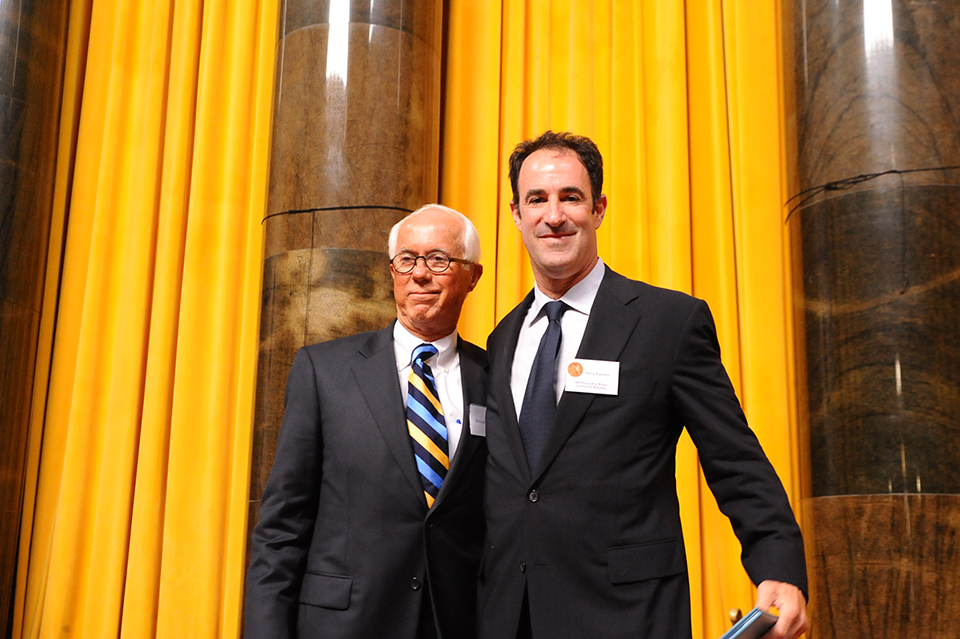
Richard Oppel, Pulitzer Board co-chair (left), presents the 2008 Pulitzer Prize in International Reporting to Steve Fainaru of The Washington Post.
Winning Work
Four Hired Guns in an Armored Truck, Bullets Flying, and a Pickup and a Taxi Brought to a Halt. Who Did the Shooting and Why?
By Steve Fainaru
Washington Post Foreign Service
On the afternoon of July 8, 2006, four private security guards rolled out of Baghdad's Green Zone in an armored SUV. The team leader, Jacob C. Washbourne, rode in the front passenger seat. He seemed in a good mood. His vacation started the next day.
"I want to kill somebody today," Washbourne said, according to the three other men in the vehicle, who later recalled it as an offhand remark. Before the day was over, however, the guards had been involved in three shooting incidents. In one, Washbourne allegedly fired into the windshield of a taxi for amusement, according to interviews and statements from the three other guards.
Washbourne, a 29-year-old former Marine, denied the allegations. "They're all unfounded, unbased, and they simply did not happen," he said during an interview near his home in Broken Arrow, Okla.
The full story of what happened on Baghdad's airport road that day may never be known. But a Washington Post investigation of the incidents provides a rare look inside the world of private security contractors, the hired guns who fight a parallel and largely hidden war in Iraq. The contractors face the same dangers as the military, but many come to the war for big money, and they operate outside most of the laws that govern American forces.
The U.S. military has brought charges against dozens of soldiers and Marines in Iraq, including 64 servicemen linked to murders. Not a single case has been brought against a security contractor, and confusion is widespread among contractors and the military over what laws, if any, apply to their conduct. The Pentagon estimates that at least 20,000 security contractors work in Iraq, the size of an additional division.
Private contractors were granted immunity from the Iraqi legal process in 2004 by L. Paul Bremer, head of the Coalition Provisional Authority, the U.S. occupation government. More recently, the military and Congress have moved to establish guidelines for prosecuting contractors under U.S. law or the Uniform Code of Military Justice, but so far the issue remains unresolved.
The only known inquiry into the July 8 incidents was conducted by Triple Canopy, a 3 1/2 -year-old company founded by retired Special Forces officers and based in Herndon. Triple Canopy employed the four guards. After the one-week probe, the company concluded that three questionable shooting incidents had occurred that day and fired Washbourne and two other employees, Shane B. Schmidt and Charles L. Sheppard III.
Lee A. Van Arsdale, Triple Canopy's chief executive officer, said the three men failed to report the shootings immediately, a violation of company policy and local Defense Department requirements for reporting incidents. He said Triple Canopy was unable to determine the circumstances behind the shootings, especially since no deaths or injuries were recorded by U.S. or Iraqi authorities.
"You have to assume that, if someone engages, he is following the rules and that he did feel a threat," Van Arsdale said, adding that conflicting accounts, delays in reporting the incidents and lack of evidence made it impossible to determine exactly what provoked the shootings. Triple Canopy officials said they have lobbied for more regulation of contractors since 2004 to better define how incidents such as the July 8 shootings are reported and investigated.
Many details about the shootings are in dispute. This account is based on company after-action reports and other documents, court filings, and interviews with current and former Triple Canopy employees, including all four men riding in the armored Chevrolet Suburban that day.
Schmidt and Sheppard said they were horrified by what they described as a shooting rampage by Washbourne and waited two days to come forward because they feared for their jobs and their lives. The two have sued Triple Canopy in Fairfax County Circuit Court, arguing that the company fired them for reporting a crime.
But another man in the vehicle, Fijian army veteran Isireli Naucukidi, said Sheppard, who was driving, cut off the taxi on Washbourne's orders, giving him a better shot. Naucukidi said the three American guards laughed as they sped away, the fate of the Iraqi taxi driver unknown. Schmidt told Washbourne, "Nice shot," according to Naucukidi.
Naucukidi also said that Schmidt was responsible for an earlier shooting incident that afternoon involving a white civilian truck, and that he believed Schmidt and Sheppard had blamed Washbourne to cover up their own potential culpability. Schmidt denied responsibility for that shooting but acknowledged in an interview he had fired a warning shot into the grille of a car on a separate airport run that morning and had failed to report it.
Naucukidi left Triple Canopy on his own shortly after the incidents occurred. Company officials said he was not fired because, unlike the three other guards, he had reported the shootings immediately. During an interview on the Fijian island of Ovalau, where he farms, Naucukidi said he decided not to return to Triple Canopy because "I couldn't stand what was happening. It seemed like every day they were covering something" up.
The presence of heavily armed guards on the battlefield has long been a wild card in the Iraq war. Insurgents frequently attack them. Iraqi civilians have expressed fear of their sometimes heavy-handed tactics, which have included running vehicles off the road and firing indiscriminately to ward off attacks.
Current and former Triple Canopy employees said they policed themselves in Iraq under an informal system they frequently referred to as "big boy rules."
"We never knew if we fell under military law, American law, Iraqi law, or whatever," Sheppard said. "We were always told, from the very beginning, if for some reason something happened and the Iraqis were trying to prosecute us, they would put you in the back of a car and sneak you out of the country in the middle of the night."
Naucukidi said the American contractors had their own motto: "What happens here today, stays here today."
June 2: Hilla
Washbourne sported a shaved head, a goatee and a mosaic of tattoos and piercings on his muscular, 6-foot-3-inch frame. He led one of two teams on Triple Canopy's "Milwaukee" project, a contract to protect executives of KBR Inc., a Halliburton subsidiary, on Iraq's dangerous roads. He earned $600 a day commanding a small unit of guards armed with M-4 rifles and 9mm pistols, the same caliber weapons used by U.S. troops.
The men referred to each other by their radio call signs. Washbourne was "JW," his initials. Sheppard, a former U.S. Army Ranger, was "Shrek," for his resemblance to the cartoon monster. Schmidt, a former Marine sniper, was "Happy," an ironic reference to his surly demeanor. Naucukidi was "Isi," an abbreviation of his first name.
Schmidt and Sheppard earned $500 a day. Naucukidi earned $70 a day for the same work.
One of the largest security firms in Iraq, Triple Canopy was known for its elite, disciplined guards, including many Special Operations veterans from all branches of service. The company provides security at some checkpoints inside Baghdad's Green Zone. But Triple Canopy officials said the company is not responsible for protecting the Iraqi parliament building, where a bomb Thursday killed at least one person and wounded at least 20.
On the Milwaukee project, Washbourne came to symbolize a lack of discipline that was a departure from the company's approach, according to several current and former employees.
Unlike the U.S. military, which prohibits drinking, Triple Canopy employees ran their own bar, called the Gem, inside the Green Zone. Washbourne sometimes drank so heavily his subordinates had to roust him for his own operations briefings, four current and former employees said. Washbourne said he drank, but seldom to excess.
An incident a month before the shootings underscored doubts among his colleagues about Washbourne's leadership, several of them said. On June 2, Washbourne was leading a convoy to a State Department compound in Hilla, about 60 miles south of Baghdad. The Suburban in which he was a passenger jumped a curb at a high rate of speed, shattering the axles and halting the exposed SUV in the middle of the highway.
A blue civilian truck suddenly flew around a blind curve and headed toward the convoy, according to Washbourne and Naucukidi, who was riding with him that day. Washbourne fired more than a dozen rounds into the oncoming truck with his M-4, wounding the driver. He later said he felt threatened. Washbourne then insisted on torching his damaged SUV with incendiary grenades instead of having it towed.
Washbourne said he was following standard operating procedure, which calls for a vehicle to be destroyed once it is disabled to prevent it from falling into the hands of insurgents.
Naucukidi said Washbourne ordered the guards to tell investigators that the convoy had been attacked by insurgents, even though many of them believed it had merely been involved in a traffic accident. Washbourne insisted that a small explosion precipitated the incident and that the SUV had been run off the road by another vehicle.
When the team returned to Baghdad, Naucukidi said, it was met by Ryan D. Thomason, a close friend of Washbourne's who was serving as acting project manager.
"What happens here today, stays here today," Thomason said, according to Naucukidi. "Good job, boys."
Thomason instructed the team not to discuss the incident for security reasons, said his attorney, Michael E. Schwartz. Triple Canopy recently opened a separate investigation into the incident after new information about it surfaced during litigation over the July 8 shootings.
July 8: Baghdad Airport
The July 8 afternoon run was to be Washbourne's last before he returned to Oklahoma. The team was to travel to Baghdad International Airport to pick up a client, then return to the Green Zone.
Washbourne, as team leader, led a pre-mission briefing in the parking lot. As the briefing concluded, according to Naucukidi, Washbourne cocked his M-4 and said, "I want to kill somebody today."
Naucukidi said he asked why. He recalled that Washbourne replied: "Because I'm going on vacation tomorrow. That's a long time, buddy."
In an incident report that he later submitted to Triple Canopy, Sheppard wrote that Washbourne also informed him that he was "going to kill someone today." In an interview, Schmidt said he heard a similar remark. Washbourne denied making any comment about his hope or intention to kill that day.
Naucukidi said he didn't take the comment seriously, because Washbourne frequently made similar jokes. "He did this really every mission: 'Okay, let's go shoot somebody,'" Naucukidi said.
Washbourne sat in the front passenger seat of the "follow" vehicle -- the third Suburban in a three-truck convoy, which included a lead vehicle, filled with guards, and what they called the "limo," a Suburban used to ferry the client. Sheppard drove. Schmidt and Naucukidi sat behind them facing backward to protect against a rear attack.
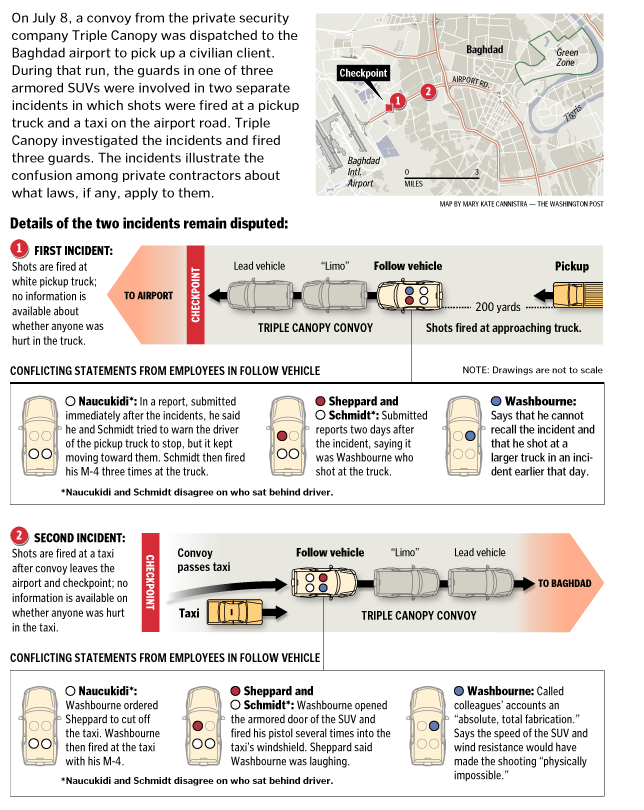
The four men agree on what happened next. The convoy arrived at Checkpoint 1, just outside the airport, and set up a blocking position to allow the lead vehicle and the "limo" to proceed through the checkpoint. The contractors noticed a small white pickup truck moving up slowly behind them from a distance of about 200 yards.
At this point, the stories diverge.
Naucukidi said Sheppard moved the Suburban to give Schmidt a better view. Naucukidi said that he and Schmidt tried to warn the white truck to stop but that it was still moving forward when Schmidt fired three times with his M-4. He said the truck stopped immediately but was still too far away for the men to see where the bullets hit.
Naucukidi also said the truck was too far away and was moving too slowly to pose a threat.
Schmidt and Sheppard waited two days before coming forward, then gave nearly identical accounts of what happened. Both said that it was Washbourne who shot at the white truck and that he fired intentionally into the windshield. "His intention was to kill," said Schmidt, who claimed he saw a "splash" of glass from the bullets striking the windshield.
Schmidt and Sheppard said Washbourne warned them not to mention the incident, quoting him as saying, "That didn't happen, understand?"
Washbourne said he only recalled firing two warning shots at a much larger white truck in an incident during a different run that morning. Naucukidi said he believes Washbourne is confusing that shooting with yet another incident that had occurred at the same location a few days earlier.
"There was no comments about 'That didn't happen, you understand,' or anything," Washbourne said.
"I am not a clever or witty man; I don't say things like that," he said. "And I'm not a morbid or sadistic" person.
July 8: Route Irish
The convoy continued through the checkpoint to pick up the KBR executive at the airport. It then left the airport and began the return trip.
Sheppard wrote that he observed "an Ambulance and a lot of activity" where the shooting had taken place. He and Schmidt said Washbourne threatened them again not to say anything.
Washbourne denied making any threats and said no ambulance was parked near the checkpoint. Naucukidi also said he did not see an ambulance.
The convoy continued down the airport road, called Route Irish by the military and contractors, toward the Green Zone. It reached speeds of 80 miles per hour.
Schmidt, Sheppard and Naucukidi agree that the convoy then came upon a taxi.
According to the accounts of Schmidt and Sheppard, Washbourne remarked, "I've never shot anyone with my pistol before." As the Suburban passed on the left, Washbourne pushed open the armored door, leaned out with his handgun and fired "7 or 8 rounds" into the taxi's windshield, both wrote in their statements.
Schmidt wrote: "From my position as we passed I could see the taxi had been hit in the windshield, due to the Spidering of the glass and the pace we were travelling, I could not tell if the driver had been hit, He did pull the car off the road in an erratic manner."
Sheppard said Washbourne was "laughing" as he fired.
Washbourne called their accounts "an absolute, total fabrication." He said the Suburban's high rate of speed and the wind resistance would have made the shooting "physically impossible."
"There's not an ounce of truth in it. It did not happen," Washbourne said angrily. "And as far as the statement goes where I said, 'I've never shot anyone with my pistol,' that is a lie. It was never one time said."
Naucukidi said that Washbourne fired at the taxi with his M-4 and that he ordered Sheppard to cut off the taxi beforehand. Naucukidi said Sheppard followed the order and used the Suburban to slow down the taxi and give Washbourne a better position to shoot from.
"When we were slightly ahead, JW just opened his door and started shooting the taxi from where we were sitting," Naucukidi said in an interview.
Naucukidi described the taxi driver as a 60- to 70-year-old man. He said he saw one hole in the taxi's windshield but could not tell if the driver had been hit. He said the taxi abruptly stopped.
"From my point of view, this old man, he was so innocent, because he was ahead of us with a normal speed," Naucukidi said. "He couldn't have any danger for us."
Sheppard sped away to catch up to the rest of the convoy, according to Naucukidi, who added that the three Americans were laughing and that Schmidt reached over, tapped Washbourne on the shoulder and told him, "Nice shot."
"They felt that it was so funny," Naucukidi said.
Schmidt denied that he complimented Washbourne. "No, I don't get a thrill out of killing innocent people," he said. "That was a moment of shame."
Divergent Reports
When the convoy returned to the Green Zone, members of the team scattered.
Naucukidi said he immediately told his supervisor, Jona Masirewa, who served as a liaison between the Fijian contractors and the Americans, about the incidents. He said Masirewa instructed him to write up a report to use in case an investigation occurred.
Naucukidi wrote the one-page report on his laptop. It contained brief summaries of the two afternoon shootings.
Of the first incident, near the airport checkpoint, Naucukidi wrote that the white truck was approaching slowly and was 200 meters away when Schmidt opened fire: "Happy shot three (3) rounds from his M4 rifle, and the white bongo truck stopped."
In the second incident, Naucukidi wrote, the Suburban "over took one white taxi with an Iraqi single pack," or passenger. He wrote that "our team leader opened his door and fired three rounds at white taxi."
But Naucukidi said Masirewa feared losing his job and did not immediately turn over the report. "It was a difficult thing for us because we are TCNs," or third-country nationals, "and they are expats," Naucukidi said. "They are team leaders, and they make commands and reports on us. And the team leaders were always saying, 'What happens today, stays today,' and if something like that happens, the team leaders, they start covering each other up."
Masirewa, who is still employed by Triple Canopy in Iraq, did not return e-mails seeking comment.
By the time Washbourne went on vacation the following day, Schmidt and Sheppard had not reported the incidents. Schmidt said he was concerned about "catching a bullet in the head." Sheppard said he was so shaken he spent the night at another location inside the Green Zone.
But other employees did not believe that Schmidt and Sheppard feared for their safety. Rather, they said, the two men feared for their high-paying jobs and believed that Thomason, the assistant project manager, would throw his support behind Washbourne, his close friend.
On July 10, two days after the incidents on the airport run, Sheppard finally went to Asa Esslinger, another supervisor, and reported them to Triple Canopy management. 'Just a Rampant Day'
On July 12, back home in Oklahoma, Washbourne received a call on his cellphone from Triple Canopy's country manager, Kelvin Kai, he recalled later.
Washbourne said Kai asked him if he remembered any shooting incidents July 8. Washbourne said he told Kai that he had forgotten to file written reports. He said he rushed to his apartment from a Tulsa pizza restaurant and sent in the reports from his laptop.
Two hours later, Kai called again from Baghdad. "He said that allegations were made that it was just a rampant day, is I believe what he called it, of shooting and mayhem," Washbourne recalled. "I said, 'No, boss, you got those two reports.' "
Kai could not be reached for comment. Triple Canopy declined to make him available, citing the ongoing lawsuit.
The following day, Triple Canopy suspended Schmidt and Sheppard pending an internal investigation. No action was immediately taken against Washbourne because he was home on leave, according to the company.
"It is essential that we have your complete cooperation in reporting the facts and circumstances of all the activities not only to Triple Canopy but also to officials from DoD and KBR if necessary," wrote Tony Nicholson, a Triple Canopy vice president, in letters to Schmidt and Sheppard.
Triple Canopy said it took statements from 30 potential witnesses forits internal probe. One week later, the three guards were informed by Raymond P. Randall, a senior vice president of Triple Canopy, that they had been fired.
"I am personally disappointed that you failed to immediately recognize the seriousness of this breach of operating procedures and its potential impact on the company's reputation," Randall wrote.
The terminations did not preclude the possibility of future investigations by the military, Randall wrote.
Van Arsdale, a retired colonel in the Army's Delta Force and a winner of the Silver Star, said Triple Canopy reported the incidents to KBR and to military officials in the Green Zone.
Triple Canopy officials said that because of the seriousness of the allegations, they expected that the military would conduct a separate investigation to determine whether further action was warranted.
Lt. Col. Michael J. Hartig, the former director of security for the Green Zone, said Triple Canopy officials approached him in his office but did not specify the allegations. "They mentioned they had a couple guys do some things that were questionable on the road, and that was pretty much it," he said.
Hartig said he informed Triple Canopy that such incidents were "out of my venue." He said he referred the company to the Joint Contracting Command for Iraq and Afghanistan, which administers contracts. "I didn't want to get involved in this because I had enough going on in my life," Hartig said. "It was like, 'Here's the point of contact. Have a nice day.'"
Two military spokespeople said they were unaware of any investigations into the shootings. Maj. David W. Small, a spokesman for the United States Central Command, which oversees Iraq, said: "This is not a Centcom issue. It's whoever was running that contract."
"We're fighting a war here," Small said.
Staff writer Tom Jackman and staff researcher Julie Tate contributed to this report.
© 2007 The Washington Post Company
By Steve Fainaru
Washington Post Foreign Service
BAGHDAD -- Private security companies, funded by billions of dollars in U.S. military and State Department contracts, are fighting insurgents on a widening scale in Iraq, enduring daily attacks, returning fire and taking hundreds of casualties that have been underreported and sometimes concealed, according to U.S. and Iraqi officials and company representatives.
While the military has built up troops in an ongoing campaign to secure Baghdad, the security companies, out of public view, have been engaged in a parallel surge, boosting manpower, adding expensive armor and stepping up evasive action as attacks increase, the officials and company representatives said. One in seven supply convoys protected by private forces has come under attack this year, according to previously unreleased statistics; one security company reported nearly 300 "hostile actions" in the first four months.
The majority of the more than 100 security companies operate outside of Iraqi law, in part because of bureaucratic delays and corruption in the Iraqi government licensing process, according to U.S. officials. Blackwater USA, a prominent North Carolina firm that protects U.S. Ambassador Ryan C. Crocker, and several other companies have not applied, U.S. and Iraqi officials said. Blackwater said that it obtained a one-year license in 2005 but that shifting Iraqi government policy has impeded its attempts to renew.
The security industry's enormous growth has been facilitated by the U.S. military, which uses the 20,000 to 30,000 contractors to offset chronic troop shortages. Armed contractors protect all convoys transporting reconstruction materiel, including vehicles, weapons and ammunition for the Iraqi army and police. They guard key U.S. military installations and provide personal security for at least three commanding generals, including Air Force Maj. Gen. Darryl A. Scott, who oversees U.S. military contracting in Iraq and Afghanistan.
"I'm kind of practicing what I preach here," Scott said in an interview on the use of private security forces for such tasks. "I'm a two-star general, but I'm not the most important guy in the multinational force. If it's a lower-priority mission and it's within the capabilities of private security, this is an appropriate risk rade-off."
The military plans to outsource at least $1.5 billion in security operations this year, including the three largest security contracts in Iraq: a "theaterwide" contract to protect U.S. bases that is worth up to $480 million, according to Scott; a contract for up to $475 million to provide intelligence for the Army and personal security for the U.S. Army Corps of Engineers; and a contract for up to $450 million to protect reconstruction convoys. The Army has also tested a plan to use private security on military convoys for the first time, a shift that would significantly increase the presence of armed contractors on Iraq's dangerous roads.
"The whole face of private security changed with Iraq, and it will never go back to how it was," said Leon Sharon, a retired Special Operations officer who commands 500 private Kurdish guards at an immense warehouse transit point for weapons, ammunition and other materiel on the outskirts of Baghdad.
U.S. officials and security company representatives emphasized that contractors are strictly limited to defensive operations. But company representatives in the field said insurgents rarely distinguish between the military and private forces, drawing the contractors into a bloody and escalating campaign.
The U.S. military has never released complete statistics on contractor casualties or the number of attacks on privately guarded convoys. The military deleted casualty figures from reports issued by the Reconstruction Logistics Directorate of the Corps of Engineers, according to Victoria Wayne, who served as deputy director for logistics until 2006 and spent 2 1/2 years in Iraq.
Wayne described security contractors as "the unsung heroes of the war." She said she believed the military wanted to hide information showing that private guards were fighting and dying in large numbers because it would be perceived as bad news.
"It was like there was a major war being fought out there, but we were the only ones who knew about it," Wayne said.
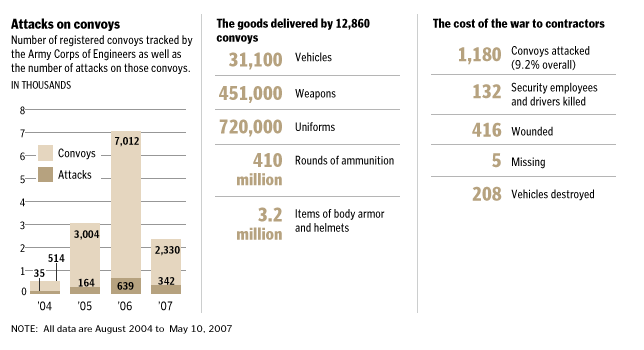
After a year of protests by Wayne and logistics director Jack Holly, a retired Marine colonel, the casualty figures were included. In an operational overview updated last month, the logistics directorate reported that 132 security contractors and truck drivers had been killed and 416 wounded since fall 2004. Four security contractors and a truck driver remained missing, and 208 vehicles were destroyed. Only convoys registered with the logistics directorate are counted in the statistics, and the total number of casualties is believed to be higher.
"When you see the number of my people who have been killed, the American public should recognize that every one of them represents an American soldier or Marine or sailor who didn't have to go in harm's way," Holly said in an interview.
According to the logistics directorate, attacks against registered supply convoys rose from 5.4 percent in 2005, to 9.1 percent in 2006, to 14.7 percent through May 10. The directorate has tracked 12,860 convoys, a fraction of the total number of private supply convoys on Iraqi roads.
"The military are very conscious that we're in their battle space," said Cameron Simpson, country operations manager for ArmorGroup International, a British firm that protects 32 percent of all nonmilitary supply convoys in Iraq. "We would never launch into an offensive operation, but when you're co-located, you're all one team, really."
ArmorGroup, which started in Iraq with 20 employees and a handful of SUVs, has grown to a force of 1,200 -- the equivalent of nearly two battalions -- with 240 armored trucks; nearly half of the publicly traded company's $273.5 million in revenue last year came from Iraq. Globally, ArmorGroup employs 9,000 people in 38 countries.
The company, with headquarters at a complex of sandstone villas near Baghdad's Green Zone, is acquiring a fleet of $200,000 tactical armored vehicles equipped with two gun hatches and able to withstand armor-piercing bullets and some of the largest roadside bombs.
The U.S. Labor Department reported that ArmorGroup has lost 26 employees in Iraq, based on insurance claims. Sources close to the company said the figure is nearly 30. Only three countries in the 25-nation coalition -- the United States, Britain and Italy -- have sustained more combat-related deaths.
A Turning Point
In spring 2004, Holly built the logistics network for Iraq's reconstruction from scratch. The network delivered 31,100 vehicles, 451,000 weapons and 410 million rounds of ammunition to the new Iraqi security forces, and items as varied as computers, baby incubators, school desks and mattresses for every Iraqi government ministry. The network came to rival the military's own logistics operation.
Holly also discovered he was at the center of an undeclared war.
He assembled a small private army to protect materiel as it flowed from border crossings and a southern port at Umm Qasr to the 650,000-square-foot warehouse complex at Abu Ghraib and on to its final destination.
"The only way anything gets to you here is if somebody bets their life on its delivery," said Holly, a burly civilian with a trimmed gray beard who strikes a commanding presence even in khakis, multicolored checked shirts and tennis shoes. "That's the fundamental issue: Nothing moves anywhere in Iraq without betting your life."
The most dangerous link in Holly's supply chain is shipping. It requires the slow-moving convoys to navigate Iraq's dangerous roads. Holly erected a ground-traffic control center in a low-slung trailer near his office in Baghdad's Green Zone. The security companies monitor their convoys in air-conditioned silence, which is shattered by a jarring klaxon each time a contractor pushes a dashboard "panic button," signaling a possible attack.
On May 8, 2005, after dropping off a load that included T-shirts, plastic whistles and 250,000 rounds of ammunition for Iraqi police, one of Holly's convoys was attacked. Of 20 security contractors and truck drivers, 13 were killed or listed as missing; five of the seven survivors were wounded. Insurgents booby-trapped four of the bodies. To eliminate the threat, a military recovery team fired a tank round into a pile of corpses, according to an after-action report.
The convoy had been protected by Hart Security, a British firm that used unarmored vehicles. Within a month, another Hart-led convoy was hit. The team leader informed the ground-control center by cellphone that he was running out of ammunition. He left the cellphone on as his convoy was overrun.
"We listened to the bad guys for almost an hour after they finished everybody off," Holly said.
The attacks represented a turning point in the private war.
Holly vowed he would never again use unarmored vehicles for convoy protection. He went to his primary shipper, Public Warehousing Co. of Kuwait, and ordered a change. PWC hired ArmorGroup, which had armed Ford F-350 pickups with steel-reinforced gun turrets and belt-fed machine guns.
Other companies followed suit, ramping up production of an array of armored and semi-armored trucks of various styles and colors, until Iraq's supply routes resembled the post-apocalyptic world of the "Mad Max" movies. Bolstered Tactics, Armor
ArmorGroup started in Iraq in 2003 with four security teams and 20 employees. It now has 30 mechanics to support its ground operation. "It's a monster," said Simpson, the country operations manager, strolling past a truck blown apart by a roadside bomb.
ArmorGroup operates 10 convoy security teams in support of Holly's logistics operation. The company runs another 10 to 15 under a half-dozen contracts, as well as for clients who request security on a case-by-case basis, Simpson said.
The company charges $8,000 to $12,000 a day, according to sources familiar with the pricing, although the cost can vary depending on convoy size and the risk. For security reasons, the convoys are limited to 10 tractor-trailers protected by at least four armored trucks filled with 20 guards: four Western vehicle commanders with M-21 assault rifles and 9mm Glock pistols, and 16 Iraqis with AK-47s.
The Western contractors, most with at least 10 years' experience, are paid about $135,000, the same as a U.S. Army two-star general. The Iraqis receive about a tenth of that.
"Every time I think about how it was at the beginning, arriving here with a suitcase and $1,000, and there was no one else around, it's just incredible," Simpson said. "Nobody envisioned that private security companies would be openly targeted by insurgents."
ArmorGroup prides itself on a low-key approach to security. Its well-groomed guards travel in khakis and dark blue shirts. The company's armored trucks are adorned with stickers issued by the Interior Ministry, where the company is fully licensed. Holly's former deputy, Victoria Wayne, said ArmorGroup turned down an opportunity to use more powerful weaponry as the insurgent threat increased.
"As a publicly traded company, they didn't want to be perceived as a mercenary force," she said.
But the company is under constant attack. ArmorGroup ran 1,184 convoys in Iraq in 2006; it reported 450 hostile actions, mostly roadside bombs, small-arms fire and mortar attacks. The company was attacked 293 times in the first four months of 2007, according to ArmorGroup statistics. On the dangerous roads north of Baghdad, "you generally attract at least one incident every mission," Simpson said.
Allan Campion, 36, who joined ArmorGroup after 18 years in the British infantry, said one of his convoys was recently attacked three times on a two-mile stretch outside Baghdad. One bomb exploded near the team leader's vehicle, but the convoy managed to continue, he said. Within minutes, another bomb exploded, followed by small-arms fire.
A firefight ensued as the convoy continued through the "kill zone," Campion said.
"We were still moving, so whether you've hit anybody or not, it's very hard to say," he said.
With the insurgents employing more-lethal roadside bombs, ArmorGroup has responded by changing tactics and spending $6.8 million to bolster its armor. Its new armored "Rock" vehicles are built on Ford F-550 chassis and are favored by ArmorGroup because of a V-shaped hull that provides better protection against roadside bombs.
Chris Berman, a former Navy SEAL who helped design the Rock for North Carolina-based Granite Tactical Vehicles, said its main deterrent is its twin gun hatches. "That gives you twice as much firepower," Berman said. "With two belt-fed machine guns in there, that's enough to chew up most people."
'Caught Up in the Mix'
Built on the site of a former Iraqi tank factory, the Abu Ghraib warehouse complex is known variously as Fort Apache, the Isle of Abu and Rocket City, a reference to when rockets and mortars frequently rained down on the compound.
The bleak, windswept facility consists of 64 buildings spread over a 1 1/2 -mile-long and half-mile-wide area; employees of Public Warehousing (now Agility) -- barricaded inside the fortress -- installed a driving range and a small fishing pond for entertainment. The perimeter is protected by double blast walls, guard towers equipped with belt-fed Dushka machine guns and uniformed Kurdish guards who answer to a military-style rank structure and carry AK-47 assault rifles.
Over the past two years, warehouse personnel "probably average four to six KIA a month and six to eight wounded a month," said Leon Sharon, the Falcon Security representative, dressed in a khaki military uniform with a "Falcon 6" patch identifying him as a field commander for the company.
"It's not a game," Sharon said. "People get killed here trying to go home. People trying to come here get killed because they work here. People on convoy escort get killed because of the materiel that we're shipping out of here. Truck drivers get killed because they get caught up in these ambushes. And you have security personnel who end up caught up in the mix. And the work has to go on as normal."
Attacks on Iraqi employees became so common that a trauma center was set up inside the main warehouse. Dozens of Iraqis, fearful of going home after work, live in barracks-style housing in the compound.
Sharon, 61, of Fort Lauderdale, Fla., is rail thin with a weathered, intelligent face shaped by chain-smoking and four decades of military work. He works out of a small office that is also his bedroom. A humidor sits on his desk. A U.S. flag covers his window. Cartons of Marlboro Reds are stacked behind him near a leather-bound copy of the Koran.
Sharon called Falcon Security a "private military company."
"When you have this many men, you don't manage it as you do a corporation. You manage it very much in the military style," he said. "My men aren't carrying potatoes; they're carrying AK-47s. It's not pilferage we're worried about. It's people storming the walls."
Falcon performs "a military-like role" in Iraq, he said, "with one key exception: We do not, and have no desire to, conduct offensive operations."
But even behind the blast walls, the private and public wars collide, Sharon said. Last year, insurgents attacked a passing U.S. military convoy on a highway outside the gates. Kurdish guards in one of the towers opened fire, killing two insurgents. "The Americans were thrilled," he said.
"All of the work that's being conducted here in Iraq by private security companies would have to be conducted by somebody, and that somebody is U.S. military personnel," he said. "If you had 500 soldiers here, that's 500 less soldiers that you have on the battlefield. And this isn't the only site. There are hundreds of sites around Iraq where you have private security. Where are you going to get this personnel?"
Sharon turns 62 in October. Asked when he planned to leave Iraq, he smiled.
"Last man here, please put the key under the door," he said.
Staff researcher Julie Tate contributed to this report.
© 2007 The Washington Post Company
Ambush in Iraq Last November Left Four Americans Missing And a String of Questions About the Firm They Worked For
By Steve Fainaru
Washington Post Foreign Service
BAGHDAD -- The convoy was ambushed in broad daylight last Nov. 16, dozens of armed men swarming over 37 tractor-trailers stretching for more than a mile on southern Iraq's main highway. The attackers seized four Americans and an Austrian employed by Crescent Security Group, a small private security firm. Then they fled.
None of the hostages has been found, eight months after one of the largest and most brazen kidnappings of Americans since the March 2003 invasion.
Crescent is shuttered, like dozens of other companies that have come and gone in Iraq's booming market for private security services. The firm leaves behind a trail of broken lives and a record of alleged misconduct. In March, the U.S. military barred Crescent from U.S. bases after it was found with weapons prohibited for private security companies, including rocket launchers and grenades, according to documents and interviews with former Crescent employees and U.S. officials.
An investigation by The Washington Post found that Crescent violated U.S. military regulations while being paid millions of dollars to support the U.S.-led mission in Iraq. The company routinely sacrificed safety to cut costs. On the day of the kidnappings, just seven Crescent guards protected the immense convoy as it drove through southern Iraq, a force that security experts described as inadequate to fend off a major attack.
Former senior managers with Crescent denied any wrongdoing and said the guards who were seized had been well equipped and simply failed to thwart the kidnappers.
"We pretty much catered to them. We spoiled them," said Scott Schneider, the company's former director of security. "You know, basically the operators screwed up," he added. "I mean, you hate to speak ill of people, but the way the situation transpired, they just made mistake after mistake" as the convoy came under attack.
Schneider oversaw Crescent's security operations for more than two years, despite having pleaded guilty, according to court records, to misdemeanor charges of breaking and entering and domestic violence in Michigan in the mid-1990s. Under U.S. law, it is a felony for domestic violence offenders to carry firearms, a prohibition that was adopted by the Defense Department for military and civilian personnel.
Crescent's managing partner, Franco Picco, said he fired Schneider, who earned $10,000 a month, after becoming aware of his criminal background shortly after the kidnappings.
Based in Kuwait City, about an hour from Iraq's southern border, Crescent was formed in 2003, part of a security industry that mushroomed overnight in Iraq in response to troop shortages and mounting insurgent attacks. By this year, the Private Security Company Association of Iraq, a trade group based in Baghdad's Green Zone, listed 177 active foreign and Iraqi security companies. The Pentagon has said that some 20,000 security contractors support the U.S.-led coalition, although some estimates are considerably higher.
The industry is largely unregulated by the U.S. and Iraqi governments, leaving companies to establish their own standards for operating on the battlefield.
This article is based on two eyewitness accounts of the ambush, company documents and interviews with former Crescent employees, including the four missing Americans. Two weeks before they were taken, the men expressed growing concern for their personal safety to a reporter traveling with them in Iraq.
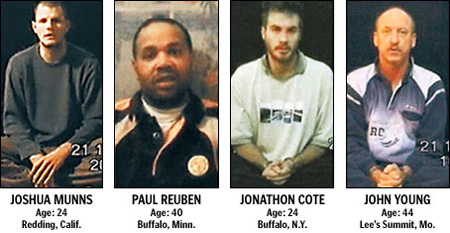
"We're not the badasses we used to think we were," said one of them, Paul Reuben, now 40, a former Marine from Buffalo, Minn., sitting in his Kuwait City dormitory on the eve of a convoy mission. "I realize I'm vulnerable."
The guards have not been seen since the Jan. 3 airing of a video made by their captors. Picco said he is convinced that the men are still alive. He said he has spent more than $300,000 seeking information about their fate and blamed U.S. and British authorities for failing to follow up leads that he believes would have led to their release.
"Alive or dead, I will bring them back," Picco said during an interview this month in Kuwait City, where he continues to run logistics and catering businesses. "Whether it takes me 10 years or a month. That's just the moral thing to do. . . . These guys are part of me."
Relatives of the missing men have begun to speak out publicly, providing some details about them and the ambush in newspaper articles and on Web sites. The families have offered a $150,000 reward for information leading to release of the men.
U.S. officials in Baghdad said the investigation is still open. "We have no information to indicate they are not alive, but we are concerned about their health and welfare," said U.S. Embassy spokesman Philip Reeker. "Efforts toward their safe recovery are a high priority for the United States."
There has been no communication from the captors, according to U.S. officials, Crescent and the families.
The attack and seizure have spotlighted Crescent's low-budget approach to private security and raised questions about whether the company was vulnerable to such an attack. Another missing guard, Jonathon Cote, now 24, a former Army paratrooper from Buffalo, N.Y., described Crescent as "ghetto" because of its relatively low pay, its minimal hiring standards and what he and other guards described as management's willingness to bend rules and cut corners.
"I've worked for a billion companies, and this is the worst I've ever worked for," said Brad Ford, a former Crescent guard who now works in Afghanistan for another security firm. "I couldn't believe how they were getting away with all the stuff they were getting away with."
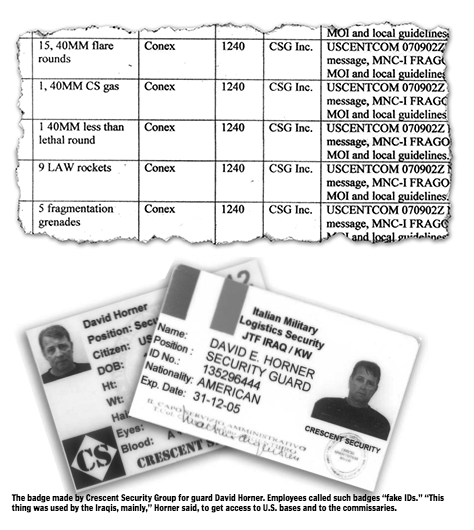
Crescent crafted its own military identification badges to enable its employees -- including unscreened Iraqis -- to gain admittance to U.S. bases, according to several former guards, two of whom provided copies of the badges. Some guards smuggled weapons and liquor across the Iraq-Kuwait border in secret compartments they referred to as stash boxes, the former employees said. As attacks became more frequent and lethal, Crescent continued to armor its gun trucks -- black Chevrolet Avalanches with belt-fed machine guns mounted in back -- with steel plates welded inside the doors, even though some guards had requested additional protection.
The company often hired guards with little or no experience. Reuben, the company medic, was a self-described alcoholic who was not certified as an emergency medical technician and had resigned as a suburban Minneapolis police officer in 2003 after a drunk-driving violation. David Horner, 54, a truck driver from Visalia, Calif., said Crescent hired him over the Internet in 2005 and put him to work immediately, even though he had not served in the military since 1973 and had never picked up an AK-47, the automatic assault rifle used by many of the company's guards.
On Nov. 16, Crescent's trucks pushed into Iraq without any of the firm's Iraqi guards, leaving the ill-fated convoy severely undermanned. The company also had not filed paperwork with the ground-control center in Baghdad that monitors nonmilitary convoys, according to those authorities, who still do not list the Crescent hostages among their casualty figures for killed, wounded and missing because the convoy was unregistered. That oversight limited Crescent's communication with the command center responsible for coordinating the military's emergency response to attacks on civilian convoys.
Security experts described the lapses as unconscionable. "It's insane. I don't know how you could sleep," said Cameron Simpson, country operations manager for ArmorGroup International, a British firm that protects one-third of all nonmilitary convoys in Iraq. ArmorGroup normally assigns 20 security contractors to protect no more than 10 tractor-trailers.
Picco said employees such as Reuben, who had previously worked for two other security companies, were presumed to have been vetted before joining Crescent. He said the company shunned fully armored trucks, not to save money but because guards preferred vehicles that allowed them to return fire and maneuver more easily. Picco's deputy, Paul Chapman, said the Italian military, which held the contract, was responsible for monitoring the convoy, even though private companies provided the trailers as well as security.
"We tried to be 110 percent legal in everything we did," Chapman said, adding that Crescent was licensed by the Iraqi Interior Ministry.
Picco said the team leader that day, John Young, 44, an Army veteran and carpenter from Lee's Summit, Mo., made the decision to leave a team of Iraqis behind without the company's knowledge and went into Iraq with just seven Western guards to protect the 37 trailers. "I think complacency set in," Picco said. "Why would you leave a complete team behind?"
But Andy Foord, a Crescent guard from Britain who was left bound inside a truck as the kidnappers fled, said in an interview that none of the Iraqi guards had reported for work that morning. He said Young informed Crescent's operations center in Kuwait City that the undermanned convoy intended to proceed into Iraq. "They knew, because John called them from the Iraq border," Foord said.
Several former Iraqi employees of Crescent were spotted among the kidnappers, according to Foord and a written report by Jaime Salgado, another guard who was left behind and later freed. Foord said he believes the attack was set up by an Iraqi interpreter who had advance knowledge of the mission.
Crescent is "blaming these boys, and they're not here to answer about it themselves," said Sharon DeBrabander, the mother of Young, the missing team leader. "I don't think that's right. They're covering up their butts, that's what they're doing."
'I Only Came Over Here For the Money'
"War is inevitable. You cannot cancel it. You can only postpone it to your advantage." That message was scrawled on a dry erase board in Picco's Kuwait City office.
Picco, 38, who was born in Italy and reared in South Africa, formed Crescent in 2003, initially to protect trucks belonging to his shipping company, Mercato del Golfo.
"Everyone knew when Iraq opened up there was going to be money to be made," he said.
As business boomed but security deteriorated, Crescent expanded. The company gained a reputation for traveling to the riskiest destinations, often for half as much as its competitors. At its peak, it earned $600,000 to $800,000 a month providing convoy protection, according to Picco, and was profiled in a 2006 book on private security contracting, "A Bloody Business," by Gerald Schumacher, a retired U.S. Special Forces colonel.
"We protect the military. Isn't that mind-boggling?" Picco said in an interview last November. "And I'm talking about escorting soldiers, as well. Isn't that frightening?"
Most of Crescent's employees were military and law enforcement veterans willing to accept extreme risk in exchange for fast money and adventure. Crescent handed out monthly pay in envelopes stuffed with Kuwaiti dinars. The guards took the money to currency exchange houses, which transferred the funds into their bank accounts.
"All you're thinking about is the money," said Chris Jackson, 28, a former Marine from Salem, N.H. "You have $50,000 in the bank, and all you're thinking about is, 'Another month and I'll have $57,000, another month and I'll have $64,000.' " By the end of last year, Jackson said, he had saved $55,000, even after splurging on Las Vegas vacations and a $5,000 Panerai watch.
"I hate to say it, but I am so thankful for this war," he said. "I only came over here for the money, and I didn't even know I could do this job until two years ago. I didn't know it was available to me."
Crescent's Iraqi employees were recruited by word of mouth; most lived around the southern city of Basra, a hotbed of Shiite militias, and were largely unknown to the company. Crescent used a two-tiered pay scale. Guards from the United States, Britain and other Western countries earned $7,000 a month or more. Iraqi guards earned $600 -- roughly $20 a day -- but performed the most dangerous work, including the manning of belt-fed machine guns while exposed in the back of the Avalanches.
Picco said the system was not ideal but was necessary to hold down costs. "To put 12 white people on a team, it's not economically viable," he said.
Before the attack, relations between the Western and Iraqi guards had deteriorated. Foord said the Iraqis were refusing to man the machine guns. After a rash of thefts, Crescent fired a group of Iraqi guards on his recommendation, Foord said.
One month before the kidnappings, Crescent's entire stockpile of weapons -- dozens of AK-47s, PKM machine guns, grenade launchers, thousands of rounds of ammunition, body armor -- disappeared from locked shipping containers at a compound across the border in Iraq, Picco and several former employees recalled.
Picco said he sent out one of his Iraqi employees with $50,000 to buy new weapons on the black market. Some of the guns came back with serial numbers matching those on the stolen weapons.
'There Was No Place They Couldn't Go'
Last August, three months before the attack, a Crescent-led convoy was transporting trucks to an Iraqi army compound in Numaniyah, about 50 miles southeast of Baghdad. On an isolated stretch of Main Supply Route Tampa, the principal highway in southern Iraq, a bomb struck a Crescent gun truck carrying three Iraqi guards. One died within minutes. Another was pinned inside the truck, his hands severed and his femur protruding from his pants-leg.
Reuben, the former suburban Minneapolis police officer who served as the company medic, reached for his trauma kit. But Crescent had failed to provide him with tourniquets and morphine, Reuben recalled before he was seized, so he tried to stanch the bleeding with swatches of fabric he tore from his armored vest. The driver remained conscious for 45 minutes but bled to death, Reuben said. "If they saw what I saw, they would get what we need," he said.
Picco said Crescent gave Reuben all the medical supplies he asked for, suggesting that any shortages stemmed from his own failure to ask.
A friendly, heavy-set man who turned 40 shortly after he was kidnapped, Reuben wore an EMT cap but said his training came mostly from first-aid courses and books. He said he now drank alcohol only occasionally. Schneider, Crescent's former director of security, said that the company was aware of Reuben's history of alcoholism but added that Reuben had been "cleaning himself up."
"In this job, as long as you have people willing to work for the money, you don't need a medic," said Cote, the missing former paratrooper. "The military is different, because you care about your soldiers, and they're doing it for service and commitment. For us, it's like a paycheck. I still think you should have some necessities, but you don't always get those."
For employees unable to obtain the military identification badges needed to gain access to U.S. bases, Crescent created its own Italian security cards in Kuwait City, according to former employees.
"This thing was used by the Iraqis, mainly, to get them on base and get them in the commissaries," said Horner, one of the guards. "It worked sometimes -- sometimes. They could flash this Italian logistics security card, and depending on how sharp the guard was decided whether they could go in."
Horner said the Iraqis were instructed to identify themselves as Egyptians to avoid arousing suspicion. He said the Iraqis and some Western contractors used the ID cards to gain admittance to the Green Zone in Baghdad; Camp Victory, near Baghdad International Airport; and Logistics Support Area Anaconda, the largest U.S. base in Iraq.
"There's no place they couldn't go," Horner said of the Iraqis. "They could have been mapping the whole damn place, and we never would have known."
Schneider acknowledged that Crescent made its own badges but said they were used only in Italian-run sectors. "We made them up, but they were recognized, so I guess you could call them official," he said. Picco said that the Italian military had authorized Crescent to make its own badges and that he had distributed them judiciously.
The badges were not fake, he said, even though Crescent guards referred to them as fake IDs.
"That's not a fact, it's just an expression," Picco said.
'You Are Going to Die'
The route scheduled for Nov. 16 was regarded as safe by the Crescent guards. They made the run almost daily, part of a long-standing contract to assist the Italian military, which was withdrawing its troops and equipment from Tallil Air Base near Nasiriyah, where Picco also operated a restaurant and a pizza joint for soldiers.
The mood at the border had been tense for months. Iraqi border police had confiscated trailers from several convoys, including Crescent's. Foord, the British guard, said that the week before, he had resisted border police officers' efforts to steal a truck, sparking a confrontation in which an Iraqi officer pointed a gun at his head. The incident closed the border for six hours, Foord said.
Crescent normally traveled with at least two or three Iraqi guards in each vehicle. The Iraqis would join the convoy at Wolf's Den, a border compound named after a Crescent employee who was killed in 2004.
On the day of the kidnapping, the Crescent team crossed the border two hours early and found just one Iraqi waiting for them. He was Wissam Hisham, an interpreter nicknamed "John Belushi" because of his resemblance to the late actor.
The rest of the Iraqi team wasn't there. "We tried to contact them, but we couldn't get through on the phones," Foord said. "That usually means that they don't want to run that day. It wasn't the first time they hadn't shown up. The team made a decision just to roll with it and hopefully hook up with the Iraqi team later." Foord said he believed the guards had become complacent about the run to Tallil, which Crescent had made hundreds of times without incident.
According to Picco, a team of Iraqi guards was in fact waiting. He first said the Iraqi team had 11 experienced members, then later said there were only seven.
"There was only one -- John Belushi," Foord said, adding that he believes the interpreter set up the ambush. "Not 11, not seven, just Belushi."
The trucks snaked past Safwan, an Iraqi border city, and continued north before approaching an overpass known as Bridge 3. The point vehicle, occupied by Cote and Joshua Munns, a 24-year-old former Marine from Redding, Calif., sent word over the radio that a police checkpoint was blocking the road.
Foord stopped his Avalanche in the middle of the highway at the rear of the halted convoy. An unmarked truck suddenly roared up beside him carrying 10 armed men. One stuck an AK-47 inside the passenger door and fired, narrowly missing him as he threw his head back, according to an 11-page account he gave military investigators after the kidnapping.
Foord said he accelerated and raced to the front of the convoy in the southbound lane while the gunmen pumped rounds into his truck with their automatic weapons.
When he reached the front of the convoy, the rest of the Crescent guards were lined up on their knees by the side of the road, Foord said. But Hisham, the interpreter, appeared to be participating in the kidnapping, according to Foord's account. Foord said Hisham accused him of shooting one of the Iraqi gunmen and screamed: "You are going to die . . . now you are going to die."
A man in civilian clothing intervened and forced Foord to his knees near the other Crescent guards -- Cote, Munns, Young, Reuben and Bert Nussbaumer, 25, an Austrian. Foord said he spotted "30-40" armed men, including at least four wearing suits who appeared to be in charge. The gunmen bound the guards with handcuffs, cloth tape and a power cord and began to load them into vehicles.
Crescent guard Salgado, a Chilean who later gave a one-page statement in fractured English, said he recognized "4 of the guys" participating in the attack as former Crescent employees.
Foord and Salgado were placed together in Salgado's GMC Yukon. Salgado said the attackers were unable to locate the keys to his truck.
"Suddenly they get a telephone call and start to move fast," Salgado's account said. As the attackers began to flee, a white pickup packed with gunmen roared up beside the two men, according to Foord's report. But it had no room for them.
"Jaime and myself appeared to have been left behind because they had lost the keys to his Yukon and had no space in any of the other vehicles," Foord said. The abductors roared off.
Several minutes later, two American Humvees approached from the south.
"I was still waiting for the bullet in the back of the head," Foord said.
The Americans cut loose Foord and Salgado and escorted the tractor-trailers back to the border. Most of the drivers that day were Pakistani. Nine drivers were seized and almost immediately released. Nineteen trailers were taken; some were recovered. Crescent sent out a team to retrieve the company's vehicles.
There has been no word about the hostages since the Jan. 3 video showing the five Crescent guards. The video opened with an image of the Koran and a map of Iraq, then the words, "The National Islamic Resistance in Iraq: The Farqan (Quran) Brigades takes responsibility for the kidnapping in Safwan, Basra."
In January, Crescent made a lump-sum payment of $3,500 -- half a month's pay -- to each of the missing men's families. The company said it has set aside three months' salary for each guard, to be paid on their release.
'This Will Never Happen Again'
After the kidnappings, Picco moved Crescent to Tallil Air Base. The company cut its staff and ran occasional security missions while waiting for news about the hostages.
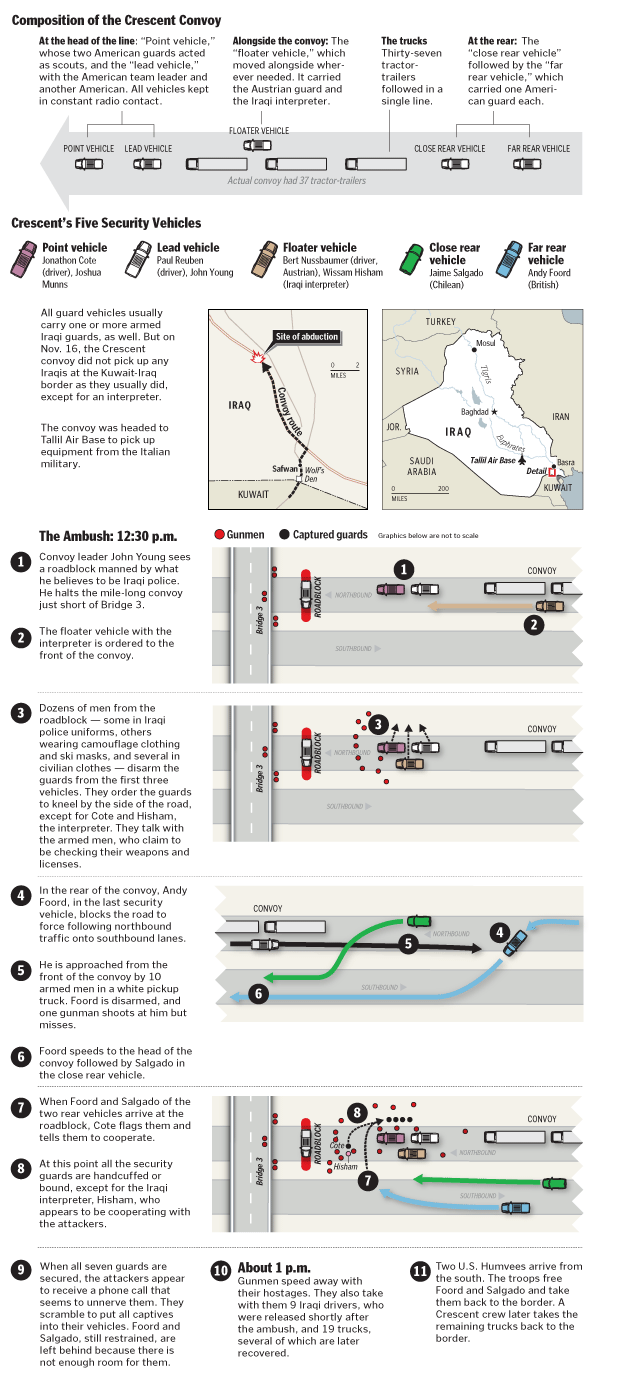
On Feb. 1, U.S. military police entered Crescent's living quarters and found 143 cans of beer, illegal steroids and an assortment of weapons that private security companies are prohibited from possessing under U.S. military regulations, including seven fragmentation grenades, a Bushmaster rifle with its serial number removed and four antitank weapons known as LAW rockets, according to a memorandum the military later sent to Crescent.
A month later, the military opened shipping containers belonging to Crescent and found more banned weapons, including four .50-caliber machine guns, 2,200 rounds of .50-caliber ammunition and nine more LAWs.
The Army informed Picco and Crescent Security that the company had been banned from U.S. bases "due to blatant disregard" of the arming guidelines for U.S. and Iraqi private security companies, according to the memorandum.
Picco protested that the weapons were legal and that Crescent was being targeted for unknown reasons, possibly related to the November ambush and seizure. But on March 6, before closing Crescent down, he signed a brief statement.
"I accept full responsibility for my company's non-compliance with established guidance and understand that any future infractions will result in additional barment from this installation," the statement said. "I assure you this will never happen again."
Crescent's vehicles, including Andy Foord's bullet-pocked Avalanche, sit idle in a dirt parking lot outside Kuwait City. The company continues to maintain a Web site, still featuring its motto: "Integrity-Commitment-Success."
Tomorrow: Why they came to Iraq.
© 2007 The Washington Post Company
Diverse Motives Drew Men To Chaotic, Perilous Work
By Steve Fainaru
Washington Post Foreign Service
ON MAIN SUPPLY ROUTE TAMPA, Iraq -- Surrounded by darkness, an AK-47 at his side, Jonathon Cote considered his future from the driver's seat of a black Chevy Avalanche hurtling through southern Iraq early last November.
Months earlier, Cote had been a reluctant accounting major at the University of Florida, a popular 23-year-old freshman who'd enrolled after four years in the Army. Cote pledged Sigma Phi Epsilon fraternity and collected $5 covers at a bar called the Whiskey Room. He drove a red Yamaha R1 motorcycle around campus until one evening he did a wheelie and was arrested for drunk driving.
Broke and despondent, Cote spoke to an Army buddy, who told him he could make $7,000 a month protecting supply convoys in Iraq. On his days off, his friend told him, he'd get to go jet-skiing on the Persian Gulf. Cote was concerned that he might lose his Florida driver's license, but in Iraq he would pilot a company "gun truck" with a belt-fed machine gun mounted in back.
"Basically I was looking for a feeling that I didn't have, and this job provided that," Cote said, his iPod set to shuffle as he steered his truck through the soft Iraqi night. "It's a distraction from the DUI, how I couldn't find a degree that I liked in college. And then there's the money. I have $30,000, and I'm going back to school with a plan."
"Life-threatening situations straighten you up fast," he said.
He had already announced his intention to return home on his U.S. voice mail and had picked a new major, exercise physiology.
On Nov. 16, Cote's plan was undone by the realities of Iraq. Driving their gun trucks along the same stretch of highway where he had sketched his future, he and four colleagues from Crescent Security Group, a small private firm, were ambushed and taken hostage. The status of the four Americans and one Austrian, 25-year-old Bert Nussbaumer of Vienna, is unknown. Cote's 24th birthday passed Feb. 11. His drunk-driving case was dismissed after the seizure.
Two weeks before the attack, the four Americans spoke at length to a Washington Post reporter traveling with them in Iraq. Together, their stories describe the diverse motivations of the private security guards whose numbers have proliferated since the start of the war, with tens of thousands of armed civilians taking on some of the most dangerous tasks.
All four missing Americans are military veterans; two -- Cote and Joshua Munns, a 24-year-old former Marine from Redding, Calif. -- did combat tours in Iraq. Their comments reveal men acutely aware of their vulnerability, yet driven by life choices that transcend mercenary stereotypes. To a man, they said they had come to Iraq for fast money. But they were also lured by the camaraderie they had known in the military, the continuous rush of adrenaline, the opportunity to see history unfold and the chance to escape mundane lives back home.
"This is me, okay? This is me," said John Young, who led the Crescent team that was ambushed and is among the missing. Young, 44, of Lee's Summit, Mo., is 5-foot-8 and thin, with a shaved head, blond mustache and piercing blue eyes. After leaving the Army in 1991, he worked as a carpenter in a family business before joining Crescent in 2005. He has a 15-year-old daughter, Jasmyn, and a 19-year-old son, John Robert.
Young had decided to keep returning to Iraq, even after a bullet took a chunk out of the collar of his armored vest and threw him into the steering wheel as he escorted a convoy through Baghdad one afternoon.
The tattered vest that saved him was displayed on a wooden table in a conference room at Crescent's Kuwait City offices.
"I want to have a normal life -- I always have -- but I've always known that I'm not that kind of person," Young said.
"I've spent an entire lifetime trying to explain it to myself. I mean, my children are a big thing to me. I'm not saying I'm the best dad in the world, but I love my children. I want to see my daughter get married. I want to see my son graduate. I want normal things in life. But I'm not normal."
The conversations took place in the cabs of the Crescent gun trucks as the guards drove through the Iraqi desert; during long waits before they crossed the sand-choked Kuwait-Iraq border; at Popeyes, T.G.I. Friday's and other Kuwait City restaurants that reminded them of home; and in their spare, dormitory-style rooms, filled with video game players and televisions and family pictures, where they passed time between missions.
At the time of the kidnapping, Crescent had 17 Western employees, from the United States, Britain, Chile, Austria and New Zealand, according to Franco Picco, the company's managing partner. Paul Chapman, Picco's deputy, said Crescent received roughly 600 job applications from abroad each month.
The company closed down within months of the attack.
"To me, this is a prestigious job," Cote said before the ambush and seizure.
"There's only a certain percentage of people who are doing this. It's like a hidden, secret part of the war, and if I could be part of that hidden, secret thing, it would be cool, you know? It's kind of like being part of history. People are gonna be like, 'Oh, man, remember the war? Where were you?' I was here. I was here."
'It's Not the Getting Hit Part That Bothers Me'
Crescent operated out of a quiet sandstone villa in Kuwait City, across the street from a mosque. The guards lived in rooms with wireless Internet, twin beds, wooden desks and concrete floors. Before dawn, as the Muslim call to prayer echoed through the courtyard, the men, clad in khakis and black shirts with a white Crescent logo, climbed into their trucks to make the one-hour drive to Iraq.
After reaching Camp Navistar, a border staging base, the men fueled their vehicles, then waited in a dirt lot in the heat for clearance to cross into Iraq. The constant rumble of Humvees, Bradley Fighting Vehicles and tractor-trailers filled the air with dust and the stench of diesel fumes. The wait could last for hours.
"I haven't been home in four months," said Paul Reuben, a former Marine, as he waited at the border one morning.
Reuben turned 40 eight days after he was seized. He stands 6-foot-4, weighs 260 pounds and smiles almost continuously, his beard and gentle manner giving him the look of an overstuffed teddy bear. Reuben has a twin brother, Patrick, a Minneapolis police officer, twin 16-old-daughters, Bree Anne and Casey Nicole, and a 16-year-old stepson, Terrell. He resigned from the St. Louis Park, Minn., police department in 2003 after a drunk-driving arrest. Reuben said he applied online for private security jobs and was hired immediately.
Waiting at the staging base, Reuben said he was exhausted from having worked "72 or 73 days straight" and jittery from fending off constant attacks. Two weeks earlier, he'd thought he heard fireworks while driving through Basra, a city racked by militia-fueled violence, but quickly realized the explosions were a volley of rocket-propelled grenades aimed at his convoy.
"The RPG attacks were the scariest thing I've ever seen," he said.
Reuben went back and forth about whether to stay on. He weighed the risk and time away from his family against the cash, which never seemed to be enough, and the appeal of the warrior lifestyle.
"I kind of like doing it. I enjoy it," he said, smiling. "I'm getting caught up on some bills and stuff like that. And I heard they're coming out with that new Dodge Challenger in 2008. I want that."
"I can't handle monotony," said Munns, the young former Marine who is also missing. "I gotta have something that shocks my system so I know I'm still alive."
Munns is tall and lanky, with an air of military discipline and close-cropped brown hair that fluffs into an Afro when he doesn't cut it. A meticulously scripted tattoo encircles his left forearm: "The unwanted, doing the unforgivable, for the ungrateful." The tattoo was the motto of his Marine sniper platoon, which fought in the 2004 assault on Fallujah.
"It's us doing the dirty work for the rest of our society who don't really care about us," he said.
Munns left the Marines in 2005 and said he immediately regretted his decision. He spent a year installing swimming pools for Viking Pools of Redding but still worked half as hard as he did in the military. He had applied to reenlist in the Marines when the Crescent job came along.
The job fulfilled Munns's need for excitement, he said. It also helped him and his fiancee, Jackie Shaw, buy a three-level fixer-upper in Redding that he dreamed of renovating himself. At the time of the attack, the house purchase was in progress.
The culture of private security was different from the brotherhood Munns had known in the Marines. He said he reserved his loyalty for his two closest friends, Cote and Mike Skora, an Army veteran from Chicago. The three guards had made a pact, half in jest: They would take their own lives or shoot each other to avoid being captured.
"I'd take a bullet for them," Munns said of Cote and Skora. "The rest of these people, I probably wouldn't."
Munns turned to Cote one morning as they prepared to cross the border. "It's not the getting hit part that bothers me," he said. "It's the getting lost and getting hung from a bridge part."
Cote chuckled.
'I'd Go Home and I'd Feel Empty'
Jonathon Cote has a boy's face and cornerback's build, the result of weightlifting and a joyless diet of salads without dressing and canned peaches that he kept stacked in his closet. He wore T-shirts and extravagantly torn jeans as he strolled through Kuwait City's malls, drawing glances amid men in starched white robes and women in black abayas.
His older brother Christopher called Jonathon an "extrovert in the extreme," a sensitive thrill-seeker who craves speed and adventure. The son of a Marine, Jon Cote was born in Long Beach, Calif., and went to high school in suburban Buffalo, N.Y.; for kicks, he and his brother would tether a snowboard to a car and ride it through a foot of snow.
In Kuwait City, Cote exercised at a local gym, then spent hours in a backroom shop watching a jeweler painstakingly craft a ring for his mother's birthday. Driving through Baghdad, he'd roll down the windows and turn up the music on his stereo, rocking in his seat with some of Crescent's Iraqi guards. "You don't have to worry about much if you're having a good time," he said.
Cote's friends and family laughed when they heard he was majoring in accounting at Florida. "It was like an oxymoron: Jon the accountant," Chris said.
Cote said he hated most of his four years in the Army. He disdained authority. College life suited him better, at least at first. People were drawn to the freshman with combat experience; even the seniors looked up to him.
But Cote said he felt disoriented, caught between the disciplined world he had left behind in the military and a new one that seemed shallow in comparison. Cote had also done a tour in Afghanistan. He once remarked to Chris that it seemed as if he had lived two lifetimes compared with the students around him. "I was like this fun, energetic kid who made everybody laugh and made everybody have a good time," he said. "But on the inside I was torn apart. I didn't know how to deal with it. So I'd go out to a party and have an awesome time, and then I'd go home and I'd feel empty. And I'd be like, 'Why do I feel this way? What . . . is wrong with me?' "
The drunk-driving arrest was merely the last straw, Cote said. "I was ashamed of what I did. And I couldn't pay for school, I couldn't pay for my apartment. I didn't want to deal with not being able to drive. I had to get a job, and the job I was going to get was probably going to be working in a bar and dealing with all these college people and their bull."
Cote had kept in touch with Skora, his old squad leader in the 82nd Airborne. After leaving the military, Skora, 35, had applied online for private security jobs. Within a month, he was in Iraq with another now-defunct security firm. He later moved to Crescent.
Cote was reluctant to leave school, but he looked at the security job as a chance to straighten out his life.
"It basically gave me an opportunity to run away from my problems," he said. "So I just left."
'And the Screams. . . . It Rips Your Heart Out'
Cote soon discovered there was no time for jet-skiing.
The work was constant, and he developed a love-hate relationship with his job. For the first time since entering college, he believed he was involved in something meaningful.
"Without us, who knows what would happen to the drivers and the cargo?" he said. He felt no guilt about the money. "The war is here. I didn't start it. If I could do it for my country, why couldn't I come over here and make a little money?"
But the work was relentless, and more dangerous than he'd imagined. "That's the worst part about this job: There's no time to think about yourself. Sometimes you should take a step back and take it all in and be like, 'What am I really here for? Why am I really doing this? Is it really worth it?' You go out, you get hit and come back, you go out and get hit and come back. You just become numb, and you just do it."
Cote said he was increasingly repulsed by what he saw on Iraq's dangerous roads. Last August, he was sent out with a Crescent team to pick up the remains of an Iraqi guard who had been killed in a bombing. The body had been taken to Tallil Air Base, about three hours north of the border. The temperature in southern Iraq that day was close to 120 degrees.
The military handed over the body in a metal coffin filled with ice. "They were really apologetic because they didn't know which end was up or the bottom or whatever," Cote said.
Crescent guards met the man's family beneath an overpass outside Basra; it was too dangerous for them to enter the city. As Cote helped strap the coffin to the roof of an orange-and-white sedan, the man's brother screamed the dead guard's name, Basheer, over and over, the name echoing beneath the overpass as he beat his fists against his chest.
Cote was suddenly stricken: The coffin had a drip valve that was positioned directly over the windshield. Water and blood trickled over the glass. "Just that kind of mental picture, it's not something you want to have in your head," he said.
"And the screams from his family. It rips your heart out."
Cote recalled looking at Skora when he got back to Kuwait.
"I don't know, man," he said, shaking his head. "I don't know about this."
But he decided to stay.
'I Still Feel Bad. I Wasn't There for Him.'
On the eve of the kidnapping, Cote stayed up all night with Skora at the Crescent villa, talking excitedly about his plans to return home. He had set a date, Dec. 7, just three weeks away. He planned to return to school in the spring.
The next day, Skora wasn't on the convoy. "I still feel bad," he said recently in Baghdad. "I wasn't there for him."
Crescent teams had made the run nearly every day for months without incident. On Nov. 16, the guards planned to lead a convoy of 37 tractor-trailers up Main Supply Route Tampa to Tallil Air Base, then return to Kuwait.
Cote shared the point vehicle with Munns. They were the first to encounter the fake checkpoint where the ambush occurred. Dozens of masked men, some in Iraqi police uniforms, had set up a roadblock. They forced the guards from their vehicles at gunpoint.
In his eyewitness account, Andy Foord, a British guard who was left behind, described Cote as initially confused, believing that the attackers "were the police and they were just checking our weapons serial numbers, weapons permits and licenses."
Cote wasn't seen again until Dec. 26, when the captors released a time-stamped video that had been shot approximately two weeks after the ambush. The footage opened with an image of the Koran and a map of Iraq, then this message: "The National Islamic Resistance in Iraq: The Farqan (Quran) Brigades takes responsibility for the kidnapping in Safwan, Basra."
The Crescent hostages sat cross-legged on the floor. Cote had the only visible injuries: His nose was swollen, and red blotches could be seen on his face.
"My name is Jonathon Cote," he said, calmly. He wore a short-sleeved white T-shirt, gray pants and socks. "I am 23, from Gainesville, Florida. I work for a private security company. I am asking the American people to put pressure on the government to leave Iraq to help me and my friends to get out of here."
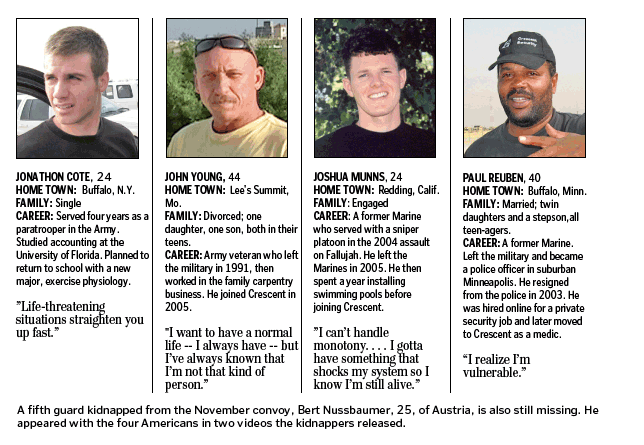
The four other hostages identified themselves and made similar statements. Reuben wore a tracksuit with orange shoulder stripes. "I'm 39 years old, or 40; I'm not quite sure of today's date," he said. "I'm from Buffalo, Minnesota. I'm married. I have twin daughters -- they're 16 -- and I have a stepson that's 16."
A second video, time-stamped Dec. 21 and Dec. 22, was released Jan. 3. The hostages again called for the removal of U.S. troops from Iraq.
Since then, prayer vigils have been held in Kansas City, Minneapolis, Gainesville and Clarence, N.Y., outside Buffalo.
In Gainesville, Sigma Phi Epsilon placed a 20-foot yellow ribbon on the front of its house.
In Redding, Calif., Josh Munns's new home deal fell through.
There has been no communication from the captors.
Staff researcher Julie Tate contributed to this report.
© 2007 The Washington Post Company
Blackwater's Security Force in Iraq Given Wide Latitude by State Dept.
By Steve Fainaru
Washington Post Foreign Service
Blackwater USA, the private security company involved in a Baghdad shootout last weekend, operated under State Department authority that exempted the company from U.S. military regulations governing other security firms, according to U.S. and Iraqi officials and industry representatives.
In recent months, the State Department's oversight of Blackwater became a central issue as Iraqi authorities repeatedly clashed with the company over its aggressive street tactics. Many U.S. and Iraqi officials and industry representatives said they came to see Blackwater as untouchable, protected by State Department officials who defended the company at every turn. Blackwater employees protect the U.S. ambassador and other diplomats in Iraq.
Blackwater "has a client who will support them no matter what they do," said H.C. Lawrence Smith, deputy director of the Private Security Company Association of Iraq, an advocacy organization in Baghdad that is funded by security firms, including Blackwater.
The State Department allowed Blackwater's heavily armed teams to operate without an Interior Ministry license, even after the requirement became standard language in Defense Department security contracts. The company was not subject to the military's restrictions on the use of offensive weapons, its procedures for reporting shooting incidents or a central tracking system that allows commanders to monitor the movements of security companies on the battlefield.
"The Iraqis despised them, because they were untouchable," said Matthew Degn, who recently returned from Baghdad after serving as senior American adviser to the Interior Ministry. "They were above the law." Degn said Blackwater's armed Little Bird helicopters often buzzed the Interior Ministry's roof, "almost like they were saying, 'Look, we can fly anywhere we want.'"
A Blackwater spokeswoman referred questions about how the company is regulated to the State Department.
Richard J. Griffin, assistant secretary for diplomatic security, said in a statement that State Department security contractors are routinely briefed on rules for the use of force. When a shooting incident occurs, he said, it is reviewed by the U.S. Embassy's Regional Security Office. "Anyone who fails to live up to our standards will be removed from the contract," Griffin said.
On Wednesday, the State Department announced that it will form a joint commission with the Iraqi government to examine issues related to private security.
In Baghdad, Prime Minister Nouri al-Maliki promised that Blackwater guards would be held accountable for what he called "a big crime" in the weekend violence. Iraqi officials have threatened to expel Blackwater from Iraq over the incident, in which at least nine Iraqis were killed.
"We will not allow Iraqis to be killed in cold blood," Maliki said. "There is a sense of tension and anger among all Iraqis, including the government, over this crime."
The confrontation between the Iraqi government and Blackwater, based in Moyock, N.C., has illuminated the uneven and largely dysfunctional regulatory system intended to govern tens of thousands of hired guns operating in Iraq.
A one-paragraph subsection to a 2004 edict issued by the Coalition Provisional Authority, the now-defunct U.S. occupation government, granted contractors immunity from the Iraqi legal process. This edict is still in effect. Congress has moved to establish guidelines for prosecuting contractors under U.S. law or the Uniform Code of Military Justice, but the issue remains unresolved.
"It's a lot of people with guns who are under no real law, and that's very troublesome," said Sen. James Webb (D-Va.), who has advocated greater oversight of private security companies. "Ninety-five percent of the people who are doing this are honest, ethical and moral, but the fringe that isn't, it's very difficult to see the legal construct that will hold them accountable."
Interior Ministry officials have said they had received information on six previous cases in which Blackwater guards allegedly opened fire on civilians, more than any other company.
Blackwater's conduct at times inflamed tensions inside the Interior Ministry, Degn said. On May 24, Degn was evacuated from the building after an armed standoff between Interior Ministry commandos and Blackwater guards, who had shot and killed an Iraqi driver outside the gates. U.S. and Iraqi officials feared the incident might lead to retaliatory attacks against Americans.
"They are part of the reason for all the hatred that is directed at Americans, because people don't know them as Blackwater, they know them only as Americans," said an Interior Ministry official who spoke on the condition of anonymity because he feared for his safety. The official, interviewed before Sunday's incident, said, "They are planting hatred, because of these irresponsible acts."
Problems of Accountability
The use of private security skyrocketed in Iraq after the March 2003 invasion because of troop shortages and growing violence. U.S. authorities have no idea how many hired guns operate in the country; estimates range from 20,000 to 50,000 or higher.
To a large degree, the companies regulate themselves. Lawrence T. Peter, director of the Private Security Company Association of Iraq, which represents at least 50 security companies, also serves as a $40-per-hour consultant on security issues to the Pentagon's Defense Reconstruction Support Office, which issues contracts.
Peter, during an interview in Baghdad, said that while serving as an adviser to the Coalition Provisional Authority he wrote the initial drafts of Memorandum 17, dated June 26, 2004, which established operating guidelines for security companies and remains "the extant law for private security contractors in Iraq."
The rules on use of force are introduced in capital letters with the statement: "NOTHING IN THESE RULES LIMITS YOUR INHERENT RIGHT TO TAKE ACTION NECESSARY TO DEFEND YOURSELF."
A separate document, CPA Order 17, dated June 27, 2004, granted the private security companies immunity from Iraqi law.
The CPA administrator, L. Paul Bremer, left Iraq the next day after transferring authority to an interim Iraqi government.
Vetting of security companies in Iraq remains so lax that another organization, the International Contractors Association, has offered to help companies discern experienced guards from those who lack qualifications. "If people won't regulate us, we will regulate ourselves, and we will do so professionally," said Jaco S. Botes, a South African contractor who heads the association.
"If the industry goes unchecked, it will implode -- that's just the logical way of things to happen," he said. "It's like a landslide. It will grow and grow until everybody is just fed up."
Over the past year, the military has issued a series of "fragos," or fragmentary orders, designed to impose greater accountability on security contractors operating under Defense Department contracts. Blackwater was not covered because it reported to the State Department.
The new rules included procedures for the registration of weapons and streamlined the reporting of shooting incidents. The U.S. military's director of security for the Green Zone, where approximately three dozen private security firms are based, has conducted sweeps that netted hundreds of unauthorized weapons.
The military also required companies to obtain operating licenses through the Interior Ministry to operate legally in Iraq. The licenses added another layer of accountability: Licensed companies were given colorful numbered decals to attach to the sides of their armored vehicles, clearly identifying them as belonging to a security firm.
The licensing process has been fraught with problems. Companies have complained about corruption and delays and said they feared handing over sensitive personnel and weapons data to an Iraqi ministry infiltrated by sectarian militias.
But the U.S. military and many registered companies argued that it was the only way to legitimize the industry. "We try to comply with all rules and decrees they produce," said Sam Jamison, the convoy manager for ArmorGroup International, a British security firm that protects nearly one-third of all nonmilitary convoys in Iraq. "If you come to someone else's country, and you don't abide by their laws and regulations, it's just the height of arrogance. We may not always like it but we will comply with it. We can't ask the Iraqi people to respect the rule of law if we don't do it ourselves."
None of the new orders applied to Blackwater, which has received $678 million in State Department contracts since 2003 and operates under the department's authority.
"I'm not gonna go chasing after non-DoD organizations, going, 'Uh, you didn't submit an incident report for this,' " said Maj. Kent Lightner of the U.S. Army Corps of Engineers, who monitors shooting incidents involving private security contractors under Defense Department contracts.
Peter, of the private security firms' advocacy group, said the rules that govern companies often depend on who issued their contract. "There's a different regulatory environment depending on who you work for," he explained.
'Heavy-Handed' Tactics
On March 31, 2004, four Blackwater employees were ambushed while escorting kitchen equipment through Fallujah. A mob shot and burned them, then hung two corpses from a bridge over the Euphrates River. To date, at least 25 Blackwater employees have been killed in Iraq.
The Fallujah attack, a turning point in the war, also led to fundamental changes in the private security industry. The military, which had been unaware that Blackwater was operating in Fallujah, created the Reconstruction Operations Center to track thousands of armed civilians on the battlefield.
Military and private security officials described the operations center as a success, with one omission: Blackwater, which played a role in its creation, does not participate.
Blackwater is not required to report its movements to the military. "There is no oversight or coordination of Blackwater by the U.S. military," said Jack Holly, a retired Marine colonel who oversees several private security firms as director of logistics for the U.S. Army Corps of Engineers.
Blackwater has said that it uses its own internal tracking system that is visible to both the military and the State Department.
Holly said Blackwater angers the Iraqis: "Their aggressive attitude is not what you would say is trying to mitigate disagreements between two societies." Earlier this year, he said, Iraqi employees on the national rail system were so intimidated that they refused to meet State Department officials escorted by Blackwater guards.
Holly said the State Department was partly to blame for what he described as Blackwater's "heavy-handed, almost arrogant" tactics. "It's obviously condoned by State and it's what State expects, because they have contract oversight and if they didn't like it they would change it," he said.
State Department officials said Blackwater is overseen by the agency's Bureau of Diplomatic Security. After several interview requests earlier this year on how the agency regulates Blackwater and other private security contractors, a spokesman e-mailed responses to written questions.
"State Department personnel, including contracting officers, routinely meet with private security contractors both on the ground in Iraq and in Washington D.C., and coordinate with other U.S. federal agencies and the Iraqi government with regard to compliance issues," the department said.
After the incident this May 24, in which Blackwater guards shot and killed an Iraqi driver outside the Interior Ministry, the Blackwater team was surrounded by Interior Ministry commandos with AK-47 assault rifles. The Blackwater guards refused to provide their names or details of the incident. A U.S. military convoy happened on the scene and an officer tried to mediate.
Eventually, a State Department official arrived, according to a security company representative familiar with the incident. The Blackwater team was allowed to return to the Green Zone.
Later, both Blackwater and the State Department initially denied that the shooting occurred. The company and agency officials then confirmed that the incident had taken place but defended the guards, saying they had followed the rules on the use of force.
The State Department said it planned a thorough investigation. Four months later, no results have been announced.
Protection 'at All Costs'
"Blackwater has no respect for the Iraqi people," the Interior Ministry official said. "They consider Iraqis like animals, although actually I think they may have more respect for animals. We have seen what they do in the streets. When they're not shooting, they're throwing water bottles at people and calling them names. If you are terrifying a child or an elderly woman, or you are killing an innocent civilian who is riding in his car, isn't that terrorism?"
Ann Exline Starr, a former Coalition Provisional Authority adviser, said she traveled in Iraq first with a military escort, then with guards from Blackwater and another State Department-contracted security firm, DynCorp International, as security in Iraq deteriorated. The shift was startling, she said. The soldiers drank tea and played cards with the Iraqis. The security contractors, on the other hand, moved more aggressively, their only focus protecting Exline Starr.
"What they told me was, 'Our mission is to protect the principal at all costs. If that means pissing off the Iraqis, too bad,' " she recalled.
Exline Starr said that most of the guards were highly professional but that their mission was different and appeared to be contrary to the U.S. government's overall goal of winning over Iraqis. She said she approached senior managers for Blackwater and DynCorp "to express my concern over the importance of maintaining relationships that have been nurtured for over six months." The companies took a more low-profile approach after the discussions, she said.
Chester Schultz, a former Blackwater guard from Fenton, Mich., said the company's goals differ from those of the military and the State Department.
"Unfortunately, the rules and regulations are way different than they're applied, and people are not held accountable, for the most part," he said. "I'm not saying it's a bunch of cowboys, but it's a different job. We're not paid to go out and find and eliminate the insurgents. Our job is to keep people alive and safe, and do what we need to do."
Degn said he believed that the Iraqi government was trying to hold up Blackwater as "a symbol." If the government can bring the company to heel, he said, all the other private security companies will have to follow.
"It's a symbol of the rift that still exists between both governments," he said. "The Iraqis are trying to establish their own authority. And if they do this, they can show the world that Blackwater is not untouchable. And that the U.S. is not the ultimate authority in their country."
Correspondents Joshua Partlow and Megan Greenwell in Baghdad and staff researcher Julie Tate in Washington contributed to this report.
© 2007 The Washington Post Company
Companies Seldom Report Incidents, U.S. Officials Say
By Steve Fainaru
Washington Post Foreign Service
Most of the more than 100 private security companies in Iraq open fire far more frequently than has been publicly acknowledged and rarely report such incidents to U.S. or Iraqi authorities, according to U.S. officials and current and former private security company employees.
Violence caused by private security guards in Iraq has come under scrutiny since a Sept. 16 shooting in Baghdad involving employees of Blackwater USA. The company's chairman, Erik Prince, told a congressional committee Tuesday that Blackwater guards opened fire on 195 occasions during more than 16,000 missions in Iraq since 2005.
However, two former Blackwater security guards said they believed employees fired more often than the company has disclosed. One, a former Blackwater guard who spent nearly three years in Iraq, said his 20-man team averaged "four or five" shootings a week, or several times the rate of 1.4 incidents a week reported by the company. The underreporting of shooting incidents was routine in Iraq, according to this former guard.
"The thing is, even the good companies, how many bad incidents occurred where guys involved didn't say anything, because they didn't want to be questioned, or have any downtime today to have to go over what happened yesterday?" he said. "I'm sure there were some companies that just didn't report anything."
The former Blackwater guards and other private security workers spoke on condition of anonymity because of concerns they would be unable to obtain future employment in the security industry. In addition, Blackwater employees reportedly sign an agreement pledging not to divulge confidential information; violations can result in a $250,000 fine imposed by the company.
Tens of thousands of private security guards operate in Iraq under a multitude of contracts, each with its own regulations. Defense and State Department contracts require security companies to report all weapons discharges, but few comply fully, according to U.S. officials and security company employees. Two company officials familiar with the system estimated that as few as 15 percent of all shooting incidents are reported, although both cautioned that it was impossible to know exactly how many incidents go unreported.
Out of nearly 30 security companies under Defense Department authority, only "a handful" have reported weapons discharges, said Maj. Kent Lightner of the U.S. Army Corps of Engineers, who monitors shooting incidents involving security companies under military contracts. Lightner said the lack of reporting undermines statistics the military compiles on shooting incidents. Through May, the military had reported 207 such incidents over the previous 12 months.
"In my civilian life, if I were doing a process analysis on this thing, I would say, 'You know what, these numbers are suspect in terms of which companies are having the most incidents and what type of incidents they are,' " Lightner said during a recent interview in Baghdad.
Col. Timothy Clapp, who preceded Lightner as director of the Reconstruction Operations Center, which tracks the movements of private security firms under Defense Department contracts, said reported incidents were usually limited to a few companies, including two British firms, Aegis Defence Services and ArmorGroup International.
Clapp said military officials became temporarily concerned last year that Aegis, which protects Corps of Engineers officials on reconstruction projects, was "out of control" because the company reported so many incidents. But Clapp said the numbers were skewed because Aegis conducts many more missions than other companies and because other companies rarely or never report shooting incidents.
"In their contracts, it says they are supposed to report, but whether they do or not is up to them," he said.
Lightner said responsibility for investigating shooting incidents involving companies under Defense Department contracts falls first to the company itself, then to the contracting officer.
U.S. officials and security company representatives said they were especially concerned about firms that operate beyond the radar of U.S. and Iraqi authorities. David Horner, who worked for Crescent Security Group, a company based in Kuwait City, said that after being attacked with a roadside bomb in a town north of Baghdad, Crescent employees fired their automatic weapons preemptively whenever they passed through the town.
"I know that I personally never saw anyone shoot at us, but we blazed through that town all the time," said Horner, 55, a truck driver from Visalia, Calif. "Personally I did not take aim at one person. But I don't know what everybody else did. We'd come back at the end of the day, and a lot of times we were out of ammo."
Horner said he did not believe any of the incidents were reported to the military. He said he quit after one of Crescent's Iraqi employees fired a belt-fed PK machine gun from the bed of Horner's truck and hit what appeared to be two members of the Iraqi National Guard.
"I was like, 'Oh man, we shot some of our own guys,' " Horner said. He said he consulted with the Crescent team leader as the two Iraqis writhed in pain, one shot in the legs, the other with "a bullet or two in his shoulder." Soldiers from a nearby Iraqi army checkpoint were approaching to investigate.
"Let's get the [expletive] out of here," Horner quoted the team leader as saying before the Crescent team drove off.
"That was my last mission," Horner said. "I wasn't over there to wreck somebody's life. There was too much cowboying going on. I really didn't know if we had made things worse over there. More than likely we did; that was my feeling."
Crescent officials have denied any wrongdoing to the military after the company was forced to suspend operations in Iraq this year because of weapons violations.
Private security guards said the question of whether to shoot often depends on split-second decisions that can mean life or death not only for them but also for those around them. Most incidents, they said, occur when a vehicle comes close to a security convoy, forcing guards to determine whether the vehicle represents a potential car bomb or merely an erratic driver.
In the Sept. 16 incident, Iraqi witnesses have said Blackwater guards fired on a white sedan carrying a doctor and her adult son after the car failed to slow down as it approached a traffic circle. In May, a Blackwater team shot and killed a civilian driver outside the Interior Ministry; the guards told investigators that the car had driven too close to their convoy and appeared to represent a threat.
CPA Memorandum 17, signed in June 2004 by L. Paul Bremer, the departing chief of the Coalition Provisional Authority that ran the occupation, describes the "binding Rules for the Use of Force that must be adhered to by all PSC [private security companies], their officers and employees." The memo prescribes a series of graduated steps, including verbal warnings, physical restraint and displaying weapons. In recent years, security guards have resorted to firing pen flares, throwing water bottles, using air horns and sirens, and displaying signs warning drivers to maintain a safe distance.
In practice, the rules of force often vary from company to company and even team to team, said current and former guards. One former Blackwater guard said the rules of force for Blackwater employees on State Department contracts -- including those involved in the Sept. 16 incident -- differed from those for Blackwater guards on non-State contracts.
State Department contracts advise employees to fire "aimed shots," as outlined in CPA Memorandum 17, according to the former employee. Those shots were often designed to disable the oncoming vehicle. But the rules, which were crafted to minimize civilian casualties, also preclude firing warning shots into the air or into the ground, tactics that also might alert a driver who had strayed too close.
"From the State Department perspective, they're looking at it as a liability thing: What happens to that round when it goes downrange," said one of the former Blackwater security guards. "I was like: 'Look, give them a chance. Not every Iraqi in a car that's near you is a bad guy.' The guy whose car you shoot up today is also the guy who could be planting an IED [improvised explosive device] tomorrow. And the only reason he changed sides now is the car that took him 10 years of life savings to buy, now you've destroyed it."
Of the 195 incidents cited by Prince and the House Oversight and Government Reform Committee, 162 resulted in property damage, according to a memo released Monday by the committee.
Procedures for reporting shooting incidents also often varied, according to current and former guards. "It's almost like a case of cover your ass," the former Blackwater guard said. "It's like, 'These guys did this, they filled out this report, we have documentation on it, and unless anybody else says anything, it's in this file here.' "
Lightner, the Army major who monitors shooting incidents, said he thought the number of reported incidents was in some ways insignificant. "Other than entertainment value, I don't see why I need to be all that worried about the number of incidents, as long as they were legitimate," he said. "If they were incidents of wrongdoing, then that's a different story."
Lightner said he usually accepted the company's version of events. "If they're reporting firing a weapon, and there's no wrongdoing, and they operated according to the law, then God bless 'em, drive on," he said. "If Aegis sends me a report and says, 'Bad guys shot at us, we shot back and dropped two of them,' I'm not going to investigate. I'm not going to worry about it, unless somebody comes back and says, 'Yeah, they dropped two children, or they dropped a woman.' "
Staff writer Alec Klein and staff researcher Julie Tate in Washington contributed to this report.
© 2007 The Washington Post Company
Witnesses Call Shooting From Justice Ministry Unprovoked, But State Dept. Cleared Its Security Team After a Brief Probe
By Steve Fainaru
Washington Post Foreign Service
BAGHDAD -- Last Feb. 7, a sniper employed by Blackwater USA, the private security company, opened fire from the roof of the Iraqi Justice Ministry. The bullet tore through the head of a 23-year-old guard for the state-funded Iraqi Media Network, who was standing on a balcony across an open traffic circle. Another guard rushed to his colleague's side and was fatally shot in the neck. A third guard was found dead more than an hour later on the same balcony.
Eight people who responded to the shootings -- including media network and Justice Ministry guards and an Iraqi army commander -- and five network officials in the compound said none of the slain guards had fired on the Justice Ministry, where a U.S. diplomat was in a meeting. An Iraqi police report described the shootings as "an act of terrorism" and said Blackwater "caused the incident." The media network concluded that the guards were killed "without any provocation."
The U.S. government reached a different conclusion. Based on information from the Blackwater guards, who said they were fired upon, the State Department determined that the security team's actions "fell within approved rules governing the use of force," according to an official from the department's Bureau of Diplomatic Security. Neither U.S. Embassy officials nor Blackwater representatives interviewed witnesses or returned to the network, less than a quarter-mile from Baghdad's Green Zone, to investigate.
The incident shows how American officials responsible for overseeing the security company conducted only a cursory investigation when Blackwater guards opened fire. The shooting occurred more than seven months before the Sept. 16 incident in which Blackwater guards killed 17 civilians at another Baghdad traffic circle.
The Feb. 7 shootings convulsed the Iraqi Media Network, one of the prominent symbols of the new Iraq, in anger and recrimination.
U.S. officials and the security company, now known as Blackwater Worldwide, offered no compensation or apology to the victims' families, according to relatives of the guards and officials of the network, whose programming reaches 22 million Iraqis.
"It's really surprising that Blackwater is still out there killing people," Mohammed Jasim, the Iraqi Media Network's deputy director, said in an interview. "This company came to Iraq and was supposed to provide security. They didn't learn from their mistakes. They continued and continued. They continued killing."
A Blackwater spokeswoman, Anne E. Tyrrell, said the company's guards came under "precision small-arms fire" and fired back with "well-aimed shots." The company was unable to comment further because of operational security and contractual obligations, she said. "This was absolutely a provoked incident," Tyrrell said.
U.S. officials were "overwhelmingly convinced" that the Blackwater guards acted appropriately, based on information they had provided, according to the diplomatic security official. He spoke on condition of anonymity because a joint U.S.-Iraqi commission is investigating private security matters, including previous Blackwater shootings. Shortly after the Feb. 7 incident, the official said, the U.S. Embassy briefed an Iraqi government official and invited him to discuss the matter further, but the embassy never heard from him again.
Under State Department rules for the use of force, security contractors are authorized to use deadly force only if there is no safe alternative and the guards or the people they are protecting face "imminent and grave danger." The Blackwater guards said they came under fire from the building and responded, the security official said.
"The embassy conducted a review of the circumstances surrounding the whole shooting incident and essentially what happened is, after going over all the reports, interviewing all the personnel that were involved in it, talking with people that were coming back in the motorcade, they concluded that the actions of the security team fell within the approved rules," the official said.
"To say Blackwater was the only source of information for this investigation is completely false," the security official added. U.S. officials declined to say who else was contacted as part of the probe or to provide any details about the assertions of Blackwater guards that they came under fire.
The Iraqi Interior Ministry has forwarded information about the Feb. 7 incident and five other fatal shootings involving Blackwater to the U.S. Embassy, which never responded, it said.
The Iraqi Media Network sought to sue Blackwater in an Iraqi court, according to Faisal Rahdi, the network's legal adviser. A judge rejected the petition, he said, citing a 2004 law signed by L. Paul Bremer, the administrator for the now-defunct U.S. occupation authority. That law, which the Iraqi government has moved to overturn, granted contractors immunity from the Iraqi legal process.
An internal review of the State Department's handling of private security recently found serious deficiencies in the agency's supervision of contractors, including Blackwater. The State Department's security chief, Richard J. Griffin, was forced to resign last month after the report was released.
The Feb. 7 incident was one of at least 10 fatal shootings involving Blackwater since June 2005, including three that led to confrontations between the security company and the Iraqi government in the months before the pivotal Sept. 16 incident at Nisoor Square.
Blackwater provides security for State Department employees traveling in Iraq. The company has received more than $1 billion in U.S. government contracts since 2001, including $832 million for security services in Iraq over the past two years. Blackwater employs 861 guards in Baghdad, according to the House Committee on Oversight and Government Reform.
The Iraqi Media Network shootings were particularly sensitive because Blackwater fired from one Iraqi government compound into another. The network is a state-funded corporation modeled after the BBC and launched by the U.S. government. After the March 2003 invasion, the network replaced the state-run television system that once dispensed propaganda for the government of then-President Saddam Hussein. The Iraqi Media Network operates several newspapers, radio stations and a flagship TV network, al-Iraqiya.
"What really shocked us is that our colleagues were killed inside their workplace, in a place that was supposed to be secure," said Abbas A. Salim, the network's news director. "The IMN, its main job is to explain democracy to the people and support the new Iraq."
News of the shootings was broadcast on al-Iraqiya, which reaches about 85 percent of Iraq's population.
'Nabras Is Hit!'
On the morning of the incident, a convoy of four armored SUVs pulled up at a traffic circle that separates the Justice Ministry from the back of the Iraqi Media Network's sprawling compound. About 20 Blackwater guards got out of the vehicles, according to witnesses.
"Before they went inside, they asked me what this other building was," said Nadim Salim, a bodyguard at the Justice Ministry. "I told them, 'That's the Iraqiya network.'"
Blackwater snipers set up on the Justice Ministry roof, taking cover behind concrete walls that crown the seven-story building. Blackwater "had full control over the guys at Iraqiya because they were higher than them," Salim said.
Across the circle, Nabras Mohammed Hadi manned his guard position. He sat on a chair on the third-floor balcony of an abandoned building looking out on the Justice Ministry and King Faisal Circle, near the rear gate of the Iraqi Media Network compound. The traffic circle, which features a statue of the king on horseback, connects to Haifa Street, a notoriously dangerous central Baghdad thoroughfare.
Hadi had been living inside the Iraqi Media Network complex because insurgents had threatened to kill him unless he left his state-supported job, according to Mohammed Adel Ali, a friend and fellow guard.
Hadi was dressed in dark-green military camouflage and held an AK-47 assault rifle. On the same balcony, about 20 feet to his left, another network guard manned a belt-fed machine gun. Two guard towers overlooked the network's rear gate, one flying the Iraqi flag. Hadi was positioned below the snipers, who stood about 450 feet away, near a large Iraqi flag on top of the Justice Ministry.
Hadi stood up in response to a commotion that suddenly broke out in the circle, according to several of his fellow guards. The time was between 11 a.m. and noon. "The problem started because some people wanted to park their car there," said one guard, Adel Saadi. "Our guards didn't allow them, because we were worried about car bombs. But they kept insisting."
Hadi yelled at the civilians to move back, according to Ali, who was also nearby. "He was shouting: 'Move away from here. You can't stay here. This is a government building.' While he was shouting, he was holding his gun in a ready position. That's when the sniper shot him."
It remains unclear what precipitated the shooting. The Blackwater guards said they came under fire from the building and responded, the diplomatic security official and the Blackwater spokeswoman said. Hadi's colleagues said he never fired his weapon. Saadi said he heard one shot, looked up and saw Hadi falling.
Saadi and Ali raced up the stairs with several other guards, Ali yelling: "Nabras is hit! Nabras is hit!" The guards said they believed the compound was under attack from insurgents. "We never thought that people would be shooting at us from the Ministry of Justice," said Hussein Abdul Hassan, the guards' chief. "It's a government building. No one would expect it."
The guards crawled toward Hadi, shielded by a three-foot-high wall. The sniper was still firing, they said. "Anyone crawling or walking, he shot at them," Hassan said. At least three bullets lodged in the building's facade. The guards found Hadi in the corner with a bullet through his head.
As they tried to move him, another shot rang out. It struck Azhar Abdullah al-Maliki, 31, another guard. His colleagues said he had raised his head above the low wall and was shot.
The Blackwater guards said they believed they were again under immediate threat and responded with lethal force, the security official said.
Maliki's older brother, Zuhair, said Maliki had taken the job just six weeks earlier. He lived with 21 members of his family, including his wife and three children, in a tiny house in Sadr City, a Baghdad slum.
Maliki slumped to the ground next to Hadi. "People were yelling, 'Azhar, what's wrong?' " Hassan said. "When they went to move him, they saw the blood spurting from his neck."
The guards quickly withdrew, ceding authority to an Iraqi army company that controls the neighborhood, Salihiya. The company commander, Capt. Ahmed Thamir Abood, said he sent soldiers up to the balcony to recover the bodies. Hadi was dead. Maliki was evacuated to a nearby hospital but was pronounced dead of a gunshot wound to the neck at 2 p.m., according to his death certificate.
Abood, a short, stocky man who speaks halting English, said he learned from the Justice Ministry that snipers from a U.S. security company -- not insurgents -- had shot the guards. He drove in a Humvee with one of his lieutenants to the ministry. The Blackwater guards were gathered in the traffic circle, he said, preparing to leave. Most were stocky, with goatees and small communication devices in their ears.
"I told them, 'I want to speak with the guy who is in charge of this unit,' " he said.
The Blackwater guards started toying with him, Abood said.
"He's in charge," said one, pointing at one of his colleagues.
"No, he's in charge," said another.
"They didn't care what I was saying," Abood said.
Abood said he spotted an American who appeared to be the diplomat being escorted by Blackwater. The man was young, perhaps in his 30s, and wore a navy blue sport coat, a tie and a combat helmet, Abood said. He tried to approach the diplomat, but the Blackwater guards stood in his way, he said.
Abood said he spoke to another Blackwater guard. "I introduced myself in English, but he didn't even look at me," he said. "I told him there are two people dead up there. He told me, 'Wait by this guy.' Then that guy told me to wait by another guy."
Abood said he was still waiting when the Blackwater guards climbed inside their vehicles, set off smoke grenades in the circle and sped away in a green-and-orange cloud toward the Green Zone.
Security contractors are instructed to leave the scene of a shooting as quickly as possible to ensure the safety of the person under their protection, according to the diplomatic security official. The Blackwater team followed standard operating procedures, the official said.
'Abu Sajad Is Dead'
Pandemonium had broken out inside the media network compound. Hundreds of employees were locked down inside the buildings, afraid of more shooting. A leader of the guard team, Thair Salaam, tried to assemble his men. He noticed that one was missing: a 40-year-old armorer named Sabah Salman, also known as Abu Sajad.
"We couldn't find him, no one could find him," Salaam said. "Then suddenly we got a call: 'Abu Sajad is dead.' That was more than an hour after the first shooting."
Guards found Salman's body on the balcony. He had been shot in the side. Salaam said he believed Salman was shot by a sniper while trying to retrieve Hadi's weapon.
"He went up there without a gun," Salaam said. "I don't know why they shot him."
Salman, like the two other guards, was poor, his colleagues said. He had taken responsibility for a second family after his brother was killed during the Iran-Iraq war in the 1980s. He helped support 17 children, including eight of his own. Salman was diabetic and often sick, according to fellow guard Mohammed Adel Ali.
He and the other guards earned 285,000 Iraqi dinars a month, about $231. That was less than half of what Blackwater security guards earn in a day.
Jasim, the Iraqi Media Network deputy director, said the company was uncertain where to turn.
The Justice Ministry, the Interior Ministry, the Iraq police and an Iraqi Media Network internal investigation identified Blackwater's involvement in the shootings.
"On Feb. 7, members of Blackwater opened fire from the roof of the Ministry of Justice building, intentionally and without any provocation, shooting three members of our security team which led to their deaths while they were on duty inside the network complex," the Iraqi Media Network report concluded.
A Salihiya police investigator, misspelling Blackwater, wrote: "By collecting information and questioning the Ministry of Justice guards, it became clear that the armed personnel, who came to the Ministry of Justice, who were using special security vehicles and caused the incident and killed guards of the Iraqi Media Network, they are working with the company of BlackRwatey for special security."
"But these people were not well known to us," Jasim said. "We don't know where they are located or who they report to. Are they at the Green Zone, at the airport? We don't know how to contact them."
Abbas, the news director, said he called a U.S. military official, who told him that the military had no information about the incident.
Follow-up investigations can be difficult in a war zone environment, the diplomatic security official said. "The State Department investigates security contractor incident scenes except when to do so would endanger the lives of the investigators," he said, adding that he was not specifically addressing the Feb. 7 incident.
The network gave the families of each of the victims 1 million dinars, or about $812, to assist with burial. The network then hired one member from each family to make up for the lost income.
The diplomatic security official said the U.S. government offered no compensation because the investigation concluded that the Blackwater guards fired in self-defense. "It is the State Department policy to offer ex gratia condolence payments when innocent civilians have been hurt," he said. "In this case, the investigation determined that the security detail had been fired upon, and therefore the issue of payments did not arise."
Rahdi, the legal adviser, said the company had hoped to recover more money for the families by suing Blackwater. But he said CPA Order 17, the law granting contractors immunity, made it impossible.
"I'm talking to you from my point of view as someone representing the law," Rahdi said. "Even if I go to the U.S. ambassador, even if I go to Bush, they go by the law. If there is no law to go after them -- what are they going to do?"
"America doesn't need more enemies in Iraq," he added. "When someone loses one of his relatives, or one of his friends who gets killed by an American and that American is protected -- untouchable -- because of a law that was set by an American, this definitely will create new enemies for the United States."
Jasim said he is still hopeful that Blackwater or the U.S. government will provide assistance.
"Those three people were killed in cold blood," he said. "They have families to support. They should at least forward a letter of apology so we can give that to their relatives. That would give them some relief."
Special correspondent Naseer Nouri in Baghdad and staff researcher Julie Tate in Washington contributed to this report.
© 2007 The Washington Post Company
Same Company Involved In Fatal October Incident
By Steve Fainaru
Washington Post Foreign Service
BAGHDAD -- Guards employed by Unity Resources Group, a security company responsible for the shooting deaths of two Iraqi women here Oct. 9, had shot and seriously wounded a man driving a van 3 1/2 months earlier on the same Baghdad thoroughfare, according to four witnesses.
The company that hired Unity, RTI International, a North Carolina-based firm that promotes democracy in Iraq under a U.S. government contract, initially said it had no information about the previously undisclosed June 24 shooting. RTI later said it discovered internal reports about the incident following detailed inquiries from The Washington Post.
The case demonstrates how security companies such as Unity operate in a lawless void in Iraq, with many shooting incidents escaping official or public scrutiny. The lack of oversight is the focus of a joint U.S.-Iraqi commission on the use of private security contractors that was formed after guards for Blackwater Worldwide killed 17 civilians in Baghdad on Sept. 16.
RTI said Unity conducted a two-month investigation into the June 24 shooting but later deleted references to a casualty from its records because it was unable to identify the victim. "The incident was reported through formal channels at the time," RTI spokesman Patrick Gibbons said. Unity referred all questions about the case to RTI.
None of the witnesses interviewed by The Post said they had been contacted by Unity or RTI. Three of the witnesses described how the van driver's hand was nearly severed but said they never learned his identity.
Most of the more than 100 security firms in Iraq work under contracts or subcontracts for government agencies, private companies or individuals, creating layers of responsibility that make oversight difficult. Unity effectively regulates itself: The company reported 38 weapons-discharge incidents while protecting RTI employees over the past two years, according to a source familiar with the data. In each instance, the company conducted its own investigation.
RTI, a not-for-profit research company that has received at least $480 million for its efforts to strengthen local governance in Iraq, said it reports the incidents to its own employer, the U.S. Agency for International Development. But USAID, which is affiliated with the State Department, does not investigate, according to USAID and the U.S. Embassy in Baghdad.
"USAID does not direct the security arrangements of its contractors," said Mirembe Nantongo, a U.S. Embassy spokeswoman. "The contractor is contractually responsible for the safety of its employees. That's as far as the connection goes. If you want more details, I would refer you to RTI."
In the June 24 incident, Unity's guards raked a white van with automatic-weapons fire around 7 a.m. near a kindergarten on Karrada Street, a six-lane boulevard in central Baghdad. Witnesses said they used a crowbar to free the driver from the vehicle after he crashed into a lamppost. They said his left hand hung limply, attached only by skin. The man was semi-conscious when he was taken to the hospital in a civilian vehicle, the witnesses said.
"This guy, he wasn't doing anything threatening, but he didn't see them, so they shot him," said Amir Thamir, 28, who works at al-Mehdi bakery, about 20 yards from where the incident occurred.
On Oct. 9, about 250 yards up the same street, Unity guards sprayed a white Oldsmobile with dozens of bullets, killing two women in an incident that drew international attention because it occurred three weeks after the Blackwater shooting.
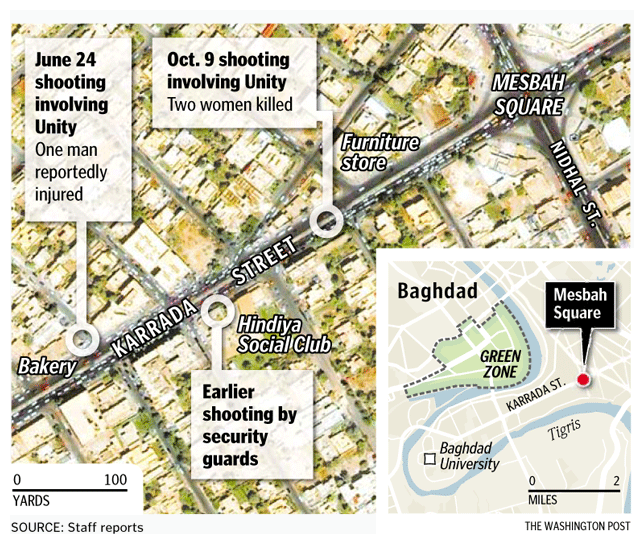
Unity said at the time that its guards opened fire after the driver failed to respond to warning signals. Through RTI, the company offered the same explanation for the June 24 incident.
The area where the incidents occurred is near a fortified complex, known as the Marble compound, that is used by Unity and RTI personnel. Unity convoys frequently drive along Karrada Street, shuttling RTI personnel to and from Baghdad's Green Zone.
Merchants along Karrada Street, the main artery of an affluent retail district, said the area has become a virtual shooting gallery for armed guards traveling in sport-utility vehicles. "Whoever gets near them, they will shoot at them," said Sirry Abdul Latif, 50, a furniture shop employee, who said there had been several such shootings in the neighborhood.
A third incident occurred in the spring along the same stretch of Karrada Street in front of a popular social club, according to seven witnesses. An unidentified private security guard opened fire on a white Toyota sedan, the witnesses said, killing a male driver with a shot to the chest before speeding away. There was no indication that Unity was involved in that shooting.
Unity Resources Group is run by Australians, including former military personnel. It is headquartered in Dubai and registered in Singapore. RTI has paid the company nearly $50 million, according to RTI figures. Unity also provides security for the National Democratic Institute, a U.S. taxpayer-funded organization that conducts democracy projects in Iraq under a State Department contract.
"What we liked about URG, first of all, is that they were considered to be a little more mature," said John Lister, the former Iraq country director for the National Democratic Institute.
Unity guards have come under attack on numerous occasions; the company's co-director once described driving through Baghdad as "like being on a 'Mad Max' film set." Insurgents ambushed one of the company's convoys in January in Baghdad, killing a 28-year-old Ohio woman employed by the institute.
Ronald W. Johnson, RTI's executive vice president for international development, said RTI hired Unity partly because it was licensed by the Iraqi Interior Ministry. "We wanted a security firm that we were comfortable working with" and was also "registered to do business in Iraq," Johnson said in an interview. USAID approved Unity's contract with RTI, Johnson said.
But the licensing process does not give the Iraqi government authority over contractors, and many companies forgo a license. A 2004 law signed by L. Paul Bremer, administrator for the now-defunct U.S. occupation government, granted security contractors immunity from the Iraqi legal process. That law is still in effect.
Unity's convoys are tracked by the U.S. military through the Reconstruction Operations Center in the Green Zone. By participating in the tracking system, the company agrees to report all shooting incidents to the military. But the U.S. military has no authority over Unity because the company is not under a Defense Department contract.
In an interview, Maj. Kent Lightner of the U.S. Army Corps of Engineers, who directs the tracking system, suggested that the reporting requirements are difficult to enforce with respect to a company such as Unity.
"The real issue is that URG is a company that is not a DoD contractor, so whether they reported incidents or not is --" Lightner paused. "I don't know, I'm walking the line on that one," he said.
Lightner said military investigators requested information about Unity's movements on Oct. 9, when the company's guards killed the two women on Karrada Street. "You're going to find out or sooner or later if they're playing by the rules or not," he said.
But a military spokesman, Navy Capt. Victor Beck, said he was unaware of any U.S. government investigation into that shooting incident or any other involving Unity. RTI and the U.S. Embassy said Unity is cooperating with Iraqi authorities.
The June 24 incident illustrates how gaps in oversight can preclude a thorough investigation.
Four witnesses said the Unity convoy opened fire after encountering the white van while traveling westbound in light, early morning traffic. One witness said the van was 40 to 60 yards behind the convoy after entering Karrada Street from a side road. The Unity guards waved two red flags to warn the driver, then quickly opened fire, according to the witness, a local resident who requested anonymity for security reasons.
The van swerved to the right and crashed into a lamppost, according to Thamir, the al-Mehdi bakery worker, and Tahir Sia, 75, who also works there. After wrenching open the passenger-side door, Thamir and Sia said, they pulled out the injured driver, who had white hair, appeared to be about 60 and was covered in blood. The man's left wrist was slashed diagonally, according to Thamir.
"He was probably hit on other parts of his body, but the major wound was on his arm," Thamir said.
Thamir and Sia said that local police never questioned them about the incident and that the man's fate and identity were unknown. Police in Karrada, leafing through a large, handwritten logbook with pages spilling from its spine, said they were unable to find a record of the incident.
Word of the shooting spread through the Green Zone "like wildfire," said a former RTI employee who requested anonymity out of concern that he would jeopardize future employment as a government contractor.
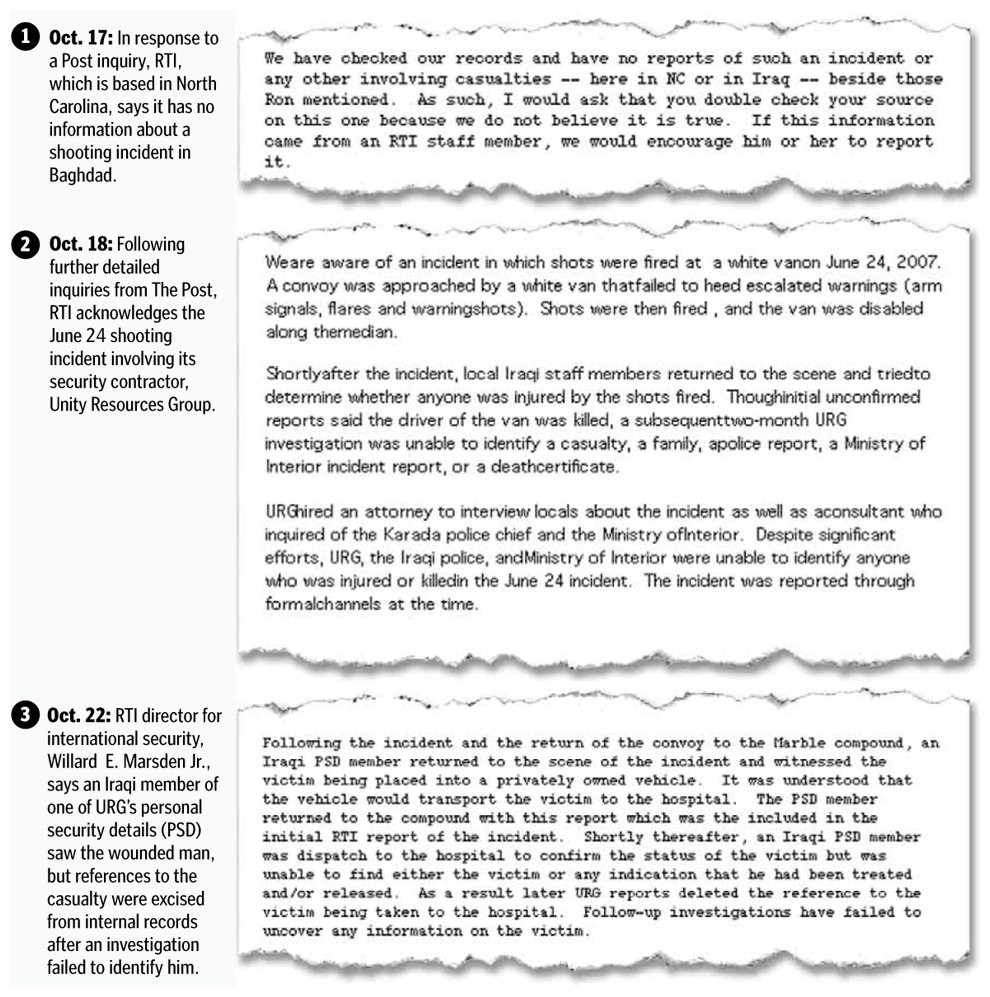
After the Oct. 9 shooting, The Postwas told about an earlier Unity incident on Karrada Street that had caused one or more casualties. RTI initially said it had no information about such a shooting, but later said it discovered internal records of the incident after The Post provided the witnesses' detailed accounts.
"We are aware of an incident in which shots were fired at a white van on June 24, 2007," Gibbons, the company spokesman, wrote in an e-mail. "A convoy was approached by a white van that failed to heed escalated warnings (arm signals, flares and warning shots). Shots were then fired, and the van was disabled along the median."
Gibbons wrote that Unity had conducted a "two-month investigation" but was unable to find any information indicating that a casualty had occurred.
Informed that several witnesses had said the van's driver incurred serious injuries, Gibbons e-mailed an amended report from Willard E. Marsden Jr., RTI's director for international security.
According to that report, one of Unity's Iraqi guards "witnessed the victim being placed into a privately owned vehicle. It was understood that the vehicle would transport the victim to the hospital."
When an Iraqi employee was later dispatched to the hospital, he was "unable to find either the victim or any indication that he had been treated and/or released."
As a result, Marsden wrote, "later URG reports deleted the reference to the victim being taken to the hospital."
Special correspondent Saad al-Izzi in Baghdad and staff researcher Julie Tate in Washington contributed to this report.
© 2007 The Washington Post Company
Despite Shootings, Security Companies Expanded Presence
By Steve Fainaru
Washington Post Foreign Service
The U.S. government disregarded numerous warnings over the past two years about the risks of using Blackwater Worldwide and other private security firms in Iraq, expanding their presence even after a series of shooting incidents showed that the firms were operating with little regulation or oversight, according to government officials, private security firms and documents.
The warnings were conveyed in letters and memorandums from defense and legal experts and in high-level discussions between U.S. and Iraqi officials. They reflected growing concern about the lack of control over the tens of thousands of private guards in Iraq, the largest private security force ever employed by the United States in wartime.
Neither the Pentagon nor the State Department took substantive action to regulate private security companies until Blackwater guards opened fire Sept. 16 at a Baghdad traffic circle, killing 17 Iraqi civilians and provoking protests over the role of security contractors in Iraq.
"Why is it they couldn't see this coming?" said Christopher Beese, chief administrative officer for ArmorGroup International, a British security firm with extensive operations in Iraq. "That amazes me. Somebody -- it could have been military officers, it could have been State -- anybody could have waved a flag and said, 'Stop, this is not good news for us.' "
Private security firms rushed into Iraq after the March 2003 invasion. The U.S. military, which entered the country with 130,000 troops, needed additional manpower to protect supply convoys, military installations and diplomats. Private security companies appeared "like mushrooms after a rainstorm," recalled Michael J. Arrighi, who has worked in private security in Iraq since 2004.
Last year, the Pentagon estimated that 20,000 hired guns worked in Iraq; the Government Accountability Office estimated 48,000.
On Feb. 7, 2006, Blackwater guards allegedly killed three Kurdish civilians outside the northern city of Kirkuk. That incident triggered demonstrations outside the U.S. Consulate and led Rizgar Ali, president of the Kirkuk provincial council, to complain to U.S. authorities in Kirkuk and Baghdad, Ali said in an interview. The incident was one of several shootings that caused friction between the U.S. and Iraqi governments..
On Christmas Eve 2006, a Blackwater employee killed the bodyguard of an Iraqi vice president in the Green Zone. Six weeks later, a Blackwater sniper killed three security guards for the state-run media network. On May 24, a Blackwater team shot and killed a civilian driver outside the Interior Ministry gates, sparking an armed standoff between the Blackwater guards and Iraqi security forces in downtown Baghdad.
By June 6, concerns about Blackwater had reached Iraq's National Intelligence Committee, which included senior Iraqi and U.S. intelligence officials, including Maj. Gen. David B. Lacquement, the Army's deputy chief of staff for intelligence. Maj. Gen. Hussein Kamal, who heads the Interior Ministry's intelligence directorate, called on U.S. authorities to crack down on private security companies.
U.S. military officials told Kamal that Blackwater was under State Department authority and outside their control, according to notes of the meeting. The matter was dropped.
"We set this thing up for failure from the beginning," said T.X. Hammes, a retired Marine colonel who advised the new Iraqi army from January to March 2004. He added that private security guards regularly infuriated his Iraqi staff with their aggressive tactics and that he reported the problems "up the chain of command."
"We're just sorting it out now," Hammes said. "I still think, from a pure counterinsurgency standpoint, armed contractors are an inherently bad idea, because you cannot control the quality, you cannot control the action on the ground, but you're held responsible for everything they do."
U.S. officials argue that security contractors save money and free up troops for more urgent tasks, such as fighting insurgents. "Certainly there have been moments of frustration where people here have said, 'Maybe we should just take over the whole operation, even if it stretches our forces more,' " Pentagon spokesman Geoff Morrell said. "But the reality is that we think our resources are better utilized taking it to the bad guys than guarding warehouses and escorting convoys."
The State Department investigated previous Blackwater shootings and found no indication of wrongdoing, according to a senior official involved in security matters. He said the U.S. Embassy discussed any concerns the Iraqi government had about the company's conduct. "I'm not aware of the significant warnings," said the official, who spoke on condition of anonymity because of ongoing investigations related to the Sept. 16 shooting.
The Defense Department has paid $2.7 billion for private security since 2003, according to USA Spending, a government-funded project that tracks contracting expenditures; the military said it currently employs 17 companies in Iraq under contracts worth $689.7 million. The State Department has paid $2.4 billion for private security in Iraq -- including $1 billion to Blackwater -- since 2003, USA Spending figures show.
On Dec. 5, the State and Defense departments signed a memorandum of agreement designed to increase cooperation between the two and better define their authority over private security contractors. The nine-page agreement, which was approved by Ryan C. Crocker, the U.S. ambassador to Iraq, and Gen. David H. Petraeus, the commander of U.S. forces there, for the first time set common guidelines for reporting serious incidents, the use of deadly force, coordination on the battlefield and possession of firearms.
But the laws governing security contractors still have not been clarified. On Sept. 30, 2006, Congress passed a provision aimed at giving the military authority over all contractors in Iraq, including Blackwater. But the provision has not been implemented by the Pentagon. The 15-month delay "has led to much confusion over who will be covered . . . and has called into question whether the Department plans to utilize this provision," Sen. Lindsey O. Graham (R-S.C.) and Sen. John F. Kerry (D-Mass.), who sponsored the provision, wrote in a letter to Defense Secretary Robert M. Gates shortly after the Sept. 16 incident.
The Pentagon is studying whether the provision can withstand legal scrutiny, Pentagon spokesman Bryan Whitman said.
Contractors in Combat
In previous wars, the Pentagon had prohibited contractors from participating in combat. But in Iraq, military planners rewrote the policy to match the reality on the ground. On Sept. 20, 2005, the military issued an order authorizing contractors to use deadly force to protect people and assets. In June 2006, the order was codified as an "interim rule" in the Federal Register. It took effect immediately without public debate.
Critics, including the American Bar Association and the U.S. Chamber of Commerce, warned that the Pentagon had used an obscure defense acquisition rule to push through a fundamental shift in American war-fighting without fully considering the potential legal and strategic ramifications.
The provision enabled the military to significantly raise troop levels with contractors whose "combat roles now closely parallel those of Constitutionally and Congressionally authorized forces," wrote Herbert L. Fenster, a partner with McKenna Long & Aldridge, a Washington-based international law firm that represents several major defense contractors. Fenster questioned the provision's legality in a lengthy comment he filed in opposition. The practice "smacks of a mercenary approach," he wrote in an e-mail.
But neither the military nor the State Department set guidelines for regulating tens of thousands of hired guns on the battlefield. Oversight was left to overburdened government contracting officers or the companies themselves, which conducted their own investigations when a shooting incident occurred. Dozens of security companies operated under layers of subcontracts that often made their activities all but impossible to track. They were accountable to no one for violent incidents, according to U.S. officials and security company representatives familiar with the contracting arrangements.
U.S. officials often turned to the Private Security Company Association of Iraq, a trade group funded by the security companies. Lawrence T. Peter, a retired Navy intelligence officer, served as the association's director while also working as a consultant to the Pentagon's Defense Reconstruction Support Office, which administers contracts in Iraq and Afghanistan. Whitman, the Pentagon spokesman, said Peter earned "a few thousand dollars a year" as a consultant.
The association operated out of an office inside the U.S. Army Corps of Engineers Logistics Directorate in the Green Zone. Jack Holly, a retired Marine colonel who heads corps logistics in Iraq, said that Peter and the association play "a critical role to help the private security community improve and regulate itself," adding, "They tried to fill a void that had been left by the U.S. government's failure to recognize the problem."
"The department didn't see him as an advocate" for the security industry, Whitman said, referring to Peter. "They saw him as a conduit for information to understand the role of private security contractors in the reconstruction process."
But others saw a conflict of interest. "It violates all the best lessons of what goes into good policy and smart business," said Peter W. Singer, a Brookings Institution senior fellow who has written a book on private security. "You do not hand over these questions to parties that are not merely mildly interested but they're the ones you are seeking to regulate."
The association sometimes resisted regulation. Earlier this year, Peter opposed the military's efforts to enforce orders requiring private security firms to obtain formal weapons permits from the Iraqi government, arguing that the authorization process was unworkable. Peter did not return messages seeking comment. His deputy, H.C. Lawrence Smith, said during an interview in Baghdad this year that the association sometimes helped the military in "writing the language in contracts relating to the role that private security companies play. We don't care what the contract is about, as long as the companies are treated fairly."
Maj. Gen. Darryl A. Scott, who oversees Pentagon contracting in Iraq and Afghanistan, said the association had never "provided any input on contract language." He said he viewed it as a trade group that made unsolicited comments on policy on behalf of its membership. To employ Peter as a consultant, Scott said, "wouldn't be proper."
Fury and Frustration
On June 27, 2004, one day before he left Baghdad, L. Paul Bremer, administrator of the now-defunct U.S. occupation government, signed CPA Order 17, a decree granting contractors immunity from Iraqi law.
Two years later, Matthew Degn, a then-36-year-old civilian contractor from Seattle, arrived in Baghdad as a senior policy adviser to the Interior Ministry. One of his assignments was to help the Iraqis regulate private security. He started by reading CPA Order 17.
Degn, a no-nonsense Army veteran who had taught national security and terrorism studies at Embry-Riddle Aeronautical University, offered a blunt assessment of the document. "You have no power," he told Iraqi officials.
Hostility toward Blackwater was already high in the Interior Ministry, which was dominated by Shiite militias. The February 2006 shooting incident in Kirkuk had damaged U.S.-Iraqi relations in the area, leaving the Americans "hated and ostracized," according to Ali, the provincial council president.
Ali said he "sent official letters to the American and the British consulates and met them in my office to find out who the murderers were. They didn't do anything or give me clear answers. They only said, 'The ones who did it were from the Blackwater company.' "
A Blackwater spokeswoman did not respond to e-mails or phone messages seeking comment. U.S. officials said they could not recall the incident.
Blackwater, based in Moyock, N.C., was founded in 1996 by a former Navy SEAL, Erik Prince. In Iraq, the company protects the U.S. ambassador and other diplomats. Blackwater has lost 25 employees in Iraq, according to Labor Department figures based on insurance claims. The firm says no one under its protection has been killed.
The State Department's reliance on Blackwater expanded dramatically in 2006, when together with the U.S. firms DynCorp and Triple Canopy it won a new, multiyear contract worth $3.6 billion. Blackwater's share was $1.2 billion, up from $488 million, and the company more than doubled its staff, from 482 to 1,082. From January 2006 to April 2007, the State Department paid Blackwater at least $601 million in 38 transactions, according to government data.
The company developed a reputation for aggressive street tactics. Even inside the fortified Green Zone, Blackwater guards were known for running vehicles off the road and pointing their weapons at bystanders, according to several security company representatives and U.S. officials.
"They're universally despised in the" Green Zone, said Arrighi, who has managed security for several companies since 2004. "That's not an overstatement. 'Universally despised' is probably a kind way to put it."
The Iraqis' fury grew as they realized that Blackwater was untouchable, Degn said. After the May 24 shooting of a civilian Iraqi driver outside the Interior Ministry gates, Blackwater guards refused to divulge their names or details of the incident to the Iraqi authorities. Degn, who was working in the ministry at the time, recalled that the Iraqis were outraged and the American advisers felt threatened.
"After that day, people looked at us a little different," Degn said. "There was a palpable feeling. . . . We knew that something monumental had happened, that we were in deep water. And we felt like we weren't getting anything done. We were going up and coming down, but they weren't listening to a darn thing we were saying."
The State Department official who spoke on condition of anonymity said Blackwater became synonymous with private security, "like Kleenex or Reynolds Wrap" being used to describe generic products, and was blamed for incidents even when it wasn't involved. He said the shootings should be viewed in the context of the several thousand missions that Blackwater conducted safely on Baghdad's dangerous streets.
On June 6, Kamal, the deputy minister, brought up the issue of Blackwater before the National Intelligence Committee. The committee's weekly meetings at the Iraqi parliament were headed by Mowaffak al-Rubaie, Iraq's national security adviser, and attended by several U.S. officials, including Lacquement, the Army's deputy chief of staff for intelligence.
A spokesman for Lacquement, who is now commander of the Army Intelligence and Security Command, said that for "reasons of classification and security," he could not address whether Blackwater was discussed.
"Clearly the overall philosophy and tactics of Blackwater were not in keeping with winning hearts and minds," said a senior defense official involved in private security policy. The company's aggressive tactics provoked widespread frustration among U.S. commanders in Iraq, but the complaints "never got out of the brigade level" until after the Sept. 16 incident, he said.
Kamal's pleas to do something about the private security firms went nowhere. "Kamal was ballistic," Degn said. The May 24 shooting "had happened right on Interior Ministry grounds. That's what made it so explosive. But once again, the Americans blew it off, so where are you going to take it after that?"
Degn said he was also frustrated. "We sent many memos up the chain of command," he said. "I thought it was a huge issue. The coalition knew about it, but it was just another part of the war, so nothing was ever done. I felt it was completely ignored."
"I mean, how many of these incidents does it take before you're finally aware?" Degn added.
'An Interesting Question'
In the spring of 2005, while on a one-year tour in Baghdad, Army Maj. Robert Bateman watched a Blackwater convoy barrel through a congested traffic circle, indiscriminately firing warning shots. Bateman, who frequently writes and blogs on military issues, described what he saw to his fiancee, Kate Turner, a first-year graduate student at Johns Hopkins University's Paul H. Nitze School of Advanced International Studies.
On Dec. 5 that year, Turner decided to ask Defense Secretary Donald H. Rumsfeld, who was visiting Johns Hopkins, what laws governed security contractors in Iraq.
"Iraq's a sovereign country. They have their laws, and they're going to govern," Rumsfeld replied.
Four months later, Turner raised the issue with President Bush when he visited the school.
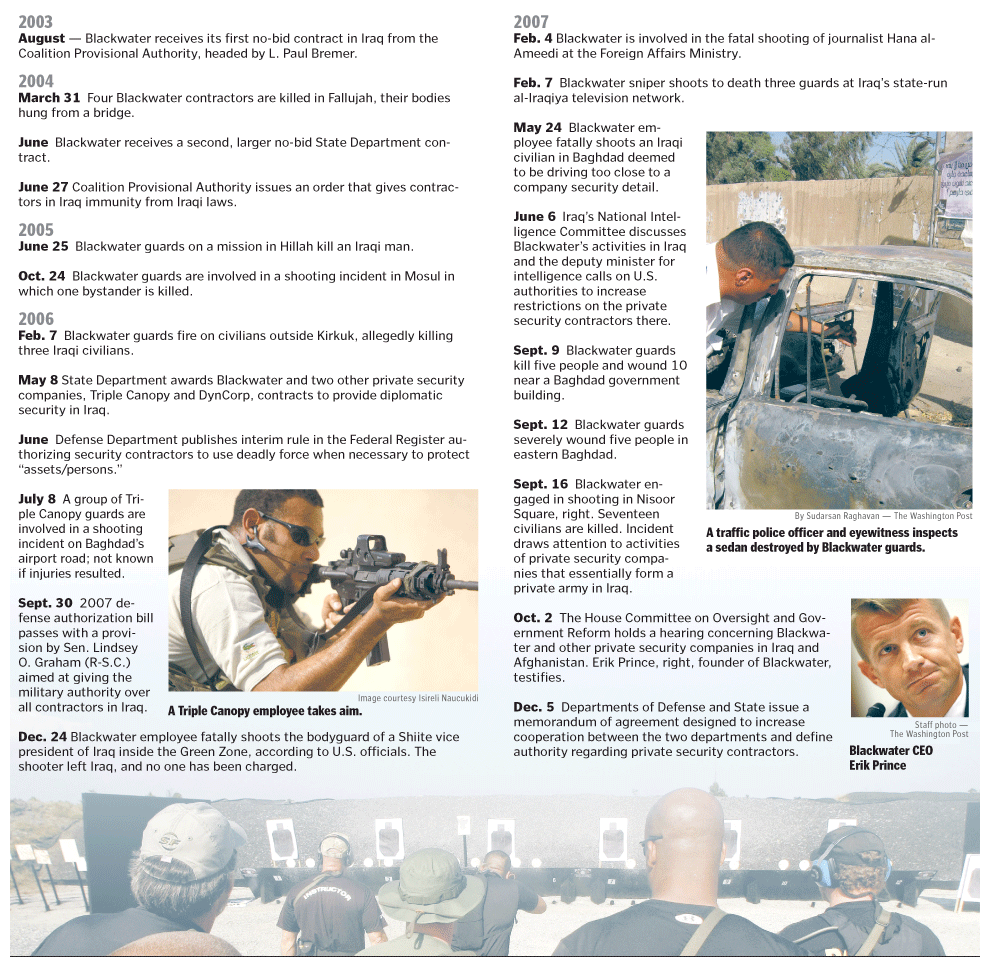
"I asked your secretary of defense a couple months ago what law governs their actions," Turner said, according to a transcript of the exchange.
"I was going to ask him," the president responded, drawing laughter as he issued a mock entreaty. "Go ahead. Help."
"Mr. Rumsfeld answered that Iraq has its own domestic laws which he assumed applied to those private military contractors," Turner said. "However, Iraq is clearly not capable of enforcing its laws. I would submit to you that this is one case that privatization is not a solution. And, Mr. President, how do you propose to bring private military contractors under a system of law?"
"I wasn't kidding. I was going to pick up the phone and say, 'Mr. Secretary, I've got an interesting question,' " Bush replied. "I don't mean to be dodging the questions, although it's kind of convenient in this case."
Turner received a letter two weeks later from the Pentagon's Office of General Counsel. It directly contradicted Rumsfeld: "Contractors are . . . subject to oversight and accountability for their actions on the basis of U.S. law and regulation."
To date, not a single case has been brought against a private security contractor in Iraq. "The reality is the military has not had any oversight on this issue until recently," Arrighi said. "We could hire the Rockettes and give them guns, and they wouldn't know. It was a total wasteland."
Special correspondent Naseer Nouri in Baghdad and staff researcher Julie Tate in Washington contributed to this report.
© 2007 The Washington Post Company
Biography
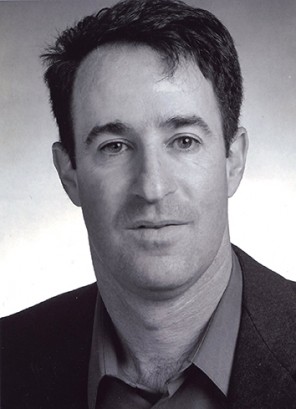
Steve Fainaru is a correspondent for The Post's foreign staff. He has covered the war in Iraq since 2004, and was a finalist for the Pulitzer Prize in international reporting in 2006. He has worked for The Post since 2000, previously covering civil liberties and the fight against terrorism and serving as an investigative reporter focusing on sports.
Previously he worked at The Boston Globe for 11 years, covering the Boston Red Sox, Wall Street and Latin America. He served as that newspaper's Latin America bureau chief.
Steve, who is based in the San Francisco Bay Area, is the co-author of The Duke of Havana: Baseball, Cuba and the Search for the American Dream, which chronicled the odyssey of pitcher Orlando "El Duque" Hernandez and his defection from post-Cold War Cuba.