The Wall Street Journal, by Staff
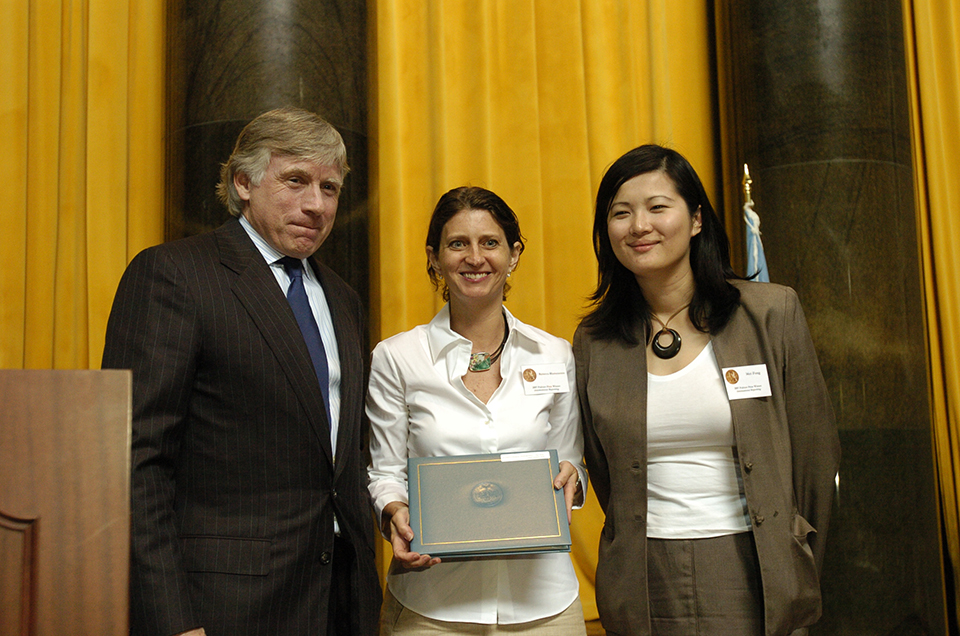
Columbia University President Lee C. Bollinger presents Rebecca Blumenstein and Mei Fong with the 2007 Pulitzer Prize in International Reporting.
Winning Work
Dangerously high levels of lead are discovered in many children; ground zero is Xinsi Village. An imported charm proves deadly in Minneapolis
By Shai Oster and Jane Spencer
"These are the facts, this is reality."
XINSI, China -- Doctors treating a five-year-old boy after a horrific electrical accident this spring were surprised to find another, equally serious problem: dangerously elevated levels of lead in his blood.
The incident uncovered one of China's worst known cases of lead poisoning. For a decade, a factory near Xinsi, an isolated village in the mountains of China's western Gansu province, made lead ingots used in manufacturing color television tubes and cables shipped around the world.
It also poured out poisoned air containing 800 times the permissible level of lead emissions, officials say.
Wang Shuhong didn't know her son, Zhou Hao, was suffering from lead poisoning until an unrelated accident brought him to the hospital.
Nearly everyone from the village who has been tested so far -- including some 250 children from three schools -- has been found with unsafe amounts of lead in their bodies. Ten children remain hospitalized and at least four are likely to have severe brain damage in the village of 1,800 people, according to Xinhua, China's official news agency.
"There's not one person in this village without lead poisoning," says Zhou Xiang, whose son was hospitalized with level of 488 micrograms per liter of blood. "My children's fingers are black and blue."
The World Health Organization says that lead blood levels of 100 micrograms per liter and above (or 10 micrograms per deciliter, using the measurement standard more common in the U.S.) are cause for concern in children. Studies show even slightly elevated lead levels can lead to permanent neurological damage and reduced IQ.
Clutching their carefully folded lab results and pointing to the numbers -- 304, 488 and even 798 -- the parents of Xinsi say they finally understand why their children have complained for so long of nausea, headaches and pains. They say their babies' teeth are growing black or not coming in at all. Parents and teachers say children are having memory and concentration problems.
The disaster shows how vulnerable China's citizens are to the environmental damage inflicted by the country's rapid industrial growth. The result is a health crisis that could have long-term consequences for a generation of children. Even in wealthier areas of China such as Shanghai and Guangdong province, officials say the deteriorating environment is a factor behind a rise in birth defects.
A lack of pollution controls has contaminated China's soil, water and air with lead, mercury and other pollutants -- and left millions of children with dangerously high levels of toxic metals in their blood. Making matters worse, much of the manufacturing that used to pollute the West has found a ready home in China, where environmental regulations are loosely enforced.
About 34% of children in China have blood-lead levels that exceed the WHO limit, according to a recent report by researchers at Peking University Health Science Center in Beijing, who reviewed 10 years of data on the topic. The situation is considerably worse in factory towns like Xinsi. By comparison, fewer than 1% of children in the U.S. have levels above the WHO limit.
High lead levels are "very common in my clinic," says Yan Chonghuai, a specialist in childhood lead poisoning at Xinhua Hospital, affiliated with Shanghai Jiaotong University School of Medicine. Dr. Yan treats cases from all over the country. On a recent day, the hospital accepted a child from Fujian province with a blood lead level of 700 and another with a level of 500 from exposure to talcum powder contaminated with lead.
In China, lead is still prized in manufacturing because it is plentiful, cheap, malleable, and resistant to corrosion. Lead compounds are regularly added to plastics and vinyl to make them more resistant to high temperatures. Because lead is heavy, it is often added to cheap metal products to make them seem more substantial.
Lead dust is sometimes added to herbal products that are sold by weight to make them heavier and increase their value. If lead is in a stable solution it may not pose a problem. But lead can be particularly dangerous in toys and jewelry because children can swallow it.
China's lead problem is drawing new attention from U.S. regulators. In the past two years, the U.S. Consumer Products Safety Commission has recalled roughly 20 products imported from China because of high lead content. They range from beach umbrellas to portable karaoke machines to children's animal-shaped flashlights.
"Given the nature of the global economy, the manufacturing processes abroad can have a substantial impact on the health of young children in the United States," says John F. Rosen, who runs the lead program at the Children's Hospital at Montefiore in New York.
Earlier this year, a 4-year-old Minneapolis boy died of lead poisoning after swallowing a metal charm that came as a gift with a pair of Reebok sneakers. The charm, which was made in China, was 99% lead.
A representative of Reebok International Ltd. says the company takes "product safety very seriously" and immediately recalled 500,000 products in 25 countries following the incident. The company has since stepped up oversight of suppliers, and increased testing of products for restricted substances.
China's pollution problems are in some ways reminiscent of what was seen during the rapid industrialization of 19th-century Britain and other industrial revolutions. But China's rapid growth is taking place at a time when government officials are well aware of the dangers of toxic substances like lead.
China is in the early stages of a battle against lead that the U.S. started nearly three decades ago. During the 1960s and early 1970s, hundreds of American children were hospitalized each year with severe lead poisoning linked to exposure from lead in paint and gasoline. One in four hospitalized children died, because there were no treatments at the time. The deaths led to laws banning lead in paint, gasoline and other industrial products. The campaign against lead was part of a wave of environmental legislation passed in the 1970s aimed at reining in rampant industrial pollution.
Now, China is confronting the same "trade-off between short-term profits by industry and the long-term burden of human and environmental costs," says Bruce Lanphear, a professor of environmental health at Cincinnati Children's Hospital Medical Center.
After decades of ignoring the rising environmental toll of its breakneck economic growth, China's central government is now trying to stem the damage. The government has already taken some steps to curb lead exposure such as phasing out leaded gasoline in the late 1990s and passing stricter rules on workplace exposure. Yet central authorities have found their efforts stymied by local officials whose promotions are based on growth in their local economies.
Xinsi, or new temple, seems like an unlikely place for an environmental battlefield. Eight hours by bus from Xi'an, the largest nearby city and home of the famed terra-cotta warriors, Xinsi is a farming village of old mud-walled homes with traditional curved Chinese roofs and wood lattice windows.
The factory, which took lead ore and melted it to separate impurities, was opened 10 years ago by a company called Huixian Hongyu Nonferrous Smelting Co. Ltd. Huixian was owned at the time by a state conglomerate called Gansu Luo Ba Nonferrous Group.
Government officials say the factory's smelter distilled lead ore into 5,000 tons a year of lead ingots and dumped the waste in unsafe slag piles. Some of that output was eventually used in television screens or cables exported to the U.S. and South Korea, according to the parent company's Web site.
The factory lies at the base of a small creek, a stone's throw from the local primary school, and its smokestack dominates the countryside. It is far from any lead-ore deposits or convenient transportation. One local official said the factory was built in Xinsi instead of closer to bigger cities to avoid scrutiny. China's environmental regulators and activists say it's increasingly common for heavily polluting industries to move to the countryside, where supervision is weak.
There are signs that the Xinsi factory followed at least rudimentary safety procedures with its own workers, many of whom came from outside the village. The factory conducted blood tests and dismissed those whose lead levels were elevated. Zhou Fei, a 42-year-old Xinsi resident, lost his job after a failed blood test. His neighbors say he has trouble remembering dates now. Asked directly, Mr. Zhou can't recall when he worked at the factory.
Many Xinsi villagers say they had no idea that the lead dust spewed by the smelter posed a hazard to them. "We're just simple peasants," said Xu Minzheng, whose 2-year-old son has a lead level of 263 micrograms per liter of blood. His 7-year-old daughter has a lead level of 316. He pointed to the smokestack overlooking the rutted dirt path winding past corn and red chili peppers hanging to dry. "We didn't have any awareness of what lead could do. But the government officials should have known. We just don't have the means to deal with this sort of thing."
Lead causes brain damage by mimicking helpful metals found naturally in the body, such as calcium, iron and zinc, and binding with the same molecules and proteins. Calcium, for example, is essential for brain development because it facilitates the growth of nerve cells. But lead binds with the sites in the brain that were intended for calcium, disrupting brain circuits critical for learning, and sometimes impeding cell growth. The process leads to irreversible intellectual impairment. Lead exposure is especially harmful to children.
Last year, the Xinsi smelter's parent company, the Gansu Luo Ba Nonferrous Group, went private in a management buyout. The factory upgraded its emissions controls, but turned them off at night, when the factory would emit heavy smoke, to save money, villagers said. Earlier this year, government authorities told the factory to cease operating, but it continued to produce in secret, according to the villagers and Xinhua, China's official state-run news agency.
The situation might have continued unchanged if it weren't for a little boy's curiosity back in March. Five-year-old Zhou Hao was playing with a classmate near a slag heap from another factory in their hamlet. Hopping over an unfinished wall, the boy touched a big electric transformer. The massive shock blew off his shoes and knocked him unconscious.
The boy's parents rode with their badly injured son overnight in an ambulance to the nearest big city hospital, in Xi'an, for the first of many operations to save his life. His left arm was amputated, he needed skin grafts, and his badly gashed scalp swelled like a balloon.
It was after blood transfusions for one of these operations that doctors diagnosed Zhou Hao's incredibly high levels of lead. The doctors couldn't understand why farmers would have lead in their blood, until Hao's mother, Wang Shuhong, told them about the factory.
Ms. Wang said she and her husband, uneducated farmers, didn't realize the consequences of the high lead level and quickly forgot about the doctors' diagnosis. Taking turns sleeping and keeping watch over their son at the hospital and worrying about how to raise tens of thousands of yuan for his medical bills left the parents drained and exhausted.
It took another chance encounter -- this time with a worker in the Xinsi smelter they bumped into in Xi'an -- for them to learn about lead. They asked what pills they should take to get rid of the lead. He said pills wouldn't help their child.
By August, after five months of treatment, Zhou Hao's parents brought him home. Word began to spread about the young boy's lead poisoning. A few farmers began sending their children to be tested in Xi'an. But officials in the factory and government denied the lead poisoning had anything to do with them, Zhou Hao's mother and other villagers said.
Zhou Hao has lead levels that, due to blood transfusions, have swung between 262 and 557, his parents say. The factory owners "did this for their profit," says Ms. Wang. "They didn't even think about lives at all."
Officials only started taking the allegations seriously after a local newspaper in Xi'an reported Sept. 5 about all the villagers coming in for lead tests. That story was soon picked up by Xinhua, which as the official organ of the regime nationalized the story and brought it to the attention of China's central leadership.
A government investigative team from Beijing is looking into how local and provincial officials allowed the factory to keep operating for years despite its failure to meet national emissions standards.
The factory has closed and parts have been torn down, villagers say. "Our stance is very clear: If we should be found responsible for this, we will admit it and actively take responsibility. It would be impossible for us to avoid responsibility," said Liu Xiaodong, office manager at Gansu Lou Ba Nonferrous Group. The local and provincial governments declined comment pending the conclusion of an investigation.
It is highly unusual in China for a company to make reparations for environmental damage. Occasionally a polluter will be forced to pay farmers for damage to crops. But there is no developed law for establishing liability for health problems.
On a recent day, a shiny caravan of sport utility vehicles carrying a delegation of regional officials roared through the rutted mu lanes to meet with the villagers. Many of the villagers gathered in an angry crowd. The officials agreed to distribute pills to people suffering severe lead poisoning. One type of pill was a Chinese herbal remedy.
International health agencies say there's no effective treatment for lead exposure except in the most life-threatening cases, when patients can be given drugs called chelation agents that strip heavy metals out of the body. But the drugs cannot reverse brain damage that has already occurred, and they carry risks of their own because they also strip useful metals from the body, such as iron and zinc.
Wu Wenchou, a bright-eyed 15-year-old girl, is one of those who was poisoned. Ms. Wu speaks standardized Mandarin -- a clear mark of an education in a rural county where the local dialect dominates. "I used to dream of going abroad to study, maybe even America," she said quietly, barely holding back tears. "My dream has been shattered."
Once a class star, young Ms. Wu began having difficulty concentrating on her homework, and her test scores kept falling. Her once-proud mother shouted at her as her grades dropped. Her blood has lead levels of 261 -- more than double the standards for safety. She called her older sister, who is studying at a nearby medical school, and told her to come home for the lead tests, too.
"I'm afraid. We have no choice," she shrugged. "These are the facts, this is reality."
© 2006 Dow Jones & Company, Inc
As Beijing explodes in an Olympic building boom, Wei Zhongwen struggles with injuries and loneliness.
By Mei Fong
A hero in his home village
BEIJING -- About a mile from Tiananmen Square lies a pit from which a 28-story hotel will rise in a little more than a year. An army of construction workers lives and works at the open site, enduring plunging temperatures and freezing winds.
Some work the midnight hours, while the rest of the city sleeps.
Others rise at dawn. They work 15-hour days or longer, seven days a week. When they topple onto their bunk beds, it is 12 to a room. There is no heat.
One of them is Wei Zhongwen. He has more than two decades as a construction worker, and the injuries to prove it: a missing pinkie and a palm-size dent on his head under his neatly cropped hair. In the past decade, the 41-year-old has helped build skyscrapers, shopping malls and much else in Beijing and nearby provinces. He hasn't seen his wife or daughter in two years, and because of the press of work ahead of the Beijing Summer Olympics in 2008, he may not see them this year either.
Migrant construction workers try to go home every year for Chinese New Year. But in the meantime, they use call centers like this one to contact their families.
"For me, one of the biggest problems of this job is loneliness," says Mr. Wei, puffing on a cigarette.
In his rural hometown, the money Mr. Wei has sent back has built his extended family a five-room house with a thatch roof, a 21-inch color television set and rooms housing a horse and some pigs. The hardship of his work is worth it, Mr. Wei says, to educate his daughter and sustain his family on their farm.
Beijing is in the midst of an enormous building boom -- one of the most ambitious construction projects the world has ever seen. Cranes clutter its skyline. At more than 10,000 sites across the city, there is a total of 1.7 billion square feet of floor space under construction -- an area that, if laid out, would be nearly three times the size of Manhattan.
This colossal development is due to the efforts of a nearly invisible army, a group of almost two million migrant workers who drift from China's farmlands. Toting their bedrolls from work site to work site, they earn as little as 50 cents an hour. They work in a hazardous profession with practically no workplace protections and little or no medical coverage. Many of the workers live right in the heart of the city, yet few ordinary Beijing residents ever glimpse their crowded barracks, where privacy, cleanliness -- even meat -- are luxuries.
They often get paid late or not at all. A report this year by the research arm of the State Council, China's highest administrative body, found that in 2004, construction firms in Beijing owed roughly 700,000 of their workers more than $380 million in wages. Mr. Wei is fighting to collect about $400 he says he is owed -- half his earnings last year -- and he may never see it.
In such an uncertain environment, workers drift from job to job together. They rely on word of mouth to protect themselves against bad bosses. And, in bad times, they rely on each other.
These men -- there are few women in their crews -- are working against a deadline: December 2007. That is when the bulk of the Olympic construction work must be completed so that Beijing, one of the world's most polluted cities, has time for the air to clear of construction dust before the Games begin.
There is a lot to finish. The Olympics will attract a flood of foreign visitors and unprecedented media attention. Beijing's construction workers are aiming to have built a chunk of a subway system that, when completed, is projected to be the longest in the world, surpassing London's underground. They are erecting an airport terminal bigger than all five at London's Heathrow Airport and about 110 hotels. Including the suburbs of Beijing, the building binge could cost more than $180 billion. Some call it China's most ambitious construction project since the Great Wall.
What happens to these workers after the boom already has become a topic of controversy. Beijing officials have made it clear they want to clear them out ahead of the Olympics. But authorities also fear political instability if so many workers are forced to leave because they may have trouble finding jobs back home.
As it is, the construction workers have a tenuous standing in the city. Lacking the papers to stay in Beijing legally, most work off the books, relying on oral promises instead of contracts. When they are sick, they visit illegal clinics, which are cheap but often dirty and run by unlicensed doctors.
Mr. Wei speaks proudly of his 18-year-old daughter Xiaowei, who lives with the rest of his family on a farm in Yushu county, in northeastern Jilin province. He says the girl is a good student and obedient. "We're not that close. I don't know what she likes," he says, awkwardly fingering a bunch of keys on his belt. A badge of prosperity among middle-age Chinese men, Mr. Wei's keys are a small vanity. He says he picked them up on the street. They are keys to things he doesn't have: a car, an apartment.
Like other construction workers, he lives frugally in the city. In his latest job he earns about $300 or so a month, but keeps only about $60 of it. The rest he sends home to the "3861 army" -- a term used to describe the women and children left behind in China's interior. (March 8 is China's Women's Day, June 1 Children's Day.)
Next to coal mining, construction work has the highest number of casualties in China, with 2,607 reported fatalities in 2005. Steel-tipped boots are rare. China's workers clamber around in thin canvas shoes, often without safety harnesses, and buy their own work gloves. Many of their hard hats are just thin plastic shells, sold for a dollar apiece.
Wang Qishan, the mayor of Beijing, said in a recent interview that he personally reviews construction accident statistics daily. "I can never be happy when I read such reports," he said. "Beijing can't do without these people." The city tries to provide services such as health care for registered migrant workers, but its resources are overstretched, he said.
Like many other construction workers, Mr. Wei entered the trade because there was little else to do on his family's farm, a small plot where corn and soybeans grow. He left home at 17 for a province next to Beijing.
When he was in his 20s, Mr. Wei's left little finger was sliced off by an electric saw. In 1994, he was hit on the head by a steel rod, landing him in the hospital for more than a month. He counts himself lucky because his employer paid for his medical bills. Construction is under way at more than 10,000 sites in Beijing.
Last year, the owner of an art gallery in Tongzhou, a Beijing suburb, stiffed Mr. Wei and 76 crew mates, according to the men and a later court ruling. They had been paid halfway through the project and promised the rest of the pay upon completion. Instead, when they finished they say they were driven from the site by thugs armed with iron staffs and meat cleavers.
China's state-controlled banks have poured credit into real estate, where many companies are politically connected. The easy money often leads to ill-conceived projects that quickly go bust. When financing collapses, construction workers -- the ones at the bottom of the totem pole -- aren't paid. They find it difficult to claim restitution because they often are employed indirectly through subcontractors.
Mr. Wei and his friends say they had no success appealing to authorities in Tongzhou. About 20 of the workers drifted home, defeated. With no money, Mr. Wei and the remaining workers were forced to make camp in the neighboring province of Hebei, eking out a living with odd jobs. They say they lived on steamed buns, mostly, six for one yuan, or about 13 cents.
In November 2005, more than 50 of them rose at dawn. They marched for five hours to central Beijing to appeal to authorities there. They wound up at Beijing's Legal Aid office on Qianmen West Street.Wang Xuefa, the center's director, remembers the sight of Mr. Wei and his friends kneeling en masse on the office floor. "It was sad to see men brought so low," he says.
The Intermediate People's Court in Tongzhou ruled in the group's favor on Jan. 6, ordering the Hong Kong developer Lian Ka Fu International to pay more than $30,000 in back wages to the workers. They haven't seen a cent. Lian Ka Fu's proprietor, Wang Xiaohu, told the court she doesn't have the money, says Chang Mingchuan, a lawyer at Beijing Legal Aid. Ms. Wang couldn't be reached for comment, and her Europe American Art Gallery -- a green low-rise with gold Corinthian columns -- is now shuttered.
Going home for Chinese New Year, China's most important holiday, is a ritual for construction workers. It is the only time in the year they see their families. Like returning heroes, they are feted and tell tales of car-choked streets and the towering skyscrapers they helped build. "Some of my neighbors have not even taken a train," Mr. Wei says.
Back home, Mr. Wei is a man of substance. Over the years, his wages, which are higher than average among construction workers because of his bricklaying expertise, have helped his family enjoy some comforts. "We're very well respected in my home," he says.
Last January, however, Mr. Wei stayed in a Hebei flophouse instead of returning home for the new year holiday. Penniless, he and his friends were too ashamed to go. To cheer up, they went to an airfield and watched planes taking off.
"Really, that's the only time I felt like suicide. I thought if a car hit me, at least I can get some compensation," Mr. Wei says.
Reached by telephone, his wife, Ding Guiying, says it is a hard life taking care of Mr. Wei's aged parents, raising her daughter alone and tending the crops. Mr. Wei's wages nowadays go to pay for his daughter's secondary education -- which isn't free in China, even at public schools. Ms. Ding says the bill comes to around $1,300 a year.
Ms. Ding, 42, hopes her husband can come home when their daughter has finished school. "We keep being separated for such a long time, and I can hardly count how many days we've been together in the past 19 years," she says.
Mr. Wei spent most of this year in Hebei, the province surrounding Beijing. In May, he and his friends found a job at a residential site. Mr. Wei roomed in a wooden shack with 10 other workers. The floor was a brick-and-dirt mixture. The only running water was from a sink in the courtyard. The toilet was a shed with wooden planks over a hole. In the kitchen, flies clustered thickly.
In Hebei, as is common on such jobs, Mr. Wei paid his employer about 60 cents daily for three meals, mostly rice and tofu. Meat was rare, but he is a vegetarian. Growing up poor, he never got used to the taste of meat.
One of the crew, Yang Xinguo, 53, injured his leg in a traffic accident and had to stop working in September. After lingering for a while, hoping to get compensation from the art-gallery job, he decided to go home in mid-November. He had a few dollars earned before the accident and $50 or so that Mr. Wei and other friends gave him.
"We will send your pay to you, once we get it," promised Mr. Wei, sitting on Mr. Yang's bed. He offered his departing friend a cigarette. Through the smoke, Mr. Yang's eyes shimmered. "Men don't want to cry, but we have cried many times," he said.
By late November, Mr. Wei and his crew had moved back to Beijing. They found better work building the 28-story, four-star hotel. Conditions are cleaner. Mr. Wei now lives in barracks perched next to the yawning site. He has 10 roommates, including some new ones. There is no canteen, so they cook in the room, using a gas ring attached to a five-foot canister next to Mr. Wei's bed.
With no heating, they sleep in their jackets, and sometimes hats and gloves, too. Temperatures can drop below zero Fahrenheit in Beijing's winter. Some have electric blankets they bought for about $1.25 each.
They are creative with their limited space, rolling back their bedrolls and using the boards beneath as makeshift tables. The cook, Wen Fenglin, adroitly uses the space to chop cabbages and peel onions, ladling water from an old paint bucket to clean the food and utensils. The 55-year-old used to work on the crew but now is employed by the construction company to cook. "Boss said I have to learn because I'm too old to do heavy work," he says, browning onions for an omelet.
There are no washing facilities, so baths and clean clothes are treats. Mr. Wei remembers taking a bath well more than a month ago at a bathhouse, paying about 60 cents.
With no laundry, Mr. Wei buys secondhand clothes, wearing them until they get too dirty. Currently, his favorite is a gray cotton shirt he bought for a little more than a dollar, which looks as if it once might have belonged to a corporate executive. "I normally throw away the clothes after wearing, but maybe I'll sell this. In about 10 days," he says.
Around Beijing's small alleyways, an underground economy caters to construction workers. Vendors often do their business by barter because the workers don't have space to keep much and adopt a throwaway culture. One popular item is underwear with zippered pockets, to keep money and valuables close.
Mr. Wei's pace of work is now frenetic. The hotel still is just a big hole in the ground. Under city ordinances, concrete trucks from the hundreds of factories ringing the city are allowed in the city center only after 11 p.m. and on weekends, so he and his friends must work long past midnight curing concrete. Once the hotel's foundation is done, in about two months, Mr. Wei says the plan is to build a floor every five days.
On the next-to-last day of November, Mr. Wei and his comrades crowded into a small postal outlet, their grimy appearance setting them apart from other customers. The air smelled of unwashed clothes, and some people edged away.
It was exactly a year since they had made their long march to the Beijing Legal Aid office. Mr. Wei had given up hope of recovering his lost wages, but on this day the mood was celebratory. It was payday, and the men wanted to mail their money home. There was a flurry of bewilderment as they fumbled with forms. Mr. Wei, his eyes red-rimmed after a 24-hour shift, helped some of the workers who can't write well fill out the forms.
Zhang Tao, 20, in a paint-stained blue sweater and matted hair, slowly scrawled the amount he is sending home: 900 yuan, or about $115. He said he earns 1,000 yuan, or $128, a month.
On another night, Mr. Wei took a walk, wandering around the city's glittering towers and looming cranes. "I have no regrets," he said. "I'm the migrant worker who stays out all year so home is better. I've seen things my neighbors have never imagined -- 50-story buildings, planes so big they can carry hundreds."
He stopped in front of a European five-star hotel near his work site. "I build these things, but I have never been inside," he said.
Timidly, he pushed the swing door and went in.
© 2006 Dow Jones & Company, Inc
Vehicles Foul Air, Jam Streets But Plump Local Coffers; Restrictions Remain Few; McDonald's Targets a Niche
By Gordon Fairclough and Shai Oster
Bumpy Ride
BEIJING -- Nearly 1,000 new cars hit the streets here every day, crowding a city already choked with pollution. Levels of nitrogen dioxide currently exceed the World Health Organization's clean-air guidelines by 78%.
The mayor, Wang Qishan, complains that the number of cars flooding the roads makes it "more difficult to run the city." Local officials are so worried about air quality for the 2008 summer Olympic Games that they are considering a temporary ban on private cars.
At the same time, the city owns Beijing Automotive Industry Corp., a car maker that has joint ventures with DaimlerChrysler AG and South Korea's Hyundai Motor Co. Last year, the company and its affiliates made more than 500,000 cars, trucks and buses, employed 48,000 workers and paid more than $500 million in local taxes. By 2008, they expect to produce one million vehicles a year.
After various on-and-off restrictions, Beijing, which has more vehicles than any other Chinese city, has almost no limitations on car usage.
"This is something of great difficulty for us. The contradiction of population and the environment -- for us and the whole of China," said Mr. Wang at a March meeting.
The rise of the automobile highlights the wrenching balancing act China faces as it tries to join the ranks of modern consumer societies: improving living standards and creating jobs for the country's 1.3 billion people while keeping pollution and oil demand under control.
Officials from China's central government are divided over how to proceed. The country's powerful economic planners see the auto industry as a "pillar" of the national economy. Others, including those from the State Environmental Protection Administration, argue that China needs to limit car use and move more quickly to tighten clean-air rules.
Local leaders are also torn. Many city and provincial governments, like Beijing, have a financial stake in the industry and are eager to capitalize on ramped-up production. But they also face complaints from citizens about snarled traffic and dirty air.
China's car debate stands out because its population is the planet's largest. Across the country, rising incomes and falling auto prices have led to an explosion in car sales, up 54% in the first three months of 2006, compared with the year-earlier period. China's auto market is now the world's second biggest, and the motor-vehicle industry employs 1.7 million workers.
The shift is happening so quickly that McDonald's Corp. said last week that it expects at least half of its new outlets in China to be drive-throughs.
And the car craze here has just begun. China now has about 25 vehicles -- and fewer than seven cars -- for every thousand people, roughly the same level as the U.S. had in 1915. If auto sales continue apace, there will be more than 130 million vehicles on China's roads by 2020 -- up from about 33 million today. That could help double China's demand for crude oil and lead to a sharp increase in greenhouse-gas emissions, according to estimates by the government and environmental groups.
"If we follow the current track of consumption patterns to develop the automobile in China," says Pan Yue, vice minister of the State Environmental Protection Administration, "the world will not be able to support" it.
Complicating matters, Chinese gasoline contains high levels of sulfur and other contaminants. It will take years and billions of dollars to improve China's refineries to make higher-quality, cleaner-burning gas.
So far, calls for stricter car controls have been largely muted by the powerful National Development and Reform Commission, which sets the country's economic-development policies.
The commission has put a priority on expanding the economy to generate jobs for the millions streaming into cities from China's countryside. Officials of provincial governments and cities -- whose performance is judged largely on their ability to boost gross domestic product -- are rushing into auto-making.
Guangdong, long known as China's export capital for consumer goods, says it wants to triple its auto-making capacity by 2010.
"How many color TV sets and refrigerators are equal to one automobile?" asked Huang Huahua, governor of Guangdong on China's southern coast, at a government conference earlier this year. "You are a fool if you don't make cars....If we still depend on color TVs and a few similar industries, then Guangdong's 9% GDP growth can no longer be assured."
In 1997, Anhui province, one of the poorest in China, teamed up with the city of Wuhu to start a government-owned car maker, Chery Automobile Co. Last year, Chery sold nearly 190,000 vehicles, more than double its sales from 2004. The company says it has had trouble expanding capacity to keep pace with demand for its cars, which sell from $3,700 up to about $25,000.
In some cases, local governments share directly in car manufacturers' profits. Shanghai's government, for example, controls and receives dividend payments from state-owned Shanghai Automotive Industry Corp., which has joint ventures with both General Motors Corp. and Volkswagen AG.
For most of the auto's history in China, there were few cars and different priorities. After the Communists rose to power in 1949, China's auto industry focused on building military vehicles, buses and trucks. The Cultural Revolution of the mid-1960s to the mid-1970s, which led to mass upheavals, hobbled the industry.
A Shift in the 1980s
China's modern car market grew slowly at first, as demand for relatively expensive cars was limited largely to government and Communist Party officials. After launching market overhauls more than two decades ago, China decided to bring in foreign expertise. In 1983, state-run Beijing Automotive signed the first joint-venture deal with American Motors Corp. to make Jeeps. Soon after, Shanghai Automotive went into business with Volkswagen.
By 1994, the government had decided that cars should play a central role in driving the country's industrial engine. The official government policy nodded toward environmental concerns, saying the government "encourages" the use of "fuel-efficient and low-polluting" vehicles. At the same time, however, officials also pressed for stepped-up production.
Even then, officials in Beijing and other cities were worried about mounting congestion and auto pollution. Beijing put varying restrictions on small cars and trucks, limiting where and when they could drive.
Development of mass transit lagged in Beijing and many other cities, creating more demand for cars. In the late 1990s, more than a dozen cities wanted subway systems. But China's central government delayed approval, partly due to budget constraints. Beijing's main east-west subway line was only finished in 2000, and large parts of the city are still inaccessible by rail.
The central government, meanwhile, was looking to strengthen the car industry by bringing in additional foreign expertise and resources. In 1997, GM won a coveted deal for a joint venture with Shanghai Automotive that now produces Buicks and other models. Many other foreign auto makers followed.
After China joined the World Trade Organization in 2001, falling prices sparked a jump in car purchases by China's more-affluent consumers.
Today, demand by middle-class buyers is surging as salaries rise and car prices, driven down by competition, plummet.
Liu Yunzhi, a 25-year-old computer-hardware designer, bought his first car, a $5,200 Chinese-made hatchback, soon after moving into an apartment in a Beijing suburb last year. He used it to haul furniture to his new home from Ikea.
"You don't have to be a rich guy to own a car," says Mr. Liu. "You can enjoy your life more."
Price wars have heated up as more local manufacturers have entered the fray. Mr. Liu's hatchback, for instance, was made by Geely Holding Group, which moved into autos after making motorcycles. BYD Co., a producer of cellphone batteries, got into the car business in 2003 after acquiring a formerly state-run assembly plant.
Rolling Stock
In Chongqing, a city in southwest China that is hoping to become the nation's car capital, auto factories spread over more than 20 million square meters, or around 5,000 acres. Metal-stamping plants, paint shops and assembly lines churned out more than 600,000 cars and other vehicles last year -- capacity that city officials hope to more than double by 2010.
Even in Shanghai's relatively diverse economy, the auto industry employed nearly 416,000 people, accounting for about 3.4% of GDP and more than $900 million in taxes in 2005, according to government figures.
Li Qisheng is 24 and has spent two years working on assembly lines for Geely in Zhejiang province, south of Shanghai. The son of farmers, Mr. Li now earns about $250 a month, or about $1.27 an hour, doing quality-control checks on new vehicles.
Mr. Li, who also receives subsidized meals and housing in a company dormitory, says he sends about half of his earnings home every month. "It relieves the pressure on my parents," he says. Last year, his family used the money to build a new, five-story concrete house to replace an old two-floor wood home. "I'm proud of myself," Mr. Li says.
The trickle-down of industry benefits has made it hard to put on the brakes. In 2000, Shanghai decided to tighten restrictions on new car registrations, auctioning off a limited number of license plates annually. But it has gradually loosened the strictures.
During the first year of the new program, Shanghai issued 14,000 plates for an average price of $1,700. Last year, it issued 67,078 for an average price of more than $4,000.
"Residents have a very strong demand of car use," says Zhu Junyi, a researcher at the Shanghai Information Center, a government think tank. The government, he adds, "has to try its best to meet the demand."
High Toll
The toll is high. Exhaust from an estimated 2.5 million vehicles has helped make Beijing one of the most polluted cities in China, even though it has shuttered many of the coal-burning factories that once fouled its air. In 2004, levels of airborne particulate in Beijing were more than six times as high as in New York, and sulfur-dioxide levels were more than double, according to Chinese and U.S. government figures.
It wasn't until 2000 that China passed its first comprehensive emissions law and made catalytic converters, which clean vehicle exhaust, mandatory. China has modeled is auto-emissions standards after those in Europe. Still, most of the country still lags behind Europe, using rules implemented there back in 1996. Beijing has a stricter standard, in line with regulations set by the European Union in 2000. The entire nation is slated to move to that cleaner standard by 2008.
Emissions testing for cars has been spotty, and experts complain that little is known about what comes out of China's tailpipes. Beijing officials say that more than 60% of the vehicles in the city have some emissions controls, an acknowledgment that up to 40% of them -- mostly older models -- have none at all.
In 2005, China imposed its first fuel-efficiency standards, which some analysts say will eventually be stricter than in the U.S. Earlier this year, the central government called on cities like Beijing to lift bans originally imposed on small cars in order to encourage purchases of more energy-efficient models. The government also instituted a graduated tax on new cars, designed to discourage purchases of gas guzzlers.
But to really limit cars' environmental toll and energy consumption, experts such as Lee Schipper, director of research at the World Resources Institute's Embarq Center for Transportation and the Environment in Washington, D.C., say China needs to levy road-use fees, lift gas prices and encourage the use of mass transit, as well as hybrid and electric vehicles.
"The rapid rate of growth is more than government institutions are prepared to deal with," says Mr. Schipper. When he suggests to local officials that Chinese cities limit the number of cars on the road, he says they resist. "They say: 'You can't restrict cars.'"
Ellen Zhu and Zhou Yang contributed to this article.
© 2006 Dow Jones & Company, Inc
Fouled Waters Lead to Flood Of Protests Nationwide; Officials' Mixed Messages
By Shai Oster and Mei Fong
River of Tears
Inspired by Erin Brockovich
XIPING, China -- For the past five years, village doctor Zhang Changjian has rallied farmers here against a chemical factory dumping pollutants into a river.
This spring, they won a rare victory. A court found the pollution exceeded acceptable levels and ordered the Rongping Joint Chemical Plant to pay damages of about $85,000. But the farmers have yet to see any of the settlement. Mr. Zhang has been the target of police harassment, and the county government has closed down his clinic.
When a chemical factory in rural China started dumping pollutants into a nearby river and cancer rates soared, village doctor Zhang Changjian, above, organized a campaign that called national attention to local farmers' plight. He drew inspiration from the movie "Erin Brockovich," starring Julia Roberts, based on a true story of a woman's crusade for justice after similar pollution in California.
A quiet man with a crop of stubby, graying hair, Mr. Zhang, 46 years old, refuses to be cowed. He continues to dispense medicine and monitor Rongping, often circling the factory in plastic slippers, a camera clamped to his belt. "Our food is still poisoned," says Mr. Zhang, pointing out the factory's wastewater spilling into the foul-smelling river that eventually flows into the East China Sea. "The farmers can't sell their crops and they're too poor to move."
Water pollution is among the most worrisome byproducts of China's rapid economic growth. Factories and cities dump some 40 to 60 billion tons of wastewater and sewage into lakes and rivers each year, according to Chinese government estimates. About 30% of China's rivers are so dirty they aren't fit for industrial or agricultural use, according to official statistics. Some 300 million Chinese -- roughly the size of the entire U.S. population -- don't have access to clean drinking water. The polluted water is becoming an international issue as it flows into Russia and other parts of Asia.
The government has sent mixed signals about how it intends to tackle the problem. Governmental bodies have given awards to environmental activists, published data stressing the magnitude of the pollution and relaxed controls on antipollution groups. That has allowed activists to form links and share notes, often via the Internet. "We all know each other," says Wu Lihong, who has been fighting river pollution in his hometown near Shanghai.
But especially at the local level, many officials are loath to let activists influence how factories are run. Provincial, county and village officials depend on industry to advance economic growth and their own careers. By one government estimate, a total of $125 billion has been invested in China's chemical and petrochemical plants -- suggesting the size of the stakes. Even when a factory is shut down, it often reopens. The central government has capped the fines for environment violations at about $120,000, and provincial authorities often set even lower caps.
Anger over the lack of clean water and air is rising. According to Pan Yue, vice minister of the State Environmental Protection Administration, about 50,000 protests last year were due to pollution.
Authorities in Pingnan County, which includes Xiping, acknowledged in a statement to The Wall Street Journal that the Rongping plant was responsible for excessive pollution in its early years. They said Rongping has taken steps to rectify the problem since 2001 and discharge levels are now within government standards. Mr. Zhang agrees the situation has improved but says pollution is still excessive.
The plant pays a third of the county's tax and other revenues and has provided well-paying jobs for peasants in this mountainous part of Fujian Province. Officials cite the economic benefits in opposing the plant's closing.
The Rongping plant opened here in 1994. It had previously been in Fujian's capital, Fuzhou. Officials relocated it to take advantage of cheap hydroelectric power from Xiping's mountain streams and promote rural economic development. A state-owned chemicals company based in Fuzhou is the plant's majority owner, although the Pingnan County government held a 30% stake until 2004.
With the factory's arrival, Xiping's population quickly doubled to 2,000 people. The plant became Asia's largest producer of potassium chlorate, a chemical widely used in bleach, fireworks and other goods. But it was also spewing chromium-6 into the river and belching chlorine from its smokestacks, according to a later provincial court verdict and the Fujian Province Environmental Supervision Center. The center said a sewage sample contained more than 20 times the amount of chromium-6 allowed by national standards. The statement by Pingnan County authorities confirms that chromium and chlorine were discharged but doesn't specify the amount or the type of chromium.
Chromium-6 plays a starring role in the movie "Erin Brockovich." It's based on a true story in which a paralegal (portrayed on screen by Julia Roberts) helped a California town's residents win $333 million from a utility that had leaked chromium into their water. Breathing chromium-6 has long been linked with lung cancer. According to U.S. authorities, ingesting the substance can damage the stomach, kidneys and liver.
Shortly after the Rongping factory opened, villagers started complaining that the emissions into the river were affecting their crops. Bamboo groves they harvested to sell to toy and chopstick makers shriveled and died. Downstream, in the nearby village of Houlong, Zheng Jiayao says he and his neighbors noticed fewer fish and shrimp and a strange smell coming from the green slime sometimes coating the water.
The factory offered to pay compensation to a handful of families whose plots abutted the factory gates. But it continued full operations.
Mr. Zhang is a "barefoot doctor," someone trained by the government to administer simple remedies and sent to remote areas that are too small to attract a doctor with a full medical degree. He arrived in Xiping in 1984. Over the years, the father of four built a comfortable practice.
In the late 1990s Mr. Zhang began noticing a spike in illnesses including stomach ailments, skin rashes and breathing problems. Combing through handwritten notes, he saw the change dated back to the factory's opening in 1994. More alarming was a rise in cancer cases. The disease accounted for just one of 13 deaths in the village between 1990 and 1994. Between 1999 and 2001, 17 of 24 deaths were cancer-related, Mr. Zhang found. Cancer victims included two 18-year-old girls and a 3-year-old boy.
In 1999, Mr. Zhang and a handful of other farmers started a letter-writing campaign. He says he drew inspiration from the Erin Brockovich movie, of which he has a copy at home. "I thought if the leaders only knew what was going on, they'd fix it," he said.
With each unanswered letter, he sent his complaints higher up the chain of command. Liu Xianbin, a former soldier with a gaunt frame who had developed cancer, enthusiastically joined in. Mr. Liu enlisted a friend to write a letter in English to former President Bill Clinton. He didn't get an answer, but he says he was questioned by local authorities about the letter and detained for a day.
In 2001, Mr. Zhang appealed to China's top environmental agency, and finally got an answer. He was told to organize a formal complaint. The doctor canvassed the villagers seeking signatures on a petition calling on the factory to stop polluting. He still has the original copy of the petition, on which farmers stamped a red thumbprint next to their signatures in the traditional Chinese manner. Mr. Zhang took soil and water samples and posted pictures of the dying bamboo groves on his Web site.
By the next year, the efforts started to bear fruit. The village head came out in support of Mr. Zhang. Villagers held a three-day leafleting campaign outside the county government offices, attracting attention from national newspapers and later a popular investigative segment on state-run national television. That summer, China's central government named Rongping one of the worst 55 polluters in China.
A rare victory: A provincial court awarded $85,000 in damages to villagers harmed by chemical pollution in Xiping's river, top. Executives at Rongping Joint Chemical Plant, bottom, say the company has now spent hundreds of thousands of dollars to upgrade its waste-water-treatment and chemical-storage facilities
The publicity drew the attention of China's only pro-bono environmental law group. The Center for Legal Assistance for Pollution Victims in Beijing decided to help the villagers bring a lawsuit against the factory. Villagers chipped in to pay several thousand dollars for environmental tests. Whenever they spotted acrid liquid being dumped into the river, they scooped it up in empty plastic water bottles, villagers and lawyers say. Eventually 1,721 villagers joined the lawsuit, the most in an environmental case in Chinese history, lawyers say.
Even as national institutions aided Mr. Zhang's fight, he faced resistance and harassment at the local level. He says he was assaulted by a thug while collecting samples and his wife was punched and shoved to the ground by an assailant who visited their home. The county government shut down his clinic, on the ground floor of his house, saying he hadn't properly renewed his license. He denies that and still informally helps villagers who seek his medical help.
A county court initially ruled in favor of the farmers but awarded them minimal damages. Both sides appealed and a provincial court handed down its verdict this March. It raised the award to about $85,000, still far below the $1.7 million in damages and compensation the plaintiffs had sought. After years of litigation, the average farmer would get only about $50.
The factory has paid the damages to the county court, which says it will disperse the money when there's a system for determining who suffered how much damage.
The fight has left factory executives bitter. He Zhang, vice head of the plant, says the media misled the poorly educated villagers and failed to give Rongping credit for improving its environmental standards. "If you find any violations, please report them to us and we'll harshly punish those responsible," says Mr. He. "I myself am living in Pingnan County for more than 20 days a month. How could I sacrifice my health and move away from a big city just to make money?"
In their statement to the Journal, the Pingnan authorities said the excessive pollution levels in the first few years of the factory's operation were due to poor equipment, untrained workers and management failures. More recently, the plant has undergone 35 random tests under the supervision of the county environmental protection bureau and passed all of them, the statement said. Rongping officials say the plant has spent hundreds of thousands of dollars to upgrade its wastewater-treatment and chemical-storage facilities.
Zhang Yangtong, who worked until recently in the packing room at Rongping, sees both sides of the debate. His job freed him from long days in the field and allowed his son to attend a better school. But he says he experienced headaches and other pain. He plans to move far away and return to farming.
The former worker says farmer neighbors sometimes accused him of siding with the entity that was poisoning them. His response: "It is the factory that is polluting, not us. We are just workers making a living here."
The court victory brought little consolation to Xu Shilian, one of the plaintiffs, who runs the village store. Ms. Xu has cancer, according to Mr. Zhang, but the village doctor and her relatives have kept the truth from her, fearing she would give up hope. "Even if we get the money it's too late. Not enough for treatment. Not enough to give me health," said Ms. Xu, 43, as she listlessly sold items that attest to Xiping's growing prosperity: packets of Pantene shampoo, phone cards and cola drinks.
Mr. Zhang acknowledges some improvements. Cancer rates have dropped off, and some brush has returned to once-barren hills. But replanted bamboo comes out scraggly. Villagers say there is no market for their mushroom, cabbage and other vegetables because people fear the produce is tainted.
Mr. Zhang says he is not going to give up his fight against the plant. "I'm a doctor. This is what I'm supposed to do."
--Cui Rong in Beijing contributed to this article.
© 2006 Dow Jones & Company, Inc
A Monumental Pagoda For Once-Sleepy Zhengzhou Satellites Spying on Bulldozers
By Andrew Browne
Growing Pains
ZHENGZHOU, China -- The new musical fountain in this drab provincial capital in central China demonstrates why authorities in Beijing are having so much trouble controlling the world's fourth-largest economy.
Jets of water dance to the patriotic anthem "Love My China," while laser beams shoot into the sky. Soon, the fountain will be overshadowed by a hotel styled after a classical Chinese pagoda, which, at 918 feet, will be nearly three-quarters as tall as the Empire State Building. A waterfront arts complex, almost completed at a cost of $100 million, looks like a clutch of enormous duck eggs. Nearby, a newly opened conference center resembles an unfurled umbrella. An exhibition hall boasts the biggest stretch of free-standing roof in Asia.
Mayor Zhao Jiancai says his vision is to transform backward Zhengzhou into the "Chicago of the East" -- a gateway between the booming coast and the vast interior -- by more than tripling the city's size. Total investment in the area around the business district could hit $35 billion. It is a huge amount of money for the capital of Henan province, one of China's poorest. Aiming to turn itself into the 'Chicago of the East,' Zhengzhou, China, is planning a 280-meter-tall hotel that is modeled after the pagodas at the nearby Shaolin monastery, famous for its kung-fu-fighting monks.
"We can only make achievements with scale," says the mayor, a former tractor factory engineer.
A similar dynamic is at work across China. Local governments are encouraging a frenzy of construction to boost their economies -- even as China's central government seeks to throttle back investment that is producing runaway economic growth. The economy expanded 11.3% in the second quarter of this year from the same period a year earlier, far outstripping the government's target of 8% for the whole year.
Many developing countries would gladly trade places with China: Most suffer from too little investment, not too much. And they worry more about spreading slums than expanding skylines.
Nevertheless, hyper-investment keeps roiling the world's fastest-growing major economy. Concerns are mounting that the boom could cause property bubbles that weigh down banks with bad debt when they burst. It also could clog railway lines and ports and trigger brown-outs as overloaded power grids collapse. Already, it is generating outsize demand for energy and raw materials, pushing up the cost around the world.
The International Monetary Fund, which is meeting Tuesday and Wednesday in Singapore, this week urged China to rein in credit to avoid "tipping off a boom-bust cycle." Construction of a nearly completed arts complex is costing around $100 million.
Though inflation remains low at 1.3%, China's top leaders are worried. Almost every day, they issue edicts to slow economic growth -- with little effect. Leaders can't even be sure how much municipalities are spending because local finances have become so murky. According to official figures that many economists believe understate the true total, fixed-asset investment rose 21.5% in August from a year earlier. While that growth rate was slower than the 27.4% of July, total annual investment as a percentage of gross domestic product, the total value of all goods and services produced in a nation, still is much higher than Japan, South Korea or Taiwan managed to sustain even during their giddy years.
If inflation takes hold, as some economists expect, the effects would be felt globally. Since China is the world's third-largest trading nation, inflation could ripple to the U.S. and other countries through rising prices for its exports. That would complicate the efforts of the U.S. Federal Reserve and other major central banks trying to head off rising inflationary pressures.
More than a quarter century of economic overhauls has produced a striking contrast in China: Politically, the Communist central government maintains a tight grip over the entire country; economically, it is losing control.
Caught in a Trap
China's leaders are caught in a trap as they cast around for ways to rein in investment. The old administrative methods -- ordering state banks to stop lending, restricting land sales, halting government approvals for major projects -- aren't working as well as before, partly because local governments are defying Beijing.
Trying to enforce investment curbs in a vast country is a tough challenge: Beijing has resorted to using satellite images to spot bulldozers working on illegal construction projects in far-flung provinces. The economy, says Andy Xie, an economist in Hong Kong with Morgan Stanley, is too big and complicated to manage through fiat.
On the other hand, market-oriented measures to slow economic growth, such as raising interest rates, aren't likely to be as effective in China as in more sophisticated economies. One reason is that local bankers still are susceptible to political pressure to extend loans. Also, state-run companies make a habit of not repaying loans, so the cost of funds often is irrelevant. Much of the corporate investment is funded out of company savings.
Already, the big state banks have ignored Beijing and dished out almost all the loans they were targeted to extend for the whole year. The Ministry of Land Resources announced recently that in some cities as many as 90% of all government land acquisitions are illegal.
To be sure, an economy expanding at double-digit rates sooner or later will likely find uses for much of the infrastructure -- highways, bridges and power plants -- that local governments are installing. But when the latest investment boom unwinds, there are concerns that Chinese cities will be littered with white elephant industrial projects that will stand empty for years.
"It's mindless," says Wang Lina, a researcher at the Chinese Academy of Social Sciences, a leading think tank, who says local governments are generating large amounts of wasteful investment.
About 10% to 20% of all investment in China is made by local governments, according to World Bank economist Louis Kuijs, who is based in Beijing. That figure understates their influence. For instance, it doesn't include investment by real-estate developers that are nominally private but often act as agents for local authorities.
Under China's former socialist economy, central planners in Beijing doled out investment funds under an annual quota program -- so much for the railroads, for the power industry, for steelmakers. China's central government grabbed local revenue and redistributed the cash around the country to pay for further investment as well as government services.
This started changing in 1978, when Deng Xiaoping launched economic overhauls that made local governments responsible for delivering growth to their own communities. Economic growth has become the path to career glory for city mayors, like Zhengzhou's Mr. Zhao, who now are driving the national economy to an unprecedented extent. Hong Liang, an economist in Hong Kong with Goldman Sachs, compares modern Chinese cities to corporations, and their mayors to chief executive officers, all competing with each other to expand their business empires.
There are good reasons why China's cities need to expand. Each year, they have to accommodate at least 10 million peasants flooding in from the countryside. Increasingly, cities also have been forced to fund their own health, education and social-welfare programs.
These financial pressures all feed into higher rates of investment, which is the quickest way for cities to expand their economies and increase their revenue.
Economic Giants
Cities in China have ballooned into economic giants. If Shanghai were a country, it would be among the 40 largest economies in the world. Its economic output last year of $114 billion was bigger than the Philippines or the Czech Republic. Shenzhen, in southern China, has an economy much larger than Vietnam's.
Still, many question whether local spending has become excessive. Zhengzhou's new conference hall, for instance, boasts a theater with seats that can be individually climate-controlled. Its vast foyer is clad in shimmering Italian marble.
Zhengzhou's drastic makeover is typical of those under way in cities around China. Shanghai led the way in the early 1990s by setting out to build a national financial and commercial hub on a stretch of rice paddy in an area called Pudong.
Over the years, Shanghai's urban plans have become ever more fanciful. It now is building a series of satellite cities -- each themed after a European country -- to relieve pressure on the city center. Anting, which aspires to be a car-making hub, is re-creating the pastel-colored apartment blocks and Bauhaus offices found in the German city of Weimar. It has even splurged on a Formula 1 race track.
Nearby, the emerging college city of Songjiang turned to a British engineering consultancy to construct an English-style community called Thames Town. There, residents can choose to live in Victorian terraced houses, drink in pubs and marry in a church whose spire rises over cobblestone lanes.
In March, Premier Wen Jiabao unveiled a five-year economic blueprint to steer China in a new direction. Instead of go-for-broke growth that has blighted the environment and widened social divisions, China would pursue more-balanced development. Still, growth is running at its fastest pace in 12 years.
China's leaders sought to curb credit by pushing through two interest-rate increases. They have taken funds out of the banking system by raising reserve requirements -- money that commercial banks must deposit with the central bank rather than lend out -- and slapped new taxes on real-estate transactions.
The two interest-rate increases this year have been too incremental -- each only 0.27 percentage point -- to have a real impact, economists say. Lending rates still are only around 6%, low for an economy expanding 14% in nominal terms, not taking into account inflation. By contrast, U.S. rates are at 5.25% -- up from 1% more than two years ago -- in an economy now expanding around 3%.
Compounding the problem is the way local governments are forced to fund their investments. China's central government doesn't allow them to raise local taxes or issue debt. Instead, they are cashing in their most valuable asset -- land. The sale of land now accounts for 40% to 60% of all local government revenue, according to Ms. Wang of the Chinese Academy of Social Sciences.
This dynamic adds momentum to the geographical expansion of cities. To acquire more land that they can sell, cities simply redraw their boundaries to engulf the surrounding farms. The compensation they pay to farmers for the land is far less than its value to developers. When the city flips the land, the revenue isn't part of regular budgets that can be audited by Beijing.
Zhengzhou, an ancient city on the Yellow River plains of central China, has long been an underachiever. Its 1950s-era textile mills are laying off workers. It has shuttered some of its grimy aluminum works on Beijing's orders to cut back on overcapacity. One of its few claims to fame is that it makes a third of all the frozen dumplings sold in China.
With a population of just two million, it considered itself too small to drive the economy of China's most populous province, with roughly 100 million people, let alone make a national impact.
The Zhengdong New District, left, which covers 150 square kilometers, will double the city's size and add 1.5 million people to the existing population of two million. A nearly completed arts complex, above, is costing around $100 million.
So in 2001, city authorities hired the acclaimed Japanese architect Kisho Kurokawa to draw up blueprints for the new urban area after an international competition. Zhengdong New District covers 58 square miles -- somewhat bigger than San Francisco. The plan will double the size of the city and add 1.5 million people to the existing population. It received the blessing of the State Council -- China's cabinet -- in 1995.
By 2020, Mr. Zhao says, additional enlargement will turn Zhengzhou into a city of five million covering 193 square miles.
Most of the investments will be made by companies rather than the government, says Mr. Zhao, 50, who sports red ties and slicks back his hair. Bank loans will pay for some infrastructure as well.
The skyline of the central business district eventually will be populated by 60-odd commercial and residential towers. The first are already in place and waiting for tenants to move in.
Radiating outward will be arrayed the industries and services of Zhengzhou's future: banking and finance, insurance, logistics, high-technology manufacturing and higher education. "It's the most advanced urban concept in the world," says Vice Mayor Wang Qinghai, who is directly responsible for the construction of the Zhengdong New District. Land prices have quadrupled in two years.
Mr. Wang says Beijing has given the go-ahead to projects covering only about 20% of the planned new area. That is holding up plans for a man-made island on a lake to house dozens of luxury apartments.
Elsewhere, there are few signs building momentum is slowing. The city's own glossy publicity materials boast that Zhengzhou has one of the highest densities of construction cranes operating in China.
Does Zhengzhou have a shot at becoming the "Chicago of China"? True, it sits at a railway crossroads between the main north-south and east-west lines, a major asset in a country where most goods still are moved by train. But there is plenty of competition from other central cities, including Wuhan farther south, as well as Nanchang, the fast rising capital of Jiangxi province.
Mayor Zhao says he is untroubled by the competition. "We all have our strengths," he says. "We'll fly together wing-to-wing."
© 2006 Dow Jones & Company, Inc
Meatpacking Modernization Threatens Beloved Yaks; New Train Brings Suspicion
Ni Ma's Quiet Resistance
By James T. Areddy
Western Frontier
NAGQU, China -- China is trying to revive poor rural regions through economic development. In Tibet, the plan has hit a snag: Ni Ma won't slaughter his yaks.
Duan Xiangzheng, a Chinese Communist Party official charged with stimulating the economy here, is pushing for the systematic slaughtering of yaks to kick-start a meat-packing industry. Mr. Duan says exporting the beefy tasting meat and the animals' black wool to markets elsewhere in China makes economic sense and is an "inevitable" development.
China's government is trying to commoditize the business of raising yaks, to kick-start a meat-packing industry in the region.
Ni Ma, 45 years old, wants to keep alive his 70 yaks, his family's most valuable and beloved asset. He sells yak milk, which is processed into the butter, cheese and yogurt that are the staples of Tibetan diet and Buddhist ritual. Even the dung is used, for fuel. Fingering a cigarette on his vast ranch, Ni Ma says his family slaughtered just three of its herd last year, even though "the local government requested that we kill more."
This remote, mountainous place, known mostly in the West as a human-rights cause, is feeling the force of China's economic juggernaut. The government in Beijing says it wants to make its 12 western provinces resemble the country's booming eastern seaboard. Lured by this vision, and by a new train connecting Tibet with the rest of China, entrepreneurs as well as tourists are flooding into the region known as "the roof of the world."
Yet Tibet is also still very much a rural place -- some 80% of its 2.7 million population is spread out on grasslands that cover almost a quarter of the country. Tibetans are protective of their distinctive Buddhist culture, which abhors the killing of animals. Many are suspicious of Chinese interference and some see the economic integration, part of the government's six-year-old "Go West" policy, as a form of colonization.
Tibetans already believe that Chinese are taking over the economy. In the capital, Lhasa, it is difficult to find a local-born taxi driver, waiter or laborer, since Chinese from other provinces will work for lower wages. Even on the $4.1 billion railway project, only about 10% of the 100,000 construction workers hailed from Tibet, according to Zhu Zhensheng, a Ministry of Railways official. Now completed, the train promises to deliver an extra 800,000 visitors a year.
Tibet lags behind other Chinese regions in many areas, including literacy rates, life expectancy and average per-capita income, which is under $250 a year in rural areas. Unlike the U.S. West, where access to the Pacific Ocean opened new trade routes, China's western regions border land-locked central Asia, home to some of the poorest and most remote locations on earth.
Nagqu, which means "Black River," is a county situated 15,000 feet above sea level on the northern steppe of the Tibetan Plateau, about 125 miles north of Lhasa. On a typical day, the temperature is below freezing. Its main town is a military base and truck stop, where garbage is left to smolder in open containers on streets that aren't lit at night, a gritty contrast to Tibet's legendary Shangri-la reputation.
Beijing's nationwide goal is to halt two decades of creeping inequality between urban and rural income, a gap the United Nations Development Program said last year may represent the world's most-uneven distribution of wealth. The Communist Party recognizes that its future depends on keeping people happy in the countryside, home to more than 80% of Chinese.
Shortly after China's communists took power in 1949, they grabbed control of Tibet, then an independent state. In 1959, the region's spiritual leader, the Fourteenth Dalai Lama, who was 23 at the time, fled on foot over the Himalayan Mountains, fearing arrest. China's efforts to discredit the Dalai Lama, who in 1989 won the Nobel Peace Prize, have fueled support for one of the world's most-celebrated human-rights causes.
In the 1960s, the government tried instituting communal ranching and other Communist economic policies, with the same disastrous results -- such as famine -- seen elsewhere. During the next two decades, Beijing relaxed its supervision of the Tibetan economy and later started celebrating Tibetans as ethnic treasures, one of 55 groups distinct from the 93% of China who are of the Han race. But by the late 1990s, Tibet's economic semi-autonomy began to look like neglect as the region fell behind the sizzling east.
In Nagqu, the job of helping Tibet catch up has fallen to Mr. Duan, a 50-year-old agricultural expert from Beijing. An ethnic Han, Mr. Duan can't speak Tibetan. Like most outsiders, he says he struggled with the effects of its high altitude and thin air.
Still, he can count. The 7.4 million livestock in Nagqu far outnumber people and generate a third of the county's $400 million in gross domestic product. Yaks, sheep and cows, which Mr. Duan calls the region's "pillar industry," are key to his goal: 50% GDP growth this year and a quadrupling of the local economy over five years.
Supporting his quest is the world's highest-altitude train, the $4.1 billion Qinghai-Tibet Railway, that at times travels 16,641 feet above sea level. Completed this summer, it links Tibet with the outside world by rail for the first time, including Beijing 1,572 miles away. Its tracks are set in permafrost and an oxygen system helps riders combat altitude sickness. It will eventually run to the Indian border.
Chinese officials compare the rail's significance with that of America's transcontinental railroad. The train has made Tibet much more accessible -- passengers can ride from Beijing for less than $200 -- and the cost of transporting freight is less than half that charged by truckers.
The world's highest-altitude bottling plant, Hong Kong-based Tibet Glacier Mineral Water Co., wants to use the train to transport branded water to Shanghai called "5,100," as in meters above sea level. The Yulong copper mine in eastern Tibet contains China's biggest deposit, with more than 10 million metric tons of proven reserves. In Nagqu, Canada's Sterling Group Ventures Inc. says it has signed a letter of intent with a Beijing company to extract lithium carbonate from a salt-water lake. The mineral is used to make batteries and glass.
Wu Yongpan, a 28-year-old entrepreneur from south China, bought an $85 ticket for a middle bunk on the first train into Lhasa last month. He figured getting to China's new western frontier quickly would give him a head start in the wholesale jewelry business. "Tibet is now opened," he says.
After nearly a month in Tibet, Mr. Wu says he found business trickier than he imagined, not least of all because, "Tibetans are not very open minded." Jewelry makers wanted to be paid in cash because they weren't comfortable using wire transfers. Jewelry distributors in southern Guangdong Province said the samples Mr. Wu bought were too big and heavy for the Chinese market. Mr. Wu says he didn't like the food and that his skin felt dry.
He plans to make a second prospecting visit before the end of this year, perhaps to sell electronics. "The culture question is a very big one ... but if I do business for a while, I can learn a little and pass it on to my friends," Mr. Wu says.
The culture question looms large in the yak business. Where rancher Ni Ma lives, rocky flatlands stretch to bald mountains on the horizon, and brushes of green grass are the only summertime vegetation. Three generations of his 10-person family sleep in two rooms of a concrete house with no electricity. Inside, a Buddhist shrine is set on top of a row of hand-painted Tibetan cabinets, contrasting with posters of Chinese luminaries such as Mao Zedong.
In a bow to tradition, when Ni Ma slaughtered his three yaks last fall, he paused for a "crying" rite on behalf of each animal slaughtered, a ceremony he is teaching to his seven children. Before a rope is fixed around the neck of a yak to be suffocated -- considered the least painful way to kill -- Tibetan nomads comfort the animal by putting Buddhist blessing pills and holy water into its mouth, while holding smoky butter candles near its nose.
The term comes from the good wishes read when an animal or person dies, called bsngo-ba, which is pronounced like the word for cry -- ngu wa -- according to Tibetans and foreign experts.
A decision to slaughter an animal is, "not a simple market transaction," says Gabriel Lafitte, a lecturer in Asian civilizations and science at the University of Melbourne, and a long-time critic of China's role in Tibet. "It's a very quiet, simple dignified ritual."
Mr. Duan, the Communist Party official, dismisses the crying rites. He says emotion is unsuitable for the slaughterhouse industry he envisages. "The traditional concept has contained the economic development in our region," Mr. Duan says. "These traditional concepts will have to be changed." The local government also cites a need to fill its budget deficit.
Beijing thinks Tibet has too many yaks, which aren't raised systematically and threaten the grasslands through over-grazing. The Nagqu government is trying to enforce an edict from the Grasslands Construction Authority, the body that decides how such land is used, stating that no more than one yak can be raised per 120 mu, a Chinese measure equivalent to about eight hectares.
Nagqu's yak herders are trying to break into distant markets through a government-funded dairy cooperative. Tibetan butter, cheese and yogurt, all made from yak milk, are slowly becoming specialty products overseas. Tibetan Ragya Yak Cheese has been irregularly imported to New York by Slow Food U.S.A., a not-for-profit organization.
After sampling the Ragya Yak Cheese this year, chef Riccardo Buitoni of the Aurora restaurant in Brooklyn, N.Y., developed a pasta incorporating the "amazing cheese." Mr. Buitoni says he will put the dish on his menu permanently if he can get regular supplies. It reminds him of the unpasteurized cheese he ate as a child in Italy.
Local officials also used the cooperative to lean on yak farmers to slaughter enough animals each year to keep the herd from growing.
Yak meat tastes like tough beef. The woolly animals are two-thirds the size of cows but they're pound-for-pound more valuable; both sell for about $750. The meat is often available jerk-dried or as an ingredient for dipping into a hot pot consisting of an oily, spicy soup. At Ba Guo Bu Yi, a Sichuan-style restaurant in Shanghai, raw yak meat is a delicacy that sells for $16 a plate compared with a cold beef plate at $3.25.
So far, however, there isn't much cargo leaving Tibet. About 60 loaded freight cars a day have pulled into Lhasa since freight services began in March, some of them ferrying supplies for China's military. Railway officials say through July, only about two dozen stocked freight cars left Lhasa for other parts of China.
In the Sichuan town of Manigango last year, some 300 ethnic Tibetans rioted and burned down a year-old slaughterhouse operated by Sichuan Longsheng Group. Ranchers said they faced government pressure to sell livestock to the company for slaughter, according to human-rights groups and an official at the company. The slaughterhouse has reopened "but business is not good," says a Longsheng official. "Tibetans aren't willing to kill their yaks. They just keep them and raise them," he says
For Ni Ma, the train had an immediate financial impact. As the construction work stretched into Nagqu, he was hired as part of the preparation crew. The work tripled his $250 yearly herding income.
Now the railroad is complete, Ni Ma says he recognizes the potential of a business-like approach to slaughtering his yaks. But for "family" reasons, he says he still isn't comfortable with it in practice.
© 2006 Dow Jones & Company, Inc
Garners Mr. Zou Support From Middle-Class Buyers
By Andrew Browne
Bubbling Anger
A Grilling by Security Agents
SHENZHEN, China -- Zou Tao has become an unlikely hero in this profit-driven city of half-built apartment complexes and luxury villas: He is calling for a boycott of the real-estate market.
It is a daring grass-roots campaign, designed to tamp down overheated property prices, that he says has gotten him in trouble with police and attracted threats -- but also the backing of people across the country.
Since he posted an open letter on his Internet blog in April urging Shenzhen residents to stop buying property, Mr. Zou says, he has been deluged with more than 150,000 pledges of support nationwide. The 32-year-old golf-equipment dealer has evidently tapped into a deep resentment against powerful real-estate developers and their local-government backers. They have helped push prices so high that many city residents can't afford to buy, even while numerous units held by speculators remain empty.
"Millions of Chinese citizens stand behind you," read one message that lit up Mr. Zou's cellphone.
His attack on Shenzhen's property barons says much about a mood of defiance, when it comes to housing, that is sweeping China's normally apolitical middle class. Soaring property prices are widening social divisions in what is already one of the most unequal societies on earth. The average cost of a new apartment in Shenzhen has shot up to about $125,000, the equal of 10 years' salary for a college-educated professional there.
The excesses of a real-estate industry that is focused on the top end of the market have also raised the risk of a property bubble in some big cities, from Shenzhen on the southern coast of China to Shanghai and Beijing farther north.
Around the country, local governments sometimes face violent protests from peasants whose farms have been gobbled up by voraciously expanding cities. Tension is simmering among inner-city workers whose homes are bulldozed to make way for high rises. Now, anger is building among the very group that stood to benefit most from China's warp-speed development: the aspiring middle class, where so many are being priced out.
Behind the surge lie contradictory priorities that arose over two decades of fast growth. Leaders in Beijing, fearful of the social unrest income disparities can cause, are eager to develop affordable mass housing. Yet city governments, competing with one another to expand their economies and build infrastructure, rely heavily on land sales to developers and taxes on expensive property. Their interest is to maximize profits.
The upshot is backing for Mr. Zou's boycott campaign from people like David Huang, a 32-year-old manager at a high-tech factory in Shenzhen.
Mr. Huang and his wife have been saving for years to buy a home in which to raise their son, now 7. At the end of last year, they had enough for a deposit on a three-bedroom apartment. But Mr. Huang says he got busy at work and put off the paperwork. His delay proved costly. Since January, he says, pointing a finger toward the ceiling of a Shenzhen coffee shop, the price has zoomed by 40%.
How could prices keep soaring at the same time as supply is? "It's all speculation and manipulation," says Mr. Huang, who continues to rent. "If developers want to make a reasonable profit, I can take that. But this is out of control."
Those who do buy include a cross section of the affluent, many of whom are evidently speculators. They include prosperous ethnic Chinese from Taiwan and Hong Kong, managers at foreign-owned enterprises, and urban yuppies who got in when prices were affordable and are borrowing to buy more. Many of these buyers appear confident that foreign companies will continue to pour into China's big cities, and expatriates will sop up the many still-empty apartments. Kenny Tse, a real-estate analyst for Morgan Stanley in Hong Kong, estimates that 25% to 40% of the buyers of new urban apartments pay cash.
But for Mr. Huang to buy, he would have to spend half of his $800 monthly salary on the mortgage. That would be impossible, he says, given how much he must save to protect himself against medical and other emergencies in a society that has only a flimsy social safety net. A mortgage of the size needed to buy, he says, would "mean I can't lose my job. It means I can't get sick."
For many years under China's socialist system, private home ownership was frowned on. The Communists seized all private property, and employers provided workers with subsidized housing, the rent a pittance. But in 1995, China's leaders launched a privatization experiment in Guangdong, the province surrounding Shenzhen on China's southern coast. There, the provincial government authorized individual state-run enterprises to sell off their housing stock inexpensively to their workers. That program was later rolled out around the country, creating the beginnings of a private housing market.
At the same time, Beijing encouraged the growth of mortgage lending, which spurred construction of more private housing. Besides easing the burden on factories, authorities hoped this program would fuel the expansion of cities as economic engines and support an array of industries, from home furnishings to financial services.
The ensuing building boom has reverberated through the global economy. Partly to fuel its pell-mell real-estate construction, China consumes vast amounts of steel, copper and cement, inflating global commodity prices. Meanwhile, its trade surpluses leave it awash in cash that state banks are all to eager to lend -- further stimulating both the building and the buying of housing. And if credit weren't enough to steer investors into housing, they face a paucity of other places for their cash, what with bank deposit rates fixed at 2.25%.
In one gauge of the vigor of the housing market, Ikea has opened a superstore in Beijing that is second in size only to its flagship store in Sweden.
But it is unclear how sustainable this boom is. Some economists warn that Chinese cities are becoming so overbuilt they face a price collapse. The more optimistic dismiss the concern, noting that annual house-price increases have been roughly tracking double-digit rises in urban salaries over the past several years.
Making it harder to know who is right: China lacks many of the detailed housing statistics common in the West, such as rates of vacancies, inventories and resale prices. The lack of data leaves prospective buyers at loss when faced with a hard sell from buyers -- and may keep the developers, themselves, from sensing the extent of their overbuilding.
Vacancy estimates for new residential buildings in Shanghai run as high as 25% -- yet about 250,000 new apartments flood the market each year, official figures show. In Shanghai's suburbs, the surplus has begun to cool prices, which after a run-up are off 25% in the past year. In Beijing, meanwhile, property prices are soaring ahead of the 2008 Olympics. But rents on luxury homes there are falling, suggesting that prices are supported more by speculation than real demand.
"It's going to turn bad," predicts Peter Churchouse, who runs the Lim Asia Alternative Real Estate fund in Hong Kong.
A property bust, potentially far bigger than one that struck in the late 1990s, could batter China's economy. Investment in real estate is likely to approach 10% of gross domestic product this year. The World Bank estimates that 20% to 30% of lending by China's big state banks goes to real estate. Serious trouble in housing could bury them in bad loans.
The central government has taken steps to head off such a scenario. Last month, it announced a ban on new villa developments -- walled compounds of townhouses and freestanding homes -- as part of a slew of directives aiming at forcing local governments to build more low-cost housing and at driving out speculators. For residential property held less than five years, Beijing imposed a 20% capital-gains tax on profit and a 5.5% levy on the total sales price. It also raised the minimum down payment (to 30% from 20%) and said developers must reserve 70% of new projects for smaller units. But the new rules are full of loopholes, and past efforts by Beijing to rein in prices have all failed.
Benefits from the property boom have flowed unevenly. Of the 20 wealthiest people on the 2005 "China Rich List," compiled by British accountant Rupert Hoogewerf, half are in real estate and all have a net worth of more than $500 million.
But in Beijing, 70% of the population falls beneath the income level needed to buy a home, according to a think tank at Beijing Normal University. Take Price Wu, a 32-year-old software engineer who earns $1,000 a month. His salary ranks him among China's affluent, but he is still looking for an affordable place to buy.
Last year, Mr. Wu says, he lost his girlfriend because he couldn't bring himself to take the financial risk of buying an apartment she insisted they needed before marriage. His ambitions are modest. "I don't want a villa, just a very ordinary apartment will do," he says.
Mr. Wu is weary of the games he says real-estate companies play. "They'll tell you that they only have five apartments left. They say, 'Buy now or they'll all be gone,' " he says.
Mr. Wu doesn't expect that Mr. Zou's boycott campaign will collapse property prices, but hopes that "it might at least stabilize them." He adds: "If the masses get together and show their force, nothing can stand in their way.
In challenging developers, Mr. Zou recognizes he has crossed the line from consumer advocacy to political activism. In China, some of the biggest developers are backed by local governments and work closely with state-owned banks.
A former soldier, Mr. Zou was born in a poor village in the central province of Hunan. He says he grew up with a passion for defending the weak and exploited, and got into importing and exporting golf equipment simply as a way to fund his work as a consumer advocate.
His activism made him a minor celebrity in his adopted home of Shenzhen. Last September, in a public hearing to discuss a controversial proposal to raise parking fees, Mr. Zou turned up with the results of his own online survey showing that 85% of 12,301 people he questioned opposed the increase. In the end, the government slashed the proposed increase.
He wasn't prepared for the resistance to his latest crusade. He says plainclothes security agents seized him at the Shenzhen airport last month as he tried to board a flight to Beijing to present a letter to Premier Wen Jiabao complaining that urban residents have become "house slaves" to developers. The agents grilled him overnight but let him go the next day, he says. He jumped on the first available plane to Beijing and delivered his petition to the State Council, the equivalent of the Chinese cabinet.
Mr. Zou has also run into trouble from other quarters. He just laid off the last of his 15 employees, he says, because he feared for their safety after they received anonymous telephone threats. His downtown office, once bursting with samples of Titleist golf balls and MacGregor sports bags, sits almost empty. A few days ago, he says, somebody apparently cut fine slits in the rear tires of his car. He says a mechanic who noticed the damage told him the rubber could have burst open at high speed and caused a crash.
"A lot of people hate me," Mr. Zou says, slumped in his executive desk chair in a yellow golf shirt and khaki chinos. "They think I'm stealing their fortune."
Li Ning, a marketing manager for Shenzhen's newest office tower, the 52-story Times Square built by Hong Kong-backed Excellence Group, offers a guarded view of Mr. Zou's campaign. "I may not agree with what he says, but I support his right to say it," he says.
Mr. Li puts the blame for Shenzhen's rising property prices in part on the local government, which he says miscalculated the explosive growth of the city from a stretch of farmland in the 1970s. Today, it has 12 million people but is short of public transportation between its heavily built-up downtown and its spacious suburbs. The result is a scramble for living space in the inner city. "Extreme price rises and falls aren't good for us," Mr. Li says. "We want stability."
Shortly after Mr. Zou posted his blog message calling for the boycott, the state-run China Youth Daily newspaper conducted an Internet survey among 9,000 people asking for their reaction: 79.1% of interviewees offered their support.
--Kersten Zhang in Beijing and Ellen Zhu in Shanghai contributed to this article.
© 2006 Dow Jones & Company, Inc
Scientists Track the Dolphins But Might Have to Settle For Finding Them Extinct
By Shai Oster
HUBEI PROVINCE, China -- The Swiss heir to a trucking fortune and a team of scientists want to save the Yangtze River's white dolphins. But nobody is sure there are any left.
Last month, August Pfluger led a team of Chinese, Japanese, Swiss and American scientists in search of the baiji, a shy, nearly blind freshwater mammal known for centuries in Chinese legend as the Goddess of the Yangtze.
In the early 1990s, scientists estimated that there were about 200 baiji left, dodging the freighters and fishing boats clogging the river. By 1997, at the time of the last reliable sighting, scientists estimated that, at most, only about 17 of the 6-foot-long dolphins remained.
If this dolphin is now deemed to be extinct, scientists say it would be one of the few large aquatic mammals to be wiped out in 300 years. In the 1950s, the Caribbean monk seal was hunted to extinction. Other species have been pushed to the brink but have crawled back. By most reckonings, China's baiji has been pushed too far.
"It's a big thing to have a large mammal go extinct on our watch," said Bob Pitman, an ecologist from the U.S., looking for the dolphin through binoculars.
The baiji highlights the costs of China's untrammeled economic growth, which has polluted its skies and fouled its waters. The baiji, known for its chopsticks-like snout and uncanny sonar ability to navigate the muddy Yangtze, appears to have fallen victim to Chinese government inaction and insufficient international attention.
"Nobody cares about that damn animal -- maybe we are crazy," said the 42-year-old Mr. Pfluger as he unfurled a banner bearing the name of his foundation, Swiss-based baiji.org, across the rust-streaked boat.
To pull off the expedition, Mr. Pfluger brought together a group of scientists from the East and the West, including Mr. Pitman, a marine ecologist with the National Oceanic and Atmospheric Administration of the U.S. Department of Commerce, and Wang Ding, China's leading champion of the baiji.
Since the late 1970s, China has recorded unprecedented growth of about 10% a year. But the side effects have deeply scarred China's landscape. One-third of the country suffers from severe acid rain. More than 300 million people lack access to clean drinking water, and more than half of the country's waterways are badly polluted. China claims some 47 critically endangered animal species on the Red List of threatened species, kept by the World Conservation Union, a voluntary organization of concerned scientists. Other endangered species are the Chinese alligator and the Yangtze River sturgeon.
In October, the United Nations Environment Program declared the Yangtze and Pearl River estuaries dead zones. The water doesn't have enough oxygen in it to support fish.
"The baiji is a beautiful mammal, on top of the food chain, close to human beings. If the Yangtze can't support baiji, then it can't support human beings," said Mr. Wang, as the boat sailed past belching factories, some spewing waste.
It wasn't always so. A few thousand years ago, the Yangtze was the Amazon of the East, rich in wildlife like alligators, elephants, giant sturgeons and an unusually large salamander. Scientists believe the baiji first moved into the area some 20 million years ago, making it one of the oldest species of dolphin. It developed in near total isolation from any other species of dolphin or whale. In the silty waters, its eyes atrophied, and it became nearly blind.
The baiji relies on a highly developed sense of sound to locate food and swim around obstacles, rather like bats bouncing sound waves off distant objects to judge their location. The baiji's long lower jaw works like a boom microphone to focus sound waves that are funneled to ears protected from distracting noise by a thick pad of fat. Other dolphins use their own sonar, too, but they also rely on vision.
The first mention of the baiji dates back 2,000 years to Guo Po, a Jin dynasty scholar who described it in the Erya, China's oldest dictionary. Later, the strange creature found its way into a love story, where it turned into a beautiful woman like a mermaid. That's why fishermen called the baiji the goddess of the Yangtze and said the animal could foretell bad weather.
The baiji was unknown in the West until 1918, when the 17-year-old son of a missionary shot and killed one while duck hunting. Charles Hoy and his father sent the skull to the Smithsonian Institution, where it was identified as a new species.
Not much more was known about the baiji until a Swiss scientist named Giorgio Pilleri came to China and studied the creature in the late 1970s.
As China's economy grew, the baiji started dying off. The sandbanks where the animals liked to lurk were dredged. Channels were dynamited. Baiji competed with fishermen for food, and were often entangled in nets. All the engine noise confused the dolphins. During the chaotic years of the Cultural Revolution, some hungry fishermen even took to eating the bitter flesh of the dolphin.
By the time China was slowly opening to the outside world after decades of self-imposed isolation, the dolphin was in trouble. In 1978, the central government decided to set up a special group of scientists to study the dying species; the group is now headed by Mr. Wang.
Known in China as Mr. Baiji, Mr. Wang first began to grow fond of the creature in 1980 while he was nurturing a badly injured baiji brought by some fishermen to the Institute of Hydrobiology in Wuhan, a city on the Yangtze.
Mr. Wang and others put the dolphin, which they named Qiqi, in a fishpond, applied a traditional Chinese poultice, and nursed the animal back to health. Mr. Wang and others took care of Qiqi until he died of old age in July 2002. "It was like losing a family member," Mr. Wang says.
Mr. Pfluger met Mr. Wang and was impressed with his dedication. Despite the baiji's critically endangered status, Mr. Pfluger felt that not enough had been done to save it. Part of the problem, Mr. Pfluger says, is that Chinese and international scientists disagreed on strategy. The Chinese wanted to take baiji out of the polluted river and relocate them to an isolated reserve, like one created for pandas. Many Western conservationists said the trauma of removing the dolphins could kill them.
A few finless porpoises -- smaller, stouter mammals with blunt noses -- were moved into a reserve, along with one baiji. The porpoises survived, but the captive baiji died.
By 2004, time was running out. Fewer fishermen were spotting baiji. Mr. Pfluger stepped in to help assemble a team of foreign and international scientists to go looking for them.
Now, and for the next six weeks, researchers will take turns scanning the horizon for any glint of snout and fin sticking through the water. If they find more than 10, they will discuss what to do next. The chances of that don't seem good. Most of the scientists on the boat aren't optimistic that they will find any.
For years, Mr. Pitman, the U.S. marine ecologist, has searched the world's rivers and oceans for rare species of dolphins and whales. This trip, he says, will be the toughest. "The chance of seeing the baiji is overshadowed by the foregone conclusion it's nearly extinct. I've come to pay my last respects."
© 2006 Dow Jones & Company, Inc
THE OUTLOOK
By Jason Dean
BEIJING -- China's embrace of market forces in the past three decades has reshaped virtually every aspect of its people's lives. Much of the impact has been positive. Hundreds of millions have escaped dollar-a-day poverty. The average Chinese citizen is wealthier, and enjoys far more economic and political freedom, than when overhauls began in 1978.
But the transformation has also wiped out much of a cradle-to-grave safety net -- health care, education, pensions -- that ensured basic needs were met for most of the population. It has severely damaged large parts of the country's environment, and triggered a widening gap between rich and poor.
Indeed, while China's government still calls its system socialist, and still plays a big role in the economy, what has developed here sometimes resembles a sort of naked capitalism, where an unfettered pursuit of profit governs almost all facets of life, and a growing share of the population is left unprotected.
Aware that the social tensions spawned by these trends could undermine their authority, China's Communist Party leaders have put dealing with social inequities at the top of their agenda. President Hu Jintao's administration has promised a range of initiatives as part of his overarching policy goal of creating a "harmonious society." The pledges include lowering taxes on farmers, raising the minimum wage, curbing corruption and strengthening environmental safeguards.
The rest of the world has a big stake in this race, too: By casting its fortunes with the global economy, China has entwined its fate with those of governments and companies spanning the earth. The country now powers global economic growth. And it plays a more reliable role in sticky international issues, such as how to defang a nuclear North Korea. A shock to China's system, a burst of instability stemming from internal unrest, would reverberate through boardrooms and capitals the world over.
But the party consistently confronts a big, intractable obstacle to achieving its stated aim of defusing social tensions: itself.
Widespread official graft persists despite a multiyear crackdown. In the countryside, local officials frequently conspire with developers to buy land from subsistence farmers at cut rates. Some nominally public schools charge prohibitively steep tuition. State-owned companies are among the biggest polluters. Even upright local officials, knowing that promotions depend on their success in boosting local economies, often defy directives that conflict with the goal of growth at all costs.
The upshot is that a party that projects an image of monolithic unity -- at home and abroad -- is finding that one of its greatest challenges lies in bringing to heel the very officials it relies on to implement its orders.
From Shenzhen in the south to Beijing in the north, and often in defiance of Party edicts, developers with close ties to local governments are covering cities with luxury real-estate developments, even as housing prices soar to levels many urban Chinese can't afford. Meanwhile, underfunded government hospitals turn away patients who can't afford cash upfront for treatment. Government-backed automobile companies churn out the cars that are increasingly cloaking China's urban skies with smog. And state-run tobacco companies, keen for profit, peddle trillions of cigarettes a year, though smoking-related diseases and health-care costs continue to soar.
Nowhere are the challenges for China's government greater than with its deteriorating environment. The problem is nationwide. A potassium chlorate factory in the village of Xiping in the southeastern province of Fujian dumps chemicals for years in a nearby river, in defiance of court orders, destroying local crops. A factory that makes lead ingots in Gansu in the west spits out waste that afflicts some 250 children with lead poisoning. A state-owned petrochemical plant in the northeast spills benzene, making water nearby undrinkable.
"China is dangerously near a crisis point" with its environment, writes Pan Yue, the outspoken vice minister of China's State Environmental Protection Administration, in a commentary published last month. A third of China's people drink substandard water, and a third breathe badly polluted air, according to Mr. Pan. "True, China has made the kind of economic advances in three decades that required 100 years in Western countries. But China has also suffered a century's worth of environmental damage in 30 years," Mr. Pan wrote.
Yet when SEPA goes to shutter waste-spilling plants, often at the behest of nearby residents, it is regularly thwarted by local officials intent on keeping local factories cranking -- and often lining their own pockets.
In many advanced economies, social tensions find some release in democratic elections that allow the aggrieved to oust unpopular or corrupt leaders. China has so far steadfastly avoided that approach. It is instead struggling to find other ways to keep its vast bureaucracy and increasingly unruly businesses in line.
Few people think these trends pose an imminent threat to the Communist Party's hold on power. But incidents of public protest, sometimes violent, are on the rise, officials say. More immediately, there are economic costs that result from the disjunctures, and these could imperil the continued progress of China's economic reforms. No longer able to rely on state health or pension programs, many Chinese citizens are banking large chunks of their income to pay their own way. That robust savings is slowing China's shift to a domestic-consumption-led economy, and therefore is likely to keep exports high, and big Chinese trade surpluses a source of international tensions.
SEPA, the environmental agency, meanwhile, estimated in a September report that the cost to clean up pollution produced in 2004 alone would equal about 3% of China's economic output that year a hefty price tag. Mr. Pan, the vice minister, believes the number is actually much higher.
China's leaders in the past three decades have engineered one of the most remarkable economic transformations in human history. And yet today the country faces tests borne of that progress that are in some ways trickier than those it has already overcome. A nation that started out railing against capitalism now embodies many of its most extreme elements. Like other industrializing economies, it must find ways to guide national ambitions, so they don't ultimately undercut the national interest.
Shai Oster contributed to this article.
© 2006 Dow Jones & Company, Inc
Illegal Power Plants, Coal Mines In China Pose Challenge for Beijing
By Shai Oster
JUBAO VILLAGE, China -- On the edge of this dusty farming hamlet, the massive smokestack of the half-finished Xinfeng Power Plant looms as a monument to China's out-of-control demand for energy.
Unlike two other power plants nearby, Xinfeng isn't supposed to exist. China's electricity regulators never authorized the $362 million coal-burning plant. But in 2004, the provincial government here in northern China's Inner Mongolia ignored Beijing's call to slow down investment and started building the plant anyway, hoping to ensure enough juice for the region's supercharged industrialization by tapping its rich reservoirs of coal.
Inner Mongolia's disobedience might have escaped notice. But in July 2005, in the rush to finish the plant before regulators found out about it, the housing for a turbine collapsed, killing six workers. During the yearlong investigation that followed, the central government discovered that Inner Mongolia had illegally built about 10 power plants, or 8.6 gigawatts of electricity-generating capacity -- equal to about a 10th of the United Kingdom's total capacity.
The illegal plants have had unintended -- and detrimental -- consequences. By eschewing even basic environmental safeguards, they stand out as polluters even in an industry that is one of China's leading sources of emissions, officials say. They also have driven up the demand for and price of coal, the country's most abundant source of fuel. That, in turn, has spawned thousands of illegal coal mines that have contributed to more than 4,000 coal-mining deaths in China this year.
The illegal power plants show how China's economic transformation is outpacing Beijing's ability to manage it. Never before has a country with such a big population grown as rapidly as China. The country's economy has expanded an average 10% a year since the late 1970s. The process of economic modernization is happening twice as fast in China as it did in the U.S. or Japan, where it took half a century or more.
One fifth of the power plants in China are illegal, according to government estimates -- enough to light up all of the U.K. While the electricity they supply is essential to power China's growth, the uncontrolled manner in which they are multiplying, often under the protection of local authorities, poses a challenge to Beijing's authority and its grip on energy policy.
"It is impossible for our central government to go everywhere to see, when the small power plants start building," said Zhang Guobao, vice chairman of the National Development and Reform Commission, China's top energy policy planner, in an interview.
The central government is likewise finding it hard to crack down on illegal coal mines. In past years it has shut down thousands of mines -- only to see thousands more spring up in their place. The primary reason: the soaring profits to be made from selling coal to China's power plants are a powerful temptation. Many regions have embraced coal mining to boost their growth rates, including Inner Mongolia, one of China's most coal-rich provinces.
Infuriated by the illegal Xinfeng power plant, central-government officials earlier this year demanded that the province's top leadership present self-criticisms before China's powerful State Council, or cabinet. Under China's Communist system, that's an unusually public form of rebuke, designed to send a message to others against defying Beijing's will.
Even so, construction continues today at the Xinfeng plant nearly a year after Beijing ordered it stopped. Officials at the company building the plant say they expect to get approval to complete it "sooner or later."
In China, more power plants almost invariably mean more coal consumption. The country has been unable to diversify away from coal, which is cheaper than alternative fuels, some of which are imported.
But China's coal consumption is costly in human and environmental terms. Amid the push to feed the country's power plants last year, 5,938 coal miners were killed in accidents, mostly in smaller, illegal mines. Such accidents are so commonplace here that only the larger ones rank as news.
Coal is one of the biggest pollution sources in China, which some experts think is on the verge of an environmental crisis. This year, the central government set a target of reducing the amount of energy the country consumes relative to its economic output. But the soaring demand for coal-fueled electricity has upended Beijing's efforts to rein in pollution.
"It will be very difficult to realize our targets of saving energy and reducing pollution," Ma Kai, China's top economic policy planner, said this fall.
The implications of China's mushrooming hunger for energy go far beyond its own borders. As incomes rise in China, energy use per person is starting to catch up with the richer West. The typical American consumes about eight metric tons of oil a year, or its equivalent in coal and other fuels. Japanese consume about half that sum. In China, per capita energy consumption now stands at just 1.2 metric tons.
It would require a doubling of world oil production -- an impossible feat -- for every Chinese to live the energy-intensive lifestyle of an American, as well as more coal than some believe China could ever dig up.
"We can't copy the big home and the big car" that so many Americans enjoy, said Zhou Dadi, a top researcher with the Energy Research Institute, a government-backed think tank. "It's just not doable."
China's current energy predicament is rooted in the decision it made three decades ago when it began to embrace a market economy. For the first 20 years of its transition, as China shifted from a mostly agrarian country to light industry, it was able to quadruple the size of its economy while only doubling its energy needs.
Throughout the 1990s, however, a new and faster phase of expansion quietly took hold as the government loosened restrictions on investment and the mobility of its citizens, accelerating China's industrialization and urbanization. Manufacturing accounted for a steadily greater share of the economy. Energy-intensive heavy industries boomed, from petrochemicals to auto production, aided by China's entry into the World Trade Organization in 2001.
Low energy prices, made possible in part by government controls, encouraged consumers to use more. Coal consumption initially crept up slowly, to around 1.5 billion metric tons a year in the mid-1990s, from just under one billion metric tons a year a decade earlier. Last year, however, China consumed about 2.2 billion metric tons of coal, one-third of the world's total and more than any other country.
Beijing's efforts to reduce reliance on coal have largely failed. China has plenty of coal -- an estimated 114.5 billion metric tons of recoverable reserves. Only the U.S. and Russia have more. Natural gas, which burns more efficiently and causes far less pollution, has proved too expensive to compete effectively. Planned increases in nuclear-power production would fill only a fraction of China's energy demand. Even China's more-ambitious plans for hydropower power and wind farms won't seriously challenge coal's dominance.
Coal miners are on the front lines of the battle to meet China's energy needs. It is dangerous work. As with power plants, China's government has had great difficulty regulating coal mines. In the U.S., which produces about half as much coal as China, 47 miners have been killed so far this year, up from 22 last year. In China, the number of deaths has declined slightly this year, but it is still enormous: 4,236 dead so far.
The number of casualties goes up in the winter. More than 400 miners died in November alone. "In winter, demand goes up, the market prices go up, and the profit motive goes up," said Huang Yi, spokesman for the State Administration of Worker Safety, the agency that investigates mine accidents.
Smaller, often inefficient, and dangerous mines account for about a third of China's coal production. They are so important to meeting its energy needs that the central government recently delayed plans to improve safety by shuttering many of them.
Whole regions of China are pockmarked with tiny, illegal mines like the one in Wangyu in central China's gritty Shanxi province, where an accident in early November killed 34 miners. Four tons of demolition explosives illegally stored in a shaft caught fire and destroyed the small mine, according to government safety officials. The dead, who had just started the night shift, were mostly from the same village some 250 miles away.
Wang Chenliang, from Sichuan province, had just ended his shift when the explosion occurred. He rushed back to help with rescue efforts. He and others pulled survivors from the wreckage and pumped air into the mine to aid anyone who was trapped but still alive.
"This work is tiring and dangerous," Mr. Wang said a few days after the accident, only moments before police detained a journalist attempting to interview survivors. Like others, he got his job through introductions from fellow villagers. "We came here to earn money. The money here is much higher than back home in Sichuan."
The mine's safety certificate and production permit had both expired, according to central-government officials. But the local government was protecting it, they said, because it held a financial interest in the mine.
That sort of corruption is common. Last year, the central government found that more than 4,500 government officials illegally held stakes in coal mines and frequently covered up safety violations. Many of these mines lack basic safety equipment. Workers scrabble down narrow pits, where the most modern tools may be the sticks of dynamite used to dislodge the coal. At the accident site in Wangyu, there was no rescue equipment on hand, another common problem.
Over the past few years, provincial officials in Inner Mongolia have decided to build power plants and encourage heavy industry to relocate to the region to take advantage of its coal resources. The strategy has paid off in economic terms.
Last year, the province's economy grew 21.6%, roughly double the national rate. In 2004, it grew 19.4%. Industrial output has grown an average 30% a year over the past four years. Such unbridled growth caught China's central government off guard.
In 2003 and 2004, massive power shortages in the south led to rolling blackouts. Local authorities across China decided to build power plants, often illegally, to keep their local economies humming. Around that time, officials in Inner Mongolia approved a plan to build the Xinfeng Power Plant in the small town of Fengzhen, in a bid to attract more factories.
"Inner Mongolia has a lot of coal. Other parts of China need the electricity. Of course Inner Mongolia should take advantage of its natural resources," said Yan Keji, a construction worker at one of the three power plants near Jubao.
It isn't just heavy industry that needs power. China's consumers are using more, too. Mr. Yan's hometown in the mountains of Hunan didn't have electricity until 1990. At first, his house had one light bulb. Now, the money he earns from construction has paid for a television, washing machine, refrigerator and air conditioning, a pattern repeated in millions of homes across China as people get richer.
China's sprawling cities are also driving up power demand. Inner Mongolia now provides Beijing with 20% of its electricity, according to Jim Brock, an independent energy consultant in the Chinese capital.
Nearly two years ago, China's central government started cracking down on the unauthorized power plants because they feared a surplus of power. In Inner Mongolia, local officials ignored orders to stop building the Xingfeng plant, figuring they could always get retroactive approval, according to the official Xinhua news agency. But the death of the six workers in July 2005 set in motion the investigation that culminated in the public castigation of the provincial chief and the order to stop work on Xinfeng.
Some construction work on the plant continues. Workers interviewed at the site said the plant would be able to produce electricity next year. They declined to give their names.
Na Guiting, an official at Inner Mongolia Energy Generation Investment Co. Ltd., the plant's owner, said the company is eager to finish building and has reapplied for approval. "Mongolia still has a very serious power shortage. If Xinfeng would be approved, it could be generating in three or four months," the official said.
Kersten Zhang contributed to this article.
© 2006 Dow Jones & Company, Inc