St. Petersburg Times, by Staff
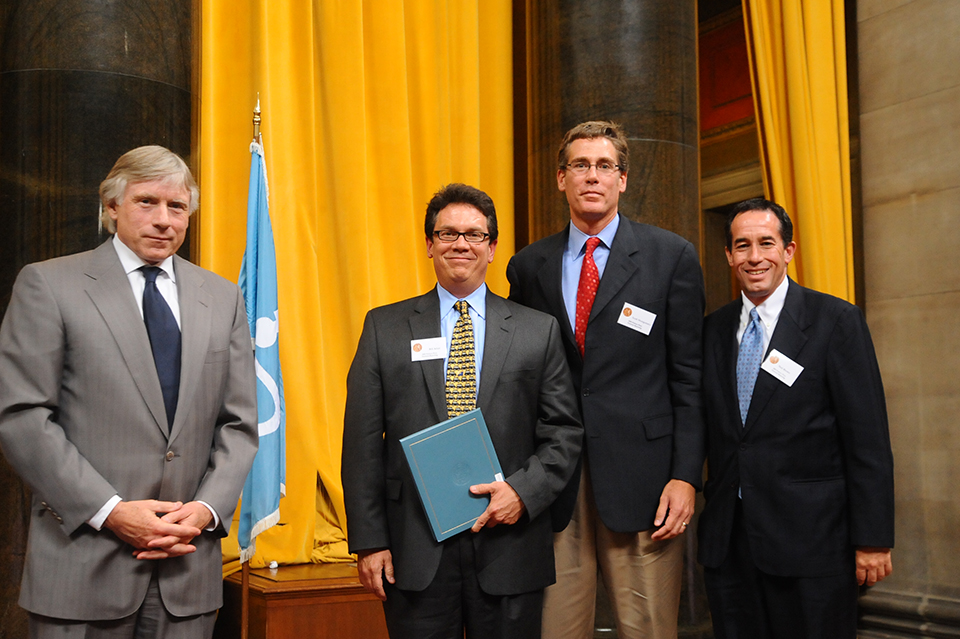
Lee C. Bollinger, President of Columbia University (left), presents the 2009 National Reporting prize to (l-r) Bill Adair, Scott Montgomery and Neil Brown of the St. Petersburg Times.
Winning Work
For a year, you've heard them boast and bash.
They've sung the praises of Ronald Reagan and cursed those tax- and-spend liberals - or sung the praises of universal health care and cursed those well-heeled lobbyists.
They've accused opponents of flip-flopping, of taking millions from pharmaceutical companies, of raising taxes on everybody - even dog groomers.
Can anyone make sense of it all?
Enter PolitiFact, our fact-checking Web site. For the past five months, the PolitiFact team has checked more than 300 claims by the candidates and made rulings on our Truth-O-Meter.
We've checked accusations from anonymous chain e-mails that Barack Obama refused to say the Pledge of Allegiance (False), Hillary Clinton's allegation that President Bush cut health research (False) and Mitt Romney's boast about turning around the Olympics (Mostly True).
With the Florida primary three days away, we have collected five of our most revealing rulings for each of the major candidates. You'll find the rest at Politifact.com. You can browse by candidate, issue or search by keywords. If you have a minute, search for Spike, the Romney attack dog. Turns out he was right about the tax on groomers.
SEN. HILLARY RODHAM CLINTON
U.S. senator from New York, first elected in 2000. She previously served as first lady when her husband, Bill Clinton, served two terms as president.
No records, but there are witnesses
The statement: "Look, I believe in accountability. In 1983, I led the effort in Arkansas to improve our schools."
--Hillary Rodham Clinton, Sept. 13, 2007, in a forum hosted by Slate/Yahoo/Huffington Post
The ruling: Press clippings and interviews with people who were there support her account.
Clinton promoted children's health care
The statement: "There are 7,000 kids in New Hampshire who have health care because I helped to create the Children's Health Insurance Program."
-- Hillary Rodham Clinton, Jan. 5, 2008, in a debate in Manchester, N.H.
The ruling: She accurately says she helped to create SCHIP, and she gets the number right.
NIH funding is up under Bush
The statement: "It's just outrageous that under President Bush, the National Institutes of Health have been basically decreased in funding."
--Hillary Rodham Clinton, Oct. 30, 2007, in Philadelphia
The ruling: No matter how you slice the numbers, National Institutes of Health funding has gone up.
ATTACK
RNC number-crunchers crunch Clinton accurately
The statement: "If Sen. Hillary Clinton could enact all of her campaign proposals, taxpayers would be faced with financing more than $777.6- billion in new spending over one White House term."
--Republican National Committee, Nov. 26, 2007, in a "Spend-O- Meter" on its Web site, www.gop.com
The ruling: We find the Republicans are doing a reasonably good job of accounting. In 19 out of 24 examples cited by the RNC, the Spend-O- Meter correctly explained Clinton's proposals.
ATTACK
Polarizing, yes, but electable, too
The statement: "The fact of the matter is that my colleague from New York, Sen. Clinton, there are 50 percent of the American public that say they're not going to vote for her."
--Sen. Chris Dodd, D-Conn., Oct. 30, 2007, in a debate in Philadelphia
The ruling: Dodd is accurate when he cites polls that show 50 percent of the U.S. public won't vote for Clinton. But the rest of the story is that it's not a dealbreaker as far as electibility goes.
JOHN EDWARDS
Former U.S. senator from North Carolina who was John Kerry's running mate in 2004. Also a personal injury attorney. He is married to Elizabeth Edwards, who has been diagnosed with cancer.
Hold on, it's not really never, ever
The statement: "John Edwards never - has ever from the beginning of his political career has never taken PAC money or the money of Washington lobbyists. Ever."
Joe Trippi, senior campaign advisor to John Edwards, on Sept. 20, 2007, in a television interview
The ruling: Edwards accepted $14,900 from employees at lobbying firms through June 2007. Given the absolute ironclad statement, we rule it Half True.
President can't snatch Congress' health care
The statement: If Congress won't pass universal health care, he'll tell Congress: "I'm going to use my power as president to take your health care away from you."
--John Edwards, Nov. 12, 2007, in a TV ad
The ruling: The president can't just "take away" health care from Congress. As a former member of the U.S. Senate, Edwards should know better.
He's juicing the numbers with these apples
The statement: "Our children's safety is potentially at risk because nearly half of the apple juice consumed by our children comes from apples grown in China."
--John Edwards, Oct. 29, 2007, in a speech in Manchester, N.H.
The ruling: His numbers are off, but his point about lots of our apple juice coming from China is true. It's also true that its safety standards don't meet ours.
ATTACK
Edwards a significant player on several bills
The statement: "John doesn't have a record in the Senate. John's only passed four bills. They're all about post offices."
--Sen. Joe Biden, D-Del., Dec. 31, 2007, at a campaign event in Ames, Iowa
The ruling: Edwards had a respectable record of accomplishments during his single term in the chamber.
ATTACK
Edwards was tagged 'populist' early on
The statement: "John wasn't this raging populist four years ago" when he ran for president.
--Barack Obama, Nov. 8, 2007, in Chariton, Iowa
The ruling: Edwards has consistently raised issues of economic inequality his entire political career.
SEN. BARACK OBAMA
U.S. senator from Illinois. Previously served in the Illinois state Senate and was an instructor at the University of Chicago Law School. He is married.
Obama has consistently opposed the war
The statement: "I opposed this war from the beginning. I opposed the war in 2002. I opposed the war in 2003. I opposed it in 2004 and 2005 and 2006."
--Barack Obama, Sept. 12, 2007, in Clinton, Iowa
The ruling: Obama opposed the war as a little-known state senator from Illinois and spoke out notably at a Chicago antiwar rally in 2002. He has been vocal in the years since.
If it quacks like a lobbyist, it's a lobbyist
The statement: "Leading by example, refusing contributions from PACs and Washington lobbyists."
--Barack Obama, Aug. 21, 2007, in a TV ad
The ruling: Obama accurately says he doesn't accept money from federally registered lobbyists, but he accepts thousands from people in the influence industry.
He says universal, but it's no guarantee
The statement: "I do provide universal health care."
--Barack Obama, Nov. 15, 2007, in Las Vegas
The ruling: Even if you buy his argument that his plan will create the market conditions to make health care universally available, his plan doesn't guarantee it.
His record on bipartisanship is split
The statement: "During (Obama's) tenure in Washington and in the Illinois state Senate, Barack Obama has accumulated a record of bipartisan success."
--Barack Obama, Sept. 6, 2007, on the campaign's Web site
The ruling: He has co-sponsored many bills with GOP members, but 2007 records show he voted with his party's position 96 percent of the time.
ATTACK
Obama's hand was on the Bible
The statement: When Obama was sworn into office, "he DID NOT use the Holy Bible, but instead the Kuran."
--Chain e-mail, Dec. 19, 2007
The ruling: Two press reports from Obama's swearing-in ceremony in January 2005 mention specifically that Obama took the oath of office by placing his hand on his own copy of the Bible.
RUDY GIULIANI
Former mayor of New York City. Previously served as a federal prosecutor, as well as an associate attorney general under President Ronald Reagan. He is married.
Hard to measure, but he's a tax cutter
The statement: "And delivered more tax relief than the other Republicans combined."
--Rudy Giuliani, Jan. 16, 2008, in a TV ad
The ruling: Given many confirming sources, it's clear Giuliani has a strong record on tax cutting. However, it's next to impossible to accurately judge the rest of his claim.
Creative math by an abortion-rights mayor
The statement: "We reduced abortion. We increased adoptions by 135 percent."
--Rudy Giuliani, Dec. 12, 2007, in a debate in Johnston, Iowa
The ruling: While he has his numbers right on abortion rates, it's a stretch for the abortion-rights mayor to take credit. We also find he has inflated the adoption figures by getting fancy with his math.
The turn-around started before Rudy did
The statement: "I brought down crime more than anyone in this country - maybe in the history of this country - while I was mayor of New York City."
--Rudy Giuliani, Oct. 21, 2007, in a debate in Orlando
The ruling: Violent crime in New York actually began falling three years before Giuliani became mayor in 1994. Nor was New York unique in its crime trends.
ATTACK
Giuliani left Iraq panel - or it left him
The statement: "He was a member of the Iraq Study Group and was either fired or quit from a very important commission that was trying to figure out the way forward in Iraq."
--John McCain, Nov. 26, 2007, in interview on Fox News
The ruling: It's unclear whether he was fired or forced to quit, but during his two-month tenure on the panel, he attended no meetings and was replaced by Edwin Meese III, former attorney general.
ATTACK
Giuliani was welcoming to immigrants
The statement: "The mayor said ... 'if you happen to be in this country in an undocumented status . . . then we welcome you here. We want you here. We'll protect you here.' "
--Mitt Romney, Nov. 28, 2007, in a debate in St. Petersburg
The ruling: Romney is referring to a statement Giuliani made at a 1994 news conference. Giuliani now emphasizes the need for more border security and tougher enforcement by the federal government.
MIKE HUCKABEE
Served as governor of Arkansas from 1996 to 2007. Has worked as a Baptist minister. He is married.
The roads are better - but still rank near the bottom
The statement: "I took on the worst road system in the country, according to Trucker's magazine. When I left, they said it was the most improved road system in the country."
--Mike Huckabee, Jan. 10, 2008, in a debate in Myrtle Beach, S.C.
The ruling: While Huckabee is right that the state earned the honor for the most improved roads in his term, it's a stretch to say that was the case when he left office. And Arkansas still lags behind other states.
Not quite the best education record
The statement: Says he has "the most impressive education record" of the Republican candidates.
--Mike Huckabee, Dec. 12, 2007, in a debate in Des Moines, Iowa
The ruling: Education improved in Arkansas under Huckabee's watch. But as for his boast of being the best, take that with a grain of salt. Mitt Romney's Massachusetts record also was impressive.
Huckabee's nickel-and-dime defense
The statement: "As governor of Arkansas, I cut taxes and fees almost 100 times, saving the taxpayers almost $380-million. I left a surplus of nearly $850-million."
--Mike Huckabee, Aug. 2, 2007, in a news release
The ruling: Huckabee correctly toots his own horn about a major tax cut and he did leave a big surplus when he left office. But we give him a Half True for mischaracterizing his fiscal policies in between.
1 out of 56 equals 'most'? No, it doesn't
The statement: The signers of the Declaration of Independence were "brave people, most of whom, by the way, were clergymen."
--Mike Huckabee, Oct. 21, 2007, in Orlando
The ruling: We'd like to give Huckabee every benefit of the doubt, but even if you consider former clergymen among the signers the most you come up with is four. Out of 56. That's not "most."
ATTACK
The liberal label doesn't quite stick to Huckabee
The statement: "He's a good man, but he's a pro-life liberal. He's right on the pro-life part, but he's a liberal."
--Fred Thompson, Nov. 7, 2007, in a Nashville radio interview
The ruling: Can you oppose withdrawal from Iraq, as Huckabee does, and still be liberal? Can you support a flat sales tax and still be liberal? Given the subjective nature of the term, we rate this Half True.
SEN. JOHN MCCAIN
U.S. senator from Arizona, a post he has held since 1986. Previously served two terms in the U.S. House. Spent his career in the military, including 5-1/2 years as a prisoner of war. He is married.
He was front and center, uncovering wasteful mess
The statement: "I saved the taxpayers $2-billion on a bogus Air Force Boeing tanker deal where people went to jail."
--John McCain, Nov. 28, 2007, in a debate in St. Petersburg
The ruling: It is well documented in media and government reports that McCain was quick to identify the deal as a bad one for taxpayers. He found it tucked into a little-noticed amendment to a defense budget.
There are a few blips on the senator's record
The statement: "I have never asked for nor received a single earmark or pork- barrel project for my state."
--John McCain, Jan. 6, 2008, in a debate in Manchester, N.H.
The ruling: We find three examples of McCain seeking pork-barrel projects for Arizona, which puts a few blemishes on an otherwise stellar record against pork.
McCain is right: He told them so!
The statement: "One man opposed a flawed strategy in Iraq. One man had the courage to call for change. One man didn't play politics with the truth."
--John McCain, Oct. 1, 2007, in a TV ad
The ruling: As far back as mid 2003, McCain has been one of the Senate's strongest and most vocal advocates of the war in Iraq, and also one of the Bush administration's biggest Republican critics.
McCain's immigration plan is no free ride
The statement: "The fact is it's not amnesty."
--John McCain, Jan. 5, 2008, in a debate in Manchester, N.H.
The ruling: While McCain is more receptive to giving undocumented workers a path to citizenship than most of his GOP rivals, the many hurdles included in his plan do not meet the "amnesty" definition of a general pardon of offenders by a government.
ATTACK
Yes, McCain changed his mind on the tax cuts
The statement: "Sen. McCain voted against the Bush tax cuts. Now he's for them."
Mitt Romney, April 26, 2007, in Stratham, N.H.
The ruling: When the cuts were first proposed, McCain voted against them, saying tax cuts needed to be paired with lower spending. In 2006, when the cuts were extended, McCain voted yes because he said opposing the extension of cuts already in place would amount to a tax increase.
REP. RON PAUL
Texas physician in his second stint in Congress. Was in the House from 1977-1985, and was the Libertarian Party nominee for president in 1988. Elected again to Congress in 1996. He is married.
Lots of bills, but not the most of any member
The statement: "Introduces numerous pieces of substantive legislation each year, probably more than any single member of Congress."
--Ron Paul, Sept. 17, 2007, in a statement on his campaign Web site
The ruling: In the last Congress, he was 25th overall in the number of bills introduced, with 71 bills, 66 of which could be called substantive.
He's a consistent supporter of gun rights
The statement: "Has never voted for a federal restriction on gun ownership."
--Ron Paul, Sept. 17, 2007, in a statement on his campaign Web site
The ruling: Paul has voted consistently to keep the Second Amendment from being limited in any way.
In campaign donations, a military victory for Paul
The statement: "I get the most money from active duty officers and military personnel."
--Ron Paul, Nov. 28, 2007, in a debate in St. Petersburg
The ruling: Paul, the only Republican candidate for president who opposes the war, is on the money here. The Center for Responsive Politics reports that from January to late November of 2007, he received at least $53,670 from U.S. military personnel, tops among presidential candidates.
So true, he's understating the situation
The statement: "It used to be the policy of the Republican Party to get rid of the Department of Education. We finally get in charge and a chance to do something, so we double the size of the Department of Education."
--Ron Paul, Dec. 12, 2007, in a debate in Johnston, Iowa
The ruling: The size of the Education Department didn't just double with Republicans in charge of Congress, it nearly quadrupled between 1994 and 2006, increasing from $27-billion to $100-billion.
ATTACK
Exceptions to his small-government principles
The statement: "Never votes for legislation unless the proposed measure is expressly authorized by the Constitution."
--Ron Paul, Sept. 17, 2007, in a statement on his campaign Web site
The ruling: An examination of Paul's record shows that although he usually adheres to his principle, he has sometimes voted for programs that aren't "expressly authorized" in the Constitution.
MITT ROMNEY
Served single term as governor of Massachusetts. Worked as a turn- around expert for private companies. Took over management of the 2002 Winter Olympics in Salt Lake City. He is married.
His effort was Olympic, if a little overstated
The statement: "Took on the Olympics and turned them around."
--Mitt Romney, Sept. 26, 2007, in a television ad
The ruling: Romney's implication that he single-handedly rescued the Games is a sore subject in Utah. But there is nothing to dispute that Romney played a vital role in rescuing a very troubled Olympics.
This depends on your definition of a tax increase
The statement: "The Republican governor who stood up and cut spending instead of raising taxes."
--Mitt Romney, Sept. 21, 2007, in a television ad
The ruling: That's only half of the story. Romney closed loopholes in the corporate income tax, which effectively increased taxes for some companies. And he and the legislature increased myriad fees.
Actually, his campaign is ankle-deep in lobbyists
The statement: "I don't have lobbyists running my campaign."
--Mitt Romney, Jan. 17, 2008, in a news conference in a Staples store in Columbia, S.C.
The ruling: We don't accept the idea that you must be on the payroll to be involved in "running" the campaign. And there's no question some key people in the Romney campaign are well-connected lobbyists.
Consistent on gay marriage, not amendment
The statement: "I have not changed my position on the (gay) marriage amendment or anything else related to marriage."
--Mitt Romney, Sept. 14, 2007, in an interview on MSNBC
The ruling: He is correct that he has been consistent in his opposition to same-sex marriage, but has changed his position on what he would support in an amendment.
ATTACK
Inconsistent on abortion, Romney now opposes it
The statement: "I'm pro-life. (Romney)'s not."
--Sen. Sam Brownback, R-Kansas, former candidate for president, speaking on Aug. 21, 2007
The ruling: Romney says he is pro-life, but acknowledges he has not been consistent on the issue over the years. Romney said he changed his mind on abortion after meeting with a Harvard stem-cell researcher in 2004.
© 2008 St. Petersburg Times
By Robert Farley
The latest anti-Hillary Clinton chain e-mail making the rounds comes not from an anonymous voice in the blogosphere but from a former political consultant who once helped guide the Clintons' political life in Arkansas and the White House.
Although it's not clear who created the e-mail, the allegations it carries are based on an article by famed strategist Dick Morris. The onetime Clinton ally paints an embellished picture of Hillary Rodham as a student radical who interned for a law firm headed by a Communist and worked tirelessly to help Black Panthers on trial for murder.
Anonymous e-mail attacks have been popular in this year's presidential campaign, particularly in the Democratic contest where both leading candidates have been subjected to viral assaults. But this one is unique because it cites a well-known source: Morris.
You may remember him as the campaign manager for Bill Clinton's 1996 re-election campaign, the one who stepped down in disgrace when it was revealed that he allowed a prostitute to listen in on conversations with the president. She said Morris had a thing for toe sucking.
Morris' relationship with the Clintons quickly soured. Now, he's a political commentator for Fox News and a nationally syndicated columnist with a Web site, DickMorris.com. Clinton-bashing is his passion.
On Aug. 9, 2007, Morris wrote an article for FrontPageMag.com, a conservative Internet journal, where he restates two points he made about Hillary Clinton in a book he wrote years before. The first was about her alleged sympathy for the Black Panthers and the other referenced her internship with a law firm run by a Communist.
We'll start with the Black Panthers. Here's what the e-mail, taken directly from Morris' article, says: "Hillary's main extracurricular activity in law school was helping the Black Panthers, on trial in Connecticut for torturing and killing a federal agent. She went to court every day as part of a law student monitoring committee trying to spot civil rights violations and develop grounds for appeal."
Here's the history.
In 1970, eight Black Panthers, including its national chairman Bobby Seale, were brought to trial in New Haven, Conn., on charges of murdering a fellow member, Alex Rackley, who was suspected of being a police informant. He was not a federal agent.
The trial consumed the Yale campus, and many Yale students rallied in support of the black defendants, or at least for their right to a fair trial. Consider this statement from Yale president Kingman Brewster: "I personally want to say that I am appalled that things have come to such a pass that I am skeptical of the ability of black revolutionaries to achieve a fair trial anywhere in the U.S."
Clinton, a Yale Law School student a the time, played a "minor" role in the doings that year, said Paul Bass, a journalist who spent years researching the Black Panther case for a book he co-authored called Murder in the Model City. She co-chaired a committee whose main role was to prevent violence at a May Day demonstration, he said.
Clinton's committee also offered legal advice to demonstrators who got arrested and to monitor the trial for civil rights abuses, Bass said.
But if that monitoring ever happened, said two sources interviewed by the St. Petersburg Times, one thing is certain: Clinton was not an every-day trial watcher, as Morris claims. Nor did she "help" the defense.
"I can't say she was never in court," said David Rosen, a junior member of the defense team for Seale. "But she was not there every day. In fact, I don't even remember seeing her there at all. I know she didn't do any work for the defense team."
According to Carl Bernstein's biography A Woman in Charge, Clinton was among the student-observers from a civil liberties class who attended the trial daily "to report possible abuses by the government, discuss them in class, write papers about them and prepare summaries for the American Civil Liberties Union."
That last part is news to Mike Avery, who was hired by the ACLU as a staff lawyer to keep tabs on the Black Panther case.
"I didn't see Hillary Rodham anywhere around the place, and I would have known," said Avery, now a law professor at Suffolk Law School in Boston.
People involved in the case all knew each other and socialized, he said. "She was not in that crowd," he said, "by no stretch of the imagination."
Clinton's campaign did not respond Times inquiries.
Another Morris charge sent by chain e-mail said: "Hillary interned with Bob Treuhaft, the head of the California Communist Party. She met Bob when he represented the Panthers and traveled all the way to San Francisco to take an internship with him."
In 1971, Clinton did spend a summer interning as a law clerk for Treuhaft, Walker and Burnstein.
And senior partner Treuhaft had once been active in the American Communist Party, though he was not "head of the California Communist Party" as Morris claimed in his article. Investigated and harassed by McCarthyites in 1950s, Treuhaft was listed by the House Un-American Activities Committee as one of the most dangerously subversive lawyers in the country, according to his 2001 obituary in the Times of London. But he became disillusioned with the party and left it in 1958, before Clinton started her internship with the firm.
In her autobiography, Clinton makes only passing reference to her responsibilities at the firm, which she called "a small law firm in Oakland, California." She wrote, "I spent most of my time working for Mal Burnstein researching, writing legal motions and briefs for a child custody case."
Burnstein, who was never a Communist, is retired now. Reached at his home in California, Burnstein recalled that Clinton was one of the firm's better summer interns: smart and a hard worker.
"She wasn't political at all, that I remember," Burnstein said. "The only politics that were discernible were probably liberal politics ... She came to us because of the civil rights cases we did, the things we did with racial equity and other civil rights things. That was her interest."
In addition to Treuhaft's former association with the Communist Party, another partner in the firm, Doris Walker, was, and still is, an active member.
Clinton must have known about those associations, Burnstein said. "It's not like it was a secret."
Walker, now retired, said she figured someone would try to make political hay out of it eventually. Reached at home in California this week, she said she "must be the only living Communist Party member of my generation."
"It was sort of a left-wing firm," Walker said, but most of the lawyers were not Communists. To dredge it up now, she said, amounts to little more than red-baiting.
Although Morris did not respond to an e-mail seeking comment, in his 2004 book, Rewriting History, an acerbic rebuttal to Hillary Clinton's autobiography, Living History, he takes a more measured stance.
"Hillary was no Communist, nor should her work at the Treuhaft firm imply that she was," Morris wrote. "But the fact that she chose this job out of all the summer jobs that might have been available, traveling three thousand miles for it, tells something about her orientation at the time. Just as the fact that she does not describe the firm's work or reputation says something about her today."
That part's not in the e-mail, which ends with Morris' assessment of Clinton: "She is a disaster for all Americans."
SIDEBAR
Statement: "Hillary interned with Bob Treuhaft, the head of the California Communist party"
- Chain e-mail
Ruling: She interned at Treuhaft's law firm, and he had been a Communist, though not a party head, but that was years before
Statement: Hillary's main extra-curricular activity in law school was helping the Black Panthers, on trial in Connecticut for torturing and killing a federal agent."
- Chain e-mail
Ruling: Witnesses at the trial say this account is wrong.
© 2008 St Petersburg Times
By Robert Farley and Angie Drobnic Holan
Two days after Hillary Clinton reluctantly agreed to be photographed riding on an elephant, hours after she sat through a children’s gymnastic demonstration but before tea at the ambassador’s residence, the then-first lady’s motorcade steered Clinton to a dusty Hindu village in rural Bangladesh.
It was in this village that Dr. Mohammad Yunus first established his microcredit movement, a program that seeks to reduce poverty by making small loans to poor people, mostly women.
Yunus’ efforts would win him a Nobel Peace Prize a decade later. But this was April 1995, and here was Clinton, “First Lady of the World,” as Yunus would describe her, in a bamboo hut halfway around the world to meet with 80 women whose lives were turned around due to loans as small as $100.
Bangladesh was just one of an astounding 82 countries Clinton visited during her days as first lady, from 1993 through 2001. Clinton’s White House daily schedules recently were made public. PolitiFact reviewed her schedule on all the days she was traveling in another country to get a sense of the substance of her trips.
Locked in a tight presidential primary, now-Sen. Hillary Clinton has made much of her experience in foreign affairs, often trumpeting her travels as first lady as proof that she is better equipped to lead than her Democratic opponent, Sen. Barack Obama.
But the significance of Clinton’s travel also has been challenged. Opponents claim she’s embellishing her record. Did she really help bring peace to Northern Ireland? Did her widely praised “women’s rights are human rights” speech in China amount to much? And then the whopper: Clinton’s recounting how she once landed in Bosnia amid sniper fire, a claim first derided by comic Sinbad, who was on the trip, and later indisputably debunked by CBS file video that has now been viewed more than 2-million times on YouTube.
Clinton critics like Dick Morris, a onetime political adviser to President Bill Clinton, ridiculed her foreign agenda as little more than ceremonial fluff.
“During her international travels, there was no serious diplomacy, just a virtually endless round of meetings with women, visiting arts-and-crafts centers, watching native industries and photo opportunities for the local media,” Morris wrote recently.
The White House schedules certainly show lots of that, but what emerges from a careful review is a truth that lies somewhere in between the characterizations by the competing camps. There were more weighty activities than Clinton’s critics like to believe; but little indication that the first lady played any kind of pivotal foreign policy role.
Some quick impressions:
• Clinton traveled a lot. We counted 82 countries.
• She met often with women’s groups, virtually on every trip, holding roundtable discussions that usually centered on women’s rights, health care or child care.
• After meeting with Yunus in Bangladesh that day in April 1995, using mircocredit as a tool to fight world poverty became one of Clinton’s biggest international initiatives in her travels as first lady. The issue of microcredit appears on Clinton’s schedules more than 50 times.
• She traveled nearly half the time with her husband, Bill. While traveling free of the shadow of the president, the schedules show Hillary Clinton was more free to lead a diplomatic mission. Flying solo, she met more often with heads of state and social leaders, made meaningful addresses and convened discussion groups.
In many ways, Clinton’s trip to South Asia is emblematic of her travels. For sure, there was one part ceremony — meet-and-greets with heads of state, sightseeing tours, photo ops. But as with her itinerary in Bangladesh, Clinton often used her travels as a platform to advocate for her favored causes.
“When Hillary Clinton says something, the whole world listens,’’ Yunus said after Clinton’s 1995 visit. “This will have a tremendous impact on the world’s financial system, which is basically biased against women.’’
According to Melanne Verveer, Clinton’s former chief of staff and nearly constant travel companion, the 12-day trip to South Asia, which included stops in Pakistan, India, Nepal, Bangladesh and Sri Lanka, was just one example of Clinton’s important international efforts in championing women’s and children’s issues.
But that’s not how the Calcutta Telegraph saw it at the time.
“For someone billed as one of the most able and sensitized minds of the American administration, Ms. Clinton was singularly insensate and solely decorative today,” the paper stated. “She did speak a few sentences at Prayas [school]. ... But it could just as well have been Lady Diana, Jane Fonda or (Miss World) Aishwarya Rai speaking.”
Clinton addressed the criticism at a speech before the Rajiv Gandhi Foundation in New Delhi.
“I recognize that discussion of such problems as education and health care for girls and women is viewed by some as ‘soft,’ labeled dismissively as a women’s issue belonging, at best, on the edge of serious debate,” Clinton said. “I want to argue strongly, however, that the questions surrounding social development, especially women ... are at the center of our political and economic challenges.” Clinton’s schedule, while illuminating, will not settle the debate about her foreign affairs credentials, said Bruce Miroff, a professor of political science at the State University of New York, Albany.
“It’s not just where you go and who you meet,” Miroff said. “It’s what you learn when you get there. And that’s very hard to measure.”
Miroff says that while the sweep and import of Clinton’s travels were certainly unprecedented for a first lady, it’s also true that she was not the commander in chief. She did not have security clearance.
That limited Clinton to advocating within her established niche: women’s rights, microcredit, children’s issues. Yes, she made a powerful human rights speech in China, Miroff said, but her experience cannot be compared to a president or even to the level a senator on the Foreign Relations Committee.
“It’s true that she traveled more than most first ladies,” Miroff said. “On the other hand, it’s hardly the case that she was on the front line of U.S. international relations.”
Not willing to concede the foreign “experience” mantle, Obama in November characterized Clinton’s experience as no more than having tea with world leaders.
That unfairly disparages what Clinton actually did, said Verveer, who was with Clinton on all but two of her trips.
While it’s true that Clinton did not deal with national security issues, Veveer said, she did advance U.S. interests around the globe. Verveer said Clinton also advanced the reach of microcredit and helped to promote democracy in countries that were just developing free-market economies.
“In the context of the importance of that to our country,” Verveer said, “I don’t consider that fluff.” And while the press often found her roundtable discussions boring, Verveer said, “it was an attempt by her to get really significant insight into what was happening in a country. It was her effort to bring together people who were making a difference in health care and education.”
The trips also afforded her access to an array of leaders. In March 1995, she met with Pakistani Prime Minister Benazir Bhutto. A few days later she met with P.V. Narasimha Rao, the prime minister of India. In Eastern Europe in July 1996, she met with President Ion Iliescu of Romania and President Vaclav Havel of the Czech Republic. In a tour of Central American countries in 1998, she announced major aid packages for hurricane relief and addressed the Congress of Guatemala. In Egypt in March 1999, she met with Hosni Mubarak: The 15-minute courtesy call stretched to an hour, with Clinton expressing concern about the treatment of his country’s 6-million to 10-million Coptic Christians, according to reports from the time.
And that’s just a sampling of her far-reaching international travel. The only comparison would be Eleanor Roosevelt, the original “first lady of the world.” Roosevelt also worked hard to enhance the status of working women while first lady and helped found the United Nations. She later served as a U.N. delegate and chaired the committee that put together the Universal Declaration of Human Rights. Though Clinton never held any formal position like that, a March 1997 trip to Africa with daughter Chelsea provides another example of the duality of Clinton’s purpose.
In South Africa, while she did some sightseeing and glad-handing, she also met with members of the controversial Truth and Reconciliation Commission, a panel chaired by Archbishop Desmond Tutu, that was investigating apartheid-era political crimes.
“There are people who have not taken kindly to the commission,” Tutu said at the time. “To have had people like herself come in is important for enhancing public belief in the intrinsic credibility of the commission.”
Tutu said Clinton talked about the role of memorials in helping a nation heal its wounds.
“It wasn’t just a courtesy chat,’’ Tutu said.
Locked as she is in a tight race with Obama, who is relatively inexperienced in foreign affairs, there is big temptation for Clinton to inflate her assets, said Michael A. Genovese, director of the Institute for leadership Studies at Loyola Marymount University in Los Angeles.
In the heat of the campaign, Genovese said, Clinton seems to have “overplayed her hand a bit.”
Clinton’s recent misstatement about landing in Bosnia under sniper fire made the whole strategy backfire.
PolitiFact also found accuracy problems with Clinton’s claims that she brought peace to Northern Ireland and helped negotiate open borders for Kosovo refugees.
“In terms of real substance, the first lady seems not to have left many major footprints,” said Genovese. “She wasn’t negotiating treaties. But she was discussing international events with international leaders.”
And she was hammering her pet issues — children, women and health care.
“She was doing what she’s always done,” Genovese said. “But she’s not going to change the world as a first lady.”
SIDEBAR
Statement: As first lady, Clinton traveled to places that were "too small, too poor or too dangerous" for the president
- Hillary Clinton, March 17
Ruling: Most of her destinations would have made terrific tour packages
Statement: Hillary Clinton's international travels included "no serious diplomacy"
- Dick Morris, March 21
Ruling: She didn't have clearance to broker deals, but she had serious meetings with real world leaders
© 2008, St. Petersburg Times
By Robert Farley
Political opponents of Sen. Barack Obama thought they finally had the goods to pin him as a serial fabricator.
In a Memorial Day speech in Las Cruces, N.M., Obama claimed his uncle "was part of the first American troops to go into Auschwitz and liberate the concentration camps" in World War II.
Statement: "I had an uncle...who was part of the first American troops to go into Auschwitz and liberate the concentration camps."
- Barack Obama, Monday, in Las Cruces, N.M.
Ruling: Obama names the wrong concentration camp, but the rest of his statement is correct.
The next day, the Republicans pounced. RNC secretary Alex Conant correctly noted that it was Soviet, not American, troops that had opened the gates of Auschwitz in 1945. Obama's story of his uncle was dubious, Conant said, while concluding that the latest of Obama's "frequent exaggerations" raised questions about his readiness to lead as commander in chief.
The Obama campaign quickly responded. Yes, Obama had misidentified the concentration camp, but campaign officials insisted the story of an uncle shutting down a Nazi camp was true.
No matter, the gaffe became the issue du jour among cable news and radio talk show political commentators. Some smelled a Bosnia-sized blunder (remember Hillary Rodham Clinton's "I landed under sniper fire" bungle?), but few took the time to find out whether the substance of the claim — that Obama's uncle helped to liberate a concentration camp — was actually true.
The Obama campaign said Obama's great-uncle (his grandmother's brother) was part of the 89th Infantry Division that liberated a concentration camp in Ohrdruf, a subcamp of Buchenwald in Germany.
"Sen. Obama's family is proud of the service of his grandfather and uncles in World War II — especially the fact that his great-uncle was a part of liberating one of the concentration camps at Buchenwald," said Obama campaign spokesman Bill Burton. "Yesterday he mistakenly referred to Auschwitz instead of Buchenwald in telling of his personal experience of a soldier in his family who served heroically."
In order to judge the veracity of Obama's statement, PolitiFact needed to answer two questions: First, what military unit liberated the camp at Ohrdruf? And most important, was Obama's great-uncle in that unit at that time?
According to an article from the United States Holocaust Memorial Museum, the 89th Infantry Division on April 4, 1945, overran Ohrdruf, about 40 miles southeast of the Buchenwald concentration camp.
"Ohrdruf was the first Nazi concentration camp liberated by U.S. troops in Germany," the article states. "A week later, on April 12, Generals Dwight D. Eisenhower, George S. Patton, and Omar Bradley visited Ohrdruf to see, firsthand, evidence of Nazi atrocities against concentration camp prisoners."
According to a Web site dedicated to the 89th Infantry Division, "Ohrdruf was a work camp, not an extermination camp, but the difference is difficult to discern. Prisoners were literally worked to death and disposed of by burning in incinerators, which was the most 'cost-effective method.' "
There's little question, then, that the 89th Infantry Division liberated Ohrdruf, a Nazi work camp that may not have been a facility on the scale of Auschwitz but shared many of that camp's notorious characteristics.
That leaves the matter of whether Obama's great-uncle served in that Army unit at that time.
Obama campaign officials did not provide any documentation to confirm that Charles T. Payne, 83, served in the 89th Infantry Division in April 1945. And we wanted more than their word.
Although we were unable to reach Payne directly, Payne's son, Richard Payne, said his father "definitely served in the 89th Infantry Division" and confirmed that Obama's account was substantially accurate.
Mark Kitchell, who maintains a Web site dedicated to the 89th Infantry Division, said he was able to locate a list of servicemen that includes a Pfc. C.T. Payne who served in K Company of the 355th Infantry Regiment of the 89th Infantry Division. The list included only the initials for first names.
The 355th Infantry Regiment was the one that liberated Ohrdruf, Kitchell said. Kitchell, the son of 89th veteran Raymond E. Kitchell, obtained the list from the official Division History book, written after the war.
Our last piece of evidence comes from the National Personnel Records Center, an operation of the federal government's National Archives and Records Administration, and it puts this question to rest.
Researchers confirmed to PolitiFact that Army personnel records for Payne would have been destroyed in a 1973 fire that consumed many such archives, but they dug up a "Morning Report" dated April 11, 1945, showing Pfc. Charles T. Payne was assigned to the 355th Infantry Regiment, Company K. The Records Center provided a copy of the report to PolitiFact.
There's no question Obama misspoke when he said his uncle helped to liberate the concentration camp in Auschwitz.
But even with this error in location, Obama's statement was substantially correct in that he had an uncle — albeit a great-uncle — who served with troops who helped to liberate the Ohrdruf concentration/work camp and saw, firsthand, the horrors of the Holocaust.
© 2008, St. Petersburg Times
By Bill Adair
As the pundits and politicos dissect the campaign of Sen. Hillary Rodham Clinton, who went from being untouchable front-runner to second-place finisher, there will be plenty of explanations.
She underestimated the fundraising prowess of Sen. Barack Obama, she bet too much on Clinton administration loyalties, and she failed to prepare for a long race.
But the arc of Clinton's campaign can also be traced in her rise and fall on the simple scale of truthfulness.
When we launched PolitiFact last summer, Clinton was on top of the world. Leading in polls, potent in fundraising, she seemed to be unbeatable. Back then, she stood alone among all the candidates, Republican and Democratic, for her disciplined adherence to the facts. When PolitiFact checked her claims, we found she was nearly always right.
But instead of gliding through a string of victories, Clinton suffered early election losses that turned her well-funded, well-organized campaign operation into a scramble to stay in the game. By late February, Obama had inched ahead and the Clinton campaign began its "kitchen sink" strategy of throwing everything at the front-runner.
The facts got lost in the fight.
The turning point for Clinton's record — and quite possibly for her entire campaign — came in March when she claimed she had ducked sniper fire in Bosnia. At the time, Clinton was straining to distinguish her record from that of Obama, a relative neophyte, by showing that she knew what it was like to come under fire. Literally.
PolitiFact and many other news organizations pointed out that her arrival in Bosnia was more smiles than snipers. Archived news video showed Clinton accepting a poem from a schoolgirl. No one was ducking and running. Clinton earned our lowest rating, Pants on Fire.
About the same time, she exaggerated her influence in bringing peace to Northern Ireland (we gave her a Half True) and how much she helped refugees from Kosovo (Barely True). Suddenly her grades were slipping.
Clinton continued to get sloppier with her facts. She mischaracterized Obama's health plan, distorted an energy bill he supported and she opposed, and exaggerated his remarks about attacking terrorists in Pakistan. She misled voters about how much they would save from a gas tax holiday (she used a number for a family of four but made it sound like a per-person figure) and she made inaccurate historical comparisons to this year's nomination schedule.
Her mistakes were compounded in separate blunders by Bill Clinton. He said his wife's Bosnia error, for example, was a momentary, late-night slip of the tongue. But we found she had made the sniper fire claim at least twice, including in a speech that began at 9 a.m.
The accuracy problems took a toll. In a Washington Post/ABC News poll in mid April — about one month after the Bosnia mistake — Clinton was viewed as "honest and trustworthy" by 39 percent, down from 52 in May 2006. In that April poll, 58 percent said she was not honest and trustworthy.
In December, when voters were asked in a Post/ABC poll which candidate they considered more honest and trustworthy, Clinton led Obama, 35 percent to 27 percent. After the Bosnia mistake, the results flipped. Obama led Clinton, 53 percent to 30 percent.
Of course, PolitiFact has caught Obama in plenty of mistakes, too. In fact, he has earned more False and Pants on Fire ratings (13) than Clinton (9). But, like other candidates, Obama's mistakes have come pretty consistently throughout the campaign, while Clinton had a strong record for accuracy until March and then a spotty one after that.
Clinton's fall from presumed nominee to also-ran is likely to be debated for years to come. But there's no question that her decline in poll numbers was matched by (or caused by) her drop in truthfulness. It might be worth reminding other politicians: If you're going to throw the kitchen sink, make sure you've got your facts right.
SIDEBAR
The Statement: "I remember landing under sniper fire."
Date and Location: March 17 in Washington
The Statement: "If you are driving on average in America this summer, you'll save — according to Department of Energy figures — about $70."
Date and Location: May 4 in Indianapolis
The Statement: "I actually started criticizing the war in Iraq before (Obama) did."
Date and Location: April 5 in Eugene, Ore.
The Statement: "It doesn't make sense "historically" to drop out because the 1968 race was still competitive when "Bobby Kennedy was assassinated in June in California."
Date and Location: May 23 in Sioux Falls, S.D.
© 2008 St. Petersburg Times
By Bill Adair
It's a line you'll hear many times from Sen. John McCain over the next five months: "In just a few years in office, Sen. Obama has accumulated the most liberal voting record in the Senate."
But McCain's campaign also pointed out recently that Barack Obama votes with President Bush about half the time.
So the biggest liberal in the Senate is a solid supporter of President Bush? What gives?
The statement: "In just a few years in office, Sen. Obama has accumulated the most liberal voting record in the Senate."
- John McCain, June 3 in a speech in New Orleans.
The ruling: McCain suggests it is a cumulative rating for all of Obama's time in the Senate. But it's one rating for one year. Measurements for other years and by other groups show Obama is not the No. 1 liberal -- in some cases, far from No. 1.
Actually, there's some truth to both claims. The political magazine National Journal rated Obama the most liberal senator for 2007, while Congressional Quarterly calculated that Obama voted with Bush 40 to 50 percent over the past two years.
McCain's seemingly contradictory claims illustrate the limitations of congressional ratings. Although they can provide a quick snapshot of someone's voting record, the ratings have many shortcomings, political scientists say.
"They can give a good inkling of whether someone is liberal or conservative, but they're not good enough for a precise determination of what someone's ideology is," said Josh Clinton, a political science professor at Princeton University.
'Obama the liberal'
You'll be hearing a lot about "Obama the liberal" between now and November.
It's a standard technique from the Republican playbook: brand Democratic opponents as "tax-and-spend liberals."
Back in January, when National Journal released its vote ratings, it gave Republicans some fresh ammunition to use the term against Obama. The nonpartisan magazine, which in 2004 had determined the Senate's No. 1 liberal was also a presidential candidate — John Kerry — published a story headlined "Obama: Most Liberal Senator in 2007."
Within hours of the rating's release, the Republican National Committee issued a fact sheet: "Obama: #1 Liberal Senator." Since then, McCain and many other Republicans have often cited the National Journal rating. Last week, Rep. Dan Boren, a Democrat from Oklahoma, cited the rating in explaining why he would not support Obama.
Yet other ratings paint a different picture.
Voteview.com, a site created by political scientists that plots lawmakers on a liberal-conservative scale based on their voting patterns, calculated there were nine senators more liberal than Obama in the current Congress.
"Obama is a liberal, but he's not the most liberal," said Keith Poole, a University of California-San Diego professor who runs the site. By comparison, McCain is the eighth-most conservative. Ratings from Congressional Quarterly also provide a mixed picture.
In CQ's calculation of party unity, which measures how often members vote with their party on bills where the parties split, Obama got a 97 percent rating last year. Ten Democrats had higher scores. On votes where Bush indicated his position, CQ found Obama supported the Republican president 40 percent of the time in 2007. That 40 percent rating put Obama in the middle of the pack for Democrats. In 2006, Obama voted with Bush 49 percent of the time.
McCain had the Senate's highest presidential support score last year, 95 percent, but he missed more than half of the votes because he was campaigning. And McCain hasn't always been such a strong backer of President Bush. He supported Bush 77 percent in 2005 and has averaged 89 percent since 2001.
A quick primer on the ratings
National Journal, Voteview and CQ use very different approaches.
National Journal relies largely on the judgment of its editors and reporters. They choose votes that they believe show ideological distinctions (they chose to include 99 of the 442 Senate votes last year) and they decide which side in the vote is liberal and which is conservative. Then they compute how often senators and House members vote each way.
"We're trying to pick votes where some ideological differences are displayed and show how members of Congress line up relative to one another," said Charles Green, editor of the magazine.
CQ takes a more empirical approach and calculates how often members vote with their party or the president.
"We don't try to establish a litmus test or ideological label," said John Cranford, CQ's national editor. "What we're looking for is something that more closely represents how members might characterize their vote, such as how often they vote with the president."
Voteview uses a complicated calculation based on patterns of how often each member of Congress votes with other members. The program determines the patterns from hundreds of votes and plots each member on a liberal-conservative spectrum.
Labor unions and advocacy groups do their own congressional ratings, usually based on a small number of votes on their key issues. Their ratings not only provide voter's scorecard of senators and House members who support their causes, but the ratings themselves are used as a lobbying tool. Typically, the groups alert lawmakers when a vote will be included in their ratings which, depending on the heft of the group, can influence the way some lawmakers vote.
"They are not picking votes in an objective way to assess where a member is on an issue," said Clinton, the Princeton professor. "They want to exercise leverage."
Martin Frost, a former Democratic member of Congress from the Dallas-Fort Worth area, is more blunt about the groups' motives in alerting members about the ratings.
Those calls, Frost said, are "meant to be a threat."
How accurate?
Political scientists caution that all ratings have limitations — the biggest being that they are based on the congressional agenda, which is set by the party in control. That can skew the votes so they don't fairly represent a member's ideology.
For example, a senator who is liberal on social issues but conservative on economic topics can have his or her overall "score" distorted if there are many votes on social-issue bills but few on economic ones.
Likewise, missed votes can weaken the value of the results. Because Obama was campaigning, he missed 33 of the 99 votes that National Journal rated. McCain missed so many the magazine decided not to give him an overall rating.
Obama complained about the way National Journal categorizes votes as liberal or conservative. He said he disagreed, for example, with the judgment of the magazine that his vote to establish a Senate office of public integrity should be considered a liberal vote.
Obama said party scores reflect the partisan nature of Congress.
"It is true that when you look at some of the votes that I've taken in the Senate that I'm on the Democratic side of these votes," he said in an April TV interview. "But part of the reason is because the way these issues are designed are to polarize. They're intentionally designed to polarize."
'Philosophical mess'
The Voteview approach is widely praised by political scientists because it has been very accurate at predicting how members vote. But Poole acknowledges his liberal-conservative scale doesn't fully capture the complexity of lawmakers' viewpoints.
"American politics is a philosophical mess in that there is no philosophical coherence to political parties. The parties are just groups of issue positions," he said.
Green, the National Journal editor, says voters shouldn't rely on a single rating to determine a candidate's ideology.
"There's pluses and minuses to each rating system. If you look at a number of them, I think you have a pretty good picture," he said.
Thomas Mann, a senior fellow at the Brookings Institution, a political think tank, said they have limited value.
"This is a case," he said, "where statistics can do more harm than good."
Times researcher Angie Holan contributed to this report.
© 2008 St. Petersburg Times
By Amy Hollyfield
It started as a whisper, a trickle of nagging doubt.
"As a concerned citizen, I'm wondering if there isn't something fishy going on with the Obama certificate."
"I have serious doubts about the purported 'birth certificate' you were sent."
"Something doesn't smell right."
Soon, e-mails and blog posts were flying. As the pace quickened, the tone sharpened.
"You should be apologizing ... for your misinformation regarding BO bogus birth certificate, that you claimed was genuine!"
At full throttle, the accusations are explosive and unrelenting, the writers emboldened by the anonymity and reach of the Internet.
And you can't help but ask: How do you prove something to people who come to the facts believing, out of fear or hatred or maybe just partisanship, that they're being tricked?
• • •
Sen. Barack Obama's birth certificate is a document PolitiFact.com had sought for months. Countless chain e-mails, seeking to paint him as a secret Muslim, speculated that his full name included Muhammed (or Mohammed). Some said he is not an American citizen.
As a fact-checking news Web site, we went to extensive lengths to sort out the truth. We got a copy of his 1992 marriage certificate from the Cook County (Ill.) Bureau of Vital Statistics. His driver's license record from the Illinois Secretary of State's office. His registration and disciplinary record with the Attorney Registration & Disciplinary Commission of the Supreme Court of Illinois. Not to mention all of his property records.
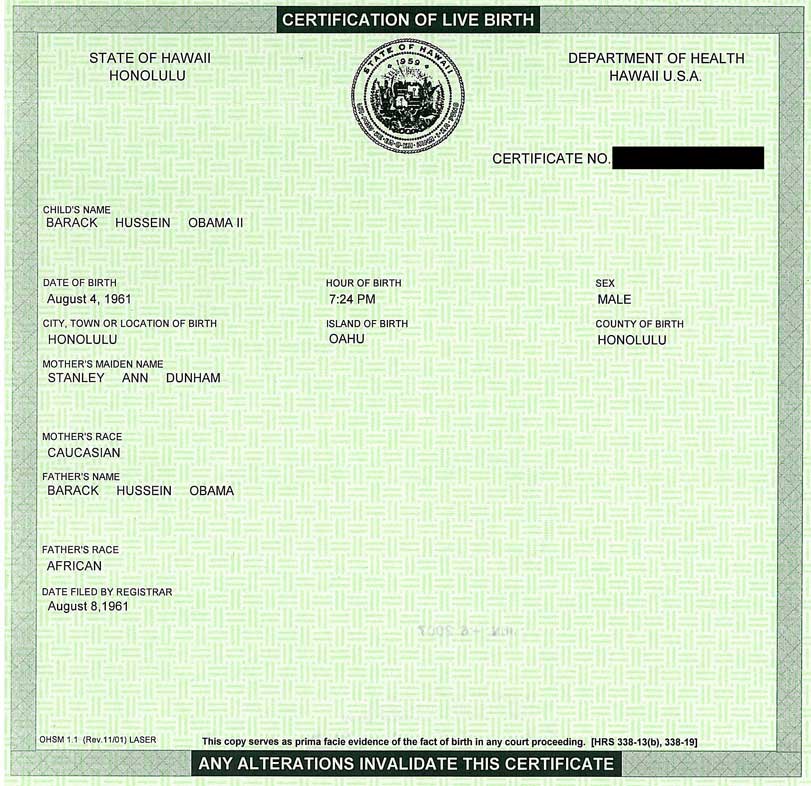
Not one of these documents shows a Muhammed (or Mohammed) in Obama's name. They all read "Barack H. Obama" or "Barack Hussein Obama."
The ultimate document we sought was Obama's birth certificate. Unlike the other documents, Hawaii birth certificates aren't public record. Only family members can request copies, so when the campaign declined to give us one, we were stalled.
On June 13, 2008, Obama's campaign finally released a copy, while launching a fact-check Web site of its own, Fightthesmears.com. The site is a direct response to allegations about Obama that won't go away: He's Muslim. He took the oath of office on a Koran. He refuses to say the Pledge of Allegiance. PolitiFact has researched all of these accusations and none of them are true.
When the birth certificate arrived from the Obama campaign it confirmed his name as the other documents already showed it. Still, we took an extra step: We e-mailed it to the Hawaii Department of Health, which maintains such records, to ask if it was real.
"It's a valid Hawaii state birth certificate," spokesman Janice Okubo told us.
Then the firestorm started.
- Where is the embossed seal and the registrar's signature?
- Comparing it to other Hawaii birth certificates, the color shade is different.
- Isn't the date stamp bleeding through the back of the document "June 2007?" (Odd since it was supposedly released in June 2008.)
- There's no crease from being folded and mailed.
- It's clearly Photoshopped and a wholesale fraud.
• • •
At PolitiFact.com, we're all about original sources. We don't take anyone at their word or take the reporting of other media organizations as proof. We go to the heart of the story, the source of the truth — original, corroborating documents.
When the official documents were questioned, we went looking for more answers. We circled back to the Department of Health, had a newsroom colleague bring in her own Hawaii birth certificate to see if it looks the same (it's identical). But every answer triggered more questions.
And soon enough, after going to every length possible to confirm the birth certificate's authenticity, you start asking, what is reasonable here?
Because if this document is forged, then they all are.
If this document is forged, a U.S. senator and his presidential campaign have perpetrated a vast, long-term fraud. They have done it with conspiring officials at the Hawaii Department of Health, the Cook County (Ill.) Bureau of Vital Statistics, the Illinois Secretary of State's office, the Attorney Registration & Disciplinary Commission of the Supreme Court of Illinois and many other government agencies.
Sounds like a Vince Flynn novel.
• • •
Peter Goelz knows a little something about conspiracy theorists.
He was managing director of the National Transportation Safety Board in 1996 when TWA Flight 800 crashed off Long Island, killing 230 people. While the NTSB's investigation found no evidence of sabotage or terrorism, the Internet was stocked with insistent accusations.
"We were right at the beginning of this Internet lunacy," Goelz said in an interview with PolitiFact. "And there were a variety of crackpot Web sites and Web commentators that generated all sorts of rumors. The principle one was that TWA in fact was shot down by an errant Navy missile in ... a live-fire exercise off the Hamptons."
Nine miles off Long Island, in the middle of summer. And then a full-scale coverup by the Navy and all the sailors involved.
"I am sure that we spent another $10-million, perhaps $20-million, out of a $50-million investigation, to just knock down and put to bed these kinds of rumors, these insidious rumors," Goelz said. "We felt like we had to answer every question because it was such a public and dreadful and confounding event."
Goelz, who is now a communications consultant in Washington, D.C., says the Internet has given a platform to anyone to say anything. And a way to find others who want to hear it.
"Online, they can be almost anything," he said. "They can be the crusading investigators that they always wanted to be."
• • •
The Hawaii Department of Health receives about a dozen e-mail inquiries a day about Obama's birth certificate, spokesman Okubo said.
"I guess the big issue that's being raised is the lack of an embossed seal and a signature," Okubo said, pointing out that in Hawaii, both those things are on the back of the document. "Because they scanned the front … you wouldn't see those things."
Okubo says she got a copy of her own birth certificate last year and it is identical to the Obama one we received.
And about the copy we e-mailed her for verification? "When we looked at that image you guys sent us, our registrar, he thought he could see pieces of the embossed image through it."
Still, she acknowledges: "I don't know that it's possible for us to even say beyond a doubt what the image on the site represents."
• • •
And there's the rub. It is possible that Obama conspired his way to the precipice of the world's biggest job, involving a vast network of people and government agencies over decades of lies. Anything's possible.
But step back and look at the overwhelming evidence to the contrary and your sense of what's reasonable has to take over.
There is not one shred of evidence to disprove PolitiFact's conclusion that the candidate's name is Barack Hussein Obama, or to support allegations that the birth certificate he released isn't authentic.
And that's true no matter how many people cling to some hint of doubt and use the Internet to fuel their innate sense of distrust.
© 2008 St. Petersburg Times
By Robert Farley
The first draft of Anne Kilkenny’s e-mail went to her mother in California. Then she sent it out to a few dozen friends and family members, many “in the lower 48.”
Within a week, Kilkenny’s words, the observations of a Wasilla, Alaska, homemaker who remembers Gov. Sarah Palin when she was mayor, circled the globe. The letter is posted on a thousand Web sites. It’s being cited in countless blogs and e-mails. Read it for yourself here.
Kilkenny, 59, has been quoted on the front page of the New York Times. She has been interviewed by the Los Angeles Times, the San Francisco Chronicle, four British papers, L’Express from France and Der Spiegel from Germany, to name just a few. She has gone on TV with ABC and NBC and CNN, which spent four hours at her house. She has spoken with National Public Radio.
Kilkenny is now a significant voice in the national discussion of the presidential election, but she began with a modest goal. She merely wanted to answer out-of-town friends who asked: “You’re from Wasilla — what’s Sarah Palin like?”
Kilkenny was more than a casual observer. She says she attended virtually every City Council meeting in Palin’s first year as Wasilla mayor in 1996. She is not a fan.
Kilkenny put her thoughts in a six-page e-mail in which she praised Palin as smart, energetic and hardworking but also labeled her intolerant, ambitious and ruthless. Kilkenny was perhaps the first to spread the story, now being widely reported, of how Palin once tried to fire the town librarian after the librarian made it clear that she would oppose efforts to remove books from the local collection. Palin was the freshly elected mayor then, and although she didn’t have any particular books in mind, she posed what she later called “rhetorical” questions about how objectionable books could best be removed. It's a murky issue, but we dove in and ruled Kilkenny's statement Half True.
Kilkenny was part of the insurgency that saved the librarian, Mary Ellen Emmons, from dismissal by Palin, who had asked for Emmons’ resignation, according to news accounts at the time. Palin relented after a public uprising.
Another claim in Kilkenny's e-mail is that Palin "fired Wasilla’s Police Chief because he 'intimidated' her, she told the press." Palin did write a memo suggesting intimidation was at play, but it's clear issues of loyalty and support were also factors in the firing. We find this claim Mostly True.
Kilkenny, whose husband is retired, says Palin left the city in debt over pet projects. And she concludes “there has to be literally millions of Americans who are more knowledgeable and experienced than she” and who would be better suited to be vice president.
We examined Kilkenny's claim about Palin leaving the city in debt, as well as several other figures she cites from city budgets to make the argument that Palin was hardly the fiscal conservative she is portrayed as. We found that while Kilkenny's numbers are Mostly True, they get a fuller context from the current mayor.
At the top of the e-mail, Kilkenny told friends they should feel free to distribute the e-mail to friends. But, she asked, “please do not post it on any websites as there are too many kooks out there.”
Ha ha ha.
Within hours, she was getting e-mails referencing her “blog.”
“What blog? Did I blog?” she wondered. She had never blogged before.
Google “Anne Kilkenny and Palin” and you’ll get more than 17,000 page hits now. Her letter has become a popular chain e-mail. “Intellectually, you realize there is this pyramid effect,” Kilkenny said. “But it’s still mind-boggling.”
A couple of factors conspired to propel Kilkenny’s letter to Web fame. First, few Americans outside Alaska had ever heard of Palin before she was announced as Sen. John McCain’s running mate. Since that day just a week ago, the public has had a voracious appetite for information about her.
Second, Kilkenny provides a critical voice. Palin is wildly popular in Alaska, and even more so in Wasilla, a town beaming with pride at having one of its own nominated to become vice president of the United States.
Kilkenny’s critical voice has appealed to journalists, who have called by the dozens, eager for a perspective that differs from the hometown boosters. More than one reporter has called with just two questions: “Are you a real person? Did you write this?”
She’s not sure how all this may be playing with her neighbors. She has been so inundated with calls and interviews, she hasn’t had time to leave the house. Her mother worries about the attention. She suggested her daughter change her phone number and move in with her until the firestorm passes. But so far the e-mail response has been overwhelmingly positive, Kilkenny said. Many have praised her courage. Others have written in defense of Palin. That’s okay with Kilkenny, too.
Kilkenny, a Democrat, said she does not share Palin’s political point of view. But for those who are socially conservative, she said, her e-mail should be in some ways reassuring. “I want people to know,” she said. “If they are social conservatives, they can trust that’s who she is.”
Overall, she has been pleased with the tone of responses.
“The American public is not a vicious, vindictive, ugly group of people,” she concluded. “They care deeply about their country. They take their responsibility as citizens very seriously. My faith in the American people was really pumped up.”
Another thing she has learned: The public is very distrustful of the media. “But they are very trustful of me,” she said.
Which she finds a little alarming. Because, she said, they really don’t know who she is. She could be anyone.
© 2008 St. Petersburg Times
By Angie Drobnic Holan
The story begins, like so many these days, with Gov. Sarah Palin’s speech at the Republican National Convention last week. Having stirred the crowd to its feet more than once, Palin delivered a knockout line when she deadpanned:
“I love those hockey moms. You know the difference between a hockey mom and a pit bull? Lipstick.”
The line drew cheerful applause and has echoed ever since, which seems to explain how Sen. Barack Obama found himself in the middle of an uproar when he uttered a time-worn phrase to denigrate Sen. John McCain’s proclaimed agenda for “change” in Washington.
"John McCain says he's about change, too," Obama said. "And so I guess his whole angle is, 'Watch out, George Bush! Except for economic policy, health care policy, tax policy, education policy, foreign policy, and Karl Rove-style politics, we're really going to shake things up in Washington.'"
"That's not change," Obama said. "That's just calling something the same thing something different. But you know, you can put lipstick on a pig. It's still a pig. You can wrap an old fish in a piece of paper called change, it’s still going to stink after eight years. We’ve had enough of the same old thing."
Gasp! He just said lipstick! Did he just call Sarah Palin a pig??!!!
That’s the charge.
The statement: Barack Obama on Sarah Palin: "You can put lipstick on a pig. It's still a pig."
- Web ad by the campaign of Sen. John McCain
The ruling: Obama so clearly wasn't talking about Palin It's a wonder anybody has the nerve to suggest he was.
Later that day, the McCain campaign arranged a conference call for reporters with Jane Swift, the former governor of Massachusetts. She said that when you add up Obama’s comments and Palin’s comments, you get Obama calling Palin a pig. Swift said Obama should apologize.
“Calling a very prominent female governor of one of our states a ‘pig’ is not exactly what we want to see,” Swift said.
The issue has dominated the presidential campaign for two days, with the McCain campaign stirring a controversy by having local lawmakers call for Obama to apologize, and the Obama campaign responding with examples of how often he and others have used the phrase. The next day, Obama called the McCain’s campaign tactics “lies and phony outrage and Swift-boat politics.”
On Wednesday, the McCain campaign released a Web ad called “Lipstick.” It begins with a clip of Palin delivering her lipstick line, then text flashes on the screen saying “Barack Obama on: Sarah Palin.” A moment later, the ad plays a small portion of Obama’s “lipstick on a pig” remark, but not enough of his quotation to make clear what he was talking about. The ad concludes with a clip of CBS anchor Katie Couric soberly remarking on sexism on the campaign trail.
The ad has two big problems, as does the complaint of former Gov. Swift. First, in the full text of the remarks it’s clear that Obama isn’t talking about Sarah Palin. He’s talking about McCain’s argument that he represents change.
Second, “putting lipstick on a pig” is a popular put-down, especially among politicians. It generally means taking a bad or unattractive idea and trying to dress it up.
We weren’t able to pin down the origins of this folksy expression, but we found tons of instances of people using it. The political newspaper The Hill labeled the phrase “Congress Speak” back in June, and gave it an official definition: “an expression used to illustrate that something unattractive cannot be beautified or otherwise positively changed by any amount of makeup or other exterior alterations.”
In 1986, Texas Agricultural Commissioner Jim Hightower used the phrase to criticize Ronald Reagan’s farm policy. During the 2004 presidential campaign, both Dick Cheney and John Edwards used it to attack the other guy’s running mate. Earlier this year, Democratic Congresswoman Linda Sanchez of California gave a speech on trade policy. “You know the old saying about putting lipstick on a pig? Well, I smell bacon,” she groused.
Obama and McCain both have used the expression.
In September 2007, Washington Post columnist Eugene Robinson quoted Obama using the phrase to discuss Iraq policy:
“I think that both Gen. Petraeus and Ambassador Crocker are capable people who have been given an impossible assignment,” Obama said. “George Bush has given a mission to Gen. Petraeus, and he has done his best to try to figure out how to put lipstick on a pig.”
In Iowa on Oct. 11, 2007, McCain panned Sen. Hillary Clinton’s health care plan, calling it “eerily reminiscent” of the plan that failed during Bill Clinton’s administration, according to a report in the Chicago Tribune.
“I think they put some lipstick on a pig,” McCain said, “but it’s still a pig.”
On Feb. 1, 2007, McCain blasted a Senate resolution that would have criticized President Bush’s strategy in Iraq. Some had praised the resolution as a compromise measure, but McCain disagreed. “It gets down to whether you support what is being done in this new strategy or you don’t,” McCain said. “You can put lipstick on a pig, [but] it’s still a pig, in my view.”
It is simply impossible to view the complete remarks by Obama and conclude that he’s making a veiled and unsavory reference to Palin. Her name never is used in the preceding sentence. In fact, it’s hard to see how one could interpret Obama’s lipstick-on-a-pig remark as referring directly to McCain, either. We think it’s very clear that Obama was saying McCain’s effort to call himself the “candidate of change” is like putting lipstick on a pig, trying to dress up a bad idea to look better. Agree or disagree with Obama’s point, but his remark wasn’t the smear that McCain’s people have tried to make it.
If anyone’s doing any smearing, it’s the McCain campaign and its outrageous attempt to distort the facts. Did Obama call Palin a pig? No, and saying so is Pants on Fire wrong.
© 2008 St. Petersburg Times
By Robert Farley and Angie Drobnic Holan
In this complex financial crisis, the presidential candidates have the biggest megaphone of all to help us understand the mess we're in.
But relying on them for an unvarnished view is like asking competing trial attorneys to provide the "facts" of a case. You'll get some facts, but in a light that's most friendly to their client.
In the second presidential debate on Oct. 7, 2008, Sens. John McCain and Barack Obama laid out their explanations of the root causes of the financial crisis. Both say they sounded warnings that could have lessened the problem, and both blamed the other for helping to cause it.
Here's the McCain version: "One of the real catalysts, really the match that lit this fire, was Fannie Mae and Freddie Mac. I'll bet you, you may never even have heard of them before this crisis. But you know, they're the ones that, with the encouragement of Sen. Obama and his cronies and his friends in Washington, that went out and made all these risky loans, gave them to people that could never afford to pay back."
Obama's side: "Let's, first of all, understand that the biggest problem in this whole process was the deregulation of the financial system. Sen. McCain, as recently as March, bragged about the fact that he is a deregulator."
In reality, the crisis was caused by a "perfect storm" of economic factors with lots of blame to go around, both in the private sector and government quarters.
In a recent panel discussion on the crisis, Jay Light, dean of the faculty at Harvard Business School, likened it to a train wreck "caused by a collision of a collapsing housing bubble and a new but untested financial system."
Rather than the old system in which a highly regulated bank would buy and hold a person's home mortgage, a system evolved whereby mortgage brokers would originate loans, bundle them, then quickly sell them to Wall Street, where the loans were packaged into securities, cut and sliced, sold and resold.
Role of derivatives
Another factor was subprime loans, which are loans at higher interest rates made to people perceived to be greater lending risks. Elected officials encouraged the relaxation of mortgage standards, motivated by the noble goal of trying to get all Americans into homes — even low- and moderate-income people with poor credit histories. The effort increased the number of home buyers, goosing housing demand.
But investment banks loved what the government was doing and encouraged it. Worldwide savings were soaring, and international investors were hungry for a safe place to park their money.
Mortgage-backed securities appeared to be virtually risk-free on paper, premised as they were on ever-rising home prices. And, once-obscure derivatives — the credit default swap, a private contract that pays off in case of a defaulted loan — were specifically exempted from government regulation. Today, nobody knows the true value of these investments, given foreclosures and mortgage defaults, and that is what's causing the credit crunch — a general reluctance to lend money.
But let's start with McCain's version, with the government agencies called Fannie Mae and Freddie Mac.
Set up decades ago by the federal government to underwrite mortgages and promote home ownership, Fannie Mae (the Federal National Mortgage Association) and Freddie Mac (the Federal Home Loan Mortgage Corp.) became major players in the domestic mortgage market. They don't make loans to homeowners directly, but they purchase mortgages, bundle them into securities, and sell some of them on the open market. Together, Fannie and Freddie owned or guaranteed about $5-trillion in mortgages, about half of the U.S. market.
After years of rapid growth in home prices, foreclosures and mortgage delinquencies began rising by 2006. Some homeowners had adjustable-rate mortgages that were resetting to higher rates they could no longer afford. In other cases, speculators were overextended and dumping properties. Outright fraud had some role: people who took out loans never intending to pay them back.
Regardless of the reasons, by 2008 foreclosures were affecting Fannie and Freddie. The agencies didn't have enough money to meet their financial obligations, and the U.S. government took them over on Sept. 7.
Fannie and Freddie
McCain's statement suggests that Fannie and Freddie made too many risky loans, and that caused today's crisis. Most economists agree that Fannie and Freddie did encourage looser lending standards, but they disagree on whether the agencies were leading the way or following the pack.
There's also McCain's second point, that Democrats encouraged Fannie and Freddie to take on more risky loans.
The answer depends on the point in history you choose to look at. In the late 1990s, the Republican-controlled Congress — with the blessing of Democratic President Bill Clinton — eased the credit requirements on loans that Fannie and Freddie purchased. Fannie and Freddie grew rapidly, and at some point executives started manipulating earnings reports and violating basic accounting principles. Federal investigators uncovered the misconduct, resulting in a scandal.
By 2006, McCain did, in fact, sign on to a Republican-led attempt at regulatory overhaul of the mortgage-financing firms.
"If Congress does not act, American taxpayers will continue to be exposed to the enormous risk that Fannie Mae and Freddie Mac pose to the housing market, the overall financial system, and the economy as a whole," McCain declared in a May 26, 2006, news release.
'Bipartisan problem'
However, McCain's current attempts to depict those efforts as an early warning that could have lessened the current credit crisis don't wash. McCain was talking about potential fallout from accounting troubles, not freewheeling lending standards based on a housing bubble. And he said nothing about major financial institutions becoming badly leveraged on bad loans and new securities products.
While McCain is quick to blame Democrats for opposing the legislation — they did — the Republican-controlled Congress (with a Republican in the White House) didn't get around to a regulatory overhaul when it held power.
"It's a bipartisan problem," said Bill Beach, director of the Center for Data Analysis at the conservative Heritage Foundation.
Obama's argument is that deregulation caused the problem. That's not technically accurate — deregulation implies regulations were done away with. In the case of the economic crisis, there was a bit of that.
The Securities and Exchange Commission, for example, gave an exemption to investment banks in 2004 that allowed them to take on much more debt. But credit default swaps were never regulated in the first place. In 1999, Republicans passed legislation, signed by Clinton, specifically exempting them from regulation.
Some regulatory agencies had regulation powers that they never utilized or didn't utilize well. The Federal Reserve has the power to tighten lending standards, for instance, or raise interest rates. But former Chairman Alan Greenspan discouraged new rules and advised Congress repeatedly not to regulate derivatives.
"There were lots of regulatory failures, and it would be reasonable to blame regulators for not detecting problems and acting on them sooner," said Charles Calomiris, a professor at Columbia Business School and a scholar at the conservative American Enterprise Institute. "But deregulation means the removal of regulatory barriers."
It's certainly fair to say that McCain has historically been an advocate for deregulation of business. In March, as Obama has repeatedly noted, McCain boasted to the Wall Street Journal, "I am fundamentally a deregulator."
But for Obama to suggest McCain's deregulation efforts are to blame for the current financial crisis is misleading. In that same article, McCain said there was a need for government oversight of the subprime lending market.
Lax regulation
Calomiris called Obama's deregulation argument "discouragingly dishonest" as "the only deregulation in banking of any significance (branching deregulation, and allowing commercial banks to underwrite corporate securities) had nothing to do with the subprime crisis. Said differently, everyone (including commercial banks) who underwrote or bought subprime paper would have been able to do so long before deregulation."
But lax regulation contributed to the crisis more than Fannie and Freddie, in the opinion of another economist.
"I put the first blame with the Fed and their failure to rein in the bubble," said Dean Baker, an economist and co-director of the left-leaning Center for Economic and Policy Research in Washington.
Obama did send a letter to Treasury Secretary Henry Paulson and the new Federal Reserve chairman, Ben Bernanke, in March 2007, advising a meeting on the subprime mortgage mess. "We cannot sit on the sidelines while increasing numbers of American families face the risk of losing their homes," Obama wrote.
But economists agree that it was too late by that point, a point that economists Baker and Calomiris agree on. In separate interviews, they both used the same analogy: The horse was already out of the barn.
"The subprime market basically blew up in 2007," Baker said. "It was too late by then."
© 2008 St. Petersburg Times
By Bill Adair
The Truth-O-Meter has rated 153 claims and attacks from John McCain. Many have involved wasteful spending and his reputation for fighting political pork. We found, for example, that he was pretty much on the mark about a government program to study the DNA of bears and that he was right that President Bush and the Republican Party have presided over a 55 percent increase in domestic spending.
We noted that McCain has been pretty consistent opposing pork projects for his own state, but he can't claim a perfect record. He sought $10-million for an academic center to honor the late Chief Justice William Rehnquist, and he asked the Environmental Protection Agency to provide $5-million toward a wastewater project in Nogales, Ariz.
We rated many of McCain's statements on Iraq, including his claim that Saddam Hussein said he had wanted to obtain weapons of mass destruction (True), and McCain's claim last summer that casualties and deaths were at the lowest point since the war began (Half True).
Barack Obama's attacks on McCain have tried to link him with Bush and portray McCain's economic plan as favoring wealthy families and big corporations. We found that Obama was right to say McCain votes with Bush 90 percent of the time, but that Obama was misleading in saying McCain's plan offers "billions in tax breaks for oil and drug companies." Actually, all companies would benefit from McCain's proposal to cut corporate taxes, not just the Democrats' favorite bogeyman.
We've also checked several of McCain's more unusual claims, including one that the Broadway musical Mamma Mia! sells out consistently (True) and that the average South Korean is 3 inches taller than the average North Korean (also True).
STATEMENTS BY MCCAIN
McCain spoke up early, held hearings on global warming
The statement:"John McCain stood up to the president and sounded the alarm on global warming ... five years ago."
-- John McCain, June 17 in a TV ad
The ruling: Indeed, the Congressional Record shows that McCain spoke up about global warming in January 2003. And as chairman of the Senate Commerce Committee, he held hearings on the issue several years before that. On Jan. 9, 2003, McCain and Sen. Joe Lieberman introduced the Lieberman-McCain Climate Stewardship Act, which sought to reduce greenhouse gas emissions by capping them and allowing companies and utilities to sell or trade their emission rights. Manik Roy, director of congressional affairs for the Pew Center on Global Climate Change, called McCain "a huge leader on this issue in the Senate."
McCain's change in posture, not position, on drilling
The statement: "I've always said it's (offshore drilling) up to the states and I still say that."
-- John McCain, June 18 in Springfield, Mo..
The ruling: Opponents have accused McCain of flip-flopping on offshore drilling, but we found McCain's record is not so clear. In June 2003, McCain was among 10 Republicans who voted for an anti-drilling amendment proposed by Democratic Florida Sen. Bob Graham, but in August 2006, McCain voted in favor of a bill that authorized drilling in about 8.3-million acres of the eastern Gulf of Mexico. In reviewing his statements over the years, we found McCain has consistently been in favor of letting states ultimately decide whether to drill. The difference now is that he's become a cheerleader for the cause. If it's not a change in position, it's at least a change in posture.
Fannie, Freddie and John, at odds in 2006
The statement: "John McCain fought to rein in Fannie and Freddie ... but Democrats blocked the reforms."
-- John McCain, Sept. 30 in an advertisement
The ruling: McCain did indeed co-sponsor a bill that would have enhanced oversight of Freddie Mac and Fannie Mae, private corporations created and sponsored by Congress to lower the cost of mortgage capital. McCain signed on 17 months after it was introduced, after a damning federal report on accounting practices at Fannie Mae was released. The McCain campaign has also noted that in 2003 he was one of five Republican senators to co-sponsor a prior bill to tighten oversight of Fannie and Freddie. Still, if he "fought" for reform, it wasn't exactly guns-a-blazin'. McCain overstates his role in pushing for Fannie and Freddie reform.
Gas tax holiday much more costly than McCain suggests
The statement: The price of a gas tax "holiday" would be about the same as "a Bridge to Nowhere (or) another pork barrel project."
-- John McCain, April 24 in interview on Fox News
The ruling: A gas tax holiday would cost the federal government about $9-billion in lost revenue, according to 2007 figures from the IRS. And McCain is way off with his suggestion that it could be paid for by eliminating the famous "Bridge to Nowhere" or another pork barrel project. When Congress was considering the project, the federal cost was estimated at just over $200-million, so it would actually take 45 Bridges to Nowhere to make up for the shortfall in gas tax. He's also way off with his suggestion that the holiday could be paid for by eliminating a pork barrel project. The average pork project costs $1.3-million, so it would take more than 6,900 of them to pay for the tax holiday. The math is so far off that we've got to set the meter ablaze.
Hussein did say he hoped to get WMD
The statement: When the United States invaded Iraq, Saddam Hussein wanted to acquire weapons of mass destruction, and "he said so himself after his capture."
-- John McCain, June 4 in St. Petersburg
The ruling: The claim is based on information from the Iraq Survey Group, which interviewed scores of people, including Hussein's top advisers. After his capture in 2003, the survey group gained access to information gleaned from Hussein during detention. Hussein's interrogator for the group, George Piro of the FBI, told 60 Minutes that Hussein told him he wanted to pursue weapons of mass destruction again. "He wanted to pursue all of WMD," Piro said. "So he wanted to reconstitute his entire WMD program." Granted, the Survey Group came from the U.S. intelligence community, which got the weapons question wrong before the invasion. But it's the best record publicly available, and it supports McCain's statement.
He was front and center, uncovering a wasteful mess
The statement: "I saved the taxpayers $2-billion on a bogus Air Force Boeing tanker deal where people went to jail."
-- John McCain, Nov. 28, 2007, in St. Petersburg
The ruling: Indeed, McCain was front and center in a well-publicized effort that killed an Air Force plan to lease 100 Boeing 767s and use them for refueling tankers. The plan eventually led to one of the more notable Washington scandals in years, resulting in prison terms for a top Boeing official and the Air Force's No. 2 weapons buyer. It is well-documented in media and government reports that McCain was quick to identify the $23.5-billion deal as a bad one for taxpayers. He found it in December 2001 and tucked into a little-noticed amendment to the 2002 defense budget. Other senators and watchdog groups took up the fight against the deal, but only after McCain and his staff revealed the makings of a scandal.
ATTACKS AGAINST MCCAIN
Obama knows McCain's intentions better than McCain?
The statement: "Sen. McCain would pay for part of his (health care) plan by making drastic cuts in Medicare - $882-billion worth."
-- Barack Obama, Oct. 17 in a speech in Roanoke, Va.
The ruling: The $882-billion figure comes from an analysis of McCain's plan by the Center for American Progress Fund, a left-leaning think tank. Because McCain's campaign says the plan would be "budget neutral" - meaning it would be paid for by savings from Medicare and Medicaid - the Center for American Progress assumes the savings would come from cuts to the big health programs. But McCain has never talked about Medicare cuts to pay for his plan. Instead, his campaign says it would overhaul Medicare reimbursement policies, streamlining treatments, cracking down on fraud and waste, and more use of generic drugs, among other savings. So Obama is making a big leap with this one.
The statement: McCain "has opposed stem cell research."
-- Barack Obama, Sept. 16 in a radio ad
The ruling: At one time, McCain did oppose embryonic stem cell research. But then he changed his mind. "I have talked with numerous scientific experts. I believe that under stringent safeguards and under the most rigorous kinds of procedures, that this can help in finding the cure for Alzheimer's, Parkinson's and other serious diseases," he said. In June 2004, McCain was among 58 U.S. senators - most of them Democrats - who signed a letter urging President Bush to change his position and allow federal funding for scientific research on embryonic stem cells. And McCain has backed up his words with his votes in favor of it in recent years.
High earners get a break under McCain's plan
The statement: John McCain "is proposing tax cuts that would give the average Fortune 500 CEO an additional $700,000 in tax cuts."
-- Barack Obama, Oct. 7 in a debate in Nashville, Tenn.
The ruling: To come up with that number, the Obama campaign cites numbers from a Forbes magazine study of the average CEO compensation in 2007 for the 500 largest companies, not the Fortune 500. And yes, it comes to about $705,000. But the nonpartisan Tax Policy Center did a more conservative analysis that said CEOs would receive a tax rate decrease of 2.1 percent, or about $270,000. That's still a big number, but not as big as $700,000.
Taking it straight from the records, Obama nailed it
The statement: "John McCain has voted with George Bush 90 percent of the time."
-- Barack Obama, Aug. 28 in a speech at the Democratic National Convention
The ruling: The number is based on a "presidential support" score from Congressional Quarterly, which rates how often lawmakers back or oppose the president. Since 2001, McCain has, in fact, backed the president's position an average of 90 percent of the time. By congressional standards, that's solidly partisan, but hardly marching in lockstep. McCain supported Bush as infrequently as 77 percent of the time in 2005; and as high as 95 percent of the time in 2007.
McCain's tax plan doesn't ignore middle class
The statement: Sen. McCain's tax plan provides "virtually nothing to the middle class."
-- Joe Biden, Oct. 2 in vice presidential debate in St. Louis
The ruling: Independent studies of McCain's tax plan show that wealthy Americans would benefit the most, but his plan does have provisions that would help the middle class. Chief among these is an increase to the exemption taxpayers claim for each dependent. It's currently $3,500 and would go up by $500 each year beginning in 2010 until it would reach $7,000 in 2016. After that, it would be indexed for inflation. McCain also would tweak the alternative minimum tax and extend President Bush's 2001 and 2003 tax cuts, currently set to expire at the end of 2010, which expanded the child tax credit. So it's wrong to say McCain's plan would provide little relief to middle-class Americans.
Ad distorts McCain's record on Violence Against Women Act
The statement: Says McCain "voted to let governments charge rape victims" for forensic exams.
-- Planned Parenthood, Oct. 1 in a TV ad
The ruling: The ad attributes the charge to McCain's 1994 vote on a crime bill that included the Violence Against Women Act, which included a provision that required states to provide free forensic exams for rape victims. Planned Parenthood's logic: Because McCain opposed that bill, he voted to let governments charge victims for their rape kits. But McCain opposed it not because of the Violence Against Women provisions but because it included wasteful spending and had a provision that would have banned so-called assault weapons. And Planned Parenthood conveniently ignores the fact that McCain voted in favor of the act several other times and actually spoke in favor of it on the Senate floor.
© 2008, St. Petersburg Times
By Bill Adair
Barack Obama has faced the Truth-O-Meter 159 times, most often on issues involving taxes, the economy and energy. Many of the claims involved his tax plan, such as the one below about small businesses. We've also examined Obama's claim that his tax plan would reduce taxes on 95 percent of working families, which we rated True. But he has sometimes mistakenly said "95 percent of Americans" or 95 percent "of you," which earned a Half True.
We've checked many Obama claims on energy, including one that people could save all the oil from new drilling by fully inflating their tires and getting tuneups (True). And we examined his contention that oil companies are failing to drill on 68-million acres where they have rights (False).
Many attacks against Obama have also been about his tax plan, often suggesting he would raise taxes on the middle class. We found the attacks frequently distorted the truth, because Obama's plan would increase taxes only on families earning more than $250,000 per year. But we found McCain was correct that as a senator, Obama has not challenged his party leadership on any major issues and that McCain was right that Obama sought $932-million in political pork.
We've examined more than two dozen attacks against Obama from anonymous chain e-mails. The overwhelming majority of these e-mails have been wrong, often ridiculously so. No, Obama is not a Muslim, he did not take the oath of office on a Koran, he did not refuse to say the Pledge of Allegiance, he did not refuse to thank soldiers in Afghanistan, he does not want to unilaterally disarm our nation and he does not want to replace our national anthem with I'd Like to Teach the World to Sing.
STATEMENTS BY OBAMA
Most small businesses won’t be subject to tax increases
The statement:"98 percent of small businesses make less than $250,000" and would not see a tax increase under Barack Obama's plan.
-- Barack Obama, Oct. 15 in a debate in Hempstead, N.Y.
The ruling: A study of the tax plan by the Tax Policy Center, a nonpartisan research group, indicates that Obama is right. His plan would roll back the Bush tax cuts on the top two tax brackets. In practice, this mean that people with income above $200,000 for singles and $250,000 for couples would see taxes increase. It's not easy to identify small businesses because of the way people file taxes, but two analyses by the Tax Policy Center confirm that about two percent would see their taxes increase under Obama's plan.
Obama goes too far to make his point on gas tax holiday
The statement: A gas tax holiday is a gimmick that "every economist says will just go into the pockets of the oil companies."
-- Barack Obama, May 13 in a Q&A in Cape Girardeau, Mo.
The ruling: It's true that economists have found oil companies don't pass the full benefit of gas tax holidays on to consumers. For that and other reasons, the vast majority of economists who have opined on the issue opposed the holiday. But to say every economist believes the break would just go to the oil companies is an exaggeration. Even harsh critics of a gas tax holiday said consumers would see some benefit. Obama takes a fact in his favor - that the nation's economists have come down on his side in the gas tax debate - and stretches it a bit too far.
Obama's health care plan expands existing system
The statement: Under Barack Obama's health care proposal, "if you've got a health care plan that you like, you can keep it."
-- Barack Obama, Oct. 7 in a debate in Nashville, Tenn.
The ruling: Republicans often falsely characterized Obama's health plan as being government-run, which prompted him to assert that it would rely largely on the current system in which employers provide private health insurance for their employees. His plan would essentially take today's system and seek to expand it to the uninsured. Obama has said he would like his plan to be universal, in that everyone has health care coverage, but it only mandates coverage for children. He is correct that under his plan, people who want to keep their current insurance should be able to do so.
Obama has consistently opposed the war
The statement: "I opposed this war from the beginning. I opposed the war in 2002. I opposed the war in 2003. I opposed it in 2004 and 2005 and 2006."
-- Barack Obama, Sept. 12, 2007, in Clinton, Iowa
The ruling: Obama opposed the war as a little-known state senator, and he spoke out notably at a Chicago antiwar rally in 2002. In 2003, when he began campaigning for the U.S. Senate seat for Illinois, he reiterated his opposition in several debates and meetings. So his claim to have long opposed the war is true.
Actually, abortion numbers have declined
The statement: "Although we have had a president who is opposed to abortion over the last eight years, abortions have not gone down."
-- Barack Obama, Aug. 16 in TV interview with megachurch pastor Rick Warren
The ruling: In his appearance at Warren's church in Lake Forest, Calif., Obama asserted that abortions have not gone down during the Bush presidency. But in fact, the numbers have gone down. The New York-based Guttmacher Institute reported that in 2005 the country's abortion rate fell to 19.4 abortions per 1,000 women ages 15 to 44, continuing a trend that started after the abortion rate peaked in 1981 at 29.3. The institute says the rate of abortions is at its lowest point since 1974.
68-million acres aren't going untouched
The statement: Oil companies "haven't touched" 68-million acres where they already have rights to drill.
-- Barack Obama, Aug. 4 in Lansing, Mich.
The ruling: The line sounds good as a Democratic rebuttal to Republican support for more drilling in Alaska and off the U.S. coast. But Obama's statement is misleading, inasmuch as it suggests that oil and gas companies have access to 68-million acres of oil and gas fields that they deliberately are not drilling. That is simply not true. Years of exploration and federal permitting must be completed before leased land yields oil or gas.
ATTACKS AGAINST OBAMA
In the U.S. Senate, Obama's no maverick
The statement: "Sen. Obama has never taken on his party leaders on a single major issue."
-- John McCain, Oct. 7 in a debate in Nashville, Tenn..
The ruling: Limiting our examination to Obama's four years in the U.S. Senate, it would seem that McCain is on mostly solid ground. Congressional Quarterly each year tallies what it considers the key votes that took place in the previous 12 months. Of the 41 Senate votes tallied by CQ between 2005 and 2007, Obama sided with a majority of his caucus on 36 of them. On three, he did not vote. On one, he voted with 21 colleagues against the nomination of John Roberts to the Supreme Court, a vote that evenly divided the Democratic caucus. And last, there was a 2005 tort reform vote. CQ did not consider the Office of Public Integrity votes to be among the most important of 2006 or 2007. So McCain is correct.
An absurd claim about a sex-ed bill that never passed
The statement: Obama's one education accomplishment was "legislation to teach 'comprehensive sex education' to kindergartners."
-- John McCain, Sept. 9 in a television ad
The ruling: Republicans often falsely characterized Obama's health plan as being government-run, which prompted him to assert that it would rely largely on the current system in which employers provide private health insurance for their employees. His plan would essentially take today's system and seek to expand it to the uninsured. Obama has said he would like his plan to be universal, in that everyone has health care coverage, but it only mandates coverage for children. He is correct that under his plan, people who want to keep their current insurance should be able to do so. The origins of this claim go back to Obama's days as a state senator in the Illinois General Assembly. But the bill never passed, and Obama was not a sponsor or a co-sponsor. He just voted for it in committee. So calling it one of his accomplishments is incorrect. The McCain ad also distorts the impact of the bill on young students. The bill specifically mentions that instructional material must be age appropriate. It specifically mentions teaching children how to "say no to unwanted sexual advances" and "nonconsensual physical sexual contact." This is a ridiculous claim, because it wasn't an accomplishment for Obama and it distorts the purpose of the bill.
Obama is a Christian, and he was sworn in on his Bible
The statement: When Obama was sworn into office, "he DID NOT use the Holy Bible, but instead the Kuran (Their equivalency to our Bible, but very different beliefs)."
-- Chain e-mail, from Dec. 19, 2007
The ruling: Many of the chain e-mails we examined say Obama is a Muslim. One contended that his middle name is Mohammed (Pants on Fire). Another one took a different route, distorting Bible passages to allege that he is the Antichrist. (also Pants on Fire). The claim about the Koran seems to be inspired by the 2007 swearing-in of Rep. Keith Ellison, D-Minn., the first Muslim elected to Congress. Ellison used a Koran that once belonged to Thomas Jefferson. But as for Obama, he is a Christian and took the oath on his own Bible.
Obama's tax plan hits $200,000 and up
The statement: Obama plans "a tax increase for everyone earning more than $42,000 a year."
-- John McCain, Aug. 11 in an Internet ad
The ruling: A snarky Web ad from McCain calls Obama "The One" and shows his supporters saying things like "Hot chicks dig Obama." The ad says that for supporters of Obama, "The perks are amazing, like a tax increase for everyone earning more than $42,000 a year." It's a gross distortion of Obama's proposals to say they would raise taxes on "everyone" who earns that much. The McCain campaign's evidence are Obama's votes on budget resolutions. But budget resolutions are nonbinding, don't have the force of law and don't include precise details on taxes or spending. And Obama's tax plan would only raise taxes on people making more than $200,000 if single or $250,000 if married filing jointly.
McCain has Obama over a pork barrel
The statement: "Obama has asked for $932-million in earmarks, literally $1-million for every day that he's been in Congress."
-- John McCain, Sept. 16 in a speech in Tampa
The ruling: On his Web site, Obama has listed every earmark he's requested - but not necessarily received - during his time in the Senate. It totals $931.3-million, even though the Illinois senator said earlier this year he would eschew any pork for fiscal 2009. Obama took office Jan. 3, 2005. Since then, there have been about 930 working days, as they are defined by most people, Monday through Friday, excluding holidays. Overall, Obama's been in Congress for more than 1,350 days, if you count weekends. So how many points do you take off for McCain not saying "every working day"? Not many. We say Mostly True.
Several ratings rank Obama lower
The statement: "Senator Obama has the most liberal voting record in the United States Senate."
-- John McCain, Sept. 26 in Oxford, Miss.
The ruling: In January, National Journal magazine rated Obama the "Most Liberal Senator in 2007." But he wasn't the top liberal in his two other years in the U.S. Senate, according to the magazine. He was 10th-most liberal in 2006 and 16th in 2005. And Voteview.com, a site created by political scientists that plots lawmakers on a liberal-conservative scale based on their voting patterns, calculated nine senators were more liberal than Obama. McCain's statement suggests it is a cumulative rating for Obama's tenure in the Senate. But in fact, it is true for only one rating for one year. Measurements for other years and by other groups show Obama is not the No. 1 liberal - in some cases, far from No. 1.