The Boston Globe, by Charlie Savage
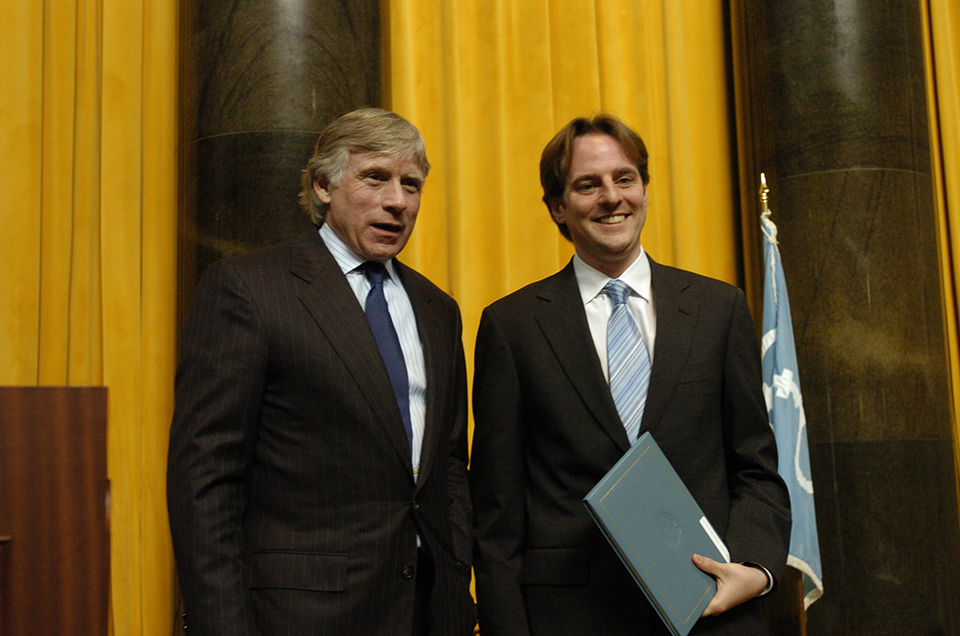
Columbia University President Lee C. Bollinger (left) presents Charlie Savage with the 2007 Pulitzer Prize in National Reporting.
Winning Work
By Charlie Savage
Vice President Dick Cheney recently told reporters, ''I believe in a strong, robust executive authority, and I think that the world we live in demands it. . . . I would argue that the actions that we've taken are totally appropriate and consistent with the constitutional authority of the president."
WASHINGTON -- When President Bush last week signed the bill outlawing the torture of detainees, he quietly reserved the right to bypass the law under his powers as commander in chief.
After approving the bill last Friday, Bush issued a ''signing statement" -- an official document in which a president lays out his interpretation of a new law -- declaring that he will view the interrogation limits in the context of his broader powers to protect national security. This means Bush believes he can waive the restrictions, the White House and legal specialists said.
''The executive branch shall construe [the law] in a manner consistent with the constitutional authority of the President . . . as Commander in Chief," Bush wrote, adding that this approach ''will assist in achieving the shared objective of the Congress and the President . . . of protecting the American people from further terrorist attacks."
Some legal specialists said yesterday that the president's signing statement, which was posted on the White House website but had gone unnoticed over the New Year's weekend, raises serious questions about whether he intends to follow the law.
A senior administration official, who spoke to a Globe reporter about the statement on condition of anonymity because he is not an official spokesman, said the president intended to reserve the right to use harsher methods in special situations involving national security.
''We are not going to ignore this law," the official said, noting that Bush, when signing laws, routinely issues signing statements saying he will construe them consistent with his own constitutional authority. ''We consider it a valid statute. We consider ourselves bound by the prohibition on cruel, unusual, and degrading treatment."
But, the official said, a situation could arise in which Bush may have to waive the law's restrictions to carry out his responsibilities to protect national security. He cited as an example a ''ticking time bomb" scenario, in which a detainee is believed to have information that could prevent a planned terrorist attack.
''Of course the president has the obligation to follow this law, [but] he also has the obligation to defend and protect the country as the commander in chief, and he will have to square those two responsibilities in each case," the official added. ''We are not expecting that those two responsibilities will come into conflict, but it's possible that they will."
David Golove, a New York University law professor who specializes in executive power issues, said that the signing statement means that Bush believes he can still authorize harsh interrogation tactics when he sees fit.
''The signing statement is saying 'I will only comply with this law when I want to, and if something arises in the war on terrorism where I think it's important to torture or engage in cruel, inhuman, and degrading conduct, I have the authority to do so and nothing in this law is going to stop me,' " he said. ''They don't want to come out and say it directly because it doesn't sound very nice, but it's unmistakable to anyone who has been following what's going on."
Golove and other legal specialists compared the signing statement to Bush's decision, revealed last month, to bypass a 1978 law forbidding domestic wiretapping without a warrant. Bush authorized the National Security Agency to eavesdrop on Americans' international phone calls and e-mails without a court order starting after the terrorist attacks of Sept. 11, 2001.
The president and his aides argued that the Constitution gives the commander in chief the authority to bypass the 1978 law when necessary to protect national security. They also argued that Congress implicitly endorsed that power when it authorized the use of force against the perpetrators of the attacks.
Legal academics and human rights organizations said Bush's signing statement and his stance on the wiretapping law are part of a larger agenda that claims exclusive control of war-related matters for the executive branch and holds that any involvement by Congress or the courts should be minimal.
Vice President Dick Cheney recently told reporters, ''I believe in a strong, robust executive authority, and I think that the world we live in demands it. . . . I would argue that the actions that we've taken are totally appropriate and consistent with the constitutional authority of the president."
Since the 2001 attacks, the administration has also asserted the power to bypass domestic and international laws in deciding how to detain prisoners captured in the Afghanistan war. It also has claimed the power to hold any US citizen Bush designates an ''enemy combatant" without charges or access to an attorney.
And in 2002, the administration drafted a secret legal memo holding that Bush could authorize interrogators to violate antitorture laws when necessary to protect national security. After the memo was leaked to the press, the administration eliminated the language from a subsequent version, but it never repudiated the idea that Bush could authorize officials to ignore a law.
The issue heated up again in January 2005. Attorney General Alberto Gonzales disclosed during his confirmation hearing that the administration believed that antitorture laws and treaties did not restrict interrogators at overseas prisons because the Constitution does not apply abroad.
In response, Senator John McCain, Republican of Arizona, filed an amendment to a Defense Department bill explicitly saying that that the cruel, inhuman, and degrading treatment of detainees in US custody is illegal regardless of where they are held.
McCain's office did not return calls seeking comment yesterday.
The White House tried hard to kill the McCain amendment. Cheney lobbied Congress to exempt the CIA from any interrogation limits, and Bush threatened to veto the bill, arguing that the executive branch has exclusive authority over war policy.
But after veto-proof majorities in both houses of Congress approved it, Bush called a press conference with McCain, praised the measure, and said he would accept it.
Legal specialists said the president's signing statement called into question his comments at the press conference.
''The whole point of the McCain Amendment was to close every loophole," said Marty Lederman, a Georgetown University law professor who served in the Justice Department from 1997 to 2002. ''The president has re-opened the loophole by asserting the constitutional authority to act in violation of the statute where it would assist in the war on terrorism."
Elisa Massimino, Washington director for Human Rights Watch, called Bush's signing statement an ''in-your-face affront" to both McCain and to Congress.
''The basic civics lesson that there are three co-equal branches of government that provide checks and balances on each other is being fundamentally rejected by this executive branch," she said.
''Congress is trying to flex its muscle to provide those checks [on detainee abuse], and it's being told through the signing statement that it's impotent. It's quite a radical view."
© 2006 The Boston Globe
By Charlie Savage
WASHINGTON -- When President Bush signed the reauthorization of the USA Patriot Act this month, he included an addendum saying that he did not feel obliged to obey requirements that he inform Congress about how the FBI was using the act's expanded police powers.
The bill contained several oversight provisions intended to make sure the FBI did not abuse the special terrorism-related powers to search homes and secretly seize papers. The provisions require Justice Department officials to keep closer track of how often the FBI uses the new powers and in what type of situations. Under the law, the administration would have to provide the information to Congress by certain dates.
Bush signed the bill with fanfare at a White House ceremony March 9, calling it "a piece of legislation that's vital to win the war on terror and to protect the American people." But after the reporters and guests had left, the White House quietly issued a "signing statement," an official document in which a president lays out his interpretation of a new law.
In the statement, Bush said that he did not consider himself bound to tell Congress how the Patriot Act powers were being used and that, despite the law's requirements, he could withhold the information if he decided that disclosure would "impair foreign relations, national security, the deliberative process of the executive, or the performance of the executive's constitutional duties."
Bush wrote: "The executive branch shall construe the provisions . . . that call for furnishing information to entities outside the executive branch . . . in a manner consistent with the president's constitutional authority to supervise the unitary executive branch and to withhold information . . . "
The statement represented the latest in a string of high-profile instances in which Bush has cited his constitutional authority to bypass a law.
After The New York Times disclosed in December that Bush had authorized the military to conduct electronic surveillance of Americans' international phone calls and e-mails without obtaining warrants, as required by law, Bush said his wartime powers gave him the right to ignore the warrant law.
And when Congress passed a law forbidding the torture of any detainee in US custody, Bush signed the bill but issued a signing statement declaring that he could bypass the law if he believed using harsh interrogation techniques was necessary to protect national security.
Past presidents occasionally used such signing statements to describe their interpretations of laws, but Bush has expanded the practice. He has also been more assertive in claiming the authority to override provisions he thinks intrude on his power, legal scholars said.
Bush's expansive claims of the power to bypass laws have provoked increased grumbling in Congress. Members of both parties have pointed out that the Constitution gives the legislative branch the power to write the laws and the executive branch the duty to "faithfully execute" them.
Several senators have proposed bills to bring the warrantless surveillance program under the law. One Democrat, Senator Russell Feingold of Wisconsin, has gone so far as to propose censuring Bush, saying he has broken the wiretapping law.
Bush's signing statement on the USA Patriot Act nearly went unnoticed.
Senator Patrick J. Leahy, Democrat of Vermont, inserted a statement into the record of the Senate Judiciary Committee objecting to Bush's interpretation of the Patriot Act, but neither the signing statement nor Leahy's objection received coverage from in the mainstream news media, Leahy's office said.
Yesterday, Leahy said Bush's assertion that he could ignore the new provisions of the Patriot Act -- provisions that were the subject of intense negotiations in Congress -- represented "nothing short of a radical effort to manipulate the constitutional separation of powers and evade accountability and responsibility for following the law."
''The president's signing statements are not the law, and Congress should not allow them to be the last word," Leahy said in a prepared statement. ''The president's constitutional duty is to faithfully execute the laws as written by the Congress, not cherry-pick the laws he decides he wants to follow. It is our duty to ensure, by means of congressional oversight, that he does so."
The White House dismissed Leahy's concerns, saying Bush's signing statement was simply "very standard language" that is ''used consistently with provisions like these where legislation is requiring reports from the executive branch or where disclosure of information is going to be required."
''The signing statement makes clear that the president will faithfully execute the law in a manner that is consistent with the Constitution," said White House spokeswoman Dana Perino. "The president has welcomed at least seven Inspector General reports on the Patriot Act since it was first passed, and there has not been one verified abuse of civil liberties using the Patriot Act."
David Golove, a New York University law professor who specializes in executive power issues, said the statement may simply be ''bluster" and does not necessarily mean that the administration will conceal information about its use of the Patriot Act.
But, he said, the statement illustrates the administration's "mind-bogglingly expansive conception" of executive power, and its low regard for legislative power.
"On the one hand, they deny that Congress even has the authority to pass laws on these subjects like torture and eavesdropping, and in addition to that, they say that Congress is not even entitled to get information about anything to do with the war on terrorism," Golove said.
© 2006 The Boston Globe
By Charlie Savage
WASHINGTON -- President Bush has quietly claimed the authority to disobey more than 750 laws enacted since he took office, asserting that he has the power to set aside any statute passed by Congress when it conflicts with his interpretation of the Constitution.
Among the laws Bush said he can ignore are military rules and regulations, affirmative-action provisions, requirements that Congress be told about immigration services problems, "whistle-blower" protections for nuclear regulatory officials, and safeguards against political interference in federally funded research.
Legal scholars say the scope and aggression of Bush's assertions that he can bypass laws represent a concerted effort to expand his power at the expense of Congress, upsetting the balance between the branches of government. The Constitution is clear in assigning to Congress the power to write the laws and to the president a duty ''to take care that the laws be faithfully executed." Bush, however, has repeatedly declared that he does not need to "execute" a law he believes is unconstitutional.
Former administration officials contend that just because Bush reserves the right to disobey a law does not mean he is not enforcing it: In many cases, he is simply asserting his belief that a certain requirement encroaches on presidential power.
But with the disclosure of Bush's domestic spying program, in which he ignored a law requiring warrants to tap the phones of Americans, many legal specialists say Bush is hardly reluctant to bypass laws he believes he has the constitutional authority to override.
Far more than any predecessor, Bush has been aggressive about declaring his right to ignore vast swaths of laws -- many of which he says infringe on power he believes the Constitution assigns to him alone as the head of the executive branch or the commander in chief of the military.
NUMBER OF NEW STATUTES CHALLENGED
Especially since the mid-1980s, presidents have sometimes declared that they can ignore a provision of a bill because they believe it is unconstitutional.
George H.W. Bush: 4 years in office, 232 statutes challenged
Bill Clinton: 8 years in office, 140 statutes challenged
George W. Bush: 5 years in office, at least 750 statutes challenged
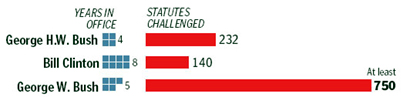
Many legal scholars say they believe that Bush's theory about his own powers goes too far and that he is seizing for himself some of the law-making role of Congress and the Constitution-interpreting role of the courts.
Phillip Cooper, a Portland State University law professor who has studied the executive power claims Bush made during his first term, said Bush and his legal team have spent the past five years quietly working to concentrate ever more governmental power into the White House.
''There is no question that this administration has been involved in a very carefully thought-out, systematic process of expanding presidential power at the expense of the other branches of government," Cooper said. "This is really big, very expansive, and very significant."
For the first five years of Bush's presidency, his legal claims attracted little attention in Congress or the media. Then, twice in recent months, Bush drew scrutiny after challenging new laws: a torture ban and a requirement that he give detailed reports to Congress about how he is using the Patriot Act.
Bush administration spokesmen declined to make White House or Justice Department attorneys available to discuss any of Bush's challenges to the laws he has signed.
Instead, they referred a Globe reporter to their response to questions about Bush's position that he could ignore provisions of the Patriot Act. They said at the time that Bush was following a practice that has "been used for several administrations" and that ''the president will faithfully execute the law in a manner that is consistent with the Constitution."
But the words "in a manner that is consistent with the Constitution" are the catch, legal scholars say, because Bush is according himself the ultimate interpretation of the Constitution. And he is quietly exercising that authority to a degree that is unprecedented in US history.
Bush is the first president in modern history who has never vetoed a bill, giving Congress no chance to override his judgments. Instead, he has signed every bill that reached his desk, often inviting the legislation's sponsors to signing ceremonies at which he lavishes praise upon their work.
Then, after the media and the lawmakers have left the White House, Bush quietly files "signing statements" -- official documents in which a president lays out his legal interpretation of a bill for the federal bureaucracy to follow when implementing the new law. The statements are recorded in the federal register.
In his signing statements, Bush has repeatedly asserted that the Constitution gives him the right to ignore numerous sections of the bills -- sometimes including provisions that were the subject of negotiations with Congress in order to get lawmakers to pass the bill. He has appended such statements to more than one of every 10 bills he has signed.
"He agrees to a compromise with members of Congress, and all of them are there for a public bill-signing ceremony, but then he takes back those compromises -- and more often than not, without the Congress or the press or the public knowing what has happened," said Christopher Kelley, a Miami University of Ohio political science professor who studies executive power.
Military link
Many of the laws Bush said he can bypass -- including the torture ban -- involve the military.
The Constitution grants Congress the power to create armies, to declare war, to make rules for captured enemies, and "to make rules for the government and regulation of the land and naval forces." But, citing his role as commander in chief, Bush says he can ignore any act of Congress that seeks to regulate the military.
On at least four occasions while Bush has been president, Congress has passed laws forbidding US troops from engaging in combat in Colombia, where the US military is advising the government in its struggle against narcotics-funded Marxist rebels.
After signing each bill, Bush declared in his signing statement that he did not have to obey any of the Colombia restrictions because he is commander in chief.
Bush has also said he can bypass laws requiring him to tell Congress before diverting money from an authorized program in order to start a secret operation, such as the "black sites" where suspected terrorists are secretly imprisoned.
Congress has also twice passed laws forbidding the military from using intelligence that was not "lawfully collected," including any information on Americans that was gathered in violation of the Fourth Amendment's protections against unreasonable searches.
Congress first passed this provision in August 2004, when Bush's warrantless domestic spying program was still a secret, and passed it again after the program's existence was disclosed in December 2005.
On both occasions, Bush declared in signing statements that only he, as commander in chief, could decide whether such intelligence can be used by the military.
In October 2004, five months after the Abu Ghraib torture scandal in Iraq came to light, Congress passed a series of new rules and regulations for military prisons. Bush signed the provisions into law, then said he could ignore them all. One provision made clear that military lawyers can give their commanders independent advice on such issues as what would constitute torture. But Bush declared that military lawyers could not contradict his administration's lawyers.
Other provisions required the Pentagon to retrain military prison guards on the requirements for humane treatment of detainees under the Geneva Conventions, to perform background checks on civilian contractors in Iraq, and to ban such contractors from performing "security, intelligence, law enforcement, and criminal justice functions." Bush reserved the right to ignore any of the requirements.
The new law also created the position of inspector general for Iraq. But Bush wrote in his signing statement that the inspector ''shall refrain" from investigating any intelligence or national security matter, or any crime the Pentagon says it prefers to investigate for itself.
Bush had placed similar limits on an inspector general position created by Congress in November 2003 for the initial stage of the US occupation of Iraq. The earlier law also empowered the inspector to notify Congress if a US official refused to cooperate. Bush said the inspector could not give any information to Congress without permission from the administration.
Oversight questioned
Many laws Bush has asserted he can bypass involve requirements to give information about government activity to congressional oversight committees.
In December 2004, Congress passed an intelligence bill requiring the Justice Department to tell them how often, and in what situations, the FBI was using special national security wiretaps on US soil. The law also required the Justice Department to give oversight committees copies of administration memos outlining any new interpretations of domestic-spying laws. And it contained 11 other requirements for reports about such issues as civil liberties, security clearances, border security, and counternarcotics efforts.
After signing the bill, Bush issued a signing statement saying he could withhold all the information sought by Congress.
Likewise, when Congress passed the law creating the Department of Homeland Security in 2002, it said oversight committees must be given information about vulnerabilities at chemical plants and the screening of checked bags at airports.
It also said Congress must be shown unaltered reports about problems with visa services prepared by a new immigration ombudsman. Bush asserted the right to withhold the information and alter the reports.
On several other occasions, Bush contended he could nullify laws creating "whistle-blower" job protections for federal employees that would stop any attempt to fire them as punishment for telling a member of Congress about possible government wrongdoing.
When Congress passed a massive energy package in August, for example, it strengthened whistle-blower protections for employees at the Department of Energy and the Nuclear Regulatory Commission.
The provision was included because lawmakers feared that Bush appointees were intimidating nuclear specialists so they would not testify about safety issues related to a planned nuclear-waste repository at Yucca Mountain in Nevada -- a facility the administration supported, but both Republicans and Democrats from Nevada opposed.
When Bush signed the energy bill, he issued a signing statement declaring that the executive branch could ignore the whistle-blower protections.
Bush's statement did more than send a threatening message to federal energy specialists inclined to raise concerns with Congress; it also raised the possibility that Bush would not feel bound to obey similar whistle-blower laws that were on the books before he became president. His domestic spying program, for example, violated a surveillance law enacted 23 years before he took office.
David Golove, a New York University law professor who specializes in executive-power issues, said Bush has cast a cloud over "the whole idea that there is a rule of law," because no one can be certain of which laws Bush thinks are valid and which he thinks he can ignore.
"Where you have a president who is willing to declare vast quantities of the legislation that is passed during his term unconstitutional, it implies that he also thinks a very significant amount of the other laws that were already on the books before he became president are also unconstitutional," Golove said.
Defying Supreme Court
Bush has also challenged statutes in which Congress gave certain executive branch officials the power to act independently of the president. The Supreme Court has repeatedly endorsed the power of Congress to make such arrangements. For example, the court has upheld laws creating special prosecutors free of Justice Department oversight and insulating the board of the Federal Trade Commission from political interference.
Nonetheless, Bush has said in his signing statements that the Constitution lets him control any executive official, no matter what a statute passed by Congress might say.
In November 2002, for example, Congress, seeking to generate independent statistics about student performance, passed a law setting up an educational research institute to conduct studies and publish reports "without the approval" of the Secretary of Education. Bush, however, decreed that the institute's director would be ''subject to the supervision and direction of the secretary of education."
Similarly, the Supreme Court has repeatedly upheld affirmative-action programs, as long as they do not include quotas. Most recently, in 2003, the court upheld a race-conscious university admissions program over the strong objections of Bush, who argued that such programs should be struck down as unconstitutional.
Yet despite the court's rulings, Bush has taken exception at least nine times to provisions that seek to ensure that minorities are represented among recipients of government jobs, contracts, and grants. Each time, he singled out the provisions, declaring that he would construe them "in a manner consistent with" the Constitution's guarantee of ''equal protection" to all -- which some legal scholars say amounts to an argument that the affirmative-action provisions represent reverse discrimination against whites.
Golove said that to the extent Bush is interpreting the Constitution in defiance of the Supreme Court's precedents, he threatens to "overturn the existing structures of constitutional law."
A president who ignores the court, backed by a Congress that is unwilling to challenge him, Golove said, can make the Constitution simply "disappear."
Common practice in '80s
Though Bush has gone further than any previous president, his actions are not unprecedented.
Since the early 19th century, American presidents have occasionally signed a large bill while declaring that they would not enforce a specific provision they believed was unconstitutional. On rare occasions, historians say, presidents also issued signing statements interpreting a law and explaining any concerns about it.
But it was not until the mid-1980s, midway through the tenure of President Reagan, that it became common for the president to issue signing statements. The change came about after then-Attorney General Edwin Meese decided that signing statements could be used to increase the power of the president.
When interpreting an ambiguous law, courts often look at the statute's legislative history, debate and testimony, to see what Congress intended it to mean. Meese realized that recording what the president thought the law meant in a signing statement might increase a president's influence over future court rulings.
Under Meese's direction in 1986, a young Justice Department lawyer named Samuel A. Alito Jr. wrote a strategy memo about signing statements. It came to light in late 2005, after Bush named Alito to the Supreme Court.
In the memo, Alito predicted that Congress would resent the president's attempt to grab some of its power by seizing "the last word on questions of interpretation." He suggested that Reagan's legal team should "concentrate on points of true ambiguity, rather than issuing interpretations that may seem to conflict with those of Congress."
Reagan's successors continued this practice. George H.W. Bush challenged 232 statutes over four years in office, and Bill Clinton objected to 140 laws over his eight years, according to Kelley, the Miami University of Ohio professor.
Many of the challenges involved longstanding legal ambiguities and points of conflict between the president and Congress.
Throughout the past two decades, for example, each president -- including the current one -- has objected to provisions requiring him to get permission from a congressional committee before taking action. The Supreme Court made clear in 1983 that only the full Congress can direct the executive branch to do things, but lawmakers have continued writing laws giving congressional committees such a role.
Still, Reagan, George H.W. Bush, and Clinton used the presidential veto instead of the signing statement if they had a serious problem with a bill, giving Congress a chance to override their decisions.
But the current President Bush has abandoned the veto entirely, as well as any semblance of the political caution that Alito counseled back in 1986. In just five years, Bush has challenged more than 750 new laws, by far a record for any president, while becoming the first president since Thomas Jefferson to stay so long in office without issuing a veto.
''What we haven't seen until this administration is the sheer number of objections that are being raised on every bill passed through the White House," said Kelley, who has studied presidential signing statements through history. "That is what is staggering. The numbers are well out of the norm from any previous administration."
Exaggerated fears?
Some administration defenders say that concerns about Bush's signing statements are overblown. Bush's signing statements, they say, should be seen as little more than political chest-thumping by administration lawyers who are dedicated to protecting presidential prerogatives.
Defenders say the fact that Bush is reserving the right to disobey the laws does not necessarily mean he has gone on to disobey them.
Indeed, in some cases, the administration has ended up following laws that Bush said he could bypass. For example, citing his power to ''withhold information" in September 2002, Bush declared that he could ignore a law requiring the State Department to list the number of overseas deaths of US citizens in foreign countries. Nevertheless, the department has still put the list on its website.
Jack Goldsmith, a Harvard Law School professor who until last year oversaw the Justice Department's Office of Legal Counsel for the administration, said the statements do not change the law; they just let people know how the president is interpreting it.
''Nobody reads them," said Goldsmith. "They have no significance. Nothing in the world changes by the publication of a signing statement. The statements merely serve as public notice about how the administration is interpreting the law. Criticism of this practice is surprising, since the usual complaint is that the administration is too secretive in its legal interpretations."
But Cooper, the Portland State University professor who has studied Bush's first-term signing statements, said the documents are being read closely by one key group of people: the bureaucrats who are charged with implementing new laws.
Lower-level officials will follow the president's instructions even when his understanding of a law conflicts with the clear intent of Congress, crafting policies that may endure long after Bush leaves office, Cooper said.
''Years down the road, people will not understand why the policy doesn't look like the legislation," he said.
And in many cases, critics contend, there is no way to know whether the administration is violating laws -- or merely preserving the right to do so.
Many of the laws Bush has challenged involve national security, where it is almost impossible to verify what the government is doing. And since the disclosure of Bush's domestic spying program, many people have expressed alarm about his sweeping claims of the authority to violate laws.
In January, after the Globe first wrote about Bush's contention that he could disobey the torture ban, three Republicans who were the bill's principal sponsors in the Senate -- John McCain of Arizona, John W. Warner of Virginia, and Lindsey O. Graham of South Carolina -- all publicly rebuked the president.
"We believe the president understands Congress's intent in passing, by very large majorities, legislation governing the treatment of detainees," McCain and Warner said in a joint statement. "The Congress declined when asked by administration officials to include a presidential waiver of the restrictions included in our legislation."
Added Graham: "I do not believe that any political figure in the country has the ability to set aside any .... law of armed conflict that we have adopted or treaties that we have ratified."
And in March, when the Globe first wrote about Bush's contention that he could ignore the oversight provisions of the Patriot Act, several Democrats lodged complaints.
Senator Patrick J. Leahy of Vermont, the ranking Democrat on the Senate Judiciary Committee, accused Bush of trying to "cherry-pick the laws he decides he wants to follow."
And Representatives Jane Harman of California and John Conyers Jr. of Michigan -- the ranking Democrats on the House Intelligence and Judiciary committees, respectively -- sent a letter to Attorney General Alberto R. Gonzales demanding that Bush rescind his claim and abide by the law.
"Many members who supported the final law did so based upon the guarantee of additional reporting and oversight," they wrote. "The administration cannot, after the fact, unilaterally repeal provisions of the law implementing such oversight.... Once the president signs a bill, he and all of us are bound by it."
Lack of court review
Such political fallout from Congress is likely to be the only check on Bush's claims, legal specialists said.
The courts have little chance of reviewing Bush's assertions, especially in the secret realm of national security matters.
"There can't be judicial review if nobody knows about it," said Neil Kinkopf, a Georgia State law professor who was a Justice Department official in the Clinton administration. "And if they avoid judicial review, they avoid having their constitutional theories rebuked."
Without court involvement, only Congress can check a president who goes too far. But Bush's fellow Republicans control both chambers, and they have shown limited interest in launching the kind of oversight that could damage their party.
"The president is daring Congress to act against his positions, and they're not taking action because they don't want to appear to be too critical of the president, given that their own fortunes are tied to his because they are all Republicans," said Jack Beermann, a Boston University law professor. "Oversight gets much reduced in a situation where the president and Congress are controlled by the same party."
Said Golove, the New York University law professor: "Bush has essentially said that 'We're the executive branch and we're going to carry this law out as we please, and if Congress wants to impeach us, go ahead and try it.' "
Bruce Fein, a deputy attorney general in the Reagan administration, said the American system of government relies upon the leaders of each branch "to exercise some self-restraint." But Bush has declared himself the sole judge of his own powers, he said, and then ruled for himself every time.
"This is an attempt by the president to have the final word on his own constitutional powers, which eliminates the checks and balances that keep the country a democracy," Fein said. "There is no way for an independent judiciary to check his assertions of power, and Congress isn't doing it, either. So this is moving us toward an unlimited executive power.
Sidebar: Examples of the president's signing statements
Since taking office in 2001, President Bush has issued signing statements on more than 750 new laws, declaring that he has the power to set aside the laws when they conflict with his legal interpretation of the Constitution. The federal government is instructed to follow the statements when it enforces the laws. Here are 10 examples and the dates Bush signed them:
March 9: Justice Department officials must give reports to Congress by certain dates on how the FBI is using the USA Patriot Act to search homes and secretly seize papers.
Bush's signing statement: The president can order Justice Department officials to withhold any information from Congress if he decides it could impair national security or executive branch operations.
Dec. 30, 2005: US interrogators cannot torture prisoners or otherwise subject them to cruel, inhuman, and degrading treatment.
Bush's signing statement: The president, as commander in chief, can waive the torture ban if he decides that harsh interrogation techniques will assist in preventing terrorist attacks.
Dec. 30: When requested, scientific information ''prepared by government researchers and scientists shall be transmitted [to Congress] uncensored and without delay."
Bush's signing statement: The president can tell researchers to withhold any information from Congress if he decides its disclosure could impair foreign relations, national security, or the workings of the executive branch.
Aug. 8: The Department of Energy, the Nuclear Regulatory Commission and its contractors may not fire or otherwise punish an employee whistle-blower who tells Congress about possible wrongdoing.
Bush's signing statement: The president or his appointees will determine whether employees of the Department of Energy and the Nuclear Regulatory Commission can give information to Congress.
Dec. 23, 2004: Forbids US troops in Colombia from participating in any combat against rebels, except in cases of self-defense. Caps the number of US troops allowed in Colombia at 800.
Bush's signing statement: Only the president, as commander in chief, can place restrictions on the use of US armed forces, so the executive branch will construe the law ''as advisory in nature."
Dec. 17: The new national intelligence director shall recruit and train women and minorities to be spies, analysts, and translators in order to ensure diversity in the intelligence community.
Bush's signing statement: The executive branch shall construe the law in a manner consistent with a constitutional clause guaranteeing ''equal protection" for all. (In 2003, the Bush administration argued against race-conscious affirmative-action programs in a Supreme Court case. The court rejected Bush's view.)
Oct. 29: Defense Department personnel are prohibited from interfering with the ability of military lawyers to give independent legal advice to their commanders.
Bush's signing statement: All military attorneys are bound to follow legal conclusions reached by the administration's lawyers in the Justice Department and the Pentagon when giving advice to their commanders.
Aug. 5: The military cannot add to its files any illegally gathered intelligence, including information obtained about Americans in violation of the Fourth Amendment's protection against unreasonable searches.
Bush's signing statement: Only the president, as commander in chief, can tell the military whether or not it can use any specific piece of intelligence.
Nov. 6, 2003: US officials in Iraq cannot prevent an inspector general for the Coalition Provisional Authority from carrying out any investigation. The inspector general must tell Congress if officials refuse to cooperate with his inquiries.
Bush's signing statement: The inspector general ''shall refrain" from investigating anything involving sensitive plans, intelligence, national security, or anything already being investigated by the Pentagon. The inspector cannot tell Congress anything if the president decides that disclosing the information would impair foreign relations, national security, or executive branch operations.
Nov. 5, 2002: Creates an Institute of Education Sciences whose director may conduct and publish research ''without the approval of the secretary [of education] or any other office of the department."
Bush's signing statement: The president has the power to control the actions of all executive branch officials, so ''the director of the Institute of Education Sciences shall [be] subject to the supervision and direction of the secretary of education."
© 2006 The Boston Globe
WASHINGTON -- The office of Vice President Dick Cheney routinely reviews pieces of legislation before they reach the president's desk, searching for provisions that Cheney believes would infringe on presidential power, according to former White House and Justice Department officials.
The officials said Cheney's legal adviser and chief of staff, David Addington, is the Bush administration's leading architect of the "signing statements" the president has appended to more than 750 laws. The statements assert the president's right to ignore the laws because they conflict with his interpretation of the Constitution.
The Bush-Cheney administration has used such statements to claim for itself the option of bypassing a ban on torture, oversight provisions in the USA Patriot Act, and numerous requirements that they provide certain information to Congress, among other laws.
Previous vice presidents have had neither the authority nor the interest in reviewing legislation. But Cheney has used his power over the administration's legal team to promote an expansive theory of presidential authority. Using signing statements, the administration has challenged more laws than all previous administrations combined.
"Addington could look at whatever he wanted," said one former White House lawyer who helped prepare signing statements and who asked not to be named because he was describing internal deliberations. "He had a roving commission to get involved in whatever interested him."
Knowing that Addington was likely to review the bills, other White House and Justice Department lawyers began vetting legislation with Addington's and Cheney's views in mind, according to another former lawyer in the Bush White House.
All these lawyers, he said, were extremely careful to flag any provision that placed limits on presidential power.
"You didn't want to miss something," said the second former White House lawyer, who also asked not to be named.
Cheney and Addington have a long history. Addington was a Republican staff member on the congressional committee investigating the Iran-Contra scandal in the 1980s, while Cheney was the ranking GOP House member. When Cheney became defense secretary under President George H. W. Bush, he hired Addington as Pentagon counsel.
After Cheney became vice president in 2001, he again hired Addington as counsel. Addington played a major role in shaping the administration's legal policies in the war on terrorism, including a 2002 memo arguing that Bush could authorize interrogators to bypass anti torture laws. In October, when Cheney's former chief of staff, I. Lewis "Scooter" Libby, was indicted for perjury and resigned, Cheney replaced Libby with Addington.
A spokeswoman for Cheney's office, asked to comment on Addington's role in reviewing legislation, said, "We do not comment on internal deliberations."
Addington, through the spokeswoman, declined to be interviewed.
But Martin Lederman, who worked in the Justice Department's Office of Legal Counsel under presidents Bill Clinton and George W. Bush, said that Addington is simply doing the day-to-day legwork for Cheney and that he is influential within the administration because of the vice president's desire to enhance executive power and Bush's willingness to endorse Cheney's views.
"In every administration, Democratic and Republican, there are officials with strongly held constitutional views, including somewhat idiosyncratic views," said Lederman, now a law professor at Georgetown University. "What is new is that the extremely idiosyncratic and aggressive constitutional views are being adopted by the vice president and, therefore, by the administration."
Previous administrations left the reviewing of legislation to the White House counsel's office and the Justice Department's Office of Legal Counsel.
"What's happening now is unprecedented on almost every level," said Ron Klain, who was chief of staff to Vice President Al Gore from 1995 to 1999. "Gore was a very active policy maker in the Clinton administration, but that didn't include picking through bills of Congress to find things to disagree with."
The administration insists that Bush's use of signing statements is not unprecedented. Justice Department spokesman Brian Roehrkasse said, "President Bush's signing statements are lawful and indistinguishable from those issued on hundreds of occasions by past presidents."
The use of signing statements was rare until the 1980s, when President Ronald W. Reagan began issuing them more frequently. His successors continued the practice. George H. W. Bush used signing statements to challenge 232 laws over four years, and Bill Clinton challenged 140 over eight years, according to Christopher Kelley, a political science professor at Miami University of Ohio.
But in frequency and aggression, the current President Bush has gone far beyond his predecessors.
All previous presidents combined challenged fewer than 600 laws, Kelley's data show, compared with the more than 750 Bush has challenged in five years. Bush is also the first president since the 1800s who has never vetoed a bill, giving Congress no chance to override his judgments.
Douglas Kmiec, who as head of the Office of Legal Counsel helped develop the Reagan administration's strategy of issuing signing statements more frequently, said he disapproves of the "provocative" and sometimes "disingenuous" manner in which the Bush administration is using them.
Kmiec said the Reagan team's goal was to leave a record of the president's understanding of new laws only in cases where an important statute was ambiguous. Kmiec rejected the idea of using signing statements to contradict the clear intent of Congress, as Bush has done. Presidents should either tolerate provisions of bills they don't like, or they should veto the bill, he said.
"Following a model of restraint, [the Reagan-era Office of Legal Counsel] took it seriously that we were to construe statutes to avoid constitutional problems, not to invent them," said Kmiec, who is now a Pepperdine University law professor.
By contrast, Bush has used the signing statements to waive his obligation to follow the new laws. In addition to the torture ban and oversight provisions of the Patriot Act, the laws Bush has claimed the authority to disobey include restrictions against US troops engaging in combat in Colombia, whistle-blower protections for government employees, and safeguards against political interference in taxpayer-funded research.
Cheney's office has taken the lead in challenging many of these laws, officials said, because they run counter to an expansive view of executive power that Cheney has cultivated for the past 30 years. Under the theory, Congress cannot pass laws that place restrictions or requirements on how the president runs the military and spy agencies. Nor can it pass laws giving government officials the power or responsibility to act independently of the president.
Mainstream legal scholars across the political spectrum reject Cheney's expansive view of presidential authority, saying the Constitution gives Congress the power to make all rules and regulations for the military and the executive branch and the Supreme Court has consistently upheld laws giving bureaucrats and certain prosecutors the power to act independently of the president.
One prominent conservative, Richard Epstein of the University of Chicago Law School, said it is "scandalous" for the administration to argue that the commander in chief can bypass statutes in national security matters.
"It's just wrong," Epstein said. "It is just crazy as a matter of constitutional interpretation. There are some pretty clear issues, and this is one of them."
Laurence Tribe, a prominent liberal at Harvard Law School, said: "Nothing in the text and structure of the Constitution, or Supreme Court precedents, supports the Bush-Cheney assertion that Congress cannot limit or direct what government officials may or must do."
Nonetheless, Bush has demonstrated that he is willing to put his legal team's claims about his authority into action. Shortly after the terrorist attacks of Sept. 11, 2001, Bush authorized the military to eavesdrop on Americans' international phone calls without a warrant, bypassing a surveillance law that requires warrants.
Passed in 1978, the warrant law is one of a series of policies enacted after the Vietnam War and the Watergate scandal. The laws sought to prevent future abuses by regulating how the president can use his national security powers.
In December 2005, shortly after the warrantless wiretapping program was exposed, Cheney gave a rare press conference to explain why he believed the program was legal. Offering an early view of the administration's argument that the warrant law is unconstitutional, Cheney recalled the period in which it was enacted as a time of congressional overreach.
"A lot of the things around Watergate and Vietnam, both, in the '70s served to erode the authority, I think, the president needs to be effective, especially in a national security area," said Cheney, who served as White House chief of staff to President Gerald Ford .
Cheney also offered a roadmap to his thinking about presidential power. He told reporters to read a 1987 report whose production he oversaw when he was a leading Republican in the House of Representatives. The report offered a dissenting view about the Iran-Contra scandal.
"If you want reference to an obscure text, go look at the minority views that were filed with the Iran-Contra Committee," Cheney said. "Nobody has ever read them, but . . . I think [they] are very good in laying out a robust view of the president's prerogatives with respect to the conduct of especially foreign policy and national security matters."
The Iran-Contra scandal involved efforts by Reagan administration officials to bypass a law cutting off funds to anti-Marxist rebels in Nicaragua. The officials secretly sold arms to Iran, sent the proceeds to the rebels, and lied to Congress to cover it up.
A congressional committee issued a 427-page report concluding that a "cabal of zealots" in the administration who had "disdain for the law" had violated the statute.
But some of the Republicans on the committee, led by Cheney, refused to endorse that finding. They issued their own 155-page report asserting the real problem was Congress passing laws that intruded into a president's authority to run foreign policy and national security.
"Judgments about the Iran-Contra affair ultimately must rest upon one's views about the proper roles of Congress and the president in foreign policy," Cheney's report said. "The fundamental law of the land is the Constitution. Unconstitutional statutes violate the rule of law every bit as much as do willful violations of constitutional statutes."
Cheney's report includes a lengthy argument that the Constitution puts the president beyond the reach of Congress when it comes to national security. Some 18 years later, the Justice Department would repeat these same arguments in a 42-page memo arguing that Bush's warrantless wiretapping program is a lawful exercise of presidential power.
Despite legal scholars' skepticism about the expansive theory of presidential power Cheney has long promoted, Bush's legal team has used the theory to target every law that regulates the military or the executive branch.
Kmiec, one of the only scholars who has testified that Bush might have the authority to set aside the warrant law, said he thinks the administration's use of signing statements has gone too far, needlessly antagonizing Congress. Arlen Specter, Republican of Pennsylvania and Senate Judiciary Committee chairman, recently announced hearings into the matter.
"The president is not well served by the lawyers who have been advising him," said Kmiec.
© 2006 The Boston Globe
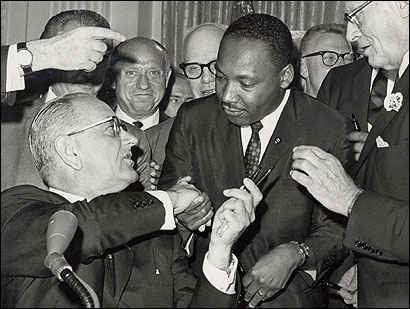
During his signing of the landmark Civil Rights Act of 1964, President Lyndon B. Johnson shook hands with the Rev. Martin Luther King Jr. (United Press International/ File 1964)
WASHINGTON -- The Bush administration is quietly remaking the Justice Department's Civil Rights Division, filling the permanent ranks with lawyers who have strong conservative credentials but little experience in civil rights, according to job application materials obtained by the Globe.
The documents show that only 42 percent of the lawyers hired since 2003, after the administration changed the rules to give political appointees more influence in the hiring process, have civil rights experience. In the two years before the change, 77 percent of those who were hired had civil rights backgrounds.
In an acknowledgment of the department's special need to be politically neutral, hiring for career jobs in the Civil Rights Division under all recent administrations, Democratic and Republican, had been handled by civil servants -- not political appointees.
But in the fall of 2002, then-attorney general John Ashcroft changed the procedures. The Civil Rights Division disbanded the hiring committees made up of veteran career lawyers.
For decades, such committees had screened thousands of resumes, interviewed candidates, and made recommendations that were only rarely rejected.
Now, hiring is closely overseen by Bush administration political appointees to Justice, effectively turning hundreds of career jobs into politically appointed positions.
The profile of the lawyers being hired has since changed dramatically, according to the resumes of successful applicants to the voting rights, employment litigation, and appellate sections. Under the Freedom of Information Act, the Globe obtained the resumes among hundreds of pages of hiring data from 2001 to 2006.
Hires with traditional civil rights backgrounds -- either civil rights litigators or members of civil rights groups -- have plunged. Only 19 of the 45 lawyers hired since 2003 in those three sections were experienced in civil rights law, and of those, nine gained their experience either by defending employers against discrimination lawsuits or by fighting against race-conscious policies.
Meanwhile, conservative credentials have risen sharply. Since 2003 the three sections have hired 11 lawyers who said they were members of the conservative Federalist Society. Seven hires in the three sections are listed as members of the Republican National Lawyers Association, including two who volunteered for Bush-Cheney campaigns.
Several new hires worked for prominent conservatives, including former Whitewater prosecutor Kenneth Starr, former attorney general Edwin Meese, Mississippi Senator Trent Lott, and Judge Charles Pickering. And six listed Christian organizations that promote socially conservative views.
The changes in those three sections are echoed to varying degrees throughout the Civil Rights Division, according to current and former staffers.
At the same time, the kinds of cases the Civil Rights Division is bringing have undergone a shift. The division is bringing fewer voting rights and employment cases involving systematic discrimination against African-Americans, and more alleging reverse discrimination against whites and religious discrimination against Christians.
"There has been a sea change in the types of cases brought by the division, and that is not likely to change in a new administration because they are hiring people who don't have an expressed interest in traditional civil rights enforcement," said Richard Ugelow, a 29-year career veteran who left the division in 2002.
No 'litmus test' claimed
The Bush administration is not the first to seek greater control over the Civil Rights Division. Presidents Richard Nixon and Ronald Reagan tried to limit the division's efforts to enforce school-desegregation busing and affirmative action. But neither Nixon nor Reagan pushed political loyalists deep in the permanent bureaucracy, longtime employees say.
The Bush administration denies that its changes to the hiring procedures have political overtones. Cynthia Magnuson, a Justice Department spokeswoman, said the division had no "litmus test" for hiring. She insisted that the department hired only "qualified attorneys."
Magnuson also objected to measuring civil rights experience by participation in organizations devoted to advancing traditional civil rights causes. She noted that many of the division's lawyers had been clerks for federal judges, where they "worked on litigation involving constitutional law, which is obviously relevant to a certain degree."
Other defenders of the Bush administration say there is nothing improper about the winner of a presidential election staffing government positions with like-minded officials. And, they say, the old career staff at the division was partisan in its own way -- an entrenched bureaucracy of liberals who did not support the president's view of civil rights policy.
Robert Driscoll, a deputy assistant attorney general over the division from 2001 to 2003, said many of the longtime career civil rights attorneys wanted to bring big cases on behalf of racial groups based on statistical disparities in hiring, even without evidence of intentional discrimination. Conservatives, he said, prefer to focus on cases that protect individuals from government abuses of power.
Hiring only lawyers from civil rights groups would "set the table for a permanent left-wing career class," Driscoll said.
But Jim Turner, who worked for the division from 1965 to 1994 and was the top-ranked professional in the division for the last 25 years of his career, said that hiring people who are interested in enforcing civil rights laws is not the same thing as trying to achieve a political result through hiring.
Most people interested in working to enforce civil rights laws happen to be liberals, Turner said, but Congress put the laws on the books so that they would be enforced. "To say that the Civil Rights Division had a special penchant for hiring liberal lawyers is twisting things," he said.
Jon Greenbaum, who was a career attorney in the voting rights section from 1997 to 2003, said that since the hiring change, candidates with conservative ties have had an advantage.
"The clear emphasis has been to hire individuals with conservative credentials," he said. "If anything, a civil rights background is considered a liability."
But Roger Clegg, who was a deputy assistant attorney general for civil rights during the Reagan administration, said that the change in career hiring is appropriate to bring some "balance" to what he described as an overly liberal agency.
"I don't think there is anything sinister about any of this. . . . You are not morally required to support racial preferences just because you are working for the Civil Rights Division," Clegg said.
Many lawyers in the division, who spoke on condition of anonymity, describe a clear shift in agenda accompanying the new hires. As The Washington Post reported last year, division supervisors overruled the recommendations of longtime career voting-rights attorneys in several high-profile cases, including whether to approve a Texas redistricting plan and whether to approve a Georgia law requiring voters to show photographic identification.
In addition, many experienced civil rights lawyers have been assigned to spend much of their time defending deportation orders rather than pursuing discrimination claims. Justice officials defend that practice, saying that attorneys throughout the department are sharing the burden of a deportation case backlog.
As a result, staffers say, morale has plunged and experienced lawyers are leaving the division. Last year, the administration offered longtime civil rights attorneys a buyout. Department figures show that 63 division attorneys left in 2005 -- nearly twice the average annual number of departures since the late 1990s.
At a recent NAACP hearing on the state of the Civil Rights Division, David Becker, who was a voting-rights section attorney for seven years before accepting the buyout offer, warned that the personnel changes threatened to permanently damage the nation's most important civil rights watchdog.
"Even during other administrations that were perceived as being hostile to civil rights enforcement, career staff did not leave in numbers approaching this level," Becker said. "In the place of these experienced litigators and investigators, this administration has, all too often, hired inexperienced ideologues, virtually none of which have any civil rights or voting rights experiences."
Dates from '57 law
Established in 1957 as part of the first civil rights bill since Reconstruction, the Civil Rights Division enforces the nation's antidiscrimination laws.
The 1957 law and subsequent civil rights acts directed the division to file lawsuits against state and local governments, submit "friend-of-the-court" briefs in other discrimination cases, and review changes to election laws and redistricting to make sure they will not keep minorities from voting.
The division is managed by a president's appointees -- the assistant attorney general for civil rights and his deputies -- who are replaced when a new president takes office.
Beneath the political appointees, most of the work is carried out by a permanent staff of about 350 lawyers. They take complaints, investigate problems, propose lawsuits, litigate cases, and negotiate settlements.
Until recently, career attorneys also played an important role in deciding whom to hire when vacancies opened up in their ranks.
"We were looking for a strong academic record, for clerkships, and for evidence of an interest in civil rights enforcement," said William Yeomans, who worked for the division for 24 years, leaving in 2005.
Civil Rights Division supervisors of both parties almost always accepted the career attorneys' hiring recommendations, longtime staffers say. Charles Cooper, a former deputy assistant attorney general for civil rights in the Reagan administration, said the system of hiring through committees of career professionals worked well.
"There was obviously oversight from the front office, but I don't remember a time when an individual went through that process and was not accepted," Cooper said. "I just don't think there was any quarrel with the quality of individuals who were being hired. And we certainly weren't placing any kind of political litmus test on . . . the individuals who were ultimately determined to be best qualified."
But during the fall 2002 hiring cycle, the Bush administration changed the rules. Longtime career attorneys say there was never an official announcement. The hiring committee simply was not convened, and eventually its members learned that it had been disbanded.
Driscoll, the former Bush administration appointee, said then-Attorney General John Ashcroft changed hiring rules for the entire Justice Department, not just the Civil Rights Division. But career officials say that the change had a particularly strong impact in the Civil Rights Division, where the potential for political interference is greater than in divisions that enforce less controversial laws.
Joe Rich, who joined the division in 1968 and who was chief of the voting rights section until he left last year, said that the change reduced career attorneys' input on hiring decisions to virtually nothing. Once the political appointees screened resumes and decided on a finalist for a job in his section, Rich said, they would invite him to sit in on the applicant's final interview but they wouldn't tell him who else had applied, nor did they ask his opinion about whether to hire the attorney.
The changes extended to the hiring of summer interns.
Danielle Leonard, who was one of the last lawyers to be hired into the voting rights section under the old system, said she volunteered to look through internship applications in 2002.
Leonard said she went through the resumes, putting Post-It Notes on them with comments, until her supervisor told her that career staff would no longer be allowed to review the intern resumes. Leonard removed her Post-Its from the resumes and a political aide took them away.
Leonard said she quit a few months later, having stayed in what she had thought would be her "dream job" for less than a year, because she was frustrated and demoralized by the direction the division was taking.
The academic credentials of the lawyers hired into the division also underwent a shift at this time, the documents show. Attorneys hired by the career hiring committees largely came from Eastern law schools with elite reputations, while a greater proportion of the political appointees' hires instead attended Southern and Midwestern law schools with conservative reputations.
The average US News & World Report ranking for the law school attended by successful applicants hired in 2001 and 2002 was 34, while the average law school rank dropped to 44 for those hired after 2003.
Driscoll, the former division chief-of-staff, insisted that everyone he personally had hired was well qualified. And, he said, the old hiring committees' prejudice in favor of highly ranked law schools had unfairly blocked many qualified applicants.
"They would have tossed someone who was first in their class at the University of Kentucky Law School, whereas we'd say, hey, he's number one in his class, let's interview him," Driscoll said.
Learning from others
The Bush administration's effort to assert greater control over the Civil Rights Division is the latest chapter in a long-running drama between the agency and conservative presidents.
Nixon tried unsuccessfully to delay implementation of school desegregation plans. Reagan reversed the division's position on the tax-exempt status of racially discriminatory private schools and set a policy of opposing school busing and racial quotas.
Still, neither Nixon nor Reagan changed the division's procedures for hiring career staff, meaning that career attorneys who were dedicated to enforcing traditional civil rights continued to fill the ranks.
Yeomans said he believes the current administration learned a lesson from Nixon's and Reagan's experiences: To make changes permanent, it is necessary to reshape the civil rights bureaucracy.
"Reagan had tried to bring about big changes in civil rights enforcement and to pursue a much more conservative approach, but it didn't stick," Yeomans said. "That was the goal here -- to leave behind a bureaucracy that approached civil rights the same way the political appointees did."
© 2006 The Boston Globe
By Charlie Savage
WASHINGTON -- Despite assuring Congress that career military lawyers are helping design new trials for accused terrorists, the Bush administration has limited their input on their key request, that any tribunals must give detainees the right to see the evidence against them, officials said.
After the Supreme Court struck down the White House's military tribunals system in June, government lawyers began drafting legislation that would set new rules for trials of terrorist suspects. A central issue is whether prosecutors will be allowed to introduce secret evidence, which detainees would not be able to defend against.
Most military lawyers strongly oppose allowing secret evidence, arguing that such a plan would probably violate the Geneva Conventions and create a precedent for enemies of the United States to use show-trials for captured Americans. But administration lawyers maintain that classified evidence may be crucial to a case, and revealing it would compromise national security.
Members of Congress have pressured the White House to listen to the military lawyers as it drafts the legislation, and on Aug. 2, Attorney General Alberto Gonzales told lawmakers that "our deliberations have included detailed discussion" with military attorneys whose "multiple rounds of comments . . . will be reflected in the legislative package."
But the issue of secret evidence, officials said, has been off the table for all of those discussions with the exception of one meeting between Gonzales and the top military lawyers in late July. The session ended in an impasse, and the issue has not been raised again, they said.
Instead, new guidelines are being drafted by Bush-appointed attorneys in the Justice Department's Office of Legal Counsel. They met just once with a working group of military lawyers on July 28, following up with e-mail exchanges that stopped after the first week of August, according to officials.
At the start of the July 28 meeting, the officials said, the administration's lawyers announced that there was no point in debating the secret evidence issue at their level, so all their subsequent discussions were limited to more minor concerns -- mostly wording changes and procedural matters.
The limits placed on the discussion with the military lawyers, called the Judge Advocate General corps, have angered a group of retired military attorneys. They believe that the administration's dismissal of JAGs' views has been a prime factor in such setbacks as the Abu Ghraib torture scandal.
"The [Justice Department] should have learned that a failure to involve the JAG community can lead to problems," said retired Major General Nolan Sklute , who retired as the Air Force's top lawyer in 1996. "If they are talking to the JAGs only about superficial matters . . . that indicates that this is about form instead of substance, and nobody has learned any lessons out of this."
The Justice Department press office did not respond to calls requesting comment.
The tension surrounding the plans for new terrorist trials is the latest chapter in a long effort by White House political appointees to exert greater control over career military lawyers.
In November 2001, when White House lawyers drew up a presidential order authorizing an initial round of trials for accused terrorists, they allowed the JAGs to send one representative to look at the draft and then refused to let him take notes. The final order included none of the suggestions offered by the uniformed lawyers.
And in early 2003, when a Pentagon working group came up with a report on detainee interrogations that said certain harsh interrogation techniques were legal, top JAGs insisted that such a stance would undermine the Geneva Conventions and put interrogators at risk of prosecution for assault. The civilians ignored their views.
Many former JAGs trace the current disputes back to Vice President Dick Cheney's efforts to rein in the JAG corps in the first Bush administration.
In 1991, when he was secretary of defense, Cheney asked Congress to pass a law to put politically appointed attorneys -- including the Army's general counsel, William Haynes II , who is now the Pentagon general counsel -- in charge of the JAGs. But Congress refused.
The following year, Cheney's legal team tried again to take over the JAG corps, this time using an internal Pentagon order. But they rescinded the plan after Congress made it an issue during the nomination of David Addington -- Cheney's longtime legal adviser and now his chief-of-staff -- to be the Pentagon general counsel.
The issue of the military lawyers' independence resurfaced after the current administration took office.
In May 2003, the administration issued an order giving the Air Force general counsel supervisory authority over Air Force JAGs, essentially a resurrection of the plan Congress had rejected in 1992. And in February 2005, Haynes proposed letting political appointees select who would be the top military lawyers for each service.
Neither plan succeeded. Congress forced the Air Force to rescind its order, and Haynes' s proposal to change the way the top military lawyers are selected withered after generating an unenthusiastic response from service secretaries.
Through spokespeople, Cheney, Addington, and Haynes all declined to be interviewed. But administration defenders contend that it is more efficient for military leaders to have one legal counsel rather than rival and competing sources of advice. And they say, as a matter of principle, all military officials should be subject to control by politically accountable civilians.
"I do not happen to believe that because you put a uniform on, you have more integrity than a civilian person put there by the president," said Steven Morello , who was Army general counsel from 2001 to 2004.
But retired military lawyers insist that their independence is an important check-and-balance for what the military can be ordered to do. And legal scholars link Cheney's efforts to limit the influence of the JAGs to the administration's other efforts to expand executive power.
"This didn't start with the torture fight," said Martin Lederman , a Georgetown law professor who worked in the Justice Department from 1994 to 2002. "They've believed in this [eliminating JAG independence] as a matter of religious faith for a long time. They knew it was going to matter, even though they didn't yet know what it was going to matter for."
Responding to the administration's attempts to marginalize the JAGs, Congress has tried to strengthen their authority in recent years, only to meet with opposition from the White House.
In October 2004, Congress -- led by Senator Lindsey Graham, a South Carolina Republican and a reservist military lawyer -- passed a law prohibiting Pentagon officials from interfering with the JAGs' ability to "give independent legal advice." But when Bush signed the law, he issued a signing-statement saying that the legal opinions reached by his political appointees would still "bind all . . . military attorneys."
And a House-Senate conference committee is now considering legislation to elevate the top lawyers in each service from two-star generals to three-star generals in order to increase their clout. But the administration has urged Congress to reject the proposal, saying in a policy statement that it would "undermine the president's flexibility" and "add unnecessary and rank-heavy bureaucracy."
But backers of the proposal, including Ed Rodriguez , president-elect of the Judge Advocates Association, said giving the top JAGs a third star would make it harder to discount the military attorneys' views on such crucial matters as whether secret evidence should be admissible in a trial. If the JAGs' advice had been taken in the first place, he said, the Supreme Court might not have struck down the tribunals in this year's case of Hamdan v. Rumsfeld.
"A third star will have a huge impact if it comes to pass," said Rodriguez. "This is a battle that is being fought under the surface, but we're trying to prevent the next Abu Ghraib and Hamdan from happening."
© 2006 The Boston Globe
By Charlie Savage
WASHINGTON -- President Bush this week asserted that he has the executive authority to disobey a new law in which Congress has set minimum qualifications for future heads of the Federal Emergency Management Agency.
Congress passed the law last week as a response to FEMA's poor handling of Hurricane Katrina. The agency's slow response to flood victims exposed the fact that Michael Brown, Bush's choice to lead the agency, had been a politically connected hire with no prior experience in emergency management.
To shield FEMA from cronyism, Congress established new job qualifications for the agency's director in last week's homeland security bill. The law says the president must nominate a candidate who has "a demonstrated ability in and knowledge of emergency management" and "not less than five years of executive leadership."
Bush signed the homeland-security bill on Wednesday morning. Then, hours later, he issued a signing statement saying he could ignore the new restrictions. Bush maintains that under his interpretation of the Constitution, the FEMA provision interfered with his power to make personnel decisions.
The law, Bush wrote, "purports to limit the qualifications of the pool of persons from whom the president may select the appointee in a manner that rules out a large portion of those persons best qualified by experience and knowledge to fill the office."
The homeland-security bill contained measures covering a range of topics, including terrorism, disaster preparedness, and illegal immigration. One provision calls for authorizing the construction of a 700-mile fence along the Mexican border.
But Bush's signing statement challenged at least three-dozen laws specified in the bill. Among those he targeted is a provision that empowers the FEMA director to tell Congress about the nation's emergency management needs without White House permission. This law, Bush said, "purports . . . to limit supervision of an executive branch official in the provision of advice to the Congress." Despite the law, he said, the FEMA director would be required to get clearance from the White House before telling lawmakers anything.
Bush said nothing of his objections when he signed the bill with a flourish in a ceremony Wednesday in Scottsdale, Ariz. At the time, he proclaimed that the bill was "an important piece of legislation that will highlight our government's highest responsibility, and that's to protect the American people."
The bill, he added, "will also help our government better respond to emergencies and natural disasters by strengthening the capabilities of the Federal Emergency Management Agency."
Bush's remarks at the signing ceremony were quickly e-mailed to reporters, and the White House website highlighted the ceremony. By contrast, the White House minimized attention to the signing statement. When asked by the Globe on Wednesday afternoon if there would be a signing statement, the press office declined to comment, saying only that any such document, if it existed, would be issued in the "usual way."
The press office posted the signing-statement document on its website around 8 p.m. Wednesday, after most reporters had gone home. The signing statement was not included in news reports yesterday on the bill-signing.
Senator Susan Collins, a Republican from Maine and chairwoman of the Senate Homeland Security and Government Affairs Committee, who has been one of the harshest critics of FEMA's performance during Katrina, yesterday rejected Bush's suggestion that he can bypass the new FEMA laws.
Responding to questions from the Globe, Collins said there are numerous precedents for Congress establishing qualifications for executive branch positions, ranging from the solicitor general's post to the director of the Fish and Wildlife Service.
She also said that Congress has long authorized certain officials from a variety of departments "to go directly to Congress with recommendations," pointing out that the FEMA director statute was modeled after a law that gives similar independence to the chairman of the Joint Chiefs of Staff at the Pentagon.
"I believe it is appropriate to extend this authority to the official tasked with leading the nation's response to disasters," she said.
Georgetown Law School professor Martin Lederman said Congress clearly has the power to set standards for positions such as the FEMA director, so long as the requirements leave a large enough pool of qualified candidates that the White House has "ample room for choice."
"It's hard to imagine a more modest and reasonable congressional response to the Michael Brown fiasco," said Lederman, who worked in the Justice Department's Office of Legal Counsel from 1994 to 2002.
The White House did not respond to requests for comment about its signing statement.
In the past, the administration has defended the legality of its signing statements. It has also argued that because Congress often lumps many laws into a single package, it is sometimes impractical to veto a large bill on the basis of some parts being flawed .
At a June hearing before the Senate Judiciary Committee, a Bush administration attorney, Michelle Boardman , noted that other US presidents have also used signing statements. She asserted that Bush's statements "are not an abuse of power."
Bush's use of signing statements has attracted increasing attention over the past year. In December 2005, Bush asserted that he can bypass a statutory ban on torture. In March 2006, the president said he can disobey oversight provisions in the Patriot Act reauthorization bill.
In all, Bush has challenged more than 800 laws enacted since he took office, most of which he said intruded on his constitutional powers as president and commander in chief. By contrast, all previous presidents challenged a combined total of about 600 laws.
At the same time, Bush has virtually abandoned his veto power, giving Congress no chance to override his judgments. Bush has vetoed just one bill since taking office, the fewest of any president since the 19th century.
Earlier this year, the American Bar Association declared that Bush's use of signing statements was "contrary to the rule of law and our constitutional separation of powers."
Last month, the nonpartisan Congressional Research Service concluded that Bush's signing statements are "an integral part" of his "comprehensive strategy to strengthen and expand executive power" at the expense of the legislative branch.
© 2006 The Boston Globe
By Charlie Savage
ANN ARBOR, MICH. -- In July 1987, then-Representative Dick Cheney, the top Republican on the committee investigating the Iran-contra scandal, turned on his hearing room microphone and delivered, in his characteristically measured tone, a revolutionary claim.
President Reagan and his top aides, he asserted, were free to ignore a 1982 law at the center of the scandal. Known as the Boland Amendment, it banned US assistance to anti-Marxist militants in Nicaragua.
"I personally do not believe the Boland Amendment applied to the president, nor to his immediate staff," Cheney said.
Most of Cheney's colleagues did not share his vision of a presidency empowered to bypass US laws governing foreign policy. The committee issued a scathing, bipartisan report accusing White House officials of "disdain for the law."
Cheney refused to sign it. Instead, he commissioned his own report declaring that the real lawbreakers were his fellow lawmakers, because the Constitution "does not permit Congress to pass a law usurping Presidential power."
The Iran-contra scandal was not the first time the future vice president articulated a philosophy of unfettered executive power -- nor would it be the last. The Constitution empowers Congress to pass laws regulating the executive branch, but over the course of his career, Cheney came to believe that the modern world is too dangerous and complex for a president's hands to be tied. He embraced a belief that presidents have vast "inherent" powers, not spelled out in the Constitution, that allow them to defy Congress.
Cheney bypassed acts of Congress as defense secretary in the first Bush administration. And his office has been the driving force behind the current administration's hoarding of secrets, its efforts to impose greater political control over career officials, and its defiance of a law requiring the government to obtain warrants when wiretapping Americans. Cheney's staff has also been behind President Bush's record number of signing statements asserting his right to disregard laws.
A close look at key moments in Cheney's career -- from his political apprenticeship in the Nixon and Ford administrations to his decade in Congress and his tenure as secretary of defense under the first President Bush -- suggests that the newly empowered Democrats in Congress should not expect the White House to cooperate when they demand classified information or attempt to exert oversight in areas such as domestic surveillance or the treatment of terrorism suspects.
Peter Shane, an Ohio State University law professor, predicted that Cheney's long career of consistently pushing against restrictions on presidential power is likely to culminate in a series of uncompromising battles with Congress.
"Cheney has made this a matter of principle," Shane said. "For that reason, you are likely to hear the words 'executive privilege' over and over again during the next two years."
Cheney declined to comment for this article. But he has repeatedly said his agenda includes restoring the presidency to its fullest powers by rolling back "unwise" limits imposed by Congress after the Vietnam War and the Watergate scandal.
"In 34 years, I have repeatedly seen an erosion of the powers and the ability of the president of the United States to do his job," Cheney said on ABC in January 2002. "I feel an obligation...to pass on our offices in better shape than we found them to our successors."
Cheney's ideal of presidential power is the level of power the office briefly achieved in the late 1960s, the era of what historian Arthur Schlesinger Jr. called the "imperial presidency."
Early in the Cold War, presidents began invoking national security to seize greater power from Congress. This concentration of authority peaked under President Richard Nixon, who famously asserted that "when the president does it, that means it's not illegal." But Watergate reawakened Congress, which passed new laws to regulate presidential power.
Cheney was a close observer of that era. He landed his first job in the federal government in 1969, when Donald Rumsfeld hired him as an assistant at the Office of Economic Opportunity. The antipoverty agency, set up by Congress during the Johnson administration, was unpopular among conservatives, and Rumsfeld's and Cheney's job was to help Nixon impose greater political control over the office.
A chief target was the agency's legal aid program, headed by Terry Lenzner. Now a private investigator, Lenzner said in a recent interview that the White House pressured him to fire lawyers who filed class-action lawsuits on behalf of the poor. But Lenzner said he could not fire them because of the way Congress had written the agency's statute.
"I was being told, 'You have to put a stop to this, you have to control these lawyers,'" Lenzner recalled. "But I said that 'If I do what you want me to do, it will violate the law.'"
The orders to fire lawyers, Lenzner said, came from other White House aides, not Rumsfeld or Cheney personally. Still, in November 1970, Rumsfeld summoned Lenzner to his office, and, with Cheney at his side, fired Lenzner because he was unwilling to follow orders.
In August 1974, Nixon resigned rather than face impeachment by Congress. The new president, Gerald Ford, asked Rumsfeld to be his White House chief of staff, and Rumsfeld again made Cheney his deputy. A year later, Rumsfeld became secretary of defense, and Cheney replaced him as Ford's top aide.
In his new role, Cheney was exposed to national security issues from the perspective of a White House that wanted to preserve secrets in the face of congressional demands for more openness. Soon after Rumsfeld and Cheney took on their new posts, Congress passed a bill to strengthen the Freedom of Information Act. The bill allowed judges to review classified documents to determine if they were being shielded for political purposes.
In October 1974, Ford vetoed the legislation, telling Congress that the bill "would violate constitutional principles." Congress, however, overrode his veto, and lawmakers soon threatened to impose further limits on presidential power.
In December 1974, The New York Times reported that the CIA had engaged in an illegal domestic spying program for two decades, tapping phones, opening mail, and breaking into homes of antiwar protesters. The article, by investigative reporter Seymour Hersh, prompted a congressional uproar.
In a memo to Ford, obtained at the Ford Presidential Library in Ann Arbor, Mich., Cheney urged the swift creation of a presidential commission to investigate the CIA. Cheney wrote that doing so was "the best prospect for heading off congressional efforts to further encroach on the executive branch."
Ford created the commission, but Congress moved in anyway. A Senate committee chaired by Idaho Democrat Frank Church began demanding access to secret documents. But Cheney soon saw a chance to convince the public that investigating intelligence operations was dangerous and unwise.
In May 1975, Hersh wrote an article discussing how US submarines eavesdropped on the Soviet Union's undersea cables. Fearing that the article had damaged national security, Cheney pushed the idea of indicting the reporter using the 1917 Espionage Act.
Making an example out of Hersh, Cheney wrote, would "create an environment" that might intimidate both the press and Congress. "Can we take advantage of it to bolster our position on the Church Committee investigation? To point out the need for limits on the scope of the investigations?" Cheney wrote. The idea, however, was scrapped to avoid attracting the Soviets' attention to Hersh's article.
The next spring, after revelations that the National Security Agency had monitored the phone calls of American civil rights and antiwar activists, Congress drafted legislation to require warrants for domestic surveillance. Cheney's allies, including Defense Secretary Rumsfeld and then-CIA director George H.W. Bush, opposed such a bill as a derogation of presidential power. But Ford decided not to fight it.
Congress passed the warrant requirement as the Foreign Intelligence Surveillance Act of 1978 -- the same law that the Bush-Cheney administration later bypassed with its warrantless wiretapping program.
After Ford lost the 1976 presidential election to Jimmy Carter, Cheney returned to Wyoming and in 1978 won a seat in Congress, where he specialized in intelligence matters. During the Iran-contra hearings, Cheney failed to convince a majority of his colleagues that the Reagan administration was justified in ignoring the Boland Amendment, but he moved quickly to block new congressional encroachments on what he saw as a president's exclusive turf.
When the Senate passed a bill forcing presidents to notify Congress of all covert operations within 48 hours, Cheney led a successful fight to defeat the bill in the House. He argued that Congress was prone to leaks and had no authority to force the commander-in-chief to share information about covert operations.
"The 48-hour bill would 'get back' at President Reagan by tying the hands of all future presidents," Cheney wrote in a May 1988 Wall Street Journal column. "That approach will achieve nothing useful."
The next year, Cheney became defense secretary under President George H.W. Bush. In his new position, Cheney again pushed for an expansive view of presidential power -- most dramatically in late 1990, when Cheney urged Bush to launch the Gulf War without asking Congress for authorization.
For all major overseas wars from 1789 to 1950, presidents obeyed the constitutional provision giving Congress alone the power to declare war. But in Korea and Vietnam, Presidents Truman, Johnson, and Nixon defied this constraint. They asserted that the commander-in-chief had "inherent" power to take the country to war on his own.
Seeking to restore its constitutional role, Congress passed the War Powers Resolution in 1973, requiring presidents to consult Congress when sending troops into battle.
After Saddam Hussein invaded Kuwait in August 1990, Bush sent 500,000 US troops to Saudi Arabia. As they prepared to attack the Iraqi forces, Cheney told Bush that it was unnecessary and too risky to seek a vote in Congress.
"I was not enthusiastic about going to Congress for an additional grant of authority," Cheney recalled in a 1996 PBS "Frontline" documentary. "I was concerned that they might well vote 'no' and that would make life more difficult for us."
But Bush rejected Cheney's advice and asked Congress for a vote in support of the war. The resolution passed -- barely. Had Congress voted no, Cheney later said, he would have urged Bush to launch the Gulf War regardless.
"From a constitutional standpoint, we had all the authority we needed," Cheney said in the 1996 documentary. "If we'd lost the vote in Congress, I would certainly have recommended to the president that we go forward anyway."
As the Gulf War proceeded, Cheney fought with Congress on other fronts. After civilian Pentagon lawyers clashed with military attorneys over the handling of any bodies contaminated by biological weapons, Cheney asked Congress to change the law to place all military attorneys under the control of civilian political appointees. Congress rejected Cheney's proposal. But in March 1992, Cheney's deputy issued an administrative order defying the expressed will of Congress.
At the same time, Cheney was thwarting Congress by refusing to issue contracts for the V-22 Osprey, a plane that was plagued with technical problems. Cheney opposed the V-22 program, but Congress appropriated funds for it.
By refusing to issue contracts, Cheney revived a Nixon-era tactic of "impounding" funds -- refusing to spend money for programs that he didn't like. Congress had passed a law in 1974 to ban impoundment. Cheney, who later said he believes the anti-impoundment law unconstitutionally infringes on executive power, ignored it.
But Congress forced Cheney to back down in July 1992, when his top assistant, David Addington, was nominated to be the Pentagon's general counsel and came before a Senate confirmation hearing.
"How many ways are there around evading the will of Congress? How many different legal theories do you have?" Senator Carl Levin, Democrat of Michigan, thundered at Cheney's aide.
"I do not have any, senator," said Addington. He was confirmed only after promising that the Pentagon would restore the military lawyers' independence and issue V-22 contracts as quickly as possible.
Cheney left government after Bill Clinton was elected president in 1992, but he returned as a deeply influential vice president eight years later. His aide Addington became a dominant member of the administration's legal team, and together, Cheney and Addington made the assertion of sweeping executive powers a hallmark of George W. Bush's presidency.
One of Cheney's first acts as vice president was to convene an energy policy task force, inviting energy company lobbyists to suggest a package of tax breaks and other incentives for their companies.
When Congress and watchdog groups requested his task force's records, Cheney successfully fought a court battle to keep them secret, arguing that presidents needed greater power to solicit candid advice. The decision gutted the Federal Advisory Committee Act, a 1972 law in which Congress tried to require such policymaking to be subject to public scrutiny.
After the attacks of Sept. 11, 2001, military lawyers objected to the administration's assertion that a president has the power to detain and interrogate terrorism suspects outside the restrictions of the Geneva Conventions. In response, the administration renewed Cheney's attempt to put military lawyers under the control of civilian appointees.
Citing a need for secrecy, the administration also erected new roadblocks to Freedom of Information Act requests, restricted access to historic presidential records, and threatened to prosecute journalists who published classified information using the 1917 anti-spying law -- the same idea Cheney toyed with in 1975.
In signing statements and legal memos, the administration, with Cheney and Addington as its driving force, has repeatedly used the war on terrorism to advance the idea that the president has vast "inherent" authority to bypass laws enacted by Congress. Even when Congress voted, a week after the 9/11 attacks, to authorize the use of military force against Al Qaeda, the administration quickly seized the moment to lay down its marker.
"[Congress cannot] place any limits on the president's determinations as to any terrorist threat, the amount of military force to be used in response, or the method, timing, and nature of the response," the Justice Department asserted in a September 2001 memo solicited by the White House. "These decisions, under our Constitution, are for the president alone to make."
The following year, the administration drew up secret legal opinions informing military and CIA interrogators that the president has the power to authorize them to violate laws banning torture.
"In order to respect the president's inherent constitutional authority to manage a military campaign against Al Qaeda and its allies, [the anti-torture law] must be construed as not applying to interrogations undertaken pursuant to his commander-in-chief authority," said an August 2002 memo, which was leaked to the media only after the abuse of Iraqi prisoners at Abu Ghraib came to light.
Then, in December 2005, The New York Times revealed that the administration was wiretapping Americans' international phone calls and e-mails without warrants, violating the 1978 surveillance law.
Three days later, Cheney sat down with reporters and laid out his belief "in a strong, robust executive authority." Bypassing the warrant law, he asserted, was "consistent with the constitutional authority of the president."
Cheney also indicated that he hopes to establish further precedents for the expansion of presidential authority. Listing other statutory constraints on presidential power, he said they "will be tested at some point." When Cheney was asked whether he believed that the pendulum of executive power had swung back far enough in the direction he desired, or whether it needed to swing back further, he demurred.
"I do think that to some extent now, we've been able to restore the legitimate authority of the presidency," he replied.
© 2006 The Boston Globe
Biography
Charles Savage is a Washington correspondent for the Boston Globe. He covers the Supreme Court, the Department of Justice, and the Department of Homeland Security, with a focus on legal and policy issues related to the war on terrorism.
Savage was born in Fort Wayne, Indiana, in 1975. He earned an undergraduate degree in English from Harvard College in 1998, then began his journalism career as a government and politics reporter for the Miami Herald. In 2002-03, Savage was a Knight Foundation journalism fellow at Yale Law School, where he earned a master's degree. He joined the Washington bureau of the Globe in October 2003.
Savage is currently on book leave writing about presidential power. His work is scheduled to be published by Little Brown in the Fall of 2007. He lives in Washington with his wife, Luiza Ch. Savage, the US correspondent for the Canadian newsweekly magazine Maclean's, and their one-year-old son, Will.