The New York Times, by James Risen and Eric Lichtblau
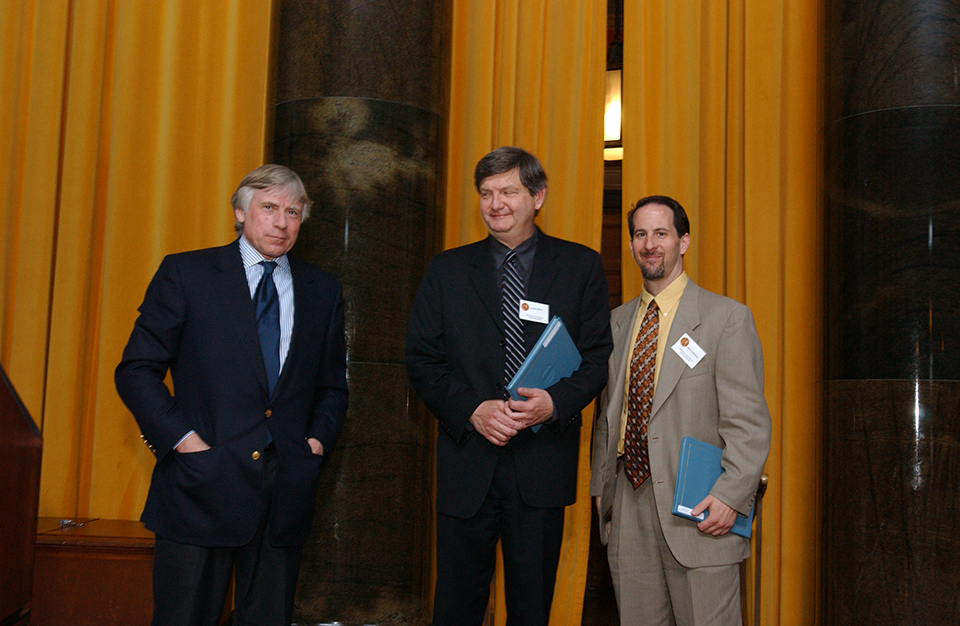
Lee C. Bollinger (left) presents James Risen (center) and Eric Lichtblau with a 2006 Pulitzer Prize in National Reporting.
Winning Work
By James Risen and Eric Lichtblau
[T]he N.S.A. eavesdrops without warrants on up to 500 people in the United States at any given time. The list changes as some names are added and others dropped, so the number monitored in this country may have reached into the thousands since the program began, several officials said. Overseas, about 5,000 to 7,000 people suspected of terrorist ties are monitored at one time, according to those officials.
--Correction Appended
WASHINGTON, Dec. 15 - Months after the Sept. 11 attacks, President Bush secretly authorized the National Security Agency to eavesdrop on Americans and others inside the United States to search for evidence of terrorist activity without the court-approved warrants ordinarily required for domestic spying, according to government officials.
Under a presidential order signed in 2002, the intelligence agency has monitored the international telephone calls and international e-mail messages of hundreds, perhaps thousands, of people inside the United States without warrants over the past three years in an effort to track possible "dirty numbers" linked to Al Qaeda, the officials said. The agency, they said, still seeks warrants to monitor entirely domestic communications.
The previously undisclosed decision to permit some eavesdropping inside the country without court approval was a major shift in American intelligence-gathering practices, particularly for the National Security Agency, whose mission is to spy on communications abroad. As a result, some officials familiar with the continuing operation have questioned whether the surveillance has stretched, if not crossed, constitutional limits on legal searches.
"This is really a sea change," said a former senior official who specializes in national security law. "It's almost a mainstay of this country that the N.S.A. only does foreign searches."
Nearly a dozen current and former officials, who were granted anonymity because of the classified nature of the program, discussed it with reporters for The New York Times because of their concerns about the operation's legality and oversight.
According to those officials and others, reservations about aspects of the program have also been expressed by Senator John D. Rockefeller IV, the West Virginia Democrat who is the vice chairman of the Senate Intelligence Committee, and a judge presiding over a secret court that oversees intelligence matters. Some of the questions about the agency's new powers led the administration to temporarily suspend the operation last year and impose more restrictions, the officials said.
The Bush administration views the operation as necessary so that the agency can move quickly to monitor communications that may disclose threats to the United States, the officials said. Defenders of the program say it has been a critical tool in helping disrupt terrorist plots and prevent attacks inside the United States.
Administration officials are confident that existing safeguards are sufficient to protect the privacy and civil liberties of Americans, the officials say. In some cases, they said, the Justice Department eventually seeks warrants if it wants to expand the eavesdropping to include communications confined within the United States. The officials said the administration had briefed Congressional leaders about the program and notified the judge in charge of the Foreign Intelligence Surveillance Court, the secret Washington court that deals with national security issues.
The White House asked The New York Times not to publish this article, arguing that it could jeopardize continuing investigations and alert would-be terrorists that they might be under scrutiny. After meeting with senior administration officials to hear their concerns, the newspaper delayed publication for a year to conduct additional reporting. Some information that administration officials argued could be useful to terrorists has been omitted.
Dealing With a New Threat
While many details about the program remain secret, officials familiar with it say the N.S.A. eavesdrops without warrants on up to 500 people in the United States at any given time. The list changes as some names are added and others dropped, so the number monitored in this country may have reached into the thousands since the program began, several officials said. Overseas, about 5,000 to 7,000 people suspected of terrorist ties are monitored at one time, according to those officials.
Several officials said the eavesdropping program had helped uncover a plot by Iyman Faris, an Ohio trucker and naturalized citizen who pleaded guilty in 2003 to supporting Al Qaeda by planning to bring down the Brooklyn Bridge with blowtorches. What appeared to be another Qaeda plot, involving fertilizer bomb attacks on British pubs and train stations, was exposed last year in part through the program, the officials said. But they said most people targeted for N.S.A. monitoring have never been charged with a crime, including an Iranian-American doctor in the South who came under suspicion because of what one official described as dubious ties to Osama bin Laden.
The eavesdropping program grew out of concerns after the Sept. 11 attacks that the nation's intelligence agencies were not poised to deal effectively with the new threat of Al Qaeda and that they were handcuffed by legal and bureaucratic restrictions better suited to peacetime than war, according to officials. In response, President Bush significantly eased limits on American intelligence and law enforcement agencies and the military.
But some of the administration's antiterrorism initiatives have provoked an outcry from members of Congress, watchdog groups, immigrants and others who argue that the measures erode protections for civil liberties and intrude on Americans' privacy.
Opponents have challenged provisions of the USA Patriot Act, the focus of contentious debate on Capitol Hill this week, that expand domestic surveillance by giving the Federal Bureau of Investigation more power to collect information like library lending lists or Internet use. Military and F.B.I. officials have drawn criticism for monitoring what were largely peaceful antiwar protests. The Pentagon and the Department of Homeland Security were forced to retreat on plans to use public and private databases to hunt for possible terrorists. And last year, the Supreme Court rejected the administration's claim that those labeled "enemy combatants" were not entitled to judicial review of their open-ended detention.
Mr. Bush's executive order allowing some warrantless eavesdropping on those inside the United States - including American citizens, permanent legal residents, tourists and other foreigners - is based on classified legal opinions that assert that the president has broad powers to order such searches, derived in part from the September 2001 Congressional resolution authorizing him to wage war on Al Qaeda and other terrorist groups, according to the officials familiar with the N.S.A. operation.
The National Security Agency, which is based at Fort Meade, Md., is the nation's largest and most secretive intelligence agency, so intent on remaining out of public view that it has long been nicknamed "No Such Agency." It breaks codes and maintains listening posts around the world to eavesdrop on foreign governments, diplomats and trade negotiators as well as drug lords and terrorists. But the agency ordinarily operates under tight restrictions on any spying on Americans, even if they are overseas, or disseminating information about them.
What the agency calls a "special collection program" began soon after the Sept. 11 attacks, as it looked for new tools to attack terrorism. The program accelerated in early 2002 after the Central Intelligence Agency started capturing top Qaeda operatives overseas, including Abu Zubaydah, who was arrested in Pakistan in March 2002. The C.I.A. seized the terrorists' computers, cellphones and personal phone directories, said the officials familiar with the program. The N.S.A. surveillance was intended to exploit those numbers and addresses as quickly as possible, they said.
In addition to eavesdropping on those numbers and reading e-mail messages to and from the Qaeda figures, the N.S.A. began monitoring others linked to them, creating an expanding chain. While most of the numbers and addresses were overseas, hundreds were in the United States, the officials said.
Under the agency's longstanding rules, the N.S.A. can target for interception phone calls or e-mail messages on foreign soil, even if the recipients of those communications are in the United States. Usually, though, the government can only target phones and e-mail messages in the United States by first obtaining a court order from the Foreign Intelligence Surveillance Court, which holds its closed sessions at the Justice Department.
Traditionally, the F.B.I., not the N.S.A., seeks such warrants and conducts most domestic eavesdropping. Until the new program began, the N.S.A. typically limited its domestic surveillance to foreign embassies and missions in Washington, New York and other cities, and obtained court orders to do so.
Since 2002, the agency has been conducting some warrantless eavesdropping on people in the United States who are linked, even if indirectly, to suspected terrorists through the chain of phone numbers and e-mail addresses, according to several officials who know of the operation. Under the special program, the agency monitors their international communications, the officials said. The agency, for example, can target phone calls from someone in New York to someone in Afghanistan.
Warrants are still required for eavesdropping on entirely domestic-to-domestic communications, those officials say, meaning that calls from that New Yorker to someone in California could not be monitored without first going to the Federal Intelligence Surveillance Court.
A White House Briefing
After the special program started, Congressional leaders from both political parties were brought to Vice President Dick Cheney's office in the White House. The leaders, who included the chairmen and ranking members of the Senate and House intelligence committees, learned of the N.S.A. operation from Mr. Cheney, Lt. Gen. Michael V. Hayden of the Air Force, who was then the agency's director and is now a full general and the principal deputy director of national intelligence, and George J. Tenet, then the director of the C.I.A., officials said.
It is not clear how much the members of Congress were told about the presidential order and the eavesdropping program. Some of them declined to comment about the matter, while others did not return phone calls.
Later briefings were held for members of Congress as they assumed leadership roles on the intelligence committees, officials familiar with the program said. After a 2003 briefing, Senator Rockefeller, the West Virginia Democrat who became vice chairman of the Senate Intelligence Committee that year, wrote a letter to Mr. Cheney expressing concerns about the program, officials knowledgeable about the letter said. It could not be determined if he received a reply. Mr. Rockefeller declined to comment. Aside from the Congressional leaders, only a small group of people, including several cabinet members and officials at the N.S.A., the C.I.A. and the Justice Department, know of the program.
Some officials familiar with it say they consider warrantless eavesdropping inside the United States to be unlawful and possibly unconstitutional, amounting to an improper search. One government official involved in the operation said he privately complained to a Congressional official about his doubts about the program's legality. But nothing came of his inquiry. "People just looked the other way because they didn't want to know what was going on," he said.
A senior government official recalled that he was taken aback when he first learned of the operation. "My first reaction was, 'We're doing what?' " he said. While he said he eventually felt that adequate safeguards were put in place, he added that questions about the program's legitimacy were understandable.
Some of those who object to the operation argue that is unnecessary. By getting warrants through the foreign intelligence court, the N.S.A. and F.B.I. could eavesdrop on people inside the United States who might be tied to terrorist groups without skirting longstanding rules, they say.
The standard of proof required to obtain a warrant from the Foreign Intelligence Surveillance Court is generally considered lower than that required for a criminal warrant - intelligence officials only have to show probable cause that someone may be "an agent of a foreign power," which includes international terrorist groups - and the secret court has turned down only a small number of requests over the years. In 2004, according to the Justice Department, 1,754 warrants were approved. And the Foreign Intelligence Surveillance Court can grant emergency approval for wiretaps within hours, officials say.
Administration officials counter that they sometimes need to move more urgently, the officials said. Those involved in the program also said that the N.S.A.'s eavesdroppers might need to start monitoring large batches of numbers all at once, and that it would be impractical to seek permission from the Foreign Intelligence Surveillance Court first, according to the officials.
The N.S.A. domestic spying operation has stirred such controversy among some national security officials in part because of the agency's cautious culture and longstanding rules.
Widespread abuses - including eavesdropping on Vietnam War protesters and civil rights activists - by American intelligence agencies became public in the 1970's and led to passage of the Foreign Intelligence Surveillance Act, which imposed strict limits on intelligence gathering on American soil. Among other things, the law required search warrants, approved by the secret F.I.S.A. court, for wiretaps in national security cases. The agency, deeply scarred by the scandals, adopted additional rules that all but ended domestic spying on its part.
After the Sept. 11 attacks, though, the United States intelligence community was criticized for being too risk-averse. The National Security Agency was even cited by the independent 9/11 Commission for adhering to self-imposed rules that were stricter than those set by federal law.
Concerns and Revisions
Several senior government officials say that when the special operation began, there were few controls on it and little formal oversight outside the N.S.A. The agency can choose its eavesdropping targets and does not have to seek approval from Justice Department or other Bush administration officials. Some agency officials wanted nothing to do with the program, apparently fearful of participating in an illegal operation, a former senior Bush administration official said. Before the 2004 election, the official said, some N.S.A. personnel worried that the program might come under scrutiny by Congressional or criminal investigators if Senator John Kerry, the Democratic nominee, was elected president.
In mid-2004, concerns about the program expressed by national security officials, government lawyers and a judge prompted the Bush administration to suspend elements of the program and revamp it.
For the first time, the Justice Department audited the N.S.A. program, several officials said. And to provide more guidance, the Justice Department and the agency expanded and refined a checklist to follow in deciding whether probable cause existed to start monitoring someone's communications, several officials said.
A complaint from Judge Colleen Kollar-Kotelly, the federal judge who oversees the Federal Intelligence Surveillance Court, helped spur the suspension, officials said. The judge questioned whether information obtained under the N.S.A. program was being improperly used as the basis for F.I.S.A. wiretap warrant requests from the Justice Department, according to senior government officials. While not knowing all the details of the exchange, several government lawyers said there appeared to be concerns that the Justice Department, by trying to shield the existence of the N.S.A. program, was in danger of misleading the court about the origins of the information cited to justify the warrants.
One official familiar with the episode said the judge insisted to Justice Department lawyers at one point that any material gathered under the special N.S.A. program not be used in seeking wiretap warrants from her court. Judge Kollar-Kotelly did not return calls for comment.
A related issue arose in a case in which the F.B.I. was monitoring the communications of a terrorist suspect under a F.I.S.A.-approved warrant, even though the National Security Agency was already conducting warrantless eavesdropping.
According to officials, F.B.I. surveillance of Mr. Faris, the Brooklyn Bridge plotter, was dropped for a short time because of technical problems. At the time, senior Justice Department officials worried what would happen if the N.S.A. picked up information that needed to be presented in court. The government would then either have to disclose the N.S.A. program or mislead a criminal court about how it had gotten the information.
Several national security officials say the powers granted the N.S.A. by President Bush go far beyond the expanded counterterrorism powers granted by Congress under the USA Patriot Act, which is up for renewal. The House on Wednesday approved a plan to reauthorize crucial parts of the law. But final passage has been delayed under the threat of a Senate filibuster because of concerns from both parties over possible intrusions on Americans' civil liberties and privacy.
Under the act, law enforcement and intelligence officials are still required to seek a F.I.S.A. warrant every time they want to eavesdrop within the United States. A recent agreement reached by Republican leaders and the Bush administration would modify the standard for F.B.I. wiretap warrants, requiring, for instance, a description of a specific target. Critics say the bar would remain too low to prevent abuses.
Bush administration officials argue that the civil liberties concerns are unfounded, and they say pointedly that the Patriot Act has not freed the N.S.A. to target Americans. "Nothing could be further from the truth," wrote John Yoo, a former official in the Justice Department's Office of Legal Counsel, and his co-author in a Wall Street Journal opinion article in December 2003. Mr. Yoo worked on a classified legal opinion on the N.S.A.'s domestic eavesdropping program.
At an April hearing on the Patriot Act renewal, Senator Barbara A. Mikulski, Democrat of Maryland, asked Attorney General Alberto R. Gonzales and Robert S. Mueller III, the director of the F.B.I., "Can the National Security Agency, the great electronic snooper, spy on the American people?"
"Generally," Mr. Mueller said, "I would say generally, they are not allowed to spy or to gather information on American citizens."
President Bush did not ask Congress to include provisions for the N.S.A. domestic surveillance program as part of the Patriot Act and has not sought any other laws to authorize the operation. Bush administration lawyers argued that such new laws were unnecessary, because they believed that the Congressional resolution on the campaign against terrorism provided ample authorization, officials said.
The Legal Line Shifts
Seeking Congressional approval was also viewed as politically risky because the proposal would be certain to face intense opposition on civil liberties grounds. The administration also feared that by publicly disclosing the existence of the operation, its usefulness in tracking terrorists would end, officials said.
The legal opinions that support the N.S.A. operation remain classified, but they appear to have followed private discussions among senior administration lawyers and other officials about the need to pursue aggressive strategies that once may have been seen as crossing a legal line, according to senior officials who participated in the discussions.
For example, just days after the Sept. 11, 2001, attacks on New York and the Pentagon, Mr. Yoo, the Justice Department lawyer, wrote an internal memorandum that argued that the government might use "electronic surveillance techniques and equipment that are more powerful and sophisticated than those available to law enforcement agencies in order to intercept telephonic communications and observe the movement of persons but without obtaining warrants for such uses."
Mr. Yoo noted that while such actions could raise constitutional issues, in the face of devastating terrorist attacks "the government may be justified in taking measures which in less troubled conditions could be seen as infringements of individual liberties."
The next year, Justice Department lawyers disclosed their thinking on the issue of warrantless wiretaps in national security cases in a little-noticed brief in an unrelated court case. In that 2002 brief, the government said that "the Constitution vests in the President inherent authority to conduct warrantless intelligence surveillance (electronic or otherwise) of foreign powers or their agents, and Congress cannot by statute extinguish that constitutional authority."
Administration officials were also encouraged by a November 2002 appeals court decision in an unrelated matter. The decision by the Foreign Intelligence Surveillance Court of Review, which sided with the administration in dismantling a bureaucratic "wall" limiting cooperation between prosecutors and intelligence officers, cited "the president's inherent constitutional authority to conduct warrantless foreign intelligence surveillance."
But the same court suggested that national security interests should not be grounds "to jettison the Fourth Amendment requirements" protecting the rights of Americans against undue searches. The dividing line, the court acknowledged, "is a very difficult one to administer."
Barclay Walsh contributed research for this article.
Correction: Dec. 28, 2005, Wednesday:
Because of an editing error, a front-page article on Dec. 16 about a decision by President Bush to authorize the National Security Agency to eavesdrop on Americans and others inside the United States to search for evidence of terrorist activity without warrants ordinarily required for domestic spying misstated the name of the court that would normally issue those warrants. It is the Foreign - not Federal -Intelligence Surveillance Court.
© 2005 The New York Times Company
HISTORY Created in 1952, the National Security Agency is the biggest American intelligence agency, with more than 30,000 employees at Fort Meade, Md., and listening posts around the world. Part of the Defense Department, it is the successor to the State Department's "Black Chamber" and American military eavesdropping and code-breaking operations that date to the early days of telegraph and telephone communications.
MISSION The N.S.A. runs the eavesdropping hardware of the American intelligence system, operating a huge network of satellites and listening devices around the world. Traditionally, its mission has been to gather intelligence overseas on foreign enemies by breaking codes and tapping into telephone and computer communications.
SUCCESSES Most of the agency's successes remain secret, but a few have been revealed. The agency listened to Soviet pilots and ground controllers during the shooting down of a civilian South Korean airliner in 1983; traced a disco bombing in Berlin in 1986 to Libya through diplomatic messages; and, more recently, used the identifying chips in cellphones to track terrorist suspects after the 2001 attacks.
DOMESTIC ACTIVITY The disclosure in the 1970's of widespread surveillance on political dissenters and other civil rights abuses led to restrictions at the N.S.A. and elsewhere on the use of domestic wiretaps. The N.S.A. monitors United Nations delegations and some foreign embassy lines on American soil, but is generally prohibited from listening in on the conversations of anyone inside the country without a special court order.
OFFICIAL RULES Since the reforms of the late 1970's, the N.S.A. has generally been permitted to target the communications of people on American soil only if they are believed to be "agents of a foreign power" -- a foreign nation or international terrorist group -- and a warrant is obtained from the Foreign Intelligence Surveillance Court.
EXPANDED ROLE Months after the terror attacks of Sept. 11, 2001, President Bush signed a secret executive order that relaxed restrictions on domestic spying by the N.S.A., according to officials with knowledge of the order. The order allows the agency to monitor without warrants the international phone calls and e-mail messages of some Americans and others inside the United States.
© 2005, The New York Times Company
By Eric Lichtblau and James Risen
In the early years of the operation, there were few, if any, controls placed on the activity by anyone outside the security agency, officials say.
WASHINGTON - The National Security Agency first began to conduct warrantless eavesdropping on telephone calls and e-mail messages between the United States and Afghanistan months before President Bush officially authorized a broader version of the agency's special domestic collection program, according to current and former government officials.
The security agency surveillance of telecommunications between the United States and Afghanistan began in the immediate aftermath of the Sept. 11, 2001, attacks on New York and Washington, the officials said.
The agency operation included eavesdropping on communications between Americans and other individuals in the United States and people in Afghanistan without the court-approved search warrants that are normally required for such domestic intelligence activities.
On Saturday, President Bush confirmed the existence of the security agency's domestic intelligence collection program and defended it, saying it had been instrumental in disrupting terrorist cells in America.
After the Sept. 11 attacks, the Bush administration and senior American intelligence officials quickly decided that existing laws and regulations restricting the government's ability to monitor American communications were too rigid to permit quick and flexible access to international calls and e-mail traffic involving terrorism suspects. Bush administration officials also believed that the intelligence community, including the Central Intelligence Agency and the N.S.A., had been too risk-averse before the attacks and had missed opportunities to prevent them.
In the days after the attacks, the C.I.A. determined that Al Qaeda, which had found a haven in Afghanistan, was responsible. Congress quickly passed a resolution authorizing the president to conduct a war on terrorism, and the security agency was secretly ordered to begin conducting comprehensive coverage of all communications into and out of Afghanistan, including those to and from the United States, current and former officials said.
It could not be learned whether Mr. Bush issued a formal written order authorizing the early surveillance of communications between the United States and Afghanistan that was later superseded by the broader order. A White House spokeswoman, Maria Tamburri, declined to comment Saturday on the Afghanistan monitoring, saying she could not go beyond Mr. Bush's speech.
Current and former American intelligence and law enforcement officials who discussed the matter were granted anonymity because the intelligence-gathering program is highly classified. Some had direct knowledge of the program.
The disclosure of the security agency's warrantless eavesdropping on calls between the United States and Afghanistan sheds light on the origins of the agency's larger surveillance activities, which officials say have included monitoring the communications of as many as 500 Americans and other people inside the United States without search warrants at any one time. Several current and former officials have said that they believe the security agency operation began virtually on the fly in the days after the Sept. 11 attacks.
The early, narrow focus on communications in and out of Afghanistan reflected the ad hoc nature of the government's initial approach to counterterrorism policies in the days after Sept. 11 attacks.
But after the United States-led invasion of Afghanistan succeeded in overthrowing the Taliban government in late 2001, Al Qaeda lost its sanctuary, and Osama bin Laden and other Qaeda leaders scattered to Pakistan, Iran and other countries. As counterterrorism operations grew, the Bush administration wanted the security agency secretly to expand its surveillance as well. By 2002, Mr. Bush gave the agency broader surveillance authority.
In the early years of the operation, there were few, if any, controls placed on the activity by anyone outside the security agency, officials say. It was not until 2004, when several officials raised concerns about its legality, that the Justice Department conducted its first audit of the operation. Security agency officials had been given the power to select the people they would single out for eavesdropping inside the United States without getting approval for each case from the White House or the Justice Department, the officials said.
While the monitoring program was conducted without court-approved warrants, senior Bush administration officials said the far-reaching decision to move ahead with the program was justified by the pressing need to identify whether any remaining ''sleeper cells'' were still operating within the United States after the Sept. 11 attacks and whether they were planning ''follow-on attacks.''
Mr. Bush, in his speech on Saturday, cited the disruptions of "terrorist cells" since Sept. 11 in New York, Oregon, Virginia, California, Texas and Ohio as evidence of a very real threat. And he pointed to overseas communications by two of the Sept. 11 hijackers who were living in the San Diego area as evidence that the security agency needed the power and flexibility to track international communications.
The two men "communicated to other members of Al Qaeda who were overseas," Mr. Bush said. "But we didn't know they were here, until it was too late.''
In his speech, Mr. Bush pointed to the layers of oversight and review that are built into the secret spying program to ensure that it is ''consistent with the letter and intent of the authorization.''
© 2005 The New York Times Company
By James Risen and Eric Lichtblau
WASHINGTON, Dec. 20 - A surveillance program approved by President Bush to conduct eavesdropping without warrants has captured what are purely domestic communications in some cases, despite a requirement by the White House that one end of the intercepted conversations take place on foreign soil, officials say.
The officials say the National Security Agency's interception of a small number of communications between people within the United States was apparently accidental, and was caused by technical glitches at the National Security Agency in determining whether a communication was in fact "international."
Telecommunications experts say the issue points up troubling logistical questions about the program. At a time when communications networks are increasingly globalized, it is sometimes difficult even for the N.S.A. to determine whether someone is inside or outside the United States when making a cellphone call or sending an e-mail message. As a result, people that the security agency may think are outside the United States are actually on American soil.
Vice President Dick Cheney entered the debate over the legality of the program on Tuesday, casting the program as part of the administration's efforts to assert broader presidential powers.
Eavesdropping on communications between two people who are both inside the United States is prohibited under Mr. Bush's order allowing some domestic surveillance.
But in at least one instance, someone using an international cellphone was thought to be outside the United States when in fact both people in the conversation were in the country. Officials, who spoke on condition of anonymity because the program remains classified, would not discuss the number of accidental intercepts, but the total is thought to represent a very small fraction of the total number of wiretaps that Mr. Bush has authorized without getting warrants. In all, officials say the program has been used to eavesdrop on as many as 500 people at any one time, with the total number of people reaching perhaps into the thousands in the last three years.
Mr. Bush and his senior aides have emphasized since the disclosure of the program's existence last week that the president's executive order applied only to cases where one party on a call or e-mail message was outside the United States.
Gen. Michael V. Hayden, the former N.S.A. director who is now the second-ranking intelligence official in the country, was asked at a White House briefing this week whether there had been any ''purely domestic'' intercepts under the program.
"The authorization given to N.S.A. by the president requires that one end of these communications has to be outside the United States,'' General Hayden answered. ''I can assure you, by the physics of the intercept, by how we actually conduct our activities, that one end of these communications are always outside the United States."
Attorney General Alberto R. Gonzales also emphasized that the order only applied to international communications. "People are running around saying that the United States is somehow spying on American citizens calling their neighbors,'' he said. ''Very, very important to understand that one party to the communication has to be outside the United States."
A spokeswoman for the office of national intelligence declined comment on whether the N.S.A. had intercepted any purely domestic communications. ''We'll stand by what General Hayden said in his statement,'' said the spokeswoman, Judy Emmel.
The Bush administration has not released the guidelines that the N.S.A. uses in determining who is suspected of having links to Al Qaeda and may be a target under the program. General Hayden said the determination was made by operational people at the agency and "must be signed off by a shift supervisor," with the process closely scrutinized by officials at the agency, the Justice Department and elsewhere.
But questions about the legal and operational oversight of the program last year prompted the administration to suspend aspects of it temporarily and put in place tighter restrictions on the procedures used to focus on suspects, said people with knowledge of the program. The judge who oversees the secret court that authorizes intelligence warrants -- and which has been largely bypassed by the program -- also raised concerns about aspects of the program.
The concerns led to a secret audit, which did not reveal any abuses in focusing on suspects or instances in which purely domestic communications were monitored, said officials familiar with the classified findings.
General Hayden, at this week's briefing, would not discuss many technical aspects of the program and did not answer directly when asked whether the program was used to eavesdrop on people who should not have been. But he indicated that N.S.A. operational personnel sometimes decide to stop surveillance of a suspect when the eavesdropping has not produced relevant leads on terror cases.
"We can't waste resources on targets that simply don't provide valuable information, and when we decide that is the case," the decision on whether a target is ''worthwhile'' is usually made in days or weeks, he said.
National security and telecommunications experts said that even if the N.S.A. seeks to adhere closely to the rules that Mr. Bush has set, the logistics of the program may make it difficult to ensure that the rules are being followed.
With roaming cellphones, internationally routed e-mail, and voice-over Internet technology, "it's often tough to find out where a call started and ended,'' said Robert Morris, a former senior scientist at the N.S.A. who is retired. ''The N.S.A. is good at it, but it's difficult even for them. Where a call actually came from is often a mystery."
© 2005 The New York Times Company
By Eric Lichtblau and James Risen
This so-called "pattern analysis" on calls within the United States would, in many circumstances, require a court warrant if the government wanted to trace who calls whom.
WASHINGTON, Dec. 23 - The National Security Agency has traced and analyzed large volumes of telephone and Internet communications flowing into and out of the United States as part of the eavesdropping program that President Bush approved after the Sept. 11, 2001, attacks to hunt for evidence of terrorist activity, according to current and former government officials.
The volume of information harvested from telecommunication data and voice networks, without court-approved warrants, is much larger than the White House has acknowledged, the officials said. It was collected by tapping directly into some of the American telecommunication system's main arteries, they said.
As part of the program approved by President Bush for domestic surveillance without warrants, the N.S.A. has gained the cooperation of American telecommunications companies to obtain backdoor access to streams of domestic and international communications, the officials said.
The government's collection and analysis of phone and Internet traffic have raised questions among some law enforcement and judicial officials familiar with the program. One issue of concern to the Foreign Intelligence Surveillance Court, which has reviewed some separate warrant applications growing out of the N.S.A.'s surveillance program, is whether the court has legal authority over calls outside the United States that happen to pass through American-based telephonic "switches," according to officials familiar with the matter.
"There was a lot of discussion about the switches" in conversations with the court, a Justice Department official said, referring to the gateways through which much of the communications traffic flows. "You're talking about access to such a vast amount of communications, and the question was, How do you minimize something that's on a switch that's carrying such large volumes of traffic? The court was very, very concerned about that."
Since the disclosure last week of the N.S.A.'s domestic surveillance program, President Bush and his senior aides have stressed that his executive order allowing eavesdropping without warrants was limited to the monitoring of international phone and e-mail communications involving people with known links to Al Qaeda.
What has not been publicly acknowledged is that N.S.A. technicians, besides actually eavesdropping on specific conversations, have combed through large volumes of phone and Internet traffic in search of patterns that might point to terrorism suspects. Some officials describe the program as a large data-mining operation.
The current and former government officials who discussed the program were granted anonymity because it remains classified.
Bush administration officials declined to comment on Friday on the technical aspects of the operation and the N.S.A.'s use of broad searches to look for clues on terrorists. Because the program is highly classified, many details of how the N.S.A. is conducting it remain unknown, and members of Congress who have pressed for a full Congressional inquiry say they are eager to learn more about the program's operational details, as well as its legality.
Officials in the government and the telecommunications industry who have knowledge of parts of the program say the N.S.A. has sought to analyze communications patterns to glean clues from details like who is calling whom, how long a phone call lasts and what time of day it is made, and the origins and destinations of phone calls and e-mail messages. Calls to and from Afghanistan, for instance, are known to have been of particular interest to the N.S.A. since the Sept. 11 attacks, the officials said.
This so-called "pattern analysis" on calls within the United States would, in many circumstances, require a court warrant if the government wanted to trace who calls whom.
The use of similar data-mining operations by the Bush administration in other contexts has raised strong objections, most notably in connection with the Total Information Awareness system, developed by the Pentagon for tracking terror suspects, and the Department of Homeland Security's Capps program for screening airline passengers. Both programs were ultimately scrapped after public outcries over possible threats to privacy and civil liberties.
But the Bush administration regards the N.S.A.'s ability to trace and analyze large volumes of data as critical to its expanded mission to detect terrorist plots before they can be carried out, officials familiar with the program say. Administration officials maintain that the system set up by Congress in 1978 under the Foreign Intelligence Surveillance Act does not give them the speed and flexibility to respond fully to terrorist threats at home.
A former technology manager at a major telecommunications company said that since the Sept. 11 attacks, the leading companies in the industry have been storing information on calling patterns and giving it to the federal government to aid in tracking possible terrorists.
"All that data is mined with the cooperation of the government and shared with them, and since 9/11, there's been much more active involvement in that area," said the former manager, a telecommunications expert who did not want his name or that of his former company used because of concern about revealing trade secrets.
Such information often proves just as valuable to the government as eavesdropping on the calls themselves, the former manager said.
"If they get content, that's useful to them too, but the real plum is going to be the transaction data and the traffic analysis," he said. "Massive amounts of traffic analysis information -- who is calling whom, who is in Osama Bin Laden's circle of family and friends -- is used to identify lines of communication that are then given closer scrutiny."
Several officials said that after President Bush's order authorizing the N.S.A. program, senior government officials arranged with officials of some of the nation's largest telecommunications companies to gain access to switches that act as gateways at the borders between the United States' communications networks and international networks. The identities of the corporations involved could not be determined.
The switches are some of the main arteries for moving voice and some Internet traffic into and out of the United States, and, with the globalization of the telecommunications industry in recent years, many international-to-international calls are also routed through such American switches.
One outside expert on communications privacy who previously worked at the N.S.A. said that to exploit its technological capabilities, the American government had in the last few years been quietly encouraging the telecommunications industry to increase the amount of international traffic that is routed through American-based switches.
The growth of that transit traffic had become a major issue for the intelligence community, officials say, because it had not been fully addressed by 1970's-era laws and regulations governing the N.S.A. Now that foreign calls were being routed through switches on American soil, some judges and law enforcement officials regarded eavesdropping on those calls as a possible violation of those decades-old restrictions, including the Foreign Intelligence Surveillance Act, which requires court-approved warrants for domestic surveillance.
Historically, the American intelligence community has had close relationships with many communications and computer firms and related technical industries. But the N.S.A.'s backdoor access to major telecommunications switches on American soil with the cooperation of major corporations represents a significant expansion of the agency's operational capability, according to current and former government officials.
Phil Karn, a computer engineer and technology expert at a major West Coast telecommunications company, said access to such switches would be significant. "If the government is gaining access to the switches like this, what you're really talking about is the capability of an enormous vacuum operation to sweep up data," he said.
© 2005 The New York Times Company
By Eric Lichtblau and James Risen
"We are going to look into that. The calmest word I can use to describe how I feel about this is that I am aghast."
WASHINGTON, Dec. 27 - Defense lawyers in some of the country's biggest terrorism cases say they plan to bring legal challenges to determine whether the National Security Agency used illegal wiretaps against several dozen Muslim men tied to Al Qaeda.
The lawyers said in interviews that they wanted to learn whether the men were monitored by the agency and, if so, whether the government withheld critical information or misled judges and defense lawyers about how and why the men were singled out.
The expected legal challenges, in cases from Florida, Ohio, Oregon and Virginia, add another dimension to the growing controversy over the agency's domestic surveillance program and could jeopardize some of the Bush administration's most important courtroom victories in terror cases, legal analysts say.
The question of whether the N.S.A. program was used in criminal prosecutions and whether it improperly influenced them raises "fascinating and difficult questions," said Carl W. Tobias, a law professor at the University of Richmond who has studied terrorism prosecutions.
"It seems to me that it would be relevant to a person's case," Professor Tobias said. "I would expect the government to say that it is highly sensitive material, but we have legal mechanisms to balance the national security needs with the rights of defendants. I think judges are very conscientious about trying to sort out these issues and balance civil liberties and national security."
While some civil rights advocates, legal experts and members of Congress have said President Bush did not have authority to order eavesdropping by the security agency without warrants, the White House and the Justice Department continued on Tuesday to defend the legality and propriety of the program.
Trent Duffy, a spokesman for the White House, declined to comment in Crawford, Tex., when asked about a report in The New York Times that the security agency had tapped into some of the country's main telephone arteries to conduct broader data-mining operations in the search for terrorists.
But Mr. Duffy said: "This is a limited program. This is not about monitoring phone calls designed to arrange Little League practice or what to bring to a potluck dinner. These are designed to monitor calls from very bad people to very bad people who have a history of blowing up commuter trains, weddings and churches."
He added: "The president believes that he has the authority -- and he does -- under the Constitution to do this limited program. The Congress has been briefed. It is fully in line with the Constitution and also protecting American civil liberties."
Disclosure of the N.S.A. program has already caused ripples in the legal system, with a judge resigning in protest from the Foreign Intelligence Surveillance Court last week. The surveillance court, established by Congress in 1978 to grant warrants in terrorism and espionage cases, wants a briefing from the Bush administration on why it bypassed the court and ordered eavesdropping without warrants.
At the same time, defense lawyers in terrorism cases around the country say they are preparing letters and legal briefs to challenge the N.S.A. program on behalf of their clients, many of them American citizens, and to find out more about how it might have been used. They acknowledge legal hurdles, including the fact that many defendants waived some rights to appeal as part of their plea deals.
Government officials, in defending the value of the security agency's surveillance program, have said in interviews that it played a critical part in at least two cases that led to the convictions of Qaeda associates, Iyman Faris of Ohio, who admitted taking part in a failed plot to bring down the Brooklyn Bridge, and Mohammed Junaid Babar of Queens, who was implicated in a failed plot to bomb British targets.
David B. Smith, a lawyer for Mr. Faris, said he planned to file a motion in part to determine whether information about the surveillance program should have been turned over. Lawyers said they were also considering a civil case against the president, saying that Mr. Faris was the target of an illegal wiretap ordered by Mr. Bush. A lawyer for Mr. Babar declined to comment.
Government officials with knowledge of the program have not ruled out the possibility that it was used in other criminal cases, and a number of defense lawyers said in interviews that circumstantial evidence had led them to question whether the security agency identified their clients through wiretaps.
The first challenge is likely to come in Florida, where lawyers for two men charged with Jose Padilla, who is jailed as an enemy combatant, plan to file a motion as early as next week to determine if the N.S.A. program was used to gain incriminating information on their clients and their suspected ties to Al Qaeda. Kenneth Swartz, one of the lawyers in the case, said, "I think they absolutely have an obligation to tell us" whether the agency was wiretapping the defendants. In a Virginia case, Edward B. MacMahon Jr., a lawyer for Ali al-Timimi, a Muslim scholar in Alexandria who is serving a life sentence for inciting his young followers to wage war against the United States overseas, said the government's explanation of how it came to suspect Mr. Timimi of terrorism ties never added up in his view.
F.B.I. agents were at Mr. Timimi's door days after the Sept. 11 attacks to question him about possible links to terrorism, Mr. MacMahon said, yet the government did not obtain a warrant through the foreign intelligence court to eavesdrop on his conversations until many months later.
Mr. MacMahon said he was so skeptical about the timing of the investigation that he questioned the Justice Department about whether some sort of unknown wiretap operation had been conducted on the scholar or his young followers, who were tied to what prosecutors described as a "Virginia jihad" cell.
"They told me there was no other surveillance," Mr. MacMahon said. "But the fact is that the case against a lot of these guys just came out of nowhere because they were really nobodies, and it makes you wonder whether they were being tapped."
John Zwerling, a lawyer for one of Mr. Timimi's followers, Seifullah Chapman, who is serving a 65-year sentence in federal prison in the case, said he and lawyers for two of the other defendants in the case planned to send a letter to the Justice Department to find out if N.S.A. wiretaps were used against their clients. If the Justice Department declines to give an answer, Mr. Zwerling said, they plan to file a motion in court demanding access to the information.
"We want to know, Did this N.S.A. program make its way into our case, and how was it used?" Mr. Zwerling said. "It may be a difficult trail for us in court, but we're going to go down it as far as we can."
Defense lawyers in several other high-profile terrorism prosecutions, including the so-called Portland Seven and Lackawanna Six cases, said they were also planning to file legal challenges or were reviewing their options.
"Given what information has come out, with the president admitting that they had avoided the courts, then the question becomes, do you try to learn whether something like that happened in this case?" said Patrick Brown, a Buffalo lawyer in the Lackawanna case. "I would have to talk to my client about whether that's a road we want to go down."
Gerry Spence, who is the lead counsel representing Brandon Mayfield, a Portland lawyer who was arrested in error last year in connection with the Madrid bombings and is now suing the government, said of the security agency program: "We are going to look into that. The calmest word I can use to describe how I feel about this is that I am aghast."
Because the program was so highly classified, government officials say, prosecutors who handled terrorism cases apparently did not know of the program's existence. Any information they received, the officials say, was probably carefully shielded to protect the true source.
But defense lawyers say they are eager to find out whether prosecutors -- intentionally or not -- misled the courts about the origins of their investigations and whether the government may have held on to N.S.A. wiretaps that could point to their clients' innocence.
Stanley Cohen, a New York lawyer who represented Patrice Lumumba Ford in the Portland Seven case, said many defendants would face significant obstacles in mounting legal challenges to force the government to reveal whether material obtained through the security agency's program was used in their cases.
"You really could have standing problems" for many of the defendants, Mr. Cohen said.
But some Justice Department prosecutors, speaking on condition of anonymity because the program remains classified, said they were concerned that the agency's wiretaps without warrants could create problems for the department in terrorism prosecutions both past and future.
"If I'm a defense attorney," one prosecutor said, "the first thing I'm going to say in court is, 'This was an illegal wiretap.' "
© 2005 The New York Times Company
Biography

James E. Risen joined The New York Times as a correspondent in the Washington bureau, covering national security and intelligence, in May 1998.
Previously, he served as a correspondent for the Los Angeles Times from 1984 to 1998. He covered national security and intelligence from 1995 to 1998; he was chief economic correspondent in their Washington bureau from 1990 to 1995, and he was their Detroit bureau chief from 1984 to 1990.
From 1981 to 1984, he worked as a reporter for The Detroit Free Press covering the auto industry and labor.
Born in Cincinnati, Ohio, on April 27, 1955, Mr. Risen received a B.A. degree in history from Brown University in 1977 and an M.S. degree in journalism from Northwestern University in 1978.
He is married, has three children and lives in Maryland.
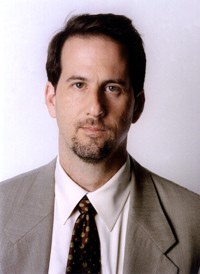
Eric Lichtblau joined The New York Times in September 2002 as a Washington correspondent covering the Justice Department in the Washington bureau.
Previously, Mr. Lichtblau was at the Los Angeles Times for 15 years, where he also covered the Justice Department in the Washington bureau from 1999 to 2002; before that, he did stints on the investigative team in Los Angeles and covered various law enforcement beats.
Mr. Lichtblau was born in Syracuse, and graduated from Cornell University in 1987 with a Bachelor of Arts in English and political science.