The New York Times, by Walt Bogdanich
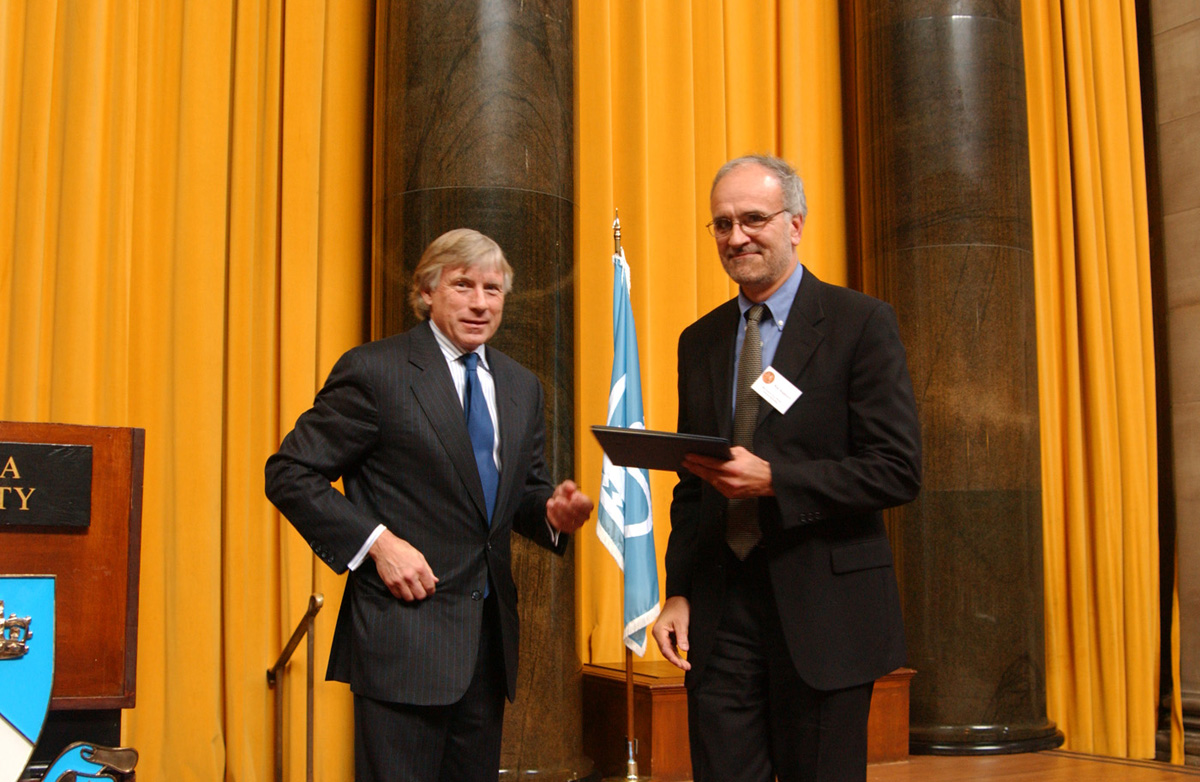
Columbia University President Lee C. Bollinger (left) presents Walt Bogdanich with the 2005 Pulitzer Prize in National Reporting.
Winning Work
By Walt Bogdanich
Jenny Nordberg contributed reporting for this article. Tom Torok contributed data analysis and reporting. Eric Koli contributed reporting from San Francisco.
In fact, one Union Pacific official said that federal regulators told the railroad in late 1999 "to stop calling" after fatal accidents. Federal officials denied doing so, but the following year, The Times's analysis shows the number of accidents not reported promptly by Union Pacific quadrupled.
At 5:45 p.m., with the autumn sun dipping toward the horizon, Blas Lopez, a father of four young children, drove his truck loaded with potatoes bound for market onto a railroad crossing in south-central Washington State. In an instant, a 4,700-ton Union Pacific train rammed Mr. Lopez's truck with the force of an explosion, ripping apart his body.
Union Pacific responded as most railroads do after fatal crossing accidents: It blamed the victim, Mr. Lopez, not itself.
What Union Pacific did not say was that the warning signal at the crossing contained parts that the manufacturer had said, 12 years earlier, should be replaced "as soon as possible" because they might be defective. After a witness to the accident said the signal appeared to have malfunctioned, a lawyer for Mr. Lopez's family arranged with Union Pacific in October 2001 to inspect the signal.
But a railroad manager beat the lawyer there by several hours. In the predawn darkness, the manager secretly swapped the suspect parts for newer ones. The cover-up was not discovered until weeks later, when the Lopezes' lawyer noticed that the serial numbers on the parts did not match the railroad's records.
Union Pacific's conduct is a stark example of how some railroads, even as they blame motorists, repeatedly sidestep their own responsibility in grade-crossing fatalities. Their actions range from destroying, mishandling or simply losing evidence to not reporting the crashes properly in the first place, a seven-month investigation by The New York Times has found.
Union Pacific stands out. In one recent 18-month period, seven federal and state courts imposed sanctions on Union Pacific, the nation's biggest railroad, for destroying or failing to preserve evidence in crossing accidents, and an eighth court ordered a case retried. One sanction has since been overturned on appeal.
Over the last eight years, railroads have also broken federal rules by failing to promptly report hundreds of fatal accidents, 71 of them last year, denying the federal authorities the chance to investigate when evidence is fresh and still available, according to a computer analysis of federal data by The Times. Enforcement of these rules is so lax that federal officials said they were not even aware of the reporting problems.
In fact, one Union Pacific official said that federal regulators told the railroad in late 1999 "to stop calling" after fatal accidents. Federal officials denied doing so, but the following year, The Times's analysis shows the number of accidents not reported promptly by Union Pacific quadrupled.
Trains, like airplanes, have black-box event recorders, but records show that railroads have a spotty history of keeping them in working order and have sometimes lost or erased their information after crashes. The information from recorders can be so inconclusive that after one 17-year-old girl was killed in Tennessee, the railroad produced five different versions of the accident from the same black box.
On average, one person a day dies at a crossing in the United States. Since 2000, more than twice as many people have been killed at grade crossings as have died in commercial plane crashes. But these deaths draw little national attention because they usually come one or two at a time, often where tracks slice through small towns and rural expanses across the country.
"It's a systemic failure," said James E. Hall, a former chairman of the National Transportation Safety Board. "It's been something that has just not grabbed the attention, unfortunately, of the public."
It has barely grabbed the attention of the government. Only federal authorities, not the local police, have the authority to properly investigate a railroad's role in an accident. But of the nearly 3,000 rail crossing accidents last year, federal authorities fully investigated just four.
Families of victims searching for the cause of a crash have to ask the railroads themselves or file lawsuits. But as judges who have sanctioned Union Pacific have found, getting a straight answer can be difficult.
Kathryn Blackwell, a spokeswoman for Union Pacific, said her company's policy was to keep records as long as federal law requires. "Union Pacific did not purposefully destroy evidence to keep it from the jury," Ms. Blackwell said. "Union Pacific would not destroy documents in anticipation of litigation."
Yet Union Pacific was found to have knowingly destroyed relevant evidence after a collision in Arkansas that left Frank Stevenson brain damaged and killed his wife. Mr. Stevenson has since lost his job, his house and, he said, his stepchildren, who blame him for their mother's death. "I have no family anymore," he said.
Mr. Stevenson's injuries left him without any memory of the accident. But when he filed a lawsuit, Union Pacific had purged much of its own institutional memory of the accident, court records show. Track inspection records that might have shown the crossing was hazardous were discarded by the railroad after Mr. Stevenson asked for them. Tapes of the train's crew talking to dispatchers before the accident were not preserved. The train's black box was not much help either: it malfunctioned and did not record the horn.
"Documents have been routinely destroyed despite defendant's knowledge that they are relevant to this lawsuit," Judge William R. Wilson of Federal District Court wrote in 2001, referring to Union Pacific. And, Judge Wilson added: "This does not square with the discovery rules nor with `traditional notions of fair play and justice.' "
Between The Cracks
Harvey Levine remembers the day in the mid-1990s when, as a vice president of the Association of American Railroads, he suggested that railroads, not just drivers, might share responsibility for grade-crossing collisions.
The reaction was swift.
"Another vice president said, `Why don't you shut up and sit down,'" recalled Dr. Levine, an economist and a former railroad employee. "I knew the next sentence out of my mouth was going to cost me my job."
With two children in college, Dr. Levine said he did not argue the point.
Railroads and the federal government have spent millions of dollars educating the public about the motorist's responsibility for avoiding trains. "Always Expect A Train!" has become the slogan of the railroads as well as their principal regulator, the Federal Railroad Administration.
"Motorists can stop quickly, trains cannot," said Ms. Blackwell, the Union Pacific spokeswoman.
Grade-crossing deaths have declined by more than 50 percent since 1990 and both the industry and regulators say the educational campaign has contributed to the decline. But Dr. Levine, who has testified for accident victims, said a bigger reason was that tens of thousands of crossings have been closed and the government has paid to install gates or lights at many other crossings. Still, most of the 250,000 crossings have no warning lights or gates, and grade-crossing deaths are up more than 10 percent for the first four months of this year.
Many accidents are indeed caused by careless or reckless driving. A federal study released late last month blames "risky driver behavior or poor judgment" for 87 percent of fatal crossing accidents over the last decade. The audit, though, was based mostly on accident reports from the railroads themselves. In fact, as Ms. Blackwell of Union Pacific acknowledges, railroads are sometimes at fault, too.
Overgrown vegetation can block a driver's view. Gates or lights can fail. An engineer may blow a horn too late. "In order to avoid that train, you have to be able to see the train and to hear the train," said John E. Parker, a South Carolina lawyer who represents crossing accident victims.
Yet, in most cases, no one thoroughly investigates the railroads' conduct.
The industry has worked to keep the power to investigate grade-crossing accidents centered in Washington, where it has long been an influential force. Vice President Dick Cheney served on Union Pacific's board and the Treasury Secretary, John W. Snow, is a former chief executive of CSX.
But federal authorities rarely use those investigative powers in crossing accidents.
"We typically will only look at those that have extraordinary or unusual circumstances," said Warren Flatau, a railroad administration spokesman. That usually means three or more deaths in a single accident. More federal attention is paid to derailments and train-on-train collisions. And although states can punish railroads for unsafe crossings, they usually do not.
Families of victims have found it hard to get the government to do more. "You are fighting a war with wounded soldiers here," said Vicky Moore, whose 16-year-old son, Ryan, was killed in 1995 at one rural Ohio crossing where at least six others have died.
When an accident happens it is usually up to the local police alone to investigate, but their power over railroads is so limited that they lack the authority, for example, to seize an event recorder or to order a train's crew to be tested for drugs or alcohol.
"We are not given information we need to thoroughly investigate," said Tom Mockbee, chief of police in Waldo, Ark., who has investigated rail crossing accidents. "Their attitude is if I don't get it, they don't have to defend it."
The Barber Case
It was hardly a secret that the railroad crossing just west of Palestine, Ark., was dangerous. Like many of Union Pacific's crossings in the area, this one, known as Crossing "123," had no lights or gates to warn motorists.
Overgrown vegetation made the crossing especially hazardous, said Willetta Carroll, the mayor of Palestine, population 700.
"You had to be on the track before you could see the train," Ms. Carroll said. The mayor, whose sister-in-law died at a rail crossing in Palestine, said she complained many times to Union Pacific without success.
So did Carl Jones, a garbage truck driver, who said he had contacted the railroad 7 to 10 times about Crossing 123, according to court records. Once, Mr. Jones said, he stopped a Union Pacific worker on the road to tell him the crossing was life-threatening.
Union Pacific employees noticed the danger, too. Willie Savage, who supervised track workers, thought the crossing was so dangerous that he had flagmen stop traffic before allowing his men to cross the road in their rail cars, court records show. And Donald DePriest said that when he worked as an engineer he told the railroad that the crossing endangered the public and rail employees alike.
The warnings became reality at 9:15 a.m. on Jan. 19, 1998, when a garbage truck driven by Charles Rolfe pulled up to "123." "We started easing up to the crossing until we practically got on the track itself -- you couldn't see anything," said Chris Barber, Mr. Rolfe's co-worker who was in the truck.
Suddenly, Mr. Barber turned his head and saw a light and a giant yellow engine. "I put my head down and prayed," he recalled in an interview. The impact killed Mr. Rolfe. Mr. Barber spent the next two months in a hospital and rehabilitation center, recovering from a skull fracture, broken neck, collapsed lung and various other broken bones. He still has trouble walking and is unable to work.
Federal authorities did not investigate the crash and Mr. Barber filed a lawsuit against Union Pacific, saying the railroad failed to keep the crossing safe, to properly sound the train's horn and to operate the train at a safe speed. Union Pacific denied each of those accusations in court.
In preparing for the trial in 2002, Mr. Barber's lawyers found several people who said they were nearly killed at the crossing. The lawyers also wanted voice tapes of the railroad's dispatchers talking to the crew, track inspection records and any "slow orders" directing trains to reduce their speed near the crossing because of hazardous conditions.
Union Pacific, however, said the voice tapes had been taped over and the track reports had been discarded, some after Mr. Barber asked for them. The railroad also said it could find no "slow orders" for the crossing. Even so, Mr. Barber's lawyers sent a consultant, Alan J. Blackwell, a former Union Pacific manager, to Union Pacific headquarters in Omaha to search for slow orders. Mr. Blackwell eventually found some for the track around Crossing 123, despite the railroad's claims that they did not exist.
Union Pacific's conduct earned it a sanction from the presiding judge, who told the jury that it could -- but was not required to -- conclude that the missing evidence was not favorable to the railroad.
At the trial, Robert L. Pottroff, a lawyer representing Mr. Barber, stacked empty boxes in the courtroom that he said represented missing evidence. "By the time we got done there were a dozen empty boxes," said Mr. Pottroff, a Kansas lawyer who has helped to organize a legal assault on how Union Pacific handles evidence.
The jury awarded Mr. Barber $5.1 million in compensatory damages and $25 million in punitive damages.
Union Pacific appealed, but the Arkansas Supreme Court upheld the verdict earlier this year in a blistering opinion that said Union Pacific behaved with a "high degree of reprehensibility."
"This case reflects the development of a corporate policy at Union Pacific that put company profits before public safety," the court wrote. "Union Pacific intentionally destroyed track records and voice tapes. Furthermore, there is evidence from which a jury would reasonably conclude that Union Pacific attempted to conceal 'slow orders' issued for this portion of track."
Union Pacific has asked the United States Supreme Court to review the case. Ms. Blackwell, the company spokeswoman (who is not related to Mr. Blackwell), said some documents were mistakenly destroyed after they were requested in court because of human error. "It's not something that we are proud of," she said in an interview. "But unfortunately, people make mistakes."
Union Pacific has also put in place a more aggressive, system-wide program to control vegetation at rail crossings, according to the company.
Meanwhile, Chris Barber's wife, Claudette, wondered if the railroad felt any remorse. Mr. Barber doubts it. "They thought they could get away with it as they always had in the past," he said.
A Change in Policy
Union Pacific's attitude toward investigating grade-crossing accidents was once very different, three former managers with the railroad said.
Those managers said in interviews that from the mid-1980's until the early 1990's, the company was transformed by a new chief executive, Michael H. Walsh, who wanted a more aggressive, open search for the causes of accidents.
"It was a whole new concept," said Mr. Blackwell, a former manager of track maintenance for Union Pacific. "His theory was basically completely opposite from the law department's theory where you do not admit anything because there is liability."
This new philosophy, said Mr. Blackwell, who left the company in 1995, was embodied in a company manual, "Accident Investigation Guidelines." "The investigator must recognize that in some situations management may have failed to comply with a duty or responsibility, which may result in clear liability on the part of the company," the manual states.
Under Mr. Walsh, Mr. Blackwell said, "all documents, everything was to be preserved not just what was good for the railroad."
But the corporation's attitude began to change after Mr. Walsh, who has since died, left the company in August 1991, said the former managers, who have testified on behalf of accident victims. Mr. Blackwell said the company issued a new manual that focused less on rooting out the causes of accidents than on protecting the company.
Claims investigators were instructed not to share their findings with other departments, unless permission was granted. The revised manual also noted that "no useful purpose is served by extensively documenting evidence" when company liability is obvious. Instead, the manual said, the company should try to settle the claim quickly and fairly.
The manual advised care in deciding "the degree and extent to which obviously harmful and possibly inflammatory evidence is documented." For example, the company said "gory" pictures might inflame the jury. "Statements documenting hazardous conditions in great detail serve only the same purpose when such conditions are known to have existed," the manual stated.
Company investigators were further cautioned about taking pictures of any obstructions that might have blocked a motorist's view. "A panoramic view taken at one point might show a possible view obstruction, while an unobstructed view may be demonstrated by moving slightly closer to or away from the crossing," the manual stated.
It also recommended that investigators fully document evidence that could implicate the motorist, including photographing the vehicle's speedometer, and the controls for the radio, air conditioner, heater and stereo -- all possible signs that a driver was distracted or might not have heard the train horn.
The railroad also did not want certain interviews and conversations taped, including those with train crews. Mr. Blackwell, the former manager, said he was told by a company official that when investigating an accident he should use private phone lines rather than communicating by radios, which are often recorded.
Ms. Blackwell, the Union Pacific spokeswoman, said the company's procedures for investigating an accident scene were not intended to hide anything. "There's no desire to alter what the motorist would see, only a desire to show what he would have seen," she said. She also said the instructions should be viewed in the context of the manual's overall message, which is to conduct a full and fair investigation, including collecting evidence "even though it might be detrimental to the company's position."
Ms. Blackwell said the manual was taken out of service early last year.
Michael Easley, of Arkansas, one of the lawyers representing Mr. Stevenson and Mr. Barber, said the investigation manual reveals Union Pacific's agenda. "This shows an investigation that's not looking for the truth but for an advantage," Mr. Easley said.
Sanctions Pile Up
Other major railroads have been accused of seeking a similar advantage.
After Debbie and Eddie Wood lost their daughter at a crossing in Cleveland, Mo., in 1998, their lawyer sent a letter to Kansas City Southern railroad that ended with the plea: "Please do not destroy any evidence." But the railroad not only destroyed dispatch tapes and data from the event recorder, it also "lied" about its brush-cutting records, according to a ruling by Judge Marco A. Roldan of Circuit Court in Jackson County, Missouri, who sanctioned the railroad last year.
A spokesman for the railroad declined to comment because another lawsuit related to the accident is pending.
When Kenneth D. Breinig's 16-year-old son was killed at a crossing near their rural Nebraska home in 1997, Mr. Breinig accused the railroad that owned the track, the Burlington Northern and Santa Fe Railway Company, of clearing the overgrown vegetation only after the accident occurred.
Patrick Hiatte, a spokesman for Burlington Northern, said his company had solid evidence that the railroad cleared the vegetation several hours before the accident. But Mr. Breinig's lawyer found witnesses who said it was done afterward, and the railroad settled a lawsuit filed by the family. "They tried to say that it was done the day before the accident, but we had too many witnesses," said Mr. Breinig, who was a minister before his son's death left him unable to continue.
"It was a cover-up," he said.
Still, Union Pacific's record of seven court sanctions between July 2001 and January 2003 for destroying or failing to preserve evidence -- the legal term is spoliation -- stands out. "There is hardly an excuse for one incident of spoliation, and I can't imagine an excuse for seven," said Steven Lubet, a law professor who teaches legal ethics at the Northwestern University School of Law. "It is extremely unusual."
Union Pacific lawyers have argued in court that documents and tapes were discarded as part of the company's "document retention" policy, which states that voice tapes of crew conversations be recycled after 90 days and track inspection reports be discarded after a year, which is how long federal law requires that they be kept.
"Nothing wrong with housekeeping, but once there is knowledge of the possibility of litigation, that trumps housekeeping," said Mr. Lubet. "Document retention policy is a euphemism for document destruction."
The sanctioning judges seemed to agree.
In July 2001, for example, Judge Wilson sanctioned Union Pacific in the Frank Stevenson case for destroying records, but noted that the railroad kept dispatch tapes when they aided the company's defense. "Can one not reasonably infer that when U.P. believes the voice tape is favorable, it preserves it?" Judge Wilson wrote.
One week later, a state appellate court in Louisiana said that given the railroad's failure to produce documents and tapes "a trier of fact could easily conclude that Union Pacific negligently or intentionally failed to preserve this evidence." Yet, the court noted, "the documents important to Union Pacific's defense seemed to always be available."
Then in January 2002, a Kansas state judge, Robert J. Fleming, concluded that Union Pacific's policy of recording over the voice tape served no purpose "other than to keep the voice tapes out of the hands of the plaintiffs."
In November of that year, Magistrate Judge Jerry Cavaneau of Federal District Court in Arkansas criticized Union Pacific for destroying the dispatch tape and discarding the safety warning sign, which the victim's family contended was faded and difficult to see. Union Pacific, the judge ruled, "knew litigation was likely and knew or should have known that the condition of the warning devices at the intersection could be an issue."
Last month, a federal appeals court overturned one sanction that had been imposed against Union Pacific in Arkansas, concluding that the railroad had not acted in "bad faith" by discarding audio tapes.
Ms. Blackwell of Union Pacific blamed the sanctions mostly on a legal strategy of several lawyers to shift attention from the accidents to the company's record retention policies, which judges had previously found not to be a problem. Even so, Ms. Blackwell said, Union Pacific now realizes the evidence should have been kept. "We've been punished," she said. "So I think we've learned our lesson."
Union Pacific said that last October it had implemented "new procedures to locate and retrieve all reasonably relevant crossing accident documents and preserve them far beyond federal requirements."
On Feb. 11, a Union Pacific train struck a vehicle at a crossing that had no lights or gates, seriously injuring the driver, Joshua Armstrong, who had just dropped off his two children at a baby sitter's house on his way to nursing school. Mr. Armstrong remained in a coma for two months, his relatives said.
Officer Jason Martin of the Brinkley Police Department arrived on the scene minutes after the crash. After helping Mr. Armstrong, whose pickup had been pushed down the track, Officer Martin noticed people wearing Union Pacific uniforms back at the crossing. Only later, Officer Martin said, did he realize that they had cut vegetation around the crossing before he had a chance to assess whether it might have blocked Mr. Armstrong's view of the train.
"I was upset that they did not let us know what they were doing," he said. To document their activity, Officer Martin said he has pictures of the fresh cuts.
"Why didn't they go out there to cut those bushes a week before?" he asked. "That doesn't look good."
The officer also expressed concern about a second Union Pacific train that had been parked on a parallel track near the crossing. Officer Martin said that before he could measure how close the parked train -- which could have blocked Mr. Armstrong's view of the oncoming train -- was to the crossing, railroad workers backed it farther away from the crossing.
To establish how far that second train moved, Officer Martin said he asked the railroad for data from the engine's event recorder. But five months later he said he has yet to receive it.
Yet another problem arose, Officer Martin said, when he noticed that someone had taken bulbs from the brake lights in Mr. Armstrong's truck after it was towed from the accident scene.
The officer said he did not know what happened to the bulbs. The railroad's accident reconstruction team, he said, denied taking them. But whoever took them, he said, probably knew their value in an investigation. "What the bulbs do is tell if the brakes had been applied or not," Officer Martin said. And that could indicate whether Mr. Armstrong saw the train before it struck him.
Officer Martin said he is certain about one thing: "I won't get them back."
Ms. Blackwell, the Union Pacific spokeswoman, said that because she expects the Armstrong case to result in a lawsuit, she declined to comment except to deny all the accusations made by the Brinkley police.
"We are at the mercy of the railroads," said the Brinkley mayor, Billy Clay. "Their philosophy is, 'Hey, we were there first and you built the town around us.' This is their attitude."
If the Armstrong family does decide to sue Union Pacific, it will have to go forward without one of its witnesses, a young mother, Kelly Turner, who lived near the crossing. Two months after Mr. Armstrong's accident, Ms. Turner was killed in a crash at the same crossing.
Accidents Go Unreported
A basic maxim of accident investigations is the sooner evidence is collected, the better.
"Decades of experience in accident investigation have taught F.R.A. that the best information is often available only very early in the investigation, before physical evidence is disturbed and memories cloud," according to railroad administration policy.
For that reason, federal rules require railroads to quickly report by telephone crossing fatalities to the National Response Center, which functions as a national 911 call center. Those reports are forwarded to the railroad administration and National Transportation Safety Board where officials decide whether to dispatch investigators.
For years, the safety board required railroads to report crossing fatalities within six hours, but the deadline was shortened to two hours in 1989 after the board found "numerous instances" where investigators could not get to the scene before the post-accident cleanup had begun.
But the safety board regulation carried no enforcement power, so in May 2003 the railroad administration began requiring that railroads report fatalities immediately.
Despite these federal regulations, railroads repeatedly ignore them, according to a computer analysis by The Times of tens of thousands of federal accident reports compiled by the National Response Center and the railroad administration.
The analysis found that over the last eight years about 750 fatal accidents were not reported to the response center. These accidents were eventually reported to the railroad administration in monthly filings, but that was after a timely investigation could have been conducted.
Because some victims may have died more than 24 hours after the crash -- and would not have to be reported to the response center -- the total violations over the eight years cannot be definitely stated. But for accidents in 2003, The Times examined police reports and coroner records to establish a time of death and found 71 fatal accidents, or nearly 25 percent of all fatal crashes that year, that should have been reported.
Of those, the greatest number, 46, involves Union Pacific. Another eight fatal accidents were not reported properly by CSX.
The Times provided its findings to the safety board and the railroad administration. Paul Schlamm, a spokesman for the safety board, said he had referred the cases "for appropriate follow-up," and he added: "We expect railroad operators to comply with this requirement."
But the railroad administration, said its spokesman, Mr. Flatau, "is not required or obligated" to enforce these rules. "Rather, it is a matter subject to nuanced prosecutorial discretion," he said.
Adam Hollingsworth, a CSX spokesman, said, "We have put in place additional procedures to ensure that those notifications are made."
Ms. Blackwell of Union Pacific acknowledged that some accidents were not reported properly, but said that according to two company managers, the Federal Railroad Administration told the railroad in October or November of 1999 not to tell the response center about every crossing fatality. "They both say that the F.R.A. asked us to stop calling the N.R.C.," Ms. Blackwell wrote in an e-mail message. She declined to provide further details.
Steven W. Kulm, a Federal Railroad Administration spokesman, said he was unaware of any formal or informal instructions about not reporting accidents. Nonetheless, figures show that the number of fatalities not reported by Union Pacific to the response center quadrupled in 2000, the year after the railroad said it was contacted by federal regulators.
On Thursday, Ms. Blackwell said that after receiving The Times's analysis "our vice chairman and our president have authorized an internal audit of all of our reporting processes." She added that "based on our obvious failures in these areas you have highlighted, they are checking the whole company." That check has uncovered 10 fatal accidents this year that were not reported to the response center, Ms. Blackwell said.
Even when companies do report fatal accidents to the response center, they often report them late. The Times's analysis found that from 1996 through 2003, more than 800 fatal accidents were reported to the response center later than the two hours allowed by federal regulation.
Prompt notification can be especially important when an accident involves a report of malfunctioning gates or warning lights at a crossing. That was the case after a fatal accident on July 9, 2003 when a Union Pacific train traveling more than 60 miles per hour rammed a car at a crossing in Mecca, Calif., a tiny town southeast of Los Angeles.
According to a police report, Aniano Arce, 76, was behind the wheel of his Toyota waiting for an approaching train to pass. The crossing gate had lowered automatically. Across the tracks from Mr. Arce, a spice salesman named Esteban Rojas was also waiting to cross.
Suddenly, Mr. Rojas noticed the gate on Mr. Arce's side rise, suggesting that it was safe to proceed. Mr. Rojas said he watched Mr. Arce slowly make his way across the tracks when the train hit Mr. Arce's car, killing him.
"I was shocked," said Mr. Rojas, who told police he was certain that the gate had malfunctioned. "That is why I stuck around, I couldn't believe it," he said. He repeated that account to The Times and said he told the same story to Union Pacific representatives who visited his house.
A railroad official told the police that the gates were checked and found to be working properly, but the police investigator was skeptical. After noting that the base of one of the warning units was cracked and bent, the officer concluded that the crossing gate failed "to operate properly," according to a police report.
Last September The Times asked the railroad administration about the accident that had killed Mr. Arce in July. "I'm not seeing that at the moment," said Mr. Flatau, the agency spokesman. In fact, Union Pacific had not reported the accident to the National Response Center.
Union Pacific reported the fatality to federal authorities in its monthly accident filings, but because the filings are processed through an F.R.A. contractor, they did not reach Washington D.C. for two months, Mr. Flatau said.
Immediate notification might have triggered an investigation, Mr. Flatau said. A state official did eventually inspect the gates and found nothing wrong with them, but that was more than one week after the accident.
Mr. Flatau said the railroad administration "is going to recommend a violation." But one of the agency's top safety officials, Grady C. Cothen, Jr., believes regulators should go easy on Union Pacific. "I don't see any reason to be excessively critical of U.P. in this case, as I understand the facts," Mr. Cothen wrote in an internal e-mail message made available to The Times. "I don't see this as a case where a civil penalty is likely to help."
Black Boxes
In 1969, just two years after its inception by Congress, the National Transportation Safety Board began a campaign to require event recorders on all mainline trains, just as it does on airplanes.
That campaign would last a quarter of a century because the railroads and the railroad administration argued that the cost of recorders outweighed their benefit.
Safety board investigators strongly disagreed. "The Safety Board's views are shaped by years of experience in using recorders to help reconstruct and `solve' aircraft accidents," the agency stated in a 1988 report.
Although many trains had carried black box event recorders to monitor crew behavior, records showed that without federal rules, railroads taped over data, incorrectly recorded information from the recorders, lost data or even lost the recorder itself. Sometimes railroads said they simply forgot to install a recorder. In a few rare cases, railroads were accused of tampering with the recorder or manipulating its results.
The safety board prevailed and starting in 1995 trains that go faster than 30 miles an hour were required to carry event recorders. But in 1999, a safety board report concluded that "missing or erroneous data continue to occur at an alarming rate." That report, presented at a symposium on event recorders, concluded that poor maintenance "may be an industrywide problem" due in part to weak government regulations.
Last year, when a railroad administration inspector visited Norfolk Southern's locomotive shop in Chattanooga, Tenn., he found that event records were not being properly inspected.
On a return trip in August, he found "no action had been taken" to correct the problems. Moreover, a spot check of four locomotives found black-box data from two showing train speeds of 158 miles per hour and 137 miles per hour. Those speeds far exceed the limit for freight trains, indicating the event recorders malfunctioned. A railroad official admitted that the company "had dropped the ball," records show.
Then in February of this year, the federal authorities reported that some Norfolk Southern trains still had problems, but they praised the railroad for improving. Whatever the problems were, "we fixed it," said Frank Brown, a spokesman for Norfolk Southern.
After winning the fight to require event recorder, the safety board pushed to make them crash-worthy. In December 2000, the safety board said it was "very concerned at the lack of progress" by the railroad administration, noting that hundreds of new locomotives were being equipped with recorders that might not survive crashes.
"A lot of the industry, certainly, was not very receptive to having recorders," said Jim Cash, chief of the vehicle recorder division of the safety board. "And so it was kind of a way of delaying the process by dickering over crash-viability standards."
Although rules on making event recorders crash-worthy are expected soon, full implementation could take several years, according to the Safety Board.
Families of victims also criticize regulators for allowing railroads to keep custody of the recorders in all accidents except the few that are investigated by federal officials.
That differs from the airline industry. "United Airlines doesn't download and determine what was said or wasn't said," complained Robert A. Schuetze, a Colorado lawyer who represents crash victims. "But in the railroad industry, they control it."
And railroads are sometimes reluctant to share their data.
A Colorado State Trooper, Brian C. Lyons, testified last year that in an accident reconstruction course taught by Burlington Northern and Santa Fe Railway, he was instructed on the importance of getting the contents of train's black box. Yet, in his first grade-crossing accident investigation, which involved a Burlington Northern train, the officer said the railroad refused to give him a printout of the data for six to eight months. A spokesman for Burlington Northern said the data was turned over sooner than that.
Families of accident victims have had similar problems getting access to a train's event recorder. J. Roberto Oaxaca, a Texas lawyer, said Burlington Northern failed to produce black-box data after he asked for it in two fatal accidents.
In one case, two boys ages 10 and 12, were killed at a rail crossing in 1997 near Canutillo, Texas. Mr. Oaxaco said witnesses did not hear the train's horn. "We asked for the tape and they plain flat said there was no tape in the recorder," he said. "The law required that they have an event recorder, but they said, `We just messed up and didn't put a tape in it.'" The railroad confirmed that there was no tape, and it won the case.
Mr. Oaxaco criticized the railroad administration for not punishing Burlington Northern. "They should have investigated and should have cited somebody," he said. "You can't say I just didn't have a tape."
A Secret Switch
This was to have been Blas Lopez's last year in the potato fields of Washington State. With a steady scrap metal business in McAllen, Texas, Mr. Lopez, 35, had tired of the long drive north during the potato harvest. "He really didn't want to go up there," his wife, Ruth, recalled. But Mr. Lopez's brother convinced him there was money to be made, Ms. Lopez said. So he went.
Mr. Lopez's last day of hauling potatoes began sometime between 4 a.m. and 6 a.m. on Sept. 27, 1997. About 12 to 14 hours later, weighted down with his final load, Mr. Lopez drove his truck up to a rail crossing east of the city of Pasco.
The crossing had only warning lights, no gates, to protect drivers on the busy highway where the speed limit was 60 miles per hour. A private tree farm on one side of the crossing made it difficult to hear and see trains, nearby residents said.
A Union Pacific engineer, Brian K. Baller, said that during his training he was warned that drivers got dangerously close to trains at that crossing, according to court records. Mr. Baller said he had two close calls, which he reported to the railroad. Once, a police car narrowly avoided a crash by stopping a mere foot or two short of the train.
In addition to the red flashing lights at crossing, there was an advance warning light about 700 feet from the crossing. Both lights were supposed to activate simultaneously at least 20 seconds before a train entered the crossing.
As Mr. Lopez approached the crossing, Helen Gibson was behind him in a truck. Ms. Gibson was familiar with the crossing, having once had a close call with a train there because, she said, the warning lights began flashing too late.
Ms. Gibson testified later that Mr. Lopez had already passed the advance warning light before it began flashing. Another motorist said he saw Mr. Lopez shielding his eyes from the setting sun just before the train hit and killed him.
After Ms. Lopez and her four young children filed a lawsuit against Union Pacific, the railroad took its usual position and blamed Mr. Lopez. The railroad even said in court papers that Mr. Lopez's negligence caused damage to its train and that the Lopez family should pay Union Pacific for "loss of use of its locomotives, rail cars and equipment."
But the Lopez family's lawyer, Nicholas Scarpelli, focused on whether the accident was caused by a "short signal," a warning light that activated too late.
There were, however, problems with his case. The railroad denied the signal malfunctioned and on Oct. 16, 2001, seeking to have the Lopez case dismissed, the railroad presented a sworn affidavit from the regional signal manager, Robert Ryan, stating that the signal been inspected regularly with no problems reported.
Two days later Mr. Scarpelli told Mr. Ryan of his plan to inspect the signal box the next day. "I asked Ryan, 'May we look in the box tomorrow morning?' and he said, 'Yeah,'" Mr. Scarpelli recalled. When Mr. Scarpelli and his expert inspected the signal box that morning with Mr. Ryan's help, they found nothing unusual.
That might have been the end of the Lopezes's case had Mr. Scarpelli's legal team not noticed more than a month later that the serial numbers on the parts they had inspected did not match those given to them by another representative of the railroad.
In a court proceeding Mr. Ryan explained under oath that he drove to the crossing a few hours before Mr. Scarpelli's inspection to replace potentially defective signal parts. A dozen years earlier, the manufacturer had reported that those parts had malfunctioned in one instance and cautioned that signals with those parts might fail to warn motorists of oncoming trains in time. In other words, they could cause a "short signal."
For that reason the manufacturer had urged that the parts be quickly replaced. Mr. Ryan also admitted that as many as 60 percent of crossings in his region appeared to have the same suspect parts. "It was a widespread problem," he said in a deposition.
Mr. Scarpelli quickly asked the court for sanctions against Union Pacific and got them in February 2002. "His actions were not that of a rogue underling," fumed Judge John C. Coughenour of Federal District Court. "His acts were egregious. Severe sanctions are appropriate."
As punishment, Judge Coughenour ruled that at trial Union Pacific could not dispute that "this defect caused the crossing signals to fail."
The railroad settled the Lopez lawsuit soon after.
Ms. Blackwell said Mr. Ryan "was a good employee who made a very bad decision and he was fired." Afterward, the company instituted a new centralized database to ensure that suspect signal parts are removed quickly, she said.
But several weeks ago, after The Times asked about potentially defective parts that had not been removed from a signal at an Arkansas crossing where a woman had been killed, Ms. Blackwell said Union Pacific realized its tracking system was experiencing "some technical difficulties."
Ms. Blackwell said that the railroad's senior management had ordered that the system be fixed quickly. "They have put the highest priority on this," she said, adding, "When we see that we've made a mistake and when we see that we can improve our processes, we take action."
© 2004, The New York Times Company
By Walt Bogdanich and Jenny Nordberg
Union Pacific has been accused of mishandling evidence not just in crossing accidents but also in employee injury cases and in investigations of wildfires in Oregon that were suspected of having been caused by its trains.
In January 2002, a regional administrator for the Federal Railroad Administration accused Union Pacific of hampering his investigation into worker accidents by failing to turn over records and cleansing medical files.
The year before, a state court judge in Oregon ordered Union Pacific not to interfere with investigations of wildfires after state officials accused the railroad of destroying and withholding evidence of its possible role in two fires. It took about 1,000 people to suppress the fires in August 2000.
Union Pacific's problems in Oregon stemmed from two wildfires in the Meacham Canyon area.
Investigators believed the fires were ignited by faulty equipment in Union Pacific trains that may have dropped "hot metal debris," according to court records. In the first fire, investigators secured the area where the fire originated to keep unauthorized people away. But before investigators finished their examination, a Union Pacific train carrying a large magnet entered the secured area, picking up metal fragments, Oregon officials said in court papers.
This made it "impossible to determine which pieces of metal had come from the area of the fire's origin," the state said.
After a second wildfire broke out about a week later, state investigators located the Union Pacific train they believed ignited that blaze. But state officials said the railroad "removed a failed braking mechanism and other physical materials" and put them in a pickup truck "lockbox." Union Pacific then refused to turn over that evidence or guarantee "that these materials would be preserved," the state said.
The two fires cost about $3 million to suppress. Union Pacific reimbursed the government for most of that expenditure. Kathryn Blackwell of Union Pacific said the company was collecting evidence for its own investigation of the fires and was not trying to obstruct the state's examination. "We owned up to our responsibility by paying the state and federal governments," Ms. Blackwell said.
Rod L. Nichols, a spokesman for the Oregon Department of Forestry, said that Union Pacific had since been very cooperative in fire-related matters.
The accusations against the railroad in the worker accident investigations were contained in a January 2002 memo, written by Alvin L. Settje of the railroad administration. Mr. Settje wrote that a claims official for the railroad "was extremely reluctant" to provide claims files even when they were subpoenaed.
According to the memo, Union Pacific turned over only 82 of the 130 claims files that had been requested. In addition, Mr. Settje said the claims files that were provided "appeared to have been cleansed of all medical documentation which hindered our audit."
Union Pacific blamed the incident on the inappropriate behavior of a single employee and said it did not reflect company policy.
© 2004, The New York Times Company
By Walt Bogdanich
DECHERD, Tenn. - In those first raw days after his 17-year-old daughter died, Norman Feaster couldn't stop thinking about how easily she might have been saved: If only Hilary hadn't agreed to run an errand that took her down an unfamiliar road. If only the overgrown bushes hadn't blocked her view of the railroad tracks. If only there had been crossing gates to stop her from driving in front of a CSX locomotive on that autumn day in 1997.
Soon Mr. Feaster began calling politicians, regulators, railroad officials, anyone who could help to get gates installed at the crossing so that no one else's child had to die there. But he made little progress, he says, until one day he received a strange telephone call. A state transportation official wanted to arrange a clandestine meeting. Intrigued, Mr. Feaster agreed to drive an hour and a half to Nashville, where he met the official in the lobby of the Tennessee Performing Arts Center.
The state official, Terry Cantrell, said he had just discovered some hidden history behind Hilary's case: Two teenage boys had been killed at the same crossing four years earlier. But because the railroad had never reported the accident to the federal authorities, the government had not identified the crossing as especially perilous and had not ordered the railroad to put up gates, Mr. Feaster said the official told him.
If only CSX had complied with federal rules, Mr. Feaster remembers thinking, Hilary would not have died.
"To me this is just criminal," he said.
CSX's failure to report that first fatal crash may be its most serious reporting failure, but it is hardly an isolated omission. Over the last eight years, CSX and other railroads have failed to properly notify federal officials about hundreds of crossing accidents, according to federal records and a computer analysis of crash data by The New York Times.
Hilary Feaster's death is a harsh lesson in the cost of those broken rules, and of the government's lack of enforcement. The federal regulators did not punish CSX for its silence in Decherd, just as they only rarely enforced the rules in other cases. In fact, records obtained by The Times show that in 2000, after finding a "critical problem" with CSX's reporting, regulators acknowledged that they had treated the railroad with "extreme leniency," pardoning most of its violations.
The Feaster crash was reported, but the government never investigated it, beyond some preliminary inquiries by the local police. Yet when Mr. Feaster, his wife, Maryellen, and their lawyers began to unravel the case on their own, they found out, as so many victims' families do, how hard it can be to extract the truth from a railroad.
The town police officer at the scene that day observed that Hilary's view of the oncoming train had been blocked by the heavy brush alongside the road. Yet when it came time to describe the accident scene to regulators, as federal rules require, CSX said that nothing had obstructed her vision, records show.
One of the warning lights was found not to be working after the crash. But CSX did not inform the police officer that a maintenance worker had repaired the light while the officer was busy conducting his investigation. In doing so, the officer said, the railroad had "materially altered the scene of the Feaster accident prior to the completion of my investigation."
What's more, when Mr. Feaster tried to find out if the train's horn had given Hilary ample warning, the railroad produced four conflicting accounts from the engine's black box event recorder before offering up a fifth one that showed the horn being sounded almost until the train entered the crossing.
The CSX Corporation, which runs one of North America's four biggest freight railroads, says it behaved fairly and ethically in all of its dealings with the police, the government regulators and the Feaster family. It described the failure to report the first fatal accident as "an isolated administrative error."
"Were there mistakes made? Yes," said a railroad spokesman, Adam Hollingsworth. "But they were simply that -- mistakes."
Today, a pair of tall white gates stand guard at the Decherd crossing. Hilary Feaster's parents know all that it took to get them there.
"People have said to me after the crossing gates went up, 'Do you feel like her death wasn't in vain?"' Maryellen Feaster said the other day. "And I said no, I feel it was totally in vain. She was sacrificed, and it's not fair."
The Accident
Maryellen Feaster had always tried to avoid the spot, where Highway 127 crosses the CSX tracks on the edge of town. It scared her, she says -- the field dense with weeds and bushes lining the highway on the right, the trains coming out of nowhere, suddenly filling your view.
Decherd's railroad past is pretty much out of sight, too. But its story is very much the small-town American standard, of a place that grew up and prospered around the railroad -- in this case The Nashville & Chattanooga -- completed in the early 1850's then eased into a long, slow slide. The old Decherd depot is long gone, as are the passenger trains that called there eight times a day. What remains are the CSX freights running through town.
It was a clear, cool day when Hilary Feaster drove out to the Highway 127 crossing. Oct. 15, 1997.
After school, she had dropped by her father's office to say hello. They talked briefly, and he gave her some money. Norman Feaster, who practices poverty law at Legal Services of South Central Tennessee, remembers with pride the way his daughter had begun to appreciate good books, which they would discuss together in the evenings. He also remembers her last words that afternoon: "I love you, Daddy. I'll see you later."
Hilary then went to have her senior picture taken. It shows her as she remains in her mother's memory -- forever confident, untroubled, coming into her own.
"You never saw her without a smile on her face," Ms. Feaster said. "She was excited when she got up in the morning."
Hilary had been planning for her senior-class trip, to Ireland, and had just finished her application to Emerson College in Boston.
She didn't usually drive Highway 127 either. But it was the best route to the new Wal-Mart, where she had to pick up a prescription for her mother.
Shortly before 5 p.m., she turned her 1989 Toyota station wagon onto the highway from the Decherd Estill Road. The field ran roughly 250 feet to the edge of the tracks on the right. Up ahead, two cars moved through the crossing, into the setting sun. From the west, a 34-car CSX train, going 54 miles an hour, came pounding out of the brush.
The Investigation
The train deposited Hilary's crumpled car and broken body nearly a quarter of a mile down the track.
Within minutes, Officer Glenn T. Summers, a 13-year veteran of investigations for the Decherd police, was there, examining the car, taking measurements and interviewing the engineer.
What happened from then on illustrates how limited the investigations of crossing accidents generally turn out to be.
As Officer Summers worked his way toward the crossing, he made two significant observations.
"The view of the track and any eastbound train is blocked by the elevation of surrounding field and trees and bushes growing alongside the road," he noted in his accident report. And in an interview, he added, "At that time of year, the sun is right in your eyes, and you can't hardly see."
In other words, with no crossing gates, the flashing signal lights might have been Hilary's last, best warning. Officer Summers found them in perfect working order.
"Railroad crossing lights were on and operational upon my arrival at the scene," he wrote in his accident report. The signal's warning bells were working, too, he said.
In writing that report, though, Officer Summers now says he did not know an important fact: While he was busy investigating the crash scene, a CSX maintenance worker named Philip Stephens had come to check on the signals. One of two flashing left-hand lights, the ones meant to alert a driver close to the crossing, was not working, Mr. Stephens found.
He quickly traced the malfunction to a loose wire -- the signal had not been damaged in the crash -- and fixed it. He then wrote a report documenting his repairs. But Officer Summers says there was no mention of a broken signal when he spoke with Mr. Stephens at the scene.
CSX had another chance to disclose that problem. The next day, Officer Summers said, he talked with Larry Lovette, a CSX claims agent, at the crossing and discussed his investigation. He also spoke briefly with Mr. Stephens, he said. Again, the broken signal did not come up.
Later, Mr. Stephens testified that he had carried out his duties by giving his repair report to Mr. Lovette a day or two after the crash.
Mr. Lovette said in a deposition that while he didn't recall when he had learned of the signal problem, he didn't believe it was soon after the accident.
Federal law requires the railroads, after an accident, to report significant malfunctions to the Federal Railroad Administration. "You should include any information that increases our knowledge of the underlying reasons why the accident occurred and its consequences," the railroad administration explains in a guidebook on accident reporting.
Even so, an agency spokesman said a malfunction of only one of the left-hand lights at the crossing on Highway 127 would not have had to be reported to the federal regulators. Because the two lights flash alternately on and off, the signal could have been entirely dark at regular intervals. Still, "it would not be considered an activation failure, because more than 50 percent of the lights have to be out or inoperable," said the spokesman, Warren Flatau.
Besides, in CSX's judgment, the signal was working at the time of the accident. The railroad spokesman says witnesses, including another police officer and a rescue worker, saw the lights working immediately after the crash. But the Feaster family says there was nobody there to witness exactly what Hilary saw just before the accident.
Either way, Mr. Hollingsworth acknowledged that the railroad should have told the police about the broken signal. "Yes, we should have done that," he said.
Federal regulators also ask railroads to include sight obstructions in their accident reports. But CSX's report to federal regulators did not include anything about the overgrown vegetation that so concerned Officer Summers.
"There was no sight obstruction at the crossing," said Mr. Hollingsworth. "We do not have an obligation to report something that did not exist." He pointed out that the state had not cited CSX for failing to cut the brush at the crossing. However, in court papers, a state official said he could not say if any inspections had been done around the time of the accident.
According to the Federal Railroad Administration, railroads report sight obstructions in only a small fraction of crossing accidents. But when the National Transportation Safety Board looked at a sample of 60 accidents from 1996, it found at least partial sight obstructions in more than half.
Still, the federal regulators are virtually powerless to do much about them because no federal rule specifically requires railroads to keep crossings clear of vegetation and other hazards. And while many states do have such rules, they are not always willing to punish railroads for failing to keep crossings safe.
Last year, for example, Tennessee's transportation department had to threaten CSX with legal action before the railroad finally fixed 10 hazardous crossings. The railroad was not fined in any of the cases.
In South Carolina, CSX was fined a total of $1.3 million in recent years for dozens of safety violations, including overgrown vegetation and defective warning signs, that went uncorrected for months. The state's transportation department did not collect one cent.
"The penalties were a tool to use to get the railroads to clear vegetation and do some other things," explained Linda McDonald, a lawyer for the department. Ms. McDonald compared CSX's fines to a letter a homeowner might receive for an overdue mortgage payment. "A lot of people ignore the first letter since they know what a problem it is to foreclose the mortgage," she said.
Mr. Hollingsworth said CSX had fixed the problems and improved vegetation control throughout its system. That, he added, was the important thing.
But C. Bradley Hutto, a South Carolina state senator, said that because of the state's attitude, dangerous problems were not fixed quickly enough.
"The railroad knew the standard procedure was to waive fines, so why fix it?" Mr. Hutto said.
The Whistle-Blower
In the days after the accident, Hilary's parents visited the crossing several times. Once Ms. Feaster stayed behind, but the story of that day still tugs at her: Norman, in tears, hacking wildly at the bushes, weeds and little trees by the tracks.
"That always seemed so sad to me," Ms. Feaster said, "picturing him out there crying, trying to do something, anything to make it better."
Among those he called to make it better was Mr. Cantrell, who oversaw rail safety for the Tennessee Department of Transportation. "He told me to speak to his lawyer," Mr. Feaster recalled.
Nine days after the accident, Mr. Lovette, the CSX claims agent, stopped by Mr. Feaster's office. After expressing condolences, he made an offer: while admitting no negligence, the railroad would pay $25,000 to settle any potential claims.
It was just as the Feasters began to seriously consider the offer that Mr. Cantrell called back. He wanted to meet "on the sly," according to Mr. Feaster's notes of the conversation. Mr. Cantrell also gave Mr. Feaster his cellphone number and, Mr. Feaster recalls, advised him not to sign anything until they had talked.
Mr. Feaster says he didn't quite understand Mr. Cantrell's obsession with secrecy. But after meeting in the lobby of the Performing Arts Center, the two men walked to a spot where they could be alone.
Then Mr. Cantrell told Mr. Feaster that his office helped determine which of the state's thousands of crossings got lights and gates. Though the railroads do the work, the government actually pays the bills, and each year, there is enough money only to upgrade several dozen crossings. The crucial factor, Mr. Cantrell explained, is accident history.
Mr. Cantrell had brought along a thick binder, full of accident history.
"He flipped it open and pointed to Hilary's crossing and showed that there was no record of any deaths," Mr. Feaster said.
After Hilary's death, though, Mr. Cantrell's boss had happened to be talking with the mayor of a town near the crossing. "And in conversation," Mr. Cantrell told Mr. Feaster, "the mayor had mentioned, 'Well, you know that's where those two boys got killed."'
One morning four years earlier, those two boys -- Shilo T. Bush, 19, and Ryan M. Bush, 17 -- had driven down Highway 127 and into the side of a CSX train running through heavy fog, according to a police report.
The CSX spokesman, Mr. Hollingsworth, said that even if the railroad had reported the 1993 accident, there was no proof that "additional warning protection" would have been installed.
But a letter from a state transportation official to the railroad, dated May 5, 1998, and obtained by The Times, indicates otherwise. "If that accident had been routinely reported," wrote the official, John B. Boynton Jr., "the department would have paid for a set of gates to be installed prior to the last fatality."
Mr. Cantrell declined to be interviewed about the meeting.
"I just got the strong impression that this whole thing disturbed him very much," Mr. Feaster said. "It was a very human kind of thing, trying to reach out to me as a grieving parent who had just lost his daughter."
The meeting lasted perhaps half an hour. Mr. Feaster said he left feeling less angry than numb. "I don't think I could have been hurt any more than I was," he said.
The Warning Signal
The revelation brought focus to the Feasters' flailing grief. As Norman Feaster saw it, the earlier, unreported fatalities in Decherd raised a crucial question, especially with CSX offering $25,000 up front to be absolved of all blame. What else, he wondered, might the railroad have done wrong?
After consulting with Pamela R. O'Dwyer, a lawyer who has handled a number of crossing-death cases, he sent a letter to a lawyer for the railroad.
"My wife and I have no information to indicate that CSX, or its employees, acted improperly at the time of Hilary's accident, or failed to properly maintain the track or signals at that crossing," he wrote. "However, we would like some assurance that this was, in fact, the case."
Specifically, he asked for inspection records for the warning signals, to see if they had been properly maintained, as well as tapes of crew conversations with dispatchers, in case any safety problems had been discussed before the crash.
In a series of court cases in recent years, judges around the country have spoken out strongly about the investigative importance of preserving such recordings after fatal crossing accidents.
In the Feaster case, Mr. Lovette, the CSX claims agent, soon reported that the tapes no longer existed.
Mr. Lovette, a claims agent for 27 years before Hilary's accident, would testify that he thought the tapes were recycled every 30 days. Another CSX official, however, said that Mr. Lovette had never asked for them.
"I can't tell you whether I requested them or not," Mr. Lovette said in court papers.
As for the warning lights, Mr. Lovette told the Feasters that the inspection records showed no problems; he even gave them a report that showed the lights working three weeks before the crash.
About a year after the accident, Mr. Lovette returned to Decherd to see the police investigator, Officer Summers. The officer remembers Mr. Lovette showing him the same signal-inspection report, then asking him to sign a statement: that he had found the warning lights in working order on the day of the accident.
Under oath and unaware of the railroad's signal-repair job as he had been the day it was done, Officer Summers signed.
By then, the Feasters had decided to refuse the $25,000 and file suit. The truth of what had happened with the signals came out as their lawyers dug through documents from CSX. Buried in the middle of two bankers' boxes of reports on track conditions was Philip Stephens's repair report, said Ms. O'Dwyer, the Feasters' lawyer.
The CSX spokesman, Mr. Hollingsworth, said that the railroad's "response to discovery was broad and robust," and that Mr. Lovette had acted properly. In an interview, Mr. Lovette, who recently retired, said any suggestion that he had been less than honest in his handling of the case was untrue.
In any event, it would be four more years, Officer Summers says, before he realized that he had not been told the entire story. As he said in court papers, "It appears that CSX materially altered the scene of the Feaster accident without ever advising me of that fact."
The Black Box
Whatever the precise state of the warning signal, the thickness of the vegetation at the crossing, the glare of the setting sun, Hilary Feaster should have had one more chance: the train's horn.
Under CSX's own rules, a train must sound its horn until it enters a crossing. To find out if it indeed had given Hilary sufficient warning, her father asked the railroad for the data in the engine's black box.
The black box, similar to those in airplanes, records a train's key movements and operations: how fast it was going, when it braked and when and for how long the horn sounded. But except for those rare cases in which federal officials investigate a grade-crossing accident, the black box remains in the custody of the railroad. As a result, CSX got to download the information from the Decherd crash and use one of its own software contractors to interpret the results.
Federal records show that the nation's railroads have a spotty record of keeping black boxes in working order and have sometimes lost or erased their data. In the Feaster case, finding out precisely when the horn sounded turned out to be extraordinarily difficult.
Initially, Mr. Lovette produced a printout that he said indicated that the horn had sounded until the train's emergency brake was applied. "It looked like the train whistle was sounded properly," he testified.
But that conclusion was later disputed by the company's own expert on black boxes, Chris DuBois. Mr. DuBois testified that the printout actually showed the company to be in violation of its own rules because the horn stopped sounding three seconds, or 166 feet, short of the crossing.
A second printout also turned out to be inaccurate. Then, in June of 2001, came yet another version -- one potentially far more problematic for the railroad. This time, the horn appeared to have stopped sounding six seconds, or about 400 feet, before the crossing.
In February 2002, concerned about that result, Wayne L. Robbins Jr., a lawyer representing CSX, sent an e-mail message to company officials about the need "to clear up the problem with the different printouts." True, incompatible software might be producing unreliable results. But, Mr. Robbins added, "If no expert can prove that, we are stuck with six seconds of no whistle immediately before the accident."
The black box, though, held a few more surprises. In April of 2002, Mr. DuBois presented the Feasters with a sworn statement in support of a fourth version that showed the most serious violation of CSX operating rules yet. This time, the horn was silent for seven seconds before the train entered the crossing.
But four months later, just as the Feasters' lawyers were preparing to question Mr. DuBois under oath about the seven seconds of silence, CSX produced yet another version.
"We come down here yesterday only to receive a new version, a fifth version," John Chandler, one of the Feasters' lawyers, said at the time in exasperation. "We object to any use of any new versions, new printouts. You know, sometime it has to come to an end."
This fifth and final version brought all the calculation and recalculation full circle: it moved the sounding of the horn all the way back to a point just short of the crossing.
CSX blames its software contractor for the problems. "The early printouts were a result of a software glitch," Mr. Hollingsworth said. He added, "Once we were made aware of it, we worked with suppliers" to fix it.
Mr. Feaster is not so sure.
"I believe they massaged the data until they got a report that matched their theory of the case," he said.
Nonetheless, by admitting that earlier printouts were flawed, a CSX expert on event recorders had to acknowledge that thousands of black-box downloads in previous years were now unreliable.
A Pattern of Silence
As the Feasters' lawyers prepared their case, they bored in on the railroad's failure to report the earlier deaths at the Decherd crossing. And while this omission profoundly affected the Feaster family, it appears to have prompted little self-examination inside CSX.
Mr. Chandler raised the subject in a deposition with Ruth Ann Spears, who is now retired but at the time of the earlier crash was the top CSX official responsible for accident reporting.
MR. CHANDLER: Did CSX conduct any investigation to figure out how that had occurred?
MS. SPEARS: Not to my knowledge.
MR. CHANDLER: O.K., to your knowledge, has CSX ever tried to determine why an accident hadn't been reported? I'm talking about a crossing accident.
MS. SPEARS: Not to my knowledge.
MR. CHANDLER: O.K., so to your knowledge, there wasn't anybody at CSX that said, 'Well, you know, somebody dropped the ball here, we need to find out who that person was and perhaps discipline them for this?'
MS. SPEARS: Not to my knowledge. The railroad spokesman, Mr. Hollingsworth, insisted that there had been no need to investigate the failure to report the earlier deaths because a 1996 federal audit had found that "our processes worked, and that our reporting was timely and accurate."
After citing that audit eight times in an interview, though, he called back the next day to say there was no audit. "I apologize for that confusion," he said.
Indeed, when a Federal Railroad Administration official named Robert Portsche visited CSX headquarters in Jacksonville, Fla., in 2001, he found the company's reporting record significantly wanting.
The railroad administration says it lacks the resources to do regular detailed reviews of the railroads' reporting practices. Mr. Portsche looked at data from a single year, 2000, comparing accidents in the company's files with those reported to his agency.
"It was a very significant failure in reporting," Mr. Portsche said in a recent interview. "Much more than I had expected." A spokesman for CSX said the company was already working on the problem when Mr. Portsche arrived.
In all, records show, CSX did not report 20 percent of its grade-crossing accidents in 2000. None of the cases were fatal, but in one, in July of 2000, CSX did not report that one person had been injured at a crossing in Cullman, Ala., the site of a previous fatal accident. Then, in 2002, a man was killed there when his car was hit by a CSX train. The state has since ordered lights and gates installed at the crossing.
In another unreported case, at a crossing in Indiana, lights and gates had not been working for two to three weeks when a CSX train hit a truck. A railroad employee was supposed to have stopped traffic but failed to do so.
When it came to punishing CSX for its reporting failures, the Federal Railroad Administration was characteristically reticent.
The agency could have fined CSX $202,500, but it imposed only $45,000 in fines. Three years later, CSX has paid just $19,000. Seven cases of the original 80 are pending.
"We could go out there and fine them for the 80, but I had gotten their attention," Mr. Portsche said.
CSX earned special consideration because it cooperated with the railroad administration and demonstrated a willingness to deal with its shortcomings, said George A. Gavalla, associate administrator for safety at the agency. "There's discretion involved, like everything else in our regulations," Mr. Gavalla added.
On Oct. 4, 2001, in an internal memorandum, CSX's executive vice president for transportation, Al Crown, quoted the agency as saying it had "extended extreme leniency in this matter." But Mr. Crown, who has retired from the company, also noted that despite new reporting procedures instituted by the railroad, the problem was continuing: "a sampling of 2001 files" found that some reports were still not being submitted.
The railroad administration expressed strong concern but not much more. In a company memorandum, a top CSX official observed that the agency had extended "confidence in our ability to rectify a serious shortcoming."
To the Feasters, the evidence in the government's files binds the railroad and its regulators together in blame.
"Why should they report?" Ms. Feaster said of CSX. "Nobody is holding them accountable."
Hung Jury
The lawsuit that Maryellen Feaster hoped would hold the railroad accountable went to trial in the fall of 2002, a little more than five years after Hilary died.
By then, the trauma the Feasters shared had helped push them apart. They are still friendly, they say; they just turned out to have different ways of living with their grief.
Mr. Feaster continued to live in the family home and work in an office where the rumble and horn of every passing CSX train were ever present. Hearing those sounds was more than his wife could bear. She moved up the hill to Sewanee, the secluded community surrounding the University of the South, a small liberal arts college where she works as a registered nurse.
Mr. Feaster, the lawyer, says the lawsuit was actually what his wife wanted. He didn't see much point in it; it certainly wasn't going to bring his daughter back. "It's been a long time since I've been able to cry," he said a while back. "It may be just a way of keeping from feeling those hurts."
Ms. Feaster felt that without the suit, the truth about what happened would never be known, because no government agency had investigated Hilary's death.
"I want you to remember her," she told CSX's lawyer, Mr. Robbins, at one point in the legal proceedings. "And I want you to remember those other people whose families will not be the same."
The trial, in a Franklin County courtroom, lasted about two weeks. The testimony traced the Feasters' journey through uncertainty and discovery, the dodgy warning signals, black-box revisions and unreported deaths. Then it ended in a hung jury.
One of the jurors, Mike Papula, a young veteran of the Navy's nuclear submarine fleet, remembers that when he left the courthouse, "I was so emotionally distraught, I prayed that I would have some type of relief." The Feasters, Mr. Papula thought, had an "overwhelming" case. "I would have thought we'd be out of there in five minutes," he said in a recent interview.
Two particular things from the trial stick in Mr. Papula's mind. One is a statement by CSX that vegetation was not an issue because the railroad had not been cited for it, Mr. Papula recalled, adding, "It shows a callousness." Then there was the testimony, he said, that the wire that came loose had never been inspected. That's certainly not the way things were done in the Navy, he said. Mostly, he says, he can't help wondering what if it had been any of his four children at the crossing that day.
Though Mr. Papula said he had his supporters on the deadlocked jury, so did the foreman, Mark Dudley, the county building commissioner. During deliberations, Mr. Dudley spoke about his daughter, too. She is the same age as Hilary would have been, and she looks like her, too. Had she been killed under the same circumstances, he told the other jurors, she would have been the one most responsible. And he would not have sued.
"I personally felt a reasonable person should have seen that a railroad track was in front of her and probably should have taken precautions if there are no barriers," he said recently in an interview.
The outcome was "a total shock" to Ms. Feaster. "I kind of broke down at that point," she said. But she and Mr. Papula have found a cause. They cajoled their way onto a state task force examining how to make railroad crossings safer. The task force includes state officials, railroad representatives and victims' family members.
Ms. Feaster and Mr. Papula say the railroad representatives have consistently blocked their suggestions, including one as simple as requiring all trains to record the sounding of their horns as they approach crossings.
Now state officials have closed the meetings to the public, and Ms. Feaster said a facilitator was being brought in to try to bring the sides closer together.
It is frustrating, she says. It is also uncomfortable, this new public role.
"This is not anything I ever thought I could do, sitting in that task force, getting up and talking," she said. And it is hard, she admits, to keep talking about issues that remind her of her daughter's death.
"She loved being alive," Ms. Feaster said recently at her hilltop home. Hilary is buried not far away, in the university graveyard. "On her last birthday, I gave her a present and she said: 'Mom, you don't have to give me anything, you've already given me everything I wanted. You gave me life."'
One Last Battle
Several months after the trial ended, the Feasters settled their remaining litigation with CSX. They cannot discuss the settlement because the terms are confidential.
There was one last battle before the gates went up at the Decherd crossing. At first, CSX offered to do the job for $122,000, nearly three times what the state thought the project should cost. "What they were offering was certainly not a fair deal for taxpayers," said Kim Keelor, a spokeswoman for the Tennessee Department of Transportation.
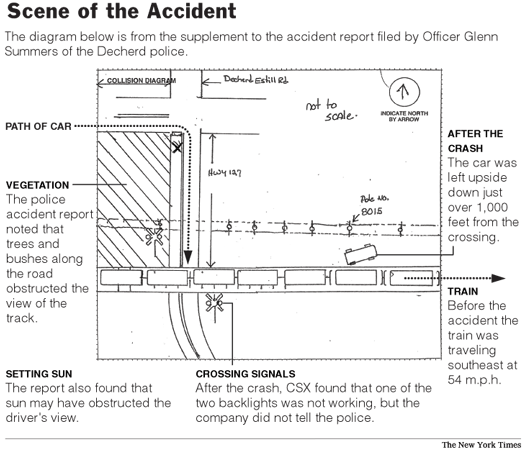
As a compromise, the state agreed to pay CSX $60,000. (In the mid-1990's, CSX faced far more serious complaints; it agreed to pay $5.9 million to settle civil fraud charges of overbilling the government for crossing lights and gates in several Southern states.)
Problems with warning signals got CSX into trouble with federal regulators early this year after an elderly couple were killed at a crossing near Rochester that had been plagued by malfunctioning signals. Local officials said that despite repeated complaints, the railroad had been slow to fix those signals and several others in the area.
And CSX has continued to have trouble with its reporting of crossing accidents. Last year, the railroad violated federal rules by failing to immediately inform the authorities of eight fatal crossing accidents, according to an analysis of federal records by The Times. They were reported later, but evidence was no longer fresh.
CSX says it has instituted improved reporting procedures, which have been praised by federal regulators. But in January of this year, the railroad once again did not call promptly with news of a fatal crash. Two teenagers were killed and a third seriously injured at a crossing in Miamisburg, Ohio, that had no warning lights or gates.
The railroad's spokesman, Mr. Hollingsworth, blamed "an administrative oversight" for the violation.
Jenny Nordberg contributed reporting for this article. Eric Koli contributed research.
© 2004, The New York Times Company
By Walt Bogdanich
It is no mystery why, one spring day two years ago, an Amtrak passenger train jumped the tracks near Crescent City, Fla., and skidded to a stop on its side, killing 4 people and injuring 142.
Investigators concluded that the track, owned by the big freight railroad CSX, had not been properly stabilized and that management's oversight of maintenance had been lax. But when millions of dollars in damage claims arose from the crash, it was not CSX, a multibillion-dollar corporation, that paid them. It was Amtrak, the perennial money loser that survives only with regular infusions of cash from American taxpayers.
Three months later, it happened again. Poor track maintenance by CSX caused an Amtrak train to derail in Maryland, investigators said, injuring nearly 100 people. Again, Amtrak covered claims against CSX.
In accident after accident, in derailments and grade-crossing collisions, CSX and other major freight railroads have used Amtrak to shield themselves from tens of millions of dollars in liability, an examination by The New York Times has found.
For three decades, Amtrak has been paying these liability claims, regardless of fault, as a condition for using the freight lines' tracks. Not only do these payments shift the burden of paying for negligence from profitable corporations to taxpayers, they remove an incentive for railroads to keep their tracks safe.
There has never been a full accounting of these payments. Even Amtrak officials could not say how much the arrangement, known as indemnification, has cost the railroad, which needed $1.2 billion in government subsidies this year to stay afloat.
But an analysis by The Times of records obtained through the federal Freedom of Information Act found that Amtrak has paid more than $186 million since 1984 for accidents blamed entirely or mostly on others. In each instance, freight railroads were accused of playing the major or a contributing role in causing those accidents, which killed 53 people and injured nearly 1,300, according to court records, government investigators and lawyers for crash victims.
Most of those accidents were not covered by Amtrak's insurance, an Amtrak spokesman said. And the $186 million reflects only part of Amtrak's costs stemming from accidents. The figure does not include payments made before 1984, outstanding claims from recent accidents, settlements of less than $100,000, the cost of repairing damaged Amtrak equipment and legal bills for defending the freight railroads in court.
These indemnity agreements represent another way in which some of the nation's freight railroads side-step responsibility in accidents. In July, The Times reported that railroads had destroyed, mishandled or simply lost evidence in grade-crossing accidents and had also failed to properly report hundreds of accidents to federal authorities.
Freight railroads have long had the political muscle to insist that Amtrak, which is beholden to Congress for its survival, indemnify them for accident claims. In 1997, after a federal judge questioned the legality of granting railroads blanket immunity, Congress rose to the defense of the freight railroads, passing a bill that, among other things, reaffirmed Amtrak's legal right to indemnify the freight lines.
Two years later, Amtrak officials said they had no choice but to cover $63.8 million in punitive damages, including interest, after CSX was found to have caused a fatal Amtrak crash in Lugoff, S.C. A judge called CSX's negligence "borderline criminal."
"It's a bitter pill to swallow," said an Amtrak spokesman, Cliff Black. "It hurts our bottom line. It hurts our treasury."
Amtrak says it has received about $8 billion in government support over the last decade, and last year alone paid about $100 million to use their tracks.
The freight railroads say indemnification merely protects them from risks they would not face if Congress had not insisted that Amtrak, which owns little track of its own, use their rails. Congress, CSX said in a statement, "balanced that demand on private property by calling upon passenger railroads to bear the costs of insuring against potential liabilities."
The freight lines also pointed out that indemnity agreements are common in the rail industry, since companies sometimes run their trains on another's tracks. And they dismiss the idea that such agreements discourage attention to safety. "We suffer great economic harm when our freight trains have accidents, and we go to great lengths to prevent accidents of all types," said Kathryn Blackwell, a spokeswoman for Union Pacific.
But those arguments do not sway Angelica Palank, who received the $63.8 million payment after her husband, Paul, a police officer, was among eight people killed in the South Carolina crash in 1991. A faulty CSX track switch caused the accident.
Ms. Palank said she gave eight years of her life to legal warfare against CSX. After raising her two children alone, suffering depression and enrolling in law school so she could better understand the case, she believed that justice had finally been done after the judge in her case upheld the jury verdict, calling CSX's carelessness and greed "the functional equivalent of manslaughter." She believed that CSX, chastened, might not misbehave in the future.
But several weeks ago, a Times reporter told her, for the first time, that the money she received by wire transfer had not come from CSX, but rather from Amtrak.
First came disbelief, then anger, and finally tears. "I'm mortified," she said. "Everything I've been living under is a lie. I was feeling on a personal level at least I did my part, and now I find out I didn't."
Origins of an Obligation
Amtrak's obligation to pay for the mistakes of others dates back to its first days. Created by Congress in 1970, Amtrak preserved passenger travel by allowing railroads to unload this money-losing service - which the railroads had been threatening to drop - onto a semipublic corporation.
But Amtrak still had to negotiate the terms for using tracks it did not own. The American Association of Railroads, the freight lines' trade group, made it clear that its members wanted no liability for passenger deaths and injuries even if they caused them. Amtrak, on the other hand, worried that such an agreement might be fiscally unsound and potentially unsafe for passengers, records show. It wanted liability assigned on the basis of fault.
Neither side appeared willing to budge. Then, just before the matter was to be turned over to arbitration, Amtrak tried negotiating with just one railroad, Burlington Northern, rather than the association, records show. Soon, Amtrak relented and signed an indemnity agreement that became a model for the industry.
Amtrak backed down, records show, after Burlington Northern argued that its tracks were safe and that disputes over fault might inflate the cost of settling claims. Ultimately, Amtrak agreed to cover accident claims from its own passengers and employees. The freight railroads were responsible for their own employees should they be injured by an Amtrak train.
How vigorously Amtrak pressed its case is open to question. Records show that when negotiations began, Burlington Northern was in a position to exert influence over Amtrak's affairs. Not only did its chairman, Louis W. Menk, sit on Amtrak's board, along with two executives from other freight railroads, but Burlington Northern also owned about 3.3 million shares of Amtrak's common stock, which it obtained in exchange for giving Amtrak rail equipment. Other railroads were also given shares.
Although the government owned the controlling shares in the corporation, the railroads did initially have a say in picking three of Amtrak's directors, with the government picking most of them.
"Was the fox in the hen house?" said Thomas M. Downs, who served as Amtrak's chief executive two decades later, from 1993 to December 1997. "Of course."
The negotiations over indemnity, Mr. Downs said he believed, were not conducted at arms-length among equals. "There was barely a railroad to negotiate with on the Amtrak side," he said, adding that Amtrak was dependent on the freight railroads to keep its passenger trains on schedule. "Freight railroads had all the marbles."
At the time, Mr. Black said some members of Congress believed that Amtrak would merely be a stepping stone to getting rid of passenger service. "Many observers thought it would just go away," he said.
But it did not, and indemnity agreements has haunted Amtrak for years, said Mr. Downs, who now runs the Eno Transportation Foundation, which seeks to improve different modes of transportation. "It was one of the things that always gave me heartburn in my dealings with the freight railroads, because there was no accountability."
Questions of Costs
Amtrak's indemnity payments stemmed not just from derailments but also from accidents at grade crossings.
Such was the case on Sept. 26, 1999, when an Amtrak train came barreling through tiny McLean, Ill. Two high school honor students, Stuart A. Curtis and C. Dannen Latherow, did not realize a train was approaching because an employee for Union Pacific, which owned the tracks, had accidentally disconnected the warning lights and gates, according to an investigation by the National Transportation Safety Board.
Both boys were killed. Amtrak paid $4 million to their families.
Amtrak paid considerably more - $32 million - after a jury concluded that Union Pacific bore prime responsibility for an August 1997 grade-crossing accident in Missouri. The jury said Amtrak played a minor role in that accident.
Local residents had complained about the difficulty in seeing approaching trains, partly because of overgrown vegetation. A state judge concluded that Union Pacific knew or should have known that the crossing was dangerous. In fact, another Amtrak train had killed a motorist there just four months earlier. And Amtrak paid for that accident, too - $1.7 million.
Mr. Downs said he had been concerned enough about having to pay for the mistakes of others that he called Union Pacific's chairman, Dick Davidson. As Mr. Downs recalls the conversation, "He said, 'That's not our job, that's yours. That's the price for carrying passengers on our railroad.' "
A spokeswoman for Union Pacific said that Mr. Davidson did not recall that conversation, and that it "would be inaccurate to quote him in this manner."
Last year, Amtrak paid the freight lines about $100 million for using their tracks. That figure is so low, according to the Association of American Railroads, that its members should be upset with Amtrak, not the other way around. The association sent The Times a copy of its own study for 2001 that said that the freight railroads actually gave Amtrak about $243 million in indirect subsidies by discounting the cost of using their tracks.
But Harvey Levine, a former economist for the railroad association - who now testifies on behalf of accident victims - said the association study ignored the fact that Amtrak was already shouldering nearly $1 billion in losses each year, losses that the railroads themselves would have faced had Amtrak not stepped in and assumed the burden of carrying passengers.
An Amtrak official said it was "completely bogus" for the association to suggest that Amtrak was not paying its fair and agreed-upon share. If the freight railroads could prove Amtrak was underpaying them, the official said, they would make an issue of it. But they have not, he added.
In fact, the inspector general for Amtrak, Fred E. Weiderhold Jr., said that over the last 10 years he had questioned about $54 million in billings that the freight railroads submitted to Amtrak. Those billings relating to track use were either unjustified or unsupported by records, Mr. Weiderhold said. Amtrak, he added, negotiated settlements with the railroads for about 30 percent to 40 percent of the disputed amount.
Most of Amtrak's accidents are not covered by insurance. Since 1995, Amtrak itself has had to pay all claims of up to $10 million for a single accident; before that, its deductible was $25 million for collisions and derailments, an Amtrak spokesman said.
Told of the size of some of Amtrak's indemnification payments, Frank Clemente, who runs the consumer group Public Citizens Congress Watch, said, "I think if the public knew this it would be up in arms."
Questions of Safety
Government officials in recent years have expressed concern about the safety of America's 200,000 miles of railroad track. Federal statistics show that in 2003 there were slightly more derailments than a decade ago, though train accidents over all have been dropping.
The effect on Amtrak has been a particular concern. In October 2002, worried about CSX's track-related accidents, particularly those involving passenger trains, an official of the federal Department of Transportation wrote a memorandum urging regulators to form a special task force to monitor CSX's track-safety programs, records show. That memorandum, from the department's inspector general's office, cited repeated attempts by the Federal Railroad Administration, dating back to the mid 1990's, to bring CSX's tracks up to standard.
In its statement, CSX said it had "invested more than $5 billion in track, signals, training and inspection programs over the last five years to make a safe railroad even safer." At the same time, CSX said that "it is not only false, it defies logic" to suggest any relationship between indemnity and CSX's, or the entire industry's, attention to safety. "The industry has dramatically improved safety since the type of Amtrak agreements you question were put in place in the 1970's," the statement said.
Still, the question of such a relationship was at the center of the most serious challenge to Amtrak's indemnity agreements.
On Jan. 4, 1987, an Amtrak train crashed into a Conrail train in Chase, Md. Sixteen people were killed and more than 174 were injured. Just before the crash, the Conrail engineer had used marijuana and had intentionally disabled an audible warning device in his cab. The engineer later pleaded guilty to manslaughter and was sent to jail.
Amtrak argued in federal court that Conrail's wrongdoing was so egregious that any indemnity payments would violate public policy. The judge, Oliver Gasch of Federal District Court in Washington, agreed - in part. He wrote that Amtrak officials who negotiated the original indemnity agreement "were deeply concerned about the maintenance of safety" and did not intend for the agreement to "deprive the traveling public of its reasonable expectation" that Conrail would operate safely. To insulate Conrail from punitive damages, he concluded, "would render meaningless" the obligation of Conrail to meet safety standards.
Even so, Amtrak ended up paying compensatory damages of $9.3 million.
Judge Gasch's decision caused considerable unease among the freight railroads, said government officials. Concerned that their liability protection was being chipped away, the freight railroads turned to Congress for help. In 1996 and 1997 alone, records show, the freight railroads spent $35 million lobbying Congress on different issues, including indemnity. And eventually, Congress put its weight behind the indemnity agreements, passing the Amtrak Reform and Accountability Act of 1997.
Biggest Payout Yet
Two years after enactment of the 1997 law, CSX used the indemnity agreement as a shield against the biggest payout yet - the $63.8 million in punitive damages, including interest, paid to Mrs. Palank.
Arthur J. Franza, the judge in her case, was harshly critical of CSX for eliminating too many maintenance workers. "Although cost-cutting measures may have saved defendant over $2 billion, society paid the cost with eight human lives," Judge Franza said.
Mrs. Palank said she had pursued the punitive damages with the understanding that CSX, not Amtrak, would pay it. And for years, she said, she believed that CSX indeed had. For good reason, according to one of her lawyers, F. Gregory Barnhart, who said records show that Mrs. Palank's money was sent to her by CSX.
Her other lawyer, Christian D. Searcy, said he had even asked Amtrak officials to state in writing whether they had reimbursed CSX. "They said no letter will be forthcoming," Mr. Searcy said.
Mrs. Palank said the jury was never told that CSX would escape the sting of its verdict. "It's so secretive, so manipulative," she said. "Someone in the federal government needs to answer for this, because there was no legal justification for them to be paying for somebody else's wrongdoing."
Mark Geistfeld, a law professor at New York University, said indemnification, a form of insurance, has its limits. "Certainly, you cannot get insurance for criminal fines, for example," Professor Geistfeld said. "It's against public policy. No court would enforce it." But, whether Amtrak should have paid in this case depends on what kind of behavior you are talking about, he added.
Mr. Downs, the former Amtrak chief, said that after the railroad's lawyers told him Amtrak could not escape paying the punitive verdict, he called John Snow, then CSX's chief executive, to complain. Mr. Snow, now President Bush's treasury secretary, said in essence that a deal was a deal, Mr. Downs recalls. Mr. Snow declined to discuss the conversation or the case. CSX also declined to comment specifically on Amtrak's payment of punitive damages.
Amtrak's obligation did not end with the $63.8 million payment to Mrs. Palank, though. It was also responsible for $24 million in compensatory damages to her and other crash victims, for a total of $88 million. For causing the accident, CSX paid the Federal Railroad Administration the maximum fine - $20,000.
"It's very difficult to convince railroads that the carrying of people has a higher standard of operating discipline and safety than, say, coal," Mr. Downs said. "And the reason I think that is, is that they are immune from any cost."
At about the same time that the Palank case was working its way through the courts, in fact, CSX was working on a different front to soften its litigation costs. It played a prominent role in a business coalition that helped persuade the Florida Legislature in 1999 to change liability laws in the state, imposing limits on punitive damages, for example.
"We, like many other companies across the country, support a civil justice system that is fair and balanced," said Adam Hollingsworth, a CSX spokesman. CSX, said Mr. Hollingsworth, who has since left the company, wants to make sure "that those responsible for injury pay their portion of fault."
Claire Hoffman, Eric Koli and Jenny Nordberg contributed reporting for this article.
© 2004, The New York Times Company
By Walt Bogdanich
Federal inspectors were clearly troubled by what they had been seeing in recent years at Union Pacific. According to their written accounts, track defects repeatedly went uncorrected; passenger trains were sent down defective tracks at speeds more than four times faster than were deemed safe; and engines and rail cars were dispatched in substandard condition.
Soon, the inspectors from the Federal Railroad Administration began talking tough: bigger fines and more of them. But as they began to crack down on the railroad, they found themselves under fire from an unexpected quarter: their boss, the agency's deputy administrator, Betty Monro.
Ms. Monro demanded to know why agency officials had not pursued the less punitive "partnership" approach that she favored, according to a July 2002 memo from her and the agency's chief at the time, Allan Rutter. A year later, in a senior staff meeting, Ms. Monro rebuked her subordinates as being "overly aggressive" toward Union Pacific, according to one person present.
Ms. Monro, who now runs the railroad agency, was in a position to know just how unhappy her inspectors were making officials at Union Pacific. She and the railroad's chief Washington lobbyist, Mary E. McAuliffe, are longtime friends and have vacationed together on Nantucket several times since Ms. Monro joined the agency in 2001.
The railroad industry and its federal overseer have long been closely intertwined. And increasingly, like many other federal regulators, the Federal Railroad Administration has emphasized partnership as the best, quickest way to identify, and fix, safety problems from the roots up. But the story of its recent oversight of Union Pacific - spelled out in a series of internal memorandums from agency officials and inspectors - raises questions about whether this closeness has actually served to dull the agency's enforcement edge.
Critics of the agency say that it has, over the years, bred an attitude of tolerance toward safety problems, and that fines are too rare, too small and too slowly collected. Those concerns have been underscored recently by a number of major Union Pacific derailments in Texas and California, including one in which the release of poisonous chlorine gas killed a woman and her daughter in their home near San Antonio.
The ties between industry and regulator are many-layered.
Another big railroad company, CSX, offered the agency's chief safety official a job potentially worth $324,000 a year, with bonuses and stock options, while he was visiting railroad headquarters to discuss safety problems. After the official, James T. Schultz, accepted the job several days later, a federal watchdog asked that agency officials be instructed on the ethics of discussing job offers.
The agency promotes the rail industry on its Web site, calling it "safe, fuel efficient, environmentally friendly." It has lent millions of dollars to struggling railroads and has helped finance the industry's nonprofit educational campaign, which emphasizes the responsibility of motorists - and not the railroads - in avoiding grade-crossing accidents.
The industry is a rich source of campaign contributions, mostly to the Republicans, with Union Pacific as the biggest giver. Its corporate political action committee was among the top 10 donors to Republican candidates for this election cycle, and Ms. McAuliffe is the treasurer of the company's PAC. The railroad's chairman, Dick Davidson, is identified by the Bush campaign as a "Ranger," having raised more than $200,000 for the president. Until he became Mr. Bush's running mate in 2000, Dick Cheney was a member of the Union Pacific board.
George Gavalla, who was the F.R.A.'s associate administrator for safety at the time of the efforts to crack down on Union Pacific, said in an interview in August that at times he felt pressured by his superiors to go easier on the railroad - something Mr. Gavalla said he refused to do.
"Every time we do some significant enforcement, particularly on Union Pacific, I would be called in and asked why," said Mr. Gavalla, who has since left the agency.
The F.R.A., asked about why Mr. Gavalla left, would only say that he resigned this fall.
The agency also vigorously denies that it tried to get Mr. Gavalla, or anyone else, to let up on Union Pacific.
In separate statements, the agency and Union Pacific say the railroad has worked diligently to improve its safety record. And any accusation of favorable treatment, the F.R.A. said, is disproved by the fact that over the last four years Union Pacific "has been inspected more times, has received more violations and has paid more in fines than any other railroad." Union Pacific says it paid $4.1 million in fines last year.
The F.R.A. declined through a spokesman to make Ms. Monro available for an interview, but her former boss, Mr. Rutter, defended her vacations with Ms. McAuliffe, saying they were not only proper but beneficial to regulators.
"Frankly, the business intelligence that we could gather helped us in understanding how our enforcement method was being perceived," said Mr. Rutter, now deputy executive director of the North Texas Tollway Authority.
But Charles Lewis, who runs the Center for Public Integrity, a nonprofit watchdog group in Washington, said the vacations merely underscored "the level of incestuousness between the railroad industry and the regulator."
And the recent derailments have caused some government officials to question the F.R.A.'s oversight of Union Pacific. After five derailments in five months near San Antonio, Senator Kay Bailey Hutchison, Republican of Texas, asked for a federal investigation into the company's operations in the area. Two of those derailments occurred near a high school; in another case, two engines plunged into a creek, spilling diesel fuel. "People are asking now, 'What's going on?' " said Mayor Edward D. Garza of San Antonio.
In California last month, a Union Pacific train derailed east of Los Angeles, damaging two houses, spilling fuel, cutting off electricity to 100 houses, and forcing the evacuation of 24 homes. A little more than a year earlier, in the same county, a runaway train raced through residential neighborhoods at speeds up to 95 miles per hour before derailing, injuring 13 people and damaging or destroying 8 houses.
Kathryn Blackwell, a spokeswoman for Union Pacific, said the most recent derailments were still under investigation but added that derailments had been declining since 2001. "We have a lot more at stake in preventing derailments and accidents than does the F.R.A.," Ms. Blackwell said.
The Federal Railroad Administration began to emphasize its partnership approach in 1995. "We start with the assumption that railroads and their employees want to promote safety for their own benefit, not just because a law or regulation requires it," the F.R.A. would later explain.
Supporters of this approach, called the Safety Assurance and Compliance Program, say it has sharply reduced accidents by focusing on big-picture problems, rather than minor rule infractions. But, according to longtime critics of the F.R.A., the industry and its overseers have sometimes taken the concept of cooperation too far.
In October 1997, the F.R.A.'s associate administrator for safety, James T. Schultz, visited CSX's corporate headquarters in Jacksonville, Fla., to discuss serious safety problems at the railroad. During his visit, CSX officials on three successive days discussed employment possibilities with Mr. Schultz, according to an inspector general report.
Several days later, Mr. Schultz accepted CSX's offer to be the railroad's vice president and chief safety officer. The federal watchdog found "no evidence that Schultz violated any criminal conflict of interest statute."
A CSX spokesman said Mr. Schultz, who has since left the company, helped to make the railroad safer.
Some rail-safety advocates say the agency suffers from a reluctance to impose punishment, which has made it less willing to investigate problems. The agency acknowledges that it levies fines for roughly 2 percent of all violations that it finds. The New York Times recently reported that the F.R.A. last year investigated fully just 4 of about 3,000 grade crossing accidents and that the agency had failed to enforce its own rules requiring that railroads promptly report grade crossing fatalities.
"There are a lot of really good people in the F.R.A. who are concerned about safety, but they unfortunately are not making the command decisions," said Paul F. Byrnes, who worked as a lawyer with the agency from 1998 to 2001 and now consults for a law firm that sues railroads. The agency's leadership, Mr. Byrnes said, had for a time referred to the railroads "as our customers."
In April 2002, after reviewing the F.R.A.'s effort to improve the safety of one railroad company's tracks, the inspector general reminded the agency that on occasion it "will need to act more as a regulator and less as a partner."
Mr. Gavalla, who replaced Mr. Schultz as the agency's safety chief, said he supported the partnership approach. But when it failed to work at Union Pacific, Mr. Gavalla said, he and his staff began a multi-region crackdown on the railroad, with more inspections and more fines. Mr. Rutter and Ms. Monro, he said, were not pleased.
In a July 2002 memo, for example, they asked Mr. Gavalla to justify the crackdown. While they said they accepted Mr. Gavalla's decision, Mr. Rutter and Ms. Monro wrote that it "raises questions about whether our newer enforcement philosophy could have been applied in this particular situation."
In the minds of some F.R.A. inspectors, a tougher approach was necessary. A series of internal agency memorandums obtained by The Times showed that agency inspectors were worried that Union Pacific management had not been doing enough to keep their trains and tracks safe.
In one F.R.A. memo, dated May 1, 2002, an inspector said he found 400 track problems near O'Hare International Airport in Chicago. He warned that an accident could cause the release of hazardous materials, and added, "Consider the mass evacuation, chaos, injury and maybe death that could result from such a catastrophe."
The inspector wrote that he believed Union Pacific was "either ignoring the conditions at this facility'' or "not conducting thorough inspections."
In another memo, from November 2002, F.R.A. inspectors said that because Union Pacific had done a poor job of fixing track defects near Shreveport, La., trains should not have been allowed to go faster than 10 to 15 miles per hour. Even so, the inspector said, the railroad raised the speed of the track back up to 75 m.p.h. for passenger trains and 70 m.p.h. for freight trains.
But the findings that most troubled the inspectors occurred in Union Pacific's North Little Rock service area in Arkansas. In a July 2003 memo, F.R.A. officials said Union Pacific's own inspectors had told them that railroad managers "had interfered with their ability to perform inspections." According to that memo, the agency had found conditions "so egregious that it was apparent that the railroad inspectors were not identifying defects in the track, and were doing so with their managers' tacit approval."
The officials further charged that some violations had been "willful," according to the July memo.
That same month, Mr. Gavalla said he and his senior staff visited Union Pacific headquarters in Omaha to discuss safety issues. But just before the meeting, Mr. Gavalla said, Betty Monro told the F.R.A. staff that over dinner the previous night, Union Pacific officials had angrily complained that the agency had been picking on them. Mr. Gavalla said he recalled Ms. Monro saying that that conduct was not going to be tolerated.
Later, Mr. Gavalla said Ms. Monro gave him an e-mail message from Ms. McAuliffe. "The nature and degree of these fines call into question the credibility of F.R.A. senior management who have expressed a desire to work with the railroads and Union Pacific in a performance-based partnership," Ms. McAuliffe wrote.
Though the F.R.A. would not comment on the friendship between Ms. Monro and Ms. McAuliffe, the Union Pacific spokeswoman, Ms. Blackwell, said the two women had been friends for more than 25 years, "long before either of them was involved with railroads."
Ms. Blackwell said each woman paid her own expenses during the five vacations they took together - sometimes with other people - after Ms. Monro joined the F.R.A. in 2001. "Ms. McAuliffe and Ms. Monro were aware that this friendship would put them under scrutiny by some people who may question the appropriateness of the relationship. That is why they chose to continue the friendship in an open and honest way."
The F.R.A. and Union Pacific said the friendship did not affect how the agency dealt with the railroad. Said Ms. Blackwell, "To suggest that U.P. received preferential treatment due to this friendship - or due to political contributions - would be dead wrong."
Jenny Nordberg contributed reporting for this article.
© 2004, The New York Times Company
By Walt Bogdanich
Judge Jack T. Marionneaux said the offer took him by surprise. Two years ago, while presiding over a state lawsuit involving a motorist killed at a Louisiana railroad crossing, Judge Marionneaux said he was among several people invited to ride on a train and learn about grade-crossing accidents.
"It was really a bit strange," Judge Marionneaux said in court proceedings. "I had never been called by a railroad to go take a ride until I got this case."
The train ride, staged for police officers and judges to demonstrate how drivers dart in front of trains, was part of a publicity campaign developed by a nonprofit rail-safety group called Operation Lifesaver. The group's message - which emphasizes the role of drivers, not the railroads, in causing crossing accidents - echoes the railroad industry's consistent courtroom defense. The invitation, the judge said, "offended me."
Judge Marionneaux declined the offer. He also vowed to empanel a grand jury if another such campaign was mounted during the trial.
Nor was he alone in worrying that Operation Lifesaver's message might taint the legal process. Since 2001, two other judges have taken action to stop the group from conducting publicity campaigns around the time of trials.
Operation Lifesaver is the nation's most influential rail-safety group, preaching its gospel of driver responsibility to judges, police officers, elected officials and the news media. No one disputes the value of its message - that drivers should pay attention at rail crossings - or the dedication of many of its volunteers. And its work is widely praised by police and community groups.
But documents show that the organization is tightly bound to the railroad industry, and critics, including many accident victims, say the group's message serves another agenda: to inoculate the railroads against liability in grade-crossing collisions.
Not only did a railroad help found Operation Lifesaver; rail industry officials make up half the organization's national board and provide much of the financing for its state chapters. It also gets millions of dollars from the railroads' federal regulator, which is itself closely intertwined with the industry.
And even as Operation Lifesaver speaks out about changing drivers' behavior, it spends little time on a range of safety matters that are the responsibility of the railroads and is largely silent on the benefits of warning lights and gates, which many experts say are among the most effective of all safety devices.
In the view of its critics, Operation Lifesaver is another way the rail industry seeks to sidestep responsibility in grade-crossing accidents. This summer, The New York Times reported that railroads in some cases had destroyed or failed to keep important evidence in fatal grade-crossing cases and had failed to properly report hundreds of car-train collisions to federal authorities.
Blaming the Public?
Leila Osina said she was fired in 1995 as Operation Lifesaver's executive director after she objected to what she considered the group's pro-railroad slant. "The message was to blame the public for all railroad accidents and absolve the railroad from any responsibility," Ms. Osina said in a statement in 2000 in connection with a federal court case in Arkansas involving a car-train accident.
Operation Lifesaver's position is that the police and judges should crack down on drivers who do not obey traffic safety laws at crossings, but it offers little criticism of railroads that fail to remove overgrown vegetation at crossings, or fail to fix warning signs and signals, or fail to make sure that trains properly sound their horns and obey the speed limit.
An internal document from before 1995 also shows that speakers were instructed not to use terms like "rough crossing," "dangerous crossing" or "speeding train." Those terms "carry a negative connotation" and detract from the group's safety message, the document states.
Operation Lifesaver says this document is no longer used.
The current executive director, Gerri L. Hall, says her group is simply an educational organization with no hidden agenda. "Our education program isn't about who's at fault, it's about how a driver can take a role in safety," Ms. Hall said. "We want to empower them to make choices that are good. It isn't about placing blame."
Ms. Hall, who has led Operation Lifesaver since 1995, said that while some local volunteers had made unacceptable statements about the group's work in the past, she had worked to standardize its message. She said the group made safety presentations last year to about 1.3 million people, and she said that federal authorities say it has saved 11,000 lives since 1972. She also said Operation Lifesaver received "substantial" support from nonrailroad sources.
As for the comments made by Judge Marionneaux in Louisiana and the court actions to stop Operation Lifesaver from conducting its media campaigns, Ms. Hall said she was unaware of the events that led to them.
Vicky Moore, whose son was killed nine years ago at a rural Ohio crossing where at least six other people have died, says she believes Operation Lifesaver lets railroads off the hook. "Everybody has a shared responsibility here, not just the driver," she said. "We do not feel that Operation Lifesaver represents the families or victims of this type of tragedy."
Ms. Moore and her husband, Dennis, try to do what Operation Lifesaver does not - with the money from their settlement with Conrail, they run an educational foundation that, among other things, helps finance the installation of lights and gates. They also erect billboards that offer another reason for grade-crossing collisions: "Bad Crossings Kill Good Drivers," one of their signs states.
Theirs is an issue that cuts angry and deep in the heart of rural and small-town America. On average, one person is killed every day at a railroad crossing. And while deaths have fallen sharply from a decade ago, there were 255 through August of this year, a 20 percent increase over the same period in 2003, according to the Federal Railroad Administration.
'A Tremendous Success'
Operation Lifesaver was co-founded by Union Pacific Railroad in Idaho in 1972 and quickly spread to other states through independent chapters. By 1986 there were many state chapters and the national version of Operation Lifesaver was incorporated by the Association of American Railroads, an industry trade association; Amtrak; and the Railway Progress Institute, a rail equipment supply group.
Since Ms. Osina left the national group, its board has expanded to include more members from outside the rail industry. It now has 10 voting members - half of them from the industry.
"We know what a tremendous success Operation Lifesaver Inc. has been," said Allan Rutter last fall before he stepped down as chief of the Federal Railroad Administration, which regulates the industry. The agency backs his words with taxpayer money; it has contributed $7 million since 1997. Two other agencies, the Federal Highway Administration and the Federal Transit Administration, have collectively kicked in a similar amount.
Even so, the Operation Lifesaver program pays scant attention to unsafe crossings.
According to minutes of a 1992 meeting of Operation Lifesaver's development council, the signal-workers union notified the group that "warning device malfunctions are a factor in driver behavior at railroad crossings" and that the police should be told of this. The minutes show that the recommendation was unanimously rejected. Ms. Hall of Operation Lifesaver said she knew nothing of the meeting because it happened before she arrived.
On the issue of lights and gates, Ms. Osina, the former executive director, said she came to believe that the railroads did not want them.
"The board of directors openly acknowledged an aversion to the installation of lights and gates because of the maintenance cost for those devices," Ms. Osina said in her 2000 court statement. The government pays for the installation of lights and gates at crossings, but railroads must keep them working properly.
Their value was underscored in 2001 when the Missouri Supreme Court upheld a verdict against Union Pacific after an accident at a grade crossing that did not have lights and gates. In that case, the court noted, a Union Pacific representative said lights and gates reduced the probability of accidents by as much as 90 percent.
Ms. Hall said Operation Lifesaver did not advocate more lights and gates at crossings because it is "beyond the scope of what Operation Lifesaver is trying to do." By taking a position on the issue, she said, "the next thing that would happen to us is we would spend all of our time in court, I suppose, or be dragged into discussions with Congress about lights and gates and who will pay for them."
Although lights and gates are in place in fewer than half the nation's rail crossings, Operation Lifesaver emphasizes driver attitudes, arguing that impatient drivers often go around gated crossings.
Working With the Police
After a grade-crossing accident, Operation Lifesaver often offers its representatives as experts to be quoted in the local press. The group also tries to educate police officers through a program called Officer on the Train. Police officers, public officials and the news media are invited onboard a train with a camera mounted on the front of the engine. When drivers cross in front of the train, the police officers radio ahead to other officers waiting in cars, who then issue tickets to the drivers.
The resulting news coverage conveys a message espoused by the railroads. During one such train ride in 1996, for example, a police officer was quoted by a St. Louis newspaper as saying, "People are still running the gates and winning big lawsuits."
Operation Lifesaver also reaches out to the police is on its Web site with 14 "tips for law enforcement officers" who might end up investigating a car-train collision. After tips on how to safely secure an accident scene, the first mention of a possible cause for the accident is No. 7: "Look for evidence of suicide."
An older Operation Lifesaver guide, no longer used, noted that "a significant number of grade crossing 'accidents' are cleverly disguised suicides." The guide further stated that "the lack of physical evidence should not rule out that probability."
Some drivers do commit suicide at grade crossings, though the exact number is not known. But some families of accident victims say railroads unfairly raise the specter of suicide as a way to escape responsibility for crashes.
In addition to police officers, Operation Lifesaver also focuses on judges with its message that reckless drivers are to blame for rail-crossing accidents. One way to reach them was outlined in a document titled "How to Gain the Attention of Judges," which suggested that the group's members "find out which judges are running for election and invite them to an interview to express their opinions."
Asked about the document, Operation Lifesaver said in a statement that a judge created it and distributed it at a national Operation Lifesaver conference in 2000. That judge, the statement said, believed other judges should know "about the importance of enforcing grade-crossing violations by drivers and railroad trespassing violations by pedestrians."
Judge Marionneaux of Louisiana said in October 2002 that Operation Lifesaver had crossed the line when it invited him to participate in Officer on the Train. "It looks like it's a simple invitation without any point," he said in court proceedings, noting that he was not the only judge invited to go along. "But what is the reason to ask a judge to go ride on a train?" The judge did not cite any evidence that the event was designed to influence his views or the jury's, but he said it made him feel uncomfortable nevertheless.
In another rail-crossing case, William R. Wilson Jr., a federal judge in Arkansas, tried in August 2001 to stop Operation Lifesaver from running its publicity campaign during the trial. Judge Wilson said he felt the order was necessary after a two-day regional event in which the news media and police officers were given train rides.
"I'm sure that a lot of crossing accidents are primarily due, or solely due, to driver disregard, negligence, trying to beat the train or whatever," Judge Wilson said in court proceedings. But he also said some of the educational materials did not "seem balanced," failing to mention that railroads sometimes "don't blow the whistle or sometimes they speed or sometimes crossings are not repaired right or sometimes the railroad lets vegetation grow up."
James Johnson, a former grade-crossing safety coordinator for Southern Pacific Railroad - now part of Union Pacific - testified in 2000 in yet another grade-crossing case that on two occasions he helped arrange Officer on the Train programs to coincide with trials.
Elizabeth S. Hardy, a lawyer who represents accident victims, said that on one occasion she had just picked a jury in a grade-crossing case "and the very next morning" Operation Lifesaver's message was being heard "eight to 10 times a day on television, on the radio."
Ms. Hardy, who late last year obtained a court order to stop the group from running a media blitz during a trial, complained that the railroads used the news media to show how their employees "suffer grievously" because of accidents caused by "stupid" motorists.
A spokeswoman for the Association of American Railroads said it was "patently false" that the industry used Operation Lifesaver to further its own agenda. Ms. Hall, the group's executive director, agreed.
"These are good people, and they are being besmirched by innuendo," Ms. Hall said. "This is a good organization with big hearts." She said plaintiffs' lawyers were behind the criticism of her group because, with the number of rail-crossing deaths declining, "they are losing their base of operation." Operation Lifesaver, she added, wants to look at all factors involved in accidents, including dangerous crossings.
But Ms. Moore, the mother whose son was killed by a train, remains unconvinced. She asked to join Operation Lifesaver's board last year, but the board unanimously rejected her, saying the group did not wish to become involved in "advocacy." Why, she asked in a letter to Operation Lifesaver, is she called an advocate, when railroad officials on the board are not?
Ms. Moore says she never received an answer.
Jenny Nordberg and Eric Koli contributed reporting for this article.
© 2004, The New York Times Company
By Walt Bogdanich
It was late afternoon on July 14, 2002, when Amtrak train No. 391 pulled out of Union Station in Chicago, bound for Southern Illinois. Several hours later, the train began to run a gantlet of hazardous highway crossings where gates and warning lights malfunctioned, endangering both passengers and motorists.
The first problem arose at a crossing in Cumberland County. Eight miles down the track, it happened at another crossing. Then another. And another. By the time Amtrak 391 reached the small town of Odin, signals at seven crossings had failed to give drivers proper warning of at least 20 seconds, according to federal records.
And on the same day in the same general area, northbound Amtrak train No. 392 encountered "short warnings" at another four crossings. Two days later, the trains ran through a total of seven more short signals.
No one was injured on either day. But three years earlier, on the same track north of these crossings, 11 Amtrak passengers were killed and 89 injured when a train slammed into a truck loaded with steel at a crossing in the town of Bourbonnais. Federal investigators blamed the truck driver for ignoring a proper warning signal, but the state police, witnesses and most recently a judge concluded that a short warning was a factor in the crash.
The railroad industry and its overseer, the Federal Railroad Administration, have long maintained that signal malfunctions pose little danger and that accidents caused by them are "extremely rare."
But last week, after The New York Times began asking questions about signal problems, federal regulators disclosed that since a fatal accident in Michigan in the spring, they have been investigating whether a "type of Amtrak train" might be failing to trigger warning signals properly. And an examination of reported signal malfunctions indicates that they may constitute a wider problem, also involving freight trains.
A Times computer analysis of government records found that from 1999 through 2003, there were at least 400 grade-crossing accidents in which signals either did not activate or were alleged to have malfunctioned. At least 45 people were killed and 130 injured in those accidents, according to the records, although in most cases the role of signal malfunctions was unclear. Federal rules require that railroads maintain signals on tracks they own.
The accident reports, all prepared by the railroads, also raise questions in many cases about whether unsafe behavior by drivers contributed to the accidents. In addition, since 2000, railroads filed about 2,300 reports of the most serious types of signal malfunctions: short signals or no signals at all. Most of these malfunctions did not involve accidents.
"My concern is that this is just the tip of the iceberg," said James E. Hall, a former chairman of the National Transportation Safety Board. "If we had that type of record in aviation, it would be unacceptable."
In February, after a husband and wife were killed near Rochester, at a crossing where the signal had been disabled for maintenance, the Federal Railroad Administration inspected 199 area rail crossings maintained by the railroad company CSX. The agency found that nearly half had defects. Though most of the defects were deemed "relatively minor," they were found to be serious at 12 crossings, the agency said. CSX has since made major repairs to crossings in the area.
The railroad administration's investigation of Amtrak began after a woman and her 15-year-old daughter were killed by a train in Charlotte, Mich., in April when, the police say, a warning signal activated too late. The same railroad that owned the Illinois tracks in the 2002 incidents - Canadian National Railway - also owned the tracks in Charlotte and was responsible for maintaining the signals in both areas.
Canadian National said in a statement to The Times that it did not believe that the short signals in Illinois showed "a significant or persistent problem, or otherwise reflected systemic issues regarding CN signal performance, inspection, maintenance, or repair." The railroad declined to comment on the Charlotte fatalities until the railroad administration completed its investigation.
Warning signals are triggered when an approaching train causes an electrical current to pass from one rail to the other. Last week, the railroad administration said its preliminary investigation of the Charlotte crash had concluded that the warning signal malfunctioned, possibly because Amtrak's braking equipment and practices, along with accumulated material on the tracks, had impeded the electrical current.
The agency said there was no connection between the short signals in Illinois and the Charlotte accident, though both appear to have involved a buildup of different substances on the tracks.
"Passenger locomotives are generally lighter than freight locomotives and use different types of braking equipment," a government official involved in the Michigan investigation said. He added that the problem was "very intermittent" and had been detected only "regionally."
In a statement, an Amtrak spokesman, William Schulz, said that all of its locomotives and most of its cars had the same kind of brakes, and that there have been "no instances" where Amtrak trains have been found to cause short signals. But with an "abundance of caution in mind," Mr. Schulz said, the passenger service changed some braking equipment and procedures on the Michigan line after the Charlotte accident.
The frequency of signal malfunctions is difficult to assess, because railroads do not have to report all malfunctions and because proving that an error occurred is often difficult after an incident.
According to government data, some 9,500 calls about signals were lodged in 2003 in Texas, which has the only statewide government hot line for problems at grade crossings. Several Texas crossings have been the subject of scores of complaints in recent years. Some callers were reporting the same problem.
Chronic signal malfunctions are not only hazardous, but also burdensome for police departments, especially smaller ones, because they must often send officers to safeguard motorists at problem crossings.
Peggy Wilhide, a spokeswoman for the Association of American Railroads, played down the significance of signal malfunctions, saying a recent federal report found that the great majority of crossing accidents were caused by unsafe drivers. Ms. Wilhide also emphasized that most of the reports of signal malfunctions could not be confirmed.
"I would put our safety record up against any industry," she said.
A spokesman for the Federal Railroad Administration, Steven W. Kulm, said his agency's efforts had "contributed to the dramatic decrease in the loss of life and injury at highway-rail grade crossings." The federal authorities "aggressively review" all reports of signal failures, Mr. Kulm said, adding, "More than 9 of every 10 accidents occurred when the grade crossing warning system was functioning properly."
Federal rules define signal malfunctions as those that give drivers a warning of less than 20 seconds, or that activate when no train is approaching. The latter, called a false activation, is potentially dangerous because drivers may be led to ignore signals that they believe are not working. False activations are the most common signal problem, officials say.
"Americans are impatient, they are only going to sit for so long," said George Gavalla, a former top safety official with the railroad administration. "They will say the gates or lights are not functioning, and they are just going to go."
For that reason, Mr. Gavalla said, after accidents the agency requires railroads to report any possible or confirmed signal that lasts more than 60 seconds without a train entering the crossing. "That's outside what is considered to be a reasonable time frame," Mr. Gavalla said.
Mike Stead, who oversees rail safety for the Illinois Commerce Commission, said he was unaware of any warning system in his state that was designed to operate longer than 60 seconds with no train present.
Warning signals can fail for various reasons, experts say. Salt, dirt, heavy rain and other substances can interfere with electrical conductivity and wiring. Poor maintenance by the railroads contributes to the problem. So does aging equipment, said Tom Woll of the railroad administration.
In some cases, records show, railroad workers have accidentally disconnected the warning system, or disabled signals during maintenance without providing alternate ways to warn drivers, like flagging them at the crossing. The latter issue was the subject of a 2002 agency advisory.
Even so, the problems have continued. In the crash near Rochester this year, CSX disabled a signal while trying to learn why it was malfunctioning. With no warning signal, trains were supposed to stop at the crossing, then have crews flag motorists, but on the morning of Feb. 3, a CSX train failed to stop, striking the car of John O'Connor and his wife, Jean, killing them.
Of the grade-crossing accidents in the Times analysis, roughly 17 percent involved rail maintenance or inspection equipment that, according to the rail industry, is not designed to activate the warning signals. Most of this equipment, the railroad administration said, weighs too little and has too few wheels to trigger the warning signal. Nearly 30 people were injured in these collisions from 1999 through 2003, government records show.
Proving that a signal malfunctioned can be difficult. In the more than 400 accidents in the Times analysis, 30 percent of the signal problems were listed as confirmed. The rest were listed as "alleged," meaning that a technician checked the signal later and found no problem, said Ms. Wilhide, the spokeswoman for the Association of American Railroads.
But determining what happened at the time of an accident is possible only at those signals equipped with devices to record when a warning is activated and the position of the gates when the crash occurred. Most signals lack such devices. More often, the determination comes down to what witnesses say, and their accounts may differ.
Even when no accident occurs, the Federal Railroad Administration requires railroads to report to a separate database when signals fail to give drivers a sufficient warning. The required 20 seconds are necessary because gates do not descend instantly. They typically begin to lower four to five seconds after signal activation and take about five seconds to be fully deployed. The reports in this federal database, however, often provide few or no details on the signal malfunctions.
This database does not reflect every signal that fails to operate properly. The most common problems, false activations, are not included. Also, according to the rail industry, if a malfunctioning signal is taken out of service so it can be worked on, it does not have to be reported separately to the signal problem database - even if an accident occurs - because the signal did not technically fail; it was simply out of service.
In the summer of 2002, 27 short signals on the Canadian National tracks in Illinois were reported to the federal database. Some signals were short by only a second or two, but most reports did not specify the length of time. Records show that after the malfunctions were discovered, Canadian National temporarily lowered the allowable train speed for all railroads using the affected tracks. The railroad administration said the problems "were primarily related to deposits from freight spillage that caused a buildup of material on the rail surface." Since then, it said, steps have been taken to improve the sealing of railroad cars that carry grain.
An Amtrak spokesman said he was unaware of the Illinois short signals until The Times asked about them. The passenger service, he added, does not keep records of signal malfunctions that involve its trains. Amtrak's president, David L. Gunn, said in an interview that he believed that freight railroads tried their best to maintain warning signals.
Even so, Mr. Gunn said he found the apparent breakdown in Illinois troublesome.
"Absolutely," he said. "Any failure like that will put somebody in danger."
In the Michigan crash last April, that danger proved fatal to Melanie Pouch and her daughter, Meghann, according to witness accounts. Ten people said the train had entered the crossing when the warning gates began to descend. About a month later, the police officially concluded that the signal malfunctioned.
Nonetheless, Canadian National's accident report still states that the signal is only alleged - but not proved - to have malfunctioned.
"It's clearly inappropriate of the railroad to call this an alleged malfunction," said Bryan J. Waldman, a lawyer representing Mrs. Pouch's estate. "Corporations speak about how injured people need to take responsibility for their own actions, and corporations need to take responsibility for their actions."
In several fatal accidents, signal problems were reported before and after the accidents. For example, at the Bourbonnais crossing where 11 Amtrak passengers died, four false activations were confirmed in the year before the crash and two short signals occurred within a month afterward, records show. (Canadian National Railway did not, at the time, own that track, so it had no maintenance responsibility for that signal.)
The Rochester-area crossing where two people were killed had also been the subject of repeated complaints. And in the month after the Michigan crash, the police received two reports of Amtrak trains going through the crossing without the gates being properly lowered, records show. In that same period, two other crossings with signals on the Amtrak line in the area were reported to have malfunctioned.
A Canadian National spokesman denied that those malfunctions occurred.
Jenny Nordberg, Jo Craven McGinty and Tom Torok contributed reporting for this article.
© 2004, The New York Times Company
Biography
Walt Bogdanich became the investigations editor for the Business and Finance Desk ofThe New York Times in January 2001. He recently was named an assistant editor for the paper's newly expanded Investigative Desk.
Before joining The Times in 2001, he was an investigative producer for "60 Minutes" on CBS and for ABC News. Previously, he worked as an investigative reporter for The Wall Street Journal in New York and Washington. He also worked for The Cleveland Press andThe Plain Dealer.
Born in Chicago on October 10, 1950. Mr. Bogdanich graduated from the University of Wisconsin in 1975 with a degree in political science. He received a master's degree in journalism from Ohio State University in 1976.
Mr. Bogdanich won the Pulitzer Prize in 1988 for his articles in The Wall Street Journal on substandard medical laboratories. He has also won three George Polk Awards and an Overseas Press Club Award.