Los Angeles Times, by Staff
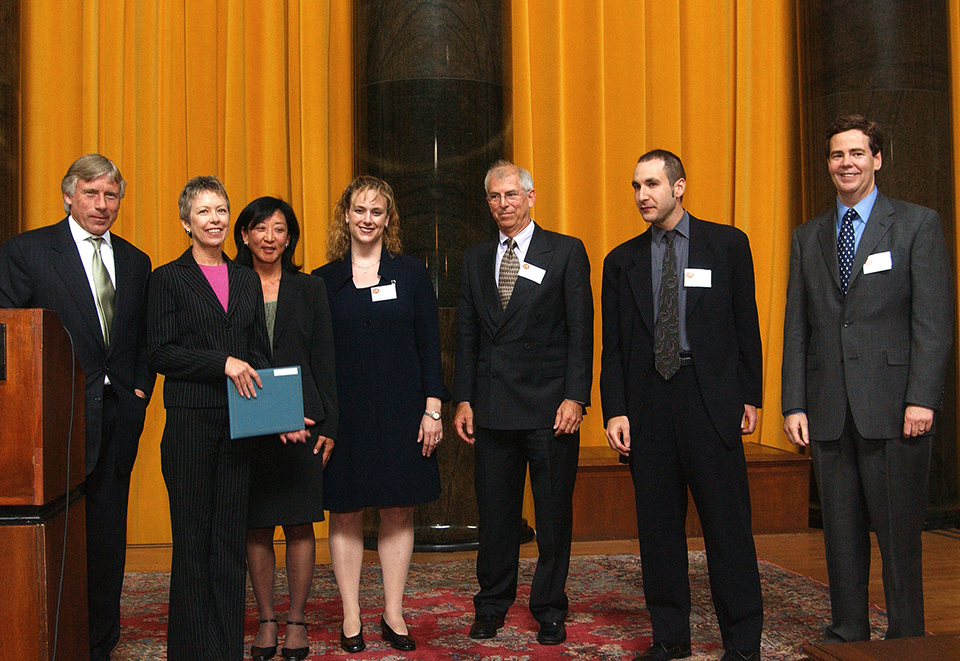
Columbia University President Lee C. Bollinger (left) presents (from left) Nancy Cleeland, Evelyn Iritani, Abigail Goldman, Tyler Marshall, Rick Wartzman and John Corrigan, of the Los Angeles Times, with the 2004 Pulitzer Prize in National Reporting.
Winning Work
By Abigail Goldman and Nancy Cleeland
LA Times Staff Writers
Wal-Mart is so powerful that it moves the economies of entire countries, bringing profit and pain. The prices can't be beat, but the wages can.
--First of Three Parts
"I've been following Sam Walton since the 1970s," he said. "He's the American dream."
LAS VEGAS -- Chastity Ferguson kept watch over four sleepy children late one Friday as she flipped a pack of corn dogs into a cart at her new favorite grocery store: Wal-Mart.
The Wal-Mart Supercenter, a pink stucco box twice as big as a Home Depot, combines a full-scale supermarket with the usual discount mega-store. For the 26-year-old Ferguson, the draw is simple.
"You can't beat the prices," said the hotel cashier, who makes $400 a week. "I come here because it's cheap."
Across town, another mother also is familiar with the Supercenter's low prices. Kelly Gray, the chief breadwinner for five children, lost her job as a Raley's grocery clerk last December after Wal-Mart expanded into the supermarket business here. California-based Raley's closed all 18 of its stores in the area, laying off 1,400 workers.
Gray earned $14.68 an hour with a pension and family health insurance. Wal-Mart grocery workers typically make less than $9 an hour.
"It's like somebody came and broke into your home and took something huge and important away from you," said the 36-year-old. "I was scared. I cried. I shook."
Wal-Mart gives. And Wal-Mart takes away.
From a small-town five-and-dime, Wal-Mart Stores Inc. has grown over 50 years to become the world's largest corporation and a global economic force.
It posted $245 billion in sales in its most recent fiscal year -- nearly twice as much as General Electric Co. and almost eight times as much as Microsoft Corp. It is the nation's largest seller of toys, furniture, jewelry, dog food and scores of other consumer products. It is the largest grocer in the United States.
Wal-Mart's decisions influence wages and working conditions across a wide swath of the world economy, from the shopping centers of Las Vegas to the factories of Honduras and South Asia. Its business is so vital to developing countries that some send emissaries to the corporate headquarters in Bentonville, Ark., almost as if Wal-Mart were a sovereign nation.
The company has prospered by elevating one goal above all others: cutting prices relentlessly. U.S. economists say its tightfistedness has not only boosted its own bottom line, but also helped hold down the inflation rate for the entire country. Consumers reap the benefits every time they push a cart through Wal-Mart's checkout lines.
Yet Wal-Mart's astonishing success exacts a heavy price.
By squeezing suppliers to cut wholesale costs, the company has hastened the flight of U.S. manufacturing jobs overseas. By scouring the globe for the cheapest goods, it has driven factory jobs from one poor nation to another.
Wal-Mart's penny-pinching extends to its own 1.2 million U.S. employees, none of them unionized. By the company's own admission, a full-time worker might not be able to support a family on a Wal-Mart paycheck.
Then there are casualties like Kelly Gray. As Wal-Mart expands rapidly into groceries, it is causing upheaval in yet another corner of the economy. When a Supercenter moves into town, competitors often are wiped out, taking high-paying union jobs with them.
Wal-Mart's plans to enter the grocery business in California early next year have thrown the state's supermarket industry into turmoil. Fearful of Wal-Mart's ability to undercut them on price, the Ralphs, Vons and Albertsons chains have sought concessions from their unionized workers in Southern and Central California, leading to a work stoppage now entering its seventh week.
Half a century ago, the nation's largest and most emulated employer was General Motors Corp. "Today," said Nelson Lichtenstein, a history professor at UC Santa Barbara, "for better or worse, it's Wal-Mart."
GM brought prosperity to factory towns and made American workers the envy of the world. With a high-wage union job, an assembly-line worker could afford a house, a decent car, maybe even a boat by the lake.
There was a bit of truth, Lichtenstein said, to the famous assertion by Charles Wilson, General Motors chief from 1941 to 1953, that what was good for GM was good for the country.
With Wal-Mart, the calculus is considerably more complex.
'We Have Split Brains'
Glenn Miraflor used to chide his wife for shopping at Wal-Mart.
As a member of Ironworkers Local 416, the 50-year-old father of four is well aware of the retailer's anti-union stance. But when the family's credit card debt topped $10,000, Wal-Mart's deals suddenly looked irresistible.
"Where else are you going to find a computer for $498?" he asked, looking for a PC with his wife, Debbie, at the Supercenter on Serene Avenue, far from the glitz of the Las Vegas Strip. "Everyone I work with shops here."
Surveys by the Teamsters and the United Food and Commercial Workers -- the two unions most threatened by Wal-Mart -- show that many of their own members shop at the discounter.
"We have split brains," said Robert Reich, U.S. secretary of Labor under President Clinton and now a professor of economic and social policy at Brandeis University in Waltham, Mass. "Most of the time, the half of our brain that wants the best deal prevails."
The connection may be lost on many, Reich said, but consumers' addiction to low prices is accelerating a shift toward a two-tiered U.S. economy, with a shrinking middle class and a growing pool of low-wage workers.
"Wal-Mart's prices may be lower," he said, "but that's small consolation to a lot of people who end up with less money to spend."
Others insist there is a net benefit whenever consumers can get more for less. "If you have lower real prices, you're saving money," said Arthur Laffer, a key advisor to President Reagan who is now an economic consultant in San Diego. "The prices' falling, in effect, raises the wages of everyone who buys their products."
That's basically the way the Miraflors saw it as they cruised the aisles of the Supercenter -- Wal-Mart Store No. 2593 -- and snapped up deals: Ragu pasta sauce for 89 cents, Aunt Jemima pancake mix for 48 cents, pork shoulder steaks for $1.49 a pound and five cans of Del Monte vegetables for $2.
After making their way through the groceries, the Miraflors turned their attention to the housewares section, stopping in front of a 20-inch box fan. Glenn Miraflor checked the price and made room for it in their cart.
"Ten bucks," he said. "You can't beat that. That's why we come here."
Vendors' Alley
The fan was made 1,700 miles away in Chicago at Lakewood Engineering & Manufacturing Co. A decade ago, the same fan carried a $20 price tag.
But that wasn't low enough for Wal-Mart. So Lakewood owner Carl Krauss cut costs at every turn. He automated production at the red-brick factory built by his grandfather on the city's West Side. Where it once took 22 people to put together a product, it now takes seven. Krauss also badgered his suppliers to knock down their prices for parts.
In 2000, he took the hardest step of all: He opened a factory in Shenzhen, China, where workers earn 25 cents an hour, compared with $13 in Chicago. About 40% of his products now are made in China, including most heaters and desktop fans. The Miraflors' box fan was assembled in Chicago, but its electronic guts were imported.
"My father was dead set against it," Krauss said of the move overseas. "I have the same respect for American workers, but I'm going to do what I have to do to survive."
Survival in an age when consumers are hyper-vigilant about prices means shaving expenses again and again. "Nobody wants to be on the shelf with the same item for $1 more," Krauss said.
All the retailers he supplies -- including Home Depot Inc. and Target Corp. -- drive a hard bargain with manufacturers. But none is as tough as Wal-Mart, Krauss said.
Twice a year, his sales representatives travel to Wal-Mart headquarters to pitch their products. There, competitors sit side by side, waiting to be ushered into one of 60 glass-sided cubicles -- a space some call Vendors' Alley.
Then the haggling begins. "You give them your price," Krauss said. "If they don't like it, they give you theirs."
The suppliers are at a disadvantage. The Wal-Mart buyer can always go out to the waiting room and find someone who will go lower. "Your price is going to be whittled down like you never thought possible," Krauss said.
After moving much of his manufacturing abroad, Krauss doesn't see any way to push costs lower. "If you're doing things legally, you can't," he said.
He may have to find a way.
At the Serene Avenue store, shopper Sarah Saxon, 17, pulled a $40 Lakewood heater off the shelf. She looked it over, then put it back in favor of an AirTech model selling for $34.88. She said it looked better than the Lakewood.
"Besides," she said, "it's cheaper."
Wal-Mart's culture of cheap emanates from Bentonville, a town of 20,000 tucked into the low green hills of northwest Arkansas, where a young Sam Walton opened his first five-and-dime in 1950. Even then, Walton had a vision of a different kind of retail.
Rather than charging a little less than his competitors, Walton wanted to slash prices as much as he could and still make a profit. Other stores would use price breaks from manufacturers as a way to boost their bottom lines, paying less at wholesale while leaving retail prices untouched.
Walton passed such savings on to his customers as his discount business evolved into Wal-Mart stores in 1962. He figured he would make up the difference in volume. He was right.
By the mid-1980s, Wal-Mart's success had catapulted Walton to No. 1 on the Forbes list of richest Americans. Still, he drove an old pickup truck to haul around his bird dogs, refused to fly first class and shared hotel rooms with colleagues on business trips.
Bentonville, like the man who put it on the map, is a combination of Southern charm and Midwestern practicality. The town square is anchored by the original Walton's five-and-dime (now a visitors' center) and dotted with small shops. But the real action is down Business Route 71, where the Wal-Mart Supercenter rises up, big enough to fit three 747s with room to spare.
Across the street is the base of Wal-Mart operations: the Home Office. The world's biggest company occupies an industrial-looking hodgepodge of windowless work spaces, connected by bunker-like hallways. The drab gray-and-blue walls display the visage and sayings of Sam Walton, who died in 1992:
"Listen to your associates.... They're the best idea generators."
"To succeed, stay out in front of change."
"Swim upstream. Go the other way. Ignore the conventional wisdom."
Lists abound. The best-performing stores. The worst-performing stores. Under a picture of the founder asking, "Who's taking your customers?" is a roster of competing retailers, including Costco Wholesale Corp., Circuit City Stores Inc. and Target, with the name and picture of each company's chief executive.
It's all part of the Wal-Mart culture: a zealous attention to competition, customers and costs.
Wal-Mart employees, unlike their counterparts at other retailers, are forbidden to accept so much as a soda from vendors -- or anybody else the company does business with -- on the theory that such frills ultimately are paid for by consumers. The company's meticulous management of the flow of goods, from the factory floor to the store shelf, has shaved shipping and inventory costs to a degree that retailing experts say is unprecedented.
"You could argue that some of what Wal-Mart does to cut costs has been win-win," said Richard S. Tedlow, a professor of business administration at Harvard Business School. "What's being squeezed out is waste."
The company is so ruthlessly efficient that 4% of the growth in the U.S. economy's productivity from 1995 to 1999 was due to Wal-Mart alone, researchers at the McKinsey Global Institute estimated last year. No other single company had a measurable impact. Wal-Mart also has forced competitors to become more efficient, driving the nation's productivity -- output per hour of work -- even higher.
Walton, who still is referred to as Mr. Sam throughout the corporation, worked in a ground-floor office barely big enough for a conference table. The current occupant, Chief Executive H. Lee Scott Jr., is the keeper of Mr. Sam's vision. Like all Wal-Mart executives, he empties his own trash and shares budget hotel rooms when traveling. Everyone flies coach.
"We do not have limousines," said Scott, who certainly could afford one, having made nearly $18 million last year in salary, bonus and stock, plus options with an estimated value of $11.3 million. "I drive a Volkswagen Bug."
Wal-Mart's stinginess reaches from the executive suite to the loading dock.
Some truckers complain that they must unload their own cargo -- or pay Wal-Mart to do it. Other big retail chains absorb that cost themselves. "They're awful," said independent driver George Hauschild of Palm Springs. "They don't even let you use the bathroom."
At every one of the 2,966 Wal-Marts in the U.S., thermostats are kept at a steady 73 degrees in summer, 70 degrees in winter; raising or lowering the temperature is considered a waste of money.
Such measures seem mild compared with what Wal-Mart has done to cut payroll costs. In one case, a jury in Oregon last year found that company managers had coerced hundreds of employees to work overtime without pay.
The managers were driven by intense pressure from Bentonville, witnesses said. Managers whose labor costs were considered too high were singled out during the company's weekly in-house satellite broadcasts. In response, managers tampered with electronic time cards or bullied employees to work off the clock, according to trial testimony.
The Oregon jury found last December that Wal-Mart's behavior was illegal and willful. A separate trial to determine damages for the 290 plaintiffs is set for early next year.
Wal-Mart settled similar overtime suits in Colorado and New Mexico for undisclosed amounts. More than 40 other cases are awaiting trial.
The company says it prohibits off-the-clock work and blames the problems on a small number of rogue managers.
Last month, Wal-Mart ran into trouble because of another cost-cutting practice: using dirt-cheap janitorial services.
A grand jury is investigating whether Wal-Mart knew that janitors provided by subcontractors were illegal immigrants cheated out of overtime pay. Federal agents raided 61 Wal-Marts across the country and seized boxes of documents from the Bentonville headquarters. Wal-Mart has denied wrongdoing.
Scott, the CEO, lauded Wal-Mart's employment record. Even in tight labor markets, he said, the company never has trouble finding workers.
"It is not forced labor," he said. "The truth is, I go to the stores and shake hands with the associates, and they like working at Wal-Mart."
On the Fast Track
Aaron Rios liked working at Wal-Mart so much that he decided to make his career there.
Like two-thirds of Wal-Mart's store managers, Rios started off as an hourly worker -- in his case, stocking shoes on the graveyard shift at the Wal-Mart in his hometown of Hanford in the San Joaquin Valley.
After two years, Rios was recommended for management training -- the company's fast track -- leading him to quit community college and pursue a climb through the Wal-Mart ranks.
"There's just something about a Wal-Mart environment," said Rios, who became manager of the Serene Avenue Supercenter in Las Vegas at age 26. "It changed who I am, where I was going and what my career goals were."
Wal-Mart store managers earn about $95,000 annually, including bonuses, according to the company. Supercenter managers earn $130,000.
A management position requires long hours -- as many as 80 a week -- and, often, a willingness to relocate. Rios worked at six California Wal-Mart stores before taking the helm at Serene Avenue.
"It doesn't come free," said Rios, a divorced father who shares custody of his 2-year-old son.
Still, he said, the benefits outweigh the sacrifices.
"I have an open opportunity. I could go into real estate for Wal-Mart. I could do systems, analysis, accounting. It's endless," Rios said. "If I wanted to go to Germany or Japan or Brazil or any of the markets we have, I believe I could go."
A few weeks later, Rios snared another promotion, moving back to California as a district manager in the Antelope Valley, overseeing seven stores from Barstow to Palmdale.
Larry Allen had his own dreams of climbing the Wal-Mart ladder.
In the fall of 2001, he and his wife, Jacque, left Portland, Ore., where the economy was sputtering, and headed to Las Vegas. He was an executive chef and she worked in catering. They looked forward to a fresh start in unionized casino jobs, making more than $15 an hour, with health insurance and pensions.
But their timing was lousy. Recession and terrorism were hitting the gaming industry hard, and work of any kind was scarce.
Just before their money ran out, the Allens lowered their expectations and took jobs at the Serene Avenue Wal-Mart. Jacque, then 43, worked the counter at the in-store restaurant, Radio Grill. Larry, 46, stocked produce. They each earned $8 an hour.
Despite the letdown, Larry Allen said he attacked the job with enthusiasm. Inspired by tales of well-paid Wal-Mart managers who had started out as hourly employees, such as his manager Aaron Rios, he figured on working his way up. That was Sam's way, he said.
"I've been following Sam Walton since the 1970s," he said. "He's the American dream."
The glow faded quickly. At his 90-day review, Allen said, he received an unenthusiastic write-up and an hourly raise of 35 cents. His supervisor told him that if he continued working hard, in two years he might make his way up to $10 an hour.
Allen thinks he knows why he received such mediocre marks. For one thing, he was prone to question company policy. Then, Allen committed the ultimate act of disloyalty: He openly promoted unionization.
West Coast Ambitions
For decades, Wal-Mart has tantalized and frustrated union organizers. But the company's move into the grocery business -- a labor stronghold -- has raised the stakes dramatically.
Union organizers say the high wages and benefits of their members are at risk, as Wal-Mart expands its Supercenters beyond the South and Midwest. The company recently established a beachhead in Las Vegas, with five centers.
Next stop: California, where Wal-Mart plans to open 40 Supercenters starting early next year. In a sense, it has already arrived. Wal-Mart's low wages are a central factor in the labor dispute between California's three major supermarket chains and the United Food and Commercial Workers.
"They are the third party now that comes to every bargaining situation," said Mike Leonard, director of strategic programs for the UFCW.
Over many years of hard negotiating, the union has won and maintained premier contracts for its 800,000 grocery workers. But with the opening of each new Supercenter, the union's clout erodes.
Every one of the giant stores sucks away about 200 UFCW jobs, said retail consultant Burt P. Flickinger III, who runs Strategic Resource Group in New York. That means less power at the bargaining table and less money to hire organizers.
On average, Flickinger says, Wal-Mart's wage-and-benefit package is about $10 an hour less than those offered by unionized supermarkets.
For shoppers, that makes a big difference. A cartful of groceries is 17% to 39% cheaper at a Wal-Mart Supercenter than at a unionized supermarket, according to a survey last year in Las Vegas, Dallas and Tampa, Fla., by investment bank UBS Warburg.
Wal-Mart's move into groceries has led 25 regional supermarket chains around the nation to close or file for bankruptcy protection, eliminating 12,000 mostly union jobs, Flickinger said.
With this in mind, Safeway Inc. recently aired a videotaped message to employees, whose contract in Las Vegas expires next fall.
"Wal-Mart wants our customers and your jobs," said Safeway executive Larree Renda. Total wage and benefit costs represent 15% of sales at Safeway, Renda said. At Wal-Mart, they account for 9%.
"If we don't change," Renda said, "you bet we'll lose jobs -- and it will be in the thousands."
Staying Unorganized
From their first day on the job, Wal-Mart employees are advised to avoid unions and to report any organizing activities to their supervisors.
"If a union got in here, every benefit we've got could go on the negotiating table, every one of them," says a man identified as Russell, a veteran employee, in a video shown to new hires. "Unions will negotiate just about anything to get the right to have dues deducted out of paychecks. You see, they need big money to pay union bigwigs and their lawyers."
Company policy prohibits any union talk in work areas, and organizers say they routinely are asked to leave stores. The retailer sought, and last year received, a court order keeping organizers out of all of its stores in Arkansas. The state Supreme Court nullified the order in July.
At the first hint of union activity, Wal-Mart managers are supposed to call a hotline, usually prompting a team visit from Bentonville.
Wal-Mart spokeswoman Mona Williams said the intervention was meant to help store managers respond effectively and legally.
"Our philosophy is that only an unhappy associate would be interested in joining a union," she said, "so that's why Wal-Mart does everything it can to make sure that we are providing our associates what they want and need."
But dozens of times in the last four years, attorneys for the National Labor Relations Board have claimed that the company infringed on the supermarket union's legal right to organize.
Although some of those claims have been thrown out, others have been upheld by administrative law judges, who have ruled that Wal-Mart illegally influenced employees with offers of raises, promotions and improved working conditions just before they were to vote on whether to join a union.
Judges also have found that Wal-Mart illegally implied that workers could lose benefits such as insurance and profit sharing if they unionized.
What's more, managers illegally confiscated union literature, threatened to close down a store if workers voted to join the union, fired several union supporters and failed to promote others, according to rulings from Minnesota to Florida.
Stymied in their previous attempts to organize Wal-Mart workers, UFCW leaders adopted a new strategy in 2000. They decided to marshal their resources for a concerted organizing effort in one place: Las Vegas.
The union reached out to workers with a Web site and a weekly radio talk show, and posted organizers outside Wal-Mart stores at all hours. When they could, UFCW members would leave union literature inside stores, hoping that workers would see it before managers ordered the material thrown away.
Larry Allen got his first glimpse at a union pamphlet last year as he carried it to the garbage at the Serene Avenue Supercenter. He was hooked, and began advocating for an election to bring in the union.
"Somebody has got to step up and fight for what is right," Allen said.
Ripple Effect
Less than a mile away from the Serene Avenue store, another shopping center stands deserted, in desperate need of an anchor.
A year ago, the Raley's grocery store here drew thousands of shoppers who spilled out to neighboring businesses, buying flowers, mailing packages, getting their nails done. Today, the store is gone. The remaining shops are struggling.
"I'm probably down 45%," said Bonnie Neisius, who owns a UPS Store franchise in the center. "I just don't get the foot traffic anymore."
A few doors away, Windmill Flowers owner Diana I. Murphy leaned on a table where she would have been arranging bouquets -- had there been customers.
"There are a couple of things in play," Murphy said. "The recession, terrorism. And Wal-Mart. It's had a direct effect on me, because they sell flowers, too.... They even deliver."
Unlike small towns with boarded-up commercial centers, fast-growing Vegas quickly loses track of its Wal-Mart victims.
Wal-Mart's costs to the community tend to show up in subtler ways.
In an informal survey in the late 1990s of people who used Las Vegas emergency rooms for routine medical care, patients who said they were employed but uninsured were asked where they worked.
"Wal-Mart came up more than any other," said Dr. Raj Chanderraj, a Las Vegas cardiologist and chairman of the Clark County Health Care Access Consortium, a group that works to provide medical services to the uninsured.
The reason, say critics: Because Wal-Mart pays such low wages, many employees can't afford the health insurance the company offers. And those who do have health coverage through the company often can't afford deductibles that run as high as $3,000 a year.
"Their employees are ending up at the county hospital and become the burden of the county," said Clark County Manager Thom Reilly.
Wal-Mart disputes that. Williams, the company spokeswoman, said that 48% of employees are covered by Wal-Mart's health insurance plan. Among those who aren't, 26% have coverage from another source such as a spouse's employer or Medicare, Williams said.
The notion that Wal-Mart doesn't provide adequate health coverage is "just rhetoric," she said. "It's simply not true."
According to the Employee Benefit Research Institute in Washington, nearly 44% of workers in the retail sector as a whole have employer-provided health coverage. Among big companies in all industries, the figure is 66%.
Those who accuse Wal-Mart of shortchanging its employees, Williams suggested, don't understand the modern service economy. "Retail and service wages are what they are," she said, "whether you look at a department store, a discount store, the local dry cleaners, the bakery or whatever.
"Wal-Mart is a great match for a lot of people," Williams added. "But if you are the sole provider for your family and do not have the time or the skills to move up the ladder, then maybe it's not the right place for you."
'I Still Believe in Wal-Mart'
Larry Allen spent about a year advocating for the supermarket union while working at Wal-Mart.
In the parking lot and in the break room, he passed out fliers and talked up the benefits of unionizing. But he and his fellow union backers didn't get as far as they hoped. About 42% of workers in the grocery department at Serene Avenue signed UFCW cards -- not enough for the union to feel confident about winning an election.
In August, Allen was fired. NLRB attorneys said it was because of his union activities and filed a complaint against Wal-Mart, seeking his reinstatement.
On a recent afternoon outside the Supercenter, dozens of union members rallied to support Allen. "Larry, Larry, Larry," they chanted. Over at the store entrance, the demonstration was a muffled, distant bit of noise. Store managers watched on a screen as surveillance cameras scanned the crowd.
Asked about the commotion, a gray-haired Wal-Mart greeter named Robert just smiled. "They want to make the store union," he said. "But that would make the prices go up for our customers. We can't let that happen."
On some level, even Larry Allen understands. "I still believe in Wal-Mart," said Allen, who now is on the union payroll as an organizer. "I like the idea of it -- give a quality product at a low price. It's what the American public wants."
© 2003, Los Angeles Times
By Abigail Goldman
LA Times Staff Writer
H. Lee Scott Jr., 54, joined Wal-Mart in 1979, overseeing the company's trucking fleet. He gained a reputation as a master of logistics, moved into sales and merchandise, and became CEO in 2000. A friendly, plain-spoken man, Scott sat down in his office and talked about where the company has been and where it is going:
Question: What obligations does Wal-Mart have as the biggest company in the world, and are you meeting them?
Answer: We have an obligation to give back to the community, and I think we are. We do not have a sense that we have to make corporate donations to rebuilding monuments or supporting operas or the arts or any of those things. We think our obligation is to give back in that individual community. That's where that money came from, that's where it ought to go back to.
Founder Sam Walton said that Wal-Mart wouldn't go where it wasn't wanted. Is that still true?
I think that is true.
How do you define 'where it's not wanted'? Is it not wanted by those people who would like to not see lower prices? I don't think we're going to let them define whether or not we come. Is it going to be those people who do not want to compete with Wal-Mart? I don't think we're going to let them define it.
What services or products can Wal-Mart add?
Well, I think financial services is one we would like to be in. We're already offering money orders. We've dramatically lowered the costs of wiring money. There's probably a place for us in mortgages. I think the dot-com is going to be a very powerful tool.
How big can Wal-Mart be?
We are 8% of the nonautomotive, nonrestaurant sales in the U.S. I'm not sure why it couldn't be 24%. We've really done a great job for our customers, lowering prices, lowering the cost of living, raising the standard of living. Is it really unhealthy for us to be 32%? Could we be four times bigger right here? I don't know why not.
Tell us about plans for expansion in California. When will people see that?
I think they're going to see it very quickly.
Our goal is to roll out Supercenters as we get the permission from individual towns, and to roll out Supercenters fairly aggressively in California.
What is your response to critics who say Wal-Mart is replacing high-paying supermarket jobs with inferior ones?
I think it's interesting that people think that they can legislate what the world is going to look like. That they can set up a process of protections that doesn't reward efficiency.
We went through the lowest period of unemployment we've had in years, and yet we staffed our stores. We hired people. We trained people. So, if our jobs were so poor, when you had 2% unemployment, 3% unemployment, how did we get a million people?
Do you think your wages and benefits should be better?
No. But I think one of the goals would be to pay people as much as you can pay them. I think that's obviously anybody's goal, so that you can have a balance between what the prices should be [and] what the pay should be.
I think health care is a huge issue for all of us and whether it's buried in the costs of the product or whether it's in your paycheck, I think there's something that we as a country are having to address as we see these costs going up.
Are you proud of the wages and benefits you provide?
Yes, I'm proud. I think it's very competitive, but I'm particularly proud of the careers we provide. I see associates who like us and appreciate what the company has done for them and who know that the company appreciates what they have done.
© 2003, Los Angeles Times
By Nancy Cleeland, Evelyn Iritani and Tyler Marshall
LA Times Staff Writers
Wal-Mart, once a believer in buying American, extracts ever lower prices from 10,000 suppliers worldwide. Workers struggle to keep pace.
--Second of Three Parts
In southern China, Wal-Mart has found all the ingredients it needs to keep its "every day low prices" among the lowest in the world.
SAN PEDRO SULA, HONDURAS -- When Wal-Mart Stores Inc. demands a lower price for the shirts and shorts it sells by the millions, the consequences are felt in a remote Chinese industrial town, at a port in Bangladesh and here in Honduras, under the corrugated metal roof of the Cosmos clothing factory.
Isabel Reyes, who has worked at the plant for 11 years, pushes fabric through her sewing machine 10 hours a day, struggling to meet the latest quota scrawled on a blackboard.
She now sews sleeves onto shirts at the rate of 1,200 garments a day. That's two shirts a minute, one sleeve every 15 seconds.
"There is always an acceleration," said Reyes, 37, who can't lift a cooking pot or hold her infant daughter without the anti-inflammatory pills she gulps down every few hours. "The goals are always increasing, but the pay stays the same."
Reyes, who earns the equivalent of $35 a week, says her bosses blame the long hours and low wages on big U.S. companies and their demands for ever-cheaper merchandise. Wal-Mart, the biggest company of them all, is the Cosmos factory's main customer.
Reyes is skeptical. Why, she asked, would a company in the richest country in the world care about a few pennies on a pair of shorts?
The answer: Wal-Mart built its empire on bargains.
The company's size and obsession with shaving costs have made it a global economic force. Its decisions affect wages, working conditions and manufacturing practices -- even the price of a yard of denim -- around the world.
From its headquarters in Bentonville, Ark., the company has established a network of 10,000 suppliers and constantly pressures them to lower their prices. At the same time, Wal-Mart buyers continually search the globe for still-cheaper sources of supply. The competition pits vendor against vendor, country against country.
"They control so much of retail that they can put someone into business or take someone out of business if they choose to," said Pat Danahy, a former chief executive at Cone Mills Corp. in Greensboro, N.C., one of the few surviving U.S. textile producers.
In Honduras, the pressure keeps factory managers on edge, always looking for ways to cut expenses without running afoul of labor laws or Wal-Mart's own contractor rules, which call for "reasonable employee work hours."
"I think we have reached the limit," said Shin Woo Kang, manager of the enormous Han Soll Textile Ltd. sewing plant on the outskirts of San Pedro Sula. The plant employs 1,600 workers, mostly young women. Wal-Mart is its biggest customer.
The brightly lighted factory is filled with humming machines, mounds of clothing parts and fast-moving hands. Down one production line, pieces of navy blue fabric take shape as Bobbie Brooks polo shirts, each bearing a Wal-Mart price tag of $8.63.
Kang said Wal-Mart was paying Han Soll about $3 a shirt -- a few cents less than last year.
Asked what he would do if the retailer pressed for an even lower price, Kang grew quiet. "We would have to find something," he said finally. "Honestly speaking, I don't know what it is."
To cut costs, Honduran factories have reduced payrolls and become more efficient. The country produces the same amount of clothing as it did three years ago, but with 20% fewer workers, said Henry Fransen, director of the Honduran Apparel Manufacturers Assn., which represents nearly 200 export factories.
"We're earning less and producing more," he said with a laugh, "following the Wal-Mart philosophy."
That's harsh medicine for a developing country. The clothing industry is one of the few sources of decent jobs for unskilled workers in this nation of 6 million. Many of those jobs depend on Wal-Mart.
"You could be looking at a government meltdown if something were to happen to this industry," said Raja Rajan, a factory manager active in the apparel association.
In Rajan's view, Wal-Mart is so important to the stability of Honduras that leaders should cultivate stronger ties with the company, almost as they would a foreign country. He has lobbied the government to send high-level envoys to Wal-Mart's Arkansas headquarters, something Bangladesh and other countries already do.
Even with such efforts, Rajan fears that the migration of sewing jobs to China and other lower-cost countries can't be stopped, only slowed.
Chuck Wilburn figures that his 1,300 employees will be among the casualties. He manages a factory on the outskirts of San Pedro Sula that cranks out clothing for Wal-Mart, Target Corp. and other retailers.
Wilburn's employer, Oxford Industries of Atlanta, once owned 44 factories in the American South. It shuttered them all in the last 15 years and moved the work to cheaper locales. That's how Wilburn found himself in Honduras.
He is proud of his clean, modern factory. "It's nicer than the one I ran in South Carolina," Wilburn said.
Still, he has had trouble turning a profit. He laid off 500 employees two years ago. Even here, it's hard to meet Wal-Mart's prices. Wilburn expects that Oxford will close his factory in the next few years and move on to another country where basic cotton clothes, such as Wal-Mart's Old Glory khaki pants, can be produced for less.
"Our business is a lot of twill stuff," he said. "That will be gone."
Waving the Flag
It wasn't long ago that Wal-Mart was fighting to keep manufacturing jobs on U.S. soil.
In 1985, founder Sam Walton launched his "Bring It Home to the USA" program. "Wal-Mart believes American workers can make a difference," he told his suppliers, offering to pay as much as 5% more for U.S.-made products.
In his 1992 memoir, "Made in America," Walton claimed that the program had saved or created nearly 100,000 jobs by using "the power of this enormous enterprise as a force for change."
But the late Walton's much-trumpeted effort soon was overtaken by the rise of the global economy. The spread of the Internet and other technology, along with U.S.-led efforts to tear down trade barriers, made it easier to move goods and capital across borders.
To maintain its edge on pricing, Wal-Mart quietly joined other retailers in a worldwide search for the cheapest sources of production.
In apparel, the process begins with Celia Clancy. From a renovated warehouse near the company's headquarters, the Wal-Mart executive vice president oversees the world's largest clothing budget, estimated at $35 billion in 2000.
Clancy gives her buyers a "Plus One" mandate every year: For each item they handle, they must either lower the cost or raise the quality.
To demonstrate, she pulled a pair of girls' shorts off the wall of her cramped office and gave them a tug.
"This was a dumb little knit pull-on short," Clancy said. "We improved the fabric, put some more fashion in it and are selling it for the same price as last year -- $5.19."
Keeping prices low like this means squeezing costs at every step. Clancy and her buyers have trimmed back the number of brands, styles and color schemes. That allows Wal-Mart to consolidate its purchases of fabric, accessories and thread and to wrangle steep discounts from suppliers.
Clancy's buyers used to rely on a Hong Kong company and other intermediaries to find bargains overseas. This year, Wal-Mart established its own global procurement division to hunt for the cheapest raw materials, manufacturers and shipping routes. Last year, for instance, the company rerouted cargo from a port in Hong Kong to the southern Chinese province of Guangdong, where shipping rates were lower. The savings: $650,000.
In purchasing fabrics such as denim and khaki, Wal-Mart plans to approach three to five mills around the world and pit them against each other. "We'll be putting our global muscle on them," said Ken Eaton, head of the global procurement division, which has 21 offices in 18 countries.
Eaton believes he can reduce costs at least 20% by cutting out the middleman and buying directly from foreign factories. He feels a sense of urgency about his mission, in part because he believes the company's "Buy American" focus left it playing catch up.
"Honestly, we're kind of late to the party," he said. "There are a lot of companies out there that have been direct-importing and understanding the global aspect of sourcing for a long, long time."
As late as 1995, Wal-Mart said imports accounted for no more than 6% of its products. Today, consulting firm Retail Forward estimates that 50% to 60% of the merchandise in the company's U.S. stores is imported.
Wal-Mart Chief Executive H. Lee Scott Jr. said in an interview that the trend reflected an inescapable reality: U.S. consumers aren't willing to pay even a little extra for a "Made in America" label.
"The customer ultimately drives that," he said.
Big in Bangladesh
Wal-Mart is the most powerful corporate citizen in Bangladesh, even though it doesn't operate a single store in the country.
When the company complained to Bangladesh's Export Promotion Bureau this spring about delays in moving cargo, the response was swift.
Officials in the southern port of Chittagong are speeding up efforts to reduce paperwork and modernize facilities. Over the objections of labor leaders, port officials also are building a five-berth container terminal that will be privately managed. Already, giant cranes have helped shorten a ship's turnaround time from six days to fewer than four.
It's no wonder Wal-Mart wields such clout in this country, where nearly half the population lives in poverty. The company bought 14% of the $1.9 billion in apparel that Bangladesh shipped to the U.S. last year.
"Wal-Mart is our biggest customer and it's important to me," said Commerce Minister Amir Khasru Mahmud Chowdhury. But, he added, Wal-Mart's prices "are coming down all the time -- that's the biggest threat to us."
Bangladeshi factory owners say Wal-Mart and other retailers have asked them to cut their prices by as much as 50% in recent years.
One apparel manufacturer described a visit from a Wal-Mart buyer who showed him a European-made garment that retailed for $100 to $130. The buyer asked the Bangladeshi to produce a knockoff for $10 a dozen. He declined.
"They say to come down in price, but we have to make a profit," complained another clothing maker. Hoping to land a Wal-Mart order for 600,000 fleece jackets this year, he bargained down his suppliers of fabric, thread and fastenings, and managed to cut his price by 20%.
It wasn't good enough for Wal-Mart. "They said they will place the order in Vietnam or China," he recalled.
Syed Naved Husain had hoped to avoid this sort of nickel-and-diming by going upscale.
As head of the apparel division for Beximco, Bangladesh's largest private company, Husain spent $300 million in 1995 to build a computerized textile and apparel manufacturing center in a rice paddy outside Dhaka. He hired hot designers from Asia and Europe.
Within a few years, he was manufacturing clothes for European retailers Diesel and Zara, and his lushly landscaped "manufacturing oasis" had become an industry showpiece.
But the market has started to change. Wal-Mart is selling more-fashionable clothes, and Husain's high-end customers are nervous. They are pushing him like never before to cut costs.
"Unfortunately," Husain said of Wal-Mart, "they've created a model that has taken the world by storm."
U.S. retailers began making their way to Bangladesh in the 1980s. They found a large population of poor, young women willing to work from dawn to dusk for a few pennies an hour.
Many factories lacked ventilation and fire escapes. Labor activists estimated in the mid-1990s that as many as 50,000 Bangladeshi children were sewing apparel for companies such as Wal-Mart and Kmart Corp.
The resulting outcry prompted a government crackdown on the use of child labor and led companies such as Wal-Mart to require suppliers to adhere to labor laws and safety standards.
Sheikh Nazma, a former child laborer, has seen the way Wal-Mart can help clean things up.
She worked at a Dhaka garment factory that had no clean drinking water and only a few filthy toilets for hundreds of employees. After the owner refused to pay their wages for three months, the employees complained to Wal-Mart, the factory's main customer.
"Wal-Mart interfered, and ... the owner paid our salaries and overtime and even paid bonuses to each worker," recalled Nazma, who later helped launch the Bangladesh Independent Garment Workers Union Federation.
But Nazma and others say Wal-Mart undermines its good efforts with its incessant push for lower prices. To fill orders on short schedules, factories often force their employees to work overtime or stay on the job for weeks without a day off, according to Sayeeda Roxana Khan, a former factory manager in Dhaka. To conceal such practices, auditors say, some factories keep two sets of books.
"It's the workers who suffer when entrepreneurs have to survive by cutting corners," said Khan, who now works for Verite, a firm that conducts factory audits for Tommy Hilfiger, Levi Strauss and other U.S. companies.
Khadija Akhter can attest to that. For about $21 a month, nearly three times what a maid or cook would make, the 22-year-old worked in a Dhaka factory, performing final checks on men's shirts and trousers.
Employees, she said, often worked from 8 a.m. to 3 a.m. for 10 to 15 days at a stretch to fill big orders from Wal-Mart. Exhausted, she quit after a year and took a lower-paying but less grueling job.
All the speeding up by Bangladeshi factories may not be enough to satisfy Wal-Mart.
A. Hasnat, Wal-Mart's general manager in Bangladesh, said the country's factories need to become more efficient still. From his vantage, many are poorly managed, have outdated equipment and run too slowly.
"I think they need to improve," he said. "When I entered a factory in China, it seemed they are very fast."
3,000 Factories in China
Eyes down, hunched forward, 20-year-old Ping Qiuxia steered a pair of green women's briefs through a sewing machine. Then her fingers whipped the briefs 180 degrees and moved them back toward her, this time with elastic bands stitched neatly around the edges. Within seconds, she was at work on the next pair.
The garment was part of a 6,000-piece order scheduled for shipment to Wal-Mart stores in Germany. For nine hours a day, sometimes six days a week, Ping and other employees of the Gladpeer Garment Factory in the southern Chinese city of Dongguan churn out undergarments, sleepwear and children's clothing.
In southern China, Wal-Mart has found all the ingredients it needs to keep its "every day low prices" among the lowest in the world.
Although labor costs more here than it does in Bangladesh, China offers other advantages: low-cost raw materials; modern factories, highways and ports; and helpful government officials.
Wal-Mart has been instrumental in making this corner of China the world's fastest-growing manufacturing zone. Last year, the company shipped $12 billion in products out of China, 20% more than in 2001.
The marriage between the world's largest and most efficient retailer and China's low-cost factories is setting a new global "cost standard" for manufactured products, according to consulting firm Deloitte Touche Tohmatsu.
The phenomenon is rattling competitors worldwide and worrying international labor activists. They cite the Chinese government's hostility toward organized labor and its lack of worker protections.
"Wal-Mart has really been at the forefront in driving down wages and working conditions," said Kent Wong, director of the UCLA Labor Center, who has made two trips to China in the last year. "They're not only exporting the Wal-Mart name and the corporation and the identity. They're also exporting that way of doing business."
Wal-Mart has more than 3,000 supplier factories in China, and the number is expected to rise. But that doesn't mean workers in China are secure.
Gladpeer used to make clothes in Hong Kong. It moved production to China in the 1980s because costs were much lower, said Simon Lee, a managing director of the family-owned firm.
Gladpeer's 1,200 workers -- mostly young women -- are paid about $55 a month and live in clean but cramped dormitories, eight to a room.
But Lee is likely to reduce his employment in Dongguan soon. He is planning to open a new factory in Guangxi province, a remote region of western China where labor, electricity, housing and taxes are cheaper. "Competition is intense, and our biggest single issue is cost," Lee said. "Many customers look at cost first, then they look at the workmanship. That's why we're going to Guangxi."
Cleeland reported from Honduras, Iritani from Bangladesh and Marshall from China. Times staff writer Abigail Goldman and Hong Kong bureau researcher Tammy Wong contributed to this report.
© 2003, Los Angeles Times
By Nancy Cleeland
LA Times Staff Writer
Sewing contractor Rob Reed shut down his Commerce factory this summer after 17 years, laying off 100 workers and adding his name to a long list of bankrupt U.S. manufacturers.
He isn't shy about assigning blame for what happened.
"We've been forced out of business, No. 1, because of the likes of Wal-Mart," Reed said.
Wal-Mart was once a solid account for his company, Stitches. But every season, Reed said, the retailer demanded a lower price, shrinking his profit to the point that an unexpected expense could push him into the red.
In January, he lost money on a Wal-Mart order. A few months later, he was asked to make 10,000 intricately worked cardigans for the retailer within a week. The sample already bore a Wal-Mart price tag: $8.47. "You can't make it here at that price," Reed said at the time. "Not legally, anyway."
Although desperate for work, he turned the order down.
Reed, 61, now works as a consultant and dreams of opening another contract shop that can focus more on quality and still succeed.
He isn't terribly hopeful, however. "The thing is," Reed said, "with so many contractors on the verge of extinction, there's always someone willing to do it cheaper."
© 2003, Los Angeles Times
By Evelyn Iritani and Nancy Cleeland
LA Times Staff Writers
Safe working conditions. Reasonable hours. No child labor.
These are among the rules that Wal-Mart Stores Inc. and other retailers imposed on their foreign contractors after a series of scandals in the 1990s. Yet just how well Wal-Mart's contractors abide by its standards is something of a mystery -- and a source of controversy.
Unlike other retailers, Wal-Mart refuses to open its suppliers' factories to independent inspections.
That prompted Domini Investments, which runs a "socially responsible" mutual fund, to dump its 1.3 million Wal-Mart shares in 2001. "At the very least you want some transparency," said Domini's Kyle Johnson.
Wal-Mart insists that it rigorously enforces its code of conduct, sending inspectors on unannounced visits to about 300 plants a week. The company says it won't open the factories to independent audits for competitive reasons.
Few expect the giant to budge. "They want to set their own agenda and do it the Wal-Mart way," said Vidette Bullock Mixon, director of corporate relations and social concerns for the $11-billion United Methodist Church Pension Fund.
© 2003, Los Angeles Times
By Nancy Cleeland and Abigail Goldman
LA Times Staff Writers
Wal-Mart plans to open 40 of its nonunion Supercenters in California. Labor is fighting the expected onslaught, but the big retailer rarely concedes defeat.
--Third of three parts
"It's the union against Wal-Mart. This has nothing to do with Inglewood."
Inglewood seemed to offer the perfect home for a new Wal-Mart Supercenter, with low-income residents hungry for bargains and a mayor craving the sales-tax revenue that flows from big-box stores.
But nearly two years after deciding to build on a 60-acre lot near the Hollywood Park racetrack, Wal-Mart is nowhere near pouring concrete. Instead, the world's biggest company is at war with a determined opposition, led by organized labor.
"A line has been drawn in the sand," said Donald H. Eiesland, president of Inglewood Park Cemetery and the head of Partners for Progress, a local pro-business group. "It's the union against Wal-Mart. This has nothing to do with Inglewood."
Indeed, similar battles are breaking out across California, and both sides are digging in hard. Wal-Mart Stores Inc. wants to move into the grocery business throughout the state by opening 40 Supercenters, each a 200,000-square-foot behemoth that combines a fully stocked food market with a discount mega-store -- entirely staffed by non-union employees. The United Food and Commercial Workers and the Teamsters are trying to thwart that effort, hoping to save relatively high-paying union jobs.
The unions have amassed a seven-figure war chest and are calling in political chits to fight Wal-Mart. The giant retailer is aggressively countering every move, and some analysts believe that Wal-Mart's share of grocery sales in the state could eventually reach 20%. The state's first Supercenter is set to open in March in La Quinta, near Palm Springs.
"If we have an advantage," said Robert S. McAdam, Wal-Mart's vice president for state and local government relations, "it's that we are offering what people want."
In fact, Wal-Mart has won allies by providing people of modest means a chance to stretch their dollars.
"We need to have retail outlets that are convenient and offer quality goods and services at low prices," said John Mack, president of the Los Angeles Urban League. "I really think that there are potential economic benefits for this community with the addition of a Wal-Mart."
Yet the Supercenters also threaten the 250,000 members of the UFCW and Teamsters who work in the supermarket business in California.
For decades, the unions have been a major force in the state grocery industry and have negotiated generous labor contracts. Wal-Mart pays its grocery workers an estimated $10 less per hour in wages and benefits than do the big supermarkets nationwide -- $19 versus $9. As California grocery chains brace for the competition, their workers face severe cutbacks in compensation.
"We're going to end up just like the Wal-Mart workers," said Rick Middleton, a Teamsters official in Carson who eagerly hands out copies of a paperback called "How Wal-Mart Is Destroying America." "If we don't as labor officials address this issue now, the future for our membership is dismal, very dismal."
The push for concessions has already started, prompting the longest supermarket strike in Southern California's history. About 70,000 grocery workers employed by Albertsons Inc., Kroger Co.'s Ralphs and Safeway Inc.'s Vons and Pavilions have been walking the picket lines since Oct. 11, largely to protest proposed reductions in health benefits. The supermarkets say they need these cuts to hold their own against Wal-Mart, already the nation's largest grocer.
Rick Icaza, president of one of seven UFCW locals in Southern California, has taken issue with much of the supermarkets' rhetoric since the labor dispute began. But he doesn't doubt that Wal-Mart is the biggest threat ever posed to the grocery chains -- and, in turn, his own members.
"The No. 1 enemy has still got to be Wal-Mart," he said.
The unions and their community allies have stopped Wal-Mart in some places and slowed it down in others. They have persuaded officials in at least a dozen cities and counties to adopt zoning laws to keep out Supercenters and stores like them.
Homeowner groups, backed by union money, sued to stop construction of two Supercenters in Bakersfield, arguing that the stores would drive local merchants out of business. Contra Costa County and Oakland also have passed measures that could block Supercenters.
In Los Angeles, several City Council members are drafting an ordinance to require an examination of how large-scale projects such as Supercenters would affect the community, including the possible loss of union jobs. As envisioned by supporters, the measure would allow the city to insist on higher wages as a condition of project approval.
"We want Wal-Mart to be able to help us with our economic development," said Councilman Eric Garcetti, who is co-sponsoring the measure. "We just want to be able to do it on our terms and not theirs."
Wal-Mart, however, can more than match its foes in resources and resolve.
To soften its outsider image, the retailer has hired local political insiders to coax projects through planning bureaucracies. It has promised jobs and sales-tax bonanzas to cities struggling with deficits and unemployment.
When the answer is "no," Wal-Mart rarely concedes defeat. At least nine times during its latest California push, the company has responded to legal barriers by threatening to sue or to take its case straight to local voters by forcing referendums.
That's what happened in Inglewood after the City Council in October 2002 adopted an emergency ordinance barring construction of retail stores that exceed 155,000 square feet and sell more than 20,000 nontaxable items such as food and pharmacy products. The measure was tailored to block a Supercenter.
Icaza declared victory. "Wal-Mart's plans to enter the retail grocery business in Inglewood are dead!" he crowed in a union newsletter.
But they weren't. Within a month, Wal-Mart gathered 9,250 signatures on petitions, more than enough to force a public vote. The company also threatened to sue the city for alleged procedural violations. Looking at a possible court battle or an embarrassing failure at the polls, Inglewood officials withdrew the ordinance they had passed a month earlier.
Furious with the council, Icaza ran his own candidate in city elections in June. Ralph Franklin, a former supermarket clerk and manager and now a UFCW business agent, won with 70% of the vote, ousting a council member who had gone against the union.
Worried that the council might try to trip it up again, Wal-Mart went on the offensive. In late August, the company, through a group called the Citizens Committee to Welcome Wal-Mart to Inglewood, began gathering a new batch of signatures to force a popular vote on the Supercenter. The initiative, which calls for building permits to be issued without a public hearing or environmental impact study, is expected to be on the March 2004 ballot.
"When people feel they're not getting a fair shake with the legislative process, they take things to a vote" of the electorate, said McAdam, the Wal-Mart vice president.
Wal-Mart's opponents have vowed to sue to block the initiative on the grounds that it oversteps the limits of the ballot process.
UFCW and Teamsters locals have raised dues or diverted funds from other programs to bankroll anti-Wal-Mart campaigns. With more than $1 million now available, thousands of members to draw from and encouragement from national leaders, local labor would seem to be in a strong position.
But union efforts have been hampered by personality conflicts and disagreements over strategies and goals, according to people close to the situation.
As in Inglewood, many union locals have focused on so-called site fights, winning zoning restrictions at the local level. That strategy can temporarily save union jobs and give leaders victories to celebrate, but it does little to stop the long-term march of Wal-Mart, critics say. After all, there are 478 cities in California, 88 in Los Angeles County alone.
Pushing for zoning restrictions also can backfire, stirring resentment among consumers and business owners -- even those who directly compete with Wal-Mart.
Wal-Mart opponents "try to use the government to accomplish things that they may not be able to accomplish in the marketplace," said Alan Zaremberg, president of the California Chamber of Commerce. "It's not government's role to interfere with what consumers want."
For their part, national labor strategists want local leaders to focus less on zoning campaigns and more on the daunting, long-term goal of unionizing Wal-Mart employees. Few take the advice, and those who do quickly realize just what they are up against.
George Hartwell, president of UFCW Local 1036 in Camarillo, hired 18 organizers to hit the nine Wal-Mart stores in his jurisdiction. With few leads to go on and employees in stores forbidden to talk about unions, progress was slow. Then in mid-summer, a group wearing union T-shirts was served with trespassing papers and asked to leave a Wal-Mart in Lompoc. Lawyers tussled over that for months. Now Hartwell and his crew can enter the stores, but with strict limitations. "We go through and say, 'good morning' or 'good afternoon,' just to be visible," he said.
Despite the long odds in taking on the company, many union activists insist they have no choice.
"I've put 29 years of my life into this job, and now they're trying to pull the rug out from under me," said Diane Johnson, a union cashier at a Pavilions store in Los Angeles who is helping to coordinate anti-Wal-Mart efforts in Inglewood through the Los Angeles Alliance for a New Economy.
Johnson and co-workers have made door-to-door visits and spoken from church pulpits, hoping to turn public opinion against the discounter. "For me to go backwards would just be hell," she said.
But Wal-Mart, the nation's largest seller of everything from toys to DVDs, has plenty of defenders too, some of them politically and financially powerful. They range from prominent Los Angeles toy importer Charlie Woo, who recently took up Wal-Mart's case before Los Angeles City Council members, to Jeffrey Katzenberg, a co-founder of Hollywood studio DreamWorks SKG. He lobbied former Gov. Davis against signing a statewide anti-big-box measure passed by the Legislature five years ago; Davis vetoed the bill.
McAdam said Wal-Mart doesn't order its suppliers to lobby on the company's behalf. But it does spell out for vendors the consequences of anti-Wal-Mart legislation.
"It's our belief that on certain issues, they have a vested interest in seeing ... that our company can continue to grow," McAdam said.
Wal-Mart also helps smooth entry into new markets by cultivating relationships with civic groups.
As it prepared last year to buy and renovate a former Macy's in the south Los Angeles community of Baldwin Hills, corporate officials met with leaders of the Los Angeles Urban League and arranged to hire some employees through the organization.
Allies in organized labor tried to dissuade the Urban League's Mack from cooperating. Normally pro-union, Mack turned them down, saying the community badly needed jobs and low-cost shopping options.
"I'd rather have a person on somebody's payroll -- even if it isn't at the highest wage -- than on the unemployment roll," Mack said. "We're not going to punish job seekers by refusing to refer them to Wal-Mart for a job."
By the time the Baldwin Hills-Crenshaw Plaza Wal-Mart opened in January, Wal-Mart had doled out thousands of dollars, mostly in $1,000 grants, to local institutions such as schools and youth programs. The company cut the Urban League a $3,000 check. It also provided $10,000 for new lights at the Martin Luther King Jr. Little League Baseball field.
The ordinance being considered in Los Angeles would ask planners to weigh the "community benefits" of a mega-store in any zone that receives federal, state or municipal funding or incentives -- essentially the entire city.
Like an environmental impact report, the community-benefits study would consider possible negative outcomes and propose ways to mitigate them. Wages could be held to "prevailing standards." If supermarkets were deemed the standard, that would mean union scale.
Backed by Garcetti and Councilman Ed Reyes, the ordinance could be ready for a council vote next month.
Several studies commissioned in recent years by independent groups, including the Orange County Business Council and the San Diego Taxpayers Assn., found the state would suffer a net economic loss if union jobs were traded for jobs at Wal-Mart.
Wal-Mart had declined to respond with numbers of its own until a few months ago, when it commissioned the Los Angeles County Economic Development Corp. to measure the effect of Supercenters on the region. Researcher Gregory Freeman said the study balanced wage losses with consumer savings, noting that Supercenter prices are typically 20% lower than at union markets.
The study was completed two weeks ago, Freeman said, but hasn't yet been released.
As he began his study in mid-summer, Freeman told council members that other analyses haven't fairly measured all the pros and cons of the Supercenters. For one thing, he said, savings from lower grocery prices could be used by working-class shoppers for other things, such as buying homes.
As for those merchants who won't be able to compete with Wal-Mart, others say, progress always carries a price.
"I grew up in Pennsylvania; my father had a corner market there. When I was 3 or 4, the A&P moved in and put him out of business," recalled the Chamber's Zaremberg. "That was tough for us, but I don't think anyone would go back and say we shouldn't have supermarkets."
© 2003, Los Angeles Times
By Tyler Marshall
LA Times Staff Writer
Wal-Mart is growing fast in China, where its stores are local attractions. The firm's overseas empire is changing buying habits in 10 nations.
SHENZHEN, China -- Lau Man-ching has a new habit: Three times a week, she shops at Wal-Mart.
Like a growing number of middle-class Chinese consumers, the 30-year-old real estate agent is drawn by the dazzling array of goods offered under one roof. Lau buys most of her produce at a Wal-Mart Supercenter near the Hong Kong border, occasionally venturing upstairs to browse through the aisles of clothing, appliances and sporting goods.
The fact that sales and checkout clerks smile and try to help is a bonus. For China's long-suffering consumers, weaned on long lines and patient waits for shoddy merchandise, the change is almost revolutionary.
"It's fast, it's convenient and it's clean," Lau said. "And it's all right here."
After more than eight years of treading cautiously, Wal-Mart is pulling out the stops in China, one of the latest additions to a fast-growing overseas retail empire that includes more than 1,300 stores in 10 countries.
After stumbling badly in Germany, where it met fierce resistance from competitors and labor unions, Wal-Mart started doing its homework. In Britain, it purchased the ASDA department store chain, acquiring not only one of that country's largest retailers but also picking up the popular George fashion line that it is importing into the United States. Wal-Mart entered Japan's notoriously closed market by purchasing a 34% share of Seiyu, a troubled department store chain.
Along the way, Wal-Mart has not only introduced discount shopping but transformed buying habits. In Mexico, where Wal-Mart opened its first foreign outlet in 1991, the company's Walmex division accounts for more than half of all supermarket sales. Consumers used to getting their meat from neighborhood carnicerias are buying beef wrapped in plastic. They've also developed a taste for bagels.
In China, the spectacle of shoppers crowding to buy Max Factor beauty products, Johnson & Johnson lotion and Sony TV sets is a powerful sign of how consumer tastes are changing in the world's most populous country. Exotic foreign goods that would have been hard to come by a decade ago -- from potato chips to feminine hygiene products -- are brisk sellers today.
Many customers here treat Wal-Mart in much the same way an American might venture into Harrods in London. Families dress up and go there for the day. Young people visit on dates. The store is a must-see for out-of-town visitors.
One Shenzhen shopper said she'd brought her four grandchildren to Wal-Mart just to look around. "I don't have any plans to buy anything today," she said.
Still, business is robust. A Sam's Club membership store owned by Wal-Mart in Shenzhen set a single-day sales record for the company two years ago, taking in $1.7 million during the Chinese new year holidays.
Because of such volume, Wal-Mart is about to embark on an ambitious expansion in China, including its first outlets in the consumer strongholds of Beijing and Shanghai. The company, which employs 15,000 people in China, will have more than 30 stores open in the nation by year's end, up from 25 last year.
To American eyes, the selection offered at a Wal-Mart in Shenzhen is remarkably similar to that found in a U.S. store, but with an overlay of products catering to Chinese tastes. In the food section, white bread, U.S.-style birthday cakes, sliced pizza and breaded fried chicken are lined up next to eel, chicken feet, pork meat balls and frozen dim sum.
The store's pharmacy is divided in two: one area filled with Western brand-name medications such as Tylenol, the other with Chinese herbs and a stack of dried sea horses. (The Chinese boil them in soup for added energy.)
Wal-Mart executives claim chewing-gum sales per store are higher in China than in the U.S. "People say the Chinese don't like sweets," said Joe Hatfield, the president of Wal-Mart's Asian retail operation. "But we sure sell a lot of M&Ms."
It's not just Western goods that are new. Wal-Mart is mass-marketing Chinese products that were previously available only in isolated parts of the country. Suddenly, peanuts and coconut juice from Guangdong province in the south are available to Wal-Mart customers in western Yunnan province. Hams and mushrooms from rural Yunnan, along with oats from coastal Fujian province in the east, are on shelves in Shenzhen in the south.
Wal-Mart's start in China was rocky. It first failed to break into a highly competitive market in Hong Kong in the mid-1990s. Then, just a few months before opening its first two stores in mainland China in 1996, the company split with its Asia joint-venture partner, Thailand-based Charoen Pokphand Group.
Wal-Mart also proved less nimble than some of its competitors, including French retailer Carrefour Group, and got caught up in China's vast central bureaucracy.
But before long, Wal-Mart found its way out of the thicket.
It has won government approval to open three outlets in Beijing. One of those -- a Sam's Club warehouse store -- opened in July, with two others scheduled to open next year. Planning is also underway to expand into Shanghai, with a target date of 2005 for opening the first store, according to company officials.
Hatfield, who has lived in China for nine years, sees only more growth in the future.
"What this place is going to look like 10 to 20 years from now -- and what the consumer will be ready to buy -- is hard to even think about," Hatfield said. "There are 800 million farmers out there who've probably never even tasted a Coke."
Times Hong Kong bureau researcher Tammy Wong and staff writers Evelyn Iritani and Abigail Goldman contributed to this report.
© 2003, Los Angeles Times