Los Angeles Times, by Alan Miller and Kevin Sack
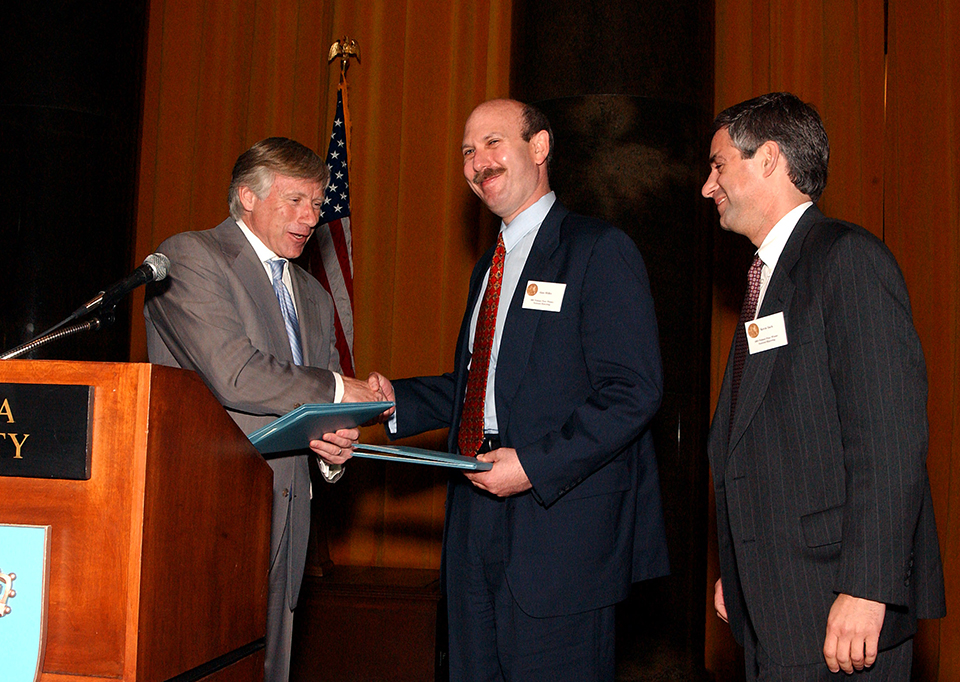
Columbia University President Lee C. Bollinger (left) presents Alan Miller (center) and Kevin Sack (right) with the 2003 Pulitzer Prize in National Reporting.
Winning Work
By Alan C. Miller and Kevin Sack
Times Staff Writers
PART I: "THE WIDOW-MAKER"
"The AV-8B simply wasn't competitive in terms of range, payload, survivability, target acquisition [or] communications capability."
YUMA, Ariz. -- Though many had died flying the Harrier, Marine Corps pilot Peter E. Yount never thought it would let him down.
He knew the attack jet well and was devoted to it. In the entire U.S. arsenal, only the compact, muscular-looking Harrier could lift straight up off a runway, hover like a hummingbird, then blast off in search of targets.
"Difficult but honest" is how Yount described it.
But on a clear spring day in 1998, the Harrier would betray him. At 14,500 feet over the Southern California desert, the plane's engine quit. Yount twice tried to restart it. No response.
"I'm losing control of this thing," Yount radioed to his wingman in a firm voice. "I've got zero hydraulics. I've got nothing. I'm getting out of this thing. Get out of my way!"
He veered the aircraft away from farmhouses and highways in the Imperial Valley below, then pulled the ejection handle. And there, at 7,500 feet, the Harrier failed him again.
As Yount shot out of the cockpit, his seat rotated out of position. When his parachute unfurled above him, its harness straps smacked violently against his helmet, whipsawing his head. The 42-year-old lieutenant colonel and father of two young girls died instantly of a broken neck.
For the Marines, the ensuing rituals were painfully familiar. Notify the widow. Remove the wreckage. Investigate the causes.
They know this drill all too well because the Harrier is the most dangerous airplane flying in the U.S. military today.
Over the last three decades, it has amassed the highest rate of major accidents of any Air Force, Navy, Army or Marine plane now in service. Forty-five Marines have died in 143 noncombat accidents since the corps bought the so-called jump jet from the British in 1971. More than a third of the fleet has been lost to accidents.
The toll has been little noted by the public and the media because the Harrier tends to kill pilots one at a time. In contrast, the V-22 Osprey, a problem-plagued troop transport plane, has killed as many as 19 Marines in a single crash.
The Harrier and the Osprey are the first two planes the Marine Corps has acquired in pursuing its long-range vertical vision. A third plane is under active development and several others are being conceived.
In the future, according to the vision, all Marine aircraft will combine the best traits of helicopters and fixed-wing planes, making the corps' flying force sharply distinct from those of the Navy, Air Force and Army.
The price to be paid for that vision was first seen in the Harrier. The officers who died in it ranked among America's most accomplished aviators. They typically finished near the top of their flight school classes, often aspiring to become squadron commanders, generals or astronauts.
Many of their deaths were preventable. The Marines have known for years they were flying a plane bedeviled by mechanical problems and maintenance mistakes. Yet they moved haltingly to fix known shortcomings that threatened pilots' lives.
In Yount's case, a mechanic incorrectly installed a part that led to failure of the temperamental engine. The ejection system that fractured Yount's neck had previously killed two pilots.
The Marine Corps initially sold the Harrier to Congress and the Pentagon for its ability to launch from a clearing as small as a tennis court, or a damaged runway near a remote battlefield, and then roar to the rescue of troops in trouble.
In 31 years of flight, however, the Harrier's vaunted ability to take off vertically has never been used in combat -- only in training exercises, air shows and the 1994 film "True Lies," when Arnold Schwarzenegger commandeers a Harrier to save Miami from a terrorist attack.
Instead, the planes have used their powerful thrusters for short, rolling takeoffs from runways and Navy assault ships, mostly flying missions that could have been handled by safer, more conventional aircraft.
Many of the Harrier's ailments can be traced directly to its innovative vertical-thrust technology. But despite the investment of tax dollars, aircraft and pilots' lives, there is little evidence that the Harrier's noncombat deaths have been redeemed in any significant way on the battlefield.
"If the Harrier had been decisive many times in battle, we would all still regret horribly the tragedies of the pilots who have been killed, but at least you'd be able to say that the Harrier made a difference," said Philip E. Coyle, the Pentagon's chief weapons tester from 1994 to 2001.
"What makes this situation so difficult is that we just don't have that kind of battlefield record to support the accidental deaths."
In the Persian Gulf War in 1991, the hot thrust-producing nozzles in the heart of the fuselage -- the devices that allow the Harrier to rise and balance in the air -- made the plane a magnet for heat-seeking missiles. Its loss rate was more than double that of the war's other leading U.S. combat jets. Five Harriers were shot down and two pilots died.
"It's the most vulnerable plane that's in service now," said Franklin C. "Chuck" Spinney, who evaluates tactical aircraft for the Pentagon. "You can't hit that thing without hitting something important."
In the last decade, the use of laser-guided ordnance from highflying bombers and unmanned drones has diminished the need for the Harrier's brand of close air support.
Afghanistan provided precisely the kind of austere battlefield where the Marines had maintained the Harrier would make a crucial difference. Yet U.S. commanders held the Harrier out of the first four weeks of combat last year.
As other planes pummeled Taliban and Al Qaeda targets, Harriers based on the Navy's amphibious assault ship Peleliu practiced attack maneuvers over the Arabian Sea, hundreds of miles from the action.
"Other squadrons were going north to the war and we were flying south for more training," recalled Capt. Matthew Parker, a Harrier pilot. "It was very frustrating."
Today, the Marines hope the Harrier will play a more dramatic role in a potential war with Iraq. But given the plane's limitations, many defense officials and military analysts deem that unlikely.
'Answer to a Prayer'
To the Marine Corps' ranking generals, the Harrier has been a major step toward realizing a dream that germinated during World War II in the bloody jungles of Guadalcanal and Tulagi. As Marines battled Japanese forces and malarial mosquitoes on those South Pacific islands, the Navy withdrew and initially left them to fend for themselves without air cover and supplies. The Marines lost more than 1,000 men in the campaign, and their resentment has endured for 60 years.
The precept that Marines in the air should protect Marines on the ground has been central to the corps' ethos ever since. By 1957, Marine leaders had proclaimed the bold vision of creating an entire wing of aircraft with the vertical ability of helicopters and the speed and range of airplanes, a goal they now hope to reach by 2020.
Their breakthrough plane was the Harrier. It was, said one general, "an answer to a prayer."
The Marines are now testing the tilt-rotor V-22 Osprey, designed to speed troops into combat. Its revolutionary technology also has had deadly side-effects, killing 23 Marines in two crashes in 2000 alone.
The Pentagon, meanwhile, is developing the Harrier's replacement, the Marine version of the next-generation Joint Strike Fighter, a plane that will imitate the Harrier's abilities to take off after a short roll and land vertically.
As the military's smallest branch, the Marines have long feared their air wing would be absorbed by the Navy or that the corps itself would be folded into the Army. In waging the political battle to remain a self-sufficient fighting force, they have sought over the years to make their combat role distinctive.
The Marine Corps' generals are painfully aware of the Harrier's shortcomings. Many can rattle off the names of pilots they have buried. But they say that accidents are the price of technological progress, and that the Harrier has proven its value in combat while paving the way for a superior successor. They deny they have needlessly jeopardized Marines in pursuit of their vision of an independent air wing.
"I would resist with all my moral fiber the idea that we would willingly or knowingly try to bring aboard a program -- V-22 or anything else -- and so fall in love with the program that we would put people at risk to ride in those vehicles," Marine Corps Commandant James L. Jones said at a military forum last year.
If the Harrier's problems have lingered, some current and former Marine officials contend, it is because the Navy has once again let them down. As the financial overseer of the corps' aviation program, the Navy hasn't always provided enough money to maintain a plane flown only by the Marines, they say -- a charge Navy officials vigorously dispute.
Undaunted by past failures, the Marines have pressed on. Some survivors of Harrier pilots say that is as it should be, that their husbands and sons knew the risks but believed in the cause. Others are less forgiving, convinced that the corps has been more faithful to its vertical vision than to its pilots. They say the corps has taken unreasonable risks with the lives of their loved ones.
"They deserve the best chance we can give them if we're going to stick them out there to stretch the envelope," said Jim E. Dale, whose brother, 1st Lt. Kerry D. Dale, died in a 1988 Harrier crash after his flaps jammed. "They deserve honesty. They deserve integrity. They deserve the very principles from the corps that we think the corps stands for."
Many of the Harrier's victims left behind adoring wives and children too young to comprehend. Long after their deaths, their parents grasp for memories, adorning their sons' bedrooms with ceremonial swords, plastic airplane models and flags folded neatly into tri-corner boxes.
Twelve years after Maj. Roland P. Wheeler died in a Harrier crash, his widow, Brandi, still drives her white Toyota Camry with his call sign -- "Wheels" -- stamped on her license plate. Even within the macho culture of military aviation, she said, Harrier pilots hold a certain swaggering cachet: "If you flew the Harrier, you walked on water and glowed in the dark."
After watching so many colleagues die, some pilots and their families have decided the risk is too great. Gary Pheasant left the Marine Corps in 1988, with 1,800 flight hours in the Harrier, when his wife decided she could no longer live with the dread.
"When I'd go fly," he said, "she'd make sure the house was clean. She figured the chaplain could be coming over at any moment."
Love at First Sight
No wonder the Harrier enthralled the Marines when they first saw it at a British air show in 1968. With wings distinctively swept back and angled downward, the plane is a technological marvel when it is flying well.
Named after a low-flying marsh hawk, the Harrier has a massive Rolls-Royce engine that supplies 23,800 pounds of thrust through four nozzles that pivot down to produce a shimmering blast of hot air. The thrust can propel the plane off the ground and into a hover, a process that pilots compare to balancing an elephant on the head of a pencil.
The British developed the Harrier in the 1960s to counter the threat of a Soviet attack. If allied air bases were destroyed, a dispersed fleet of Harriers could counterattack from glens or roads.
Marine pilot Thomas H. Miller, then a colonel, was one of the first two Americans to fly the British Harrier. "If I had my way, I'd have a squadron of those things tomorrow," he told his superiors upon his return. "I think we can save an awful lot of young people's lives."
The Marines got their first jump jets in 1971. Over the ensuing 31 years, the corps received 397 Harriers, first from Hawker Siddeley Aviation Ltd. and British Aerospace Inc., and then from McDonnell Douglas Corp., lead contractor on the second version of the plane.
The Marines now have 154 Harriers. The plane is no longer in production but is scheduled to remain in service another 13 to 17 years.
Despite its early billing, the Harrier turned out to have a crippling flaw: It crashed at an alarming rate.
Other military planes have killed more pilots because there are more of them, and they log more hours in the air. But by the accepted standard of U.S. military aviation safety -- major accidents per 100,000 flight hours -- the Harrier has no peer among active planes today.
Major accidents are known in the military as Class A mishaps if they cause death, permanent injury or at least $1 million in losses (the dollar figure has increased over time).
The Class A mishap rate for the first model of the Harrier, the AV-8A, was astronomical -- 31.77 accidents per 100,000 hours. Notoriously unstable, it had a propensity for rolling over and slamming into the ground. Well over half were lost to accidents. One tragedy-scarred squadron dubbed the plane "the Widow-Maker."
Promising dramatic improvement, the Marines replaced it with the more stable and capable AV-8B model in the mid-1980s.
"Any safety problems, perceived or real, with the AV-8A have been specifically designed out of the AV-8B," Col. Harold Clark, a Harrier program officer, proclaimed in 1981.
But by 1996, nearly a quarter of the new planes had crashed.
The lifetime accident rate for the Marines' AV-8B is 11.44 per 100,000 hours of flight, well over the combined rates for other attack and fighter planes flown during those years by the Marines, the Navy and the Air Force.
It is more than twice the lifetime accident rate of the Air Force's F-16 Fighting Falcon, a single-engine tactical aircraft like the Harrier that has been in service since 1979. It is nearly five times higher than the A-10 Warthog, an Air Force attack plane that has been flying since 1976. And it is more than 3 1/2 times the rate of the F/A-18 Hornet, a twin-engine combat plane flown since 1980 by the Navy and Marines that, like the Harrier, operates largely off ships.
The Harrier Review Panel, a Marine commission that issued a 1998 report on the AV-8B's problems, wrote that the Harrier's accident rates "seem always to have been a decade or more behind the rest of the tactical aviation world."
All told, Harriers have been involved in more than 300 accidents and 900 less serious incidents, according to the Naval Safety Center's aviation database. The loss to taxpayers exceeds $1.8 billion. And those figures don't include the plane's calamitous first decade.
The Marines had a glimmer of hope in 2001. The Harrier earned its lowest Class A mishap rate ever: 2.74 per 100,000 hours of flight. That prompted Commandant Jones to say last February that "the Harrier is flying unbelievably well." Two weeks later, a Harrier crashed off the coast of Mexico. Two more went down in North Carolina in June and July. All three pilots ejected successfully. The financial losses totaled $90 million. And the Class A mishap rate for 2002 shot back up to 9.66 through Oct. 1.
Across the Atlantic, planes in Britain's much smaller Royal Air Force fleet have been crashing at an even higher rate. Between 1990 and 2000, the models most similar to the Marines' AV-8B had cumulative major accident rates ranging from 12 to 19 when the U.S. military standard is applied.
Fifteen major accidents killed two British and one American pilot during that period.
In August, an RAF Harrier slammed into the sea as the pilot parachuted to safety in front of thousands of spectators at a Suffolk air show. The cause of the crash is under investigation.
A number of other countries, including Spain and Italy, have bought Harriers over the years. But Taiwan decided earlier this year not to lease nearly three dozen AV-8Bs from the Marines because of concerns about "maintenance, safety and performance," said a Taiwan defense official.
The U.S. Navy has spent nearly $9 billion since 1971 to buy and modify the Harriers and an additional $4.1 billion since 1986 to repair and fly the aircraft. The Marines are rebuilding 74 AV-8Bs at a cost of $28.2 million each, pushing the overall investment in some of those planes above $50 million.
Budget Battles
Many current and former Marine Corps leaders complain that the Navy has not always provided sufficient funding because the Harrier, unlike the F/A-18, belongs to the Marines alone.
In their budget battles with the Navy, the Marines portray themselves as the deprived stepchild in an institutional rivalry.
Former Navy secretaries and other senior officers deny that the Navy has shortchanged the Harrier program. But they said the Navy has been reluctant to provide extra money to the Marines for a jet that is more costly and less reliable than other combat planes.
"The fact that the Harrier turned out to be grossly more expensive than they thought, especially driven by the very high accident rate, was not the fault of the Navy," said John F. Lehman Jr., who served as Navy secretary from 1981 to 1987. "That was their miscalculation."
Because the Navy has been unwilling to pour extra money into a plane it regards as flawed, the Marines have chosen to make do with what they had.
Stephen E. Brooks, who flew the Harrier for four of his 10 years in the Marines before leaving in 2000, called it "a phenomenal aircraft when it's being financed and maintained properly."
But he said the Marines didn't "want to acknowledge how expensive it would be to run it properly.... The Marine attitude would be: 'We'll make it work with what we've got.' "
The Harrier's accidents cannot be traced to any single problem, but rather to an array of them.
In the last 12 years alone, the Marines have grounded parts of the Harrier fleet 31 times for periods ranging from days to months.
Failures of the cantankerous Rolls-Royce engine have been chronic, causing more than two dozen major accidents.
The Marines and the Naval Air Systems Command knew for nearly eight years that the wing flaps were prone to locking up, but it took three crashes, two of them fatal, before they decided to redesign the problem part.
The accident that killed Lt. Col. Yount highlights just how risky the Harrier can be.
Yount grew up close enough to Cape Canaveral, Fla., to watch rocket launches from his porch. A former test pilot venerated for his skill in the cockpit and his leadership in the ready room, he aspired to become a general. He had been selected to command a Harrier squadron at the Marine Corps Air Station in Yuma.
Janet Yount never fretted much about her husband's safety. "When I'm in the plane, you don't have to worry," he had assured her. "I'm in control."
But he once confided that he never wanted to rely on the Harrier's ejection system. "That thing's dangerous," his mother, Bettye Yount, recalled him saying.
The accident inquiry concluded that a circlip, a semicircular fastener, was incorrectly installed by mechanics on the gas turbine starter, setting off a chain reaction that led to the engine failure.
Then, when Yount ejected, he was killed by the very system that pilots depend on when they run into trouble.
He became the third Harrier pilot since 1990 to die during an "in-the-envelope" ejection -- meaning the circumstances were such that survival would be expected -- according to the Harrier Review Panel.
A subsequent Navy examination cataloged other serious Harrier ejection injuries, including five previous "major neck injuries" sustained during otherwise normal ejections.
Nevertheless, the Marines say they had no reason to believe the ejection system was flawed before Yount's accident. In its aftermath, they made safety improvements to better protect against serious injuries.
Yount's death unnerved many in the Marine Corps because he seemed to have made no mistakes.
"Here was a guy who did every single thing correctly and still the airplane ended up letting him down," said retired Lt. Gen. Fred McCorkle, head of Marine aviation at the time.
The Marines acknowledge they have had a rough ride with the Harrier. But eight current and former Marine commandants and top aviation officers told The Times in interviews that it has been worth it.
Retired Maj. Gen. Charles F. Bolden Jr., who stepped down as commander of the 3rd Marine Aircraft Wing in August, said the Marines "don't stop flying airplanes because we have accidents."
He added: "We try to find out what the problem was and then we fix it. And we tried to do that with the Harrier."
McCorkle, who retired from the Marines last year after 35 years in the service, said, "I've heard a lot of people who were very, very attuned to caring for their troops say that's the cost of doing business."
Retired Commandant Charles C. Krulak, who convened the Harrier Review Panel, which generated a six-year infusion of funds for the program, said the Marines have made many efforts to improve the plane's safety.
All military pilots accept a certain level of risk. And Harrier pilots in particular have been willing to commit themselves to a plane they know is perilous, out of devotion to the Marines.
Many adore the plane because it handles like a hot rod. They express confidence in their ability to fly it despite the ominous nicknames it has earned, including "the Scarier" and "the lawn dart."
Like Capt. Richard F. Davis, who got a pilot's license before he could drive, many had wanted to fly since childhood. And like Capt. Manuel Rivera Jr., who challenged friends to play handball while he hopped on one foot, they were fit, disciplined and brimming with bravado.
Davis, 27, died when his AV-8A rolled over during a vertical takeoff in 1975. Rivera, 31, died when his AV-8B smashed into the Omani coastline during a Gulf War training mission in 1991.
For the pilots, it is a measure of their intense loyalty to the plane and to the corps that even those who have suffered incalculably from its crashes tend to remain unflinching advocates.
Retired Gen. Richard. D. Hearney, a member of the first Harrier squadron, was the head of Marine aviation in 1994 when his second son, Brenden K. Hearney, 29, flew a British Harrier into the ground while on an exchange program with the RAF in England.
"I've got my lifeblood tied up in the program, literally," Hearney said in an interview. Did his son's death change his commitment to the Harrier? "Not a bit," he said.
In 1993, John O'Brien, a 28-year-old Marine pilot with only 152 hours in the Harrier, smashed his plane into a grove of trees during a tricky "rolling vertical landing."
Pinned inside the flaming wreckage, he suffered burns over more than a third of his body and ultimately lost part of an arm and a leg.
Without a trace of bitterness, O'Brien said the Marines need the combat flexibility the Harrier provides.
"Advancements in technology don't come without sacrifice," O'Brien said, surrounded at his Pennsylvania home by his wife and three young daughters. "Advancements in technology are sometimes written in blood."
Combat Record
It would be one thing if the Harrier's unique design had produced unique results. But in two wars and a number of lesser conflicts, the plane has not made a distinctive mark.
It is telling that Marine leaders, when defending the Harrier's record, tend to point back two decades to another nation's conflict.
In Britain's Falkland Islands War with Argentina, Royal Navy Sea Harriers won a nation's reverence by defending the short-deck ships on which they were based. Armed with cannons and heat-seeking missiles, they proved too much for Argentina's Mirage fighters and other jets in air-to-air combat.
The Marine Corps' Harriers have never faced a similar mission and are not outfitted to do so. The Marines obtained the plane primarily to support troops on the ground. As a result, the corps accepted many trade-offs for an aircraft that relies on powerful blasts of hot air to propel it into the sky.
The superheated column of thrust can liquefy asphalt, while its huge intakes can ingest pebbles and other engine-shredding debris.
The Harrier has to be light enough for the engine's thrust to lift it straight off the ground, so it carries a relatively small amount of fuel, which limits both its range and payload. Its maximum external load, including bombs and fuel, is 9,000 pounds.
By contrast, the Marines' own F/A-18 can handle 15,500 pounds and the Air Force's A-10 up to 16,000 pounds, according to Jane's All the World's Aircraft.
To keep its weight down, the Harrier has no protective armor. It carries no flame-retardant foam in its fuel tanks because the foam displaces fuel. The fuel tanks are not equipped with self-sealing membranes to plug bullet or shrapnel holes.
The Marine Corps spent a lot of money to test such survivability systems in the late 1990s but ultimately rejected them because of their weight, said the Naval Air Systems Command, which oversees Marine aircraft safety.
Moreover, the plane's single engine gives it little margin for error. It is neither supersonic nor stealthy, which means it cannot fly especially fast or easily elude enemy radar.
And the hottest of its thrust-producing nozzles are in the middle of the fuselage, a design anomaly required to balance the Harrier for vertical flight. In other aircraft, the hot spot is near the tail, where a hit by a heat-seeking missile is less likely to be fatal.
Until recently, the Harrier's vulnerability was magnified because it was intended to fly close to the ground as it swooped down on enemy troops.
In its first significant U.S. combat role, during the Persian Gulf War in 1991, it paid a heavy price. On the war's final day, Capt. Reginald C. Underwood and other Harrier pilots were flying below the cloud cover at about 8,000 feet so they could see their target, a convoy of Iraqi military vehicles.
"We were flying way too low," said his squadron commander, Lt. Col. Jerry Fitzgerald. An Iraqi missile went straight up the left hot nozzle of Underwood's jet. "He never saw it coming," Fitzgerald said.
Underwood was killed, one of two Harrier pilots to die in Gulf War combat. Five of the seven Harriers that took enemy fire were destroyed. Two ejecting pilots were captured by the Iraqis.
The Harrier's attrition rate of 1.5 planes for every 1,000 sorties flown contrasted with a rate of 0.5 for the A-10, a sturdy and inexpensive attack jet that flew many dangerous missions. The F-16 had an even lower rate, 0.2, and the Marine Corps' F/A-18 suffered no losses.
Postwar Praise
The Marines nevertheless point to the Gulf War as the Harrier's proving ground. The corps' commandant at the time, Alfred M. Gray Jr., told the Senate Armed Services Committee in March 1991 that its support for the AV-8B "paid off in spades" in the Gulf.
Marine officials and other Harrier proponents note that Gen. H. Norman Schwarzkopf, commander of U.S. forces in the Gulf, cited the Harrier in a postwar report as one of several weapons that gave "standout performances."
The Harrier did fly early and often. But it required an enormous transport and supply operation to keep it provisioned with bombs, fuel, parts and distilled water for cooling the engine, a far cry from its originally stated mission of operating from remote locations.
It took about 2,000 Marines to support an air group based at King Abdul Aziz Air Base near Dhahran, Saudi Arabia, that included 66 Harriers and 20 OV-10 Bronco observation planes, said retired Col. John R. Bioty Jr., who commanded the group.
During the last 10 days of the war, some planes also operated from a short runway at Tanajib, a rearming and refueling base about 35 miles south of the Kuwaiti border that put them closer to the enemy than any other airplane.
The Harriers bombed Iraqi artillery, armored vehicles, troops and air defense units, Bioty said. And while other planes flew far more sorties, the smaller Harrier fleet flew a substantial number: 3,349.
"Because the aircraft was able to base closer to the forward edge of the battle area, it could respond quicker and didn't require air refueling," Bioty said. "It can do things other airplanes can't do and can go places other airplanes can't go."
In the end, retired Air Force Gen. Charles A. Horner, the U.S. air commander in the Gulf, said his decision to stack aircraft over the battlefield "negated the need for quick response" from AV-8Bs.
The General Accounting Office, the investigative arm of Congress, omitted the plane from its 1997 report on the Gulf air war, pointing to its "relatively few strikes against strategic targets."
Though the Harrier proved effective at what it did, "trying to justify it based on the Gulf War is tenuous at best," Horner said. "In terms of payload, range and suitability for close air support," he added, "the A-10 is a much better platform."
Even some Marine generals agreed. Given the loss of five planes, the Harrier in the Gulf "wasn't a failure, but it wasn't a great success," said retired Lt. Gen. Charles H. Pitman, chief of Marine aviation from 1988 to 1990. "I don't think they did anything spectacular."
The Marines say they have since reduced the Harrier's vulnerability by tripling the number of flares and other decoys that the plane can fire to divert missiles.
But the primary reason the plane is safer in war today is that the advancing technology of laser-guided missiles and bombs has allowed all combat planes to fly at higher altitudes. In the process, the Harrier has become less relevant.
"You can find missions the Harrier can perform," said Michael O'Hanlon, a defense analyst at the Brookings Institution, a nonpartisan think tank based in Washington, "but I question whether any of them are missions only the Harrier can perform."
In future conflicts, unmanned drones like the one that killed suspected Al Qaeda operatives in Yemen last month are expected to fly missions that had been the exclusive province of combat planes like the Harrier.
And American commanders now routinely assign various aircraft to essentially loiter over the battlefield, reducing the value of basing planes up front near the troops.
Some critics even argue it is unwise to put planes so close to the enemy because it leaves them vulnerable to attack.
All of those factors conspired to make the Harrier a marginal player last year in Afghanistan, where highflying bombers and fighter planes inflicted considerable damage before the Harriers were even called into action.
"Close air support in Marine terms was not what was happening there," said Col. Thomas D. Waldhauser, commanding officer of the 15th Marine Expeditionary Unit, which included the Harrier squadron aboard the Peleliu. "Close air support in Afghanistan was a B-52 dropping bombs from 30,000 feet."
The six planes on the Peleliu were sent into combat only after their frustrated pilots complained to Commandant Jones about their idleness. When the war began, the Harriers in the region lacked a laser targeting system. Lt. Gen. Michael A. Hough, chief of Marine aviation, said Harriers were cleared to join the war only after military leaders agreed that other aircraft with laser systems could pinpoint targets for the AV-8Bs. (The laser systems are now being installed in 98 Harriers at a cost of nearly $1.7 million each.)
"This is the sort of conflict in which Harrier proponents typically would expect to see the Harrier prominently used, especially early on," said Christopher Bolkcom, a military aviation analyst for the Congressional Research Service. "I don't think it's lost on many people that the Harriers were not the first airplanes used in that war."
By the time the Harriers entered the fray, targets were scarce. In November and December, the busiest months for the Harrier, the aircraft dropped only 161 bombs during 342 sorties. The 400 allied aircraft in Afghanistan never included more than 12 Harriers. Until Dec. 31, the Harriers flew exclusively from ships, just like safer and more effective Navy and Marine planes.
On that day, after the fall of Kandahar, the Marines dispatched two Harriers to a partly destroyed airstrip there. Marine leaders touted this as evidence that the planes were operating where others could not.
But the two planes stayed only one night, flying four sorties and dropping no bombs, according to the Marines. Capt. Chris Raible, who piloted Harriers in Afghanistan, said the flights "were like photo ops."
When medals were awarded for Operation Anaconda, the major battle in eastern Afghanistan in March, the honors went to the Marine helicopter pilots who provided low-level fire for ground troops while the Harriers circled above.
Harriers have been operating alongside A-10s at a high-altitude air base at Bagram since October, where the Marines say they have provided "essential support to ground units." But the thin air and a torn-up runway have restricted vertical flight.
In two important respects, the Harrier performed impressively: reliability and bombing accuracy. Pilots said the plane held up remarkably during extended sorties and that their bombs almost always hit their mark.
Gen. Jones said the Harriers "acquitted themselves quite well" in Afghanistan. "They've proven themselves to be very worthy contributors."
But a number of military officials and analysts question the value of the Harrier's contribution.
"I think the reason the AV-8s were used at all in Afghanistan was a tendency by the U.S. military to give everybody their turn, whether you needed them or not," said Anthony H. Cordesman, an analyst at the Center for Strategic and International Studies. "The AV-8B simply wasn't competitive in terms of range, payload, survivability, target acquisition [or] communications capability."
The Marines acquired the Harrier for a different type of war than is fought today, said Daniel Goure, a former director of the Pentagon's Office of Strategic Competitiveness and now vice president of the Lexington Institute, a think tank in Arlington, Va.
"For that reason, they took all the attendant risk of mishap rates and all the rest," he said. "In hindsight, I suspect they would have come up with a different answer."
© 2002, Los Angeles Times
By Kevin Sack and Alan C. Miller
Times Staff Writers
PART II: CAUSES
For example, the Marines do not regularly schedule the Harrier engine for major overhauls, as is done with most military aircraft.
CHERRY POINT, N.C. -- The pigeons in the hangar had worn out their welcome.
So late one night, three Marine maintenance workers launched an artillery assault on the squatters in the rafters. Armed with slingshots and ball bearings, they fired round after round, unfazed by the $28-million Harrier attack jet parked nearby.
They bagged one bird before being told to knock it off. The Marines then searched the hangar, inspected the plane and thought they had found all the bearings.
The next day, having flown the Harrier to Ohio, Capt. Stephen E. Brooks had just taken off for home when the engine shuddered with a thunderous crack. Finding himself powerless 150 feet above a busy interstate, he pointed the nose toward a cornfield and pulled the ejection handle. He walked away with scrapes, bruises and a medal for steering his plane away from a strip mall.
An investigation into the October 1997 crash determined that a foreign object had shaken loose during takeoff and ricocheted through the whirring engine, reducing compressor blades to shrapnel. A metallurgical analysis confirmed what was widely assumed: A dent in one of the damaged blades matched the ball bearings like a fingerprint.
Harrier pilots have encountered a mind-bending array of calamities, some unfathomable in their recklessness, others dispiriting in their predictability. In the 31 years the Marines have flown the plane, just about anything that could go wrong has gone wrong.
Time and again, engines have flamed out, compressor blades have cracked, control sticks have jammed, wing flaps have frozen, nose wheels have veered off runways. A widely respected pilot and a flight surgeon lost their lives when the acrylic canopy over their cockpit imploded.
"If you can think of a situation, it's happened," said Durward Savage, a retired Harrier pilot.
Military officials knew about defects in the flaps and ejection system for years before fixing them, while planes crashed and pilots died. Problems with the plane's engine persisted as the Marines and the manufacturer, Rolls-Royce, engaged in finger-pointing over who was responsible.
The Harrier's mechanical breakdowns have been compounded by maintenance lapses that have helped make it the most accident-prone airplane in the U.S. arsenal.
The corps has been devoted for decades to creating an aviation fleet that can take off and land vertically, with the Harrier as its prototype. The plane can rise like a helicopter, hover in precarious balance and then roar off toward the horizon.
But the Marines' Icarus-like pursuit of vertical flight has strained the limits of the plane, its pilots, maintenance crews and budget, trumping the corps' renowned can-do resourcefulness.
They have cut corners to save time and money. Rather than spending millions on engine testing, for example, they have let pilots discover the plane's failings at 15,000 feet.
"We took a revolutionary airplane with an underdeveloped engine program and we put it in the fleet," said Maj. Gen. Charles F. Bolden Jr., recently retired commander of the 3rd Marine Aircraft Wing. "We let the fleet figure out what the problems were and we killed people."
In all, 45 Marines have died in 143 noncombat accidents since the corps first bought the Harrier from the British in 1971.
Marine Corps officials say they have never knowingly allowed an unsafe aircraft to fly. The current chief of Marine aviation, Lt. Gen. Michael A. Hough, said safety improvements on the Harrier have always been a top priority. But he said it often took years to design, test and implement such changes.
"And you can't down your fleet and say, 'Well, we'll take a little pause here for about three or four years, boys, and get back to you later,' " he said.
He said the Marines have never deferred safety-related fixes because they lacked funding. But he is contradicted by predecessors, other Marine officers, accident records and official reports.
When asked which problems he would have addressed with more money, retired Lt. Gen. Harold W. Blot, a former head of Marine aviation, hardly knew where to begin.
"Well," he said, "there was a nose wheel steering issue. There was an inlet guide vane issue. There was the flap impingement issue."
Under the best circumstances, flying the Harrier is a formidable task. In an era of advanced avionics, with computers doing much of the flying, it still requires considerable manual dexterity (known among pilots as "monkey skills") and mental focus ("headwork").
Charles E. Myers Jr., a former director for air warfare in the Pentagon, likens the allure to riding "the nastiest horse in the rodeo."
While a conventional jet has one way to take off and one way to land, the Harrier pilot must master four basic methods for each. In addition to handling the throttle, control stick and rudder pedals, he also must maneuver the four rotating nozzles that allow the plane to ascend and descend on powerful blasts of hot air.
While flying vertically, he must pay close attention to wind direction. Add the challenges of operating at night or from a moving ship and the task becomes daunting.
Retired pilot Brooks, whose plane was damaged in the pigeon hunt, compares it to "speeding your car 90 mph through a crowded shopping mall parking lot while playing the hardest X-Box video game imaginable and talking on your cell phone."
Proficiency in the Harrier cockpit requires, at minimum, 15 to 20 hours in the air each month, according to the Marines. But the plane's frequent groundings -- there have been 31 in the last 12 years alone -- mean pilots often have to make do with simulators. As recently as 2000, they averaged 8.2 flight hours a month; that has since increased to 13 hours.
The downtime has contributed to numerous accidents caused by pilot error. But in some instances, pilots have been assigned posthumous blame even when inadequate training or mechanical problems were significant factors.
The aviators risked their lives every day but did not always get the support they deserved, said retired Maj. Gen. Michael D. Ryan, a former Marine wing commander who is now executive vice president of government business for Rolls-Royce North America Inc.
"These pilots were young guys, hard chargers, superheroes," he said, "who were working for leadership that sometimes didn't provide them with what they needed."
Flap Problems
From the time the Marines first discovered a dangerous flaw in the Harrier's wing flaps, nearly eight years passed, three planes crashed and two pilots died. Only then did the Marines and their Navy counterparts decide to completely redesign the problem part. It took another eight years to find the money and do the work.
In 1986, as 1st Lt. Edward C. Jasiewicz was trying to land his Harrier at the Marine Corps Air Station at Cherry Point, the flaps suddenly froze, pitching the nose forward and prompting the pilot to eject to safety.
An investigation focused on the electronic device that controls movement of the flaps, which help provide the plane with lift. The report noted that the failure rate for the device, known as a flap electronic controller, had been nearly three times higher than predicted.
Two years later, another flap failure forced 1st Lt. Kerry D. Dale to eject only 33 feet above the ground as his plane plunged into a stand of Carolina pines and exploded into bits.
"It was a light body bag," said his father, Jim P. Dale.
An investigation found that moisture had seeped into the flap controller and shorted it out.
The Marines took steps to reduce the problem, like coating the circuitry with waterproofing, while the airframe manufacturer, McDonnell Douglas Corp., explored longer-term solutions.
In the meantime, pilots were expected to fly their way out of trouble by following directions in their flight manuals, according to officials from the Naval Air Systems Command, which oversees Marine aircraft safety.
In 1989, Maj. Woody F. Gilliland managed to land his plane after the flaps seized up at more than 20,000 feet. Again, the investigation identified moisture as the culprit, according to Gilliland.
Four years later, Capt. William P. Delaney had just taken off from Cherry Point in a light rain when the flaps on his Harrier jammed. Delaney ejected just before his plane smacked the runway, broke apart and burst into flames.
The parachuting pilot descended into the fireball and was killed.
The crash investigation found that two wires to the flap controller had broken, cited moisture as a "contributing factor" and again recommended a complete redesign of the controller box.
Determining that their previous "Band-Aid" fixes had not been sufficient, the Marines and the company then decided to redesign the box, said Vince L. Higbee, Harrier program manager for Boeing Co., which bought McDonnell Douglas in 1997.
It took another two years for the Marines to find the money, Higbee said, adding that such a period was "not atypical" for military procurement.
It was only last year, 15 years after the Jasiewicz crash, that the company completed delivery of the newly designed parts to the Marine Corps.
The design changes rerouted the flow of moist air around the controller box and programmed the flaps so that they automatically override mistakes made by pilots.
The cost was $21 million. There have been no reported flap-related accidents since.
"It took Billy's accident for the Pentagon to get the money to fix that system," said William Delaney, the pilot's father. "Had they spent the money, they would have saved his life. He would still be here."
In a written statement, the Naval Air Systems Command said the true nature of the flaps problem wasn't understood until the Delaney investigation.
Higbee said each decision was based on the information available at the time. "In hindsight," he said, "you would have done something different."
The slowness in dealing with the flaps reflects a pattern of deferred repairs to critical Harrier components.
Ejection System
The ejection system killed three pilots between 1990 and 1998 and seriously injured several others before the Marines made modifications, records show.
A 1998 report of the Harrier Review Panel, a Marine Corps commission, said that while the ejection seat had worked at least 94% of the time since 1985, it also suffered from "known deficiencies."
The report cited concerns with the seat's computerized selection of ejection speeds and with an apparent design flaw that sometimes caused the harness straps to slap forcefully against the pilot's helmet. Because the Harrier operates so close to the ground when flying vertically, its ejection seat is especially fast-opening and therefore especially violent.
In addition, the Navy declined for at least 10 years to pay for a recommended steering mechanism that would have given parachuting pilots greater maneuverability. All other Navy and Marine aircraft have such a system.
The ejection seat manufacturer had proposed testing a four-line release system in the Harrier parachute as far back as 1988. But the Naval Air Systems Command responded that there were "no funds available," according to an internal document.
The systems command found the money after a prominent Marine pilot was killed in 1998 while ejecting from a Harrier.
But the parachutes were not equipped with the new system in time to save Col. Kevin E. Leffler, who ejected into high winds over Death Valley National Park in 1999. With little control over his descent, Leffler dropped into a canyon and died when his head struck a boulder.
The Marine Corps investigation concluded that a four-line release steering system "might have saved the pilot's life." It has since been provided as part of a $7-million package of parachute improvements.
Engine Trouble
The Harrier's single Rolls-Royce engine has been a persistent source of trouble, playing a role in more than half of all Harrier accidents between 1980 and 2001, according to a Times analysis of the Naval Safety Center's aviation database. Even after the Marines swapped out the Harrier's original AV-8A model for the improved AV-8B, the new engine proved to be five times less reliable than the engine in the F/A-18 Hornet, according to a 1992 audit by the Defense Department's inspector general.
"The whole 20 years I was there, they were always doing engine modifications but they could just never fix it," said Clinton M. Higginbotham, a retired Marine Corps major who spent much of his career maintaining the Harrier. "It was just a bad engine from Rolls-Royce."
The company has paid to correct two design defects. But Rolls-Royce officials said other engine problems stem from the failure by the Marines and the Naval Air Systems Command to make engineering changes recommended by the company or to invest enough in testing and maintenance.
When Capt. Daniel J. Gilkey had to bail out of his Harrier at 17,000 feet over the California desert in June 2000, the engine part that failed had been marked for modification years earlier by Rolls. The same part had malfunctioned in at least four other Harriers.
"The level of funding for the AV-8 has always been substantially less than other combat aircraft," said Colin H. Green, president of Rolls-Royce's Defence Aerospace division.
Since a meeting two years ago between the Marine Corps commandant and the Rolls-Royce chairman, cooperation has improved and both have dedicated additional resources to the engine, officials on both sides say. After Gilkey's crash, the Naval Air Systems Command grounded 101 Harriers while working with Rolls-Royce to make modifications the company had recommended previously, said Ryan, the Rolls executive. The planes remained out of service for at least six weeks and some did not return to the air for close to a year.
It was not the only time engine problems compromised Marine readiness. In 1991, the new night-attack version of the Harrier was held out of the Persian Gulf War after a nonfatal crash revealed that the engine casing flexed at high speeds, creating friction that caused fires. The corps and the Naval Air Systems Command had chosen not to subject the new engine to expensive preflight testing.
"Oh, it just drove us crazy," said retired Col. Ronald V. Deloney, who led the squadron that had to stay home. "We watched the war on CNN."
Money Problems
Many Marine leaders maintain that money for the Harrier has always been scarce.
Some blame the Navy, which controls the corps' aviation budget. They say the Navy has been tightfisted because the Harrier is flown only by the Marines. And several retired generals said the Navy, which is largely defined by its aircraft carriers, has felt threatened by the Harrier's ability to launch from assault ships with shorter decks.
But former Navy secretaries said they never intentionally shortchanged the plane and that the Marines set their own budgetary priorities. The Harrier, said Sean O'Keefe, who was Navy secretary during the first Bush administration, simply "proved to be more expensive, harder to maintain, harder to operate and required a lot more care and feeding than other tactical aircraft."
Retired Rear Adm. Robert H. Gormley said Navy leaders were "very resentful" that the corps poured money into a plane that never seemed to outpace its problems. "They just didn't see what the return was for these dollars," he said.
In 1998, the review panel concluded that the AV-8B's risk was "uniquely high" and recommended more than 50 fixes and upgrades. The Marine Corps and Navy committed $133 million over six years to make the improvements. About a third of the money had been spent as of late last year and, as of Oct. 2, 29 of the panel's recommended improvements had been completed, the Marines said. Another 19 are underway.
Now, said Lt. Col. R.E. Claypool, who commands a Harrier squadron in Yuma, Ariz., "we've got our arms around the engine."
Retired Marine Commandant Charles C. Krulak, who convened the review panel, called the new and improved Harrier "an ass-kicking machine."
That same machine crashed three times this year.
Deadly Fixes
On his first day as a Marine mechanic, Larry Stoneroad strolled out on the tarmac at Cherry Point to marvel at a hovering Harrier. His awe quickly turned to horror as the plane rolled over and slammed to the ground, fatally injuring the pilot. "I thought, 'Oh, my gosh! How many of these am I going to see?' " he said.
Stoneroad saw enough that he retired in 1999, after 25 years, without ever accepting a pilot's offer to take a spin in one of the very planes he maintained.
"I'd seen too many of them go down," he said.
Marine mechanics have long faced the unenviable task of ensuring the Harrier's safety. The plane's inaccessible engine and myriad breakdowns are challenge enough. But many also have tackled their jobs with inadequate training and support, under tremendous pressure to keep the planes flying.
Stoneroad's longevity made him something of an oddity among Harrier mechanics.
Gunnery Sgt. John Higginbotham, a senior Harrier mechanic at Cherry Point, said it was not so long ago that, with just three years under his belt, he was the most experienced mechanic in his squadron.
In Britain, where maintenance-related mistakes are relatively rare, some Harrier mechanics have worked on the plane for more years than their American counterparts have been alive.
Some Marine leaders acknowledge that the Harrier, quite simply, is often too complex for the recent high school graduates who typically maintain it.
"We had regular guys fixing them, not engineers," said retired Lt. Gen. Charles H. Pitman, a former chief of Marine aviation," and so we found that some of the problems were caused by us doing something we shouldn't have done."
For instance:
Maintenance workers installed the wrong size washer in Col. Leffler's plane, which led to an engine fire that forced his ejection over Death Valley in 1999, investigation reports show.
The Marines knew the wrong washers had been installed in some planes. Three years before Leffler's accident, the same mistake had caused two nonfatal crashes. The Naval Air Systems Command ordered inspections.
But military officials did not believe all Harrier engines contained the bad part. And with some Harriers deployed overseas, they did not want to ground the entire fleet, according to an internal maintenance bulletin. Leffler's plane was among those exempted.
"Given the critical consequences of this decision," the investigators wrote, "it would have made more sense to inspect all engines."
In 1983, a TAV-8A, the first-generation two-seat training model of the Harrier, crashed after the plane's control stick jammed during a vertical takeoff. Capt. Paul L. Spargo Jr. ejected too late, dying instantly as he slammed into the ground.
Investigators discovered that loose parts under the floorboard had caused the problem. Mechanics discarded the parts six years earlier, after using the cockpit to test experimental equipment while the plane was sidelined by an earlier crash. With the parts undetected, the plane was returned to service.
Just six days before Spargo's crash, another pilot reported that the control stick was binding. Mechanics could not replicate the problem on the ground and cleared the plane for flight.
"Everybody was shocked that something like this would happen," said Newton A. Collyar, the squadron operations officer at the time. "Somebody really dropped the ball."
Capt. Richard F. Davis died in 1975 when his AV-8A rolled on its side and crashed as he attempted a vertical takeoff.
Investigators discovered that a maintenance worker had left a flashlight in the engine bay, the equivalent of stitching up a patient with a scalpel still inside. The flashlight created "a severe loose article hazard condition" that could have caused the accident, the investigation report said.
Annie Davis Kennedy, the pilot's widow, did not know about the flashlight until The Times contacted her last summer. She had been told only that there was a fire.
"After all these years, to think it might have been human error," she said. "It rips me apart."
Shortcomings
Maintenance workers were surprisingly frank about their shortcomings in a survey by the Harrier Review Panel for its 1998 report.
Forty-three percent said they were undertrained. Seven in 10 said they did not have enough equipment or spare parts. Sixty percent said they had seen a colleague do something wrong or dangerous and 35% said they had been forced to do so themselves.
Stoneroad recalled several instances when higher-ranking Marines overrode his objections and signed off on planes he considered unsafe.
"They'd just say, 'We need the airplane,' " he said. In those cases, Stoneroad said he would quietly warn the pilot during preflight checks: "Did you see that I didn't sign off on it? You just be prepared if anything happens." The pilots invariably would fly anyway, he said.
Lt. Col. Lee Schram, the Harrier coordinator for the Marine Corps and a former Harrier squadron maintenance officer, said he had never heard of a Marine mechanic being asked to do something improper. He said a series of checks ensures that "safety is stressed at all levels."
At times, Harrier mechanics have worked exhausting hours that only increased the chances they would make mistakes.
"You're not going home till it's done," said Harold Bunch, 25, a Harrier mechanic who left the corps earlier this year. "So if you see ways to cut corners without putting a pilot in danger, you do it. Of course, people have different judgments. There's a lot of gray areas when it comes to safety."
Because of the Harrier's unique design, maintaining the aircraft is a time-consuming chore.
To preserve the plane's balance while hovering, its engine is located in the middle of the fuselage. It can be removed for repair only by taking off the wings, a gargantuan task requiring the disconnection of various controls, hydraulic lines and wires.
On average, it takes 550 man-hours to remove and replace the engine, the Marines say. It takes nine hours to perform the same work on the twin-engine F/A-18 flown by the Navy and Marines and 10 hours on the Air Force's single-engine F-16 Fighting Falcon.
The Harrier required about 25 hours of maintenance for every hour of flight in 2002, two to five times the hours needed for various models of the F/A-18. The Harrier's cost per flight hour, a figure that includes maintenance, was $5,351 in 2001. For the Marines' F/A-18C it was $3,871.
The demands on time and money can create a disincentive to perform heavy maintenance.
For example, the Marines do not regularly schedule the Harrier engine for major overhauls, as is done with most military aircraft. They order major repairs only when a problem is found or near the end of the engine's life expectancy. The savings are considerable. But the money has not always been available for the rigorous testing needed to forecast when various parts will wear out.
The Marines also scrimp on spare parts, causing mechanics to cannibalize components from one plane to keep others in the air.
As a result, planes often fly with known ailments, or "gripes," that are not considered serious enough to warrant immediate repair.
Ryan, the retired general now with Rolls-Royce, said it was common in the mid-1990s for Harriers to fly with 40 or 50 outstanding gripes, and sometimes with more than 100. Shortly after becoming a wing commander, he prohibited planes from flying with more than 10, a limit soon applied to all Marine aircraft.
"I felt it wasn't a healthy airplane," he said. "The can-do message is great, but we shouldn't be stretching it to encourage people to do things like that."
The money generated by the Harrier Review Panel report has paid for some maintenance improvements. It has provided financial incentives for experienced mechanics to reenlist and has purchased better equipment. Among the measures not approved was money to allow mechanics to remove engine sections, or modules, for repair without removing the entire engine.
Meanwhile, maintenance problems have continued.
In April 2000, Capt. Michael R. Brunnschweiler ejected over California after his Harrier lost hydraulic power and began tumbling through the sky.
Among several errors, investigators found that mechanics had improperly connected a hose that feeds hot air from the engine to the Harrier's 25-millimeter Gatling gun.
"The hot air leaks out right on the ammunition and it heats up and goes boom," Brunnschweiler explained. As he ejected, his parachute deployed with too much slack in the harness and a metal fitting slapped him in the head.
He lost sight in his left eye, fractured his skull and dislocated his right shoulder. After six surgeries, he gave up any hope of returning to the cockpit and took a medical retirement this year at age 31.
"I'm bummed, definitely," Brunnschweiler said. "All I ever wanted to do was fly."
Pilot Blame
In their final conversation, 1st Lt. Earle J. Anderson told his brother, Richard, that if he ever crashed in a Harrier, the Marine Corps would first bury him and then blame him.
"We are trained to believe -- and we want to believe -- that the aircraft will not let us down," Anderson explained that night. "So whenever something happens, it's almost always attributed to pilot error, so the rest of us can continue to believe."
Several months later, on Jan. 26, 1990, Anderson's Harrier plummeted from 35,800 feet to 22,300 feet in 24 seconds, entered a deck of clouds and disappeared into the sea near Japan. There were no radio transmissions and the Marines never found the plane or the pilot.
Despite a dearth of physical evidence, Marine investigators decided the most likely cause was pilot error, a bitter pill for Anderson's grieving survivors.
Anderson was not the only Harrier pilot to predict before dying that he would be faulted for the plane's failures. They have had good reason:
Capt. Dale W. Mulkey died in 1996 after bombs aboard his AV-8B detonated, sending it into a meteoric freefall.
The Marines discovered that ordnance officers had committed a series of mistakes, the most serious of which was arming the bombs with expired fuses, making them six times more sensitive to electrostatic effects. Even so, investigators initially blamed Mulkey, claiming he was diving too steeply and slowly when he released his bombs during a practice run.
Higher-ranking officials later removed the pilot error finding and substituted harsh language blaming the ordnance handlers "for recklessness and lack of attention to detail."
In 1988, Marine investigators attributed Kerry Dale's fatal crash to pilot error because he failed to safely land his AV-8B after the flaps froze. The flaps malfunctioned moments after takeoff and, with only seconds to react, he inadvertently sent the plane into a dive. Investigators dismissed the flap failure as only a "contributing factor."
1st Lt. Charles E. Simpson was blamed for the 1982 crash that took his life because he mishandled an emergency landing in a plane with a faulty external fuel tank.
Fuel did not transfer properly from one tank to another, creating an imbalance of 1,600 pounds on one side of the plane that "forced the pilot to perform a high-workload landing," investigators wrote. The fuel tank problem had been reported after a previous flight but not fixed.
The practice of blaming pilots in such cases is misdirected, said retired Maj. Gen. Paul Fratarangelo, a former Marine wing commander.
"When an airplane demands more than a highly trained and skilled pilot can deliver in an emergency situation, you fix the problem by redesigning the airplane, not by assigning pilot error," Fratarangelo said.
Pilots also have been faulted when investigators could not come up with other explanations.
In Anderson's case, unable to examine either his body or the wreckage, they developed an elaborate scenario based largely on supposition: The pilot lost consciousness after becoming so "task saturated" that he failed to notice his cockpit was losing pressure.
That sort of speculative conclusion would never be acceptable to civilian agencies like the National Transportation Safety Board, said Edward L. Monhollen, a former Army pilot and veteran aviation accident investigator.
"I find it borderline irresponsible to state a cause when so many other possibilities exist," Monhollen said.
One reason investigators resort to guesswork is that the Marines have chosen, for financial reasons, not to equip the Harrier with a flight data recorder strong enough to withstand all crashes. Even when the plane's data storage unit does survive, it can be difficult and time-consuming to download, and sometimes provides virtually no clues.
The Harrier Review Panel concluded that pilots had caused a quarter of the major accidents involving the AV-8B. But a mind-set persists among Marine Corps leaders that pilots are responsible for the vast majority of accidents. Retired Lt. Gen. Thomas H. Miller, a founding father of the Harrier program, put the figure as high as "80% to 90%."
Some familiar with the program said there seemed to be a particular eagerness to blame the pilot when he was no longer available to explain or defend himself.
"The big joke was that if the pilot lived, it was mechanical error," said Clinton Higginbotham, the retired maintenance officer. "If the pilot died, it was pilot error."
The official cause of a major accident is determined after an internal investigation's findings are reviewed and approved up the line.
Marine aviation chief Hough reacted indignantly to the notion that pilots have been blamed unjustifiably.
"I've been in the service 40 years," he said. "I've never heard that in my life."
Short on Hours
Investigators looking into the 1981 crash of a Harrier flown by 1st Lt. David S. Noble made a disturbing discovery. He had flown just 7.5 hours in the previous 30 days -- half what the Marines say is needed to fly the Harrier safely.
The investigators suggested the lack of flying time may have "reduced his awareness" of proper procedures. But they still held Noble responsible for the accident.
"If you're flying every day, you're not afraid of anything," said Noble, who survived his ejection but saw his career shattered. "But if you're down for a few weeks, you forget stuff.... You're stressed about it."
Studies have found that inexperienced Harrier pilots are more likely to be involved in pilot error accidents than inexperienced pilots of other combat planes. Yet flight logs and crash investigation reports show that Harrier pilots struggle to accumulate anywhere near the flight time they need.
One Marine who died in a crash blamed on pilot error flew as little as two hours some months, according to his logbook. His widow, who declined to be identified, once said he told her he "scared himself" because of his lack of flying time.
Retired Lt. Col. John W. Capito, a former Harrier squadron commander, interviewed young pilots for the Harrier Review Panel and learned that many were flying just four to five hours a month right out of flight school.
"It's not enough to fly a Cessna, much less a Harrier," Capito said. "These guys were getting a third of the flight time they needed and then people were wondering why they get in accidents."
Within the tightknit fraternity of Harrier pilots -- there are about 350 today -- the procession of flag-draped coffins and 21-gun salutes has taken a toll. Wives have learned to live with the dread that strangers in uniform may come knocking on their door at any time.
Family members spend the rest of their lives wondering whether it was the plane or the pilot. They ask themselves how the Harrier could have vanquished so many men who seemed so indestructible.
Col. John H. Ditto, the highest-ranking pilot ever to die in a Harrier, had 4,900 hours of flight time in his 24 years as a Marine, including two tours in Vietnam. But Ditto's planes were the A-4 Skyhawk and the F-8 Crusader, and nothing he experienced in those cockpits prepared him for the Harrier.
In 1981, having been tapped to become a group commander, he chose to learn to fly the jump jet because several AV-8A squadrons would fall under him. On Jan. 19, with only 13.7 hours of flight time in the Harrier, he lost control during a vertical takeoff and ejected straight into the ground.
A Marine Corps investigation concluded that Ditto stayed with his plane too long and noted his "limited experience."
His widow, Susan Page, said Ditto described the Harrier as "a bear of an airplane." Even now, she feels heartbroken for his reputation.
"If you mention his name to anybody, they will say he was one of the best sticks in the Marine Corps," she said.
"I would love to think that there was something wrong with that airplane, love to think that in that heap of metal, maybe they missed something wrong with it."
© 2002, Los Angeles Times
By Kevin Sack
Times Staff Writer
PART III: CASUALTIES
COGGON, Iowa -- Through the viewfinder of his mother's video camera, Jeffrey Smith looked the picture of Marine Corps confidence in the moments before takeoff on June 29, 1992.
Fit and trim in his olive flight suit and aviator shades, the 29-year-old pilot flashed a Tom Cruise smile as he made his final preflight checks. He walked around the wings of his AV-8B Harrier, inspected the flaps and climbed nearly all the way into the huge conical intakes, surveying the fan blades for any hint of damage.
"No gremlins in there," he reported.
Then he pulled on his helmet and clambered into the cockpit. He fired up the Harrier's engine, which responded with its trademark screaming whistle, and gave a final thumbs-up and a waved farewell to his mother and father. Smith taxied the plane to the end of the runway, and paused like a bull getting ready to charge.
As they watched from the tarmac, Ronnie and Donna Smith could not have been prouder of their son.
After an eight-month deployment in Japan, he was thrilled to be back on American soil, reunited with his wife, Dee, and discovering the heart-tug of fatherhood with the 6-month-old daughter who had been born in his absence.
With 619 flight hours under his belt, he had recently been promoted to captain and clearly felt in command of his plane. While overseas, he had worked himself into top physical shape. His parents could feel the muscles when they hugged him goodbye.
"He just seemed invincible," Donna Smith said.
It is a word used often to describe the 45 Marines who have died in noncombat accidents involving the Harrier. They always appeared that way before they climbed into their planes, so utterly self-assured, like the all-American heroes of some old black-and-white movie.
It was part of the culture. They were among the best aviators in the country: bright, brave, ambitious, dedicated to the Marines and to the Harrier's mission of protecting troops on the ground, like airborne big brothers.
Many gravitated to the single-seat Harrier precisely because of its daredevil appeal. The pioneering aircraft can ascend like a helicopter and then speed off like a jet, and its uniqueness has made it both the most captivating and the most dangerous plane in the U.S. military.
During his training, Jeff Smith had called his father any number of times with news of Harrier crashes. With 143 major accidents in its 31 years of service, the Harrier's accident rate is significantly higher than those of comparable combat planes.
Jeff always had an explanation -- the pilot or some mechanic had fouled up -- and he promised to spend extra time in the simulator, practicing emergency procedures.
"I'm ahead of it, Dad," he'd say.
But as they watched that day, under a sky the color of faded denim, Ronnie and Donna Smith came to understand that even the most conscientious pilot can only do so much to stay ahead of the Harrier.
The Smiths, with their thick hands and sun-weathered faces, are about as Iowa as you can get. Jeff was the second of five children, all of whom pitched in on the 1,700 acres the family farmed in the "Field of Dreams" lushness of eastern Iowa.
Until they got caught short in the credit crunch of the 1980s and sold off much of their land, the Smiths planted corn and soybeans and alfalfa and raised beef cattle and hogs.
Jeff weeded beans by hand and cared for 30 or so of the hogs, including his prize pets, Pork Chop and Sauerkraut, so named because Donna had once threatened to make that meal of them if they kept rooting around in her garden.
Always mechanically inclined, Jeff loved tearing down the tractors and was captivated by the new technology of farming, like using computers to set the depth and width of the rows.
He wrestled in high school, as Iowa boys are expected to do, and narrowly missed making the state tournament.
But from his earliest days, Jeff Smith's real passion was speed.
As a youngster, he raced down country roads in his father's red Cockshutt tractor. His driver's education teacher warned his parents that their son had "the heaviest damn foot" he'd ever seen.
When Jeff got his driver's license, Donna Smith predicted that her little hellion would take no more than 30 days to smash his first car. He made it to 29, when he drag-raced his 1964 Mustang into a telephone pole and nearly sliced off his scalp.
Later in life, he would take his red Corvette into the repair shop, complaining that "it shakes a little at 130."
Cars were fast. But airplanes were really fast.
While Jeff was studying engineering at Iowa State, Ronnie Smith bought a used Cessna 170 and learned how to fly.
His father's four-seater captured Jeff's imagination, particularly when Ronnie took the kids "cloud-chasing" by pulling the nose into a steep climb and giddily slamming through puffy cumulus formations.
Jeff Smith already sensed that farming was not going to be demanding enough for him. Flying, he thought, just might be his escape.
He started going to air shows around the Midwest. As soon as he graduated from college, he joined the Marines and trained as an aviator in Pensacola, Fla. He finished high in his class and was assigned to fly the Harrier. He liked that it was a single-seat airplane that forced the pilot to rely on his own instincts and skills.
He had himself photographed in the cockpit of a Harrier and sent the picture back home with an inscription: "Eat your heart out, Chuck Yeager."
When his wife once remarked that he could have made more money as an engineer, Smith responded, "Yes, I could have, but not one of them will ever pull four Gs in his life."
On that June weekend in 1992, it was Smith who was featured at the air show. After returning from Asia, he had wrangled a trip home by offering to fly a Harrier to the Quad City Air Show in Davenport.
His parents flew the Cessna in from Coggon (population 745 -- "Some Bigger, None Better") and they spent the weekend catching up in a shared motel room and attending the wedding reception of a close friend.
Jeff kept the groom up so late in the hotel bar, regaling him with tales of Marine Corps adventures, that the bride finally surrendered and retired to bed alone.
Smith was as happy as he had ever been. Everyone could see it.
After all his world travels, he seemed nostalgic for Iowa, and remarked on how green the fields were.
"Of all the people in the world," he told his parents, "Iowa people are the best." His friends noticed a new maturity about him, an interest in family and future that seemed almost ill-fitting.
"I really feel lucky," he told Doug LeClere, a high school wrestling buddy. "I feel like I've got the world by the tail."
On Sunday night, after the air show had closed, Smith told his mother he couldn't believe how happy he was.
"Oh, Jeff, don't say that," she responded. "That's just what Jay said to me."
Three years earlier, Jeff's 17-year-old brother, Jay, had been driving a car that was T-boned by a pickup truck. One of his sisters watched the crash from another car. Donna Smith, who was following only minutes behind, came upon the wreckage in time to see the paramedics loading her youngest child into an ambulance.
Jay didn't make it. That left just the three girls and Jeff.
On the Monday morning after the Quad City Air Show, Ronnie Smith, by then a part-time home-builder, had hoped to fly home early. He had work to do. But his wife persuaded him to stay long enough to see Jeff soar away toward his base in Yuma, Ariz. After all, they had never seen him fly the Harrier.
The Smiths walked down the runway with their son as he picked up rocks and other debris and tossed them to the side, like a golfer preparing the green for a long, clean putt.
Looking at the farmland around him, Jeff joked to his parents: "Well, one thing about it, if I have to abort, at least I'll be in an Iowa cornfield."
His mother chided him for even thinking that way.
"Well, Mom," she recalled him telling her, "that's what they teach us. You have to think about the possibilities. If you have to abort, where can you go, because the main thing is public safety. They don't want you to hit buildings or anyplace people will be."
Donna Smith didn't want to think about that. "This is ingrained in his head from his training," she told herself. "Why would anything go wrong?"
As Smith began his race down the runway, everything seemed normal. But as the plane reached 134 mph, the engine's roar seemed to roll back, as if someone had pulled the plug on a vacuum cleaner.
"He's lost power," Ronnie Smith said.
By the time Jeff started to brake, he had sped halfway down the 4,800-foot runway. With his left hand, he pulled the throttle to idle, then yanked back the nozzle control lever so the Harrier's four thrusters rotated as far forward as possible, blasting exhaust out ahead of the plane. Then he throttled back up while pressing the rudder pedals fully forward to activate the antiskid brakes on the main landing gear. His right hand gripped the stick, controlling the steering.
Donna kept filming as a whirl of white smoke enveloped the plane.
"Abort, abort, abort!" Smith yelled into his radio. "I'm aborting!"
But the pilot quickly ran out of runway, and his Harrier veered left across a field and then dipped into a shallow drainage ditch abutting Slopertown Road, shearing off the nose and the main landing gear.
"He's off the runway!" Ronnie Smith screamed. He began chanting beneath his breath, "Eject, eject, eject!"
Though his parents could no longer see him, Smith did eject just as his plane, loaded with 11,000 pounds of fuel, crossed the two-lane blacktop. Seconds after his ejection seat shot him 106 feet high and 151 feet forward, the Harrier jumped another drainage ditch and exploded in a farmer's field, sending up a massive ball of orange flame and billowing black smoke.
"Oh, God, no!" Donna Smith cried as she dropped her camcorder and ran toward the smoke.
As Jeff descended, he made one full swing under an open parachute. But then the wind blew him toward the flames, which melted the orange-and-white parachute panels and cut the pilot loose for a drop of more than 30 feet.
He landed head-first, possibly hitting a fence post, and was found unconscious, his breathing labored, his heart and kidneys bleeding, a leg broken.
When Ronnie Smith got near enough to see his son's helmet, all dented and smashed, he knew the prospects were grim. At Mercy Hospital in Davenport, the doctor told the distraught parents that Jeff's brain "was just scrambled."
Before sunrise the next morning, Jeff's wife, Dee, and infant daughter, Skylar, flew in from Yuma. The couple had married three years earlier after a courtship that began when Smith visited Dee's hometown of Pensacola on spring break.
The baby was born in Yuma while Smith was in Japan, but Dee scented her crib sheets with his cologne and played audiotapes of him reciting nursery rhymes. When he returned, only a month before his accident, he fell quickly in love with his "princess," even when she was smearing mashed carrots across his chest.
Once the family had gathered at the hospital, the doctor informed them there had been no sign of brain activity. They paid Jeff a final visit, with Dee holding his blistered hand and kissing his swollen forehead.
Then they ordered him removed from life support.
They buried him on the Fourth of July at Mount Clark Cemetery, near his hometown of Coggon. His slate-gray tombstone bears etchings of his portrait on one side and a Harrier on the other.
A Marine Corps investigation concluded that even though Smith was an attentive and knowledgeable pilot, he probably stayed with the plane too long in trying to minimize damage and protect bystanders. Had he ejected sooner, the investigators wrote, he might have survived.
Other pilots speculated that an initial second or two of indecision in his 25-second abort may have cost Smith his life. But Ronald V. Deloney, his commander in Yuma, said there "was no indication of any pilot error."
In the months before the fatal crash, mechanics had noted a number of minor problems with the plane that had not been fixed -- fluid leaking from a nose strut, worn rudder mounts, a light that needed replacing.
But only after a detailed engineering analysis did investigators identify the most likely cause of the engine's deceleration: a tiny L-shaped piece of plastic debris, 7/100ths of an inch long and 2/100ths of an inch wide, that had choked the flow of fuel.
The Marines never determined exactly how the shard of plastic found its way into the engine. But the Smiths are, in Ronnie's words, "disgusted" that it was not discovered.
"If it's something that broke loose, it's one thing," he said. "But if they just didn't clean it or get the piece out, that'd be pretty hard to take."
Donna Smith remains bewildered.
"The Marines are so meticulous about everything," she said. "I couldn't believe something like this could get by."
The Smiths' friends wondered how much heartbreak the family could bear. For the second time in three years, they had witnessed the death of a son.
But in some odd way, Donna Smith was glad she was there. While Jeff was overseas, she had always feared getting one of those solemn calls from a faceless colonel or chaplain.
"This way," she said, "at least we got to kiss him goodbye."
A decade later, Dee has remarried, had another child and divorced. She lives in Cedar Rapids, not far from the Smiths. Five years ago, she was a bridesmaid in a wedding in which both the bride and the maid of honor were also Harrier widows.
Skylar, now 11, is increasingly curious about the father she never knew. Her teacher recently assigned her to write a paper about an American hero. She didn't have to look far for her subject.
Donna and Ronnie deal with Jeff's loss in different ways. Ronnie likes to watch the video, over and over, to see his handsome young son flash him that confident thumbs-up. Donna, by contrast, has never brought herself to view it.
Ronnie likes to fly the Cessna to the airfield in Davenport, where a stone monument erected by family and friends now stands as "an eternal salute from a pilot to his colleagues" in Yuma's famed Black Sheep Squadron.
Donna sobs at every telling of the story, as if she is seeing it all again, and dissolves on Memorial Day when the bugler blows taps.
Even as they wonder whether greater vigilance by the Marines might have saved their son, the Smiths have tried to move on. They comfort themselves with the embrace of friends and the regularity of work. They still have three daughters to cherish.
But it hasn't been easy.
"After Jay was killed, I didn't think I was ever, ever going to get over that," Donna said. "And after Jeff was killed, I couldn't believe that God was doing it to us again. A lot of people fall back on their faith. We didn't. We abandoned it."
Once devout Catholics, the Smiths stopped going to church. It's not that they don't believe in God. But they do think he sometimes turns away.
And so even on the days when she feels God's presence in the tallness of the corn or the pink sunset over the fields, Donna Smith cannot help but ask why she lost both of her boys.
"I guess," she said, "I'm still waiting for his answer."
© 2002, Los Angeles Times
By LA Times Staff Writers
PART III: CASUALTIES
Their average age was 30. They came from 24 states and the District of Columbia. Thirty-three were married and three were engaged. They left behind 38 children and five on the way.
They are the 45 Marines who have died in Harrier accidents during the jump jet's 31 years of U.S. service. Two more Marines were killed when their Harriers were shot down during the Persian Gulf War.
With the exception of Lt. Stephen J. Chetneky, a flight surgeon, all were pilots. Some were highly experienced; others were "nuggets." All shared a devotion to the corps and to the Harrier's special mission of using Marine air power to protect Marines on the ground.
Some came from military families, with fathers and even grandfathers who had flown or fought in America's wars. Others stunned their parents when they announced plans to enlist and learn to fly. They typically were high achievers in school and in flight training. Some chose to fly the Harrier, invigorated by the challenge. Others were assigned to the plane by the Marines.
They died in fiery explosions and ill-timed ejections. Some made fatal mistakes. Some did everything right and perished anyway.
Following are the stories of their lives and deaths.
MAJ. MICHAEL J. RIPLEY
Died: June 18, 1971
Ripley, a test pilot, was the first to die at the controls of a Harrier in the United States. His AV-8A crashed into Chesapeake Bay during a test flight.
The son of a railroad foreman, Ripley grew up in a small town in the foothills of Virginia's Blue Ridge Mountains. He finished college and joined the Marines in 1958. After serving in Vietnam, Ripley -- a decorated combat pilot -- began flight training on the Harrier.
Ripley's oldest son, Charles, remembers the excitement of hearing the drone of a military plane every day around noon. "My father would fly over and he'd tip his wings at us," he said.
On his last flight, Ripley flew toward a target in the bay at a steep angle, but then couldn't pull up fast enough to avoid hitting the water.
A Marine investigation found pilot error, said his brother, retired Marine Col. John W. Ripley. "That's almost always the case, especially when you can't recover the aircraft."
Michael Ripley was 33. He had a wife and three sons under the age of 6.
CAPT. RICHARD H. BRIGGS
Died: June 5, 1974
Members of Congress and military brass were watching as Briggs, 28, brought his AV-8A in for a landing during a military exercise near Camp Lejeune, N.C.
His plane banked, rolled, then crashed. He didn't survive an ejection into a wooded area, said his widow, Marv Briggs. Investigators blamed pilot error and noted he was flying on five hours' sleep.
An experienced A-4 Skyhawk pilot, he had just 44 hours of flight time in the Harrier. His logbook showed he flew 6.2 hours in the month before his death and 10.2 hours the month before that, his widow said. His wing commander used the incident to write that Harrier pilots needed to fly 17 to 20 hours a month to stay proficient.
Marv Briggs remembered him as a "warm, funny and kind man." A U.S. Naval Academy graduate, he flew in the first Harrier squadron trained in this country. "He was very excited about the possibilities of that plane," she said. "It was a whole new part of aviation."
CAPT. ROY R. DOUGHERTY
Call Sign: Shank 47 Died: Oct. 9, 1974
The landing gear of Dougherty's AV-8A Harrier collapsed on touchdown at the Marine Corps Air Station at Cherry Point, N.C. The plane skidded off the runway and flipped into a drainage ditch, where it burst into flames.
As the plane flipped over, the ejection seat was thrown from the cockpit and slammed to the ground with Dougherty still strapped in. He was flown by helicopter to the base hospital, where he died two hours after the crash. He was 30 years old.
He had been assigned to the Harrier for just two months and it was only his third training flight. He left behind a pregnant wife and a 3-year-old son.
He was the oldest of four siblings growing up on a farm in southeast Michigan. Though he planned to enter law school after college, Dougherty instead joined the Marines and fought in Vietnam, said his sister, May Shull. He came home with a Purple Heart and a desire to fly jets, she said.
The family treasures a photo of Dougherty in uniform that he inscribed for his parents. "Rest easy," he wrote. "Your security is in my hands."
CAPT. RICHARD F. DAVIS
Call Sign: Rock Died: Feb. 14, 1975
As a child in Terre Haute, Ind., Davis begged to watch jets take off at the airport. He got his pilot's license before his driver's license.
Between semesters at Indiana State University, he attended officer training school and wore the uniform of a Marine lieutenant by the time he graduated.
In 1973, the Marines tapped him to fly the Harrier. "He was ecstatic," said his widow, Annie Davis Kennedy.
When his father fell ill the next year, Davis flew a Harrier to the Terre Haute airport to visit him. People poured onto the tarmac to watch as he made it hover, turn and climb straight up, his brother said.
Davis died four months later. His AV-8A Harrier rolled and crashed on Feb. 13, 1975, during a vertical takeoff at Cherry Point. He was 27.
A flashlight left in the engine bay or contamination of the hydraulic system could have caused the accident, investigators said.
Three more pilots in his squadron were killed in Harriers over the next four years. "I was shocked and amazed when I heard that," Kennedy said. "I just thought, 'Is this never going to stop?' "
CAPT. CLEVE B. DOSTER
Died: July 3, 1975
Doster, 26, was flying a training sortie with Maj. Woody F. Gilliland, who was in his own Harrier. Gilliland's plane lost power because of a mechanical problem and he ejected successfully, parachuting into a cotton field near Bennetsville, S.C. Soon afterward, Doster's Harrier crashed into trees. The cause could not be determined, but officials assume he lost control while trying to locate Gilliland for rescuers.
A bright, gregarious and athletic Marine with a compact 5-foot-7 frame, Doster came from a remarkable military family.
His father, Col. Grover Cleveland Doster, was a Marine aviator who flew in World War II, Korea and Vietnam, then served as a White House naval aide during the Kennedy and Johnson administrations.
Cleve Doster held a bachelor's degree in engineering from Georgia Tech and a master's in aeronautical engineering from the University of West Florida. He dreamed of being an astronaut. He had been married for three years.
"He had always wanted to fly and his idea of flight was real fast flight," said his younger brother, David Doster.
CAPT. DONALD P. KALTENBAUGH
Call Sign: K-10 Died: Dec. 16, 1976
Kaltenbaugh's AV-8A crashed into the Sea of Japan during a training flight.
His widow, Judy Kaltenbaugh, said the Marines told her he became disoriented in the fog. "I was told he got turned upside-down and instead of pulling up, he plunged down into the water."
A graduate of Cal Poly Pomona, he flew other aircraft before training on the Harrier in January 1976. "Donnie lived and breathed to fly," his widow said.
At the time he died, his oldest daughter was 4 and his twin girls were 1 1/2. "The most tragic part about this is that they didn't know him," Judy Kaltenbaugh said. "He adored them."
Kaltenbaugh was 29.
1st LT. THOMAS J. EVANS
Died: April 6, 1977
Heavy crosswinds battered the runway as Evans set out to practice a vertical takeoff in his AV-8A in Beaufort, S.C.
A novice Harrier pilot, Evans, 25, had a hard time controlling the plane in previous attempts. Now, with the wind whipping around him, he lifted his plane off the runway, hovered and lost control as he tried to accelerate into conventional flight. The plane rolled to the left, dropped nose down and bounced so hard on the ground that it detonated Evans' ejection seat. He died of a skull fracture and internal injuries.
The investigation described Evans as "an inexperienced first-tour aviator" and suggested that pilot error caused the crash. But the report also found fault with the decision to let Evans take off in heavy winds.
He was married and had a 2-year-old son. A scholarship was named for Evans at his New Jersey high school, where he was an athlete who made top grades, said his brother, David Evans.
CAPT. TIMOTHY C. KREPPS
Call Sign: Tango Charlie Died: July 12, 1977
Krepps crashed into the Atlantic during a demonstration for several high-ranking government officials, including Navy Secretary W. Graham Claytor Jr. and Bert Lance, then director of the Office of Management and Budget.
"It was a horrific sort of thing," recalled Lance, who was on board the carrier Saratoga with the other observers. "They were giving some kind of flyby demonstration and maybe a firing demonstration. It was out on the horizon. You could see him disappear."
The investigative report found that Krepps, 30, "became disoriented" and may have been confused by clouds or distracted by cockpit tasks. Little of the AV-8A was found, and Krepps was lost at sea. He was married and had two sons, 7 and 9 at the time.
"He was really gung-ho about learning to fly the Harrier," said Krepps' sister, Judy Corcoran. "He understood the complex nature of it. And he was a bit afraid of it, especially when these accidents started happening."
CAPT. ANTHONY FRANOVICH JR.
Call Sign: Bayou Died: July 26, 1977
Franovich was the first in his large, extended Cajun family to explore life beyond the oil rigs off Louisiana's Gulf Coast, said his widow, Pam Franovich Kinard. After graduating from Louisiana State University, he joined the Marines and flew F-4 Phantoms. He requested a transfer to the Harrier program in North Carolina shortly after they lost their 2-week-old firstborn child, she said.
One day the base commander dropped in on a meeting of officers' wives. "He and the chaplain told us that they knew there were a lot of fears, but we needed to support our husbands," Kinard said. "They brought out a wife whose husband had to eject from the Harrier but survived. He died later in another Harrier accident."
She knew it was her turn when she saw a chaplain approaching at the Cherry Point base hospital, where she had taken their second child for a routine checkup. Witnesses saw Franovich's AV-8A descend into the Bay River in the rain and explode. An investigation couldn't determine the cause. Franovich was 32.
Four months after his death, Kinard gave birth to their third child, a son she named Tony.
CAPT. CHARLES G. REED
Call Sign: Husky Died: Sept. 6, 1977
Reed flew into a mountainside during a bombing training run at Nellis Air Force Base in Nevada.
The cause was never determined. But investigators surmised that Reed, 30, didn't realize how close he was flying to the rugged terrain -- perhaps partly because his altimeter wasn't working properly. He had complained to a fellow pilot that the device was acting up during a flight the previous day, the accident report said.
Investigators recommended that the Marines equip all AV-8A aircraft with an audio and visual low-altitude warning system. It was added to the plane over the next few years.
A highly regarded pilot, Reed left a pregnant wife and three children between 1 and 4. His father, a private and commercial pilot, had died in a plane crash about three years earlier.
CAPT. JOSEPH GALLO
Call Sign: Cobra Died: Oct. 2, 1978
Dana Gallo said her husband advised her to sue if he died flying a Harrier.
"He had lost too many friends in accidents," she said. "He loved the aircraft, loved what it could do, but it was not a forgiving aircraft."
His AV-8A Harrier crashed in the Chocolate Mountains east of California's Salton Sea during a bombing training run. He flew into the ground inverted, according to his wingman. No cause was ever determined, Dana Gallo said. She never sued.
Gallo had flown Cobra helicopters in Vietnam and was one of the first Marine helicopter pilots to make the transition to the Harrier. After learning to fly the plane, he had served in Japan and the Mediterranean.
The son of a career Army officer, Gallo was due for a promotion to major when he was killed, Dana Gallo said. He was 34. He left two sons, who were 2 and 5 at the time of his death.
1st LT. ROBERT C. MURRAY
Call Sign: Sweet Biscuit Died: Oct. 12, 1979
Murray was a by-the-book Marine who wore his hair short and regularly attended Bible study.
He grew up in Mississippi, son of a World War II military pilot and a schoolteacher. He was an Eagle Scout, played high school football and tinkered with the piano, trumpet and French horn. His father told him he would buy him a car if he didn't take a drink or smoke a cigarette before graduating from Mississippi State. Murray had little trouble meeting the challenge. He got a shiny new Ford.
As a Marine, he was a cautious but fearless pilot, family members say. "One day I said to him, 'Robert, I know what you're doing is terribly dangerous,' " recalled his mother, Marjorie Murray. "But he said: 'Mama, don't worry about me. If anything happens to me, I'll be face to face with my savior, Jesus Christ.' "
His AV-8A crashed during a training flight over the Atlantic just off Cape Lookout, N.C. He hit the water at a steep angle and a high rate of speed. He never ejected. His body was never found and the plane was destroyed. No cause was ever determined.
Murray was 25.
CAPT. ARTHUR G. MORRELL
Call Sign: Otter Died: March 13, 1980
Morrell flew into a 200-foot-thick cloud bank at the start of a short trip back to base at Cherry Point, N.C. Two fishermen in a waterway below heard the AV-8A crash and reached the wreckage first.
The family was never told the cause of the accident, said his father, Wallace Morrell, who died earlier this month. "The explanation was simply that he went in the water and they didn't know why."
Arthur Morrell had co-captained the football team at Indiana University of Pennsylvania and married his high school sweetheart the day before graduating with a degree in mathematics. He had two sons, one 7 months and the other 2 years old, when he died at the age of 26.
"I tried to be mad at him and the Marine Corps for about two seconds," said his widow, Blenda Morrell Long. "But flying is what he wanted to do with his life, and he accomplished it. How many people can say that?"
1st LT. DONALD P. BECKER
Call Sign: Dirt Died: May 1, 1980
When the Marines assigned Becker to the AV-8A, his wife felt some trepidation.
"We had heard there were accidents and different things that tended to go wrong with the plane," said Catherine Waid Keating. "There was definitely a sense of a safety issue."
The crash that took his life was one of the most spectacular in Harrier history: During a vertical takeoff at Cherry Point, his plane rolled, dropped to the runway, bounced into a ditch, burst into flames, flipped, slid through a hangar and into a parking lot, where it damaged 20 vehicles.
The Marines never determined the cause of the crash, though an engineering analysis found no evidence of mechanical failure.
Becker, 25, was a graduate of James Madison University. His widow remembers him as "a fun-loving guy" who danced and hunted.
COL. JOHN H. DITTO
Call Sign: Ranger Died: Jan. 19, 1981
With 24 years of service, including many missions in Vietnam, Ditto, 44, was among the Marines' most experienced pilots and a member of the Golden Eagles, an elite group of naval aviators.
Though he had flown 4,900 hours, only 13.7 were in the Harrier. He'd been named commanding officer of an air group at Cherry Point that included Harriers and wanted to know how to fly all aircraft in his charge. He called it "a bear of an airplane," said his widow, Susan Page.
Before the crash, Ditto began having dreams -- premonitions, Page thinks -- about flying without an airplane. The day of the crash, she saw him fly past their house not long before a chaplain knocked on the door.
Ditto had ejected too late from his AV-8A after losing control while practicing a vertical takeoff. The investigation concluded he stayed with the plane too long trying to save it, citing his "limited experience."
Ditto had been married 13 years to Page, a former Miss Texas whom he met at an air show.
He left a daughter and a son who recently won his wings as a Marine F/A-18 pilot.
MAJ. THOMAS W. TYLER
Died: June 26, 1981
Family members had been invited on board the amphibious assault ship Tarawa for a cruise, and Tyler's fiancee was watching as he did a demonstration flyby in his AV-8A. He was supposed to make several passes by the ship from stern to bow. But after the first pass, he changed direction, heading bow to stern. After narrowly missing the ship, the plane hit the water.
Investigators concluded the "primary cause of the accident was pilot error," noting that the presence of his fiancee "may have altered Maj. Tyler's previous conscientious flying attitude." Their report also faulted shipboard personnel for not warning Tyler sooner that he had strayed from his flight plan.
Tyler graduated from the U.S. Naval Academy and flew helicopters in Vietnam. But his real love was the Harrier. "He just loved to fly that plane," said John L. Tyler, his father.
Thomas Tyler, 33, was divorced and had a daughter, who was 7 at the time he was killed.
CAPT. JEFFREY C. FISHBAUGH
Call Sign: Bones Died: Dec. 3, 1981
Soon after Fishbaugh left for a monthlong training exercise in California, a surprise arrived at the family's home in Cherry Point.
He had arranged to have flowers delivered weekly during his absence. There was a bouquet for his wife and a nosegay for his 4-year-old daughter.
"She carried that little nosegay around until it fell apart and the next one came," said his widow, Alexis Fishbaugh Rainey. "That's one of her last memories of him."
He died one day before the exercises were to end when his AV-8A Harrier crashed in the desert during a practice bombing run near Twentynine Palms.
He was 27. Besides his wife and daughter, he left a 6-month-old son.
The investigation report did not cite a cause, but noted that Fishbaugh had previously complained that the radar altimeter was inoperative. The recovered barometric altimeter read 2,500 feet -- 200 feet lower than the impact site, noted the investigator, 1st Lt. Robert G. Wilson Jr.
Wilson was originally scheduled to fly the day Fishbaugh was killed. But when the planned sortie was replaced at the last minute with a more advanced maneuver, an instructor decided Wilson was too inexperienced. Fishbaugh agreed to take his place. Wilson died in a Harrier crash three months later.
1st LT. CHARLES E. SIMPSON
Call Sign: Chester Died: Jan. 26, 1982
Simpson was just 10 minutes into a training flight at Yuma, Ariz., when he noticed a fuel tank problem that caused a dangerous weight imbalance in his aircraft.
With ground crews declaring an emergency, Simpson brought the plane in but rolled left and crashed just as he was about to touch down. At final approach, he had 2,800 pounds of fuel on the left side and 1,200 pounds on the right.
An investigation found Simpson's AV-8A had experienced fuel tank problems twice previously. Mechanics did repairs on the plane the first time but took no action the second. Investigators concluded the crash was caused by a known mechanical problem that was not fixed by maintenance crews. But they also blamed Simpson for failing to take the right steps to safely land the plane.
The son of a World War II fighter pilot, Simpson learned to fly as a teenager and studied airport management in college. He flew A-4s until the Marines assigned him to the Harrier in 1980, said his mother, Marva Simpson.
"He was in awe of the Harrier," she said.
Simpson was promoted to captain posthumously. He was 27.
1st. LT. ROBERT G. WILSON JR.
Died: March 5, 1982
After a Harrier crashed in Nevada, Wilson called his mother to assure her he was not the pilot.
"I said, 'Robbie, why do you fly that damnable airplane?' " recalled his mother, Ann Bandgren. "And he said: 'Mother, it's not a damnable aircraft. It's a wonderful aircraft and I love it. I'm right with God, and I'm doing what I want to do.' "
Wilson's own AV-8A crashed on March 4, 1982, while he was attempting to land from a hover during a training exercise at Cherry Point.
According to Bandgren, he was dropping onto a small metal pad surrounded by trees. The plane drifted left. When he tried to correct it, he became enveloped in debris kicked up by the nozzles. The plane rolled and Wilson ejected, but into the ground. He survived for about 15 hours. A letter Bandgren received from the squadron commander said, "The final cause was undetermined, with most probable cause as pilot error."
Wilson, 25, was the oldest of three brothers, a graduate of the U.S. Naval Academy and had been married less than six weeks when he was killed.
1st LT. KENNETH A. DONNELLY JR.
Call Sign: Grover Died: Sept. 24, 1982
Donnelly, 26, was a devout Christian utterly devoted to the Marine Corps, said his wife, Rosemarie Donnelly.
"He believed that it was a calling almost," she said.
He picked the Harrier when he left flight school, she said, even though he considered it "a squirrelly plane" that "took a really delicate touch" to fly.
Donnelly believed in the aircraft's mission of providing close air support to ground troops. And he was supremely confident in his ability to handle it, she said. "He was not intimidated by anything."
His AV-8A Harrier crashed into the North Sea near Germany shortly after he took off from a ship during a training exercise. Navy officials said they cannot find the investigative reports on the incident. But his widow said she was told that his Harrier went down after encountering wind shear.
They had been married three years. "He said he thought he had the best job of anyone in the world," she said.
1st LT. WILLIAM M. SQUIRE
Call Sign: Jackal Died: Dec. 1, 1982
Squire was the inquisitive son, the fifth of seven siblings, who was always in motion. He raised pheasants, repaired cuckoo clocks, and picked and canned 52 quarts of cherries to surprise his parents one year.
Although his father, an inventor, could comfortably send him to college, Squire insisted on paying his own way. He enlisted in the Marine Corps ROTC and graduated from Pennsylvania State University in 1979 with an officer's commission and an engineering degree.
His AV-8A crashed during a practice bombing run at the Marine Corps Air Station in Yuma. Squire had just completed his fifth bombing pass when the aircraft went into a fatal dive, said his father, Edward Squire.
The cause of the accident is not known. Squire was 25.
CAPT. PAUL L. SPARGO JR.
Died: April 27, 1983
A jammed control stick downed Spargo's two-seat training plane. The TAV-8A had crashed previously and been rebuilt. Before Spargo's crash, a pilot had reported a jammed control stick, but mechanics couldn't find a cause and recertified it for flight.
The stick stuck again on Spargo during vertical takeoff from Cherry Point. Spargo's student, Dwight Motz, ejected safely but Spargo was seconds too late. He hit the ground, breaking his neck. The investigation found that a spare part, a metal hose adapter, had been left beneath the cockpit floorboard and had caused the stick to jam.
A Connecticut native, Spargo, 30, had been in the Marines for 10 years, flying Harriers virtually the whole time.
His widow, Ann Spargo, said he was a well-balanced man who was bright, thoughtful, funny and sensitive.
Motz described him as a meticulous, hard-working pilot who had a gentle touch with those he was training. "He always had a positive side to a negative event," Motz said.
1st LT. DONALD R. FLATLIE
Call Sign: Flatbush Died: April 25, 1985
Flatlie was practicing dogfighting maneuvers with another plane when he banked his AV-8A too severely. The plane failed to recover from its turn, hit the ground and exploded.
He had personality conflicts with some squadron members, including the other pilot, according to his widow, Lori Leatherbee. But investigators said those conflicts did not affect his job performance. The investigation cited "pilot error in judgment" as the cause of the crash at the Naval Air Station in Fallon, Nev.
Flatlie, 29, was "a Marine first and a pilot second," Leatherbee said. "It was in his blood. He was pretty loyal to the grunts, which is why he was set on flying an aircraft that would work with the men on the ground."
A native of small-town North Dakota, Flatlie graduated from North Dakota State University. Leatherbee described him as a meticulous Marine who took pride in staying in shape and keeping his shoes shined. "His closet was organized short sleeves to long sleeves, everything in order, because of his Marine training," she said.
CAPT. DANIEL P. CAMPBELL
Call Sign: Indian Died: Aug. 12, 1987
Campbell died of a broken neck when his seat unexpectedly ejected during a training flight over Pamlico County, N.C.
Lt. Steven J. Chetneky, a Marine flight surgeon in the other seat of the TAV-8A training plane, also died in the crash.
Investigators blamed the accident on a small, undetected fracture in the acrylic canopy that gave way under the pressure of flight. The canopy shattered, triggering the ejection seat. Investigators recommended that maintenance workers begin inspecting TAV-8A canopies weekly.
Campbell was born in Cahokia, Ill., to an Ogallala Sioux mother and Air Force veteran father. He attended Parks College of Aeronautics in Cahokia, then enlisted in the Marines. He and his wife, Nancy Campbell Jobin, had two sons, ages 7 and 9 at the time of the crash.
"I know wholeheartedly that if Dan had known on Aug. 12, 1987, what was going to happen, he wouldn't have changed a single thing that he did," she said. "He was dedicated to his country and to the Marine Corps and that in itself gives me some comfort."
Campbell was 33.
LT. STEPHEN J. CHETNEKY
Died: Aug. 12, 1987
He was the flight surgeon catching a ride in the rear seat of the TAV-8A Harrier training plane piloted by Capt. Campbell. As the aircraft plummeted, Chetneky ejected too late, and his seat hit the ground before his parachute could open.
Thirty-seven years earlier, when Chetneky was 7 months old, his father was killed in the crash of his F-86 Sabre Jet at the end of a routine flight in California.
Chetneky's mother, Irene, remembered her son as a compassionate child who brought home stray animals that inevitably became family pets. "We had dogs, birds, fish, turtles, rabbits," she said.
He attended college and medical school in New Jersey then joined the Navy. Like other flight surgeons, who perform a variety of medical duties in their squadrons, he occasionally took back-seat training flights to become accustomed to the plane.
CAPT. ARTHUR SCRIVENOR IV
Call Sign: Skivvies Died: March 1, 1988
Scrivenor had a photographic memory and was constantly studying the Harrier training manual, said his widow, Sharman Scrivenor. That's why family members found the circumstances surrounding his death so befuddling.
He died while flying his AV-8B during an air-to-air combat training run that caused violent G-forces to snap his spinal cord in two places. His plane crashed in the Neuse River near Cherry Point.
An investigation concluded that Scrivenor, 28, had been flying too fast and may have improperly switched off the roll-stabilization system. Even so, the report made a point of commending him as an "aggressive and knowledgeable" pilot.
Sharman Scrivenor remains convinced the plane malfunctioned. She said her husband had not wanted to fly the Harrier because of its safety record. But once assigned to it, he devoted himself to learning how to fly it well, she said.
He was a perfectionist by nature, who made himself good at anything he tried, she said, whether cabinetmaking, landscaping, tennis or trick water skiing. He grew up in Columbia, S.C., and graduated from Virginia Tech, where he and Sharman met. They had been married for five years.
1st LT. KERRY D. DALE
Call Sign: Toad Died: July 13, 1988
The flaps malfunctioned on Dale's AV-8B Harrier seconds after takeoff from Cherry Point. As he lost control, the plane tore through a tree line, hit the ground and exploded.
An investigation concluded that an electrical short caused the flaps to fail. But the report also blamed Dale for not landing the crippled plane safely, and noted that he waited too long to eject.
Dale's father, Jim P. Dale, said his son was tired that morning because he and his wife, Tami, had been up much of the night with their sick 4-month-old baby.
But the elder Dale resents the finding of pilot error.
"I think it was just an extremely complex dadgum aircraft with extremely complex avionics in it," the father said.
Dale, 26, was president of the senior class at his Texas high school and an all-star football player, family members said. He attended Baylor University, where he studied business before joining the Marines.
"Every time we'd talk and say goodbye, the last thing I'd say was, 'Kerry, fly safe,' " his father said. "And he'd say, 'I will, Pop.' "
1st LT. JAMES T. RICHARDS JR.
Call Sign: Bullet Died: May 3, 1989
Richards apparently didn't set his AV-8B's nozzles properly during a short takeoff and lost control during the complicated maneuver. He tried to eject but the plane was in the process of flipping.
The lead investigator found that Richards made mistakes because he was "task overloaded" and feeling rushed by his recent transfer from a training squadron to his new flight squadron.
But the commanding general of the 2nd Marine Aircraft Wing later rejected that finding and called Richards, who had flown only 77.9 hours in the Harrier, "a competent, though inexperienced pilot." The crash was attributed to pilot error.
Richards, 26, grew up in Charleston, S.C., the son of a physician, and attended the University of Virginia. His parents remain bitter about the assignment of pilot error, saying their son was pushed into attempting a maneuver he was not prepared to perform. "They've got to protect the instrument," said his father, James T. Richards, "because other people are going to be using it."
1st LT. EARLE J. ANDERSON
Call Sign: Edge Died: Jan. 26, 1990
Anderson was a native of Clemson, S.C., and a graduate of the Citadel, which he attended on a Marine Corps scholarship.
"He was an all-conference, all-state wrestler," said Richard Anderson, his brother. "You looked at him and you just thought he was invincible."
He died while on a training flight from Kadena Air Base on Okinawa to Osan Air Base in South Korea. His AV-8B Harrier fell from 35,800 feet, sliced through a cloud bank and disappeared into the water. Neither the plane nor the body of Anderson, 25, was ever found.
The cause of the accident remains unknown. Investigators guessed that Anderson lost consciousness, perhaps from a depressurized cockpit. He may have missed danger signs because he had become "task saturated" while flying the plane, their report speculated.
CAPT. THOMAS KOLB
Call Sign: Magnum Died: Feb. 12, 1990
"Magnum, you're on fire! Eject, eject, eject!"
1st Lt. Ricardo L. Fresquez radioed those frantic instructions to Kolb while flying in formation with him near Twentynine Palms. Smoke was pouring from the hot nozzles of Kolb's AV-8B. Seconds later, Kolb ejected and his Harrier crashed into a mountainside. He was found dead on the ground with a broken neck.
The accident investigation found a compressor blade broke, which caused a fuel leak that ignited. The report was not conclusive about Kolb's death but suggested the ejection seat malfunctioned. An internal report found evidence that some of the lanyards that stabilize the seat had deteriorated.
"They knew of the problems previous to my brother's dying," said Kolb's sister, Linda Stovall. "Why did it have to come to the point of so many young men dying?"
Kolb enlisted in the Marine Corps in 1988, two years after graduating from San Diego State University. He finished first in his flight class and chose to fly the Harrier because he wanted to support Marines on the ground, said his father, Leonard Kolb.
Kolb was 28.
MAJ. ROLAND P. WHEELER
Call Sign: Wheels Died: Oct. 2, 1990
At 37, Wheeler was an experienced Marine pilot and flight instructor with 1,759 hours of flying time, the vast majority of them in the Harrier.
He died of brain and heart injuries after ejecting from his AV-8B during a low-altitude training flight over a dense North Carolina forest. He hit the trees before his parachute opened.
The investigation could not determine the cause of the crash, though it found that "human factors must be considered."
Another pilot and a witness on the ground reported seeing flames coming from the plane shortly before it crashed. But investigators found no physical evidence of fire before impact and concluded that the witnesses may simply have seen the detonation that launches the ejection seat from the plane.
Wheeler, father of three, had been in the Marine Corps for 15 years.
CAPT. MANUEL RIVERA JR.
Call Sign: Buick Died: Jan. 22, 1991
Rivera made 29 landings aboard his squadron's ship in the three weeks before his crash. But on the night he died, while conducting a training mission during the Persian Gulf War, he smashed into the Omani coastline while approaching the deck of the amphibious assault ship Nassau for a landing, according to a Marine investigation.
The cause could not be determined. Investigators initially speculated Rivera may have become disoriented by a false horizon or that his vision may have been obscured by condensation on the AV-8B's canopy. But senior officers dismissed those explanations as guesswork.
The son of a career Marine, Rivera grew up in public housing in the South Bronx as the oldest of four children. He was a champion racquetball and handball player who aspired to become an astronaut.
After his death at the age of 31, a school, a housing project, a street and a park in the Bronx were named for him. He left his estate to his mother with instructions that she use the proceeds to buy a house.
"He said flying was like going to heaven, that it was gorgeous up there," said Lydia Rivera, a sister.
CAPT. THOMAS P. DRISCOLL
Call Sign: Biscuit Died: Nov. 11, 1991
When his AV-8B was in trouble, Driscoll steered away from the Spanish village of Villagarcia de la Torre and ejected with the plane upside down. His parachute broke away before he reached the ground.
The investigation determined that a problem with the ailerons caused the crash but offered no explanation for the parachute failure.
Driscoll, 26, who graduated from Villanova on a Navy ROTC scholarship, never seemed intimidated by the Harrier, said his father, John Driscoll. "His mind-set was that he would not do anything that would jeopardize himself."
His son showed an interest in flight at an early age. He liked to watch planes at the airport in Rochester, N.Y., where he grew up. He built more than 50 model airplanes, which remain boxed in his parents' attic. "We don't have the heart or stomach to throw them away," his father said.
CAPT. JEFFREY J. SMITH
Call Sign: J.J. Died: June 30, 1992
Smith took advantage of an air show in Iowa to visit family and friends from his farm community. When it was time to return to his base in Yuma, his parents showed up at the Davenport Municipal Airport to videotape the departure of his AV-8B.
As his plane sped down the runway, the engine lost power, forcing him to abort. He stuck with the plane long enough to steer it into a field before ejecting. But his parachute blew over the burning debris, the panels melted and he dropped to the ground. He died of head injuries the day after the crash. He left a wife and a 7-month-old daughter. He was 29.
Smith's story is the subject of a feature that accompanies these profiles.
CAPT. MICHAEL R. VAN SICKLE
Call Sign: Rip Died: Aug. 16, 1992
Van Sickle and another pilot were simulating bombing runs in the desert in Kuwait when his AV-8B crashed.
The investigation found no evidence of mechanical failures and concluded that, "in the absence of any external factors as the cause, the probable cause of the mishap was pilot error." Investigators said problems with the plane's infrared navigation aid, which had been noted three months earlier, could have been a contributing factor.
The middle of three children in a Midwestern family, Van Sickle was a high school tennis star who inherited his interest in flying from his father, Robert Van Sickle, who piloted his own Cessna 172.
Van Sickle told others that the Harrier was a risky plane flown by highly skilled Marines. "He felt that most of the pilots he knew were very competent," Robert Van Sickle said. "They were just faced with a machine that was extremely dangerous and hard to control."
Van Sickle, 31, left a wife and a 3-year-old son. A daughter was born 15 days after his death.
1st LT. GEORGE M. ACOSTA
Call Sign: Toxin Died: Aug. 19, 1992
Acosta was the son of Cuban architects who had moved to the United States in 1960, shortly after Fidel Castro took power. The fourth of five children, "he decided to get in the armed forces to do something for his country," said his father, Carlos A. Acosta.
Acosta's AV-8B Harrier crashed in shallow water in Pamlico Sound during a training flight that began at Cherry Point. Investigators never determined the cause.
Carlos Acosta said his son was promoted to captain posthumously.
George Acosta understood the Harrier's vulnerabilities but never expressed fear of the plane, his father said. "Many, many times he said, 'If I die in a Harrier, don't cry for me.' That was his dream, to pilot a Harrier."
He was 27.
CAPT. WILLIAM P. DELANEY
Call Sign: Bull Died: Aug. 10, 1993
A light rain was falling at Cherry Point as Delaney touched down and took off again in his AV-8B. In the midst of the training maneuver, the flaps malfunctioned and he ejected just before the plane crashed -- but descended into the fireball enveloping his aircraft.
The investigation said two broken wires caused the flaps to fail and cited moisture as a contributing factor. The report noted moisture had caused previous flap control failures.
A Washington, D.C., native, Delaney had flown about 35 missions during the Gulf War and won the Commandant's Trophy during training. He aspired to be an astronaut.
Delaney's father recalled asking his tall, handsome son whether he intended to get married.
"No, dad, my job is too dangerous," Delaney responded. "I don't want to leave a bride and a new baby behind."
He was 31.
CAPT. RAYMOND N. McKAY
Call Sign: Razor Died: Jan. 30, 1995
McKay's AV-8B disappeared at night over the Indian Ocean 140 miles off the coast of Somalia. A three-week search for the 30-year-old pilot and the wreckage ended without success. No cause was ever determined.
McKay had been deployed for several months aboard the amphibious assault ship Essex. His plane had been flown twice previously that day with no problems, according to the investigation report. He did not radio about any troubles with the plane.
He had always wanted to follow in the footsteps of his father, a Marine Corps aviator who flew A-6 Intruders in Vietnam and retired in 1986 as a lieutenant colonel.
"When he was in second grade, his teacher asked the class to pick three things they wanted to be when they grew up," said George R. McKay, his father, "and he picked Marine pilot and that was it. Left the other two blank."
McKay had been married less than a year when he died. George McKay said his son never expressed any fear or concern about the Harrier, though he did complain about lack of flying time.
CAPT. STEVEN E. BEGEHR
Call Sign: Booger Died: Sept. 18, 1995
Begehr was flying his AV-8B in formation during a night training run in North Carolina when his plane clipped another Harrier and crashed into the Neuse River.
The other Harrier made it safely back to Cherry Point. It took 12 days to locate Begehr's body and the wreckage.
A Marine report attributed the crash to a momentary distraction. "Operating within the demanding environment of flying a close parade formation position, at night, left very little room for error," it said.
Begehr's parents, German immigrants, said he loved flying. "He said to me one time, 'You know, Mom, I can't believe they're paying me for it,' " said his mother, Lore Begehr of Danville, Calif.
A graduate of San Jose State University, Begehr had been married three years. He was 28.
CAPT. RONALD C. WALKERWICZ
Call Sign: Wiggy Died: Feb. 16, 1996
Walkerwicz was one of four Harrier pilots involved in the daring rescue of a downed Air Force pilot, Capt. Scott O'Grady, in Bosnia in 1995. The Harriers provided cover for the helicopter that plucked O'Grady from hostile territory.
Walkerwicz, 30, a Marine for eight years, had been obsessed with the Harrier ever since studying its use by the British in the Falkland Islands War, said his father, William Walkerwicz. He said his son "knew they were flying the most unforgiving aircraft in our arsenal."
His AV-8B crashed after apparently being struck by lightning shortly after takeoff from Cherry Point in foggy and windy conditions. The lightning set fire to one wing, then part of the wing broke off. He never ejected from his plane.
Walkerwicz, who grew up in New York state, died two months before he was to be married.
CAPT. DALE W. MULKEY
Call Sign: Pops Died: Oct. 7, 1996
Mulkey was blown out of the sky when three bombs, all with expired fuses, detonated prematurely aboard his AV-8B as he flew a training mission over California's Chocolate Mountains. One fellow pilot compared the descending plane to a meteorite.
Investigators initially blamed Mulkey for flying too slow at too steep an angle when he tried to release the bombs. Higher-ranking officials rejected that finding and harshly criticized the ordnance handlers who had loaded the bombs.
"My feeling is it never should have happened and I don't want it to ever happen to another family," said Judith Long, Mulkey's mother. "I'm just disgusted with the military for the way it was handled, and I hope they corrected the problem."
Mulkey, 32, was born in Pueblo, Colo. He was a diligent student, won varsity letters in track and football, and spent his summers as a lifeguard and swimming instructor at a local park.
He met his wife, Katherine, at Colorado State University in Fort Collins. Their daughters were 5 and 4 at the time of his death.
LT. COL. PETER E. YOUNT
Call Sign: Gator Died: April 22, 1998
Yount ejected after his engine failed during a training flight over the Imperial Valley. He was killed when his seat rotated out of position and his parachute harness straps snapped against his helmet, breaking his neck.
He was 42, a venerated Marine pilot who was about to become a squadron commander. He had two daughters, 4 and 2.
The investigation concluded that an "incorrectly installed" fastener on the gas turbine starter led to the engine flameout that crippled Yount's AV-8B, and the ejection killed him. The crash led to changes in the ejection system.
Yount graduated from the University of Florida with a degree in nuclear engineering. "He told me once, 'When I'm in the plane, you don't have to worry because I'm in control of what's going on,' " said his widow, Janet Yount.
"Pete Yount was one of those rare guys who was very, very smart, very outgoing and a great pilot," said retired Lt. Gen. Fred McCorkle, chief of Marine aviation at the time. "Here was a guy who did every single thing correctly and still the airplane ended up letting him down."
COL. KEVIN E. LEFFLER
Call Sign: Snatcher Died: Aug. 30, 1999
Three years before Leffler's death, the Marines discovered that a wrong-sized washer had been installed in some Harrier engines. The error caused two nonfatal crashes.
The Naval Air Systems Command ordered a partial inspection of the Harrier fleet for the problem part. The engine in Leffler's AV-8B was never checked. Investigators say the washer caused Leffler's plane to lose power over Death Valley National Park, forcing him to eject into high winds. He landed hard in rocky terrain and died of a head injury.
A highly experienced pilot with nearly 3,000 hours of flight time, Leffler, 49, was nine months from retirement. He was commanding officer of the Marine Aviation Detachment at the Naval Air Warfare Center at China Lake, Calif.
He had survived a midair collision of A-4s in 1979, and Kathy Leffler had lived since then with the foreboding that her husband was flying on borrowed time. He left two sons, one of whom has followed him into the Marine Corps.
MAJ. TODD S. DENSON
Call Sign: Cuddles Died: Feb. 3, 2001
Denson, 32, son of an Army chaplain, grew up in an era when young men were lured into military aviation by the movie "Top Gun." He enlisted after graduating from the University of Tennessee.
He wanted to fly the F/A-18, which he considered a safer plane, said his widow, Melissa Denson Rankin, but he quickly became a Harrier enthusiast after being assigned to the AV-8B. He had some close calls in the Harrier before his fatal accident.
He had been flying the Harrier for a decade and had been an instructor for two years, yet he kept emergency procedures written on flash cards and studied them constantly, Rankin said. "He knew it was a dangerous plane and he took it very seriously."
He died when he and his student, Capt. Jason K. Meiners, lost control of the two-seat training Harrier they were flying to their base at Cherry Point. Denson, in the rear seat, ejected too close to the ground. Meiners also was killed. It was unclear which pilot had control.
CAPT. JASON K. MEINERS
Call Sign: Coal Died: Feb. 3, 2001
Meiners' and Denson's TAV-8B training plane was landing at Cherry Point when the nose of the plane dipped. They couldn't correct it in time, investigators said.
Meiners' body was found in the wreckage, still strapped to his ejection seat. His body could not be removed immediately because of the risk that detonation devices still attached to his seat might explode. The wreckage was shielded from the rain with a tarp and protected by an honor guard until a special team arrived the next day.
His wife was three months' pregnant at the time. "Their little girl is inquisitive and outgoing, just like her father," said Carol Meiners, the pilot's mother.
Meiners, 27, was so determined to fly that he reapplied to the U.S. Naval Academy after being rejected the first time. He finished in the top 10% of his class and joined the Marines. "He liked the camaraderie of the group," Carol Meiners said, "how they stood up for each other and how they never left a man behind."
Combat Deaths
CAPT. JAMES N. "TREY" WILBOURN III
Call Sign: L.Z. Died: Feb. 23, 1991
Wilbourn's AV-8B Harrier was shot down over central Kuwait during a night attack in Operation Desert Storm.
He had been flying missions since the first day of the Gulf War, when he attacked Iraqi rocket launchers and artillery positions, according to news accounts.
A native of Huntsville, Ala., and the son of a Navy veteran, Wilbourn received a degree in aviation management from Auburn University in 1984 and then joined the Marines, earning his wings in 1987. He first flew the A-6 Intruder, switching to the Harrier in 1990.
Wilbourn kept a photograph of Army Gen. George S. Patton on his bedroom wall at home. As a high school football player, he would motivate himself before games in the locker room by playing a tape of the theme music from the movie "Patton."
While in the Persian Gulf, Wilbourn regularly wrote to his parents and his sister back home. He often signed the letters: "Love, Trey, pilot, patriot and defender of freedom."
He was 28.
CAPT. REGINALD C. UNDERWOOD
Call Sign: Woody Died: Feb. 27, 1991
Underwood died on the final day of the Persian Gulf War when his AV-8B was hit by a heat-seeking Iraqi surface-to-air missile. He left a 5-month-old daughter he had never met.
"He said he would fly even if he was not paid for it," said his widow, Donda Hill Rhodes. "It was his passion. The Harrier was a challenge and you could not fly it unless you were at the top of your class."
Underwood grew up in Lexington, Ky., and had flown since he was a teenager. He graduated from the University of Kentucky and then joined the Marine Corps. His squadron went to war and he flew nine combat missions before his final one.
On that day, he was flying in formation with three other planes after taking off from the amphibious assault ship Nassau. The mission's target was a convoy of military vehicles traveling north toward Basra. The pilots decided to fly beneath cloud cover at about 8,000 feet to get a clear view, making their Harriers easier targets.
When the missile hit, the commanding officer of Underwood's squadron was flying 1,000 feet away. In retrospect, says Lt. Col. Jerry W. Fitzgerald, it was a mistake to be flying so low. The plane crashed in a huge fireball. Underwood's body was later found in the wreckage of the plane just inside Iraq.
Underwood was 33.
© 2002, Los Angeles Times
By Alan C. Miller and Kevin Sack
LA Times Staff Writers
PART IV: CLOUT
WASHINGTON -- He was the best they had.
Earlier in his career, the Marines had entrusted Lt. Col. Keith M. Sweaney with the president's life: He flew the Marine One helicopter.
Now, at 42, he was leading the team charged with evaluating the V-22 Osprey, an experimental aircraft intended to replace Vietnam-era helicopters. Next, he was to command the first tactical Osprey squadron.
All that meant little one night in December 2000 as Sweaney and a crew of three practiced landings and approaches at a Marine base in eastern North Carolina. After two hours of flight, the Osprey suddenly dropped from the sky as the crew radioed for help: "Declare emergency! We're going down! We're going down!"
It had happened again.
Since 1957, the Marines have nurtured the futuristic dream of creating a flying force unrestricted by the availability of runways and control towers. The hybrid aircraft would be like no other, combining a helicopter's ability to lift off from small clearings and an airplane's speed in blasting toward the battlefield.
By delivering troops to the front in the Osprey and then protecting them with combat planes that can be positioned nearby, the Marines hope to make themselves an indispensable fighting force.
But their first vertical-lift aircraft, the Harrier jump jet, has never played a distinctive role in battle for the Marines during its three-decade lifespan. And the Osprey, despite 13 years of testing and the expenditure of $12.6 billion, is not close to seeing action.
Their most notable records to date have been their exceptionally high accident rates. Seventy-one Marines and four civilians have died in noncombat crashes aboard the two aircraft.
Harrier training accidents have taken the lives of 45 Marines, mostly one at a time. A single Osprey crash in Arizona killed 19 Marines just eight months before Sweaney and his crew perished.
The Osprey crashes shocked the public. But to those familiar with the corps' aviation program, they represented merely the latest sacrifice in the Marine Corps' single-minded half-century quest to build an all-vertical air fleet.
It is a dream they may be on the verge of achieving.
The Osprey is moving persistently forward despite skepticism at high levels; the Harrier is expected to fly for another 13 to 17 years, and the Marines have been promised a Harrier successor that will extend their vision into the mid-21st century.
If all goes as planned, the Marines will receive their own special version of the next-generation Joint Strike Fighter, which is now in development. The Air Force and Navy also will get the supersonic jet, but only the Marines have ordered a model that can lift off after a short roll and land vertically.
The Marines have pulled off this feat by showing the same tenacity in the political trenches that they bring to the battlefield.
Though they are the smallest of the four military services, or perhaps because they are, the Marines are unparalleled at working their way in Washington, having outlasted adversaries in Democratic and Republican administrations alike.
Political Can-Do
Their strategy comes straight from the Pentagon's procurement playbook: Sell a weapon as a lifesaving necessity, build broad coalitions of self-interested constituencies, and then, once victorious, immediately begin pushing for its successor.
But the Marines add the aura of "the few, the proud" to the formula:
They exploit the Pentagon's dissemination of design and construction contracts around the country to broaden their political base. They seek the support of lawmakers in districts where aircraft parts are made and where the Marines are major employers.
They build alliances with defense contractors, who make substantial campaign contributions to influential lawmakers and retain retired Marine generals for their access and expertise.
They plead for new aircraft by highlighting the hazards of their aging fleet, particularly helicopters that have had their own serious safety problems. But they refuse Pentagon offers of existing aircraft or other substitutes that might undercut their prospects for building an all-vertical force.
They appeal to former Marines and Marine reservists sitting in Congress. The dictum "once a Marine, always a Marine" means something on Capitol Hill.
They play their spit-and-polish image for every vote. Addressing lawmakers, the commandant may call the Marines "your corps." A lawmaker who raises a concern with one of the Marines' legislative aides may find the commandant at the door that very day.
"It's the mystique, much of which is well earned," said Lawrence J. Korb, a former Pentagon official now at the Council on Foreign Relations. "The Marines are not just another military service. They're seen as something special."
A showdown over the Osprey in the late 1980s illustrates their mastery. Blocked at the Pentagon, they joined forces with allies in Congress. Opposed there by the key committee chairman, they outflanked him on his own turf.
In a time of tightening defense budgets, the aircraft was opposed as too costly by both Defense Secretary Dick Cheney, a Republican, and Les Aspin, Democratic chairman of the House Armed Services Committee. Normally, that kind of alliance would be insurmountable. But just before the key vote, the Marines' legislative affairs officer told Aspin that he was about to lose in his own committee. Aspin didn't budge. As forewarned, he was defeated in a tie vote that effectively saved the Osprey.
Today, the Osprey's future is again uncertain. The military's chief procurement officer has questioned whether the plane will ever be safe enough for use in combat.Yet the Marines remain resilient. Not only are they counting on getting the Osprey, they say they plan to pursue as many as three more hybrid aircraft to take the place of their attack helicopters, transport planes and unmanned drones.
A vertical fleet would provide the United States with an important edge in war, they say, arguing that their opponents underestimate the military challenges ahead. The high accident rates, they say, have been the price of technological progress, but now the dark days are behind them.
"We have learned lessons well," said Lt. Gen. Michael A. Hough, the chief of Marine aviation and a former director of the Joint Strike Fighter program.
But experience with the Harrier and Osprey raises natural questions about the aircraft of the future. Can they ever be as safe as conventional planes? Do the benefits justify the costs?
"The Marines have a fabulous can-do attitude," said Philip E. Coyle, the Pentagon's chief of weapons testing and evaluation from 1994 to 2001. "But sometimes the technology you're dealing with is so complex that no amount of can-do attitude can overcome the technical difficulties."
The Harrier
Procurement, it might seem, would be an executive branch game. The Pentagon decides which weapons it wants and, along with the White House, how to prioritize them.
But Congress wields the power of the purse, and as the Harrier's history illustrates, the Marines have become particularly adept at maneuvering past the Pentagon's civilian leaders to keep the money flowing.
"I can't tell you how many times the program was, quote-unquote, 'canceled,' " said Vince L. Higbee, Harrier program manager for Boeing Co., which makes the airframe. "It really was reliant on members of Congress to keep it alive."
From the beginning, the Marines were sensitive to how Congress -- and U.S. defense contractors -- would react to the purchase of warplanes made in Britain.
Marine Col. Thomas H. Miller and another pilot first tested the Harrier in secret in 1968. Shortly thereafter, Miller was dispatched to St. Louis to see James Smith McDonnell, chairman of McDonnell Douglas, the maker of Marine F-4 Phantoms. The Marines wanted to buy fewer F-4s to free money for the first Harriers.
Miller said he told McDonnell that the Marines would strive to bring production of the Harrier home to the U.S., suggesting that McDonnell Douglas would be rewarded tomorrow for a show of selflessness today. McDonnell went along and several years later the company became the domestic manufacturer of a new Harrier model.
Shortly after receiving the Harrier, the Marines declared that it had launched them toward an all-vertical air program. But the plane began crashing so often that it earned the nickname "the Widow-Maker."
Confronting concern in Congress, the Marines devised a tactic. The Harrier's safety record, they argued, should not be judged by the accepted military standard: accidents per 100,000 flight hours.
Instead, they said the jet should be measured by its accidents per mission. Because the plane typically flew large numbers of relatively brief sorties, this had the effect of making the Harrier appear safer.
Miller said this seemed to work with Sen. William Proxmire (D-Wis.), a watchdog on government waste who was so concerned about the Harrier's accident rate that he raised the possibility of canceling it.
"We explained this business of accident rate versus sortie versus hours flown," Miller said. "We never heard any more from him."
Retired Lt. Gen. Charles H. Pitman, who headed Marine aviation from 1988 to 1990, remembered thinking the tactic was clever but disingenuous. "The fact that you're getting a lot of sorties in before you lose one doesn't make me feel any better," he said. "But, you know, we were defending the concept."
While fighting for the new model of the Harrier, the Marines rejected a Pentagon proposal to purchase additional A-4 Skyhawk attack jets for the corps. Doing so would have kept the A-4 production line open in case the Harrier faltered.
End Run
The AV-8A Harrier was not airborne for long when the Marines began lobbying for its replacement, now using its high crash rate to their advantage.
They argued that an upgraded model would dramatically improve the plane's safety as well as its combat performance. The Ford administration gave them the nod in 1976 to develop the AV-8B.
But when Jimmy Carter took office, his Defense Secretary, Harold Brown, sought to block the purchase of the AV-8B, citing safety concerns and skepticism about its benefits in battle.
The Marines didn't help themselves when they tried to impress Carter administration officials with a Harrier bombing demonstration off the Navy carrier Saratoga in July 1977. Before their eyes, an AV-8A piloted by Capt. Timothy C. Krepps, 30, slammed into the Atlantic.
"It was a horrific sort of thing," recalled Budget Director Bert Lance. "It was out on the horizon. You could see him disappear." (An investigation determined that Krepps, who died in the crash, had become disoriented.)
The Marines persisted, working hard on Capitol Hill to impress lawmakers with the invaluable role the Harrier might play in a variety of theoretical combat scenarios.
"We found the Marines would make up missions faster than we could shoot them down," said Robert A. Speir, a former tactical air analyst at the Pentagon who wrote classified reports recommending termination of the Harrier program.
The Marines also pointed out that "parts of the Harrier are built in a lot of states," Pitman said. "We made sure of that."
They got help from the British government, which encouraged the U.S. to invest in the Harrier, with its Rolls-Royce engine and other English-made components.
And the corps appealed to the 35 former Marines and reservists in Congress at that time, including members of the key Appropriations and Armed Services committees. Among the lawmakers was Sen. John Glenn (D-Ohio), the former astronaut and Marine aviator.
Glenn, now retired, is so close to his ex-Marine training squadron colleague, Thomas Miller, who rose to the rank of lieutenant general, that the two families jointly own a 63-foot boat on the Potomac named "SENIRAM II," which spelled backward means "two Marines."
Glenn, who took a flight in an early Harrier trainer, said he fought for the plane because he believed in its mission. "It really makes a better combat capability for the Marine Corps because of its ability to go in and operate behind the lines," he said.
Though Brown refused to fund the purchase of the AV-8B, he allowed development to proceed. That kept the program alive until Carter was replaced in 1981 by Ronald Reagan, who advocated a rapid defense buildup. The Marines then won approval to buy 283 AV-8Bs for $8.2 billion.
As the acquisition program wound down, they again ran into opposition, this time from one of their own, Pitman. While Pitman was a true believer in the Marine's vertical vision, he had grown concerned about the Harrier's safety. As head of Marine aviation in the late 1980s, he fought the purchase of some of the last of the AV-8Bs.
"We were still having a lot of the troubles that we had before," Pitman recalled, "and we were losing an inordinate amount of aircraft through mechanical problems and we were also losing some pilots. We actually stopped the program for a short period."
After Pitman's retirement, the Marines won approval in 1992 to replace five AV-8Bs lost in combat and one in training during the Persian Gulf War.
As they have fought for the Harrier over the years, the Marines have tried to buff the plane's reputation, sometimes embellishing its accomplishments in battle.
After the Gulf War, then-Commandant Alfred M. Gray Jr. told the Senate Armed Services Committee that "we would not have won the victory that we did in our sector without that magnificent close-air support" for ground troops provided by Harriers.
But most Harrier bombing missions took place when there were no U.S. ground troops in combat to support, according to a prominent study of the air war. During the four-day ground war, the Marines themselves determined that only 14% of all AV-8B sorties qualified as close air support.
Five years later, when pushing for the Marine version of the Joint Strike Fighter, Brig. Gen. Robert Magnus told Congress the AV-8Bs had operated during Desert Storm from "an expeditionary airfield located in a soccer stadium at Jubail, Saudi Arabia" -- implying that the plane had used its vertical ability to fly in and out. This claim has been repeated by numerous Marine generals.
In truth, the planes based in Jubail flew off a runway a half a mile from the soccer stadium, according to several Marine commanders who were there.
Even so, the corps' salesmanship has succeeded, establishing Marine aviation as a unique fighting force that required unique aircraft. On the Hill and in the Pentagon, that principle has become gospel.
The Osprey
Parts of the Osprey are manufactured in more than 40 states and in hundreds of congressional districts. The fuel tanks are made in northwest Georgia. The engine casings come from Missouri, the engine starters from North Carolina.
Therein lies the foundation of a political alliance, formally known as the Tilt-Rotor Technology Coalition. It has fought tenaciously, both in the late 1980s and again in the last two years, to defend the revolutionary aircraft.
The ungainly Osprey lifts off like a helicopter using a pair of rotors that then tilt forward so the aircraft can cruise at high speeds and altitudes like a propeller-driven plane. With the fuselage of a traditional transport plane, the Marines say it can carry up to 24 fully equipped troops.
The corps says it wants the Osprey badly because it can fly much faster and farther and haul more troops than helicopters. But from the beginning, there have been questions about safety and cost.
After his first defeat by the Osprey lobby, then-Defense Secretary Cheney did not retreat. Year after year during the first Bush administration, he tried to kill the program. Each time, Congress rode to the rescue.
Leading the charge was Rep. Curt Weldon, a Republican from the Philadelphia suburbs and a member of the Armed Services Committee. His coalition attracted 110 House members and 15 senators.
Weldon sold the plane for its unique abilities. But he had 600 other reasons to support it: the workers at the Boeing plant in his county where the fuselage would be made.
He stitched together a patchwork of the aircraft's constituents: lawmakers from Pennsylvania, Texas and other states where components were to be made; the United Auto Workers, which had thousands of jobs at stake; the contractors, with campaign funds to deploy; and even corporate patrons like Donald Trump who were tantalized by the Osprey's potential commercial use for short-hop commutes.
The Marines were there too, though discreetly, given that the secretary of Defense had lined up on the other side. They offered firm encouragement but treaded very carefully, Weldon said at the time.
There were letter-writing campaigns and full-page ads and newsletters and fund-raising receptions. A lobbying day in 1990 -- "Tilt-Rotor Appreciation Day" -- featured an Osprey, painted red, white and blue, hovering over the U.S. Capitol steps as lawmakers cheered.
The corps got help from friends like Rep. John P. Murtha (D-Pa.), a former Marine drill instructor and by then the chairman of the Defense Appropriations subcommittee. He stressed both the Osprey's tactical flexibility and its civilian utility.
The Marines hope to eventually buy 360 Ospreys. If it's proven safe, the Navy and Air Force are to get a total of 98 more. The price per aircraft, which has escalated rapidly, is estimated at $68.4 million. The total cost of the program is expected to reach $46 billion.
More Crashes
As with the Harrier, victory on the Hill was soon followed by disasters in the air.
In 1991, two Marines were injured when an Osprey prototype crashed three minutes into one of its first flights. The cause was identified as wiring problems in the flight instruments.
Then in 1992, an Osprey plunged into the Potomac River while approaching a base in Quantico, Va. The crash, caused by an engine fire, killed all seven on board -- three Marine crew members and four Boeing employees.
History seemed to be repeating itself. Like the Harrier, the Osprey was proving to be low in reliability, high in maintenance and tricky to handle when moving from horizontal to vertical flight.
But the Osprey's safety problems did not become a political issue until the two crashes in 2000 drew widespread attention.
The Arizona crash in April 2000 killed four crew members and 15 other Marines who had been loaded onto the Osprey for an evacuation training exercise. It was one of the deadliest military disasters in years, and some questioned why the corps would put so many Marines on an aircraft still in testing.
"It was not considered a risk," said Capt. Joseph Kloppel, a corps spokesman. The Marines had carried troops in the Osprey safely many times before the crash, he said.
"If we hadn't lost so many Marines in that accident, the overall impact ... would not have been as severe," said Pitman, an Osprey proponent who has advised Bell Helicopter, one of the manufacturing partners.
Investigators said the primary cause of the accident was that the pilot had exceeded the recommended rate of descent, creating a sharp updraft of turbulence that caused one of the rotors to lose lift. Any helicopter can encounter this phenomenon, known as vortex ring state, but some aviation experts say the Osprey's design makes recovery more difficult.
To save time and money, tests that would have provided more information about vortex ring state had been canceled, postponed or conducted in flight simulators rather than on the aircraft itself, the General Accounting Office discovered after the crash. The agency said the Osprey was "far less reliable" than it needed to be for active service.
Retired Marine Col. Nolan Schmidt, who managed the Osprey program at the time, said the corps believed the aircraft was safe despite the lack of testing.
The December 2000 crash that killed Sweaney and three others prompted the Osprey's grounding just as the Pentagon was about to decide on whether to proceed with full production.
Investigators said the accident was caused by a combination of a failed hydraulic line and a software glitch. The Marines had been told about the hydraulic design flaw months earlier. Investigators later said the software problem could have been detected with more rigorous testing.
Things only got worse when the Pentagon's inspector general reported in July 2001 that the V-22 squadron at New River, N.C., had falsified maintenance and readiness records in an effort to improve the Osprey's image. Three officers were disciplined.
With the Osprey program now hovering precariously, Weldon revived the tilt-rotor coalition, while the Marines declared their allegiance to the plane.
"I don't think that there's any other aircraft out there anywhere for the money that would do the mission for the Marine Corps," said Lt. Gen. Fred McCorkle, then head of Marine aviation.
A special panel appointed by the Defense secretary studied the Osprey and reported last year that the aircraft is still viable and that its problems can be solved through better pilot training and modest redesigns of its hydraulic and computer systems.
"All of the things that were wrong with this airplane have been fixed," Marine Col. Dan Schultz, the current V-22 program manager, said when the upgraded aircraft resumed testing in May.
Schultz said the highly scrutinized flight test program will spend up to a year defining where vortex ring state begins and ends and developing warnings for pilots. He said the Marines intend to prove that the V-22 is less susceptible to this condition than helicopters.
But after two decades in development, Defense Undersecretary Edward C. "Pete" Aldridge Jr., the Pentagon's top acquisition official, said in August that he remained doubtful the Osprey could overcome inherent design and engineering challenges and demonstrate its readiness for battle.
"I'm probably the most skeptical person in the Department of Defense," Aldridge said. "I've got some real problems with the airplane."
Joint Strike Fighter
The Pentagon faced a looming crisis in the early 1990s: where to find money to replace an array of aging combat jets.
The Air Force and Navy each were seeking budget-busting fighter planes. The Marines, meanwhile, were pursuing a next-generation attack jet that, like its predecessor, would fly vertically.
"I was convinced that the Congress was not going to allow the Marine Corps to build an airplane just for itself," said retired Lt. Gen. Harold W. Blot, who served as chief of Marine aviation in the mid-1990s.
Then the Marines got a break.
The Clinton administration's solution was to create an affordable plane with common features that could be tailored to the needs of the Air Force, Navy and Marines, as well as U.S. allies. The Navy and Air Force were lukewarm to the idea, at best. For the Marines, participation hung on one condition: Like the Harrier, their new plane had to be short-takeoff-and-vertical-landing, or STOVL (pronounced STO-vul).
When the Pentagon agreed to the new Joint Strike Fighter, the Marines emerged as its most ardent advocate.
Their vertical model also enticed the British and other foreign partners. England committed $2 billion to the program as an international sponsor, reinforcing the administration's cost-saving initiative.
After surviving hard-fought challenges to the Osprey and Harrier, the Marines got the go-ahead for their third vertical aircraft without so much as a skirmish.
"The Marines were steadfast in wanting it," said former Assistant Defense Secretary Ted Warner. "Nobody was challenging it."
Once the Marine imperative to buy STOVL aircraft was established in the battle for the AV-8B, the opposition grew muted, said another former defense official.
"People did not want to re-fight those old battles," the official said. "It was more a matter of we have these and we've got to replace them."
What remains uncertain, though, is how many of the vertical strike fighters the Marines will get and whether they will be able to fly them from Navy aircraft carriers.
The Navy and Marines have agreed to closely coordinate their aviation programs. But they haven't agreed on whether the Marines should fly their own or the Navy's version of the strike fighter off the carriers.
If there were concerns about the strike fighter's vertical technology, the Marines say, the manufacturer, Lockheed Martin Corp., assuaged them last year in a dramatic demonstration of an innovative new propulsion system.
A strike fighter prototype lifted off the tarmac in the Mojave Desert and hovered briefly, proving the system could work.
Lockheed's design uses a large fan in the fuselage to augment the engine, and the combination is expected to produce nearly twice the thrust of the Harrier with less stress on the engine. The fan's thrust won't generate heat like the engine does, which can burn up ship decks or airstrips while landing and taking off.
With its trapezoidal wings, twin tail and sleek frame, the single-seat attack jet will carry more bombs and travel greater distances without refueling than the AV-8B.
It is being designed to fly at supersonic speeds and to evade radar. Its sophisticated computer software and avionics should make it easier to handle. It will have the latest sensors to detect problems in flight.
Even though the Marines alone will fly the vertical version of the Joint Strike Fighter, officials say it will have enough in common with the other models to avoid the scarcity of spare parts and tools that hampered the sole-service Harrier.
The Marines say their $48-million strike fighter will allow them to fly off short-deck ships and out of small, remote landing strips, at least tripling the number of bases available to them worldwide. The plane is expected to remain in service until mid-century.
But as with the Harrier, the Marines will make trade-offs in performance for the strike fighter's unique abilities.
The lift fan will take up fuel storage space and add weight, which will reduce the distance the Marine version can fly or how many bombs it can carry on a given mission.
While the Marine strike fighter is expected to be safer than the AV-8B, some say it is likely to be more accident-prone than the Navy and Air Force models.
Christopher Bolkcom, a military aviation analyst with the Congressional Research Service, said the new propulsion system is far more complicated than the Harrier's, so there is more that could go wrong.
Other defense analysts say the plane's intended role in battle is increasingly being carried out by laser-guided bombs, unmanned drones and combat planes that loiter over the battlefield.
"We're pursuing the STOVL version of the Joint Strike Fighter because the Marines want it," said Daniel Goure, a former Pentagon official and now vice president of the Lexington Institute think tank of Arlington, Va.
"That is distinct from whether they actually need it."
The fear, of course, is that a new generation of vertical aircraft could lead to a new generation of casualties.
With the Joint Strike Fighter in early development and other vertical aircraft only being contemplated, it is too soon to know.
The Marines say their decision to seek their own special air wing will one day be vindicated.
They say their strike fighter will fulfill the Harrier's potential, and the Osprey will rise above its early missteps and prove itself invaluable.
There will be times when the United States will need vertical aircraft to move troops and protect them on unforeseen battle fronts.
And then, Marine leaders say, the investment -- in lives, in dollars, in political capital -- will pay off.
Marine Commandant James L. Jones earlier this year predicted that the "best days are still ahead" for vertical aviation. Others question whether its day will ever come.
"It's a dream that's been around a long, long time," said Franklin C. "Chuck" Spinney, a tactical air analyst in the Pentagon, "that's never delivered on its promise."
© 2002, Los Angeles Times
PART IV: CLOUT
Many former Marines have gone on to serve in Congress, often on committees overseeing military interests.
Former Marines on Capitol Hill:
REP. JOHN P. MURTHA
Corps:1952 to 1955, and 1966 to 1967; and as a reservist from 1955 to 1966, and 1967 to 1990.
Congress: Pennsylvania Democratic representative, 1974 to present. Appropriations Committee, ranking member and former chairman of the defense subcommittee. Murtha was instrumental in restoring funding for the V-22 Osprey in the late 1980s while a member of the Marine Corps Reserve, and again in the 1990s. He is a former Marine drill instructor.
FORMER SEN. JOHN GLENN
Corps: 1943 to 1965. NASA astronaut from 1959 to 1964.
Congress: Ohio Democratic senator from 1975 to his retirement in 1999. Armed Services Committee for 14 years. Glenn was a key supporter of the Harrier and the Osprey when each faced battles within the Pentagon. He flew in both aircraft and was particularly influential given his aviation background. He is a close friend of retired Lt. Gen. Thomas H. Miller, a founding father of the Harrier program and a key Marine proponent of vertical aircraft.
SEN. JOHN W. WARNER
Corps: 1950 to 1952. Ground officer with 1st Marine Air Wing in South Korea. Following active service, he remained in the Marine Reserve for 10 years. Also served in the Navy from 1945 to 1946.
Congress: Virginia Republican senator from 1979 to present. Armed Services Committee, former chairman who is due to regain the post in January. Has supported Marine aviation programs, including the Osprey.
FORMER SEN. CHARLES S. ROBB
Corps: 1961 to 1970, and as a reservist from 1970 to 1991.
Congress: Virginia Democratic senator who served two terms before losing reelection bid in 2000. Armed Services Committee member. Known as a staunch Marine ally. Two years ago he called the Joint Strike Fighter "critical" for the Navy and Marines, and spoke of the importance of deploying the Osprey. "Robb always had his door open for me," said retired Marine Gen. Anthony Zinni.
REP. LANE EVANS
Corps: 1969 to 1971.
Congress: Illinois Democratic representative was elected in 1982. Armed Services Committee member since 1988. Evans is a supporter of the Marine Corps' Osprey program.
Former Marines in Industry:
TERRENCE R. DAKE
Corps: Retired as a four-star general in 2000 after serving as assistant commandant and heading Marine aviation. A 34-year veteran, Dake flew the Osprey in 1997 and called it an important step "in modernizing Marine Corps aviation for the battlefields of the 21st century."
Corp.: Senior vice president for U.S. government and international programs for Bell Helicopter, including the Osprey program.
RICHARD D. HEARNEY
Corps: Retired as a four-star general in 1996 after serving as assistant commandant and chief of Marine aviation. A 34-year veteran, he was a member of the first Harrier squadron and one of the plane's major proponents. His son was killed in a British Harrier in 1994.
Corp.: Three years as vice president in Boeing Co.'s business development office, where he worked closely with the firm's Washington lobbyists. He remains a consultant to Boeing.
FRED McCORKLE
Corps: Retired as a lieutenant general in 2001 after serving as the chief of Marine aviation. A 35-year veteran, McCorkle flew about 6,500 hours in helicopters and jets and became an ardent defender of the Osprey program.
Corp.: Joined the board of Rolls-Royce of North America last year.
MICHAEL D. RYAN
Corps: Retired as a major general in 1998. A 31-year Marine veteran, Ryan flew the Harrier for 25 years and served as a Marine wing commander.
Corp.: Executive vice president of government business for Rolls-Royce of North America. Rolls-Royce makes the Harrier's engine as well as components for the Osprey and Joint Strike Fighter. Ryan runs the company's Washington office, including its lobbying efforts.
CHARLES H. PITMAN
Corps: Retired as a lieutenant general in 1990. A 38-year veteran, Pitman flew jets and helicopters before becoming chief of Marine aviation. Though a supporter of vertical flight, he criticized the Harrier's safety record and stalled the purchase of the last planes.
Corp.: Has worked as a consultant for various defense firms, including Bell Helicopter. Has advised Bell on the tactical importance of tilt-rotor technology.
Sources: Congressional Quarterly's "Politics in America," "The Complete Marquis Who's Who," lawmakers' official biographies, lobbying disclosure reports and interviews.
Researched by Times staff writers Alan C. Miller and Kevin Sack and news researchers Janet Lundblad and Robert Patrick
© 2002, Los Angeles Times
Biography
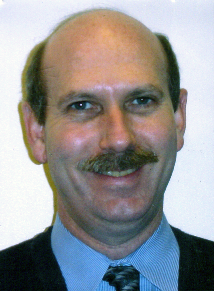
Alan Miller
EXPERIENCE
Los Angeles Times, investigative reporter, Washington bureau, 1994-present; staff writer, 1989-1994;
State and federal political reporter, Valley Edition, 1987-89.
The Record (Hackensack, NJ), state political reporter, county political reporter, 1982-87.
The Times Union (Albany, NY), political reporter, state investigative reporter, 1978-81.
EDUCATION
University of Hawaii, Honolulu, M.A., political science, 1978.
Wesleyan University, Middletown, Conn., B.A., English, 1976.
PERSONAL
Born: March 5, 1954.
AWARDS
George Polk Award, “Money from Asia,” 1996.
Goldsmith Prize for investigative reporting, “Illegal Democratic Campaign Contributions,” 1996.
Investigative Reporters and Editors Medal, “Money from Asia,” 1996.
National Headliner Awards, first place, investigative reporting, 1996.
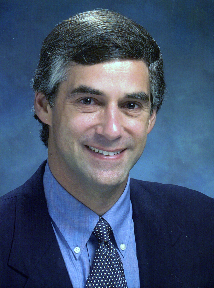
Kevin Sack
EXPERIENCE
Los Angeles Times, national correspondent based in Atlanta but assigned to the Washington investigations team, 2002-present.
The New York Times, bureau chief and national correspondent, Atlanta bureau, 1995-2002; bureau chief, Albany, NY bureau, 1990-95; metropolitan correspondent, 1989; covered numerous state and national political campaigns, wrote thelead article for The Times' award-winning project, "How Race is Lived in America," published in summer 2000 and later in book form.
Atlanta Constitution, reporter (beats included county courts and government, education, crime, state and national politics), 1981-89; covered first of four presidential campaigns.
EDUCATION
Duke University, Durhan, NC, B.A. History, with honors, 1981.
University of Witwatersrand, Johannesburg, South Africa, 1983, Rotary Foundation Fellowship.
PERSONAL
Born:, Oct. 11, 1959, Jacksonville, FL.
Divorced, one daughter, born 1993.
AWARDS
Shared Pulitzer Prize for national reporting and a special George Polk Award for "How Race is Lived in America," 2001.
The New York Times, senior writer, designation for select Timescorrespondents, chosen by the executive editor, 2000.
New York Legislative Correspondents Assn. Award for best statehouse coverage, 1992.
PROFESSIONAL AFFILIATIONS
Atlanta Press Club, board member, 1997-2000.