The New York Times, by Staff
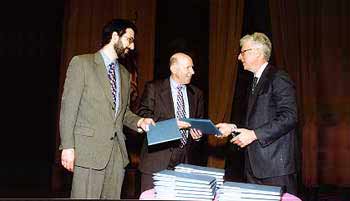
Columbia University Provost Jonathan R. Cole (right) presents Jeff Gerth (center) and Stephen Engleberg (left), of The New York Times, with The 1999 Pulitzer Prize for National Reporting.
Winning Work
By Jeff Gerth, with Raymond Bonner
Times Staff
WASHINGTON -- A Federal grand jury is investigating whether two American companies illegally gave China space expertise that significantly advanced Beijing's ballistic missile program, according to Administration officials.
But the officials said the criminal inquiry was dealt a serious blow two months ago when President Clinton quietly approved the export to China of similar technology by one of the companies under investigation.
The decision was opposed by Justice Department officials, who argued that it would be much more difficult to prosecute the companies if the Government gave its blessing to the deal, the officials said.
Under investigation, the officials said, are Loral Space and Communications of Manhattan and Hughes Electronics, a Los Angeles-based division of the General Motors Corporation. The companies denied wrongdoing, but declined to discuss the investigation.
Loral has numerous business deals with China and close ties to the White House. Its chairman and chief executive, Bernard L. Schwartz, was the largest personal contributor to the Democratic National Committee last year.
Loral's vice president for government relations, Thomas B. Ross, said Mr. Schwartz had not spoken about the matter with Mr. Clinton or any other Administration official.
The Federal inquiry stems from a 1996 incident in which a Chinese rocket carrying aloft a satellite built by Loral exploded shortly after liftoff. The two companies took part in an independent review of the failure, and reported to the Chinese on what went wrong.
Those exchanges, officials believe, may have gone beyond the sharing of information that the companies had been permitted, giving the Chinese crucial assistance in improving the guidance systems of their rockets. The technology needed to put a commercial satellite in orbit is similar to that which guides a long-range nuclear missile to its target.
In February, with the investigation of this incident well under way, Mr. Clinton gave Loral permission to launch another satellite on a Chinese rocket and provide the Chinese with the same expertise that is at issue in the criminal case, officials said.
A senior official said the Administration recognized the sensitivity of the decision, but approved the launching because the investigation had reached no conclusions and because Loral had properly handled subsequent launchings. The Administration, he said, could still take administrative action against the companies if they were found to have violated export laws in their earlier dealings with the Chinese.
Michael D. McCurry, the White House spokesman, said the launching that President Clinton approved in February "will not contribute to Chinese military capabilities" because Loral has agreed to "stringent safeguards" to prevent the unauthorized transfer of technology.
Emery Wilson, public relations manager for Hughes Space and Communications, a division of Hughes Electronics, said the company had not been notified of any Federal criminal investigation.
"In response to a letter from the State Department," Mr. Wilson said, "we conducted a thorough review and concluded that no Hughes employee had engaged in the unauthorized export of controlled technology or equipment."
The Administration has been hoping to reach a broader agreement with Beijing that would make it much easier to launch American satellites on China's rockets. Mr. Clinton is to visit China this summer in the first Presidential trip to the country since the suppression of the pro-democracy movement in the 1989 Tiananmen Square massacre.
There are huge commercial interests at stake. A host of companies, from cellular telephone networks to international television conglomerates, are waiting in line for low-cost satellites to be sent into orbit. An important bottleneck facing the companies is a shortage of rocket systems available to launch satellites.
China is eager to offer its low-cost -- but not always reliable -- services.
For American companies, there is a significant complication. All American satellites sent into orbit by China's rockets require Presidential approval, a waiver of the sanctions imposed after the Tiananmen massacre. Congress must be told of each waiver. Thus far, Presidents Bush and Clinton have issued 11 waivers for satellite launchings.
The policy under consideration by the Clinton Administration would end the case-by-case waivers and would treat future launchings of American satellites like any other export of sensitive technology, which require Government licenses.
Critics in Congress argue that Mr. Clinton is putting commercial interests ahead of national security. They caution that China has yet to prove it will abide by previous pledges it has made not to share missile technology with countries like Iran.
Few nations can deliver intercontinental ballistic missiles. China has lagged because, among other reasons, it lacks the guidance technology, also used for satellites, that allows multiple warheads to be sent from a single missile.
President Clinton signed the waiver to allow the Loral satellite launching on Feb. 18. The waiver states states that the deal is "in the national interest."
"We are more engaged with China," Mr. McCurry said. "One area of that engagement has been commercial satellite technology, which we perceive to be in our interests as well as that of China's."
But law-enforcement officials argued against the waiver, saying the approval jeopardized their investigation because it sanctioned the export of essentially the same guidance expertise involved in the possibly illegal transfer two years ago, Administration officials say.
Administration officials said the inquiry is focused on the events following the Feb. 15, 1996, explosion of a Chinese rocket carrying a $200 million Loral satellite seconds after liftoff at the Xichang Satellite Launch Center in Sichuan Province, in southern China.
After the explosion, the Chinese asked two American companies to help conduct an independent study of what went wrong. The team was led by Loral and included two experts from Hughes, according to Hughes.
According to Administration officials, the American experts provided crucial data and information to the Chinese to prevent future accidents. Later, Loral gave a copy of the written report to the State Department, which licenses the export of defense-related items.
Government officials immediately began to assess whether there had been a security breach. Last year, a criminal inquiry was begun by the United States Customs Service and the Department of Justice, officials said.
Under Federal export rules, American companies are supposed to take careful precautions to safeguard classified technology when their satellites are launched by Chinese rockets.
Satellites are shipped to China in sealed containers, and only American officials can mount them in the nose cones of the launching rockets. The Commerce Department approves the export of the satellites. But the more sensitive support activities must be approved by the State Department.
That process is meant to insure tight controls over the testing, repair and maintenance of the satellite so the Chinese cannot learn related classified information.
The State Department license issued several years ago for the Loral satellite was silent on the issue of what role, if any, the American experts could play in an analysis of a failed launching.
After United States companies took part in more than one study of failed Chinese launchings, the Federal Government changed its regulations and now requires companies to obtain a separate license to take a role in any accident review, an Administration official said.
© 1998, The New York Times Company
By Jeff Gerth
Times Staff
This article is based on reporting by Jeff Gerth, David Johnston and Don Van Natta and was written by Jeff Gerth.
WASHINGTON -- A Democratic fund-raiser has told Federal investigators he funneled tens of thousands of dollars from a Chinese military officer to the Democrats during President Clinton's 1996 re-election campaign, according to lawyers and officials with knowledge of the Justice Department's campaign finance inquiry.
The fund-raiser, Johnny Chung, told investigators that a large part of the nearly $100,000 he gave to Democratic causes in the summer of 1996 -- including $80,000 to the Democratic National Committee -- came from China's People's Liberation Army through a Chinese lieutenant colonel and aerospace executive whose father was General Liu Huaqing, the officials and lawyers said.
General Liu was then not only China's top military commander but also a member of the top leadership of the Communist Party.
Chung said the aerospace executive, Liu Chao-ying, told him the source of the money. At one fund-raiser to which Chung gained admission for her, she was photographed with President Clinton.
A special adviser to the White House counsel, Jim Kennedy, said today, "We had no knowledge about the source of Chung's money or the background of his guest. In hindsight it was clearly not appropriate for Chung to bring her to see the President."
Chung's account, coupled with supporting documents such as bank records, is the first direct evidence obtained by the Justice Department that elements of the Chinese Government made illegal contributions to the Democratic Party. Under American law, foreign governments are prohibited from contributing to political campaigns.
While the amount described is a tiny part of the $194 million that Democrats raised in 1996, investigators regard the identification of Liu as a breakthrough in their long search for confirmation of a "China Plan." The hunt was prompted by secret telephone intercepts suggesting that Beijing considered covertly influencing the American elections.
Chung, a Southern California businessman, began cooperating with investigators after he pleaded guilty in March to campaign-related bank and tax fraud. He is the first defendant in the Justice Department inquiry to agree to cooperate.
It is not clear whether other Chinese officials or executives were involved in the purported payments by Liu, or what her motivation or the Chinese military's might have been. At the time, President Clinton was making it easier for American civilian communication satellites to be launched by Chinese rockets, a key issue for the P.L.A. and for Liu's company, which sells missiles for the military and also has a troubled space subsidiary.
The President's decision was valuable to Liu for enabling her company to do more business with American companies, but it had also been sought by American aerospace corporations, including Loral Space and Communications and the Hughes Electronics Corporation, a subsidiary of the General Motors Corporation, seeking to do more business in China.
It is not known, however, whether anyone in the Democratic Party or the Clinton Administration had reason to suspect the source of the contributions from Chung.
A lawyer for Chung, Brian A. Sun, declined to comment on his client's conversations with investigators, citing his client's sealed plea agreement with the Justice Department. "I'm shocked that sources at the Justice Department would attribute anything like that to my client."
Chung has denied being an agent of the Chinese Government. "Nor did Chung ever try to lobby the American Government on any type of issue involving technology or anything else," Sun said.
A National Security Council spokesman, Eric Rubin, said, "It is ludicrous to suggest there was any influence on the determination of U.S. policy on this matter." He said he did not know whether any executives from Liu's company expressed an interest in the issue.
Liu did not return a message left with her office in Hong Kong today.
Chung's revelations have opened an avenue of inquiry leading in a diplomatically sensitive direction: next month, Clinton goes to Beijing, where he hopes to announce increased space cooperation between China and the United States.
A representative of the Chinese Government denied that Beijing was behind the purported contributions. "China has always abided by the laws and regulations in this country," said Yu Shu-ning, a press counselor for the Chinese embassy. "We have nothing to do whatsoever with political contributions in this country."
Chung, an American citizen who was born in Taiwan, owned a floundering facsimile company in Torrance, Calif. He became involved with the Democratic Party in early 1995 through Asian-American contacts at the White House and was known for constantly trying to use his connections in Washington with Chinese Government officials and executives.
Despite being labeled a "hustler" by one Presidential aide in 1995, Chung managed to visit the White House at least 49 times. He and his company contributed $366,000 to the Democratic National Committee -- most of it before he met Liu. The full amount was later returned after questions were raised about Democratic fund-raising. A Democratic National Committee spokesman, Richard W. Hess, said, "We did not know and had no way of knowing the source of his funds."
Chung met Liu in June 1996 in Hong Kong. She was not only a lieutenant colonel in the military, but a senior manager and vice president in charge of international trading for China Aerospace International Holdings Ltd., according to the company's 1996 annual report.
The company is the Hong Kong arm of China Aerospace Corporation, a state-owned jewel in China's military industrial complex with interests in satellite technology, missile sales and rocket launches.
Liu's father, General Liu, was China's senior military officer, and as vice chairman of the powerful Central Military Commission was in charge of China's drive to modernize the People's Liberation Army by selling weapons to other countries and using the hard currency to acquire Western technology. In that role, he oversaw his country's missile deals.
In addition to his military role, General Liu was a member of the Standing Committee of the Politburo of the Communist Party, the very top circle of political leadership in China. He retired from his official positions last fall at the time of the Party's 15th Congress.
China Aerospace sells satellites, launches them and owns a large chunk of a Hong Kong satellite operator, but the financial viability of many of these ventures depends on American satellites. In 1996 President Clinton made it easier for American satellites to be launched by Chinese rockets. The decision was announced in March but due to delays did not take effect until election day.
As Liu began her relationship with Chung, her company and her father were trying to fix China's troubled rocket program. That spring, China Aerospace had brought in outside experts, including officials from Hughes and Loral to help analyze why a launch the previous February had failed. The Pentagon later concluded that the outside review harmed American national security by advancing China's rocket and missile capabilities. Both companies denied wrongdoing.
In 1991 and 1993 the United States barred all American companies from doing business with two China Aerospace units who had made illegal missile sales to Pakistan. In each instance, Liu was assistant to the president of the sanctioned company.
Writing about who in China may have benefited from the 1991 missile deal, former Secretary of State James A. Baker 3d, in his memoirs, said, "In all probability, several senior government and party officials or their families stood to gain from the performance of those contracts."
The sons and daughters of China's elite -- sometimes referred to as "princelings" -- have developed lucrative businesses based on their family connections.
The missile deals were part of General Liu's strategy of selling Chinese weapons to other countries to raise money to acquire Western technology.
"Liu was a proponent of P.L.A. modernization who was very much interested in obtaining Western technology," said retired Rear Adm. Eric A. McVadon, the American defense attache in Beijing in the early 1990's. He said Liu constantly rebuffed American concerns about China's weaponry sales.
Those concerns were front and center in 1996, when General Liu was still in charge of the P.L.A. They included China's sale of missiles to Iran and of nuclear equipment to Pakistan, as well as its own bellicose military maneuvers near Taiwan.
Liu, McVadon recalled, was a "gladhander" who "brokered deals." In 1990 she was granted a visa to visit the United States as a representative of a China Aerospace subsidiary.
At the first meeting between Chung and Liu in June 1996, Chung is said to have told investigators, Liu told him she was interested in again visiting the United States. Soon learning that Chung could arrange meetings with the President, she expressed an interest in meeting Clinton.
Chung helped Liu obtain a visa on July 11, 1996, according to a law enforcement official. Five days later, he wrote the Democratic National Committee that he wanted to bring Liu and a Chinese medical executive to a July 22 fund-raising dinner to be held at the Brentwood, Calif., home of the financier Eli Broad.
Both of his guests' names were placed on the guest list after Chung wrote a check for $45,000 to the Democratic National Committee on July 19.
A week later, Chung set up a California corporation for Liu and himself, records show.
Liu arrived in Los Angeles on July 21, and the next day Chung accompanied her to two fund-raising events attended by Clinton, according to a law enforcement official. The first was an early evening $1,000-per-plate gala at the Beverly Hilton.
Later that night, Chung and Liu attended a $25,000-per-couple dinner at Broad's home that raised more than $1.5 million for the Democrats. The President was photographed with Liu, a routine courtesy at such events.
Sun, Chung's lawyer, said, "I don't think she was any different from any of his business contacts -- they thought Johnny was influential and someone they would like to know as they furthered their business dealings in the United States."
The previous year, photos from another Chung visit with Clinton had caused a problem. The President had expressed concerns about some of Chung's Chinese business clients -- unrelated to Liu -- whom the fund-raiser brought to a March 1995 radio address by Clinton.
Clinton's director of Oval Office operations, Nancy Hernreich, in testimony taken by Senate investigators, said Clinton told her later the visit shouldn't have happened. She took that to mean that Clinton thought Chung's clients were "inappropriate foreign people."
© 1998, The New York Times Company
By Jeff Gerth and David E. Sanger
WASHINGTON -- On Oct. 9, 1995, Secretary of State Warren Christopher ended a lengthy internal debate within the Clinton administration by initialing a classified order, preserving the State Department's sharp limits on China's ability to launch American-made satellites aboard Chinese rockets.
Both American industry and state-owned Chinese companies had been lobbying for years to get the satellites off what is known in Washington as the "munitions list," the inventory of America's most sensitive military and intelligence-gathering technology. But Christopher sided with the Defense Department, the intelligence agencies and some of his own advisers, who noted that embedded in commercial satellites were technological secrets that could jeopardize "significant military and intelligence interests."
There was one more reason not to ease the controls, they wrote in a classified memorandum. Doing so would "raise suspicions that we are trying to evade China sanctions" imposed when the country was caught shipping weapons technology abroad -- which is exactly what happened in 1991 and 1993 for missile sales to Pakistan.
The secretary of state's decision to keep satellites on the munitions list, making it harder for them to be exported, did not stand for long. Five months later, President Clinton took the unusual step of reversing Christopher's decision.
Control of export licensing for communications satellites was shifted to the Commerce Department, then run by Ronald Brown.
Both American satellite makers and the Chinese were delighted because the Commerce Department has dual responsibilities: licensing sensitive exports and promoting sales of American goods around the world. Several have already been approved.
One of the beneficiaries of that decision, it now turns out, was China Aerospace because its rockets could launch American satellites. An executive of the state-owned Chinese company, Liu Chao-ying, allegedly provided tens of thousands of dollars from Chinese military intelligence to the Democratic Party in the summer of 1996.
Ms. Liu's involvement was described to federal investigators recently by Johnny Chung, a Democratic fund-raiser who says he took $300,000 from Ms. Liu -- who is also a lieutenant colonel in the Chinese military -- and donated almost $100,000 of it to Democratic causes apparently keeping the rest for his businesses.
Clinton's decision was announced in March 1996, several months before the donations. But the actual change was delayed until the fall.
The White House said it did not know the source of Chung's donations and denies that the decision was influenced by campaign donations, domestic or foreign.
"This was motivated by competitiveness and streamlining bureaucracy concerns, and nothing else," Samuel Berger, Clinton's national security adviser, said in an interview two weeks ago.
On Friday, Berger's spokesman, Eric Rubin, said the decision was also part of the administration's China policy, and specifically its effort to encourage China to clamp down on military exports.
"On many occasions, this was discussed with the Chinese government because we believe that policy on satellite licenses is one of the tools we have to strengthen our nonproliferation policy," Rubin said.
Clinton's decision took place after months of tension with Beijing. And only two months after Clinton reversed the secretary of state, the administration said China had agreed to curb its missile and nuclear exports.
In January reports of China's export of nuclear technology to Pakistan and missiles to Iran caused considerable concern in Congress and the Pentagon. In early May, two months after Clinton reversed the secretary of state, the administration said China had agreed to curb its missile and nuclear exports. But that announcement was greeted with considerable skepticism by Republican critics, including Bob Dole who was well on the way to getting the nomination for president.
During the campaign, the Republicans attacked Clinton for failing to curb China's sales of nuclear and missile technology to other countries. The satellite decision in March was one element of the administration's "carrot-and-stick-approach to working with China," said James Lilley, former American ambassador to Beijing.
But in the way business and diplomacy mix in Washington's dealings with China, the decision also resonated in boardrooms on both sides of the Pacific. It satisfied the commercial interests of the American aerospace industry, which had long sought access to China's low-cost ability to launch satellites into space, aboard rockets called the Long March.
And it bolstered China's own commercial interests. Ms. Liu's parent company, China Aerospace, owns a large piece of a Hong Kong satellite operator. It also owns China Great Wall Industry Corp., the rocket company that launches both private satellites and tests and provides equipment for the missiles in China's nuclear arsenal. It was Great Wall that the State Department sanctioned in 1991 and 1993 for selling missiles to Pakistan.
Other powerful Chinese state enterprises also had multibillion-dollar stakes in getting access to American satellites. Among them was China International Trade and Investment Corp., whose chairman, Wang Jun, gained unwanted fame in the United States last year when it was revealed that he attended one of Clinton's campaign coffee meetings in the White House. The day of Wang's visit, Clinton, in what Rubin said was a coincidence, signed waivers allowing the Chinese to launch four American satellites -- though they were unrelated to the business interests of China International Trade.
"Any suggestions that these decisions were influenced by Wang Jun's presence in the U.S. is completely unfounded," Rubin said.
But there is no doubt that American companies -- partners and suppliers of China International Trade and China Aerospace -- put enormous pressure on the White House. They were also important campaign contributors. For example, the chief executive of Loral gave $275,000 between November 1995 and June 1996 to the Democrats.
How Clinton came to change the export control rules for satellites to China is a tale of Washington turf wars between the State and Commerce Departments, of arguments over how to balance America's security concerns and commercial competition in the hottest of all the emerging markets.
But it is also a story of how the interests of both large American donors and surreptitious foreign donors to the 1996 campaign intersected.
The Precursor: A Strong Push Under Bush
China's drive to obtain a steady stream of satellite technology from the United States preceded the Clinton administration's arrival in Washington.
In 1990, just a year after the killings at Tiananmen Square, officials from China Aerospace and the Chinese government approached Lilley, the American ambassador, pressing for President Bush to waive restrictions enacted in the aftermath of Tiananmen that barred China from launching American satellites.
"They hit me very hard," Lilley recalled recently. "It was a prestige national program. It was putting China on the map as the big space country of the 21st century."
Bush, America's first permanent representative in China, granted a waiver that allowed a launch on one of China's Long March rockets. In 1992, a number of senators -- including Al Gore, then still a senator from Tennessee -- wrote to the Bush administration warning that China was using the launches to "gain foreign aerospace technology that would be otherwise unavailable to it."
During the last days of the 1992 presidential campaign, Gore made the waivers an issue, contending that Bush "has permitted five additional American-built satellites to be launched by the Chinese."
"President Bush really is an incurable patsy for those dictators he sets out to coddle," Gore said during a speech at the Goddard Space Flight Center in Greenbelt, Md.
The Argument: Business Leaders Pressure Clinton
Almost as soon as Clinton took office, business leaders began their campaign to drastically change his views about China.
Both Chinese and American companies were working to get satellites off the State Department's munitions list. The rules for exporting goods that are on the list are particularly tough. Congress must be notified 30 days in advance. Moreover, the State Department considers only nonproliferation issues and defers to the Pentagon's judgments. In contrast, the Commerce Department's export-control administration solicits a host of views and must weigh the effects of its decisions on America's competitive position.
Christopher's aides also noted in their 1995 classified memo that "U.S. firms remain concerned there could be additional sanctions imposed on China precluding future munitions licenses," exactly the kind of sanctions that had been only recently lifted for China Aerospace's subsidiaries.
And there was a lot at stake: an estimated 14 commercial communications satellite launches a year worldwide, costing several hundred million dollars apiece.
"The business community regarded the inclusion of civilian satellites on the munitions list as an insult," said William Reinsch, the under secretary of Commerce for export control, who fought Christopher's decision. "We're the only country that treats them that way."
The Chinese also understood that they had a huge stake in the outcome of the decision. Zuoyi Huang, president of the California subsidiary of China Great Wall, a part of the China Aerospace empire, said in an interview that his company was eager for any changes that would insure easier access to American technology.
"The license takes time," he said. "You have to get a waiver from the president. The customers can't wait. It's just pure commercial use. It's not a military threat to the United States."
The Review: A Decision Against and a Quick Appeal
The arguments came to a head in 1995. C. Michael Armstrong, then the chief executive of Hughes Electronics and newly chosen as the head of Clinton's export council, asked to meet Christopher. He urged that satellites, which his company produces, no longer be treated as military goods.
The secretary of state promised that he would conduct a detailed review in consultation with the Department of Defense, the CIA and National Security Agency, and the Department of Commerce.
But the majority of the interagency group quickly found itself at odds with the aerospace industry. A key issue was how to protect encryption equipment, which is built into a satellite and interprets instructions from ground controllers who manipulate the satellite once it is in orbit. Similar devices are used to communicate with American spy satellites, and the Pentagon and intelligence agencies worried that anyone who could crack the code could take control of the satellites themselves.
An Aug. 17, 1995, a memorandum prepared for the interagency group noted that the chief executive of a satellite company told Christopher that "once it is embedded in the satellite, the encryption device has no military significance." Thus, the industry argued, there was little risk that the Chinese would get their hands on the encryption devices -- especially because American military officials are supposed to watch the satellites with care when they are in Chinese hands.
But, the memo went on, "the national security position" is that "the nature of the device itself," not its location, "should be used to determine whether it must be controlled as a military item."
The encryption issue was one of the main reasons the interagency group -- over the objections of the Commerce Department -- recommended that satellites remain on the munitions list. Christopher concurred.
Soon after Christopher put his initials on the decision memorandum, Commerce Secretary Ronald Brown appealed the decision to the president.
The Turnaround: The Commerce Dept. Wins a Turf Battle
The debate surrounding the appeal did not heat up for four months. The nature of the arguments that went to the White House are still unclear: Many of the documents remain classified. But those that have been reviewed by The New York Times show that the White House and the Commerce Department began communicating again about the issue on Feb. 8, 1996, two days after Clinton broke a backlog of applications for launches by China, by approving four of them that day.
Clinton signed those waivers the same day that Wang Jun, the man who was often referred to during the campaign finance investigations as a "Chinese arms dealer," visited Washington. His company, China International Trade and Investment Corp., has a multibillion-dollar stake in one of Hong Kong's largest satellite companies.
That same day, Wang met with Brown, at his expansive office in the Commerce Department. And that evening, Wang attended a coffee at the White House, an event Clinton later called "clearly inappropriate." Others at the coffee said Wang never spoke during the session.
By mid-February, for reasons that are still murky, there seemed to be some urgency at the White House to decide whether to reverse Christopher's decision, shifting satellite export licensing to the Commerce Department.
A Feb. 15 State Department memo talks about speeding up the process because "the administration wanted to wrap this up."
In the end, the State Department relented. Participants in the final debate said that the president concluded that the technology could be adequately protected through the Commerce Department, just as the department protects supercomputers and other sensitive technologies.
The president's decision was announced on March 14. Commerce officials, who had just won one of Washington's nastiest turf wars, were jubilant.
"Good news," officials were told by e-mail. The electronic message went on to recommend a "low key" spin on the news that would "not draw attention to the decision."
Internal Commerce Department documents show that officials were anticipating questions from reporters and Congress about whether the decision represented an effort to ease technology transfers to China and remove items from sanctions -- some of the same concerns that figured in Christopher's decision.
In the days preceding the announcement, China had raised tensions with its Asian neighbors and the United States to new heights, firing M-9 ballistic missiles, which carried dummy warheads, into target zones 30 miles off the shore of Taiwan.
The March 14 announcement said that regulations implementing the president's decision would be issued within 30 days. But the bureaucratic infighting continued.
Finally, the State Department issued the regulations shifting most satellite licensing to the Commerce Department.
They were published on Nov. 5, 1996, the day Clinton was re-elected.
© 1998, The New York Times Company
By Jeff Gerth
Times Staff
WASHINGTON -- For the past two years, China's military has relied on American-made satellites sold for civilian purposes to transmit messages to its far-flung army garrisons, according to highly classified intelligence reports.
The reports are the most powerful evidence to date that the American government knew that China's army was taking advantage of the Bush and Clinton administrations' decisions to encourage sales of technology to Asian companies.
The United States has barred American companies from selling military equipment to the Chinese military since the 1989 killings in Tiananmen Square.
The intelligence reports, which were described by administration officials, were recounted last year in a document compiled by Pentagon intelligence officials and sent to hundreds of senior policy-makers at the White House, State Department and other agencies.
Several congressional committees are examining whether the administration's policy toward technology exports damaged national security by strengthening China. Sen. Richard Shelby, R-Ala., chairman of the Senate Intelligence Committee, said last week that he plans to investigate use of American-made satellites by China's military. The House recently voted to ban future satellite exports to China and the Senate is scheduled to take up similar legislation soon.
China turned to the American-made satellites, which are owned by Hong Kong companies with ties to the Chinese government, when its own communications network collapsed and replacements built with help from the German conglomerate Daimler-Benz were not working.
Administration officials said it was impossible to prevent China's army from using American-made satellites sold abroad, and that their long-term aim was to prevent China's military from obtaining the technology needed to make the equipment on its own. In addition, they said, the arrangement had a side benefit: It gave American intelligence agencies a better chance of intercepting China's military communications.
Clinton administration officials said that if the United States had barred American manufacturers from selling satellites in Asia, the Chinese would have eventually gained access to satellites produced in Europe or other countries that have fewer limits on trade.
"The argument that we can block use of civilian satellite technology by the Chinese military is simply unrealistic, given the widespread availability of other satellite options around the world," James Rubin, the State Department spokesman, said in an interview.
Disclosure of the intelligence findings -- and the administration's explanation of the information -- injects a new element into the broadening congressional investigation of the administration's policy on technology sales involving China.
The Clinton administration has publicly justified its satellite sales to Chinese-linked companies on grounds that they were being used solely for civilian purposes. This argument was the underpinning of Clinton's decision in March 1996 to shift responsibility for satellite sales from the State Department to the Commerce Department, which is charged with encouraging exports.
Administration officials said the intelligence reports were part of a document called the Military Intelligence Digest, which was distributed a few months before President Clinton approved the latest sale of a commercial satellite to a civilian Chinese government ministry in February. The document said China's army was making extensive use of the American-made satellites to transmit its coded messages, according to administration officials.
The digest incorporates reports about military developments around the world, and it is difficult to assess who read any item and how closely, given the numerous intelligence memorandums policy-makers receive.
Critics of the administration say that the export of American satellites to companies with ties to the Chinese military has enhanced China's military prowess, shoring up a crucial weakness in the army's operations.
The Clinton administration is weighing whether to allow another Asian company with ties to the Chinese military to buy a similar communications satellite.
American officials said that China's military has long made some use of commercial satellites, including those launched by the consortium known as Intelsat, of which the United States and China are members. But officials said the army's use of American-made satellites sharply increased in the past two years, just as American aerospace manufacturers were placing greater emphasis on their satellite sales to Asia and just as the Clinton administration was easing export rules.
The Chinese have made no secret of the improvements wrought by increased access to the satellites.
In an article last September, the daily newspaper published by China's army said that officers once had "cried themselves hoarse" or run to distant post offices to send urgent messages over the military's antiquated communication system. "Those phenomena are now history," the article said, noting that satellite communications had been used for such high-profile operations as last year's handover of Hong Kong, the former British colony.
Last February, Clinton approved the sale of a commercial satellite made by Loral Space and Communications to a Chinese government ministry. The memorandum to Clinton outlining pros and cons of the deal made no mention of the recent intelligence about the Chinese military's growing reliance on similar American satellites.
It did tell Clinton the administration could deflect possible criticism of the sale by pointing out that it "will not contribute to Chinese military capabilities." A White House national security official, who declined to be identified, said this was meant to refer to the technology needed to launch the satellite, not the use of the satellite.
Congressional committees are closely scrutinizing that sale, which was approved by Clinton in the face of objections from Justice Department prosecutors, who were investigating the company for possible violations of export law. Loral's chairman, Bernard Schwartz, was the largest individual donor to the Democratic Party last year, and has given over $1 million in recent years.
This week, the president defended his decision as "pretty routine."
All modern armies transmit their messages through satellites.
China launched its first generation of communication satellites, the DFH-2 series, in the 1980s. The last of those satellites stopped working a few years ago. A second generation satellite, the DFH-3, was launched in 1994, but failed to achieve proper orbit and was not usable.
China's military turned to American-made commercial satellites, which had been sold in the early 1990s to Hong Kong companies with ties to the Chinese government and military. Some of these exports were approved by Bush, others by Clinton.
According to American officials, the main Hong Kong company used by the Chinese military for its communication is APT, a public company based in Hong Kong. Its shareholders include a unit of Costind, the scientific and research arm of the Chinese army.
The satellite was built by Hughes Space and Communications, part of General Motors Corp.'s Hughes Electronics subsidiary, and the license for the sale was approved by the Clinton administration in 1995. Most of the technicians involved in operating the satellite came from Chinese government agencies, including Costind.
In 1996, the Costind unit leased two receivers aboard the satellite, called Apstar 1A, according to the prospectus APT issued in late 1996 when it sold stock on the Hong Kong stock exchange.
The prospectus said Costind was using the satellite to broadcast news and entertainment programs to Macau. But administration officials said that the Chinese military was using it for other purposes, and was relaying coded communications to command and control its forces.
Brian Lo, APT's secretary, said in a telephone interview from Hong Kong that his company was a "commercial entity" that leases satellite time to "broadcasters and telecommunications networks."
Asked if this could include the Chinese army, Lo replied that the army "has business enterprises." He declined to answer whether this did include coded, military communications, saying the question was "too prejudiced."
Donald O'Neal, a spokesman for Hughes, said his company could not control the use of its satellites and that it relied on the American government to vet customers for any ties to the Chinese army.
The successful launching of Apstar 1A on a Chinese rocket in July 1996 eased fears among Chinese officials about the country's rocket program, according to reports in the press.
The next year, China again tried to solve its satellite difficulties with its own equipment. On May 12, 1997, a Chinese rocket launched another DFH-3 telecommunications satellite into orbit. It was built by China Aerospace Corp. and Daimler-Benz and contained some American parts. But according to Roland Klein, a Daimler-Benz spokesman, the satellite never worked.
Clinton administration officials insist it is impractical for the government to require companies buying U.S. communications satellites to certify that they will be used solely for civilian purposes.
But some exporters already do just that.
Last month, a Chinese rocket put a Lockheed-Martin Corp. satellite into orbit for a Chinese telecommunications company.
"We got a certificate of end use from the Chinese government saying the satellite would be used for commercial purposes only," said Jim Fetig, a spokesman for Lockheed-Martin.
© 1998, The New York Times Company
By Jeff Gerth
Times Staff
WASHINGTON -- Faced with growing criticism of its satellite exports to China, the Clinton Administration is rethinking whether to allow one of the biggest sales to date, a $650 million deal President Clinton quietly approved two years ago.
Government officials said the Pentagon and State Department were raising new questions about whether a Chinese-controlled company with close ties to China's military should be allowed to buy the satellites, which contain some of the United States' most sophisticated communications equipment.
The satellites are the cornerstone of a commercial mobile phone network planned for China and 21 other Asian nations. American officials said their design included a powerful antenna that could eavesdrop on mobile phone calls in China or other countries in the region. It could also be used by the Chinese military to transmit messages through hand-held phones to remote parts of China.
Antennas of these dimensions are a mainstay of the United States' and Russia's eavesdropping satellites and have not previously been exported to China, though a sale to the United Arab Emirates is pending. They also can be used to extend the range of mobile phones.
Clinton leaves next week for China, and the Administration had hoped to use the trip to showcase a variety of business deals and agreements, including cooperation on civilian satellite and rocket projects. Meanwhile, the House continued investigating the export of space technology Wednesday. [Page A6.]
Administration officials said concerns about the pending satellite sale had been deepened by American intelligence reports about Shen Rongjun, the Chinese Army general who oversees his country's military satellite programs. The reports quote the general as saying he planned to emphasize the role of satellites in gathering information.
In an unusual arrangement, Hughes Space and Communications hired General Shen's son, a dual citizen of Canada and China, to work on the project as a manager. The company said it was aware of his familial ties; it is not clear whether the Clinton Administration knew.
Father and son were both directly involved in the project, and American officials said the intelligence reports said the general was pressing his son to move it forward.
The New York Times reported last week that the Chinese military was sending many of its coded messages through American-made commercial satellites sold to Asian companies. China's military satellite network collapsed in 1996, when its first satellites wore out and the replacements failed to work as planned.
President Clinton approved the Hughes project on June 23, 1996, after advisers assured him the communications satellite technology was readily available from European suppliers and would not contribute to Chinese military capabilities.
China already has a burgeoning cellular telephone system, which relies on ground-based transmitters. There are almost 1.5 million cellular phones in Beijing and Shanghai, but the system is less developed in the country's more remote areas, industry officials say.
Donald O'Neal, a spokesman for Hughes, said the satellites were "inherently dual use," meaning that they have both civilian and military potential.
"The satellite is not designed for military application," O'Neal said. "But I don't know how you can prevent it."
The Federal Government could still stop the deal. O'Neal said Hughes, which is part of Hughes Electronics, a subsidiary of the General Motors Corporation, was waiting for the Commerce Department to review its application to sell the satellite to the Asian consortium, A.P.M.T. or Asia-Pacific Mobile Telecommunications.
Liu Tsun Kie, a spokesman for the consortium, said in a telephone interview from Singapore that the satellite network would be marketed to civilians by regional telecommunications operators.
It would be up to Chinese Government regulators, Liu said, to decide if China's military could use the satellites.
Liu predicted that the Clinton Administration would eventually approve the deal. "In view of the improving Sino-American relationship, as well as the close rapport established between the U.S. satellite industry and major industry leaders in China and the Asia Pacific," he said, "we are confident that A.P.M.T. will obtain all the necessary approval and export license to insure no delay in satellite launch."
Liu said the project would attract more than 200,000 mobile phone customers in China within its first two years.
The Two Crucial Steps in a Satellite Sale
Making a satellite sale to China involves two crucial steps that occur simultaneously. Aerospace manufacturers must persuade the President to sign a waiver of the sanctions imposed on Beijing after the Tiananmen Square killings in 1989. Each project requires a separate waiver.
At the same time, companies apply to Federal Government agencies for permission to export specific technologies used in the satellites. Satellite exports to the Chinese military are banned, but sales to Chinese companies are generally allowed, unless they would advance military development in areas like intelligence gathering and nuclear weapons.
Clinton granted the waiver for the Hughes project two years ago and the company obtained the necessary export licenses.
Since then, however, Hughes has changed the design to enhance the satellite's capabilities, requiring it to return to the Government for a new license.
That decision is now before a Government panel headed by the Commerce Department and including officials from the Pentagon, State Department, the Arms Control and Disarmament Agency and the Department of Energy. Each department casts a single vote, with the decision made by majority rule. A dissenting agency can appeal to the President, but that has never happened.
A Commerce Department spokesman declined to discuss the case, saying it involved confidential business information.
Privately, Commerce Department officials are arguing that the deal should go forward because the design approved in 1996 is substantially the same as the current configuration, Administration and Congressional officials said.
But some Pentagon and State Department officials believe the license should face more scrutiny in light of the new information about General Shen and the capabilities of the satellite. Administration officials also said that the increased scrutiny by Congress of the Chinese military and American satellites has prompted officials to pay closer attention to exports to China.
Several Congressional committees are investigating whether the policies on technology exports hurt the national security.
Technical Questions Determine Fate of Deal
The issue turns on highly technical questions. An Administration official who disagrees with the Commerce Department's analysis said the Hughes design is substantially different from what was approved two years ago.
"The antenna sent up the flags," the official said. "It is more powerful than what we have licensed before."
The antenna allows the satellite to receive incoming signals. But a sophisticated antenna, like the one currently under review, can become a listening device that is very effective against ground-based interception efforts, Government reports show.
Before 1996, the Pentagon could easily have stopped the license, because satellites were treated as military items and subject to State Department authority. That year President Clinton shifted jurisdiction to the Commerce Department, easing the controls and lessening the influence of the Pentagon, a senior Government auditor told Congress earlier this month.
A.P.M.T. was organized in the early 1990's. Most of its stock was held by five Chinese state-owned entities: China Satellite Launch and Tracking Control, a unit of Costind, the scientific and research arm of the Chinese military, the China Aerospace Corporation, part of the defense-industrial complex, China Resource Holdings, a trading company that owns a bank in Hong Kong with the Riady family of Indonesia, and subsidiaries of Chinese electronics and telecommunications ministries. A small stake was held by a Singapore company.
In February 1996, the consortium authorized Hughes to proceed with the design and construction of a sweeping mobile satellite telecommunication network that would span 22 countries in Asia and the Pacific, from Pakistan to Indonesia.
China's own space program -- both rockets and satellites -- was then under severe strain.
A Chinese rocket exploded shortly after liftoff in February. Two months later, engineers from Hughes and Loral Space and Communications were brought in by insurers and China Aerospace to help figure out what went wrong.
The conversations that ensued between the companies and Chinese technicians are now the subject of a criminal investigation, which is seeking to determine whether American export laws were violated. Both companies deny wrongdoing.
While China was trying to repair its rocket program, its satellites began to fail. The first domestically produced satellites, launched by the Chinese military in the early 1990's, were wearing out, and the first replacement, built in cooperation with the German company Daimler-Benz, had failed to achieve proper orbit after its 1994 launch.
In early 1996, all this led China's most senior military official, Gen. Liu Huaqing, to discuss his concern with General Shen, who until a recent reorganization was a senior Costind official and oversees China's satellite and rocket launching programs, American officials said.
General Shen and General Liu have publicly promoted satellite technology as crucial to the future development of China's military capabilities. General Shen has privately assured his colleagues about his ability to fix China's satellite problems and improve the military's surveillance and intelligence-gathering capabilities, American officials said.
At about the same time, there were concerns within Hughes and A.P.M.T. over the how long it was taking President Clinton to make a decision about the deal, O'Neal and American officials said.
Commercial satellite exports to China have been banned since the killings in Tiananmen Square in 1989, but the President can waive the prohibition, which Presidents George Bush and Clinton have done 20 times.
'Expedited Handling' of Waiver Was Sought
Hughes officials wanted "an expedited handling" of the waiver in order to meet a contractual deadline, O'Neal said. And recently released White House documents show that the company hoped to have the President sign off on the deal before Hughes' chairman left China on June 19, 1996.
The staff memorandum that the President relied on to approve the deal made no mention of the Loral-Hughes help for China's rocket program. Three weeks before the memorandum to the President, the State Department had alleged, in a letter to Hughes, that there had been a violation of the arms export control law during the rocket accident review.
The President granted the waiver on June 23.
Soon after the Presidential action, Hughes received a license to export a satellite. Later that summer, Hughes applied for another export license that would allow Shen Jun, the son of General Shen, to work on projects subject to United States export controls, including the A.P.M.T. project, O'Neal said.
"We applied for and received an export license that allowed him to participate as a translator in the A.P.M.T. preliminary design review," O'Neal said.
Shen was hired in 1994 by Hughes for his computer expertise, though the company was also aware of his family ties before he joined the company, O'Neal said.
General Shen has been involved in the A.P.M.T. project as the overseer of the Chinese launch and tracking company and his son has given Hughes marketing advice about China and technical advice about mobile telephone networks, Liu and a Hughes executive said.
O'Neal said he had no comment on the Shen family discussions because "anything he said to his dad is personal."
Despite all the flurry of activity in mid-1996 between Hughes and A.P.M.T., the deal bogged down amid internal squabbles. But by this year the pace had picked up again and last month the consortium reorganized itself and signed another deal with Hughes for an upgraded satellite.
The new satellite will have greater power to transmit and receive signals. Its payload includes a large-scale antenna reflector and a digital-on board processor, Liu and O'Neal said.
The antenna and processor enable the consortium's network to pinpoint low-power hand-held phones and simultaneously handle 16,000 phone conversations. Liu said that the regional affiliates "will be able to intercept calls if required by local authorities" but the consortium will not be able to intercept.
As a result of the recent reorganization, the consortium is now two-thirds owned by its Chinese affiliate, China A.P.M.T., said Liu, the consortium's deputy president.
China A.P.M.T., in turn, is owned by the same five Chinese entities, including the Costind unit, and it will be the local A.P.M.T. franchise in China.
The president of A.P.M.T. and China A.P.M.T. is Li Baoming and A.P.M.T.'s chief engineer is Feng Ruming. Liu said both men have senior posts with the China Satellite Launch and Tracking Control Corporation, the unit of Costind overseen by General Shen. American intelligence reports say Feng and Li are top military officers, according to Administration officials.
O'Neal said that Hughes was "not aware" of A.P.M.T.'s military ties and while "there could be" some, it was up to the Federal Government to vet those connections. That is precisely what is now happening.
© 1998, The New York Times Company
By Jeff Gerth and Eric Schmitt
Times Staff
WASHINGTON -- Shortly after he took office in 1993, President Clinton traveled to Silicon Valley to lay out his vision of a robust American economy buoyed by high-technology companies that could compete anywhere in the world.
The night before his speech, Clinton went out to dinner with two dozen executives, some of whom complained bitterly about Government rules impeding the overseas sale of computers and other cutting-edge technologies.
Clinton grabbed a pad, furiously took notes, and promised relief, one executive recalled.
Over the next five years, the President delivered, personally presiding over what industry executives and Government officials agree was one of the most sweeping relaxations of export restrictions in American history.
"These reforms," Clinton said in a 1993 letter detailing the changes to a leading computer executive, "can help unleash our companies to compete successfully in the global market."
In the years that followed, the new rules helped Clinton fulfill his vision of a centrist Democratic Party with close ties to American business. Grateful high-technology companies showered the Democratic Party with campaign contributions, cementing a new financial base for a party that has historically struggled to raise money from corporate America.
Administration officials portray the initiatives as one of Clinton's most lasting legacies, saying it bolstered national security by helping to make America's economy the world's strongest. The flood of new exports also created high-paying jobs at home.
But critics, including Republicans in Congress and some former Clinton Administration officials, argue that the high-technology exports had a serious side effect, strengthening countries like China, which some view as a potential adversary. Clinton, they contend, was blinded by his enthusiasm for securing this country's global edge and insufficiently attentive to his policies' effect on America's long-term national security.
House and Senate committees are examining whether China took advantage of the looser rules on exports to enhance its military and to obtain technology that it passed on to rogue states, including North Korea. The Senate Intelligence Committee and a special House panel, which are scheduled to report their findings in early 1999, have held a series of closed-door hearings this fall.
An examination by The New York Times of the Administration's export policies on China, based on interviews as well as Government and industry documents, shows that the looser regulations enabled Chinese companies to obtain a wide range of sophisticated technology, some of which has already been diverted to military uses.
The new rules allowed American companies to sell a host of products without prior Government approval, from high-speed computers to machine tools to communications gear subject to restrictions during the cold war. While the regulations fostered trade, they made it much harder for intelligence agencies to track how American equipment was used overseas, Administration officials said.
Until 1993, most sales to China of goods with possible military uses required American companies to obtain a Government license naming both the customer and the location in which the equipment would be installed.
Senior officials acknowledge that President Clinton decided to change the rules without a rigorous review by intelligence officials or other national security experts.
In 1995, Central Intelligence Agency analysts wrote a report warning of the military implications of technology transfers to China, but it never became an official assessment because senior aides felt it was "not well done and lacked analytical depth," an American official said.
The Government's last serious examination of technology sales to China, they said, had been conducted by the Reagan Administration in 1984 at a time when the United States was trying to build up China as a counterweight against the Soviet Union.
Since then, the Soviet Union has collapsed. And China has been caught selling missile equipment to nations like Iran and Pakistan while using its new access to Western technology to expand its economic and military power.
Paul Wolfowitz, a former official in the State and Defense Departments who participated in the 1984 study, asserted that international developments since then argue for a tightening of controls on sales to China, not a loosening.
"There is an urgent need for a fundamental review of export policy to China especially because China is in the process of becoming -- albeit still quite slowly -- the major strategic competitor and potential threat to the United States and its allies in the first half of the next century," said Wolfowitz, who is dean of the Paul H. Nitze School of Advanced International Studies at Johns Hopkins University.
But another China expert sees Beijing's improvement of its technologically backward military as more benign.
"Its overall policy is not to be a trouble maker," said A. Doak Barnett, a professor emeritus at Johns Hopkins, who added that "gradually building up its defense establishment is something I would expect it to do but in my view it's not threatening."
Whatever China's intentions, the Clinton Administration over the last five years has approved export to China of $3 billion in technology with military or civilian applications, about 5 percent of overall American sales to China.
A report prepared for the Commerce Department last December concludes that the Administration has little means of knowing whether this equipment is harming American national security or being used by Chinese industries to challenge American competitors and jobs.
"It may be too late by the time that U.S. industry and/or Government realize there is a problem emerging in either of these areas," the confidential report says.
American intelligence agencies are trying to assess how much the Chinese military has gained from the imports. Officials say they have already concluded that China's army gained access to some of the high-speed computers sold to civilian customers since 1996, when the rules on computer exports were eased. The officials said the agencies were unable to assess how the equipment was being used because they lacked basic information about the deals.
Clinton Administration officials said that the Chinese have returned the one computer that was improperly diverted and that a new agreement between the two countries will improve the ability of American officials to check the whereabouts of equipment exported to China.
Representative Christopher Cox, the Southern Californian Republican who heads the select House panel on technology transfers to China, said, "There's always been a tension within the Government about which exports are proper."
But, he added, "these days without question the overriding impulse to sell, sell, sell is in the ascendancy."
THE OLD SYSTEM
Cold War Rules Get New Scrutiny
The United States and its Western allies zealously guarded their technological edge during the cold war, forbidding the sale to Communist bloc nations of any item with a conceivable military use. Military contractors did not chafe too much under the restrictions because the Pentagon had a seemingly limitless budget for their wares.
In 1983, Chinese leader Deng Xiaoping complained bitterly about the restrictions on technology exports, prompting the Reagan Administration to ease some of the rules for China. It was seen in America's interest, Wolfowitz recently told Congress, to help Beijing develop the military muscle needed to counter the "formidable threat" from the Soviet Union. In addition, he said, China had been helpful in arming the Afghan rebels.
But the United States maintained tight controls over what he termed the most sensitive technologies -- those that could improve China's missiles or anti-submarine capabilities.
The fall of Communism brought a precipitous drop in the Pentagon budget, prompting the defense industry to scramble for new markets. Companies that once made spy satellites for American spy agencies began making equipment for cellular networks that served China or Russia.
They quickly confronted a significant obstacle to making money on sales to former adversaries. The cold war-era rules remained largely in effect, and they were being interpreted by career officials who had devoted their lives to blocking exports to Russia and its allies.
Enter Bill Clinton. His 1992 campaign had been driven by the slogan "It's the economy, stupid." Aides say Clinton's views on foreign policy were framed by his experiences as a governor of Arkansas, a poor state that looked overseas for investments and markets, and he arrived in Washington determined to expand trade.
In an immediate sign of this policy's political importance, Clinton sent the Democratic Party's chief fund-raiser, Ronald H. Brown, to take over the Commerce Department, which promotes American exports.
The Pentagon was traditionally the strongest voice against technology exports, and Clinton made several appointments calculated to change the culture. William J. Perry, an executive at a Silicon Valley company who was vocally opposed to the existing system of export controls, was named Deputy Defense Secretary and then Defense Secretary. John M. Deutch, a professor with similar views, was named to a senior post at the Pentagon, and then became Director of Central Intelligence.
Perry, testifying at his confirmation hearing to be Deputy Defense Secretary, told senators in February 1993 that controlling dual-use technology is "a hopeless task." He continued, "It only interferes with our companies' ability to succeed internationally if we try to impose all sorts of controls in that area."
Perry said, "We really need to bear down" on controlling the most critical components necessary to build weapons.
President Clinton took a personal interest in the new policy. Shortly after he returned from his foray to Silicon Valley, he spelled out his intentions in a letter to Edward McCracken, the chief executive officer of computer maker Silicon Graphics. Company officials had complained to Clinton over dinner about export rules.
"One reason I ran for President was to tailor export controls to the realization of a post-cold war world," Clinton wrote.
After noting the need to retain strong controls in some areas to combat the spread of nuclear, chemical and biological weapons, Clinton detailed his intention to "unleash our companies to compete successfully in the global market." The United States, he said, would slash red tape and loosen controls on the overseas sale of computers, telecommunication equipment and machine making tools.
THE NEW SYSTEM
Relaxed Rules Benefit Chinese
Those restrictions were an integral part of the cold war. For decades, every proposed export of technology was weighed by a committee of Western nations. It had authority to block sales involving military hardware or so-called "dual-use" equipment that had military or civilian applications.
Even before the committee disbanded in 1994, the Clinton Administration moved to ease restrictions on the sales of many dual-use items. The new rules allowed companies to export many categories of technology without applying for a Government license.
American companies were delighted with the new system, which relieved them of a time-consuming and frustrating process. But the benefits came with a cost. Because sales could be made without export licenses, the Government and its intelligence agencies no longer had a record of many deals that involved dual-use equipment. There was no way to trace patterns of sales, to know, for example, how many decoding devices were being sold to a particular country.
Commerce Department internal documents show that China has been a major beneficiary of this policy. According to a 1995 estimate, more than $1.9 billion in annual trade with China had been removed from Federal scrutiny.
A ban remains in effect on the sale to China of the most militarily potent technologies, like ballistic missiles, spy satellites and advanced fighter aircraft. Beijing buys those weapons from Russia, Europe and Israel.
"China has benefited more than any other country from U.S. decontrols on certain dual-use commodities enacted in late 1993 and early 1994," one Commerce Department document says. "There has been a 60 percent decrease in the number of individual export licenses required for trade with China (from 2,229 in 1993 to only 925 in 1994)."
The rules shifted much of the burden for controlling exports to the companies making the deals.
Previously, the applications for licenses to sell sophisticated electronic equipment overseas were scrutinized by Pentagon and intelligence analysts. One crucial question was whether the customer was really a "front" for military users barred from buying such equipment.
The Clinton Administration's new policy relied on industry executives to raise questions about their own sales. They were required to seek a Commerce Department license only if they believed the equipment would end up in military hands.
Aerospace officials say they are ill-equipped to make such evaluations.
Last year, the Administration began making public the names of questionable customers, to warn exporters. But industry officials said the list of about a dozen nuclear production facilities was a tiny slice of what was available and ignored entities involved in missile activity.
The problem is particularly acute, industry executives said, when the deals involved China, where the military has long played a role in commercial ventures and where it is difficult to distinguish between military officers' personal and professional dealings.
One of the first deals under the new rules, a 1994 sale of telecommunications equipment to China, illustrates the complexities. The Commerce Department's decision to allow such exports without a license made it easier for AT&T and other American companies to sell hundreds of millions of dollars in sophisticated equipment to Chinese companies building civil telecommunication networks.
An examination of the deal by the General Accounting Office, the audit arm of Congress, found that the equipment was sold to a Chinese-American joint venture, Hua Mei, "without Commerce review, even though the company was partially controlled by several high-level members of the Chinese military."
AT&T officials in turn told the audit agency that "they did not ask the Commerce Department to determine if Hua Mei was a civil end user, nor were they required to."
It is not known whether the company has put the equipment to military use. But Pentagon officials told the G.A.O. that in 1994, China's army was seeking to buy this same type of technology as it moved to improve its communications networks.
THE REASSESSMENT
A Computer Sale Sets Off Alarms
By 1995, the Pentagon was urging Congress to look more closely at export policy. Military officials noted that the effect of technology was cumulative, and that while individual sales might appear benign, a combination of cutting-edge acquisitions would allow an adversary to build much better bombs or radars.
President Clinton, documents show, was moving in the opposite direction.
According to a 1995 Commerce Department document, the President "made clear," in private conversations he had with Brown, that "he does not believe we have done enough to streamline and liberalize."
The document mapped out how Brown should lobby high-level Administration officials to ease controls on computer exports and shift items like communications satellites, engine technology and commercial data-scrambling devices. Such items were on a list of equipment that required a State Department license, and companies believed they could close more deals if authority over the exports were moved to Brown's Commerce Department.
Their enthusiasm for the Commerce Department was well grounded.
When it comes to proposed sales of an item regulated by the State Department, the Pentagon holds a virtual veto, a privilege it exercised regularly during the cold war.
The Commerce Department is responsible for promoting American exports. When it weighs an overseas deal, the Pentagon has only one vote out of five agencies, and the right to appeal if its objections are overruled, which has been rarely used.
Secretary of State Warren Christopher insisted that his department retain jurisdiction. He was overruled in early 1996 by Clinton, opening the way to billions of dollars of satellite sales to Chinese companies.
At about the same time, the Administration was weighing whether to lift restrictions on the export of some advanced computers. Officials asked outside consultants to study the issue, and they came back with a report that asserted the controls were pointless. The powerful computers manufactured by American companies would soon be widely available from foreign competitors, the report said.
The Administration asked the consultants to assess whether computer sales could pose a threat to the American military. Their report did not take a position, saying the Government did not have enough information to draw a conclusion.
This left the issue to Clinton, who decided to fulfill his pledge to the Silicon Valley executives and relax the restrictions.
"The President made a judgment on what the threat was, and the President's judgment was reflected in his decision," said William A. Reinsch, Under Secretary of Commerce for Export Administration. The new rules took effect early in 1996.
Soon after, Chinese companies bought 77 of the high-speed computers, which can be used to predict weather patterns but can also scramble secret communications or design powerful nuclear weapons.
Disclosure of those sales prompted Congress to reinstate license requirements for some advanced computers.
This year, the Central Intelligence Agency and other Federal agencies concluded that at least some of those computers are being used by China's military. The details of their use remain unclear, officials said.
A review by the G.A.O last month called into question the Administration's basic assumptions in lifting the controls on computers. Contrary to what the consultants said in their report, the international market for advanced computers remains strongly dominated by American companies.
Congress acted after The New York Times reported that two American aerospace companies were under investigation to determine whether they went too far in sharing rocket technology with Chinese scientists seeking to determine the causes of a failed satellite launching in 1996. The inquiry, which continues, has since been broadened to include a failed launching in 1995. Rocket technology for ballistic missiles is similar to that used to send satellites into orbit. Both companies have denied wrongdoing.
Just this month, Congress reversed Clinton's 1996 decision and returned satellite exports to the State Department. At the same time, lawmakers created a senior Pentagon position for technology security after concluding military officials' role in controlling exports to countries like China had been "significantly and improperly reduced over the years."
THE FALLOUT
Report Cites a Loss of Oversight Role
The military significance of America's exports to China is hotly debated.
China's army is in the throes of modernization. For now, Beijing is more of a regional power than a global threat.
A commission headed by former Defense Secretary Donald H. Rumsfeld concluded last July that the looser controls on exports, coupled with lax enforcement, had increased the possibility that rogue nations like Iran or North Korea would build ballistic missiles that could hit the United States.
China "poses a threat to the United States" by supplying technology to these pariah states, the report said.
Commission members said they were startled at how much the Government had freed the export of dual-use technology and how little American officials could do to track its use or assure it was not diverted to terrorists or foreign militaries.
"What's particularly troubling," said R. James Woolsey, a commission member who was Clinton's first Director of Central Intelligence, "is that the massive decontrol in the last few years of the export of dual-use technology in general, and specifically to China, has made it almost impossible for the U.S. to monitor where such technology has gone much less exercise any control over it."
Another commission member, Barry Blechman, said technology transfer "is a central reason why we reached our conclusion."
Blechman is president of DFI International, the Washington consulting firm that prepared a confidential report for the Commerce Department last December on technology transfers to China.
The report concludes that China does not pose a direct threat to American competitiveness in high technology. But it might in the future, especially in areas like electronics, which by 1996 had become China's top export back to the United States.
Then President Clinton's policy might wind up being turned upside down with China jeopardizing the same high-paying jobs that President Clinton used to justify increasing exports to China.
According to the report, the concern is that "as Chinese manufacturing becomes more sophisticated and technical in nature" -- thanks in part to American and Western exports of that technology -- "Chinese high tech products could potentially undercut such products (and therefore jobs as well)."
© 1998, The New York Times Company
By Jeff Gerth
Times Staff
WASHINGTON -- A secret Pentagon report concludes that Hughes Space and Communications, without proper authorization, gave China technological insights that are crucial to the successful launchings of satellites and ballistic missiles.
According to the report, completed on Monday, Hughes scientists helped Chinese engineers in 1995 to improve the sophisticated mathematical models necessary to predict the effects of wind, high-atmosphere buffeting and other natural forces on a rocket launching.
These formulas are important to designing nuclear missiles and launching satellites that do not explode or break apart. They help technicians calculate the appropriate angle of launch, the shape of the nose cone of the rocket, the tolerable limits of weather and other factors.
The Chinese, the Pentagon said, had been using an "oversimplified" mathematical analysis, resulting in a series of failed satellite launchings. Hughes pointed out that shortcoming to the Chinese in 1995, when its scientists helped investigate the failed launching of a Hughes commercial communication satellite atop a Chinese rocket.
The report concluded that Hughes had provided a "defense service" to China that violated American standards against helping Beijing make better satellites and missiles and required a State Department review.
The company's assistance to China "raises national security concerns both with regard to violating those standards and to potentially contributing to China's missile capabilities," the report said.
The company, and other American aerospace concerns, were eager to use Chinese rockets because they are cheaper than American or European competitors, but only if they could be made reliable. The Pentagon report said that contact between Hughes engineers and Chinese scientists allowed the Chinese to gain "specific insight into specific launch vehicle design and operational problems and corrective actions."
The report also says Hughes showed Chinese scientists flaws in the way they were attaching the cargo of rockets to the rockets themselves, including the strength of the rivets they used and the shape of the nose cone. In the case of the Chinese launchings, the cargo was satellites, but the technology is applicable as well to attaching a nuclear warhead to a missile.
A spokeswoman for Hughes, which has denied any wrongdoing in the case, said that the company's actions were approved at the time by the Commerce Department, which she said was the "appropriate licensing authority."
The Pentagon report did not say whether China had used the information for military purposes, but it said the transfer did not likely alter the strategic military balance between China and the United States.
"What it taught them how to do, which they evidently didn't know how to do, is analysis on the stresses on a launch vehicle as it goes into the upper atmosphere," said one administration official who has read the report. The official added that what Hughes taught the Chinese "could be directly applicable to military systems, although we have no information that it has been."
An unclassified version of the Pentagon report, consisting of 11 pages and a two-page appendix, was made available by a government official who favors tighter controls on satellite technology.
The Justice Department has been examining whether Hughes and Loral Space and Communications violated export laws when they helped Chinese rocket scientists understand the causes of another failed launching in 1996.
That investigation has now been expanded to include whether Hughes violated export control laws in 1995. Hughes is a subsidiary of Hughes Electronics, which is owned by General Motors.
The Pentagon report is the first indication that Hughes gave China valuable information involving the failed launching of 1995, and provides the most detailed account to date of what the Chinese might have gained from their contacts with the American aerospace companies.
The Pentagon did not see the entire picture. Some relevant Hughes documents, unavailable for the Pentagon review, are being analyzed separately by intelligence officials as part of the criminal investigation, for which they were subpoenaed.
Despite its limitations, the Pentagon report is likely to provide fresh ammunition to critics of President Clinton's 1996 decision to loosen controls over satellite exports to China, a decision for which Hughes officials campaigned heavily within the administration and which Congress reversed this fall.
"Our suspicions that technology can be transferred in these situations, that you can improve the reliability of Chinese rockets/missiles, were well founded," Sen. Thad Cochran, R-Miss., said Tuesday. He is chairman of a Senate committee that has examined the issue, and he requested the Pentagon report.
The story of technology transfers has its beginnings in 1992, when a Chinese-launched satellite exploded and Hughes conducted an investigation for China. At the time, the investigation was monitored by a Pentagon official who restricted the flow of information.
Three years later, when the next rocket exploded for what the Pentagon said were identical reasons, the Commerce Department approved an accident review by Hughes without consulting the State Department. As a result, no Pentagon monitors attended the sessions with the Chinese. The Commerce Department has acknowledged that this was a mistake.
In addition, in 1995, the Central Intelligence Agency ignored warnings raised that year by one of its scientists, Ronald Pandolfi, that Hughes may have provided crucial ballistic missile technology to China.
Pandolfi has now emerged as a key witness in the criminal investigation.
A Hughes document obtained by investigators in connection with the 1995 review indicates that Hughes officials disliked the idea of Government monitors, according to an Administration official.
In 1995 the chairman of Hughes, C. Michael Armstrong, led a lobbying effort to ease controls over satellite exports by shifting authority from the State Department, which requires monitors, to the less restrictive Commerce Department.
President Clinton appointed Armstrong to head his prestigious export council. At the council's first meeting, on Feb. 13, 1995, Clinton said "I don't think we've done nearly enough" on easing export controls, according to a White House E-mail.
That same day Hughes provided its first "failure presentation" to Chinese officials. By July, the company completed its final report. A month later the Commerce Department gave its blessing to Hughes.
But Pandolfi, the C.I.A. analyst, did not like what he saw when he visited Hughes' scientists in 1995.
"What they told him they were sharing and how far the company had been willing to go, he thought it was questionable from the standpoint of national security," said an associate of Pandolfi.
But the agency killed Pandolfi's study and no one in Washington paid any more attention to the issue. The Hughes report, though, was carefully read in China.
According to an Administration official, the Chinese adopted the recommendations contained in the Hughes report.
The issue of satellite exports to China became the subject of increased scrutiny last spring, after The New York Times reported on the Justice Department inquiry into the 1996 review by Loral and Hughes.
Last July, the Senate subcommittee on proliferation, headed by Cochran, looked into the 1995 Hughes launching.
William A. Reinsch, the Undersecretary of Commerce for export administration, told the panel that Hughes's release of its report to the Chinese was "appropriate and without risk to national security," but his department should have referred the matter to the State Department for prior review.
Pentagon oficials told the committee that they had just received the Hughes material from Commerce a few hours earlier so they could not yet assess the impact.
Steven D. Dorfman, the vice chairman of Hughes, assured the committee that "no material technology was transmitted to the Chinese that would help them build missiles."
Last summer, in the wake of Congressional inquiries, Pandolfi told his superiors that he had relevant information, including detailed contemporaneous notes taken during his trip to Hughes in 1995. He was questioned by agents of the United States Customs Service and aides of the Senate Intelligence Committee.
Investigators say they next wanted to question officials at Hughes about what Pandolfi had learned on his trip. But before those interviews took place someone at the C.I.A. alerted Hughes -- a major supplier of spy satellites to the intelligence community -- to the investigators' next move.
As a result, the interviews at Hughes never took place. But now the spy agency's warning is part of an investigation into whether the C.I.A. obstructed the investigations of Hughes. Agency officials deny that the C.I.A. intended to obstruct any investigation.
© 1998, The New York Times Company
By Jeff Gerth, David Johnston and Don Van Natta Jr.
Times Staff
These cases, involving technology that can be used for both commercial and military purposes, illustrate the interwoven lines between government and business in China.
WASHINGTON -- After a two-year investigation of Chinese political contributions to the 1996 election, Federal authorities have unearthed new evidence that Beijing's efforts were part of a broader campaign to obtain access to American high technology, according to lawyers and investigators.
While still incomplete, the evidence provides a clearer understanding of China's motivations -- and one that differs substantially from the initial view of Federal investigators and a Senate committee that China intended to influence the outcome of particular races, including President Clinton's re-election.
Investigators now believe the money was intended to enhance the political standing of those passing along the contributions to Democratic causes, to give them clout in arguing for favorable policies on trade and technology.
"Technology was a primary motive," said a senior Justice Department official who spoke on the condition of anonymity.
It appears, the official said, that China intended to follow the example of American corporations, which use donations to raise the profile of their Washington lobbyists. Under American law, foreign governments are prohibited from contributing to campaigns.
Investigators and officials said their new view of China's motivations was based on inference and evidence that includes bank records, phone calls and witness statements.
One fund raiser connected to the inquiry, Johnny Chung, was sentenced today in Los Angeles to five years' probation. Chung, who pleaded guilty to fraud, received a reduced sentence by cooperating with officials in the inquiry, including telling them he had funneled contributions from a Chinese military officer to the Democrats. [Page A16.]
While they were sparing in details, the officials investigating the China connection said they have learned of additional links between the fund raisers who arranged the suspect donations and Chinese executives and officials involved in acquiring Western technology with military uses. They said the inquiry has documented more active and substantial contacts between fund raisers like
Yah Lin Trie and Chinese officials than was previously known.
The campaign finance investigation began in 1996, when American intelligence agencies eavesdropped on conversations in which Chinese officials discussed a plan to play a role in the elections. A Closer Look At 3 Fund Raisers
Eventually, investigators focused on the activities of three figures: John Huang, a former Commerce Department official who became a leading fund raiser for the Democratic Party; Trie, who is known as Charlie, a close friend of Clinton's from Arkansas, and Chung, a California entrepreneur.
The Democratic Party, President Clinton's legal defense fund and Democratic candidates returned several million dollars in contributions connected to the three. There is no indication that the campaigns or the White House knew that Chinese businesses or officials were behind any of the donations.
A Senate investigation of the contributions earlier this year raised questions about the role of the Chinese Government, but lacked the banking records and intelligence information that was subsequently made available to the Federal Bureau of Investigation.
Senator Fred Thompson, the Tennessee Republican who was chairman of last year's Senate inquiry into campaign finance abuses, was the first to raise the alarm about China's possible role in the 1996 elections. He initially asserted that the Chinese plan influenced the 1996 Presidential and Congressional elections, as well as state elections.
Senator Thompson said in a recent interview that he now also believes that the "China plan" was aimed at obtaining American technology.
"They were attempting not only to ingratiate themselves politically but in the process to develop contacts and further relationships with companies in the U.S. who had the same technology export interest," he said.
One of most intriguing new pieces of evidence involves Trie, who served on a Presidential commission on Asian trade policy.
Trie is said to have met in Beijing with Chinese officials and asked for $1 million that could be used for political activities in the United States. Their response could not be learned.
According to the investigators, Trie told associates he had Chinese backing. He eventually raised or contributed more than $1 million to Democratic Party causes.
The campaign inquiry is now examining whether any of this money originated with Chinese companies or officials. Records show that Trie received almost $1 million from a Macao businessman with ties to the Chinese Government.
Trie's lawyer, Reid Weingarten, said he knew nothing of Trie's activities in China.
Investigators say they have learned more about another important figure in the case, Lieut. Col. Liu Chaoying, a Chinese military officer and aerospace executive. The California entrepreneur who raised money for the Democrats, Chung, has already told investigators that he took money from Ms. Liu knowing that it came from the Chinese military.
Now, investigators say, they have a deeper understanding of Ms. Liu's efforts to help Chinese companies obtain American technology with military uses.
In recent weeks, Chung has told investigators that he tried to arrange meetings for her with American aerospace companies when she visited the United States in 1996.
Ms. Liu did not return a telephone call to her office in Hong Kong.
There is also new information about Huang, who worked as a banker in Los Angeles before joining the Clinton Administration. Officials said he was overheard on government surveillance equipment discussing political donations with a Chinese official at the Los Angeles consulate.
Details of his conversation could not be learned. Huang subsequently joined the Commerce Department as a mid-level trade official. Because of his previous work as a banker in Hong Kong, he was barred from participating in decisions about China.
Nonetheless, officials said, Huang obtained at least one secret Government report on exports of military-related technology to China, which he kept in his office safe.
Huang's lawyer, Ty Cobb, did not reply to questions about these matters. Huang has not been charged with wrongdoing, but $1.6 million of the $3.4 million he raised was returned by the Democratic Party because of unanswered questions about its origins. A Possible Exploitation Of a Policy Shift
China's efforts in the 1996 elections came at a time when the Clinton Administration was relaxing controls over technology exports and military exchanges with China, a policy that dovetailed precisely with Beijing's interests. Still, no evidence has surfaced that Administration officials knew about the covert Chinese activities.
But some United States and Chinese aerospace companies may have tried to improperly exploit the policy shift, investigators say. The Justice Department is investigating three leading American aerospace companies, and some of their Chinese counterparts, for possibly illegal exports of sophisticated machining equipment and satellite technology.
These cases, involving technology that can be used for both commercial and military purposes, illustrate the interwoven lines between government and business in China. These same complex relationships between the government in Beijing and the nation's aerospace and arms-production companies have also complicated efforts by campaign finance investigators to untangle the motives of the Chinese.
Chinese leaders have repeatedly denied that they authorized a government plan to influence the American Presidential election. But Senator Thompson said the denials were hollow because they left open the possibility that Chinese business interests funneled money into the American political system.
Last July, at the end of his trip to China, President Clinton said the Chinese President, Jiang Zemin, had told him that no senior Chinese officials had sanctioned the channeling of money into American campaigns. But Clinton said that
Jiang said he "could not speak to whether any people pursuing their own business interest had done that."
The Chinese military industrial complex effectively reports to the Communist government, through a state council that oversees extensive business operations focused on technology development. Those operations include the acquisition, legally and illegally, of American technology, through imports, front companies and sometimes theft, according to U.S. Government officials and documents.
Technology is central to the future of China's armed forces. Beijing's military strategy, once dependent on a massive land-based army, has shifted to a reliance on a smaller, more mobile military heavily oriented to sophisticated computer and other electronic weaponry.
A recent Pentagon report concludes that the Chinese Army has shown "exceptional interest" in acquiring and developing advanced technology, from information and electronic warfare to anti-satellite laser capabilities and telecommunications networks. Tracing Chinese Money To a Fund Raiser
These Chinese policy goals are central to understanding the motivations of Ms. Liu, the first person who provided a link between Chinese money and Democratic donations. She works for a Hong Kong unit of China Aerospace, which is "tasked to acquire U.S. technology by the Chinese Defense Ministry," according to a 1997 Commerce Department affidavit filed in support of a search warrant in Federal court in northern California.
In her previous jobs, at other China Aerospace subsidiaries, Ms. Liu helped market sensitive missile technology in countries like Pakistan, according to Government documents and officials. She also made secret trips into the United States in pursuit of American technology and was frequently monitored by American intelligence agents, according to the officials and documents.
Ms. Liu was not a focus of last year's Senate hearings that investigated campaign finance abuses.
But the Senate inquiry hinted that major Democratic donors like Chung, Trie and Ted Sieong, a Southern California businessman, may have been working with the Chinese Government or acting as conduits for Chinese money. The donors all denied any wrongdoing and the Republican-controlled Senate committee was never able to trace the sources of their money beyond corporate bank accounts in Hong Kong.
However, the F.B.I. has now been able to go further. For example, it found that Ms. Liu made payments to Chung's Hong Kong bank account, according to officials and documents.
Chung told investigators that Ms. Liu told him about her ties to the Chinese military, where her father, Gen. Liu Huaqing, was the senior official on the central military commission until last year. Gen. Huaqing personally ordered an investigation into the January 1995 explosion of a Chinese rocket.
Later in 1995, scientists from Hughes Space and Communications helped the Chinese determine the cause.
But as it assisted the Chinese in its investigation of the explosion's cause, Hughes provided -- without proper authorization -- technological insights crucial for launches of ballistic missiles and satellites to engineers working for a Chinese aerospace company, the Pentagon concluded in a report released last week. The aerospace company that benefitted was Ms. Liu's employer. The commercial technology transfer "raised national security concerns," the Pentagon report on the matter found. A Hughes spokeswoman said the transfer was properly authorized by the Commerce Department.
Chung helped Ms. Liu enter the United States in 1996 by trying to arrange meetings for her with top American aerospace companies, according to a 1996 letter from Chung to Ms. Liu.
Senator Thompson said he believed there were striking similarities in the political actions of the Chinese and American corporations.
"It's not that they had any particular motivation at the moment," he said, "but that they had lots of motivations to have access. And would technology access and export controls be part of that? Yes."
BIG CONTRIBUTOR TO DEMOCRATS RECEIVES 5 YEARS OF PROBATION (Sidebar)
LOS ANGELES -- Johnny Chung, a prolific donor to Democrats and a frequent visitor to the Clinton White House, was sentenced to probation and community service Monday for his involvement in illegal campaign contributions in the 1996 election.
At the sentencing, Judge Manuel L. Real of Federal District Court expressed doubt over Democratic Party officials' assertions that they did not know about fund-raising abuses, and said he was "surprised" that Attorney General Janet Reno did not appoint a special prosecutor to look into them, "as much as that term has become something of a pariah."
The judge, appointed to the bench in 1966 by President Lyndon B. Johnson, said he had reviewed transcripts of Chung's testimony before a grand jury investigating those accusations.
Ms. Reno has said that in making her decision she based it on the facts and the law and had not found sufficient grounds for appointing an independent counsel.
Referring to Donald L. Fowler, the former chairman of the Democratic National Committee, and Richard Sullivan, the committee's former finance director, the judge added: "If Fowler and Sullivan didn't know what was going on, I think they are the dumbest politicians I've ever seen." Rick Hess, a spokesman for the committee, declined to respond to Judge Real's comments.
Chung, 43, who faced up to 18 months in prison, was granted leniency after a recommendation by prosecutors and pleas from his lawyer on the basis of his cooperation with an investigation into campaign fund-raising abuses in the 1996 campaign.
Chung was sentenced to five years of probation and 3,000 hours of community service.
He pleaded guilty to bank fraud, tax evasion and conspiracy charges, and admitted circumventing individual limits on donations.
© 1998, The New York Times Company
By Jeff Gerth
Times Staff
Central Intelligence Agency officers in China told headquarters in March 1996 that a consultant who worked for American aerospace companies had made payments to Chinese officials in hopes of getting lucrative contracts, American intelligence officials say.
The allegation, made in a secret cable, should have set off alarm bells. American law bars companies or individuals from paying bribes overseas to secure contracts, and the C.I.A. has agreed to share information about potential criminal activity with the Justice Department.
But for reasons that remain unclear, the cable languished in C.I.A. files for more than two years, the officials said. It was unearthed this year only after Congressional committees began examining whether the Clinton Administration had compromised national security in its zeal to promote high technology exports to China, the officials said.
The consultant is Bansang W. Lee, a Chinese-American who worked for Hughes Space and Communications and for Loral Space and Communications.
It is not clear whether the cable specifies on whose behalf Mr. Lee would have been making any payments to Chinese officials, or what kind of officials these were. Nor is it clear whose money the C.I.A. believed it was, or how much money may have been involved.
Administration officials say the Justice Department is re-examining Mr. Lee's activities. His lawyer, Brian O'Neill, said his client "has never made any unlawful or improper payments of any kind to any Chinese official."
Spokesmen for Hughes and Loral deny any wrongdoing but declined to discuss Mr. Lee's activities.
A C.I.A. official said the failure to pass the cable on to the Justice Department had been an oversight that was now being reviewed by the agency's inspector general. But it marks the second time this year that agency officials have acknowledged that they failed to disseminate potentially significant information about questionable dealings involving China and American satellite manufacturers.
The incident also illustrates the pressures that confront American manufacturers as they compete with European companies for a share of a Chinese market in which individual satellite sales can be worth as much as $1 billion.
Mr. Lee was born and reared in China but educated in the United States, earning a doctorate from Princeton University in electrical engineering. Industry executives say he was a crucial intermediary between American companies and Chinese aerospace officials who on one hand were buying Western satellites and on the other hand marketing their country's ability to launch those satellites with China's rockets.
State Department documents and interviews with industry executives suggest that Mr. Lee appears to have had a hand in both endeavors. During his years working for Hughes, the company sold hundreds of millions of dollars in satellites and telecommunications equipment to Chinese concerns, and Loral made its first satellite sale to China after it hired Mr. Lee.
When he was working at Loral, Mr. Lee suggested that the company help Chinese rocket scientists understand the causes of a failed satellite launch in 1996, according to State Department documents. Loral sent technicians to China, and their dealings with Chinese scientists, carried out without United States Government approval, are now the focus of a criminal investigation and Congressional inquiries.
A Federal grand jury is examining whether Loral, in 1996, and Hughes, in an earlier accident investigation, illegally shared American expertise with China, helping it improve the reliability of their launchings of satellites and ballistic missiles. The companies deny any wrongdoing.
That inquiry had its roots nearly a decade ago when American satellite manufacturers sought to do more business with China after the Bush Administration approved the first launchings of American satellites on Chinese rockets.
Hughes was the first American satellite maker to establish a foothold in Beijing, and it opened a new office for Asian deals in Tokyo.
The company hired Mr. Lee as a Hong Kong-based consultant in 1989, and by the early 1990's, former executives said, Hughes was seeking closer ties to the powerful China Aerospace Corporation, which sells missiles, launches rockets and makes communications satellites.
Mr. Lee was an ideal go-between. He had a close working relationship with Liu Jiyuan, the chairman of China Aerospace, a satellite industry executive said.
Mr. Lee moved to Beijing in 1992 and the next year became a full-time Hughes employee, satellite executives said. One executive said the company was so pleased with the business that Mr. Lee had generated as a consultant that it failed to conduct a thorough background investigation before hiring him.
One year later, Mr. Lee's Chinese business dealings came under scrutiny within Hughes after company employees in Bejing raised questions about some of his private business deals, said a former Hughes executive, who declined to be identified but read from notes he kept of the inquiry into Mr. Lee's activities.
One of Mr. Lee's separate business deals with a China Aerospace subsidiary entitled him to payments of about $1 million for every Hughes satellite launched on a Chinese rocket, the former Hughes executive and a government investigator said.
Mr. Lee told Hughes officials that no payments had ever been made, that he had disclosed the general outlines of the deal to the company previously and that the agreement was no longer active, former Hughes executives said. But some Hughes officials called for his immediate dismissal, the former executives said.
A spokeswoman for Hughes, Helen Sanders, would not discuss Mr. Lee's resignation, saying it was the subject of a confidential agreement. She said Mr. Lee had stopped working for the company in February 1995.
A few weeks later, Loral, which was trying to break into the Chinese market, hired Mr. Lee, aerospace executives said. Thomas B. Ross, Loral's vice president for government relations, said the company was not aware of any "allegations at the time" it hired Mr. Lee and knows of "no allegations of wrongdoing by Mr. Lee during the period he has served as a consultant to Loral."
A former Loral executive said Loral's chief of security had been concerned about Mr. Lee's close ties to Chinese officials. But other satellite executives said Loral had been pleased with Mr. Lee's work, especially his instrumental role in getting Loral to sell its first satellite to China, Chinasat 8.
Mr. Lee's activities in China appear to have attracted little attention in Washington, except for the neglected 1996 C.I.A. cable. Intelligence officials said the cable mentioned both Hughes and Loral, but further details could not be learned.
The issue was dormant until 1998, when it was disclosed that Loral and Hughes were under investigation for possible illegal transfers of rocket expertise to China. Congress began its own inquiries, and a House select committee asked the C.I.A. for information about Mr. Lee, bringing the 1996 cable to light.
About the same time, inquiries from the Senate Select Committee on Intelligence led to the discovery that a C.I.A. scientist, Ronald Pandolfi, had learned about Hughes's sharing of expertise with the Chinese in 1995. Mr. Pandolfi wrote a draft intelligence estimate report warning about the military implications in April 1996, about a month after the cable arrived. The C.I.A. decided not to distribute the classified report to select Government officials, as is routinely done with intelligence estimates, saying it was insufficiently rigorous.
Both the cable and Mr. Pandolfi's report were written at a time when President Clinton was moving to ease restrictions on satellite deals and had shifted primary oversight of sales from the State Department to the Commerce Department.
In recent reports the Pentagon largely embraced Mr. Pandolfi's conclusions, saying Hughes had provided valuable technological insights to the Chinese in 1995.
And last week, the State Department's intelligence arm asserted that China had significantly improved its ability to launch rockets reliably as a result of the help from Hughes, lessons inherently applicable to China's missile program,an Administration official said.
The Pentagon and State Department have raised similar concerns about the help that Loral gave the Chinese in 1996 as it investigated another failed launch.
The outside review of that accident was organized by Mr. Liu, the China Aerospace chairman and associate of Mr. Lee. In February 1996, before the outside committee was formed, Mr. Lee asked the Chinese to include a Loral representative as part of the investigation, according to a State Department cable recounting what Mr. Lee told an American diplomat at the United States Embassy in Beijing.
Several weeks later, when Mr. Liu specifically sought a top Loral executive to head the outside review, Mr. Lee relayed the Chinese request to the Loral executive, according to Loral documents.
© 1998, The New York Times Company
By Jeff Gerth and Eric Schmitt
Times Staff
It is public knowledge that the Chinese have an aggressive military and economic espionage program and that they have long sought to acquire American technology, legally and illegally.
WASHINGTON -- A select House committee, in a classified report unusual for its bipartisanship, has found that over the last 20 years China obtained, sometimes through theft, some of the most sensitive of American military technology, including nuclear weapons design, Government officials and witnesses before the panel say.
The committee's final report, unanimously approved by its five Republican and four Democratic members Wednesday, found that during Republican and Democratic Administrations alike, China acquired a range of technical secrets far beyond the satellite- and missile-related technology whose transfer by American satellite companies during the Clinton Administration prompted the start of the panel's inquiry in May.
In a carefully worded statement after the report had been approved, the committee's chairman, Representative Christopher Cox, Republican of California, said that China's acquisition of American technology had harmed national security and that its "acquisition efforts over the past two decades" had been a "serious, sustained" activity.
The panel's 700-page report is secret because so much of its six-month inquiry dealt with classified information, and it released no details from that report Wednesday.
It promised to begin a process, in consultation with the Clinton Administration, to declassify as many of the findings as possible.
But witnesses and intelligence officials who worked with the committee said it agreed with assessments by the Pentagon and the State Department that information shared with Chinese scientists by two American companies, the Hughes Electronics Corporation and Loral Space and Communications, had improved Beijing's ability to launch satellites and ballistic missiles.
In addition, witnesses said, the panel's conclusion that China had stolen military-related American technology may prove to be the most explosive part of the report.
The panel uncovered, for example, a pattern by the Chinese of stealing nuclear-weapons design technology from American nuclear laboratories, said one person who has read part of the report. It was unclear when or over what period of time any of these nuclear-related thefts might have occurred.
The committee, officials said, faulted policies of the Reagan, Bush and Clinton Administrations but did not say whether the problems were worse in one Administration than in another.
It made 38 recommendations for legislation or executive orders to address those policy failures. The recommendations covered policy categories like security at weapons laboratories, the handling of sensitive intelligence data and export controls.
While the committee did not directly examine covert Chinese contributions to the 1996 American election campaigns, officials said, it did investigate the activities of a Chinese aerospace executive, Liu Chao-ying. Ms. Liu was a conduit for Chinese Government payments to Democratic fund-raisers and, with her father, Liu Huaqing, formerly the senior general in the Chinese military, has been involved in Beijing's effort to acquire military-related technology.
The House committee began its inquiry in the spring after The New York Times had disclosed that American satellite makers had helped Chinese scientists rectify failures in their rocket programs, conveying information applicable to long-range ballistic missiles. Over the last six months, the panel held 33 hearings, all closed, taking testimony from intelligence officials, industry executives and nuclear-weapons experts.
The committee's inquiry initially focused on the interaction between China and the American manufacturers whose satellites were carried into orbit on Chinese rockets.
It soon branched out to examine the export of other American technology to China, including advanced computers and machining equipment.
The panel hired outside experts to examine whether scientists from Hughes Electronics, a subsidiary of the General Motors Corporation, and Loral Space and Communications had harmed national security by giving the Chinese lessons in rocket technology after the failure of two Chinese rockets in the mid-1990's.
Both companies deny any wrongdoing, but earlier this month the Administration completed reports of its own that raised national security concerns about the assistance, especially help that Hughes provided the Chinese in 1995.
The intelligence arm of the State Department found that the 1995 'tutorial" by Hughes "resulted in significant improvement" to China's rocket program and that the lessons were "inherently applicable to their missile programs as well."
In a news conference at the Capitol Wednesday, members of the committee said their analysis had gone far beyond the reviews of the failed Chinese rocket launchings involving Hughes and Loral.
"There was harm in some of the transfers of technology that occurred," said the committee's ranking Democrat, Representative Norm Dicks of Washington, "but it's also fair to say this is not the only problem we uncovered. These are serious problems that must be addressed by the Administration and by the Congress."
It is public knowledge that the Chinese have an aggressive military and economic espionage program and that they have long sought to acquire American technology, legally and illegally.
But the House panel, formally the Select Committee on U.S. National Security and Military/Commercial Concerns With the People's Republic of China, learned new details about the depth and scope of these activities as it completed the most comprehensive examination of the issue ever conducted by any part of the American Government.
The witnesses before the panel included officials from American nuclear weapons laboratories, one witness said. Last year the General Accounting Office, the investigative arm of Congress, issued a report that questioned the adequacy of security at the weapons labs, and touched on a decision during President Clinton's first term to reduce background checks of various foreign visitors there. (The visitors, most of whom are Russian and Chinese, are not allowed access to classified areas.)
It is unclear exactly how much the American public will ever learn about the committee's findings.
The issue of what to disclose is usually resolved by the release of general conclusions, and the withholding of details that might reveal how the sensitive information was acquired.
Any process in which the report is declassified would involve the Clinton Administration, officials at various intelligence agencies like the C.I.A. and the House of Representatives.
"Certainly we look forward to reading the report and studying its recommendations," said David C. Leavy, a White House spokesman. "In terms of declassification, we need to work with the committee and relevant agencies in an appropriate way to move forward."
That the committee could find political unity in a year of divisive discourse was probably due to the serious national security concerns that were the panel's work.
Other than Cox and Dicks, the members of the committee were Representatives Curt Weldon of Pennsylvania, Porter J. Goss of Florida, James V. Hansen of Utah and Doug Bereuter of Nebraska, all Republicans, and John M. Spratt Jr. of South Carolina, Robert C. Scott of Virginia and Lucille Roybal-Allard of California, Democrats.
© 1998, The New York Times Company