The Wall Street Journal, by Tony Horwitz
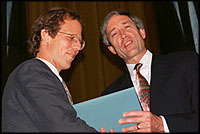
Tony Horwitz is awarded the Pulitzer Prize by George Rupp, Columbia University President.
Winning Work
By Tony Horwitz
Other workers, asked about their thoughts, almost invariably gave one of three responses: "sex," "making more money" and "getting out of this place." But chances for realizing the latter two are, in the words of one co-worker, "total fantasy, just like the sex."
Blues on the Chicken Line
MORTON, Miss. -- They call it "the chain," a swift steel shackle that shuttles dead chickens down a disassembly line of hangers, skinners, gut-pullers and gizzard-cutters. The chain has been rattling at 90 birds a minute for nine hours when the woman working feverishly beside me crumples onto a pile of drumsticks.
"No more," she whimpers. A foreman with a stopwatch around his neck rushes up. "Come on now," he bellows. "Pump it up!" Down the chain, a worker named Jose yells and waves wildly, like a drowning man. Bathroom trips are discouraged and require approval. But the foreman can't hear because of the din, and Jose is left grimacing and crossing his legs.
Finally, half an hour later, a weary cheer ripples along the line. "The last bird's coming!" someone shouts. Jose sprints toward the bathroom -- and right into the path of a cleanup crew hosing offal into floor drains. Jose slips and then flops onto a sodden bank of fat and skin. "Gotta go," he says, struggling up from the mire. "Gotta go."
While American industry reaps the benefits of a new, high-technology era, it has consigned a large class of workers to a Dickensian time warp, laboring not just for meager wages but also under dehumanized and often dangerous conditions. Automation, which has liberated thousands from backbreaking drudgery, has created for others a new and insidious toil in many high-growth industries: work that is faster than ever before, subject to Orwellian control and electronic surveillance, and reduced to limited tasks that are numbingly repetitive, potentially crippling and stripped of any meaningful skills or the chance to develop them.
Job hazards in such industries often remain rife, in part because many safety rules reflect a bygone era of heavy industry rather than the subtler dangers of today's workplace. Ironically, it is also the public's growing concern for its own health and safety that has helped fuel growth of some of the nation's harshest jobs. Poultry workers, for instance, a labor force that has almost doubled in size since 1980, feed Americans' burgeoning appetite for lean and easy-to-cook meat by trimming away fat, bone and skin -- and succumbing to rates of injury and illness that afflict almost one out of four workers annually.
Other examples include:
- Environmental workers at "dirty MuRFs," or recycling plants, who salvage metal, glass and paper from household trash that can harbor dead animals, used hypodermic needles and other potential hazards.
- Financial-services workers who process donations to charitable groups but who are barred from talking, gazing out windows or deviating from steep work quotas that are monitored by computer down to the individual keystroke.
- Correctional officers, many of whom now come from poor rural areas where prison-building has exploded with the tripling of America's inmate population since 1980. Desperate for jobs, these new rural turnkeys often are unprepared for the stress of policing urban convicts.
- Nursing-home aides, caring for the aged in facilities that are more crowded than ever with severely ill residents released at the earliest chance by cost-conscious hospitals. Often part-timers with little training, nursing aides suffer from soaring injury rates yet frequently lack health benefits themselves. "Gut rehab" workers who reclaim buildings in decayed urban cores, using picks and shovels to clear abandoned buildings that have been used for years as dumps, dog kennels, junkies' dens and makeshift brothels. "It's gritty, dangerous work, like excavating a bomb site," says Eddie Laterza, a gut-rehab contractor who works in the South Bronx.
There have always been Americans who have sought risky, rough work in exchange for high pay, whether it is erecting skyscrapers or putting out oil-field fires. But many of today's toughest occupations offer little compensation, either in pay or in skills that might allow workers to move to more-rewarding jobs.
In many respects, poultry processing epitomizes the often-unseen harshness of such low-wage work. It is the second-fastest-growing factory job in America since 1980 and now has a work force of 221,000, roughly equal to that of steelworkers. With wages starting as low as $5 an hour, jobs on the poultry line pay less than in any other manufacturing industry, except apparel. Poultry processing also ranks as the nation's 11th most-dangerous industry, with an annual injury and illness incidence rate of 23.2 per 100 full-time workers, almost double that of trades such as coal mining and construction.
Yet for thousands of Americans, the poultry line represents the best -- or only -- employment available. Chicken and turkey plants are large, labor-intensive factories clustered in the rural South, bringing thousands of jobs to small towns that often offer little else except part-time work at or near the minimum wage. The onetime Cotton Belt now belongs to a broad "broiler belt," stretching from Delaware to East Texas and studded with what are, in effect, company towns. The poultry plant is the biggest employer; the odor of dead fowl suffuses the air while feathers litter the streets; shops are filled with workers in sanitary hairnets and aprons; and in some towns plants are ringed by company housing, often trailers, crowded with workers who pay rent through payroll deductions.
"Poultry's a tucked-away industry," says Bob Hall, research director for the Institute for Southern Studies in Durham, N.C. But in terms of sales and employment, he adds: "Poultry is bigger than peanuts in Georgia, bigger than tobacco in North Carolina, bigger than cotton in Mississippi and bigger than all crops combined in either Arkansas or Alabama."
Because poultry demand keeps surging and the unpleasant labor and low wages keep turnover high -- exceeding 100% a year at many plants -- poultry companies hire constantly, with few questions asked and no skills required. At a B.C. Rogers Processors Inc. plant in Morton, Miss., the first this reporter visited in search of work, the plant manager, Jerry Duty, barely glanced at an application that listed my university education and Dow Jones & Co. (publisher of this newspaper) as my employer. "It's tough work and will make you sore as hell," he said, offering a job starting the next day at $5.10 an hour. "But it won't kill you -- only the chickens."
Preparation for the job and its dangers also was cursory. Safety training consisted of a personnel officer rattling off a list of the chemicals in the plant and the hazards they might pose. "It's the law; we have to tell you," she said apologetically, moving quickly to a list of plant rules. These included the following message on bathroom trips: "Walking off the line without someone to relieve you is not allowed. This is considered a voluntary quit." At a De Queen, Ark., plant owned by Pilgrim's Pride Corp., where this reporter later worked, unexcused bathroom trips are punishable by a three-day suspension. Information for this story was also gathered from interviews with more than 50 workers at other plants in the South.
After the brief orientation at B.C. Rogers, the other new workers and I were issued our safety and sanitation gear -- white coat, hairnet, rubber gloves, earplugs -- with $4.50, almost an hour's pay, deducted from our first paycheck to pay for these items. On the factory floor -- a noisy, wet expanse of chutes and belts loosely linked by the ubiquitous chain -- a supervisor pointed me to a space along a conveyor belt where workers frantically weighed chicken parts and crammed them into cardboard boxes. "Show him the ropes," he shouted at no one in particular, and no one ever did.
Interviewed later, Jack Rogers, B.C. Rogers's general counsel and son of the company's CEO, said: "You learn on the line how to do the job." Of safety training, he said: "It's always a challenge to create the safest environment you can." Later, in a written statement, the company added it has 13 "specialized safety programs, monthly safety programs" and that workers are trained "up to and exceeding" government standards.
Department names inside poultry plants convey the grisly tasks involved: "scalding," "evisceration," "de-bone," "drip-line," "offal," "foot room," "giblet room." Feathers, blood, viscera and condemned carcasses are sent to malodorous rendering plants to be ground and cooked into animal feed. As workers often joke, "They don't waste anything in a chicken plant -- except the cackle."
Each job carries its own hazards and hardships. By common acclaim, the toughest is held by "live hangers," who hitch incoming birds to shackles at a rate of 25 or more a minute. So strenuous that only a few can do it, live-hanging exposes workers to struggling birds that scratch, peck and defecate all over them.
Though supplied with paper masks, many hangers find them hot and confining and work without them. Some hangers spend breaks in the bathroom, coughing up feathers and dust. Hangers also develop rashes -- known as "chicken itch" -- and swollen eyes from exposure to the live birds, as well as wounds from frequent banging against the shackles. "Them's the limbs of a veteran hanger," says Willie Kimble, holding out slashed arms and hands knobbed with callouses. A 33-year-old who has hung chickens for seven years at plants in Forest, Miss., Mr. Kimble says he sticks to the job because it pays a few dimes an hour more than the wage elsewhere in chicken plants.
After the birds have been stunned with electric current, slaughtered and plucked -- largely by machine -- they are re-hung, dangling headless and upside-down for their journey through the plant. At one station, a worker who calls herself a "butthole cutter" slits open the bird so a "gut-puller" can reach in and yank out the animal's innards. Others lop off limbs, pull skin or separate organs.
Packed tightly and working quickly with knives and scissors, workers often cut themselves and others. Floors that are slick with wash water and chicken bits add to the hazard. And though most tasks at first appear undemanding if unpleasant, they quickly become grueling as the same motion is repeated, at rapid speed, for eight hours or more. Poultry processing ranks third among the nation's industries for cumulative-trauma injuries such as carpal tunnel syndrome. (Meatpacking is first, and car-body assembly is second.)
"The human body is versatile, it's adaptable, but it has physical limits that poultry processing often exceeds," says Barbara Silverstein, an ergonomics expert at the Occupational Safety and Health Administration who has studied the food industry for a decade.
She says poultry work combines four of "the big five" risk factors for cumulative trauma: rapid and repetitive motion, awkward postures, forceful motions, and no control over the pace of work. (The fifth factor is vibration, caused, for instance, by the power knives used in meatpacking.)
The cold temperatures in many parts of the plants add to the injury risk by numbing extremities, Dr. Silverstein says. Another factor: Over the past 15 years, line speeds in poultry plants have been revved up to a maximum allowable rate of 91 chickens a minute from the high 50s. (Industry and government didn't consider worker safety when ramping up speeds; rather, processors convinced regulators that they could move chickens faster without sacrificing food hygiene.)
Also, because OSHA hasn't yet issued guidelines for limiting cumulative trauma, it is hard for the agency to police companies that may endanger workers. "Japan has addressed these issues since the 1960s -- even Brazil has an ergonomic standard -- but not the U.S.," says Dr. Silverstein. The agency hopes to issue proposed standards soon.
In this respect, poultry processing reflects the way safety regulations in general have lagged behind changes in the economy. OSHA rules that apply broadly to all industries -- guarding, for instance, against high noise levels and exposed machinery -- are largely tailored to dwindling work venues such as mines and steel mills, rather than to the growing number of jobs in new industries and offices that pose different hazards.
Even so, OSHA has frequently fined poultry companies, sometimes for safety breaches that echo Upton Sinclair's "The Jungle." In 1991, 25 workers burned to death in a North Carolina chicken plant with locked fire exits and no sprinkler system. A Pennsylvania plant was fined for dangerous levels of "chicken feathers and feces" that put workers at risk of "deposits in the eyes, ears and respiratory tract." In Mississippi this year, OSHA fined a company for an exposed drive shaft that caused the amputation of a worker's legs, as well as for failing to provide safety goggles and gloves, and leaving toxic chemicals unlabeled.
Clyde Payne, the OSHA administrator for Mississippi, says many other violations may never come to light because the agency is thinly spread and relies almost entirely on complaints from workers. "In most poultry plants, you've got a low-wage and often undereducated rural work force that may not know its rights, or that's too afraid to act on them," he says.
In the cut-up department at B.C. Rogers, the workers I joined lifted 5-pound boxes of frying parts at the rate of 12 boxes or more a minute and stuffed them into larger boxes that we then hoisted awkwardly onto another conveyor. This meant we were lifting roughly 3,600 pounds an hour, for at least eight hours.
The work often was so fast-paced that it took on a zany chaos, with arms and boxes and poultry flying in every direction. At break times I would find fat globules and blood speckling my glasses, bits of chicken caught in my collar, water and slime soaking my feet and ankles and nicks covering my wrists. One woman working beside me wrapped her forearms in plastic tape because bits of chicken had gotten into her wounds and caused infections.
The speed and pressure of the line also isn't conducive to food hygiene. Chicken pieces often piled up into hillocks that eased off the conveyor belt and onto the floor. Though there are strict rules about the collection of such chicken, most workers I observed were too exhausted and apathetic to abide by them and simply scooped meat off the floor and back onto the conveyor belt. "Just make sure the USDA doesn't see you," a co-worker explained, nodding at the government inspectors scattered through the plant.
In fact, while foremen circulate, joining in the work or urging employees to speed up, the labor is effectively self-supervising. As in many factories, the conveyor belt sets the pace and anyone who flags creates more work for those farther down the line. So workers tend to vent their fatigue and frustration on each other, shouting at colleagues to do a better job.
"Someone's putting thighs in the leg boxes!" rang the refrain of a self-appointed coxswain near me at B.C. Rogers. "And I'm going to kick some butt if people don't close those boxes tight!"
There was no chance to sit down or step away from the line except during short breaks usually spent crowding into the bathroom and running to buy a soda or snack in a windowless "break room" just off the factory floor. Though most workers quickly become smeared with chicken grime and are greeted in the bathroom by signs admonishing them to "sanitize" before exiting, soap dispensers at the B.C. Rogers plant were usually empty, toilets overflowed, and drains were clogged with cigarette butts.
Asked for comment, Mr. Rogers, the company counsel, said bathrooms are cleaned regularly. But he added: "If you go in the bathroom after 50 other people, it's not going to be that clean. There should be soap, but it can run out." In a statement, the company later said bathrooms are cleaned at least five times a day.
Regarding the risk of cumulative trauma, the company says that it has ergonomics teams evaluating each job in the plant, and that engineering changes have contributed to "a significant decrease" in such injuries. As for chicken parts tossed back on the line after falling on the floor, the company said USDA and company policy requires that the chicken be gathered and re-washed by specified workers.
At the Pilgrim's Pride plant in De Queen, Ark., conditions were more sanitary but breaks were briefer. My first shift in "chill-pack," boxing frozen chicken parts, ran from 4:15 p.m. to 3:05 a.m. and co-workers said they sometimes work until dawn. Night shifts often don't end until all slaughtered birds have been processed. Thus, workers never know when they will get off, and can't pace themselves.
There was only a five-minute break during the last 5 1/2 hours, and many workers appeared to be sleepwalking through the latter part of their shift. It is at such times, safety experts say, that exhausted workers are most prone to injury. That would be "a concern if it happened quite a bit," Cliff Butler, Pilgrim's chief financial officer, says of the long shift. "But I don't think it happens habitually."
Like the work itself, thoughts tend to become numbingly repetitive. Asked how he got through the night, Bernie Garcia, a co-worker in De Queen, nodded at the endless stream of frozen chicken passing before us, stamped with the company's name and a Puritan's silhouette. "I think about pilgrims for a while," he said. "Then I think about pride. Then I think about how long it is to the next break."
Other workers, asked about their thoughts, almost invariably gave one of three responses: "sex," "making more money" and "getting out of this place." But chances for realizing the latter two are, in the words of one co-worker, "total fantasy, just like the sex." At the De Queen plant, for instance, wages start at $5.80 an hour, but top out for almost all line-workers at $6.60 an hour after three months. Only a handful rise to the better-paying supervisory ranks. (A Fortune 500 company, Pilgrim's Pride reported record net income of $31.1 million for the fiscal year ended Oct. 1, on record sales of $922.6 million. Its relatively low profit margins are in line with others in this industry.)
Workers also have little chance to develop skills that might help them move up or out. Though unskilled jobs are hardly new, the trend toward dead-end labor has accelerated in some 1990s work venues as tasks become more automated and compartmentalized. Workers on "the knife line" at most chicken plants, for instance, aren't even allowed to sharpen their own knives; this task, ostensibly for safety reasons, is given over to workers whose sole job is honing blades.
In the chill-pack department at Pilgrim's Pride, a seven-year veteran named Larry Sirmon said by way of introduction: "Here's all I know and all you need to. Breasts go 28 to a box, drumsticks go 24, and wings go 20. And make sure the numbers stenciled on the box are facing forward when you shove the box down the conveyor belt."
Before coming here, the 48-year-old Mr. Sirmon worked in an Idaho silver mine, earning twice what he does at Pilgrim's Pride. But the mine closed and Mr. Sirmon returned to his native De Queen and has been packing poultry ever since. "I reckon they'll take me out of here in a box, same as these chickens," he said, stacking 28 packs of skinless breast fillets and sliding the filled box, numbers forward, to the next person along the line.
Mr. Butler of Pilgrim's said the company is experimenting with job rotation and "cross-training," though this is aimed at paring cumulative-trauma injuries rather than making the work less dull. "It's a monotonous job, but there's a lot of jobs in this country that are," he said.
Poultry workers also must endure harsh work rules. Studies of job stress almost always identify "machine-pacing" and "lack of control" as key contributors to workplace stress. In poultry plants, this can include lack of control over bodily functions. "I'm a grown woman. I don't like being told when I need to go to the bathroom," says Hattie Pittman, a 35-year-old at a plant in Collins, Miss. This year, Ms. Pittman came down with a kidney infection that forced her to make frequent trips to the bathroom outside of designated breaks. She says her supervisor barked: "The rule is, you can't go to the bathroom more than three times a week, unless you got a doctor's permit."
A doctor later wrote her the necessary permit. But other workers in Mississippi and Arkansas said they have sometimes urinated on themselves because they were unable to locate a foreman for approval and were scared to leave the line. (B.C. Rogers said an employee "requiring use of restroom facilities is accommodated" and it dismisses claims that workers urinate on themselves as "rumors" spread by unions.)
Fear may come into play as well when workers are hurt. Companies have an incentive to underreport or downplay injuries, both to control soaring insurance and compensation costs, and to deflect the prying eye of OSHA. This has, in turn, led to frequent OSHA findings of "medical mismanagement," which includes failing to log injuries and returning hurt employees to work before they are fully recovered. At some plants, there also are safety bonuses, awarded to departments logging the fewest accidents. The system can put peer pressure on workers to ignore or fail to report injuries.
Lightly-trained medical personnel can add to the problem. B.C. Rogers, for instance, doesn't require first-aid workers to have the modest training of licensed practical nurses, though the company says it now plans to hire LPNs. Given the risks of poultry work, safety experts say plants should at least have LPNs on staff, supervised by a registered nurse or doctor.
Workers requiring serious medical attention can face other obstacles. In states such as Arkansas, the nation's largest poultry producer, injured workers must go to a company doctor unless they win permission from the state to pick their own. And poultry companies successfully lobbied for a recent overhaul of workers' compensation in Arkansas that severely restricts eligibility for claims.
Poultry companies also wield considerable influence in Washington. Agriculture Secretary Mike Espy recently resigned after he allegedly received favors from agribusiness interests, including Tyson Foods Inc., the nation's largest poultry producer. A special counsel is investigating whether the affair weakened regulation of the poultry industry.
Workers, by contrast, have little representation. Roughly 80% are nonunion, and industry leaders such as Tyson and Perdue Chicken have long been renowned for combating unions. Asked about their views of unions, poultry workers typically responded with cautionary stories about vocal workers who were dismissed, harassed or reassigned to undesirable jobs on the cramped de-bone line or in the chiller.
Even without employer intimidation, poultry plants -- like many other low-wage workplaces -- are hard to organize. Wearing earplugs, most employees have little chance to chat except during brief breaks. High turnover poses another obstacle, as does the ethnic and racial mix. Blacks and whites tend to part ways when off the line. Both groups often are separated by language and culture from the growing number of Hispanic workers, many of whom speak English poorly and fear they will lose their jobs or housing if they make trouble. Some also work here illegally and fear any contact with authorities.
"The whole setup in these plants is ripe for exploitation," says Father Scott Friend, a Catholic priest whose De Queen congregation includes about 600 poultry workers. "There's no one that workers can go to or trust if they're being misused."
Many turn to the Spanish-speaking Father Friend. (While Pilgrim's Pride has six chaplains in its De Queen plant, none are Catholic.) On an autumn afternoon, the priest listens as a glum man named Jorge tells of his two years of work at the nearby Pilgrim's Pride plant. Though he himself has incurred only minor scrapes, Jorge says he has seen co-workers run over by forklifts, lose fingers and go numb in their arms and hands.
College-educated, Jorge says he emigrated here in hopes of making a "good wage" and eventually "moving up," as generations of immigrants have done before. "This is the dream of America, I believe," he says in formal, halting English.
But now he fears that hard labor in the chicken plant will lead nowhere. "Some nights, I see myself an old man, making the same money as now, doing the same work, only with hurting arms and hands." Asked what skills he has learned at the plant, he ponders the question for a moment. "There is one thing, yes," he says finally. "I can tell a chicken gizzard from a chicken liver, I can do that well."
He pauses again and picks at a calloused finger. "Please tell me," he says, "what a man may do with that."
© 1994, The Wall Street Journal
By Tony Horwitz
HAGERSTOWN, Md. -- Control is one of Ron Edens's favorite words. "This is a controlled environment," he says of the blank brick building that houses his company, Electronic Banking System Inc.
Inside, long lines of women sit at spartan desks, slitting envelopes, sorting contents and filling out "control cards" that record how many letters they have opened and how long it has taken them. Workers here, in "the cage," must process three envelopes a minute. Nearby, other women tap keyboards, keeping pace with a quota that demands 8,500 strokes an hour.
The room is silent. Talking is forbidden. The windows are covered. Coffee mugs, religious pictures and other adornments are barred from workers' desks.
In his office upstairs, Mr. Edens sits before a TV monitor that flashes images from eight cameras posted through the plant. "There's a little bit of Sneaky Pete to it," he says, using a remote control to zoom in on a document atop a worker's desk. "I can basically read that and figure out how someone's day is going."
This day, like most others, is going smoothly, and Mr. Edens's business has boomed as a result. "We maintain a lot of control," he says. "Order and control are everything in this business."
Mr. Edens's business belongs to a small but expanding financial service known as "lockbox processing." Many companies and charities that once did their paperwork in-house now "out-source" clerical tasks to firms like EBS, which processes donations to groups such as Mothers Against Drunk Driving, the Doris Day Animal League, Greenpeace and the National Organization for Women.
More broadly, EBS reflects the explosive growth of jobs in which workers perform low-wage and limited tasks in white-collar settings. This has transformed towns like Hagerstown--a blue-collar community hit hard by industrial layoffs in the 1970s--into sites for thousands of jobs in factory-sized offices.
Many of these jobs, though, are part-time and most pay far less than the manufacturing occupations they replaced. Some workers at EBS start at the minimum wage of $4.25 a hour and most earn about $6 an hour. The growth of such jobs--which often cluster outside major cities--also completes a curious historic circle. During the Industrial Revolution, farmers' daughters went to work in textile towns like Lowell, Mass. In post-industrial America, many women of modest means and skills are entering clerical mills where they process paper instead of cloth (coincidentally, EBS occupies a former garment factory).
"The office of the future can look a lot like the factory of the past," says Barbara Garson, author of "The Electronic Sweatshop" and other books on the modern workplace. "Modern tools are being used to bring 19th-century working conditions into the white-collar world."
The time-motion philosophies of Frederick Taylor, for instance, have found a 1990s correlate in the phone, computer and camera, which can be used to monitor workers more closely than a foreman with a stopwatch ever could. Also, the nature of the work often justifies a vigilant eye. At EBS, workers handle thousands of dollars in checks and cash, and Mr. Edens says cameras help deter would-be thieves. Tight security also reassures visiting clients. "If you're disorderly, they'll think we're out of control and that things could get lost," says Mr. Edens, who worked as a financial controller for the National Rifle Association before founding EBS in 1983.
But tight observation also helps EBS monitor productivity and weed out workers who don't keep up. "There's multiple uses," Mr. Edens says of surveillance. His desk is covered with computer printouts recording the precise toll of keystrokes tapped by each data-entry worker. He also keeps a day-to-day tally of errors.
The work floor itself resembles an enormous classroom in the throes of exam period. Desks point toward the front, where a manager keeps watch from a raised platform that workers call "the pedestal" or "the birdhouse." Other supervisors are positioned toward the back of the room. "If you want to watch someone," Mr. Edens explains, "it's easier from behind because they don't know you're watching." There also is a black globe hanging from the ceiling, in which cameras are positioned.
Mr. Edens sees nothing Orwellian about this omniscience. "It's not a Big Brother attitude," he says. "It's more of a calming attitude."
But studies of workplace monitoring suggest otherwise. Experts say that surveillance can create a hostile environment in which workers feel pressured, paranoid and prone to stress-related illness. Surveillance also can be used punitively, to intimidate workers or to justify their firing.
Following a failed union drive at EBS, the National Labor Relations Board filed a series of complaints against the company, including charges that EBS threatened, interrogated and spied on workers. As part of an out-of-court settlement, EBS reinstated a fired worker and posted a notice that it would refrain from illegal practices during a second union vote, which also failed.
"It's all noise," Mr. Edens says of the unfair-labor charges. As to the pressure that surveillance creates, Mr. Edens sees that simply as "the nature of the beast." He adds: "It's got to add stress when everyone knows their production is being monitored. I don't apologize for that."
Mr. Edens also is unapologetic about the Draconian work rules he maintains, including one that forbids all talk unrelated to the completion of each task. "I'm not paying people to chat. I'm paying them to open envelopes," he says. Of the blocked windows, Mr. Edens adds: "I don't want them looking out--it's distracting. They'll make mistakes."
This total focus may boost productivity, but it makes many workers feel lonely and trapped. Some try to circumvent the silence rule, like kids in a school library. "If you don't turn your head and sort of mumble out of the side of your mouth, supervisors won't hear you most of the time," Cindy Kesselring explains during her lunch break. Even so, she feels isolated and often longs for her former job as a waitress. "Work is your social life, particularly if you've got kids," says the 27-year-old mother. "Here it's hard to get to know people because you can't talk."
During lunch, workers crowd in the parking lot outside, chatting nonstop. "Some of us don't eat much because the more you chew the less you can talk," Ms. Kesselring says. There aren't other scheduled breaks and workers aren't allowed to sip coffee or eat at their desks during the long stretches before and after lunch. Hard candy is the only permitted desk snack.
New technology, and the breaking down of labor into discrete, repetitive tasks, also have effectively stripped jobs such as those at EBS of whatever variety and skills clerical work once possessed. Workers in the cage (an antiquated banking term for a money-handling area) only open envelopes and sort contents; those in the audit department compute figures; and data-entry clerks punch in the information that the others have collected. If they make a mistake, the computer buzzes and a message such as "check digit error" flashes on the screen.
"We don't ask these people to think--the machines think for them," Mr. Edens says. "They don't have to make any decisions."
This makes the work simpler but also deepens its monotony. In the cage, Carol Smith says she looks forward to envelopes that contain anything out of the ordinary, such as letters reporting that the donor is deceased. Or she plays mental games. "I think to myself, A goes in this pile, B goes here and C goes there--sort of like Bingo." She says she sometimes feels "like a machine," particularly when she fills out the "control card" on which she lists "time in" and "time out" for each tray of envelopes. In a slot marked "cage operator," Ms. Smith writes her code number, 3173. "That's me," she says.
Barbara Ann Wiles, a keyboard operator, also plays mind games to break up the boredom. Tapping in the names and addresses of new donors, she tries to imagine the faces behind the names, particularly the odd ones. "Like this one, Mrs. Fittizzi," she chuckles. " I can picture her as a very stout lady with a strong accent, hollering on a street corner." She picks out another: "Doris Angelroth--she's very sophisticated, a monocle maybe, drinking tea on an overstuffed mohair couch."
It is a world remote from the one Ms. Wiles inhabits. Like most EBS employees, she must juggle her low-paying job with child care. On this Friday, for instance, Ms. Wiles will finish her eight-hour shift at about 4 p.m., go home for a few hours, then return for a second shift from midnight to 8 a.m. Otherwise, she would have to come in on Saturday to finish the week's work. "This way I can be home on the weekend to look after my kids," she says.
Others find the work harder to leave behind at the end of the day. In the cage, Ms. Smith says her husband used to complain because she often woke him in the middle of the night. "I'd be shuffling my hands in my sleep," she says, mimicking the motion of opening envelopes.
Her cage colleague, Ms. Kesselring, says her fiance has a different gripe. "He dodges me for a couple of hours after work because I don't shut up--I need to talk, talk, talk," she says. And there is one household task she can no longer abide.
"I won't pay bills because I can't stand to open another envelope," she says. "I'll leave letters sitting in the mailbox for days."
© 1994, The Wall Street Journal
By Tony Horwitz
"I used to think I was going to faint from the stink," he says. Sucking through his nostrils, he adds with a smile: "Now, I tell myself that it smells like money."
STORM LAKE, Iowa -- Travis Foley vividly recalls his first day on the job at a recycling plant in this farming town of 9,000.
"I threw up three times," he says. Flies swarm his face and hands as he sifts raw trash on a steamy September day. "Didn't stop working, though," the 20-year-old adds. "I just stepped back and vomited in the nearest can."
Mr. Foley worked previously at a pig abattoir and reckoned he was beyond such queasiness. "But there's stuff you see here," he says, "that would make even Superman sick."
Mr. Foley belongs to a fast-growing legion of laborers who do the dirty work of keeping America clean. As state after state passes recycling laws, household garbage that once headed straight to the landfill or incinerator now often heads instead to what is known as a "materials recovery facility," or "MuRF" for short.
At "dirty MuRFs," such as Storm Lake's, workers retrieve cans, bottles and other recyclables from raw trash dumped on conveyor belts. At other facilities (there are many variations), the recyclables arrive presorted by residents into plastic bags. But the system is imperfect: The bags often burst and mix with other refuse, and they frequently contain garbage that shouldn't be there.
"We've had a lot of trouble convincing people that disposable diapers are not recyclable," says Robert Sink, a manager at the Omaha, Neb., Solid Waste Recycling Center.
There now are about 400 MuRFs nationwide--roughly triple the number in 1990--and the number appears likely to keep multiplying as states and cities strengthen recycling efforts. Some MuRFs employ prisoners at 40 to 75 cents an hour plus time off their sentences; others hire the mentally handicapped. Generally, though, MuRFs draw on unskilled laborers who accept work that many others disdain in exchange for steady hours and pay that typically starts a dollar or so above the minimum wage.
"The work can be nasty but you feel like it's secure--people are always going to throw things away," says Algie Bullion, an Omaha worker who was laid off from his previous job as a meatpacker. Mr. Bullion, 34, says he often cautions new workers at the MuRF not to give up too quickly. "They're young, they're picking through maggots and diapers and thinking, 'Man, I can do better than this,"' he says. "But I tell them, 'Money is money, and if you haven't got the skills and education, you aren't going to do any better than this."'
Even so, turnover at some MuRFs runs 100% a year, and it is easy to see why. At the Omaha facility, a hangar-like warehouse at the city's edge, trucks dump incoming garbage on a vast "tip floor." Front-end loaders then feed the rubbish to machines that spit the refuse onto a conveyor belt known as the "trash line." Here, a half-dozen workers reach into a belt-high trough of garbage, plucking out bags of recyclables, or loose cans and bottles, and tossing them into bins and chutes for further sorting. Between loads, they use snow shovels to heft trash that has spilled off the belt and onto the floor.
On a recent day, following a rainstorm, the trash formed a wet sludge of soaked newspapers, mud-streaked bottles and cans, and burst bags extruding rotten meat, corn cobs, crushed dolls, tampons, bleach bottles, soiled kitty litter and half-empty cans of pet food. A faint drizzle of trash particles sprinkled down from tall machines that spewed still more garbage onto the line.
"When the trash is slimy, it's heavy and hard to grab hold of," says Maurice Davis, wrestling loose a sodden pile of pizza cartons. "On days like this, I feel like I'm some kind of wet rat rummaging around at the bottom of a dump."
Like other workers, though, the 33-year-old Mr. Davis says he has become inured to the filth and barely notices the odor, which is overpowering to a first-time visitor. "I used to think I was going to faint from the stink," he says. Sucking through his nostrils, he adds with a smile: "Now, I tell myself that it smells like money."
The money, however, isn't great. Employees at the Omaha facility start at $5.75 an hour and almost all top out at a dollar more than that. Temporary workers, who make up about a third of the 35-person operation, are paid $5 an hour, without benefits. They are hired permanently with benefits if they stick to the job for three months.
But few temps are assigned to the "trash line" because the work there tends to make them quit quickly, a supervisor says. One common problem: The conveyor belt causes slight motion sickness, which combines with the odor to induce nausea in newcomers. "The mix can create a unique aroma," says supervisor Jim Kemp.
The "sort line," where most newcomers work instead, isn't as pungent. Here, workers are placed between magnets and tumblers that separate out the recyclables. They perform tasks the machines can't, such as sorting glass and plastic by type and color. The work is fast-paced and nerve-jangling, punctuated by the constant smashing of glass. It also requires intense concentration so that nothing slips past.
Valentine Red says the rapid, repetitive labor often intrudes on his dreams. "I get to work tired because I've been working all night in my sleep," says the Philippine-born sorter, one of many immigrants working at MuRFs nationwide.
At the Omaha plant, which is run by Waste Management Inc., a unit of WMX Technologies Inc., workers wear steel-toed boots, hard hats and safety glasses. Gloves, arm guards and earplugs are optional, and many workers go without so they can talk with others and get a better grip on the trash. This can leave them exposed to hazards such as used hypodermic needles, bleach and smoldering ashes from household stoves. Workers also complain about the peculiar and often unpleasant items that sometimes surface: rats, dead pets, sex toys, used condoms, live snakes. In summer the trash can be especially rank--particularly if it has been by the curb or on the tip floor for a few days. In winter, many MuRFs are extremely cold, or dusty if the doors are closed to keep out the chill.
Yet, as with many other fast-growing job sectors, there has been little independent study or monitoring of MuRFs (the Bureau of Labor Statistics doesn't yet have categories to collect specific data on recycling workers and many others in new environmental fields). European studies have found high rates of skin, respiratory and intestinal problems among recycling workers. Other hazards include back and repetitive-strain injuries, needle sticks, and lacerations from cans and glass.
"There's no question that many of these facilities remain primitive in terms of safety," says Eileen Berenyi of Governmental Advisory Associates Inc., a New York-based consulting firm that is one of the few groups in America to collect data on MuRFs. She adds that the industry is extremely volatile and varied, with large, well-established facilities generally taking precautions that smaller MuRFs may not.
Iowa's Storm Lake MuRF, for instance, was cited this year by the state's Occupational Safety and Health Administration for a range of violations: inadequate safety gear, exposing workers to excessive noise and unlabeled hazardous chemicals, and failing to train workers to guard against "blood-borne pathogens" that can cause diseases such as hepatitis. The company was fined $1,320--typical of the small penalties OSHA usually doles out. Ellsworth Jeppeson, the plant's general manager, characterizes the citations as "minor stuff that we didn't even know we were supposed to be doing."
Most workers also shrug off the safety dangers of their work, which are, after all, common to the farm or slaughterhouse labor they have done before. And most have made their peace as well with the stigma of working in garbage, which causes neighbors to steer clear of them when they shop on their way home from work, and family members to insist that they strip off their clothes at the door.
"It used to bother me that I'd get home and my kids would say, 'Daddy, you stink!'" says Mr. Davis, the Omaha worker. "Now I tell them, 'Yeah, but you never say that on Fridays when I come home with a pocket full of cash.'"
© 1994, The Wall Street Journal
Biography
Tony Horwitz, who was born in Washington, D.C., graduated magna cum laude and Phi Beta Kappa from Brown University with a bachelor's degree in history. He received a master's degree in journalism from Columbia University and was awarded the Richard Baker Prize for excellence in print journalism.
Mr. Horwitz was an education reporter for the Fort Wayne (Indiana) News-Sentinel from 1983 to 1984 and a general assignment reporter for the Sydney (Australia) Morning Herald from 1985 to 1987. In September 1987, he became a freelance journalist based in Cairo and contributed to The Wall Street Journal.
In February 1990, Mr. Horwitz joined the Journal's London bureau as a reporter covering the Middle East and other foreign locations. He returned to the U.S. in July 1993. While assigned to the Pittsburgh bureau, he travels and reports on workplace issues from Virginia.