Dayton Daily News, by Russell Carollo and Jeff Nesmith
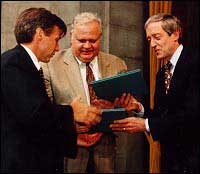
Columbia University President George Rupp (right) presents Russell Carollo (left) and Jeff Nesmith with the Pulitzer Prize for National Reporting.
Winning Work
The U.S. military operates a flawed and sometimes deadly health care system that lacks the most significant safeguard protecting civilians from medical malpractice.
By Russell Carollo and Jeff Nesmith
The men and women in America's armed forces face unnecessary danger where they should be safest - in the military's own hospitals and clinics.
A year-long Dayton Daily News examination found the U.S. military operates a flawed and sometimes deadly health care system that lacks the most significant safeguards protecting civilians from medical malpractice.
The military system employs some of the country's finest physicians. But the examination also found doctors who failed several state medical board exams, doctors who had medical licenses revoked or suspended, doctors who lost their malpractice insurance - even doctors convicted of crimes.
The newspaper reviewed thousands of previously unreleased government records, interviewed more than 200 people in 12 states and analyzed more than a dozen computer databases, some obtained only after a federal judge ordered the military to release them. The examination found:
The military health care system is a magnet for problem doctors, offering them jobs without the burdensome restrictions and liabilities faced by civilian doctors. Military doctors are not required to have malpractice insurance, they do not have to be licensed in states where they practice and they are virtually immune from being sued by their patients.
The military doesn't warn the public of doctors whose mistakes cause injuries and even death. More than 75 military medical facilities never reported a doctor for medical malpractice to a database created by Congress in 1990 to protect the public from problem doctors. Those same facilities were the targets of claims alleging more than 1,000 incidents of medical malpractice, several involving deaths.
At least 77 physicians practiced in the armed services with "special" licenses issued only to doctors at military bases, Indian reservations, mental hospitals, prisons and labs handling organs for transplants. Nearly all the doctors either failed the state licensing exam or had no evidence in their files they took it. One failed 30 times.
Nurses, physician assistants and even medical technicians take on greater responsibility in the military than in the civilian health care system. Deaths and injuries have been linked to this practice.
Even with good doctors the system often fails. That's because there is little or no continuity of care. Patients often cannot choose the doctor they see, and many get a different doctor at every appointment. The chances of getting a bad doctor increase with every visit.
"I think if Mom and Dad send their sons and daughters in harm's way, they have an expectation that the medical care afforded them is as close to what they'd get at home as can be expected," said Donald A. Kroll, an Air Force Reserve doctor who heads the military committee for the American Society of Anesthesiologists. "Are they getting what they get at home? No."
In a nine-page response to the newspaper's findings, Department of Defense health officials said differences between the civilian and military health care systems do not lesson the quality of care given to service members.
"Military medicine rates highly when measured against the variety of quality indicators used by industry to determine how well hospitals" perform," said John F. Mazzuchi, deputy assistant secretary of defense for clinical services. "The most important thing to us in military medicine is concern for the health and well-being of our patients."
Mazzuchi said the services have taken steps to correct two problems examined by the newspaper.
The Department of Defense inspector general, he said, has initiated an audit to determine whether the services are following guidelines for reporting doctors linked to medical malpractice and misconduct. Mazzuchi also acknowledged that a number of military doctors practiced without proper licenses.
"We have initiated action to correct this situation," he said.
© 1997, Dayton Daily News
An Ohio teenager's case illustrates how a flawed medical system can change a life
By Russell Carollo and Jeff Nesmith
DENVER--Leigh Clark was bleeding to death on the operating table when Dr. Phillip L. Mallory got the emergency call at home and rushed to Fitzsimmons Army Medical Center.
"At that point, the object was just to get her off the table alive," said Mallory, then chief of general surgery at the hospital. "It was one of the most frightening circumstances I'd ever been into."
Clark was supposed to have a routine 45-minute procedure to diagnose the cause of her severe abdominal pains. But instead of making a small incision just through her abdomen wall, Dr. Daniel Lim punctured the main artery carrying blood to her right leg.
Clark, who now lives in Westerville, near Columbus, survived. But at a price: eight more surgeries, months of pain and a body forever marked with scars. "A 16-year-old gymnast is now permanently crippled," a confidential Army record says.
"It's very hard," said Clark, a University of Toledo student. "It's really, really hard to soak it up when you're 16 years old."
What happened to Leigh Clark that July day in 1993 was more than an isolated mistake by a single doctor. She was the victim of a health care system that operates without the most significant safeguards protecting civilian families from medical malpractice.
© 1997, Dayton Daily News
The William Beaumont Army Medical Center in Texas was targeted for more medical malpractice claims in a 10-year period than any other military health facility in America, but the problems there occur to some degree in every military hospital.
By Russell Carollo and Jeff Nesmith
EL PASO, Texas - Until the morning Donald McKinley's wife found him face-down in their back yard, he might have been treated for the clogged arteries that finally failed him.
But his doctor never noticed the warning signs.
McKinley, a retired Army sergeant, had diabetes, high blood pressure, angina and a history of high cholesterol. An electrocardiogram showed an abnormal heartbeat. A chest X-ray revealed a buildup of calcium in his aorta, the body's main artery.
McKinley, 67, saw Dr. Andrew Curtis Faire at the William Beaumont Army Medical Center here seven times in the months before he died. Dr. Faire, suspecting sore muscles were causing the abrupt pains in McKinley's arms and shoulders, prescribed an anti-inflammatory drug.
Three weeks after the last visit, McKinley was dead. An autopsy would later show his arteries were 95 percent clogged in places.
Had the coronary artery disease been diagnosed, a Houston cardiologist told government lawyers, McKinley "probably would have had a bypass and .... probably would still be alive today."
To settle a medical malpractice claim, the government agreed a few months ago to pay Pauline McKinley approximately $300,000. Her claim represents one of 402 cases of alleged medical malpractice at Beaumont from 1986 to 1996.
Those cases push Beaumont to a grim distinction: the hospital with more malpractice claims than any other military health facility in America.
© 1997, Dayton Daily News
Researching their series of articles on problems in the U.S. military's medical system, Dayton Daily News writers Russell Carollo and Jeff Nesmith discovered that at least 77 physicians employed by the military do not even meet the minimum requirements to receive licenses to practice medicine in the states where they work. They operate under special licenses for problem doctors, issued by the state of Oklahoma.
Doctors who didn't make the grade
These doctors practiced in the military with a special license from Oklahoma, having failed at least 10 standard state licensing exams.
FOWLER:
A flight surgeon last stationed at Tinker AFB, Leon Andrew Fowler failed 18 licensing exams in Louisiana, Arizona, Tennessee and Alabama.
MOSCOSO:
A medical officer most recently stationed at a U.S. Army hospital, Washington Emilio Moscoso failed 14 times to pass California's physician licensing exam.
KANG:
The chief of anesthesia services at Barksdale AFB in Louisiana, Dae Oh Kang failed 30 licensing exams in Connecticutt, Nebraska, Oregon, Virginia and Michigan.
By Russell Carollo and Jeff Nesmith
OKLAHOMA CITY, Okla. - Dr. Leon A. Fowler delivered Domino's pizza, worked in a furniture store and made sales pitches over the phone as a telemarketer.
He had a medical degree, but he failed the standard state medical license exam 18 times - in Louisiana, Arizona, Alabama, Tennessee and Oklahoma. He also was expelled from his residency program at Oral Roberts University hospital after failing one of those exams.
Dr. Dae Oh Kang failed the license exam 30 times, taking it nearly once every six months from 1973 to 1992.
Dr. Washington E. Moscoso failed 14 times, results one state medical board said "raise serious issues as to the applicant's ability to practice medicine and surgery with reasonable skill and safety."
But Fowler, Kang and Moscoso all found an employer willing to let them practice medicine.
The employer was the United States armed services.
For nearly a decade, dozens of doctors practiced in the military even though they did not meet the minimum requirements to practice as civilian or as military doctors. Despite the lack of qualifications, several of these physicians not only treated patients but also supervised other doctors or helped decide medical policies for the Pentagon.
These were exactly the kinds of doctors the military intended to weed out in 1988, when the services for the first time required its doctors to get state licenses. The requirement was supposed to force military doctors to meet the same standards as civilian doctors. There was a key difference, though. Because military doctors are constantly transferred, they weren't required to be licensed in states where they practice, as civilian doctors are. A license from any state allowed them to practice at any of the military's almost 600 hospitals and clinics worldwide.
As physicians scrambled across America looking for states to license them, one state, Oklahoma, made a special category. The Oklahoma medical board granted "special licenses" to military doctors who did not meet minimum licensing requirements. Medical board officials said they took the step because they felt the special licensees were not a threat to patients and the military needed doctors.
Although the special licenses entitled these doctors to treat military families around the world, they didn't allow them to practice in civilian hospitals and clinics, even in Oklahoma.
"It was not a license to practice on the citizens of Oklahoma in independent practice such as a regular state license is," says a 1992 letter from the Oklahoma medical board to a military doctor explaining why she couldn't use her special license to practice on Oklahoma civilians. "It may be true that you can practice as well as any doctor in Oklahoma; however, the legal requirements for licensure must be met to assure to the public that this is true."
A Dayton Daily News analysis found that of 113 special licenses issued by the Oklahoma State Board of Medical Licensure and Supervision, at least 77 went to doctors in the Army, Navy and Air Force, which together have about 13,500 doctors.
The other doctors with special licenses worked in Indian clinics, mental hospitals and prisons. A few licenses went to doctors working at veterans' hospitals or at labs that handle organs for transplants.
Nearly all of the 77 military special licensees either failed the state licensing exam used nationwide, called the FLEX, or had no evidence in their files that they ever took it. The FLEX exam tests both basic science and clinical knowledge and is designed to ensure that doctors meet the minimal requirement to practice medicine in the United States. The FLEX was only recently replaced by the United States Medical Licensing Examination.
Thirty of the 77 failed the FLEX exam three or more times, the maximum number some states permit before requiring doctors to get additional training.
Between 76 percent and 90 percent of graduates of U.S. and Canadian medical schools pass the FLEX on their first try.
Even Oklahoma medical officials acknowledged that the FLEX is a measure of a physician's competence.
In answering a letter from Moscoso, Carole Smith, executive director of the Oklahoma medical board until earlier this year, explained why he couldn't use his special license -- the one Oklahoma gave him to treat military patients -- to treat civilians:
"As to denying you the right to prove you are a competent physician, the FLEX was designed to assess exactly that, and you failed that examination 14 times."
Failing exams wasn't the only problem the 77 special licensees had.
Some didn't finish post-graduate training required for civilian doctors. At least two were eventually court-martialed, one for molesting patients and the other for failing to record prescriptions. Another was released from active duty after military officials discovered problems with the records documenting some of his training.
Department of Defense health officials said they were unaware that a number of military doctors practiced without proper licenses.
"Our initial review has confirmed your report that some military physicians hold a special license from the state of Oklahoma," says a letter from John F. Mazzuchi, deputy assistant secretary of defense for clinical services. "We have initiated action to correct this situation."
Mazzuchi said he also asked the surgeons general of each service to verify the licenses of all doctors.
"We thought an Oklahoma license was an unrestricted license," said Lt. Gen. (Dr.) Ronald R. Blanck, the Army's surgeon general. "We're writing a letter to that state board and saying: Don't do it. That's dumb."
Blanck said he identified eight Army doctors with special licenses. None, he said, will be allowed to treat patients until they're properly licensed.
Although military officials denied knowing about the special licenses, three doctors told the Daily News the military directed them to go to Oklahoma.
Dr. Kang gave the newspaper a June 1988 memo from the Air Force surgeon general's headquarters in Washington, D.C., titled "Oklahoma Medical Licensure for active-duty physicians." The memo, which included the address and telephone number of the Oklahoma medical board, informed Air Force doctors that Oklahoma was granting licenses to doctors practicing in the military for at least five years without requiring them to pass a national licensing exam.
The memo also thanked an Air Force colonel for "pioneering this initiative."
"I know I failed a lot of times," said Kang, who remains in the military and is stationed at Barksdale Air Force Base, La. "This was approved by the government . . . All the military hospitals sent a letter to take the examination (in Oklahoma).
"Until today, nobody told us to get full license."
© 1997, Dayton Daily News
The armed services participate in a national registry of doctors linked to medical malpractice but under rules that drastically restrict the number of physicians who get reported.
By Russell Carollo and Jeff Nesmith
The U.S. Army from 1994 through 1995 was accused of medical malpractice in more than 900 incidents, and paid out $66 million to settle malpractice claims.
But the service in those years reported only one practitioner to the National Practitioner Data Bank, a national registry of health care workers linked to medical malpractice.
Federal law requires civilian hospitals, insurance companies and HMOs to report all payments made on behalf of doctors in malpractice cases. The law doesn't hold the military to the same standard, and many military doctors aren't reported simply because they committed the malpractice while in the armed services.Most Americans have never heard of the National Practitioner Data Bank, but thousands benefit from it every day. Hospitals, state medical boards, HMOs and other authorized users search the computer database more than 8,000 times a day for backgrounds on doctors and other health care workers applying for jobs. One of nine searches matches a name with a report in the database.
The military employs about 18 of every 1,000 doctors in America, yet it accounts for just twoof every 1,000 malpractice reports in the database. Those who leave the service for private practice are also likely to leave behind any links to malpractice lawsuits.
Not a single doctor was reported for a malpractice case at more than 75 military hospitals and clinics, a Dayton Daily News examination found. Since the database went online in September 1990, those 75 facilities were targeted for claims alleging more than 1,000 incidents of medical malpractice, hundreds of cases resulting in payments.
Not all of those 1,000 cases should have resulted in reports. But roughly 43 percent of all military claims are paid, and civilians must report all payments made on behalf of a doctor.
"We understand the military's health care systems' sensitivity to reporting practitioners who are career personnel," says a July 1996 report from the U.S. Department of Health and Human Services, which runs the database. "(The) Department of Defense has informed us that if practitioners do not feel supported by the system, they will consider leaving the service."
Department of Defense officials said they are "reviewing further" policies on reporting to the database.
John F. Mazzuchi, deputy assistant secretary of defense for clinical services, said he has asked the Department of Defense inspector general to audit reports by each service.
Lt. Gen. (Dr.) Ronald R. Blanck, the Army's Surgeon General, said the service reports all legitimate claims. "I would argue that for those that we do report you know that there was a problem," he said.
An Army spokeswoman said 800 Army malpractice cases are awaiting action before the service can decide if any need to be reported.
Fairchild Air Force Base hospital near Spokane, Wash., is one of the more than 75 military facilities that never had a doctor reported for malpractice to the database. Since 1990, claims filed at the base alleged at least 25 separate incidents of malpractice.
The Air Force refused to provide information on how the claims were resolved.
In one of the Fairchild cases, the government paid a settlement to a woman who blamed Dr. William M. Lindel in the death of her child.
Lindel acknowledged that the case was never reported to the National Practitioner Data Bank. He also said that had he been a civilian, he would have been reported "whether I was responsible or not." Federal law requires civilian hospitals and insurance companies to report payments made on behalf of doctors, regardless of the amount.
When Lindel left the military in 1994 for civilian practice, records connecting him to that case remained with the military.
Kim Tank, the wife of an airman, accused Lindel of negligence when he delivered her baby in 1991.
Tank alleged in her lawsuit that she was having trouble delivering her baby. Instead of doing a cesarean section--removing the baby through an incision in Tank's abdomen - the doctor used forceps to pull the child from her womb. The baby died four days later at a civilian hospital in Spokane.
"Childbirth is supposed to be something beautiful and natural," Tank said. "It was the most horrible thing I've ever been through."
Lindel said the forceps did not injure the child.
Sidebar: National Practitioner Data Bank
REPORTS 1990-95
The Department of Defense has more than 2% of the nation's physicians, but they have contributed a significantly lower percentage of the reports to a database Congress established to monitor doctors linked to malpractice or punished for incompetence.
U.S. Total Military
Total doctors 611,217 13,500*
Total malpractice reports 71,801 206
Total adverse action reports 9,847 216
* estimated
Source: National Practitioner Data Bank and Department of Defense
© 1997, Dayton Daily News
The military cuts costs and fills doctor shortages in hundreds of clinics and hospitals by allowing staff members without medical degrees or licenses to provide the same care civilians usually get from licensed doctors.
By Russell Carollo and Jeff Nesmith
Lorali Spearman thought the man in the white coat was a doctor. So when he dismissed the lump on her breast as harmless, she thought she was getting sound medical advice.
Three years later, the lump had grown to the size of a softball, and surgeons were forced to remove her breast and some of her chest muscles.
The man in the white coat was no doctor. He was a physician assistant with a degree in sociology and two years of additional schooling. Yet, at the Air Force base clinic in California where he worked, he and three other physician assistants were seeing most of the patients.
A Dayton Daily News examination found that the military sometimes cuts costs and fills doctor shortages by allowing medical personnel without medical degrees or licenses to provide the same care that civilians frequently get from licensed doctors.
Some states allow expanded roles for nonphysicians, too, and some civilian medical facilities, especially in rural areas, rely on them. But in the military, they're used throughout the services in hospitals of all sizes and often with less supervision than states require for civilian practitioners.
Spearman is not the only one who paid a price.
Medlyn Lyons had to rely on a nurse anesthetist to administer anesthesia when she went into labor. The mother's pulse rate dropped dangerously low, and Lyons' baby was born brain-damaged.
Jose Tirador was left brain-damaged after a nurse anesthetist trainee was allowed to administer his anesthesia before surgery at an Army hospital in Hawaii. The trainee, who had a 10-to-20 percent error rate administrating epidurals during the previous year, allegedly injected about four times the required dose of anesthetic into Tirador.
Kris Knowles was left severely brain-damaged after the Air Force assigned "medical service specialists" with approximately eight weeks of training to monitor the infant's temperature. The specialists, looking for a rising temperature, failed to report that his was dropping.
"In the military, sometimes, people are asked to do a lot more with a lot less," said Dr. Scott Hadaway, an Air Force Reserve doctor who works as an anesthesiologist at Miami Valley Hospital in Dayton.
Because a wounded soldier on a battlefield can't wait for a doctor, the military often gives nurses, medics, physician assistants and other medical personnel more authority than their civilian counterparts. But the military doesn't limit their authority to the battlefield.
The physician assistant who treated Spearman said in a deposition that four physician assistants were seeing most of the patients at the California military clinic where he conducted the breast examination.
"They use them because they can't hire doctors for what they pay," said Stephen Merrill, a former Navy lawyer and former special assistant United States attorney in Norfolk, Va.
They also use them with the full blessing of Congress. In 1982, Congress eliminated the requirement of physician referral and supervision for some nurses and social workers. In 1986, Congress sought to eliminate physician involvement with all other mental health professionals, questioning "whether such services can be delivered in a more cost-effective manner without the intervention of a physician."
Sen. Daniel K. Inouye, D-Hawaii, who helped sponsor the 1982 bill, has fought to make maximum use of Army nurses because he feels they are highly skilled, and using them is "highly cost-effective," said Patrick H. DeLeon, the senator's chief of staff.
Department of Defense officials, in a written statement, said: "All practitioners in our military hospitals may practice within the scope of privileges granted each hospital in which they serve. As in civilian hospitals, privileges are based on an individual's training and experience as well as the needs of the hospital."
© 1997, Dayton Daily News
By Russell Carollo and Jeff Nesmith
Military personnel and their families often can do nothing when victimized by the military's health care system.
Myrna J. Keith wants justice, but she can't get it.
Her 25-year-old son died after he went to a military clinic and got nine times the dosage of a drug ordered by the doctor.
The only physician on duty that day had just completed his internship, had no medical license and had just arrived at the clinic the month before.
The head nurse was not certified in advanced life-support techniques, and an essential piece of emergency equipment was missing a part. Other emergency equipment at the clinic was outdated, unsterilized or in a basement.
These circumstances would be powerful weapons in a wrongful-death suit.
But Myrna Keith didn't file a legal action. She couldn't. Her son was active-duty military, and a 47-year-old Supreme Court ruling called the Feres doctrine, along with subsequent cases applying it, bars lawsuits over medical malpractice to active-duty service personnel.
The Feres doctrine is not the only protection given to the military's nearly 600 hospitals and clinics and to the 147,000 people working in them. A variety of laws shields them.
The Military Claims Act, enacted in 1943, prevents even civilians--spouses and children of military personnel--from taking the government to court if the malpractice occurs overseas, where nearly a quarter of a million military dependants live.
The Feres doctrine and the Military Claims Act together bar 1.7 million people from being able to sue for medical malpractice.
"They go to cut off your right leg and they cut off your left leg, and there is nothing you can do about it," said Anne E. Brown, a St. Paul, Minn., attorney who specializes in suing the military for medical malpractice.
Even in cases in which civilian dependents can sue, they must file against the U.S. government, and they're not allowed to name doctors as defendants.
These laws and legal practices, adopted during and shortly after World War II, were designed not to interfere with the military's ability to win wars. But in a peacetime military, these protections more often extend to actions unrelated to military service.
The military is not unaware of the benefits these protections give doctors.
"As military officers and federal employees, one of the benefits we enjoy is the relative freedom from being sued personally as a result of job performance," a Navy commander wrote in a 1994 military medical journal. "In this litigious society, that is no small thing."
Medical malpractice lawsuits, and the threat of them, represent one of the most important factors protecting civilians from death and injury at the hands of the doctors. The reason is simple:
Malpractice insurers charge higher premiums to doctors who lose lawsuits. Malpractice judgments in some states must be reported to medical boards, and malpractice payments are logged on a national database used by medical boards and potential employers to screen problem doctors.
At least two states, Florida and Massachusetts, even make certain information on malpractice judgments available to the public.
"It is plain and apparent to people who are dealing in the system all the time like I do that it's the deterrent effect--it's the threat--of being sued that is the cause of better medicine in the private sector," said William T. Wood, a Rockville, Md., attorney who specializes in medical malpractice cases.
Pentagon officials, in a written statement, said the threat of lawsuits doesn't affect the way military doctors provide care.
"It is not logical or reasonable to think military physicians would provide health care differently for the population that can sue than for the one that cannot sue," the officials said.
Though active-duty service members cannot sue in court and win settlements for their injuries, the officials said, they can get financial assistance and free medical care from the Department of Veterans Affairs.
© 1997, Dayton Daily News
By Russell Carollo and Jeff Nesmith
'How do states monitor doctors practicing outside their boundaries?' Milburn said. 'That's a very big problem. It's a bigger problem to take on.'
WASHINGTON - The Department of Defense on Friday acknowledged that its health care system has serious problems, and top military officials proposed changes to make the services' almost 600 hospitals and clinics safer.
'The people I met with admitted that mistakes have been made,' said U.S. Rep. David L. Hobson, R-Springfield, after meetings with the military's top health officials. 'Frankly, I find this refreshing, and it reassures me that we will be able to get some changes made to make patients safer and to prevent future problems.'
One of the changes the military promised is an external review body to examine decisions made by military health care officials.
'This isn't the only fix that needs to be done. It's not over with,' said Scott Milburn, Hobson's press secretary.
The proposed changes follow a seven-part series published in the Dayton Daily News Oct. 5-11.
The Daily News reported that the military's health care system lacks the most significant safeguards protecting civilians from medical malpractice. Military doctors are not required to have malpractice insurance, they can practice in states where they do not hold licenses and they are virtually immune from being sued for medical malpractice, the series reported.
'They took this up to the top (of the Department of Defense), and the response was 'face this and fix it,'' Milburn said.
Hobson, who sits on the House subcommittee that approves funding for the Pentagon, met separately this week with Rudy DeLeon, Undersecretary of Defense for Personnel and Readiness, and Dr. Ed Martin, acting Assistant Secretary of Defense for Health.
In both meetings, Hobson said he stressed that Congress is taking seriously allegations of mismanagement and inadequate care "and expect positive changes to be made quickly to ensure that military health care improves."
Martin appeared Friday before representatives of veterans groups and military family organizations in an invitation-only meeting and vowed to correct problems brought to light in the Daily News series.
''These are real problems and these are real people,'' Martin said, according to a representative of one of the groups who took notes. Martin told the group Secretary of Defense William Cohen ''understands the situation and wants them to make it right,'' the representative said.
The meeting, in Alexandria, Va., was hosted by two groups, the Military Coalition and the National Military/Veterans Alliance, and was called at the Pentagon's request so that Martin could address the the newspaper articles, sources said.
''He said they know there are problems in the private system as well, but that that doesn't relieve them of responsibility,'' the representative said.
Milburn said the military is considering changes in the way it reports to the National Practitioner Data Bank, a computer database of civilian and military doctors with records of incompetence and malpractice. The Daily News series reported that the military accounted for two of every 1,000 malpractice reports to the database, even though it employs about 18 of every 1,000 doctors in America.
(Military) officials told Hobson that these changes are being made because the military's policy for reporting physicians to the NPD has been inadequate in the past,' says a prepared statement from Hobson's office.
The statement also says the military has forbidden doctors practicing under 'special' Oklahoma licenses from treating patients, and an aide to Undersecretary DeLeon confirmed that those physicians have been put under direct supervision.
The newspaper series reported that Oklahoma granted the license to military doctors even though they didn't meet the qualifications to be civilian doctors. Hobson, Milburn said, also is concerned about the difficulty state medical boards have monitoring military doctors. Although military doctors must have a state license, they do not have to be licensed in states where they practice - a requirement for nearly all other doctors in America.
'How do states monitor doctors practicing outside their boundaries?' Milburn said. 'That's a very big problem. It's a bigger problem to take on.'
Correcting some of the most significant problems addressed in the series could require legislative changes to fix, Milburn said.
For example, he said, it's up to Congress to change a legal doctrine that prevents lawsuits for medical malpractice involving active-duty military members.
DeLeon said Friday the Pentagon has been aware of the need to improve the military's health care system.
''You raised some issues,'' he said of the series. ''I really don't want to get into a point-counter-point on the specifics of the stories, but we're working on those concerns.''
Of the health care system, he said simply, ''There are problems.''
Portions of the Daily News series were published in more than a dozen other newspapers, and ABC's 20/20 aired a report Oct. 10 based on the newspaper's findings. The Army, Navy and Air Force weekly newspapers, which are distributed to military bases worldwide, also published significant parts of the series, and The Stars and Stripes newspapers ran parts of the series.
Although the military has not disputed any of the facts in the series, it has been trying to counter the effects of the publicity by issuing news releases and publishing articles of its own in response.
In a letter to the editor published in the Army Times this week, three top officials in each branch of the service lauded the military's health care system.
"We believe that our military health services system is one of the highest quality systems in the world," said the letter, which was signed by Vice Adm. Harold M. Koenig, surgeon general of the Navy; Maj. Gen. Michael K. Wyrick, deputy surgeon general of the Air Force; and Lt. Gen. Ronald R. Blanck, surgeon general of the Army.
However, in another article, published in at least one Navy newspaper, Koenig invited readers with 'questions about anything contained in the (Daily News) articles' to contact him directly or the Navy Bureau of Medicine and Surgery.
'If you ever have a question about the appropriateness of care at a Navy Medical facility, we want to know about it, right away,' he wrote.
Hobson, in his prepared statement, said: 'I am much more confident than I was earlier that there is a willingness on the part of the military to solve these problems. If they're serious about solving these problems, they've got a partner right here. I hope we can continue to work together to fix it.'
© 1997, Dayton Daily News
Biography
Russell Carollo, 42, a native of suburban New Orleans, has a journalism degree from Louisiana State University and a history degree from Southeastern Louisiana University. He is a former University of Michigan journalism fellow, and he recently completed a two-week fellowship in Japan awarded by the International Center for Journalists.
He has worked for more than six years as a special projects reporter at the Dayton Daily News. He also has worked for newspapers in Washington state, Mississippi and Louisiana. In addition to his special projects assignments in the United States, Carollo has covered stories in Bosnia and in Zaire.
In the past six years, Carollo has been a Pulitzer finalist twice, and he has won three Investigative Reporters and Editors awards (one a Gold Medal), Harvard University's Goldsmith Award, the White House Correspondents' Association Edgar A. Poe award, the Society of Professional Journalists national award for investigative reporting, a John Hancock award and several state and local journalism awards.
Jeff Nesmith, 57, a native of Hillsborough County, Florida, graduated from the University of Florida School of Journalism in 1963.
After teaching English to 12th graders at the Howey Academy in Florida for a year, he went to work for The Atlanta Constitution, where he started as an obituary writer and later covered police, city government and state politics before moving to investigative reporting. Nesmith also worked for the Philadelphia Evening Bulletin as an investigative reporter before returning to the Constitution as a correspondent in the Washington bureau, where he eventually moved to the national staff of the paper's parent company, Cox.
In 1996, Nesmith was a Pulitzer finalist and also won an Investigative Reporters and Editors Gold Medal and Harvard University's Goldsmith Award.