The New York Times, by Staff
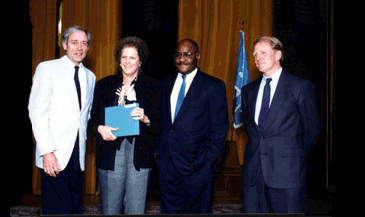
Columbia University President George Rupp (left) presents Soma Golden Behr, Gerald Boyd (center) and Michael Winerip (right) of The New York Times with the 2001 Pulitzer Prize for National Reporting.
Winning Work
By Kevin Sack
Times Staff Writer
They do not always protest publicly, fearing they might break the spell of racial good will. But they are always watching and counting.
DECATUR, Ga. -- Howard Pugh, head usher, is on patrol. May the good Lord have mercy on any child, or adult for that matter, who dares to tread across the lobby of the Assembly of God Tabernacle with so much as an open Coca-Cola in his hand. Because first he will get the look, the alert glare of a hunting dog catching its first scent of game. Then he will get the wag, the slightly palsied shake of the left index finger. And then the voice, serious as a heart attack and dripping with Pensacola pinesap: "Son, this is the Lord's house. And they just shampooed that carpet last week."
It goes without saying that Howard Pugh knows what is going on in his lobby. So when Mr. Pugh, a white man with a bulbous pink nose, spots 81-year-old Roy Denson slipping out of the sanctuary, he doesn't even have to ask. He just knows. He knows because he has seen Mr. Denson flee the 10:30 service time and again, and it is always when one of the choir's black soloists moves to center stage.
This time it is Robert Lawson, a soulful tenor with a fondness for canary-yellow suits. As he begins to sing, the Pentecostal faithful gradually rise. First a few black members clap and sway. Then more join in. Finally, the white members are moved to stand, and before long the 2,000-seat sanctuary is washed over with harmony. Stretching their arms toward the heavens, the congregants weave a tapestry of pinks and tans and browns.
But to Mr. Denson's ears, Mr. Lawson's improvisational riffs sound like so much screeching and hollering. And so he sits there seething, thinking about how he joined this church 56 years ago, how he followed it from downtown Atlanta to the suburbs, how he hung the Sheetrock with his own hands, and how the blacks are taking over and the whites are just letting it happen.
He gets angrier and angrier, listening to these boisterous black folks desecrate his music, until he simply cannot bear it. "I ain't sitting there and listening to that," he mutters on his way out. "They're not going to take over my church."
And there waiting for him is Mr. Pugh, at 65 another white man of his generation, always with the same smart-alecky question. Never mind that Mr. Pugh and his wife, Janice, have themselves become uneasy about the direction of their church, that they have been quietly contemplating a walk of their own. "Now, Roy," Mr. Pugh begins, stroking his seafarer's beard, "what are you going to do when you get to heaven? Walk out of there, too?"
Back inside, the ecstatic singing has ended, the speaking in tongues has melted into a chorus of hypnotic whispers and the members of the Tabernacle have been invited to roam the sea-foam carpet, welcoming visitors and greeting one another.
They embrace, the white people and the black people, with long, earnest hugs. Eletia Frasier, a Guyanese immigrant, kisses all who come her way, whether she knows them or not. Brad Jackson wraps his thick white arms around Eugene Glenn, a slender black man, and jerks him cleanly off the ground.
Ruben Burch, a 6-foot-7 black man whose blue usher's blazer is a tad short in the sleeves, saunters down the aisle with an irrepressible grin. During the Sunday fellowship, Mr. Burch makes a point of approaching older whites to gauge acceptance. Will they offer hugs, or merely handshakes? Will they linger, or recoil?
Halfway down the aisle, he encounters Madge Mayo, the spry 85-year-old widow of a pastor from the Tabernacle's segregated days. She stands 4-foot-9 and keeps her luminescent white hair in a tight bun.
There was a time when Mrs. Mayo could never have imagined hugging a black man, and even now she is not sure she approves of the integration of her church. But she has been touched by the bigheartedness of the Tabernacle's black members. And like so many of the whites who have stayed, she reasons that all believers are going to the same heaven, so they might as well get used to one another right here on earth.
Mrs. Mayo sees Mr. Burch heading her way and trots a few steps toward him in her shiny black pumps. They smile fondly, and he bends at the waist to embrace her. She pats Mr. Burch on the back and presses her cheek against his, passing his test.
It is a moment that would probably chafe some of his relatives, who feel that he and his wife, Vanessa, are compromising their blackness by attending "the white church." But the Burches feel blessed by the blendedness of the Tabernacle.
"Man," Mr. Burch reflects later, "30 or 40 years ago I would have been hung for just touching this lady."
Praying Side by Side
Sixteen miles east of downtown Atlanta, a vast granite monolith known as Stone Mountain looms over DeKalb County. Up on that mountain in 1915, the 20th-century Ku Klux Klan was born. And virtually in its shadow, the Tabernacle, all brick and glass and sharp angles, sits along Interstate 285 in the thick of the Atlanta sprawl.
Nearly 50 years after the Rev. Dr. Martin Luther King Jr. scolded Christians for making 11 a.m. Sunday the most segregated hour of the week, the Tabernacle is the rarest of religious institutions: a truly integrated church in a nation where 90 percent of all congregations are at least 80 percent one race. It is, to many of its 800 members, a slice of heaven on earth, a church whose spirituality is magnified by its multiracial character. What better evidence of God's presence, they reason, than the sight of whites and blacks praying side by side?
Atlanta metro area
Population: 3.7 million
Black: 26%
Hispanic: 3%
Asian: 3%
White: 68%
Hispanics may be of any race.
Source: Census Bureau, 1998 data
And yet, the Tabernacle is not some liberal church like the one nearby that took down its white stained-glass Jesus and replaced him with a black one. It is deeply conservative, socially and theologically. What draws the Pughs and the Burches and so many others is the intensity of their Pentecostal faith, which teaches that the Holy Spirit can move in the lives of all believers, regardless of background.
Pastor Roger W. Brumbalow's mission statement, displayed prominently in the lobby, challenges the congregation "to be a multiracial, multicultural maturing body of believers," and, indeed, the church is blended in almost every way. Fifty-five percent of the members are white, 43 percent are black and the rest are Asian or racially mixed. Perhaps a third of the blacks are foreign born, and the church flies 36 flags to honor their homelands.
The Tabernacle has had trouble integrating its eight-member pastoral staff, a legacy of the Assembly of God's history as a white denomination. Its first black associate pastor resigned last fall after two years. Over the last 13 months, Pastor Brumbalow, who is white, filled two openings with white associate pastors before finally hiring a black youth pastor last month. The board of deacons, by contrast, has been integrated since 1994 and became majority black after elections in March.
The choir is thoroughly mixed, and its praise-and-worship-style music falls comfortably between the traditional country hymns of white Pentecostalism and the thumping gospel funk of the modern black church. Pastor Gary Smith, the music minister, jokes that his choir would be faultless "if we could just get the whites to clap on time and just get the blacks to be on time."
The congregation does not mix only in the pews. Blacks and whites visit each other in the hospital, share motel rooms at retreats and attend potluck dinners at one another's homes. They come together in kitchens and living rooms, forming circles of prayer around an ailing old man or a hopeful young couple, then laying hands on the supplicants' foreheads and shoulders. Visiting one another's suburban homes, with their manicured lawns and large-screen TV's, these accountants and teachers, nurses and software consultants discover the common threads of their middle-class lives.
Yet for all the utopian imagery, for all the hope and faith that the congregation has moved beyond race, the life of the church is still driven by race in countless ways.
Most everyone has made accommodations of some kind. The whites, mostly native Southerners, have been forced to confront their racial assumptions and cede some control over church governance and liturgy. The blacks have ventured from the safe harbor of the African-American church and, in many cases, have suppressed lifetimes of racial resentment and distrust.
The little compromises can be detected any Sunday. They show in the frustration of some black members with the regimentation of the morning service, which opens with exactly 30 minutes of singing and usually lasts precisely two hours.
"There are times when we're praising God and then they just cut it off," complains Robert Lawson. "You can't do that. You can't put God in a box."
Some whites, meanwhile, dart glances at black churchgoers who they feel may be worshiping too exuberantly. They search for delicate words to explain.
"In a lot of cases, the blacks are really more committed," says John F. Kellerman, a former deacon.
"More outgoing," agrees his wife, Grace.
"Where the whites are more reserved, you know," he says.
Behind such concerns, though, is the question at the heart of the Tabernacle's future: Is the church simply enjoying a fleeting moment of integration on the way to becoming predominantly black? With the church growing rapidly and blacks joining at twice the rate of whites, the Tabernacle could tip, like those neighborhoods where blacks move in and whites eventually flee.
The Tabernacle is a work in progress. But how far is it willing to go? And how much are the Burches, the Pughs and the others willing to concede in order to realize St. Paul's declaration that "you are all one in Christ Jesus"?
Making 'Colored' Friends
On a chilly Saturday afternoon in January, a racially mixed crowd gathers at Howard and Janice Pugh's house for a catfish feast. They segregate quickly, of course. The men decamp to the garage, handicapping the Super Bowl and admiring Mr. Pugh's skill with the deep-fat fryer. The women settle in the sun room, swapping tales about the cold snap and the flu bug.
When the group comes together for dinner, everyone laughs knowingly at Eugene Glenn's stories about his 16-year-old daughter's interest in buying a car and lack of interest in finding a job. Before long, the joshing turns to the male love affair with the channel changer and, eventually, to Mr. Pugh's vigilance in the church lobby. The guests tease their host about how he was spotted letting the youth pastor's wife cross the carpet with an open can of soda.
"You're slipping, Howard," taunts William Turner, a black deacon.
"Yeah," he chuckles, "I'm getting soft."
As much as anyone, the Pughs have been transformed by the church's integration. Having lived most of their lives with little exposure to blacks, and little interest in gaining any, they now count blacks from the church among their closest friends.
"My feeling before I got to know them was that there really wasn't that many good blacks out there," Mr. Pugh explains. "After being around them and working with them, shoot, I don't even think about them as colored anymore."
Of course, Mr. Pugh's "colored" friends would prefer he use a synonym. But in his mind, his choice of words marks some progress. "Hey, I've come a long way," he says. "I don't say nigger anymore."
"That's right," his wife chimes in, "they should see where you've come from."
Where they both came from were country churches in the piney woods of northwest Florida. When Howard was an infant, his mother would slide him under the bench so he wouldn't get trampled while they danced in the spirit. Janice was abandoned by her parents and raised by a grandmother who enforced a strict Pentecostal code: no smoking, no drinking, no dancing, no makeup, no short pants.
They found each other 21 years ago via CB radio and began courting over a cup of truck-stop coffee. Mr. Pugh, a widower, could be gruff as an Alabama trooper. But he was also giving and good-hearted and a fine provider. She was pretty and sweet and recently divorced. She kept a Christian household and had no problem letting her husband be head of it. Even today, she cooks and cleans and lays out his clothes.
"All he has to do is put them on," she says, rolling her eyes.
"Yeah," he grins, sunk into his recliner, his toy poodle, Pepe, in his lap, "all them guys at the church comes up to me and says, 'Boy, your wife dresses you nice.' "
After working for years in pulp mills, Mr. Pugh brought his bride to Atlanta 19 years ago and started a lucrative business pouring concrete in the ever-expanding suburbs. With its sizable black middle class and political structure, the city was a shock.
The Pughs had come up in a strictly segregated culture. Mr. Pugh remembers having little childhood exposure to blacks, and during the civil rights movement he couldn't figure out what all the fuss was about. As far as he could tell, blacks had the same opportunities as he and other poor whites, even if they did have their own neighborhoods and schools.
"I just wanted to stay on my side of the fence and for them to stay on theirs," he says. "I never abused them. But they pretty much knew that I was white and they were niggers and we just ran our own way."
Mrs. Pugh, 46, says she was never taught prejudice but recalls her grandmother's warning to avoid the black side of town. Her view of black men, she says, came from movies that portrayed them "raping a white woman or something."
In Atlanta, she had to confront her fears. "You'd turn the TV on and it's a black mayor and a black city council," she says. "I'd say: 'Howard, where did you bring me? Are there any white people here?' "
When the Pughs joined in 1992, the Tabernacle was perhaps 10 percent black. They had never worshiped with blacks before. But the black folks tended to sit on the right side of the sanctuary, separated from the whites by a demilitarized zone of empty pews. "We came at a good time," Mrs. Pugh recalls. "There weren't so many of them that it was overwhelming. We could adjust."
The Burden of Blending In
Last year, Ruben and Vanessa Burch moved into a new house with an orange-brick facade in a subdivision that is perhaps a third white. Determined to raise their two daughters in an integrated setting, the Burches had been impressed while house hunting that white neighbors had waved to them, a black couple, from their lawns.
A week after the Pughs' fish fry, many of the same couples gathered for a house-blessing dinner at the Burches'. To the strumming of a guitar, the crowd welcomed the Holy Spirit into the airy two-story home. "Come in today, come in to stay," they harmonized, "come into my house, Lord Jesus."
Vanessa Burch, tall, slender and poised, handed out cups of olive oil, and the blacks and whites anointed doorknobs, bedposts and televisions with slick smudges of oil. The ceremony ended when the Burch family -- Ruben, Vanessa, 12-year-old Jessica and 7-year-old Gabrielle -- huddled in the center of the living room and surrendered to the prayers of their friends. The guests gave them a wall plaque, and little Gabby haltingly read, "May the Lord bless this home and keep you in the company of angels." Then spaghetti was served.
Like most black Southerners of their generation, the Burches have experienced their share of racism. Mr. Burch, 46, grew up in Albany, Ga., a stronghold of resistance to the civil rights movement. His wife, 40, grew up in Blakely, a south Georgia town whose high school still has separate homecoming queens and class reunions.
Both remember "colored only" water fountains and parental warnings not to be caught on the white side of town after dark. Mrs. Burch still recalls the indignity of hearing white children call her mother by her first name. And then there was the day, perhaps 15 years ago, when her white boss in a South Carolina bank informed her that the one thing he hated was an "uppity, educated nigger."
"It almost knocked me to my knees," says Mrs. Burch, then a teller at the bank. "I walked off and went into the restroom and cried because it hurt me so bad."
The Burches reacted to all this in different ways. Mr. Burch, happy-go-lucky and confident to a fault, says he never grew deeply bitter. His mother shielded him from the worst affronts, and when his high school integrated, he saw it as an opportunity to date white girls, discreetly. "You knew how far to take it," he says. "I mean, you wouldn't walk down Broadway holding somebody's hand."
Mrs. Burch was more defiant. When her school desegregated, her white classmates learned that anyone who tossed a racial epithet her way was liable to go home with bruises. At age 12, she dressed down a white woman who had scolded her sick mother for sitting in the white section of a doctor's waiting room. "After that," she says, "Mama didn't take me too many times to the doctor's office."
Their experiences left both Burches, though, with a strong understanding that their world would be multiracial, and that schooling, diction and personality would be important tools in getting ahead. Those lessons were reinforced in the Navy, where Mr. Burch spent 22 years as a medic.
In 1996 they moved to Atlanta, where he found work inspecting commercial waste-water systems. They looked for an Assembly of God church and found the Tabernacle, then about 30 percent black. Before long they were fully involved, he as an usher, she as a Sunday school teacher and both as scout leaders.
"I liked the diversity," says Mrs. Burch, an administrative assistant for a computer company. "I wanted my children to grow up with differences in a church so they could see that whenever they went to heaven it wasn't going to be all black and it wasn't going to be all white. It was going to be mixed."
A 'Walk With the Lord'
When the Tabernacle was founded, in 1916, it was most definitely not mixed. And it remained that way through most of its history, moving twice to escape the migration of blacks into its neighborhood. In the 1940's it affiliated with the Assemblies of God, a historically segregationist Pentecostal denomination. But ultimately, the church could outrun neither the changing demographics of postsegregation Atlanta nor some stark fiscal realities.
Shortly before the Pughs arrived, an unmanageable mortgage put the congregation in debt. To dig out, the church called as its senior pastor Coy Barker, a onetime rodeo rider, and agreed to pay him 25 percent of tithes and offerings. With a financial incentive to fill the pews, Pastor Barker tapped the most readily available market -- the middle-class blacks flocking into the area.
By 1984, when the church's current building was completed, the surrounding suburbs were in the midst of a stunning transformation. In 1970 there was one black among the 11,000 residents in the church's census tract. Twenty years later, two-thirds of the residents were black.
Pastor Barker, a typecast televangelist with silver hair, flashy jewelry and a black Lincoln Town Car, had a high-stepping style that mimicked the traditional black preacher. By the time he was forced out in 1993, in the throes of a messy divorce, the church was perhaps 20 percent black and on the road to financial recovery.
Predictably, some whites left. Susan Carithers, a member since birth, could never quite accept integration as God's will. Her husband grew agitated, she says, because "he just didn't want black boys sniffing up to his daughter." They left in 1996, shortly after a black man gave Mrs. Carithers a big hug during a Sunday service.
The Pughs could also have left, but they liked Pastor Brumbalow's preaching and their son's participation in the youth group. And as they got to know black members, they found they liked them, too. A lot.
The black churchgoers did not fit the Pughs' stereotypes. Mr. Pugh noticed that they did not loll around or always have their hands out like the black men who smooth his concrete, the ones he calls "the boys."
Even today he draws distinctions between his black employees and his black church friends. Sometimes he cannot recall his workers' last names, though they have been with him for years. He says that he occasionally has to bail one out of jail, and that if he drives around a corner fast enough he will catch some lounging.
But he admires the blacks at the Tabernacle. They work hard and dress well, often better than the whites, and live in two-story houses on well-tended lanes. "As I began to be around them a lot more," he says, "I saw that there was a lot more of them trying to benefit themselves."
The Pughs held cookouts and invited mixed crowds, disregarding, even slightly savoring, their white neighbors' stares. On Saturday mornings Mr. Pugh would round up a crew of church men, white and black, to go paint a widow's house or serve soup to the homeless. One Easter the Pughs took their black friends Paul and Rudine Hardy to an all-white club for dinner.
"Oh, my God, it was so funny," Mrs. Hardy says. "I said: 'Janice, Janice. These people are all just looking.' They had all this fancy food, and every time I chewed they was just looking."
Mrs. Pugh sometimes gets weepy talking about her deep kinship with Mrs. Hardy and other black women from church. She feels connected to them spiritually and turns to them when she needs prayer.
As she has learned about the bigotry they face, she has come to empathize. It isn't guilt exactly. She doesn't feel she owes black people anything. After all, her life hasn't been so easy either. But she understands, and that is something new.
"When I moved to Atlanta," she says, "I had never had any occasion to know what these people were going through. I'd never had anyone come up to me and say, 'I was treated this way because I was black.' When you hear someone say that, with tears in their eyes, you know they just want to be loved. And I guess I connected with them because I was the same way when I was a little girl. All I wanted was to be loved."
As she sees it, God is using the Tabernacle's integration to test "whether you move on in your walk with the Lord."
Her husband's walk has been less steady. He remains capable of offending black friends even as he beckons them into his life. They recognize that he has come a long way, that he has a good heart. But they also suspect that he continues to use the word "colored," often to their faces, to make it clear that he, not they, will define the terms of their relationships.
"It's a control thing," Mrs. Pugh says. "He wants people to know that he still knows the difference."
Last August, one of Mr. Pugh's black friends decided to confront him, fearing newcomers might be put off by his ways as head usher. But the man later backed down. Don't major in minor, his wife had advised him. "I do value my friendship with Howard and Janice," the man reasoned, "and if it's my friendship with them versus this, it's really very insignificant."
Mr. Burch reacted much the same way at a retreat last year, when Mr. Pugh told him a joke, the one about the black guy who moved next door to the white guy:
The white man was leaning over his fence as his new neighbor mowed the yard. With each pass, the black neighbor taunted the white man, "I'm better than you are, I'm better than you are." Exasperated, the white man finally asked, "What makes you so much better than me?" And the black man replied, "I don't have a nigger living next to me."
"Old Ruben just about fell out," Mr. Pugh remembers. "He didn't have a problem with it." And, in fact, Mr. Burch says he didn't have much of a problem with it, though he was surprised Mr. Pugh felt comfortable enough to tell him the joke. "That's just Howard," he told himself. He let the moment pass, thinking that Mr. Pugh was like an old car, sputtering down the highway: "You just say, 'Well, this is just an old car smoking and we'll go ahead and pass it and one day it'll give out and be gone.'"
What the Relatives Say
The Burches may want to make sure, as Mrs. Burch puts it, that their girls don't grow up "in an all one-race anything." But when it comes to their choice of church, they have been wounded by second-guessing from their relatives, particularly Mr. Burch's sister Jacalyn Ray. It has become personal, and at times ugly.
"It's a wannabe thing," says Mrs. Ray, who attends a black church. Her sister-in-law, she thinks, is too eager to make white friends and entertain them in her home. "Some people don't know who they are and have to go somewhere to validate themselves. She doesn't feel comfortable being black."
Mrs. Burch cannot figure out what she did to provoke Mrs. Ray, other than marry her brother. But other family members, while more tactful, do not fully reject Mrs. Ray's assessment. Mr. Burch's half-brother Frederick Caldwell has long noticed that Mr. Burch feels most comfortable in interracial settings.
"I think of Rick as my white brother," he laughs, using a nickname. "He has Caucasian features. Not facial features, but he has a white body type. He can't dance. He'll wear plaid pants. He played on the tennis team in school. He's a Newt Gingrich fan. I wouldn't necessarily say he wants to be white, but he has opinions not normally associated with a black man in the United States."
The relatives say they are also concerned that the Burches may be sending their daughters mixed signals. "I do know with Jessica there's kind of a working out of who she is," Mr. Caldwell says. "My concern for Gabrielle and Jessica is that they have a healthy respect for who they are."
Mr. Burch concedes some concern that his daughters may be too colorblind, that a life without overt discrimination has left them with little racial identity. Someday, he fears, an act of bigotry will shatter their naïveté.
Still, he resents the suggestion that he and his family prefer integration because they want to be white. He is comfortable with who he is. "I enjoy me," he says. "And I feel if you don't know me you're missing out." As for his sister, he says: "She's not in touch with reality. I mean, how do we want to be white? Because we want different things, want to live in different neighborhoods? No, she's totally wrong. I think it's a chemical imbalance."
Jessica, tall and outgoing like her parents and engagingly mature for her age, acknowledges inner conflict over racial identity. But it is not that she rejects her blackness or wants to be white. Rather, it is that she feels torn between her parents' insistence on living an integrated life and her black peers' suspicion of anyone who does.
Her parents insist that she and her sister speak "proper English" and scold them gently if they slip into black slang. But her classmates tease her relentlessly for her speech and for having white friends, and sometimes she cannot resist the pressure.
"I do talk improper English, or ebonics, with black friends," she admits. "Maybe I think they'll pick on me if I don't."
Two years ago, she decided to drop her white friends to placate the black ones. But she felt distracted, her grades suffered and she concluded that God was not pleased.
"I finally told myself that it doesn't matter what they think about me, it doesn't matter what color I hang out with," she says. "I have too much respect for who I am."
Not surprisingly, Vanessa Burch is annoyed by her daughter's problems and her in-laws' carping. But it has all made her think.
"I think long and hard about it to see, you know, could this really be true," she says. "And then I go and ask other people, 'Do you think I try to be white?' And they're like: 'What? No. You couldn't be if you wanted to.' It used to really weigh on me and I used to pray about it. 'Lord, what is it? Show me. If I'm doing something to make people see me like this, show me.' "
It hasn't come. People just don't understand, she says, that she is motivated by pragmatism, not racial treason. The reality is that her daughter will face a white world, with certain rules for getting ahead.
"I know that being black is one strike against us," she says, "and in the business world, where she's going to have to compete, being a woman is two against her. So I want her to have enough education that they can't resist her. I want her, when she gets up to speak, that they're like, 'Wow, who is that?' And believe me, voice and articulation get attention."
She is trying, she says, to help her daughters realize that there are no limits, that the restraints and prejudices of her own youth have been lifted. They can do anything, live anywhere, even someplace more extravagant than their new three-bedroom house.
"You want to live in that house on the hill over there," she challenges them, "you can live there. You have the same rights as the next person before you, beside you, behind you, around you. All of you can do the same thing. Once upon a time we couldn't. But now we can."
A Colorblindness Test
There was little chance that the Burches and Pughs would miss the wedding of Dorothea Lemon and Curtis Lockridge last June. It was to be the Tabernacle's first big interracial ceremony, and as Madge Mayo explained it, "Something is about to happen that we haven't all fully digested."
The bride, 43 and black, and the groom, 58 and white, had both recently been widowed. The two couples had been friendly at church, and Mr. Lockridge and Mrs. Lemon comforted each other through their grief. Before long, they were holding hands through the Sunday service and scribbling notes on the church bulletin.
"I luv you, Curtis," she would write.
"I'm glad," he would respond.
It raised some eyebrows when Pastor Brumbalow announced their engagement. One elderly white lady asked if Scripture permitted mixed marriages, and he told her there was no prohibition. Blacks and whites asked if it was wrong to want their children to marry within their races. He said it wasn't, and made a point of telling the men's group that he was not encouraging interracial dating.
The afternoon of the wedding, Vanessa Burch slid into a pew toward the back. "What are these people thinking?" she remembered wondering.
"How many are going to be in an uproar, and how many aren't going to be back?"
Howard Pugh recognized that the couple were grownups and could do as they pleased. But interracial relationships just went against his upbringing.
"Oh, Lord," he thought as the bride walked down the aisle. But by the end of the afternoon, Mr. Pugh could not help smiling. The couple looked awfully cute, and very much in love. The ceremony had been elegant, the reception lavish. "I'll tell you the truth," he said. "I haven't seen many white folks' weddings put on like that."
Still, some remained uneasy. "The thing that worries me most," said Madge Mayo, "is that this is going to turn things loose for the young people and it's going to get, I shouldn't say entangled, but I'd just say more mixed."
Sense and Sensitivity
What Janice Pugh cannot understand, despite her newfound empathy, is why black folks remain obsessed with race, why they can't just let it all go. She and Rudine Hardy talk about it from time to time, sitting on a green leather couch outside the sanctuary. Mrs. Hardy will wonder why the pastoral staff is so white, and Mrs. Pugh will bristle.
"You need to stop being so sensitive about all this," she will say.
"You don't understand," Mrs. Hardy will respond. "You're not black."
"I'm not black, and I never will be black," she will answer. "I just think there are other issues out there that you have to be concerned about that have nothing to do with race."
She thinks about it often. The church should be about love, and love should know no color. "If I were in their shoes," she says, "I would take the attitude that the past is past. You have to go on, and the blacks now, this is the time for them. They're more accepted now."
Because the Tabernacle is an island, and a refuge, it is often hard to accept that racial tensions lie just beneath the surface, vulnerable to exposure from the slightest scratch. But the island is in the world, and in the world there is no refuge.
Kathy Watson, a children's pastor, learned that lesson when she was rebuked by a black parent for referring affectionately to her toddlers as "monkeys." Another youth pastor got an earful about a Bible lesson that equated the color black with sin.
But those flare-ups do not rival what happened last summer with the Homebuilders, a Sunday school class for couples. Until two years ago it was led by a white couple, and attendance was predominantly white. Then Enefiok Umana, a deacon from Nigeria, and his wife, Eno, assumed the leadership, and the class became overwhelmingly black.
Many blacks concluded that whites were simply unwilling to submit to black leadership. And their suspicions were stoked one August morning when two associate pastors interrupted class to introduce a white couple as leaders of a Bible study being started for younger couples. One pastor, Ray Martin, added that the Homebuilders would come under the new class's "umbrella."
After church, the blacks huddled in the parking lot and burned up the phone lines. Some wrote in protest. The implication was clear, they felt. The church was starting a white class for those unwilling to attend the black-led class. And the bit about the umbrella really set them off.
"It was like a kick in the behind to me," said Mrs. Hardy.
Pastor Brumbalow ate lunch at William and Lula Turner's house that day. And as they told him of the discontent many blacks were feeling, the pastor started to weep and vowed that the Enemy -- meaning the Devil -- would not divide his flock. But he had to leave town the next day, and the flames raged on.
The associate pastors were flabbergasted by the reaction and wounded that the blacks could think there was racial intent. "I really thought they were a little further down the healing curve," Pastor Martin said. "It let me know that we're dealing with people that still have some wounds."
In conversations with class members, Pastor Martin acknowledged that the word "umbrella" had left the wrong impression. What he had meant, he said, was simply that the two classes would be parallel ministries that would occasionally come together for functions.
When Pastor Brumbalow returned, he took charge of damage control, delaying the new class to let emotions calm. The next night, though exhausted from his trip, he made a point of attending a Homebuilders potluck dinner.
Still, when the new class finally began, it was attended mostly by whites. And when the new group held a retreat, only one Homebuilders couple chose to attend.
When to Preach on Race
Two Sundays after the Homebuilders incident, Pastor Brumbalow did something he had hardly ever done. He preached about race. "I don't normally get this blunt," he began, slapping his hands for punctuation, "but I will get this blunt this morning."
"I want to say to you of color and you that are white" -- he was screeching like the brakes on a train -- "that if you look at a person based on the color of their skin and you evaluate them right then and there, then, my friend, you have missed the purpose of the love of God."
Sometimes, he said, it takes a while to catch on -- to comprehend that God is working a miracle at the Tabernacle so people might have a glimpse of heaven. "When I look across this congregation," he said, "I understand what God is doing. I understand the eternal kingdom."
Pastor Brumbalow recognizes that not everyone was brought up that way. In fact, he wasn't brought up that way. Growing up near Atlanta, he didn't really know any blacks, and he wasn't particularly godly. It was only after some wild days as a rock guitarist with a band called Completely Souled Out that he found God and his future wife, Becky, at a Pentecostal revival. He left shortly for Vietnam, where he won decorations for heroism.
His previous pulpit, in suburban New Orleans, had few blacks. And yet, at 50, he has managed and accelerated the Tabernacle's integration with considerable skill. Both races trust him like a parent and admire his evenhandedness, political instincts and common touch.
"He'll drink out of the same glass," Mr. Burch says. "That's the kind of feeling I get from him, you know, that I'm not higher than you."
He is a gifted preacher, fashioning sermons that are neither inaccessibly erudite nor insultingly shallow. But he prefers, he says, not to preach about race. He would rather lead by example, embracing each in his flock with the same tenderness, blessing each with the same prayers, accepting dinner invitations from all.
"I think the pitfall of having a blended church is when you make race the issue," he says. "What we're doing here as a church is not about race, and if we make that the emphasis then we miss the bigger picture. Our main goal is to reconcile people to God."
He would never say it, and maybe doesn't even let himself think it, but there is another reason not to make race the issue. To preserve the Tabernacle's fragile balance, he must reach out to newcomers without alienating old-timers like the Pughs.
The blacks at the Tabernacle were jubilant about the pastor's race sermon. And the Pughs, like many of the whites, had no real problem with its content. But that he delivered the sermon at all rubbed them the wrong way. He was playing to the crowd, they felt, or at least to part of it.
From time to time, the Pughs had discussed looking at other churches. The Tabernacle was a long drive from home. Now they shared this gnawing sense that race was beginning to supplant God's love as its driving force.
"What would cause me to leave," Mrs. Pugh said, "is for them to constantly have a platform on the black issue, to always talk about race, and not let the Holy Spirit lead us."
Sometimes, though, Pastor Brumbalow says, God just lays a message on his heart and he can't shake it loose. It happened again in February, when, voice quavering, he read Dr. King's "I Have a Dream" speech and prophesied that the Tabernacle would become a beacon for others.
"God is saying, 'I am going to prepare you to be a light, to be an example to the city of Atlanta and to the state of Georgia,' " he said. "I want to tell you, God has a dream and his dream is being fulfilled in this house this morning in the name of the Lord. Hallelujah!"
The Pughs would have preferred a different topic. "He keeps bringing it up and bringing it up," Mr. Pugh said. "With this race deal, once a year is adequate, not every other Sunday."
Several weeks later the Pughs visited another church.
A Delicate Balance
If the Burches and other black leaders at the Tabernacle have a complaint, it is with the level of diversity in the staff. They do not always protest publicly, fearing they might break the spell of racial good will. But they are always watching and counting. All you have to do, they say, is look at last year's Christmas card photograph of "the Tabernacle team," 19 red-sweatered staff members, every last one of them white.
And yet when positions have opened, black deacons have chosen not to lobby Pastor Brumbalow to fill them with blacks. They recognize, they say, that the task is not easy. The Assemblies of God is still virtually all white, with fewer than 400 blacks among its 32,000 licensed ministers. And because Pastor Brumbalow holds a statewide leadership position with the Assemblies, it might be considered bad form to hire from outside the denomination.
Even before last month's success, he had searched assiduously for black prospects, knowing that "it would certainly speak volumes that I pretty much practice what I preach." In several instances he let the congregation know that he had offered jobs to black prospects, only to be rebuffed. That seemed to satisfy his black constituents.
"He interviewed black people and they turned it down, so what can you do?" Mr. Burch said after one such search.
In general, black members suspect that it may not take much to upset the racial equilibrium of the church. Ultimately, they assume, it will come down to power. If black numbers increase to where whites feel disenfranchised, whites will leave, they predict.
For the moment, the pastors feel they must move incrementally. That was never clearer than in the planning of last year's Christmas pageant.
Like other blacks, Ruben Burch had long noticed that blacks had never been cast as Joseph, Mary or Jesus. The whites, he assumed, would have a fit. "Boy, if they figure out there was a black Jesus they probably wouldn't want to go to heaven," he joked.
Pastor Smith, the music minister, badly wanted to break that color barrier. He knew that Scripture was largely silent about Jesus' appearance and that various cultures portrayed him in their own images. But he, too, was unsure if the older whites were ready for an ebony Jesus.
So he devised a scheme to soft-pedal the racial transformation of Christ. He selected for the lead roles Stephen and Sobrina Smith, a light-skinned multiracial couple who happened to have a newborn son, Joshua. Mrs. Smith, born in Trinidad, is part African, Chinese, East Indian, Hispanic and South American Indian. Her husband, a New Yorker, is part Italian, Polish, black, Jewish and Native American.
The pastor theorized that if he could sell the Smiths, he could cast darker-skinned blacks in future years. "The first time it shouldn't be such a shock," he said. "They're not as dark. They're sort of a medium."
The pageant went off without a hitch, down to the triumphant finale, when an adult Christ figure, adorned with a crown and scarlet cloak, rode into the sanctuary on a stocky white horse. Mrs. Smith was fetching as Mary, dressed in a blue satin robe and a white shawl, cradling Joshua as her husband knelt nearby. Mr. Burch, playing a wise man, watched on bended knee.
Pastor Smith could not have been more pleased. He received lots of compliments and not a single comment about the racial makeup of the cast, which was how he wanted it. Most white members, if they noticed at all, reacted about the way the Pughs did, with a shrug.
"I think the white people have been shocked so many times that it doesn't make any difference anymore," Mrs. Pugh said. "They just say, 'Well, that's the way it is now.' "
Even the Smiths, told later that they had been selected for their complexion, said they didn't mind too much, so long as it helped move the church forward. And yet the whole experience made them wonder.
"If we are an integrated church, as we claim to be," Mrs. Smith asked, "why do we still have to go through hoops and loops to make a point and get a message across and pacify certain people and keep waves from starting? If we're still playing around with this, then maybe we're not really who we say we are."
© 2000, The New York Times Company
Joel Ruiz Is Black.
Achmed Valdés Is White.
In America They Discovered It Matters.
By Mirta Ojito
MIAMI -- Havana, sometime before 1994: As dusk descends on the quaint seaside village of Guanabo, two young men kick a soccer ball back and forth and back and forth across the sand. The tall one, Joel Ruiz, is black. The short, wiry one, Achmed Valdés, is white.
They are the best of friends.
Miami, January 2000: Mr. Valdés is playing soccer, as he does every Saturday, with a group of light-skinned Latinos in a park near his apartment. Mr. Ruiz surprises him with a visit, and Mr. Valdés, flushed and sweating, runs to greet him. They shake hands warmly.
But when Mr. Valdés darts back to the game, Mr. Ruiz stands off to the side, arms crossed, looking on as his childhood friend plays the game that was once their shared joy. Mr. Ruiz no longer plays soccer. He prefers basketball with black Latinos and African-Americans from his neighborhood.
The two men live only four miles apart, not even 15 minutes by car. Yet they are separated by a far greater distance, one they say they never envisioned back in Cuba.
In ways that are obvious to the black man but far less so to the white one, they have grown apart in the United States because of race. For the first time, they inhabit a place where the color of their skin defines the outlines of their lives -- where they live, the friends they make, how they speak, what they wear, even what they eat.
"It's like I am here and he is over there," Mr. Ruiz said. "And we can't cross over to the other's world."
It is not that, growing up in Cuba's mix of black and white, they were unaware of their difference in color. Fidel Castro may have decreed an end to racism in Cuba, but that does not mean racism has simply gone away. Still, color was not what defined them. Nationality, they had been taught, meant far more than race. They felt, above all, Cuban.
Here in America, Mr. Ruiz still feels Cuban. But above all he feels black. His world is a black world, and to live there is to be constantly conscious of race. He works in a black-owned bar, dates black women, goes to an African-American barber. White barbers, he says, "don't understand black hair." He generally avoids white neighborhoods, and when his world and the white world intersect, he feels always watched, and he is always watchful.
Mr. Valdés, who is 29, a year younger than his childhood friend, is simply, comfortably Cuban, an upwardly mobile citizen of the Miami mainstream. He lives in an all-white neighborhood, hangs out with white Cuban friends and goes to black neighborhoods only when his job, as a deliveryman for Restonic mattresses, forces him to. When he thinks about race, which is not very often, it is in terms learned from other white Cubans: American blacks, he now believes, are to be avoided because they are delinquent and dangerous and resentful of whites. The only blacks he trusts, he says, are those he knows from Cuba.
Since leaving Havana on separate rafts in 1994, the two friends have seen each other just a handful of times in Miami -- at a funeral, a baby shower, a birthday party and that soccer game, a meeting arranged for a newspaper photographer. They have visited each other's homes only once.
They say they remain as good friends as ever, yet they both know there is little that binds them anymore but their memories. Had they not become best friends in another country, in another time, they would not be friends at all today.
Two Boys on a Bus
They met on a bus, No. 262, the one that took Joel from his home in the racially mixed neighborhood of Peñas Altas to middle school, 35 minutes away. Achmed got on in Guanabo, and they sat together talking, as boys do, about everything and nothing.
Both grew up in orderly homes, with hard-working parents who supported the Castro government. Their fathers worked for the state oil company. Their mothers -- Joel's was a nurse, Achmed's an administrator in stores for tourists -- knew each other and sometimes met for coffee.
The boys' friendship was cemented through school and sport. They stood up for each other against troublemakers. "Just to know we were there for each other was good," Mr. Ruiz recalls. When his girlfriend got pregnant in high school, Achmed was the first person he told. They played soccer and baseball and ran track. Joel often stayed for dinner at Achmed's, where there was a color television and an antenna powerful enough to pick up American channels.
Because of her job, Achmed's mother had access to some of Havana's best restaurants. Every year she would take him out for a birthday dinner, and every year he would invite his best friend, Joel. "I couldn't think of anybody I would rather spend my time with," Mr. Valdés recalled.
But as they grew older, each became restless with the limitations of life in Cuba.
Achmed was in sixth grade when an aunt who had fled to Venezuela gave him a pair of white sneakers. He loved them so, he immediately wore them to school. Almost as immediately, the principal visited him at home to warn him about the troubling political implications of those foreign sneakers. At the university, too, his professors wondered why he wore foreign clothes and rode a nice bicycle. He wondered right back why he could not wear and ride whatever he wanted. When he was expelled for failing two classes, he saw it as punishment for being politically incorrect.
Before long, he found work at sea, trapping lobsters and selling them for $4 each. In a country where most people earn less than $10 a month, it was a living, though not a life. When the government allowed thousands of Cubans to leave in small boats and rafts in 1994, he was ready.
His friend Joel was ready, too, though it had taken him far longer to make up his mind. Indeed, given Cuba's racial history, it is hardly surprising that black Cubans have generally been far less eager than whites to flee to America. After all, in pre-revolutionary Cuba, blacks and whites had lived largely segregated, separated by huge disparities in economic and social standing. But two months after he seized power in 1959, Fidel Castro ordered whites to look upon blacks as equals and began leveling the economic and educational playing fields.
When Joel was very small, his family lived crammed into one room of an old carved-up mansion. Soon, the government gave them a three-bedroom apartment in a development that Joel's father had helped build. Before the revolution, Joel's mother had made a living cleaning white people's homes. It was Fidel, she told him over and over, who had given her the chance to become a nurse. And so Joel came to believe that it was no big deal, being black in Cuba.
As for America, he had seen the images on government television: guards beating black prisoners, the police loosing dogs or training hoses on civil-rights marchers.
But as Cuba's economy fell apart in the 1990's, he began to see things differently. He left military school for a cooking program, hoping for a well-paying job at a tourist hotel. Once he graduated, the only job available was washing windows. Look around, co-workers told him, look who's getting the good jobs. The answer was whites.
He noticed, too, when he watched the American channels at Achmed's house, that some blacks seemed to live well in America. He saw black lawyers, politicians, wealthy athletes. It made him think: "It's not so bad over there. Blacks are all right."
On Aug. 21, 1994, he climbed onto a raft and made for Florida. Like his friend before him, he was intercepted by the United States Coast Guard and sent to the American base at Guantánamo. The next year, they were freed -- first Mr. Valdés, then Mr. Ruiz -- and headed straight to Miami.
A Shock of Identity
In Miami, Joel Ruiz discovered a world that neither American television nor Communist propaganda had prepared him for. Dogs did not growl at him and police officers did not hose him. But he felt the stares of security guards when he entered a store in a white neighborhood and the subtle recoiling of white women when he walked by.
Miami
Population: 368,624
Black: 22%
Hispanic: 68%
White: 9%
Hispanics may be of any race.
Source: Census Bureau, 1998 data
Miami is deeply segregated, and when Mr. Ruiz arrived, he settled into one of the black urban sections, Liberty City. He had family there. His uncle Jorge Aranguren had arrived in 1980 and married an African-American. Mr. Ruiz took a job at his uncle's liquor store and started learning English.
The first thing Mr. Ruiz noticed about his new world was the absence of whites. He had seen barrios in Havana with more blacks than others, but he had never lived in a place where everybody was black. Far from feeling comfortable, he yearned for the mixing he had known in Cuba.
In Cuba, he says, he had been taught to see skin color -- in his case, the color of chocolate milk -- as not much more important than, say, the color of his eyes. But this was not Cuba. This was Miami, and in Miami, as the roughly 7 percent of the area's Cubans who are black quickly learn, skin color easily trumps nationality.
Mr. Ruiz began to understand that in earnest on Valentine's Day 1996, three months after his arrival in Miami. He had gone to dinner with his uncle Ramón Suárez at Versailles, a popular restaurant in Little Havana, a bastion of white Cuban-Americans. They took three light-skinned girlfriends along. Mr. Ruiz wore one of his nicest outfits -- black jeans and a red-and-green checked shirt. He was new to the country and unsure how to behave, but he felt comfortable at Versailles. After all, he remembers thinking, he was among Cubans. He knew the food, he could read the menu, and he could talk to the waiters.
The five sat in the back. Mr Ruiz concentrated on the conversation and on his meal. More than four years later, he remembers what he ate: a breaded steak with rice and beans and fried plantains.
Shortly before midnight, the five left in a new red Nissan. One of the women drove. Mr. Suárez sat next to her, taking pictures of his nephew and the other women laughing in back. Twenty blocks from the restaurant, four police cars, lights flashing and sirens wailing, stopped them. The woman who was driving saw them first and yelled for Mr. Suárez to drop the camera.
The officers, with weapons drawn, ordered them out of the car. Terrified, Mr. Ruiz did as he was told, spreading his legs and leaning face down on the car as the officers frisked him. It seemed like a very long time before they were allowed to go.
That was when one officer, a white Cuban-American, said something in Spanish that forever changed Mr. Ruiz's perspective on race. "I've been keeping an eye on you for a while," Mr. Ruiz recalls the officer saying. "Since you were in the restaurant. I saw you leave and I saw so many blacks in the car, I figured I would check you out."
Mr. Ruiz and his uncle stood speechless until an African-American officer approached them, apologized and sent them on their way. Afterward, his uncle said he was sure the police had been called by restaurant patrons uncomfortable with Mr. Ruiz's racially mixed group. His English teacher, an African-American, told him that white police officers liked to single out blacks driving red cars. Mr. Ruiz is not sure what to believe, but the truth is not in the details.
"Up until that day, I thought all Cubans were the same," he says. "It took a while to sink in, but that incident made me start thinking in a different way."
All at once, he had to learn how a person with dark skin should behave in this country: if an officer is following your car, do not turn your head; the police don't like it. Do not stare at other drivers, especially if they are young and white and loud. He has even learned how to walk: fast in stores, to avoid security guards; slower in the streets, so as not to attract the attention of the police. On the street, he avoids any confrontation.
He pays bills in cash because of an incident at a bank two years ago. When he asked to buy a certificate of deposit with $6,000 in lottery winnings, the bank officer, a white Cuban woman, looked puzzled, he recalls, and told him: "This is different. Your kind likes to spend the money, not save it." Since then he has not had a checking account.
And, of course, he avoids Cuban restaurants in white neighborhoods.
"In Cuba, I walked as if I owned the streets," he says. "Here I have to figure out where, what, when, everything."
He often finds himself caught between two worlds. Whites see him simply as black. African-Americans dismiss him as Cuban. "They tell me I'm Hispanic. I tell them to look at my face, my hair, my skin," he says. "I am black, too. I may speak different, but we all come from the same place."
He has started to refer to himself as Afro-Cuban, integrating, indeed embracing, the ways of his black neighbors. He enjoys what he calls black food -- fried chicken, collard greens, grits -- though he still lusts for a Cuban steak and plantains. He listens to rhythm and blues at home and at work; in the car, though, he listens to a Cuban crooner whose romantic ballads he has memorized. He dresses "black," he says, showing off his white velvet Hush Puppies and silk shirts. When he speaks English, he mimics black Miamians, but his words carry an unmistakably Spanish inflection.
Some months after the Versailles incident, when Achmed Valdés first saw his old friend, he was puzzled. "Joel has changed," he said. "He is in another world now."
A Seamless Transition
Pretty much anywhere else in America, Mr. Valdés would fit nicely into the niche reserved for Hispanic immigrants. If the question of race came up, he would be called a light-skinned Hispanic. Here in Miami, such distinctions do not apply. Here he is not a member of any minority group. He is Cuban and he is white.
This, after all, is a city run by Cubans, white Cubans. Not only are the mayors of Miami and Dade County Cuban, so are 7 of 13 county commissioners and 3 of 5 city commissioners. Spanish is the dominant language heard in the streets.
Mr. Valdés's transition to this world has been seamless, so much so that he does not really think of himself as an immigrant at all. His self-image is of someone well along on a sure, quick path to the middle class, someone who would be right at home in a quiet neighborhood of well-kept houses and neatly mowed lawns. And that is where he lives, with his wife, Ivette Garcia, and his mother in a one-bedroom apartment off 17th Avenue in southwest Miami.
He drives the car he likes, a 1998 Nissan that he plans to trade in soon for a newer model, says whatever is on his mind and dreams of opening his own business selling mattresses in a strip mall.
He has had to learn about punctuality and paying bills on time, but being white and Cuban, he has not had to learn how to behave. His English is tentative, but that does not matter too much here. His childhood friend may wrestle with a new identity, but when Mr. Valdés is asked how he has adapted in a strange land, he looks dumbfounded and jokes: "What are you talking about? I was born in Hialeah Hospital." Hialeah is south Florida's most Cuban city, often the first stop for Cuban exiles.
Still, he struggles the immigrant struggle. He has held a dozen jobs, from delivering Chinese food for tips to cleaning monkey cages for $6.50 an hour. Each time, he has traded up a bit, to the point where today he makes $9.60 an hour, with paid vacations and frequent overtime, to drive an 18-wheel Restonic mattress truck all over the state.
On weekends, however, he looks refreshed and energized, positively glowing with the middle-class knowledge of having earned his weekly respite.
It is 2 p.m. one recent Saturday, and Mr. Valdés is home from his soccer game. Before he is out of the shower, the apartment fills up with his crowd -- athletic white couples, all friends from Cuba. The men drive delivery trucks. The women, like his wife, work as medical or dental assistants.
The men plop themselves on the couch and watch soccer on television. The women cluster around the kitchen table, talking about the pill. They are all in their late 20's, all still childless, focused on the English classes or professional courses that will advance their careers. The pill is pharmaceutical insurance for their dreams: eventually having children, owning businesses, buying suburban homes. It is all planned.
With some pride, Mr. Valdés shows recent pictures of his house in Cuba. When he comes to one of his father with his new wife, his mother recoils at the sight of her ex-husband with his arm around a black woman. Mr. Valdés concentrates on the coconut trees he planted in the backyard years ago. "Look how tall they are," he says, as if surprised that his house, his father, his trees have gone on without him.
The talk drifts back to Cuba, as it so often does in Miami. Like much of Miami's Cuban community, Mr. Valdés is quite conservative politically. A favorite topic is how much he says he has learned about the Cuban government since arriving here -- the political prisoners, the human-rights abuses.
He listens to Miami's Cuban exile radio every day, particularly enjoying a program in which the host regularly reads the names of the men and women who have died in prison or were killed trying to overthrow the Castro government. Like most Cubans in Miami -- but unlike Mr. Ruiz and most Americans -- he believes that Elián González, the 6-year-old shipwreck survivor, should stay in this country rather than return to Cuba with his father.
Ninety miles and four and a half years later, Mr. Valdés has ended up back in Cuba -- albeit a new and improved Cuba.
"The only thing I miss from Cuba is being able to see the ocean from my windows," he says. "Everything else I need and want is right here. This is exactly the country that I always imagined."
Confined in a Comfort Zone
"Qué bolá, acere?" ("What's up, brother?") Joel Ruiz asks a friend who has stopped to share neighborhood gossip. It is noon on a Tuesday, Mr. Ruiz's only day off.
The friend leans in the window of Mr. Ruiz's 1989 Buick, and they talk about a shootout in front of the friend's house the day before. Drugs, for sure. Both men know the shooters from the neighborhood, and his friend is worried that they may come back. His little daughter was in the front yard when the gunfire started.
Mr. Ruiz cuts him off politely and heads to the house of another friend, a middle-aged Cuban woman who, he says, loves him like a son. What she would really love today, though, is $30 for rice and meat. "I don't have any money in the house," she says, lighting a cigarette. "It's terrible."
Having just cashed his paycheck -- $175 for six days of work at the bar -- Mr. Ruiz has money in his pocket. He peels off two 20's, and as he drives away, the woman yells after him, "Come by tonight and I'll make you dinner." He waves her off. He is in a rush. As always on these days of rest, relaxation is in short supply.
Like Achmed Valdés, Mr. Ruiz is a man of middle-class ambitions. He is studying English and wants to be a physical therapist. With the help of his uncles, he bought a house in Allapatah -- a neighborhood of dark-skinned Latinos and African-Americans -- and rents out half of it for extra income. Sure, he would like to be spending his day off hanging out, having a beer, watching sports on TV. But this day, like all his days, is circumscribed by race and the responsibilities that come with being a black man in a poor place.
For the most part, blacks are outsiders in this racially charged city, the scene of some of America's worst race riots. Blacks, especially black Cubans, lack economic and political power and resent the white Cubans who have so much of both. Steadily, relentlessly, the problems of Miami's poor have become Mr. Ruiz's, too.
When his uncle was imprisoned for drug-dealing, Mr. Ruiz was shamed and told almost no one. But the uncle had helped him get started in Miami, and so he stepped in to keep his bar going and help support his little girl. When another uncle was killed by a drunken driver and left his family with no insurance, Mr. Ruiz stepped in to help the widow and her 3-year-old daughter. He also sends money to his 11-year-old son in Cuba.
His entire routine, almost his entire life, is focused on a 20-block area around his home. Occasionally he ventures to South Beach, the fashionable zone where race is not much of an issue. Once, he went to a park in Little Havana, where Cubans, mostly retirees, gather to play dominoes and reminisce.
"But I left right away," says Mr. Ruiz, whose politics, despite a dislike of the Castro government, are more moderate than Mr. Valdés's. "I couldn't be sitting around talking about Cuba and Fidel all day."
Indeed, if his life is confined, he also feels comfortable in this place where he can be black and Cuban, where he can belong. As he drives with the windows down, he waves at people he knows, black men and women, Cubans and non-Cubans alike.
He has ambitions for the evening -- some basketball, a date with his girlfriend, a black Cuban, to see "Best Man," a film about successful black professionals.
But 4 o'clock finds him at the bar, Annie Mae's, getting things ready for the night. He puts beer in the cooler, sweeps the floors, cleans the bathrooms, polishes the tables and waits for the women who are supposed to run the bar when he is off. He waits, goes out for a while, then waits some more. Still no relief. He turns on the TV and begins watching the news.
"Have you noticed there are no blacks on television?" he says suddenly.
He should have been playing basketball by now, but instead he begins to play video tennis, his eyes fixed on the ball's glowing path through the darkness of the bar.
Encountering the Unknown
When Mr. Valdés arrived in Miami, friends and relatives did not just give him the obligatory immigrant lessons on how to fill out forms and apply for jobs. They also sent him a clear message about race, one shared by many, though not all, white Cubans: Blacks in America are different from Cuban blacks. Do not trust them and do not go to their neighborhoods.
Mr. Valdés has visited his old friend's home just once. In late 1995, when he heard that Mr. Ruiz had arrived in Miami, he went to see him in Liberty City. Following his friend's directions, Mr. Valdés found the place -- a small wood house set back in a huge grassy lot. A chain-link fence surrounds it, and there is an air of abandonment about it, but it does not inspire fear.
Still, he felt uneasy, the only white man in a black neighborhood. The houses were ugly, he says; the few people on the streets stared at him.
"Maybe it's just because, for us, that world is the unknown, but we felt uncomfortable," says his wife, who is as talkative as her husband is reserved. "It's like this: In Cuba I ventured out into the ocean, swimming by myself, because I knew the water, the currents. Here, when I swim, I never stray far from shore because I don't know what's out there."
One of Mr. Valdés's early jobs was delivering Ritz soda. Twice, he says, his truck was broken into in black neighborhoods. He lost 16 cases of soda and $2,000 in checks. "Everywhere else you leave the truck open and nothing happens," he says.
Those experiences have left him with no interest in the black world and not a kind word for African-Americans. "They basically have kids and go on welfare," he says. "What else is there to know?"
In Cuba, he says, he grew up with blacks. It was almost impossible not to, and so he never gave it much thought. His immediate neighbors were mostly white, and he never dated a black woman -- "I just don't find them attractive," he explains -- but he attended racially mixed schools, and several of his soccer buddies were black.
Here, his contacts with African-Americans are limited to chance encounters at work, his relationships with blacks to those he knows from Cuba. "As far as blacks," he says, "I only trust those I know, because I know they are not delinquents."
Mr. Valdés does not flinch when expressing his feelings about blacks. He is passionate and definitive, but he can also be generous and kindhearted, a man who shared his food with children in Guantánamo and regularly sends care packages to his friends, black and white, in Cuba.
Mr. Ruiz, he explains, is not his only black friend here. He is also friendly with Fernando Larduet, a man he knew marginally in Cuba but grew to like at Guantánamo. In a video of their time there that Mr. Valdés likes to watch to relive his daring escape from Cuba, there is an image of Mr. Valdés, who, for lack of a mirror, is gently shaving Mr. Larduet.
"It's not that I'm racist," Mr. Valdés says. "But even in Cuba, I had a vague sense blacks were different. That becomes more real here. In Cuba, everybody's the same, because everybody's poor. Not so here."
Soon after arriving in Miami, Mr. Valdés and his wife went to visit a friend at a hotel downtown. On their way, they made a wrong turn and ended up deep in black Miami.
"It was a cold night and it was really dark, even though it was early," his wife says, over dinner at a restaurant in Coral Gables, a fashionable and very white area of Miami. "People were walking around with sheets over their heads, and there was a fire in a trash can in every corner."
"And the houses were boarded up with pieces of wood to keep the cold away," her husband chimes in, barely lifting his eyes from his lasagna. "And people were smoking crack in the middle of the street."
She shudders. "We got out of there fast," she says.
In Cuba, the Limits of Equality
The soccer field where Joel and Achmed played back in Guanabo is still a busy place, a scrum of young men vying to put the ball into a goal strung together with scraps of fish netting. On this January day, the game is still an easy mix of blacks and whites.
A few miles away, in the main plaza of the University of Havana, about 200 students of all colors form a circle around a troupe of dancers. They are not clustered by race. At one point they form a human chain and then they, too, begin to dance, a rainbow of Cuba's best and brightest bathed in sunlight.
At first blush, Cuba might seem to be some kind of racial utopia. Unlike the United States, where there is limited cultural fusion between blacks and whites, Cuban culture -- from its music to its religion -- is as African as it is Spanish. But despite the genuinely easy mixing, despite the government's rhetoric, there is still a profound and open cultural racism at play.
The same black students who were part of that dancing rainbow say it is common to call someone "un negro," or "black," for doing something inappropriate. "When a man insults a woman in the street, I will shout at him, 'You are not a man, you are black!' " said Meri Casadevalle Pérez, a law student who is herself black.
And a white mechanic named Armando Cortina explained that he would never want his daughters to marry a black. "Blacks are not attractive," he said.
Blacks, he added with conviction, commit the overwhelming majority of crimes in Cuba -- a statement impossible to assess in a country that seldom publishes crime statistics. Even Cuba's racial breakdown is uncertain, with a black population thought to be as large as 60 percent.
What is clear is that while the revolution tore down most economic barriers between blacks and whites, there is inequality at the top. Blacks hold few important positions in government or tourism. They are underrepresented at the university and in the nicest neighborhoods. And the few blacks who have tried to organize around the issue of civil rights have been jailed or ostracized.
Bill Brent, a former Black Panther leader who lives in Cuba, said he had arrived full of hope that the government had found the "antidote to racism." Not only does racism persist, he lamented, but black Cubans lack the racial identity to do anything about it.
"The revolution convinced everyone that they are all Cuban and that their struggles were all the same, not separate or different because of their race," he said. "If a Cuban raises his voice to say, 'I am being discriminated against because I am black,' then he would be labeled a dissident."
Still, a voice of black identity can occasionally be heard.
In a sun-scorched neighborhood outside Havana, that voice resonates in the angry rap of Tupac Shakur. It blasts from a boombox at the feet of a group of young black men propped casually against a wall, dressed in a fair imitation of American hip-hop fashion: baggy jeans, oversize T-shirts, Nike sneakers and khaki caps with the brims turned down.
Relatives in Miami sent them the clothes and the rap tapes, they say. As they listen to the music now, it is clear they have not mastered the English lyrics and have only a sketchy sense of the song's meaning. But it does not seem to matter.
"It's about the lives of black people," says 18-year-old Ulysses Oliva. "It is for us. That is why we love it."
Two Men in Two Miamis
When Joel Ruiz told his mother that he, too, would be joining the migration to America, she fell to her knees and begged him to stay. Only when she realized she could not change his mind did she get up, dry her tears and cook him his favorite meal -- sugar-coated ham with rice and black beans. Then she accompanied him to Guanabo and cried and cried and waved his wisp of a raft out toward the horizon.
Mr. Ruiz rarely talks about his mother; at the thought of her, his eyes seem to melt under a curtain of tears. But he says he does not for a minute regret leaving Cuba. It's not that he isn't acutely aware of the way his blackness has guided his story so far in America. He understands the bargain he has made. In Cuba, he says, he did not think about race, but he had no freedom and few options. Here he cannot forget about race, or his many responsibilities, and he has grown apart from his best friend. But instead of the limits, he focuses on the opportunities.
"To eat a good steak in Cuba, I had to steal it from the restaurant where I worked," he says. "Here, I may not want to go to Versailles because I feel uncomfortable, but I can go anywhere else I choose, and no one can stop me at the door because it is illegal and I know my rights."
Along with his identity as a black man, he has found refuge in a community that welcomes him. And he has acquired an American vocabulary to frame his Cuban past. Thinking back, he points to instances of racism that he once shrugged off.
Once, on a bus in Havana, he got into a scuffle with a man he felt had stolen his seat. Afterward, a white friend's mother told him he had behaved like a black man.
" 'Te portaste como un negro,' that's what she told me," he says. "Now, what could she possibly have meant by that, and how come I didn't see it then?"
Another time, at one of those special birthday dinners with Mr. Valdés, the maître d'hôtel stopped him at the door and asked, "And who is this?"
"What he really meant was, 'Who's the nigger?' " Mr. Ruiz says. "If that happened to me now, I would know."
Mr. Ruiz insists he does not dislike whites. He cites his friendship with Mr. Valdés as an example of his open-mindedness, just as Mr. Valdés uses their relationship to establish that he is not racist. And talking to the two men, watching them in one of their rare times together, it is impossible not to feel their fierce loyalty and genuine affection.
Yet both also know that theirs is now mostly a friendship of nostalgia. They are adults with ambitions and jobs and bills to pay, they point out, with little time to talk on the phone. When they do they seldom discuss anything beyond their families in Cuba or how busy they are with work.
When it comes to race, Mr. Ruiz will give his friend the benefit of the doubt. Mr. Ruiz is proud that when he turned 30 in February, Mr. Valdés ventured to black Miami for the party at Annie Mae's. "I understand that it is more difficult for him to cross the line than it is for me," Mr. Ruiz says. "It's not his thing and I respect that."
Mr. Valdés seems uncharacteristically thoughtful when discussing his friend's life. His friend, he says, has chosen to live as a black man rather than as a Miami Cuban.
"If I were him, I would get out of there and forget about everybody else's problems and begin my own life," he says. "If he stays it is because he wants to."
Mr. Ruiz thinks his friend cannot possibly understand. Even after he moved in April to an apartment south of Miami to escape the pressures of his needy relatives, Mr. Ruiz could not cast his family or his blackness aside. He spends most of his time back in Allapatah, near the bar and the neighbors who have embraced him.
"I know he would do anything for me if I ask him to, but the one thing he can never do is to walk in my shoes," Mr. Ruiz says of his old friend. "Achmed does not know what it means to be black."
Mr. Valdés and Mr. Ruiz have never talked about race. When told of his friend's opinion of blacks, Mr. Ruiz shifts uncomfortably in his seat.
"He said that?" Mr. Ruiz asks, lifting his eyebrows. "I don't know why he would think that blacks are delinquents. I know he doesn't think that of me, and I'm black. I've always been black." A pause. He thinks some more. "He grew up with blacks," he says. "I don't understand it. Maybe something bad happened to him. I am sure he is talking about American blacks."
Mr. Valdés has never told him about his experiences in Miami's black neighborhoods, just as Mr. Ruiz has never told him about the police outside the Versailles.
Yet Mr. Ruiz says he understands his friend's fear of crime in black neighborhoods. There are parts of Liberty City even he avoids. What he is wariest of, though, are white neighborhoods. Thinking back on that encounter outside the Versailles, he says: "Now I know enough to be grateful we weren't killed that night. The police could have thought Ramón's camera was a gun."
In Mr. Ruiz's new world, whites, even white Cubans, have become a race apart, and while they are not necessarily to be avoided, they must be watched and hardly ever trusted. He can no longer see himself in a serious relationship with a white woman. "Not for marriage," he says. "Not for life."
When he is working in the bar, the only man running a place where money, alcohol and loud music flow into the early hours of morning, the customers who catch his attention are the white men who sometimes wander in.
As he sat at a corner table right before Christmas, a black plastic Santa smiling down at him, Mr. Ruiz was relaxed, debating whether to leave for a quick basketball game or stay to help out.
Just then, two white men walked in. It was easy to tell they were Cuban. They walked as Mr. Ruiz does, that chest-first Cuban walk. Mr. Ruiz perked up. He trailed the men with his eyes. They ordered beers, and as they walked over to the pool table they were momentarily blinded by the light reflecting from a hanging ball of mirrored glass. Averting their eyes, they looked toward the darkness. There they found Mr. Ruiz's cold stare. He stared them down until they left.
"You see," he said, relaxing again, "this is why I can't leave this place. You never know who is going to walk in."
© 2000, The New York Times Company
By Steven A. Holmes
FORT KNOX, Ky. -- Staff Sgt. Harry Feyer was parking cars and looking glum when the four platoons of Bravo Company, including his own, came marching toward him up a long grassy hill on their way to the winter graduation.
They stepped smartly, 214 strong, their brass buttons gleaming on dress greens, their black shoes buffed to a high sheen. They displayed all the discipline and dash that Sergeant Feyer, a leader of Fourth Platoon, had helped pound into them in nine weeks of basic training.
Striding beside them were his fellow drill sergeants, shoulders back, chests out, their full-dress uniforms a deep green backdrop for clusters of glinting medals and rainbows of ribbons, their brown Smokey Bear hats cocked aggressively low on their foreheads. Sergeant Feyer, six feet tall and lanky, might have been among them.
Instead he stood apart in his mottled fatigues and dusty combat boots, directing traffic outside the dingy yellow gymnasium where the ceremony was to be held. It was a duty he had volunteered for. It was his one-man protest.
Sergeant Feyer was angry that he had been denied an award given to the top-performing drill sergeant at the end of each basic-training cycle, an award he felt he deserved. True, it didn't look like much -- just a cheap bronze-plated statue, a generic eight-inch-tall figure of a sergeant. But in the pressure cooker that is the United States Army, winning even a small award could help make the difference between promotion and stagnation, between a better life for his family and just scraping by.
And he knew why he had lost out, or believed he knew: because he is white. No white drill sergeant had won the award since the company was founded in April 1998. Of the five given out, three had gone to blacks and one to a Hispanic. The one time a white sergeant was selected, he gave the trophy back when a group of black sergeants kicked up a fuss, saying he didn't deserve it.
That Sergeant Feyer had lost out this time came as no surprise in Bravo Company, particularly to the white sergeants. Everyone knew that in Bravo, a clique of black sergeants ran things.
Sergeant Feyer said he didn't like to think that way. People make too much of race, he said. But there were times when it did matter to him. "When it's a matter of something that I deserve because of my position," he said, "if I outrank a person and he gets a job because of his color, then there's something wrong."
As Sergeant Feyer stewed in the parking lot, Staff Sgt. Earnest Williams stood erect in front of Fourth Platoon, his square, muscled frame pushing at the seams of his uniform. Sergeant Williams was part of that black coterie that ran the company, and ran it smoothly. The white sergeants might grumble, but they acknowledged that the blacks got things done. Yet Sergeant Williams was not feeling particularly powerful this morning. This was his last day with the company. He was being transferred to another unit, away from his buddies, away from his position of influence.
It seemed unfair to him. He was a good soldier, a good leader. His superiors -- his white superiors -- had said there were too many drill sergeants in Bravo Company and not enough in others. He did not believe them. He was convinced he was being shipped out because he is black. As far as he could see, the powers that be didn't like it when the brothers were in control.
"We had it for a little while," said one of his black compatriots. "But then they said, 'Oh no, we can't let this be.' "
So on a chill December morning, two soldiers -- one black, one white, both part of an institution portrayed as a model of race relations -- stood only yards apart in the middle of this sprawling base, each believing himself the victim of racism.
Just then a gray Honda Accord glided into a parking space and out popped Sgt. First Class Henry Reed, resplendent in his dress greens. "Good morning!" he bellowed, a broad smile splitting his dark, soft-featured face. "It's a wonderful day!"
Sergeant Reed was going to receive the award that Sergeant Feyer saw as rightfully his; Sergeant Reed would get the glory even though it was Sergeant Feyer who had worked the late nights, who had pitched in to help other platoons when they were short-handed, who had made sure the washers and dryers got fixed.
Sergeant Reed was limited by a back injury suffered in a car crash, and it had not escaped Sergeant Feyer's notice that Sergeant Reed had skipped the long days on the rifle range, that he hadn't humped a 40-pound rucksack up and down steep, chest-busting hills on 15-kilometer marches.
"We all know that Reed is broke," one white drill sergeant said. "He can't do the work anymore."
Sergeant Reed was also nearing retirement; at 39 he was the oldest drill sergeant in the company. This was probably his last chance to win the company's drill-sergeant award. So his fellow black sergeants had decided to select him, they said, on the basis of what he had done in the past.
As Sergeant Feyer watched his colleague stride jauntily into the field house, he had another reason to fume. Sergeant Reed had parked his car off by itself, leaving a devil-may-care gap in the row of vehicles that Sergeant Feyer -- who finds satisfaction in rote, mechanical tasks -- had meticulously arranged.
"He ruined my parking," Sergeant Feyer said. "Not only did he screw me out of my award, but he ruined my parking."
Ideal? Get Real
The Army is not supposed to harbor racial resentment anymore. Integrated since 1948, it is now marbled with blacks, Hispanics and other minority members of all ranks. It is one of the few institutions in America in which blacks routinely boss around whites, and to hear the Army brass tell it, no one gives it a second thought.
But that is an idealized image. The Pentagon itself discovered as much last year, when it found that two-thirds of the men and women in the armed forces had experienced a racially offensive encounter in the previous 12 months. Those findings more or less mirrored the view from Bravo Company, First Battalion, 46th Infantry, in the summer and fall of last year. Racial tensions abounded, but seldom were they out in the open. Even less often did they rise to high drama. Race-related fights were rare; the angry spitting out of a slur was uncommon.
The 16 sergeants in Bravo Company appeared to get along, too, eating together in the mess hall, joshing one another about cultural differences in food, music and sports. In part they were helping to fulfill the Army's goal of not so much changing racial attitudes as altering behavior; to some extent they were carrying out orders -- to treat one another with respect regardless of race.
"It's like wearing seat belts," said Sgt. First Class Thomas Ballard, a white drill sergeant from Aberdeen, Miss. "When I was growing up I never wore a seat belt. But the Army says you've got to wear them."
Army
Population: 471,014
Black: 26%
Hispanic: 8%
Other: 6%
White: 59%
Navy
Population: 363,041
Black: 18%
Hispanic: 9%
Other: 5%
White: 64%
Air Force
Population: 350,391
Black:16%
Hispanic: 5%
Other: 5%
White: 75%
Marines
Black: 15%
Hispanic: 12%
Other: 5%
White: 68%
Hispanics may be of any race.
Source: Defense Department, 2000 data
On the surface, at least, Sergeants Williams and Feyer seemed good candidates for getting beyond race. Both were 34 years old and married. Their children -- Sergeant Williams has three, Sergeant Feyer two -- are of similar ages. Both men had been in the Army 12 years and had been "on the trail," as drill-sergeant duty is called, since the company was formed. Both had spotty academic records and both had been worrying about their careers.
They were also partners -- "battle buddies," in military parlance -- in running Fourth Platoon, though Sergeant Williams, as platoon sergeant, was technically Sergeant Feyer's supervisor. Their metal desks sat three feet apart. They even lived on the same street, less than 200 yards from each other.
But neither had ever set foot in the other's house. Sergeant Williams had a simple explanation: "We don't have anything in common. We're just different."
They were certainly different in background. Earnest Williams grew up poor in a fatherless household in Waco, Tex. Harry Feyer (pronounced Fire) led a sheltered, stable life in tidy, middle-class, lily-white Sheboygan, Wis.
They also came to be drill sergeants by very different military paths. On the wall next to Sergeant Feyer's desk was a pen-and-ink drawing of a Cobra helicopter, a memento of his days as a copter mechanic.
Sergeant Williams, by contrast, was pure infantryman. Hanging next to his desk was a framed pencil drawing of a soldier carrying a rucksack and an M-16. After he bought the sketch, in Hawaii, he had an artist erase the white soldier's face and draw one with black features. It kind of looked like him.
Of the two, Sergeant Williams was far more comfortable with the racial structure of Bravo Company. Though a white captain and white lieutenant oversaw the unit, the four black drill sergeants were unofficially in charge. Alongside Sergeant Williams, Staff Sgt. Otis Thomas ran the Third Platoon, Sergeant Reed the Second and Staff Sgt. Robert Boler the First.
Then there was First Sgt. Anthony Boles, a black man who was in charge of day-to-day matters for the entire company. The four black sergeants held great sway with him -- or so it appeared to some white and Hispanic drill sergeants.
"If I complained about something, I would get shot down quicker than Reed or Williams would," said Sgt. First Class Rogelio Gomez, a Hispanic drill sergeant who left Bravo Company last August. "That was the first sergeant's fault, because he was more comfortable dealing with his homies."
Sergeant Boles scoffed at the notion that he played favorites. But he and the other black sergeants, including Sergeant Williams, acknowledged that having a company in which African-Americans were in control was a source of racial pride. They considered it unusual, and they feared it would not last.
To Climb, Compete
Race wasn't the whole story in Bravo Company. Career and financial pressures exist in Army life with or without racial tensions. When race does come into play, though, it only aggravates the stress.
While the Army proclaims itself to be about teamwork, its soldiers, including its sergeants, compete against one another. The sergeants push their troops to be named honor platoon, to win marching and marksmanship citations, to score the highest on the P.T., or physical training, test. That means doing the most push-ups and situps, and running the fastest two miles.
Winning is not just a matter of satisfying testosterone-fueled egos. Any award, any citation, goes into a soldier's personnel file and can help lift him or her to the next rank. Promotions are everything. The raises they bring may be small, but they are the only means of easing the financial strain.
Like other sergeants, Harry Feyer and Earnest Williams each made about $2,000 a month before taxes. With that they had to buy their own uniforms, knapsacks, sleeping bags, helmets and even the stripes they sewed on their sleeves. Meals in the company mess hall were charged to them.
Housing is free if soldiers live on the post. But that means families must make do with cramped row houses.
"I'd like to have more than five bucks in my back pocket or, sometimes, no dollars in my back pocket," Sergeant Feyer said. "I want to be able to go to the A.T.M. and not worry, 'Should I do this?' " He said he would love to move into one of those bigger, duplex houses with attached garages. But houses like that are set aside for sergeants first class, a rank above him.
In such an environment there can be gnawing suspicions about why you're not moving up, or not moving up faster. Maybe it's your shortcomings. Maybe someone is holding you back. Or maybe, you think, you're not getting ahead because of your race. It's hard to tell.
It was hard to tell with Sergeants Williams and Feyer. Sergeant Williams confided that he thought little of Sergeant Feyer as a soldier and even less of him as a leader. He felt his colleague let too many things fall through the cracks and didn't push the privates enough. As Sergeant Boler said one day, using Sergeant Williams's nickname, "In that platoon, Will's the daddy and Harry's the mommy." In the macho world of the Army, "mommy" is not a compliment.
There was a Monday in July when Sergeant Williams returned from the weekend to find the barracks a mess. Sergeant Feyer had had weekend duty. Sergeant Williams was worried that the first sergeant would see the scuff marks on the floor and the scum in the showers and blame him, as platoon sergeant. That would have stained his record at a delicate time; his name was before the promotion board again.
Apparently unaware of Sergeant Williams's disrespect, Sergeant Feyer wondered aloud why his partner didn't share more responsibility with him, why he didn't trust him more. Why was it that Sergeant Williams tended to confer with Sergeants Reed, Thomas and Boler on matters involving Fourth Platoon?
"I'm his battle buddy," Sergeant Feyer said. "I feel he should be discussing things with me."
Showing Who's Boss
Basic training had entered the hot, suffocating days of a Kentucky August, and Sergeant Feyer was angry and hurt. Sergeant Williams had undermined his authority, he said -- again.
A few days before, as Bravo Company was finishing up on the hand-grenade range, the sergeants had put the recruits in formation for a "shakedown," frisking them to make sure they were not smuggling dummy grenades, a favorite souvenir, back to the barracks. Sergeant Feyer called on Pvt. David Kellar, a tough-looking black recruit from Chicago, and got a scornful look in return.
Private Kellar had been a problem from the start. He was big and intimidating. He liked to bully the other privates. Once, he got into a fight and broke another recruit's jaw. He was rebellious. When given an order, he would often suck his teeth or cast a baleful gaze.
Private Kellar's behavior unnerved Sergeant Feyer. "It wasn't like I was afraid of him," he said. "I'm sure I could take him if I had to. But it was like he wasn't giving me any respect." He had never seen the private treat Sergeant Williams that way, he said.
So when Private Kellar gave him the look this time, the sergeant decided to show him who was boss. After patting him down, Sergeant Feyer picked up the recruit's canteen and casually tossed it into an open field. "Go get the canteen, private," he told him.
But Private Kellar wasn't about to fetch anything. He turned to another recruit and gruffly ordered him to retrieve his canteen.
Sergeant Feyer only got angrier. He and Staff Sgt. David Hanson, a white Californian, grabbed the rest of the recruit's gear -- helmet, equipment belt, rucksack -- and heaved it into the field as well. "Get your gear yourself," Sergeant Feyer said.
Private Kellar obeyed this time but then complained that his helmet was missing an identification holder. It held not only his Army ID, he said, but also $50. He implied the loss was the sergeants' fault.
One black drill sergeant wasn't buying it. "Better check him," he said. But before anyone could touch him, Private Kellar patted his chest himself. Oh, he said, it had been around his neck the whole time.
Now Sergeant Feyer wanted the private punished for lying. Back at the barracks, he typed out papers that could have led to a fine or an outright discharge. But to Sergeant Williams that was overkill. A number of black drill sergeants thought the white sergeants were too harsh with black recruits, he said, and he agreed. He recalled his days in basic training when he was a tough-talking hardhead and black drill sergeants had cut him some slack. So Sergeant Williams and the first sergeant pressed Sergeant Feyer to withdraw the charges.
Sergeant Feyer relented, but the episode did not sit well. He saw it as part of a pattern in which Sergeant Williams would contradict him, criticize him, ridicule him or bypass him altogether. Sometimes when they were shooting the breeze, Sergeant Williams would regale the others with a tale of the latest Feyer screwup. He said he knew this bothered Sergeant Feyer but hoped it would prompt him to shape up.
"It's easy to make him feel insufficient or not good enough," Sergeant Williams said. "I didn't enjoy it, but I did it to put pressure on him to do better."
Sergeant Feyer would laugh at himself along with the rest. But inside, he said, he seethed. He hated the way his partner embarrassed him.
Steamroller From Waco
On a bright summer afternoon Sergeant Williams was marching Fourth Platoon along one of Fort Knox's wooded back roads. Each drill sergeant has his favorite cadence -- the rhythmic call-and-response chant used to keep the privates in step. Sergeant Williams was calling out one of his.
"I'm a steamroller, baby," he sang in a strong tenor, "and I'm rolling all over you."
The words fit well, physically and temperamentally. At 5 feet 10 inches and 210 pounds, Sergeant Williams was a model of muscle and power. When he had free time, he was usually pumping iron in the company's weight room. He was careful with his diet and didn't smoke, though he did occasionally like a beer. His desk drawer rattled with bottles of pills labeled "Ripped Fuel -- Metabolic Enhancer" and "Metaform."
He also had a bright, boyish smile that went well with his impish sense of humor.
But in an institution that puts a premium on physical fitness, it was important to Sergeant Williams to camouflage his charm with sternness and to impress the privates with prowess.
One evening they challenged him to do 50 push-ups in a minute. He accepted but, not wanting to embarrass himself, first retreated to his office to see if he could pull off such a feat. There he dropped to the floor and did 50. Naturally the effort tired him. But he would not let himself show weakness, so he swaggered out into the sleeping bay, slapped a stopwatch into a private's hand and knocked out another quick 50. The men were wide-eyed.
"In the Army you're either a stud or a slug," the sergeant said. "You can be really intelligent. But if you can't run three miles or hump a rucksack, then you're a slug."
Sergeant Williams learned the necessity of toughness long before he got to Bravo. He grew up in the central Texas flatlands, bouncing among housing projects and running through the weeds around shacks in a neighborhood of drugs and poverty.
Earnest Williams was the sixth of 14 children born to Shirley Ann Hunter. Abandoned by her first and second husbands, she had little choice other than welfare. But with so many mouths to feed, it was never enough. Clothes came from the Salvation Army. The family was constantly being evicted for failure to pay the rent.
Relatives offered to take in some of the children, but she refused. "The one thing our mother showed us was endurance," said another son, Robert Bell. "Because we had it so hard, we would have these family group sessions. She would call all my brothers and sisters together and tell us that the only thing we had was each other, and the only thing we could do was endure."
Not all the children did. The oldest brother, Greg, became a crack addict, and a younger brother, James, was killed during a drug deal. But Earnest stayed out of trouble, channeling into sports the determination his mother had taught him. In high school he became a football and track star. Or, more precisely, he willed himself to become a star; he could not abide the word "can't." One summer he watched people in the deep end of a public pool. Not content at the shallow end, he watched them and mimicked them until he had taught himself to swim.
But he was never much of a student. "I went all the way through high school and I don't think I cracked a book once," he said one day, looking wistfully off in the distance from a bleacher seat at Fort Knox.
In some ways he is the perfect soldier: strong, driven and unquestioning.
After enlisting he was steered into the infantry, and with his physical abilities he found it easy. "I felt like I'm at home here," he said. He was considered a first-rate infantryman. Once, during the Persian Gulf war, he walked point for an entire battalion of the 82nd Airborne Division as it moved to attack the Iraqis. That was as close as he came to combat; the Iraqis surrendered at the Americans' approach.
But he never gave much thought to where his career was going. He dutifully took the elite infantry jobs his superiors recommended -- paratrooper, Ranger -- and succeeded at whatever was asked of him, to the extent that he got his sergeant's stripes. He was a natural leader as a drill sergeant, fast-talking, quick-moving and impatient with those who were not.
Yet his career hit a wall after the gulf war. He was promoted to staff sergeant in 1992. Seven years later, he had yet to make it to the next level, sergeant first class. Four times his name went before promotion boards, and four times he was rejected.
He and his wife, Ruth, a Puerto Rican whom he met in 1987, suspected that his academic deficiences were behind his stagnation. He had never taken any college courses in the Army, even though he had had the opportunity. During a stint at Fort Benning, Ga., for example, he had enough time on his hands to become a part-time security guard.
"He talks about going back to school lots of times," Mrs. Williams said one afternoon in their living room, between running one child to dance and another to basketball. "A big obstacle for him is being afraid to go back. He feels he was never really prepared in high school to do college work."
But as they watched other sergeants move up -- mainly white ones, whose credentials were no better than his -- the Williamses also began to suspect race.
"It makes you wonder," Mrs. Williams said. "Is he being passed over because he's a black male?"
Sergeant Williams was getting older and going nowhere. He decided that if he didn't get a promotion by this summer, he would quit. His two years as a drill sergeant were up in April. His wife was already typing out his application to the Secret Service. He toyed with the idea of running an R.O.T.C. program at a black college somewhere and taking courses at the same time. He even considered volunteering to serve a year in Korea, figuring that if he put in 12 months there, he had a chance for an R.O.T.C. slot when he rotated back to the States.
But Korea is considered a war zone, meaning soldiers cannot take their families with them, and his wife made it clear that she would not stand for that. "It would not be good for my kids not to see their father for a year, especially my son," she said. "So that's not going to happen."
Tinkerer From Sheboygan
Sergeant Feyer liked to show off Bravo's cavernous classroom. He had spent hours refurbishing it, pasting blue sisal halfway up the white walls to relieve the drabness and deaden the echoes. He had even designed the floor, using royal blue tiles against white to make a large "146," Bravo's battalion and brigade.
It was his kind of work. "I've always loved working with my hands," he said. "I guess I got that from my dad."
His father, Gerrit, was a Dutch immigrant, a woodcarver who helped make molds for machine parts. Harry was the youngest of seven children whom Gerrit and Cornelia Feyer reared in Sheboygan, a manufacturing town on Lake Michigan north of Milwaukee and south of Green Bay.
The Feyers had moved there for the work and for their faith. Sheboygan offered a school run by the Christian Reformed Church, an offshoot of the Dutch Reformed Church, and the Feyers wanted their children educated in the Reform tradition. Sheboygan was a safe setting in which to raise children, but it was isolated.
"Because he was going to a Christian school and hung around with Dutch people, he was kind of sheltered," his father said.
There were hardly any blacks in Sheboygan. A local joke has it that if you see a black man on the street, he must play for the Packers. Sergeant Feyer remembers knowing one black family. The father was a police officer. The son was a thief.
While Earnest Williams was a football hero in high school, Harry Feyer faded into the crowd at his school. He didn't play sports, he didn't participate in extracurricular activities, he didn't do well in his studies.
"He was kind of a laid-back kid, not a natural leader," recalled Art DeJong, his high school English teacher. "I wouldn't say Harry was the most highly disciplined guy I've ever met. He was friendly and likable, the type of kid who sometimes gets lost."
Where he usually got lost was under the hood of a car. He would spend hours in a neighbor's garage, breaking down and rebuilding engines. Mechanical tasks absorbed him, just as they would in the Army, to the point where they distracted from the rest of his life.
After finishing school, he married his high school sweetheart, Laurel Cluk, a strong-willed, outspoken woman. He got a job in a plant that made wall paneling and shortly concluded that it was a dead end. That was when he decided to enlist.
In the Army he gained recognition as a first-rate mechanic and was given the job maintaining Cobras. He wound up doing little more than that; it took him almost eight years to become a sergeant. In part he blames a supervisor, in part himself.
It was 1991, and the Army was phasing out the Cobra, so promotions for people who worked on it were becoming rare. He was supposed to be notified of a special program permitting Cobra mechanics to switch to other specialties. But he was a good mechanic and his supervisor didn't want to lose him, so, the sergeant said, the supervisor hid the notification papers.
Sergeant Feyer learned of the ruse the next year, but by then it was too late for the retraining.
"I should have gone straight to the I.G., the inspector general, and say this guy just screwed me," he said. But the supervisor "was somewhat of a friend of mine," he said, "and I didn't want to get him in trouble."
"So I didn't say anything."
He does say something when his assertiveness is questioned, however. He'll smile, bob his head and, like some goofy cartoon character, sing, "Doh-dee-doh-dee-doh."
That sort of passivity drives his wife crazy. At dinner one night at home, he was complaining about being cheated out of the top drill sergeant award that went to Sergeant Reed. Without missing a beat he began describing the work he was going to do during the break between cycles to improve the company's classroom.
But why put yourself to all that trouble after what has happened? he was asked.
"Because he's stupid," Laurel Feyer interjected.
Sergeant Feyer smiled sheepishly. "Doh-dee-doh-dee-doh," he sang.
Promotion Blues
The promotion board was meeting during the summer and Sergeant Feyer was eager for a shot at platoon sergeant. But he wondered what chance he had when all the platoon sergeant slots in Bravo Company were held by blacks.
Sergeant Feyer had been in an almost identical situation in South Korea. There a white sergeant, a talented helicopter mechanic, was bypassed for platoon sergeant because all the platoon sergeants were black and a black first sergeant looked out for them. Or so most people, especially whites, suspected. As far as Sergeant Feyer knew, no one bothered to find out the truth.
Now he saw history repeating itself. "I hated thinking like that," he said. "But I just didn't want to get screwed."
Not again. Besides, he saw himself as a new man now.
His transformation began, he said, the day in 1994 when the Army told him that it was kicking him out. It had been three years since his supervisor had sandbagged him into remaining a Cobra mechanic, and he still had not made sergeant. The Army was pruning itself of dead wood, and he, stuck at corporal, was on the list.
Laurel Feyer was pregnant at the time, and the couple had a 5-year-old son; they needed the Army's medical benefits. One night Sergeant Feyer lay awake, his chest so constricted he could hardly breathe. "I was really scared," he said. "I didn't know what I was going to do."
Fear galvanized him. He pleaded with the Army not to discharge him and volunteered to work in nuclear, biological and chemical warfare. Not many soldiers choose that specialty. Most are scared off by it, imagining themselves in stifling chemical-warfare suits, never mind the poisons. Promotion possibilities there are wide open.
"I took it because I didn't want to throw away eight years of being in the Army," Sergeant Feyer said.
He made sergeant a few months later.
The promotion brought another surprise. Attending mandatory classes for noncommissioned officers, he graduated with honors. Buoyed by his success, he signed up for courses at a community college in Colorado Springs, where the family was living. He got A's, B's and an associate's degree. He was stunned.
"I went all through high school thinking I'm a failure, that I'm nothing but a D-minus student," he said.
In short order he became staff sergeant, then drill sergeant, finishing near the top of his class. Now, at Fort Knox, he had a chance for platoon sergeant, and he wasn't going to be denied by a group of blacks just because he wasn't one of them.
He talked over the situation with the company's executive officer, Lt. Paul Bergson, a chubby, college-educated white officer with a mordant sense of humor. Lieutenant Bergson warned him that before raising a stink he should determine whether the blacks promoted to platoon sergeant had more seniority. He checked, and they had.
But the black sergeants got wind that whites were questioning the platoon leadership's racial makeup and resented it.
"They never want to see a black man get ahead," Sergeant Reed said as he sat with a group of black sergeants in the mess hall one night. Sergeant Williams agreed.
As soon as whites feel even a little threatened, he said, "they all stick together."
A Truce, or Maybe Not
By the autumn of last year Sergeants Williams and Feyer had reached a kind of accommodation. It might have had something to do with Sergeant Williams's promotion; in September he received word that on his fifth try he was being made sergeant first class. The pressure, for the moment, was off. His wife could put away the application for the Secret Service.
A few days before the fall graduation, Sergeant Feyer gingerly approached Sergeant Williams and mentioned that his parents would be visiting from Sheboygan and that they had never seen their son at work. Sergeant Williams picked up on the hint and gave Sergeant Feyer his place at the ceremony marching in front of Fourth Platoon.
"This stuff don't mean nothing to me, anyway," Sergeant Williams said.
For his part, Sergeant Feyer began trying to work more effectively with Sergeant Williams. He tried to anticipate what was wanted of him. He felt Sergeant Williams tried to talk with him more. "We're clicking now," he said. "We don't even have to say anything. We each know what to do."
Sergeant Williams had a different view: his partner still wasn't pulling his weight. "He wants his own platoon," Sergeant Williams said. "I feel he should get it and then fall on his face. The reason he doesn't fall on his face now is because I don't let him."
But Sergeant Williams soon had something else on his mind. Near the end of the fall cycle he was told that he was being transferred to Echo Company, across the parade ground.
The orders outraged him. He had achieved a position of power in Bravo Company. The transfer would mean he would have to start over again. And it messed up his plans. Bravo was not participating in basic training for the January cycle, meaning that its drill sergeants would essentially have nine weeks off. Sergeant Williams had enrolled in a college course for the break. Now he would have to withdraw and work another basic training cycle with Echo.
Why the transfer? Sergeant Williams saw the reason, again, as racial. To him and his black colleagues, the battalion's white hierarchy could not tolerate one of its four companies' being run by black sergeants. One had to go.
Sergeant Williams and the other black sergeants say they had a premonition of this during a ceremony in November to replace the company commander. As the battalion commander and the battalion command sergeant major looked out on the parade ground and saw a black sergeant standing in front of each platoon and a black first sergeant in front of the entire company, you could see the shock in the officers' eyes, the sergeants said.
Not so, said Col. Mark Armstrong, the battalion commander, and Sgt. Maj. Franklin Ashe. They had barely taken notice of the company's racial makeup, they said.
"This blows me away that they would have these perceptions, because the thought never crossed my mind," Sergeant Major Ashe said.
Two days before the December graduation, Sergeants Feyer and Williams sat brooding in their office along with Sgt. First Class Mike Martin, the replacement, who is white. Sergeant Williams was angry about his impending transfer. Sergeant Feyer was still upset about having been denied the drill sergeant's award. He was speculating about who might or might not have voted for him. Sergeant Williams, who had voted against his partner, sat in silence.
'It's Too Late'
The winter graduation, minus Sergeant Feyer, was over. Friends and relatives were mingling in the barracks, congratulating the recruits. Several parents dropped by Sergeant Williams's office to shake his hand for molding their strapping young men into soldiers. But as the minutes ticked by, Sergeant Williams grew impatient. He wanted to hurry up and move his things into Echo. He was supposed to meet Sergeants Boler and Reed for beers. Sergeant Feyer was going golfing with Sergeant Hanson.
Walking outside the barracks, Sergeant Williams mentioned an overture he had received that morning. "Harry said to me at breakfast: 'You live only 200 yards away, and you've never been over my house and I've never been over your house. Why don't we try to get together?' "
He said he would consider it. "But I kind of feel like, what's the point? It's too late.
"It's like, 'Let's patch things up.' But there's really nothing to patch up."
He enlisted a number of privates to help him take his gear over to Echo. They loaded up a truck, drove it across the parade ground and lugged the stuff up two flights of stairs. Sergeant Williams hung his fatigues in a locker and tossed some equipment onto an unmade bunk.
From down the hall he could hear music drifting out of the office he would share with his new partner. It was gospel music, the sound of a choir. Sergeant Williams didn't care for gospel; he was a rhythm-and-blues man. But it didn't seem to bother him. He had met his new battle buddy, Mordecial Hale, who was 35, 6 feet 5 and black.
So will it be better, Sergeant Williams was asked, having a brother as a partner?
"Without a doubt," he replied. "Without a doubt."
© 2000, The New York Times Company
By Janny Scott
A White Journalist Wrote It.
A Black Director Fought to Own It.
BALTIMORE -- David Simon was white but he knew he could write black people. Maybe not all black people but the ones he had known in Baltimore, where he had been a crime reporter for 14 years. He had spent a year on a Baltimore drug corner and written a book that had done something almost unheard of: It had shown black inner-city drug addicts as complex and startlingly human.
So Mr. Simon was not thinking much about his whiteness when he walked into the Los Angeles offices of HBO in January 1998 and set about trying to interest three white programming executives in the improbable idea of making the book into a television series.
No one talked about race at that meeting. At least, not directly. No one remarked upon the fact that Mr. Simon was white and that nearly everyone in his book was black. Nor did anyone mention that HBO was not about to make a series about black drug addicts created by, as one HBO executive put it later, "a bunch of white guys."
Instead, the executives asked Mr. Simon a lot of questions. How did black people in Baltimore react when his book, "The Corner: A Year in the Life of an Inner-City Neighborhood," came out? What did the mayor, who was black, say? What would happen if HBO were to make the series, and shoot it in Baltimore, and protests broke out?
Then they asked him to suggest a writing partner.
He offered two names. One was James Yoshimura, an Asian-American playwright and television writer he had worked with on "Homicide: Life on the Street," the NBC series based on Mr. Simon's first book. The other was David Mills, an African-American writer and friend of Mr. Simon's since college, who had recently been nominated for two Emmys for episodes of "NYPD Blue."
Mr. Simon suggested Mr. Yoshimura and Mr. Mills for the same reason, he said later: He liked working with them. He did not feel he needed a black writer to help him tell a black story. He had spent his career as a white reporter in a mostly black town. He had a good ear and had paid attention in a way he knew most white people did not.
He was not unaware, however, that Mr. Mills might have special appeal for HBO. It was apparent from the line of questioning that a black writer was high on HBO's priority list. And, as Mr. Simon put it, as soon as the bait was dangled in the water, the fish leapt onto the hook.
At the mention of Mr. Mills, a look shot between two of the executives, Kary Antholis and Anne Thomopoulos. Mr. Antholis had been following Mr. Mills's career. He had even mentioned him to Ms. Thomopoulos -- as a smart writer who had worked at the highest levels of television, and who also happened to be black.
Do you know David Mills? one of them asked Mr. Simon.
Yes.
Could you get him to work on this project?
Sure.
Within minutes, Mr. Simon had a deal, HBO had a miniseries and Mr. Mills had a new job as Mr. Simon's writing partner and fellow executive producer.
The Risk and the Buzz
A miniseries about drug addicts was risky television. But it appealed to Chris Albrecht, the president for original programming at HBO, because HBO defined itself by doing what broadcast networks would not. That approach had earned HBO the admiration of critics, lots of Emmys and an expanding audience of subscribers, a fifth to a quarter of them black.
"The Corner" would not need a mass audience on HBO, because HBO did not make its money off commercials. What HBO wanted was attention and buzz. If the series could be shot quickly in the summer and fall of 1999 and put on the air the following April, it would be in Emmy voters' minds when they voted in June.
But no matter how good "The Corner" might be, Mr. Albrecht said later, there would be black people who would want to know why HBO was doing it at all. They would forget "Introducing Dorothy Dandridge," "Laurel Avenue," "The Tuskegee Airmen," "Miss Evers' Boys." The question would be, Why are you portraying black people that way?
HBO needed African-Americans involved for two reasons, Mr. Albrecht said: for creative reasons and for public relations.
"I really still wanted to find somebody who would be my . . . " Mr. Albrecht recalled later in his office in midtown Manhattan, choosing his words, "who would be an additional, uh. . . . " He paused, then used a vulgar expression for a person capable of detecting pretentious nonsense. "You know?"
He wanted Charles S. Dutton to direct "The Corner."
If anyone knew Baltimore's corners, it was Mr. Dutton. He had grown up in the city and spent his early years on its streets, where rock fighting -- snowball fighting, except with rocks -- earned him the lifelong nickname Roc. His only sister was a recovering cocaine addict. His only brother, who died of AIDS in 1993 at age 44, had been a heroin addict for nearly 25 years.
What had saved Charles Dutton was prison. He dropped out of school at 12 and pleaded guilty to manslaughter at 17, after stabbing a black man who had pulled a knife on him in a fight. He served two years. Then he was sent back for weapons possession, fought with a white guard, and ended up serving another seven and a half.
The tale of his redemption is well known. He grabbed an anthology of plays by black playwrights on his way into solitary confinement one day. By the light under the cell door, he read "Day of Absence," a social satire by Douglas Turner Ward. He was so taken with it, he organized a production, starred in it and discovered what he had been put on earth to do.
He formed a drama group that performed Shakespeare and Arthur Miller. He got his high school equivalency certificate and a junior college degree in prison, went to Towson State University in Maryland and Yale Drama School while on parole, and won his first Tony nomination for his performance in the August Wilson play "Ma Rainey's Black Bottom" on Broadway in 1984.
After a performance of "The Piano Lesson" by Mr. Wilson in 1990, Mr. Albrecht introduced himself to Mr. Dutton. He then lured him to Los Angeles to star in his own television program, "Roc." The sitcom, in which Mr. Dutton played a garbage man, Roc Emerson, appeared on Fox for three tumultuous seasons starting in 1991.
Mr. Dutton was not overjoyed with Hollywood. On stage he had felt he could change the world, he said earlier this year. He had found the closest thing he knew to a utopian, race-neutral place. But he arrived in Hollywood suspicious of half-hour television and determined, as he put it, that no one would make a monkey out of him in prime time.
To accomplish that, he spent much of his three years "stomping, kicking and being a despot," he recalled. Then he moved on to movies, everything from "Cry, the Beloved Country" and "Alien 3" to "Cookie's Fortune" and Spike Lee's "Get on the Bus." And he became an outspoken critic of racism in Hollywood.
"There isn't a single black person in Hollywood with any power," he said last fall. "This isn't paranoia. Because if I stood in a room with every major black star, just talking, then I would hear the same things out of their mouths that are coming out of mine. Multimillionaires. The main thing you'll hear is, 'Whenever I take a project, I can't get it done unless I have a white partner.'
"In other words, if Denzel Washington, Danny Glover, Morgan Freeman, Wesley Snipes, Laurence Fishburne, if they went to a studio and said, 'I want to do the movie of Hannibal.' They'll say, 'Yeah, well, we have to call in Al Pacino or the latest young Italian actor to play Scipio,' the guy who defeated Hannibal many years after all his conquests. And, damn it, that's who the story will center around."
In the world beyond Hollywood, Mr. Dutton, who is 49, was widely admired. A striking figure with a stocky build, shaved head and eloquent face, he often traveled the country, speaking at small black colleges and in prisons. He was respected by working-class and upper-middle-class blacks alike, and by many whites.
HBO sent the scripts to Mr. Dutton and no one else.
At first he said no. He had directed just one movie, an HBO film called "First-Time Felon." But he was not interested in another urban drama, especially one about drugs. "I had a certain bitterness and anger with family members who allowed themselves to be destroyed that way," he recalled. "I had to ask myself, do I want to take this emotional journey through this world?"
Yet the scripts intrigued him. What he admired about the story was that it was told from the addicts' perspective, not some glamorized dealer's. It made clear what he had long seen as the hypocrisy of the war on drugs. And it could serve, he said, as a raw reminder of an element of society that Americans chose to forget.
HBO offered him two episodes. Then four. Then all six. The shooting schedule would be a killer, but doing all six might give him a degree of control that television directors rarely had. He would take a bath financially, he said later, because he made his real money as an actor. But he wanted to prove he had the stamina and the concentration to pull it off.
In what he would later call a momentary lapse of sanity, he said yes. He had come to respect Mr. Simon and Mr. Mills, he said shortly after accepting the job. But, as he also said, there would not be one moment when he would forget that "it's a white writer and a white producer and it's HBO and a black director."
And no matter how many supportive black people HBO would line up, the job of defending the miniseries would fall to him. "I'm going to have to be the person saying, 'Hey, y'all, it's cool,' " he once said, chuckling at his impersonation of himself. " 'Ain't no sense in gettin' upset. This is a goooood movie. Go watch it. Order HBO!' "
The Crew Is Too White
On July 22, Mr. Dutton laid eyes on his crew for the first time.
They were gathered at the intersection of Montford Avenue and Oliver Street, a broken-down place with a bar, a corner store, a boarded-up deli and little else. Three weeks before they were to start shooting, the heads of the various departments, newly hired by the producers, had come with the producers and several HBO executives to scout their principal location.
Mr. Dutton arrived separately. He slid out of his car and focused on the stream of men and women emerging from a couple of vans.
They weren't all white. But almost.
It was not as if the producers hadn't known that he wanted a racially mixed crew. He had brought up the subject with the unit production manager, Nina Kostroff Noble, on his first day in Baltimore: I'm not going into the ghettos of Baltimore city for a whole damn summer with an all-white crew, he would remember saying. And if you guys were smart, you wouldn't either.
What makes you think it's going to be all white? she had responded.
It was always the same, Mr. Dutton said later. The business was "full of nepotism and cliquism." Italians hired Italians, Asians hired Asians. "So why is it a problem when it's a black project? Every black project that I've worked on, with the exception of the Spike Lee movies, you've got to go through this every time. You've got to say, 'Why can't we have some more black folks on the crew?' "
Not that Mr. Dutton wanted an all-black crew. Having healthy black representation was a matter of pride and fairness, but he also believed it was more fun when a crew was truly diverse. For a series about black addicts, filmed in East Baltimore, he thought the right percentage of African-Americans was their percentage in the city, roughly 65 percent.
Affecting an earnest white voice, he mocked the response he got in Hollywood whenever he complained: Are you saying the studios are deliberately not hiring black people? No, he said, they didn't go into a room and say: "You know, we ain't hiring no damn black people. Everyone agreed? And here's the story if we get questioned about it."
It just came naturally, without thinking. And if you confronted them, they would say: "Hey, my next-door neighbor is black. My best friend is black." You could throw racism two inches in front of white peoples' faces and they still wouldn't see it, Mr. Dutton said. Or they'd deny it and say you were the one causing the problems.
"There isn't a black actor in Hollywood, on the star level or the lowest level, who doesn't in private vehemently rail against the industry," he said. "The biggest stars. The hugest stars. Because somewhere along the line they are still reminded, 'You know something? You're a big star but you're just another nigger.'
"And so either you succumb to it and you roll over and you grin and you bear it and you shuck and you jive and you laugh when it ain't funny and you scratch when it ain't itching. And you go about being a good little boy and you're patted on the head and they give you the next little movie. And you look around and there ain't no black folks on that one, either."
He paused, then added: "But those that do that will probably rot in hell somewhere."
At Montford and Oliver, he could hear the first assistant director starting to introduce him: "This is the director, Charles Dutton." Instead of walking over and shaking hands, he turned his back on them all and crossed the street.
It would have been phony, he said later, to shake hands and grin and act as if everything were all right. So, flanked by his black bodyguard and his black driver, he went to work studying the location. He figured everybody got the message: I'm not doing this with a white crew. Sorry. Nothing personal.
Nina Noble, the unit production manager, was upset. She recognized the problem immediately. But Mr. Dutton was not behaving like the captain of the ship, she said later. Some of the black crew members felt like tokens; some whites felt slapped in the face, she said. They told her so.
Ms. Noble was white, but she prided herself on being colorblind in her work. In the case of "The Corner," she had intended to go farther than usual to hire a racially mixed crew. She and Mr. Simon and the other producers had discussed it at length. None of them wanted anyone in the community, cast or crew feeling exploited or degraded.
But there were not many black technicians in the business, especially in Baltimore, Ms. Noble said later. And it was expensive to bring them in from other cities and house them. When she had asked one of the unions if it had a minority roster, she had been warned against trying to violate seniority rules.
Even so, the crew she had begun putting together already included a number of African-Americans. Unfortunately, some of them were not there that day, because they were not department heads. And one of those who were there might have been mistaken for white. "O.K.," Ms. Noble said later. "It's not enough that we have people who are black. We have to hire people with dark skin."
She had been hoping that Mr. Dutton, after several weeks on the job, had begun to deal with everyone on what she called "more a personal level and less on a racial level."
"I guess I was wrong about that," she said.
Later that day, Mr. Dutton spoke with one of the visiting HBO executives, who then spoke with Ms. Noble and Robert F. Colesberry, the third executive producer. Along with Mr. Simon, they all agreed they had to try even harder to hire more African-Americans onto the crew.
In the following weeks, they hired a black script supervisor, hairdresser, director's assistant and production assistant, all of them from out of town. The Teamsters came up with three black drivers. By the end of production, the shooting crew consisted of 41 white people and 33 black people, by Ms. Noble's count.
Many crew members said it was the most racially mixed crew they had ever seen. It was a source of satisfaction for many people, including Mr. Simon, who believed that the white people had learned from the experience. He said later: "If Charles wanted us to be 65 percent, and if inertia would have made us 10 or 15 percent, somewhere in between is where we ended up. And I don't know what perfect is."
Mr. Dutton thought he did. And where they had ended up was not perfect.
That day would remain a defining moment for him. "I didn't see anything but white people, white people, white people," he said later. " 'Hey, we're making a movie about these black people and we're the experts.' Absolutely, I felt like, well, hold it. The way to impress me with your liberalism or your humanity or your honesty or your integrity where the black community is concerned is to share the damn pot."
Something lingered after that day, Mr. Simon remarked many months later. A few people told him they felt that whiteness was a liability on the set, he said. If they got their feelings hurt, it could be a hard shoot. But he believed the wrong move at that moment was to get offended. It solved nothing.
"There are white people for whom that moment of having somebody be standoffish or curt or unpleasant, or even the veiled suggestion that race is a barrier, that ends it," Mr. Simon said. If there was one thing that being a white reporter in a mostly black city had taught him, it was what could be gained by not walking away.
A Long Way From Silver Spring
Mr. Simon, who is 39, grew up in a mostly white world, the youngest of three children in a liberal Democratic household in Silver Spring, Md., in which books and newspapers were revered and argument was sport. He went to suburban public schools that were heavily white. He recalls as a child having heard a racial epithet used only twice, but having known enough to be indignant.
Baltimore
Population: 645,593
Black: 66%
Hispanic: 1%
Asian: 1%
White: 31%
Hispanics may be of any race.
Source: Census Bureau, 1998 data
Race was rarely discussed at home, but equality was a given. Mr. Simon's father was the director of public relations and a speechwriter for B'nai B'rith. His mother worked for several years for a group called the Negro Student Fund, which helped underachieving public school students move to independent schools.
Mr. Simon learned about race in Baltimore. The Sun hired him out of the University of Maryland in 1983. Race was out in the open in Baltimore in a way he had never seen before. It was no big deal, he said, to walk into a bar in Highlandtown and hear white people talking about black folks, or to meet a black person and be told everything that was wrong with white people, no offense.
Race seemed to permeate everything in Baltimore: housing, education, politics, criminal justice. It was as if the city had swallowed whole every other trend but had choked on race, he said. The biggest crime story was drugs, and intravenous drug use in Baltimore occurred predominantly among African-Americans. To be a decent reporter, he had to learn to listen to black people.
In 1988, Mr. Simon spent a year with the Baltimore Police Department's homicide unit, doing the reporting for what became his 1991 book, "Homicide: A Year on the Killing Streets." Waiting around at crime scenes and in people's houses, he ended up shooting the breeze for hours upon hours with people the police encountered on cases.
"So then the trick becomes: can I just be patient enough not to ask every question at once, to laugh only at the jokes that they tell when they're funny, and not to laugh at the ones that, if you laugh at them, they know you're full up with it, and to venture your own joke about something," Mr. Simon recalled.
At The Sun, he made a specialty of turning obscure murders into full-blown dramatic narratives. Gregarious, voluble and funny, he believed he could talk to anybody.
And every time someone rendered himself or herself human, he said, "it was an argument against whatever racial simplicities you've constructed in your mind."
In 1993, he took a leave of absence and went to work on "The Corner" with a former police detective named Edward Burns, also white, who believed that the drug war had led the police badly astray, and who shared with Mr. Simon the impulse to demonstrate to the credit-card-carrying world that the people the drug war had demonized had lives and sensibilities and deserved understanding.
Mr. Simon and Mr. Burns picked the intersection of Fayette and Monroe Streets, one of a hundred open-air drug markets in a city said to have the highest rate of heroin use of any in the country. They went every day. They talked, joked, hung around, listened, eventually winning the confidence of dozens of people whose stories would become the soul of the book.
When "The Corner" came out in 1997, the Rev. Frank Reid, a fifth-generation African Methodist Episcopal minister and pastor of the largest African-American church in Baltimore, based sermons on it. He held a party to celebrate it, and 500 people showed up.
Mr. Simon had leapt a chasm few white people cross, Mr. Mills, his friend and writing partner, believed. He had written about black addicts not through a microscope but by sitting next to them. He had learned the language, sensibility and sense of humor of the ghetto, a sensibility Mr. Mills knew from his childhood. And he had gotten more intimately involved with his subjects than Mr. Mills could imagine doing himself.
Mr. Simon's newspaper articles, meanwhile, looked less and less like what normally turns up in a newspaper. They began with paragraphs like " 'You don't look so good,' says the cop, smiling. 'You look like death.' " Then an editor at the Sun accused him of ennobling criminals. Disgusted, he left in 1995. He went to work as a writer and producer on "Homicide."
That the subjects of his journalism were often black was not what drew Mr. Simon to them, he insisted earlier this year. Race had simply made the territory seem less accessible, so their voices had not been heard. There were things he missed because he was white, he said. But there were other things a black writer from that world might have missed because he or she was too close.
Occasionally, he found himself accused of exploitation.
"I'm losing patience with the idea of it being exploitive," he said. "Except to acknowledge that in one sense all journalism is exploitive. Janet Malcolm was right. We're all selling used cars. And any journalist who tries to say we're not is lying through his teeth.
"The only ethic that I can find that you can hang your hat on says: Now that I have the material, how do I treat my subjects? Do I accord them all the humanity they deserve, or do I write a crude and simplistic exposé?"
Faces From the Old Days
The shooting schedule in Baltimore was relentless: 12- and 13-hour days, five days a week, no end in sight. By early October, Mr. Dutton had not slept eight hours straight since August. The production was on time and under budget. But at times the film was being written, cast, shot and edited almost simultaneously.
It was emotionally grueling, too. Day in and day out, they were shooting in the depths of the world they were depicting, in the decaying row house neighborhoods that in Baltimore seem to stagger on forever, with the drug corners, tumbledown bars, boarded-up windows, rumble of demolition trucks, shriek of sirens. Everywhere, there were children.
Every day people would turn up to watch, a shifting collection of neighborhood residents, acquaintances of Mr. Dutton, survivors from his prison drama group, aspiring actors and hangers-on -- more than a few of whom found their way into small parts in the series, blurring the boundary between the film and the street.
For Mr. Dutton, being back in the old neighborhood was not necessarily fun -- the handshaking, embracing, hearing sob stories, shelling out money, seeing people he had once idolized who had gone nowhere. He kept waiting for someone, he said, just someone, to arrive by car, not on foot, and get out with kids and a wife and everyone looking healthy.
Mr. Simon was around, too, along with many of the people from his book. Of those who had not died, some were clean and turning their lives around. Mr. Simon had remained close to them. Now he found joy in helping them get small roles, for which those in speaking parts could rake in the princely Screen Actors Guild rate of $596 a day.
Mr. Mills visited the set rarely. What he loved was the solitary process of writing, so he passed his days in the office, writing and fine-tuning scripts. Mr. Simon let him try anything, and relied on him. But there was a well-defined hierarchy, Mr. Mills observed without resentment. "The Corner" was Mr. Simon's project; he was there to serve Mr. Simon's vision.
They had first worked together on the University of Maryland student newspaper and Mr. Mills, like Mr. Simon, had gone into journalism. They had written their first television script together, for "Homicide," in 1992, winning an award from the Writers Guild of America. Mr. Mills had then quit his job at The Washington Post to become a television writer. Their friendship, they both said, had long ago moved well beyond the issue of race. And that appeared to be the truth.
For the first few weeks of production, Mr. Simon was on the set every day, often in the background, watching or talking with Mr. Colesberry and Ms. Noble, and occasionally Mr. Dutton. Then, after a few weeks, he began coming less often. At the time, he said he had pulled back because he was confident that the production was in good hands. But later, he said he had also begun to sense that Mr. Dutton responded better to Mr. Colesberry than to him. Mr. Dutton seemed distant, more curt. Mr. Simon said he figured Mr. Dutton was feeling the pressure, like everyone.
In fact, Mr. Dutton had come to distrust Mr. Simon.
"As good as some of this material is, I'm wondering where his real heart is in this," he said in October. "Is this really and truly an effort to do something about this?" No matter how sincere Mr. Simon was, he was "taking somebody else's misery and making a dollar off of it. Which can't be denied, whether he's the most sincere goddamn white man in the world."
Where the distrust had started, Mr. Dutton could not say for sure.
Early on, he had gotten the impression through HBO that Mr. Simon and Mr. Mills had doubts about having him direct all six episodes. Then, the initial encounter with the crew had badly soured his enthusiasm. He blamed Mr. Simon, in part; if his niche was going to be writing about black people in Baltimore, then he should have made sure there were more behind the camera.
From the first days of the shoot, Mr. Dutton said, Mr. Simon was getting on his nerves. Mr. Dutton was not accustomed to having a writer on set, and he was not interested in hearing how Mr. Simon had envisioned particular scenes. There always seemed to be people, like Mr. Simon and Ms. Noble, whispering in corners.
He hated to say he felt unappreciated. But he did feel monitored, judged and second-guessed. The only reason he had not cussed somebody out was because he had to get through the shoot. If he had gotten angry, it would have been intimidating and disruptive. To keep the peace, he let things go.
He was suspicious of white writers, he said at the time. Every aspect of black life had been distorted by white people, he said, and the series was about an element of society that he knew white people detested. He would have felt more comfortable, he said, if the writer had been black. As for Mr. Mills, Mr. Dutton felt he knew little about him; when they had first met, he had not even realized that the light-skinned Mr. Mills was black.
"I know that David Simon can visit and sit with as many black folks in this city as he wants to," Mr. Dutton said one day in late September, standing on a crumbling stretch of sidewalk in the rain. "They can pay the families to get the stories. They can listen and walk around with dope fiends. They can write about murders, and they still won't know a damn thing about black people. Not this, you know. Not this."
He added: "I know the pulse of this. I know what people think the minute they walk out them doors. I know what mothers feel when their sons and daughters walk out of the house to go to school. I know what it feels like to kill somebody. I know what it feels like to get shot. I know what it feels like that people be looking to kill me. I don't have to show up as a crime journalist after the fact."
A Painful Scene
The scene on the schedule for Columbus Day was especially difficult.
Mr. Simon had watched firsthand the event it was based on, back in 1993. Two addicts he had been following had emerged from a courtroom, accompanied by their mothers. Suddenly, one of the mothers had exploded at the other, raving and hurling obscenities in the crowded corridor.
Mr. Simon had considered leaving the scene out of the script; it had been painful to witness and painful for the mother on the receiving end. But it had seemed essential, showing the way the corner world kept intruding on people's attempts to lead ordinary lives. Mr. Simon and Mr. Mills had ended up including it, but toned down the language.
The performance could not be cartoonish, the producers had agreed; it could not be an eye-popping, head-rolling, sitcom stereotype. But the actors who had auditioned for the part had leaned in that direction. So the producers had gone to the expense of importing a New York actor to play the part of the angry mother.
Privately, Mr. Dutton found the scene embarrassing. "There was something about it that was so ghetto, so stereotypical ghetto," he said later. Not that he doubted that it had happened. But there would be black viewers who would ask, Why did you have to show that? And there would be white people who would think, Oh, yeah, that is just how they are.
When HBO had first approached him, he had had reservations about exposing the world of the corner. Not just those aspects that were embarrassing but those that felt intimate and precious, he said later. Now, he said, he sometimes felt he was giving Mr. Simon more than he could have imagined. He felt he was giving away secrets.
He remembered a performance of "The Piano Lesson" on Broadway. Dionne Warwick had been in the audience and had walked out during the second act. Months later, she told him why. "She said she couldn't take it anymore," Mr. Dutton remembered. "Because we were letting white folks in on all of our sacred little things. It was almost like that's all we had, or have."
On Columbus Day Mr. Simon was on set, a courthouse in East Baltimore. He was standing off the corridor where Mr. Dutton, intense and absorbed, was having the actors repeatedly rehearse the scene. The corridor was crowded with extras hired for the day to mill around in the background.
Mr. Simon was watching the extras. They kept failing to react to the commotion between the mothers. A couple of women looked so oblivious and white-bread, it was funny. A man playing one of the bailiffs kept going to great lengths to make sure he would be in the shot. Mr. Simon, who knew him, would remember later that he had shared a laugh with the man about that.
Meanwhile, the actor playing the raving mother was dead on. It was the moment Mr. Simon had witnessed in another courthouse corridor six years earlier, reinvented by a television production crew, transformed by artifice. He was elated. He laughed again.
Out of the corner of his eye, at one point, Mr. Dutton caught sight of Mr. Simon laughing. It made him furious.
He shot Mr. Simon an angry look. Mr. Simon seemed to turn away.
Maybe he had misinterpreted that laugh, Mr. Dutton said later. But he didn't think so. One of the actors had noticed it, too. "Why has he got to be laughing at this scene?" Mr. Dutton would remember the actor asking.
Mr. Dutton never mentioned the moment to Mr. Simon. But he said privately that a black writer would never have laughed. Not even a snicker. "Because they would have even felt a little bit of shame in it. It boils down to nobody wants to look in the mirror and see ugliness. Nobody wants to look in the mirror and see ignorance."
Months later, Mr. Simon would remember an angry look. He said he had assumed Mr. Dutton thought he was meddling, because he had asked one of the assistant directors to get the extras in the background to react.
Maybe he should have been more sensitive, he said. But how could he have been? The moment between the mothers had been painful to witness, but its power was attenuated six years later. If it had not been that moment, it could have been 10 others. He had laughed at 10 other things that were not funny in reality but were funny in the process of representing them.
"I know what I wasn't laughing at," Mr. Simon said earlier this spring. "I wasn't laughing at somebody who was black and poor and uncouth making a spectacle of themself in a hallway. That's the one thing that wouldn't have been funny to me, and wasn't when it happened."
One Connection
If there was one thing Mr. Simon and Mr. Dutton could talk about, it was Baltimore street lore. Mr. Simon loved the crime history of Baltimore the way other writers loved stories about the mob. Baltimore's organized crime was its black drug trade. The most enjoyable conversations Mr. Simon and Mr. Dutton had were about that world.
For years, Mr. Simon had believed there was a great story to be told about the early 1960's period in Baltimore when men who had made their money as hustlers and gamblers moved into drugs. It was a moment of reckoning, he thought. That story, perhaps wed to the War of the Roses, as represented in Shakespeare's history plays, had the makings of a classic black gangster film.
At its center might be the character of Melvin Williams, who was said to have risen from the pool halls of Pennsylvania Avenue in Baltimore to lay the groundwork for the heroin industry that then engulfed the city. Mr. Simon had written a five-part series about Mr. Williams's drug empire for The Sun in 1987. Mr. Dutton, it turned out, had known Mr. Williams since childhood.
Looking back, Mr. Dutton would marvel that Mr. Simon had first mentioned the idea to him not long after they met. And it had come up again and again in the following months. Just in passing, Mr. Simon said. But Mr. Dutton believed he knew what Mr. Simon was getting at. In late October, he mentioned to Mr. Simon that he liked the idea of the project, too.
So, four days before the end of the "Corner" shoot, Mr. Simon made his way over to Mr. Dutton during a break. He gave him a copy of the newspaper series and laid out his idea in detail. On the sidewalk outside the fast-food restaurant where they were shooting, they fell deep into conversation, then continued inside, squashed side by side in undersized plastic chairs.
Mr. Simon believed he would have a hard time selling the idea to a studio without Mr. Dutton, he said later, and an easier time persuading Mr. Williams to cooperate if Mr. Dutton's name were attached. Mr. Dutton knew that world, had the draw to get the project made and would even be great in the role of a police lieutenant colonel who was key to the story.
Similarly, Mr. Dutton believed that Mr. Simon would have the screenwriting reputation needed to win over a studio, he said later. Mr. Simon had the passion needed to get the project off the ground. He would have access to older police officials. And, Mr. Dutton said, he might be the only person Mr. Williams and others would open up to.
"I'm going to be the first one to admit, the idea is very, very, very clever," he said later, referring to Mr. Simon's choice of the War of the Roses as a frame for the story. "If more writers would think of those kinds of clever devices, a lot of those so-called black films in that genre would be a lot more interesting."
By early November, the editors had pieced together the first episodes of "The Corner." Seeing those rough assemblages, Mr. Dutton thought he and Mr. Simon and Mr. Mills were on the same page about many things after all. He was struck by how distinct and memorable each character was. Watching a scene in which an addict was stabbed to death, he had found himself weeping.
Maybe he had not given Mr. Simon enough credit, he had begun to think. "All the credit from the literary point of it, but from the humanity point of it, I was a little guarded," he said. On the other hand, it was a two-way street, he insisted; he remained convinced that Mr. Simon had had doubts about him, too.
In the final days of shooting, Mr. Dutton said, he took a step back and watched Mr. Simon with some of the "real people" from the book. Mr. Dutton was impressed by the emotional bond between them, and by Mr. Simon's commitment to remain involved. "If he has the patience for it," Mr. Dutton said, "I envy him."
Mr. Simon was truly fascinated by the world of the corner, Mr. Dutton believed. "There are times when he's been around the real people in this, I would look at him from afar and he'd be totally enraptured," he observed one day. And Mr. Dutton would be sure that the person Mr. Simon was listening to was full of it. Without hearing a word, he said, he could tell.
"So, in that regard, I have a soft spot for David," he said, adding: "Sometimes I shake my head and I say, 'Poor boy, if he's going for that.' But then other times I'm wary. Because, wait a minute, is this guy as nonchalant as he seems?"
Editing by Committee
When the shoot ended, Mr. Simon, Mr. Mills and Mr. Colesberry moved to Manhattan and set up shop in an editing studio in TriBeCa to work on their cuts. Mr. Dutton kept his distance, often working on his own cuts in a midtown hotel. His creative juices flowed better there, he said. But it also felt awkward in TriBeCa, "those guys tiptoeing around me."
Under the rules of television, the producers had the power to overrule Mr. Dutton on cutting the series. He submitted his director's cut of each episode, then they took it and made theirs. Mr. Dutton disliked many of the flashbacks that had been shot: "I'd say 3 percent work. The other 97 percent don't," he said one day. He took some out -- and the producers put some back.
He also chose particular takes of certain scenes, only to have the producers replace them with selections of their own. They were eviscerating one of the characters, Mr. Dutton complained privately. He hated their musical choices, too. Using blues music for the title theme was, to him, "the typical white-boy idea of what black life is like."
Still, he kept his complaints to himself. The producers had the right to do what they were doing. So why bother objecting?
By late December he was not sure he would be showing up in Pasadena in mid-January to help promote the series at a semiannual meeting of television critics. "I could say, 'I wish you guys well, but I'm unavailable,'" he said. "I could be shooting a picture in London." Or, he said, he could be on his farm in Maryland, shoveling manure.
But on Jan. 19, there he was in Pasadena. Minutes before the preview, he stalked into the room at the Ritz Carlton where the HBO contingent was waiting. He seemed barely able to bring himself to say hello to Mr. Simon, Mr. Colesberry and Mr. Mills. "I didn't know why Charles was so mad," Mr. Simon said later. "I thought it was the cuts."
Mr. Simon resolved not to let the day end without inviting Mr. Dutton to have a drink and talk things over. Mr. Dutton had plans but took Mr. Simon's cell phone number, just in case. It felt as though the ice was cracking, Mr. Simon said later. Then Mr. Dutton never called. When they bumped into each other the next morning, Mr. Dutton explained cheerfully that he had been out late.
Back on the East Coast, HBO asked Mr. Dutton at the last minute to film a personal preamble to the series, describing his reasons for making it. The idea worried Mr. Simon and Mr. Mills; they did not want HBO apologizing for the series in advance. They shipped a draft script to Mr. Dutton. But he sent back a message saying he would write the preamble himself.
Then, two days before he was to shoot it in Baltimore, an HBO executive informed Mr. Simon, Mr. Mills and Mr. Colesberry that Mr. Dutton did not want them there. They were stung but complied. So, on a cold Saturday in early March, Mr. Dutton returned one more time to Montford and Oliver and filmed his 90-second introduction, alone.
"I didn't need two cents from anybody," Mr. Dutton said later. "I didn't want five opinions on how we should shoot it or any genius ideas for rewriting. I don't even know why anybody wanted to be there. If they wanted to be there because they were worried about what Charles Dutton was going to do, then that's indicative of the entire shoot."
"The Corner" had its premiere at 10 p.m. on Sunday, April 16. Apart from a few lukewarm notices, one in The New York Times, the reviews were unanimous in their admiration: "ferociously written," "superbly directed," "spectacularly acted," "unblinkingly honest." In The Washington Post, Tom Shales called the series "an act of enlightenment, raw and shattering and strangely, inexplicably, beautiful."
Week after week, the ratings were unusually high for HBO in that time slot, especially in African-American households. There was none of the black backlash everyone had feared. Sales of Mr. Simon and Mr. Burns's book surged. People seemed stunned by the series' realism. Watching it at home, Mr. Dutton found himself struck again by the writing.
"I have to say the writing is absolutely brilliant," he said, looking back on what Mr. Simon had accomplished. "Without a doubt, he captured the hell out of those lives. Whatever painstaking efforts he had to go through, to sit and live for a year on those corners, it is totally a credit to him to have put it down on paper in the noncompromising way that he did.
"That's what makes the piece as beautiful and strong as it is. That he didn't take any weak shortcuts to appease a certain element of society, that he presented it just as it was told to him and just the way he observed it and just the way he analyzed it. In a nutshell, it's absolutely remarkable what he did."
With distance, Mr. Dutton believed he had let the strains of the production cloud his judgment. He had failed to see that Mr. Simon had been as nervous about the project as anyone, maybe more so, he said. Mr. Simon was probably worried about career, life, limb, everything, if it had come out badly.
Mr. Simon, meanwhile, continued to raise the Pennsylvania Avenue idea with Mr. Dutton when they saw each other. He had been rereading Shakespeare's history plays and had begun trying to contact Melvin Williams in prison. He was planning to write an outline and send it to Mr. Dutton. It had begun to seem possible that they might eventually work together again.
"I can't express to you how minimal whatever problems Charles and I had were compared to how I felt when I went onto that corner in 1993," Mr. Simon said. "People were a lot more direct about not wanting us there on that corner than Charles was when I was on set. The trick was coming back every day. Most people's opinions changed. To an extent, I had 60 days with Charles. I think by the 60th day his impressions might have been different. If not, I would suggest 60 more might help. Or 120.
"Now, racially, in this country, you don't usually get that kind of prolonged experience. Either people bend over backwards to get along or they don't and they steer clear. But I've sort of been trained -- and you could call it crassly manipulative, because I want the book or I want the movie to be better -- to stay put."
"If he thinks I was a bastard to work with, I don't think he was so easy to work with, either," he said a couple of days later. "But I would still do it a second time, based on the quality of the work that occurred. I know this: This time directing for him, he has directed something that's better because I wrote it, and I've written something that's better because he directed it.
"If we come out of it the second time and we've managed not to acquire some degree of understanding of our own foibles and insensitivities and misunderstandings, if we wind up in this exact same moment, then we're idiots. We ought to be able to learn."
© 2000, The New York Times Company
The Black Internet Entrepreneur Had the Idea; The White One Became the Venture's Public Face.
By Amy Harmon
ATLANTA -- It was shortly before midnight on the eve of 2000, and Timothy Fitzgerald Stevenson Cobb was savoring the moment. Debonair as always in a white dinner jacket, sipping from a glass of the 1990 Krug Champagne he had selected for the party, he was in Miami Beach, surrounded by the friends and relatives he was putting up for the weekend, waiting for the fireworks to start.
He had much to celebrate. Like the dashing hero in "The Thomas Crown Affair," a recent Hollywood remake that had quickly entered his movie pantheon, Mr. Cobb had pulled off something of a coup.
Over two sleep-deprived years, he and his partner, Jeff Levy, had built an Internet research company in Atlanta that ultimately captured half of a fast-growing market. Then came a merger with their only rival and the payoff: a public stock offering. By the end of trading on May 7, 1999, each man's net worth had swelled by about $25 million.
In the booming Internet economy, their windfall was by no means the most spectacular. But it conferred an uncommon distinction on Mr. Cobb: he became one of the country's few black Internet millionaires, joining an elite group of blacks in the upper reaches of American industry.
It also happened to be Mr. Cobb's 35th birthday that balmy night at the Art Deco-style National Hotel in South Beach, and when the clock struck 12, there were hugs all around. Mr. Cobb remembers in particular a warm embrace with Mr. Levy. It reminded him, he recalled later, of how strong their bond had been. They had shared a single-minded drive to succeed, often reading each other's thoughts and finishing each other's sentences. To Mr. Cobb, Jeff Levy, 37 -- one of the few white people in the room on New Year's Eve -- understood his satisfaction in a way that probably no one else could.
Yet Mr. Cobb also recalled a creeping uneasiness that weekend. It showed in his oversleeping the day before, a rare lapse for someone who took pride in never having to set an alarm. And it showed in what he described as one of his worst rounds of golf ever.
One reason for his distraction was his shifting fortunes. Shortly after the merger, Mr. Levy and Mr. Cobb went off to start separate Internet ventures. Mr. Levy's was doing fine. Not so Mr. Cobb's.
Another reason was the racial mantle Mr. Cobb bore: the black success story in a white world. He calls it both a source of pride and an enduring burden. For all he and Mr. Levy lived through together, in this he was alone.
The racial backdrop to Mr. Cobb's accomplishments went largely unmentioned by the people he did business with, but he seemed never to forget it. When things were good, being black made them better; when things were not so good, it made them worse.
Not that he dwelled on it, he insisted. To wonder how race might have made his success harder or its aftermath rockier would be counterproductive. Besides, he said, it would be unseemly for him to complain. He had a new Porsche, a new Range Rover and trust funds for his sons, ages 4 and 10 months. He was well invested in other Internet companies. He was preparing to move into a luxurious new house.
Moreover, he said, in his business world overt discrimination had been alleviated by legal protections, changing notions of acceptable behavior and an actual improvement in racial attitudes. And the new high-tech economy provided a better semblance of equal opportunity. It was one reason he had risked becoming a Web entrepreneur.
Still, he said, he had no illusions. He knew how race could tip the scales. How skin color could trump money and status when it came to forging business ties. How self-imposed pressures to succeed, particularly as a black man, could take a toll on every part of life. Certainly, he acknowledged, race was in his thoughts as he churned over his game plan that weekend. As he often reminded his wife, Madelyn Adams Cobb, he was nearly alone as a black Web entrepreneur in Atlanta. If he failed, he believed, others would not get the chance. He was a role model.
"Failure is not an option for me," Mr. Cobb said. "I can't accept it. I won't accept it. I won't let it happen. There are other folks coming down the path who will all do much cooler things than I've done, and I want to be sure I'm not blocking their way."
Simply not failing didn't cut it for him, either. When he was growing up in Durham, N.C., he recalled, his parents told him that he would have to work twice as hard as white people to achieve as much.
Perhaps that was why he took care to be the best-prepared and best-dressed for every business meeting. And why he is so driven to excel. "Michael Jordan is not a role model," he said. "I compete with him."
In one way that statement was a measure of his brashness; it was also a half-joking nod to his freshman year at the University of North Carolina, spent warming the bench while Mr. Jordan dominated the basketball court. But what he really meant, he said, was that to be black and successful in business you had to be more than good; you had to be a superstar.
That was how some friends at the Miami Beach party said they saw him. But Mr. Cobb said he knew that in this moment of glory he had to admit to a more recent defeat: he was spending half a million dollars a month on an idea he had lost faith in. He remembers thinking he would have to work harder than ever on a new venture. And he said he put out of his mind the question of whether his marriage, already frayed, would survive the strain.
Friends and Rivals
Close partners and good friends, Tim Cobb and Jeff Levy were also friendly rivals. On the golf course Mr. Levy was the superior player, but Mr. Cobb challenged him all the same, a trait that impressed Mr. Levy when they were getting to know each other.
"Most African-Americans I know are in some way intimidated or uncomfortable with the white man's world," Mr. Levy said. "They never learned how to play golf, so you take them to a golf course and they're terrible, so they don't want to play. Well, Tim never learned to play golf, and he was terrible, and he didn't care."
Mr. Cobb eventually sought Tiger Woods's coach for tutoring. But if he took some ribbing on the fairways, he dished it back elsewhere, rating Mr. Levy's fashion sense a lukewarm "improving" and urging him to forget his grandfather's maxim, "Dress British, think Yiddish."
"Not so preppy," advised Mr. Cobb, who favored Italian suits.
As they went their separate ways, the former partners kept tabs on each other's business exploits. Each invested in the other's company, each sat on the other's board. Each also noticed who had the bigger office and how much cash the other was burning.
They were, it seemed, equally well-equipped to steer a new enterprise in an industry that claims to be the ultimate meritocracy. In Silicon Valley, the mantra goes, the business is evolving so quickly that the only color that matters is green. In Atlanta, a budding technology hub in an area with a much larger black population, the refrain is much the same.
"I can't imagine that race would be an obstacle," said a white industry executive on the board of Mr. Cobb's new company. "If somebody has a good business plan in the Internet space, that's all that matters."
For whatever reason, though, by the start of this year Mr. Levy had clearly pulled ahead of Mr. Cobb. He had raised an additional $11 million to finance his venture, eHatchery, which helps companies start up in exchange for a sizable ownership stake. The company's offices, in a renovated ice cream factory, were filling up with dot-com fledglings. And good press was plentiful.
But Mr. Levy, a consummate schmoozer who counts compulsive efficiency as one of his greatest virtues, was coping with pressures of his own. He was determined, for instance, to measure up to his great-great-grandfather, Julius Rosenwald, an early chairman of Sears Roebuck & Company who had given millions of dollars to build more than 5,000 schools for blacks in the South. Mr. Levy had dabbled in civic causes and thought about philanthropy, but he first wanted to build an even larger fortune, and to do that he was counting on eHatchery.
That meant he was always drumming up interest in eHatchery's investments and calculating how and when to cash in. At the same time, he said, he had to be careful not to stretch himself too thin. He and his wife agreed a few months ago that he needed to be "present" when he was home and to be home more often. What was the point of the money, she wanted to know, if she and his sons, ages 4 and 2, never saw him?
Still, in a life Mr. Levy described as a multilevel chess game, the racial plane was one he did not have to play on. As a Jew, he said, he often felt like an outsider himself. But he also knew that his blond hair, blue eyes and white skin shielded him from the kind of scrutiny Mr. Cobb faced.
"Tim has to take things over a hurdle that I don't have," Mr. Levy said.
Though sensitive to race, Mr. Levy prides himself on looking beyond it. He and Mr. Cobb rarely talked about it. "I never saw Tim as black," Mr. Levy said. What mattered, he said, was that they thought alike.
But they didn't always. There was a moment last fall when the two were discussing a young black man pitching an idea. "He's smart, but he doesn't have your polish," Mr. Cobb recalled Mr. Levy's saying. The comparison to an aspiring entrepreneur with no experience rankled, Mr. Cobb said, but he let the remark roll off. He knew Mr. Levy did not mean to offend, he said.
On another occasion Mr. Levy told Mr. Cobb that he thought being black could be an advantage in business when diversity was increasingly viewed as a plus. Mr. Cobb considered. Then, as a way of gently informing his friend that in his experience the drawbacks outweighed any benefits, he broke into a mock-gospel chorus: "Nobody knows the trouble I've seen."
But Mr. Cobb's black friends did know. They included David Crichlow, who in March became the first black partner at the 132-year-old Wall Street law firm Winthrop, Stimson, Putnam & Roberts; Ed Dandridge, who recently left ABC, where he had been one of two black senior executives; and Henry Moniz, who was Democratic counsel to the House Judiciary Committee during the Clinton impeachment hearings.
Each could attest to the power of race. They told stories of being too eagerly sought by co-op boards needing a respectable black face; of being told too often by well-meaning whites that they "transcended race"; of not hailing taxis to avoid being passed by. There was a risk of falling into the "angry black man syndrome," as one of Mr. Cobb's friends put it; show too much anger and people will write you off.
These were the subtle ways race played out. Other moments weren't so subtle. Mr. Crichlow said he would not easily forget the time he stood in a law office lobby, wearing his customary suit and tie and waiting to meet an opposing counsel, who is white. When the lawyer appeared, he mistook the only other person there, a white man, for Mr. Crichlow. The man wore green work pants and a short-sleeve shirt and was standing next to his delivery of Poland Spring water.
Mr. Moniz remembered appearing in court to handle a drunken-driving case as a favor to the defendant's father, an important corporate client. When Mr. Moniz started to speak on behalf of the accused -- a young white man in a goatee -- the judge, also white, interrupted, apparently assuming that the black man had to be the defendant. "You have a competent attorney," the judge told Mr. Moniz.
Mr. Dandridge said that when he went out on weekends in casual clothes near his home on the Upper West Side of Manhattan, he was invisible to the ABC colleagues he might pass on the street, even though they were neighbors. To him, the truth about the daily lives of Mr. Cobb and his high-powered black friends is captured in a monologue by the black comedian Chris Rock. "There ain't no white man in this room that will change places with me -- and I'm rich!" the routine goes. "That's how good it is to be white. There's a one-legged busboy in here right now that's going: 'I don't want to change. I'm gonna ride this white thing out and see where it takes me.' "
The joke had struck Mr. Cobb, too. Told that a white executive at Mr. Levy's company had described him as a "black James Bond," Mr. Cobb knew it was meant as a nod to his fondness for gadgets and risk. But "why a 'black' James Bond?" he had wanted to know, supplying his own answer: "Black is the identifier that goes before you, always. It raises the odds that you will get a real reminder that you are an outsider every time they meet you."
Yet to Mr. Cobb there is a joy in being black. There is the pleasure in the color of his own skin, he said. There is the bond among his black friends, based in part on their being outsiders. There is the trash-talking in basketball that he and his friends have transposed to the golf course. And there is something about being black and successful in a white world without compromise that can make him break into his wide, easy grin. "I love being black," he said.
He remembered telling his mother he would not have had the same success if he were not black. If he were white, he told her, maybe he would have believed more in his chances of making partner at his old law firms. Maybe as a junior executive at Turner Broadcasting he would have had mentors and so would not have left. In some ways, he said, the doors that seemed less open directed him down the entrepreneurial path where he was happiest.
Still, Mr. Cobb called the idea that race was not a factor in the technology industry "laughable," if only because of who has more access to capital. Like most Internet entrepreneurs, he and Mr. Levy had raised their first million from friends and family -- and most of it had come from Mr. Levy's friends and family.
"It's one thing to have people who can write checks for $1,000," Mr. Cobb said. "It's another thing if they can write checks for $100,000."
But he would not blame race for the disparity between his and Mr. Levy's recent fortunes. That would be too easy. They had started different businesses; the market moved in unpredictable ways. And he harbored no resentment toward his former partner. Mr. Levy remained one of the few people he could talk to about what really mattered: business.
"Dude, what's your burn rate right now?" Mr. Levy demanded recently, speaking into his ever-present cell phone. "How much of the company are you giving away?" On the other end, Mr. Cobb, in his faint drawl, said something that made Mr. Levy laugh.
Only One Could Be C.E.O.
The first time the Levys and the Cobbs met as couples was in early 1994 at an Atlanta cafe. Valerie Hartman Levy had wanted them to get together since Mr. Cobb, a lawyer, joined Turner, where she held a senior position in the legal department.
Struck by his sense of humor, she remembered telling Mr. Cobb in his job interview that he reminded her of her husband. Later, Mr. Cobb told his wife that Ms. Hartman Levy, strong-willed and forthright, reminded him of her.
The couples soon discovered they had a lot more in common. Two years earlier, both men left coveted jobs at fancy New York law firms to follow the women, whose careers had taken them to Atlanta. And both men soon chafed at their new jobs, Mr. Levy's with another law firm.
By the time dinner was over, the women had become friends and the men had begun plotting their entrepreneurial escape. Their rapport was immediate.
It was a rare thing, both men said, the way they could let their guard down and talk so freely. When the Levys' first son was born, Mr. Cobb became his godfather.
The men soon became convinced that the Web was their generation's cable television. Then the idea struck. "You know," Mr. Cobb recalls saying, "I don't think there's a Nielsen's of the Internet." His idea was to create an audience measurement system for Web sites that Internet companies would use, much the way the television networks rely on Nielsen ratings. He thought of a name, too: RelevantKnowledge.
By then Mr. Levy had joined Turner's legal department and Mr. Cobb had moved on to its business development unit. They began meeting for coffee at 6:30 every morning, calculating and debating their chances of success.
Finally, during the opening ceremonies at the 1996 Olympic Games, Mr. Cobb turned to Mr. Levy. "If Billy Payne can bring the Olympics to Atlanta," Mr. Cobb said, referring to the lawyer who had done so, "we can start this company."
As Mr. Levy saw it, Mr. Cobb had more to lose, having less of a financial safety net. But at the same time Mr. Cobb felt that at 32 he had hit a glass ceiling. Of the several hundred vice presidents at Turner, only seven were African-American, he recalled.
Mr. Levy remembers taking courage from Mr. Cobb's resolve. In the fall of 1996 they quit their jobs. RelevantKnowledge was born.
At first, the two were 50-50 partners in everything: finances, decision making, titles. But when they began raising money, the venture capitalists told them that a company led by co-C.E.O.'s would not fly. Investors would be comfortable only if there was one chief, someone to hold accountable for making a profit.
The decision about who would be chief executive was made in one of the nearly wordless exchanges they often had in those early days. Both knew that Mr. Cobb was more qualified, they later acknowledged. He had more business experience than Mr. Levy, whose specialty was libel law. And the company was his idea. But both also believed it would be easier to raise money with a white chief executive than a black one. They did not think people would refuse to invest simply because Mr. Cobb was black. Not exactly. They just thought a black C.E.O. would make the company look more unusual, Mr. Levy said. And as much as Mr. Cobb cared about being a positive role model, risking the company over racial pride could be self-defeating.
Anyway, did it really matter? That was the question they kept asking. They were grateful just to have found each other, two ambitious young men -- one the descendant of a sharecropper, the other of a millionaire.
The eldest of three children, Mr. Levy grew up in Lawrenceville, N.J., in a modest home that reflected the family's conscious effort not to show off its wealth. Mr. Levy's father, Paul, was a judge, who as a lawyer in the 1970's had represented the National Urban League. His mother, Linda Levy -- an heiress to the Rosenwald fortune -- was a humor columnist and cookbook author.
For Mr. Levy, the family heritage always loomed large. Things came easily to him: childhood summers on Martha's Vineyard; family golf vacations in Scotland; early admission to Harvard, where he was captain of the fencing team; a first job with a good law firm in Manhattan. Taking risk, too, came easier with family money to fall back on. But for Mr. Levy the family money was also what made him so determined to prove that he didn't need it.
Tim Cobb was born in Burlington, N.C., where his father, Harold, was a Baptist minister and his mother, Armadia, a teacher. Race was the main topic of conversation at the dinner table. Once, Tim's father came home drenched. He had been marching for civil rights and hoses had been turned on him. Mr. Cobb's mother still lowers her voice when she says "white," an indication, he said, of her perception of how the world was divided, which side had power.
When the family moved to Durham, Tim excelled in class and on the basketball court. In the 11th grade, he was accepted to Andover, the elite Massachusetts prep school, and persuaded his parents to let him go. His father had suspicions, though. "They said, 'We need a black kid,' and Tim had good grades and spoke nice," Harold Cobb said.
When Mr. Cobb decided to attend law school at the University of Pennsylvania, an uncle warned that corporate law firms would not hire blacks. But for Mr. Cobb, law school was an epiphany.
"That was the beginning of seeing firsthand dozens of people like me who had similar ambitions, similar talents and similar skills and résumés, all getting job offers and getting hired," he said. "That was a confirmation in my mind that there are times when an individual can limit themselves by not trying, and so I vowed never to say I'm not going to try that because I don't see any black people doing it."
And yet, about a decade later, the issue before him was whether he and Jeff Levy would dare try a path that few had taken -- naming a black man chief executive.
Mr. Levy remembers as painful their conversation about the C.E.O. question. They were taking a huge risk with their careers. They would be investing their money and that of friends and family. In the end, Mr. Levy recalls, they sort of said it without saying it. Mr. Cobb picked up the phone afterward and left Mr. Levy a message: "If you want to be C.E.O., that's fine with me."
The Payoff, Then the Parting
If their bow to pragmatism was troubling, it is hard to argue that it did not pay off. A friend of Mr. Levy's from Harvard put them in touch with J. H. Whitney & Company, the venture capital firm that eventually put up several million dollars after dozens of others had turned them down.
Mr. Cobb and Mr. Levy knew they were really co-C.E.O.'s, Mr. Levy said. "It wasn't like I would ever say, 'I'm C.E.O., so that's what we're doing.' " Friends remember that he always took care to refer to Mr. Cobb as his partner and co-founder, and Mr. Cobb, who took the title of president, attended every meeting with potential investors.
Neither man recalls overtly racist incidents during their partnership, although they remember that an associate of Mr. Cobb's once told Mr. Levy that he had been "jewed" out of something, and Mr. Cobb called to demand an apology.
Mr. Cobb had a joking explanation for the paucity of racist remarks. "I think they were afraid I was going to beat them up," he said.
Lowering his voice, he mimicked what a venture capitalist might say about him: "He could be angry."
"The angry Jewish man just doesn't command the same fear in the heart," Mr. Levy said.
But there were times when racism may have operated below the surface, they said. For instance, an investor who seemed ready to give them money abruptly changed his mind after meeting them. Billions of dollars had been flowing into Internet companies, and the venture capitalists at J. H. Whitney had told the partners that getting financing from that investor should be "a layup."
"From my perspective it was the most bizarre thing," Mr. Cobb recalled. "It could have been for some other reason. But I chalked that one up to his just being uncomfortable with me."
Mr. Levy is reluctant to link any difficulty in their raising money to Mr. Cobb's race. But he remembers noticing how people sometimes looked to him in a meeting as if he, not Mr. Cobb, would have the answers.
"It wasn't like, 'Hey, he's the better business person.' It was, 'Hey, he's the white guy,' " Mr. Levy said.
Yet he also said he thought Mr. Cobb was able to use race to his advantage, drawing a comparison to a woman who might use sexual attraction to gain an edge. He could "play the angry black man" when he felt like it, Mr. Levy said, and people reacted.
"All's fair in love and business," he said. "You play to win."
By the beginning of 1998, much of the Internet industry was relying on Relevant-Knowledge to measure Web-site popularity. And because he carried the top title, Mr. Levy was becoming more closely identified with the company's success. He was the one quoted in the media; he was the one who networked with other Internet moguls.
That March, Mr. Levy spoke in Tucson at PC Forum, an annual gathering of technology executives. At the next year's forum he met Bill Gross, an Internet entrepreneur who became a mentor and, later, the biggest investor in eHatchery other than Mr. Levy.
Whether it was because Mr. Cobb always seemed to be one of only three black people at conferences or because he was too impatient to mingle without purpose, he was glad to leave that duty to Mr. Levy. So what if his name wasn't in the paper?
But Mr. Cobb's taking the lesser title and a quieter role appears to have had a price. Mr. Levy was reminded of it at this year's PC Forum. On Mr. Cobb's behalf, he approached the sponsor of another conference, which Mr. Cobb wanted to attend.
"You remember my partner, Tim Cobb?" Mr. Levy asked.
"No, never heard of him," came the reply.
"To the world, I was C.E.O.," Mr. Levy said, "and I think certainly that had an impact."
If Mr. Cobb regretted taking the No. 2 job, the closest he would come to saying so was to comment: "I don't make the rules. I have to play by them, and I have to win by them."
Still, once the partners decided to merge with their major rival, Media Metrix, Mr. Cobb did not stick around long. He knew that only one of them would be able to participate in taking the company public, he said. Mr. Levy wanted that job, and as the public face of RelevantKnowledge, he seemed like the logical choice for it.
Instead, Mr. Cobb invited Mr. Levy to help him start a Web site aimed at teenagers, an untapped demographic niche, according to the information they had gathered at RelevantKnowledge. This time Mr. Cobb would be chief executive, and this time they would take the company public themselves.
Mr. Levy declined. The idea of a lifestyle site for teenagers did not grab him, he said. And he couldn't imagine not being chief executive. He, too, wanted to take his own company public, and he tried to persuade Mr. Cobb to be his No. 2 at eHatchery. This time, Mr. Cobb declined.
One Succeeds, One Struggles
HipO.com, Mr. Cobb's new company, let teenagers buy clothing and accessories through its Web site with "HipCards" and attracted some major sponsors and investors.
But by late fall, Mr. Cobb was stumbling. Deal after deal with potential partners had fallen through. By January, visitors to the site were seeing an animation bidding them farewell.
Atlanta metro area
Populations: 3.7 million
Black: 26%
Hispanic: 3%
Asian: 3%
White: 68%
Hispanics may be of any race.
Source: Census Bureau, 1998 data
Ms. Adams Cobb, now a vice president for employee development at The Atlanta Journal-Constitution, believed that her husband might have had an easier time with HipO had he not ceded the top job at Relevant Knowledge. Little slights gnawed at her. Sitting in the audience at the Atlanta Convention Center in October as Mr. Cobb and Mr. Levy were introduced on a panel of local technology executives, she bristled as Mr. Cobb was introduced last, even though he was not sitting at the end of the dais.
The moderator introduced Mr. Levy as the "former chief executive of RelevantKnowledge" and described eHatchery. When he got to Mr. Cobb, he said simply, "This is Tim Cobb, who helped found RelevantKnowledge." Helped found?
"It was almost like an aside," Ms. Adams Cobb said. "I know how hard he worked, and he didn't get the credit."
Mr. Cobb had a different theory.
"I often feel on panels like this that the moderators don't know what to say to me," he said. "Maybe they're afraid they're going to say something offensive, so they don't say anything. I don't know."
In college, when a member of a fraternity known for flying the Confederate flag called him "nigger" one drunken night, the response was clear: a punch. Now, in a more sophisticated world, he was often left with nothing to do but shoulder the weight of shadowy perceptions.
Did the demise of HipO have anything to do with race? He did not think so, he said. Even in the midst of the current Internet frenzy, the majority of start-ups fail. But he could not know for sure. How had he performed at dinner when the Time Warner executives talked about wine and people they knew in common? What impression had he made on the National Football League executives when he had tried to recruit the N.F.L. as a sponsor? Anyone might go through such a self-evaluation after an important business meeting, but for Mr. Cobb each question came with an unspoken qualifier: how did he perform, what impression did he make, as a black man?
Asha Appel, his lieutenant at HipO's New York office, said she often thought that potential partners wanted to work with Mr. Cobb because joining a successful black man would make them look good. Ms. Appel, who is white, said she had been conscious of feeling that way herself and had not been proud of it; it is a reaction to racism that is racist itself, she said.
"In meetings they all look to him, and that look doesn't come from just wanting to see his reaction," Ms. Appel said. "It comes from, 'We want you to know we're respecting you.' "
Her white boss in a previous job never got those looks, she said.
"Now they will speak to me and look to Tim for approval," she said. "And it's not about business. It's personal. Tim is a touchstone. His color is a touchstone."
Reactions like those by white associates only make it harder for him to establish the rapport that is often necessary to make business deals, Mr. Cobb said. "Ultimately it comes down to relationships," he said. "I've got to be able to connect with the person, and it's harder for people to connect with me as a black man.
"I'm never going to remind somebody of their little brother or their cousin or their next-door neighbor. I might remind them of someone in business school who they thought was smart and wish they'd gotten to know better."
Mr. Levy had no such concerns, of course. He was busy leveraging his reputation from RelevantKnowledge to attract investors and draw attention to eHatchery. A spread in U.S. News and World Report and an appearance on CNN followed the first article about the company last August in The Journal-Constitution. "Jeff Levy is an Internet success story," it began.
By contrast, HipO received scant press attention in its early days. In January, The Atlanta Business Chronicle ran an account of the demise of Mr. Cobb's HipO.com under the headline "Not Hip Enough? Web Site Dumps Pursuit of Teens."
But if Mr. Levy's public profile is higher than Mr. Cobb's, in part owing to his position and exposure at RelevantKnowledge, he also made an effort to raise it. He joined the board of Atlanta's science museum, helped the Democratic Senatorial Campaign Committee and was invited to Washington for a dinner with President Clinton. Occasionally he answered his cell phone and found a senator on the line. He got a kick out of that. And his "Thursday Nights at the Hatch" cocktail parties attracted a crowd of Atlanta movers and shakers.
He was also spending more time with his sons as his wife became more involved in causes like the Million Mom March.
"Jeff is a poster boy for the new economy in Atlanta," said a prominent lawyer in a toast one Thursday in March.
Mr. Cobb, meanwhile, was traveling more and working longer hours. He was determined to make sure his investors did not lose their money and was working furiously to transform HipO's assets into a new Internet business. His wife remembers his coming home exhausted, with little energy for anything but watching ESPN.
He was also too overextended to think about community involvement, he said. Besides, he had never shared Mr. Levy's enthusiasm for it. Although he joined a panel of black entrepreneurs in a program for black students at the Wharton Business School, Mr. Cobb turned down requests to join political campaigns and civic groups and passed on a chance to work with Magic Johnson on a Web venture aimed at blacks.
In his view the struggle for blacks now was mainly economic. He could do more good, he said, by ensuring his own success, by supporting other black professionals and by offering himself as a model. And he had a hard time with peers who chose not to, like the black man working out at his gym who turned out to be the chief executive of a public Internet company. The man told him he kept a low profile, Mr. Cobb recalled, because he thought it would be better for the company's stock performance if people did not know he was black. "I told him that was messed up," Mr. Cobb said.
Soon, Mr. Cobb insisted, there would be more like himself. To ensure that, he paid special attention to black entrepreneurs who asked him to invest, and recently put $200,000 into an Internet start-up run by young African-Americans. If they did well, they in turn would finance others, Mr. Cobb said. "That's how you get the momentum."
But sometimes, he said, he grew frustrated with how slowly the ranks of black entrepreneurs were growing. He wished he could page the entire listening audience of the Les Brown show, a radio call-in program aimed at blacks, and tell them: "Here, do this. I did it, you can do it. I didn't do it dunking a basketball or singing a song, not that there's anything wrong with that. So have all my close friends, they've done it too. But we need other people, other success stories."
Tolls and Prospects
In April Mr. Cobb and Mr. Levy dined together at an Atlanta restaurant. They ordered a bottle of cabernet. They talked about business.
Mr. Levy was preparing to raise more money. He wanted to set up another eHatchery office, perhaps in Washington D.C. Soon, he hoped, an eHatchery investment would be ready to take public or be sold.
Prospects had also brightened for Mr. Cobb. He had transformed what was left of HipO into a new company, Edaflow, which was using the Internet to connect clothing manufacturers and retailers.
They also talked about their personal lives.
Mr. Levy's 4-year-old son, Mr. Cobb's godson, had been admitted to a private preschool where he would start learning Spanish. As for Mr. Cobb, shortly after they returned from Miami, he and his wife separated. He moved into the new house in March while his wife remained with the boys a few blocks away. But he spent more time with his sons now, three nights a week.
Ms. Adams Cobb said some combination of the missed family dinners and the constant feeling that her husband had blinders on had worn her down. Mr. Cobb acknowledged that his approach to work had burdened the relationship: "When I'm in a foxhole I divorce all emotion from what I'm doing and just do it," he said. "Madelyn doesn't like me when I'm like that."
Their marital troubles were similar to those of many entrepreneurs battling the odds. But some of Mr. Cobb's friends suggested that because the sense of going into daily battle was heightened for black men in business, so were frictions at home.
"The toll," Mr. Cobb said, "is probably higher than I realized."
Meanwhile, Mr. Cobb's oldest son, a few months older than Mr. Levy's, had begun to explore the meaning of race in his young life. Mr. Cobb had started what he knew would be a continuing conversation with him about what it means to be black in America, and why a white boy in a similar situation might have an easier time. In lectures that echo those of his own parents, Mr. Cobb said, he tells his son that he must not allow his race to hold him back.
"I tell him it's important to work hard, it's important to succeed. Absolutely, I'm burdening him with all that early on. He'll be like, 'I hear this stuff in my head, I don't know where that comes from.' "
Yet Mr. Cobb said he was confident that his sons' racial experiences would be better than his, partly because of social progress and partly because of his effort to provide for them. It will never occur to them that they should not have access to something because of their race, he said.
When he was growing up, he remembers, there was a country club he knew his family could not belong to. Now his sons play in the pool with Mr. Levy's at the exclusive Ansley country club and never question whether they should be there. Still, they were becoming aware of a difference.
"Dad," Mr. Cobb recalled his older son's observing one morning, "I'm the only brown boy in my class."
"I told him not to worry so much about color of skin," Mr. Cobb said. "I told him to look at his friends, and if they're nice people, to make his determination based on that. And I told him I was the only brown kid in my class too, and it's O.K."
© 2000, The New York Times Company
By Charlie LeDuff
TAR HEEL, N.C. -- It must have been 1 o'clock. That's when the white man usually comes out of his glass office and stands on the scaffolding above the factory floor. He stood with his palms on the rails, his elbows out. He looked like a tower guard up there or a border patrol agent. He stood with his head cocked.
One o'clock means it is getting near the end of the workday. Quota has to be met and the workload doubles. The conveyor belt always overflows with meat around 1 o'clock. So the workers double their pace, hacking pork from shoulder bones with a driven single-mindedness. They stare blankly, like mules in wooden blinders, as the butchered slabs pass by.
It is called the picnic line: 18 workers lined up on both sides of a belt, carving meat from bone. Up to 16 million shoulders a year come down that line here at the Smithfield Packing Co., the largest pork production plant in the world. That works out to about 32,000 a shift, 63 a minute, one every 17 seconds for each worker for eight and a half hours a day. The first time you stare down at that belt you know your body is going to give in way before the machine ever will.
On this day the boss saw something he didn't like. He climbed down and approached the picnic line from behind. He leaned into the ear of a broad-shouldered black man. He had been riding him all day, and the day before. The boss bawled him out good this time, but no one heard what was said. The roar of the machinery was too ferocious for that. Still, everyone knew what was expected. They worked harder.
The white man stood and watched for the next two hours as the blacks worked in their groups and the Mexicans in theirs. He stood there with his head cocked.
At shift change the black man walked away, hosed himself down and turned in his knives. Then he let go. He threatened to murder the boss. He promised to quit. He said he was losing his mind, which made for good comedy since he was standing near a conveyor chain of severed hogs' heads, their mouths yoked open.
"Who that cracker think he is?" the black man wanted to know. There were enough hogs, he said, "not to worry about no fleck of meat being left on the bone. Keep treating me like a Mexican and I'll beat him."
The boss walked by just then and the black man lowered his head.
Who Gets the Dirty Jobs
The first thing you learn in the hog plant is the value of a sharp knife. The second thing you learn is that you don't want to work with a knife. Finally you learn that not everyone has to work with a knife. Whites, blacks, American Indians and Mexicans, they all have their separate stations.
The few whites on the payroll tend to be mechanics or supervisors. As for the Indians, a handful are supervisors; others tend to get clean menial jobs like warehouse work. With few exceptions, that leaves the blacks and Mexicans with the dirty jobs at the factory, one of the only places within a 50-mile radius in this muddy corner of North Carolina where a person might make more than $8 an hour.
While Smithfield's profits nearly doubled in the past year, wages have remained flat. So a lot of Americans here have quit and a lot of Mexicans have been hired to take their places. But more than management, the workers see one another as the problem, and they see the competition in skin tones.
The locker rooms are self-segregated and so is the cafeteria. The enmity spills out into the towns. The races generally keep to themselves. Along Interstate 95 there are four tumbledown bars, one for each color: white, black, red and brown.
Language is also a divider. There are English and Spanish lines at the Social Security office and in the waiting rooms of the county health clinics. This means different groups don't really understand one another and tend to be suspicious of what they do know.
You begin to understand these things the minute you apply for the job.
Blood and Burnout
"Treat the meat like you going to eat it yourself," the hiring manager told the 30 applicants, most of them down on their luck and hungry for work. The Smithfield plant will take just about any man or woman with a pulse and a sparkling urine sample, with few questions asked. This reporter was hired using his own name and acknowledged that he was currently employed, but was not asked where and did not say.
Slaughtering swine is repetitive, brutish work, so grueling that three weeks on the factory floor leave no doubt in your mind about why the turnover is 100 percent. Five thousand quit and five thousand are hired every year. You hear people say, They don't kill pigs in the plant, they kill people. So desperate is the company for workers, its recruiters comb the streets of New York's immigrant communities, personnel staff members say, and word of mouth has reached Mexico and beyond.
The company even procures criminals. Several at the morning orientation were inmates on work release in green uniforms, bused in from the county prison.
The new workers were given a safety speech and tax papers, shown a promotional video and informed that there was enough methane, ammonia and chlorine at the plant to kill every living thing here in Bladen County. Of the 30 new employees, the black women were assigned to the chitterlings room, where they would scrape feces and worms from intestines. The black men were sent to the butchering floor. Two free white men and the Indian were given jobs making boxes. This reporter declined a box job and ended up with most of the Mexicans, doing knife work, cutting sides of pork into smaller and smaller products.
Standing in the hiring hall that morning, two women chatted in Spanish about their pregnancies. A young black man had heard enough. His small town the next county over was crowded with Mexicans. They just started showing up three years ago -- drawn to rural Robeson County by the plant -- and never left. They stood in groups on the street corners, and the young black man never knew what they were saying. They took the jobs and did them for less. Some had houses in Mexico, while he lived in a trailer with his mother.
Now here he was, trying for the only job around, and he had to listen to Spanish, had to compete with peasants. The world was going to hell.
"This is America and I want to start hearing some English, now!" he screamed.
One of the women told him where to stick his head and listen for the echo. "Then you'll hear some English," she said.
An old white man with a face as pinched and lined as a pot roast complained, "The tacos are worse than the niggers," and the Indian leaned against the wall and laughed. In the doorway, the prisoners shifted from foot to foot, watching the spectacle unfold from behind a cloud of cigarette smoke.
The hiring manager came out of his office and broke it up just before things degenerated into a brawl. Then he handed out the employment stubs. "I don't want no problems," he warned. He told them to report to the plant on Monday morning to collect their carving knives.
$7.70 an Hour, Pain All Day
Monday. The mist rose from the swamps and by 4:45 a.m. thousands of headlamps snaked along the old country roads. Cars carried people from the backwoods, from the single and doublewide trailers, from the cinder-block houses and wooden shacks: whites from Lumberton and Elizabethtown; blacks from Fairmont and Fayetteville; Indians from Pembroke; the Mexicans from Red Springs and St. Pauls.
They converge at the Smithfield plant, a 973,000-square-foot leviathan of pipe and steel near the Cape Fear River. The factory towers over the tobacco and cotton fields, surrounded by pine trees and a few of the old whitewashed plantation houses. Built seven years ago, it is by far the biggest employer in this region, 75 miles west of the Atlantic and 90 miles south of the booming Research Triangle around Chapel Hill.
The workers filed in, their faces stiffened by sleep and the cold, like saucers of milk gone hard. They punched the clock at 5 a.m., waiting for the knives to be handed out, the chlorine freshly applied by the cleaning crew burning their eyes and throats. Nobody spoke.
The hallway was a river of brown-skinned Mexicans. The six prisoners who were starting that day looked confused.
"What the hell's going on?" the only white inmate, Billy Harwood, asked an older black worker named Wade Baker.
"Oh," Mr. Baker said, seeing that the prisoner was talking about the Mexicans. "I see you been away for a while."
Billy Harwood had been away -- nearly seven years, for writing phony payroll checks from the family pizza business to buy crack. He was Rip Van Winkle standing there. Everywhere he looked there were Mexicans. What he didn't know was that one out of three newborns at the nearby Robeson County health clinic was a Latino; that the county's Roman Catholic church had a special Sunday Mass for Mexicans said by a Honduran priest; that the schools needed Spanish speakers to teach English.
With less than a month to go on his sentence, Mr. Harwood took the pork job to save a few dollars. The word in jail was that the job was a cakewalk for a white man.
But this wasn't looking like any cakewalk. He wasn't going to get a boxing job like a lot of other whites. Apparently inmates were on the bottom rung, just like Mexicans.
Billy Harwood and the other prisoners were put on the picnic line. Knife work pays $7.70 an hour to start. It is money unimaginable in Mexico, where the average wage is $4 a day. But the American money comes at a price. The work burns your muscles and dulls your mind. Staring down into the meat for hours strains your neck. After thousands of cuts a day your fingers no longer open freely. Standing in the damp 42-degree air causes your knees to lock, your nose to run, your teeth to throb.
The whistle blows at 3, you get home by 4, pour peroxide on your nicks by 5. You take pills for your pains and stand in a hot shower trying to wash it all away. You hurt. And by 8 o'clock you're in bed, exhausted, thinking of work.
The convict said he felt cheated. He wasn't supposed to be doing Mexican work. After his second day he was already talking of quitting. "Man, this can't be for real," he said, rubbing his wrists as if they'd been in handcuffs. "This job's for an ass. They treat you like an animal."
He just might have quit after the third day had it not been for Mercedes Fernández, a Mexican. He took a place next to her by the conveyor belt. She smiled at him, showed him how to make incisions. That was the extent of his on-the-job training. He was peep-eyed, missing a tooth and squat from the starchy prison food, but he acted as if this tiny woman had taken a fancy to him. In truth, she was more fascinated than infatuated, she later confided. In her year at the plant, he was the first white person she had ever worked with.
The other workers noticed her helping the white man, so unusual was it for a Mexican and a white to work shoulder to shoulder, to try to talk or even to make eye contact.
As for blacks, she avoided them. She was scared of them. "Blacks don't want to work," Mrs. Fernández said when the new batch of prisoners came to work on the line. "They're lazy."
Everything about the factory cuts people off from one another. If it's not the language barrier, it's the noise -- the hammering of compressors, the screeching of pulleys, the grinding of the lines. You can hardly make your voice heard. To get another's attention on the cut line, you bang the butt of your knife on the steel railings, or you lob a chunk of meat. Mrs. Fernández would sometimes throw a piece of shoulder at a friend across the conveyor and wave good morning.
The Kill Floor
The kill floor sets the pace of the work, and for those jobs they pick strong men and pay a top wage, as high as $12 an hour. If the men fail to make quota, plenty of others are willing to try. It is mostly the blacks who work the kill floor, the stone-hearted jobs that pay more and appear out of bounds for all but a few Mexicans.
Plant workers gave various reasons for this: The Mexicans are too small; they don't like blood; they don't like heavy lifting; or just plain "We built this country and we ain't going to hand them everything," as one black man put it.
Kill-floor work is hot, quick and bloody. The hog is herded in from the stockyard, then stunned with an electric gun. It is lifted onto a conveyor belt, dazed but not dead, and passed to a waiting group of men wearing bloodstained smocks and blank faces. They slit the neck, shackle the hind legs and watch a machine lift the carcass into the air, letting its life flow out in a purple gush, into a steaming collection trough.
The carcass is run through a scalding bath, trolleyed over the factory floor and then dumped onto a table with all the force of a quarter-ton water balloon. In the misty-red room, men slit along its hind tendons and skewer the beast with hooks. It is again lifted and shot across the room on a pulley and bar, where it hangs with hundreds of others as if in some kind of horrific dry-cleaning shop. It is then pulled through a wall of flames and met on the other side by more black men who, stripped to the waist beneath their smocks, scrape away any straggling bristles.
The place reeks of sweat and scared animal, steam and blood. Nothing is wasted from these beasts, not the plasma, not the glands, not the bones. Everything is used, and the kill men, repeating slaughterhouse lore, say that even the squeal is sold.
The carcasses sit in the freezer overnight and are then rolled out to the cut floor. The cut floor is opposite to the kill floor in nearly every way. The workers are mostly brown -- Mexicans -- not black; the lighting yellow, not red. The vapor comes from cold breath, not hot water. It is here that the hog is quartered. The pieces are parceled out and sent along the disassembly lines to be cut into ribs, hams, bellies, loins and chops.
People on the cut lines work with a mindless fury. There is tremendous pressure to keep the conveyor belts moving, to pack orders, to put bacon and ham and sausage on the public's breakfast table. There is no clock, no window, no fragment of the world outside. Everything is pork. If the line fails to keep pace, the kill men must slow down, backing up the slaughter. The boxing line will have little to do, costing the company payroll hours. The blacks who kill will become angry with the Mexicans who cut, who in turn will become angry with the white superintendents who push them.
10,000 Unwelcome Mexicans
The Mexicans never push back. They cannot. Some have legitimate work papers, but more, like Mercedes Fernández, do not.
Even worse, Mrs. Fernández was several thousand dollars in debt to the smugglers who had sneaked her and her family into the United States and owed a thousand more for the authentic-looking birth certificate and Social Security card that are needed to get hired. She and her husband, Armando, expected to be in debt for years. They had mouths to feed back home.
The Mexicans are so frightened about being singled out that they do not even tell one another their real names. They have their given names, their work-paper names and "Hey you," as their American supervisors call them. In the telling of their stories, Mercedes and Armando Fernández insisted that their real names be used, to protect their identities. It was their work names they did not want used, names bought in a back alley in Barstow, Tex.
Rarely are the newcomers welcomed with open arms. Long before the Mexicans arrived, Robeson County, one of the poorest in North Carolina, was an uneasy racial mix. In the 1990 census, of the 100,000 people living in Robeson, nearly 40 percent were Lumbee Indian, 35 percent white and 25 percent black. Until a dozen years ago the county schools were de facto segregated, and no person of color held any meaningful county job from sheriff to court clerk to judge.
At one point in 1988, two armed Indian men occupied the local newspaper office, taking hostages and demanding that the sheriff's department be investigated for corruption and its treatment of minorities. A prominent Indian lawyer, Julian Pierce, was killed that same year, and the suspect turned up dead in a broom closet before he could be charged. The hierarchy of power was summed up on a plaque that hangs in the courthouse commemorating the dead of World War I. It lists the veterans by color: "white" on top, "Indian" in the middle and "colored" on the bottom.
That hierarchy mirrors the pecking order at the hog plant. The Lumbees -- who have fought their way up in the county apparatus and have built their own construction businesses -- are fond of saying they are too smart to work in the factory. And the few who do work there seem to end up with the cleaner jobs.
But as reds and blacks began to make progress in the 1990's -- for the first time an Indian sheriff was elected, and a black man is now the public defender -- the Latinos began arriving. The United States Census Bureau estimated that 1,000 Latinos were living in Robeson County last year. People only laugh at that number.
"A thousand? Hell, there's more than that in the Wal-Mart on a Saturday afternoon," said Bill Smith, director of county health services. He and other officials guess that there are at least 10,000 Latinos in Robeson, most having arrived in the past three years.
"When they built that factory in Bladen, they promised a trickledown effect," Mr. Smith said. "But the money ain't trickling down this way. Bladen got the money and Robeson got the social problems."
In Robeson there is the strain on public resources. There is the substandard housing. There is the violence. Last year 27 killings were committed in Robeson, mostly in the countryside, giving it a higher murder rate than Detroit or Newark. Three Mexicans were robbed and killed last fall. Latinos have also been the victims of highway stickups.
In the yellow-walled break room at the plant, Mexicans talked among themselves about their three slain men, about the midnight visitors with obscured faces and guns, men who knew that the illegal workers used mattresses rather than banks. Mercedes Fernández, like many Mexicans, would not venture out at night. "Blacks have a problem," she said. "They live in the past. They are angry about slavery, so instead of working, they steal from us."
She and her husband never lingered in the parking lot at shift change. That is when the anger of a long day comes seeping out. Cars get kicked and faces slapped over parking spots or fender benders. The traffic is a serpent. Cars jockey for a spot in line to make the quarter-mile crawl along the plant's one-lane exit road to the highway. Usually no one will let you in. A lot of the scuffling is between black and Mexican.
Black and Bleak
The meat was backing up on the conveyor and spilling onto the floor. The supervisor climbed down off the scaffolding and chewed out a group of black women. Something about skin being left on the meat. There was a new skinner on the job, and the cutting line was expected to take up his slack. The whole line groaned. First looks flew, then people began hurling slurs at one another in Spanish and English, words they could hardly hear over the factory's roar. The black women started waving their knives at the Mexicans. The Mexicans waved theirs back. The blades got close. One Mexican spit at the blacks and was fired.
After watching the knife scene, Wade Baker went home and sagged in his recliner. CNN played. Good news on Wall Street, the television said. Wages remained stable. "Since when is the fact that a man doesn't get paid good news?" he asked the TV. The TV told him that money was everywhere -- everywhere but here.
Still lean at 51, Mr. Baker has seen life improve since his youth in the Jim Crow South. You can say things. You can ride in a car with a white woman. You can stay in the motels, eat in the restaurants. The black man got off the white man's field.
"Socially, things are much better," Mr. Baker said wearily over the droning television. "But we're going backwards as black people economically. For every one of us doing better, there's two of us doing worse."
Bladen County, N.C.
Population: 30,717
Black: 40%
Hispanic: 1%
Other: 2%
Asian: 0%
White: 58%
Robeson County, N.C.
Population: 115,589
Black: 25%
Hispanic: 1%
Indian: 40%
Asian: 0%
White: 35%
Hispanics may be of any race.
Source: Census Bureau, 1998 data
His town, Chad Bourne, is a dreary strip of peeling paint and warped porches and houses as run-down as rotting teeth. Young men drift from the cinder-block pool hall to the empty streets and back. In the center of town is a bank, a gas station, a chicken shack and a motel. As you drive out, the lights get dimmer and the homes older until eventually you're in a flat void of tobacco fields.
Mr. Baker was standing on the main street with his grandson Monte watching the Christmas parade march by when a scruffy man approached. It was Mr. Baker's cousin, and he smelled of kerosene and had dust in his hair as if he lived in a vacant building and warmed himself with a portable heater. He asked for $2.
"It's ironic isn't it?" Mr. Baker said as his cousin walked away only eight bits richer. "He was asking me the same thing 10 years ago."
A group of Mexicans stood across the street hanging around the gas station watching them.
"People around here always want to blame the system," he said. "And it is true that the system is antiblack and antipoor. It's true that things are run by the whites. But being angry only means you failed in life. Instead of complaining, you got to work twice as hard and make do."
He stood quietly with his hands in his pockets watching the parade go by. He watched the Mexicans across the street, laughing in their new clothes. Then he said, almost as an afterthought, "There's a day coming soon where the Mexicans are going to catch hell from the blacks, the way the blacks caught it from the whites."
Wade Baker used to work in the post office, until he lost his job over drugs. When he came out of his haze a few years ago, there wasn't much else for him but the plant. He took the job, he said, "because I don't have a 401K." He took it because he had learned from his mother that you don't stand around with your head down and your hand out waiting for another man to drop you a dime.
Evelyn Baker, bent and gray now, grew up a sharecropper, the granddaughter of slaves. She was raised up in a tar-paper shack, picked cotton and hoed tobacco for a white family. She supported her three boys alone by cleaning white people's homes.
In the late 60's something good started happening. There was a labor shortage, just as there is now. The managers at the textile plants started giving machine jobs to black people.
Mrs. Baker was 40 then. "I started at a dollar and 60 cents an hour, and honey, that was a lot of money then," she said.
The work was plentiful through the 70's and 80's, and she was able to save money and add on to her home. By the early 90's the textile factories started moving away, to Mexico. Robeson County has lost about a quarter of its jobs since that time.
Unemployment in Robeson hovers around 8 percent, twice the national average. In neighboring Columbus County it is 10.8 percent. In Bladen County it is 5 percent, and Bladen has the pork factory.
Still, Mr. Baker believes that people who want to work can find work. As far as he's concerned, there are too many shiftless young men who ought to be working, even if it's in the pork plant. His son-in-law once worked there, quit and now hangs around the gas station where other young men sell dope.
The son-in-law came over one day last fall and threatened to cause trouble if the Bakers didn't let him borrow the car. This could have turned messy; the 71-year-old Mrs. Baker keeps a .38 tucked in her bosom.
When Wade Baker got home from the plant and heard from his mother what had happened, he took up his pistol and went down to the corner, looking for his son-in-law. He chased a couple of the young men around the dark dusty lot, waving the gun. "Hold still so I can shoot one of you!" he recalled having bellowed. "That would make the world a better place!"
He scattered the men without firing. Later, sitting in his car with his pistol on the seat and his hands between his knees, he said, staring into the night: "There's got to be more than this. White people drive by and look at this and laugh."
Living It, Hating It
Billy Harwood had been working at the plant 10 days when he was released from the Robeson County Correctional Facility. He stood at the prison gates in his work clothes with his belongings in a plastic bag, waiting. A friend dropped him at the Salvation Army shelter, but he decided it was too much like prison. Full of black people. No leaving after 10 p.m. No smoking indoors. "What you doing here, white boy?" they asked him.
He fumbled with a cigarette outside the shelter. He wanted to quit the plant. The work stinks, he said, "but at least I ain't a nigger. I'll find other work soon. I'm a white man." He had hopes of landing a roofing job through a friend. The way he saw it, white society looks out for itself.
On the cut line he worked slowly and allowed Mercedes Fernández and the others to pick up his slack. He would cut only the left shoulders; it was easier on his hands. Sometimes it would be three minutes before a left shoulder came down the line. When he did cut, he didn't clean the bone; he left chunks of meat on it.
Mrs. Fernández was disappointed by her first experience with a white person. After a week she tried to avoid standing by Billy Harwood. She decided it wasn't just the blacks who were lazy, she said.
Even so, the supervisor came by one morning, took a look at one of Mr. Harwood's badly cut shoulders and threw it at Mrs. Fernández, blaming her. He said obscene things about her family. She didn't understand exactly what he said, but it scared her. She couldn't wipe the tears from her eyes because her gloves were covered with greasy shreds of swine. The other cutters kept their heads down, embarrassed.
Her life was falling apart. She and her husband both worked the cut floor. They never saw their daughter. They were 26 but rarely made love anymore. All they wanted was to save enough money to put plumbing in their house in Mexico and start a business there. They come from the town of Tehuacán, in a rural area about 150 miles southeast of Mexico City. His mother owns a bar there and a home but gives nothing to them. Mother must look out for her old age.
"We came here to work so we have a chance to grow old in Mexico," Mrs. Fernández said one evening while cooking pork and potatoes. Now they were into a smuggler for thousands. Her hands swelled into claws in the evenings and stung while she worked. She felt trapped. But she kept at it for the money, for the $9.60 an hour. The smuggler still had to be paid.
They explained their story this way: The coyote drove her and her family from Barstow a year ago and left them in Robeson. They knew no one. They did not even know they were in the state of North Carolina. They found shelter in a trailer park that had once been exclusively black but was rapidly filling with Mexicans. There was a lot of drug dealing there and a lot of tension. One evening, Mr. Fernández said, he asked a black neighbor to move his business inside and the man pulled a pistol on him.
"I hate the blacks," Mr. Fernández said in Spanish, sitting in the break room not 10 feet from Mr. Baker and his black friends. Mr. Harwood was sitting two tables away with the whites and Indians.
After the gun incident, Mr. Fernández packed up his family and moved out into the country, to a prefabricated number sitting on a brick foundation off in the woods alone. Their only contact with people is through the satellite dish. Except for the coyote. The coyote knows where they live and comes for his money every other month.
Their 5-year-old daughter has no playmates in the back country and few at school. That is the way her parents want it. "We don't want her to be American," her mother said.
'We Need a Union'
The steel bars holding a row of hogs gave way as a woman stood below them. Hog after hog fell around her with a sickening thud, knocking her senseless, the connecting bars barely missing her face. As co-workers rushed to help the woman, the supervisor spun his hands in the air, a signal to keep working. Wade Baker saw this and shook his head in disgust. Nothing stops the disassembly lines.
"We need a union," he said later in the break room. It was payday and he stared at his check: $288. He spoke softly to the black workers sitting near him. Everyone is convinced that talk of a union will get you fired. After two years at the factory, Mr. Baker makes slightly more than $9 an hour toting meat away from the cut line, slightly less than $20,000 a year, 45 cents an hour less than Mrs. Fernández.
"I don't want to get racial about the Mexicans," he whispered to the black workers. "But they're dragging down the pay. It's pure economics. They say Americans don't want to do the job. That ain't exactly true. We don't want to do it for $8. Pay $15 and we'll do it."
These men knew that in the late 70's, when the meatpacking industry was centered in northern cities like Chicago and Omaha, people had a union getting them $18 an hour. But by the mid-80's, to cut costs, many of the packing houses had moved to small towns where they could pay a lower, nonunion wage.
The black men sitting around the table also felt sure that the Mexicans pay almost nothing in income tax, claiming 8, 9, even 10 exemptions. The men believed that the illegal workers should be rooted out of the factory. "It's all about money," Mr. Baker said.
His co-workers shook their heads. "A plantation with a roof on it," one said.
For their part, many of the Mexicans in Tar Heel fear that a union would place their illegal status under scrutiny and force them out. The United Food and Commercial Workers Union last tried organizing the plant in 1997, but the idea was voted down nearly two to one.
One reason Americans refused to vote for the union was because it refuses to take a stand on illegal laborers. Another reason was the intimidation. When workers arrived at the plant the morning of the vote, they were met by Bladen County deputy sheriffs in riot gear. "Nigger Lover" had been scrawled on the union trailer.
Five years ago the work force at the plant was 50 percent black, 20 percent white and Indian, and 30 percent Latino, according to union statistics. Company officials say those numbers are about the same today. But from inside the plant, the breakdown appears to be more like 60 percent Latino, 30 percent black, 10 percent white and red.
Sherri Buffkin, a white woman and the former director of purchasing who testified before the National Labor Relations Board in an unfair-labor-practice suit brought by the union in 1998, said in an interview that the company assigns workers by race. She also said that management had kept lists of union sympathizers during the '97 election, firing blacks and replacing them with Latinos. "I know because I fired at least 15 of them myself," she said.
The company denies those accusations. Michael H. Cole, a lawyer for Smithfield who would respond to questions about the company's labor practices only in writing, said that jobs at the Tar Heel plant were awarded through a bidding process and not assigned by race. The company also denies ever having kept lists of union sympathizers or singled out blacks to be fired.
The hog business is important to North Carolina. It is a multibillion-dollar-a-year industry in the state, with nearly two pigs for every one of its 7.5 million people. And Smithfield Foods, a publicly traded company based in Smithfield, Va., has become the No. 1 producer and processor of pork in the world. It slaughters more than 20 percent of the nation's swine, more than 19 million animals a year.
The company, which has acquired a network of factory farms and slaughterhouses, worries federal agriculture officials and legislators, who see it siphoning business from smaller farmers. And environmentalists contend that Smithfield's operations contaminate local water supplies. (The Environmental Protection Agency fined the company $12.6 million in 1996 after its processing plants in Virginia discharged pollutants into the Pagan River.) The chairman and chief executive, Joseph W. Luter III, declined to be interviewed.
Smithfield's employment practices have not been so closely scrutinized. And so every year, more Mexicans get hired. "An illegal alien isn't going to complain all that much," said Ed Tomlinson, acting supervisor of the Immigration and Naturalization Service bureau in Charlotte.
But the company says it does not knowingly hire illegal aliens. Smithfield's lawyer, Mr. Cole, said all new employees must present papers showing that they can legally work in the United States. "If any employee's documentation appears to be genuine and to belong to the person presenting it," he said in his written response, "Smithfield is required by law to take it at face value."
The naturalization service -- which has only 18 agents in North Carolina -- has not investigated Smithfield because no one has filed a complaint, Mr. Tomlinson said. "There are more jobs than people," he said, "and a lot of Americans will do the dirty work for a while and then return to their couches and eat bonbons and watch Oprah."
Not Fit for a Convict
When Billy Harwood was in solitary confinement, he liked a book to get him through. A guard would come around with a cartful. But when the prisoner asked for a new book, the guard, before handing it to him, liked to tear out the last 50 pages. The guard was a real funny guy.
"I got good at making up my own endings," Billy Harwood said during a break. "And my book don't end standing here. I ought to be on that roof any day now."
But a few days later, he found out that the white contractor he was counting on already had a full roofing crew. They were Mexicans who were working for less than he was making at the plant.
During his third week cutting hogs, he got a new supervisor -- a black woman. Right away she didn't like his work ethic. He went too slow. He cut out to the bathroom too much.
"Got a bladder infection?" she asked, standing in his spot when he returned. She forbade him to use the toilet.
He boiled. Mercedes Fernández kept her head down. She was certain of it, she said: he was the laziest man she had ever met. She stood next to a black man now, a prisoner from the north. They called him K.T. and he was nice to her. He tried Spanish, and he worked hard.
When the paychecks were brought around at lunch time on Friday, Billy Harwood got paid for five hours less than everyone else, even though everyone punched out on the same clock. The supervisor had docked him.
The prisoners mocked him. "You might be white," K.T. said, "but you came in wearing prison greens and that makes you good as a nigger."
The ending wasn't turning out the way Billy Harwood had written it: no place to live and a job not fit for a donkey. He quit and took the Greyhound back to his parents' trailer in the hills.
When Mrs. Fernández came to work the next day, a Mexican guy going by the name of Alfredo was standing in Billy Harwood's spot.
© 2000, The New York Times Company
By Timothy Egan
An Asian-American Told His Story to Whites and Won.
For Black Politicians, It's a Riskier Strategy.
"You don't deny your race," he said at one point. "But it's there. It's always there. It's like a huge anchor around your neck, even though nobody ever asks about it."
BAINBRIDGE ISLAND, Wash. -- The ferry from Seattle is 10 minutes from landing as first light slips through the silvered mist of Puget Sound, and Ron Sims is still not sure what face he will present to the world today.
The look is fine. He is not dressed like a Northwest guy. No camouflage of plaid, hiking boots or fleece vest. He wears his politician's suit and suspenders, his silk tie and leather shoes with a shine -- standard uniform for the leader of a county with a population greater than that of a half-dozen states.
Passengers recognize him: there are stares and smiles directed his way. But he is also attracting the kind of curious glances that might fall on a square-jawed, rock-shouldered black man sitting next to a sheriff's deputy as he arrives at a place where blacks are more abstractions than neighbors.
The boat glides past million-dollar homes, and the big engines growl in reverse. The whistle blows. Almost show time. Two school assemblies in this county, barely 10 miles across the water but a world removed from the one he governs, will hear him. The question is which Ron Sims will take the stage.
He is known as an ebullient man, someone who hugs teachers and police officers with equal zest. And at a time when so much of politics is about conveying the authentic personal narrative, Mr. Sims is a natural storyteller with a compelling one to offer, a bootstrap tale about a journey from anger to open arms.
Yet his friends and advisers have long urged him to keep a large part of that story -- race -- bottled up, even if it is the one thing that deeply affects how people view him. It would do him no good to talk about it, they say. Especially if he personalizes it. The way to succeed is to be seen but not seen. Flesh without color. What people want to hear from the second-highest-ranking elected official in the state are his views on property taxes, traffic, growth.
On this January day, however, Mr. Sims has been asked to talk about race, and he is tempted, he says, to throw caution aside, to let them see it through his eyes. But do they really want to hear what it is like for a black politician to live in two worlds?
"Are you kidding?" he says, laughing. "I lead a dual life. I struggle with it every day. There is Ron Sims the person and Ron Sims the public official. And my greatest fear is that in order to govern, I will end up divesting myself from who I really am."
Washington does not look like a state where a nonwhite politician would have to anglomorph to succeed. The old boundaries of race and power appear to be fading. When he was sworn in as county executive three years ago, Mr. Sims became one of three nonwhites holding the top political jobs in the state. The others were Gary Locke, the nation's first and only Chinese-American governor, and Norm Rice, Seattle's mayor, who is black.
Asian-Americans have been elected to high office in Washington State for 20 years, and black mayors have won not just in the heavily Democratic Puget Sound area but in the overwhelmingly white and Republican eastern part as well -- all this in a state that is 89 percent white.
Many voters say that by putting a Chinese immigrant's son and two descendants of slaves atop the governing pyramid of the state, Washington has transcended race; in the new century, in the New West, the expressed hope is that politics has shed its color barriers, and even its color consciousness. Not long after electing Mr. Locke in 1996, the voters threw out all laws allowing Washington to hire based on racial preference. No more affirmative action. Competence was all that mattered. End of subject.
"In some ways, people think we are beyond prejudice here," said Mr. Locke, who is 50. "Certainly growing up in Seattle I never felt any overt racism. And I think that's because of our newness. We are a young state, open to change."
But if the old racial order -- of whites always on top -- has eroded, a more complex one has replaced it. And if the rules have changed, whites still control the game. Now the system rewards nonwhites who know how to make the largely white electorate see in them what the voters see in themselves.
Thus Mr. Locke, a popular Democrat seeking re-election this year, has played up his family story -- an American immigrant tale about his rise from a hovel in China to a country where the Chinese had long been barred. Thus Mr. Sims has concluded that the best way to get people to listen to him in a state that is barely 3 percent black is to shatter assumptions about black politicians and become an expert in what the white majority cares about most.
More than 10 years ago, when he was first elected to a county legislative post, Mr. Sims was taken aside by Sam Smith, who was a Seattle councilman and the dean of black politicians in the city.
"Don't you sit on no health and human services committee," Mr. Smith warned him, Mr. Sims recalled.
He followed his mentor's advice. "And if you look at what Gary Locke and Norm Rice have done, they took the same path," Mr. Sims said. "We all became budget chairmen -- the opposite of the stereotype."
Mr. Sims, who is 51, has since become a national expert on the life cycle of Pacific salmon, a Northwest icon now in decline. "One of my African-American political friends back East said to me, 'You mean you get up every morning and talk about fish? Fish!' "
Mr. Locke knows stereotypes too. It was not so long ago, in the mid-1980's, that a few former colleagues in the State Legislature were not sure if he was Japanese or Chinese and, in any case, assumed his family was no friend of America.
"They said: 'Your people disrupted my life. I had to go off and fight because of your people,'" Mr. Locke recalled. His people -- actually, his father -- also fought, also in an American uniform, against the Nazis.
Even so, the Chinese-American governor has not heard or seen what the African-American county executive has -- the kind of thing usually transmitted in a code that has become ever more sophisticated.
"People will call me an 'inner-city politician' whenever they want to remind someone of my race," Mr. Sims said. No matter that he grew up in the less populated, nearly all-white eastern part of the state and now spends most of his time talking about suburban concerns. By contrast, Mr. Locke lived in public housing as a boy in a racially mixed part of Seattle; he is by far the more "inner city" political leader. But that label has never been pinned on him.
Charting a course through the racial terrain of the post-civil-rights era is tricky, Mr. Sims said. He saw what happened to his best friend, Mr. Rice, when as a black mayor he tried to step out of the urban political box by running for governor. And he has seen how Mr. Locke, who defeated Mr. Rice in a primary, has used a favorable public perception of Asian-Americans to advantage.
But Mr. Sims cannot change his skin color, and if he expects to follow Mr. Locke to the governor's mansion in four years, as he may try to, he has to find a way on his own, he said. Asked by a reporter to talk about that exploration, he did so over several months.
"You don't deny your race," he said at one point. "But it's there. It's always there. It's like a huge anchor around your neck, even though nobody ever asks about it."
Black politicians have learned certain approaches, he said: "One thing we do is called the get-over technique. You know how the world sees you. But in order for them to get-over it, you speak their language."
Some of the best minds in American politics have told him as much, saying that if he wants to be governor, he has to stay out of the race zone. Be a black who does not run as a black, in the words of Frank Greer, a political consultant who helped L. Douglas Wilder of Virginia become the only black ever elected governor in the United States. Keep it neutral, upbeat, informed, the way he talks about salmon.
Today will be different, though. Today Ron Sims has been asked by his hosts to talk about something other than salmon or sewers. The person and the politician will be one.
That, at least, is the plan.
History Lesson vs. Life Lesson
A sea of white faces awaits Mr. Sims at Woodward Middle School on Bainbridge Island. It is early, and the seventh and eighth graders gathered in the gym are sluggish. A murmur rolls through the assembly as the King County executive walks in and shakes a few hands.
On Bainbridge Island, an outpost of new wealth and settled rhythms, blacks are a novelty, but throughout this side of Puget Sound, racial troubles still surface. At a high school basketball game in the southern part of the county a few days earlier, some boys chanted "Go rob a liquor store!" at visiting black players from Tacoma.
They later apologized, and school administrators said it had been an isolated incident -- not reflective of predominant student attitudes.
But it did not surprise Mr. Sims. Growing up in Spokane, where a slim 1 percent of the population of 175,000 was black, he felt the daily rub of racial humiliation, he said.
"There was a kid who used to run by our house every afternoon and shout, 'Nigger, nigger, nigger,' and then run off," Mr. Sims recalled one day. "Same routine every day. One day my twin brother and I caught up with him, and let's just say we had a very physical discussion. When my father came home, he was furious at us. He said, 'Don't you ever stoop to their level!'"
Now he strolls to the microphone in front of the bleachers. The applause is polite.
"How many of you know who Harriet Tubman is?"
The students are blank-faced. A boy with a voice yet to descend into the octaves of puberty raises his hand.
"Uh, wasn't she a slave?"
"Yes! What else?"
"She got the underground railroad going or something?"
"Very good. What's your name?"
"Zack."
"O.K., Zack. Stand up, please. Why did slaves have to be smuggled north?"
Zack turns red and stammers. "I don't know."
Another hand goes up. A girl rises. "Something to do with Abraham Lincoln?"
Mr. Sims shakes his head in mock horror, then smiles reassuringly. He tells the students about a Supreme Court decision. They grow fidgety. Where does he go with this?
"A slave was still a slave back then because the Supreme Court ruled that they were property. Not human beings. Property. So if slaves are property, what does that make Harriet Tubman?"
No hands go up.
"She was an outlaw!" he says. "A thief. If slaves are property, as the Supreme Court has ruled, Harriet Tubman was a thief. They should have arrested her, right?"
He is pacing, microphone in hand, trying, it seems, not to lose the audience. His aim is to bring the story around to Martin Luther King, a onetime outlaw. How to make it matter to the Pokémon generation?
Mr. Sims has never shied away from speaking out on issues important to blacks in the Seattle area -- about police harassment, about job discrimination. But those are matters of the public realm. The occasion at the middle school seemed to require more, something from the heart.
Maybe a searing story about his own childhood. He considered telling one, he reflected later. A Tupperware party had been planned, but the only black family in his Spokane neighborhood had not been invited, and the white mothers left it up to one of their boys to tell the Sims children that their mother was not welcome.
He had told this story once to a different audience, and he wound up regretting it, he said. Too personal. So looking at the white students now assembled before him, he said, he decided in midstream not to take the risk. He recalled how it had come out the first time, he said, how bitter he had sounded then, summing up the story in the bluntest of terms: "Let the two nigger kids go tell their nigger mom that she can't come."
Asian in the Governor's Mansion
To see the current occupants of the governor's mansion in Olympia is to realize how much this state has changed. A century ago Asians were considered such a threat to white employment that they were marched out of their homes at gunpoint and told never to return. And not quite 60 years ago, Asian-Americans were again uprooted, this time forced into internment camps.
Today, Gov. Gary Locke lives amid Chippendale mirrors and windows fashioned after those at Monticello. For him, it is a return to public housing, albeit with 27 rooms.
Afternoon sunlight pours into a cozy den; both the babies, Emily and Dylan, are asleep, allowing Mr. Locke's wife, Mona Lee Locke, who is also a child of Chinese immigrants, a chance to relax. A 35-year-old former television reporter who still makes documentary films, she has the personality of young Champagne and the kind of looks the camera loves. She is witty, fashionable, self-deprecating and still somewhat awed by the life the Lockes are leading as the crown couple of Asian-American politicians.
"I don't think either of us realized the scope of all this," she says. "People come up to Gary all the time and tell him what a role model he is, that they hope he runs for higher office. Even Republicans. And it's because of his race that they look up to him. They see in him the American Dream come true."
Mr. Locke sees himself in those terms as well. On becoming Washington's 21st governor, he noted in his inaugural address that his grandfather had worked as a houseboy less than a mile from the Capitol grounds.
"It took a hundred years to go one mile," Mr. Locke said. "But it's a journey that could only take place in America."
Early this year, the Lockes were feted at a fund-raiser sponsored by Bill Gates, the co-founder of Microsoft, which is based in Washington. Jimmie Locke, the governor's 83-year-old father, was there. Gary did not even speak English until he was 6, the elder Locke reminisced.
Now look at him: being toasted by the richest man in the world!
A fortuneteller in New York's Chinatown once told Jimmie Locke that one of his sons would be famous. Mr. Locke doubted him. "I said: 'Famous? What the heck. He's Chinese in America. What can you be famous for?' "
Now some Asian-Americans hope that Gary Locke will run for president one day. But even his father's wildest interpretation of the fortuneteller's prediction does not allow such a thought.
"President is still the white people's position," he said.
Unlike Mr. Sims, the governor says he does not struggle to reconcile his public and private personas. He is shy, and if he is introspective he gives no hint of it. There are few lines on his face; with his paintbrush black hair, he looks two decades younger than his 50 years. His hobby is plumbing. His idea of a good time is cleaning out his father's garage.
Mr. Locke says he knows in his heart that despite the model-minority tag, not every Asian is smart, and not every black gets a fair shake in the state he holds up as a beacon of the racial future. But he rarely uses the bully pulpit for social change.
He did make a public fuss, though, for an issue that touched his own life: affirmative action. Were it not for a race-conscious admissions policy, he said, he would not have to gone to Yale. "I was a three-fer," he said. "Asian. From the West. Public school." But though he spoke against a 1998 ballot measure rolling back affirmative action, the voters went their own way, removing racial preference from state hiring.
Voting was not an option when the Lockes came to America; most Chinese could not even own property. And until 1943, with few exceptions, the Exclusion Act made it against the law for a person from China to enter the United States as an immigrant.
As a legacy of the law, the Locke family has shared a deep secret for three generations: like a lot of Chinese-Americans, they had to lie to get into the country; the governor's paternal grandfather told the authorities that he had been born in America.
"Some members of my family are still very nervous about acknowledging what happened back then," Governor Locke said.
Jimmie Locke came to America from southern China with his father in 1931, a boy of 13. Ten years later he was drafted into the Army and fought the Germans in France. After the war, he and his wife, Julie Locke, who was born in Hong Kong, had five children, Gary arriving second. Growing up on Seattle's Beacon Hill, Gary was in the middle of the melting pot: blacks lived next door, Japanese across the street, Italians behind the backyard.
But unlike Ron Sims, Mr. Locke says he lived a childhood virtually free of racial insults. He rarely gave racial differences a second thought, he said. "My dad only talked about how lucky we were to be in America," he said.
When pressed, however, he recalled several times when he was made to feel embarrassment about his heritage. His third-grade teacher once asked him what he had had for breakfast. When he replied that he had eaten a traditional Chinese meal of porridge and dried shrimp, the teacher struck him on the hand with a ruler, unhappy that he was not eating like an American.
"It was hard -- doubting yourself, your culture, wondering if your parents did something wrong," he said.
Still, Gary Locke called himself "a Seattle kid." He loved camping, Boy Scouts. What made him realize that he was thoroughly American, he said, was when his parents took him to Hong Kong at the age of 10 to stay with his maternal grandparents and learn Chinese customs. He was appalled by what he saw.
"My grandmother lived in a room, 8 feet by 8 feet. Dirt floor. Cooked over an open fire. Scrounged around for kindling. There was raw sewage outside. It was essentially a refugee camp. The plan was to leave me with my maternal grandparents and be educated. I rebelled."
In high school he was convinced that there were no limits to what he could do in this country. A former classmate, Sharon Chow, said that when Gary was a student leader, his race "was something I never heard people talk about; it was no big deal."
It was only when he left Seattle, at the height of the Vietnam War, that Gary Locke began to understand how some people in his own country considered him foreign, if not the enemy. As he was leaving for Yale, he and his parents, waiting in the airport, were confronted by an American soldier, who cursed them and called them gooks.
At Yale, Gary was often complimented on his English and asked about his diet. "People would come up to me and say, 'Do you ever eat steak? Ever eat fried chicken?' They had these stereotypes: you only eat with chopsticks, you don't celebrate Thanksgiving, that sort of thing."
He also learned for the first time that he had grown up in a country whose official policy for 61 years had been to close the gates to the Chinese. His parents had never told him about the exclusion laws, or the internment of Japanese-Americans, and the subject had not come up in his textbooks.
"I was just very, very sad that this was part of the history of the United States," Mr. Locke said. "Very disappointed."
It was not unusual that the Locke family was silent about the past. Other Asian-Americans recall the same.
"When I was growing up, if you asked about internment, my family would say it's all in the past -- they would not talk about it," said Joan Yoshitomi, a longtime friend of Mr. Locke's who had been sent to a camp with her family during World War II.
The Locke family was more vocal about young Gary's future. They hoped he would be an engineer or a businessman. Politics was unseemly. But Gary went his own way, winning a seat in the State Legislature in 1982, then rising swiftly to budget chairman. In 1993 he defeated an incumbent to become the King County executive.
His rise excited the pan-Asian community, an unusual alliance of Japanese, Chinese, Filipinos, Vietnamese and Pacific Islanders who make up about 6 percent of Washington's population. But Mr. Locke's heritage was rarely mentioned, in press accounts or by opponents, during any of his seven campaigns. His public life followed the unspoken rule for nonwhites in American politics: to be successful, be race neutral.
"If you were to ask people for adjectives to describe Gary Locke, you would get way down the list before the word Chinese would come up," said Brian Ebersole, Mr. Locke's friend from their legislative days together and now mayor of Tacoma.
Mr. Locke was the picture of a policy wonk, the last person to turn out the lights in the House of Representatives. One newspaper headline called him "The Man Who Mistook His Life for the Legislature."
He was also a lonely guy. Though he had been briefly married while attending Boston University Law School, he had spent most of his adult life searching for a perfect mate. Friends would arrange blind dates for dinner parties, then sigh as he launched into a discussion of the inadequacies of the state tax structure.
Then, in middle age, alone and believing he had reached a political plateau, the world opened up for Gary Locke. The fortuneteller in New York had had it right.
The 'Angry' Black Man
Fifteen minutes into his speech, Ron Sims drops the talk of slavery and summons the image of Bainbridge Island, 1942.
"The Japanese have just bombed Pearl Harbor," Mr. Sims tells the students. "The United States Army came to Bainbridge Island to round up the citizens who were of Japanese ancestry. You live here, and these people are your neighbors. What are you going to do?"
"Tell them to go to Canada," one boy says.
"Canada?" Mr Sims lets the answer sink in. "O.K. But most of these people are United States citizens. They don't want to go to Canada. They are your neighbors, remember? So what do you do?"
The children look at one another.
"The executive order says Japanese-Americans have to leave their homes. It is the law. Are any of you going to break the law to help them?" Two dozen students rise.
Mr. Sims himself was something of a militant once. In the turbulent 60's he was one of a handful of black students who pushed for change at Central Washington University, challenging teachers and administrators on curriculum and admissions policies. He wore a dashiki, grew an Afro and quoted Malcolm X.
He questioned not only authority but his own core beliefs. At one point he wrote a term paper on how Christianity had justified slavery. He spent months researching the paper, growing increasingly bitter about his faith, then took his work home to Spokane to show his father.
"My father said, 'Brilliant.' And then he told me, 'This is not the God I know.'"
Over several months, as Mr. Sims considered what his father had said, his thinking changed. He ultimately chose the God of his father, he said, coming to believe that most people were capable of looking beyond their baser instincts. By his senior year, Ron Sims had persuaded his college, with an enrollment of 5,000 that was 99 percent white, to elect him student body leader.
Only rarely does the old indignation seep out now. At a public hearing on land use in the new suburbs east of Seattle two years ago, a man stood up and shouted, "Ron Sims, you are nothing but bought and sold to special interests!"
Mr. Sims shot back: "There hasn't been a member of the Sims family bought and sold since my great-grandfather was a slave. And this member of the Sims family isn't for sale today."
When a reporter describes Mr. Sims as angry in a public debate, he will challenge the characterization. "That's code," he said. "A black man who is angry is a lethal label in politics."
The middle school principal nods approvingly at the end of Mr. Sims's exercise on World War II internment. The students applaud those who stood and said they would help their neighbors. Having retreated from the talk about slavery, Mr. Sims is back on comfortable middle ground.
Running on the Record, Not Race
When Ron Sims is unsure of himself, he turns to the friend who served as best man at his wedding, Norm Rice, now 58. In many ways Mr. Rice set the standard for how a nonwhite politician could govern in the Pacific Northwest.
In the late 1980's, when Mr. Rice held a meeting at his house to solicit advice on whether he should run for mayor of Seattle, it was Mr. Sims who made the comment that no one wanted to hear. He said a black candidate could not be elected mayor.
But Mr. Rice proved his younger friend wrong. He served two terms, becoming one of Seattle's most successful mayors. Under Mr. Rice, the city rebuilt its downtown and improved its schools, the job and housing markets boomed, crime plummeted and tax revenue rolled into city coffers.
Going from popular leader of the state's biggest city to governor seemed a logical next step for the mayor in 1996. But he faced a formidable primary opponent in Gary Locke, then the King County executive. A big question mark was race. Neither man had mentioned the subject in earlier campaigns. But this would largely be a contest between an Asian-American and an African-American. How much attention should be drawn to a candidate's race?
Mr. Rice's supporters were divided. Some wanted him to tell his story about overcoming bigotry as a middle-class black in Denver. It was a personal history with indelible moments like his first day of college, at the University of Colorado in Boulder. As Mr. Rice remembers it: "I was waiting to meet my roommate. His parents came in, took one look at me and said, 'Goodbye,' " taking their son with them.
But Mr. Rice wanted to run on his record at the helm of the good ship Seattle.
"I said to Norm, 'You've got to get past what you did for Seattle; they won't elect you governor for that,'" said Sue Tupper, one of his strategists.
"People want to know you, the person," she told him.
Mr. Rice was unswayed. His response was that when race was brought up directly, even in the context of defeating bigotry, it could backfire, because then people would be asked to vote for a black man instead of a mayor who happened to be black.
"Sue, I won't go there," he told Ms. Tupper.
"Why not?" she asked. "You've got a great story."
"Yes," he replied. "I have a great story about how my family came to America. As good as Gary's. We just happened to have different travel agents."
Letting Race Play a Role
A different strategy emerged in the Locke camp. Mr. Locke was sitting on a gold mine of personal narrative, an immigrant tale echoing those of millions of white Americans. And no one was advising him that a Chinese-American could not be elected.
"The consensus was that because Gary Locke was so good at what he does, the voters would overlook race," said Lori Matsukawa, an anchor at KING-TV, who had introduced him to Mona Lee.
Gary married Mona in 1994, and she changed his life, he says. He opened up, reached out, joked more easily. Even his wedding proposal was out of character. He hired a plane to trail a banner reading: "Mona, I love you. Will you love me?"
By 1996 she was not just a wife with star quality but a close adviser. Though a novice in the nuances of politics, she knew how to use television to tell a story. And rather than play down his Chinese background, she advised her husband, he should use it.
For Mr. Locke, it was a logical decision, part of his political evolution as he reached beyond his base of support to a statewide electorate less familiar with him. "You can't hide your race," he said. "My hair, my eyes, my skin color: people look at me and know I'm Asian."
The Gary Locke who was introduced to voters in 1996 was married, visibly happy and even openly affectionate with his new wife. And suddenly, for the first time in a campaign, he was calling himself "a person of color."
Whether speaking to apple farmers in Yakima, Rotarians in Spokane or suburban moms in Bellevue, he had a simple refrain when he brought up his family history: "I am Chinese, but I am thoroughly American."
His self-description went to the heart of old white fears about the Chinese in America: that their true allegiance was to the ancient nation across the Pacific. He emphasized his biography the entire campaign, first for the Democratic nomination, when a black mayor, Mr. Rice, was his main opponent, and then in the general election, when he faced Ellen Craswell, a white Republican and Christian conservative of the far right.
Mr. Locke crushed Mr. Rice in the primary. The Seattle mayor won only two small counties, far away from Seattle. And in a state that leans Democratic and favors efficiency over ideology in its lawmakers, Mr. Locke beat Mrs. Craswell by nearly 20 percentage points.
His campaign strategy, Mr. Locke said, had nothing to do with the race of any of his opponents but was a way to sell his biography. And both the governor and the first lady said that his talking about his heritage had been difficult at first.
"We never wanted to use race," Ms. Locke said. "Washington is mostly Caucasian, so there's no point. Gary's not comfortable. With a Chinese heritage, you're raised not to talk about it. But once we started talking about it, he felt more comfortable, because people responded to his story."
The story they told was couched in terms familiar to most Americans. "We helped to build this country with our blood, our sweat and our tears," Mr. Locke would say in his speeches. "Now it's time for us to share in governing it." And, "I believe in the American Dream because I am part of it."
It bothers many Americans of Asian descent to be described, as a group, as clever, diligent or shrewd. Those very words were long used to keep Asians out of the country or to cast suspicion on them. But by the late 1990's, Asian-Americans, at least those on the West Coast, were finding they could use ethnic pride as Mr. Locke had, as something that would appeal to whites.
Blacks, however, could not.
"I think it's tougher for a black than an Asian," said Mayor Ebersole of Tacoma, who is white. "If there are stereotypes about race, the present stereotypes about Asians are positive."
Yet for Mr. Locke the old negative ones can resurface. When a campaign-finance scandal enveloped a handful of Asian-American contributors to the 1996 Democratic presidential race, he publicly questioned whether Jews or Irish-Americans would have been subjected to the same suspicions as the Asian-Americans. Conservative pundits and Republicans attacked him.
"They said I was playing the race card," Mr. Locke said.
It was a fresh variation on the lesson that Mr. Rice and Mr. Sims had been taught time and again. "You can't be too black, or too Chinese," as Mr. Ebersole put it.
Legacies and Latitudes
Mr. Locke's first year as governor was euphoric. President Clinton put him under the spotlight in a State of the Union speech. The governor and his wife went to China, where they were mobbed, attracting more attention than Mel Gibson, who was making a movie there.
They journeyed to Jilong, the Locke ancestral village in Guangdong Province. There the governor met an uncle who lives in a two-room house shared by 13 people, a chamber pot outside. One eight-foot-long wall was filled with pictures of the Locke family diaspora to America. The last snapshots showed Gary and Mona Lee Locke on election night.
Washington State
Population: 5.7 million
Black: 3%
Asian: 6%
Hispanic: 6%
Other: 2%
White: 83%
Seattle
Population: 536,978
Black: 11%
Asian: 15%
Hispanic: 5%
Other: 1%
White: 68%
King County
Population: 1.7 million
Black: 6%
Asian: 10%
Hispanic: 4%
Other: 1%
White: 79%
Hispanics may be of any race.
Source: Census Bureau, 1998 data
"I sat in the room where my dad was born, where my grandfather was born -- a shed almost, with no electricity -- and the whole experience was overwhelming," Mr. Locke said. He wept as he left the village, people who were with him said. It was the first time anyone could remember seeing him cry.
Back home, Mr. Locke and his wife faced only a smattering of ill feeling. While touring the state to promote early-childhood learning programs, Ms. Locke ran into conservative protesters who said she was a dupe of Communist China. The attacks surprised and upset her, she said, though neither she nor her husband spoke out against them.
"There will always be a small group of people who think that because we are Chinese we agree with the policies of the Communist government of China," Mr. Locke said, shaking his head. "It's sad."
While Mr. Locke was gathering high approval ratings as governor, Ron Sims was learning the job that Mr. Locke had given up, touring the housing developments and strip malls of a fast-growing King County. As for Mr. Rice, he left politics after his second term as mayor, at the end of 1997.
Today, Mr. Rice is the director of the Federal Home Loan Bank in Seattle. When he talks about the governor's race, he attributes his loss to no one but himself; he just ran a weak campaign, he says.
Yet when asked what the campaign had taught him about racial politics today, this normally gregarious man struck a different, more cautious note. "I think that if people have a choice between an African-American and an Asian-American, they will probably choose the latter," he said. "Whether people want to admit it or not, there is a hierarchy of race."
When Mr. Locke was asked about that notion, he looked puzzled. "Racial hierarchy?" he said. "You know, I've never really thought about it."
A Politician Gets Personal
The clock is winding down on Ron Sims's hour with the Bainbridge students. He has taken them through discussions of slavery and internment and brought some students forward to re-enact a scene from the life of Dr. King. It is hard to tell if he has reached them.
He seems about to take questions, but does not. Instead he walks to the edge of the crowd.
"I want to tell you a story about myself," he says. Once he starts, there is no hesitation.
"I'm a little boy, 4 years old. We are driving across the country. In North Dakota, I fall out of the car, while it's going slow. I fall to the pavement. Blood everywhere. I'm lying there on the highway thinking, Please don't leave me in North Dakota."
He is seriously hurt, the back of his scalp peeled away, he says. His family panics and races to the nearest hospital, in a small town. As he speaks, the gym is as quiet as it has been all morning.
"What do you think happened to me?" Mr. Sims asks. "I was a black kid in a white state, and blood was pouring out of my head. What do you think they were thinking about our family? We went from one town to the next. We ... were ... turned ... away .... six times. Six times! Nobody would treat me.
"Finally, a nun at a Catholic hospital took me in. I needed 200 stitches to put my scalp back together."
He walks back to the center of the room. "I got to be King County executive," he says, "because one person made a decision to treat me. One person made a difference."
Spontaneous applause. A standing ovation. The white principal, Clayton Mork, takes the microphone for routine announcements, then stops. He begins to weep. He tries to compose himself. "I know, as a middle-aged school principal, that, that there are not a lot of things I can say that carry a lot of weight with you kids, but this ---- " Again he is overcome.
Mr. Sims walks forward and gives the principal a bear hug. Afterward, a stream of awkward adolescents approaches Mr. Sims for hugs or high-fives.
"That was great, Mr. Sims!"
"Awesome!"
He leaves the gym beaming. The next stop is a much bigger audience, more than a thousand students at Bainbridge Island High School.
There he tells a story not about his family's past but about the present, and perhaps about the future. He is married to a woman from the Philippines, he tells them, and what an eye-opener that has proved to be.
"When I told my friends I was in love, they said, 'You know those Filipino women carry knives in their purses.' And when we married, boy, did we get it from all sides -- her family and my family. We were outcasts."
He has now been able to see America from an immigrant's point of view, he says, and his wife, Cayan Topacio, has come to understand how a native-born black sometimes has to strain for respect. Their 12-year-old son looks more black than Asian, and in watching how people react to him, Ms. Topacio says, she has learned something about the attitudes of her adopted country. Blacks are treated different from Asians, she says, "in little everyday ways."
Ron Sims ends his second talk with a request. "You kids are told all the time to be tolerant," he says. "Well, don't be tolerant of me because I'm African-American. That really bugs me. Either include me or exclude me."
Afterward he is again engulfed by students, parents, teachers -- all white. In the stands, one teacher turns to another and says, "Hard to believe that guy's a politician."
On the ferry ride home, Mr. Sims sits with the sheriff's deputy, his bodyguard, and watches the city come into view. He appears drained. Both speeches seemed to have worked, but those were impressionable children, not toughened adults. In four years he may run for governor. There is no way to know how voters would react. If he told his racial story, would he win as Gary Locke had? If he went the race-neutral route, would he lose as Norm Rice had?
The boat pulls into Seattle. Several people approach Mr. Sims. He is King County executive again. He straightens his tie. A woman asks him about his habitat-preservation program for kokanee salmon. He gives a very long, very detailed answer.
© 2000, The New York Times Company
By Ginger Thompson
A Landowner Tells Her Family's Truth.
A Park Ranger Wants a Broader Truth.
NATCHITOCHES, La. -- At the south edge of Magnolia Plantation, eight simple cabins stood in a field of clover. Generations of whitewash were peeling from the mud-brick walls. All but one front porch had rotted away, and there were gaping holes where doors and windows used to be.
Hidden from the main house by rows of live oaks, the cabins had been forgotten by many and ignored by most. There was almost nothing left -- except the stories of the slaves who once lived in them.
Betty Hertzog hadn't been thinking about slavery when she agreed to go along with her rich friends' plans to turn part of her beloved Magnolia into a national park. She had been thinking about her family's land, and her struggle to hold onto it.
Ms. Hertzog's ancestors settled that fertile land at the south end of Cane River more than 200 years ago, and she had lived in the big house at Magnolia nearly all her life. She had too little money to keep it going, no children to pass it on to. Sometimes when she talked about her devotion to the land, it sounded almost like religion. "If you had land," she would say, "you were raised that it is very important, and that if you had it, you had to keep it."
To listen to Betty Hertzog is to feel the abiding power of Old South symbols. Slight but still sturdy at 70, Ms. Hertzog is reserved to the point of reclusiveness, happiest walking the plantation grounds alone. But she had come to believe that the new national park, with its droves of tourists, offered a way to hold onto the land -- to preserve her family's stories and teach future generations about the agricultural practices that made Magnolia the Goliath of Cane River when cotton was king.
Bobby DeBlieux hadn't been thinking about slavery, either, when he began his campaign to turn Magnolia's work buildings into a national park. He had just been trying to rescue his town.
He had been trying since he was mayor in the mid-1970's, and Natchitoches (pronounced NA-kuh-tish) was drying up: farms were dying, working families were fleeing, much of downtown was boarded shut.
"I knew that history was the key to turning the whole town around," said Mr. DeBlieux, 67, who owns the Tante Huppé Bed & Breakfast on Jefferson Street. "First people would want to come here to visit, and if they did, they would want to stay."
Mr. DeBlieux -- pronounced like the letter W -- doesn't look like an economic-development visionary. With his shock of cottony-white hair, his shirttails hanging over sagging jeans, he generally seems to have just rolled out of bed. But he was right. Before long, that ugly downtown had become a National Historic Landmark, a mile-long quarter of French Colonial buildings converted into antique shops, restaurants and souvenir emporiums. The tourists came, and they stayed, often in the 32 B & B's -- as people here will tell you, the most in the state.
Still, when Mr. DeBlieux and his preservationist friends thought about Natchitoches's larger possibilities, they tended to look down Cane River to Magnolia and its sister plantation, Oakland. The old places had gone to seed some, but with a little help and money from the National Park Service, they could make Natchitoches the Colonial Williamsburg of Louisiana.
In 1994, with some deftly applied pressure from Louisiana's senior senator at the time, J. Bennett Johnston -- Betty Hertzog's cousin by marriage -- Congress created the Cane River Creole National Historical Park. As for how slavery would fit in, Betty Hertzog hoped the Park Service wouldn't dwell on it too much.
"A lot of people around here have put slavery behind them," she said. "It is a part of the history here, and no one wants to ignore it. But I don't want them to talk about slavery and get stuck on that."
A little more than a year ago, though, she started to feel uneasy about the Park Service's plans. A new ranger, a black woman named Carla Cowles, had begun scratching around the old slave cabins.
Slavery was pretty much all Ms. Cowles was thinking about when she came to Cane River. A heavyset woman of 40 with a booming laugh laid over an edgy determination, Ms. Cowles (pronounced coals) had started her career at Colonial Williamsburg. But she came away with a very different ambition than Bobby DeBlieux's: to provide a face and a voice to the often-ignored stories of African slaves.
For a decade, in re-enactment and song, she had shown the violent fate of captured runaways and the pain of families torn apart, had explained how people treated as property had held onto humanity and hope. Magnolia's slave cabins, she thought, would be the perfect stage for her work.
"I'm here to tell the whole story," she said. "Some people might call it revisionist history, but I think what's been going on around here is a lot of revisionist history."
Stories, of course, have consequences. And from the beginning, what hardly anyone really counted on was how a new park, on a plantation that once had 260 slaves, might stir things up in a place where people had agreed long ago that the last thing they wanted to talk about was race.
When the Park Service held hearings about what kind of programs people wanted at the park, there was a lot of enthusiasm about restoring the old buildings. When slavery came up, there was silence.
"Speaking about slavery proved difficult for whites and blacks, and promised complications for park interpretation," the Park Service reported. "Blacks and whites treated slavery as a delicate, nearly taboo subject for public discussion."
The Role of a Lifetime
Betty Hertzog had spent weeks getting the big house ready for the Natchitoches Fall Pilgrimage of Historic Homes, and on opening day last October, it looked like a movie set. Sunlight cascaded over the portrait of Magnolia's patriarch, Ambrose LeComte 2nd, striking a dandy pose in his ascot and Colonial jacket. The Baccarat chandelier bought years ago in New Orleans was up in the grand foyer once again. The air was suffused with the history of Ms. Hertzog's ancestors -- it hung from every wall, filled every shelf -- and she wondered if she was doing her family proud.
"Daddy wouldn't have liked these tours, because he didn't like strangers roaming through his house," she said. "But you can't make a living from farming anymore. The tourists help pay to keep up this old place."
As an only child, she had always known she would someday take over Magnolia. But she had expected to live a little of her own life first. She was just out of college and heading to Houston to look for work when the call came. Her father had had a heart attack. Someone had to manage the harvest. "It was panic, pure panic," she said. "I really wasn't sure I could manage it the way Daddy did, but I had to try, or else we might lose it all."
So at 23, she traded her big-city dreams for a job at a local bank, and began her turn as caretaker of the land. No one asked her to stay. No one had to. Magnolia was simply not going to go the way of the other Cane River plantations, into strangers' hands.
But it has been more than 10 years since Ms. Hertzog oversaw a harvest. In the late 1980's, when the bottom fell out of cotton, she rented her fields to corporate growers. Soon, she began the house tours. And then, in the early 90's, her rich preservationist friends began talking about turning Magnolia's work buildings -- the slave cabins and hospital, the blacksmith shop and cotton gin -- into a national park.
On opening day of the fall festival, though, she talked about Magnolia's good times, not her own struggle. Dressed in a pink satin Civil War-era gown, she showed tourists the wooden clock rescued from the original big house, burned down by Union troops; the 1851 trophy won by the family's prize racer, an auburn thoroughbred named Flying Dutchman; and the chapel fashioned from an old workroom at the back of the manor.
Of the 700 tourists, all but 10 or so were white. One black visitor, 55-year-old Sam Dugar, had come looking for his own history. Mr. Dugar's father and grandfather had been sharecroppers at Magnolia, but till now he had avoided the place. As the tour ended, he said he felt cheated.
"All I kept thinking was that they accumulated all this wealth because of the blacks who worked here," he said. "But there was nothing on the tour about black people. It's as if their place in history was erased."
Betty Hertzog insists she is not trying to erase history. "We are showing this house," she explained. "I try to talk about what's here, and the history that I am aware of. The slaves didn't have a lot of records, and so you don't know who was here and where they all were on the place." If visitors are interested, she tells them the slave cabins are out there, on the Park Service's portion of the land.
Besides, she says, talk of slavery can offend. Her cousin Ambrose recalled a black visitor who demanded back her $5 admission after learning that the house was still owned by the original slaveholding family. "She was yelling so loud, I could hear her from my house," said Mr. Hertzog, who lives next door. "I was wondering, what does that woman know about Betty? The days of owning slaves was long ago."
Certainly, Ms. Hertzog says, it was not right for humans to be held as property. But she feels no shame. "The government has given them every opportunity in the world," she said, "so stop complaining about the past and go out and do something."
She has a low opinion of the idea, embraced by some black intellectuals and politicians, of reparations for slaves' descendants. "I think they should be grateful they got their freedom back then," she said. "I think they ought to be glad they are Americans, living in a free country. The more of that stuff that gets stirred up, the more hate there will be on both sides."
From the little she has learned, she says, her family did not mistreat its slaves. A Northwestern State University historian has found no evidence of abuse or neglect, though a set of ankle stocks was evidence of punishment. A Park Service archaeologist also told her that the two-family brick cabins were larger and more comfortable than the log dwellings on other plantations. And inventories show that Magnolia's slaves had more balanced diets than others in the area.
Strolling among the cabins one evening, Ms. Hertzog said that in her mind, slavery looked a lot like the lives of the sharecroppers -- slaves' descendants she remembered from childhood, who worked the land for part of the crop. To this day, that is the only way she has known blacks. Even after the last families left the cabins in 1968, she continued to employ a few black workers.
"That's just the way things have always been," she said. "Each group had different networks, I guess."
Some black old-timers, she says, have told her that their years at Magnolia were the best of their lives. While segregation governed life in town, she says, on Magnolia blacks and whites raced horses together and played on the plantation baseball team, the Black Magnolias. She knew that black children would not have the same opportunities as whites. "But for them," she said, "that's the way life was and they accepted it."
As for Magnolia's slaves, she knew some of their stories would be told at the new park. But she wanted those stories to reflect her family's hardships and kindnesses as well. Which was why she was getting so worried about the Park Service's plans.
Ms. Hertzog almost never talked directly about Carla Cowles. And for more than a year after Ms. Cowles arrived, Ms. Hertzog never met with her. "I guess I have just been too busy," she said.
But she complained a lot about the Park Service, and said she had heard Ms. Cowles and her boss were giving tours and talking about slaves who had never even lived on Cane River. She had been led to believe the park would be devoted to agriculture, she said, but increasingly it seemed the emphasis would be on slavery, on portrayals bound to vilify her family. She felt betrayed.
"That's the way people from other places feel about the South anyway," she said, "so I don't doubt it a bit."
An Outlet for the Anger
"When we learn about history, we are often told about kinder, gentler times," Carla Cowles was telling a tour group at the cabins. (Though the park won't open officially for a year or two, she has begun giving tours of the work buildings and cabins.) "We are taught to think about the lives of the rich and glamorous, not about the common, everyday people -- people like you and you and you."
"How many children do you have, sir?" she went on, turning to a man in the crowd.
He held up two fingers.
"If you lived here, with your two kids, would work be all that you did in your life?" she asked.
"No, I would have to take care of my kids."
"Well, the people who lived here couldn't even do that. Their children could be taken from them at any time and sold away."
This is the kind of simple exchange that Ms. Cowles uses to pull her audience into the lives of the mothers and fathers, cooks and carpenters who lived in bondage. The history of slavery is so painful and mind-bending, she says, that teaching anything meaningful in an hour seems impossible. So she makes it personal, makes the tourists become slaves, if only for one mental moment.
It was just such a moment that set her on the road to Cane River. In 1989, with a 16th-century literature degree from the University of Virginia and yet another dead-end job, she answered an ad for a job at Colonial Williamsburg: "Talk about black history and get paid," it said. It sounded promising -- except for having to portray slaves.
Growing up in Williamsburg, the daughter of a millworker and a teacher's aide, she had revered America's civil rights leaders. She had watched her mother, who never graduated from junior high, fight to get her children into Advanced Placement classes. And in college, which she remembers as "a sea of whites," Ms. Cowles organized sit-ins to demand more minority professors.
She saw no spirit of rebellion in slavery. "I was like a lot of people who think slaves were weak, and I didn't want to portray weakness," she said.
Her bosses at Colonial Williamsburg persuaded her to try. She started off in secondary roles, singing songs that showed "the lighter side of slavery." Later, in a burlap costume, she portrayed a slave named Secundia, who had just learned that her mother had died on another plantation.
"I was singing to my dead mother," she recalled, "saying how we were so busy working in the fields that I never had time to tell her I loved her."
The experience, she says, was transforming. Suddenly, the slaves she had studied in documents came to life and had her face. Their history became her cause. And her portrayal of Secundia got her a job at the Jefferson National Expansion Memorial in St. Louis, organizing programs about the Dred Scott Decision, which barred slaves and their descendants from citizenship.
About a year ago, Ms. Cowles was assigned to develop the Cane River historical and community outreach programs.
She imagines the old cabins as a "living, breathing slave community," complete with people in costume portraying slaves.
She expected some resistance. She had read the reports from all the public hearings. Early on, she turned to Frankie Ray Jackson, a black former school-board member, for help in navigating people's sensitivities. As for Bobby DeBlieux and his friends, she had little to do with them; at one meeting she did attend, she asked why she was the only black person there. And she never knocked on Betty Hertzog's door. She just hadn't had the time, she said.
It's not that Ms. Cowles doesn't often deal with whites in Natchitoches. She speaks warmly of her boss, Laura Soulierre, who has encouraged her pursuit of slave history. She gets along well with the park volunteers, most of whom are white. And she deals comfortably with white tourists, putting them at ease when they make clumsy comments about slavery.
"We can't heal old wounds until we look at the way life was and all its problems," she often says.
Yet for all the healing power of history, it has increasingly channeled her racial anger. When she talks about that anger, she casts back in her mind -- to the St. Louis landlord who at first refused her an apartment because she was black; to the man who called her a "pickaninny" as she guided him through Colonial Williamsburg in her slave costume; to the grade-school teacher who tried to fail her for refusing to pick a hero from a list of white American leaders.
Today, away from work, she leads an essentially black life. She dates a black man who calls himself a separatist. And though she says she does not share those views, she has had only two white friends. She tries not to wallow in anger, but the more she learns about slavery, the more she regards the old plantation elite with suspicion and reproach.
"It is almost impossible, living as a black person in America, and as a person who has studied so much about slavery, not to be angry about the injustices done to black people," she said.
She avoids talking directly about Betty Hertzog, just as Ms. Hertzog will not talk directly about her. She speaks of no one in particular when expressing resentment at the "furniture and antiques" tours popular around town. And while she is offended at the wealth that plantation owners accumulated on the backs of slaves, she is disturbed more, she says, by whites who ignore the less noble truths of their families' pasts.
"They don't have to say, 'I'm sorry,'" she said. "But if you remain silent about it, then you have blood on your hands, too."
A Social Contract of Silence
Last fall, for the first time, a black man ran for mayor of Natchitoches. He was a vice president at the local university and a six-term councilman. Many whites quietly talked of supporting him; polls predicted record black turnout. Then the candidate, John Winston, started talking about race, with the slogan, "Let's make history! Let's elect the first black mayor."
That didn't go over too well. White callers to the "Talk Back Natchitoches" radio show worried that Mr. Winston would not serve all equally. Some criticized him for making race an issue. White support faded.
In the end Mr. Winston lost, by 63 votes, to a white anesthesiologist named Wayne McCullen. More than 95 percent of Mr. Winston's supporters were black; more than 95 percent of Mr. McCullen's were white. Both men agreed there had been a backlash over the race issue, and Mr. Winston has had second thoughts about his slogan.
"When it comes to race, the truth gets twisted to mean a lot of different things," he said. "And so most people just prefer not to talk about it."
Public discussion of race is never easy, anywhere. But in this town of 17,000 in central Louisiana, not talking about race is at the heart of a social contract, rooted in the slave-owning past, that governs all sorts of black-white relationships -- or nonrelationships. Whatever the inner tensions, Natchitoches has tended to get along.
Black and white Natchitoches are separate worlds of roughly equal size. (The black half generally includes the mixed-race Creoles, though socially and politically they float in between.) Whites live east of Fifth Street, blacks west. Natchitoches Junior High is mostly black; the junior high at St. Mary's Catholic School is mostly white. On Sundays, blacks fill the all-you-can-eat buffet near the Wal-Mart; whites crowd restaurants on the historic waterfront.
Though there are a handful of influential blacks, economic and political power rests in white hands. Indeed, even if Mr. Winston had won, he would have had less power than the three well-endowed, and virtually all-white, private committees that turned Natchitoches into a tourist town. Whites own all the new businesses in the landmark district. In this place where so much revolves around history, the history it tends to revolve around is white Colonial history.
"The thing is, blacks think this historic district is white elite," Bobby DeBlieux said. "Well it is. But it's not because we designed it that way. It's sad, but black people here segregate themselves."
Blacks do not dispute those facts. They just give them a different spin. "It's true that blacks have not gotten involved in the historic things," said Clifford Blake, who owns a po' boy shop. "I had a chance to open up a place on the waterfront, but I didn't do it because it seemed like it was too white-dominated, and I didn't believe they really wanted blacks involved."
To local preservationists, the racial climate reflects Natchitoches's history as a "cultural island" in the South. From its founding by French traders in 1714, they maintain, its colonists were more accepting of other races than the British were, and generally kinder to slaves. Natchitoches, they say, is the best place to tell "a side to slavery most people have never seen."
"People here have always gotten along and respected one another," Mr. DeBlieux said, adding, "Maybe there's no social closeness now, but there's no tensions."
Even through the turmoil of the civil rights movement, Natchitoches was calm; there were no protests, and a single brief boycott. But silence, Mr. Winston and other blacks say, has been less a matter of contentment than ingrained reticence. They recall the one time Natchitoches did come close to open confrontation.
Back in 1927, a white plantation owner had given the city a bronze statue of a slave tipping his hat and bowing his head in greeting. A plaque said the statue had been erected "in grateful recognition of the arduous and faithful service of the good darkies of Louisiana," and whites saw it as a symbol of their enlightened view of slavery.
For 40 years the Good Darkey stood on Front Street. But in 1968, as civil rights protests gripped the South, young blacks vowed to bomb it, calling it an abominable symbol of servitude. In the end, after a meeting with the mayor, blacks stood down and the Good Darkey went gently, removed by officials late one September night.
There was a sense of victory among blacks, and integration came peacefully. But that progress, many blacks say, has gone only so far. They remain in their separate world, profoundly wary of whites.
Across Cane River from the new park is St. Paul Missionary Baptist Church, organized 133 years ago by freed slaves. Even today, says the pastor, the Rev. Leo Walker, many in his congregation are struggling to overcome generations of distrust.
"A lot of them harbor deep anger about things that happened to them or their ancestors in the past," he said, "and they honestly believe that no whites can go to heaven."
A Son of 'the Quarters'
Leslie Vercher winced whenever he heard people call Magnolia's brick cabins "slave quarters." They had once been his home.
His father was born and raised in the cabins, and his family did not move off Magnolia until the late 1960's. Those people were not slaves, he pointed out. They were the Hertzogs' employees, and they called their homes "the quarters."
Natchitoches, La.
Population: 16,713
Black: 53%
Hispanic: 1%
Asian: 1%
White: 44%
Hispanics may be of any race.
Source: Census Bureau, 1998 data
But when pressed to think about any ancestors who lived there as slaves, this fireplug of a man looked as if he might become physically ill. He refused to watch movies like "Roots" or "Amistad," and rejected the term "African-American" because he had never known any relatives from Africa. Certainly some black people on Cane River were interested in seeing slave stories, however painful, resurrected at the new park. But Mr. Vercher saw slavery only as a shameful part of the past, and tried to wipe it from his mind.
"I don't want to hear about my people being beaten and raped," he said, with his Cajun twang and willful scowl. "Let it go."
But in a twist of fate -- he sometimes saw it as a divine trick played by his late father -- Mr. Vercher, 35, was now working for the Park Service, restoring the cabins. For a black man, especially one with a ninth-grade education, it was one of the best jobs on Cane River, with decent pay and benefits for his common-law wife and two sons.
His father, Ellis, had been happy that the cabins were going to become part of a new national park. The son was still coming to terms with the idea.
Ellis Vercher was one of Betty Hertzog's father's chief hands, and the family -- there were 12 children -- lived in the cabin at the end, the one with the porch still on the front. Ellis Vercher was always proud to say he was reared on a plantation, as if it gave more meaning to the five-bedroom house he built when the family moved away. And he tried to instill that feeling in his children.
"I don't mind being out here," Leslie Vercher said, "because I feel my daddy when I'm here."
Asked what he thought life was like for slaves, he frowned and said, "Hell, what you think?" But then he thought again about his father. There were indeed hard times, when they would work all season and not make a cent. But there were also good times -- cookouts, horse races and dances at the company store -- and good friends.
"I found a marble the other day and it felt funny in my hand," Mr. Vercher said. "I thought to myself, 'I bet my daddy played with this marble.'"
Bringing Up Slavery
A wintry chill hung over Cane River the November evening Carla Cowles brought slavery back to Magnolia Plantation.
For the opening of an exhibit called "Free at Last," Ms. Cowles had invited two black historical interpreters from Arkansas to perform skits showing slave life through fables and song. "We are going to be talking about things that are uncomfortable," she told the audience gathered at the cabins. "We are going to show you how people endured the institution called slavery."
Discomfort had been swirling through town ever since a notice appeared in The Natchitoches Times the week before. Ms. Cowles had enlisted her boss to deliver Betty Hertzog's invitation -- "I have had very little contact with Miss Betty," she explained -- and Ms. Hertzog seemed leery about the whole thing. "You can never tell," she said. "It might just be a bunch of stereotypes."
Leslie Vercher was also worrying about stereotypes. "It's easy for Carla to talk about slavery because she don't come from here," he said. "I don't think it would be so easy for her to tell those stories if she was talking about her own people."
Ms. Cowles had invited all 15 schools in the area. But while teachers at three schools accepted, the rest did not respond.
She shrugged it off at first. With such short notice, there probably hadn't been time to arrange transportation. Then she heard that Samuel Jackson, a black man who is principal of Natchitoches Junior High, was worried the performance might ignite racial tensions. She went to see him, to explain that everything would be handled with great sensitivity. But he stood firm.
Mr. Jackson said he had worked hard to keep the peace at his school, where more than 70 percent of the students are black and almost all the whites are bused in by court order. Just a few weeks earlier, he said, a white student had shown up wearing a T-shirt with a drawing of Ku Klux Klansmen and the words, "We were the original Boys in the Hood." A black student had come to school upset that a local white fraternity was planning a mock slave auction. Exposing students to slave re-enactments, Mr. Jackson said, would be like throwing a match into gasoline.
"I am afraid you would have white students making fun of the way black people talked, and then blacks might respond in a combative way," he said. "It could fester into a big problem."
In the end, about 70 people -- black and white -- showed up that evening. Leslie Vercher, anxieties and all, stood in back, pacing and puffing hard on a cigarette. Betty Hertzog came, too. If the story of slavery was going to be told, she said, she was going to make sure it was accurate.
The two performers, Curtis Tate and Daryl Minefee, leapt into the spotlight. They wore tattered pants, bright shirts and oversize shoes. Their stage was a bench. Mr. Tate stood on top, joking like a country bumpkin. Mr. Minefee, wearing that same foolish grin, sat playing an African drum.
First, Mr. Tate told several fables set in Africa. Then he transported the audience to America, and told a story about a slave beaten by an overseer for bringing her baby along to the cotton fields.
"The overseer was full of the master's whiskey," Mr. Tate growled, flailing one arm as if cracking a whip, "and when he saw that baby he started whippin' that girl, and whippin' that girl until she and the baby started to bleed."
But instead of returning to the fields, the woman ran to a wise elder who began chanting an African incantation, and all the slaves flew happily away.
For the finale, Mr. Tate portrayed a slave named Luther and his master, James McVicar. Luther had learned to read and write, but kept it secret for fear of punishment. The year was 1849, and one day he blurted out something from the morning paper about a gold rush in California.
A disturbed Mr. McVicar forced a Bible into Luther's hands and ordered him to read his favorite passage.
Luther trembled and said: "Naw suh, Massa McVicar. I can't read."
Mr. McVicar insisted.
Luther opened the Bible and read in a quavering voice, "Moses said unto Pharaoh, 'Let my people go.' "
The audience held its breath as Luther slumped over in fear.
Then Mr. McVicar grinned and jumped with excitement. "I'll be darned, Luther, you can read! Can you write, too?"
Luther, paralyzed by confusion, forced his head to nod.
"This is great," his master shouted. "You can help me keep my books; you can help me with my ledgers."
For a moment, the audience seemed as stunned as Luther. But soon people were laughing and applauding in relief.
Betty Hertzog joined the standing ovation, then headed home, elated. "I liked it," she said. "I thought they did a real professional job. It was especially good for children."
Students and teachers from Simpson Junior High, a white group who had seen the show earlier that day, said they had learned important lessons about blacks.
"It makes us understand what they had to go through," said Jenna White, 13. "It opens our eyes and makes us respect them more."
Mr. Vercher, though, was pacing and dragging harder on his cigarette. With their silly grins and floppy hats, he said, the actors had given no dignity to the memory of slaves. It was as if the Good Darkey statue had come to life, not the strong, resilient people who were his ancestors. Slaves could not fly from the fields, he said, and if a master learned that a slave could read, he would reach for a rope.
"What kind of historians are they," he asked, "if they make up things instead of telling it like it was?"
When to Water Things Down
Carla Cowles was not stunned at all by the show. It went exactly as she had planned.
The week before, she had called Mr. Tate with a warning about the anxieties around Cane River. She told him that blacks had been feeling uncomfortable about slave re-enactments, and that Principal Jackson was concerned. She also told him that the direct descendants of Magnolia's original family would be in the audience, along with some of the town's powerful preservationists. She went over the details of Mr. Tate's stories, and did not ask him to change the content in any way. But be sure, she cautioned him, that none of the stories appear to reflect the lives of Cane River slaves.
"There was a lot that went unsaid," Mr. Tate recalled. "But I got the clear impression that she was feeling pressure."
After the morning performance, over lunch at Lasyone's, a local meat-pie diner, they discussed the surprise ending to the Luther story. It did not, they acknowledged, reflect the reality of life for most slaves, who were beaten or separated from their families for seeking education.
But the story was not a complete lie. The truth is that there is no one truth to slavery. It was different from state to state, plantation to plantation. Mr. Tate had documents about a slave whose masters had taught him to read and write, and others about a slave beaten by whites when discovered reading a newspaper. In using that first slave as raw material for the Luther story, Mr. Tate said, he was concerned more with whites like Ms. Hertzog than blacks like Mr. Vercher.
"They are the ones who can't handle the truth," Mr. Tate said, crouching over his plate and lowering his voice. "Isn't it the same for all black people, that we have to be careful to make white people comfortable?"
As they struggled to reconcile the Luther story with their strident commitment to teaching what they saw as the holocaust of slavery, it became clear that more pragmatic issues were at play, too. At historical sites across the country, a new generation of interpreters had begun to pull stories of slavery from the dust of history. And often, as Ms. Cowles and Mr. Tate kept hearing, they ran into turbulence.
"It all comes down to economics," Mr. Tate said. "Whites still control most museums and historical parks. Unless black people start putting more money into these places, then we will never really be able to have control."
Ms. Cowles added, "If you make them uncomfortable, they'll shut you down."
She had seen that kind of power right here in Natchitoches. Just weeks before, another Park Service official had come under attack from local preservationists. The official, John Robbins, headed up a prestigious federally financed center that develops and teaches preservation technologies. Mr. Robbins had supported a Congressional proposal that would have allowed the center to be moved. But after a few well-placed calls to Washington, the bill was killed, and Mr. Robbins was transferred to Washington.
"These people around here may come from the country," Ms. Cowles said, "but they are very smart and well connected, and if you cross them you're out of here."
A few days after the performance, Ms. Cowles stood in the doorway of a cabin and reflected on all that had happened. "I did not want to make the message too hard the first time," she said, "especially with me being an outsider and a black woman."
So she began to settle in for the long haul. Early in the year, she turned down an assignment on the East Coast and began looking for land where she could build a house. It might take years, she realized, for the truth of slavery to be told on Cane River.
"If they felt good after that performance, they'll come to the next one and the next one," she said. "And I'll be able to present something a little bit stronger each time."
Bobby DeBlieux says he understands that slavery will be one of the park's main themes, and he thinks that, too, will ultimately be good for business. There is an untapped well of black tourists out there, he says, who might spend money on a plantation tour that incorporates slave history.
Over at the big house, Betty Hertzog sounds as if she is ready to move on. The 27-room house has become more showplace than home. Almost all her personal belongings are crammed into two bedrooms; the rest of the house stays dark unless tourists come by. Her relatives don't come too often, either, and so her most consistent companions are her two dozen cats.
Not long after the performance, she decided she was not going to worry about the new national park anymore. She asked Senator Johnston's daughter, Mary Catalo, to look out for the family's interests, and in April, Ms. Catalo met with Carla Cowles and offered herself as the family liaison.
Ms. Catalo, who is 37 and sells real estate in New Orleans, is from the ninth generation of the family that built Magnolia, and her feelings about how its history should be portrayed seem to mark a clear shift from those of the woman she calls Aunt Betty.
"It is not a comfortable thing for me to come out and say that my relatives owned slaves," she said, "but it is important that we all openly acknowledge where we came from so we can start to work through the problems that were created in the past.
"Racism is a difficult thing to deal with because it runs so deep. To me this park offers a chance to at least help start a dialogue that doesn't exist right now."
Years ago, Betty Hertzog built herself a house near the river, thinking she would move there after her parents died. What with the responsibilities of holding onto Magnolia, she has yet to spend a night there.
"Every time I got ready to move, something else would happen and I needed to stay," she said. "But maybe the time has finally come. Used to be that it was hard to leave this old place. But now it's harder and harder to stay."
© 2000, The New York Times Company
By Tamar Lewin
MAPLEWOOD, N.J. -- Back in eighth grade, Kelly Regan, Aqeelah Mateen and Johanna Perez-Fox spent New Year's Eve at Johanna's house, swing-dancing until they fell down laughing, banging pots and pans, watching the midnight fireworks beyond the trees in the park at the center of town.
They had been a tight threesome all through Maplewood Middle School -- Kelly, a tall, coltish Irish-Catholic girl; Aqeelah, a small, earnest African-American Muslim girl, and Johanna, a light-coffee-colored girl who is half Jewish and half Puerto Rican and famous for knowing just about everyone.
It had been a great night, they agreed, a whole lot simpler than Johanna's birthday party three nights before. Johanna had invited all their friends, white and black. But the mixing did not go as she had wished.
"The black kids stayed down in the basement and danced, and the white kids went outside on the stoop and talked," Johanna said. "I went out and said, 'Why don't you guys come downstairs?' and they said they didn't want to, that they just wanted to talk out there. It was just split up, like two parties."
The same thing happened at Kelly's back-to-school party a few months earlier.
"It was so stressful," Kelly said. "There I was, the hostess, and I couldn't get everybody together."
"Oh, man, I was, like, trying to help her," Aqeelah said. "I went up and down and up and down. But it was boring outside, so finally I just gave up and went down and danced."
This year the girls started high school, and what with the difficulty of mixing their black and white friends, none took on the challenge of a birthday party.
It happens everywhere, in the confusions of adolescence and the yearning for identity, when the most important thing in life is choosing a group and fitting in: Black children and white children come apart. They move into separate worlds. Friendships ebb and end.
It happens everywhere, but what is striking is that it happens even here. In a nation of increasingly segregated schools, the South Orange-Maplewood district is extraordinarily mixed. Not only is the student body about half black and half white, but in the last census, blacks had an economic edge. This is the kind of place where people -- black and white -- talk a lot about the virtues of diversity and worry about white flight, where hundreds will turn out to discuss the book "Why Are All the Black Kids Sitting Together in the Cafeteria?" People here care about race.
But even here, as if pulled by internal magnets, black and white children begin to separate at sixth grade. These are children who walked to school together, learned to read together, slept over at each other's houses. But despite all the personal history, all the community good will, race divides them as they grow up. As racial consciousness develops -- and the practice of grouping students by perceived ability sends them on diverging academic paths -- race becomes as much a fault line in their world as in the one their parents hoped to move beyond.
As they began high school, Kelly, Johanna and Aqeelah had so far managed to be exceptions. While the world around them had increasingly divided along racial lines, they had stuck together. But where their friendship would go was hard to say. And like a Greek chorus, the voices of other young people warned of tricky currents ahead.
Different but Inseparable
On her first day at Columbia High School, Kelly Regan took a seat in homeroom and introduced herself to the black boy at the next desk.
"I was trying to be friendly," she explained. "But he answered in like one word, and looked away. I think he just thought I was a normal white person, and that's all he saw."
She certainly looks like a normal white person, with her pale skin and straight brown hair. But in middle school, she trooped with Aqeelah and Johanna to Martin Luther King Association meetings; there were only a handful of white girls, but Kelly says she never felt out of place. "Some people say I'm ghetto," she said, shrugging. "I don't care."
She had always had a mixed group of friends, and since the middle of eighth grade had been dating a mixed-race classmate, Jared Watts. Even so, she expected that it would be harder to make black friends in the ninth grade. "It's not because of the person I am," she said, "it's just how it is."
Kelly's mother, Kathy, is fascinated by her daughter's multiracial world.
"It's so different from how I grew up," said Ms. Regan, a nurse who met Kelly's father, from whom she is divorced, at a virtually all-white Catholic school. "Sometimes, in front of the high school, I feel a little intimidated when I see all the black kids. But then so many of them know me, from my oldest daughter or now from Kelly, and they say such a nice, 'Hi, Mrs. Regan,' that the feeling goes away."
Johanna Perez-Fox is intensely sociable; her mane of long black curls can often be sighted at the center of a rushed gossip session in the last seconds before class. As she sees it, her mixed background gives her a choice of racial identity and access to everybody. "I like that I can go both ways," said Johanna, whose mother is a special-education teacher and whose father owns a car service.
Johanna has a certain otherness among her black friends. "If they say something about white people, they'll always say, 'Oh, sorry, Johanna,' " she said. "I think it's good. It makes them more aware of their stereotypes."
Still, she was put off when a new black friend asked what race she was.
"People are always asking, 'What are you?' and I don't really like it," she said. "I told him I'm half white and half Puerto Rican, and he said, 'But you act black.' I told him you can't act like a race. I hate that idea. He defended it, though. He said I would have a point if he'd said African-American, because that's a race, but black is a way of acting. I've thought about it, and I think he's right."
Aqeelah Mateen's parents are divorced, and she lives in a mostly black section of Maplewood with her mother, who works for AT&T. She also sees a lot of her father, a skycap at Newark Airport, and often goes with him to the Newark mosque where he is an imam.
Aqeelah is a girl of multiple enthusiasms, and in middle school, her gutsy good cheer kept her close to black and white friends alike. But in high school, the issue of "acting black" was starting to become a persistent irritant.
After school one day, Aqeelah and two other black girls were running down the hall when one of them accidentally knocked a corkboard off the wall. Aqeelah told her to pick it up, but the girl kept going.
"What's the matter with you?" Aqeelah asked. "You knocked it over, you pick it up."
Why do you have to be like a white person? her friend retorted. Just leave it there.
But Aqeelah picked it up.
"There's stuff like that all the time, and it gets on my nerves," she said later. "Like at track, in the locker room, there's people telling a Caucasian girl she has a big butt for a white person, and I'm like, 'Who cares, shut up.'"
On an Even Playground
Johanna and Aqeelah met in kindergarten and have been friends from Day 1; Kelly joined the group in fifth grade.
"Nobody cared about race when we were little," Johanna said. "No one thought about it."
On a winter afternoon at South Mountain Elementary School, that still seemed to be the case. There were white and black pockets, but mostly the playground was a picture postcard of racial harmony, white girls and black girls playing clapping games, black boys and white boys shooting space aliens. And when they were asked about race and friendships, there was no self-consciousness. They just said what they had to say.
"Making friends, it just depends on what you like to do, and who likes to do those things," said Carolyn Goldstein, a white third grader.
"I've known Carolyn G. since kindergarten," said a black girl named Carolyn Morton. "She lives on my block. She's in my class. We even have the same name. We have so many things the same!"
As for how they might be different, Carolyn Goldstein groped for an answer: "Well, she has a mom at home and my mom works, and she has a sister, and I don't."
They know race matters in the world, they said, but not here.
South Orange-Maplewood School District, N.J.
Population: 6,071
Black: 47%
Hispanic: 4%
Other: 0%
Asian: 3%
White: 45%
Hispanics may be of any race.
Source: National Center for Education Statistics, 1997-98 data
"Some people in some places still feel prejudiced, so I guess it's still a kind of an issue, because Martin Luther King was trying to save the world from slaves and bad people and there still are bad people in jail," Carolyn Morton said, finishing up grandly. "I hope by the year 3000, the world will have peace, and the guys who watch the prisoners can finally go home and spend some time with their families."
A Shifting Sandbox
All through middle school, Johanna, Kelly and Aqeelah ate lunch together in a corner of the cafeteria where they could see everyone. The main axis of their friendship was changeable: In seventh grade, Johanna and Kelly were the closest. In eighth grade, as Kelly spent more time with Jared, Johanna and Aqeelah were the tightest.
But at the end of middle school, the three were nominated as class "best friends." And while they saw their classmates dividing along racial lines, they tried to ignore it. "In middle school, I didn't want to be aware of the separation," Kelly said. "I didn't see why it had to happen."
Most young people here seem to accept the racial split as inevitable. It's just how it is, they say. Or, it just happens. Or, it's just easier to be with your own kind.
When Sierre Monk, who is black, graduated from South Mountain, she had friends of all races. But since then, she has moved away from the whites and closer to the blacks. Now, in eighth grade, she referred to the shift, sometimes, as "my drift," as in, "After my drift, I began to notice more how the black kids talk differently from the white kids."
Sierre said her drift began after a sixth-grade argument.
"They said, 'You don't even act like you're black,'" she remembered. "I hadn't thought much about it until then, because I was too young. And I guess it was mean what they said, but it helped me. I found I wanted to behave differently after that."
Sierre (pronounced see-AIR-ah) had come from a mostly white private school in Brooklyn. She is the granddaughter of Thelonius Monk, the great jazz pianist, and more than most families, her parents -- Thelonius, a drummer, and Gale, who manages her husband's career and father-in-law's estate -- have an integrated social life.
For Gale Monk, it has come as something of a surprise to hear Sierre talk about her new distance from her white friends.
What about the bat mitzvah this weekend? Ms. Monk asked.
Well, that's just because we used to be friends, Sierre said.
"What do you mean? She's in and out of this house all the time. I can't remember how many times she's slept over or been in my kitchen."
"That was last year, Mom. This year's different. Things have changed."
And Sierre's mother allows that some separation may be healthy.
"I don't have any problem with the black kids hanging together," she said. "I think you need to know your own group to feel proud of yourself."
There is a consensus that the split is mostly, though hardly exclusively, a matter of blacks' pulling away.
Marian Flaxman, a white girl in Sierre's homeroom, puts it this way: "You know, you come to a new school and you're all little and scared, and everybody's looking for a way to fit in, for people to like them. At that point, I think we were just white kids, blah, and they were just black kids, blah, and we were all just kids. And then a few black kids began thinking, 'Hey, we're black kids.' I think the black kids feel like they're black and the white kids feel like they're white because the black kids feel like they're black."
And Sierre does not really disagree: "Everybody gets along, but I think the white kids are more friendly toward black or interracial kids, and the black kids aren't as interested back, just because of stupid stereotypical stuff like music and style."
What they cannot quite articulate, though, is how much the divide owes to their growing awareness of the larger society, to negative messages about race and about things like violence and academic success. They may not connect the dots, but that sensitivity makes them intensely alert to slights from friends of another race, likely to pull away at even a hint of rejection.
Sometimes it is simply a misread cue, as when a black girl, sitting with other black girls, holds up a hand to greet a white friend, and the white girl thinks her greeting means, "I see you, but don't join us." Sometimes it is an obvious, if oblivious, offense: A black boy drops a white friend after discovering that the friend has told another white boy that the black family's food is weird.
And occasionally, the breach is startlingly painful: A white seventh grader considers changing schools after her best friend tells her she can no longer afford white friends. Months later, the white girl talked uncomfortably about how unreachable her former friend seemed.
"I'm not going to go sit with her at the 'homey' table," she said, then flushed in intense embarrassment: "I'm not sure I'm supposed to say 'homey.' I'm not sure that's what they call themselves; maybe it sounds racist."
And indeed, the black girl believed that some of the things her former friend had said did fall between insensitive and racist.
For their part, both mothers, in identical tones, expressed anger and hurt about how badly their daughters had been treated. Each, again in identical tones, said her daughter had been blameless. But the mothers had never been friends, and like their daughters, never talked about what happened, never heard the other side.
Marian Flaxman went to a mostly black preschool, and several black friends from those days remain classmates. But, she said, it has been years since she visited a black friend's home.
"Sometimes I feel like I'm the only one who remembers that we used to be friends," she said. "Now we don't say hello in the halls, and the most we'd say in class is something like, 'Can I borrow your eraser?'"
Asked if she knew of any close and lasting cross-race friendships, she was stumped, paging through her yearbook and offering up a few tight friendships between white and mixed-race classmates.
Diane Hughes, a New York University psychology professor who lives in South Orange, has studied the changing friendships of children here. In the first year of middle school, she found, black children were only half as likely as they had been two years before to name a white child as a best friend. Whites had fewer black friends to start with, but their friendships changed less. But blacks and whites, on reaching middle school, were only half as likely as third graders to say they had invited a friend of a different race home recently.
By the end of middle school, the separation is profound.
At 10 p.m. on a Friday in October, 153 revved-up 13-year-olds squealed and hugged their way into the South Orange Middle School cafeteria for the Eighth Grade Sleep over. At 11 they were grouped by birthday month, each group to write what they loved about school.
They loved Skittles at lunch ...
the Eighth Grade Sleepover ...
Ms. Wright, the health teacher/basketball coach/Martin Luther King Club adviser. And at the March table, a white boy wrote "interracial friendships."
But the moment the organized activities ended, the black and white eighth graders separated. And at 2 a.m., when the girls' sleeping bags covered the library floor and the boys' the gym, they formed a map of racial boundaries. The borders were peaceful, but there was little commerce across territorial lines. After lights out, some black girls stood and started a clapping chant.
"I can't," one girl called.
"Why not?" the group called back.
"I can't."
"Why not?"
"My back's hurting and my bra's too tight."
It grew louder as other black girls threaded their way through the darkness to join in.
"I can't."
"Why not?"
"I shake my booty from left to right."
Marian, in her green parrot slippers, was in a group of white girls up front, enjoying, listening, but quiet.
"It's cool, when they start stuff like that, or in the lunchroom when they start rumbling on the table and we all pick it up," she said. "It's just louder. One time in class this year, someone was acting up, and when the teacher said sit down, the boy said, 'It's because I'm black, isn't it?' I thought, no, it's not because you're black; that's stupid. It's because you're being really noisy and obnoxious. And it made me feel really white. And then I began thinking, well, maybe it is because he's black, because being noisy may be part of that culture, and then I didn't know what to think."
Jostling for Position
Aqeelah, Kelly and Johanna refuse to characterize behavior as black or white; they just hate it, they insist, when anyone categorizes them in racial terms.
"I think what makes Kelly and Johanna and me different is that we're what people don't expect," Aqeelah said. "I'm the only Muslim most people know, and one of two African-Americans on my softball team. There's Kelly, a white girl playing basketball, and Johanna, when people ask if she's white or Puerto Rican, saying, 'Both.'"
Most students are acutely aware of the signposts of Columbia High's coexisting cultures. The popular wisdom has it that the black kids dominate football and basketball, the white kids soccer, softball and lacrosse. Black kids throw big dancing parties in rented spaces; white parties are more often in people's homes, with a lot of drinking. Everyone wears jeans, but the white kids are more preppy, the black kids more hip-hop. Black kids listen to Hot 97, a hip-hop station, or WBLS, which plays rhythm and blues; white kids favor rock stations like Z100 or K-Rock.
"I know a lot of Caucasians listen to Hot 97, too," Aqeelah said, "but even if I had a list of 200 Caucasians who listen to it, everyone still thinks it's an African-American thing."
Even though the two cultures are in constant, casual contact -- and a few students cross back and forth easily -- in the end, they are quite separate.
Jason Coleman, a black graduate who just finished his freshman year at Howard University, remembers how the cultures diverged, separating him from the white boy with whom he once walked to school.
"The summer before high school, we just went different ways," he said. "We listened to different music, we played different sports, we got interested in different girls. And we didn't have much to say to each other anymore. That's the time you begin to develop your own style, and mine was a different style than his."
Jason's style included heavy gold chains, a diamond ear stud, baggy pants and hair in short twists. Asked to define that style, he hesitated, then said, "I guess what bothers me least is if you say that I follow hip-hop fashion."
At the start of high school, much of Jason's energy went toward straddling the divide between hip-hop kid and honors student. He was in frequent physical fights, though never with white students; that doesn't seem to happen. Although blacks are now a slight majority at the school, he, like many of the black students, felt an underlying jostling about who really owns the school. And he felt dismissed, intellectually and socially, by some teachers and classmates.
"African-Americans may be the majority, but I don't think they feel like the majority because they don't feel they get treated fairly," he said. "You see who gets suspended, and it's the African-American kids. I had one friend suspended for eating a bagel in homeroom because his teacher said he had an attitude. That just wouldn't happen to a Caucasian boy. It doesn't have to be a big thing to make you feel like it's not really your school. We can all hold hands and talk about how united we are, but if the next day you run into a girl from your classes at the mall with her mother and she doesn't say hello, what's that?"
To avoid these issues, Jason chose a predominantly black college, Howard, and he seemed relaxed there this year. The gold chains and diamond were gone, and he was studying hard to go to medical school, as his father and brother had.
White students at Columbia High have their own issues. Many feel intimidated by the awareness that they are becoming a minority at the school, that they tend not to share academic classes, or culturally much else, with a lot of the black students. It is striking that while there are usually a few black or multiracial children in the school's white groups, whites rarely enter the black groups. Many white students are reluctant to be quoted about the racial climate, lest they seem racist. But some recent graduates are more forthcoming.
"A lot of the black kids, it was like they had a really big chip on their shoulder, and they were mad at the world and mad at whites for running the world," said Jenn Caviness, a white graduate who attends Columbia University. "One time, in 10th grade, in the hall, this black kid shoved me and said, 'Get out of the way, white crack bitch.' I moved, because he was big, but I was thinking how if I said something racial back, I would have been attacked. It was very polarized sometimes."
She and others, however, say the cultural jockeying has an upside -- a freedom from the rigid social hierarchy that plagues many affluent suburban high schools.
"If you're different here, it doesn't matter, because there's so many kinds of differences already," Johanna explained when asked to identify the cool kids, the in crowd. "There's no one best way to be."
In Johanna's commercial art class one day, there was a table of black boys, a table of white girls and a mixed table, where two black girls were humming as they worked. A white girl asked what the song was.
They told her, and she said, "It's really wack."
Yeah, one answered, "You don't know music like we know music."
"Yeah, and you don't know music like I know music."
"I know," the black girl said, smiling. "It's like two completely different tastes."
Acting Black, Acting White
Aqeelah, Kelly and Johanna did not have many classes together this year, but they had grown up in a shared academic world. While they are not superstars, they do their work and are mostly in honors classes. But if that common ground has so far helped keep them together, the system of academic tracking more often helps pull black and white children apart.
Whenever people talk about race and school, the elephant in the room -- rarely mentioned, impossible to ignore -- is the racial imbalance that appears when so-called ability grouping begins. Almost all American school districts begin tracking sometime before high school. And when they do, white students are far more likely than blacks to be placed in higher-level classes, based on test scores and teacher recommendations.
Nationwide, by any measure of academic performance, be it grades, tests or graduation rates, whites on average do better than blacks. To some extent, it is a matter of differences in parents' income and education. But the gap remains even when such things are factored out, even in places like this. Experts have no simple explanation, citing a tangle of parents' attitudes, low expectations of mostly white teaching staffs and some white classmates, and negative pressure from black students who believe that doing well isn't cool, that smart is white and street is black.
It can be a vicious circle -- and a powerful influence on friendships.
Inevitably, as students notice that honors classes are mostly white and lower-level ones mostly black, they develop a corrosive sense that behaving like honors students is "acting white," while "acting black" demands they emulate lower-level students. Little wonder that sixth grade, when ability grouping starts here, is also when many interracial friendships begin to come apart.
"It sometimes bothers me to see how many of my African-American friends aren't in the higher-level classes, and how they try to be cool around their friends by acting up and trying to be silly and getting in fights," said Sierre, who this year moved up to honors in everything but math. "A lot of them just aren't trying. They're my friends, but I look at them and think, 'Why can't you just be cool and do your work?' "
The district does not release racial breakdowns of its classes. But at Columbia High, which is 45 percent white, ninth-grade honors classes usually seem to be about two-thirds white, middle-level classes more than two-thirds black, and the lowest level -- "basic skills" -- almost entirely black. The imbalance is at least as great at Marian and Sierre's middle school.
Honors is where students mix most.
"You really see the difference when you're not in honors," said Kelly, who was in middle-level English this year. "In middle level, there aren't so many white kids, and whenever you break into groups, people stick with their own race."
The contrasts are stark. In Aqeelah's mostly white honors history class, the students argued passionately about the nature of man as they compared Hobbes, Locke, Voltaire and Rousseau. But the next period, when the all-black basic-skills class arrived, the students headed to the library to learn how to look up facts for a report on a foreign country.
"I'm still taken aback, shocked, each time I walk into a class and see the complexion," said LuElla Peniston, a black guidance counselor at the school. "It should be more balanced."
The issue has become especially delicate as the district has become progressively blacker, as more students have moved in from poorer neighboring towns with troubled schools, and as the ranking on state tests has slipped. Five years ago, a quarter of the district's children were black; now, with blacks a slight majority, many people worry that the district could tip too far. (Of course, black and white parents tend to have different ideas about how far is too far.)
The schools are still impressive. Columbia High always sends dozens of graduates, black and white, to top colleges. It produced Carla Peterman, a black Rhodes scholar, and Lauryn Hill, the hip-hop star, who still lives in town. This year Columbia had more National Achievement Scholarship semifinalists -- an honor for top-scoring black seniors in the National Merit Scholarship Program -- than any school in the state. And last year it had an 88 percent passing rate on the state high school proficiency test, three points above average.
Still, in a society that often associates racial minorities with stereotypes of poverty, the district has an image problem. Many parents -- whites, but also some blacks -- talk nervously about "those kids with the boomboxes out in front of school," and wonder if they should start checking out private schools or another district.
The district's administrators have been grappling with questions of racial balance and ability grouping for years. In middle school, for example, students can temporarily move up a level, to try more challenging work. But the program is used mostly by white families -- to push a child or remove him or her from a mostly black classroom -- so it has only increased the skew.
Many white parents, Ms. Peniston says, are adamant about not letting their children be anywhere below honors. "They either push very hard to get their children into the level where they want them, or they leave," she said.
It is not an issue only for whites. Many black parents worry that the schools somehow associate darker-skinned children with lower-level classes.
When Kelly's boyfriend, Jared Watts, transferred from South Orange Middle School to Maplewood Middle, he was placed in lower-level classes, something his parents discovered only on parents' night.
"There were all these African-American families, asking all these basic questions," said Jared's mother, Debby Watts. "I looked around and realized they'd put him in the wrong group. I was so upset I made my husband do the calling the next day. They moved him up right away. But you can't help but wonder if it would have happened if he'd been white."
Sierre Monk's parents are watching her grades, and thinking that unless she is put in honors classes in high school next year, they will move her to private school.
Sierre says she is comfortable with her white honors classmates, even if her best friends now are black.
"I feel friendly to a lot of the white kids, and still e-mail some of them," she said. As she sees it, she can be a good student without compromising her African-American credentials. Not everyone, she observes, has been so culturally dexterous.
"A lot of people think of the black kids in the top classes, the ones who don't hang out with a lot of African-Americans, as the 'white' black kids," she said. "I'd never say it to them, but in my head I call them the white black kids, too."
Still, she said, she was happiest in her middle-level math class, where every student but one was black.
"It's my favorite, because I can do well there without struggling," she said. "And I feel closest to that class, because I have so many friends there. Once I was waiting outside, alone, when I heard a group of white kids talking about, 'Oh, those kids in Level 3, they must be stupid.' I don't want to associate with people who think like that."
Fissures, Chasms, Islands
It was hard for Aqeelah, Kelly and Johanna to get together this year. They had different lunch periods, different study halls. Only Johanna and Kelly had any classes together. Johanna was on the varsity swim team, Kelly was on the ninth-grade basketball team and Aqeelah ran indoor track. The three could go weeks without getting together.
But they were still close. In the fall, when Johanna had big news to share about a boy she liked, she was on two phone lines simultaneously, telling Kelly and Aqeelah the latest.
When they finally met for dinner at Arturo's Pizza in November, their pleasure in being together was visible.
Aqeelah was a little late, so Kelly chose an orange soda for her. When she arrived, they were their usual frisky selves, waving to everyone who walked by and talking about the old friends they didn't see anymore and the new people they felt friendly with but would not yet ask to the movies.
They were still in giggle mode when Aqeelah said, "I get made fun of by everybody," and Johanna broke in, "Why, because you're short?" and they collapsed into laughter.
But a second later, Aqeelah was not laughing. She had her head down and her eyes covered, and when she looked up, a tear was leaking down her cheek.
"No, it's really confusing this year," she said. "I'm too white to be black, and I'm too black to be white. If I'm talking to a white boy, a black kid walks by and says, 'Oh, there's Aqeelah, she likes white boys.' And in class, these Caucasian boys I've been friends with for years say hi, and then the next thing they say is, 'Yo, Aqeelah, what up?' as if I won't understand them unless they use that kind of slang. Or they'll tell me they really like 'Back That Thing Up' by Juvenile. I don't care if they like a rapper, but it seems like they think that's the only connection they have with me.
"Last year this stuff didn't bother me, but now it does bother me, because some of the African-American kids, joking around, say I'm an Oreo."
Johanna and Kelly were surprised by her pain; they had not heard this before. But they did sense her increasing distance from them.
"It's like she got lost or something," Kelly said. "I never see her."
Aqeelah had always been the strongest student of the three, the only one in a special math class, one rung above honors. But by winter, she was getting disappointing grades, especially in history, and beginning to worry about being moved down a level. Math was not going so well either, and so she dropped track to focus on homework. She was hoping to make the softball team, and disappointed that neither of her friends was trying out. "I'll never see you," she complained.
All three, of course, have always had other friends, and they still did.
Much of Kelly's social life was with her racially mixed lunch group. She felt herself moving further from some of her white friends, the ones who hang out only with whites. "It seems like they have their whole clique," she said, and she was not terribly interested in them. Against the grain, she was still working to make friends with blacks, particularly with a basketball teammate.
Johanna found herself hanging out more with blacks, much as her older sister had -- though not her brother, a college freshman whose high school friends were mostly white.
"In middle school, there were black and white tables in the cafeteria and everything, but people talked together in the hallways," Johanna said. "Now there's so many people, you don't even say hi to everybody, and sometimes it seems like the black and white people live in such different worlds that they wouldn't know how to have fun together anymore."
The three girls celebrated separately this New Year's Eve -- Kelly with Jared, Johanna at a party with her family, Aqeelah at her father's mosque for Ramadan.
Kelly still tried to bring them together. One Friday night, she called Johanna and Aqeelah on the spur of the moment, and they came over in their pajamas. And at Kelly's last basketball game, in late February, Johanna and Aqeelah sat and joked with Jared, Kelly's mother, her grandmother and little brother.
The next day Kelly and Jared broke up. Kelly said she was sad and working hard to keep up her friendship with Jared, but that's about all she was saying.
And as spring arrived, Kelly, Johanna and Aqeelah acknowledged that, at least for now, their threesome had pretty much become a twosome.
Johanna and Kelly were still very tight, and did something together almost every weekend. But these days Aqeelah talked most to a black girl, a longtime family friend. It was partly logistics: Aqeelah would run into her daily at sixth period and after school, at her locker.
"I don't know why I don't call Johanna or Kelly," she said. "They'll always have the place in my heart, but not so much physically in my life these days. It seems like I have no real friends this year. You know how you can have a lot of friends, but you have no one? Everyone seems to be settled in their cliques and I'm just searching. And the more I get to know some people, the more I want to withdraw. I'm spending a lot more time with my family this year."
It's not that Aqeelah was falling apart. She was still her solid self, with all her enthusiasms -- for "Dawson's Creek," movies, and the Friday noon service at the mosque. But increasingly, the gibes about being too white were getting to her. One day, walking to class with a black boy who is an old friend, she blew up when he told her she had "white people's hair."
"I just began screaming, 'What's wrong with these people in this school?' and everyone stared at me like I was crazy," she said. "Everyone, every single person, gets on my nerves."
Lessons and Legacies
The story of Aqeelah, Kelly and Johanna is still unfolding. But those who have gone before know something about where they may be headed.
Aqeelah's struggle is deeply familiar to Malika Oglesby, who arrived from a mostly white school in Virginia in fifth grade and quickly found white friends. Several black boys began to follow her around, taunting her. Lowering her eyes, she recited the chant that plagued her middle-school years: "Cotton candy, sweet as gold, Malika is an Oreo."
"I don't think I knew what it meant the first time, but I figured it out pretty fast," she said.
Jenn Caviness, one of her white friends from that time, clearly remembers Malika's pain.
"Malika was in tears every other day, they just tormented her," she said. "We all felt very protective, but we didn't know how to stop it."
Malika felt powerless, too.
"I didn't tell my parents about it, I didn't tell my sister, but it was a hard time," she said. "If you'd asked me about it at the time, I would have said that there was absolutely no issue at all about my having chosen all those white friends. But that's not true. By the end of seventh grade, I was starting to be uncomfortable. Everybody was having little crushes on everybody among my friends, but of course nobody was having a crush on me. I began to feel like I was falling behind, I was just the standby."
The summer before high school, she eased into a black social group.
"I found a black boyfriend, and I kind of lost contact with everyone else," said Malika, who now attends Howard.
And yet, when Malika finished talking about her Oreo problem, when Jason recalled his fighting days, when others finished describing difficult racial experiences, a strange thing happened. They looked up, unprompted, and said how much they loved the racial mix here and the window it opened onto a different culture.
"Columbia High School was so important and useful to me," said Jenn, immediately after recounting how she had been pushed in the hall by a black boy. "It shaped a lot of parts of my personality."
She and the others remembered a newfound ease as high school was ending, when the racial divide began to fade.
"Senior year was wonderful, when the black kids and the white kids got to be friends again, and the graduation parties where everyone mixed," said Malika. "It was so much better."
Many parents say that is a common pattern.
"It is an ebb and flow," said Carol Barry-Austin, the biracial mother of three African-American children. "Middle-school kids need time to separate and feel comfortable in their racial identity, and then they can come back together. I remember when I wanted to give my oldest daughter a sweet-16 party, she said no, because she couldn't mix her black and white friends. But by the time she got to a graduation party, she could."
This year, among the seniors, there was a striking friendship between Jordan BarAm, the white student council president, and Ari Onugha, the black homecoming king.
They met in ninth grade when Jordan was running for class president and knew he needed the black vote. Ari, he had heard, was the coolest kid in school, and he went to him in such a low-key and humorous way that Ari was happy to help out. From that unlikely start, a genuine friendship began when both were in Advanced Placement physics the next year.
This year they had several Advanced Placement classes together, and they talked on the phone most nights, Jordan said, "about everything" -- homework, girls, college. Ari was admitted to the University of Pennsylvania's Wharton School and Jordan to Harvard.
"No one looking at me would ever think I'm in Advanced Placement," said Ari, who wears baggy Gibaud pants, a pyramid ring and a big metal watch. "Most of the black kids in the honors classes identify with white culture. I'm more comfortable in black culture, with kids who dress like me and talk like me and listen to the same music I do."
Ari and Jordan have a real friendship, but one with limits. On weekends, Ari mostly hangs out with black friends from lower-level classes, Jordan with a mostly white group of top students. When Ari and his friends performed a wildly successful hip-hop dance routine at the Martin Luther King Association fashion show, Jordan, like most white students, did not go. And when Jordan and his friends put together a fund-raising dance for a classmate with multiple sclerosis, Ari did not show up.
"We've tried to get him to white parties, everyone wants him there, but he either doesn't come or doesn't stay long," Jordan said.
Jordan thinks a lot about race and has been active in school groups to promote better racial understanding -- something he has tried unsuccessfully to draw Ari into.
And while Ari often visits Jordan's home, Jordan has only rarely, and briefly, been to Ari's.
Ari laughed. "Hey, dude, you could come."
© 2000, The New York Times Company
By Dana Canedy
AKRON, Ohio -- Swept up in the rush of New York City, Carl Chancellor and Bob Dyer looked like any other tourists that bright May weekend in 1994. There they were, snapping pictures at the Statue of Liberty, savoring Jamaican food at a trendy restaurant, clinking beer bottles and wineglasses in heady toasts back at their hotel.
But more than simply tourists, they were colleagues out on the town celebrating. In the long months that had led them to New York, Mr. Chancellor and Mr. Dyer were part of a team of reporters for The Akron Beacon Journal that had explored the racial attitudes of this city of 215,000 people. Their series earned the paper journalism's big award, the Pulitzer Prize.
The two had gone to New York to bring the medal home.
Back in Akron, there were Champagne showers and congratulatory speeches for a staff that had united behind the series and gloried in having been a healing force in the city, organizing and promoting projects to bring the races together. The Beacon Journal also tried to lead by example. Shortly after the series ended, the paper introduced a lineup of columnists reflecting "the perfect demographic," as Mr. Dyer put it. They included a black woman and a white woman as well as Mr. Chancellor, who is black, and Mr. Dyer, who is white.
The Beacon Journal, it seemed, had become a proud model of racial enlightenment, and the men were at the top of their careers. Which made it all the more startling when the jubilation began to fade.
The two columnists came to be viewed almost as counterpoints on race, starting with some explosive columns that divided many of their colleagues and angered readers. In an especially polarizing episode last year, the columnists fell out over a single word -- niggardly.
Mr. Chancellor, who is 47, had been sipping coffee in his living room and channel-surfing through the morning news programs when a voice stopped him cold. Someone was defending a white District of Columbia official who had come under fire for using the word niggardly in a budget meeting with a black colleague.
Mr. Chancellor said he felt his temperature rising when the white face looking back at him through the television screen suggested that any black person who took offense at the word obviously did not know what it meant. When he reached the newsroom that morning, Mr. Chancellor was still angry. So he pounded out a column telling readers that he understood why the debate over niggardly was generating national attention.
Years earlier, a Beacon Journal colleague had said at a union meeting that management was being niggardly with raises. Mr. Chancellor recalled thinking then that white people toss the word around too freely, knowing it means stingy but also that it reminds blacks of a far more hurtful word.
"In both cases, the incident in D.C. and my personal experience, the use of the word niggardly was calculated," he wrote. "It was a sophomoric, smart-alecky and cowardly way to deliver an insult through the back door."
Not a bad topic for readers to chew on, Mr. Chancellor thought. One of them was Mr. Dyer, and he could not swallow what his friend was dishing out.
"I think the reaction I had to this column was, like, 'What? You've got to be kidding,' and it was very widespread among people of my color,'" said Mr. Dyer, 48. "So part of me said, 'Let's get equal time here.' "
He did, in a rebuttal in the paper's Sunday magazine. "To defend the firing of a man who used a word that somebody misunderstood is to defend ignorance," Mr. Dyer wrote, noting that niggardly had an origin different from that of the word it was being compared with. "Today, apparently, if you say 'two plus two equals four' and somebody among the oppressed masses sincerely believes the answer is five, the person who said 'four' is wrong."
Mr. Dyer hit the send key on his computer and called Mr. Chancellor to let him know what was coming. He considered Mr. Chancellor a friend, after all.
As office acquaintances go, the men had gotten to know each other fairly well over the 15 years they had worked together. Before there were lawns to tend and children to raise, they would meet after work on the basketball court, maybe share a beer.
"When we were covering baseball games and stuff, and just during lulls, we might talk about our families and our dreams and aspirations," Mr. Chancellor recalled. But he will not go so far as to say that he and Mr. Dyer were ever friends. "I guess we tried to stay away from some of the harder subjects or the more politically controversial subjects," he said.
But that unspoken agreement was fractured by the "niggardly" debate; at the height of it the men were barely speaking. And the rift extended beyond them.
"I guess the buzz was all around the newsroom that he was writing it," Mr. Chancellor said of Mr. Dyer, "and people would come by patting him on the back, massaging him, kind of reading over his shoulder and cheering him on.
"The black folks in the newsroom were upset, and so they called me at home and told me: 'Oh, you should see what is going on here. Everybody is cheering Bob Dyer on.' "
Mr. Chancellor was not about to let Mr. Dyer dismiss his view in print. So before Mr. Dyer's response was published, Mr. Chancellor read it, and in an unusual decision, his editors let him write a rebuttal to the rebuttal that went to press the same day.
"Well, I have been taken to the woodshed not only by my readers, who have called and written by the score, but also by some of my colleagues," Mr. Chancellor wrote in the later column.
"If I say that I'm offended by the word niggardly being used in my presence, my objection may make no sense to you, but I have a right to those feelings," he wrote.
"If, for example, you are standing on my toes, it is completely up to me to determine if my foot is hurting and to what extent."
The Beacon Journal's editor, Janet C. Leach, who is white, now says it was a mistake to let the columnists slug it out in print. "I don't recall getting involved with this until Carl wrote his rebuttal, and then I was like, 'Oh, why are we even bothering our readers with this?' "
Even so, she stands by her decision to let Mr. Chancellor throw the last punch. "Bob was attacking Carl's opinion," Ms. Leach said, "so Carl was allowed to defend his opinion. Although no more of this."
The columnists have since called a truce. "We were both hot at each other a little bit," Mr. Chancellor said, "but then it blew over."
Still, the men occasionally wonder whether confronting racially sensitive issues has hurt their careers. And many among the 157 people on the news staff -- 15 percent of whom are black and 4 percent other minorities -- say that although the city's racial climate may have improved because of the series, seven years later the newspaper itself has shown less progress.
A few reporters who worked on the series still socialize, and some editors say it made them more attuned to potentially offensive articles, photographs and headlines.
"I was made more aware of some of the stresses and strains that affect black people and how what I might do or say could impact that," said David Hertz, a white editor.
Still, some of the staff seems resigned to the notion that though blacks and whites may act polite toward one another, they are still divided by mistrust and misunderstanding.
Bonnie Bolden, the metro editor, who is white, summed up the sentiment: "I will never again say things are fine."
This is a place that just a few years ago was overcome with race religion. Troubled by the state of race relations, The Beacon Journal had gone further than most newspapers to investigate the gap between blacks and whites and to understand why it had not closed. It found mistrust and misperceptions, frustrations and tensions; it even looked inward, discovering much the same in its own newsroom. It had found, it seemed, a way to talk about race. And yet even here, in a place where men and women make a living seeking answers to questions and using words well, communication can break down. And race still seeps back in.
A Race Report Card
Walk into the third-floor newsroom and it is obvious that the race project, "A Question of Color," remains a source of great pride to The Beacon Journal, a scrappy member of the Knight Ridder chain with a daily circulation of 140,000. Against a wall the Pulitzer medal, for public service -- the fourth Pulitzer in the paper's 162-year history -- shines under a spotlight in a plexiglass case surrounded by reproductions of the articles in the series.
For Mr. Chancellor and Mr. Dyer, the work reflected in that display is a reminder of more than the career-enhancing accolades and the New York weekend. They remember the months they sat behind a two-way mirror and listened to panels of citizens talk about race. White women admitted that they still crossed the street to avoid black men. Black fathers said they still did not want their daughters marrying white boys. When blacks and whites were thrown together, they mostly smiled politely and talked about the need to get along.
Mr. Chancellor and Mr. Dyer shaped those conversations into front-page articles that introduced the race series in February 1993 with what the paper described as "a separate, but equal, focus on our differences." Mr. Dyer's article appeared under the word whites in bold letters and Mr. Chancellor's under the word blacks.
When it comes to race, The Beacon Journal told readers: "Whites are tired of hearing about it. Blacks wish it would go away. All seem powerless to move it." But what was behind the divide, the paper was asking, and why did it persist?
Long before the newspaper sought the answers, those questions had nagged at David Hertz. It was 1992, and there was unrest in Los Angeles after the acquittal of four white police officers in the roadside beating of Rodney King, a black motorist. What troubled Mr. Hertz was that though many people had been disturbed by the incident, blacks had reacted more angrily than whites, and not just in Los Angeles but 2,000 miles away, in Akron.
So with his bosses' approval, Mr. Hertz, then an editor on the night metro desk, gathered a group of colleagues, Mr. Chancellor among them, to discuss how race factored into their work and private lives. Mr. Hertz told how in middle school black children had pushed him around just for being white. A black reporter was in tears recalling the pain of realizing as a young girl that her skin color made her different from a beloved white playmate.
But where to go from there? Mr. Hertz, now the business editor, said it occurred to him that "we needed to do more than a reaction piece" to the unrest in Los Angeles.
His bosses agreed and conceived the race project, committing more than two dozen reporters, photographers, graphics artists and editors to a yearlong series of articles, 30 in all. The goal was to hold race up to the light and look at it from every angle -- personal relations, housing, education, economics and crime among them. But as the work proceeded, and a troubling picture of race relations emerged, the editors decided on a more activist role for the paper.
It helped create multiracial partnerships among local community groups to foster unity and understanding. It also called on individuals to get involved. And they did:
More than 20,000 readers accepted a New Year's resolution challenge made by the paper to commit to racial healing and allowed their names to be published.
Hundreds joined in the first of what has become a yearly "Race/Walk for Unity."
Through "town meetings" on race, organized by the paper, hundreds of others stepped out of the safety of their familiar circles and spoke up. Some who had never shared so much as a cup of tea or a beer with a person of another race even formed interracial friendships.
Churches began holding integrated services, which continue today. At one recent gathering, black congregants from one church and whites from another washed each other's feet in a ceremony that drew from the Last Supper.
And the newspaper started the "Coming Together Project," now a nonprofit agency that coordinates racial-unity programs in and around Akron, a recovering Rust Belt town that is 25 percent black. This month, the Knight Foundation, which offers grants to educational and cultural programs and which is not affiliated with the newspaper chain, gave the project $350,000. The newspaper itself has given $300,000 to the project over the years.
The Beacon Journal's effort to engage the city and its suburbs in a discussion of race was applauded by the Pulitzer judges, at Columbia University. And so encouraging was the social progress attributed to the project that the White House selected Akron as the setting for President Clinton's first "town hall meeting" on race, in 1997.
But not only did the newspaper look at race in its own backyard; it also examined itself. For the final article, Mr. Dyer wrote about race relations among his co-workers and their perceptions of how race affected the crime coverage. The article revealed that the journalists who had written Akron's racial report card were as confused and divided by race as the people whose words and images they had filtered into print.
"I think we all get along, but there are racists in the newsroom," a white journalist was quoted as saying. "I'm talking about people at parties who have a little too much to drink and suddenly start talking about 'niggers.' "
For Mr. Dyer, reporting on his colleagues made the race story almost personal. "I always thought, even well before that series, that people in the newsroom considered themselves enlightened, which was sort of debunked when we did the focus group," he said recently. "You know, we were like any other part of society. We didn't have a clue."
A Typical Newsroom
It was a slow February afternoon in the newsroom, and boredom had set in. Suddenly a rubber band whizzed by Reginald Fields, a black reporter. Laughter broke out behind a computer screen a few desks away. Moments later, a white editor, Mitch McKenney, joined in, firing off another rubber band. It was all in fun, a spontaneous show of camaraderie.
Akron, Ohio
Population: 215,712
Black: 27%
Hispanic: 1%
Asian: 2%
White: 70%
Hispanics may be of any race.
Source: Census Bureau, 1998 data
Last year, when Melanie Payne, a black reporter, was stricken with a rare heart condition, a steady stream of colleagues, black and white, went to her bedside.
And five months ago, when the newspaper's art director, Terence Oliver, who is black, returned from a church missionary trip to Africa and told the editor, Ms. Leach, how deeply the experience had moved him, she had him write about it for the cover of the local news section.
On any given day, The Beacon Journal newsroom hardly seems like a place where race would be an issue. Even when there is conflict, Mr. Chancellor said, "the real divisions in the newsroom aren't always race-based." Indeed, reporters and editors say that a recent wave of staff reassignments, budget cuts and defections to the rival Plain Dealer, in Cleveland, have done more to hurt morale than any racial tension.
"As a small newsroom, I think a lot of it is petty jealousy, just individual personality conflicts," Mr. Chancellor said. "And I guess it's the daily stress of working on deadline and people blowing up at each other because it's just the nature of the business."
Months can pass without Mr. Chancellor's or Mr. Dyer's writing about race. The subject is not often on the table when editors decide what to put on the front page. Nor is it a daily topic when co-workers meet over vending-machine coffee in the cafeteria.
In one respect, The Beacon Journal is even in the forefront of racial progress. It has a black publisher, John L. Dotson Jr., who, as part of a pioneering generation of black journalists, covered the Detroit race riots in the 1960's and worked for The Philadelphia Inquirer and Newsweek. Editors there, like those in most newsrooms, struggle earnestly with questions of racial sensitivity. They debated, for instance, whether they would publish a photograph of a black man washing a white man's feet during the church service, fearing it would be suggestive of black servitude. (The editors decided not to use such a picture and instead published one of a white man washing a black man's feet.)
Yet even in this environment, race still slips back into the room. It is there when reporters and editors, keeping score, immediately notice the color of a new employee's skin. It is there when a midlevel black editor perceives her demotion as racially motivated. It is there when a white reporter wonders whether political correctness instead of news judgment elevated one obituary, that of a local black civil rights leader, to the front page and relegated another, that of an internationally known white plastics-and-rubber industry inventor, to the cover of the local news section.
And it was there one day when the editor, Ms. Leach, picked up an anonymous memo that had landed on her desk. "It made me sick," she said. The note criticized her hiring of a black journalist, calling the person incompetent, an affirmative-action mistake.
Color-coded scorecards and friendly rubber-band wars. Ask almost anyone on The Beacon Journal staff about the seemingly contradictory images of the place and they will say that the newsroom culture simply reflects the fragility of racial harmony in all segments of society.
"You go into a school and you'll see a bunch of black people sitting in a corner and a bunch of white people sitting in a corner," Mr. Dyer said. "I mean, you've got to really make an effort to go out and reach across."
And you have to be even bolder to speak up about race at work. Is it worth the risk? Mr. Dyer has a mortgage to pay, a new swimming pool and two young daughters to put through college one day.
"You get to the newsroom," he said, "and you're 32 or 34, and you've learned that if you're black and want to succeed or you're white and you want to succeed, you can say this but you probably shouldn't go there, and you ought to just back off."
Two Sons of Two Clevelands
Robert Bruce Dyer and Carl Clifton Chancellor were introduced to the world less than a year apart, wrapped in blankets in the same nursery at University Hospitals of Cleveland.
While they started out in the same place, Carl and Bob went home to different worlds in an era of whites-only country clubs and the first rumblings of black civil unrest.
Their early years influenced the men as journalists. "You have two educated men with two educated egos that see things very differently because they were raised very differently," said Sheila Williams, who has lived with Mr. Chancellor for 13 years and is the mother of his youngest son.
Mr. Dyer, the son of an electrical engineer and an amateur figure skater, grew up in a suburban part of mostly rural Geauga County, outside Cleveland, where in pockets the Amish outnumbered the blacks. There he learned about doing unto others as you would have them do unto you; about doing a job right the first time, even if it was just washing your father's car. But race was not a frequent topic at the Dyer dinner table.
There were a few blacks at young Bob's school and some who worked at the country club, where he occasionally dined with his grandfather. But he remembers noticing the all-you-can-eat shrimp more than the help. Far away there were civil rights marches, boycotts, dogs turned on protesters -- events he saw only out of the corner of his eye, on television.
But if the boy with the pale peach complexion saw race mainly in the media, the one with the apple-butter skin saw it in his own reflection. There was no ignoring race for young Carl Chancellor. It was in countless church sermons about better days ahead. It was at his grandmother's kitchen table, where civil rights leaders could count on a hot meal after a protest rally. And it was at a park in Florida, where he was turned away at the whites-only entrance to the glass-bottom-boat ride. (He recalled being one of only a handful of passengers on the blacks' boat, while whites crowded into a boat that looked full enough to capsize.)
Home for the Chancellors was Cedar Estates, a fancy name for a place that was anything but. Their apartment in that Cleveland public housing development was all they could afford while Carl's mother tended to her growing family and his father washed trucks at the electric company to pay his way through law school.
His father, Carl Eugene Chancellor, graduated less than a year after young Carl's birth, and the family was soon on a trajectory from penny-pinching to prosperity. Hired by the electric company's legal department, he promptly moved his family to a better neighborhood on the city's edge. The houses were modest, and every day, it seemed, a moving van rolled in to pack up another white family, but to the Chancellors it felt like sweet suburbia nonetheless.
The elder Mr. Chancellor taught by example, and in time it all made sense to Carl: the fine food, the parties with his father's accomplished black friends -- a doctor, an architect, other lawyers -- and even his father's insistence that Carl pass up a chance to attend a prestigious East Coast boarding school to remain in a public school where the principal and the teachers looked like him. Black did not mean inferior. That is what his father was trying to say.
So Carl did not find it nearly as interesting as some grownups that his father kept getting promoted and had a white secretary. And his only observation about his family's dining at the Four Seasons during vacations to New York was that "my father would always get mad at my little brother because no matter what restaurant we went to, he always ordered a hamburger."
In middle age, Mr. Chancellor is content with the black man he has become. He is 5 foot 10, with a handsome, closely cropped beard and wavy salt-and-pepper hair. He favors tailored slacks, black turtlenecks and Italian leather shoes.
A soccer dad, Mr. Dyer fits comfortably in his skin, too. He is 6 foot 2 with an easy smile, a thick mustache and a full head of dark brown hair. He prefers khakis, cotton sports shirts and loafers.
As different as they are, there is also a sameness about them. Both live in upper-middle-class suburban neighborhoods and say they are pleased that their children have a more racially diverse group of friends than they do. The women in their lives describe them in similar terms, as caring, but opinionated and "macho" too.
"I think we share a lot of values," Mr. Chancellor said. But factor in race, and they can be worlds apart.
"Carl can't understand what it is to be a white male in America any more than Bob can understand what it is to be a black male in America," his companion, Ms. Williams, said.
Once, Mr. Dyer was pulled over on a dark highway after edging in and out of his lane while trying to pass a truck. It struck him, he said, that he had experienced something comparable to racial profiling.
"I resented the fact that I was, you know, sort of randomly pulled over for no good reason," Mr. Dyer said. "I mean, it's not as if people like me never encounter situations where you go, 'What the hell is going on?' "
Another time, at a restaurant with his family, Mr. Dyer thought the service was terrible. When a black family a few tables away got the same treatment, he said, he wondered whether they would attribute it to discrimination and wrote in a 1990 column about seeing race where it may not be.
It is not that bigotry is a figment of the imagination, Mr. Dyer wrote. But, he added: "This white guy keeps getting hammered, too, day after day after day. So don't take it personally. There's plenty of rudeness and incompetence to go around."
For many of his readers and colleagues, though, that column was unremarkable compared to one he wrote in two parts in 1995 during Black History Month. He said it generated more response than anything he had written in 20 years. One call came from the publisher, who summoned Mr. Dyer to explain what he meant when he wrote this:
"I'll give you some black history: For the past 15 years, a race that accounts for only 12 percent of this country's population has caused more than half its problems."
The column went on to say that "guilt-ridden white people have turned us all into contortionists, looking for new ways to twist the truth to make blacks look better." It described Afrocentrism as "the scholarly equivalent of flying saucers."
Explosive words, to be sure, but Mr. Dyer says he was misread. The column, he said, was meant as an uncensored expression of an internal debate with his conscience. It was meant to show the conflicted feelings that many whites have about blacks but are loath to express in a time of political correctness. Yes, he had exaggerated some points for the sake of argument. But Mr. Dyer was certain that even his critics would give him credit for asking, "If things are so equal, care to trade places with an African-American?" His well-meaning conscience also got the last say, reminding him that "things won't improve unless you pay more attention to me."
Mr. Dyer said he had assumed that coming in the wake of the race project and the good will it engendered, the column was timed just right. "I thought maybe now, since we seemed to be acknowledging that we have problems, and we can talk about problems, maybe it's time to push it harder," he said. But he had been wrong.
Whatever his intentions, his words drew little sympathy from some colleagues. "Bob is a racist without even knowing it," said Yuvonne Bruce, a black assistant features editor, who worked on the race series.
Mr. Dyer, who says he gets along with many of his black colleagues, contends that white people risk being slapped with ugly labels when they speak honestly about race.
Mr. Chancellor says Mr. Dyer is not a racist, just naïve about the pervasiveness and pain of bigotry. How could Bob Dyer know?
Unlike Mr. Chancellor, he has never had trouble trying to interview fans at Cleveland Indians games because stadium security thought his media credentials might be fake. Nor has he known the anger that boils up in black men who feel under siege.
Mr. Chancellor felt that anger when four white New York City police officers were acquitted in the shooting death of an unarmed African immigrant, Amadou Diallo. The verdict, in February, was fresh in his memory a few days later when he noticed a white police officer driving behind him in a movie theater parking lot.
"I'm thinking, 'If he does say something to me, I think I will go off,' " Mr. Chancellor recalled. "I guess I just came to a decision: 'If he says anything about me, about anything, I'm just going to go off right then and there.' "
As it turned out, the officer was not trailing him but driving to meet an officer up ahead in a parked patrol car.
Mr. Chancellor laughs about the moment now. Life can be funny that way.
Just like the boy he once was, he still sees race all around him. Meanwhile, Mr. Dyer still believes that people focus on it too much.
A Column Is Canceled
Carl Chancellor says he knows the double standards. A white man is confident, a black man is cocky. A white man has taste, a black man is flashy.
And a white columnist can never write too white, Mr. Chancellor says, but if you are black, you learn quickly that your subjects and your sources had better not be too black too often.
So he found white people on welfare to write about. And if he found a reason to write about somebody who just happened to be black, he said, "I went overboard to not mention his race or downplay it because I was afraid that the readers would miss my point."
Some people in the newsroom suggest that his self-restraint did not go far enough for some editors. Last fall, Mr. Chancellor lost his column and was reassigned to a general news beat. He found himself covering Groundhog Day.
Ms. Leach said the reassignment had had nothing to do with Mr. Chancellor's writing about race but rather with his productivity. She said he had been asked to do more reporting for his columns and contribute news articles as well. When he declined, the column was discontinued, she said.
Mr. Chancellor confirms Ms. Leach's account of what happened but has gone back and forth in his mind about whether the newspaper's demands were meant to force him to give up the column. Many of his black colleagues are far less willing to give the management the benefit of the doubt.
They say Mr. Chancellor was no less productive than any other columnist and that his editors were simply punishing him for some of his views, a charge the editors deny. "I think that management did not like Carl's style," said Melanie Payne, a black features writer.
Ms. Bruce, the black assistant features editor, said she was shocked when she opened her newspaper and discovered that the column was gone. "I felt strongly that we were losing a strong black voice," she said.
In protest, she circulated a petition in support of Mr. Chancellor among only the black staff members. Charlene Nevada, a white editor on the metro desk, said she was not sure whether she would have signed or not. "But it would have been nice to be asked," she said.
The protest surprised Ms. Leach because the journalists went over her head and took their "statement from the minorities," as Ms. Bruce described it, directly to her boss.
The publisher, Mr. Dotson, is no stranger to the complexities of race relations in the workplace. His decades of experience taught him to keep his thoughts and feelings closely guarded to protect himself from all sorts of attacks, he said.
So when asked recently about race relations at The Beacon Journal, he was initially stone-faced and defensive, wondering aloud about how much he should say. When he finally did open up, what he revealed was not so much about the newsroom as about the pressures on a black executive in a largely white industry.
"When I came along," Mr. Dotson said in slow, measured tones, "I would get up in the morning and I would put on this armor and go to work."
Today it is still his first line of defense, the steely gaze, the tight smile, the terse responses. He slips into that posture as easily as he does his crisp white shirts and banker-blue suits.
"It protects me against all of the assaults that I think I undergo," Mr. Dotson said. "They are not racial all the time. Some of it is racial. Mostly it is not revealing my inner thoughts because I don't want to make a misstep."
His caution may be one reason staff members have different readings of him.
"I think it's kind of funny how a lot of people in the newsroom, white people in the newsroom, think he bends over backwards to appease and please the black community and black reporters in the newsroom," Mr. Chancellor said of Mr. Dotson. "When I think if you polled the black people in the newsroom, they'd probably think that it's the other way around."
That is exactly what some blacks in the newsroom concluded after Mr. Dotson responded to the petition by backing the editor's decision to reassign Mr. Chancellor and later supporting her choice of a white man as a replacement.
To some blacks, the decisions sent the wrong message about racial diversity.
"I don't think we have anybody leading us who cares," Ms. Bruce said.
But rather than indifference, Mr. Dotson's actions reflect a desire to stay out of day-to-day newsroom affairs, he said. "I try to let the editors run the newsroom," he said.
When he sees fit, though, he does not hesitate to use his power to promote fairness and diversity. Mr. Dotson banned publication of the Cleveland Indians' logo, a caricature of an Indian chief, because it offended some readers. He also persuaded a civic group to change the date of an event that the newspaper was supporting after an editor complained that it fell on a Jewish holiday. And he has hired a black general manager who is widely believed to be his heir apparent.
Differences in perceptions of how race affects Mr. Dotson as publisher extend to the upper echelons as well.
Since Ms. Leach joined the paper in 1998, she has assumed she carries a burden that Mr. Dotson does not. When she speaks in the community, Ms. Leach, the first woman to hold the title of Beacon Journal editor, is inevitably accused of turning the publication into the "Ladies' Home Journal."
"It happens every time," Ms. Leach said. "I don't think they ever ask John Dotson about being a black publisher because it would be politically incorrect."
Not so, Mr. Dotson said, adding: "I just don't talk about it. I mean, when I appointed Jan as editor, one of the questions to me was, 'What are people going to say, The Beacon Journal having a black publisher and now a woman editor?' I mean, that's from within the newspaper."
Mr. Dotson even gets regular calls from a reader who points out instances of the newspaper's appearing to pander to blacks.
"That's America," the publisher said. "What am I supposed to do about that?"
The Price of Candor
For now, Mr. Chancellor has made peace with his lowered profile at The Beacon Journal. Though still a general assignment reporter, he has worked on in-depth projects that he cares about and that Ms. Leach says she enthusiastically supports.
He and Mr. Dyer say there are no hard feelings lingering between them and that they have grown to respect each other's honesty. The men even talk about someday getting back to the basketball court. (They still lie about who has the better jump shot.)
These days, Mr. Chancellor spends his spare time writing a novel about a newsroom and a book of short stories, "Soul Songs," about coming of age in the 60's. The Beacon Journal, he said, will not be his last stop, and he does not spend much time thinking about the race project or the column he lost.
As for Mr. Dyer, he still writes a magazine column every Sunday but occasionally questions whether his views have hurt his chances for other opportunities at The Beacon Journal, and whether it would be easier to get ahead if he were not a white male.
"I want to make it clear that I don't know in this case, that it's just total speculation, but the thought had crossed my mind," Mr. Dyer said.
He has grown more reluctant to write about race these days. He knows he is on safer ground when writing about highway sound barriers or the local soapbox derby.
His admirers say he can be witty and touching, whether writing a "letter to heaven" to his mother or a "happy anniversary" column praising his wife as intelligent, loyal and "perfectly comfortable with people of different backgrounds, incomes and colors."
"Sometimes he's writing what he believes is right, sometimes he's just writing what he feels," his wife, Becky, said.
And sometimes he still offends even when not trying to be provocative. Readers and colleagues were sharply critical of one column, meant to be humorous, in which he suggested new mascots for local schools. For a mostly black high school, he offered the name Crackheads -- a jab at a member of its basketball team who had been arrested on a drug charge.
"I did not like that one at all," said Mr. Dotson, who characterized Mr. Dyer's columns as generally too sarcastic and negative.
Marilyn Miller Roane, a black reporter, confronted Mr. Dyer about the column. "I told him, 'You just missed it; this is not funny,' " she said. She has concluded that his column speaks to "crybaby white boys." Such reactions leave Mr. Dyer shaking his head. He argues that the mascot column poked fun at lots of institutions, that he did not single out the black school for ridicule. And he said he was frustrated that people did not remember all he had written to improve race relations. What about the column advocating the hiring of a black news anchor at a local television station? Or the one denouncing harassment of an interracial couple?
Mr. Chancellor says he knows about being misunderstood, too. It is a burden he believes he and Mr. Dyer share.
"I think the general newsroom perception might be that I'm pretty militant and I'm the 'angry black man,' or something like that," he said, dismissing the notion with a roll of the eyes. "Name-calling is something I'm used to."
Mr. Dyer takes it harder.
"Fewer people would think I was racist if I kept my mouth shut," he said. Though tempted to do just that, he says he will not. Remaining silent would mean he had lost all hope of seeing race relations improve.
"If there is a race problem," he said, "it is my problem, too."
© 2000, The New York Times Company