The Washington Post, by Staff
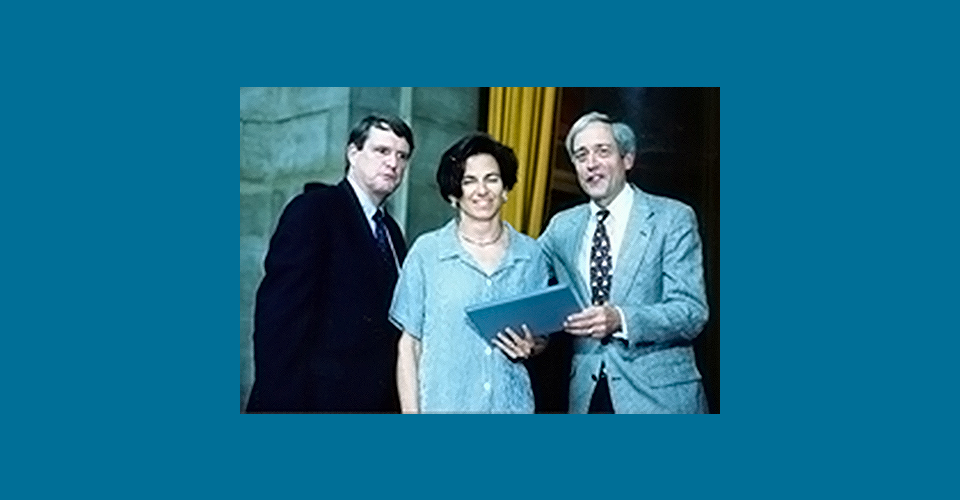
Columbia University President George Rupp (right) presents Liz Spayd and Leonard Downie, Jr. of The Washington Post with the 2002 Pulitzer Prize for National Reporting.
Winning Work
By Bob Woodward
Washington Post Staff Writer
Mohamed Atta, one of the key organizers among the 19 hijackers who carried out the Sept. 11 attacks, left behind a five-page handwritten document in Arabic that includes Islamic prayers, instructions for a last night of life and practical reminders to bring "knives, your will, IDs, your passport" and, finally, "to make sure that nobody is following you."
FBI investigators, who found the writings in Atta's luggage, which did not make it onto his flight, are not sure of the author's identity -- whether it was Atta, another hijacker or someone else.
The document is a cross between a chilling spiritual exhortation aimed at the hijackers and an operational mission checklist. With the hijackers all dead, the pages may turn out to provide the most vivid and penetrating glimpse into their mental states and final hours before they embarked on the deadliest act of terrorism in U.S. history.
The haunting writings urge the hijackers to crave death and "be optimistic." At the same time, the document starkly addresses fear on the eve of their suicide mission.
"Everybody hates death, fears death," according to a translation of highlights of the document obtained by The Washington Post. "But only those, the believers who know the life after death and the reward after death, would be the ones who will be seeking death."
This appears in a section of the document beneath the words, "The last night."
That section begins, "Remind yourself that in this night you will face many challenges. But you have to face them and understand it 100 percent .... Obey God, his messenger, and don't fight among yourself where you become weak, and stand fast, God will stand with those who stood fast."
The translated version of the document instructs the hijackers to steel their will with prayer before embarking on their mission.
"You should pray, you should fast. You should ask God for guidance, you should ask God for help .... Continue to pray throughout this night. Continue to recite the Koran."
It continues: "Purify your heart and clean it from all earthly matters. The time of fun and waste has gone. The time of judgment has arrived. Hence we need to utilize those few hours to ask God for forgiveness. You have to be convinced that those few hours that are left you in your life are very few. From there you will begin to live the happy life, the infinite paradise. Be optimistic. The prophet was always optimistic."
The document offers eerie practical advice for the hijackers:
"Check all of your items -- your bag, your clothes, knives, your will, your IDs, your passport, all your papers. Check your safety before you leave .... Make sure that nobody is following you."
Interwoven throughout is spiritual guidance on purifying one's mental and physical state. The document says, "Make sure that you are clean, your clothes are clean, including your shoes."
A recurring theme is the promise of eternal life.
"Keep a very open mind, keep a very open heart of what you are to face," the document says. "You will be entering paradise. You will be entering the happiest life, everlasting life."
Atta, 33, and Abdulaziz Alomari spent the night of Sept. 10 in Room 232 of the South Portland Comfort Inn in Portland, Maine. Early Sept. 11, they boarded a flight from Portland to Boston's Logan Airport, where they connected to American Airlines Flight 11, the plane that was commandeered and flown into the north tower of the World Trade Center.
Atta's luggage did not make it onto Flight 11. The FBI found another copy of essentially the same document in the wreckage of United Flight 93, a government source said. Flight 93 was also hijacked and crashed into a field in Pennsylvania. The multiple copies suggest the document was shared among at least some of the hijackers.
After the attacks, several published reports stated that Atta had left a "suicide note," which is what the FBI initially called it in a document sent to police investigators in Europe. Other reports called it a will written by Atta, an Egyptian who joined radical Islamic circles while studying urban planning in Germany.
Yesterday, the Dallas Morning News quoted federal officials as saying that a copy of an Arabic-language prayer guide had been found in the wreckage of Flight 93.
The first four pages of the document obtained by The Post are handwritten on large paper and recite some basic Islamic history about the prophet fighting infidels with 100 men against 1,000. They also include prayers such as, "I pray to you God to forgive me from all my sins, to allow me to glorify you in every possible way."
The fifth and last page is on standard stenographer paper that apparently had been ripped from a pad and is headed, "When you enter the plane":
It includes a series of prayers or exhortations. "Oh, God, open all doors for me. Oh God who answers prayers and answers those who ask you, I am asking you for your help. I am asking you for forgiveness. I am asking you to lighten my way. I am asking you to lift the burden I feel.
"Oh God, you who open all doors, please open all doors for me, open all venues for me, open all avenues for me."
The author doodled on the paper, drawing a small, arrowhead-like sword. Two circles entwine the shaft, which also has serpentine swirls drawn onto it. The doodle also resembles a key.
The word "ROOM" is written vertically in large double-block letters at the end.
The document continues: "God, I trust in you. God, I lay myself in your hands."
It closes, "There is no God but God, I being a sinner. We are of God, and to God we return."
The document, several scholars of Islam said, draws on traditional Islamic prayers and alludes to Koranic verses. It begins with the universal Islamic benediction recalling God's mercy and compassion. And the last two paragraphs repeat the basic Muslim belief that "there is no God but God."
However, some noted that words like "100 percent" and "optimistic" are modern vocabulary not found in ancient prayers.
"Except for the section that talks about going into a plane and the knives, virtually everything else you could find in some medieval devotional manuals," said John Voll of Georgetown University's Center for Muslim-Christian Understanding.
It seems to have been written, Voll added, "by a person who lives in a devotional environment that involves a significant amount of memorized material. . . . It is embedded in a broad Islamic devotional discourse."
Other scholars noted the document's use of Islamic language to clothe a practical call to action.
"The jargon is authentic Islamic jargon," said Imad ad Dean Ahmad, president of the Bethesda-based Minaret of Freedom Institute. "It's obviously phrased to make it sound like it's part of a message to people going on a mission from which they will not return."
Richard C. Martin, professor of Islamic studies at Emory University, said the document appears to refer to "the purification that martyrdom represents" before it gets to "the quotidian matters of entering the airplane and gives final instructions."
Martin added, "This is a kind of spiritual preparation as I read it, or so it sounds."
However, two scholars said they found "incongruous" the opening line that refers to praying "in the name of God, of myself and my family . . ." because Muslims do not pray in their name or their families' names.
Jonathan Brockopp, assistant professor of Islamic studies at Bard College, noted another incongruity in the statement about seeking death.
In mainstream Muslim tradition, he said, "there is an important distinction between suicide and martyrdom in that martyrs don't seek death. A martyr seeks to glorify God and be God's instrument . . . and is not necessarily seeking death."
The idea "of not seeking death," Brockopp added, "is tremendously important in Muslim tradition."
He noted, however, that Islamic extremists have recently arrived at their own interpretations of these early Muslim teachings, and the document's author appears to follow the extremist view.
Finally, Brockopp said he found certain phrases like "lighten my way ... lift the burden" typical of self-exhortations made by "a person who joins a charismatic community or cult" and then tries "to do something beyond impossibility."
Staff writer Caryle Murphy and staff researcher Jeff Himmelman contributed to this report.
Excerpts from a five-page handwritten document that the FBI found in Mohamed Atta's luggage. Translated from Arabic:
- "In the name of God, the most merciful, the most compassionate .... In the name of God, of myself and of my family .... I pray to you God to forgive me from all my sins, to allow me to glorify you in every possible way."
- "Remember the battle of the prophet ... against the infidels, as he went on building the Islamic state."
- In upper right hand corner of Page 3: "The last night."
- "Remind yourself that in this night you will face many challenges. But you have to face them and understand it 100 percent."
- "Obey God, his messenger, and don't fight among yourself where you become weak, and stand fast, God will stand with those who stood fast."
- "You should engage in such things, you should pray, you should fast. You should ask God for guidance, you should ask God for help ... Continue to pray throughout this night. Continue to recite the Koran."
- "Purify your heart and clean it from all earthly matters. The time of fun and waste has gone. The time of judgment has arrived. Hence we need to utilize those few hours to ask God for forgiveness. You have to be convinced that those few hours that are left you in your life are very few. From there you will begin to live the happy life, the infinite paradise. Be optimistic. The prophet was always optimistic."
- "Always remember the verses that you would wish for death before you meet it if you only know what the reward after death will be."
- "Everybody hates death, fears death. But only those, the believers who know the life after death and the reward after death, would be the ones who will be seeking death."
- "Remember the verse that if God supports you, no one will be able to defeat you."
- "Keep a very open mind, keep a very open heart of what you are to face. You will be entering paradise. You will be entering the happiest life, everlasting life. Keep in your mind that if you are plagued with a problem and how to get out of it. A believer is always plagued with problems.... You will never enter paradise if you have not had a major problem. But only those who stood fast through it are the ones who will overcome it."
- "Check all of your items - your bag, your clothes, knives, your will, your IDs, your passport, all your papers. Check your safety before you leave.... Make sure that nobody is following you.... Make sure that you are clean, your clothes are clean, including your shoes."
- "In the morning, try to pray the morning prayer with an open heart. Don't leave but when you have washed for the prayer. Continue to pray."
- "When you enter the plane: Oh God, open all doors for me. Oh God who answers prayers and answers those who ask you, I am asking you for your help. I am asking you for forgiveness. I am asking you to lighten my way. I am asking you to lift the burden I feel."
- "God, I trust in you. God, I lay myself in your hands. I ask with the light of your faith that has lit the whole world and lightened all darkness on this earth, to guide me until you approve of me. And once you do, that's my ultimate goal."
- "There is no God but God. There is no God who is the God of the highest throne, there is no God but God, the God of all earth and skies. There is no God but God, I being a sinner. We are of God, and to God we return."
© 2001, The Washington Post Company
By Dan Eggen and Bob Woodward
Washington Post Staff Writers
The terrorists who carried out the Sept. 11 attacks were bankrolled with $500,000 from overseas that financed an operation planned and launched several years ago in Germany, with crucial support in Britain, the United Arab Emirates and Afghanistan, senior government officials have concluded.
U.S. investigators have determined that at least four of the 19 suspected hijackers were trained at camps in Afghanistan run by Osama bin Laden, whose al Qaeda network is believed responsible for the assaults on New York and Washington. They also have tentatively concluded there are links between bin Laden and most of the other hijackers, according to information gathered by the Justice Department, FBI and CIA.
Government investigators are becoming increasingly convinced that one or two other hijackings were in the works, officials said, and are focusing on three men in U.S. custody who received flight training. One was detained while seeking flight simulator training in Minnesota before the hijackings, and two others were arrested on a train in Texas after departing on a jet that was grounded after the attacks, sources said.
Government officials said other people in the United States might have provided minor assistance or had knowledge that a terrorist operation was underway. But the FBI has found little evidence so far that the teams of hijackers received much support here, sources said.
"There seems to be no U.S. mastermind," one official said.
The Justice Department has cast a global dragnet over the last two weeks in a hunt for accomplices. It is narrowing its criminal investigation to a number of individuals and is beginning to formulate criminal charges that could be filed against them, sources said. But a senior Justice official declined to predict when the first indictment might be handed down.
"We are past the first phase, and we are beginning to sharpen and focus the investigation," one Justice official said. "You don't get smoking guns in a case like this. The key is going to be in the details, in putting together the pieces, and we've gone a long way to doing that. . . . We're looking with particularity at a number of people."
The disclosures provide the most complete picture yet of the direction and scope of the U.S. investigation into the deadliest terror attack in American history, which has left 6,500 people missing or dead in New York, Washington and Pennsylvania. The hijackings have led to arrests on every continent but Antarctica.
In tracing $500,000 flowing into U.S. bank accounts used by Mohamed Atta and other suspected members of the hijacking teams, the FBI has documented numerous large cash withdrawals and a long trail of hotels, rental cars and airplane trips that largely dispel any notion of an austere plot, a senior government official said. Previous reports have said the attacks cost no more than $200,000.
Some of the money used to prepare the attack has already been linked to accounts in the Middle East, the source said, and investigators have documented instances of simultaneous withdrawals from the same account in different cities.
"This was not a low-budget operation," the official said. "There is quite a bit of money coming in, and they are spending quite a bit of money."
Investigators are convinced that the details of the terror plot were hatched in Hamburg, Germany, where Atta and two other suspected hijackers, Marwan Al-Shehhi and Ziad Samir Jarrah, are believed to have run a terrorist cell out of a second-floor student apartment.
The FBI is doubling its contingent of agents working on the investigation in Germany, in the belief that the trail will lead from there to the Middle East, one official said. The initial concept for the Sept. 11 attacks likely came from Afghanistan, where bin Laden is believed to be hiding, another official said.
Investigators have found that the suspected leaders in the plot moved in and out of the United States beginning at least 18 months ago, with lower-level hijackers not arriving until this year. Atta returned to Germany at least twice after arriving in the United States, a source said.
"There were two groups on each plane," one senior official said. "You've got the brains, who are the pilots and the leaders, and then you have the muscle coming in later on. They were the ones who held the passengers at bay."
The FBI is deeply suspicious of the circumstances surrounding three key men who have been detained in the case. Zacarias Moussaoui was taken into custody in Minnesota in August after he attempted to pay cash to learn how to steer, but not take off or land, a jumbo jet.
Moussaoui is not cooperating with authorities.
Two others, Mohammed Jaweed Azmath and Ayub Ali Khan, were detained on an Amtrak train Sept. 12 in Fort Worth with hair dye, large amounts of cash and box-cutter knives like the ones used in the hijackings. The men, who had lived in Jersey City, had flown on a plane from Newark to St. Louis that was grounded after the attacks. Both men had flight training, one source said.
FBI agents have combed the passenger manifest on that flight and have not found anyone else who is believed to be a potential hijacker, an official said.
Adding another important element to the global investigation, British authorities yesterday accused an Algerian pilot of training four of the hijackers, including the apparent pilot of the jet that crashed into the Pentagon.
During an extradition hearing in London, British prosecutor Arvinda Sambir suggested that Lotfi Raissi, 27, may have been a knowing participant in the terrorist plot, and that U.S. authorities might charge him with conspiracy to murder.
"The hope is that he will be able to tell us who planned what and when," added one senior U.S. official.
However, the British prosecutor left open the possibility that Raissi may have instructed the hijackers at an Arizona flight school without knowing their intentions. Defense lawyer Richard Egan said Raissi "adamantly denies any involvement in the recent appalling tragedies."
In a sign of U.S. investigators' intense interest in the case, eight FBI agents attended the hearing at Bow Street Magistrates' Court. The court ordered Raissi held in jail for another week, pending a second hearing on the U.S. extradition request.
The original request, issued June 19, said Raissi had given false information on an application for a U.S. pilot's license. Now, authorities want to pursue his alleged connections with the hijackers.
Dressed in a white track-suit top and pants, Raissi spoke only to confirm his name during the brief hearing.
Sambir said that Raissi, who was arrested in Britain last week, had visited the United States several times this year. The evidence against him, she said, includes a videotape of him flying on June 23 from Las Vegas to Phoenix with Hani Hanjour, who is believed to have been the pilot of American Airlines Flight 77, the plane that hit the Pentagon.
In June, Hanjour was a member of the flight simulator club of the Sawyer School of Aviation in Phoenix, according to the school's spokeswoman. Raissi was also a member of the Phoenix flight simulator club for five months this year and used a flight simulator at a Phoenix area airport at the same time as Hanjour, according to the aviation school.
"He was a lead instructor of four of the pilots that were responsible for the hijackings," Sambir said in court. "We say he was there to ensure that the pilots were capable and trained for this purpose," she added.
Raissi received a U.S. commercial pilot's license in January 1999, with a rating to fly a Boeing 737. Two days later, he was certified as a ground instructor, and in March 1999, he received a license to be a flight instructor.
Raissi lived in a Phoenix apartment complex and listed himself as both a student and employee at Westwind Aviation Academy, a flight school at the Phoenix Deer Valley Airport, according to the East Valley Tribune, a Mesa, Ariz., newspaper. Raissi has said he trained at Westwind in 1997 and 1998, according to documents the FBI showed to another local flight school director.
Westwind was acquired two years ago by Pan Am International Flight Academy, a Florida company. Todd Huvard, a vice president at Pan Am International, said the company was cooperating with the FBI but would not release any information to the press.
Last week, police searched Raissi's apartment in the village of Colnbrook, Berkshire, near London's Heathrow airport, and took a flight manual and a pilot's logbook that had several pages torn out, authorities said.
In an odd twist, a database search of public records shows that Raissi had used the Social Security number of a Jersey City woman who died in 1991. The woman, Dorothy Hansen, was a retired factory worker.
Hansen's grandson, Carl G. Hansen III, 37, said he had never heard of Raissi. Joyce Mastrangelo, Dorothy Hansen's daughter, said she was astounded.
"Oh my God, how did he get that?" Mastrangelo said. "My mother has been dead 10 years."
In other developments yesterday:
- Attorney General John D. Ashcroft released a four-page letter in Arabic that was found among the belongings of men on three of the hijacked jetliners. The letter includes Islamic prayers, speaks of death for a glorious cause, and reminds the reader not to forget his knives and passport. The letter, first detailed in yesterday's Washington Post, demonstrates how the Muslim hijackers "grossly perverted the Islamic faith," said Ashcroft, who repeated that Muslims in the United States "deserve dignity and respect." Identical letters were discovered in three places. One was found inside a car parked at Dulles International Airport, starting point of the flight that crashed into the Pentagon. The second was found at the Pennsylvania crash site of United Flight 93. The third was found in the Boston luggage of Atta, who was aboard one of the planes that plunged into the World Trade Center.
- Ashcroft said more than 480 people have been arrested or detained during the first 18 days of a quest he has called the largest criminal investigation in the nation's history. Although bin Laden has been identified by President Bush as the sponsor of the Sept. 11 attacks, Ashcroft said investigators "have not ruled out the participation of any individual or any organizations in this attack."
- FBI Director Robert S. Mueller III contested reports that FBI agents have posed questions about political beliefs to Muslims, Sikhs and Arab Americans who have been stopped or detained as part of the investigation. He said questioning focuses on relationships with the 19 suspected hijackers and their associates, and "may cross over into relationships that may have sprung out of attendance at, for instance, religious meetings. But there is no effort to delve into either the political or the religious beliefs of individuals."
- In Cedar Rapids, Iowa, the Secret Service arrested Youssef Hmimssa, who had been wanted under the alias Jalali. Authorities said they believe he may have knowledge of a terrorist threat against former defense secretary William Cohen. Hmimssa was indicted Thursday, along with two other men, by a federal grand jury in Detroit on two counts of fraud. During a Sept. 18 search of a Detroit apartment, FBI agents seized false immigration papers and a fake passport bearing the name Michael Saisa and a picture believed to be that of Hmimssa or Jalali, two of five aliases cited by authorities. He was also wanted in Chicago on charges of financial-related fraud and false identification charges. Agents also found a day planner that refers to the "American defense minister" and contains an apparent sketch of the U.S. air base in Incirlik, Turkey. Cohen canceled a visit to Incirlik last December after learning of a "credible threat against him," according to a former Department of Defense officials.
Special correspondent Adi Bloom in London; staff reporters Sari Horwitz, Lena Sun, Scott Higham, Fredrick Kunkle, Allan Lengel, Peter Slevin and Marcia Slacum Greene, and researchers Bobbye Pratt and Margot Williams contributed to this report.
© 2001, The Washington Post Company
By Amy Goldstein
Washington Post Staff Writer
The 19 hijackers who carried out the worst act of terror ever to occur on U.S. soil worked with little outside help as a single, integrated group composed of identifiable leaders and shadowy foot soldiers who prepared for their final day in a tight choreography over 18 months.
An examination of public records and dozens of interviews shatters the image of the conspiracy that coalesced immediately after the Sept. 11 attacks.
Based on early, flawed information from federal investigators, initial accounts depicted an operation that was carried out by four compartmentalized cells of terrorists. And because investigations and neighbors were confused by similar or falsified Arabic names, reports emerged that the cells included as many as 10 pilots, who -- with wives and children -- had blended seamlessly into suburban America.
In fact, it now seems clear that only a single hijacker aboard each of the four commandeered aircraft knew how to fly a plane. Just two of the other hijackers -- both linked to terrorist Osama bin Laden -- had briefly taken flight lessons.
These six men apparently formed the conspiracy's leadership. Records and interviews show that this core group, often separated by thousands of miles, remained in the United States the longest and left behind the most visible tracks that, in retrospect, can be seen as highly synchronized preparations.
Some of the leaders were educated, worldly and so intimately connected that three of the four suspected pilots had roomed together in Germany, where they attended theTechnical University of Hamburg. Sophisticated as they were, the leaders were clumsy enough in their English and manners that they repeatedly provoked notice and annoyance, if not outright suspicion, while they were in the United States.
Helping these leaders was a cadre of 13 Saudi Arabian men, most of them younger and less educated, many from their country's poorest regions. These young Saudis left faint appearances in U.S. public records and seem for the most part to have arrived only in recent months.
Leader or follower, none of the hijackers brought wives or children with them. And contrary to early reports, none of the pilots had worked for Saudi Arabian Airlines.
For the leaders and followers alike, a maze of connections -- including overlapping addresses -- exists among hijackers who ended up on different flights.
The synchronization of their preparations is evident in the most basic ingredients of their plot. Seven of the hijackers obtained Florida driver's licenses within a 15-day span in early summer. Thirteen purchased airline tickets for their final flights within five days in late August. And over the course of the summer, a dozen -- who ultimately ended up spread among the four flights -- moved through South Florida apartments.
The plot revolved around mundane, perfectly legal details of everyday life: tourist visas, driver's licenses, apartment leases, Internet connections, airline tickets, mail boxes and rental cars. The records left by the hijackers as they carried out those ordinary acts reveal the footprints of the conspiracy. They detail who did what and with whom, and they reveal that the hijackers were divided into two distinct classes.
"There are two groups on each plane: You've got the brains, who are the pilots and the leaders, and then you have the muscle coming in later on," said a senior government official. "They were the ones who held the passengers at bay."
This newer portrait of the conspiracy may yet evolve. The FBI investigation into the plot is preliminary, and the conspiracy's precise nature probably will not be understood for years. Only a fraction of what has been learned about the conspirators by federal investigators is publicly known. Telephone records and airline manifests, for example, would be disclosed only in secret before a grand jury or in a courtroom.
But from the information that is available at the moment, certain patterns can be gleaned that render a fuller picture of the conspirators.
In particular, an analysis of the hijackers' visible trails gives greater clarity to the role of Mohamed Atta, the 33-year-old Egyptian lawyer's son already identified by a government official as the "axle" of the plot. He traveled the most, listed the most addresses, took the most practice flights and had the greatest interaction with other conspirators. Atta and two of the other suspected pilots -- Marwan Al-Shehhi and Ziad Samir Jarrah -- belonged to a radical Islamic student group in Hamburg that investigators believe may have been a birthplace of the plot.
More broadly, both the leaders and the followers can be seen to have often deployed in pairs. They came together for crucial tasks, such as to get new government identification cards that would ease their passage onto the planes.
The hijackers' behavior reveals certain incongruities. They were Islamic fundamentalists who nevertheless indulged in Western culture, from fast food to hard liquor. One spent $4,500 on a single airline ticket, yet they haggled over bar tabs, car rental fees and apartment security deposits just days before they would die.
The most basic incongruity, though, is this: The preparations of the 19 hijackers were imperfect. Some were kicked out of pilot schools. Some had to pay cash for their plane tickets after their credit cards were rejected. Two were late for the Boston flight that would be the first to slam into the World Trade Center. But inexact as it was, their plot succeeded in claiming more than 6,000 lives.
The Advance Guard
In November 1999, two Saudi Arabian men moved into a ground-floor apartment at the Parkwood Apartments, a town house complex near a busy commercial strip in San Diego. Khalid Almihdhar and Nawaf Alhazmi struck their neighbors as odd. They had no furniture but often carried briefcases and seemed to be on their cell phones a lot.
Two months later, investigators believe, Almihdhar and Alhazmi traveled to Malaysia, where they met with bin Laden operatives who were later linked to the bombing of thedestroyer USS Cole.
By May 2000, they arrived at Sorbi's Flying Club, a small school 20 miles north of San Diego that trains about four dozen pilots a year, and announced that they wanted to learn to fly Boeing airliners.
Almihdhar and Alhazmi were part of the advance guard.
Their flight lessons began within weeks of the day two of the other leaders, Atta and Al-Shehhi, a 23-year-old native of the United Arab Emirates, enrolled in a six-month course at Huffman Aviation, a flying school in Venice, Fla.
A continent apart, the four men displayed uncanny parallels. According to former neighbors, landlords and flight instructors, the California team and the Florida team almost always left their apartments as a pair. Few people recall ever seeing any of them alone.
Within each pair, one man assumed a more genial, communicative role, while the other was quieter, brooding. In California, Alhazmi is remembered as more outgoing. In Florida, waitresses and others consistently recall Al-Shehhi as friendlier than Atta -- a dour, arrogant man whose English seemed atrocious at times, but suddenly could be smooth when he needed a car or hotel room.
These four men traveled often: Al-Shehhi to Morocco and Amsterdam, Atta twice to Spain.
Neither team took pains to be furtive. Although Atta occasionally used aliases, all four men gave their real names when they registered for flight lessons or bought airline tickets -- a violation of a "terrorist's manual" written for bin Laden's network.
Almihdhar and Alhazmi, in particular, were readily visible within the local Muslim community. They mingled atthe Islamic Center of San Diego. It was at the center that they bought the blue Corolla they would ultimately drive across the country and park at Dulles International Airport on Sept. 11.
Even as they sought to blend into the United States well enough to complete their tasks, the pairs of men were imperfect chameleons. At times, they were overeager. They were hindered by faulty English. They were, on occasion, aggressive, even boorish.
Rick Garza, Sorbi's chief flight instructor at the time, sat Almihdhar and Alhazmi down after a half-dozen ground lessons and two flights. "This is not going to work out," he told them.
Their English was terrible, but Garza was more disturbed by a certain overzealousness. Even though "they had no idea what they were doing," the instructor said, they insisted on learning to fly multi-engine planes, at one point offering him extra money if he would teach them.
In Florida, Atta strived to adapt to U.S. styles, shedding the flowing beard and tunic he had favored in Germany for a clean-cut look. But both he and Al-Shehhi, while more successful than the San Diego pair at acquiring pilots' skills and licenses, could be similarly off-putting. At Huffman, Atta appropriated the seat cushion of a fellow student while he flew in the school's Piper Cherokee Warrior.
Infuriated, the student, Anne Greaves, tried to wrest the cushion from Atta's grasp. "Marwan lunged, putting his arm quickly between Atta and myself, to protect him in a way," Greaves said. "I remember thinking, 'What on Earth could they be frightened of?' "
Doughnuts by the Boxful
If the behavior of the first four was conspicuously unpleasant, they nevertheless were clearly more adept than the young Saudi men who came in a second wave.
One of these men, who moved early last summer into a shabby apartment building inPaterson, N.J., once had to ask a neighbor how to screw in a light bulb.
Among the first to arrive were Hamza Alghamdi, 20, and Mohand Alshehri, 23, who in January rented a post office box in Delray Beach, Fla.
Most of the second group of conspirators were from poor families. A few had enough education to give them skills that would prove handy. Alshehri, who graduated from a religious high school and dropped out of Imam Muhammed bin Saud University, was facile enough with computers that he could use the Internet at a Delray Beach public library.
But these younger men seemed to settle under the wings of a leader for such basic needs as finding a place to live. Last winter, Hani Hanjour, another pilot, did the talking when he rented the Paterson apartment with another young man, even though Hanjour's own English was poor. In June, Al-Shehhi, by then a licensed pilot who had been in Florida for at least a year, helped Hamza Alghamdi shop for an apartment, according to the real estate agent who worked with them.
Unlike the first wave, who focused on the mentally rigorous work of pilot training, the second wave of young men put time into strengthening their bodies. In Florida and Maryland, they paid cash to train with weights in gyms.
In ways that were curiously out of sync with Islamic orthodoxy, these young men seemed to revel in their brief taste of American life. They wore shorts and T-shirts. Last month, Majed Moqed, 22, another hijacker on American Airlines Flight 77, which hit the Pentagon, stopped into a Beltsville store that rents adult videos. After scanning the titles, he did not rent any, but he returned at least once.
Some of the hijackers who passed through New Jersey during the summer developed the habit of buying doughnuts by the boxful and meals from a Chinese carryout. Others frequently stopped by a bar at night for Salem or Parliament cigarettes, Heineken or Budweiser beer.
A Blur of Motion
New Jersey served as one hub for the conspirators in the days and nights of summer. South Florida served as the other. Soon, the early pairs gave way to larger, interlocking groups.
The apartment that Al-Shehhi had helped Hamza Alghamdi to find also became the home of Saeed Alghamdi and Ahmed Ibrahim A. Al Haznawi.
On Aug. 2, at least five -- and possibly seven -- of the hijackers went to a Virginia Department of Motor Vehicles office in Arlington, where they allegedly met a local man who fraudulently helped them obtain identification cards they could flash at airport counters.
The men who got the IDs that day later would fan out to three of the four hijacked planes, illustrating the conspiracy's interwoven nature. The scheme is striking for a second reason: It shows the amount of calculation behind the plot. The men who got the Virginia cards included those who would board the flight at nearby Dulles. The only others who took part in the scam were the two hijackers on other planes who had not obtained a driver's license in Florida since last spring.
Such close coordination, visible all along, is particularly evident as the conspirators purchased their tickets and moved into their final positions before the attacks. The last weeks of August and first days of September appear in retrospect as a blur of motion, as hijackers left apartments, returned rental cars and realigned to join the men with whom they would board their planes.
Mysteries That Linger
As more of the conspiracy becomes understood, government sources now say that the investigation so far suggests the 19 had "no major help" in the United States. Sources say that the conspirators were funded with $500,000 from overseas and that the terrorist mission was planned and launched several years ago in Germany, with crucial support in Britain, the United Arab Emirates and Afghanistan.
Of the more than 480 people detained during the last few weeks, a few have drawn particular attention.
Zacarias Moussaoui was detained Aug. 17 after he caused a scene at a flight simulator in Minnesota, where he worried his instructors by baldly saying he wanted to learn how to fly jets but not to land them.
Two Indian men who had gotten off an airplane on Sept. 11 were arrested on a train in Fort Worth the next day. Accounts differ on what led to the arrests, but the men were discovered with $5,000 in cash, hair dye and box-cutter knives similar to ones used by the hijackers to take control of the planes.
Early last week, Mohammed Abdi, a Somalian working as a security guard in the District, was detained after authorities found his phone number written on a map left behind in the blue Corolla by several of the hijackers in a Dulles parking lot. And Friday, Lotfi Raissi, an Algerian pilot who had lived in Arizona, was accused in Britain of training four of the hijackers.
In recent days, the investigation has intensified in Germany as well, where authorities are seeking people who roomed with the hijackers from Hamburg or had other ties to them.
Of all the mysteries that linger, a central one surrounds the man believed to be the fourth hijacker pilot: Hanjour. Unlike the other three suspected pilots -- Atta, Al-Shehhi and Jarrah, who trained in Europe -- there is no evidence that Hanjour was radicalized in Islamic circles within Germany. Unlike the other pair of leaders -- Almihdhar and Nawaf Alhazmi, who have been linked to bin Laden's network and settled together in San Diego -- Hanjour did not train to fly with a partner.
Of all the 19, Hanjour's roots in the United States seem deepest. The first trace of him in this country dates to 1990, when he appeared at the University of Arizona in Tucson for an eight-week English course. Exactly a decade later, he received a student visa by applying for another English course, this time in Oakland, Calif. He entered the country but never showed up in class.
In his elusiveness, in his long acquaintance with America, Hanjour is the only hijacker who fits the profile of what investigators call a "sleeper," a terrorist who lives inconspicuously in a country for years before committing his violent act.
It is clear that Hanjour knew the San Diego leadership team. They were in the city together and, by some accounts, were roommates for a time. By last spring, he was on the East Coast, helping the younger group in New Jersey. What is less evident is his exact role in the conspiracy. Was he dispatched early to prepare the path? Was he taken into the plot as a pilot after the pair in San Diego proved so inept?
Certainly, Hanjour's own piloting skills were shaky. He took lessons at a Scottsdale, Ariz., flight school four years ago, but eventually was asked to leave by instructors who said his skills were poor and his manner difficult. Just a month ago, instructors at Freeway Airport in Bowie flew with him and deemed him unfit to rent a plane by himself.
But on the morning of Sept. 11, as Flight 77 veered off its course to Los Angeles and streaked toward Washington and the Pentagon, Hanjour is thought to have been the one who executed what a top aviation source called "a nice, coordinated turn."
© 2001, The Washington Post Company
By Barton Gellman
Washington Post Staff Writer
The government of Sudan, employing a back channel direct from its president to the Central Intelligence Agency, offered in the early spring of 1996 to arrest Osama bin Laden and place him in Saudi custody, according to officials and former officials in all three countries.
The Clinton administration struggled to find a way to accept the offer in secret contacts that stretched from a meeting at a Rosslyn hotel on March 3, 1996, to a fax that closed the door on the effort 10 weeks later. Unable to persuade the Saudis to accept bin Laden, and lacking a case to indict him in U.S. courts at the time, the Clinton administration finally gave up on the capture.
Sudan expelled bin Laden on May 18, 1996, to Afghanistan. From there, he is thought to have planned and financed the twin embassy bombings of 1998, the near-destruction of the USS Cole a year ago and last month's devastation in New York and Washington.
Bin Laden's good fortune in slipping through U.S. fingers torments some former officials with the thought that the subsequent attacks might have been averted. Though far from the central figure he is now, bin Laden had a high and rising place on the U.S. counterterrorism agenda. Internal State Department talking points at the time described him as "one of the most significant financial sponsors of Islamic extremist activities in the world today" and blamed him for planning a failed attempt to blow up the hotel used by U.S. troops in Yemen in 1992.
"Had we been able to roll up bin Laden then, it would have made a significant difference," said a U.S. government official with responsibilities, then and now, in counterterrorism. "We probably never would have seen a September 11th. We would still have had networks of Sunni Islamic extremists of the sort we're dealing with here, and there would still have been terrorist attacks fomented by those folks. But there would not have been as many resources devoted to their activities, and there would not have been a single voice that so effectively articulated grievances and won support for violence."
Clinton administration officials maintain emphatically that they had no such option in 1996. In the legal, political and intelligence environment of the time, they said, there was no choice but to allow bin Laden to depart Sudan unmolested.
"The FBI did not believe we had enough evidence to indict bin Laden at that time, and therefore opposed bringing him to the United States," said Samuel R. "Sandy" Berger, who was deputy national security adviser then.
Three Clinton officials said they hoped -- one described it as "a fantasy" -- that Saudi King Fahd would accept bin Laden and order his swift beheading, as he had done for four conspirators after a June 1995 bombing in Riyadh. But Berger and Steven Simon, then director for counterterrorism on the National Security Council (NSC) staff, said the White House considered it valuable in itself to force bin Laden out of Sudan, thus tearing him away from his extensive network of businesses, investments and training camps.
"I really cared about one thing, and that was getting him out of Sudan," Simon said. "One can understand why the Saudis didn't want him -- he was a hot potato -- and, frankly, I would have been shocked at the time if the Saudis took him. My calculation was, 'It's going to take him a while to reconstitute, and that screws him up and buys time.' "
Conflicting Agendas
Conflicting policy agendas on three separate fronts contributed to the missed opportunity to capture bin Laden, according to a dozen participants. The Clinton administration was riven by differences on whether to engage Sudan's government or isolate it, which influenced judgments about the sincerity of the offer. In the Saudi-American relationship, policymakers diverged on how much priority to give to counterterrorism over other interests such as support for the ailing Israeli-Palestinian talks. And there were the beginnings of a debate, intensified lately, on whether the United States wanted to indict and try bin Laden or to treat him as a combatant in an underground war.
In 1999, Sudanese President Omar Hassan Bashir referred elliptically to his government's early willingness to send bin Laden to Saudi Arabia. But the role of the U.S. government and the secret channel from Khartoum to Washington had not been disclosed before.
The Sudanese offer had its roots in a dinner at the Khartoum home of Sudanese Foreign Minister Ali Othman Taha. It was Feb. 6, 1996 -- Ambassador Timothy M. Carney's last night in the country before evacuating the embassy on orders from Washington.
Paul Quaglia, then the CIA station chief in Khartoum, had led a campaign to pull out all Americans after he and his staff came under aggressive surveillance and twice had to fend off attacks, one with a knife and one with claw hammers. Now Carney was instructed, despite his objections, to withdraw all remaining Americans from the country.
Carney and David Shinn, then chief of the State Department's East Africa desk, considered the security threat "bogus," as Shinn described it. Washington's dominant decision-makers on Sudan had lost interest in engagement, preparing plans to isolate and undermine the regime. The two career diplomats thought that was a mistake, and that Washington was squandering opportunities to enlist Sudan's cooperation against radical Islamic groups.
One factor in Washington's hostility was an intelligence tip that Sudan aimed to assassinate national security adviser Anthony Lake, the most visible administration critic of Khartoum. The Secret Service took it seriously enough to remove Lake from his home, shuffling him among safe houses and conveying him around Washington in a heavily armored car. Most U.S. analysts came to believe later that it had been a false alarm.
Taha, distressed at the deteriorating relations, invited Carney and Shinn to dine with him that Tuesday night. He asked what his country could do to dissuade Washington from the view, expressed not long before by then-United Nations Ambassador Madeleine K. Albright, that Sudan was responsible for "continued sponsorship of international terror."
Carney and Shinn had a long list. Bin Laden, as they both recalled, was near the top. So, too, were three members of Egypt's Gamaat i-Islami, Arabic for Islamic Group, who had fled to Sudan after trying to kill Egyptian President Hosni Mubarak. Sudan also played host to operatives and training facilities for the Palestinian Islamic Resistance Movement, or Hamas, and Lebanon's Hezbollah.
"It was the first substantive chat with the U.S. government on the subject of terrorism," Carney recalled.
Taha mostly listened. He raised no objection to the request for bin Laden's expulsion, though he did not agree to it that night. His only rejoinders came on Hamas and Hezbollah, which his government, like much of the Arab world, regarded as conducting legitimate resistance to Israeli occupation.
Sudanese President Bashir, struggling for dominance over the fiery cleric Hassan Turabi, had already made overtures to the West. Not long before, he had delivered the accused terrorist known as "Carlos the Jackal" to France. Less than a month after Taha's dinner, he sent a trusted aide to Washington.
Maj. Gen. Elfatih Erwa, then minister of state for defense, arrived unannounced at the Hyatt Arlington on March 3, 1996. Using standard tradecraft, he checked into one room and then walked to another, across Wilson Boulevard from the Rosslyn Metro.
Carney and Shinn were waiting for him, but the meeting was run by covert operatives from the CIA's Africa division. The Washington Post does not identify active members of the clandestine service. Frank Knott, who was Africa division chief in the directorate of operations at the time, declined to be interviewed.
In a document dated March 8, 1996, the Americans spelled out their demands. Titled "Measures Sudan Can Take to Improve Relations with the United States," the two-page memorandum asked for six things. Second on the list -- just after an angry enumeration of attacks on the CIA station in Khartoum -- was Osama bin Laden.
"Provide us with names, dates of arrival, departure and destination and passport data on mujahedin [holy warriors] that Usama Bin Laden has brought into Sudan," the document demanded. The CIA emissaries told Erwa that they knew of about 200 such bin Laden loyalists in Sudan.
During the next several weeks, Erwa raised the stakes. The Sudanese security services, he said, would happily keep close watch on bin Laden for the United States. But if that would not suffice, the government was prepared to place him in custody and hand him over, though to whom was ambiguous. In one formulation, Erwa said Sudan would consider any legitimate proffer of criminal charges against the accused terrorist. Saudi Arabia, he said, was the most logical destination.
Susan Rice, then senior director for Africa on the NSC, remembers being intrigued with but deeply skeptical of the Sudanese offer. And unlike Berger and Simon, she argued that mere expulsion from Sudan was not enough.
"We wanted them to hand him over to a responsible external authority," she said. "We didn't want them to just let him disappear into the ether."
Lake and Secretary of State Warren Christopher were briefed, colleagues said, on efforts launched to persuade the Saudi government to take bin Laden.
The Saudi idea had some logic, since bin Laden had issued a fatwa, or religious edict, denouncing the ruling House of Saud as corrupt. Riyadh had expelled bin Laden in 1991 and stripped him of his citizenship in 1994, but it wanted no part in jailing or executing him.
Saudis Feared a Backlash
Clinton administration officials recalled that the Saudis feared a backlash from the fundamentalist opponents of the regime. Though regarded as a black sheep, bin Laden was nonetheless an heir to one of Saudi Arabia's most influential families. One diplomat familiar with the talks said there was another reason: The Riyadh government was offended that the Sudanese would go to the Americans with the offer.
Some U.S. diplomats said the White House did not press the Saudis very hard. There were many conflicting priorities in the Middle East, notably an intensive effort to save the interim government of Prime Minister Shimon Peres in Israel, which was reeling under its worst spate of Hamas suicide bombings. U.S. military forces also relied heavily on Saudi forward basing to enforce the southern "no fly zone" in Iraq.
Resigned to bin Laden's departure from Sudan, some officials raised the possibility of shooting down his chartered aircraft, but the idea was never seriously pursued because bin Laden had not been linked to a dead American, and it was inconceivable that Clinton would sign the "lethal finding" necessary under the circumstances.
"In the end they said, 'Just ask him to leave the country. Just don't let him go to Somalia,' " Erwa, the Sudanese general, said in an interview. "We said he will go to Afghanistan, and they said, 'Let him.' "
On May 15, 1996, Foreign Minister Taha sent a fax to Carney in Nairobi, giving up on the transfer of custody. His government had asked bin Laden to vacate the country, Taha wrote, and he would be free to go.
Carney faxed back a question: Would bin Laden retain control of the millions of dollars in assets he had built up in Sudan?
Taha gave no reply before bin Laden chartered a plane three days later for his trip to Afghanistan. Subsequent analysis by U.S. intelligence suggests that bin Laden managed to draw down and redirect the Sudanese assets from his new redoubt in Afghanistan.
From the Sudanese point of view, the failed effort to take custody of bin Laden resulted primarily from the Clinton administration's divisions on how to relate to the Khartoum government -- divisions that remain today as President Bush considers what to do with nations with a history of support for terrorist groups.
Washington, Erwa said, never could decide whether to strike out at Khartoum or demand its help.
"I think," he said, "they wanted to do both."
© 2001, The Washington Post Company
By Bob Woodward and Thomas E. Ricks
Washington Post Staff Writers
In 1999, the CIA secretly trained and equipped approximately 60 commandos from the Pakistani intelligence agency to enter Afghanistan for the purpose of capturing or killing Osama bin Laden, according to people familiar with the operation.
The operation was arranged by then-Pakistani Prime Minister Nawaz Sharif and his chief of intelligence with the Clinton administration, which in turn promised to lift sanctions on Pakistan and provide an economic aid package. The plan was aborted later that year when Sharif was ousted in a military coup.
The plan was set in motion less than 12 months after U.S. cruise missile strikes against bin Laden's training camps in Afghanistan that Clinton administration officials believe narrowly missed hitting the exiled Saudi militant. The clandestine operation was part of a more robust effort by the United States to get bin Laden than has been previously reported, including consideration of broader military action, such as massive bombing raids and Special Forces assaults.
It is a record of missed opportunities that has provided President Bush and his administration with some valuable lessons as well as a framework for action as they draw up plans for their own war against bin Laden and his al Qaeda network in the aftermath of the Sept. 11 attacks on New York and Washington.
The Pakistani commando team was up and running and ready to strike by October 1999, a former official said. "It was an enterprise," the official said. "It was proceeding." Still stung by their failure to get bin Laden the previous year, Clinton officials were delighted at the operation, which they believed provided a real opportunity to eliminate bin Laden. "It was like Christmas," a source said.
The operation was aborted on Oct. 12, 1999, however, when Sharif was overthrown in a military coup led by Gen. Pervez Musharraf, who refused to continue the operation despite substantial efforts by the Clinton administration to revive it.
Musharraf, now Pakistan's president, has emerged as a key ally in the Bush administration's efforts to track down bin Laden and destroy his terrorist network. The record of the CIA's aborted relationship with Pakistan two years ago illustrates the value -- and the pitfalls -- of such an alliance in targeting bin Laden.
Pakistan and its intelligence service have valuable information about what is occurring inside Afghanistan, a country that remains closed to most of the world. But a former U.S. official said joint operations with the Pakistani service are always dicey, because the Taliban militia that rules most of Afghanistan has penetrated Pakistani intelligence.
"You never know who you're dealing with," the former senior official said. "You're always dealing with shadows."
'We Were at War'
In addition to the Pakistan operation, President Bill Clinton the year before had approved additional covert action for the CIA to work with groups inside Afghanistan and with other foreign intelligence services to capture or kill bin Laden.
The most dramatic attempt to kill bin Laden occurred in August 1998, when Clinton ordered a Tomahawk cruise missile attack on bin Laden's suspected training camps in Afghanistan in response to the bombings of U.S. embassies in Kenya and Tanzania.
At the time, the Pentagon informed the president that far more ambitious and riskier military actions could be undertaken, according to officials involved in the decision. The options included a clandestine helicopter-borne night assault with small U.S. special operations units; a massive bombing raid on the southeastern Afghan city of Kandahar, the spiritual home of the Taliban and a place frequently visited by bin Laden and his followers; and a larger air- and sea-launched missile and bombing raid on the bin Laden camps in eastern Afghanistan.
Clinton approved the cruise missile attack recommended by his advisers, and on Aug. 20, 1998, 66 cruise missiles rained down on the training camps. An additional 13 missiles were fired at a pharmaceutical plant in Sudan that the Clinton administration believed was a chemical weapons factory associated with bin Laden.
Clinton's decision to attack with unmanned Tomahawk cruise missiles meant that no American lives were put in jeopardy. The decision was supported by his top national security team, which included Secretary of State Madeleine K. Albright, Secretary of Defense William S. Cohen and national security adviser Samuel R. "Sandy" Berger, officials said.
In the aftermath of last month's attacks on the United States, which the Bush administration has tied to bin Laden, Clinton officials said their decision not to take stronger and riskier action has taken on added relevance. "I wish we'd recognized it then," that the United States was at war with bin Laden, said a senior Defense official, "and started the campaign then that we've started now. That's my main regret. In hindsight, we were at war."
Outside experts are even more pointed. "I think that raid really helped elevate bin Laden's reputation in a big way, building him up in the Muslim world," said Harlan Ullman, a defense analyst at the Center for Strategic and International Studies, a Washington think tank. "My sense is that because the attack was so limited and incompetent, we turned this guy into a folk hero."
Senior officials involved in the decision to limit the attack to unmanned cruise missiles cite four concerns that in many ways are similar to those the Bush administration is confronting now.
One was worry that the intelligence on bin Laden's whereabouts was sketchy. Reports at the time said he was supposed to be at a gathering of terrorists, perhaps 100 or more, but it was not clear how reliable that information was. "There was little doubt there was going to be a conference," a source said. "It was not certain that bin Laden would be there, but it was thought to be the case." The source added, "It was all driven by intelligence. . . . The intelligence turned out to be off."
A second concern was about killing innocent people, especially in Kandahar, a city already devastated by the Soviet Union's 1979 invasion of Afghanistan. Large loss of civilian life, the thinking went, could have cost the United States the moral high ground in its efforts against terrorism, especially in the Muslim world.
The risks of conducting a long-range helicopter assault, which would require aerial refueling at night, were another factor. The helicopters might have had to fly 900 miles, an official said. Administration officials especially wanted to avoid a repeat of the disastrous 1980 Desert One operation to rescue American hostages in Iran. During that operation, ordered by President Jimmy Carter, a refueling aircraft collided with a helicopter in the Iranian desert, killing eight soldiers.
A final element was the lack of permission for bombers to cross the airspace of an adjoining nation, such as Pakistan, or for helicopters to land at a staging ground on foreign soil. Since Sept. 11, Pakistan, Uzbekistan and Tajikistan have offered the United States use of bases and airspace for any new strike against bin Laden.
Bin Laden, 44, a member of an extended wealthy Saudi family, was expelled from Saudi Arabia in 1991 and stripped of his citizenship three years later. In early 1996, the CIA set up a special bin Laden unit, largely because of evidence linking him to the 1993 bombing of the World Trade Center. At the time, he was living in Sudan, but he was expelled from that country in May 1996 after the CIA failed to persuade the Saudis to accept a Sudanese offer to turn him over.
After his subsequent move to Afghanistan, bin Laden became a major focus of U.S. military and intelligence efforts in February 1998, when he issued a fatwa, or religious order, calling for the killing of Americans. "That really got us spun up," recalled retired Marine Gen. Anthony C. Zinni, who was then the chief of the Central Command, which oversees U.S. military operations in the Middle East and Central Asia.
When two truck bombs killed more than 200 people at the U.S. embassies in Kenya and Tanzania in August of that year, and the U.S. government developed evidence that bin Laden was behind both attacks, the question was not whether the United States should counterattack, but how and when. And when depended on information about his whereabouts. Two weeks later, intelligence arrived in Washington indicating that bin Laden would be attending a meeting in eastern Afghanistan. Much turned on the quality of the intelligence provided by CIA Director George J. Tenet, recalled a senior official who had firsthand knowledge of the administration's debate on how to respond.
"Some days George was good," the official said, "but some days he was not so good. One day he would be categorical and say this is the best we will get . . . and then two days later or a week later, he would say he was not so sure."
'It Was a Sustained Effort'
The quality of the intelligence behooved restraint in planning the raid. Hitting bin Laden with a cruise missile "was a long shot, very iffy," recalled Zinni, the former Central Command chief. "The intelligence wasn't that solid."
At the same time, new information surfaced suggesting that bin Laden might be planning another major attack. Top Clinton officials felt it was essential to act. At best, they calculated, bin Laden would be killed. And at a minimum, he might be knocked off balance and forced to devote more of his energy to hiding from U.S. forces.
"He felt he was safe in Afghanistan, in the mountains, inside landlocked airspace," Zinni said. "So at least we could send the message that we could reach him."
In all, 66 cruise missiles were launched from Navy ships in the Arabian Sea off the coast of Pakistan into the camps in Afghanistan. Pakistan had not been warned in advance, but Air Force Gen. Joseph Ralston, then the vice chairman of the Joint Chiefs of Staff, met with Pakistani officials at the precise time of the launch to tell them of the operation. He also assured them that Pakistan was not under surprise attack from India, a potential misapprehension that could have led to war.
At least one missile lost power and crashed in Pakistan, but the rest flew into Afghanistan and slammed into suspected terrorist training camps outside Khost, a small town near the Afghan-Pakistani border. Most of the cruise missiles were carrying loads of anti-personnel cluster bomblets, with the intention of killing as many people as possible. Reports from the scene were inconclusive. Most said that the raid killed about 30 people, but not bin Laden.
Intelligence that reached top Clinton administration officials after the raid said that bin Laden had left the camp two or three hours before the missiles struck. Other reports said he might have left as many as 10 or 12 hours before they landed.
Sources in the U.S. military said the launch time was adjusted some to coordinate it with the Sudan attack and to launch after sundown to minimize detection of the missiles. This had the effect of delaying the launch time by several hours. An earlier launch might have caught bin Laden, two sources said.
Cohen came to suspect that bin Laden escaped because he was tipped off that the strike was coming. Four days before the operation, the State Department issued a public warning about a "very serious threat" and ordered hundreds of nonessential U.S. personnel and dependents out of Pakistan. Some U.S. officials believe word could have been passed to bin Laden by the Taliban on a tip from Pakistani intelligence services.
Several other former officials disputed the notion of a security breach, saying bin Laden had plenty of notice that the United States intended to retaliate.
There also is dispute about the follow-up to the 1998 raid, specifically about whether the Clinton administration, having tried and failed to kill bin Laden, stopped paying attention.
There were attempts. Special Forces troops and helicopter gunships were kept on alert in the region, ready to launch a raid if solid intelligence pinpointed bin Laden's whereabouts. Also, twice in 1999, information arrived indicating that bin Laden might possibly be in a certain village in Afghanistan at a certain time, officials recalled. There was discussion of destroying the village, but the intelligence was not deemed credible enough to warrant the potential slaughter of civilians.
In addition, the CIA that year launched its clandestine operation with Pakistani intelligence to train Pakistani commandos for operations against bin Laden.
"It was a sustained effort," Cohen said recently. "There was not a week that went by when the issue wasn't seriously addressed by the national security team."
Berger said, "Al Qaeda and bin Laden were the number one security threat to America after 1998. It was the highest priority, and a range of appropriate actions were taken."
But never again did definitive information arrive that might have permitted another attempt to get bin Laden, officials said.
"I can't tell you how many times we got a call saying, 'We have information, and we have to hold a secret meeting about whether to launch a military action,' " said Walter Slocombe, the former undersecretary of defense for policy. "Maybe we were too cautious. I don't think so."
Researcher Jeff Himmelman contributed to this report.
© 2001, The Washington Post Company
By Susan Schmidt and Bob Woodward
Washington Post Staff Writers
U.S. intelligence officials have told members of Congress there is a high probability that terrorists associated with Osama bin Laden will try to launch another major attack on American targets here or abroad in the near future.
Based on what officials described as credible new information, the FBI and the CIA have assessed the chances of a second attempt to attack the United States as very high, sources said yesterday.
At a briefing Tuesday, in response to a senator's question about the gravity of the threat, one intelligence official said there is a "100 percent" chance of an attack should the United States strike Afghanistan, according to sources familiar with the briefing.
One senior official said some of the new intelligence is "very real." But the official cautioned that some of it may be braggadocio or even disinformation designed to discourage the United States from retaliating for the Sept. 11 attacks on New York and Washington.
The new information is worrisome enough that officials at the White House, the Justice Department and the State Department have huddled in recent days to figure out the best way to communicate their concern to the public, a source with knowledge of those discussions said.
The concern about another attack is based on intelligence from sources in England, Germany, Afghanistan and Pakistan, according to a source familiar with what congressional intelligence committees have been told. Egyptian, Somali and Pakistani elements of bin Laden's network are thought to be involved.
Members of the intelligence committees declined to comment on the briefings they have received, which are classified. But their public comments, and remarks by Attorney General John D. Ashcroft on Sunday, highlight the danger the country continues to face.
"We have to believe there will be another attempt by a terrorist group to hit us again," Sen. Richard C. Shelby (Ala.), ranking Republican on the Senate intelligence committee, said yesterday. "You can just about bet on it. That's just something you have to believe will happen."
Shelby declined to discuss specific intelligence information on the plans of bin Laden's Al Qaeda terrorist network that were provided in a classified briefing Tuesday by counterterrorism officials from the FBI, CIA and the Defense Intelligence Agency.
Ashcroft warned earlier this week that there is a "likelihood of additional terrorist activity," and that the "risks go up" once the United States responds with military action. "We think that there is a very serious threat of additional problems now," Ashcroft said. "And frankly, as the United States responds, that threat may escalate."
The Justice Department sought to play down that warning slightly Monday, after Ashcroft's words received more media attention than officials had expected.
"Ashcroft's and [Secretary of State Colin L.] Powell's people and the White House are working on how to word their warnings," a source familiar with multiagency discussions said. "The government doesn't want to panic people." But, he added, "The government is definitely preparing for a counterstrike by bin Laden."
Officials at the White House declined to comment yesterday.
Government officials are fearful of attacks at any of hundreds or thousands of locations, including symbols of American power and culture, such as government buildings in Washington and centers of entertainment. They are concerned about truck bomb and car bomb explosions that could be detonated near natural gas lines, power plants and other sites that one source decribed as "exposed infrastructure."
The FBI has taken a particular interest in crop-dusting airplanes for fear they could be used in a chemical or biological weapons attack. Mohamed Atta, one of the suspected leaders of the Sept. 11 attack, expressed a keen interest in the planes. Zacarias Moussaoui, a French-Moroccan man in custody as a material witness, reportedly had materials about crop dusting in his possession when he was detained in August.
The overriding goal, a senior official said, is to make the United States a "hard target" for terrorists.
But U.S. intelligence and law enforcement agencies do not have specific information on the nature of future attacks. The Coast Guard is boarding and searching ships in New York, Boston and other harbors, and security has been stepped up around nuclear power plants, oil pipelines, refineries and other potential targets.
The FBI has found no links between any of the 19 alleged hijackers or their possible accomplices and any of the 1,000 to 2,000 suspected terrorist sympathizers in this country, including known Al Qaeda supporters, lawmakers were told. The group that conducted the Sept. 11 attacks and anyone who might have helped it operated as a closed unit and there may be other such cells as yet undetected by law enforcement, some members of Congress were told.
"The investigative case has to take a back seat to preventing the next terrorist act," a senior law enforcement official said. "That comes right from the top, from the president of the United States on down."
In preparation, the FBI has a plan in place to go "full tilt" for 72 hours whenever the president decides to make a move against bin Laden, al Qaeda or Afghanistan's ruling Taliban government, the official said. At the investigation's command center in FBI headquarters, a team of analysts and agents has been working around the clock sifting through reports of potential threats since Sept. 11.
U.S. officials acknowledge it is difficult to understand the motivation behind some of the threats they have learned about.
In response to threats from bin Laden's network that were detected in June and July, for example, officials made decisions to abandon some U.S. embassies and to move Navy ships in foreign ports out to sea. Now, officials have concluded, the threats may have been disinformation designed to occupy officials' attention, or to allow bin Laden operatives to observe American counterterror lockdown methods, a knowledgeable source said.
Shelby said law enforcement agencies believe terrorists will do something unexpected, and thus the agencies are trying to think "out of the box" in anticipating what might be ahead. However, he noted, bin Laden has been known to return to the same targets repeatedly, such as the World Trade Center, which terrorists with possible ties to bin Laden's group bombed in 1993.
In 1999, a terrorist cell linked to bin Laden was thwarted in what one participant later testified was a plot to bomb Los Angeles International Airport.
A senior government official said yesterday that if al Qaeda follows its normal pattern, "other attacks are in various stages of planning." The U.S. embassies in Kenya and Tanzania, which were bombed in 1998, were first surveilled as targets in 1994, according to court testimony earlier this year.
The government official, who spoke on the condition of anonymity, said bin Laden's terrorist organization "likes to mix tactics and targets." Under that theory, more airplane hijackings seem less likely, because security has been increased. Ground-based operations, he said, seem more probable.
Staff writers Dan Balz, Dan Eggen, Vernon Loeb, John Mintz and Walter Pincus contributed to this report.
© 2001, The Washington Post Company
By Bob Woodward
Washington Post Staff Writer
President Bush last month signed an intelligence order directing the CIA to undertake its most sweeping and lethal covert action since the founding of the agency in 1947, explicitly calling for the destruction of Osama bin Laden and his worldwide al Qaeda network, according to senior government officials.
The president also added more than $1 billion to the agency's war on terrorism, most of it for the new covert action. The operation will include what officials said is "unprecedented" coordination between the CIA and commando and other military units. Officials said that the president, operating through his "war cabinet," has pledged to dispatch military units to take advantage of the CIA's latest and best intelligence.
Bush's order, called an intelligence "finding," instructs the agency to attack bin Laden's communications, security apparatus and infrastructure, senior government officials said. U.S. intelligence has identified new and important specific weaknesses in the bin Laden organization that are not publicly known, and these vulnerabilities will be the focus of the lethal covert action, sources said.
"The gloves are off," one senior official said. "The president has given the agency the green light to do whatever is necessary. Lethal operations that were unthinkable pre-September 11 are now underway."
The CIA's covert action is a key part of the president's offensive against terrorism, but the agency is also playing a critical role in the defense against future terrorist attacks.
For example, each day a CIA document called the "Threat Matrix," which has the highest security classification ("Top Secret/Codeword"), lands on the desks of the top national security and intelligence officials in the Bush administration. It presents the freshest and most sensitive raw intelligence on dozens of threatened bombings, hijackings or poisonings. Only threats deemed to have some credibility are included in the document.
One day last week, the Threat Matrix contained 100 threats to U.S. facilities in the United States and around the world -- shopping complexes, specific cities, places where thousands gather, embassies. Though nearly all the listed threats have passed without incident and 99 percent turned out to be groundless, dozens more take their place in the matrix each day.
It was the matrix that generated the national alert of impending terrorist action issued by the FBI on Oct. 11. The goal of the matrix is simple: Look for patterns and specific details that might prevent another Sept. 11.
"I don't think there has been such risk to the country since the Cuban missile crisis," a senior official said.
During an interview in his West Wing office Friday morning, Vice President Cheney spoke of the new war on terrorism as much more problematic and protracted than the Persian Gulf War of 1991, when Cheney served as secretary of defense to Bush's father.
The vice president bluntly said: "It is different than the Gulf War was, in the sense that it may never end. At least, not in our lifetime."
Pushing the Envelope
In issuing the finding that targets bin Laden, the president has said he wants the CIA to undertake high-risk operations. He has stated to his advisers that he is willing to risk failure in the pursuit of ultimate victory, even if the results are some embarrassing public setbacks in individual operations. The overall military and covert plan is intended to be massive and decisive, officials said.
"If you are going to push the envelope some things will go wrong, and [President Bush] sees that and understands risk-taking," one senior official said.
In the interview, Cheney said, "I think it's fair to say you can't predict a straight line to victory. You know, there'll be good days and bad days along the way."
The new determination among Bush officials to go after bin Laden and his network is informed by their pained knowledge that U.S. intelligence last spring obtained high quality video of bin Laden himself but were unable to act on it.
The video showed bin Laden with his distinctive beard and white robes surrounded by a large entourage at one of his known locations in Afghanistan. But neither the CIA nor the U.S. military had the means to shoot a missile or another weapon at him while he was being photographed.
Since then, the CIA-operated Predator unmanned drone with high-resolution cameras has been equipped with Hellfire antitank missiles that can be fired at targets of opportunity. The technology was not operational at the time bin Laden was caught on video. The weapons capability, which was revealed last week in the New Yorker magazine, was developed specifically to attack bin Laden, the officials said.
In addition, with the U.S. military heavily deployed in some nations around Afghanistan, commando and other units are now available to move quickly on bin Laden or his key associates as intelligence becomes available.
U.S. law enforcement and intelligence agencies recently received an important break in the effort to track down terrorist leaders overseas, according to officials.
The FBI and CIA have been given limited access in the last several weeks to a top bin Laden lieutenant who was arrested after Sept. 11 and is being held in a foreign country. The person, whose various aliases include "Abu Ahmed," is "a significant player," in the words of one senior Bush official. Ahmed was arrested with five other members of al Qaeda. He is believed by several senior officials to be the highest-ranking member of al Qaeda ever held for systematic interrogation.
Though Ahmed has not given information about future terrorist operations, he has provided some details about the October 2000 attack on the USS Cole in a Yemeni port, when 17 sailors were killed. One source said he also has information about the planned terrorist attacks in the United States that were disrupted before the millennium celebrations in December 1999.
The New Normalcy
When specific facilities or locations are threatened, as they have been repeatedly in the last month, the FBI informs local law enforcement authorities or foreign intelligence services that are supposed to increase security and take protective measures.
The Threat Matrix lists where the intelligence comes from -- intercepted communications, walk-in sources, e-mails, friendly foreign intelligence services, telephone threats, and FBI or CIA human sources.
The public is not informed except when the threat is considered highly credible or specific, as it was on Oct. 11 when the FBI issued its nationwide alert.
In the interview, Cheney said that deciding when to go public and when to withhold threat information is one of the most difficult tasks the administration faces.
"You have to avoid falling into the trap of letting it be a cover-your-ass exercise," Cheney said. "If you scare the hell out of people too often, and nothing happens, that can also create problems. Then when you do finally get a valid threat and warn people and they don't pay attention, that's equally damaging."
He also noted, "If you create panic, the terrorist wins without ever doing anything. So these are tough calls."
Making details from the Threat Matrix public could result in chaos, several officials said. Literally hundreds of places, institutions and cities from across the country have been on the list.
"It could destroy the livelihood of all those organizations and places without a bomb being thrown or a spore of anthrax being released," another senior Bush official said. The official was asked what would happen if there was a major terrorist incident and many were killed at one of the facilities or places on the Threat Matrix and no public warning had been issued.
"Then they would have our heads," the official said.
Intelligence and law enforcement agencies attempt to run every threat to ground to see if it is genuine, officials said. The results at times have been unexpected. In early October, a woman called authorities to say it was her patriotic duty to report that her husband, who is from the Middle East, was planning an attack with eight or nine friends on Chicago's Sears Tower.
The woman sounded credible and her allegations were reported in the Threat Matrix. The FBI then detained her husband and friends. On the next Threat Matrix the CIA reported that the FBI might have broken up an al Qaeda cell.
Upon further investigation, the FBI learned that the woman was furious with her husband, who had a second wife. Her allegations had no merit, but the bureau discovered that some of the people were involved in an arranged-marriage scheme.
"Instead of terrorism," one official said, "we found an angry wife."
Another senior official said, "There can be a problem in a marriage and it results in, you know, an allegation that shows up in the Threat Matrix."
During the interview in his West Wing office, Cheney, with a large map of Afghanistan on an easel near his desk, spoke of life post-Sept. 11.
"The way I think of it is, it's a new normalcy," he said. "We're going to have to take steps, and are taking steps, that'll become a permanent part of the way we live. In terms of security, in terms of the way we deal with travel and airlines, all of those measures that we end up having to adopt in order to sort of harden the target, make it tougher for the terrorists to get at us. And I think those will become permanent features in our kind of way of life."
New War, Old Problems
Though the new intelligence war presents the CIA with an opportunity to excel, several officials noted that the campaign is also fraught with risk.
The agency is being assigned a monumental task for which it is not fully equipped or trained, said one CIA veteran who knows the agency from many perspectives. Human, on-the-ground sources are scarce in the region and in the Muslim world in general. Since the end of the Cold War more than a decade ago, the Directorate of Operations (DO), which runs covert activity, has been out of the business of funding and managing major lethal covert action.
The CIA has a history of bungling such operations going back to the 1950s and 1960s, most notably when the agency unsuccessfully plotted to assassinate Fidel Castro.
In one of the celebrated anti-Castro plots, a CIA agent code-named AM/LASH planned to use Blackleaf-40, a high-grade poison, with a ballpoint-hypodermic needle on the Cuban leader. The device was delivered on Nov. 22, 1963, and a later CIA inspector general's report noted it was likely "at the very moment President Kennedy was shot."
Though no connections were ever established between the Castro plots and the Kennedy assassination, the CIA's reputation was severely tarnished.
The covert war in Nicaragua in the 1980s was another source of negative publicity, as the CIA mined harbors without adequate notification to Congress and published a 90-page guerrilla-warfare manual on the "selective use of violence" against targets such as judges, police and state security officials. It became known as the "assassination manual."
William J. Casey, President Ronald Reagan's CIA director from 1981 to early 1987, was mired in the disastrous outcome of the "off-the-books" operations of the Iran-contra scandal. That scandal involved secret arms sales to Iran and the illegal diversion of profits from those sales to the contra rebels supported by the CIA in Nicaragua.
Reagan and Casey had trouble when they sought to punish covertly the terrorists responsible for the 1983 truck bombing of the U.S. Marine compound in Lebanon, which killed 241 American servicemen in the deadliest terrorist attack on Americans before Sept. 11. Casey worked personally and secretly with Saudi Arabia to plan the assassination of Muslim leader Sheikh Fadlallah, the head of the Party of God or Hezbollah, who was connected to the Marine bombing. The method of retaliation was a massive car bomb that was exploded 50 yards from Fadlallah's residence in Beirut, killing 80 people and wounding 200 in 1985. But Fadlallah escaped without injury.
Since the Ford administration, all presidents have signed an executive order banning the CIA or any other U.S. government agency from involvement in political assassination. Generally speaking, lawyers for the White House and the CIA have said that the ban does not apply to wartime when the military is striking the enemy's command and control or leadership targets.
The United States can also legally invoke the right of self-defense as justification for striking terrorists or their leaders planning attacks on the United States.
Bush's new presidential finding differs from past findings against the terrorists in a number of significant ways. First, it puts more military muscle behind the clandestine effort to crush al Qaeda. Second, it is far better funded. Third, senior officials said, it has the highest possible priority and will involve better coordination within the entire national security structure: the White House, the president's national security adviser, the CIA, the chairman of the Joint Chiefs of Staff and the departments of State, Defense and Justice.
On Friday, Cheney said the country had a sense of confidence in Bush's team, which includes an experienced trio of advisers -- Defense Secretary Donald H. Rumsfeld, Secretary of State Colin L. Powell and Cheney himself. CIA Director George J. Tenet has developed an unusually close relationship with the new president, becoming a regular during Camp David weekends and briefing the chief executive most days.
"There's a lot of tough decisions that are involved here, and some of them very close calls," Cheney said. "But if I had to go out and design a team of people . . . this is it."
The vice president added that the war on bin Laden and terrorists in general is going to be particularly difficult.
"They have nothing to defend," he said. "You know, for 50 years we deterred the Soviets by threatening the utter destruction of the Soviet Union. What does bin Laden value?
"There's no piece of real estate. It's not like a state or a country. The notion of deterrence doesn't really apply here. There's no treaty to be negotiated, there's no arms control agreement that's going to guarantee our safety and security. The only way you can deal with them is to destroy them."
'Smoke Them Out'
Six days after the Sept. 11 attacks, Bush publicly declared the intentions of his administration with the statement that bin Laden was "Wanted: Dead or Alive."
In those remarks at the Pentagon, he said that the new enemy, bin Laden and other terrorists, liked "to hide and burrow in" and conceal themselves in caves. He first mentioned "a different type of war" that would "require a new thought process."
Two days later, Sept. 19, Bush made his first public mention of "covert activities," noting that some foreign governments would be "comfortable" supporting such action.
He added a broad outline of the goal: "Clearly, one of our focuses is to get people out of their caves, smoke them out and get them moving and get them. That's about as plainly as I can put it."
Bush sounded this theme again during his nationally televised address to a joint session of Congress on Sept. 20, when he spoke of "covert activities, secret even in success." In public remarks to CIA employees at the agency's headquarters in Langley a week later, the president dropped more hints: "You see, the enemy is sometimes hard to find; they like to hide. They think they can hide, but we know better."
Officials said that the covert activities approved by the president include a wide range of traditional CIA operations, such as close cooperation with friendly foreign intelligence services and covert and overt assistance to the Afghan rebels fighting to overthrow the Taliban leadership that harbors bin Laden.
The CIA has studied bin Laden and his al Qaeda network for years. A special unit or "Bin Laden station," created in 1996, works round the clock at headquarters.
When Cheney gave a speech Thursday night in New York City, he noticed a sea change. As his motorcade went through Manhattan, people stopped their cars, got out and applauded.
During his short speech before the 56th Annual Alfred E. Smith Memorial Foundation Dinner, he was interrupted by applause 15 times.
On Friday morning, while sitting in his comfortable, well-lit West Wing office, he said with a smile, "There wasn't a dove in the room."
Researcher Jeff Himmelman contributed to this report.
© 2001, The Washington Post Company
By Amy Goldstein
Washington Post Staff Writer
This article was reported by Washington Post staff writers Amy Goldstein, Marcia Slacum Greene, George Lardner Jr., Hanna Rosin, Lena H. Sun and Cheryl W. Thompson, and was written by Goldstein.
Exactly 23 minutes before suspected terrorist plot leader Mohamed Atta acquired a Florida driver's license, a 28-year-old Pakistani gas station attendant got his license renewed at the same motor vehicles' branch. For that reason, Mohammad Mubeen was standing in a tiny courtroom wearing an orange jumpsuit last Monday afternoon, one of more than 1,100 people ensnared in a nationwide hunt for terrorists.
In urgent, rapid-fire Urdu, Mubeen pleaded to be released. True, he had entered the United States illegally, he told the judge through a translator. But he said he simply did not know any of the hijackers.
Still, the government attorney in the Miami courtroom easily persuaded the judge to hold Mubeen without bond. The lawyer presented a striking legal document that offers insight into both the strategy behind the detentions and a novel legal argument to keep people in custody on the most slender suspicion.
Signed by a top international terrorism official at FBI headquarters in Washington, the seven-page document, which has not been previously disclosed, is being used repeatedly by prosecutors in detention hearings across the country. The FBI affidavit explains that "the business of counterterrorism intelligence gathering in the United States is akin to the construction of a mosaic.
"At this stage of the investigation, the FBI is gathering and processing thousands of bits and pieces of information that may seem innocuous at first glance. We must analyze all that information, however, to see if it can be fit into a picture that will reveal how the unseen whole operates. . . . What may seem trivial to some may appear of great moment to those within the FBI or the intelligence community who have a broader context."
The document's language offers the clearest window so far into a campaign of detentions on a scale not seen since World War II. As investigators race to comprehend the ongoing terrorist threat, the government has adopted a deliberate strategy of disruption -- locking up large numbers of Middle Eastern men, using whatever legal tools they can.
The operation is being conducted under great secrecy, with defense attorneys at times forbidden to remove documents from court and a federal gag order preventing officials from discussing the detainees. Law enforcement officials have refused to identify lawyers representing people who have been detained or to describe the most basic features of the operation. The officials say they are prohibited from disclosing more information because of privacy laws, judges' orders and the secrecy rules surrounding the grand jury investigation of the Sept. 11 attacks.
The result has been confusion over exactly who is being counted in the government's official tally of 1,147 detainees and who is still being held. When asked directly how many people have been released, Justice Department officials say they are not keeping track.
Of the 1,147, Justice officials have specifically singled out only 185 detainees who are being held on immigration charges. An INS official described them as "active cases" believed to have "relevance to the investigation."
To try to illuminate this hidden campaign, The Washington Post identified 235 detainees and examined the circumstances of their cases.
The analysis of these cases -- located through court records, news accounts, lawyers, relatives and friends -- shows that three-fifths of the detainees found by The Post are, like Mubeen, being held on immigration charges. Seventy-five have been released.
A small, as-yet-unknown number are being held on "material witness" warrants, an indication that investigators believe they have information vital to the probe. Another small number -- perhaps 10 -- are believed to lie at the center of the investigation, with ties to the al Qaeda network or some knowledge of the hijackers. But sources say none of those men is cooperating.
The 235 identifiable cases reveal the essential nature of the current effort: It appears to be less an investigative search for accomplices to the Sept. 11 attacks than a large-scale preventive operation aimed at disrupting future terrorism.
That is evident, in part, from the fact that none of the detainees has been charged in the plot or with other acts of terrorism. In addition, the pace of detentions has accelerated visibly as government officials have received information about new threats and issued public warnings -- spiking sharply, for example, after rumors of planned attacks Sept. 22.
The government's strategy and methods have elicited protests from defense attorneys and civil libertarians. They say the campaign is a massive act of racial profiling similar to the internment of 110,000 Japanese Americans at the start of World War II.
Senior Justice officials deflect such criticism. Except for the material witnesses, they say, all of the detainees have violated some kind of law. What is different after Sept. 11 is that many people are being held -- in what is essentially preventive detention -- who would otherwise be released on bond. Assistant Attorney General Michael Chertoff said: "If there is a violation that you find, we are going to move ahead on the case."
The Post's analysis of the identified 235 detainees shows with greater precision who is being picked up. The largest groups come from Saudi Arabia, Egypt and Pakistan. Virtually all are men in their twenties and thirties. The greatest concentrations were arrested in several states with large Islamic populations and what law enforcement officials have identified as al Qaeda sympathizers: Texas, New Jersey, California, New York, Michigan and Florida.
The preventive nature of the campaign is evident from the character of arrests. Immediately after Attorney General John D. Ashcroft spoke publicly in late September of fears of chemical attacks by terrorists using trucks, law enforcement officers picked up 21 Iraqi refugees in a fraudulent truck license scheme; officials later said they appeared unconnected to the attacks.
In a speech late last month to the U.S. Conference of Mayors, Ashcroft compared the government's current actions to Attorney General Robert F. Kennedy's campaign against organized crime in the early 1960s.
"Robert Kennedy's Justice Department, it is said, would arrest mobsters spitting on the sidewalk if it would help in the battle against organized crime," Ashcroft told the mayors in his most revealing public remarks to date about the detentions. "It has been and will be the policy of the Department of Justice to use the same aggressive arrest and detention tactics in the war on terror.
"Let the terrorists among us be warned: If you overstay your visa -- even one day -- we will arrest you."
Three Concentric Circles
From the analysis of the 235 detainees, an image of the investigation emerges that can be seen as a set of three concentric circles.
Nine men appear to be at the hot center of the investigation, including the well-publicized names who have generated the most attention from law enforcement. The next layer consists of 17 men and one woman with more fragile connections -- either to hijackers or to figures in the hot center. They include former roommates, people found with false identification and people who helped the hijackers get false IDs.
By far the largest group of detainees consists of an outer ring of people whose interest to investigators is largely unknown. Some in this outer ring were apprehended because they were in the same places or engaged in the same activities as the hijackers: learning to fly airplanes, traveling or -- as in Mubeen's case -- getting a driver's license. Others appear to have been detained more randomly, because they come from a set of Middle Eastern countries and had immigration violations.
The operation has generated some false leads, especially in the early days, when investigators, looking for Middle Eastern men who fit the profile of the hijackers, erroneously focused on a group of Saudi men who were pilots or in flight schools.
Chertoff, the assistant attorney general, said the investigation began by focusing on the hijackers and their credit-card and phone records and expanded outward. "Where we had information, we'd go out and interview," he said in an interview. "We went in as many different directions as we could."
Government Uses Every Tool Possible
The government's determination to employ every legal tool at its disposal -- to hold detainees as long as possible -- can be seen in cases across the country.
The tiny southwest Miami courtroom where Mubeen was denied bond is far from the only place where the FBI affidavit -- bearing the signature of Michael E. Rolince, chief of the FBI counterterrorism division's international terrorism section -- has been used to keep someone locked up. It was also presented during an immigration hearing in St. Louis, flabbergasting the lawyer who represents Osama Elfar.
Elfar, 30, was arrested by FBI agents at 7 a.m. Sept. 24, at the end of a night shift at his job as an aviation mechanic for Trans States Airlines. He was charged with staying in the United States longer than his visa allowed. The real reason for his arrest, he believes, is that he is Egyptian, Muslim and employed at an airport -- with a memorable first name.
He told the FBI agents he had no sympathy for Osama bin Laden. He volunteered to let them look around his apartment, take his phone bills and search his computer. They found nothing, said he and his attorney, J. Justin Meehan. On Oct. 5, Elfar took a polygraph test and passed, Meehan said, "with flying colors."
Nevertheless, two weeks later, a government lawyer blocked his bond with the affidavit that says the FBI "has been unable to rule out the possibility that [Elfar] is somehow linked to, or possesses knowledge of, the terrorist attacks on the World Trade Center and the Pentagon."
Elfar still is being held in the Mississippi County jail in southeast Missouri. "This is what I do not understand," Elfar said in a telephone interview from the jail, three hours from St. Louis. "When I took the test, the agent promised that if I was clear, I would not be under arrest anymore."
Legal experts said the affidavit's argument to hold people while the FBI builds its mosaic is actually a new twist on an old metaphor. The CIA often relied on the mosaic argument to withhold information, on the grounds that enemies of the United States could gather fragments of intelligence and piece together government secrets.
The FBI's use of that argument to keep people in custody is "very foreign to the way things have been done," said Mark H. Lynch, a Washington lawyer familiar with the legal cases. "If they are holding people in order to rule out the possibility that they're involved, that just turns the system on its head."
On the other hand, William Barr, attorney general for the first President George Bush, said the affidavit is an effort to explain "selective enforcement" of the law and to "say to the judge, 'This is why we are landing like a ton of bricks on this case.' . . . Presidents going back to Lincoln have realized they have to have a willingness to meet an extraordinary threat, which this is."
The affidavit is only one of the techniques that law enforcement officials are using to prevent the detainees from being freed.
On Sept. 18, Ashcroft ordered the INS to revise its rule for holding detainees before they are charged, lengthening that period from a maximum of one day to 48 hours or an unspecified "reasonable time" in a national emergency.
Under another INS regulation that took effect at the beginning of last week, the INS can now automatically detain certain people granted bond on immigration violations for 10 days to give the agency time to appeal, an INS spokeswoman said.
Accounts from several detainees and their lawyers illustrate the government's new hard line.
Months before the attacks, the government had been trying to deport Palestinian activist Ghassan Dahduli, who was free on bond while he fought to stay in the country. Now, those same officials are trying to keep him from leaving.
After the hijackings, INS officials revoked Dahduli's bond and arrested him Sept. 22 at his home in Richardson, Tex., where he lived with his wife and five children. A few days later, news accounts said that the name of Dahduli, 41, who has lived in the United States for 23 years, turned up in the address book of Wadih el Hage, a former personal secretary to bin Laden who has been convicted in the 1998 bombings of two U.S. embassies in Africa.
Dahduli's lawyer, Karen Pennington, said he agreed on Oct. 3 to be deported, but law enforcement officials are unwilling to let him go.
Other detainees are being held on criminal charges that reflect the extraordinary scrutiny now directed at Middle Eastern immigrants. Fathi Mustafa, 65, a Palestinian who has become a naturalized U.S. citizen, and his son, Nacer Fathi Mustafa, 29, a U.S. citizen, have been accused of possessing altered passports. They were detained in Houston four days after the hijacking attacks on their way home to Florida from a trip to Mexico to buy leather goods.
At the Houston airport where they were to catch a connecting flight, the father and son were pulled out of line by immigration officials who said their passports contained an extra layer of laminate, said their lawyer Dan B. Gerson. Federal officials have said that such additional clear sheets can be used to fraudulently insert someone's picture on top of the original photograph -- a method sometimes adopted by terrorists trying to conceal their identities.
Gerson said that his clients did not know why their passports had the extra layer and that they had entered the United States with them before and never been stopped. The elder Mustafa was released and allowed to return to Florida with a leg monitor to track his movements. His son, who has an arrest record, has been denied bail.
Such strict application of new and customary legal tools has enraged defense attorneys and groups that advocate civil liberties and immigration. Randall Hamud, a San Diego lawyer representing several detainees, said, "These are nickel-and-dime matters that have nothing to do with planes crashing into buildings."
Those critics have seized on the death of a detainee in New Jersey -- apparently of a heart attack -- and the beating of at least one young man by fellow inmates at a Missouri jail. Last week, a coalition of legal and immigration organizations filed a Freedom of Information Act request with the FBI and the Justice Department, demanding information on the detainees.
Law enforcement officials say that every detainee is being granted due process. Justice Department spokeswoman Mindy Tucker said, "Aside from one complaint about one inmate's treatment at a federal prison, the Department has not received any complaints."
Federal officials also say that their aggressive stance matches the prevailing public mood. "The American people expect us to be absolutely certain," INS spokesman Russ Bergeron said, before letting people go.
Ambiguous Connections to Hijackers
The men who form the hot center of the investigation are striking, in part, because they offer a new way of understanding that the Sept. 11 attacks were carried out by the 19 hijackers with little outside help.
Even at this focal point of the probe, none of the detainees has been accused of an act of terrorism. The only living people charged in the hijacking plot are three men -- two from Morocco and one from Yemen -- who lived in Hamburg, Germany, and now are international fugitives.
Of the 235 detainees who could be identified in the United States, only 10 are known to have any kind of link to the hijackers. Most of those known links are intriguing but ambiguous.
They include a telephone call placed to a former roommate of Atta's in Germany by Zacarias Moussaoui, a French Moroccan who was arrested at a Minnesota flight school Aug. 17 and is being held in New York on an immigration violation.
The connections also include two phone numbers left in a rental car at Dulles International Airport by the hijackers who crashed American Airlines Flight 77 into the Pentagon. They belonged to Osama Awadallah, 21, a Jordanian student who allegedly met some of the hijackers in San Diego, and Mohammed Abdi, 44, a naturalized U.S. citizen from Somalia who lives in Alexandria.
Several of the men at the hot center are suspected of deeper involvement. Among them are Nabil Almarabh, a Kuwaiti who used to drive a Boston cab and has links to both the hijackers and al Qaeda, and Ayub Ali Khan and Mohammed Jaweed Azmath, both from India, who were apprehended with box-cutter knives the day after the hijackings on a train to Fort Worth.
Also in this group is Youssef Hmimssa, of Morocco, who lived in a Detroit apartment where police found false ID cards and documents suggesting a planned attack in Turkey on the U.S. secretary of defense.
In the next layer are two students who also allegedly knew some of the hijackers in San Diego: Mohdar Abdallah and Omer Bakarbashat, both of Yemen.
Another young Yemeni man in Southern California, Ramez Noaman, a student at California Polytechnic University at Pomona, was held as a material witness in Manhattan for a dozen days before his release and testified before the New York grand jury. In a brief telephone interview, he confirmed that he rented a room in a two-story San Diego house where two hijackers had lived before him.
In an even more ephemeral connection, Hady Omar Jr., an Egyptian antiques dealer in Fort Smith, Ark., made a plane reservation from the same computer at a Kinko's store in South Florida as one of the hijackers. Omar, 22, is being detained on immigration charges. His wife said the overlapping use of the computer was sheer coincidence.
Others in the second layer have been linked to men at the investigation's hot center, rather than to hijackers. One of those is Mohammad Aslam Pervez, a Pakistani who shared an apartment with the two men arrested with box-cutter knives on the train to Texas.
Several in this second layer appear to be under mounting pressure from investigators. Although the hot center group has not expanded in recent weeks, criminal charges such as perjury have been brought against detainees in the next ring.
Mujahid Abdulqaadir, 51, had been interviewed repeatedly by the FBI about his acquaintance with Moussaoui. Just two weeks ago, he was arrested as a material witness and brought to New York. On Friday, he was returned to Oklahoma, where he faces charges related to guns that FBI agents found while searching his house, his lawyer said.
For Some, Shattered Dreams
The evening of Oct. 11, hours after Ashcroft warned of "credible threats" of more terrorism, Tarek Abdelhamid Albasti was making spaghetti at the Crazy Tomato, the restaurant he owns in Evansville, Ind., with his uncle and his wife.
A former member of the Egyptian national rowing team, Albasti now is a U.S. citizen with a 2-year-old daughter, a father-in-law who is a former U.S. foreign service officer and a mother-in-law who can trace her lineage back to the American Revolution. Still, FBI agents had shown up twice after the attacks, to inquire about his political beliefs and the flying lessons that he had been given as a birthday present.
At 8 p.m. that Thursday night, the FBI returned to take him away with his Egyptian uncle and seven other Muslim men from Evansville. The next morning, they were flown in shackles to Chicago on a U.S. Marshal's Service jet.
After a week in jail, where they staged a hunger strike while being held as material witnesses, Albasti, his uncle and six others were released.
Albasti's detention fits a pattern common to many people in the investigation's outer ring. His family believes he was arrested because his new pilot's license fit the profile of the leaders of the hijacking plot.
Even a man who tried to help investigators wound up in custody. Two days after the attacks, Mustafa Abu Jdai and his wife, Dianna, in Tyler, Tex., called the FBI's 800 number. He told investigators he had answered an advertisement for a job posted at a Dallas mosque and met last spring with several Arabic-speaking men who offered to pay him to take flight lessons in Texas, Florida or Oklahoma. Abu Jdai's wife said that the FBI showed her husband photographs and that he recognized one of the men as Marwan Al-Shehhi, who is believed to have piloted one of the planes that hit the World Trade Center.
Abu Jdai's wife said the FBI gave him a polygraph test and told him he gave a wrong answer to the last question. He was then charged with a visa violation and remains in a Dallas jail.
Even for those who have won release, the experience has profoundly soured their feelings toward the United States. When he got home from Chicago, Albasti, the owner of an Italian restaurant in Indiana, ripped up his pilot's license. He left for a visit to his parents in Egypt last week and is unsure whether he will return. Said his wife, Carolyn Baugh: "American dream. Shattered."
Washington Post staff writers Bob Woodward and Jim McGee and Research Editor Margot Williams also contributed to this report.
© 2001, The Washington Post Company
By Bob Woodward
Washington Post Staff Writer
A unit of the Special Activities Division was the first to enter Afghanistan after Bush declared his war on terrorism. The unit established a bridgehead on Sept. 27 for the regular U.S. Special Forces that followed.
The CIA is mounting a hidden war in Afghanistan with secret paramilitary units on the ground and Predator surveillance drones in the sky that last week provided key intelligence for concentrated U.S. airstrikes on al Qaeda leaders, according to well-placed sources.
The CIA units, whose existence has not been previously disclosed, are operating in what amounts to a central combat role in America's unconventional war in Afghanistan. On Sept. 27, one of these units was the first U.S. force to enter the country in the current terrorism war, paving the way for U.S. Special Operations forces. The units also have been providing the rebel Northern Alliance movement with intelligence on opposing Taliban and al Qaeda troop concentrations, the sources said.
The units are part of a highly secret CIA capability, benignly named the Special Activities Division, that consists of teams of about half a dozen men who do not wear military uniforms. The division has about 150 fighters, pilots and specialists, and is made up mostly of hardened veterans who have retired from the U.S. military.
The division's arsenal includes helicopters and airplanes and the unmanned aerial Predator drones equipped with high-resolution cameras and Hellfire antitank missiles. Last week, a CIA-run Predator provided intelligence resulting in three days of strikes that killed key al Qaeda leaders. But it was unclear what role CIA information played in the successful attack on Muhammad Atef, the senior operations lieutenant for Osama bin Laden whose death was confirmed yesterday by the Taliban.
Defense Secretary Donald H. Rumsfeld has given almost daily briefings summarizing the course and accomplishments of the U.S. military action in Afghanistan, which began six weeks ago. Absent from those briefings are any details or sense of the CIA's covert role in the battles, a secret war that has until now remained largely under wraps.
The role of the CIA's paramilitary units has been particularly important in Afghanistan, several sources say, because much of the war has turned on intelligence and targeting information. The CIA warriors also bring an experienced knowledge of the territory and Northern Alliance factions.
In addition to its paramilitary units, the CIA's Special Activities Division has inserted into Afghanistan specialized CIA case officers from the agency's Near East Division who know the local languages and had previous covert relationships with the Northern Alliance going back years.
For the last 18 months, the CIA has been working with tribes and warlords in southern Afghanistan, and the division's units have helped create a significant new network in the region of the Taliban's greatest strength.
One source said that the Special Activities Division units have directly or indirectly helped with hundreds of successful military strikes since Oct. 7, when the U.S. military bombing campaign began. The handling of intelligence for airstrikes and the use of the Predator has led to some turf friction and complaints about sharing between the U.S. Air Force and the CIA, but both military and nonmilitary sources say the relationship is working and has provided obvious benefits. The CIA's global response center monitors critical intelligence and video and is in direct communication with the U.S. Central Command, which runs the war from its headquarters in Tampa.
In addition to their war-fighting role, the CIA's covert units designate locations where the massive U.S. humanitarian assistance in Afghanistan is most needed.
All of this covert CIA work is a key part of President Bush's strategy, which one source described as an attempt to "deny the sanctuary of Afghanistan to bin Laden and his al Qaeda network." Bush in September signed an intelligence order, called a finding, ordering the CIA to use all necessary means to destroy bin Laden and al Qaeda. About $1 billion in new funds have been provided the CIA, most of which is for covert action.
The CIA work with the Northern Alliance and tribes in the south is central to that strategy. Operationally, it means that once the CIA locates opposition groups in Afghanistan that have the will and capacity to hunt and kill Taliban and al Qaeda members, those groups will receive covert or overt U.S. support in the form of weapons, ammunition, food and money.
A unit of the Special Activities Division was the first to enter Afghanistan after Bush declared his war on terrorism. The unit established a bridgehead on Sept. 27 for the regular U.S. Special Forces that followed.
These CIA paramilitary units have moved in and out of Afghanistan periodically, and some have established permanent bases. The special units work "hand in glove with the special forces and notably have provided a crucial eyes-on-the-ground capability," a well-placed source said. The Special Activities Division reports to the deputy director for operations, the clandestine arm of the CIA.
Before last year, the division was called the Military Support Program, or MSP, which had existed in the agency for decades.
Senior administration officials attribute a significant portion of the speed and effectiveness of recent Northern Alliance advances in Afghanistan to the assistance of the CIA units.
Key has been the precision bombing of Taliban logistics. The sources said coordination on targeting among the CIA special units, traditional satellite and signals intelligence and the U.S. military has improved significantly over the course of the short war, accounting, in part, for the rapid collapse of Taliban forces. "They can't get food and ammunition," a source said. "The Taliban communications have been largely severed."
Because the CIA has focused on bin Laden and al Qaeda for years and gained a strong foothold among the Northern Alliance opposition, several sources said the Afghan phase of the war on terrorism may turn out to be easier than coming phases directed at terrorists in other countries where there is less of a CIA presence.
In some respects, the war on terrorism in Afghanistan appears, at least so far, to provide some ideal circumstances.
First, the special units have been going in and out of Afghanistan since 1997, and have gained immense operational experience and important contacts, particularly with the Northern Alliance.
Second, the CIA gained experience during the 1980s covert war in Afghanistan, when the agency provided massive support and funding to the mujaheddin rebels, who eventually drove the Soviet army out. The Near East Division has 10 to 20 case officers with Afghan experience, knowledge of the terrain and languages, and contacts with anti-Taliban groups and tribes. Some of these case officers have been inserted into Afghanistan with the help of the CIA's paramilitary units as liaison and support for the Northern Alliance.
Third, in the mid-1980s, the CIA set up a counterterrorism center to coordinate intelligence and operations within the U.S. government. Personnel are assigned from the CIA, the FBI, other U.S. intelligence agencies, even the Federal Aviation Administration. Nearly 300 worked in the center before Sept. 11, and that number has swollen to 900 since the terrorist attacks that killed more than 4,300.
Nine days after the terrorist strikes at the World Trade Center and the Pentagon, Bush outlined the plan for the war on terrorism in a nationally televised speech to a joint session of Congress. He said the war might include "covert operations, secret even in success."
© 2001, The Washington Post Company
By Bob Woodward
Washington Post Staff Writer
At the urging of the CIA, foreign intelligence services and police agencies in 50 countries have arrested and detained about 360 suspects with alleged connections to Osama bin Laden's al Qaeda network or other violent terrorist groups, according to well-placed sources.
The massive, aggressive international roundup mirrors, in part, the broader detention program carried out by the FBI in the United States that has netted more than 1,100 people, including a small number believed to have information about terrorists and a far larger number of Middle Eastern nationals held on immigration violations.
The growing number of foreign detentions, part of the "unseen" war on terror that President Bush has frequently alluded to, shows the degree of cooperation other nations are quietly providing to the U.S. effort to crush al Qaeda.
The number of overseas arrests has grown considerably from what has been previously acknowledged -- on Oct. 21, President Bush said more than 200 suspected terrorists had been rounded up overseas. An exhaustive search of English-language newspapers worldwide turned up the names of only 75 foreign terror-related arrests since Sept. 11.
In one CIA case, intelligence reports indicated the general whereabouts of a suspected terrorist who may have had advance knowledge of previous attacks. Only a handful of suspects fall into that category -- a key group that is targeted because its members might be involved in future attacks.
But one country balked at providing the information the CIA needed to pinpoint the terrorist's location. Time was critical, so a covert CIA team broke into a facility overseas and stole the information. Within 12 hours, the suspected terrorist was located and the details were passed on to a fully cooperative foreign intelligence service, which had the individual arrested by one of the country's law enforcement agencies.
As part of the deepening relationships between the CIA and foreign intelligence services, agency officials abroad are increasingly sharing sensitive intelligence on suspected terrorists, supporting overseas investigations and initiating -- in several cases virtually insisting on -- arrests.
The foreign effort reflects the continuing concern of the White House, the Justice Department, the FBI and the CIA that bin Laden and his network may have future terrorist attacks already planned in the United States or against U.S. facilities abroad.
The total number of people detained worldwide as part of the Sept. 11 probe is unknown, as are the identities and significance of most. In addition to the 360 foreign arrests generated by the CIA, the FBI through its own contacts and legal attachés overseas has helped produce a separate, unknown number of arrests. Dozens of countries have also stepped up their counterterrorism programs and have arrested on their own many more suspects, possibly in the hundreds, without any encouragement from the CIA or the FBI.
Of the 360 suspects arrested or detained abroad at the CIA's instigation, there were more than 100 in Europe, more than 100 in the Near East, 30 in Latin America and 20 in Africa. Officials said those arrests may have thrown some known al Qaeda groups off balance, but it is not clear whether any terrorist attacks in the United States have been disrupted or aborted. Four planned attacks, including a highly publicized plan to blow up the U.S. Embassy in Paris, have been aborted abroad since Sept. 11.
The CIA is rapidly developing information on suspected terrorists and working intensely with foreign intelligence services to turn that information into arrests. In addition, the agency, which had been accused of timidity, is undertaking some high-risk operations of its own to track suspected terrorists.
Since Sept. 11, a number of countries where the authorities thought al Qaeda did not have a presence have received a loud wake-up call and discovered cells or operatives within their own borders, several sources said.
The CIA effort is part of the work of a substantial foreign intelligence coalition involving dozens of countries assembled by CIA Director George J. Tenet. A senior White House official said recently that the intelligence coalition is as important as the military and diplomatic coalitions involved in the war on terrorism, particularly in the war's initial phase in Afghanistan.
"Intelligence may be more important down the road," the official said, "when we can't bomb or send in the [U.S.] Special Forces and have to operate covertly to root out" the terrorists.
Two senior diplomats in Washington involved in assisting the CIA said that the intelligence-sharing and the pressure to detain suspected terrorists in their countries are remarkable. "We can't get away from these [CIA] people," said one European diplomat, adding that the agency inundates his country with information, lists and requests.
On Oct. 1, Bush made reference to the foreign arrests in a speech at the headquarters of the Federal Emergency Management Agency (FEMA) in Washington.
The president said that the American people "aren't going to see exactly what's taking place on their TV screens," but he added that "slowly, but surely," progress was being made.
Since Sept. 11, intelligence-sharing and cooperation among foreign services worldwide have flourished, several sources said.
The Jordanian General Intelligence Department (GID) has been involved in more than a dozen arrests. The CIA provided the name of one of the eight suspected al Qaeda members arrested in Spain earlier this week.
In another example, shortly after the terrorist attacks, two suspected al Qaeda members were picked up in Bahrain. The two were sent to Saudi Arabia for questioning, and they provided authorities there with an al Qaeda contact telephone number in the country.
After several weeks spent tracing calls from that number to other phone numbers, Saudi authorities tracked down and arrested a senior al Qaeda figure who uses various aliases, including "Abu Ahmed." He and five other al Qaeda members were arrested while attempting to leave the country.
Ahmed is believed to be the highest-ranking al Qaeda member to be held for questioning, and is one of the people believed to have had advance knowledge of previous terrorist attacks.
Sources said that he has provided information about the alleged involvement of a Yemeni intelligence officer in the October 2000 terrorist boat-attack on the destroyer USS Cole at a Yemeni port, in which 17 U.S. sailors were killed. Ahmed reportedly had details of the planned attacks that were thwarted in the United States before the millennial celebrations of December 1999.
One source said Ahmed also knew some of the 19 hijackers who took over four planes on Sept. 11 and carried out the worst terrorist incident in U.S. history, killing about 4,000 people. Ahmed's information is considered a critical link between the hijackers and al Qaeda, and both the FBI and the CIA have been given limited access to him and his interrogation sessions, the sources said.
The Egyptian foreign intelligence services have been particularly active and helpful to the CIA. Egypt has among the most formidable and ruthless intelligence services in the Middle East, and several of those arrested in other countries as part of the Sept. 11 roundup have been sent to Egypt for interrogation or trial. According to evidence gathered for a 1999 trial in Egypt of more than 100 defendants from the Egyptian Islamic Jihad, which had merged with al Qaeda the previous year, the intelligence agents regularly used torture to obtain confessions from suspected terrorists.
The possibility of torture has raised some concerns within the Bush administration, according to one source, who also said there are worries that the wide-ranging terrorist roundup might be used by repressive regimes to crack down on their political opposition.
In his Oct. 1 speech at FEMA, Bush, as he has often done since Sept. 11, tried to lay out publicly and in general terms what was going on behind the scenes.
"You see, we've said to people around the world: 'This could happen to you, this could have easily have taken place on your soil, so you need to take threats seriously, as well,'" Bush said. "We're beginning to share intelligence amongst our nations. We're finding out members of the Qaeda organization, who they are, where they think they can hide. And we're slowly, but surely, bringing them to justice."
Staff researchers Jeff Himmelman and Margot Williams contributed to this report.
© 2001, The Washington Post Company
By Walter Pincus and Karen DeYoung
Washington Post Staff Writers
The United States has obtained a videotape of Osama bin Laden describing the damage around the World Trade Center -- where the twin towers and other buildings were destroyed -- as being much greater than he had expected, according to senior government officials.
On the tape, which was obtained in Afghanistan during the search of a private home in Jalalabad, bin Laden praised God for far greater success than he expected, using language that indicated he was familiar with the planning of the attacks, according to one of the officials.
The administration has blamed bin Laden for the Sept. 11 attacks but has not released evidence showing that he directly planned or ordered them. Although officials have said they have intercepted communications allegedly tying bin Laden or his associates to the hijackers, they have not released any such material, citing intelligence concerns.
The videotape discovered in Jalalabad offers the most conclusive evidence of a connection between bin Laden and the Sept. 11 attacks in New York and Washington, according to government officials who have been briefed on its contents or have read transcripts.
Senior Bush administration officials are debating whether and how to release the videotape, which some officials hope could tamp down concern in the Muslim world that Washington has unjustly accused bin Laden.
"It is very clear that bin Laden not only had advance knowledge [of the Sept. 11 attacks], but [the video] is proof he was responsible for planning," said one senior official who has been shown a transcript of the videotape.
The 40-minute tape, which an official said appears to have been shot by an amateur, has been viewed by very senior Bush administration officials within the past week. Fearful it might be a fake, officials sent it to outside experts for review, and they declared it "legitimate," one senior official said.
On the tape, according to one official who has heard a description of its contents, bin Laden said he was at a dinner when first word came that a plane had crashed into a World Trade Center tower. Bin Laden said that he told the others at the dinner, and that they cheered. He then indicated on the tape that more is coming, according to the official.
Bin Laden used his outstretched hands to explain that he expected only the top of the Trade Center towers to collapse, down to the level where the airliners struck. The eventual total collapse of both towers, the al Qaeda leader said, was totally unexpected.
U.S. intelligence officials are not certain as to why the tape was shot, but in other cases such tapes have been used by al Qaeda for recruitment purposes, a senior official said. Government officials declined to offer more details of how the videotape fell into the U.S. government's hands or which agency obtained it.
The new videotape is not the one described last month by British Prime Minister Tony Blair. Intelligence sources had obtained only a transcript of that tape, not the actual video.
Blair, in a Nov. 10 speech to Parliament, said the transcript of an Oct. 20 video shows that bin Laden was asked by an interviewer about the New York and Washington attacks. Blair said the al Qaeda leader replied: "It is what we instigated, for a while, in self defense. And it was revenge for our people killed in Palestine and Iraq."
A decision on whether to release information on the newly discovered tape is in the hands of presidential counselor Karen Hughes, according to a senior official familiar with the situation.
Shortly after the September terrorist attacks, President Bush gave Hughes the task of managing the White House information flow on the Afghan war. Hughes heads a special White House-based public relations operation that the United States and Britain began early last month to win international public support, particularly in the Islamic world, for the anti-terrorist campaign.
The public relations group has been concerned with the lack of U.S. credibility in the Muslim world, and recent discussions about release of the tape have focused on how to get Arab audiences to believe its contents -- something that might not happen if Washington was the source of the release.
Asked yesterday about the bin Laden tape, Hughes responded through deputy White House communications director Jim Wilkinson: "We cannot confirm or deny this report. As a matter of practice, we do not comment on matters of intelligence or military activities."
Secretary of State Colin L. Powell promised on Sept. 23 that the United States would produce a document containing compelling evidence bin Laden and his network were responsible for the attacks. He later said the material was classified and could not be released.
On Oct. 4, however, Blair used a speech to Parliament to lay out the U.S. proof. He said that Western governments had evidence that bin Laden indicated, before the attacks, he was preparing "a major attack on America" and that he ordered associates to return to Afghanistan by Sept. 10. Blair also said a top al Qaeda lieutenant admitted the bin Laden organization was responsible for the suicide attacks. That person has not been identified and has not made any statements in public.
Evidence shown by U.S. officials to the government of Pakistan on Oct. 4 provided "sufficient basis for indictment" of bin Laden in a court of law, that country's Foreign Ministry spokesman, Riaz Muhammad Khan, said without providing details.
Last month, in releasing a 23-page update of intelligence findings, British officials said that another bin Laden associate had admitted that he trained some of the hijackers. That individual, also, has neither been identified nor has made any statement in public.
Bin Laden, himself, has denied a role in the attacks. On Sept. 12, the day after the attacks, a bin Laden aide told an interviewer from al Jazeera television over a satellite phone that the al Qaeda leader "thanked Almighty Allah and bowed before him when he heard this news," but that "he had no information or knowledge about the attack."
On Sept. 17, a bin Laden aide gave the Afghan Islamic Press a statement in which bin Laden said: "I have taken an oath of allegiance to [Mullah Omar, head of Afghanistan] which does not allow me to do such things from Afghanistan. We have been blamed in the past, but we were not involved."
In a tape prepared for release over al-Jazeera television after the first U.S. missiles fell on Afghanistan on Oct. 7, bin Laden again praised the "groups of Islam, vanguards of Islam ... [who] destroyed America," adding, "I pray to God to elevate their status and bless them." But he again did not accept responsibility for the attack.
© 2001, The Washington Post Company