David E. Hoffman of The Washington Post
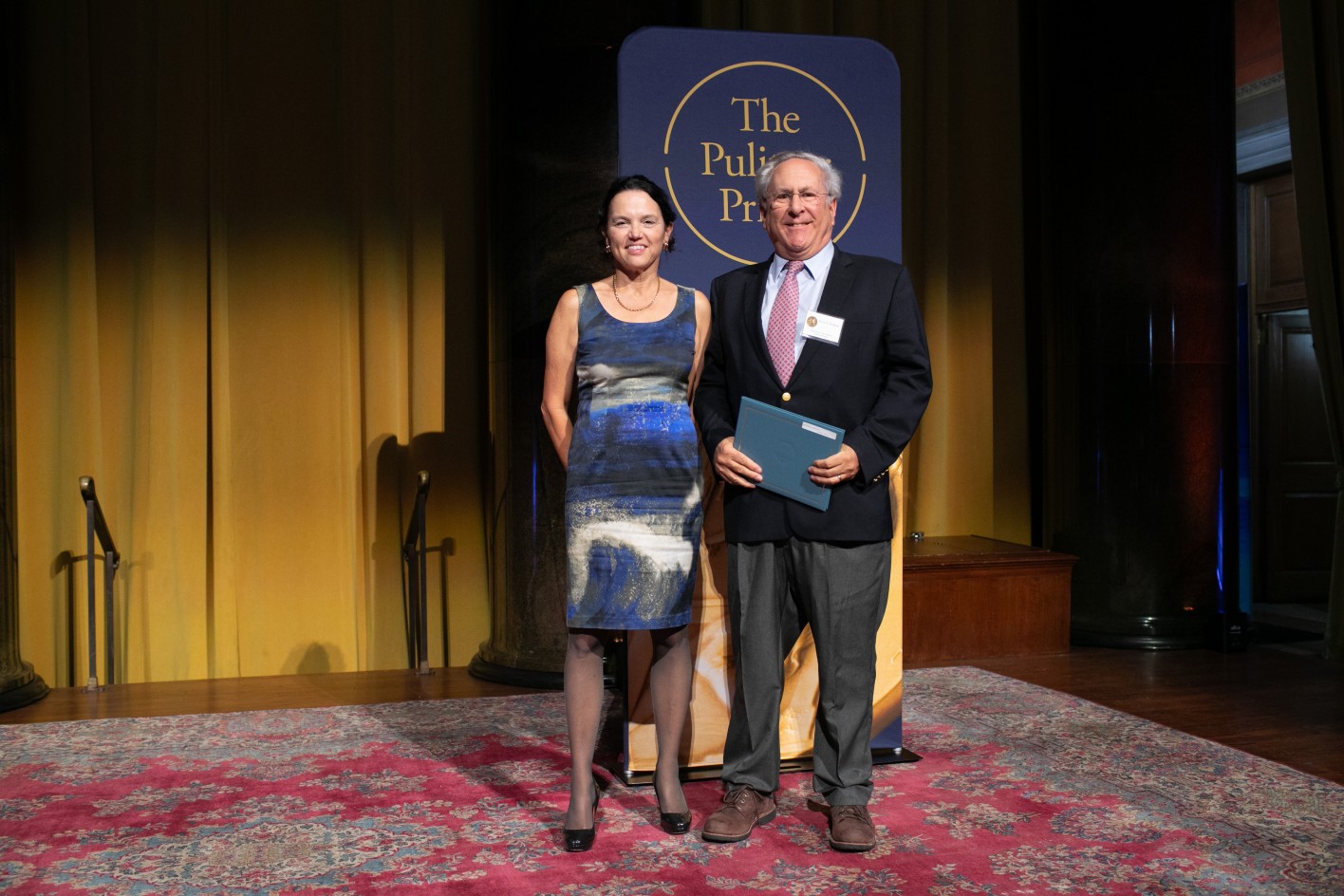
David E. Hoffman (right) accepts the 2024 Pulitzer Prize for Editorial Writing from Columbia University Interim President Katrina Armstrong. (David Dini/The Pulitzer Prizes)
Winning Work
On Feb. 27, 2022, Danuta Perednya, a 21-year-old university student, reposted a message on the messaging app Telegram criticizing Russian President Vladimir Putin and Belarusian President Alexander Lukashenko for the war in Ukraine.
On Dec. 28, 2020, a young Saudi Arabian woman, Salma al-Shehab, tweeted an appeal to release Loujain al-Hathloul, an activist who was in prison for seeking the right of women to drive in the kingdom.
In October, a 19-year-old Russian university student, Olesya Krivtsova, posted an Instagram story criticizing Russia's war in Ukraine. Her fellow students at Northern Federal University, in the northern city of Arkhangelsk, took a screenshot of the Instagram story - and reported her to the authorities.
Ms. Perednya was arrested and sentenced to 6½ years in prison. Ms. Shehab was sentenced to 34 years in prison and to a 34-year travel ban. Ms. Krivtsova has been added to a list of terrorists and extremists, charged with discrediting the military and put under house arrest, and she is facing seven years in prison. They all are being punished by despotic regimes for nothing more than posting or reposting something on social media.
That’s all — a click.
They are hardly alone. The world’s political prisons are bulging. A string of popular uprisings over the past few years brought hundreds of thousands of demonstrators to the streets, protesting against authoritarianism in Hong Kong, Cuba, Belarus and Iran; against the military junta that toppled democracy in Myanmar; and against strict restrictions on speech and protest in Russia and China. Also, Arab Spring uprisings swept Egypt, Syria and elsewhere a decade ago, and protests broke out in Vietnam in 2018. Most of these protests were met with mass crackdowns and arrests. Thousands of participants — largely young and demonstrating for the first time — have been held in prisons for demanding the right to speak and think freely and to choose their leaders.
Authoritarian regimes often work in the shadows, using secret police to threaten dissidents, censor the media, prohibit travel or choke off internet access. But when prisons are jam-packed with thousands who simply marched down the street or sent a tweet, the repression is no longer hidden; it is a bright, pulsating signal that freedom is in distress.
Political prisons are, sadly, not new. During the 20th century, the practice of mass repression grew to immense proportions in Joseph Stalin’s gulag system of forced labor camps. Political prisons have been notorious in Fidel Castro’s Cuba, Saddam Hussein’s Iraq, Cold War East Germany, apartheid South Africa, North Korea, and, in recent years, in China’s Xinjiang region.
According to the classic definition, formulated by Carl J. Friedrich and Zbigniew Brzezinski in 1956, a totalitarian dictatorship is characterized by an ideology, a single party led by one person, a terroristic police, government control of all communications, a weapons monopoly and a centrally controlled economy. In today’s world, fewer authoritarian states run a command economy. But many embrace the other characteristics. The political prisons are where the threads come together, punishing those who challenge a regime’s monopoly on power.
In earlier times, dissidents carried placards, issued manifestoes, staged strikes and engaged in public demonstrations. In one famous case, in August 1968, eight demonstrators took to Moscow’s Red Square to protest the Warsaw Pact invasion of Czechoslovakia to suppress the Prague Spring. “For your freedom and ours!” read one banner. Within minutes, the KGB tore down the banners and arrested the protesters. When dissenters were not easily found, the secret police still were on the prowl; the East German Ministry of State Security, known as the Stasi, developed an elaborate system to anticipate dissent and snuff it out. Neighbors informed on neighbors. Living under dictators usually meant living in fear.
Then came the digital revolution. The internet appeared to be the ultimate antidote to autocracy. It was open, decentralized, beyond a state’s control; it was global and empowered hundreds of millions of people to speak their minds without fear of retribution. Even when a prosperous and rising China sought to close itself off from the global internet with a Great Firewall and vast censorship, the digital byways still erupted periodically with fury and criticism. The world didn’t change overnight — fear of speaking out still lingered for many. But for a time, free speech began to outpace the ability of government to control it.
The authoritarian rulers were not idle. They planned to take back the public square, and now they are doing it. According to Freedom on the Net 2022, published by Freedom House, between June 2021 and May 2022, authorities in 40 countries blocked social, political or religious content online, an all-time high. Social media has made people feel as though they can speak openly, but technological tools also allow autocrats to target individuals. Social media users leave traces: words, locations, contacts, network links. Protesters are betrayed by the phones in their pockets. Regimes criminalized free speech and expression on social media, prohibiting “insulting the president” (Belarus), “picking quarrels and provoking trouble” (China), “discrediting the military” (Russia) or “public disorder” (Cuba).
Ms. Perednya’s case is chilling. She was an honors student at Belarus’s Mogilev State University. Three days after Russia’s invasion of Ukraine, she reposted, in a chat on Telegram, another person’s harsh criticism of Mr. Putin and Mr. Lukashenko, calling for street protests and saying Belarus’s army should not enter the conflict.
She was arrested the next day while getting off a bus to attend classes. Judges have twice upheld her 6½-year sentence on charges of “causing damage to the national interests of Belarus” and “insulting the president.”
In Saudi Arabia, Ms. Shehab’s tweet was a simple hashtag, #FreeLoujain. It was a reference to Loujain al-Hathloul, the women’s rights activist who was at the time imprisoned for demanding the right to drive. Ms. Shehab was detained in January 2021 and initially charged with trying to “disturb public order and destabilize the security and stability of the state.” Later, prosecutors said she should be charged under counterterrorism and cybercrime statutes and was given the horrific 34-year sentence. Her two sons were 4 and 6 years old when she was detained, and she has not seen them in two years. Ms. Hathloul was released from prison just weeks after Ms. Shehab was arrested.
In July 2021, a husband and wife in Belarus, Anastasiya Krupenich-Kandratsiyeva, a teacher, and Siarhei Krupenich, a tech worker, exchanged messages with each other over Telegram, sharing reposts from some of the hundred or so channels Belarus’s dictatorship has labeled as “extremist.” They were arrested. At a police station, officers opened Ms. Krupenich-Kandratsiyeva’s phone and found the messages. The couple each spent several months in prison, then were released and fled the country.
Freedom on the Net 2022 surveyed internet freedom in 70 countries, covering 89 percent of the world’s internet users. Officials in at least 53 countries charged, arrested or imprisoned internet users in retaliation for posts about political or social causes. This kind of repression is deepening in Ethiopia, Libya, Morocco, Myanmar, Rwanda and Turkey. Very rarely is it reversed, as in Nicaragua, where 222 political prisoners were released and forced into exile last week.
Of all the countries in the world, however, China remains the most repressive. It has used prison camps since the early days of the People’s Republic, as depicted in the 1973 memoir “Prisoner of Mao,” by Bao Ruo-Wang. He was labeled a counterrevolutionary and sent to forced labor camps in the late 1950s. At one point, he was handcuffed and stuffed into a coffin-like cell not large enough to stand in, with a dirty blanket, a wooden bucket for a latrine and a light bulb that never went off.
Today, Chinese authorities deploy multiple types of coercion and repression: the forced incarceration of more than 1 million Uyghurs, many of them in bleak concentration camps surrounded by barbed wire; a long-running campaign against the religious group Falun Gong and unofficial Christian churches; targeted punishment for dissent; and a relentless attempt to censor the internet. Freedom on the Net 2022 says that China remains “the world’s worst environment for internet freedom,” adding that “journalists, human rights activists, members of religious and ethnic minority groups, and ordinary users were detained for sharing online content, with some facing harsh prison sentences.”
The database run by the Congressional-Executive Commission on China has 2,506 active cases of detention in China, referring to political and religious prisoners known or believed to be detained or imprisoned or under coercive controls. Another database, maintained by the Dui Hua humanitarian organization, which has tracked political and religious cases since 1980, lists 7,683 active cases, many of which involve members of the outlawed Falun Gong religious group. In recent years, the Chinese government has better concealed details about political prisoners. But it is clear that the government’s highly sophisticated surveillance system — including facial recognition and even technology that can identify a person by their gait — is zeroing in on dissent and protest.
After a wave of protest against covid-19 restrictions in late November, Doa, a 28-year-old tech worker in Beijing, told The Post that she and a friend were at a night demonstration briefly, keeping away from police and people filming with their phones. “I worked before in the social media industry. … I know how those things can be used by police,” she said. “They still found me. I’m still wondering how that is possible.” She added: “All I can think of is that they knew my phone’s location.” Two days later, police called her mother, claiming Doa had participated in “illegal riots” and would soon be detained. “I don’t know why they did it that way. I think it creates fear,” Doa said. A few hours later, the police called her directly, and she was summoned to a police station in northern Beijing, where her phone was confiscated and she underwent a series of interrogations over roughly nine hours. The group Chinese Human Rights Defenders estimates that more than 100 people have been detained for the November protests.
The worldwide toll of this sort of 21st-century authoritarianism is growing. Over the past four years, just four uprisings in various parts of the world have led to nearly 18,000 people being arrested and incarcerated. In Belarus, mass demonstrations erupted after Mr. Lukashenko stole an August 2020 election. The number of political prisoners in Belarus has soared from a handful to 1,441 now. In Myanmar, or Burma, citizens are fighting a military coup that overthrew its young democracy in February 2021. There are 13,884 political prisoners there today. In Cuba, on July 11, 2021, a massive and spontaneous street protest broke out across the island, and more than 1,000 have been arrested in its wake. In Hong Kong, there were only a handful of political prisoners in 2019, when protests erupted against China’s increasingly authoritarian rule; now, there are 1,337. An additional 20,000 people have been detained in Iran since protests began there in September. A young Iranian couple were recently sentenced to five years in prison each after a video went viral on Instagram of them dancing in public, the woman without a head covering.
Many of these prisoners are young. In Hong Kong, about three-fourths of those given prison time are under the age of 30; more than half are under 25. In Cuba, the average age is 32. The situation is similar in Myanmar and Belarus. In Russia, the share of women taking to the streets has risen dramatically in recent years. Women accounted for as much as 31 percent of the crowd in 2021 rallies for Russian opposition leader Alexei Navalny; after the Kremlin announced mobilizations of men for the Ukraine war, women made up 51 and 71 percent of the crowd at rallies on Sept. 21 and Sept. 24, respectively.
Protesters and dissidents need help to evade government controls. Free countries can develop and spread encryption software that protects their digital communications, as well as tools allowing people to circumvent government internet blockages, snooping and tracking. In times of conflict, helping besieged demonstrators stay online and spread the word can be vital, for example by deploying mobile internet technology such as the Starlink terminals used in Ukraine, Iran and elsewhere.
But as authoritarian regimes evolve and adapt to such measures, protesters will require new methods and tools to help them keep their causes alive — before the prison door clangs shut. It is a job not only for democratic governments, but for citizens, universities, nongovernmental organizations, civic groups and, especially, technology companies to figure out how to help in places such as Belarus and Hong Kong, where a powerful state has thrown hundreds of demonstrators into prison without a second thought, or to find new ways to keep protest alive in surveillance-heavy dystopias such as China.
Free nations should also use whatever diplomatic leverage they have. When the United States and other democracies have contact with these regimes, they should raise political prisoners’ cases, making the autocrats squirm by giving them lists and names — and imposing penalties. The Global Magnitsky Act offers a mechanism for singling out the perpetrators, going beyond broad sanctions on countries and aiming visa bans and asset freezes at individuals who control the systems that seize so many innocent prisoners. The dictators should hear, loud and clear, that brutish behavior will not be excused or ignored.
Every political prisoner’s case is a travesty of justice. Freedom of expression, association and belief are not crimes. The most powerful answer is to shine a spotlight on the plights of political prisoners and make sure they are not forgotten.
Information is the world’s lifeblood. It pulsates in torrents of facts and images. We are swamped with it.
But information can be poison, a dangerous weapon. Disinformation, or organized lying, can be used to wage political warfare. As the historian Thomas Rid wrote in “Active Measures,” his book on the subject, disinformation can weaken a political system that places its trust in truth. “Disinformation operations, in essence, erode the very foundations of open societies,” he wrote.
A disinformation operation now being waged by Russia shows in stark detail how this malevolence works. Taking a program by the United States that was intended to make people healthier and safer in the former Soviet Union, a program it had welcomed and participated in for 22 years, Russia twisted facts into a cloud of falsehoods. The campaign, rooted in decades-old traditions of disinformation by the Kremlin, has intensified during Russia’s ruinous war on Ukraine in the last year.
In a previous editorial in this series, we examined how young people who posted freely on social media have been wrongly arrested and sentenced to years in prison by authoritarian regimes. This editorial looks at disinformation as a tool of dictatorship. Disinformation is not just “fake news” or propaganda but an insidious contamination of the world’s conversations.
And it is exploding.
A helping hand
On Aug. 29, 2005, Barack Obama, then a Democratic senator from Illinois, and Sen. Richard G. Lugar, Republican of Indiana, visited a laboratory at Kyiv’s Central Sanitary and Epidemiological Station in Ukraine. This facility was not well secured and, by the nature of its public health work, held dangerous pathogens. Andy Weber, a U.S. Defense Department official, showed Mr. Obama a tray of small vials: samples of Bacillus anthracis, the bacterium that causes anthrax. “I saw test tubes filled with anthrax and the plague lying virtually unlocked and unguarded — dangers we were told could only be secured with America’s help,” Mr. Obama recalled.
There was deep concern after 9/11 that terrorists could obtain such materials. Ukrainian President Leonid Kuchma asked the United States to check the security of his nation’s chemical and biological facilities, and Mr. Weber, who had helped uncover the illegal Soviet biological weapons system, spent two weeks with a small team scrutinizing Ukraine’s facilities in late 2001. The lab in Kyiv that Mr. Obama visited held pathogens that cause not only anthrax but also tularemia, brucellosis, listeriosis, diphtheria, cholera, typhoid and others.
On the day of Mr. Obama’s visit, Ukraine signed an agreement with the United States to upgrade and modernize the labs. For example, cattle in Ukraine occasionally became naturally infected with anthrax and the Ukrainian scientists had been culturing the anthrax bacillus for diagnostic purposes, which meant they kept cultures of it, a potential target for terrorists. The U.S. assistance would help them move toward using safer molecular diagnostic methods, such as polymerase chain reaction and antigen testing. The United States also pledged to improve the locks on the doors and beef up capabilities so they could detect disease outbreaks sooner, as well as spot the cause.
The agreement with Ukraine grew out of the 1992 Nunn-Lugar legislation, sponsored by Mr. Lugar and Sen. Sam Nunn (D-Ga.) to clean up the Cold War legacy of nuclear, chemical and biological weapons in the former Soviet Union, an effort that became known as Cooperative Threat Reduction. In the 1990s, thousands of nuclear warheads and missiles were liquidated, followed by vast stocks of chemical weapons. Later, the Nunn-Lugar program expanded into reducing biological threats in Russian laboratories, as well as other former Soviet republics. Among other efforts, a public health reference laboratory — named the Lugar Center — was opened in Tbilisi, Georgia, in 2011. Pathogens stored in a Soviet-era research institute in the center of Tbilisi were moved to a purpose-built, secure facility.
The Nunn-Lugar program was partially in the U.S. interest. But it was also an act of benevolence. The sole remaining superpower extended a hand to nations that were weak and struggling, providing about $1 billion a year to the former Soviet republics. Since 2005, the U.S. agreement with Ukraine has led to $200 million in aid for 46 biomedical and health facilities. The assistance was not forced on anyone — it was designed to make people safer and healthier. The recipients were eager for it. The aid to Russia was terminated by President Vladimir Putin in 2014 but continued elsewhere.
Turning the truth upside down
The Cold War never became a hot war between the superpowers, but the competition was fought intensely in the shadows. Disinformation was a Soviet tactic from 1949 to 1988. One major effort, carried out by the Soviet Union, China and North Korea during the Korean War, between 1951 and 1953, claimed the United States had released bacteria and infected insects into North Korea and China. The charges were fabricated but received wide circulation and were only proved false in 1998 by Soviet Central Committee documents published by University of Maryland scholar Milton Leitenberg. He obtained a copy of a cable to Mao Zedong, sent after Joseph Stalin’s death, that read, “The Soviet Government and the Central Committee of the [Communist Party of the Soviet Union] were misled. The spread in the press of information about the use by the Americans of bacteriological weapons in Korea was based on false information. The accusations against the Americans were fictitious.”
In another disinformation campaign, the Soviet Union pushed a false story in the 1980s that the United States had genetically engineered the virus that causes AIDS at Fort Detrick, a U.S. Army biomedical facility. Another lie was added that the virus was released in Africa to kill Africans. The KGB planted the story in news media around the globe. Polls later showed that the campaign had been successful: A compilation of 20 public opinion surveys of African Americans between 1990 and 2009 showed that an average of 28 percent of respondents believed that genocide was involved in the origin of HIV.
In more recent years, the Nunn-Lugar program became a frequent target of Russia’s disinformation campaigns. Because the funding came partially through the Pentagon’s Defense Threat Reduction Agency, Russia frequently claimed that military research was underway in the recipient facilities. The Lugar Center was a major focus. In December 2009, an item in the Russian newspaper Pravda claimed “biological weapons are being secretly developed on Georgia territory.” The article contained no fewer than nine discrete false allegations.
In 2018, Russia aimed a fresh burst of disinformation at the Lugar Center. On Jan. 16, South Front, a website connected to Russian intelligence agencies, posted a 49-page document titled “The Pentagon Bio-Weapons.” It was a subtle mix of authentic historical documents describing the pre-1969 U.S. biological weapons program — before a 1972 treaty outlawed germ warfare — with falsehoods implying that the United States was continuing work on bioweapons at the Lugar Center. In September, a former KGB officer and onetime Georgian security official, Igor Giorgadze, appeared on Russian television channels RT and Sputnik with documents that he claimed showed the Lugar Center “could be a cover for a bioweapons lab” doing experiments on humans. He also alleged the U.S. government had granted patents for biological weapons devices. Soon after, a Russian Foreign Ministry official said the United States was using the Georgian people “as guinea pigs.” Then, Russian Gen. Igor Kirillov, head of the radiation, chemical and biological defense forces, announced that the Lugar Center had been “testing a highly toxic chemical or highly lethal biological agent under the guise of treatments.”
These claims were fictitious, but they made headlines. On May 26, 2020, the Russian Foreign Ministry released a three-page statement about the Lugar Center containing no less than 16 false statements, some absurd, such as about the germ warfare “patents.”
The Lugar Center’s mission was to protect people from disease. Nine Russian scientists had visited it since 2016, and some of them had actually worked there. The Russian government knew its allegations were lies but used them to create a disinformation bomb about biological weapons. The Russian effort, Mr. Leitenberg concluded, “repeatedly displays a brazen, disdainful, spit-in-your-eye character.”
‘Firehose of falsehoods’
As Putin’s troops stormed into Ukraine on Feb. 24, 2022, Russia’s disinformation warriors used the same approach as they had in Georgia.
The Russian defense ministry announced on March 6 that it had obtained documents from workers at Ukrainian laboratories showing that dangerous pathogens were destroyed on the day of the invasion. Spokesman Igor Konashenkov said the documents “confirm that components of biological weapons were developed in Ukraine bio laboratories in close proximity from the territory of Russia.” He said the pathogens, such as plague, anthrax, tularemia and cholera, were destroyed to conceal the U.S. involvement.
This was a total fiction. But thanks to social media, the claims raced around the globe at the speed of light. On March 8, Chinese Foreign Ministry spokesman Zhao Lijian repeated the Russian lies, saying the United States “has 26 bio-labs and other related facilities in Ukraine, over which the U.S. Department of Defense has absolute control,” and, “the biological military activities of the U.S. in Ukraine are merely the tip of the iceberg,” with 336 biological labs in 30 countries. He called on the United States to “fully clarify its biological militarization activities both inside and outside its borders.” Within hours, at least 17 Chinese state media outlets posted his accusations, and on China’s Weibo social media, the topic gained more than 210 million views.
On March 9, Fox News host Tucker Carlson picked it up, too. Undersecretary of State for Political Affairs Victoria Nuland had told a Senate hearing that it was important the invading Russian troops not take over the Ukraine research facilities. A Russian spokeswoman said Ms. Nuland’s comment confirmed the United States’ “illegal and criminal activity on Ukrainian soil.” Mr. Carlson then pounced, saying the Russian account of the biological weapons laboratories “is, in fact, totally and completely true. Whoa.” He also said, “We would assume ... they were working on bioweapons.”
On March 10, Gen. Kirillov announced that the documents obtained by Russia showed that the United States was trying to “develop bioagents capable of targeting various ethnic groups,” such as ethnic Slavs. No such effort, of course, existed.
The next day, Russia called a meeting of the Security Council to air the lies it had concocted. The U.S. ambassador to the United Nations, Linda Thomas-Greenfield, said, “There are no Ukrainian biological weapons laboratories supported by the United States — not near Russia’s border, or anywhere.”
“Let me be clear,” said Director of National Intelligence Avril Haines at a Senate hearing, “we do not assess that Ukraine is pursuing either biological weapons or nuclear weapons.”
On March 16, Mr. Putin made the disinformation charge directly. “A network of dozens of laboratories operated in Ukraine, where military biological programs, including experiments with samples of coronavirus, anthrax, cholera, African swine fever and other deadly diseases, were carried out under the supervision and financial support of the Pentagon,” he said, claiming that “they are now strenuously trying to cover up the evidence of these secret programs.”
On March 18, Russia again called a U.N. Security Council meeting to discuss its claims. But the U.N. High Representative for Disarmament Affairs, Izumi Nakamitsu, said the United Nations “is not aware of any such biological weapons programs.”
Surprisingly, a Russian biologist, Yevgeny Levitin, posted an open letter online, with some other scientists, titled, “Stop the lies on Ukrainian bioweapons!” The letter said the Russian documents were “obviously false” and do not describe biological weapons. Asked why he spoke out, Levitin said, “Because they wrote pure lies. This is a deliberate lie, which is not justified in any way. This will become obvious to any person who takes the trouble to simply carefully read the documents.”
Russia relentlessly stoked the lies. On March 31, it submitted formal statements repeating the bioweapons charge to the U.N. Conference on Disarmament in Geneva. On April 4, the two houses of the Russian parliament voted to launch a special parliamentary inquiry into the Ukrainian laboratories. On May 13, Russia called for a U.N. Security Council meeting for a third time; a top U.N. official said there was still no evidence of biological weapons programs in Ukraine. On May 27, Gen. Kirillov delivered another briefing with wide-ranging allegations of U.S. and Ukrainian involvement in biological weapons. Russia charged that the Ukraine laboratories were preparing to send migratory birds and bats with disease into Russia, an echo of the false “infected insects” supposedly sent into China 70 years earlier. By summer, the claims reached bizarre sci-fi levels: Russian officials said in July that Ukrainian soldiers were subjected to “secret experiments” that “neutralized the last traces of human consciousness and turned them into the cruelest and deadliest monsters” and “the most cruel killing machines.”
In September, Russia kept up the drumbeat by triggering a formal review under the 1972 Biological and Toxin Weapons Convention, for only the second time in the treaty’s history. The overwhelming number of states involved in the review rejected the allegations. In October, Russia filed a long complaint, accompanied by a draft resolution calling for an investigative commission, with the U.N. Security Council. The resolution failed to gain enough support to pass.
At the Security Council on Oct. 26, Ms. Thomas-Greenfield admonished the Russians for calling yet another meeting that “is a colossal waste of time.”
“We all know these claims are pure fabrications, brought forth without a shred of evidence,” she added.
The Russian disinformation strategy is not to be ashamed or shy, but to pump out more. At Mr. Putin’s Moscow summit with Chinese leader Xi Jinping on March 21, the two leaders did it again, expressing “serious concern” about the biological military activities of the United States, both inside and outside the country.” In April, the Russian parliament commission is expected to deliver its report, another chance to spread the contamination. Russia’s authoritarian system is able to exploit many instruments — security services, cutouts, websites, diplomats and state-controlled media — to create an ecosystem for disinformation. Rand Corp., the think tank, a few years ago called Russia’s strategy a “firehose of falsehoods.”
The threat of biological weapons inspires public anxiety and fear, even more so after a catastrophic pandemic. Both Cold War superpowers researched biological weapons, which were outlawed in the 1972 treaty. The Soviet Union signed the treaty but then secretly built the largest biological weapons program the world had ever seen, including standby factories to create germ warfare agents in the event of war. The Soviet program was exposed after the Cold War ended. It was especially pernicious for Russia to throw this charge at the United States.
Why Russia does it — and how to strike back
The Kremlin’s disinformation casts the United States — and Ukraine — as villains for creating germ warfare laboratories, giving Mr. Putin another pretext for a war that lacks all justification. The disinformation undermines the biological weapons treaty, showing that Mr. Putin has little regard for maintaining the integrity of this international agreement. The disinformation attempts to divert attention from Russia’s barbaric onslaught against civilians in Ukraine. In 2018, the Kremlin may have been seeking to shift attention from the attempted assassination of former double agent Sergei Skripal in Britain, or from the Robert S. Mueller III investigation that year of Russian meddling in the U.S. presidential campaign.
The biological laboratories are just one example of Russia’s wider disinformation campaigns. Data shared by Facebook shows Russians “built manipulative Black Lives Matter and Blue Lives Matter pages, created pro-Muslim and pro-Christian groups, and let them expand via growth from real users,” says author Samuel Woolley in “The Reality Game.” He adds, “The goal was to divide and conquer as much as it was to dupe and convince.” During the pandemic, Russia similarly attempted to aggravate existing tensions over public health measures in the United States and Europe. It has also spread lies about the use of chemical weapons, undermining the treaty that prohibits them and the organization that enforces it. In the Ukraine war, Russia has fired off broadsides of disinformation, such as claiming the victims of the Mariupol massacre were “crisis actors.” Russia used disinformation to mask its responsibility for the shoot-down of the Malaysia Airlines flight MH-17 over Ukraine in 2014.
The disinformation over Ukraine, repeated widely in the Russian media, plays well with social groups that support Putin: the poor, those living in rural areas and small towns, and those being asked to send young men to the front. Mr. Putin so tightly controls the news media that it is difficult for alternative news and messages to break through.
Does the disinformation persuade anyone outside of Russia? It is impossible to know how much is accepted or changes minds. But a survey in Germany suggests that the drumbeat of lies takes a toll. In a nationwide public opinion poll by CeMAS, respondents were asked whether they agree, disagree or partially concur with the statement: “Ukraine, together with the U.S., has operated secret biolabs for the production of biological weapons.” The poll in April found 7 percent agreed, 79 percent disagreed and 14 percent said some of each. By October, 12 percent said they agreed, 67 percent disagreed and 21 percent said some of each.
The pollsters called the results “quite worrying” and pointed out that “anti-democratic actors use disinformation campaigns not only to convince, but also to sow doubt among the population.”
This is the key point: Disinformation is a venom. It does not need to flip everyone’s, or even most people’s, views. Its methods are to creep into the lifeblood, create uncertainty, enhance established fears and sow confusion.
The best way to strike back is with the facts, and fast. Thomas Kent, the former president of Radio Free Europe/Radio Liberty, has pointed out that the first hours are critical in such an asymmetrical conflict: Spreaders of disinformation push out lies without worrying about their integrity, while governments and the news media try to verify everything, and take more time to do so. Mr. Kent suggests speeding the release of information that is highly likely to be true, rather than waiting. For example, it took 13 days for the British government to reach a formal conclusion that Russia was behind the poisoning of Mr. Skripal, but within 48 hours of the attack, then-Foreign Secretary Boris Johnson told Parliament that it appeared to be Russia, which helped tip the balance in the press and public opinion.
In Ukraine, when Russia was on the threshold of invasion, government and civil society organizations rapidly coordinated an informal “early warning system” to detect and identify Russia’s false claims and narratives. It was successful when the war began, especially with use of the Telegram app. In a short time, Telegram use leapt from 12 percent adoption to 65 percent, according to those involved in the effort
Also in Ukraine, more than 20 organizations, along with the National Democratic Institute in Washington, had created a disinformation debunking hub in 2019 that has played a key role in the battle against the onslaught of lies. A recent report from the International Forum for Democratic Studies at the National Endowment for Democracy identified three major efforts that paid off for Ukraine in the fight against Russian disinformation as war began. One was “deep preparation” (since Russia was recycling old claims from 2014, they were ready); active and rapid cooperation of civil society groups; and use of technology, such as artificial intelligence and machine learning, to help sift through the torrents of Russian disinformation and rapidly spot malign narratives.
Governments can’t do this on their own. Free societies have an advantage that autocrats don’t: authentic civil society that can be agile and innovative. In the run-up to the Ukraine war, all across Central and Eastern Europe, civil society groups were sharpening techniques for spotting and countering Russian disinformation.
Plain old media literacy among readers and viewers — knowing how to discriminate among sources, for example — is also essential.
Open societies are vulnerable because they are open. The asymmetries in favor of malign use of information are sizable. Democracies must find a way to adapt. The dark actors morph constantly, so the response needs to be systematic and resilient.
In a world that connects billions of people at a flash, the truth may have only a fighting chance against organized lying. As an old saying has it: “A lie can travel halfway around the world while the truth is putting on its shoes.”
In the spring of 2012, Vladimir Putin was feeling the pressure.
For months, anti-Putin protests had surged through the streets of Moscow and other cities following fraudulent parliamentary elections the previous December. Mr. Putin, who was about to be sworn in for a third term as president, harbored a fear of “color” revolutions — the 2003 Rose Revolution in Georgia, the 2004-2005 Orange Revolution in Ukraine — as well as other popular revolts like the 2010-2012 Arab Spring, in which four dictators were overthrown. Until his inauguration in May, Russian authorities had tolerated the demonstrations. But when street protests broke out again, some marred by violence, the police moved in aggressively and hundreds were arrested.
On July 20, Mr. Putin signed legislation — rushed through parliament in just two weeks — to give the government a strong hand over nongovernmental organizations (NGOs), which he suspected were behind the protests. He had long been apprehensive about independent activism, especially by groups that were financed from abroad. Under the new law, any group that received money from overseas and engaged in “political activity” was required to register as a “foreign agent” with the Justice Ministry or face heavy fines.
The law crippled these groups, the backbone of a nascent civil society that had blossomed in the 1990s in Russia after the dissolution of the Soviet Union. Such organizations are the heartbeat of a healthy democracy, providing an independent and autonomous channel for people to voice their desires and aspirations. One of the first groups to be targeted was Memorial, founded during Mikhail Gorbachev’s years of reform to protect the historical record of Soviet repressions and to defend human rights in the current day. Mr. Putin was determined to squelch it and others like it.
Soon, similar laws began to crop up around the world. In the following years, at least 60 nations passed or drafted laws designed to restrict NGOs, and 96 carried out other policies curtailing them, imposing cumbersome registration requirements, intrusive monitoring, harassment and shutdowns. The wave of repressive measures offers a revealing look at the titanic struggle between democracy and authoritarianism. In the past decade, dictators have forged transnational bonds, sharing methods, copying tactics and learning from one another. They are finding new ways to quash free speech and independent journalism, eradicate NGOs, silence dissent and suffocate criticism.
In previous editorials in this series, we examined how young people who posted freely on social media were wrongly imprisoned by authoritarian regimes. We also described how Russia created and exploited disinformation about biological weapons. This editorial looks at how autocracies are reinforcing themselves by swapping methods and tactics.
The dictators want most of all to survive. They are succeeding.
A cascade of restrictions
The Russian “foreign agent” law hung an albatross around the neck of NGOs and, later, independent journalists and bloggers — anyone who received any money from abroad, even payment for a single freelance article. All were required to post a label on their published material identifying it as the work of a “foreign agent,” which in Russia has traditionally been associated with spying. When many organizations refused to oblige, the law was amended so the Justice Ministry could put them in the registry without their consent. Then in 2015, Russia added a new law designating any organization “undesirable” if the government deemed it a threat to national security — effectively a ban. One of the organizations so labeled was the Open Society Foundations established by financier George Soros, which had been, among other things, a lifeline of personal subsidies for Russian scientists in the lean years after the Soviet collapse.
Azerbaijan was the first among former Soviet republics to copy Russia’s 2012 law in 2013 and 2014. Then came Tajikistan in 2014 and Kazakhstan in 2015 with legislation directly limiting foreign funding to NGOs or sharply increasing bureaucratic burdens on them. The laws were largely borrowed from Russia. The cascade of laws has been documented in the Civic Freedom Monitor of the International Center for Not-for-profit Law.
Egypt also put NGOs in the crosshairs. In 2013, the courts convicted 43 NGO workers, including Americans, Egyptians and Europeans, many in absentia, on charges of operating without required government approval. The notorious criminal prosecution, Case 173, dragged on for years. Although the 43 were later acquitted in a retrial, the harassment continues. Under President Abdel Fatah El-Sisi, Egyptian authorities have frozen the assets of human rights activists, banned them from traveling abroad and regularly called them in for questioning on suspicions of “foreign funding.” This included Hossam Bahgat, founder and director of the Egyptian Initiative for Personal Rights, one of Egypt’s most well-known rights organizations. Egypt replaced a draconian 2017 law on NGOs with a new one in 2019 but retained many harsh restrictions. The new law banned activities under vaguely worded terms such as any “political” work or any activity that undermines “national security.”
Cambodia, ruled by strongman Hun Sen for decades, in 2015 imposed a law under which NGOs can be disbanded if their activities “jeopardize peace, stability, and public order or harm the national security, culture and traditions of Cambodian society.” Uganda, which has an active community of NGOs, imposed a restrictive law in 2016; the groups have faced suspensions, freezing of accounts, denial of funding and restrictions on freedom of expression, association and assembly. In Nicaragua, the dictatorship led by former Sandinista guerrilla Daniel Ortega adopted a “foreign agent” law in 2020 and a law restricting NGOs in 2022. It has canceled the legal registration of more than 950 civil society organizations since 2018.
China, which originally permitted NGOs to exist in a legal gray zone, took a harder line after Xi Jinping came to power in 2012. A new NGO law went into effect in 2017, increasing state control over foreign and domestic funding to civil society groups. While Russia operated with blacklists, China created a whitelist, rewarding some NGOs whose interests it approved, as it sought to punish those in sensitive areas such as media, human rights and religion. Lu Jun, co-founder of one of the early successful NGOs, the Beijing Yirenping Center, which fought discrimination, recalled the ways in which the state turned against his group. For seven years, it was allowed to grow. But then, he recalled, “Between 2014 and 2019, in four separate crackdowns, nine of my colleagues were jailed and five of our offices were repeatedly searched until they were shut down.”
A secret school — or ‘mad scientists’?
How did so many countries come to do the same thing in the same decade? The answers are difficult to find — dictatorships are shrouded in secrecy. But Stephen G.F. Hall, a professor at the University of Bath, in Britain, uncovered evidence that the dictators copy, share and learn from one another. His new book, “The Authoritarian International,” looks at how this works.
According to Mr. Hall, authoritarian regimes must constantly maintain the illusion of steadfast control. Relax for a minute, and the illusion could vanish. “Protest is like a run on the bank,” Mr. Hall told us. “The protesters only have to get it right once.” For autocracies, protest and dissent are an existential threat.
“They’ve all seen what happens to autocrats generally — the Gaddafi moment, being dragged through the streets and beaten to death with a lead pipe. … They seem to know that if one country becomes democratic in a region, the rest will almost certainly follow. … And the best way to ensure that survival is to learn, to cooperate and to share best practices because you constantly have to stay one step ahead.”
Mr. Hall says much “authoritarian learning” is indirect, diffused through like-minded networks and emulation. When he began his research, he thought he might find an actual school of dictatorship, with Mr. Putin or other despots as “either star pupils or teachers telling other autocrats how to establish best survival practices.” But Mr. Hall did not find contemporary evidence of such a school. “I think it is primarily a case of trial and error,” he said, with the dictators more like “mad scientists” who run experiments and then share the results. which are passed around in the shadows, through security services and old-boy networks.
And there are traces of collaboration. According to Mr. Hall, Russia has frequently looked to Belarus as a proving ground and source of authoritarian methods. In 2002, Belarusian strongman Alexander Lukashenko created the Belarusian Republican Youth Union, a pro-regime, patriotic organization that could take control of the streets in Minsk in the event of an attempted color revolution. After the Orange Revolution in Ukraine, the Kremlin quickly created its own groups of “patriotic youths.” Years later, when Mr. Lukashenko was facing massive protests after stealing the 2020 presidential election, Mr. Putin came to his rescue. For instance, when Belarusian television workers quit their jobs in protest of the election fraud, Mr. Putin sent in Russians to keep the broadcasts going. (For Russia, the help is also driven by security concerns, given Belarus’s proximity to NATO.) Belarus also cooperates with China, which has long provided it with facial recognition technology. China’s telecommunications giant Huawei set up research centers in Belarus and brought Belarusian students to China for training.
Some authoritarian learning has its origin in history books. Magnus Fiskesjö, a professor at Cornell University, has shown how China in the past decade or so has brought back show trials, with staged, coerced confessions, borrowing both from the Mao era and reaching back to Joseph Stalin’s show trials of the 1930s. The extrajudicial show trials have been used against journalists, bloggers, academics, lawyers and entertainers, among others. The forced confessions go a step further than just silencing dissent; they are used to “shape reality” and create a more “predictably obedient society.”
The digital censors
In the world of authoritarian tactics, Russia and China are the center of gravity. They share know-how for policing the internet and generate sheaves of propaganda and disinformation, sometimes broadcasting identical sets of lies at the same time. Mr. Putin and Mr. Xi declared a “no limits” partnership in February 2022, but closer cooperation to squelch free speech on the internet was already well underway.
A glimpse of how it works was provided recently in a trove of internal documents, emails and audio recordings disclosed by Radio Free Europe/Radio Liberty in an April 5 report by Daniil Belovodyev, Andrei Soshnikov and Reid Standish. The materials depict Russia and China working closely to help each other more tightly control the internet in two high-level meetings in 2017 and 2019.
The first meeting, on July 4, 2017, was a two-hour session in Moscow between Ren Xianling, who was then-deputy minister of the Cyberspace Administration of China, and Aleksandr Zharov, then-head of Roskomnadzor, the Russian government agency that censors the internet. According to the documents and other materials, the Russians wanted expertise from China about “mechanisms for permitting and controlling” mass media, online media and “individual bloggers,” as well as China’s experience regulating messenger apps, encryption services and virtual private networks. The Russians asked to send a delegation to China to study its vast domestic surveillance system and the “Great Firewall” that blocks unwanted overseas information. The Chinese visitors were particularly interested in methods used by the Russian agency to control the media coverage of public protest. The Chinese visitors’ questions were prompted by public demonstrations just a few months before, organized by opposition leader Alexei Navalny in March 2017. Mr. Zharov reportedly responded that the Kremlin wasn’t worried because the protests were small-scale and Mr. Putin’s public support was at a “very high level.”
The discussion came just as Russia was looking at how to install more sophisticated controls over the internet. The government attempted in 2018 to block the popular messaging platform Telegram but failed to do so. In May 2019, Mr. Putin signed new legislation requiring that Russian companies install more intrusive controls, and also envisioning the creation of an entirely isolated Russian internet. Outside researchers have found that the new controls gave the Kremlin “fine-grained information control” over internet traffic.
In July 2019, the Russian and Chinese teams met again in Moscow, according to the RFE/RL report. Mr. Zharov asked the Chinese for advice about how to deal with platforms that successfully evade Russia’s blocking. The failure with Telegram was brought up as an example. The Russians also asked the Chinese how they used artificial intelligence to identify and block “prohibited content.” RFE/RL disclosed this year that Roskomnadzor has been using sophisticated techniques to track Russians online, searching for posts that insult Mr. Putin or call for protests.
Then in October 2019, on the sidelines of the World Internet Conference in China, Russia and China signed a cooperation agreement on counteracting the spread of “forbidden information.” In December 2019, China sent requests to Russia, in three separate letters, with censorship requests to block articles and sites, such as the Epoch Times, a newspaper with ties to the Falun Gong movement that is persecuted in China, and links on GitHub, the software development website, that describe ways to bypass China’s firewall inside the country.
The dictators have clung to power
Of course, the United States and other democracies also cooperate and spend billions of dollars annually promoting the values of open societies and rule of law around the world. Like the dictators, the democracies share tactics and methods with one another. But there is one important difference: Diffusion of democracy appeals to — and relies upon — individuals and free thinking, while autocrats pursue their own survival by suffocating individual voices.
The latest Freedom in the World report shows a decline in freedom for the 17th year in a row. Many autocrats are proving resilient. In the nearly 11 years since Mr. Putin signed the “foreign agent” law, most of the world’s leading dictators have held on. Rarely have they been toppled by popular protests. They are building new means of repression along with the old. In China, tech companies have invented an electronic surveillance system that can automatically recognize a protest banner and demonstrators’ faces — and alert the police.
In Russia, Mr. Putin is unrestrained. The “foreign agent” and “undesirable” laws were revised again in 2022, making them significantly more draconian. While the earlier version singled out those who received money from abroad, now a “foreign agent” can be anyone who receives any kind of support from overseas or comes “under foreign influence in other forms.” New names are added every Friday to the registry compiled by the Justice Ministry.
As of June 16, the registry listed 621 groups and people.
“Authoritarian regimes are much more brazen than before,” said William J. Dobson, co-editor of the Journal of Democracy and author of “The Dictator’s Learning Curve,” published in 2012. “They are not sitting still.”
At the same time, autocracies are racked with challenges and setbacks. Mr. Putin’s invasion of Ukraine might yet doom his rule. In China, Mr. Xi demands obedience, but protesters defy him, as they did last winter over “zero covid” restrictions. And one example of successful protest came recently in Georgia. The ruling Georgian Dream party advanced yet another “foreign agent” bill to require any organization receiving more than 20 percent of its funds from foreign sources to register as “agents of foreign influence.” But the bill was widely criticized, and after mass protests around the Parliament building in March, it was dropped.
All who believe in democracy must find new ways to advance it. This is especially important now, when democracy has lost luster around the globe.
Democracy’s greatest strength is openness. It should be harnessed to tell the truth loudly and widely.
This editorial, originally published online July 28, has been revised to reflect subsequent events.
First came a bloody massacre. Then came digital snitches, arrests and prison — for those who mourned the deaths.
On the morning of April 11, in a rural village in central Myanmar, a crowd gathered to celebrate the opening of a new administration building, built by the armed resistance to the military junta ruling the country. Suddenly, a military jet dropped two 500-pound bombs, one of them directly onto the villagers. When rescuers came to help the wounded, a combat helicopter sprayed the area with gunfire. In the evening, a military jet fighter conducted another airstrike. More than 175 civilians were killed, including more than 40 children, in the massacre at Pazi Gyi, the bloodiest day in the war between the military junta that seized power more than two years ago and the resistance.
Word of the massacre spread rapidly on social media. On the same day, a young man, Willi Phyo, who lived in Mandalay and was a supporter of the resistance, changed his Facebook photo to black in sympathy for the victims. His protest was noticed by a channel on the social media platform Telegram. The channel has been run by Han Nyein Oo, a pro-military social media figure who acts as a spotter of dissent. It posted photos of Mr. Phyo, and pointed out to the authorities how to find him: “He lives on the ground floor of an apartment in front of elementary school, No. 17, 14th Street, 86th Street,” the Telegram channel reported.
The Telegram channel also called out a television actress, Myat Thu Thu, who announced on Facebook that she would no longer live-stream, out of grief for the villagers. Similarly, it called out a pop singer, May La Thanzin, who goes by “May Melody” and had posted a message of sorrow on a black background after the bombing.
The next day, Mr. Phyo was arrested. Then the actress and the pop singer were arrested. The pattern was repeated again, all over the country, according to Radio Free Asia, which has compiled cases and provided details to The Post. The Telegram channel was a snitch line, tattling to the military junta about people who speak their minds online.
The crackdown in Myanmar, or Burma, shows once again how authoritarian regimes are turning the digital revolution to their own ends. Once there was hope the internet would become a global force for freedom and openness. In some ways, it has. But it also has shown a dark underside as a tool of dictatorship.
The Burmese generals seized power on Feb. 1, 2021, from a democratic government led by Nobel Peace Prize winner Aung San Suu Kyi, whose party had won a resounding victory in parliamentary elections the previous November. After months of peaceful protests, democratic forces coalesced into armed resistance. The ragtag resistance has been fighting an intense war with the military ever since, shoulder to shoulder with ethnic militias also fighting the army. The junta has responded with unremitting force to put down protest and resistance, attacking civilians from the air, burning down villages and killing thousands of people. Some 24,154 people have been arrested for opposition to the junta, and 19,681 are still detained. The military has turned Myanmar back into a dictatorship, cutting short a brief and incomplete flowering of democracy.
In a previous editorial in this series, we detailed how young people around the world were imprisoned by authoritarian regimes for merely posting freely on social media. This editorial adds a grim case study from Myanmar, where a digital war is being fought on top of a shooting war.
The young pop singer, Ms. Thanzin, on July 7 posted a new profile picture, a real photo, her first post since April, to the relief of her fans.
“Missing you,” she wrote to her 7.5 million followers.
Telegram is widely used around the world to avoid snooping by authoritarian regimes. The founder, Pavel Durov, a reclusive Russian-born entrepreneur, had first created Vkontakte, a hugely popular Russian social media platform that looked like Facebook. It was subsequently taken over by oligarchs close to the Kremlin when Mr. Durov resisted taking down pages of opposition leader Alexei Navalny. Mr. Durov and his brother Nikolai then created Telegram in 2013 to be a secure, ad-free messaging app, and its popularity soared. Mr. Durov fled Russia in 2014. He now lives in Dubai and holds dual French-Emirati citizenship.
In 2018, the Russian authorities demanded that Mr. Durov turn over encryption keys to Telegram, seeking information about Ukrainian users. He refused. Russia’s internet censor, Roskomnadzor, launched a two-year effort to block the platform online, but failed. Mr. Durov’s defiance enhanced the platform’s reputation as a haven against dictatorship. Telegram now has more than 800 million active users and is second in popularity only to WhatsApp in online messenger apps.
Mr. Durov wrote in a blog post in 2021, “Telegram is the first app to stand up to and, if necessary, pick a fight with a government.” He added in April, “Telegram’s mission is to preserve privacy and freedom of speech around the world.” The company says Telegram “played a prominent role in pro-democracy movements around the world, including in Iran, Russia, Belarus, Myanmar and Hong Kong.”
Telegram says communications between users are completely private, but channels — such as the one in Myanmar — are public. In these channels, Telegram says it will take down content that is deemed illegal, such as pornography or advocacy of violence and terrorism. However, it will not remove material that reflects free speech. Telegram declares on its website: “For example, if criticizing the government is illegal in some country, Telegram won’t be a part of such politically motivated censorship. This goes against our founders’ principles. While we do block terrorist (e.g. ISIS-related) bots and channels, we will not block anybody who peacefully expresses alternative opinions.” Mr. Durov posted about Telegram’s mission on his channel, “In the past, countries like China, Iran and Russia have banned Telegram due to our principled stance on the matter of human rights. Such events, while unfortunate, are still preferable to the betrayal of our users and the beliefs we were founded on.”
In Myanmar, though, the snitch channel used Telegram to suppress free speech — by alerting the authorities to criticism. We asked Telegram whether this was consistent with Mr. Durov’s lofty principles. It replied that Telegram would remove “doxing” content when notified by users. On July 31, after this editorial was published online, Telegram blocked the Han Nyein Oo channel for “doxing,” or “distributing the private information of individuals without their consent.” However, the problem remains — as the same kind of harassment and intimidation could be undertaken with a new channel.
Telegram is a magnet for users — Mr. Durov says more than 2.5 million new ones sign up every day — because it combines private messaging to individuals and groups, including a popular “secret chats” function, with public channels that can reach huge numbers of users all at once. It is also fast. This makes it appealing not only to those fighting for democracy but also to authoritarian regimes and their allies. Russian officials, including Russian President Vladimir Putin’s spokesman, Dmitry Peskov, use Telegram, the app they once tried to shut down. When the Russian invasion of Ukraine began, Telegram became the main channel for pro-Kremlin military bloggers to support the war. When the mercenary chieftain Yevgeniy Prigozhin began to complain in public about shortcomings of the Russian military, he broadcast his tirades in audio messages posted to Telegram and heard by millions. He also broadcast about his short-lived mutiny in June on the platform.
Dictators constantly fear they will be overthrown. The digital age has brought them plenty of tools to cling to power. They can use online means to propagandize, to flood the zone of information, and they can pressure or change ownership of platforms to control the message. Dictators can also use force to coerce and block objectionable platforms or sites, or to erect barriers, such as China’s Great Firewall. They have the power to muster cyberwarriors to infiltrate the devices of their opponents, spy on them and to attack or destroy them. They can erect elaborate surveillance mechanisms to track people’s movements at the grocery store — or at a protest. They can reach beyond their own borders.
But one of the most valuable tools an autocrat can have is the ability to zoom down to a granular level to locate individuals at odds with the regime.
That is what the Myanmar Telegram channel had been doing — picking out opponents one by one.
Facebook has some 20 million users in Myanmar, a country of 53.8 million people. For many, Facebook is the whole internet, a source of news and information as well as social posting. The material gathered by Radio Free Asia shows that many of those who spoke out against the government did so on Facebook accounts. It is an enduring risk in dictatorships; those who are brave enough to speak out on social media also expose themselves — they put a target on their own back.
Before it was blocked, the Telegram snitch line in Myanmar had 54,500 subscribers. Informers were instructed where to send their report, and to “please make sure the address is accurate.”
In war-torn Myanmar, details about arrests are sparse. But according to Radio Free Asia, in most high-profile cases, the charge leveled is based on Section 505-A of the penal code, alleging state defamation, sedition, incitement of public unrest and aiding “terrorism” by supporting pro-democracy groups, which were outlawed by the military junta as “terrorist organizations.” Some of the high-profile arrests are made public by the regime to instill fear in the population.
After the massacre at Pazi Gyi, on April 19 a Burmese woman, Nilar Win, wrote in a Facebook post that she felt sorry for the victims. The Han Nyein Oo Telegram channel soon posted screenshots of her lament — and asked the police for her arrest.
She was arrested that day.
The next day, Moe Htet, who owns a photography studio in Yangon, shared pictures of the airstrike victims online. She also changed her Facebook profile to black in mourning. The Han Hyein Oo Telegram channel urged the police to arrest her, providing screenshots of her post and providing her address.
She was arrested.
Also in Yangon, Cho Wint Mar Zaw spoke out in a Facebook post, expressing sympathy to families of the survivors of the massacre. The Telegram channel spotted her — and put her photo on the channel and asked authorities to detain her. She was arrested the next day, April 23.
In May, the hunt snared a popular hip-hop singer, Byu Har, the son of a prominent musician, Naing Myanmar, who is best known for his pro-democracy anthem “Kabar Ma Kyay Bu,” written during a 1988 uprising against military rule. Based on the melody of “Dust in the Wind,” by American rock band Kansas, it was widely sung at anti-coup protests in recent years. According to Radio Free Asia, on May 23, Byu Har posted a video on Facebook, complaining about electricity shortages. Yangon has been stricken by power outages, lasting about five hours in the morning, and five hours in the afternoon or evening.
“I want to tell the minister of electricity who is wearing that elegant uniform, and the employees under the ministry of electricity, that you guys are all stupid fools,” the artist said in the video. Under the government of the deposed Aung San Suu Kyi, he added, “not only did we have enough electricity without any power outage, her government even lowered the rate of electricity bills.” He also lashed out at the junta leader, Gen. Min Aung Hlaing.
“The guy who is governing the country is also a stupid, incompetent fool himself,” he said. “You guys have no … skill at all. Even if a fool like me were to govern this country, I promise that we would have enough electricity with no power outages. … I am cursing at you because I don’t have the electricity. Got it? If you want to arrest me, just come.”
The day after the video was posted, the Telegram channel urged the police to arrest the singer, calling him a “low class dog.”
He was arrested the same day.
Even mentioning the birthday of Aung San Suu Kyi is reason for being called out — and arrested. She was sentenced to 25 years in prison after a trial on specious charges of corruption.
On June 19, Kaung Khant Lwin, who lives in Yangon and works in a drugstore, posted a message on Facebook to celebrate Aung San Suu Kyi’s 78th birthday. He called her “our leader” and tucked a flower behind one ear, joining a “flower strike” that day to show solidarity with the jailed democracy icon. Flowers tucked into a bun have long been her signature look; on the protest day, many shops sold all their flowers. On Facebook, he included quotes from her famous 1990 “Freedom from Fear” speech, and he wrote his own testament:
“Not being scared is not bravery.
Doing the right thing despite being scared is bravery.
I am also scared (as a human). But keeping in my mind that
I have to do the right thing and then face it.”
He was singled out the same day by the Telegram channel. It referred to him as a dog, and pointed to the address of the drugstore.
About 130 people who participated in the “flower strike” were arrested that day, including Mr. Khant Lwin, and the Telegram channel cheered his detention. “A dog who supported the thieves by celebrating ‘The Dog Strike’ is now seized within an hour and had no time to run. [The police] were fast and reliable, we respect and salute.”
Just before the birthday and protest, actress Poe Kyar Phyu Khin posted a video entitled “Daw Aung San Suu Kyi (Our True Leader)” to TikTok. She was arrested at her home in Yangon on the night of Aung San Suu Kyi’s birthday.
Radio Free Asia reported that Telegram — Mr. Durov’s dream of defending free speech — has become a “form of military intelligence,” in the words of Yangon-based protest leader Nan Lin. “It may look like ordinary citizens are reporting people who oppose the military, but that’s not true,” he said. “It’s the work of their informers. It’s one of the junta’s intelligence mechanisms. In other words, it’s just one of many attempts designed to instill fear in the people.”
In open societies, there are methods to counter the double-edged sword of social media. Disinformation and misinformation can be rebutted by rapidly leveraging openness and free expression. It is hard enough when the enemies of free expression use the right to free expression to spread their own misbegotten dictatorial message.
But in Myanmar, once a nascent democracy now ruled by a ruthless military junta, the options are doubly hard. A lively, independent digital news media is struggling and deserves support. Although Facebook has been criticized for allowing hate speech to be posted against the Muslim Rohingya minority in Myanmar, its continued presence also empowers people who want to resist the generals. The internet can be a force for democracy.
The Telegram snitch channel was doing the junta’s work. Mr. Durov, a multibillionaire, has said that he stands for free expression and backs Telegram users against the state “no matter what.” Telegram did the right thing by closing down an offending channel, but that’s certainly not the end of the story, as new ones will spring up. Everyone who cares about free expression must remain vigilant against the use of digital tools by despots to suppress it.
In the first weeks of 2020, a radiologist at Xinhua Hospital in Wuhan, China, saw looming signs of trouble. He was a native of Wuhan and had 29 years of radiology experience. His job was to take computed tomography (CT) scans, looking at patients’ lungs for signs of infection.
And infections were everywhere. “I have never seen a virus that spreads so quickly,” he told a reporter for the investigative magazine Caixin. “This growth rate is too fast, and it is too scary.”
“The CT machines in the hospital were overloaded every day,” he added. “The machines are exhausted and often crash.”
But this tableau of chaos was hidden from the Chinese people — and the world — in early 2020. Chinese authorities had acknowledged on Dec. 31, 2019, that there were 27 cases of “pneumonia of unknown origin,” and 44 confirmed cases on Jan. 3, 2020. The Wuhan health commission reported 59 cases on Jan. 5, then abruptly reduced the number to 41 on Jan. 11, and claimed there was no evidence of human-to-human transmission or any signs of doctors getting sick.
That claim was a lie. The coronavirus was running rampant. Doctors at the radiologist’s hospital, and other hospitals, were getting sick. But China’s Communist Party leaders prize social stability above all else. They fear any sign of public panic or admission that the ruling party-state is not in control. The authorities in both Wuhan and Beijing kept the situation secret, especially because annual party political meetings were being held in Wuhan, the capital of Hubei province, from Jan. 6 to Jan. 17.
Secrecy has long been a major tool of the governing Communist Party. It suppresses independent journalism, censors digital news and communications, and withholds vital information from its people. Doctors in Wuhan who knew the truth were afraid to speak out. China did not reveal human transmission of the virus until Jan. 22, and by then, the pandemic had been ignited. In 3½ years, covid-19 has taken nearly 7 million lives by official counts. The true death toll is probably twice or three times that number.
This editorial is part of a series examining the inner workings of authoritarianism around the world. Previously, we looked at how dictatorships exploit social media, at the creation of disinformation and at how autocrats share tactics. This installment examines how China’s authoritarian system handled a grave public health crisis, as seen through the eyes of doctors and other health-care professionals on the front lines who were struggling to cope with a virus no one had witnessed before. At a time when trust and transparency were needed to save lives, Chinese authorities covered up the facts and lied — and they continue to do so today.
In Wuhan, the radiologist realized the virus was jumping from person to person. On Jan. 16, he spoke privately about it with a colleague, expressing concern the disease was exploding. The colleague, in tears, replied, “Wuhan will go down in history as a result.”
The doctors are gagged
In any battle against disease, the rapid flow of information is essential. China learned this the hard way in the 2003 SARS outbreak, when state secrecy hobbled the response as 8,098 people became ill and 774 died in China and elsewhere. After that, China set up a digital system for reporting a spreading disease. The core is the National Notifiable Disease Reporting System (NNDRS), which provides online reporting of cases. Covering the entire country, it allows for an entry to be accessible at all levels, from local hospitals to the Chinese Centers for Disease Control and Prevention (CDC) in Beijing. Chinese officials boasted that the new system was “horizontal to the edge, vertical to the bottom,” that it would report on detected sickness within hours.
The NNDRS was largely designed to report on known diseases with an early-warning component. In particular, China was on the lookout for dangerous respiratory contagions like the first SARS, which were given a special category — PUE, for “pneumonia of unknown etiology,” or unknown origin. The CDC monitors the NNDRS reports daily. If more than five cases of PUE are found in one location, the CDC is supposed to send a special team to investigate. But by some accounts, the PUE system was plagued with false positives — cases that turned out to be something else. And for the reporting to happen, a doctor or dedicated hospital staff must fill out an electronic “report card”; a phone call or other method doesn’t suffice.
This internal reporting is separate from what the public is told. Public disclosure is controlled by the party. This power lies with health commissions at the local, provincial and national levels, and ultimately with the State Council, China’s highest-ranking body. Every major institution in China, including its hospitals, has a party overseer. In the health-care realm, China’s CDC has standing only to offer advice about an issue, not to decide what measures to take in response.
In January 2020, the system failed as the virus spread. This can be gleaned from documents and interviews conducted by Chinese journalists. They managed to capture a revelatory picture of the struggle by doctors and hospitals despite China’s strict limits on news reporting and its system of censorship. Gilles Demaneuf of the research group DRASTIC, which has been probing the origins of the virus, has compiled and translated these materials in a 193-page report he has shared with the World Health Organization’s Scientific Advisory Group for the Origins of Novel Pathogens. The report was made available to us. The findings are augmented by disclosures from U.S. Right to Know, a freedom-of-information group, and news accounts and congressional investigations in the United States.
In editorials last year, we called attention to how the virus was spreading in November and December 2019, earlier than China has admitted; how China had carried out genomic sequencing of the virus in late December 2019; and we pointed to additional cases that were not reported to a joint mission of China and the WHO. It is still not known precisely how or where the pandemic began, whether from zoonotic spillover or a laboratory leak. But by the end of December 2019, the growing caseload set off alarms in Wuhan. The genomic sequencing showed the virus was closely related to the first SARS virus, which had set off panic in China almost 20 years earlier.
China’s small clinics are often the first stop when people get sick. For additional treatment, patients proceed up a ladder of tertiary, secondary and primary hospitals. One of those at the top was Wuhan Central Hospital, a large-scale municipal facility, providing complex health care and advanced medical training and research. It has a main campus near the river on Nanjing Road and a secondary branch, known as Houhu, near the Huanan Seafood Wholesale Market, a huge bazaar selling seafood as well as farmed wildlife — alive and frozen — that became a superspreader venue for the new virus. Wuhan Central was a sentinel hospital for China’s CDC — to be on the lookout for infectious-disease outbreaks in central China.
Both branches had started to receive patients with the new illness, and by Dec. 30, 2019, seven patients were at the Houhu branch. Several had links to the market. Other hospitals started to see patients with coughing and other virus symptoms, too.
That afternoon, at 3:10 p.m., the Wuhan health commission — the political level — issued an “urgent notice” to health institutions to look out for PUE cases. Another notice followed at 6:50 p.m., warning “not to disclose information to the public without authorization.”
At Wuhan Central that evening, ophthalmologist Li Wenliang examined the medical report of a patient whose condition seemed strikingly like SARS. He shared it with his former medical school friends in their class WeChat group, so they could be prepared. “Seven cases of SARS confirmed,” he wrote. On Jan. 1, Li was detained by police, along with seven other doctors. He was accused of “making untrue comments” that had “severely disturbed the social order.” He was reprimanded for “this illegal activity” and signed a paper promising not to do it again.
Separately, Ai Fen, head of Wuhan Central’s emergency department, grew concerned about the infections. She alerted the hospital management that one of the patients ran a small clinic near the market and had treated many people from there, strongly suggesting human-to-human transmission was underway. She asked her staff to begin wearing N95 masks. This set off fresh alarms. The staff realized it meant transmission was underway and the virus could threaten them as well as everyone else.
On Jan. 2, she was reprimanded by Cai Li, the party boss at the hospital, who accused her of spreading rumors. The emergency department head said she was told not to send any text or WeChat messages about the virus, but to communicate about it only face-to-face with other doctors. Similar orders went out to other doctors at Wuhan Central. The masks became an urgent issue. In response to protests, hospital leaders allowed doctors in three departments — emergency, respiratory and ICU — to wear masks but ordered those in other departments, including gynecology, urology, cardiology, ophthalmology and ultrasound, not to. Many of these doctors went unprotected — and got infected.
Also on Jan. 2, a memo went out at the Wuhan Institute of Virology, a major research center on coronaviruses. Employees were warned that “all testing and experimental data, results, and conclusions related to the epidemic should not be published on blogs and social media, and should not be shared with the media (including official media), or partner organizations.”
According to the radiologist at Xinhua Hospital, the reprimand to Li and the other doctors “really shocked us.” He added, “This incident played a great role in the gagging of the medical community. … Most of us dare not speak out publicly for fear of being summoned by the police.”
But he saw the reality at Xinhua Hospital, which was formally named Hubei Provincial Hospital of Integrated Traditional Chinese and Western Medicine. He recalled that starting on Jan. 5, he saw two or three images indicating infections, then more each day. Then “suddenly it showed a multiple fold increase” to 30 a day and kept doubling. By Jan. 11, he said, “medical staff in the unit were infected one after another.” The government had still not acknowledged human-to-human transmission, or health-care workers getting sick, but the virus was everywhere. “The hospital was full of people, and the situation was a bit chaotic,” the radiologist said.
“Our hospital’s outpatient clinic is crowded with a large number of suspected patients who can’t be admitted,” he said. “Some patients kneel down and beg the doctor to take them in.”
The public was given only a skimpy version of the facts. Days went by with no announcement of any new cases and no warnings. In Wuhan, crowds bustled at a mass banquet, and millions began to travel at the opening of the Lunar New Year celebrations.
But the highest levels of China’s government knew the truth. According to a key memo obtained by the Associated Press, on Jan. 14, the head of the National Health Commission admitted to provincial officials in a teleconference that the situation was “severe and complex, the most severe challenge since SARS in 2003.”
‘Everyone was covering their eyes’
When it was needed most, China’s disease reporting system collapsed. In part, this was because of confusion and administrative bungling. Patients who showed up at small local clinics in the first weeks were sent home or to second-tier hospitals, and these cases most likely never generated the “report card” necessary for registering in the system. Also, the high costs of hospitalization in a top-ranked facility might have discouraged many sick people from going there. Moreover, many front-line doctors had not used the disease reporting system or were wary of reporting an infection of an unknown nature. Top authorities issued conflicting criteria for what defined a new case — at first, the patient had to be linked to the Huanan market, but after many people who had not been to the market became ill, that requirement was dropped.
And there was one other major factor: In the first weeks of January 2020, high-level officials made a deliberate effort to slow-walk the reporting of cases.
The admonition not to write anything down — and to pass reports only verbally — immediately thwarted the NNDRS system, which accepted only written, electronic “report cards” that could be filed only by a doctor or other select staff in the hospital, such as the public health department. As one worker in the emergency department of Wuhan Central put it, “There is no written report, it cannot be reported, and what you say doesn’t count.”
According to the radiologist at Xinhua Hospital, authorities also limited the number of virus samples tested in Wuhan. The quantity of tests was small and the quality poor; China had neither the means nor intention at this point to test broadly. This left many people stuck in limbo as “suspected” cases, or sent home to recover, rather than be admitted to hospitals. If they died, they were kept off lists of confirmed cases. Authorities also decided on Jan. 11 that records of CT scans were not to be given directly to medical staff, who would be informed only verbally of the results. This was to conceal the infections among medical staff, which the government had claimed were not occurring.
Repeatedly in hospitals, doctors were told to be “careful” and “cautious” about filing a report card for a new case. A day-to-day chronology of events at Wuhan Central from Dec. 29 to Feb. 8 was prepared by a public health doctor there. The document was obtained by Caixin and another Chinese publication, the Paper. Both said they confirmed its authenticity. The document shows a pattern of slow-walking the reporting.
The initial seven patients at Wuhan Central had been reported only by telephone, and the public health doctor was eager to file the electronic report cards. But he was instructed by political officials and higher-ups to wait. Although the cases were in the hospital in late December, they were not entered into the system until Jan. 8, according to the chronology.
On Jan. 11, the Wuhan health commission revised the total cases downward to 41, based on the first PCR tests, and declared — yet again — that “no clear evidence of human-to-human transmission” had been found.
On Jan. 12, the public health doctor at Wuhan Central got more instructions from above: Any report card of new infection must be “cautiously” reported. On Jan. 13, a meeting was held at the hospital, and the doctors and public health officials were warned that cases of infection could be reported only with the consent of the city and provincial health commissions — the political level. These layers of approval only clogged the system more. “On Jan. 16,” the public health doctor wrote, “I asked the surrounding hospitals about the recent report card entries and learned that they had not reported any card recently.” But, he added, the virus was ravaging the city, and asymptomatic infection had appeared. Other front-line doctors estimated that there were tens of thousands of cases by Jan. 21.
“In mid-January, everyone was covering their eyes,” a doctor from Wuhan Central told Caixin. “From the province to the city to the hospital: the province did not allow the city to report, the city did not allow the hospital to report, and the hospital did not allow the hospital department to report. It was just covered up layer by layer, causing the golden period of prevention and control to be missed again and again.”
The radiologist saw the gap between the government statements and reality. On Jan. 18 at his hospital, there were 86 cases. “After that, there were more than 100 cases every day.”
If he had known a pandemic was coming, he said later, he would have taken the risk and warned the public. At the time, “I was weak and chose to remain silent.” He posted a personal message on the microblogging app Weibo, urging elderly people to wear masks, but he had few followers, and “no one heard it.”
Doctors in Wuhan bore an especially heavy burden. Four of them at Wuhan Central Hospital later died of covid, including Li, the ophthalmologist who was reprimanded.
‘Endless coverups’
Public health — the management of the well-being of a whole population — presents a special test of governance. A vital part of protecting people is communicating clearly what is happening, persuading them to modify their behavior to avert illness and death, and building trust over time. Failure in any of these tasks can lead to far greater suffering.
The United States and other open societies struggled with political polarization, fragmentation and disinformation during the pandemic. Misinformation and untruths spread fast, often outpacing sound public health counsel. Many unnecessary deaths resulted.
But while democracies are swamped with information as well as disinformation, China’s dictatorship bottled up the truths and published lies. The party’s quest for absolute control — through fear, threats and intimidation — blocked action precisely when the virus spread might have been slowed or stopped. The decisions allowed a spark to become a wildfire, a disaster of immense proportions. As the pandemic unfolded, China remained a black box. It slammed the door on any further investigation of the origins of the virus inside China and did not publish accurate data on the pandemic death toll; doing so might have called into question the party’s competence and leadership. When Zhejiang province recently published mortality data indicating a surge of deaths after China abruptly lifted its “zero covid” policy in December 2022, indicating a higher death toll than China had acknowledged, the data was promptly deleted.
Edward Holmes, an evolutionary biologist and virologist who is a professor at the University of Sydney, exchanged messages on Slack with other virologists in March 2020, as the pandemic gained strength. Holmes, who has extensive China experience, wrote of China: “There is so much repression and deceit, it is ridiculous.” He added that the true number of cases was probably much higher than reported and said, “I’ve also heard that some of the hospitals in Wuhan are declining to test because they want to report low/no numbers.”
Dr. Holmes noted the statements that the virus would not transmit between people, and added, “Endless coverups.”
What happened in Wuhan was not a single slip-up or misjudgment. It was a result of how the system works, demanding fealty and imposing control in all directions. It was a deliberate choice to order doctors not to wear masks that could have saved lives; to slow-walk the reporting and thus impede early warning; to shut down communications with the public; and to instruct doctors not to write anything down about the spreading danger. The consequence was death and misery for the Chinese people and the rest of the world on an unimaginable scale.
Sarada Taing was worried sick.
A U.S. citizen who was born in Cambodia, he was running from Washington an online, independent news broadcast for audiences in Cambodia and around the world. On his weekday Khmer-language video talk show, which draws between 50,000 and 80,000 viewers, he airs investigative reports on corruption, money laundering, land grabs, deforestation, human rights abuses and human trafficking — challenging the authoritarian government.
On June 19, just weeks before a Cambodian election, Sarada got two audio messages on Facebook Messenger from a pro-government social media celebrity in Cambodia. In the first message, the man told Sarada he “would chop my head off if I entered Cambodia.” In the second, the man asserted that he had friends outside Cambodia and “they also don’t like you.” The threat was repeated in a Facebook Live conversation the celebrity hosted from Cambodia on June 22, during which the man said he would not hesitate to kill Sarada.
With a history as a human rights investigator in Cambodia and years of journalism experience with Cambodian radio, Voice of America and Radio Free Asia, Sarada was accustomed to confronting hostility, but now he felt directly threatened. He has a young son, and his wife’s elderly parents live with the family. He replaced the locks on his doors, added a digital security code and installed video surveillance. Then he wrote an email to the FBI and the State Department. “I fear for my life and the life of those close to me due to my work as a journalist,” he wrote. “I am so scared.” Two FBI special agents interviewed him and checked back later, saying they are pursuing the case.
He is not alone. Around the world, dictators are dispatching assassins, kidnappers, secret police and private investigators to abduct, harass, intimidate and harm dissidents, journalists, academics and others far beyond their borders. Transnational repression, as it is called, is spreading faster than democracies can cope with it. As Freedom House noted in a landmark study 2½ years ago, dictatorships struck back at activists and journalists who were using the internet to campaign for human rights from afar. The authoritarian regimes learned to respond in the same way, through spyware and online harassment, and have taken their campaigns a major step further, with surveillance, threats, disruption, kidnapping and violence.
Freedom House has built a database of incidents over the past nine years involving direct physical repression. The list had 608 cases when unveiled in February 2021 and now contains 854 incidents by 38 perpetrators in 91 countries. The top 10 perpetrators in the database are China (253), Turkey (132), Tajikistan (64), Russia (46), Egypt (45), Turkmenistan (36), Uzbekistan (36), Belarus (30), Iran (23) and Rwanda (18). A report by Human Rights Watch recently documented cases of killings, kidnappings, attempted kidnappings, forced disappearances and physical attacks targeting Rwandans living abroad. But the Government Accountability Office concluded in report last month that U.S. law “does not specifically criminalize or define” transnational repression and that a “lack of common understanding” about the threat, especially among state and local law enforcement, has hampered the response.
This editorial is part of a series, Annals of Autocracy, examining how authoritarian regimes around the world work. Transnational repression is one of their tools. It targets people who have done nothing more than exercise their rights to free expression, association or belief — people who are struggling for democracy and basic human liberties. In many cases, they were forced to flee their homeland.
They are pursued by dictators without borders.
‘Totally get rid of him’
China is the world’s primary perpetrator of transnational repression. It has long targeted groups such as Falun Gong believers; Tibetans and Uyghurs; and, more recently, Hong Kong democracy activists. Prominent and outspoken dissidents and critics have been kidnapped from abroad and brought to the mainland for secret trials and long prison sentences. But Beijing’s methods are growing more brazen: China has been setting up outposts in other countries to hunt for dissidents and using cutouts, or third parties, to mask the secret role of China’s security services.
These new trends are evident in a series of 16 criminal complaints involving Chinese transnational repression that the Justice Department has filed since March 2022. For example, in that month, the Justice Department charged two men, Fan “Frank” Liu and Qiang “Jason” Sun, and a former Florida corrections officer and bodyguard, Matthew Ziburis, with plotting to harass and ruin a Chinese dissident artist in California. What made the plot unusual: Mr. Sun, a tech company official, allegedly ran the operation from Hong Kong, acting on behalf of the Chinese government, while Mr. Liu allegedly pursued dissidents from within the United States and hired the bodyguard to go after the artist. Although the court filings don’t identify him, the target of the operation was sculptor Chen Weiming, who had created a satirical bust of Chinese leader Xi Jinping’s head as a giant coronavirus particle. Titled “CCP Virus,” it was unveiled in Yermo, Calif., on June 4, 2021.
The court filings describe an elaborate plot to discredit the artist and ultimately to destroy his works on U.S. soil. The plan was “to totally get rid of him,” Mr. Liu reportedly wrote.
At one point, according to the court filing, the China handler asked the bodyguard to “destroy all sculptures and things that are not good to our leaders.” In 2021, soon after it was unveiled, the “CCP Virus” sculpture was burned to the ground. Its security cameras had been disconnected.
Mr. Chen, the artist, knew full well who had come after him. “Something like this is not a personal action but a Chinese Government action against us and the American system of free speech,” he said after the fire. He rebuilt the sculpture, this time in steel. The Justice Department has brought charges against the alleged Chinese plotters and two others accused of helping them; the case is pending.
Federal prosecutors also revealed the existence in New York of what they called an “illegal police station,” an outpost for transnational repression operated by the Chinese government in Lower Manhattan. The station had the ostensible function of allowing overseas Chinese to renew their driver’s licenses, but it also had a back-office mission to track down dissidents. The Justice Department has charged two New York men with conspiring to act as unregistered agents of the Chinese government in setting up the station.
China has established such stations all over the world. They are supposedly citizen “service centers” but have a more sinister purpose, set up with the United Front Work Department, the Communist Party agency that seeks to co-opt ethnic Chinese individuals and communities living outside China. The human rights group Safeguard Defenders has published three reports revealing how the network was created. At first, China was seeking to nab criminals and fugitives abroad. Then China’s security services launched international long-arm policing operations known as “Fox Hunt” and “Sky Net,” supposedly aimed at fugitives involved in corruption, who were coerced to return. Sometimes the targets were harassed and kidnapped by agents abroad.
This was followed by the creation in the past few years of the “police stations,” known as “110 Overseas” after the Chinese version of 911. They were established by Chinese provincial police bureaus — in Fujian, Zhejiang and Jiangsu provinces — usually without telling the host government. Safeguard Defenders has found there are now at least 102 police stations in 53 countries.
These police stations are the scaffolding of China’s dictatorship without borders.
The Chinese government is not alone in transnational repression, but its “level of aggressiveness is unique,” Alan E. Kohler Jr., then-assistant director at the FBI, said in a news conference announcing the criminal complaints in 2022. “We have dozens of transnational repression cases,” he added. “However, we believe we should have hundreds.” The FBI has created a web portal and “threat intimidation” guides in dozens of languages to advise potential victims on what to do. But many are too fearful and mistrustful to report threats.
China has frequently threatened the families of those individuals it targets overseas, saying it will arrest and detain relatives back home unless a victim cooperates. Using the families in this way — essentially holding them hostage — has proved a potent weapon. The victims often give in.
Iran’s intelligence agencies have repeatedly schemed to kidnap or assassinate prominent dissident journalist and women’s rights activist Masih Alinejad, a U.S. citizen born in Iran who has contributed to Voice of America’s Persian service and written for The Post. According to court filings, they researched travel routes from her residence in Brooklyn to the waterfront, where she could be spirited away in a speedboat to Venezuela and eventually back to Iran. Eighteen months later, the Justice Department announced it had uncovered another Iranian plot to assassinate her, this one involving an Eastern European criminal gang, one of whose members drove by her house with an AK-47-style assault rifle and 66 rounds of ammunition.
In going after critics, authoritarian regimes often help one another. In 70 percent of the transnational repression cases documented last year, both the perpetrator and host countries were rated “not free” by Freedom House. For example, Turkey, ruled by autocratic President Recep Tayyip Erdogan, increasingly has acted as an agent of other repressive states, such as China, in seeking to capture ethnic Uyghurs who fled in fear of being incarcerated in concentration camps.
For years, Mr. Erdogan has attempted in vain to extradite Fethullah Gulen, a cleric living in exile in Pennsylvania, who had built a network of schools and social services in Turkey. Mr. Erdogan has accused him of masterminding a 2016 coup attempt, which Mr. Gulen denies. Unable to seize him, Turkish intelligence agents grabbed his nephew, Selahaddin Gulen, a teacher living in Kenya, and spirited him back to Turkey. He is serving a three-year-and-four-month sentence on charges of belonging to a terrorist organization. Turkey labeled the entire Gulen organization as “terrorist” and has spent years abducting its members. In a 2021 report, Freedom House identified 58 people taken from 17 countries by Turkey since 2014 — and said that was likely an undercount.
What to do about transnational repression
Many of the China cases brought by federal prosecutors allege violation of the Foreign Agents Registration Act (FARA), which requires representatives of a foreign government to register with the U.S. attorney general when engaging in a broad range of activity. Most of these cases have not yet reached trial; the accused face other charges, including obstruction of justice and money laundering.
By itself, FARA is an imperfect tool for fighting transnational repression. It was enacted in 1938 to combat Nazi and communist propaganda. Generally, a person who “willfully” violates the act may face up to five years in prison and up to a $10,000 fine, but enforcement lagged for many years. Between 1966 and 2015, the Justice Department brought only seven criminal FARA cases. In recent years, there has been an increase, including several high-profile cases brought by special counsel Robert S. Mueller III.
But the law is essentially a registration and disclosure statute — it does not address the underlying misbehavior. Justice Department officials say they are fighting transnational repression with the tools they have. According to the GAO, these include laws prohibiting money laundering or murder-for-hire, tactics often used by perpetrators. The U.S. government can also use sanctions and visa bans such as those imposed after the assassination of Post contributing columnist Jamal Khashoggi. By exposing the plots, prosecutors hope to deter others and signal to despots that the United States won’t tolerate their dirty methods here.
Stronger tools are needed. Freedom House published a detailed set of policy recommendations that include putting transnational repression in the annual State Department human rights reports and calling attention to it in travel advisories.
FARA should be revised to give law enforcement a stronger tool to identify and stop those who are secretly doing the bidding of overseas autocrats. The U.S. government should take steps to raise awareness of transnational repression among officials in law enforcement and intelligence and those who work with refugees and asylum seekers, so they can better spot it and report it. Several bills have been introduced in Congress that would take steps to codify transnational repression as a crime, such as the Transnational Repression Policy Act, which calls for updating U.S. laws to criminalize “the gathering of information about private individuals in diaspora and exile communities on behalf of a foreign power that is intending to harass, intimidate, or harm an individual in order to prevent their exercise of internationally recognized human rights.” The GAO has also suggested pressuring perpetrators that benefit from U.S. arms exports by using a provision of the Arms Export Control Act of 1976 barring arms sales to countries engaged in a pattern of intimidation or harassment directed at individuals in the United States. Saudi Arabia and Egypt are among the top 25 arms-transfer recipients.
Any new enforcement effort must safeguard rights and be careful not to stoke more fear or xenophobia. Giving victims a reliable portal to report abuse can make a difference.
All democracies and open societies must be vigilant about repressive regimes that abuse the International Criminal Police Organization (Interpol) to force the arrest and return of dissidents or political opponents who have sought refuge in other countries. In 2016 and 2017, the organization adopted reforms to provide an extra layer of legal review to avoid the wrongful use of “red notices” and diffusions — notifications sent between countries that law enforcement authorities seek the arrest of a specific person — for politically motivated arrests. A State Department and Justice Department joint report to Congress in August 2022 found that progress has been made but abuses “still occur.” Repressive regimes disguise their requests as based on ordinary crimes so that Interpol won’t detect they are politically motivated.
Dictators also misuse the labels “terrorist” or “extremist” to define their foes. Russia and China do this frequently. Freedom House found in 2021 that in 58 percent of the cases in its database, states used the “terrorist” label to go after their enemies.
Why do they make such an effort to reach beyond their borders? Autocrats hold on to power by coercion. Any challenge is seen as a threat to be extinguished. In Russia and China within the past year, citizens have been arrested for holding up a blank piece of paper in protest. The autocrats don’t practice democracy or the rule of law. They don’t build civil society in their own countries, and they don’t respect it in others. “In effect,” Freedom House found in its 2021 report, “states can now threaten, kidnap or murder exiles with little fear of punishment.”
The United States cannot and should not tolerate the long arm of these dictators wreaking havoc on our soil.
In September last year, three days after widespread protests broke out across Iran over the death of a young woman detained for not fully covering her hair with a hijab, the authorities blocked the internet.
Mahsa Amini, a 22-year-old from Iran’s Kurdistan province, had been visiting Tehran with her family when the morality police arrested her. Her family says she was beaten in jail, and she died in a hospital on Sept. 16. Around the country, people took to the streets, led by women demanding the right to dress as they chose.
The government cut off internet access in parts of Kurdistan, Tehran and elsewhere, according to NetBlocks, which tracks internet outages. Iran’s theocratic rulers apparently intended to keep demonstrators in the dark about protests spreading in neighboring towns and cities. Both WhatsApp and Instagram were shut down.
But a little-known channel helped millions of Iranians stay in the know. A nongovernmental organization in Los Angeles, NetFreedom Pioneers, had created a method to bypass the internet entirely and broadcast files — text, audio or video — from commercial satellites to anyone with a receiver dish. It is called Toosheh, or Knapsack. The group collected photos and news reports from social media platforms and elsewhere, uploaded them to a satellite and then down to homes in blacked-out Iran. The news was easily shareable on a flash drive.
Toosheh, founded by an Iranian émigré, brought fresh and uncensored information into a censored country, offering a ray of hope in the struggle between forces of dictatorship and democracy.
For more than a decade and a half, autocracy has been steadily advancing around the globe. Dictators routinely arrest their foes, including those demanding basic rights such as freedom of expression. But they have modernized their methods, taking control of the internet and using it to broadcast disinformation while censoring the truth. They have forced independent media to close and aimed surveillance at social media and the people who use it. They have created firewalls and imposed internet shutdowns. Freedom House found in its latest annual survey of political rights and civil liberties that democracy has been in decline for 17 years — and one of the biggest drivers has been attacks on freedom of expression.
But there are ways to confront the forces of authoritarianism, especially on the information battlefield, where the future of democracy may be decided for millions of people. The stakes are enormous: Will open societies thrive and grow, or will more of the globe fall under the sway of dictatorships such as the one in China, where information manipulation is the norm and surveillance technology watches over everyone, all the time?
Breaking through the firewalls
What makes Toosheh effective is its simplicity. It uses existing technology and current set-top boxes and commercial satellite receivers. Although Iran’s government has tried to prohibit ownership of satellite dishes, the ban is barely enforced, and they have proliferated. Evan Firoozi, executive director of NetFreedom Pioneers, estimated that Toosheh has reached 10 percent of the households in Iran, which has a population of about 90 million.
Every day, Toosheh recipients can download 1.2 gigabytes of data an hour for up to four hours. The files are scrambled but reassembled on arrival into their native formats, such as videos, photos or texts, transferrable directly to a flash drive. The system requires nothing new — the satellites are already in position, and NetFreedom Pioneers can be up and running in any part of the world in less than 24 hours. It is rapidly scalable. While Iran has tried periodically to jam the satellite signals in some places, it hasn’t been able to block the transmissions entirely or permanently.
“One of the main reasons for the protests to spread around the country is that people are hearing that other people are protesting,” Mr. Firoozi told us. “So they get the courage to go out and start protesting.” Toosheh delivers straight news so people can see what is happening elsewhere. The project could be used for closed societies outside Iran, such as Afghanistan under the Taliban, as well as for populations caught in wars or natural disasters.
Another promising approach is known as internet circumvention, allowing people online to pierce firewalls, evade censorship and gain free access to independent information from around the globe. Not long ago, circumvention techniques, such as virtual private networks (VPNs), which create a separate, protected tunnel through the internet, were a niche technology with an uneven record. Now they have improved, and the number of users has exploded.
From 2012 to 2019, Radio Free Asia nurtured an in-house pilot program, the Open Technology Fund, to find ways to evade censorship and surveillance for both its audiences and its journalists. In 2019, the effort was spun out into an independent nonprofit, with congressional funding of $40 million this year, working to bolster circumvention tools and protect the security and privacy of users. Previously, users looked to circumvention tools only when there was a crisis — there would be a spike, then usage would settle back down. “In the last two years, that has completely changed,” Laura Cunningham, the fund’s director, told us. The circumvention tools, apps such as Psiphon and Lantern, have become an everyday reality. As many as 1 in 4 adults in Iran are using them. Worldwide, the number of average monthly users of the circumvention tools supported by the Open Technology Fund has soared from 9 million to 40 million.
When Russia invaded Ukraine, Radio Free Europe/Radio Liberty saw demand for its coverage soar, about half of it from Russia and half from Ukraine. (The organization suspended operations inside Russia following years of pressure from the government, relocating staff to Prague and elsewhere.) To avoid censorship or interference from Moscow, the Open Technology Fund scrambled in a matter of months to build a system of mirror sites that would allow users in Russia to seamlessly access the RFE/RL news stories from social media without using a complex VPN. The sites are essentially reproductions, and users from within Russia can get to them unimpeded when they click on short URLs. They are now in place for 342 websites of the U.S. Agency for Global Media, assuring that such outlets as Voice of America and RFE/RL can continue to reach audiences in closed societies. The mirrors remove the burden from the user, making circumvention much easier for millions of readers and viewers.
Helping protesters see one another
In China’s authoritarian system, the knowledge of protests — what happened, where and when — is prohibited information. The government stopped publishing data about “mass incidents” more than a decade ago, and independent researchers who collected it have been arrested. China fears contagion: If people find out others are protesting, they might be inspired to follow. There are many protests in China, but the censors go to great effort to scrub them from news and social media, especially when they start to get shared.
All through the summer and early autumn last year, protests took place against China’s rigid “zero covid” policy, which imposed draconian lockdowns. Then, on Nov. 24, came a fire in Urumqi, the capital of the Xinjiang region in western China that is home to a persecuted minority, the ethnic Uyghurs. Around 8 p.m., a high-rise residential building erupted in flames. With the area locked down for covid, at least 10 people — and maybe as many as 44 — were killed, trapped in the building. The blaze deepened the anger in the country.
Two days later, students at a university in Nanjing began holding up blank sheets of paper, a protest tactic to evade censorship or arrest while also mocking it. The white-paper protests spread to other universities, and then demonstrations broke out in major cities. Freedom House’s China Dissent Monitor found 75 protest events that week. Social media posts, protest signs and other images spread online faster than China’s censors could scrub them; people learned about others’ grievances, protests and dissent.
A month earlier, a courageous dissident, Peng Lifa, had hung protest banners from the Sitong Bridge in Beijing just as the Communist Party was convening for its congress held every five years. He criticized zero-covid policies and demanded political reform, including the ouster of President Xi Jinping. After the Urumqi fire, in demonstrations in Beijing, Shanghai and Chengdu, protesters invoked language from Mr. Peng’s banner, including “We don’t want lockdowns, we want to eat.” The result was a decentralized movement — people were communicating indirectly through signs and slogans.
China’s security services rounded up students in the white-paper protests. But it was too late. The movement had rattled China’s leadership. On Dec. 7, Mr. Xi abruptly reversed the zero-covid policy.
A key takeaway: Seeing people actively protest inspires others who share their dissatisfaction. Making this happen is a goal of the China Dissent Monitor, a project that Freedom House started last year. Using artificial intelligence and other methods, it harvests and preserves information about dissent from multiple sources before Chinese censors erase it and charts the events in a database, creating an open record. While it is still difficult to get the information disseminated inside China, the group is trying different channels, including VPNs. The China Dissent Monitor has also built a gallery of photos and videos of demonstrations inside the country, a kind of Instagram of Chinese protest that is a powerful tool to show China’s people the breadth of activism — just what the government wants to hide.
During the white-paper protests, Li Ying, a Chinese artist in his 30s living in Italy, known as “Teacher Li,” had a huge impact. Out of reach of China’s censors, he collected protest information and images sent to him on Twitter, then broadcast them in a stream of reports in real time, becoming a singular point of contact for those who wanted to know what was happening. Through Mr. Li, the protesters were able to “see” one another. Although Twitter is blocked in China by the Great Firewall, people on the mainland can access it through VPNs. According to the Wall Street Journal, his posts from late November to mid-December last year had more than 1.3 billion views, a brilliant example of circumvention at work.
Mr. Li wrote an open letter to the Chinese authorities in the early days of the protests, saying he had received death threats and insisting they back off. “I’m not afraid of you anymore,” he wrote. “Don’t try to silence me.” He warned he would be replaced by others if anything happened to him.
Toward a new playbook
While these efforts are pushing back against autocracy, democracies need to do far more.
Russia and China, friends “without limits,” often assert that democracy has run its course, that it is incapable of governing, that authoritarian models work better. President Vladimir Putin of Russia told a conservative audience recently that the ideas of the United States have become “decrepit” and added, “We see it, and everyone sees it now. It is getting out of control and is simply dangerous for others.” Both Russia and China have launched fusillades of disinformation intended to confuse people, besmirch democracy and subvert it from within. For example, Facebook announced recently that it had removed 4,789 fake accounts based in China that were impersonating Americans and intended to create chaos in the lead-up to next year’s U.S. presidential election. The illiberal regimes are at war with the democracies on the battlefield of information and ideas. The democracies are taking a battering — and need to respond.
Sanctions are slow and don’t often result in change. For instance, the United States in August sanctioned 101 officials in Belarus for falsifying results of the 2020 election there, including visa bans on judges who sentenced people to prison for social media posts. But the Belarusian dictator, Alexander Lukashenko, went right on arresting people and imprisoning them.
The United States has a well-established set of programs to advance democracy, overseen by the U.S. Agency for International Development, the State Department and the National Endowment for Democracy. They provide training in independent media, draft laws, bolster civil society and encourage free elections around the world. There’s also important work in journalism from the outlets under the U.S. Agency for Global Media, such as Radio Free Asia, Radio Free Europe/Radio Liberty and Voice of America, which are designed to offer straight news and information and thus contribute to advancing democratic ideals. They are essential. But the existing U.S. government democracy effort, about $3 billion a year, less than four-tenths of a percent of the defense budget, is grossly under-resourced compared with the investments made by Russia and China.
It has long been true that the strongest argument for democracy around the world is the example of the United States. But the showcase is no longer enough. Powerful dictatorships that rely on deceit and manipulation are using new tools and technologies. Democracies need new thinking to respond.
One place to start is to build an uninhibited rebuttal of the narrative offered by dictatorships. A counternarrative must assert the basic values and ideals of democracy in a way that is credible and persuasive. The world’s democracies should create a system to fight back that can speak plainly and consistently about the inherent advantages of democratic systems, while admitting the imperfections, and use creative ways to illuminate the flaws and depredations of authoritarian regimes.
This will require hard work by the Biden administration, Congress and democratic allies around the world. It must go beyond summits and talking. Perhaps there is a model in the way that the Bill & Melinda Gates Foundation reimagined problem-solving in global public health. Or perhaps existing U.S. organizations — such as Freedom House, the National Endowment for Democracy, the Agency for Global Media — and similar groups here and abroad can, together, build a renewed campaign. It will require a major boost in resources. It must speak with absolute clarity; foreign audiences will be sensitive to spin and put off by clumsy sloganeering.
The mission is no less than explaining to the world why freedom matters to everyone, every day.
Authoritarian regimes often suffer brain drain. Open societies should leverage this for a renewed battle for democracy, taking advantage of talent spread around the world. Diasporas are rich with knowledge and should be brought into the effort.
Another idea is to focus more urgently on countries that are sliding backward but have not yet fallen entirely into dictatorship. It makes sense to catch them sooner rather than later. Remember the shining moment when Sudan’s population seemed headed for a democratic opening after the overthrow of dictator Omar Hassan al-Bashir? Could more have been done to save Sudan’s future for democracy before it fell into civil war? Often there is a fragile and rapidly closing window for action.
These are a few ideas, but the most important message is that autocracy is on the march in today’s world, and democracy must confront this profound threat.
Biography

David E. Hoffman is a member of the editorial board of The Washington Post. He was previously assistant managing editor, foreign editor, Jerusalem correspondent, Moscow bureau chief, and White House correspondent for the newspaper. He is the author of “Give Me Liberty: The True Story of Oswaldo Paya and his Daring Quest for a Free Cuba,” “The Dead Hand: The Untold Story of the Cold War Arms Race and Its Dangerous Legacy,” “The Billion Dollar Spy: A True Story of Cold War Espionage and Betrayal,” and “The Oligarchs: Wealth and Power in the New Russia.” He has also made four documentary films for PBS Frontline. He attended the University of Delaware and Oxford University and lives with his wife in Maryland.