Staff of Reuters
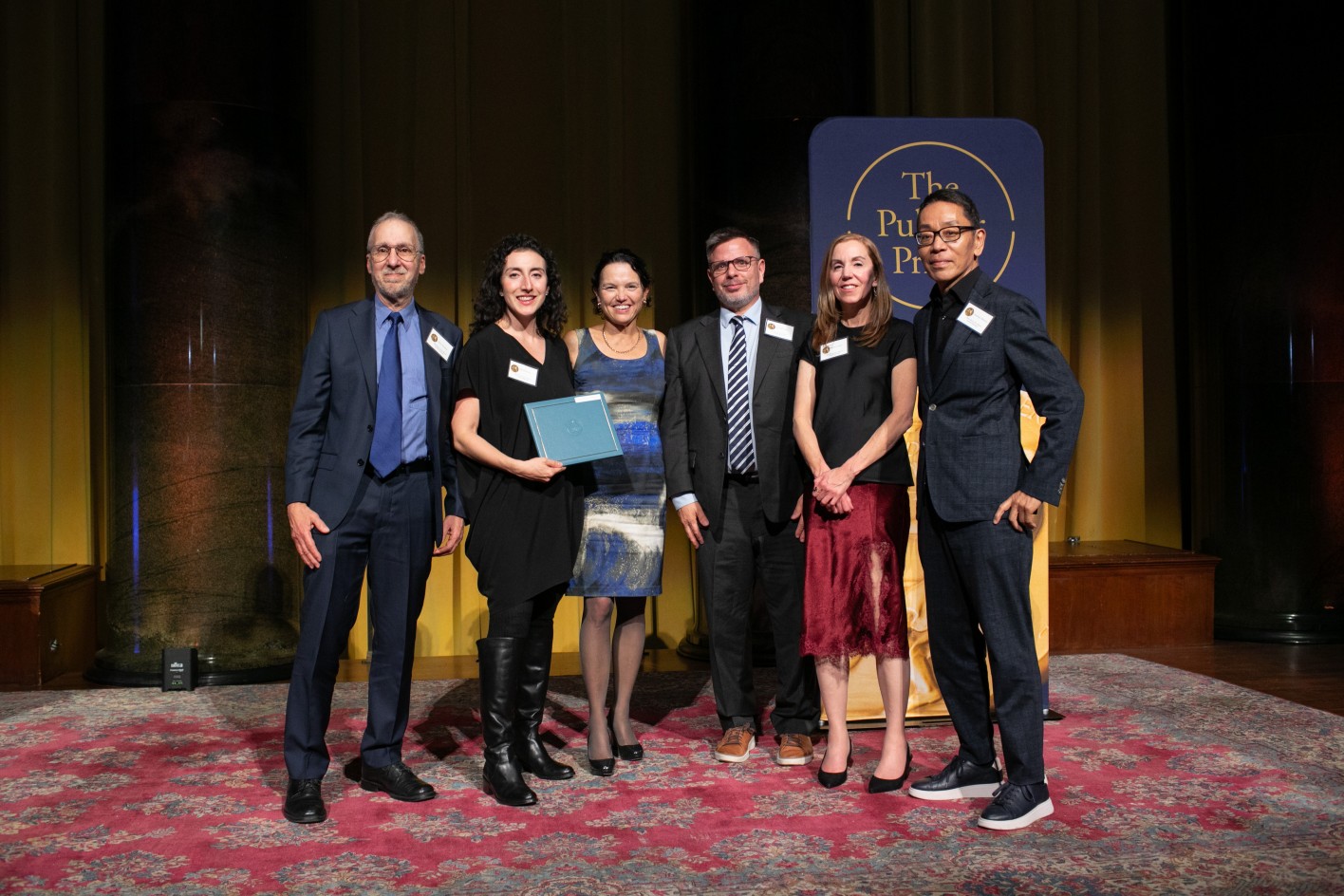
Staff members from Reuters (from left: Steve Stecklow, Rachael Levy, Kevin Krolicki, Marisa Taylor and Norihiko Shirouzu) accept a 2024 Pulitzer Prize for National Reporting from Columbia University Interim President Katrina Armstrong (third from left). (David Dini/The Pulitzer Prizes)
Winning Work
Reuters documented at least 600 previously unreported workplace injuries at Musk’s rocket company: crushed limbs, amputations, electrocutions, head and eye wounds and one death. SpaceX employees say they’re paying the price for the billionaire’s push to colonize space at breakneck speed.
By Marisa Taylor
One windy night at Elon Musk’s SpaceX facility in McGregor, Texas, Lonnie LeBlanc and his co-workers realized they had a problem.
They needed to transport foam insulation to the rocket company’s main hangar but had no straps to secure the cargo. LeBlanc, a relatively new employee, offered a solution to hold down the load: He sat on it.
After the truck drove away, a gust blew LeBlanc and the insulation off the trailer, slamming him headfirst into the pavement. LeBlanc, 38, had retired nine months earlier from the U.S. Marine Corps. He was pronounced dead from head trauma at the scene.
Federal inspectors with the U.S. Occupational Safety and Health Administration (OSHA) later determined that SpaceX had failed to protect LeBlanc from a clear hazard, noting the gravity and severity of the violation. LeBlanc’s co-workers told OSHA that SpaceX had no convenient access to tie-downs and no process or oversight for handling such loads. SpaceX acknowledged the problems, and the agency instructed the company to make seven specific safety improvements, including more training and equipment, according to the inspection report.
It was hardly the last serious accident at SpaceX. Since LeBlanc’s death in June 2014, which hasn’t been previously reported, Musk’s rocket company has disregarded worker-safety regulations and standard practices at its inherently dangerous rocket and satellite facilities nationwide, with workers paying a heavy price, a Reuters investigation found. Through interviews and government records, the news organization documented at least 600 injuries of SpaceX workers since 2014.
Many were serious or disabling. The records included reports of more than 100 workers suffering cuts or lacerations, 29 with broken bones or dislocations, 17 whose hands or fingers were “crushed,” and nine with head injuries, including one skull fracture, four concussions and one traumatic brain injury. The cases also included five burns, five electrocutions, eight accidents that led to amputations, 12 injuries involving multiple unspecified body parts, and seven workers with eye injuries. Others were relatively minor, including more than 170 reports of strains or sprains.
Current and former employees said such injuries reflect a chaotic workplace where often under-trained and overtired staff routinely skipped basic safety procedures as they raced to meet Musk’s aggressive deadlines for space missions. SpaceX, founded by Musk more than two decades ago, takes the stance that workers are responsible for protecting themselves, according to more than a dozen current and former employees, including a former senior executive.
Musk himself at times appeared cavalier about safety on visits to SpaceX sites: Four employees said he sometimes played with a novelty flamethrower and discouraged workers from wearing safety yellow because he dislikes bright colors.
The lax safety culture, more than a dozen current and former employees said, stems in part from Musk’s disdain for perceived bureaucracy and a belief inside SpaceX that it’s leading an urgent quest to create a refuge in space from a dying Earth.
“Elon’s concept that SpaceX is on this mission to go to Mars as fast as possible and save humanity permeates every part of the company,” said Tom Moline, a former SpaceX senior avionics engineer who was among a group of employees fired after raising workplace complaints. “The company justifies casting aside anything that could stand in the way of accomplishing that goal, including worker safety.”
One severe injury in January 2022 resulted from a series of safety failures that illustrate systemic problems at SpaceX, according to eight former SpaceX employees familiar with the accident. In that case, a part flew off during pressure testing of a Raptor V2 rocket engine – fracturing the skull of employee Francisco Cabada and putting him in a coma.
The sources told Reuters that senior managers at the Hawthorne, California site were repeatedly warned about the dangers of rushing the engine’s development, along with inadequate training of staff and testing of components. The part that failed and struck the worker had a flaw that was discovered, but not fixed, before the testing, two of the employees said.
Cabada’s wife told Reuters the company has ignored the family’s attempts to find out why he wasn’t protected. “It would have been nice to get a call from Elon Musk,” Ydy Cabada said. “But I guess workers are just disposable to them.”
In all, Reuters interviewed more than three dozen people with knowledge of SpaceX safety practices, including more than two dozen current or former employees. Many of the sources spoke on condition of anonymity, citing concerns about career or legal repercussions.
SpaceX did not respond to questions from Reuters and a detailed description of this article’s findings.
The more than 600 SpaceX injuries Reuters documented represent only a portion of the total case count, a figure that is not publicly available. OSHA has required companies to report their total number of injuries annually since 2016, but SpaceX facilities failed to submit reports for most of those years. About two-thirds of the injuries Reuters uncovered came in years when SpaceX did not report that annual data, which OSHA collects to help prioritize on-site inspections of potentially dangerous workplaces.
Reuters unearthed details about the 600-plus injuries by examining court documents in worker lawsuits, employee medical records, state workers’ compensation claims and emergency-call records. The news agency also obtained, through public records requests, internal SpaceX injury logs that the company turned over to federal and state safety inspectors following serious safety incidents. Such logs are rarely made public. Regulators require companies to keep the records, which include descriptions of individual injuries, and to produce them upon request.
After years of failing to report annual injury-and-illness statistics to regulators, some SpaceX sites started filing the data in 2021 or 2022. The data for 2022, which are more complete, reveal injury rates at three major SpaceX industrial facilities that far exceeded the space-industry average.
The 2022 injury rate at the company’s manufacturing-and-launch facility near Brownsville, Texas, was 4.8 injuries or illnesses per 100 workers – six times higher than the space-industry average of 0.8. Its rocket-testing facility in McGregor, Texas, where LeBlanc died, had a rate of 2.7, more than three times the average. The rate at its Hawthorne, California, manufacturing facility was more than double the average at 1.8 injuries per 100 workers. The company’s facility in Redmond, Washington, had a rate of 0.8, the same as the industry average.
Two other SpaceX facilities in Florida, at Kennedy Space Center and Cape Canaveral, could not be compared to the industry average in 2022. Kennedy didn’t report injury data that year. And the company labeled Cape Canaveral as part of a different industry subcategory for which the government doesn’t calculate an average rate.
The Kennedy site did report injury data for 2016, the first year it was required to do so – but hasn’t reported since. For that year, the facility reported data amounting to an injury rate of 21.5 injuries per 100 workers, about 27 times the industry average. The facility employed only 50 people at the time; it had just taken over a launch pad from the U.S. National Aeronautics and Space Administration (NASA). Sixteen of those workers were injured, SpaceX reported. By 2021, employment at Kennedy had grown to more than 1,100 workers, NASA said.
A dozen worker-safety experts said SpaceX’s poor safety record underscores the perils of working in the lightly regulated and fast-expanding U.S. space industry. Other major space companies have also failed to report annual injury data to OSHA in some recent years.
Reuters reviewed state and federal safety violation records on SpaceX and found no sanctions for its data-reporting failures. For safety violations that inspectors found after SpaceX worker accidents, state and federal regulators levied only small fines, typically ranging from a few hundred to a few thousand dollars.
In a written response to questions from Reuters, OSHA did not comment on SpaceX’s worker safety record or its enforcement decisions involving the company. The agency did not address why it never cited SpaceX for failing to report injury data for many years, saying it would be “unfair to draw a conclusion” because it didn’t know “the specifics.” Reuters documented the safety reporting lapses using the agency’s own records.
The agency did say it has recently increased inspections of companies generally and issued more of its stiffest penalties in egregious cases.
California OSHA, a state-run workplace safety regulator, did not comment in response to Reuters’ questions.
NASA said it has paid SpaceX $11.8 billion to date as a private space contractor. The agency did not comment on the company’s safety record but said it has the option of enforcing contract provisions that require SpaceX to “have a robust and effective safety program and culture.”
SpaceX has defended its safety practices in written responses to OSHA and CalOSHA. In response to an inquiry into the Cabada accident, SpaceX argued to CalOSHA that it shouldn’t be held responsible for such injuries because it provides extensive safety training and the malfunction was not reasonably foreseeable. Accountability for such part failures and any resulting injuries falls instead on a cadre of employees known as “responsible engineers,” or REs, the company wrote.
“REs are ultimately responsible for all aspects of their components and systems,” including safety, the company wrote. “Put simply, the RE is the delegated SpaceX representative.”
Safety specialists dismissed SpaceX’s contention that it can off-load the company’s duty to ensure worker safety to specific engineers it employs. Jordan Barab, who served as an OSHA deputy assistant secretary between 2009 and 2017, called the notion “ludicrous.”
OSHA told Reuters that employers, not designated employees, are responsible for ensuring a hazard-free workplace.
Travis Carson, a former Brownsville welder and production supervisor, said SpaceX generally left staffers in charge of their own safety, with little training or oversight.
“SpaceX’s idea of safety is: ‘We’ll let you decide what’s safe for you,’ which really means there was no accountability,” said Carson, who has worked for more than two decades in dangerous jobs such as building submarines. “That’s a terrible approach to take in industrial environments.”
‘No accountability’
Since Musk co-founded SpaceX in 2002, his free-wheeling entrepreneurism has proved a powerful draw for young skilled workers. Some SpaceX employees described eagerly joining the company as it outpaced competitors and offered perks including in-house medical clinics and private company stock that has shot up in value. The company, which employs 13,000 workers, had an estimated value of $150 billion as of earlier this year. Musk has a 42% stake and 79% of the company’s voting power, according to a company filing.
SpaceX has achieved major breakthroughs. It was the first private company to send humans into orbit. Its Starlink unit is now the world’s largest satellite operator. Competitors including Jeff Bezos’ Blue Origin have struggled to keep pace with SpaceX’s reusable rockets, which have slashed launch costs.
Some SpaceX engineers say they relish collaborating with creative coworkers in an environment with little bureaucracy. “There’s a certain amount of red tape that SpaceX avoids, which allows it to move faster” than NASA or private competitors, said Chris Cunnington, a former engineer in McGregor, Texas. He said he believed SpaceX struck a good balance between speed and safety.
Other current and former employees at the company’s Brownsville site, which had the highest 2022 injury rate, said the company’s disdain for structured processes came at a high cost to workers.
SpaceX started building its Brownsville site in 2014, and it has since become the epicenter of Musk’s Mars mission. The facility employs more than 1,600 workers on the Texas-Mexico border and combines manufacturing, testing and launching. It’s the base of SpaceX’s Starship program, a project aiming to build cheaper rockets faster.
Brownsville managers, many of them in their 20s, worked grueling hours trying to meet Musk’s deadlines, according to six current or former employees familiar with the site’s operations, including Moline and Carson. Some workers slept overnight at the facility at times so they could work more than 80 hours a week, according to four of those employees.
Carson worked at the Brownsville site as a welder in 2019 and 2020 and returned as a production supervisor in 2021 and 2022. He said some employees took Adderall, the stimulant typically used to treat attention-deficit disorder, without a prescription. Others fell asleep in bathrooms, said Carson and three other current or former Brownsville workers.
To speed work and cut costs, SpaceX started manufacturing rockets in tents next to an undeveloped Gulf of Mexico beach. Workers welded rocket parts up to 12 hours a day, six days a week, often in temperatures over 100 degrees Fahrenheit, the SpaceX workers said. When overcome by heat, they were given IV fluids and sent back to work.
When high winds disrupted the work, supervisors shut the tents, closing off ventilation that is essential for safe welding, according to the six current and former workers. OSHA warns that welding stainless steel can generate a highly toxic, cancer-causing dust. The agency told Reuters it requires companies to assess the danger of such environments through air sampling and to implement a “respiratory protection program” when needed. One former welder, Phillip Fruge, said he asked managers for respirators commonly used to protect welders’ lungs, but they weren’t provided.
“We could see the clouds of the dust filling the tent,” Fruge recalled. “Everyone was just breathing it in, day after day.”
Carson said he pressed superiors for better safety measures but was ignored. He recalled stepping into the interior of a rocket under construction in 2021 on his first day as a supervisor. Another manager, working 20 feet above him, carelessly dropped a nearly 100-pound hoist, barely missing Carson.
“That’s like a firing offense at other places, but not at SpaceX,” Carson said. “They needed bodies, and Elon needed stuff done.”
Carson himself eventually was fired in January 2022 after getting into a scuffle with a boss. Carson, who is African American, said he shoved the manager, a younger man, because he had repeatedly called Carson “boy,” despite Carson’s requests that he stop. “Boy” is widely considered a racial epithet by Americans when used to refer to a Black man. The supervisor, who could not be reached for comment, was not disciplined, according to Carson. Reuters could not independently confirm how SpaceX handled the incident.
SpaceX sometimes rushed to hire workers and regularly failed to properly train or equip new recruits, more than a dozen current and former employees said. Workers with no experience, for instance, were handed welding tools without training, they said. Four of these employees, who were managers fresh out of college, described making tough calls on the safety of dangerous activities with little guidance.
In November 2021, two Brownsville technicians were moving square steel tubing weighing 500 pounds, using a crane with a lifting magnet, according to OSHA inspection records. The tubing fell and crushed a worker’s hand because the crane was only designed to hoist 300 pounds, OSHA concluded.
The employee, whose name was redacted in the inspection report the agency gave Reuters, required long-term treatment after surgery, including the partial amputation of the worker’s ring finger, according to the report. The agency faulted the company for failing to ensure employees tested whether the crane could lift the load. SpaceX appealed the resulting $43,506 fine and got it knocked down to $8,701 after agreeing to remedy the worker-safety problems identified in the report.
Florentino Rios suffered a severe eye injury at SpaceX’s Brownsville site one summer night in 2021, as he worked about 25 feet off the ground attaching two beams to a launch pad. A crane operator missed a hand signal from Rios and mistakenly tried to move the beams after they were fixed in place, Rios said in an interview. That error caused a chain connecting the crane to the beams to snap and strike Rios in the face. Another worker who was present confirmed Rios’ account.
The team should have had walkie-talkies, Rios said, and had previously asked management for better lighting.
As blood trickled down his face, Rios inched along a beam to a platform where he was lowered down, he said. SpaceX employees who examined him at an on-site medical clinic told him he could return to work on the next shift, although he still couldn’t see well, said his attorney, Richard Hinojosa. Reuters could not independently confirm the SpaceX medical clinic’s assessment.
Rios went to the hospital that night. A medical scan revealed a traumatic injury in his swollen left eye, according to medical and workers’ compensation records reviewed by Reuters. He continued to work anyway for a few days. When he sought further treatment, doctors told him he had lost vision in the eye and was legally blind, the records show.
Rios, 55, said he can no longer drive or work construction. He sued SpaceX alleging its negligence caused the injury by failing to implement or follow worker-safety procedures. “It wasn’t safe,” Rios said, adding that management never addressed the problems.
The company, in court records, argued that Rios’ own negligence was to blame. The case is ongoing.
“I used to be someone who didn’t like sitting around,” said Rios. “I worked day and night to give my children what they needed. And now, I can’t.”
Shortcutting safety
On Jan. 18 of last year, part of a Raptor V2 engine broke away during pressure testing at the SpaceX facility in Hawthorne, California. The part, a fuel-controller assembly cover, careened into the head of Cabada, a SpaceX technician. Nearly two years later, the father of three young children remains in a coma with a hole in his skull, family members said.
The accident generated news last year but little has emerged until now about the causes. The incident stemmed from several safety lapses at the Hawthorne site, according to Reuters interviews with eight former SpaceX employees familiar with the incident and the testing preparations.
Two of the employees said the mishap resulted in part from a simple mistake: An engineer started the test when Cabada was still too close to the engine and unprotected from explosions or flying debris.
Senior managers were repeatedly warned for at least a year before the accident that pressure-testing crews were not following standard worker-safety protocols, such as providing protective barriers or clearing personnel from the testing area, according to a former employee familiar with the matter. Such testing should be conducted with a “boom box” covering the whole engine to protect workers, the employee said. At one point, managers rejected a new training program, written and proposed by pressure-testing staff, on the grounds that it would cause delays, according to the source and a document reviewed by Reuters.
Another key contributing factor: SpaceX senior managers, in the months leading up to the accident, had instructed engineers to end or limit the testing of individual rocket parts before they are assembled into an engine, two staffers said. The managers were reacting to Musk’s demands for faster progress on the Raptor engine program, the workers said.
The team normally would have conducted more extensive testing on the cover that malfunctioned and struck Cabada, they said.
The limited testing nonetheless revealed a potentially dangerous flaw in the cover, according to two sources familiar with the matter. The component was redesigned to correct the problem, they said, but the new part wasn’t ready before the pressure testing that hurt Cabada. Reuters could not determine the precise nature of the flaw.
SpaceX’s rejection of a more rigorous training program, its moves to limit testing, and the discovery of the cover’s defect before the accident haven’t been previously reported.
In a written response to CalOSHA’s inspection, SpaceX said it had conducted ample analysis and testing of the part before it failed.
More than a dozen current and former workers said SpaceX’s willingness to cut corners and skip some worker safeguards has helped keep it well ahead of competitors and score lucrative government contracts. SpaceX last year surpassed Boeing to become NASA’s second-largest vendor.
The company also boosts development speed through a structure that gives managers high levels of autonomy but raises safety risks, the dozen current and former SpaceX workers said. The company is split into three teams: engineering, manufacturing, and testing. The engineering leadership includes the “responsible engineers” SpaceX designates as accountable for safety in manufacturing. But those engineers have little control of other teams, including the one that stress-tests the engines and parts they develop, according to two staffers with knowledge of the matter.
In the case of the test that injured Cabada, this loose structure meant the testing team never coordinated with the responsible engineer team, the workers said.
After the Cabada accident, CalOSHA inspectors detailed other safety lapses. One employee involved in the pressure checks told them that the company generally didn’t do full safety inspections before such testing, agency records show. Another said the engine should have undergone more testing “without personnel around,” according to the records.
SpaceX pushed back on the agency’s finding that the company failed to protect Cabada, the records show. The company blamed a particular responsible engineer, who it said was accountable for the safety of the defective cover “through the lifecycle of development, testing and production.” SpaceX fired the engineer and a manager on the same team over the incident, according to three employees with knowledge of the situation.
Cabada’s wife, Ydy, said SpaceX hasn’t responded to the family’s attempts to find out how he was injured. Michael Sanchez, a Los Angeles attorney representing her, said the company has never answered his inquiries, including a March 2022 certified letter requesting a copy of any surveillance footage of the accident and advising SpaceX to preserve any other relevant records. Ydy Cabada has considered a lawsuit but has not filed one.
“SpaceX has not returned a single call,” Sanchez said.
Francisco’s sister, Evelyn Cabada, said the accident devastated the family. In addition to the severe head injury, she said, her brother caught pneumonia and meningitis in the hospital.
Ydy Cabada said the family still holds out hope he’ll emerge from the coma.
“The doctors keep saying nothing has changed,” she said. “It’ll take a miracle for him to get out of that bed.”
Flamethrowers and safety yellow
Musk is well-known as a hands-on manager. He was directly involved in handing down sometimes unrealistic deadlines, said current and former employees. Musk’s heavy involvement in scheduling resulted in “significantly more unsafe working conditions than would have existed otherwise,” said Moline, the engineer.
One former SpaceX executive defended Musk, saying he would listen to employees who were willing to go “toe-to-toe” with him on safety issues and took them seriously.
Another former executive said Musk cared about his workers and was bothered when they got hurt, but that safety was not one of Musk’s priorities. Musk, the ex-manager said, thought that “workers take care of their safety themselves.”
This former executive said that top company officials knew its injury rates ran high but attributed the problem to employing a largely young workforce in a dangerous industry. SpaceX leaders also believed the company shouldn’t be held to the same standard as competitors because SpaceX oversees more missions and manufacturing, the two former executives said.
That attitude is a red flag that a company is rationalizing a fundamentally unsafe environment, according to four worker-safety experts interviewed by Reuters, including Barab, the former OSHA deputy assistant secretary.
“SpaceX shouldn’t be exempt from protecting workers from being injured or killed,” Barab said, “just because they’re doing innovative work.”
Four SpaceX employees told Reuters they were disturbed by Musk’s habit of playing with a flamethrower when he visited the SpaceX site in Hawthorne. The device was marketed to the public in 2018 as a $500 novelty item by Musk’s tunnel-building firm, the Boring Company. Videos posted online show it can shoot a thick flame more than five feet long. Boring later renamed the device the “Not-A-Flamethrower” amid reports of confiscations by authorities.
For years, Musk and his deputies found it “hilarious” to wave the flamethrower around, firing it near other people and giggling “like they were in middle school,” one engineer said. Musk tweeted in 2018 that the flamethrower was “guaranteed to liven up any party!” At SpaceX, Musk played with the device in close-quarters office settings, said the engineer, who at one point feared Musk would set someone’s hair on fire.
Musk also became known in California and Texas for ordering machinery that was painted in industrial safety yellow to be repainted black or blue because of his aversion to bright colors, according to three former SpaceX supervisors. Managers also sometimes told workers to avoid wearing safety-yellow vests around Musk, or to replace yellow safety tape with red, the supervisors said.
Workers often walked too close to engine-testing and rocket-building facilities because the company failed to cordon off areas or put up warning signs, said Paige Holland-Thielen, a former operations and automation engineer in Hawthorne.
“One time I walked out the door of my building, and there was a giant crane there,” she recalled. “A bunch of people in hard hats started screaming at me to get back inside.”
Holland-Thielen and Moline, who also worked in Hawthorne, were among nine workers fired in the summer of 2022 after raising workplace complaints in an open letter that was ultimately signed by hundreds of employees. The letter criticized Musk’s flippant social-media responses to sexual-harassment allegations against him, which he denied. It also criticized a management culture of dismissing employee concerns and unevenly enforcing discipline policies. Eight workers who drafted the letter have since filed a complaint with the National Labor Relations Board against SpaceX alleging unfair labor practices.
Moline said SpaceX Chief Operating Officer Gwynne Shotwell told him he was being fired for distracting workers from getting to Mars. “Please focus on your job and the mission of SpaceX – to get humanity to Mars as quickly as possible,” Shotwell told him and Holland-Thielen, among others, in an email reviewed by Reuters.
Shotwell did not respond to a request for comment.
A death and a $7,000 fine
SpaceX has faced few consequences from safety regulators for its failure to report annual safety data and to protect workers in incidents reviewed by federal and state inspectors, agency records show.
OSHA and CalOSHA have fined the billionaire’s rocket company a total of $50,836 for violations stemming from one worker’s death and seven serious safety incidents, regulatory records show.
OSHA did not comment on the modest penalties that resulted from inspections of SpaceX.
SpaceX’s history of injuries and regulatory run-ins in California underscores the limits of worker-safety regulation. Fines are capped by law and pose little deterrent for major companies, experts in U.S. worker safety regulation said. Federal and state regulators also suffer from chronic understaffing of inspectors, they said. OSHA did not address questions about staffing levels but said it “focuses its resources on hazardous workplaces.”
CalOSHA levied a fine of $18,475 for the violation that resulted in Cabada’s skull fracture. SpaceX unsuccessfully disputed the agency’s classification of the violation as “serious” and appealed the penalty as excessive, asking for a reduction to $475.
In another case, CalOSHA never inspected the company following a serious accident resulting in a leg amputation. But the agency may not have known the accident happened at all: A Reuters review of agency documents indicated it had no record of the 2016 incident.
Federal and state law require companies to immediately report all employee deaths, amputations and injuries resulting in hospital admissions. It isn’t clear whether SpaceX ever reported the injury. Neither the company nor CalOSHA commented on why the agency had no report on it.
If SpaceX didn’t report the case, “I don’t think they have any excuse,” said Ann Rosenthal, a former OSHA associate solicitor, who handled legal matters for the agency until 2018.
The incident resulted in Steven Trollinger’s leg being crushed during a mission to recover a rocket that landed in the Pacific Ocean, according to records in a lawsuit Trollinger filed. The accident occurred when he and other SpaceX employees were being transferred between two vessels. SpaceX knew that one of the vessels wasn’t properly equipped with a transfer platform designed to ensure the workers’ safety, but proceeded anyway, Trollinger’s lawsuit alleges.
Trollinger, who declined to comment, settled with SpaceX for an undisclosed sum, court records show.
In inspections following two other serious California injuries – the amputation of two fingers in 2017 and a serious knee injury in 2021 – CalOSHA levied fines of $750 and $5,060, respectively. When a worker’s finger was amputated this March, inspectors took no action and did not visit the site, records show.
After Texas worker Lonnie LeBlanc fell off a trailer and died in 2014, OSHA came to what it called an informal settlement with the company after inspectors found the safety lapses, OSHA records show. The settlement allowed SpaceX to pay a $7,000 fine.
LeBlanc’s brother, Chris Weimer, and an uncle, Ron Weimer, said the family didn’t know that OSHA had investigated the death and found violations until Reuters told them.
Ron Weimer said the hazardous nature of rocket-building is no excuse for his nephew’s death.
“There’s a way to do dangerous work,” he said, “without people dying.”
Safety at SpaceX: How Reuters analyzed workplace injuries
Reuters documented at least 600 injuries at SpaceX through a variety of public records, including the company’s own injury logs at three facilities that were inspected by regulators.
Such logs are normally kept private by companies, but they became public record when SpaceX was required to turn them over to inspectors from the Occupational Safety and Health Administration (OSHA) and a state-run affiliate in California, CalOSHA. Reuters obtained these logs, which include short descriptions of each injury in a given year, through public records requests. They covered between one and five years at each of the three facilities, in Hawthorne, California; Cape Canaveral, Florida; and Redmond, Washington.
Reuters also documented injuries through other public records and employee interviews at those three sites and three other facilities, in Brownsville, Texas; McGregor, Texas; and at the Kennedy Space Center in Florida. The records included court documents in worker lawsuits, employee medical records, state workers’ compensation claims, and emergency calls.
The six total sites were chosen because they are SpaceX’s biggest industrial facilities, engaged in manufacturing, testing or rocket launching.
Reuters also calculated annual injury rates for 2022 for some of these facilities using the annual data they have been required to file with OSHA since 2016. Reuters calculated the facilities’ rates using an OSHA formula that uses the total hours worked at a company to estimate an annual injury rate per 100 full-time workers. The data used to calculate the SpaceX rates also included a small number of illnesses.
Before 2021 and 2022, SpaceX facilities usually did not submit the required data, with each site failing to report it for between four and six years.
When comparing these rates to the space-industry average, the news organization used an estimated average injury-and-illness rate produced annually by the U.S. Bureau of Labor Statistics (BLS). The BLS derives industry averages by collecting a representative sample of data from companies in a given industry; it cannot by law release data from individual firms surveyed.
Like OSHA, the BLS is a division of the U.S. Labor Department, and both agencies collect injury data from companies under the same guidelines. OSHA advises companies to use the BLS average in their industry as a benchmark for their worker-safety performance.
SpaceX, when filing injury data to the OSHA, classifies itself as part of the “guided missile and space vehicle manufacturing” industry, a regulatory data-collection category that is a subset of the larger aerospace industry. The BLS estimated the average injury-and-illness rate for that industry was 0.8 per 100 workers in 2022, a rate that has not changed much in recent years.
For one facility, in Cape Canaveral, SpaceX listed a different aerospace industry subcategory for 2022: “transportation by spacecraft, freight.” That facility couldn’t be compared to an industry average because the BLS doesn’t produce one for that subcategory. Another facility, at Kennedy Space Center, did not report annual injury data to OSHA for 2022.
Unsafe Space
By Marisa Taylor
Additional reporting: Joey Roulette
Photo editing: Corinne Perkins
Video production: Evan Garcia, Olivia Zollino, Jane Ross, Ilan Rubens, Lucy Ha
Art direction: John Emerson
Edited by Michele Gershberg and Brian Thevenot
Musk has said his brain implant company, Neuralink, will make the paralyzed walk, the blind see and eventually turn people into cyborgs. But the firm still struggles to secure clinical-trial approval for the relatively modest goal of helping disabled people type.
By Rachael Levy and Marisa Taylor
In at least four occasions since 2019, Elon Musk has predicted that his medical device company, Neuralink, would soon start human trials of a revolutionary brain implant to treat intractable conditions such as paralysis and blindness.
Yet the company, founded in 2016, didn’t seek permission from the U.S. Food and Drug Administration (FDA) until early 2022 – and the agency rejected the application, seven current and former employees told Reuters.
The rejection has not been previously reported. In explaining the decision to Neuralink, the agency outlined dozens of issues the company must address before human testing, a critical milestone on the path to final product approval, the staffers said. The agency’s major safety concerns involved the device’s lithium battery; the potential for the implant’s tiny wires to migrate to other areas of the brain; and questions over whether and how the device can be removed without damaging brain tissue, the employees said.
A year after the rejection, Neuralink is still working through the agency’s concerns. Three staffers said they were skeptical the company could quickly resolve the issues – despite Musk’s latest prediction at a Nov. 30 presentation that the company would secure FDA human-trial approval this spring.
Neuralink has not disclosed details of its trial application, the FDA’s rejection or the extent of the agency’s concerns. As a private company, it is not required to disclose such regulatory interactions to investors. During the hours-long November presentation, Musk said the company had submitted “most of our paperwork” to the agency, without specifying any formal application, and Neuralink officials acknowledged the FDA had asked safety questions in what they characterized as an ongoing conversation.
Musk and other Neuralink officials did not respond to requests for comment on the company’s device or its dealings with the FDA. The agency declined to comment on Neuralink, citing laws keeping commercial information private.
The Neuralink sources declined to provide Reuters with the agency’s written rejection, a legally confidential document. The staffers, including four who had read the FDA document and others aware of the agency’s concerns, described the safety issues in interviews, speaking on condition of anonymity.
Such FDA rejections do not mean a company will ultimately fail to gain the agency’s human-testing approval. But the agency’s pushback signals substantial concerns, according to more than a dozen experts in FDA device-approval processes.
The rejection also raises the stakes and the difficulty of the company’s subsequent requests for trial approval, the experts said. The FDA says it has approved about two-thirds of all human-trial applications for devices on the first attempt over the past three years. That total rose to 85% of all requests after a second review. But firms often give up after three attempts to resolve FDA concerns rather than invest more time and money in expensive research, several of the experts said.
Companies that do secure human-testing approval typically conduct at least two rounds of trials before applying for FDA approval to commercially market a device.
Neuralink’s regulatory struggles stem largely from its culture of setting goals for breakthroughs on extremely ambitious timelines and viewing regulators as obstacles to innovation, according to more than a dozen current and former company employees. That leadership style, mirroring how Musk runs electric-car pioneer Tesla, can create vulnerabilities when applied to developing a medical device that must be tested on human subjects before final approval, the staffers say.
Still, Musk retains the full confidence of many loyal Neuralink staffers and some industry investors, who point to his past successes in taking on extreme challenges as the founder of Tesla and rocket-builder SpaceX.
“I definitely would never bet against him,” said Bob Nelsen, co-founder of venture capital firm ARCH Venture Partners, who said he invested personal money into Neuralink. “If he has some bumps in the road with Neuralink, or any other thing, he’ll regroup and figure it out … Just think about it: Those are hard industries with huge safety barriers – cars and rockets.”
In public comments over the years, Musk has detailed a bold vision for Neuralink: Both disabled and healthy people will pop into neighborhood facilities for speedy surgical insertions of devices with functions ranging from curing obesity, autism, depression or schizophrenia to web-surfing and telepathy. Eventually, Musk has said, such chips will turn humans into cyborgs who can fend off the threat from sentient machines powered by artificial intelligence.
“I could have a Neuralink device implanted right now, and you wouldn’t even know,” Musk said at the Nov. 30 presentation, a livestreamed “show and tell” event, drawing laughs from the crowd. At another public company event in 2020, he said: “You’ll be able to save and replay memories…. The future is going to be weird.”
Such high-flying ambition has contributed to Neuralink’s estimated worth of more than $1 billion, far higher than its competitors, according to four people familiar with the private valuation.
Neuralink officials have publicly vowed to address any FDA concerns. Musk made headlines late last year when he said he was already so confident in the devices’ safety that he would be willing to implant them in his own children.
Musk also has said Neuralink would restore full mobility to paralyzed patients. In February, however, Dongjin “D.J.” Seo, Neuralink’s vice president of engineering, said at a conference that the “primary short-term goal” was more modest: to help paralyzed patients communicate through computerized text without typing. Seo said full mobility, along with restoring sight to the blind, were “long-term” goals.
Musk’s public claims and well-known impatience pose a critical test for the FDA in balancing demands for speedy review with the diligence required to ensure safety and efficacy, said Kip Ludwig, former program director for neural engineering at the U.S. National Institutes of Health (NIH), a federal agency. The FDA in recent years has faced pressure from Congress to accelerate reviews but also criticism over controversial approvals, such as its 2021 authorization of an Alzheimer’s treatment without conclusive proof of efficacy.
Industry players closely watching Neuralink’s development have long expected a collision between Musk and the FDA, Ludwig said, as the billionaire pushes Neuralink to quickly navigate regulatory reviews.
“Everybody in the industry was saying: ‘Oh my God, they’re going to run straight into a brick wall,’” Ludwig said of Musk’s bid for FDA approval. “Neuralink doesn’t appear to have the mindset and experience that’s needed to get this to market anytime soon.”
Without commenting on Neuralink, the FDA said it upholds high standards in vetting all brain implants even as it aims to speed reviews. “Innovation and safety are not an either-or scenario,” said Owen Faris, who helps oversee the FDA’s Office of Product Evaluation and Quality.
A company document from last fall said Neuralink expected the FDA to authorize human trials for its brain implant by March 7, 2023. But three Neuralink sources with knowledge of the company’s FDA interactions said they are not confident of any imminent regulatory approvals and that any prediction on the timing is a “gamble,” as one of the sources put it.
Neuralink’s focus on speed has contributed to other problems. Reuters exclusively reported late last year that the federal government was investigating the company’s treatment of its research animals. The probe was launched amid growing employee concern that the company is rushing experiments, causing additional suffering and deaths of pigs, sheep and monkeys. Three Neuralink staffers now tell Reuters that company leaders wanted animal experiments accelerated to gather data to address FDA concerns over the human-trial application.
Reuters also broke the news that the Department of Transportation is separately investigating whether Neuralink illegally transported dangerous pathogens, on chips removed from monkey brains, without proper containment measures.
The Department of Transportation said its investigation is ongoing. The U.S. Department of Agriculture’s Office of Inspector General, which is conducting the animal-treatment probe, declined to comment.
Turning down government money, advice
While Neuralink garners outsized attention because of its famous founder, more than a dozen companies are developing or manufacturing devices in the wider $6 billion field of so-called neuromodulation devices, which record or stimulate neural activity.
Researchers have experimented with such devices for more than four decades. The FDA has approved a significant number of them, including those treating Parkinson’s disease, epilepsy and obsessive-compulsive disorder. Development typically takes many years. For example, NeuroPace, which makes the brain implant to treat epilepsy, received final FDA approval in 2013 – 16 years after the company’s launch.
Neuralink competes in a niche of so-called brain computer interface (BCI) devices. Such devices use electrodes that penetrate the brain or sit on its surface to provide direct communication to computers. No company has received final FDA approval to market a BCI brain implant, the agency said, although the exact definition of the category is debated in the industry.
Neuralink officials touted plans to eventually produce a device with 16,000 electrodes, far more than other currently proposed devices. But that may not break any new ground. Neuralink plans only 1,024 electrodes in its first implant. That’s similar to devices from other firms, which also plan to add thousands more electrodes later, according to Ludwig, the former NIH official. Further, he said, the question of whether more electrodes will significantly help patients remains hotly debated among brain-implant experts.
Neuralink’s electrodes are attached to wires thinner than a human hair, which are implanted in the brain, the company has said. It also aims to revolutionize surgeries with a robot to sew its microscopic wires into brain tissue, while avoiding blood vessels, in minutes.
Musk’s company, however, trails at least one direct rival in the race for FDA approval. Synchron, a competitor making a BCI implant, has won the agency’s blessing for human trials. Like Neuralink, Synchron aims to help paralyzed people type with their minds. With Neuralink playing catch-up, Musk approached Synchron last summer about making an investment, Reuters reported in August.
The NIH, which supports and finances medical innovation, seeks to help brain-implant companies with public-private partnerships as part of its BRAIN initiative (Brain Research through Advancing Innovative Neurotechnologies). The agency finances half a dozen firms including Blackrock Neurotech, a start-up, and medical device giant Medtronic. Launched in 2014, the effort will receive about $680 million this year. Beyond grants, it provides access to government experts who advise on how to gain FDA approval and commercialize a device.
BRAIN initiative team leader Nick Langhals said the agency reached out to Neuralink to offer help but was declined. “We wouldn’t leave a company like Neuralink off the list, but they were not interested,” Langhals said, adding that the company didn’t explain its reasons.
Musk has told senior Neuralink managers that NIH funding would bring unwanted public oversight and bureaucratic hurdles, according to one person who heard such comments from Musk and a second source with knowledge of Musk’s views about the NIH.
The episode reflects a wider view at Neuralink that the government generally moves slowly and stifles innovation, five current and former employees said. In a presentation to staff last fall, the company set a goal of making the FDA “our #1 Fans by showing that we go above and beyond,” according to a document reviewed by Reuters. The presenter at the internal company meeting, however, also referred to a veteran surgeon and FDA reviewer as a “curmudgeon,” according to two people who heard the comment.
Neuralink could be helped by federal laws passed in recent years aiming to accelerate FDA reviews. Among a host of policy changes, Congress instituted the “breakthrough” designation for novel devices targeting serious conditions. The label gives companies faster agency feedback during the development process.
The breakthrough-device program, among other changes, has helped the FDA substantially reduce the total time companies spend seeking agency approvals, the FDA says. The agency also must respond to human-trial applications within 30 days.
Of 750 devices currently labeled breakthrough, more than 100 are neurological, the FDA says. Neuralink secured the label for its brain implant in July 2020, according to the company. In an undated company document, Neuralink said it hoped that, by December 2021, the FDA would approve testing 10 people, giving “the first humans a mind blowing experience.”
‘This is not a toy’
As Neuralink races to deliver a marketable implant, more than a dozen current and former Neuralink staffers describe a working environment that, while demanding and ambitious, is also loose and disorganized.
Musk has been one of the few constants in leadership: Nearly all eight company founders, which included acclaimed scientists, have departed. Musk himself often pays more attention to his higher profile ventures – Tesla, SpaceX and Twitter – than to Neuralink, three company sources said. Musk’s emails to Neuralink staffers often come from his SpaceX address, said two people who reviewed them.
Hiring and promoting young employees has been a Neuralink hallmark since its founding, the current and former employees said. The company brims with recent college graduates and interns. One team had no members over 30 years old, a Neuralink source recalled. The strategy saves money and aligns with Musk’s view that younger workers often innovate better than older ones, the employees said.
The company’s former president, Max Hodak, had not turned 30 when he joined Neuralink at its founding. Before Neuralink, Hodak worked in a neural engineering lab while in college at Duke University and launched a cloud-computing startup afterward. Currently, one key company liaison to the FDA is a software engineer in his mid-20s, four current and former employees said.
That lack of experience in medical regulation has contributed to tensions inside Neuralink over development pace, the staffers said. In the company’s early years, executives discussed real estate for outpatient centers nationwide before the company had finalized a device, one former employee recalled. The plans sparked a debate among more experienced top scientists, who chafed at the development speed envisioned by generally younger staffers, the employee said.
A different Neuralink source recalled a meeting in late 2020 or early 2021 in which an angry Musk shouted until about 2 a.m. about what he called the company’s slow regulatory progress. When executives called his expected timeline unrealistic, Musk replied that he would make the FDA understand the need for fast approvals. Musk has participated in some phone calls between Neuralink and the agency, often seeking to expedite human trials, according to two people with knowledge of the calls.
The source who described the late-night meeting said Musk expects Neuralink to operate like Tesla, which brought several ground-breaking electric vehicles to market relatively quickly. “He can’t appreciate that this is not a car,” this source said. “This is a person’s brain. This is not a toy.”
At the meeting, Musk said he would make major changes at Neuralink without faster progress, this source recalled. Several weeks later, in March 2021, Musk fired company president and de facto leader Hodak, according to several current and former employees. Three years later, the company remains without a president.
Musk and Neuralink did not respond to inquiries about why Hodak was fired. Hodak declined to comment.
Since Musk ousted Hodak, a coalition of executives has filled the gap, though employees often disagree on who is truly in charge.
The leadership includes Shivon Zilis, a long-time Musk confidante who formerly worked at a venture capital firm. Zilis recently gave birth to two children fathered by Musk, in a relationship she calls non-romantic. Her LinkedIn page identifies her as Director of Operations and Special Projects. Another key executive is Seo, the engineering chief and only remaining founder besides Musk. In mid-February, Ian O’Hara, an executive who oversaw the robot program, announced his departure, according to four sources familiar with the matter.
Seo declined to comment. Zilis and O’Hara did not respond to inquiries.
Safety concerns
The FDA’s rejection listed dozens of what the agency calls “deficiencies” that the company must address before human trials, five Neuralink sources said. They called some issues relatively minor.
One serious FDA concern involved the possibility that the device’s tiny threads, which carry electrodes, could migrate to other areas of the brain, according to six current and former employees. The company has sought to address the issue through animal tests on dozens more pigs, three Neuralink sources said.
Migrating wires can induce inflammation, impair function in critical areas of the brain and rupture blood vessels, said Victor Krauthamer, a former FDA official for three decades, including a stint as acting director of the office that reviews human-trial requests for brain implants. A migration problem can also erode the device’s effectiveness, leading to the risk of surgical removal, he and other experts said.
“The threads can cause damage because brains are very, very soft and very delicate,” Krauthamer said.
The FDA’s concerns about the battery are also potentially serious, experts in brain devices said. Neuralink proposed making its device with a novel charging system involving lithium batteries that could be recharged remotely. The agency found the company needed to show in animal studies that the battery was very unlikely to fail, six current and former Neuralink employees said. If any component of the device that is connected to the battery current fails, the current could potentially damage brain tissue, three brain-implant experts said.
The FDA also raised questions about whether the device could be removed without damaging brain tissue. In Neuralink’s November presentation, officials acknowledged the FDA concern but downplayed it.
Engineer Alex Wood-Thomas was asked about the potential danger of removing the device in order to implant an upgraded one in the future. He responded that, because of the threads’ small size, scarring “within the brain is so minimal that they're actually removed quite easily.”
Several employees disputed his characterization as misleading and unsupported by animal studies, according to two Neuralink sources and internal discussions seen by Reuters.
Wood-Thomas declined to comment.
The FDA also flagged concerns that the device could overheat, also potentially damaging tissue.
Neuralink may be able to address all of the FDA’s concerns, industry and regulatory experts said.
If the FDA has lingering minor issues with a company’s device, it might let the firm move forward with a slower, staged trial, the experts said. The agency has suggested such a path might work for Neuralink, with fewer subjects implanted at first, and more tested months later, according to two people familiar with the discussions. Still, that proposal disappointed Neuralink because it could delay progress toward final FDA approval, one of the sources said.
Neuralink is hardly alone among brain-implant pioneers in slogging through difficult research and regulatory challenges that can drag on for years, said Gene Civillico, a neurophysiologist who formerly worked for both the FDA and the NIH on neural-implant research.
“The reason we don’t have a (BCI) device yet like Neuralink’s is not because no one has spent any money on it,” Civillico said. “It’s not because Elon Musk hasn’t thought about it enough. It’s because it’s a hard problem.”
Brain implant pioneers face long road to market and a crowded field
Neuralink, founded in 2016, has yet to receive FDA approval to test its brain chip in humans. Other implant makers have spent years or decades on research to secure U.S. regulatory approvals.
Synchron, like Neuralink, aims to help patients with severe paralysis control digital devices. It received U.S. approval for human testing in July 2021, five years after applying to the U.S. Food and Drug Administration (FDA). The company first tested its device on four patients in Australia who successfully sent text messages with their minds – no typing required. Synchron recently raised $75 million, including from funds backed by tech billionaires Bill Gates and Jeff Bezos. As of late February, Synchron had implanted two patients with the device out of a total of six planned for its first U.S. trial.
Medtronic is a leader among several companies producing deep-brain stimulation (DBS) devices. The FDA first approved Medtronic’s implant, to treat Parkinson’s disease, in 1997. Since then, more than 175,000 patients have been implanted with the device. The device reduces Parkinson’s tremors and lessens other motor-control symptoms such as stiffness and slowness.
NeuroPace, founded in 1997, didn’t secure FDA approval for its brain implant to treat epilepsy until 2013. The device is used by adult patients who have tried at least two medications but still suffer from frequent and disabling seizures, according to the company. The device lessens the frequency of such episodes.
Blackrock Neurotech, established in 2008, has tested its brain implant in humans for almost two decades. It says the device has been shown to enable people with paralysis to control digital devices, prosthetics, and their own limbs. The company had hoped to secure approval to commercialize the implant from the FDA by last year but is still working on it, according to the company.
Precision Neuroscience, founded in 2021, includes as its co-founder former Neuralink founding member Benjamin Rapoport. The company bills its device as “minimally invasive.” The device, shaped like a piece of tape, is designed to conform to the surface of the brain. Unlike some other devices, its wires and electrodes do not need to pierce brain tissue, the company says. The company has not yet secured approval for clinical trials.
Brain Teaser
By Rachael Levy and Marisa Taylor
Photo editing: Corinne Perkins
Art direction: John Emerson
Edited by Michele Gershberg and Brian Thevenot
Wheels falling off cars at speed. Suspensions collapsing on brand-new vehicles. Axles breaking under acceleration. Tens of thousands of customers told Tesla about a host of part failures on low-mileage cars. The automaker sought to blame drivers for vehicle ‘abuse,’ but Tesla documents show it had tracked the chronic ‘flaws’ and ‘failures’ for years.
By Hyunjoo Jin, Kevin Krolicki, Marie Mannes and Steve Stecklow
Shreyansh Jain was ecstatic in March when he picked up his first electric vehicle, a brand-new 2023 Tesla Model Y. He used a sizable chunk of family savings to buy it with cash.
“We were over the moon!” said Jain, an electronics engineer in Cambridge, England.
His exuberance came to a “grinding halt” one day later, with 115 miles on the odometer, Jain told Reuters. As he drove with his wife and three-year-old daughter, he suddenly lost steering control as he made a slow turn into their neighborhood. The vehicle’s front-right suspension had collapsed, and parts of the car loudly scraped the road as it came to a stop.
“They were absolutely petrified,” Jain said of his wife and daughter. “If we were on a 70-mile-per-hour highway, and this would have happened, that would have been catastrophic.”
The complex repair required nearly 40 hours of labor to rebuild the suspension and replace the steering column, among other fixes, according to a detailed repair estimate. The cost: more than $14,000. Tesla refused to cover the repairs, blaming the accident on “prior” suspension damage.
Jain is one of tens of thousands of Tesla owners who have experienced premature failures of suspension or steering parts, according to a Reuters review of thousands of Tesla documents. The chronic failures, many in relatively new vehicles, date back at least seven years and stretch across Tesla’s model lineup and across the globe, from China to the United States to Europe, according to the records and interviews with more than 20 customers and nine former Tesla managers or service technicians.
Individual suspension or steering issues with Teslas have been discussed online and in news accounts for years. But the documents, which have not been previously reported, offer the most comprehensive view to date into the scope of the problems and how Tesla handled what its engineers have internally called part “flaws” and “failures.” The records and interviews reveal for the first time that the automaker has long known far more about the frequency and extent of the defects than it has disclosed to consumers and safety regulators.
The documents, dated between 2016 and 2022, include repair reports from Tesla service centers globally; analyses and data reviews by engineers on parts with high failure rates; and memos sent to technicians globally, instructing them to tell consumers that broken parts on their cars were not faulty.
Neither Tesla nor top executive Elon Musk responded to detailed questions for this article. Musk has acknowledged some build-quality problems with Teslas in the past, particularly the entry-level Model 3. But he also says his cars have no peer.
“We make the best cars,” he said of Tesla at a New York Times event last month. “Whether you hate me, like me or are indifferent, do you want the best car, or do you not want the best car?”
Tesla’s handling of suspension and steering complaints reflects a pattern across Musk’s corporate empire of dismissing concerns about safety or other harms raised by customers, workers and others as he rushes to roll out new products or expand sales, Reuters has found.
A Reuters investigation in November documented at least 600 injuries at rocket-builder SpaceX, where employees described a culture of rushing dangerous projects with little regard for workers’ safety worries. In July, the news agency revealed how Tesla had created a secret team to suppress thousands of customer complaints about poor driving range. The report, which found that Tesla rigged an algorithm to inflate its cars’ in-dash range estimates, sparked a federal investigation. Late last year, Reuters exposed how hurried experiments at Musk’s brain-chip startup, Neuralink, resulted in the unnecessary suffering and deaths of laboratory animals, despite objections from workers seeking to protect them.
Neither Musk nor any of his companies commented for these reports. But he recently lashed out at critics of his social-media company, X, formerly Twitter, which has seen its revenue and market value plummet since Musk bought the firm for $44 billion about a year ago. At the live Times event, he went after advertisers who boycotted X over Musk’s endorsement of an antisemitic post on the social-media site. “Go fuck yourself,” the billionaire told companies who pulled their business.
Unlike traditional automakers, which use independent dealers to sell and repair vehicles, Tesla sells directly to customers and owns and operates a large portion of its service centers. That gives the automaker extraordinarily detailed real-time visibility into parts failures, repairs and warranty claims, which Tesla engineers meticulously tracked and analyzed for years, the company records show.
Yet the company has denied some of the suspension and steering problems in statements to U.S. regulators and the public– and, according to Tesla records, sought to shift some of the resulting repair costs to customers.
Tesla has blamed frequent failures of several parts on Tesla owners, alleging they abused the cars, according to interviews with former service managers, company records and a 2020 Tesla letter to the U.S. National Highway Traffic Safety Administration (NHTSA). In other cases, the automaker charged customers with out-of-warranty cars to replace parts that Tesla engineers internally called flawed or that they knew had high failure rates. Engineers ordered repeated redesigns for several parts and discussed seeking money back from suppliers because of the defects.
The records reveal persistent problems with low-tech suspension connections, such as upper and lower control arms, and fore and aft links. These parts are relatively inexpensive for Tesla and largely invisible to most consumers. But they play a critical role in safely connecting a car’s axle and wheels to its body and steering apparatus.
Two more complex and expensive parts also frequently failed: half shafts – the left and right drive axles – and steering racks, which often needed replacing after sudden power-steering outages that some Tesla owners said nearly caused accidents. One driver said in an interview that his brand-new 2023 Model Y jerked to the right when the power-steering suddenly failed at speed, nearly putting the vehicle into a ditch.
At least 11 drivers told Tesla a crash was caused by a failure in the suspension, steering or wheel assembly, company records show. Those accident claims, which have not been previously reported by the media, were recorded by Tesla staff between 2018 and 2021 and assigned to engineers or technicians for review.
In April 2021, the owner of a 2020 Model 3 with less than 15,000 miles on the odometer, went to a Tesla repair center in Brooklyn, New York, after an accident. The technician’s summary: “Front wheel fell off while driving on Autopilot at 60 mph,” referring to Tesla’s automated driving system. The wrecked car was sold, without the front wheel, in November 2021, auction records show.
The following month, another owner of a 2020 Model X in Madrid reported a wheel falling off while driving, the records show. Neither driver is identified in the records, which also do not detail how Tesla responded.
The suspension collapse in Jain’s car fortunately occurred at low speed. It was nonetheless shocking in a car he had owned for less than 24 hours. The automaker told him the suspension collapse was caused by the separation of a lower control arm from the steering knuckle, which connects to the wheel assembly. Jain expected Tesla to cover the damage.
A Tesla Service representative had texted Jain that an initial inspection found “no evidence of any external damage” that caused the incident and implied Tesla would pay for the repairs, according to a copy of the text Jain provided to Reuters.
About a week later, Tesla sent Jain a letter denying responsibility, saying it had inspected the vehicle and determined that the cause was “a prior external influenced damage to the front-right suspension.”
Jain said he was the only driver of the car during the one day he owned it and hadn’t had an accident before the suspension failure. “I was like, ‘Bloody hell, how can metal just snap like that when I know for sure the car has not hit anything?’” he said.
The repair took about three months. Jain paid a deductible of about $1,250 to have the work covered by his insurance company, which after the claim hiked his rates sharply on another car he owned, he said.
Fed up with the ordeal, Jain sold the repaired Tesla – for about $10,000 less than the $55,000 he paid for it.
“I lost complete confidence in the car,” he said.
Recalling parts in China – but not in the U.S.
The Tesla records reveal the company’s extensive knowledge of systemic suspension and steering problems, even as the company denied some of the same problems to regulators and customers who expected the company to pay for repairs. One especially problematic part was the aft link.
A series of 2016 suspension failures in China bears striking similarities to the incident with Jain’s car seven years later. Some of Tesla’s earliest China customers told the automaker that a front wheel had collapsed while turning at low speeds on its Model S luxury sports car, Tesla’s first mass-produced vehicle.
The front aft link, an aluminum-alloy suspension arm, had snapped, Tesla engineers found, according to company records that documented half a dozen such incidents. Between 2016 and 2020, Tesla resolved about 400 complaints involving aft-link failures in China, according to a former Tesla employee with direct knowledge of the matter. The company fixed cars under warranty or by making so-called goodwill repairs for out-of-warranty vehicles, the former employee said. Tesla redesigned the part four times because the initial revisions did not fully fix the problem, the automaker’s records show.
“The collapse of the suspension is terrifying to the customer,” Riccardo Dong, a Tesla engineer then based in China, wrote in 2016 on the company’s troubleshooting platform. “Many owners are asking for a recall.”
Dong did not respond to a request for comment.
Tesla delayed a recall for four more years, until Chinese regulators pushed for one. China’s State Administration for Market Regulation, in a statement, cited a “risk of accidents” in extreme cases of the aft-link part failure. Yet the automaker never recalled the part in the United States and Europe despite reports of frequent failures globally.
Tesla told U.S. regulators the failures were caused by “driver abuse.” The company also instructed service centers, in a February 2019 “talking points” memo, to use the same explanation with customers experiencing aft-link failures. They were told to blame “vehicle misuse,” such as “hitting a curb or other excessive strong impact.”
Tesla uses the terms “abuse” and “misuse” in the conditions of its warranty contract language that allow the automaker to decline claims for repairs or damage.
Tesla employed this deny-and-delay strategy as its ballooning costs of warranty repairs threatened the company’s profitability at a critical juncture – when investors were scrutinizing its long-term prospects.
During the fourth quarter of 2018, Tesla paid nearly $500 for repairs, on average, for every Tesla in operation at the time, service engineers were told in a series of memos. In total, an April 2019 memo noted, Tesla’s repair business lost $263 million in the quarter because of the high volume of warranty and goodwill repairs. For comparison, that was nearly double Tesla’s quarterly profit of $139 million.
Some U.S. customers with out-of-warranty cars paid more than $1,000 to repair aft links, and Tesla records show many European customers were frustrated at paying for replacements. Tesla’s basic U.S. warranty lasts four years or 50,000 miles, and coverage is similar in most other markets.
Tesla has also fought in court to avoid making repairs to suspension parts, including control arm assembly components.
The automaker scored a recent victory in a prospective class-action lawsuit alleging Tesla was aware that Model S and X cars made from 2013 to 2018 had a “suspension defect,” yet refused to cover repair costs, even for vehicles still under warranty. A federal judge in California dismissed claims from one plaintiff in January 2023, ruling he had failed to show Tesla “knew or should have known” of an alleged defect in his car. The class-action lawsuit, however, didn’t cite the Tesla records Reuters reviewed for this article. The other two plaintiffs voluntarily dismissed their claims without prejudice, which could allow them to refile a similar case later.
Tesla has had nine recalls in the United States for steering and suspension issues since 2018, NHTSA records show. Most affected a relatively small number of vehicles. The largest was in 2018, to replace steering-rack bolts on more than 70,000 Model S vehicles because of the risk that corrosion could cause a loss of power steering.
Tesla engineers were still examining the aft-link failures as recently as 2022, company records show. In February of that year, one company data review noted that the multiple revisions to the part, over several years, had finally fixed all “major flaws.”
Earlier, in April 2019, Netherlands-based Tesla Product Support Engineer Ralf van Gestel presented findings on the aft-link issue in an analysis. He found Tesla had spent nearly $4 million on suspension warranty repairs globally for models S and X over the previous 12 months. Aft-link failures, often on cars less than two years old, accounted for the largest portion, $1.3 million.
In the 12 months before van Gestel’s analysis, Tesla had replaced about 11,000 of the parts, about two-thirds of them under warranty, the data collected by van Gestel showed.
In September 2020, Tesla engineers in Europe examined the long history of aft-link failures. Valentin Oetliker, an engineer and company intern based in France, expressed alarm that the part had a “high failure rate” despite a redesign. In an analysis written for other engineers, he noted that many customers were dissatisfied at paying for the repairs in newer vehicles. At the time, about 5% of the 12,858 Model S and Model X vehicles on the road in Tesla’s southern Europe and Middle East markets had needed repairs because of aft-link failures, according to a Reuters calculation of the data reported by Oetliker.
Oetliker did not comment.
That same month, in a September 3, 2020, letter to U.S. regulators, Tesla denied there were any defects with the same aft links that its engineers had determined were flawed. It told NHTSA it would not recall the part for U.S. customers, despite its recall of the same part the month before in China.
The company told NHTSA it had voluntarily recalled the aft link and another suspension part under pressure from China regulators, even though it disagreed with their assessment, because fighting them presented a “heavy burden.” At the time, Tesla was looking to ramp up production at its newly built Shanghai Gigafactory, which would become the world’s most productive and profitable electric-vehicle plant.
By contrast, Tesla took a firm stance with U.S. regulators.
“There is no defect in the subject components and no associated safety risk,” a senior Tesla lawyer wrote to NHTSA, again blaming owners: “The root cause of the issue is driver abuse.”
The letter cited a drastically lower failure frequency than the 5% failure rate for the aft link in the markets that Oetliker analyzed. Addressing both aft links and the other part it recalled in China, a rear suspension upper link, Tesla told NHTSA: “The occurrence of such failures in China (approx. 0.1%) and elsewhere (less than 0.05%) remains exceedingly rare.”
NHTSA has not ordered Tesla to take any action on the parts the company recalled in China. The agency has not explained why. The U.S. safety regulator, however, has since 2020 been investigating a similar front suspension part known as a fore link, and its risk of breaking, in models S and X. The agency has said it received dozens of complaints about the part breaking, including several about failures happening at highway speeds.
NHTSA confirmed to Reuters it was investigating the fore link. The agency also launched a probe into power-steering outages in July. NHTSA declined further comment on both inquiries.
In July 2021, Henrietta Wooten, a retiree outside St. Louis, was backing her 2015 Model S out of the driveway when she heard a “screeching noise” and a “big old thump,” she said in an interview. The wheel had collapsed after a break in the fore link that NHTSA is investigating. The repair cost her about $980.
In March, the agency asked Tesla for more information on fore-link failures, including any reports of fires related to the part breaking. Such a part failure could cause a fire if the battery, which is embedded in the floor of Tesla vehicles, scrapes the ground, said Michael Brooks, executive director at the Center for Auto Safety, a consumer advocacy group.
Suspension parts are critical for safety because a failure “pretty much means that your car is going to have some sort of loss of control and a much higher chance of a crash,” Brooks said in an interview.
Tesla owners have filed about 260 complaints with NHTSA over suspension and steering problems this year, compared to about 750 for General Motors and 230 for Toyota. That makes Tesla’s complaint rate far higher when considering the number of GM and Toyota vehicles on the road. GM has a 21% share of U.S. cars in operation; Toyota, 15%. Tesla’s share: less than 1%, according to data analytics firm Experian.
Trouble in Norway
When Tesla engineer van Gestel examined common suspension problems, he found control-arm failure failures had been the second-most expensive failure for the automaker in the 12 months preceding April 2019. Control arms on the Model X had failed more than 3,000 times during that period, despite a redesign of the part.
The engineer found that front upper control arms in models S and X were prone to early failure, with most replacements happening within 2-1/2 years of ownership, he said in a report for Tesla engineers. Van Gestel recommended “next steps,” including “improve quality” of the part and “charge back supplier” for the failures.
The records do not make clear whether Tesla ever received any money back from suppliers. Van Gestel did not respond to a request for comment.
The control-arm problem continued for years, across Tesla’s model lineup. The automaker replaced front upper control arms on about 120,000 cars globally from January 2021 through March 2022, according to a Reuters analysis of repair records included in the Tesla documents. Most of the replacements came on the Model 3, Tesla’s least expensive vehicle. Many of the customer complaints were for noise.
Tesla paid for most of the 120,000 vehicles repaired under warranty, but owners with older cars also paid for 31,000 repairs, the Reuters analysis showed. An upper control arm can cost about $90 on a Model 3 and more than $280 for a Model X, according to invoices provided by customers. That doesn’t include labor, which can run $200 an hour or more for a Tesla technician.
Such suspension defects are rare on relatively new cars, said David Friedman, former acting NHTSA administrator under the Obama administration.
“You certainly shouldn’t be expecting suspensions to fail within the first few years of owning a vehicle,” Friedman said in an interview.
Former service managers and technicians in Norway, the country with the most Teslas per capita, said in interviews that they were inundated with angry customers complaining of early control-arm failures. They said that tension increased as the automaker, starting in 2017, told service employees to push the cost of the frequent and repeated failures onto customers to cut warranty and goodwill repair costs.
One manager said he was forced out after resisting the company’s push to blame customers for the failures of faulty control arms. “I said: ‘Now, we have to quit talking bullshit,’” he recalled. A service technician said he started in 2018 and quit a year later over the issue. “I wasn’t doing anything else than just constantly changing those control arms,” he said.
One senior manager defended the company’s push to cut costs, saying some service managers were giving away repairs in Norway at a rate that would “bankrupt any company.”
‘Womp-womp-womp’
The problematic control arms and links were cheap and simple parts. But two more complex and expensive Tesla components – steering racks and axle half shafts – also frequently failed on newer vehicles.
Trace Curry had a slew of problems with his 2016 Model X. After paying about $110,000 for the vehicle, the Cincinnati surgeon had to replace the control arms twice, once under warranty and once at his own expense. Later, after the four-year warranty ran out, he paid about $10,000 more out of pocket for suspension and drive-axle parts that failed, according to invoices Curry provided to Reuters.
In 2018, Curry had to replace both front half shafts, the left and right drive axles that connect to the wheels, under warranty. Then he had to pay about $1,500 last year to replace both of them again.
When suspension parts rust or wear out, the first symptom can be an annoying squeak, frustrating some Tesla drivers who paid six-figure sums for a luxury vehicle that promised whisper-quiet, breakneck acceleration.
“It sounds like you’re driving a jalopy from the 1970s,” Curry said. “It defeats the purpose of the high speed if you’re afraid that your front wheels are going to fall off if you accelerate quickly.”
Tesla tracked noise complaints on the new Model 3 in 2018 and 2019, company records show. Repair centers handled about 300 cases where owners who had half shafts or wheel hubs replaced reported a wide array of strange noises alerting them to the problem. The complaints included descriptions of “clicking,” “clunking,” a “whir,” a “loud bang” or a “womp-womp-womp” noise increasing with speed. In those 300 cases, Tesla tracked “days to failure,” the total number of days between the start of a vehicle’s new-car warranty and a repair. The average was about eight months.
When the half shafts failed in Curry’s Model X, the SUV vibrated severely, especially under acceleration. He called the multiple replacements “insane” in a car that new: “Have you ever heard of anybody having to replace the axles when you didn’t have an accident?”
Tesla engineers heard about it quite a lot, company records show. One repair analysis showed the company replaced nearly 66,000 half shafts between January 2021 and March 2022. Customers paid for about 10% of those repairs.
Lars Heykers, a senior technician in Belgium, wrote on a company messaging system in September 2021: “We have a car which already had the newest revision of the half shafts 6 weeks ago, and the same issue has returned. Is there another fix for this or just replace them again?”
More than one engineer made a point of saying the issue had nothing to do with damage caused by customers. Engineer Anastasia Skolariki, who was troubleshooting repair problems and customer complaints for Tesla in Europe, wrote in May 2020 to other engineers and technicians that the problem was a design issue “and not abusive behavior from the customer side.” The company needed to cover repairs for cars under warranty, she said, “no matter how many times the vehicle comes to Service with the same issue.”
Neither Heykers nor Skolariki responded to requests for comment.
In 2019, a Tesla engineer in Shanghai flagged a failure on a brand-new Model S with 160 kilometers (99 miles) on it. The car’s rear left half shaft had broken into three pieces when the owner stepped on the accelerator; one of the pieces pierced the electric-drive unit that powers the car.
Another problem seen in brand-new Teslas: sudden power-steering outages.
In May, less than two months after buying his 2023 Model Y, Jamie Minshall felt it jerk suddenly to the right while driving outside Portland, Oregon. A dashboard error message popped up: “Steering assist reduced,” indicating a loss of power-steering. Losing the power function makes the steering wheel suddenly more difficult to turn.
“Fortunately, I was able to hit the brakes quick enough and not go into the ditch, but, yeah, it was pretty terrifying,” said Minshall, who has raced cars as a hobby. “It tried to kill me.”
In July, NHTSA began investigating power-steering outages in 2023 Model 3 and Model Y vehicles.
Between late 2017 and early 2022, more than 400 Model 3 or Model Y owners told the automaker about power-steering failures, according to a Reuters review of customer messages sent through Tesla’s service app. Some reported outages of other safety systems at the same time. The steering complaints accelerated in late 2021 and early 2022.
One Tesla owner from Charlotte, North Carolina, who is not named in the Tesla records, reported to the automaker on Dec. 27, 2021: “Our Model Y started to buck” before power steering and stability control stopped working.
Two weeks later, a Model Y driver near White Plains, New York, told service technicians: “I cannot drive the car. None of the power functions work.”
When NHTSA started its investigation into power steering in late July, it did so on the basis of complaints from 12 drivers. Tesla had known of more than 30 times that number of complaints since 2017 on models 3 and Y, its records show.
NHTSA declined to comment on whether Tesla had disclosed consumer complaints about power steering or safety incidents to the agency.
Andrew Lundeen, of Santa Rosa, California, was driving his wife’s 2018 Model 3 in August when he rode over a speed bump and lost power steering.
Lundeen said in an interview that a Tesla service manager told him that a power-steering connector had corroded. The manager said the likely cause was a car wash, which he described as a known problem.
Lundeen paid $4,400 to replace the steering rack and a wiring harness.
“This is the only car that I’ve ever heard of where a car wash can damage the wiring,” Lundeen recalled telling the manager.
Lundeen said he was so shocked by the manager’s frank explanation of Tesla’s part failures that he wrote it down: “All I can tell you,” the Tesla manager said, “is we’re not a 100-year-old company like GM and Ford. We haven’t worked all the bugs out yet.”
Steered Wrong
By Hyunjoo Jin, Kevin Krolicki, Marie Mannes and Steve Stecklow
Additional reporting by Zhang Yan, Abhirup Roy, Mike Scarcella, David Shepardson, Norihiko Shirouzu and Noel Randewich
Photo editing: Corinne Perkins
Art direction: Jillian Kumagai and Troy Dunkley
Edited by Brian Thevenot
About a decade ago, Tesla rigged the dashboard readouts in its electric cars to provide “rosy” projections of how far owners can drive before needing to recharge, a source told Reuters. The automaker last year became so inundated with driving-range complaints that it created a special team to cancel owners’ service appointments.
By Steve Stecklow and Norihiko Shirouzu
In March, Alexandre Ponsin set out on a family road trip from Colorado to California in his newly purchased Tesla, a used 2021 Model 3. He expected to get something close to the electric sport sedan’s advertised driving range: 353 miles on a fully charged battery.
He soon realized he was sometimes getting less than half that much range, particularly in cold weather – such severe underperformance that he was convinced the car had a serious defect.
“We’re looking at the range, and you literally see the number decrease in front of your eyes,” he said of his dashboard range meter.
Ponsin contacted Tesla and booked a service appointment in California. He later received two text messages, telling him that “remote diagnostics” had determined his battery was fine, and then: “We would like to cancel your visit.”
What Ponsin didn’t know was that Tesla employees had been instructed to thwart any customers complaining about poor driving range from bringing their vehicles in for service. Last summer, the company quietly created a “Diversion Team” in Las Vegas to cancel as many range-related appointments as possible.
The Austin, Texas-based electric carmaker deployed the team because its service centers were inundated with appointments from owners who had expected better performance based on the company’s advertised estimates and the projections displayed by the in-dash range meters of the cars themselves, according to several people familiar with the matter.
Inside the Nevada team’s office, some employees celebrated canceling service appointments by putting their phones on mute and striking a metal xylophone, triggering applause from coworkers who sometimes stood on desks. The team often closed hundreds of cases a week and staffers were tracked on their average number of diverted appointments per day.
Managers told the employees that they were saving Tesla about $1,000 for every canceled appointment, the people said. Another goal was to ease the pressure on service centers, some of which had long waits for appointments.
In most cases, the complaining customers’ cars likely did not need repair, according to the people familiar with the matter. Rather, Tesla created the groundswell of complaints another way – by hyping the range of its futuristic electric vehicles, or EVs, raising consumer expectations beyond what the cars can deliver. Teslas often fail to achieve their advertised range estimates and the projections provided by the cars’ own equipment, according to Reuters interviews with three automotive experts who have tested or studied the company’s vehicles.
Neither Tesla nor Chief Executive Elon Musk responded to detailed questions from Reuters for this story.
Tesla years ago began exaggerating its vehicles’ potential driving distance – by rigging their range-estimating software. The company decided about a decade ago, for marketing purposes, to write algorithms for its range meter that would show drivers “rosy” projections for the distance it could travel on a full battery, according to a person familiar with an early design of the software for its in-dash readouts.
Then, when the battery fell below 50% of its maximum charge, the algorithm would show drivers more realistic projections for their remaining driving range, this person said. To prevent drivers from getting stranded as their predicted range started declining more quickly, Teslas were designed with a “safety buffer,” allowing about 15 miles (24 km) of additional range even after the dash readout showed an empty battery, the source said.
The directive to present the optimistic range estimates came from Tesla Chief Executive Elon Musk, this person said.
“Elon wanted to show good range numbers when fully charged,” the person said, adding: “When you buy a car off the lot seeing 350-mile, 400-mile range, it makes you feel good.”
Tesla’s intentional inflation of in-dash range-meter projections and the creation of its range-complaints diversion team have not been previously reported.
Driving range is among the most important factors in consumer decisions on which electric car to buy, or whether to buy one at all. So-called range anxiety – the fear of running out of power before reaching a charger – has been a primary obstacle to boosting electric-vehicle sales.
At the time Tesla programmed in the rosy range projections, it was selling only two models: the two-door Roadster, its first vehicle, which was later discontinued; and the Model S, a luxury sport sedan launched in 2012. It now sells four models: two cars, the 3 and S; and two crossover SUVs, the X and Y. Tesla plans the return of the Roadster, along with a “Cybertruck” pickup.
Reuters could not determine whether Tesla still uses algorithms that boost in-dash range estimates. But automotive testers and regulators continue to flag the company for exaggerating the distance its vehicles can travel before their batteries run out.
Tesla was fined earlier this year by South Korean regulators who found the cars delivered as little as half their advertised range in cold weather. Another recent study found that three Tesla models averaged 26% below their advertised ranges.
The U.S. Environmental Protection Agency (EPA) has required Tesla since the 2020 model year to reduce the range estimates the automaker wanted to advertise for six of its vehicles by an average of 3%. The EPA told Reuters, however, that it expects some variation between the results of separate tests conducted by automakers and the agency.
Data collected in 2022 and 2023 from more than 8,000 Teslas by Recurrent, a Seattle-based EV analytics company, showed that the cars’ dashboard range meters didn’t change their estimates to reflect hot or cold outside temperatures, which can greatly reduce range.
Recurrent found that Tesla’s four models almost always calculated that they could travel more than 90% of their advertised EPA range estimates regardless of external temperatures. Scott Case, Recurrent’s chief executive, told Reuters that Tesla’s range meters also ignore many other conditions affecting driving distance.
Electric cars can lose driving range for a lot of the same reasons as gasoline cars — but to a greater degree. The cold is a particular drag on EVs, slowing the chemical and physical reactions inside their batteries and requiring a heating system to protect them. Other drains on the battery include hilly terrain, headwinds, a driver’s lead foot and running the heating or air-conditioning inside the cabin.
Tesla discusses the general effect of such conditions in a “Range Tips” section of its website. The automaker also recently updated its vehicle software to provide a breakdown of battery consumption during recent trips with suggestions on how range might have been improved.
Tesla vehicles provide range estimates in two ways: One through a dashboard meter of current range that’s always on, and a second projection through its navigation system, which works when a driver inputs a specific destination. The navigation system’s range estimate, Case said, does account for a wider set of conditions, including temperature. While those estimates are “more realistic,” they still tend to overstate the distance the car can travel before it needs to be recharged, he said.
Recurrent tested other automakers’ in-dash range meters – including the Ford Mustang Mach-E, the Chevrolet Bolt and the Hyundai Kona – and found them to be more accurate. The Kona’s range meter generally underestimated the distance the car could travel, the tests showed. Recurrent conducted the study with the help of a National Science Foundation grant.
Tesla, Case said, has consistently designed the range meters in its cars to deliver aggressive rather than conservative estimates: “That’s where Tesla has taken a different path from most other automakers.”
Failed tests and false advertising
Tesla isn’t the only automaker with cars that don’t regularly achieve their advertised ranges.
One of the experts, Gregory Pannone, co-authored a study of 21 different brands of electric vehicles, published in April by SAE International, an engineering organization. The research found that, on average, the cars fell short of their advertised ranges by 12.5% in highway driving.
The study did not name the brands tested, but Pannone told Reuters that three Tesla models posted the worst performance, falling short of their advertised ranges by an average of 26%.
The EV pioneer pushes the limits of government testing regulations that govern the claims automakers put on window stickers, the three automotive experts told Reuters.
Like their gas-powered counterparts, new electric vehicles are required by U.S. federal law to display a label with fuel-efficiency information. In the case of EVs, this is stated in miles-per-gallon equivalent (MPGe), allowing consumers to compare them to gasoline or diesel vehicles. The labels also include estimates of total range: how far an EV can travel on a full charge, in combined city and highway driving.
EV makers have a choice in how to calculate a model’s range. They can use a standard EPA formula that converts fuel-economy results from city and highway driving tests to calculate a total range figure. Or automakers can conduct additional tests to come up with their own range estimate. The only reason to conduct more tests is to generate a more favorable estimate, said Pannone, a retired auto-industry veteran.
Tesla conducts additional range tests on all of its models. By contrast, many other automakers, including Ford, Mercedes and Porsche, continue to rely on the EPA’s formula to calculate potential range, according to agency data for 2023 models. That generally produces more conservative estimates, Pannone said.
Mercedes-Benz told Reuters it uses the EPA’s formula because it believes it provides a more accurate estimate. “We follow a certification strategy that reflects the real-world driving behavior of our customers in the best possible way,” the German carmaker said in a statement.
Ford and Porsche didn’t respond to requests for comment.
Whatever an automaker decides, the EPA must approve the window-sticker numbers. The agency told Reuters it conducts its own tests on 15% to 20% of new electric vehicles each year as part of an audit program and has tested six Tesla models since the 2020 model year.
EPA data obtained by Reuters through the Freedom of Information Act showed that the audits resulted in Tesla being required to lower all the cars’ estimated ranges by an average of 3%. The projected range for one vehicle, the 2021 Model Y Long Range AWD (all-wheel drive), dropped by 5.15%. The EPA said all the changes to Tesla’s range estimates were made before the company used the figures on window stickers.
The EPA said it has seen “everything” in its audits of EV manufacturers’ range testing, including low and high estimates from other automakers. “That is what we expect when we have new manufacturers and new technologies entering the market and why EPA prioritizes” auditing them, the agency said.
The EPA cautioned that individuals’ actual experience with vehicle efficiency might differ from the estimates the agency approves. Independent automotive testers commonly examine the EPA-approved fuel-efficiency or driving range claims against their own experience in structured tests or real-world driving. Often, they get different results, as in the case of Tesla vehicles.
Pannone called Tesla “the most aggressive” electric-vehicle manufacturer when it comes to range calculations.
“I’m not suggesting they’re cheating,” Pannone said of Tesla. “What they’re doing, at least minimally, is leveraging the current procedures more than the other manufacturers.”
Jonathan Elfalan, vehicle testing director for the automotive website Edmunds.com, reached a similar conclusion to Pannone after an extensive examination of vehicles from Tesla and other major automakers, including Ford, General Motors, Hyundai and Porsche.
All five Tesla models tested by Edmunds failed to achieve their advertised range, the website reported in February 2021. All but one of 10 other models from other manufacturers exceeded their advertised range.
Tesla complained to Edmunds that the test failed to account for the safety buffer programmed into Tesla’s in-dash range meters. So Edmunds did further testing, this time running the vehicles, as Tesla requested, past the point where their range meters indicated the batteries had run out.
Only two of six Teslas tested matched their advertised range, Edmunds reported in March 2021. The tests found no fixed safety buffer.
Edmunds has continued to test electric vehicles, using its own standard method, to see if they meet their advertised range estimates. As of July, no Tesla vehicle had, Elfalan said.
“They've gotten really good at exploiting the rule book and maximizing certain points to work in their favor involving EPA tests,” Elfalan told Reuters. The practice can “misrepresent what their customers will experience with their vehicles.”
South Korean regulators earlier this year fined Tesla about $2.1 million for falsely advertised driving ranges on its local website between August 2019 and December 2022. The Korea Fair Trade Commission (KFTC) found that Tesla failed to tell customers that cold weather can drastically reduce its cars’ range. It cited tests by the country’s environment ministry that showed Tesla cars lost up to 50.5% of the company’s claimed ranges in cold weather.
The KFTC also flagged certain statements on Tesla’s website, including one that claimed about a particular model: “You can drive 528 km (328 miles) or longer on a single charge.” Regulators required Tesla to remove the “or longer” phrase.
Korean regulators required Tesla to publicly admit it had misled consumers. Musk and two local executives did so in a June 19 statement, acknowledging “false/exaggerated advertising.”
Creating a diversion
By last year, sales of Tesla’s electric vehicles were surging. The company delivered about 1.3 million cars in 2022, nearly 13 times more than five years before.
As sales grew, so did demand for service appointments. The wait for an available booking was sometimes a month, according to one of the sources familiar with the diversion team’s operations.
Tesla instructs owners to book appointments through a phone app. The company found that many problems could be handled by its “virtual” service teams, who can remotely diagnose and fix various issues.
Tesla supervisors told some virtual team members to steer customers away from bringing their cars into service whenever possible. One current Tesla “Virtual Service Advisor” described part of his job in his LinkedIn profile: “Divert customers who do not require in person service.”
Such advisors handled a variety of issues, including range complaints. But last summer, Tesla created the Las Vegas “Diversion Team” to handle only range cases, according to the people familiar with the matter.
The office atmosphere at times resembled that of a telemarketing boiler room. A supervisor had purchased the metallophone – a xylophone with metal keys – that employees struck to celebrate appointment cancellations, according to the people familiar with the office’s operations.
Advisers would normally run remote diagnostics on customers’ cars and try to call them, the people said. They were trained to tell customers that the EPA-approved range estimates were just a prediction, not an actual measurement, and that batteries degrade over time, which can reduce range. Advisors would offer tips on extending range by changing driving habits.
If the remote diagnostics found anything else wrong with the vehicle that was not related to driving range, advisors were instructed not to tell the customer, one of the sources said. Managers told them to close the cases.
Tesla also updated its phone app so that any customer who complained about range could no longer book service appointments, one of the sources said. Instead, they could request that someone from Tesla contact them. It often took several days before owners were contacted because of the large backlog of range complaints, the source said.
The update routed all U.S. range complaints to the Nevada diversion team, which started in Las Vegas and later moved to the nearby suburb of Henderson. The team was soon fielding up to 2,000 cases a week, which sometimes included multiple complaints from customers frustrated they couldn't book a service appointment, one of the people said.
The team was expected to close about 750 cases a week. To accomplish that, office supervisors told advisers to call a customer once and, if there was no answer, to close the case as unresponsive, the source said. When customers did respond, advisers were told to try to complete the call in no more than five minutes.
In late 2022, managers aiming to quickly close cases told advisors to stop running remote diagnostic tests on the vehicles of owners who had reported range problems, according to one of the people familiar with the diversion team’s operations.
“Thousands of customers were told there is nothing wrong with their car” by advisors who had never run diagnostics, the person said.
Reuters could not establish how long the practice continued.
Tesla recently stopped using its diversion team in Nevada to handle range-related complaints, according to the person familiar with the matter. Virtual service advisors in an office in Utah are now handling range cases, the person said. Reuters could not determine why the change was made.
On the road
By the time Alexandre Ponsin reached California on his March road trip, he had stopped to charge his Model 3’s battery about a dozen times.
Concerned that something was seriously wrong with the car, he had called and texted with several Tesla representatives. One of them booked the first available appointment in Santa Clara – about two weeks away – but advised him to show up at a Tesla service center as soon as he arrived in California.
Ponsin soon received a text saying that remote diagnostics had shown his battery “is in good health.”
“We would like to cancel your visit for now if you have no other concerns,” the text read.
“Of course I still have concerns,” Ponsin shot back. “I have 150 miles of range on a full charge!”
The next day, he received another text message asking him to cancel the appointment. “I am sorry, but no I do not want to close the service appointment as I do not feel my concerns have been addressed,” he replied.
Undeterred, Ponsin brought his car to the Santa Clara service center without an appointment. A technician there told him the car was fine. “It lasted 10 minutes,” Ponsin said, “and they didn’t even look at the car physically.”
After doing more research into range estimates, he said he ultimately concluded there is nothing wrong with his car. The problem, he said, was that Tesla is overstating its performance. He believes Tesla “should be a lot more explicit about the variation in the range,” especially in very cold weather.
“I do love my Tesla,” the engineer said. “But I have just tempered my expectation of what it can do in certain conditions.”
Range Rage
By Steve Stecklow in London and Norihiko Shirouzu in Austin
Additional reporting by Heekyong Yang and Ju-min Park in Seoul and Peter Henderson in San Francisco
Art direction and lead illustration: Eve Watling
Video Production: Lucy Ha and Ilan Rubens
Edited by Brian Thevenot
By Steve Stecklow, Waylon Cunningham and Hyunjoo Jin
LONDON/SAN FRANCISCO, April 6 (Reuters) - Tesla Inc assures its millions of electric car owners that their privacy “is and will always be enormously important to us.” The cameras it builds into vehicles to assist driving, it notes on its website, are “designed from the ground up to protect your privacy.”
But between 2019 and 2022, groups of Tesla employees privately shared via an internal messaging system sometimes highly invasive videos and images recorded by customers’ car cameras, according to interviews by Reuters with nine former employees.
Some of the recordings caught Tesla customers in embarrassing situations. One ex-employee described a video of a man approaching a vehicle completely naked.
Also shared: crashes and road-rage incidents. One crash video in 2021 showed a Tesla driving at high speed in a residential area hitting a child riding a bike, according to another ex-employee. The child flew in one direction, the bike in another. The video spread around a Tesla office in San Mateo, California, via private one-on-one chats, “like wildfire,” the ex-employee said.
Other images were more mundane, such as pictures of dogs and funny road signs that employees made into memes by embellishing them with amusing captions or commentary, before posting them in private group chats. While some postings were only shared between two employees, others could be seen by scores of them, according to several ex-employees.
Tesla states in its online “Customer Privacy Notice” that its “camera recordings remain anonymous and are not linked to you or your vehicle.” But seven former employees told Reuters the computer program they used at work could show the location of recordings – which potentially could reveal where a Tesla owner lived.
One ex-employee also said that some recordings appeared to have been made when cars were parked and turned off. Several years ago, Tesla would receive video recordings from its vehicles even when they were off, if owners gave consent. It has since stopped doing so.
“We could see inside people's garages and their private properties,” said another former employee. “Let's say that a Tesla customer had something in their garage that was distinctive, you know, people would post those kinds of things.”
Tesla didn't respond to detailed questions sent to the company for this report.
About three years ago, some employees stumbled upon and shared a video of a unique submersible vehicle parked inside a garage, according to two people who viewed it. Nicknamed “Wet Nellie,” the white Lotus Esprit sub had been featured in the 1977 James Bond film, “The Spy Who Loved Me.”
The vehicle’s owner: Tesla Chief Executive Elon Musk, who had bought it for about $968,000 at an auction in 2013. It is not clear whether Musk was aware of the video or that it had been shared.
Musk didn’t respond to a request for comment.
To report this story, Reuters contacted more than 300 former Tesla employees who had worked at the company over the past nine years and were involved in developing its self-driving system. More than a dozen agreed to answer questions, all speaking on condition of anonymity.
Reuters wasn’t able to obtain any of the shared videos or images, which ex-employees said they hadn’t kept. The news agency also wasn’t able to determine if the practice of sharing recordings, which occurred within some parts of Tesla as recently as last year, continues today or how widespread it was. Some former employees contacted said the only sharing they observed was for legitimate work purposes, such as seeking assistance from colleagues or supervisors.
LABELING PEDESTRIANS AND STREET SIGNS
The sharing of sensitive videos illustrates one of the less-noted features of artificial intelligence systems: They often require armies of human beings to help train machines to learn automated tasks such as driving.
Since about 2016, Tesla has employed hundreds of people in Africa and later the United States to label images to help its cars learn how to recognize pedestrians, street signs, construction vehicles, garage doors and other objects encountered on the road or at customers’ houses. To accomplish that, data labelers were given access to thousands of videos or images recorded by car cameras that they would view and identify objects.
Tesla increasingly has been automating the process, and shut down a data-labeling hub last year in San Mateo, California. But it continues to employ hundreds of data labelers in Buffalo, New York. In February, Tesla said the staff there had grown 54% over the previous six months to 675.
Two ex-employees said they weren’t bothered by the sharing of images, saying that customers had given their consent or that people long ago had given up any reasonable expectation of keeping personal data private. Three others, however, said they were troubled by it.
“It was a breach of privacy, to be honest. And I always joked that I would never buy a Tesla after seeing how they treated some of these people,” said one former employee.
Another said: “I’m bothered by it because the people who buy the car, I don't think they know that their privacy is, like, not respected … We could see them doing laundry and really intimate things. We could see their kids.”
One former employee saw nothing wrong with sharing images, but described a function that allowed data labelers to view the location of recordings on Google Maps as a “massive invasion of privacy.”
David Choffnes, executive director of the Cybersecurity and Privacy Institute at Northeastern University in Boston, called sharing of sensitive videos and images by Tesla employees “morally reprehensible.”
“Any normal human being would be appalled by this,” he said. He noted that circulating sensitive and personal content could be construed as a violation of Tesla’s own privacy policy — potentially resulting in intervention by the U.S. Federal Trade Commission, which enforces federal laws relating to consumers’ privacy.
A spokesperson for the FTC said it doesn’t comment on individual companies or their conduct.
To develop self-driving car technology, Tesla collects a vast trove of data from its global fleet of several million vehicles. The company requires car owners to grant permission on the cars’ touchscreens before Tesla collects their vehicles’ data. “Your Data Belongs to You,” states Tesla’s website.
In its Customer Privacy Notice, Tesla explains that if a customer agrees to share data, “your vehicle may collect the data and make it available to Tesla for analysis. This analysis helps Tesla improve its products, features, and diagnose problems quicker.” It also states that the data may include “short video clips or images,” but isn’t linked to a customer’s account or vehicle identification number, “and does not identify you personally.”
Carlo Piltz, a data privacy lawyer in Germany, told Reuters it would be difficult to find a legal justification under Europe’s data protection and privacy law for vehicle recordings to be circulated internally when it has “nothing to do with the provision of a safe or secure car or the functionality” of Tesla's self-driving system.
In recent years, Tesla’s car-camera system has drawn controversy. In China, some government compounds and residential neighborhoods have banned Teslas because of concerns about its cameras. In response, Musk said in a virtual talk at a Chinese forum in 2021: “If Tesla used cars to spy in China or anywhere, we will get shut down.”
Elsewhere, regulators have scrutinized the Tesla system over potential privacy violations. But the privacy cases have tended to focus not on the rights of Tesla owners but of passers-by unaware that they might be being recorded by parked Tesla vehicles.
In February, the Dutch Data Protection Authority, or DPA, said it had concluded an investigation of Tesla over possible privacy violations regarding “Sentry Mode,” a feature designed to record any suspicious activity when a car is parked and alert the owner.
“People who walked by these vehicles were filmed without knowing it. And the owners of the Teslas could go back and look at these images,” said DPA board member Katja Mur in a statement. “If a person parked one of these vehicles in front of someone’s window, they could spy inside and see everything the other person was doing. That is a serious violation of privacy.”
The watchdog determined it wasn’t Tesla, but the vehicles’ owners, who were legally responsible for their cars’ recordings. It said it decided not to fine the company after Tesla said it had made several changes to Sentry Mode, including having a vehicle’s headlights pulse to inform passers-by that they may be being recorded.
A DPA spokesperson declined to comment on Reuters findings, but said in an email: “Personal data must be used for a specific purpose, and sensitive personal data must be protected.”
REPLACING HUMAN DRIVERS
Tesla calls its automated driving system Autopilot. Introduced in 2015, the system included such advanced features as allowing drivers to change lanes by tapping a turn signal and parallel parking on command. To make the system work, Tesla initially installed sonar sensors, radar and a single front-facing camera at the top of the windshield. A subsequent version, introduced in 2016, included eight cameras all around the car to collect more data and offer more capabilities.
Musk’s future vision is eventually to offer a “Full Self-Driving” mode that would replace a human driver. Tesla began rolling out an experimental version of that mode in October 2020. Although it requires drivers to keep their hands on the wheel, it currently offers such features as the ability to slow a car down automatically when it approaches stop signs or traffic lights.
In February, Tesla recalled more than 362,000 U.S. vehicles to update their Full Self-Driving software after the National Highway Traffic Safety Administration said it could allow vehicles to exceed speed limits and potentially cause crashes at intersections.
As with many artificial-intelligence projects, to develop Autopilot, Tesla hired data labelers to identify objects in images and videos to teach the system how to respond when the vehicle was on the road or parked.
Tesla initially outsourced data labeling to a San Francisco-based non-profit then known as Samasource, people familiar with the matter told Reuters. The organization had an office in Nairobi, Kenya, and specialized in offering training and employment opportunities to disadvantaged women and youth.
In 2016, Samasource was providing about 400 workers there for Tesla, up from about an initial 20, according to a person familiar with the matter.
By 2019, however, Tesla was no longer satisfied with the work of Samasource’s data labelers. At an event called Tesla AI Day in 2021, Andrej Karpathy, then senior director of AI at Tesla, said: “Unfortunately, we found very quickly that working with a third party to get data sets for something this critical was just not going to cut it … Honestly the quality was not amazing.”
A former Tesla emp loyee said of the Samasource labelers: “They would highlight fi re hydrants as pedestrians … They would miss objects all the time. Their skill level to draw boxes was very low.”
Samasource, now called Sama, declined to comment on its work for Tesla.
Tesla decided to bring data labeling in-house. “Over time, we’ve grown to more than a 1,000-person data labeling (organization) that is full of professional labelers who are working very closely with the engineers,” Karpathy said in his August 2021 presentation.
Karpathy didn’t respond to requests for comment.
Tesla’s own data labelers initially worked in the San Francisco Bay area, including the office in San Mateo. Groups of data labelers were assigned a variety of different tasks, including labeling street lane lines or emergency vehicles, ex-employees said.
At one point, Teslas on Autopilot were having difficulty backing out of garages and would get confused when encountering shadows or objects such as garden hoses. So some data labelers were asked to identify objects in videos recorded inside garages. The problem eventually was solved.
In interviews, two former employees said in their normal work duties they were sometimes asked to view images of customers in and around their homes, including inside garages.
“I sometimes wondered if these people know that we're seeing that,” said one.
“I saw some scandalous stuff sometimes, you know, like I did see scenes of intimacy but not nudity,” said another. “And there was just definitely a lot of stuff that like, I wouldn't want anybody to see about my life.”
As an example, this person recalled seeing “embarrassing objects,” such as “certain pieces of laundry, certain sexual wellness items … and just private scenes of life that we really were privy to because the car was charging.”
MEMES IN THE SAN MATEO OFFICE
Tesla staffed its San Mateo office with mostly young workers, in their 20s and early 30s, who brought with them a culture that prized entertaining memes and viral online content. Former staffers described a free-wheeling atmosphere in chat rooms with workers exchanging jokes about images they viewed while labeling.
According to several ex-employees, some labelers shared screenshots, sometimes marked up using Adobe Photoshop, in private group chats on Mattermost, Tesla’s internal messaging system. There they would attract responses from other workers and managers. Participants would also add their own marked-up images, jokes or emojis to keep the conversation going. Some of the emojis were custom-created to reference office inside jokes, several ex-employees said.
One former labeler described sharing images as a way to “break the monotony.” Another described how the sharing won admiration from peers.
“If you saw something cool that would get a reaction, you post it, right, and then later, on break, people would come up to you and say, ‘Oh, I saw what you posted. That was funny,’” said this former labeler. “People who got promoted to lead positions shared a lot of these funny items and gained notoriety for being funny.”
Some of the shared content resembled memes on the internet. There were dogs, interesting cars, and clips of people recorded by Tesla cameras tripping and falling. There was also disturbing content, such as someone being dragged into a car seemingly against their will, said one ex-employee.
Video clips of crashes involving Teslas were also sometimes shared in private chats on Mattermost, several former employees said. Those included examples of people driving badly or collisions involving people struck while riding bikes – such as the one with the child – or a motorcycle. Some data labelers would rewind such clips and play them in slow motion.
At times, Tesla managers would crack down on inappropriate sharing of images on public Mattermost channels since they claimed the practice violated company policy. Still, screenshots and memes based on them continued to circulate through private chats on the platform, several ex-employees said. Workers shared them one-on-one or in small groups as recently as the middle of last year.
One of the perks of working for Tesla as a data labeler in San Mateo was the chance to win a prize – use of a company car for a day or two, according to two former employees.
But some of the lucky winners became paranoid when driving the electric cars.
“Knowing how much data those vehicles are capable of collecting definitely made folks nervous," one ex-employee said.
Reported by Steve Stecklow and Waylon Cunningham in London and Hyunjoo Jin in San Francisco. Edited by Peter Hirschberg.
Elon Musk promised cheaper, better, even “revolutionary” auto insurance after Tesla started losing sales because of high premiums. But understaffing left some customers waiting weeks or months for compensation as they continued making payments on crashed cars.
In February, Mark Bova purchased a used 2018 Tesla Model S. Before leaving the dealer, he bought insurance from Tesla itself, finding the initial $93 monthly premium “really reasonable.”
Sixteen days later, as he drove along the Capital Beltway to his Maryland home, he engaged Autopilot, Tesla’s automated driving system. The car started beeping and lurched left — striking a median and flipping. He escaped through a window as the car filled with smoke. An ambulance rushed him to the hospital with back injuries that later required surgery.
“I’m a former Green Beret,” Bova said, referring to the U.S. Army Special Forces. “That was probably the second-most traumatic thing I've gone through other than being in combat.”
His ordeal isn’t over. Tesla Insurance, launched in 2019 by the electric-car company, has promised policyholders “vastly better” service than rivals, as Tesla chief Elon Musk put it in April 2022. Musk also said he aimed to offer “same-day” collision repairs. But Bova says he has been battling the insurer ever since the crash.
He said he waited seven months for payment on the totaled vehicle and still hasn’t been compensated for about $50,000 in medical expenses. That required a call to the automaker’s product liability department because the crash involved Autopilot, he was told. He waited on hold for hours and got hung up on four times, he said. When someone finally answered, the person promised another callback in two weeks. Four months later, he’s still waiting.
Tesla and Musk did not respond to detailed questions from Reuters for this report.
Bova isn’t the only customer Tesla Insurance has angered, according to scores of complaints in social media and online posts, including on a Better Business Bureau website, and Reuters interviews with half a dozen policyholders. While some customers in online posts have praised the insurer’s low premiums, others, like Bova, complain of waiting weeks or months for payouts and repairs, and an inability to reach claims adjusters.
Tesla officials have said they started the insurer to solve a problem: Prospective customers walking away from car sales after getting sky-high insurance quotes, based on the electric vehicles’ high collision-repair costs. Despite promising to revolutionize automobile insurance, Tesla has at times run the business on a shoestring budget, at one point with only about a dozen adjusters who were quickly overwhelmed by hundreds of claims, according to several sources familiar with the insurer’s operations.
The insurer’s problems fit into a pattern of rushed and sloppy management leading to consumer and worker harms across Musk’s empire of technology and manufacturing firms. The billionaire’s decisions have come under fire in the year since he bought Twitter, now renamed X. Advertising revenue and company value plummeted after Musk slashed the firm’s staff by more than half and introduced a series of unpopular platform changes. After Musk endorsed an antisemitic post on X last week, several major companies halted their advertising on the platform. Musk denied being antisemitic.
At Tesla, employees shared sensitive videos and images of owners recorded by the cars’ cameras, Reuters reported in April, prompting two U.S. Senators to write Musk a letter stating that the article raised “serious questions about Tesla's management practices.” In July, the news agency exposed a systematic effort by Tesla to overstate its vehicles’ driving range— including by rigging the algorithm that controls in-dash estimates — leading to a federal investigation and several class-action lawsuits.
This month, a Reuters investigation documented at least 600 injuries at rocket-maker SpaceX, and pervasive failures to report safety data to regulators, as workers scrambled to meet Musk’s ambitious deadlines for space missions. Late last year, Reuters exposed how experiments at Musk’s brain-chip startup, Neuralink, resulted in the unnecessary suffering and deaths of lab animals as researchers rushed to appease Musk’s demands for speedy regulatory approvals.
Complaints about Tesla Insurance are drawing scrutiny from state regulators and the plaintiffs’ bar. The Ohio Department of Insurance at least twice this year determined that Tesla had violated the state’s insurance regulations in handling claims, including for a lack of timely communications with a policyholder, according to correspondence obtained by Reuters through a public records request. The department was considering opening formal investigations, the records show. The agency declined to comment.
Customer complaints against auto insurance companies aren’t uncommon. And there’s no way to know exactly how many have been made against Tesla Insurance and how its record compares with competitors’. That’s in part because regulators in some states where it does business – including California, Utah, Illinois and Virginia – consider details of complaints confidential.
In interviews, customers described their interactions with the insurer as frustrating on many levels. Phil Fioresi Sr., a stonecutter in South San Francisco, California, told Reuters it took about 15 calls to reach someone at Tesla Insurance after his daughter’s car was struck by one of its policyholders in September. He called the service “totally ridiculous.”
“What do they have, three people answering phone calls?” he asked.
The insurer wouldn’t divulge the current number of claims adjusters. But the dozen or so adjusters who started handling California claims in late 2021 were quickly so swamped that resolving cases took weeks or months, the people familiar with the operations said. At the time, Tesla insured more than 50,000 vehicles in the state, according to California Department of Insurance records.
Working out of a Tesla office in Draper, Utah, the initial adjusters sometimes had to take on hundreds of claims each, far more than at other insurers, according to the sources with knowledge of Tesla Insurance’s operations. Unlike competitors that often have separate call centers to take claim reports, Tesla’s adjusters had to answer the phones themselves while also handling claims.
Tesla has since expanded into 11 more states, hired additional claims adjusters in Texas and Maryland, and has been trying to bring on more, according to LinkedIn profiles and company job listings. But accounts of delayed repairs and compensation, and long waits for service continue to appear online.
The accounts of customers interviewed by Reuters contrast sharply with Tesla’s bold promises to policyholders. On an earnings call in April 2022, Musk said: “Basically, the customer experience is just vastly better because if there’s an accident, there’s no argument. We’ll repair it immediately.”
He blasted the typical auto insurance experience as a “nightmare” of arguments with insurance companies, adjusters and repair centers. “So we’re trying to turn a nightmare into a dream with Tesla Insurance,” he said.
High repair, insurance costs
Tesla decided to enter the auto insurance business “kind of unintentionally,” Zachary Kirkhorn, then Tesla’s chief financial officer, explained during an earnings call in October 2021.
“Our customers were coming to us, complaining that the price of traditional insurance was too high, and it was reducing the affordability of a Tesla,” Kirkhorn said. “And part of our journey here at Tesla is, we want as many people as possible to be able to afford our products.”
Kirkhorn didn’t respond to a request for comment.
High insurance costs had for years made it harder to sell Teslas. It’s a common problem among makers of electric cars, which often have higher collision repair costs, especially for replacement of their pricey batteries, than gasoline-powered vehicles.
In 2015 and 2016, the Highway Loss Data Institute, a nonprofit insurance research organization, reported that Teslas had significantly higher collision and property damage claim frequencies and losses than conventional large luxury vehicles. Based in part on that data, insurer AAA-The Auto Club Group said in 2017 that it was raising its rates to cover Teslas by up to 30%. Tesla disputed AAA’s analysis at the time.
That fall, Tesla launched InsureMyTesla, a new insurance offering for U.S. Tesla owners, in partnership with Liberty Mutual Insurance Co. But the cost issue persisted. In an online discussion on Reddit at the time, Tesla owners swapped stories about steep premium quotes from InsureMyTesla. One Reddit user called the rates “horrible.”
InsureMyTesla was eventually pulled from the U.S. market, although it’s still offered in some other countries. A spokesman for Liberty Mutual declined to comment on its relationship with Tesla.
In April 2019, Musk announced that Tesla would launch its own insurance business that would be “much more compelling than anything else out there." Four months later, Tesla Insurance became available in California, Tesla's largest car market, promising greatly reduced rates and saying it would expand to other states.
To enter California, Tesla partnered with Markel Group's State National Insurance Company, which the state had already approved to sell insurance. State National has had the worst consumer complaint record among California’s top 50 auto insurers for the past three years, according to the state insurance department. State National works with other companies besides Tesla, and the statistics don’t show how many of the insurer’s complaints involve Tesla policyholders.
State National declined to comment.
Musk continued expressing sky-high hopes for the business. In July 2020, Musk called Tesla Insurance “revolutionary” on an earnings call. He predicted in another call three months later that insurance eventually could account for 30% or 40% of the value of the Tesla car business, which currently has a market capitalization of more than $700 billion.
Tesla Insurance has expanded rapidly. It’s now offered in states including Illinois, Colorado and Ohio, and Tesla has applied to sell insurance elsewhere, including Florida, Georgia and Washington, regulatory filings show.
Automated rate hikes
In many states where Tesla Insurance is available, its monthly premiums can vary based on daily “Safety Scores" that the automaker says reflect “real-time driving behavior” measured by sensors and software. Tesla is facing at least two class-action lawsuits that allege its vehicles are prone to producing false collision warnings that can lower the scores and inflate premiums. In court filings, Tesla has denied the allegations and sought to dismiss the cases.
Chanda Santiago, a Tesla Insurance policyholder who is not involved in the litigation, told Reuters a similar story about safety-system malfunctions, including false warnings and spontaneous slamming of the brakes. Santiago, a Maryland real estate investor, said her monthly premium recently jumped nearly 50% to about $190.
“I’m not satisfied with how the safety score is calculated,” she said. “You’re grading me on something that’s not working properly.”
Santiago said she brought her 2020 Tesla Model 3 into service several times, but was told technicians couldn’t duplicate the problems or fix them. Once, she said, a technician didn’t wear a seat belt while driving the car – a no-no automatically detected by its safety systems.
“So I got dinged” on the safety score that day, she said.
Reuters was not able to independently verify Santiago’s interactions with Tesla.
Other customers have had trouble handling the most mundane insurance matters. Lester F. Aponte, a Los Angeles attorney who signed up for Tesla Insurance in August, described a maddening ordeal to obtain proof of insurance. He said the Tesla phone app froze when he tried to access the documents. He called multiple times and was placed on hold for as long as 90 minutes.
He complained on Facebook: “The problem is there is no customer service. At all.”
He told Reuters he didn’t hear from the insurer until after he complained to the Better Business Bureau. In the end, he said, Tesla Insurance had to cancel his policy and issue a new one so that he could access the documents on the phone app.
“Fortunately, I haven't had an accident or needed to contact them about repairs,” he said.
Understaffed and overwhelmed
In the fall of 2021, Tesla began hiring claims adjusters to work in the company’s Draper, Utah, office, luring them with perks including free health insurance and a company stock purchase plan, according to the several people familiar with Tesla’s insurance operations. Their assignment: handle claims for policyholders in California and eventually in other states. Until then, Tesla had relied on another company to process California claims.
Claims soon started arriving — not only from California but also from Texas, where Tesla recently had begun offering insurance. The dozen or so adjusters saw their caseloads jump from four or five claims a day to sometimes two dozen or more. Backlogs grew into the hundreds and could take adjusters two weeks or longer to get back to a customer.
Policyholders were supposed to report claims on a phone app, but there were often glitches, so many had no choice but to call. The call queue seemed endless, the sources said, and adjusters could spend anywhere from a few minutes to nearly an hour taking initial claim reports from customers. That interrupted their work processing the claims, which takes longer and involves such tasks as reviewing repair estimates or arranging rental cars, according to the sources.
The adjusters also couldn’t tell how long people were waiting on hold and were often greeted by furious customers. Some complained about spending more than an hour on the phone, the sources said. Some callers reported being stranded on highways.
Tesla tried to hire more employees, but the process was slow, the people with knowledge of its insurance operations said. About a year after it started hiring in-house adjusters in late 2021, there were still only about a dozen adjusters in Draper because some had quit.
Waiting months for repairs, payouts
Jonathan Garcia was driving in North Carolina last year to visit family over Thanksgiving when a deer darted in front of his 2021 Tesla Model S. Garcia, an Ohio physician, submitted a claim to Tesla Insurance for damages to the hood and bumper, according to documents Reuters obtained from the Ohio Department of Insurance through a public records request.
After Garcia reported the accident on Nov. 23 last year, he repeatedly called, emailed and left voicemail messages with a Tesla Insurance claims adjuster for three months seeking repairs and a rental car, the records show.
“There were times I was calling every day. I was leaving messages every day. I was emailing every day," Garcia said in an interview.
The insurer didn’t respond until after he filed a complaint with the Ohio insurance department, he said. Documents released by the department showed that it found Tesla "did not adequately comply with timely claim communications" as state regulations require. The department informed Garcia in March that its findings were under further review that could result in an investigation, the results of which would remain confidential.
Tesla Insurance acknowledged its adjuster “did not timely communicate and process the claim,” according to a company letter to the department dated March 2. It explained that the “communication gap” resulted “from some staffing adjustments that occurred during the time of this claim.” The insurer compensated Garcia in part by agreeing to extend his car rental for up to 21 days, according to the letter.
Garcia said it took about six months to repair his car. He said he terminated his Tesla Insurance on May 17 and switched to another company at a higher premium.
“I would have paid a very high amount of money to not go with Tesla Insurance again," Garcia said.
Scott Sawyer, a college researcher in Riverside, California, said he and his wife signed up for Tesla Insurance to cover their 2021 Model Y “because we thought it would be more seamless and easy.”
Then an uninsured driver in a pickup truck rear-ended their Tesla on a freeway in February 2022. Sawyer said it took repeated calls over seven months before the vehicle was finally repaired. While awaiting parts delayed by shortages, “we drove it with a big dent for a while,” he said.
Then, this year, on August 25, the car was parked in front of their house when a minivan struck it, crushing the vehicle’s front left side. Sawyer said someone from Tesla Insurance called him a few days later and said the company would inspect the vehicle, which had been towed.
A month went by, and “we didn’t hear a peep from Tesla,” he said. “We have tried emailing, calling, texting and the claims adjuster will not respond,” his wife, Lauren Lee Sawyer, wrote on Facebook, adding: “I am furious. I hate that I am making payments on a totaled car.”
Sawyer said he filed complaints with the Better Business Bureau and the California Department of Insurance, and contacted a lawyer. He said he eventually heard from a claims adjuster who estimated the damage at $10,000. Convinced the car wasn’t repairable, Sawyer insisted that the car be taken to a body shop.
The shop determined the car was totaled, he said, but it took more than two weeks – and intervention by his lawyer – before Tesla finally agreed. It has offered him $44,852 to settle the claim.
Will he stick with Tesla Insurance?
“Of course not,” Sawyer said. “Lesson learned there.”