Vladimir Kara-Murza, contributor, The Washington Post
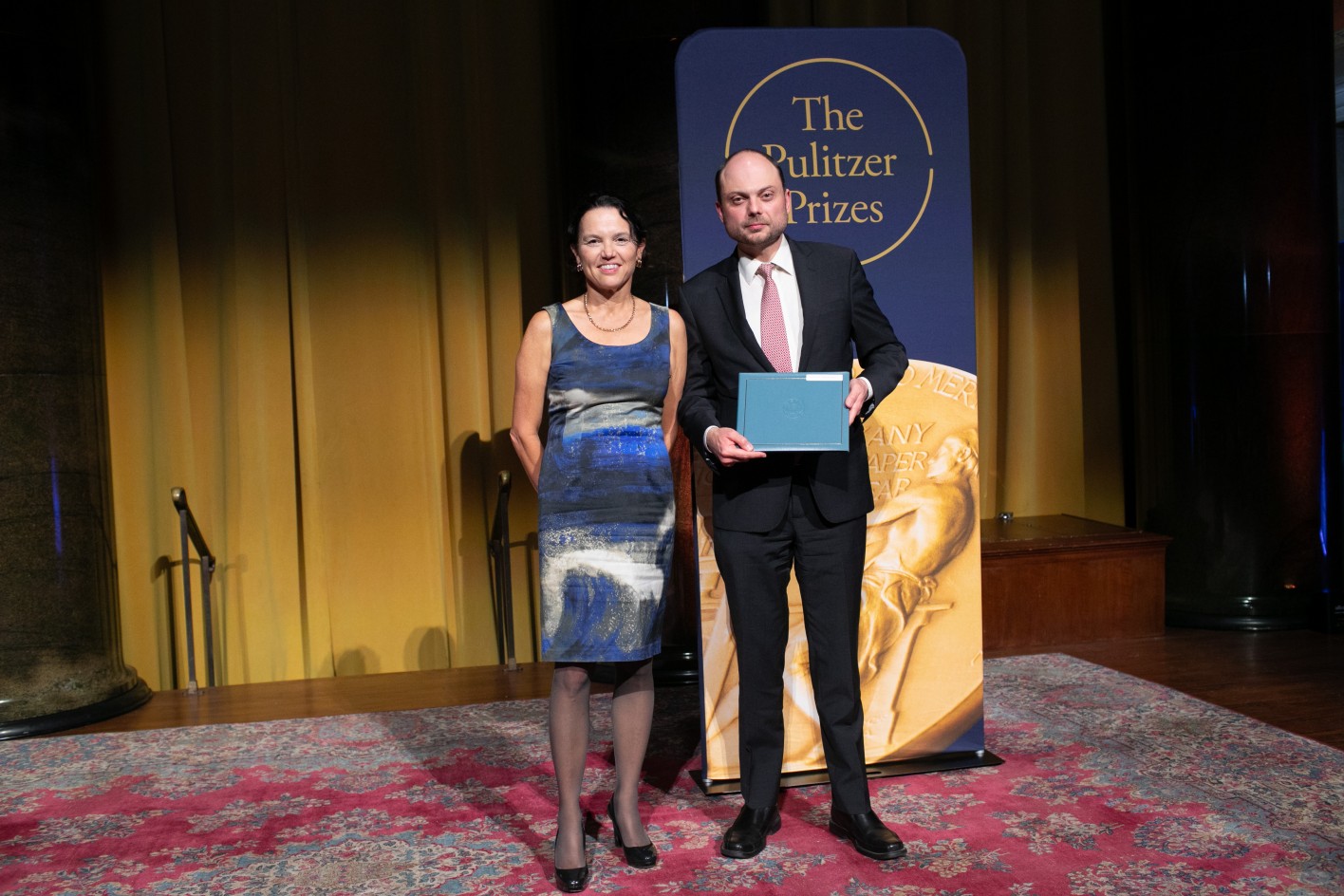
Following his August 2024 release in an international prisoner swap, Vladimir Kara-Murza (right) accepts the 2024 Pulitzer Prize for Commentary from Columbia University Interim President Katrina Armstrong. (David Dini/The Pulitzer Prizes)
Winning Work
By Vladimir Kara-Murza
PRETRIAL DETENTION CENTER 5, Moscow — Among the most stressful aspects of Russian prison life is exposure to government propaganda. Every cell I’ve been in has a television that is constantly turned on — and, with brief respites such as soccer matches during the recent FIFA World Cup, most of the airtime across all major networks is taken up by relentless pro-regime and pro-war messaging not dissimilar to the “Two Minutes Hate” from George Orwell’s 1984. Except that, in Vladimir Putin’s Russia, televised hate goes on for hours.
Propaganda is not limited to news bulletins and talk shows — it also permeates documentaries, cultural programs and even sports coverage. New Year’s Eve, when millions of Russians tune in to listen to popular songs and watch favorite movies, was also filled with propaganda messages.
The leitmotifs are always the same: Russia is surrounded by enemies. The West seeks to humiliate and dismember it. The Soviet Union was a noble and benevolent state — “the empire of good,” as chief TV propagandist Dmitry Kiselyov put it in a film broadcast on New Year’s Eve — that was destroyed by a mischievous scheme of the Reagan administration with help from domestic traitors. The only reason Russia still exists is because Putin is there to protect it. Ukraine is a Western puppet state run by neo-Nazis through which the United States and NATO are trying to attack Russia. And Russian soldiers on the front lines are heroes defending the motherland.
And so on — day after day, for hours on end. This is the distorted reality that millions of Russians have lived in for years — and it is frightening.
It is a reality that Putin took a long time and put in a lot of effort to construct. He began early: Days after his inauguration as president of Russia in May 2000, he sent armed operatives to raid the offices of Media Most, at that time Russia’s largest private media holding. Its flagship outlet was NTV, one of the country’s most popular television channels, known for hard-hitting news coverage, sharp political satire, criticism of the war in Chechnya and exposure of government corruption. Within a year, NTV was seized by the state. Before the end of 2003, the Kremlin had silenced all of Russia’s independent TV networks, establishing a complete monopoly on the airways. From then on, it was a straight road to dismantling what was left of Russia’s democracy — and, ultimately, to where we are today.
Russian society met the destruction of independent media mostly with silence. There were street rallies in support of NTV — but nowhere near the scale merited by the gravity of the situation. Western leaders, the supposed guardians of democratic values, were just as indifferent. A few weeks after the state takeover of NTV, President George W. Bush greeted Putin in Slovenia with famous words about looking into his eyes and getting “a sense of his soul.” In June 2003, days after Putin pulled the plug on Russia’s last independent TV network, he was treated to a pomp-filled state visit to London, with red-carpet greetings, lavish receptions and a horse-carriage ride with Queen Elizabeth II. Not a word about media freedom was uttered by his hosts. As a journalist covering that visit, I could not help but feel somewhat astonished.
Western reluctance to seriously address the malign influence of Kremlin propaganda was still on display years later when, after the assassination of Russian opposition leader Boris Nemtsov in 2015, former prime minister Mikhail Kasyanov and I urged the U.S. government to impose targeted sanctions on some of the most notorious Kremlin propagandists who incited hatred toward Putin’s opponents. Our calls fell on deaf ears.
It would take Putin’s invasion of Ukraine and a large-scale war in the middle of Europe for Western governments to finally bring sanctions on the Kremlin’s propaganda machine and its chief operators. Only in 2022 did Vladimir Solovyov, one of the faces of Putin’s television propaganda, finally lose access to his two villas on Lake Como in Italy. Western politicians and commentators who blame Russian society for tolerating this regime for such a long time should not forget about their own leaders who did exactly the same.
Despite its intensity, Kremlin propaganda is showing signs of losing its effectiveness. Surveys show that the audiences of all three main television networks are overwhelmingly older; younger Russians prefer to get their news from online sources — and find ways to overcome state-imposed firewalls to do it. Last year, Russia shot up to second place worldwide in the downloads of VPN services that give access to websites blocked by the government; the messaging app Telegram now has a larger audience in Russia than state television. A recently leaked secret poll commissioned by the Kremlin showed that Russians strongly favor a peaceful settlement with Ukraine over continuing the war — hardly a result sought by state propaganda.
Among the most important steps the free world could take to further undermine the Kremlin’s hateful messaging would be to support independent Russian media — such as Echo of Moscow, TV Rain and Novaya Gazeta — that were shut down after Putin’s attack on Ukraine and are now operating from abroad. Nothing weakens official lies as effectively as truthful information. No less important — especially looking ahead — is to pursue accountability for the people who operate Putin’s propaganda machine. Sanctions are merited (and long overdue) — but not enough.
As high-level conversations begin about a future international tribunal over the Putin regime’s war crimes in Ukraine, plans should also be made to bring to account those who incited and enabled them — in the same way Nazi propagandists were tried at Nuremberg, or the operators of Radio Mille Collines at the U.N. criminal tribunal for Rwanda. Speaking recently on one of the television talk shows, Margarita Simonyan, head of the leading Kremlin propaganda outlet RT, warned that in the event of Putin’s failure in Ukraine, “The Hague [the seat of international courts] awaits even the street sweeper behind the Kremlin wall.”
I don’t think anyone would suggest that street sweepers working for the Kremlin should be brought to justice. But the likes of Simonyan, Kiselyov, Solovyov and other Putin regime propagandists certainly should.
By Vladimir Kara-Murza
PRETRIAL DETENTION CENTER NO. 5, MOSCOW — Among the most difficult aspects of imprisonment — after forced separation from family and the daily humiliation of not being able to control your own movements, except for walking back and forth in a tiny prison cell — is the inability to see or speak to people you care about.
So it was a special treat for me when the First General Court of Appeals in Moscow, which on July 31 finalized my 25-year prison sentence for speaking out against Vladimir Putin and his war on Ukraine, decided to open its doors for the announcement of the ruling. I couldn’t speak to anyone from my glass cage surrounded by police guards and court bailiffs, but for the few minutes it took the presiding judge to read out the (predetermined) decision, I could see the faces, smiles, tears and thumbs-ups of my friends, colleagues and supporters, as well as journalists and diplomats who packed the courtroom. This was the first time I had seen most of them (except for the handful who were witnesses at my proceedings) since my arrest in April 2022 and my trial at the Moscow City Court, which was held entirely behind closed doors.
The secrecy was explained by the “classified” status of my case (a self-evident absurdity given that all my “criminal episodes” were my public speeches that are readily accessible online). The real reason — as prosecutor Boris Loktionov candidly stated at the appeals hearing last month — was “to prevent Kara-Murza from using the court as a political platform and publicly calling our president, Vladimir Vladimirovich Putin, a murderer.” Well, he said it himself.
At the start of this process, I expected my experience to be similar to that of the dissidents of the 1960s and 1970s whose struggles against Soviet totalitarianism I have studied and documented. But Russia’s regress under Putin has taken a much more dramatic pace. From the total secrecy of the proceedings to the three-judge panel that seemed to intentionally echo the “troikas” of the 1930s to the language of the prosecutor, who called me “an enemy that must be punished,” my trial had much more in common with the handling of “enemies of the people” under Joseph Stalin than of dissidents under Leonid Brezhnev. The sentence completed the parallel: Before me, the last time political prisoners in this country had received 25-year terms was at the end of Stalin’s reign.
Even the wording of the verdict seems to be taken directly from that era. In 1937, my grandfather Alexei Kara-Murza — also a journalist and historian — was arrested and sent to the gulag for “expressing hostility towards the leaders of the party and the government.” One of my “crimes” detailed in the sentence was “making hostile statements about the representatives of the state authorities including the President of the Russian Federation.” The rhymes couldn’t be more deliberate. But then again, it is hardly surprising that someone who began his rule by reinstating the Stalin-era national anthem is using Stalin-era methods against his opponents. In Russia, symbols speak louder than words.
The aim of the Kremlin’s campaign of punishing enemies (to borrow the words of my prosecutor) is also the same as it was under Stalin: to instill fear in Russian society and to paralyze its will to challenge the regime. Alongside my friends and colleagues in the courtroom last month were propagandists from state media outlets who made sure to break the news of the ruling as loudly as possible — as they did with Alexei Navalny’s 19-year sentence, which was announced Aug. 4. But beyond Navalny and me, there are hundreds of political prisoners in today’s Russia, now in nearly every region of the country; and the fastest-growing segment among them are opponents of Putin’s war on Ukraine. Repression and fear are the only way the Kremlin is able — for now — to keep significant antiwar sentiment in Russian society from translating into open protests.
My lawyers tell me about their conversations with cabdrivers in Moscow — usually a good gauge of public opinion in any country. Most of them are against the war. When my lawyer asked one of them why he isn’t doing anything about it, he responded: “Haven’t you heard about the guy who got 25 years for speaking out?”
“I have,” she said with a smile.
Some people in the West are asking why more Russians aren’t protesting against Putin and his brutal war. Perhaps, a more apt observation would be that — given the circumstances and the cost — so many Russians are. According to human rights groups, since Putin’s invasion of Ukraine, nearly 20,000 people have faced police detention across Russia for antiwar protests. Not a week goes by without another arrest, indictment or sentencing of antiwar protesters. Artists and journalists, politicians and priests, lawyers and police officers, students and railroad workers: Russians of different backgrounds and vocations have refused to become silent accomplices to Putin’s war, even at the cost of personal freedom.
It is my hope that when people in the free world today think and speak about Russia, they will remember not only the war criminals who are sitting in the Kremlin but also those who are standing up to them. Because we are Russians, too.
By Vladimir Kara-Murza
Editor’s note: In April 2022, Russian police arrested opposition activist and Post contributor Vladimir Kara-Murza for criticizing the war in Ukraine. Last month, he was transferred to a maximum-security prison in Siberia, where he is set to serve out the rest of his 25-year sentence.
PRISON COLONY NO. 6, OMSK, Russia — Dictators are not content with controlling the present; they want to control the past as well. “Correctly” crafted historical narratives can give them an appearance of legitimacy and provide justification for their actions.
So it should not be surprising that, even though the Russian state is focusing most of its resources on its ongoing aggression against Ukraine, Vladimir Putin found time to set up a special task force to prepare a new history textbook for Russia’s 10th- and 11th-graders. The panel, headed by his adviser Vladimir Medinsky, completed its work in a mere four months. This fall, as schools opened across Russia for the new academic year, Medinsky’s textbooks went into compulsory use. The Kremlin adviser, who likes to style himself as a “historian” (though his doctoral thesis was found to be plagiarized), had personally co-written them.
As could be expected from a regime led by a KGB officer who spares no effort to whitewash and glorify the Soviet past, the new textbooks have very little to do with actual history. Instead, they resemble compilations of propaganda slogans that have for years been advanced by Kremlin officials and state media outlets.
Russian students will be taught that both the 1968 invasion of Czechoslovakia and the 1979 invasion of Afghanistan were conducted at the behest of these countries’ own governments; that “human rights violations” (written exactly like this, in quotation marks) in the Soviet Union were just a pretext for Western interference in its internal affairs; and that Mikhail Gorbachev was an incompetent and ignorant leader whose policies led to the “greatest geopolitical catastrophe of the twentieth century,” as the dissolution of the U.S.S.R. is described in the textbook, using Putin’s well-known expression. The history of the Soviet dissident movement is illustrated with a “primary source” — not a declaration or pamphlet by dissidents or human rights groups, of course, but a 1972 report from KGB Chairman Yuri Andropov about “organized subversive activity … by anti-Soviet elements.”
Some of the historical fabrications or omissions in the textbooks are simply funny. Nobel Prize-winning writer Alexander Solzhenitsyn, who chronicled the history and mechanics of Soviet repression in his seminal “The Gulag Archipelago,” is listed among Russian cultural figures who “left the USSR in the 1970s and early 1980s.” Technically speaking, you can’t argue with that — Solzhenitsyn did indeed “leave the USSR” after being arrested, charged with treason and forcibly deported from the country in February 1974.
In another section dedicated to sporting achievements, the list of Soviet world chess champions stops with Anatoly Karpov in 1985. Garry Kasparov, who won the title from Karpov that year, also came from the Soviet Union — but as an opponent of Putin and the war in Ukraine, he can’t be mentioned in any context. In the same way, the names of people who had become “undesirable” during the Stalin era were simply cut or blacked out from books and encyclopedias — as if they never existed.
But the most egregious section in Medinsky’s history textbook concerns a subject that does not belong to a history textbook at all: the war in Ukraine. To any historian (and I am one myself), the very idea of analyzing current events as history is a breach of professional ethics. In his book “Outlines of Russian Culture,” written in the 1890s, eminent historian Pavel Milyukov declined to discuss governmental reforms enacted by Alexander II in the 1860s and 1870s because they were too recent and “as yet unfinished.” But nothing as mundane as professional standards could deter Medinsky from dedicating pages in his textbook to an event that is not only recent but also current and ongoing. (I would also wager that the public perception of the war is going to change dramatically in Russia in the years to come — making its treatment as part of “history” even more nonsensical.)
Students in Russian classrooms will be told that Ukraine is a “neo-Nazi” state led by a “junta” that came to power in a “military coup” in 2014, and that “any dissent in Ukraine is brutally suppressed, and the opposition is banned.” It was Ukraine that started this war, the textbook claims — while Russian soldiers are now “fighting shoulder to shoulder for goodness and the truth.” (I am not joking — this is an actual phrase from the textbook.) “The special military operation has consolidated our society,” the textbook asserts, using the official propaganda euphemism for the Ukraine war. Needless to say, it neglects to mention that opposition in Russia to the war is punished by long prison sentences — and that, despite this threat, thousands of Russians have publicly protested it.
Russia, of course, has a history of using school textbooks for the purposes of government propaganda. But we also know how such efforts ended — and I am fortunate to have a personal experience of this. In Soviet schools, one of the most ideologically charged history textbooks came in fourth grade; it was about the early 20th century and accordingly centered on the takeover of power by the Bolsheviks in 1917 — “the Great October Socialist Revolution,” as it was called then.
For me, fourth grade started in September 1991, just days after Russia’s democratic revolution dealt the final blow to the Soviet regime. The very air, it seemed, smelled of freedom. Our school was near Lubyanka Square, and during recess, we would go there to look at the empty pedestal from the monument of KGB founder Feliks Dzerzhinsky that had just been toppled. The pedestal was covered with anti-communist graffiti; on top of it, instead of Dzerzhinsky, now stood a makeshift wooden cross in memory of the millions of victims of the Soviet regime. The atmosphere around us couldn’t have been in starker contrast to the ideological nonsense written in the textbook.
Our history teacher never used it. “You can read it in your own time if you want to,” she would say at the start of every lesson. “And I will tell you what actually happened.”
Something makes me think the Medinsky textbook will meet the same fate — and much sooner than he or his boss might imagine. You could say it’s a historian’s intuition.
By Vladimir Kara-Murza
Editor’s note: In April 2022, Russian police arrested opposition activist and Post contributor Vladimir Kara-Murza for criticizing the war in Ukraine. On Sept. 4, authorities at the Moscow detention center where he has been held for more than a year informed his lawyers that he was no longer in custody there. Though his precise whereabouts are unknown, it is likely he is being transferred to a Siberian prison where he will be expected to serve out the rest of his 25-year sentence. What follows is the translation of a Russian-language text he was able to write before his departure.
Political change in Russia always comes unexpectedly. The czarist minister Vyacheslav von Plehve, who before 1904 called for a “small victorious war,” never imagined it would lead to a revolutionary explosion and force the monarchy to agree to a constitution, a parliament and freedom of the press. Vladimir Lenin, complaining to the Swiss Social Democrats in January 1917 that “we of the older generation may not live to see the decisive battles of this coming revolution,” did not suspect that it was only a few weeks away. And absolutely no one in the summer of 1991 expected that by the end of the year, the Communist Party of the Soviet Union would be banned and the Soviet Union dissolved.
The next time, change will come in exactly the same way — abruptly and unexpectedly. None of us knows the specific moment and specific circumstances, but it will happen in the foreseeable future. The chain of events leading to these changes was started by the regime itself [with its full-scale invasion of Ukraine] in February 2022. It’s only a matter of time.
And this means, as Alexei Navalny rightly pointed out in a recent and widely discussed article, that a window of opportunity for the reestablishment of the state on democratic principles will soon appear again in Russia. Not a “window of guarantees,” not a “window of a final result,” not a “window of a bright and happy future” — but rather precisely a window of opportunity that we must use wisely and not squander yet again, as was done in the 1990s. And that is why a serious, meaningful and public conversation about those missed opportunities is so important — not for historical reflection but to avoid stepping on the same rake again.
Hardly anyone can dispute that the leaders of democratic Russia of the 1990s missed a unique historical chance. The only thing is that it was missed, in my opinion, much earlier than the events that Alexei writes about: long before the constitution of 1993, the loans-for-shares auctions of 1995 and the presidential election of 1996. The windows of opportunity opened by revolutionary change are generally very small and close very quickly. The new government will have only a few months, at best a year, to make a decisive break with the totalitarian past and prevent its return.
It was this chance that Boris Yeltsin’s team missed in those crucial months of 1991 and 1992, when every day was worth its weight in gold. A society that has gone through the trauma of a brutal dictatorship, massive internal repressions and aggressive external wars, that has lived for decades under conditions of total lies and deliberate distortion of normal human values, needs, above all, moral purification. This is the path that — in various forms but with an unchanged essence — a variety of countries have walked in recent history: from Germany after National Socialism to the states of Latin America after military dictatorships, from the former socialist countries of Eastern Europe to post-apartheid South Africa. To prevent the return of evil, we must first comprehend, condemn and punish it — publicly and at the highest state level. In this way, neither the ideology underlying the previous regime nor the structures and people implementing its repressive policy will be allowed to harm the young democracy, especially in the first, most important years of its formation.
This path of real renewal was open to Russia in 1991 and 1992. Society was ready for it. The rising strength of the social movement of the late 1980s and early 1990s and the August Revolution of 1991 were driven by anti-totalitarian passion, by the rejection and denial of violence on the part of the Communist Party and its “armed wing.” It is no coincidence that immediately after the victory over the coup plotters [in 1991], a crowd of Muscovites set off to remove the monument to [Soviet secret police founder] Felix Dzerzhinsky on Lubyanka Square. At the same time, they dismantled Yuri Andropov’s memorial plaque on the facade of the main KGB building. It is quite possible that the issue would not have remained limited to the plaque and the monument: The people gathered in the square were ready to go further — to the building itself. The leader of the victorious revolution, Yeltsin, personally came to Lubyanka to dissuade them from this. His authority in those days was undisputed, so people dispersed. This was the first red flag.
Just a few days later, at a different rally at the Mayakovsky Monument, Vladimir Bukovsky, a writer, long-term political prisoner and co-founder of the democratic movement in the U.S.S.R., spoke words that proved prophetic. “Don’t be fooled: The dragon is not dead yet. It is mortally wounded, its spine is broken, but it still holds human souls and many countries in its claws.” Throughout the next year, Bukovsky and a few other farsighted democratic leaders, including Galina Starovoitova, a Russian legislator and adviser to Yeltsin, tried to persuade the Russian leadership to “slay the dragon”: to open the archives of the Central Committee of the Communist Party of the Soviet Union (CPSU) and the KGB, to publish documents about the crimes of the Soviet regime and its punitive bodies, and to condemn these crimes at the state level so that the people who committed these crimes could not decide the fate of new Russia.
This was not to be a “witch hunt,” as frightened party officials cried. “After all, the task was not to separate the less guilty from the more guilty and punish the latter, but to cause a process of moral purification of society,” Bukovsky wrote in his book “Judgment in Moscow.” “For this, it was necessary to judge the system with all its crimes.” In 1992, the Russian Constitutional Court conducted its hearings on the fate of the Communist Party, at which a few documents on the crimes of the Soviet regime were presented from the archives of the Central Committee; Bukovsky, who had been invited by the president’s office to act as an expert witness, wanted these hearings to become just the sort of “Russian Nuremberg trial” he envisioned. That same year, Starovoitova introduced in the Supreme Soviet of the Russian Federation a bill on lustration that proposed a temporary ban (five to 10 years) on government service for all former party officials and all former employees of the KGB.
As we know, nothing of the sort was done. Yeltsin was not ready for a final break with the Soviet past. Western leaders, afraid of being confronted with interesting information about themselves in the Moscow archives, pressured Yeltsin to keep them closed. The Supreme Soviet did not even consider Starovoitova’s bill. And the Constitutional Court made a halfhearted decision that avoided the main issue: the illegality of the activities of the CPSU itself. (The court dismissed the need for an assessment of this on the ridiculous pretext that the party no longer existed.) Anatoly Kononov, the Constitutional Court judge who expressed a dissenting opinion, called the court’s decision a “denial of justice,” noting that the materials presented in court “allow the characterization of this organization (the CPSU) as criminal,” including with reference to international norms “on genocide, war crimes and crimes against peace and humanity.” The judge separately noted the role of “subordinate CPSU punitive bodies” in these crimes.
But no official conclusions were made regarding those punitive bodies. The archives, for the most part, remained closed. The KGB dodged even the mildest of reforms. It received a bit of an image makeover; that was all. And the people who took a direct part in repression ended up in leadership positions from the very first days of democratic Russia. In December 1991, Vyacheslav Lebedev, who had recently taken part in the imposing of sentences for political reasons, was confirmed as the chairman of the Supreme Court of the Russian Federation. In January 1992, the post of head of the anti-corruption department of the Ministry of Security of the Russian Federation was given to Anatoly Trofimov, who as a KGB investigator handled the cases of many Moscow dissidents, including Anatoly Shcharansky, Yuri Orlov, Sergei Kovalev and Father Gleb Yakunin. Soon, Trofimov rose to the position of head of the Moscow department of the FSB and deputy head of the entire organization. There are many similar examples, but I will name only one more: In the same year, 1992, KGB officer Vladimir Putin, who in the 1970s had personally taken part in searches and interrogations of Leningrad dissidents, became the right-hand man of St. Petersburg Mayor Anatoly Sobchak.
Having failed to effect the changes he believed necessary, Bukovsky left Russia with a warning to Yeltsin’s team: “Look, it’s like a wounded animal: If you don’t finish it off, it will attack you.” In the end, the monstrous crimes of the Soviet system and its punitive bodies never received either a moral or a legal assessment by the Russian state. I repeat: If we do not comprehend, condemn or punish evil, it will definitely return. On Dec. 20, 1999 — 11 days before he moved to the Kremlin — Putin, then the prime minister, unveiled a restored Andropov memorial plaque on Lubyanka, the same one that had been removed in August 1991.
We have no right to repeat this mistake when the window of opportunity opens again. All archives must be opened and published. All the crimes of both the Soviet and Putin regimes must receive a proper evaluation at the state level. All structures involved in these crimes — above all the FSB — must be liquidated, and the people who committed these crimes must be held accountable before the law. Those who served as conductors of repressive policies should be deprived of the right to hold government posts — and this will not be a witch hunt (as some current officials will once again shout) but the necessary protection against a new authoritarian revenge. And I would like to emphasize (although it goes without saying): To investigate war crimes and crimes against humanity committed by the Putin regime in the course of its aggression against Ukraine, we will have to create an international tribunal (modeled on similar ones for the former Yugoslavia and Rwanda), to which all suspects, regardless of their rank and position, must be transferred.
Only in this way — having fully confronted and condemned these crimes — will Russia be able to truly free itself from the burden of the past and move forward toward the creation of a free and modern state based on law and universal values. This will ensure that the country can finally avoid entering the same old vicious circle, so that the next generation of Russian politicians will no longer need to conduct the same old discussions between Vladimir labor camp and Moscow prison.
I believe we can do it.
By Vladimir Kara-Murza
PRETRIAL DETENTION CENTER NO. 5, MOSCOW — By unwritten instruction, political prisoners are not supposed to be held in the same (or adjacent) cells in Russian prisons and penal colonies — a departure from late Soviet times, when special labor camps in the Perm Region and a whole wing of Vladimir City Prison were designated specifically for opponents of the regime. Some of the most prominent Soviet dissidents — including Natan Sharansky and Vladimir Bukovsky — passed through these notorious institutions, which are described in grim detail in their memoirs. If there was any upside, it was the chance to interact with fellow human rights activists. Sharansky warmly recalls sharing a prison cell with Lithuanian dissident Viktoras Petkus, their conversations and chess matches.
Today’s political prisoners are spread among regular inmates — and so, in the 16 months I’ve been imprisoned, I have had only a few accidental encounters with fellow opposition members. Once, I shared a ride in a police van with Alexei Gorinov, a Moscow municipal councilor arrested for denouncing the war in Ukraine at his council meeting.
Another time, I spent all day in a holding cell of the Moscow City Court with Daniel Kholodny, the director of Alexei Navalny’s video operations (and Navalny’s co-defendant). Before his trial, Daniel was also held at our prison, so we were sometimes escorted together to the administrative wing to meet with lawyers or investigators. Of course, we used every opportunity for a conversation along the way.
For one day, I even shared a cell with a fellow political prisoner — Vadim Ostanin, a leader of the Navalny movement in Siberia. We were both pleasantly puzzled as to how this was possible, but the prison warden realized his mistake; Vadim was hastily removed from my cell at 2 a.m. that night.
But the most unusual — and most unexpected — encounter with an opposition colleague happened one morning last month, when the prison guard opened the feeding slot in my cell door and told me to get ready for a court appearance by video link. I did not have any scheduled hearings that day and had no idea what was going to happen. The answer came once I was locked in a metal cage (yes, even when you speak by video from a secure room inside a prison, they still lock you in a cage) and the screen was turned on.
What I saw made me think of a scene in Franz Kafka’s “The Trial” in which the protagonist, facing a prosecutor and assembled guests in the attic of a random residential building, has to respond to charges of which he has no knowledge. The room on the video screen looked like a school gym. At the head of the court, under a double-headed eagle clumsily fastened to the wall, sat Moscow City Court Judge Andrei Suvorov, with his chair behind a small (also school-type) desk. His judicial gown looked strikingly out of place, given the circumstances. The room was filled with men in black masks and khaki uniforms. At a table by the wall on the left side of the screen sat the defendant surrounded by his lawyers — and it was only when he stood up to approach the camera and speak that I realized it was Alexei Navalny.
The Russian authorities are doing their best to hide the sham trials of their political opponents from public view. My own trial at the Moscow City Court, which ended with a 25-year sentence, was held entirely behind closed doors. Alexei’s trial was actually organized inside the penal colony in the Vladimir Region where he is serving his previous sentence. It was there where I was now connected by video link, called by Alexei as his defense witness.
Because he had to respond to his official indictment, Alexei’s questions to me were no less Kafkaesque than the surroundings. Does public opposition to the government constitute extremist activity? Is the freedom of public demonstrations conditional on permission by the authorities? Was his 2013 campaign for mayor of Moscow (where he came in second with 27 percent of the vote) just a cover for his underground illegal activities? Were his anti-corruption investigations detailing the riches of Vladimir Putin and his close entourage slanderous fabrications? And so on. A few times, I had to ask whether the question was serious. “Unfortunately, yes — that is my indictment,” Alexei would respond each time.
We hadn’t spoken since Alexei’s arrest in January 2021, so it was nice to see one another, even in such unorthodox circumstances. Suvorov didn’t interrupt us once — a pleasant change from my own trial, during which Judge Sergei Podoprigorov constantly cut me off when I spoke and did not let me ask my own defense witnesses (journalist and Nobel Peace Prize laureate Dmitry Muratov and veteran opposition leader Grigory Yavlinsky) a single question. Unlike Podoprigorov — who has been sanctioned in the United States and other Western countries under Magnitsky laws that I helped pass — Suvorov had nothing personal against his defendant.
Of course, that didn’t affect the result in any way — verdicts for political prisoners are decided in the Kremlin ahead of time. This month, Alexei was sentenced to 19 years in a “special regime” penal colony.
“Only in a Russian court can an extremist call a traitor as his defense witness,” Alexei quipped during our courtroom exchange, referring to the respective charges against us. “There’ve been stranger things,” I replied. “Alexander Solzhenitsyn was declared a traitor, and Nelson Mandela was convicted as a terrorist. But, somehow, time has set everything right.”
And so it will again in Russia. Of this, I have no doubt.
By Vladimir Kara-Murza
Vladimir Kara-Murza delivered these remarks on Monday at the closing session of his trial in Moscow.
MOSCOW CITY COURT — Members of the court: I was sure, after two decades spent in Russian politics, after all that I have seen and experienced, that nothing can surprise me anymore. I must admit that I was wrong. I’ve been surprised by the extent to which my trial, in its secrecy and its contempt for legal norms, has surpassed even the “trials” of Soviet dissidents in the 1960s and ’70s. And that’s not even to mention the harshness of the sentence requested by the prosecution or the talk of “enemies of the state.” In this respect, we’ve gone beyond the 1970s — all the way back to the 1930s. For me, as a historian, this is an occasion for reflection.
At one point during my testimony, the presiding judge reminded me that one of the extenuating circumstances was “remorse for what [the accused] has done.” And although there is little that’s amusing about my present situation, I could not help smiling: The criminal, of course, must repent of his deeds. I’m in jail for my political views. For speaking out against the war in Ukraine. For many years of struggle against Vladimir Putin’s dictatorship. For facilitating the adoption of personal international sanctions under the Magnitsky Act against human rights violators.
Not only do I not repent of any of this, I am proud of it. I am proud that Boris Nemtsov brought me into politics. And I hope that he is not ashamed of me. I subscribe to every word that I have spoken and every word of which I have been accused by this court. I blame myself for only one thing: that over the years of my political activity I have not managed to convince enough of my compatriots and enough politicians in the democratic countries of the danger that the current regime in the Kremlin poses for Russia and for the world. Today this is obvious to everyone, but at a terrible price — the price of war.
In their last statements to the court, defendants usually ask for an acquittal. For a person who has not committed any crimes, acquittal would be the only fair verdict. But I do not ask this court for anything. I know the verdict. I knew it a year ago when I saw people in black uniforms and black masks running after my car in the rearview mirror. Such is the price for speaking up in Russia today.
But I also know that the day will come when the darkness over our country will dissipate. When black will be called black and white will be called white; when at the official level it will be recognized that two times two is still four; when a war will be called a war, and a usurper a usurper; and when those who kindled and unleashed this war, rather than those who tried to stop it, will be recognized as criminals.
This day will come as inevitably as spring follows even the coldest winter. And then our society will open its eyes and be horrified by what terrible crimes were committed on its behalf. From this realization, from this reflection, the long, difficult but vital path toward the recovery and restoration of Russia, its return to the community of civilized countries, will begin.
Even today, even in the darkness surrounding us, even sitting in this cage, I love my country and believe in our people. I believe that we can walk this path.
By Vladimir Kara-Murza
Vladimir Kara-Murza has prepared the following remarks for an upcoming appearance before a Moscow appeals court. In April, he was sentenced to 25 years in prison on treason charges — an accusation based entirely on his public statements about Russia’s full-scale invasion of Ukraine.
Update: Kara-Murza delivered these remarks at his appeal hearing on July 31. As was expected, he lost the appeal.
Throughout this process — first in the Moscow City Court, now here in the Court of Appeal — a very strange feeling has never left me. Judicial procedures, by their nature, must be somehow connected with the law. But everything that has happened to me has nothing to do with the law; if anything, what I have witnessed is precisely the opposite.
The law — both Russian and international — prohibits the waging of aggressive war. But for more than 15 months, the man who calls himself the president of my country has been waging a brutal, unprovoked, aggressive war against a neighboring country: killing its citizens, bombing its cities, seizing its territories.
The law — both Russian and international — prohibits attacks on civilians and civilian targets. But during the 15 months of Putin’s aggression in Ukraine, tens of thousands of civilians have been killed and wounded, and thousands of hospitals, schools and houses have been destroyed.
The law — both Russian and international — prohibits propaganda for war. But war propaganda is all I hear from morning to night on the television that plays in my prison cell.
Today in our country, it is not those who are waging this criminal war but those who oppose it who face judgment: Journalists who tell the truth. Artists who put up antiwar stickers. Priests who invoke the commandment “Thou shalt not kill.” Teachers who call a spade a spade. Parents whose children draw antiwar pictures. Lawmakers who allow themselves to doubt the appropriateness of children’s competitions when children are being killed in a neighboring country.
Or, as in my case, politicians who openly speak out against this war and against this regime. I received a sentence of 25 years for five public appearances. As the head of my guards in Moscow City Court sarcastically joked: “Impressive work.”
All this has happened before in our country. In 1968, participants in a demonstration on Red Square against the invasion of Czechoslovakia were sentenced to camps and internal exile, and in 1980, [Andrei] Sakharov was exiled to the closed city of Gorky for speaking out against the war in Afghanistan.
But it was only a few years later that a Russian president [Boris Yeltsin], on a visit to Prague, condemned that occupation and laid flowers at the memorial to its victims, and the highest legislative body of our country declared that the war in Afghanistan deserved moral and political condemnation. The same will happen with the current war in Ukraine, and it will happen much sooner than it may seem to those who unleashed it. That is because, in addition to legal laws, there are laws of history, and no one has yet been able to cancel them.
And then the real criminals will be judged — including those whose arrest warrants have already been issued by the International Criminal Court. As you know, war crimes have no statute of limitations. I have some advice for all of those who organized my and other show trials against opponents of the war by trying to present opponents of the authorities as “traitors to the Motherland,” for all of those who are so nostalgic for the Soviet system: Remember how it ended. All systems based on lies and violence end the same way.
Biography
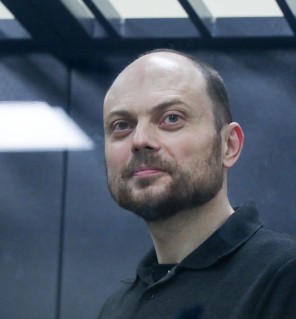
Vladimir Kara-Murza is a Russian politician, author, and historian who has been imprisoned in Russia since April 2022 for speaking out against the war on Ukraine. A longtime colleague of opposition leader Boris Nemtsov, he was a candidate for the Russian Parliament and served as deputy leader of the People’s Freedom Party. Leading diplomatic efforts on behalf of the opposition, Kara-Murza played a key role in the adoption of targeted Magnitsky sanctions on Russian human rights violators in the United States, European Union, Canada, and Great Britain. U.S. Sen. John McCain (R-Ariz.) called him “one of the most passionate and effective advocates for passage of the Magnitsky Act”; U.S. Sen. Ben Cardin (D-Md.) described him as “a courageous advocate for the democratic process and fundamental universal human rights.” Twice, in 2015 and 2017, Kara-Murza was poisoned and left in a coma; a subsequent media investigation by Bellingcat and The Insider has identified officers of Russia’s Federal Security Service who were behind the poisonings. He is a contributing writer at the Washington Post and hosts a weekly show on Echo of Moscow radio, and has previously worked for the BBC, RTVi, Kommersant, and other media outlets. He has directed three documentary films, They Chose Freedom, Nemtsov, and My Duty to Not Stay Silent; and is the author of Reform or Revolution: The Quest for Responsible Government in the First Russian State Duma and a contributor to several volumes, including Russian Liberalism: Ideas and People, Europe Whole and Free: Vision and Reality, and Boris Nemtsov and Russian Politics: Power and Resistance. Kara-Murza led successful international efforts to commemorate Nemtsov, including with street designations in Washington and Vilnius. He was the founding chairman of the Nemtsov Foundation and served as vice president at Open Russia and the Free Russia Foundation; both organizations were designated as “undesirable” by Vladimir Putin’s government. Kara-Murza is a senior advisor at Human Rights First and a senior fellow at the Raoul Wallenberg Centre for Human Rights; and has been a visiting fellow at the University of Chicago, leading a seminar course on contemporary Russia. He has been profiled on CBS 60 Minutes and NBC Nightly News, and has appeared on CNN, Fox News, MSNBC, and BBC Newsnight. Kara-Murza is a recipient of several awards, including the Sakharov Prize for Journalism as an Act of Conscience, the Magnitsky Human Rights Award, and the Geneva Summit Courage Award. He holds an M.A. (Cantab.) in History from Cambridge. He is married, with three children.