Michael Paul Williams of the Richmond (Va.) Times-Dispatch
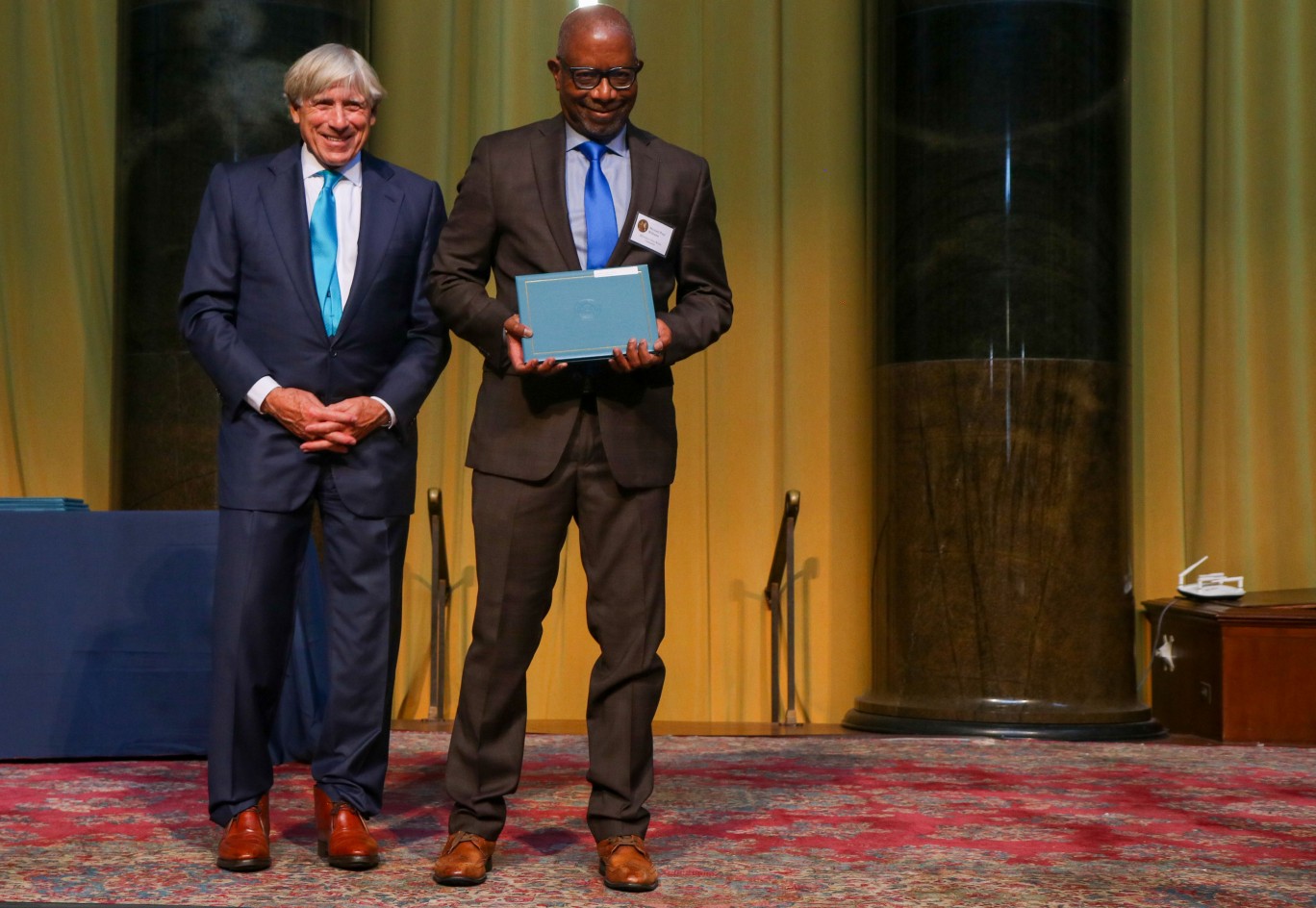
Michael Paul Williams accepts the 2021 Pulitzer Prize for Commentary from Columbia University President Lee Bollinger. (Jose Lopez/The Pulitzer Prizes)
Winning Work
The original opponent of the Robert E. Lee statue issued a stern prophesy after the monument was erected in 1890.
John Mitchell Jr. — newspaper editor, politician, banker and civil rights activist — predicted that the monument “will ultimately result in handing down to generations unborn a legacy of treason and blood.”
Mitchell, editor of the Richmond Planet, wasn’t done. He wrote of the black man: “He put up the Lee Monument, and should the time come, he’ll be there to take it down.”
The time has come. Gov. Ralph Northam is removing Lee from his pedestal as soon as possible. Richmond Mayor Levar Stoney will attempt to follow suit with Monument Avenue’s other Confederate statues in tandem with City Councilman Mike Jones.
John Mitchell, the great-great-nephew of John Mitchell Jr., could not be happier.
“Beautiful,” he said Wednesday. “It has to be done.”
And Mitchell, a Richmond-based web designer and musician, says that when that pedestal becomes vacant, “Of course, I would like to see my great-great-uncle up there.”
The possibilities are endless, but I can’t think of a better choice than Mitchell, a fearless anti-lynching crusader who organized a successful streetcar boycott in Richmond — a half-century before the Martin Luther King Jr.-led Montgomery bus boycott — and ran for governor of Virginia on a “lily black ticket” that included Maggie Lena Walker.
That we are at a moment no one saw coming is due to the Black Lives Matter protesters who cast an unflinching light on the ugly symbolism behind these monuments. Few images are as powerful as the light projection of George Floyd’s face onto the graffiti-marked Lee monument, as was done Wednesday night.
“It is young people, a new generation, that are leading us,” said Robert Johns, a relative of Barbara Johns, who as a 16-year-old schoolgirl in Prince Edward County became a heroine of the civil rights movement in Virginia.
Richmond’s monuments survived the martyrdom, at the hand of white supremacists, of nine black churchgoers in Charleston, S.C., and Heather Heyer in Charlottesville. But the national revulsion and furor unleashed by the torture of Floyd while in the custody of Minneapolis police officers landed at the doorstep of Monument Avenue.
The graffiti handiwork of the protesters, in its rawness, connected the dots of modern-day policing to its slave patrol roots. But what those monuments represent is far more vulgar than the graffiti. They send a clear message that black lives don’t matter at all. The legacy of enslavement and treason has bled into our present.
“Richmond is no longer the capital of the Confederacy,” Mayor Levar Stoney said Thursday. As if to remove all doubt, that message was repeated by a descendant of the man on the monument.
“The Lost Cause is dead,” said the Rev. Robert W. Lee IV. “A new cause is upon us, one of equality and justice and peace and concord.”
Stoney summoned the words of the always-eloquent James Baldwin: “History is not the past. It is the present. We carry our history with us. We are our history.”
Richmond has become so fixated at carrying the weight of history that it failed to realize what a burden it was, until the demonstrators made it impossible to ignore.
Northam spoke of how a little girl might feel upon standing in the 100-foot Lee circle and gazing up at a 12-ton monument, six stories high. “When it’s the biggest thing around, it sends a clear message: This is what we value the most.”
The monument, by its sheer scale, was designed to evoke shock and awe. It gave white supremacy a symbolic imperviousness — and worse, a veneer of virtue.
“In 2020, we can no longer honor a system that was based on the buying and selling of enslaved people,” the governor said.
The oppression of black folks will not end with the removal of these monuments. As Northam noted, racism is a system that touches every person and every aspect of our lives. But it’s a start.
The grassroots Virginia Defenders for Freedom, Justice & Equality cheered this turn of events in a statement Wednesday. It quoted member Joseph Rogers, a descendant of James Apostle Fields, who rose from enslavement in Hanover County to gain election to the Virginia House of Delegates, a year before the Lee monument went up.
“If we can dismantle the symbols of white supremacy, it means we can dismantle the legacy of white supremacy,” Rogers said. “We can save and improve public housing. We can fund underfunded schools. We can address police brutality. We can do it for Black folks, indigenous people, people of color, working-class whites.”
There will no doubt be resistance, because nothing progressive happens here without it. But allow us this moment of optimism amid a season of trauma. Moving ahead, the possibilities are endless in a space previously reserved for the celebration of oppression. We might salute the spirit of collective dissent that made this happen. Or we could pay a fitting and ironic tribute to Mitchell — a spiritual progenitor of the Black Lives Matter movement and a man who saw this moment coming.
“I think he would say ‘I told you so,’ ” his great-great-nephew said. “Sometimes, prophesy can be justice.”
And when the time comes, “I would fight to be one of those hands to bring that statue down.”
We should have known this day was coming, because they knew this day was coming.
The extrication of Richmond from the clutches of its white-supremacist symbols was never going to be as simple as loosening a few bolts and pushing the levers on a crane.
The architects of Lost Cause dogma protected their bronze idols with an arsenal of fail-safes. Removing Confederate statues from Monument Avenue always was going to be a fight — and a prelude to the much more difficult task of purging the legacy of white supremacy.
And so it has come to pass with an injunction preventing Gov. Ralph Northam, at least temporarily, from removing Robert E. Lee from his pedestal following a complaint that its removal is in violation of the 1890 deed giving the state control of the property.
Artist Kehinde Wiley foreshadowed this moment with his “Rumors of War” statue — a prophesy of cultural evolution and the turmoil that can envelope it.
On Sunday, a Hanover County man was arrested after allegedly driving his pickup truck into a crowd of Black Lives Matter demonstrators marching on Lakeside Avenue en route to the monument of Confederate General A.P. Hill.
Resistance to change is the Virginia Way, even as our elected officials trend more progressive. This is no moment for a victory lap; the battle still is joined.
William C. Gregory, great-grandson of the couple who conveyed the Lee Circle to the state in 1890, says the removal of the Lee statue as planned would cause the monument “irreparable harm.”
He argues that the state, in its acceptance of the property, guaranteed that the statue, pedestal and circle would be “perpetually sacred” and that the state would “faithfully guard it and affectionately protect it.”
And so the deification of Confederate iconography began. It was not enough to inscribe protections in the state code for the Lee statue and its ideological brethren; the Lee monument should be protected by word and deed as well, if you buy Gregory’s argument.
Richmond Circuit Judge Bradley Cavedo just might. On Monday, he issued a 10-day injunction blocking the Lee statue’s removal from its pedestal, citing “a likelihood of irreparable harm to the statue.”
“It is in the public interest to await resolution of this case on the merits prior to removal of the statue by defendants, and the public interest weighs in favor of maintaining the status quo,” the injunction reads.
It was never in the public interest to build or maintain this monument; Robert E. Lee himself said as much.
“I think it wiser,” he wrote in 1869, “... not to keep open the sores of war but to follow the examples of those nations who endeavored to obliterate the marks of civil strife, to commit to oblivion the feelings engendered.”
This legal wrangling misses the point: Irreparable harm already has been done to Virginia’s black citizens, whose ancestors had no real say in the erection of these tributes to men who fought to rip the Union asunder in defense of slavery.
“The purpose of this monument was to recast Virginia’s history; to recast it to fit a narrative that minimized a devastating evil perpetrated on African Americans during the darkest part of our past,” Rita Davis, counsel to the governor, said Tuesday.
Northam’s decision to press forward with its removal “takes us a step closer to reclaiming the truth of Virginia’s history, and to reclaim it for all Virginians, and we look forward to defending that in court.”
The deal struck in 1890 was born out of bad faith and foreshadowed the state stripping its black citizens of their Reconstruction era-rights at the Virginia Constitutional Convention of 1902.
Today, these monuments perpetuate a racist ideology that still plagues our nation. The Lakeside incident is a chilling reminder of what transpired on Aug. 12, 2017, in Charlottesville following a rally of white supremacists, neo-Confederates and neo-Nazis, assembled in part to protest the threatened removal of Confederate monuments. White supremacist James Alex Fields Jr. plowed his car into a crowd of protesters, killing Heather Heyer.
As if operating from the same playbook, an armed man in Seattle drove his car into a crowd of Black Lives Matter protesters and shot a bystander, also on Sunday.
Harry H. Rogers of Hanover County has been charged in the Lakeside incident. Henrico Commonwealth’s Attorney Shannon Taylor is considering hate crime charges. She said the defendant is “an admitted leader of the Ku Klux Klan and a propagandist for Confederate ideology.”
When it comes to Confederate propagandists, it’s hard to top the city of Richmond and the commonwealth of Virginia. It’s past time for both to get out of the hate crime business.
Christopher Columbus survived multiple voyages across the high seas. But his Richmond statue met an inglorious end at the bottom of a Byrd Park lake.
You might have figured Columbus was out of sight and mind at the end of Arthur Ashe Boulevard as local and national attention focused on the Confederate statues on Monument Avenue. But he was removed from his perch on Tuesday night. The following night, Jefferson Davis met the same fate. Williams Carter Wickham was the first Confederate general to fall in this battle for Richmond’s soul, taken down the night of June 6 in Monroe Park.
The pervasive mood has shifted from whitewashing history to unmasking travesties, including the torture and genocide of indigenous people in the West Indies by Columbus.
“To community members and organizers, the Christopher Columbus narrative represents the first leg of a mythical heroes relay race,” in which the participants pass a baton driving exploitation of land and labor, said Chelsea Higgs Wise, a local activist and podcaster who attended the Byrd Park demonstration in solidarity with indigenous peoples.
“Drowning the Columbus statue was a way for Richmond to correct our narrative,” she said. The toppling of other statues this past week “directly connects how the genocide of stolen land paved the way for Virginia to create generational wealth by labeling Africans as human cargo,” she added.
Gov. Ralph Northam has moved to extract Robert E. Lee from his base, though that is tied up in litigation. Mayor Levar Stoney and Richmond City Council are poised to remove the other Confederates on Monument Avenue. Confederate statues have been beheaded or removed in Portsmouth and Norfolk.
It’s as if folks suddenly have realized that they’ve been victims of a multi-generational gaslighting that assigned heroic stature in the public square to agents of enslavement, treason and torture.
This all is unnerving for those who prefer order to chaos. Statue removal potentially is dangerous for protesters. But trauma, confinement and justifiable impatience are a potent mix.
“When you fail to talk about this country’s tortured racial history during times of normalcy, I think this is what you end up with during times of unrest and upheaval,” said University of Richmond historian Julian Maxwell Hayter.
If you’re a demonstrator, you’re probably inclined to strike now, before police begin to crack down or the public mood shifts from Black Lives Matter to lock ‘em up.
But for now, “I think the pandemic in some ways has heightened people’s sense of vulnerability and it’s washed away our distinctions,” Hayter said. Of course, he’s quick to add, that feeling is not unanimous in this age of polarization. Some people can’t even be compelled to wear a mask for their own well-being and that of others, much less acknowledge police brutality or white supremacy.
The optimist in me feels permanent change in the air; the realist wonders if this energy is sustainable.
But young people appear to be hyper-attuned to the brokenness that is the United States today. It wasn’t working for many of them even before the pandemic and the deaths of George Floyd and Breonna Taylor at the hands of police, and jogger Ahmaud Arbery by vigilantes.
“I think there’s a deep-seated, broad-based unrest, especially with younger people, who in some ways recognize that their future has been leveraged,” Hayter said, adding that “they’ve lost faith in the boomer generation’s ability to negotiate our way out of these messes.”
But Hayter, who served on Stoney’s Monument Avenue Commission, says you cannot make the Lost Cause narrative go away simply by tucking away symbols of white supremacy. They must be part of a teachable moment if America is to deal with its legacy of racism.
“You win the mob over by taking down the statues. I think you win the masses over with what you do with them afterward.”
I say we could place them at a battlefield or Civil War museum. Or how about an institution focused on race and civil rights?
The erection of those monuments coincided with the nadir of American race relations from the end of Reconstruction into the early 1920s, with the rollback of black voting rights and political gains, the establishment of Jim Crow and other preludes to current-day inequities in income, employment, health, education and housing.
We’re at a moment where folks are demanding that we take an honest look at these statues and their true legacy, at eye level.
This is our moment of truth to create a legitimate cause out of a lost one.
To do so, the prevailing mythology must come crashing down to earth. We can’t properly assess what’s been placed on a pedestal.
For more than a century, the larger-than-life bronze of Stonewall Jackson towered above one of our most prominent intersections, a symbol of Richmond’s immutability.
“We place today on a high pedestal Virginia’s flawless knight,” Col. Robert E. Lee, grandson of the general, said at the Oct. 11, 1919, unveiling of the monument.
But recently, seemingly all at once for a critical mass of folks, the flaws in this narrative became too hideous to ignore as Richmond reached a saturation point for Lost Cause propaganda. Jackson’s street address was changed to Arthur Ashe Boulevard in honor of the Richmond native, tennis champion and human rights activist whose aspirations were stymied in his hometown by the white supremacy Jackson fought to uphold.
We are now a city in search of heroes and causes we can all rally around. Jackson never qualified. Wednesday, under a gray sky, his likeness was lifted from a perch it never should have occupied in a just and evolved society.
Amid a national reckoning on race after the torture of George Floyd at the hands of police, Richmond could no longer reconcile its racist iconography.
Black Lives Matter demonstrators have attempted to topple Confederate monuments, with varying degrees of success. Finally, on the first day Richmond could take down Confederate statues under a new state law, Mayor Levar Stoney ordered Jackson’s removed as a public safety hazard.
When a crane raised the 17½-foot bronze statue off the granite pedestal, the weight of Richmond history became more bearable. But there’s much heavier lifting to be done.
I’m not just talking about Jackson’s Confederate cohorts. Even before all the symbols of white supremacy are removed, we need to take a wrecking ball to the institutions that help sustain the real thing.
Wednesday at Monument Avenue and Ashe Boulevard was an afternoon of false starts, with enthusiasm uncorked and bubbling to the top before being stuffed back into the bottle. The atmosphere was like that before the lights dim at a rock concert, with the throngs surrounding the Jackson statue applauding at the slightest sign that the show was about to begin.
They chanted: “Whose streets? Our streets!” and “Black Lives Matter!” and sang the refrain from the old Steam classic, “Na na na na, na na na na, hey, hey, good bye.”
April Gage, a native Canadian, stood on the median holding her 8-month-old daughter. “Just coming here and watching is good for keeping all your thoughts flowing through this time,” she said. “This is the moment we’re in.”
Bryan Bailey observed the scene from a distance. “It’s about time,” was his assessment.
The beeping crane maneuvered and power tools whirred. But as the minutes turned to hours, there stood Jackson, like a stone wall. The moment began to echo December’s “Rumors of War” unveiling at the Virginia Museum of Fine Arts, with our transition from old to new Richmond delayed by a tarp unwilling to let go. Jackson was harnessed but seemingly refused to surrender. Then again, we’re talking about extracting bronze from a granite base, not pulling apart Legos.
Finally, the statue lifted off its pedestal to cheers before hanging suspended for a moment. By now, it was pouring, and a bell tolled in the background.
Someday, it will be universally acknowledged that July 1, 2020, was a great day in the city of Richmond — the moment this city finally began divorcing itself from the Confederacy. The fall of Stonewall is just a start. We need to begin earnest work building a Richmond we can be proud of.
“A city cannot consistently transform itself at the expense of its most marginalized citizens and not expect those citizens to have a vast imagination about what a further transformation — whether of statues, a name or leadership — could be,” wrote Hanif Abdurraqib in The New Yorker.
Abdurraqib, a Columbus, Ohio, native, was speaking of his city and the troubling legacy surrounding its namesake. But the same could be written of Richmond, a city whose sense of possibility calcified when it chose to attach its identity to an irredeemable cause.
Richmond, and the nation, are in a long-overdue moment of self-assessment, and no less than our future depends on it. No good can come out of defining ourselves by four of the bloodiest years in the nation’s history and honoring, in our most prominent spaces, agents of treason and enslavement.
Removal of this monument and others will mean nothing if we don’t expand our imagination about what we can and should be.
Hanover County appears intent to live on in infamy as the Prince Edward County of the 21st Century.
In 1959, Prince Edward became the poster child for Massive Resistance, closing its public schools and establishing a private all-white academy — Black students be damned.
Racist intransigence was wrong in Prince Edward then.
It’s wrong in Hanover County now.
“The overwhelming majority of longtime residents in Prince Edward County regret that Massive Resistance not only happened, but that it played such a leading role in creating it and sustaining it,” says Justin Reid, a Prince Edward native and director of community initiatives for Virginia Humanities. “I think honestly there were many people who felt that way while it was happening, but because of peer pressure and intimidation and fear of retribution, were simply afraid to speak out.
“If the majority of white residents who knew and felt what was happening was wrong had had the courage to speak out, we would have been able to prevent so much heartache.”
Which brings us to the heartache experienced by generations of students of color in Hanover.
During the same year Prince Edward closed its schools, Lee-Davis High School, home of the “Confederates,” opened its doors in Mechanicsville.
In 1968, the year the Rev. Martin Luther King Jr. was murdered, the Hanover School Board named a new middle school for Stonewall Jackson.
This was no coincidence.
Today, the Hanover school system continues to honor treason in service of human enslavement. The board can’t seem to convince itself to do the right thing, shooting down an effort this past month to change the school names.
School board members consistently have declined interview requests from Richmond Times-Dispatch reporters about the subject, citing a legal challenge from the Hanover NAACP filed last August.
Hoping to prod Hanover and other school districts onto the right side of history is Gov. Ralph Northam, who wrote a letter Monday urging school board chairs to reject Confederate school names.
“When those names reflect our broken and racist past, they also perpetuate the hurt inextricably woven into this past,” he wrote. “When public schools are named after individuals who advanced slavery and systemic racism, and we allow those names to remain on school property, we tacitly endorse their values as our own. This is no longer acceptable.”
A growing number of localities agree, reversing the Lost Cause glorification that was a response to the civil rights movement and school desegregation.
During the 1950s and ’60s, Georgia redesigned its state flag to incorporate the Confederate battle flag in its design; South Carolina planted the rebel flag atop its state capitol.
For decades, we largely acquiesced. But hate woke us from our slumber.
Five years ago, white supremacist Dylann Roof murdered nine black churchgoers during a Bible study at Emanuel African Methodist Episcopal Church in Charleston, S.C. Roof’s embrace of the Confederate battle flag shredded plausible deniability about that symbol’s cheek-to-jowl dance with hate and subjugation.
Two years later, a Neo-Nazi killed Heather Heyer with his car in the aftermath of a white supremacist rally in Charlottesville, where marchers defended that city’s Confederate statues.
Today, amid an ascendant Black Lives Matter movement, Mississippi is removing the Confederate emblem from its state flag. And Manassas, a place as steeped in Civil War lore as Mechanicsville, renamed its Stonewall Jackson High School last week.
Avi Hopkins, an African American alumnus of Lee-Davis, wants similar change in Hanover.
“I’m very proud that our governor recognizes the importance of not only diverse communities, but also communities of inclusiveness. I hope that the leadership and courage displayed in this moment by Gov. Northam will be replicated in Hanover County,” he said.
“All students deserve a space where they can feel safe in being their authentic selves. The long cast of these racist shadows needs to be removed and replaced with the light of hope for all students.”
The Instagram postings of Black@HanoverCPS provide vivid evidence that African American students in the county, to a significant degree, have not felt safe being authentic.
But then, as now, young people drove the movement toward change. Black students in Prince Edward staged a walkout from their shabby school, leading to a lawsuit that became part the Brown v. Board of Education decision.
Sixteen-year-old Barbara Johns and her fellow plaintiffs displayed more moral courage than the decision makers in Hanover, whose cowardice will make the county a cautionary tale as the nation transitions to a more enlightened era.
“This a bad economic development decision. This is a bad tourism decision. But most importantly, this is a decision that’s harming a considerable number of residents in your community,” Reid said.
“It’s clear ignorance is no longer in season. We know this history. Now is the time to act.”
Hanover, the clock is ticking.
The moral arc bending toward justice is visible from Hill Monument Parkway, a North Side street named for Confederate Gen. A.P. Hill.
To the south is the statue of Hill, the last city-owned Confederate statue still standing, at the intersection of Hermitage Road and Laburnum Avenue. Planted in a nearby yard are Black Lives Matter signs. Across the road sits the Richmond public school named for Linwood Holton, a transitional figure whom an elderly black man in Southside Virginia paid the ultimate tribute: “First governor of all the people.”
Holton, who broke the white supremacist Byrd machine’s stranglehold on state politics in 1970, complied with a federal court order desegregating Richmond’s schools by enrolling his own children in RPS.
Virginia seemed to be marching toward a more inclusive future. But then, as now, some feverishly clutched to the past. Among those affected by the desegregation plan was Bradley Cavedo, then a student at Thomas Jefferson High School.
It was an unhappy experience, he wrote in 1977 for The Collegian, the University of Richmond’s newspaper.
“I will be leaving the solicitous paternalism of the federal courts, which among other things nearly wrecked my high school education by instituting a massive busing plan that caused more upheaval in my school and my life than most people could imagine,” he wrote, as reported by Courthouse News Service.
Today, Cavedo is a Richmond Circuit Court judge presiding over two lawsuits involving the city’s Confederate monuments, most of which were removed by Black Lives Matter demonstrators or by order of Mayor Levar Stoney in the upheaval that followed the Minneapolis police killing of George Floyd. From the bench, he has exhibited a solicitous paternalism in defense of the statues.
In blocking Gov. Ralph Northam’s attempt to remove the state-owned Robert E. Lee monument, Cavedo asserted that the statue “belongs to the people.”
Well, I’m one of those people, and I want it to come down.
The monument was designed to inspire fear or reverence, depending on the hue of the onlooker. As a Richmond native, I avoided it altogether out of revulsion. It has never felt more approachable than in its current graffiti-covered state.
Northam is the duly elected representative of the people. So are the City Council members who reached a consensus to remove the monuments on behalf of a city composed largely of descendants of the enslaved.
Virginia, until recently, was as protective of those monuments as it was protective of school segregation. The commonwealth — on human bondage, school integration and interracial marriage, among other issues — historically has had to be dragged bodily onto the less hateful side of history.
But the absence of monuments to white supremacy is so unbearable to some Richmonders that they would sue to raise them back up, even after they’ve been dismantled. The spirit of those monuments can be found in the racist vitriol Stoney has received in the mail, including one note that called him an “Errand Boy” and the N-word.
Make no mistake. This is merely delay. There’s no turning back.
There’s no logical or moral reason to further celebrate treason in service of the buying, selling and enslavement of human beings. There never was.
To raise these symbols again in the 21st century, when we all should know better, would be doubling down on an obscenity. Using the law as a tool to defend white supremacy is as odious as using the Bible to do so.
Meanwhile, some of us already are looking to the future. Having been defined so long by an inglorious four-year chapter of U.S. history, we need to decide who we want to be.
A decade ago, to commemorate the 150th anniversary of the Civil War and Emancipation, historian Ed Ayers launched a community conversation called “The Future of Richmond’s Past” to promote a more holistic discussion of a history that had been largely purged of slavery.
“In some ways, we’ve been rehearsing this moment a long time before it came,” said Ayers, president emeritus of the University of Richmond.
The empty pedestals on Monument Avenue and the pruned top of the Confederate Soldiers and Sailors monument on Libby Hill are sights some of us thought we’d never see.
“For those of us who’ve been thinking about it a long time, what’s striking is both how long it’s taken and the speed in which it happened,” Ayers said.
What Richmond does over the next three years “will define it going forward,” Ayers said. “You have to have a conversation in which all the voices are heard. The problem with the statues is that they were just one set of voices that claimed to be speaking for everybody. And the people who didn’t have voice — when they had a chance — said, ‘No, they’ve never spoken for me.’”
“If not a blank slate, we do have an opportunity ... to reinvent ourselves with a story that all of us would want to be told,” said Ayers, adding: “If we rise to the occasion, later generations won’t look back and say, ‘OK, they lied to themselves.’”
Richmond must stop waging war with the past and fight for its future. We’ve got to leave the lies behind.
If we want to keep bending toward justice, we’ve got to keep our eyes on the prize.
Statues to the Confederate president, generals, soldiers and sailors have fallen by the wayside.
But Dr. Hunter Holmes McGuire, surgeon to Stonewall Jackson and the Confederate army, remains unmoved during this moment of racial reckoning, despite his unrepentant racism as a pusher of eugenics pseudoscience and Lost Cause propaganda until his death in 1900.
Our Veterans Administration Medical Center bears his name. Virginia Commonwealth University — a school with an inglorious past of robbing the graves of Black people for medical research — has a medical campus building named for him. A statue of McGuire stands in Capitol Square.
As the pandemic exacts a disproportionate toll on Black and brown lives, the pre-existing condition of racism has proven more deadly than the virus.
Medical science should be as much on trial as Confederate soldiers. But McGuire, who helped blaze a trail for the medical mistreatment of Black bodies, is venerated in the Richmond landscape.
“McGuire’s writings are more appropriate for a Grand Wizard of the KKK than a medical officer,” Richmonder Charles Pool wrote to me in an email.
Indeed, as president of the American Medical Association in 1893, McGuire co-authored an open letter titled “Sexual Crimes Among the Southern Negroes.”
He wrote: “In the South, the negro is deteriorating morally and physically; and, as the American Indian, the native Australian, the native Sandwich Islander, and other inferior races, disappear before the Caucasian, so the negro, in time, will disappear from this continent ... It is the frightful ‘survival of the fittest.’”
McGuire asked for “some scientific explanation of the sexual perversion in the negro of the present day.” His corresponding co-author, Dr. Frank Lydston, suggested castration as an alternative to the lynching of Black men.
In the same pamphlet, McGuire strayed dangerously close to being a lynching apologist in writing: “The newspaper men in the North … seem to see only the fearful spectacle of a hung, burnt or shot negro. They seem unable to see the innocent mutilated and ruined female victim …”
Of course, those lynching victims often were guilty of little more than being Black in the South.
In 1899, McGuire was at the forefront of purging textbooks with any mention of slavery as the cause of the Civil War as chairman of the history committee of the Grand Camp, Confederate Veterans of Virginia. And he railed against “suffrage to the blacks.”
In 1946, the VA hospital in Richmond would be named for McGuire.
Kyle Bibby, a former Marine captain whose tours of duty include Afghanistan, does not think much of this choice. He almost exclusively goes to VA medical centers for his health care needs.
As a Black man, “It is a slap in the face,” said Bibby, a New Jersey resident and national campaigns manager for Common Defense, an organization of politically progressive veterans.
For Navy veteran Tashandra Poullard of Houston, the legacy of McGuire brought to mind J. Marion Sims, the so-called “father of modern gynecology” who conducted painful experiments on enslaved Black women without the use of anesthesia. His statue stood in New York’s Central Park for more than a century before it was removed in 2018.
For her, McGuire represents a history of the medical profession using Black people as guinea pigs, based on the racist belief that Black skin was thicker and Black people more unfeeling of pain.
“A lot of these things are a result of trying to normalize the abuse of Black bodies, to make sure that Black people are not seen as human beings, dehumanizing us to justify our treatment,” Poullard said. “And the statues, the names of these buildings, all of these things are symbolic of ensuring that white supremacy still reigns supreme over people of color.”
McGuire might not have escaped the judgment of history.
VCU’s Committee on Commemorations and Memorials has recommended removing McGuire’s name from its medical campus building. Gov. Ralph Northam will be working with legislators to address specific statues, including McGuire’s, said his spokeswoman.
Ralph Jones Jr., spokesman for U.S. Rep. Donald McEachin, D-4th, who represents Richmond, said the congressman “would absolutely support the renaming of McGuire VA hospital.”
But Bibby, a Naval Academy graduate, says changing names is not enough. Communities, and particularly white residents, must reflect on the extent they’ve internalized the messages they’ve conveyed.
“What other ways have they affected how their community is framed and how it’s structured and who gets what, and who has access to resources and things like that? It seems like a small thing, but it’s really not. It’s an indicator of other things.”
Until there’s an autopsy, the white supremacy that gave rise to these symbols will remain alive and well.
Biography
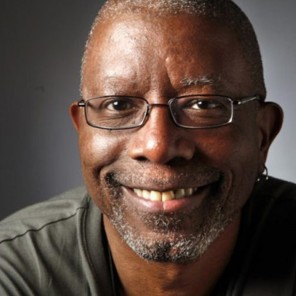
Michael Paul Williams is a native of Richmond and in 1992 became the first Black columnist at his hometown paper, an outlet in the former capital of the Confederacy that once endorsed Massive Resistance. Williams is a graduate of Hermitage High School, Virginia Union University and Northwestern University. His unflinching truth telling has secured numerous honors; among them a Nieman Fellowship and the title of reporter "who makes you want to tear up the newspaper," from a local magazine. He's equally proud of each.