Robert Greene of the Los Angeles Times
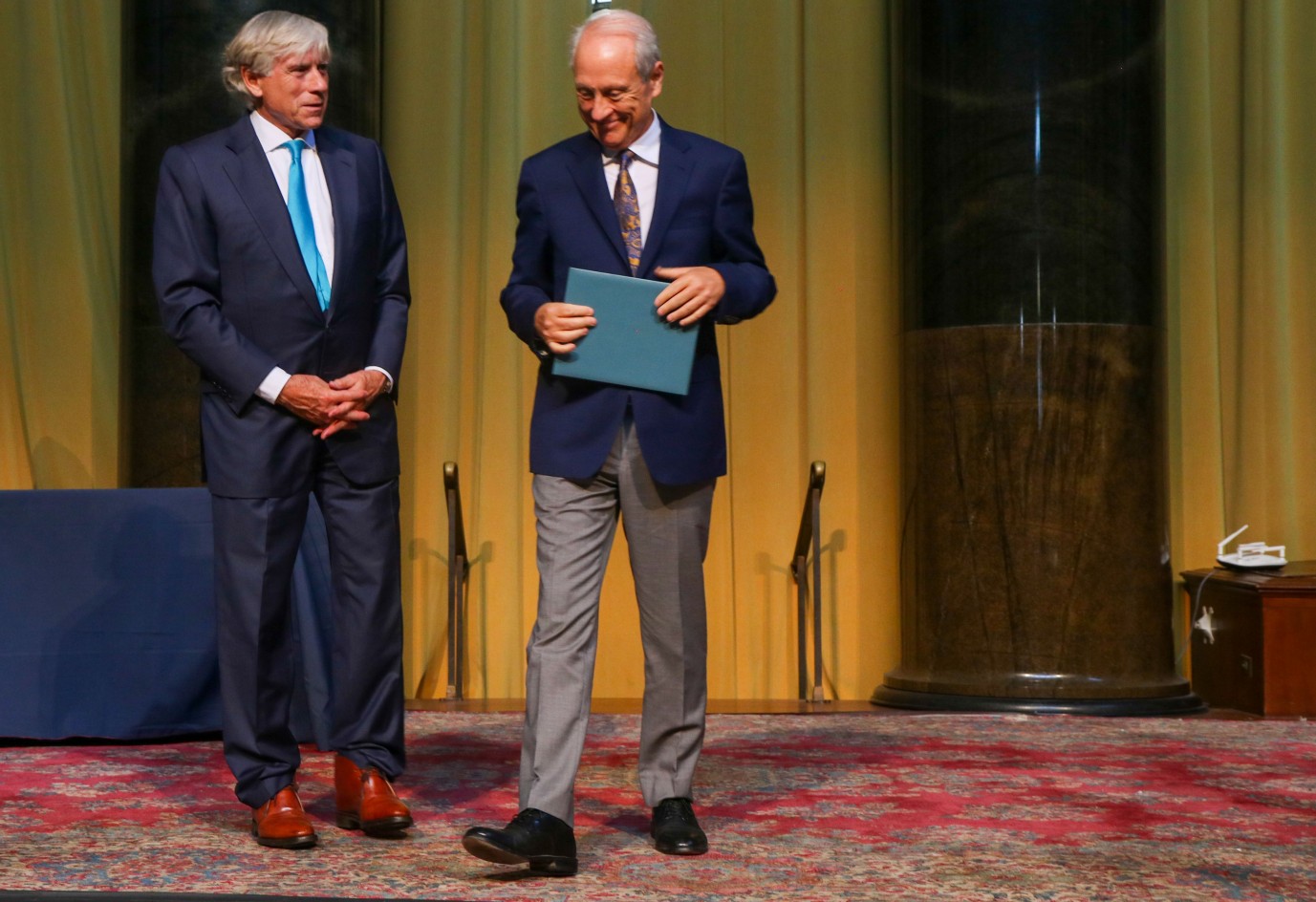
Robert Greene accepts the 2021 Pulitzer Prize for Editorial Writing from Columbia University President Lee Bollinger. (Jose Lopez/The Pulitzer Prizes)
Winning Work
Despite the worldwide consensus on the best measures people can take to protect themselves from the coronavirus, there are more than 2 million people in the United States who cannot practice social distancing, are prohibited from using or even possessing hand sanitizer and who cannot wash their hands without permission.
As inmates in local jails and state and federal prisons, they are virtually defenseless against the virus. In jails especially — where quarters are cramped, inmate turnover is high, and thousands of people are admitted each day — it is only a matter of time before an infected person who does not yet show symptoms enters one of these locked institutions. And once the virus enters such a confined space, it will spread.
Certainly this is a crisis for the inmate population, which is made up largely of people from socially and economically marginalized communities and suffers disproportionately from medical and mental health problems.
And of course it is a crisis for their families, whom they will be rejoining.
But it is a crisis as well for the rest of us for two distinct reasons: First, they are part of our community, and we as a society are responsible for their safety during the period in which we have locked them up with no ability to practice the protective measures that the rest of us do — the distancing, the hand washing.
And second, for those observers who might shrug over the fate of prisoners, it is important to remember that inmates are released every day to rejoin the rest of us.
The average jail stay in Los Angeles County is around 10 days. An infected but symptom-free inmate could easily enter and leave jail, unknowingly spreading the virus to hundreds of others who also will be leaving within a week or two. No jail or prison in the U.S. tests every inmate either coming in or going out for the virus. There simply aren’t enough tests available.
In China, a decline in new infections was quickly (although briefly) reversed because of rapid outbreaks in two prisons. In Italy, an atmosphere of fear and anxiety among prison inmates over the virus, together with an emergency ban on visitors, sparked deadly riots, escapes and a complete breakdown of authority. In Iran, officials saw the urgent need to temporarily defuse similar potential disasters by granting furloughs to tens of thousands of prisoners.
Thankfully, a handful of county officials in the U.S. also see the wisdom of lowering the danger in jails and prisons from the virus by quickly reducing the number of inmates. Here in Los Angeles, Sheriff Alex Villanueva took a number of steps to trim the nation’s largest jail population.
Inmates with 30 days or fewer left on their sentences have been released. The sheriff has asked police departments to limit arrests to only dangerous suspects, thereby decreasing new entries. Defendants awaiting trial who have bail set at $50,000 or less are cited and released.
These are smart and responsible moves to reduce the threat of a coronavirus disaster in jails. But that still leaves more than 16,000 people behind bars. There is so much more that can and should be done in jails, where stays are short, as well as prisons, where they are much longer.
Virtually no defendant should be admitted to jail during this emergency who does not pose a risk to public safety. By definition that includes anyone with bail set, whether they can pay it or not, and anyone subject to jail for a technical parole or probation violation. There are alternatives to incarceration that promote safety and fulfill the public’s need to see justice done; now is the time to employ them.
For those already in jail, Villanueva is right to let out people who would be leaving within a few weeks anyway. But a coalition of elected U.S. district attorneys has argued that anyone with six months or less to run of their sentence, and not just 30 days, should also be let out.
In federal prisons, still filled with inmates from the 1990s war on drugs, the fastest-growing segment is prisoners age 55 and older. State prisons have large numbers of people with complex medical problems. Few at that age pose a risk to society, and most should be granted furloughs or compassionate early release when it is safe to do so.
During this emergency, time is of the essence. Judges and prosecutors should understand the importance of reducing new jail and prison admittances. Sheriffs and wardens should see the wisdom in reducing their inmate populations to only those who need to be there for public safety. If they need statutory authority for releases, lawmakers should act swiftly to grant it.
And then, when the crisis abates and we have caught our collective breath, we can ask ourselves why we lock up so many suspects, defendants and convicts in the first place, and whether they all need to be behind bars for us to be safe.
Amid the stay-at-home orders that have helped to push California’s declining crime numbers even lower, some sheriffs, police and prosecutors are complaining that certain pandemic-related measures are preventing them from doing their jobs and, as a result, are endangering the public. They back their claims with stories of suspects who are arrested but then immediately released, ostensibly because police are now powerless to hold them, only to commit new crimes — sometimes even later the same day.
These critics use well-worn, tiresome and utterly false terms to describe their supposed predicament. Judges, they say, have ordered “early release” or issued criminals “get out of jail free” cards. Criminals are “laughing at us.” Instead of catching crooks, police must resort to “catch and release” because their “hands are tied” by leftist reformers pursuing “socially progressive goals.”
This is all bunk.
The latest object of the law enforcement establishment’s scorn and anxiety is the state Judicial Council’s zero-dollar bail order. Issued April 6, it resets to zero the presumptive bail amount for people arrested for misdemeanors and many nonviolent felonies.
The order makes perfect sense. It keeps jails from filling up with suspects who haven’t been convicted of anything and who pose little danger to the public if they are sent home with instructions to come to court on the appointed date. That’s crucial at a time when jails have become infection hot spots due to inadequate hygiene and lack of social distancing.
Police and prosecutors conveniently fail to mention that the order allows them to detain suspects, just as before, if they can convince a judge that releasing the person would pose an unacceptable risk to public safety.
The Judicial Council order is very clear on this point. But just in case there was any lingering doubt, an April 29 Court of Appeals ruling from San Diego nailed it down: Defendants can still be held without bail on a judge’s order. Cops and prosecutors just have to get the defendant to court and then make a persuasive case against release. Despite the assertions of some district attorneys that they would have to wait weeks for a regular bail hearing, a judge is available in every California county, 24 hours a day, seven days a week, to sign warrants, issue emergency orders and prevent the release of dangerous suspects.
The only difference is that suspects can no longer be held or released based on how much money they have or can raise for bail. Poor suspects can no longer be held without a showing that they pose a danger. Rich suspects can still get out, just like before — but only if they are acceptable risks, not because they have money.
Police and prosecutors who still complain that zero dollar bail ties their hands apparently didn’t get the memo. Or they got it but didn’t read it. Or they read it but didn’t understand it. Or they understood it just fine but didn’t like it, because they realize it means they can no longer bank on a defendant’s poverty as a means to keep him or her locked up. To take away the liberty of a person accused (but not convicted) of a nonviolent crime, they will now have to actually make the case to a judge.
That’s not some bizarre “socially progressive goal,” despite Orange County Dist. Atty. Todd Spitzer’s argument in a recent Orange County Register op-ed. It’s the presumption of innocence — a fundamental principle of justice that predates the founders and was recognized by the Supreme Court early in the nation’s history as a basic constitutional protection.
The order has also freed some defendants who had been locked up for months because they couldn’t afford their pre-pandemic bail amounts. But those releases don’t override decisions of judges to keep defendants in custody, despite claims by San Bernardino County Sheriff John McMahon in a video statement. No judge had ordered that these defendants be kept in custody in the first place. Quite the opposite — the judges heard the arguments, considered the evidence and ordered the defendants to be released on bail, although at amounts that proved to be beyond their means.
Nor do the repeat offenses by car thieves and other career criminals, including multiple arrests on the same day, make the case against zero-dollar bail, despite the assertions of Los Angeles Police Chief Michel Moore and other law enforcement leaders around the state. Repeat offenders are obviously high risks to commit more crimes, and as the Court of Appeals made clear, zero-dollar bail does not require “cite and release.” Bring them to a judge. Seek a detention order.
Nor is eliminating money bail for people accused of misdemeanors and nonviolent felonies in any sense “early release,” despite arguments by numerous critics in law enforcement. Release is arguably “early” only when a convicted person leaves incarceration before his or her sentence is completed. Again, zero-dollar bail applies to people who’ve merely been accused.
Spitzer’s characterization of the Judicial Council as a bunch of social progressives is laughable. The council is headed by Chief Justice Tani Cantil-Sakauye, a cautious, deliberative and politically centrist former criminal prosecutor who served as legal affairs secretary to a Republican governor and was appointed to three judicial positions by three different Republican governors (and who is married, by the way, to a retired law enforcement officer). Most council members are judges, and the overwhelming majority of them were appointed to the bench by Republicans. These are not social experimenters.
In fact, criminal defense lawyers and progressive activists were deeply disappointed by the Judicial Council’s order, which they had hoped would indeed grant the kind of blanket release that so many cops and prosecutors falsely claim it does. Many activists rally around the call to #FreeThemAll — in other words, empty and close jails and prisons, and not necessarily because of the pandemic. There’s an important discussion to be had about reducing incarceration in the United States, but the extremely modest and sensible zero-dollar bail order hardly falls under that topic.
We’ve heard these sorts of outlandish, fear-mongering claims many times before, often because law enforcement leaders set in their ways could not grasp how to do their work without the excessively punitive laws and procedures to which they had become accustomed.
When responsibility for felons convicted of nonviolent crimes was “realigned” in 2011 by Assembly Bill 109 — that is, shifted from state prison and parole to county jail and probation — prosecutors and police told stories (too often unexamined by news media) of “AB 109ers” who committed heinous crimes because of “early release” from prison (although the law did not cause the release of a single prison inmate). A leading candidate for governor dropped out of the race after it became clear that realignment had no role in releasing the supposed string of 109ers on which he was basing his campaign.
When voters passed Proposition 47 in 2014 and reclassified smaller-level crimes of theft and drug possession as misdemeanors rather than felonies, prosecutors and police said they were powerless, for example, to arrest a suspect on suspicion of possessing a stolen gun because the weapon was worth less than $950, the new cutoff for felonies. Nonsense.
When voters adopted Proposition 57 in 2016 and permitted prison inmates to earn parole by participating in rehabilitation programs, critics again said crime would skyrocket. But all along, crime has plummeted.
California has thoughtful prosecutors, police and judges who keep careful watch on the criminal justice system and make well-considered adjustments, sometimes in response to voter demands and sometimes in response to emergencies, such as the COVID-19 pandemic. But it also has those who don’t quite keep up to date, or who didn’t read or understand the memo. Their voices are loud, and they are warming up for two backward-looking November ballot measures that they hope will scrap bail reform and roll back the other landmark improvements to the state’s criminal justice system in the last decade. COVID-19 lends them the wisp of fear and anxiety that is necessary to spur reactionary attacks on justice. Californians should demand better from their top cops and prosecutors.
What if the nation had met the crack epidemic of the 1980s with healthcare rather than with police and prison? How much more prepared might we have been today for a deadly viral pandemic, and how much more resilient in the aftermath, had we built out a public health infrastructure with treatment clinics, housing and other resources and supports aimed at restoring the health of American neighborhoods?
What if we had recruited, trained and adequately paid a generation of clinicians, physicians, nurses, researchers, peer counselors and educators to deal with the drug crisis instead of buying tanks and armored cars for police and sending them into neighborhoods suffering the physical and social consequences of cheap crack cocaine?
The 1980s were our fork in the road. The path we chose led directly to the nation we now inhabit, overwhelmed by serious illness, fear, anger, mutual mistrust and a level of inequity and incompetence that mocks our self-image as Americans.
To know what to do now, it’s essential to remember what we didn’t do then.
Smokable cocaine “rocks” first appeared on the streets of American cities in 1981. Cheaper than powder cocaine and highly profitable for suppliers and dealers, the drug was associated with an alarming increase in hospital emergency room visits. Nevertheless, the early governmental response was neglect.
As the ’80s wore on, though, rock cocaine became known as “crack,” and it wormed its way into the popular imagination as a fearful substance that threatened to destroy the nation. The anti-crack frenzy preceded the real epidemic, which took off in the middle of the decade when Congress made penalties for possessing the substance 100 times greater than for similar amounts of powder cocaine. The rationale was specious: that crack was more addictive, an assertion that subsequent studies demonstrated to be untrue. Crack possession may have been targeted because it was associated in the public mind with African American users, and powder with well-to-do whites. The race-tinged national panic over crack reshaped and reinvigorated the “war on drugs” that President Nixon declared in 1969.
Two companion public health disasters followed in quick succession. The first was violent crime, as crack profits lured street entrepreneurs and gangs. Competition became deadly. The murder rate for young Black men doubled.
The second was the law enforcement response and what later became widely known as mass incarceration. Black communities that for decades had suffered from official neglect suddenly saw astounding investment of public resources — in the form of violent policing.
In Los Angeles, LAPD Chief Daryl Gates ratcheted up the force, deploying armored cars to break down so-called crack houses and conducting massive weekend raids that resulted in the arrest of hundreds of young Black men, whose cars were impounded and often ransacked by the time they were released from jail — without charges — on Monday morning.
Black men who were indeed charged were typically sentenced under new crime laws carrying shockingly stiff mandatory prison terms.
Health officials consider waves of murder, male depopulation of communities and racism to be public health crises equal to drug or viral epidemics. Health is intimately tied to social and economic opportunity, the quality of our schooling, the safety of our workplaces, the cleanliness of our air and the readiness of family, friends, neighbors, peers, parishioners and officials to render aid when any of us is in crisis.
The disparity in the quality of those social determinants of health is readily identifiable on maps that display life expectancy by ZIP Code. In some parts of Los Angeles, a stretch of three miles means a difference of 13 years in average lifespan.
Instead of fixing that disparity, the police-and-prisons response exacerbated it.
When the savage beating of Black motorist Rodney King by LAPD officers in 1991 was caught on videotape, African Americans in Los Angeles were hopeful that the rest of us would finally see what they had been suffering through the crack epidemic and the violence and harassment that ensued, and would finally do something about it. Instead, a year later, the officers were acquitted. The angry outburst that followed was a reaction not just to the King beating and LAPD impunity, but to a decade’s worth of serious health and social needs being answered with law enforcement “solutions.”
The crack epidemic was an opportunity lost. The legacy of the 1980s could have been a service infrastructure that provides people in crisis a place to go for care and a set of enforceable health quality standards.
But instead we built and packed prisons. Now, 28 years later, those institutions have become the nation’s leading centers of novel coronavirus infection.
The disease has so far sickened nearly 2 million people in the U.S. and killed well over 100,000, with the death toll being much higher in communities of color, including Black neighborhoods — predictably so, considering those maps that measure and depict community health and resilience.
The May 25 police killing of George Floyd in Minneapolis, like the beating of Rodney King, represented more than just a shocking example of police violence. The killing and the angry and sometimes violent protests that followed sum up yet another generation of failed policy and imposed inequity.
We are called to respond differently this time. We must do now what we failed to do then: Build a system of care that fosters health and justice, and deconstruct the costly police-and-prisons infrastructure that we foolishly built instead.
We need not start from scratch. Los Angeles County helps people coming home from jail or prison reunify with their families and get jobs, housing and care. The Office of Diversion and Reentry — housed, it’s important to note, in the Health Department — is the leading edge of a broader care-first, jails-last program that, if built out as envisioned by frontline service providers and county workers, could be the system that we should have built more than three decades ago. It could be a model for the nation.
The L.A. County Board of Supervisors adopted a framework for the care-first program, formally known as Alternatives to Incarceration. But then came the current health crisis, and implementation has stalled. It would be ironic — and tragic — if the program is mothballed because the pandemic and the reaction to Floyd’s killing turn the county’s attention elsewhere. Might we, in 30 years, look back again at the road we should have taken but didn’t?
Despite their robes, judges are not wizards. They have no conjuring superpowers that allow them to see through juvenile offenders and know the course of their adult lives in prison. Nor are they equipped to determine, today, whether any particular offenders will have a sufficient change of heart, mind and spirit that would warrant their release 10, 20, 30 or more years in the future.
So it is absurd to grant judges the power to brand any particular juvenile they see in front of them as “incorrigible” or so beyond redemption that no future judge or parole board should ever be able to consider how the offender had lived his or her life as an imprisoned adult.
The issue arises because the U.S. Supreme Court recently agreed to review the case of Brett Jones, who at 15 killed his grandfather and was sentenced to life without the possibility of parole. Jones appealed on the ground that the judge imposed the sentence without first making a finding that the teen was “permanently incorrigible.” The state of Mississippi argues that such a finding was unnecessary.
Arguments are not yet set, and the case may not be heard until the next term, which begins in October.
Over the last several years, the high court has begun to acknowledge what has long been known by most psychologists, neurologists, nations, state courts and, indeed, average people: Juveniles are not the same as adults. Their still-undeveloped brains make them more impetuous, more emotional, less capable of making moral judgments, more capable of eventual rehabilitation. Less moral capacity means less criminal culpability — and a different level of punishment.
In 1988, the court banned the death penalty for offenders under age 15. In 2005, the court extended the ban to offenders under 18. In 2010, it ruled that juveniles cannot be sentenced to life without parole for non-homicide cases. In 2012, it banned automatic life sentences without parole for juveniles. In 2016, it said the previous ruling applied retroactively.
The justices have acknowledged again and again that juveniles are different and should be treated differently — but they’ve done it incrementally and at a creeping pace that leaves the United States as the only nation on the globe where it is still possible to sentence people to life without parole for crimes they committed before they turned 18. They made a point of noting that they’d left a window open for “the rarest of juvenile offenders, those whose crimes reflect permanent incorrigibility.”
Unfortunately, the question before the court in Jones vs. Mississippi is not whether Jones’ judge had the superhuman ability to foresee whether the offender would change in prison, but whether it matters that he failed to make a finding on the record of “incorrigibility” or “irreparable corruption” or “irretrievable depravity” or any other term that suggests that a judge can magically know more about a young offender today than anyone else would know in the future.
These are all terms that, as applied to juvenile offenders, are as meaningless as “abracadabra.” They cannot imbue any judge with access to a young killer’s future psyche, no matter how horrid the details of the crime. Reading a crime for evidence of the defendant’s imperviousness to change makes no more sense than reading his palm.
Rather than being magic, words like “incorrigible” actually indicate superstition and fear. They symbolize the folk belief that we can know the full measure of a man based only on his heedless actions as an adolescent, or the companion belief that some young people are superpredators, essentially subhuman, and unable ever to live in civilized society. That’s at stark odds with our society’s religious faith that people can change and our scientific knowledge that they often do.
Prison may not be an ideal place for teenagers to grow into adulthood, but it is there that young killers will mature and have time — plenty of time — to look back on the crimes of their youth with the developed brains and perspectives of adults. They may take the opportunity to seek education. They may learn empathy. They may feel remorse. They may be rehabilitated.
Or they may not, but who’s to know? Their lives and their progress should be reviewed by parole boards or judges who have the benefit of considering the perpetrators’ adult conduct over many years in prison.
The justices one day will have to acknowledge that their exception for “incorrigible” youth says less about any offender than it does about adult fears, prejudices and superstitions. It’s a shame that they won’t be discussing that question in the case of Brett Jones.
The ambush-style shooting Saturday evening of two Los Angeles County sheriff’s deputies as they sat in their patrol car at the L.A. Metro station in Compton was cruel and disgusting, as were the words that some demonstrators reportedly shouted outside St. Francis Medical Center in Lynwood, where the two deputies were being treated.
Witnesses said some in the crowd outside the hospital shouted, “Death to police” and “Kill the police.” The Sheriff’s Department tweeted that some shouted, “We hope they die,” and blocked the hospital’s emergency entrances.
At this time, there is no evidence connecting the attack to killings of Black people around the country by police officers. But tensions over those killings, and the protests that have followed, make the mental juxtaposition of the events unavoidable.
Earlier in the day, hundreds of protesters demanded justice for Dijon Kizzee, a Black man who was riding a bicycle when sheriff’s deputies attempted to stop him for a vehicle code violation. They shot him dead, and the supposed violation still has not been explained.
The shooting of the deputies and the cruel chants at the hospital, it should go without saying, do nothing to further the investigation of Kizzee’s killing. Or to explain the fatal shooting of Andres Guardado by deputies in June. Or to alter the law enforcement practices that led to the deaths.
They add nothing of value to the argument over the proper role of armed law enforcement agents in patrolling Metro or other transit systems.
Nor do they justify the deputies’ arrest of KPCC reporter Josie Huang, who was covering the scene at the hospital. Huang appears to have been simply doing her job.
Nor was anything useful added by President Trump, who ghoulishly tweeted: “If they die, fast trial death penalty for the killer.”
Thankfully, the deputies have not died.
The nation, in desperate need of cooler heads and an end to a season of death, must for the present make its way with neither. We have in our hands the power to destroy ourselves and one another, and we seem bent on exercising it.
In the meantime, though, the quest for justice must continue, however plodding it may be, however dull it may seem when compared with protests, killings and presidential tweets. The hunt for the deputies’ shooter must continue. If a suspect is caught and tried, the proceedings should be conducted with truth and fairness. Law enforcement practices must be scrutinized and, where needed, corrected. Racism must be acknowledged and combated. Our communities, our people, must get a chance to breathe.
The rethinking and reconstruction of the American criminal justice system has come in waves. A decade ago, unconscionable (and unconstitutional) prison crowding in California sparked smarter sentencing and parole, then alternatives to jail and prison, then the downgrading of drug possession felonies to the misdemeanors they once were and are now again, amid a continuing and historic decrease in crime. Four years ago, in a handful of jurisdictions around the nation, came the election of a new generation of prosecutors who seek not the toughest possible sentences, but a more effective, more equitable and more just criminal justice system. This May, with the death of George Floyd in Minneapolis, came the national recognition of the racial injustice that is built into American policing.
The next wave of reinvention may come from Los Angeles County, if voters here elect George Gascón as their district attorney.
Gascón is the right candidate at the right time in the largest local criminal justice jurisdiction in the United States. He brings with him the frontline experiences of a cop who saw the tough-on-crime ethic wreak havoc in the communities he policed, and is one of the few police leaders to question the old-style approach. As San Francisco’s district attorney, he extended that reexamination to the entire criminal justice system. The Times endorsed Gascón for district attorney in the March 3 primary as the candidate most capable of bringing positive change, and we endorse him again in the runoff against two-term incumbent Jackie Lacey.
Opponents delight in calling Gascón a carpetbagger because he served as a police chief in Arizona and as chief and then D.A. in San Francisco before challenging Lacey. The charge is absurd. A young Gascón moved with his parents from Castro’s Cuba to Southern California in the 1960s, grew up here, became an LAPD patrol officer in the 1970s after military service, left the department but returned in the 1980s in the thick of the tough-on-crime era. He rose through the ranks (while completing law school) and was instrumental in reinventing the Los Angeles Police Department following the Rampart scandal, in which officers framed suspects to cover their own crimes. He saw firsthand the depth of not just overzealous policing, but unlawful, destructive policing that victimized the very communities that the justice system was meant to protect. As assistant chief under William Bratton, he helped steer the department into a federal consent decree and managed the LAPD’s day-to-day operations.
He took his still-developing ideas about policing to Mesa, Ariz., where he served as chief, focused on repeat criminals to achieve reductions in crime, used data to zero in on the most egregious offenders and their likely victims, and formed a progressive counterpoint to the retrograde Maricopa County Sheriff Joe Arpaio, who was known for his immigration posses and his desert tent cities for jail inmates. Gascón’s tenure in the politically conservative city won plaudits from across the political spectrum.
He returned to California as San Francisco police chief in 2009, and in that job he helped set the stage for the early wave of reform with his innovative ideas about policing, prosecution and alternatives to incarceration. As other jurisdictions (including Los Angeles County) fretted over “realignment” — a plan to reduce prison crowding by giving counties more control and flexibility over lower-level felons — Gascón was one of the thinkers who helped show other counties the way forward.
In 2011, he became San Francisco district attorney and a key figure in a movement that relied on modern tools and, above all, data to measure the effectiveness of prosecutorial policies. One example: the use of artificial intelligence to hide a suspect’s race from prosecutors to eliminate unconscious bias in charging decisions.
Meanwhile, Lacey made history by becoming the first woman and the first African American district attorney elected in Los Angeles County. Her blueprint for diverting mentally ill defendants to treatment was welcome. But her implementation was slow. And her attitude toward reforms emanating from Gascón’s office and elsewhere in the state was disappointing.
She branded realignment “a terrible mistake.” When Gascón co-wrote Proposition 47 to return drug possession and petty theft to their former misdemeanor status, Lacey opposed it. When marijuana use was legalized and Gascón led in expunging prior convictions, Lacey was slow to follow suit. Where Gascón opposed the death penalty, Lacey’s department remains the state’s most prolific generator of death sentences. As Gascón helped lead the effort to raise standards for police use of force — allowing police to shoot only when necessary — Lacey lobbied hard for the older, lower standard. When Gascón fought against a law to deport nonviolent drug offenders, Lacey fought to keep it. When Gascón called for the State Bar of California to adopt a rule against district attorney candidates accepting donations from police unions, Lacey — who has benefited from the expenditures of millions of dollars in donations from police unions — opposed the move.
Lacey’s most vocal opponents zero in on her failure to prosecute police officers for killings, and indeed the dearth of prosecutions is noteworthy, especially in egregious cases such as the one in which LAPD Officer Clifford Proctor killed Brendon K. Glenn in 2015. Even Police Chief Charlie Beck, after seeing video evidence of the shooting, said his officer should be criminally charged. But Lacey declined, saying she could not prove the case beyond a reasonable doubt. Less discussed is her office’s absence from prosecutions of sheriff’s deputies who beat inmates and visitors at county jails, and alleged civic corruption of the sort that has resulted in indictments of and guilty pleas by Los Angeles city officials. Those were obtained by federal prosecutors, not the district attorney.
Lacey, to her credit, has used her position as the state’s most powerful prosecutor to lobby for improvement in some key areas of California’s criminal law, including legislation to curb the excesses of the state’s sex offender registry. Her efforts in that arena have been thoughtful and courageous.
But Los Angeles County needs so much more. It can be and should be the leader in policies and practices that improve public safety by reducing, not expanding, the footprint of the criminal justice system.
Gascón, if he wins, will have his hands full because the sprawling Los Angeles County district attorney’s office is notorious for its entrenched culture and its resistance to change. But he is the best person to lead that effort. The Times urges voters to choose Gascón.
As this dismal year draws to a close, we fix our eyes on images of rescue: A vaccine. An inauguration. A spring that might bring reopenings instead of shutdowns. May we once again see crowded restaurants, empty hospital beds, peaceful streets, kind faces. May these stark past months be long forgot and never brought to mind.
Yet we cannot, despite ourselves, leave this cruel year behind. The 340,000 dead from COVID-19 won’t let us, nor will the lingering animosity we display toward one another, expressed by the masked toward the unmasked and the other way around, or by plots to kidnap governors and put them on trial, or angry chants outside the homes of police chiefs, mayors and public health officers. Nor can we seem to let go of this year’s presidential election, which is over and clearly decided, yet somehow for many not ended. How far into next year will the denial extend? Jan. 6? Jan. 20? This year is like some irritant in the eye that can’t be washed out. It stays with us, affecting our vision in a most unexpected way — clarifying it, not clouding it.
That’s the thing about 2020, a term that describes both normal eyesight and an abnormal year. 2020 vision has given us a partially corrected view of ourselves, our nation and one another. It has brought into focus some hard truths that we cannot now unsee, try as we might.
We formerly saw America as being at the apex of medical knowledge and logistical know-how, the nation most prepared to deal with contagious diseases. With our world-class virologists, immunologists and epidemiologists, and our top-notch schools of public health, surely we would isolate and defeat any new outbreak. We had protocols. We had plans. We had the equipment and the skills, the scientific expertise, the civilian chain of command and the requisite confidence in our government. We proved that with Ebola and avian flu. We were ready.
But in fact we were not.
The protocols, plans and principles developed by the Obama administration for dealing with a pandemic were thrown out by the current team and replaced with essentially nothing — except for a hazy notion that each state would provide its own response and somehow block the disease at the state line. Officials of both parties share blame: In politically progressive and medically advanced California, three mobile hospitals, millions of stockpiled respirator masks and thousands of portable ventilators were dismantled or given away during Jerry Brown’s administration as part of fiscal belt-tightening. The best thinking and the best planning were no match for political philosophies and budget crises.
We gazed with sympathy at Italy when it ran out of hospital beds amid the COVID-19 crisis in March, and we wondered at how such an advanced nation could be caught so off-guard. We thanked our lucky stars we weren’t like them — yet here we are, with by far the world’s worst pandemic body count and today, at least in Central and Southern California, the most overcrowded hospital wards and the most virulent transmission rate.
The crisis weighed Americans’ regard for one another and found it wanting. Would we wear masks to protect one another’s lives? Would we do without restaurant meals, family gatherings, political rallies, worship services, at least to protect our friends and loved ones, if not ourselves? Would we do it to beat back the greatest collective challenge the nation has faced in generations?
We would, for a while, and then we would not.
For all our expertise and resources, 2020 has revealed the stark inequalities, eroded solidarity and sheer selfishness that have long been in the background, the result of decades of attacks on government, on the safety net and on the very idea of a shared American destiny. It presented our nation, our society, our form of government and our collective will with a rigorous stress test. We failed. Miserably.
Already imperiled by a deadly pandemic and economic collapse, we saw a Black man killed when a police officer knelt on his neck for some eight minutes. Some sighed and said we’d seen it before; others took to the streets in anguish, outrage and resolve. A nation half-believing that racism was long defeated and half-angry that racism still pumps vigorously through our veins confronted itself, and still could not reach resolution. Could we at least agree on the scope of our progress — and failure? We could not. Could we at least relegate racist speech and behavior to a less-enlightened era, or to a few backward corners of our nation, or to the ignorant or malicious people who dress in blackface for what they consider fun, or who call the cops when they see a Black man on the street, minding his own business? We could not. 2020 vision allows America and the world to see what many communities of color have known for generations.
This year also exposed the fragility of the economic expansion of the last decade, ostensibly the longest in American history. Real wages have scarcely risen in decades, and the presumed abundance of our times — online commerce, cheap consumer goods from China, numerous digital gadgets to entertain and distract us — covered up glaring economic insecurity. We entered 2020 with 40% of Americans unable to come up with $400 in the event of an emergency, and we end 2020 with millions barely scraping by, with the help of unemployment assistance and food banks.
At least we kept faith in our cherished institutions, did we not? We have not descended into violent autocracy or repressive authoritarianism, and yet we are less different — less exceptional — than we believed.
Truth came under attack in 2020. We doubted one another’s ability to differentiate fact from fiction. Science was questioned — indeed, even the scientific method, and belief in empirical reality. We are not today the shining example for the world. We are not who we thought we were.
Much as 2020 was largely defined by a legacy of 2019 — recall, after all, that the “19” in COVID-19 refers to the year the disease was first identified — so 2021 will carry with it pieces of 2020. We still have the pandemic, vaccine notwithstanding. We are at a crossroads on race and policing with little consensus on a path forward.
But a new year is a time of renewal nonetheless, and if it brings with it some measure of American disillusionment, that’s not necessarily a bad thing. A clearer vision of ourselves and the chasm between who we are and what we aspire to be is necessary to any improvement. If we can name our shortcomings, surely we can fix them. The least we can do is try.
Biography

Robert Greene is an editorial writer covering water, drought, criminal justice reform, policing, mental health and Los Angeles County government. Greene previously was a staff writer for the L.A. Weekly and a reporter and associate editor for the Metropolitan News-Enterprise. Prior to becoming a journalist, he was an attorney in Los Angeles. He is a resident of Highland Park and a graduate of USC and Georgetown University Law School.