Wesley Morris of The New York Times
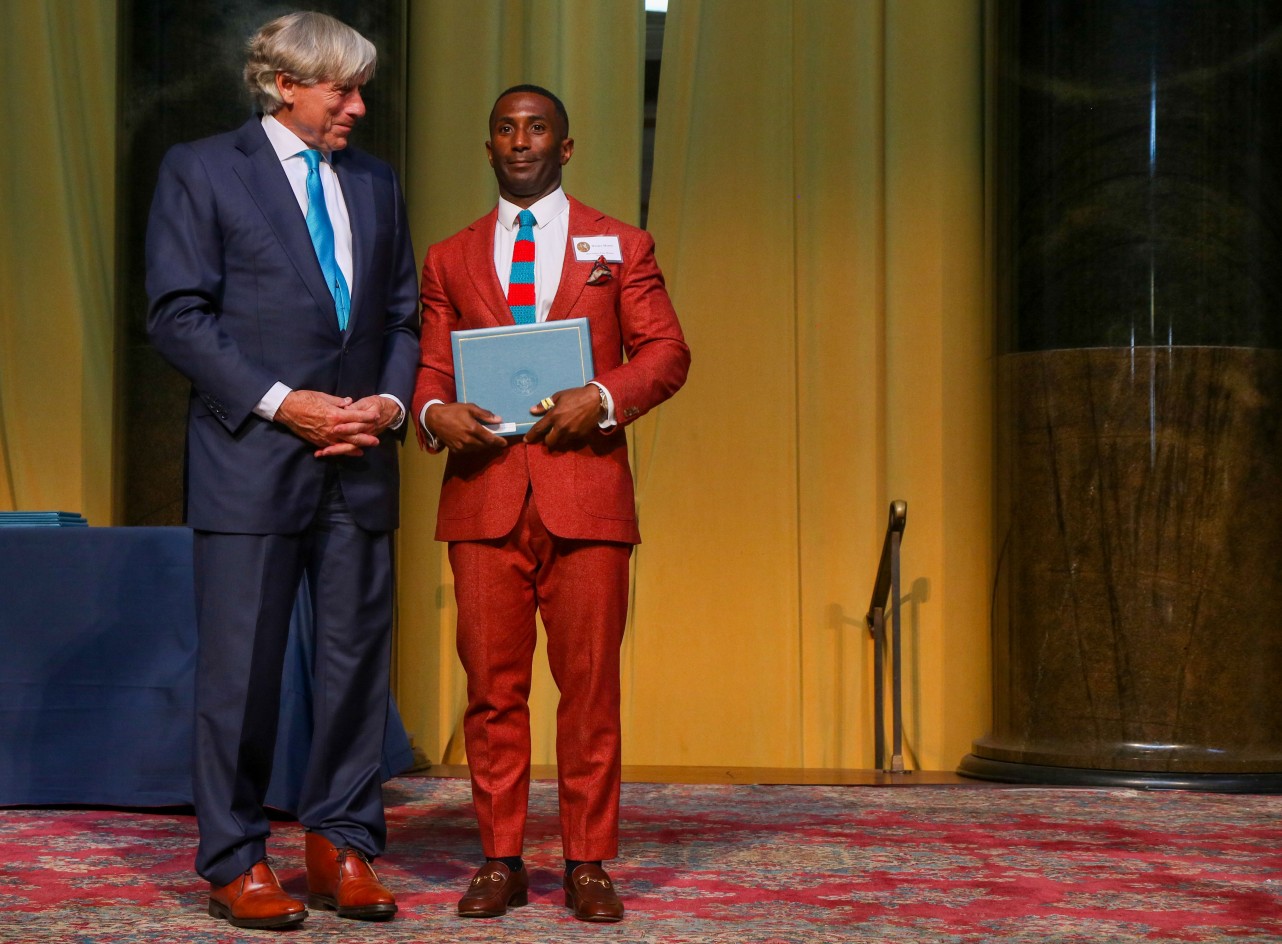
Wesley Morris accepts the 2021 Pulitzer Prize for Criticism from Columbia University President Lee Bollinger. (Jose Lopez/The Pulitzer Prizes)
Winning Work
Awash in the ghastly video mosaic shot by black people’s cameraphones, I found myself doubled over the kitchen sink. Then a lyric gave me strength.
The most urgent filmmaking anybody’s doing in this country right now is by black people with camera phones. Their work comprises a ghastly visual mosaic of mistreatment, at best, and whose victims are international symbols of mourning: Eric Garner, Philando Castile, Sandra Bland. Art is not the intent. These videos are the stone truth. Quaking proof of insult, seasick funerals. Livestreamed or uploaded, or suppressed then suspiciously unearthed as found footage. Last week, the archive grew by two, and now the nation’s roiling.
First, a white dog walker called the police on Christian Cooper, a birder in Central Park. Her unrestrained dog disturbed this man’s peace. He asked that the dog be leashed (the park’s rules, not his) and its affronted owner told him that if he didn’t stop recording their interaction she’d tell the police that an “African-American man is threatening my life.” He kept rolling — actually, he kept directing. “Please call the cops,” he calmly instructs her. “Please tell them whatever you like.” And she does.
But it was how she told on him that you don’t forget. Three times, she informs the dispatcher that this man is her emergency. By the last round, she’s made herself hysterical. The person at the other end can hear distress and can probably sense that the greater victim in this exchange might be her mewling dog, choking because the grip on its collar is so tight. When the call is over, Cooper thanks her — for leashing the dog, but for also endangering him, for living down to herself, for quite a performance of umbrage. This woman has dialed 911, but she’s also got access to an ancient American network of interpersonal fraud. She knows the advantage of her role. So, of course, did he. That’s why his camera’s on. In case. The video would be the counterfactual that might save his life.
That’s not how it went for George Floyd, that same Monday, 1,200 miles away. In this video footage, captured, in part, by Darnella Frazier, the Minneapolis police officers who bore down on his body appeared immune to the cameras trained on them, immune to his gasping pleas for air and his mother. There is a madness in how calm they appear as a grown man rasps and begs. For stretches, one officer stands there like an inanimate object that refuses to hear the bystanders beseeching on Floyd’s behalf. Another officer had rested his knee in the man’s nape, comfortably. For more than eight minutes — eight of George Floyd’s last — it barely moves, as though that’s what God intended napes to be, a kneeler.
The Cooper and Floyd videos capture ancestral false alarms and overreactions, centuries-old hatreds, miserable inequalities. (The dog in one video fares better than the human being in the other.) These videos are part of some newish optic tradition that dates back, at least, to those abstract camcorder images of the L.A.P.D. going to town on Rodney King, stories black people share to keep one another safe and warn others; bystander evidence, filmed by all kinds of people, that has to embarrass the wheels of justice into their slow grind. It’s video that is currently breaking open the United States once again.
This country manufactures only one product powerful enough to interrupt the greatest health and economic crisis it’s probably ever faced. We make racism, the American virus and the underlying condition of black woe. And the rage against it is strong enough to compel people to risk catching one disease in order to combat the other — in scores and scores of American cities, in cities around the world. They’re a tandem now, the pandemic bold-underlining-italicizing what’s endemic to us. The underfunded hospitals, appalling factory conditions and unequal education were readily evident last year, before Covid-19. Now, the inadequacies and inequalities expedite death and compound estrangement. The low-wage workers have been deemed essential yet remain paid inessentially. The numbers of black, Latino and Indigenous people infected, deceased and unemployed are out of whack with their share of the population. And the president has yet to offer his condolences, in earnest.
So maybe we were due for another round of unrest and conflagration. Maybe, Black Lives Matter and Colin Kaepernick were simply ahead of their time, even if the calls for respect that they marched and knelt for remain absurdly longstanding. This explosion seems meant to occur in the year in which we saw a video of a 25-year-old black man, a runner named Ahmaud Arbery, chased down by white men in Georgia and shot dead, men who went on about their lives for months after.
It had to happen in a year in which police killed a sleeping black woman, Breonna Taylor, wanted on suspicion of nothing. It had to be in the year of lockdowns, masks, in-a-blink job loss and funerals no one could physically attend. It had to be the year whose numbers refer to perfect vision. People could, perhaps, see anew that, when it comes to certain white people, what we call freedom is basically impunity. Freedom-plus. Americans have watched that plus burn outside their homes.
Impunity permits politicians and TV hosts to lie about whatever and the police to shoot rubber bullets at nonprotesters as if they were squirrels. Impunity is what brings black men as different and differently eloquent as the rapper-activist Killer Mike and the Princeton professor Dr. Eddie Glaude Jr. to anger and the verge of tears, in separate appearances before the media on Friday. They both embodied a sentiment of the protests. We’ve been trying to make this country great, but you won’t let us.
Black Americans have come in peace, they’ve come armed. They’ve just been trying to mind their business. Disappointment awaits, regardless. Anytime the racial temperature goes up and hell pays a visit to earth, the disappointment takes a holiday. And you fight. You fight because you’re tired. Yet you’re tired because you’ve been fighting. For so long. In waves, in loops, in vacuums, in vain.
I suppose this is all how I found myself doubled over the kitchen sink on Sunday, bawling into a bowl of greens, a knife in one hand, the other gathered into the loneliest fist that hand had ever made. I was doubled over because Patti LaBelle had wrecked me.
Now, somehow, Patti’s not for everybody. And I don’t mean white people (although I’ve heard the complaints). My mother was a black woman from Philadelphia just like Patti and her feelings remained mixed. Not something you need to know about my otherwise perfect mother; it’s just to say that Patti LaBelle is an unsettled matter. And her unorthodoxy — as a cookbook author, a vocalist and someone who believes that a black woman’s hair ought to be a wonder of the world — makes her all the more beloved to her partisans.
The last song on her 1985 album, “Patti,” is a live cover of a classic written by Kenny Gamble and Leon Huff and released in 1972: “If You Don’t Know Me by Now.” Harold Melvin & the Blue Notes recorded the raw, plangent definitive version; Simply Red the comparatively subdued hit 1989 incarnation. Both are excellent. It’s a perfect song that LaBelle moves into and refurnishes. She flips and flexes every syllable. The word “eye” is elongated so that suddenly there’s an “o” in there. Pure Patti. The chorus — “if you don’t know me by now, you will never, never, never know me” — is left to the men doing her backing vocals, while LaBelle spreads icing all over their cake.
This version is arranged as a march that keeps cresting: big drums, wagging piano, bass that vamps. After four minutes, the band offers her a clearing to do some trapeze work. And this is the moment — in the middle of a pandemic, with the country in some of its worst-ever shape, with protesters on my street damning the police, with black America at yet another wit’s end — that I heard a song I’ve listened to a hundred times like I’ve never heard it before.
“I thought you knew me by now,” she sings, “but you don’t.” She’s off-book as they say, working on mood, instinct and fatigue. “Heh, heh,” she says with a weary laugh before she starts talking to the room.
“You break your back, you break your legs and you break your face, trying to make these people know you in life. But somehow they just don’t wanna try to,” she says and goes on to wonder, “Is it the way I look?” In her story, she’s talking about a man and has a mirror moment. “Self,” she asks, “is it worth it?” And, in her four-alarm soprano, she lets out a naying, “Uh-uh,” only with more “uhs” than I could count. “I’m not going to try to prove myself no more,” she proclaims as her singers back her, firm yet softly, with that chorus (“never, never, never”). For half of the remaining 90 seconds, she is knocking everything off the emotional table she’d spent the previous five minutes setting.
This is not a protest anthem. It’s a lovers-at-a-crossroads jam. But LaBelle is working this crowd. She’s preaching about something that, at my sink, at a crossroads, along with millions of other black people, sounded like a much bigger love. Her exasperation felt transcendently real and timelessly final. Enough.
I heard a woman declaring her value. George Floyd was suspected of having used a counterfeit bill at a corner store, which means his life was worth less than money. I heard her thinking through an ultimatum now being laid down in the streets of this country. You still think we’re monkeys, monsters, beasts, thugs, the living dead, minorities? If you don’t know that a black man, calling for his mother, his dead mother, is so desperate for somebody to hear him that he’s screaming for ghosts — or fears he’s in the process of becoming one; if you don’t know that we, too, can run for leisure and sleep for rest; if you don’t know that this skin is neither your emergency nor an excuse to invent one, that the emergency has tended to be you — by now? — you will never, never, never …
What is the next step as America confronts its racism? A broadcast spectacle, our critic writes, that could look like court, a telethon, therapy, an Oprah show — and more.
When someone wants to explain where the country’s been since Memorial Day, they refer to The Moment. “The Moment,” at first, seemed to name a finite period, the killing of George Floyd on May 25, and the moments his death comprised. “The Moment” then proved spongy quick, absorbing the bewildering madness of the deaths of Ahmaud Arbery and Breonna Taylor and expanding into more protests in more corners of the planet than seemed fathomable. (The demonstrations took place during a pandemic; The Moment had swelled inside a Moment.) It appealed to people whose response to such Moments has tended to be less than vociferous — white people. White people marched and chanted. They ate tear gas and pepper spray. White people said “Black Lives Matter,” “systemic racism” and, occasionally, “reparations.”
Questions arose about what The Moment was and what should be asked of it. The Moment brought us new vision to see old wrongs and emboldened us to raze and ruin them. The Moment reversed power. Mayors stood among civilians, the police took a knee, a president had been absconded into a bunker. This Moment was the sort that Black America had been waiting for — when the woke learned to walk, when the Confederate flag ceased official operation as a security blanket, when even a beloved music trio had to concede that “Dixie” no longer becomes them.So here we are, still in this Moment, tasked to behold the changing of names and the signaling of virtue. Waiting for meaningful legislative reform, seizing matters with civilian hands in the meantime: recasting jobs; reclaiming parks and pedestals and city streets, these local reclamations, seemingly one public space at a time. The speed of change in a country notoriously allergic to it feels like a spree, reckoning as a marathon of “Supermarket Sweep.” We know The Moment is connected to other moments yet there’s a sense in our bones that it differs from them. Who knows when such a Moment might come along again?
Before it vanishes, the centuries and conditions that produced it warrant commemoration. They warrant further confrontation, reclamation and connection. They warrant an event — broadcast across the country, over months, not days — that squares the present with the past, that explains The Moment to those who say they are, at last, awake to it. This Moment of historic holding to account, of looking inward, deserves a commensurate, totalizing event that explains what is being reckoned with, demanded and hoped for, an experience that rubs between its fingers the earth upon which all those toppled monuments had so brazenly stood. The Moment warrants a depth of conversation the United States has never had. It demands truth and reconciliation.
Other countries have undergone such commissions, tribunals and soul searching — among them, El Salvador, Rwanda, Peru, Germany, South Africa. They recount staggering atrocity — inconceivable corruption, organized oppression, genocide. Of their participants, they compel confession and vulnerability. Of their audience, they require fortitude, a pillow to wail into, a strong stomach.
This country has flirted with truth and reconciliation. Reconstruction ended in 1877, a dozen years after the end of the Civil War. It was more political action than ritual, a campaign of personhood and rights that ended when racists intimidated it out of existence. In 1968, in the wake of the racial conflagrations roiling American cities during the mid- to late 1960s, Gov. Otto Kerner Jr. of Illinois presented the findings of his so-called riot commission, whose politically moderate and racially uniform makeup (two of its members were Black; there was one woman) was strategically cast for ho-hum results. What it delivered to President Lyndon B. Johnson was, instead, shockingly, comprehensively grim. The United States, the commission concluded, is a hopelessly divided nation that has locked its Black citizens in impoverishment and swallowed the key, that good white folks were out-to-lunch and therefore as culpable as the white supremacists were malignant.
The conclusions and recommendations were urgent, vast yet granular, attentive and astringent. The report deduced that, among other things, the roots of the violence demanded massive housing and police reform, a serious political and economic commitment to social programs, and higher taxes. But nothing meaningful came of it. The conclusions were too overwhelming — too indicting. Johnson seemed to take the findings personally. Plus: the money required to confront them was being spent to prolong the fight in Vietnam. So white America went the opposite direction, electing Richard Nixon, who ran, in part, on a law-and-order campaign. The wound festered.
When it was published as a book early in ’68, the report became a best seller. But it ought to have been part of a one-two punch. Part two should have been a televised, multipart presentation of the commission’s intensive effort: its conclusions, considerable field work and still-bracing historical contextualizing put before the public, alongside the disgruntled, despondent, enraged, hurt Black Americans whose circumstances swell the report. The country watched the cities burn but never met the human beings who lived in them. It didn’t spend days on end hearing Kerner and especially, perhaps, John V. Lindsay, the mayor of New York and the commission’s most popular member, inveighing against the racism in our marrow. Johnson and Nixon were essentially able to look the other way.
The nation had become consumed with news of the war. But there was evident hunger to know more about the terrors at home. Nine years after the Kerner Report, a century after Reconstruction’s abandonment, we got “Roots” — eight nights of generational magnum opus meant to inspire as much as explain. It was far from the Kerner Report, set in Gambia and the antebellum South, during the Civil War and its aftermath.
ABC aired “Roots” on consecutive nights as a hedge; the network, home of “Happy Days,” had expected a dud, despite the Alex Haley novel it was based on being a huge hit. The year before, during the bicentennial, NBC had a ratings smash with the network-television debut of “Gone With the Wind.” “Roots” wasn’t perfumed with nostalgia. It was, for 1977, a watershed retrospective, in which a Black family were the heroes, and the dads from some of America’s favorite shows — “The Brady Bunch,” “The Waltons,” “Bonanza” — played racists. Scores of millions of people beheld its 12 or so hours; the finale on ABC remains the third highest-rated television episode ever. Which is to say that we once were ready to go through something ugly together as a nation.
Neither the times nor the climes are, of course, what they were in ’77. For one thing, most of the country watched that series because there wasn’t much else on. A truth and reconciliation event in 2020 would help make up for 150 years of missed opportunities. It should be broadcast live and streamed the way impeachments and inaugurations are; the way certain trials are. That would require more than just ABC’s audacity, however backhanded. It would need CBS’s, NBC’s and Fox’s; CNN’s, BET’s and the Weather Channel’s. It would demand the platforms of Netflix, HBO, Disney+, Hulu and Amazon. There would be no escaping this thing, since there is no escape in the daily lives of many Americans. We’ve marched for systemic reform. This event — some of it recorded, some broadcast live — would tell the horror story of the system, draw straight lines from slavery to right now and demand the system be reformed.
n South Africa, in 1996, a Truth and Reconciliation Commission arose from an agreement to grant amnesty to those who confessed to crimes against humanity committed during more than four decades of Apartheid. The commission took statements from 22,000 victims and witnesses; thousands of people applied for amnesty; and a kind of extralegal trial ensued in which the perpetrators faced their victims.
Some of the hearings were broadcast on Sundays for two years in hourlong episodes and some, on very few occasions, were live. Initially, the government resisted televising them at all but relented to international pressure. Deborah Hoffman and Frances Reid made a haunting documentary of the proceedings, focused on a few cases. Released in 2000, it’s called “Long Night’s Journey Into Day”; and in it, you can see why such an event would be difficult for live production. The hearings were unpredictable and thorny. Not everyone looking for amnesty was necessarily contrite. Racial exorcism proved elusive.
What would an American version be? Court, theater, a hearing, a telethon, therapy, TV, church, Ken Burns, Anna Deavere Smith? Each perhaps — and more. Who would make it? I don’t know. It could certainly proceed in conjunction with the minds and imaginations of the staff within the Smithsonian brain trust and Bryan Stevenson’s Equal Justice Initiative. Who has been keeping C-SPAN going all these many decades? The production, however, is merely the second hurdle to clear. The first would be convincing executives that it’s worth doing in the first place. Here’s what to say about that: The entertainment industry itself has more than a century of harm to atone for and ameliorate. Any company that believes the solution to “systemic racism” is “The Help” shouldn’t mind a surrender of its airwaves.
Should this event be night after night of that scene in “Hidden Figures” in which Taraji P. Henson unloads on a giant room full of white men, including Kevin Costner, that she’s always late because her colored bathroom is a mile away from her desk? No. This wouldn’t be an exercise in rage, self-pity or despair, not purely, although the terrain will, by necessity, be despairing. It wouldn’t be a series of “white fragility” lectures, either. What’s needed is a broadcast that could include white Americans awakening to racism but remains focused on the legacies of the racism itself. There might be some of the emotional individual confrontation that put so many South Africans through the wringer. The American version would dare to hold the country to account and atone.
Would that then mean the duty for reconciliation resides with the government? Would the commission just be Congress? I hope not — it should entail more than elected officials. A mandate for the event would come as much from the public as from Washington. The power of Kerner’s outfit was that it went out and heard people.
There’s a blueprint for what I’m proposing, and it’s basically sitting in a vault. House Bill H.R. 40, as it’s now called, was originally introduced by John Conyers in 1989. He brought it up repeatedly until he left Congress in 2017. The Commission to Study and Develop Reparation Proposals for African-Americans currently rests in the hands of Representative Sheila Jackson Lee. What Conyers, who died in 2019, was asking the bill to do seems perfectly reasonable — “address the fundamental injustice, cruelty, brutality, and inhumanity of slavery in the United States and the 13 American colonies between 1619 and 1865 and to establish a commission to study and consider a national apology and proposal for reparations for the institution of slavery.”
Why not start with that? The bill is simply calling for a conversation about reparations. It doesn’t demand a dollar be paid and only insinuates that money is owed. Instead, it simply wants members of Congress to talk about what it would mean for the United States government to close a wealth gap that it opened and, over centuries, widened until inequality among the races appears irreconcilable. If Congress refuses to take it up, Hollywood should adapt it.
The white people who bought, owned, traded, lashed and raped Black people are long dead. Their descendants are among us. Slavery, however, wouldn’t be the subject of this televised reckoning. Racism would. A crucial chunk of a truth and reconciliation broadcast would use the work of scholars and thinkers like Matthew Desmond, Ta-Nehisi Coates, Nikole Hannah-Jones, Isabel Wilkerson and Richard Rothstein to enumerate the means by which the country has prospered from the theft of land and the strategic denial of housing.
It’s both a logical framing and a literary one. A home is a transferable asset. It is a refuge, a nest, a beacon of welcome, a source of dignity — the most basic of needs, and for many people over many too many decades, outrageously elusive. “What white Americans have never fully understood — but what the Negro can never forget,” the Kerner Report concluded back in 1968, “is that white society is deeply implicated in the ghetto. White institutions created it, white institutions maintain it, and white society condones it.”
Weeks could be spent covering housing with, among other things, a series of documentaries that highlight the many government and government-backed programs designed to strengthen segregation and bolster so-called ghettos. You could spend an entire night with the story of Clyde Ross, the Chicago laborer who wound up as a housing rights activist and whose travails Coates built his argument around in “The Case for Reparations.”
Weeks more could be spent on law enforcement, telling the story of America’s police force, its roots in enslavement and how racism now seems so inextricable from policing that calls for its abolition have migrated from the ideological fringes. Enough police officers, lawyers, families of the dead, legal scholars and people who are currently and formerly incarcerated could testify to racism’s criminal-justice puppetry. The same goes for the ways in which nonwhite people are far likelier to live amid pollution than white Americans; and the deep, unbreakable hypocrisies that continue to keep Black children learning separately and in substandard conditions.
There must be room for the testimony of young Black people whom nobody’s heard of, folks whose hopelessness and alienation, whose fragile personal ambitions and self-belief, can be traced from here back to the 1980s and the 1960s, back to the disillusionments of the late 1870s after the government foreclosed Reconstruction. They are my cousins, my neighbors, my pals. They’re between almost every line of the Kerner Report. And no one is listening to them now.
This reckoning event would in part entail stories of the ways in which the poison of racism has ruined lives and wrecked families, like the Rushes of Lowndes County, a sparsely populated, desperately poor patch of central Alabama. Two years ago, during a congressional hearing, Pamela Sue Rush discussed the devastating squalor to which she’d been relegated for most of her life. Rush was enlisted to become an activist against her own poverty and poor health care options. In July, she died of Covid-19. She was 50.
The country deserves to hear her family discuss her underlying conditions and how they took hold on the land of the former slave quarters that held her mobile home. Citizens of Lowndes could inform the country of their lack of access to plumbing or basic sanitation services, about their shouldering of a disproportionate share of this pandemic. The Rosses could stand before the country and tell of Clyde’s losses, fights and gains. Then we’d hear from the officials and schemers who neglected and bilked them. Their confessors would be the likes of Oprah Winfrey, Gayle King, Terry Gross, Katie Couric, Trevor Noah, Brian Lehrer, Cheryl Strayed and Connie Chung, people who excel at listening, people whom Americans are used to listening to, people whose ears seem connected directly to their hearts. The listening feels important. So does the facilitation of dialogue. This makes someone like Winfrey critical to the undertaking. She is a pioneer of televised reckoning and remains a master facilitator.
In June, in the midst of the protests, Winfrey held a two-night, existential video conference call that included Hannah-Jones; Atlanta’s mayor, Keisha Lance Bottoms; and the antipoverty activist the Rev. William Barber II. Titled “Where Do We Go From Here?” it made for a snapshot of a potential commission. For Apple TV+, Winfrey has just begun holding conversations about our times with thought leaders and others. She was made for The Moment. “The Oprah Winfrey Show” was a 25-year truth and reconciliation commission.
Over a series of weeks, the scope would zoom out and contract, telling stories about the country in order to place the lives of individuals in a national context. We’ve grown used to television that’s both expansionist and screen-pinching, macrocosmic and personal: “The Wire,” “Hamilton,” “O.J.: Made in America” and the Michael Jordan documentary “The Last Dance.” We’ve devoured “Star Trek,” “Star Wars,” “Game of Thrones,” “Harry Potter,” the Boston Red Sox, the Chicago Cubs, and 70 years of soap operas. Sagas are a food group. Obviously, barriers exist to wanting and understanding this one. We think we know it. We don’t think we need to know it. “I have a Black friend.” “I saw Ken Burns’s ‘The Civil War.’” “Obama.”
Every title on that list is, in its way, an entertainment, and so, perhaps, is this event. It should be a spectacle. It shouldn’t be spectacular. Maybe some nights ought to feature gospel choirs and tribal groups, music by Kendrick Lamar, Lila Downs, Pamyua, Gladys Knight and Rhiannon Giddens. Maybe every installment should simply feature the lustrous power of Bernice Johnson Reagon, Rutha Mae Harris and Bettie Mae Fikes, the voices of the civil rights movement. Fikes is “the Voice of Selma” and the most important living American singer without a Wikipedia entry. She vowed that the singing she did at John Lewis’s funeral would be her last. Someone should beg her to reconsider.
Entertainment, here, would be a sobering virtue, catharsis rather than a loophole. There would be serious room made for spiritual address and cosmic redress; for acknowledgments of country and native land stewardship; for many nights of Native Americans reinserting themselves in the nation’s narrative, troubling it, setting it right; for breath work and silence that assists us through the heft of this undertaking. There should be readings and dancing and photography and bands and orchestras. There would be a place, as well, for comedy, some of which would arise on its own, some of which might necessitate actual comedians. Laughter helps.
There is no shame in entertainment intended to restore, heal, repair, reveal, reframe, to midwife. A belief in that aspect of entertainment is what once brought historic droves of us to “Roots.” We just didn’t know what to do once it was over. That finale ends with its formerly enslaved family standing atop the hills of Lauderdale County, Tenn., as though it were the beginning of “The Sound of Music.”
Feels like a comfort now. But in 1977, the predominant response was a deep sigh. The Center for Policy Research polled 500 Black Americans and 500 white Americans and found that many people were saddened by “Roots.” It was a Moment that ultimately withered.
This Moment didn’t come cheaply. It should not be squandered. It should be nationally witnessed and absorbed. Truth and reconciliation is a death and a birth, accordingly arduous, tense, procedural, affirming, painful. The outcome feels secondary to the process. The ritual is the benefit. The Moment demands that we summon the courage to put ourselves through it. At last.
The actor, who died Friday at 43, exploded the parameters of what biographical moviemaking ought to be.
The problem with dignity is that there’s not much an actor can do with it. Not when he’s playing Jackie Robinson or Thurgood Marshall, not when you’re the leader of a made-up African kingdom, like Wakanda.
For a performer, dignity can seem like an anchor or a void. What can he show us of a baseball legend or a titan of jurisprudence that they hadn’t previously revealed?In playing dignity, Chadwick Boseman, who died Friday, at just 43, of colon cancer, often seemed tasked to perform its burden. But there was always more to him in these parts than heft. He pumped in plenty of its opposite: lightness. In “Marshall,” instead of bearing down on the man’s owlish brilliance, Boseman turned the concept of what’s actionable into physical action. He was light, quick, smooth, chic. He sprinkled the truth with herbs and spices.
Amazingly, between his work as Robinson and Marshall, Boseman also played the great American superstar James Brown in “Get On Up.” Had any actor spent more time in such enormous shoes in so brief a span? (The Jackie Robinson film, “42,” came out in 2013; “Marshall” was four years later.) No one in the movies comes to mind. Sidney Poitier maybe. But he went first and so had to make his own shoes.
I’ll confess to finding it odd that Boseman played these three roles so quickly. It seemed at first like a joke on the movies’ ongoing obsession with stories about exceptional Black Americans or like Hollywood was too lazy to imagine anyone else inhabiting the exceptions. The truth is that Boseman actually cornered a market with his inner elasticity and, at least for me, exploded the parameters of what biographical moviemaking ought to be. With him, “seems like” mattered more than “looks like.” It was daring, and he didn’t seem aware of the risks.
What can an actor show us when he doesn’t even look like the people he’s playing? That always seemed peculiar, his resemblance to none of the three men. But Chadwick Boseman had these eyes. They weren’t Robinson’s, a young Marshall’s or Brown’s. In each case, Boseman’s eyes were too large (and his frame, while we’re at it, was too small). But, my, their sincerity and tenderness reached inside you. That’s what his eyes could do with entire personas: get to their point and go beyond it.
During this “great man” stretch, Boseman’s idea of the legends he embodied won out over verisimilitude. The movies themselves aren’t bold enough to let him go too deep or get too dark — “42” is more about how the Brooklyn Dodgers general manager Branch Rickey (Harrison Ford) handled the team Robinson integrated. Nonetheless, Boseman made each man sexy, contemplative, certain.
“Seems like” took him to some beguiling places in “Get On Up,” that James Brown movie from 2014. He got Brown’s gunshot kinetics and percussive way with a conversation, his allure and mercurial short fuse. An audience might have had trouble harmonizing Brown’s contradictions — the libertine and conservative urges, his tyranny, paranoia and generosity, that he loved women and hit them. Boseman turned the friction of Brown’s personality into fire. The movie’s unruliness, its kitchen-sink way with a life story, its divergence from reality all probably would have overwhelmed a regular actor. Boseman, it turns out, was far from a regular actor.
The movie came and went that summer. What everybody missed was not only one of the year’s best performances but a milestone for a tired genre. Unlike Joaquin Phoenix (who played Johnny Cash) and, eventually, Rami Malek (Freddie Mercury) and Renée Zellweger (Judy Garland), Boseman didn’t attempt to sing. You’re hearing James Brown’s vocals. But Boseman obviates any editing tricks. The camera gets right up close to him as, say, he stands motionless — motionless for Brown, anyway — and belts “Try Me,” a cappella. Boseman was so fluent in the curl of Brown’s tongue and the aperture of his mouth as it sculpted and spat “I need you” and “I want you to stop my heart from crying” and “heh!” that the singer’s voice may as well have been the actor’s.
The impact of Boseman’s lip-syncing differs from Marion Cotillard’s in “La Vie en Rose” or Jamie Foxx’s in “Ray” because Boseman really does look all wrong for the part — clothes, for instance, that hugged late-career Brown hung from Boseman’s athletic body. Oral simulation forged his pathway to credibility, not hair or makeup. What his “Godfather of Soul” lacked in resemblance, he made up for in spiritual zest.
Boseman’s career didn’t take off until he was well into his 30s. So a heavy “what if” looms over his career, the bulk of which was spent, of course, in the Marvel universe, where he thrived as T’Challa, king of Wakanda, the country he defends as Black Panther. When T’Challa first appears, in the first “Captain America” sequel, there’s a smolder to Boseman that makes him the most compelling person in the movie for as long he’s around, which wasn’t much, yet more than I would have expected. But Marvel always has a plan, and the plan for Boseman was a stand-alone “Black Panther” film. He was his trademark cocktail of pensive and cool. The crown didn’t weigh on him. He played the part like the movie star “Black Panther” would turn him into.
A wonderful aspect of Boseman’s fame was how little he seemed to mind having it wrapped up in that franchise. Whatever “Black Panther” means to millions of people also meant something to him. He walked red carpets in floor-length designer coats, embroidered suits, knightly capes and so many bright, lickable patterns that the clothes became their own candy shop. He did so, apparently — unimaginably — while also battling cancer. In public, he crossed his arms across his chest the way they do in Wakanda, as a salutation that doubles as a promise to endure. In 2018, he hosted “Saturday Night Live” and, as T’Challa, hilariously vied for a win against Shanice and Rashad in one of the show’s “Black Jeopardy!” segments. His categories included Grown Ass; Girl, Bye; and White People.
At some point, Shanice picks the first category for $600 and gets the clue, “You send your smartass child here ’cause she thinks she grown.” T’Challa chimes in, speaking with Boseman’s lilting Wakandan pragmatism: “What is ‘to one of our free universities where she can apply her intelligence and perhaps one day become a great scientist?’” His dignity is more than the game needs. It’s asking the show to want more for itself. The comedy arises from the tension between low expectation and high, between Kenan Thompson’s exasperation, as the host, and Boseman’s blithe rectitude, between regular folks and royalty.
The exciting mystery was always going to be where Boseman would take his classiness in addition to Wakanda. He’d completed a film version of August Wilson’s play “Ma Rainey’s Black Bottom,” for George C. Wolfe, with Viola Davis. And though he might have been hesitant to try yet another extraordinary American, he was good at it. Why stop at Thurgood Marshall? Boseman’s solemnity and round, serious, searching eyes better matched James Baldwin. That pairing might have been something — Baldwin’s middle age meeting Boseman’s, the actor’s dexterous way with dignity approaching the thinker’s never-ending demand that the country respect the dignity of Black Americans.
His loose resemblance to Baldwin is secondary to what Boseman might have done with Baldwin’s erudition and elocution. For Boseman was no impersonator. He was in his way a historian — of other people’s magnetism and volition. Excellence and leadership spoke to and sparked him. They had to. No one approximates this much greatness without a considerable reserve of greatness himself.
A quarantine facial-hair experiment led me to a deep consideration of my Blackness.
Like a lot of men, in pursuit of novelty and amusement during these months of isolation, I grew a mustache. The reviews were predictably mixed and predictably predictable. “Porny”? Yes. “Creepy”? Obviously. “ ’70s”? True (the 18- and 1970s). On some video calls, I heard “rugged” and “extra gay.” Someone I love called me “zaddy.” Children were harsh. My 11-year-old nephew told his Minecraft friends that his uncle has this … mustache; the midgame disgust was audible through his headset. In August, I spent two weeks with my niece, who’s 7. She would rise each morning dismayed anew to be spending another day looking at the hair on my face. Once, she climbed on my back and began combing the mustache with her fingers, whispering in the warmest tones of endearment, “Uncle Wesley, when are you going to shave this thing off?”
It hasn’t been all bad. Halfway through a quick stop-and-chat outside a friend’s house in July, he and I removed our masks and exploded at the sight of each other. No way: mustache! I spent video meetings searching amid the boxes for other mustaches, to admire the way they enhance eyes and redefine faces with a force of irreversible handsomeness, the way Burt Reynolds never made the same kind of sense without his. The mustache aged me. (People didn’t mind letting me know that, either.) But so what? It pulled me past “mature” to a particular kind of “distinguished.” It looks fetching, for instance, with suits I currently have no logical reason to wear.
One afternoon, on a group call to celebrate a friend’s good news, somebody said what I didn’t know I needed to hear. More reviews were pouring in (thumbs down, mostly), but I was already committed at that point. I just didn’t know to what. That’s when my friend chimed in: “You look like a lawyer for the N.A.A.C.P. Legal Defense Fund!”
What I remember was laughter. But where someone might have sensed shade being thrown, I experienced the opposite. A light had been shone. It was said as a winking correction and an earnest clarification. Y’all, this is what it is. The call moved on, but I didn’t. That is what it is: one of the sweetest, truest things anybody had said about me in a long time.
My friend had identified a mighty American tradition and placed my face within it. Any time 20th-century Black people found themselves entangled in racialized peril, anytime the roots of racism pushed up some new, hideous weed, a thoughtful-looking, solemn-seeming, crisply attired gentleman would be photographed entering a courthouse or seated somewhere (a library, a living room) alongside the wronged and imperiled. He was probably a lawyer, and he was likely to have been mustached.
Thurgood Marshall started the National Association for the Advancement of Colored People’s Legal Defense and Education Fund 80 years ago. (It still exists. Sherrilyn Ifill is in charge.) The L.D.F.’s most famous cases include Shelley v. Kraemer, which, in effect, forbade landlords from refusing to rent to Black people, and Brown v. Board of Education, the crown jewel in the fund’s many school-desegregation challenges. Marshall was, essentially, the civil rights movement’s legal strategist, and in case after case, he arrived at the Supreme Court in elegant tailoring and sharp haircuts. A decade later Marshall was on the court. And any time he donned that robe and those horn-rimmed spectacles, every time he shined at oral arguments, he did so wearing a mustache. The glasses and jowls emphasized his famous air of wisdom. The mustache bestowed a grounding flourish.
In 1954, when the court ruled in Brown, it wasn’t so rare to see a mustached man. They were a common feature among blue-collar joes. Charlie Chaplin and Errol Flynn had been stars; and the country hadn’t quite finished with Clark Gable. Ernest Hemingway had aligned the mustache with distinctly American ideas of masculine bravado, concision and sport. But a mustache could also be a softener, a grace note. A mustache advertised a certain commitment to civility. On a man like Gable, it embellished his rough edges, gave his characters’ chauvinism a classy place to land.
On Black men, a mustache told a different story. It was fashionable, but it was more than that. On a Black man, it signified values: perseverance, seriousness, rigor. Ralph Ellison, Langston Hughes, Jacob Lawrence, Gordon Parks, Albert Murray, John Lewis, C.T. Vivian, Martin Luther King Jr., Ralph Abernathy, Bayard Rustin, Joseph Lowery, Fred Shuttlesworth, Julius L. Chambers, Jesse Jackson, Hosea Williams, Adam Clayton Powell Jr., Elijah Cummings: mustaches all. Classics. (It should be noted that the superstar ideological iconoclast among the freedom fighters, Malcolm X, did battle accordingly. He was the only prominent American leader, of any race, with a goatee.)
In the days after that congratulations video call, the euphoria of having been tagged as part of some illustrious legacy tapered off. The mustache had certainly conjoined me to a past I was flattered to be associated with, however superficially. But there were implications. During the later stages of the movement, a mustached man opened himself up to charges of white appeasement and Uncle Tom-ism. Not because of the mustache, obviously, but because of the approach of the sort of person who would choose to wear one. Such a person might not have been considered radical enough, down enough, Black enough. The civil rights mustache was strategically tolerant. It didn’t advocate burning anything down. It ran for office — and sometimes it won. It was establishmentarian, compromising and eventually, come the infernos at the close of the 1960s, it fell out of fashion, in part because it felt out of step with the urgency of the moment.
The Black mustache didn’t end with the disillusionments of the post-civil-rights era. Jim Brown, Stevie Wonder, Richard Roundtree, Billy Dee Williams, Lionel Richie, Sherman Hemsley, Carl Weathers, James Brown, Arsenio Hall and Eddie Murphy wore one. It’s just that no higher calling officially united them. Their mustaches were freelance signatures, the mark of an individual rather than a people’s emblem. At some point in the 1970s and through at least 1980, Muhammad Ali grew one you could attach to a broom handle. Donnie Simpson hosted BET’s “Video Soul” with a tapered number and a silky smoothness that could line a tuxedo jacket. Throw a rock at an old Jet magazine from the 1980s, you’ll hit somebody’s mustache. But well before then, the politics of self-presentation had coalesced around grander, less deniable hair. They migrated to the Afro. A mustache might have been a dignified symbol in the pursuit of equality. But there was nothing inherently Black about it. A mustache meant business. An Afro meant power.
I knew before the summer’s Black Lives Matter protests that my mustache made me look like a bougie race man: a professional, seemingly humorless middle-class Negro, a moderate, who believes that presentation is a crucial component of the “advancement” part of the N.A.A.C.P. mission, someone who doesn’t mind a little respectability because he believes his people deserve respect. It’s a look to ponder as the country finds itself churning once again over ceaseless questions of advancement and justice and the right to be left the hell alone. I live a street over from a thoroughfare where the protests happened almost nightly in June and July. I could hear their approach from my living room. One evening, I stood at a corner, moved, as thousands of people passed: friends, colleagues, co-workers, some guy I went on a blind date with a million years ago, chanting, brandishing banners and buttons. Some protesters had their fists raised in a Black-power salute. So I raised mine. Not a gesture I would normally make. But there was something about seeing so many white people lifting their arms that goaded me into doing it, too. Mine kept lowering itself, so I had to jerk it to its fullest, most committed extension. I felt out of control, like Edward Norton throwing himself around his boss’s office in “Fight Club”; like the kleptomaniac that Tippi Hedren played in Alfred Hitchcock’s “Marnie,” trying to palm a stack of cash but her arm. Just. Won’t. Pick. It. Up. At some point, I stopped straining. This wasn’t the struggle I came for. Plus, a friend told me later that I had made my fist wrong.
The Black-power salute is not a casual gesture. It’s weaponry. You aim that arm and fire. I aimed mine in solidarity — with white people instead of at a system they personify. And that didn’t feel quite right. But how would I know? I had never done a Black-power salute. It always seemed like more Blackness than I’ve needed, maybe more than I had. I’m not Black-power Black. I’ve always been milder, more apprehensive than that. I was practically born with a mustache.
I grew up in Philadelphia in the 1980s. My mother left my father when my sister and I were small. I took the divorce just fine. Except for the stealing. I used to pluck quarters from my mother’s change purse and, before class, feed them to the arcade consoles at the 7-Eleven near school. First, though, I would discreetly jam handfuls of 1-cent candy into my pockets. The quarters were never meant to cover that. For two weeks in the second grade, this is how my mornings began — until I got caught. The store manager called my mother, and in the uncomfortably long wait for her arrival, I sat there, wallowing in regret. But she never showed. My father did. She must have phoned him. He walked me home to the house he no longer lived in and spanked me (a first, for us both). Then he calmly walked me to school. On the way, he explained, with uncharacteristic gravity, that because I was Black, I needed to be very careful about my behavior. Nobody should steal. And we especially shouldn’t. He was a track coach, and that was one of the few times he ever coached me.
It’s perhaps absurd to point to one childhood incident and declare it decisive, but I’ve always found that story useful. It’s rich in disappointment, embarrassment, shame and guilt (my mother needed those quarters; they were carfare; and the kids at school now knew I was a thief). I was so ashamed that I vowed, at 6, that I never wanted to feel like that again. I’d had a moral near-death experience. From there on, I would be good. That was the vow.
“Good” meant trying hard and helping out and listening and being a devoted friend. It meant only the best news for my parents and being liked. But goodness as a personal policy is strange for a child to have. It’s for grown-ups; not for kids. Teachers like good kids; some teachers prefer them. The kind of goodness I’m talking about is suspicious to other kids. Kids don’t want to catch you abstaining from trouble or raising your hand or staying behind after school to help out or, worse, to hang. I went to the same small, mostly Black private school from third grade until graduation. That kind of goodness sometimes got classified as “white.” It wasn’t pejorative, exactly. Kids liked me. But we all seemed to realize that now I had a genre.
I don’t recall making a conscious equation between goodness and whiteness. But I watched TV and went to movies and devoured comic books and music videos in which most of the people were white. I made identifications. I internalized things. I watched almost every episode of two popular sitcoms in which rich white people adopt Black orphans. Hip-hop had only begun its pursuit of world domination; it was still just rap. But I preferred pop music and liked it when a rap song — “Push It,” “Just a Friend,” “Going Back to Cali” — crossed from Black radio to everybody else’s. The crossing over was validating. Pop was proof not of selling out, but of a kind of goodness.
I never suffered any major drama about being Black or being gay. (A stretch of the sixth grade featured me talking like Jackée Harry, who played the flamboyantly congested sexpot, Sandra, on “227.”) I just understood that there were strata and somewhere among them were my “proper” diction and pegged jeans. I had made myself an individual and was never tortured too terribly for it. I had a little room of my own in a wider Black world. Then Carlton moved in.
Carlton was Will Smith’s rich, conservative cousin on “The Fresh Prince of Bel-Air.” The show ran on NBC from 1990 to 1996 and was another Black-adoption sitcom, only the rich family was Black. Carlton was the middle kid: bellowingly enunciative, preppy in Ralph Lauren everything, deafened by the setting on Will’s Blackness. To Will, Carlton’s familiarity with whiteness made him indistinguishable from it. Early in Season 1, when a family friend chooses Carlton and not Will to drive his fancy car to Palm Springs as a favor, a miffed Will asks, “This is a Black thing, isn’t it?” On the road, Carlton offers Will a snack: “What do you say to an Oreo?” Will answers: “What’s up, Carlton?”
Carlton’s erudition and country-club style panic Will, whose own approach to Blackness becomes an overcompensation for his proximity to affluence. His Blackness is a thing he performs — for an audience, but mainly for himself. In Season 2, Uncle Phil tells Will that he’s proud of him, that he’s just like his son. It’s a compliment that induces a nervous breakdown. “I’m turning into Carlton,” Will says. “No more of these sissy sandwiches. No more valet parking. And no more of these preppy parties, man.” He then destroys the $200 check that he kissed up to Uncle Phil to write him and says, “Yo, the funky fresh is back in the flesh with a vengeance, Holmes!” It’s stunning enough, the equation of intelligence with emasculation and whiteness with lunch (Will: sandwiches?). But when he’s finished, the audience erupts in cheers. Nobody watching wanted Will to become “good.” They wanted him to stay Black.
I didn’t know who Carlton was until I was presumed to be him: in school, at my weekend movie-theater job, in the checkout line at the Gap. He equipped the young and perplexed with a shorthand for bright, square oddballs who weren’t quite nerds. (Nerds were easy. They were Steve Urkel, the geek from “Family Matters.”) In high school, there were a few of us oddballs. I, alas, was the lone Carlton. But a crucial part of the equation always felt off. Carlton epitomized the hazardous comedy of racial estrangement. Even his assertions of Blackness were meant in irony. Like the time, in Season 1, when Will bets that his cousin wouldn’t last long in Compton, and Carlton winds up dressed like a gangsta. His sudden abundance of Blackness was supposedly funnier because we were well versed in his alleged lack of it.
But sometimes I wondered, Was he really an exemplar of Blackness’s rigidity or could he have been an exploration of its parameters? Could I? I don’t think it mattered back then. These were teenagers. They weren’t looking for the nuances of who anybody was. They were Will, in search of the easiest path to jokes that distracted from their insecurities. And the path from Carlton to me was, admittedly, not an arduous one to forge. This would have been asking a lot of a network sitcom, but I sometimes wondered about the Blackness of Carlton’s inner life and its correspondence to mine.
One of the proudest secondhand moments of my adolescence was the Wimbledon tennis tournament in which an unseeded Lori McNeil stopped Steffi Graf’s title defense in the first round and almost made it to the final. I liked Steffi Graf, but Lori McNeil? How? Did Carlton catch any of that? Did he love it when a curmudgeon like Stanley Crouch, a reality checker like Julianne Malveaux or a sage like Toni Morrison would show up on some talk show and just go on and on about whatever? The hosts might have seemed prepared for the erudite truth of what they had to say but often seemed taken aback by the precise Blackness of its deployment. The joke of Carlton was that he adored Tom Jones and danced like Belinda Carlisle. But surely he could sense that the 1980s and 1990s were a bounteous age for an anything-goes kind of Blackness: Prince, Whoopi Goldberg, Jermaine Stewart, Janet Jackson, Flavor Flav.
The first time I saw a wet suit was on Corey Glover, who sang in the band Living Colour, four Black guys who built their hard rock on a base layer of rhythm and blues. Rap’s menu had diversified enough to include Afrocentric hippies like Arrested Development and hippie-dorks like De La Soul. Lenny Kravitz was another hippie but nobody in my life seemed to take his funk-rock as spiritually as I did. To them, it was cheesy and ripped off. I inspected this music for a Blackness that comported with mine and every time felt the thrill of pure identification.
Carlton rarely got to make any such discovery. His cluelessness was too useful an asset. He was the bane of my adolescence, but I came to feel for him and despise the trap he was in. Every once in a while, though, somebody involved with that show would let him the littlest bit loose. At the end of the Compton episode, this happens:
Carlton: “I never judge you for being the way you are. But you always act like I don’t measure up to some rule of Blackness that you carry around.”
Will: “You treat me like I’m some kind of idiot just ‘cause I talk different.”
Carlton: “ ‘Differently.’”
The show just kept shaking the Etch A Sketch, resetting Carlton’s self-awareness and Will’s insensitivity to it. But I understood what Will’s ilk ignored. The Oreo had a soul.
During that stretch in high school, I grew a mustache. It was a classic rite of male puberty: I grew it because I could, kept it because it didn’t violate a dress code and was grateful for it because it probably helped tame the homophobes. Just about every boy in my graduating class had something sprouting above their lip. Wispy, ghostly, “cheesy,” but certifiably masculine. That’s also why people called me Carlton: because I bore the vaguest resemblance to Alfonso Ribeiro, the actor who played him. We both talked funny, dressed funny, danced funny. And we both, it must be said, had a mustache.
On my way to college, I got rid of it, hoping to exorcise Carlton. And it didn’t go with the look I wanted to take with me: baggy T-shirts and baggy pants with either Doc Martens or a pair of Chuck Taylors. I had two beloved T-shirts: Travis Bickle, the “Taxi Driver” psycho, was printed on one; the other was striped thin in red, green, black and yellow, which struck me as in some way African even though it was not. My older cousin Leon bought me a 40 Acres and a Mule baseball cap from Spike Lee’s merchandise shop. No filmmaker mattered more to my teenage self. But I was perpetually concerned that somebody might ask what the 40 acres were all about. Here I was, nervous about the call for reparations atop my head when there was a homicidal maniac staring out from my chest. Even then, I couldn’t. Make. A. Fist.
I went to Yale, which, until recently, offered an orientation camp for several dozen nonwhite students to bond. It was a week of sitting around, exploiting the pretext of food and talent shows to luxuriate in the personalities and tastes and lives of potential new friends. It was exciting, finding these kindred souls. Every once in a while, one of us would pause our little paradise to laugh at the absurdity of it all (the program’s acronym was PROP) and ponder the looming menace: Were we being warned? The program was a rather stunning admission on the college’s part: This is a white place; you all are going to need to keep one another from drowning. Lots of us had gone to integrated schools. We could swim. I swam.
But there’s a way that, for certain nonwhite people (especially if you’re poor), life at a liberal arts college (especially a so-called elite one) can feel like the reward for all of that being good. Maybe you’ve beaten some odds to get there, and your prize for all of the effort and, let’s face it, all of the luck is, yes, a premium education but also living among white people. But first — ha, ha — first you must exemplify your people, be a diplomat for them and an ambassador to the white people to whom your ways might seem foreign.
No one ever puts it that way. The structure does the talking. No Black first-year student I knew at Yale had a Black roommate. If a professor put James Baldwin or Toni Morrison or Ntozake Shange or August Wilson on a syllabus, you, as the section’s sole Black person, would be gazed at until you got the discussion started, expected to approve your sectionmates’ analysis and withstand their insinuations. There were several ways to receive such a position: aghast, aggrieved, in acquiescence, with authority.
I eventually owned the situation. But it created delusions. I, at least, went through a brief, shameful period of high peacock during which my stage name could have been Mr. Black Experience. Prolonged only-ness winds up abutting exceptionalism. The alternatives never felt, to me, like improvements. Take the athlete from Southern California whom I ran into during a terrible evening he was having our first year. The pressure to declare his Blackness had snapped him. He didn’t want to be merely some Black guy; he just wanted to be him. There was no consolation. We ran into each other from time to time. He pledged one of the big white fraternities and seemed to enjoy its spoils. I still think about him. What were the rest of his four years like?
Mine remain four of my best. I was happy. Only this summer have I taken any deep stock of the time I had there, how acculturation can breed estrangement, how I ended up with the comfortable life I’ve got. One urgent demand of this moment is for people, workplaces and institutions to reckon with their whiteness. Why not reckon with mine? Day after day of video calls will do that. I sat there on work meetings, in friend hangouts and family catch-ups and stared into people’s homes, tallying who’s in my world, regretting nothing but simply absorbing how solidly white and discretely nonwhite the parties are and how it all feels traceable to a morning I got caught stuffing my pockets with Jolly Ranchers.
After graduation, during the decade and a half I spent working at newspapers in San Francisco and Boston, I embarked on a life that featured increasingly fewer Black people — at the office; in restaurants; on the streets. It was less an ambition than ambition’s consequence. Some days it felt as if the Rapture had occurred and taken all the Black people to Atlanta or Houston. Even as I basked in the fortune of my life, loneliness performed its gentle tintinnabulations. San Francisco once had a good, Black-run soul-food place called Powell’s. I sat down there almost every month just to have a base to touch. I talked about moving to Oakland but never did. In Boston, I had a couple of weird years with men. After a political convention, in 2004, I took home a guy from South Carolina who seduced me with talk about the difference he planned to make as a Black politician. On the walk to the subway the next morning, I all but asked him to take me to Charleston. That was the end of that.
I wasn’t thinking of the people in my life as just white people; these were my co-workers, my friends. One of those friends applied a similar logic to me. The same week that a Minneapolis police officer killed Philando Castile, he found me in grief, and I told him that I’ve always harbored a murmuring awareness that I could be shot. He was incredulous. How could that happen to me? I went to a good school and had a good job. I was Black but not “killed during a police stop” Black. I was good.
I can imagine a version of myself that, having completed Yale and succeeded professionally, would’ve heard that response and felt relieved. That I was one of racism’s carve-outs. I was me. Only, I’ve always felt more lucky than exceptional. I can now see that my vow of goodness was an existential shift of shape. Having been told, early on, that unreasonable obstacles awaited, I set about finding a form that could easily evade them.
There is, I suppose, an other hand, wherein I take further stock and declare a folly. The entire affair of race is a joke. My life is mine, no strings, no speed traps. Why overthink it? And the mustache. Come on. It’s called a pandemic trend. I made bread on my face. One’s race is not one’s self. I know this and strive to leave it at that. But I never get far. In the United States, a Black self eventually discovers his race is a form of credit (or discredit, as it were). You can’t leave home without it.
Yet for as long as Black Americans have been conscious of their Blackness, some public intellectual has cried “hoax.” You, Black person, are free — free to be a Person. You can Rapture yourself. American literature reserves a corner for characters who’ve plotted escape: the passing novel, wherein Black people eke out a sad white life. Certainly, a logic for leaving exists. I must admit I do feel free, often in precisely the way that friend of mine insisted I must, because my fears haven’t yet come true. I could, in theory, join the Black exit campaign and leave, if not the race, then certainly the sort of thinking that believes racism is a form of determinism, affecting the choices we make as individuals.
I’ve tried to empathize with this thinking and am always surprised that I can’t close the deal.
You might recall that before he became America’s most notorious double-murder acquittee, O.J. Simpson insisted he wasn’t Black, either: He, alas, was O.J. Ensnarement within the criminal-justice system has this tragic way of clarifying who you are. Simpson emerged from that national disaster redefined by the Blackness he forsook. Lately and most cantankerously, it’s Kanye West who has been daring to level with us. His early musical pushes against Black orthodoxy have mutated, over the last four years, into pleas for Black people to stop it with the racism talk, to get over it, essentially. His vision for transcendence of racism, if not race itself, would be easier to share if it didn’t appear to lead straight into the arms of racists.
I don’t believe in that kind of transcendence. I’m not a Blexiteer, some person who is still convinced that we live in post-racial times. If anything, I’m a Blexistentialist. I encounter something like Barack Obama’s “Dreams From My Father,” which is steadfastly the opposite of the passing experience, and feast on his decades-long search for a Black self that suits him. It’s a finding book, a story of becoming. As the Black tent expands, the people beneath it can keep doing as they’ve always done — widening its poles.
I have wondered, though, what kind of spiral I would have taken had the friend on that video call, not said “N.A.A.C.P. lawyer,” if she had looked at my face and said, “You look like Clarence Thomas” or Herman Cain or Ben Carson (Carson’s goatee has, on occasion, been only a mustache). What if she had pinned me to a bootstraps mentality that rejects racism as a root of injustice, that believes you’re your own responsibility? I would have felt cornered, I suppose. Personal accountability isn’t nothing. This country just won’t let it be all. The extant number of Black firsts, rares, onlys, nevers, not yets and not quites attests to that, as does the chronic too manys, too oftens and too soons.
I like to think that I would have absorbed her “Clarence Thomas” and regaled her with a separate lineage. I would have told her that I hail from a long line of family mustaches. Uncle Gene’s made him look famous. Uncle Jack’s got bushy after World War II and pretty much stayed that way. My grandmother’s last husband, Jimmy, wore his in a style best described as “sharpened.” How did she kiss that thing and not need stitches? Her first husband, my grandfather, kept his barely there. Both their sons had one. Her brother Marcellus liked his thin. My mother loved my stepfather’s, because, well, she loved him. My father had his phases. Three of his brothers had them, too; the fourth, Uncle Bill, had an ascot — had you ever met Uncle Bill, you would conclude that the ascot essentially was a mustache.
It might just have been simpler to say who didn’t have one than who did. I don’t know what everybody’s politics were, but as a clan, we were a Thanksgiving spread, a little of everything yet nothing so outrageous that the advancement for colored people would ever be off the table. These were workingmen, providers, not activists but voters, certainly. Their mustaches strike me now as a generational phenomenon. These people were all born between 1920 and 1950. Of their children, only my cousins Butchie and Kyle are describable as mustache men.
This is why I’ve kept mine. It’s me squeezing my way into a parallel heritage. In this small sense, the work I do caring for it feels connected to a legacy of people who did and do the work chipping at and thinking with this nation. The good work.
Something obvious in just about any photograph taken of Black Americans during the civil rights era is how put-together everyone is. They wore to war what they wore to church. The country was watching. People got dressed up to withstand being put down. They dressed with full awareness that an outfit risked ruin: skirts twisted round, glasses cracked, ribbons undone, hair soaked, fabric stained with mustard, cream and blood. What hat didn’t stand a good chance of permanent separation from its wearer? What fine pair of shoes didn’t risk meeting its doom? A mustache, though? Hard to mar one of those. It was a magisterial vestige of elegance in defiance. It couldn’t be snatched at or yanked. It held its ground, no matter how many times a nightstick or fist might attempt to remove it.
I look at those pictures and wonder about getting dressed — for contempt — about grooming oneself for it. Maintaining a mustache requires a surgical delicacy, a practiced lightness. I tend to save it for last, strenuously avoiding that part of a shave, for as delighted as I am by the sound of the scraping of the blade against my skin, some doubt never fails to creep into the mustache stage. It’s a dismount, match point. Can I close this out? Is this going to be the shave the mustache doesn’t survive? I have dreamed that I’ve lost it, that it just leapt off my face and I chased it around my house. Destroying it is always possible, but you’re more likely just to turn it into something else, something you would be terrified to wear. Mine is actually a pre-emption. I go with the Denzel Washington in “Philadelphia” because I don’t trust that I have the hands for the Denzel of “Devil in a Blue Dress.”
This is also to say that, for the righteous and wayward alike, the process entails a disturbance of the line between vanity and knowledge of self. In 2018, Martin Luther King Jr.’s former barber, Nelson Malden, spoke to Alabama Public Radio about grooming King: “He was more concerned about his mustache than his haircut. He always liked his mustache to be up off the lip, like a butterfly. He would tell me, ‘Make it like a butterfly this time.’”
It’s grueling work, the business of becoming a butterfly. Long, ugly periods of churn and slog. But then you have this light, fluttering thing. It might have seemed inadequate — or incongruous, at least — for King to grip the sides of a lectern to tell congregants that they were all striving to bring the nation closer to embodying the hair beneath his nose. But when you know that he thought of his look as bespeaking a kind of weightlessness, you could also surmise that he knew the price of such flight might be life itself. He was trying to align the country with that mustache. We’re not there yet. But we’re working on it.
Make it like a butterfly next time.
The Academy Awards have made mistakes before, our critic writes. But this year’s crop of best-picture nominees may be the breaking point.
If something’s not right with the Oscars, what about them is most wrong? The joylessly algebraic nomination process? All those old white voters? That we seriously call September to February awards season, like it’s weather or the flu? Whatever it is, we’re looking at nine best-picture nominees and 19 actors that have got a lot of people rolling their eyes — people like me. And I’m not an eye-roller about these things. I love the Academy Awards.
For reasons too dumb to get into, I’ve bought four different copies of “Inside Oscar,” Damien Bona and Mason Wiley’s drinkably juicy, year-by-year history of the awards and the show. For a chunk of my childhood, I listened to the broadcast on a contraband Walkman because, you know, bedtimes and stuff. In college, my best friend and I used to make lists of the likely nominees until the internet put that part of the friendship out of business. And every year, I still have a surprise-nominee dream. (Alfre Woodard, in my unconscious, you were up for “Passion Fish,” “12 Years a Slave” and “Clemency”!)
Why the hell am I like this? I’m not in the Academy. Lots of what I love never gets near a nomination. And the winners and losers don’t make my life better or worse. But I do think the Oscars are a diagnosis of the health of the movies. They tell everybody what the people who make our movies like — or what they want us to think they like; what they want one another to think they like. They can be miserably transparent (how many movies about show business have won best picture?); and risibly self-congratulatory (bloated epics, vanity projects, “Crash”). But it’s always useful to know where a moviegoer stands with these people. And the five to 10 films nominated for best picture operate as a class that doubles as an X-ray — of the Academy and the movie business.
This year the X-ray feels like it was removed from a time capsule. And a little Oscar radiology reveals that eight of the nine movies (minus “Parasite”) are about white people — and, excusing “Little Women,” and Scarlett Johansson in “Marriage Story” notwithstanding, about white men. “Little Women” is the lone nominee that a woman directed.
O.K., but what’s to roll my eyes at? Welcome to the Nth Annual Academy Awards! I hear that. This might be a reductive way of looking at the Oscars. Math is just organizing the preferences and passions of about 9,000 people. Why’s race such a factor now? Well, for one thing, when it comes to the Oscars, there is some accounting for taste. And this year, the problem isn’t with the particular remaining movies — “1917,” “Ford v Ferrari,” “The Irishman,” “Jojo Rabbit,” “Joker” and “Once Upon a Time … in Hollywood” — or the white people in them. Not since my wish list and Walkman days, have I despised so few nominees in this category. Most of them I love. As for the one failure, I’ve never worked harder to get with the program. But after four tries, I gave up. This Joker, quite often literally, has no clothes.
Assembled, these distinct movies become a representative entity, and a person like me notices a theme that could poke out an eye. And whiteness is part of that story. It’s always been, of course. But this year feels different. A homogeneity has set in. The nominated movies start to look like picture day at certain magnet schools. “Jojo Rabbit” is a Hitler Youth comedy! Quentin Tarantino’s “Once Upon a Time …” is a dream about the accidentally heroic pre-emption of racist Charles Manson’s murder plot. And “Little Women” quietly dramatizes the freedom white women experience after the men have left to fight a war; a war to end the enslavement of black people. Sounds a little too ironic, and yet the movie means us to understand the irony. Those white ladies are better off than any black people. They’re just not equal to the women’s enlisted brothers, fathers and beaus. The border between their time and ours has a gusty permeability.
Some of what’s so strong about “The Irishman” and “Once Upon a Time …” comes from how remembered they both feel — rue-soaked in the first movie; heavy with “what if” in the other. At the movies (in the West), the convenient thing about the past is that you can solve the matter of race by pretending it doesn’t exist. Most of these movies, in addition to their thematic rearview, are based in actual history. (“1917” sends two British World War I soldiers on a critical, thrillingly stressful postal mission.) You can’t put nonwhite people in places they weren’t — and when a movie does, you get something mildly anarchic like a biracial Jewish New Zealander having a ball playing Hitler.
Quentin Tarantino’s “Once Upon a Time …” has a great line; as they wait for their car, Brad Pitt tells a weepy Leonardo DiCaprio, “Don’t cry in front of the Mexicans.” Their white American maleness is too mythic and valuable to go around blubbering all over valets. “Joker” is about a comedian, but it doesn’t have Tarantino’s sense of humor about its whiteness. Whiteness here is a tragic, symbolic condition. Overlooked, unseen, under-medicated, Joker, and eventually his disciples, discover that being a guy with a carnival-ready white face helps get him the attention he wants. And even though this is the only movie of the bunch (the only non-Korean, Hitler-free movie) to feature even remotely meaningful parts for nonwhite actors (a bunch of Latinos beat up Joker in the opening minutes; his social worker and neighbor are black women), guess what: He kills a lot of them!
Couldn’t these nine movies just be evidence of taste? Good taste? They certainly could. They are. And yet, after the hash tags and threatened boycotts, after “Hidden Figures,” “Get Out” and “Black Panther” and “BlacKkKlansman”; after “Moonlight” winning over “La La Land”; after no woman being a two-time directing nominee; after the touted diversification campaigns and calls for “inclusion riders” (calls in acceptance speeches!); and in the same year that a popular Latina surprisingly missed the cut and the only black acting nominee is playing a plantation escapee (albeit one of history’s most famous escapees, but still) — the assembly of these movies feels like a body’s allergic reaction to its own efforts at rehabilitation.
Only two of the nine movies are set in what we’d called the present moment; and one of those (“Parasite”) comes to us from Seoul. Which means, the other seven — six of which are set in the United States — take place in the past. The last time something like that happened was in 2009, back when there were still only five nominees and the movie most present was set in Mumbai — “Slumdog Millionaire.” Before that it was the premillennial time warp of 1999: two movies taking place in Elizabethan England and three set during World War II. Out with the new, in with the ancient!
So what’s happening now isn’t exactly novel. Plus, movies set in the present almost never win. The 2017 fiasco that left “La La Land” confused for “Moonlight” is a rare example of front-runners set close to now. I, at least, am amazed that the only two of the nine movies pointing a way forward, embracing modernity (shrewdly in “Little Women”), are by a white American woman and a South Korean man. And that the movie expected to win the Oscar takes place 103 years ago.
Maybe this is just bad luck. I mean, what could the Academy have done to prevent itself from duplicating schisms beyond the movie theater? National schisms. (Nationalist schisms.) According to all the forecasting, these were the nine most predicted nominees. There’s no shafted movie by or about nonwhite people, despite certain passions for “The Farewell” and “Hustlers” or even mine for “Waves.” The last thing I’d want is for the Academy to vet and damage-control the nominees, the way the muckety-mucks who operate the Grammys are rumored to do. Guys, too many whites! We got to get “Queen & Slim” in here. Let the Academy Awards do what they’ve always done: Tell on the film industry.
We’re in the middle of so many shifts. The aim to diversify the movies looks like it’s taking hold just as there are fewer middlebrow studio movies and streaming is becoming king. Some of the shifts involve the remakes, reboots and reimaginings that keep falling from the intellectual property tree — the eternal reliance upon action and superhero movies. Women and nonwhite folks? Put ’em in there! Put ’em in parts that white folks used to have and call it reparations! Comedies and blockbusters with Kumail Nanjiani and Dave Bautista and Issa Rae and Tiffany Haddish and Kevin Hart and Eugenio Derbez and Jason Momoa.
Really, some of that reupholstery is just more integration. The vicissitudes of progress — all that change, all that changing back — can create an optics headache over at the Academy. It could leave you with whiplash, with the impression that the membership is just over it. I can look at these otherwise innocent movies, gathered together, and surmise progress fatigue: We already did that. If Joaquin Phoenix wins the best actor Oscar for “Joker,” he’s likely to remind his fellow industry professionals, as he did last Sunday at the BAFTAs, that their tiredness is not an option, that it’s an embarrassment.
That fatigue starts to mirror life everywhere else, as it used to be and sometimes as it remains. Separate, unequal: You’ve put enough nonwhite people in pop hits that you have to think alternatively. So when the so-called awards season heats up, you can’t find anything serious, nonwhite and good. So come nomination morn, the Oscars suddenly look like evidence of white flight, this reliable suburb of “quality” and “taste” and eligibility. My favorite complaint from longstanding Academy members about more women and nonwhite people joining the gang is that some of them are in violation of a credits criterion. They’re underqualified for membership but only because the industry has thrived on systemic disqualification.
I know, I know. It’s not as though you can’t find nonwhite people at the movies. “Bad Boys for Life” has been at the top of the box office for three weeks. And that might be part of the problem because the closest “Bad Boys” will ever get to the Oscars is three billboards outside the Dolby Theatre.
After his career in music, the rock ’n’ roll innovator took up the task of maintaining his legacy — because nobody else was going to do it.
Alarm was central to the Little Richard experience. He wailed like a siren and screamed for his life. Every song was an emergency, every punched and pounded piano key an ecstatic dialing of 9-1-1.
Something was always on fire with him. His loins, his fingers, his tongue. All of this burning alarmed the country, woke it up, amused and inspired it. He was ridiculous, and he knew it: equal parts church, filth, lust, androgyny, comedy, passion. And eventually anger. You see, this man built rock ’n’ roll’s rambunctious wing, its anything-goes department. People looted.
And anybody who was around in the 1980s and 1990s got to hear him ring the alarm about how robbed he was. This was well after Little Richard’s inventions of the 1950s (the mischievous swagger, the zooming sense of rhythm, the joy grenades) had gone molecular by way of Elvis Presley, Jerry Lee Lewis, James Brown, David Bowie and Prince, just to identify the biggest molecules. He’d emerged from some personal lows in the 1970s and could still recognize himself everywhere.
At the 1988 Grammys, someone had the idea to have him present best new artist with David Johansen. Johansen was the lead singer of the proto-glam-punkers New York Dolls, who were influential in their own right, and had reinvented himself as a louche lounge act named Buster Poindexter. His cover of the calypso song “Hot Hot Hot” had been all over MTV the previous summer. He approaches the microphone with Little Richard, who’s in a golden tuxedo, sunglasses and his legendary pile of hair. Before they start, he proceeds to take in Johansen’s sky-scraping pompadour.
“I used to wear my hair like that,” Little Richard says, to big laughter. “They take everything I get. They take it from me.” The laughter subsides, and you can feel the room begin to suspect that this isn’t a bit. Johansen wears one of those “help me” grins and tries to move things along. He even lets out a paltry, dismissive “woo” that merely permits Little Richard to take another bite: “He can’t get that though.”
When it’s time, Little Richard says, “And the best new artist is … me.” The audience cheers. “I have never received nothin’. You all ain’t never gave me no Grammy. And I been singing for years.”
He has moved away from the microphone, working the house like a megachurch preacher who’s found his groove. His right arm’s waving, his left remains on his hip, holding the winner’s card with Jody Watley’s name. “I am the architect of rock ’n’ roll!” he shouts. The audience is on its feet. “I am the originator.” But he goes on longer than that, maybe too long, cracking himself up along the way, letting out a proper “woo.” Half aggrieved king, half giddy queen. The winner really is me!
He was 55 that night. You’d have sworn, though, that Johansen was the elder. “Richard,” he calls out, like a testy father. What choice, though, did Little Richard have? Gathered that night was an industry coursing with his genes. He needed to exalt in the results of this paternity test. I am your daddy! If it was too much, it was also too true. This was Little Richard’s last act: self-historian. He had to tell it because no one else would — not Hollywood, not the Grammys. He was a living legend who taught a generation of kids how to appreciate him.
Little Richard shouted the guest rap on Living Colour’s “Elvis Is Dead,” a single from 1990 about the band’s ambivalence toward Presley’s legacy. Elvis was gone. But Little Richard hadn’t gone anywhere. He installed himself on the talk show circuit, where his “shut ups” and twanging, hard-soft pronouncements (“I give ’em two snaps and a broken wrist”; “never had it, can’t get it, don’t wanna know where to find it”) sounded too honest to settle entirely into schtick.
One night in 1990 Arsenio Hall donated most of his talk show to him. He tore through “Lucille” and “Tutti Frutti,” wondered how he’d only just received his star on the Hollywood Walk of Fame, told rap’s many would-be censors that they were too old to get it, and spoke his famous nonmusical line: “I’m not conceited,” he told Hall. “I’m convinced.”
That kind of shamelessness is elemental now. It’s a pillar of hip-hop. It’s running the White House. But Little Richard’s self-regard is like no other’s, not even Kanye West’s. He could laugh at himself, maybe to keep from crying. He made it seem all about him. But no sensible person could assume he was bragging for himself alone. This was a country built upon robberies of all sorts. Here was this loud black man who, in his way, wouldn’t shut up about it. He became this emblem of taking justice into your hands when official channels fail, sounding alarms with gospel humor and some inadvertent rudeness (poor Jody Watley really had to wait).
For a few minutes, in 1986, the emblem was in full flower, right there in “Down and Out in Beverly Hills,” Paul Mazursky’s hit satire, with Richard Dreyfuss, Nick Nolte and Bette Midler. Little Richard plays the record producer who lives across the street from Dreyfuss and Midler, the Whitemans. Not even 20 minutes in, he pops out in a bathrobe, gold chain, his juiciest Jheri curl and foulest mood. The occasion is his neighbors’ false alarm, which unleashes at least one chopper and a flood of concerned cops.
“I know why I don’t get the protection that I’m supposed to get,” Little Richard says, “Because I’m black!” He’s not so much saying this as much as he is exclaiming it, performing it, braying it. He even throws in a “good God Almighty.” These are street preacher antics. “I spent $3.6 million for that pile of stucco you see over there!” When he runs off, exasperated, he’s still ranting: “I’m bringing in more brothers, more brothers,” then lets out a “woo.”
As you watch him go on, you notice that, for once, he isn’t laughing. He seems pained to have to make this known. His alarm was real.
Maybe part of the reason we tolerated Little Richard the way we did was because he actually took it easy on us. He seemed frozen in the era of his genius, living with abandon until he died. Was that an illusion brought on by that name? He was born one Richard Penniman and exited 87 years later, a Little. How seriously do we take our Littles? Do we believe in their rage? It’s likely that when Little Richard ranted about tragedy, we heard an adult child. We heard a gay comedian. We heard an aunt.
So, he was ridiculous — but only because this country is ridiculous. He knew that, too, and embodied it with gusto.
ESPN’s new 10-part documentary doesn’t ask Big Questions. But it does go big on a team whose personalities and feats warrant just this sort of excess.
Right now, 10 hours of old playoff basketball should probably be broadcast with a trigger warning. Ten hours of Michael Jordan-era Chicago Bulls playoff basketball should probably come with a chaplain. For “The Last Dance” is 10 hours of all-time postseason sports. The documentary is ostensibly about the season that culminated in the team’s historic sixth and final N.B.A. championship title, in 1998, led by Jordan, Scottie Pippen and Phil Jackson, the coach. That’s a story that may not require a show that runs about as long as Krzysztof Kieslowski’s Ten Commandments parable, “The Decalogue.” But what else are you doing?
Moreover, this is a team whose personalities, personal dramas and feats warrant just this sort of excess. It’s a team that inspired its own commandments: Thou shall not doubt. Jordan’s 15 seasons of brilliance, cunning, ruthlessness, volition, perfectionism and artistry render him impervious to overstatement. He essentialized the sneaker as casual wear and luxury item. He made cause-free celebrity — cause-free black celebrity, no less — seem viable, preferable to having to mean all things to all people. One size had to fit all. Few team players had ever became as rock-star, movie-star famous and with nary a scandal the way Jordan had — almost exclusively through athletic supremacy. There was basketball Jordan and Air Jordan. No athlete anywhere will ever have a mid-motion logo as triumphantly hieroglyphic as his, the silhouette as sentence.
In Pippen, Jordan had the greatest wingman ever; in Rodman, the most mercurial, most formidable Dennis. In Jackson, among the least likely of masterminds. How did the team’s core last so long? How’d it keep winning so big, bigger, biggest? Over and over, the series reminds you how many times things came yea close to falling apart. And, remarkably, even then, the pieces were reassembled and reconfigured for further dominance.
You could call these 10 hours a walk down memory lane. But that’d be like calling Mardi Gras a parade.
The series is this ocean of archival game clips, dunk montages, smack talk, mea culpas, cigar smoking, backstabbing, frontstabbing, manfully restrained tears, endorsements of the triangle offense, interviews with anybody who even blinked at the N.B.A. from 1984 to 1998, including with Jordan’s mother, Deloris, whose serenity creates the flabbergasting illusion that she’s younger than her 57-year-old son. I can think of maybe four living athletes important enough to lure the participation of two living ex-presidents (Bill Clinton, Barack Obama), but only one whose team could necessitate appearances by both of those guys plus Carmen Electra. This thing is absurdly, almost comically, exhaustive.
ESPN Films, which produced the series with Netflix, had planned to air it during the finals. But we’re all a little desperate. Traffic to the network’s site is down. Its handful of cable channels are either going archival and morphing into the Sportsonian or impersonating Twitch, the all-day live-stream gaming site. Quarantined current stars are playing HORSE against their quarantined retired elders — people are placing bets! The thirsty need a slaking. So “The Last Dance,” which debuts Sunday, is a company opening up that case of good, special-occasion Château Margaux for crisis drinking.
The show’s sprawl — two episodes per night for five Sundays — is more about vastness than depth. The filmmakers have access to unseen off-court footage from 1997 and ’98. When a title card announced that, I got chills: We’re going all the way back there?
But the old footage doesn’t feel entirely tamed. It turns up a few locker-room eyepoppers, like a clip from one evening before the ’98 All-Star Game. A retired Magic Johnson drops by to say hi to Jordan, and Jordan’s All-Star coach, Larry Bird, asks Jordan about Magic, “Wouldn’t you like to have some of his ass today?” You really have to hear it with Bird’s Indiana twang. It’s the “picture your parents having sex” of sports-legend vulgarity. Johnson’s response is even less printable. (Picture your parents making porn.)
The first four episodes loosely concern the personal stories of the team’s four main stars: Jordan, Pippen, Dennis Rodman, and Coach Jackson. The structure is irritating. A visual timeline slides us back and forth between the 1997-1998 season and just about every pertinent year before it. That strategy leaves us in no single place for terribly long. Just as you’re about to settle into, say, Jackson’s Montana upbringing, his career as a gangly Knick or his spirituality and adventures with psychedelics, it’s onward to add those biographical chips to the team mosaic.
Once in a while, the to-and-fro produces a comedic masterstroke. Episode 3 ends with Jordan recalling the time Rodman requested a Las Vegas vacation, and Episode 4 opens with a title screen that says, “Dennis Rodman has been absent with permission from the Chicago Bulls for 24 hours.” The sentence then updates itself — “with” expands to “without” and “24 hours” reddens and ticks up to 88. And just like that, we’re looking at Electra, in the present, who goes on to conclude that “it was definitely an occupational hazard to be Dennis’s girlfriend.” Watching her interlude, it hit me: Electra, a pop singer, model and muse, was a Kardashian trial balloon.
There’s no overarching big idea in this series, which Jason Hehir directed. It doesn’t have a big question to ask. No grand thought emerges about the league after Jordan, or about how he changed the sport. Nobody, for instance, scores the way Jordan did, from midcourt. It’s raining threes now. His 10 scoring titles aren’t likely to get a toppling anytime soon — seven of those were in a row. (And: Is the pregame headphones craze his doing? What was he listening to?)
You’d welcome any thoughts on his Bulls being the last dynasty before the N.B.A.’s hip-hop and Instagram eras. The shorts were short back then and the suits hideous (baggy, endless, with too many buttons and too many breaks; its wearers looked like deacons at a car-salesman church). But they were standard before Allen Iverson, the Sixers phenomenon, who in the late 1990s and 2000s, brought swagger, bravado and cornrows to the league and with those a different kind of racism that pried “thug” from traditionalists’ lips and crested with a brawl between players and fans one night outside Detroit in 2004.
The roundabout consequence was the institution of an official dress code that, on the one hand, inspired pre- and postgame sartorial inspiration and, on the other, served to remind the players of their places as employees. ESPN shared only the first eight episodes with critics. Maybe some of this is up for consideration during the dismount.
As a whole, though, “The Last Dance” doesn’t hunger to be a work about the cultural psyche or the country’s racial history. It’s not Ken Burns or “O.J.: Made in America,” the current yardstick for redwood-size nonfiction storytelling. And that’s all right. Jordan has never felt quite comparable to Muhammad Ali, O.J. Simpson, Michael Jackson or Barack Obama, these towering figures who double naturally as Rorschachs of a roiling national consciousness. Jordan is as important but less transcendent, less polarizing, less political, therefore less politicized.
It’s quite something witnessing Obama practice cultural criticism in an expression of empathy for and disappointment in Jordan’s refusal, in 1990, to endorse the futile Senate candidacy of Harvey Gantt (the first of two tries); Gantt was a black architect and former Mayor of Charlotte, N.C., running to unseat the super-racist Jesse Helms in Jordan’s home state. Obama wasn’t the only person who wished Jordan had spoken out. When the series digs up Helms’s victory speech (“There’s no joy in Mudville tonight!”), it’s tempting to be mad at Jordan all over again. But his remaining apolitical was by design. The ambition was to achieve unimpeachable, unparalleled excellence in his chosen career. Everything else was a potential distraction.
A more-than-casual basketball person, such as myself, might know all of this about Jordan and think, as I actually, did: This seems like a lot of stone for such a little bit of blood. But here’s the achievement of this series: Jordan isn’t boring. At all. He’s thicker now, handsome in a seasoned way, that dark-brown dome of his having eased more into “rotunda”; his buttonhole eyes retain a mild haze of puddled rheum; that tiny hoop remains affixed to his left ear, birthmark-stubborn. To his right, there often sits a whiskey glass; my gaze would occasionally drift its way for status checks — full, half full, more empty. Regardless, he’s wonderful throughout this thing, more than he needed to be, more than I would have guessed: present, open, ruminative, so funny.
Hehir has this trick where any time someone says something debatable or controversial or simply worthy of running by Jordan, he hands him an iPad and makes him watch what was said. And every time Hehir does it, Jordan turns the reaction into gold. He’s an incredulous Zeus in these moments, lightning bolts falling from his toga as he laughs, zapping lesser gods. To Gary Payton, his momentarily wily foe in the 1996 finals, I say: Ouch. (It could have been worse. Jordan drops a house on Isiah Thomas.)
Payton pops up in Part 8 and is also fantastic. All the talking heads here bring good stuff. The coach Pat Riley, remembering Jordan’s arrival in the league: “As a rookie, he wasn’t a rookie.” Magic Johnson, shaking his head at Jordan’s dethroning him: “That dude was just … Mmm mmm mmm.” Some of the joy in spending all this time with “The Last Dance” comes from who the series has gathered to sing Jordan’s praises and tell the truth on him — broadcast journalists like Hannah Storm, Willow Bay, Bob Costas, Andrea Kremer, Ahmad Rashad and Michael Wilbon; former teammates like Steve Kerr, Toni Kukoc, Horace Grant and B.J. Armstrong.
Jordan’s evasion of zeitgeist sizzle simply takes some of the pressure off Hehir. He could’ve leaned on all those clips of Jordan’s electric breakaways and all-court modern dance. He is determined, instead, to leaven deification with intimacy and humor. The series feels unafraid to broach the tricky stuff about Jordan’s life, personality and career, like his gambling, his father James’s murder, the sour aspects of his ambition and those fascinating 18 months, in 1994 and 1995, when he quit the N.B.A. to play baseball for a White Sox farm club. (Imagine Superman auditioning to play Wolverine.) Jordan seems ready to go there for all of it, into the valleys and darkness. This show is among the most fascinating examinations of greatness I’ve seen.
People who missed the Jordan era might receive his totalizing prowess as myth. They know him as a brand, as the baldheaded middle-aged meme who leaks courtside tears for their tweets, as one of the worst-dressed men in sports retirement. “The Last Dance” is an invitation to meet the legend who sparked the memes, to witness a newly human — or perhaps simply also human — figure who, in his prime, loved his sport above all else. We learn nothing about Jordan’s marriages or children.
But more than once, the series shows us the child in him. It tends to surface after he has won, as in the heartbreaking sight of him minutes after taking title No. 4 in 1996, still mourning his father. A camera catches him sprawled on the locker room floor, still in his uniform and crying convulsively, onto no one’s shoulder — a sudden metaphor of himself. Alone, weeping into a basketball.
Biography
Wesley Morris is a critic at large for The New York Times, where he writes about pop culture and the intersection of culture and race. He is also a host of “Still Processing,” a culture podcast at The Times. He has written about the George Floyd video footage, Hollywood's penchant for racial reconciliation fantasies and how Toni Morrison taught him how to think.
Before he arrived at The Times in 2015, Mr. Morris worked at Grantland as a staff writer and was a National Magazine Award finalist for Columns and Commentary in 2015. He was a film critic at The Boston Globe from 2002 to 2013, and was awarded the Pulitzer Prize for his criticism there in 2012. Before that, he wrote for The San Francisco Chronicle and The San Francisco Examiner.
He was born in Philadelphia and received a bachelor’s degree from Yale University for film studies. He lives in Brooklyn.