Christopher Knight of the Los Angeles Times
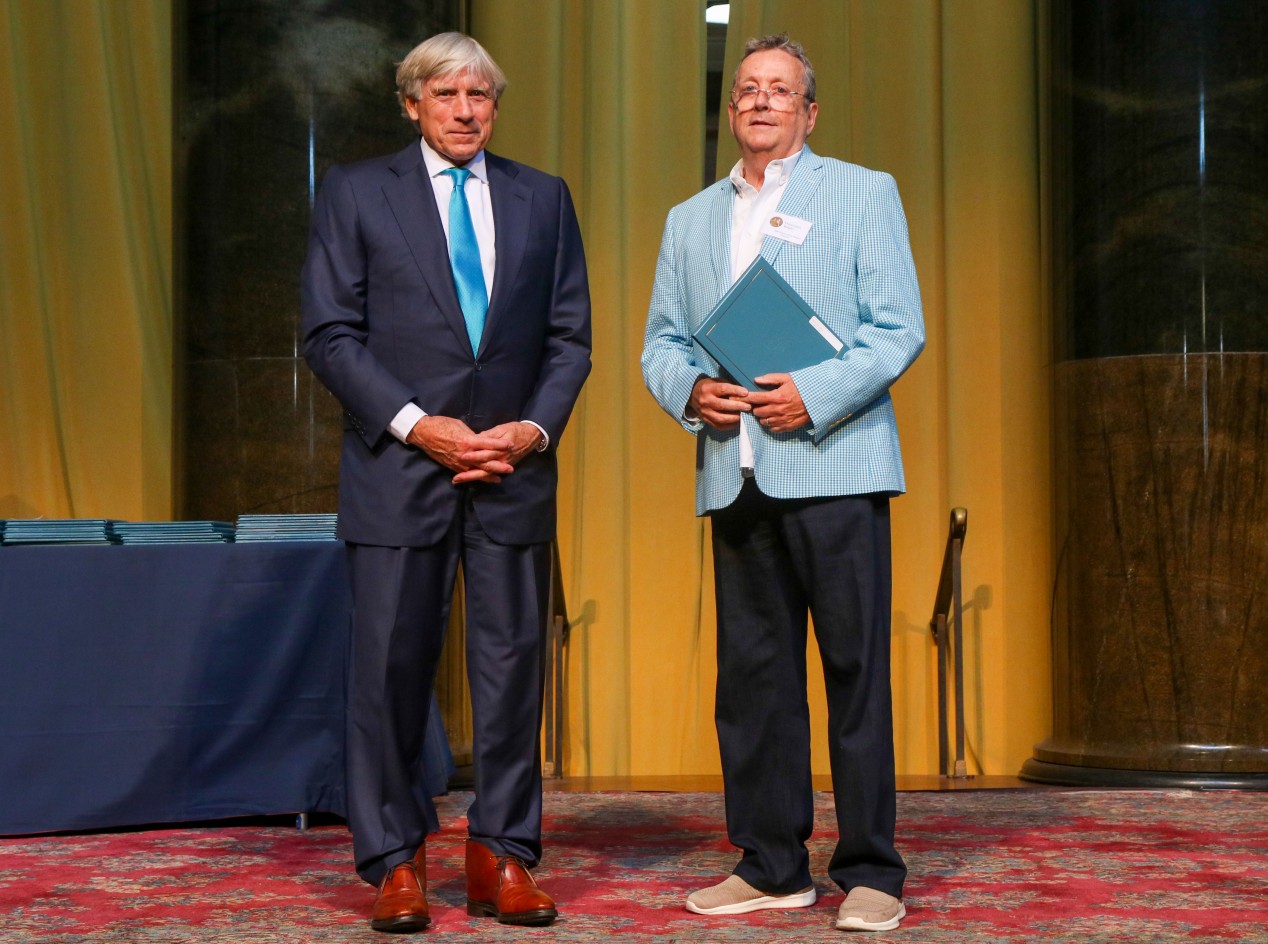
Christopher Knight accepts the 2020 Pulitzer Prize for Criticism from Columbia University President Lee Bollinger. (Jose Lopez/The Pulitzer Prizes)
Winning Work
Without fanfare, the Los Angeles County Museum of Art has taken a momentous step. Separate curatorial divisions for American art and for European painting and sculpture, established when the museum opened its Wilshire Boulevard doors more than half a century ago, are now united under a single department head.
Sound bizarre? It is. No other museum of LACMA’s size and complexity does it.
LACMA’s European collections include Continental and British art produced from the Middle Ages to the end of the 19th century, while its American holdings continue to the start of World War II. Two big museum departments have essentially collapsed into one.
Fitz Henry Lane’s icily crisp view of majestic schooners, stilled in the setting sun of 1850s Boston Harbor, is under the same curatorial umbrella as a painting of the goddess Venus disarming little Cupid by Alessandro Allori, the prolific 16th century Florentine Mannerist.
A 15th century German woodcarving of the Virgin and child standing on a crescent moon, described in an apocalyptic vision by the enigmatic St. John, will henceforth curatorially cohabit with Guy Pène du Bois’ painted scene of two Roaring ’20s flappers who have stopped in front of a New York City shop so one can adjust her stocking.
The strange mash-up is in fact the first concrete step in Director Michael Govan’s plan to create a non-departmental art museum, for which Swiss architect Peter Zumthor is designing a controversial new building. (The project website is at buildinglacma.org.) The idea is to show LACMA’s diverse art collections as changing, cross-cultural theme exhibitions, rather than as relatively permanent displays organized by department.
Originally skeptical of the plan, I’m less confident than ever. That’s because of an unsuccessful sample of what’s to come.
“To Rome and Back: Individualism and Authority in Art, 1500-1800” has been on view since June in the Resnick Pavilion. (It closes March 17.) The theme is the pull of the Eternal City on the artistic imagination from the Renaissance to the European Enlightenment, when Rome’s influence largely evaporated.
But the show is bland and ineffectual. About 130 objects are on view, drawn from LACMA’s collections of European painting and sculpture, decorative arts, prints and drawings, Latin American art, costumes and textiles.
A few loans are here too, including a newly rediscovered, rather ungainly painting of Cleopatra, circa 1630, by Artemisia Gentileschi, borrowed from a local private collection. Better would have been a loan from the Getty Museum of “Modern Rome,” J.M.W. Turner’s dreamily iridescent 1839 masterpiece and European art’s definitive take on the city’s vaporous dissolution.
The installation is organized into seven chapters.
“Meanings of Rome” considers the city as both a real place with an ancient history and a fantasized product of literary imagination. “Inspiration and Awe” tackles theatricality, courtesy of the Vatican’s demand for spectacle. A section on “Classical Authority” might be retitled “We’re Rome, and You’re Not.” Etc.
If you think LACMA has the holdings to illuminate these sweeping themes in significant ways, you would be wrong. To be sure, wonderful objects are on view. But this mixed-up jumble of stuff skids along the topical surface. Connections with Rome are often flimsy, stretched to a breaking point.
Just because a “Holy Family” is dressed in robes and the Virgin stands in a hip-thrust pose with some classical buildings in the background doesn’t tell us anything meaningful about art in Florence, where 25-year-old Fra Bartolommeo painted the picture, or about Roman influence during contemporaneous political upheaval in Tuscany. Classicism had also been a feature of medieval art, while the artist, not yet even a monk, wouldn’t travel to Rome until he was in his 40s.
At the other end of the spectrum, no wall text identifies the enthroned figure of St. Catherine painted by Bernardo Strozzi, who worked mostly in Genoa and Venice, as a direct reference to pagan oracles in Michelangelo’s Sistine Chapel ceiling. If you didn’t already know it when you arrived at the show, you wouldn’t know when you left either.
Yes, Bolivia and Ecuador were Spanish Catholic outposts in South America; but in the painting by colonial artist Antonio Montúfar, do we really discover anything of substance about Rome just because Pope Nicholas V is having a vision of St. Francis? One of seven figures in Spanish painter Alonso Cano’s “Christ in Limbo” is a female nude, but she’s as much a Greek Aphrodite as a Roman Venus.
To Athens and back?
Why Dutch painter Hendrik Frans van Lint’s sweet little 1730 tourist view of the Piazza Navona didn’t make the installation’s cut, nor American artist John Singleton Copley’s magnificent, full-length 1780 portrait of soldier Alexander Montgomerie, striding like a Scottish translation of the Vatican’s Apollo Belvedere, is anybody’s guess. The show has lots of blank wall space.
The art in “To Rome and Back” does not carry the installation’s narrative. Instead, church vestments and a bronze Mercury, an etching of Tivoli and a painting of a primped British aristocrat (also in an Apollo Belvedere flourish) are deployed as illustrations to a missing text. And thin, patchy illustration at that.
The show isn’t exactly infotainment — elevator music for the eyes — but it’s pointed in that direction. I’ve seen the installation three times, and I still can’t figure out who it’s for.
I fear that the answer is: the general public. That’s a problem.
Art museums have two audiences — one general, who may or may not have a genuine interest (there’s got to be someplace to take the in-laws over the holidays); the other a dedicated art audience, who range from passionate enthusiasts to committed professionals. “Rome” throws that dedicated core constituency overboard.
Lose the core and the museum is in trouble. The trick is to serve both publics at once. And a prime service of a great museum is to help transform the general public into an art public.
The modern idea for institutions dedicated to amassing works of art for public display — a library for art objects, not books — was born of the Enlightenment. Ironically, its very roots were in Rome. The antiquities-rich Capitoline Museum, opened in 1734 in the city’s ancient heart, was Europe’s first modern museum.
Divvying up bigger, global-survey museum collections according to geography, medium and time period evolved over more than a hundred years. The structure isn’t perfect (nothing is). Because of its late-18th century point of origin, it is also caught up in the bad as well as the good.
Institutional privilege has been historically afforded to European art at the expense of equally magnificent cultural expression produced elsewhere. Meanwhile, pernicious colonial exploitation has regularly been paraded as benevolent goodwill.
Yet, the traditional organizing method has also proven itself more than serviceable. As art historians who work directly with objects, curators develop unique expertise in concentrated areas. The museum’s job is to create open intersections where the public has access to that expert insight.
The head of the new joint mega-department is Leah Lehmbeck, LACMA curator of European painting and sculpture for two years. She replaces longtime department heads J. Patrice Marandel (European) and Ilene Susan Fort (American), both recently retired. In the new system, American art has taken the bigger hit.
Before studying to become an art historian, Lehmbeck worked at an auction house selling American art. After, she was at Pasadena’s Norton Simon Museum, home to stellar European and South and Southeast Asian art but almost no prewar American painting, sculpture or design. The Simon does not organize large or complex exhibitions.
Lehmbeck hasn’t organized a major museum show, a lack of experience that surely hampered “To Rome and Back.” But she is the curatorial point person in the planned reorganization of LACMA’s entire permanent collections for the new Zumthor building.
For well-known problems with art historical categories and displays, the disappointing “Rome” prototype is not worthwhile. Sidelining deep expertise isn’t just unhelpful; it derails the likeliest path to useful fixes.
In preparation for tearing down four of the seven buildings on LACMA’s campus, most of the museum’s galleries are now closed. American, European, Oceanic, Egyptian, Near Eastern, Islamic, Japanese, Latin American, Ancient American, South and Southeast Asian and photograph collections are shuttered. (Note: Most of the art is gone, but you’re still required to pay the full admission price of $16 to $25 to see what’s left.)
Nine of 12 current temporary shows feature modern and contemporary art, one contextualizing a recent painting by Shanghai artist Zheng Chongbin with some Chinese Song and Yuan dynasty ceramics. LACMA is now operating less like an encyclopedia of historical knowledge than like one of the nation’s 11 kunsthalles – non-collecting “art halls” that focus on recent talent.
The Zumthor building is at least a year behind schedule. Groundbreaking, planned for late 2018, is now anticipated for early 2020, with the old projected 2023 reopening date pushed back to early 2024. The hefty budget, first announced in 2013, is still listed at $650 million, but simple inflation pushes that number to more than $700 million today.
I guess the curatorial staff will have several years to bone up on their colleagues’ specific areas of expertise to come up with cross-disciplinary themes for the future. (Good luck with that: The collection includes around 120,000 objects.) Let’s hope they’re better than this largely useless “permanent collection temporary exhibition” about Rome. Getting rid of traditional departments is the goal of the New LACMA, but current moves do not inspire confidence.
Within weeks, the County Board of Supervisors is expected to vote on releasing $117.5 million in taxpayer funds to help build a much-needed new home for the imposing permanent collection at the Los Angeles County Museum of Art. The total price tag to replace four crumbling and inefficient buildings is $650 million, with the lion’s share privately funded.
I do not envy the supervisors their task. Once assured, viewed almost as a slam-dunk, the vote is now a gnawing puzzlement.
That’s because of some startling news that broke last week. We learned on the eve of the decision that the ambitious construction plan at the Wilshire Boulevard campus has been radically downsized.
What was once a project designed to add nearly 50,000 square feet of critically needed gallery space committed to showcasing the museum’s impressive and still-growing permanent collection of paintings, sculptures and other global works of art has been turned on its head. Now, rather than enlarge the capacity, the scheme is to reduce the existing gallery square footage by more than 10,000 square feet.
Adding 50,000 square feet might not even have been enough. Subtracting 10,000 is absurd.
LACMA has become the Incredible Shrinking Museum. I couldn’t name another art museum anywhere that has ever raised hundreds of millions of dollars to spend on reducing its collection space.
Peter Zumthor, 75, the celebrated Swiss architect chosen almost a decade ago for the job by LACMA Director Michael Govan, is known as a slow, deliberate designer whose aim is to craft evocative, atmospheric spaces. The museum, his first building in the United States, is easily the largest he has tackled.
Zumthor’s building would replace three existing structures erected when LACMA opened in 1965, plus a fourth completed in 1985. Together, they contain 120,000 square feet of collection galleries.
The size of new gallery space has been a moving target from the beginning.
- In 2013, as a debut exhibition of preliminary building designs was being readied, a LACMA spokesman explained to The Times that the new facility would essentially replicate the existing square footage of what was being torn down, rather than giving the museum’s collection additional room.
- The following year, in the run-up to the Board of Supervisors vote on earmarking project funds, Govan told a meeting of editors and reporters at The Times that the display area had changed. The design’s newest iteration would enlarge space for the permanent collection by 50,000 square feet.
- Barely a year later, as LACMA prepared celebrations for its 50th anniversary, that number had already been trimmed. The expansion was pegged at an additional 40,000 square feet — 10,000 less, but still roughly the size of LACMA’s newly built Resnick Pavilion, the hall where temporary exhibitions are shown.
And there the number stood — until the completed environmental impact report was filed with the county on March 22.
Eagle-eyed William Poundstone, who writes at his ironically named blog Los Angeles County Museum on Fire, named for a famous Ed Ruscha painting, waded through the 577-page report. He discovered that the plan for galleries had shrunk to 109,900 square feet — a precipitous drop from the 170,000 square feet contemplated in 2014, and smaller than what’s there now.
From nearly 42% more gallery space when the Board of Supervisors gave preliminary approval to the rebuilding plan, there will now be about 8% less than LACMA has today. Frankly, that’s a disaster for adequate display of the permanent collection.
LACMA’s collection is something of a miracle, the bulk of its roughly 125,000 objects acquired just in the last six decades. Encyclopedic in range, with superlative holdings in Dutch Golden Age painting, South Asian sculpture, ceramics from ancient West Mexico, Korean ancestor portraits and Joseon dynasty vessels, modern German Expressionism, Safavid dynasty art from Iran and much more, it compares favorably when measured against encyclopedic museums of much older vintage.
That collection will continue to grow. LACMA last year reported adding art valued at more than $35 million, most of it from gifts.
But the new building cannot grow with it. Zumthor’s design is self-contained. A single-story, curvilinear structure is raised on massive piers to span Wilshire Boulevard at Spaulding Avenue. Additions are out of the question.
Why the shrinkage? Sluggish fundraising is one speculation. However, a dubious shift in museum philosophy is just as likely.
Given vast L.A. sprawl, the museum has promoted developing satellite facilities. A small one is in place at the Vincent Price Museum at East Los Angeles College, and two more are planned for South L.A. Fine with me — except, not for the permanent collection.
An encyclopedic or universal museum is distinct from other kinds for its diverse global holdings. Uniquely valuable because that diversity is pulled together in one place, it reflects the cosmopolitan urbanity of a modern city.
Creating such a collection has been labored over for half a century by countless LACMA curators. Balkanizing it into satellites defeats the purpose. Satellites only work for temporary exhibitions, not permanent collections.
LACMA, however, is also planning to remove permanence from its new Wilshire Boulevard collection galleries. Instead, works culled from the collection will be assembled as temporary theme shows. The strategic change was illustrated by a recently closed example at the Resnick — “To Rome and Back,” a thin and ineffective look at ancient Rome as an artistic inspiration over centuries. The show was an embarrassment.
Presumably those collection theme shows might someday circulate among LACMA’s future satellites — a local version of the Guggenheim Museum’s failed effort to franchise the New York institution in a host of global cities. Govan was deputy director at the Guggenheim from 1988 to 1994, when initial plans were drawn for its branded satellite in Bilbao, Spain.
Bilbao has a brilliant, now-famous Frank Gehry building and a generic, barely noteworthy art collection.
The hapless Rome show, a sample of what’s to come, confirmed my skepticism about the unique and risky plan, which I expressed to Govan in conversation a few years back. Not to worry, he reasonably argued; if thematic collection installations don’t work out, nothing prevents a future return to standard encyclopedic displays based on simple geography and chronology.
Except, now something does. Diminished gallery space prevents it. There is no turning back.
Other practical problems plague the museum design, starting with the absence of curators offices. The collection’s custodians, along with most of the remaining professional staff, will be housed in a skyscraper across the street, occupying five full floors of rental space.
Curators in exile? Ideally, curatorial offices should open directly onto galleries, so that staff has daily interaction with the collection in its public domain.
It’s true that art museums are more expensive to build than routine office space, but rental expenses in perpetuity more than eradicate any upfront savings. The initial outlay is simply the cost of doing effective museum business.
The $600-million price tag presented to county officials in 2014 for their initial project greenlight soon bumped up to $650 million. With a reduced building plan now, LACMA is offering less art for more money. Is an Incredible Shrinking Museum really worthy of taxpayer support?
The County Board of Supervisors meets Tuesday to vote on moving forward with a planned redesign of the Los Angeles County Museum of Art. They will have two primary decisions to make.
First: Should the county grossly overpay for a new museum building?
Second: Should the county overturn the museum’s original aim to encompass in one place all the cultures that make up modern Los Angeles County?
The obvious answer to both is a resounding no. Here’s why:
The cost per square foot of the plan is about $500 too much. And the plan destroys the vital concept of an encyclopedic art museum, which has successfully guided LACMA for half a century.
I blanched when LACMA Director Michael Govan told my colleague Deborah Vankin in a Times interview published online Saturday that the new building, designed by Swiss architect Peter Zumthor, is “about $1,873, plus or minus” per square foot.
Downtown, the flashy, 4-year-old Broad art museum came in at around $1,260, when adjusted for inflation. The complicated new Menil Drawing Institute in Houston, which opened last fall, came in just above that, at $1,327 per square foot. Three years ago this month, the San Francisco Museum of Modern Art opened an elaborate new building at an inflation-adjusted cost of $1,384 per square foot.
The Broad and SFMOMA are in dangerous earthquake zones, while the Menil is in an area that must be cautious about the potential for epic flooding. All three faced paying an unusual building premium, just as LACMA does. They coped with the budget, but it seems LACMA can’t.
The $500 difference is astounding. On a 347,500-square-foot new building, that’s a premium of more than $170 million. Building costs do vary from city to city, but that disparity is more than steep. It’s precipitous.
Some love Zumthor’s design, a single-story building lifted on piers to span Wilshire Boulevard. Others hate it. But aesthetics are not the big problem.
This is: The proposed building is smaller than the buildings it will replace, and it cannot be expanded. When it is done, LACMA is done.
That is a very big deal. A vote to approve doesn’t just affect the future look of the place. It wrecks the invaluable idea of an encyclopedic art museum.
An encyclopedic (or “universal”) museum brings together art from any and every culture, from any and every historical moment, together in one place. It’s a reflection of the polyglot metropolis in which all Angelenos should be able to discover a reflection of themselves — of their history and their connection to their neighbors. The form is crucial to the contextual understanding of the vast diversity of global art.
But the self-contained new building, which cannot grow with the collection, represents the launch of a different museum philosophy. Govan declared it to LACMA membership in a mass-email last week.
“Our future expansion might be best pursued not on our Wilshire campus,” he wrote, “but rather in the communities throughout Los Angeles where we intend to bring our art collection to future satellite locations.”
Sounds nice, bringing art to the people. But a balkanized museum offering mere fragments instead of a cosmopolitan, encyclopedic whole is not a recipe for salvation. Satellites are an old and costly boutique-museum idea that has been tried — and failed — elsewhere.
Satellites pledge access to the artistic inheritance of humanity, and access is indeed crucial. But if access were the priority, the museum wouldn’t be charging adults $16 to $25 a pop to get in. Better that LACMA should put its shoulder to the wheel of making admission to its Wilshire campus free for every county resident, rather than chop up the universal art collection and spread it around over the county’s 4,751 square miles.
A “yes” vote from the supervisors means that more than 50 years of the county project to build the last great encyclopedic art museum in the United States is over. It has driven five former LACMA directors, scores of curators and professional staff, countless past benefactors, an array of trustees and untold others in building the institution, virtually from scratch, since 1965.
Their collective aim — exciting in its audacity, achieved in fits and starts with varying degrees of success — was that LACMA would be the last great encyclopedic museum to be built in the United States, given the rapidly shrinking pool of available major art. Other illustrious American examples — in Boston or Cleveland; St. Louis or New York; Philadelphia; Kansas City, Mo.; Toledo, Ohio; or Chicago — have been at it far longer. Encyclopedic art museums are a rare accomplishment, but that remarkable achievement for Los Angeles County will grind to a halt.
There will be no getting it back. The final environmental impact report that the supervisors have in their hands makes no mention of that, even though it is the defining environmental impact of the plan on which they are about to vote.
Money does matter. (So far, about $36 million has been spent, according to county figures.) Fundraising is stuck below targets, although Govan has pulled in far more in pledges than any past director. He’s unusually good at that. Future directors better be too.
That’s because the planned new building has zero “back of the house” services — no curatorial offices, no conservation studio, no art storage, no library, etc. Like the needless satellites, those essentials will be farmed out. LACMA will be tied to the ongoing annual expense of paying commercial rents off-site, all while servicing the project’s hefty debt load over coming decades.
Honestly, it’s irrelevant whether the form of Zumthor’s design looks like a coffee table or a small-city airport terminal, as critics have said, or whether the concrete is black or beige or that the naming opportunity for one of two planned cafes has gone to Ryan Seacrest. (The “American Idol” host is a museum trustee, and although LACMA officials haven’t yet announced it, he has signed a $2.5-million pledge to underwrite the restaurant. Good on him.) Those concerns draw lots of chatter, but they pale beside the encyclopedic issue.
I suspect the supervisors have no idea, either about encyclopedic museums or the looks-good-only-on-paper satellite “solution.” They shouldn’t have to know. Supervisors not in District 2 or 3, overlapping the site of LACMA’s campus, might figure that a satellite coming their way would be just the ticket. The whole topic is as rare as the 50-year achievement that’s about to be squandered.
County Chief Executive Officer Sachi A. Hamai has endorsed the plan, but the recommendation is wrong. It should be rejected — and not only because of that boggling $1,873-per-square-foot cost.
How do you hang paintings on concrete walls?
“With great difficulty” is the joke answer.
“With great difficulty” is the serious answer too. Hanging paintings on cast concrete isn’t easy.
But that’s apparently what the Los Angeles County Museum of Art has in mind, beginning in four or five years, when a controversial $650-million structure opens on the Wilshire Boulevard campus. Replacing four existing buildings, the new 109,900 square feet of galleries will feature hundreds of permanent collection paintings hanging on concrete. The gallery walls will be made of the stuff.
The County Board of Supervisors voted last month to release $117.5 million toward the nutty idea, urged on at a pitiful public hearing by movie-star cheerleading from Brad Pitt and Diane Keaton, plus a cast of characters all with vested interest in approval. A week or so later, the public got a chance to see a few images of the latest design. (Nice timing.) LACMA opened a small space on the ground floor of the soon-to-be-torn-down Ahmanson Building to show what Swiss architect Peter Zumthor, 76, has been up to lately.
The modest show includes a general site plan, a project timeline, some boosterish textual explanations and a pair of digital slide shows — one for earlier Zumthor projects, built and unbuilt and mostly in Europe, the other for 11 renderings of the new LACMA. All three gallery interiors sport walls of horizontally striated concrete.
Zumthor got the museum job 11 years ago. Plans for what he would build have changed several times since then. Most attention has focused on the exterior — an organic undulation that looks like a 1930s Jean Arp bas-relief sculpture raised on cubic, Brancusi-like pedestals.
The luminous digital drawings of the exterior radiate a relaxed, blissful glow for cars streaming by and people milling about beneath clear blue skies streaked with delicate clouds. Architectural renderings like these are designed to make a sales pitch — LACMA, after all, still needs to raise tens of millions of dollars (and satisfy supervisors) to build it — so the bunkum level runs high.
They’re like those annoying TV ads for erectile dysfunction, the ones where a naked, hand-holding couple stretched out in separate bathtubs gazes out over an endless sea or primeval forest and contemplates the (false) promise of never-ending youth. Tiepolo would be proud.
The interior is more of an unknown. That’s where the art will be, but even at this late date no floor plan or gallery layout is available for public perusal. (A request to see one went unanswered.) There are only those three new renderings — and they’re hilarious.
Thanks to software, paintings from the collection, all European and of sizes large and small, are inserted into the stylishly austere rooms. So is what appears to be one of the collection’s great treasures: a magnificent 9th century BC Assyrian relief of a winged deity escorting King Ashurnasirpal II through his honored earthly passage.
Don’t count on that actually happening (the hanging, not the escorting). In real life, the carved alabaster block weighs just under a ton, but in digital life it can hover beautifully up on the wall.
So, how do you hang paintings on cast concrete?
Suspending pictures on wires secured to a high picture rail, as Victorians sometimes did, doesn’t do the trick. In earthquake country, the last thing you want when a temblor hits is for your suspended Georges de La Tour masterpiece to start slapping against the wall.
Drilling is the answer.
To confirm that assumption, I checked with a number of preparators with extensive experience installing paintings in art museums, commercial galleries and homes. When I explained my question, most groaned. All had essentially the same explanation.
Get an electric tool, bore a hole into the concrete, pound in an anchor (plastic or lead) with a hammer, then screw the hook or other hanging device into the anchor, which should expand to make a tight fit.
And if you want to move the painting?
Unscrew the hooks and pull out the anchors, further damaging the wall and requiring the holes to be filled with fresh concrete. (Be careful if you need to drill a hole in the same place later, as a patch may not be as secure.) With more conventional drywall, a hole is easily spackled and painted over, but concrete in-fill leaves a visible scar.
Now, repeat hundreds of times to accommodate LACMA’s diverse collection — a Joseon dynasty mythological depiction of Daoist immortals Zhongli Quan and Liu Hai; the John Singer Sargent portrait of Mrs. Edward L. Davis and her tow-headed boy, Livingston; the rare signed and dated (“Arellano in 1691”) Mexican painting of the Virgin of Guadalupe; Paul Cézanne’s explosive forest landscape in the South of France; and scores more.
The museum has decided to rotate the encyclopedic collection constantly, abandoning more permanent displays. So, multiply those numbers.
Wall labels identifying the paintings? Few are shown in the renderings, but I suppose Velcro might work. Or, maybe your smartphone GPS can call them up with something like face-recognition technology.
LACMA Director Michael Govan is unperturbed by the idea of paintings hung on concrete. He has said it’s done all the time at Zumthor’s one other art museum built from scratch, the handsome little Kunsthaus Bregenz in a resort city at the Austrian edge of scenic Lake Constance.
Well, not exactly. The 20,000-square-foot Kunsthaus (less than a fifth the size of LACMA’s planned galleries) is a four-story contemporary art space with a tiny collection.
Its lantern-like rooms of concrete and semi-opaque glass most often host shows of sculptures, installations and video art by living artists. This year’s schedule is typical: one exhibition with recent paintings hung in one of the building’s four floors, while three “not-painting” shows round out the bulk of the calendar.
So, yes, it can be done. You can, indeed, hang paintings on concrete walls. Which begs the question: Why would you want to?
I’m sure it could look glamorous. (See the stylish digital rendering with the Rembrandt portrait of prosperous Dutch grain merchant Martin Looten.) I’m also sure that, on the day it opens, the place will look as dated as a skinny black Prada suit.
That’s because spare, raw, unadorned concrete is a signature material of Minimalism. Zumthor is a Minimalist architect, and 1960s Minimalist art is Govan’s favorite kind. (Born in 1963, just as the style was getting off the ground, he studied to be an artist before getting detoured into museum administration.) Two generations ago, Minimalism represented a powerful break with conventional structures of painting and sculpture.
Take Donald Judd’s 1977 “Untitled (for Leo Castelli),” a reinforced-concrete sculpture composed of five empty boxes, each 7 feet square. Nothing separates the industrial forms’ insides from their outsides, erasing traditional claims that art is an outer exposure of an artist’s submerged inner life. Utterly impersonal, the anonymous modular geometry creates a sleek object emphasizing contemplation. A viewer observes himself observing.
Minimalism was a classic anti-art strategy, annulling every established trace of modern abstract art by slamming on the brakes and reversing gears. The Judd is a prime example.
Or, it was a prime example. Badly damaged now, the sculpture has been quietly crumbling away in LACMA’s east garden for years, edges chipped, surfaces scaly and rusty rebar exposed like the ribs of a decaying carcass.
(If you find a dead body in the street, decency demands covering it with a shroud. The same goes for a dead sculpture in an art museum’s garden. LACMA should be embarrassed.)
Concrete gallery walls are likewise an iconoclastic token. Common drywall is the usual museum choice.
The stone and block walls of the Metropolitan Museum of Art’s Cloisters are an exception to the rule. But, notably, that Medieval collection’s installation — mostly sculptures, liturgical objects and tapestries — rarely changes, while its supreme masterpiece painting, the Merode Altarpiece, stands on a shelf.
Chucking practical drywall signals a loathing for conventional cultural piety. The material gesture further proclaims the preeminence of structural fact. It avows an anti-elitist attentiveness to the industrially humdrum.
At least, it did way-back-when. For a thrilling example from 1922, see the tilt-up concrete walls of West Hollywood’s landmark Schindler House.
Anti-art aesthetics were first brandished as a sharp, unsettling disruption of the smoothly running status quo even earlier — by Dada artist Marcel Duchamp a century ago. New appreciation for Dada and for industrial architecture were both instrumental in Minimalism’s emergence.
Now that the strategy is universally accepted, however, it no longer has the power to muck up the rules. It is the rule. Anti-art aesthetics are the status quo. LACMA’s Minimalist design isn’t bold or progressive; it’s echt establishment. The gesture is antiquated — a pricey emblem of institutional taste.
For a glamorous example, see Austria’s Kunsthaus Bregenz.
LACMA’s plan for elevated horizontal architecture claims to erase a pecking order that puts one culture higher than another on a vertical ladder of artistic expression. But hostile concrete gallery walls are just old-timey Euro-American anti-art inflated to institutional scale. Minimalism colonizes diverse global cultures as surely as the Greco-Roman temple designs of yesterday’s art museums did — only in a newer, shinier, more modern way.
What, you expected something revolutionary from a hugely pricey building funded by local billionaires and sanctioned by county government?
Concrete is also beige-gray. So forget color ever again gracing LACMA’s gallery walls. Color can set a mood, tag an era, help establish a theme, introduce variation or visually resonate with the art. Applied color is irrational and playful, while solemn gray — intrinsic to the material — is “honest.” Heaven forbid looking at art should involve illuminating delight, never mind engaging with curatorial artfulness.
Faith in concrete’s sober virtue reminds me of all the cooing back in 2008-2010 over “column-free space” in Renzo Piano’s LACMA designs for BCAM and the Resnick Pavilion. Wide-open, uninterrupted interiors without pesky ceiling supports were touted as representing curatorial freedom and artistic respect — the liberty to subdivide interior museum space in whatever way might best flow from the art being shown.
Yes, but: Art installation budgets roughly tripled when BCAM and Resnick opened, several people with direct knowledge of the column-free plan told me. Earthquake-zone building codes guide construction of those temporary interior walls. The structural demands approximate those for permanent walls — including their expense.
Freedom has its costs. If the Resnick gallery layout for last year’s (dreadful) exhibition, “To Rome and Back: Individualism and Authority in Art, 1500-1800” looked familiar, that’s because you saw it the year before in (the great) “Painted in Mexico, 1700-1790: Pinxit Mexici.”
And before that for “Los Angeles to New York: Dwan Gallery, 1959 –1971.” Seven hundred years of international contemporary art, Latin American Baroque paintings and European Renaissance sculptures, paintings, graphics and decorative arts were all shown in the same container. So much for tailoring galleries to the unique demands of what’s on view. Too costly.
The concrete-walled spaces in between the concrete-walled rooms have been branded as “meander galleries” — ad-speak for what mere mortals know as hallways. The renderings overflow with twenty- and thirty-something visitors browsing about, the selfie crowd coveted by marketing departments everywhere, their designer hand bags, quaint man-buns and athleisurewear on casual parade.
Not a chair or bench is anywhere to be seen in the pictured indoor acreage, which will be nearly the size of two football fields. Museum fatigue — a phenomenon from being on your feet for hours, first analyzed in a scientific journal back in 1916 — disappears into the digital glow.
Zumthor’s imposing building is a bridge with a glass-walled perimeter straddling Wilshire Boulevard, the city’s automotive spine. The show’s wall text piously bills this design as taking a moral stand that chooses cultural transparency over opacity.
In reality, the new LACMA just makes an Instagrammable spectacle of the conspicuous consumption inside. Art museums have been public showcases for the aesthetic preferences of the affluent ever since the 18th century, when Rome’s papal Capitoline Museum and Paris’ palatial Louvre Museum were founded. That’s not a knock, just an inescapable fact. Like church and state then, plutocracy now is not transparent — so let’s not pretend otherwise.
Similarly, let’s not pretend that concrete gallery walls are a magnificent idea. Should they be built, let’s also hope they hold up better than that hapless Minimalist sculpture languishing out in LACMA’s soon to be torn-up garden.
Dear Peter Zumthor,
We haven’t met, but I have been following your work on a design for a new building at the Los Angeles County Museum of Art ever since word leaked (13 years ago) that you had been tapped for the project. Following along hasn’t always been easy. Transparency about the building plan is not the museum’s long suit.
The other day, though, you gave an interview about LACMA to your local newspaper in Zurich, Switzerland, and it made me blanch. Like the museum’s director, Michael Govan, you have had no experience with encyclopedic art museums prior to your LACMA involvement — and it shows.
You said a couple of things about the museum that betrayed profound misunderstanding. Since they go to the core of an institution I know fairly well, they seem worth clarifying.
Three statements are particularly troubling. I’ll start with the knottiest one.
You are quoted describing an encyclopedic art museum as “an asylum for homeless objects” — displaced, apparently, because the diverse global cultures that produced most of these paintings, sculptures, textiles and the rest are either long gone, if the objects are historical, or far away, if the art is contemporary.
“These objects have lost their context,” you explain. You plan to give these homeless objects a home.
But encyclopedic art collections are distinctive. They are a powerful invention of the European Enlightenment, which arose from a crucial understanding: Art objects get authentic context from other works of art.
A displaced art object gets its primary illumination not from a grand new building, nor from wall labels or chattering people (including critics). With all due respect, your contextual analysis is wrong. That means your proposed solution is wrong too.
In any case, your work as an architect is widely celebrated for very different kinds of structures — thermal baths in an Alpine village, a Norwegian victims’ memorial, a small Swiss contemporary art center. Your plan harnesses those same architectural gifts for LACMA’s art.
But architecture cannot compensate for lost context. Beautiful light won’t do it, nor rooms with atmosphere. Detailed craftsmanship won’t either.
These are the elements for which your work is known. But they’re irrelevant to counteracting the rupture of a vanished world that, a thousand years ago in China, brought about a stoneware ewer in the shape of a parrot. Or a relief of carved ivory showing a serene Buddha Shakyamuni in 18th century Sri Lanka. Or Diego Rivera’s altar to the endurance of indigenous Mexico, painted in the wake of a modern revolution.
Light, space, atmosphere — these and other architectural dimensions might turn out to be very beautiful. Given your venerable track record — the Pritzker Prize isn’t handed out to architects of dubious skill! — I have every reason to believe that the museum’s objects could look very handsome in their new setting.
But context? It will still be lost.
Architecture cannot repair it or substitute for the loss. A therapeutic design approach works for a spa, but it will fail for the art museum.
In fact, the museum’s building design is ultimately irrelevant, except for the ways it serves the curatorial program. Believing otherwise betrays your inexperience with this museum’s form.
The key attribute of an encyclopedic museum — proximity in the depth and diversity of other art — compensates for the lost context. Art is an eloquent conversation among artists, past and present, which smart museum curators know how to host.
I know you pretty much waved off meeting with LACMA’s talented curatorial staff during your lengthy design process, but that was a serious mistake. No painting, sculpture, costume or ritual object is an island, entire of itself — if I might repurpose the poet John Donne.
Every artwork is “a piece of the continent, a part of the main.” Objects perceptively chosen and shrewdly installed so that they can speak freely with one another, teasing out meanings one might not otherwise see, are what begin to discover or build an expressive context.
History is about the past and the present simultaneously, not one at the expense of the other. Encyclopedic art collections understand that.
That’s why I was saddened — and, I confess, a bit upset — by another contentious comment in your Neue Zürcher Zeitung interview. You were explaining the plan to simply dismantle the encyclopedia as traditionally conceived, in favor of a constant rearrangement of LACMA’s collection to make perpetually changing thematic exhibitions.
“The museum director Michael Govan and I have long agreed on this new order,” you told a reporter. “It is an encyclopedic museum, with 135,000 objects that came together by accident: furniture, clothes, stone sculptures. One could say: It is completely disparate, what is gathered here.”
By accident? That’s just wrong.
Yes, serendipity was involved, as it is in building any art museum’s vast collection — especially one as varied (or disparate) as an encyclopedia. But “accident”?
That might describe a freeway crackup, but it insults the insightful, considered labor over more than five decades of scores of LACMA professionals, benefactors and volunteers, men and women whose work has tried to make sense of global artistic plenitude. They started putting their shoulders to the wheel long before you or the director arrived on the scene — neither one with a day’s work experience at an encyclopedic art museum.
It insults the Ahmanson Foundation, in LACMA’s history the single largest donor of money to buy art — more than $160 million — without which the museum would be gravely lacking in “homeless objects.” I could continue with a very long list of such names — half a century of growth is not nothing — but one more example should suffice.
The unparalleled array of three dozen 17th century Dutch masterpieces collected by the late Edward and Hannah Carter is the exact opposite of an accident. Acquired by LACMA during the tenure of emeritus curator J. Patrice Marandel, it includes only first-rate still lifes, landscapes, seascapes, city views and church interiors from a specific time and place.
The pristine Hendrick Avercamp skating scene alone is the envy of the museum world. But, together with the other brilliantly chosen Carter works, plus others in LACMA’s 17th century rooms, context begins to come into pretty sharp focus.
There are plenty of other examples. Speaking of which, where is the Carter collection, now that the museum has been packed up for the impending tear-down of existing buildings? Storage? Will it be hidden away until your new building is opened five years from now, then occasionally brought out piecemeal in temporary shows? What a waste of an incomparable resource, already contextualized.
And how will that affect the terms of a bequest that says if the matchless paintings are not on permanent view — as they should be — the gift is rescinded, and the collection transferred to the National Gallery of Art?
Talk about lost context.
Presumably you didn’t mean to insult these folks, who represent a core museum constituency. Every art museum serves two publics — an art public and a general public. After the affront, your interview puts a thumb on the scale for the latter.
Of plans for the museum’s gallery layout you say, “I deliberately create spatial networking in such a way that personal, free and intuitive passages through the collection are possible and provoked.” We still haven’t seen any gallery floor plans, but you are describing a stroll through the whole museum. Who does that?
Think of any other encyclopedic museum in the world. If anyone tries to see all of the Metropolitan Museum of Art in one bite, it’s only tourists. Your thinking is apparently shaped by tourism — which leaves out the people of L.A., plus aficionados who visit often. What about them — the LACMA community?
Or maybe your notion is shaped by small, single-subject art museums — like the two you’ve designed in Europe. One concerns artifacts from a local Catholic diocese, the other shows contemporary art. They can easily be seen in a brief visit.
One writer — Tyler Green, historian and producer of the Modern Art Notes podcast — calls your LACMA design the Coffeetable Kunsthalle. The coffee table part is a funny jape about the design’s similarity to a piece of midcentury furniture, an undulating shape raised on legs; but the kunsthalle part is more telling. A kunsthalle — “art hall” — is an exhibition-only venue without a permanent collection, never mind an encyclopedic one.
Granted, I read your interview in translation. (My command of German text disappeared shortly after I completed graduate school exams more years ago than I care to remember.) If I misunderstood, I apologize. But, given your misplaced faith that your building can repair art’s contextual issues, I doubt it.
It pains me to have to say this, but the design’s critique of the encyclopedic form is shallow, the revisionism uninformed. LACMA’s encyclopedic collection is not an accident, and no architecture can compensate for lost context.
And you have to get this building right. When it’s done, your work is what people will know for LACMA’s next 50 years.
Few remember the two museum directors present at the 1965 birth of the original buildings, but everyone now speaks of their architect. Like you, many speak of William Pereira’s three-pavilion design with disdain. It badly cramped the LACMA mission.That’s why his buildings are being torn down.
Sincerely yours,
Christopher
Large-format landscape and seascape photographs by Thomas Joshua Cooper are luxuriously printed in velvety black and white. The artist, 72, uses a complex tonal printing process that lends richness and depth to the photographic grays and blacks.
Visually, however, the imagery is dull. If not exactly interchangeable — a frothy swirl of churning foam around a rocky outcropping in the Strait of Magellan here, a frosty rim of the Niagara Falls Basin there — the photographs exhibit a repetitive sameness. In 140 examples (75 small studies and 65 as large as 40 by 54 inches) at the Los Angeles County Museum of Art, a viewer’s eyes glaze over pretty fast.
Cooper has been an American expat working in Scotland since 1982. The LACMA show, organized by Director Michael Govan and curator Rebecca Morse, is his first significant museum survey. Its centerpiece is a selection from his “Atlas,” some 700 photographs that, according to the museum, together “charts the Atlantic basin from its most extreme northern, southern, eastern and western land points.”
Over three decades, in other words, Cooper traveled the Western Hemisphere and photographed the Atlantic Ocean’s edges. The idea might be compelling, but the art isn’t. This is one of those Conceptual projects in which the concept far outstrips the visual result, the often-rollicking tales of their perilous making supplanting any interest generated by largely humdrum images.
The work is something of a cross between the critically admired, nearly abstract black-and-white photographs of the world’s oceans that Hiroshi Sugimoto began around 1980 and Ansel Adams’ hugely popular, sometimes grandiose pictures of the American West from the 1940s and after. Cooper is a true eccentric, as a recent New Yorker profile attests, but his pictures couldn’t be more conventional.
In an eyebrow-raising addendum, LACMA’s director also commissioned a group of 19 photographs of the California coast (Cooper was born in San Francisco) and organized a concurrent exhibition of them at Hauser & Wirth gallery, where the work is for sale. The expedition to produce the suite of coastal pictures was funded by the Lannan Foundation and Ann Tenenbaum & Thomas H. Lee. They are also major donors to artist James Turrell’s “Roden Crater” project in an extinct volcano in the Arizona desert, where Govan is president of the Skystone Foundation that oversees the project and raises funds for it.
Artistically, the photographs in “The Capes of California” are just more of the same shallow tedium. A commercial exhibition conceived and assembled by a nonprofit museum director who is the head of a county department subsidized by taxpayers, on the other hand, creates an ethical swamp of considerable depth. Neither LACMA’s board of trustees nor the L.A. County Board of Supervisors should stand for it.
Thomas Joshua Cooper
‘The World’s Edge’
Where: LACMA, 5905 Wilshire Blvd.
When: Through Jan. 26; closed Wednesdays
Cost: $10-$25 (see website for free periods)
Info: (323) 857-6000, www.lacma.org
‘The Capes of California’
Where: Hauser & Wirth, 901 E. 3rd St.
When: Through Jan. 19; closed Mondays
Cost: Free
Info: (213) 943-1620, www.hauserwirth.com
When Marco Polo headed off from Venice, Italy, for the sprawl of Asia in 1271, the inquisitive teenager was on the lookout for wondrous things. One that he found surprised him mightily.
The unicorn he encountered on the island of Sumatra “is not in the least like that which our stories tell of as being caught in the lap of a virgin,” he later told a scribe, who recorded the explorer’s epic, 24-year journey in “The Travels of Marco Polo.” In fact, he continued, “’Tis a passing ugly beast to look upon.”
That’s probably because what Polo had actually seen was a rhinoceros.
Because the traveler had never encountered one of those before, and because the ungainly beast sported a large horn protruding from its head like an elegant unicorn — which he also had never seen but knew about from Bible stories — he put two and two together and came up with five. Polo knew what he was looking for, so he made the world conform to his expectation.
Unicorns proliferate in the first room of “Book of Beasts: The Bestiary in the Medieval World,” a sumptuous exhibition at the J. Paul Getty Museum. An animal surrogate for Christ’s cleansing purity, unicorns turn up in pictures drawn and painted in the vellum pages of books, carved into the side of an ivory box and the seat of a parade saddle made of bone, woven into a wool and silk tapestry, stained into window glass, hammered into a brass dish, molded to form a ritual water vessel and embroidered into delicate linen cloth.
Not one is passing ugly.
And lest a museum visitor doubt the reality of the marvelous creature represented in all these objects, some dating from nearly 1,000 years ago, a unicorn horn is displayed nearby. An unidentified artisan lavished the horn’s sometimes-spiraling surface with intricate patterns of plants, animals and human figures.
Pattern is repetition and repetition is ritual — which may explain why this strange object is thought to have been used in church processions as a ceremonial staff. Nearly 4 feet long, it was carved in England more than 100 years before Polo set off on his trip.
Closer inspection reveals that, like the rhinoceros case of mistaken identity, this carved tusk actually came from a wholly different beast. Not a unicorn’s horn, it’s the left canine tooth of a narwhal, a type of Arctic porpoise.
Never mind. Many of the unicorns that these medieval artists invented are as wondrous as nature’s gifts.
“Book of Beasts” chronicles the rise of the bestiary, a specific type of manuscript illuminated with pictures of animals both real and imaginary, ordinary and extraordinary, plus its influence on other art until the Renaissance interrupted all the fun. Around 300 were produced, especially in Northern Europe during the 12th and 13th centuries. Astoundingly, nearly one-third of the 60 known books have been brought together for this indispensable show.
For every lion there’s a griffin — a lion’s body fused with an eagle’s head, wings and sometimes talons — and for every pelican, a fire-breathing dragon. Bestiaries extolled the glory of the Christian God through the application of vivid splendor to his creation, whether proved to be real like a lion and pelican or believed to exist in a far-off realm like the griffin and unicorn. That meant making art that would be equally as splendid, to convey appropriate power.
The show’s second section opens with a wallop.
The Aberdeen Bestiary, made circa 1200, is regarded by many scholars the greatest one of all. Certainly, it is an eye-boggling extravagance. Getty curator Elizabeth Morrison and assistant curator Larisa Grollemond, who organized the exhibition after nearly a decade’s research, chose to display the book opened at a pivotal place.
The spectacular folio on the left shows Christ in majesty, enthroned in an abstract eternity of glistening, polished gold. So much gold that the vellum page looks physically heavy.
He is held aloft by angels and, at the corners, the four evangelists. Matthew is represented as an angel, then Mark, Luke and John by their similarly winged animal symbols of lion, ox and eagle.
The exaltation of the relationship between God and nature is further stressed by the stunning painting on the opposite page. Its story comes from the Book of Genesis. Adam, the first man, is shown naming the animals.
Adam’s right hand is raised in blessing, his left palm lowered and held upright in a welcoming, come-hither gesture. Boxy rectilinear compartments hold an array of gently rounded, boldly outlined creatures painted in saturated colors, starting at the top with a crimson lion — king of the beasts.
The animal symbolism can get pretty complicated. Mythology of the time, according to a nearby label, said that the cubs of a lioness were born dead; after three days, the lion would breathe life into them. The legend has at least two implications, both inferring nature’s sacred source.
Genesis asserts that God “breathed into [Adam’s] nostrils the breath of life; and man became a living soul” — the lone biblical text that identifies when human life begins. The lion’s tale also adds a twist of resurrection, since the cubs arise only after a three-day “death.”
The show then fans out beyond illuminated manuscripts to encompass the bestiary’s role in establishing a pervasive visual vocabulary in the medieval world. Its words and pictures functioned as a kind of moral Christian guidebook. The allegorical range is marvelous in tapestries, metalwork, architectural fragments (painted ceiling panels, carved column capitals), game boards and other medieval objects of courtly and monastic life.
Eventually, the story unravels. Science intervenes.
Christian allegory wanes as natural history emerges during the Renaissance, slowly draining mystical symbolism and replacing it with the visual power of direct observation. If you haven’t actually seen a unicorn, better not to carve or paint one except in the spirit of lively play.
That shift in emphasis doesn’t banish imagination. “A Hare in the Forest,” the Getty’s own captivating 1585 Hans Hoffmann panel painting, renders every fine, short hair of the animal’s fur in excruciating detail. But the bunny, inspired by a famous Albrecht Dürer watercolor, is placed within a hyper-real woodland. Botanists have explained that only in art, not nature, could such a diverse array of plant life occupy a single locale.
If only the exhibition had also ended there. Unfortunately, there’s one more room to go, and it misfires.
Seventeen minor specimens of Modern and contemporary art by the likes of Henri de Toulouse-Lautrec, Pablo Picasso, Alexander Calder and Damien Hirst suddenly catapult us almost 300 years into the future. The exhibition’s closing narrative is disjunctive. What happened between the 17th and 20th centuries is anyone’s guess.
To cite one hapless example, Hirst’s sculpture of a hefty unicorn skull, crafted from solid gold and silver and made in 2010 for a lavish exhibition in Polo’s hometown of Venice, doesn’t really occupy “the sometimes blurry line between reality and fantasy” — the bizarre claim in the show’s large (and largely impeccable) catalog. The nihilistic gewgaw, vacuous and vulgar, instead embodies the mythos that can be manufactured in a crude market-culture that primarily values art as a luxury asset.
That’s a unicorn of a different color.
Art museums now seem to feel that topical relevance is somehow served by appending recent art to exhibitions otherwise anchored in a historical epoch. Here, reducing the medieval bestiary to a contemporary footnote makes for a listless conclusion to an otherwise strong and compelling show.
'Book of Beasts: The Bestiary in the Medieval World'
Where: J. Paul Getty Museum, 1200 Getty Center Drive, Brentwood
When: Through Aug. 18; closed Mondays
Admission: Free
Info: (310) 440-7300, www.getty.edu
When Henry and Arabella Huntington gave their massive San Marino estate to the public in August 1919, they had a plan. The two Gilded Age swells, firmly installed near the top among America’s richest people, specified that admission to visit their collections of art, books and botanical specimens would be free.
The stated goal, grandly echoing the Preamble to the U.S. Constitution, was “to promote the general welfare.”
A century later, the Huntington Library, Art Museum, and Botanical Gardens still ranks as one of the more astounding cultural institutions in Los Angeles — rich in British and American literature and art, housed in imposing buildings and set amid 120 acres of extraordinary gardens. Yet even with a $450-million endowment, free it is not.
The Huntington is instead just about the most expensive ticket to a cultural institution in Los Angeles. You won’t learn how that striking change happened in “Nineteen Nineteen,” the museum’s otherwise fascinating new exhibition celebrating its centennial year. But happen it did.
Today, if a couple and their two school-age kids want to see that absorbing exhibition some Sunday afternoon, they’d better be prepared to shell out between $84 and $106 to get in the door. That’s a long way from “a free public library, art gallery, museum and park,” as the founders’ original trust document so nobly announced.
“Nineteen Nineteen” takes its title from a John Dos Passos novel. Dos Passos isn’t much remembered today, but many critics regard the book as one of the 20th century’s most adventurous English-language novels.
Written in 1932 as the specter of fascism was rising in Europe and the global Great Depression was skittering toward rock bottom, it’s a work of nonlinear fiction focused on the stupefied aftermath of World War I. An experimental technique melds news reports, storytelling, graphic art, stream of consciousness and other surprising devices that mull the repercussions of an epic tragedy — 16 million died — in which the writer had seen grueling duty as an ambulance driver.
“The war was a blast that blew out all the Diogenes lanterns,” Dos Passos wrote.
That bleak quote greets visitors to the show in a scene-setting wall text. It signaled the deception and dishonesty that would spawn the madness of the Roaring ’20s and by the decade’s close, the brutal economic collapse of a rampaging industrial world.
By today’s standards, Henry and Arabella were virtual billionaires in 1919. Their $69-million net worth is the equivalent, when adjusted for a century’s inflation, of $1.02 billion today. Their affluence came from several sources.
Inheritance was one. Henry’s uncle, Collis P. Huntington, was born dirt poor, but as a rapacious founding partner and then cutthroat president of the Central Pacific Railroad, he became immensely rich. When Arabella became his widow and married his nephew, Henry, much of his giant fortune remained intact.
Henry is often wistfully cited for building the far-flung, long-since dismantled trolley system that once crisscrossed the vast reaches of Los Angeles. The exhibition features a remarkable hand-drawn map, 39 feet long and apparently being publicly shown for the first time, that charts the sprawling routes of the Pacific Electric Railway.
It also shows adjacent real-estate parcels, carefully annotated, that were the actual point of the mass-transit exercise. Jennifer Watts, co-curator of the show (with James Glisson), describes the vast streetcar system as a loss leader: Huntington made no profit building the Red and Yellow Cars, but the bigger, frankly predatory plan was to conveniently transport people to all that juicy real estate he had for sale from downtown L.A. west to the Pacific Ocean and east to Riverside.
Huntington also built ships. His uncle developed the Newport News Shipbuilding and Drydock Co. in Virginia. By chance, the company’s president went down with the Lusitania, a seagoing disaster that contributed mightily to America’s entrance into World War I. The conflict didn’t hurt a shipbuilder’s bottom line.
“Nineteen Nineteen” displays a wide-ranging cross section of items related to the title’s year, with around 275 chosen from the roughly 11 million in the Huntington’s collections. Virtually everything in it was made, published, edited, exhibited or acquired in 1919.
“Nineteen Nineteen” takes its title from a John Dos Passos novel. Dos Passos isn’t much remembered today, but many critics regard the book as one of the 20th century’s most adventurous English-language novels.
Written in 1932 as the specter of fascism was rising in Europe and the global Great Depression was skittering toward rock bottom, it’s a work of nonlinear fiction focused on the stupefied aftermath of World War I. An experimental technique melds news reports, storytelling, graphic art, stream of consciousness and other surprising devices that mull the repercussions of an epic tragedy — 16 million died — in which the writer had seen grueling duty as an ambulance driver.
“The war was a blast that blew out all the Diogenes lanterns,” Dos Passos wrote.
That bleak quote greets visitors to the show in a scene-setting wall text. It signaled the deception and dishonesty that would spawn the madness of the Roaring ’20s and by the decade’s close, the brutal economic collapse of a rampaging industrial world.
By today’s standards, Henry and Arabella were virtual billionaires in 1919. Their $69-million net worth is the equivalent, when adjusted for a century’s inflation, of $1.02 billion today. Their affluence came from several sources.
Inheritance was one. Henry’s uncle, Collis P. Huntington, was born dirt poor, but as a rapacious founding partner and then cutthroat president of the Central Pacific Railroad, he became immensely rich. When Arabella became his widow and married his nephew, Henry, much of his giant fortune remained intact.
Henry is often wistfully cited for building the far-flung, long-since dismantled trolley system that once crisscrossed the vast reaches of Los Angeles. The exhibition features a remarkable hand-drawn map, 39 feet long and apparently being publicly shown for the first time, that charts the sprawling routes of the Pacific Electric Railway.
It also shows adjacent real-estate parcels, carefully annotated, that were the actual point of the mass-transit exercise. Jennifer Watts, co-curator of the show (with James Glisson), describes the vast streetcar system as a loss leader: Huntington made no profit building the Red and Yellow Cars, but the bigger, frankly predatory plan was to conveniently transport people to all that juicy real estate he had for sale from downtown L.A. west to the Pacific Ocean and east to Riverside.
Huntington also built ships. His uncle developed the Newport News Shipbuilding and Drydock Co. in Virginia. By chance, the company’s president went down with the Lusitania, a seagoing disaster that contributed mightily to America’s entrance into World War I. The conflict didn’t hurt a shipbuilder’s bottom line.
“Nineteen Nineteen” displays a wide-ranging cross section of items related to the title’s year, with around 275 chosen from the roughly 11 million in the Huntington’s collections. Virtually everything in it was made, published, edited, exhibited or acquired in 1919.
So, no iconic Gainsborough “Blue Boy” (don’t worry, it’s in another room), but many rarely seen posters, photographs, manuscripts, botanical specimens pressed into books, a few minor Modern paintings, news clippings, a smashing Abraham Walkowitz Cubist drawing of a cityscape seemingly in the midst of a nervous breakdown and more. The inevitably chaotic jumble is given some shape by five loosely thematic sections.
“Fight” looks at the brutal war. “Return” regards the exhausted relief and rising social tensions in its immediate aftermath. “Map” charts the L.A. region, including a visionary fantasy of a massive, never-built cultural edifice planned for the center of the city. “Move” reverberates against a mogul rich from those railroad-streetcar-shipbuilding industries, pulling back to regard a nation on the move.
Finally, “Build” conjures the intersection of the mogul’s private estate with the public institution he put on the drawing board.
“As part of an extensive peace-time programme,” The Times reported on June 27, 1918, “Mr. Huntington commissioned Myron Hunt, an architect, to prepare plans for a library building [for] one of the world’s most valuable libraries.” Hunt’s 1919 ink-on-linen presentation drawing of the planned Neoclassical edifice, floating in ethereal clouds of leafy trees, pretty much describes what took shape in steel and concrete the following year.
Yet, the show is less about the Huntington itself than about the social and cultural context that helped shape it. One of the most absorbing moments is a lineup of three portraits of George Washington, all acquired in 1919, including a dollar-bill classic by Gilbert Stuart. They hang next to a vitrine featuring significant books that arrived by the trainload in San Marino that year.
Among them are autograph memoirs by Benjamin Franklin, Aaron Burr and William Tecumseh Sherman. Huntington had hoovered-up huge and coveted Anglo-American libraries (almost a quarter-million rare and indispensable volumes) during shopping sprees in the East. He was apparently asserting that the colonizing doctrine of Manifest Destiny, however bitterly contested, meant that Los Angeles, where the books and Founding Father paintings would be forever enshrined, was every bit as American as Philadelphia, New York, Atlanta or D.C.
Which brings us to the trust’s original arrangement for a “free public library, art gallery, museum and park.” The pledge came in wake of something else brought about by the end of World War I: Enormous pressure mounted to lighten the tax load of America’s super rich.
The exhibition doesn’t mention it, but the individual income tax was still new. The 16th Amendment was ratified only in 1913, and it was mostly Gilded Age progeny like the “billionaire” Huntingtons who felt the pinch. Joseph J. Thorndike of the Tax History Project once said that without the war, expensive in treasure as well as blood, two charitable tax breaks common today were unlikely ever to have happened.
A deduction for charitable donations was introduced in 1917. When the war ended the following year, a second deduction was added, specifically to reduce estate taxes for bequests. Six months later, Henry and Arabella made their massive charitable donation.
Long after both benefactors were buried on the Huntington mansion’s lawn, public admission to the spoils of their sprawling estate was free. And so it remained until 1996, after a decade in which voluntary, pay-what-you-wish contributions were requested. Huntington leadership then successfully applied to the state’s attorney general to inaugurate an admission charge.
It was set at $7.50.
That number, adjusted for inflation to about $12.50 now, is roughly half the regular adult admission required today. The Huntington has doubled its cost of entry, but other L.A. art museums — the Getty, the Hammer, the Broad — are free, and the Museum of Contemporary Art will soon be too. The San Marino powerhouse remains an exceptional cultural asset for those who can afford to visit it. For those who can’t, “Nineteen Nineteen” celebrates a distant memory.
'Nineteen Nineteen'
Where: The Huntington Library, Art Museum, and Botanical Gardens, 1151 Oxford Road, San Marino
When: Through Jan. 20. Closed Tuesdays
Info: (626) 405-2100, www.huntington.org
For most of the last four decades, Pattern and Decoration art seemed wonderfully outré to many observers, an eccentric violation of the standards and norms of serious painting and sculpture that was itself not to be taken too seriously.
P&D, as 1970s Pattern and Decoration was soon called, poked a well-placed finger — or three — in the eye of Minimal art’s crisp reduction of austere forms, the sharp idea-orientation of Conceptual art and the fashionable but still critically iffy appeal of Pop art. All those florid fabric swatches, proliferating curlicues, Moorish arabesques, celebrations of Grandma’s wallpaper and crystal doorknobs, bright colors, polka dots and plaids were all just — well, just too much.
Liking P&D was OK — but only if the fondness registered as a guilty pleasure, preferably accompanied by mild but self-conscious embarrassment. (“I know better; really, I do.”) Soon enough, the movement disappeared into the sandstorm kicked up by loudly marketed Neo-Expressionist painting. By the time the 1980s had come and gone, P&D had too.
Somewhere early on in “With Pleasure: Pattern and Decoration in American Art, 1972-1985,” the large — and important — new historical survey exhibition at the Museum of Contemporary Art, it occurred to me that something unexpected happened while we weren’t paying much attention. Without fanfare or warning, P&D no longer looks like a bizarre defilement, breach or disruption of anything at all.
Instead, P&D now just looks like art. Some of it is superlative, some is not; but to dismiss it wholesale is plainly an error in judgment.
The erudite seriousness of the endeavor, which has been there all along, has risen to the surface of the playful, imaginative, often flamboyant paintings and, occasionally, sculptures and documented performances. That the work no longer appears frivolous or out of place is certainly not an indication of the stature the movement now occupies in the history of recent art. P&D holds no such illustrious place.
In fact, MOCA’s is the first full accounting of the movement undertaken by a major museum. It is something of a return to what made the place major in the first place — an institutional willingness to do the big, thematic historical surveys from which others shy away. MOCA has done it for Minimalism, feminist art, Conceptual art and performance; add P&D to the impressive list.
A few other modest shows of this material have cropped up here and there, but the uniqueness of this one, organized by MOCA curator Anna Katz and featuring 100 works by 45 artists, is indication enough of the institutional blind spot in which P&D has long languished. “With Pleasure” instead reveals that the once seemingly oddball positions these artists championed are fundamental to the art being made today.
P&D artists drew and elaborated on myriad artistic sources, appropriating aspects of global practices for their own varied purposes. Twentieth-century modernism was a distinctive cultural form that emerged in the West, but the world — and its art — is larger than that.
Among the wellsprings of untapped visual languages ripe for use were traditional Japanese scrolls (Takako Yamaguchi), Islamic and Talavera pottery (Ralph Bacerra), Southern American garden gates (Valerie Jaudon), Chinese paintings (Brad Davis), Christian altarpieces (Robert Zakanitch), Chinese clip art (Kim MacConnel), genteel ladies’ fans and Valentine candy boxes (Miriam Schapiro), Persian textiles (Robert Kushner), Tibetan thangkas (Faith Ringgold), Baroque architectural fragments (Betty Woodman), Byzantine mosaics (Ned Smyth), African textiles (Howardena Pindell), Mexican tiles (Joyce Kozloff) and much more. Just about any ornamental art you can think of from any culture in world history fed the work.
The Pop part of P&D is pretty obvious, taking its cues from the mass popularity of decorative forms internationally. (Andy Warhol famously said Pop was about “liking things.”) The Minimalist dimension is embedded in the pattern part.
The exhibition highlights a frequent focus on the grid as a structural pattern for diverse compositions. A grid underlies the very different linear banners of unstretched fabric made by Kozloff, replete with abstract shapes like diamonds and six-pointed stars, and by MacConnel, enlivened with purple eggplants and beets.
Amy Goldin, the brilliant critical theorist of P&D, pointed out that pattern is not located in the simple repetition of forms and images. Pattern resides instead within the steady, measured repetition of intervals between those forms and images. The spatial structure accounts for an almost musical feel to much of this work, sometimes straightforward and sometimes contrapuntal.
But if ’70s P&D is in one way the unexpected offspring of a marriage between ’60s Pop and Minimal art, its midwife is Conceptual art. That is spelled out in Tina Girouard’s “Wall’s Wallpaper I,” one of the show’s gems.
Four vertical strips of fussy, pastel floral wallpaper are mounted on a muslin backing 5 feet square. Clematis climbs a trellis, sprays of yellow roses cascade down a crisscross background and more. Adjacent is a framed sheet of graph paper with instructions, carefully handwritten in pencil, explaining how the wallpapers are to be selected, arranged and permanently installed on a wall.
“Wall’s Wallpaper I” is a marvelous sendup of classic geometric wall drawings, complete with their own complex sets of instructions, by Sol LeWitt, a founder of Conceptual art. It raised a vexing question. If the idea (or concept) behind the work is more important than the finished art object, per Conceptual art’s assertion, why not just use Granny’s decorating scheme from the parlor? It’s loaded with sentiment, unruly memory and wit.
Lurking within Girouard’s example is a salient feature of P&D and its awkward history. Domestic materials evoke a traditionally female purview. It is worth noting that women are central to the Pattern and Decoration movement. (Of the 45 artists here, 28 are women.) The grid wasn’t only a mighty structural legacy of the Industrial Revolution — of the layout of the city block and the skyscraper’s steel framework, forms conventionally associated with male labor. The grid is also the foundation of needlepoint embroidery and a basket’s weave.
In a happy case of serendipity, this show’s 1985 end date coincides with the launch of the mature work of Lari Pittman, providing copious backstory to the smashing Pittman retrospective currently across town at the UCLA Hammer Museum. Both owe much to the confluence of liberation movements of the 1960s — African American, feminist, LGBTQ — yielding a political dimension that undercuts efforts to dismiss its gravity.
If there’s a flaw, though, it’s in the surprising omission of two L.A.-based artists. Ironically, both are male.
Beginning in 1974, Peter Alexander began to develop a marvelous series of glitter and collage paintings on unstretched black velvet, which brought Light and Space art into the emerging framework of Pattern and Decoration. A year later, Don Sorenson (1948-1985) started his impossibly complex zigzag paintings, which grabbed the orderly grid by the lapels, injected vivid color and twisted it into eye-dazzling patterns of spatial discontinuity.
Both should have a place in the survey, but the absence of two paintings is far from fatal. “With Pleasure” has a lot to offer. Pattern and Decoration emerges as a relatively brief, highly focused jab to art’s solar plexus. The jolt now is in recognizing just how deep it went and how well it took.
'With Pleasure: Pattern and Decoration in American Art, 1972-1985'
Where: Museum of Contemporary Art, 250 S. Grand Ave., L.A.
When: Through May 11; closed Tuesdays
Admission: $8-$15
Info: (213) 626-6222, www.moca.org
In size, “Betye Saar: Call and Response” is a modest show. Just 18 sculptures and collages, plus a selection of sketches, are tucked into a single small gallery at the Los Angeles County Museum of Art’s Resnick Pavilion.
The focus is on objects made in the last 25 years of a prolific career that was launched six decades ago. Since then, her work has been seen in more than 80 solo shows in galleries and museums.
Size, however, can be deceptive. Think of the LACMA gallery as a kind of one-room schoolhouse. Two lessons are on offer, both very big.
One is the distinctive nature of Saar’s brand of assemblage art. She builds her sculptures from used household objects, but in a carefully considered rather than spontaneously improvisational way. Artists take a variety of approaches to the use of found objects in their work, but hers is related to a particular kind of drawing.
The other lesson concerns the relationship between assemblage as a specific art form and the larger context of racism that has permeated American life from its beginnings. In “Call and Response,” the two lessons intertwine.
Take “I’ll Bend But I Will Not Break” (1998), a reflective installation assemblage that was born of a chance encounter at a rummage sale with a vintage ironing board. According to the catalog by LACMA curator Carol S. Eliel — spiral-bound, like Saar’s sketchbooks — the artist found the object at a Pasadena City College flea market. Something about it sparked the artist’s imagination, setting off a chain reaction.
In the finished work a flatiron, the pre-electric kind heated on top of a stove (and made of the hefty metal that gives the iron its name), is chained to a leg of the old ironing board. This intimation of bondage gets specific on the board’s top, which is printed with two images.
One is a famous 18th century British diagram of the packed hold of a slave ship in the Middle Passage between Africa and the Caribbean. The other pictures a black woman bent over her ironing.
History flashes by. Slavery’s forced labor blurs into Jim Crow’s restricted labor. “I’ll Bend,” the opening words of the sculpture’s title, describes the physical posture of a domestic worker at an ironing board.
“But I Will Not Break” describes another black woman — Saar herself, engaged in the labor of making a work of art.
The assembled composition stands in the room’s corner. Behind it a bright, white, crisply ironed sheet hangs clipped to a clothesline suspended between adjoining walls. In barely visible white thread, the cornered sheet features an embroidered monogram: KKK.
The irony — pun intended — of airing dirty laundry seemingly made clean by racism’s insidiousness is impossible to miss.
A vitrine nearby holds a number of small sketchbooks, including one related to “I’ll Bend But I Will Not Break.” Standing on edge, the sketchbook is opened to two sheets with drawings made using a plain ballpoint pen and the kind of “to-do” notebook that you’d carry in a pocket. Rather than lavish drawings, Saar’s sketches read as visual notations jotting down something in the mind’s eye — a kind of memo-to-self, written with the simple directness of a grocery list.
An aerial view of the ironing board’s top featuring the images of the slave-ship diagram and the woman ironing, dated Jan. 3, was quickly rendered using rudimentary marks. Twenty-six days later, an equally basic side-view of the ironing board shows the flatiron and chain in place.
The later sketch also specifies that the applied images will be affixed to the board not by drawing or painting them but by a heat-transfer printing technique. That little notation packs a punch: Heat transfer is itself an ironing process, applying pressure and high temperature to move an image from one surface to another. Saar’s assemblage doesn’t just describe history, it embodies a visceral connection to it.
That’s where the relationship between the larger context of racism and assemblage as a specific art form comes in.
On one hand, it’s unsurprising that the genre would be pervasive among African American artists. The deep roots of assemblage in Los Angeles art began in the 1950s with the counterculture ethos of Wallace Berman. An art at variance with prevailing social norms — or in committed opposition to them — is to be expected.
On the other, assemblage as an approach to making art was born a century ago in Picasso’s Cubist constructions. Cubism launched a formal revolution in seeing. The illusions of Renaissance perspective were chucked overboard to allow for the inventions of a new way of observing multiple sides of an object at once.
Saar’s assemblages add a social dimension to the multiplicity. She sees sides of lived experience that artists of the dominant culture necessarily can’t observe.
When she saw a beat-up old ironing board at a flea market sale, Saar saw a long, rectangular shape narrowing at one end that recalled the distinctive contour of a picture seared into the consciousness of countless African Americans. That double-vision began a chain reaction of associations that unfolded over time in marvelous, disturbing and insightful ways.
Saar’s 23 sketchbooks itemize stops on the path that arrives at the show’s 15 assemblages and three collages.
In several works she seizes the racist stereotype of the mammy caricature. Inserting little toy machine guns into one grinning doll’s hands, she transforms an image of mockery into a fierce symbol of resistance.
In others, birdcages are small prisons for a variety of objects placed inside. As Maya Angelou explained, it’s “the caged bird” that “sings of freedom.” Art — song — is a zone of liberty.
In the final work, a new sculpture whose sketchbook drawings date back as far as 2001, scores of cobalt blue bottles rest on a metal cot over a bed of coals. The ensemble is illuminated from within by a flourish of blue neon.
Ever since the biblical prophet Isaiah, enshrined on Michelangelo’s Sistine Chapel ceiling and in the poetry of William Butler Yeats, burning coal has represented pain’s ability to purify and cleanse. Saar’s bed of coal welds its metaphoric capacity for spiritual transformation to the blues.
“Woke Up This Morning, the Blues was in My Bed” adds a poignant coda to a moving exhibition.
'Betye Saar: Call and Response'
Where: Los Angeles County Museum of Art, 5905 Wilshire Blvd., L.A.
When: Through April 5. Closed Wednesdays
Admission: $10-$25 (see website for free periods)
Info: (323) 857-6000, www.lacma.org
Biography

Christopher Knight is art critic for the Los Angeles Times. He is a three-time finalist for the Pulitzer Prize in criticism (1991, 2001 and 2007). Knight received the 1997 Frank Jewett Mather Award for distinction in art criticism from the College Art Assn., becoming the first journalist to win the award in more than 25 years. He has a master’s degree in art history from the State University of New York and a bachelor’s degree from Hartwick College in visual art and literature. Before his career as a journalist, he served as curator at the Museum of Contemporary Art in San Diego and was a consultant to the Lannan Foundation and the Archives of American Art, Smithsonian Institution in Los Angeles.