Miami Herald Editorial Board, for a series written by Amy Driscoll
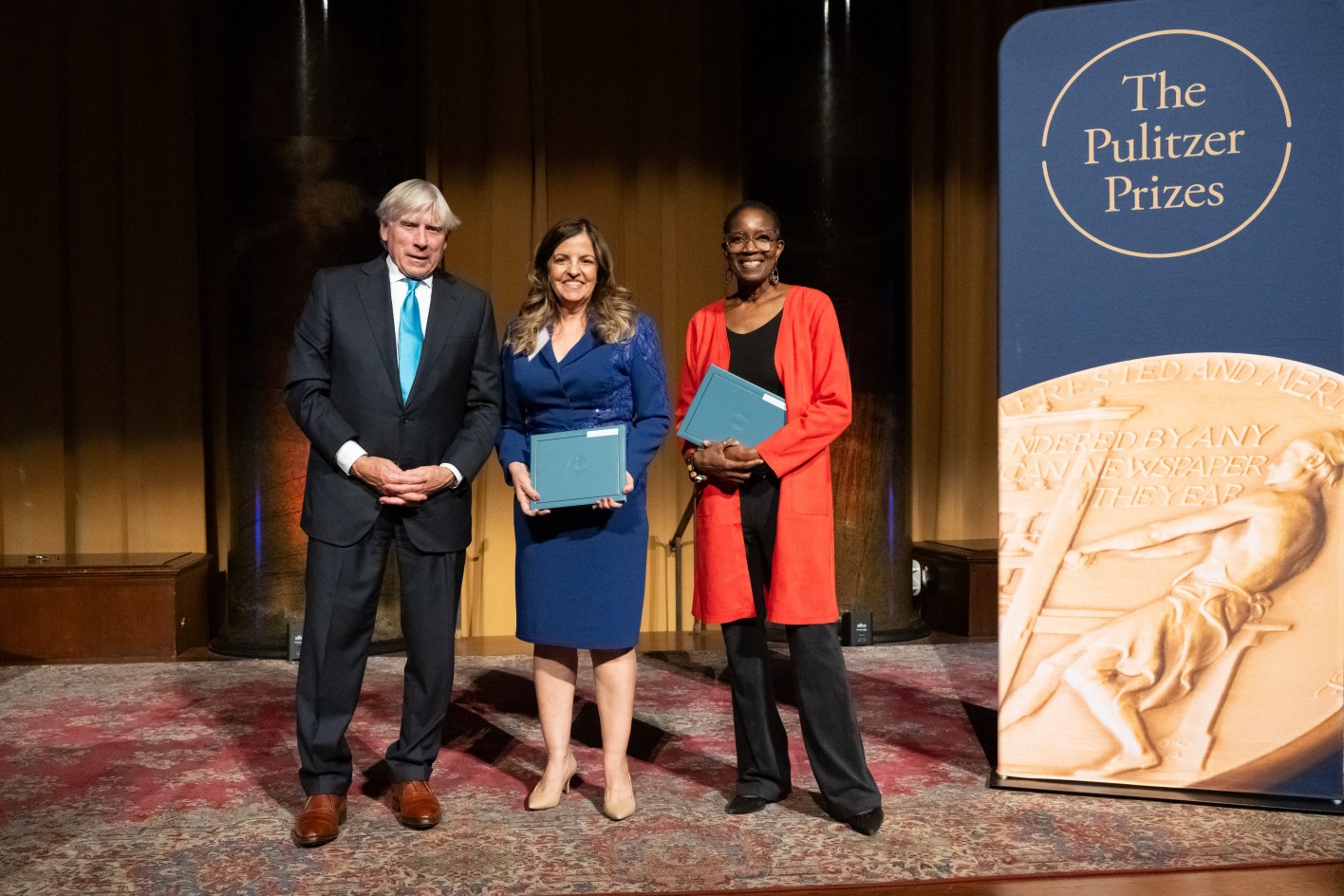
Amy Driscoll (center) and Nancy Ancrum accept the 2023 Pulitzer Prize for Editorial Writing from Columbia University President Emeritus Lee Bollinger. (Diane Bondareff/The Pulitzer Prizes)
Winning Work
Twenty-six years, and we’re still waiting.
It was supposed to be a small gem of a park on Biscayne Bay, a four-acre sweetener if voters agreed to allow the Miami Heat to build its new arena on public land. Parcel B, as the wedge of waterfront property is known, was one of the ways the arena deal successfully was sold to voters back in 1996.
Tucked behind a modern white arena, within sight of downtown, the park was supposed to be a place for residents to glory in the same waterfront views that are too often reserved for millionaires and, increasingly, billionaires.
Voters bought the rhetoric. But we were played. An unbelievable 26 years later, we’re still waiting for that park to become reality.
There are indications it might finally happen, or at least some version of what was promised. There are serious talks between Miami-Dade County and the Heat, both sides say. But after more than two decades, we’re no longer the gullible residents of 1996 who put their faith in pretty-colored renderings and the aw-shucks appeal of new Heat coach Pat Riley, back when he still had dark hair. We won’t believe it until we see it.
Parcel B is just a handful of acres. Not much in a city that calls itself the “Gateway to Latin America” or, more grandly, the “City of the Future.” Not much in a place where a developer is now building a skyscraper 100 stories high, the tallest in Florida. Not much — but still a promise, to us, the taxpayers. There are now about 60,000 people living downtown, but Parcel B remains little more than a fenced-off parking lot with a view of the water. The arena, of course, is in its third decade.
DISREGARD FOR VOTERS
In the panoply of lies that South Florida has endured through the ages from its elected officials, the failure to actually provide a park on Parcel B doesn’t come close to the top of the list. That honor may well still go to the Miami Marlins stadium, a terrible deal financed with about $500 million in bonds back in 2009 that will wind up costing taxpayers as much as $2.4 billion by most estimates — and still hasn’t revitalized the area around it.
But the disregard for what voters were promised on tiny Parcel B in some ways rankles even more, precisely because it is such a small thing; 26 years of insults, even little ones, pile up. And because those who were in charge of making it happen brushed off that promise as though it meant nothing and are now, for the most part, gone from positions of power.
In some ways, Parcel B is a symbol of so much that is absurdly wrong with Miami. We talk a good game about investing in the community to build something great, but over and over, our leaders succumb to the latest person swaggering into town with bulging pockets. And whatever was said five years ago, or last month, wafts away on the ocean breeze. For those here for the long haul, that hurts. And even for those who are here for just a year or two, such short-term thinking erodes the quality of life.
Miami deserves better. Miami should be better. Miami can be better.
It sounds like ancient history, but in 1996, the question of a new Heat arena downtown was thought to be a potential turning point for a city and a region striving to be taken seriously. There was good reason to worry: Miami was broke, its bond rating tanking and a humiliating state financial oversight board in the offing. The city and county governments were weathering damaging corruption scandals. Operation Greenpalm, as a federal investigation was dubbed, involved a bribes-for-bonds kickback scheme that would eventually take down a host of city and county leaders. The race riots of the ‘80s weren’t that far in the past. Neither was the Mariel boatlift.
With that roiling backdrop, a coalition of powerful community leaders got together — including the chairman of the Miami Herald’s parent company at the time, P. Anthony Ridder of Knight-Ridder — to sell county voters on the idea of a sleek new waterfront arena for the Heat. The team, owned by cruise ship mogul Micky Arison, had been threatening to move to neighboring Broward County, like the Florida Panthers hockey team.
There were serious objections to the new basketball arena plan. It would replace another — a round pink building named the Miami Arena — that was only eight years old and a few blocks inland, and that taxpayers were still paying for. Adding to that dicey proposition, the new arena would go on land that was supposed to be used for a big public park. Voters, understandably, were reluctant to subsidize a project that would benefit a billionaire team owner and multi-millionaire players.
The County Commission approved the deal to put the arena on the waterfront property, but opponents — led by the late Dan Paul, an attorney and open-space activist — gathered enough signatures to force the issue onto the ballot.
‘FANTASTIC’ WATERFRONT PARK
When it looked as though the referendum might not pass, the Heat agreed to pay the entire cost of the arena construction and launched an ad campaign that emphasized the lovely park voters would get out of the deal. The Miami Herald, in October 1996, ran a story about one ad, paid for by a political committee formed by the Heat, in which the Heat’s president made the pitch. In it, Riley appears on a basketball court, ball in hand: “If anybody tries to tell you the waterfront arena is only about basketball, hey, you got to get the facts. It is all about turning this into a fantastic new waterfront park for all of us to enjoy. With new shops, new restaurants and new excitement. Hey, Miami is a world-class city, so let’s go for the best with a world-class waterfront.”
The ad, which included renderings of frolicking children, soccer games and passing sailboats, concluded with a narrator’s voice: “For Miami’s future. A new waterfront park all our families can enjoy. Let’s build the best for Dade County.”
Voters ultimately went for it. But there was a loophole. The ballot language didn’t actually specify that the park would be built — a critical omission, it turned out. Once the referendum passed, the promise of a park melted away like an ice cube on a South Florida sidewalk in August.
We are all living with the consequences of that oversight — if that’s what it was. Though activists and some public officials — notably, former County Commissioner Audrey Edmonson — have continued to fight for a park, there’s still no such thing on Parcel B, which the Heat returned to county ownership in 2003. It remains a pseudo parking lot, which the team still uses — renting it from the county by the day, mostly for VIP vehicles on game and event days.
Make no mistake. Parcel B is a gorgeous spot. Windswept, commanding a broad view of the bay, it would make a glorious park. It’s not particularly visible or easy to get to, but Bayside Marketplace is directly south, within easy walking distance along the water. On a recent day, the gates at both ends were guarded because the Heat had rented the property. Still, a few people fished from the seawall, enjoying a view that few in Miami have been able to see.
As Peter Ehrlich of Miami’s Urban Environment League, an activist group, told us, “The fact that this taxpayer-owned waterfront site has been covered in concrete and asphalt for over 30 years is a crime.”
There have been a few slight developments. In 2017, the land got a light sprucing up, with new palm trees and benches and light posts, and in 2020, the property was officially named Dan Paul Plaza.
Still, Paul, who died in 2010, would be appalled, no doubt. He was a champion of public access to bayfront land — and he specifically opposed building the Heat’s tax-subsidized arena on county land. He also advocated for a bayfront pathway that would allow everyone, not just the affluent, access to the waterfront that helps define Miami. We’re sure that a fenced-off parking lot with a narrow span of grass and a paltry number of palms are not anything he would have been proud to attach his name to.
And even that sorry excuse for open space hasn’t always been guaranteed. For a while there, every few years brought another attempt to use what is still a prime piece of waterfront land. Retail stores, a 55-year lease for a Cuban-exile museum, a portion of a special-event auto race course — everything but a park.
STILL OPEN SPACE
There is one saving grace. Through it all, the land has essentially remained open space, even in development-frenzied Miami. It can still become the park it was supposed to be.
We asked the Heat if they had any new plans for the land. They responded that they have “been working closely” for two years with Miami-Dade Mayor Daniella Levine Cava’s administration, a neighborhood association and others “to develop a plan for Dan Paul Plaza that addresses all our needs. . . . As part of our long-standing partnership with Miami-Dade County, [the] arena makes limited use of Dan Paul Plaza as needed for games, concerts, etc., for which Miami-Dade County as owner of the parcel is compensated. Absent that arrangement, we would not be able to meet our contractual obligations to Miami-Dade County to run a first-class facility and attract world-class events.”
But allowing the Heat to use that land for parking or staging events wasn’t part of the deal with taxpayers, who — it bears repeating — already have allowed a for-profit organization to build its arena on choice bayfront land owned by the public. How the team manages its parking and staging is not a taxpayer obligation. The Heat made the original promise. Riley put his name on it. The team needs to make good on it.
Levine-Cava said earlier this month that she is “very, very close” to being able to announce a plan in the next few months that would move the Heat’s current parking strip away from the water and close to the arena building, freeing up much of the land for public use. She offered details: This would be a plaza, not a park, but it would include a waterfront promenade, playing fields and an area for dogs and possible strengthening of the seawall.
“So everybody is on board. We’re all in agreement,” she said.
When Levine-Cava became mayor two years ago, she said she wanted to see a park there. We were glad to hear a current county leader declare that intention out loud — even though this agreement, if it actually happens, doesn’t sound like it will be everything promised. At the very least, we want to see those ugly fences near the water removed. But we expect a lot more.
The Heat should be responsible for providing its own extra parking. Taxpayers have been plenty generous already with the land — something most residents probably have long forgotten, if they ever knew it.
That’s the allure and the disappointment of Miami: a short memory. In a place known for transience, it’s easy to make fervent vows of action one year that are consigned to oblivion the next. But if you’re a long-term resident with greater expectations of your government — like Paul, Miami’s legendary warrior for public open space — each rosy promise tossed aside later is another reason to disconnect, to stop investing in our community, to distrust our leaders, ills that are plaguing our society more and more.
Turning Parcel B — or Dan Paul Plaza — into the sun-drenched public space that was dangled so tantalizingly before voters in 1996 won’t magically restore the electorate’s faith in government or undo the last more than two decades of broken promises.
But there is a basic wrong here that still needs to be righted. Voters 26 years ago cast their ballots in good faith, as government officials, community leaders — including the Miami Herald Editorial Board — and the Heat lined up to tell them it was a great idea. They shouldn’t have had to examine the referendum with a lawyer at their sides or act like eagle-eyed detectives on alert for a bait-and-switch.
We know the people in office in Miami today aren’t the ones who were here back then. Our current leaders didn’t break this promise. But it’s up to them to honor it anyway. Levine-Cava seems to understand that, at least.
There was another ad back in 1996 that described the situation this way: “Miami’s downtown waterfront: broken concrete, nobody uses it. Let’s make a change for the better. A new, world-class waterfront park with shops, restaurants and a championship arena. A new safe place for all our families to enjoy. A waterfront park we can all be proud of.”
Voters of Miami held up their end of the bargain. That “waterfront park we can all be proud of”? We’ve waited long enough. If elected officials want voters to believe their word actually means something and if teams like the Heat and owners like Arison still want that all-important community backing, they need to keep their promises — even the small ones.
When it comes to civic projects, Miami is rightfully known as a place that’s long on promises and woefully short on follow-through. A towering new condo tower building can pop up overnight, it seems, but the restoration of publicly owned Virginia Key? That’s been dragging on for decades.
The 1,000-acre, natural island just off Miami’s coastline could be a world-class jewel of a park and recreational area. Instead, it remains a faint shadow of that grand vision. Public officials have vowed for years to undo the abuse and neglect the island on the Rickenbacker Causeway has suffered. Some work has been done, and more is promised. But for the most part, progress has been painfully slow as millions of taxpayer dollars set aside for Virginia Key remain unspent, some 18 years later.
Part of the lack of urgency afflicting the effort may stem from the island’s history. Virginia Key was long considered to be throwaway land. During segregation, it offered the only beach where Blacks were officially allowed, part of Miami’s ugly racist past.
As far back as 1982, the Miami Herald called Virginia Key “a perennial site for big plans that go bust.” That included “a golf course, library site, target range and world’s fair site.” It was also home to a nude beach until the early ‘80s, when the city cracked down, and a film location of sorts — the low-budget horror film, “Island Claws,” was shot there in 1980, starring a giant mechanical crab.
SECOND-CLASS STATUS
The island hasn’t fully shed its second-class status to this day. The most recent evidence: the Miami City Commission’s takeover of the Virginia Key Beach Park Trust overseeing development of a Black history and civil rights museum planned on the historic Black beach, which the county deeded to the city to be used for park purposes only.
The City Commission ousted every member of the majority-Black board — despite vociferous protests from Miami’s Black community — and replaced it with a board that has just one Black member, Commissioner chairwoman Christine King. She has said she will make two more appointments to the Trust who will be Black.
Has it taken too long to break ground on a museum, especially with the money already set aside? Yes. But the city should have been working with the Trust more closely, not swooping in and removing members wholesale in a fit of pique.
City commissioners cited reasons for the takeover that changed to fit the facts, starting with an audit that purported to show malfeasance — it didn’t — and ultimately landing on the idea that the board had been too slow to build the museum. Would this have happened if this were a Cuban museum? We doubt it.
Adding to the imbroglio: The dismissal of the board came after city commissioners first tried to put a homeless encampment on Virginia Key, a callous and impractical plan — far from services and transportation, for starters — that smacked of sweeping the homeless out of sight while also potentially further degrading the natural environment under restoration. That plan is on hold after a huge public outcry. One of those who opposed it? The head of the Virginia Key board who was ousted just over two months later, though commissioners insist the removal wasn’t punitive.
An outdoor center on the island that was in business for seven years was similarly booted after its owner publicly spoke out against the homeless encampment idea. Code violations and overdue rent were the ostensible reasons, but the timing is certainly suspect.
You could dismiss all of that as politics, but it’s also about controlling the destiny of Virginia Key — and in development-rabid Miami, there’s a lot of waterfront real estate on the island. South Florida has a long, sad history of devaluing open space and letting private developers use public land for their projects — look at the bayfront Miami Heat arena downtown or the soccer stadium, plus shopping mall and hotel, planned for the taxpayer-owned Melreese golf course near Miami International Airport.
Virginia Key must be considered differently. It’s a huge chunk of environmentally sensitive land that has long been talked about as a potential Miami version of Central Park, surrounded by water instead of city streets. With its unparalleled view of Biscayne Bay, it should be treated as a defining asset for Miami — and it should have happened long ago.
HONOR THE LEGACY
This isn’t some fond wish we’ve suddenly pulled out of thin air. Taxpayers have repeatedly said they want Virginia Key improved and its legacy honored, and they’ve ponied up some serious money to do it. Miami-Dade County taxpayers pledged $45 million in bond money to clean up and cap the old landfill and another $20 million to build the civil rights museum. There’s also a master plan for the whole island, completed by the city of Miami after umpteen meetings and lots of community involvement.
All of that was years ago. The master plan approval? In 2010. The money for the landfill? Set aside in 2004. Ditto for the museum money: 2004.
Today, the promise of the beautiful, but abused, island remains insufficiently realized. Far too much of the site is still more wasteland than park land or recreational space.
There have been notable areas of progress. Virginia Key Beach, Miami’s historically Black beach, reopened in 2008 after decades of being shuttered. That’s an enormous accomplishment and a boon for our community. It even includes the historical carousel, a slice of the past. There are bike trails on the island now, and it remains a popular spot for kayakers and rowers. Jimbo’s, a disreputable but much-loved throwback of a watering hole, has closed so the shoreline could be restored to a natural state, and there’s been significant mangrove restoration and removal of exotic plants and trees, helping the land to heal itself. Sea turtles nest there; for migratory birds, it’s an important feeding ground on a Southeast Florida coastline cluttered with condos.
And there’s hope of more follow-through. The county included in its projected 2023-24 budget about $21 million for remediation of the Virginia Key dump. If it happens — and the county thinks it will — that would go a long way toward making good on the promise to finally clean up the landfill. County officials tell us that in recent years, they’ve been able to accomplish much of the preliminary work to prepare the site for a two-foot cover of soil — using fill from the port tunnel project — followed by vegetation.
ECOLOGICAL GEM
Projected budgets, though, have a way of changing. Outgoing Miami Commissioner Ken Russell, in whose district Virginia Key sits, said he’s been waiting seven years for that remediation. Still, he said, Virginia Key is “an ecological gem. . . . It’s still a beautiful place to go.”
Miami-Dade Mayor Daniella Levine Cava told the Editorial Board that she believes the work will go forward in 2023. “It is unfortunate how long it has taken,” she said, noting that, “There’s been a lot of changes in city government over this period of time. It has been somewhat of a challenge to get agreements moving forward.”
That’s an understatement, for sure. And so we remain skeptical, until the county budget is approved and the work actually begins.
On the civil rights museum, King has said she believes the project will move more quickly now than it would have been before the takeover of the trust. We hope that’s true, but we have our doubts. When’s the last time that putting a bunch of politicians on a board made it work faster and more efficiently?
Virginia Key is one of South Florida’s special places. Despite all that has been heaped upon it, the island can still offer the opportunity for us to do something important and lasting. Finish the work to create a gorgeous natural environment, yes, but let’s also build a first-class museum, and include the voices of those who served on the Trust. Virginia Key can be for kayakers and beachgoers, and it should, but it should also be something else: a place to acknowledge the struggles of segregation and celebrate the longtime contributions of Miami’s Black community.
Miami city officials, together with the county, must make sure Virginia Key is prized and guarded with zeal, repaired and nurtured into becoming all it can be — not treated badly, allowed to languish or be exploited, any more than it already has.
Miami needs to take a hard look at Grand Avenue in western Coconut Grove — and then a hard look in the mirror. An important piece of Miami’s Black history is being erased before our eyes. And there’s no real drive to stop it.
Grand Avenue was once the vital economic engine of this historically Black neighborhood. It’s now mostly shuttered stores and empty lots, gutted by a combination of broken redevelopment promises and decades-long neglect, official and unofficial.
We’ve written about those failures time and again. But as Grand Avenue declines, there’s a more insidious loss happening, too: the slow but effective blotting out of the physical traces of the largely Bahamian community that settled the West Grove before Miami was a city and helped carve it from coral bedrock as far back as the 1880s.
Those settlers and the African-American residents who joined them helped make Miami — literally. But neglect, disinvestment and, now, accelerating gentrification through a newly aggressive style of real-estate investing are all but wiping out the evidence of those foundational contributions.
Just this year, a plan to create a community redevelopment agency to help revitalize the area was discarded, perhaps with good reason. But where does that leave us? Adding another washed-out idea to the pile of initiatives that have come to nothing. In turn, the remnants of the old West Grove become more vulnerable than ever to that convenient scapegoat, “market forces.”
By rights, an alarm should be sounding on Grand Avenue, a horn blaring to warn of its imminent demise. What’s happening there, in the broader West Grove — and in other places, too, such as Little Haiti and Overtown — amounts to allowing the extinction of something important. We’re failing to preserve our multicultural past. We’re giving an “oh-well” shrug as entire groups of people are being removed from the narrative of South Florida.
That cannot be the final word. We can’t let it be. There are still pieces of the Black Grove to preserve for future generations. And there are still efforts being made to stabilize the community. The county’s push to increase housing density near mass transit hubs is one of them. Individual programs, though, won’t be enough.
Pulling what’s left of the original West Grove back from the brink, if it can be done, will take the combined efforts of the county, city and the neighborhood. It’ll require cooperation, and someone will need to take a leading role. We suggest whomever replaces outgoing Miami City Commissioner Ken Russell, whose district includes the Grove.
Miami Mayor Francis Suarez, too, should weigh in. We were disappointed when he failed to speak out against a City Commission plan to redraw its political boundary lines that waters down Blacks’ voting power in the Grove. But he did help hit pause on Commissioner Joe Carollo’s misbegotten proposal to place scores of tiny homes for the homeless on Virginia Key, another site of significance in the city’s Black past. So maybe he can find his voice now to decry the slow-motion destruction of the historic Black Grove.
Losing a street, or even a neighborhood, may not seem like much — change is inevitable, and Miami is a city of relentless reinvention — but Grand Avenue and its surroundings are tied to the very founding of the city and shouldn’t be cast aside so easily. The West Grove is where Bahamian immigrants built homes nearly 150 years ago, its residents providing a workforce to help build the nascent city and even some of the required signatures for Miami’s 1896 incorporation. That is not unimportant. In other cities, with a deeper sense of history and civic pride, it would be celebrated, not ignored.
Miami has a memory problem, though. We can barely remember the promises made last year, let alone decades ago. Developers and politicians have counted on that for years, with Grand Avenue as just one more example. If Miami’s leaders have any hope of saving even the last bits of the Black Grove, they need to act now.
CENTER OF COMMERCE
The West Grove was once a thriving community, a beacon for the Black working and middle class, drawing African Americans from North Florida and the deep South, especially after World War II. Grand Avenue, the Jim Crow-era dividing line between white Grove and Black — one that still persists in some ways — was a bustling center of commerce.
Generational housing turnover, poverty and neglect — with economic and institutional racism no doubt playing a big role — took a toll in the ensuing years, and parts of the tight-knit community with its shotgun homes and spreading tree canopy became increasingly run down. Effort after effort to inject new life into the area and especially into Grand Avenue has flared, sputtered and died.
As time rolls on, there is less left to preserve, a cycle that plays conveniently into the hands of profit-minded developers blind to everything but the prime location and relatively cheap housing costs, the twin drivers of Florida’s existence.
Today, gentrification is everywhere. Modern, white-box houses, derided by some as soulless “sugar cubes,” are creeping from the affluent eastern Grove toward the west. Longtime residents are forced out, age out or sell, unable or unwilling to turn down high-priced offers for small homes that then become knockdowns.
Lack of political power in the area, no cohesive effort by government, a willingness to surrender to those eager to make a buck, the scourge of racism — they all have played a role in this dismaying tale, as the Miami Herald reported in a recent series, On the Brink.
Marvin Dunn, a noted Miami historian who grew up in the West Grove, said outside forces, including the 1980 race riots that spread to the Grove, contributed to Grand Avenue’s failure to flourish. But he said family ties to the neighborhood have also frayed over the decades.
“The families that were originally in those homes in the Grove, the pioneers and the next generation of Blacks who were in the West Grove, those folks I don’t think would have thought about selling their homes. They were attached to the land. But now we’re three or four generations away from the original Black Grove families, and those lots are very, very valuable and these folks are selling them off.”
In the end, he said, “I think you’re going to see the gentrification march right down Grand Avenue.”
PLANS LEAD NOWHERE
Three decades of plans and promises have produced little progress in the West Grove, as Grand Avenue’s past continues to wither. There was the 1980 proposal to turn the street into a business district with a Bahamian theme and a 1984 plan for a “Goombay Plaza” with an outdoor market. In 1986, there was an affordable-housing idea, complete with celebrity architects, that took way too long to complete and wound up with units way too expensive for the intended residents. There was a “slum clearance” plan to relocate 99 families and a “Grand Avenue Vision Plan.”
Just last year, there was a misplaced effort along Grand Avenue to build a Wawa, the ubiquitous gas station and sandwich shop chain, in a spot that was originally planned for affordable housing. The outcry that followed doomed it. That may have been for the best, but it left the land, once again, vacant.
Perhaps more significant from a revitalization perspective, there was last year’s proposal to create a community redevelopment agency to help pay for affordable housing, an effort to help stabilize the community. City Commissioner Russell had long championed the idea, but it failed to secure a necessary approval this year from the County Commission.
Other ideas to help the West Grove have been floated, including focusing on the county’s existing plan to increase housing density near transit stations, with a certain amount of affordable housing included. It’s hard to see that sort of thing working quickly enough to make a difference. The people building those sugar-cube houses aren’t likely to respect drawn-out government time lines.
If the West Grove didn’t have enough problems, it will also now be suffering under a City Commission redistricting plan, approved earlier this year, that splits the historic neighborhood into three districts, with some Black residents ending up in a mostly Hispanic district. It was a move that smacked of diluting the strength of the Black vote, especially as it fights gentrification. Grove residents, long among the city’s most politically engaged, mounted a campaign against redistricting, but the city approved the new boundaries anyway. A lawsuit filed this month by the American Civil Liberties Union is challenging the maps in federal court on the grounds of “racial gerrymandering.”
GRASSROOTS EFFORTS
The West Grove isn’t lost just yet. There are small pockets of resistance to the economic pressures, groups like Rebuilding Together Miami-Dade, making repairs to dozens of homes that house longtime, elderly and low-income local residents. Others are working to preserve the distinct character of the neighborhood. The 1897 E.W.F. Stirrup House has been painstakingly rebuilt by descendants of Bahamian-born pioneer settler Ebenezer Stirrup and is now an inn. There’s also talk of reopening the Jim Crow-era ACE movie theater on Grand. Perhaps that could spark redevelopment the way the Lyric Theater has in Overtown, another historically Black Miami neighborhood in danger of being gentrified out of existence. The famed Goombay Festival, an annual celebration of West Grove’s Bahamian roots that once drew thousands, was revived this year in a smaller version.
Additional traces of the old Grove will remain — 20 or 30 of the early cottages are being saved through historic designation, Dunn said — but the bulk of the fight may already be over. “In 10 years,” he said, “we won’t be able to recognize what we now call the West Grove or the Black Grove.”
That doesn’t have to happen, or at least not completely. It took citizens banding together to save Art Deco buildings in Miami Beach from developers, buildings that were derided at the time as unimportant, outdated relics. All the buildings weren’t saved but a lot were. Today the Deco district is a worldwide draw for tourists.
There are economic forces at play in the case of the Grove that no one could, or even should, stop. We are not anti-capitalism. But rolling over isn’t the answer, either. A new and concerted effort by the county, the city and West Grove residents is needed to set up a framework to preserve at least some part of what makes the West Grove special.
Grand Avenue and the West Grove represent something deeply important and worth saving. They’re a callback to old Florida and, particularly, a part of Florida that Black people built in the face of persistent racism. If we allow these tangible reminders to be bulldozed away, we will be compounding the indignities imposed on generations of Black residents.
Losing Grand Avenue and the West Grove doesn’t just erase history. It diminishes us all.
In the many and varied ways the taxpayers of Miami-Dade County have been betrayed by their leaders over the years, one stands out for the sheer, galling longevity of the duplicity: the failure to build the North Corridor extension of Metrorail.
For almost 40 years, the Black communities in the northern end of the county have been waiting for the rail line that our leaders promised them if they voted for mass transit back in the late ‘70s. Residents have been shafted for so long, children have been born, grown up and had children of their own. The Metrorail extension isn’t just late. It’s a generation or two late.
So now there’s some positive-sounding news about construction possibilities. A new pot of federal money might make the difference — again! We hope it turns out to be true. But we cannot be dazzled by visions of dollars wafting in from Washington anymore. We won’t believe it until the track is being laid and the stations are rising from the earth. We don’t expect Black voters to believe it, either: Decades of being slighted and overlooked have taught us all that bitter lesson.
The failure to build the promised stretch of track from the core of Miami up to the northern county line isn’t just about transit, critical as that is to our community. It’s also about injustice, the kind that breeds distrust in public officials and institutions and undermines democracy, something we can ill afford.
So we’ll say it again: The people of northern Miami-Dade were promised transit. They voted for it. They deserve to get it. Or, at the very least, their children and grandchildren do.
GETTING AROUND
A lack of easy, smart transportation is one of the biggest and most persistent drawbacks to living in Miami. Getting around still is far too difficult for a place that aspires to be a world-class city or even just a livable one. There are efforts underway that may help, at least a bit: Tri-Rail will, eventually, connect to downtown Miami. A Bus Rapid Transit line in southern Miami-Dade is being built, though it has fallen behind schedule. The too-costly monorail to Miami Beach is dead, to be replaced by a more common-sense expansion of the Metromover from the mainland.
And higher-density housing near rapid mass transit hubs is also being constructed, at long last, downtown and farther south, along the original Metrorail corridor.
It all takes too long and costs too much, but there’s no real choice. If this region is going to grow, we have to handle transportation in a modern way. More cars are not the answer.
Now there’s the possibility of progress on Metrorail’s North Corridor, too. In November, the county announced an expedited plan to build a leg of the elevated train from 79th Street north to the Hard Rock Stadium — where the Dolphins have actually chalked up some wins lately and World Cup games will be hosted in 2026. The rail would be completed first, and at a faster pace than contemplated before. Seven additional stations would supposedly be added later, between 79th Street and the stadium.
A train to a World Cup match or a Formula 1 race or a big-time concert sounds great — world class, even — but there’s also a real danger that building the lone stadium stop before the other stations could result in something we don’t want to see: richer, whiter fans being ferried right past the poorer, working-class communities, with the needs of billionaire team owners being served before the rest of the community that voted for the North Corridor in the first place.
If the county builds the stadium-only extension first, what credible guarantee will North Corridor residents have that the stations designed to serve them will be built? After all, they were told — and believed — that a Metrorail extension was coming their way a long time ago. Those additional stations can’t be one more insulting broken promise. The county must follow through here, and quickly.
As always, it comes down to money. A 2018 estimate of construction costs for this new rail line was about $1.8 billion, and it’s likely to be more now. County officials tell us they think they can snag federal dollars to pick up as much as 45% of the costs, with state and local money covering the rest.
Setting aside our skepticism about whether Miami-Dade really will be able to get that federal money — a suspiciously familiar refrain — we hope the county is right when it says the best way to secure that help from the feds is with this new, speedier Metrorail extension plan. The Miami-Dade project could qualify for U.S. Department of Transportation money as soon as next year. Construction could follow within 12 months, they believe.
A year? That would be an astonishing feat, considering the long and tortured history of this project. We still remember the other administrations and other elected leaders who made similar pledges to get this project done and then didn’t do it — when Metrorail was first built, for example, and, again, two decades ago, when county voters approved a half-penny transit tax that ended up paying for a backlog of maintenance work rather than promised new rail lines including the North Corridor.
The Miami Herald’s archives are replete with headlines from the distant past about yet another attempt to finally — finally! — extend Metrorail north to the Broward County line, pledges that never were fulfilled.
METRORAIL BECAME ‘METROFAIL’
When the heavy rail system opened in 1984, it was planned in phases that included a northern leg of track along 27th Avenue, pretty much the same one we’re talking about today. But Metrorail quickly turned into “Metrofail” with soaring construction costs, dismal ridership, a blatant failure by the government to figure out a source for annual operating and maintenance revenue and the damning conclusion that the lines went places where people didn’t much need to go.
Metrorail became the subject of national ridicule. President Reagan infamously called it “a billion-dollar mistake,” saying the system had so few riders, “it would have been a lot cheaper to buy everyone a limousine.”
Not surprisingly, discussions of extending Metrorail north — or anywhere else — withered away.
The conversation about transportation in Miami has changed enormously since then. The pressure of growth is making mass transit more critical, and housing prices are driving a conversation on increasing density, especially along those all-important rail and bus corridors. We have TriRail and Brightline. Interstate 95 has been widened and widened. We have toll lanes that offer “express” service. We have Uber. We do not, however, have the North Corridor on Metrorail.
Let’s be clear. The promise of a 27th Avenue track wasn’t just an idea or an optional add-on. It was a promise, made to the Black community in 1978 to win votes for Metrorail. And it worked. The referendum was a squeaker, with just 50.34% voting for mass transit. Black voters were credited with putting it over the top.
New segments of Metrorail have been built since then, for reasons both political and practical — to Hialeah and to the airport, finally. Not the North Corridor, though.
DISASTROUS TRANSIT TAX
But the North Corridor insults don’t stop there. In 2002, 66% of voters approved the half-penny sales tax for transit, but that didn’t help, either. In fact, it was disastrous. The referendum for the People’s Transportation Plan misleadingly sounded like a cure-all for much of what ailed, and still ails, Miami-Dade’s transportation grid. There was something for everyone: more bus service, coordinated traffic signals to reduce congestion, improved roads, including drainage and a pledge of “building rapid transit” to places including Miami Beach, Florida City and, yes, specifically, “North Dade.”
The whole thing was wildly unrealistic and quickly became a bitter disappointment to taxpayers. The original plan had called for a full penny tax, and the list of projects had been based on that. When polls showed the full penny might not pass, the referendum was trimmed to a half penny — but the project list wasn’t cut. Most of the money has been spent on deferred maintenance of the existing transit system. Here we are, 20 years since that vote, and the North Corridor is among the many promises that remain broken.
The new plan for the North Corridor, unveiled by Miami-Dade Mayor Daniella Levine Cava in November, would run the track north from the Northwest 79th Street station, and is part of the county’s SMART Plan, a process that launched transit studies for six of the county’s busiest commuting corridors, most of which were promised new rail lines with the 2002 sales tax campaign.
Levine Cava said she understands the hard feelings that just the mention of the North Corridor can trigger. “We’re trying to make up for lost time and trust” in a community that has “felt left behind,” she said, calling the project “truly transformational.”
That’s if it really happens, of course.
Miami-Dade Commission Chairman Oliver Gilbert, who represents Miami Gardens, where the new track would run, says he’s “cautiously optimistic” that this time really will be different. He pushed to kill an ongoing request for private rail proposals for the North Corridor in favor of the new plan by the county, helping to clear the way for Miami-Dade’s application to the federal government for funding.
“It shows that we’re serious,” Gilbert told us.
That does seem like an important thing to establish in this case, to put it mildly. Perhaps, though, voters are the ones who need to hear it — and believe it — most.
Over the years, objections to building rail along this corridor have been repeatedly raised on grounds it will not produce enough riders to make the investment worthwhile. But public transit is already highly subsidized. And there’s another argument: If our goal is to create more housing by increasing density along transit corridors, something Gilbert — who is also chairman of the Miami-Dade Transportation Planning Organization — believes will help relieve housing pressures in the county, then this makes sense. Gilbert said Miami Gardens is among the cities that would be able to build higher density housing along the rail without much complication.
The North Corridor could also connect to rapid transit in Broward, Gilbert notes, something that was discussed back in the late ‘90s. That’s longer term planning, something South Florida is notoriously bad at, but it should be considered. If Miami wants to be a great city, it needs to include plans for regional transportation, beyond its own parochial interests.
Miami-Dade has decades of bad history to overcome on transit. The voters have been deceived, fleeced and lied to, with the transit tax as Exhibit A. There’s not much trust left, understandably. And there’s a special rancor — that has been fully earned — when it comes to the North Corridor.
This is a chance to, finally, start evening up the ledger, just a little bit. The Metrorail extension, with all of its stations, needs to be built to a part of the community that has been pushed aside for too long, whose hopes were disregarded and to whom promises didn’t matter.
The people were promised rail. They didn’t get it. Almost 40 years later, it’s beyond time to get it done.
Want to see Miami’s most ancient sites, evidence of Tequesta Indian settlements so old they date back an incredible 2,000 years or more?
Good luck.
You won’t find them in carefully marked historic zones or museum-quality displays designed to help visitors understand Florida’s earliest inhabitants.
No, in the two decades or so since archaeologists uncovered traces of prehistoric Native American life right in the middle of the city — some preservationists have called the settlement the actual birthplace of Miami — three such sites have become all but invisible, another failure of private and public sectors to fully honor much ballyhooed agreements with taxpayers.
Rome has the 2,000-year-old Colosseum. And Miami? We have what amounts to a 2,000-year-old dog park and a couple of unmarked circles dwarfed by glass-and-concrete high-rises.
Here’s how we treat this precious legacy: The Miami Circle — a carved limestone circle at the mouth of the Miami River and a National Historic Landmark since 2009 — has become a grassy expanse where nearby condo owners bring their pets to relieve themselves.
Another Tequesta circle, part of a larger settlement discovered after the better-known Miami Circle, is located on the north side of the river, on an anonymous downtown corner behind a glass railing. A tower looms overhead, cars and buses belch exhaust a few feet away and there are no signs — none — offering any clue to its importance or even what it is.
A third bit of the Native American settlement, also preserved, is even less accessible: a limestone circle enclosed in an unfinished room off the high-rise condo lobby. You can see it only if you know where to look: through a peeled-off spot of the window covering.
Archaeological discoveries of this caliber aren’t made every day. But no one seeing these sites would come away feeling enlightened or moved. Nor, if they knew how we got to this point, would they think that governments and private companies have been held accountable for their many public promises to preserve and interpret these sites.
This was not how it was supposed to be.
A BUNCH OF OLD POST HOLES
OK, maybe the Tequesta sites shouldn’t be compared to ancient Roman ruins like the Colosseum. But the value we place on history, Miami history, shouldn’t be measured in Greek columns or determined by European standards. Those who seek to dismiss the Tequesta findings as little more than a bunch of old post holes in the ground — the circles are likely places where structures were erected — are missing the point: Just because there’s no marble statuary doesn’t make the roots of civilization in South Florida any less meaningful or less important to learn from.
Florida’s disrespect for its cultural past is nothing new, and nothing to be proud of. Back in the 1890s, Henry Flagler, industrialist and founder of the Florida East Coast Railway, built his Royal Palm Hotel on the north banks of the Miami River by leveling a Tequesta Indian mound, on the same spot where modern archaeologists discovered those ancient footprints of civilization. In those days, hotel guests could purchase Tequesta Indian skulls as souvenirs.
That’s dreadful, repulsive, and we’re rightly horrified by that behavior today. But if Miami really wants to exorcise the demons of the past and recognize the people who came before us — something civilized societies generally do — we have to do more than save small portions of the Tequesta settlement foundations. We have to actually honor those slivers of history represented by the Miami Circle and the other “circles” that were discovered afterward.
It’s time for Miami and the state of Florida to take the next step: Pay respect to the indigenous people, and not with a plaque or a sign — the Miami Circle has those, more or less. We’re talking about full-fledged, smartly imagined historical sites that educate and preserve, the kind of thing found in what Miami keeps saying it aspires to be: a world-class city.
We should do it because it’s the right thing to do. We should do it because Miami is nothing if not multicultural, and that should, of course, include our Native American past. But if that’s not enough reason — and because we know how South Florida works — there’s a more lucrative angle: Well-crafted historic sites can be big tourist draws.
To be fair, the reason the first circle — the Miami Circle, discovered in 1998 and now owned by the state — morphed from archaeological site into a place for dogs to romp is because it was covered with a layer of dirt and grass to protect it from the elements and preserve the artifacts for the future. And it makes for a nice green space, swept by breezes from the bay, amid what has rapidly become a condo canyon. We can see why dog owners like it. Or, more relevantly, why the Tequestas chose it.
A PERFECT CIRCLE
It was almost paved over. A millionaire developer had been planning a condo on the site, after demolishing an apartment building, when archaeologists discovered a perfect circle, 38 feet across, probably part of a council house or ceremonial structure for the tribe of hunters and fishermen at the mouth of the Miami River.
The furor that followed the discovery drove a push to wrest the land from the hands of the developer. There were demonstrations and claims that the circle had mystical properties. Eventually, the developer was paid $27 million in public money not to build there. That was a monumental effort, and we applaud it. But that was a long time ago. Despite the Miami Circle’s status as a National Historic Landmark, a state proposal to create a three-dimensional replica of it never came to be.
The way things are going, a real effort to interpret the site for visitors may never happen. A state historic preservation official came to Miami in October to meet with representatives from state and local organizations involved with the Miami Circle to talk about “the condition of the property, including landscaping and interpretive panels,” the Florida Department of State said. Another meeting is tentatively set for January, but it doesn’t exactly have an ambitious-sounding agenda: It’ll focus on “updating the interpretive signs including materials, copy and funding.” We do not have high hopes.
Right now, the site has little to mark it as anything special, let alone prehistoric. There are a few signs. One informational panel at the entrance is an embarrassment: a mess of peeling plastic and sun-faded words about Miami’s oldest dwellers and the traces of civilization they left on the 2.2-acre spot. For the eagle-eyed, there’s a tiny notice of an audio tour, online and by phone. If you call the number, a narrator calls it “one of the most intriguing places in Florida — in fact, in the world.” Perhaps someone should tell the dogs.
The second set of sites created less fanfare when they were unearthed from beneath asphalt parking lots, but they, perhaps, are even more significant. Archaeologists working on the north side of the river, across from the Miami Circle, discovered the foundations of a Tequesta Indian village, including 11 circles, hundreds of carved post holes and linear walkways.
Bob Carr, the archaeologist who excavated both sites, called it an “unparalleled piece of North American history.” Some preservationists even suggested it should be designated as a UNESCO World Heritage Site, with less development allowed on the property.
In 2014, after much negotiation, the developer, MDM, struck a deal to preserve a fraction of what was excavated and display and interpret those discoveries. The late Arva Moore Parks, Miami’s fierce champion of historic preservation, said at the time that the agreement was “history making” and would “help people understand and appreciate Miami’s beginnings as they build its future.”
Eight years later, the Met Miami development has gone up. But the two Tequesta Indian circles are a far cry from what anyone would describe as historic showcases — one unmarked, the other totally inaccessible. There’s no two-story glass enclosure on the southwest corner of the property to display one of the circles, as outlined in the agreement with the developer. There’s no glass floor over the other one, with interpretive signs or videos, or a HistoryMiami mini-museum. There’s no glass floor over a brick-lined well believed to have been part of a 19th century U.S. Army fort that was also erected on the site. Is this the history-making agreement that Parks so proudly endorsed? Hardly.
In 2020, a Miami Herald story ran with the headline: “Miami’s ancient Tequesta Indian circles still not on display.” Two years later, virtually nothing has changed.
Except this: The city and developer headed into more mediation this month. It was past due. The city and the taxpayers have all been patient enough. As Carr said, “We’ve waited a long time for these things to be completed — not just preserved, but interpreted. And not just public access, but signage and exhibits that would allow people to experience these very important sites.”
The 2014 agreement allowed MDM to build on the vast majority of the Tequesta site — about 98% of it, according to Vinson Richter, president of the Dade Heritage Trust, a group that was at the table for the original mediation. And still, he said, the developer has not done what was required. “It’s really a shame that however many years later that we’re here still talking about it and that they’re trying to get out of it, to weasel out of it.”
The developer’s lawyer, not surprisingly, said the opposite, that MDM values the history of the site and wants very much to successfully conclude the agreement. “I don’t believe there’s a single developer in Florida who has done as much and spent as much to preserve a site,” MDM attorney Gene Stearns said.
Maybe so. But here’s what needs to happen: The agreement to properly display the few measly bits that have been saved needs to be enforced, in letter and in spirit. As Richter told us, “Archaeological sites of this magnitude are not discovered every day.”
Here’s a thought: Maybe it’s time for Miami to reconsider the idea of paving over prehistoric sites. We know, we know — that’s heresy in Florida, built on exploiting the land with no regard to the future. Back when the second set of Tequesta sites were found, Richter said he knew that, in Miami, given the value of the property, the site would never become a museum. “But anywhere else in the world,” he said, “it might have been.”
History demands that we do right by these sites. It’s an important charge, not one to be wiggled out of or tossed off with half-hearted measures. These places hold some of the deepest imprints of Miami history within them. That’s knowledge that should be shared and honored and carried into the future, long after developments like the Met Miami have, like everything else, slipped into history’s rear view mirror.
Biography

Before joining the Editorial Board, Amy Driscoll was the Herald's editor for health policy during the pandemic and for politics during the 2020 election. Prior to that, she was the editor for world affairs, with a team that included Latin America and the Caribbean. She is a former Nieman Fellow at Harvard University and co-creator of the photo archive site, Flashback Miami. She previously worked at the Palm Beach Post, and is a second-generation journalist.