Andrea Long Chu of New York Magazine
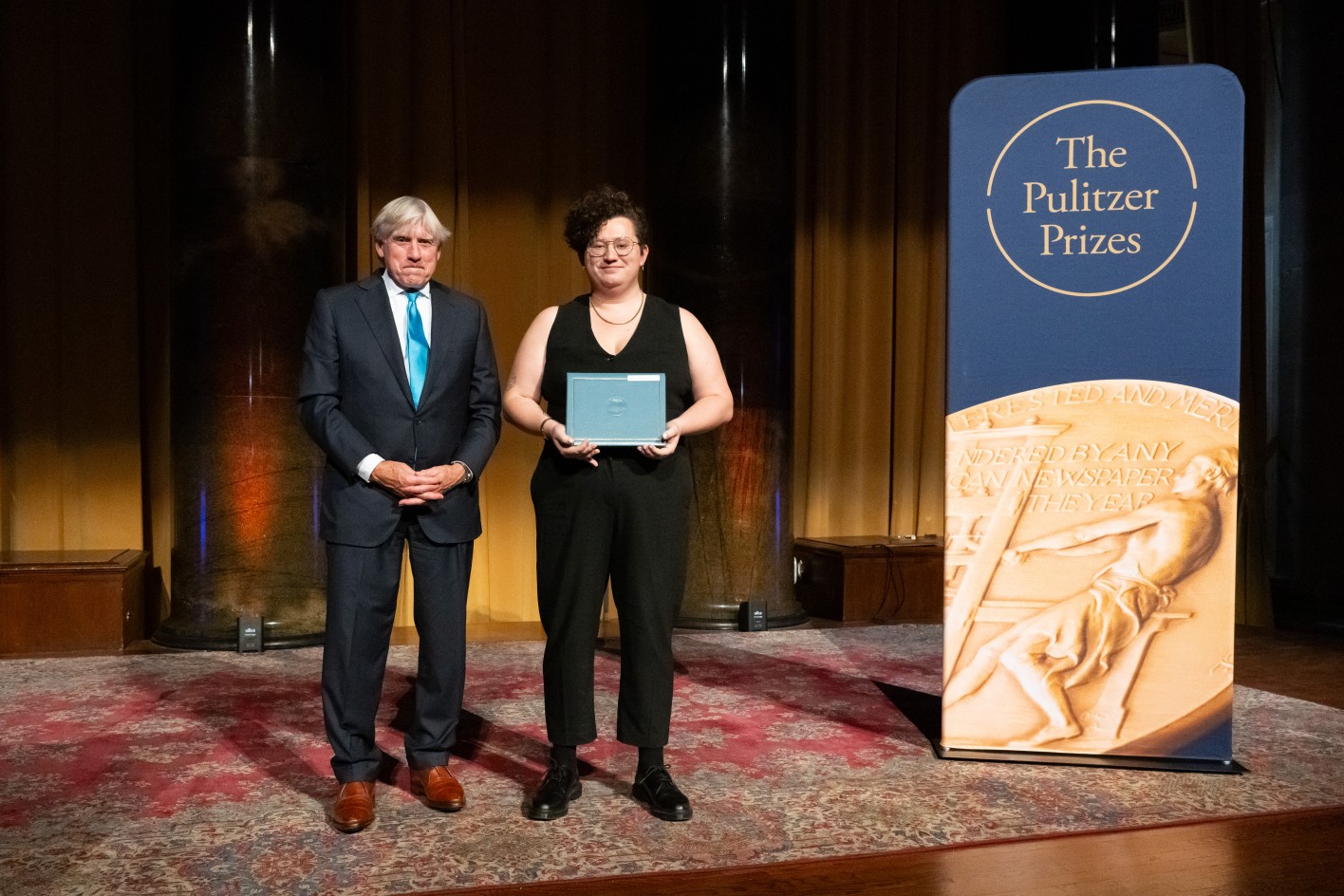
Andrea Long Chu accepts the 2023 Pulitzer Prize for Criticism from Columbia University President Emeritus Lee Bollinger. (Diane Bondareff/The Pulitzer Prizes)
Winning Work
The novelist tends to torture her gay male characters — but only so she can swoop in to save them.
By the time you finish reading A Little Life, you will have spent a whole book waiting for a man to kill himself. The novel, the second from author Hanya Yanagihara, begins as a light chronicle of male friendship among four college graduates in New York City before narrowing its focus to Jude, a corporate litigator whose decades-long struggle to repress a childhood of unrelenting torments — he was raised by pedophiles in a monastery, kidnapped and prostituted in motels, molested by counselors at an orphanage, kidnapped again, tortured, raped, starved, and run over with a car — ends in his suicide.
An unlikely beach read with a gothic riptide, A Little Life became a massive best seller in 2015. Critics lavished praise on the book, with one declaring it the long-awaited “great gay novel” for its unsparing approach to Jude, who falls in love with his male best friend. (A rare pan in The New York Review of Books prompted an indignant letter from Yanagihara’s editor.) A Little Life would go on to win the Kirkus Prize and was a finalist for the National Book Award and the Man Booker Prize; it has since been adapted for the stage by the celebrated director Ivo van Hove, and last month, readers of the New York Times nominated it next to finalists like Beloved and 1984 for best book of the past 125 years.
But Yanagihara’s motivations remained mysterious. The author was born in Los Angeles to a third-generation Hawaiian Japanese father and a Seoul-born Korean mother; her father, a hematologist-oncologist, moved the family around the country for work. She has lived in Manhattan since her 20s, but her heart is in Tokyo and Hawaii. (She has called the last “the closest thing that Asian Americans have to Harlem.”) Her first novel, The People in the Trees, about a doctor who discovers immortality on an island paradise, was well but quietly received in 2013. That book featured homosexuality and pedophilia; not until A Little Life would these be revealed as consistent preoccupations. The People in the Trees took Yanagihara 18 years to write, off and on, during which time she worked as a publicist, book editor, and magazine writer. A Little Life, which she wrote while an editor at large at Condé Nast Traveler, took only 18 months.
How to explain this novel’s success? The critic Parul Sehgal recently suggested A Little Life as a prominent example of the “trauma plot” — fiction that uses a traumatic backstory as a shortcut to narrative. Indeed, it’s easy to see Jude as a “vivified DSM entry” perfectly crafted to appeal to “a world infatuated with victimhood.” But Jude hates words like abuse and disabled and refuses to see a therapist for most of the novel, while Yanagihara has skeptically compared talk therapy to “scooping out your brain and placing it into someone else’s cupped palms to prod at.” (Jude’s sickest torturer turns out to be a psychiatrist.) More compelling about A Little Life — and vexing and disturbing — is the author’s omnipresence in the novel, not just as the “perverse intelligence” behind Jude’s trauma, in the words of another critic, but as the possessive presence keeping him, against all odds, alive. A Little Life was rightly called a love story; what critics missed was that its author is one of the lovers.
This is Yanagihara’s principle: If true misery exists, then so might true love. That simple idea, childlike in its brutality, informs all her fiction. Indeed, the author appears unable, or unwilling, to conceive love outside of life support; without suffering, the inherent monstrosity of love — its greed, its destructiveness — cannot be justified. This notion is inchoate in The People in the Trees, which features several characters kept on the brink of death and ends with a rapist’s declaration of love. In A Little Life, it blossoms into the anguished figure of Jude and the saintlike circle of friends who adore him. In Yanagihara’s new novel, To Paradise, which tells three tales of people fleeing one broken utopia for another, the misery principle has become airborne, passing aerosol-like from person to person while retaining its essential purpose — to allow the author to insert herself as a sinister kind of caretaker, poisoning her characters in order to nurse them lovingly back to health.
Two years after A Little Life was published, Yanagihara joined T magazine, the New York Times’s monthly style insert, as editor. She has called the publication “a culture magazine masquerading as a fashion magazine” — though you’ll have to sift through many pages of luxury advertisements to confirm that. During her time at Condé Nast Traveler, the publication sent her on a staggering 12-country, 24-city, 45-day, $60,000 journey from Sri Lanka to Japan for a 2013 issue called, incredibly, “The Grand Tour of Asia.” “A trip to India isn’t complete without a stop at the legendary Gem Palace,” she wrote in a photo spread titled “The Plunder,” “and a few souvenir diamonds” — four diamond bangles, to be exact, priced up to $900 each. “When we wear a piece of custom jewelry,” she once told readers of T, “we are adding ourselves to a legacy as old as the Romans, the Greeks, the Persians — older.”
This may be surprising. But it is easy to forget that A Little Life is an unapologetic lifestyle novel. Jude’s harrowing trials are finger-sandwiched between Lower East Side gallery openings, summers on Cape Cod, holiday in Hanoi. Critics remarked on its mouthwatering (or eye-rolling) spread of culinary delights, from duck à l’orange to escarole salad with pears and jamón, followed by pine-nut tart, tarte Tatin, and a homemade ten-nut cake Yanagihara later described as a cross between Danish rugbrød and a Japanese milk bread she once ordered at a Tokyo bakery. The book inspired celebrity chef Antoni Porowski to publish a recipe called “Gougères for Jude,” based on the canapés Jude makes for a New Year’s party before cutting his arms so badly he requires emergency medical attention; it can be found on the website for Boursin, the French herbed-cheese brand.
Indeed, Yanagihara’s onslaught of horrors could allow readers to block out, like a childhood trauma, the fact that they were reading luxury copy. Her first book was quite literally a travelogue written by a pedophile; in To Paradise, Yanagihara has not lost the familiar voice of a professional chronicler of wealth. Here are rose-hued Oriental carpets, dark-green douppioni-silk drapes, wood floors polished with macadamia oil; here are wok-fried snow peas, ginger-wine syllabub, a pine-nut tart (another one!). As in A Little Life, Yanagihara cannot help giving cheerful directions as she maneuvers her characters, tour guide–like, through New York. “We’ll cut across Christopher, and then go past Little Eight and east on Ninth Street before turning south on Fifth Avenue,” a minor character proposes during a crisis.
Perhaps I am being ungenerous. Surely novelists should describe things! Better, they should evoke them, like the dead, or the Orient. Yanagihara has a tourist’s eye for detail; this can make her a very engaging narrator. Here’s that holiday in Hanoi from A Little Life:
“[He] turned down an alley that was crowded with stall after stall of small, improvised restaurants, just a woman standing behind a kettle roiling with soup or oil, and four or five plastic stools … [He] let a man cycle past him, the basket strapped to the back of his seat loaded with spears of baguettes … and then headed down another alley, this one busy with vendors crouched over more bundles of herbs, and black hills of mangosteens, and metal trays of silvery-pink fish, so fresh he could hear them gulping.”
Now here’s days 23 and 24 of that “Grand Tour of Asia” from Condé Nast Traveler:
“You’ll see all the little tableaux … that make Hanoi the place it is: dozens of pho stands, with their big cauldrons of simmering broth … bicyclists pedaling by with basketfuls of fresh-baked bread; and, especially, those little street restaurants with their low tables and domino-shaped stools … [The next day] you’ll pass hundreds of stalls selling everything for the Vietnamese table, from mung bean noodles to homemade fish paste to Kaffir limes, as well as vendors crouched over hubcap-size baskets of mangoes, silkworms, and fish so fresh they’re still gulping for air.”
Now it is no crime to put your paid vacation into your novel. My point is simply that Yanagihara remains at heart a travel writer, if not an unreconstructed one. She seems to sense that wealth can be tilted, like a stone, to reveal the wriggling muck beneath. In a few cases, she is even making a political point, as with her abiding interest in the colonization of Hawaii. But more often in these books, wealth’s rotten underbelly is purely psychological: There are no wrongful beach houses in A Little Life, no ill-gotten hors d’oeuvre. Luxury is simply the backdrop for Jude’s extraordinary suffering, neither cause nor effect; if anything, the latter lends poignancy to the former. This was Yanagihara’s first discovery, the one that cracked open the cobbled streets of Soho and let something terrible slither out — the idea that misery bestows a kind of dignity that wealth and leisure, no matter how sharply rendered on the page, simply cannot.
To Paradise is not a novel at all. It is three books bound into a single volume: a novella, a brace of short stories, and a full-length novel. The conceit is that its three tales are set in 1893, 1993, and 2093 in alternate versions of a Washington Square townhouse. The first is a Henry James–esque period romance: David, a wealthy scion with a secret history of nervous breakdowns, rejects a proposal from the boring Charles to flee west with roguish pauper Edward. The second, a weird postcolonial fable, finds gay paralegal David hosting a dinner party with his older HIV-positive boyfriend, Charles, in honor of a terminally ill friend, while David’s father, the rightful king of Hawaii, lies dying in a psychiatric facility. The third book, the novel-length one, is a fitful attempt at speculative fiction complete with surveillance drones (“Flies”), boring names (“Zone Eight”), and a biodome over Central Park. In this New York ravaged by a century of pandemics, brain-damaged lab tech Charlie discovers her husband Edward’s infidelity, while her grandfather, a brilliant virologist, reveals his role in creating the current totalitarian government. (In a desultory bid to sew the three parts together, Yanagihara has given multiple characters the same name, without their being biologically or, indeed, meaningfully related.)
The third part of To Paradise may sound topical, but Yanagihara has a lifelong fascination with disease. She was a self-described “sickly child” whose father used to take her to a morgue where a pathologist would show her the cadavers, folding back the skin flaps like flower petals so the young girl could sketch their insides. Years later, The People in the Trees would center on a zoonotic disease that extends the sufferer’s life span while rapidly degrading cognitive function. In A Little Life, Jude’s history of abuse is equally a nutrient-rich soil for infection: his venereal diseases, acquired from clients; his cutting, which results in septicemia; his maimed legs, which, after decades of vascular ulcers and osteomyelitis, must finally be amputated. That’s to say nothing of the many minor characters in the novel who are summarily dispatched by strokes, heart attacks, multiple sclerosis, all kinds of cancer, and something called Nishihara syndrome, a neurodegenerative disease so rare the author had to make it up.
Like its predecessor, To Paradise is a book in which horrible things happen to people for no reason. The agents of misery this time have become literally inhuman: cancer, HIV, epilepsy, functional neurologic disorder, a toxic antiviral drug, the unidentified viral hemorrhagic fever that will fuel the next pandemic. A virus makes perfect sense as Yanagihara’s final avatar after three novels. The anguish it visits on humanity — illness, death, social collapse — is just an indifferent side effect of its pointless reproductive cycle. Biologists do not even agree on whether viruses are living organisms. A virus wants nothing, feels nothing, knows nothing; at most, a virus is a little life.
This is ideal for Yanagihara: pure suffering, undiluted by politics or psychology, by history or language or even sex. Free of meaning, it may more perfectly serve the author’s higher purpose. Reading A Little Life, one can get the impression that Yanagihara is somewhere high above with a magnifying glass, burning her beautiful boys like ants. In truth, Jude is a terribly unlovable character, always lying and breaking promises, with the inner monologue of an incorrigible child. The first time he cuts himself, you are horrified; the 600th time, you wish he would aim. Yet Yanagihara loves him excessively, cloyingly. The book’s omniscient narrator seems to be protecting Jude, cradling him in her cocktail-party asides and winding digressions, keeping him alive for a stunning 800 pages. This is not sadism; it is closer to Munchausen by proxy.
Yanagihara provides a perfect image for this kind of love. Jude’s lover, Willem, trying to prevent him from cutting himself, hugs Jude so tightly he can barely breathe. “Pretend we’re falling and we’re clinging together from fear,” Willem tells him; for a brief moment, the fiction of imminent death cuts through Jude’s self-loathing and allows him to crumple helplessly into his lover’s suffocating embrace. As he loses consciousness, Jude imagines them falling all the way to the earth’s core, where the fires melt them into a single being whom even death cannot part.
If disease is Yanagihara’s angel of death, gay men are her perfect patients. The majority of her protagonists to date are gay men, or at least men-loving men, and she approaches them with a distinct preciousness. When Jude finally reveals the details of his horrific childhood to Willem, the two are lying on the floor of a literal closet. In A Little Life, this tendency could be fobbed off as a literary technique in line with Yanagihara’s stated desire to make the novel “operatic,” but in To Paradise, her sentimentality has begun weeping like a sore. “We could never be together in the West, Edward. Be sensible! It is dangerous to be like us out there,” pleads one David. “If we couldn’t live as who we are, then how could we be free?” Indeed, the entire first book of To Paradise is set in an alternate version of 19th-century New York preposterously founded on the freedom of love; you’ll forgive me for being unmoved, at this moment in history, by the heartbreak of marriage equality.
And then there is the matter of AIDS. It’s true that To Paradise is not an AIDS novel; the actual crisis, which unfolds here just as it did in reality, is little more than a faint backdrop for a hundred pages. But this is only because Yanagihara appears to see all diseases as allegories for the human immunodeficiency virus. Charles’s ex-boyfriend Peter may only be dying of “boring old cancer, I’m afraid,” but the virus hovers over his farewell party and lingers through the novel’s succession of pandemics. The next Charles, persona non grata in a fascist state of his own design, will join other mildly oppressed gay men of New York in seeking love and support in a riverside rowhouse on Jane Street in the West Village — three blocks from the real-life AIDS memorial in Hudson River Park. This detail is mawkish in the extreme, a shameless attempt to trade on the enviable pathos of a disease transmitted through an act of love.
When A Little Life was first published, the novelist Garth Greenwell declared it “the most ambitious chronicle of the social and emotional lives of gay men to have emerged for many years,” praising Yanagihara for writing a novel about “queer suffering” that was about AIDS only in spirit. This was a curious claim for several reasons. First, many of the novel’s characters, including Willem and Jude, fail to identify as gay in the conventional sense. Second, Yanagihara herself is not gay, though she says she perfunctorily slept with women at Smith College. Indeed, if A Little Life was opera, it was not La Bohème; it was Rent. Now perhaps the great gay novel should move beyond the strictures of identity politics; Yanagihara has stubbornly defended her “right to write about whatever I want.” God forbid that only gay men should write gay men — let a hundred flowers bloom. But if a white author were to write a novel with Asian American protagonists who, while resistant to identifying as Asian American, nonetheless inhabited an unmistakably Asian American milieu, it might occur to us to ask why.
Why, then? “I don’t know,” Yanagihara told one journalist. To another, she insisted, “I don’t think there’s anything inherent to the gay-male identity that interests me.” These are baffling, even offensive responses given that she has had almost a decade to come up with better ones. But I do not think Yanagihara, an author who believes in fiction as a conscious act of avoidance, is being dishonest. “A fiction writer can hide anything she wants in her fiction, a power that’s as liberating as it is imprisoning,” she has written, explaining her refusal to go to therapy despite the urging of her best friend, the man to whom A Little Life is dedicated and whose social circle inspired the book’s friendships. “As she grows more adept at it, however,” Yanagihara continues, “she may find she’s losing practice in the art of telling the truth about herself.”
That well may be. Regardless of Yanagihara’s private life, her work betrays a touristic kind of love for gay men. By exaggerating their vulnerability to humiliation and physical attack, she justifies a maternal posture of excessive protectiveness. This is not an act of dehumanization but the opposite. There is a horrible piety to Jude, named for the patron saint of lost causes; he has been force-fed sentimentality. When the author is not doling out this smothering sort of love through her male characters (Willem, for instance), she is enacting it at the level of her own narration. Indeed, the conspicuous absence of women in her fiction may well express Yanagihara’s tendency, as a writer, to hoard female subjectivity for herself.
This brings us to Charlie, a narrator in To Paradise and Yanagihara’s only female protagonist to date. Charlie is a technician who takes care of mouse embryos at an influenza lab in Zone Fifteen. The antiviral drug that saved her life as a child has left her affectless and naïve, pitifully incapable of comprehending the extent of her own loneliness. After Charlie is raped by two boys her age — the only rape in this whole book, if you can believe it — her grandfather Charles desperately tries to ensure her safety by marrying her off to a homosexual like himself. But it is with Charlie, who longs for her husband to touch her even as she knows he never will, that the sublimation of romantic love will finally slouch into despair. When Charlie follows him to a gay haven in the West Village, having discovered notes from his lover, she is heartbroken. “I knew I would never be loved,” Charlie thinks. “I knew I would never love, either.”
But this isn’t entirely true. After Charlie’s husband dies of an unknown illness, the only woman Yanagihara has ever asked readers to care about will lie next to his corpse and kiss him for the first time — the space between them closed, at last, by death.
There is no paradise for Charlie. The odd and tuneless phrase to paradise provides a destination but withholds any promise of arrival. Perhaps this is why Yanagihara has tacked it half-heartedly onto the last sentence of each of the novel’s three books. Doom shadows every character who decides to abandon one apocryphal heaven on earth for another: the plutocratic Northeast for the homophobic West, the colonized state of Hawaii for a delusional kingdom on the beach, totalitarian America for the unknown New Britain. Every paradise is a gossamer curtain; behind it lies a pit of squalor, disease, torture, madness, and tyranny. Freedom is a lie, safety is a lie, struggle is a lie; even the luxuries Yanagihara has spent her career recording are nothing in the end. For paradise, insofar as it means heaven, also means death.
Not even love will save Yanagihara’s characters. Her fantasies of suffering and illness are designed only to produce a very specific kind of love, and this love is not curative but palliative — it results, sooner or later, in the death of the thing. If this is fatalism, it is not the sanguine fatalism of Prospero, another rightful king on another island paradise, reminding his audience that “we are such stuff / As dreams are made on, and our little life / Is rounded with a sleep.” No, it is the exsanguinating fatalism of Jude, who, out of love for his boyfriend, will try to show “a little life” — a phrase he learned from his pimp — while Willem makes love to his reluctant body. The same phrase appears in The People in the Trees, where it describes the bleak vegetative state that befalls the islanders whose disease has stretched out their life spans. In To Paradise, Charles reflects on a set of immune-compromised twins, explaining that he never became a clinician because he “was never convinced that life — its saving, its extension, its return — was definitively the best outcome.” The twins die, possibly by suicide, and Charles goes on to design death camps. “There’s a point,” Yanagihara once said of Jude, at which “it becomes too late to help some people.”
These are difficult words to read for those of us who have passed through suicidal ideation and emerged, if not happy to be alive, then relieved not to be dead. It is indeed a tourist’s imagination that would glance out from its hotel window onto the squalor below and conclude that death is the opposite of paradise, as if the locals did not live their little lives on the expansive middle ground between the two. But even Yanagihara’s novels are not death camps; they are hospice centers. A Little Life, like life itself, goes on and on. Hundreds of pages into the novel, Jude openly wonders why he is still alive, the beloved of a lonely god. For that is the meaning of suffering: to make love possible. Charles loves David; David loves Edward; David loves Charles; Charlie loves Edward; Jude loves Willem; Hanya loves Jude; misery loves company.
The author has been hailed as a high priestess of filth. Really, she wants to purify her readers.
If you have ever worked with one, you’ll know that assholes don’t respond well to input. “Coaxing something up there, into the light, can take all day,” reports the narrator of Ottessa Moshfegh’s “Brom,” a 2017 short story about a shut-in feudal lord who spends his days easing foreign objects into his rectum. His name for this practice is illumination: “A few things I’ve managed to illuminate are worth noting: a small bottle of sherry, my sister’s confirmation crown which I snatched from its velveteen case and hammered down straight and flat, a rabbit’s foot, a brass corkscrew, an ivory penknife.” Brom, you see, believes his colon houses the light of God, safely concealed from his serfs, whom he torments, and his servant girl, whom he imprisons and feeds horse manure. But no man who lighteth a candle hideth it under a bushel, and in the end, hoping to work a miracle on his dying mother, Brom will demand his anus be cut open with a sword.
Moshfegh has dedicated her career to writing about assholes: cruel, pathetic people who do cruel, pathetic things. But the acclaimed author has also spent the last decade writing about the anus. Her early literary fiction is dotted with scatological detail: a smear of bird shit, an anal dildo, buckets for defecating in; ass-to-mouth play, sodomy with a broken bottle, a colostomy bag full of digested Mexican food. Moshfegh’s 2015 debut novel, the noirish Eileen, follows a laxative-abusing secretary at a boys’ prison who stumbles into a mystery involving nightly enemas and anal rape. The book won the PEN/Hemingway Award and was shortlisted for the Booker Prize; critics praised it for being a Trojan horse, a study in human depravity hiding in the bowels of a commercial thriller.
Mainstream success did nothing to soften Moshfegh’s stomach for bodily functions. If anything, it made her cheekier. The beautiful protagonist of her 2018 novel, My Year of Rest and Relaxation, embarks on her quest to sleep for a year by shitting directly onto the floor of the fancy art gallery that employs her. It’s tempting to chalk up the butt stuff to a fixation that Moshfegh says dates back to her 20s. The “Marquis de Sade says anal sex is best when the ass is full of shit,” she once wrote to a man who had asked her out for ice cream. “What do you think?” Like Sade, Moshfegh also has a philosophical interest in human waste. She finds in it not just pleasure and shock but a serious analogy for the literary act, which she has described as a cycle of defecation and coprophagia. “In writing, I think a lot about how to shit,” she once advised her fellow fiction writers. “What kind of stink do I want to make in the world? My new shit becomes the shit I eat.”
Moshfegh’s latest piece of shit is her new novel, Lapvona, a dark medieval farce about a woebegone hamlet in quasi-historical Eastern Europe. In the village of Lapvona, shit is everywhere: in the air, in the earth, splattered onto clothes, and crusted onto bodies. “Lapvona dirt is good dirt,” the villagers tell each other, referring to the fecundity of the local soil, but when drought strikes, they will resort to eating dried-out cakes of animal dung as well as the dirt itself. Meanwhile, at the manor on the hill, servants fertilize the lord’s vegetables with fecal matter from the lord’s chamber pots and feed the lord’s livestock hay grown in his own ordure. The lord himself, a pervert with no interest in governing, makes his servant girl catch shit-stained grapes in her mouth and present her rump for sniffing. “Cabbage, and something a bit worse than that. Shit, I guess,” he discerns. His priest offers the less vulgar term excrement. “Excrement,” the lord ponders. “Is that like sacrament?”
For Moshfegh, the answer is “yes.” These days, the leading coprophage of American letters is seeking the sacred. This is no contradiction. “The sacred world depends on limited acts of transgression,” wrote the French intellectual Georges Bataille, himself a writer of smut. Think, for example, of the Catholic ritual of the Eucharist, in which the faithful take the body of God in their mouths. Moshfegh’s own sacraments involve a different orifice, so you will forgive her if her search has led her up her own ass. Like the Hebrew holy of holies, the anal canal has two veils—an outer sphincter and an inner—and its interior is known in formal anatomy as a lumen, the Latin word for “light.” More than ever, Moshfegh wants to illuminate us. The question is if we’ll fit.
Disgusting, I know. Eileen so disgusts herself that she fantasizes about being impaled by a falling icicle: “Perhaps it would have soared down my throat, scraping the vacuous center of my body—I liked to picture these things—and followed through to my guts, finally parting my nether regions like a glass dagger.” Of course, readers like to picture these things too. This is the pleasure of reading Moshfegh at her best: letting her plunge something sharp down your throat before you have a chance to gag. She likes to file her metaphors down to a point: a discarded pair of pumps become “two dead crows,” fingers clutch a notebook “like the legs of a lizard grappling a rock.” Her observations can have the shock of ice water: “He always hid his shame and self-loathing under an expression of shame and self-loathing.” Moshfegh prefers to write in a claustrophobic first-person voice, jamming readers up against her characters’ darkest thoughts. The narrator of My Year of Rest and Relaxation sullenly accompanies her hated best friend to her mother’s funeral. “I felt as though she were a stranger I had hit with my car,” she coolly reports, “and I was waiting for her to die so she wouldn’t be able to identify me.” Even the mild-mannered widow who tries to solve a delusional murder in Moshfegh’s 2020 novel, Death in Her Hands, can’t help imagining grisly ends for the “dull heifers” she sees buying junk food at the grocery store.
As a result, critics have occasionally attempted to locate Moshfegh within the imaginary debate over “unlikable” female characters that has dribbled like a chronic nosebleed down the internet’s face since 2013, when the novelist Claire Messud upbraided an interviewer for asking if she would want to be “friends” with her rage-filled female narrator. Two years later, during press for Eileen, Moshfegh dismissed the “hoopla” over Messud’s novel and rightly declared, to the apparent surprise of one interviewer, that she didn’t find Eileen “unpleasant” to begin with. It is wrong to say that Moshfegh writes unlikable characters for the simple reason that many people do like them quite a bit; her commercial success testifies to a widespread hunger for having one’s appetite ruined. This is the premise of Moshfegh’s fiction: Disgust does not preclude delight—and, in fact, it often enhances it.
At first glance, Lapvona is the most disgusting thing Moshfegh has ever written. The novel begins with the slaughter of two small children by bandits; their devastated grandfather, Grigor, cuts off a captured bandit’s ear and throws it to the birds. Unbeknownst to the villagers, the bandits answer to Villiam, the sadistic lord whose well-appointed manor overlooks Lapvona. In the nearby forest, a slow, misshapen shepherd boy named Marek finds relief from his father’s abuse by suckling at the withered teat of Ina, a blind witch who will later gouge out the eyes of a horse to restore her own vision. But when Marek impulsively murders the lord’s boastful son, Villiam decides to adopt him instead of punishing him, setting off a cascade of misfortunes.
Yet Moshfegh’s trusty razor can feel oddly blunted in Lapvona. In part, her characteristic incisiveness is dulled by her decision to forgo the first person, in favor of more than a dozen centers of consciousness. This diminishment is also a curious effect of Lapvona itself. The author has always favored vaguely drawn settings, but in the past, with a few exceptions, her stories took place against a backdrop of middle-class America. Eileen may refer to her frozen New England suburb only as X-Ville, but her graphic bathroom habits draw their shock value from their proximity to her neighbors’ “perfect, neat colonials,” which she views with both envy and suspicion. But feudalism features neither polite society nor good taste; there is raw power but little plausible authority. Like a certain Camelot, Lapvona is a silly place, managed by a mostly illiterate priest who pretends to speak Latin and a fatuous lord whose greatest joy is forcing his servants to do comic impressions of him. There is no nice side of town; there is no indoor plumbing. You cannot épater le bourgeois without an actual bourgeoisie, and when the malnourished serfs of Lapvona start munching on their neighbors and raping nuns, it’s easy not to be offended.
Then again, that may not be the point. Moshfegh may be a cynic, but she has never been a proper satirist—that would require an ideology. Lapvona is the clearest indication yet that the desired effect of Moshfegh’s fiction is not shock but sympathy. Like Hamlet, she must be cruel in order to be kind. Her protagonists are gross and abrasive because they have already begun to molt; peel back their blistering misanthropy and you will find lonely, sensitive people who are in this world but not of it, desperate to transform, ascend, escape. True, their methods are alarming. The sleeper in My Year of Rest and Relaxation binges sedatives; the widow skitters into paranoid fantasy; Eileen skips town with a kidnapped woman in her car. But as Moshfegh’s characters sift through the shit that, like all humans, they carry inside them everywhere they go, they catch a glimpse of something stranger, beautiful even: another world, another way to live. The Lapvonians know this entity as God. They wander their bit of earth looking for God in the filthiest places: They see his love in physical abuse, his faithfulness in starvation, his creation in rape. But their belief is more than a delusion or a heartless trick of the clergy; it is, for Moshfegh, an expression of the divine within each of them, slowly churning, building bulk, until the fateful day it demands to be let out.
At least, this is one explanation for Moshfegh’s animosity. There is another: animus. A few critics have complained of gratuitous levels of violence and rancor in her fiction, and it’s easy to see why. The self-hating narrator of Moshfegh’s experimental novella McGlue, set in 1851, makes lavish use of the word faggot, despite the fact that its homophobic sense is not attested until the 1910s. Moshfegh has a similarly blithe relationship to physical deformity: Marek, a child of incest, has a crooked spine, a protruding rib cage, and a distorted skull as well as what we moderns might call an intellectual disability. Moshfegh herself might call him retarded, a word that several of her characters brandish like a tiny flag of rebellion. She appears to defend the choice in her short-story collection, Homesick for Another World, in which a caregiver at an assisted-living facility reassures readers, “You can call them ‘retarded’—that word doesn’t offend me as long as it’s used the proper way, without pity.” Of course, it never is. “How does it feel to be a middle-aged divorcée living with your retarded nephew and working in a computer café?” one character texts his crush. “Is it everything you ever dreamed?”
To be fair, Moshfegh has never tried to defend her characters on moral grounds. She intends that they be outsiders, freaks, malcontents. “I let them say what they want,” she told one interviewer. “Usually they’re saying something too honest.” The effect can be powerful. After Eileen casually humiliates a young woman who is visiting her rapist, she reflects, “I suppose I may have been envious. No one had ever tried rape me.” The sentence slices through you like an icicle—the wit of it, the horror, the heartbreak, the audacity of such poor taste—and the pieces melt away before you can decide how it made you feel. In My Year of Rest and Relaxation, the orphaned narrator mentally flicks away her mother’s suicide note by calling it “totally unoriginal.” The quip is devastating not least because there really is something cliché about the grandeur of depression—and there really isn’t a right time to bring it up. If this is what Moshfegh means when she speaks of telling people “the truth they don’t want to hear,” then good: She is well within the remit of all the best fiction, which rightly holds up a sharp pin for our worst angels to dance on.
But then there is the matter of weight. “I had a thing about fat people,” confides one narrator. “It was the same thing I had about skinny people: I hated their guts.” Moshfegh’s characters are almost universally obsessed with body mass, and their loathing for the “obese” is startlingly vicious and remarkably consistent. The author’s first short story, written at the age of 13, began like this: “I killed a man this morning. He was fat and ugly and deserved to die.” In her mature fiction, fat people—almost always women—are compared to “cows,” “hogs,” a “sack of apples,” a “clapping seal,” a “water bed.” In two different novels, they are imagined as farm animals awaiting slaughter. They have “huge bloated hands,” “swollen thighs,” and “throats like frogs,” and they waddle around on “thick ankles” that seem “about to snap.” They eat “cheesecake” and “hollandaise” and “caramel popcorn”; they eat “a donut” (Eileen) or “doughnuts” (Homesick for Another World) or “trays of donuts” (My Year of Rest and Relaxation) or “what must have been a dozen chocolate-covered donuts” (Death in Her Hands). They are “pitiful,” “repugnant,” “miserable,” “lazy,” “idiotic” “gluttons.” They sit there stupidly, “oozing slowly toward death with every breath.”
In literary criticism, we call this a pattern. The funny thing is this level of verbal abuse could probably be justified if Moshfegh’s stories demonstrated even a passing interest in fat people. But Moshfegh, who has spoken candidly of her struggle with bulimia and recently walked the runway for Maryam Nassir Zadeh at New York Fashion Week, does not write about fat people. She writes about cold-hearted, disgusting, strangely sympathetic people slouching toward warped ideas of self-improvement who also happen to be emphatically, existentially thin. A few have actual eating disorders; the rest suffer from orthorexia of the spirit, obsessing over the purity of what they put in their souls. Their fantasies of wellness extend to Moshfegh herself, who speaks of fiction as a kind of ethical colon cleanse: “People should be as hostile as they want in their writing. Do it there, don’t do it out in the world to other people.” Indeed, if one did harbor personal animus, putting it into the mouths of a few loathsome fictional characters would be a clever way to have your cake without the calories.
Moshfegh, for her part, does not believe any topic should be off-limits. She is flattered by comparisons to Vladimir Nabokov—she would like to have written Lolita herself—and one of her favorite writers is Charles Bukowski, whom she praises for saying “the shit everybody thinks and nobody says.” She is an admirer of American Psycho author Bret Easton Ellis, in whom she detects a “delicate, invisible layer of self-awareness” often absent in readers. Ironically, Ellis has come to resemble a Moshfegh character in recent years: perpetually resentful, laughably unaware of his own irrelevance. In 2018, Moshfegh joined Ellis on his podcast, where he spends the twilight of his career tilting at millennial windmills. He complained to Moshfegh that literary prizes were being handed out to Black writers who hadn’t earned them; she, referring to a book project set in early-1900s San Francisco, told a chuckling Ellis, “If things continue in the way that they are culturally right now, nobody can say shit about my next protagonist because she’s a Chinese cross-dresser. You just try to tell me she’s disgusting.” (The book in question has mercifully yet to appear.)
This is as political as Moshfegh ever gets in public. She alludes cryptically to easily offended “people on the internet” and has refused to be called a feminist. “My partner makes the point that men have been turned into children and are no longer allowed to be angry or macho or have opinions or be lustful or masculine anymore,” Moshfegh has said of her husband, author of an awful On the Road rip-off about doing peyote with “a bunch of Injuns.” In her own fiction, the novelist is most comfortable avoiding politics altogether. Now, it is perfectly fine not to write political novels. But if Moshfegh has no distinct political beliefs of her own, this has not spared her the inconvenience of the fact that other people do. This attitude makes sense in a writer who has passionately argued that art should free the mind, not improve society. Last summer, Moshfegh made her case in a widely circulated missive:
A novel is not BuzzFeed or NPR or Instagram or even Hollywood. Let’s get clear about that. A novel is a literary work of art meant to expand consciousness. We need novels that live in an amoral universe, past the political agenda described on social media. We have imaginations for a reason. Novels like American Psycho and Lolita did not poison culture. Murderous corporations and exploitive industries did. We need characters in novels to be free to range into the dark and wrong. How else will we understand ourselves?
This is all well and good; it has the pleasing shape of radical sentiment without the encumbrance of any actual political commitments. In reality, it is very easy to oppose the banning of a book like Lolita while also pointing out that the author of American Psycho is a sundowning reactionary. But Moshfegh seems to believe that unsettling moral perspectives are better found in novels than in readers. For her, the threat to the novel is posed not by murderous corporations, which are merely window-dressing here, but by a sinister “political agenda” found, like all political agendas, in the swarming tweets of strangers. The substance of that agenda is easy to guess—social justice, both real and imagined—but what Moshfegh really means is what most successful artists mean when they speak vaguely about the value of art: the absolute indignity of being told what to do.
Beneath all the bluster, the only political enemies Moshfegh openly acknowledges are commercialism and agitprop—that is, the desecration of art by money and power. The narrator of My Year of Rest and Relaxation speaks with uncharacteristic reverence of the “ineffable quality of art as a sacred human ritual” and laments the art world’s enslavement to “political trends and the persuasions of capitalism.” She scoffs at a series of huge, ejaculate-covered canvases by an artist with the cachet of being Asian American: “He titled the abstract paintings as though each had some deep, dark political meaning. Blood-Dimmed Tide, and Wintertime in Ho Chi Minh City and Sunset over Sniper Alley. Decapitated Palestinian Child. Bombs Away, Nairobi. It was all nonsense, but people loved it.” The narrator eventually quits her gallery job by relieving herself on the floor and stuffing her used Kleenex into the artist’s latest installation; later, well-rested, she visits the Met, where she presses her palm into an oil painting of a fruit bowl just to prove that “beauty and meaning had nothing to do with each other.” This kind of sacrilege is purifying, not destructive; it constitutes a limited act of transgression that, like a fecal transplant, only contaminates the space of art in order to restore it, now teeming with life, to its original state of health.
This is why we all shit: to be renewed. Everything else—money, political ideology, institutions of all kinds—is a distraction from the fundamental unity of shit and spirit. “We are spiritual and we’re human poop machines,” Moshfegh says. “We are divine and we are disgusting. We’re having these incredible lives and then we’re going to be dead and rot in the ground.”
But few can grasp the enormity of the truth. Out of all the villagers seeking spiritual awakening in Lapvona, only one gets close. At 64, Grigor is the oldest and most devout man in the village. When the bandits murder his young grandchildren, he grieves and asks God to protect their souls. But the summer drought, during which he survives on leeches and clay from the lake, changes Grigor. He questions how the local lord had food and water during the drought, why the bandits have never tried to pillage the lord’s manor, why God would let them steal from the poor. Angry and confused, he visits Ina, who opens his mind with cannabis and nurses him at the breast. “I finally heard the truth,” he tells his daughter-in-law. He imagines leading a revolt against the lord, but deep in his heart he knows that political remedies are a fantasy. Instead, Grigor is left with the thwarted liberation of knowing that the world he lives in is a “sham.”
Moshfegh claims to have discovered this secret in kindergarten when, during a lesson on clock-reading, she realized that she, along with everyone she knew, was going to die. “Since I was five,” she writes in a rare bit of nonfiction, “all of life has been like a farce, an absurd performance of a reality based on meaningless drivel, or a devastating experience of trauma and fatigue, deep with meaning, which has led me into such self-seriousness that I often wonder if I am completely insane.” The conviction was strong enough to form the basis of a much-noted short story in Homesick for Another World about a little girl who believes that, if she kills the correct person, she will be returned to the secret world she has been separated from since birth. “I don’t know what it is,” the girl admits. “But it certainly isn’t this place, here on Earth, with all you silly people.”
For all its technical mastery, there remains something deeply juvenile about Moshfegh’s fiction, colored in with an existential discomfort that the author has not updated since childhood. There were, of course, reasons for the young Moshfegh to feel this way. Her mother was born in then-Yugoslavia; her father belongs to a wealthy family of Iranian Jews whose assets were seized during the 1979 revolution. The couple fled Tehran and ended up in Newton, Massachusetts, the affluent suburb of Boston. Moshfegh grew up lower-middle class, and she remembers feeling ashamed of the “jalopies” her parents drove around town, one of which was so rusted that “I could watch the ground pass through the hole between my feet.” Class is a frequent theme in her fiction—that detail about a rusty car appeared in a recent short story—but Moshfegh has no interest in class critique, turning her grade-school scissors instead to a paper-thin picture of “normal people”; she is against phonies of all tax brackets, not the commodity form. She means to widen consciousness, not raise it. “I just want people to wake up,” she has said. In the shocking coda to My Year of Rest and Relaxation, the rejuvenated narrator watches footage of what appears to be her unbearably normal best friend, a corporate assistant obsessed with fitting in, leaping from a World Trade Center building on September 11. This is not a searing commentary of political violence but a metaphor for the narrator’s enlightened quietism: “There she is,” she says admiringly, “a human being, diving into the unknown, and she is wide awake.”
By the end of Lapvona, a different edifice has been torn down. The village church is dismantled stone by stone by a foreign lord, and no one prays anymore. Moshfegh has said that she could never belong to a religious community herself—too many rules—but she does still believe in God, whom she understands as “the intelligence of the universe.” So does Grigor: “Didn’t they know that the land was God itself, the sun and moon and rain, that it was all God?” he asks himself. “The life in their seeds of wheat, the manure from the cow, that was God.” Desperate to know if “something sacred” remains in Lapvona, Grigor returns to Ina. “Forget that church,” the healer tells him. Then Ina takes his hand and commands him to open his heart:
Grigor’s whole arm was pulsating now. His heart beat powerfully in his chest. Ina took him by the other hand, too. He could not fight. She overpowered him, and the force of God entered his body like a rash spreading across his skin, and he felt his heart surge, then stop. He waited for it to start again. He looked at Ina in the eye.
“If you don’t let God into your heart, you’ll die,” Ina said. “That’s what kills people. Not time or disease. Now, open up.”
Like the art-touching scene at the end of My Year of Rest and Relaxation, Ina’s miracle is a clear allegory for the very novel it concludes—all the way down to the motif of the hand, which might as well be holding a pen. Moshfegh describes her writing process as an ecstatic experience of “channeling a voice,” and she has often expressed a desire to “be pure and real and make whatever is coming to me from God.” The epigraph to Lapvona, “I feel stupid when I pray,” is taken from a Demi Lovato song about feeling abandoned by God. But the phrase also recalls Moshfegh herself, who imagines that her “destiny” is to reach into readers and transmit the divine. “My mind is so dumb when I write,” she told an early interviewer. “I just write down what the voice has to say.” In other words, there’s a reason God isn’t listening: He’s busy praying to people like Moshfegh.
That’s a nice thought. It must be convenient to believe in a God whose theological features consist in giving you divine permission to write whatever you want. But even with all the authority of heaven behind her, Moshfegh would rather preach righteousness to an empty chapel than break bread with the weak and the blind. This is the problem with writing to wake people up: Your ideal reader is inevitably asleep. Even if such readers exist, there is no reason to write books for them—not because novels are for the elite but because the first assumption of every novel must be that the reader will infinitely exceed it. Fear of the reader, not of God, is the beginning of literature. Deep down, Moshfegh knows this. “If I didn’t like what I read, I could throw the book across the room. I could burn it in my fireplace. I could rip out the pages and use them to blow my nose,” observes the widow of Death in Her Hands. Yet the novelist continues to write as if her readers are fundamentally beneath her; as if they, unlike her, have never stopped to consider that the world may be bullshit; as if they must be steered, tricked, or cajoled into knowledge by those whom the universe has seen fit to appoint as their shepherds.
It’s a shame. Moshfegh dirt is good dirt. But the author of Lapvona is not an iconoclast; she is a nun. Behind the carefully cultivated persona of arrogant genius, past the disgusting pleasures of her fiction and bland heresies of her politics, wedged just above her not inconsiderable talent, there sits a small, hardened lump of piety. She may truly be a great American novelist one day, if only she learns to be less important. Until then, Moshfegh remains a servant of the highest god there is: herself.
Why does the half-Asian, half-white protagonist make us so anxious?
It only takes a few years. An economic catastrophe brings on the partial collapse of American society. As the nation recovers, an ascendant right wing blames the crisis on China. In the years following, the United States is rebuilt as an authoritarian nation under the Preserving American Culture and Traditions Act, colloquially known as PACT, an expansive law that allows the government to ban books, monitor private citizens, and disappear political dissidents, all in the name of preventing the spread of un-American views, a category that grows broader by the month: “Appearing sympathetic to China. Appearing insufficiently anti-China. Having any doubts about anything American; having any ties to China at all — no matter how many generations past.”
This is fiction, obviously, even as it clearly brings to mind Japanese incarceration and the rise of McCarthyism as well as the wave of racist attacks on people of Asian ancestry since the pandemic began. The book in question is Our Missing Hearts, the third novel from author Celeste Ng, about a 12-year-old boy named Bird Gardner whose mother, a Chinese American poet, abandoned him and his white father three years before. Ng’s little mixed-race hero doesn’t speak Cantonese and doesn’t seem to eat Chinese food or know any Asian people. But his appearance alone — “the tilt of his cheekbones, the shape of his eyes” — is enough to subject Bird to the unifying existential threat faced by “anyone who might seem Chinese.” This spectacularly anti-Asian version of the United States betrays a new, more openly political ambition on Ng’s part: Whereas her previous work focuses on the experience of Asian Americans, she is now trying to write about Asian America itself.
The problem is that such a thing may not exist. It remains a very open question whether the disparate immigrant populations huddled under the umbrella of Asian American — a term coined by student activists at Berkeley in 1968 — have enough in common to justify a shared politics or even a shared identity. “Nobody — most of all Asian Americans — really believes that Asian America actually exists,” contends the journalist Jay Caspian Kang in his 2021 polemic The Loneliest Americans. For Kang, Asian American identity is a fantasy created by striving Asian professionals eager to reap the “spoils of full whiteness” while hiding behind a relatively mild, disorganized form of oppression that pales, literally, in the face of the systemic violence visited on Black Americans. “There are still only two races in America: Black and white,” he declares. “Everyone else is part of a demographic group headed in one direction or the other.”
What interests me here is not Kang’s argument per se — he is not the most persuasive writer on the subject, only the loudest — but rather the fact that both he and Ng, arguably two of the most prominent Asian American authors working today, end up placing their ideas on the shoulders of a mixed-race child. In the opening pages of The Loneliest Americans, Kang stares ambivalently at his half-Korean newborn’s “full head of dark hair and almond-shaped eyes,” wondering if she will one day inherit the whiteness that cultural assimilation and accumulated wealth will have bought her. Ng, for her part, is writing about a fictional mixed-race child, though she also has a half-Chinese son in real life, and in any case, as she herself observes in her second novel, Little Fires Everywhere, children are always fictional: “To a parent, your child wasn’t just a person: your child was a place, a kind of Narnia, a vast eternal place where the present you were living and the past you remembered and the future you longed for all existed at once.” Indeed, it is quite possible to read The Loneliest Americans as the author’s attempt to prove that his own mixed-race daughter has a serious shot at whiteness, just as it is hard not to read Our Missing Hearts as carefully positing the conditions under which Ng’s mixed-race son would be unambiguously Asian.
How is it that the mixed Asian child can seem quintessentially Asian American — as Asian American as apple pie, as it were — while serving as living proof that Asian America does not exist? It is not a question of whether Ng or Kang is right. The looming fact of racial admixture, especially with white people, may be said to form the grit in the pearl of Asian American consciousness today. This is true in brute demographic terms: Somewhere around 3 million Americans identify as multiracial people of East or Southeast Asian heritage, but our numbers are rapidly increasing, and almost half of all American-born Asian newlyweds have married outside their race. But this is also true — perhaps even more true — at the level of historical feeling, where the mixed Asian transforms the slow crush of assimilation into a dynamic and emotive physical presence. Even the most racially secure Asian Americans have been known to discover in their mixed counterparts a whiter version of themselves. This creature is beautiful and terrible, striated with desires that feel hard or wrong to name, a literal assimilation of culture, custom, and language, not to mention skin, fat, and bone. “If she can move freely between worlds, why can’t you?” the hero of Charles Yu’s 2020 novel Interior Chinatown asks himself, marveling at the sight of his mixed-race daughter with his immigrant father. “Maybe, if you’re lucky, she’ll teach you.”
That is a lot to ask of a child. It is a strange thing for fully Asian writers to look to mixed Asian people for relief from their racial anxieties when actual mixed-race Asians, who, it turns out, can write their own books, have little reassurance to offer. “I’ve always blamed my tendency to vacillate on my mixed ethnicity. Halved, I am neither here nor there, and my understanding of the relativity inherent in the world is built into my genes,” observes Jane Takagi-Little in Ruth Ozeki’s 1999 debut novel, My Year of Meats — an early instance of what we might call the “mixed Asian” novel. In recent years, this little genre has quietly bloomed, given life by a small cohort of novelists who write about characters that, like themselves, are of both white and East or Southeast Asian ancestry. (Accordingly, I’ll be using the imperfect shorthand mixed Asian to refer only to people of that particular ethnic makeup.) These novels are largely about unremarkable middle-class people without political or intellectual ambitions; what links these characters is not only a vague experience of racial non-belonging but also a gnawing uncertainty about how much this experience actually matters, even to themselves. Yet the mixed Asian novel has far more to teach us about Asian America today than Ng’s didacticism or Kang’s yawp does — precisely because it doesn’t have much to say about it at all. Asian America is not an idea for these authors but a sensation, a mild, chronic homesickness; indeed, to read the mixed Asian novel will be to ask ourselves if Asian America can be anything but a kind of heartache.
In the process, we may also learn to stop reading mixed Asians like novels. There is no better example of the latter tendency than Ng’s own debut novel from 2014, Everything I Never Told You, in which the favorite daughter of an interracial couple turns up drowned in a nearby lake. Lydia’s death is ruled a suicide, and readers are led to believe the girl cracked under competing visions for her life — her Chinese father’s eagerness for her to assimilate, her white mother’s desire for her to distinguish herself. But the truth is that Lydia never meant to kill herself at all. Instead, in a fit of Icarian optimism, she decided to swim the lake despite never having learned to swim. Her mistake is oddly conceptual: Lydia obviously does not need to literally survive a sink-or-swim scenario to figuratively stand up to her parents. It is as if the girl finds herself in a crisis of abstraction, rather than one of family pressures, and it is this essentially literary confusion — between narrative trope and material reality — that sends her to the bottom of the lake. Dragged down by the weight not of parental expectation but of her own waterlogged lungs, Lydia dies precisely as she lived: a metaphor.
So how does it feel to be a metaphor? There is, of course, a long history of tragic mixed Black characters saddled with symbolism in American literature: Nella Larsen’s 1929 novel Passing famously concerns a biracial woman’s doomed attempt to blend into white high society. The mixed Asian character, while a comparatively new phenomenon, has its own distinct literary roots. It is often forgotten that Amy Tan’s 1989 novel The Joy Luck Club — that classic of Asian American fiction — prominently features a mixed-race protagonist. “Most people didn’t know I was half Chinese,” remarks Lena St. Clair, noting that her resemblance to her mother is limited to dark hair, olive skin, and eyes that look “as if they were carved on a jack-o’-lantern with two swift cuts of a short knife.” As a child, Lena is expected to translate for her Chinese-speaking mother and frequently makes up lies; years later, she is languishing in a joyless marriage to her wealthy white boss, who insists they split household expenses. “I’m so tired of it, adding things up, subtracting, making it come out even,” she tells him, almost as if she is talking about herself. Her mother, deeply worried, compares her to a ghost.
In one sense, Lena is just a variation on a theme for Tan, who tends to view the character’s biraciality as a particularly obvious illustration of the more general plight of the assimilated Chinese American daughter. (If few today remember that Lena is mixed, this is likely because the character was rewritten as fully Chinese for Wayne Wang’s 1993 film adaptation.) “Only her skin and her hair are Chinese. Inside — she is all American made,” admits a different mother of her fully Chinese daughter. In fact, the members of the older generation of The Joy Luck Club often fret that their offspring are Chinese in appearance only, and they hand down sentimental stories of their tribulations in China out of a fear that their presumably mixed-race grandchildren — three out of the novel’s four daughters are at various points married or engaged to white men — will end up just as American as their mothers.
Yet at the same time, Lena represents a genuine antecedent to the protagonists of the mixed Asian novel. Like her, these characters are diffident, aimless, frustrated; they are stalled in their careers and ambivalent about their romantic partners, as if the acute experience of racial indeterminacy has diffused into something more banal. This is notably different from the “tragic mulatto” trope dating back to 19th-century fiction, in which a light-skinned character, denied the full privileges of whiteness by some remaining quantum of Black blood, descends into self-hatred, depression, or suicide. On the contrary, the mixed Asian hero is not a tragic mixture but an ironic one since, for the most part, she does enjoy those privileges — even when she doesn’t pass. But the fact that this dispensation may be conditional seems to linger in the mixed Asian psyche as a fuzzy, unsettled feeling that can manifest as anything from shyness to a fear of commitment. In Claire Stanford’s Happy for You, published this year, a 30-something half-Japanese woman named Evelyn impulsively abandons her unfinished philosophy dissertation to help a tech giant develop an app that tracks happiness — even as she is quietly anxious at the prospect of her boyfriend proposing. “I knew I was supposed to be happy about this,” Evelyn admits. “And yet when I thought about marriage, I felt only a hollow pit deep in my solar plexus, a vacancy that seemed to be mine alone.”
This emptiness — or really the displacement of racial or cultural emptiness into another, more general field of experience — is the first principle of the mixed Asian novel. Something is missing, but it isn’t clear what. Several characters end up trying to fill this hole with a child, as if rerolling the genetic dice will provide a glimpse into the origins of their own discontent. This is easier said than done, of course. Knocked up by her boyfriend, Evelyn will require an emergency C-section after the placenta suddenly separates from her quarter-Japanese fetus, endangering its life. “Somehow, my body had known I was not sure about the baby. My body had acted, unilaterally,” she thinks. Indeed, if mixed Asian protagonists struggle to rear children in these novels, that is because in many ways the mixed Asian still resembles a child, trapped in a state of perpetual immaturity by her failure during the critical window of childhood to inherit a clear narrative about her own racial identity. Willa, the directionless college grad of Kyle Lucia Wu’s Win Me Something, who works as a nanny for a wealthy white family, is pressured into joining the 9-year-old daughter’s private Mandarin lessons, where her precocious charge chastises her for asking questions in English. The scene is a perfect inversion of Willa’s kindergarten days, when she would proudly inform classmates that she didn’t speak Chinese. Now, to the Mandarin teacher, an ashamed Willa explains, “I didn’t grow up with my dad.”
Parental abandonment is a consistent theme across these books. Ozeki’s fourth novel, The Book of Form and Emptiness, opens with the pointless death by delivery van of the central character’s half-Japanese, half-Korean father. Willa’s Chinese father isn’t dead in Win Me Something, only absent, having left her white mother to marry a different white woman, resulting in a set of half-Chinese half-sisters. Of special note is Rowan Hisayo Buchanan’s Harmless Like You, about an irritable mixed-race art dealer and the Japanese mother who left him when he was a toddler. In high school, Jay begins to suffer from fainting attacks, and even as an adult he depends on a service animal, a sickly hairless cat that requires a daily suppository. Now, he struggles to relate to his quarter-Chinese, quarter-Japanese newborn daughter, whom he fantasizes about leaving with an expensive-looking white co-ed in the park. “You know the legend about how the goddess who gave birth to Japan had another child first,” he pontificates to his wife. “This baby of theirs, he had no bones. Hiruko. The name literally means leech child.” Jay is talking not just about his “leech-like” infant but about himself, as if racial amalgamation had resulted in a being whose lack of internal structure left it with only one purpose: to feed.
This brings us to a second principle of the mixed Asian novel: The more the mixed Asian allows the experience of racial dispossession to manifest directly, without displacement, the more this feeling takes on the form of something like a fundamental hunger. Many characters in these novels have strong feelings about Asian food — Willa treasures the memory of eating beef tongue with her father, while Jay nurses a self-parodying love of crab rangoon. By far the most interesting and sustained example of this trend is in Claire Kohda’s debut novel Woman, Eating, published this year, about a young mixed-race art-gallery intern in London who also happens to be a vampire. Lydia longs to sample the food of her late father’s culture — onigiri, soba, Japanese corn dogs — but human food is noxious to her. At the same time, she has never drunk human blood, having been raised on a strict diet of pig’s blood procured by her half-Malay, half-white vampire mother, who believes vampirism is a monstrous extension of colonial greed. Now, living on her own for the first time, Lydia slowly begins to starve; unable to procure fresh pig’s blood from her local butcher, she resorts to buying a powdered version online, then to draining a dead duck she finds along the river. At the novel’s end, when she finally drinks the blood of a white art curator, a rapturous Lydia discovers his blood tastes like everything he has ever eaten, including not only Japanese food but Malaysian delicacies like pandan, “something unfamiliar but at the same time deeply familiar, something I didn’t know I craved.”
There are two ironies here. The first is that Lydia can taste Asian food only through acts of terrific violence that bear an uncomfortable resemblance to the original colonial act. Lydia is also of European stock, after all, and it can be difficult to parse the reclamation of heritage from the crime of cultural theft — hence the narrative contrivance of her inability to source pig’s blood, which renders her actions understandable (she’s very hungry) if not exactly justifiable. For the second irony is that coagulated pig’s blood, without the addition of fillers as in blood sausage, is eaten as a food unto itself in several Asian countries, including Malaysia; perhaps some of Lydia’s existential problems could have been solved simply by access to a well-stocked Asian grocer. But this is precisely why food matters so much to the mixed Asian: It places the desire for culture inside the body, out of the reach of any potential accusation that she is, as it were, appropriating herself. Compare Michelle Zauner’s 2021 memoir Crying in H Mart, named for the beloved Korean American grocery chain, in which the half-Korean musician reflects on the death of her mother with reference to the fermentation process involved in making kimchee: “The culture we shared was active, effervescent in my gut and in my genes, and I had to seize it, foster it so it did not die in me.”
This is poetic but not exactly plausible. There is really only one craving that the mixed Asian invariably carries in their body, and it is not the hunger for cultural memory. “There is no way to look at the face of a mixed-race person and not be immediately reminded of sex,” Ozeki observes in her short nonfiction book The Face: A Time Code — though this reaction may be more unconscious today than it was when Ozeki was growing up in the ’60s. Almost all children, of course, are proof of sexual congress; what the mixed person suggests is not just that people of different races can be attracted to each other but also, more discomfitingly, that people can be attracted to the idea of race itself. Indeed, a striking peculiarity of the mixed-race Asian is that almost any sexual attraction he experiences will by definition be interracial, given that he inhabits no clearly defined racial category to begin with. What this means is that racial difference is an inescapable factor in the mixed Asian’s romantic choices. The wisecracking author in Peter Ho Davies’s The Fortunes considers himself “immune to the Western fetish of otherness, even if — perhaps because — his father wasn’t,” though what this means in practice is that “he’s never been attracted to Chinese girls” and he calls his white wife his “occident waiting to happen.” This dilemma — call it compulsory exogamy — is taken to almost satiric levels in Buchanan’s Harmless Like You, in which Jay putatively wriggles out of the problem by marrying a half-Chinese woman who so strongly resembles him that a friend is reminded of “the Siamese cats in Lady and the Tramp.” But this is not so much a refuge from the dilemma as a confirmation that even the most precisely calibrated same-race desire is still, for that very reason, a desire for race.
If there is a final principle of the mixed Asian novel, it is that no amount of resemblance can guarantee relation — to a parent, to a culture, to a race, or a racial politic. It is not every mixed-race Asian who can, for instance, walk through Chinatown like Bird in Our Missing Hearts and feel “oddly at home” surrounded by faces like his mother’s. Compare this with Willa in Win Me Something, who anxiously researches restaurants online when her younger half-sister Charlotte proposes they meet for soup dumplings. “Sometimes being in Chinatown made me feel a melancholy indigo, skittish with a feather-brushed sadness,” Willa admits, recalling the time a man hawking newspapers in Chinese fell silent as she walked past. At the restaurant with Charlotte, who grew up with their Chinese father, Willa puzzles over their differences. “I didn’t feel envy. It was just that I wanted her to know what it was like for me,” she thinks. “If I could have her understand anything, it was this: Do you know the feeling of home that you have? I don’t have that.”
But the difference between Willa and her sister, who is just as mixed-race as she is, is the whole point. At the lowest limits of every bond of kinship, one finds not some cultural or hereditary bedrock but a small infinite ravine that must be leaped across, again and again, through acts of will. This is not to say that the only thing standing between the mixed Asian and racial homecoming is her reluctance to come home — quite the contrary, as the mixed Asian novel amply demonstrates. But what these novels also force us to admit is that there is no racial belonging without the desire to belong, that the desire to reach, not without risk, across differences of physical appearance, personal history, and material circumstance is a necessary, even critical, component of race — not just for mixed-race people but perhaps for everyone.
Early in The Loneliest Americans, Kang clarifies that the title refers to “the loneliness that comes from attempts to assimilate, whether by melting into the white middle class or by creating an elaborate, yet ultimately derivative, racial ‘identity.’ ” Indeed, Kang so ardently believes in a universal desire to be white among so-called Asian Americans that he reflexively dismisses every indication to the contrary — a taste for tapioca pearls, support for ethnic-studies programs — as little more than yellowface. Eating at an Asian food court in Berkeley, Kang cannot conceive of why a nearby group of Asian undergrads would choose to sit together. “Their insularity feels banal and unwarranted,” he complains. “If you’re just going to speak English, dress like everyone else, and complain about schoolwork like every other Berkeley student, what, exactly, is the culture you’ve created?”
We are very good these days at providing elaborate explanations for why people of color may want to be white — an assumption we often make not out of rigor or intellectual bravery but for our own analytic convenience. The world is simply much harder to understand when one stops treating white supremacy like a gas leak — invisible, omnipresent, and expanding to fill every void — and more like an oil spill: sprawling and massively destructive but also crude, combatable, and, most important, easily surpassed in scale and complexity by the ocean itself. It is a sad irony of The Loneliest Americans, for instance, that it never occurs to Kang to ask whether his own half-white daughter might one day want to be Asian. The fact is that a certain minority of people, thanks to an accident of birth, will always find themselves in the curious position of being made to move, just a bit, along the weird, curved plane that is race in America. This movement defies the Euclidean assumption that racial identity always exists in direct proportion to racial assignation — “the color of one’s skin,” as American politicians like to say. It suggests, in other words, that a certain small measure of freedom may inhere in the concept of race itself.
To be clear: Such freedom, if it exists, would be largely subjective. It would not be sufficient on its own to alter the objective realities of racism, nor would it have any direct bearing on liberatory struggles; above all, it would not justify race fraud. This freedom would simply remind us that white supremacy is neither the only nor the best conceptual yardstick for the lived experience of people who are not white — not least because, as the mixed Asian novel shows us, we cannot know in advance who those people are. It is undoubtedly true that race in America is created and maintained through racist violence. It is, however, no contradiction to say that race, once people start living with it, can no longer be reduced to that violence for the staggeringly simple reason that people do live with it, every day, gradually patching together new, often temporary worlds of experience in which race may be felt as something other than a target on one’s back (or, for that matter, a gun in one’s hand). It’s worth noting that, at the end of the day, Ng and Kang actually agree that racial identity can be bought only through racism; they are merely, to quote the old joke, haggling over the price. But what this assumption yields is a thin, abstract concept of Asian America, one that is so hostile to actual human beings that it recognizes them only when they are in pain. This is why the question “Does Asian America exist?” is the wrong one; it is a bloodless logic game masquerading as a political problem.
Here is the better question: Do we want to be Asian Americans? I don’t mean this in a voluntaristic, do-you-believe-in-fairies sort of way, but as a real, honest question: Do people of Asian ancestry in this country want to be Asian Americans? The question is not why a mixed-race person should “get” to qualify as Asian despite, for instance, never having been bullied at school or attacked by a stranger; the question is why we cannot imagine any other way to be Asian. And if there is one conclusion to be reached from the mixed Asian experience, it is this: People want race. They want race to win them something, to tell them everything they were never told; they want friendship from it, or sex, or even love; and sometimes, they just want to be something or to have something to be. I do not mean that Asian America will suddenly appear on the horizon tomorrow if enough of us choose it tonight. What I mean is that many people across the country, including many of us who are mixed, are already choosing it, and it is enough for now to ask why. There is, after all, a reason that people sit together: They don’t want to be alone.
Margery Williams Bianco’s story is a memorial to what we lose in exchange for adulthood.
You probably remember it. But if you don’t, it goes like this. A little boy receives a stuffed rabbit for Christmas. From a wise old toy, the rabbit learns that when a child loves you for a long time, you become Real, and the rabbit yearns to be Real himself. Eventually, he gets his wish: The boy plays with him all spring and summer, and the rabbit doesn’t mind that his coat has grown shabby and his stuffing is coming out, because he knows he is Real to the boy. But when the boy gets sick with scarlet fever, the doctor orders the rabbit to be burned alongside the other germ-ridden playthings. Shivering on the trash heap, the little rabbit wonders what it all was for. He cries a tear — a real tear — and from the fallen tear there grows a flower, and out of the flower steps a beautiful fairy, and the fairy transforms him into a real rabbit at last.
This is the plot of that beloved classic of children’s literature The Velveteen Rabbit. First published in book form in 1922 by a little-known novelist named Margery Williams Bianco, it has now been in print for a century, selling over a million copies in the U.S. alone. Dozens of illustrators have reimagined it, including Maurice Sendak three years before Where the Wild Things Are. It is frequently adapted for the stage, and Meryl Streep received a Grammy nomination in 1986 for a recording of it she made with the pianist George Winston. This year, Doubleday released a 100th-anniversary edition with stunning new art by award-winning illustrator Erin Stead. All the while, it has remained a humble bedtime story across the English-speaking world. Perhaps you read it when you were small; perhaps you have read it to someone smaller.
Yet The Velveteen Rabbit was always more than a children’s book. Bianco, already the author of five unsuccessful novels for adults, had once longed to be a writer of serious fiction, but by the time she wrote The Velveteen Rabbit, she had not published a book in eight years. Two decades later, and by then a widely respected author, translator, and critic of children’s books, Bianco would scorn attempts to draw a line around writing for young people, preferring to refer more expansively to what she called “imaginative literature” intended for all ages. “If you do not respond to its magic, you have either traveled many leagues from its enchanted land, or will never qualify to enter it,” she wrote of such literature. “Reality and unreality interpenetrate, but this is confusing only to those who feel that unreality — or that which takes place in the imagination — should be kept always in a properly labeled compartment.”
The philosophical character of The Velveteen Rabbit, whose subtitle is How Toys Become Real, reflected Bianco’s abiding interest in the relationship between reality and the imagination. “The child mind is far more logical and orderly, far more concerned with the value of realities, than is sometimes supposed,” she wrote. “The fact that these realities may differ from our own has no bearing on the question.” Children are perfectly well aware that the lives of their beloved playthings are imaginary; what they lack, Bianco believed, are the barriers that will be erected in adolescence between imagined realities and material ones. After all, it is quite easy to prove that the imagination makes things real: We call this reading. The little boy’s love for his treasured rabbit is not so different from an adult’s absorption in a good book. For Bianco, the necessary role of fiction was to act as a mental preserve for the once-wild faculty of the imagination, whose domestication is a bittersweet but essential condition of adulthood.
This was not an abstract subject for the author. Her daughter, Pamela, a child prodigy, had quickly gone from playing with dolls, including Bianco’s own old stuffed rabbit, to her first gallery exhibition at the age of 12, attracting the attention of art collectors and an enchanted press. In fact, the first published version of The Velveteen Rabbit, commissioned by Harper’s Bazaar in 1921, served as a vehicle for original illustrations by Pamela, whom the magazine had effusively profiled in an earlier issue. (The story’s author was advertised as “Pamela’s mother.”) It isn’t hard to read The Velveteen Rabbit as an elegy for a daughter who grew up too fast. Indeed, as in all imaginative literature — all fiction, perhaps — the story represents at once the persistence of childhood and a memorial to its loss.
Bianco was born in London in the summer of 1881, the daughter of a barrister who was also a distinguished classicist. “To be the youngest of a family by as much as six years is almost like being an only child,” she recalled. She learned to make do with her imagination, inventing stories with her stuffed rabbit, Fluffy, and tracing paper animals out of the green three-volume set of J. G. Wood’s Illustrated Natural History that belonged to her father. She began keeping pet mice in her dollhouse, and she liked to steal plant cuttings from the park when the gardeners weren’t looking. Bianco’s father died when she was 7; soon thereafter, the family immigrated to a farm outside Philadelphia, where the young girl began writing adventure stories set in the Amazon or Wild West, editing her manuscripts from the solitude of the staircase landing.
By the dawn of the 20th century, a youthful Bianco had returned to London with dreams of becoming a professional writer and “a grand collection of rejection slips.” Her first novel, published in 1902, about a failed insurrection in a nameless tropical republic, is impressionistic to the point of being unintelligible. Later novels — derivative romances in a more realist mode — feature witty female protagonists sharpened to a stylish edge: a bitter atheist with a dark secret, the restless bastard daughter of a drowned sailor. To make ends meet, Bianco found employment with a London publisher of Christmas stories, where she tossed off copy for treacly illustrations of “nice fat little girls or puppies or dolls.” She so despised the job that she stuck her feelings into a short story in which an alcoholic newspaperman ends up writing “simple little tales with an obvious moral tacked on” for a Sunday-school press. Decades later, Bianco would carry this hatred of mawkishness into her career as a children’s author, lambasting what she saw as “that form of weak pseudo-realistic writing, too often mistaken for realism, which deliberately falsifies life, through sentimentality, through the desire to portray a world in which everything is easy and simple, all difficulties melt at a touch and reward hangs like a ripe apple for the gathering.”
After her fourth disappointing book, Bianco stepped back from writing in favor of her newly cosmopolitan family life. In 1904, she had married a suave Italian bookseller named Francesco Bianco — she pronounced his name, which she took, bee-YANK-oh — and she now had two small children: Cecco, named for his father, and little Pamela, to whom Bianco entrusted her old toy rabbit, Fluffy. In 1907, the Biancos moved to Paris, where they befriended the American writer Gertrude Stein, whose salons had just begun to attract the Parisian avant-garde. After a few years back in England, the family relocated to Francesco’s native Turin. In Italy, Bianco would take the children to see the Italian masters at the local pinacoteca, where Pamela fell in love with Botticelli’s angels, and the family began holding little writing contests to be judged by Francesco, who was often away on business. (On one such trip, Bianco recalled, her husband mailed home “a sort of open pie called pizza” that rotted in the post office before anyone thought to retrieve it.)
Bianco published little during this time, owing in no small part to the demands of motherhood. In Paris, she had taken to writing with her manuscript book in her lap so she could oblige her children at the drop of a hat, drawing pictures for Pamela or folding paper toys. In retrospect, her most notable work from this period is “Eugene,” a short story published in Lippincott’s Monthly Magazine in 1912. The story reads like a dark distortion of the sickly sweet Christmas stories she had contemptuously churned out as a young copywriter. Six-year-old Eugene is rude, ill tempered, and ignored by his mother; when he tries to join the neighbor girl for Christmas dinner, the girl publicly humiliates him. “Eugene” was clearly written for adults — its eponymous ankle biter calls a Black waiter a racial slur — but the story’s themes of loneliness and neglect would reemerge a decade later in Bianco’s books for children.
First, recognition would find a different Bianco. During the Great War, Pamela began to demonstrate a talent for art. Every day, she produced strange, dreamlike line drawings of little girls holding pomegranates, winged Madonnas covered in flowers, rabbits dancing in the forest. When Francesco submitted her pictures to a children’s art exhibition, the committee couldn’t believe they were the work of an 11-year-old girl. Pamela had her first solo show at a London gallery in 1919, and word spread of a child prodigy. The Italian poet and protofascist war hero Gabriele D’Annunzio reportedly called Pamela “a marvelous child with a name resembling a new flower.” The symbolist poet Walter de la Mare, then well known to the British public, wrote verses to accompany Pamela’s illustrations for a book-length collaboration called Flora. A second London exhibition drew the attention of the American art collector Gertrude Vanderbilt Whitney, later to found the Whitney Museum of American Art, who declared that her “countrymen must see the work of the world’s child marvel.” By 1921, led by Pamela’s growing fame — largely the work of the garrulous Francesco, her self-appointed manager — the Biancos had all moved to New York City. The little girl herself, swiftly thrust into premature adulthood, opted to leave her stuffed rabbit in Italy.
Bianco, now almost 40 and eclipsed by her own daughter, weighed a return to writing. “I disliked everything I had written before,” she recalled. “I wanted to do something different but did not know what it should be.” She was tired of the modish modernism she had aped in her youth. “Whenever I find myself breaking out into words — that sort of writer’s measles which is so detestable — [I] always know it’s because I hadn’t something to say,” she would observe many years later, noting how the recursive abstraction of her old friend Stein had always reminded her of a “gramophone needle that gets stuck and keeps tugging on the same phrase.” Searching for a more direct literary style, Bianco began to think back on the stories she had imagined for her young children, which were characterized by a charming matter-of-factness. (“The Tubbies are very well and happy,” she had once written to a young Pamela, informing her that her dolls were invited to a picnic with dancing to follow.)
Meanwhile, Pamela’s solo exhibition at the Anderson Galleries on Park Avenue at 59th Street had been a smash hit. The New York Times praised the girl’s “tiny sketches of rabbits,” and the show’s many buyers included the songwriter Jerome Kern and the art collector Helen Frick. A writer for Harper’s Bazaar described the exhibit in particularly florid terms: “A bacchanalia of ecstatic rabbits lead me on fluffy, Terpsichorean paws into her enchanted woods, where fairies and babies, and birds and flowers, and angels and madonnas, in a divine tangle of bliss, worship spring.” To the press, Francesco sought to portray his daughter as a natural talent who just happened to be an heir to the Italian Renaissance. “We never talk art in the family,” he boasted to the New York Tribune while Pamela sat quietly next to him petting a family cat. The little artist demonstrated only a passing interest in her remarkable success; her chief concern during the show had been to ensure that a portrait of her beloved late guinea pig, Tiddles, be clearly marked NOT TO BE SOLD.
However Bianco felt about all the panegyric — motherly pride, professional envy, guilt — a chance opportunity would soon hitch the failed novelist to her daughter’s rising star. Eager to capitalize on a faddish child prodigy, Harper’s Bazaar commissioned Bianco to write a story for Pamela to illustrate. Bianco would later describe it as “a sort of accident” that “became the beginning of all the stories written since.” In June 1921, the magazine ran a four-page story called “The Velveteen Rabbit, Or How Toys Become Real,” the simple, thoughtful tale of a shy stuffed rabbit whom a fairy transforms into a real rabbit after he is lost by the little boy who loved him. The magazine billed it as a “fairy story for grown-ups,” but its true audience was arguably Pamela herself, whose forgotten stuffed rabbit had since transmigrated into the young artist’s numinous drawings, where it could often be seen holding between its tiny paws a flower like the one from which the fairy emerges in the story. Pamela was becoming real too, and Bianco had captured not only the joy and grief of transformation but also the imaginary world that was dying off with her daughter’s abbreviated childhood.
In 1922, The Velveteen Rabbit was published as a book just in time for Christmas shopping. The first edition, dedicated to Francesco, featured haunting lithographs by the acclaimed British printmaker William Nicholson. Anne Carroll Moore, the imperious children’s librarian at the New York Public Library, declared the book a classic in the Hans Christian Andersen tradition that was “destined to live in the remembrance of every child and grown up” who reads it. A tastemaker best remembered today for despising Margaret Wise Brown’s Goodnight Moon, Moore would champion Bianco’s work throughout what would be the latter’s long career as a children’s author. (Bianco herself would call Moore the Velveteen Rabbit’s “godmother.”)
By 1929, Bianco had published seven more books for children and translated two others from French. She took this work as seriously as she had ever taken writing for adults — perhaps more so. In her 1925 essay “Our Youngest Critics,” Bianco described child readers as “an audience at once eager to be amused yet highly skeptical of the deliberate attempt to amuse; uncertain of what it does want but amazingly definite as to what it does not … appreciative of results when they come out right but wholly devoid of that weakness which makes us bear with an artist through sympathy.” These standards had given Bianco perhaps the first experience of deep professional satisfaction in her life, forcing her to discard “the skilful embroiderings and unessentials, the nice picking of phrases and building up of ‘atmosphere’” that characterize her early novels. “To these critics,” she wrote, as if relieved, “style means very little.” What mattered most was simply that the writer win the reader’s confidence. “The one essential thing the writer must have, to succeed at all, is a real and genuine conviction about his subject,” Bianco concluded. “It has got to be real to him.”
In her description of the task of the children’s author, one can hear an echo of the shabby little protagonist who had launched her career. “What is REAL?” the Velveteen Rabbit asks the Skin Horse, the oldest and wisest toy in the nursery. The rabbit has heard the mechanical toys bragging about their moving parts and scale-model details. “They were full of modern ideas,” Bianco wrote, “and pretended they were real.” This worries the rabbit, who has let himself be convinced that his sawdust filling is cheap and unfashionable and doesn’t even know that his velveteen is, in fact, imitation velvet. But the Skin Horse — not an invention of Bianco’s but a popular 19th-century pull-along toy consisting of calfskin stretched over a wheeled frame — kindly reassures him. “Real isn’t how you are made,” says the old horse. “It’s a thing that happens to you. When a child loves you for a long, long time, not just to play with, but REALLY loves you, then you become Real.” The Skin Horse’s proverb, which remains perhaps the most quoted line of The Velveteen Rabbit today, articulates an idea Bianco would return to again and again in both her fiction and her criticism: namely, that the metaphysical status conferred by the imagination is not only real but far realer — and not in a metaphorical sense — than any product of literary craft or intellectual abstraction.
But this kind of Real cannot last forever, despite what the Skin Horse says. Bianco would acknowledge that those same curious “extensions of reality” that the child mind accepts without question will “by the later light of acquired reasoning” appear strange and unbelievable to the adult. As the child grows, the internal logic holding the imagination together — along with the realities contained therein — begins to break down; the adult mind, in the interest of its own integrity, will be “contented to class as dream” what it once knew to be real. “But who can say where dream ends and reality begins?” Bianco mused.
The rabbit asks himself this question when he is confronted with two wild rabbits in the garden who twist and contract as they leap into the air. “He isn’t a rabbit at all! He isn’t real!” one of them shouts after examining the worn little toy before the pair slip away into the bracken. The wild rabbits pose a possibility that the Velveteen Rabbit, who until this point has believed that all rabbits are stuffed like himself, has never even considered: a new, more mature concept of reality, elusive and inherently changeable, continually withdrawing from the imagination’s tidy reach into a dark and unintelligible material world.
There is, in other words, a second Real. This was Bianco’s greatest insight, the one that made The Velveteen Rabbit a genuinely philosophical work — that the true task of growing up lies not in simple self-actualization but in carefully negotiating the delicate transition from one order of reality to another. Central to this transition is the limiting of the imagination to more indirect spheres of experience (dreams, literature, art) in exchange for an independent, more plastic sense of self. But the process, by necessity, will begin with tragedy. Just as the Velveteen Rabbit comes to believe he will be Real forever, he is thrown out. “Of what use was it to be loved and lose one’s beauty and become Real if it all ended like this?” the heartbroken rabbit wonders. A tear drops from his eye and out steps the beautiful fairy who promises to make him Real. “Wasn’t I Real before?” the little rabbit asks. “You were Real to the Boy,” the fairy gently replies, “because he loved you. Now you shall be Real to every one.”
In real life, of course, there are no fairies, and Bianco had a lifelong abhorrence of the coddling of children. “The mission of fantasy, far from belying truth,” she wrote, “is often to present truth in an understandable form.” The fairy may be an obvious narrative device deployed to soften the unfortunate end to which every well-loved plaything comes, but she does not make the rabbit Real the way the boy once did. She is not a powerful Other but a slantwise aspect of himself that emerges from his own very real tears, which already contain all the magic required to effect his final transformation into a real rabbit. He has learned, in the words of one of Bianco’s early novels, “the eternal paradox that only with love comes the strength to do without love.” The remedy for his loneliness will no longer derive from someone else’s imagination but from himself, in all his wildness and mystery. In other words, the Velveteen Rabbit does the one thing no work of imaginative literature, not even The Velveteen Rabbit itself, can ever do: He steps out of the mind and into the real world.
Pamela would do the same but with even greater difficulty. In 1926, at the age of 19, she suffered a nervous breakdown ostensibly brought on by a bad case of measles. Bianco called her daughter’s psychotic break a “catastrophic” time for the family, describing Pamela as a “leopard in the jungle, tearing up her bedlinen nightly.” During the episode, Pamela hurled glasses of water across the room and talked incessantly, forcing a friend to listen to the life history of the Buddha; she tore up pillowcases to make book jackets and screamed at visions of floating powder boxes. “I have no interest in life and I’m about sick of everything most of the time,” Pamela wrote to a friend. “Continually, my mind goes back to my early childhood in Italy, and I worry amazingly over all sorts of little things that happened then.” The Biancos sent her to see a nerve specialist. “Today I went out for the very first time in a taxi,” Pamela wrote. “It seemed like a dream all the time — nothing was real.”
Childhood fame evidently exacted its familiar toll on the young artist, who had spent years cannibalizing the imaginary world of her own youth for the consumption of adults all too eager to praise her childlike innocence; it might have taken many more for her to recover her sense of reality. In 1930, Pamela returned to her beloved Turin on a Guggenheim Fellowship to study painting. “Years of illness may disappear when I reach Italy,” she wrote hopefully. Her late-1950s painting Pomegranate, a glittering, geometric rendering of the fruit she liked to draw as a child, is held in the collection of the Museum of Modern Art.
Bianco, for her part, would publish over 30 books in her lifetime, the vast majority of them for children. As a frustrated novelist, she had learned the hard way that every work of fiction represents an attempt by the imagination to grasp its own finitude, and eventually she dedicated her career to helping children make peace with their own endings. She would even write a sequel to The Velveteen Rabbit called The Skin Horse, in which the ruined old horse, resurrected on Christmas Eve as a brilliant Pegasus, flies a terminally ill boy off into the dark night. “You don’t have to educate children about death,” Bianco wrote two years before her own death in 1944. “Speak of it as a natural occurrence and they will do the same.” A real rabbit, after all, is one that has been given the gift of mortality. In “Our Youngest Critics,” Bianco acknowledged that some of the greatest works of children’s literature have dealt in “the sadness which is inseparable from life, which has to do with growth and change and impermanence, and with the very essence of beauty.” But even this, she supposed, was too grown-up a way of thinking. “It is quite possible that to the child, so far as he is aware of them, those things may not be sad at all: they may be quite natural and inevitable, and just as they should be,” Bianco wrote. “Perhaps his way of looking at them, and not ours, is the right one.”
The slavery interpretation the author couldn’t escape.
In Octavia E. Butler’s novelette “Bloodchild,” a quantum of humanity fleeing Earth finds sanctuary on a distant planet—but at a price. The native Tlic, a species of intelligent, centipedelike aliens, establish the Preserve, where humans can work, marry, and raise children without interference; in return, some humans are implanted with eggs by Tlic females, whose larvae must feed on living flesh. First published in Asimov’s Science Fiction in 1984, “Bloodchild” won Butler the Nebula, Hugo, and Locus Award for Best Novelette—a sci-fi Triple Crown. Narrated by a young human host who begins to question the whole arrangement after witnessing a gruesome larval delivery, the story represents Butler at the height of her powers, patiently unfolding the consequences of an upsetting moral premise with horrific serenity. The author herself viewed “Bloodchild” as an unusual kind of love story as well as “a story about paying the rent”—that is, one that took seriously what it might cost humanity to survive on an alien planet. “It wouldn’t be the British Empire in space, and it wouldn’t be Star Trek,” Butler wrote in a 1996 afterword to the story. “Sooner or later, the humans would have to make some kind of accommodation with their um … their hosts.”
But many readers found a different kind of parable. “It amazes me that some people have seen ‘Bloodchild’ as a story of slavery,” Butler wrote. “It isn’t.” She later recalled telling this to a college student who had written a paper on the topic. “Well, the author doesn’t always know!” the young woman replied. In a sense, both of them were right: The question of what exactly to make of the disturbing relationship between Gan, the human narrator, and T’Gatoi, the Tlic politician to whom he has been promised since birth, is not only the thematic core of “Bloodchild” but also a topic of heated debate among the story’s own characters. “We were necessities, status symbols, and an independent people,” Gan says of humanity’s standing among the Tlic, even as he defends the practice of implantation after his bitter older brother accuses him of being a willing host animal. But Gan will still end up staring down T’Gatoi, pointing an illegal rifle at his own throat, demanding to be seen as more than her property. “What are we to you?” he whispers, terrified. “You know me as no other does,” the alien gently answers. “You must decide.”
Butler made her own decision, coolly telling an interviewer in 1996, “The only places I am writing about slavery is where I actually say so.” Yet she had often seemed to say so. In fact, slavery had been present in Butler’s work from the very beginning: her debut novel from 1976, Patternmaster, was the first in a hugely ambitious saga about the millennia-long breeding of a telepathic master race known as the Patternists who eventually enslave some of Earth’s population and drive the rest off-world. Three novels later, in 1979, Butler found mainstream success with Kindred, in which a present-day Black woman is mysteriously transported to the antebellum South to repeatedly save the life of her slave-owning white ancestor. That novel was followed by Wild Seed in 1980, the fourth in the Patternist series, about two sparring African immortals set against the backdrop of the Atlantic slave trade.
In this light, longtime fans could be forgiven for taking “Bloodchild” as one more of Butler’s slave stories. But there was another explanation for readers’ response. “So many critics have read this as a story about slavery, probably just because I am Black,” Butler observed. For decades, Butler was nearly the only Black woman writing science fiction in America, a position she occupied with dignity and frustration, and this kind of reading—the slavery reading—would dog her throughout her career. But there was more to this than the racist notion that Black people have nothing better to do than pick at historical wounds. What Butler also faced was the enduring idea, not exclusive to white people, that African American literature represents one long, elaborate riff on the slave spirituals that first awakened a young Frederick Douglass to “the soul-crushing and death-dealing character of slavery,” as he wrote in 1855. In other words, if the slavery reading prevailed among Butler’s readers, this was perhaps because they were working, even in all good faith, from the simple, seductive assumption that the underlying impulse of all Black art is to get free.
Yet to make this assumption, at least in Butler’s case, is to miss one of her finest qualities as a writer of science fiction: her often ruthless commitment to writing about highly rational people who choose to give up their freedom, or their chance at going free, in exchange for something they need more. To be sure, they typically make these choices under threat of violence, enslavement, or death, and they almost universally resent being made to choose. But they do not strike their bargains simply in order to survive—a trade-off easily understood from the standpoint of classical liberalism—but rather because they ultimately judge that, in their specific situations, freedom has less value than, for instance, hope or pleasure. Even Kindred, in its depiction of the protagonist’s ambivalent relationship with her slave-owning ancestor—she briefly considers becoming his lover before killing him—toys with the idea that such bargains could exist within the actual historical institution of American chattel slavery. In this sense, the true object of Butler’s interest was not slavery per se but rather the real possibilities opened up when freedom is no longer humanity’s north star.
It’s not hard to see why Butler might have been skeptical of slavery as a theme. Issues of colonization, enslavement, and empire had after all been the bread and butter of science fiction since Asimov; the colonized Fremen people of Frank Herbert’s 1965 classic Dune, one of Butler’s favorite novels, were originally envisioned as transported penal laborers called “freedmen.” At the same time, the genre had all but sealed itself off to nonwhite characters during Butler’s time. Early in her career, she participated in a panel alongside an editor who cheekily suggested that Black characters were superfluous in science fiction since “you could always make any racial statement you needed to make by way of extraterrestrials.” (The experience would inspire her 1980 essay “Lost Races of Science Fiction.”) Even now, science fiction remains the preferred genre of white slavery narratives; a Black science-fiction writer wishing to write about slavery may achieve little more than redundancy in a genre whose appeal has long consisted in ethical carte blanche to rehearse historical wrongs like the Atlantic slave trade, the British Empire, the Holocaust, or the dropping of the atom bomb so long as half of the people involved are blue.
But what Butler may not have anticipated was a latter generation of admiring readers who would actively want her stories to be about slavery. It is increasingly difficult to separate Butler the author from the hagiography that has sprung up around her since her untimely death in 2006; this is especially the case in academic and activist circles, where she is hailed as a prophetic voice, a public intellectual, and an Afrofuturist visionary. Her work is sometimes called utopian, even as Butler herself was a political pessimist with a lifelong aversion to utopian thinking, and scholars have praised her novels for being “queer,” staring past her relentless focus on sexual dimorphism and biological reproduction. (The unusual male pregnancy of “Bloodchild” also happened to spare Butler, who had weathered homophobic insults growing up, the prospect of a phallic female impregnating another female.) In 2015, the editors of the fiction anthology Octavia’s Brood: Science Fiction Stories From Social Justice Movements went so far as to draw a straight line from Butler’s legacy as a Black science-fiction writer all the way back to “our ancestors in chains dreaming about a day when their children’s children’s children would be free.” Indeed, it is no great mystery why the neo–slave narrative Kindred—a good novel, but not a great one, and one that Butler never considered a work of science fiction—remains her most widely read and taught book today.
Butler, who in 2000 would tell Charlie Rose that she had no interest in saying anything about race other than “Hey, we’re here,” made it a point to avoid critical theory of all kinds. “It’s just an impression of mine, but in some cases critics and authors seem to be massaging each other,” she remarked. “It’s not very good for storytelling.” She regarded herself first and foremost as a writer; her biographer Gerry Canavan would call writing “a holy thing for Butler, a constant and daily devotion.” Yet her novels are rarely afforded the full privileges of literary criticism, perhaps because this would puncture the apotheosis to which she is sometimes subjected. Her prose, sometimes called spare, is just as often lackluster. Her heroines—most of them idealized versions of Butler herself (tall, androgynous, highly driven)—tend to occupy the vantage point of lucid species-consciousness at the expense of their interior lives. “They rarely notice anything that doesn’t pertain to their emergency, as though the world were a fluorescent-lit escape room,” observed Julian Lucas in The New Yorker last year. None of this is to say that Butler is undeserving of remembrance or critical evaluation; on the contrary, it is to say that, like many writers, she was often good, sometimes bad, occasionally brilliant, and rarely satisfied with her own work.
Butler would go so far as to disavow her 1978 novel, Survivor, which she blocked from being reprinted in perpetuity. (A used copy can run you hundreds of dollars online.) In fact, as a decent execution of a derivative premise, Survivor is no worse than Butler’s first novel, Patternmaster, to which it serves as an oblique prequel, describing the fate of a group of human colonists called “Missionaries”—quasi-Christian religious refugees who have fled the Patternist telepaths on Earth and hope to reestablish humanity among the stars. On a faraway planet they name Canaan, the Missionaries enjoy a cautious peace with the Garkohn, a tribe of bioluminescent aliens whose social roles are determined by their fur coloration. When the Missionary heroine, Alanna, is captured by the rival Tehkohn clan, she learns that the Garkohn have been quietly enslaving her fellow humans with a highly addictive drug, and she persuades the Tehkohn chieftain, with whom she has begun (unwillingly, at first) a sexual relationship, to help liberate them.
Butler would disparage Survivor as her “Star Trek novel”—her childhood crush on Captain Kirk notwithstanding—on account of what she saw as the book’s scientific absurdities and simplistic picture of interstellar exploration. She was deeply embarrassed by the fact that the novel’s aliens just so happen to have reproductive organs compatible with human ones, such that Alanna ends up giving birth to a Tehkohn daughter; Butler’s later Xenogenesis trilogy, in which a postnuclear humanity is forced to reproduce with a species of extraterrestrial gene traders, may be read as one long, fastidious atonement for Survivor’s sex scenes. But worse than this for Butler, who rarely wrote hard science fiction anyway, was the fact that she had naïvely repeated the old colonial encounter that had characterized so much of the stories she had read in her youth, in which the colonists must conquer the natives or risk being subjugated themselves. When the Garkohn leader learns of humanity’s designs to escape, he confidently offers them a familiar bargain: Be fruitful and multiply in the south in exchange for submitting to Garkohn customs and rule. “You Missionaries find it very easy to say you would rather die than do this or that,” he says, trying to call their bluff. “You will realize that there is no shame in your submission.” But the colonists successfully escape anyway, resettling in harsh but conveniently uninhabited territory in (of all places) the north.
This was Butler’s biggest issue with Survivor: Humanity goes free. It was a mistake she endeavored never to repeat. Originally, she had planned for Survivor to be the first of several Missionary stories, each set on a different planet, and in her journals she privately acknowledged that “Bloodchild,” with its vague allusions to the flight of Gan’s ancestors, could have easily been another. Yet in its published form, “Bloodchild” presents a very different scene of negotiation from that in Survivor. What Gan demands, loaded rifle under his chin, is that T’Gatoi allow him to give up his freedom on his own terms. “No one ever asks us,” he tells the alien, but when she offers to take his sister instead, he stops her. “Do it to me,” he says, letting T’Gatoi lead him to bed and slide her ovipositor into him: “The puncture was painless, easy. So easy going in. She undulated slowly against me, her muscles forcing the egg from her body into mine.” T’Gatoi hesitantly asks Gan if he has offered himself in order to spare his sister. “And to keep you for myself,” he answers, nuzzling into her. The question is not whether this qualifies as lovemaking but what kind of love is being made. Pressing his naked flesh against T’Gatoi’s velvety body, Gan accepts the risks of being unfree; in return, he wins fidelity, purpose, and a deeply compromised version of love—overclose, carnivorous—that may nonetheless form the basis of a good life.
To return to “Bloodchild” today is to be confronted with the prospect of a Black writer for whom freedom was rarely, if ever, the highest good. That this may appear paradoxical says less about Butler than it does about a contemporary tendency to compensate for the underrepresentation of minority artists by inflating their art until it reflects the experience of not being represented. This is to respond to pigeonholing by overstating the value of being a pigeon. Undoubtedly, Butler’s fiction was informed by her personal experiences of racism and misogyny; but we must never assert the obvious fact that Butler managed to be both a Black woman and a fiction writer as if this were a specifically literary accomplishment instead of a social one. What recommends Butler’s work today, warts and all, is not her status as one of the few Black science-fiction writers of her time but rather the fact that, despite this overwhelming professional isolation, she never gave in to what the critic Ismail Muhammad recently called “the pressures of easy legibility that Black writers have always faced in America.” For Butler, nothing was harder, or more important, than the act of writing. If we do owe her a debt, as devotees sometimes claim, we may pay it by having a harder time reading her.
For what do we think that literature actually does? In the ’80s, Butler’s speaking gigs would inevitably result in a Black person asking her about the value of science fiction for Black people—a question to which she never found a satisfying answer. “I resented the question,” she wrote in a 1989 article for Essence. “Still I’m asked, what good is science fiction to Black people?” Her answers there were brief and predictable—imagination, creativity, thinking outside the status quo—and Butler seems to have known they were unsatisfying. “What good is all this to Black people?” she asked again in the essay’s final line. It’s as if Butler was the alien now, legs akimbo, staring down at the reader from her yellow, unblinking eyes: “You must decide.”
Biography
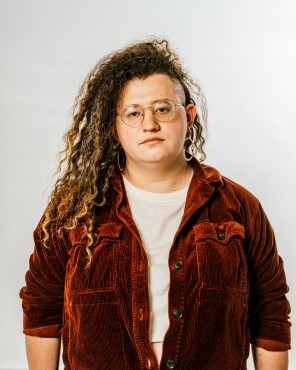
Andrea Long Chu is the book critic for New York magazine. Her book Females was a finalist for the 2019 Lambda Literary Award in Transgender Nonfiction. Her essays have been included in The Best American Essays 2022 and The Best American Nonrequired Reading 2019. She has previously written for The New Yorker, The New York Times, Bookforum, n+1, and elsewhere. She lives in Brooklyn.