Kyle Whitmire of AL.com, Birmingham
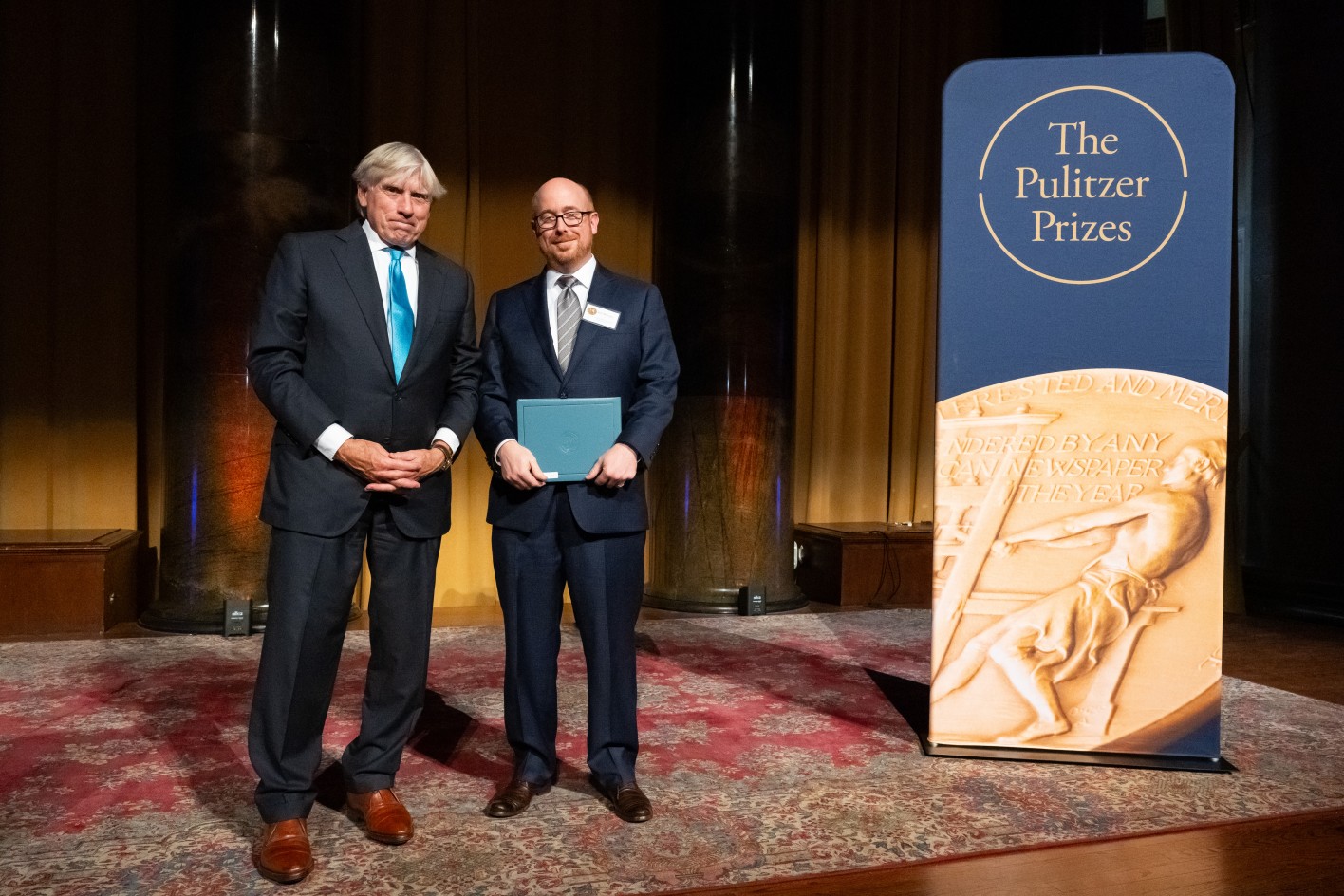
Kyle Whitmire accepts the 2023 Pulitzer Prize for Commentary from Columbia University President Emeritus Lee Bollinger. (Diane Bondareff/The Pulitzer Prizes)
Winning Work
“But if we would have white supremacy, we must establish it by law — not by force or fraud.”
— John B. Knox, chairman of the Alabama Constitutional Convention of 1901.
Perched atop Goat Hill in Montgomery, the Alabama capitol is the sort of backdrop local TV news stations use for political stories when they don’t have a better visual. It’s cut from a Greek Revival template, with a dome and the Corinthian columns, and not all that distinct from other state capitols. But as Alabama government buildings go, it’s the showpiece. Even the traffic lights out front are hung awkwardly at the sides of the road as to not obstruct the view coming up Dexter Avenue.
Let’s take a walk around. But don’t touch anything. Messing with the stuff here can get you into trouble.
Except for the yearly State of the State addresses, the Alabama Legislature doesn’t meet here anymore. They get together in a repurposed Department of Transportation building across the street. They moved over there in the 1980s — temporarily — and then never came back. But for the governor’s suite and a few other state offices, the capitol is essentially a museum.
Which isn’t to say it’s unimportant.
It’s here that Alabama governors take their oaths of office. It’s here that George Wallace declared “Segregation forever!” It’s here that Black civil rights activists, including John Lewis, finished their march from Selma. It’s here that Martin Luther King Jr. demanded America fulfill its obligation to secure voting rights for all.
And it’s here that tourists, not to mention thousands of schoolchildren on field trips each year, come to see what Alabama is about.
They’d be forgiven for thinking it’s mostly about the Confederacy.
This was the Confederacy’s first capital, a distinction Montgomery held for only three months, but a fact literally written in stone throughout the grounds.
The first visage you see while ascending the marble steps out front is not that of King or even Wallace, but of a man from Mississippi.
This is where Jefferson Davis took the oath as the first and only Confederate president, and there’s a little brass star to mark the spot. To the left of the steps is the statue of Davis, a cloak over his shoulders, his hands resting on a slab of pink granite, donated by the Daughters of the Confederacy in 1940.
The statue is not some misplaced relic that’s outlived its welcome. Alabama still observes Davis’ birthday as a state holiday, in addition to Confederate Memorial Day and Robert E. Lee Day. The latter it observes simultaneously with the MLK federal holiday.
Alabama has not moved on. But let’s move on with our tour.
Outside the governor’s office on the north side of the building stands a monument to the Confederate soldiers and sailors Davis got killed. It’s 88 feet tall.
At the southeast corner, there’s an eternal “Flame of Freedom” left by the American Legion to honor those who served and remember the lives lost in the other American wars. That monument is about six feet tall.
Also, the eternal flame has gone out. In fact, I don’t remember ever seeing it lit.
Three trees have markers memorializing their historical importance. “Washington took command of the American Army under grandparents of this elm,” says one. The marker evidently outlived its elm. There’s no tree there anymore.
Trees get markers here, but you won’t find many Black people memorialized on the grounds. And those few are hard to find.
Inside the capitol entrance, there’s a framed display on an easel giving a brief, sanitized story of Horace King, an enslaved architect who designed the cantilevered staircase to the rotunda.
Up those stairs, inside the old House and Senate chambers, there are two markers, put there about a decade ago. They name the Black lawmakers who served during Reconstruction. The plaques break down the names by years elected, with lists getting shorter each election cycle.
And then ending abruptly.
Nothing here explains why or how Black representation ended then. And that’s what I brought you here to see.
The scandal here isn’t only that more Black people aren’t honored. The sin is what else has been ignored, and the silence exposes the guilty. This building is where the rights of generations of Black people were stolen, not once but twice.
First, when the Confederacy organized itself.
And again — in 1901.
Among all those statues and markers, portraits and plaques, there’s none to document when white south Alabama planters and north Alabama industrialists gathered here in 1901 — when they tried to bring the Confederacy back to life, but this time within the confines of the federal government.
The mementos here tell a story, but it’s counterfeit history. If you want history, you have to find it across the street, at the state Archives.
In the minutes of that convention, you’ll see that it was right up there, on that old House dais, that John B. Knox, a lawyer from Anniston, accepted the chairmanship of the 1901 Alabama Constitutional Convention, where he opened his remarks with a racist joke about “a well authenticated story from Kentucky, of an old darkey” and then explained how they would end what he called “the menace of negro domination.”
It was here they unreconstructed Alabama. It was here that they proudly, explicitly embedded “White Supremacy by Law” — an actual sub-head in the minutes — into Alabama government. It was here they consolidated political power in the Legislature — and away from city and county governments where Black majorities might decide their own affairs. It was here they disenfranchised Black voters for most of the 20th century. It was here they opened the door for Jim Crow, segregation, lynchings, convict leasing and all sorts of oppression.
It was here they drafted the Alabama Constitution of 1901, the foundational document of state government — now amended 977 times and the longest constitution of any state or nation in the world — that still affects and afflicts Alabama. After the birth of the Confederacy, it might be the most consequential act of Alabama history, but good luck finding a trace of it here.
But this place doesn’t need another statue or one more bronze plaque on a wall. It needs ribbons of yellow tape.
This building is a crime scene.
Monuments and monsters
We’ll leave the creepy old portrait of Robert E. Lee for another tour, but before we leave the capitol, I want to show you one more monument.
The Jefferson Davis monument is one of five statues for individuals, but for anyone ill at ease with Confederate symbols, it might be the second-most disgusting thing here. To the right of the marble steps outside, partly obscured by an impressively ancient and massive laurel oak, is the shrine to James Marion Sims, a physician from Montgomery, which the plinth calls the “Father of Modern Gynecology.”
He could also be called the Doctor Mengele of the Confederacy.
To the extent Sims founded the science of women’s health, he did so by conducting involuntary medical experiments on slaves. One of Sims’ test subjects, an enslaved woman named Anarcha, underwent more than 30 surgeries by his hands, without consent. And without anesthesia.
These are not disputed facts. They come from Sims’ notes, but you will find no mention of that here. People who have tried to bring attention to Sims’ misdeeds have gone unheard here, and one has been arrested. In 2018, Montgomery activist Jon Broadway was jailed after he poured ketchup on the statue during a protest.
Earlier last year, Montgomery artist Michelle Browder unveiled a memorial to three of Sims’ test subjects across downtown. But the Sims monument, like the Alabama capitol, stands stubbornly frozen in place and time.
Whether Sims deserves this place of honor is largely moot. Nor is changing it. The Sims monument is protected by the law.
In 2017, the Alabama Legislature passed the Alabama Memorial Preservation Act. The law makes it illegal to rename, remove or otherwise disturb any historical monument, building or dedicated street older than 40 years.
The bill followed efforts, primarily in majority-Black cities, to move Confederate monuments and rename public buildings and spaces that honored slaveowners and segregationists.
The sponsor, state Sen. Gerald Allen, said the bill protected history, which Allen must consider with greater regard than books. In 2005, Allen sponsored another bill to ban books with LGBTQ authors or characters from school libraries. When asked whether the books should be burned, he said, “I guess we dig a big hole and dump them in and bury them.”
The new law worked exactly how the 1901 framers designed the system to work. It took power from Black people in majority-Black cities and counties and gave it to whites in the Legislature.
When the monuments bill passed in 2017, every Black member of the Alabama Legislature voted against it, in addition to two white lawmakers. Every lawmaker who voted for it was white.
The City of Birmingham was the first to challenge the law and built a plywood wall around its Confederate monument until the city could decide what to do with it. Alabama Attorney General Steve Marshall sued and threatened to fine Birmingham $25,000 a day.
The city argued the law violated its free speech rights and said it gave more influence to dead Confederate sympathizers than living people.
The Alabama Supreme Court ruled in the state’s favor, but with one key exception: The state could fine a city or county $25,000 only once, not daily and not into perpetuity.
Lawmakers had accidentally left a loophole.
“The legislature felt like Confederate monuments were priceless,” state Rep. Chris England said. “The Supreme court felt like they were worth $25,000.”
It’s a nice line, but not entirely accurate. One justice, Mike Bolin, urged the Legislature to make the law more punitive.
“Indeed, the deterrent effect of a fine derives from its pinch on the purse,” he wrote.
In 2021, one lawmaker tried just that.
A meaner monuments law
On the wall of Rep. Mike Holmes’s office hangs a certificate that would be politically toxic in many places outside of his district. Below an emblem bearing a Confederate flag, the document says Holmes is descended from a Confederate soldier and qualified for membership in the Sons of Confederate Veterans.
The monuments, he says, are history.
Holmes takes pride in his Confederate roots. He’s traced his family tree back to five relatives who fought for the South in the war, but none on the Union side. In the course of our conversation, he uses the pronoun “we” when referring to the Confederacy.
Holmes says none of his relatives owned slaves but fought in the war for other reasons. When I ask him why he thinks the war happened, he attributes the South’s rebellion to one thing — taxes.
“We were at a terrible disadvantage here in the South for trade for that reason, because our costs were jacked up so high by those implements,” he says. “That, to me, was the cause of secession — well then, of course, the secession caused the Civil War.”
I asked Holmes whether he’d read Alexander Stephens “Cornerstone Speech,” but Holmes said he was unfamiliar with it.
Stephens was the vice president of the Confederacy and considered by many to be its intellectual lodestar, similar to the role Thomas Jefferson played in the American revolution. If the cause of the Civil War is a mystery to be solved, then the Cornerstone Speech is one of many smoking guns — a racist screed arguing all men were in no way created equal.
“Our new government is founded upon exactly the opposite ideas; its foundations are laid, its cornerstone rests, upon the great truth that the negro is not equal to the white man; that slavery, subordination to the superior race, is his natural and normal condition,” Stephens said in 1861. “This, our new government, is the first, in the history of the world, based upon this great physical, philosophical, and moral truth.”
But Holmes, who says he cares deeply about history, was unpersuaded.
“I would say he’s wrong,” Holmes says. “When you study it thoroughly, it was pretty clear what it was about.”
The monuments, he says, are history.
In the last regular legislative session, Holmes sponsored a bill to toughen Alabama’s monuments law further, increasing penalties to $10,000 a day and expanding the acts prohibited.
In our conversation, I asked Holmes about the Sims monument and whether he opposed adding context to the statue to recount the experiments conducted on enslaved women. Holmes said he didn’t oppose that, however his bill did. It prohibits adding any competing signage or even saying anything bad about it.
“No monument that is located on public property may be relocated; removed; altered; renamed; dishonored, disparaged, or reinterpreted with competing signage, wording, symbols, objects, or other types or means of communication located at the site of the monument; or otherwise disturbed,” the bill said.
If Holmes seems unclear what was in his bill, it’s also unclear who wrote it. In February, the Southern Cultural Center said in a Facebook post that it had contributed to the drafting of the bill.
“For the past 8 months the Southern Cultural Center has been a member of a special team of our people to rewrite the disastrously and disappointing Monument 2017 law,” the organization said on its page. “This was requested by Representative Mike Holmes District 31.”
The Southern Poverty Law Center has identified the Southern Cultural Center as a neo-Confederate hate group and the facility it owns near Holmes’ hometown of Wetumpka was, until 2018, the headquarters for another SPLC-labled hate group, the League of the South. The two organizations diverged after the League supported violent protests in Charlottesville, Va., leaving the property vulnerable to seizure in the lawsuits that followed.
In February, Holmes told reporters that the group didn’t draft the bill but two members of the group had helped him with it. When I asked him about it, Holmes said he had help from about 12 people but declined to identify any of them.
Holmes’ monuments law rewrite stalled last year in committee.
Holmes told me he would not be sponsoring the bill in the upcoming legislative session. When I asked why, he said he still supported the bill and would vote for it, but he thought it would stand a better chance of passage if someone else carried it. The supporters of the bill believe they have found another sponsor, he told me, but again he declined to name the sponsor or the supporters shopping the bill to lawmakers.
If Holmes is vague when discussing the future of the monuments bill, he’s clear about one thing — he believes the Legislature should have say over monuments, buildings and streets, not counties, cities, school boards or other local governments, and he’s opposed to compromises, such as moving the monuments to Confederate cemeteries.
“To move them off into some obscure parks, somewhere where 10 people they might walk by, and then that’s that kind of defeats the purpose,” he says.
I try to get Holmes to look at the monuments issue from another angle. I bring up a civil rights monument in Birmingham’s Kelly Ingram Park that has been questioned for its faithfulness to facts and history, but we quickly hit a dead end.
“I have no idea where Kelly Ingram Park is,” he says.
Artifacts, not history
Rep. Juandalynn Givan knows where Kelly Ingram Park is. The Civil Rights battleground is in her Alabama House district. Like Holmes, she can trace her roots back to the Civil War era, too — when her ancestors were held as slaves in Wetumpka, Holmes’ hometown.
She is not fine with the way things are.
Givan doesn’t withhold her opinions. More than once, that’s gotten her into trouble. In 2017, House Speaker Mac McCutcheon stripped her of a committee assignment after she called a former lawmaker racist and threatened to “take him out” if he ever came to her committee again. Once, on the House floor, McCutcheon cut off her microphone during a debate and Givan responded with a torrent of obscenities for which she later apologized.
But for the most part, she’s a Black woman sick of the status quo.
When Holmes brought his bill before the State Government Committee last year, Givan spoke out against it. She stood at the committee room podium but turned her face to Holmes.
“Take your foot off my neck,” she said at the hearing last April.
Holmes’ bill was atrocious, she says, and punitive for the sake of being punitive.
Several members of the public spoke in favor of Holmes’ proposal and similarly made arguments the Civil War hadn’t been about slavery but tariffs and taxes.
“That war was about the fact that certain states did not want to do away with or to abolish slavery,” she says when I speak with her later. “And you still have members in that party who do not want to accept that realization and how one can come before a committee and say that that’s not true. It’s beyond reasoning.”
When I ask Givan if she’s given up on persuading her opponents, she says yes, but then she recounts members of the majority she’s caused to question their beliefs. She even speaks fondly of Rep. Will Dismukes — “my buddy,” she calls him — who was rebuked last year by the Alabama Republican Party after he attended a celebration of Nathan Bedford Forrest’s birthday the same weekend as John Lewis’s state funeral.
Last year, Givan brought her own bill to revise the monuments law. But despite her sharp tongue and sharper elbows, the law she proposed would not have ground the monuments into the sand. Instead, Givan proposed narrowing the law to apply to monuments only — not streets and buildings — and would have allowed cities and counties to move the monuments they don’t want to somewhere they could be preserved and protected.
In short, Givan’s bill would have treated the state’s sundry monuments as historical artifacts, not history itself, and would have sent the relics no one wanted to the Alabama Department of Archives and History.
“Municipalities should be able to control those things for which they have the responsibility of taking care of and managing and cultivating,” Givan says. “That should be their role and responsibility.”
Givan managed to win over a couple of Republican lawmakers but not enough to make it past the committee.
She said she will try again and when I spoke with her she said she recently had a Republican colleague express interest in sponsoring the bill with her.
“We’ll see,” she said.
The scene of the crime
On a sunny day in late October, I park my car beneath a rumbling overpass and walk toward the thrum of drums and trombones a couple of blocks away. I-65 doesn’t bisect this Montgomery neighborhood so much as dominate it. The interstate’s course through this neighborhood was no mistake, Montgomery Mayor Steven Reed says. It was part of what he calls the “weaponization” of the federal highway system — drawing lines through majority-Black communities, including this one where many civil rights leaders lived.
And where one grew up.
After Reed won election as Montgomery’s first Black mayor, he says he wanted to do something to honor Fred Gray. Now 91 years old, the Alabama attorney began defending civil rights leaders in the courtroom when he was just 24, including his most famous client, Rosa Parks.
“It was important for me to do that for attorney Gray and his family now,” Reed says. “I’m really big on giving people their flowers while they’re on this side of the sun, as opposed to after they have gone.”
Reed asked Gray how he’d like to be memorialized. Gray said he’d like his name on the street where he was raised — Jefferson Davis Avenue.
In a field beside an empty schoolhouse, the city has set up a 50-ft wide stage with a tent for shade. In front of it are about 300 folding chairs which quickly fill. The Alabama State University marching band plays the National Anthem before the university’s concert choir sings the Black National Hymn, “Lift Every Voice and Sing.” Most of the folks in the crowd are Black, but not all.
Around the edges of the gathering, standing in dress uniforms, are firefighters and police officers, in addition to about a dozen patrol cars blocking traffic on the adjacent streets — which is significant.
In full view of at least two dozen police officers, we’re about to witness a crime.
There’s poetic justice, as Reed puts it, replacing the name of a slaveowner and insurrectionist with a civil rights hero.
“When you think about that community and those that are traversing those streets, I think that Fred Gray represents a much more appropriate role model, not just for his neighborhood in Montgomery, Alabama, but I would say even the state and the nation,” Reed says.
But the act itself shows that history isn’t over, that — as partisans on all sides of this fight love to say — those who do not remember history are condemned to repeat it.
And Reed is and the city are about to repeat it again — as Civil Rights protestors did when Gray was a young man defending them in court — by violating an unjust law.
If the state fines the city, Reed says he’s had numerous business leaders and philanthropists offer to pick up the cost. The city will follow Birmingham, Mobile and Madison County, which already cut their checks after defying the monuments law.
It’s tempting to see the streets, buildings and monuments as symbols, only — but with the monuments law protecting them, they stand for something else, too — reminders of the 1901 constitution. They show how the system withholds power from city and county leaders, and denies their constituents any say in their own affairs.
And as Reed says when I speak with him later, it’s not just street names and Confederate relics the state constitution affects — it’s taxes, zoning laws and education. Recently the city wanted to raise $700,000 a year more for schools through property taxes, which it did, but only after clearing constitutional hurdles cities in other states never face.
Under Alabama’s archaic, racist Constitution, cities and counties are denied control of their own affairs. These are not the unintended consequences. This effect was intentional. This is how the 1901 Constitution was designed to work.
But on this sunny day in October, Reed, with the backing of residents and the city council, put those old men who met 120 years ago at the state capitol behind them. After about an hour of remarks and praise for Gray, Reed walks with him to the corner where a short vinyl curtain covers the street sign. Gray and his wife tug on the rope and the covering drops away.
“W. Fred D. Gray Ave,” it says.
The crowd cheers. Family and friends pose for photos with Gray and his wife by the signpost. The mayor gives interviews to the press. The music plays again below a bright blue sky.
It’s a beautiful day to break the law.
Come with me. I want to show you what a hole in Alabama history looks like.
Downtown Eufaula is postcard pretty. It fits the Hollywood idea of what a small Southern town is supposed to look like, so much so that the producers of that “Sweet Home Alabama” movie took some footage here years ago, although they shot the scenes with Reese Witherspoon across the river, in Georgia.
According to the Alabama Department of Transportation, this road is the busiest state highway in Alabama, and if you close your eyes, you might mistake its sounds and smells for a big city rather than a quaint river town. This is how impatient beachgoers get from Atlanta to Panama City, and where semis and log trucks belch diesel fumes as they rumble in both directions. But turn your head, look out the passenger side window, and you can see the same 15-second clip Hollywood came here for 20 years ago.
On either side of Eufaula Avenue are rows of antebellum mansions that have their own names, imparted by owners who are long since dead. The director of the state tourism department once said the houses looked like wedding cakes. Most, but not all, are in excellent shape, restored by new owners who are as much curators as they are residents.
Lines of old oak trees form a natural canopy over the road. The residents are protective of these trees, many of which memorialize deceased townspeople with small granite markers laid like gravestones among their roots. One tree owns itself, or so a little plaque there says, and there’s even a tiny fence to keep us off its lawn.
Eufaula sells its history to tourists, or at least, a version of it. Each spring, the city hosts the Eufaula Pilgrimage, an antebellum festival when many of these private homes open for tours. Young women dress in hoop skirts and old men button up waistcoats. Typically, about 1,500 people visit from across the southeast. And it’s an event the state subsidizes. Last year, Alabama distributed $247,500 to preservation groups here.
“Experience Southern hospitality at its finest when you visit Eufaula, Alabama,” a promotional video by the Eufaula Heritage Association promises. “During its annual pilgrimage, beautiful historic homes built in the days when cotton was king will be open to visitors during this nostalgic return to the Old South.”
Today we’re going back to an old South, but not that one.
Past the mansions, where Eufaula Avenue meets Broad Street, is the obligatory Confederate monument. In fact, there are lots of monuments and markers on Broad, between the Confederate hospital at one end and the spot where the town surrendered to Union troops at the other. There’s a WWI doughboy statue, a WWII monument, and a waist-high granite memorial to Leroy Brown who was, as it turns out, a fish.
In 1973, the legendary bass swallowed a strawberry jelly worm in Lake Eufaula and thereafter lived in a bait shop live tank until his death in 1980. More than 800 folks attended Leroy’s funeral, and the governor declared an official day of mourning.
Yes, there is history in Eufaula. But there’s something missing.
The most significant memorial in Eufaula is the one that isn’t here. Just a little further down Eufaula Avenue — past that Confederate monument and around the corner from the fish — is the site of a tragedy.
Where today the air reeks with car exhaust, there was gunsmoke.
Where traffic creeps between stoplights, bodies lined the street.
In the median of that busy road was once a massacre.
Here is where Alabama took a bloody turn, something so shocking at the time that it led to two Congressional investigations. It might be the most consequential thing that ever happened in this town.
But you won’t find mention of it — not here, not now.
Step into my time machine. There’s something important I want to show you.
An ambush in 1874
Henry Frazer was a Black Republican when that wasn’t an unusual thing in Alabama. That day he told the men not to bring weapons, he would later tell investigators in one of two Congressional inquiries into what happened that day in Eufaula.
The year was 1874, and Alabama was nearing the abrupt end of Reconstruction. Frazer, who was also a Methodist minister, had spent two weeks canvassing support among the sharecroppers around Eufaula, back when cotton farmers still loaded their crops onto boats. The Monday before Election Day, he led about 400 Black men toward town to vote. They camped by the roadside outside of town, and set off on foot at eight o’clock the next morning, marching to drums and fifes.
“I told them that although they might carry sticks, they should not carry any other weapons,” Frazer told investigators. “I instructed them to stand in a body until they got a chance to vote.”
When they arrived in Eufaula, they met another group of Black men coming into town from the other direction. A policeman searched them and as the men began to vote, a man named Harrison Hart rode up on a horse. He asked what time it was.
“Somebody made answer to him that it was nearly twelve o’clock, and he said, ‘In about an hour’s time, we will have a frolic,’” Frazer testified.
Hart wasn’t the only one anticipating a frolic.
The city judge and election supervisor, Elias Keils, had warned federal authorities that trouble was imminent. The night before the election, Keils met the Black voters in rallies outside of town and implored them to endure any insults they would hear and to not return any curses. They were to vote and get out as swiftly as possible.
If they did, Keils said, they would be protected. It was a promise he never should have made.
Nine years into Reconstruction, there were signs already that federal forces had grown weary of their mission reconfiguring social order in the South. At least twice ahead of that election, Keils wrote the U.S. Marshal in Montgomery to ask for support.
“Every day the most vicious of the ‘White League’ are carrying into various portions of this county new breech-loading double-barrelled shot-guns with fixed ammunition, plenty of which has lately been shipped here,” Keils wrote a month before the election. “We all know what this means, particularly when the most infamous threats are daily made by those of the ‘White League’ who control it.”
The White League had recently taken root in Louisiana and Mississippi, and its influence was spreading across the South. While it shared many of the same goals as the Ku Klux Klan, the White League operated openly. It had organized militias for driving Republicans and unionist forces out of the South. After the Battle of Liberty Place in New Orleans, the League occupied that city for three days. And it had plans for the 1874 midterm elections.
Keils had been a secessionist before the Civil War but since the war ended he had switched to the Republican Party. He’d fallen out of favor among Eufaula whites, both for his new political allegiance and for the mercy he showed to Black defendants in his court. His opponent in the 1874 election wrote a song about him, which I won’t quote because it uses the n-word a lot, but it makes clear why Keils had fallen out of favor: He protected Black voters, he let one Black defendant work as a doorman in his court, and, the thing they couldn’t forgive, he let Black people serve on juries in judgment of white defendants.
He was, to use the epithet of the time, a scalawag.
James Williford knew what that was like. A deputy U.S. Marshal — Williford had grown up across the river in Georgia. But since he’d joined the Marshals service, he’d become an outsider.
“If a man does anything for the United States Government he is looked upon with about as favorable eyes as Gabriel looked upon the devil in Paradise,” Williford testified later.
But some locals were more cordial than others. That morning, the marshal sat on a box by a storefront, talking about mining with Eli Shorter. Shorter was a prominent citizen in Eufaula, formerly a colonel in the Confederate Army and a Congressman before the war.
Then the frolic started.
According to Williford, Shorter saw the disturbance first and suggested he do something to stop it. Williford wasn’t sure he had the authority, but Shorter assured him his presence alone would settle things.
Frazer, the minister and Republican canvasser, was closer to the ruckus and saw more of what happened.
According to Frazer and other witnesses, there was a dispute about whether one young Black man was old enough to vote. When the man tried to vote the Republican ticket, the officials there objected and some white Democrats took the young man around the corner into an alley. A short while later, they reemerged, but now the young Black man was holding a Democratic ticket and taking it toward the ballot box.
A Black man named Milas Lawrence said to the young man, “God damn you, are you going to vote the Democratic ticket?”
A white Democrat named Charlie Goodwin confronted Lawrence, and the two began to shout at each other.
“I have a right to stand up for my color as much as you have for yours,” Lawrence said.
Still making his way toward the fight, the marshal Williford first reached the young Black man, who by then had voted. Wiliford asked the young man if he had voted as he pleased. When the man said he had, Williford told him to go about his business and that he’d be protected.
“Boys, all you go back to the polls now and vote, and then turn right round and go home,” Williford told them. “This looks like too much a fuss.”
About then the argument escalated. A white man named Clayton yelled, “Shoot the damn son of a bitch!” And then another white man named Dowdy pulled a Bowie knife and stabbed Lawrence in the back. Lawrence tried to flee but fell a few yards from where he’d been stabbed.
That’s when, according to multiple witnesses, Goodwin drew his pistol and fired it straight up in the air. Several witnesses would later say they believed the shot to have been a signal.
The marshal couldn’t see who fired the shot, but he heard a white man shout what sounded like orders. Partially deaf, Williford grabbed the arm of a Black man next to him and asked what was said.
“Didn’t you hear them say?” the man answered. “Fall in, Company A! Fall in, Company B!”
Swiftly, all but a handful of white men shuffled out of the crowd and gathered on the side of the street opposite the polling boxes. The men on the ground drew pistols and shotguns. The second-story windows of the storefronts flew open and from there men aimed rifles at the crowd. The rifles had come from an armory — provided for the town’s protection by the United States government.
Somewhere between 800 and a thousand Black men stood exposed in the street.
Then the shooting started.
This is where witness testimony diverges wildly, and perhaps that’s understandable. Most witnesses said the shooting lasted but for a minute or two, others said nearly half an hour. But all agreed hundreds of shots were fired.
The Black crowd split and fled in opposite directions down the street, and each way about a dozen or more white gunmen chased after them, firing as they went.
One Black man, S.N.B. Johnson, was hit five times before he jumped down a well in the middle of the street for protection.
Frazer fled but quickly hid behind some steps on the side of a house. From there, he could see Harrison Hart, the man who’d warned of the “frolic,” firing at the fleeing men.
Among a larger crowd of white men still standing near the polling boxes, there were cheers. A few men tossed their hats into the air.
“Now, God damn you, bring on your Yankees!” Frazer and other witnesses heard one man yell. “We are ready for them!”
Meanwhile, the marshal, Williford, was trying to get the Yankees.
Like the Black voters, he ran for cover. He later told investigators he could hear the bullets whistle around him. Briefly, he sheltered in a home around the corner. Then he ran to the office of U.S. Army Captain A.S. Daggett.
Daggett’s office was close enough to the poll boxes that he’d witnessed most of the shooting out his window. Williford begged Daggett to stop the ambush.
Daggett refused. Instead, he showed Williford a telegram with orders from Montgomery. It said the federal troops could only help U.S. Marshals serve writs.
“Very well — I have writs!” Williford said. He pulled subpoenas from his pockets and asked for soldiers to help serve them. “I have 15 or 20 subpoenas. Are they not writs?”
“I think not, but I will look in my dictionary to see,” Daggett said before fetching the book.
Daggett suggested Willford leave the subpoenas with him and the soldiers would serve them in the morning.
Williford pleaded some more. The mob outside would kill every Black man if they didn’t do something, Williford argued, but Daggett closed his dictionary.
“I cannot help it if they do,” Daggett said according to Williford’s testimony.
The Yankees weren’t coming to the rescue.
Williford left Daggett’s office and returned to the scene of the shooting. He tried to count the dead but had trouble sorting them from the injured, some of whom were already being carted off on wagons.
The casualty counts vary, but most say between seven and ten men died on the street. Others were found later, dead in the woods outside town, after the buzzards found them first.
Around 80 were wounded — most of them Black, but not all. About five white men had been hit. Henry Shorter, brother of Eli, had been standing on the wrong side of the street and caught a bullet in his wrist.
But the violence wasn’t finished.
That evening, at another polling place in the nearby town of Spring Hill, many from the same mob surrounded an office where Keils — the judge and election supervisor who’d sent for help — and others were counting votes.
Keils had asked the Union soldiers in Spring Hill for support, too. They showed him a telegram from Daggett — the first telegram ever received in Spring Hill’s new telegraph station — relaying orders from Montgomery not to interfere.
The mob demanded that the judge surrender the ballot box.
When he refused, they shot up the office and burned the precinct ballots. Keils lived, but in the firefight, his 16-year-old son was struck four times and died two days later.
The white Democrats declared themselves the victors and forced — in some instances literally forced — Republicans from their offices. The 1874 election gave Democrats control of the Alabama Legislature and state executive offices. Though the character of the party would change, it wouldn’t lose its majorities in the Alabama Statehouse for the next 136 years.
Federal authorities tried to hold the Eufaula mobs accountable. Williford, the marshal, testified that he arrested about 30 men. A federal grand jury called witnesses. After the first witness, a Black man named Hilliard Miles, testified, he was almost immediately arrested by local law enforcement and charged by a state grand jury with perjury.
His crime: Naming one of the men he saw leading the White League militia — Braxton Bragg Comer.
That first witness was convicted and sentenced to state prison where federal authorities lost track of him. Witnesses of the massacre stopped coming forward. None of the 30 men Williford arrested were convicted.
The Republican officials and their canvassers, including Frazer, had to flee the county. For his own safety, Williford was reassigned to Texas. Those who had helped the Republicans were blacklisted by employers, or worse.
The previous February, about 1,200 Black voters had cast ballots in Eufaula city elections.
In 1876 — two years after white Democrats took control of the county — only 10 Black voters cast ballots in Eufaula.
Later, Henry King, another of the Republican canvassers, testified to the Congressional committee that no Black men were allowed to vote in Barbour County anymore A congressman asked what would become of them if they did.
“They will come up missing,” King said.
What’s there today?
Five men died in the Boston Massacre and it’s in every American history textbook. About twice as many died that day in Eufaula and Alabama history textbooks neglect any mention of it.
Eufaula has buried it, too.
I grew up in Alabama. In school, I had two years of what I was told was Alabama history. I never heard of any of this. Last year, around the anniversary of the Tulsa Black Wall Street Massacre, I saw a map of similar mass murders around the country.
And there was Eufaula.
Unlike the Black Wall Street Massacre, Eufaula’s secret history wasn’t kept alive only by word of mouth. There were two congressional investigations that produced official reports and included hundreds of pages of sworn testimony from witnesses on all sides. (I’ve now read all of it, which I used to build the narrative above.)
I drove to Eufaula, just to make sure there wasn’t something there to mark the spot. As I suspected, I found nary a thing.
The well where S.N.B. Johnson took shelter is long gone. There’s a fire hydrant in the highway median there now. The buildings the shooters fired from are gone, too, burned in a pair of blazes around the turn of the 20th century. On one end of the block is a Walgreens. At the other end is a tanning salon called Lasting Impressions.
Between 70 and 80 people got shot here for trying to vote. And there’s nothing here to say a thing about them. Around the corner, there’s a memorial to a fish, but nothing for what happened here. Not a monument. Not a marker.
Nothing.
Of the people who died that day, I found the name of only one — Willie Keils, son of the city judge, buried in a neglected corner of the town cemetery.
The Black voters murdered in the street— their names are lost.
About 20 miles northwest of Eufaula, there’s a roadside marker memorializing the attack in Spring Hill that killed Keils’ son, put there in 1979. It doesn’t mention the massacre earlier that day.
“This bloody episode marked the end of Republican domination in Barbour County,” it says.
Also, it refers to Keils as a “scalawag.”
Post-reconstruction
Had not Dr. Richard Bailey told me where to look for the marker, I might have zipped past it on my way to Eufaula. Bailey is a historian and author of “Neither Carpetbaggers nor Scalawags,” an account of Black Republican officeholders during Reconstruction. He lives in Montgomery where he guides tours of that city’s buried history. As he puts it, not everybody cried when Union troops marched up Dexter Avenue toward the capitol.
“Reconstruction is essentially — until recently, at least — an overlooked period in Alabama history,” he says. “Nobody really wants to talk about Reconstruction. We’ve begun to talk about it, but at the same time we are sanitizing it, also.”
Reconstruction, Bailey says, was America’s first attempt at a civil rights movement — when Black people first had full rights of citizenship and some degree of protection from white people hostile to them. When it ended, those reforms died with it, and it began a violent period in Alabama history — a period deliberately covered up.
It’s impossible to know what might have happened in some alternate universe, where the Eufaula Election Massacre never occurred. But we can see what happened in this one, and it’s possible to draw a line from this mass murder, not only to the end of Reconstruction in Barbour County, but to the end of Reconstruction in the South.
The election of 1874 gave Democrats control of state government again, and it gave national Democrats their first post-war majority in U.S. Congress. When the presidential election of 1876 ended in a virtual tie, Democrats had the political leverage to negotiate a compromise — withdraw union troops from the South and the Republicans could keep the presidency.
It also gave Barbour County outsized influence on Alabama politics, Bailey says.
“All you need to do is to pick up a list of Alabama governors and look at which counties they are from,” he says.
Or, you can find them upstairs, in one of those wedding cake houses in Eufaula.
Home of Governors
The Shorter Mansion, built by Eli Shorter II, today is the headquarters of the Eufaula Heritage Association. For the most part, the first-floor rooms are used as event spaces for parties and weddings. Upstairs is where the artifacts are kept, including Confederate currency, a few battle flags, period dresses, but nothing to speak of the slavery this city was built on.
There is, however, the Governor’s Parlor.
In the 1960s Barbour County marketed itself as the “Home of Governors.” Five were from here, although the county has sometimes claimed Lurleen Wallace, a Tuscaloosa native, as a sixth. Her portrait is the largest in the parlor, above a display case of Wallace political memorabilia.
It’s one of six portraits, including her husband’s.
Among them is Gov. Braxton Bragg Comer — the man Hilliard Miles named as the White League militia leader that day in 1874.
He later became a U.S. Senator, too.
Comer succeeded Gov. William Jelks, another Barbour County man. There’s nothing I found to tie Jelks to the massacre although he was generally supportive of lynchings and pardoned members of one whole mob that had been convicted of murder.
As president of the state Senate and as governor, Jelks successfully shepherded the ratification of the Alabama Constitution of 1901, a racist foundational document of Alabama government that disenfranchised Black voters and today centralizes power in Montgomery and away from minority-controlled local governments. The framers of Alabama’s constitution were explicit in its purpose — embedding “white supremacy by law” (their words) in state government.
Comer was the first governor to take office under the new document.
Those murders on Eufaula Avenue helped set all that in motion.
This is the hole in our history.
Reconstruction was America’s first experiment at nation-building, and it failed for many of the same reasons, and in the same ways, as later attempts elsewhere in the world.
While the Republican occupiers did their best to make the South into a more just and equitable place, they couldn’t overcome the subversive resistance of the men they’d ostensibly defeated. Over time, the conquered Confederates wore the Yankees down. Just as Daggett and his federal soldiers refused to help that day in Eufaula, Union forces gave up — and they abandoned new Black citizens when they needed protection the most. When they were gone, the Confederates regressed to their old ways, swiftly and violently.
Deep in the U.S. Senate report on Alabama’s political unrest are a handful of local newspaper clips, evidence of the great reversion happening here through 1877. Those clips show, perhaps in the clearest terms, how Alabama’s white establishment and the so-called Redeemer government perceived the after-effects of the Civil War and they show where the state was headed next. One editorial all but calls for a race war.
“Emancipation threw the whites and blacks on their own resources, and each race must depend upon its own inherent strength. Freeing the slaves was a declaration of war between the Caucasian and African — a war that is going on now and that will go on silently, ruthlessly, and unceasingly until one or the other is exterminated.
“Let us recognize facts — admit that a war of races is progressing — and then every man will range himself under the banner of his kindred. For ourselves we say, No compromise — no ‘unification’ — but a white man’s rule, a white man’s civilization, and a white man’s government, or ruin and extermination!”
It was in that era of violent backsliding — of unreconstruction — when men like Jelks and Comer reshaped Alabama government with a foundational document Alabama still operates under today.
It was in that time that children of Confederates built monuments and mythology — not history, but an elaborate deception.
And one still sustained today with taxpayer money.
Backwards no more
When I returned from Eufaula, I reached out to Doug Purcell, a retired historic preservationist who, until a few years ago, led the Historic Chattahoochee Commission. I asked him why there’s no monument for the massacre. His short answer: No one has asked for it, likely because no one there remembers it.
“Probably 99.9 percent of the people living in Eufaula have no — recollection is the wrong word because they weren’t here at that time — but they just don’t know it,” Purcell says. “They don’t know about the lynchings that took place here in Eufaula. They don’t have any idea when the Confederate monument was erected and how it relates back to the 1901 constitution and Jim Crow law.”
Until a few years ago, Andrew Forte was one of them. Forte lives in Eufaula and grew up just north of town. Like me, Forte didn’t know about the Eufaula election massacre until he saw something about it on the internet.
Forte, who’s Black, moved away after high school. After spending his career as an auditor in several cities around the South, he returned to Eufaula in 2016. Since then, he’s been active in the NAACP and has taken an interest in the city’s history, especially the city’s Confederate monument that, he says, his family has hated as long as he can remember.
But what happened there next to that monument, he learned of more recently. On Facebook, Forte stumbled across an article about the Wilmington, North Carolina, insurrection of 1898.
“And there was a map of the United States that showed the different places where similar events had occurred, and it said ‘Eufaula-1874,’ and I was like — OK?” Forte recalls. “I’d never heard anything about it.”
Forte asked his friends in the community and connections of Facebook where he could find the historical marker for the Spring Hill attack. He says there are a lot of Black people in his town who are still nervous talking about such things.
“But nobody from here in Eufaula mentioned anything about it, either for fear or they just didn’t know,” he said. “I had a lady out of Virginia who told me exactly where it was, and that’s how I found it.”
Forte says the 1874 Election Massacre needs to be remembered.
“I love this country and I love Eufaula,” says Forte, who cites his 12 years of service in the Army after attending college in Tuskegee. “But we’re not willing to go backwards anymore.”
Too many of Alabama’s historical institutions have done more to obscure that era than to preserve it, but whether the state should fund antebellum house museums or keep laws to protect Confederate memorials might be easier to answer than a much bigger question: What’s missing?
It’s a problem Eufaula recently encountered ahead of the World War I centennial. That doughboy monument we passed on our tour — there was a problem with it. It listed names of five Barbour County men who’d died in the Great War. But all were white.
In 2018, an anonymous donor paid to have the monument amended to include the names of six more service members lost in the war — five Black and one white — who had been left off the original monument.
Ironically, the correction might run afoul of the state’s recent Memorial Preservation Act, which forbids altering the appearance of any monument more than 40 years old. Purcell, who helped research the addition, says the addition is legal since it doesn’t touch the old monument. When I saw the granite slab, it could have fooled me.
But it demonstrates, perhaps as clearly as anything we’ve seen, history is not a granite soldier on a pedestal nor so much bric-a-brac in a pretty old house. Those are artifacts. History is something more complicated.
History is the backstory for everything that happens today — without it we can no more understand the present than keep up after walking into a movie that’s halfway over.
Today you can walk into the Alabama Legislature and see a body divided along racial lines. All but two Democrats are Black. All but one of the Republicans are white. The party labels have reversed, but the dividing line is in the same old place. And every year, the white folks run slap over the Black folks.
These things are not unconnected or unrelated.
Alabama is still unreconstructed.
If Eufaula was ready to reckon with its history, it would have done so already, but its reluctance is understandable. Doing so is painful, even embarrassing.
But painful or not, acknowledging what happened there is necessary. Not to embarrass those with family ties to the murderers, but to honor the bravery of those new citizens who died trying to vote. Otherwise what you’re doing isn’t history, but a lot of “Gone with the Wind” cosplay.
It can hurt, and perhaps, the only way to tell you’ve found history and not its counterfeit, nostalgia, is when you discover something you didn’t want to see.
I get it.
That editorial above calling for a race war? It came from The Birmingham News.
Above the gates of hell, the poet Dante says, there’s an inscription: “Abandon all hope, ye who enter here.”
Above the front door of the Alabama Statehouse, there’s another warning: “Audemus jura nostra defendere.”
We dare defend our rights.
Last April, Keith Jackson passed beneath those words on his way to talk to lawmakers, to tell them of something that had bothered him for a long time.
Your first time entering the Statehouse, you might wonder whether you’re in the right place. This was once a Department of Transportation office building, and it looks like a place you’d go to get your drivers’ license renewed. In the 1980s — during renovations at the capitol across the street — the Legislature borrowed this place and never gave it back. The old capitol was pretty, but this building affords every lawmaker an office, however tiny, and it has an abundance of conference rooms for committee meetings.
It was at one such meeting where Jackson intended to speak.
Past the front doors, Alabama State Troopers processed visitors through the metal detectors and X-ray machines. The officers don’t wear their Smokey the Bear hats indoors, but they sport the same uniforms unlucky motorists see by the roadside. It’s a uniform Jackson knew well. He wore it for 20 years.
A retired Alabama trooper, he was there to say out loud what he’d kept bottled up his entire career. He despised a patch on that uniform — the Alabama Coat of Arms.
The Coat of Arms features, among other decorations, a Confederate battle flag.
Jackson is Black, and he believes that rebel banner needs to go.
Not only is the state symbol on troopers’ uniforms, it’s on their patrol cars, too. It adorns the seals of state agencies and decorates their stationery. When governors take the oath of office on the capitol steps, that crest is affixed to the podium where they speak, and when the inaugural balls are over, it hangs on the office wall where they go to work. Once you begin to look for it, you’ll see it all over the place in Montgomery.
And every time Jackson sees it, he sees that flag.
But little did Jackson know, he was there to undo the handiwork of an Alabama fixture, a force from a century ago whose influence persists. Her name was Marie Bankhead Owen, the second director of the Alabama Department of History and Archives.
Of Alabama women, there are only a few who compete with Owen for the most impact. Gov. Lurleen Wallace, maybe. Helen Keller, for certain. Rosa Parks, of course. Kay Ivey? It remains to be seen.
Owen, in comparison, might be little-known in Alabama today, but to say she’s just a figure in Alabama history is unfair. At one time she was Alabama history.
That Coat of Arms was her creation.
Those words of warning above the Statehouse door were hers, too.
Ms. Marie
There’s a story — undocumented but passed down at Archives and History. As it goes, the Alabama Legislature would keep a special page stationed as a lookout in the old capitol’s south entrance. This boy (there were no female pages then) had one job — to alert lawmakers when “Ms. Marie” was headed their way.
“Legislators would scatter because they knew she was coming to put pressure on them for one thing or another,” says Steve Murray, director of Archives and History.
The Alabama Department of Archives and History was the first of its kind in the country, born out of her husband’s collection of historic artifacts and documents.
Thomas McAdory Owen was an amateur historian, but approached the discipline with zeal, collecting all the maps, newspapers, diaries and genealogical records he could lay hands on. At first, he kept the records in the House and Senate chambers when lawmakers weren’t in session. Later, he stored them in old houses across the street from the capitol — properties he acquired to build a museum.
His vision was to build Alabama’s equivalent of the Library of Congress. But between collecting and fundraising, he worked himself to exhaustion, dying of a heart attack before he could see his dream come true. After his death in 1920, the department board named his wife the new director.
At 50, Marie Bankhead Owen became only the second woman to lead a state agency, and she held on to her position for the next 35 years.
Owen was a more formidable figure in Montgomery than her late husband ever was.
“Ms. Marie” is what they called her to her face. Behind her back they called her “the Tiger Lady.”
Lawmakers feared her with reason. Her married name was Owen, but Ms. Marie was a Bankhead, a name still attached today to roads and parks throughout the state. Her father, John Bankhead, had been a U.S. Senator, as was her oldest brother, John Jr. Not to be outdone, her brother William Bankhead rose to become Speaker of the U.S. House of Representatives and one of the most powerful American politicians during Franklin Roosevelt’s New Deal.
Owen did not lack her brothers’ ambition, but she was shut off from a career in politics because she was a woman. Despite this, Owen was adamantly and publicly opposed to women’s suffrage, which she campaigned against.
Her fear was not what would happen should women get the right to vote, but rather, what would happen next — if women could vote, it was only a matter of time before Black Alabamians reclaimed that right, too.
Owen was an adamant and unrepentant racist.
In a petition to lawmakers, the Woman’s Anti-Ratification League — one of two anti-suffrage organizations Owen led — explained opposition to the 19th Amendment as “essential for the preservation of social order and the maintenance of white supremacy.”
“For Marie, ultimately race trumps gender,” says Kari Frederickson, history professor at the University of Alabama and author of “Deep South Dynasty: The Bankheads of Alabama.”
Her family connections already gave her more power than most Alabamians, male or female. Empowering women, white or Black, was a threat to the influence she had.
“Getting the right to vote for her is more about the potential for opening up the ballot to Black women, and that is much more frightening and much more catastrophic,” Frederickson says. “It outweighs any benefits that might come.”
Owen had power, but often little money. In the 1920s she lost most of her inheritance in Florida real estate speculation. After that bubble burst, she lived off the generosity of her more famous movie star niece, Tallulah — and the government.
Throughout the second half of her life, Owen hustled for various government jobs, but the director position was her “meal ticket,” as she called it in a letter to her brother. Nepotism was part of her nature.
After one Alabama governor rebuked her in a board meeting for keeping her son on her department payroll during budget cuts, Owen wrote to her brother John that she had been embarrassed but kept her composure as their late father would have expected.
“If I would follow my instincts at the present moment I would cut his G___D___ throat,” she said.
Governors came and went in Montgomery, but for most of four decades, “Ms. Marie” was constant. Beyond subsistence, her professional life focused on three missions.
To build the building her husband envisioned.
To preserve the relics of the Confederacy her family cherished.
And to purge the state’s history, iconography and culture of all traces of Reconstruction.
To Ms. Marie, symbols mattered — one symbol in particular.
Black boy on a school bus
Keith Jackson was in third grade the first time someone called him that word.
Jackson’s mom had taken part in the civil rights movement, but he says his parents, then raising him and his brothers in Lawrence County in north Alabama, tried to protect them.
“It pains me to think of the stuff that she went through,” Jackson says. “But she never cried, she never gave that to us. As young men, my mom and my dad purposefully shielded us from that. We didn’t even know the difference until we got exposed to it.”
There were fights at the high school. That’s the first thing Jackson remembers. He was too young for that to be a danger to him, but not his older brother.
“I used to listen to my mom coaching him how to avoid things and get away from crowds, stay in athletics, don’t be involved in any of the disturbances that was going on,” he says.
Jackson’s class was the first in his school system to be integrated from kindergarten on, which went more or less smoothly for him until his last day of third grade. Jackson was getting off the bus when a boy several years older than him shouted that epithet at him from the back of the bus.
“I didn’t even know what the n-word was,” he says. “I turned around and an orange hit me in the face and exploded, and everybody on the bus laughed.”
Jackson tried to laugh it off, too, but when he turned to hug his bus driver goodbye for the summer, he saw tears on her face.
“She just told me to have a good time,” he says.
When Jackson asked his mom what the word meant, his mom told him only ignorant people used it. The next fall, when he climbed back on the bus, the same older boy was there to taunt him.
“I got on the bus and he stood up in the back of the bus and said, ‘Hey, n-word, how was your summer?’” Jackson recalls. “And I said, ‘Fine, ignorant, how was yours?’”
And this is how things went between them for about four years, Jackson says, until one day the older boy seemed to offer him an apology. The older boy told Jackson he was sorry for what he’d called him and gave him a gift.
“He took his hat off his head, and he gave it to me and said this is kind of a truce, and you can wear this proudly,” Jackson says. “And, I took the guy at his word and I said, OK.”
It was a reddish-orange, with Budweiser written on it — and a rebel flag.
When he wore the hat in school, his history teacher yelled at him to take it off, but Jackson thought the teacher, who was Black, was mad because he was wearing a hat in school. It was only when he wore it home that he realized what was wrong with it.
“I will never in my life forget this day. I had that hat on and I went to my grandma’s house,” he recalls. “And when I walked in the door, my mom and my grandma were sitting there and my mom went off. She told me, ‘Get that hat off your head! Don’t you ever put that back on your head!’”
Jackson said he protested. He told his mom it was just a hat. But she told him to get it out of the house and to never bring it back in.
They never spoke about the hat again, and Jackson never wore the hat again, but he could tell his mom had been hurt by it.
“I didn’t notice it when it was happening,” he says. “But later on, when I learned what it was, when I looked back, that doggone flag was flying everywhere there was a fight or a disturbance. Watching it on TV, you know, somebody always had that flag.”
Rewriting history
The Alabama Department of Archives and History has the third largest collection of Confederate flags in the nation — much of it compiled by Thomas McAdory Owen before his death.
The building, however, was the work of Ms. Marie. And like a lot of things in Alabama, it was paid for by the federal government.
In 1934, Bibb Graves replaced Gov. Benjamin Miller — whose throat Owen wanted to cut. After taking office, Graves arranged a meeting in Washington for himself, Owen and Harry Hopkins, the head of Roosevelt’s new Works Progress Administration.
“Aunt Marie had badgered Governor Graves into going to Washington and demanding this sum,” her niece Tallulah said in her autobiography.
Owen made her best pitch before Hopkins asked to speak with Graves alone. Hopkins was somewhat irritated by the Alabama panhandling and told Graves that WPA didn’t have the money for “every little old lady who wanted an archive.”
Graves then reminded the president’s advisor that Owen’s brother was speaker of the U.S. House of Representatives.
And that her other brother was the chair of the U.S. Senate Appropriations Committee.
When Owen returned to the room, Hopkins asked where it was she wanted to build her archive.
“Hopkins saw the light,” Tallulah wrote. “Aunt Marie got her million.”
Today, the white marble home of the Alabama Department of Archives and History stands across Washington Avenue from the state capitol. The building has been expanded twice, and its grounds now take up a full city block, but for a small parcel — the First White House of the Confederacy.
Murray, the Archives and History director today, doesn’t criticize Owen without first acknowledging what good she did for the department. However, Owen was not a professional historian or archivist, he says. Her personal interests often clouded the department’s mission and cluttered its collections. More significantly, Owen was among the most significant purveyors of an antebellum “history” that had little or no basis in fact.
“Speaking more broadly, Marie was an extraordinary influence in the creation within Alabama of that Lost Cause mandate or cultural influence that pervaded much of Southern society and even nationally,” Murray says.
Owen wrote and distributed history plays for Alabama school children, and she penned Southern romance novels that depicted the Confederacy as a virtuous place that civilized African savages through benevolent slavery. One novel, “Yvonne Braithwaite: A Delta Romance,” she managed to get published.
Perhaps most crucially, Owen guided Alabama history curricula, writing the first textbooks covering state history.
“She defended the legality of secession,” Frederickson, the UA history professor, wrote, “and identified President Lincoln’s call for volunteers following the firing on Fort Sumter as the start of the Civil War, which she called the War Between the States.”
Owen’s view that Lincoln started the war was not uncommon in her day, just as it’s portrayed, too, in the racist, Klan-aggrandizing cinematic milestone, “The Birth of a Nation.”
Owen downplayed, marginalized or outright omitted contributions by African-Americans in her texts, focusing instead on the state’s abundance of rivers and other natural resources to explain its economic vitality before the war.
And she suppressed voices who contradicted her.
Purging pedagogy
Owen had been active in the United Daughters of the Confederacy for much of her life, but in 1936 the Alabama division elected her to leadership — division historian, a job that usually involved collecting minutes of chapter meetings and assisting members’ research.
But Owen wasn’t a passive note-taker. No sooner than she had accepted the job than she received an alarming letter from the division president, Mollie Jones of Auburn. Jones reported that a junior high school teacher in Montgomery had told students there that Robert E. Lee, Jefferson Davis and other Confederate heroes were traitors and the Confederacy had been a treasonous rebellion against the American government.
“For Montgomery of all places to have such heresy taught is beyond words an outrage,” Jones wrote. “In every town where there is a chapter and in others, if possible, if such as this is going on, we could investigate and it would be a real contribution.”
Owen accepted the challenge and quickly organized a campaign to purge anti-Confederate lessons from Alabama classrooms.
“She comes up with all these talking points and then encourages members of the UDC to begin surveilling schools,” Frederickson says. “What are they teaching? How are they teaching it here? This is what you say when you go and meet with the principal of the school.”
I ask Frederickson if Owen’s campaign seems familiar or contemporary.
“You think?” she says before a nervous laugh.
First, Owen encouraged chapter presidents to interrogate their school superintendents and history teachers. In addition to portraying Davis and Lee as heroes, the United Daughters of the Confederacy fought to ban the “Battle Hymn of the Republic” from school recitals, to remove “Uncle Tom’s Cabin” from classrooms and to rename the Civil War the “War Between the States.”
“In case any one of them is so illy informed as to be teaching this false history, the truth of the matter should be placed in their hands with the view of having the coming generations realize that what the South fought for was the same kind of independence as our Revolutionary fathers,” Owen wrote to the chapter presidents.
But Owen didn’t limit her advocacy to what should be banned. She solicited Douglas Freeman, the author of a Robert E. Lee biography, to draft a new “Confederate Catechism” for school children to memorize, and she pressured publishers to include the Confederate Catechism in history textbooks.
“We will just have to let them know that we will not take false history supinely and that it is money out of their pockets when they try to force such false teaching upon the younger generations,” Owen wrote to the division president of the United Daughters of the Confederacy.
Owen expanded her campaign beyond Alabama. She wrote letters to UDC leaders and elected officials throughout the South, pushing them to follow Alabama’s example. Through pamphlets, plays and radio shows, the UDC spread Owens’ agenda throughout the region.
A particular target of her campaign, Frederickson says, were any cultural vestiges of Reconstruction.
“To her Reconstruction was this time in which the federal government, aided by carpetbaggers and unqualified Black men, had their boots on the neck of the white south,” Frederickson says. “It was a time of humiliation, a time of great corruption, and anything that is a result of that time is absolutely illegitimate.”
Through their political power, her father and brothers had done much to erase Reconstruction from politics and government, expanding convict leasing and helping to enact the Alabama Constitution of 1901.
Owen used her influence to target the historical artifacts and symbols of Reconstruction.
“She is trying to make it a regional thing as well: Let’s reclaim these important symbols from the carpetbaggers and Negroes,” Frederickson says of Owen’s campaign. “And she’s successful.”
That doggone patch
During his time as a State Trooper, Jackson says, it would have been a career-killer to complain about the patch on his arm. The officers in what was then called the Highway Patrol got angry enough when the state changed their department’s name to ALEA. The iconography and symbolism of those uniforms are important to them, he says. He waited until he was retired to do something about it.
First, he approached the NAACP with the hope of convincing ALEA to change the patch. When that didn’t work, he began talking with state Rep. Laura Hall, D-Huntsville, about what it would take to change the state coat of arms.
First, they wrote to the governor, asking her to do something about the symbols, Hall says, but the governor’s office didn’t respond.
Hall introduced a bill in January of last year, but the State Government Committee did not take it up until the end of April when it was too late to pass in the 2021 legislative session.
HB 43 was dead before Jackson passed the metal detectors.
But Jackson signed up to speak anyway. Committee chairman Chris Pringle told him he would have just three minutes to speak.
“I’m going to wave my gavel at you when two and half minutes is up,” Pringle gently warned.
“Roll Tide,” Jackson said back.
Jackson told the story about the boy on the bus, about the orange and about the hat.
“Later, I became frustrated with my parents, because they allowed me to be so gullible,” he said. “They didn’t tell me what the hat meant.”
But he learned.
Then, for 20 years, Alabama forced him to wear that same symbol on his arm.
Pringle raised the gavel for his 30-second warning.
“If you look at the State Trooper patch, that coat of arms is there …”
“Thank you so much,” Pringle said.
Like the bill before the committee, Jackson’s time was up before he could finish.
A better office
By 1939, five years after Owen’s trip to Washington, work on Archives and History’s new home in Montgomery was nearing completion. It was a stately government building, with white marble drawn from Sylacauga and a walnut-paneled director’s office about twice the size of the governor’s office across the street.
As construction on the Archives’ new home neared completion, Owen set out to leave a different sort of mark on Alabama — and to erase one more vestige of Reconstruction.
Owen called Alabama’s state seal a “monstrosity” and successfully lobbied to replace it with an updated version of a seal used before the Civil War. Of the Reconstruction-era seal, Owen did not disguise her contempt.
“The intention of these aliens was to stamp a defeated people with the insignia of a conquering nation,” Owen wrote.
Simultaneous to replacing the seal, Owen commissioned a wholly new symbol — the Alabama coat of arms.
On April 23, 1939, the cover of The Birmingham News Sunday magazine featured the debut of the new design, approved by the Legislature the week before. The new symbol would hang in both houses of the Legislature, the governor’s office, the governor’s mansion “and in suitable places in our institutions of higher learning and in our public schools,” Owen wrote inside the magazine.
At the top is a sailing ship bringing the first French settlers to the state’s shore. Two bald eagles face each other, between them a shield decorated with symbols of the five governments of Alabama — a Union shield atop French, Spanish, British and Confederate flags.
The Confederate banner included is not one of the three official flags of the Confederacy but the rebel battlefield banner already adopted by defiant Southerners.
Beneath them, the two eagles clutch a banner with a Latin phrase few Alabamians would understand.
Audemus jura nostra defendere.
Owen seems to have come up with the words — the new state motto, passed by the Legislature to replace the old “here we rest” — on her own. Owen explained she took inspiration from an 18th century poem, “What Constitutes a State?”
“Men who their duties know,” the poem concludes. “But know their rights, and knowing, dare maintain.”
Or as Owen condensed it for the 20th century into a mantra of Alabama stubbornness and Southern defiance …
“We dare defend our rights.”
Hope dies last
Jackson wasn’t the only person to speak on that day last April. Two members of the Sons of Confederate Veterans stood to make arguments that have been mostly debunked by historians — that there were African-American Confederates, too, and that taxes had been the true cause of the war. Like Jackson, their time expired before they could finish.
But the bill drew one peculiar ally who also spoke in its favor — Steve Murray, the director of Archives and History.
Murray’s argument before the committee was a simple one that seemed to pique the interest of at least a few lawmakers: The Coat of Arms is bad history.
Not only was the battle flag never a government flag of the Confederacy, but the British and Spanish flags on the crest are historically inaccurate, as well.
Perhaps more significantly, the state’s symbol does nothing to acknowledge the Native Americans who lived in Alabama thousands of years before that French ship on the crest landed in what’s now Mobile Bay.
Murray shared with the committee some ideas — changing the symbol to incorporate historically accurate symbols as well as Native American iconography.
Pringle, the committee chairman, promised to work with Hall and Murray to move something forward. But for now, the bill died in committee, without a vote.
Despite the resistance, Hall says she hasn’t given up hope for redrawing the coat of arms. After almost 30 years in the Alabama Legislature, she’s accustomed to the slow walk of lawmaking.
“‘I’m going to continue to have faith and believe — even if it’s not going to happen this year — we will be in the process of making sure that it happens,” she said. “My first bill took me 13 years.”
Jackson was less upbeat.
“Just empty,” he said when I asked him how he felt after that committee meeting. “It left me empty.”
I asked him why. It wasn’t the legislative dead-end, he said. Rather, it was the other speakers that day — folks who still believed the Civil War wasn’t about slavery.
“I hate to think that you grow accustomed to it, but people around here, they believe it with all their heart and soul, and it’s nothing you can do to change their minds,” Jackson said.
Days of infamy
In 1945, John Hope Franklin visited the Archives and History building in Montgomery to pore over records there. Franklin would become one of the leading Black history experts in the country, but at the time, he was a relatively recent Harvard graduate and young college professor nosing through Alabama Civil War records.
The documents he sought, Franklin recalled in his memoirs, could only be seen with permission from the director.
“I hear there is a Harvard n—-r here,” Owen said to anyone within earshot, including Franklin who was standing right in front of her. “Have you seen him?”
Owen’s secretary explained that Franklin was the man she was looking for.
“You don’t look like a Harvard n—-r to me,” Owen said to him. “Have a seat.”
Owen gave Franklin the records he wanted, but not before quizzing him about where he was from and where he’d received his education. When he told her he’d done his undergraduate schooling at Fisk University in Nashville, she called it “a good old Confederate State!”
“She spoke of the end of the war and how relieved she was that the ‘boys’ would be coming home,” Franklin wrote in his autobiography, “Mirror to America.” “It was equally obvious that she hoped that the segregated South she was so enamored of would last forever too unaffected by peace or war.
“Days of infamy had passed,” he wrote. “More days of infamy yet remained.”
Owen was reaching the end of her career, and her influence was waning, as was her family’s power. By 1946, both her brothers had died, and with the death of Franklin Roosevelt, a new Democrat from Missouri was changing the party her family once controlled. The new president, Harry Truman, embraced a civil rights agenda, integrating the military and commissioning studies of abuses in the South. When Southern Democrats formed the States’ Rights Democratic Party in 1948, Owen was appointed head of the women’s division.
In that job, she toured the South again giving speeches to civic groups. She compared Truman’s push for greater civil rights for African-Americans to the fascism the Allies defeated in Nazi Germany.
In Ms. Marie’s twisted view of history, America had been the one fighting for white supremacy.
In 1955, she survived a car wreck, but her injuries triggered a steep decline in her health.
She soon retired and died three years later at the age of 88.
Ghost in the Archives
Near the entrance to her old, first-floor office sits a bust of Ms. Marie. The bronze sculpture is true to its subject, with a stern, serious face that looks out of its white marble enclave as if still watching the hall. Next to the bust, there’s a photograph of Owen with a paragraph describing her opposition to women’s suffrage and her support for Jim Crow.
“Owen believed that the right to vote should be governed by state law because federal protection would lead to increased voting by African Americans,” it says.
Wherever Owen’s image appears in the public parts of the building, there are similar descriptions nearby.
Murray, the director, says the department has no intention of erasing Owen’s contributions but is focused instead on correcting her mistakes and filling in the gaps she left behind.
He understands that without her this office and this building might not exist. Reminders are everywhere, including her old office, where he works. The furniture is the same she brought here 80 years ago. The walnut paneling is still there, as is the private bathroom. Between two tall windows looking out at the capitol, a canvas portrait of Ms. Marie stares down.
But the Archives has grown.
In 2014, the department rebuilt and redesigned much of the Museum of Alabama on the second floor. While it still includes some artifacts collected by Owen and her husband, it also shares slave narratives, as well as exhibits on Reconstruction and the Civil Rights movement. Near the exit, there’s a space set aside for the modern-day, with a small white sign saying “Exhibit in Progress.” Behind the glass, there’s a gray mannequin torso with a “Black Lives Matter” t-shirt.
When George Floyd’s murder set off a national movement in 2020, Archives and History was still under COVID lockdown. Murray said he and the department staff felt they needed to do something to match the significance of the moment
“We could have released a statement saying, if you want to learn more about the history of race and racism in the United States, here’s some great online material,” Murray says. “But from the first moment that we contemplated that, I knew that it was incomplete to the point of being dishonest, because we knew that we could speak to the fact that systemic racism was a reality in our country because we can see it in our own work as an agency.”
In the department’s Fall 2020 newsletter, Archives and History published a 12-point plan, called its Statement of Recommitment, and Murray wrote a candid admission of the damage the Owens family had caused the state.
“The fault of the Owens was not in the decision to collect Confederate history, which is of indisputable importance, but in the disproportionate use of agency resources to preserve the Confederate past while declining to do anything remotely similar for the history of African Americans in Alabama,” Murray said in the newsletter.
From now on, Murray promised, the department would do whatever it could to repair as much of that damage as possible.
Ms. Marie haunts this place, but not through her bronze likeness in the hall, nor through her Haunted Mansion-like portrait in the director’s office. What she’s left here lives in the basement — 24 boxes of her personal papers. Among pressed flowers and birthday cards are brittle, yellowed letters, speeches and research notes on Alabama history.
Among the strategy memos for the school curricular campaign are letters that by themselves seem mundane — moms asking where they can buy tiny Confederate flags for their children, and campaign pitches for new Confederate monuments, including a statue of Jefferson Davis that still stands outside the Alabama capitol.
Owen and her fellow Confederate Daughters understood something important. Confederate iconography and monuments were not relics, but vessels — filled with racist ideology and false knowledge, and designed to carry their contents into the future.
And it’s still working.
“We must have something of this sort, as the present generation is getting further and further away from the faiths of their fathers,” Owen wrote. “Of course, no historian wishes to perpetuate animosities but ‘truth is mighty and must prevail.’”
Whose rights?
While Owen’s influence on her old department is fading, her stamp on Alabama remains. The coat of arms still hangs on the wall at Archives and History, as required by law. You’ll have to look hard to find it, but it’s still there.
And on highway patrol cars.
And on agency seals and state stationery.
And on the troopers’ uniforms.
“When Mississippi changed its flag, I thought our thing would gain some traction,” Jackson said. “If they can change their thing, when are we going to change ours?”
But it’s not only the iconography that lives on here. It’s the cruel racist joke that still hangs above the Statehouse door.
We dare defend our rights. But whose rights?
The answer has always been clear. Every right Jackson and other Black Alabamians have today, they have in spite of, not because of, the Alabama Legislature.
It’s in the Statehouse, not the Archives, where Owen’s handiwork perhaps best reveals itself — when Sons of Confederate Veterans repeat the lies of the Confederate catechism in committee meetings.
And when lawmakers perpetuate the lies of their white supremacist forebearers.
At that hearing last year, the committee chairman, Rep. Chris Pringle, seemed receptive to Jackson’s arguments, and perhaps more so to Murray’s plans for updating the state crest.
But after that legislative session adjourned, he took a turn in the other direction. Pringle introduced the first bill in Alabama to ban teaching critical race theory from Alabama public schools.
Since critical race theory isn’t taught in Alabama schools, I called Pringle to ask him what he thought CRT was. Pringle struggled. He sputtered a stop-and-go story about corporate reeducation camps for white executives before telling me he was concerned about history.
“I mean, history is being rewritten and I’m not exactly sure of the accuracy of what’s there now and what they’re trying to change it into,” he said.
But history isn’t being rewritten. Owen and the United Daughters of the Confederacy did that a century ago.
And once again, the Alabama Legislature is rushing to the defense of an incomplete Alabama story.
Already in 2022, there are three anti-CRT bills filed in the Alabama Legislature with another one expected to drop soon. The question isn’t whether a CRT bill will pass, but which one.
Meanwhile, there are more bills to protect Confederate monuments, never mind the Legislature made moving most Confederate monuments illegal in 2017.
One bill would make vandalizing monuments during a protest a felony punishable by up to 20 years in prison.
Unlike Hall’s bill last year, the new monuments bills weren’t delayed until the last day of the session. Two recently sailed through the state Senate’s first 2022 committee hearing and will soon go to the full body for a vote.
See the difference?
And after the Alabama Legislature redrew district lines last year, a panel of three federal judges, including two Republican Trump appointees, found that the map had purposely diluted Black votes. The U.S. Supreme Court overturned the ruling, not because it disagreed with its conclusions, but because, as Justice Brett Kavanagh said, redrawing the district lines so close to the election would cause too much confusion.
As it happens, Pringle co-chaired the joint legislative redistricting committee, too, alongside state Sen. Jim McClendon, R-Springville, who is a member of the Sons of Confederate Veterans.
Were someone to quiz them, it’s unlikely many Alabama lawmakers would know who Marie Bankhead Owen was. Like the Alabamians they represent, most have forgotten the woman who captured Alabama history for the Confederacy.
But when you watch what the Legislature does, it’s like Ms. Marie never left.
Only the page is missing, listening for her footsteps through the Statehouse hall.
State Rep. Chris England is prone to wander. It’s something he enjoys doing, exploring backroads and forgotten sites in a state that still confounds him.
It’s not always the safest pastime.
“You’re going to think I’m crazy,” he says.
Not long after he was first elected in 2006, England, a Democrat from Tuscaloosa and now state party chairman, toured Alabama’s Emergency Management headquarters near Clanton. After the stop at EMA, he meandered.
“I also visited the — you know the big flag on 65?” he says.
If you’ve driven the interstate between Birmingham and Montgomery, you know the big flag. It’s impossible to miss. Raised there by the Sons of Confederate Veterans, it might be the state’s most unsightly roadside distraction.
Hoisted on a 100-foot pole, the 600 square foot Confederate banner flies over private property, so England moseyed further until he came to a cemetery where much smaller battle flags flapped from wooden sticks by the graves of long-dead soldiers. He got out to look around.
“I walked through it, and I just looked at some of the names, just to kind of get a feel for what this is about, why we struggle for this. Right?” he says. “I never got an answer.”
That’s when the men in two pickup trucks pulled up. They didn’t get out at first, but they stopped and stared at him, he says.
“What can I do? I’m out here in the middle of the woods, by myself, at a Confederate cemetery, essentially,” England says. “So I did the only thing I knew to do — I tried to make sure that I humanized the situation, let them know that I wasn’t here to kick over tombstones and knock stuff down.”
There are still places and situations where it’s unsafe for a Black man to go. And if that seems like an exaggeration, look one state over, to Georgia, where Ahmaud Arbery lost his life for exploring a house under construction. Or to Florida, where Trayvon Martin was killed on his way home from buying a pack of Skittles.
England waved at the men. They waved back. Then one of the men got out of his truck and asked him what he was doing.
“I said, ‘I’m just trying to get a better appreciation for Alabama’s history,’” England says.
The men laughed and England smiled back at them. They chatted a bit more before they got back in their trucks and left. “I was scared shitless though,” he says.
Even in 2022, Black people must live with the fear that there are places where they could be killed before they might explain what it is that they’re doing there. What a lifetime of living with that pressure will do to a person is something England wants his white colleagues in the Legislature to understand.
It’s a struggle he seems to be losing.
In successive legislative sessions, Black lawmakers have grown increasingly weary of serving as political tackling dummies, run over repeatedly by an increasingly dismissive majority.
It’s a struggle that, months after England told me this story, would lead to several Black lawmakers telling their white colleagues they’d never be able to look at them the same way again.
Same turning point, different year
In 2019, the Alabama State Senate was debating yet another abortion bill when something curious happened. The text of the bill compared abortion to a handful of crimes against humanity.
“It is estimated that 6,000,000 Jewish people were murdered in German concentration camps during World War II; 3,000,000 people were executed by Joseph Stalin’s regime in Soviet gulags; 2,500,000 people were murdered during the Chinese ‘Great Leap Forward’ …”
Sen. Rodger Smitherman, D-Birmingham, noticed something missing. He proposed an amendment to include the transatlantic slave trade among the atrocities. After all, it’s estimated that at least 2 million enslaved Africans died crossing the Atlantic in what’s called the Middle Passage.
The bill’s Senate sponsor, Clyde Chambliss, R-Prattville, opposed the amendment, which failed on a party-line vote. The Senate chambers grew quiet and uncomfortable. The abortion bill debate had been tense already, but after Smitherman’s amendment died, there was a sense that something much more personal had happened and the tone carried through the rest of that session.
Similar inflection points have become a mid-session phenomenon in Montgomery.
On paper, Alabama has a two-party system, and in the Alabama Legislature, there are Republicans and Democrats. But were someone wholly unfamiliar with Alabama to walk into the Statehouse there’s one thing they’d notice immediately.
All but two of Alabama’s Democratic lawmakers are Black. All but one of Alabama’s Republican lawmakers are white.
And the white ones are firmly in the majority.
It’s a political divide that sometimes expresses itself in unexpected moments — when gambling legislation threatens to close casinos in majority Black counties, or when Medicaid expansion, which could have brought billions into Alabama, is ignored.
“You have to take things issue by issue,” Smitherman, who has served in the Senate since 1994, told me later. “You can’t take things personally, because I might disagree with you on one bill and need your support for another.”
This sort of emotional compartmentalization is more common among older Black lawmakers. Some younger Black lawmakers have found the nothing-personal approach harder to maintain.
The 2021 regular session saw tempers flare over a bill to raise criminal penalties over rioting. Among other things, the bill increased penalties for blocking highways during protests, and Democrats asked how the bill would have applied to Selma-to-Montgomery civil rights marchers. Rep. Mary Moore, D-Birmingham, speaking on the House floor, called the bill’s sponsor, Allen Treadaway, R-Morris, a racist. The two exchanged words.
In another exchange, Rep. Merika Coleman, D-Birmingham, lashed out at Rep. Charlotte Meadows, R-Montgomery, who had been needling her and other Democrats throughout a late-night session.
“I will not take it,” a frustrated Coleman told Meadows. “We, as a body, shouldn’t take it. And just because you’re a white woman doesn’t mean you know more than I do as a Black woman.”
Meadows laughed at Coleman, making Coleman even angrier as lawmakers, white and black, squirmed.
Throughout the session, England and House minority leader Anthony Daniels, D-Huntsville, pulled their colleagues aside, talking to them in the aisles, counseling them on keeping cool.
“Folks like to say that this is like professional wrestling, that what you see isn’t real,” England told me after the 2021 session. “Well, now people are starting to get hurt.”
The riot bill passed the House but died upstairs in the Senate.
Meanwhile, Smitherman pushed through a bill to create a police brutality database so bad-apple law enforcement officers could no longer quietly evade accountability by jumping from one department to another. It was the only one of six bills Democrats introduced in the wake of George Floyd’s murder that passed.
England counted both as victories, however fleeting.
“I also know that same spirit will reappear in 2022,” England predicted last year. “Not just in a riot bill, but in a CRT bill, too.”
Telling one CRT from another
This is the part in stories like this where I’m supposed to turn down the lights and turn on the overhead projector and explain what critical race theory is and what it isn’t.
Critical race theory is confined mostly to higher-level graduate courses and to law schools. An esoteric framework, critical race theory examines how bias in law and social structures disadvantages minorities more than white people. Critical race theory is not taught, nor has it ever been taught, in Alabama K-12 schools …
Only, nobody gives a damn about any of that.
Because CRT has become something different now. To understand what this other CRT is, it helps to watch a few campaign ads.
In her latest TV spot, Gov. Kay Ivey stands in front of a classroom. She begins by briefly mentioning her time as a teacher decades ago.
“When I taught school, we said a prayer, pledged allegiance and taught the basics,” she says.
Then Ivey takes an aggressive turn.
“Today the left teaches kids to hate America,” she growls like a substitute teacher who might smack a kid with a ruler. “But not here! Biden’s critical race theory — racist, wrong and dead as a doornail.”
I should have mentioned during the classroom lecture, Joe Biden did not invent critical race theory, nor has he advocated using it in schools.
The ad is the latest among Ivey’s claims to have “banned” critical race theory from schools, which is curious since Ivey has done no such thing.
Ivey hasn’t yet signed any anti-CRT bills into law, although she could soon have the opportunity.
Ivey hasn’t issued any executive orders banning CRT in the classroom, either.
The closest Ivey has come to restricting CRT was an administrative resolution, passed by the Alabama State Board of Education, on which Ivey serves as president.
That resolution, titled “Declaring the Preservation of Intellectual Freedom and Non-Discrimination in Alabama’s Public Schools” doesn’t mention CRT, nor does it ban it from classrooms. Instead, it prohibits “divisive concepts,” a euphemism that often stands in the place of CRT throughout the country.
But something important must not be lost amid the misdirection: The Alabama school board’s CRT ban does not, in fact, ban CRT.
So what’s going on here?
Mostly, it appears to have been fodder for Ivey’s ad.
The so-called CRT ban gives Ivey a hook — however small — on which to hang her claim.
And it allows Republicans, such as her, to accuse Democrats of something they never did.
Democrats — which in Alabama politics, means mostly Black people.
CRT is the mechanism Republican candidates can use to accuse Black people of being the real racists. And it has become an essential tool for Republicans going into the 2022 primaries.
The trouble in Alabama, though, is that Ivey has a CRT claim she can make, however specious — but Republican lawmakers can’t say the same. The issue is still so new that no one thought to drop an anti-CRT bill in the 2021 Legislative session.
But in 2022, just as England predicted, the Alabama Republican supermajority brought a bill to ban a thing that their governor is on TV saying has already been banned.
And just as CRT is something different for Republicans than the critical race theory taught in higher education and law schools, the issue has become something different for Democrats, too.
For Black lawmakers in Alabama, it’s a struggle for respect.
Three times in a committee
When the Alabama House’s State Government Committee first took up HB 312, committee chairman Rep. Chris Pringle, R-Mobile, made a promise to his Democratic colleague, Rep. John Rogers, D-Birmingham.
“I promise you, I’m going to give you all the time to debate this bill that you want,” Pringle said.
We’ll be coming back to that.
The Republicans’ vehicle for a legislative CRT ban, HB312, would go before the committee three times.
The first was for a public hearing, when concerned constituents may speak their mind about a bill. Eleven people spoke before the committee, including a lawyer, several teachers and the state director of Archives and History, Steve Murray.
All of them opposed the bill.
In the second meeting, committee members debated the bill among themselves. Several Black lawmakers quizzed the bill’s sponsor, Rep. Ed Oliver, R-Dadeville, about what his bill actually does. Oliver struggled to give examples of the divisive concepts he opposes.
“With all due respect,” said Oliver, a retired ambulance helicopter pilot. “I’m trying to protect students in this day …”
“From?” asked Rep. Rolanda Hollis, D-Birmingham.
“From different ideologies I do not think are appropriate,” he said.
“Like?” she asked.
“From socialism or communism or anything else,” he said.
By this point in the legislative process, Oliver’s bill had become so watered down that even he said it read more like the Civil Rights Act than a groundbreaking new law. In the second committee meeting, Oliver removed language calling slavery a deviation from the founders’ principles since the Constitution’s three-fifths compromise pretty much nullified any such argument.
The important thing here was that they pass something.
What the bill would actually do after the inevitable press release it was meant to generate seemed almost irrelevant.
But Oliver and the bill’s supporters had reason to know what the side effects of this bill might be. Earlier in the session, Alabama State Superintendent Eric Mackey told lawmakers, including Oliver, that the school board’s existing anti-CRT resolution had already triggered complaints about Black history being taught in schools.
“There are people out there who don’t understand what CRT is, and so in their misunderstanding of it, they make a report but it’s not actually CRT,” Mackey said then. “I had two calls in the last week that they’re having a Black History Month program and they consider having a Black history program CRT. Having a Black history program is not CRT.”
Alabama Archives and History Director Steve Murray gave the State Government Committee a similar warning.
“It will lead to teachers spending more time trying to determine where the mines are in the minefield, so they don’t step on them and inadvertently get themselves or their school in trouble, than they will spend time preparing good lessons in history education and civics,” Murray said.
Only one Republican on the State Government Committee seemed to care. Rep. Mike Ball, R-Madison, seemed to catch his Republican colleagues off guard.
“You mean to do well, but this isn’t going to do it, because the hard work of addressing where all this started and where we can go together — we haven’t gotten there,” Ball said after calling the racial divide a spiritual problem. “And you can’t do it in an adversarial environment. You have to do it in a spirit of love, and not this side overpowering that side.”
Ball’s objections gave the bill’s opponents an unexpected momentum. Hollis spoke one more time. Whatever she had left bottled up — she pulled the cork.
“This is gonna create more problems,” Hollis said. “We already have problems and I’m tired of problems. I’m tired of racism. I’m tired of this shit.”
With the committee meeting spiraling out of control, the chairman, Chris Pringle, called for a voice vote, and the committee carried the bill over.
For most other bills in most other sessions, that would mean it was dead. But not this one.
When governing gets boring
The day after his plea to his Republican colleagues, I called Ball, who informed me the bill would be back next week.
It probably won’t surprise you to learn where Ball’s independent streak comes from. Ball is not running for reelection.
“I’m going to go play music,” he told me of his post-politics plans.
A retired highway patrolman and ABI hostage negotiator from Madison, Ball says he’s proud of what his party accomplished immediately after taking control of the Legislature in 2010, but he’s disheartened by what he sees today.
“Whether you like it or not, we did a lot of substance, meaningful things, in that first quadrennium,” Ball says.
Those changes included ethics reforms and an education trust fund policy called the rolling reserve which has effectively ended sudden job cuts due to proration in public schools.
“Once you get your initial things done, then you got to govern and that’s boring,” he says. “Republicans, we keep trying to gin up the base when the base doesn’t need ginning up.”
That’s what the CRT bill is, he says.
When I ask him why the partisan division in the Legislature has become so raw, Ball brings up a point other lawmakers, Democrats and Republicans, have shared with me — the number of Republican lawmakers who can remember what it was like to be in the legislative minority is dwindling.
As that number dwindles, the hubris of the new generation of Republicans grows.
“If a Democrat would’ve introduced that same bill, but we were in the minority, we would have called them the thought police,” Ball says.
Ball let me know he would not be there for the next committee meeting. It was clear what his Republican colleagues would do.
“When the train is coming down the tracks, ain’t no need standing there to get run over,” he says.
And the train was moving fast.
The State Government Committee met again the following Tuesday, just as Ball said. Only two Black lawmakers, including Hollis, made it to the committee room before the chairman called the members to order.
From roll call to adjournment, the meeting lasted less than 60 seconds. HB312 received a favorable report on a voice vote, over the objections of Rep. Hollis and Rep. Kelvin Lawrence, D-Hayneville.
“We discussed this in two other meetings,” Rep. Pringle, the committee chairman, said when the lawmakers demanded to know why they couldn’t speak.
Rep. Rogers walked into the meeting two minutes late, holding amendments in his hand.
“It’s over already?” he asked.
He didn’t get the time he’d been promised to speak.
Kay Ivey’s short memory
In 2019, Kay Ivey needed a Black friend.
An archivist at Auburn University discovered a 1967 interview with Ivey and her ex-husband. In the interview, Ivey described how, when she was a student at the university, she had participated in a skit called “Cigar Butts.”
In blackface.
The recording proved a rumor Ivey had denied only a year before when running for election. Ivey claimed she hadn’t lied, but rather hadn’t remembered it.
In an attempt to get ahead of the story, her chief of staff reached out to Black lawmakers first, told them what was coming and asked their forgiveness. In a public statement, she promised to do better in the future.
“While we have come a long way, we still have a long way to go, specifically in the area of racial tolerance and mutual respect,” Ivey said in a video published online. “I assure each of you that I will continue exhausting every effort to meet the unmet needs of this state.”
Some Black lawmakers, including Smitherman, accepted her apology. Others, including Rogers and Rep. Juandalynn Givan, D-Birmingham, said the governor should resign.
Regardless, Ivey stayed in office, and two years later, she was campaigning against CRT.
In a quote often repeated, the Republican political strategist Lee Atwater once traced the history of Southern white politicians using race to their advantage — from shouting the n-word on the stump to more abstract policy positions like tax cuts.
“Now, you’re talking about cutting taxes, and all these things you’re talking about are totally economic things and a byproduct of them is Blacks get hurt worse than whites,” he said.
Curiously, Atwater intended that off-the-record confession, published after his death, as a defense of the GOP’s “Southern strategy.” By moving further and further into abstraction, he argued, the party would eventually migrate so far from race that it wouldn’t matter anymore. Economic issues would take the front seat, he said.
Only it doesn’t seem to be working out that way.
From laws to protect Confederate monuments to anti-CRT bills, Alabama is regressing — away from the abstract and back toward the overt.
America, too.
And when a governor goes from promising to work harder for racial tolerance to ignoring the concerns of Black lawmakers and Black school board members, you can begin to see why lawmakers, such as Hollis, have grown so tired.
For Black Alabamians, Alabama history is a series of broken promises, and it’s only rational to be concerned that hard-won gains are always at risk of being lost.
History is not, as it’s sometimes taught, a slow-but-steady progression from the imperfect toward the more perfect, but a series of leaps forward among stumbles backward.
We’re stumbling again.
And this time, history itself is at stake.
Floor fight
When HB312 reached the floor of the Alabama House, Rep. Givan of Birmingham quizzed the Republican sponsor on what history he wanted to protect.
“Are you familiar with the Middle Passage?” she asked Rep. Oliver.
“I’m sorry?” he said.
“Are you familiar with the Middle Passage?” she repeated.
“From 1619, maybe?” asked Oliver, at a loss for what she was asking.
“I just asked you if you were familiar with the Middle Passage,” she said.
“No, ma’am,” Oliver conceded.
As many as 2 million Africans, at least, are believed to have died crossing the Atlantic on slave ships bound for the Americas, but when asked about it, Oliver grasped instead for the title of the 1619 Project — The New York Times project led by Pulitzer winner Nikole Hannah-Jones that has also animated so many CRT opponents.
Under later questioning from England, Oliver denied that HB312 was an anti-CRT bill but he left the door open for it banning CRT. England asked which it was.
“It’s not a critical race theory bill. It’s a divisive language bill,” Oliver said. “Critical race theory could certainly be included in the things that we would try to address.”
“So it is?” England asked again.
“It could be,” Oliver answered.
The debate lasted for two hours, the maximum allowed under House rules. Black lawmakers lined up, one after another, to plead with white colleagues to reconsider what they were doing.
As it had in previous sessions, the tone turned personal.
“I’m realizing, when you talk to me and tell me, ‘Oh man, you’re a good guy and I like you,’ you don’t,” said Rep. Daniels, the House minority leader.
The bill would change how he saw everyone in the chamber who voted for it, he warned.
Daniels’ argument became a refrain for the Democrats, who began telling their Republican colleagues directly that HB312 was a personal attack. Rogers called it a knife at his throat and England decried how many of his white colleagues had called him “articulate” as some sort of compliment.
“You can’t tell me these things and believe them but then not want to talk about what created me or how I got here or why I think the way that I think,” England said. “It really bothers me to know that we are debating a piece of legislation and passing a law to try to protect the sensibilities of white Americans, because this is not about anything else but that.”
As he had in committee, Ball alone crossed the aisle. While being empathetic toward his Republican colleagues’ intentions, he warned that the bill would backfire and inflame divisions.
“A lot of the problems that we are facing in our country and in our state — these are spiritual problems,” Ball said. “And you can’t pass a law that’s going to fix these spiritual problems.”
Black lawmakers shouted “Preach!” and “Amen!” to their new ally. But seconds later, House Speaker Mac McCutcheon, R-Huntsville, called for the vote.
But for three votes, it split down party lines.
Ball voted against.
But there were other curious departures from the expected split. Speaker McCutcheon voted “no,” as well. Rep. Joe Faust, R-Fairhope, and Rep. Allen Farley, R- McCalla, did too.
As the Republicans moved to the next bill on the calendar — to place new restrictions on absentee voting — state Rep. Mary Moore, D-Birmingham, sang “Ain’t No One Going to Turn Me Around” over the sponsor’s opening remarks, seemingly explaining the bill’s intent.
Other Democrats met with reporters in the small media area near the entrance of the House chambers.
“They talk about standing strong for Alabama, but goddammit, they’re standing wrong for Alabama,” Daniels said.
As he spoke, the House clerk reported small but significant changes to the HB312 vote count.
Speaker McCutcheon had intended to vote “yes,” the clerk reported.
Faust, too.
That glimmer of independence minutes before —it had been mostly a clerical error. Only Ball and Farley had crossed party lines.
Regardless, the legislation would go to the Senate, where a similar anti-CRT bill had already passed out of committee.
As Ball said, the train was speeding down the tracks, no matter who tried to step in its way.
To England, the fast-moving bill is not only about Alabama history but also about controlling its future. In Alabama, he said, we run from things that provoke thought and we shun those who take a different view of history than the one approved by the state.
“It is designed to socially engineer a particular person, and if you can’t get along with it, you don’t have a place here,” England said of the bill. “And if you can’t accept what the history that we want to give you is, you don’t have a place here, you don’t belong here, you’re not valued like the folks in charge.”
Without confronting the past’s impact on the present, Alabama would never grow, he warned.
“This legislation,” he said, “will continue to allow the dead to bury the living in the state for eternity.”
Correction: A previous version of this story reported that Rep. Mike Ball had been the only Republican to ultimately vote against HB312. In fact, Rep. Allen Farley did as well and the story has been corrected.
Monuments and statues are magnets for our attention, and Montgomery has its share.
But there’s something else I want to show you here.
Across the street from the Alabama State Capitol sits an old two-story wooden house with bright white clapboards and forest green shutters. A red, white and blue flag flies atop a pole out front, but it’s not the Stars and Stripes.
It’s the first national flag of the Confederacy.
This is the First White House of the Confederacy, and for a century this house has been a state-sponsored shrine to Jefferson Davis — never mind that Davis lived in this house for just six weeks.
And even then, he wasn’t here. This house used to be across downtown. Like the statue of Davis on the capitol steps, this thing was put here — moved to this block in 1921 — to deliver a message across generations. It’s a mission paid for by taxpayers and spelled out in state law: “the preservation of Confederate relics and as a reminder for all time of how pure and great were southern statesmen and southern valor.”
This is where Alabama still brings children by the busload to learn about the antebellum South and what the displays inside call the “War for Southern Independence.”
The first time I came here, as one of those school kids 35 years ago, I walked out carrying a souvenir Confederate flag. I’ve passed by it many times but haven’t gone inside.
Let’s go look around, but don’t sit on the furniture. In places like this, they don’t like anybody using a chair for a chair.
The first floor could be mistaken for a furniture museum — a desk used by Robert E. Lee, a rocking chair gifted by Zelda Fitzgerald. All that’s within reach is adorned with little white cards warning, “Do not touch.”
Most of the rooms are protected from intruders by iron gates or velvet ropes, except for one upstairs — the Relic Room.
The last bedroom of the Confederacy.
There, in glass display cases, are Confederate currency, a pocket watch Davis traded for a pair of boots when he fled to Canada, the last of three Confederate national flags …
But absolutely nothing about slavery.
Any mention is missing entirely from this place, like the detached kitchen left behind when the house moved. Like most antebellum museums in Alabama, this place tells a story of the people who lived here, but not a word for the people who worked here.
Instead, it portrays Confederate elites as enchanting heroes. Near the gift shop, there’s a framed newspaper editorial from 1971: “Jefferson Davis: An American Patriot.”
There’s also a box for donations.
“Since 1921, the First White House of the Confederacy is free to the public thanks to the White House Association of Alabama,” it says, referring to the local nonprofit that owns and manages the furnishings and the trinkets in the Relic Room.
That, too, is a partial truth.
This place isn’t free and most of the money doesn’t come from the White House Association. According to publicly available tax records, the foundation spent about $33,500 annually in recent years.
In that same time, the state of Alabama spent a little more than $175,000 a year here. By law, the Alabama Department of Finance manages the museum, its upkeep, and its employees.
This antebellum mansion is kept open by Alabama taxpayers, and it’s not the only one.
No home for history
Across the country, monuments drew a lot of ire in recent years, but look around and you’ll find other anchors of Confederate nostalgia nearby — antebellum mansions converted into museums.
Unlike statues in the park, these things cost money.
House museums, as they’re called by preservationists, are not peculiar to the South, but here they come in a distinct vintage — full-sized Confederate dollhouses. Even after the Charleston massacre and the riots in Charlottesville, Confederate iconography and ideology have a home in these roadside attractions.
House museums are vessels for ideology, says Frank Vagnone, co-author of “The Anarchist’s Guide to Historic House Museums.”
“House museums are an attempt from the dominant culture to solidify a narrative that could be teachable to an audience that they said needed to be taught how to be American,” he says.
The state of Alabama owns and funds six antebellum museums, and gives out grants and legislative earmarks to others. City and county governments support dozens more, even in majority-Black Birmingham, which owns and operates the Arlington House.
Communities have inherited these institutions, like unwanted heirlooms, but few have had the will or the interest to develop them into something new.
So they keep doing what they’ve always done, however badly.
The possibility for something better is there. While visiting some of these sites, I would eventually find it — a Black Civil War reenactor who’s made preserving slave dwellings his life’s mission, a plantation heiress who joined forces with a rural Black mayor to open a space for reconciliation — but 150 years of cultural inertia won’t be overcome without effort.
It’s even harder when some of the people in charge of these institutions are often products of the institutions themselves — the generations who passed through places like the First White House of the Confederacy before anyone challenged the stories told there.
The folks who work in these old houses form attachments, Vagnone warned me, and the stories these old spaces tell can tangle with their identities. If you don’t show the proper deference, things can get uncomfortable quickly.
“These house museums are almost like churches,” he says. “They are places of community, and in many cases, they’re literally called shrines. They’re places of meditation and reflection, very much like a church. So when you start to question that, you’re questioning an almost core spiritual belief.”
“Does that bother you?”
One afternoon late last year, I met a few of the folks he was talking about.
On a corner in downtown Ashville, Alabama, sits an old one-story wooden house with bright white clapboards and forest green shutters.
But this one flies a Confederate battle flag.
That flag might be the most recognizable icon of the Confederacy, but it was never an official national symbol of the rebel states.
The first time that flag ever flew over Alabama in any official respect was when Robert Kennedy paid a visit to Montgomery in 1963. Just before he got there, George Wallace had it hoisted above the Alabama Capitol, and there it stayed until Gov. Jim Folsom Jr. had it removed three decades later.
But here it still flies — a historically inaccurate flag at what’s supposed to be a history museum.
The John W. Inzer Museum isn’t only a house museum. It’s a clubhouse for the Sons of Confederate Veterans Camp 308 and the local chapter of the Daughters of the Confederacy. That’s not a secret. It says so on the sign out front.
The museum is open by appointment only, which is fine. I’m here at the invitation of Alabama state Sen. Jim McClendon, a Republican from nearby Springville.
During the previous legislative session, a source told me to check out an unusual earmark in the state budget. As a member of the state Senate Finance and Taxation Committee, McClendon helps shape Alabama’s General Fund budget, and he’s made a place in it more than once for this little museum.
Last year, the Inzer Museum received $25,000 from the state of Alabama. And that’s not the first time the museum has seen a check like that. In 2015 it got $17,500 from the state and in 2011 it got $12,811.75. In 2009, it got another $22,500.
More recently, in 2017 it received $15,000 from the Coosa Valley Resource Conservation and Development Council, not the state, but when the local paper took a photo of the novelty check, McClendon was in the picture — with little Confederate battle flags flapping behind him.
This year the museum received another $25,000, only this time McClendon didn’t make the appropriation. Gov. Kay Ivey did it for him.
What makes these disbursements more peculiar is that the museum isn’t even in McClendon’s district.
He is, however, a member of Sons of Confederate Veterans Camp 308.
“I’ve tried to help those guys out on a pretty regular basis, you know?” McClendon said when I asked him about it. “So what’s the problem?”
I asked him what folks should think about a state-funded museum with a Confederate battle flag flying out front.
“Does that bother you?” he asked.
It does, I told him.
“Well, it doesn’t bother me,” he said.
Confederate causes have been a thing for McClendon in Montgomery, especially the state’s biggest such expenditure — the Confederate Memorial Park, near Prattville.
Last year, the state spent more than $670,000 there. Attempts to redirect those funds have hit resistance — primarily from McClendon who wields more power than just his influence on the budget. He also oversees legislative redistricting in Alabama.
“Everyone rallied around our Confederate History,” McClendon said after one attempt failed in 2009. “This was a sound enough defeat that it will echo through the chamber.”
I asked McClendon whether politicians should be deciding which historic preservation efforts get funding or if it should be left to professionals. He’s comfortable with lawmakers making those decisions.
“It just sounds like you’re trying to stir up — trouble,” McClendon said and ended our conversation.
But after we hung up, he called me again to offer an invitation.
That’s how on a brisk fall day, I got a personal tour, led by two Sons of Confederate Veterans and three Daughters of the Confederacy.
Despite briefly getting yelled at by the 87-year-old captain of SCV Camp 308 — who thought I wanted to destroy history — the visit was cordial and my hosts were kind.
The inside of the Inzer museum was dark. The red stained windows framing the front door, which were from Belgium and original to the house, cast little light until McClendon turned on a lamp. Jeannette Taylor, the chairwoman of the museum board, guided me room-by-room recounting the history of each artifact.
And each piece of furniture. Lots of furniture.
On the wall hung a lithograph of Alabama’s secession ordinance — which John W. Inzer had been the youngest and the last delegate to sign. Also on the wall are framed letters and proclamations from every Alabama governor since Fob James.
During the war, Inzer served in the Confederate army before being captured. While held prisoner of war, he kept a diary, copies of which the museum members handle with the reverence of a family Bible.
During the tour, I considered again what Vagnone had said — for their curators, historic house museums can be sacred spaces, antiques take on the significance of saints’ relics, and the stories that underlie the narrative become interwoven with the descendants’ identity, no matter how true those stories might be.
Most of us adopt the religions we are born into, and for the Sons of Confederate Veterans and the Daughters of the Confederacy, the stories of their ancestors are something similar to religious beliefs. Expecting them to discard them can be like asking someone to remove their own appendix.
For most of my visit, I listened and cracked a few jokes to lighten the mood.
But after the tour, I did something I haven’t done yet in a historic house museum — I sat on a couch.
I didn’t hide from my hosts why I was there. I was trying to understand how Alabama wrestles with its history, I told them, and I want to show how that history influences our present.
The Sons and Daughters told me they are paying respect to their ancestors.
“I just like taking care of old things,” Taylor said.
I made the point that the flag outside is not historically accurate, and I asked them what message they think it sends to people who pass the museum, specifically Black people.
“Somebody can look at that — they draw their own conclusion to see that flag for what they think it means to them,” the captain said. “That’s a lot different than what it means to us.”
McClendon fell back on an argument I had heard before: Why are people so offended?
“If somebody is offended by something, whose problem is that?” he asked.
Of course, the trans-Atlantic slave trade is among the greatest crimes against humanity in modern history, and the Confederacy existed to defend slaveholding — just as it says in that Alabama secession ordinance hanging on the museum wall. If that’s not offensive, I don’t know what is.
But I wasn’t winning any converts.
Instead, I asked the group, when the day comes they aren’t here anymore, who will take care of this place?
McClendon said he worries about his family land, which has been passed down since before the Civil War. Will his granddaughter come back to take care of it? She seems to have a life of her own on her mind, he said.
The Inzer house is something like that, he argued.
“This group is proud of what they’ve got, and they’re spending their time and their money, their efforts on it,” he said. “If some offspring gets fired up, good. If they don’t — well, hell, — we’re going to be in the ground anyway.”
A job and a calling
George Washington’s plantation, Mount Vernon, is widely considered the first American house museum, but the largest wave peaked around the American bicentennial, Vagnone says. Since then, many have struggled to keep their doors open and few consider what purpose they should serve for the folks outside.
“History sites that were started decades and decades and decades ago, for one reason, are now being viewed by several generations later, dubiously questioning why they are there, what’s the narrative talking about?” he says. “Who’s been left out?”
Evelyn England will tell you, it’s people like her.
Until earlier this year, England was one of those state employees at the First White House of the Confederacy in Montgomery. There, she often surprised visitors.
England is Black. “I was the first, and for a great percentage of the time, for a long time, I was the only face that you saw,” she says. “So it didn’t bother me. If you could speak English, we can communicate.”
After 12 years working at the first White House, England quit this year after she refused to sign an employee performance review she felt had measured her work unfairly. She has since opened an EEOC complaint against the state.
State officials have declined to comment on her work history but released her personnel file pursuant to a public information request. That file shows years of positive performance reviews, a couple of suggestions for improvement and one formal reprimand.
England is a deeply religious person. When she first applied for a state job through the Alabama Personnel Department, she says she asked God for a challenge. When she saw the job she was matched with, she knew she had been given one.
“I was determined to hold up my end of the bargain,” she says. “I was going to give it my all until my all wasn’t enough.”
She believed it was important that people see her there.
And she needed a job.
“There was one lady, she asked, ‘How can you work here?’” England recalls. “She was with her husband. She was in the gift shop, and I said, ‘Ma’am, I’ll quit today if you pay all my bills.’”
England learned the details behind the furniture and walked guests through with enthusiasm.
I wasn’t the first to notice the kitchen was missing, she says. It was left behind when the state moved the building.
But it was the missing stories that bothered her more.
The museum gift shop she managed sold a book about a boy named Jim Limber, a Black child the Davis family took in during the war. Confederate apologists have seized on the story as proof Davis wasn’t racist, but England has her own theory after she compared pictures of Jim Limber to the other Davis children.
On a tour, she asked whether anyone noticed a resemblance.
That led to one of the few written criticisms in England’s personnel file.
“Some of the information about the Davis children had to be talked about so that the public did not get the wrong idea about the adoption,” one performance review says under areas for improvement.
England says she also caught heat for sharing her opinion of Davis’s marriage. Letters and other primary sources suggest that Jefferson and Varina Davis had a rocky relationship. None of that appears in the museum’s version of their life.
“I made the statement, and I think someone recorded me and took it back to the White House Association, where I said, ‘That was a marriage made in hell,’” she recalls.
Again she was told to stick with the approved story.
Another time, England was reprimanded for interrupting a conversation between two visitors to share her belief that buildings shouldn’t be named after people because all people have skeletons.
“As a Capitol Receptionist, you are to provide accurate information to visitors about the First White House and historical events, not your opinions,” her state supervisor wrote. “You have demonstrated that you are unable to present historical facts to the public so, effective immediately, you will no longer conduct tours or impart information concerning the First White House.”
England’s personnel file shows that, while she continued to meet expectations, her duties began to be pared away.
After the mass shooting in Charleston, the little Confederate flags in the gift shop, like the one I took home 35 years ago, were gathered up and stowed away, she told me.
“They said to pull it and I pulled it and inventoried it,” she said.
The Confederate story has been muted, somewhat, but nothing else has been let in to take its place or offer a broader view of history.
After 12 years, the small things added up, England said. She wanted what the museum denied for people who look like her — respect.
Dispirited, she said leaving the First White House behind felt like a personal failure. She’s come to love history, even when others take issue with her perspective.
“I’m not about eradicating anything,” England said. “On some points, I may be challenging your truth, but the doors of history need to swing both ways.”
Something, but not enough
There’s a different history to be found than the one hard-coded into Alabama by the Daughters of the Confederacy.
But you have to know where to look.
I was told to go to the Black Belt, where the Alabama Historical Commission had tried to broaden what these antebellum mansions share.
Outside downtown Greensboro sits a two-story house. This one is brick but the front has been painted white. The shutters are forest green. From the road, the mansion can be hard to see through the magnolia trees.
Hence the name, Magnolia Grove.
This mansion is the oldest of five antebellum museums owned by the state and supported by the Alabama Historical Commission.
In the 1940s, the Hobson family donated this house with the state’s promise that their family could keep living there. The last of them, Margaret Hobson, died in 1978, and for nearly 40 years the state paid her a stipend to serve as a tour guide.
The Alabama Historical Commission owns the facilities, but in 2014, the state tried to shift responsibilities to what preservationists call “friends groups,” meaning local public nonprofits. The state retained ownership but the friends groups were given responsibility for operations, including managing museum collections and keeping the grass cut. An annual grant covers some of the costs.
The delegation of responsibility also distances the state from some of the choices made regarding the collections.
“We’ve put the daily operation in that community’s hands in the hopes that it gives the community more of a sense of ownership,” Commission site director Eleanor Cunningham told me later, regarding the friends groups.
The worst thing, she says, would be to mothball it.
So each year, Historic Magnolia Grove gets about $40,000 of state money, the least of the commission’s five house museums. At Confederate General Joe Wheeler’s former home, Pond Spring, the state has spent more than $900,000 over the last five years, or $107.75 for every visitor over the same period, according to state records.
When I approached the wide front porch at Magnolia Grove, the first thing I noticed was something green and black growing on the massive columns — mildew or mold, I’m not sure which. Maybe some of both. I didn’t touch it.
Instead, I tried the door knob.
It didn’t turn.
I knocked on the door.
No one answered.
In other state house museums, I had been greeted by receptionists who all seemed somewhat surprised to have a visitor.
This one was supposed to be different. But not like this.
What’s different was out back, in the crook of a treeline. There stands another house — tiny, with one door, three windows and no shutters. In front of the house, there’s a display on a post.
“Slave House, Who lived here?”
The sign was faded, clouded by baked-on dirt and cracked by the weather.
But this was something I hadn’t seen yet. Slave quarters are rare among antebellum house museums, at least in Alabama.
Almost a decade ago, the Alabama Historical Commission acquired a federal grant from the National Parks Service to restore this one.
But as every homeowner knows, a house is at constant war with nature, and here the elements are taking back lost ground. The same goo on the columns out front also stained the lower clapboards and ivy had begun to climb one corner of the house.
The door was locked, but through a window, I could spy a couple of wooden chairs, a small plain table, a fireplace and a museum display of Magnolia Grove’s census records, which include descriptions of people, each given a number, but no names.
Joseph McGill has been inside that little house and many others like it. The founder and executive director of the Slave Dwelling Project, he led a group here, not long after the quarters were restored, for an overnight sleepover.
Before founding the Slave Dwelling Project, McGill was a field officer for the National Trust for Historic Preservation, and today he also works as a consultant for the Magnolia Plantation in South Carolina.
When I spoke with him later, he said the project grew out of one of his pastimes — Civil War reenacting. On his website, the headshot next to his bio shows McGill dressed in a Yankee blue jacket, buttoned collar and Union cap. Around campfires, he’s had conversations with folks in different uniforms who see that era quite differently. McGill is Black.
The importance of slave dwellings came to him in Amsterdam, he said, when he visited the attic where Anne Frank and her family hid from the Nazis. What his teachers in high school had tried to get across suddenly became real.
“When I went into that space, then it hit me — wow, this really happened in this space,” he says. “So that was kind of my epiphany, if you will, my ah-ha moment to know that spaces like that need to exist.”
Since starting the project, he has helped owners of old plantations and antebellum homes rediscover slave dwellings some had not realized were there — a storage shed or garage behind the house that had been there forever, or sometimes quarters in attics and basements.
His big idea was to take groups of people into these spaces overnight — to dwell. He thought it would be a one-year thing. Twelve years later, he’s still doing it.
“These spaces are not always positive, but the spaces still need to exist, because if they don’t, you will get those folks out on the fringe who are going to try to deny that these experiences, these errors, or these atrocities in our histories didn’t exist,” he says. “As you know, we do have some folks out there saying the Holocaust never happened.”
Slave dwellings can impart some sense of what slavery was like.
But that day I was stuck on the outside looking in.
I walked around the detached kitchen and knocked on the mansion’s back door.
Again no answer.
It’s a shame. There’s an opportunity here for something special.
In the middle of Alabama’s Black Belt, there’s a nascent renaissance happening. In recent years, Greensboro has seen an influx of outsiders attracted by the town’s cultural prospects and affordable real estate. Auburn University’s Rural Studio, south of town, has lent its attention to several sites nearby, including the Safe House Black History Museum.
The Safe House is where Martin Luther King Jr. once hid from the Klan while meeting with Civil Rights organizers. It has received some national attention as an atypical Black house museum, but not so much funding from the state.
Something is blooming here, just not Magnolia Grove.
As I drove away, I surveyed the Italianate and Victorian homes flanking the road. None boasted the same great columns, but their paint was fresh, the lawns were cut, and cars were parked in their driveways.
There were signs of life.
But the antebellum mansion behind me seemed embalmed.
No place for weddings
I thought that would be where this journey would end, but about a month ago, a colleague asked me to fill in for him moderating a panel at the David Matthews Center in Montevallo. It was there I learned of a Black mayor and white artist working together to give an antebellum plantation a new purpose.
So I invited myself to their party.
By Alabama Highway 25 just outside of Harpersville sits an old, wooden two-story house with bright white clapboards. The shutters used to be forest green but were recently painted a more modern slate gray.
This day people park in the grass and make their way through the front doors. From outside I could hear Nell Gottlieb’s voice above the others as she greets her visitors.
It’s Homecoming at the Klein-Wallace House, the third such event here that brings the plantation owner’s family and the descendants of their enslaved workers together.
Most of these house museums share a similar origin story: A stately manor falls into disrepair, a widow goes bankrupt or the children have moved away with no intent to return. Cheerful locals step in to rescue the structure before it turns to termite food. They fill the house with antiques and a story they prefer.
This one is different.
Gottlieb was the child who’d moved away, but she doesn’t want this to be a museum.
“We had the advantage of not starting until recently, and not having anything,” she says. “So we don’t consider ourselves a house museum and wouldn’t call it that.”
Born in Birmingham, Gottlieb left in 1962 with no intention of returning. She earned her Ph.D. in sociology and became a college professor in Austin, Texas. In her retirement, she shifted her attention to her art. Alabama was furthest from her mind.
Then her cousin called.
He wouldn’t be able to care for the family home much longer, he said. Would she take it?
Gottlieb was conflicted. She had good memories of the place where she spent summers with her grandmother, but she also knew what it had been.
Thousands of acres of cotton fields surround the house. Those fields had once been her family’s property, too — as were the people who worked there.
Gottlieb returned to the house to take stock of what she’d been left. The house was sagging and the roof was beginning to cave. Bees had colonized a bedroom wall. It would need a lot of work, beginning with the foundation.
That’s when, she says, Theo Perkins drove up.
The Harpersville mayor is also a pastor and a school bus driver, and his connections give him something like social omniscience in the town, Gottlieb says.
“Theo just seems to know whenever someone’s at the house,” she says. “He knows everything that’s going on here.”
Perkins had come with a community concern. Gottlieb’s family owned a private cemetery about a mile away. Their enslaved workers had been buried there, too, along with generations of their descendants. The Wallace family had locked the gates and only allowed Black descendants to pay their respects once or twice a year.
“When I came and let them know how the community felt, the caretaker was here and they said cut that lock right now,” Perkins recalled.
Still, there was the question of what to do with the house.
It was Perkins’ idea to do something that would help the community, Gottlieb says.
Along with Perkins and other slave descendants, they came up with the idea to turn the house into something different — not a museum, but a cultural center for reconciliation and art. Together, they founded Klein Arts and Culture, which now owns and operates the house.
The nonprofit has recruited a professor from Auburn University, Elijah Gaddis, to lead an interpretive task force. The working group is composed of history professors and specialists in museum studies. The majority of the members are Black and several teach at HBCUs.
“At its heart, it is an idea about how you interpret the past and what are the principles and approaches that you want to take to the past,” Gaddis said of their approach.
Those principles must be revisited regularly, first to ensure that the implementation is sound, but second to reconsider the principles themselves. This is what many institutions fail to do, he said, and how museums get stuck in the past.
“There’s an ideology behind the interpretation, and that ideology has often not been rethought in 20, 30, 40 or 80 years,” he said.
Gaddis said their plan will likely include what are called “shadow structures,” outlining where slave dwellings once stood, and outdoor artwork to decenter the house and its white plantation owners. Already, the foundation commissioned its first outdoor sculpture by Miles College professor Tony Bingham.
The interior of the house will remain in the state of what’s called “benign neglect,” Gaddis told me. It will tell its history by showing its age, not by being staged with antique furniture.
The board had no desire to turn the house into another Confederate dollhouse, Gottlieb told me. It won’t be another event space people rent for parties and weddings, as many house museums have done to get by.
In fact, years ago, the family had put all of their old furniture into storage where it later burned in a fire. She thinks that was a blessing.
So does Perkins.
“We never put anything in it because, we said, we want to fill it with the arts,” Perkins said. “We want to fill it with culture, we’re gonna fill it with the spirit of people that come there.”
At the homecoming, that included artwork by Bingham and large displays of local Black history ephemera collected by board member Peter Datcher.
Descendants milled about the room, poring over slave censuses and old school records, pointing at the pictures and whispering back and forth how they’re connected. Once all the families had gathered, everyone loaded into cars and buses for the mile-long drive to the cemetery, where the families laid a wreath, said a few prayers and sang “Amazing Grace.”
After the ceremony, Perkins showed me where his family members lay. He used to come here as a boy to help his grandfather cut grass, he said, and he feels like he’s always known its stories. Over there is an aunt murdered by the Klan, he said, and by that rock is his earliest ancestor, a great-great-great grandmother born in 1832.
During the ceremony, Perkins’s daughters had read the names of those buried here. And he watched them as we talked.
I asked him the same question I’d put to my hosts at the Inzer house: What did he hope for this place after he’s gone?
“The Wallace house becomes alive again,” he said.
So far this year, the house has hosted a performance by the Wideman-Davis Dance Company, poetry readings by local middle school students, and an overnight visit by McGill’s Slave Dwelling Project.
As Perkins and I spoke, the families slowly regrouped and returned to the old house. There, they gathered in the front parlor for an hour of conversation and fellowship before lunch.
On the parlor walls are a few shreds of old wallpaper, hung there in the 1950s by Gottlieb’s uncle. The pattern is of belles and gents riding horses in front antebellum mansions, larger and grander than this place ever was, like something out of “Gone with the Wind.”
“My grandmother hated that wallpaper,” Gottlieb says.
I can tell Gottlieb doesn’t care for it either.
But there’s not another antebellum mansion I’ve visited that doesn’t seem to try something similar — to paper over cracks, stains and rot with a romantic dream of the Old South, pining as her uncle did for a past that was never real.
What’s real is what’s underneath.
The past requires our attention, and it can’t stay hidden forever.
Time travel in Alabama can be a dangerous thing, and we just got off on the wrong stop.
This is Dexter Avenue, all right. The Alabama capitol is here but no monuments yet. The trees are sparse and behind us is a new building still called by its original name, the Second Colored Baptist Church.
A little farther down Goat Hill, there are thousands of angry men and they’re heading our way.
Waiting for them at the capitol steps are the Montgomery city police and Alabama militia. The governor has ordered them to carry 40 rounds of ammunition each, or so the papers say, and word is light artillery is being brought in as we speak.
This probably isn’t the march on Montgomery you’ve seen in your textbooks.
This is Inauguration Day 1894.
And we’d better hide.
The protestors are angry and they’ve come with no promise of being peaceful. Pitchforks and torches are hardly a metaphor, and they’ve probably got some guns, too. They seem ready to turn the town over, and leading their charge is a white man who looks like a walrus that’s taken human form.
Reuben Kolb is here to take the oath of office as Alabama’s 29th governor, only the election officials say he didn’t win. Kolb has called his supporters to Montgomery to set them straight and take office anyway.
If this seems a little January 6-ish to you, there are important differences.
First, the election really was rigged and Kolb was cheated (and not for the first time, either).
And second, if you look into that crowd, you’ll see some Black folks, too.
Yes, this is a biracial political coalition in 19th-century Alabama.
Weird, huh?
What we’re witnessing is the closest Alabama ever came to a Blazing Saddles-type ending — where poor whites and freed Blacks realized they had more in common with each other than with the land barons who ran this state.
Tomorrow this will be front-page news across the country, though few will remember it a century hence.
Kolb is an unlikely leader for this insurgency. He was born in affluent, influential Barbour County — the so-called “Home of Governors” — where 20 years back a white militia ambushed and murdered Black voters on their way to the polls. Kolb’s mother was a member of the powerful Shorter family. During the Civil War, he fought as a captain in the Confederate army, and he returned to Alabama to be a planter, like many other white elites.
But he was also kind of a nerd.
Rather than growing cotton, he experimented with crop rotation and nearly went broke before he developed a new strain of watermelon called Kolb’s Gem. Like a Honeycrisp apple of the 19th century, the sweet, hardy fruit was a hit, and soon he was selling its seeds all over the country. At home in Alabama, he preached the gospel of agricultural science and helped found the Alabama Department of Agriculture. In his evangelism, he won the trust of poor white dirt farmers and Black sharecroppers. When he ran for governor, he had the radical idea of making them his political base — Kolbites, as they came to be known.
But if this seems a bit like a White Savior story, you’re absolutely right.
When Kolb and his citizen army get to the top of that hill, he’s going to chicken out. The governor will threaten him with arrest, and before the Kolbites start punching out windows or fighting with cops, he’ll relent and tell his folks to be peaceful. He’ll give a little speech from the back of a wagon, his dispirited supporters will meander home, and the folks who really run Alabama will hold the real inauguration.
But what happened this day terrified Alabama’s ruling class, and in a few years, they’re going to make sure nothing like this ever happens again. Mostly south Alabama planters and north Alabama industrialists, they’re a nasty bunch who stole what they didn’t inherit — money, land and power— and they’ll salt the earth before they share it. Soon, they’ll leverage every institution they control to divide this state, and they’ll pass a new state constitution to keep it that way, maybe forever.
But we’ll catch up with them later.
Let’s get out of here. I want to show you where this is going.
Alabama politics in black and white
It’s 2021 and at least we landed somewhere safe, as long as we don’t catch COVID. The Alabama Statehouse has the ventilation system of a Civil War submarine, and this is one of its smaller committee rooms — ideal for keeping spectators to a minimum.
It takes four days, minimum, to pass a bill through the Alabama Legislature. Redistricting is on a legislative fast track and this little committee room is where it leaves the station.
The committee is a peculiar one — made up of Alabama House and Senate members. The lawmakers sit around tables arranged in a horseshoe — with white Republicans on one side and Black Democrats on the other.
At the head table are the two co-chairs, both Republicans.
One is state Rep. Chris Pringle from Mobile. If he looks at me funny, it’s because, a few months back, he filed a bill to ban Critical Race Theory from Alabama schools. I asked him to explain what CRT was, and he sputtered some weirdness about white executives being forced into re-education camps.
The other co-chair is state Sen. Jim McClendon of Springville. He’s a retired optometrist and a member of the Sons of Confederate Veterans. Occasionally, he directs state funding to a little museum his SCV camp runs. That museum has a Confederate battle flag out front. When I ask him about it later, he’ll wonder aloud why anyone would ever be offended by that flag.
But today, these lawmakers are here for a different job — redrawing Alabama’s district lines, including those for Congress.
Typically, redistricting is a two-year process, but because the U.S. Census Bureau delivered results late this time, it’s being radically accelerated. The only people to have seen the new maps are a few House and Senate Republicans, and now they expect everyone to vote on it, no questions asked.
State Rep. Chris England, D-Tuscaloosa, isn’t having it.
“I did not see these maps until yesterday,” England says. “We’re undertaking a pretty massive task, with the amount of information presented to us, to come here and say, I need you to vote today.”
England rattles off a list of questions. He wants to know what criteria they used. He wants to know whether anyone did a racial polarization study. One question is so simple, that the fact it’s a question at all reveals a lot about how this process works — he wants to know who drew the maps.
When England is done talking, Pringle quickly recognizes another lawmaker, state Sen. Bobby Singleton, D-Greensboro.
“Are you going to answer his questions?” Singleton asks.
“We’re going to get back with him,” Pringle says.
This riles the Democrats in the room and it’s this moment right here I want you to see. In the Alabama Legislature, we’re not looking at a simple partisan split, but a racial one, too. All but one member of the Republican caucus is white. All but two members of the Democratic caucus are Black.
Partisanship layers over race so neatly, white lawmakers can run over Black lawmakers, disregard their concerns and occasionally treat them with naked contempt — and, when they’re done, say it’s because they’re Democrats.
Partisanship is the means by which white people in Alabama subordinate Black people and then tell themselves it has nothing to do with race.
But this time the pushback from Black lawmakers forces Pringle to answer some of England’s questions.
“You stated that it complies with the Voting Rights Act,” England tells Pringle. “You also say that it complies with the 14th Amendment equal protection. So I’m asking you, how?”
Again, Pringle gets testy.
“I see where you’re going, and let’s do this: You tell me where it doesn’t,” Pringle says. “How’s that?”
But England doesn’t relent, and a few questions later, Pringle reveals something interesting.
A racial polarization analysis was done for all the congressional districts but one, he says — the 7th Congressional District, the only majority Black district in Alabama. Also, when the committee’s demographer drew the map, he had turned off race as a criterion, he says.
The Black lawmakers are frustrated because they suspect their white colleagues of packing as many Black voters into one district as they can get away with. Called stacking and packing, this makes races in all the adjacent districts easier for them to win.
When it’s Singleton’s turn to speak again, he tells the committee he’ll be bringing another Congressional map, one which gives Black voters a say in state races proportionate to their part of Alabama’s population — just like they have in the state Legislature, and just like they have on the state school board.
It’s a plan the Legislature will ignore.
It’s been 127 years since Reuben Kolb’s populist charge up Goat Hill, and Alabama politics is still racially segregated.
We’ll catch up with the Power Express later, when it jumps the legal tracks and crashes into the United States Supreme Court.
Now, it’s time for us to return to the scene of the crime.
Brace yourself. We have to go back to 1901.
The Magnificent System
It’s 1901 at the Alabama capitol, one of those spring days in May when the weather can’t decide what to be. The capitol staff keep futzing with a new contraption here, electrical fans, which they turn off and on as the delegates complain that it’s too hot and then too cold.
The first order of business is who will sit where. The Democrats say they’re entitled to first pick, since they’re in the majority, but after some fussing from the Republicans and Populists, they agree to draw numbers out of a hat. Not everybody is satisfied.
“We might as well shoot craps or draw high spades,” a delegate from Walker county yells at the chair.
There’s also a spell where a few delegates question the expense for stenographers. Everything here will be written down. A few seem to think that’s not a great idea — a written record today could be evidence in court later.
And then they set to business.
These 155 delegates have come together under a common cause. They’re here for election security.
This is the 1901 Alabama Constitutional Convention, but the rhetoric might sound familiar to 21st century ears.
“There is no higher duty resting upon us, as citizens and as delegates, than that which requires us to embody in the fundamental law such provisions as will enable us to protect the sanctity of the ballot,” John Knox, a lawyer from Anniston, says after being chosen the body’s chairman.
For decades cheating at the ballot box had undermined the legitimacy of state government and tempted the familiar specter looming over Alabama politics — federal intervention.
Reuben Kolb wasn’t wrong when he said he’d won the governor’s race. His victory really was stolen.
And these are the men who took it from him.
The election fraud they claim they want to stop is their own.
In 1874, violent voter suppression and blatant election rigging unseated the Reconstruction Republicans and returned white Democrats to office in Alabama and throughout much of the South. With this reclaimed power, the South brokered an end to the federal oversight of Reconstruction in 1877.
At first, Black voting fell sharply, especially in the Black Belt, the fertile region where plantations had flourished and Black people outnumbered whites, in some places three-to-one.
In an 1874 city election, about 1,200 Black voters cast ballots in Eufaula, Ala.
In the 1876 presidential election, that number fell to 10.
But then something curious began to happen. Black people in the Black Belt started to vote again — at least on paper — but not for the party of Lincoln. This time they cast their ballots for the white Democrats favored by their former enslavers.
This wasn’t some early struggle for voting rights. Rather, Black Belt planters built an elaborate scheme that gave them control of Alabama.
They called it “the magnificent system.” This fraud is no secret. In fact, several delegates at the 1901 convention speak of it proudly — in the open and on the record. On the old House floor, a Perry County delegate, Charles Greer brags about it with the over-the-top flourish of a carnival barker.
“It is an art, gentlemen, learned only by experience, one fraught with danger—a ‘magnificent system’ that cannot be inherited or perpetuated,” Greer says. “It is an achievement of faith with the evidence not seen. It is Christianity, but not orthodox. It is prime but humane. It is wrong but right.”
In reality, the “magnificent system” is not so mystical. In the Black Belt, they stuff ballot boxes where they can, move voting precincts without warning, and bribe anyone otherwise reluctant to help cheat. Planters threaten the livelihoods of the Black sharecroppers and force them to vote how they want. And if that doesn’t work, they threaten their lives.
Mess with the magnificent system, and you’ll get lynched.
And they’ve used this system to beat the folks they don’t like — freed Black men and poor white folks elsewhere in the state, including “radical” Republicans and those Populist Kolbites.
When Reuben Kolb ran for office, it was the magnificent system that delivered the votes for his opponent.
But most folks at this convention understand this reign of terror can’t last. Urban elites and big city newspapers are fed up with the Black Belt’s corruption. And there are already Yankee congressmen threatening a second Reconstruction.
In the Black Belt, younger Black voters are ready to foment an uprising, warns Greer, the Perry County delegate. Just before the convention, a sheriff had told him they were organizing.
“It was purely out of fear they did not attempt to put their plans into execution,” Greer says. “Nightly meetings were held and this Convention discussed, and while none became sufficiently emboldened to tell their secrets, it was plainly seen that under a proper leadership they would have entered the contest even at the risk of certain bloodshed.”
No matter how cavalier this all sounds, delegates believe this “magnificent system” to be a moral depravity — a necessary evil — but one that might leach into other aspects of the social order.
“The results of such an influence will enter every branch of society,” Knox warns the delegates. “It will reach your bank cashiers, and affect positions of trust in every department. It will ultimately enter your courts, and affect the administration of justice.”
It might even risk their eternal souls. Stealing is still a sin, after all.
That’s what the convention chairman Knox means when he says, “But if we would have white supremacy, we must establish it by law. Not by force or fraud.”
Whites won’t have to steal Black votes if Black people no longer have a vote. These men are here to disfranchise every Black voter.
But they’ll have to get around the U.S. Constitution and its post-Civil War amendments.
Lucky for them, they have model legislation to follow, invented in Mississippi and already blessed by an unlikely ally — the United States Supreme Court.
Defusing the bomb
It’s 2021 again and this time we’re in a slightly bigger committee room at the Alabama Statehouse. This room has more space for onlookers than the last, and its proceedings are streaming online.
A joint committee of House and Senate members, in addition to some outside lawyers and consultants, are trying to clean up the Alabama Constitution of 1901.
Over the next year, they will carefully strip out racist language, clean out portions overturned by the courts and reorganize the nearly 1,000 amendments. When their work goes before voters next year, they’ll call it the Alabama Constitution of 2022.
But it will really be the same old wretched document with the epithets erased.
But here’s the thing I want you to see a year before the vote.
One of the committee members, Birmingham lawyer Stan Gregory, is questioning whether poll taxes are inherently racist, and there’s some confusion among the committee members about whether other states still use poll taxes.
If you look closely at Rep. Merika Coleman, D-Birmingham, you might see her grinding her teeth, but she’s keeping it together nicely.
Before the meeting caterwauls out of control, the head of the Legislative Reference Service, Othni Lathram, offers to do some research and report back to the committee. Lathram is an expert at defusing political bombs and he’s gently slow-walking this one to a dumpster out back.
Even 120 years since the convention in Montgomery, there are folks who will question whether a poll tax in the 1901 Constitution is truly racist.
Such is the power of race-neutral racism — working exactly as it was designed.
Break’s over. Now, back to 1901.
Inventing race-neutral racism
It’s 1901 again, and the convention is nearing its end. Many of the delegates have late-summer vacation plans, and Thomas Bulger, a delegate from Tallapoosa County, is getting frustrated.
The convention leaders keep pushing hare-brained ways to take the vote away from Black people, but each scheme they come up with would catch some white people in its net. Bulger doesn’t understand why it has to be so complicated, and he’s not alone. If left to him, he’d write “negroes can’t vote” on a slip of paper and go home.
“What we would like to do in this country, more than any other two things, would be to disenfranchise the darkeys and to educate the white children,” he says, using the second-worst slur in the convention minutes. “If we can do that, just let us alone and we will continue to have the greatest State in the American Union.”
The lawyers among the delegation — and they are many — try gently to explain to their cohorts that such a state system won’t work under the U.S. Constitution.
It’s a message Knox, the chairman, has been preaching since the very first day in his opening speech: “And what is it that we do want to do? Why, it is, within the limits imposed by the Federal Constitution, to establish white supremacy in this state.”
Luckily for them, in 1901, they now have the U.S. Supreme Court on their side. In recent years, the court has been on a tear, weakening the Constitution’s promise of equal protection.
In 1896, the court ruled that Louisiana train cars could be segregated by race, as long as the accommodations were somewhat similar. Plessy v. Ferguson will be a handy hammer of Alabama politics for decades to come.
But even more useful for these delegates is a recent decision, Williams v. Mississippi. In 1898, the court ruled Mississippi’s 1890 Constitution did not violate the 14th Amendment.
With that decision, the court gave Alabama not just a tool for disenfranchisement, but the whole toolbox — literacy tests, residency requirements, requisite property ownership … and poll taxes.
“The constitution of Mississippi and its statutes do not on their face discriminate between the races, and it has not been shown that their actual administration was evil; only that evil was possible under them,” the nation’s top court said.
And they weren’t wrong about that last part. There’s going to be some evil to come, all right.
But what this means now, to the Alabamians assembled in 1901, is that to withstand court challenges, racist laws with racist effects will have to be wrapped in the guise of race neutrality.
Louisiana, South Carolina and North Carolina have already followed Mississippi’s lead. Now it is Alabama’s turn.
Alabama’s suffrage committee copied and refined the Mississippi plan, and the convention delegates are in agreement about the goal of taking the vote from Black people.
Where they are split is on how many collateral white people are acceptable. Every Mississippi mechanism hurt some white voters, too — the poor and the uneducated. Many here are fine with that.
Emmet O’Neal, a future Alabama governor and member of the convention’s suffrage committee, proposes a solution.
“It was the illiterate and uneducated white man that fought the battle of the Confederacy,” he says. “They and their descendants were educated not in books but in the traditions and principles of free government.”
The new constitution will exempt Confederate soldiers and their descendants from some of the voting restrictions.
“The negro on the other hand has no traditions of liberty, no pride of ancestry, no environments which fit him to intelligently discharge the great duties of citizenship,” O’Neal says, despite Black Alabamians having done those things during Reconstruction.
Soon the Alabama Constitution of 1901 will be ready to go before voters.
Emmet O’Neal, a future Alabama governor and member of the convention’s suffrage committee, proposes a solution.
“It was the illiterate and uneducated white man that fought the battle of the Confederacy,” he says. “They and their descendants were educated not in books but in the traditions and principles of free government.”
The new constitution will exempt Confederate soldiers and their descendants from some of the voting restrictions.
“The negro on the other hand has no traditions of liberty, no pride of ancestry, no environments which fit him to intelligently discharge the great duties of citizenship,” O’Neal says, despite Black Alabamians having done those things during Reconstruction.
Soon the Alabama Constitution of 1901 will be ready to go before voters.
The sneaky stuff lasts the longest
It’s 2021 again. We’re back at the Legislative reapportionment committee, which just rammed through Alabama’s Congressional districts with a racial-split vote, and now it has turned its attention to the state House and Senate maps.
They’re going to ram this one through, too, but not before state Sen. Roger Smitherman, D-Birmingham, says his piece.
The state districts poking into Alabama’s largest county is an even uglier problem than the congressional map, he says.
In the Alabama Legislature, the larger counties have what are called local delegations. These smaller groups control local bills. To sit on these committees, lawmakers don’t have to live in the counties, they only need to have a piece of the county in their district.
Jefferson County is a majority-Democrat county and home of Alabama’s largest majority-Black city, Birmingham. But the districts have been drawn to give lawmakers outside the county a piece here and a piece there so white Republicans will still control the delegation.
One state House member, Rep. Kyle South, R-Fayette, lives closer to Columbus, Miss. than Birmingham, and yet he serves on the committee.
“There is no reason on earth that Jefferson County should be split among seven senators,” Smitherman says.
But there is a reason, it’s just not one Smitherman likes, and if you look at what the Legislature has done, you can see why.
When Birmingham attempted to set its own minimum wage, lawmakers who don’t live there made it illegal for the city to do so.
When majority-Black cities tried to move their Confederate monuments, it was the Legislature that made them keep them in place.
When county sheriffs and city police pleaded with lawmakers to leave pistol permits alone so they could get illegal, unregistered guns off city streets, the Legislature ignored them and made it legal for anyone to carry a pistol without a license.
Ironically, the 1901 Convention concentrated power in Montgomery to keep local control — called “home rule” — away from poor, uneducated white people in rural areas, but as the federal courts and the Voting Rights Act disarmed their racist disfranchisement, this tool has worked to control majority-Black cities and counties.
And perhaps the most lasting effect of the 1901 convention has been Alabama’s tax structure, which caps property taxes and limits property tax to its “current use,” not what the property could be sold for.
The net effect has been that urban school systems and affluent suburbs have sufficient funding for education, while rural schools struggle to meet basic needs.
In 2011, a lawsuit in federal court challenged the state’s system for funding public schools. Judge Lynwood Smith ruled in favor of the state, saying the plaintiffs had not proven that school funding was racially discriminatory, only that it disfavored rural systems, white and Black.
But in the massive 854-page ruling, he blistered the Alabama Constitution of 1901.
“With regard to the first of those elements, the overwhelming weight of evidence in this record establishes — clearly, convincingly, and beyond reasonable debate — that virtually every provision of the basic charter of Alabama government drafted by the delegates to the 1901 Constitutional Convention was perverted by a virulent, racially-discriminatory intent,” he said.
And Smith honed in on something the plaintiffs didn’t address in their lawsuit — the Constitution of 1901 had been passed by fraud.
The Magnificent System strikes again
It’s Nov. 12, 1901, and we missed the big event. Yesterday, Alabamians went to the polls, and by the stack of newspapers in front of us, you might think they voted overwhelmingly in favor of the new constitution.
“State goes for ratification,” the lead headline in The Birmingham News says.
Compared to some of its competitors, the News is being subdued.
“Negro forever eliminated from Alabama politics,” the Birmingham Age-Herald tells us.
Another goes all out with typefaces typical of unexpected wars or the violent deaths of presidents.
“THE CITIZENS OF ALABAMA DECLARE FOR WHITE SUPREMACY AND PURITY OF THE BALLOT,” the Montgomery Advertiser says. “The Putrid Sore of Negro Sufferage is Severed from the Body Politic of the Commonwealth.”
The vote was decisive, the papers say — which is, to use the 21st-century term, fake news.
They’ll be counting votes for the rest of the week, and it’s a close one.
Ahead of the vote, the Alabama Democratic Party’s campaign committee adopted a succinct slogan in support of the proposed constitution: “White supremacy, suffrage reform, and purity of elections.”
The strategy was simple — divide voters by race and they’d win.
Only many white voters in Alabama didn’t buy it. Dissenters had two objections.
First, many poor whites suspected they would be disfranchised, too. On this, they were correct. The “grandfather clause” set a clock on their disfranchisement, delaying it a couple of generations. Within a few decades, the 1901 Constitution will deny the vote to more white residents, by raw numbers, than Black residents.
Second, while the new constitution will deny Black people the vote, it still counts them when splitting up seats in the Legislature. As a result, the white planters in the Black Belt will have even more power under the new system than under the violent old one.
When more careful and discerning tallies are taken later, important facts will stand out.
Among predominantly white Alabama counties, ratification failed.
Again, it was the Black Belt that delivered the victory.
To accept that this was a legitimate referendum, you have to believe that Black voters throughout the region voted overwhelmingly to deny themselves the right to vote.
In Lowndes County — a Black Belt county that will give birth to the Black Panther Party decades from now — Black voters outnumbered white voters, five-to-one, and yet the county voted 94% in favor of ratification.
The Alabama Constitution of 1901 was supposed to put an end to voter fraud, but the whole process has been a fraud. The ratification vote was a fraud, too.
The “magnificent system” has struck again.
The Marble Palace
It’s 2022 now. Most battles for voting rights seem to begin in Alabama and end here, on one side of this road or the other.
Over there is the United States Capitol.
Over here is the United States Supreme Court.
Above the front door of this Greek temple of American Justice, it says “Equal Justice Under Law” etched into the facade.
Sometimes that’s been true. Sometimes not so much.
Because of its liberal shift in the 20th Century, the court has had a reputation as a guardian for the marginalized. That hasn’t always been the case — more of a deviation from the mean — and lately the court seems to be regressing to its old ways.
Almost immediately after the Alabama Constitution of 1901 became law, a Black Montgomery janitor named Jackson Giles challenged the new restrictions. He took his case all the way here.
Twice.
He lost both times.
It would fall to Congress to restore voting rights to Black Americans. After the Selma-to-Montgomery voting rights marches of the 1960s, Congress passed the Voting Rights Act. But lately, the court has been chipping away at that law, too.
In 2010, Shelby County, just south of Birmingham, challenged the Voting Rights Act’s preclearance requirements. The top court ruled in the county’s favor, ending Justice Department oversight in Alabama and other states with records of voter suppression.
Free of federal supervision, Alabama enacted photo ID requirements at the polls and closed drivers license offices in rural areas, a disproportionate number in the Black Belt before being shamed into a reversal by the media and investigated by the U.S. Department of Transportation.
Today, the Voting Rights Act is under scrutiny again.
And again, the case comes from Alabama.
After the Alabama Legislature passed that district map in four days, plaintiffs sued the state, arguing that Alabama had not given Black voters proportionate representation.
However, fair representation isn’t all that’s at stake, but also the Voting Rights Act itself. An unfavorable ruling from the court could weaken the law’s protection even further.
So here we are, again — passing beneath that promise of equal protection to see whether it holds true.
Since the Dobbs decision reversed Roe v Wade, the building is tightly guarded, although the Capitol Police are polite and helpful when I need directions.
Inside, it’s obvious why this place has been called the Marble Palace. Most of the marble, incidentally, came from Sylacauga. When you walk the halls of the U.S. Supreme court, you tread on Alabama. Everything about it — the columns, the velvet curtains, the rituals of the courtroom staff — invokes a sense of reverence, whether you’re inclined to give it or not.
Once the hearing is underway, however, I can’t help but think I’ve seen something like this before in my younger days covering the Birmingham City Council. Up there are nine men and women behind a wooden dais, a few like to talk more than they listen, and a couple of them I’m not sure are fully awake. All that’s missing is the smug old council president asking his rivals, “Can you count to five?”
Alabama is expected to win. However, those expectations of an easy Alabama victory soften somewhat after the state’s solicitor, Edmund LaCour, begins to speak.
LaCour says the state had no racist intent when drawing its maps, and he argues that no map maker could draw two minority districts if race were not a consideration.
The state favors a race-neutral system.
Just as Alabama did when it turned off race while drawing its maps.
Taking race into consideration would be a violation of the 14th Amendment, he says.
“What I guess I’m a little confused about in light of that argument is why, given our normal assessment of the Constitution, why is it that you think that there’s a 14th Amendment problem?” Justice Ketanji Brown Jackson asks.
It’s Jackson’s second day on the court, but she’s come prepared and she has a lot to say about Alabama’s arguments. She takes LaCour back to the beginning — the men who wrote the 14th Amendment during Reconstruction.
“I looked at the report that was submitted by the Joint Committee on Reconstruction, which drafted the 14th Amendment, and that report says that the entire point of the amendment was to secure rights of the freed former slaves,” she says. “The legislator who introduced that amendment said that ‘unless the Constitution should restrain them, those states will all, I fear, keep up this discrimination and crush to death the hated freedmen.’”
It wasn’t a race-blind or race-neutral system they were trying to protect, she says. Rather, the 14th Amendment, the Civil Rights Act and eventually the Voting Rights Act all took race into consideration. They had to when ensuring equal protection under the law.
“That’s not a race-neutral or race-blind idea in terms of the remedy,” she says.
Justice Samuel Alito, who has been resting his eyes, gently nudges LaCour toward a more defensible position; they refocus the discussion on the practicality of drawing a second majority Black district that is sensibly drawn and “reasonably” compact.
This seems to be the soft, exposed tissue in the law the conservative justices want to poke — more likely to weaken the law than to completely overturn it.
Justice delayed is justice denied, but look about the building and you’ll find a number of graven turtles among its marble — a deliberate reminder that justice is slow.
If that message is too subtle, they also sell turtle plush toys in the gift shop.
After an hour and a half of arguments, the court adjourns. Its ruling will come sometime before next June.
No time like the present, except the past
It’s not unusual to see federal judges suggest arguments no one before them has considered. I’ve seen it many times.
More than a century after the Alabama Constitution of 1901 became law, U.S. District Judge Lynwood Smith wrote an aside in an order, pointing to a weakness that should have been obvious: If the vote to ratify the constitution was a fraud, isn’t the law a fraud, too?
“Without such criminal acts committed by a white elite in the Black Belt counties, the document presented to the people as the 1901 Constitution would not govern the State today,” Judge Smith wrote in his 2011 ruling. “The evidence of this fact, both in this case and in reliable secondary sources that address the matter, is overwhelming.”
However, the plaintiffs in that school funding case hadn’t made that argument. Writing between the lines, Smith seemed to invite such a challenge.
“As a consequence, this court must leave that issue for another day, and another forum,” he said.
But no one ever took Smith up on his invitation.
In November 2022, Alabama voters approved what they were told was a new foundational law, the Alabama Constitution of 2022.
In reality, the state’s recompilation committee removes the racist sections already struck directly by the courts, but nothing else. The sneaky stuff — the lack of home rule, the broken tax structure, the cruel and capricious education system — was left untouched.
The Alabama Constitution of 2022 isn’t a new document, but an alias for the old one — with the race-neutral racism still firmly encoded.
What’s more, newer discriminatory amendments, such as Alabama’s constitutional prohibition of same-sex marriage, were left untouched.
Constitutional reform groups, which have fought for decades to replace Alabama’s racist source code, rallied behind the effort. They accepted it as a half-loaf, an iterative step toward a long-term goal.
But Alabama’s “new” constitution will ensure the race-neutral racism of the “old” one will live on.
It’s another whitewash. The rot beneath is still there.
I won’t argue that it was the committee’s intent, but this is the risk of not minding one’s history. The power of race-neutral racism is that it works so well, well-meaning folks can perpetuate it without meaning to or realizing it. Like that committee member who questioned whether poll taxes were truly racist, you wind up carrying the baton of long-dead bigots without realizing it, much less questioning why.
That’s why the 1901 convention is so important to revisit. The delegates then were right to worry about the stenographers. That record is their confession. Like action movie villains, they spilled their secret plans, only no hero stopped them from putting their evil schemes into practice. This wasn’t unintentional, incidental or unconscious racism, it was deliberate. They didn’t oppress the poor by accident. That was their design.
They cultivated acrimony and resentment to keep working-class whites and Blacks divided and blind them to the populists’ epiphany — that together they were a threat to the people really in control.
Their plan required not only a social and legal division but a political one, too — a separation that persists today, at the ballot box and in the Alabama State House. Our elected officials call themselves Republicans and Democrats, but Alabama has a white people’s party and Black people’s party. Those partisans in Montgomery spend so much time fighting with each other that they do little to make the state better for the people they ostensibly represent, and it shows.
Every time Alabama lands at the bottom of another national ranking — you can trace a line back to 1901. Power, economic advancement and quality of life were things Alabama’s framers claimed for themselves, not for anyone beneath their social standing. Keeping things as they were — as they’ve always been — suited them just fine. And we suffer for it now as we have since the day they adjourned.
Time travel is dangerous in Alabama, but there is one place the Alabama Constitution forbids us to go — the future.
We can zip back and forth, between their time and ours, but until we free ourselves completely from their handiwork — until we rip up that wretched, racist document and write a clean one of our own — Alabama will be chained to its past.
[N]othing in this Constitution shall be construed as creating or recognizing any right to education or training at public expense, nor as limiting the authority and duty of the legislature, in furthering or providing for education, to require or impose conditions or procedures deemed necessary to the preservation of peace and order.
— Alabama Constitution of 1901, Amendment 111
What’s the danger of not minding one’s history?
Come with me, and I’ll show you. What I have in store is kind of embarrassing, but I think you need to see it.
It’s 1989 and the lights are down in this mostly-metal building. When your eyes adjust, you’ll see we’re in one of those multipurpose structures common among small rural schools — sometimes a gymnasium and sometimes an auditorium, with a lunchroom tucked beneath the bleachers.
Tonight, it’s an auditorium, and the stage is set for the sixth-grade class play.
As parents file into their seats, the metal folding chairs clank against each other and rub against the maple wood floor. Over by the scoreboard, you’ll see a clear copyright violation of Ole Miss’ mascot, a goofy Colonel Sanders look-alike leaning on his cane, only the colors are different. When this place serves as a basketball court, the Rebels play here.
This is a segregation academy, one of the many private schools that sprang up in Alabama when integration of public schools became inevitable.
Shhhhh … the show’s about to start.
The theme for tonight is the South, from old to new, and it’s a story as faithful to history as you might expect in a place created to defy the integration of public schools. I mean, these kids are going to sing “Swing Low, Sweet Chariot,” and every last one of them is white.
But first, the children act out the story of John Brown’s raid on Harpers Ferry.
In “Lies my Teacher Told Me,” historian James Loewen says you can tell a lot about an American History textbook by how it depicts Brown — either as a righteous freedom fighter liberating the enslaved or, more often, a deranged zealot hell-bent on treason. The litmus test works for elementary school productions, too, but because we’re watching 11 and 12-year-olds and not professional actors, it’s hard to tell which direction this show is taking.
At least until Brown’s captor shows up — an American colonel and soon-to-be Confederate hero named Robert E. Lee.
A short kid in a long coat and a Santa Claus beard enters from stage left. A tuft of red hair sticks out from beneath a borrowed Stetson hat. He walks up behind the original outside agitator, points a cap pistol from the Pirates of the Caribbean gift shop at the center of his back and then shoots the bastard race traitor dead, center stage. As the lights dim for the scene change, the chorus sings “John Brown’s Body lies a moldering in the grave …”
This is the sort of performance that will one day give Southern politicians night sweats for fear of being canceled.
Believe me, I know.
Our little Robert E. Lee up there — that’s me.
This production is where I learned the words to “Dixie,” and if we stick around for the finale, there’s an adorable rendition of the band Alabama’s “Song of the South.” After 33 years, I still don’t know what the line “Sweet potato pie and I shut my mouth” is supposed to mean.
But one thing, I know for sure — I wasn’t ever supposed to learn what really happened in this state where I grew up, and what I know now I didn’t learn here.
A lot of people went to a whole lot of trouble, building whole schools from scratch to make sure it never happened.
And that shouldn’t be a surprise — the last century of Alabama struggles were always about education.
The Old (school) South
How would you know if you grew up in a cult? It’s a question I’ve thought about a lot and I still don’t have a good answer.
Being educated in the South, especially Alabama, leaves everyone with a choice: Accept what you’ve been given without question, or spend your life wondering how much of what you’ve been taught is true.
My parents’ decision to enroll me in a seg academy had less to do with their politics, and more to do with my mom’s work. She was a teacher, and when we moved to our little town, the private school was the only place hiring. It was frowned upon there for faculty to enroll their children in public school, and my folks took the path of least resistance.
But not without some doubts, and as a nosey child, I rooted them out.
I’d eavesdrop on their conversations about it, although the only one I remember distinctly was not about race, but rather my new science textbook that said God created the world in six days.
Not only were seg academies hacked-together institutions with flimsy standards, but most also took cover behind the guise of “Christian” academies. The secularization of public education was older than most people alive and didn’t coincide with when these schools opened — desegregation did.
But advertising private education as a refuge from the evils of evolution was more defensible than saying your children won’t have to share a classroom with Black kids. However, this parochial roleplay required the curricula to fit the facade, and some folks within the system played the role so well, they actually came to believe it.
My parents seemed concerned I’d come to believe it, too.
When they caught me listening in, they told me something radical for an elementary student — I should give the right answers on the tests, but I need not believe everything I was taught in school.
It felt like I had been given a dangerous new freedom, like being left at home alone for the first time. I had permission to decide things for myself, but it would be decades before I questioned just how much what I had been taught was actually true.
My mom died in a car crash when I was 10 and, by high school, I was enrolled in the public school which, unlike most schools I’ve seen since, was somewhat integrated.
When I got there, I expected something altogether different, like moving to another country.
Quite the opposite, it wasn’t so different after all.
But for a handful of kids, students mostly self-segregated in lunchrooms and bleachers. Curricula diverged, too — vocational and college prep — and while that division didn’t follow strict racial lines, the tracks clearly hewed to one group or the other. There were Black students in my classes, but rarely more than five or six at a time.
Integration, as fragile as it was, didn’t force any great reckoning, but rather a new status quo that often cared about keeping the peace more than telling the complete truth.
Alabama’s tortured, violent past was mostly told by way of silence.
There are two exceptions I must acknowledge, though.
One was our American History teacher, a stern woman named Betty Collins who had higher expectations of her students than most students had of themselves. She told us early that we wouldn’t use “we” when referring to the South during the Civil War. “We” meant the United States of America.
Another was Jimmie Rose Bryant. The vice-principal and one of the few Black teachers, she taught Alabama History. I had another teacher for that subject, but I regularly heard my white classmates griping about Mrs. Bryant’s focus on the civil rights movement. I never heard Black students make any such complaints.
Meanwhile, my Alabama History class was busy learning the names of the county seats, oblivious that something interesting might ever have happened here.
More often, history ended with WWII. The Allies would defeat the Axis Powers and … whaddya know? We’re out of time for the year. Have a good summer, kids!
Little did I know then, this weird curriculum of We’re-Not-Going-to-Talk-About-It had only recently taken the place of outright lies.
A brief history of Alabama public education: Part I
Had I gone to school just a few years before, I would have gotten a very different education.
For nearly a century, the Daughters of the Confederacy shaped an alternate history for Alabama schools, one in which Southern valor had been tragically outmatched by the superior resources of underhanded Yankees.
The Daughters purged texts they didn’t like from school libraries and investigated teachers who didn’t keep to their version of events. They even included in school textbooks a “Confederate catechism” to correct any suggestion that slavery or the Southern rebellion might have been mistakes, much less the cause of the Civil War.
As late as the 1980s, Alabama history textbooks argued that enslaved people had been happy and well cared for, that the Ku Klux Klan had been a mostly peaceful but misunderstood men’s organization, and that Yankee carpetbaggers and traitorous scalawags had pillaged the South after the war.
The story that carpetbaggers were post-war predators exploiting a defenseless South was something I grew up hearing, both in and out of school, but the reality had been something different and the myth hid something important.
The so-called carpetbaggers, scalawags and freedmen had tried to build something new in Alabama — public schools.
Those schools required taxes.
If you grew up in Alabama, that’s the pillaging of the poor old South you heard about — taxes for schools.
White Southerners then, like most folks now, didn’t want to pay taxes, especially the plantation owners and a new class of urban industrialists around Birmingham. When Reconstruction ended, they repealed many of those taxes and, for a time, disbanded the Alabama Board of Education.
But poor whites flipped out. The Reconstruction schools had been their first chance at education and they wanted that opportunity back.
So the state’s ruling class put together a new grand bargain — the Alabama Constitution of 1901. Its explicit purpose was to banish Black voters from the political system but it also weaponized public education as a wedge issue between races. It offered a Devil’s bargain to poor whites: We may not treat you like one of us, but stick by our side and we won’t treat you like one of them, either.
The constitution delivered on its promise to disenfranchise Black voters, but support for public education was another matter.
Like every deal with the Devil, this one came with fine print.
Everyday low taxes, guaranteed
Of course, nobody taught me any of this in school — not my old seg academy but not my new public school, either. Instead, I had to figure most of it out myself.
I began to put the pieces together in the Wal-Mart parking lot.
It seemed half my town was there that day for the grand opening of our brand new Supercenter, which replaced the old Wal-Mart just a little further down the road.
There was a band. A woman I didn’t know belted the Star Spangled Banner as I’d never heard before. The store’s general manager — who’d later become our mayor — led the blue-vested employees in a corporate cheer.
“Give me a W!”
“W!”
“Give me an A!”
“A!”
“Give me an L!”
“L!”
“Give me a squiggly!” he shouted as he bent his knees and wiggled his hips.
“Squiggly!” the employees grunted as they mimicked their boss, drawing laughs from the crowd.
If this seems slightly demeaning, we’re just getting started.
Before I changed schools, I’d been the Kid Who Could Draw, but my new class already had a Kid Who Could Draw, so I cast about for something else to set me apart. Eventually, I’d settle on the Kid Who Could Write, but before I got there, I dabbled with the Kid Who Could Speak and the Kid Who Could Act on Stage.
Speech and theater classes were rare in rural Alabama, and ours often depended on hand-outs from different businesses to get by. In exchange for a small donation, we had agreed to dress as commercial children’s characters for the grand opening. For the next several hours, my classmates and I took turns suiting up like deep sea divers. We were the Keebler Elf, the Blue Bunny and everybody’s favorite, Barney the purple dinosaur.
Barney had to have escorts as bodyguards after one kid came up to my older stepbrother, who was taking his turn in the suit, and punched him square in the stomach. But my classmates and I didn’t mind the gig, though. The new store was a warehouse of free samples and never-before-seen wonders like rotisserie chicken and a McDonald’s inside the store.
Also, we got a free pass out of school. The brat who punched my brother wasn’t the only kid playing hooky that day.
Since then, I’ve read a lot of articles and have seen documentaries lamenting how Wal-Mart destroyed small-town America, but for my town, it did something different. It wasn’t just the donation that helped our theater class. That box store gave the town a sales tax base that could sustain a school.
In rural Alabama, schools are dependent on sales taxes. Keep that fact handy, because we’ll be coming back to it in a minute.
And if you’re thinking that sales taxes are a tax on the poor, you’re absolutely right, and Thomasville was smack in the middle of a sea of poor folks to tax.
Depending on which map you’re looking at, it may or may not show Clarke County as part of the Black Belt. It was certainly close enough that we could see it.
Heck, if you closed your eyes when you crossed the Wilcox County line, you could hear the road noise change from one county’s pavement to the other. We lived at the edge of a continental shelf with the lip of an abyss of poverty just across the county line.
And one thing about Thomasville set it apart — we had a somewhat integrated and reasonably funded public school. Thomasville High School didn’t guarantee an education, but you could find one if you looked for it.
Electives and extracurriculars were something private schools had been too small to afford, and competitive speech and theater were things I enjoyed, especially when those things led to state competitions.
Those overnight trips opened my eyes to two things about Alabama that I hadn’t realized before.
Again, things nobody taught in our classrooms.
First was that, while our school was better off than others around us, there were schools in this state that made ours look like a dump.
We’d visit schools In the major cities and their suburbs. They had auditoriums that were only auditoriums, lunchrooms that were only lunchrooms, and music classes outside of marching band. Their art classes had wide open studios to work in. Their science labs had suitable equipment, and the air conditioning didn’t hang perilously out half-open windows or somehow freeze over and stop working when it was 95 degrees outside.
Second, apart from the schools, not all of Alabama looked like my hometown.
Those overnight trips opened my eyes to two things about Alabama that I hadn’t realized before.
Again, things nobody taught in our classrooms.
First was that, while our school was better off than others around us, there were schools in this state that made ours look like a dump.
We’d visit schools In the major cities and their suburbs. They had auditoriums that were only auditoriums, lunchrooms that were only lunchrooms, and music classes outside of marching band. Their art classes had wide open studios to work in. Their science labs had suitable equipment, and the air conditioning didn’t hang perilously out half-open windows or somehow freeze over and stop working when it was 95 degrees outside.
Second, apart from the schools, not all of Alabama looked like my hometown.
A brief history of public education in Alabama: Part II
The United States military understood something a century ago that many folks still don’t get today — there are some people who aren’t smart enough to trust with a gun.
In 1917, the United States Department of War experimented with a novel idea. While sifting and sorting conscripts for World War I, it put to use intelligence tests to see which draftees were suitable for combat and in which roles.
Alabama flunked the test.
Alabamians, white and Black, scored so badly that many had to be sent home rather than to the front lines for fear they might shoot the wrong people.
And these tests also showed something else — white people in Alabama scored worse than Black people outside the South. Standardized testing and intelligence tests have a nasty history of abetting racism, but this one showed white superiority to be a lie.
And what Alabama had done to perpetuate that lie was hurting everybody.
This shouldn’t have been a surprise.
Alabama’s new constitution promised a right to an education, but it didn’t do much to fund it. The state’s anemic education system kept poor people where the south Alabama planters and north Alabama industrialists wanted them — in the fields, factories and mines.
White schools got little. Black schools got much less.
In 1930, Lowndes County spent $96 per pupil for white schools, according to Alabama historian Wayne Flynt. For Black children, it spent $5.
The WWI intelligence tests embarrassed the state, and several elected leaders from that period sometimes get credit for being “progressives” who championed reforms. But for most of the 20th century, education reform in Alabama meant meeting the minimum expectations of white people while ignoring the needs of Black people.
Until 1954, when things got even worse.
Brown vs. Board of Education of Topeka set in motion the desegregation of public schools, and in 1956, Alabama resisted with suicidal defiance.
Amendment 111 to the Alabama Constitution of 1901 rescinded the state’s right to an education.
Later, the state enacted even more restrictions on property tax, and whites in majority-Black areas either moved en masse or enrolled their children in hacked-together seg academies. The post-Reconstruction fear of “negro rule” was very much alive in white Alabama and resulted in the widespread abandonment of public schools.
By 1990, a coalition of rural schools sued Alabama for its pathetic support of public education. At trial, witnesses described schools without libraries, schools where textbooks were older than the students, schools that were structurally unsound, unsanitary and infested with vermin.
The Alabama Supreme Court ruled that, despite the obvious inequity and inadequacy, only the Legislature had the authority to do something about it.
The Legislature responded as it often does — by doing nothing.
It’s not sufficient to say Alabama has failed its students. “Failure” implies some kind of accident.
What Alabama did to its school children, it did on purpose.
When we talk about white supremacy
I’ve been throwing around the word “poor” a lot, despite it being out of fashion. Recently, listening to public radio, I heard a host tell of a book drive for “under-resourced” kids, which sounds like a logistical problem.
There is nothing shameful about being poor in Alabama. The shame belongs to lawmakers and lobbyists in Montgomery and c-suite executives in Birmingham who’ve let this travesty go on for 120 years.
Rather than fix disparities in public education, lawmakers have shamed “failing schools” and invented new ways to raid school funds to subsidize private academies.
We do not control what we inherit, but we do control what we do with it. The poor have not inherited anything but their poverty, which they get the day they are born.
But the political and economic descendants of those 1901 conventioneers have preserved a system that should have been obliterated and replaced a long time ago.
A system designed to preserve white supremacy.
When I was growing up, I thought “white supremacy” meant the Klan or neo-Nazis — whose numbers by then had dwindled to a handful of goofy extremists. They held pathetic little marches in far-away cities or played freak-of-the-week on daytime talk shows like “Geraldo.”
It was on one of these shows that I first heard the n-word. My grandmother, who had been watching with me at her house, shuddered.
“We don’t talk like that,” she told me. “We say ‘colored.’”
But what these groups had done in the past was seldom a topic of conversation. No one taught us how Klan membership had been a virtual prerequisite for public office in Alabama — for governors, senators and one eventual U.S. Supreme Court justice.
Nor did they say that, until a few years before I was born, the state’s one functional political party had proudly proclaimed “white supremacy, for the right” at the top of its primary ballots.
No one taught us that the foundational law of our state had been written with the explicit purpose of “White Supremacy by Law.”
I suppose it’s a habit of adults everywhere to keep grown-up matters out of children’s ears, but there’s something very Southern about awkwardly hiding from one generation something that had been plastered on seemingly every flat surface a few decades before.
In recent years, school curricula has incorporated some of Alabama’s secret history, which has in turn triggered a backlash from angry parents. Earlier this year, Alabama Superintendent Eric Mackey told lawmakers that parents had begun calling his office to report Black History Month lessons were CRT.
How do you know if you were born into a cult? Risking arrest at a local school board meeting might be a clue.
The thing is, I understand where some of those folks are coming from. Growing up, I had been exposed to enough Confederate apologist nonsense that, for a time, I believed it, too. It’s hard to let go, and when you realize that something you’ve believed your whole life might be a lie, it’s disorienting in a way that most folks will never appreciate. It’s scary.
How did I find my way out of those woods?
I didn’t learn of our state’s secret history in school.
Instead, I learned about it through my work.
In one of my first jobs out of school, I befriended a Jefferson County Circuit Judge, Mac Parsons, who had served in the Alabama Senate, shaming his colleagues with his wit and intelligence, until they got so sick of him that they drew him out of his district.
Drinking coffee in his chambers one day, I said something to the effect of, “You know, I think the real problems in this state might go all the way back to 1901.” I might as well have said that our crime problems could be attributed to guns, drugs and poverty. Parsons had been the Legislature’s fiercest advocate for constitution reform.
“All these legislators go to Montgomery,” Parsons said. “They put their hands on the Bible and swear to uphold the Alabama Constitution of 1901 — and they haven’t read either one of them things.”
He had read both from beginning to end, and he became my first tutor on Alabama’s wretched source code.
The next thing that happened was I took a job covering Birmingham City Hall. I wrote about the foibles behind the council dais for eight years, and I saw the state’s largest city, majority Black, have to beg permission from a majority white suburban legislative delegation for what should have been simple things.
But also, at City Hall, I got to meet civil rights heroes including Abraham Woods, Fred Shuttlesworth, and the footsoldiers they led through Kelly Ingram Park. I got to hear about Alabama’s secret history from people who had lived it.
It didn’t take long to understand why all this was kept a secret.
In Alabama, we are told to forget the things we should be proud of and to have pride in the things that should give us shame.
If we taught this state’s true history in schools, somebody might have to confess their great-granddaddy’s crimes.
If we ever came to understand what hell 120 years of malicious indifference had wrecked on Alabama, somebody might have to pay taxes.
Heck, if most people in this state understood how badly they’d been cheated, it might even lead to violence. It’s happened before.
So in history’s place, we were given a fairy tale.
This carefully programmed nostalgia for the antebellum South was everywhere — in schools, in parks, and in museums. It was even on TV. In the early 1990s, it seemed like TBS played “Gone with the Wind” on an infinite loop, interrupted by ridiculously long commercials for expensive Civil War chess sets from the Franklin Mint.
Wherever you went, it was always near.
Meanwhile, Reconstruction, lynchings, Jim Crow and the civil rights movement rarely got their due, confined to 30-second “The More You Know” public service announcements during Black History Month.
In my experience, it was not so much that people lied about what had happened. They just didn’t talk about the parts they wanted to forget.
Silence across generations is surprisingly effective at erasing important facts from public memory.
There’s an argument I can hear already that I couldn’t see these things then because I was white, and that Black people have passed secret knowledge from person to person, one generation to the next. I hope that is true, but I have reason to believe it isn’t, not always.
Earlier this year, when I wrote about the 1874 Election Massacre in Eufaula, my email inbox filled with messages from Black people who grew up there, some who still lived there, who had never heard that such a thing had occurred.
But I’ll tell you something else.
A year ago, I sat in an antebellum house museum with two Sons of Confederate Veterans and three Daughters of the Confederacy. In the course of our conversation, I told them the story of that massacre in Eufaula, where seven Black men had died and as many as 80 others were wounded while trying to vote.
To a person, they agreed that tragedy deserved to be memorialized, too.
The thing is, we love talking about the past — the parts we like. The other stuff we ignore, distort or try to forget because we are afraid of being judged.
Confronting the past can be painful or embarrassing. The closer that gets to ourselves, the harder it becomes.
However, I believe Alabama can reckon with the hard stuff.
History is not statues in the park or a flag on a public building. It’s not stories in school books or rote facts committed to memory.
History is a discipline. It’s interrogating the past with healthy skepticism. It’s learning to accept the ugly parts. And it’s learning from them, too.
It’s asking, over and over again, is that how it really happened?
Only when we ask that question might we finally change.
Biography

Kyle Whitmire is the state political columnist for the Alabama Media Group, taking aim at corruption, cruelty, incompetence and hypocrisy while also searching for those righteous folks who stubbornly adhere to their principles and make their state and country better places for all.
Originally from Thomasville, Ala., and a graduate of Birmingham-Southern College, he has spent the last 20 years covering political culture in Alabama.
After joining AL.com in 2012, he first worked as a government and politics reporter, leading multiple investigations. He moved to his current position of columnist in 2014.
In 2020 he was the recipient of the Scripps Howard Foundation’s Walker Stone Award for opinion writing, and in 2021 he received the Sigma Delta Chi award for best opinion writing from the Society of Professional Journalists and the Molly Ivins prize for political commentary.
He lives in Homewood, Alabama, with his wife Elizabeth, son Ward, and daughter Margaret.