Melinda Henneberger of The Kansas City Star
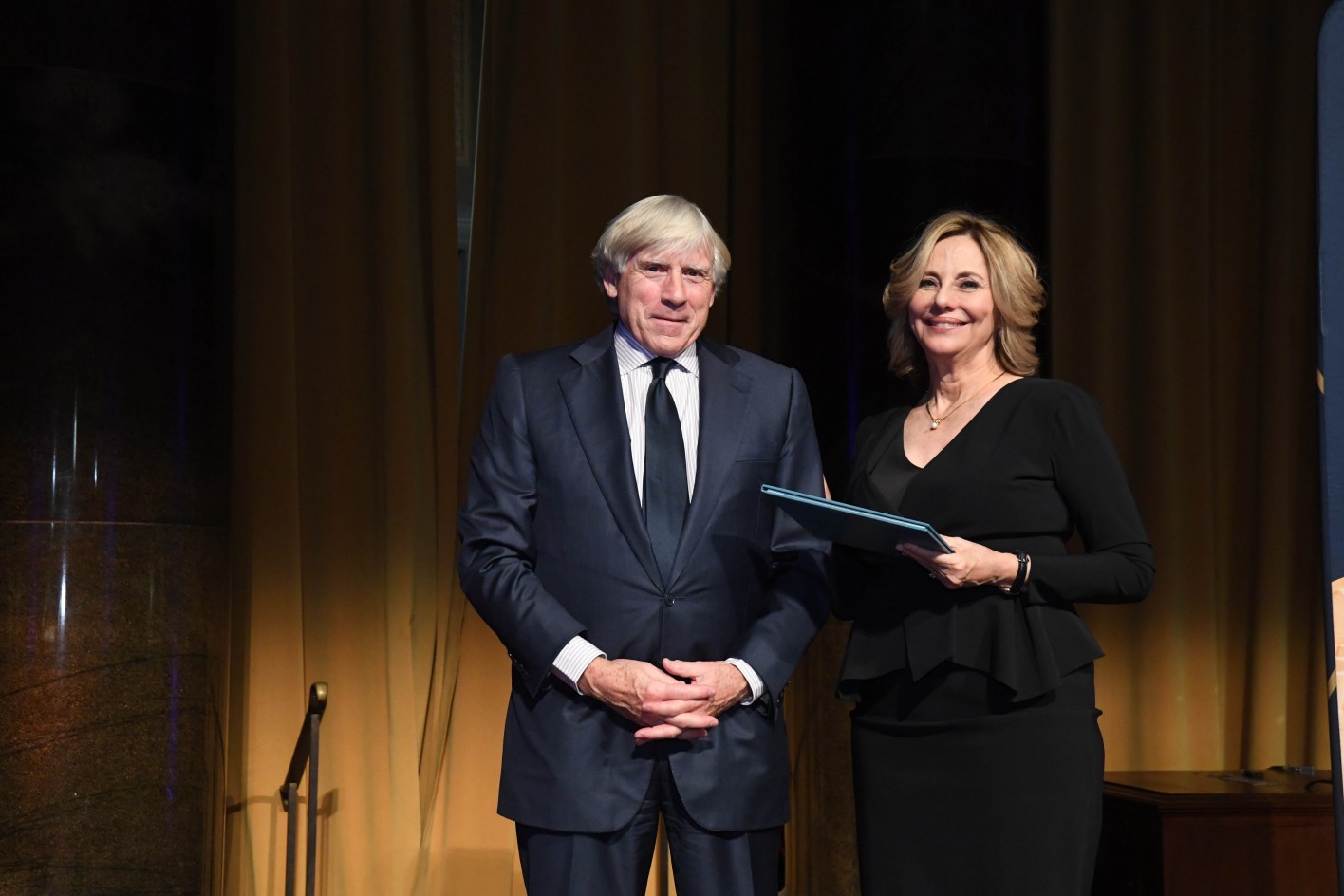
Melinda Henneberger accepts the 2022 Pulitzer Prize for Commentary from Columbia University President Lee Bollinger. (Eileen Barroso/Columbia University)
Winning Work
A 5-foot-9-inch, 250-pound white male accused of sexually assaulting dozens of mostly poor Black women is at large in Kansas City, Kansas.
No need to put out an APB, though, because the suspect, former homicide detective Roger Golubski, who retired in good standing and with a full pension from the Kansas City, Kansas Police Department, isn’t in hiding. There’s no mystery about his whereabouts, right in Wyandotte County, where he’s lived all his life.
In a November deposition in a civil case against him, Golubski mostly declined to answer questions by invoking his Fifth Amendment right not to incriminate himself. He did that a nice round 555 times.
Among the questions he wouldn’t answer were these: Did he have a sideline in selling drugs and “facilitating prostitution” while he was a police detective? Ever get charges dismissed in return for sex? Ever rape a minor in his cop car? Or threaten to harm a woman if she turned him in?
Also this one: “You closed dozens of cases by manipulating witnesses to give false testimony?” And this: “Throughout the 1980s and 1990s, you used your network of women on the streets to provide false information to close your cases, correct?”
Golubski did, however, talk about the four years he spent in a Catholic seminary, studying to become a priest. And noted that though he is so faithful that he kept a prayer book in his police office “until someone stole it,” he never lost sight of how important it is to observe the separation of church and state. (For the record, that’s one line he does not stand accused of crossing.)
He also complained that the department didn’t throw him much of a retirement bash 10 years ago when he left after 35 years on the force. A plate of cookies from Price Chopper is “not my definition of a party,” said Golubski, who is 68. Nor did he get a gold watch. “It must have got lost in the mail.”
He did not go away empty handed; the police department’s platinum-plated gift to Roger Golubski was silence: Roger who? Even now, a department spokeswoman says nobody there knows anything about the allegations against him, though his former partner, Terry Zeigler, only stepped down as chief of police a little more than a year ago.
Women who say Golubski held his badge over them for years are finally ending their silence, though, despite very real fears for their physical safety.
SAID HE GOES DRINKING WITH DISTRICT ATTORNEY
One such woman, who also gave a deposition in November, testified under oath about meeting Golubski when he arrived at her home, along with a bunch of other Kansas City, Kansas police officers, early one morning in 1999.
Her sons were marched to a squad car, and while other officers searched her home, Golubski never left her side. “I asked him questions about what was going on. He was too busy looking at me, staring at me, telling me how nice I looked and that I had nice legs.”
And how did she feel about that? “I didn’t feel too good, because they had my sons out in the police car, and I was mainly worried about them and he making all of these side comments about my body. I didn’t like that at all. I thought it was inappropriate.
That was only a preview, she testified. A few days later, while she was “devastated” and “sick” with worry for her boys, Golubski, who was the lead investigator in the case against them, dropped by again.
And once again, “I was talking about my son. He was talking about my legs and how a friend he can be to me … He said he can help me out with my kids. He said he knew the D.A. because they are friends and that they go to the bar.”
She was scared, as he “kept moving close to me. I really didn’t know what he was going to do until he put his hand on my leg and I slapped it off. And then he said he can really help me out, help my sons out. And then he put his hand back. But that time, he pushed the hands all the way up under my skirt … I asked him what was he trying to do. And so I stood up. He stood up. And next thing I know, he pushed me on the couch and unzipped his pants.”
Golubski raped her, she said, all the while telling her he wasn’t going to hurt her and that it would be over soon. When it was, he wiped himself off, took the roll of paper towels he’d used to do that with him, and left. “I was sitting there crying, and he didn’t say nothing.”
This happened many times, she said, and no, she never called the police. “He was the police. What was I going to say — this policeman just raped me?”
On one occasion, she testified, Golubski told her that his partner, Zeigler, had come with him and was waiting in the car outside. The former police chief did not respond to multiple messages from The Star seeking comment, and Golubski’s lawyer declined to comment.
Her account of being targeted when she was most vulnerable is not unlike the story of another woman I interviewed months ago, Teresa Randolph, who said that on the 2008 night that a SWAT team came to her home to charge her father in a fatal shooting, Golubski made his way to her bedroom and closed the door behind him. “I was in my bedclothes, he was sitting on my bed, and it felt almost violating, very uncomfortable.”
Then and in a number of later phone calls, she said, he told her he could help her father if she’d meet him alone. “I always suggested that there would be another party there, and he said, ‘I’ll call you another time.’’’ The last time they spoke, “he got angry with me and said I was too educated for him.”
HELPED SEND INNOCENT LAMONTE MCINTYRE TO PRISON
What Golubski is really accused of is playing God in Kansas City, Kansas, for decades, stealing from some and giving to others, behaving violently with some women and buying groceries for others. Sometimes, his accusers say, he offered carrots like help getting a new apartment in return for testimony, while at other times threatening women that their children would be taken away or that the men in their lives would be sent to prison if they didn’t do as he said.
The case that’s finally bringing all of this to light started with Lamonte McIntryre, who served 23 years in prison for a 1994 double murder that he didn’t commit, and that Golubski was in charge of investigating. When the former detective was deposed, it was as part of the civil case being brought by McIntryre and his mother Rose, who has said in sworn testimony that Golubski sexually assaulted her and framed her then-17-year-old son when she refused to continue being coerced. In Golubski’s legal answer to the suit, he has denied any wrongdoing.
Behind all of the corruption that he’s accused of getting away with for so long was the assumption that no one was ever going to believe the word of a bunch of powerless Black women over a man with a badge and a gun, who by the time he retired had risen to the rank of police captain.
But it’s long past time for their stories to be told, listened to and acted on.
If even one of them is true, why is Roger Golubski still walking around free, glum that he didn’t get a better send-off from the job? When is the FBI, whose investigators have been interviewing those who’ve known him off and on for years, finally going to do something?
Is no one in the Kansas City, Kansas Police Department at all curious about the extent and the impact of these alleged crimes? Or the potential abuse of power by those who were supposed to be protecting the community? If not, what does that say about the culture of the department, not just then but now?
Is no one in authority willing to take a second look at Golubski’s old cases? Or worried about how they’ll ever have any credibility until all of the facts are known and acknowledged?
It was Roger Golubski who inspired the Kansas law that spelled out that cops can’t have sex with anyone they’ve arrested or detained. In his honor, such as it is, the state should also change the statute of limitations on rape so that even a case from, say, 1999, could be prosecuted.
In the past, Zeigler has suggested that any allegations against his former partner and the department that he until recently led are old news. They are not. And until they’re addressed, what has changed?
Officials can continue to plead ignorance, but at a terrible price, and not only for those whose trust wasn’t so much betrayed as it was never allowed to grow. There is no statute of limitations on complicity.
“The hurt comes from them treating her like a piece of garbage” whose murder wasn’t worth even trying to solve.
The common denominator in the murders of six Black women who were killed in Kansas City, Kansas City, Kansas decades ago is that they all had a close connection to Kansas City, Kansas homicide detective Roger Golubski.
Five had been blackmailed, bribed or otherwise coerced into sexual relationships with him, according to their friends and relatives. The sixth had only been seen around with him.
Think about that: Wouldn’t any other man who’d been having sex with a series of murder victims be a suspect in their killings? Or at a minimum, someone the cops would want to talk to? That he was also the investigator in some of these cases is wrong on its face.
And is that why five of these homicides were never solved? Because here’s what happened after these women were murdered: in most cases, nothing.
Was the Kansas City, Kansas Police Department covering up for Golubski, or did they just not care?
If you were one of “Golubski’s girls,” as activist Khadijah Hardaway calls the women he exploited, you were already in deep trouble. Like others he is accused in a lawsuit of pressing into service sexually and as informants, these were all women who had become addicted and were working as prostitutes.
Conveniently for the guilty, there was no public outcry when they disappeared. A line or two in this newspaper announced that their bodies had been found mutilated or strangled or shot.
Golubski’s attorney, Morgan Roach, did not return messages seeking comment for this column, and the KCKPD says they don’t talk about ongoing investigations, which since there’s no statute of limitations for homicides, these technically still are. If they were really ongoing, you’d think police would have turned up something after all these years, wouldn’t you? But then, the dishonesty of pretending these are active investigations is so obvious that it isn’t intended to fool anybody.
We know these murders were never properly investigated because those closest to the victims were never even interviewed about possible leads. So their families still have no answers, and Roger Golubski is still walking around free and collecting a pension.
The FBI is now investigating at least one of these homicides, and the Wyandotte County District Attorney should reopen the cases of every one of these women, who were powerless but not unmourned.
‘TREATING HER LIKE A PIECE OF GARBAGE’
The body of Gloria Montgomery’s 34-year-old sister, Diane Edwards, was found decomposing near a landfill off Interstate 70 on October 9, 1997. “The hurt comes from them treating her like a piece of garbage” whose murder wasn’t worth even trying to solve, says Montgomery. “She was still a person.”
A sweet person, those who knew her said, who adored her two children and hated the drugs she was always trying to quit. In the Wyandotte County jail on prostitution charges two years before she died, she sent worried notes to officials begging for access to a phone, so she could check on her kids. She also asked for a Bible and a birthday card she wanted to send. That may be the only written record she left behind.
What was left of her body was found in some weeds by a man who’d stopped by the side of the road to relieve himself. Only five minutes after the dispatcher put out the word about the discovery of Edwards’ then still unidentified body, according to a police report, Golubski was the first officer to arrive on the scene.
Her autopsy was conducted by Erik K. Mitchell, whose forensic mistakes contributed to the wrongful convictions of Hector Rivas, who died while waiting for a retrial after his conviction was overturned, and of Pete Coones, who died this February. In November, Coones was released from prison after serving 12 years for a murder he did not commit
In the summary of his autopsy of Diane Edwards, Mitchell said the “configuration of the body at the scene and scene information are compatible with a probable sexual assault and a homicide, most likely by asphyxial means” a month or maybe two earlier. In other words, who knows.
Montgomery called police many times over the years to see what police had learned about her sister’s death. The investigation is ongoing, they kept telling her, and only Roger Golubski could talk to her about it. The one time she got him on the phone, he said he would come talk to her before he retired, but that never happened. The next time she called, he had already gotten his goingaway party. That was in 2010, 13 years after Diane’s death. In all that time, they’d never told her a thing. Or asked her anything, either.
Edwards’ ex-husband, Allen Young, Sr., who had remained friends with the mother of his children, had filed a missing persons report a month before her body was found. He told me that not long before her death, she had talked to him about being abused by a boyfriend. “One day when she came over, she had burns on her neck, choke burns.”
When she was found dead, “I slightly thought that her boyfriend may have had something to do with it.” That boyfriend disappeared after her murder, but police didn’t want to hear about that, Young said. After detectives came to tell him they’d found her body, “we never heard from them again.”
Diane had also told her son, Allen Jr., who last saw his mother on his first day of fifth grade, that her boyfriend had “attempted to kill his last two women. I’m 12 and I wanted my mother’s murder investigated, but they never looked into it. I do feel like (Golubski) is the one who covered up. Once they came by and said she was gone, we never seen them again. They never talked to any of us again.”
An investigation by someone she’d been seen with when she was alive, as Edwards had been seen with Golubski, has a builtin conflict.
And an investigation that doesn’t ever get around to asking the victim’s loved ones about the man who’d been abusing her and then had disappeared? That’s no investigation at all.
Her remains were identified by “one post-mortem print” that was “of sufficient quality for entry” into the Kansas Bureau of Investigation’s database, according to her autopsy. Her son had heard they’d IDed her by dental records, but he didn’t think that could be right, since “I don’t know she had any dental records.” A life can’t just be erased without any follow-up at all, can it?
Yes, as it turns out.
‘GOLUBSKI WAS DRIVING THE CAR’
Another murder victim involved with Golubski was 39-year-old Rose Calvin, whose family had often seen her with the police detective, and had heard her talk about what a bad guy and dirty cop he was. When her body was found, in July of 1996, Golubski wouldn’t let her relatives see her body, and told them it was badly decomposed, which was not the case. They knew it couldn’t be, since her niece had seen her alive only the day before.
Should a cop who’d been involved with the victim have had anything to do with her case? Absolutely not, yet Golubski was assigned to investigate hers, along with two other detectives.
Another such victim was Rhonda Easley Tribue, whose 1998 death the FBI recently announced that it’s looking into. The last time Tribue’s friend Niko Quinn saw her alive, she said she was going to meet Golubski.
“She was on my porch and we were sitting there talking and I put some finger waves in her hair that day. Then she said, ‘Well, I’m about to go meet my trick.’
As she walked up the street and around the bend, just out of sight, a detective car drove by her house. “Golubski was driving the car. I seen him.” Just a few seconds later, he came back down the street. When he drove past Quinn’s house again, there was someone in the car with him.
The 33-year-old mother of six was found dead early the next morning, on Oct. 8, 1998. An autopsy showed Tribue had died from multiple blows to her head and extremities. It also said her body may have been dragged. Her murder was never solved, either.
Just as Golubski allegedly made a habit of putting KCK prostitutes to work for him, Quinn made a habit of trying to look out for them: “I gave them shelter.”
Tribue’s death was an almost exact repeat of 26-year-old Monique Allen’s on January 10 of 1998. Monique, too, had been at Quinn’s house, to change clothes before meeting her trick. “I saw the detective car come by” and saw Monique get in. The next day, she was found bludgeoned to death. Quinn didn’t see who was driving that time, or know who she was meeting, but she did know that Golubski was one of Monique’s regulars. Again, no one was ever arrested.
When Niko’s own sister, Stacey Quinn, who she says Golubski had started raping when she was still a teenager, was found shot to death at age 32 on January 16, 2000, it was Golubski who interviewed witnesses and Golubski who came to inform the family, along with other detectives. After all the times his car had been parked at her place, and all the times Stacey had told them that he was not just a devil but the Devil, he still laughed at another detective’s crack that hey, on the bright side, if she’d lived, she “would have been a vegetable.”
When Golubski showed the Quinn family a photo of Stacey’s body and asked them to identify her, “We all said, ‘You know who she is because you used to mess with her!’ And he said yeah, but this is procedure.” Her family never believed that Marcus Washington, the young man convicted of her murder, had been responsible, at least not by himself. A woman who had just turned 100 told police she’d seen her hopping around in the middle of the street screaming for help, but decided against opening the door. Stacey left one shoe in the street, and because this was not a fairy tale, died on the woman’s lawn after being shot 17 times.
WHAT NIKO QUINN SAW
The night before 30-year-old Liza Michie’s body was found, February 3, 2004, Niko Quinn saw her out walking in the snow. They were good friends, too. “She’d come and hang out at my house, take a shower.”
That night, “I turned around to get her,” but someone else had gotten there first. Not two minutes after yelling at her to ask what she was doing out tromping around in that weather, “I turned around on 32nd and saw the detective car come past me. I went back to go get her and footprints were there and she wasn’t.” When they did find her, she’d been shot in the head.
Natasha Hodge, who was also working as a prostitute in KCK then, said her friend Michie had admitted when she was drunk one night that she’d gotten mixed up with Golubski, too.
Hodge says Golubski was never violent with her; in fact, she saw him as almost a friend, since he never hit her and always paid her, both for sex and for information. But looking back on all of the murder victims he was involved with, “that’s scary I was alone with him so many times.”
Maybe the violent deaths of all of these women had nothing to do with their connection to Golubski. Maybe the fact that no one cared enough to investigate their murders was just more of the disrespect with which they’ve lived and died.
But others besides Quinn must have seen some of these women in their final hours, and anyone who did should step up and say so. Maybe no one was listening before, but they are now. The FBI wants to hear from you, and so do I.
The way these murders were handled was at a minimum criminally negligent. As Diane Edwards’ sister Gloria Montgomery says, “She was still a person.” She and the others were still mothers and sisters and daughters and friends. And we still, urgently, even if these murders did happen a long time ago, need to know what Roger Golubski and others at the Kansas City, Kansas Police Department know about how they died.
Was everyone in the KCK police department just accustomed to women screaming behind Roger Golubski’s office door?
She's an Air Force veteran, like both of her parents and her two sisters, with a brother who went rogue and joined the Marines. But her PTSD has nothing to do with her service. At 44, she is a woman still so shaken by an encounter with former Kansas City, Kansas, police detective Roger Golubski in his office at police headquarters in 2004 that she started having trouble breathing as she told me about it.
“I had just moved here,” to Overland Park, said the woman, who because Golubski told her she’d wind up in the morgue if she ever said anything to anyone, does not want her name in the paper.
She’d just started dating a fellow veteran who lived in KCK at the time. One weekend early in 2004, they were hanging out at his place when an ex-girlfriend of his, who lived right across the street and was maybe not that much of an ex after all, came over in a fury. They called the police, who when they arrived, assumed that her boyfriend was the one responsible for the cuts on her face and chest.
When she followed the officers outside to tell them that no, that’s not what had happened, they arrested her, too. “The officer slammed me on the hood” of the patrol car, she said, and “put handcuffs on me for obstruction,” but only held her for a few hours.
Several days later, she got a call from a Capt. Golubski, who told her, “I saw your mugshot and you are gorgeous.” She needed to come down and take care of some paperwork, he said. “I’d never been in any trouble before and didn’t know how anything was supposed to work,” even if she did know that cops are not supposed to be checking out mugshots and then swiping right.
When she got there, she said, Golubski told her right away that the woman who’d cut her had already been down to talk to him about pressing charges against her. But not to worry, he said, because since she was the prettier of the two, he wouldn’t be filing that case. As a homicide detective, there was no legitimate reason for him to have been involved in the matter at all.
Then, “he takes me into his office, closes the door and turns into a different dude, rubbing on himself” and demanding, ‘Kiss me!’ He snatched that mask off his face so quick it was like his face dropped six inches.’’
Then “he pushed me up against the door” and was suddenly all over her, she said, attempting to “do it right there,” at which point, “I lost it. I got loud because I got scared — hysterical, screaming, kicking. Everyone had to have heard me. I know my head hit the door a couple of times.”
WOMAN SCREAMING BEHIND DETECTIVE’S OFFICE DOOR
Finally, someone on the other side of the office door banged on it a few times, as if to say, “Knock it off,” I guess like I used to do with my New York neighbor who liked to bounce his basketball off our common wall at all hours. Was a screaming woman in Golubski’s office such a minor irritant — such a “not this again” non-event — in the KCKPD that pounding on the door a few times while strolling on past actually seemed like the right response?
If we could just freeze the action right there for a minute, I can’t tell if this is a police station or the worst frat house on campus. What kind of police can’t or won’t hear the panicked screams of someone in trouble in his own office?
All of those big-cheese KCKPD officials who’ve claimed never to have had any inkling about this man’s many alleged victims must be the most clueless cops in history. Or would be, if they were telling the truth.
And c’mon, if they weren’t worried about scrutiny of their own actions, rather than only Golubski’s, they would have called for an independent audit long ago, and going forward promised a no-tolerance view of alleged serial rapists who’ve investigated the murder of the multiple Black women they happen to have been exploiting, sexually and otherwise.
Hello, Department of Justice, civil rights division, we’ve got a situation you really need to look at here, and I don’t mean through the FBI investigation that’s gone on, off and on, for years, not only moving at the speed of a glacier but melting like one. This is not the first, second or third Black woman I’ve talked to who’s said Golubski stalked, harassed and threatened her, always after the same, “You’re so pretty” line failed. How many would be too many?
I’m sorry to say, I haven’t seen either Gov. Laura Kelly or U.S. Rep. Sharice Davids say boo-hiss about any of the above, either, I guess because that’s how Democrats get and hope to stay elected in Kansas, even if taking a stand for a community that’s been treated like throwaways, no matter who cries about it, is seriously underrated.
But, back at KCK police headquarters in early 2004, “A whole lot of people saw him take me in that office, and they did nothing” beyond that knock, she said. Just that, though, was enough of an interruption for her to break free and get the door open. “Now I’m rattled,” and Golubski is telling her that if she ever says a single word to a single person, they’ll find her body and call it an accident.
Then, in another 180, he’s calmingly telling her what a “good girl” she is, as he walks her, still reeling, to the office of Kansas City, Kansas, lawyer Reginald Davis, who was then the municipal prosecutor, working in the same building.
Davis remembers him walking her in, and asking him to dismiss her misdemeanor ticket, which he did. He didn’t notice that she was in a panic, he said.
For many months after that, Gobubski called her and said he could still send her to jail any time unless she went out with him. “It was a nightmare. I thought it would never be over.”
It only ended when her father, who is white, called Golubski and told him to back off.
“The whole thing was messed up,” her father told me. “I called and told him I didn’t appreciate it. He kept saying she was the one instigating things, and I was like, ‘Everybody needs to stay professional.’… He agreed to leave her alone and he did, thank God.”
PROSECUTOR HAD 'VERY SPECIAL' RELATIONSHIP WITH GOLUBSKI
When I called Davis, who is in private practice now, and asked what he remembered about Roger Golubski, he said they’d had a “very cordial relationship.”
Then, before I even mentioned the woman who’d reached out to me, he volunteered that two moments really stood out in his mind. One, he said, was when Davis saw “a very attractive African American female I used to always try to hit on” in his apartment complex coming out of her place with Golubski.
And then there was the time Golubski “brought a very attractive woman to me and I tried to help her” by dismissing her ticket, as Golubski had asked him to do.
As to why a homicide detective had anything to do with this made-up, minor case, he said he had no idea. “I don’t know why he was involved in this misdemeanor ticket.” But, he said again, “It’s not unusual for prosecutors to dismiss cases at the request of police officers. … I assumed he was dating her or she was helping him with a case, so I said yeah, no problem.”
“Captain walked her into the prosecutor’s office. I was under the impression he knew her. He introduced her as a good friend, and I read between the lines. Was she a very attractive woman? Strikingly, so obviously, I made a pass at her. I was single. I remember driving to her mom’s house” and they went out on one date.
Golubski “kind of encouraged me to see about going out with her. He said she was a good girl.”
In the years since, the woman telling this story said, she’s often had a recurring dream in which she’s being forced off the road by police officers trying to make her death look like an accident. Several times when I was talking to her about this experience, she started to hyperventilate and had trouble catching her breath.
“I can’t breathe,” is of course what George Floyd said in his last moments alive, as Minneapolis police officer Derek Chauvin kept his knee on his neck. It’s what an unarmed 15-year-old Black kid in Kansas City, Missouri — who was never charged with any crime, by the way — cried six months before that, as an officer kept his knee on the back of his head on the pavement in front of a local Go Chicken Go restaurant.
But it’s also the effect that Golubski and his colleagues, who at the very least decided not to hear a woman screaming in their own office, have had on an entire community.
It’s the effect that he and the department that is covering for him and others still — Roger who? — have on that community even now. If he doesn’t know where bodies — real bodies; that is not a metaphor — are buried, then why do they continue to wrap their arms around an accused serial rapist whose “girls” kept winding up dead? Neither Golubski’s lawyer nor a spokeswoman for the KCKPD returned calls seeking comment.
‘USED HIS LEVERAGE AS AN OFFICER TO OBTAIN SEXUAL FAVORS’
The woman in this story called me because she’d read my last report on Golubski and felt she couldn’t in good conscience fail to step forward, even as she also felt she was putting her life in danger by doing so. “I don’t want anyone else to ever feel like I felt.” If she can take that risk, do you think maybe some of you non-criminals in the KCKPD might someday speak up? No, right?
So far, only a few have done so. They include the late Ruby Ellington, a 25-year veteran of the department who swore in a 2015 affidavit that everyone in the department knew about Roger Golubski, with whom she’d trained at the police academy.
“Golubski used his leverage as an officer to obtain sexual favors” from women in trouble, she said under oath. “Golubski’s misconduct and his exploitation of Black women was well known throughout the Department. Despite this, he was never punished. In fact, he rose steadily through the ranks and became a powerful detective and, ultimately, a captain. … If a Black female had any kind of criminal charge or other legal problem, Golubski would use that as leverage to get what he wanted.”
But Ron Miller, who was chief of police in 2004? He didn’t know anything about anything, apparently. He said in a 2012 deposition that Golubski was a good detective who “had a pretty good network of informants and he was a guy that kind of kept his informants close to the vest.” You could say that.
Asked under oath whether it was true that another KCK officer had reported walking in on him having sex with a witness — not the same woman, but in the same year — he said no: “I honestly at this moment do not recall that happening. I — I — I don’t have any knowledge of that at this moment. … I don’t recall that. I mean, I don’t. If I did, I’d certainly tell you. There would be no reason for me not to tell you. … You can’t assume the chief knows everything. … I do not recall ever knowing that before you said it.”
Rosie McIntyre, the mom of Lamonte McIntyre, who served 23 years for a double murder he did not commit, after an investigation run by Golubski, has sworn under oath that he sexually assaulted her in his office, too, years before wrongfully arresting her son to get back at her for refusing to ever see him again. Another officer walked in on them as he was attacking her, she’s said. But of course, no one knew anything about that, either. In 2010, Golubski retired in good standing with a full pension he’s still drawing.
Asked, “Did you ever have anyone share with you Golubski’s reputation, if you will, for his affinity towards African American females,” Miller zigged, zagged, and finally said, “That’s not foreign to me, let’s put it that way.”
And where can we find Ron Miller today? Why, serving as U.S. Marshal, in charge of security for those who would in theory at least be investigating Golubski and his whole rotten department.
SOS, Joe Biden and Merrick Garland. If KCK is still part of the United States of America, please send in the lawyers stat, because the Black people who live there have for decades been left for dead.
If Christina King and Dorothy Cooper had turned up dead on Ward Parkway, would their murders have been ignored?
April King was in the fifth grade when her 26-year-old mother, Christina Ranae King, nicknamed “Cricket” by her family, because she was so tiny, was found beaten to death in Kansas City, Kansas. That was on Christmas Day, 1998.
And from that day to this, the most painful memory associated with the most painful loss of April’s life is what her grandma always said that then-KCK police detective Terry Mast told her when she asked him how the investigation was going. “She got off the phone crying and my grandpa asked her why. She said he told her, ‘She’s just another crackhead off the streets and we really don’t investigate’’’ those homicides. “She didn’t call back no more after that.”
Mast did not respond to my messages or certified letter. One of the most recent posts on his public Facebook page says that some poor guy who’d come through the food line multiple times one day when he was helping his Moose Lodge staff a soup kitchen had reminded him “why I don’t like volunteering, because I don’t understand what this asshole’s gripe was, as a society we don’t owe him or anyone shit.”
Is that why “we really don’t investigate” certain murders? Mast was true to his word to April’s grandmother, Penny Barnett, in any case, because her family never heard another whisper about any investigation.
Barnett died in 2016, but April King is available to receive your apology, Detective Mast. Or better yet, some information about what happened to her mother.
That “crackhead” comment was from another century, of course. But it was just two months ago that Star Cooper heard something all too similar when she called the KCKPD hoping to get them to reopen the investigation into the 1983 murder of her mom, Dorothy Fay Cooper.
Current KCKPD Capt. Rodney Smith, who was sympathetic when Cooper first reached out, called her the morning of March 26th, the day they were supposed to meet, and told her that wouldn’t be happening after all: “He said, ‘My boss said there was no reason for us to open this case. We don’t have any more evidence.’ He got really rude with me after that. He said, ‘I mean, she was a streetwalker. What else do you want us to do?’ ”
Treat her murder like it mattered, maybe? Because that’s a human being you’re talking about, with a family still suffering and still looking for answers.
THE CULTURE THAT MADE ROGER GOLUBSKI POSSIBLE
A spokeswoman for the KCKPD said in an email that “in regards to the comments made to Ms. Star Cooper, we have initiated an internal investigation.’’
Comments like that are no small thing, because they reflect a culture, in 1983 and today, that counts certain people as unworthy of even worrying about. And that culture, then and now, is what made depraved former KCK police detective Roger Golubski possible.
It was the view of the women Golubski preyed on as disposable that freed him to treat them as such, for decades using his badge to help him sexually exploit poor women, most of them Black. At least six women connected to Golubski were murdered, and some of those murders were investigated by him, too.
It’s also why Golubski has never been brought to justice: For one thing, that’s because so many others were complicit in his predations. For another, it’s because more of the public, even now, isn’t demanding his immediate arrest.
Thought experiment: Let’s say young women on Ward Parkway kept turning up dead. And let’s say a bunch of them had been extorted and “messed with” by this one cop, who — and now this would have to be a total coincidence — also wound up investigating some of their murders. Would Kansas City just keep walking, and maybe note that those Ward Parkway women really need to make better decisions? Of course not.
And if these homicides had happened years ago, but had never been solved or sweated, would the consensus be that oh well, that was then? No again. There is a reason there’s no statute of limitations for murder.
‘SOME EVIDENCE WAS MISSING’
Cooper was just a baby when her 20-yearold mother, known as Dot, was found naked and quite inexplicably dead, covered only in mud and grass, on the bank of Turkey Creek in April of 1983.
The autopsy ruled the death a homicide, but also said the cause of death was unknown. Since Dorothy had been missing for three weeks, but according to the autopsy had been dead only a couple of days when she was found, where had she been in the meantime?
If police ever had the slightest intention of finding her killer, why had they dropped off the only piece of her clothing they’d recovered, a denim jacket, at the funeral home, instead of keeping it as evidence?
Star’s grandfather tried for three years to get a copy of the autopsy, and never did succeed. The case was still under investigation, he kept hearing, so that just wouldn’t be possible. But if it was under investigation, why didn’t Dorothy’s family ever get an update on this long-running inquiry?
Star herself called the Kansas City, Kansas Police Department looking for answers for the first time in 2008, and was told that the only person who could talk to her about the case was a Roger Golubski.
Today, that name sets off 19 alarm bells, but it meant nothing to Star when she went down to the police headquarters with her uncle, Oscar Cooper, to meet with him in the summer of ‘08.
Golubski told them he was looking into the killing but “no one is talking. He told me that he went to look for evidence in the evidence closet and some evidence was missing.”
What evidence, he wouldn’t say. “I said you know, as a little girl I always had a dream that a police officer killed my mom. He said, ‘That’s bullshit.’ I said, ‘Who else can get back in your evidence closet to get rid of evidence?’ He was done talking to me after that. When I tell you that man turned red, he turned red. He was pissed that I said anything like that.”
‘HOLD ON, MY BOSS WAS ON THIS CASE’
Her uncle, Oscar Cooper, told me that once his niece mentioned her dream, “he was really on fire, like y’all need to leave.”
Oscar had been living with his father, his sister Dorothy and her two small children when she went missing. He went with his father to a police station in KCMO, where they lived, to report that she hadn’t come home. They refused to take the report, though.
“They said they couldn’t until it had been 24 hours. It had already been 30 hours, but they still wouldn’t take it. I don’t know why.”
Oscar had seen his sister at a party on the night she disappeared, but no one ever wanted to hear about that, either during the horrible weeks she was missing or the even worse days and years after her body was found.
Dot was working as a prostitute then, her daughter said, “but she still came home every night to make sure my brother and I were in bed,” so her family knew something was seriously wrong when she didn’t.
April King says of her mom, “I know she was known to be a prostitute; she had just been released from jail the day before” some metal scavengers found her body in the driveway of an abandoned nursing home at North 27th Street and Sewell Avenue. “After my dad went to prison, she gave up. From what everyone said, she was a good person, and she lived on the streets.”
The desperation of Christina King and Dorothy Cooper’s circumstances in no way diminished all that these women were to those who loved them. Nor did it make their murders any less illegal. But one detective, officially or not, seems to have been the point man on all of these killings, and why was that?
Oscar Cooper is just shy of 100% sure that Golubski was the officer who came to the house to tell them about Dorothy’s murder. And if Golubski wasn’t involved in the investigation, why could Star Cooper and her uncle only talk to him about it?
After Star read a story I wrote about Golubski a couple of months ago, “it touched me so much that I went down to the KCK police station again. It felt like you were talking about my mom.”
The lady at the desk said she would have to talk to Capt. Rodney Smith.
She called him a few times, and when she heard back, found him solicitous. “He said, ‘I’m all down for you. I don’t care who it was. If it was a police officer or someone on the streets, I want to help.’’’
Later, “he’s looking over the files while I’m on the phone with him and he said, ‘Hold on, my boss was on this case.’ He said he’d have to talk to him to see if it was worth opening back up.”
Then, on March 26, she heard back that no, it wasn’t worth opening back up.
WHY HAD ONE OF DOROTHY’S HANDS BEEN CUT OFF?
One of the many questions the Cooper family has is why, at the funeral home, they saw that one of Dorothy’s hands had been cut off.
Was she found that way, Star Cooper asked coroner Alan Hancock, back in 2008? He told her no, he’d done that during the autopsy, because he needed to get her fingerprints. Hancock, who is dead now, didn’t even do the autopsy, though he did sign it.
The autopsy notes adhesions on her wrist, and her family wonders if maybe her hand was cut off to hide that she’d been handcuffed during the weeks she was missing.
But then, they’ve been left to wonder about lots of things, because police have never treated them like they were worth taking seriously, either.
Star Cooper is 39 now and the mom of six, including three foster kids she adopted. After her mom died, she and her older brother bounced around between relatives. “I was molested as a little girl, and no one ever believed me. Life for me growing up, it was hard.”
Just this last year, she got a headstone to mark the grave of the mother she doesn’t remember, but has missed all her life just the same.
And for her, her mom’s case is still open, whether the police department ever looks at it again or not.
“She did report it, and she took them there, but the evidence just kind of disappeared, and nothing, nothing, nothing was ever done.”
No one can claim that Natasha Hodge, who turns 45 today, on June 27, has breezed through life. She was abused as a child in Kansas City, Kansas, and after she ran away at 16, she was abused during her years on the street.
Since 2009, she’s been an inmate at the Topeka Correctional Facility, where she was sent after fatally shooting the “longtime boyfriend” who routinely hit her with lead pipes and brass knuckles. He burned her with crack pipes, smashed beer bottles over her skull, bit chunks of skin out of her back and threatened to burn down her mom’s house with her kids inside if she ever left him. He “was a different person when he was using crack,” she said in an affidavit. “I have no doubt that he would eventually have killed me.”
“That man beat me, threatened me, stalked me, raped me,” she said during one of our phone interviews over the course of the last year. “His favorite thing to do was to beat me up and force me to perform oral sex on him. He was vicious, and I do not regret killing him. I just regret coming to prison for 12 years.”
The public defender who represented her told her to take the prosecutor’s offer of 15 years and be grateful, because a jury would have given her 50. He was probably right about that, too, because for women who kill their abusers, very little has changed.
Yet Hodge’s single worst experience, she says, and the one that she still has flashbacks and nightmares about, was her rape by a KCK police officer who never took his hand off his gun as he forced her to service him in a vacant crack house near the railroad tracks off Quindaro Boulevard. In a 2014 affidavit, she said that “In February of 1996, I was raped by Officer William Saunders of the Kansas City Kansas Police Department.”
He never uncuffed her, she told me, and “the whole time he was raping me I was crying my eyes out thinking will I see my daughter again? I really thought he was going to kill me, and I kept wondering how long it would be before they found my body.”
When he instead dropped her off on Fifth Street afterward, as if nothing had happened — and please put me down as skeptical that anyone who would do this once did it only once — she walked straight to the nearby office of a local attorney she’d heard of, Rosie Quinn.
Both Quinn and Hodge, who haven’t talked since 1996, told me the same story.
CONDOM EVIDENCE IS ‘DNA ON A SILVER PLATTER’
Quinn immediately took Hodge to the hospital, where they did a rape kit, collecting her clothing and scraping under her fingernails. Then they went to the KCKPD’s internal affairs department, where Hodge told a female detective the whole story and picked Saunders’ picture out of a photo lineup.
From there, Hodge led that detective and a crime tech team back to the house, where they found Hodge’s nose ring and the officer’s boot prints still in the carpet. They found the condom he’d tossed into the snow out in the front yard, too, just where Hodge had said it would be.
The detective, who Hodge says told her that there had been other such complaints against that same officer, “didn’t seem surprised.”
The universe of rape victims who both report immediately and lead police to a mountain of physical evidence is not vast. “They had his condom with semen in it,” she says. “That was DNA on a silver platter.” Yet no one got back to Hodge, then or ever. And can you imagine authorities treating a crime victim for whom they had even the slightest regard so dismissively?
In response to my questions about what happened after Hodge accused Saunders of raping her, a spokeswoman for the KCKPD answered via email: “Regarding the case of Natasha Hodges,” — and yes, they misspelled her name — “the allegations were investigated in 1996. Forensic evidence was submitted to the Kansas Bureau of Investigation in March of 1996. That same year the case was forwarded to the Wyandotte County District Attorney who declined to prosecute.”
The DA at the time was Nick Tomasic, who held that job from 1972 until 2005. When he retired, The Star ran a tribute in which the police chief at the time, Ron Miller, praised him as a respected supporter of law enforcement.
Saunders didn’t answer the messages I left on his cell phone, and neither did the now 88-year-old former DA.
I’ve reported before that the KCKPD culture made a predator as prolific as former KCK police detective Roger Golubski possible by responding to crimes against poor Black women like Natasha Hodge as unworthy of any real investigation. That the DA’s office wouldn’t have been interested in prosecuting a cop on charges that he raped a woman working as a prostitute is as unsurprising as it is unjust. In fact, the thunderbolt here is that the KCKPD says they did turn the evidence over to the KBI, who did refer it to the DA for possible prosecution.
LAWYER CONFIRMED DETAILS OF ATTACK BY POLICE OFFICER
The lawyer Hodge hired not an hour after being raped, Rosie Quinn, volunteered many of the same details that Hodge had.
“My understanding was that the police had gone back there and found a used condom,” Quinn said. “There was a police report made and it was that guy Saunders. It was a police matter, and there were officers who told me they’d retrieved” evidence from the scene. “It did happen.” But, she said, “I do not know what became of it.”
What became of it is that prosecutors were so blasé about this attack that no one ever thought to inform Hodge that they weren’t going to pursue the case.
And the message that had to have sent to someone like Roger Golubski, who is accused of raping many women on the street, was this: Help yourself. A cop would have to be awfully confident that he was immune from prosecution to toss a DNA sample in the yard in front of a crime scene, in full view of his victim.
It was years later, in 2007, that Hodge first met Golubski. “He said he was canvassing the neighborhood because someone had been murdered. I said I didn’t have any information about who he was looking for, and he asked me for a date.” After that, she says, he paid her for sex from time to time.
Unlike those who’ve told me they had reason to fear Golubski, Hodge in those days saw him as “what a working girl would consider a ‘good trick’“ because he never beat her or tried to get out of paying.
But the victims I’ve interviewed all say that Golubski was not the only KCK officer who used his badge as a weapon against vulnerable women.
FBI AGENTS DIDN’T RETURN CALLS AFTER INTERVIEW
In February of last year, Hodge was interviewed by two FBI agents whose business cards she kept. They asked her about Golubski and about her rape. They were going to get back to her in 30 days, she says, but still haven’t, and never returned her calls, either. The feds have been interviewing KCKPD victims on and off since the 1980s.
Hodge told those agents, just as she told me, that early one morning in February of 1996, she was sitting in a U-Haul at a gas station on 18th Street with her friend Chuck. The sun had just come up, and her friend, who was moving some furniture that day, had gone inside to pay for the gas and get some food. “I was gone when he came back.”
An officer tapped on her window and said he’d gotten a complaint about a prostitute on the lot. I’m just sitting here, she told him, waiting for my friend. He handcuffed her, forced her into his patrol car and shouted to another officer outside the store that he was taking her in.
She knew right away that she wasn’t being arrested because he did not radio in, did not check her warrants and did not take her to the station. “He never asked me my name,” and stayed terrifyingly silent when she asked him where he was taking her.
Hodge told her mother, Vonya Ford, about the rape several days after it happened. “I still don’t like to talk about it,” Ford told me. “She was just a kid! She did report it, and she took them there, but the evidence just kind of disappeared, and nothing, nothing, nothing was ever done.”
She saw her attacker once more, years later, one night when he was sent to her house on a domestic violence call. “He didn’t recognize me, but it was like looking into the eyes of the devil.” Better the devil inside the house than the one at the door, she decided, so “I made some lame excuse,” and he went away, just as the case against him had.
In prison, “I try to take one day at a time, because anything more is very overwhelming.” Monday through Friday, she works from 6 a.m. to 1 p.m. making shirts, mops, and during the pandemic, COVID-19 masks for the National Guard.
She doesn’t mind that job, because “even days when I don’t like the work, I like the people I work with.”
The prison volunteer who originally told me about Natasha described her as someone who stands out as “very mature and reasoned. She’s reliable.”
Every day after work, she calls her mom, who is raising the younger daughter she’s so proud to say is going to college in the fall. Then she watches ”Ellen” — “that’s my girl — and I go outside sometimes, but I really don’t care for the heat. I have exactly three people I consider real friends.” Otherwise, she stays to herself, counting down her time.
And paying for her crime, such as it was, having long since decided that the officer who violated her would never pay for his, just as Roger Golubski hasn’t, and maybe never will.
Her former attorney, Rosie Quinn, also spent time in prison — three years, for tax evasion. At the disciplinary hearing at which her law license was reinstated, Quinn testified that that happened because of a gambling addiction for which she has been in recovery for many years. The same month Quinn was indicted, in June of 2009, her law office in KCK burned to the ground.
And William Saunders, who goes by Ed? He’s 62 now, and after finishing out his career at the KCKPD he retired to Florida, where a palm tree and some well-tended flowers grow in his front yard.
WILL NEW KCK POLICE CHIEF REOPEN CASE?
On the phone the other day, I told Natasha that this column was almost ready to go and for the first time in the year that I’ve been talking to her, she started to cry. Because after 25 years, her story was finally going to be out in the world. “It needs to be done,” she said, “because there are other victims out there.”
There are many others, still unheard and unheeded. And other perps, unpunished and collecting a public pension.
The Kansas City, Kansas Police Department just got a new police chief, Karl Oakman, who said last week that he’d like to start a new division to look at old cases. Which is wonderful news. To show the community that this really is a different day, they could start by going back and looking again at reports against police officers. The DA’s office should do that, too.
The KCKPD spokeswoman did not answer my question about whether the evidence in Hodge’s case has been preserved. But since 2013, there has been no statute of limitations on rape in Kansas. And what Hodge correctly called “DNA on a silver platter” might solve other cases, too.
Can you imagine what it would mean to pursue a 25-year-old case against a police officer accused of raping a Black woman with no resources or connections, who in those days was working as a prostitute? ”All new world” is what that would say. One in which justice is at least an option, no matter who you are.
Maybe that’s still like expecting the sun to rise in the north and set in the south. But some of those reading this column now know and care about what happened to you, Natasha. Happy birthday.
How many women would have to accuse former KCKPD detective Roger Golubski before they’d be believed over him?
The woman I interviewed recently was not the first to tell me about being sexually assaulted by former Kansas City, Kansas, police detective Roger Golubski.
Neither is she the first to tell me that he’d threatened to kill her — and told her he’d “have something done” to her brother, too, she said — if she reported him.
But she is the first I’ve met who went to the hospital afterward and had a full rape kit done.
In other words, authorities might have had DNA that could prove what he is and does in their possession all along.
The hospital then known as Truman Medical Center, where she got the forensic exam in 1990, typically turns rape kits over to the “appropriate jurisdiction crime laboratory.” It’s not clear where hers would have gone, since this happened in Kansas and the exam was in Missouri. But in theory, anyway, these kits are preserved for 30 years in Missouri and for five years in Kansas. She is working with both Truman and the Kansas City Police Department to get her records and trace the kit. If that evidence still exists, the FBI could prove her allegations beyond any doubt.
Sure, or disprove them. Though why, if there were any question, would this woman put herself in danger by coming forward to announce that there may be DNA out there that would show who and what KCK officialdom has been defending all these years?
She’s 54 now, and is prepared to testify. She is planning to call the FBI on Monday, so agents won’t even have to look for her.
Golubski is accused of exploiting and raping mostly poor Black women, whose male companions and relatives he abused differently, threatening arrest and worse, throughout his 35-year career at the KCKPD.
A lot of time has passed since that 1990 hospital visit, of course. Law enforcement agencies across the country have been found to have violated their own policies by destroying rape kits, in some cases within months of receiving them, without ever testing them.
But if that kit has been preserved, then the years of official amnesia and what certainly looked like foot-dragging to the Golubski victims who talked to federal agents years ago, and never heard from them again, are finally coming to an end.
POLICE LOST FILES, MISPLACED EVIDENCE
Even if they didn’t keep the kit, so many victims, witnesses and even some cops have come forward at this point that I’m prepared to hope that all of the KCKPD’s lost files, missing evidence and “Gosh, I never heard any of this” denials are about to end exactly as they should have long ago. That is, with Roger Golubski in handcuffs and the organization that made him possible declaring moral bankruptcy.
No matter how many times we’re told that if any of this happened at all, it was so long ago that it no longer matters, the truth for victims is that decades of debilitating fear will really only be over when he is behind bars.
So why did the woman who says Golubski raped her three decades ago call me now — as it happened, just a few days before the news broke about the federal grand jury that’s finally looking into Golubski and friends?
“Because my brother just recently passed,” she said. As far as she was concerned, only when he died, in a June hit-and-run accident in California, did Golubski’s threat finally expire.
“After my brother passed, I sat down and had a long talk with God and just told him to give me some answers and help me, and I came to my decision” to report what happened all those years ago, she said.
It took a while for her to follow through, because “I didn’t know if I was ready to be revealed. And I’m still scared, because he’s still out there. I don’t know who he’s still connected to. He has friends in higher places or he wouldn’t still be walking around.” You’d have to be naive to think otherwise, and none of those accusing the former captain has enjoyed the luxury of being overly trusting in quite a while.
Then, in September, she saw my column reporting rape allegations against another Kansas City, Kansas, cop. A former police officer said that same officer, Ed Saunders, had also tried to sexually assault her. That even someone “on the inside” could be at risk of sexual violence from a fellow officer got to her, she said.
PICKED UP IN POLICE CAR FROM KCK PARK
So finally, two weeks ago, after a lot more thought and prayer, she called me, and recently, we met for breakfast near the factory where she works.
Golubski raped her, she told me, when she was 23 and living with a boyfriend near KCK’s Parkwood Park. One warm night, after she and her boyfriend had argued, she walked out in anger and wound up sitting alone in the park’s pavilion sometime around midnight.
“The next thing I know, Roger Golubski pulls up” in his police car. “He said it was after hours and I couldn’t be in the park. He said he’d take me somewhere safe.”
This is the point in the fairy tale when the wolf still seems harmless to the girl in the woods. Or in the horror movie, it’s when only the audience knows that something not at all good is about to happen.
That started to dawn on her, too, after only a few minutes. “When we were driving, he said he had to make a stop.” After they passed what was then the Church’s Chicken, where J’s Fish and Chicken is now, “we went up 27th past the Delavan Apartments.” Where are we going, she kept asking.
“He ended up turning up some street by these duplexes, and there was some woods and a little field right there. I’m like, ‘What are we doing here?’ And he got out, came and got me out of the back, and told me I had to perform oral on him.
“I’m crying and I’m telling him I don’t want to do that, so then he put his hand around my throat. He choked me and pushed me down in the back seat. He forced me to have sex with him, and then he forced me to perform oral sex, and I’m crying and he told me, after he got done, that if I ever said anything, he would have something done to my brother.”
Though she wouldn’t have known it otherwise, he was so sure he was untouchable that “he told me what his name was, and he told me he could have me killed or arrested if I went to the police, and they wouldn’t believe me anyway. Why would they believe me over him? And after he got through doing what he was doing, the crazy thing is, he took me back to the park.”
MULTIPLE REPORTS ON HARVEY WEINSTEIN, LARRY NASSAR, TOO
I wonder sometimes — as in, every single day — how many women would have to come forward before they would be believed over Roger Golubski. Then I remind myself that 87 women told the truth about Harvey Weinstein before he ever saw the inside of a cell. Fifty women had to complain before Larry Nassar was even forced out as Olympic gymnastics team doctor, and 156 spoke in court before he was sentenced.
Most rapes are never prosecuted. But the terror that this one man with a badge, a gun and no fear of accountability inflicted on an entire community was more the symptom than the cause of corruption on a scale I haven’t seen anywhere else in 37 years in journalism.
Golubski’s lawyers never answer questions, other than to say that they can’t respond. But he did get the opportunity to answer for himself in a 2020 deposition in the civil suit being brought by Lamonte McIntyre, who, thanks in large part to Golubski, spent 23 years in prison for a double murder Golubski had to have known McIntyre did not commit. During that deposition last November, Golubski rolled his eyes, shook his head, and invoked his Fifth Amendment right not to incriminate himself a nice round 555 times.
After he dropped the woman I met recently back off in Parkwood Park, she says, “I walked back home, scared the whole way,” and when she got there, she told her boyfriend “I was raped by two dudes, because I couldn’t tell him the real story. Then I ended up going to Truman Medical.”
After the full exam, which typically takes between four and five hours, nurses called the police. And that’s when she left, afraid that one of the officers answering the call to interview her might be her assailant.
Her then-boyfriend, to whom she hadn’t spoken in years, told me she’d come home that night “hysterical crying. She told me what happened” — though, no, he said, he never was able to get her to say exactly who had hurt her. “I took her to the hospital. She was messed up a little bit.”
DEPRESSION, SUICIDE ATTEMPT IN RAPE’S AFTERMATH
“It affected me bad,” the woman said. So much so that she became seriously depressed and two months later took some pills out of a medicine cabinet in the home on Ward Parkway where she had a cleaning job.
“I ended up trying to kill myself” and was hospitalized for several days. “That it was somebody who was supposed to be protecting me — I trusted him, and got in the car thinking he was going to help me. I go see a therapist right now for that.”
The female friend she immediately told about being raped, though she never said by whom, told me she “was upset and she didn’t want to be alone after that. She was having nightmares.”
That wasn’t the end of the threats from Golubski, either: “I seen him one other time, walking up and down Quindaro, and he told me I’d better keep my mouth closed. I told him I hadn’t said nothing to anybody, and after that, I stayed in Missouri and stopped going to Kansas. I didn’t want him to be able to do that to nobody else in my family, or go after my brother.”
Her view of law enforcement was never the same: “When I grew up, police were nice.” After her encounter with Golubski, “I was scared of every cop I saw. And I’m still scared, because he’s still protected. He has to still have people on the inside.”
That’s why the former KCK cops who talk to me about all of this say things like “People have turned up dead for less here,” than telling the truth about crimes committed by their colleagues.
“You just have to compartmentalize” to survive, another said. “Once you got to a certain point” in the chain of command, that officer said, “it didn’t matter what you did. It’s still scary now, to be honest.’’
With the FBI closing in, Golubski’s “people on the inside” must be scared, too. Because if he ever is indicted, we’ll be hearing a lot more about them.
“This thing is crushing people, and they don’t want me to say anything, but I can’t” stay silent any more.
In 1999, former Kansas City, Kansas Police Department officer Sonny Callahan says, all that the friend who came to his office to talk to him would say is that a colleague of his was raping her, repeatedly, and threatening to have her killed.
This officer, she told him, had promised to help her boys, who’d been arrested. And had told her that if she reported him, her body would never be found: “That made my blood run cold. She didn’t want to say any names because she was afraid.” The case involving her sons “was still active,” and “as a policeman, you have to tread carefully.”
From knowing her, knowing her partner and seeing just how terrified she was, “I believe what she was saying. I believed her 100%.”
At some point — he doesn’t remember when, exactly — he learned that the officer who was terrifying her and others was then-Detective Roger Golubski. And over the last maybe 15 years, the harm that this man was allowed to do to the community, his community, has only grown clearer to Callahan, he said.
Callahan is Black, and so are most of the women whom Golubski is accused of raping and exploiting in all sorts of other ways, all the way back to the the 1980s.
The rumor, Callahan said, had always been that “he was fooling with a bunch of Black women.” Talk didn’t make it true, of course. But with Golubski, the talk just never died down. “His thing kept going and kept going.” Because it wasn’t just talk. “It was a house of cards.”
“It’s a jacked up environment, kiddo.” So much so that at first, “you can’t wrap your mind around the extent of what these women are saying.”
And even when you do come to see what’s happening, he said, “Who you going to go fuss with? Who’s going tolisten? You don’t know who you're talking to. So you just sit there, and it’s almost like, as long as you don’t put your hands on me, it’s cool. And that’s ridiculous.”
FORMER OFFICER SEES FBI INVESTIGATION AS ‘EXTREMELY SERIOUS’
Since the Innocence Project first contacted him about Golubski’s role in Lamonte McIntyre’s wrongful conviction, he thinks in ‘07, he’s learned more and more about “women who were abused and maybe dead.” And what he hadn’t put together before “began to make sense.”
He doesn’t want to make this all about race, he says, because it isn’t, and because there are lots of good people at the department who want something done as much as the victims do.
Still, he says, it’s also a fact that because the women Golubski hurt were poor and Black, with some that meant they had “no credibility, because it was just n-----s.”
Even among those who did not see it that way, he said, there were “too many people pushed in different directions in pursuit of being able to get along in the environment,” which was “extremely dangerous.”
It’s not that they were all corrupt, he said, but more a matter of not wanting to “upset the culture within. They don’t want to be ostracized. They want to be able to work and not have any trouble. The real deal is this: White folks just don’t have the heart to jump into the middle of it, and this is how the status quo works.”
It’s not that they were all corrupt, he said, but more a matter of not wanting to “upset the culture within. They don’t want to be ostracized. They want to be able to work and not have any trouble. The real deal is this: White folks just don’t have the heart to jump into the middle of it, and this is how the status quo works.”
Callahan was with the department from 1977 until 2010, the same year Golubski retired. So he knows, he says, that many of his former colleagues are also ready for change. “A lot of folks in law enforcement want something to happen, and many of them are afraid.”
Why’s that? “They don’t want to be viewed as turning against the thing, or snitching.”
But meanwhile, “for the entirety of the police department, and a lot of great people over there, it makes it hard for them to be able to do their gig.”
Change doesn’t happen by magic, of course, or by staying mum. And when I called Callahan on Monday, out of the blue, he agreed to talk for the record. Not because I said just the right thing to persuade him, but because he was beyond ready: “This thing is crushing people, and they don’t want me to say anything, but I can’t” stay silent any more. “I can’t do this. I can’t do this.”
He’s seen his friends — Golubski’s victim who told him about her experience all those years ago, and her partner, too — worn down by what they’ve been through. “This has beat them down,” he said. “She’s been sick behind it.”
And this won’t be over for victims until the whole truth is out.
ACCUSER ‘SICK AT MY STOMACH’ TALKING ABOUT ATTACKS
On Saturday, I had breakfast with Callahan’s friend who said Golubski raped her over and over in 1999, at what was already the lowest moment of her life.
When we met, she’d just heard again from one of the FBI agents investigating the former KCKPD captain. The agent was just checking in, she said. “They said do I need anything, and I was like yeah, I do; I need justice. I get sick at my stomach every time I talk about it,” she said, and put her hand over her mouth for a minute.
To Golubski and the system that protected him, “I was just a young, dumb Black broad” he could disrespect and do with as he pleased.
And would this situation really have been allowed to go on for decades if his victims had not been seen as expendable? “We’re nobody,” she said, but fillers of prisons and coffers who “have to just keep living and stay on our tippy toes.”
In a separate interview, her longtime partner talked about the frustration of not being able to do anything about her pain: “The physical thing is one thing, but the mental anguish, it was bad.”
Still is, actually. Just the other night, she said, she looked outside and saw a white SUV in front of her house that sped away when she stepped to the front window. Was that nothing, or one of the status quo’s protectors, come to intimidate her or worse?
Even leaving the Denny’s where we’d met made her jumpy, she said, because she didn’t know who was out in the parking lot. “I”m so nervous right about now,” she said, but then added, “it’s time for me to stop being afraid and help other women.”
When you’ve been told that if you ever tell anybody, your body might never be found, well, telling anyway is an awfully brave thing to do. And if she ever gets the justice that she told the FBI is all she wants for Christmas, it will be because she and other victims risked everything for it.
Biography

Melinda Henneberger is a columnist and editorial writer at The Kansas City Star. She joined The Star Editorial Board in 2017 and was named vice president and editorial page editor for the paper in 2021. She has covered criminal justice, local and state government, hospitals, social services, prisons and national politics and previously worked in Texas, New York and Washington, D.C. For 10 years, she was a reporter for The New York Times based in New York, Washington and Rome.
An Illinois native and graduate of the University of Notre Dame, Henneberger earned a graduate degree in European Studies from the Catholic University of Louvain in Belgium. She also has been a visiting fellow at the Catholic University of America's Institute for Policy Research and Catholic Studies and a fellow at Harvard University’s Shorenstein Center on Media, Politics and Public Policy.
She was a Pulitzer finalist for Commentary in 2021, for Editorial Writing in 2020 and for Commentary in 2019. She received the Mike Royko Award for Commentary and Column Writing from the News Leaders Association in 2019 and the Scripps Howard Walker Stone Award for Opinion Writing in 2018.