Salamishah Tillet, contributing critic at large, The New York Times
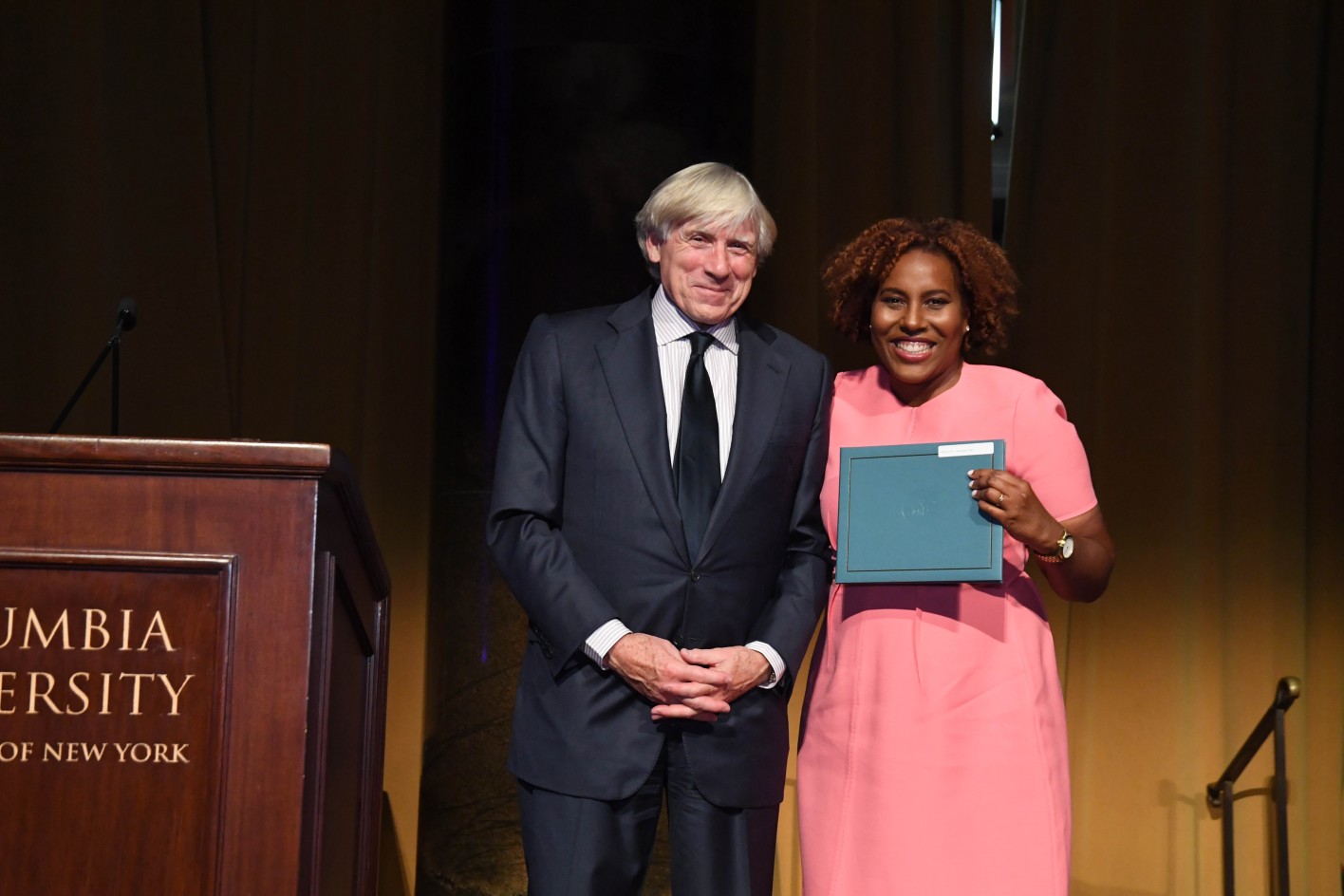
Salamishah Tillet accepts the 2022 Pulitzer Prize for Criticism from Columbia University President Lee Bollinger. (Eileen Barroso/Columbia University)
Winning Work
“Before Yesterday We Could Fly,” a novel approach to the period room, threads together past, present and future. It focuses on Seneca Village, a Black community whose erasure still reverberates.
More than a year after the racial reckoning, the Metropolitan Museum of Art has created one of its most thoughtful reparations projects yet.
I do not mean its returning of some priceless artifacts back to West Africa, or its addressing of past racial wrongs with a restitution fund to support diversity in the arts, or the acknowledgment by Dan Weiss, its president and chief executive, on the one-year anniversary of George Floyd’s police killing, that “the Met is a brilliant institution that has fallen short on these issues of race, equity and justice.”
I mean something far more speculative, and symbolic. Its newest installation, “Before Yesterday We Could Fly: An Afrofuturist Period Room,” boldly grapples with one of New York City’s biggest racial traumas: the 1857 destruction of Seneca Village, a vibrant, predominantly free Black community whose members had owned land along West 82nd to West 89th Streets starting in 1825, but were forced out in order to make Central Park. A racist smear campaign targeting the community in 1856 described its housing structures as shanties and its living conditions there as unhygienic and poor. The city used these stereotypes to further justify its need to purchase the land through eminent domain.
As much as this exhibition looks backward, the room is also steeped in the present. The Met, breaking with its own tradition of the immersive “period room” shaped by a particular period of time or genre of decorative arts, has envisioned a counterfactual fable: The room here belongs to a Seneca Village resident, a Black woman and her family, left undisturbed, and able to maintain the dignity, safety and suffrage that were the results of their landowning. Most strikingly, the room’s ornateness underscores the toll of the city’s loss, and the consequences of denying Black people the ability to pass on their wealth across generations.
The installation consists of a breathtaking re-creation of one of its resident’s homes as it might have existed in her own day, our time, and in some distant future. The farsighted curatorial team led by Hannah Beachler, the first African American to win an Oscar for production design for “Black Panther,” collaborating with the Met curators Ian Alteveer and Sarah Lawrence, and Michelle Commander, the consulting director and literary scholar, not only give Seneca Village a far more empowering ending than the one it met, but enable us to have a glimpse of what could be.
The exhibition takes its name from the 19th-century legend of the Flying Africans, passed down by generations through oral histories, about a group of West Africans who resisted their enslavement in the New World by flying back home from the Georgia coast. The myth inspired Virginia Hamilton’s classic children’s book, “The People Could Fly” in 1985, and other artists. This installation gestures more toward the fantastic with a few hints of flight.
Consisting of a house, whose clapboard style recalls the exterior of a 19th-century Seneca Village home, while its open floor plan connecting the living room and the kitchen evokes our free-flow interior designs of today, the room also features wallpaper by the Nigerian-born artist Njideka Akunyili Crosby — “Thriving and Potential, Displaced (Again and Again and…).” This inkjet vinyl print, one of three commissioned works for the installation, is a collage that includes a survey map of Seneca Village, images of artifacts discovered during an archaeological dig at the site in 2011, vintage photographs, called ambrotypes, of 19th-century Black New Yorkers, and repeating silhouettes of okra. The presence of the plant, in all its varying shades of green, also marks time as a remnant of the Old World brought to the Americas by enslaved Africans during the Middle Passage and is suggestive of the dense foliage that envelops Central Park now and protected those Black villagers back then.
Afrofuturism, invoked in its subtitle, is a fantastic, otherworldly, or science-fiction-based aesthetic that imagines a better, freer world for Black people. Such temporal and spatial collapses are at the heart of this entire experience, an act that might impart some small form of memory justice to those modern-day descendants of Seneca Village who remain unknown to us today and whose ancestors’ stories were largely forgotten until Roy Rosenzweig and Elizabeth Blackmar’s 1992 social history, “The Park and the People: A History of Central Park.”
I find such aesthetic gestures, though well-meaning, only partly fulfilling, and largely a reminder that art can only go so far in redressing the tragedy that is American racism.
The Met’s real atonement is with its reliance on the traditional period room, a genre that is increasingly scrutinized by critics for its whitewashing of history.
“Every period room is a fiction, right,” Sarah Lawrence, the Met’s curator of European Sculpture and Decorative Arts, told me during my visit. “It has a veneer of authenticity.” As she acknowledged, “Every single period room is bringing together floors, ceilings, objects that never were actually together at the same time. So, if we acknowledge the fiction, how can we use that as an opportunity to bring stories in our museum that otherwise are left out of our period rooms?” Later, she added, “We have an amazing range of period rooms, but for the most part, they are white affluent Eurocentric interiors.”
In 2017, the Met began actively experimenting with its own period rooms by reconstructing the finely detailed, all white closet of Sarah Berman — an early 20th-century immigrant who traveled from Belarus to Palestine — and placing it next to the recently installed Worsham-Rockefeller Dressing Room from 1882. The result was a dialogue about the excess and simplicity of modern life.
But “Before Yesterday We Could Fly” is far more transformational, because it gives the museum a real chance to rethink the entire premise upon which the period room was based — verisimilitude to the past — and embrace how the racial contradictions of New York City’s history and the utopian aspirations of Seneca Village continue to shape our country today.
Nothing achieves this crisscrossing of time better than Jenn Nkiru’s five-sided television that sits in the middle of the living room. Running a short black and white film featuring archival footage, re-enactments of a 19th-century African American Seneca Village family dining together, and an elder Black, or griot figure calling out “Seneca/Senegal,” the television is both analog and avant-garde — African Diasporic yet thoroughly domestic, and disruptive to the very ideas of periodization, or for that matter, nationhood.
But the longer I stayed in the room, the more engrossed I became in its vast assortment of domestic items. To name just a few: a rubber hair comb patented by Charles Goodyear in the 1850s; Willie Cole’s 2007 “Shine” artwork, an assemblage of black high heel shoes sculpted in the tradition of a West African mask; Cyrus Kabiru’s 2020 sculpture “Miyale Ya Blue,” a recycled boombox decked in red, yellow, turquoise with its nine antennas hinting at the intergalactic while also curved in the shape of a crown; Elizabeth Catlett’s 1947 linocut of Sojourner Truth; or a 17th-century crucifix from the Kongo region. The collection was not dizzying but rather deliberative. Ultimately, these temporal juxtapositions became a form of continuity for the entire room.
Whether such an exceptional approach to the period room is an outlier or will radically alter the fate of the museum‘s overall approach to similar installations remains to be seen.
The grace and grandeur threading together these disparate times, items, mediums are most fully on display in a new commission by the Met, the Haitian artist Jean-Louis Fabiola’s “Justice of Ezili,” a sculptural dress made of paper sheets and clay, 24-karat gold, Swarovski crystals and resin. Belonging to the fictional Black woman whose home we are visiting, it makes the rupture between what was and what was denied to its real life inhabitants more stark and stunning.
In this sense, it is good that “Before Yesterday, We Could Fly” is self-aware enough to know it cannot remedy such a trauma. Rather, it is really a generative addition to those ongoing conversations about racial justice, healing and repair that cultural institutions like the Met, and everyday people all over the country, were asked to have at the height of Black Lives Matter in 2020.
Ideally, the room itself is so immersive and suggestive that its viewers end up going just a few minutes away to visit the sites in Central Park where Seneca Village once stood, and find that clash between historical erasure and artistic speculation, forced displacement and Black Freedom dreams to be so jarring, and unjust, that we all grieve and begin the hard work of economic and emotional repair.
Before Yesterday We Could Fly: An Afrofuturist Period Room
This is an ongoing exhibition. Metropolitan Museum of Art, 1000 Fifth Avenue, (212) 535-7710; metmuseum.org. Entry to the museum is by timed ticket. All visitors age 12 and older must be vaccinated against Covid-19.
Meghan Markle and Harry’s interview revealed a catalyst for their reinvention, our critic writes: Harry’s racial awakening after attacks on Markle.
It was well worth the wait. The first joint interview with Prince Harry and Meghan Markle since they stepped down from royal life last year (a process that became officially permanent last month) did not disappoint.
I, for one, watched this tell-all with Oprah Winfrey while texting with many of the same Black women with whom I watched their wedding in 2018. Back then, we shared OMG emojis because we were pleasantly surprised by the way Black culture was so powerfully celebrated and Markle’s African-American identity so thoughtfully integrated into their ceremony at St. George’s Chapel.
Now, we were aghast at the couple’s allegations that racism toward Markle and its various consequences were a primary reason they fled their home to find freedom in sunny California.
Based on Markle’s deep commitment to women’s rights and the interview’s promo clip — Winfrey asks her, “Were you silent or were you silenced?” — I went into this assuming it would be a feminist revision of the couple’s fairy-tale romance. “The latter,” Markle responded in the interview. Later, she’d compare her life as a royal to Princess Ariel losing her voice after falling in love with a human in “The Little Mermaid.” In that analogy, this interview is the final breaking of that spell, with Markle now fully in control of her voice. It reminded us that she never needed a Prince Charming to rescue her, while showing us that their very modern marriage is what saved and ultimately liberated them both from the trappings and the trap that is the Crown.
But therein lies the true catalyst for their radical reinvention: Harry’s racial awakening. Here, I do not just mean the accusations from the couple about the deep anxiety some royals had about the potential skin color of their son, Archie — which resulted, they said, in his not being offered the traditional rituals of the royal hospital picture, the title “Prince” and the security that comes with that status. Rather, the second hour of the interview was a culmination of a process that Harry had been undergoing since their first date in 2016, when he was becoming more cleareyed, confrontational and emboldened to take on the British monarchy into which he was born, and the white privilege that holds it up and has benefited him his entire life.
Typically, we see racial awakenings as a tragic rite of passage for Black people. In slave narratives and early 20th-century African-American autobiographies and novels, there is often a moment in which a Black child realizes she is not only different from her white peers but that her darker skin or African-American parentage makes her inferior to them. The literary critic Henry Louis Gates Jr. once described it as a “scene of instruction.” In books like W.E.B. Du Bois’s collection “The Souls of Black Folk,” from 1903, or Nella Larsen’s novel “Passing,” from 1929, this traumatic rupture is always intimate and severe, the first and most formative experience in a lifetime of racist insults.
As Black parents, we try to prepare our children for these inevitable encounters with The Talk, the sage advice and survival strategies we hope might blunt the damage of these betrayals. But every Black person I know has had such a moment. Mine was my senior year in high school when my white classmates charged that the only reason I had been admitted to the University of Pennsylvania was because of affirmative action, an insinuation that equated being Black with being underqualified, and an injury that has caused me to obsessively overachieve in almost every aspect of my professional life.
I’ve rarely heard white friends discuss their parallel experiences of first realizing their privilege. In fact, this summer was unprecedented in the sheer number of public figures and predominantly white organizations that released statements or tweets acknowledging their role in perpetuating systemic racism. In private, I and many of my Black friends received more sympathetic emails or Black Lives Matter solidarity texts from our white colleagues than ever before. It seemed, suddenly, white people too were having their own version of The Talk.
And in popular culture, these awakenings are appearing with more frequency. In this season of NBC’s “This Is Us,” Randall’s white siblings, Kate and Kevin, are, as a result of the Black Lives Matter protests this summer, slowly coming to terms with how much their own white household, and their ongoing refusal to deal with racism, has harmed their African-American brother, who was adopted.
Without such recognition by our white family members and friends, racial inferiority is merely thrust onto Black people as a unique burden that we must bear, disprove of and reject. This innocence is at the core of white privilege, and by extension, white power.
Back in 2005, when Harry wore a Nazi uniform to a costume party, it would have been impossible to predict his trajectory. By last fall, however, his awakening was well underway, with him talking about how his marriage to Markle immediately changed his understanding of race. “I had no idea it existed,” he said of unconscious bias in British GQ. “And then, sad as it is to say, it took me many, many years to realize it, especially then living a day or a week in my wife’s shoes.”
Last night, he took it a step further. First, he noted how “the race element” distinguished the tabloid frenzy surrounding Markle from others in the past. “It wasn’t just about her, it was about what she represents,” he said. Next, he indicted his family for not taking on the racist attacks hurled at their own, and then linked their institutionalized reticence or refusal to intervene in Britain’s much longer history of imperialism.
“For us, for this union and the specifics around her race, there was an opportunity — many opportunities — for my family to show some public support,” he told Winfrey. “And I guess one of the most telling parts and the saddest parts, I guess, was over 70 female members of Parliament, both Conservative and Labour, came out and called out the colonial undertones of articles and headlines written about Meghan. Yet no one from my family ever said anything. That hurts.”
With this provocation, Harry suggests the Royals were not merely unwilling to accept his biracial Black wife and their multiracial child but also what Markle embodied: the millions of Black people throughout Britain and the Commonwealth who finally saw themselves in the monarchy through Markle’s existence, finding optimism in this interracial union.
And with that confession, Harry declared his independence from British racism — whether he realizes it goes beyond his family’s treatment of his son and is an essential ingredient to the monarchy itself, I don’t know. But I turned off the interview wondering how American race relations will further change him. That the couple landed in the United States during a pandemic that has disproportionately harmed African-American and Latino families, and in a period of racial protest and rising white nationalism, feels a bit like jumping out of the frying pan into the fire.
But, maybe that’s the point.
Freed from the constraints of not being able to confront racism head-on might mean that he will dedicate his life to dismantling it, not just out of necessity, but also as a way of writing a new chapter in his family’s history and bequeath his children a legacy of antiracism.
And if that is the case, it really will be better than any fairy tale ever imagined.
Correction: March 8, 2021
An earlier version of this article misquoted Meghan Markle’s response to the question: “Were you silent or were you silenced?” asked by Oprah Winfrey in her televised interview. Markle responded, “the latter,” not “silenced.”
Correction: March 9, 2021
An earlier version of this article misstated the title of a book. It is “The Souls of Black Folk,” not “The Souls of Black Folks.”
The Netflix hit departs from the homogeneous casting of most period drama, imagining a 19th-century Britain with Black royalty and aristocrats.
“We were two separate societies divided by color until a king fell in love with one of us,” the quick-witted Lady Danbury (Adjoa Andoh) tells her protégé, the Duke of Hastings. “Look at everything it is doing for us, allowing us to become.” She insists, “Love, Your Grace, conquers all.”
Appearing in the fourth episode of “Bridgerton,” the first series produced by Shonda Rhimes as part of her powerhouse Netflix deal, this conversation between the show’s main Black characters is the first explicit mention of race in a story that revolves around the duke, a Black man named Simon Basset (Regé-Jean Page), and his passionate courtship of Daphne (Phoebe Dynevor), the eldest daughter in the wealthy, white and titled Bridgerton family.
The show’s casting diversity is its most immediately striking quality, not just in Black aristocratic characters like the duke and Lady Danbury, but also in the entrepreneurial Madame Genevieve Delacroix (Kathryn Drysdale) and the working-class couple Will and Alice Mondrich (Martins Imhangbe and Emma Naomi). All of them are central to the complicated social caste system that make up the show’s version of early 1800s London.
“Bridgerton” is not Rhimes’s first dalliance with a multiracial cast in a British period drama. In 2017, she produced “Still Star-Crossed” on ABC, a story that began after the deaths of Romeo and Juliet and focused on their cousins Benvolio Montague and Rosaline Capulet, who were forced to marry in order to heal the family rift. Though Benvolio and Rosaline are intentionally cast as a interracial couple, race was neither a point of contention nor grist for social commentary. Instead, viewers were asked to suspend our contemporary racial perceptions in order to accept the colorblind Verona of the past. (This strategy, among others, was largely unsuccessful — “Still Star-Crossed” was canceled after only one season.)
In contrast, the characters of “Bridgerton” never seem to forget their blackness but instead understand it as one of the many facets of their identity, while still thriving in Regency society. The show’s success proves that people of color do not have to be erased or exist solely as victims of racism in order for a British costume drama to flourish.
Chris Van Dusen, the “Bridgerton” showrunner, was a writer on Rhimes’s “Grey’s Anatomy” before going on to be a co-executive producer on “Scandal,” a show that both recognized but did not entirely revolve around the interracial tensions of Olivia Pope’s romantic relationships. Applying that same approach to his adaptations of Julia Quinn’s Bridgerton novels, Van Dusen places us in an early 19th century Britain ruled by a Black woman, Queen Charlotte (Golda Rosheuvel).
“It made me wonder what that could have looked like,” Van Dusen told The New York Times in a recent feature about the show. “Could she have used her power to elevate other people of color in society? Could she have given them titles and lands and dukedoms?”
Such a move pushes back against the racial homogeneity of hit period dramas like “Downton Abbey,” which that show’s executive producer, Gareth Neame insisted was necessary for historical accuracy. “It’s not a multicultural time,” he said in a 2014 interview with Vulture. “We can’t suddenly start populating the show with people from all sorts of ethnicities. It wouldn’t be correct.”
“Bridgerton” provides a blueprint for British period shows in which Black characters can thrive within the melodramatic story lines, extravagant costumes and bucolic beauty that make such series so appealing, without having to be servants or enslaved. This could in turn create openings for gifted performers who have avoided them in the past.
“I can’t do ‘Downton Abbey,’ can’t be in ‘Victoria,’ can’t be in ‘Call the Midwife,’” the actress Thandie Newton told the Sunday Times of London in 2017. “Well, I could, but I don’t want to play someone who’s being racially abused.” She went on, “There just seems to be a desire for stuff about the royal family, stuff from the past, which is understandable, but it just makes it slim pickings for people of color.”
For all its innovations, “Bridgerton” has its own blind spots. I found it strange that it is only the Black characters who speak about race, a creative decision that risks reinforcing the very white privilege it seeks to undercut by enabling its white characters to be free of racial identity.
When Lady Danbury expresses her optimistic belief in the power of love, the duke is more circumspect, countering that Black progress is fragile and dependent on the whims of whichever white king is in charge. But to actually see narrative evidence of this precariousness, you have to turn to other recent British period dramas that featured integral Black characters, like “The Spanish Princess” and “Sanditon.”
Taking place in Tudor England, “The Spanish Princess” on Starz features Stephanie Levi-John as a Black woman named Lina who came to England as Catherine of Aragon’s lady-in-waiting. Based on an actual historical figure, the show thoughtfully fictionalized her struggle between her loyalty to Catherine and her love for her Moorish husband, Oviedo, and their twin boys as xenophobia rises throughout the kingdom, and Catherine’s marriage to King Henry VIII unravels.
The series is set in the 16th century during a historical epoch in which slavery and race were not inextricably linked to each other. Here, Lina’s brown skin merely indicates her foreignness rather than marks her oppression, giving us insight into how such differences were interpreted and experienced before anti-Black racism was codified in Europe (and the Americas) as a result of the trans-Atlantic slave trade.
By the time we reach the early 19th-century world of PBS’s “Sanditon,” however, the long arm of the slave trade has reached the British seaside resort of the title. Adapted by Andrew Davies from an unfinished novel by Jane Austen, “Sanditon” expands the story of Miss Georgiana Lambe, Austen’s first Black character. Described briefly (and offensively) in the manuscript as a “mulatto” born to a white slaveholding father and enslaved Black mother in the British colony of Antigua, Georgiana in the series is an heiress, played by Crystal Clarke, whose wealth and exotic beauty make her the most sought after young woman in England’s south coast. Ultimately, I found Georgiana’s rarefied status to be the show’s biggest representational challenge: As I reveled in her splendor, I also found myself forgetting the enslaved labor that created it.
But racial trauma remains. Despite the attention that she receives, Georgiana is ultimately alienated in England because of her race, an experience that I found more realistic than Marina Thompson’s (Ruby Barker), another biracial debutante who also finds herself alone at court in “Bridgerton.”
Other complex portrayals of Britain’s participation in the slave trade can be found in Amma Asante’s standout 2013 movie “Belle,” or in Pippa Bennett-Warner’s character on Hulu’s “Harlots,” who lives as a free but formerly enslaved Black woman in London in the 1780s.
I’m also looking forward to the mini-series “The Long Song,” debuting later this month on PBS. Based on Andrea Levy’s novel of the same name, it unfolds at the dawn of emancipation in Jamaica in the 1830s. It is another story of England and the central role its Black subjects played in building its wealth and grandeur under King George and Queen Charlotte’s rule, though we’ll probably see far fewer corsets and society balls.
By avoiding both slavery and the fervent British abolition movement that flourished in London in the early 19th century, “Bridgerton” ultimately opts for “Downton” escapism over a nuanced exploration of real-time racial dynamics, mostly relegating such aspects to the story’s past. In flashbacks we learn that the first Duke of Hastings was ruinously consumed by his newfound status, demanding, to the point of verbal abuse, absolute perfection from his wife, who dies in childbirth, and his son, who stutters as a child. (Shades of Papa Pope of “Scandal,” who once admonished his daughter, “You have to be twice as good as them to get half of what they have.”)
With more seasons presumably to come, given the show’s popularity, I’m curious how far “Bridgerton” is willing to depart from Quinn’s novels in order to fill in the worlds of its other Black characters, especially Black women like Lady Danbury, Queen Charlotte and Madame Delacroix. They are the show’s most intriguing characters and they remain mostly unexplored — will they eventually be afforded as much complexity as the duke? As Daphne’s entire family?
In a society in which gender and sexual mores dominate the actions and attitudes of all its characters, I want to see how these women learned to navigate those same structures differently shaped than everyone else. Because despite Lady Danbury’s beliefs that love conquers everything, I could not help but think that history ends up validating the duke’s skepticism and his sense that Black progress is always a fragile thing.
But who knows? Maybe if I knew how Lady Danbury or Queen Charlotte came to be, I’d be so convinced that I’d finally be able to revel in a past that I haven’t quite seen myself in before.
Devastated by the Rodney King verdict decades ago, our critic refused to view the video of Floyd’s murder. But she found solace in the art it inspired.
I’ve never watched the video of George Floyd’s murder. My decision wasn’t premeditated or preordained, but rather an improvised refusal. I did not want to be another spectator of that oldest of American rituals: the killing of a Black person in public.
My resistance was not heroic; I’ve just learned not to trust what I see. My doubt started 30 years ago when I, like much of the country, saw another recording, this time a videotape in which four white officers of the Los Angeles Police Department mercilessly beat Rodney King on the side of a San Fernando Valley street. During my senior year of high school, my mainly white classmates and I argued about the case. I believed the grainy black and white footage, shot on a home video camera by George Holliday, a 31-year-old white plumber, to be incontrovertible evidence, and that a guilty verdict was inevitable.
But, when, on April 29, 1992, on their seventh day of deliberations, the predominantly white jury acquitted the four men on nearly all charges in the beating of King, their decision taught me a vital lesson: To be Black in this country is to be gaslit almost all the time.
What I deemed with my own eyes to be truth or fact would always be unequal to the power of the white gaze that dominates most aspects of American life.
This was a horrible lesson for a child to learn. But I find it far crueler to see it pass down to my children, a 5-year-old Black boy named after Sidney Poitier, and an 8-year-old Black girl named after the 19th-century Black abolitionist community Seneca Village. They already know how vulnerable their bodies are in public, and how at any given moment a random police siren might be our demise.
But, even as I refused to watch the footage of George Floyd’s death, bravely recorded by Darnella Frazier when she was 17, I did bear vigilant witness to what it reignited: the Black Lives Matter movement the world over. I too came out of quarantine to march, chant and paint All Black Lives Matter and Abolish White Supremacy murals on the streets of Newark. “Those dead bodies are our bodies,” we all knew deep down. “Their flesh, our flesh.”
I thought back to watching the King video, how it made me feel frustrated and defenseless as a young African-American citizen. But the trial also shaped my career as a Black critic. The defense broke the 81-second video down frame by frame so its experts could dissect each detail. By doing so, they neutralized its impact. That strategy — focusing on still shots, playing with point of view and emphasizing multiple interpretations — made me realize how important it was for me to be able to make sense of cultural objects, even one as amateur as Holliday’s video, for myself.
When I started college a few months after that verdict, I decided that I no longer wanted to be a lawyer but an academic trained in the tools of cultural criticism, someone who could teach others how to interpret and contextualize the narratives that shape our understanding of the past and how we relate to one another in the present.
So, decades later, even as I avoided watching the replay of Floyd’s murder, I grappled with the tragedy of his death. Not only in my conversations with friends or in my online classes with my students, but also as a critic who found herself immersed in the groundswell of African-American art that anticipated, responded to and intervened in our racial reckoning.
I saw Black artists, filmmakers, fashion designers, musicians and poets take on the white gatekeepers in their industries and institutional homes. I identified the new conversations Black artists are having with one another across generations and disciplines. I wanted my own writing to match the immediacy with which these artists shared messages of rejecting white privilege, re-centering our collective humanity and demanding a world in which Black people are truly free.
Appearing over the past year, four works in particular were so arresting that even as I stopped watching real-life racial violence against even more Black people, these artists made it impossible for me to look away fully: “Two Distant Strangers,” a short film by Travon Free and Martin Desmond Roe; “A Love Song for Latasha,” a short documentary by Sophia Nahli Allison; a painting of Breonna Taylor by the artist Amy Sherald; and the video installation “Chasing Pink, Found Red” by Tyler Mitchell.
“Two Distant Strangers,” which just won an Oscar and is streaming on Netflix, tells the story of Carter, a young Black man (played by the rapper Joey Bada$$) who keeps reliving the day a white police officer kills him. Reminiscent of the 1993 movie “Groundhog Day,” Carter wakes up each morning conscious of the day before, and spends the bulk of the film trying to change his ending. Nothing works. After Carter’s 99th failed attempt, he realizes that Officer Merk (Andrew Howard) is also aware of the time loop and derives great pleasure from repeatedly killing him. Despite this horrific revelation, I’m always surprised and inspired by the ending, in which Carter doubles down on his plan of outlasting and defeating this trap of white supremacy.
“A Love Song for Latasha” (also on Netflix) uses absence to recover the story of Latasha Harlins, the 15-year-old Black girl who was killed by a Korean-American grocer in 1991. Allison chose not to include the footage of Harlins’s death taken by the store’s camera, which was shown on national news and was later used in the trial of the woman who shot her. Instead she actively memorializes Harlins through the memories of her loved ones, her childhood mementos and lushly lit re-enactments of her life. After first writing about the movie in June, I’ve come back to it again and again, haunted by its moving portrait of Black death. By reminding us that the public outcry after Harlins’s shooting also helped spark the Los Angeles riots in 1992, Allison puts Black girls front and center in our racial justice movement.
Such inclusivity also drew me to Amy Sherald’s portrait of Breonna Taylor, which appeared on the cover of the September issue of Vanity Fair guest-edited by Ta-Nehisi Coates. Now the painting is the signature piece in “Promise, Witness, Remembrance,” an art exhibition in honor of Taylor at the Speed Art Museum in Louisville, Ky. Sherald, who captures the daily beauty and dignity of Black people, is best known for her portrait of Michelle Obama for the National Portrait Gallery in 2018.
Sherald’s bold choice of turquoise and tender recreation of Taylor’s glamour is an aesthetic protest of the horror of Taylor being shot to death in her own home. Ultimately, its large size (54 by 43 inches) provides a narrative justice of sorts, as it partly fills in the empty spaces of the nearly blank incident report that followed her death with an expansive remembering of Taylor’s life.
I came late to Tyler Mitchell’s exhibition “I Can Make You Feel Good” at the International Center of Photography, which opened in January 2020 and brings together his fashion photography, staged portraits and experimental filmmaking. But by the time I saw the show in December, his thematic emphasis on joy, utopia and Black leisure took on a heightened urgency after spending the year overwhelmed by the twin pandemics of the coronavirus and systemic racism.
In the book inspired by the show, the photographic stills from “Chasing Pink, Found Red” depict young Black men and women dressed in shades of white, brown and black relaxing on top of a red and white checkered picnic blanket barefoot and with their eyes closed, suggesting (as I’ve written before) a communal gathering as group rest. But, as a film, mounted on three large screens, with voice-overs that Mitchell crowdsourced from his friends and social media followers, it reveals a formative encounter: the moment that Black people become aware of how they are seen in the eyes of others. Overlaid with this litany of racial microaggressions, the young Black bodies in relief appear united in death, a slippage caused by the ongoing tragedies and overwhelming ubiquity of such images today.
I was reminded of how much this art sustained me over the past year as I listened to Derek Chauvin’s trial last month. In my car, I heard witness after witness relive the worst minutes of their lives, sometimes watching new footage from before, during and after Floyd’s final moments. But, as palpable and searing as that trauma was, I was never certain of the trial’s outcome. “Believe your eyes,” the prosecutor Steve Schleicher had repeatedly insisted to the jury in the courtroom. “What you saw, you saw.”
Would the young people who watched the Floyd video feel as gaslit by a verdict as I did nearly 30 years ago?
For the first time since then, I felt a slight sense of hope that the lens through which Black people see our lives (and too often our deaths) had also empowered these anonymous jurors to do what was just and right. And to be honest, I’m not sure what I would have told my daughter, who watched the guilty verdict being announced with me, if that strategy hadn’t worked. Either way, I did what I believe is the job of a mother and a critic to do. I stayed present with her, I helped her hold her feelings, and I helped her turn what she witnessed into a story that could account for the difficult history of our country without stripping her of the life-affirming hope that she will need to navigate these troubled waters.
As for me, I will continue to find solace in the art that sustains, expresses and saves our Black lives.
The female protagonists in “Trouble in Mind,” “Caroline, or Change” and “Clyde’s” show the richness that comes from having a multitude of Black voices onstage.
Now that Broadway has returned and made it through the fall, and as it deals with a raft of cancellations because of the resurgent pandemic, I’ve been thinking a lot about the meaning of progress. Promoted, in large part, by the racial reckoning of 2020, the theater industry has responded to criticisms about its systemic racism by featuring an impressive number of plays by Black writers or with Black leads.
In the last few weeks, I’ve seen a handful of these shows: “Trouble in Mind,” “Caroline, or Change” and “Clyde’s.” Individually, their plots and period settings offer great insight into how far we’ve really come. But taken together, they reveal a full range of aesthetic and racial possibilities that exist for their African American characters once the white gaze is diminished or fully removed.
My feelings largely align with the points Alice Childress makes in her 1955 play, “Trouble in Mind,” a comedy-drama about a veteran Black actress named Wiletta Mayer who, while preparing to stage an anti-lynching play called “Chaos in Belleville” for Broadway, begins to challenge the racial paternalism through which its white playwright and director insist on depicting Black Southern life. More specifically, the plot follows Wiletta’s mounting frustrations about her role as a mother who does not protect her Black son from a white mob after he tries to vote. It’s an act that seems inconceivable to Wiletta.
“Trouble in Mind,” which was originally produced in Greenwich Village, did not make it to Broadway in 1957 after its white producers insisted that Childress provide a more conciliatory ending for her Black and white characters, and she refused. Now, Charles Randolph-Wright, a Black director, is overseeing the Roundabout Theater Company’s Broadway production of the show at the American Airlines Theater.
In the play, Wiletta (portrayed brilliantly by LaChanze) initially accepts her character’s subservience and exaggerated Southern drawl, and the problematic messaging about civil rights in “Chaos in Belleville,” as the price she must pay in order to have one of the few parts offered to Black actors at the time. Set backstage, as Wiletta and her fellow cast members begin rehearsing with the director, Al Manners (Michael Zegen), we follow Wiletta’s progression from a woman trying to school a younger Black actor on how to ingratiate himself to white people, like Manners, who can make or break his career to a woman threatening to leave the production if her role continues to traffic in such offensive and absurd racial stereotypes.
As she evolves, the audience is exposed to multiple gazes: the intimate conversations that Black performers have with one another beyond the purview of white people; the figurative masks that Black actors wear in front of their white peers and theater power brokers as a matter of professional survival; and the white gaze that Al and the other white characters don throughout the rehearsals in which they slip back and forth between declarations of how liberal they are and their racist insults.
These three perspectives collide when Wiletta fully exposes Al’s racism, a climax that not only puts her career at risk but jeopardizes the future of the play. However, in Childress’s deft hands, this potential loss is not a tragedy, but rather a reversal of fortunes for Wiletta: Once Al is no longer able to determine her fate, she is able to give the performance of a lifetime — and live out her dignity in its fullness onstage.
I thought a lot about Wiletta’s limited theatrical options — a mammy, a maid, an emotionally repressed Southern mother — while watching Tony Kushner and Jeanine Tesori’s musical, “Caroline, or Change,” which first appeared on Broadway in 2004, and now is also being produced by the Roundabout Theater on Broadway, at Studio 54. Set in Louisiana in 1963, eight years after “Trouble in Mind” made its debut and when the civil rights movement was reaching full bloom, the musical does not focus on the major events affecting the nation at the time — the assassination of Medgar Evers, the March on Washington, or the bombing of the 16th Street Baptist Church in Birmingham, Ala.
Instead, “Caroline, or Change” is a semi-autobiographical exploration of how the country’s racial dynamics affected an 8-year-old boy named Noah Gellman, his middle-class Jewish American Southern family, their 39-year-old Black housekeeper Caroline Thibodeaux (played by the breathtaking Sharon D Clarke), and her three children.
When we first meet Caroline, she is doing laundry in the Gellmans’ basement. Physically alone, her world seems to come alive when the radio (Nasia Thomas, Nya and Harper Miles), the washing machine (Arica Jackson), and the dryer (Kevin S. McAllister) become characters onstage and provide Caroline with a sense of camaraderie and comfort that she does not share with her white employers.
Public spaces are even more segregated so she finds community in the moon (N’Kenge) and the bus (McAllister again), who speak to her as well. The richness of Caroline’s life, however, is always illusory: The gaze through which we understand her story is never hers, but rather that of Noah’s as he reminisces on his childhood and his family’s (especially his stepmother Rose’s) fraught relationship with her during this turbulent time in American history.
To his credit, Kushner’s script never pretends that Noah’s lens is Caroline’s. One of the musical’s most revealing scenes takes Noah’s myopic vision head-on. After Rose (Caissie Levy) tries to teach Noah a lesson by asking Caroline to take home any “change” that she finds in his pockets before she washes them, Noah imagines Caroline’s children at home, happy to spend their entire evening thinking about him and how they will spend the money. This satirical turn challenges Noah’s nostalgia, putting his racial narcissism front and center. It is also a perfect counterpoint to the professed liberalism of Al Manners’s from “Trouble in Mind” and the unacknowledged white male privilege that he wields over his cast and stage crew.
And yet, “Caroline, or Change” still feels incomplete. Not because Noah and Caroline are unable to resolve their conflict or because the unrest driving the civil rights movement is nodded to through the toppling of a Confederate statue, but because for the entirety of the show Caroline remains Noah’s fantasy, and thus unknowable to us. She is not a fully realized character.
Such distance, of course, is realistic. Memory is fallible and given their differences, I expected Noah to have very little access to Caroline’s inner life or imagination. But I longed to see her unmediated through his sentimentality, and truly on her own terms. Though Caroline is the protagonist of this musical (and Clarke really does own this stage), Caroline is not fully empowered, her agency limited in the story because it was not really hers in the first place.
This is not to say that I need to have an all-access pass to a Black woman’s interiority in order to appreciate the depth of her humanity. In fact, I found the title character in Lynn Nottage’s comedy “Clyde’s,” played by the ever-perfect Uzo Aduba at the Helen Hayes Theater, to be refreshingly inaccessible.
The owner of a truck stop diner in Reading, Pa., Clyde also oversees the kitchen that she only staffs with formerly incarcerated men and women. Not only does she impose her exacting demands on her employees — a direct contrast to the Zen-like style of her head cook, Montrellous (the wonderful Ron Cephas Jones) — but she is the only person whose back story we never learn and who, besides her endless stream of costume changes, has no clear character arc.
In other words, she is intentionally flat, a feature that Aduba’s nuanced performance leans into with wit and grit, making Clyde a rarity for a Black woman actress: an antihero. She does not have agency, she has full-fledged power. Her omnipresence is most likely a stand-in for state violence or Satan, or both. Unlike Wiletta, who needs to break free of roles that confine her, or Caroline, who, we assume, feels suffocated by the oppressive conditions of the South, Clyde is the one who traps her employees in a permanent space of unfreedom and social purgatory.
“One of the things about where we are today is now we have a multitude of Black voices on the stage,” Nottage said to me during a recent interview at the Schomburg Center for Research in Black Culture. “I feel the freedom to put someone onstage who isn’t perfect, who isn’t heroic, who isn’t necessarily showing the best of us, but showing an aspect of us.” In other words, Clyde’s villainy is also an aesthetic liberation for Nottage, a character that is neither born out of nor now embattled with the white gaze.
Ultimately, such provocative personalities are signs of progress for us all, both on and off stage. We can only hope that such roles continue to exist — not as a one-off or in a vacuum — but as a sister among many. This is the Broadway that Wiletta Mayer really fought for as she longed to celebrate the complexity, diversity and messiness of Black life.
While Omar Little on “The Wire” is his best-known role, the actor drew upon his family and neighborhood for a slew of larger-than-life parts.
In a memorable scene in HBO’s “Lovecraft Country,” a sullen, swollen-eyed Montrose Freeman stands alone in a crowded underground ballroom as his lover, Sammy, in drag, beckons him to the dance floor. Wearing a red silk shirt, Montrose, played by Michael K. Williams, glistens as his character, a queer Black man, struggles with his sexuality and his race in 1950s Chicago.
Montrose slowly begins to move from one dance partner to another, at first reluctantly and then with such revelry that he is soon drenched in his own sweat and swept up in the air by a group of drag queens. Freed, at least temporarily, from the trauma of his past and the restrictions of his present, Montrose goes on to hug, hold and finally kiss Sammy on the lips for the first time.
I’ve watched that scene many, many times. In an era in which “Pose,” “Legendary” and “RuPaul’s Drag Race” put Black queer ball culture front and center, Montrose’s story line might not stick out. But when it first aired last September, after the summer of Black Lives Matter, Williams’s intimate portrayal of a man both lost and ahead of his time was so transformative, so transfixing, that I found myself clinging desperately to Montrose’s moment of exhaling and exaltation. It offered respite to viewers still reeling from George Floyd’s final words: “I can’t breathe.”
“That scene wasn’t about him coming out the closet,” Williams said in an interview with TV Guide last September. “It was more about him letting that little boy out that closet and run around the room and just be free.”
And Williams, who was found dead on Monday in his apartment in Brooklyn, knew how to be free onscreen. He chose to breathe life into characters so unconventional, so complex, and often so contradictory that they couldn’t be boxed into the traditional categories of race, sexuality and class into which they were born.
Inspired by his childhood in Vanderveer Estates, an apartment complex now known as Flatbush Gardens, in Brooklyn, Williams understood the weight of his roles. And whether his audience knew it or not, he made sure that we saw the everyday working-class Black men with whom he grew up as he saw them himself: larger than life.
Such was the case with Chalky White, the Atlantic City bootlegger in HBO’s “Boardwalk Empire,” whom he based on his father, who was raised in the Jim Crow South. To play Ken Jones, a gay-rights activist who struggles with H.I.V., in the ABC docudrama “When We Rise,” he drew upon gay nephews who had died. Freddy Knight, a former boxer who runs a drug ring at Rikers Island in the HBO limited series “The Night Of,” was modeled on another relative who had been incarcerated at Rikers. As Freddy, who takes a naïve prisoner (played by Riz Ahmed) under his wing, Williams could shift from caring protector to cruel crime boss within a single scene, a choice that not only kept viewers guessing at Freddy’s real motives but became the emotional center of the show.
As Bobby McCray in Netflix’s “When They See Us,” a mini-series about the Central Park Five, Williams swings on a pendulum of rage, grief and guilt after he has convinced his teenage son, Antron, to sign a false confession. (Antron was later sentenced to five to 10 years for rape and assault, serving six years before his exoneration.) Rather than play Bobby’s sacrifice of his son or his later abandonment of his family as completely cold and calculated, Williams infused his character with a sense of searching and shame.
“On paper, Bobby — let’s face it, he made some bad choices,” Williams told Vanity Fair. “That is what he did. I just chose to find out the reasons why, and that was a painful journey.”
Adding to Williams’s mystique as an actor was the scar that ran down his face, marking the time a man slashed his face outside a bar in Queens when he was 25. Williams would say that his wound transformed him. “All my life I’m this cream puff, and next thing I know everyone sees me as some kind of gangster,” he told The New York Times for a 2017 article. “It almost made me laugh.”
I also saw his scar as a metaphor. A bit off-kilter. A permanent symbol of his vulnerability. A trauma that rendered him unforgettable, while providing him, and us, a road map to the tenderness and torment that he would infuse into all his characters, sometimes triggering his own trauma and his lifelong battle with depression and substance abuse.
It was a story line brought close to home through Omar Little, the stickup man from HBO’s “The Wire.” Williams’s breathtaking performance made him the ultimate outlaw: a Black, gay, shotgun-carrying gangster who operates both above the law and beyond the Baltimore street codes. Partly based on the real-life gangster Donnie Andrews, who was lionized as Baltimore’s own Robin Hood, Omar apotheosized Williams’s career but also plagued Williams in the years after the show ended. When he went back to his old neighborhood, “they were calling me Omar,” he told The Times. “That’s when the lines got blurred.”
I went back to “The Wire” today. Not to witness Omar’s anticlimactic death, but to the fifth episode of its final season, when he barely survived. After patiently waiting for hours outside of a rival’s apartment, Omar decides to go in guns blazing, only to be ambushed and his partner shot dead. For perhaps any other character on “The Wire,” escape would have been impossible, but for Omar, defying the odds was a way of life. When he jumped out the window — gunshots whizzing by him — he appeared as both man and myth.
Playing such original, sensitive, vulnerable characters not only expanded our universe of Black masculinity but also bled into Williams’s own life, making it hard for him to separate the craft from its creator. He had said that the pressures of playing Omar helped bring on an existential crisis, and a relapse. Perhaps his empathy became expressed as addiction, his talent its own form of torture.
“The characters that mean the most to me are the ones that damn near kill me,” he said in 2017. “It’s a sacrifice I’ve chosen to make.”
By making the lesbian attraction between the main characters more explicit, the drama moves beyond mainstream Hollywood’s white gaze.
Midway through the new drama “Passing,” Irene Redfield (Tessa Thompson), the light-brown-skinned, upper-middle-class protagonist, offers a unique insight into her psyche when she says to her friend Hugh, “We’re, all of us, passing for something or the other,” and adds, “Aren’t we?”
Until now, Irene has successfully maintained her cover as both a respectable wife and proud African American woman. But when Hugh (Bill Camp) challenges her by asking why she does not pass for white like her biracial childhood friend, Clare Kendry (Ruth Negga), her response is a revelation, startling me almost as much as it did him.
“Who’s to say I am not?” she snaps back.
In that moment, I realized that what I had considered the B-plot of Nella Larsen’s 1929 novel, “Passing,” had risen to the surface in the writer-director Rebecca Hall’s adaptation, giving us a narrative that remains all too rare in Hollywood today: the interior world of a Black woman’s mind.
When I teach Larsen’s novel to my undergraduate students, I usually start with the obvious: its racial plot and the ways in which Clare finds refuge from racism by identifying as white, only to be tragically alienated from her Black family and community.
But I mainly teach “Passing” through what I think is the novel’s real central conflict: same-sex female desire and the paranoia that begins to overtake Irene, and for that matter Larsen’s story line, as a result of her unconsummated relationship with Clare. In a 1986 essay on Larsen’s novel, the critic Deborah E. McDowell explained why this longing had to appear secondary to the emphasis on race. “The idea of bringing a sexual attraction between two women to full expression,” she wrote, was “too dangerous of a move” in 1929. Instead, “Larsen enveloped the subplot of Irene’s developing if unnamed and unacknowledged desire for Clare in the safe and familiar plot of racial passing.”
Rather than explore the ways that Irene comes into her sexuality, racial passing — at the height of segregation in America — was considered a far more urgent and thus more conventional theme than that of Black women’s inner lives. As a consequence, Larsen’s novel ended up passing, too, eventually taking “the form of the act it implies,” McDowell concluded.
Visually, Hall compensates for the novel’s restraint through stolen glances, flirtatious phrases, and lingering touches and kisses between Clare and Irene. As Irene’s tension mounts, the film externalizes it through other symbols: a loudly ticking grandfather clock, a pot of water boiling over and even her breaking a teapot at a midday social in her home. In these hints, we see both Irene’s desire to break free from the illusion of middle-class domesticity and heterosexuality that she performs, as well as the threat that Clare’s presence poses to Irene’s sense of control.
But, to externalize Irene’s internal thoughts and her sublimated identity, the movie makes what is suggested in the novel far more explicit. For example, Irene’s confession to Hugh never actually happens in the book. Hall opted to amp up that moment, she explained in a video for Vanity Fair, because she wanted “to highlight the latent homosexuality and power dynamics” underlying their shared secret.
But for all that movie does so very well — its subtle swing jazz score; its beautiful black-and-white montages evocative of the photographers Gordon Parks and Carrie Mae Weems; and the delightful cat-and-mouse performances by Thompson and Negga — it deliberately limits how much access we have to Irene. Such restrictions, after having a glimpse of Irene’s full personality, further reminded me of how few stories about African American female sexuality and subjectivity have been told on the big screen.
In other words, at this moment, when Black artists are being celebrated and validated as never before, what does it mean to invest in films that fully move us beyond a racist or sexist gaze and into their innermost thoughts?
To date, such layered depictions mainly are found in the indie sphere, like Kathleen Collins’s recently restored 1982 “Losing Ground”; Cheryl Dunye’s 1997 autofiction, “The Watermelon Woman”; and Ava DuVernay’s 2010 “I Will Follow You.” Not only do these films meditate on Black women’s struggles to understand themselves as sexual or spiritual beings in the world — but they also do so by acknowledging Blackness as one, not the only, marker of their identities.
“Passing” reminds us of the need for movies to get us past the surface — of skin and sight — and revel in the worlds that Black women create for themselves beyond the gaze of others.
Biography
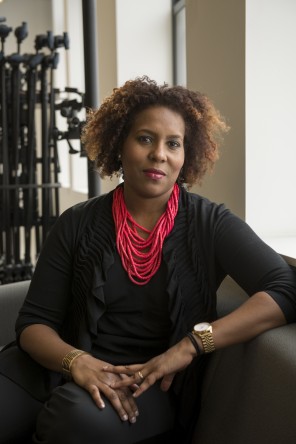
A scholar, writer, and activist, Salamishah Tillet is the Henry Rutgers Professor of Creative Writing and African American and African Studies and the director of Express Newark, the Center for Socially Engaged Art and Design at Rutgers University - Newark. She was previously the Robert S. Blank Presidential Associate Professor of English and Africana Studies at the University of Pennsylvania. She is a contributing critic at large for The New York Times, where she has written about popular culture, gender, sexuality, and race since 2015. Before joining The Times, she wrote about politics and culture for The Nation and The Root.
Tillet is the author of “In Search of the Color Purple: The Story of an American Masterpiece” (Abrams, 2021) and “Sites of Slavery: Citizenship and Racial Democracy in the Post-Civil Rights Imagination” (Duke University Press, 2012). She is the co-host and co-producer of “Because of Anita,” a podcast about the enduring legacy of Anita Hill’s testimony before the Senate Judiciary Committee in 1991. (Pineapple Studios, 2021).
She was awarded the 2020 Whiting Foundation Creative Nonfiction fellowship for her forthcoming cultural biography, “All the Rage: Mississippi Goddam and the World Nina Simone Made” (Ecco, 2023), and in May 2021, she was named a 2021 Andrew Carnegie Fellow by the Carnegie Corporation of New York for her next project, “In Lieu of the Law: ‘Me Too’ and the Politics of Justice,” a cultural history of the world’s largest social media movement.
In 2003, Tillet and her sister, Scheherazade Tillet, founded A Long Walk Home, an arts organization that empowers young people to end violence against girls and women, and she is a founding member of the Black Girl Freedom Fund, a 10-year-initiative to invest $1 billion to better the lives of Black girls and young women and their families.
She received her Bachelor of Arts in English and African American Studies and graduated Phi Beta Kappa and magna cum laude from the University of Pennsylvania, her Masters of Art in Teaching in English from Brown University, and her Masters of Art in English and American Literature and her Ph.D. in American Studies from Harvard University.