Finalist: Xochitl Gonzalez of The Atlantic
Nominated Work
Why do rich people love quiet so much?
New York in the summer is a noisy place, especially if you don’t have money. The rich run off to the Hamptons or Maine. The bourgeoisie are safely shielded by the hum of their central air, their petite cousins by the roar of their window units. But for the broke—the have-littles and have-nots—summer means an open window, through which the clatter of the city becomes the soundtrack to life: motorcycles revving, buses braking, couples squabbling, children summoning one another out to play, and music. Ceaseless music.
I remember, the summer before I left for college, lying close to my bedroom box fan, taking it all in. Thanks to a partial scholarship (and a ton of loans), I was on my way to an Ivy League college. I was counting down the days, eager to ditch the concrete sidewalks and my family’s cramped railroad apartment and to start living life on my own terms, against a backdrop of lush, manicured lawns and stately architecture.
I didn’t yet know that you don’t live on an Ivy League campus. You reside on one. Living is loud and messy, but residing? Residing is quiet business.
I first arrived on campus for the minority-student orientation. The welcome event had the feel of a block party, Blahzay Blahzay blasting on a boom box. (It was the ’90s.) We spent those first few nights convening in one another’s rooms, gossiping and dancing until late. We were learning to find some comfort in this new place, and with one another.
Then the other students arrived—the white students. The first day of classes was marked by such gloriously WASPy pomp that it made my young, aspirational heart leap. Professors in academic regalia gave speeches about centuries-old traditions and how wonderful and unique we were—“the best class yet.” Kids sang a cappella and paraded with a marching band. I’d spent my high-school years sneaking out at night to drink 40s on the beach and scheming my way into clubs. I understood that what was happening around me wasn’t exactly cool, but it was special. And I was a part of it.
I just hadn’t counted on everything that followed being so quiet. The hush crept up on me at first. I would be hanging out with my friends from orientation when one of our new roommates would start ostentatiously readying themselves for bed at a surprisingly early hour. Hints would be taken, eyes would be rolled, and we’d call it a night. One day, when I accidentally sat down to study in the library’s Absolutely Quiet Room, fellow students Shhh-ed me into shame for putting on my Discman. With rare exceptions—like Saturday nights during rush—silence blanketed the campus.
I soon realized that silence was more than the absence of noise; it was an aesthetic to be revered. Yet it was an aesthetic at odds with who I was. Who a lot of us were.
Within a few weeks, the comfort that I and many of my fellow minority students had felt during those early cacophonous days had been eroded, one chastisement at a time. The passive-aggressive signals to wind our gatherings down were replaced by point-blank requests to make less noise, have less fun, do our living somewhere else, even though these rooms belonged to us, too. A boisterous conversation would lead to a classmate knocking on the door with a “Please quiet down.” A laugh that went a bit too loud or long in a computer cluster would be met with an admonishment.
In those moments, I felt hot with shame and anger, yet unable to articulate why. It took me years to understand that, in demanding my friends and I quiet down, these students were implying that their comfort superseded our joy. And in acquiescing, I accepted that.
I had taken the sounds of home for granted. My grandmother’s bellows from across the apartment, my friends screaming my name from the street below my window. The garbage trucks, the car alarms, the fireworks set off nowhere near the Fourth of July. The music. I had thought these were the sounds of poverty, of being trapped. I realized, in their absence, that they were the sounds of my identity, turned up to 11.
I loved the learning that I did in college—academic and cultural. And I managed to have a lot of fun, in the spaces that the students of color claimed as our own. We had our own dormitories, our own hangouts; we even co-opted a room in the computer center where we could work the way we preferred, with Víctor Manuelle or Selena playing in the background. Some white students resented that we self-segregated. What they didn’t understand was that we just wanted to be around people in places where nobody told us to shush.
When I moved back to Brooklyn after college, I found that the place had changed. Neighborhoods that had been Polish and Puerto Rican and Black were suddenly peppered with people who looked better-suited to my college campus than to my working-class home turf. Many of them needed the affordable rents because they had opted into glamorous but poorly paying white-collar jobs. Alas, these newcomers hadn’t moved here to live alongside us; they’d come to reside.
The first time it happened was the night before Thanksgiving. Three or four of us—all people of color—were eating takeout in my best friend’s studio apartment. The radio was playing, and we were debating, as we often did, who was the best rapper alive. There was a knock at the door and when we opened it, my friend’s neighbor, a 20-something woman new to Brooklyn, was standing there, exasperated. “Did your mothers not teach you the difference between inside voice and outside voice?”
The next time it happened was at brunch in Fort Greene, the time after that in a newly opened hotel bar in Williamsburg. After a while, I stopped keeping track. The people complaining clearly thought they were trying to enforce a sonic landscape that they deemed superior, but what they were really doing was using shame to exert control. Over the restaurant, the building, the borough. Us.
For generations, immigrants and racial minorities were relegated to the outer boroughs and city fringes. Far, but free. No one else much cared about what happened there. When I went to college, it was clear to me that I was a visitor in a foreign land, and I did my best to respect its customs. But now the foreigners had come to my shores, with no intention of leaving. And they were demanding that the rest of us change to make them more comfortable.
The Society for the Suppression of Unnecessary Noise was founded by a physician named Julia Barnett Rice in 1906. Rice believed noise was unhealthy, and enlisted New York City’s gentry (including Mark Twain) to lobby for things like rules governing steamboat whistles, and silence pledges from children who played near hospitals.
The group met in posh spaces like the St. Regis hotel, but Rice insisted that she was not solely interested in protecting New York’s upper class. “This movement is not for the relief of the rich,” she wrote in The New York Times, “for the poor will benefit by it fully as much as, if not more than, those who can leave the city whenever they wish.” In 1909, the organization celebrated the passage of an ordinance that prohibited street vendors (many of them immigrants) from shouting, whistling, or ringing bells to promote their wares. (The ban applied only to Manhattan, though the city had fully incorporated as the five boroughs a decade earlier.)
Attempts to regulate the sounds of the city (car horns, ice-cream-truck jingles) continued throughout the 20th century, but they took a turn for the personal in the ’90s. The city started going after boom boxes, car stereos, and nightclubs. These were certainly noisy, but were they nuisances? Not to the people who enjoyed them.
In 1991, the NYPD launched Operation Soundtrap, a campaign in which cops would trawl streets—often in majority-Black-and-brown communities—hunting for and confiscating cars with enhanced stereo systems. (“If they don’t turn down the volume, we’ll turn off their ignition,” the chief of the police department vowed.) When Rudy Giuliani became mayor in 1994, he used a cabaret-license law to force clubs out of gentrifying neighborhoods like the Lower East Side and Chelsea. The battle against nightlife continued during the Bloomberg years. New York was effectively codifying an elite sonic aesthetic: the systemic elevation of quiet over noise.
In the years that followed, many of New York’s nightclubs migrated to Brooklyn, which remains loud and proud. An analysis of 2019 data ranked it as the loudest borough in New York. It earned this distinction by racking up the most noise complaints to 311—the city complaint hotline. Which raises the question: Was it the noisiest borough? Or was it just home to the densest mix of loud people and people who wanted to control those loud people?
I find many city noises nerve-racking and annoying: jackhammers doing street maintenance, the beeping of reversing trucks, cars honking for no good reason. Yet these noises account for a small minority of all noise complaints. Nearly 60 percent of recent grievances center on what I’d consider lifestyle choices: music and parties and people talking loudly. But one person’s loud is another person’s expression of joy. As my grandmother used to say, “I’m not yelling, this is just how I tawk!”
The Upper East Side of Manhattan, which runs from 59th Street to 96th Street, is one of the borough’s quietest neighborhoods. Save for trips to the Metropolitan Museum of Art, I didn’t spend a lot of time there growing up. In fact, my first real foray uptown came that summer before college. The woman who’d endowed my scholarship wanted to meet me. I stepped out of the elevator of her Fifth Avenue apartment building in my Sunday best, and was promptly greeted by a maid—another Latina. I waited, very quietly, for my benefactor—a pleasant older woman in a Chanel suit—to join me for tea. For an hour I pretended to be a meek, muted version of myself. No one had told me to do this. I instinctively understood that, in this unfamiliar environment, the proper way to express my gratitude was to hush myself.
That day recently returned to me when I realized that the same luxurious stretch of Fifth Avenue is also home to the National Puerto Rican Day Parade. Puerto Ricans have been coming to New York since the United States seized the island as a colony after the Spanish-American War, but the great wave of migration occurred in the 1950s and ’60s. Hundreds of thousands of Puerto Ricans moved to the Lower East Side, Spanish Harlem, parts of the Bronx, Bushwick, and Sunset Park, where I grew up. In the late 1950s, community leaders wanted to show their children—many of whom had never been to la matria—pride in their identity by coming out of the margins and marching through the heart of Manhattan. Over the years, the parade has grown and grown.
It is a loud affair, and I take pride in saying that we are a loud people. (Is it a coincidence that one of J.Lo’s biggest hits was “Let’s Get Loud”? I think not.) We love our music. We love to dance. We love being Puerto Rican. And perhaps this is why the parade inspires such discomfort. In the ’90s, Upper East Siders implored the city permit office to move the parade to the Bronx, to “their neighborhood.” A 2003 New York Times story reported that “one day a year the Upper East Side takes a deep breath and prepares itself.” Only after Michael Bloomberg, then the city’s mayor, made a public appeal did retailers and property owners along the route stop boarding up their windows as if a hurricane were barreling down on the city. Some restaurants and coffee shops still close for the day.
In June, after a two-year COVID hiatus, the 65th Annual National Puerto Rican Day Parade marched up Fifth Avenue. I had the honor of being an ambassador for arts and culture, which meant I got to ride in the back of a red convertible. The event is a big party, or more accurately, a thousand different parties all celebrating the same thing: being Puerto Rican in the greatest city in the world. Every float, every car, every delegation was playing reggaeton, salsa, merengue, boleros, and Bad Bunny. Everywhere you went you heard Bad Bunny. People were dancing bomba and plena and bachata. There were chants of “Puerto Rico!” and “¡No se vende! ” I waved at all the beautiful people, and when we passed the apartment building where my former benefactor lived all those years ago, I shouted out an extra-loud “¡Wepa! ”
For 35 blocks, we were as loud as we wanted to be, and nobody could tell us nothing. And then we got to the end of the route. The crowd thinned out and the blockades ended, and we were met with a giant traffic sign illuminated with the words QUIET PLEASE.
Language—even its loss—is part of what “makes” Latinos, Latino.
Welcome, dear reader, to Hispanic Heritage Month! The only heritage month that, like many of us whom it celebrates, exists across borders—of time, that is (in this case, the months of September and October!). It’s a four-week period where my calendar is as jam-packed as Dolores Del Rio’s dance card at the Trocadero.
I have mixed feelings about these calendar-based celebrations. On the one hand, I like seeing our stories and history given a brighter light—particularly considering that Latinos make up nearly 20 percent of the American population right now. On the other hand, given that statistic, I personally won’t be satisfied until that light shines on our stories around 20 percent of the time, 100 percent of the year.
Either way, for the next four weeks, I will ride the bandwagon and dedicate this space to what I will call “Hispanic Concerns”. Or, more accurately, “My Hispanic Concerns”. Stuff that really interests me, or sticks in my craw, both within my community and regarding how the outside world perceives us. This week: language.
A conundrum of the Latino experience in the United States is that we are an ethnic identity defined by nuance and diversity, who exist within a national conversation that is allergic to nuance and can’t really wrap its head around either. Hispanics (and I use the two terms interchangeably; if you want to know why I’m not using Latinx, please see here) are not a race, we are not universally immigrants, and we do not all speak Spanish.
This last piece perhaps is most befuddling, and occasionally distressing, to both white non-Hispanics as well as some subsections of the Hispanic community. As a Latina who does not speak fluent Spanish, and is very cognizant of the painful history as to why, nothing is more amusing and infuriating than the crestfallen look of a white non-Hispanic when they ask if you are fluent in Spanish and you say no. There’s often an awkward moment of silence when you can visibly see the person’s confusion, when they no longer know where to place you in their personal taxonomy system for other people’s identities.
In the old days, when people still felt comfortable saying the quiet parts out loud—roughly as recently as the late aughts—admitting I don’t speak Spanish to a white non-Hispanic might yield statements like, “So you’re not really Latina.” This reaction would render me both ashamed at my perceived deficiency and obliged to defend myself. I found myself overexplaining my comprehension skills and awkwardly apologizing for my grandparents, who—like so many others—were shamed and taunted for speaking Spanish and who, in an effort to shield their descendants from that discrimination, made English the dominant language of the household. And how, unlike my parents, I just never picked it up.
Of course, I am far from alone in this experience. This was an issue that, per the Washington Post, plagued Julián Castro during his presidential run, when the media would repeatedly stop just short of taunting the congressman with the Spanish-language prowess of the then-mayor of South Bend, Indiana, Pete Buttigieg; New Jersey Senator Cory Booker; and Texas Representative Beto O’Rourke. Indeed, some say it cost him the vice-presidential nod in 2016, which went to a fluent Spanish speaker, Senator Tim Kaine. “Speaking Spanish fluently is just one part of the overall connection to the Latino community,” Castro told The Washington Post in 2019. “But mainstream media turns that into the only variable as to whether somebody is Latino or not, which is completely out of line with reality.”
For me, personally, it took years to register that the right response to non-Hispanic white people should be patient indignation. Patience because, to quote Lauryn Hill paraphrasing the Gospel of Luke: “Forgive them, Father, for they know not what they do.” Indignation that the same prevailing white-American culture that forced—through means passive and violent—my ancestors to sublimate their language now feels entitled to diminish my identity based on the absence of that language, without ever thinking to acknowledge the role the culture played in rendering the scar of its absence.
And it is a scar. There are few Latino-identifying people who don’t speak Spanish who don’t feel a certain way about it, be that ashamed, defiant, deficient, or proud. The loss of language within our community is rarely passive. There are many who wear their lack of Spanish-speaking ability as a badge of honor: a testament to their commitment to American-ness. And then there are the countless others who feel, as I once did, embarrassed—particularly when in the company of other Latinos—at how “American” this makes them. These are Latinos who mourn the loss of their culture. But this scar in absentia, this loss of Spanish, is too a part of our Latino experience. Because it is a part of our story as people of the United States.
This is partially why, when other Latino people are the ones using Spanish proficiency as some kind of community litmus test, it is particularly painful. Because very rarely is that knowledge deficit a personal choice, and, all too often, it is one that arose as a protective stance against discrimination. It extends no empathy to the difficulty—in a mixed-language environment or an English-dominant community—of retaining or reasserting language into the next generation. These things, once lost, are not easily returned.
For Afro-Latinos, Asian Latinos, and a growing group of Americans of mixed-race Latino identity who aren’t fluent, this negative judgment, coupled with the historic racism and colorism that exists within our own community, is doubly painful. It messages not just deficiency, but a seeming rejection from a community. And it’s an attitude that I believe acts as a cudgel against our own understanding of who we are as a community —of our history in this country—and detracts from our collective power as a group.
But back to white America: It’s interesting to me that Latino people seem to be the only ethinic group held to this double standard of language retention. The only group where assimilation is demanded but then turned against you like a sword as a marker of “disqualification.” If one was a Russian American or an Italian American who did not speak the once–mother tongue, sure, it might distress a grandmother or two. But white-American society would not see this as a “disqualification” from that person’s claim to that identity. Rudy Giuliani’s “Italianness” was never called into question just because he can’t speak the language. I don’t know if anyone has ever asked Nancy Pelosi or Devin Nunes, “Parli Italiano?” or “¿Você parle Português?” But no one questions their claims to Italian American or Portuguese American identity. Nor was it the case for any of the proud Russian, Polish, Greek, or countless other second- or third-generation Americans I grew up with. In fact, the language loss would be seen as “progress” in their family’s journey to being part of the fiber of this country. Not so for Latinos.
So why the double-edged sword for us? My friend, the very talented poet Marisa Tirado, hints at one possible theory in her poem, from which I borrowed this week’s column title, “Selena Didn’t Know Spanish Either,” in which she writes:
When I learned that at first, Selena didn’t know Spanish
Either,
I entered a moment beyond my own poetics.
Truth is, white kids get more gold stars per language,
get corporate jobs in Mexico City. I watched them take
family cruises down to meet my ancestors before I could.
Do you know what it’s like to be off-limits from yourself?
Perhaps there is a blind spot in the white-American consciousness—a place where, as Marisa writes, “white kids get more gold stars per language”—concerning the impact of white-American discrimination on the Hispanic experience, including its role in language loss. Perhaps, as I wrote earlier, it’s simply the struggle of the American populace to do “nuance.”
Or perhaps it’s something altogether more complex and, I’ll admit, slightly more cynical: resentment. Of the perceived privileges of being a minority group. As if being Hispanic qualifies one for an array of benefits, such as minority business loans, affirmative-actions spots in colleges, and cultural buy-in to Bad Bunny, and, because we are not a race, speaking Spanish is how we are meant to “prove” we deserve this “special experience” of being marginalized in the United States of America. As if by not speaking Spanish, we are trying to “get away with something.”
I believe it is for this reason that the question of language, when raised by white Americans, so often feels—as Castro pointed out—like a gauntlet thrown down. It’s a gauntlet that seems to scream: “What gives you the right to claim this identity? Prove yourself to me!!” As if Kaine’s language proficiency carries the weight of forbearers whose bodies were experimented on so that American women could have birth control. As if O’Rourke’s Spanish holds the pain of grandparents being sent to segregated schools; of aunts and uncles being victims of mob violence; of arduous journeys made at great sacrifice across borders to work the jobs no one else wanted. I could go on and on here, but you get my point.
To my bilingual Latino readers: You carry in your tongues the history of where we descended from, where we’ve come from. These are places many of us still think of as home, or at least homes away from home. Keep it alive!
To my non-Spanish-speaking Latino readers, your loss of language is, too, a part of our history—that is, of our history here in America. Our loss of language is the history of the things our families before us endured, and the things we’ve endured personally. It’s a fact that we can choose, with great effort, to try and amend, but nothing we should ever feel we need to apologize for. And to my white, non-Latino readers: This Hispanic Heritage Month, let us tell you what makes Latinidad. (Hint: It doesn’t start and stop with Spanish skills.)
Would we defend ‘The Satanic Verses’ if it were published today?
One of the best New York nights of my life was in the early aughts, at a children’s book launch in the basement of the Mercer Hotel. It was a tiny spot, the kind of place where, if you were there, you were inevitably talking to everyone else who was there, too—and the “everyone else” at this event was so random that it was sexy: Joaquin Phoenix, fresh off of Gladiator; Howard Stern and his then-new wife, Beth Ostrosky; Moby, who was inexplicably pole dancing; and so many supermodels, it felt like you were in a magazine. (I really still have no idea how I ended up at this party, but that was the beauty of New York.) And of course, to make it a real New York affair, it required at least a dash of public intellectuals: writers, cultural commentators, novelists. In those days, revered downtown critics like Michael Musto or Fran Lebowitz were the types who typically fit the bill. But on this particular night, it was Salman Rushdie: literary hero. I remember thinking, This is the coolest party I’ve ever been to.
Because, as I mentioned, the place was the size of a boot box, it didn’t take long before Rushdie and I were bellied up to the bar at the same time, and I took the opportunity to tell him how much I loved The Satanic Verses. With tremendous humor, he responded, “Did you actually read it?” I had no ambitions of being a writer, but I was an avid reader of fiction at the time and assured him that I’d read that and Midnight’s Children and loved them both. In my naivete about life, and my preconceived notions of what “serious writers” did with their free time, I asked him what brought him to the party that night. To that, he said: “I’m just making up for lost time.”
Back then, when I was only in my 20s, I could not have even imagined what it would be like to re-emerge into public life after spending nearly a decade underground, wandering from place to place, living under a pseudonym, with 24-7 government protection. I could not grasp how so much living could be sacrificed for writing a work of fiction. Not that I wasn’t aware of the fatwa on Rushdie’s life—the bounty on his head was international news that had played out on the covers of all the New York tabloids. It was just that, having barely lived at all at that point, I hadn’t understood all that he’d been made to give up for his art.
Of course, all art requires sacrifice—of time, of spirit, of sanity. And art requires risk of rejection, of critical misunderstanding, and of pissing people off. How could it not? Art is a reflection of the lived life of the artist—no matter the art form—and the quest to express or find some expression of personal truth about that lived experience. For some of us, including Rushdie, this often results in touching on the controversial or, at the very least, disagreeable. As a writer he’s often concerned with the politics and history of his native India; his second book resulted in a lawsuit by Indira Gandhi and his third was banned in Pakistan.
In many ways, the story of Salman Rushdie, the artist, is a universal opera that all artists can relate to: risk, reward, and sacrifice—all of which have played out on the grandest possible scale. As Martin Amis wrote in Vanity Fair of Rushdie’s predicament in 1990:
Rushdie’s situation is truly Manichaean, but he is neither a god nor a devil; he is just a writer—comical and protean, ironical and ardent….There are times when Rushdie’s predicament feels like a meaningless divagation, a chaotic accident; there are other times when it feels rivetingly central and exemplary. Rushdie’s friends, I imagine, think about him every day. But his writer friends, I suspect, think about him every half an hour. He is still with us. And we are with him.
Certainly, this was true for me when I heard the news of his stabbing on Friday. I am not a writer friend of his, but by virtue of being a writer, I understood that—by simply existing as an artist—there but for the grace of God go I.
Here is where my thoughts turn more cynical, and probably more controversial: As his condition stabilized and my concern and horror turned to analysis and assessment of the larger situation, I was forced to ask myself what would have happened had The Satanic Verses come out in 2022. In addition to the bounty on his head, would Rushdie have also faced a metaphorical death in the form of so-called cancellation? A recoiling of the literary and intellectual world that had so vocally supported him in 1989? In 2013, Rushdie himself predicted that the answer would be yes. Commenting in response to the American writers of PEN America protesting the recognition of the journalists from Charlie Hebdo, Rushdie said: “[I]f the attacks against Satanic Verses had taken place today, these people would not have defended me, and would have used the same arguments against me, accusing me of insulting an ethnic and cultural minority.”
By his own admission, Rushdie didn’t write the book with the intention to offend, as he wrote (in the third person) for The New Yorker:
When he was first accused of being offensive, he was truly perplexed. He thought he had made an artistic engagement with the phenomenon of revelation—an engagement from the point of view of an unbeliever, certainly, but a genuine one nonetheless. How could that be thought offensive? The thin-skinned years of rage-defined identity politics that followed taught him, and everyone else, the answer to that question.
Regardless of his intention, his tome was and is offensive to many Muslims. Perhaps today the book would not have even been published for this reason. Or if it had, I can picture a scenario where Western liberal society en masse likely would not have condoned violence, but mightn’t have rushed to his defense, either.
There are very real right-wing attacks happening on free speech right now, including homophobic attempts to add “ratings” to TV programs that feature gay characters, book bans, and threats of violence against librarians for carrying and recommending these books. Still, on the left today, there is little appetite within liberal discourse to support freedom of artistic expression that might be deemed offensive to anyone—intentional or otherwise.
In the current moment, our concern for Rushdie’s freedom of speech feels like a case that’s been grandfathered in—one that, in considering oneself liberal, we are meant to have a certain opinion about, but that opinion is actually completely out of whack and inconsistent with the actual discourse of the moment. It's a bit of a throwback—like the kind of book party I chance encountered him at—of a moment in time that’s past us.
Or perhaps it’s an opportunity to revisit the past and question if perhaps we might not have thrown out some of the baby with the bathwater in the past 30 years since the bounty was put on Rushdie’s head. The fatwa is an extreme expression of a still-familiar threat; physical exile from your home country is extreme. But the truth is that artists and creators of all races, genders, and sexual preferences are living in a time of trepidation, at best. At worst, we live in fear of cancellation—not of our personas, but of our art. Of the limitation of our forms of expression. Of a kind of creative assault. (Public apologies aside, as a friend pointed out to me this weekend, Will Smith really seems to have opened the floodgates to retaliation against public figures at their most vulnerable.) I know this from media case studies I can point to, and by way of personal stories—whispered to me in bars of experiences through pulled book contracts and requests for edits of scripts or storylines.
Before I am misinterpreted, I want to be clear that this is not a defense of bad actors who happen to be artists. That people whose behavior as individuals outside of the creation of their art is criminal, bigoted, or hateful are being held accountable for that behavior in the court of public opinion or the marketplace is a good thing. But when the art itself is bothersome, to some or many, and faces backlash, this becomes a different question.
As I see it, the bravest thing Salman Rushdie has done as an artist is to continue to make his art while knowing, better than almost anyone alive today, that radical truth-telling in a time where we are allergic to nuance holds great risks. Yes, it is our job to be courageous. But, when artists feel stifled by a climate, or are holding back from exploring their art to its fullest expression out of fear for how that art might be received, we all lose something. I say this even as I find some of the artmaking happening today upsetting, offensive, discomforting, or questionable. Because we either believe in supporting free artistic expression, or we don’t.
The victory of the ultraconservative congresswoman Mayra Flores in South Texas shows what Democratic campaigns are doing wrong.
Several years ago, shortly before the 2016 elections, I was having a drink with an acquaintance of mine, another Latino Brown alumni, who we’ll call Mando Gonzalez. Other than our last names and our Brown degrees, Mando and I don’t have much in common, but we hit it off at an alumni function and went on to get the occasional drink or coffee when we find ourselves in the same city. When the conversation turned to the election and how much Hillary Clinton needed the Latino vote, Mando said something that I found nearly blasphemous at the time, but that I’ve pondered since. I paraphrase, but he said: “There is no Latino vote; Latino identity is an invention of academia.”
His point, as he further explained, was that Latino-ness is something your kids “catch” when they go to college, like feminism. And not just any kind of college, but a predominantly white institution. Had Mando, the son of Mexican immigrants who was reared in a Spanish-speaking Los Angeles household, gone to, say, UCLA—a school with a 21 percent Hispanic population (about 6,600 students), and whose Chicano-studies program is nearly 20 years old—he would have likely emerged with a different worldview. Surrounded by so many other Hispanics of similar backgrounds, he argued, he likely would have just considered himself Mexican American. Mando felt that having the rarified experience of being part of a pan-ethnic Hispanic minority at a predominantly white institution is what gave the term Latino emotional and intellectual resonance. (To help paint a picture, Brown—by no means an outlier among the Ivies—boasts a 10 percent Latino enrollment rate, which is about 1,000 students. This number includes students from every Latino ethnic and geographic background that the U.S. has to offer.)
I found myself thinking of Mando this weekend while reading the recent New York Times coverage of Mayra Flores, the newly elected, ultraconservative congresswoman in Texas’s Rio Grande Valley. I was wringing my hands the whole time, yet I was also utterly unsurprised. I wasn’t surprised that Flores and other conservative Latinas’ success in running for office has largely been fueled by the power of Latina political organizing—something the Hillary Clinton campaign tried to tap into as well. I also wasn’t surprised that Flores’s simple slogan, “God, Family, Country,” was persuasive; it clearly reflects the values of a certain slice of her predominantly Mexican American, pro-law-enforcement region of South Texas.
But here’s what had me wringing my hands: I could very easily see that slogan having appeal in pockets of Florida, Arizona, Central California, and even parts of New York. As we watch this Hispanic drift toward the GOP, I wonder: What, exactly, are Democrats offering “Latinx” voters? (Indeed, that very language is somewhat polarizing, as just 3 percent of the Hispanic population uses the term, but that’s a newsletter for another day.) What, beyond the blanket and possibly patronizing presumption that Latino voters all see themselves as people of color and therefore are voting against their own interests by voting Republican, is being offered up? Or, to return to Mando’s take, how do you make a compelling case for voting around Latinx identity politics when only a micro-segment of the population feels an emotional tether to that identity? In a community like Flores’s, which is overwhelmingly not just Hispanic, but Mexican American, what aspect of a pan-ethnic identity do voters there connect with? Do they connect with such an identity at all?
Personally, getting to college and finding a Latino community was a salve for me. I am of mixed Puerto Rican and Mexican American heritage; I spent my school years in Brooklyn and the summers in Northern California with my paternal grandmother. No single identity felt fully correct, and at that time it didn’t matter, because in the streets of Brooklyn, you were just “Spanish.” When I got to college, the term Latino, which spoke to my own pan-ethnic identity, felt like a comfortable identity to embrace. (I preferred it to Hispanic, which, in my opinion, put the colonizer in the center of our experience.) Away from my family and home and with such a small group of us on this largely white campus, the Latino community became my family. I learned how to cumbia from my Colombian friends, perfected my bachata with my Dominican ones, and developed a familiarity and affection for the cultures of many other ethnicities and experiences that comprise what we think of as Latinx in the United States. (While I tend to use the terms interchangeably, I personally prefer Latin, Latine, or Latinx, in a sign of respect for my gender-nonbinary brothers and sisters out there, although I also understand the resistance.)
My experience is rare. Going away to college is what gave me access to Latine diversity, yet only about 16 percent of Latinos have college degrees. (Again, a gap that merits its own post.) Within that group, students are overwhelmingly attending local community colleges, state schools, and regional private, often religious, institutions, with majority minority or Latinx populations. Couple that with the sheer fact that nearly 72 percent of Americans live near where they were born and raised; that number includes Hispanic Americans, who traditionally have gravitated to certain regions and areas based on ethnicity. What we can extrapolate is that most Hispanic Americans are living a highly specific, regional experience of their identity. Even among college-educated Hispanics, the pan-ethnic experience that made Latino identity into more than just a demographic term for me is not a universal one.
Maybe Mando was right. Yes, part of the Democrats’ problem with the Latino vote is their laziness in failing to look at the regional cultures and concerns of the Hispanic electorate and tailoring their messages to that (or their refusal to even use the terminology most Hispanics prefer). But I believe it’s also, as David Shor has pointed out, a blind spot that Democratic campaigns have developed, in which they over-index the worldview and experiences of the college graduate. As Shor’s theory was paraphrased in Politico:
Although young people as a whole turn out to vote at a lower rate than the general population, the aforementioned type of young person is actually overrepresented within the core of the Democratic Party’s infrastructure. According to Shor, the problem with this permanent class of young staffers is that they tend to hold views that are both more liberal and more ideologically motivated than the views of the coveted median voter, and yet they yield a significant amount of influence over the party’s messaging and policy decisions. As a result, Democrats end up spending a lot of time talking about issues that matter to college-educated liberals but not to the multiracial bloc of moderate voters that the party needs to win over to secure governing majorities in Washington.
In my experience volunteering in politics, this holds true for the young Latinx movers and shakers seeking to make a mark in politics as well. A quick search of “emerging leaders” celebrated by the Biden administration last Hispanic Heritage Month reveals a talented bunch of young staffers, all of whom, as expected, have four-year degrees, many from elite, predominantly white institutions, where I would imagine they, like me, found some comfort in their pan-ethnic Latino communities. But their reality is not reflective of the reality of Mayra Flores’s constituents, many of whose families have lived in the Rio Grande Valley since before it was Texas, and the majority of whom are Mexican American.
When every candidate on the ballot is Mexican American, what matters to voters is not an allegiance based on identity, but which candidates’ values (God, family, country) are aligned with their own. I don’t know what the midterms will hold, and I can’t even wrap my head around the 2024 presidential race, but what I can tell you is that any candidate who comes out with a blanket Latinx Outreach Strategy isn’t going to win over the Hispanic voter.
How a Spanish idiom perfectly encapsulates the U.S.’s relationship with Puerto Rico, especially in the wake of Hurricane Fiona
When my friends and I were younger and would while away the hours gossiping about who was dating whom, we would play a game we called Sucio o no sucio? Sucio, as a word, translates into “dirty,” but as a slang expression it has no precise translation in English—which is probably why it routinely peppers Latino conversations, even when they aren’t transpiring in Spanish.
A sucio (or sucia, in the feminine) is someone of moral ill-repute, in a lecherous or greedy manner. So an old conversation might have followed:
“Did you hear that Isabel got engaged to Victor?”
“Really? Because Victor was trying to get my roommate’s phone number at the party last night. You should have seen the way he was looking at her!”
To which all gathered would say, “Sucio!”
Or, “You remember how Laura had that consulting gig where she was always going to London? Turns out she has a whole other relationship there and Tracy never knew.” To which someone else would reply, “Laura’s always been a sucia—remember when Tracy caught her cheating way back when? What did she expect?”
In pan-Latino culture, the label of sucio is almost like a public-service announcement. It’s an intra-community warning that the aforementioned person has a track record of untrustworthy, shifty, shady behavior. That in that person’s wake is a trail of heartbreak and betrayals. And that, if you are going to engage with this person, you should proceed with caution.
What is unique to the label of sucio—the thing that makes it so difficult to translate—is that it’s rarely doled out after a one-off slip of questionably moral behavior. One affair, or unwelcomed pass, or two-timing incident does not a sucio make. It is a label earned by repeat offenses, usually committed in front of others within a community or online. And it is this visibility that, while not diminishing the hurt, pain, and damage that the sucio causes, leaves the victim with a certain sense of exhausted exasperation. What did I expect? I always knew they were a sucio.
I thought of this term in the aftermath of Hurricane Fiona as I communicated with loved ones, and others with loved ones of their own, in Puerto Rico last week. Here, on the mainland, Diasporicans were filled with dread; when the mainstream media covered Puerto Rico, there was almost a hovering urgency to declare this “another Maria.” But, from the island, what I got was more of a “Here we go again.” Survival systems that developed over years of rolling blackouts and earthquakes, neglect and disillusionment with U.S. bureaucracy, were put back into place. Showers were had with buckets, refrigerators were purged, and medicines rationed out; people in the mountains awaited cell service to check in with relatives—not with the sense of panic and urgency that had come with Maria, but with resignation at the inevitable. Puerto Ricans on the archipelago reacted with the energy of your tía whose husband has been stepping out on her for years, after she’s confronted with yet another piece of evidence of his infidelities. A shoulder shrug and a back-to-the-business-of-making-life-happen. Because this is what it means to be bound to a sucio.
And make no mistake, we—America—are the sucio here. Sucios sinverguenzas—absolutely shameless. We are the gross friend of the family who stares at your cleavage while his wife is getting him a drink at the party. We’re Tristan Thompson leaving a pregnant girlfriend to be with Khloé Kardasian, just to cheat on Khloé once she’s pregnant.
From the outset, when the island was seized as a spoil of the Spanish-American War, Puerto Rico was always one of America’s side chicks. The place where, as my grandmother would say, you went to get the milk without having to buy the cow. Despite Congress’s ability to alter the terms of this colonial relationship—via a vote to adjust the terms of Puerto Rico’s territorial status or a vote to take up the Democratic congresswoman Nydia Velazquez’s Puerto Rican Self-Determination bill, which would provide Puerto Ricans with a true, congressionally recognized referendum on their status—Congress never does. Because a sucio doesn’t consider the other party’s well-being. It’s all about what the sucio wants—which is everything! That is, with none of the commitments, and none of the care.
Anyone who, in real life, has found themselves stuck with a sucio inevitably has a come-to-Jesus moment when the accumulated incidence of grievance, of being used, and of shameless exploitation of the relationship is simply so egregious, they reach peak heartbreak. The person sees, laid bare, how things really are. How little this sucio values them, their well-being, their “relationship.” Hurricane Maria was, for many Puerto Ricans, that moment. The moment when one can no longer pretend that things are okay. Where a person cannot look at an American flag and honestly think that it represents them.
But, unlike your cuckolded tía, Puerto Rico can’t leave! At least, not so easily. So instead, she shrugs her shoulders and picks up a bucket to get more water for a shower. She goes to a community-aid group to see what help she can get—now—for the house whose foundation was always shaky to begin with. Because better a little help now than to wait for that sucio to come back with his FEMA tarp and bureaucratic red tape and talk of unity—how next time it will be better—all while knowing it will be the same. (Yet again, when given the opportunity in advance of the hurricane landing, Congress still has not lifted the Jones Act, which puts a tax on basic goods on the island that affects suffering people!)
There are always those who can’t see the sucio for who they are—either for lack of hearing the warning or for lack of a desire to hear it; whose hearts grow arms that cover their ears. Whose eyes turn away from each infraction of their dignity. We’ve all been there, myself included. I remember as a younger woman dating someone who, on paper, seemed as worldly and upper-class a person as a girl from South Brooklyn could possibly imagine being with. (He even had a British accent! I mean, really …) Oh, and what I thought it said about me that someone like that thought me “worthy.” Never mind that he was clearly being dishonest about his marital status; never mind that he never really treated me like an equal.
Such willful ignorance is what I see when I hear pro-statehood islanders and Diasporicans speak of the U.S. government as a faithful actor. Who gaze starry-eyed at the prospect of full citizenship even as the U.S. government allows crypto-miners to pillage the island yet again, as Puerto Ricans pay the price for the slow-walk of Maria recovery in the wake of Fiona. There is a term in Spanish for that kind of oblivious love: It’s called being a pendeja. The one who plays the fool for the sucio again and again and again.
But, for those paying attention, much of the rest of the island is fed up. People are exhausted of this relationship and the pendejas who keep it in place. If you listen to the people, they are telling you, this relationship is growing untenable.
The cultural legacy of Lemon Pledge, Murphy Oil Soap, Fabuloso, Windex, Ajax, and bleach.
The moment that I admitted defeat in the battle over the gentrification of my old neighborhood of Fort Greene, I was in a cramped aisle at the corner store. I had been out of town for a couple of weeks and, upon my return, went in to restock three of my household staples: Bustelo coffee, Bounty paper towels, and Clorox all-purpose cleaner with bleach. I was mystified when they told me that they had stopped stocking Bustelo (in favor of a humanely farmed, organic brand), that the only kind of paper towels they had were some sort of grayish-looking recycled brand, and most horrifically, that all of the “real” cleaning products had been replaced by lines of “all-natural” sprays, washes, and soaps. All these cleaning products came in cute packaging with trendy fonts, and scents with names from the fruit-and-vegetable aisle—lemon, orange, sage. I walked out that night empty-handed and brokenhearted.
Over time, outside the home, I’ve made an uneasy peace with a lot of the conceits of New Brooklyn. I drink coffee-shop coffee with oat milk way more frequently than my old light-and-sweet bodega java. I enjoy the great bars and restaurants. I have embraced No. 6 clogs and statement reading glasses and own an almost absurd number of Rachel Comey dresses. But I draw the line at my cleaning products.
Growing up, Saturdays were for cleaning the house. We would get up early, play music nice and loud, and set about the work of dusting, scrubbing, mopping, laundering, and polishing. We used Lemon Pledge, Murphy Oil Soap, Fabuloso, Windex, Ajax, whatever detergent was on sale that week, and good old-fashioned bleach. There was no spot in the house that was not hit with a chemical. The entire endeavor would take several hours and, when it was over, the reward was a sparkling home that smelled like oil, artificial lemon, chlorine, “lavender” and … well, clean. And it smelled clean because it was clean. And because we had a clean house, we could “relax” for the rest of the weekend and enjoy it. And we could also “relax” because should anyone stop over unexpectedly, we never had to feel the shame of people thinking that you had a “dirty house.”
I am hardly alone in this history. Growing up and cleaning on Saturday mornings (and using Fabuloso and Clorox) is a unifying experience across the vastly diverse Latinx community that is now well immortalized in memes, videos, and articles. It is, for many of us, part of our cultural tradition. But I also found, growing up in blue-collar Brooklyn, where most of my friends were either first- or second-generation Americans, Saturday-morning cleaning was a common bond among us all.
I’m not going to lie; another way that I myself have gentrified is that I no longer spend my Saturday mornings cleaning. (I do the maintenance, and Emmy, who shares my love of chemicals, does the heavy lifting.) But I have lots of friends who can afford cleaning help and still opt against it. For some, it provides a connection to home, for others it is a stress reliever, and for others still, a routine and tradition that helps pass along the modes of cleaning that they want to instill in their own kids.
What I can say for certain is that there is not a natural or “environmentally friendly” cleaning product in my home. I go near (the dollar store) and far (Home Depot) to find my products, and I schlep them home with pride. I want nothing that smells like it could be left around children unattended, nothing that couldn’t also kill insects if used in plentiful enough supply. But it is more than nostalgia or scent memory that keeps me hooked on these chemical-based products. It is my firm belief that nothing makes your house cleaner, nor one happier, than boiling hot water mixed with perfumed poison that is, well, harming the environment.
Which brings me to the point. For years, I’ve skulked around in shame as I’ve rejected organic cleanser after organic cleanser. I’ve quietly pretended that I think these products do the same work and have the same ability as their elder, more toxic siblings. I’ve not judged people’s homes as filthy when I see these products on the counter or in their cabinets. (Okay, I have judged. But here’s why I haven’t judged more harshly: Because I’ve felt guilty about the environment. Because I’ve felt badly that I care more about the eradication of dirt and germs than carcinogens and, I don’t know? The oceans? The ozone? I’m not quite sure what harm my cleaning products are causing exactly. I just know that they are probably not good. I don’t want the Earth to disintegrate, and I do recycle. And yet …)
And yet, I have decided not to judge myself. Because with a tiny bit of distance from the deep pandemic, I realized something. When the going got tough and the tough got terrified of fucking germs, nobody reached for the biodegradable cleansers or the lemon-scented vinegar counter spray. They scrambled for Clorox Disinfecting Wipes with bleach. Why? Because deep down, we all know they work better. And do you know who already had them stockpiled? This girl.
Nury Martinez shows that Latinos’ racism can still reaffirm white supremacy.
On Monday, L.A. City Council President Nury Martinez took a “leave of absence” (in disgrace) from her position following a leaked audio recording of Martinez making racist and homophobic statements to a group of fellow political leaders. I’m not sure if hate language from a public official can be considered in grades of “better” or “worse,” but I’d venture to say that what made Martinez’s remarks particularly horrible were that they focused on a child—specifically, the Black son of fellow L.A. City Council member Mike Bonin, who is white and gay.
In addition to calling the child a repugnant, racist epithet, Martinez takes the opportunity to deem Bonin the “fourth Black member” of the city council. She then goes on to criticize the L.A. district attorney, George Gascón, by describing him as being “with the Blacks”—the implication being, of course, that if he is “with the Blacks,” he cannot be aligned with Martinez’s interests. And, of course, the further implication being that he can’t be aligned with her Latino constituents’ interests.
I would love to say that I’m surprised by this incident, but I’m only surprised by how retrograde the nature of the racism was. Anti-Blackness, and specifically anti-Black racism, has followed most U.S. Latinos from their home countries, where the violent “mixed” origins of our very existence—the result of a white Spanish colonizer enslaving and raping indigenous and African peoples—have long elevated white skin such as mine in the social pecking order. But, more often lately, when issues of Latino anti-Blackness arise, they are discussed as an intra-community issue pertaining to the bias against, and erasure of, Afro-Latino identity amongst our own people. Martinez’s clear-cut, “us against them” hatred feels so simplistic and lacking in nuance, it feels of a bygone era, like stuff out of a ’90s movie about race relations.
And yet, at its core, it is that clear-cut. It is as simple as it gets: This Latina in a position of power actively holds disdain for Black people and feels confident enough that the three other Latinos (also in positions of power) that she’s speaking with share that disdain, that she freely speaks her mind. What makes this revelation more painful—and dangerous—is that within her racism is yet another wrongful reassertion of Latinidad: that Latino-ness lives “over here” and Blackness lives “over there.”
In Martinez’s remarks there is, yes, harmful racism against the Black residents of Los Angeles. But her words also entail yet another viscerally hurtful rejection of the Afro-Latino and mixed-race Latino identities of a community she supposedly represents. Her racism causes harm not only in her city, but in the Latino community at large.
That harm is psychological, and it’s political. Anytime we reaffirm a hierarchy of race and colorism that was thrust upon us by a colonizer, we inflict upon ourselves emotional harm. And anytime we reject the racial, ethnic, and religious diversity that actually comprises the U.S. Latino population, we reduce ourselves to flattened white-media stereotypes.
But the harm is also practical. In her new book, Racial Innocence: Unmasking Latino Anti-Black Bias and the Struggle for Equality, Tanya K. Hernández outlines how anti-Black racial biases amongst non-Black Latinos adversely affect Afro-Latinos in the criminal-justice system, in housing access, and in educational spaces.
Martinez’s words are also, simply, just painful. They should be painful to all Latinos, whether you are Afro-Latino or not. Because Anti-Blackness in our community is a form of self-hatred. Racism is a form of self-hatred. Colorism is a form of self-hatred. And it isn’t getting us anywhere.
An anecdote: I went to junior high school in a racist, predominantly Italian American neighborhood that I believe—given that a mob of white teens lynched a Black kid there while I was a student—I can safely describe as such. In school, there were the “cool kids,” who were Italian, and then there was “everybody else”—including the “Spanish kids.” Because many of the Italians weren’t “allowed” to socialize with us, we formed a clique of our own, and I eventually found love with a Dominican boy whom I would make out with on a corner after school. In 2022, we would describe my novio as Afro-Latino; in 1990, he was just Dominican.
One day, we came out of school to find the streetlamps plastered with makeshift “wanted” posters with a photograph that showed me and him kissing. The crime he was “wanted” for was his being Black and my being “something else.” Kids at school couldn’t invite me over because I was “Spanish,” but, according to the person who made the poster, I was white enough to be in “danger.” In reality the only person in danger was my Black novio. We stopped making out near school. Racism both brought us together and then pulled us apart.
Here’s a news flash to non-Black Latinos—from a person who, you can scroll up and confirm, looks pretty caucasian: Your “whiteness” will always be relative. You can utter as much garbage as you want about Black people; you can vote Republican; you can lead the Proud Boys. You will never “achieve” whiteness. The “gift” bestowed upon Italians and the Irish isn’t happening for us. So, you can discriminate against Black people and Afro-Latinos all you want. It won’t make you white. It just makes you a racist person of color. A Brown Clayton Bigsby. A fool.
I benefit from white-skin privilege on a daily basis. From the moment I stepped into a classroom, I’ve been the likely recipient of teacher favoritism over any of my equally intelligent and darker-skinned Latino and Black classmates. I probably received preferential treatment even before that, among relatives. It is important for me, and people who look like me, to own that. But it is equally important to disavow and loudly reject non-Black-Latino racism. To examine and interrogate our community leaders and elected officials and media outlets about their anti-Black biases. Because while I believe we Latinos will never be white, our racism can still reaffirm white supremacy.
Biography
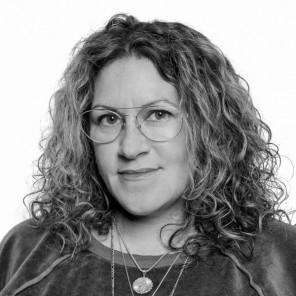
Xochitl Gonzalez is a staff writer at The Atlantic. She is the New York Times best-selling author of Olga Dies Dreaming, and is writing and co–executive producing a television adaptation of the book. Her work has been published by Allure, Bustle, Vogue, and The Cut. Prior to writing, Gonzalez had an extensive career as a wedding planner, an entrepreneur, and a consultant. She sits on the board of the Lower Eastside Girls Club.