The Boston Globe, by Kathleen Kingsbury
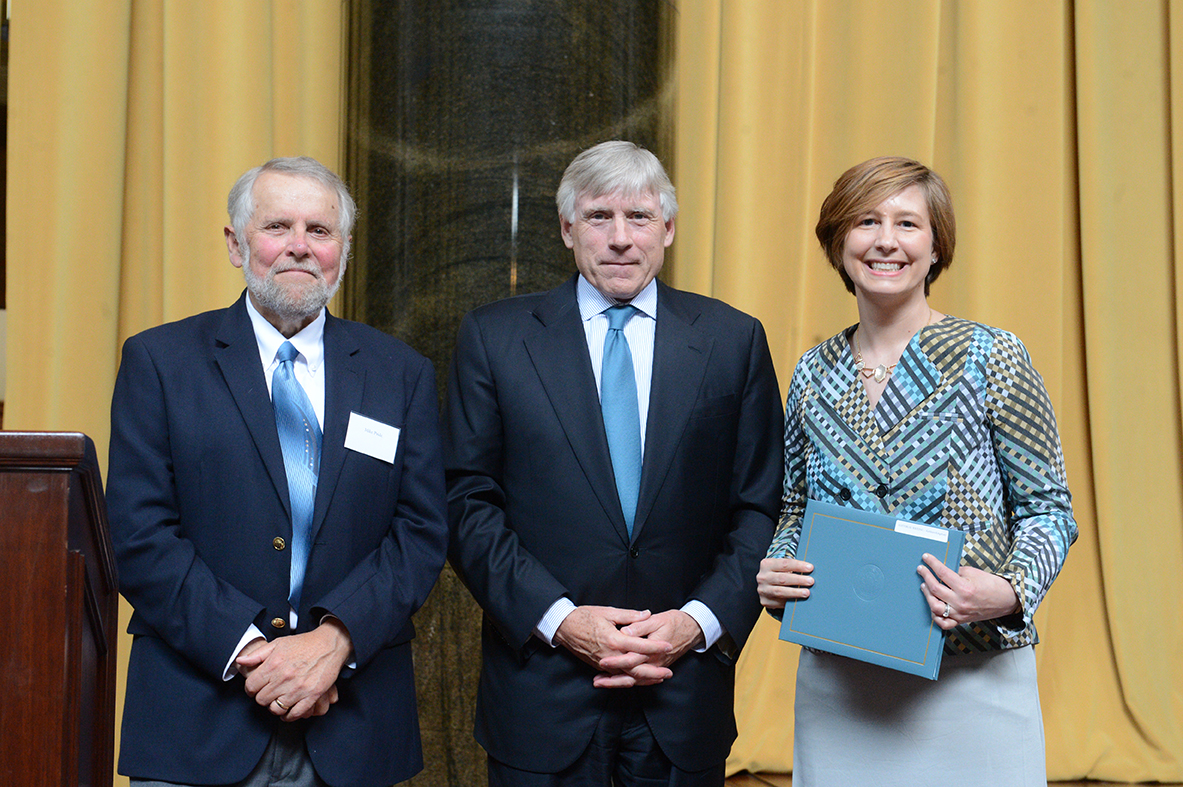
Mike Pride, Pulitzer Prize Administrator (left), and Lee C. Bollinger, President of Columbia University (center), present the 2015 Editorial Writing Prize to Kathleen Kingsbury.
Winning Work
By Kathleen Kingsbury
It's easy to recognize a former restaurant dishwasher. Long, deep scars often line their forearms — the result of nights when, as the lowest on the chain of kitchen workers, they must plunge their hands into boiling hot water to unclog industrial-size dish-washing machines. Another requirement is hauling heavy dish tubs across slippery kitchens. For this backbreaking work, the hourly pay frequently doesn’t exceed the state minimum wage of $8. Undocumented workers often make significantly less. If a dishwasher shows promise, he’ll get a second job in the kitchen, usually prepping salads, for no extra pay. “Paying your dues quietly is how to move up in a kitchen,” says Jonny Arévalo, who worked at several Boston restaurants, including Bennigan’s, for nine years. “Then some other poor guy takes your place.”
The restaurant industry in the United States is exploding, just as the income gap is widening. The trends are related: While expansion of other industries often leads to higher wages and greater opportunities, growth in the restaurant business does not. Shielded by a powerful lobby and a franchise system that makes union organizing difficult and impractical, it provides the scraps at the bottom of the income ladder. The food service industry is the province of kitchen workers who must enlist government investigators to collect the bare minimum that the law entitles them to receive; wait staff who earn a punishingly low $2.13 per hour nationally in exchange for tips whose distribution is often controlled by management; and fast-food employees who work for chains that explicitly advise them to apply for food stamps and other government aid to supplement their unlivable pay.
These low wages do not represent an efficient, market-driven distribution of labor. Because waiters making poverty wages turn to public aid, American taxpayers effectively subsidize the restaurant industry to the tune of $7 billion per year. All this for an industry that isn’t beset by global competition — as industrial manufacturers are — and doesn’t represent a vital national interest, like energy or utilities. In fact, the economic arguments against policies that would raise the wages of restaurant workers are distinctly unimpressive. Claims that higher wages would result in fewer jobs aren’t borne out by the experience of California, which bolted ahead of Massachusetts and other states years ago by prohibiting the practice of giving sub-minimum paychecks to workers in jobs with heavy tipping: The number of restaurant jobs in the Golden State is expected to rise by 141,000, or 9.1 percent, by 2024 despite workers having higher guaranteed pay, outpacing Massachusetts’ projected jobs growth of 5.7 percent over the same period.
Fairness alone suggests making a concerted effort to remove the loopholes that allow many restaurants to keep their workers in dire circumstances. Concern for the children of such workers ought to be enough of an incentive to mount an effort to raise salaries. But there is a larger reason to elevate the status of restaurant employees: It would be the single most effective way to combat income inequality in a country where the gap between rich and poor is soaring to levels not seen since before the stock market crash of 1929.
Restaurant workers represent a whopping 10 percent of the workforce, and a vastly disproportionate share of low-wage workers. By changing a few policies and adjusting some industry practices, the nation could sharply reduce the numbers of families in poverty and enhance the middle class while actually saving taxpayer dollars. It’s time to start moving in this sensible direction, both in Massachusetts and the nation as a whole.
Restaurants, in a way, are the quintessential industry of a challenging 21st-century economy. Time-pressed Americans eat out for at least five meals a week, and the average household spent $2,620 on food away from home in 2011, according to the National Restaurant Association. A thriving restaurant scene like Boston’s, with its fine dining and food trucks, is an integral part of a modern city. Massachusetts’ restaurants alone are projected to ring up $13.5 billion in sales for 2014. Yet as fine diners increasingly seek out organic, farm-to-table cuisine, few think much of the workforce making those meals.
What goes on behind the kitchen doors is grim. The 13 million-plus restaurant workers in the United States face a poverty rate that is nearly three times that of the rest of the country’s workforce, and the industry hosts seven of the 10 worst paying American jobs, according to federal labor statistics. Dishwashers in Massachusetts, for instance, made $10.29 per hour on average in 2012. (That figure is telling in itself, as it includes dishwashers at hotels, universities, and health care facilities, who are usually union workers and nationally earn on average nearly $3 more per hour than restaurant dishwashers.) Research done by MIT puts a livable wage for Boston — the minimum income someone needs to live adequately given local costs of living — at $12.65 for a single adult and $22.40 for a family of four.
Moreover, these jobs come with few of the benefits that workers in other industries take for granted. Health coverage is rarely offered; paid sick leave, vacation time, and 401(k)s are virtually unheard of. Schedules often change on a weekly or even daily basis, making child care a nightmare to arrange. And forget about job security. Restaurant analyst Victor Fernandez says annual turnover is above 95 percent for hourly workers.
Very little will improve until consumers begin to pressure the industry. While diners feel empowered to ask whether produce was purchased locally or if chickens were given free range to lay their eggs, they don’t feel comfortable questioning the treatment of employees, despite mounting evidence of violations of labor laws and poor conditions for workers. Diners, either through their political representatives or their own complaints to managers, should argue that workers be given:
■ Hourly wages at or above a living wage for individuals.
■ Payment for all the time they work, including overtime.
■ Opportunities to organize if they choose to do so.
Meanwhile, lawmakers should summon the courage to reject the demands of the National Restaurant Association, which is largely responsible for Massachusetts’ “tipped minimum wage” — under which restaurants are allowed to pay workers just $2.63 with the hard-to-enforce understanding that tips will make up the rest of the way to at least $8 per hour. California, for its part, has guaranteed that all restaurant workers will earn at least $10 per hour by 2016, through a straightforward paycheck, with tips extra.
Most restaurant owners blame low wages and poor working conditions on slim profit margins amid intense competition. But raising wages across the board wouldn’t change the competition; every outlet would have to play under the same rules and demands. And while consumers should expect somewhat higher prices to cover higher labor costs, some restaurants insist that better-paid workers are more reliable and stay in their jobs long enough to make up in efficiency for what they’re costing in extra wages.
In reality, employers get away with paying little and treating workers badly simply because they can. There aren’t many other opportunities in Massachusetts for workers with few or no skills, especially if they are undocumented. In 2012, there were 1.8 job seekers for every opening in the restaurant sector statewide, a relatively low figure compared to other industries. Yet the data suggest more than two-thirds of those openings were for part-time work, while the vast majority of the unemployed want full-time positions.
In Boston, immigrants from Latin America — most often from Colombia, El Salvador, or Brazil — fill restaurant kitchens. Many, because they have limited English or are in the country illegally, are simply glad for paying work. Supporting family here and back home, they often string together two or three jobs to make ends meet. “They start at 7 a.m. in one kitchen doing prep, then leave for a second shift, working until midnight or 1 a.m.,” says Arévalo, who was a pilot in his native Colombia and now runs the worker center at the Massachusetts Coalition For Occupational Safety and Health (MassCOSH).
Filiberto Lopez moved to Boston from El Salvador seven years ago in hopes of finding the American Dream, and ended up sleeping in the kitchen of a East Boston Peruvian restaurant. He worked more than 80 hours a week there, schlepping 200-pound sacks of flour from the kitchen’s basement storage area, cleaning the restaurant after hours, even maintaining its air filters and electrical system. His boss, himself an immigrant, was verbally abusive, regularly referring to Lopez as “Boy.” For this, Lopez was paid $5 an hour and never overtime. “I didn’t speak English and didn’t have legal documents,” Lopez says. “I assumed I had no rights at all.” Lopez has moved on to work at other Boston restaurants, and has helped MassCOSH identify other abusive workplaces.
Wage theft is common across the industry, and not just at struggling ethnic outlets in distant neighborhoods. It starts with failure to pay overtime. State law exempts eateries from paying time-and-a-half for more than 40 hours of work in one week. However, federal laws do not — and if a restaurant makes more than $500,000 in gross annual sales, it is compelled to follow the federal law. Local establishments have also been found to be breaking child labor laws, failing to pay minimum wage, or failing to pay workers at all.
Massachusetts’ restaurants are under more scrutiny than most. The Boston office of the US Department of Labor conducted 165 investigations in the restaurant industry in fiscal year 2013, collecting more than $1.7 million in back wages from employers who violated wage-and-hour laws. Among those cited for various violations since 2009 by the Labor Department, state Attorney General’s Office, and other enforcement agencies are some of the Boston area’s most popular dining establishments: Not Your Average Joes; the Metropolitan Club; Sunset Grill & Tap; Brookline’s Pomodoro; Cambridge’s Miracle of Science, Middlesex Lounge, and Tory Row; and Ruby Tuesday.
In 2012, acclaimed restauranteurs Patrick Lyons and Ed Sparks agreed to pay $424,000 in back pay and damages to improperly underpaid workers at 15 of the restaurants they own, including Towne, Scampo, Sonsie, and the Bleacher Bar. In what is a common practice, Lyons and Sparks had contracted out their labor to an agency that not only failed to pay employees but also disappeared. At the end of the day, though, the law rightly holds the restaurants responsible for ensuring their workers are fully paid. “Know who you’re doing business with,” Lyons warns. “Or you’ll end up paying at least twice what you owed in the first place.”
But resources for enforcement are limited. Boston Mayor Marty Walsh could help. During his campaign, Walsh pledged his support for a livable wage. A first step for his administration toward achieving that would be to streamline the permitting process. By allowing restaurants to open and operate with less red tape, overhead could be reduced, and capital freed up for owners to pay their workers a higher wage.
Or, better yet, Walsh could follow the lead of Somerville Mayor Joe Curtatone. Last summer Curtatone championed and passed a citywide ordinance put forward by local activists that now prevents employers who are guilty of wage theft from getting or renewing permits. This law should be replicated across Massachusetts. “If you break the law and don’t pay your workers what they’re owed, you won’t do business in Somerville,” Curtatone says.
That’s a message any business owner will understand.
By Kathleen Kingsbury
Tipping is said to have started in the Roman Empire as a means to reward servants and slaves. Americans adopted the custom only after the Civil War, but it stuck: Diners doled out some $40 billion in gratuities in 2012, according to industry experts. Yet the entrenchment of tipping has given restaurant owners a pretext to avoid paying their workers a proper wage. The tip system should be uprooted — or at least returned to its roots as a purely voluntary reward for excellent service.
Other than restaurants, few other industries let bosses rely mainly on customers’ generosity to set employee wages. Owners are happy to save on labor costs. Back when tips still came mainly in cash (and therefore could conveniently be left off income tax forms), this arrangement probably made sense to workers, too.
That’s changed in the era of credit card payments. Only the wait staff at the priciest establishments can count on big tips leading to livable incomes. Wage theft — the nonpayment of owed wages or tips — is now commonplace at restaurants. Overall, the vast majority of servers and other front-of-the-house employees have been left with little control over how much income they make each week.
A busy Friday evening shift can mean good money, only to be followed by a slow Sunday afternoon where tips total $20 for a whole shift. If a diner doesn’t like his meal, his dissatisfaction with the kitchen could reduce the take-home pay of his server, the busser who cleared his table, and even the host who seated him. Work performed outside regular shifts typically goes unpaid, and bad weather or illness may lead to no pay at all.
Rakel Papke earned good tips as a waitress at Braza Bar and Grill, a popular Everett restaurant. Yet in nine months of working there, she received only six paychecks — and, she says, those checks arrived only after she asked. “They basically only paid me to keep me quiet,” Papke adds. So she recently filed a formal complaint with Attorney General Martha Coakley’s office, asking her former employer for the more than $4,000 she is owed in back pay.
More realistic, however, would be systemic change through stronger wage laws and better enforcement of those regulations. The Massachusetts Legislature is currently debating whether to raise the minimum wage, and the state Senate last November voted to raise the minimum for tipped workers, pegging it to 50 percent of the minimum for other workers. Whether the House will follow suit is unclear. Such an oversight would be shocking. Four out of five states — Arizona, Colorado, North Dakota, and Florida — where the National Restaurant Association projects the fastest growth in the restaurant industry for 2014 have a tipped minimum wage of at least $4.86, or nearly twice Massachusetts’ current law.
The Massachusetts Restaurant Association, the industry’s lobbying group, has devoted intense resources to keeping the tip wage unchanged. Its CEO, Bob Luz, notes that waiters and waitresses in the state already make some of the highest average wages in the country, significantly more than cooks and kitchen workers, and that raising the tipped minimum could increase menu prices for customers. “No victim here if the tipped minimum doesn’t go up,” Luz says. His argument, however, rests on potentially unreliable data that employers, rather than servers themselves, report to the US Department of Labor.
Even if Massachusetts diners are more generous with tips — as the Labor Department data imply — why not extend a greater level of wage security to all servers in the state? Advocates want the tipped wage to be at least 60 percent of the full minimum wage guaranteed to all other workers.
Even better, however, would be to pass a law that would prohibit a separate tipped minimum wage, as seven other states have done. Workers would be guaranteed $8, or whatever the current full minimum wage is. Then, any tips they received would be what most customers already see them as — bonuses.
The nation’s largest state, California, for decades has not allowed tipped workers’ base pay to fall below the regular minimum wage. From fusion bistros in Los Angeles to sushi bars in San Francisco where the fish is flown in daily, the industry is booming and expected to expand by 9.1 percent over the next decade. In fact, in California and the six other states without a separate tipped wage — Alaska, Nevada, Montana, Minnesota, Oregon, and Washington state — job growth in the industry is expected to exceed Massachusetts’ over the next 10 years, in some cases by more than double. The poverty rate for tipped workers in these states was 12.1 percent, compared with 16.1 percent in states with the lowest tipped minimum, according to a 2011 analysis by the Economic Policy Institute.
Massachusetts, which often prides itself on its progressive values, is a laggard in protecting restaurant workers. Its current tipped minimum wage is worth just one-third of the regular minimum wage, and is lower than the tipped wage in 27 other states, including all other New England states, according to the Massachusetts Budget and Policy Center.
Women, who make up about 73 percent of tipped workers, are disproportionately harmed. Waitresses in some gritty bars and grills say they feel compelled to flirt with customers and laugh at offensive jokes just to preserve their income. Even then, they earn an average of $0.50 less per hour than male tipped workers, government statistics show. Doing away with the tipped minimum and giving these women a steadier paycheck would be the quickest way to restore their dignity.
Under the current system, restaurants must pay wait staff $2.63 an hour. A server’s wages plus her tips for every two-week pay period must also average out to at least $8 an hour, the regular state minimum wage. If not, then her employer is legally required to make up the difference.
Reality is messier. The government agencies that enforce wage laws largely depend on violations being reported, and some restaurant owners have found they can underpay workers without consequence. Nationwide, an Aspen Institute study suggests that nearly 40 percent of restaurant workers earn at or below the federal minimum wage of $7.25, even with tips factored in.
A 2009 study of 4,400 workers in New York, Los Angeles, and Chicago found that more than one-quarter of tipped workers were not even paid the lower tipped minimum wage, and 12 percent had seen their tips stolen by an employer or supervisor, which is illegal. There’s no reason to believe Massachusetts is an exception. In 2012, Starbucks was ordered by a federal appeals court to pay Bay State baristas $14 million in tips that had been illegally meted out to managers.
Ending the tipped minimum wage would be the first step to preventing this kind of abuse. Frequenting and encouraging eateries that include a service charge in the price of a meal is another.
Until then, tip well.
Tomorrow: How higher wages will help workers, businesses, and taxpayers.
Correction: An earlier version of this editorial suggested the Massachusetts state Legislature had not considered raising the minimum wage for tipped workers. The state Senate voted to raise the wage in November, but the House has yet to follow suit.
By Kathleen Kingsbury
“I could stop worrying about our monthly bills today and start planning for the future,” she said.
When challenged on their low wages and lack of benefits, fast-food chains tend to depict their workers as teenagers saving for college, for whom the hourly receipts are a step toward a better future rather than a way to make ends meet now. Apparently, all those smiling kids wear their brightly colored smocks and golf visors with the same pride as Marines donning their colors, and are just as happy to serve. But those workers, if they exist, are a distinct minority.
They should meet Hope Shaw, the 38-year-old single mother of three who is assistant manager at Dunkin’ Donuts on Boston Street. She, too, likes to serve. But her life is one of unrequited toil. She lives paycheck to paycheck. Her heating gas was shut off last winter for failure to pay; the electric bill for her Dorchester apartment is consistently three months overdue. She’s gone without health insurance for more than a year. “My rent is $1,100 a month,” she says. “Every month I feel like I’m choosing between paying that or putting food on the table.”
Yet, six days a week, Shaw leaves her home before 4 a.m. to work a nine-hour shift overseeing the sale of donuts, bagels, and flat-bread sandwiches, while coping with customers who expect their coffee to be prepared exactly as they please and only sometimes drop a penny in the tip can. She’s been promoted twice in the five years she’s worked at the store, and her hourly pay has gone from $8 to $10. She made slightly less than $24,000 last year.
Despite working full-time, she and her family remain submerged beneath the poverty rate for Boston residents. Shaw’s predicament is common among her fast-food colleagues. Nationally, the median wage for front-line fast-food workers is $8.94 per hour, according to an analysis by the advocacy group National Employment Law Project.
Among those workers, about 70 percent are over age 20. And of that 70 percent, a third have attended college. Most employees are depending on those jobs to support themselves and their families. “We can’t make it out here,” Shaw says.
Fast-food workers in Boston and across the country have been striking since last summer for higher pay. They’re demanding that national fast-food chains enter into collective bargaining for a minimum wage of $15 per hour, more than twice the federal minimum wage, and paid sick leave. They make a compelling case.
Right now, it’s public assistance that is making up the difference. Half of fast-food workers’ families rely on government aid at a cost of $7 billion per year to American taxpayers, according to recent research done at the University of California at Berkeley and the University of Illinois at Urbana-Champaign. This aid amounts to a massive public subsidy to multibillion-dollar private corporations.
McDonald’s alone costs taxpayers an estimated $1.2 billion each year. One employee last fall recorded a staff member on the company’s “McResource” line urging the full-time worker to sign up for food stamps, Medicaid, and welfare. The hotline, which was recently shut down, routinely helped employees and their families enroll in state and local assistance programs.
Social safety nets exist for a reason. But enabling profitable companies to keep workers on at poverty wages is a poor use of scarce government resources. Little in the McDonald’s financial statements indicates it can’t afford to pay employees more. In 2012, net income topped $5 billion, and the company paid out another $5.5 billion in dividends and stock buybacks. CEO Donald Thompson earned a salary of nearly $14 million — or about $7,000 per hour. In fact, industry-wide research by the Economic Policy Institute finds that restaurant CEO pay was 788 times higher than average employee earnings last year — a stark example of the way executives can reward themselves for keeping the wages of others low.
The simplest solution is to raise the minimum wage. The Massachusetts Senate has voted to increase the minimum wage from $8 an hour to $11 by 2016, and the House is currently negotiating its own bill. Because the value of the minimum wage hasn’t kept pace with inflation, a full-time minimum wage worker now makes the equivalent of $5,400 a year less than in 1968, according to the Massachusetts Budget and Policy Center. Not surprisingly, nearly 80 percent of the public supports minimum wage increases.
But the national food chains haven’t offered good evidence for why they shouldn’t start workers’ wages at $15 per hour instead. McDonald’s frequently cites the fact that it already offers “competitive pay,” suggesting that anything more would put it at a competitive disadvantage. But if the top 10 chains entered collective bargaining and agreed to $15, that argument goes away.
Then there is the counterexample of In-N-Out Burger, a West Coast regional chain that’s become a cult favorite. In-N-Out takes pride in paying starting employees $10.50 an hour, and within a few months most are making at least $2 more. The company offers benefits including vision, medical, and dental for part- and full-time associates. Assistant managers can make up to $70,000 annually; managers as much as $120,000. And In-N-Out’s 280 locations brought in $651 million in sales in 2012, which is more than twice the per-store average at Dunkin’ Donuts’ 7,360 US locations.
Burger King executives prefer to blame low wages on the franchise model, in which outlets are separately owned and managed, even though Burger King maintains tight control of the product line, restaurant design, amenities, and pricing. It has said it “doesn’t make hiring, firing, or employment-related decisions for our franchisees.” Indeed, the company that enforces tight specifications for everything from the weight of the Whopper to the amount of oil in the French fries makes absolutely no provision for minimum wages or conditions of employment. Requiring its franchisees to pay a living wage through its franchise contract isn’t anywhere on the radar screen.
It’s a telling omission. Franchise owners, worried about higher labor costs, could demand lower corporate fees in return. The tradeoff could lower corporate profits. So workers and customers are paying the price instead.
Would the price of fast food soar with a higher minimum wage? It’s not likely. Economists at UC Berkeley have estimated a $15 wage would cost consumers about 10 percent more. (Americans spent, on average, about $2,620 on eating out in 2011, according to the National Restaurant Association.) A separate 2006 study suggests menu prices would rise about 17 percent with a $15 minimum wage, according to the Employment Policies Institute.
Breaking down the McDonald’s 2012 annual report provides a little more clarity. At company-run stores, profit margins are above 10 percent, but payroll and employee benefits add up to about 25 percent of sales at these locations. That means, if compensation were to double and no other expenses lowered to offset that rise, prices would have to increase by about 25 percent, or $1 more per Big Mac, to make up the difference. Industry associations insist that any higher prices would drive away customers and result in fewer jobs. Some diners might indeed go elsewhere or eat at home. But most fast-food customers are less price-sensitive; those motivated mostly by convenience wouldn’t cross state lines or turn to the Internet to save $1 on a fast-food lunch. Meanwhile, restaurants could count on lower training and recruitment costs as turnover — now close to 100 percent per year for fast-food chains — is reduced.
In return, the extra $5 per hour would transform the lives of hard workers like Shaw and their kids. “I could stop worrying about our monthly bills today and start planning for the future,” she said.
Tomorrow: Unions and advocates need to step up organizing restaurant workers.
Correction: A previous version of this story misstated the results of a survey on education levels of fast-food workers over age 20. One third have attended college.
By Kathleen Kingsbury
About 13 percent of fast-food workers have employer-sponsored health benefits, compared with 59 percent of the workforce as a whole.
In nearly a decade of working at the Burger King across from the Boston Common, Kyle King’s hourly pay has risen from $8 to $8.15. Unable to afford rent on a place of his own, the 46-year-old lives with his brother in a small Roxbury apartment. Fed up, King decided to join a one-day nationwide strike of fast food workers last August and told the Globe as much. Things at work then went from bad to worse for King.
The day after he appeared in the newspaper, King arrived at Burger King for a scheduled shift only to be told to go home; he wouldn’t be needed that day. In the weeks that followed, he saw his 20-hour schedule whittled down to fewer than nine hours per week.
About 4 miles away, Georgina Guiterrez, a prep cook at the Burger King on Washington Street in Dorchester, believes she has faced similar payback. She says the owner of that franchise called workers who chose to strike “traitors.” Guiterrez earns $8.25 an hour after four years on the job; she received a 25-cent raise in August when the owner was trying to persuade her not to strike. She did anyway, and since then has seen her hours halved from 38 to barely 20 some weeks. That has been devastating to Guiterrez, who supports her disabled mother and three nieces and nephews with her Burger King pay. (Neither the chain nor the franchisees in question responded to requests for comment.)
According to the US Department of Labor, fewer than 2 percent of food service workers are unionized. It shows. Employees like King and Guiterrez are at a major disadvantage when demanding better pay and working conditions. Average wages in the sector have stagnated at just above the federal minimum wage, $7.25 an hour, for two decades. About 13 percent of fast-food workers have employer-sponsored health benefits, compared with 59 percent of the workforce as a whole. Whether through traditional unions or some other vehicle, one of the quickest ways to improve the lot of most restaurant employees would be for them to band together.
Larger unions often have trouble making inroads into restaurants because of the small-scale nature of the business, with its mom-and-pop eateries and franchised fast-food outlets. Fortunately, less conventional advocates for workers are filling the gap.
One promising example is New York-based Restaurant Opportunities Center United, which recently expanded its efforts to Boston. The advocacy group is probably best known fora $5.25 million settlement it helped win against celebrity chef Mario Batali in 2012 after servers at several of Batali’s famed restaurants alleged their employer had violated the Fair Labor Standards Act, in part by pocketing gratuities. Beyond its workplace justice campaigns, however, ROC-United offers its 10,000 nationwide members benefits such as free job training and an affordable health plan. In Boston, this work should complement local immigrant worker centers, which already help collect unpaid wages, connect employees to enforcement agencies, and provide multilingual education on workers’ rights.
To see the impact that better organizing can have, one needn’t look much farther than Boston’s college campuses. Traditional unions have had the most success organizing food service workers at large institutions, such as hotels, hospitals, and universities. Boston’s Unite Here Local 26 has negotiated collective bargaining agreements on behalf of food workers at several local schools, including Harvard, Northeastern, Brandeis, and MIT. “What we found in non-union settings were pay rates that ranged from $9 to $11 and health benefits with premiums, co-pays, and deductibles so high the employees couldn’t afford them,” says Brian Lang, Local 26’s president.
With Local 26’s help, Lang says, pay has risen significantly, employees’ share of their health coverage has dropped to as little as $4 a week, and workers are ensured regular schedules, including set days off. As union members, they also have access to legal help, low-interest loans to buy homes, and educational initiatives such as English lessons and GED prep.
Up to now, unions have generally shied away from trying to organize fast-food workers one independently owned franchise at a time. But what if they set their sights higher? Chains like McDonald’s, KFC, and Burger King already dictate many details of franchise operations, from staff uniforms to marketing to the prices they can charge for certain menu items. If they wanted, national fast-food chains could also insist that franchisees abide by collectively bargained wage standards. The main thing preventing the chains from negotiating such agreements is the likely rise in worker salaries.
Fortunately, the National Labor Relations Board came to Kyle King’s aid. Under the Obama administration, the panel has recognized that, even though the might of labor has declined, workers’ rights still need protection. It has emphasized key parts of the National Labor Relations Act that allow for any employees to join together and seek better terms, with or without a union, says Boston labor attorney Louis Mandarini, who filed a complaint with the board on King’s behalf.
Because King was exercising his right to contact the media about inadequate working conditions, the NLRB complaint prompted the owners of the Burger King franchise where he works to settle with King. He will have his pay reinstated for the day he was sent home after the Aug. 29 strike, and Burger King has committed to upping King’s weekly hours significantly.
But it’s crucial to note who connected King to his legal representation: MassUniting, a local labor group financed in part by the Service Employees International Union. As King put it, “I wouldn’t have even known I had these rights if someone hadn’t been there to tell me.”
Correction: An earlier version of this editorial incorrectly said the Massachusetts Legislature has not considered raising the state’s tipped minimum wage. State senators voted to raise the wage last November, though the House has yet to follow suit.
By Kathleen Kingsbury
A legal opinion issued by the National Labor Relations Board Tuesday could go a long way toward addressing a root cause of income inequality: the low wages and inadequate benefits of fast-food employees. Such workers make up a large percentage of the working poor — people who work full time but don’t earn enough to cover basic expenses. Many earn so little that they’re eligible for public assistance. Taxpayers cover the cost of benefits that their employers should be picking up.
In declaring that, in labor disputes, McDonald’s could be treated as a “joint employer” along with its franchisees, the NLRB opened the door for unified protests and perhaps even union organizing across the entire McDonald’s empire in the United States, as well as those of other fast-food chains with a similar franchise model. In the past, fast-food chains insisted that decisions on wages and working conditions were made by the franchise owners, and that any complaints or organizing efforts should be directed at each owner individually. (McDonald’s has 14,000 US outlets, 90 percent of which have independent owners.) The company vowed to fight the NLRB’s decision, declaring that it “changes the rules for thousands of small businesses.” But the decision is mainly changing — or, rather, clarifying — the rules for McDonald’s itself.
This isn’t a shocking legal stretch. McDonald’s maintains tight control of the menu, cooking standards, cleanliness, and atmosphere of its franchises. It clearly recognizes that customer loyalty depends on consistency among all McDonald’s outlets. Labor standards also bear strongly on the overall McDonald’s experience, so holding the chain responsible for the treatment of the workers in its franchises is merely a logical extension of what all customers recognize when they approach the golden arches: The restaurant is a McDonald’s, and operates under the aegis of the McDonald’s corporation.
By Kathleen Kingsbury
Tucked into a nondescript strip mall off Route 44 in Raynham, the Grand China Buffet was an affordable option for the customers and employees of the Big Lots and Pep Boys stores on either side of it. Especially popular was the $4.99 all-you-can-eat lunch deal. “The prices are great — much cheaper then other buffets,” customer Adam M. wrote on Yelp. “And for better food on top!”
But, for its workers, the Grand China Buffet was a virtual prison. The labor was grueling, former employee Felipe Merino Sanchez said: six days a week, more than 12 hours per day, doing food prep, cleaning the dining room, and fixing the HVAC system. The kitchen lacked safety equipment, the floors were slippery and filled with holes, the oven leaked gas. Cooking often meant reheating days-old food for the buffet, including, once, seafood that the kitchen staff was asked to pick out of the trash. When workers complained, they were fired.
At the end of each shift, employees were taken to a rooming house in neighboring Taunton where they were locked in for the night, according to Sanchez. Four to five people shared each room. “We couldn’t leave as we wanted,” Sanchez, whom the Globe located through worker advocates and government citations, said via a translator. “The door was alarmed.” When the police knocked on the door one day, though, he hid. “I thought I’d lose my job or get deported.”
Few casual diners would expect that a seemingly unremarkable eatery in Raynham could be a venue for what amount to human rights violations. But even at its highest levels, the restaurant industry is run on a more informal basis than most. Servers are paid mainly in tips; the back of the house often abounds with unofficial employees. These practices are problematic on their own terms, but they also create a fertile environment for conduct equivalent to human trafficking.
For all the attention given to undocumented housekeepers and gardeners, the food-service industry is among the leading employers — and exploiters — of immigrant labor. More than one-fifth of all food-service workers are foreign-born, according to a 2012 analysis by the Brookings Institution. And in many cases, the immigrants who are mistreated are fully legal.
But there are scant resources devoted to exposing these crimes, and most customers don’t think twice, especially when the food is cheap and the cuisine is ethnic: Some familiar old tropes — that the ill-treatment of immigrant workers is merely adherence to cultural norms, that “making it” in America involves absorbing adversity — become common fig leaves for abuses.
And the restaurants that engage in such practices aren’t isolated mom-and-pop horror shows: Many belong to networks that funnel immigrant labor, documented or not, from major entry points like New York City to smaller cities and towns across the country.
Sanchez, for one, crossed the US border from Mexico in 2003 and headed to New York City. Getting a job was his first priority. He said he followed his brother’s footsteps and searched local Chinese newspapers for coded ads aimed at undocumented workers. When he found what he was looking for, Sanchez called a telephone number, was given an address in Chinatown, and on the appointed date, got into a van driven by a stranger. They headed 200 miles north to the Grand China Buffet. He had no clue where he was, Sanchez recalled, but it was a job with food and housing.
At the urging of the Massachusetts Coalition for Occupational Safety and Health, the state Attorney General’s Office began investigating the Raynham eatery in August 2010, along with a sister restaurant, the New York Chinese Buffet, located in Somerset.
Investigators found the staff made far below Massachusetts’ minimum wage of $8 with no overtime pay — if they were paid at all. Sanchez claimed to be owed some $26,000 in unpaid wages. Another employee, Fidela Martinez, who was 16 at the time, was not paid for more than nine months, even as she worked thousands of hours.
The owners and managers — Xue Ying You, Zhi Hao Zhang, Casidy Lu, Ai Yi Lu, and Ming Kuai Lu — were eventually charged with failure to pay employees minimum wage and failure to pay them in a timely manner, among other charges. The Grand China Buffet was also cited for breaking child labor laws. They were ordered to pay $181,000 in fines, at least some still unpaid. Both restaurants were shuttered.
No criminal or trafficking charges were filed, however. Massachusetts did not pass its antitrafficking law until 2011. And Ai Hui Lu — whom Sanchez and advocates believe is related to the previous management — was granted a liquor license from Raynham selectmen in 2011 for a new restaurant, the Hibachi Sushi Buffet, in the space Grand China once occupied. Sanchez moved on to work at another Chinese buffet. (Repeated attempts to reach all of the owners and managers for comment went unanswered, although some of them have previously denied the charges in media reports.)
Labor advocates and trafficking experts noted the reopening of the restaurant with frustration, explaining more generally that operators are notorious not only for avoiding arrest but for also finding ways to keep operating even after being cited for grotesque abuses. Enforcement is so sporadic, and tolerance is so high, that only the most unlucky violator gets padlocked for good.
There is no way to estimate fully how many workers suffer the same fate as Sanchez and Martinez. But restaurant operators in Minnesota, Wisconsin, California, Texas, and Kentucky have been accused of human trafficking over the past two years. Most often, the offenders were small-scale, ethnic restaurants.
Several laws to protect workers like Sanchez and Martinez are in place. Massachusetts has among the strictest labor regulations in the country, and it has slowly started to prosecute trafficking cases since the law passed three years ago.
More, however, could be done: Enforcement nationally should be more proactive and better funded. The US Department of Labor, for example, is one of the few agencies that routinely trains its inspectors to recognize trafficking victims, but also has only about 1,000 wage and hour investigators to monitor as many as 10.5 million employees at nearly 600,000 restaurants nationwide — in addition to the millions of other workplaces covered by the Fair Labor Standards Act.
Violations are more often unearthed by state or local labor and health code investigators who aren’t necessarily trained to know trafficking — and who might not want to jeopardize their own cases by bringing in criminal investigators. Physical evidence isn’t properly collected or doesn’t exist, and prosecutors are frequently forced to rely on witness testimony — witnesses who are also often afraid of being deported, in debt to their abusive employer, or isolated or vulnerable for other reasons — to make their case. (A challenge compounded by the fact that the US Department of Homeland Security, which oversees immigration, also investigates trafficking crimes involving foreign national victims on the federal level.) Agencies don’t communicate well enough among themselves to identify questionable businesses.
In Massachusetts, an interagency task force headed by Attorney General Martha Coakley in 2013 recommended a well-funded, worker-led program aimed specifically at labor trafficking to offer comprehensive legal and social services. That proposal should be taken up. Even consistent, coordinated data collection — to better understand how prevalent this problem is — would help.
A good start would be for the Commonwealth to follow the lead of California, which in April enacted a law requiring restaurants that serve alcohol to post public notices in their kitchens explaining slavery and human trafficking, or face stiff penalties.
There’s a role here for customers, too. As long as Americans believe that a lunch out can and should cost less than $5, workers in the food-services industry will be exploited. What went on behind the kitchen doors of the Grand China Buffet will continue elsewhere. The economics of today’s restaurant business, between labor and food costs, are difficult. And when diners find restaurants that are implausibly cheap, they might ask themselves — and their servers — why that might be.
The true cost of cheap egg rolls became grossly apparent at the Grand China Buffet. And Massachusetts — and the rest of America — needs to put down the fork and stop looking the other way.
By Kathleen Kingsbury
Less than a year after the owners of Bukhara Indian bistro in Jamaica Plain were accused of stealing nearly $200,000 from their employees, allegedly making them work weeks without pay, city officials approved the restaurant’s upgrade to a coveted full liquor license.
Stealing wages from workers is rampant in the restaurant industry, according to federal investigations — and so is escaping any real consequences. One World Cuisine, the company that operates Bukhara as well as Diva in Somerville and Dosa Factory in Cambridge, settled with its workers, and now the restaurant in the heart of one of Boston’s ostensibly most progressive neighborhoods is humming again.
Stealing from workers — by, for example, withholding tips, failing to pay overtime, or doctoring timecards — has devastating consequences for employees whose financial lives are disrupted; even if back wages are eventually paid, workers may miss rent payments or struggle to feed their families in the meantime. Enforcement efforts by the attorney general’s office and federal agencies, with their limited resources, clearly have fallen short.
But city officials have powerful leverage: They can make the treatment of workers a much more central part of the permitting process for restaurants. Some municipalities in Greater Boston are moving in that direction. But the real test will be whether they put real resources into policing an industry that has proven adept at skirting other labor protections.
Inspired by the One World case, Somerville — with the backing of Mayor Joe Curtatone — passed an ordinance last year that allows the city to deny permits or revoke existing ones for operators found to owe back pay. Boston Mayor Martin Walsh followed suit this fall, issuing an executive order that says vendors will have to certify compliance with state and federal wage laws in order to receive city contracts and — most importantly for restaurants — instructs the licensing board to take wage theft violations into consideration before issuing, renewing, or rescinding city licenses.
Walsh’s executive order, which goes into effect on Jan. 1, is one of the first in the country to require a so-called wage bond, meaning companies must also show they have adequate funds to pay workers fully for the duration of their city contract. The mayor’s staff worked closely with unions and other worker advocates to craft the executive order, and soliciting that input likely strengthened it.
While the Somerville and Boston laws both apply to all types of businesses, their reach could have an outsized impact on behalf of those who work in food service. While hardly the only sector guilty of wage violations, restaurants are among the worst offenders. The US Department of Labor recently released a survey of workforce data from New York and California that found minimum-wage violations — which, across all industries, amounted to more than $20 million estimated in lost income in each state per week — were most common in restaurants and hotels. A separate study previously suggested 43 percent of restaurant workers report not being paid overtime that they were owed under the law.
But the efforts of Boston and Somerville will not help a single worker if the mandates aren’t funded or enforced.
In Somerville, as of November, no businesses had lost permits thanks to the wage theft ordinance, which passed in the summer of 2013. Officials there seem to have no means to root out violators — they note that the attorney general’s office is in the process of creating a database of citations. No launch date is set.
Boston also has no mechanisms set up yet to enforce its law, such as surprise inspections at job sites, financial audits, or periodic payroll reviews. There has been no funding so far earmarked for compliance work, no additional hires announced, and, pressed for details on how enforcement will be done, city officials say that while the mayor is committed to battling wage theft, no final decisions have been made for even what part of City Hall will oversee the effort.
Other labor rules in Boston show that very little will improve until the city starts paying attention. The city law that requires 50 percent of total work hours be performed by Boston residents, 25 percent minorities, and 10 percent women on publicly funded construction projects and large private projects went largely unheeded under the Menino administration until about four years ago, when city councilors Ayanna Pressley and Mike Ross began to press the issue.
Data about building sites across Boston is now available online and regularly updated. And since 2009, minority participation is up nearly 20 percent, and the portion for women has nearly doubled, according to Susan Moir, director of the Labor Resource Center at UMass Boston. “Transparency means developers can’t make excuses. Their competitors are meeting the goals. Why aren’t they?” Moir said. “But it takes political will first.”
The upside for workers, if these latest wage laws are enforced, is tangible: In one case alone this year, a federal judge determined that Ward’s Cleaning Service, Inc., which serves some 85 restaurants and hotels in the greater Boston area, owed more than $1 million in back pay and damages to 149 low-wage employees working as dishwashers, janitors, and housekeepers. Investigators discovered that the company’s management avoided overtime payments by directing workers to falsify timecards or use multiple timecards with different names. Ward’s also allegedly paid employees with checks made out to fake names or in cash to avoid labor laws. (The firm noted this week that the violations cited were identified and halted in early 2012, saying three quarterly independent audits since the judgment last spring have found the company is in full compliance with wage laws.)
Even more troubling: This was not the Peabody-based firm’s first offense. It was cited for similar violations in 1993. Technically, under both Boston and Somerville’s wage theft laws, that could have disqualified it for permits or city contracts. If its president, David Ward, had believed that stiffing workers could have significant financial consequences for his business, would the company have been so cavalier to flout the rules again and again?
Walsh and Curtatone should make sure their laws are strong, funded, and enforced, to guarantee the answer is no. At the very least restaurant workers are owed that.
By Kathleen Kingsbury
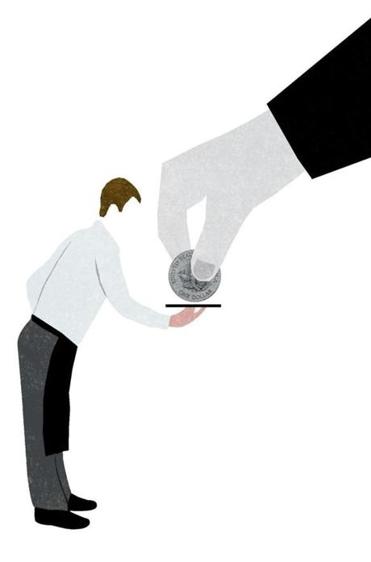 Patric Sandri for The Boston Globe
Americans have started to care deeply about how their food came to be. At restaurants, we ask probing questions: Are the greens organic? Were the cows grass-fed? We fret over whether our chicken could run around the farmyard. We take comfort in knowing that the pickles were prepared in-house, and that the cucumbers came from just an hour away. In short, we’ve come to demand high quality and sustainable sourcing in every part of a restaurant’s operation.
Well, except in how the employees who work there are treated.
In a series of editorials over the past year, the Globe has detailed the challenges that food service workers routinely face: wages too low to live on, minimal job security, few organizing rights, the risk of wage theft, and even human trafficking.
These are all indecencies that, theoretically, should fall to lawmakers to address. But political will in Washington to raise the minimum wage has stalled, and labor enforcement, at both the federal and state levels, has been ineffectual.
No, more humane working conditions in restaurants aren’t likely to arrive until patrons start demanding them as part of their dining experience, too.
Contrary to the protests of industry bigwigs and some politicians, there is room in restaurant economics for higher pay and benefits — if customers are willing to pay a little bit more.
Ask top executives at Chipotle Mexican Grill. The burrito chain is red hot, achieving record margins and robust sales in recent years as Americans (and Europeans and Canadians) embrace its “Food with Integrity” motto. The company does offer its employees some luxuries rare in its industry — quick advancement, health insurance, regular full-time shifts, for instance — but its average wage for non-managers works out to be just slightly above $9 per hour (including bonuses).
Yet, in discussing proposals for a $10 minimum wage, Chipotle’s chief financial officer, Jack Hartung, shrugged it off. “A move to $10 would have an effect, but not too significant,” Hartung told analysts last January. In other words, an extra buck an hour isn’t a major threat to Chipotle’s bottom line, but the chain is also in no hurry to get there. For the Chipotle “crew member” trying to support a child, a raise to $10 represents a 11 percent pay hike and can mean the difference between making rent and being evicted, paying the gas bill, even putting enough food on the table.
Already, plenty of eateries and smaller chains in the Boston area — up and down the price spectrum — have committed to compensating hourly employees more than the bare minimum: Shake Shack, Boloco, the Salty Pig, and Coda in the South End, Canary Square in Jamaica Plain, Porters Bar and Grill near North Station, Haley House Bakery Cafe in Roxbury.
In addition to a minimum wage of $10, Boloco offers employees at its burrito joints other perks, including 401(k) matching, transportation subsidies, and English-language courses. Virtue isn’t the only reward: “There are quantifiable savings in terms of lower turnover and training costs,” said CEO Patrick Renna. “Happier employees mean better service and higher customer satisfaction.”
But customers shouldn’t wait for other restaurant owners to figure that out on their own. The dining public must show that it wants better treatment for workers. Here’s how:
■ Demand intelligence. Unlike health code violations, an eatery’s bad labor practices aren’t regularly catalogued in any city-run online databases. For now, the US Department of Labor’s “Eat Shop Sleep” app is one of the best tools available, listing past citations for wage theft or other labor violations. It allows users to search by location or a restaurant’s name, but the results are still limited.
■ Patronize the good guys. There’s not yet a Yelp rating or a widely used “fair trade” label to identify restaurants whose managers take pride in treating workers well. But a simple Google search can provide some help. Pay attention to online reviews that mention good labor practices. Tell owners that’s why you are there. Tell your friends, too. (Boycotting bad apples is harder to do — see above — but an admirable goal nonetheless.)
■ Tip in cash. Servers who make the tipped minimum wage ($3 in Massachusetts as of Jan. 1) often must rely on generous tippers to make up most of their take-home pay. And, as backwards as it sounds in an electronic age, wait staff report that leaving cash is the best guarantee your tip will end up in the right pocket.
■ Push for higher wages and workers rights. The Fight for $15 campaign continues. Polls suggest most Americans support an increased minimum wage, so be vocal about it. Sign petitions, attend hearings, join protests, confront politicians about their stances, trumpet the issue on social media.
Being a more conscientious consumer will pay off in unexpected ways. Restaurants today lie at the heart of 21st-century American life. These employers aren’t headed overseas; for the foreseeable future, millions of Americans will wait tables, cook food, or wash dishes for their livelihoods.
Meanwhile, an ever-more-frazzled public eats out instead of cooking at home. Neighborhood development and redevelopment plans increasingly hinge on attracting new restaurants. Having that local eatery on the corner, or a perhaps short drive away, has become an intrinsic part of what makes a community feel liveable.
That’s all the more reason for customers to make sure their friends, neighbors, and family members who work in these vital businesses earn enough to live on. And when restaurateurs, from small chef-owners to fast-food giants, see customers paying closer attention to equity in their industry, they’ll know what to do.
To the judges of the Pulitzer Prizes:
In 2014, editorial boards and policy makers debated ways to reverse the worrisome rise of income inequality. The Boston Globe's Kathleen Kingsbury zeroed in on the single most effective step the country could take - raising the salaries of the nation's 13.5 million restaurant workers.
Kingsbury laid out a slate of proposals that, taken step by step, would raise millions of American families out of poverty at only a modest cost to diners. Yet Kingsbury's editorial series, "Service Not Included," was more than policy prescriptions: It was a work of investigative reporting, as she sketched out in shocking detail how workers at many classes of Massachusetts restaurants were being treated abysmally.
Restaurants lie at the heart of the 21st-century American economy, a cornerstone of economic development plans and employment strategies. At the low end, fast-food joints are a regular source of meals for millions of families. At the high end, chefs get celebrity treatment on reality TV and in the food press.
Yet the franchise system also allows well-known fast-food brands to keep employees from organizing. At restaurants with table service, existing laws and consumer habits enable, and even encourage, the payment of below-subsistence wages. The under-the-table nature of many restaurants camouflages significant wage-and-hours abuses - sometimes even the abuse of basic human rights.
In response, Kingsbury offered targeted, achievable solutions. In February, she called for letting fast-food workers organize across independently owned franchises; subsequently, the National Labor Relations Board adopted just such a standard in a case involving McDonald's. Kingsbury also urged Boston's mayor, Martin Walsh, to take a restaurant's labor practices into account in licensing decisions. He later signed an order doing just that.
The second installment of the series, I should note, includes one factual correction. Sources whom Kingsbury consulted about a proposed reform believed the Massachusetts Legislature had never even considered it; we published a correction upon learning that, in fact, one chamber had passed a similar measure in a previous year.
Regardless, the Globe believes that "Service Not Included" remains worthy of strong consideration for the Pulitzer's Editorial Writing award. Amid broad concern about growing inequality in America, Kingsbury zoomed in on the powerlessness of workers in one ubiquitous industry. Her series is a vital response to a source of injustice in Massachusetts and nationwide. I proudly nominate Kathleen Kingsbury for this honor.
Sincerely,
Marjorie Pritchard
Deputy Managing Editor, Opinion
Biography

Kathleen Kingsbury is the deputy editorial page editor at the Boston Globe. In this role, she also edits the Sunday opinion pages. She joined the Globe's editorial board in 2013. Prior to that, she was a New York-based staff writer and Hong Kong-based correspondent for Time Magazine. She has also contributed to Reuters, the New York Times, BusinessWeek, the Daily Beast, and Fortune.