The Oregonian, by Editorial Staff

Lee C. Bollinger, President of Columbia University (left), presents the 2014 Editorial Writing Prize to (left to right) Erik Lukens, Mark Hester, Susan Nielsen and Len Reed of The Oregonian, Portlan
Winning Work
By The Oregonian Editorial Board
Perhaps nothing the Legislature does this year will be more important, and more bitterly contested, than PERS reform. Lawsuits and political retribution followed the last reform effort, which took place a decade ago. But so did improvements, most notably the creation of a less-generous third tier of benefits that now serves almost 44 percent of active PERS members.
Those 2003 reforms, though beneficial, have not adequately protected school districts, cities and other government agencies from the retirement system’s crushing burden. Facing unfunded liabilities of $16 billion, the PERS board last year approved a 45 percent increase in employer (read taxpayer) contributions, beginning in July. That translates into about $900 million over the 2013-2015 biennium. The estimated hit on Portland Public Schools alone — $14 million — could pay for a lot of teachers.
The costs of the state’s pension system must be better controlled, and there’s only one way to do it: Pay beneficiaries less than they’d get otherwise. Lawmakers must cut as painlessly as they can, but cut they must.
Gov. John Kitzhaber singled out a pair of appropriate reform measures in his proposed budget. One would end the practice of offsetting Oregon income taxes for retirees who live out of state, and therefore pay no Oregon income taxes. The other would limit annual cost of living increases for PERS beneficiaries to the first $24,000 of benefits. Taken together, these changes would save an estimated $800 million over the biennium, which is money that would remain available to support public services.
The governor can do no more than recommend, however. It’s up to the Legislature to do the work, and this is the sort of work the Legislature doesn’t like to do. Lawmakers in 2011 considered a bill that would have done away with the income tax offset for out-of-state retirees ... and agreed only to cut the perk for those who retire and vamoose after Jan. 1, 2012. They wimped out.
Even now, when both the governor and economic reality demand action, Democrats seem to have the PERS jitters. Incoming House Speaker Tina Kotek hasn’t said “no” to the governor’s proposals. But she has expressed reservations about supporting proposals that may be legally questionable. With that in mind, she has requested a legal opinion on the cost of living idea.
Hmm.
Kotek calls herself a “pretty cautious person.” Caution is a good thing up to a point, but excessive caution can paralyze. Oregonians already know that limits on cost of living increases will be challenged in court, leading to the only legal opinion that matters: that of the state Supreme Court. What purpose would an independent legal opinion serve, except as an excuse for inaction? We certainly hope that’s not where this is going.
The options the governor has identified are only two on a long list of potential PERS adjustments that Republicans, at least, are eager to explore. Senate Minority Leader Ted Ferrioli calls them the “lowest of the low hanging fruit.” Mike McLane, his counterpart in the House, calls the governor’s proposals “sensible,” but says his caucus is considering some additional options, which it was not ready last week to release.
The Legislature should provide a fair hearing to these and other proposals to ease the PERS burden. But ultimately, as McLane notes, Democrats, who enjoy majorities in both chambers, will decide what passes. And the two proposals supported by the governor, also a Democrat, are good candidates.
Such a thing is disheartening to consider, but lawmakers might, once again, punt on PERS. What happens then, besides the continued erosion of public services?
Forget about tax reform, for starters. Voters aren’t about to support changes to Oregon’s tax system doing away with the personal income tax kicker, tweaking property taxes or the Big Kahuna, creating a sales tax — if the Legislature doesn’t have the stomach to address one of its most significant spending problems. And they shouldn’t.
In the event of legislative failure, Oregonians should start a conversation with that other legislative body — themselves. The initiative process allows them to make law without involving their elected representatives, which comes in handy when the elected folks — whether from simple cowardice or out of an obligation to favored interest groups — don’t do their jobs.
Voters could enact Kitzhaber’s recommendations via the initiative process. And as long as they were at it, they could consider an initiative creating a pure defined-contribution plan, like a 401(K), for new public employees.
By The Oregonian Editorial Board
The American Federation of State, County and Municipal Employees represents about 24,000 people in Oregon, most of whom work in state and local government. It also represents a rather . . . pronounced point of view on the Public Employees Retirement System, whose soaring costs will be debated this session by the state Legislature.
AFSCME’s position is, in effect, that Gov. John Kitzhaber’s out to lunch. There are opening positions, and then there are opening positions.
In his proposed budget, the governor has identified a pair of PERS reforms that would save hundreds of millions of dollars. The first would end the unjustifiable practice of compensating out-of-state PERS retirees for Oregon income taxes they don’t pay. Because, you know, they don’t live here. The second would apply annual cost of living adjustments only to the first $24,000 of retirees’ income.
With the legislative session — and potential reform — looming, AFSCME says “no way” to both. The COLA cap won’t survive a legal challenge, says Ken Allen, executive director of Oregon AFSCME Council 75, who visited The Oregonian editorial board Wednesday. The union’s lawyers say the limitation would run afoul of state Supreme Court rulings, so there’s no point in trying.
Others interpret the law differently, including the governor’s office. If the Supreme Court upholds the change, the savings will be significant. If not, taxpayers will be no worse off than they are now.
And what about the state’s practice of using taxpayers’ money to compensate out-of-state retirees for an expense they don’t incur? You can’t stop this practice, says Allen, because those who’d be affected have planned their retirements with the assumption that the undeserved reimbursement would be available. That’s right: Oregonians have to keep making improper payments because doing the responsible thing would be bad for those who receive the money.
Besides, he argues, the Legislature fixed the problem by denying the bogus bonus to anyone who retires after the beginning of 2012. Some “fix.”
Another reform proposal making the rounds would create greater flexibility for employers when negotiating the 6 percent pickup, which refers to the practice of paying, or picking up, employees’ mandatory retirement contributions. Right now, it’s all or nothing. Employers can pick up the full 6 percent or nothing at all. State law could, and should, be changed to allow taxpayers to pick up some portion of the 6 percent.
That’s a bad idea, says Allen, as it would create “turmoil” in collective bargaining. “We have enough tough bargaining issues” already, he says. Why create another?
So what can the state do to ease the PERS burden? Amortize the unfunded liability over 30 years rather than the current 20 years, says Allen. The stock market will rebound, and the problem will be solved. In other works, hand the PERS problem to the next generation.
AFSCME, of course, is only one of Oregon’s public employee unions, and Allen’s views represent an opening position. But what an opening position it is: Forget about trimming costs and hide the problem instead. Supporters of PERS reform, including the governor, are in for a fight.
By The Oregonian Editorial Board
We’ve mentioned on a number of occasions that the PERS-reform measures woven into Gov. John Kitzhaber’s proposed budget would save about $800 million over the 2013-15 biennium. That’s a lot of greenbacks. So many, in fact, that a number of readers have, understandably, expressed skepticism.
As one online commenter wrote last week, “This $800 million savings is smoke and mirrors.”
So, where did that giant number come from? Is it smoke and mirrors or is it the real deal?
The number, which is actually $865 million over two years, comes from a PERS-system analysis of various benefit modifications, including those the governor worked into his budget. According to the analysis, taxpayers would save $55 million in the coming biennium if they stopped compensating out-of-sate retirees for Oregon income taxes they don’t pay. Kitzhaber’s other proposal applying cost of living increases only to the first $24,000 of pension income would save a further $810 million this biennium.
Crunching the numbers “is pretty simple,” says PERS Executive Director Paul Cleary. You calculate the benefits that would be paid to retirees with and without the changes over a period of 20 years. You figure out how the difference would affect the system’s unfunded liability, and then you convert those savings into an impact on employer rates.
Let’s get specific. The current unfunded PERS liability is about $16 billion, says Cleary, and capping COLAs would reduce it by about $4.3 billion. That’s roughly 25 percent. Because public employers would no longer have to finance that chunk of the liability mountain, payroll contributions would drop accordingly. The savings of the COLA cap alone represent 4.4 percent of the projected $18.4 billion PERS-system payroll during the coming biennium, or $810 million.
The math works the same way for the out-of-state tax fix.
The savings are spread among the various components of the PERS payroll, says Cleary, with state agencies and universities getting 28 percent, school districts getting 33 percent and local governments and other public employers getting the remainder.
Applying COLAs, which can’t exceed 2 percent, only to the first $24,000 of pension income may seem like a trivial adjustment, but, as the savings indicate, it isn’t to the system or to the recipient. Let’s say your annual PERS benefit is $48,000. With a 2 percent annual COLA that applies to the full amount, you’ll make $536,098 over 10 years, according to PERS calculations. With a $24,000 cap, you’ll make $506,400, a difference of $29,698. The difference over a 20-year period is $128,799.
The measures the governor has proposed would provide a necessary check on the growth of the state’s pension system, but the effects on higher-earning retirees and future retirees — will be substantial. That’s why passing the reforms will be a struggle, why lawsuits are inevitable and why the battle won’t end even if the Supreme Court upholds both the COLA cap and the out-of-state fix.
For a hint of what lies ahead even if lawmakers and judges do the right thing, consider the following caveat included in a PERS-commissioned analysis of various COLA reforms:
“Please note that our analysis does not include any assumed change in participant behavior, bargaining agreements, or employer pay practices as a result of a change in COLA policy. Such potential impacts merit consideration, but are beyond the scope of the analysis requested.”
Cities, counties and other public agencies have the capacity to undermine legislative reforms at the bargaining table and will have to be watched carefully.
By The Oregonian Editorial Board
Beaverton voters may be asked this May to pass a local-option levy to help keep class sizes from getting worse. They may also learn, to their dismay, that every penny freed up by the levy would be gobbled up by the next rate hike for PERS pensions.
Picture it: About $12 million in new local taxes would come in the front door, and then $12 million in new pension costs would immediately flow out the back door. This indefensible math underscores the necessity of PERS reform this legislative session — not just for balancing the next state budget, but for shoring up local confidence that the state has put itself on a responsible, sustainable path.
Otherwise, why would Beaverton voters approve a local-option levy? How could voters anywhere in Oregon feel convinced their local tax dollars would improve conditions for children and teachers in today’s crowded, underfunded classrooms?
Local voters would — and should — feel a little foolish trying to solve the state’s school funding problem if lawmakers don’t tackle Oregon’s biggest spending problem.
Beaverton, the state’s third largest school district, has about 40,000 students and a general fund budget of about $300 million. The district made big cuts last year for three main reasons: meager state funding, vanishing reserves and a PERS bill that had suddenly spiked by $13 million. Parents and teachers are reeling over massive class sizes, a shorter school year and significant program cuts.
They’re also terrified that this spring will bring more of the same. They’ve got good reason. Gov. John Kitzhaber’s recommended $6.1 billion school budget isn’t quite big enough to stave off more cuts, and Democratic leaders in the Legislature seem characteristically cagey about tackling PERS.
Meanwhile, Beaverton’s PERS tab is expected to rise another $12 million in the coming school year, pushing the total general-fund hit to roughly $33 million, district officials say.
That increase is the equivalent of two weeks of school or about 130 teachers, enough to fill a couple yellow school buses.
The volunteer Beaverton School Board is rightly desperate to avoid larger class sizes, not to mention more hours of anguished public testimony about diminished school quality. The board put PERS reform at the center of its 2013 legislative agenda, urging lawmakers to turn PERS into a “sustainable system for school districts and employees.” Like the Portland School Board, which recently applauded the governor’s reform efforts and warned that PERS rate hikes threaten to harm classrooms, Beaverton is hungry for state leadership.
Beaverton Superintendent Jeff Rose says he does see a way to stop cutting and start rebuilding. He says it would require a state funding level of about $6.4 billion, plus PERS reform, plus a local-option levy. This is promising news. If the state delivers on PERS, Beaverton could feel good about passing a local-option levy and starting to restore class sizes to defensible levels.
But if lawmakers punt on pensions, leave rate hikes untouched and let Oregon taxpayers hold the bag, that same levy proposal would — and should — leave voters feeling like the Democrats’ official ATM.
Per-student funding in Oregon is stubbornly below the national average, which limits schools’ capacity and hurts teachers’ working conditions. Lawmakers hoping to boost education funding will need to make tough budget choices and pay close attention to improving the state’s business climate over the long haul.
But they’ll also need to tackle PERS, despite the political difficulties and the threats of lawsuits. They can’t just craft a PERS-free budget solution, as some Democrats are eager to do, while trying to pretend the monumental rate hikes shouldered by local taxpayers don’t exist.
If they don’t deal with PERS, we guarantee the public will notice. As Beaverton knows all too well, there’s something about paying an extra $13 million here and $12 million there, with no relief in sight, that is pretty hard to miss.
By The Oregonian Editorial Board
Because words have their limits, consider the two bar graphs below. They show, in rough fashion, the generosity of state public pension systems relative to the economies that support them. In Oregon, a Prius economy is towing a PERS yacht.
The PERS debate since Gov. John Kitzhaber released his budget last year has focused on the retirement system’s unfunded liability, which is the difference over the long term between the money the system expects to shell out to retirees and they money it’s expected to have. The gap, somewhere between $14 billion and $16 billion over 20 years, is what’s been driving up PERS bills for school districts, local governments and so on.
That’s not what these graphics are about. They show total pension fund liabilities, which in Oregon are largely funded, notwithstanding the long-term gap, compared with total personal income. As the three-state graphic indicates, Oregon’s PERS liability is roughly the same as those in Colorado and Washington, but the Beaver State’s economic engine is much, much smaller.
The graphs are part of a presentation ECONorthwest put together for a coalition led by the Oregon School Boards Association. ECONorthwest President John Tapogna likens Oregon’s situation to that of a middle class family that shells out for a Cadillac Escalade and makes the payments regularly — but doesn’t have enough money left over to patch the house’s leaky roof.
These graphs do have their limitations. The 2010 pension fund data, taken from a 2012 study by the Pew Center on the States, reflect state-sponsored pension plans. But in some states, large groups of public employees are on local pension plans. If the 50-state graph reflected the cost of all public employee pension plans, says Tapogna, states such as New York, where New York City maintains a separate plan, would be much closer to Oregon. But we’d still be in the top tier, he says.
ECONorthwest used Washington and Colorado as companion states for Oregon, because the states’ pension liabilities are similar in size and because their state-sponsored pension plans cover roughly the same percentage of public employees.
So what do these graphs suggest about PERS and legislative proposals to trim its costs? They suggest that Oregon’s pension system is a greater burden for the state’s economy than state-sponsored pension systems in most other places. One way to address this problem over the long term is to add jobs and boost incomes in Oregon. One way to do it in the short term (and the long term) is to decrease the system’s liabilities, as Kitzhaber has proposed to do, most notably by applying cost-of-living increases only to the first $24,000 of retirees’ benefits.
By The Oregonian Editorial Board
It’s no longer useful to be mad about Oregon’s overextended Public Employees Retirement System. Instead it’s time to be smart and do something about it.
To do that, the Legislature will in the coming weeks weigh several proposals to reduce the load PERS exerts upon public schools and public services across Oregon. But it will likely fail in its quest if it does not reckon with the gnarly issue running beneath every PERS calculation: fairness.
What’s fair to the thousands of dedicated public employees who worked for decades believing they’d draw a specified level of PERS benefits? At the same time, what’s fair to Oregonians forced to eviscerate school budgets to pay runaway PERS bills as present and future generations are hobbled by it and their dreams diminished?
The Legislature must somehow reconcile these and several corollary questions along the way. In so doing, it will perform a public service yet tamper with promises made long before its members were elected to office.
That’s not neat. But it is life.
Several leaders, among them Democratic Gov. John Kitzhaber and Republican Rep. Bruce Hanna, take aim at the built-in annual cost-of-living increases enjoyed by PERS beneficiaries. They do so not 40 years late but 40 years after the deal was made by long-gone legislators. That makes things tricky — as much a test of fairness as it is of math.
Kitzhaber would limit the application of the cost-of-living adjustment to the first $24,000 of a retiree’s benefits, saving more than $800 million every two years. Hanna’s COLA cap protects the income growth of many more retirees but would clip those at the higher end of the earning scale, applying to stipends above $36,000, saving more than $450 million every two years.
But the math is the easy part. As Gregory Hartman, a mathematics-major-turned-lawyer, recently told The Oregonian’s Ted Sickinger: “If you’re promised something in a contract, you can’t take the position that if we give you some of what we promised that’s not a breach of contract. It’s still a breach of contract.” Hartman works for a coalition of public sector employee unions and cites the precedent of an Oregon Supreme Court ruling protecting PERS beneficiaries.
Hanna has other proposals, too, including limits on the calculation of final average salary, upon which benefits are based (worth a potential $129 million every two years) and a phase-out by 2020 of the ability of employers to “pick up” an employee’s 6 percent contribution to retirement accounts (worth another estimated $129 million every two years).
But at every step of the way, the nagging question of fairness will come up. And it’s a question extending beyond Salem. Beaverton’s school district suffers staffing cuts and large class size owing in part to a $13 million surge last year in its PERS bill. The district’s PERS bill is expected to rise this year another $12 million, and for what? Among the worries are yet larger classes.
The last time the Legislature undertook PERS reform was in 2003, and it succeeded on several counts. But it was hard going, derailed the political career of an inspired and reform-minded Greg Macpherson, and left future lawmakers skittish about tampering again with retiree benefits.
But there is no choice now. The unfunded liability of PERS hovers at anywhere between $14 billion and $16 billion — that’s a threat to all Oregonians — and public employer contributions to the system exceed 20 percent of payroll. That’s not only unsustainable. It’s unfair to all Oregonians who aspire to learn, to work, to believe in opportunity for themselves and their families.
The City Club of Portland, in an extensive 2011 analysis of PERS, hit a note that rings truer today than then: “Rank-and-file public employees should not be blamed for the current status of PERS, but there is no choice but to reduce benefits to match financial reality and to improve intergenerational equity.”
It’s time to think about our kids as much as our retirees and our future as much as our present. We need to ensure legacies over money fights. It will take courage in Salem and the willingness to make decisions that surely will be tested in court. But it’s only fair.
By The Oregonian Editorial Board
Without bold PERS reform, we’ve argued, the Legislature will succeed neither in reducing the retirement program’s costs adequately nor in justifying the tax hikes some lawmakers want. On Wednesday, the reform proposal drafted by the top Democratic budget writers will receive a committee hearing. It’s about as bold as khaki pants.
Which isn’t to say Senate Bill 822 is meaningless. It acknowledges the need to trim the cost of the Public Employees Retirement System, and to that end would impose a graduated cap on cost of living increases for retirement benefits. It also would end the indefensible practice of reimbursing out-of-state retirees for Oregon income taxes they don’t pay.
In going even this far, Sen. Richard Devlin, D-Tualatin, and Rep. Peter Buckley, D-Ashland, have angered public employee unions, which represent a core Democratic constituency. The Oregon Education Association is urging members to show up Wednesday “and share how this proposal is unconstitutional and unfair.”
Buckley and Devlin deserve credit for shuffling in the right direction and accepting criticism for it. But Oregonians don’t send people to Salem to achieve small moral victories and collect credit. They send them there to fix problems, and SB 822 doesn’t come close to fixing the PERS problem.
PERS costs for school districts and other public employers will increase by $900 million beginning in July, then jump another $700 million in 2015 in order to offset the system’s $14 billion unfunded liability. SB 822’s biennial savings amount to only $455 million. The bill purports to save $805 million, but the balance of the “savings” during the coming biennium will consist of deferred PERS payments. Ignoring your problems, as this provision does, isn’t a very good way to fix them.
The package is “a swing and a miss,” says Jim Green, deputy executive director of the Oregon School Boards Association. He points out correctly that “skipping payments that should be made into the system is a very bad idea.”
A coalition that includes the OSBA and Stand For Children supports a more comprehensive package of reforms codified in Senate Bill 754. This is what bold looks like. It includes a COLA cap and would eliminate the out-of-state tax remedy, but it doesn’t stop there. Other reforms are aimed at salary “spiking” and the use of an unrealistic interest rate to calculate Money Match benefits. All of the changes included in SB 754 are appropriate, and — by the way — would save more than $1 billion per biennium.
At the very least, lawmakers ought to approve the reforms proposed last year by Gov. John Kitzhaber, which would save more than $860 million per biennium.
Yet the bill that will receive a hearing today before the joint Rules Committee would cut costs by only $455 million per biennium. Ho hum. In exchange for this remarkably modest package, Buckley insists that Oregonians will have to accept tax hikes. At least something about the proposal is bold.
By The Oregonian Editorial Board
Gov. John Kitzhaber made many of his fellow Democrats very uncomfortable last year when he released a budget proposal that includes hundreds of millions of dollars in savings from the state’s pension system. If you want more money for schools and other services, the governor may as well have said, you’ll have to confront your sacred cow, public employee unions.
Democrats did respond, though tepidly, with Senate Bill 822, which cuts cost-of-living adjustments for PERS recipients.
On Wednesday, the governor poked the Republican discomfort button. If you want further PERS reforms, he said, you’ll have to confront your sacred cow, an aversion to raising taxes. To be fair, the governor’s proposal includes a choice for Democrats as well: additional tax money in exchange for PERS reforms beyond those contained in SB822. But the predicament is more difficult for Republicans, who know they (and taxpayers) are being shaken down.
They also know — or they should — that it’s sometimes the best policy to grit your teeth and open your wallet. This may be one of those times.
The PERS-reform effort is, in simplest terms, about fixing a problem. The retirement system is overly generous, in some cases lavish, and it places a great strain upon not only the state’s relatively small economy, but also public schools and other government services. As PERS costs mount, teachers and others lose their jobs. Ideally, lawmakers would work on fixing the problem without pulling in unrelated matters.
But that’s not how politics works. Thus did House Democrats, alleging the need for “shared sacrifice,” approve SB822 while demanding hundreds of millions in new taxes. The approach was a little bit like charging the surgeon for the privilege of removing your inflamed appendix, and it didn’t work. Then, anyway.
The governor’s taxes-for-further reform proposal is an acknowledgement that the political dynamic hasn’t changed.
“The fact is,” Kitzhaber told a Senate committee last month with respect to tax hikes and PERS reform, “whether we like it or not, whether we agree with it or not, those two issues have become linked in this session from a political standpoint.” There won’t be more PERS reform this session without more taxes.
Sure, it’s a shakedown. But — depending upon the details — the benefits may justify the costs. The governor has proposed $200 million in new tax money (details to be worked out by lawmakers) in exchange for more than twice that in PERS savings, which would be achieved by limiting or eliminating money match for inactive PERS members. Combined, the governor’s proposal and SB822 would save taxpayers more than $900 million per biennium. That’s worth considering.
So, too, is the possibility that the inevitable legal challenges to this session’s PERS reforms will prevail. For that reason, Republicans should seek to make any reform-related tax increases contingent upon the survival of the reforms themselves. The last thing Oregonians need is a session that produces higher taxes and no viable PERS reforms.
By The Oregonian Editorial Board
Having spent a good part of last week in unproductive budget discussions, Republican and Democratic legislative leaders are probably sick of talking about PERS and taxes. They’re bound to be a little tired of each other as well. Too bad. Unless they want this session to be remembered for mediocrity, they’ll huddle up once again and get back to work.
Mediocrity is within easy reach, unfortunately. Lawmakers could balance the budget now thanks to the Legislature’s modest PERS-reform effort, combined with an optimistic revenue forecast. Such a budget wouldn’t be big enough to prevent layoffs in some school districts, and all districts, thanks to insufficient PERS reforms, would continue to struggle with retirement costs for many years. Still, the Legislature could wrap up and go home, though the result would be nothing worth bragging about.
Legislative leaders who want to be proud of their work this session should reconsider the compromise they walked away from last week. As described by Gov. John Kitzhaber during a meeting with The Oregonian editorial board Friday, it would generate hundreds of millions more for schools and other services by controlling PERS costs more tightly and, yes, by raising taxes. There’s plenty for both Democrats and Republicans to dislike, but the sum total is bound to appeal to many — and probably most — of their constituents, especially those with kids in school.
Politically, the compromise is a greater risk for Republicans. In exchange for deeper PERS cuts, they’d have to accept tax hikes of roughly $275 million in the next biennium. The hikes would hit corporations, individual taxpayers (presumably the wealthier kind) and those who indulge in such taxable sins as drinking and smoking. But some of the money also would come from badly needed changes to Oregon’s senior medical deduction, a unique tax perk whose cost — like that of PERS — is expected to mushroom.
Democrats would have to agree to slightly deeper PERS cuts, including those affecting inactive members. But they’ve already demonstrated their willingness to cut PERS, and they’d be able to point to the tax increases as evidence they’d made corporations and the wealthy share in the sacrifice. The budget fight has been about raising money and about making PERS more sustainable, but it’s also been about winning political battles. Maneuvering Republicans into supporting tax hikes would be a political win for Democrats.
Republicans surely don’t welcome the prospect, but sacrificing something you want in exchange for something more important is the nature of compromise. The sacrifice in this case is well worth it. Under the governor’s proposal, funding for schools and other government services will increase not only during the 2013- 2015 biennium, but also during subsequent biennia. This is not a one-time cash infusion that will leave a new funding crisis in its wake. It’s an enduring source of savings (and revenue) whose value will increase from one biennium to the next for the foreseeable future. It would be a mistake to walk away from such a possibility.
Compromising on PERS and taxes also might rescue the governor’s tax-reform effort, which requires cooperation between business and labor. Kitzhaber’s idea moves beyond the usual top-down reform effort, in which lawmakers cobble together a tax reform package, usually involving a sales tax, and ask people to vote on it. Instead, it asks business and labor to identify reforms both can support. And before anything ends up on the ballot, those involved would try to figure out, by polling and other means, what voters might be willing to support — even if it doesn’t involve a sales tax.
It’s an innovative, bottom-up approach, but Kitzhaber fears that the crucial business-labor cooperation might crumble if lawmakers fail to approve a compromise that boosts money for schools, controls PERS costs more effectively and raises taxes a bit. He could be right, and that would be doubly bad for schools. Not only would they miss out on sustained higher funding, but they’d also lose any hope of escaping the yo-yo effect created by the state’s volatile tax structure.
The Legislature’s Democrats and Republicans represent different core constituencies, but they need to remember that they play for the same team. What that team needs now is a budget compromise.
By The Oregonian Editorial Board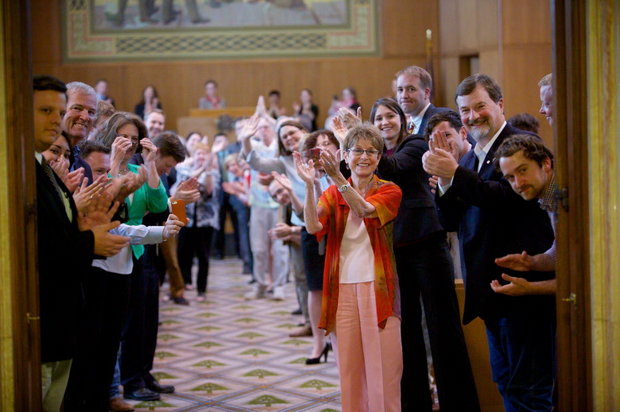
Members of the Oregon House applaud senators across the Capitol rotunda Monday at the conclusion of the 2013 legislative session. They might not be off duty for long, however. Gov. Kitzhaber says he'll call a special session if he can find the votes to support a compromise on PERS and taxes. (Michael Lloyd/The Oregonian)
Gov. John Kitzhaber greeted Monday’s conclusion of a largely unspecial legislative session by expressing his interest in a special session, which he’ll call later this year if he can round up enough votes to strike a deal on PERS reform and tax hikes. The guy once known as “Dr. No” is now the guy who won’t take no for an answer. Let’s hear it for productively focused stubbornness.
Perhaps it’s uncharitable to refer to the just-concluded session as unspecial, as lawmakers certainly can point to a number of accomplishments. They OK’d independent governing boards for the University of Oregon, Portland State University and other institutions. They approved legislation that will allow illegal immigrants who’ve graduated from Oregon high schools to pay in-state tuition at state colleges and universities. They ponied up Oregon’s share of Columbia River Crossing funding, though their cohorts in Washington failed to follow suit. And with the help of an improving economy and very modest retirementsystem reform, they gave public schools a big raise.
However, the primary reason this session belongs in the “meh” file is the failure of lawmakers to make serious adjustments to the state’s pension system. Months of dickering produced no reforms to some of the system’s most galling flaws, from the use of sick leave and vacation time to spike pension payments to the windfalls enjoyed by inactive PERS members who lucked into Money Match bonanzas.Some bad bills inevitably made it through, including a prohibition on smoking in cars while children are present and a bill that will make it much more difficult for property owners to decline renters who use Section 8 vouchers. Burdensome regulations make the housing program unappealing for many landlords, whose disinterest shouldn’t be attributed automatically to discrimination based on income or race.
Lawmakers can claim with some justification that it’s both complicated and legally risky to tackle such quirks, as outrageous as they may be to most taxpayers. It’s difficult to make the same argument when it comes to reducing annual cost of living adjustments, which is a very effective way to reduce the system’s cost and keep money in classrooms. In fact, Senate Bill 822 derives most of its savings from doing just this. It doesn’t go nearly far enough, however, which is why not a single Republican in either the House or Senate voted for it.
SB822’s inadequacy is also why Gov. Kitzhaber pushed so hard late in the session for a compromise that would reduce COLAs further while raising taxes modestly. The state’s biggest business groups backed the effort despite the tax hikes, and members of both parties were willing to go along as well. Unfortunately, there weren’t quite enough of them, and the session that could have produced something great sank back into mediocrity.
Kitzhaber isn’t ready to give up. He’ll spend some time this summer gauging support for a compromise, he told The Oregonian editorial board Monday. If he’s convinced the votes are there, he’ll call a special session.
The governor’s summer support tour should appeal particularly to Senate Republicans, who stuck a fork in the compromise late in the session. Kitzhaber says he’s willing to consider tax breaks benefiting small businesses, which Republicans want, as long as the end result is a package that trims PERS adequately and increases funding for public services sustainably.
Senate Republicans should be grateful for the governor’s determination. They could come away from this summer with further PERS reform, a business tax cut and — not to be underestimated — protection during next year’s campaign from being known as the G-No-P, which is what they’ll get if they allow their stubbornness to become mulishness.
January 6, 2014
To the Judges:
Led by Gov. John Kitzhaber, an effort to reform Oregon’s pension program for public employees became the state’s top political story in 2013, dominating the regular legislative session and concluding in a late-September special session. What would have been a contentious process in most states proved particularly difficult in Oregon, where Democrats, supported by the state’s public employee unions, control both legislative chambers and the governor’s office. But in the end, the Legislature did the job.
Beginning in January, when The Oregonian included PERS reform in its annual editorial agenda, our writers produced dozens of editorials over the course of the year. We discussed the state’s pension program in several contexts, including the effect of rising costs on local school districts, the burden the system places on the state’s modest economy and the consequences of inaction on another necessary policy initiative: reform of the state’s tax system. Responding to questions from readers, our editorials also explained how the PERSreform math worked.
We also did plenty of prodding. Following the approval of a modest reform measure during the regular legislative session, we prodded Democratic lawmakers to cut costs more aggressively. As a short-lived compromise proposal emerged late in the session, we prodded Republicans to accept small tax increases in exchange for deeper pension cuts. And following the conclusion of the regular session, we prodded Democrats and Republicans to revisit the compromise in a special session months later.
Oregon’s lawmakers trimmed the state’s pension system because the problem was too big to ignore and because the governor wouldn’t take “no” for an answer. It’s impossible to know whether or to what degree The Oregonian’s numerous editorials affected the outcome. But the opinion staff did everything possible to that end, applying relentless pressure to reluctant lawmakers and explaining to readers the need for reform and the consequences of failure. We also tried, and I think succeeded, in doing all of that without boring readers to death.
Sincerely,
Peter Bhatia
Editor and Vice President of Content