Hannah Dreier of The New York Times
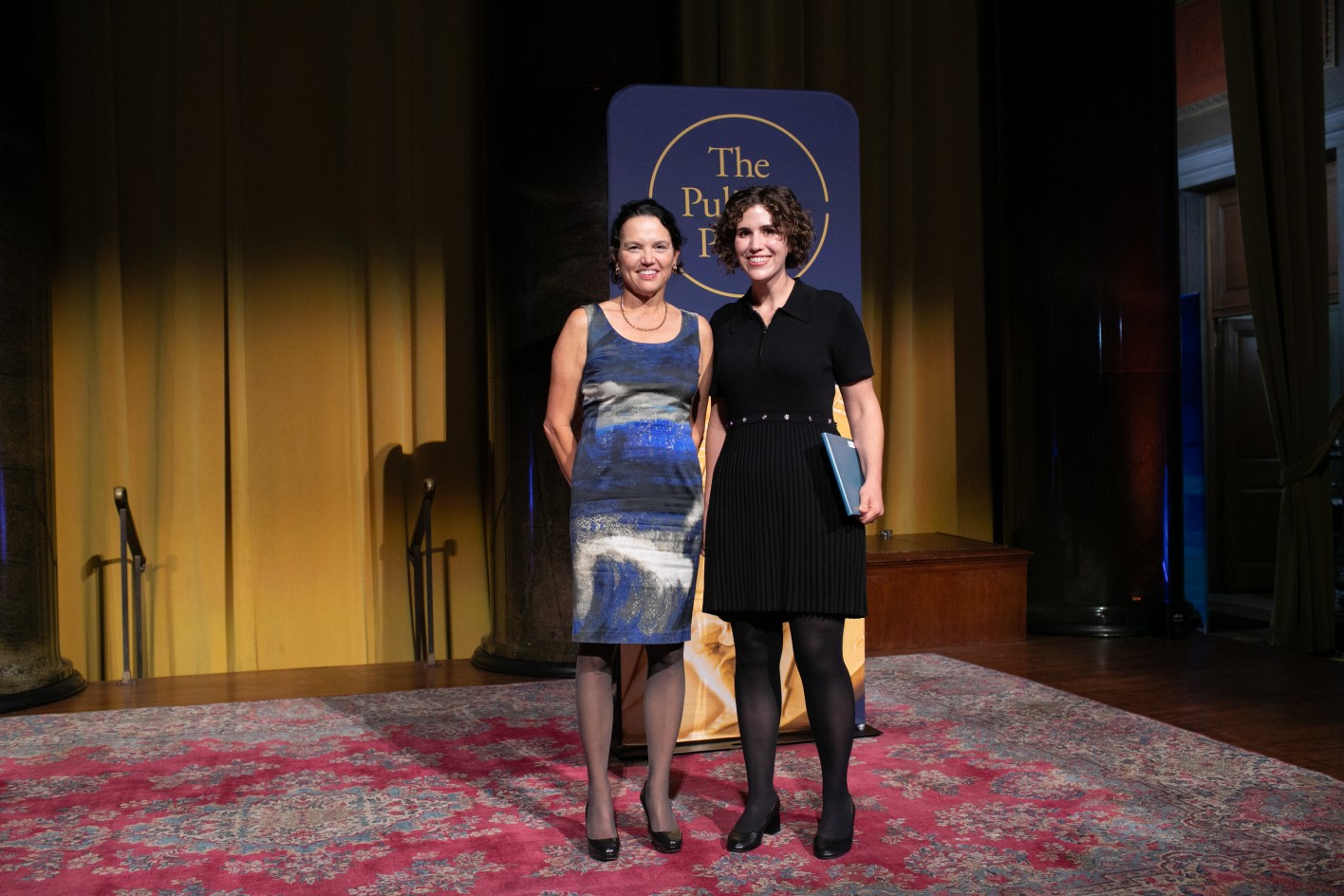
Hannah Dreier (right) accepts the 2024 Pulitzer Prize for Investigative Reporting from Columbia University Interim President Katrina Armstrong. (David Dini/The Pulitzer Prizes)
Winning Work
Arriving in record numbers, they’re ending up in dangerous jobs that violate child labor laws — including in factories that make products for well-known brands like Cheetos and Fruit of the Loom.
By Hannah Dreier
Photographs by Kirsten Luce
It was almost midnight in Grand Rapids, Mich., but inside the factory everything was bright. A conveyor belt carried bags of Cheerios past a cluster of young workers. One was 15-year-old Carolina Yoc, who came to the United States on her own last year to live with a relative she had never met.
About every 10 seconds, she stuffed a sealed plastic bag of cereal into a passing yellow carton. It could be dangerous work, with fast-moving pulleys and gears that had torn off fingers and ripped open a woman’s scalp.
The factory was full of underage workers like Carolina, who had crossed the Southern border by themselves and were now spending late hours bent over hazardous machinery, in violation of child labor laws. At nearby plants, other children were tending giant ovens to make Chewy and Nature Valley granola bars and packing bags of Lucky Charms and Cheetos — all of them working for the processing giant Hearthside Food Solutions, which would ship these products around the country.
“Sometimes I get tired and feel sick,” Carolina said after a shift in November. Her stomach often hurt, and she was unsure if that was because of the lack of sleep, the stress from the incessant roar of the machines, or the worries she had for herself and her family in Guatemala. “But I’m getting used to it.”
These workers are part of a new economy of exploitation: Migrant children, who have been coming into the United States without their parents in record numbers, are ending up in some of the most punishing jobs in the country, a New York Times investigation found. This shadow work force extends across industries in every state, flouting child labor laws that have been in place for nearly a century. Twelve-year-old roofers in Florida and Tennessee. Underage slaughterhouse workers in Delaware, Mississippi and North Carolina. Children sawing planks of wood on overnight shifts in South Dakota.
Largely from Central America, the children are driven by economic desperation that was worsened by the pandemic. This labor force has been slowly growing for almost a decade, but it has exploded since 2021, while the systems meant to protect children have broken down.
The Times spoke with more than 100 migrant child workers in 20 states who described jobs that were grinding them into exhaustion, and fears that they had become trapped in circumstances they never could have imagined. The Times examination also drew on court and inspection records and interviews with hundreds of lawyers, social workers, educators and law enforcement officials.
In town after town, children scrub dishes late at night. They run milking machines in Vermont and deliver meals in New York City. They harvest coffee and build lava rock walls around vacation homes in Hawaii. Girls as young as 13 wash hotel sheets in Virginia.
In many parts of the country, middle and high school teachers in English-language learner programs say it is now common for nearly all their students to rush off to long shifts after their classes end.
“They should not be working 12-hour days, but it’s happening here,” said Valeria Lindsay, a language arts teacher at Homestead Middle School near Miami. For the past three years, she said, almost every eighth grader in her English learner program of about 100 students was also carrying an adult workload.
Migrant child labor benefits both under-the-table operations and global corporations, The Times found. In Los Angeles, children stitch “Made in America” tags into J. Crew shirts. They bake dinner rolls sold at Walmart and Target, process milk used in Ben & Jerry’s ice cream and help debone chicken sold at Whole Foods. As recently as the fall, middle-schoolers made Fruit of the Loom socks in Alabama. In Michigan, children make auto parts used by Ford and General Motors.
The number of unaccompanied minors entering the United States climbed to a high of 130,000 last year — three times what it was five years earlier — and this summer is expected to bring another wave.
These are not children who have stolen into the country undetected. The federal government knows they are in the United States, and the Department of Health and Human Services is responsible for ensuring sponsors will support them and protect them from trafficking or exploitation.
But as more and more children have arrived, the Biden White House has ramped up demands on staffers to move the children quickly out of shelters and release them to adults. Caseworkers say they rush through vetting sponsors.
While H.H.S. checks on all minors by calling them a month after they begin living with their sponsors, data obtained by The Times showed that over the last two years, the agency could not reach more than 85,000 children. Overall, the agency lost immediate contact with a third of migrant children.
An H.H.S. spokeswoman said the agency wanted to release children swiftly, for the sake of their well-being, but had not compromised safety. “There are numerous places along the process to continually ensure that a placement is in the best interest of the child,” said the spokeswoman, Kamara Jones.
Far from home, many of these children are under intense pressure to earn money. They send cash back to their families while often being in debt to their sponsors for smuggling fees, rent and living expenses.
“It’s getting to be a business for some of these sponsors,” said Annette Passalacqua, who left her job as a caseworker in Central Florida last year. Ms. Passalacqua said she saw so many children put to work, and found law enforcement officials so unwilling to investigate these cases, that she largely stopped reporting them. Instead, she settled for explaining to the children that they were entitled to lunch breaks and overtime.
Sponsors are required to send migrant children to school, and some students juggle classes and heavy workloads. Other children arrive to find that they have been misled by their sponsors and will not be enrolled in school.
The federal government hires child welfare agencies to track some minors who are deemed to be at high risk. But caseworkers at those agencies said that H.H.S. regularly ignored obvious signs of labor exploitation, a characterization the agency disputed.
In interviews with more than 60 caseworkers, most independently estimated that about two-thirds of all unaccompanied migrant children ended up working full time.
A representative for Hearthside said the company relied on a staffing agency to supply some workers for its plants in Grand Rapids, but conceded that it had not required the agency to verify ages through a national system that checks Social Security numbers. Unaccompanied migrant children often obtain false identification to secure work.
“We are immediately implementing additional controls to reinforce all agencies’ strict compliance with our longstanding requirement that all workers must be 18 or over,” the company said in a statement.
At Union High School in Grand Rapids, Carolina’s ninth-grade social studies teacher, Rick Angstman, has seen the toll that long shifts take on his students. One, who was working nights at a commercial laundry, began passing out in class from fatigue and was hospitalized twice, he said. Unable to stop working, she dropped out of school.
“She disappeared into oblivion,” Mr. Angstman said. “It’s the new child labor. You’re taking children from another country and putting them in almost indentured servitude.”
On the Night Shift
When Carolina left Guatemala, she had no real understanding of what she was heading toward, just a sense that she could not stay in her village any longer. There was not much electricity or water, and after the pandemic began, not much food.
The only people who seemed to be getting by were the families living off remittances from relatives in the United States. Carolina lived alone with her grandmother, whose health began failing. When neighbors started talking about heading north, she decided to join. She was 14.
“I just kept walking,” she said.
Carolina reached the U.S. border exhausted, weighing 84 pounds. Agents sent her to an H.H.S. shelter in Arizona, where a caseworker contacted her aunt, Marcelina Ramirez. Ms. Ramirez was at first reluctant: She had already sponsored two other relatives and had three children of her own. They were living on $600 a week, and she didn’t know Carolina.
When Carolina arrived in Grand Rapids last year, Ms. Ramirez told her she would go to school every morning and suggested that she pick up evening shifts at Hearthside. She knew Carolina needed to send money back to her grandmother. She also believed it was good for young people to work. Child labor is the norm in rural Guatemala, and she herself had started working around the second grade.
One of the nation’s largest contract manufacturers, Hearthside makes and packages food for companies like Frito-Lay, General Mills and Quaker Oats. “It would be hard to find a cookie or cracker aisle in any leading grocer that does not contain multiple products from Hearthside production facilities,” a Grand Rapids-area plant manager told a trade magazine in 2019.
General Mills, whose brands include Cheerios, Lucky Charms and Nature Valley, said it recognized “the seriousness of this situation” and was reviewing The Times’s findings. PepsiCo, which owns Frito-Lay and Quaker Oats, declined to comment.
Three people who until last year worked at one of the biggest employment agencies in Grand Rapids, Forge Industrial Staffing, said Hearthside supervisors were sometimes made aware that they were getting young-looking workers whose identities had been flagged as false.
“Hearthside didn’t care,” said Nubia Malacara, a former Forge employee who said she had also worked at Hearthside as a minor.
In a statement, Hearthside said, “We do care deeply about this issue and are concerned about the mischaracterization of Hearthside.” A spokesman for Forge said it complied with state and federal laws and “would never knowingly employ individuals under 18.”
Kevin Tomas said he sought work through Forge after he arrived in Grand Rapids at age 13 with his 7-year-old brother. At first, he was sent to a local manufacturer that made auto parts for Ford and General Motors. But his shift ended at 6:30 in the morning, so he could not stay awake in school, and he struggled to lift the heavy boxes.
“It’s not that we want to be working these jobs. It’s that we have to help our families,” Kevin said.
By the time he was 15, Kevin had found a job at Hearthside, stacking 50-pound cases of cereal on the same shift as Carolina.
‘So Many Red Flags’
The growth of migrant child labor in the United States over the past several years is a result of a chain of willful ignorance. Companies ignore the young faces in their back rooms and on their factory floors. Schools often decline to report apparent labor violations, believing it will hurt children more than help. And H.H.S. behaves as if the migrant children who melt unseen into the country are doing just fine.
“As the government, we’ve turned a blind eye to their trafficking,” said Doug Gilmer, the head of the Birmingham, Ala., office of Homeland Security Investigations, a federal agency that often becomes involved with immigration cases.
Mr. Gilmer teared up as he recalled finding 13-year-olds working in meat plants; 12-year-olds working at suppliers for Hyundai and Kia, as documented last year by a Reuters investigation; and children who should have been in middle school working at commercial bakeries.
“We’re encountering it here because we’re looking for it here,” Mr. Gilmer said. “It’s happening everywhere.”
Children have crossed the Southern border on their own for decades, and since 2008, the United States has allowed non-Mexican minors to live with sponsors while they go through immigration proceedings, which can take several years. The policy, codified in anti-trafficking legislation, is intended to prevent harm to children who would otherwise be turned away and left alone in a Mexican border town.
When Kelsey Keswani first worked as an H.H.S. contractor in Arizona to connect unaccompanied migrant children with sponsors in 2010, the adults were almost always the children’s parents, who had paid smugglers to bring them up from Central America, she said.
But around 2014, the number of arriving children began to climb, and their circumstances were different. In recent years, “the kids almost all have a debt to pay off, and they’re super stressed about it,” Ms. Keswani said.
She began to see more failures in the vetting process. “There were so many cases where sponsors had sponsored multiple kids, and it wasn’t getting caught. So many red flags with debt. So many reports of trafficking.”
Now, just a third of migrant children are going to their parents. A majority are sent to other relatives, acquaintances or even strangers, a Times analysis of federal data showed. Nearly half are coming from Guatemala, where poverty is fueling a wave of migration. Parents know that they would be turned away at the border or quickly deported, so they send their children in hopes that remittances will come back.
In the last two years alone, more than 250,000 children have entered the United States by themselves.
The shifting dynamics in Central America helped create a political crisis early in Mr. Biden’s presidency, when children started crossing the border faster than H.H.S. could process them. With no room left in shelters, the children stayed in jail-like facilities run by Customs and Border Protection and, later, in tent cities. The images of children sleeping on gym mats under foil blankets attracted intense media attention.
The Biden administration pledged to move children through the shelter system more quickly. “We don’t want to continue to see a child languish in our care if there is a responsible sponsor,” Xavier Becerra, secretary of health and human services, told Congress in 2021.
His agency began paring back protections that had been in place for years, including some background checks and reviews of children’s files, according to memos reviewed by The Times and interviews with more than a dozen current and former employees.
“Twenty percent of kids have to be released every week or you get dinged,” said Ms. Keswani, who stopped working with H.H.S. last month.
Concerns piled up in summer 2021 at the Office of Refugee Resettlement, the H.H.S. division responsible for unaccompanied migrant children. In a memo that July, 11 managers said they were worried that labor trafficking was increasing and complained to their bosses that the office had become “one that rewards individuals for making quick releases, and not one that rewards individuals for preventing unsafe releases.”
Staff members said in interviews that Mr. Becerra continued to push for faster results, often asking why they could not discharge children with machine-like efficiency.
“If Henry Ford had seen this in his plants, he would have never become famous and rich. This is not the way you do an assembly line,” Mr. Becerra said at a staff meeting last summer, according to a recording obtained by The Times.
The H.H.S. spokeswoman, Ms. Jones, said that Mr. Becerra had urged his staff to “step it up.” “Like any good leader, he wouldn’t hesitate to do it again — especially when it comes to the well-being and safety of children,” she said.
During a call last March, Mr. Becerra told Cindy Huang, the O.R.R. director, that if she could not increase the number of discharges, he would find someone who could, according to five people familiar with the call. She resigned a month later.
He recently made a similar threat to her successor during a meeting with senior leadership, according to several people who were present.
‘It Was All Lies’
While many migrant children are sent to the United States by their parents, others are persuaded to come by adults who plan to profit from their labor.
Nery Cutzal was 13 when he met his sponsor over Facebook Messenger. Once Nery arrived in Florida, he discovered that he owed more than $4,000 and had to find his own place to live. His sponsor sent him threatening text messages and kept a running list of new debts: $140 for filling out H.H.S. paperwork; $240 for clothes from Walmart; $45 for a taco dinner.
“Don’t mess with me,” the sponsor wrote. “You don’t mean anything to me.”
Nery began working until 3 a.m. most nights at a trendy Mexican restaurant near Palm Beach to make the payments. “He said I would be able to go to school and he would take care of me, but it was all lies,” Nery said.
His father, Leonel Cutzal, said the family had become destitute after a series of bad harvests and had no choice but to send their oldest son north from Guatemala.
“Even when he shares $50, it’s a huge help,” Mr. Cutzal said. “Otherwise, there are times we don’t eat.” Mr. Cutzal had not understood how much Nery would be made to work, he said. “I think he passed through some hard moments being up there so young.”
Nery eventually contacted law enforcement, and his sponsor was found guilty last year of smuggling a child into the United States for financial gain. That outcome is rare: In the past decade, federal prosecutors have brought only about 30 cases involving forced labor of unaccompanied minors, according to a Times review of court databases.
Unlike the foster care system, in which all children get case management, H.H.S. provides this service to about a third of children who pass through its care, and usually for just four months. Tens of thousands of other children are sent to their sponsors with little but the phone number for a national hotline. From there, they are often on their own: There is no formal follow-up from any federal or local agencies to ensure that sponsors are not putting children to work illegally.
In Pennsylvania, one case worker told The Times he went to check on a child released to a man who had applied to sponsor 20 other minors. The boy had vanished. In Texas, another case worker said she had encountered a man who had been targeting poor families in Guatemala, promising to help them get rich if they sent their children across the border. He had sponsored 13 children.
“If you’ve been in this field for any amount of time, you know that there’s what the sponsors agree to, and what they’re actually doing,” said Bernal Cruz Munoz, a caseworker supervisor in Oregon.
Calling the hotline is not a sure way to get support, either. Juanito Ferrer called for help after he was brought to Manassas, Va., at age 15 by an acquaintance who forced him to paint houses during the day and guard an apartment complex at night. His sponsor took his paychecks and watched him on security cameras as he slept on the basement floor.
Juanito said that when he called the hotline in 2019, the person on the other end just took a report. “I thought they’d send the police or someone to check, but they never did that,” he said. “I thought they would come and inspect the house, at least.” He eventually escaped.
Asked about the hotline, H.H.S. said operators passed reports onto law enforcement and other local agencies because the agency did not have the authority to remove children from homes.
The Times analyzed government data to identify places with high concentrations of children who had been released to people outside their immediate families — a sign that they might have been expected to work. In northwest Grand Rapids, for instance, 93 percent of children have been released to adults who are not their parents.
H.H.S. does not track these clusters, but the trends are so pronounced that officials sometimes notice hot spots anyway.
Scott Lloyd, who led the resettlement office in the Trump administration, said he realized in 2018 that the number of unaccompanied Guatemalan boys being released to sponsors in South Florida seemed to be growing.
“I always wondered what was happening there,” he said.
But his attention was diverted by the chaos around the Trump administration’s child separation policy, and he never looked into it. The trend he saw has only accelerated: For example, in the past three years, more than 200 children have been released to distant relatives or unrelated adults around Immokalee, Fla., an agricultural hub with a long history of labor exploitation.
In a statement, H.H.S. said it had updated its case management system to better flag instances when multiple children were being released to the same person or address.
Many sponsors see themselves as benevolent, doing a friend or neighbor a favor by agreeing to help a child get out of a government shelter, even if they do not intend to offer any support. Children often understand that they will have to work, but do not grasp the unrelenting grind that awaits them.
“I didn’t get how expensive everything was,” said 13-year-old Jose Vasquez, who works 12-hour shifts, six days a week, at a commercial egg farm in Michigan and lives with his teenage sister. “I’d like to go to school, but then how would I pay rent?”
Occupational Hazards
One fall morning at Union High School in Grand Rapids, Carolina listened to Mr. Angstman lecture on the journalist Jacob Riis and the Progressive Era movement that helped create federal child labor laws. He explained that the changes were meant to keep young people out of jobs that could harm their health or safety, and showed the class a photo of a small boy making cigars.
“Riis reported that members of this family worked 17 hours a day, seven days a week,” he told the students. “The cramped space reeked of toxic fumes.” Students seemed unmoved. Some struggled to stay awake.
Teachers at the school estimated that 200 of their immigrant students were working full time while trying to keep up with their classes. The greatest share of Mr. Angstman’s students worked at one of the four Hearthside plants in the city.
The company, which has 39 factories in the United States, has been cited by the Occupational Safety and Health Administration for 34 violations since 2019, including for unsafe conveyor belts at the plant where Carolina found her job. At least 11 workers suffered amputations in that time. In 2015, a machine caught the hairnet of an Ohio worker and ripped off part of her scalp.
The history of accidents “shows a corporate culture that lacks urgency to keep workers safe,” an OSHA official wrote after the most recent violation for an amputation.
Underage workers in Grand Rapids said that spicy dust from immense batches of Flamin’ Hot Cheetos made their lungs sting, and that moving heavy pallets of cereal all night made their backs ache. They worried about their hands getting caught in conveyor belts, which federal law classifies as so hazardous that no child Carolina’s age is permitted to work with them.
Hearthside said in a statement that it was committed to complying with laws governing worker protections. “We strongly dispute the safety allegations made and are proud of our safety-first culture,” the statement read.
Federal law bars minors from a long list of dangerous jobs, including roofing, meat processing and commercial baking. Except on farms, children younger than 16 are not supposed to work for more than three hours or after 7 p.m. on school days.
But these jobs — which are grueling and poorly paid, and thus chronically short-staffed — are exactly where many migrant children are ending up. Adolescents are twice as likely as adults to be seriously injured at work, yet recently arrived preteens and teenagers are running industrial dough mixers, driving massive earthmovers and burning their hands on hot tar as they lay down roofing shingles, The Times found.
Unaccompanied minors have had their legs torn off in factories and their spines shattered on construction sites, but most of these injuries go uncounted. The Labor Department tracks the deaths of foreign-born child workers but no longer makes them public. Reviewing state and federal safety records and public reports, The Times found a dozen cases of young migrant workers killed since 2017, the last year the Labor Department reported any.
The deaths include a 14-year-old food delivery worker who was hit by a car while on his bike at a Brooklyn intersection; a 16-year-old who was crushed under a 35-ton tractor-scraper outside Atlanta; and a 15-year-old who fell 50 feet from a roof in Alabama where he was laying down shingles.
In 2021, Karla Campbell, a Nashville labor lawyer, helped a woman figure out how to transport the body of her 14-year-old grandson, who had been killed on a landscaping job, back to his village in Guatemala. It was the second child labor death she had handled that year.
“I’ve been working on these cases for 15 years, and the addition of children is new,” Ms. Campbell said.
In dairy production, the injury rate is twice the national average across all industries. Paco Calvo arrived in Middlebury, Vt., when he was 14 and has been working 12-hour days on dairy farms in the four years since. He said he crushed his hand in an industrial milking machine in the first months of doing this work.
“Pretty much everyone gets hurt when they first start,” he said.
Targeting the Middlemen
Charlene Irizarry, the human resources manager at Farm Fresh Foods, an Alabama meat plant that struggles to retain staff, recently realized she was interviewing a 12-year-old for a job slicing chicken breasts into nuggets in a section of the factory kept at 40 degrees.
Ms. Irizarry regularly sees job applicants who use heavy makeup or medical masks to try to hide their youth, she said. “Sometimes their legs don’t touch the floor.”
Other times, an adult will apply for a job in the morning, and then a child using the same name will show up for orientation that afternoon. She and her staff have begun separating other young applicants from the adults who bring them in, so they will admit their real ages.
Ms. Irizarry said the plant had already been fined for one child labor violation, and she was trying to avoid another. But she wondered what the children might face if she turned them away.
“I worry about why they’re so desperate for these jobs,” she said.
In interviews with underage migrant workers, The Times found child labor in the American supply chains of many major brands and retailers. Several, including Ford, General Motors, J. Crew and Walmart, as well as their suppliers, said they took the allegations seriously and would investigate. Target and Whole Foods did not respond to requests for comment. Fruit of the Loom said it had ended its contract with the supplier.
One company, Ben & Jerry’s, said it worked with labor groups to ensure a minimum set of working conditions at its dairy suppliers. Cheryl Pinto, the company’s head of values-led sourcing, said that if migrant children needed to work full time, it was preferable for them to have jobs at a well-monitored workplace.
The Labor Department is supposed to find and punish child labor violations, but inspectors in a dozen states said their understaffed offices could barely respond to complaints, much less open original investigations. When the department has responded to tips on migrant children, it has focused on the outside contractors and staffing agencies that usually employ them, not the corporations where they perform the work.
In Worthington, Minn., it had long been an open secret that migrant children released by H.H.S. were cleaning a slaughterhouse run by JBS, the world’s largest meat processor. The town has received more unaccompanied migrant children per capita than almost anywhere in the country.
Outside the JBS pork plant last fall, The Times spoke with baby-faced workers who chased and teased one another as they came off their shifts in the morning. Many had scratched their assumed names off company badges to hide evidence that they were working under false identities. Some said they had suffered chemical burns from the corrosive cleaners they used.
Not long afterward, labor inspectors responding to a tip found 22 Spanish-speaking children working for the company hired to clean the JBS plant in Worthington, and dozens more in the same job at meat-processing plants around the United States.
But the Labor Department can generally only issue fines. The cleaning company paid a $1.5 million penalty, while JBS said it had been unaware that children were scouring the Worthington factory each night. JBS fired the cleaning contractor.
Many of the children who were working there have found new jobs at other plants, The Times found.
“I still have to pay back my debt, so I still have to work,” said Mauricio Ramirez, 17, who has found a meat processing job in the next town over.
‘Not What I Imagined’
It has been a little more than a year since Carolina left Guatemala, and she has started to make some friends. She and another girl who works at Hearthside have necklaces that fit together, each strung with half a heart. When she has time, she posts selfies online decorated with smiley faces and flowers.
Mostly, though, she keeps to herself. Her teachers do not know many details about her journey to the border. When the topic came up at school recently, Carolina began sobbing and would not say why.
After a week of 17-hour days, she sat at home one night with her aunt and considered her life in the United States. The long nights. The stress about money. “I didn’t have expectations about what life would be like here,” she said, “but it’s not what I imagined.”
She was holding a debit card given to her by a staffing agency, which paid her Hearthside salary this way so she did not have to cash checks. Carolina turned it over and over in her palm as her aunt looked on.
“I know you get sad,” Ms. Ramirez said.
Carolina looked down. She wanted to continue going to school to learn English, but she woke up most mornings with a clenched stomach and kept staying home sick. Some of her ninth grade classmates had already dropped out. The 16-year-old boy she sat next to in math class, Cristian Lopez, had left school to work overtime at Hearthside.
Cristian lived a few minutes away, in a bare two-room apartment he shared with his uncle and 12-year-old sister, Jennifer.
His sister did not go to school either, and they had spent the day bickering in their room. Now night had fallen and they were eating Froot Loops for dinner. The heat was off, so they wore winter jackets. In an interview from Guatemala, their mother, Isabel Lopez, cried as she explained that she had tried to join her children in the United States last year but was turned back at the border.
Cristian had given his uncle some of the money he earned making Chewy bars, but his uncle believed it was not enough. He had said he would like Jennifer to start working at the factory as well, and offered to take her to apply himself.
Cristian said he had recently called the H.H.S. hotline. He hoped the government would send someone to check on him and his sister, but he had not heard back. He did not think he would call again.
Research was contributed by Andrew Fischer, Seamus Hughes, Michael H. Keller and Julie Tate.
Editor’s note: In considering whether to fully identify some children in this article, Times journalists weighed many factors. In each case, the reporter obtained the permission of the child’s sponsor and parents, many of whom hoped the story would help others understand the realities of life for migrant children in the United States.
The White House and federal agencies were repeatedly alerted to signs of children at risk. The warnings were ignored or missed.
By Hannah Dreier
In the spring of 2021, Linda Brandmiller was working at an arena in San Antonio that had been converted into an emergency shelter for migrant children. Thousands of boys were sleeping on cots as the Biden administration grappled with a record number of minors crossing into the United States without their parents.
Ms. Brandmiller’s job was to help vet sponsors, and she had been trained to look for possible trafficking. In her first week, two cases jumped out: One man told her he was sponsoring three boys to employ them at his construction company. Another, who lived in Florida, was trying to sponsor two children who would have to work off the cost of bringing them north.
She immediately contacted supervisors working with the Department of Health and Human Services, the federal agency responsible for these children. “This is urgent,” she wrote in an email reviewed by The New York Times.
But within days, she noticed that one of the children was set to be released to the man in Florida. She wrote another email, this time asking for a supervisor’s “immediate attention” and adding that the government had already sent a 14-year-old boy to the same sponsor.
Ms. Brandmiller also emailed the shelter’s manager. A few days later, her building access was revoked during her lunch break. She said she was never told why she had been fired.
Over the past two years, more than 250,000 migrant children have come alone to the United States. Thousands of children have ended up in punishing jobs across the country — working overnight in slaughterhouses, replacing roofs, operating machinery in factories — all in violation of child labor laws, a recent Times investigation showed. After the article’s publication in February, the White House announced policy changes and a crackdown on companies that hire children.
But all along, there were signs of the explosive growth of this labor force and warnings that the Biden administration ignored or missed, The Times has found.
Again and again, veteran government staffers and outside contractors told the Health and Human Services Department, including in reports that reached Secretary Xavier Becerra, that children appeared to be at risk. The Labor Department put out news releases noting an increase in child labor. Senior White House aides were shown evidence of exploitation, such as clusters of migrant children who had been found working with industrial equipment or caustic chemicals.
As the administration scrambled to clear shelters that were strained beyond capacity, children were released with little support to sponsors who expected them to take on grueling, dangerous jobs.
In interviews with The Times, officials expressed concern for migrant children but shifted blame for failing to protect them.
H.H.S. officials said the department vetted sponsors sufficiently but could not control what happened to children after they were released. Monitoring workplaces, they said, was the job of the Department of Labor.
Officials at the Labor Department said inspectors had increased their focus on child labor and shared details about workers with H.H.S., but said it was not a welfare agency.
And White House officials said that while the two departments had passed along information about migrant child labor, the reports were not flagged as urgent and did not make clear the scope of the problem. Robyn M. Patterson, a White House spokeswoman, said in a statement that the administration was now increasing scrutiny of employers and reviewing its vetting of sponsors.
“It’s unacceptable that companies are using child labor, and this administration will continue working to strengthen the system to investigate these violations and hold violators accountable,” the statement read.
But the White House declined to comment on why the administration did not previously react to repeated signs that migrant children were being widely exploited.
“If I saw it, they could have put it together,” said Ms. Brandmiller, who is also an immigration lawyer. “There were so many opportunities to connect those dots that no one ever did.” An H.H.S. spokeswoman said the agency had no record of Ms. Brandmiller’s concerns. The company that ran the emergency shelter declined to comment.
Ms. Brandmiller said she still worried about the 14-year-old boy, Antonio Diaz Mendez.
Antonio is living in Florida City, Fla., far from his family in Guatemala. In an interview last summer, he sat on the mildewed porch of a house crowded with other migrant children. He said he was working long shifts in a refrigerated warehouse, packing vegetables for distribution around the country, and had not seen his sponsor in months.
He missed his grandmother and sometimes went days without talking to anyone. He wanted to go to school, but felt trapped because he needed to earn money to repay his debts, support himself and help his siblings.
No one, he said, had ever come to check on him.
‘This Is BS’
Soon after President Biden took office, the growing numbers of migrant children touched off tension between the new administration and longtime government staff members.
The president had promised to abide by a 2008 anti-trafficking law that requires the federal government to accept children traveling alone from most countries and allows them to stay in the United States during the yearslong process of applying for legal status.
But the law did not anticipate that a pandemic would ravage the economies of Central American countries. Parents in deepening poverty began sending their children to the United States to earn money — part of a phenomenon some immigration advocates call “voluntary family separation.”
In 2021, as images of children sleeping under foil blankets in overflow centers dominated the news, Susan E. Rice, the White House’s head of domestic policy, told staff members she was frustrated with the situation, according to five people who worked with her. Ms. Rice vented in a note she scribbled on a memo detailing the position of advocates, who believed a pandemic-era border closure was compelling parents to send unaccompanied children, sometimes called U.C.s.
“This is BS,” Ms. Rice wrote, according to a copy of the memo reviewed by The Times. “What is leading to ‘voluntary’ separation is our generosity to UCs!”
In a statement, Ms. Patterson, the White House spokeswoman, said that any suggestion that Ms. Rice felt constrained by the demands of the law was false and that she was “proud to be doing the right thing and treating children with dignity and respect.”
Under the law, the Department of Health and Human Services is responsible for vetting sponsors to ensure they will provide for children’s well-being and protect them from trafficking or exploitation. But as shelters filled with children, the department began loosening some vetting restrictions and urging case managers to speed the process along.
Longtime H.H.S. staff members complained that the changes endangered children. White House aides and administration officials grew exasperated, believing that these workers were clinging to protocols that kept children in shelters when it was better for them to be in a home with an adult.
“It was maddening,” said Vivian Graubard, a White House adviser who worked with Ms. Rice on migrant child issues.
At least five Health and Human Services staff members filed complaints and said they were pushed out after raising concerns about child safety.
Jallyn Sualog was the most senior career member of the H.H.S. division responsible for unaccompanied migrant children when Mr. Biden took office. She had helped build the program after the passage of the 2008 law and, as a lifelong Democrat, had celebrated Mr. Biden’s win.
But soon, she said, she began to hear reports that children were being released to adults who had lied about their identities, or who planned to exploit them.
She warned her bosses in a 2021 email, “If nothing continues to be done, there will be a catastrophic event.” She continued to email about situations she described as “critical” and “putting children at risk.”
Concerned that no one was listening, Ms. Sualog filed a complaint in the fall of 2021 with the H.H.S. Office of Inspector General, the agency’s internal watchdog, and requested whistle-blower protection. She also took the unusual step of speaking with congressional staffers about her worries.
“I feel like short of protesting in the streets, I did everything I could to warn them,” Ms. Sualog said of the administration. “They just didn’t want to hear it.”
In late 2021, she was moved out of her position. She filed a complaint with the federal office responsible for enforcing whistle-blower protection rules, arguing that she had been illegally retaliated against.
Last fall, the Office of the Inspector General released a report that discussed Ms. Sualog’s case and several demotions and dismissals at the agency that “may have risen to the level of whistle-blower chilling.”
Ms. Sualog settled with the agency, which agreed to pay her legal fees, and resigned last month.
An H.H.S. spokeswoman declined to comment on Ms. Sualog’s complaint but said the agency does not retaliate against whistle-blowers. While some staffers disagreed with the administration’s approach, the spokeswoman said, significant changes were needed to address the increase in unaccompanied migrant children.
Even as veteran employees left, others kept sounding alarms. In January, shortly before the Times investigation was published, a group of workers sent another memo to their H.H.S. bosses saying the system had resulted in unsafe discharges. “We are pulling humanity out of ‘Health and Human Services,’” they wrote.
Troubling Trends
Some of the most persistent warnings that children were being funneled into dangerous jobs came from outside the government. H.H.S. releases most children to sponsors without follow-up care, but it hires organizations to provide thousands of the most high-risk children with several months of support services.
Last spring, Matt Haygood, senior director of children’s services at the U.S. Committee for Refugees and Immigrants, one of the largest of these organizations, sent an email with the subject line “Trafficking Concerns” to several H.H.S. officials.
“We have identified some troubling trends in the Chicago metro area,” he wrote, including vans picking up children at odd hours, suggesting that they were being driven to factory jobs. Mr. Haygood asked if H.H.S. would consider adding the neighborhood to a watchlist, so that prospective sponsors there would be more closely vetted.
An H.H.S. staff member replied that more than 200 children, most of them Guatemalan, had recently been released to the neighborhood and confirmed that many of those cases had been marked as suspicious: Adults were sponsoring multiple children, and minors were working instead of attending school.
“There are certainly plenty of other concerning trafficking red flags,” the staff member wrote. Mr. Haygood expected the agency to add more safeguards for children released to the area, Little Village. Instead, H.H.S. decided they were not needed.
In response to The Times, an H.H.S. spokeswoman said the department had already put protections in place for children being released to a few streets in the city and at the time saw expanding those measures as overreach.
At a small fast-food restaurant in Little Village one recent afternoon, Guatemalan teenagers played video games on their phones and flirted in Indigenous languages. Several said they worked full time overnight in factories, in violation of child labor laws. Few had enrolled in school.
One, Marvin Che, said he came to the United States last year, when he was 16, and had been working 12-hour overnight shifts alongside other migrant children packing products at the manufacturer Pactiv Evergreen, including Hefty plastic party cups. “We came alone, so we have to work hard,” Marvin said.
A spokeswoman for Pactiv Evergreen said that its company policy prohibited minors from working at manufacturing sites, and that it would make sure its staffing agencies were complying. A representative for Reynolds Consumer Products, which owns the Hefty brand, said Pactiv Evergreen no longer made its party cups.
Other social service organizations said they, too, had flagged clusters of suspicious cases, including in Nashville and Dallas.
“We’re waiting for the congressional hearing that’s like, ‘How did this happen to all these kids?’” Mr. Haygood said.
In the last two months, congressional leaders from both parties have questioned why so many migrant children ended up in exploitative jobs, and two oversight hearings are planned in the House on Tuesday.
An H.H.S. spokeswoman said the department was aware that some migrant children worked long hours because they are under intense pressure to earn money, but the agency’s legal responsibility for children ends once they are released. Still, the department is working to provide a few months of case management to all unaccompanied migrant children, she said.
For now, most children released to sponsors have little support aside from an H.H.S. hotline. According to internal documents obtained by The Times, reports of trafficking to that hotline increased by about 1,300 percent over the past five years.
In one call last year, a child living in Charlotte, N.C., said his sponsor had found him a job in a restaurant and told him “he needs to work to eat.” In another, a child said his sponsor had never enrolled him in school after he was released from an El Paso shelter, and was forcing him to pay for rent and food.
The H.H.S. spokeswoman said the agency asks local law enforcement to check on children who might be in danger.
A Hard Life in Florida
Antonio arrived at the border shortly after turning 14, and spent several weeks at a shelter before moving to Florida. A former neighbor had agreed to be his sponsor, but Antonio, who had never spent a night away from his town, had not understood how isolated he would be in the United States.
He took jobs with employers willing to hire a child without a work permit — sometimes in landscaping and sometimes in housecleaning. He also enrolled in eighth grade and discovered that he loved biology.
He scraped by until the end of the school year, but he needed to earn more money. Instead of continuing to ninth grade, he found the job packing vegetables. He worked numbing shifts that left him chilled each night even though he worked in the heaviest jacket he could afford. A spokeswoman for the company, Jalaram Produce, said it does not hire minors.
Antonio had not told anyone back home how much he was struggling. “I don’t want them to worry about me,” he said. His father became more absent during the pandemic, and he knew his grandmother had no other way to feed his young sisters. He said he might feel less lonely after he turned 16 and qualified to enroll in night school.
This was a common hope among migrant children in his neighborhood. A few blocks away, a boy working construction said he felt ashamed about not knowing how to read. He, too, was released in 2021 — at age 12 — and was immediately put to work by a man who had sponsored at least five children. At a day-labor pickup site, a 13-year-old released last year to a man he had never met said he wished he could enroll in middle school and start learning English.
“People don’t know,” Antonio said, “but there are a lot of kids here living the same life.”
Warning Signs
Inside the White House, Ms. Rice was at the center of the migrant children crisis. As she pressed to move children out of shelters more quickly, clues began to emerge about what was happening to them once they left.
In the summer of 2021, near the height of the crush at the border, H.H.S. managers wrote a memo detailing their worry about increasing reports that children were working alongside their sponsors, a sign of possible labor trafficking. Ms. Rice’s team received the memo, and Ms. Rice was also told what it said, according to two people familiar with the conversations.
Andrew J. Bates, White House deputy press secretary, disputed that, saying Ms. Rice “did not see the memo and was not made aware of its contents.”
Around the same time, Ms. Rice’s team was told about concerns over a large group of children who had been released to one city in Alabama, according to six current and former staff members. The situation was the subject of frequent updates as H.H.S. sent case managers to the city to check on children, and coordinated with the Labor Department and Homeland Security Investigations to look into whether they were working in poultry plants.
One former top White House adviser remembered thinking at the time that the development was worrisome and that it suggested other cases could be going overlooked.
A White House spokeswoman denied that senior officials were told about the situation.
A few months later, Ms. Rice’s staff learned that H.H.S. could not reach a growing number of migrant children just a month after their release, according to a former senior White House official.
But the White House largely treated these as discrete events, not as signs of a mounting problem.
Tyler Moran, Mr. Biden’s senior adviser for migration at the time, said she relied on H.H.S. to tell her how to weigh information, such as the memo from the department’s worried managers and the calls to children that were going unanswered. Staff members, she said, had not pointed to a broader child labor crisis. “The White House deferred to the agencies to let us know when things were really a problem,” Ms. Moran said.
The Department of Labor was sending up signals of its own. In 2022, investigators began uncovering signs of migrant child labor inside industrial workplaces, including several auto part factories in the South. The department put out news releases warning of a rise in child labor violations.
Last summer, labor investigators began a major operation at a sanitation company that eventually found that more than 100 mostly Spanish-speaking children were working the overnight shift scouring meatpacking plants around the country. Many of the children had come through the migrant shelter system and been released to sponsors.
As investigators found more and more migrant children working for the cleaning company around the country, H.H.S. briefed Ms. Rice’s team about the situation regularly over a period of months, according to two people familiar with the conversations.
The Labor Department also included details about the sanitation company and auto parts operations in weekly cabinet-level reports. “It was like, ‘We have problems here,’” said Martin J. Walsh, the secretary of labor until last month. “We sent reports to the White House, so they knew we were working on this stuff.”
When the Labor Department updated its public dashboard in December, it showed a 69 percent increase in child labor violations since 2018.
A spokeswoman for the Labor Department said that the White House had been aware of the rise in child labor because it was widely public. But Mr. Bates, the White House deputy press secretary, said officials there had not known of the increase in child labor until The Times’s February report.
‘At Least I’m Helping’
Even after Ms. Brandmiller’s warnings, the man who had sponsored Antonio, Juan Rivera, was allowed to receive another boy: He said he sponsored a 15-year-old and set him up with a job on a palm tree plantation.
Mr. Rivera said in an interview that he had done Antonio a favor by helping him come to the United States. He kept records of his expenses, including the cost of picking up Antonio after he left the shelter, food and clothes when he first arrived, and a twin-size mattress for his shared room. The debt had taken Antonio about a year to pay off.
He said he occasionally saw Antonio in the area and assumed that he was working hard and sending money home. “American kids just study, but our kids are poor and have to work,” he said. “One has to suffer to earn a little money here.”
This spring, Antonio’s landlord decided the house had become overcrowded. Antonio found a new home, but the rent was twice as high. He changed jobs again, picking up better-paying day labor shifts, and said he no longer hoped to attend night school. Instead, he is trying to save several thousand dollars to hire a lawyer who might help him secure a permit to work legally, in a less grueling job.
“I need to earn lot of money now,” Antonio said. “It’s gotten hard, but at least I’m helping.”
On Sundays, he attends a Spanish-language church with a vibrant youth group. The pastor, Abel Gomez, said Antonio sometimes sits with him after the service and cries about the pressure he feels.
“What I want most for Antonio is for him to be able to go back to school,” Mr. Gomez said. “But I know it’s complicated for him because there’s no one to support him.”
Mr. Gomez said he would like to help young congregants like Antonio more — even take them in. But it would be impossible. There are too many in the same situation, and more seem to arrive each week.
Ana Ley contributed reporting. Kitty Bennett contributed research.
By Hannah Dreier
Photographs by Meridith Kohut
Late on a Thursday in February 2022, Marcos Cux, who had just turned 14, bundled up in green rubberized overalls and a matching jacket that was too big for his slight shoulders. He packed a pair of steel-toed rubber boots and two layers of gloves, because even a small tear could lead to a chemical burn. As others in the house slept, a cousin drove him to his cleaning shift at the chicken slaughterhouse, a half-mile-long industrial complex on a stretch of bare highway in rural Virginia, set behind hedges and a tall metal fence.
The plant, which is run by Perdue Farms, processes 1.5 million chickens a week. Before dawn each morning, trucks haul in birds stuffed so tightly in layers of steel cages that they cannot move. Seagulls wheel around above, drawn by scraps in dumpsters. Workers inside hang the birds upside down in a darkened kill room. Bursts of electricity stun them, and the conveyor line runs their necks past sharp blades. They pass through the defeathering room, where the line plunges into foamy hot water, and then on to other machines that remove feet, heads and guts. Finally, rows of workers slice what remains into packageable parts.
When Marcos and the rest of the cleaning crew got there after midnight, the plant had a putrid smell workers sometimes felt they could taste. They sloshed through water, grease and blood, which drained into a channel that snakes around the plant under grates. Marcos gathered up chicken pieces left by the day shifts, working quickly because the whole facility had to be sanitized by 5 a.m. He took the covers off the channel and began using a pressurized hose to spray the machines down with 130-degree water.
He came from a village in Guatemala to this small town on the Eastern Shore of Virginia several months earlier. Before he left, his family was struggling to pay for electricity and skipping meals in the aftermath of the pandemic. They couldn’t afford formula for his infant sister. His parents were growing desperate and knew that while adults who arrive at the U.S. border are generally turned back, minors traveling by themselves are allowed in.
The policy dates back to a 2008 law intended to protect children who might otherwise come to harm on their own in Mexican border towns. In the 15 years since, the carveout has become widely known in Central America, where it shapes the calculations of destitute families. Marcos’s parents decided he would go north and find a way to earn money. They borrowed against their land to pay a coyote — technically a human smuggler, but in this case, more like a travel agent — to help him reach the United States without being kidnapped or hurt. He made his way to an adult cousin in Parksley, a town of 800 people bookended by the Perdue plant and another sprawling chicken operation run by Tyson Foods.
His cousin, Antonia de Calmo, was living in an already-cramped home with her husband and four children in a trailer park called Dreamland, but she agreed to take in Marcos after his mother called in tears and said that they had no other options. Federal law bans minors from cleaning slaughterhouses because of the risk of injury. But with the help of a middle-school classmate who already worked at the plant, Marcos bought fake documents that said he was a man with a different name in his 20s. When he was hired, children made up as much as a third of the overnight cleaning crew at the Perdue plant, workers told me. The work was harder than Marcos expected, but it also paid better than he could have imagined — around $100 for each six-hour shift, more than he could make in a month back home.
After he finished hosing down the machines, he started scrubbing blood and fat off the steel parts with chemicals that, if they hit skin, created welts that could take months to heal. Shortly after 2:30 a.m., he thought he saw a bit of torn rubber glove within the conveyor belt of the deboning area and reached in to grab it. Suddenly, the machine came to life. Across the factory, another worker had failed to see Marcos crouched with his left arm deep inside the assembly line and turned it on.
The belt caught the sleeve of Marcos’s baggy jacket and pulled him across the floor. Hard plastic teeth ripped through his muscles, tearing open his forearm down to the bone. By the time someone heard his screams and shut off the power, his arm was limp, a deep triangular gash running down the length of it. A rope of white tendons hung from his elbow to his wrist, horrifying the workers who gathered around him. He understood from their faces that something was badly wrong but didn’t feel any pain as the wound began gushing blood and he started to lose consciousness.
A supervisor called 911 to report the injury. “We don’t know what to do,” she said, her voice rising. “It’s bleeding out.” The dispatcher ran through a list of questions about his condition. “And how old is that person?” the dispatcher asked.
The supervisor did not respond.
“Even if you had to guess?” he asked.
Still no response.
“Like, 20s? 30s?” he asked.
“Um,” the supervisor said, her voice shaking.
Another moment passed, and the line went dead.
When the paramedics arrived, a dispatcher reported “massive amounts of bleeding,” and Marcos was flown to a trauma unit in Baltimore for emergency surgery. He lay in the hospital for two weeks as medical staff wondered why the paperwork for this boy with long eyelashes and a round baby face said he was an adult man named Francisco.
The morning after Marcos’s injury, workers in Dreamland began talking about a child whose arm had been nearly torn off at the plant. Word soon spread through town. There were reasons that supervisors, teachers, federal inspectors and even police officers had said nothing for years about children working at the slaughterhouses. Everyone understood that the children were under extraordinary pressure to earn money to pay off their travel debts and help their families back home. They were living on a remote stretch of peninsula with few job options — if the plants shut down because of a labor scandal, the local economy could collapse. Now, with an eighth grader in the hospital, many wondered if they had been wrong to keep quiet.
For most of the last century, Parksley was an almost entirely white agricultural community, with a migrant labor force that cycled in and out with the rhythms of the tomato and corn crops. That started to shift when the two plants opened in the 1970s, just as American consumers were developing an appetite for boneless, skinless, nugget-size chicken. More processing steps required more workers, and the companies, which now produce one in three pounds of poultry consumed in the United States, became the area’s biggest employers.
It was dangerous, grueling work, and half the plant employees quit each year. The managers found a solution to chronic turnover by looking to migrant seasonal workers, who now settled in Parksley and other nearby towns in Accomack County and worked year-round at the plants.
In recent years, poverty worsened in Central America, and the work force changed once again. More than 300,000 migrant children have entered the United States on their own since 2021, by far the largest such influx in memory. Most have ended up working full time, fueling a resurgence in child labor not seen in a century, with children living far from their parents and working illegally in all 50 states. At slaughterhouses, it is no longer only Spanish-speaking adults seeking jobs but also children, most of them from Guatemala, which is one of the most impoverished countries in the region.
The pandemic was especially crushing to the agricultural highlands where Marcos’s family raised animals on a small plot of land. The odd jobs that kept them afloat disappeared during the shutdowns, food prices soared and then his father fell ill. When his parents told him he would be going to the United States to work, he was initially excited — he pictured a land of skyscrapers and shopping malls.
After crossing the border, Marcos spent a few weeks in a shelter run by the Department of Health and Human Services. The agency is responsible for releasing migrant children to adults who will protect them from exploitation while their cases move through the immigration system, a process that takes years. So many children were crossing in the early days of the Biden administration that the shelters filled up, and children were sometimes held at jail-like facilities run by Customs and Border Protection. H.H.S. urged shelter workers to send children to their sponsors more quickly.
Children usually arrive in the United States with some idea of who might take them in: either a parent or sibling or, about half the time, a more distant relative or family friend. While parents and siblings often support the children who come to live with them, other adults are more likely to take children in only on the condition that they work and pay rent. Of the dozens of children who have been released to sponsors in and around Parksley during the past three years, more than 90 percent have gone to adults who are not their parents.
Marcos gave the shelter staff Antonia’s phone number, and the agency contacted her and sent a list of requirements for sponsors. The first was to provide Marcos with food and shelter. Another was to send him to school. Nearly last on the list was a pledge that he wouldn’t work. Antonia agreed to them all, but she had no intention of keeping Marcos from working. She knew that was why he had come. She, her husband, her oldest daughter and most people she knew worked for the chicken plants, and it seemed likely that he would find a job there, too.
Marcos and Antonia said H.H.S. officials never came to check up on him after he arrived in Virginia. But they decided to enroll him in school anyway, just in case. “I had to go to school, but I only came to help my family,” he told me in one of many conversations in Spanish during the past year.
Marcos began attending eighth grade in the Accomack school district, where more than 1,000 of the county’s roughly 4,700 students were learning to speak English. Marcos borrowed $800 from Antonia to buy fake papers from a man in a nearby trailer, and at 13 he was hired onto the overnight sanitation shift. Each morning, Antonia picked him up from the plant at 6:30, and 20 minutes later, he was waiting in front of Dreamland for the school bus.
While teenagers work legally all over America, Marcos’s job was strictly off limits. Federal law prohibits 14- and 15-year-olds from working at night or for more than three hours on school days. Older teenagers are allowed to put in longer hours, but all minors are barred from the most dangerous occupations, including digging trenches, repairing roofs and cleaning slaughterhouses.
But as more children come to the United States to help their families, more are ending up in these plants. Throughout the company towns that stud the “broiler belt,” which stretches from Delaware to East Texas, many have suffered brutal consequences. A Guatemalan eighth grader was killed on the cleaning shift at a Mar-Jac plant in Mississippi in July; a federal investigation had found migrant children working illegally at the company a few years earlier. A 14-year-old was hospitalized in Alabama after being overworked at a chicken operation there. A 17-year-old in Ohio had his leg torn off at the knee while cleaning a Case Farms plant. Another child lost a hand in a meat grinder at a Michigan operation.
In Accomack, cleaning staffs once worked directly for the slaughterhouses. But years ago, the plants started delegating this work to outside sanitation companies, which pay less and allow brands to avoid accountability for problems. The largest such U.S. contractor, Packers Sanitation Services Inc., says on its website that it can “take the liability and risk off your facility’s record.” The Biden administration has pledged to start fining brands for violating child-labor laws, but so far it has imposed penalties only on subcontractors.
A 2022 study led by a researcher at Washington State University found that many adult workers would be willing to take meatpacking jobs if they paid slightly better, around $2.85 more an hour. But in Parksley, the only people eager to join the poorly paid night shift were immigrant women who wanted to be available to their kids when they got home from school. When children like Marcos began to arrive, far from their parents and under pressure to make money, there seemed to be a perfect match between the needs of the plants and the needs of the newcomers.
“They have to work,” says Miguel Cobo, assistant manager of the sanitation shift at Perdue. And the plants need people to clean. “If companies like this looked too closely at who was working, no company would be able to keep going.” Cobo and the other supervisors had agreed to let the children leave early so they could get to homeroom. “It’s a circle — they help us, and we help them.”
Marcos woke up alone in a hospital room in a tangle of intravenous tubing and beeping machines. He knew that children were not supposed to work at the plant, and now he understood why. But he worried about what his parents would do if he didn’t recover — they still owed more than $6,000 for his journey north. He believed he had to get better and persuade the bosses to hire him back.
Doctors were able to save Marcos’s arm, and with two more surgeries and six months of physical therapy, he started to be able to move it again. But skin grafts from his thigh gave his forearm an uneven, quilted appearance, and his fingers were still frozen in a claw. Fayette Industrial, the Tennessee-based cleaning company that had been hired by Perdue, covered his medical bills.
One afternoon last September, a few weeks after his third surgery, he stood on his porch with Antonia and looked out over Dreamland, wondering how things had gone so wrong. “It’s really not how I thought it would be,” he said.
Built in the 1970s, the trailer park is now entirely Spanish-speaking and has effectively become company housing for slaughterhouse workers. Green jackets used by the cleaning crews hang from porches and clotheslines, and residents leave hard hats with sanitation-company logos outside their doors. The plants in Accomack County are not just the area’s primary employers; they are major supporters of the community. Children go to school with backpacks donated by Perdue and study in math-and-science centers funded by the company. Tyson gives thousands of pounds of chicken and dry goods to first responders and food banks that families rely on as nearly one in three children in the community live in poverty. Perdue buys trucks for the volunteer Fire Department and donates hundreds of whole chickens to its cookout fund-raisers. When Parksley got its first library this summer, the Perdue Children’s Room was its centerpiece.
Almost all the Dreamland families are originally from Mexico or Central America, but the park offers two kinds of childhoods. Some children hurry home from school, eat a rushed dinner and then go to sleep as early as possible so they can get up for work. Others, mostly children living with their parents, spend the hours after school hanging around outside their trailers, playing on rope swings or splayed on couches they drag onto lawns. Several have part-time jobs cutting grass or babysitting. But if they work, it’s not to pay debts or help with rent. Their parents take care of that and admonish them to finish their homework so they will not end up at Tyson or Perdue.
Seven months after his accident, Marcos had become a rarity in the community: a 14-year-old living far from his parents but not working. “They won’t take me back because of the accident,” he said of the sanitation company. He still couldn’t lift his arm well, and often it hung limp at his side. It was approaching 90 degrees, but he wore long sleeves to hide his scars.
After his injury, Marcos missed a month of eighth grade. Students who had been on the shift told their teachers what happened, but when a school counselor called Antonia, she said Marcos had fallen at home. “I was nervous to say anything more because of his age,” she said. She refused to show school administrators Marcos’s medical records. They were under his false name, which Dreamland residents who use fake papers because they are underage or undocumented tend to call their “stage name.”
Marcos thought about returning home. “I came only because things were so desperate,” he said. But if he went back, there would be no way to pay off his family’s debt, and they would lose their land. So he returned to school instead. He started paying closer attention in class and studying English at night. Many Dreamland children drop out between middle school and high school, but to his own surprise, Marcos was now in his first weeks of ninth grade.
He felt guilty, but Antonia understood the bind he was in. “He wanted to help his mom and dad, but he can’t do anything now,” she said. “And once you come, you can’t go back because of the debt.”
As Marcos and Antonia talked, they looked over at the neatly painted trailer where Cobo, the assistant manager at Perdue, lived. Two nights earlier, he was on duty when a young woman got her leg jammed in a pallet jack and had to be taken out in an ambulance. He was also working the night Marcos was injured and had taken a photo of the boy’s mangled arm to show the other shifts as a warning. He felt pity when he saw Marcos now. He had sponsored a young relative who worked nights at the plant while attending school, and he understood the strain the children were under. He had not said anything about Marcos’s age to the bosses because he didn’t want to cause problems for the other young workers.
After Marcos’s injury, the priest at the Catholic church near Dreamland announced a collection for him during Mass. He knew that many children in the congregation worked overnight but didn’t see his role as extending beyond bearing witness. A police officer who coached softball at the high school discussed the accident with a teacher but didn’t get involved; it didn’t seem like a law-enforcement matter.
Short of someone calling in a tip, the Department of Labor, which is in charge of enforcing federal child-labor laws, was unlikely to find out what had happened. The department has 750 investigators overseeing fair labor standards at 11 million workplaces, including 3,000 slaughterhouses. Even when inspectors do catch child-labor violations, the maximum penalty per child is $15,000, and they usually fine only the subcontracted companies, not the brands themselves. Lawmakers have been pushing to increase the maximum fine, but Congress is gridlocked, with each party drafting its own bills and refusing to vote for legislation introduced by the other side. (Perdue and Tyson said in statements that they have no tolerance for child labor and were taking steps to eliminate violations at plants nationwide. A spokesman for Fayette said the company was unaware of any minors on staff and learned of Marcos’s true age only after he was injured. The company said it is taking steps to protect against child-labor violations.)
Because Marcos had been hospitalized, Fayette, Perdue’s sanitation provider, was required to notify the Occupational Safety and Health Administration about the accident. Federal officials passed the information to Virginia’s state office to investigate. It was assigned to a compliance officer who advertised on his LinkedIn profile that he started working at 14, first as a dishwasher at a bar and then in construction. The officer opted to let the company do a self-inspection. A few days later, Fayette’s safety director sent back most of the information the officer had asked for. One detail was left out: the injured worker’s age. The director indicated that the accident had been caused by “poor training.” Less than two weeks after Marcos’s injury, the compliance officer closed the case with no citations and without coming near Dreamland or the plant.
At Perdue, night-shift workers worried that the bosses would start firing children and others who used false names after Marcos got hurt. But the plant kept running more or less as it had been, though supervisors stopped letting students leave early to catch the school bus, because it seemed like a tacit admission that the shift was filled with minors.
The cleaning company was always hiring, and new workers went through several nights of instruction. As part of the plant’s safety protocol, each new hire was given a padlock for the machine he or she was cleaning to ensure it couldn’t be turned on. After Marcos’s accident, trainers started bringing in a worker to explain the importance of this step. The man warned new hires that he had noticed a child who sometimes neglected to use the lock, and one night that child nearly lost his arm. He told the group that he regretted staying silent — not about Marcos’s young age, but about the fact that he had apparently misunderstood the padlock system.
Emilio Ortiz, 14, went through this orientation and wondered what happened to the boy who got hurt. Emilio had recently come to Virginia from Chiapas, Mexico, to join his two older brothers, who already had a year of experience on the night shift. The brothers were released to an aunt by the Health and Human Services shelter system in 2021, when they were 15 and 16. Within a few months, they had earned enough money to buy their own trailer. Now, with Emilio working, too, they were sending money back to their parents.
Emilio didn’t go to school. He worked until 5 p.m. each day in agriculture, then grabbed an employee badge stamped with the Perdue logo and car-pooled with his brothers to the slaughterhouse. He stopped going to school in Mexico several years earlier, and the idea of enrolling in eighth grade seemed like a waste of time given how much money he could make.
One night this spring, Emilio crossed the parking lot just before the shift started, clutching his bulky green uniform under his arm and half running to keep up with his older brother. Some underage workers were assigned to tackle the kill room, while others would spend the shift on ladders cleaning tall pieces of machinery. Emilio was assigned to one of the assembly lines, as Marcos had been.
The routine was the same every night. He and his brothers used pressure hoses that kicked back against their shoulders and chests to wash away the blood and meat scraps. Most workers wore earplugs to drown out the hoses and roaring machines. The scalding water created billows of steam, and within an hour, the brothers would be drenched in runoff and chicken grime. Working with a partner, Emilio would turn on the conveyor belt and coat it in a thick chemical foam that made his lungs ache. Then he stopped the line and scrubbed it inch by inch, using a flashlight to check corners and undersides.
Chemical burns could be hard to avoid. One teenager with a welt on his nose explained that he was burned the night before seemingly out of nowhere; maybe the chemical had dripped down from the ceiling. The worst part of the job was the finishing acid used on Fridays. Another boy who cut the three brothers’ hair in a shed behind his Dreamland trailer warned them about this part. He, too, had started working at the plant when he was 14, when his sponsor moved out of state and he had to find a way to pay rent by himself. “It makes you cough all weekend, but then by Monday you’re OK again,” he said.
After the machines are clean, a U.S. Department of Agriculture inspector looks them over. About a dozen of these inspectors work at each plant. During the day, they watch carcasses whiz by on production lines, and as the overnight shift finishes, they ensure that everything is properly sanitized. The three brothers tended to leave the area or look at the ground when the inspectors came around; they seemed connected with law enforcement.
A U.S.D.A. inspector named Maria Escalante worked the Perdue cleaning shift as an adult in the 1990s when she settled in Virginia. She came from Guatemala and obtained legal status under an amnesty program. Back then, cleaners were hired directly by the company and earned more than $25 an hour in today’s dollars. She saw the inspectors walking around in their clean white coats emblazoned with the U.S.D.A. logo and admired their air of authority. The job did not require a college degree, so she studied English and passed a written test after several attempts. She is now in her 18th year as an inspector, earning $28 an hour. She notices children like Emilio but has decided not to report them because her job is to ensure that the country’s food-safety laws are followed, not its labor laws.
“It’s not my place to say anything, and anyway, they have no one here,” she says. “They have to work to at least pay rent.” She adds, “I see these kids, and they’re only 13, 14 years old. I do feel bad for them.”
Escalante noticed that the child workers often seem to fumble the safety protocols. When she heard about Marcos’s injury, she assumed this was what happened. “These kids are always making mistakes and hurting themselves,” she says.
After work, she looks for the injured children and tries to help them. She spent a few weeks this year trying to track down a teenager who she heard had fallen from a ladder at Tyson and broken his leg. “But it’s hard because they’re working under other names,” she says.
As the number of migrant children working in American slaughterhouses has grown, adults have occasionally intervened. Last year, a Guatemalan girl working for Packers Sanitation showed up to middle school in Nebraska with acid burns on her hands and knees, and administrators called the police. The Department of Labor began a monthslong investigation into the company and found more than 100 children, some as young as 13, working in eight states, including at plants run by Tyson. The government fined the cleaning company $1.5 million, but the brands that benefited from the children’s labor faced no consequences.
At Perdue, some women noticed Emilio and his siblings sitting quietly next to one another on breaks and started calling them “the sad brothers.” Angelica Gonzalez, who was on the night shift and had children of her own, often chatted with them. She sometimes bought the working children clothes from Walmart or offered them her husband’s castoffs. “I don’t know how they can stand to be so far from their parents and working so hard,” she says. “I ask how they do it, and they just say, ‘We have to.’”
Other workers judged the children’s parents for sending them out alone to earn money. Arelis Perez, who lives in Dreamland with her two young daughters, recently noticed that a ninth grader who lived near the park entrance had joined the cleaning crew. She was disturbed by how distressed the child looked during her first weeks on the shift. “I would never want my girls to do that,” she says.
One morning in May, Marcos was the first in his seat in the newcomers section of Arcadia High School. His class was in a back hallway decorated with international flags as part of a program the district set up several years ago for migrant children. Now nearing the end of ninth grade, he was trying to make peace with his role as a full-time student. He had drawn a smiling picture of himself on the white board in the front of the room and had written, in English, “The best student is Marcos.” His English language teacher, Sandra Ellenberger, decided to leave it there for the week.
The school had divided the migrant ninth graders into two cohorts. Ellenberger’s class was full of students who teachers thought might make it to graduation. Few of these children worked, and most were living with their parents. The other class was larger, and 90 percent of the students eventually stopped coming to school. Marcos had been placed in the smaller class.
“Happy Cinco de Mayo,” Ellenberger said as students filed in. She was playing mariachi music for the occasion. Like most teachers in the program, she didn’t speak much Spanish, but she looked for ways to show the children that she respected their cultures. She had decorated her classroom with local newspaper clippings about the school’s varsity soccer team, which is composed of so many newcomers that announcements at the games are in Spanish. She put a beanbag chair in a converted closet so students who worked overnight shifts could rest before the bell rang.
Ellenberger passed out a quiz, and Marcos began to fly through the questions, nodding his head to the music. When a boy sitting next to him got stuck on the conjugation of a verb, he explained the rule, murmuring, “Don’t worry, it’s really tricky.”
Ellenberger spent the past year wondering if she should be doing more to protect her working students. She is from a college town where the hardest job a child might find is busing tables. When she told her parents about Marcos’s injury, they couldn’t understand how children were allowed in slaughterhouses. “They were horrified, but I explained that’s normal here,” she says. Teachers are mandated by law to report injuries resulting from abuse or neglect but not accidents connected to child-labor violations. In Accomack, teachers hesitated to make reports that might further jeopardize children they knew needed to work.
Occasionally, students showed teachers acid burns or confided that they were allergic to the cleaning solutions. Some of the ninth graders had what sounded like smokers’ coughs; one had been coughing so much that teachers spoke with her guardian, who said her lungs had been burned by bleach.
Recently, Ellenberger told a school counselor that one of her ninth graders seemed to be struggling with the pressure of the overnight shift. Two migrant students had just died by suicide. She hoped someone might persuade the boy’s guardian to let him stop working. Instead, the counselor helped him find a car-pool from Perdue to the high school, so he would be on time. Ellenberger now felt she had been naïve to expect more.
In the larger English-learners class next door, students trickled in slowly all morning. Their teacher, Claire Applegate, often walked into a mostly empty classroom. She estimated that 16 of her 19 students were working, some of them taking home nearly as much money as she did. Each fall, she made lists of their work schedules to keep at her desk — a yellow sticky note labeled “Perdue” and a blue one labeled “Tyson.”
Two girls who lived at Dreamland walked in 45 minutes late, eyes red from cleaning chemicals. Applegate welcomed them and kept teaching as they fell asleep at their desks.
Teachers were used to seeing middle schoolers sleeping outside the building first thing in the morning in cars they drove without licenses after coming directly from the overnight shift. But no one could remember a student getting as badly hurt as Marcos, and they worried about who might be next. Applegate sometimes listened to a police scanner at night and wondered if the emergencies involved her students. Once, firefighters responded to a call in which a Perdue sanitation worker was hoisted 20 feet in the air by a conveyor belt. They had to take him out of the factory with a piece of machinery still attached to his body.
Many of Applegate’s students had only a few years of education. Some didn’t know that a globe represented the shape of the world. Others had never learned how to hold a pencil, or interpret a clock, or read. Lately, though, she wasn’t sure if going to school made sense for the working children who were unlikely to graduate. If they weren’t coming to class, they could at least switch to the day shift and get a good night’s sleep.
“It’s a moral dilemma because it’s not the best thing for them,” she said. “They’re not going to cut their hours, and sleep deprivation is one of the worst things you can do to your body. I question whether they should be here because they don’t really need to know geography or trigonometry.”
The native-born teenagers tended to avoid socializing with recent arrivals, but Marcos was proud that he could now often keep up in mainstream classes. Even as he succeeded in school, though, his family was sliding further toward disaster. His mother had been sick and needed surgery, but she couldn’t find a hospital that would perform the operation without being paid beforehand. The $6,000 debt was weighing on his parents, with interest mounting. Marcos’s mother told him they were eating their chickens and turkeys and sometimes selling the larger animals to turn the lights back on. “They’re doing everything they can think of, but it’s impossible because they can’t work,” he said.
After school, he returned to the trailer, which was now home to nine people. An aunt had come from Guatemala a month earlier with her 15-year-old daughter, Antonieta. His aunt had planned to work while Antonieta went to school, but they suffered a series of setbacks on their journey. Kidnappers held them hostage in Mexico and forced them to borrow from relatives to buy their freedom. They were turned back at the border and decided to cross through the desert, but his aunt fell from the border wall, shattering her leg and running up $107,000 in debt to an El Paso hospital. Now she was sleeping in the kitchen and using a walker, and instead of enrolling in ninth grade, Antonieta was looking for a job.
As Marcos walked into the kitchen, his aunt was lost in worry. “I don’t know how we’re going to get through this,” she said. Marcos nodded to her, then hurried to his bedroom and closed the door. He opened a flashcard app on his phone and started matching vocabulary words to images. The sooner he learned English, the sooner he might be useful again. He might be able to get a job at a fast-food restaurant off the highway. Until then, there was not much he could do to help anyone.
On Saturdays, much of the town went to a small shop packed with specialty groceries, medicine with Spanish labels and piñatas to withdraw their salaries and send home remittances.
The store is more than just a place to wire money. Mary Enamorado, the woman at the cash register, acts as an informal social worker and immigration advocate. This part of the Eastern Shore has no pro bono immigration lawyers, few nonprofits and no Spanish-speaking community organizations beyond churches. Enamorado helps adults navigate the paperwork to sponsor minors, welcomes children once they arrive and dispenses advice.
“So, are you working already?” she asked one of her first customers of the day, a student from Applegate’s class.
Enamorado had helped the ninth grader’s brother apply to be her sponsor. Now she noticed that the girl had the white payroll debit card used by the sanitation companies. The companies deposited a week’s pay each Friday, and workers usually withdrew it all in cash the following day. The girl told Enamorado with pride that she had gotten a job.
Enamorado sympathized with children who worked nights but thought their sponsors were akin to traffickers. She had joined the cleaning shift herself when she first arrived in Virginia from Honduras in her early 20s and knew how dangerous it could be. She had been especially disgusted by what she heard of Marcos’s case. “Making a 13-year-old go to work like that?” she said. “Awful.”
Enamorado’s son played on the varsity soccer team with many of the working children. The captain who led the team to state quarterfinals this year came to the United States on his own as a 12-year-old and started working immediately to pay his sponsor rent. He juggled the soccer team with shifts at Perdue, getting home at 10 p.m. after away games, sleeping a couple of hours and then heading to the plant. Now he was weeks away from graduating, one of a few students from his English-language-learners cohort who had made it through high school. “We can all be proud of him,” Enamorado said. She encouraged the migrant children who had dropped out of school to take G.E.D. classes at the local community college. Most dreamed instead of joining the military.
Another girl came in with a white payroll card. She finished the Tyson cleaning shift a few hours earlier and still had a headache from the night’s chemicals. Enamorado counted out $500 for her and gave her a discount on a bag of ice pops. “Take care of yourself,” she said.
When the girl walked out, Enamorado shook her head. She had tried to encourage the girl’s sponsor to enroll her in school. “But they have $14,000 in debt to pay off,” she said.
Technically, minors are not supposed to send wire transfers, and Enamorado was supposed to check their IDs. But when she tried to enforce the rule, customers complained. “They just have fake papers anyway,” she said.
The store got more crowded in the afternoon. A boy with the beginnings of a mustache withdrew his $500 and bought a bottle of nonalcoholic wine. A teenager who had recently dropped out of 10th grade so he could switch to the day shift sent $150 to his mother. Another child came in, a slight 15-year-old who had played on the soccer team with Enamorado’s son but dropped out after spring break to work at Perdue during the day. He was too short to rest his elbows on the counter. “Is your uncle not letting you go to school?” she asked as he ran his payroll card.
“They don’t let me,” he said.
“Who exactly?” Enamorado asked.
The boy didn’t answer. Sometimes, she wanted to interrogate the children who came in with payroll cards, but she also knew that would be bad for business. There was another store with a card reader a few miles up the highway. She handed the boy $500 and then helped him send money to his mother. “They miss you on the soccer team,” she said.
A week later, Enamorado was in place behind the counter again for the Saturday rush. Applegate’s student came back with her brother. As the girl used the payroll-card reader, she and her brother explained that it would be her last payday for a while. The cleaning-shift supervisor had called her into his office, she said, and told her that she had done a good job, but minors were no longer allowed at the plant.
Enamorado counted out $500 and told the girl that with any luck she would find a new job before too long. But she knew there were few jobs to be had in Accomack beyond the poultry industry.
I began visiting Parksley in the summer of 2022 as part of reporting I’ve been doing on migrant child labor over the past year and a half. When the first of these articles ran, the Biden administration responded by stepping up child-labor enforcement. Each time I went back to Parksley after that, I wondered whether I would find that children had been fired from the Perdue and Tyson plants. I thought labor inspectors might audit the plants. But the peninsula continued to keep its secret.
That changed in May, after Perdue got word that I was reporting on the plant during one of my Parksley trips. The company sent out a warning that I was looking into its operations. Soon slaughterhouses around the country began passing out fliers with my photograph.
In Accomack, the assistant night manager, Cobo, gathered 150 sanitation workers for a midnight meeting at Perdue. They sat sweating in their rubberized uniforms as he told them that minors were no longer welcome. Some children got mad and said they needed the jobs to survive. Others took the news quietly but then made private appeals to the supervisors. “They were looking at me with tears in their eyes,” Cobo remembers. Afterward, Fayette, the sanitation company, sent an inspector to look over the remaining workers and ensure none were minors.
Supervisors who oversaw the cleaning shift at the Tyson plant warned their corporate office that a reporter was spending a lot of time in town. By June, all the children I had been speaking to were out of jobs. Emilio was fired along with his two brothers, and his agricultural job became the family’s only source of income. His older brothers spent their days stewing over what happened at the plant. “They made plenty of money from our labor and then tossed us out like trash,” one says.
After the firings, Arcadia High teachers noticed that some ninth graders were suddenly coming to class on time. Their eyes were less red, and they seemed more animated, laughing with friends and shouting out answers.
At the end of the school year, Marcos was the only ninth grader in the newcomers program to earn a passing score on a statewide standardized test on his first try. But Ellenberger, his teacher, saw that he was troubled. He continued to fill his English workbooks with references to home. One exercise asked about his dream job. “To help my family,” he wrote. Another asked what made him happy. “My parents.”
He was starting to accept that he would probably never wear short sleeves again. At his most recent checkup, the doctor explained that his arm had healed badly and he would need at least three more surgeries. Marcos found himself crying in the examination room for the first time. “I thought they were going to tell me I was finally done,” he said. “It made me realize I might never get better.” Fayette is still covering his medical care, but he needed to go to Baltimore for the surgeries and hadn’t found anyone to drive him there.
Workers said the cleaning crew at Perdue struggled through the summer. Supervisors told the remaining staff that everyone would have to clean more areas until they could find more workers. Eventually, adults started to see young faces again. A few of Marcos’s classmates were hired back. One teenager who could no longer work at Tyson was able to switch to the Perdue cleaning shift with a set of fake papers.
Toward the end of the summer, Marcos, now 15, was able to find something, too. It was a job that even the most desperate migrants shunned: sifting through industrial chicken warehouses and pulling out dead birds. Each day, he passed through entrances marked “Perdue family farmer,” put on two masks to guard against the overpowering smell of ammonia and waded in among thousands of chickens packed together in windowless coops. His task was to search the ground carefully for carcasses amid layers of excrement as the birds pecked frantically at his hands and feet. He started at 5 a.m. and removed between 100 and 150 dead birds during each 12-hour shift. “There are some dead chickens that are good and rotten — they explode,” he said.
The chicken houses paid less than the sanitation crew, but he was still able to send $100 home to his parents after a few weeks.
When school started again, his 15-year-old cousin Antonieta didn’t consider enrolling, but Marcos cut his shift back to just four hours in the evening and returned for 10th grade. If he learned English, he might get a higher-paying job outside the poultry industry. His teachers were happy to see him and fussed over how tall he had grown. But as school got underway, Marcos felt torn. The reduced hours meant that most days he was earning just $20, and he no longer had time to study when he got home. “Maybe the classes won’t assign so much homework this year,” he said. “Or maybe I’ll be able to do it all on the bus.” If he dropped out and worked full time, he might be able to pay off his family’s debt within a year.
One afternoon in September, he hurried off the school bus and back to his trailer to get ready for his shift. He threw his backpack in a corner; he wouldn’t start on his outstanding assignments until the next morning.
Antonia was at Perdue, so Marcos car-pooled with another chicken-house worker. The man honked when he arrived, and they drove out of Dreamland, going slowly to avoid the potholes. They passed the green jackets on clotheslines. They passed a girl with a puppy who had dropped out after eighth grade to work at Tyson. They passed the assistant manager’s home, with its new wood porch, and then the shed where migrant children were lining up to get their hair cut.
Marcos wouldn’t be back until after dark. He usually got home around 8 p.m., but he would stay at the chicken houses longer if there were more dead birds to find. It had been a sweltering day, which would mean additional carcasses and, he hoped, more work.
Research was contributed by Seamus Hughes, Eli Murray and Julie Tate.
Private auditors have failed to detect migrant children working for U.S. suppliers of Oreos, Gerber baby snacks, McDonald’s milk and many other products.
By Hannah Dreier
One morning in 2019, an auditor arrived at a meatpacking plant in rural Minnesota. He was there on behalf of the national drugstore chain Walgreens to ensure that the factory, which made the company’s house brand of beef jerky, was safe and free of labor abuses.
He ran through a checklist of hundreds of possible problems, like locked emergency exits, sexual harassment and child labor. By the afternoon, he had concluded that the factory had no major violations. It could keep making jerky, and Walgreens customers could shop with a clear conscience.
When night fell, another 150 workers showed up at the plant. Among them were migrant children who had come to the United States by themselves looking for work. Children as young as 15 were operating heavy machinery capable of amputating fingers and crushing bones.
Migrant children would work at the Monogram Meat Snacks plant in Chandler, Minn., for almost four more years, until the Department of Labor visited this spring and found such severe child labor violations that it temporarily banned the shipment of any more jerky.
In the past two decades, private audits have become the solution to a host of public relations headaches for corporations. When scandal erupts over labor practices, or shareholders worry about legal risks, or advocacy groups demand a boycott, companies point to these inspections as evidence that they have eliminated abuses in their supply chains. Known as social compliance audits, they have grown into an $80 billion global industry, with firms performing hundreds of thousands of inspections each year.
But a New York Times review of confidential audits conducted by several large firms shows that they have consistently missed child labor.
Children were overlooked by auditors who were moving quickly, leaving early or simply not sent to the part of the supply chain where minors were working, The Times found in audits performed at 20 production facilities used by some of the nation’s most recognizable brands.
Auditors did not catch instances in which children were working on Skittles and Starburst candies, Hefty brand party cups, the pork in McDonald’s sandwiches, Gerber baby snacks, Oreos, Cheez-Its or the milk that comes with Happy Meals.
In a series of articles this year, The Times has revealed that migrant children, who have been coming to America in record numbers, are working dangerous jobs in every state, in violation of labor laws. Children often use forged documents that slip by auditors who check paperwork but do not speak with most workers face-to-face. Corporations suggest that supply chains are reviewed from start to finish, but sub-suppliers such as industrial farms remain almost entirely unscrutinized.
The expansion of social compliance audits comes as the Labor Department has shrunk, with staffing levels now so low that it would take more than 100 years for inspectors to visit every workplace in the department’s jurisdiction once. For many factories, a private inspection is the only one they will ever get.
Auditors for several firms said they are encouraged to deliver findings in the mildest way possible as they navigate pressure from three different sources: the independent auditing firms that pay their salaries; corporations, such as Walgreens, that require inspections at their suppliers; and the suppliers themselves, which usually must arrange and pay for the audits.
The auditor who looked at the Minnesota jerky factory for Walgreens was Joshua Callington. He has conducted more than 1,000 audits in the past decade.
“If audits are done correctly, the world could be a better place,” he said. “Bettering the lives of workers is what these audits are supposed to be about.”
But more and more, he said, each audit had begun to feel like a struggle between wanting the truth and trying to avoid conflict.
He had not seen any child labor in the Minnesota factory. To keep to his work schedule, he had to leave for his next audit at 4 p.m., long before the late shift arrived. Spotting problems had also led to tension between Mr. Callington and his employer, UL Solutions, which began as a safety testing business and expanded more than two decades ago into social compliance audits. The company took in $2.5 billion in revenue last year and is on the cusp of an initial public offering.
What Mr. Callington saw as a commitment to his job, his firm seemed to see as overzealousness.
“The assessment is not meant to be a policing effort,” the UL Solutions employee handbook says.
After Mr. Callington failed three Walgreens suppliers in 2017 and 2018 for abusive working conditions, the chain complained about his communication style and asked for him to be taken off its account. UL put him on a remediation plan for about a year. (Walgreens declined to comment on the incident, but said it only rarely asks for auditors to be removed. In response to questions about the Monogram factory, the company said it had cut ties with the supplier. Monogram said it is now using stronger age-verification procedures.)
This spring, Mr. Callington flagged labor issues involving adult migrant workers at a warehouse that supplies Costco’s potatoes. The plant’s management complained that he was demanding and argumentative, and his supervisor barred him from returning. Mr. Callington believed that the supplier objected to his finding 21 violations when the previous audit had found none. UL Solutions, which still employs Mr. Callington, declined to comment on either incident.
The supervisor said Mr. Callington would have to complete a series of customer service trainings, and concluded with an inspirational quote that he attributed to the poet Maya Angelou.
“‘People will forget what you said. They will forget what you did. But they will never forget how you made them feel,’” he wrote in an email. “Keep this in mind as you are interacting with our clients during your audits.”
Night Shifts, Daytime Audits
In dozens of interviews, auditors said that sometimes their firms provide little more than a veneer of compliance for global corporations, which overstate how rigorously they review sprawling supply chains.
Auditors typically start their inspections in the morning and stay for about seven hours, even at 3,000-person factories that operate around the clock. In practice, this means that late afternoon and night shifts, where child labor violations most often occur, are almost never seen.
This year, the Department of Labor imposed a $1.5 million fine against Packers Sanitation Services, which provides cleaning crews to slaughterhouses. Investigators found that the company was employing more than 100 children, including 13-year-olds, to clean back saws and head splitters overnight.
These plants had been supplying McDonald’s and Costco for years, and the corporations required regular audits. Some of those auditors noted that there was a large night shift run by the sanitation company, but said they had not been able to observe any of the workers. One auditor who was checking a Nebraska plant for Costco’s Kirkland brand beef spoke with 20 out of 3,500 workers — as is standard in much of the industry — and left at noon, an inspection showed. In another audit at the same plant, the inspector left at 1:30 p.m.
Costco and McDonald’s said in statements that they were strengthening their auditing standards. Packers said it had improved age verification of its workers.
Even if auditors had stayed later at the plants, they might not have been able to talk privately with the migrant child workers, who largely speak Spanish or Indigenous languages of Central America. Auditing firms rarely provide interpreters.
“You’re supposed to ask another worker to translate. But you’re trying to unearth something that people aren’t trying to yell from the rooftops,” said Juanita Sanchez-Sevilla, a Spanish speaker who has been conducting audits since the 1990s, including for the leading firms Intertek and Bureau Veritas. “If you look at the upper echelons of the industry, they’re all white.”
In the absence of in-person interviews, auditors rely on paperwork. But children use forged documents. This summer, for instance, a 16-year-old from Guatemala was killed while cleaning a Mississippi slaughterhouse that supplies Chick-fil-A. His documents said he was in his 30s. In a statement, Chick-fil-A said it was reviewing how it investigates violations at plants.
Research has shown that outside audits are less conclusive than companies suggest. A 2021 analysis of 40,000 audits by a Cornell professor found that nearly half had relied on forged or dubious documents. An earlier study that explored the industry’s financial conflicts of interest found that auditors report fewer violations when factories are paying the bill.
In a statement, UL Solutions said that audits provide a snapshot for companies, which are ultimately responsible for enforcing their standards. An audit, the statement said, “cannot and does not guarantee that an audited facility is in full compliance with requirements against which it was audited, and does not confirm or certify compliance with laws.”
In the absence of thorough inspections, child workers can stay hidden for years.
In 2020, an auditor visited a snack food factory in Geneva, Ill., to do an inspection required by the baby food giant Gerber. As it always had, Gerber’s report came back clear of child labor. The factory was also being regularly audited for the makers of Starburst and Skittles candies, Oreos and Cheez-Its. The companies behind those products said in statements that they had not seen indications of child labor in any inspections.
However, some migrant children were working on these products at the time. Among them was Efren Baldemar, who described getting the job with false identification at 14 years old. He was working from 10 p.m. to 6:30 a.m. to help support his family in Guatemala, renting space in a house of strangers.
In the mornings, he went from the factory to ninth grade and often fell asleep at his desk. The pace on the assembly lines was grueling. “If you didn’t keep up, the product would back up, and the machines would smoke,” he said.
The manufacturer, Hearthside Food Solutions, has been under federal and state investigations since The Times revealed child labor at other facilities in February. In a statement last week, the company said it “has never knowingly employed underage labor in our facilities.” It said it could not find a record of Efren working at its plant.
Plant inspections are typically scheduled weeks in advance, and auditors say they risk upsetting factories by arriving even a few minutes early.
“If you tell them when you’re showing up, they can game it,” said Doug Cahn, who created the audit system for Reebok International and now advises other corporations. “They know auditors don’t come back to see if the lights are on at the meatpacking plant at 3 a.m.”
In some cases, the Times review of audits showed, auditors certified plants as free of child labor but acknowledged in their reports that they didn’t really know if that was true.
An auditor representing Walgreens reported that there was no way to verify the ages of workers at a Chicago-area factory distributing disposable plates and cups. At the time, the factory was also supplying products for Sysco, Hefty and Walmart’s Great Value brand, according to the audit. The plant was using a staffing agency that refused to share paperwork, the auditor noted.
Hefty and Walgreens said that they have stopped using the supplier. Sysco said it did not generally audit U.S. suppliers, while Walmart declined to comment.
The staffing agency is now under a state investigation for possible child labor violations.
Nagging Questions
In his career, Mr. Callington had never found a case of migrant child labor, which would trigger an automatic failing grade. But now looking back, he suspected he had often audited plants where children were working.
Earlier this year, Mr. Callington asked managers at UL Solutions if Costco or other corporations might be willing to start requiring unannounced nighttime inspections. He pointed out news coverage that mentioned child labor raids at slaughterhouses.
“I have audited these locations and was never able to detect these issues given that we are only present for the first shift,” he wrote.
A manager said she would raise the question with higher-ups. He never heard anything more about it.
Mr. Callington sometimes squeezes in five audits a week, staying on the road for six-week stretches. He flies between coasts so regularly that he has stopped thinking of himself as having a home-base time zone, and during long drives occasionally turns to his phone to ask, “Hey, Siri, where am I?”
This fall, he found himself in Oregon looking over the supply chain for the store-brand milk sold at Costco.
A company called Darigold, which processes milk for an association of 300 Northwest dairy farms, was paying for Mr. Callington to review its Portland plant. A manager toured him around the gleaming factory, which was suffused with the sweet smell of milk.
He looked over the spinning bottling machines, but did not ask about the dairies that supplied the milk. He had once tried to look at a sub-supplier for Costco when he wandered into a hen house at a different facility that was packing eggs. The factory complained that he had gone beyond the scope of his audit, he said.
By late afternoon, he was thanking the Portland team for their hospitality and leaving to prepare for his next inspection. He had given the milk plant a perfect score on Costco’s child labor standards: free of illegal child labor (requirement No. 140), free of children working excessive hours (No. 144) and free of instances of child labor in the past (No. 142).
But a few hours away, 17-year-old Miguel Sanchez was in the middle of his shift at a Darigold milk supplier, where he had been working 12-hour days for nearly two years.
‘No Option Except to Keep Going’
Miguel came to Washington’s Yakima Valley from Mexico to live with an older brother, and immediately began working at an industrial dairy with fake identification that said he was an adult. It was a violation of child labor laws for him to work instead of going to school, but he had to contribute to the rent, and felt pressure to support his parents back home.
“I was tired a lot when I started because you have to work really fast, but my family was proud of me,” he said.
In May, Miguel was trying to corral several dozen cows in a milking pen when a co-worker accidentally shut the gate and trapped him inside. Two cows, each weighing about half a ton, pushed him up against the metal bars.
Miguel felt the air leave his lungs and his spine start to buckle. He tried to shout, but his co-worker did not hear him over the thrum of machinery, and he began to pass out. A supervisor took him to the hospital.
Six months later, pain still radiated from his back into his legs as he ran up and down the floor of a warehouse hooking and unhooking cows from milking machines. He regularly downed an over-the-counter drug called Backaid to get through the workday, but it seemed to do less and less. Even standing had become excruciating.
“It feels like electric shocks all through my body,” he said last month. “But I have no option except to keep going. I have to make money.”
It is unclear if the milk Miguel collected ended up in the facility that Mr. Callington audited. Darigold’s milk is processed in 11 plants around the Northwest. Workers said they often saw minors in the dairies, and The Times spoke with a half-dozen children who came to the United States alone and worked full time for Darigold suppliers in Washington, Idaho and Oregon.
In separate statements, Costco and Darigold said they had not been aware of any child labor issues and would investigate.
Years before Mr. Callington audited the Portland factory, Costco was warned about working conditions on Darigold supplier dairies. One adult worker in the Yakima Valley drowned in a manure lagoon. Another had her face crushed by a cow. A third lost both her legs in a feed grinding machine.
In 2018, Costco began meeting with farmworker advocates as well as representatives from Darigold and UL Solutions to draw up a framework for auditing industrial dairies. But a year later, the initiative fell apart, with Costco telling the others that the extra monitoring was not feasible. In its statement to The Times, Costco said it remains interested in “collaborative partnerships” to improve conditions on dairy farms.
A major producer, Darigold also supplies McDonald’s and Nestlé and processes Safeway’s house brand Lucerne. None of those corporations inspect the dairies where the milk originates. McDonald’s, Nestlé and Safeway said in statements that they expect suppliers to comply with their responsible sourcing standards.
Miguel tries to keep his mind blank during the workday, but he worries that he will get hurt again. When he returned home after another shift last month, he nodded at his brother and lay down on an air mattress on the floor. The sole table in the apartment was covered with boxes of Backaid and receipts for wire transfers the brothers had sent home.
“Maybe they’ll let me take some sick days next week,” Miguel said.
“I hope so,” his brother said. “I don’t know if you’re going to be able to keep going.”
Also scattered on the table were letters from the state explaining how Miguel could put in a workers’ compensation claim and collect benefits. Neither brother could read, though, and in any case, the letters were written in English. The last one said that the deadline to apply had passed.
Miguel said that when he got hurt, his supervisor told him not to give his real age at the hospital. In the milking warehouse, though, most everyone knew he was a minor.
There was no need to hide on the night shift. No one was coming to look for him.
Marcela Valdes contributed reporting.
By Hannah Dreier, Brent McDonald, Nicole Salazar, Annie Correal and Carson Kessler
This is Antoni Padilla, 15. He found work as a roofer in South Carolina after leaving Honduras.
Federal law bars anyone under 18 from roofing because it’s so dangerous. But across the U.S., migrant children do this work anyway.
They call themselves “ruferitos” on social media. In videos like these, they talk about being underage and pose on rooftops and ladders, often without the required safety gear.
One slip can be fatal.
The New York Times spoke with more than 100 child roofers in nearly two dozen states, including some who began at elementary-school age. They wake before dawn to be driven to distant job sites, sometimes crossing state lines. They carry heavy bundles of shingles that leave their arms shaking. They work through heat waves on black-tar rooftops that scorch their hands.
The rise of child roofers comes as young people are crossing the southern border alone in record numbers. Nearly 400,000 children have come to the United States since 2021 without their parents, and a majority have ended up working, The New York Times has reported in a series of articles this year.
The most common job for these children is under-the-table work in roofing and construction, according to teachers, social workers, labor organizers and federal investigators. Roofing is plentiful and pays better than many of the other jobs these children can get.
In New Orleans, Juan Nasario said he had been replacing roofs during 12-hour shifts nearly every day since he arrived from Guatemala four years ago, when he was 10. He would like to go to school or at least join a soccer team, but he needs to pay rent to his older cousin.
In Dallas, Diego Osbaldo Hernández started roofing at 15, after coming to the United States from Mexico last year to live with an older friend.
His jobs take him all across Texas, but his favorite place to work is San Antonio. “They are the shortest houses,” he said.
The federal government pledged to crack down on child labor earlier this year. But this roofing work force continues to grow as fast as children arrive, anxious to find a way to support themselves and help their families out of poverty.
A Plunge From the Third Story
In Honduras, Antoni lived with his four siblings in a one-room home without electricity. He had worked since he was small, carrying food out to field hands.
He arrived in the U.S. in 2021 and joined a roofing crew. He shot videos like this one to show his family the steep drops below.
Roofing left Antoni little free time, but his earnings covered room and board at an uncle’s house near Myrtle Beach, and he started sending money home.
In the spring of last year, he was working on this beach house.
He was inching backward collecting shingles when he slipped and fell nearly 30 feet. He slammed into this cement patio.
At the hospital, Antoni lay in a coma with severe brain trauma, breathing through a tube in his neck. His skull was fractured, a lung was punctured and he was bleeding internally throughout his body. His family in Honduras said their goodbyes on speakerphone.
“Very poor outcome anticipated,” his surgeon wrote.
But after three months, he woke up, and the doctors said he could leave. No rehabilitation facility would accept him without health insurance. Unable to speak or stand, he went back to the trailer he had been sharing with his uncle’s family. He stayed inside for the next several months.
Children working on construction sites are six times as likely to be killed as minors doing other work, according to the National Institute for Occupational Safety and Health. Roofing is particularly risky; it is the most dangerous job for minors other than agricultural work, studies show.
Labor organizers and social workers say they are seeing more migrant children suffer serious injuries on roofing crews in recent years.
A 16-year-old fell off a roof in Arkansas and shattered his back. A 15-year-old in Florida was burned all over after he slipped from a roof and onto a vat of hot tar. A child in Illinois stepped through a skylight and fractured his spine.
Even falls that do not result in major injuries instill a sense of dread in some young workers. Cristian Marcos has been working on multimillion-dollar homes in the Miami area since he arrived from Guatemala in 2021, when he was 12. He once fell from a second story while installing a roof and walked away with only bruises.
“When you fall, you might be fine, or you might be dead,” he said in a whisper during a lunch break.
Terry Coonan, who runs a human rights center at Florida State University, often comes across children after they have been discarded by their employers. One 15-year-old boy from Central America who had been traveling around the country with a crew boss was abandoned last year after being injured on a work site. The boy was found alone and crying in a ditch.
“He was of no more use,” Mr. Coonan said.
‘This Incident May Have Been Prevented’
Juan Ortiz, 15, was installing metal roofing at a plant in Alabama in 2019 when this patch of insulation gave way and he fell onto a concrete floor.
After his death, the federal Occupational Safety and Health Administration found that the employer had “nine laborers on the crew, but only six harnesses.”
Andrés Toma, 16, was not clipped into a harness when he fell to his death while replacing this roof in Florida in April. “This incident may have been prevented,” OSHA wrote.
He had been earning $70 a day. His older sister said the family had not known he was roofing, “just that he had found a good job that paid well.”
Crisanto Campos, 17, was electrocuted while raising a pallet of shingles onto this rooftop in Louisiana last year. It was his first time operating a forklift.
The OSHA report said another worker had survived a similar “near miss” the previous day.
About 100 roofers are killed on the job each year, most often in falls, according to the Department of Labor. The government does not publish data about injuries or fatalities among child roofers — a category of workers that is not supposed to exist.
Some crew bosses understand the risk to their young workers and keep newly hired children on the ground, picking up discarded shingles and hoisting bags of new ones onto ladders.
But there is a powerful incentive to get on the roof: Laying down shingles pays more than double what helpers earn.
When they do get onto roofs, children said, they often work without harnesses or safety training. Some rely on dangling ropes to keep their balance. Others described struggling to keep their footing while shuttling bags of shingles.
“One is OK,” said Miguel Santos, who started this work in New Orleans at 16. “But two is very, very heavy.”
When these children get hurt, contractors often refuse to pay medical bills.
Cracks in Enforcement
A 16-year-old from Honduras spent September working with this crew in South Carolina.
Itzel Sánchez, the crew boss, says she hires underage workers because she doesn’t like to turn away children who are in need.
They are also much cheaper to employ.
Ms. Sánchez says helmets and harnesses are too cumbersome. If she hears inspectors are coming, the crew runs to the equipment trailer.
Children find roofing work through churches, in Facebook groups and at day labor sites, where workers of all ages gather in the mornings in hopes of being chosen for jobs. They sometimes say they are older than 18, but subcontractors rarely ask them to prove it.
Ms. Sánchez does not worry about getting in trouble for hiring minors. She said workplace inspectors do not often come around.
“They only visit certain neighborhoods, and sometimes they let you know when they’re going to show up,” she said.
Ms. Sánchez and other subcontractors said they have turned to children because there are not enough adults willing to do this work. Roofing industry experts say firms have struggled with a labor shortage amid residential building booms across the South and an uptick in hurricanes and other natural disasters.
The Times found children replacing the roofs of big box stores, government-owned buildings and campus housing, as well as private homes. Some were working for bosses who had themselves arrived not long ago as unaccompanied children.
The Department of Labor, which is in charge of enforcing federal child labor laws, has not kept up with the industry’s shift. The department has brought an average of seven cases a year over the past decade, imposing less than $6,000 in fines per case.
In a statement, the department noted that it had just 731 investigators overseeing 11 million workplaces. Jessica Looman, administrator of the department’s wage and hour division, said the department was requesting more funding from Congress to protect migrant children.
“Stories like the ones we are seeing in roofing and many other industries are exactly why we have stepped up our child labor enforcement,” Ms. Looman said.
In the small Florida city of Homestead, The Times spoke with 20 migrant child roofers, some as young as 13, at day labor sites.
Not far away, Ileana Bachelier, a career investigator with the Labor Department, was attending a Homestead community event. She said that she responded to all child labor tips, but did not have the time to chase down roofing cases on her own in the absence of a complaint. “I’m not going to make it my duty to go out and look for it,” she said. Ms. Bachelier has since left the department.
Investigators have imposed one child labor fine for roofing in South Florida over the past 15 years, for about $13,000 in 2017, according to a Labor Department database.
Even when OSHA, the Labor Department’s safety enforcement arm, responds to accidents that kill or maim migrant children, The Times found that inspectors sometimes fail to follow policy and alert child labor investigators. Other times, investigators open cases but then let them drop.
After questions from The Times, the department is revisiting several cases, including two fatalities. None of the deaths in this story have resulted in any child labor fines.
After the Accident
About five months after his fall, Antoni testified in a workers’ compensation case. He was asked to raise his right hand and swear to tell the truth.
He could not lift his arm and struggled to understand basic questions.
Antoni could not remember what state he was in, or his father’s name. His brain injuries have severely impaired his memory and speech.
He has trouble dressing himself, and he’s unsteady on his feet.
But it is still important to him to help his relatives. He tries to eat on his own and washes the family’s dishes, balancing plates against his chest to transfer them to dry.
As soon as Antoni regained some of his speech, he began asking when he could go back to Honduras to see his parents.
He was likely eligible for workers’ compensation, but the company that had been hired to do the roofing job had subcontracted it out to a smaller company, which subcontracted it again. The three contractors spent a year arguing over who should be held liable. They are in the process of settling, but it is unclear how Antoni’s family will support him in Honduras. They live hours from the kind of medical care he needs.
State labor investigators cited one of the companies for violating child-labor laws. The fine was $500.
For now, Antoni lives in the same trailer. His uncle was killed in a car crash this spring while driving to get Antoni’s anti-seizure medication, and so he relies on his aunt for needs as basic as walking down the front steps.
His parents share the hope that their son will return from South Carolina, but have struggled to help him understand that he needs to stay put until they can figure out how to care for him.
They check on him twice a day, and Antoni counts down the hours to their calls. He smiles and laughs when talking to them, and speaks with flashes of the lively child he used to be. “I miss you so much,” his father said on a recent call. “But you have to hang on. We’ll see each other again.”
Antoni often spends his days sitting on his bed, scrolling through TikTok videos posted by other child roofers — the vast network of ruferitos who capture the view from spindly ladders and shingled rooftops across the country.
On a recent afternoon, he smiled as he looked at his phone. “That’s how it was,” he said. He took in the songs about coming to America for a better life, the selfies with steep drops in the background, the emojis of flags from Guatemala and Honduras. They reminded him of the thing he most holds onto when the rest of his memories are hard to summon. “I was sending home $300 a month,” he said.
Reporters
Hannah Dreier, Brent McDonald, Annie Correal, Nicole Salazar, Carson Kessler
Produced by
Gray Beltran
Cinematography
Brent McDonald, Gustavo Acosta, Ray Whitehouse
Photography
Brent McDonald, Nicole Salazar
Video Editor
Caroline Kim
Senior Video Producer
Jeesoo K. Park
Editors
Kirsten Danis, Rumsey Taylor, Lanie Shapiro
Research
Kirsten Noyes, Alain Delaqueriere, Kathleen Flynn
Photos and videos of Antoni Padilla courtesy of the Padilla family
Archival materials courtesy of Cullman Police Department, Occupational Safety and Health Administration, Jefferson Parish Sheriff’s Office
Editor’s note: Additional videos of child roofing appear courtesy of the roofers.
The move came days after a Times investigation showed children were working in dangerous jobs throughout the United States.
By Hannah Dreier
The Biden administration on Monday announced a wide crackdown on the labor exploitation of migrant children around the United States, including more aggressive investigations of companies benefiting from their work.
The development came days after The New York Times published an investigation into the explosive growth of migrant child labor throughout the United States. Children, who have been crossing the southern border without their parents in record numbers, are ending up in punishing jobs that flout child labor laws, The Times found.
The White House laid out a host of new initiatives to investigate child labor violations among employers and improve the basic support that migrant children receive when they are released to sponsors in the United States. Karine Jean-Pierre, the White House press secretary, called the revelations in The Times “heartbreaking” and “completely unacceptable.”
As part of the new effort, the Department of Labor, which enforces these laws, said it would target not just the factories and suppliers that illegally employ children, but also the larger companies that have child labor in their supply chains. Migrant children often use false identification and find jobs through staffing agencies that do not verify their Social Security numbers.
Companies have escaped fines in the past by blaming those agencies or other subcontractors when violations are discovered.
“Too frequently, employers who contract for services are not vigilant about who is working in their facilities,” the Labor Department said in a statement.
The department will also explore using a “hot goods” legal provision that allows it to stop the interstate transport of goods when child labor has been found in the supply chain.
The Times found products made with child labor in the American supply chains of major brands and retailers, including Ben & Jerry’s, Fruit of the Loom, Ford, General Motors, J. Crew, Walmart, Whole Foods and Target. In Grand Rapids, Mich., children worked late nights at plants operated by Hearthside Food Solutions, which makes and packages food for other companies, including General Mills, Frito-Lay and Quaker Oats.
The Department of Labor has begun an investigation into Hearthside, administration officials said.
Officials plan to initiate investigations in parts of the country more likely to have child labor violations and ask Congress to increase penalties. Federal investigators have long complained that the maximum fine for violations — about $15,000 per occurrence — is not enough to deter child labor. The new effort also establishes a joint task force between the Department of Labor and the Department of Health and Human Services, which is responsible for child migrants, to better share information.
In the past two years, more than 250,000 children have come into the country alone. Many of them are under tremendous pressure to send money back to their parents, as well as pay thousands of dollars in smuggling fees and, in some cases, rent and living expenses to their sponsors. Most are from Central America, where economic conditions have deteriorated since the pandemic.
Children now are working hazardous jobs in every state and across industries, The Times found. They are taking jobs in slaughterhouses, construction sites and commercial bakeries — positions that have long been off-limits to American children for nearly a century.
At least a dozen underage migrant workers have been killed on the job since 2017, including a 16-year-old who fell from and was crushed by an earthmover he was driving in Georgia. Others have been seriously injured, losing legs and shattering their backs in falls.
In a speech on the House floor Monday, Representative Hillary Scholten, Democrat of Michigan, called on Congress to act.
“Stories of kids dropping out of school, collapsing from exhaustion, and even losing limbs to machinery are what one expects to find in a Charles Dickens or Upton Sinclair novel, but not an account of everyday life in 2023, not in the United States of America,” Ms. Scholten said.
A spokesman for Speaker Kevin McCarthy said Xavier Becerra, the secretary of health and human services, “cut corners on vetting procedures to prioritize the expedited release of minors, and as a result more migrant children are being handed off to traffickers and exploited.”
Republicans on Capitol Hill immediately began launching investigations and discussing legislation, including plans to demand the Department of Health and Human Services to track and provide better care for children after they are released to sponsors. Democrats are also considering new measures.
Both the House Judiciary and Oversight committees pledged investigations, and Representative Jim Jordan, Republican of Ohio and the Judiciary chairman, demanded in a letter sent Monday that Robin Dunn Marcos, the director of the division of H.H.S. in charge of child migrants, submit to a transcribed interview.
One Hearthside worker, Carolina Yoc, 15, described a grueling schedule of juggling school and eight-hour swing shifts packaging Cheerios each day. She said she was growing sick from the intensity of the factory work and lack of sleep.
A representative for Hearthside said last week that it had found workers through a staffing company and would implement better controls. After The Times’s story was published, the company said it had hired a law firm and consultant to review its employment and safety practices and begun requiring government identification from any worker entering its 39 plants nationwide.
Most of the companies identified by The Times as having child labor in their supply chains said last week they were investigating the findings or had ended contracts with suppliers. PepsiCo, which owns Frito-Lay and Quaker Oats, whose brands are sometimes manufactured at Hearthside, did not respond to repeated requests for comment until after the Biden administration’s announcement on Monday, when it said in a statement that it was “deeply concerned” and had prohibited its suppliers from hiring underage workers. Whole Foods, which also did not comment until after the story was published, said it would investigate The Times’s findings of child migrant labor at one of the company’s chicken suppliers.
Under a 2008 federal anti-trafficking law, children arriving alone from countries other than Canada and Mexico are allowed to stay in the United States and apply for asylum or other legal protections. The Department of Health and Human Services is supposed to ensure sponsors will support them and protect them from trafficking or exploitation.
But as more and more minors have crossed the border, the Biden administration has ramped up demand on H.H.S. staff members to release the children from shelters as quickly as possible. Mr. Becerra has urged staff members to move with the speed of an assembly line, The Times found. The department rolled back protections that had been in place for years, including some background checks and reviews of children’s files.
A spokeswoman for the department said last week that it was in the best interest of children to be quickly moved out of detention and that the department had not compromised safety.
Biography

Hannah Dreier is an investigative reporter for The New York Times. Before joining The Times in 2022, she wrote about immigration policy, federal disaster aid and police reform at The Washington Post. She previously worked at ProPublica and was a correspondent for The Associated Press in Venezuela. Her reporting has led to nationwide policy changes and the passage of new laws.