The New York Times, by Alissa J. Rubin
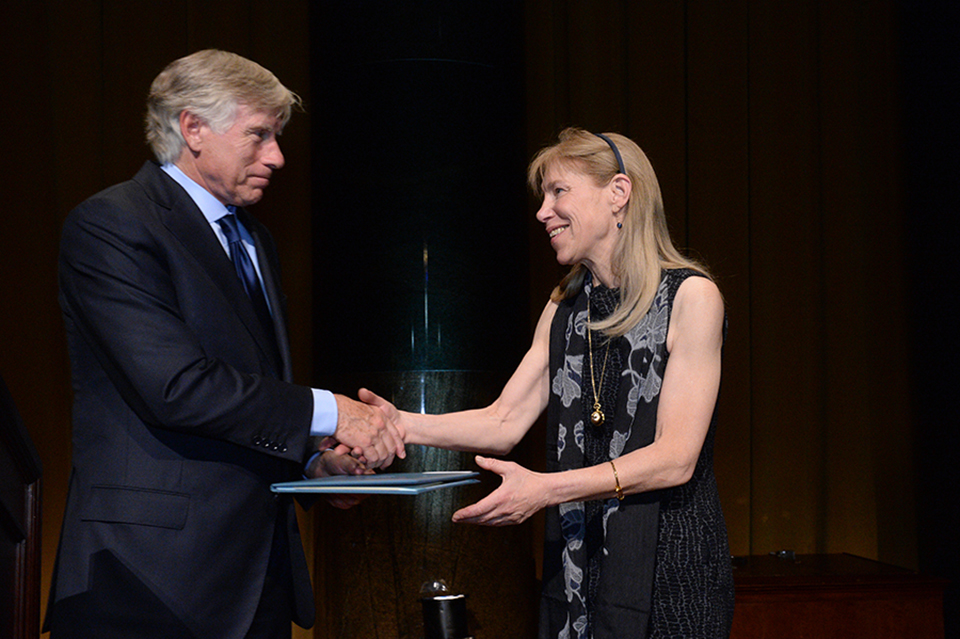
Columbia University President Lee C. Bollinger presents the 2016 International Reporting Prize to Alissa J. Rubin of The New York Times
Winning Work
Trial in Afghan Woman’s Public Death Gave an Illusion of Due Process
By Alissa J. Rubin
KABUL, Afghanistan — Farkhunda had one chance to escape the mob that wanted to kill her. Two Afghan police officers pulled her onto the roof of a low shed, above the angry crowd.
But then the enraged men below her picked up poles and planks of wood, and hit at her until she lost her grip and tumbled down.
Her face bloodied, she struggled to stand. Holding her hands to her hair, she looked horrified to find that her attackers had yanked off her black hijab as she fell. The mob closed in, kicking and jumping on her slight frame.
The tormented final hours of Farkhunda Malikzada, a 27-year-old aspiring student of Islam who was accused of burning a Quran in a Muslim shrine, shocked Afghans across the country. That is because many of her killers filmed one another beating her and posted clips of her broken body on social media. Hundreds of other men watched, holding their phones aloft to try to get a glimpse of the violence, but never making a move to intervene. Those standing by included several police officers.
Unlike so many abuses against Afghan women that unfold in private, this killing in March prompted a national outcry. For Farkhunda had not burned a Quran. Instead, an investigation found, she had confronted men who were themselves dishonoring the shrine by trafficking in amulets and, more clandestinely, Viagra and condoms.
At first, the trial and convictions that followed seemed a victory in the long struggle to give Afghan women their due in a court of law. But a deeper look suggests otherwise. The fortuneteller who several investigators believe set the events in motion was found not guilty on appeal. The shrine’s custodian, who concocted the false charge of Quran burning and incited the mob, had his death sentence commuted. Police officers who failed to send help and others who stood by received slaps on the wrist, at most. Some attackers identifiable in the videos avoided capture altogether. Afghan lawyers and human rights advocates agree that most of the accused did not receive fair trials. Farkhunda’s family, fearing reprisals and worried that the killers would not be held accountable, fled the country.
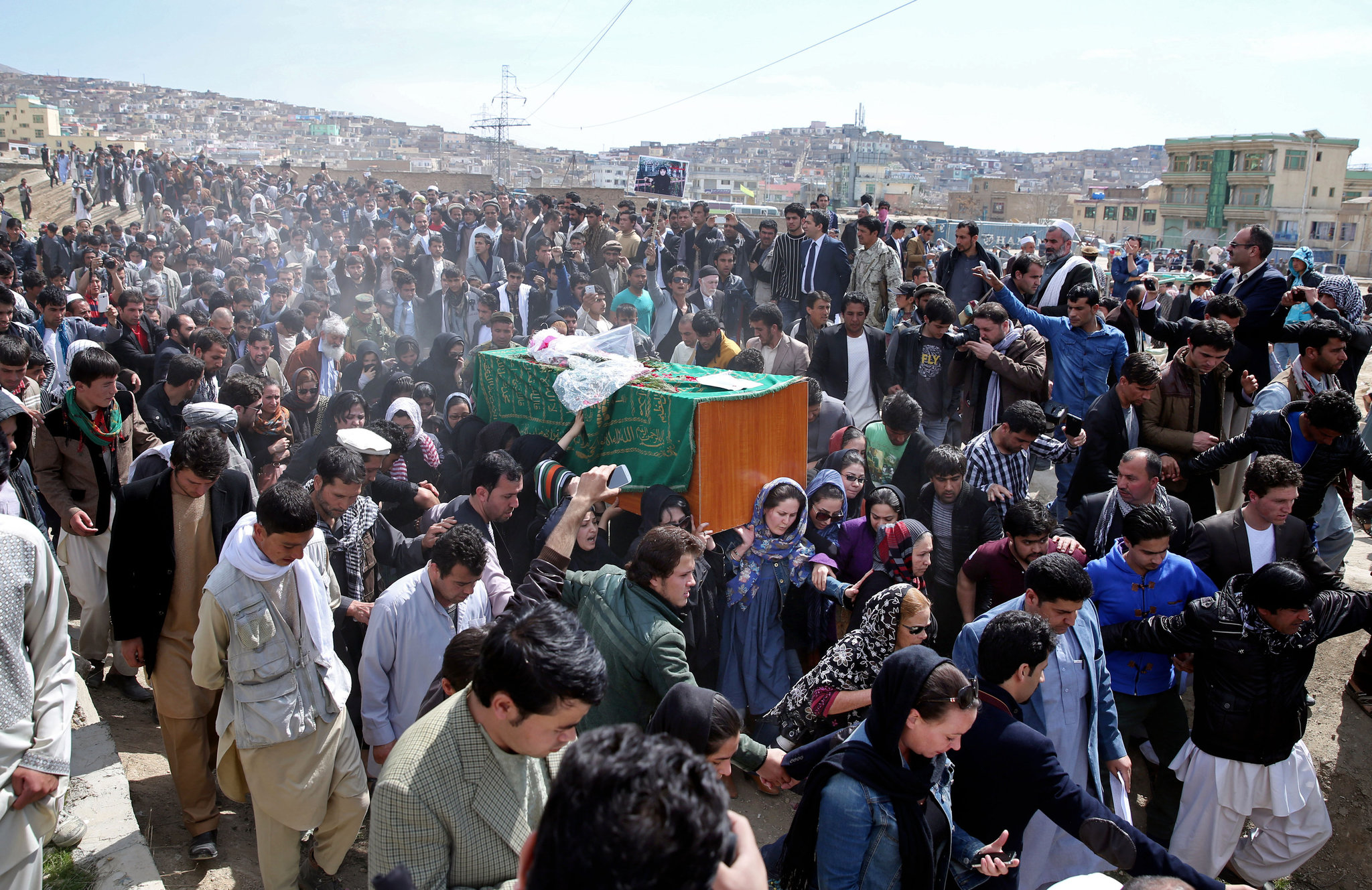
Hundreds of people gathered in Kabul to bury Farkhunda. Women carried her coffin, breaking the custom of staying away from funerals. Massoud Hossaini/Associated Press
Farkhunda’s death and the legal system’s response call into question more than a decade of Western efforts in Afghanistan to instill a rule of law and improve the status of women. The United States alone has spent more than $1 billion to train lawyers and judges and to improve legal protections for women; European countries have provided tens of millions more.
But like so many other Western attempts to remake Afghanistan, the efforts have foundered, according to Afghan and Western lawyers and officials. Afghan society has resisted more than 150 years of such endeavors by outsiders, from the British to the Russians to the Americans. This remains a country where ties of kinship and clan trump justice, and where the money brought by the West has made corruption into a way of life. The rule-of-law programs were often designed in ignorance of Afghan legal norms, international and Afghan lawyers say. And Western efforts to lift women’s legal status provoked fierce resentment from powerful religious figures and many ordinary Afghans.
Yet Afghan women most need the legal system to defend them: They are largely powerless without the support of male family members, and it is usually family members who abuse them.
“Where is the justice?” asked Mujibullah Malikzada, Farkhunda’s elder brother, as he sat in a sparsely furnished apartment in Tajikistan. “In my Islamic country, a girl was disrespectfully, dishonorably lynched and burned, and what has happened? We have left our home. They never caught all the people. What are we to do?”
As a last resort, Farkhunda’s family has appealed to the Afghan Supreme Court, which has wide power to impose new sentences or order a new trial. The decision is pending.
“If she gets justice, all women in Afghanistan who were harmed or killed or abused get justice,” said Leena Alam, an Afghan television actress who found herself joining hundreds of women at Farkhunda’s funeral, defying tradition by carrying the coffin. “If she doesn’t, then all these years of the international community being here, all the support they gave, all the money, this whole war, means nothing. It all went to waste.”
The Killing
Farkhunda first visited the Shah-Do Shamshira shrine — named for a foreign warrior who is said to have helped bring Islam to Afghanistan — four weeks before her death.
It was a Wednesday, women’s day at the shrine, when men are not allowed. The women commiserate about their lives. They visit the fortuneteller to buy amulets to help them get pregnant, find a husband or have male children. Known as tawiz, the amulets usually consist of writings on a small piece of paper that a woman can pin to her body or keep in a pocket.
Farkhunda was appalled at the way the women’s superstitions were being exploited, her brother Mujibullah recalled. She confronted the custodian, Zainuddin, and the fortuneteller, Mohammad Omran, saying: “You are abusing the women. You are charging them money for something that is not Islamic, that is not religious.”
As the atmosphere at the shrine became tense, Mujibullah said, “The custodian said to Farkhunda: ‘Who the hell are you? Who are you to say these things? Get lost.’ ”
The Malikzadas are an educated family. Farkhunda’s father, Mohammad Nader Malikzada, 72, worked for nearly 40 years as the lead engineer for Afghanistan’s Public Health Ministry, keeping its medical technology, such as it was, running. Mujibullah had a job at the Finance Ministry, and a second brother was an engineer.
Farkhunda, one of eight sisters, was academically inclined. The girls were either graduates of or students at universities or teachers’ colleges. Several were still single in their 20s, unusual for Afghan women. The family did not patronize places like the Shah-Do Shamshira shrine, which was known for attracting the local riffraff as well as pilgrims.
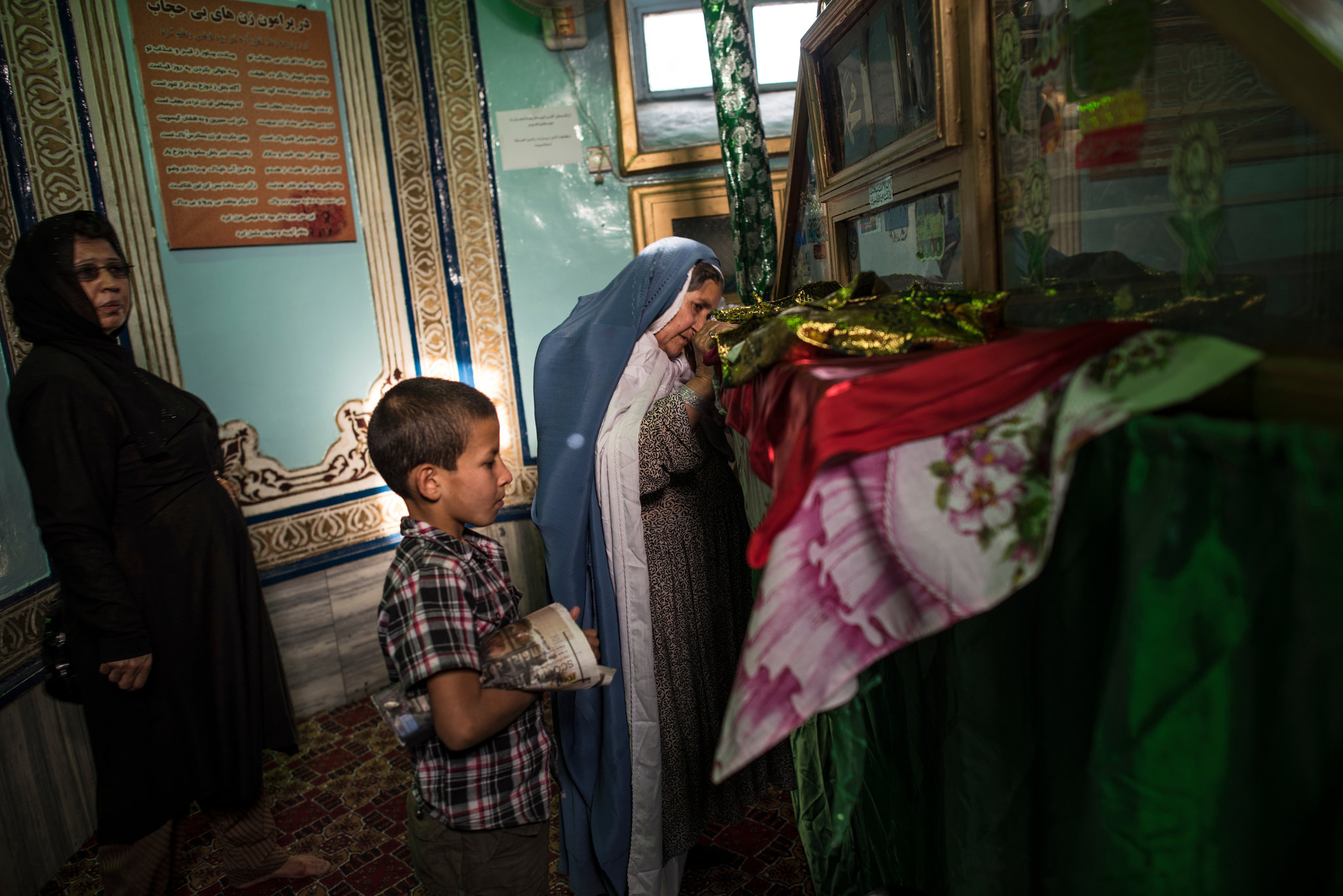
Afghans at the Shah-Do Shamshira shrine, where Farkhunda was killed. It is one of Kabul's most well-known shrines. Lynsey Addario for The New York Times
Farkhunda turned out to be right: There was something amiss at the shrine. Investigators from the police and the National Directorate of Security, the Afghan intelligence service, learned later that the fortuneteller, almost certainly with the assistance of the custodian, was trafficking in Viagra and condoms, said Shahla Farid, a member of the investigating committee set up by President Ashraf Ghani after the murder. Viagra is popular and easily available in Afghanistan. Some men see it as an aphrodisiac; others as a remedy if they are nervous on their wedding night.
The investigators also found pregnancy test strips and sweet-smelling body wash in the fortuneteller’s bathroom, suggesting that women might have used it. Ms. Farid and police investigators said it was possible that the fortuneteller moonlighted as a pimp.
The last thing the fortuneteller wanted was a young woman, fired with religious faith, disturbing his means of making a living.
On March 19, the last day of her life, Farkhunda returned to the shrine. After lecturing the women about the uselessness of the amulets, she gathered up some used ones and may have set them on fire in a trash can, said Ms. Farid, who is also a law professor at Kabul University.
“The custodian, Zainuddin, was illiterate, and he took the burnt papers and added to them some old pages of a burnt Quran, and that’s what he showed people outside the mosque as proof that she had burned the Quran,” Ms. Farid said.
That is a charge almost guaranteed to bring a violent reaction in Afghanistan, where even the rumor of a Quran burning can bring hundreds into the streets, calling for blood.
Muhammad Naeem, who sells pigeon feed across the road from the shrine, said he had heard the custodian calling out to people walking by: “A woman burned the Quran. I don’t know if this one is sick or mentally disturbed, but what kind of Muslim are you? Go and defend your Quran.”
It was about 4 o’clock, time for the afternoon prayer. The streets were full, and a crowd quickly gathered. Cellphone videos captured the first moments of the argument.
“Why did you burn it?” a man shouted.
As Farkhunda insisted she had not, another man shouted, “The Americans sent you.”
She responded, “Which Americans?”
He said, “Stop talking or I will punch your mouth.”
Mr. Naeem said that a police officer had tried to lead Farkhunda away, but that, mindful of Afghan custom as well as strict Islamic teachings, she had asked the officer to bring a policewoman. The crowd broke through. In cellphone recordings, more than one person can be heard shouting, “Kill her!”
“Then she fell down on the ground and the people tried to beat her and pummel her, and the police would try to help her up, and then the people from the other side would push her down,” Mr. Naeem recalled. “They were like kids playing with a sack of flour on the floor.”
In the videos, Farkhunda seems at first to be screaming in pain from the kicks, but then her body convulses under the blows, and soon, she stops moving at all. Even when the mob pulls her into the street and gets a car to run over her, and she is dragged 300 feet, the police stand by.
By then, she was little more than a clothed mass of blood and bones. Yet still more people came to beat her. One of the most fervent was a young man, Mohammad Yaqoub, who worked at an eyeglasses shop. He heard the crowd as Farkhunda was dragged behind the car and rushed out, eager to join.
Eight months later, neatly dressed with a small beard and mustache, Mr. Yaqoub hardly looked like someone capable of violence. Yet in the videos, he is so caught up in the moment that he has a terrifying ferocity.
“People were saying, ‘If someone doesn’t hit her, he is an infidel.’ That was when I got emotional and hit her twice,” he said in an interview at Pul-i-Charkhi prison, just east of Kabul. “My third punch hit the road, and my hand got injured.”
After going back to his shop and patching up his hand, he heard the men outside still shouting and said he felt drawn back. The men had dragged Farkhunda’s body to the riverbank, and Mr. Yaqoub looked for heavy rocks to drop on her. One was so large, he could barely lift it, he said.
Mr. Yaqoub was hardly an illiterate day laborer. He had completed 11th grade and, when interviewed in prison, said he was 18. He explained his fury by saying, “The Quran is like our honor: It is our personal honor and the honor of the prophet.”
As Mr. Yaqoub milled with the crowd, other men set Farkhunda on fire, using their own scarves as fuel because her clothes were so soaked with blood, they would not light.
In the middle of the mayhem, someone found Farkhunda’s phone and called her father. He, his wife and Farkhunda’s brother Mujibullah drove to the police station. They had no word of her fate until Gen. Abdul Rahman Rahimi, Kabul’s chief of police, broke the news.
“It is proved that she burned the Quran,” he told Farkhunda’s stunned parents, who knew she was deeply religious and planned to study theology at Kabul University. General Rahimi also informed them that he had told an Afghan television station that Farkhunda was mentally ill, in an attempt to calm an angry public.
It was true that Farkhunda had been treated for mental illness. Its severity is unclear, but details given to the Afghan Independent Human Rights Commission and other investigators indicated that she had gone through several difficult periods — including one in which she mostly stayed in bed and said she feared praying because she might make a mistake, according to her mother. She was put on medication, which helped for a time, her mother said, according to the Human Rights Commission report.
General Rahimi told Farkhunda’s father that the police had failed to protect her and advised him to leave Kabul for his own safety. Months later, her brother Mujibullah recalled his despair.
“I felt the sky had touched the earth and I was between the two, being shattered into pieces,” he said. “I thought I am in some other world. Someone is telling me that a girl who loved the Quran, who would die for the Quran, had been killed, murdered, for burning the Quran.
“I couldn’t believe it could be our Farkhunda.”
Within two days of the killing, the Ministry of Hajj and Religious Affairs announced that Farkhunda had been innocent. Soon, she was transformed from a person into a cause. Video clips of her death were broadcast on Afghan television, prompting shame among many citizens.
Swelling numbers of young women, joined by some young men, gathered spontaneously at the shrine and held candlelight vigils. They formed a “Justice for Farkhunda” organization. They marched, demonstrated and demanded that her killers be brought to trial.
Most extraordinary, women rebelled against the custom of staying away from funerals, and hundreds gathered to carry and escort her coffin.
Ms. Alam, the Afghan actress, said she had felt compelled to go to the cemetery on the day of Farkhunda’s burial.
“Her body was brought to her grave by women and buried by women,” she said. “We took all our shawls and scarves and knotted them together and held them on each side, and then lowered the coffin into the grave. And I remember I had a little cut from the wood from the coffin, and I didn’t want that cut to heal.”
Investigation and Trial
The case posed two sometimes conflicting challenges for the Afghan legal system: satisfying public pressure for retribution while making sure the trial was perceived as fair.
Mr. Ghani himself pressed for action, declaring, “We are not going to allow mob justice.” Ms. Alam played Farkhunda in a re-enactment of the killing held just before the trial began.
The circle of those culpable was wide. But the degrees of responsibility varied considerably and ultimately confounded the prosecutors, who charged only 30 civilians, 28 of them with the same crimes: murder and burning. Investigators believed that the fortuneteller, whose business was threatened, had incited the custodian of the shrine to accuse Farkhunda. The fortuneteller himself was not present the day she was killed, yet he was charged with her murder.
Two or three police officers seem to have tried to help Farkhunda, but others who arrived later appeared to be overwhelmed by the mob. Officers called on to send help claimed that reinforcements had not arrived because the police pickup trucks had no fuel and because their radios had not been working. The mob was huge, and it was never established at what point in the beating, dragging and burning Farkhunda actually died.
The police, acting on the orders of the Interior Affairs Ministry, ultimately detained more than 50 people, 49 of whom — including 19 police officers — stood trial.
Yet some who appeared guilty based on video evidence avoided capture or charges. They included the driver of the car that ran over Farkhunda and a man wearing a sweatshirt with the number six on it, whom the videos showed repeatedly jumping on her body. Also involved was a well-known local figure, Habib Deh Afghanan, who trained as a wrestler and was at the shrine during the beating, according to witnesses.
A senior police investigator in Kabul acknowledged that the police had failed to capture all of those responsible. He estimated that three or four key suspects had fled Kabul; it was unclear if they had political connections and therefore had been tipped off, or if some had been detained and then released. None of the provincial police forces had the will or the clout to arrest them, said the investigator, who asked not to be identified because the appeals process is still underway. The case became politicized, he added, with intense pressure to make arrests to show that the government was taking a stand.
“Everyone tried to use this case for their political leverage,” the investigator said. “Some used it as a way to attack the police chief, some to attack the government; others used it, under the guise of ‘civil society,’ to undermine the role of spiritual leaders or Islamic scholars. So all of that made our work difficult.”
If some of the guilty were spared, the legal system also appeared to entrap some of the innocent. Some of those arrested were later shown not to have even been physically present during the killing. And Afghan defense lawyers described multiple failures in protecting the rights of the accused, including their right to counsel.
Zaki Ayoubi, an idealistic lawyer who had worked for a Western rule-of-law organization, had great hopes for changing the legal system. He began to worry about the lack of attention to appointing counsel for the accused. He turned to friends from university and from Western legal workshops and began to recruit them.
The American notion of defense lawyers does not exist in Afghanistan, where defense lawyers traditionally played the role of middleman between the accused and the prosecutors and judge. Until as recently as 2008, the few pro bono defense lawyers worked directly for the Ministry of Justice, which did little to give defendants confidence in them.
Gradually, that is beginning to change, in part because of one of the more successful parts of the American rule-of-law programs, which helped create a bench of defense lawyers within the Justice Ministry and outside of it.
Mr. Ayoubi recognized early that even if he could find defense lawyers, the trial would be heavily politicized. Mr. Ghani continued speaking out. The country’s chief executive, Abdullah Abdullah, had visited Farkhunda’s family to offer his condolences. These moves clearly signaled to the judiciary that it needed to find people guilty.
The judge appointed to preside over the trial was Safiullah Mujadidi, a man who could be trusted to get the results leaders wanted. He was well known for his 2014 ruling in the case of seven men accused of raping four married women in a rural area of Kabul Province. In that case, Hamid Karzai, then the president, asserted publicly even before the trial that he would approve a death sentence. The judge sentenced five of the men to death even though they testified that they had confessed under torture. The men were quickly executed.
In Farkhunda’s case, Judge Mujadidi again moved quickly. The prosecutors delivered their completed file to the judges on April 27, and the trial began just five days later. It was not clear whether the judges had even had time to review the more than 4,000 pages of material, according to international and Afghan lawyers who closely followed the case.
When the trial opened, fewer than seven of the 49 accused had retained defense lawyers. None of those lawyers were notified of the date or time of the trial, several of them said, and only three or four were present at all during the proceedings. Few, if any, were given access to the documents compiled by the prosecution until the trial started, so they were unable to prepare a defense of their clients, the lawyers said.
Judge Mujadidi, who has since been appointed as a counselor at the Supreme Court, said in an interview that he had attended training sessions provided by several American-funded rule-of-law programs and a German one.
In his view, he said, “The decision in the primary court was according to the law, which brought justice.”
He argued that criticisms about the lack of defense counsel and scant time for preparation were motivated by defense lawyers’ greed. “All they think of is their business, not the people and the good of others,” he said. “They even overcharge their clients to make more money.”
Judge Mujadidi added that every defendant had been asked if he wanted a lawyer. “All of them said they could better defend themselves and they know what to say in court, so there was no need for the defense lawyers,” he said.
Abdul Masood Khorami, a lawyer representing Mr. Yaqoub, the eyeglasses shop worker, did not even know the trial had begun until he received a call from Mr. Yaqoub’s father, who was watching the proceedings on television. When Mr. Khorami rushed to the courtroom, he found that the trial was being run as if it were a terrorism case rather than a murder case. Heavily armed guards wearing dark glasses stood behind the judges.
It took most of two days for the prosecutor to finish reading the indictment. Then the three-judge panel took a day to deliberate privately. On the third day, they delivered a verdict.
Each defendant or his lawyer was allowed to speak for scarcely five minutes after the prosecutor read the evidence against the defendant. Many of the statements were pushed to the trial’s last day and were unlikely to have been taken into consideration by the judges, who had deliberated the day before and announced the verdict shortly after the defendants finished speaking.
In any case, few of the defendants were given a chance to speak beyond perfunctory responses to questions, and neither were most of their lawyers. One exception was Mr. Khorami, who had learned about the importance of objections in one of the Western-run rule-of-law courses he had taken. He understood that it was a critical moment under Afghan law as well: Unless an issue is raised in the trial court, it cannot be raised in an appeal. He objected to a statement that his client, Mr. Yaqoub, was an adult, claiming that he could prove he was a minor. Minors are not subject to the death penalty under Afghan law.
Judge Mujadidi said in an interview that he did not believe Mr. Khorami. “He forged his client’s tazkera to prove him underage,” he said, referring to an Afghan identity document, “but the forensic medicine test and our knowledge said he was a grown adult with a full beard.”
The judge ignored Mr. Khorami’s objection, and Mr. Yaqoub was one of four sentenced to death. The others were Zainuddin, the shrine’s custodian; Sharaf Baghlani, a onetime employee of the Afghan intelligence service who had boasted on Facebook about his role in Farkhunda’s killing; and Abdul Basheer, a driver.
Eight others were found guilty of major roles in Farkhunda’s murder and were each sentenced to 16 years in prison. The other 18 civilian defendants were found not guilty for lack of sufficient evidence. Of the police officers, eight had their cases thrown out, and 11 were given the lightest penalty possible: They were required to continue working in their assigned police districts for one year and to refrain from traveling.
Legal Changes
Farkhunda’s case highlighted the limits of the Western rule-of-law effort, but it suggested that there had been at least one significant achievement: Afghans did hold a trial and try to bring people to justice.
However, a full investigation, a trial perceived as fair and sentences based on evidence would have sent a message that Afghans agreed that a lynch mob was unacceptable; that the police and courts could deliver justice; and that victims, even female victims, had rights.
In reality, Afghans were divided about the event and what the punishments should be. Some believed that everyone in the crowd that beat Farkhunda and applauded should be punished; others thought only a few should be. Almost no one had faith in the justice system: In surveys, it is the least trusted Afghan institution.
In the face of competing pressures and beliefs, rumors and corruption, many of the legal lessons painstakingly taught by Western-funded lawyers were simply ignored.
That is all the more surprising because almost everyone involved in the case had some exposure to rule-of-law training.
Since 2005, according to the Special Inspector General for Afghanistan Reconstruction, the United States has spent more than $1 billion to train prosecutors, defense lawyers and judges in such areas as legal procedure, questioning witnesses and computerizing case loads. It has also underwritten programs encouraging transparency, justice for women, changes to detention practices and a stronger informal justice system, which dominates in rural areas.
Every defense lawyer interviewed for this article had attended workshops or legal courses funded in part by the State Department’s Bureau of International Narcotics and Law Enforcement Affairs; by the United States Agency for International Development; by the Justice Department; by the European Union Police Mission in Afghanistan; or by individual countries such as Canada, Germany or Sweden. Many prosecutors, particularly the elite ones used for Farkhunda’s case, have also attended such programs, according to American and international trainers. Although most of the judges in the case did not respond to requests for interviews, several who were not involved said it was common for judges to have received some Western training.
But Afghan and Western observers alike said the efforts had been hobbled by ignorance of Afghan norms and, in some cases, by arrogance. Some trainers tutored Afghans about how to pick jurors, but judges decide cases in Afghanistan. Some also brought young lawyers in to teach older Afghans in a society where age is a symbol of authority and knowledge. The intricacies of law were often literally lost in translation from English to Dari, according to two international lawyers who have spent years working in Afghanistan.
An effort to rewrite the criminal procedure code, rather than translate it so the West could use it as a starting point, captured the occasional absurdities of the process.
“At the time, it was the Italians who were in charge of the rule of law, so they wrote one close to the Italian code,” said a Western lawyer who has spent years in Afghanistan, and who asked not to be named because he is not allowed to speak for his organization. “Why would they write a new one when the Afghans had a criminal procedure code that everyone knew?”
As with efforts to engineer gender equality, many Western ideals ran head-on into entrenched Afghan beliefs. For example, one lawyer recalled a two-week course in representing clients who bring sexual assault cases. But despite Western efforts, few sexual assault cases ever come to trial in Afghanistan because of family pressures and a well-founded fear of reprisal.
Siavash Rahbari, an American lawyer who speaks fluent Dari and works on rule-of-law issues for the Asia Foundation, said the West fundamentally misunderstood Afghanistan’s needs. The experts thought they were helping to rebuild a system in transition from the Taliban period to a more secular one. Rather, Afghans are still trying to determine what kind of system they want. The Afghan system still draws on Islamic law, as well as its own legal code, which has roots in both the German and Egyptian systems.
Defense lawyers and prosecutors study law and political science in college, but almost all judges study theology and Shariah, Islamic law. So when the two meet in a courtroom, they come with completely different frames of reference. Often, they are talking past each other. And judges, who are the backbone of the system, are often resistant to change.
Afghan lawyers said the Western designers of the program had not paid enough attention to Afghans’ deference to age and experience.
“An American lawyer is standing before a class of Afghan lawyers or judges in their 40s and 50s, and the American lawyer is in his 30s,” said Sayed Mohammad Saeeq Shajjan, an Afghan defense lawyer with a Harvard degree who returned to his country to practice law. “Everyone has his pride, and they say, ‘Why is this young kid teaching me?’ ”
Mr. Shajjan also faulted a lack of follow-up.
“At the end of the one-month training, they have a ceremony, get a certificate and photos, but who follows up and sees if they learned something or not?” he asked. “No one is doing that, and it’s a big mistake.”
Nor did the Western training reckon with the pervasiveness of corruption, a scourge in the justice system as in so much else in Afghanistan.
“When your client is a poor guy, you are asked to pay a bribe or he spends 16 years in jail,” said Muhammad Aziz Sofizada, a defense lawyer who represented two clients in Farkhunda’s case, including one who was sentenced to 16 years in prison. “What are you supposed to do? In this country, without spending money, you can’t get anything.”
But the trial also showed that some ideas had taken root, particularly among a growing cadre of young, Western-influenced defense lawyers. Michael J. Fannon, who was the chief of party for the International Development Law Organization and worked in Afghanistan for six years, said that when he left in 2014, the number of defense lawyers had swelled to about 2,000, from 200 in 2008.
Two defense lawyers said they had drawn on their training in making legal arguments and registering objections to prosecutors, but they were in the minority. And several who were not directly involved in the trial, and so were freer to speak about it, said they believed the system had failed in Farkhunda’s case.
“So many didn’t have a defense lawyer — there were almost 50 people tried,” Mr. Shajjan said. “You cannot try such a huge number of defendants, and defendants who don’t have lawyers,” in such a short period. “You need to give the defendants a chance to speak. Everyone was given two minutes.”
Human rights lawyers also argued that the legal system needed to send a clear signal that it is unacceptable to stand by and watch as a mob beats someone to death. “All those watching her being killed should have been given a sentence,” said Shamsullah Ahmadzai, the head of the Afghan Independent Human Rights Commission office for the Kabul region. “When someone is being killed, it is not a play. It is not a movie.”
Verdicts Overturned
While supporters of Farkhunda celebrated the trial-court verdict, defense lawyers rallied on behalf of their clients. But unlike the televised trial, the appeal in late June took place behind closed doors, according to lawyers involved in the case and others who managed to slip into the hearing.
That secrecy is against Afghan rules of criminal procedure — although there is a loophole that allows judges not to announce a proceeding to the news media as long as no one is stopped from attending. The defendants and their lawyers were called in for discussions with the judges in groups, depending on their sentences.
Lawyers for those condemned to death or long prison sentences pointed out that no one had bothered to determine when Farkhunda died. Under Afghan law, the penalty is far lighter for desecrating a dead body than it is for murder, so Mr. Sofizada, Mr. Khorami and other lawyers drilled down on that point.
“Who is the guy who hit the first blow? Who is the one whose blow killed her?” asked Mr. Sofizada, who represented a shopkeeper named Mohmand. “If it’s violence, who is responsible for this violence? The guy who started the episode and encouraged the people to hit her? The guy chanting slogans who encouraged the people? Was it a blow from a stick that killed her? A stone? Was it that she was burned, or was it the car running over her?”
Mr. Yaqoub said he had only desecrated a corpse. “I knew she was dead because she was not moving,” he said. Asked if Farkhunda might have been unconscious, but not dead, he did not reply.
Mr. Yaqoub’s lawyer, Mr. Khorami, used his session with the appellate judges to try to convince them that Mr. Yaqoub had been wrongly tried as an adult. He produced a tazkera, the Afghan identity document, saying that his client had been 17 at the time of the killing. Although the trial-court judge believed this document had been forged, the appeals panel deemed Mr. Yaqoub underage and commuted his death sentence to 10 years in prison.
The argument that there was no evidence on who had struck the blow that killed Farkhunda made sense to both the appellate court and the Supreme Court, according to people close to the courts. “It’s very difficult to determine responsibility if you don’t know what killed her,” a person close to the Supreme Court said, speaking on the condition of anonymity because court employees are not allowed to talk to the news media.
So the judges commuted the other three death sentences to 20-year prison terms.
They also reviewed the evidence that the fortuneteller was not at the shrine when Farkhunda was killed and ruled that he was not guilty because he had not been present. They exonerated a ninth police officer, so that in the end, only 10 were disciplined at all.
When the appeals court’s ruling became public in July, Farkhunda’s family and many women’s groups were stunned to find out that they had been given no chance to make their case. Farkhunda’s brother Mujibullah said the new verdict was a travesty.
“You saw that boy who hit her with that big stone, and the court said he’s underage,” he said. “Even if he is underage, he knows how to hit, but he doesn’t know how to answer for his actions.”
Female lawyers who followed the case said the verdict showed Afghanistan’s cultural bias against women. “There was some discrimination against women,” said Najla Raheel, a young lawyer who takes cases on behalf of women, even when they cannot pay, and who was appointed by Mr. Ghani to lead the team representing Farkhunda’s family in the appeal to the Supreme Court. “Some government officials didn’t want 49 men punished for the death of one woman.”
Soon after the new verdict, Farkhunda’s family asked Mr. Ghani’s wife, Rula, who had taken an interest in the case, to help them get temporary visas to leave the country. They felt the appeals verdict signaled that the public did not support them.
In the meantime, the legal team appointed by Mr. Ghani decided there had been so many flaws in the case that the only fair course was to ask the Supreme Court to order a retrial, according to Ms. Raheel and Mr. Ayoubi, who had also joined the legal team representing Farkhunda’s family.
The Road Ahead
The request for a retrial was made in August, and the Supreme Court has not yet announced its decision. The court, which has great leeway to increase, reduce or throw out penalties, often simply confirms appellate decisions or sends them back to the appeals court for review. None of the lawyers interviewed for this article could recall a time when the court had sent a case back for a complete retrial.
Farkhunda’s family is beginning to worry that there will never be a decision and that she is being forgotten.
Five miles north of the Shah-Do Shamshira shrine, a sprawling graveyard covers a slope in Chaikhana, a northern neighborhood of Kabul. The rocky earth is brown and gray. The graves are gray, too, modest piles of small stones fenced off from one another. The ground is littered with empty water bottles and small pink or blue plastic bags blowing in the late autumn wind.
In the middle of the cemetery, far from the main road, lies Farkhunda Malikzada. Her grave is large but half finished. The coffin has been sunk into a concrete slab facing west, toward Mecca. At each of the four corners is an unfinished concrete column with metal spikes sticking out. A flag with her ghostly pale face, wrapped in a black hijab so not a hair is visible, hangs over the grave. It is hard even to make out her features. She is fading into memory.
On a recent Friday, the only people near the grave were four neighborhood children who use the cemetery as a playground.
The children all knew her name. Ishaq, 6, volunteered: “Her name is Farkhunda. She burned the Quran, so she was punished and she was lynched.”
Ahmad Shakib and Jawad Sukhanyar contributed reporting.
By John Woo, Adam B. Ellick and Alissa J. Rubin
Farkhunda Malikzada, a 27-year-old Muslim woman falsely accused of burning a Quran, was killed by a mob in central Kabul as hundreds watched and filmed. This video contains scenes of graphic violence.
Western Ideals Collide With Repressive Reality in a Push for More Equality
By Alissa J. Rubin
JALALABAD, Afghanistan — Parveena almost got away.
She was on her way home from a visit to her parents in a remote corner of eastern Afghanistan with her children by her side and a small group of women. Two men, their faces covered by kaffiyehs, pulled up on a motor scooter.
“Who is Parveena, daughter of Sardar?” said one, looking at the group of women, their faces hidden behind blue burqas.
No one answered. One of the men took his Kalashnikov and used the muzzle to lift the burqa of the nearest woman — in conservative Afghan society, a gesture akin to undressing her in public. It was Parveena, who like many Afghans used only one name. She grabbed the muzzle, according to her father and her brother, and said, “Who is asking?”
But the gunmen had seen her face, and they fired 11 bullets into her.
Parveena’s story — she was one of six policewomen killed in 2013 — is an extreme case, but it reflects the dangers and difficulties of Afghan policewomen and the broader Western effort to engineer gender equality in Afghanistan. The plight of women under the Taliban captured the Western imagination, and their liberation became a rallying cry. A flood of money and programs poured into Afghanistan, for girls’ schools and women’s shelters and television shows, all aimed at elevating women’s status.
But these good intentions often foundered against the strength of Afghan sexual conservatism. As the tale of Afghan policewomen shows, repressive views of women were not just a Taliban curse, but also a deeply embedded part of society.
Now, as Western troops and money flow out of Afghanistan, the question is just how much the encounter with the West and its values has really changed the country, and whether any of the foreign ideas about the status of women took hold.
In 2001, when the Taliban regime fell, women in Afghanistan were among the very worst off on earth: They had no access to education, women’s health care was scant, and government-sanctioned public beatings were widely accepted. Women rarely ventured out at all, and when they did, they had to be accompanied by a man and covered head to toe with a burqa.
Fourteen years later, there is a palpable sense of possibility for women, especially in urban areas. Girls are going to school in large numbers, at least up to age 11, and there is more access to women’s health care even in some remote parts of the country. However, in rural areas and in the Pashtun-dominated east and south, most women still live confined lives. They are subjected often to forced marriage, child marriage and beatings, and sometimes to honor killings. And conditions for Afghan women over all still rank close to the bottom among developing countries.
Hiring and training policewomen have been key priorities of Western governments and funders. They reasoned that Afghan women and girls, who face high levels of violence, sometimes on a daily basis, would be more likely to report abuse or seek help if they could turn to other women, and that meant ensuring there were women on the police force.
But those hopes ran up against the sexual taboos that haunt every interaction between men and women in Afghanistan. Policewomen have been branded as little more than prostitutes, dishonoring their families. That stigma means that mostly desperate women, usually illiterate and poor, have joined the force. In a society where coercive sex is a frequent tool, many endure sexual harassment for fear of losing their jobs.
Afghan policewomen, struggling to maintain good reputations, face a legion of logistical problems poorly understood by Western donors — a need for separate changing rooms in police stations, for example, since women are afraid to wear their uniforms on their way to work. After a decade and millions of dollars, even the modest goal of recruiting 5,000 policewomen remains a mirage. In fact, only 2,700 are on the force, less than 2 percent of the 169,000 members, according to the United Nations’ office in Kabul based on numbers from the Afghan Interior Ministry.
“The situation in Afghanistan is not prepared for women to work with men, and our community is not ready for female police to work here,” said Col. Ali Aziz Ahmad Mirakai, who heads recruitment for conservative Nangarhar Province, where Parveena worked.
Colonel Mirakai, who supports having more policewomen, sighed. “The police commanders I work with say: ‘We don’t need them to work with us until noon and go home; instead of female police, send us male police.’” he said, alluding to the reality that many women have to leave work early to care for their families.
To assemble a portrait of policewomen’s experiences, The New York Times interviewed more than 60 policewomen, male police commanders, Interior Ministry officials, Western military officials and staff members of nongovernmental organizations.
A United Nations report given to the ministry in 2013 but never publicly released — in part because of fears of possible reprisals against policewomen — found that 70 percent of the 130 policewomen interviewed had experienced sexual harassment, with smaller numbers reporting rape or more explicit pressures to have sex.
“The Interior Ministry’s and Afghan society’s generally negative view of policewomen, the lack of a confidential complaints mechanism, corruption, lack of facilities, discrimination and sexual harassment remain primary barriers,” said Georgette Gagnon, the head of the United Nations’ human rights division in Afghanistan.
The clash between Western ideals and Afghan realities means a program established to promote women has all too often backfired, subjecting the recruits themselves to abuse and retribution.
The small but real achievements have been in some of the family-response units, which give female victims a chance to talk to a policewoman and gain access to female lawyers.
“It’s the absurdity of imposing our liberal Western beliefs,” said a Western diplomat who has spent many years in Afghanistan and asked not to be named because of the sensitivity of the subject for governments that have invested heavily in training Afghan women for the security forces. “It’s easy for us to put these women out there and tout their accomplishments, but then we leave, cut them loose, and what happens to them?”
Burdens at Home and Work
Like all the women who work with her in Kabul Police District No.10, Sharifa Aziza is too frightened to wear her uniform outside the office. She does not want her neighbors to know she is a policewoman.
Unlike most of her colleagues who stay inside a rickety trailer working as searchers and patting down women who enter the police compound, Ms. Aziza works in the family-response unit and occasionally helps with criminal cases. She counts herself lucky that she is subjected less to the harassment of younger male police officers, who bother the female searchers almost constantly.
One spring day, the windows of the female searchers’ small trailer were open and a policeman kept poking his head in, saying “Kiss me” to a young female colleague of Ms. Aziza.
“I have told him ‘no,’” the young woman said forcefully.
“I will not leave until I bite your face,” he said in a tone that was meant to be playful but that had an edge to it.
The woman looked at the floor. There is no effective confidential complaint system when policewomen are harassed. Senior police officials could not remember any complaints from women that had been formally prosecuted, and they minimized the problem.
Some women are pressured into giving in. “Good women are pushed into doing bad things,” said Madina, 21, a policewoman in eastern Afghanistan who would allow only her first name to be used to protect her safety.
Ms. Aziza’s boss, Nooria Sediqi, a second lieutenant who is about 50, displayed considerable knowledge of prostitution arrangements within the police. “The salaries are low,” she said of police pay. For a session of sex, a woman could earn $100 or even $200, she said. That is half a month’s salary for a junior policewoman, and a great deal even for a more senior one.
Occasionally older policewomen have acted as madams, procuring younger ones either for men within the police force or outside it, according to two of the policewomen interviewed for this article as well as Western officials who work with the police.
Interviews suggest that many policewomen, aware they have few useful skills and untrained in how to behave professionally, are vulnerable to sexual pressure. They are easy targets for more senior males who can withhold their pay or assign them to jobs far from home, and so policewomen are fearful of complaining.
Ten years ago, Ms. Aziza followed two of her brothers who had joined the security forces and enlisted with the police, hoping to earn enough to help sustain her family. In those early years of President Hamid Karzai’s administration, Afghanistan was full of promise. Women in cities had begun to take off their burqas and there was a widespread sense of a new start.
“It seemed to me then a very good and clean job,” she said.
Then her husband died of cancer and she had to take in the wife and children of her brother, who is a drug addict. Even though she earns twice as much as cleaners for the education ministry, her $240 monthly salary is nowhere near enough. After paying $100 for rent and as much as $80 for electricity, there is rarely more than $60 left for food, medicine and clothing.
“This is the room of a widow woman,” Ms. Aziza said, gesturing to the dark two-room hovel where she lives on an abandoned construction site. Outside, a broken bedspring sat between torn bags of cement, a promise of construction that was never realized. The sharp smells of urine and sour milk pervaded the house.
It was a Friday, her day off, and she flung open her sole cupboard to show her prized possessions. Her crisply pressed police uniform was draped in plastic to keep out the relentless dust. She showed certificates for attending police seminars, describing which dignitaries presided over each ceremony. Then she rummaged until she found a picture of a pretty 8-year-old girl smiling into the camera. “My daughter,” she said.
“Here, when a woman is widowed, she has to marry her husband’s brother and I refused,” she said. It was a moment of independence, but it quickly turned tragic.
Her mother-in-law, concluding that Ms. Aziza must be morally lacking when she turned down a chance to be respectable, took the child from her. While Afghan law allows a widow to have custody of her children, as a practical matter the lack of money often results in the children staying with relatives. Ms. Aziza sees her daughter now only once a year, on her birthday.
“She took my daughter by force,” said Ms. Aziza, staring into the photo as if the girl might walk out of it and into her arms. Tears came to her eyes.
Embarrassed, she looked away. Soon it would be time to make dinner and there was not much other than some bread left from the morning and a bag of okra.
Ms. Aziza’s family obligations are common among women in the police force, and often limit what they can accomplish on the job.
“They have to look after their children, cook, make dinner, clean; they have to leave early to take care of family matters,” said Col. Ali Akbar Mahmoudi, the former police chief in Ms. Aziza’s district, who is a supporter of policewomen. “None of the women police are coming during the night — just in some exceptional cases when we send them a police vehicle to pick them up for a raid.”
The men, by contrast, he said, “are flexible, they work all jobs, 24 hours; they pull guard at night.”
In fact, many of the women said they had been left to make their own way home after raids and only recently had been given separate toilets and changing rooms.
Ms. Aziza’s day starts in the dark hours before dawn when she rises to make tea before setting out at 6:30 a.m. for work, which begins at 8. Usually she takes a series of minibuses, squeezing into vehicles so packed with people that they are in danger of tipping over.
The need for transportation for women in a society where respectable women do not go out of their homes alone was one of the many details that escaped Western organizations that gave money for women’s empowerment, said Anastasiya Hozyainova, who worked as a consultant to the United Nations and the European Union. “The policewomen don’t receive transportation help, for instance, so how can a woman even get to work?” she said.
Under pressure by Western funders to meet gender targets, police officials hired any woman who would sign up. But there were few recruits in the countryside.
Col. Saboor Khan, who until 2014 was the longtime deputy for gender, children’s rights and human rights at the Interior Ministry, said that in traditional Afghan culture, “It’s a shame for a woman to work, and that also reflects on the family.”
Ms. Aziza works in the Gender and Family Response Unit of District 10, a section that exists at least nominally in every police department in Afghanistan to deal with domestic violence.
But many women are not allowed to leave the house except with a male relative, and often that relative is either the person who was beating her or someone in the family allied with him. And even if a battered woman is able to get away, there is a profound shame associated with talking about such matters to someone outside the family — even other women.
The result is that 12 years later, there are still relatively few cases for the units.
Of the 13 policewomen in the 318-member force in District 10, most are searchers. One, Feriba, stood in the trailer’s small entry, looking out at the scrawny shrubs in the yard. Her salary supports a disabled husband and six children. “Do you think we want to do this?” she asked.
“I would do anything else,” she said, answering her own question.
Ms. Aziza nonetheless believes that District 10 is better than most. Both the former Interior minister, Umar Daudzai, and the new one, Nur al-Haq Ulumi, have tried to push commanders to find jobs more suitable for women.
“They listen to women more here,” Ms. Aziza said. “In the past year, at least they gave us a separate toilet. Maybe they received much pressure from the world community and that has created pressure to take care of the women,” she said early in 2014, when there were still substantial numbers of American and NATO troops in Afghanistan.
“But I am worried,” she said. “After 2014, what should we do?”
A Woman in Command
Zarif Shaan Naibi is that rare figure among Afghan policewomen: a success story. The first female warden of Kabul’s women’s prison, she stands out among the overwhelmingly male command structure of the Interior Ministry.
Her realm is a barren patch of ground on the northeast side of Kabul with the three-story prison at its center. Six days a week Ms. Naibi goes to her office in a building next to the prison, and after attending meetings and signing paperwork, she wades into the prison itself.
Once painted white, the prison building is now badly scuffed, and the female prisoners seem to pour out of it. The prison has been overcrowded for years; at the end of 2014, it housed 33 percent more women than the 120 it was supposed to hold, according to prison officials. The women jostle to lean out of the windows and crowd at the front door, but there is nowhere to go other than the small bare yard, where even weeds seem to have a hard time growing.
Before she even reaches the stairwell, Ms. Naibi is besieged by women asking her for medical care, to arrange lawyers’ visits, or for help settling disputes.
A woman of medium height with hair either swept under a police cap or under a neat hijab, Ms. Naibi neither puts on airs nor appears particularly dominating, but her sense of purpose is unmistakable. She steadily navigates the prison’s maelstrom of emotion, keeping herself at arm’s length.
She relies on her rare ability to create privacy for conversations. She pats one inmate on the arm and then does the same to another, a gesture that is at once maternal and admonishing. She asks them to hug each other and makes them promise to stop fighting.
Her success appears to be rooted partly in her training in the late 1970s and the 1980s, when Afghanistan’s government was imbued with Communist ideology. The period offered exceptional opportunity for women, especially in urban areas.
As ethnic Hazaras, a group that was persecuted by the Taliban and has now embraced education and the modern world, Ms. Naibi’s mother and brothers allowed her to join the police, and when she married, her husband allowed her to continue. He is now in the Defense Ministry.
Ms. Naibi recalls that in her day all her teachers at the police training center were women. Now they are almost all men.
Under the Communists, women’s education was valued and candidates for the police were vetted, she said. “If she wasn’t educated, they wouldn’t take her. If she had graduated from high school, they would send her to the police academy.”
But these Communist ideals encountered resistance from much of Afghan society. Then under the Taliban, most policewomen were banished, and Ms. Naibi’s family, as Hazaras, had to flee. When the police were reconstituted after the Taliban’s ouster in 2001, the Afghan leadership was desperate for women to serve, calling former policewomen back to work as well as recruiting new ones.
For Ms. Naibi, it was a second birth. When the ministry put out the word, she went immediately — still wearing her burqa, required garb under Taliban rule, because she could not quite believe it was safe to take it off. Many other women came, too.
“We were standing in this room and then we began to recognize each other’s voices coming from under our burqas and we were saying: ‘Is it really you? Are you still alive?’”
More than half of her charges in prison today are there for moral crimes, a vast category that includes running away from home and intending to commit adultery. Either crime can taint a woman for the rest of her life.
Also among the inmates are policewomen, most of them in prison for running afoul of morality laws. Of the six there during a visit last winter, only one was accused of a violent crime (she tried to kill her husband).
Two appeared to have been victims of an unsuccessful effort to blackmail them into paying a bribe to avoid jail, but since they had no money, they ended up in prison. Forlorn and confused, they were embarrassed that they had accepted an invitation to have dinner with the son of a police commander, setting them up to be arrested for being alone with a man to whom they were not married.
Watching Ms. Naibi is a lesson in what could be possible for women in Afghanistan.
One morning, she was arguing with the male security guards about their schedules. “Just keep on one guy who knows everything,” she said.
The guards sat in silence, leaving it unclear whether they understood her instructions. One then complained that the ministry did not act quickly on personnel matters.
She sighed audibly. “Yes, O.K. we’ll fix everything, I’ll sort it out.”
The male guards saluted her when they left as they would a male commander.
“Yes, there will be negative discrimination against women, but it’s up to you to command authority,” Ms. Naibi said. “It doesn’t matter if you’re a man or a woman — it’s your duty that defines you.”
Working in Secret
With five children and a disabled husband, Parveena, 28, was both desperate for work and overwhelmed by the task of caring for her family. There were few choices and none that would pay as well as being a policewoman, she said in an interview barely a month before she was killed in July 2013.
Parveena was attending a seminar for junior policewomen in Jalalabad, the largest city in conservative eastern Afghanistan, where tribal law often trumps government authority.
In contrast with a number of fully veiled women in the room, Parveena wore a white shawl over her head and had a warm open smile.
Of the 3,850-member force in Nangarhar Province in 2013, there were just 32 women, which meant most women worked alone in a sea of men, struggling to preserve their reputations.
“I am the only female where I work,” Parveena said then. “I don’t talk to anyone, I don’t give anyone my phone number or take anybody’s phone number. I just come at 8 and leave at 12 and then take the leftover food that people don’t eat for my kids,” she said, referring to the leftovers from policemen’s lunches.
Even then, she knew the risks. “My in-laws don’t support me,” she said, but then suggested that she had never told them about her job. “They don’t know; only my brothers know.”
Still, Parveena was enthusiastic about her work. Her father, a frail man of 70, said she liked it so much, she persuaded her younger brother to join the police as well.
Her commanders said they respected her hard work, so much so that they entrusted her with the dangerous mission of recruiting more women for the police force when she was visiting her home district of Lal Pur, near the Pakistani border.
Recruiting women for the security services can be dangerous even in a large city, but in a region where the government had no presence, it turned deadly.
All the more so because as much as a year before she was killed, the Taliban learned of her job, said Wali Khan, 21, her younger brother.
“She was doing the job secretly,” he said, telling only her immediate family and not wearing a uniform. “Then a year ago one of our relatives who was in the Taliban found out and he told people.”
That put her life at risk. Agnesa Shinwari, a member of the local provincial council, said, “In Afghanistan, if your husband allows you to work or your father allows you, it doesn’t matter.” The woman is still not safe, she said, if another family member does not approve.
She said she had heard that cousins of Parveena were involved in her death. The provincial police accused the Taliban, but local Taliban commanders denied involvement. After the killing, the family quickly called relatives who were in the Taliban and they heard there had been a spy, a person they knew in the community who had tipped off the Taliban to her visit to her home district.
Her brother’s casual reference to Taliban relatives is a chilling reminder of how hard it is to know which side people are on — or if they are on both.
Her father summed it up bitterly as he sat on a lumpy cot in the bare room in Jalalabad where he was visiting his son. “Who killed her? God knows, God knows better than I. Everyone is pulling a shawl on their face and calling themselves Taliban,” he said.
As word spread that Parveena had been killed, some whispered that she had had an affair or had been bold with men.
Madina, 21, a policewoman who attended seminars with Parveena, said the talk of immoral acts was a lie.
“She was a good and clean and honest woman,” she said.
Yet the stigma of being a policewoman remains so powerful that even after Parveena’s father and brothers picked up her body, they could find no mullahs in their village who would bury her or say the funeral prayers.
“There were six mullahs in our village, and after she was killed they disappeared intentionally,” her brother Wali said. “The Taliban had told the mullahs, ‘Don’t do a funeral ceremony for those people,’ and not one would say the prayers for my sister.”
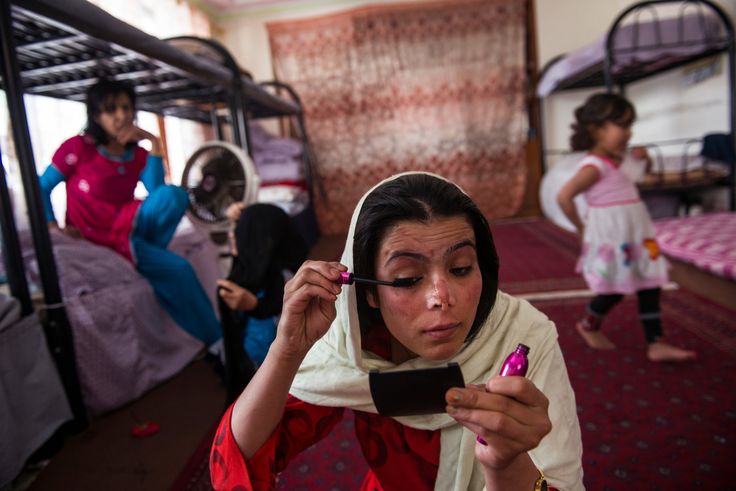
Rika, whose stepmother poured acid on her when she was a girl, in her room in the Women for Afghan Women shelter in Kabul. (Lynsey Addario for The New York Times)
By Alissa J. Rubin
KABUL, Afghanistan — Faheema stood trembling in the courtyard of the large house, steeling herself for the meeting with her family.
She took a deep breath and ran inside, her black abaya swirling around her, and fell to the floor at her uncle’s feet, hugging his knees, her face pressed against him, her shoulders heaving.
The reproaches came immediately. “How could you do this?” her uncle said. “You were always so sweet to everyone. How could you have done this?”
What Faheema, 21, had done was to run away from her home in eastern Afghanistan with the man she loved. She left behind her large family and the man that her family had promised her to. Although her uncle’s words at first seemed kind, his tone had a dangerous edge: Faheema had to come home.
For a young woman from an Afghan village to go home after running away with a man is tantamount to crossing a busy street blindfolded: There is a strong likelihood that she will be killed for bringing shame on her family.
Faheema, who like many Afghans uses a single name, was one of the lucky ones: She had made it to an emergency women’s shelter, one of about 20 that over the last 10 years have protected several thousand women across Afghanistan from abuse or death at the hands of their relatives.
These shelters, almost entirely funded by Western donors, are one of the most successful — and provocative — legacies of the Western presence in Afghanistan, demonstrating that women need protection from their families and can make their own choices. And allowing women to decide for themselves raises the prospect that men might not control the order of things, as they have for centuries. This is a revolutionary idea in Afghanistan — every bit as alien as Western democracy and far more transgressive.
As the shelters have grown, so has the opposition of powerful conservative men who see them as Western assaults on Afghan culture. “Here, if someone tries to leave the family, she is breaking the order of the family and it’s against the Islamic laws and it’s considered a disgrace,” said Habibullah Hasham, the imam of the Nabi mosque in western Kabul and a member of a group of influential senior clerics. “What she has done is rebelling.”
The opposition comes not only from conservative imams, but also from within the Afghan government itself. Lawmakers came very close in 2011 to barring the shelters altogether and in 2013 nearly gutted a law barring violence against women. They yielded only after last-minute pressure from the European Union and the United States.
Now, as the Western presence in Afghanistan dwindles, this clash between Western and Afghan ideas of the place of women means many of the gains women made after the 2001 invasion are at risk.
Although the Taliban’s harsh restrictions on women alienated many Afghans and helped rally foreign support for the war, the idea that women must submit to men remains widely held.
“A lot has changed since 2001, but most people still have conservative, traditional views of women,” said Manizha Naderi, who runs Women for Afghan Women, which operates shelters or other programs in 13 provinces.
That makes the fragile network of safe houses and the women who staff them even more vulnerable to restrictive legislation and attacks by local strongmen. The shelters, like so much of the Western project to coax change in Afghanistan, are emblems of a society in transition.
While the shelters have brought freedom to many women, others are stranded, safe for a time from their families but unable to leave because neither their families nor society accepts them.
Ms. Naderi estimates that about 15 percent of the women in her shelters cannot leave — ever. For these abused women, the longer they live suspended between two worlds, the less the shelter comes to feel like a haven and the more like a jail.
A Frightening Example
Above all, Faheema wanted to avoid the fate of Amina, an 18-year-old who ran away from her family in rural Baghlan Province in the summer of 2013 and whose case became widely known. She fled when her family told her she would be marrying an older man.
Amina made it to the provincial capital and was picked up by the Afghan Intelligence Service. Unlike many runaways, who are seen as fallen women and are prey to being molested by the police, she was not abused. Instead, she was brought to the women’s ministry office, which exists in every provincial capital in Afghanistan.
The women’s ministry sent her to the only shelter in the province. But after one or two nights, her family arrived. They promised not to harm Amina if she returned home with them, repeating that pledge on a videotape after meeting with the head of the provincial women’s ministry office, Khadija Yaqeen. The girl then climbed into a taxi with her family.
Amina never made it home. Nine men accosted the vehicle on a deserted stretch of road not far from her home, pulled her out and shot her, according to her family. No one else was harmed, they later told the ministry.
Women’s advocates and the police doubted the story. Why would armed men take just one young girl out of a car and shoot her? Why wouldn’t the family call for revenge?
The answer pointed to something far more sinister than a random holdup. In much of Afghanistan, a runaway is a tainted woman, who cannot be married off.
“This is the perception: Once she leaves the family, she’s in the hands of others, and they can do whatever they want with her — sexually abuse her — because she has left the family circle,” said Mr. Hasham, the imam in Kabul. By tribal custom, which is particularly strong in rural areas, a so-called honor killing is the only way to eradicate the shame.
The Baghlan provincial police chief, Amer Khail, believes Amina’s brother was involved in her killing, but said there were conflicting reports.
The women’s ministry office did not press for arrests. Amina’s short life and death drifted into sketchier and sketchier memory, with everyone involved claiming they had done the right thing.
Ms. Yaqeen of the women’s ministry said she had to let Amina go because she asked to leave with her family.
“Nobody had beaten her,” she said, “so I had no excuse to keep her.”
Ms. Yaqeen admits she was called by a member of the provincial council. She said the council member did no more than urge her to talk to the family, who had come to the provincial capital to get their daughter back. Provincial council members tend to be deferential to the desires of powerful local families, who would be eager to cleanse the family honor.
But Ms. Yaqeen said Amina made the choice herself.
It seems likely that a young girl, frightened and among strangers and faced by her angry family, would try to appease them because she could hardly believe that her family would be willing to kill her.
Women’s advocates in Baghlan have little question that this was an honor killing. “She should have been kept in the shelter for much longer,” said Homaira Mohammedi, the acting head of the Baghlan shelter at the time, who says that she was away the weekend that Amina came in.
“We did everything according to the rules and regulations,” Ms. Yaqeen insisted. “This is a problem of the society.”
A Family Confrontation
Faheema was sure that her family would not spare her if she left the shelter and went home.
“I had a problem with my father,” she said. “He engaged me to my uncle’s son, and I wasn’t happy to marry him, so I married another man.”
Her father told her he had bought a gun. “‘Wherever I see you both, I will kill you,’” he said before she ran away.
The desperation of her family to have her come home suggested that her view was correct. They were willing to agree to almost anything to pry her away from the safety of the shelter. A younger girl, or a weaker one, might have given in. But one of the most striking characteristics of many of the women who make it to a shelter is that, like Faheema, they have a sad but cleareyed understanding that they are in danger from their own families. This is often the first step toward being able to save themselves.
Unlike the Baghlan women’s ministry, where Amina had just one meeting with her family before she was given back to them, Women for Afghan Women requires repeated sessions between the young woman, her family and a mediator before she can go home. . The average number of meetings is about eight, said Nuria Kohistan, who mediated Faheema’s case. If the staff is not satisfied that the young woman will be safe, they will keep her as long as necessary.
Faheema’s third session with her family was a few days after the first and involved her mother, a younger sister, a younger brother and the brother of her spurned fiancé, who had been at the previous meeting.
The 45-minute session was filled with tears and screaming and bordered on physical violence — several times Faheema’s mother grabbed her daughter’s arm and held it in an iron grip as if to drag her from the mediation room, through the door and out the gate. A tall, thin woman with a frightening strength, she seemed to hold Faheema in her sway far more than the men in the family.
As if to protect herself, Faheema entered the room with a veil covering her whole face.
First her mother said to the mediator: “My daughter wants to go with us. Her father is now in the hospital.”
She turned to Faheema and said, “We will get you divorced from that guy,” referring to the man Faheema ran away with. Her fiancé’s brother and her mother said they would support her marrying someone else.
Ms. Kohistan, the mediator, said in an aside, “They’re saying these things, but as soon as they get custody of her, they will kill her.”
Heaping on the guilt and reminding Faheema of her shame, her mother said, “We have two houses in Ghazni, but we will sell them, because we can’t live in Ghazni anymore.”
The mediator pleaded: “Please talk about this in a way that this problem could be solved.”
Faheema put her head in her hands. Her 3-year-old brother knelt on the floor with his head under his mother’s long skirt as if he were trying to block out the sound of the warring grown-ups.
As it became clear that the shelter was not going to turn Faheema over to her family, her mother tried offering the mediator a bribe. “Please help us, and we will give you a gift,” she said, her voice pleading, tears in her eyes. Then she turned, almost spitting, to Faheema.
“You know your father, you know the character of your father,” she said. Gripping Faheema, she dragged her up from the chair. “He will kill me. You can come to my grave tomorrow.”
Finally, Faheema summoned her courage. “Why don’t you understand?” she said. “I already got married.”
And then she appeared to resign herself to the future. “This thing I did, I did. I cannot go with you, even if I lose everyone in my family,” she said and added, half speaking to them and half to the mediator, “I cannot go back home, because they will kill me.”
She pried her arm away from her mother’s grip and ran into the main building’s basement rooms. There, her mother could not reach her — she was kept out, and Faheema locked in, by a heavy metal gate. Her shoulders heaving, Faheema sank to her knees and wept hopelessly.
Never Going Home
The women in the long-term shelter try to cheat sleep by huddling together in the dark, their voices a way to ward off nightmares. The torments they endured at the hands of their families are written on their bodies. Knife scars traverse their faces and necks. Beatings with chains mark their backs. Some limp from broken bones that were never properly set. Several have faces eroded by acid, a favorite weapon here.
Daily life is an endless effort to escape the haunted precincts of memory; images of pummeling hands, the thumping sound of wood hitting their legs, of their bodies falling to the floor, the taste of blood in their mouths.
There are 26 women in the long-term shelter run by Women for Afghan Women in Kabul. If Faheema’s family continued its threats, this shelter would become her home.
That these women are still standing, and that some are trying to piece together complete lives, is a cause for wonder and a testament to their strength. In the safety of the halfway house, the women offer a glimpse into the worlds they have fled: muddy courtyards strung with laundry; screaming children and squawking chickens; cramped rooms for women and often not enough food. Women in Afghanistan are the last to eat, the last to bed and the first to rise.
Gul Meena, 16, survived a brutal attack by her brother after she fled an older husband, who had beaten her, and ran away with another man. She had been just 8 or 9 in her home in Kunar Province on the Pakistan border when a man in the next village offered money to her unemployed father for her.
In her innocence, she was thrilled to be given a white dress and makeup for the wedding ceremony. “I was thinking, this is the future, my husband would be buying me new clothes every day,” she said. In the car on the bumpy ride to her new home she remembers addressing her new husband as “uncle.”
“Uncle, please take care of me. I’m afraid I will fall,” she said as she bounced on his knee in the car.
From the moment she arrived in his house, she was a servant. The only grace was that he was not allowed to have sex with her before she had her first period. Two years after they wed, the moment came and he forced himself on her. “I was like a thing and they sold me,” she said. “He was beating me with everything near to him. With his glasses, with his mobile phone, with wood, with stones, and with his hands.”
Lonely and bewildered, she tried at least twice to return to her father’s house, but the family sent her back to her husband and finally she went to a neighbor’s home. The husband of the family ran away with her to Nangarhar Province in eastern Afghanistan.
When her brother caught up with them, he slit the man’s throat and slashed Gul Meena 15 times with an ax, nearly blinding her and leaving her for dead. When she woke up in the hospital, she looked in the mirror. “I was very damaged,” she said. “Before, I was beautiful and young.”
Although she does not see herself that way, she is still a stunning young woman. She has never gone to school but speaks with a simple eloquence. Now she fears that she is ugly and no one will marry her. “Men are always interested in the beauty of a woman,” she said. “They are never interested in the heart.”
In the long-term shelter, most women feel a deep relief. No one is beaten. There is enough food. Chores are shared and, above all, there are choices: Some girls decide to go to school and try to make up for the years they were kept as virtual slaves. Others go to classes at beauty school in the hope of learning a skill that they will be able to use. One has a job as a house cleaner, and another is a skilled tailor and makes clothes while caring for her 6-year-old daughter.
“We try to find a solution,” Ms. Naderi said, but she admitted there were few options in Afghanistan. It is exceedingly rare for a woman to live alone here, and so the staff tries to help women recreate families when their own have shunned them. “Sometimes we can find husbands,” she said. “We’ve married maybe 10 or 11, but it’s difficult.”
While traditional attitudes remain deeply ingrained, women’s advocates do see changes. “Now women are finding a voice,” said Soraya Sobrang, a member of the Afghan Independent Human Rights Commission. “And also they want to have some rights and have some decision-making. If you want to marry my daughter, you have to ask me as well. The men think the women want to deprive them of rights. This touches their pride. And this creates violence in the family.”
The battle between tradition and a fragile new sense of women’s rights continues. A government committee investigated the shelters after a television program accused them of forcing battered women into prostitution. The committee found that most of the shelters were well run.
The committee members recognized that most of the women were at risk of beatings or death if the shelters were closed or their capacities diminished, but no one wanted to defend the shelters publicly. The outcome relieved the women who ran the shelters and Western aid organizations: The government would not close the safe houses but, at the same time, there was little public support for spending money from the Afghan budget on them.
However, Ms. Sobrang said: “The international community has promised to continue support.” Such funding is essential if the shelters are to survive. Ms. Naderi relies on generous funding from the United States government, which accounts for close to 90 percent of her budget. The balance is raised from private, mostly foreign donors.
The women inside the halfway house understand the risks they would face if they had to leave. “I cannot go anywhere alone,” said Mariam, 22 who escaped an abusive Taliban husband and fled to the shelter. “Everybody likes to have their freedom, but I cannot have mine.”
Inescapable Fear
In the end, Faheema was able to leave the shelter, with the help of a lawyer provided by Women for Afghan Women. After four or five months, a court recognized her marriage to her husband, Ajmal, and the attorney general ordered her to live with him in Kabul.
But it is not exactly a happy ending.
Although they are in love, they live in terror of being cornered by a member of Faheema’s family and being beaten or killed. They live in poverty because Ajmal had to shutter his shop in their hometown, Ghazni, and cannot go there for fear of being killed. He has no money to start a new business.
A thin young man who wears Western clothes and, in keeping with more modern Afghan ways, does not have a beard, Ajmal comes across as serious and anxious.
“We live in fear and in hiding,” he said. Three times a day, when he goes out to buy a long loaf of Afghan bread, he finds himself looking around nervously to see if any of Faheema’s family is lying in wait for him.
He worries all the time about his widowed mother and two sisters, who still live in Ghazni. When he had his small cosmetics shop there, he contributed to supporting the family. But now, only his widowed mother’s meager income as a tailor helps feed the family.
None of this has weakened the couple’s resolve to be together, but it weighs on them because in Afghanistan, to not be able to go home is to be an outcast, almost an orphan.
Faheema tried to make peace between their two families and braved a phone call with her angry father to beg him to meet with elders from Ajmal’s clan. But her father refused to see them and said the only thing that would satisfy him is if they gave him a daughter to marry off to his son or nephew in exchange for Ajmal’s taking Faheema.
Despite the hardship, Faheema hopes her sisters and cousins will have the courage to demand that their families ask permission before making plans to marry them off. She wishes that her father had respected her enough to ask her. “My message to my father is that he should ask his children first before making any decision for their lives,” she said, wistfully.
In the cold Kabul winter, as they prepared to return to their small, damp apartment, which is all they can afford, Faheema said she had one more wish.
“Take us out of Afghanistan,” she said, “because we won’t be able to have a quiet life here.”
Rod Nordland and Jawad Sukhanyar contributed reporting.
By Alissa J. Rubin
KABUL, Afghanistan — The Taliban occupation of Kunduz may have been temporary, but what they did to Afghan women’s rights could prove to be lasting.
In a methodical campaign, the Taliban relentlessly hounded women with any sort of public profile, looted a high school and destroyed the offices of many of the organizations that protected and supported women in Kunduz.
Among those who have fled are the women who ran a shelter for female victims of violence, who Taliban commanders say are “immoral.”
Gone are educated women who worked for the government or international organizations; gone are some women who were school administrators and women who were activists for peace and democracy. They left, mostly at night, on foot or in run-down taxis, hiding under burqas, running for their lives.
“I won’t go back — I will never go back,” said Dr. Hassina Sarwari, the Kunduz Province director of Women for Afghan Women, which ran a shelter for abused women, a family guidance center and a center for the children of women in the Kunduz prison.
After the Taliban completed their campaign of burning and looting women’s organizations, they continued their attacks verbally, by text messages and telephone calls, threatening women and their relatives, making it clear that the women would remain in their sights. The Taliban’s message, based on interviews with a half-dozen women who received the warnings after fleeing Kunduz, was that they escaped this time, but that next time they would not be so lucky.
“Before we managed to take control of the shelter, Hassina Sarwari, the head of the shelter house, along with all the runaway sluts and immoral girls, had already left Kunduz city,” said Abdul Wali Raghi, a Taliban commander in Kunduz.
“Hassina Sarwari herself is an immoral slut, and if we had captured her, she would be hanged in the main circle in Kunduz city,” he added.
If in their publicity statements in recent years the Taliban had sounded more moderate, their behavior in Kunduz left little doubt where they really stand.
Within the first three days of the Taliban occupation, women who ran organizations aimed at helping women had their homes and offices looted, their computers stolen, their furniture, televisions and appliances smashed. Then, the Taliban left messages on their phones, or with relatives or neighbors, saying, “Return and you will be killed.”
Among the organizations destroyed by the Taliban were three radio stations run by women: One was burned, the other two looted. The Fatima Zahra girls’ high school and the Women’s Empowerment Center, which held social and political awareness sessions and taught women to sew, were also looted.
Women for Afghan Women’s office and children’s center were looted, its computers and cars were stolen, and the organization’s shelter for abused women was completely burned; it also appeared to have been attacked with sledgehammers, the windows shattered, the walls and door frames smashed.
Some allegations against the Taliban — that they raped women in the Kunduz University dormitory and the women’s prison — have not been proved. The accusation of rapes in the dormitory was broadcast on Tolo TV, and allegations of the prison rapes were broadcast on One TV. But the evidence supporting the allegations is still sketchy.
Taliban commanders and spokesmen forcefully denied that charge and threatened to kill “any staff or reporter” of either Tolo or One TV, calling them “satanic media” that repeated “propaganda.”
The Taliban noted that because their invasion of the city occurred during the annual Eid al-Adha holiday, the women were not even in the dormitory, but home visiting their families. The Kunduz University president, Abdul Qadoos Zarifi, said the same in a television interview.
What happened in the prison is less clear. Mr. Raghi, a Taliban commander in Kunduz, strongly denied the rape allegations. However, there are reports among some women’s groups of at least one woman being raped multiple times. Much remains unclear about that case, including who the attackers might have been.
Even amid the broader destruction in Kunduz over the past few days, including dozens of casualties and widespread building damage, the threat against women there was particularly chilling. That is in part because of how rare, and how recent, improvements for Afghan women have been in territories beyond Kabul, the national capital.
In Kunduz, known for having some of the most horrific cases involving women including at least two cases of stoning in the last five years, gang rape and rapes of children, it has taken years for women to feel secure enough to work there. Now that they feel targeted and under surveillance by the Taliban, they are unlikely to return or, if they do, are likely to choose jobs where they are less visible and less easily tracked.
“There is psychological damage,” Fiona Gall, the director of A cbar, an umbrella group representing nongovernmental organizations in Afghanistan, said about the effects on both women’s organizations and smaller humanitarian groups working in Kunduz.
“These people are going to be much more reluctant to do anything that stands out,” for fear that their families will be targeted, she said.
Fawzia Bostani, a civil engineer who works for the Ministry of Public Works in Kunduz, had been threatened for years by the Taliban. She was sure they would come looking for her once they entered the city.
She is the only female civil engineer working in Kunduz, she said. And her projects — including routing and restoring roads in Kunduz and its neighboring provinces, and taking part in an effort to learn the views of local women on the construction — have made her well known in the area.
The day after the Taliban arrived, she put on a burqa and slipped through the alleys to a neighbor’s house — it turned out just in time.
“That night the Taliban came to my house and said, ‘Where is that woman who is working in street building?’” Ms. Bostani said. “My older brother said, ‘There is no woman working in any organization doing that work in this house.’”
The Taliban members showed her brother a photograph of the corner of their block, saying that they had watched a car pick her up every morning.
As soon as the Taliban left, her brother called her and told her to flee. Although it was dark, she walked until she was at the edge of the city and then took a three-wheel all-terrain vehicle almost 70 miles to neighboring Baghlan Province.
A few days later, the Taliban returned to her house in Kunduz and left a message with her sister-in-law: “We don’t want to see her here again.”
Ms. Bostani said she has no plans to return to Kunduz.
The head of the Afghan government’s Women’s Ministry office in Kunduz, Naheed Asifi, also fled and made clear she was reluctant to return.
“If your life is in danger and you know that there is a significant threat, would you go back?” she asked. “I am sure you would not.”
Asked if the government will be able to find someone else to fill her job in Kunduz, Ms. Asifi said: “I don’t think anyone would go.”
Despite the sense of crisis and deterioration, Manizha Naderi, the executive director of Women for Afghan Women, said she was sure that the organization would find a way to re-establish its services for vulnerable women in Kunduz, but acknowledged that it would take much more than finding new offices.
“I don’t see most of our people who worked in Kunduz returning, so it will be a big challenge for us to find staff,” she said.
She paused and added: “But, people need us so we have to come up with a plan. If we stop working, it’s a big victory for the Taliban.”
Last year Alissa Rubin of The New York Times wrote one of the most powerful stories anywhere, a horrifying account of a young Afghan woman who was beaten to death by a mob of crazed men, run over by a car, dragged along the street and set afire — after being accused, falsely, of burning a Quran.
That Rubin was there to write that story says a lot about this longtime correspondent’s courage and dedication in going to dangerous places to reveal the plight of people trapped by war. The previous year she had barely survived a helicopter crash while returning from a mountain in Iraq where Yazidi refugees were caught. When her editor saw her in the hospital in New York, she smiled, her face still blue with bruises, her wrists heavy with bandages, and said, “You know, I am going back.”
So she did. Back to Afghanistan, where last year she delivered deeply reported, moving articles about the struggle to improve the lives of women. She also told the larger story of why, after so much money, so much time and so many lives lost, the United States had largely failed to transform this country.
The murder of Farkhunda, the 27-year-old woman killed by the mob, became an obsession for Rubin, all the more because Farkhunda was innocent. “I did more than 50 interviews, not counting those people to whom I returned two, three and even four times,” Rubin said later. “I traveled to Tajikistan to meet with Farkhunda’s family. I retraced her steps on the day she died, stopping to talk to every shopkeeper and tailor who had been there who would talk to me. Many claimed they weren’t there, as if it were a Mafia killing.”
Rubin’s readers could watch this horror for themselves. Her story was accompanied by a chilling eight- minute video, included in this entry, that showed every step of Farkhunda’s torment, from the accusations taking hold and the first blows being struck, to her battered body set afire.
Only someone with Rubin’s experience could use the mob killing to take the measure of Afghan justice — and find it sadly wanting. Her savvy piece revealed a nation that after centuries of being pressed to bend to outsiders’ ways simply refused. Americans set goals that were thwarted by an almost arrogant inability to understand the Afghan people and their culture.
In two earlier articles, the reporting for which began before the helicopter crash in 2014, Rubin examined the effort to bring women into the police force and to end the practice of “honor killings.” Though much foreign money had poured into Afghanistan, for girls’ schools and women’s shelters aimed at elevating women’s status, “these good intentions often foundered” because “repressive views of women were not just a Taliban curse, but also a deeply embedded part of society.”
Rubin traveled to Jalalabad on roads busy with Taliban to report on the policewomen. She sometimes hid her blond hair under a scarf and altered her way of walking to make herself less conspicuous. She slept in her clothing so she could flee if necessary. She checked to see if her hotel window opened so she could escape.
Rubin selected the police force because the Americans had invested a lot there. Pretty quickly she knew she had chosen the right target when one of the women she had interviewed was murdered. It was difficult to get policewomen to talk. When they did, they often lied and said everything was fine.
Rubin knew that wasn’t true. So she would meet women in public — at police stations or the police academy — get their phone numbers, then arrange interviews in their homes. She interviewed the main subjects three or four times to piece together the story.
To report on the shelters set up to protect women who feared being killed by their own families, Rubin traveled and stayed in Baghlan Province, which was unstable and dangerous. She spent hours with women, most traumatized and afraid to talk. She slept and ate in the shelters, meditated with the young women, dressed like the young women. And she won their confidence.
Rubin has spent much of her distinguished career in battlegrounds, whether Iraq, Afghanistan or the Balkans. What marks her coverage is her courageous and sensitive portrayal of how war deforms societies. She is subtle and nonjudgmental. “I always try to imagine myself as both a victim and a perpetrator,” she said, “and then ask people questions to help me see the world from their point of view.”
In her world, there are few pure heroes, or pure villains. We believe that one of the few pure heroes is Alissa Rubin herself. In August 2014 she was almost killed. She had only recently become Paris bureau chief when she learned that ISIS had trapped thousands of Yazidi men, women and children on a mountain. Again, she felt compelled to bear witness — to give voice to the victims of this despicable group and to force the world to confront the reality that ISIS created.
So she climbed aboard an Iraqi helicopter and headed for the mountain. On her return the helicopter crashed. The pilot was killed. She crawled from the wreckage badly injured, with head and face fractures, two broken wrists, broken ribs, damage to her leg and a severe concussion. It was a long, scary evacuation, but as soon as she was safe in an Istanbul hospital, Rubin insisted on dictating her story, or rather, the story of the Yazidis on Mount Sinjar. Six months later, she was back at work in Afghanistan.
Rubin also stands out for her mentorship and modesty. Ask any reporter who has worked with her, whether competitor or colleague, and they will tell you stories of her generosity. She has been responsible for nurturing the careers both of other Western reporters and the Iraqi and Afghan staff who are fiercely loyal to her.
For her quiet courage and her commitment to telling the stories of women whose voices are rarely heard, with great pride we nominate Alissa Rubin for the Pulitzer Prize for International Reporting.
Biography
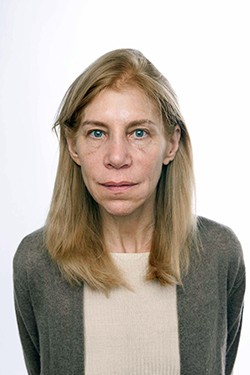
Alissa Johannsen Rubin is the Paris Bureau Chief for The New York Times. She joined The New York Times in January 2007 as a correspondent in Baghdad and covered Iraq and Afghanistan, becoming bureau chief in Baghdad in the fall of 2008, and then moving to Afghanistan in October 2009, becoming bureau chief there a couple of months later. She was in Kabul for almost four years, leaving in the late summer of 2013 to take up the job as Paris bureau chief. However, she continued to work on projects in Afghanistan and joined the team covering the Islamic State’s takeover of northern and western Iraq in 2014. That August she was seriously injured and nearly killed in a helicopter crash in Kurdistan, covering the beleaguered Yazidis.
Before joining The New York Times, she was the Los Angeles Times co-bureau chief in Baghdad and its bureau chief for the Balkans for five years. She started at The Los Angeles Times’s Washington bureau in 1997, covering health care policy and financing, abortion politics and legislation, and the fight over tobacco legislation on Capitol Hill. Before The Los Angeles Times she was a reporter for Congressional Quarterly magazine, where she covered health care and then taxes and trade on Capitol Hill.
She came to Washington after working for four years as a reporter in Wichita, Kan., for the Knight-Ridder newspaper then known as The Wichita Eagle-Beacon. She also covered taxes there as well as the troubled farm economy.
Her career in journalism started at The American Lawyer magazine where she was a researcher. While in Washington, D.C., she freelanced for The New Republic, The Washington Monthly and The Washington Post’s Outlook section as well as The Washington Post magazine.
Ms. Rubin, was born and brought up in New York City and graduated Phi Beta Kappa in 1980 from Brown University with an honors degree in Renaissance Studies and a minor in Classics (Latin). She received a Mellon Fellowship in the Humanities to pursue her graduate studies in Modern European History (with a focus on the history of the Catholic Church) at Columbia University where she received an M.A. in 1986.
She is a winner of the 2015 John Chancellor Award for journalistic achievement; an Overseas Press Association award in 2010 for a piece on women suicide bombers titled “How Baida Wanted to Die” and a Washington Monthly award in 1992 for a piece that appeared in the Washington City Paper, “What People Talk About When They Talk About Abortion.” In 1992 she won an Alicia Patterson Fellowship to report on the medical and religious roots of the abortion controversy in the wake of the U.S. Supreme Court’s 1989 Webster decision. She was twice part of teams that won the National Farm Writers of America Award at the Wichita Eagle in 1986 and 1988 for their coverage of farm issues. She also won the William Allen White Award in 1989 for her coverage of Kansas’ overhaul of its real estate taxes. Her college thesis, which was a translation and annotation of some of the letters of Lionardo Bruni, a Renaissance humanist, was published in Allegorica, an academic journal.
Alissa lives in Paris with her husband, James E. Castello, a lawyer who specializes in international arbitration.