Reuters, by Jason Szep and Andrew R.C. Marshall
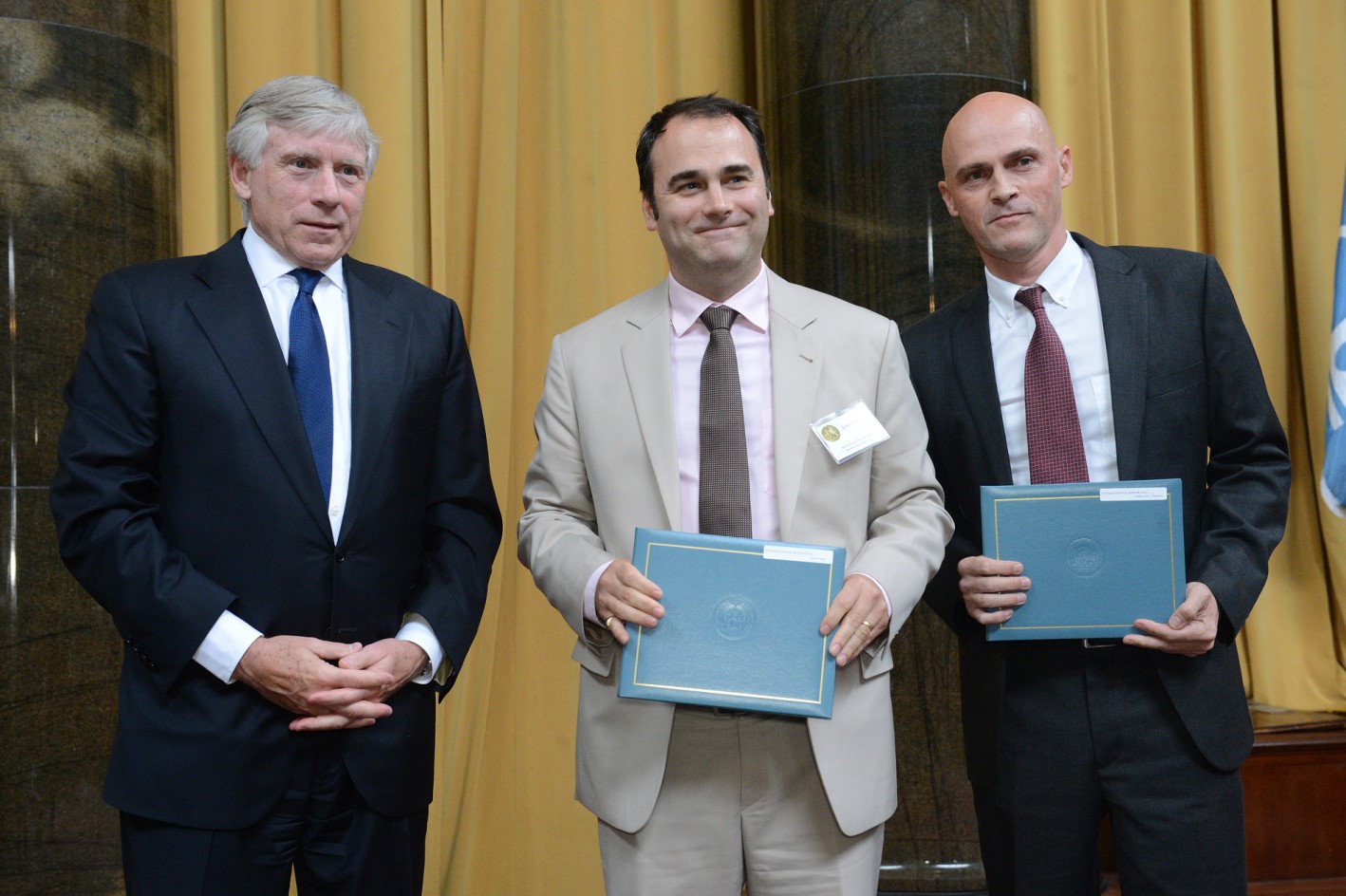
Lee C. Bollinger, President of Columbia University (left), presents the 2014 International Reporting Prize to Jason Szep (center) and Andrew R.C. Marshall of Reuters.
Winning Work
By Jason Szep and Stuart Grudgings
PADANG BESAR, THAILAND -- The beatings were accompanied by threats: If his family didn't produce the money, Myanmar refugee Abdul Sabur would be sold into slavery on a fishing boat, his captors shouted, lashing him with bamboo sticks.
It had been more than two months since Sabur and his wife set sail from Myanmar with 118 other Rohingya Muslims to escape violence and persecution. Twelve died on the disastrous voyage. The survivors were imprisoned in India and then handed over to people smugglers in southern Thailand.
As the smugglers beat Sabur in their jungle hide-out, they kept a phone line open so that his relatives could hear his screams and speed up payment of $1,800 to secure his release.
"Every time there was a delay or problem with the payment they would hurt us again," said Sabur, a tall fisherman from Myanmar's western Rakhine state.
He was part of the swelling flood of Rohingya who have fled Myanmar by sea this past year, in one of the biggest movements of boat people since the Vietnam War ended.
Their fast-growing exodus is a sign of Muslim desperation in Buddhist-majority Myanmar, also known as Burma. Ethnic and religious tensions simmered during 49 years of military rule. But under the reformist government that took power in March 2011, Myanmar has endured its worst communal bloodshed in generations.
A Reuters investigation, based on interviews with people smugglers and more than two dozen survivors of boat voyages, reveals how some Thai naval security forces work systematically with smugglers to profit from the surge in fleeing Rohingya. The lucrative smuggling network transports the Rohingya mainly into neighboring Malaysia, a Muslim-majority country they view as a haven from persecution.
Once in the smugglers' hands, Rohingya men are often beaten until they come up with the money for their passage. Those who can't pay are handed over to traffickers, who sometimes sell the men as indentured servants on farms or into slavery on Thai fishing boats. There, they become part of the country's $8 billion seafood-export business, which supplies consumers in the United States, Japan and Europe.
Some Rohingya women are sold as brides, Reuters found. Other Rohingya languish in overcrowded Thai and Malaysian immigration detention centers.
Reuters reconstructed one deadly journey by 120 Rohingya, tracing their dealings with smugglers through interviews with the passengers and their families. They included Sabur and his 46-year-old mother-in-law Sabmeraz; Rahim, a 22-year-old rice farmer, and his friend Abdul Hamid, 27; and Abdul Rahim, 27, a shopkeeper.
While the death toll on their boat was unusually high, the accounts of mistreatment by authorities and smugglers were similar to those of survivors from other boats interviewed by Reuters.
The Rohingya exodus, and the state measures that fuel it, undermine Myanmar's carefully crafted image of ethnic reconciliation and stability that helped persuade the United States and Europe to suspend most sanctions.
At least 800 people, mostly Rohingya, have died at sea after their boats broke down or capsized in the past year, says the Arakan Project, an advocacy group that has studied Rohingya migration since 2006. The escalating death toll prompted the United Nations this year to call that part of the Indian Ocean one of world's "deadliest stretches of water."
EXTENDED FAMILIES
For more than a decade, Rohingya men have set sail in search of work in neighboring countries. A one-way voyage typically costs about 200,000 kyat, or $205, a small fortune by local standards. The extended Rohingya families who raise the sum regard it as an investment; many survive off money sent from relatives overseas.
The number boarding boats from Myanmar and neighboring Bangladesh reached 34,626 people from June 2012 to May of this year - more than four times the previous year, says the Arakan Project. Almost all are Rohingya Muslims from Myanmar. Unprecedented numbers of women and children are making these dangerous voyages.
A sophisticated smuggling industry is developing around them, drawing in other refugees across South Asia. Ramshackle fishing boats are being replaced by cargo ships crewed by smugglers and teeming with passengers. In June alone, six such ships disgorged hundreds of Rohingya and other refugees on remote Thai islands controlled by smugglers, the Arakan Project said.
Sabur and the others who sailed on the doomed 35-foot fishing boat came from Rakhine, a rugged coastal state where Rohingya claim a centuries-old lineage. The government calls them illegal "Bengali" migrants from Bangladesh who arrived during British rule in the 19th century. Most of the 1.1 million Rohingya of Rakhine state are denied citizenship and refused passports.
Machete-wielding Rakhine Buddhists destroyed Sabur's village last October, forcing him to abandon his home south of Sittwe, capital of Rakhine state. Last year's communal unrest in Rakhine made 140,000 homeless, most of them Rohingya. Myanmar's government says 192 people died; Rohingya activists put the toll as high as 748.
Before the violence, the Rohingya were the poorest people in the second-poorest state of Southeast Asia's poorest country. Today, despite Myanmar's historic reforms, they are worse off.
Tens of thousands live in squalid, disease-ridden displacement camps on the outskirts of Sittwe. Armed checkpoints prevent them from returning to the paddy fields and markets on which their livelihoods depend. Rohingya families in some areas have been banned from having more than two children.
Sabur's 33-member extended family spent several months wandering between camps before the family patriarch, an Islamic teacher in Malaysia named Arif Ali, helped them buy a fishing boat. They planned to sail straight to Malaysia to avoid Thailand's notorious smugglers.
Dozens of other paying passengers signed up for the voyage, along with an inexperienced captain who steered them to disaster.
"DYING, ONE BY ONE"
The small fishing boat set off from Myengu Island near Sittwe on February 15. The first two days went smoothly. Passengers huddled in groups, eating rice, dried fish and potatoes cooked in small pots over firewood. Space was so tight no one could stretch their legs while sleeping, said Rahim, the rice farmer, who like many Rohingya Muslims goes by one name.
Rahim's last few months had been horrific. A Rakhine mob killed his older brother in October and burned his family's rice farm to the ground. He spent two months in jail and was never told why. "The charge seemed to be that I was a young man," he said. Rakhine state authorities have acknowledged arresting Rohingya men deemed a threat to security.
High seas and gusting winds nearly swamped the boat on the third day. The captain seemed to panic, survivors said. Fearing the ship would capsize, he dumped five bags of rice and two water tanks overboard — half their supplies.
It steadied, but it was soon clear they had another problem - the captain admitted he was lost. By February 24, after more than a week at sea, supplies of water, food and fuel were gone.
"People started dying, one by one," said Sabmeraz, the grandmother.
The Islamic janaza funeral prayer was whispered over the washed and shrouded corpses of four women and two children who died first. Among them: Sabmeraz's daughter and two young grandchildren.
"We thought we would all die," Sabmeraz recalled.
Many gulped sea water, making them even weaker. Some drank their own urine. The sick relieved themselves where they lay. Floorboards became slick with vomit and feces. Some people appeared wild-eyed before losing consciousness "like they had gone mad," said Abdul Hamid.
On the morning of the 12th day, the shopkeeper Abdul Rahim wrapped his two-year-old daughter, Mozia, in cloth, performed funeral rites and slipped her tiny body into the sea. The next morning he did the same for his wife, Muju.
His father, Furkan, had warned Abdul Rahim not to take the two children - Mozia and her five-year-old sister, Morja. The family had been better off than most Rohingya. They owned a popular hardware store in Sittwe district. After it was reduced to rubble in the June violence, they moved into a camp.
On the night Abdul Rahim was leaving, Furkan recalls pleading with him on the jetty: "If you want to go, you can go. But leave our grandchildren with us."
Abdul Rahim refused. "I've lost everything, my house, my job," he recalls replying. "What else can I do?"
On February 28, hours after Abdul Rahim's wife died, the refugees spotted a Singapore-owned tugboat, the Star Jakarta. It was pulling an empty Indian-owned barge, the Ganpati, en route to Mumbai from Myanmar. The refugee men shouted but the slow-moving barge didn't stop.
But as the Ganpati moved by, a dozen Rohingya men jumped into the sea with a rope. They swam to the barge, fixed the rope and towed their boat close behind so people could board. By evening, 108 of them were on the barge.
Mohammed Salim, a soccer-loving grocery clerk, and a young woman, both in their 20s, were too weak to move. Close to death, they were cut adrift; the boat took on water and submerged in the rough seas.
"He was our hope," said Salim's father, Mohammad Kassim, 71, who emptied his savings to pay the 500,000 kyat ($515) cost of the journey.
Of the 12 who died on the boat, 11 were women and children.
MISTAKEN FOR PIRATES
What happened next shows how the problems of reform-era Myanmar are rapidly becoming Asia's.
The tugboat captain mistook the Rohingya for pirates and radioed for help, said Bhavna Dayal, a spokeswoman for Punj Lloyd Group, the Indian company that owns the barge. Within hours, an Indian Coast Guard ship arrived. Officers fired into the air and ordered the Rohingya to the floor.
Rahim, the rice farmer, said he and five others were beaten with a rubber baton. With the help of some Hindi picked up from Bollywood films, they explained they were fleeing the strife in Rakhine state. After that, everyone received food, water and first aid, he said.
Another Indian Coast Guard ship, the Aruna Asaf Ali, arrived. It took the women and children to the Andaman and Nicobar Islands, an Indian archipelago a short voyage to the south, before returning for the men.
In Diglipur, the largest town in North Andaman Island, immigration authorities separated the men from women and children, putting them all in cells. Guards beat them at will, Rahim said, and rummaged through their belongings for money. He lost 60,000 kyat ($62) and hid his remaining 60,000 kyat in a crack in a wall.
Rupinder Singh, the police superintendent in Diglipur, denied anyone was beaten or robbed.
After about a month, the Rohingya were moved to a bigger detention center near the state capital Port Blair. They joined about 300 other Muslims, mostly Rohingya from Myanmar, who had been rescued at sea. The men went on a one-day hunger strike, demanding to be sent to Malaysia.
The protest seemed to work. Indian authorities brought all 420 of them into international waters and transferred them to a double-decker ferry, said the Rohingya passengers.
"They told us this ship would take us straight to Malaysia," said Sabur.
It was run, however, by Thailand-based smugglers, he said.
Commander P.V.S. Satish, speaking for the Indian Navy and the Indian Coast Guard, said there was "absolutely no truth" to the allegation that the Navy handed the Rohingya to smugglers.
After four days at sea, the Rohingya approached Thailand's southern Satun province around April 18. They were split into smaller boats. Some were taken to small islands, others to the mainland. The smugglers explained they needed to recoup the 10 million kyat ($10,300) they had paid for renting the ferry.
ECONOMICS OF TRAFFICKING
Thailand portrays itself as an accidental destination for Malaysia-bound Rohingya: They wash ashore and then flee or get detained.
In truth, Thailand is a smuggler's paradise, and the stateless Rohingya are big business. Smugglers seek them out, aware their relatives will pay to move them on. This can blur the lines between smuggling and trafficking.
Smuggling, done with the consent of those involved, differs from trafficking, the business of trapping people by force or deception into labor or prostitution. The distinction is critical.
An annual U.S. State Department report, monitoring global efforts to combat modern slavery, has for the last four years kept Thailand on a so-called Tier 2 Watch List, a notch above the worst offenders, such as North Korea. A drop to Tier 3 can trigger sanctions, including the blocking of World Bank aid.
A veteran smuggler in Thailand described the economics of the trade in a rare interview. Each adult Rohingya is valued at up to $2,000, yielding smugglers a net profit of 10,000 baht ($320) after bribes and other costs, the smuggler said. In addition to the Royal Thai Navy, the seas are patrolled by the Thai Marine Police and by local militias under the control of military commanders.
"Ten years ago, the money went directly to the brokers. Now it goes to all these officials as well," said the smuggler, who spoke on condition of anonymity.
A broker in Myanmar typically sends a passenger list with a departure date to a counterpart in Thailand, the smuggler said. Thai navy or militia commanders are then notified to intercept boats and sometimes guide them to pre-arranged spots, said the smuggler.
The Thai naval forces usually earn about 2,000 baht ($65) per Rohingya for spotting a boat or turning a blind eye, said the smuggler, who works in the southern Thai region of Phang Nga and deals directly with the navy and police.
Police receive 5,000 baht ($160) per Rohingya, or about 500,000 baht ($16,100) for a boat of 100, the smuggler said.
Another smuggler, himself a Rohingya based in Kuala Lumpur, said Thai naval forces help guide boatloads to arranged spots. He said his group maintains close phone contact with local commanders. He estimated his group has smuggled up to 4,000 people into Malaysia in the past six months.
Relatives in Malaysia must make an initial deposit of 3,000 ringgit ($950) into Malaysian bank accounts, he said, followed by a second payment for the same amount once the refugees reach the country.
Naval ships do not always work with the smugglers. Some follow Thailand's official "help on" policy, whereby Rohingya boats are supplied with fuel and provisions on condition they sail onward.
The Thai navy and police denied any involvement in Rohingya smuggling. Manasvi Srisodapol, a Thai Foreign Ministry spokesman, said that there has been no evidence of the navy trafficking or abusing Rohingya for several years.
CAGES AND THREATS
Anti-trafficking campaigners have produced mounting evidence of the widespread use of slave labor from countries such as Myanmar on Thai fishing boats, which face an acute labor shortage.
Fishing companies buy Rohingya men for between 10,000 baht ($320) and 20,000 baht ($640), depending on age and strength, said the smuggler in Phang Nga. He recounted sales of Rohingya in the past year to Indonesian and Singapore fishing firms.
This has made the industry a major source of U.S. concern over Thailand's record on human trafficking. About 8 percent of Thai seafood exports go to supermarkets and restaurants in the United States, the second biggest export market after Japan.
The Thai government has said it is serious about tackling human trafficking, though no government minister has publicly acknowledged that slavery exists in the fishing industry.
Sabur, his wife Monzurah and more than a dozen Rohingya thought slavery might be their fate. The smugglers held them on the Thai island for five weeks. The captors said they would be sold to fisheries, pig farms or plantations if money didn't arrive soon.
"We were too scared to sleep at night," said Monzurah, 19 years old.
Arif Ali, the family patriarch in Kuala Lumpur, managed to raise about $21,000 to secure the release of 19 of his relatives, including his sister Sabmeraz, Sabur, and Monzurah. They were taken on foot across the border into Malaysia in May. But 10 of the family, all men, remained imprisoned on the island as he struggled to raise more funds.
As Ali was interviewed in early June, his cellphone rang and he had a brief, heated conversation. "They call every day," he said. "They say if we call the police they will kill them."
Some women without money are sold as brides for 50,000 baht ($1,600) each, typically to Rohingya men in Malaysia, the Thai smuggler said. Refugees who are caught and detained by Thai authorities also face the risk of abuse.
At a detention center in Phang Nga in southern Thailand, 269 Rohingya men and boys lived in cage-like cells that stank of sweat and urine when a Reuters journalist visited recently. Most had been there six months. Some used crutches because their muscles had atrophied.
"Every day we ask when we can leave this place, but we have no idea if that will ever happen," said Faizal Haq, 14.
They are among about 2,000 Rohingya held in 24 immigration detention centers across Thailand, according to the Thai government.
"To be honest, we really don't know what to do with them," said one immigration official who declined to be named. Myanmar has rejected a Thai request to repatriate them.
Dozens of Rohingya have escaped detention centers. The Thai smuggler said some immigration officials will free Rohingya for a price. Thailand's Foreign Ministry denied immigration officials take payments from smugglers.
PROMISED LAND
When Rahim, Abdul Hamid and the other Rohingya finally arrived in Thailand, smugglers met them in Satun province, which borders Malaysia.
They were herded into pickup trucks and driven to a farm, where they say they saw the smugglers negotiate with Thai police and immigration officials. The smugglers told them to contact relatives in Malaysia who could pay the roughly 6,000 ringgit ($1,800).
"If you run away, the police and immigration will bring you back to us. We paid them to do that," the most senior smuggler told them, the two men recalled.
After 22 days at the farm, Rahim and Hamid escaped. It was near midnight when they darted across a field, cleared a barbed-wire fence and ran into the jungle. They wandered for a day, hungry and lost, before meeting a Burmese man who found them work on a fruit farm in Padang Besar near the Thai-Malaysia border. They still work there today, hoping to save enough money to leave Thailand.
If the smugglers get paid, they usually take the Rohingya across southern Thailand in pickup trucks, 16 at a time, with just enough space to breathe, the smuggler in Thailand said. They are hidden under containers of fish, shrimp or other food, and sent through police checkpoints at 1,000 baht ($32) apiece, the smuggler said. Once close to Malaysia, the final crossing of the border is usually made by foot.
Abdul Rahim, the shopkeeper who lost his wife and toddler, arranged a quick payment to the smugglers from relatives in Kuala Lumpur. He was soon on a boat to Malaysia with his surviving daughter and his sister-in-law, Ruksana. They were dropped off around April 20 at a remote spot in Malaysia's northern Penang island.
For Abdul Rahim and many other Rohingya, Malaysia was the promised land. For most, that hope fades quickly.
At best, they can register with the United Nations High Commission for Refugees and receive a card that gives them minimal legal protection and a chance for a low-paid job such as construction. While Malaysia has won praise for accepting Rohingya refugees, it has not signed the U.N. Refugee Convention that would oblige it to give them fuller rights.
Those picked up by Malaysian authorities face weeks or months in packed detention camps, where several witnesses said beatings and insufficient food were common. The Malaysian government did not comment on conditions in the camps.
The UNHCR has registered 28,000 Rohingya asylum seekers out of nearly 95,000 Myanmar refugees in Malaysia, many of whom have been in the country for years. An estimated 49,000 unregistered asylum seekers can wait months or years for a coveted UNHCR card. The card gives asylum seekers discounted treatment at public hospitals, is recognized by many employers, and gives protection against repatriation.
The vast majority, like Sabur, Abdul Rahim and their families, don't obtain these minimal protections. They evade detention in the camps but live in fear of arrest.
By early July, Sabur had found temporary work in an iron foundry on Kuala Lumpur's outskirts earning about $10 a day. He will likely have to save for years to pay back the money that secured his release.
Abdul Rahim's family now lives in a small, windowless room in a city suburb. His late wife's sister, Ruksana, coughed up blood during one interview, but is afraid to seek medical help without documentation.
By early July, Abdul Rahim had married Ruksana. He was picking up occasional odd jobs through friends but was struggling to pay the $80 a month rent on their shabby room. Despite that, and the loss of his first wife and daughter, he still believes he made the right decision to flee Myanmar.
"I don't regret coming," he said, "but I regret what happened. I think about my wife and daughter all day."
(Stuart Grudgings reported from Kuala Lumpur. Additional reporting by Amy Sawitta Lefevre in Bangkok and Sruthi Gottipati in New Delhi. Editing by Bill Tarrant and Michael Williams.)
By Jason Szep and Andrew R.C. Marshall
RANONG, THAILAND -- One afternoon in October, in the watery no-man's land between Thailand and Myanmar, Muhammad Ismail vanished.
Thai immigration officials said he was being deported to Myanmar. In fact, they sold Ismail, 23, and hundreds of other Rohingya Muslims to human traffickers, who then spirited them into brutal jungle camps.
As thousands of Rohingya flee Myanmar to escape religious persecution, a Reuters investigation in three countries has uncovered a clandestine policy to remove Rohingya refugees from Thailand's immigration detention centers and deliver them to human traffickers waiting at sea.
The Rohingya are then transported across southern Thailand and held hostage in a series of camps hidden near the border with Malaysia until relatives pay thousands of dollars to release them. Reporters located three such camps - two based on the testimony of Rohingya held there, and a third by trekking to the site, heavily guarded, near a village called Baan Klong Tor.
Thousands of Rohingya have passed through this tropical gulag. An untold number have died there. Some have been murdered by camp guards or have perished from dehydration or disease, survivors said in interviews.
The Thai authorities say the movement of Rohingya through their country doesn't amount to human trafficking. But in interviews for this story, the Thai Royal Police acknowledged, for the first time, a covert policy called "option two" that relies upon established human-smuggling networks to rid Thailand of Rohingya detainees.
Ismail was one of five Rohingya who said that Thai immigration officials had sold him outright or aided in their sale to human traffickers. "It seemed so official at first," said Ismail, a wiry farmer with a long narrow face and tight curly hair. "They took our photographs. They took our fingerprints. And then once in the boats, about 20 minutes out at sea, we were told we had been sold."
Ismail said he ended up in a camp in southern Thailand. So did Bozor Mohamed, a Rohingya whose frail body makes him seem younger than his 21 years. The camp was guarded by men with guns and clubs, said Mohamed, and at least one person died every day due to dehydration or disease.
"I used to be a strong man," the former rice farmer said in an interview, as he massaged his withered legs.
Mohamed and others say they endured hunger, filth and multiple beatings. Mohamed's elbow and back are scarred from what he said were beatings administered by his captors in Thailand while he telephoned his brother-in-law in Malaysia, begging him to pay the $2,000 ransom they demanded. Some men failed to find a benefactor in Malaysia to pay their ransom. The camp became their home. "They had long beards and their hair was so long, down to the middle of their backs, that they looked liked women," said Mohamed.
"HOLDING BAYS"
What ultimately happens to Rohingya who can't buy their freedom remains unclear. A Thai-based smuggler said some are sold to shipping companies and farms as manual laborers for 5,000 to 50,000 baht each, or $155 to $1,550.
"Prices vary according to their skills," said the smuggler, who spoke on condition of anonymity.
The Arakan Project, a Rohingya advocacy group based in Thailand, says it has interviewed scores of Rohingya who have passed through the Thai camps and into Malaysia. Many Rohingya who can't pay end up as cooks or guards at the camps, said Chris Lewa, Arakan Project's director.
Presented with the findings of this report, Thailand's second-highest-ranking policeman made some startling admissions. Thai officials might have profited from Rohingya smuggling in the past, said Police Maj-Gen Chatchawal Suksomjit, Deputy Commissioner General of the Royal Thai Police. He also confirmed the existence of illegal camps in southern Thailand, which he called "holding bays".
Tarit Pengdith, chief of the Department of Special Investigation, Thailand's equivalent of the U.S. FBI, was also asked about the camps Reuters discovered. "We have heard about these camps in southern Thailand," he said, "but we are not investigating this issue."
Besieged by a political crisis and violent street protests this week, Thailand faces difficult questions about its future and global status. Among those is whether it will join North Korea, the Central African Republic and Iran among the world's worst offenders in fighting human trafficking.
The signs are not good.
The U.S. State Department's annual Trafficking In Persons (TIP) report ranks countries on their record for combating the crime. For the past four years, Thailand has sat on the TIP Report's so-called Tier 2 Watch List, the second-lowest rank. It will be automatically downgraded to Tier 3 next year unless it makes what the State Department calls "significant efforts" to eliminate human trafficking.
Dropping to Tier 3 status theoretically carries the threat of U.S. sanctions. In practice, the United States is unlikely to sanction Thailand, one of its oldest treaty allies in Asia. But to be downgraded would be a major embarrassment to Thailand, which is now lobbying hard for a non-permanent position on the United Nations Security Council.
THE ROHINGYA EXODUS
Rohingya are Muslims from Myanmar and Bangladesh, where they are usually stateless and despised as illegal immigrants. In 2012, two eruptions of violence between Rohingyas and majority Buddhists in Rakhine State in western Myanmar killed at least 192 people and made 140,000 homeless. Most were Rohingya, who live in wretched camps or under apartheid-like segregation with little access to healthcare, schools or jobs.
And so they have fled Myanmar by sea in unprecedented numbers over the past year. Ismail and Mohamed joined tens of thousands of Rohingya in one of the biggest movements of boat people since the end of the Vietnam War.
Widespread bias against the Rohingya in the region, however, makes it difficult for them to find safe haven - and easy to fall into the hands of traffickers. "No one is there to speak for them," says Phil Robertson, deputy director for Asia at Human Rights Watch. "They are a lost people."
Rohingya men, women and children squeeze aboard overloaded fishing boats and cargo ships to cross the Bay of Bengal. Their desired destination is Malaysia, a Muslim-majority country where at least 31,000 Rohingya already live. As Reuters reported in July, many of these refugees were waylaid in Thailand, where the Thai navy and marine police worked with smugglers to extract money for their onward trip to Malaysia.
Hundreds of Rohingyas were arrested in two headline-grabbing raids by the Thai authorities on January 9 in the towns of Padang Besar and Sadao, both near the Malaysia border. At the time, Colonel Krissakorn Paleetunyawong, deputy commander of police in the area, declared the Rohingya would be deported back to Myanmar. That never happened.
Ismail and Mohamed were among the 393 Rohingya that Thai police say were arrested that day in Padang Besar. So was Ismail's friend Ediris, 22. The three young men all hailed from Buthedaung, a poor township in northern Rakhine State.
Their story reveals how Thailand, a rapidly developing country in the heart of Southeast Asia, shifted from cracking down on human trafficking camps to facilitating them.
A SECRET POLICY
After their arrest, Ediris and Ismail were brought to an immigration detention center (IDC) in Sadao, where they joined another 300 Rohingya rounded up from a nearby smuggler's house. The two-story IDC, designed for a few dozen inmates, was overflowing. Women and children were moved to sheltered housing, while some men were sent to other IDCs across Thailand.
With about 1,700 Rohingya locked up nationwide, the Thai government set a July deadline to deport them all and opened talks with Myanmar on how to do it. The talks went nowhere, because the Myanmar government refused to take responsibility for what it regards as illegal immigrants from Bangladesh.
Men and teenage boys languished for months in cramped, cage-like cells, often with barely enough room to sit or stand, much less walk. In June, Reuters journalists visited an IDC in Phang Nga, near the tourist Mecca of Phuket. There were 269 men and boys crammed into a space built for no more than 100. It reeked of urine and sweat. Some detainees used crutches because their muscles had atrophied.
A doctor who inspected Sadao's IDC in July said he found five emaciated Rohingya clinging to life. Two died on their way to hospital, said the doctor, Anatachai Thaipratan, an advisor of the Thai Islamic Medical Association.
As the plight of Rohingya detainees made world headlines, pressure mounted on Thailand. But Myanmar wouldn't take them, nor would Malaysia. With thousands more arriving, the U.N.'s refugee agency issued an urgent appeal for alternative housing. The government proposed building a "mega camp" in Nakhon Sri Thammarat, another province in southern Thailand. It was rejected after an outcry from local people.
In early August, 270 Rohingya rioted at the IDC in Phang Nga. Men tore off doors separating cells, demanding to be let outside to pray at the close of the Muslim holy month of Ramadan. Over the last three weeks of August, more than 300 Rohingya fled from five detention centers.
By this time, Mohamed, the 21-year-old refugee, could no longer walk, let alone escape. His leg muscles had wasted away from months in detention in a cell shared by 95 Rohingya men. Ismail and Ediris were shuttled between various IDCs, ending up in Nong Khai, a city on Thailand's northern border with Laos.
Thailand saw its options rapidly dwindling, a senior government official said, speaking on condition of anonymity. It couldn't protest to Myanmar's government to improve the lives of Rohingya and stem the exodus, the official said. That could ruffle diplomatic feathers and even jeopardize the access of Thai companies hoping to invest in Myanmar, one of the world's hottest frontier markets.
Nor could Thailand arrest, prosecute and jail the Rohingya for breaking Thai immigration law - there were simply too many of them. "There would be no room in our prison cells," Police Maj-Gen Chatchawal said.
That growing problem gave birth to "option two" in October, a secret policy to deport the refugees back to Myanmar that led to Rohingyas being sold to human trafficking networks.
A hint of the policy shift came weeks earlier, on September 13, when Police Lt. Gen. Panu Kerdlarppol, chief of the Immigration Bureau, met with officials from other agencies on the resort island of Koh Samui to decide what to do with the Rohingya. Afterwards, Kerdlarppol announced that immigration authorities would take statements from the Rohingya "to arrange their deportation" and see if any want to go home. Arrangements would be made for those who did.
By early October, 2,058 Rohingya were held in 14 IDCs across Thailand, according to the Internal Security Operations Command, a national security agency run by the Thai military. A month later, that number stood at about 600, according to non-governmental organizations and Muslim aid workers. By the first week of December, it was 154, Thailand's immigration department said.
Rohingya were fast disappearing from Thailand's IDCs, and nobody knew where they were going.
"WE NOW BELONGED TO THEM"
Central to the policy was Ranong, a sparsely populated Thai province whose geography has always made it a smugglers' paradise. Ranong shares a long, ill-policed land and sea border with Myanmar. Its coastline is blanketed in dense mangrove forest and dotted with small, often uninhabited islands.
The provincial capital, also called Ranong, was built on tin mining but now lives off fishing and tourism. Rust-streaked trawlers from Thailand and Burma ply the same waters as dive boats and yachts. So do wooden "long-tail" boats, named after their extended drive-shafts, which ferry Burmese migrant workers to the Myanmar port of Kawthaung, only a 30-minute voyage away.
By late October, hundreds of Rohingya were being packed onto immigration trucks and driven to Ranong for processing and deportation. Among them were Ismail and Ediris, who arrived in the port city after a grueling, standing room-only journey of 1,200 km (746 miles) from Nong Khai.
At Ranong's IDC, they were photographed and told by Thai immigration officers they were being sent back to Myanmar. "They said no other countries were accepting Rohingya, and Myanmar had become peaceful," said Ismail.
Then they were driven to a Ranong pier and herded onto four long-tail boats, each with a three-man crew of Thais and Burmese. Once at sea, the Rohingya asked the boat driver to help them. The Burmese-speaking driver shook his head and told the Rohingya they had been sold by Thai immigration officials for 11,000 baht ($350) each.
"They told us we now belonged to them," said Ismail.
After about 30 minutes at sea, the boats stopped. It was early afternoon on October 23. The vessels waited until about 6 p.m., when a large fishing boat arrived. They were loaded aboard and sailed through the night until they reached a jungle island, separated from the mainland by a narrow river. It was about 4 a.m.
Ismail said he saw about 200 other Rohingya in that camp, mostly sleeping and guarded by men with guns. The guards shoved Ismail and the others into a muddy clearing. There was no water or food. He was told he must pay 60,000 Thai baht ($1,850). Did he have family who could send the money? If he did, he could go wherever he wanted, Ismail said he was told. "If you don't, we'll use this," one guard said, showing an iron rod.
Ismail had some cash but not enough. "We need to escape," he whispered to Ediris. After an hour at the camp, just before dawn, the two men made their move. A guard fired shots in the air as they ran through the jungle and waded through a river to reach the mainland. For the next 24 hours, they survived by drinking stream-water and eating the bark of banana trees. They emerged onto a rubber plantation, their feet lacerated from the bare-foot jungle trek, and met a Burmese man who promised to spirit them into Malaysia for 8,000 baht, or $250, each.
They agreed and were driven to a house in southern Thailand, where Reuters interviewed them hours before they were smuggled by pick-up across the Malaysian border.
THE JUNGLE CAMPS
Bozor Mohamed, the third young Rohingya from Buthedaung, said he was held for 10 days at a jungle camp in Padang Besar.
He, too, said he had been delivered by Thai officials to trafficking boats along the maritime border with Myanmar. Afterwards, in torrential rain and under cover of darkness, along with perhaps 200 other Rohingya, Mohamed said he was ferried back across the strait to Thailand, where a new ordeal began.
The men were taken on a two-day journey by van, motor-bike, and foot to a smuggler's camp on the border with Malaysia. On the final hike, men with canes beat the young Rohingya and the others, many of them hobbled by months of detention. They stumbled and dragged themselves up steep forested hills.
Making the same trek was Mohamed Hassan, a fourth Rohingya to escape Thailand's trafficking network. Hassan is a baby-faced 19-year-old from the Rakhine capital of Sittwe.
He said he arrived at the camp in September after an overnight journey in a pick-up truck, followed by a two-hour walk into the hills with dozens of other Rohingya. Their captors ordered them to carry supplies, he said. Already giddy with fatigue and hunger after eight days at sea, the 19-year-old shouldered a sack of rice. "If we stopped, the men beat us with sticks," he said.
The camp was partially skirted by a barbed-wire fence, he said, and guarded by about 25 men with guns, knives and clubs. Hassan reckoned it held about 300 Rohingya. They slept on plastic sheets, unprotected from the sun and rain, and were allowed only one meal a day, of rice and dried fish. He said he was constantly hungry.
One night, two Rohingya men tried to escape. The guards tracked them down, bound their hands and dragged them back to camp. Then, the guards beat the two men with clubs, rods and lengths of rubber. "Everybody watched," said Hassan. "We said nothing. Some people were crying."
The beating lasted some 30 minutes, he said. Then a guard drew a small knife and slit the throat of one of the fugitives.
The prisoners were ordered to dispose of his corpse in the forest. The other victim was dumped in a stream. Afterwards, Hassan vomited with fear and exhaustion, but tried not to cry. "When I cried they beat me. I had already decided that I would die there."
His only hope of release was his older brother, 42, a long-time resident of Thailand. Hassan said he had his brother's telephone number with him, but at first his captors wouldn't let him call it. (Traffickers are reluctant to deal with relatives in Thailand, in case they have contacts with the Thai authorities that could jeopardize operations.)
Eventually, Hassan reached his brother, who said he sold his motorbike to help raise the equivalent of about $3,000 to secure Hassan's freedom, after 20 days in the camp.
Reporters were able to trace the location of three trafficking camps, based on the testimony of Rohingya who previously were held in them.
Three journalists traveled on motor-bikes and then hiked through rubber plantations and dense jungle to directly confirm the existence of a major camp near Baan Klong Tor.
Concealed by a blue tarpaulin tent, the Rohingya were split into groups of men and women. Some prayed. The encampment was patrolled by armed guards and protected by villagers and police. The reporters didn't attempt to enter. Villagers who have visited the camp said the number of people held inside ranged from an estimated 500 to a thousand or more, depending on the number of people arriving, departing or escaping.
Interviews with about a dozen villagers also confirmed two other large camps: one less than a mile away, and another in Padang Besar, near the Malaysia border.
"THAT RED LINE IN THE SEA"
Major General Chatchawal of the Royal Thai Police in Bangkok admitted there was an unofficial policy to deport the Rohingya to Myanmar. He called this "a natural way or option two." But he said the Rohingya went voluntarily.
"Some Rohingya in our IDCs can't stand being in limbo, so they ask to return to where they came from," said Chatchawal. "This means going back to Myanmar." Rohingya at the IDCs, for instance, sign statements in the presence of a local Islamic leader, in which they agree they want to return to Myanmar.
These statements, however, were at times produced in the absence of a Rohingya language translator. When reporters visited the Sadao IDC for this story, the translator was a Muslim from Myanmar who spoke only Thai and Burmese, and thus unable to explain what the detainees were signing.
Chatchawal was also presented with recent testimony from Rohingya who said they weren't taken to back to Myanmar. Instead, they were put in boats by Thai immigration officials, told they had been sold and taken under duress to Thailand's camps. Reporters interviewed four Rohingya for this story who said they fell prey to trafficking with official complicity.
At the house where Ediris and Ismail were interviewed were two other survivors of the trafficking camps: Abdul Basser, 24, and Fir Mohamed, 28. They told similar stories. Both were arrested after arriving in Thailand on January 25, and held at the overcrowded Phang Nga IDC for about eight months. On October 17, the two men, along with dozens of other Rohingya, were driven overnight to Ranong.
"We were told we could go back to Myanmar," said Mohamed.
That day, 48 Rohingya and five Buddhist Burmese were loaded into trucks and driven to a pier. The five Burmese were put on one boat; the Rohingya were put on another. After about a half hour at sea, the captain cut the engine. "We thought the engine had stalled or broke down," said Basser. "The captain told us we could not go back to Myanmar, that we had been sold by the immigration and police," he added.
Mohamed and Basser, too, escaped after being brought to an island near mainland Thailand.
Until now, the Thai government has denied official complicity in the smuggling or trafficking of Rohingya. But in a break with that position, Chatchawal said Thai officials might have received money previously in exchange for Rohingya, but not anymore. "In the past, and I stress in the past, there may have been cases of officials taking payments for handing over migrants to boats," he said. "I am not ruling it out, but I don't know of any specific cases recently."
He said it was possible the Rohingya were intercepted by brokers and never made it to Myanmar. "Once they've crossed that border, that red line in the sea, they are Myanmar's responsibility," he said.
He also admitted the camps uncovered by Reuters exist in breach of Thai laws. He referred to them as "temporary shelters" for a people who ultimately want to reach Malaysia. The smugglers who run the camps "extort money from Rohingya" but police don't accept bribes from them, he said.
As for the trafficking way stations in Padang Besar and Sadao, Chatchawal said: "I do believe there could be more camps like these. They could be hidden deep in the jungle."
(Additional reporting by Jutaret Skulpichetrat and Amy Sawitta Lefevre in Bangkok, and Stuart Grudgings in Kuala Lumpur.)
By Andrew R.C. Marshall and Jason Szep
The U.S. State Department is gathering information for its next Trafficking In Persons (TIP) Report, due to be published in June. It ranks countries on their efforts to combat human trafficking. Thailand faces an automatic downgrade to Tier 3, the lowest rank, unless it makes "significant efforts" to improve its record, the State Department says.
In an interview with Reuters, Police Maj-Gen Chatchawal Suksomjit of the Royal Thai Police defended Thailand's record for investigating and prosecuting traffickers and the Thai officials who help them.
Nine people have been arrested in Thailand in relation to Rohingya-smuggling so far in 2013, including two government officials, according to data provided by Chatchawal's office. None of the arrests have led to convictions, however, and charges against one of the two officials were dropped.
The numbers suggest the enforcement is losing steam. Thailand prosecuted 27 people for trafficking in 2012, down from 67 the previous year, according to the 2013 TIP Report. Only 10 of those prosecutions - one of them an official - resulted in convictions, the report said.
Corruption among Thai law enforcement personnel allowed human trafficking to prosper, said the State Department. Thai police and immigration officials "extorted money or sex" from detainees or "sold Burmese migrants unable to pay labor brokers or sex traffickers," the 2013 report said.
The same report urged the Department of Special Investigation (DSI), Thailand's answer to the FBI, to "increase efforts . . . to investigate, prosecute, and convict officials engaged in trafficking-related corruption."
When Reuters described what it learned about Rohingya trafficking to DSI chief Tarit Pengdith, he said it was the responsibility of the Thai police and military to investigate.
"The DSI has heard about cases of Rohingya being moved from immigration detention centers across Thailand to other parts of the country where they are sold to human traffickers, but we are not responsible for investigating these cases," Tarit said.
Ultimately, the stateless Rohingya are not the police's responsibility either, Police Maj-Gen Chatchawal said: "The Rohingya are Myanmar's problem because they don't want to stay in Myanmar. They are persecuted there."
Myanmar, meanwhile, disowns them, recently rejecting a U.N. resolution urging citizenship for the Rohingya. Myanmar government spokesman Ye Htut referred to a 1982 citizenship law that effectively renders the Rohingya stateless.
"Citizenship will not be granted to those who are not entitled to it under the law no matter who applies pressure on us," he said.
(Editing by Michael Williams and Bill Tarrant.)
By Jason Szep
MEIKHTILA, MYANMAR -- The Buddhist monk grabbed a young Muslim girl and put a knife to her neck.
"If you follow us, I'll kill her," the monk taunted police, according to a witness, as a Buddhist mob armed with machetes and swords chased nearly 100 Muslims in this city in central Myanmar.
It was Thursday, March 21. Within hours, up to 25 Muslims had been killed. The Buddhist mob dragged their bloodied bodies up a hill in a neighborhood called Mingalarzay Yone and set the corpses on fire. Some were found butchered in a reedy swamp. A Reuters cameraman saw the charred remains of two children, aged 10 or younger.
Ethnic hatred has been unleashed in Myanmar since 49 years of military rule ended in March 2011. And it is spreading, threatening the country's historic democratic transition. Signs have emerged of ethnic cleansing, and of impunity for those inciting it.
Over four days, at least 43 people were killed in this dusty city of 100,000, just 80 miles north of the capital of Naypyitaw. Nearly 13,000 people, mostly Muslims, were driven from their homes and businesses. The bloodshed here was followed by Buddhist-led mob violence in at least 14 other villages in Myanmar's central heartlands and put the Muslim minority on edge across one of Asia's most ethnically diverse countries.
An examination of the riots, based on interviews with more than 30 witnesses, reveals the dawn massacre of 25 Muslims in Meikhtila was led by Buddhist monks - often held up as icons of democracy in Myanmar. The killings took place in plain view of police, with no intervention by the local or central government. Graffiti scrawled on one wall called for a "Muslim extermination."
Unrest that ensued in other towns, just a few hours' drive from the commercial capital of Yangon, was well-organized, abetted at times by police turning a blind eye. Even after the March 21 killings, the chief minister for the region did little to stop rioting that raged three more days. He effectively ceded control of the city to radical Buddhist monks who blocked fire trucks, intimidated rescue workers and led rampages that gutted whole neighborhoods.
Not all of the culprits were Buddhists. They may have started the riots, but the first man to die was a monk slain by Muslims.
Still, the Meikhtila massacre fits a pattern of Buddhist-organized violence and government inaction detailed by Reuters in western Myanmar last year. This time, the bloodshed struck a strategic city in the very heart of the country, raising questions over whether reformist President Thein Sein has full control over security forces as Myanmar undergoes its most dramatic changes since a coup in 1962.
In a majority-Buddhist country known as the "Golden Land" for its glittering pagodas, the unrest lays bare an often hidden truth: Monks have played a central role in anti-Muslim unrest over the past decade. Although 42 people have been arrested in connection to the violence, monks continue to preach a fast-growing Buddhist nationalist movement known as "969" that is fueling much of the trouble.
The examination also suggests motives that are as much economic as religious. In one of Asia's poorest countries, the Muslims of Meikhtila and other parts of central Myanmar are generally more prosperous than their Buddhist neighbors. In Myanmar as a whole, Muslims account for 5 percent of the populace. In Meikhtila, they comprise a third. They own prime real estate, electronics shops, clothing outlets, restaurants and motorbike dealerships, earning conspicuously more than the city's Buddhist majority, who toil mostly as laborers and street vendors.
As Myanmar, also known as Burma, emerges from nearly half a century of isolation and military misrule, powerful business interests are jockeying for position in one of Asia's last frontier markets. The recent violence threatens to knock long-established Muslim communities out of that equation, stoking speculation the unrest is part of a bigger struggle for influence in reform-era Myanmar.
The failure of Nobel Peace Prize-winner Aung San Suu Kyi, now opposition leader in parliament, to defuse the tension further undermines her image as a unifying moral force. Suu Kyi, a devout Buddhist, has said little, beyond warning that the violence could spread if not dealt with by rule of law.
Suu Kyi declined to be interviewed for this story.
GOLD HAIR CLIP
The spark was simple enough.
Aye Aye Naing, a 45-year-old Buddhist woman, wanted to make an offering of food to local monks. But she needed money, she recalled, sitting in her home in Pyon Kout village. At about 9 a.m. on March 20, a day before the massacre, she brought a gold hair clip to town. She had it appraised at 140,000 kyat ($160). With her husband and sister, she entered New Waint Sein, a Muslim-owned gold shop, which offered her 108,000 kyat. She wanted at least 110,000.
Shop workers studied the gold, but the clip came back damaged, she said. The shop owner, a young woman in her 20s, now offered just 50,000. The stout mother of five protested, calling the owner unreasonable. The owner slapped her, witnesses said. Aye Aye Naing's husband shouted and was pulled outside, held down and beaten by three of the store's staff, according to the couple and two witnesses.
Onlookers gathered. Police arrived, detaining Aye Aye Naing and the owner. The mostly Buddhist mob turned violent, hurling stones, shouting anti-Muslim slurs and breaking down the shop's doors, according to several witnesses. No one was killed or injured, but the Muslim-owned building housing the gold shop and several others were nearly destroyed.
"This shop has a bad reputation in the neighborhood," said Khin San, who says she watched the violence from her general store across the street. "They don't let people park their cars in front. They are quarrelsome. They have some hatred from the crowd.".
That hatred had been further stoked by a leaflet signed by a group calling itself "Buddhists who feel helpless" and handed out a few weeks before. It suggested Muslims in Meikhtila were conspiring against Buddhists, assisted by money from Saudi Arabia, and holding shady meetings in mosques. It was addressed to the area's monks.
Tensions escalated. By about 5:30 p.m., four Muslim men were waiting at an intersection. As a monk passed on the back of a motorbike, they attacked. One hit the driver with a sword, causing him to crash, witnesses said. A second blow sliced the back of the monk's head. One of the men doused him in fuel and set him on fire, said Soe Thein, a mechanic who saw the attack. The monk died in hospital.
Soe Thein, a Buddhist, ran to the market. "A monk has been killed! A monk has been killed!" he cried. As he ran back, a mob followed and the riots began. Muslim homes and shops went up in flames.
Soe Thein identified the attackers by name and said he saw several in the village days after the monk was murdered. Police declined to say whether they were among 13 people arrested and under investigation related to the Meikhtila violence.
"WE JUST WANT THE MUSLIMS"
That evening, flames devoured much of Mingalarzay Yone, a mostly Muslim ward in east Meikhtila. The fire razed a mosque, an orphanage and several homes. Hundreds fled. Some hid in Buddhist friends' houses, witnesses said. About 100 packed into the thatched wooden home of Maung Maung, a Muslim elder.
As the mob swelled in size, Win Htein, a lawmaker in Suu Kyi's National League for Democracy party, tried to restrain the crowd but was held back. "Someone took my arm and said be careful or you will become a victim," he said.
About 200 police officers watched the riots in the neighborhood before leaving around midnight, he said.
By about 4 a.m., the Muslim men inside Maung Maung's house were braced for battle, chanting in Arabic and then shouting in Burmese, "We'll wash our feet in Burman blood." (The Burmans, or Bamah, are Myanmar's ethnic majority.) Nearly a thousand Buddhists were outside.
When dawn broke, at about 6 a.m., the only police presence in the area was a detail of about 10 officers. They slowly backed away, allowing the mob to attack, said Hla Thein, 48, a neighborhood Buddhist elder.
The Muslims fled through the side of the house, chased by men with swords, sticks, iron rods and machetes. Some were butchered in a nearby swamp, said Hla Thein, who recounted the events along with four other witnesses, both Buddhist and Muslim.
Others were cut down as they ran toward a hilltop road. "They chased them like they were hunting rabbits," said NLD lawmaker Win Htein.
Police saved 47 of the Muslims, mostly women and children, by encircling them with their shields and firing warning shots in the air, Hla Thein said. "We don't want to attack you," one monk shouted at the police, according to a policeman. "We just want the Muslims."
Ye Myint, the chief minister of Mandalay region that includes Meikhtila, told reporters later that day that the situation was "stabilizing." In fact, it was getting worse. Armed monks and Buddhist mobs terrorized the streets for the next three days, witnesses said.
They threatened Thein Zaw, a fireman trying to douse a burning mosque. "How dare you extinguish this fire," he recalls one monk shouting. "We are going to kill you." A group of about 30 monks smashed the sign hanging outside his fire station and tried to block his truck. He drove through a hail of stones, one striking below his eye, and crashed, he said, showing his wound.
"A monk with a knife at one point swung at me," said Kyaw Ye Aung, a junior firefighter who, like Thein Zaw, is Buddhist.
Three days later, on the hill where Muslim bodies were burned, this reporter found the remains of a mix of adults and children: pieces of human skull, vertebrae and other bones, and a singed child's backpack.
Nearby, municipal trucks dumped bodies in a field next to a crematorium in Meikhtila's outskirts. They were burned with old tires.
MURKY POLITICAL FORCES
Knife-wielding monks jar with Buddhism's better-known image of meditative pacifism.
Grounded in a philosophy of enlightenment, nonviolence, rebirth and the vanquishing of human desires, Buddhism eschews crusades or jihads. It traditionally embraces peace, clarity and wisdom — attributes of the Buddha who lived some 2,500 years ago.
About 90 percent of Myanmar's 60 million people are practicing Buddhists, among the world's largest proportion. Sheathed in iconic burgundy robes, Buddhist monks were at the forefront of Myanmar's struggle for democracy and, before that, independence.
Many Burmese find it easier to assume a cherished institution has been infiltrated by thugs and provocateurs than to admit the monkhood's central role in anti-Muslim violence in recent years.
On the streets of Meikhtila, witnesses saw monks from well-known local monasteries. They also saw monks from Mandalay, the country's second-largest city and a center of Burmese culture about 100 miles to the north. One such visitor was the nationalistic monk Wirathu.
Wirathu was freed last year from nine years in jail during an amnesty for hundreds of political prisoners, among the most celebrated reforms of Myanmar's post-military rule. He had been locked up for helping to incite deadly anti-Muslim riots in 2003.
Today, the charismatic 45-year-old with a boyish smile is an abbot in Mandalay's Masoeyein Monastery, a sprawling complex where he leads about 60 monks and has influence over more than 2,500 residing there. From that power base, he is leading a fast-growing movement known as "969," which encourages Buddhists to shun Muslim businesses and communities.
The three numbers refer to various attributes of the Buddha, his teachings and the monkhood. In practice, the numbers have become the brand of a radical form of anti-Islamic nationalism that seeks to transform Myanmar into an apartheid-like state.
"We have a slogan: When you eat, eat 969; when you go, go 969; when you buy, buy 969," Wirathu said in an interview at his monastery in Mandalay. Translation: If you're eating, traveling or buying anything, do it with a Buddhist. Relishing his extremist reputation, Wirathu describes himself as the "Burmese bin Laden."
He began giving a series of controversial 969 speeches about four months ago. "My duty is to spread this mission," he said. It's working: 969 stickers and signs are proliferating — often accompanied by violence.
Rioters spray-painted "969" on destroyed businesses in Meikhtila. Anti-Muslim mobs in Bago Region, close to Yangon, erupted after traveling monks preached about the 969 movement. Stickers bearing pastel hues overlaid with the numerals 969 are appearing on street stalls, motorbikes, posters and cars across the central heartlands.
In Minhla, a town of about 100,000 people a few hours' drive from Yangon, 2,000 Buddhists crammed into a community center on February 26 and 27 to listen to Wimalar Biwuntha, an abbot from Mon State. He explained how monks in his state began using 969 to boycott a popular Muslim-owned bus company, according to Win Myint, 59, chairman of the center that hosted the abbot.
After the speeches, the mood in Minhla turned ugly, said Tun Tun, 26, a Muslim tea-shop owner. Muslims were jeered, he said. A month later, about 800 Buddhists armed with metal pipes and hammers destroyed three mosques and 17 Muslim homes and businesses, according to police. No one was killed, but two-thirds of Minhla's Muslims fled and haven't returned, police said.
"Since that speech, people in our village became more aggressive. They would swear at us. We lost customers," said Tun Tun, whose tea shop and home were nearly destroyed by Buddhists on March 27. One attacker was armed with a chainsaw, he said.
A local police official made a deal with the mob: Rioters were allowed 30 minutes to ransack a mosque before police would disperse the crowd, according to two witnesses. They tore it apart for the next half hour, the witnesses said. A hollowed-out structure remains. Local police denied having made any such an agreement when asked by Reuters.
Two days earlier in Gyobingauk, a town of 110,000 people just north of Minhla, a mob destroyed a mosque and 23 houses after three days of speeches by a monk preaching 969. Witnesses said they appeared well organized, razing some buildings with a bulldozer.
"ENEMY BASES"
Wirathu denied directing the monks in Meikhtila and elsewhere.
"You have the right to defend yourselves. But you don't have the right to kill or destroy," he said in the interview.
Wirathu said he was in Meikhtila to persuade monks not to fight. At one point, he delivered a speech on a car roof. A first-hand account of what he said was not available.
He acknowledged spreading 969 and warned that Muslims were diluting the country's Buddhist identity. That is a comment he has made repeatedly in speeches and social media and by telephone in recent weeks to a large and growing following.
"With money, they become rich and marry Buddhist Burmese woman who convert to Islam, spreading their religion. Their businesses become bigger and they buy more land and houses, and that means fewer Buddhist shrines," he said.
"And when they become rich, they build more mosques which, unlike our pagodas and monasteries, are not transparent," he added. "They're like enemy base stations for us. More mosques mean more enemy bases, so that is why we must prevent this."
Wirathu fears Myanmar will follow the path of Indonesia after Islam entered the archipelago in the 13th century. By the end of the 16th century, Islam had replaced Hinduism and Buddhism as the dominant religion on Indonesia's main islands.
Wirathu began preaching the apartheid-like 969 creed himself in 2001, when the U.S. State Department reported "a sharp increase in anti-Muslim violence" in Myanmar. Anti-Muslim sentiment was fueled in March that year by the Taliban's destruction of Buddhist images in Bamiyan, Afghanistan, and in September by al Qaeda's attacks in the United States.
The monk continued until he was arrested in 2003 and sentenced to 25 years in prison for distributing anti-Muslim pamphlets that incited communal riots in his birthplace of Kyaukse, a town near Meikhtila. At least 10 Muslims were killed in Kyaukse by a Buddhist mob, according to a U.S. State Department report.
Wirathu has a quick answer to the question of who caused Meikhtila's unrest: the Buddhist woman who tried to sell the hair clip. "She shouldn't have done business with Muslims."
"STATE INVOLVEMENT"
Wirathu should be arrested, said Nyi Nyi Lwin, a former monk better known by his holy name U Gambira who led the "Saffron Revolution" democracy uprising in 2007 that was crushed by the military. "What he preaches deviates from Buddha's teachings," he said. "He is a monk. He is an abbot. And he is dangerous. He is becoming very scary and pitiful."
But Gambira said only the government can stop the anti-Muslim mood.
"In the past, they prevented monks from giving speeches about democracy and politics. This time they don't stop these incendiary speeches. They are supporting them," he said. "Because Wirathu is an abbot at a big monastery of about 2,500 monks, no one dares to speak back to him. The government needs to take action against him."
Hla Thein, a witness to the massacre in Meikhtila, said authorities did surprisingly little to stop the violence. "It was like they were waiting for an order that never came," he said.
One senior policeman told Reuters he expected to be ordered to forcibly restrain the riotous mob, but was told not even to use truncheons.
That pattern echoes what Reuters reporters found last year in an examination of October's anti-Muslim violence in Myanmar's western Rakhine State. There, a wave of deadly attacks was organized, according to central-government military sources. They were led by Rakhine Buddhist nationalists tied to a powerful political party in the state, incited by Buddhist monks, and, some witnesses said, abetted at times by local security forces.
The latest bloodshed could have been nipped in the bud, said NLD lawmaker Win Htein, a former army captain who spent 20 years as a political prisoner. He said the region's military commander, Aung Kyaw Moe, could have stopped the riots with a few stern orders - especially given that thousands of soldiers are permanently stationed in Meikhtila and nearby.
Aung Kyaw Moe insisted authorities did their job. "It is like a battle. When it first starts you can't really guess the manpower needed or how big it is going to be. But there was protection."
Min Ko Naing, a former political prisoner revered by Burmese nearly as much as Suu Kyi, was in Meikhtila as the violence began. After the massacre, he said, the mob looked well organized. Cell phones in hand, monks inspected cars leaving town, he said. A bulldozer was used to destroy some buildings. "The ordinary public doesn't know how to use a bulldozer," he said.
The U.N. special rapporteur on human rights in Myanmar said he had received reports of "state involvement" in the violence. Soldiers and police sometimes stood by "while atrocities have been committed before their very eyes, including by well-organized ultra-nationalist Buddhist mobs," said the rapporteur, Tomas Ojea Quintana. "This may indicate direct involvement by some sections of the state or implicit collusion and support for such actions."
Ye Htut, a presidential spokesman and deputy minister of information, called those accusations groundless. "In fact, the military and the government could not be concerned more about this situation," he said.
Authorities imposed martial law on the afternoon of March 22, the third day of violence. By then, only three people had been arrested, all of them for carrying weapons, a police official said. As they began to make more arrests, the unrest ended the next day. A total of 1,594 buildings were destroyed, the regional government said.
It started up a day later in Tatkon on the outskirts of the capital Naypyitaw. The riots then swept south to Bago Region, erupting along a highway just north of Yangon. By March 29, at least 15 towns and villages in central Myanmar had suffered anti-Muslims riots. In Yangon, some Muslims prepared for violence by Buddhists, shuttering shops and leaving to stay with relatives elsewhere.
On April 2, 13 Muslim boys died in a fire at a Yangon religious school. Many grieving relatives say they believe the blaze was deliberately set. The floors were surprisingly slick with oil during the blaze, they said. Yangon officials say it was caused by an electrical short circuit.
Some speculate the violence may be orchestrated by conservative forces pushing back at reformers. Or that crony businessmen linked to the former junta hope to knock Muslims out of business and create an economic vacuum in the heartlands that only they can fill. This last theory resonated with some Muslim businessmen such as Ohn Thwin, 67.
"This is both religious anger and economics," he said, surveying the remnants of his 30-year-old metalworking shop at a popular corner of Meikhtila, a strategic city where three highways intersect. Like many Muslims, he can trace his ancestry back several generations. And like many, he runs a profitable business and has dozens of Buddhist friends, including one who helped him escape the violence.
MAKESHIFT REFUGEE CAMPS
Across town, about 2,000 people cram into a two-story high school, one of several makeshift refugee camps housing about 11,000 of the town's Muslims, according to the United Nations Office for the Coordination of Humanitarian Affairs. Many more squeezed into a nearby stadium.
It's unclear if the Muslims whose businesses were destroyed will be able to reclaim their prime real estate. Ye Myint, the region's chief, said they may be moved to new areas - a policy that backfired in Rakhine State, where segregation has only led to further communal violence.
"Once we have achieved a time when there is peace, stability and the rule of law, then we look into resettlement," said Ye Myint.
The high school feels like a jail. Muslims inside cannot leave at will. Friends and relatives are kept waiting outside. Police block journalists from speaking with Muslims - even through a gate.
"I can't sleep at night. I keep thinking there will be another attack," said Kyaw Soe Myint, 40, who was waiting to see his 10 cousins inside before a guard shooed him away. "We're living with fear."
The identity of those arrested is unclear. But according to police, among those detained was the gold shop owner.
Aye Aye Naing, owner of the hair clip, remained shocked by the violence. "I feel sad for the Muslims who have been killed," she said. "All humans are the same; it's just the skin color that is different. We have friends who are Muslims." She said she doesn't know what became of her hair clip.
(Additional reporting by Min Zayer Oo. Editing by Andrew R.C. Marshall, Michael Williams and Bill Tarrant.)
By Jason Szep
The United Nations calls them "virtually friendless" and among the world's most persecuted people.
SITTWE, MYANMAR -- A 16-year-old Muslim boy lay dying on a thin metal table. Bitten by a rabid dog a month ago, he convulsed and drooled as his parents wedged a stick between his teeth to stop him from biting off his tongue.
Swift treatment might have saved Waadulae. But there are no doctors, painkillers or vaccines in this primitive hospital near Sittwe, capital of Rakhine State in western Myanmar. It is a lonely medical outpost that serves about 85,300 displaced people, almost all of them Muslims who lost their homes in fighting with Buddhist mobs last year.
"All we can give him is sedatives," said Maung Maung Hla, a former health ministry official who, despite lacking a medical degree, treats about 150 patients a day. The two doctors who once worked there haven't been seen in a month. Medical supplies stopped when they left, said Maung Maung Hla, a Muslim.
These trash-strewn camps represent the dark side of Myanmar's celebrated transition to democracy: apartheid-like policies segregating minority Muslims from the Buddhist majority. As communal violence spreads, nowhere are these practices more brutally enforced than around Sittwe.
In an echo of what happened in the Balkans after the fall of communist Yugoslavia, the loosening of authoritarian control in Myanmar is giving freer rein to ethnic hatred.
President Thein Sein, a former general, said in a May 6 televised speech his government was committed to creating "a peaceful and harmonious society in Rakhine State."
But the sand dunes and barren paddy fields outside Sittwe hold a different story. Here, emergency shelters set up for Rohingya Muslims last year have become permanent, prison-like ghettos. Muslims are stopped from leaving at gunpoint. Aid workers are threatened. Camps seethe with anger and disease.
In central Sittwe, ethnic Rakhine Buddhists and local officials exult in what they regard as a hard-won triumph: streets almost devoid of Muslims. Before last year's violence, the city's Muslims numbered about 73,000, nearly half its population. Today, there are fewer than 5,000 left.
Myanmar's transformation from global pariah to budding democracy once seemed remarkably smooth. After nearly half a century of military dictatorship, the quasi-civilian government that took power in March 2011 astonished the world by releasing dissidents, relaxing censorship and re-engaging with the West.
Then came the worst sectarian violence for decades. Clashes between Rakhine Buddhists and stateless Rohingya Muslims in June and October 2012 killed at least 192 people and displaced 140,000. Most of the dead and homeless were Muslims.
"Rakhine State is going through a profound crisis" that "has the potential to undermine the entire reform process," said Tomás Ojea Quintana, U.N. special rapporteur on human rights in Myanmar.
Life here, he said, resembles junta-era Myanmar, with rampant human-rights abuses and a pervasive security apparatus. "What is happening in Rakhine State is following the pattern of what has happened in Myanmar during the military government," he said in an interview.
The crisis poses the biggest domestic challenge yet for the reformist leaders of one of Asia's most ethnically diverse countries. Muslims make up about 5 percent of its 60 million people. Minorities, such as the Kachin and the Shan, are watching closely after enduring persecution under the former junta.
As the first powerful storm of the monsoon season approached western Myanmar this week, the government and U.N. agencies began a chaotic evacuation from the camps, urging thousands of Rohingya Muslims to move to safer areas on higher ground across Rakhine State.
Some resisted, fearing they would lose all they had left: their tarpaulin tents and makeshift huts. More than 50 are believed to have drowned in a botched evacuation by sea.
"THEY ALL TELL LIES"
Sittwe's last remaining Muslim-dominated quarter, Aung Mingalar, is locked down by police and soldiers who patrol all streets leading in and out. Muslims can't leave without written permission from Buddhist local authorities, which Muslims say is almost impossible to secure.
Metal barricades, topped with razor wire, are opened only for Buddhist Rakhines. Despite a ban against foreign journalists, Reuters was able to enter Aung Mingalar. Near-deserted streets were flanked by shuttered shops. Some Muslims peered from doors or windows.
On the other side of the barricades, Rakhine Buddhists revel in the segregation.
"I don't trust them. They are not honest," said Khin Mya, 63, who owns a general store on Sittwe's main street. "Muslims are hot-headed; they like to fight, either with us or among themselves."
Ei Mon Kyaw, 19, who sells betel nut and chewing tobacco, said Muslims are "really dirty. It is better we live apart."
State spokesman Win Myaing, a Buddhist, explained why Aung Mingalar's besieged Muslims were forbidden from speaking to the media. "It's because they all tell lies," he said. He also denied the government had engaged in ethnic cleansing, a charge leveled most recently by Human Rights Watch in an April 22 report.
"How can it be ethnic cleansing? They are not an ethnic group," he said from an office on Sittwe's main street, overlooking an empty mosque guarded by soldiers and police.
His comments reflect a historic dispute over the origins of the country's estimated 800,000 Rohingya Muslims, who claim a centuries-old lineage in Rakhine State.
The government says they are Muslim migrants from northern neighbor Bangladesh who arrived during British rule from 1824. After independence in 1948, Myanmar's new rulers tried to limit citizenship to those whose roots in the country predated British rule. A 1982 Citizenship Act excluded Rohingya from the country's 135 recognized ethnic groups, denying them citizenship and rendering them stateless. Bangladesh also disowns them and has refused to grant them refugee status since 1992.
The United Nations calls them "virtually friendless" and among the world's most persecuted people.
BOAT PEOPLE EXODUS
The state government has shelved any plan to return the Rohingya Muslims to their villages on a technicality: for defying a state requirement that they identify themselves as "Bengali," a term that suggests they are illegal immigrants from Bangladesh.
All these factors are accelerating an exodus of Rohingya boat people emigrating in rickety fishing vessels to other Southeast Asian countries.
From October to March, between the monsoons, about 25,000 Rohingya left Myanmar on boats, according to new data from Arakan Project, a Rohingya advocacy group. That was double the previous year, turning a Rakhine problem into a region-wide one.
The cost of the one-way ticket is steep for an impoverished people - usually about 200,000 kyat, or $220, often paid for by remittances from family members who have already left.
Many who survive the perilous journeys wind up in majority-Muslim Malaysia. Some end up in U.N. camps, where they are denied permanent asylum. Others find illegal work on construction sites or other subsistence jobs. Tens of thousands are held in camps in Thailand. Growing numbers have been detained in Indonesia.
MOB VIOLENCE
Rakhine State, one of the poorest regions of Southeast Asia's poorest country, had high hopes for the reform era.
In Sittwe's harbor, India is funding a $214 million port, river and road network that will carve a trade route into India's landlocked northeast. From Kyaukphyu, a city 65 miles southeast of Sittwe, gas and oil pipelines stretch to China's energy-hungry northwest. Both projects capitalize on Myanmar's growing importance at Asia's crossroads.
That promise has been interrupted by communal tensions that flared into the open after the rape and murder of a Buddhist woman by Muslim men in May last year. Six days later, in retribution, a Buddhist mob beat 10 Muslims to death. Violence then swept Maungdaw, one of the three Rohingya-majority districts bordering Bangladesh, on June 8. Rohingya mobs destroyed homes and killed an unknown number of Rakhines.
The clashes spread to Sittwe. More than 2,500 homes and buildings went up in flames, as Rohingya and Rakhine mobs rampaged. When the smoke cleared, both suffered losses, though the official death toll for Rohingya - 57 - was nearly double that for Buddhist Rakhines. Entire Muslim districts were razed.
October saw more violence. This time, Buddhist mobs attacked Muslim villages across the state over five days, led in some cases by Rakhine nationalists tied to a powerful political party, incited by Buddhist monks and abetted at times by local security forces.
U.S. President Barack Obama, on a groundbreaking visit in November, urged reconciliation. "The Rohingya ... hold within themselves the same dignity as you do, and I do," he said. The week he visited, Thein Sein vowed to forge ethnic unity in a letter to the United Nations.
But the violence kept spreading. Anti-Muslim unrest, whipped up by Buddhist monks, killed at least 44 people in the central city of Meikhtila in March. In April and May, Buddhist mobs destroyed mosques and hundreds of Muslim homes just a few hours' drive from Yangon, the country's largest city.
Thein Sein responded by sending troops to volatile areas and setting up an independent commission into the Rakhine violence. Its recommendations, released April 27, urged meetings of Muslim and Buddhist leaders to foster tolerance, Muslims to be moved to safer ground ahead of the storm season, and the continued segregation of the two communities "until the overt emotions subside."
It sent a strong message, calling the Rohingya "Bengalis," a term that suggests they belong in Bangladesh, and backing the 1982 citizenship law that rendered stateless even those Rohingya who had lived in Myanmar for generations.
The Rohingya's rapid population growth had fueled the clashes with Buddhists, it said, recommending voluntary family-planning education programs for them. It suggested doubling the number of soldiers and police in the region.
Rohingya responded angrily. "We completely reject this report," said Fukan Ahmed, 54, a Rohingya elder who lost his home in Sittwe.
Local government officials, however, were already moving to impose policies in line with the report.
THE HATED LIST
On the morning of April 26, a group of state officials entered the Theak Kae Pyin refugee camp. With them were three policemen and several Border Administration Force officers, known as the Nasaka, a word derived from the initials of its Burmese name. Unique to the region, the Nasaka consists of officers from the police, military, customs and immigration. They control every aspect of Rohingya life, and are much feared.
Documented human-rights abuses blamed on the Nasaka include rape, forced labor and extortion. Rohingya cannot travel or marry without the Nasaka's permission, which is never secured without paying bribes, activists allege.
State spokesman Win Myaing said the Nasaka's mission was to compile a list identifying where people had lived before the violence, a precondition for resettlement. They wanted to know who was from Sittwe and who was from more remote townships such as Pauktaw and Kyaukphyu, areas that saw a near-total expulsion of Muslims in October.
Many fled for what Win Myaing said were unregistered camps outside Sittwe, often in flood-prone areas. "We would like to move them back to where they came from in the next two months," said Win Myaing. The list was the first step towards doing that.
The list, however, also required Muslims to identify themselves as Bengali. For Fukan Ahmed and other Rohingya leaders, it sent a chilling message: If they want to be resettled, they must deny their identity.
Agitated crowds gathered as the officials tried to compile the list, witnesses said. Women and children chanted "Rohingya! Rohingya!" As the police officers were leaving, one tumbled to the ground, struck by a stone to his head, according to Win Myaing. Rohingya witnesses said the officer tripped. Seven Rohingya were arrested and charged with causing grievous hurt to a public servant, criminal intimidation and rioting.
Compiling the list is on hold, said Win Myaing. So, too, is resettlement.
"If they trust us, then (resettlement) can happen immediately. If you won't even accept us making a list, then how can we try and do other things?" he asked. The crisis could be defused if Rohingya accepted the 1982 Citizenship Law, he said.
But doing so would effectively confirm their statelessness. Official discrimination and lack of documentation meant many Rohingya have no hope of fulfilling the requirements.
Boshi Raman, 40, said he and other Rohingya would never sign a document calling themselves Bengali. "We would rather die," he said.
Win Myaing blamed the Rohingya for their misfortune. "If you look back at the events that occurred, it wasn't because the Rakhines were extreme. The problems were all started by them," the Muslims, he said.
SCORCHED EARTH
In Theak Kae Pyin camp, a sea of tarpaulin tents and fragile huts built of straw from the last rice harvest, there is an air of growing permanence. More than 11,000 live in this camp alone, according to U.N. data. Naked children bathe in a murky-brown pond and play on sewage-lined pathways.
A year ago, before the unrest, Haleda Somisian lived in Narzi, a Sittwe district of more than 10,000 people. Today, it is rubble and scorched earth. Somisian, 20, wants to return and rebuild. Her husband, she says, has started to beat her. In Narzi, he worked. Now he is jobless, restless and despondent.
"I want to leave this place," she said.
Some of those confined to the camps are Kaman Muslims, who are recognized as one of Myanmar's 135 official ethnic groups; they usually hold citizenship and can be hard to tell apart from Rakhine Buddhists. They fled after October's violence when their homes were destroyed by Rakhine mobs in remote townships such as Kyaukphyu. They, too, are prevented from leaving.
Beyond Sittwe, another 50,000 people, mostly Rohingya, live in similar camps in other parts of the state destroyed in last year's sectarian violence.
Across the state, the U.N relief agency has provided about 4,000 tents and built about 300 bamboo homes, each of which can hold eight families. Another 500 bamboo homes are planned by year-end. None are designed to be permanent, said agency spokeswoman Vivian Tan. Tents can last six months to a year; bamboo homes about two years.
The agency wants to provide the temporary shelter that is badly needed. "But we don't want in any way to create permanent shelters and to condone any kind of segregation," Tan said.
Aid group Doctors Without Borders has accused hardline nationalists of threatening its staff, impairing its ability to deliver care. Mobile clinics have appeared in some camps, but a U.N. report describes most as "insufficient."
Waadulae, suffering from rabies, was treated at Dar Paing hospital, whose lone worker, Maung Maung Hla, was overwhelmed. "We have run out of antibiotics," he said. "There is no malaria medicine. There's no medicine for tuberculosis or diabetes. No vaccines. There's no equipment to check peoples' condition. There are no drips for people suffering from acute diarrhea."
State spokesman Win Myaing said Rakhine doctors feared entering the camps. "It's reached a stage where they say they'd quit their jobs before they would go to these places," he said.
The treatment of the Rohingya contrasts with that of some 4,080 displaced ethnic Rakhine Buddhists in central Sittwe. They can leave their camps freely, work in the city, move in with relatives in nearby villages and rebuild, helped by an outpouring of aid from Burmese business leaders.
Hset Hlaing, 33, who survives on handouts from aid agencies at Thae Chaung camp, recalls how he earned 10,000 kyat ($11 a day) from a general-goods stall in Sittwe before his business and home went up in flames last June. Like other Muslims, he refuses to accept the term Bengali.
"I don't want to go to another country. I was born here," he says, sipping tea in a bamboo shack. "But if the government won't accept us, we will leave. We'll go by boat. We'll go to a country that can accept us."
(Edited by Andrew R.C. Marshall and Bill Tarrant.)
By Andrew R.C. Marshall
YANGON, MYANMAR -- The Buddhist extremist movement in Myanmar, known as 969, portrays itself as a grassroots creed.
Its chief proponent, a monk named Wirathu, was once jailed by the former military junta for anti-Muslim violence and once called himself the "Burmese bin Laden."
But a Reuters examination traces 969's origins to an official in the dictatorship that once ran Myanmar, and which is the direct predecessor of today's reformist government. The 969 movement now enjoys support from senior government officials, establishment monks and even some members of the opposition National League for Democracy (NLD), the political party of Nobel peace laureate Aung San Suu Kyi.
Wirathu urges Buddhists to boycott Muslim shops and shun interfaith marriages. He calls mosques "enemy bases."
Among his admirers: Myanmar's minister of religious affairs.
"Wirathu's sermons are about promoting love and understanding between religions," Sann Sint, minister of religious affairs, told Reuters in his first interview with the international media. "It is impossible he is inciting religious violence."
Sann Sint, a former lieutenant general in Myanmar's army, also sees nothing wrong with the boycott of Muslim businesses being led by the 969 monks. "We are now practicing market economics," he said. "Nobody can stop that. It is up to the consumers."
President Thein Sein is signaling a benign view of 969, too. His office declined to comment for this story. But in response to growing controversy over the movement, it issued a statement Sunday, saying 969 "is just a symbol of peace" and Wirathu is "a son of Lord Buddha."
Wirathu and other monks have been closely linked to the sectarian violence spreading across Myanmar, formerly known as Burma. Anti-Muslim unrest simmered under the junta that ran the country for nearly half a century. But the worst fighting has occurred since the quasi-civilian government took power in March 2011.
Two outbursts in Rakhine State last year killed at least 192 people and left 140,000 homeless, mostly stateless Rohingya Muslims. A Reuters investigation found that organized attacks on Muslims last October were led by Rakhine nationalists incited by Buddhist monks and sometimes abetted by local security forces.
In March this year, at least 44 people died and 13,000 were displaced - again, mostly Muslims - during riots in Meikhtila, a city in central Myanmar. Reuters documented in April that the killings happened after monks led Buddhist mobs on a rampage. In May, Buddhists mobs burned and terrorized Muslim neighborhoods in the northern city of Lashio. Reports of unrest have since spread nationwide.
The numbers 969, innocuous in themselves, refer to attributes of the Buddha, his teachings and the monkhood. But 969 monks have been providing the moral justification for a wave of anti-Muslim bloodshed that could scuttle Myanmar's nascent reform program. Another prominent 969 monk, Wimala Biwuntha, likens Muslims to a tiger who enters an ill-defended house to snatch away its occupants.
"Without discipline, we'll lose our religion and our race," he said in a recent sermon. "We might even lose our country."
Officially, Myanmar has no state religion, but its rulers have long put Buddhism first. Muslims make up an estimated 4 percent of the populace. Buddhism is followed by 90 percent of the country's 60 million people and is promoted by a special department within the ministry of religion created during the junta.
EASY SCAPEGOATS
Monks play a complex part in Burmese politics. They took a central role in pro-democracy "Saffron Revolution" uprisings against military rule in 2007. The generals - who included current President Thein Sein and most senior members of his government - suppressed them. Now, Thein Sein's ambitious program of reforms has ushered in new freedoms of speech and assembly, liberating the country's roughly 500,000 monks. They can travel at will to spread Buddhist teachings, including 969 doctrine.
In Burma's nascent democracy, the monks have emerged as a political force in the run-up to a general election scheduled for 2015. Their new potency has given rise to a conspiracy theory here: The 969 movement is controlled by disgruntled hardliners from the previous junta, who are fomenting unrest to derail the reforms and foil an election landslide by Suu Kyi's NLD.
No evidence has emerged to support this belief. But some in the government say there is possibly truth to it.
"Some people are very eager to reform, some people don't want to reform," Soe Thein, one of President Thein Sein's two closest advisors, told Reuters. "So, regarding the sectarian violence, some people may be that side - the anti-reform side."
Even if 969 isn't controlled by powerful hardliners, it has broad support, both in high places and at the grass roots, where it is a genuine and growing movement.
Officials offer tacit backing, said Wimala, the 969 monk. "By letting us give speeches to protect our religion and race, I assume they are supporting us," he said.
The Yangon representative of the Burmese Muslim Association agreed. "The anti-Muslim movement is growing and the government isn't stopping it," said Myo Win, a Muslim teacher. Myo Win likened 969 to the Ku Klux Klan.
The religion minister, Sann Sint, said the movement doesn't have official state backing. But he defended Wirathu and other monks espousing the creed.
"I don't think they are preaching to make problems," he said.
Local authorities, too, have lent the movement some backing.
Its logo - now one of Myanmar's most recognizable - bears the Burmese numerals 969, a chakra wheel and four Asiatic lions representing the ancient Buddhist emperor Ashoka. Stickers with the logo are handed out free at speeches. They adorn shops, homes, taxis and souvenir stalls at the nation's most revered Buddhist pagoda, the Shwedagon. They are a common sight in areas plagued by unrest.
Some authorities treat the symbol with reverence. A court in Bago, a region near Yangon hit by anti-Muslim violence this year, jailed a Muslim man for two years in April after he removed a 969 sticker from a betel-nut shop. He was sentenced under a section of Burma's colonial-era Penal Code, which outlaws "deliberate and malicious acts intended to outrage religious feelings".
QUASI-OFFICIAL ORIGINS
The 969 movement's ties to the state date back to the creed's origins. Wimala, Wirathu and other 969 preachers credit its creation to the late Kyaw Lwin, an ex-monk, government official and prolific writer, now largely forgotten outside religious circles.
Myanmar's former dictators handpicked Kyaw Lwin to promote Buddhism after the brutal suppression of the 1988 democracy uprising. Thousands were killed or injured after soldiers opened fire on unarmed protesters, including monks. Later, to signal their disgust, monks refused to accept alms from military families for three months, a potent gesture in devoutly Buddhist Myanmar.
Afterwards, the military set about co-opting Buddhism in an effort to tame rebellious monks and repair its image. Monks were registered and their movements restricted. State-run media ran almost daily reports of generals overseeing temple renovations or donating alms to abbots.
In 1991, the junta created a Department for the Promotion and Propagation of the Sasana (DPPS), a unit within the Religion Ministry, and appointed Kyaw Lwin as its head. Sasana means "religion" in Pali, the liturgical language of Theravada Buddhism; in Burma, the word is synonymous with Buddhism itself.
The following year, the DPPS published "How To Live As A Good Buddhist," a distillation of Kyaw Lwin's writings. It was republished in 2000 as "The Best Buddhist," its cover bearing an early version of the 969 logo.
Kyaw Lwin stepped down in 1992. The current head is Khine Aung, a former military officer.
Kyaw Lwin's widow and son still live in his modest home in central Yangon. Its living room walls are lined with shelves of Kyaw Lwin's books and framed photos of him as a monk and meditation master.
Another photo shows Kyaw Lwin sharing a joke with Lieutenant General Khin Nyunt, then chief of military intelligence and one of Myanmar's most feared men. Kyaw Lwin enjoyed close relations with other junta leaders, said his son, Aung Lwin Tun, 38, a car importer. He was personally instructed to write "The Best Buddhist" by the late Saw Maung, then Myanmar's senior-most general. He met "often" to discuss religion with ex-dictator Than Shwe, who retired in March 2011 and has been out of the public eye since then.
"The Best Buddhist" is out of print, but Aung Lwin Tun plans to republish it. "Many people are asking for it now," he said. He supports today's 969 movement, including its anti-Muslim boycott. "It's like building a fence to protect our religion," he said.
Also supporting 969 is Kyaw Lwin's widow, 65, whose name was withheld at the family's request. She claimed that Buddhists who marry Muslims are forced at their weddings to tread on an image of Buddha, and that the ritual slaughter of animals by Shi'ite Muslims makes it easier for them to kill humans.
Among the monks Kyaw Lwin met during his time as DPPS chief was Wiseitta Biwuntha, who hailed from the town of Kyaukse, near the northern cultural capital of Mandalay. Better known as Wirathu, he is today one of the 969's most incendiary leaders.
Wirathu and Kyaw Lwin stayed in touch after their 1992 meeting, said Aung Lwin Tun, who believed his father would admire Wirathu's teachings. "He is doing what other people won't - protecting and promoting the religion."
Kyaw Lwin died in 2001, aged 70. That same year, Wirathu began preaching about 969, and the U.S. State Department reported "a sharp increase in anti-Muslim violence" in Myanmar. Anti-Muslim sentiment was stoked in March 2001 by the Taliban's destruction of Buddhist statues in Bamiyan, Afghanistan, and in September by al Qaeda's attacks in the United States.
Two years later, Wirathu was arrested and sentenced to 25 years in jail for distributing anti-Muslim pamphlets that incited communal riots in his hometown. At least 10 Muslims were killed by a Buddhist mob, according to a State Department report. The 969 movement had spilled its first blood.
969 VERSUS 786
Wirathu was freed in 2011 during an amnesty for political prisoners. While the self-styled "Burmese bin Laden" has become the militant face of 969, the movement derives evangelical energy from monks in Mon, a coastal state where people pride themselves on being Myanmar's first Buddhists. Since last year's violence they have organized a network across the nation. They led a boycott last year of a Muslim-owned bus company in Moulmein, Mon's capital. Extending that boycott nationwide has become a central 969 goal.
Muslims held many senior government positions after Myanmar gained independence from Britain in 1948. That changed in 1962, when the military seized power and stymied the hiring and promoting of Muslim officials. The military drew on popular prejudices that Muslims dominated business and used their profits to build mosques, buy Buddhist wives and spread Islamic teachings.
All this justified the current boycott of Muslim businesses, said Zarni Win Tun, a 31-year-old lawyer and 969 devotee, who said Muslims had long shunned Buddhist businesses. "We didn't start the boycott - they did," she said. "We're just using their methods."
By that she means the number 786, which Muslims of South Asian origin often display on their homes and businesses. It is a numerical representation of the Islamic blessing, "In the Name of Allah, the Compassionate and Merciful". But Buddhists in Myanmar - a country obsessed by numerology - claim the sum of the three numbers signifies a Muslim plan for world domination in the 21st century.
It is possible to understand why some Buddhists might believe this. Religious and dietary customs prohibit Muslims from frequenting Buddhist restaurants, for example. Muslims also dominate some small- and medium-sized business sectors. The names of Muslim-owned construction companies - Naing Group, Motherland, Fatherland - are winning extra prominence now that Yangon is experiencing a reform-era building boom.
However, the biggest construction firms - those involved in multi-billion-dollar infrastructure projects - are run by tycoons linked to members of the former dictatorship. They are Buddhists.
Buddhist clients have canceled contracts with Muslim-owned construction companies in northern Yangon, fearing attacks by 969 followers on the finished buildings, said Shwe Muang, a Muslim MP with the ruling Union Solidarity and Development Party. "I worry that if this starts in one township it will infect others," he said.
"OUR LIVES ARE NOT SAFE"
For Zarni Win Tun, the 969 devotee, shunning Muslims is a means of ensuring sectarian peace. She points to the Meikhtila violence, which was sparked by an argument between Buddhist customers and a Muslim gold-shop owner. "If they'd bought from their own people, the problem wouldn't have happened," she said.
Her conviction that segregation is the solution to sectarian strife is echoed in national policy. A total of at least 153,000 Muslims have been displaced in the past year after the violence in Rakhine and in central Myanmar. Most are concentrated in camps guarded by the security forces with little hope of returning to their old lives.
A few prominent monks have publicly criticized the 969 movement, and some Facebook users have launched a campaign to boycott taxis displaying its stickers. Some Yangon street stalls have started selling 969 CDs more discreetly since the Meikhtila bloodbath. The backlash has otherwise been muted.
Wimala, the Mon monk, shrugged off criticism from fellow monks. "They shouldn't try to stop us from doing good things," he said.
In mid-June, he and Wirathu attended a hundreds-strong monastic convention near Yangon, where Wirathu presented a proposal to restrict Buddhist women from marrying Muslim men.
In another sign 969 is going mainstream, Wirathu's bid was supported by Dhammapiya, a U.S.-educated professor at the International Theravada Buddhist Missionary University in Yangon, a respected institution with links to other Buddhist universities in Asia.
Dhammapiya described 969 as a peaceful movement that is helping Myanmar through a potentially turbulent transition. "The 969 issue for us is no issue," Dhammapiya told Reuters. "Buddhists always long to live in peace and harmony."
NO MOSQUES HERE
The only mass movement to rival 969 is the National League for Democracy. Their relationship is both antagonistic and complementary.
In a speech posted on YouTube in late March, Wirathu said the party and Suu Kyi's inner circle were dominated by Muslims. "If you look at NLD offices in any town, you will see bearded people," he said. Followers of Wimala told Reuters they had removed photos of Suu Kyi - a devout Buddhist - from their homes to protest her apparent reluctance to speak up for Buddhists affected by last year's violence in Rakhine. Suu Kyi's reticence on sectarian violence has also angered Muslims.
The Burmese Muslim Association has accused NLD members of handing out 969 materials in Yangon.
Party spokesman Nyan Win said "some NLD members" were involved in the movement. "But the NLD cannot interfere with the freedoms or rights of members," he said. "They all have the right to do what they want in terms of social affairs."
Min Thet Lin, 36, a taxi driver, is exercising that right. The front and back windows of his car are plastered with 969 stickers. He is also an NLD leader in Thaketa, a working-class Yangon township known for anti-Muslim sentiment.
In February, Buddhist residents of Thaketa descended upon an Islamic school in Min Thet Lin's neighborhood which they claimed was being secretly converted into a mosque. Riot police were deployed while the structure was demolished.
A month later, Wimala and two other Mon monks visited Thaketa to give Buddhists what a promotional leaflet called "dhamma medicine" - that is, three days of 969 sermons. "Don't give up the fight," urged the leaflet.
Today, the property is sealed off and guarded by police. "People don't want a mosque here," said Min Thet Lin.
As he spoke, 969's pop anthem, "Song to Whip Up Religious Blood," rang over the rooftops. A nearby monastic school was playing the song for enrolling pupils.
(Additional reporting by Min Zayar Oo; Editing by Bill Tarrant and Michael Williams.)
By Andrew R.C. Marshall
YANGON, MYANMAR -- Wimala Biwuntha is a pint-sized monk with boyish features who could barely see over the lectern during his recent sermon to a mesmerized crowd at a Yangon monastery. Yet his stature in Myanmar grows daily, thanks to his stark message to fellow Buddhists: "We are digging our own graves."
Wimala's sermon in the low-rent suburb of Insein was billed as an "introduction to the Buddhist logo". To warm up the crowd, a catchy pop tune called "Song to Whip Up Religious Blood" was played at high volume on a continuous loop on the monastery's loudspeakers. "Buddhists should not stay calm anymore," ran the lyrics.
Wimala hails from Mon, a coastal state near Yangon. The Mon pride themselves on being Myanmar's earliest converts to Buddhism. In October, with violence raging in Rakhine, he and fellow Mon monks set up the "Gana Wasaka Sangha" network to propagate 969 teachings.
It distributes a map showing Myanmar surrounded by Muslim-majority countries where Buddhism once flourished, such as Indonesia. "If necessary," runs its slogan, "we will build a fence with our bones."
Wimala arrived for his sermon barefoot, his shaven head shielded from the searing pre-monsoon sun by white umbrellas held aloft by disciples. His sermon was filmed by two cameramen, who later burned it onto DVDs that are distributed across Myanmar. Now that junta-era controls on the Internet have gone, 969 speeches are also widely disseminated on Facebook and YouTube.
Wimala's preaching style is by turns intimate and hectoring. He cracks jokes. Often, he closes his eyes and intones like a revivalist preacher. Unfurling a poster of the 969 logo, he led the audience through the first of many renditions of the movement's catechism.
"When you eat?" he asked.
"Nine six nine!" shouted his followers.
"When you go?"
"Nine six nine!"
"When you buy?"
"Nine six nine!"
"When you wake up?"
"Nine six nine!"
"When you sleep?
"Nine six nine!"
Afterwards, Wimala spoke approvingly of monks in Karen State who fine Buddhists caught buying from Muslims.
The Mon monks have delivered dozens of sermons in known sectarian trouble-spots. Wimala's speech in the Bago farming town of Minhla in February was followed by rising communal tensions, Muslim residents told Reuters. Four weeks later, a Buddhist mob destroyed mosques and Muslim houses in the town. Many of Minhla's 500 Muslims fled.
In an interview, Wimala said 969 might have inspired followers to commit anti-Muslim violence. But they were an ill-educated minority whose actions had been exaggerated by "Muslim-owned media", he said.
Emboldened, Wimala wants to reach a younger audience. He and other abbots are promoting compulsory religious education for Buddhist children.
The Mon monks plan to teach 60,000 children at more than 160 schools in Yangon and Moulmein, said Yin Yin Htwe, 34, a Wimala donor and disciple who runs a jewelry business. "I want children to learn the dhamma (Buddhist teachings), improve their manners and protect the nation and religion," she said.
Outside, waiting to greet Wimala, are dozens of primary schoolchildren with 969 logos pinned to their shirts.
(Editing by Bill Tarrant.)
To: The Pulitzer Prize Advisory Panel
For two years, Reuters reporters have been tirelessly investigating a conflict in a forgotten corner of the Muslim world: the dirty war against the Rohingya of Myanmar.
The Rohingya are a stateless and friendless Muslim people living in Myanmar and Bangladesh, and their oppression has triggered one the biggest movements of boat people since the Vietnam War. Reporters Jason Szep and Andrew R.C. Marshall in 2012 documented how majority-Buddhist Myanmar’s democratization was unleashing long-suppressed hatreds. In one report, they exposed how a Buddhist-nationalist political party organized the country’s bloodiest pogroms in decades, amounting to ethnic cleansing against the
Rohingya. Myanmar ignored these abuses as it drew praise abroad for its shift from dictatorship.
They stayed on the story in 2013, producing powerful investigations that brought the international dimensions of this overlooked injustice to world attention. Two stories uncovered evidence of Thai government involvement in the trafficking and abuse of Rohingya Muslims who were seeking haven abroad.
The news had dramatic impact: Citing Reuters coverage, Thai police in late January this year rescued hundreds of refugees held at a human-trafficking camp and arrested three suspected trafficking ringleaders.
Each story submitted here required extensive and often dangerous field work in several countries, including remote, rarely traveled areas of Myanmar and next-door Thailand.
The April 8 story, “Buddhist monks incite Muslim killings in Myanmar,” revealed a massacre of Muslims in the city of Meikhtila. Reuters was the first news organization to report and reconstruct the March 21 massacre of at least 25 Muslims, including children. The story uncovered a mass grave where bodies were being burned, prompting a follow-up investigation by New York-based Physicians for Human Rights. The challenges were formidable. When Szep arrived, on March 25, the killers were still on the streets. Some tried to intimidate the journalists, warning them away from certain areas. Soldiers refused to let Szep speak with Muslims at refugee centers. Some survivors would speak only in dark alleyways. It took weeks or months for rival news organizations to produce similar accounts.
Szep’s May 15 story, “In Myanmar, apartheid tactics against minority Muslims,” revealed how tens of thousands of displaced Rohingya were kept in permanent, prison-like ghettos near the city of Sittwe in Myanmar’s Rakhine state. Szep and a Reuters photographer concealed themselves in a motorized trishaw to enter Sittwe’s last remaining Muslim quarter, which was locked down by soldiers. Szep skirted the barricaded checkpoints to document the rise of apartheid in modern-day Myanmar.
One of the most disturbing trends in Myanmar is the rise of a radical Buddhist movement known as “969,” widely blamed for triggering violence as far away as Malaysia. In a June 27 report, “Myanmar gives official blessing to anti-Muslim monks,” Marshall was the first to document how the movement enjoyed the support of senior Myanmar government officials. In a startling interview, the minister of religion expressed support for 969’s most incendiary Buddhist monk and for its boycott of Muslim businesses.
On July 17, “Thai authorities implicated in Rohingya smuggling networks,” Szep and Stuart Grudgings produced an unprecedented and moving reconstruction of how Rohingya fled Myanmar by sea, including horrific personal accounts by survivors. In a major scoop, Szep and Grudgings conducted rare interviews with human smugglers who identified some Thai naval security forces as profiting from Rohingya smuggling.
The team probed deeper into the trafficking networks. On December 5, in “Thailand secretly supplies Rohingyas to trafficking rings,” Szep and Marshall exposed a disturbing truth: With immigration detention centers overflowing with Rohingya refugees, the Royal Thai Police had come up with a secret new policy called “option two”: Thailand would tell the Rohingyas they were being deported, put them on boats – and let traffickers pick them up. The Rohingya are then transported across southern Thailand and held hostage in secret camps hidden near the border with Malaysia until relatives pay thousands of dollars to release them.
This shocking story caused an uproar. The United Nations and the U.S. State Department called for an investigation. In late January this year, Thai deputy national police chief Chatchawan Suksomjit announced that authorities had freed 531 men, women and children from an illegal camp identified by Reuters. “After Reuters gave us information, we ordered an investigation into the camps,” he told journalists.
The Reuters coverage also drew praise around the world. The reports were cited by the Harvard Ash Center and the International Crisis Group, which play crucial roles in advising Myanmar on reforms. The Physicians for Human Rights, which documented the 1994 genocide in Rwanda, summed up Reuters’ coverage as follows:
“The Reuters investigations out of Burma/Myanmar over the last year have helped raise awareness about a range of crucially important issues, including violence against Muslims and other ethnic groups, and the plight of the Rohingya, one of the world’s most persecuted ethnic groups. … This kind of in-depth journalism is truly crucial for bringing attention to human rights violations that are occurring in this part of the world, and ensuring they do not go unnoticed.”
Szep, Marshall, Grudgings and their colleagues produced courageous journalism with tremendous practical impact and great moral force. I am proud to nominate them for a Pulitzer Prize for International Reporting.
Sincerely,
Stephen J. Adler
Editor-in-Chief
Reuters
Biography

Jason Szep has been a Reuters correspondent, bureau chief and editor since 1990. A Boston native, Jason has had postings with Reuters in Toronto, Sydney, Hong Kong, Singapore, Tokyo, Boston and Bangkok. He won the Society of Professional Journalists' Sigma Delta Chi award in 2007 for a series on Mormonism in America. In his current role as Southeast Asia Bureau Chief, he oversees text, pictures and television news operations across 10 countries for Reuters. His assignments have ranged from Kabul and Islamabad to the U.S. presidential campaign trail during the 2008 election.
Andrew R.C. Marshall joined Reuters in January 2012 as Special Correspondent, Thailand and Indochina. Previously, he explored Asia’s remotest regions for TIME and other magazines and newspapers worldwide, including The Sunday Times Magazine, National Geographic, Esquire (UK), and many others. He received three Society of Publishers in Asia Awards for Editorial Excellence for his reporting for TIME.
He is the author of two non-fiction books which have been translated into 10 languages. The Trouser People (Penguin, 2003 and River Books, 2012), about football and dictatorship in Burma, is a New York Times Notable Book. He is also co-author of The Cult at the End of the World (Random House, 1996), an account of Japan’s homicidal Aum cult and the rise of high-tech terrorism.
He has co-produced three documentaries for Al Jazeera—on cholera epidemics in Bangladesh, military torture in Thailand and heroin rehab in Malaysia—and acted as a consultant on a fourth for Channel 4, about apocalypse culture in Israel, Japan and the U.S. He is British and lives in Bangkok with his Swiss wife and two children.