The Washington Post, by Anthony Shadid
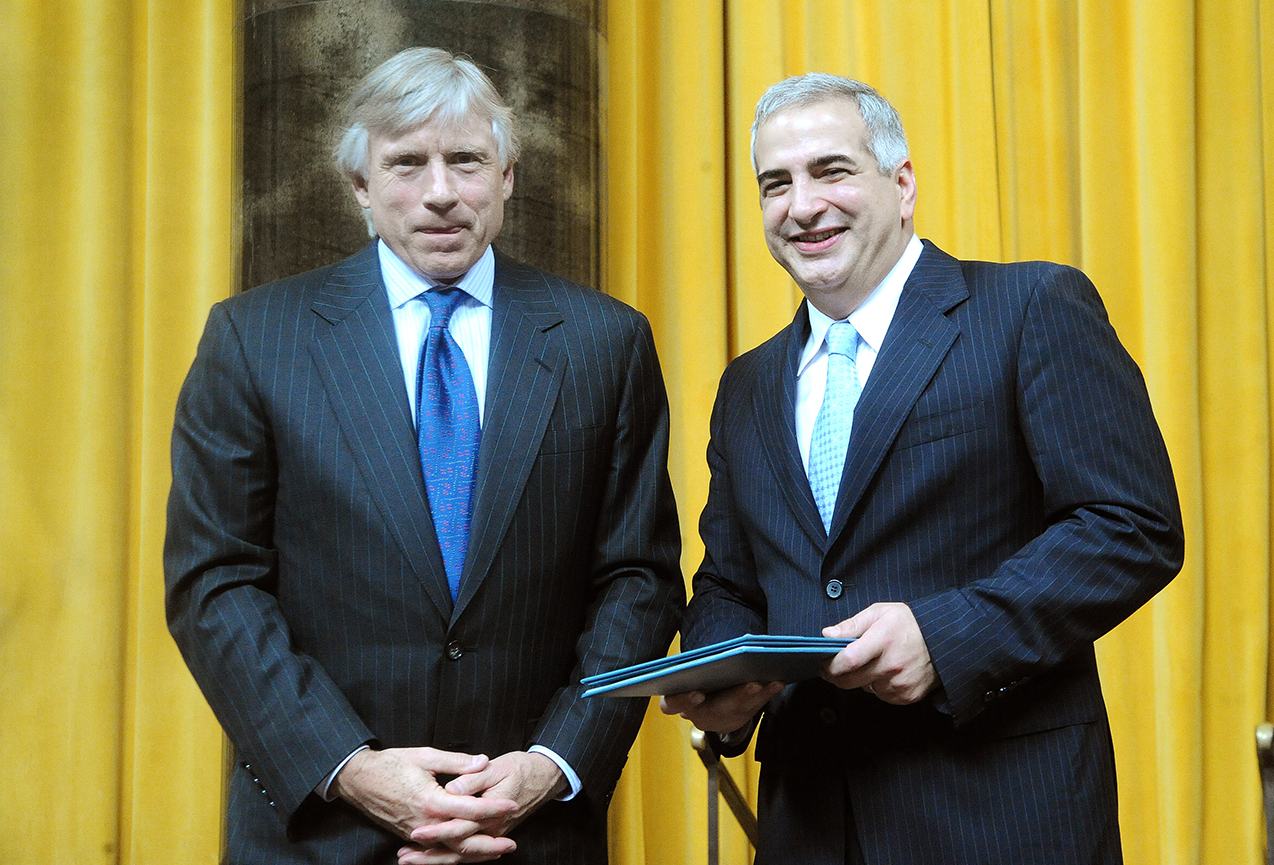
Lee C. Bollinger, President of Columbia University (left), presents the 2010 International Reporting prize to Anthony Shadid of The Washington Post.
Winning Work
By Anthony Shadid
BAGHDAD -- Maybe it was the only shot heard for days in a neighborhood once ordered by the cadence of gunfire. Perhaps it was the smiles at checkpoints and the shouts of Iraqi policemen navigating the always snarled traffic. "God's mercy on your parents," they beseeched. "God's blessings on you." Maybe it was the music box still playing "Santa Claus Is Coming to Town" at a kiosk overflowing with Christmas tree decorations and heart-shaped red pillows.
For anyone returning to Baghdad after spending time here during its darkest days two years ago, when it was paralyzed by sectarian hatred and overrun by gunmen sowing despair, the conclusion seemed inescapable.
"The war has ended," said Heidar al-Abboudi, a street merchant.
The war in Iraq is indeed over, at least the conflict as it was understood during its first five years: insurgency, communal cleansing, gangland turf battles and an anarchic, often futile quest to survive. In other words, civil war -- though civil war was always too tidy a term for it. The entropy, for now at least, has run its course. So have many of the forces the United States so dangerously unleashed with its 2003 invasion, turning Iraq into an atomized, fractured land seized by a paroxysm of brutality. In that Iraq, the Americans were the final arbiter and, as a result, deprived anything they left behind of legitimacy.
Not to say that there is peace in Iraq. As many people are killed today as on any day in 2003 and 2004. Nor is there victory. For any Iraqi, the word, translated into Arabic, draws a dumbfounded look. Victory for whom? Certainly not the tens of thousands of civilians -- perhaps many more -- killed in the frenzied clashes of those once inchoate forces.
Rather, it is the day after.
Baghdad feels much as southern Lebanon did after an asymmetrical war there in 2006, between Israel and Hezbollah, the Shiite Muslim movement that fought Israel to a draw. Survivors rose from the rubble of their homes, offices and stores with the satisfied smile of survival -- in war, its own victory. Then they beheld the destruction the fighting had wrought around them. Their faces turned grim as they realized the task at hand.
It is perhaps the day before, too.
"We don't know what's next," Shidrak George, a bystander, said April 9, 2003, as he watched men vainly assault Saddam Hussein's statue in Firdaus Square with chains, a sledgehammer and a cascade of rocks before making way for a bulky Marine M88 armored recovery vehicle to pull it down. The vehicle stopped for no one. It didn't have to.
He said everything remained ghamidh -- mysterious and unclear.
"We want to know how this turns out."
A City of Walls
In Baghdad's 1,250-year history, its denizens have bestowed on it many names. To Abu Jaafar Mansour, its founder, it was the City of Peace, a capital whose walls were so perfectly circular that a contemporary suggested they were poured into a mold and cast.
Saddam Hussein's Baghdad was a testament to his megalomania, a strange sprawl with a disfigured sense of grandeur. After his fall, the city was stripped bare, revealing a modern creation of brick and mud, vulnerable like its people. It became a city of lanterns amid the blackouts, a city of ghosts shadowed by fear, a city that was mahjoura, forsaken. The architecture of occupation soon followed, falling like a curtain -- dull, unadorned concrete barriers colored in the somber gray of an overcast sky.
Baghdad today is a city of those walls.
The neighborhood of Dora looks like a maximum-security prison, complete with a rusted watchtower. Sadiyah has but one entrance, where waiting traffic sometimes snakes a mile. Sadr City is enclosed, then divided into three hamlets. Amariyah is surrounded. So are Hurriyah and Shuala, Bayaa and Amal. No one can see inside. No one can look out.
In two years, only the faces of the walls have changed.
They now declare the swagger of Iraqi army units: "The Lion Brigade remains a lion," graffiti reads. They warn: "Respect and be respected." They celebrate: "Long live the new Iraq." They serve as a canvas for murals that forgo Iraq's more contemporary Arab past for its older Sumerian and Babylonian glory. They carry the advertisements of the travel agencies, moneychangers and realty offices they now protect. They bear the floral patterns that, not long ago, were more familiar on martyrs' posters.
Most of all, the walls conceal.
"A ruined state" was the term Iraq's parliament speaker had for what the Americans have left behind those walls. Mahmoud al-Mashhadani said it in anger after he resigned in December. But the phrase resonates, in both Iraq as a whole, a weary landscape dominated in hues of brown, the color of poverty, and in Baghdad, a city where everything these days seems twisted or torn, bent or broken, snared in barbed wire that has lost its sheen. Every median has its piles of dirt and rubble, often both. Every curb has its soggy trash.
This war's end feels more truce than treaty, more respite than reconciliation. There is no revival or renaissance, no celebration. It manifests itself most in the simple lifting of a siege.
In a roundabout once known as Ali Baba Square, water occasionally flows from a bronze fountain portraying Kahramana, the slave girl who outwitted the 40 thieves of "A Thousand and One Nights." Boys play pool on tables lining the lazy Tigris River. Trucks along Abu Nawas Street bring flopping fish destined for plates of masgoof, an Iraqi specialty.
In Firdaus Square, where Hussein's statue once gave way to American tanks whose barrels read "Beastly Boy" and "Bloodlust" and U.S. soldiers blared Johnny Cash's "Ring of Fire" over Humvee speakers, two students, Hussein al-Abbas and Amjad Abdel Hamza, took pictures of each other near the swings and park benches.
"For the memories," Abbas said.
Behind them, a poster reads: "Law builds the nation."
Fragile is the term American officials rely on to describe this Iraq, and indeed, it is that. At this moment, the country feels as though it could recover, economically if not physically, blessed by oil reserves that are potentially the largest in the world. Crumbling, it feels as though it could just as well remain a powerless, pliant country buckling under its own weight, dependent on a United States that seems determined to dictate its future.
The spectrum between those poles relies on the question of power. The struggle for that power -- a series of elections this year is one avenue, and money, guns and repression are another, more familiar means -- pervades almost every aspect of life in Iraq today.
Fragile, repeat the Americans. Dangerous, say many Iraqis, bracing for more violence.
"Before the storm, there's always quiet," said Amal Salman, living with her family in Karrada, above a street lined with vendors hawking hats emblazoned with "Budweiser," "Wisconsin" and "Baylor Crew." A kiosk offered posters of Turkish soap operas that have become a sensation in Baghdad and elsewhere in the Arab world. Pictures of Hossam al-Rassam, a popular Iraqi singer, were in short supply.
When she was 13, Salman chronicled the fall of Hussein in her diary. "No one realizes they are gone, all of them, forever," she wrote in 2003. She stayed optimistic during Baghdad's darkest chapter. "The sun will set today, but it always rises again. Everything rises again," she said then. "I don't know how to express it, but I understand it."
Now 18, she worried.
"It's always most dangerous when it's calm," she said.
The Culture of the Shoe
Standing in Firdaus Square on April 9, 2003, the Marine recovery vehicle doing its part, it was difficult to imagine that the United States truly understood the country it had inherited that day. Iraq was a place brutalized by war and tyranny, imbued with ambivalence about the future, shaped by yearning for the past. It never abided by American preconceptions. It never hewed to the United States' construct of what a country should be.
In months, the unanticipated forces that would shape Iraq were soon unleashed -- a Shiite Muslim revival, disenfranchisement of Sunnis, the import of a radical strain of Islam, the hardening of sectarian and ethnic identities, and the onset of a lawless culture of men with guns. An Iraqi friend once called their legacy the culture of the shoe, known here as the kundura.
"When anyone is against you, when anyone has differences with me, I will put a kundura in his mouth, I will shove a kundura down his throat, I will hit him with a kundura, and so on," he said at the time. "We live in a kundura culture."
Today, many of those forces seem to have fitfully run their course.
"There is a disintegration in the entire sectarian establishment in Iraq," said Wamidh Nadhme, a political science professor sitting in the Adhamiyah quarter, over a leisurely lunch of a wintertime soup that mixed turnips with balls of ground meat. "Everyone now is trying to wash their hands of the blood that had stained them."
His once perilous neighborhood was now quiet. There was neither the staccato crack of gunfire nor the dull thud of helicopters. His gate was unlocked. So was his front door.
His son, Jamal, nodded in agreement, but then offered a caveat.
"The embers are still glowing," he cautioned his father.
Mercury might best describe Iraq's politics these days, skipping, rolling and congealing, pushed and pulled by forces that always feel surreptitious and furtive.
The overarching Shiite alliance, once blessed by Grand Ayatollah Ali Sistani, has crumbled. The figure of one of its leaders, Abdul Aziz al-Hakim, stricken by cancer and ravaged by its treatment, seems a metaphor for its fortunes. The bloc that claimed to speak on behalf of reticent Sunnis has splintered, unable to agree on a candidate to replace the speaker of parliament, himself partial to the kundura. It faces competition from the Sons of Iraq movement, which is made up of many who have surrendered the insurgency for a seat at the table. The Shiite prime minister is rallying Sunnis against Kurds. Some of his allies are those same former insurgents.
Shiite Arab, Sunni Arab and Kurd were always facile descriptions of Iraq. Now they make hardly any sense before the constellation of combustible alliances jockeying to answer the questions at the heart of Iraqi politics today: How strong will the central government in Baghdad be, and what coalition of interests will secure power?
"The flames have disappeared. It's true," said Abboudi, the street vendor in crowded Karrada, as he sat at his well-stocked store of men's clothes. "But the war continues among the politicians. Until this moment, there is a great struggle going on among them."
In that, 2009 feels much like that April day in 2003. Then, as now, one war's end was the preamble for another, far greater struggle. Much was ambiguous and indistinct. Consequences were unintended.
Like today, it was all ghamidh.
© 2009, The Washington Post
By Anthony Shadid
THULUYAH, Iraq -- Nadhim Khalil wears the clothes of the cleric he is. He bears the scars of the insurgent he was. And in a country where business these days is power, he talks the speech of the merchant he has become, plying his trade in a contest for authority.
Imbued with the swagger of youth, lording over this oasis-like town on a bend of the Tigris River, Khalil has power, the fruits of a singularly Iraqi odyssey that has taken this scion of a religious family from the leadership of the local branch of al-Qaeda in Iraq, responsible for a reign that saw residents executed in the streets, into the generous arms of the American military and Prime Minister Nouri al-Maliki, his erstwhile foes.
Khalil's analysis is blunt: He used to be on the losing side.
His formula is simple: With God, guns and money, he is now the authority in town.
"I'm sure the Americans will leave after a little while, and there's nothing I achieve by killing them now. I could kill them anytime, anywhere, and so what?" he asked. "In the beginning, the thought was that you could achieve your goal with weapons, but honestly? That investment has shown no return. That company has shown no profit."
Khalil's ascent here is a legacy of the war that has all but ended and the struggle that has begun in Iraq, shaped by the expediency of American tactics to quell the insurgency and the combustible, shifting landscape those choices have left behind. War and occupation shattered old notions of power here, embedded in patronage and tradition. In places like Thuluyah, new leaders and forces are emerging, redrawing the maps of towns and regions that, in quick succession, have passed from the hands of Saddam Hussein, through the throes of the insurgency and into today's far murkier contest.
Fierce in its customs, Thuluyah is a microcosm of Sunni Muslim regions of the country, residents like to say. If so, the town is a sober harbinger. Khalil, often forthright, sometimes persuasive and occasionally thuggish, has become the strongman.
Just 30 years old, Khalil has inherited from his family the town's biggest mosque, where brimming crowds gather on Fridays for his stentorian sermons. He heads the council that oversees the hundreds of armed men who deserted the insurgency for U.S.-funded units known as the Sons of Iraq, outnumbering the police and army unit stationed here. The mention of Khalil's name -- Mullah Nadhim, as he is known here -- ensures passage through their checkpoints. He heads a council of tribal leaders that provides a channel to Maliki, who offered his hand in friendship in a meeting in Baghdad's Green Zone.
The elected city council can only watch and complain -- in whispers -- about a man they fear. The town's elders scoff at his age and pedigree, with a wayward glance.
"My opinion?" asked Abdullah Jabbouri, a council member and former general. He paused, smiling a little sheepishly.
"Anyone who has absolute power becomes dangerous, even to himself," he said.
Renown as an Insurgent
Khalil has long enjoyed prominent standing in this town of 50,000, graced by orchards and orange groves. His father, Mahmoud, was the head of the Caliphs Mosque, the town's largest, which Khalil inherited at 18. So was his grandfather, Khalil. In the days of Hussein, he had secured a measure of fame -- or perhaps notoriety -- when he was questioned for sometimes explicit criticism of the government in his sermons -- that it should build schools, not palaces, that its rule lacked the justice of Islam's forebears.
But it was not until 2003, in the months after Hussein's fall, that he won renown with a message as incendiary as it was harsh -- against the Americans, of the need to defend Sunnis against Shiites. Even today, some recall a sermon he delivered that November.
In it, he spoke of three men who competed to be the most vile. The first saw a woman carrying wood atop her head. He beat her. The second then tore off her clothes and raped her. The third stood back. When the others asked what he would do to prove his wickedness, the man laughed. That was my mother, he told them.
Khalil paused as he finished the story. The mosque fell silent. The mother, he declared, his voice rising again, represented Iraq, and the men were those betraying her.
"The occupation is like a cancer," he shouted, "and it has to be removed."
In those days, Khalil had insisted that he was only "fighting with his tongue." His zeal soon drew him into the ranks of an incipient insurgency, leading 30 armed men and meeting colleagues in Baghdad, where he sometimes sought shelter at the Um al-Qura mosque. He ventured to the Anbar province capital of Ramadi, towns in Diyala province, and across the border to Syria. The U.S. military jailed him twice: as prisoner No. 159705 when he spent nearly six months in the massive prison at Abu Ghraib in 2004, and as No. 200331 when he was incarcerated for a similar stint at Camp Cropper in Baghdad nearly two years later. By his count, U.S. soldiers searched his house 67 times. They occasionally brought dogs, he said, to inspect his mosque.
By August 2006, after a meeting in Homs, Syria, he had joined al-Qaeda in Iraq, a homegrown Sunni movement that U.S. officials say is led by foreigners and that embraced a radical strain of Islam.
Unlike other regions of Iraq, there was never any ambiguity in Thuluyah about the occupation. From the beginning, it was despised. The town was the scene of one of the first efforts at counterinsurgency, when 4,000 U.S. troops, along with helicopter gunships and armored vehicles, moved through in June 2003. They killed three males, including a 15-year-old whose body was left for hours, swelling under a burning sun.
But even the occupation's fiercest opponents were startled by the severity of al-Qaeda, which ruled Thuluyah for 16 months starting in 2006. Men deemed collaborators were dragged from their homes and cars, sometimes executed in the street with a bullet to the back of the head. One man, a policeman's brother, was beheaded with the dull edge of a shovel. In all, residents say, 216 people were killed. No one could smoke in the streets.
"In theory, it was good," Khalil said of al-Qaeda.
But he realized that what he deemed the excesses of implementation were turning sentiment against it. These days, he calls himself contrite; he said he only wanted to fight Americans, not Shiites in neighboring Balad and certainly not his own people. But he acknowledged, too, that he was eventually forced to weigh the costs and benefits.
"Four years of fighting, and we didn't achieve anything," he said in his house, adorned with a Koranic inscription on the wall that reads: "God forgives all sins. Truly, He is often forgiving and most merciful."
"That company went bankrupt," Khalil said matter-of-factly. There was little hint of penitence, less of remorse. "The past is closed now," he said. "It failed, and I don't like to remember the years of failure."
In June 2007, Khalil turned against his allies, declaring war from his mosque.
"Al-Qaeda must depart, or face from us what they may not expect," he recalled saying. "Throw them out of our villages. Have no mercy on them, whether young or old."
Three times, al-Qaeda in Iraq loyalists tried to kill him. On Oct. 19 that year, they planted a bomb under his chair in the mosque, injuring 136 worshipers. Khalil suffered 30 wounds that left dark scars on his left arm and left leg. But within a few months, working with the U.S. military, police and men who deserted al-Qaeda in Iraq for an American-backed militia of former fighters, Khalil crippled the group. Residents estimate that 80 of its men were arrested and 70 others were killed -- 50 by the U.S. military and 20 by police. Only a dozen or so fighters remain, haunting the gardens and farms around the town.
In his own estimation, Khalil was the last man standing.
He has shaved his beard, its wispiness once indicative of his youth. In a reception room painted soft pink, he unabashedly displays a picture of himself with a sniper rifle, surrounded by Iraqi security forces, former insurgents turned American allies and a U.S. soldier, smiling broadly. To visitors, always gracious, he speaks with the fervor of the converted.
"I have a new company," he declared.
Smiling, he added, "You can't bring the Neanderthal to live in a globalized age."
But he still calls himself an Islamist, and to his followers, his words remain harsh.
"Our country is occupied and our bodies are torn apart, but we shouldn't forget our families in Palestine," he proclaimed in a sermon recently to an overflow crowd in his austere mosque, its white walls gouged by shrapnel from his assassination attempt.
"Those sons of monkeys, enemies of God and killers of prophets," he declared, his voice rising in denunciation of Jews, "are killing our brothers and sisters in Palestine."
A Void After Hussein
Under Hussein, Thuluyah enjoyed the perks of patronage and loyalty. Some residents estimate that as many as 90 percent of the townspeople were Baath Party members, a fourth of them employed by the army, government or intelligence service.
That world crumbled in April 2003. The tribes -- powerful clans with the names of Jabbouri, Khazraji, Ubaidi and Bufarraj -- filled the void for a while, then made way for insurgent groups and eventually al-Qaeda in Iraq. Its departure left a contested landscape, in which the government, represented by no more than 70 soldiers, is a bit player.
The city council is universally despised, castigated as corrupt and dismissed as impotent. Tribal leaders hold sway. On a recent day, the sheiks of the region's tribes met in Balad to negotiate blood money for 14 construction workers from that town whom al-Qaeda members from Thuluyah had executed with a bullet to the back of the head in 2006. But even the sheiks complain they no longer enjoy the same writ in a terrain shaped by force of arms and patronage that comes through ties to the American military and the government.
Khalil calls the perspective of the tribal leaders "limited."
That leaves Khalil himself, who is called commander by the 700 members of the Sons of Iraq in the region. In mismatched uniforms or civilian clothes, they man checkpoints on the town's main road, draped in bandoleers and waving walkie-talkies. He heads a council of 10 tribal leaders established last year by Maliki, the prime minister's tentative but far-reaching attempt to cultivate rural support. He said he meets with the U.S. military every two weeks. Each Tuesday, he gathers a council in Thuluyah with the mayor and heads of the police, city council and army to review security here.
"He has helped maintain peace and stability in the region while supporting the populace's need for the same," said Lt. Col. David Doherty, a spokesman for the U.S. military in northern Iraq, the region that includes Thuluyah.
At the city council headquarters, a simple building near the town's entrance, pockmarked by bullets, Jabbouri was more circumspect. A towering man, dressed in a checkered kaffiyeh, he represents Thuluyah's past. He was a general under Hussein, a veteran of the war with Iran. He is a lawyer and tribal elder. A council member, he has ambitions to sit in parliament. At first, he deflected queries about Khalil.
"This is a deep question," the 68-year-old Jabbouri replied.
But over thin cups of scalding sweet tea, the conversation unfolded.
"He's from a respectable family," one of his colleagues volunteered.
"What?" Jabbouri gruffly responded. "Is he the head of a tribe? How many houses belong to him? Five? He's not a thinker. He's more like an adolescent."
The criticisms tumbled out, growing in boldness. Khalil's conversion was akin to a cleric banning alcohol, then mixing the first drink. Money and power have made him a pharaoh. His guns, in the hands of his men, have left the city council with no qudra, or capability. Though elected to office, the men find themselves on the outside looking in.
"All we can do is write. We can't carry anything out," one colleague said.
"The Americans put him in charge," another added, too fearful to give his name. "They gave him the key. From where else would he have gotten it?"
Jabbouri shook his head. "His ambition stretches beyond the sky," he said grimly.
Speaking Like a Candidate
"The fight now is the fight over the finger," Khalil said over a lunch of roast lamb and rice, grilled fish, okra and more lamb, after delivering his sermon.
He meant the coming election and the indigo stain Iraqis receive after voting. He meant, too, that he himself planned to run for parliament, hoping to represent Thuluyah.
These days, Khalil is a man about town. He got married and got respectable. He mixes easily with worshipers, his fighters and the workers renovating his mosque. Even in January, nearly a year before parliamentary elections, he sounds like a candidate.
Through his intervention, he said, the Americans have funded 20 projects for the town, from paving 10 miles of roads to bringing clean water for thousands of families. He still oversees salaries for the Sons of Iraq. He has found 400 people jobs in the army and police. He has secured compensation for 1,500 people who suffered injuries in fighting.
"I have a lot of credit from the people at this point," he said.
Across from the mosque, Shihab Khaled watched a butcher slaughter a sheep, dragging the knife along the belly of the animal as it hung from a meat hook.
"They used to massacre people like this, and it was ordinary," he said under his breath. Al-Qaeda in Iraq killed his brother Zahid, a policeman like him, in August 2007. He himself never wore his uniform in public. "It's all over now. It's passed like a dream."
He said he thanked God first, "and second, the efforts of Mullah Nadhim."
But there is something familiar about the reluctance of many others to talk.
"He who is scared stays peaceful," goes a proverb sometimes uttered in the town. It was often pronounced after Hussein's fall, in the ensuing anarchy. But it holds truth today, too. There is fear here, the sense in places where law is arbitrary that fewer words are better.
"He still needs time to build trust," said Suleiman Kanoush, a 43-year-old government employee. "We still need time to give him our trust again."
Trust, though, is not Khalil's power.
© 2009, The Washington Post
By Anthony Shadid
ABU GHRAIB, Iraq, March 11 -- At noon Tuesday, there was the explosion. Gunfire followed, and 33 people were dead, pieces of their corpses mixing with stagnant water, trash and soggy scraps of food. At noon Wednesday, there were the atlal.
The word in Arabic means the remains or ruins, the traces of something left behind. The atlal of Tuesday's attack, one of two in the past week that killed scores in the capital and its environs, were spent bullet cartridges, catching the glint of a morning sun, that survivors accused soldiers of firing at them in the chaos and confusion that followed the blast.
The atlal were the orphaned boy who had been selling plastic bags for a few cents. They were the vegetable seller whose 18-month-old daughter was ripped from his grasp as he was hurled to the asphalt. They were the relatives standing at a morgue that housed the remains of their families together with the remnants of the bomber who killed them.
"Neither the American nor Iraqis will try him," said Rahim Abdullah, whose aunt and cousin were among those refrigerated inside. "He'll be judged in heaven."
In 2003, when America began its occupation, bombings with half the casualties of Tuesday's suggested the United States might not prevail. Today, when America and its Iraqi allies seem to be winning, the attack failed to make the front page of the government newspaper.
"No one values the victims anymore," said Mohammed Awad, another relative standing near the morgue, under a sun that washed Abu Ghraib of color.
Even before the fall of Saddam Hussein, Abu Ghraib, a desolate swath on Baghdad's western outskirts, was a symbol. The prison here was the worst of Hussein's hellholes, a place whose name spoke to the horrors of his ubiquitous terror. When he issued an amnesty emptying the prison and others in October 2002, it foreshadowed the tumult that would ensue after his fall six months later, as a country stepped from a prison cell into the sunlight. Abu Ghraib became an axis of the insurgency, once one of Iraq's most dangerous locales. Its prison was taken over by U.S. soldiers, who photographed their own sadistic treatment of inmates.
On Wednesday, the day after the market bombing, Abu Ghraib was a symbol of death's anonymity, in a conflict where hundreds of people still die every month, even as a sense of the ordinary returns.
Pieces of flesh collected in a black plastic bag were tossed near the market, its stalls built of tattered canvas, soiled blankets, and rickety wood and iron. The stench of death still hung along muddy puddles of blood that were something in between red and brown. Barbed wire snagged plastic bags, fluttering in a forlorn breeze. Scenes of doves, rivers and a sun setting over palm trees were painted on blast walls, dissonant with a landscape that, from its dusty palm fronds to its dead grass, was painted solely in grays and browns.
"It is forbidden to stop," a concrete barrier read at the very place police Maj. Gen. Maarid Abdel-Hassan stopped Tuesday to tour the market before the suicide bomber rushed his car and detonated explosives that tore through the crowd of men, women and children.
"We won't forget," said Ahmed Naji, whose brother Ali lay in a hospital bed, a tube in his nose draining blood from his wounds. "We won't forget what happened."
Ali was crossing the street when the assailant, dressed in a camouflage police uniform, threw himself toward Abdel-Hassan. The blast tore Ali's infant daughter, Aya, from his arms, flinging her down.
"Thank God," he said simply of her survival.
"It was like the day Baghdad fell," his brother Ahmed said. "No, it was worse."
Abdel-Hassan said insurgents fired on his men, unleashing gun battles that raged as his car sped away. Police stationed in the area blamed soldiers in his convoy for firing randomly. Survivors at the hospital, along with doctors and staff, insisted the general's soldiers simply lost control, pouring gunfire at survivors as they staggered through the market.
"Anyone who moved was shot," Ali said.
"It's an army of occupation," a man attending his wounds said under his breath.
Ahmed Tahsin, so gaunt he looks younger than his 12 years, sold plastic bags in the market for about 20 cents. His father was dead, in a car accident before the war. His mother abandoned him. His half sister, Noura, had raised him and his brother, Hossam.
"It's hurting," Ahmed cried in the room next door, as a doctor tried to snake a tube through his nose to drain blood from surgeries that removed part of his stomach and intestine. His spleen was, in the doctor's words, shattered. "I can't bear it!" he cried again.
"Shut up!" the doctor barked. "It's for your own good."
"Don't let him put it in my nose," the boy begged, sobbing, swallowed by the blanket that was tossed over him. "Don't let him. Somebody please talk to him."
His brother leaned against a grimy wall, crying.
"What did he do to deserve this?" Hossam said. "Why? He didn't do anything wrong."
The sun poured down outside. It does that in Iraq, relentless as it batters. Abdullah and Awad stood with other men near the refrigerated morgue, sweat gathering on their brows as they waited to collect their relatives. They couldn't travel in the hours after the attack. All the roads were closed.
"They wouldn't let anyone, not a single person, come in or out," Abdullah said.
He went that night to retrieve his 28-year-old cousin, Raed Sabar Abed. He returned Wednesday to bury his 63-year-old aunt, Baraka Hussein Khalaf. Her body was stored inside, along with nine other corpses and the remains of the bomber's legs.
"A nightmare," Abdullah said.
"I want to know the dialogue that goes on between them right now. I hope they ask him why he killed them," he said. "I want them to know his answer."
The Karkh Cemetery is a few miles from the market, which was abandoned Wednesday but for a few vendors selling tomatoes, eggplants, squash, bananas, oranges and the potatoes for which Abu Ghraib is known. A ledger sat on the desk at the cemetery's entrance.
"Rasoul Fadhil Abbas" read the first name, born in 1988. "Abdel-Majid Hamid Ahmed" read the second, born in 1995. "Mohammed Khudeir" read the third, born in 1998.
Thirteen more names followed. The cause of death was identical for each.
Infijar, it read. "Explosion."
The bodies were buried under piles of dirt not yet settled. The names were scrawled by hand in cheap concrete. A palm frond jutted from the dirt of each grave. Occasionally there was incense. A sign of the newly dead, black crows fluttered near denuded eucalyptus trees.
"God have mercy on them," said the gravedigger, Akram Ahmed.
© 2009, The Washington Post
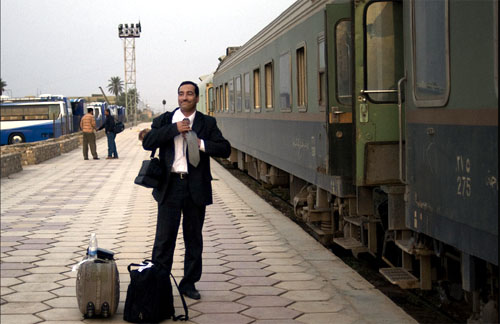
Dhia Hassan straightens his tie after getting off the train. He now lives in Sweden, and is visiting his home in Basra for the first time since 1995. (Andrea Bruce-The Washington Post)
BAGHDAD -- A sandstorm always makes a dreary Baghdad drearier. The sun turns to a moon in a funereal gray sky. Time surrenders its procession, as dawn melts into a cloudy day that feels like dusk. Common these days, the storms bring a gauze of grit that settles over everything, and the eyebrows of Pvt. Bassem Kadhim were no exception.
Standing at a checkpoint at the entrance of the Baghdad Central Railway Station, he leaned toward a car. His eyes narrowed, as he cocked his head in recognition.
Um Kalthoum, the Egyptian diva of another generation, played on a scratchy cassette. It was the song "Siret al-Hob," her peerless voice soaring over the strains of a forlorn violin.
"Let me listen for just a moment," Kadhim told the driver, "then I'll let you pass."
He listened. "From a whisper of love, I found myself in love," Um Kalthoum sang. "I melted in love, spending morning and night at its door." And he let the car pass.
There is a new vigor to the cadence of the Baghdad train station beyond his checkpoint, revived after a long slumber. But like the legendary singer, it evokes a lost world. Two clock towers stand like sentinels on each side of a turquoise dome built half a century ago. Musty ticket counters advertise lines that no longer run: to Mosul, to Husaybah, and across the border, to Syria and Turkey. Flickering chandeliers illuminate distinctions -- Couchette Class, Tourist Class -- that no longer matter.
The station is a door of sorts, as is the train parked there.
Through it is another Iraq, far from the country today that is at once so resilient yet so uncertain. This is an Iraq imbued with the recollection, sometimes imagined, of a past not yet bloodied. It is a nation where names still evoke a place, not an occupier's crimes and excesses -- Abu Ghraib, Haditha, even Baghdad. It is a country that unfurls between two rivers, filled with longing but bereft of borders of sect and ethnicity that cut through even the smallest towns with the blunt edge of a blast wall or a massacre's lingering memory.
"On the train," said Ahmed Murad, boarding the car, "you go straight ahead."
At 6:25 p.m., the horn blew, and workers and students, good sons going home to their families, well-wishers and mourners threw their jackets, shoulder bags stretched taut, sacks stuffed with sandwiches and tightly rolled carpets on the racks overhead. They settled into frayed green leather seats, with murmurs like that of an audience before a play.
The train had no number. There is only one, bound each evening for Basra, 340 miles to the south.
The horn sounded again at 6:30. The train's six carriages heaved, then stumbled ahead, departing on time. The wheels shrieked, the clanging metal otherworldly, and a landscape always so claustrophobic and demarcated fell effortlessly into the train's wake.
"Is that Dora?" someone asked idly.
"Kadhimiyah?" another wondered.
Wind poured through the car as the train gathered speed. The colored banners of Shiite Muslim devotion faded from view. So did checkpoints adorned with plastic flowers, gathering dust in the storm. The train rumbled past blurred scenes of traffic snarled as cars waited for inspection, past police trucks with sirens wailing and past blast walls plastered with tattered election posters. Soldiers were illuminated in the streaming headlights of cars, recognizable for a moment before they fell back into the dark of night.
For perhaps the first time since the U.S.-led invasion in 2003, an American convoy stopped for someone in Baghdad. It waited on the road to the airport, as the train cut across.
By 6:54, the train reached full speed, and Aqeel Moussa dragged on a cigarette, watching a timeless scene of squat houses spilling beneath date palms.
"There's no Sunni, there's no Shiite here. We're all part of the same hand," he said, thoughts wandering. "I know someone only through the conversation we share."
In spirit, if not reality, the train is part of an older line and an older Middle East, the product of a 19th-century vision of the Ottoman Empire and its German allies to build the Berlin-Baghdad Express, eventually ending in Basra and running unfettered across the borderless expanse of Turkey, Syria and Iraq.
With little fanfare, service began again in December to Basra. For 18 months, it had been too dangerous for the train to venture through the treacherous stretch of eucalyptus trees, date palms and ocher-colored villages spilling south of Baghdad, an area once known as the Triangle of Death. Snipers took potshots at the train. The railway's director general was ambushed and shot in both legs in 2004. A bridge near Latifiyah, in the heart of the triangle, was blown up time and again.
These days, though, the train is full, its fare of $7 a fifth of what a taxi can cost. And as it passed Latifiyah, no one seemed to deem the threat too great anymore.
"The evidence is that I'm sitting here," said Hilal Karim, bound for a job in Basra.
The soiled green drapes of Car 499 hung over cracked windows. The springs of Seat 23 were broken. A few of the lights worked overhead, one of them drawing a moth that danced along the roof, frenetic and tireless. Brown walls added to the drabness.
"Mohammed, leave open the door!" one passenger shouted toward the back of the carriage, jabbing two fingers clasped around a cigarette. "Let's let the smoke get out!"
His butt joined sunflowers seeds littering the floor.
"What are you doing? Trying to light the train on fire?" he shouted at a youth in front of him who vainly tried to prop a burning stick of incense where a screw once was.
"Is this Latifiyah?" another passenger asked.
"Mahmudiyah?" his friend guessed.
A medley of songs played from cellphones. There were Iraqi artists like Yas Khudr. Jokingly, someone offered a martial ode to Saddam Hussein. A Syrian singer named Asala performed another song by Um Kalthoum. "I fear for you, and fear you might forget me," it went. "But longing for you kept me awake, overtaken by nostalgia."
The words were barely audible to Wala Hassan, standing at the train's open door.
"I'm fed up with this life," he volunteered, sipping scalding tea.
Nineteen, married and the father of a 9-month-old baby named Ali, Hassan had come to Baghdad for work. It was his fifth trip on the train. The night before, he had slept in the street, hoping to be first in line for an application to the police. It didn't matter.
"There's no future, I swear to God," he said. He tossed the dregs of his tea out the door and stood up. "I don't even have a single dinar to give to my baby."
He propped a sinewy arm against the exit and forced a smile of hospitality. With a faraway stare, he looked out the train at other lives that were lived. His wasn't yet. "When I stand here, I want to take the grief from my heart and throw it out the door."
He smiled again, tightly. "It feels good to talk," he said.
The train slowed. "Are we in Musayyib?" someone asked.
A few rows away, another song played. It was "This Iraq," by Taysir al-Safir. "We will light your roads with candles," he sang. "We will dry the tears from your eyes."
The history of Iraq's internecine war in 2006 and 2007 has yet to be written. It lacks even a name. Sometimes it is called "the sectarian time" or "sectarian war." Occasionally, "the events." Often, one word suffices, taifiyya, which simply means sectarianism.
The checkpoints that litter Iraq's roads, sometimes every 100 yards or so, are a legacy of that war. In a country rife with borders and barriers, barricades and barbed wire, many find them loathsome. Inspections are arbitrary, soldiers are sometimes rude and delays can stretch hours, in ribbons of traffic that can unwind for more than a mile.
"It always bothered you when you saw American convoys stopping us, not letting us move in our own country," said Ali Zeid, a 20-year-old student who had been visiting in Baghdad.
"And now Iraqis have caught the disease from the Americans," added his cousin, Abdullah Hamid. "It's like a virus spreading through your computer. You can't delete it."
Hamid, garrulous and stout, studies computers, but his true love, he said, is for poetry, ranging from the work of Umru al-Qais, from before the dawn of Islam, to Nizar Qabbani, who died in 1998. Hamid's favorite line goes like this, inspired by the taifiyya: "Tears of Baghdad, millions of tears. Who do I have in Baghdad, crying for me, as I cry for her?"
There is a poetry to the train, he said. It is the education of a journey.
"You have an idea of the country you live in when you pass through it so freely," he said, his head leaning against a window coated with dust. "I want to move from place to place. If I can't know about the world, at least I can know about my own country."
More songs played, one of them an ode to a train.
"I remain waiting at the track, counting how many stations till Basra," sang Yas Khudr, from a muffled speaker. "Did they reach Tel Alaham, or have they passed it?"
As midnight approached, more fell asleep, save for a rowdy bunch in Row 29. By 2 a.m., even they had quieted, though passengers still stirred whenever the train slowed.
"Where are we now?" one asked.
"What town are we in?" wondered another. "Samawah or Suq al-Shuyukh?"
Toward Basra, the sky hinted gray. Gas burned from oil wells in the distance, like bonfires on the horizon. Flags for Shiite saints again became distinct. So did the graffiti scrawled in black along the walls. Checkpoints returned, with the borders they drew. The train rattled past stagnant canals filled with trash in a city once Iraq's most beautiful.
The train stopped at 5:58 a.m. "Welcome to our Basra Railway Station," the wall read, near a ticket counter that offered "High Class Reserve." The train was two minutes early.
© 2009, The Washington Post
By Anthony Shadid
BAGHDAD -- Across the street from the tidy rows of tombstones in the British cemetery, mute testimony to the soldiers of an earlier occupation, Mustafa Muwaffaq bears witness to the quieter side of the United States' six-year-old presence in Iraq.
In wraparound sunglasses, shorts and shoes without socks, the burly 20-year-old student waxes eloquent about his love for heavy metal of all kinds: death, thrash, black. But none of it compares, he says, to the honky-tonk of Alan Jackson, whose tunes he strums on his acoustic guitar at night, pining for a life as far away as a passport will take him.
"You know, I wanna go to Texas and be a country boy," he said, as he stood in the sweltering shade of Baghdad's Academy of Fine Arts. "I wanna be a cowboy, and I wanna sing like one."
All occupations eventually end. When this one does, history's narratives will be shaped by the cacophony it wrought -- the carnage unleashed by the U.S.-led invasion that threatened Iraq's notion of itself as a country and that will haunt generations to come.
But the whispers may linger just as long -- the far quieter way in which two cultures that often found it difficult to share the same space intersected to reshape Iraq's language, culture and sensibility. From tattoos of Metallica to bellybutton piercings, from posters for a rap concert in Baghdad to stories parents tell their naughty children in Fallujah of the Americans coming to get them, the occupation has already left its mark.
There is the bellicose language of the checkpoint: "Go" and "Stop" (often rendered as "stob" in a language with no "p"), along with a string of American expletives that Iraqi children imitate with zeal. In parks along the Tigris River, they play "tafteesh," Arabic for inspection. Iraqi troops, sometimes indistinguishable from their U.S. counterparts, don the sunglasses considered effeminate in the time of Saddam Hussein.
Some Iraqi youths even dip Skoal tobacco.
"It's inevitable that they're going to leave a trace on us after they depart," said Yahya Hussein, a soccer coach, former player and denizen of Baghdad's Karrada neighborhood.
'These Are the Times'
Hussein left Kawkab al-Sharq cafe -- named for a legendary Egyptian singer of another era -- where waiters ferried tea, Nescafe and a water pipe known as a nergilla, a word taken from Persian. His family's history in Karrada stretches back 11 generations, and as he strolled along the neighborhood's main thoroughfare, he spoke with the authority of experience.
"All this," he said, pointing at a kiosk, "came after the occupation."
Rickety stands along the street overflowed with goods. Toy guns emblazoned with the moniker "Super Police" sat next to imitation handcuffs and walkie-talkies. A doll dressed in fatigues, with dog tags around its neck, carried an M-16 rifle, familiar to Iraqis as a weapon of the U.S. military. With a squeeze of the doll's hand, Freddie Mercury belted out Queen's "We Will Rock You" to a street speaking Arabic.
"These are the times," Hussein said.
Bootleg copies of "Star Trek," "Valkyrie" and "Marley & Me" were on sale, along with CDs by Eminem, 50 Cent and Massari. On a wall was an ad for a concert by Rap Boys, billed as the "first and biggest rap party in Baghdad."
Youths asked a barber across the street for the latest haircut, which they call "spiky"; one barber insisted that the name came from a soldier's nickname for his military dog. The soldier's version of a crew cut is called "Yankee" (or, sometimes, "bankee").
Businesses hawked camouflage-patterned men's underwear. "Harley," a kind of biker boot, went for $125. "Texas," the cowboy version, cost $100.
For each item, Hussein had a simple phrase: "after the suqut," the fall of Saddam Hussein.
The Long Perspective
Iraq remains a proud country, its people bridling at what they see as the condescension inherent in the United States' modern-day equivalent of a civilizing mission. History, thousands of years of it, forms the refrain of any conversation: Mesopotamia gave birth to civilization, and at its medieval zenith, as Europe slumbered, Baghdad was a city of racetracks, law schools, museums, libraries, hospitals, zoos and insane asylums.
The country's past shamed its present, and in the wake of Hussein's fall in 2003, many Iraqis, however suspicious, were willing to give the Americans the benefit of the doubt. Now, many blame them for everything from sectarian strife to Baghdad's disrepair. The only kind of American most Iraqis have met is a young, gun-toting soldier, and a look of scornful incomprehension often greets a question about the Americans' cultural legacy.
"What are they leaving behind?" asked Mohammed Chayan, a 45-year-old painter sitting with friends at the Madarat Cafe and Gallery, near a wall of concrete barriers.
"There's never really been interaction with society," he said. "When they came to visit, it wasn't artists who showed up. It was soldiers coming down from their tanks."
"They were isolated," admitted Mohammed Rasim Kasim, a filmmaker and photographer. "But," he added, "I have to disagree with my colleague."
Kasim, a bearish, cheerful man, said that before 2003 he had traveled only to neighboring Jordan. Since then, he has visited the United States, Turkey, Syria, Lebanon, Germany and Austria. And an image lingers from his travels: recognizing a car in Berlin as a U.S. military vehicle not because it was part of an armored convoy snarling traffic for a mile behind it, as in Iraq, but because he spotted the tiny inscription on its license plate: "U.S. Army."
"It was written so small," he said, still amazed at how inconspicuous it was.
"I'm not defending their presence, but that's not all it was. We have to be honest," Kasim told his friend. "We paid a very high price, but it was the price of freedom."
Chayan shook his head.
"We haven't seen a bright side," he said. "Well, there's no bright side to colonization, we can say that. But the Americans could have left something positive behind. What makes me sad, wherever I go, whenever I go, I just see remains of destruction."
A friend of Chayan's stopped by briefly. "Peace be upon you," he said. The two men traded words of endearment in a staccato burst of familiar Arabic: "My heart," "My dear," "My soul." Then Chayan bade him goodbye: "With peace." His friend's response was distinctly Iraqi, a word borrowed decades ago from English and now used as a greeting, as a farewell, as thanks or as welcome.
"Hello, hello," he said.
The British Interlude
The British entered Baghdad in 1917 to end Ottoman rule, with the same pledge the Americans would make. "Our armies do not come into your cities and lands as conquerors or enemies, but as liberators," proclaimed Maj. Gen. Sir Stanley Maude. Like the Americans, the British faced a revolt, in 1920, led by a segment of the population that had grown frustrated and resentful at the heavy-handedness of a foreign army.
British rule lasted until 1932, and its waning influence ended with the fall of the Hashemite monarchy in 1958. By then, it had left an indelible mark on Iraq's culture and society. Everything from post offices and nightclubs to the railway stations and double-decker red buses that ran in the capital until the last days of Hussein's rule bore a British stamp. So did the military, the judiciary, the health system and the ministries.
Even today, English instructors in Iraqi universities favor a British accent.
"The British created the system. We inherited it from them," said Adnan Pachachi, an 85-year-old lawmaker and former diplomat who entered Iraq's foreign service in the last years of the monarchy. "Of course, Iraqis then added to it."
Words borrowed from the British still litter Iraqi Arabic, albeit with a local inflection: glass, bottle, bicycle, rail, battery, ice cream, counter, blanket, jerrycan, gear, dashboard (dishbool), table (tabla) and lousy (malyous). "Wrongside" means to drive the wrong way down a one-way street. Some argue that the word for tea glass, istikaan, comes from the phrase "ice tea can." (Others insist the word is derived from Persian.)
And, of course, "hello."
American Dreams
Abu Naji was the nickname Iraqis gave their British occupiers. There remains no equivalent for the Americans, but a slew of words describe those who imitate them. The older term for someone becoming more American than Americans was mitamrik, or Americanized. More conservative types here call such people khanazeer or quruud, "pigs" or "monkeys." One student at the Academy of Fine Arts coined another name.
"Am-raqis," she said.
The students agreed there has been an infitah, or opening -- the word many use for the plethora of influences that followed the occupation, imported through the Internet and satellite television, each banned to varying degrees under Hussein. But many of them echoed the question heard at the Madarat Gallery: What has freedom brought?
"You can say what you want to say, and you don't care what anyone else thinks," said Raed Ibrahim, a 23-year-old painter at the academy. "That's my freedom. Anyone can grasp it."
Shahid Shaker, a 21-year-old sculptor, looked at the ground, then spoke up. "Don't exaggerate," she told him softly. "Yes, the occupation brought freedom. But it destroyed culture, too. We're being educated in a culture of violence."
"Sometimes," she added, "there is too much freedom."
Imported pornography is sold openly in Baghdad's Bab al-Sharji market. Popping pills is something of a fad. On campus, dating has grown more permissive. The reality TV show "American Idol," broadcast by a Saudi-owned satellite channel, has its fans. Citing songs by 50 Cent and Metallica conveys a certain hipness. So do tattoos; Shaker says 40 percent of students have one, a remarkable figure given that they were once a mark of prison time.
"I'm going to get one as soon as I get the money," Ibrahim volunteered.
'Havee Matel Mark'
Mark Apram, the most popular tattoo artist in Baghdad, charges $50 for his work. Twenty-nine and married, he sometimes works from his cramped apartment, where a wall bears the words "Havee Matel Mark" over his painting of a red-eyed devil with pitchfork. ("Did I spell it right?" he asked.)
The room is a potpourri of American influences: a picture of an FHM model laminated on his coffee table; a stuffed Taz, the Tasmanian devil from Looney Tunes; an Incredible Hulk action figure. His shirt, embossed with images of Tupac Shakur and Snoop Dogg, reads, "The Hood, the Bad and The Guilty."
"Anything American, I love it," he said. "It's what makes me happy."
Apram estimates that he has done a million tattoos since the Americans invaded, inspired by the Internet and by designs he saw on soldiers' arms when they rolled up their sleeves. "Maybe even more," he responded to a look of disbelief.
He is an advertisement for his own work. His left arm bears the images of a scorpion, the sun, the Virgin Mary and the name of an old girlfriend, Rana. (His pregnant wife has begged him to remove that one.) Being right-handed, he has left his right arm bare. On his right leg are tattooed a dragon and the letter E, for Eminem.
Butterflies and flowers are most popular with girls, he said. Men prefer skulls, a barbed-wire-like design, Metallica and the names of daughters, wives and girlfriends. Some ask for a dragon. A teenage boy wanted a Harley-Davidson motorcycle.
The Internet has been influential, he said, as have satellite TV channels. But as he sees it, his success is a legacy of the presence of tens of thousands of American troops in his country.
"They're the origin of all of it," he said. "They're teaching us how to act."
A Military Lexicon
The military aesthetic may prove to be this occupation's most lasting cultural artifact. If the British can claim credit for an array of industrial words used by Iraqis, including "radiator" and "machine," the Americans are responsible for a military lexicon that is still evolving.
"Hummer" has entered Iraqi dialect as the word for the armored jeeps known as Humvees, as has the Arabic-inflected plural, Hummer-at. "Buffalo" is the word for MRAPs, the hulking Mine Resistant Ambush Protected vehicles. "Chocolate, mister!" or "Soccer ball, mister, soccer ball!" children shout to troops in Sadr City, a Baghdad slum of soggy trash and stagnant pools of sewage.
Badg-at has become Iraqi Arabic for identity cards. Other words and phrases have been picked up from soldiers at checkpoints or conducting house raids or foot patrols: "Relax," "Please," "Sorry," "No problem," "Oh, my God," "Give me five." Almost any youth can hurl a string of American expletives whose Arabic equivalent would earn them a slap across the face.
The war has inspired new Arabic words, as well. Hawasim, the name Hussein bestowed on his last battle in 2003, has come to mean booty looted in its aftermath. Arabic rendered literally from English at checkpoints -- "Prepared to capture criminals" or "Prepared to help" -- reads like the Arabic subtitles of an American movie.
As in the Palestinian territories, where security forces sometimes copy the style of their Israeli occupiers, Iraqi soldiers are now sometimes indistinguishable from their American counterparts, resembling a scaled-down version of a football player.
There is the desert camouflage, along with sunglasses and, occasionally, gloves. The black leather boots of the Hussein era have given way to a khaki suede variety. Holsters have gone from the hip to the thigh. The soldiers are equipped with kneepads, though they usually droop down to their ankles. No one was seen with a flak jacket before the invasion. Nor did anyone roll up their sleeves or tuck their pants into their boots.
Even the posture is American: rifle carried high, finger on the trigger.
And a fist thrust forth has come to mean stop.
"They look like peacocks," declared Abu Ali Rubai, a 60-year-old uniform vendor. "They wear this and that," he said, pointing at a holster nicknamed Rambo, combat boots called Swat, and plastic handcuffs. "They're like a child playing with toys."
He ruffled through bags filled with the gold-colored insignia of the old army's medical corps, tanks, special forces and artillery. He pointed out the colors of the berets that no one buys anymore -- blue for air force, beige for infantry and red for military police. Then he grabbed fistfuls of new badges, most of them in English and Arabic. There was Special Forces, with its skull and crossed arrows (sometimes written as Special Farces). "Iraq Army" was printed in English. So was SWAT. One badge read, "Ministry of Interiors."
Rubai cast a longing eye at his favorite uniform, worn by Abdel-Karim Qassem, the officer who overthrew the monarchy in 1958, in a portrait that hangs behind his desk. It was a woolen, British-style uniform with a hat known as the sidara, or faisaliyya. Four blue versions of the hat still hung from nails in the wall, gathering dust.
"The old ones were more distinguished," Rubai said. Then he recited a stanza by Maaruf al-Rusafi, a nationalist poet who died in 1945.
The English are not our saviors,
Even if they have made pledges to us in writing.
When has a strong man had pity for the weak?
How does a master make a pledge to his sheep?
We are but prisoners in their hands
And by the pledges they have written that shackle us.
By God, even if we were monkeys,
Monkeys would not accept being our kin.
© 2009, The Washington Post
By Anthony Shadid
BAGHDAD -- There is a hint of an older Baghdad in old Baghdad. You might call it more of a taunt. It's there at the statue of the portly poet Marouf al-Rusafi, pockmarked by bullets, who gives his name to an untamed square. Around him revolves a city, storied but shabby, that American soldiers have finally, ostensibly, left.
The past is here. A turquoise dome, fashioned from brick and adorned in arabesque, peeks from beneath a shroud of dust. A stately colonnade buttresses British-era balconies and balustrades. A forlorn call to prayer drifts from an Ottoman mosque.
But few can see the dome. A spider web of wires delivering sporadic electricity obscures the view. You can't navigate the colonnade. Blast walls block the way. And rarely does the call to prayer filter out from a deluge of car horns.
"It's all become trash, broken windows and crumbling buildings," complained Hussein Karim, a porter looking out from his perch atop a flap of cardboard on the statue's granite pedestal. "Baghdad," added his friend, Hussein Abed, "has become a shattered city."
U.S. combat troops finished withdrawing from Baghdad and other Iraqi cities on June 30. But they leave behind a capital that is forever altered by their presence. Augustus boasted that he found Rome a city of bricks and made it a city of marble. Baghdad was another city of bricks, and a coterie of American generals turned it into a city of cement. Their concrete is everywhere -- from the sprawling Green Zone to the barriers and blast walls that line almost every street -- reorienting the physical, spiritual and social geography that for more than a millennium was dictated by the lazy bends in the Tigris River.
In time, though, those walls may matter less than the deeper forces that six years of an American presence hastened. Baghdad is now a city divided from itself. Shiite neighborhoods rarely have Sunnis. Sunni ones, far less numerous today, no longer have Shiites. Christians have all but left. Potentates seek refuge in fortresses, and the poor fend for themselves.
From Beirut to Cairo to Baghdad, the Arab world's great capitals have all lost a measure of tolerance, receding behind walls, psychological and otherwise, that demarcate their sects, ethnicities and classes. Each mourns the disappearance of a cosmopolitanism that seemed entrenched a generation ago. Each longs for the inhabitants that gave it more grace. In the end, Baghdad may be the dystopic culmination of those trends, not so much shattered by the present as it is divorced from its history.
The Americans created none of it, but facilitated all of it, giving space to the region's worst impulses.
"Destruction is easy," declared Karim, the porter. "Building takes a lot more time."
Saddam Hussein brought a coarsely martial style to an earlier Baghdad. To a utilitarian capital, his monuments brought a twisted vainglory.
The Hands of Victory is probably most distinguished in that vision, for its vulgarity alone. Conceived in 1985, the arch of crossed swords celebrated an Iraqi victory at a time when Iran was winning the eight-year war. The fists grasping the swords were molded from Hussein's, enlarged 40 times. The curved blades are replicas of the swords of Saad Ibn Abi Waqas, the Arab general who defeated the Persians in the 7th century. Each required 24 tons of metal, recast from the guns of dead Iraqi solders. From the wrists dangled nets bulging with thousands of bullet-riddled helmets of Iranian soldiers. By one account, the original plan called for Iranian skulls.
The walls of today are more functional, but no less distinguishing. They are without the aggressive permanence of the barriers the Israelis have built to divide themselves from the Palestinians. They lack the political graffiti and inspired art that made the Berlin Wall so distinctive. Instead they articulate the disparate ambitions in an Iraq that is emerging from war, even as many wonder what it has left.
Paintings on the cement boast an idealized Iraq of Sumerian and Babylonian glory or a future of improbable skyscrapers. Vendors use them as billboards -- for real estate, children's clothes and changing money. The government scrawls on them its authoritarian vision of law as an antidote to entrenched disorder. "Respect and be respected," one motto reads. "Be a hero. Protect Iraq," urges another.
"These walls will be removed when the people of Iraq finally wake up again," said Wissam Karim, a 28-year-old soldier walking to his base in Adhamiyah.
He glanced at a wall that stretched nearly two miles, dividing the Sunni residents of Adhamiyah from the Shiite residents of Sleikh. "Long live the resistance," read a slogan scrawled on one segment. Someone had crossed out the last word and written "Iraq."
Khan Mirjan was built in 1359, and an inscription on a wall of the caravanserai glorifies its founder, Amin al-Din Mirjan: "The most abundantly just, king of kings of the world." For 600 years, the building endured as a masterpiece of Islamic architecture.
In the months after the invasion, it was looted. A rising water table soon flooded it. Majestic but musty, the khan feels like the Colosseum might have to a medieval Roman.
"It endured for hundreds of years," said Hassan Ibrahim, a 41-year-old squatter or watchman (take your pick). "If you want to destroy it, it takes no more than minutes."
Unlike in Cairo or Istanbul, with their imperial cityscapes, remarkably little of Baghdad's antiquity has survived. Wars, the flooding of the temperamental Tigris and occasional lightning made sure of that. The city instead seems to draw pride from a culture of memory.
"When did we lose that civilized spirit?" asked Saad Owaiz, a 58-year-old denizen of the Zihawi Cafe, with a cigarette-stained goatee and Lenin-style glasses.
He longed for a past as imagined as it was real. He mourned Rashid Street and its long-shuttered restaurants and cinemas. He missed the chatter among officials, sheikhs and men of letters at the Parliament Cafe.
"There's not as much conversation these days," he lamented.
The neighborhood that unfurls from Rusafi's statue was once Baghdad's most vibrant, with a mix of Ottoman mosques and markets and British-era apartments. There was fashion on River Street, culture on colonnaded Rashid Street, the first to be illuminated in Iraq. The tastiest pastries, the best coffee and the most delicious ice cream could be found there. Protests got their bearings at the square, then surged forward.
Today there is commerce of another sort, cheap goods disgorging into streets that no longer form intersections; the blast walls make them more a maze. Fish from the Tigris asphyxiate in a tub on a car. A pyramid of soft drinks sweats like its vendor. Girls' dresses splash yellow, orange and pink in a street of gray and brown.
Pictures stare out from the occasional cafes and even more occasional bookstores. King Ghazi's handsome gaze contrasts with King Faisal II's boyish innocence. A prince dons the sidara, a cap forever tied to an era.
In the days of those pictures, Owaiz boasted, he would eat no more than a piece of bread and a slice of cheese, then drink a glass of pomegranate juice from a stand called Hajji Zibala.
"It was like we ate an entire sheep," he said. "Now if we eat an entire sheep, we're still hungry. . . . The mood's just not there."
"Baghdad," he added, "is like a ghost to me."
Nostalgia is perhaps the defining sentiment in a disenchanted Arab world, punctuating conversations in Cairo and Beirut as it does in Baghdad. It marks the fact that something -- a measure of tolerance, a more libertine life, the cosmopolitanism of a confident culture -- has been lost.
Beirut had its downtown, before the civil war wrecked it, where families posed before the statue in Martyrs' Square. Now a preserve of the rich, it was once a crossroads of class, where cinemas abutted the fish market, and boutiques and banks shared space with vegetable vendors. Cairo had its downtown -- the Groppi cafe and cinemas such as Rivoli, Metro and Opera -- whose era ended with a fire in 1952 and a revolution that followed.
Not all was wonderful, of course. Cairo was far more pleasurable if you were a foreign resident, sometimes never speaking Arabic, than an Egyptian. Sightseers in Beirut could ignore a ring of misery on its outskirts, populated by disenfranchised Shiites. But few would dispute that identity, be it sect, ethnicity, even class, was more malleably defined. And nearly everyone would agree that chauvinism had yet to best tolerance.
"How do you tell that story without seeming too nostalgic for a world that in many respects we wouldn't want to bring back?" asked Mark Mazower, author of "Salonica, City of Ghosts." "That's the dilemma."
To Mazower, the nostalgia is not something singularly Arab, but rather a universal narrative that seems to capture failure as much as it does loss.
"Everybody is conscious of how difficult nation-states find it to establish stable and tolerant regimes," he said. "The nostalgia reflects the sense of their crisis today."
There is neither stability in postwar Baghdad, nor tolerance. But Maysoon al-Damluji stops short of blaming the American troops who have mostly left her capital.
"I have always said an army is an army, regardless. It's just young men with guns," said Damluji, an architect and lawmaker from a prominent family. "You don't expect an army to take care of a city. You don't expect an army to be sensitive to people's needs."
Baghdad was immiserated already before the Americans came. There was the eight-year war with Iran, when prisoners of war were paraded in pickup trucks through the city. Sanctions followed another war, Iraq's 1991 invasion of Kuwait, in time wiping out Baghdad's once-vibrant middle class.
"There are whole generations that have grown up who know nothing but the language of war, confrontation and defiance," Damluji said. "You see it in people's eyes."
Baghdadis -- by which she meant the city's tolerance -- have gone. Migrants from the countryside, with the hard rules of hard men, have taken their place. In her day, a tribal sheik would forgo his headdress when he visited the capital.
"He would be too embarrassed," she said. "When they visited, they acted like Baghdadis. Now people living in Baghdad act like tribal elders from the countryside."
Damluji has an answer; a project to restore the swath of urban wilderness around Rusafi's statue. Owners would become shareholders in a company that would renovate and resurrect a portion of the city that stretches nearly two miles along the Tigris, from Bab al-Sharji to Bab al-Moadhem. Traffic would be forbidden. Cinemas and stores would share space with parks. Hers is similar to a vision that helped rebuild Beirut, but unlike in the Lebanese capital, she said, "We are going to try to keep the social fabric and not turn it over to Starbucks."
She unfurled a photo 20 feet long, a satellite image of the city. There were no barriers, no concrete, no t-walls. "All this is going to be restored," she vowed, waving her hand across the photo.
There is a famous song by Kazem al-Saher, Iraq's best-known singer, about the capital. "Has God ever created, in the entire world, anything as beautiful as you?" he asks. His voice then rises, plaintively, as he cries, "Baghdad! Baghdad! Baghdad!"
Was it ever really beautiful? Damluji paused.
"No," she answered. "No, I don't think Baghdad was ever a beautiful city. But it was a lively city. It was civilized."
The photo remained at her feet. She dragged on a Davidoff cigarette as her gray terrier, Apricot, jumped into her chair.
"It will take awhile," she admitted. "It's far more difficult to build than to demolish."
© 2009, The Washington Post
QARAQOSH, Iraq -- Louis Khno is a city councilman whose city is beyond his control. In his barricaded streets are militiamen -- in baseball caps and jeans, wielding Kalashnikov rifles, with the safeties switched off. They answer to someone else. Leaders of his police force give their loyalty to their ethnic brethren -- be they Kurd or Arab. Clergy in the town pledge themselves to the former. Khno and his colleagues to the latter.
"We're far from the conflict, but now we've become the heart of the conflict between Kurds and Arabs," Khno said. "We're now stuck in between them."
Khno called the town "the line of engagement," one stop along an amorphous frontier in northern Iraq shaped by contested history, geography and authority. Dividing the Kurdish autonomous region from the rest of the country, that frontier represents the most combustible fault line in Iraq today, where Arab and Kurd forces may have come to blows last month along hills of harvested wheat. Kurdish officials suggest that another confrontation is inevitable, with halfhearted negotiations already stalled, and U.S. officials acknowledge that only their intervention has prevented bloodshed.
Since 2003, when U.S. forces barreled into Baghdad, toppling Saddam Hussein, inspiring a Shiite revival and unleashing a Sunni insurgency that drew on a communal sense of siege, the war in Iraq has been in large part a sectarian conflict that pitted Sunni Arab against Shiite Arab. That war has subsided, even if bitterness remains.
For months, there were fears that the sectarian battle might reignite, as the United States withdrew its combat forces. Today, that looks less likely. Rather, U.S. officials say, the biggest threat to Iraq in the years ahead is the ethnic conflict, Kurds in the north against the Arab-dominated government in Baghdad, a still-unresolved struggle that has helped shape Iraq's history since the British inherited the land after World War I.
Already, the conflict has redrawn alliances, helping bring a Shiite prime minister into the arms of a powerful Sunni sheik in Anbar province, once the cradle of the insurgency. It has stoked long-standing Kurdish fears of a resurgent government in Baghdad bent on curbing the power of its regional government, which held an election Saturday for a president and new parliament. And it has plunged border towns like Qaraqosh into an increasingly nasty struggle that some fear may end in bloodshed.
"There may not be war. We're tired of wars," said Atheel al-Nujaifi, the Sunni Arab governor of northern Iraq's Nineveh province. "But there will definitely be clashes and fights here and there."
Animosity in Sunni Anbar
It was not so long ago when talk in Anbar, the sprawling province west of Baghdad, dwelt on lynching Americans, smiting infidels and driving Shiite politicians and their Iranian sponsors from Baghdad. Talk there is anything but subtle.
These days, there is a new refrain.
"The Kurds are most dangerous because they live among us as Iraqi citizens," declared Raad al-Alwani, a blunt-speaking sheik in Ramadi whose fondness for scotch competes with his affection for two $20,000 falcons tethered in his front yard. "They should remember that someday there will be a strong government in Baghdad again."
"In the old days, one policeman would have kicked all the Kurds out," added his cousin, Khalid Abdullah al-Fahad, dragging on a cigarette and sipping tea.
Another cousin, Skander Hussein Mohammed, chimed in.
"Our children will kick them out if we can't," he vowed.
With an ear tuned to Iraqi politics, along with the legacies that shape them, Prime Minister Nouri al-Maliki has cultivated those resentments to fashion himself into a nationalist leader. He has staked out an identity as a defender of Iraq's unity and its Arab identity. He has insisted on a strong central government and changes in the constitution that are anathema to Kurds who see that document as their bulwark against an emboldened Baghdad. Since last year, he has dispatched the Iraqi army to the disputed border areas, many of them -- not incidentally -- home to potentially vast reserves of oil and gas.
That has played well in Anbar, where Maliki, a Shiite, has proposed an alliance with Ahmed Abu Risha, perhaps the most powerful Sunni sheik in the province, whose brother led the fight against al-Qaeda in Iraq until he was assassinated in September 2007.
"He's someone who wants a united Iraq," Abu Risha said of the prime minister. "Our points of view, our perspectives are very close."
To call Iraqi politics transparent is to suggest Abu Risha's Rolex is imitation. It's not. And the parlor game in Baghdad these days is discerning Maliki's true motivations. Is he the nationalist strongman so many here desire, bent on defending the territorial integrity of Iraq from the reach of Kurdish ambitions? Or is he covertly sectarian, trying to stoke Arab fears to distract from his imposition of Shiite hegemony in Baghdad?
In Anbar province, Alwani insisted that Maliki's tough line on the Kurds was a gambit to gather Arab votes for parliamentary elections in January. Another sheik, Hamid al-Hais, praised Maliki's stand on the Kurds but insisted he must be tougher. To the nods of fellow tribesmen, Hais offered his own solution to Kirkuk, a city contested by Kurds, Arabs and Turkmens: "If they try to take it, we wipe it off the face of the map."
Suspicions Among Kurds
There is a suspicion that colors almost every conversation in the Kurdish autonomous region, a majestic stretch of ranges, interspersed with rivers and fertile valleys. It is fostered by a fight with Baghdad that dates to the British era, and reinforced by the massacres Hussein unleashed at the end of the Iran-Iraq war in 1988.
"Is their policy of procrastination and delay for the sake of [allowing] them to get stronger to impose their will on us?" asked Falah Mustafa Bakir, a Kurdish minister.
Maliki has dispatched two delegations to Irbil, the Kurdish capital, ostensibly to break the deadlock in relations between the Baghdad government and the Kurdish government. But he has not spoken with Massoud Barzani, the Kurdish president, in a year, a clear sign that their once amiable relationship has fallen apart.
As one official termed it, "there's a lot of poison in the air."
U.S. officials acknowledge that the disputed boundary has become the most pressing issue in a slew of unresolved conflicts in Iraq -- from national reconciliation to an oil law on sharing revenue and managing the country's enormous reserves.
For years, that boundary was known as the Green Line, drawn as Iraqi forces withdrew from northern Iraq after the 1991 Persian Gulf War. It served as the border until 2003, when Kurdish forces, known as pesh merga, crossed the frontier with U.S. approval. Since last year, Maliki has pushed back, sending the Iraqi army to confront pesh merga in the border town of Khanaqin, which has a Kurdish majority, and deploying thousands more troops in Kirkuk. Fearing tension, the U.S. military has bolstered its presence in Kirkuk.
For months, though, the U.S. Embassy has abdicated the lead role in resolving the border issue to the United Nations, which has made little headway. Timing is bad, too. These days, Kurdish attentions are focused on the results of Saturday's election for a regional president and parliament, in which opposition parties did surprisingly well. Forming a government may take until September. With the campaign for national elections beginning in November, little time is left for real negotiation.
As in Arab Iraq, some are also suspicious of the motivations involved in fanning the conflict.
"Internal consumption," said Muhammad Tofiq, a Kurdish opposition politician. To him, the dispute is a way to divert attention from the corruption and failures of the region's ruling parties, the Patriotic Union of Kurdistan and the Kurdistan Democratic Party. "To them, an oil well is more important than Sinjar and Khanaqin," two contested cities.
But old suspicions die hard here, as evidenced by a confrontation between Iraqi army and Kurdish forces that probably would have erupted last month in Makhmur, a disputed town controlled by Kurds, had U.S. forces not been present.
A round of late-night calls by the U.S. military and others averted a clash. "But when will it happen again?" asked Nechirvan Barzani, the Kurdish prime minister. "There is still the logic of who is powerful and who is weak."
Town of Divided Loyalties
The first question at the checkpoint on the edge of Qaraqosh, the Christian town along the disputed border, was standard. "Where are you coming from?" barked a militiaman in street clothes, armed and paid by a benefactor loyal to the Kurds.
The questions that followed weren't.
"Are you Christian?" he asked. "Are you Kurdish? Are you Arab?"
These days in Qaraqosh, it matters.
Residents seem to resist the idea of being joined to Kurdistan, as the Kurds refer to their autonomous region. Many of the Christians here pronounce a pride in belonging to an ancient community of Mesopotamia. Others resent the heavy-handedness of Kurdish security, which residents say has hauled away scores of people in the past few years to prisons in Irbil and, farther north, in Aqrah.
"When they return," one politician said, "they have to keep their mouth shut."
Qaraqosh is consumed in a claustrophobic conflict over space and borders, a grinding attempt to lay claim -- politically, psychologically and socially -- to everything from the authority of the police to the rebuilding of a church.
The native language of the deputy police chief is Kurdish. So is his loyalty, critics say. His boss speaks Arabic. Members of the city council pledge loyalty to Gov. Nujaifi's Arab-dominated government in Mosul, which provides Qaraqosh meager water and electricity. More generous is the money that has poured in from a benefactor, Sarkis Aghajan, a wealthy Christian who once served as Kurdish finance minister. Credited to him are buses for students, renovations of orphanages and monasteries, and even generators for electricity. Officials say he is behind the militia, too, which numbers 1,200 fighters in Qaraqosh and two other Christian towns.
"We have an order from the state," said Ghadeer Salem, one of the commanders.
Baghdad? he was asked.
"No," he replied. "Kurdistan."
Special correspondent Dlovan Brwari contributed to this report.
© 2009, The Washington Post
By Anthony Shadid
RAMADI, Iraq -- There was once a swagger to the scotch-swilling, insurgent-fighting Raed Sabah. He was known as Sheik Raed to his sycophants. Tribesmen who relied on his largess called him the same. So did his fighters, who joined the Americans and helped crush the insurgency in Anbar province.
Sabah still likes his scotch -- Johnnie Walker Black, with Red Bull on the rocks -- but these days, as the Americans withdraw from western Iraq, he has lost his swagger. His neighbors now deride him as an American stooge; they have nicknamed his alley "The Street of the Lackeys."
"The Americans left without even saying goodbye. Not one of them," Sabah said in his villa in Ramadi, the capital of Anbar, once the cradle of Iraq's insurgency. "Even when we called them, we got a message that the line had been disconnected."
Nowhere is the U.S. departure from Iraq more visible than in Anbar, where the 27 bases and outposts less than a year ago have dwindled to three today. Far less money is being spent. Since November, more than two-thirds of combat troops have departed. In their wake is a blend of cynicism and bitterness, frustration and fear among many of the tribal leaders who fought with the troops against the insurgents, a tableau of emotion that may color the American legacy in a region that has stood as the U.S. military's single greatest success in the war.
Pragmatism, the Americans call their departure. Desertion, their erstwhile allies answer.
As the United States leaves the province, acknowledged Col. Matthew Lopez, the Marine commander here, "you're going to have individuals who are unhappy."
Sabah freely admits he is one of them.
"We stood by them, we carried out their requests, we let no one hurt them," he said in a rushed clump of words, near certificates of appreciation from the Marines and the U.S. Army that gather dust in a mother-of-pearl cabinet. "They weren't supposed to abandon us."
As he sat with other tribal leaders who joined the American-led fight in 2006 and 2007, his reticence seemed to rival his fatalism, the sense that foes outnumber friends. "I expect I'll die at any time," he worried. "Today, tomorrow, maybe the day after."
'The British Had Foresight'
Steeped in desert traditions of pride, dignity and honor, no one in Anbar, perhaps the most Arab of Iraq's Arab regions, would contend that any foreign occupation was good, and the Americans remain deeply unpopular in some quarters here. But true or not, there is a prevailing sense in this vast, arid region bisected by the Euphrates that, as far as occupations go, the British were better at it than the Americans.
There are bridges still nicknamed "British bridges," built after the British defeated the Ottoman Empire and occupied Iraq at the end of World War I. One spans the Euphrates in Ramadi. The descendants of some sheiks jealously guard pictures of their forefathers posing with British potentates. One of them bragged that Gertrude Bell, the British diplomat and adventurer, wrote about his ancestor, the powerful sheik Ali Sulaiman.
"One of the most remarkable men in Iraq," she declared in a letter to her father.
"The British had foresight and, we can't say credibility, but they had more patience than the Americans. They understood how to take time to win someone to their side," said his great-grandson, Ali Hatem Sulaiman. "The Americans, no. With them, it's either shoot you or give you money, it's either hire you or beat you up."
The Americans, he said, used a jackhammer to shape a diamond.
Deliberate Disengagement
To be fair, Lopez, the colonel in Ramadi, is no jackhammer.
His tenure in Iraq started in 2003 in Karbala, part of the Shiite Muslim heartland. He ends his latest tour, this one in Iraq's Sunni hub, next month. He dismissed the idea that allies were somehow abandoned or friends shown any disrespect.
The day after he took command, Lopez ordered the construction of a diwan, a kind of reception hall requisite in any sheik's house. Forty-eight hours later, it was done, complete with eight Persian carpets, overstuffed furniture, ample ashtrays and even pink plastic flowers in the corner. On the wall is a clock with the 99 names of Allah in Arabic.
"All the nuances," Lopez described it, "all the cultural sensitivities."
His Marines train their Army successors in the etiquette of brewing Turkish coffee, or as one soldier put it, "espresso times 10." Well-sugared tea should be served as soon as the sheiks sit down in Lopez's diwan. "You want to be Johnny on the spot every time," Cpl. Jared Jones insisted. In serving meals, put lamb in the middle, he said, chicken to the side. Take plastic silverware out of the wrapper; doing otherwise is considered tacky.
"We can't stress how much this matters," Jones lectured the impromptu class of a half-dozen soldiers. "We mess it up, we pay the price. Now, are there any questions about chow?"
But even Lopez's efforts can't rewrite the arithmetic of postwar Iraq. He acknowledged that "the sheer mathematics" of the withdrawal mean U.S. officers are simply less engaged with some of the sheiks who joined them in the fight against insurgents, a battle widely viewed as one of the crucial pivots in the American experience in Iraq. As he describes it, the military has also disciplined itself to better target which sheiks it wants to court -- the 20 or so whom they have deemed most prominent here.
"I think that's one of our institutional lessons learned," Lopez said.
The goal of what he called a responsible drawdown was "a return to normalcy."
"It's not normal for a coalition presence to be injected into the Iraqi cultural system and the sheiks' system," Lopez said, sitting in his office at Camp Ramadi. "Without extricating ourselves from the equation," he added, "it can't return to normal."
A Sheik Speaks His Mind
Postwar Anbar is anything but normal, whatever normal might mean here. By virtue of its money, arms and prestige, the U.S. military -- like its British predecessors -- has indelibly remade the province's landscape. One ally, Ahmed Abu Risha, whose clan was little known before the occupation, is on a trajectory to become Anbar's most powerful man. Other allies have gathered fabulous wealth. Yet others deem themselves dead men walking, having courted too few friends while they occupied the U.S. limelight.
The one constant is the degree to which the sheiks dislike one another. Any pledge not to speak ill about one's peers is almost always a preamble to a string of expletives. In one rant that ended only when the sheik ran out of breath, a rival was called a pimp, a prostitute, the son of a dog and, finally, "a circumciser."
Perhaps another constant is the suspicion that many of America's allies direct at their patron.
"They did the same thing in Vietnam," said the pragmatic Affan al-Issawi, a U.S.-allied militia leader near Fallujah whom Lopez called "a very dear friend of mine."
"I know their history. Just in one night, they left. They left all their agents and friends behind. I knew they would leave one day," Issawi said.
Issawi has decorated his villa with portraits of himself with then-President George W. Bush, former American military commanders and President Obama. He acknowledges the help the U.S. military gave him in the counterinsurgency, including rifles, heavy machine guns and ammunition it seized from "bad people," as well as $1.5 million in contracts to build schools and a water station. On one $450,000 school contract, he boasted, flashing a $25,000, diamond-encrusted Rolex watch, he managed to clear $300,000.
Indeed, Issawi may come out on top. He is an ally of Abu Risha, who some speculate might become the president of Iraq after next year's elections. Issawi has a seat on the provincial council, guaranteeing police protection. He carries his wealth naturally, like a rich Persian Gulf Arab, at ease with privilege to which he has grown accustomed.
"I didn't build my life with American bricks," said Issawi, who will turn 35 in November. "I knew one day they would leave, and that they would leave quickly."
A Bitter Aftertaste
In 1922, Ali Sulaiman, the sheik praised by Gertrude Bell in her letter, worried what would happen to his reputation if it looked like the British had abandoned him.
Nearly a century later, Raed Sabah and a coterie of other sheiks are the modern equivalent. At the peak of the fight against the insurgency, the United States supplied Sabah with 50 AK-47 rifles. Jassem Swaidawi, another ally, ran up a $30,000 bill one month on a U.S.-supplied phone he used to contact the military; he was reimbursed. Hamid al-Hais shows off a partial right finger and two wounds in his right leg, suffered in a fight with insurgents in 2007. They all met Obama when he was still a presidential candidate.
Some of them said they expected American citizenship. Fearful for their lives amid charges of treason, others hoped for help finding residency in neighboring Jordan or Syria. Some are clearly motivated by money, which was once abundant: They want funds to keep flowing in a region that, more than any other part of Iraq, appears wedded to kleptocracy. "The simplest thing they could have done was to keep in touch," said Sabah, who last saw representatives of the U.S. military before the provincial elections in January.
"The Americans never understood Iraqi society," added Hais, sitting in his diwan with a plaque from the U.S. military that reads, "Allies in battle, friends in peace."
"All they did was write down in their notebooks what they were supposed to have learned," he said.
The American project here was always infused with contradictions. Iraq was never as sovereign as U.S. officials insisted, never as secure as the military proclaimed. The United States called itself a partner, even as it presided over the destruction of the country's fabric. In Anbar, it proclaims a return to normalcy, amid a withdrawal it deems responsible, in a land that will long bear its mark.
Sabah and other U.S.-allied sheiks joke darkly about the accusations leveled against them: that they have served as spies and stooges for the Americans. Some call them "the sheiks of dolma," a reference to the stuffed grape leaves the allies would serve U.S. military officers for lunch. You served the Americans, some tell the sheiks, and they never served you.
"The Americans took what they wanted from them and left them behind. You can't do that in Iraq," said Col. Mahmoud al-Issawi, Fallujah's police chief. "It's shameful to the worst degree. It's not just shameful, it's actually a huge scandal."
"An easy target to be killed," he termed the sheiks.
In the interview, Lopez, the Marine commander, said he was sure that the United States would still boast of friends in Anbar in five years. Sabah, not called a sheik as often these days, was doubtful.
"They may have to come back one day, and their friends won't be here anymore," he said. "Who would stand with them again? After this? No one would accept it."
© 2009, The Washington Post
By Anthony Shadid
SUWAYRAH, IRAQ -- The U.S. military called it shock and awe, and it began on March 21, 2003 -- 8:09 p.m., to be exact. It concluded here with a sigh. No one quite remembers when the Americans withdrew from Forward Operating Base Summers.
"One morning they left, and they never came back," said Osama Majid, a vendor on the road to the base, as he hovered over his shelves of Iranian and Turkish packaged sweets. "People woke up, and they were gone."
Occupations probably never really end. Even after the last of the 115,000 U.S. soldiers leave, this one will live on in the national psyche, in the bearing of Iraq's military, in cowboy boots, tattoos and, of course, language. "Badjat," demand Iraqi sentries at Summers' gates, waiting for a visitor's identity card. Sometimes occupations leave behind the banal.
Summers is like an archaeological dig.
Perched 30 miles southeast of Baghdad, the former U.S. base -- known before the Americans arrived and after they departed as Suwayrah Airport -- often strikes the pose of a post-apocalyptic outcast, the posture of much of the country. The land around it is austere, possessed of beauty only at the gloaming, when loneliness becomes serene. Its outskirts were looted of everything years ago, down to the tan brick that once lined buildings' walls. The compound itself feels forlorn and deserted, the doors of its buildings barricaded by plywood, its windows sealed by cinder block.
Inside those buildings is the swill of American commercial culture, feeling as incongruous as the winter rain that falls on the country's desert these days.
Strewn on concrete platforms where soldiers once lived are cans of Skoal, a package of Orville Redenbacher's Movie Theater Butter Popcorn and a Famous Amos Chocolate Chip Cookies wrapper. In another room is a Pringles Sour Cream & Onion can, a plastic jar of Herr's cheese snacks and a tin of Chef Boyardee Beefaroni. Scattered nearby are energy drink cans such as Java Monster and Rip It. A pigeon rustles the quiet, past a door where a sign still reads: "Quiet Hours, 2200-1100, No Exceptions."
"When people go from a place, from any place, they're going to leave a mess behind," said Sgt. Hazem Said, with the tiny Iraqi 2nd Company that inherited the base.
At times, America's withdrawal from Iraq appears as mundane as its invasion was climactic. At the peak of the U.S. military buildup in Iraq in 2007, there were more than 160,000 troops. Today, there are 115,000, and many of those who have left often departed seemingly in stealth. By August, only 50,000 are supposed to remain.
From the once-proud city of Baghdad, they have withdrawn through a landscape that bears the scars of the battles they fought and witnessed, where the echoes of occupation still sound along the road in the grunts of anarchy and the whispers of abandonment. Everything seems bent and broken, torn and tangled, from the railing on the highway to the signs bearing names of faraway destinations to the rubble piling up along the curbside. At least those curbs are not yet crumbling.
Coiled barbed wire has kept its sheen but lost its purpose. Only the trunks remain of palm trees cut to deprive insurgents of cover. Withering, their replacements evoke a pessimism about their chances. Everything around them seems khaki, the color of war.
At the end of the road from Baghdad, in southernmost Umm Qasr, with its port facing the Persian Gulf, military convoys ply a road whose asphalt, melted in the sun, bears the deep grooves of years of vehicle tracks. Carrying Humvees, generators, fuel and forklifts, the trucks keep a precise distance over an imprecise landscape, passing knots of Iraqi soldiers dressed in mismatched camouflage at untidy checkpoints.
Not everything goes with them.
At the former FOB Summers, the sandbags stay behind. So does the generator, even though a fuel shortage has kept it from working this week. A red stop sign rendered in English remains at the gate. As do the graffiti. "USAF -- Death on Call," one reads. Basketball hoops still stand, without their nets. "No dunking," warn signs on two of them. Scattered under one hoop is a "Quick Start Guide" for an armored vehicle known as an MRAP. "For official use only," it says. Nearby are discarded letters from home, gathering dust.
"Dear Soldier," one embossed with a smiley face reads, "words are not enough to express my thanks for your self-less service. God bless America and God bless you."
In the commander's office, flimsy walls are still adorned in Hello Kitty wallpaper (purple and pink). On the floor is a box from Iowa that once held hamburgers and hot dogs. An unused U.S. Postal Service envelope promises to deliver anywhere in the United States.
And, of course, the concrete barricades are still here, everywhere.
"They left us the walls," said Sgt. Ahmed Hussein, manning the gate.
He looked around. "It reminds me of a prison," he said. "They put concrete around you and lock a gate. What else would you think?"
By Anthony Shadid
THULUYAH, IRAQ -- Recitation of the Koran, mournful but consoling, played from a scratchy cassette as the men gathered in the funeral tent for condolences. They sipped bitter Arabic coffee, only enough to leave an aftertaste. As they smoked cigarettes, an American helicopter rumbled overhead, its rotors sounding the familiar drumbeat of war.
The men had arrived on this day in June 2003 to pay their respects to Hashim Mohammed Aani, a chubby 15-year-old who was one of three people killed a day before in a U.S. raid through this lush region on the sweep of the Tigris River.
An omen, a soft-spoken former judge called the shy boy's death. Other mourners called it a tragedy. To the rest of Iraq, it was little more than a statistic, incidental in the killing fields the country would soon be reduced to. The raid itself was a footnote.
This is the story of that footnote, a cautionary tale in the Iraq war. It is the story of the raid's unintended consequences -- a chain of events that began as soon as American troops set foot in Thuluyah. As the U.S. military departs Iraq, those events have brought the town full circle, returning it to where it was when Saddam Hussein fell.
Drawing on dozens of interviews and numerous visits since 2003, some chronicled in The Washington Post, it is the story of a town where wild thorns grow among the unadorned tombstones. It begins with a tall, burly 28-year-old who served as an informer for the Americans on that raid. His name was Sabah Kerbul, and the mourners who gathered the next day blamed him for the deaths.
'Like an earthquake'
Perched on a bend in the Tigris, Thuluyah had escaped the ravages of the U.S.-led invasion that March. A 90-minute drive north of Baghdad, the town was beyond the route of the U.S. military, which was bent on occupying Baghdad. Although Thuluyah's men had filled the ranks of the Baath Party, the army and the intelligence, the town was too small to figure in most maps.
Within weeks, though, it would bear the scars of the invasion's confusing aftermath. Eleven days after Saddam Hussein's regime fell that April, one of the first insurgent attacks occurred at the edge of town, along an irrigation canal that over time was nicknamed the Valley of Death. More followed. By June, in response, the U.S. military had devised Operation Peninsula Strike, dispatching helicopter gunships, armored vehicles and edgy troops in the first attempt to quell an insurgency that would only grow more intense.
They arrived in Thuluyah after midnight.
"It was like an earthquake," recalled Mawlud Awad al-Jabbouri, a tall and stocky resident who had served as a brigadier in Hussein's intelligence service.
The soldiers shouted in English. Most of the residents stared back in frightened incomprehension. Like others, Jabbouri raised a white handkerchief, in a universal sign of surrender. With hundreds of others, he was blindfolded, bound with plastic cuffs and forced to lie on his stomach. Helpless, he listened as his wife and five children cried nearby.
"I was afraid they were going to line us up on the wall and shoot us as revenge," he said. Lying next to him was his cousin, Saad Salah Ali, short and balding.
"What do you do?" an interpreter barked at Ali. "I'm a taxi driver," he replied.
From somewhere near, Ali heard another voice. The Arabic was spoken in the town's own dialect. It was familiar, that of a neighbor, someone who lived a few houses away. "Oh, you're a taxi driver," the voice said sarcastically to Ali, a former colonel.
It was Sabah. Others noticed him, too, as he ambled through the crowd in American-issued desert camouflage and pointed out suspected insurgents.
The soldiers soon departed the town, but they left behind myriad grievances articulated in cries for vengeance. No one could do anything about the Americans -- not yet, at least. But they could do something about Sabah.
As in other Sunni regions, the sway of tribes had grown in Thuluyah after Hussein's fall, and their authority and the code that underpinned it bore a desert inflection, austere and merciless. The dead 15-year-old had been a member of one tribe, Sabah was from another, and justice had to be done. And the sheiks, empowered in the anarchy of 2003, their words now law, would mete out their notion of it: Either Sabah's family must kill Sabah, or the sheiks would kill the family.
"The sheiks insisted," Sabah's brother said. "Everyone said he must be killed."
A man named Nadhim Khalil, better known as Mullah Nadhim, was the lone figure to speak out on behalf of Sabah's brother and father. Khalil, the son and grandson of clerics and the head of the Caliphs Mosque, the town's largest, was sympathetic to their pleas. No one had proven Sabah was a traitor, the cleric said. Even worse, he suspected, some of the sheiks were trying to cover up their own collaboration with the Americans by making Sabah a scapegoat. He agreed to meet Sabah the next day.
"But the Kalashnikov was faster than I was," Khalil lamented.
The sheiks had said they would wait no longer, and the next morning, two hours before the call to prayer, Sabah's brother and father led Sabah behind the house.
"Seconds before he died, I told him it's not us. It's the town, and we're just one house, alone. We're standing all alone," the brother recalled, his lips quivering.
Five shots later, Sabah was dead.
A curse, Khalil called it, and he denounced it three days later at the mosque.
"His killing opened the door to hell," he recalled. "It didn't only open it, it broke it down, and it couldn't be closed again."
A new, chaotic reality
The residents of Thuluyah take pride in their origins, their blue eyes testament to their ancestors' flight centuries ago from neighboring Syria. When they arrived, the latticework of canals and branches of the Tigris reminded them of ribs -- the origin of Thuluyah's name in Arabic. Their town would be the heart those ribs protected.
Customs were entrenched. No one could ask a favor of a sheik unless they first spent three days at his home. Lunch for a stranger, any stranger, was requisite.
The sheiks inherited the town in 2003. After Hussein's government fell, there was no one else.
But in the months that followed Sabah's death, those same sheiks were overwhelmed by the dynamics the invasion had set in motion. In that, Thuluyah was a microcosm of the region once known as the Sunni Triangle, populated by poor Sunnis of the countryside with whom Hussein had identified. He had courted them as a pillar of his rule. He had guaranteed their interests and provided them patronage.
Now he had fallen. The village was left to fend for itself against ascendant Shiites and an aggressive occupation that brought U.S. military patrols in Humvees through the town almost every day.
"A ball of string, and nobody knew where it started" was how Abdel-Hamid Shweish, one of the town's two preeminent sheiks, described the new reality.
Khalil, the cleric, was blunter. "It was a tsunami," he recalled.
Khalil, though only 25 at the time, had already led the family's mosque for seven years, and his words assumed more importance as Sunnis turned to religion to reinforce their identity. He saw no end to the occupation. Sectarian strife was mounting. Sunnis here needed a militia to defend their interests.
In October 2004, the first cell of al-Qaeda in Iraq came together. The insurgent group was homegrown but led by foreigners. Only nine people from Thuluyah were members. By 2006, when Khalil said he joined, he estimated that al-Qaeda in Iraq had 500 Thuluyah residents among its ranks.
The group wrapped itself in the rhetoric of faith and fatherland: It would defend the people's dignity against the American occupiers and the Shiites doing their bidding. But its real success relied on a tactic borrowed from organized crime: It adhered to no limits in using violence.
In all, more than 200 townspeople were killed as collaborators. Occasionally, their bodies were doused with gasoline and burned. Insurgents talked of shutting down schools, which they denounced as an instrument of occupation. They ordered women married to policemen to divorce their husbands. It didn't matter. By then, most of the police officers had resigned.
Before sunset, U.S. patrols would venture from their base at a former airfield known as Abu Hleij, renamed Forward Operating Base McKenzie, more worried for themselves than the town several miles away.
"After sunset, life stopped," said Jabbouri, the former brigadier in the Iraqi intelligence service.
Not even the sheiks felt safe. One of them, Hussein Ali Saleh, stationed 10 armed men to guard his house. Another was ambushed, bullets tearing through his leg. He still limps. Grenades were thrown twice at the home of Shweish, who recalled that Thuluyah at the time was a "battlefield." The sheiks received pictures of their meetings with Americans in 2003, as both threat and blackmail. Insurgents soon seized the traditional place of the sheiks in arbitrating disputes.
"The sheiks had no power whatsoever," Jabbouri said. "They could do nothing but fear for their lives."
Then, in 2007, a blurry picture began to make the rounds in Thuluyah.
The tide turns in Thuluyah
The men in Thuluyah have come to hold on to pictures like artifacts, as a way to remember what was. They are not family portraits. They are gory, chronicling the trail of blood that al-Qaeda in Iraq charted during its reign in Thuluyah. Men cling to them in macabre fascination, shocked at how grotesque the violence grew.
One showed what was left of a traffic policeman. In September 2007, armed men killed him, then impaled his head on a metal stake they had driven into the ground at the entrance to the Ishaq Bridge. For four days, as sand from the banks of the Tigris hung in the air like a windblown fog, it stayed there. His family was too afraid to take it down.
"It was not humane, it was not religious, it was not resistance," said Safa Saleh, a resident of the town. He shook his head, recalling the image. "It was something so ugly."
Soon after, Saleh's brother Ibrahim was killed. It was Ramadan, Islam's most sacred month. Saleh was riding with his brother and other relatives in their olive Opel when a gray Opel cut them off. Saleh's brother, a police lieutenant, was kidnapped. After three days of negotiations, and a ransom that included a $1,000 Glock 9mm, his brother's body was returned to him. The hands were bound with electric wire. There were burns to the legs and genitals. In a photo, his head is gone, as if animals had torn it from his body, dragging away parts of his spine with it.
It had been three years of jihad, a time when residents often tacitly accepted killings of people whom al-Qaeda in Iraq deemed collaborators and spies, he said. "But now this?"
"Ibrahim was loved, his morals were good, and he was respected. When he was killed, everyone knew they could no longer stand for it," he recalled. "It moved the entire town to act against the armed men. The ugliness created a revolution inside people."
In a matter of weeks, residents stopped providing shelter to militants. They pleaded for police officers to return to their jobs, offering tips on the whereabouts of insurgents. One of the town's sheiks, whose home was attacked with mortar shells and whose nephew was kidnapped and killed, set up a checkpoint with his own armed men, contesting al-Qaeda in Iraq's control of the streets.
Most importantly, Khalil, the cleric, had turned against the insurgents, denouncing them from his mosque.
After years of fighting, Khalil had come to realize that the insurgency was failing to protect the interests of the Sunni community. Even now, he defends al-Qaeda in Iraq's ideology. "A good project," he said. But in practice, it had only managed to turn sentiments against him and his notion of jihad.
Khalil soon emerged as a leader of an American-backed militia of former fighters, helping cripple the group with intelligence that only a convert could provide. A year later, only a dozen or so of al-Qaeda in Iraq's fighters remained in the town, the rest vanquished by police, Khalil's men and the U.S. military, whose soldiers had become a more common sight at the police station and town hall.
"We had entered a dark tunnel with no light at the end," the cleric said. He nodded, contrite but confident. "The choice that we had made didn't bear fruit."
A cleric's rise and fall
By 2008, Khalil was a man about town.
Crowds spilled outside the doors of his family's mosque, enraptured by his thunderous sermons. He led the council that oversaw the hundreds of armed men who were members of the U.S.-backed militia, and he headed a group of local tribal leaders formed by Prime Minister Nouri al-Maliki. Khalil was anything but bashful in recommending himself as a possible candidate for parliament. The simple mention of his name, Mullah Nadhim, ensured passage through the numerous checkpoints created in the fight against al-Qaeda in Iraq.
Then Iraqi security forces arrested him in May 2009 on charges he criticized as political. The Americans had once embraced Khalil. Now, in the words of a military spokesman, they considered his arrest "a matter for the government of Iraq." In public, Maliki called for Khalil's release. In private, one of Maliki's senior aides said the prime minister had once asked Khalil how many people he had killed while he was a leader of al-Qaeda in Iraq. Four months would pass before Khalil was freed from a prison in Tikrit.
Celebratory gunfire greeted him as a 12-vehicle convoy of politicians, officers and tribal leaders, sirens blaring, escorted him home on Sept. 18. His enemies, watched by his allies with a wary eye, joined hundreds of others at his manicured villa to pay their respects. But as Thuluyah's fruit trees began losing their leaves, it was clear Khalil no longer commanded the authority he once did.
"Mullah who?" a soldier at a checkpoint asked at the outskirts of town when queried by a reporter.
On a recent Friday, Khalil walked a dirt path that, by his count, he has plied more than a thousand times. In tan sandals and a traditional white robe, a cleric's turban wrapped around his head, he passed ripening pomegranates and bullet holes etched in cement, their edges rounded by time. "Long live Iraq," a faded slogan read on a wall.
Khalil said he no longer had ambitions for parliament. In disgust, he had hid in a drawer a picture of himself with a grinning U.S. soldier. Reluctantly, he seemed to acknowledge his own rise and fall. "If we talk about a strongman these days," he admitted, "there is none."
But at 31, he appeared relaxed, even playful, as he neared the crowded mosque with a retinue of bodyguards, having ended what he described as a mujazafa, a word that can mean adventure or risk.
"Order," he admitted, "has brought an end to the law of the jungle."
Order meant the power of the sheiks, he added, "and that cannot be changed."
Back to normal, sort of
Near Thuluyah's elegant villas, the fuchsia blossoms of the Mirabilis jalapa sometimes grow wild. They are known as the 4 o'clock flower, renowned for their ability to stay underground, lost to any garden for so long that they are eventually forgotten, only to sprout again when conditions change.
These days, one of the plants is blossoming near the house of Shweish, the leading sheik.
"These six years are like a rain cloud that arrives in summer," he said. Shweish spoke slowly, with a quiet sense of authority that comes with the expectation of being obeyed. "It comes, and just as quickly, it's gone."
Saleh, the other preeminent sheik, these days receives guests not with a retinue of 10 guards but with a prepared speech that he gingerly holds in hands furrowed like drought-stricken land.
"Iraqis are brothers from north to the south, from east to west," he declares.
In a less formal moment, the 82-year-old boasted that he and his colleagues have again seized the authority over matters of life and death. "Right now, praise God, we have the first word again in Thuluyah," he said.
Shweish put it more bluntly. "I am where I started," he said.
A footnote to the war, as incidental as it was forgettable, wrecked and remade Thuluyah. Hundreds were killed, farms turned to desert. "Thuluyah's suffering was part of Iraq's suffering," Khalil lamented. "Our reality is its reality." As the Americans leave, the men gathered for lunch at the house of Jabbouri, the former brigadier, and wondered at the recent past.
"We should blame ourselves," said Ali, Jabbouri's cousin, who had heard Sabah's voice during the U.S. raid. "We have to take responsibility for the spark that we ignited."
"Actually it was our fault," Jabbouri added. "We were the problem."
Bathed in an afternoon sun, the room turned silent.
The war never had to happen, he meant.
"Everything has its price," he said, "but as a town, we paid a very high price."
The past remains alive
There is a story often recounted in the most traditional stretches of Iraq, where the unforgiving ways of the desert hold sway. In one telling, a Bedouin's father was killed, and a vendetta followed. Forty years had passed, and the Bedouin had yet to exact his revenge.
Why, he was asked.
"Laisa baad," he replied. Not yet.
Near the citrus groves and fields of wheat and vegetables where he killed his son six years ago, before ferrying the corpse to the cemetery a mile away in a pickup truck, Sabah's father recalled the execution with anger.
"What happened has happened," he said. His eyes were steely, his body taut. "I don't want to turn back the pages of the past."
Son Salah intervened, apologizing.
"Forgive my father," he said. "He is very angry at the past."
Salah walked to the dirt road outside. His hands shook, and his body trembled. Unshaven, with the sinewy build of a day laborer, he nervously smoked Kent cigarettes.
"He is my brother," he blurted out, "from my flesh, from my blood."
After Sabah's death, the father and brother, both of whom fired the shots that killed Sabah, fled the town. They would not return for three years.
"This was the injustice of Thuluyah and its sheiks," Salah said.
A crime, he called it.
His brother's grave lies down a road that meanders outside town, past parched irrigation canals, denuded orchards and olive trees coated with dust. The cemetery is washed of color. There is no shade to give respite from the sun. Save for the wind and the sound of distant cars, it is quiet, making the place feel even lonelier.
Only three broken bricks scarred white by bird droppings mark the grave, a rough pile of riverine gravel, mud and straw. Scrub brush, bearing thorns, grows nearby.
"We still haven't put the tombstone," Salah said softly. "We haven't had time."
He stood with his hands clasped tightly behind his back, one balled in a fist.
© 2009, The Washington Post
Biography
Anthony Shadid served as the Baghdad bureau chief of the Washington Post until December 2009. An award-winning journalist and author, he has reported from most countries in the Middle East over a 15-year career abroad.
Shadid won the Pulitzer Prize for International Reporting in 2004 for his coverage of the U.S. invasion of Iraq and the occupation that followed. In 2007, he was a finalist for the Pulitzer Prize for his coverage of Lebanon. He has also received the American Society of Newspaper Editors’ award for deadline writing (2004), the Overseas Press Club’s Hal Boyle Award for best newspaper or wire service reporting from abroad (2004) and the George Polk Award for foreign reporting (2003).
Shadid is the author of two books, Legacy of the Prophet: Despots, Democrats and the New Politics of Islam, published by Westview Press in December 2000. His second book, Night Draws Near: Iraq’s People in the Shadow of America’s War, was published in September 2005 by Henry Holt. He is currently working on a third book, still untitled, set in his family’s ancestral village in southern Lebanon.
He is a native of Oklahoma City, and a graduate of the University of Wisconsin- Madison.