The New York Times, by Jeffrey Gettleman
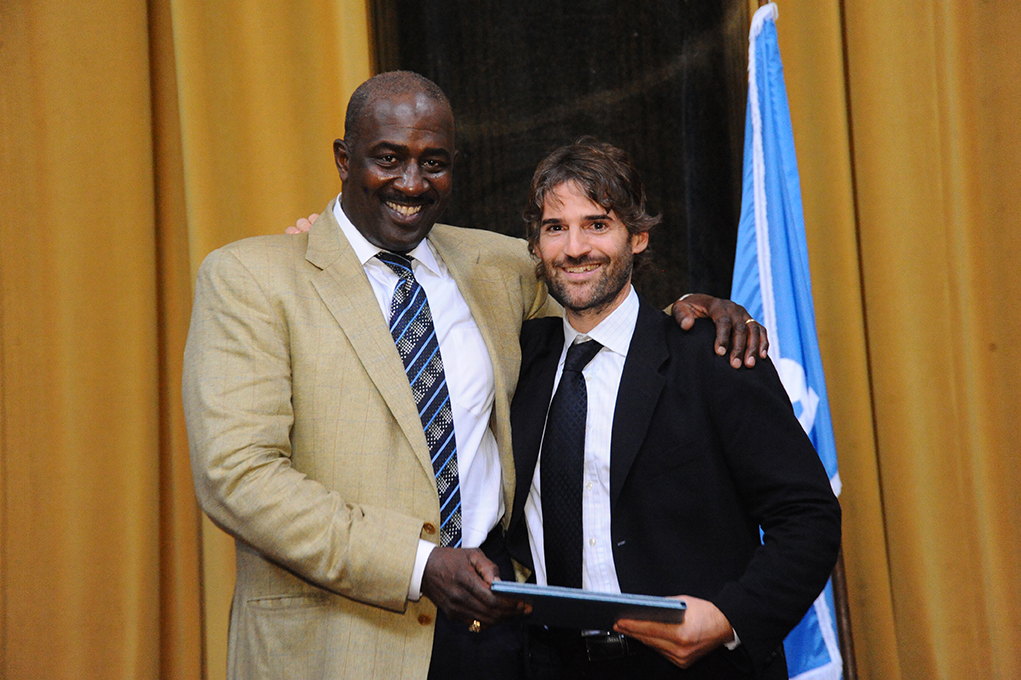
Gregory Moore (left), co-chair of The Pulitzer Prize Board, presents the 2012 International Reporting Prize to Jeffrey Gettleman of The New York Times.
Winning Work
One couple's 388-day ordeal--and their unlikely saviors.
A fluke of the wind: When Paul and Rachel Chandler's small sailboat drifted off course and was hijacked by Somali pirates, the never imagined how long they'd be held captive--or who would ultimately save them.
By Jeffrey Gettleman
“It wasn’t really a pretty night,” Rachel Chandler recalled. Small, sloshing waves were coming from the southeast, and a trickle of wind blew from the southwest. There was no moon, and the stars were shrouded by clouds.
The boat was slowly edging away from Mahé, the main island in the Seychelles archipelago, for Tanga, Tanzania, the beginning of a two-week passage across the Indian Ocean. The wind was pushing them farther north than they’d planned to be. With no ships or land in sight, the Chandlers’ 38-foot sailboat, the Lynn Rival, bobbed along all alone.
Rachel, who is 57, was on watch — it was her turn to do the four-hour shift — and her husband, Paul, was asleep below deck. It was about 2:30 a.m., and she sat in a T-shirt and light trousers at the stern, feeling seasick. Because the wind was so faint, Rachel turned on the sailboat’s small engine, which chugged along at five knots, just loud enough to drown out other noise.
By the time she heard the high-pitched whine of outboard motors at full throttle, she had only seconds to react. Two skiffs suddenly materialized out of the murk, and when she swung the flashlight’s beam onto the water, two gunshots rang out.
“No guns! No guns!” she screamed.
The crack of assault rifles jarred Paul awake. He had been sleeping naked — as he often does on tropical nights — and hesitated before jumping out of the cabin. “The first thing I thought,” said Paul, who is 61, “was pirates.”
Within seconds, eight scruffy Somali men hoisted themselves aboard, their assault rifles and rocket-propelled-grenade launchers clanging against the hull. Paul activated an emergency beacon, which immediately started emitting an S.O.S., and then went up on deck. The men stank of the sea and nervous musk, and they jabbed their guns at the Chandlers.
“Stop engine!” they shouted. “Crew, crew! How many crew number?”
One pirate was particularly concerned about anything flashing, and Paul’s heart sank when the pirate stomped below deck and discovered the emergency beacon, blinking like a strobe, and promptly switched it off. The pirates ordered the Chandlers not to touch anything else, and then they demanded a shower.
This was Oct. 23, 2009. The Chandlers would be held for the next 388 days. In the past few years, loosely organized gangs of Somali pirates, kitted out with Fiberglas skiffs, rusty Kalashnikovs and flip-flops, have waylaid hundreds of ships — yachts, fishing boats, freighters, gigantic oil tankers, creaky old Indian dhows, essentially anything that floats — and then extracted ransom in exchange for their return. As a result, the worldwide shipping industry now spends billions of dollars on higher insurance premiums, armed guards and extra fuel to detour thousands of miles away from the Gulf of Aden, a congested shipping lane just off Somalia’s coast leading to the Red Sea. Navies from more than two dozen countries patrol Somalia’s coast, burning around a million dollars of fuel per day. And yet 2011 is on track to be another banner year for piracy, with more than 20 ships already seized, hundreds of seamen in captivity and the average ransom now fetching upward of $5 million, a fortune anywhere but especially in a country with no government and an economy that has been decimated by decades of war. Of all the thousands of people who have been held for ransom, though, few, if any, would endure as long — and as intimate — an experience behind pirate lines as Paul and Rachel Chandler.
“I fell in love with her voice,” Paul says of his wife. And Rachel does have a beautiful voice, precise and soft. It was London, 1979. He was an engineer for a Brazilian company; she was working for a supplier of windows. They talked on the phone about some construction project, and Paul was hooked.
When they met, Paul discovered that Rachel was tall, actually a couple of inches taller than he was, and thin, with pale skin and a shock of red hair. They dated for a year and a half, married and soon moved to Doha, Qatar, where Paul found some work and where a Palestinian guy named Sammy taught Rachel how to sail. (Paul had been sailing since he was a kid.) When they returned to England a few years later, they started out by buying a share in the Lynn Rival, a modest yacht, if there is such a thing, just big enough for oceanic trips. They never had children, and when they retired a few years ago, they began sailing full time, exploring the Adriatic, the Red Sea, Egypt, India, Sudan, Oman and Eritrea, blogging about their adventures all the way.
It was a dreamy but hardly luxurious life. Paul would catch snapper in the hours before dawn and Rachel would fry them up for lunch. They’d bake their own bread in the yacht’s shoebox-size oven and sleep onboard even when in port, to save on hotel costs. The Lynn Rival is a pretty, teak-trimmed boat, but she’s 30 years old, and life aboard was filled with oiling, cleaning, tightening, rewiring and constantly fixing the cranky toilet.
They were fully aware that the Indian Ocean was a hunting ground for Somali pirates, but Paul is a Cambridge-trained engineer with a hyper-rational way of looking at the world, and he considered the risks of being hijacked to be equivalent to slamming into a partly submerged shipping container in the middle of the ocean — meaning theoretically possible but very remote. Technically, he’s right. A few dozen ships are hijacked each year, out of the tens of thousands that sail past Somalia, putting the odds of being captured at about 0.1 percent. And the Seychelles, a sumptuous vacation spot, were pretty safe at that time, though pirates have since discovered it.
“The idea of getting kidnapped and held for a long time was not in my mind,” Paul said. “It was very hard to believe anybody would be interested in us. And while we were aware of the broader dangers — ”
“It wasn’t deemed high-risk,” Rachel said, finishing his sentence, as each often does
“It was a fluke of the wind that put us where we were,” Paul said.
Once the pirates were in control of the Lynn Rival, they ransacked it, flinging open cupboards, eating all of the Chandlers’ cookies and stealing their money, watches, rings, electronics, their satellite phone and clothes. There were now 10 men; two more pirates had scampered onboard to join the others. After showering and draining the Chandlers’ entire supply of fresh water, they started trying on outfits. A broad-shouldered buccaneer named Buggas, who appeared to be the boss, was especially fond of their waterproof trousers, parading up and down the deck wearing them, while some of the other pirates strutted around in Rachel’s brightly colored pants and blouses.
The pirates lashed their skiffs to the Lynn Rival and reset the course for Somalia. But with the winds so limp, it could take two weeks. Buggas needed a faster getaway, so he made contact with another group of pirates on the Kota Wajar, a Singaporean freighter that was recently hijacked.
“Speak this man!” he shouted at Paul, thrusting the satellite phone into his hand. “They rescue us.”
It was Paul’s introduction to the loose fraternity of Somali pirates and to one of the pirates’ newest strategic advances: the mother ship. Mother ships are larger vessels — also usually hijacked — that serve as floating bases, with weeks of food and fuel aboard. The mother ships prowl the ocean with the faster attack skiffs tied alongside, allowing pirates to commandeer vessels 1,000 miles offshore. Their strike zone is now more than two million square miles of water, which is virtually impossible to patrol. Jay Bahadur, author of a new book, “The Pirates of Somalia: Inside Their Hidden World,” likens the international naval efforts to “a losing game of Whac-a-Mole.”
Paul spoke to the freighter’s Pakistani captain, who had a gun to his head, and arranged a rendezvous. Right as the Chandlers’ boat was about to tie up to the hijacked freighter, a British Navy ship that had been trailing from a distance started to close in. Buggas jammed his Kalashnikov in Paul’s face, telling him in broken English that he had better radio the ship to back off.
“Please turn away or we will be killed,” Paul told the navy, and moments later the British ship slid away.
The Kota Wajar — which already had more than a dozen captured crewmen on board — lumbered 150 miles or so to the Somali coast, where it soon joined several other hijacked ships anchored near the beach, a floating community of hostages. Being around fellow captives gave Rachel a trace of comfort, knowing she and Paul were not totally alone. Almost all hostages are kept on their boats, but Buggas deviated from the standard pirate script and grunted that it was time to go ashore. Rachel remembers stepping into a skiff, petrified, seeing some white faces looking down from a nearby hijacked Spanish fishing trawler and then slamming into a desolate beach.
“I remember it almost being like a shipyard,” Paul said. “It was like a little base.” Dozens of men — all of them carrying guns — were working on the beach with disc cutters, welders and other power tools, preparing a fleet of boats for future hijacking missions.
Right behind the little base were two freshly washed Toyota trucks parked in the sand. As they stepped in, Rachel saw Buggas wearing Paul’s Rolex and commented, “Oh, look, he’s wearing your watch.” One of the men sitting in the front seat overheard her and confronted Buggas, who then sheepishly handed the Rolex back to Paul. The man, who spoke English, was better-dressed than Buggas and wasn’t armed. He had an educated air about him, the Chandlers said, and they recalled this moment as the first of their endless attempts to decipher in whose hands their fate really rested.
“We didn’t know who these guys were,” Mohamed Aden said of the pirates who took the Chandlers. “They were nobodies, people we call cockroaches, gangsters, new to the system. It was the first time they had brought anybody to land, the first time they had ever captured anybody. It took us six months to establish who they were.”
Aden, who is better known by his childhood nickname, Tiiceey, is the president of the Himan and Heeb administration, a small, clan-based government recently established in central Somalia. Two decades of unabated chaos has resulted in these tiny statelets popping up across the country. By latest count, there are more than 20, formed by members of the same clan — the one fundamental element of Somali society that has not been totally eviscerated by civil war. There is the internationally recognized Transitional Federal Government in Mogadishu, Somalia’s bullet-pocked capital, which has received millions of dollars in support from the United States and the United Nations. But the T.F.G. was assembled outside the country and doesn’t have much grass-roots support. It barely controls Mogadishu and is completely irrelevant in central Somalia.
Aden works from a shell of a house in Adado, a trading town about 200 miles from the coast. He dresses and talks like a rapper, with Kangol caps and baggy pants and an iPhone clipped to his hip. He is a naturalized American and spent years in Minneapolis running a small health-care company before being drafted by elders in his clan, the Saleban, to spearhead the Himan and Heeb administration. In 2009, I spent two weeks observing his efforts to build a government from scratch, complete with a functioning police force, environmental laws and schools. But Aden had, and still has, a pirate problem. Technically, Himan and Heeb’s jurisdiction extends to the coast, but Aden has no authority there; the area is controlled instead by pirate gangs, most of them fellow Saleban.
“I don’t have the firepower to take these guys on,” Aden said. “I’d like to, but I can’t.”
Instead, Aden has become chummy with some of Somalia’s more notorious pirates, many of whom take nicknames like Son of a Liar, Red Butt, Red Teeth and Big Mouth. Big Mouth is considered one of the founding fathers of Somali piracy and recently branched into the business of distributing khat, the leaf millions of Somalis chew for a pleasant, mild high that provides a temporary reprieve from their bleak reality. Together, Aden and Big Mouth rebuilt Adado’s airstrip to bring in more khat, which has become a major source of income for Aden’s small administration (Aden taxes each flight) and Big Mouth’s growing enterprise.
“What am I going to do?” Aden said, with a smile. “I’m trying to develop my area.”
After the Chandlers were taken, Aden went straight to Big Mouth to find out who the abductors were, but even Big Mouth didn’t know. In recent years, as ransoms have climbed, thousands of destitute, uneducated Somali youth have jumped into the hijacking business, and all anyone in Adado knew was that a young upstart named Buggas had taken the Chandlers to a desiccated smudge of a town called Amara, near the coast, and that Amara locals were backing him up. Local support is crucial, because holding hostages — especially for a long period — can become expensive. You need to keep them fed and most important, heavily guarded — so a rival pirate gang or Islamist militia doesn’t rekidnap them. Paul figures it was costing Buggas nearly $20,000 a month to hold them hostage: with around $300 per day spent on khat; $100 a day on goats; maybe a couple hundred more for tea, sugar, powdered milk, fuel, ammunition and other supplies. Then there’s payroll— in the Chandlers’ case, cash for the pirate raiding party and their 30 henchmen who rotated as guards on shore. On top of this come the translators, who charge a hefty fee to interact with the hostages and negotiate a ransom.
Pirates tend to operate on credit — borrowing all these resources from community members or other pirates, who will then get a cut, or in Somali, a sami, once a ransom is delivered. In Amara, rumors quickly began to fly that the Chandlers were rich — possibly even British M.P.’s — and were therefore the ideal sami opportunity.
“People were saying it would take just two months for a ransom and then they would get double,” Aden remembered. “They invest $5,000, they get $10,000 back. That’s a good return, right?”
Amara lies on a wind-raked plain, surrounded by sand dunes and scrub brush bristling with bone-white thorns. I passed through there in 2009 and remember hundreds of squat, little huts packed together, an incongruously tall cellphone tower and sandy roads littered with donkey dung. Buggas moved the couple around a lot, sometimes locking them in houses inside Amara, where they could hear goats bleating or children playing just outside the gates, other times setting up crude camps in the bush with plastic tarps stretched between the trees.
For Rachel, the days all blur together. She would get up around dawn, when the desert was just bearably cool. Paul would sleep a little later. They would try their best to ingest a breakfast of goat liver and then wash up with a jerrycan of well water. They would read the few books they were allowed to grab from the yacht and write in their diaries. Paul tended to focus on the here and now: “Overcast, a little wind,” reads one entry in neat blue ink. “Another sleepless night” was another. Rachel tended to be more introspective with longer entries in perfectly formed script. The smells they remember are sweat, the stinky perfume the pirates would douse themselves with and the scent of the charcoal, which had been soaked in diesel. Sometimes, in the morning, if they felt motivated, they did yoga together; once Paul turned around to see half a dozen gunmen earnestly following along. It seemed everyone was horribly bored.
“I was struggling,” Rachel told me in May, as she sat in her carpeted living room in a small home in Dartmouth, England, where the Chandlers have been living since being freed. “I’d get through the early part of the morning, and then the heat and humidity would build up, and I’d be lying there thinking, I don’t want to read, I don’t want to do anything, how am I going to get through the next 10 minutes, let alone 10 hours, let alone 10 days?”
Lunch was a mound of plain spaghetti, typically served in nauseatingly large portions. Then nap time and maybe laundry. Sweetened boiled beans and rice for dinner. They didn’t interact much with the pirates, who would occasionally bark at them to borrow their scissors or listen to their radio. Then sleep.
Buggas appeared to be calling all the shots, which dismayed the Chandlers because he seemed uneducated, temperamental and crass. They kept hoping some wiser, more experienced pirates would show up and realize they were not rich and strike a deal for a more modest ransom. But that never happened. Buggas was supremely confident that he was on the verge of making millions — he had two white people in his hands, after all.
“British government pay big money, no problem,” he kept saying.
“He wasn’t an intelligent thug,” Rachel said. “He was just a thug.” She closed her eyes and drew a composite sketch of him in her mind: around 33 years old, fairly thickset, round, chunky face, low forehead, small eyes, fleshy lips that he tended to leave open. He was constantly threatening them: “No money, you dead, kill you.”
The problem was that the Chandlers didn’t have much money. They had spent around $75,000 to buy and fix up the Lynn Rival, and they owned a two-bedroom apartment in Tunbridge Wells, a London suburb, worth around $250,000, and some retirement accounts, which brought the total to $500,000. The pirates scoffed at such petty cash and demanded $7 million and told Paul to find a negotiator.
“Negotiator?” Paul said. “I don’t have a negotiator.” He suggested the pirates call Rachel’s older brother, Stephen Collett, a retired farmer back in England. Stephen, who is writing a book about the kidnapping, politely declined to discuss details about the 200 or so calls he made to the pirates. He still seems shaken up. “How would you feel if you got a phone call from a guy who says, ‘I got your sister and her husband at gunpoint so you better send us everything you got and more and you’ll be lucky if you get them back’?
The Chandlers soon deduced that escape or rescue was unlikely. The pirates operated with total impunity in their patch of Somalia. People were always coming by the camp — young men, young women and, as Rachel put it, “elderlylike characters” who would sit for hours with the gang, talking, laughing, leisurely sipping little cups of tea, making it abundantly clear that the whole community was complicit and that no one would help them. For Paul, who is unfailingly polite and gentle, a man whose voice rarely clears a whisper, this is what brings out the bitterness.
“Everybody was in on it,” he said. “I’m angry at Somali society. I’m angry at a community.”
In a rough, industrial part of northeast London, next to an auto-body shop and behind an unmarked door, is Universal TV. It includes a suite of offices and a bare-bones TV studio with a black velvet curtain and a giant map of Africa. Veiled Somali women drift in and out, and prayer-capped Somali men make the run to the gas station up the street to get Fanta and potato chips. If there is any nucleus of the Somali diaspora, any glue holding together a people who have been scattered by war and settled everywhere from Sydney to Minneapolis, it is Universal TV, which broadcasts news and other shows worldwide in Somali and is seen as keeping a sense of nationhood intact while Somalia sorts out its mess.
Ridwaan Haji Abdiwali is one of Universal’s on-air news anchors, a 28-year-old refugee who was hit by a stray bullet during Somalia’s civil war before fleeing to England seven years ago. He has thoughtful, hooded eyes and his own weekly television show called “Have Your Say.” More than anything, he is deeply embarrassed about his homeland, which has lurched from crisis to crisis since 1991, when clan warlords tore down the central government and then fought among themselves.
“It’s a constant source of sorrow,” Abdiwali said. “I feel guilty when I see my country. No education, no peace, no international relationships, no economy.”
But the hijacking of the Chandlers was especially shameful. It was all over the news, perfect tabloid fodder, one of the biggest-running stories of the time — two pensioner Brits “on the trip of a lifetime” now in the hands of Somali gunmen. Abdiwali remembers sitting with other students in the canteen at the University of Westminster when yet another Chandler update came on TV. “Oh, my God,” his friends groaned about the pirates. “They’re morons, they’re criminals.”
Abdiwali started focusing his hourly show on the Chandlers and even called up Buggas and his fellow pirates and berated them on the air. “They’re not rich ship owners,” Abdiwali told the pirates.
“These people are innocent and you should release them.” His initial strategy, he told me, was to heap shame on the pirates for kidnapping two elderly people and to show England that not all Somalis were criminals and morons.
Abdiwali and some others at Universal TV then turned to Abdi Shire Jama, who was a freelance interpreter in London and a talented songwriter. Jama thought a music video would help spread the word, so he produced a song called “Release the Couple,” soon broadcast on Universal and YouTube. It begins with a Somali kid with a British accent saying, “I hope this message gets to the people who are responsible for holding Rachel and Paul Chandler.” Then, after a burst of synthetic drums and some squeaky Somali music, five Somali singers break into song.
“Our people fled their homes. . . . The host countries did not look at the color of our skins. . . . We need to show our debt to them, for it is the donkey who does not acknowledge the debt.”
But Jama’s song also captures an ambivalence many ex-pat Somalis feel about piracy. While it implores the pirates to release “Rachel and her husband, Paul, and his wife,” it also says: “This song is to remind you to fight those foreign vessels which come to illegally fish from our seas and to dump poisonous wastes in our seas. This is national defense.”
After Somalia’s central government collapsed 20 years ago, the 1,900-mile coastline became an unpatrolled free-for-all, with foreign fishing trawlers descending to scoop up Somalia’s rich stocks of tuna, shark, whitefish, lobster and deep-water shrimp. With no authorities to fear, the fishing boats were especially unscrupulous and used heavy steel drag nets that wiped out the marine habitat for years. Somali piracy was born when disgruntled fishermen armed themselves and started attacking the foreign trawlers. They soon realized they could attack any ship and get a ransom for holding the crew hostage.
“In the beginning, the pirates had a lot of support,” explained Kayse Maxamed, a Somali who works in mental health in Bristol and who organized a “Save the Chandlers” rally in front of a mosque in early 2010. “Everybody liked them. They represented the Somali Navy.”
The pirate gangs played on this sentiment, taking names like “Somali Marines,” “Defenders of Somali Territorial Waters,” “Central Somali Coast Guard” and “Ocean Salvation Corps.”
But the kidnapping of the Chandlers made many otherwise sympathetic Somalis realize the pirates were, at their most elemental level, simply seafaring extortionists who were giving all Somalis a bad name. Maxamed, Abdiwali and Jama said they had absolutely no trouble getting hundreds of other British Somalis to join their cause. At one big Save the Chandlers meeting in Camden in early 2010, someone suggested that every member of Britain’s Somali community, estimated to number anywhere from 100,000 to 500,000, contribute 10 pounds toward the ransom. But before this could get off the ground, the British Foreign Office contacted several community leaders, including Maxamed, and reminded them that British government policy was never to pay ransom. Maxamed and others said they were forced to drop the idea, which meant that the situation in Amara would drag on.
By this point, Buggas and his gang were becoming extremely agitated. A small airplane had been buzzing over their camp — possibly British secret service — and the Chandlers’ family in England, now three months into this, was refusing to negotiate with the pirates.
“Family no speak,” Buggas kept grumbling. “Family no speak.
One day he marched to the entrance of the lean-to where the Chandlers were sleeping, a messy bush camp with mattresses lying in the dirt, ammunition tins carelessly baking in the heat and plastic sheeting stretched overhead.
“You go, one, one,” Buggas ordered. “Paul, bags, go.”
Buggas’s plan was to separate the Chandlers to make them as miserable as possible so they would urge their relatives to cough up the cash. But the Chandlers refused and roped their arms around each other. It was more than just the fear of being lonely, Rachel explained. “We didn’t want to die alone,” she said. “At the time, we couldn’t see how we were going to get out of this place.”
Buggas snatched up his gun and blasted three shots in the air.
“Come out!” he yelled. “Come out!”
The Chandlers clutched each other even tighter.
“You crazy,” said one of the guards, whom the Chandlers had nicknamed Mr. Fastidious for the exacting way he always folded up his ratty little bed roll.
Paul snapped back, “You crazy.”
Buggas raced over to a tree and yanked out a root. With a big knife he stripped it smooth. He started ferociously whipping the Chandlers, aiming for Rachel’s head. They crumpled to the ground, and the other pirates pulled them apart. Until this point, though they had been threatened many times with loaded assault rifles, the Chandlers had never been beaten. It seemed that the pirates were reluctant to even touch them — until now.
As several gunmen dragged Paul away, he turned around to catch a glimpse of Rachel on her knees, screaming: “Bastards! Murderers!” That’s when Buggas ran up to her and smashed the back of his rifle into her jaw, shearing off a tooth.
Thus began three long months of solitude. The Chandlers were stuck in little huts in Amara only a few miles away from each other but weren’t allowed to communicate. Paul tried to keep himself occupied, sketching in his journal and making a phrase book of Somali words — “bowl,” “banana,” “knife,” “bald.” There was one man, the cook, who occasionally spoke to him. “I did have moments when I sat in that chair and cried,” Paul said. “I knew it wasn’t productive. I was just treating myself to a few moments of it. I knew I could survive.”
At this point Paul began his “begging calls” to relatives. While Rachel had qualms about leaning on family members, Paul said he saw the whole ordeal “purely as a commercial transaction. I would pay every penny I could scrimp, borrow or steal to get me and Rachel out of there.”
But even accessing their savings was complicated. The Chandlers were officially under duress, the family’s solicitor informed Stephen, and therefore not considered mentally fit to hand over control of their accounts.
Paul fumed on the phone to his brother-in-law Stephen: “Tell the solicitor to use the money for a gravestone and bring it out here himself!” He told me: “I knew we weren’t going to get out without money being paid. It’s as simple as that.”
Paul dealt primarily with a translator named Ali, who was negotiating with Stephen. Ali didn’t fraternize much with the guards, who were mostly in their early 20s. Ali was a bit older and wore crisp button-down shirts, sunglasses, a gold wristwatch and gold chains. According to lawyers who handle piracy cases, pirate translators tend to be educated men from within the community who work for several different pirate gangs and are typically paid a flat fee, which can reach $200,000 — they are essentially white-collar pirates.
Rachel, meanwhile, was completely isolated. Buggas had instructed the guards not to talk to her. Rachel’s cook would throw down a bowl of food and then just pad away. She started talking to herself and chanting, sometimes mimicking the call to prayer. “Shut up or I beat you!” Buggas would yell. It tormented her to think that Buggas and his gang were actually going to profit from her misery. She wanted to deny them that and felt spite bubbling up inside her. She was completely powerless to control her fate — except in one way. She had hidden a couple of razor blades in her hut and fantasized about slitting her wrists at night so the pirates would wake up to find her sprawled in a pool of blood.
“But the problem was I wouldn’t be able to see their faces,” she ultimately realized. “So what’s the point of that?”
In late January, a doctor, Abdi Mohamed Elmi, known as Dr. Hangul, was allowed to see the Chandlers. Mohamed Dahir, a Somali journalist, tagged along and filmed the visit, selling it to Sky News in Britain. Dahir was shocked at how bad Rachel looked.
“She was sitting under a tarp in a bush camp, completely out of it,” he said. “She had gotten even skinnier. She had trenches under her eyes. She kept saying: ‘I need my husband. I want to see my husband before I die.’ ”
Mohamed Dahir’s footage deeply unnerved the Somali community in Britain. People began to worry that the Chandlers might die in captivity. Of course, the pirates wouldn’t intentionally kill them and spoil their chances of a ransom. But as the Somali diaspora knew, the desert is unforgiving.
Abdiwali and the other members of the informal Free the Chandlers coalition began to recalibrate their strategy. It was time to play the clan card, they decided. Somalia is one of the most homogeneous countries on the planet, with nearly everyone sharing the same religion (Sunni Islam), the same language (Somali), the same race and same ethnicity, but Somalis are divided into a dizzying number of clans. Most areas, except for the big towns, are dominated by a single clan.
Though pirates aren’t totally responsive to clan structure, they are not immune from it either. Clan elders still have some authority across Somalia — even if they don’t have the militias to back it up — and they can marshal community pressure and make it difficult for pirates to continue to operate in their areas.
Abdiwali used his television show to focus pressure on the Saleban, the dominant clan in Amara and the clan of Buggas and his men. “I said this could be bad for your clan,” remembered Abdiwali, who is from a different clan. “Actually,” he corrected himself, “this is sensitive. I didn’t actually say ‘clan.’ I said this could be bad for the name of your area, because if I say ‘clan,’ some people are going to say, ‘Ridwaan, you hate this clan.’ ”
Before long, the pirates were threatening to kill Abdiwali. But he was no stranger to death threats. He had been harassed countless times before by the Shabab, an Islamist militant group in Somalia that routinely beheads people, so he shrugged off the pirates’ threats.
As the weeks passed and more British Somalis found themselves drawn into conversations about the Chandlers, in gathering places like the Blue Ocean restaurant in Shepherd’s Bush or the Euro Discount Shop in Bristol (where bundles of khat are sold from cardboard boxes on the floor), the talk inevitably turned to the issue of clan.
“There was this huge debate,” recalled Mursal Kadiye, a Saleban businessman who has been involved in several hostage negotiations, including helping resolve the hijacking of the Sirius Star, a Saudi supertanker seized with $100 million of oil inside. “People were saying: ‘How can you guys let them do this? Don’t you have political leaders? Don’t you have clan elders? How can you let them hold two elderly people in Saleban territory?’ It was embarrassing.”
For Kadiye’s brother, Dahir Kadiye, a former taxi driver who recently set up a branch of an international security company in Mogadishu, it was even worse. Dahir’s teenage son, Yusuf, was being teased at his school in London. Kids were calling him pirate.
Dahir Kadiye started reaching out to fellow clansmen in Amara and Adado, warning them that if the Chandlers died, the world wouldn’t just hold Somalia responsible; it would hold the Saleban responsible. In Amara, elders were hitting a similar note. Ali Abdi, who owns a small general store, tried to persuade the pirates that keeping the Chandlers was now becoming a risk for the entire community. “
A lot of people came, including a father whose son was a pirate, and told the pirates that these people might die in their hands,” Abdi remembered.
But Buggas and the gang didn’t budge. They needed their money. Their operating expenses were growing daily, and by this point they had many creditors — some of them heavily armed — who were expecting to be paid back.
By the spring, after the Chandlers had spent six months in captivity, local opinion was turning against Buggas and his crew. “People were making fun of the pirates,” said Mohamed Dahir, the journalist. “Everybody was saying they have this big debt and they’re holding an old couple who don’t have any money.” Dr. Hangul, the physician who made that first visit with Dahir, said, “The pirates were afraid to even walk around Adado.”
Dr. Hangul also told me that Buggas was not actually in charge. “He was just the chief of security, chief of the militia,” he said. “He was working for three or four investors who were making the decisions.”
In many Somali piracy cases, a committee of investors or creditors fronts the cash for the piracy mission, and it’s up to the head gunman to deliver a tidy profit. But finally it seemed to dawn on Buggas and his creditors that they weren’t going to make much of a profit on this one. Stephen and Ali were negotiating a payment under a half-million dollars, all the Chandler family could afford and, for the pirates, a humiliating fraction of what corporate shipowners typically pay. (One pirate gang operating not far from Amara made $9.5 million last year by hijacking a Korean oil tanker called the Samho Dream.)
Stephen started looking into chartering a plane in Nairobi to package the money and deliver it to Buggas. Because of the profusion of hijackings over the past several years, several companies now specialize in making money drops.
Buggas agreed to reunite the Chandlers while the arrangements were being finalized. As we sat in her living room, Rachel described seeing Paul for the first time in three months as he stepped out of a truck with his dusty bags to move back into her hut. Her usual composure cracked for a moment, and she began to cry.
“I thought, My goodness, he looks so old and frail,” she said. “But then he smiled. And it was just Paul’s smile. Even Buggas was standing benevolently by and saying, ‘Are you happy?’ Can you believe it?”
In mid-June, Ali the translator showed up at the bush camp with a typed-out sheet of paper, in English, essentially a pirate contract. “It’s standard pirate procedure,” Stephen told me. The letter stipulated that the Chandler family would pay $440,000 and “the pirates” — this word was used in the contract — would promptly release them. Ali signed the contract and faxed it to Stephen, who then spoke to Rachel. “The plane is on its way,” Rachel remembers Stephen saying about the aircraft that would drop the money. “See you in Nairobi soon.”
“Our hopes were sky high,” Paul told me.
But then nothing happened. The Chandlers stayed in their bush camp. When they asked their guards what was going on, all the pirates would say was, “No fly today.” Or tomorrow. Or the next day. Dejected, they wondered whether Stephen got cold feet and backed out.
When Mohamed Dahir, the journalist, returned in July, he whispered to the Chandlers that the money drop had been made; the pirates received nearly $450,000. Rachel exploded. “Bastards!” she yelled. “You got the money!”
Around this time, Aden, the president of the Himan and Heeb administration, was trying to cut his own deal. He was just on the verge of attracting aid groups — word was beginning to spread that Adado was an oasis of stability in otherwiseviolent central Somalia — and the last thing he needed was his little domain to be associated with the imprisonment of Western hostages. He raised $50,000 from local businessmen and says he nearly persuaded Buggas and the gang to take it. But then some people called from Nairobi and London and told Buggas to hold out for more. Aden wouldn’t be specific about who these meddlers were — maybe he didn’t know. But often in pirate cases, strangers — typically Somali businessmen — insert themselves into the delicate negotiations, offering their services to the families of captives or to the pirates in hopes of getting a slice of the ransom.
“This is a funny business,” Aden said. “Everybody wants to get a benefit for themselves and not for Paul and Rachel.”
By this point, Paul was sick of playing the good hostage. When the gunmen would ask to use his radio or deck of cards, he’d simply refuse. What were they going to do to him, anyway? He remembers one night when the gang had just received some new cellphones, and while he was trying to go to sleep, they were making a racket. He stood up in his underwear and yelled, “Shut up!” After a stunned silence, one of them said weakly, “Problem?”
In November, Dahir Kadiye, whose son was teased in school, decided to go to Adado. His plan, he said, was to use the contacts he had made through his small security company to bring the Chandlers home. But what exactly happened after that remains murky. Aden and several others told me emphatically that Kadiye, along with Dr. Hangul and other Saleban elders living abroad, cobbled together several hundred thousand dollars to pay off the pirates. The money was collected secretly, Aden said, and a rich Somali woman living in the Persian Gulf contributed $100,000 to make sure the deal went through.
Dr. Hangul has a somewhat different version. He recently told me that the Somali government, through Kadiye, paid the pirates several hundred thousand dollars after Somalia’s president, Sheik Sharif, met with the British prime minister, Gordon Brown, in March 2010. Somali officials wouldn’t comment on whether they paid a ransom. A British diplomat familiar with the Chandler case said that his government “doesn’t pay ransom, doesn’t condone the paying of the ransom and doesn’t encourage the paying of ransom,” adding that if the Somali government “did contribute to the ransom — and I heard that too, though I can’t say it’s a fact — it certainly wasn’t the result of any meeting or conversation with us.”
Kadiye vehemently denies that any additional money was paid. He says that all he used to lubricate the final deal was “systematic community pressure.”
The Chandlers said they had the impression that a second payment was made. One day, Buggas came up to them, when there were no other gunmen in earshot, and said something like, “My Somali family give two hundred,” referring to his clan. (The pirates always spoke in thousands.) On Nov. 13, 2010, more than a year after they were taken, the Chandlers were told to pack their bags. They climbed into the Toyotas, and it seemed as if the whole village of Amara piled into the sandy road to wave goodbye. “We weren’t letting our hopes rise too high,” Paul said. “But we had this sense.”
They drove for hours, heading west, deep into the desert. Buggas sat in the back of their truck, cheeks bulging with khat, a machine gun on his lap. His last words to them were, “Rachel, you go London tomorrow.”
The next day at dawn, they stepped out of the truck and saw a Somali man approaching them. He was wearing a flack jacket and a baseball cap and had a British passport in his hand. He said “I’m Kadiye, and I’ve come to take you home.”
“I thought, What’s this guy doing here?” Rachel said. “We had no idea who he was.”
But then Kadiye hugged them. “It was just extraordinary, this Somali hugging us,” Rachel recalled giddily. “I just thought, this guy is for real, he must be a kind man, because we had not experienced that sort of true kindness that you can recognize in that way, somehow, in a hug.”
It was at that instant, with Kadiye’s arms around them, that the Chandlers realized they were finally free. But Kadiye said they were still in danger — other pirates or bandits might be lurking around, and they needed to move fast. They finally made it to Adado, where Aden served them tea, toast and eggs — “a full English breakfast,” he joked — and then some officials with Somalia’s transitional government helped fly the Chandlers to Mogadishu and on to Nairobi, Kenya.
After they arrived in London a few days later, they slept a lot. Paul found it therapeutic to immerse himself in simple tasks, like checking the air in his tires and getting a new ATM card. To his distress, he learned that his 99-year-old father died while they were in captivity and now, in addition to reclaiming their affairs, they had to straighten out his dad’s too.
But they were energized by an especially bright and surprising piece of news: the Lynn Rival had not simply drifted away to disappear into the ocean; the British Navy had recovered her and brought her back home. She’s now in a boatyard near Dartmouth, a quaint English town full of fudge shops, the opposite end of the universe from Somalia. That country seems to only go from bad to worse. A famine is sweeping the southern regions, Islamist militants have recently gone on another beheading spree and the pirates are growing more ambitious and more violent. In September, they struck on land in Kenya. In the middle of the night, they zoomed up in a speedboat to a fancy beach resort in Kiwayu, burst into a bungalow and attacked a British couple, killing the husband and then bundling up the wife and disappearing with her. Recent reports indicate they are now holding the woman hostage hundreds of miles away from the Kenyan border, deep inside Somalia, in — it turns out — Amara. Kadiye says he’s trying to get involved.
The Chandlers insist they have had no lasting damage from the experience, physical or psychological, except, in Paul’s words, “We’ve spent 2 percent of our lives in Somalia.”
Shortly after they returned, the Chandlers agreed to a series of interviews with a London tabloid and a TV station for around $275,000 and then started working on a book, “Hostage,” which was published last month in England. They did this with one goal in mind, they told me: make enough money to pay back their families and fix their boat, which still has a bullet hole in the boom. But spending their time in such a sedentary way is clearly frustrating to them. They had planned to while away these years seeing the world, and they don’t know many people in Dartmouth. Their community is each other and perhaps the wider world of equally passionate sailors who have devoted their lives to floating on the ocean
Profiting from their ordeal, Rachel says, is “just a means to an end, and the end will be getting back on the Lynn Rival,” though they are going to stay out of the Indian Ocean for the time being. The Caribbean will probably be their first trip, next summer. “If you’ve got a nice breeze and you’re just creaming along and if you’ve got a clear sky and nobody else is out there,” she said, her voice trailing off. “I just love it. I do feel truly that I’m on my own, this little speck in our universe.”
By Jeffrey Gettleman
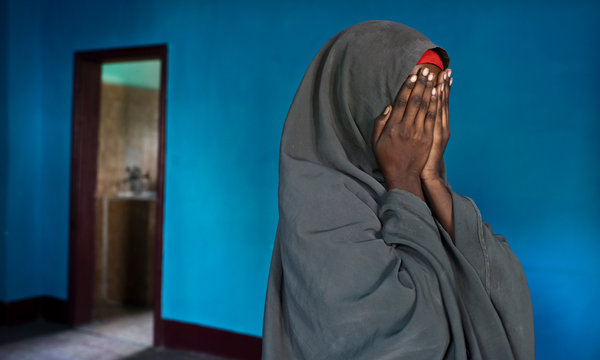
A rape victim in Mogadishu hid her identity. Aid workers say there has been a free-for-all of armed men preying upon women and girls displaced by famine. (Sven Torfinn)
DADAAB, Kenya — The people start trudging in at dawn, more than a thousand every day, exhausted, sick and starving, materializing out of the thin desert air to take their places at the gates of the world’s largest refugee camp, here in northern Kenya.
They are fleeing one of the worst droughts in Somalia in 60 years and many have walked for weeks through an anarchic landscape replete with bandits and militants but little food.
By the time they get here, many can barely stand or talk or swallow. Some mothers have even shown up with the bodies of shriveled babies strapped to their backs.
Abdio Ali Elmoi clutches her son, Mustapha, whose eyes are dimming. Her face is grooved with grief. She has already lost three children to gaajo, or hunger, a common word around here.
“I walked all day and all night,” she whispered, barely able to speak. “Where I come from, there is no food.”
Somalia is once again spewing misery across its borders, and once again man-made dimensions are making this natural disaster more acute.
The Islamist militants controlling southern Somalia forced out Western aid organizations last year, yanking away the only safety net just when the soil was drying up and the drought was coming. Only now, when the scale of the catastrophe is becoming clear, with nearly three million Somalis in urgent need and more than 10 million at risk across the parched Horn of Africa, have the militants relented and invited aid groups back. But few are rushing in because of the complications and dangers of dealing with a brutal group that is aligned with Al Qaeda and has turned Somalia into a focal point of American concerns on terrorism.
The Somalis are not waiting. Tens of thousands, possibly even hundreds of thousands, are now fleeing to Kenya and Ethiopia for help, but the Kenyan government says it is overwhelmed and has been blocking the United Nations from opening a new $15 million camp here in Dadaab that could help absorb the influx.
Everything is in place to house 40,000 more refugees — new water towers, new latrines, new office blocks and perfectly straight rows of new mud-brick houses that look sturdy enough to live in for years. But that is precisely what the Kenyans fear.
As many as 380,000 people already live in the amalgam of camps that make up Dadaab (it was intended to hold 90,000), and the Kenyans worry that Somalis will continue flocking here and never go home, given the perennial turmoil in their country since the central government collapsed in 1991.
“Personally, I’ve done what I could,” said Gerald Otieno Kajwang’, Kenya’s immigration minister. “But the numbers coming in are too large that they threaten our security.”
The Kenyan government has been facing intense pressure to open the new camp, and several Western aid officials contended that the Kenyans were simply trying to extract more money from Western allies before relenting. On Friday, Kenyan officials indicated that the camp would open soon, but the delay has stranded thousands of refugees on the outskirts of Dadaab in the desert, increasingly far from hospitals, clean water or latrines, many with sick children curled up under trees.
“It’s shocking,” said Alexandra Lopoukhine, a spokeswoman for CARE, an aid group working in Dadaab.
Those who make it to one of the few hospitals in the camps might have a chance. The pediatric ward in the Dagahaley section is a fluorescent-lighted purgatory. Dozens of wizened children lie on rough wool blankets — nurses say probably fewer than half will make it — their skin slack, their eyes glassy, their heads far too big for their bodies. Many have IVs taped to the sides of their skulls.
“Vascular collapse,” explained a Kenyan doctor. “We couldn’t find a vein anywhere else.”
Isak Abdi Saney, a destitute farmer, is on a death watch. He gently lifts up the shirt on his 6-month-old son. Every rib shows, beneath skin as translucent as rice paper. Every breath looks as if it could be his last.
Because it is so difficult and dangerous for outsiders to even visit areas controlled by the Shabab militant group, it is hard to gauge the full depth of this drought. Somalia seems to be perpetually on the brink. With a shattered economy, no functioning central government and aid flows blocked, countless Somalis starve every year.
But according to a famine monitoring program financed by the United States, “over the past year, the eastern Horn of Africa has experienced consecutive poor rainy seasons, resulting in one of the driest years since 1950-1951 in many pastoral zones.”
The years of conflict — and recent increases in food prices — have depleted Somalia’s ability to withstand it. Thousands of people are leaving relatively uneventful rural areas to seek refuge even in Mogadishu, Somalia’s bullet-riddled capital, which has experienced a mass exodus for years because of fighting between the shaky government and Islamist militants.
The route to Dadaab, which lies about 50 miles inside Kenya’s border, is especially perilous, winding through one of the most unforgiving environments in the world. Refugees have been marauded, raped and killed by the various armed groups that haunt the land. Most arrive here penniless and demoralized. Many parents said they buried children along the way.
Some die just within reach of finally getting help. Right in front of a reception area at the camp are dozens of freshly dug graves.
Once proud young men find themselves sitting in the dirt, waiting to be registered. Life as a refugee is humiliating, especially in a culture that prizes independence. The first step is clawing through a crowd to get a cup of flour and some glucose biscuits. Then comes registration, getting fingerprinted twice, photographed, logged in, cataloged. Kenyan government workers scurry around, wearing blue surgical masks and polo shirts that say “Refugees Are Real People.”
Somali refugees are typically not allowed to work in Kenya, and without special permission they are not supposed to leave the camp. Dadaab is a place to warehouse people, often for years. Aid workers predict the numbers here could soon swell to half a million, sprawled across miles of scrub brush.
“I never thought I’d lose all my cattle,” said Abdi Farah Hassan, who looked visibly uncomfortable in line to be photographed. “I never thought I’d be a refugee.”
Reuben Kyama contributed reporting from Nairobi, Kenya, and Mohamed Ibrahim from Mogadishu, Somalia.
By Jeffrey Gettleman
MOGADISHU, Somalia — The girl’s voice dropped to a hush as she remembered the bright, sunny afternoon when she stepped out of her hut and saw her best friend buried in the sand, up to her neck.
Her friend had made the mistake of refusing to marry a Shabab commander. Now she was about to get her head bashed in, rock by rock.
“You’re next,” the Shabab warned the girl, a frail 17-year-old who was living with her brother in a squalid refugee camp.
Several months later, the men came back. Five militants burst into her hut, pinned her down and gang-raped her, she said. They claimed to be on a jihad, or holy war, and any resistance was considered a crime against Islam, punishable by death.
“I’ve had some very bad dreams about these men,” she said, having recently escaped the area they control. “I don’t know what religion they are.”
Somalia has been steadily worn down by decades of conflict and chaos, its cities in ruins and its people starving. Just this year, tens of thousands have died from famine, with countless others cut down in relentless combat. Now Somalis face yet another widespread terror: an alarming increase in rapes and sexual abuse of women and girls.
The Shabab militant group, which presents itself as a morally righteous rebel force and the defender of pure Islam, is seizing women and girls as spoils of war, gang-raping and abusing them as part of its reign of terror in southern Somalia, according to victims, aid workers and United Nations officials. Short of cash and losing ground, the militants are also forcing families to hand over girls for arranged marriages that often last no more than a few weeks and are essentially sexual slavery, a cheap way to bolster their ranks’ flagging morale.
But it is not just the Shabab. In the past few months, aid workers and victims say, there has been a free-for-all of armed men preying upon women and girls displaced by Somalia’s famine, who often trek hundreds of miles searching for food and end up in crowded, lawless refugee camps where Islamist militants, rogue militiamen and even government soldiers rape, rob and kill with impunity.
With the famine putting hundreds of thousands of women on the move — severing them from their traditional protection mechanism, the clan — aid workers say more Somali women are being raped right now than at any time in recent memory. In some areas, they say, women are being used as chits at roadblocks, surrendered to the gunmen staffing the barrier in the road so that a group of desperate refugees can pass.
“The situation is intensifying,” said Radhika Coomaraswamy, the United Nations’ special representative for children and armed conflict. All the recent flight has created a surge in opportunistic rapes, she said, and “for the Shabab, forced marriage is another aspect they are using to control the population.”
In the past two months, from Mogadishu alone, the United Nations says it has received more than 2,500 reports of gender-based violence, an unusually large number here. But because Somalia is a no-go zone for most operations, United Nations officials say they are unable to confirm the reports, leaving the work to fledgling Somali aid organizations under constant threat.
Somalia is a deeply traditional place, where 98 percent of girls are subject to genital cutting, according to United Nations figures. Most girls are illiterate and relegated to their homes. When they venture out, it is usually to work, trudging through the rubble-strewn alleyways wrapped head to toe in thick black cloth, often lugging something on their back, the equatorial sun burning down on them.
The famine and mass displacement, which began over the summer, have made women and girls more vulnerable. Many Somali communities have been disbanded, and with armed groups forcing men and boys into their militias, it is often single women, with children in tow, who set off on the dangerous odyssey to refugee camps.
At the same time, aid workers and United Nations officials say the Shabab, who are fighting Somalia’s transitional government and imposing a harsh version of Islam in the areas they control, can no longer pay their several thousand fighters the way they used to. Much as they seize crops and livestock, giving their militants what they call “temporary wives” is how the Shabab keep many young men fighting for them.
But these are hardly marriages, said Sheik Mohamed Farah Ali, a former Shabab commander who defected to the government army.
“There’s no cleric, no ceremony, nothing,” he said, adding that Shabab fighters had even paired up with thin little girls as young as 12, who are left torn and incontinent afterward. If a girl refuses, he said, “she’s killed by stones or bullets.”
One young woman just delivered a baby, half Somali, half Arab. She said she was selected by a Somali Shabab fighter she knew, brought to a house full of guns and handed off to a portly Arab commander, one of the many foreigners fighting for the Shabab.
“He did whatever he wanted with me,” she said. “Night and day.”
She said she escaped when he was sleeping.
The Elman Peace and Human Rights Center is one of the few Somali organizations helping rape victims, run by Fartuun Adan, a tall, outspoken woman whose husband, Elman, was gunned down by warlords years ago. Ms. Adan says that since the famine began, she has met hundreds of women who have been raped and hundreds more who have escaped forced marriages.
“You have no idea how difficult it is for them to come forward,” she said. “There’s no justice here, no protection. People say, ‘You’re junk’ if you’ve been raped.”
Often, the women are left wounded or pregnant, forced to seek help. Ms. Adan wants to expand her medical services and counseling for rape victims and possibly open a safe house, but it is hard to do on a budget of $5,000 a month, provided by a small aid organization called Sister Somalia. Ms. Adan wept on a recent day as she listened to the 17-year-old girl recount the story of seeing her friend stoned to death and then being gang-raped herself.
“These girls ask me, ‘How am I going to get married, what’s going to be my future, what’s going to happen to me?’ ” she said. “We can’t answer that.”
Some of the women in Ms. Adan’s office seem to have come from another time. They have made it here, with help from Elman’s network, from the deepest recesses of rural Somalia, where women are still treated like chattel.
One 18-year-old who asked to go by Ms. Nur, her common last name, was married off at 10. She was a nomad and says that to this day she has never used a phone or seen a television.
She spoke of being raped by two Shabab fighters at a displaced-persons camp in October. She said the men did not bother saying much when they entered her hut. They just pointed their guns at her chest and uttered two words: stay silent.
By Jeffrey Gettleman
Benadir Hospital is a chunky block of a building in downtown Mogadishu, built in the 1970s by the Chinese. It has cracked windows, ceiling fans that don’t turn and long, ghostly hallways that stink of human excrement and diesel fuel — all that the nurses have to wash the floors. Each morning, legions of starving people trudge in, the victims of Somalia’s spreading famine. Many have journeyed from hundreds of miles away. They spent every last dollar and every last calorie to make it here, and when they arrive, they simply collapse on the floor. Benadir’s few doctors and nurses are all volunteers and all exhausted, and many wear tattered, bloodied smocks. The minute I walked in, I had a bad feeling I would find what I was looking for.
As the East Africa correspondent for The New York Times, my assignment has been to chronicle the current famine in Somalia, one of the worst humanitarian disasters of the last two decades, hitting one of the most forlorn and troubled countries in modern times. My job is to seek out the suffering and write about it and to analyze the causes and especially the response, which has been woefully inadequate by all accounts, though not totally hopeless.
In Benadir, there is a room full of old blue cots, one after another, where the sickest children lie. On each bed, a little life is passing away. Some children cry, but most are quiet. The skin on their feet and hands is peeling off. All their bones show, like skeletons covered in parchment. I was standing just a few feet away from Kufow Ali Abdi, a destitute nomad, as he looked down on his dying daughter, and when the time came, there was no mystery, no fuss.
I watched Mr. Kufow carefully unhook the I.V. that was attached to her shriveled body and then wrap her up in blue cloth. Her name was Kadija and she was 3 years old and probably not more than 20 pounds. Mr. Kufow walked out of the room, lightly carrying Kadija’s body in his arms.
At least five children died that day in Benadir. At a camp not far away, where people are housed in twig huts and stare listlessly at the road, hoping for an aid truck to arrive, I was told that 10 had died. Across Somalia, it’s hundreds a day.
Much of Africa, Somalia in particular, has had a tough time since independence in the 1960s, becoming synonymous with staggering levels of misery and leading many people to simply shrug and mutter “here we go again” when they hear of a new drought or a new war. But this current crisis in Somalia is on a different order of magnitude than the typical calamity, if there is such a thing. Tens of thousands of people have already died, and as many as 750,000 could soon starve to death, the United Nations says, the equivalent of the entire populations of Miami and Pittsburgh.
One reason the situation has gotten this grim is that most of the big Western aid agencies and charities, the ones with the technical expertise and so-called surge capacity to rapidly distribute aid, have been blocked from working in the famine zones. At a time when Somalia is suffering from the worst drought in 60 years, a ruthless militant group called the Shabab, which is essentially a Qaeda franchise, is on such an anti-Western tirade that it has banned Western music, Western dress, soccer, bras and even Western food aid. The Shabab are a heavily armed complication that differentiates this crisis from previous famines in Somalia, Ethiopia or Sudan and from other recent natural disasters like the tsunami in Indonesia or Haiti’s earthquake, where aid groups were able to rush in and start saving lives within a matter of hours.
That said, it is not as if American or European aid agencies are simply giving up on Somalia. It’s the opposite. They’re stepping up operations and scrambling to find ways to get around the Shabab restrictions, turning to new technologies like sending electronic money by cellphone so people in famine zones can buy food themselves from local markets.
Western charities are also teaming up with the new players on the aid scene, like Turkish groups and other Muslim organizations that are allowed into Shabab areas. It all calls for more hustle and definitely more imagination: in Somalia there are a million impediments to the aid business — the Shabab, the broken-down state, dilapidated ports and airports, American government sanctions, a legacy of corruption and the sheer dangers of working in full-fledged anarchy haunted by militias, warlords, glassy-eyed gunmen and even 21st-century pirates. But charity groups say they are beginning to turn this famine around. They just need more resources and more time.
“One thing is clear,” said Elhadj AsSy, a Unicef official. “With continued support from our donors and partners, our combined efforts to save lives, livelihoods and ways of life will make a difference.”
But support — meaning dollars — has been frustratingly scant. While many more lives are at stake in Somalia’s crisis, other recent disasters pulled in far more money. For instance, Save the Children U.S. has raised a little more than $5 million in private donations for the Horn of Africa crisis, which includes Somalia and the drought-inflicted areas of Kenya and Ethiopia. That contrasts with what Save the Children raised in 2004 for the Indonesian tsunami ($55.4 million) or the earthquake in Haiti in 2010 ($28.2 million) or even the earthquake in Japan earlier this year ($22.8 million) — and Japan is a rich country.
“Americans are incredibly generous when they understand that children are in desperate need,” said Carolyn Miles, president of Save the Children. “If they knew millions of children were facing death in East Africa, I believe they would give. But I don’t think Americans understand the scale of this disaster.”
Rachel Wolff, a spokeswoman for World Vision, explained that “rapid-onset disasters,” like a sudden earthquake, tend to get more attention and more donations. And Somalia’s crisis was hardly rapid. This was a catastrophe 20 years in the making.
The central government collapsed in 1991, pulled down by clan warlords who then turned on one another and plunged Somalia into anarchy. The hospitals are now shot-up wrecks, the roads are abysmal and the airports and ports barely function, complicating the efforts to bring in life-saving supplies. Somalia’s economy has been so shattered by war that there are few paying jobs, which leads to the pilfering of humanitarian aid, another serious problem here, because the black market of stolen food aid has blossomed into one of the country’s few moneymaking industries, along with, of course, piracy.
Farms are ruined and much of the food Somalis survive on is imported, leaving them highly vulnerable to swings in global food prices, which are near record highs. Somalia is also probably one of the most violent countries on the planet. Whenever I come, I have to hire my own private mini-army to guard me, usually 10 to 15 gunmen, who start shadowing me the minute I step off the plane. Many aid workers have been killed or kidnapped in Somalia, which has scared aid organizations away.
“We are beyond frustrated to not be able to reach children who are dying, not be able to fulfill our humanitarian mandate within the worst-hit areas of the Horn drought crisis,” said Mrs. Wolff of World Vision, which the Shabab has banned. “Since February, when we warned of the drought crisis, we have been exploring various options but do not have a breakthrough solution at this point.”
In the other crises I’ve covered, there’s a certain routine: check in with the United Nations upon arrival, get a security briefing, take an aid worker out for a drink and then, come next morning, hitch a ride to the field in an aid agency Land Cruiser with the name stenciled on the side.
In refugee camps in Darfur, Sudan or the many besieged Congolese towns I’ve worked in, it’s hard not to stumble across other Westerners, many wearing mesh vests emblazoned with the name of their organization or the acronyms — Save the Children, Doctors Without Borders, Unicef, the United Nations High Commissioner for Refugees, the International Rescue Committee, War Child — overseeing food deliveries, taking surveys or slipping a feeding tube up the nose of a starving child. But in Somalia, these big agencies are virtually absent.
The day a photographer and I visited the Badbaado camp in Mogadishu, many people thought we were the aid workers. We passed rows of tiny huts built literally out of sticks and rags, stepping over piles of human waste because these camps of starving people have sprouted up so fast there are few latrines, water taps or any real planning, and we met one emaciated person after another. They stumbled forward, sometimes hugging me for support or pulling the tight skin at their throats to show they were starving. One man reached out and jerked my arm.
“Look!” he said, pointing to a small bundle in the corner of his tent. I peered in. It was the corpse of his 2-year-old son, Suleiman, who had just died.
I heard many bad stories about the Shabab in these camps. Most people here fled Shabab zones, often starting out their journey with five or six children and arriving in Mogadishu with just one or two left. There is nothing else they can do. They either buried their children along the way or left them dying under a tree.
People told me the Shabab were trying to prevent anyone from leaving and that Shabab fighters had even set up special camps where thousands of exhausted, hungry and sick people were corralled at gunpoint, an ideal breeding ground for disease, especially because the Shabab have also banned immunizations. It’s the perfect storm to kill countless children. Measles, typhoid and cholera are already beginning to sweep through the camps. Epidemiologists predict that the fatalities will shoot up and thousands of people will perish when the heavy rains come in November and December, spreading waterborne diseases.
Ken Menkhaus, a political science professor at Davidson College who has been working as a consultant on Somalia since the early 1990s, said the Shabab had pushed Somalia to a tipping point.
“The worst-case scenario is a Khmer Rouge situation where a group with a twisted ideology presides over the mass death of its own people,” he said. “The numbers are going to be horrifying.”
There have been some rumblings by Ethiopia and others of strengthening the current African Union peace-keeping force in Somalia and trying to blast out the Shabab so more aid can reach starving people. But the United States and the other nations with the necessary resources don’t want to get dragged back into Somalia, which was the scene of a botched peace-keeping mission in the 1990s.
But this famine isn’t all about the Shabab. Even in the few government-controlled zones, people are suffering on a shocking scale. Western donors, including the United States, have poured millions of dollars into Somalia’s Transitional Federal Government, a divided, unpopular collection of politicians and former warlords based in Mogadishu, Somalia’s bullet-riddled capital. American officials have branded the T.F.G., as it is known, as the best bulwark against the Shabab. But many analysts say the T.F.G. has performed dismally in responding to the famine (and to the Shabab), and in recent weeks, government militias have looted food and shot starving people.
The government’s weaknesses have spawned the advent of more than 20 independent mini-states seeking to rule themselves. Most of these are formed by members of the same clan — the building block of Somali society — and are loose organizations of a few politicians and some gunmen. In a time of famine, it’s a bit overwhelming for aid groups to deal with all these new entities.
In August, I flew with World Vision to visit Dolo, a small town on the Ethiopia-Somalia border controlled by a local militia. We took off from Nairobi at dawn, cruising over vast tracts of uninhabited, desiccated scrub brush, and landed on a dirt airstrip three hours later. Stick-thin militiamen dressed in camouflage uniforms that hung loose off their bony shoulders squinted at us as we stepped off the plane. We climbed into dusty trucks and sped off to see the district commissioner, Dolo’s boss.
The district commissioner’s office was a twig hut with a plastic tarp for a roof and sand for a floor. I think the man could read, but that was about it — he told us he had barely gone to school, didn’t have any money and was struggling to handle the ceaseless flood of starving people pouring into his area. Just a few steps from his office I met a woman sitting on an empty wooden box along the road, with four very thin children. They had just arrived from a Shabab area, and the woman said that what little food was being distributed through the International Committee of the Red Cross was getting stolen by Shabab fighters.
“They’re starving, too,” she said.
The World Vision team made a quick survey of conditions in the town, leaving Chris Smoot, the Somalia country director, almost in tears.
“I see a community that doesn’t know how to cope,” Mr. Smoot said. “They’re cut off, this little island of whatever.”
We landed back in Nairobi by nightfall, proof of another problem: few foreign aid workers who work on Somalia actually spend much time in Somalia. Just about all the embassies and aid agencies run their Somali operations by remote control from Nairobi, relying on local staffs and updates by phone and e-mail, because it’s too dangerous for foreigners to linger in Somalia for more than a few hours (unless you’re a journalist with your own mini-army). One of the consequences of this arm’s-length approach is an inevitable lack of oversight, which has precipitated scandals like accusations against the World Food Program that as much as half of the emergency food intended for needy people in Somalia is being stolen by corrupt United Nations contractors and sold on the open market; some of the proceeds are said to be going to the Shabab, who then use the money for guns.
The accusations have never been definitively proved. But just their possibility prompted the American government to slap heavy restrictions on aid to Somalia, which remain in place now, even during the famine. American officials recently indicated that they had relaxed some of the restrictions, but aid agencies said it was still difficult to determine what was legal and what was not.
“The uncertainties around what we’re allowed to do in southern Somalia, and with whom, create a chilling effect for aid groups who would otherwise want to respond,” explained Jeremy Konyndyk, a director of policy and advocacy for Mercy Corps.
All this might easily lead one to conclude that Somalia is beyond hope and that hundreds of thousands of people are going to die, no matter what. But that’s not true. Aid agencies are making progress, though the situation is far from ideal. I constantly get e-mails asking: what can I do to help?
I try not to pick favorites, and I give the best picture I can, which is constantly changing, of who is doing what in response to this famine. The Shabab are mercurial, letting in some big aid groups but not others. Unicef, for example, is one of the few United Nations agencies able to do some work in Shabab areas, supporting feeding centers and medical clinics, but all through Somali staff. The World Food Program is distributing food in the Mogadishu camps, but once again there are myriad accusations of aid being stolen.
Smaller aid agencies definitely have more flexibility. For instance, the only Western aid worker I saw during a recent trip to Dhobley, a wild, militia-controlled town on the Somalia-Kenya border, was a burly Australian with a white Hemingway-esque beard who was working for the American Refugee Committee. It’s a private aid agency that has sent several foreigners into Somalia to oversee sanitation and cash-for-work projects.
Kenya and Ethiopia host more than 600,000 Somali refugees, and many of the major aid organizations, like CARE, Doctors Without Borders, the United Nations High Commissioner for Refugees and Save the Children, are running programs in camps in these two countries. Inside Somalia, many aid groups are embracing the approach of cash transfers by cellphone as a way to get around the Shabab and deliver aid directly — and discreetly — to poor people. It is early days yet, but it seems to be working.
Muslim charities, like Islamic Relief and several Turkish aid agencies, are playing an increasingly large role in this crisis, because the Shabab continue to allow them much more access to drought zones than the Western groups. Somali organizations, like Saacid, are also helping feed people, though the local charities are often undermanned and underfinanced.
It is important to remember that however plagued Somalia is, however routine conflict, drought and disease have become, however many Somalis have already needlessly died, Somalis are not somehow wired differently from the rest of us. They are not numb to suffering. They are not grief-proof. I’ll never forget the expression on Mr. Kufow’s face as he stumbled out of Benadir Hospital into the penetrating sunshine with his lifeless little girl in his arms. He may not have been weeping openly. But he looked as if he could barely breathe.
By Jeffrey Gettleman
DHOBLEY, Somalia — Adan Dahir Hassan sits in a bald office, wires dangling from the ceiling, handing out death sentences. Recently installed by an Islamist warlord, Mr. Hassan recalled how he had ordered a soldier who had killed a civilian, possibly by accident, to be delivered to the victim’s family, which promptly shot him in the head.
“It’s Islamic law,” said Mr. Hassan, the professed district commissioner of this bullet-riddled town. “That’s what makes the community feel happy.”
For the first time in years, the Shabab Islamist group that has long tormented Somalis is receding from several areas at once, including this one, handing the Transitional Federal Government an enormous opportunity to finally step outside the capital and begin uniting this fractious country after two decades of war.
Instead, a messy, violent, clannish scramble is emerging over who will take control.
But the government is too weak, corrupt, divided and disorganized to mount a claim beyond Mogadishu, the capital, leaving clan warlords, Islamist militias and proxy forces armed by foreign governments to battle it out for the regions the Shabab are losing.
Already, clashes have erupted between the anti-Shabab forces fighting for the spoils, and roadblocks operated by clan militias have resurfaced on the streets of Mogadishu, even though the government says it is in control. Many analysts say both the Shabab and the government are splintering and predict that the warfare will only increase, complicating the response to Somalia’s widening famine.
“What you now have is a free-for-all contest in which clans are unilaterally carving up the country into unviable clan enclaves and cantons,” said Rashid Abdi, an analyst for the International Crisis Group, which studies conflicts. “The way things are going, the risk of future interregional wars and instability is real,” Mr. Abdi added, “even after Al Shabab is defeated.”
More than 20 separate new ministates, including one for a drought-stricken area incongruously named Greenland, have sprouted up across Somalia, some little more than Web sites or so-called briefcase governments, others heavily armed, all eager for international recognition and the money that may come with it.
Officials with the 9,000-strong African Union peacekeeping force, the backbone of security in Mogadishu, say they are deeply concerned by this fragmentation, reminiscent of Somalia’s warlord days after the government collapsed in 1991.
“What was holding everybody together is now gone,” lamented an African Union official, who asked not to be identified because he was departing from the official line that all is well in Mogadishu. “All these people who came together to fight the Shabab are now starting to fight each other. We weren’t prepared for this. It’s happening too fast.”
American officials are struggling to keep up with Somalia’s rapidly evolving — or some say devolving — politics, saying they have lost faith in the transitional government’s leaders and are now open to the idea of financing some local security forces, part of what they call a “dual track” approach to supporting the national and local governments at the same time.
“It wouldn’t be the worst thing in the world to have a local leader with some charisma and grass-roots support,” said one American official, who was not authorized to speak publicly.
Perhaps no area better illustrates the creeping warlordism than Dhobley, a forlorn little town near the Kenyan border contested by two new militias, one led by a dapper, French-educated intellectual, the other by an Islamist sheik who used to be in league with the Shabab.
People are starving here, victims of Somalia’s famine, 70-pound adults and tiny babies with skin cracked like old paint. But there are few aid organizations around. They have been scared off by the hundreds of undisciplined militiamen, who constantly fire off their guns and have killed each other in recent weeks.
The gunmen in solid green fatigues belong to Ahmed Madobe, the Islamist sheik-turned-warlord who just a few years ago was hunted down by American forces, wounded by shrapnel during an air raid and then spirited away to an Ethiopian prison.
“I wasn’t just in the Shabab; I helped found it,” Sheik Madobe boasted the other day, as he sat in a tent on Dhobley’s outskirts, flanked by dozens of baby-faced fighters. He said he had quit the Shabab because “they’re killers,” though several analysts said it was a more prosaic breakup over smuggling fees.
Also prowling around Dhobley, between crumbling buildings and stinking piles of animal carcasses from the drought, are hundreds of gunmen in camouflage fighting for another man, known as the Professor.
Mohamed Abdi Mohamed, better known as Professor Gandhi, is a former university lecturer who says he holds two French Ph.D.’s — in geology and anthropology. He has formed his own state, Azania, complete with two houses of representatives and special seats for women, though he is not actually in Dhobley and seems to spend a lot of time in Kenya.
“Let’s just say Madobe and I have different values,” Professor Gandhi said from the tearoom of a fancy hotel in Nairobi, the Kenyan capital, where he was wearing gold-rimmed glasses and a stylish thick cotton blazer.
Professor Gandhi’s and Sheik Madobe’s forces, working simultaneously though not quite together, recently pushed the Shabab out of a few towns along the Kenyan border. The Kenyan military has been backing them up, and according to American diplomatic cables, the Chinese government gave Kenya weapons and uniforms for the Somali militiamen, possibly because there is oil in southern Somalia that the Chinese covet.
A similar situation is unfolding near the Ethiopian border, where an Ethiopian-backed militia has defeated Shabab forces and established a narrow zone of control. In central Somalia, another militia, Ahlu Sunna Wal Jama’a, which also receives Ethiopian weapons, has seized several towns from the Shabab as well.
The Shabab seem to be undercut by internal fissures, though they still have thousands of fighters. Several leaders, including Fazul Abdullah Mohammed, have recently been killed, and the Shabab’s policy of blocking Western food aid at a time of famine has meant that hundreds of thousands of people have fled their territory, depleting the militants’ resources and depriving them of recruits. Those who remain are often too poor to tax or too sick to soldier.
In August, the Shabab announced they were pulling out of Mogadishu for the first time in years, though some fighters apparently stayed behind to terrorize the population and behead more than a dozen people.
The new anti-Shabab forces have differing relationships with the transitional government. Sheik Madobe says he is willing to work with transitional leaders; Professor Gandhi dismissed them as a lost cause. But even the local administrations marginally aligned with the government say they do not get much help from Mogadishu and now want to break away.
“Separation, that’s our dream,” said Abdirashid Hassan Abdinur, a local official in Dolo, near the Ethiopian border. As for a name, he said they were still working on that. “All I can say is that we’ll pick it here, not at some foreign hotel.”
By Jeffrey Gettleman
MOGADISHU, Somalia — The Shabab Islamist insurgent group, which controls much of southern Somalia, is blocking starving people from fleeing the country and setting up a cantonment camp where it is imprisoning displaced people who were trying to escape Shabab territory.
The group is widely blamed for causing a famine in Somalia by forcing out many Western aid organizations, depriving drought victims of desperately needed food. The situation is growing bleaker by the day, with tens of thousands of Somalis already dead and more than 500,000 children on the brink of starvation.
Every morning, emaciated parents with emaciated children stagger into Banadir Hospital, a shell of a building with floors that stink of diesel fuel because that is all the nurses have to fight off the flies. Babies are dying because of the lack of equipment and medicine. Some get hooked up to adult-size intravenous drips — pediatric versions are hard to find — and their compromised bodies cannot handle the volume of fluid.
Most parents do not have money for medicine, so entire families sit on old-fashioned cholera beds, with basketball-size holes cut out of the middle, taking turns going to the bathroom as diarrhea streams out of them.
“This is worse than 1992,” said Dr. Lul Mohamed, Banadir’s head of pediatrics, referring to Somalia’s last famine. “Back then, at least we had some help.”
Aid groups are trying to scale up their operations, and the United Nations has begun airlifting emergency food. But many seasoned aid officials are speaking in grim tones because one of Africa’s worst humanitarian disasters in decades has struck one of the most inaccessible countries on earth. Somalia, especially the southern third where the famine is, has been considered a no-go zone for years, a lawless caldron that has claimed the lives of dozens of aid workers, peacekeepers and American soldiers, going back to the “Black Hawk Down” battle in 1993, spelling a legacy that has scared off many international organizations.
“If this were Haiti, we would have dozens of people on the ground by now,” said Eric James, an official with the American Refugee Committee, a private aid organization.
But Somalia is considered more dangerous and anarchic than Haiti, Iraq or even Afghanistan, and the American Refugee Committee, like other aid groups, is struggling to get trained personnel here.
“It is safe to say that many people are going to die as a result of little or no access,” Mr. James said.
This leaves millions of famished Somalis with two choices, aside from fleeing the country to neighboring Kenya or Ethiopia, where there is more assistance. They can beg for help from a weak and divided transitional government in Mogadishu, the capital. Just the other day there was a shootout between government forces at the gates of the presidential palace. “Things happen,” was the response of Abdiweli Mohamed Ali, Somalia’s new prime minister.
Or they can remain in territory controlled by the Shabab, who have pledged allegiance to Al Qaeda and have tried to rid their areas of anything Western — Western music, Western dress, even Western aid groups during a time of famine.
Much of the Horn of Africa, which includes Kenya, Somalia, Ethiopia, Eritrea and Djibouti, has been struck this summer by one of the worst droughts in 60 years. But two Shabab-controlled parts of southern Somalia are the only areas where the United Nations has declared a famine, using scientific criteria of death and malnutrition rates.
People from those areas who were interviewed in Mogadishu say Shabab fighters are blocking rivers to steal water from impoverished villagers and divert it to commercial farmers who pay them taxes. The Shabab are intercepting displaced people who are trying to reach Mogadishu and forcing them to stay in a Shabab-run camp about 25 miles outside the city. The camp now holds several thousand people and receives only a trickle of food.
“I was taken off a bus and put here,” said a woman at the camp who asked not to be identified.
Several drought victims who have succeeded in making it to Mogadishu said that the Shabab were threatening to kill anyone who left their areas, either for refugee camps in Kenya and Ethiopia, or for government zones in Somalia, and that the only way out was to sneak away at night and avoid the main roads.
A few years ago, the Shabab began banning immunizations, deeming them a Western plot to kill Somali children. Now countless unvaccinated children are dying from measles and cholera as tens of thousands of malnourished, immunity-suppressed people flee the drought areas and pack into filthy, crowded camps.
The other day, Kufow Ali Abdi, a destitute herder who lost all his cattle, trudged out of Banadir Hospital, gently carrying a small package in his arms wrapped in blue cloth. It looked almost like a swaddled newborn but it was the opposite. It was the body of his 3-year-old daughter, Kadija, who had just succumbed to measles.
“I just hope they can save the others,” he said, referring to his two remaining children, down to skin and bone.
The magnitude of suffering could shift the political landscape, which has been dominated by chaos since 1991, when clan warlords overthrew the central government and then tore apart the country. The Transitional Federal Government — the 15th attempt at a government — is trying to assert itself and beat back the Shabab, and the famine and attendant relief effort could mean an enormous opportunity.
“It could be a face-lift for them, an opportunity to deliver services and show they are committed,” said Sheik Abdulkadir, a militia leader. “But if a lot of people die here, people will say it’s the government’s fault.”
The famine could affect the Shabab as well, deepening the fissures in their organization. Shabab leaders are now beginning to cut their own deals in the face of mass starvation. Unicef recently delivered a planeload of food and medicine to Baidoa, a Shabab stronghold. In Xarardheere, another Shabab-controlled town and a notorious pirate den, a Shabab commander said in an interview on Saturday that he would welcome Western aid organizations despite the anti-Western policies imposed by his leadership, which has been hit by the deaths of several prominent figures recently.
Sheik Yoonis, a Shabab spokesman, said in an e-mail that the declaration of a famine was “an exaggeration.” He said that Shabab fighters were not imprisoning people in the camp, but that the people were attracted to it by “this sense of serenity and security.” He also denied that the Shabab were diverting river water or scaring away aid agencies.
Still, many aid organizations are reluctant to venture into Shabab areas because of the obvious dangers — the Shabab have killed dozens of aid workers — and because of American government restrictions. In 2008, the State Department declared the Shabab a terrorist group, making it a crime to provide material assistance to them. Aid officials say the restrictions have had a chilling effect because it is nearly impossible to guarantee that the Shabab will not skim off some of the aid delivered in their areas.
Even United Nations contractors have been accused of siphoning food aid, resulting in extensive investigations and cuts in life-saving assistance.
Western aid agencies are now trying to work through Islamic and local organizations as much as possible, but the Somali partners do not usually have as much technical expertise. And heavy fighting has erupted in Mogadishu again, making it dangerous even for Somali aid workers.
“Somalia is one of the most complicated places in the world to deliver aid, more complicated than Afghanistan,” said Stefano Porretti, who heads the World Food Progam’s efforts in Somalia and recently worked in Afghanistan.
By Jeffrey Gettleman
NAIROBI, Kenya — When the first batch of African Union peacekeepers landed at Mogadishu’s decrepit airport in 2007, they were immediately shelled by insurgents with mortars and given little chance of success. This was Somalia after all, the graveyard of several other doomed interventions, and the African Union soldiers were a last resort for a deeply troubled mission.
But four years later and nearly 10,000 soldiers strong, the African Union force in Somalia has hardened into a war-fighting machine — and it seems to be winning the war. Analysts say the African Union has done a better job of pacifying Mogadishu, Somalia’s capital and a hornet’s nest of Islamist militants, clan warlords, factional armies and countless glassy-eyed freelance gunmen, than any other outside force, including 25,000 American troops in the 1990s.
The peacekeepers have “performed better than anyone would have dreamed,” said J. Peter Pham, director of the Africa program at the Atlantic Council, a Washington research institution.
Their surprising success has put the African Union in the driver’s seat of an intensifying international effort to wipe out Somalia’s Shabab militants, once and for all. Kenya, Ethiopia, the United States, France, Djibouti, Burundi and Uganda have all jumped in to some degree against the Shabab, a brutal and wily insurgent group that is considered both a regional menace and an international threat, with possible sleeper cells embedded in Somali communities in the United States and Europe.
The Shabab have been terrorizing Somalia for years, imposing a harsh and alien form of Islam, chopping off heads and unleashing suicide bombers, including Somali-Americans recruited from Minnesota. But the African Union has dealt the Shabab a crippling blow in Mogadishu, which is what may have encouraged Kenyan and Ethiopian forces to recently invade separate parts of Somalia in an unusual regional effort to spread the Shabab thin on several fronts and methodically eliminate them.
But the Shabab are hardly giving up. Young, messianic insurgents are viciously resisting the African Union troops, sometimes fighting hand to hand, with both sides suffering heavy losses.
African Union officials, who have been reluctant to disclose casualties and in the past even provided apparently false accounting of the numbers, revealed that more than 500 soldiers had been killed in Somalia, making this peacekeeping mission one of the bloodiest of recent times.
Oct. 20 was a particularly bad day. Shortly after dawn, several hundred peacekeepers marched into Deynile, one of the last Shabab strongholds in Mogadishu.
“It started off easy, too easy,” groaned Cpl. Arcade Arakaza, a Burundian peacekeeper, from a hospital bed in Nairobi.
There was little resistance, with a few Shabab fighters fleeing in front of them. Civilians smiled from the bullet-riddled doorways, saying things like, “Don’t worry, Shabab finished.”
But suddenly the entire neighborhood opened up on the peacekeepers with assault rifles, belt-fed machine guns and rocket-propelled grenades, “women, kids, everyone,” Corporal Arakaza said. It was a classic envelope trap, with the Shabab drawing the peacekeepers deeper into their lair, sealing off the escape routes and then closing in from all sides.
Dozens of peacekeepers were wounded, including Corporal Arakaza, who was shot through the groin, and more than 70 killed in the span of a few minutes. But the African Union soldiers clawed back, eventually capturing a chunk of Shabab territory.
Unlike the Americans, who hastily left Somalia after 18 soldiers were killed during the infamous Black Hawk Down debacle in 1993, or the United Nations mission that folded not long afterward, the African Union has pressed on. It plans to send thousands more young men from deeply impoverished sub-Saharan nations into the maw of Somalia, an arrangement that is lucrative for the governments of the contributing countries and the soldiers themselves — they each can make $1,000 a month as a peacekeeper compared with as little as $50 back home.
The American government is helping foot this bill, contributing more than $400 million. Even so, some American officials say the mission is underfinanced. They insist the African troops need better flak jackets, more armored trucks and helicopters. Many peacekeepers bled to death that day in Deynile because they had no way of being rescued.
“These guys are fighting and dying every day and there’s a national interest for us in Somalia,” one American official said. “It’s crazy we’re spending more money on Congo and Darfur,” home to enormous United Nations peacekeeping missions that in total cost the American government more than $1 billion per year, though neither place is considered strategically vital to the United States.
Few in Washington are optimistic about getting the African Union better equipment during a painful round of budget cuts at the Pentagon and State Department. While Darfur, Sudan, and the Democratic Republic of Congo have high-powered champions like Secretary of State Hillary Rodham Clinton, who visited eastern Congo to spotlight the rape problem, or the countless celebrities who routinely tour Darfur, several American officials who work on Africa say there is not a strong lobby for Somalia in the White House.
The Pentagon has organized occasional Special Operations strikes to take out wanted Somali terrorist suspects — the Shabab have drawn increasingly close to Al Qaeda — and the American government is paying contractors to train African Union troops in the ABCs of urban combat. But the official American policy is no boots on the ground, which goes for the French as well, who have also bombed Shabab camps.
That leaves a dreary infantry war between the ill-equipped African peacekeepers, who come from Burundi and Uganda, with several hundred Djiboutians on their way, and the Shabab.
Sgt. Astere Nimbona, another Burundian peacekeeper, said that his unit had no armored personnel carriers or tanks on the day of the Deynile battle. He marched nine hours straight under the equatorial sun, lugging pounds of bullets and an empty canteen, before he stepped into the ambush.
“What we did was basically suicide,” he said.
The African Union has shifted from blasting Shabab areas with long-range artillery, which it did in the beginning, killing many civilians, to using foot patrols. They have now succeeded in securing most of Mogadishu, without making nearly as many enemies.
The peacekeepers may soon venture into Somalia’s famine-stricken hinterlands, where the Shabab have been blocking aid convoys from reaching starving people. There is also talk of bringing the Kenyan troops, and possibly the Ethiopian troops, under the green-and-white African Union flag.
But there is an uncomfortable bigger question. What will these African Union sacrifices amount to? All peacekeeping experts say the same thing: that peacekeepers are a Band-Aid on a gaping wound, a way to buy time until a political process takes hold and alleviates the causes of the conflict.
In Somalia, the political process seems as bleak as ever. The Transitional Federal Government, Somalia’s internationally recognized authority that the African Union protects, is a collection of corrupt politicians and warlords who control almost no territory and are exceedingly unpopular.
The government has yet to fix schools, open hospitals or deliver services in just about all the neighborhoods the African Union has wrested away from the Shabab in battles that often cost dozens of lives for a few crumbling city blocks.
By Jeffrey Gettleman
LEWERE, Sudan — Children with shrapnel wounds lie on metal hospital cots. Thousands of others have been huddling in caves and stony riverbeds, fleeing the fighter jets and bombers prowling the skies. Villages are empty, fields unplowed. At the faintest buzz of a plane, people scatter into the bush, in a panic.
“Just lie flat, or you could get killed,” warned Nagwa Musa Konda, the director of a local aid organization, as a plane growled closer.
Despite an agreement signed only days ago to bring peace to this part of central Sudan, it seems to be sliding inexorably toward war.
Young men here in the Nuba Mountains are being mobilized into militias, marching into the hills to train. All the cars in this area, including humanitarian vehicles, are smeared with thick mud to camouflage them from what residents describe as unrelenting bombings. And opposition forces vow to press their fight until they win some form of autonomy, undeterred by the government’s push to stamp them out.
“It’s going to be a long war,” said Ahmed Zakaria, a doctor from the Nuba Mountains who recently quit his job to become an opposition fighter. “We want a secular, democratic state where we can be free to rule ourselves. Like Kurdistan,” Dr. Zakaria said, smiling. “And we will fight for it.”
The conflict is overshadowing one of the biggest events in Sudan’s history: the independence of the southern part of the country and the creation of two Sudans. In just over a week, southern Sudan will officially break off from the north, the capstone of decades of civil war and years of international negotiations to stave off further bloodshed.
But the fighting in the Nuba Mountains, which sit in the north’s territory, underscores how fractured Sudan will remain even after the south secedes. The same demands being espoused by opposition fighters here have been the kindling for major conflict — and major suffering — in several other corners of northern Sudan, where the government is determined to keep a firm grip across a country of diverse groups clamoring for their rights.
In the few towns in this vast landscape of terraced mountainsides and thatched-roof villages, the northern government has been amassing tanks, rocket launchers, artillery and thousands of soldiers and allied militiamen, either to pressure Nuba leaders into disarming or to prepare for a major offensive once the rains stop in a few months.
While the hillsides are slick and muddy, the government can do little but bomb, as it admits doing. But government officials say their fight is solely with opposition fighters, not with civilians, contending that widespread reports of civilian casualties are fabrications intended to rally Western nations against Sudan.
“The government is trying to control and take care of the people for peace and security and actually defeat and remove all the traces of rebels from the area,” said Rabie A. Atti, a government spokesman. “We are not against the people,” Mr. Atti added.
But as the conflicts in the western region of Darfur and southern Sudan long before that have proved, counterinsurgencies often cast a wide net.
At a small, mountainside hospital here in Lewere, an entire ward is filled with victims who said they were at a well, fetching water, when they were bombed. Most are children. Their whimpers filter through the mesh windows, along with the pungent smells of antiseptic solution and decaying flesh.
Inside, Winnasa Steven, a 16-year-old girl, writhed on a cot. From her hip, doctors cut out a three-inch chunk of ragged shrapnel, which her mother keeps, wrapped in white paper.
“I am in big pain,” Winnasa said.
Next to her, a toddler cried, his face a map of bandages. Not far away, a little girl sucked down spoonfuls of porridge. Her mother tried not to look at the gaping hole in her leg.
Tensions had been building steadily in the Nuba Mountains since a disputed election in May. The governing party’s candidate, Ahmed Haroun, who has been indicted on charges of war crimes in Darfur by the International Criminal Court, won the governorship of Southern Kordofan, the state that encompasses the Nuba Mountains, by a margin of 6,500 votes out of a total of 400,000, defeating a popular Nuba leader who used to be a guerrilla fighter.
The Carter Center endorsed the election, but people say the government fiddled with the tallies because Southern Kordofan was too important to lose. It has the most productive oil fields in the north and borders the south, making it a useful rear base for the militias widely believed to be armed by the north. Kordofan also has fertile land, minerals and gum arabic, an ingredient in countless Western products.
This area has a history of oppression — and resistance. The Nuba people were enslaved by their neighbors hundreds of years ago, bombed by the British and subjugated by the north. The people here are not Arab like the northerners, and many are Christian. Tens of thousands of Nuba fighters joined southern rebels during the north-south civil war. It is these southern-allied fighters who are refusing to disarm, and clashes erupted in June.
In Kadugli, the biggest town in the Nuba Mountains region, many witnesses say the Sudanese Army and allied Arab militias have gone house to house, methodically executing civilians. Kamil Omer El Amin, a Nuba agricultural officer, matter-of-factly described what happened to his friend Philip.
“He drove up to the U.N. compound,” Mr. Amin said. “The intelligence agents told him to get out of the car. He sat down. They shot him in the chest.”
United Nations officials confirmed the killing, but said the overwhelming number of northern troops rendered them powerless to stop it, even though the shooting happened right outside the United Nations base
Many Nuba professionals have fled to the opposition-controlled mountaintops.
“We spent two weeks up there, drinking something you can barely call water,” said Caddy Ali, who worked for a project financed by the World Bank.
Ms. Ali said the agreement signed on Tuesday between southern-allied opposition leaders and the government, which outlined steps for political compromise and a cease-fire, was meaningless.
“We’re never going to forgive them now,” she said. “Do you know how many people I’ve seen die right in front of me?”
Aid workers said hundreds of civilians had been killed in the bombings. The Sudanese Army is also blockading roads and bombing airstrips, essentially cutting off food supplies. “These people are going to starve,” one Western aid worker said.
On Thursday, some Nuba aid workers stopped their car to pick up some deleib, a wild mushy fruit that looks like a coconut.
“This is what the fighters lived off in the 1990s,” Dr. Zakaria said. It seems some people are preparing to live off it again.
Josh Kron contributed reporting from Juba, Sudan.
By Jeffrey Gettleman
LEWERE, Sudan — Fatima Ramadan, mother of six, froze, her eyes shooting up to the sky.
“Antonov!” she yelled.
Little girls threw down the pebbles they were playing with. Toddlers, sensing danger, started to wail. About two dozen people grabbed the young and dashed up the mountainside into a cave. It was hot and dark inside, and the children’s eyes were wide with fear.
“I don’t like this place,” said Kaka, a 10-year-old girl.
Nobody does. And yet thousands of people live like this.
As the July 9 division of Sudan nears, the government in Khartoum is scrambling to crush any rebellious chunks of the territory that will remain its own. Its forces have been relentlessly pounding the Nuba Mountains from Russian-made Antonov bombers for weeks, demanding that tens of thousands of rebel fighters dug in here disarm and drop their insistence on more autonomy for the distinctive Nuba people. Hundreds of civilians have been killed, including many children. Bombs have been dropped on huts, on farmers in the field, on girls fetching water together, slicing them in half with buckets in their hands.
As the area inches toward becoming fully engulfed in war, the Nuba caves offer a crucial refuge.
Every morning at sunup, Ms. Ramadan trudges up a hillside, about 1,000 feet high, lugging pots, water jugs, mats and blankets, the children huffing behind.
She nestles her cooking fire in a crack in the mountain wall, to conceal the smoke. The young mothers around her dangle their legs over ledges as they nurse. Older children play a game similar to jacks, using pebbles on the precarious heights. Old men just sit and stare. At dusk, which usually signals the end of the sorties, most descend. Very few young men are with them.
“These caves have saved my children’s life,” Ms. Ramadan said. A couple of hundreds yards below her is the evidence: jagged chunks of shrapnel, gaping bomb craters and a tree trunk with a huge hole blown straight through it. The bombings have shifted west in recent days, away from the Lewere Valley toward what is emerging as the front line in an area called Korchi. But the fear endures like a scar.
“Even the sound of a car sends us running,” Ms. Ramadan said.
In another time, perhaps, a hike up this mountain would be a treat. The views from the top are amazing. The undulating Nuba heartland stretches for miles into the hazy distance, the tawny hilltops clear save for some scratchy green brush and a few trees stubbornly clinging to the rocks. Down below, thatched-roof huts squat together. A few people swing hoes. A few women plant on their knees, as if they are praying. A tan stripe — the only road — slices across the valley floor.
“This is all about land,” said Saida Bakhait, who is also hiding in a cave with her children.
“Bashir,” she says, referring to Sudan’s president, Omar Hassan al-Bashir, “needs our land and he wants to finish us off.”
The government says that its bombing campaign is solely directed at opposition fighters, not civilians. But if war comes, it will not be an easy fight.
“Be tough! Be strong! Protect our land!” shout legions of young men — “freedom fighters” they call themselves — as they march through the mist-shrouded valleys at dawn to add to the rebels’ numbers. They do not have guns, so they train with sticks. Many are freshly carved, the wood still white.
Land is often code for identity and the Nuba see this as a fight for their cultural survival. These mountains are an outpost of traditional beliefs and Christianity (though there are Muslim Nuba, too) in northern Sudan. Anthropologists have celebrated the Nuba for their singing, dancing, ferocious wrestling tournaments and dizzying number of languages, with nearly every major set of hills having its own tongue. Their land is among the most fertile in all of Sudan.
Because they had been subjugated by Sudan’s Arab rulers for generations, the Nuba sided with southern rebels during the latter half of Sudan’s north-south civil war, in the 1980s and ’90s. The government responded by bombing the hillsides, wiping out villages and incarcerating hundreds of thousands of Nuba in so-called peace camps where many were forced to convert to Islam at gunpoint. People fled to caves then, too.
A peace treaty signed in 2004 called for Nuba to have a say in determining how much autonomy they would get — again, protecting their unique culture was a priority — but autonomy never came. Now, it seems, the government’s sudden interest in Nuba is timed to the south’s independence on Saturday. Khartoum may feel it has to send a signal that even after the south breaks off, the result of decades of struggle for liberation, it will not tolerate other secession movements.
“They lost southern Sudan with bitterness, and now they are projecting that bitterness on us,” said a Nuba man named Kuku.
In one place near Lewere, hundreds, perhaps thousands, are camped in caves. At least that is what some soldiers were saying. According to them, an entire village has uprooted itself to a mountaintop.
“But we can’t let you see it,” said a local elder at the foot of the mountain. He is sympathetic but firm.
“It’s the only place that hasn’t been bombed yet,” he said. “The last thing we want is for al-Bashir to know about it.”
By Jeffrey Gettleman
NAIROBI, Kenya — Think of it as the Battle of the Tweets.
Somalia’s powerful Islamist insurgents, the Shabab, best known for chopping off hands and starving their own people, just opened a Twitter account, and in the past week they have been writing up a storm, bragging about recent attacks and taunting their enemies.
“Your inexperienced boys flee from confrontation & flinch in the face of death,” the Shabab wrote in a post to the Kenyan Army.
It is an odd, almost downright hypocritical move from brutal militants in one of world’s most broken-down countries, where millions of people do not have enough food to eat, let alone a laptop. The Shabab have vehemently rejected Western practices — banning Western music, movies, haircuts and bras, and even blocking Western aid for famine victims, all in the name of their brand of puritanical Islam — only to embrace Twitter, one of the icons of a modern, networked society.
On top of that, the Shabab clearly have their hands full right now, facing thousands of African Union peacekeepers, the Kenyan military, the Ethiopian military and the occasional American drone strike all at the same time.
But terrorism experts say that Twitter terrorism is part of an emerging trend and that several other Qaeda franchises — a few years ago the Shabab pledged allegiance to Al Qaeda — are increasingly using social media like Facebook, MySpace, YouTube and Twitter. The Qaeda branch in Yemen has proved especially adept at disseminating teachings and commentary through several different social media networks.
“Social media has helped terrorist groups recruit individuals, fund-raise and distribute propaganda more efficiently than they have in the past,” said Seth G. Jones, a political scientist at the RAND Corporation.
For the Shabab, this often translates into pithy postings, like “Europe was in darkness when Islam made advances in physics, Maths, astronomy, architecture, etc. before passing on the torch,” and sarcastic jabs at the Kenyan Army. Kenya’s military spokesman, Maj. Emmanuel Chirchir, is also a loquacious writer of posts, and the result is nothing short of a full-on Twitter war.
After Major Chirchir wrote that the Shabab might be transporting weapons on donkeys and that “any large concentration and movement of loaded donkeys will be considered as Al Shabaab activity,” the Shabab responded: “Like bombing donkeys, you mean! Your eccentric battle strategy has got animal rights groups quite concerned, Major.”
Major Chirchir fired back, “Life has better to offer than stonning innocent girl,” a reference to the Shabab’s penchant for harsh Islamic punishments like stoning.
The Shabab have teased Major Chirchir for his spelling mistakes and have tossed around some SAT-quality words.
“Stop prevaricating & say what you really think, Major!” the Shabab wrote. “Sure your comments will invite derision but try to muster (or feign) courage at least.”
Few Somalia hands are surprised by all this. The Shabab may be bloodthirsty, and in the areas they control — and they still control many — they have yanked out gold teeth, beheaded shopkeepers, sawed off arms and stoned adulterers. Yet, at the same time, they have shown their technical skills, making powerful suicide bombs and roadside explosives. They also have a geeky side, showcasing their work through slick propaganda videos, Web sites and digital chat rooms.
Beyond that — and quite frightening to many American officials — is the fact that educated Westerners are clearly working for the Shabab. Several Somali-Americans have killed themselves as suicide bombers, and even non-Somali Westerners, including one man from Alabama, are serving as battlefield commanders.
Of course, it is impossible to know who exactly is operating the Twitter account, HSMPress, which refers to the Harakat al-Shabab al-Mujahedeen, or Movement of Holy Warrior Youth, the Shabab’s full name. But African Union and Western officials have said the account is legitimate, and HSMPress recently used Twitter to publish the identification cards of several missing African Union peacekeepers, presumably killed in battle. On Wednesday, the African Union confirmed that the cards were authentic.
The Twitter account is linked to an e-mail account operated by the Shabab “Press Office” that routinely provides detailed — though slanted — information about the continuing combat between the Shabab and the African Union peacekeepers. Sometimes, the Shabab’s information is more truthful than the African Union’s, as was the case during an intense recent battle in Somalia’s capital, Mogadishu, in which the Shabab claimed to have killed scores of peacekeepers, while the African Union initially said it had lost only 10. African Union officials later conceded that the Shabab had been correct.
The man behind the e-mails and possibly the Twitter posts calls himself Sheik Yoonis, which is probably a nom de guerre. He has responded to written questions from The New York Times and during a few rare telephone interviews spoke with a clipped British accent.
The Shabab news releases are written in colloquial, often clever, English, like this warning to peacekeepers from Burundi: “You now have a choice to make. Either you call for the immediate withdrawal of your troops from our country or you shall receive the bodies of your remaining sons delivered to you in bags. Think long. Think hard.”
Afyare Elmi, a Somali political scientist teaching at Qatar University, said the Shabab had a more coherent communication strategy than the Transitional Federal Government of Somalia, a weak and fractured entity that controls very little territory and often contradicts itself in public statements. He added that the carefully composed e-mails and the Twitter account, which began Dec. 7, were part of a reinvigorated Shabab effort to burnish their public image.
Shabab fighters recently held a quiz show for children. (The prizes were grenades and an AK-47.) In October, Shabab leaders invited a masked Qaeda emissary to hand out dates and sacks of rice to famine victims. And just this week the Shabab announced the opening of a new “War Statistics Office,” clearly an attempt to convey a modicum of professionalism.
But few Somalis are fooled. The Shabab’s policies are imperiling what matters most — survival. Last month, with a famine still stalking parts of southern Somalia, the Shabab shut down 16 more aid groups, which many aid officials said was a surefire way to slowly kill thousands. Ever since the famine swept across southern Somalia this summer, the Shabab have been blocking food deliveries, diverting river water from starving farmers to their friends and even forcibly warehousing sick people in their own displaced persons camps.
Tens of thousands have already starved, and many Somalis are now cheering on the Kenyan and Ethiopian troops, traditionally mistrusted as meddling outsiders, who recently invaded Somalia to push the Shabab out of border areas.
On the streets of Mogadishu, a shot-up city that has been suspended in 20 years of civil war and anarchy, few people have ever heard of Twitter
“Is Twitter some sort of artillery that the Shabab is going to fire?” asked Muktar Abdi, a taxi driver. He said he had heard something like that on the radio.
It is clear that the Shabab, by posting comments in English, are trying to appeal to people outside Somalia. And it may be working.
As of Wednesday afternoon, the Shabab Twitter account had 3,186 followers. And true to their guerrilla spirit, the Shabab follow no one.
Mohammed Ibrahim contributed reporting from Mogadishu, Somalia.
Biography
Jeffrey Gettleman is the East Africa bureau chief for The New York Times.
He covers 12 countries and has focused much of his work on internal conflicts in Kenya, Congo, Somalia, Sudan and Ethiopia. Before this posting, Jeffrey worked for The New York Times in New Jersey, Baghdad and Atlanta. He has also been a reporter for the Los Angeles Times and the St. Petersburg Times.
He studied philosophy at Cornell and earned a master's of philosophy degree from Oxford, where he was a Marshall Scholar. He has appeared as a news commentator on CNN, BBC, PBS, NPR, ABC and the Charlie Rose show. He has also written for The New York Times Magazine, Foreign Policy, The New York Review of Books, The New Republic and GQ.
Jeffrey is 40 years old and married to Courtenay Morris. They live in Nairobi, Kenya, and have two young sons.