Chicago Tribune, by Paul Salopek
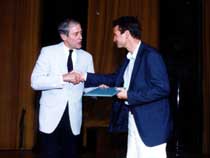
Columbia University President George Rupp (left) presents Paul Salopek with a 2001Pulitzer Prize for International Reporting.
Winning Work
Health care is regressing, life expectancy is going down. Sleeping sickness, once vanquished, is killing again. And in a post-Cold War world, few appear to care.
By Paul Salopek
Tribune Foreign Correspondent
IBBA, Sudan --The mad people of Ibba hardly seem the harbingers of a health crisis consuming Africa.
At first glance, their insanity almost seems understandable, the human fallout from 16 grinding years of civil war.
There are the two farmers, grown men, who have regressed to childhood, playing together with sticks and pebbles in nearby mango groves. There is the young mother who has gone berserk, chasing villagers with a rusty machete. Lost souls stroll through the surrounding woodlands stark naked. And one villager, a shy young man, has had to be tied to a granary wall by his family. Inexplicably, he was setting neighbors' huts on fire.
"About five years ago, when all this started happening, some people laughed at it," said Anthony Badagbu, a health worker at Ibba's thatch-roofed hospital. "Now people are crying because we know it kills. People go crazy, fall into a coma and die."
If not exactly weeping, global health experts are certainly stunned by the bizarre outbreak of dementia in Ibba and dozens of isolated villages like it in rebel-held Sudan. The madness is late-stage sleeping sickness, a lethal, long-vanquished foe from the age of Stanley and Livingstone, and its baleful reappearance is just the latest sign of Africa's seemingly unstoppable slide into a health disaster of historic proportions.
Spread by the bite of tsetse flies, sleeping sickness was virtually wiped out generations ago. Now, it is believed to infect at least 300,000 people in countries as far-flung as Sudan and Angola. Entire villages have been depopulated, something not seen here since colonial times. "This is extremely depressing, like setting back the clock 60 years," said Simon Gould, a medical researcher with the humanitarian group Doctors Without Borders, which recently opened a new sleeping sickness hospital in Ibba. "You get to a point in Africa where you say, 'OK, we've touched bottom.' But sleeping sickness proves we haven't. So if this doesn't set off alarm bells, I don't know what will." At the millennium, alarm bells are clanging louder than ever over the health woes of the world's second-largest continent. AIDS, malaria, tuberculosis, cholera, Lassa fever, meningitis -- the litany of diseases lashing Africa at the advent of the 21st Century is, if anything, longer than the bestiary of epidemics that have struck before. And in a shrinking world linked by easy jet travel, fears are rising that Africa's problems can become global as diseases spill out from the continent and spread across the world. What elevates this crisis above Africa's earlier health calamities, experts say, is not just its daunting scale and complexity, but its resistance to the familiar solution of unloading donated United Nations medicines on some dusty, bedraggled airstrip. Chronic wars, unrelieved poverty, rapid urbanization and corruption are still the traditional villains in the sickening of Africa. Yet today, those home-grown culprits are being abetted by powerful forces from far beyond Africa's shores.
Orphans of the Cold War, African governments have seen their share of foreign aid from the world's richest nations shrink by 20 percent since the late 1980s, when the region was a favorite chessboard for East-West conflict. Now, the United Nations can't even muster three-fifths of the $800 million in donations it says it needs for humanitarian and health emergencies on the continent.
The rise of capitalism in the 1990s has delivered a cruel one-two punch to Africa's socialized health systems. Government health programs have been trimmed back or privatized-- often at the behest of the World Bank or International Monetary Fund-- just when the region is gripped by the worst plague in modern history.
And in perhaps the bitterest irony of all, the pharmaceutical industry has poured billions into curing rich countries' diseases -- cancer, for example, is on the retreat in the United States -- while ignoring research into cures for ailments of Africa's poor.
The economics for drug companies are simple: There is no profit to be made from a diseased Sudanese who doesn't belong to an HMO that can pick up the tab.
Taken together, the impact of all these factors on Africa's 650 million people has been bleak:
- At the beginning of a new century, when citizens of the developed world can look forward to medical advances that may boost their life span to 120 years, the life expectancy of millions of Africans is dropping -- in some cases apocalyptically. Zimbabwe, which boasted a life expectancy of 61 nearly a decade ago, will see its people die, on average, by age 40 in 2005. According to one UN report, much of sub-Saharan Africa may see a similar drop over the next 25 years.
- AIDS, the single biggest culprit behind that catastrophic mortality rate, shows no sign of burning itself out on the continent. Some 23 million people, or more than 70 percent of the world's carriers of HIV, the virus that causes AIDS, already live in Africa. Countries such as Uganda have checked the disease's advance through public education, but in other regions where the infections are leveling off, the cause is more dismal. All those at risk already have the disease and will be dead within a decade.
- According to the World Health Organization, an infectious disease crisis "of global proportions" is brewing in the developing world, and hitting Africa especially hard. Fully 20 of 33 new and unexpected epidemics since 1994 have erupted in Africa,where only 11 percent of the world's population lives. This rogue's gallery of ailments includes everything from yellow fever to plague, brucellosisto Ebola.
"This is not the African renaissance we expected," said Pierre Kombila, the health minister of Gabon, invoking the upbeat imagery currently popular with Africa's leaders. "We do not expect outside solutions. But people must understand that these are not just our problems anymore. With globalization, they are everybody's."
An ancient scourge
Perhaps no epidemic captures that intertwining of global and local interests better than the surprise resurgence of sleeping sickness, a drama of human suffering that's playing out not just in the war-raked savannas and forests of southern Sudan, but in gleaming boardrooms of pharmaceutical firms in Europe and the United States.
The disease itself is ancient -- caused by a wormlike, one-celled parasite called a trypanosome, whose ferocity once deprived humans of access to nearly two-thirds of the richest food-producing lands in sub-Saharan Africa. Until the development of modern drugs, entering the vast kingdom of the vector, the blood-sucking tsetse fly, was suicidal. A single outbreak in Uganda between 1902 and 1906 killed 200,000 Africans and colonists.
Injected into the host by the fly, the parasite migrates through the circulatory system to the brain, where it mysteriously triggers trembling, lethargy, erratic behavior and, if left untreated, coma and death. One variety, Trypanosoma brucei rhodesiense, is endemic to East Africa and can kill within weeks. The West African variety, Trypanosoma brucei gambiense, takes up to several years of increasing debilitation to become fatal.
Gambiense, the slow killer, is the culprit in Sudan's hot zone, Western Equatoria province.Not coincidentally, the conditions that exist today in the area are so primitive they mimic the tsetse killing grounds of preindustrial Africa. Years of civil war between the country's Arabic north and rebels from the black Christian and animist south, where many people believe everything in nature has a living soul, have turned the province into one of most backward places on Earth.
A few red-dustroads swallowed by elephant grass are the only tangible legacy of British rule,which ended in 1956. There is not a single working telephone, flush toilet or paved road -- much less a modern hospital -- within 30,000square miles.Travel is by foot. A pane of window glass is a novelty. So,until recently,was money, with most transactions being carried out by barter in scattered villages.
About all that is left in abundance in Western Equatoria these days is tsetse flies and tens of thousands of sick people -- all of them carrying sleeping sickness.
"In the old days the British hired 'fly boys' to go stand in the bush and attract tsetse flies," said Lasu Lauya Joja, 43, a Sudanese relief worker with CARE International, which is conducting sleeping sickness screening campaigns in the area. "The boys would take off their shirts and have a partner who swatted the flies before they bit. They got paid a bounty for each fly."
Joja said that the work of decades of fly-control programs, including more modern efforts to clear the undergrowth favored by the tsetse, have been undone since rebels warmed into the province in 1990. Worse yet, the few Western charities that were treating sleeping sickness with modern medicines, shrinking the human reservoir for the disease and thus reducing reinfection rates, also packed up and fled.
"Thousands of people ran into the bush to escape the fighting -- we found some dressed only in leaves when we first got here (in 1994)," said Joja. "But out in the bush even more people got bitten by flies and soon what have you got? Boom! An outbreak of a disease that shouldn't even exist anymore."
In the village of Ezo, where CARE has set up a field headquarters, the incidence of sleeping sickness rocketed from less than 1 percent of the local population in 1989 to a peak of 43 percent in 1997. Local chiefs say they buried about 2,200 of the brain parasite's victims in the interim years of isolation before outsiders returned to Equatoria.
"We had forgotten what it was," said Erneo Nbino, 64, whose grown son, Costaki, died of the illness. "At first we thought it was malaria because he became very tired and slept all the time. But when he was awake, he didn't recognize me, he insulted me and wanted to fight all the time. He became a different person."
Nbino, sporting a heavy wool coat and shorts under the hammering tropical sun, was standing in line to be tested for sleeping sickness in Ezo.
CARE technicians had set up their battery-powered centrifuges in the shade of some mango trees. The medics pricked fingers to draw blood samples. And out of some 260 people examined that morning, 46 were positive, including two more of Nbino's sons and their wives.
The old man walked stone-faced back to his forest hut 4 miles away, surrounded by 14 grandchildren he would have to support if more of his family members died.
Costly cure
"The good news is that we can cure them," said Michaleen "Mickey" Richer, a doctor with International Medical Corps, a relief organization. "The bad news is what we use to cure them with."
Richer, an American, was the first person to grasp the full scope of the sleeping sickness disaster in Sudan. Bashing along disused back roads in a dented-up Landcruiser, she and her colleagues screened 36,000 people for the disease and treated 2,800, doubtless saving many lives.
But in the process, Richer stumbled across an even greater malady that no heroics could cure: the iniquities of the global pharmaceutical trade.
"The drugs are extraordinarily expensive," she said. "To actually stop this epidemic, treating relapse cases and getting things back to where they were just 10 years ago,could eventually cost millions. With the way humanitarian aid has dried up,that probably isn't going to happen."
Two drugs are used to cure sleeping sickness. Pentamidine, used for the earlier stages of the infection, costs $1,200 per treatment, though the World Health Organization managed to procure some at a reduced cost. Melarsoprol, the drug of choice once the trypanosome invades the brain, costs about $100, still far out of African patients' reach.
To make matters worse, some of the drugs are antique -- and highly toxic. Melarsoprol,a concoction that hit the market in 1947, hasn't been improved on in a half-century. For drug companies, it simply isn't profitable enough to invest in research. One doctor describes it as the chemical equivalent of "arsenic suspended in car antifreeze solution."
"It's so painful that I've seen grown men cry and women scream when I inject it," Richer said. "But if I don't, they die."
About 5 percent die anyway, from side effects.
One recent afternoon, Richer checked up on dozens of sleeping sickness patients at the Tambura hospital, a rural compound that, like everything else in southern Sudan,is dog-eared with neglect.
Walking down a cramped ward clogged with gourds, baskets of peanuts, playing children and semiconscious bodies, she came upon a man, Simon, who was dying because he wasn't responding to the drugs.
"We don't want to lose this man," said Richer, a short, effusive Coloradan, to nobody in particular while hugging the patient. "He is very handsome. He is very bright. We don't want him to die."
Simon sat limply on his palm mat, glassy-eyed and smiling with embarrassment. Two months earlier, the world's last stocks of DFMO, the second-chance drug for relapsed sleeping sickness patients, had expired. The manufacturer, Hoechst Marion Roussel, a multinational drug firm, had phased it out for lack of profitability.
When it comes to global economic forces ganging up on sickly Africa, no issue stirs more passions than fair access to lifesaving drugs.
"Withholding foreign aid means you're just selfish," said Bernard Pecoul, a pharmaceutical expert with Doctors Without Borders in Paris. "But to cut off the supply of drugs because people can't pay -- that's like the developed world turning Africa out of its sickbed. It's venal."
Humanitarian groups see drug accessibility as one of the greatest health dilemmas of the new century.
According to Doctors Without Borders, the international pharmaceutical industry has been neglecting "poor people's diseases" for years. Of the 1,450 new medicines brought to market between 1975 and 1997, they say, only 11 directly target the sorts of tropical ailments common in Africa.
And even when the maladies of the rich and poor overlap, the most famous instance being AIDS, cost and intellectual property rights are still putting medicines beyond reach.
A celebrated case in point: When AIDS-plagued South Africa hinted that it might manufacture its own AZT, an expensive anti-retroviral drug, the U.S. government, backed by the pharmaceutical industry, threatened sanctions. Patent laws were at stake. And despite President Clinton's recent promise to intervene on South Africa's behalf, the confrontation remains at an impasse.
Deadly paradox
Paradoxically,standoffs between the globe's sick and wealthy may only get worse as medical science gets better.
"The costs of research and development are extraordinary," said Lori Kraut, a spokeswoman for Hoechst Marion Roussel, the drug firm that manufactured the discontinued sleeping sickness medicine. "We have to invest our money wisely to see a return."
Industry sources say the cost of researching, testing and bringing a sophisticated new drug to consumers can now reach $500 million -- making the sparse markets of Africa even less tempting.
Nonetheless, Kraut said her company, which recently merged to form Aventis Pharma, based in Frankfurt, Germany, is trying to do right by the people of Sudan.
HMR has transferred the DMFO patent to the World Health Organization, which is looking for anew manufacturer. The company has also turned over the last remaining stocks of its drug, free of charge. A one-year supply will be available soon.
"The Sudanese are actually the luckiest sleeping sickness victims in Africa," said Anne Moore, an epidemiologist at the federal Centers for Disease Control and Prevention in Atlanta. "They're the only ones who are accessible enough to help. Hundreds of thousands of others in Congo and Angola are isolated by fighting. Nobody really knows what's happening to them."
Many of the residents of the tiny, mud-walled village of Ibba do feel lucky.
They say they are lucky to be alive after so many years of war. And though the northern government in Khartoum still sends the occasional Soviet-built Antonov bomber droning overhead to drop a bomb, most of the ground combat has moved far to the north, into the land of the Dinkas.
In the interlude of peace the foreign doctors have come. They are banking the flames of sleeping sickness.
"We thank the Lord for their help, but we Africans are fighting this disease with all our might too," said Elija Gadri, 60, the Episcopal pastor of Ibba. "We fight it with our hearts, like Queen Gulana."
Gadri recalled proudly how the village matriarch, Gulana Sekina Gidam, organized the frightened, dying people of Ibba into groups and ordered them to be injected with medicine. At church, she used a bullhorn to cajole them into building the new sleeping sickness hospital. She danced at its opening.
Gidam is buried across the dirt road from Gadri's thatch-roofed church. Sleeping sickness didn't get her. She was the village's first victim of Melarsoprol, the toxic old drug that kills 5 percent of its users.
© 2000, Chicago Tribune
By Paul Salopek
Tribune Foreign Correspondent
The AIDS epidemic has killed a staggering 13 million Africans. A widespread culture of shame and denial spreads the disease. Villages of hopeless orphans are testament to this losing battle.
ESIDUBWINI, South Africa -- Thandiwe Mwandla can't give away her sugar cane these days, much less sell it. The same goes for her sweet bananas and corn and the hard little peaches that grow in her garden. The fruit has AIDS, people say.
Switching from farmer to tailor, Mwandla, 45, a resourceful and stubborn woman, has tried sewing dozens of bright new skirts and aprons to sell. Nobody buys them. They too, neighbors say, carry the killer disease.
More recently, she trudged to the local health clinic and cajoled the doctors there into paying her a modest stipend to teach AIDS awareness courses. At the designated times, however, the classroom stands empty. Like her fruit and clothing, Mwandla is being shunned. And her crime isn't simply that she is HIV positive.
"People die here every week from AIDS, but we pretend not to notice," said the mother of five, whose electrician husband died of AIDS in 1994, leaving her with no means of support. "My crime is that I've told people I have HIV. That has made me an outcast."
Neighbors walk a broad circle around her property, she said. Others have warned her not to visit their homes. Sitting in a crumbling, tin-roofed house she can longer afford to repair, she summed up the schizophrenic world of AIDS-plagued Esidubwini.
"We get sick and we get poorer," she said bitterly, "and we die lying to ourselves."
Staring into the abyss of an incomprehensibly brutal epidemic, it is plain how the 23 million people who live with HIV in Africa can drift easily into numbing fatalism, or a fierce, hardening shell of denial.
Nearly 20 years after it roared out of the continent's jungles, the savage virus that goes by many oblique names here -- "that other thing," they call it in Zimbabwe; "white man's disease" is its delusional nickname in Gabon -- has wrecked decades of health and welfare gains and turned optimistic predictions about a new, robust African Century into a cruel joke.
According to a United Nations report released this month, Africa's AIDS catastrophe is not only unchecked but, chillingly, also accelerating even as the death rate drops in rich countries thanks to expensive drug therapies. The continent already is home to almost 70 percent of the world's HIV-positive people, experts note, and that bleak lead is only likely to widen in the next century.
AIDS is a democratic killer in Africa. Unlike in the West, it is not associated with urban and gay populations. Spread from husband to wife, through prostitutes or teenage sex, it burns through the rural communities where most Africans live. For the first time in the history of the pandemic, more women than men are infected; hundreds of thousands of African babies are born with HIV.
13 million deaths
A staggering 13 million Africans have died from AIDS, or 90 percent of global death toll. Five years from now that number will breach 20 million, a figure surpassing the wholesale die-off in medieval Europe at the height of the bubonic plague.
Yet as numbingly high as these numbers may be, they cannot begin to show how an obscure monkey virus that managed to jump to human beings, possibly when a hunter gutted an infected chimpanzee in the forests of Cameroon decades ago, is unraveling the fabric of entire societies and threatening to bring Africa's economy to its knees.
Fields in Zimbabwe, for example, stand untilled because tens of thousands of farmers are enfeebled by HIV, which infects a quarter of the total population. So many adults have died in the AIDS hot zones of East and southern Africa that some villages are turning into dazed outposts of orphans. In the United States, by contrast, the national incidence rate is only a fraction of 1 percent.
The impact on African business is incalculable. Some experts predict that agriculture, the pillar of most African economies, may have to shift slowly away from lucrative, labor-intensive export crops such as coffee due to a lack of workers. An oil refinery in Zambia recently bankrupted itself with the AIDS-related costs of workers' medical care and burial fees.
And in South Africa, where a staggering 45 percent of the country's mine workers may carry the virus, the outlay for health benefits for ailing employees is expected to more than double by 2005.
Culturally, the disease is eating away at the famous safety net provided by Africa's extended family system. There are simply too many victims to cope.
Beleaguered presidents, faced with massive diversions of resources to AIDS, have pushed unenforceable laws against long-held tribal practices such as wife inheritance and clan "uncles" who initiate girls into sex.
Virginity testing
The Zulus in South Africa even have revived long-forgotten practices such as virginity testing to stanch horrific 30 percent HIV prevalence rates in Kwazulu-Natal.
And in one of the ironies of the great AIDS pandemic, stunned policymakers in African capitals are watching their frail national health systems sink under millions of AIDS cases -- precisely at a time when public spending is shackled by austerity programs imposed by the World Bank and the International Monetary Fund.
"How is AIDS upending society? How will our economies survive the next 20 or 30 years? Anybody who claims to know is a liar," said Alan Whiteside, a health economist at South Africa's University of Natal. "Basically, we're still at the beginning of this epidemic. All I can say is that harsh decisions are going to have to be made. Some (leaders) won't make them, and their countries are going to fail dismally."
Just an hour's drive north of Whiteside's university, in rural towns such as Esidubwini, nestled in the rolling hills of a region so beautiful that white settlers named it after England's famously lush Midlands, a small, heartbreaking window into that future is already opening.
In some Midlands communities, up to 40 percent of the residents, mostly ethnic Zulus, will be dead from AIDS within a decade, the highest incidence in the world.
Why this is happening is a tale of callousness and despair, and a classic example of how AIDS has hopscotched around the continent, cursing some regions and leaving others virtually intact, probing for the right social conditions -- poverty, promiscuity, unprotected sex -- that favor the transmission of the fatal virus.
"In Africa, AIDS is a heterosexual disease, and migration is its handmaiden," said Anwar Hoosen, a social worker with the AIDS Training Information and Counseling Center, a government agency in the nearby city of Pietermaritzburg.
"These small rural towns have been the labor pool for mines and big farms for generations," Hoosen said. "The guys leave to work for months at a time, they have sex with prostitutes and bring the disease back home to kill their families."
South Africa's old white rulers designed mass labor migrations to tear up black social networks, he added. Where it failed, AIDS has come back to finish the job. In places such as Esidubwini, a jumble of houses and cane fields graced by huge operatic clouds that boil up in the afternoons, battered family structures are collapsing because of AIDS.
"My husband was the one who infected me but he tried to hide his sickness," said Mwandla, the mother ostracized for revealing her HIV. "He came home from his job one day, and I found him laying sick on the porch saying, 'I wish I were dead!' and then I knew it. I almost fainted. He got it from his girlfriends."
Hired on the sly
Mwandla nursed her husband, Joe, for two years before he died. The medical bills sucked up her meager savings. Deprived of her usual sources of income by AIDS paranoia, she barely makes ends meet by working as a maid or laborer at a dollar a day for people who hire her on the sly.
"I can't be seen at their homes," she says without self-pity but with a certain scarred hardness. Her five children, born after disease entered the family, are HIV negative. But her house is unkempt and dingy in ways that have nothing to do with poverty but with demoralization.
In fact, most households in rural Esidubwini are headed by single mothers, many with children fathered by different men.
Clad in bright head scarves and smocks, the women hoe their small scraps of field to earn money because there is no other employment. They die from mysterious ailments that everybody calls pneumonia and are buried on weekends in graves topped with paper flowers. Otherwise, the town is largely a manless place. The young men come home only to die, leaving behind a burgeoning army of AIDS orphans, some now heading their own households.
"Does this sound normal to you?" said Sbongile Shabane, one of the few local AIDS activists. "Then why do we go on pretending as if nothing is happening?"
Shabane, the director of an AIDS awareness group called Siyaphila -- Zulu for "We are Alive" -- says the deep, bruising culture of shame and denial surrounding the disease in Africa is perhaps the biggest obstacle to bringing the scourge under control.
Her own group is a rueful case in point: It consists of HIV carriers who, like herself, have had the courage to go public. Though it is based in Kwazulu-Natal, a South African province where at least 2 million HIV-positive people live, Siyaphila has fewer than two dozen members.
"To be HIV positive is to be less than human," Shabane said. "I have seen people turned out by their families. One woman was carted out of her house in a wheelbarrow when her family found out she had AIDS. Nobody wants to deal with this."
Or with Shabane. She was recently chased out of a black township outside the city of Durban by an angry mob of youths who charged that her advocacy work was bringing disgrace to the community. Similarly, in South Africa's most celebrated case of AIDS-phobia, a young activist named Gugu Dlamini was beaten to death by a gang of youths in 1998 after announcing that she had HIV.
"It's ignorance, it's fear, it's our taboos about sex," said Shabane, an exuberant woman who is prone to spontaneous bouts of dancing on her rounds through the muddy backstreets of AIDS-stricken Midlands communities.
"We are a bewildered people," she said. "We are expressing our fears in strange ways."
One of those ways has been the revival of an ancient Zulu custom, virginity testing for young girls.
Fertility ritual
Long abandoned, the tests were once integral to fertility rituals among the Zulu. But today, hundreds if not thousands of young women are doffing their blue jeans and sneakers, donning short beaded aprons, and standing bare-breasted on hillsides, waiting to undergo genital examinations by teams of plastic-gloved matriarchs. The purpose: Use tradition to shore up a dam against a tide of teen pregnancy and AIDS.
"The ancestors tell me in my dreams to revive such things," said Nomagugu Patience Ngobese, 43, a sangoma, or faith healer, who has spearheaded the tests. "We have adopted too many Western things without thinking and we lost respect for our bodies. This has allowed things like AIDS to come torture us."
Some local doctors see the exams as a gasp of cultural desperation in the face of AIDS.
"There is no easy way even for a trained doctor to determine virginity, and if you notice, they're only putting pressure on the girls," said Neil Mckerrow, a pediatrician and AIDS expert at Edendale Hospital in Pietermaritzburg.
"Look, we have communities where AIDS is actually leveling off because all our young, able-bodied people who are at risk of catching the bloody disease are now infected," Mckerrow said. "It's that sort of horror that people can't seem to see squarely. All this other stuff is just looking away."
At an anguished turn of the millennium for Africa, looking away is an oft-heard charge when it comes to battling the worst scourge to hit humanity since European microbes colonized America 500 years ago, wiping out millions of aboriginal people.
The sort of willful blindness that is afflicting the dying residents of Esidubwini, global health experts say, is common in capitals around the continent.
Uganda, which has reduced its AIDS infection rate through an aggressive public education and pro-condom campaign, is one of few notable exceptions.
"An enormous opportunity is being missed to mobilize women's groups, church groups, unions, whatever," said David Heymann, executive director of the communicable disease program for the World Health Organization in Geneva. "What governments don't seem to understand is that the window of opportunity is closing and that if they don't tackle this gigantic problem now, they're just endangering their own survival."
Africa's cash-strapped nations have been criticized for funding extravagant prestige projects that seem, at best, misguided in the plague years of AIDS.
Whether it's dams in Namibia or Japanese-funded, multimillion-dollar referral hospitals in Zambia, where rural clinics that service the majority of the population often don't even stock aspirin, the development priorities of many AIDS-sickened countries has been condemned by AIDS activists here and abroad.
South Africa, the rich man of sub-Saharan Africa yet a country with the fastest-growing AIDS infection rate in the world, hasn't escaped blame. It just signed a $3 billion contract to procure fighter jets, submarines and other weaponry from European arms makers at a time when its health budget is shrinking 5 percent.
'A major failure'
"This is a major failure of national will," said Charlene Smith, a journalist who became an AIDS campaigner after being raped this year in her home. One-third of all South African women who visit rape clinics test positive for HIV.
"About 75 percent of all pediatric deaths at Johannesburg General Hospital are related to AIDS these days," Smith said. "Because nobody likes to use condoms in this country, we've also got countless families with both parents dead. We should be building orphanages, not buying guns."
Yet, in fairness, many of the poor governments most affected by AIDS in Africa can't spend more on health and welfare, even if they wanted to. The virus is mowing down their people in the midst of economic belt-tightening programs urged on the by global lending agencies such as the World Bank.
Such "economic restructuring" is well-intentioned; it's a sour dose of medicine designed to cure inefficiency and slim down bloated governments. But in the AIDS-pummeled Africa of today, the free-market ways of a globalized economy can carry a heavy human cost.
In Zimbabwe, where 60 percent of all hospital beds are occupied by AIDS cases, thousands of nurses have left their jobs because of drastic pay cuts. And in Kenya, hopeful statistics that showed a decline in sexually transmitted diseases -- the best marker for the prevalence of AIDS -- turned out to be false: People had simply stopped going to clinics because they couldn't pay for formerly subsidized services.
"It never helps to have a major epidemic explode just as you're trying to reform public health systems," said David Allen, an American epidemiologist working with the South African Health Department.
Not that the people of the serene, beautiful and tormented communities of South Africa's Midlands would ever know. More than 90 percent of their residents die at home, perishing in utter poverty from a disease that, after all these years of killing, few still dare identify by name.
One recent afternoon, Shabane, the social worker, toured her home community of Mt. Elias, pointing out houses where people have died. There was the family where both parents had died; a 16-year-old daughter was taking care of her younger siblings. A few blocks away was Granny Lephina's house. She has lost all three of her children to "tuberculosis" and the cost of the funerals--about $450--had bankrupted her.
"Let's stop and see somebody who's dying," Shabane said with an angry smile.
Beauty Ngidi, 22, sat in her brother's home alone, a thin, slow-moving young woman who lived up to her name. The hut was in deep shadow.
"You know, you should admit you have this disease," Shabane said while Ngidi's family hovered warily outside, just beyond earshot.
Ngidi said nothing.
"Beauty, you really should," Shabane repeated softly.
© 2000, Chicago Tribune
By Paul Salopek
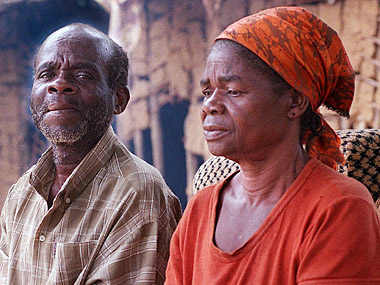
Isidore Edjimouagno and his wife, Charlotte Barnaye, survived an outbreak of the deadly ebola virus along the Ivindo River in Gabon. (Tribune photo by Nancy Stone.)
THE IVINDO RIVER, Gabon -- The wind has no name. But it is a fierce wind, a bad wind, and when it blows down this tar-black jungle river, most people run. Because it turns their eyes the color of blood. Because the wind kills them.
Isidore Edjimouagno knows. He survived the evil wind, though it left him a broken man. This is his one claim to fame: He breathed the wind and lived. He is a dead man who sits blinking in surprise under the shade trees of his garden.
"People thought it was yellow fever at first and weren't that frightened," recalled Edjimouagno, 61, one of scores of gold panners who were brought down the Ivindo River in dugouts, vomiting blood and semiconscious. "But the next time the wind came they all ran away. The police had to set up roadblocks in the towns. They wanted to run all the way to the capital."
Edjimouagno's harrowing brush with the foul winds of the Ivindo River was the world's last recorded outbreak of ebola, Africa's notoriously lethal virus.
The fatal virus with the terrifying mystique has howled down the broad, silent river several times now, most recently in 1996-97, swiftly killing at least 100 people, or about 8 out of every 10 of its victims. As always, after burning through the local population, it subsided back into the jungle without a trace.
For all scientists can manage to decipher of ebola's natural history, it might as well be a mystical wind -- one that bodes poorly for the future health of this enfeebled continent, or, for that matter, given the ease of air travel, the world beyond.
As the new millennium begins, nothing -- not the collapse of creaky dictatorships, not the advent of Mandela in South Africa or McDonald's in Mauritius -- shapes the character of life in modern Africa more than deadly illness.
AIDS rakes the continent, taking such a horrific toll that diseases such as sleeping sickness, which threatens to kill 300,000 people, are considered silent epidemics. Hard-won, incremental health gains that had added a year or two to the average African's lifespan since the 1970s now lie in tatters. Disease, says the World Bank, remains the prime reason Africa still lags in the race of continents.
So it is ironic, then, that what gives the international community a case of cold sweats isn't so much Africa's mammoth epidemics -- AIDS, malaria or pulmonary infections, to name a few -- but instead the small ambushes being set by so-called new or emerging diseases that surface in the forests,pick off a few human beings and disappear in the epidemiological equivalent of a drive-by shooting.
Viruses such as ebola and Marburg liquefy the internal organs, causing some victims to bleed even from their pores. Neither has a cure, each is transmitted through contact with bodily fluids and can kill within days.
Gruesome as the diseases are, global health authorities are even more alarmed by the certainty that new, ebola-like scourges are on the way. The reason? As Africa's burgeoning population continues to push into tropical ecosystems -- farming, cutting down trees and grazing cattle where they never had before -- countless more people will blunder into the ancient webs of parasitism between unknown microbes and animals and thus become possible hosts themselves.
Consider the numbers. According to the United Nations, in 1950 only 224 million people lived in sub-Saharan Africa, a vast region larger than the United States, China and India combined. Today, that figure has almost tripled,to 650 million. By 2025, even under the killing weight of its epidemics,the number is expected to nearly double again, to 1 billion. The majority of these people are rural, and as such will remain in the cross hairs of strange, opportunistic diseases.
But if health authorities suffer nightmares about red-eyed ebola victims staggering into their airports -- as one was thought to have done in Augustin Berlin (it was yellow fever; he died) -- then rich nations share part of the blame.
Climate change sparked by fossil fuel use in industrialized countries is disrupting the tropical ecosystems of Africa and probably will unleash unpredictable new epidemics, experts warn. Malaria, a not-so-novel killer, already is marching south with unprecedented warm weather into parts of South Africa where it has never been seen.
Moreover, global commerce is playing a powerful role in opening up the Congo basin's gigantic, almost impenetrable forests to human settlement. International logging corporations have multiplied in the region since the mid-1960s, and in Gabon, where French corporations are active, the muddy roads that funnel out truckloads of tropical hardwoods destined for parquet flooring have brought out something less profitable -- people dying of ebola.
"Ebola is just the tip of the iceberg," said Sally Lahm, an American ecologist and anthropologist doing fieldwork in the vast, sweltering Ivindo watershed in Gabon. "Everybody in the West loves the idea of biodiversity in rain forests. Well, people forget that that includes microbes too.
"Look at it from the perspective of these viruses," said Lahm, who lives in the jungle trading town of Makokou. "Look who's invading who."
Whichever end of the microscope you view it from, it seems that even after a quarter-century of experience -- ebola came to light in then-Zaire in 1976 -- the human beings aren't doing so great.
In Africa's most recent outbreak of hemorrhagic fever, a Marburg epidemic in rebel-held Congo last year that reportedly killed 70 to 80 people, it took 10 months for scientists to identify the culprit.
The delay came despite an infusion of cash from nervous developed countries eager to monitor emerging killer diseases. This is one of the few elements of Africa's collapsed health system that has seen a boost in foreign funding recently, much of it courtesy of a $50 million donation by the U.S.
In the case of the 1995-97 ebola outbreaks in Gabon, where identification was brisker, public panic smashed through quarantine controls set up by at least three national and international disaster relief agencies.
Hundreds of terrified people from the remote hot zone near the Ivindo River drove, hitchhiked, flew or limped all the way to Libreville, the teeming Gabonese capital a 15-hour drive away. There, appalled friends and families slammed their doors in the refugees' faces out of fear of infection. The government admits to 11 of the quarantine escapees dying in the city.
Meanwhile, back in the jungle, the dying floated down the inky currents of the Ivindo in canoes. People rolled their bodies hurriedly into the water, or into shallow holes dug into the muddy river banks, propping beer bottles on sticks as grave markers. Their cherry-red eyes: That's what everyone remembers.
In river towns such as Makokou and Booue, disease experts from France and the World Health Organization trudged the muddy streets in spacesuits, embittering the local people.
"It was like our lives were worth nothing," said Alphonse Kuomissele, whose father, Isidore, was one of the few who survived being infected during the Gabon outbreaks. "People would walk backward away from you, to make sure you wouldn't touch them. Taxis were afraid to stop. Even the police at the road blocks just waved you through because they didn't want to touch your identity card."
To make matters worse, one man, a Gabonese doctor who had treated a dying ebola patient in Libreville, thoughtlessly rode an airliner all the way to Johannesburg, where he became sick within days. Dozens of people on the plane were exposed to the deadly virus. The South African nurse who treated him died.
"I sure wish somebody would find out where these diseases hide out in the forests when they're not out killing people," said Bob Swanepoel, a researcher at South Africa's National Institute of Virology and a world expert on ebola. "It'd be a hell of a relief. We could all get on with our lives."
Swanepoel, a sprightly, goateed man who has made a career of tramping to the far corners of Africa to identify new diseases, has collected hundreds of bat, rodent, primate, insect and plant samples from jungles, trying to pin down ebola's "reservoir" in nature.
A study released last summer by French researchers claiming to have finally isolated ebola DNA in shrews from the Central African Republic is not definitive, Swanepoel said.
"Is it in bushmeat? A monkey? Is it a mosquito bite? You can test 100,000 mosquitoes for a certain virus until you find it; that's the sort of job we face," he said. "The fact is, there are already 500 known viruses, and we've only pegged 26 to disease. The unknown ones run into the tens of thousands. Africa is going to be keeping us busy for a while."
Swanepoel was on the team that identified last year's Marburg outbreak in Congo. Named after the German city where it claimed the lives of several lab workers, Marburg hemorrhagic fever is, if anything, even more cryptic than ebola. It snuffed out scores of people in Durba, a rebel-held town where Canadian gold-mining operations had disturbed big swaths of rain forest.Miners were dropping dead in excrement-fouled tunnels, Swanepoel said, and their colleagues were working right atop the buried bodies. On hearing of the outbreak, neighboring Uganda slammed its border shut.
"Forget trying to stop these scary things' spread out of Africa," said David Heymann, the American executive director of the communicable disease program for the World Health Organization. "If you're sitting in Podunk, Wisconsin, you're not safe from these infectious diseases. They go anywhere."
International flight figures would seem to bear him out. According to the World Tourism Organization, the number of departures from Africa between 1993 and 1997 increased 44 percent, the second highest jump in the world after the Middle East.
Heymann added that 900 malaria cases are imported to the United States every year. West Nile virus, an exotic African disease with serious, encephalitis-like symptoms, made its first appearance in the Western hemisphere last year in New York, he noted.
"The mosquitoes that carry yellow fever and malaria are still all over the southeastern United States, just waiting to feast on an unvaccinated population," he said. "It just makes economic sense to attack these problems at the source, in Africa, rather than here in our own back yards."
He ticked off other emerging diseases in Africa -- less lethal ones than ebola or Marburg, perhaps, but incapacitating enough: Lassa fever (spread by rats), yellow fever (an urban disease), Rift Valley fever (a hemorrhgic fever spread by dam and irrigation projects).
"We can't rely on our little spacesuits to insulate us from Africa anymore," he said. "With trade, travel, global investments, it just ain't that kind of world any longer."
Africans, meanwhile, are more alone than ever in their struggle against the onslaught of cryptic new diseases, ailments that could prove to be the plagues of the 21st Century.
Over the gilded 1990s, a decade of economic boom times in America and Europe, black Africa's nations got poorer, part of a global trend toward the concentration of more wealth in fewer hands. The disparity of wealth between the world's richest and poorest countries, the United Nations says, yawned from a ratio of 44:1 in 1973 to 727:1 in 1997.
In the age of genetic therapies and miraculous baboon-to-human heart transplants, the governments of the world's sickest continent can afford to spend between $1 and $10 per citizen per year on health care. And about the only people getting rich in Africa these days are the muti men, the traditional healers who have a bonanza of misery to reap. One in South Africa has just bought a DC-3 airplane for his private airstrip.
"Our diseases are making us poorer not just in body but in spirit," said Pierre Kombila, the new minister of health in Gabon, an intense, bespectacled man of little ceremony who personally answers the door to his tiny government office in Libreville. "Health is the first ingredient in pride. Today, alot of Gabonese hate being Gabonese."
On the banks of the murky Ivindo River, in faraway Makokou, where hospital staffers are paid so wretchedly they have to moonlight -- one nurse operates a bar -- a health worker who survived the worst of ebola disasters knew what Kombila was saying.
She described bitterly how senior government officials had stolen thousands of dollars worth of medical supplies left after the outbreaks by foreign donors.
She recalled coldly how whites had showed up in their spacesuits days after she and her exhausted co-workers had been slipping through ebola-laced blood and diarrhea in their plastic sandals, trying frantically, without medicines, to save their dying neighbors from the deadliest pathogen known to mankind.
"All of that is disgraceful," she said. "But I will do it again. That is my job. I'll do what I can with cotton balls and water."
So she waits, with her barren dispensary shelves, to see what comes rolling next down the big dark river.
© 2000, Chicago Tribune
By Paul Salopek
Tribune Foreign Correspondent
MGAHINGA GORILLA NATIONAL PARK, Uganda -- Like any other park warden in Africa, Klaus-Jurgen Sucker had enemies, although maybe more than most. When it came to defending his park's endangered mountain gorillas, Sucker knocked heads hard.
A strapping, 37-year-old German biologist, Sucker infuriated the local Bakiga and Bafumbira hunters whose snares he ripped up, some 7,000 wire traps in all. He earned the wrath of illegal loggers by erecting steel barriers along the park's boundaries. Five years of angry clashes with encroaching farmers had turned his mop of blond hair prematurely white -- much like the hulking, silver-backed gorillas he so admired.
Sucker's most formidable foes, however, came from far beyond Mgahinga's bamboo forests and watercolor-blue volcanoes.
In a backlash as old as African conservation itself, powerful interest groups objected to the warden's gung-ho methods.
Critics said that Sucker put the needs of animals above those of thousands of impoverished Africans living around his park. When Sucker refused to bend, they quietly lobbied the Ugandan National Parks Service for his transfer.
"Klaus was a strong man, but when they ordered him to go it affected his heart," said Sunday Nyakunze, an AK-47-toting park ranger trained by Sucker. "That's the only way we can explain the bad thing he did at the end."
Apparently distraught over abandoning his beloved gorillas, Sucker hanged himself in his nearby village home without leaving a note.
Sucker's obscure 1994 death might seem like just another case of environmental martyrdom in Africa; inevitably, his tragedy has been compared to the murder of Dian Fossey of "Gorillas in the Mist" fame.
But Sucker's story is different, because his most powerful opponents weren't the usual rogue's gallery of xenophobic politicians or greedy wildlife dealers, but competing environmentalists who have launched what is, in effect, a sweeping, last-ditch battle for the soul of wild Africa.
Organizations such as the International Gorilla Conservation Program, the World Bank and CARE have chosen the misty jungles and crowded villages of southwestern Uganda as a vast and controversial testing ground for the theory of "community conservation." The idea is simple: To save what's left of Africa's fading wildlife, experts say, the animals must in essence be given back to the Africans, so the Africans will feel more of a kinship with them and feel the need to protect them.
Lucrative gorilla tourism profits, for example, are being shunted toward building local schools. Villagers who were once evicted from the gorilla parks are being invitedback in to harvest forest products, a heresy unthinkable in Sucker's day. And dozens of technical consultants, wheeling their shiny four-wheel-drive vehicles through the farmlands that ring gorilla habitat, are pushing million-dollar projects in crop improvement, family planning, agro forestry and micro-enterprise-- all to minimize human conflict with some 300 reclusive apes.
Remote, hauntingly beautiful and dirt poor, Uganda's version of Appalachia has thus become the world's boldest experiment in social engineering for the sake of the environment. It is a corner of Africa where pygmies are now required to carry "utilization permits" to use their own forests. Where the gorillas' long-term fortunes depend on the vagaries of the London stock exchange. And where a gentler, kinder vision of conservation, advocates say, might rescue a continent's wildlife from an otherwise bleak future.
"Sucker would never compromise for his gorillas," said Jaap Schoorl, a Dutch environmental consultant who worked in Uganda when the German was still booting villagers out of Mgahinga. "But we have to face the reality that Africa's wild places are shrinking islands surrounded by a growing sea of people. Unless we do something drastic, we're lost."
Few experts dispute the fact that Africa's pageant of wildlife is in drastic shape. After more than a century of Western-style management, the iconic animals that have come to symbolize wild nature to millions of people around the world are more threatened than ever. Fabled wildlife parks have become dog-eared meccas of industrial tourism. And biologists warn that the Earth's richest assemblage of large mammals -- a unique remnant of the fauna that roamed the continents during the Pleistocene Epoch -- is slipping inexorably toward oblivion.
Consider these trends:
- With Africa's human population expected to rocket from 650 million to 1.1 billion over the next 25 years, hundreds if not thousands of animal and plant species will be crowded out of existence. The biggest fight ahead, conservationists say,won't be on Africa's famed savannas, but in besieged forests like those at Mgahinga and its sister gorilla park, the Bwindi Impenetrable Forest. Today, efforts are under way to safeguard small patches of the species-rich Congo Basin, a vast rain forest a third the size of the continental United States that is under assault by European logging firms.
- The environmental coups scored against the international wildlife trade in the 1990s -- particularly the ivory ban that helped save Africa's elephants -- are being undone bynew, homegrown threats. Urban migration of rural people has created a faddish appetite for wild animal meat among Africa's millions of city dwellers. This bush-meat trade has funneled tons of dead antelopes, elephants, bush pigs, monkeys and snakes -- trussed in bloody burlap sacks -- into the booming city markets of central and West Africa every year.
- Africa's latest cycle of wars, meanwhile, is gutting the continent's premier wildlife habitats. The Congo's Virunga National Park, a UN-designated World Heritage Site where Africa's oldest rain forests grow, has turned into a killing zone for animals. Armed factions in Congo's civil war have gunned down 10,000 hippos, 6,000 buffaloes and more than 3,000 elephants since 1994, biologists say. Desperate refugees have razed more than 20 square miles of the forest for firewood.
Yet the most disturbing trend of all, experts warn, is that Africa's wildlife is becoming increasingly irrelevant to Africans themselves. Swelling armies of rural peasants seewild animals as little more than crop pests -- or dinner. And among the continent's exploding urban populations, the plight of such animals as black rhinos, whose numbers have crashed disastrously from 100,000 to just 3,000 in 25 years, is an eccentric concern at best.
"The average American or European has seen more African species in zoos than your typical modern African has seen in the wild," said Elias Maluleke, a South African journalist who has written on the subject. "Wildlife parks are seen as white peoples' enclaves. How many blacks do you see wandering around Kruger National Park (in South Africa)? How many big game hunters are black? Africans get nothing out of their own wildlife."
Which is exactly where community-based conservation comes in.
Pioneered in Zimbabwe in the 1980s, supporters of the concept insist that Africa's wildlife will never survive without the help of rural communities, where almost 80 percent of all Africans still live. Instead of rousting villagers from parks, the thinking goes, Africa's wardens should be seeking ways to get them back in, if only to instill a sense of connection with protected areas. Economic links between people and animals should be bolstered through ecotourism. And where that fails, then other opportunities must be concocted to enlist villagers to the cause of conservation.
Nowhere does hope blaze more brightly for this new hearts-and-minds approach than at Mgahinga and Bwindi national parks in Uganda. At stake, experts say, is far more than half the world's remaining population of mountain gorillas. Mgahinga and nearby Bwindi, which together cover 144 square miles of gorilla habitat, encompass some of the richest ecosystems in Africa.
In Bwindi, a relict Ice Age forest, thousands of species of birds, mammals and insects swarm beneath the jungle canopy. And 15 miles away, at Mgahinga, where volcanoes jab above the Great Rift Valley, a rare, high-altitude patch of tundra thrives only 100 miles away from the equator.
In satellite photos, both parks appear as small, forested islands with hard, ruler-straight shorelines. An estimated 100,000 farmers hoe their potato fields right up to their boundaries. In places, crowding at the edges of the parks surpasses 900 people per square mile. In the United States, the average population density hovers around75.
For Jackson Mutebi, a biologist with CARE's Development Through Conservation program, that image from orbit offers a bleak snapshot of the future of protected areas in Africa.
"The rich world wants places like Mgahinga preserved, and they usually get their way, but it's always at the expense of the people who live here," said Mutebi. "When these places became parks in the early 1990s, thousands of villagers lost access to firewood, building materials, food and medicinal plants overnight. They were so mad they were ready to hunt gorillas out of revenge. Our job is to try and find ways to compensate their losses."
Sitting on a rock fence marking Mgahinga's boundary, he was overseeing a project that was doing just that. Dozens of local workmen were putting the finishing touches on a gigantic water tank. The metal cistern, paid for by the United Nations, eventually will supply 36,000 nearby villagers with tap water. The water is being piped from a wetland inside the park. Prime gorilla habitat.
Such trade-offs, of course, are exactly what outraged Karl-Jurgen Sucker, Mgahinga's bulldog warden. Not unexpectedly, his own water policies were more proactive.
"He would confiscate our plastic jugs if he caught us stealing water from the park," said John Mikekemo, a beekeeper from the tiny community of Buzeyi, which abuts the reserve. "Sometimes he even burned our buckets."
CARE's piped-water system, a powerful goodwill gesture, is just one of countless community conservation schemes designed to reverse that antagonistic relationship. The sheer scale of the effort -- funded by donors as diverse as the European Union, USAID, the Dutch government, the World Bank and private environmental groups --resembles an ecological Marshall Plan. Inevitably, it is reshaping the lives of thousands of rural Ugandans.
Mikekemo's small village of Buzeyi, with its bamboo granary and wheat-stalk thatched roofs, is as good an example as any of what Africans from the red deserts of Namibia to the wildlife-rich swamps of Cameroon can look forward to with the rise of "benefit sharing" conservation across the continent.
Agricultural experts have quadrupled Buyezi's bean crop output, partly to lift families out of survival mode so they can begin to think about conservation, but also to reduce pressure for opening up new land. (Other villages have been encouraged to take up goat farming to replace the antelopes once hunted in the parks.)
Moreover, beekeepers such as Mikekemo will soon be allowed to place their hives inside park boundaries as part of a "multiple use" program. In villages around Bwindi, people are already gathering bamboo, clay, medicinal plants and basketry vines inside the park, albeit on a controlled basis.
The most important benefits by far, however, are reaped from the elusive mountain gorillas themselves.
Gorilla groups habituated to the presence of tourists have churned out millions of dollars for the Ugandan government. As much as 70 percent of the Ugandan Wildlife Authority's budget comes from the $250-a-head gorilla trekking fees. Those revenues evaporated last spring after a Rwandan rebel attack killed eight tourists. But gorilla-lovers are slowly returning, and the world's largestapes, whose gentle demeanor has proven irresistible to tourists, already have generated funding for sixprimary schools around Mgahinga.
Such perks will never compensate for the land and resources locked up by the parks, of course. More than 1,000 people were expelled from Mgahinga in 1992 when a further 3 1/2 square miles of encroached-on habitat was reclaimed for the gorillas. Some of those hardest hit have been the minority Batwas, or Pygmies, who traditionally relied on the park's forests for their livelihoods.
"We once had all the food we could eat from the forest," said Ventina Nyirasafari, a grizzled matriarch who lives with her children and grandchildren within paces of Mgahinga's boundary wall. "Now this park hurts us. It makes us poor."
Nyirasafari was baffled by the requirement for a "resource user's identity card" to enter the forests of her ancestors.
"Who are thesepeople who come to tell us this?" she asked bitterly, squatting in the black volcanic mud by her leaf hut, where a child lay glassy-eyed in fever.
CARE and othergroups have a ready reply: With unrestricted use, the gorilla parks would be plowed into farmland within 20 years' time.
Yet for all its laudable goals, some wildlife experts share Nyirasafari's doubts about the complex mesh of development and conservation projects swirling around Bwindi and Mgahinga.
To some, the projects' sheer size smacks of eco-colonialism, a foreign-devised social order that, ironically, espouses African empowerment.
"These gorillas tend to do things to donors' heads, so you've got this uncoordinated suite of organizations throwing bagfuls of money around down there," said Gilbert "Robbie" Robinson, the new director of the Uganda Wildlife Authority, which has itself been rattled by corruption scandals stemming from lucrative gorilla revenues.
"It's all hideously expensive and can't be sustained," Robinson said. "When the money dries up, it will come crashing down."
Indeed, nobodyis rallying to spend CARE's annual gorilla conservation budget of $820,000on African wild dogs, a wide-roaming species whose disappearance signals the end of unfragmented habitats on the continent. No community conservation programs exist for the uncharismatic but endangered riverine rabbit. Or fo rthe vanishing desert warthog of Somalia. Or for many of the other 842 endangered species across the continent.
Yet, amazingly, the planners at Mgahinga and Bwindi foresaw even this problem. The WorldBank has stepped in to create the world's first trust fund for an endangered species. Dividends from a $4.3 million offshore fund will help finance Uganda's gorilla parks in perpetuity. A stock analyst in the dog-eared town of Kabaletracks the gorilla's stocks and bonds daily on the Web site of the London Stock Exchange; her office overlooks a dusty main street clogged with broad-horned ankole cattle and vendors with 50-pound bunches of bananas balanced on theirheads.
Still, even the wildest optimists in southwest Uganda concede that the ultimate clash over the future of Africa's wildlife won't likely be between law-enforcement types like Sucker and people-friendly pragmatists like Mutebi. Instead, it will be a chronic struggle for survival against the continent's notorious instability.
Across Mgahinga's misty volcanoes, Rwanda's premier gorilla ecotourism program lies in the rubble of that country's 1994 genocide. And a few miles to the east, an almost identical community-based project to save the other half of the gorilla population has been gutted by Congo's civil war.
A recent trip to that region revealed a spooky, derelict national park that has doubled as a human battlefield for nearly two years.
Rebel authorities have hacked down the Virunga National Park's 50 million-year-old forests to create free-fire zones along roads. Rumangabo, the once-gracious colonial park headquarters, has been looted bare. Soldiers even carted off the park's scientific library, one of the finest in Africa. And estimates of gorillas killed in the crossfire range as high as 25, a tenth of the local population.
"My rangers used to lead tourists from all over the world up these volcanoes, just like in Mgahinga," said Mesi Muhindo, Virunga's beleaguered conservator. Wistfully, Muhindo recounted how, until recently, gorilla trekkers could even drink French champagne in a tidy, chalet-style lodge.
"We are regressing," Muhindo said in his echoing headquarters, where the only items remaining are a few old specimen jars of age-bleached salamanders and snakes, leftover from Belgian colonial times. "My rangers have had to turn into soldiers. Nine of them have been killed."
Klaus-Jurgen Sucker would probably have understood.
Back in peaceful Mgahinga, the Ugandan park rangers who knew the combative warden have kept a monument to remember him by. It is one of the steel barriers the gorilla-obsessed German erected to keep people away from the animals. Over taken by shifting park borders, it now stands pointlessly on a grassy volcanic slope, holding nothing at bay.
© 2000, Chicago Tribune
Tribune Foreign Correspondent
HE CONGO BASIN RAIN FOREST, Cameroon -- In the steamy twilight of the jungle, Gilles Bokande hunkered beside a mossy stump and pinched his nose between his index and middle fingers. Blowing air through the back of his throat, he bleated like a duiker, a tiny forest antelope.
Nothing happened.
Trudging a mile deeper into Africa's largest remaining rain forest, Bokande crouched and tried again. Still no response.
The animals don't come anymore when Bokande, a Baka Pygmy, calls them. A fresh logging road snakes nearby--a muddy funnel that siphons away not only the forest's primeval hardwoods but also thousands of wild animals poached for the dinner tables of urbanites in the burgeoning cities of Cameroon.
"It's harder to find antelope, gorillas, chimpanzees and elephants," said Bokande, a pleasant, wiry man whose teeth are filed to sharp little points. "The forest is getting quieter now."
Across Africa, a remorseless silence is falling over the far untamed corners of a continent that long has symbolized wild nature to a jaded, over-industrialized world.
In places such as the famed gorilla reserves of Uganda, where conservationists are desperately trying to link the needs of dwindling wildlife with those of land-hungry farmers, it is the silence of nature drowned out by the babble of human overpopulation. In countries such as Kenya and South Africa--which grimly lead the continent with 59 and 141 endangered species--it is the quiet absence of wild animals outside of zoolike national parks. And in hot spots like Angola and Congo, it is the pitiable hush that comes after the massacres of wild animals amid terrible civil wars.
But here, deep in the lush rain forests of central Africa, that deadened stillness is even more ominous because it heralds the outside world's final assault on the last true wilderness left on the continent. In a rain forest second only to the Amazon in size, environmentalists are girding themselves for one of the defining conservation battles of the 21st Century: saving an African frontier so wild that its animals don't run away because they have never seen humans before.
"This is the holy of holies," said World Wildlife Fund biologist Paul Noupa, one of the conservationists scrambling to set up wildlife sanctuaries so remote that they probably won't have visitors for years. "If we fail to preserve this place, we can only blame ourselves. All over Africa, you have a long history of conservation. Not here. Here we are starting from scratch, and the clock is ticking."
Until recently, time was of little consequence in the vast rain forest that stretches from Nigeria east to Rwanda.
About a third as big as the continental United States, it was a forgotten refuge for Africa's densest concentrations of animals and for the Pygmies who hunted them with arrows and spears. But since the early 1990s, a timber rush spearheaded by European logging companies has kicked off a classic story of greed and exploitation--a tale that includes an unprecedented slaughter of monkeys, an unseemly turf battle among conservation groups, and a cynical developed world that wants to have its rain forest and eat it too.
Logging and hunting have gone hand in sweaty hand in the Congo Basin for as long as anyone can remember. But both activities have exploded for reasons few could have foreseen.
The depletion of west Africa's forests, where Europe traditionally bought its tropical hardwoods, has launched a stampede of French, German and Middle Eastern logging companies into the more inaccessible jungles of central Africa. At the same time, a regional economic crisis has only accelerated the timber boom: Local currency devaluations in the mid-1990s effectively halved the cost of hauling 800-year-old trees through hundreds of miles of forest to the parquet-flooring and furniture-making markets of Europe and Japan.
In Cameroon, wood production soared 50 percent between 1992 and 1997, the last years for which figures are available.
Strapped for cash because of slumping cacao exports, the government has gratefully seized the $60 million-a-year lifeline created by logging revenues. The story is the same in neighboring Gabon, where declining oil production is stoking the logging trade and where the president, Omar Bongo, owns 500,000 acres of prime timber concessions.
But just as Mercedes-Benz logging trucks have begun rumbling in earnest along the Congo Basin's new mud highways, the public's appetite for wild animal meat surged in the teeming cities of Cameroon, Gabon, Congo and the Central African Republic.
Elephants, antelopes and monkeys have been a staple of local villagers' diets for millenniums, of course. But Africa's swelling urban populations, nostalgic for village foods and flush with money, have turned a subsistence activity into a burgeoning, multimillion-dollar industry.
Newly extended logging roads have become bush meat pipelines plied by poachers who snare and shoot anything in sight. Many logging companies encourage the hunting because it also saves on the cost of shipping beef into the remote jungle towns where their workers live.
"We know it's a problem, and we are even planning to raise a herd of cows for workers to eat," said Thibaut Fuchs, the sawmill manager of the Forestry Association of Cameroon, a French-Cameroonian logging company that selectively harvests mahogany, sapeli and ebony from 200,000 acres of jungle. "But it's an uphill battle. People here say, 'You've got to be kidding! Why raise cows? The forest is ours, and the wild animals are everywhere!' "
In hundreds of town markets like the one in Yokadouma, a logging center set like a grubby island in the middle of southeastern Cameroon's oceanic canopy of trees, about a dozen vendors specialize in selling wild animal carcasses. Antelopes, skinned and trussed, look like small greyhounds frozen in mid-stride. Elephant meat is hacked into 2-pound cubes. And smoked sections of an animal's large intestine--possibly from a forest buffalo--look like a charred fire hose.
"The bush meat trade is the No. 1 threat to biodiversity in the Congo Basin," said Conrad Aveling, director of ECOFAC, a European-funded environmental group based in Gabon. "A logging road goes in, and five years later there isn't a single large animal left in the forests. Thousands of square kilometers have been hunted clean. We're talking about tons and tons of animal meat, including organized shipments that go across the borders of Gabon and Cameroon."
Hit especially hard, environmentalists say, is the Congo Basin's rich diversity of primates. Monkey meat is prized as a status food among urban elites. Endangered gorillas can bring $100 on the wild-meat market. A chimpanzee nets almost as much. Experts warn that only about 120,000 common chimpanzees are left in central Africa's rain forests, and thousands are shot every year.
"It's not much of a sport, because parts of this forest are so remote that the animals just sit there when they see you--they don't know to be afraid," said Henk Hoefsloot, a WWF biologist based in Yokadouma. "Not even the Pygmies go into some parts of the jungle. This is the Africa not of a hundred years ago, but before the presence of human beings."
That extraordinary isolation is what ultimately lies on the chopping block of the loggers and poachers, experts say. In the utterly remote rain forest where the borders of Cameroon, Gabon, the Republic of Congo and the Central African Republic converge, enormously diverse animal and plant populations have been buffered from outside disturbance since before the last Ice Age.
And unlike the more famous Amazon, the Congo Basin bustles with large animals. Elephant populations are far higher here than in Africa's celebrated savannas. Moreover, a unique system of jungle clearings, called bais, functions as a remarkable magnet for wildlife.
"These are the animals' gardens, where they all come to eat," said biologist Noupa, who has done surveys for the WWF in Cameroon's southeastern hinterland. "You look at them, and they seem like uniform little patches of grassland. But we've counted 110 species of grass in one."
The conservation community's campaigns to save this pristine, wild heart of Africa have been intense--and illuminate the enormous power that global environmentalism wields at the turn of the millennium, but also its uglier iniquities.
Prodded by global conservation groups, the European Union and World Bank in August convened a meeting with Cameroonian officials to read them the riot act. Unless Cameroon got serious about cracking down on the devastating bush meat trade, the foreigners warned, further development funds would be frozen. Specifically at stake was $52 million in EU money for road maintenance, a substantial sum in a country with a per capita annual income of $2,000.
Cameroon's nationalistic newspapers were not alone in seeing the irony in the threat.
"Here you have the developed world telling this poor country to shape up, while its own logging companies are the very ones opening up the forests to poaching," said Jaap Schoorl, the Cameroon field coordinator for the WWF, the world's largest environmental organization. "It seems we still haven't outgrown the old double standard."
Cynical or not, the fear of sanctions has stamped out the most blatant signs of the bush meat trade in Cameroon, where the problem is rampant. A huge bush meat market near the presidential palace in Yaounde, the capital, has been shut down. And the sale of endangered species, such as gorillas and chimps, has been forced underground.
Even so, the resources and the will to stop the hunting do not exist, especially in a country recently rated the most corrupt in the world by Transparency International, an organization that promotes economic accountability.
A recent anti-poaching patrol by Cameroon's Ministry of Environment and Forestry in Yokadouma, the logging town, drove home that point.
Chief ranger Mboh Dandjouma, a grave man clad in khakis and red penny loafers, had to borrow a truck from a German development organization to set up his surprise roadblocks on a logging road outside town. Within minutes, he stopped a bush taxi and confiscated a set of pathetically small elephant tusks, a pile of duiker antelopes and a bloody burlap sack filled with gut-shot monkeys: two mustached guenons, a spot-nosed guenon and a cloaked mangabey. The woman who carried the monkeys turned out to be the wife of a provincial member of parliament.
The next bust, of a rickety bus, bagged more dead antelopes and monkeys. The passengers, clearly shocked at the novelty of having their bush meat confiscated, screamed abuse at Dandjouma and his rangers.
"They threatened to kill us," Dandjouma said with a sigh afterward, beads of sweat bulging on his forehead.
He later explained that he and his 22 men are responsible for patrolling 12,000 square miles of forest, an area about the size of Maryland. Dead monkeys, their long tails tied around their necks to make convenient handles, hang for sale along all the roads around Yokadouma.
If the stick of international sanctions is failing to stanch the slaughter in the Congo Basin, conservationists are using carrots as well: With promises of World Bank biodiversity funding and the distant lure of ecotourism profits, conservation groups have triggered the biggest parkmaking rush Africa has seen since colonial times.
In Cameroon, the WWF is proposing three huge reserves that encompass 3,200 square miles of virgin rain forest, a region almost as big as Yellowstone National Park. Across the border in the Republic of Congo, the New York-based Wildlife Conservation Society has spearheaded the creation of the 1,500-square-mile Nouabale-Ndoki National Park. And ECOFAC and others are either announcing new parks or reviving old ones in Congo, Gabon and the Central African Republic.
Privately, some of the wildlife biologists involved admit that a fierce game of public-relations one-upmanship--rooted in competition for donor funding--has marred the race to conserve Africa's last true wilderness.
"There's a lot of talk that goes into thin air," said a foreign park planner in Cameroon. "We don't cooperate, we don't even talk to each other, and a lot of effort gets duplicated."
Others have criticized the proliferation of "paper parks" as detrimental to the conservation effort in the Congo Basin. Such "protected areas," announced with fanfare, get no institutional backing, slip into oblivion and end up eroding the credibility of all parks in the region. In a recent internal memo, the WWF even concedes as much: "There is presently no viable institution in place to manage the newly created Forest Parks. . . . the human and financial resources that the Government of Cameroon will be able to avail for their management is factually non-existent."
Nevertheless, many conservationists, gazing out over the primeval rain forests where animals still do not fear human beings, see no other choice.
"If these areas don't have legal status--pfft!--10 years from now, with a new government, you'll have a logging concession," said the WWF's Schoorl. "This is humbling work. The truth is, we will never keep it all pristine. Not even a sizable fraction. Not unless we all go back to being Pygmies."
Which in today's Africa, even Pygmies cannot do.
On the side of a logging road churned into the consistency and color of orange pudding, Basile Simba said his people can no longer find elephants nearby. This is a problem because Jengi, the forest spirit that protects the Baka Pygmies, must be placated with elephant kills.
"Without kills, we cannot dance, and Jengi has gone away," said Simba, whose clan has turned into one of the tendrils of the great, branching pipeline of bush meat feeding Cameroon's cities.
Simba said he wanted more logging roads, so he and his hunters could find elephants. The thing he wants most in the world, he said, is a shotgun.
© 2000, Chicago Tribune
500,000 people have died over decades of civil war, and the bloodshed has come down to this: Diamonds and oil that fatten corrupt leaders on both sides
Tribune Foreign Correspondent
CANGANDALA, Angola -- This rocket-shattered village on the desolate plains of northern Angola doesn't look like the front line of an ugly new kind of war in Africa.
Everything seems too dismally familiar. The abandoned mud huts. The government troops trudging down red-dirt savanna roads with looted furniture balanced on their heads. The filthy refugees with sunken eyes who watch them pass from the shade of mango trees.
Squint, and Cangandala could be any African war zone within the last 50 years. Except for the stories of exhausted old men such as Paciencia Nyanga.
"When the soldiers chased us off our farm they said it was for our own safety, because of the guerrillas," said Nyanga, 60, a soba, or traditional village elder who led his family across 60 miles of wilderness to the relative safety of a refugee camp here. "But we know better. There were mines nearby. They were too close to us. We knew they were dangerous."
Nyanga wasn't referring Angola's lethal crop of 10 million land mines. He was talking about diamond mines, and here his woes, like the seemingly familiar wretchedness of Cangandala, symbolize a new and particularly venal chapter in the history of warfare on this continent.
In a conflict that every year seems less like a civil war and more like an exceedingly violent corporate takeover, government generals have seized Nyanga's land not because of his politics, tribal affiliation or religion, but simply to mine whatever gems might lie under the old man's cornfields. For years, UNITA rebels have been doing exactly the same thing, and the millions that both armies skim from such dirty business not only buys more tanks and ammunition, but perks such as private jets, luxury cars, vacations in Europe, fat overseas bank accounts and, for government officers at least, investments in tacky discos in the mildewed capital of Luanda.
More than just diamonds are at stake in this greedy free-for-all. Angola's war booty includes a vast pool of offshore oil, much of it pumped by American petroleum giants such as Chevron. That bonanza in turn feeds an even greater web of corruption and profiteering that entangles everyone from the political clique surrounding Angola's president, Jose Eduardo dos Santos, to Slovakian arms dealers, South African pilots and Israeli radar manufacturers.
In effect, after 25 years of grinding combat and a pile of 500,000 dead, Angola has metamorphosed from an idealistic liberation war to a Cold War sideshow to a post-modern killing field. Stripped of nationalism or ideology, the fighting here today is little more than armed capitalism.
"It's one of the continent's new commercial wars," said Simon Taylor, an analyst with Global Witness, a London-based human-rights watchdog. "The government and UNITA wrap themselves in democracy, freedom and human rights, but they're just lining their pockets.
"When you think about it, what's happening in Angola isn't so much a new war as a very old one," Taylor added.
"We're actually regressing back to a colonial-style scramble for Africa's natural resources. Only now it's the multinational conglomerates and local political elites who are cashing in."
More traditional forms of mass bloodletting haven't entirely vanished from Africa, where 11 wars are simmering. Thousands of Tutsis and Hutus, for example, still are being hacked or shot to death in the grim ethnic strife tormenting Burundi and Rwanda. Religious antagonism between Muslims and Christians plays a toxic part in the civil war in Sudan. In Africa's parched Horn, neighbors Eritrea and Ethiopia have waged a bizarre territorial conflict over a patch of worthless desert.
But the troubling rise of apolitical, money-driven wars in Africa is hard to ignore in the continent's most recent hot spots. In Sierra Leone's revolution by amputation, diamonds are again at the core of the fighting. Oil wealth drives the ongoing unrest in the Republic of Congo. In Congo, formerly Zaire, by far Africa's most explosive conflict, six different nations are mired in an ideology-free combat where the stakes boil down to access to natural resources as diverse as gold, timber, diamonds and coffee.
When it come to killing for profit, however, Angola remains in a class by itself.
After achieving independence from Portugal in 1975, Angola's fractured liberation movement was quickly hijacked by the Cold War machinations of East and West. The former Soviet Union supported the leftist MPLA government of dos Santos, while the rebel UNITA movement, led by the veteran guerrilla Jonas Savimbi, received millions in armaments from the CIA and the old white-supremacist regime in South Africa.
Unfortunately, since the fall of Berlin Wall, extinguishing the flames of the bloody if forgotten war in Angola's savannas and deserts has proven far more difficult than fanning them.
UNITA's Savimbi, a die-hard opportunist, seems willing to spill blood until he is crowned Angola's supremo. After stubbornly sabotaging every peace effort sponsored by the United Nations over the last decade, including a 1992 election that he lost, the onetime hero of the Reagan administration has become an international pariah. The West now backs former leftist dos Santos, whose newly found enthusiasm for free markets has earned him a reputation as one of the most corrupt presidents in Africa.
What all this means for 11 million ordinary Angolans is a rudderless war with no end in sight, a conflict that has reduced three quarters of the population to slat-ribbed poverty.
Luanda, a once-charming coastal city of red-tiled roofs, boasted 3,000 members in its yacht club during colonial times. Today, about the only vessels plying its harbor are cargo ships carrying UN corn for some 1.2 million war refugees.
Thousands of unemployed youths hawk Portuguese wine, wild parrots, toilet seats and condoms in Luanda's streets.
Around them clashes the surreal iconography of Angola's endless war, old and new. Chevron's gleaming headquarters, for example, sits on Lenin Avenue. DHL, the American express-mail company, is located on Comandante Che Street.
The country's Marxist-turned-capitalist political elite, meanwhile, gun their sport-utility vehicles through the chaos, nudging aside los mutilados, beggars who press their mine-blasted stumps against rolled-up car windows.
"It's fashionable to say that we are cursed by our mineral riches," said Rafael Marques, an Angolan journalist who was convicted of libel and sentenced to 6 months in jail for attacking corruption in the dos Santos regime.
"That's not true. We are cursed by our leaders. Dos Santos and Savimbi are exactly the same because they are killing us for money. They are our CEOs of war."
Yet if Angola's war has degenerated into a soulless business venture, then it is impossible not to tally its assets. Angola, where a third of the children are dying of disease and hunger before the age of 5, is potentially one of the richest nations in the world.
Enormous new oil strikes have placed the country's petroleum reserves on par with Europe's North Sea, say industry experts. Last year alone, exploration bonuses shelled out by American and French conglomerates earned the Angolan government $800 million, almost all of which was spent on weaponry. The U.S. pumps 7 percent of all its imported crude from Angola, most of it through Chevron wells. Oil analysts say that figure will double within the next decade.
"Billions in oil revenues pour into a black hole called the Angolan government, and most of it is never seen again," said Taylor of Global Witness. "Dos Santos' cronies funnel it through their own supply companies and take kickbacks on every bullet fired in the war, on every uniform, on every piece of bread fed to the soldiers. War has been very kind to these people, and there is little incentive to stop it."
In a report issued last year on the role of oil in Angola's conflict, Global Witness accused the president's arms procurers of using this gusher of petroleum dollars to buy Slovakian arms through the Russian mob. Israeli, Ukrainian and Russian arms dealers also are believed to be tapping the profits from Angola's oil.
When it comes to the commerce of war, some Angolan officials are loath to turn any client away. According to the New York-based group Human Rights Watch, aircraft belonging to Sonangol, the national oil company, even have been sighted at enemy UNITA airstrips.
Through its spokesman at the Ministry of Social Communication, the Angolan government refused to comment on those allegations.
So did Chevron, which funnels hundreds of millions in taxes every year into Luanda's murky coffers. So crucial are Chevron's revenues, in fact, that they have spawned one of the more legendary anecdotes of Angola's postmodern war: The American company's facilities were protected in the 1980s by Cuban troops, forces sent to prop up dos Santos' regime against attacks by American-funded rebels.
"Look, we can either engage the Angolans and try to change the system or just wash our hands of the place," said a U.S. official familiar with the scramble for lucre in Angola.
"I don't think that anyone disputes the fact that today the government is more responsible than Savimbi."
Besides the fact that Luanda adheres to UN peace plans, however, little of substance differentiates the two old enemies anymore -- except their sources of income.
For Savimbi, it is Angola's incomparable treasure trove of diamonds. On average, only 15 percent of the world's diamonds are gem-quality, experts say. In Angola, that percentage rockets to an extraordinarily profitable 80 percent.
Varied sources say that Savimbi has amassed $3 billion to $4 billion in illicit gemstone sales over the last eight years, despite UN trade sanctions against his rebels. In a blunt UN investigation published two weeks ago, Belgian diamond brokers, Bulgarian arms dealers and several African heads of state were all implicated in UNITA's diamond smuggling ring.
"They'll never be able to stop it," said a government diamond broker in Malange, a northern city that was shelled mercilessly by UNITA forces last year, after the latest cease-fire unraveled.
"There's too much money to be made in this war, and both sides know it," said the man, who asked to remain anonymous. "Peace means we'll have to clean up our books. Nobody wants that."
Sitting at an open-air bar in Malange and watching the army roll into the shattered town to unload truckloads of beer, the broker told how he had bought gems from his government's enemy. A small plane touches down at a dirt airstrip. A waiting UNITA officer takes the requisite 15 percent cut from a briefcase stuffed with $1 million. And the remaining capital goes for locally mined stones that are then mixed with other gems before being sold in Antwerp, Belgium.
Such tales of an undeclared "diamond detente" are like land mines in Angola; it is hard not to bump into them. Until recently, the two armies responsible for killing a half-million of their own citizens even were mining side by side along northeastern Angola's remote Chicapa River.
Efforts by Luanda to sift "guerrilla-tainted diamonds" out of its legitimate trade by creating a central clearing house called ASCORP, a firm again linked to dos Santos' cronies, have been greeted with skepticism.
"I think every diamond from Angola is dirty, not something you would want to wear," said Chris Dietrich, an Angola expert with South Africa's Institute for Security Studies. "Just ask the average Angolan what this war is about. Nobody even remembers. It's about greed, period."
Most of the war-weary, displaced farmers in bullet-pocked Cangandala village agreed, if in simpler terms. For them, as for old Nyanga, who had walked days across the savanna, the war was what they had lost: a herd of goats, their fields, a foot to an anti-personnel mine. Only one refugee recalled the antique Marxist rhetoric of dos Santos' MPLA government, a decade out of date.
"This is depressing because, in a sense, we're working for the generals too," said Hans Vikoler, an Italian with the UN World Food Program, which was feeding thousands of homeless people stranded in the village. "The two sides move villagers off their lands to dig diamonds and we take care of them. We make business easier."
In the end, about the only true believer seemed to be Flavio Fernandez, the governor of Malange, the vast and desolate province that encompasses Cangandala.
"We cannot give up the dream of democracy here," said Fernandez, who predicted that recent months of government victories were bringing UNITA and Savimbi to their knees. "To say there are no ideals behind this war, no good or evil side, is lie. We are not fighting a lie."
Fernandez, a close associate of the president, said this in his air-conditioned Luanda office, where the business cards on his desk introduced him as the president of a construction firm, the owner of Angola's sole Nissan dealership and director of a gynecological clinic.
No cards mentioned his post as governor of distant Malange province, perhaps because he spends no time there.
His office in Malange is a decrepit, shrapnel-spattered building with no power, where his staff hawks diamonds.
They display them to visitors with a whisper, and the stones look like salt.
© 2000, Chicago Tribune
Angola's brutal war shelters nomads from world's intrusions
Tribune Foreign Correspondent
THE NAMIB DESERT, Angola -- A cloudless desert sky, shimmering like polished chrome. A desolate plain, littered with stones, unfolding to all horizons. A vast and ancient stillness. And in this wilderness of dust, the tiny footprints of a child.
"Himba," said Alfredo Tchimbuembue, a ranger sweating along a remote trail in Iona National Park, one of war-weary Angola's derelict nature reserves.
Tchimbuembue crouched to touch the print, shaking his head in wonder.
"They travel alone for days, herding goats," he said. "They need nothing. They don't need us."
Tchimbuembue would know. Trekking through his sprawling park only a few hours earlier, he had stumbled across a band of tough, proud Himba nomads who had never met an Angolan government official, despite having roots in the parched landscape that stretched back 400 years.
One bearded elder, smeared in red ochre pigment and puffing on an antelope-bone pipe, had asked to see an Angolan bank note. Unimpressed, he fingered the bill with mild curiosity. Two Western journalists hiking with Tchimbuembue had sparked more interest. The puzzled tribesmen tugged at blonde hair, mistaking it for a wig of horse fur. Then, with admirable tact, they asked one of the strangers if she was a man or woman.
When it comes to so-called "lost tribes," the jungles of Brazil or New Guinea spring quickest to mind, not the outback of Angola. To most of the world, Angola is a war, not a country: a distant killing field packed with land mines and "blood diamonds," where the weapon of choice is neither spear nor arrow, but a thoroughly modern AK-47 assault rifle.
Yet here in Angola's empty quarter, a moonscape of bare rock and sand just north of the Namibian border, one of Africa's longest and ugliest conflicts has wrought a fragile miracle at the turn of the millennium: the preservation of a forgotten, Iron-Age tribe of herders who anthropologists say are the most culturally intact on the continent.
Cut off by 25 years of fighting between Angolan troops and UNITA rebels, buffered to the south by the nearly roadless wastes of the Namib, as few as 1,000 nomadic Himba still wander Angola's remote southwestern corner, driving their goats and long-horned cattle between precious water holes, and conducting feasts for their ancestors as they have for centuries.
A recent journey into the lonesome region, perhaps the first such trip by Western journalists in many years, revealed a self-sufficient people who are far more traditional than their cousins in neighboring Namibia, where Westernized Himba are becoming a tourist attraction to match Kenya's famous Masai herders. Camping under the stars of an older Africa, Angola's nomads have thrived in isolation. Their children and livestock are fat and healthy. And ironically, as forgotten as the Himba are, it is the Angolan government, mired in a dehumanizing and impoverishing war, that seems "lost" by comparison.
"Two things have kept these people as amazingly unchanged as they are," said Francisco Giner Abati, a Spanish anthropologist who has visited Angola during lulls in the country's civil war.
"The first is that they have nothing the government and rebels can fight over -- no oil, no diamonds. The second is that Angola's reputation is so terrible that nobody ever goes there to bother them."
The paradox of this time warp Abati need hardly mention: With every shaky step Angola takes toward peace and normalcy, the Himba's long isolation crumbles further.
At the moment, for example, Angola's diehard UNITA rebels are cowed by powerful government offensives. The brutal war, fueled by diamonds and oil, is ebbing. And the Angolan government, capitalizing on this period of relative peace, is hoping to launch an ecotourism industry that will rock the nomad's world.
A moribund national park near Luanda, the slum-ringed capital, is being revived for visitors. Its poached savannas will be restocked with elephants from Botswana later this month.
Iona National Park, a spectacular chunk of the Namib Desert encompassing 5,000 square miles of the Himba's homeland, is next on the agenda.
"It is our biggest and best park," said Lucas Miranda, the chief of the National Office of Protected Areas in Luanda. "Even today it is very safe. It was never mined. And it still has lots of animals."
Miranda, a Czech-trained forester, said his government is eager to create a trans-boundary park joining Iona with the famed Skeleton Coast Park in Namibia -- a nation that earns $500 million from tourism every year. Iona, the thinking goes, would funnel some of that bonanza across the border.
"We want to show the world Angola's beauty," Miranda said.
Nobody, of course, has consulted the Himba about these extravagant plans. Nobody, for that matter, has taken the trouble to even find the nomads.
Stretched like a dried animal hide across 13,000 square miles of wilderness, Angola's parched corner of the Namib has effectively slid off the map of Africa since the country gained independence from Portugal in 1975.
The few colonial-era roads and campsites have eroded into the dust. Iona itself is a fiction, with a handful of unpaid rangers gamely patrolling small areas on donkey or foot.
The park's bigger wildlife -- elephant and rhino -- were shot out during a border war with the white-ruled South Africa 20 years ago. (Flying over the area recently, a Namibian anthropologist noticed that terrified Himba bolted at the sight of her helicopter; they thought the aircraft was South African, and that the war was still on.)
And today, the Angolan government's only permanent presence in a desert as big as Belgium are two police outposts manned by desperately lonely officers. When visitors stopped at one barracks recently, the commander promptly shot himself in the hand so he could be evacuated.
Yet as outlandish as Angola's ecotourism dreams might seem, the bureaucrats in Luanda are right about one thing -- the haunting beauty of a region few outsiders have seen in decades.
Spared the combat that has wrecked most of Angola, the Namib shelters primordial vistas that are fading from much of southern Africa.
Vast, brittle grasslands still harbor large, free-roaming herds of springbok and kudu antelope. Rare welwitschia plants, living fossils with a 1,000-year life span, grow by the thousands in rocky flats. The desert's empty Atlantic shore, unfished for decades, teems with endangered sea turtles and seal rookeries.
And in the shimmering heat waves of distance, a red-painted people, like figures from an ancient rock painting, drive their animals towards ephemeral springs and pen them in corrals made of thorn brush.
"All the cows you see have a name," Coyambo, a middle-aged Himba, said proudly of his dozens of cattle. "We call them by their names and they come. They are our friends."
Supremely self-sufficient, tough, stoic, Coyambo seemed unfazed by the appearance of strangers at his family's onganda, or temporary camp. A few tin cans and scraps of canvas betrayed the only evidence of modern Africa at his mud-and-stick shelter. Otherwise, everything came from the desert--his cowhide sandals, the sinew string on a hunting bow, a snuffbox fashioned from a 20-year-old grenade casing found in the sands.
Smeared with the trademark Himba sunscreen of red minerals and buttermilk, Coyambo described how Angolan traders sometimes trudged five days into the desert to barter cloth for fat Himba goats. The only other outside contact came from long treks into Namibia to visit relatives or exchange livestock for lifesaving medicines.
Near Coyambo's homestead, other Himba tended small plots of maize on the sandy banks of the Cunene River. Stately women in headdresses made from lopped-off goats' ears guarded the crops from baboons. One wizened old man remembered the war against the Portuguese colonists. He did not know that the fighting continues, now between Angola's two old liberation movements -- or that it has claimed 500,000 lives.
"War and famine have disrupted so many African societies that it's weird to see Angola's mess actually keep a culture intact," said Margaret Jacobsohn, an anthropologist working on indigenous rights issues in Namibia, where some 10,000 Himba live.
"With no cash economy, no commercial alcohol, no missionaries and no schools, the Angolan Himba are probably like ours were 20 years ago," Jacobsohn said. "The question now is how to ease them into the modern world on their own terms."
The record for doing that in Africa -- or the Amazon, or New Guinea, or any other place where the last vestiges of tribal culture are dissolving -- is bleak.
In Namibia, for example, the Himba were recruited into the South African army as scouts. Today, many younger people have lost interest in cattle, opting for cash jobs instead. Himba women charge tourists to have their photograph taken. Some Himba villages now look suspiciously like slums.
"Governments are embarrassed by these people and tour operators want to keep them in a museum," said Jacobsohn. "Nobody ever asks the Himba what they want. Television? Cows? Those decisions must be theirs."
For certain, nobody is asking the Himba in Angola.
Pressed to list their needs, the nomads frown, as if being tested, and lump together abstractions -- hospitals, machetes. Then they go back to the task at hand: grinding snuff on a desert stone, or milking a cow with a gourd bucket clamped between their knees.
"All my ancestors are buried here," said herder Eri Pandera, explaining why he doesn't leave for Namibia, where the modern world beckons. "Their graves are here. We cannot leave them alone."
Pandera, like all his fellow tribespeople, communicates with the dead through a sacred fire built at every family compound. He carries a pinch of ash from camp to camp, so that, symbolically, the fire never goes out. In the trackless Namib, anthropologists believe that the Himba's firelight has been flickering like this since the 1600s, when they arrived as part of the great Bantu migrations from the north.
"They've been in this place a long time, and they should be allowed to stay," said Joao Manuel Serodio, a former administrator of Angola's beleaguered park system who is pushing the country's first ecotourism campaign. "They must be regulated, though. We must control them so they don't harm the park."
Serodio, sitting 500 miles north of the Namib in a cramped Luanda office darkened by a power failure, was a busy man with little time for lost tribes. But many average Angolans do care. Indeed, lost-tribe stories seem to abound in Angola, and all of them are tinged with a wistful, fairy-tale quality.
Weary young soldiers conscripted into Angola's brutal war tell of a stunted people who live in holes in the country's heavily mined Moxico province. These Angolan pygmies, they say, come out only at night. They also tell of wild tribesmen in the Namib who smear themselves with ash and pass for baboons.
These are stories about escaping the ruin that is modern Angola. But in the ancient Namib, the fairy tale is real.
Recently, on the banks of the Cunene River, a Himba woman gave birth. She lay on her side on a goatskin, in the shade of a camel-thorn bush. The baby was stunned, silent and damp. Already daubed with ochre, it stared wide-eyed out into the glare of the oldest desert in the world.
© 2000, Chicago Tribune
Nation of riches impoverished by legacy of greed
By Paul Salopek
Tribune Foreign Correspondent
KOLWEZI, Congo -- The rains start in October in Katanga province, with huge drops that fall as they do only in the tropics, straight and hard, like a hail of ball bearings.
Water pools. And then, restlessly, the runoff begins to move. It slides northward across an immense red savanna, once home to an African king who played two colonial powers off against each other, only to be shot for his cleverness. The water creases into rivulets, which soon merge into small, sluggish creeks. One of these creeks flows past a mine that once supplied the uranium for America's first atom bomb. Another, snaking miles away on a plain of strange, bone-white mud, sluices between the bare, spindly legs of Paul Katoji.
"Gold," whispers Katoji, holding up a grain of shiny metal on the tip of his thumb.
The skinny prospector stares hungrily at the glinting crumb. He is poor and has a wife and four small children to feed. Like scores of other men, he scratches in the stream for gold, surviving on the mercy of the tributary. The stream, fed now by hungry men's sweat, drains the tailings of an enormous mine closed by war. These dregs hold untold tons of gold along with an estimated 180,000 tons of the strategic metal cobalt. Every day Katoji, clad in patched shorts, sifts his water-wrinkled fingers through a discarded treasure worth more than a billion dollars.
In this way, from this wretched paradox, the Congo River is born.
If rivers can be the biographers of a landscape, gathering not just the silt but the stories of the nations they traverse, then the tale of the Congo River today is one of epic, almost hallucinatory tragedy: For more than two years now, one of the world's mightiest waterways has gushed through the heart of Africa's most dangerous and debilitating war.
Rising from Congo's rich mineral fields, the Congo River curves north into a primordial jungle that now absorbs the racketing gunfire of at least a half-dozen dueling armies. The river's currents, so massive they bulge 5 feet with the tug of a full moon, glide past ruined cities and abandoned villages. Nearly 3,000 miles later, swollen now by some 7,000 miles of tributaries, they reflect the skyscrapers of Kinshasa, a capital city where idled barges crammed with refugees provide a backdrop for water-skiing diplomats and relief workers.
Dip a finger into the river's burbling headwaters; it isn't the distant pounding of the Atlantic surf you feel, but the faint vibrations of war.
Little seen by outsiders, this clash over Africa's vast center has been muffled by the remoteness of the battlefield--a trackless forest bigger than Western Europe. Yet as faraway as it may seem, the war is perhaps the defining conflict in modern Africa, a struggle over power and wealth that heralds a depressing new era of instability for the world's poorest continent.
Diplomats call it "Africa's First World War" because the armies of seven nations, three squabbling rebel groups and a rabble of militias are ensnared in fighting that has caused hundreds of thousands of deaths.
The rebels, mostly boys in gum boots, have occupied the eastern half of the Democratic Republic of Congo, Africa's third-largest nation, with the help of troops from Rwanda, Uganda and Burundi, who claim to be protecting their flanks from marauding guerrillas. The western and southern half of the million-square-mile country remains in government hands, but only with military support of allies Angola, Zimbabwe and Namibia.
It is a war of rusty barges tricked out with artillery that sink in river skirmishes ignored by the world; the warm currents, watched over by squalling gray parrots or shrieking monkeys, carry away the dead.
It is war where jets scratch the equatorial skies, dropping a lone bomb, like an egg, into a rainforest second in size only to the Amazon. A war where thatched villages and tin-roofed towns fall and are retaken in a scramble for gold, diamonds and timber as much as for political power.
In this festering tropical garden, millions of Congolese hunker in the shadows by armed strangers who come from far-off lands. In Katanga's provincial capital of Lubumbashi, located 150 miles from the Congo River's source, Zimbabwean soldiers relax from lonely guard duty at remote diamond mines. Crew-cut Asian men in cheap shoes hurry past on dirt sidewalks--North Korean military trainers who drill the troops of Congolese President Laurent Kabila in exchange for diamonds or, according to some, uranium.
Far from the towns, out in the immense jungles, ghastly rumors drift through the forest like foul swamp gas--tales of atrocities committed against civilians trapped in the chaos.
"In January in the Kamituga area of South Kivu Province, Mai Mai leader Silvestre Louetcha reportedly executed 32 women who had supported the mwami [traditional ruler] of Kamituga in resisting Mai Mai demands for forced labor," notes a recent U.S. State Department report on human rights in the Congo. "Before killing these women, the Mai Mai reportedly accused them of witchcraft, then cut their breasts off and forced them to eat their own breasts ... There were also reports that Mai Mai units killed persons by crucifying them."
Such savagery is hauntingly echoed in another report:
"We fell upon them all and killed them without mercy ... [Our leader] ordered us to cut off the heads of the men and hang them on the village palisades, also their sexual members, and to hang the women and children on the palisades in the form of a cross."
Yet this last dispatch was written a century ago, by a European officer massacring Congolese villagers in the service of Belgium's King Leopold II, the most despotic of Africa's colonizers. Far from reverting to ancient tribal violence, Congo's modern combatants are simply updating the bloody colonial quest for rubber and ivory. Back then, as today, such horrors were kept secret. But the Congo remembers. Few countries are as scarred by their history.
"South Africa's turn to democracy may be the biggest success story in Africa since the Cold War," said Jakkie Potgieter, an expert with South Africa's Institute for Security Studies in Pretoria. "But the Congo is our biggest failure. You've got this rich, gigantic country in the middle of the continent that's sucking the whole region into disaster. If it drags on much longer, there really is no pulling back. It becomes another Angola."
It wasn't supposed to happen this way.
The fall of Congo strongman Mobutu Sese Seko in 1997, after 32 years of fantastically corrupt rule, should have marked a new beginning not only for some 50 million long-suffering Congolese, but for the continent as a whole.
Mobutu, a leopard-skin-capped tyrant created by the CIA as a bulwark against communism in Africa, cannibalized his own country. In the jungles of Congo, then called Zaire, he built lavish European villas and Chinese pagodas, and stocked them with French wines flown in by chartered Concordes.
Yet when Mobutu finally crumpled before the rebel armies of Kabila, Congo's new president, no renaissance followed. Instead, a tempting new power vacuum and the 1994 genocide in neighboring Rwanda led to the spilling of new blood on the richest real estate in Africa.
In the last three years, Rwanda has marched thousands of troops into Congo to root out the murderous Hutu militias responsible for slaughtering 500,000 Rwandan Tutsis. Uganda has done much the same to squash its own Congo-based enemies. Unhappy with Kabila's inability to control his borders, both countries are supporting armed groups inside Congo with the aim of bringing the new president down. In true Congo fashion, the rebels spend most of their time bickering among themselves. There are now rebels who have rebelled against the rebels, and the jungles swarm with men of questionable allegiances and lots of guns.
As for Kabila, a pudgy former guerrilla with a taste for Mao suits and expensive whiskey, he has declared it his "sacred duty" to free Congo's soil of all foreign armies--albeit with the assistance of three foreign armies from sympathetic states. Billboard-size portraits adorning the capital, Kinshasa, show Kabila squinting warily upward, as if searching for the first plane out of his ruined nation.
Amid all the confusion, the killing goes on. And it is growing worse.
A peace accord signed last year is unraveling. The United Nations now says that hundreds of thousands of civilians have died and 1.8 million more are displaced in the region--six times the number of refugees who stampeded out of Kosovo. These figures are guesses. Most humanitarian groups have abandoned the Congo in utter frustration.
"Congo has never really been a true nation," says I. William Zartmann, an analyst at the Johns Hopkins School of Advanced International Studies in Washington. "Mobutu treated the place like his private property and held it together with payoffs. This war is a test of Congo's viability as a nation."
He noted ruefully how Africa's first continental war, a painful test facing the region in the new millennium, is relegated "pretty much to the bottom of the barrel" of U.S. foreign policy.
"Where else in the world is the future so unresolved, so up for grabs?" Zartmann asked. "Will Congo break up? Will it stay whole? ... It's maddening, but it's also amazing."
Into this troubled, half-made world the Congo River flows, snaking more than 2,900 miles through a sprawling combat zone.
It is an iconic stream, the former portal to central Africa; up to 9 miles wide in places, it is the sixth-longest river in the world. A quarter-million boat passengers once traveled its powerful currents every year. And Africa, like an upended horn of plenty, once spilled a fortune in diamonds, palm oil, coffee, rubber, gold, bush meat, ivory and hardwoods down its silty waters.
Yet if Joseph Conrad could steam up the Congo again as he did in 1890, the author of the brooding classic "Heart of Darkness" would instantly recognize the grim desolation of long-gone colonial times--"an empty stream, a great silence, and impenetrable forest."
Today, with the mighty Congo River cut by war, millions who once depended on this vital waterway are stranded in the continent's vast interior. Only hand-poled dugouts crawl in places along the riverbanks.
And in the immense no man's land of central Congo, the jungle is quietly swallowing whole cities, turning them into modern-day versions of Mayan ruins.
A recent five-week journey down the war-strangled currents of the Congo River often revealed a stream of drowned hopes. But in important ways the Congo is also a river of the future. New ways of life are being invented today in the heart of Africa. Millions of people, forsaken by the rest of the world, are adapting and surviving, arts at which the Congolese excel.
"Tell Clinton he cannot kill us," declared Katoji, the impoverished gold prospector at the Congo's headwaters.
Like many Congolese, he believes the United States is secretly guiding his forgotten war. He can't comprehend that his misery has no greater design, no purpose. Had not America, he asked, backed the thief Mobutu? And wasn't America now an ally of the invader Rwanda?
Standing in murky waters that begrudged so little of their true wealth, he offered, as a gesture of goodwill, his paltry grain of gold to a stranger.
The double curse of Africa
The exact source of the Congo River arises 100 miles south of Katoji's diggings, atop a seabed a billion years old, now a grassy plain speckled with round African huts.
This ancient sea was a sump; it collected the metals leached by rivers from a primordial continent, concentrating them in its sediments, hardening them into stone. Eons later, the stones, smelted into copper, would make the tribes of Katanga rich--so much so that colonial Belgium and Britain would jockey over their lands. The Katangans' last king, Misiri, was the principal victim of this dispute. He was shot down in 1890 by the Belgians, who couldn't buy him off with cases of gin.
Two more conflicts, far bloodier wars of secession, would be fought in Katanga soon after Congo's 1960 independence.
It is fitting, then, that the Congo River today should have its roots buried deep in Congo's baneful mineral wealth--deposits worth billions in copper, zinc, cobalt, uranium, gold and manganese that have brought little but grief to central Africa.
"This is the double curse of Africa," argues Mabi Mulumba, an economist at the University of Kinshasa. "We aren't just killing ourselves over our extravagant riches--no, that is not enough. We fight over our potential riches as well.
"All of this gold sitting in the ground? What good is it? It is not even being worked and may never be because of our situation. But that doesn't matter. We still fight as if it were in our pockets right now."
The cynicism of the old East-West struggle in Africa, Mulumba said, is being eclipsed by a new brand of madness: a brazen scramble for loot among Africans themselves.
Politics and nationalism still kill in Africa, of course. The recent, murderous border war between Ethiopia and Eritrea was about little else. But ideology has been overtaken by lucre in a way unseen since colonial times.
Angola, the classic proxy war between capitalism and communism, has turned into a battle between oil and diamond interests. And the terrible mass amputations that have bloodied Sierra Leone began years ago, in a tug-of-war over lucrative diamond fields.
Yet the Congo war, because of its bizarre roster of combatants and the sheer pile of its booty, remains in a brazen and greedy class by itself.
Hundreds of miles north from the Congo River's fabulously rich source, across the war's invisible front lines, Ugandan officers aiding the rebels even specialize in commodities: one colonel goes for gold, another for coffee, a third for papain--the extract from papayas used in processed foods. Lucrative diamond bourses have sprung up in the capital of rebel-allied Rwanda, a country without of a single diamond mine of its own.
"It reminds me of us," joked a European mining consultant in Lubumbashi, the capital of Katanga province and the city closest to where the Congo River is born.
"The Africans are carving up Congo the way the colonialists carved up Africa," he says. "It has less to do with ideology or even military strategy than with spheres of economic influence. We have taught them well."
The consultant sits in a pleasant office that is calm, even peaceful, because business is dead in the mining fields of Katanga. His satellite telephone rarely rings. He whiles the time away sipping coffee at Planet Hollybum, the restaurant where the last die-hard expatriate miners sit immobile at tables, as if conserving their energy for some unknown but unavoidable calamity looming ahead.
And this is the irony haunting the Congo River's headwaters: While opposing armies poke and scrape for gold or diamonds, the gigantic apparatus of Congo's legitimate mining industry sits paralyzed. Rots.
To drive through Katanga province today is to witness first-hand what novelist V.S. Naipaul described as Congo's surreal atmosphere of lost chances, a place where "your life and ambition had already been lived out for you and you were looking at the relics of that life."
Enormous open-pit mines stare idly at the tropical skies. Aging smelters from Belgian times sit rusting on the savannas, puffing away at 10 percent capacity. And children walk obliviously to school through 60 million tons of mining debris that would make any industrialized nation salivate. The tailings brim with the richest concentrations of cobalt--a metal crucial in aircraft manufacture--in the world.
The government mining company that once oversaw most of these projects, a giant corporation known by its acronym GECAMINES, is comatose. At its peak, it was the biggest mining operation on the continent and the spine of Congo's economy, generating $2.2. billion in exports a year. Decades of rapacious thievery by dictator Mobutu crippled the industry. In 1988 alone, the kleptomaniac who dubbed himself "the all-powerful warrior who goes from conquest to conquest, leaving fire in his wake," stole $400 million in mining profits. But the war has sealed its doom.
With investors scared off by the fighting, copper production has collapsed from a 1980s peak of 470,000 tons a year to only 30,000. Cobalt is down from 18,000 tons to a mere 3,000.
The result: an eerie landscape of waiting.
The silent mines wait. The roads, unrolling emptily across the brittle plains and built with millions in World Bank funds, wait. Even the Congo River, its waters so mineralized that they swirl orange, a cocktail of oxides, waits.
And the people--especially the people--wait.
Lubumbashi feels like a city holding its breath. Thousands of people walk miles from the shantytowns to the shops downtown because there is no gasoline for buses. Thousands more, unemployed, stand on sidewalks or sit under the falling blossoms of flame trees.
"We're the Democratic Republic of waiting," says a Congolese smelter owner who laid off 80 percent of his workforce. "I wake up every morning and it is like sleep-walking. We go through the motions, and the world passes us by."
In effect, 50 million Congolese are waiting. But for what?
"For a savior," says Rev. Kasongo Hulumba.
A request for one true God
Two half-finished steeples jut above the trees of Lubumbashi. This is the Kimbanguist Church, one of the few buildings under construction in the only large city close to the source of the Congo River.
"Despite the hardships of war our temple continues to grow," says Hulumba. "This is to say, we feel that if you follow Kimbangu, miracles will abound."
Hulumba sits in a small rectory office furnished with plastic lawn chairs. A wire pokes through the middle of the ceiling, as if from heaven, and descends to Hulumba's intermittently ringing phone. He is the local pastor of Congo's home-grown religion, which worships a flamboyant healer named Simon Kimbangu, who died in prison in 1951.
Kimbangu preached that a black messiah was coming to the Congo. Fired by colonial injustices as much as spiritual redemption, he foretold a day when whites would be expelled by the African paradise that had once belonged to the Congolese. His sermons triggered mass unrest against the Belgians. They first condemned him to death, then commuted his sentence to life imprisonment; the man believed by millions of followers to be the incarnation of the Holy Spirit languished in Lubumbashi's jail for 30 years.
Today, impoverished Kimbanguists pray for peace at the patio where Kimbangu was flogged; removing their shoes, the pilgrims kneel on the concrete, revealing socks worn through at the soles.
Cults of many types have erupted everywhere in wartime Congo. In hard times, imported Christianity has been whittled and shaped to meet local demand; relief from the suffering and uncertainty of a war the world ignores.
"All we request is one true god," explained Hulumba, a friendly man in sandals.
Yet what the Congo has been left with instead is a trinity of gold, diamonds and cobalt. Or Kabila: According to Congo's information minister, a recycled Mobutu crony, the new president is divinely inspired.
The Congo River describes a huge arc northward out of the fading El Dorado that is Katanga. From an airplane, the stream looks like a necklace of quicksilver reflecting the noonday sun. After hundreds of miles, it drops slowly out of the savanna and into thickening woodlands, then into Congo's vast tropical rainforest, which is synonymous here with the war.
Crashing over several sets of milky rapids, the river slides past old slaving outposts and abandoned palm-oil factories to a village called Lokutu. And here, at a wooden chapel, another Congolese sect smolders on. It worships Patrice Lumumba, Congo's martyred liberation leader.
Charming and erratic, Lumumba was one of the heroes of post-colonial Africa. But his nationalist rhetoric and coziness with the Soviets alarmed the Western powers; this impulsiveness cost him dear.
The CIA hoped to poison him in 1960, but Mobutu and other political enemies took care of him first. One day after Lumumba's execution, the delighted CIA station chief in Kinshasa walked to the Congo River and dumped his vial of toxin into the Congo River, a stream of what-might-have-beens.
And so, today, the members of the Lumumba-God church are waiting, like just everyone else in Congo.
This is what they say: When Lumumba comes back to save them, he will walk Christ-like across the unforgiving waters of a river that bears their country's name.
© 2000, Chicago Tribune
By Paul Salopek
Tribune Foreign Correspondent
KISANGANI, Congo -- There are two new burial grounds in this steamy river town.
Gaston Nyimu Kaya built one. It looks like a small Arlington cemetery.
"We buried the people we could identify here," says Nyimu, the young Red Cross chief of Kisangani. He points to long rows of wet graves laid out in a precise grid. By a clean-swept communal tomb carefully hedged with bricks, he says, "These people were more difficult. Some of them had been lying in the streets for a week."
The dead are Nyimu's neighbors, citizens of Kisangani killed in a pointless battle between the Ugandan and Rwandan armies in Congo's civil war. Nyimu wants their resting place to be clean. He is a meticulous man who relishes neatness. Clad in a traditional tunic and trousers stenciled with colorful maps of Congo--"A Happy Country" the pattern says in French--he surveys his domain with satisfaction. It is a drizzly day, and the water drips from the white crosses like tears.
Outside his graveyard fence a less tidy Congo resumes.
A weedy mass grave bulges nearby, filled with the remains of ethnic Tutsis butchered in an earlier pogrom. And Kisangani itself is an unkempt corpse. Blasted by 6,000 high-explosive shells in June, the city is reverting to jungle. Trees grow out of the roofs of its university buildings. Hungry professors grow cassava in the boulevards below.
Kisangani's second new cemetery flows nearby; Ugandan troops have dumped scores of their dead comrades into the muddy currents of the Congo River.
"The only thing the UN peacekeepers did was send out bulletins to the world," Nyimu recalls of the fighting that destroyed his city. Standing in his sodden black dress shoes, gazing out over what may be the cleanest cemetery in Africa, he adds: "As it turned out, the world couldn't care less about our obituaries."
Two years after the outbreak of civil war in the Democratic Republic of Congo, the world still largely ignores the body count in central Africa. Most of the cemeteries here are just humps of red mud in the jungles. And the mighty Congo River, curving like a giant scythe through the battle zone, often conspires to hide the dead.
Yet only two weeks ago, the United Nations announced that some 600,000 children under 5 have probably perished from hunger, disease and violence in Congo's war. Assuming this staggering figure is correct, it matches all the dead in Angola during its 27 years of nearly continuous fighting.
Far removed from the cameras and headlines, off the political map, Congo bleeds from one of the most lethal, complex wars in the world.
Congo's conflict has been called "Africa's First World War" because of its stew of combatants. President Laurent Kabila, supported by allies Angola, Zimbabwe and Namibia, is struggling to hold on to power against rebels backed by Rwanda and Uganda.
Competing armies flying a host of banners--nationalism, rebellion, revenge, profit--make the killing hard to contain. And diplomats worry that the fighting poses the greatest threat to African peace and stability in the new millennium.
Mentioned far less often in international circles is the suffering of the ordinary Congolese. Millions are trapped in the maw of the fighting. Isolated in Africa's interior, harassed by some 100,000 widely scattered troops on all sides, their plight is almost completely unknown.
"Even the fish don't want to stay in Congo anymore," said Mosiki Pombolo, a fisherman who lives at some rapids near Kisangani, the remote midway point of the Congo River's 2,900-mile journey to the Atlantic.
Pombolo stared into the Congo's churning currents. Fishing was bad.
"Many, many rockets and bullets have fallen into the river," he said finally. "The fish, when they hear this, go far away. They are just like people. They want tranquility."
Few outsiders have seen Congo's war up close.
The only real pathway through the vast wilderness of Congo's battlefield is the river itself. Rising from the plains near the Zambian border, it enters the war zone peacefully, from government-held Katanga province, and exits more than 2,000 miles away at the capital city, Kinshasa.
In between, however, travelers floating down the world's sixth-longest river in a canoe are witness to a landscape haunted by war; a place where time appears not only to have stopped, but where the clock seems to have been turned back a century by the fighting.
Strange, car-less cities are subsiding into the sweltering jungle like so many ancient ruins. Highways that once rivaled Brazil's Trans-Amazon, already crumbling from years of neglect, have vanished altogether. In their place, traders push food-laden bicycles 800 miles along greasy jungle footpaths--more than the distance between Atlanta and Chicago.
On a recent afternoon in the heart of the jungle, one of these African versions of the Ho Chi Minh Trail was busy with bicycle merchants rolling and pedaling their wares--live pigs, boxes of dried fish, sacks of sugar--through clouds of shimmering butterflies. Travel time was measured in months.
The mighty Congo River itself, once a winding highway for 250,000 boat passengers a year, has been cut by the front lines. The biggest artery of commerce for central Africa is eerily empty save for a few dugout canoes and the makeshift gunboats of Kabila's government.
"Only the fish can travel freely," said Renos Mahamba, a trader from Kisangani who has seen his "African Queen"-style boats confiscated by rebels and used as troop carriers. "We are a forgotten island in the middle of the continent. A prison island."
How many people languish there?
No one knows. The UN study with the numbingly high death toll merely estimates that 16 million ordinary Congolese on both sides of the front lines--fully a third of Congo's population--are either starving or left homeless by the fighting.
"The forests are full of people," explains Mahamba. "Some of them are surviving on wild fruits. Others are surviving by the force of the gun."
Congo, a strategic country that borders nine other nations, is cursed by its riches and plagued by the circularity of its history.
Today's scramble for political power, gold and diamonds echoes the genocidal reign of Belgium's King Leopold II, a rapacious colonialist whose agents chopped off the hands and heads of countless Congolese in a quest for ivory and rubber.
Colonial riverboats paddled 1,000 miles up the Congo River to present-day Kisangani, trading gunfire with hails of arrows whizzing out of the river's 100-foot walls of trees.
More than half a century later, in 1960, Congo was once again the scene of major bloodshed: It was the first African beachhead of the Cold War.
Some 60,000 UN troops poured through Congo when Africa's richest colony exploded into mayhem after independence. American presidents starting with Kennedy anointed Mobutu Sese Seko, a caricature of a venal African strongman, to hold the line against Soviet meddling. Che Guevara responded by marching with 100 Cubans into the Congolese jungles to foment revolution.
"Nothing leads me to believe that Kabila is the man of the hour," Guevara wrote of Congo's current president, a young rebel back in 1965. Guevara complained bitterly that Kabila and other Congolese leaders spent too much time "in the best hotels, issuing communiques and drinking Scotch in the company of beautiful women." Huffing with asthma, the Latin American revolutionary abandoned Congo after six months.
Having toppled dictator Mobutu in 1997, Kabila himself now grapples with rebellion. Only today, with the Cold War a memory, nobody is marching to save backwater Congo.
Should a peace deal ever hold, only 5,500 UN troops will be sent to Congo.
"Let me be frank, this is probably the most complex situation the UN has ever found itself in," says a UN cease-fire observer stationed in Kisangani, the scene of fighting that claimed at least 700 civilian lives in June. "You have rebels fighting the government, rebels fighting each other, and foreign supporters on all sides fighting each other too."
Asked what the fighting in Kisangani was about, he shrugged and placed the tips of his index fingers and thumbs together to form a diamond.
The inner station
An arcane publication of the Central Bank of Congo offers the following key statistics:
Since independence from Belgium, copper production in one of Africa's most industrialized nations dropped from 282,000 tons to 37,000 tons. Official gold production fell from 22,000 pounds to 15 pounds. Cement: 347,000 tons down to 160,000. Palm oil: 244,000 tons to 81,000. The manufacture of shoes: 29,000 pairs to only 1,700. Cloth: 60,000 square meters to 10,000. The list is long.
Only two Congolese commodities buck the trend. Diamond output has climbed from 14 million carats to 20 million. And beer: 1.7 million cases to 4.3 million.
This patterns holds in rebel-held Kisangani, a jungle metropolis halfway down the Congo River, and arguably the most godforsaken city in the world.
"These are the only two industries still functioning in town," says Ekopi Kane Mokeni, a half-Lebanese merchant whose fleet of 12 trucks has been stolen by rebel soldiers. "Diamonds and beer offer escape."
Mokeni is among a growing number of Congolese who pine not only for the wretched dictatorship of Mobutu, but for the even more dubious days of colonial rule. He remembers when Kisangani--then called Stanleyville--boasted cinemas and clubs that played Glenn Miller. A rough river pearl, Kisangani then looked out across a half-mile of slowly moving brown water bustling with boats of all sizes. Belgian plantation owners, Greek ship captains and Indian shopkeepers rubbed elbows on its busy wharves.
Kisangani's history, however, is a recurring tragedy played by different actors. It has gone from Afro-Arab slaving center to Belgian colonial ivory outpost to independence killing ground. In 1965 rebels clad in monkey skins hacked and speared people to death here, and then ate them. It is the site of novelist Joseph Conrad's "Inner Station"--the outpost in deepest Africa where Kurtz, the protagonist of "Heart of Darkness," lost his sanity and his soul.
Today, cut off from the central government--marooned, in fact, from the 21st Century--Kisangani has seen at least four major battles in the last two years, all of them turf wars between the occupying armies of Uganda and Rwanda.
It is a weird, post-holocaust metropolis. Four hundred thousand people mill in streets that are virtually empty of motorized traffic. There are no working phones, water or steady power. In one building, men in snappy business suits sit in a second floor office that looks like performance art; the office walls are blown out. Hot winds carry off their paperwork. Though it is Congo's third-largest city, Kisangani runs on barter. In the market, vendors use the city archives to wrap peanuts.
Downtown, however, flashes of fresh paint stand out: new diamond bourses with names like "American Ninja," "Mr. Cash" and "Christ Is Rich."
The gems, sifted by hand from thousands of gravelly creeks that spill into the Congo River, were a source of fighting between erstwhile allies Uganda and Rwanda in Kisangani. Today, Rwanda flies some of these milky-yellow stones to its capital in old Soviet-made Antonov aircraft. Canned food, ammunition, gasoline and cheap boomboxes trickle back by air.
If the geographic source of the Congo River lies in the faraway savannas of southern Congo, then the political headwaters of Congo's complex war lie to the east, in the ethnic conflicts of Africa's Great Lakes region.
Rwanda ignited the current war after the Hutu militiamen responsible for the genocide of some 500,000 Rwandan Tutsis escaped into the jungles of neighboring Congo. Unable to secure Kabila's help in rooting them out, Rwanda decided to foment rebellion inside Congo--exactly as it once had helped Kabila overthrow Mobutu.
Many bitter Congolese see the Rwandans as the puppet-masters of the war. At the outbreak of the fighting in Kisangani, scores of Rwandan Tutsis were massacred.
"Congolese are joyful people, people who like life," says Andre Babusia, a priest whose seminary was smashed by an artillery shell in June. "But this war has changed us. We are learning to hate well. The Rwandans have infected us with their virus."
What hasn't changed is the Congolese genius for survival.
Kisangani's stately old parks and streets are given over to survival crops. With rural areas picked clean by marauding soldiers, the city now actually exports food to the nearby countryside.
Hundreds of youths, meanwhile, have attached padded seats to the backs of their bicycles: Kisangani taxis. Women riding these seats have broken new fashion ground; they wear trousers.
"We are inventing a new vocabulary for the war," says Samuel Benda Ndomba, a jovial man who always carries a briefcase. "We call these bicycles 'toleka,' which means 'Let's go!'"
Ndomba is a language professor at Kisangani's comatose university. He is a British-trained linguist and the author of a doctoral thesis titled "A Lexico-Semantic Study of Word Derivations in Bantu Languages: Some Applications."
Currently, he is growing cassava, a starchy root, to feed his family.
The professor's river
One day, Ndomba decides to travel down the Congo River to the town of Bumba. He does this as a favor to us, as a guide.
The Congo River runs miles wide in the country's war zone; a big, flexed muscle that arcs 1,000 navigable miles from here down to the capital, Kinshasa. It is king of a watershed that covers 1 million square miles, all of central Africa. It pours more fresh water into the sea than any other stream in the world save the Amazon.
From Kisangani, Congo's main hinterland city, the waters roll west and then south toward the Atlantic Ocean. Scores, then hundreds of islands appear in the warm stream, some of them bigger than Manhattan but covered only in giant, dripping trees.
Bumba, some 250 miles downstream, is about as far as it is safe to journey downstream now. Few boats of any kind make even this short passage. Congo's two rebel groups, the Congolese Rally for Democracy and the Movement for the Liberation of the Congo, control the river's banks across shadowy lines of control. The armed boys in gum boots and soccer shirts who wave their guns from the jungled banks are unpredictable.
This is the war in Congo's vast interior: a soldier of uncertain allegiance demanding something--anything--at gunpoint.
"The war has stopped everything," said a youth named Albert at a fisherman's camp. "Most of the camps have fallen apart because of the attacks by soldiers. They loot. They rape our women. So we run into the forest and eat berries like our ancestors."
Missionaries and the few humanitarian groups still operating in Congo's rebel-held east confirm social devastation on a staggering scale. The aid group Doctors Without Borders reports populations of 150,000, 400,000, even 500,000 people living in the bush without access to as much as a single aspirin. The few clinics have been looted. The medics chased away. Resurgent diseases such as malaria, experts say, are by far the biggest killers in the Congo war.
"Stanley would probably feel at home on this river," says linguist Ndomba, referring to American explorer Henry Morton Stanley, the first white to descend the Congo in the 1870s. Stanley shot his way down the long river, spilling the blood of hundreds of attacking tribal warriors into the currents along the way.
Ndomba sits cramped under a rainbow-colored umbrella in a 25-foot-long canoe. Riding with him are an agronomist and two women soap traders who have overcome their fears to make their first business trip on the river in a year. They plug the leaking canoe with dabs of soap while Ndomba expounds on his semantic theory of the war.
The Congo's more than 250 tribal languages, he says, are not a potential root of warfare. Instead, it is the imperfect application of a foreign lingua franca, like Congo's national language, French, that leads to misunderstandings, confusion and aggression.
Politicians say "the people" not knowing it means only men in certain tongues. Or they hide behind foreign words like "democracy," "development" and "geopolitics," which have no exact local meaning, thus raising false hopes--or suspicion.
"We talk ourselves into war," says Ndomba.
Ndomba recites the poetry of Robert Frost while the canoe floats past impenetrable jungle.
The dark windows of abandoned palm oil factories gape now and then over the Congo's empty currents. The sharp cries of fish eagles are often the only sounds echoing over a glassy stream on sweaty afternoons. At night, the river mirrors the sky so perfectly that paddling down it after dark is like floating through the cosmos, with stars above, below and all around.
Two days later, the canoe slides off the desolate currents of the Congo River at Bumba, one of the last ports before the river switches into government hands. The town of 60,000 is lit at night by thousands of little cups of burning palm oil. Five lumber mills line the riverfront, all of them shut down, their equipment looted. Without saws, the people have begun using the doors in their homes to build coffins.
"Who are the real people driving this war?" Ndomba asks bitterly, seeing the ruined town.
He repeats the two questions that are voiced by virtually all the Congolese who are trapped in Africa's biggest war: "Who is behind it all? Who is benefiting from it?"
The children's crusade
In Gemena, a town about 100 miles north of the Congo River near a tributary called the Ubangi, a lone jet buzzes high across the hot, tropical sky and drops a bomb.
Sometimes this bomb does not explode. It embeds itself in the mud of the jungle like a raisin in soft dough. On other occasions it may crush a hut. Or perhaps it does detonate, and kills. This is another face of war in the Congo: dying as if by lightning strike. "Mal chance," the Congolese say, bad luck.
"I am very afraid when I hear a plane," says Janet Gbademogo, a thin, nervous young mother in this rebel-held town. "When I think I hear one, I run into the trees. I stay there for hours."
A 10-foot-wide crater is all that is left of the bomb that fell into Gbademogo's mud yard. The bomb had been kicked out of a government cargo plane. It decapitated one of her young nephews and killed eight other people. The youngest was Moise Fiokowose, 4, her son.
President Kabila is bombing the northern territory of the Movement for the Liberation of Congo (MLC) more frequently these days. Government troops also are on the move in Congo's far south. Despite almost monthly diplomatic summits, the Congo war is heating up.
"Our patience is running out," says Jean-Pierre Bemba, the leader of the MLC, a Ugandan-backed rebel group based in Mobutu's old tribal homeland.
The son of one of Congo's richest businessmen, Bemba, who favors bluejeans and colorful African shirts, has established his forward headquarters at an abandoned coffee plantation.
"Either Kabila accepts the Lusaka accord or we attack him," he says defiantly. "It is that simple."
In truth, all sides have been violating Congo's battered cease-fire agreement. Recent negotiations aside, the Congolese Rally for Democracy (RCD), backed by Rwandan troops, has been on the move in Katanga. And Bemba's own soldiers are trying to encircle a river town called Mbandaka, the last upstream stop before the capital Kinshasa--and power.
But who are the Congolese rebels? Who, as the Congolese ask endlessly, are the people driving the war?
There only can be one answer: strangers. From the foreign armies pursuing their own interests to the supposedly home-grown rebels they support, the people guiding Africa's First World War are strangers.
Many of the insurgents are young, affluent expatriates, the children of old Mobutuists or anti-Mobutuists who have spent much of their lives far from Africa. Bemba's "foreign minister," a businessman in Belgium, is now attempting to relearn Lingala, the national language. The "commissar of foreign affairs" for a rebel group called RCD-Kisangani is a young Congolese doctor from Cincinnati.
On the government side the trend is much the same. Kabila's interior minister washed glasses at a Brussels cafe. A former foreign minister was a psychoanalyst in Paris. The new chief of forestry spent years as a professional student in Kentucky. Even Kabila, who had not visited Congo's capital in 30 years, spent most his life as an exile in East Africa.
In some ways, the chaotic war at the heart of Africa seems like a medieval children's crusade: a parade of young outsiders sent to conquer the Holy Land. The analogy is not perfect. Congolese warlords are not innocents. But their outsiders' brutal ignorance, and the sorrows it has planted, are the same.
"You can hardly get around this in Africa," argues a Western diplomat in Kinshasa. "Who else has the expertise to run a country in a place like Congo? Or run a war? And what is wrong with coming back home and getting involved?"
Yet the startling fact remains: At the turn of the millennium, 40 years after the end of colonialism, many African leaders are still not connected, in any fundamental way, to their own people. In Congo, the figure most responsible for this debilitating gulf was himself a man of the soil. Mobutu, a lowly army sergeant who died a broken king in exile in 1997, still rules Congo through bleak absences. He destroyed a generation of leadership. He made today's crusade possible.
"For 32 years he kept us like children," says David Sinalokumbe, a high school student in Bumba, the dying river town. "So we pulled him down and threw him in the river."
Sinalokumbe gestured at a concrete plinth in Bumba's plaza where a bronze statue of the dictator once gazed down on his subjects. The platform has been empty for three years.
Sinalokumbe, a smart and ambitious youth, practices poling a canoe on the Congo River every afternoon--learning his grandfather's skills because the huge ferries, carrying 2,000 passengers and tons of goods from Kinshasa, no longer dock here. Cautiously, he keeps close to the shores of powerful currents that draw waters from a million square miles around, into the immense, invisible heart of a war that appears to have no end.
© 2000, Chicago Tribune
By Paul Salopek
Tribune Foreign Correspondent
KINSHASA, Congo--The invalids line their wheelchairs along the edge of the pier, high above the Congo River's swirling, deadly currents, as if about to plunge in.
But they are not suicidal. They are in a race. And they must solve an important puzzle: How can they board the approaching ferry without being kicked or beaten? What is the best way to avoid the bullying laborers who soon will drop crushing, 120-pound sacks of rice onto the pier? When, and for how long, should they pause to dodge the barrels of solvent that will come rolling down the loading ramp? And can they really move fast enough to squeeze past that Mercedes where a rich man sits with his windows rolled up, honking impatiently to drive onto the boat?
When the ferry from Brazzaville drops its plank, the matter is resolved within minutes. Hundreds of people stampede off its deck, elbowing hundreds more who shove to get on. In between, the men in wheelchairs swivel and probe, rolling this way, nudging that way, seeking openings. Policemen in khaki swing at the passengers with webbed belts, bits of garden hose, rubber fan belts, knotted ropes and wires. A stevedore slips and spills a bale of peanuts. Short, sharp pushing matches break out.
But slowly, tenaciously, with small compromises, the handicappes of Kinshasa advance steadily up the ramp.
"It helps to be like us," says Gode Mowangi, one of hundreds of polio-stricken traders who eke out their living transporting goods across the Congo River on their wheelchairs. "You are invisible. People let you alone."
Many of Kinshasa's 5 million citizens must feel something like Mowangi these days--ignored by the world, swept up in a gigantic brawl that is being fought largely over their heads, and scrambling to survive, to avoid being trampled to death.
The brawl in this case involves a sprawling, regional war of unprecedented scale in Africa. Deep in the continent's belly, a rabble of Congolese militias and seven different armies are fighting over whether President Laurent Kabila should remain in power. The conflict has ripped Congo in half.
Congo's war is to some extent a river war; the Congo River's 7,000 miles of navigable tributaries often define the route of an army's advance. To follow its bent course, then, is to follow the flow of the conflict itself--from the mineral-rich headwaters in Katanga, to the steamy jungles controlled by rebels, to the mighty waterway's final dash for the sea near Congo's forsaken river capital, Kinshasa.
But if the Congo River today tells the story of a rich, vital nation imploding into chaos, then it tells a bigger story too. Far beyond the Congo's million-square-mile watershed, politicians and diplomats are whispering that the Congo war could drag Africa into unprecedented crisis.
Some fear Kabila will fight to keep power at any cost, including even the fracturing of Africa's third-largest nation.
Should this happen, analysts say, the murky struggle in Congo will become the defining African war of the new century. And the resulting upheaval will be unlike any since colonial times.
"If you end up with a de facto partition of Congo, you set an explosive precedent," said a Western diplomat in Kinshasa. "You basically raise the specter of the breakup of the weaker nation-states in Africa. It's the continent's biggest taboo."
Since the early 1960s, when colonialism began to crumble, there has been one cardinal understanding among most African statesmen: Tinkering with colonial borders, however nonsensical they might be, invites the dual disasters of border wars and tribal secessions.
Even hard-core pan-Africanists like Tanzania's Julius Nyerere declared that such a course would "lead us to the tragic absurdity of spending money on armaments while our people die for want of medical attention."
Corrupt governments and the Cold War have confirmed Nyerere's fears anyway. But it is worth noting that in more than 70 coups in Africa since 1963, none has resulted in the forming of new nations. Eritrea, which became independent in 1993, was a colonial creation.
"The real danger of Congo today is that we are in hangover from the Cold War," says Johannes Dawit, the speaker of Ethiopia's parliament. "Old East-West alignments have collapsed and things are still very unpredictable, in flux. I would expect Africa to be in turmoil for the next 10 years. Sudan could break into three pieces--south, west and north. And Congo could be a detonator."
Dawit explains that Ethiopia's solution to Africa's lingering instability is ethnic federalism: Major tribal groups have their own schools, television stations and taxes.
But the real tragedy of Congo, with its 250 ethnic groups, is that the problem is reversed.
Just as the Congo River's branching tributaries web the country together with a maze of tropical streams, virtually all Congolese, from a jungle fisherwoman to a European-bred rebel leader, want to preserve their union.
"This was the only good thing [former dictator] Mobutu left us after decades of thievery--we all still call ourselves Congolese," says Jean Mpasi-Mazeba, a sad-faced accountant with the government's paralyzed shipping agency.
Mpasi-Mazeba works in a cavernous building smelling of mildew and clogged plumbing that overlooks one of Kinshasa's many idled shipyards. Rusting ferryboats line the city's industrial riverside like beached whale carcasses. All the boats are bloquee-- "blocked" by the war. Mpasi-Mazeba uses the same term to describe his own family; like millions of other Kinshasans, he hasn't seen his upstream relatives for more than two years. They are cut off behind rebel lines.
This is how the war grinds on, quietly eroding Congo's 40 brief years of national unity. Already, experts worry that Kabila, if hard pressed by the rebels, will set up a new nation in Katanga, his mineral-rich home province at the river's headwaters. Others foresee United Nations peacekeepers enforcing a de facto partition of Congo along cease-fire lines.
"Every Congolese is against the war," says Mowangi, the handicappetrader. "Even a disgraced man like me."
A man with a brilliant smile, Mowangi grudgingly admits that war has bolstered his worth as a citizen.
His family abandoned him as a child because of his arms and legs--three of four limbs are like broomsticks, shriveled by polio. No woman will marry him. No restaurant will serve him. But an uncle in the sprawling slums of Kinshasa has taken him in. It is the hard times. The uncle extracts a share of Mowangi's lean trading profits.
The river that swallows all rivers
One of the tallest skyscrapers in Kinshasa is the Ministry of Information. Dominique Sakombi Inongo, the minister, sits in an office on the top floor, and to reach him you must pound with a large stone on the elevator door in the lobby. Sometimes the elevator operator hears. Sometimes he doesn't. If he does, and picks you up, the doors will open on many floors that are completely black, dark as caverns. Sakombi's is not one of them.
"The Congo River," says Sakombi, "is the spinal column of our country. It is a wonderful road. It connects urban to rural. It mixes our cultures and philosophies. It is the basis of our history, and our future."
Sitting in an office decorated with faux Louis XIV furniture, he tells how the Congo River can meet the hydropower needs of Africa. He explains how the Congo's electricity-generating capacity exceeds all of the rivers and lakes in the continental United States combined. He describes how its original Kikongo name, nzere--"the river that swallows all rivers"--inspired the previous name of the country, Zaire. What he doesn't say is how the stream now also connects the Congolese through widespread misery and death.
According to the United Nations, hundreds of thousands of people have died of war-related violence, disease and hunger in Congo since the fighting erupted in August 1998. Upstream, some 200,000 people are thought to be surviving off wild berries in the jungles of rebel-held eastern Congo alone. In Kinshasa, which is firmly under government control, the toll is more subtle.
With wartime inflation running at more than 500 percent and few civil servants getting paid, Congo's huge capital has become a city of frenetic peddlers. Sweating young men carry trays on their heads piled with sundries, condoms and aspirin, rosaries and razor blades. Two hundred people may stampede toward a passing microbus taxi, because gasoline shortages have paralyzed public transportation.
And on the Congo River, there is only one good business left: smuggling desperate Congolese out to Brazzaville, capital of the neighboring Republic of Congo. The most recent celebrity among these emigrants was Francoise Lumumba, the son of Congo's martyred liberation leader.
Still, Sakombi does not look like the representative of a regime that might spark a terrible new wave of war across Africa. He is an amiable bureaucrat clad in a purple boubous, a traditional robe. If he is preachy, it is because he is famous for two things: He claims to conduct direct conversations with God every day; and he asserts that President Kabila is ruling Congo with divine guidance.
In his previous incarnation as a frontman for former dictator Mobutu Sese Seko, Sakombi once produced a television commercial that showed the U.S.-backed strongman descending godlike from the clouds.
"What the world calls a rebellion we call an aggression," Sakombi says, castigating the United States for not reining in its African allies Rwanda and Uganda, who ignited the war in central Africa.
His billboards, "Fight for the Reconquest of Congo," hector Kinshasans from hundreds of street corners.
But they fool no one.
"There's no military solution to this standoff," sighs a senior United Nations official involved in trying to bring peace to Congo. "The country's just too immense for a clean military victory to ever happen. Except for Rwanda and Angola, who are worried about guerrillas, there's also no legitimate security reason for people to be meddling here. People are just milking the place for diamonds."
Another UN source who deals frequently with Kabila says: "He is not really a bad man. He is a revolutionary still trapped in the 1960s who feels he has been chosen by history. He is delusional, intensely paranoid, and the chasm of isolation between he and the people is growing."
Nobody knows exactly where Kabila, a former guerrilla, sleeps in Kinshasa. He sends decoy motorcades out whenever he travels. Convinced the United Nations wants to assassinate him, he avoids driving past the organization's compound, even though it once lay on the most direct route to the airport.
The lesson of airplanes
An expatriate living in Congo wants to point out the lunacy of post-Cold War conflict in Africa.
"Go to the airport and look at the tails of the airplanes," he says.
Miles outside the city, over roads filled with deep pools of fetid rainwater, Ndjili International Airport often looks abandoned except for a motley gaggle of cargo planes parked on a distant tarmac.
Most are Soviet-made Antonovs, the surplus of the Cold War. Many have "UN" stenciled on their tails; these are planes chartered by the United Nations to fly high-protein porridge to refugees, or UN peace observers to forward positions as mandated by the Security Council.
A few planes have the faint outlines of "UN" on their tails where the international organization's logo has been stripped off; these are former mercy planes now contracted to fly arms and ammunition to Kabila's troops.
Ukrainian pilots fly both types of planes. Identical planes also are flown by Ukrainian mercenaries on the rebel side.
"The Ukrainians have privatized the war," the expatriate says, laughing. "And best of all, they also sit on the Security Council at the UN!"
Who will save Congo?
One day, a Kinshasa newspaper carries a letter from a reader titled, "More Than 500 Barriers Erected to Hold the Ship Owners at Ransom."
The letter says: "So what is happening on the Congo River? Impossible to go one step forward without encountering the Security Forces. They search everything. The aim of the search is only to be able to steal as much as possible. For each step forward there is a tax or a fine. This does not go to the State but to the pockets of the strongest ones."
The letter goes on describe how ship captains are robbed of cassava roots, fish and other food at 500 separate checkpoints between Kinshasa and Mbandaka, a front-line town some 350 miles upstream.
In fact, traffic on the Congo River has been all but paralyzed by the war. The mad gantlets run by Mowangi, the invalid trader--15-minute journeys across the stream to neighboring Brazzaville--are the only regular passenger routes still active on one of the world's most magnificent waterways. No other river in the world is as constant as the Congo; it crosses the equator not once, but twice, and its currents absorb runoff from two alternating wet seasons, two hemispheres.
The letter writer concludes with Congolese hyperbole: "To say the least the [Democratic Republic of Congo] is a country where great ideas are born but not enjoyed by anyone ... Imagination prevails over reality. Reason is offending to governments. Who will save Congo?"
In the exclusive, hilly neighborhoods of Kinshasa where the technocrats of Kabila have replaced those of Mobutu, and from where the Congo River seems like a distant blade of sky, Christophe Gbenye says he has the answer to that question: Who will save Congo?
"My party," says Gbenye, the general secretary of the Congolese National Movement-Lumumbist, the direct descendant of the party founded by Congo's liberation leader Lumumba. "Kabila has no vision whatsoever. He was a professional rebel, living in Tanzanian hotels. He does not know how to run a country or a war."
Gbenye, sitting under a thatched gazebo equipped with a bar and an espresso machine, repeats what everyone in Kinshasa says: Kabila is prolonging the war because he will not survive a free election in a peaceful Congo. Kabila has squandered his goodwill since installing himself as president in 1997. He has suppressed the press and banned all political parties. He has postponed elections indefinitely. He has set up a sham parliament with hand-picked deputies.
Gbenye compares the biggest war in Africa to a crystal--a perfect latticework of interlocking interests that make the violence and chaos unscratchable, like a diamond.
Angola wants its borders secure from guerrillas, so it supports Kabila in exchange for allowing Angolan troops in Congo. Zimbabwe and Namibia are reported to be tapping diamond mines in exchange for their help. Rwanda and its ally Uganda will never pull out of the rebel-held east until the Hutu militias that committed the 1994 Rwandan genocide are neutralized there.
"To get all these foreigners out, to solve this puzzle, to keep this disease from spreading to the rest of Africa, it will take a new generation of Congolese leaders," says Gbenye. But he is not one of them.
His party, inactive now like all the opposition in Congo, is widely regarded as having been co-opted by Kabila. And then there is his past. Gbenye led the Simba rebel movement in the 1960s, an army whose fighters dressed in monkey skins and cannibalized their opponents. In the eastern city of Kisangani, he once took 800 white hostages and threatened to burn them alive.
Gbenye, a courtly man in a blue flowered shirt, says that today he is a vegetarian and a devout Catholic.
A gift for the dead
Mowangi, the river trader, doesn't know much about politics. None of the people crowded into his uncle's compound in the slums of Kinshasa can afford a newspaper. For them, the war is this: Of 35 people packed into the dusty clutch of huts and houses, only two have jobs. And everything costs money these days in Kinshasa.
School students must pay their teachers to have each of their tests graded. A woman giving birth is held as collateral in Kinshasa's dilapidated hospital until her family ponies up a set of chairs, or perhaps the family television set.
Mowangi is one of the two lucky people among his relatives who enjoys steady work. Usually, a cousin pushes him and his wheelchair the 6 miles to the waterfront. He carries a few boxes of soap over the Congo River, or some biscuits perhaps, for a weekly income of about $15.
Mowangi does not like the Congo River. He once saw a handicappe fall into the stream. The man and his wheelchair sank immediately. In compensation, the ferryboat captain paid a small cadeau, or gift, to thehandicappe traders union.
A message to the world
While peacemakers from the United Nations and the Organization of African Unity circle Congo warily, smelling a quagmire bigger than the size of many subcontinents, 50 million Congolese wait. They grow gaunt. They die. Many leave; the most popular television show in Kinshasa is a music program featuring Congolese emigrants partying in Belgian clubs.
But some of Congo's people, thrust unwillingly into a volcanic war rumbling in Africa's center, have refused to fade away. They do not want to become invisible, like the handicappes.
In August, 44 followers of Bernard Mizele Nsima, a wizened old preacher who calls himself the King of Kongo, walked into government offices in Kinshasa and delivered 44 identical letters addressed to Kabila. The president, the letters intoned, was to resign immediately and pass power to Mizele, a divine king.
The royal subjects of the so-called Kingdom of Kongo were hauled off to jail. Mizele was arrested at 3 a.m. the next day, in a police raid on his house.
"The police asked him to give up his demands," says Basakinina Mbelolo, an unemployed engineer who is a minister in Mizele's fantasy kingdom. "He said he couldn't; he had his vision from God."
Today the self-anointed king sits in prison, apparently waiting for another chance to grasp his destiny.
The old man's followers had staged a similar phantom coup once before. During their 1998 trial on charges of subversion--a showcase for the hairline cracks appearing in the surface of Congo's battered nationhood--King Mizele laid out his plans to carve a secessionist empire from Congo that included Kinshasa and two western provinces. He already had appointed family members to imaginary government posts. Today, thousands of his followers still carry his kingdom's identity cards.
"We want you to deliver a message to the world about these matters," says Mbelolo, the king's spokesman. "There are great injustices here."
Mbelolo, a dapper man, borrows money to photocopy his kingdom's manifesto to the world. But after disappearing into the clogged, dusty, sweltering streets of Kinshasa, he never returns.
It is perhaps just as well.
The original Kingdom of Kongo, an empire with a complex system of taxes and fiefs that flourished on the lower reaches of the Congo River in the 15th Century, had no luck eliciting either attention or pity from of the world beyond Africa.
"My Lord, a monstrous greed pushes our subjects, even Christians, to seize members of their own families, and of ours, to do business by selling them as captives," King Nzinga Mbemna Affonso, the kingdom's first missionized monarch, wrote his counterpart in Portugal.
King Affonso, the first African leader to enter into correspondence with civilizations beyond the continent, was watching his lands being plundered by Portuguese slavers. He wrote beautiful letters requesting the intercession of several European courts. No answers ever came. Instead his pleas spilled, as the Congo River still does, into a vast ocean of silence.
The Congo is a strong if pitiless stream. Today, cargo ship captains report that the red silts of Africa's heart can be seen some 30 miles out into the Atlantic.
© 2000, Chicago Tribune
Biography
Paul Salopek is the Chicago Tribune's Africa correspondent, based in Johannesburg.
Prior to his assignment covering sub-Saharan Africa, Salopek was a general assignment reporter on the Tribune's Metropolitan staff, reporting on immigration, the environment and urban affairs.
Prior to joining the Tribune, he worked as a writer for theNational Geographic for three years, and wrote the October 1995 cover story on Africa's mountain gorillas. Before that, he reported on U.S.-Mexico border issues for the El Paso (TX) Times. In 1990 he was Gannett News Service bureau chief in Mexico City.
Salopek began his journalism career in 1985 when his motorcycle broke down in Roswell, New Mexico, and he took a police-reporting job at the local newspaper to earn repair money. Since then has had covered conflicts in Central America, New Guinea and the Balkans.
Salopek won a Pulitzer Prize for explanatory journalism in 1998. The Pulitzer was for Salopek's two articles on the controversial Human Genome Diversity Project, a project based upon the theory of building an ark of human DNA.
Outside of journalism, Salopek has worked off and on as a commercial fisherman, most recently with the scallop fleet out of New Bedford, Massachusetts, in 1991.
Salopek received an undergraduate degree in environmental biology from the University of California at Santa Barbara in 1984.
He was born Feb. 9, 1962, in Barstow, California. He was raised in central Mexico.