Finalist: The New York Times Staff
Nominated Work
By Rukmini Callimachi
QADIYA, Iraq — In the moments before he raped the 12-year-old girl, the Islamic State fighter took the time to explain that what he was about to do was not a sin. Because the preteen girl practiced a religion other than Islam, the Quran not only gave him the right to rape her — it condoned and encouraged it, he insisted.
He bound her hands and gagged her. Then he knelt beside the bed and prostrated himself in prayer before getting on top of her.
When it was over, he knelt to pray again, bookending the rape with acts of religious devotion.
“I kept telling him it hurts — please stop,” said the girl, whose body is so small an adult could circle her waist with two hands. “He told me that according to Islam he is allowed to rape an unbeliever. He said that by raping me, he is drawing closer to God,” she said in an interview alongside her family in a refugee camp here, to which she escaped after 11 months of captivity.
The systematic rape of women and girls from the Yazidi religious minority has become deeply enmeshed in the organization and the radical theology of the Islamic State in the year since the group announced it was reviving slavery as an institution. Interviews with 21 women and girls who recently escaped the Islamic State, as well as an examination of the group’s official communications, illuminate how the practice has been enshrined in the group’s core tenets.
The trade in Yazidi women and girls has created a persistent infrastructure, with a network of warehouses where the victims are held, viewing rooms where they are inspected and marketed, and a dedicated fleet of buses used to transport them.
A total of 5,270 Yazidis were abducted last year, and at least 3,144 are still being held, according to community leaders. To handle them, the Islamic State has developed a detailed bureaucracy of sex slavery, including sales contracts notarized by the ISIS-run Islamic courts. And the practice has become an established recruiting tool to lure men from deeply conservative Muslim societies, where casual sex is taboo and dating is forbidden.
A growing body of internal policy memos and theological discussions has established guidelines for slavery, including a lengthy how-to manual issued by the Islamic State Research and Fatwa Department just last month. Repeatedly, the ISIS leadership has emphasized a narrow and selective reading of the Quran and other religious rulings to not only justify violence, but also to elevate and celebrate each sexual assault as spiritually beneficial, even virtuous.
“Every time that he came to rape me, he would pray,” said F, a 15-year-old girl who was captured on the shoulder of Mount Sinjar one year ago and was sold to an Iraqi fighter in his 20s. Like some others interviewed by The New York Times, she wanted to be identified only by her first initial because of the shame associated with rape.
“He kept telling me this is ibadah,” she said, using a term from Islamic scripture meaning worship.
“He said that raping me is his prayer to God. I said to him, ‘What you’re doing to me is wrong, and it will not bring you closer to God.’ And he said, ‘No, it’s allowed. It’s halal,’ ” said the teenager, who escaped in April with the help of smugglers after being enslaved for nearly nine months.
Calculated Conquest
The Islamic State’s formal introduction of systematic sexual slavery dates to Aug. 3, 2014, when its fighters invaded the villages on the southern flank of Mount Sinjar, a craggy massif of dun-colored rock in northern Iraq.
Its valleys and ravines are home to the Yazidis, a tiny religious minority who represent less than 1.5 percent of Iraq’s estimated population of 34 million.
The offensive on the mountain came just two months after the fall of Mosul, the second-largest city in Iraq. At first, it appeared that the subsequent advance on the mountain was just another attempt to extend the territory controlled by Islamic State fighters.
Almost immediately, there were signs that their aim this time was different.
Survivors say that men and women were separated within the first hour of their capture. Adolescent boys were told to lift up their shirts, and if they had armpit hair, they were directed to join their older brothers and fathers. In village after village, the men and older boys were driven or marched to nearby fields, where they were forced to lie down in the dirt and sprayed with automatic fire.
The women, girls and children, however, were hauled off in open-bed trucks.
“The offensive on the mountain was as much a sexual conquest as it was for territorial gain,” said Matthew Barber, a University of Chicago expert on the Yazidi minority. He was in Dohuk, near Mount Sinjar, when the onslaught began last summer and helped create a foundation that provides psychological support for the escapees, who number more than 2,000, according to community activists.
Fifteen-year-old F says her family of nine was trying to escape, speeding up mountain switchbacks, when their aging Opel overheated. She, her mother, and her sisters — 14, 7, and 4 years old — were helplessly standing by their stalled car when a convoy of heavily armed Islamic State fighters encircled them.
“Right away, the fighters separated the men from the women,” she said. She, her mother and sisters were first taken in trucks to the nearest town on Mount Sinjar. “There, they separated me from my mom. The young, unmarried girls were forced to get into buses.”
The buses were white, with a painted stripe next to the word “Hajj,” suggesting that the Islamic State had commandeered Iraqi government buses used to transport pilgrims for the annual pilgrimage to Mecca. So many Yazidi women and girls were loaded inside F’s bus that they were forced to sit on each other’s laps, she said.
Once the bus headed out, they noticed that the windows were blocked with curtains, an accouterment that appeared to have been added because the fighters planned to transport large numbers of women who were not covered in burqas or head scarves.
F’s account, including the physical description of the bus, the placement of the curtains and the manner in which the women were transported, is echoed by a dozen other female victims interviewed for this article. They described a similar set of circumstances even though they were kidnapped on different days and in locations miles apart.
F says she was driven to the Iraqi city of Mosul some six hours away, where they herded them into the Galaxy Wedding Hall. Other groups of women and girls were taken to a palace from the Saddam Hussein era, the Badoosh prison compound and the Directory of Youth building in Mosul, recent escapees said. And in addition to Mosul, women were herded into elementary schools and municipal buildings in the Iraqi towns of Tal Afar, Solah, Ba’aj and Sinjar City.
They would be held in confinement, some for days, some for months. Then, inevitably, they were loaded into the same fleet of buses again before being sent in smaller groups to Syria or to other locations inside Iraq, where they were bought and sold for sex.
“It was 100 percent preplanned,” said Khider Domle, a Yazidi community activist who maintains a detailed database of the victims. “I spoke by telephone to the first family who arrived at the Directory of Youth in Mosul, and the hall was already prepared for them. They had mattresses, plates and utensils, food and water for hundreds of people.”
Detailed reports by Human Rights Watch and Amnesty International reach the same conclusion about the organized nature of the sex trade.
In each location, survivors say Islamic State fighters first conducted a census of their female captives.
Inside the voluminous Galaxy banquet hall, F sat on the marble floor, squeezed between other adolescent girls. In all she estimates there were over 1,300 Yazidi girls sitting, crouching, splayed out and leaning against the walls of the ballroom, a number that is confirmed by several other women held in the same location.
They each described how three Islamic State fighters walked in, holding a register. They told the girls to stand. Each one was instructed to state her first, middle and last name, her age, her hometown, whether she was married, and if she had children.
For two months, F was held inside the Galaxy hall. Then one day, they came and began removing young women. Those who refused were dragged out by their hair, she said.
In the parking lot the same fleet of Hajj buses was waiting to take them to their next destination, said F. Along with 24 other girls and young women, the 15-year-old was driven to an army base in Iraq. It was there in the parking lot that she heard the word “sabaya” for the first time.
“They laughed and jeered at us, saying ‘You are our sabaya.’ I didn’t know what that word meant,” she said. Later on, the local Islamic State leader explained it meant slave.
“He told us that Taus Malik” — one of seven angels to whom the Yazidis pray — “is not God. He said that Taus Malik is the devil and that because you worship the devil, you belong to us. We can sell you and use you as we see fit.”
The Islamic State’s sex trade appears to be based solely on enslaving women and girls from the Yazidi minority. As yet, there has been no widespread campaign aimed at enslaving women from other religious minorities, said Samer Muscati, the author of the recent Human Rights Watch report. That assertion was echoed by community leaders, government officials and other human rights workers.
Mr. Barber, of the University of Chicago, said that the focus on Yazidis was likely because they are seen as polytheists, with an oral tradition rather than a written scripture. In the Islamic State’s eyes that puts them on the fringe of despised unbelievers, even more than Christians and Jews, who are considered to have some limited protections under the Quran as “People of the Book.”
In Kojo, one of the southernmost villages on Mount Sinjar and among the farthest away from escape, residents decided to stay, believing they would be treated as the Christians of Mosul had months earlier. On Aug. 15, 2014, the Islamic State ordered the residents to report to a school in the center of town.
When she got there, 40-year-old Aishan Ali Saleh found a community elder negotiating with the Islamic State, asking if they could be allowed to hand over their money and gold in return for safe passage.
The fighters initially agreed and laid out a blanket, where Ms. Saleh placed her heart-shaped pendant and her gold rings, while the men left crumpled bills.
Instead of letting them go, the fighters began shoving the men outside, bound for death.
Sometime later, a fleet of cars arrived and the women, girls and children were driven away.
The Market
Months later, the Islamic State made clear in its online magazine that its campaign of enslaving Yazidi women and girls had been extensively preplanned.
“Prior to the taking of Sinjar, Shariah students in the Islamic State were tasked to research the Yazidis,” said the English-language article, headlined “The Revival of Slavery Before the Hour,” which appeared in the October issue of the magazine, Dabiq.
The article made clear that for the Yazidis, there was no chance to pay a tax known as jizya to be set free, “unlike the Jews and Christians.”
“After capture, the Yazidi women and children were then divided according to the Shariah amongst the fighters of the Islamic State who participated in the Sinjar operations, after one fifth of the slaves were transferred to the Islamic State’s authority to be divided” as spoils, the article said.
In much the same way as specific Bible passages were used centuries later to support the slave trade in the United States, the Islamic State cites specific verses or stories in the Quran or else in the Sunna, the traditions based on the sayings and deeds of the Prophet Muhammad, to justify their human trafficking, experts say.
Scholars of Islamic theology disagree, however, on the proper interpretation of these verses, and on the divisive question of whether Islam actually sanctions slavery.
Many argue that slavery figures in Islamic scripture in much the same way that it figures in the Bible — as a reflection of the period in antiquity in which the religion was born.
“In the milieu in which the Quran arose, there was a widespread practice of men having sexual relationships with unfree women,” said Kecia Ali, an associate professor of religion at Boston University and the author of a book on slavery in early Islam. “It wasn’t a particular religious institution. It was just how people did things.”
Cole Bunzel, a scholar of Islamic theology at Princeton University, disagrees, pointing to the numerous references to the phrase “Those your right hand possesses” in the Quran, which for centuries has been interpreted to mean female slaves. He also points to the corpus of Islamic jurisprudence, which continues into the modern era and which he says includes detailed rules for the treatment of slaves.
“There is a great deal of scripture that sanctions slavery,” said Mr. Bunzel, the author of a research paper published by the Brookings Institution on the ideology of the Islamic State. “You can argue that it is no longer relevant and has fallen into abeyance. ISIS would argue that these institutions need to be revived, because that is what the Prophet and his companions did.”
The youngest, prettiest women and girls were bought in the first weeks after their capture. Others — especially older, married women — described how they were transported from location to location, spending months in the equivalent of human holding pens, until a prospective buyer bid on them.
Their captors appeared to have a system in place, replete with its own methodology of inventorying the women, as well as their own lexicon. Women and girls were referred to as “Sabaya,” followed by their name. Some were bought by wholesalers, who photographed and gave them numbers, to advertise them to potential buyers.
Osman Hassan Ali, a Yazidi businessman who has successfully smuggled out numerous Yazidi women, said he posed as a buyer in order to be sent the photographs. He shared a dozen images, each one showing a Yazidi woman sitting in a bare room on a couch, facing the camera with a blank, unsmiling expression. On the edge of the photograph is written in Arabic, “Sabaya No. 1,” “Sabaya No. 2,” and so on.
Buildings where the women were collected and held sometimes included a viewing room.
“When they put us in the building, they said we had arrived at the ‘Sabaya Market,’” said one 19-year-old victim, whose first initial is I. “I understood we were now in a slave market.”
She estimated there were at least 500 other unmarried women and girls in the multistory building, with the youngest among them being 11. When the buyers arrived, the girls were taken one by one into a separate room.
“The emirs sat against the wall and called us by name. We had to sit in a chair facing them. You had to look at them, and before you went in, they took away our scarves and anything we could have used to cover ourselves,” she said.
“When it was my turn, they made me stand four times. They made me turn around.”
The captives were also forced to answer intimate questions, including reporting the exact date of their last menstrual cycle. They realized that the fighters were trying to determine whether they were pregnant, in keeping with a Shariah rule stating that a man cannot have intercourse with his slave if she is pregnant.
Property of ISIS
The use of sex slavery by the Islamic State initially surprised even the group’s most ardent supporters, many of whom sparred with journalists online after the first reports of systematic rape.
The Islamic State’s leadership has repeatedly sought to justify the practice to its internal audience.
After the initial article in Dabiq in October, the issue came up in the publication again this year, in an editorial in May that expressed the writer’s hurt and dismay at the fact that some of the group’s own sympathizers had questioned the institution of slavery.
“What really alarmed me was that some of the Islamic State’s supporters started denying the matter as if the soldiers of the Khilafah had committed a mistake or evil,” the author wrote. “I write this while the letters drip of pride,’’ she said. “We have indeed raided and captured the kafirah women and drove them like sheep by the edge of the sword.” Kafirah refers to infidels.
In a pamphlet published online in December, the Research and Fatwa Department of the Islamic State detailed best practices, including explaining that slaves belong to the estate of the fighter who bought them and therefore can be willed to another man and disposed of just like any other property after his death.
Recent escapees describe an intricate bureaucracy surrounding their captivity, with their status as a slave registered in a contract. When their owner would sell them to another buyer, a new contract would be drafted, like transferring a property deed. At the same time, slaves can also be set free, and fighters are promised a heavenly reward for doing so.
Though rare, this has created one avenue of escape for victims.
A 25-year-old victim who escaped last month, identified by her first initial, A, described how one day her Libyan master handed her a laminated piece of paper. He explained that he had finished his training as a suicide bomber and was planning to blow himself up, and was therefore setting her free.
Labeled a “Certificate of Emancipation,” the document was signed by the judge of the western province of the Islamic State. The Yazidi woman presented it at security checkpoints as she left Syria to return to Iraq, where she rejoined her family in July.
The Islamic State recently made it clear that sex with Christian and Jewish women captured in battle is also permissible, according to a new 34-page manual issued this summer by the terror group’s Research and Fatwa Department.
Just about the only prohibition is having sex with a pregnant slave, and the manual describes how an owner must wait for a female captive to have her menstruating cycle, in order to “make sure there is nothing in her womb,” before having intercourse with her. Of the 21 women and girls interviewed for this article, among the only ones who had not been raped were the women who were already pregnant at the moment of their capture, as well as those who were past menopause.
Beyond that, there appears to be no bounds to what is sexually permissible. Child rape is explicitly condoned: “It is permissible to have intercourse with the female slave who hasn’t reached puberty, if she is fit for intercourse,” according to a translation by the Middle East Media Research Institute of a pamphlet published on Twitter last December.
One 34-year-old Yazidi woman, who was bought and repeatedly raped by a Saudi fighter in the Syrian city of Shadadi, described how she fared better than the second slave in the household — a 12-year-old girl who was raped for days on end despite heavy bleeding.
“He destroyed her body. She was badly infected. The fighter kept coming and asking me, ‘Why does she smell so bad?’ And I said, she has an infection on the inside, you need to take care of her,” the woman said.
Unmoved, he ignored the girl’s agony, continuing the ritual of praying before and after raping the child.
“I said to him, ‘She’s just a little girl,’ ” the older woman recalled. “And he answered: ‘No. She’s not a little girl. She’s a slave. And she knows exactly how to have sex.’ ’’
“And having sex with her pleases God,” he said.
A System of Extortion
Mimicking a Real State With Revenue Raised in Taxes and Fines
By Matthew Rosenberg, Nicholas Kulish and Steven Lee Myers
Three times a month, Mohammad al-Kirayfawai hands $300 to fighters from the Islamic State for the privilege of driving his refrigerated truck full of ice cream and other perishables from Jordan to a part of Iraq where the militants are firmly in charge.
The fighters who man the border post treat the payment as an import duty, not a bribe. They even provide a stamped receipt, with the logo and seal of the Islamic State, that Mr. Kirayfawai, 38, needs for passing through other checkpoints on his delivery route.
Refuse to pay and the facade of normality quickly falls away. “If I do not,” Mr. Kirayfawai explained, “they either arrest me or burn my truck.”
Across wide expanses of Syria and Iraq, the Islamic State, with the goal of building a credible government, has set up a predatory and violent bureaucracy that wrings every last American dollar, Iraqi dinar and Syrian pound it can from those who live under its control or pass through its territory.
Interviews with more than a dozen people living inside or recently escaped from the Islamic State-controlled territory, and Western and Middle Eastern officials who track the militants’ finances, describe the group as exacting tolls and traffic tickets; rent for government buildings; utility bills for water and electricity; taxes on income, crops and cattle; and fines for smoking or wearing the wrong clothes.
The earnings from these practices that mimic a traditional state total tens of millions of dollars a month, approaching $1 billion a year, according to some estimates by American and European officials. And that is a revenue stream that has so far proved largely impervious to sanctions and air raids.
“They fight in the morning and they tax in the afternoon,” said Louise Shelley, the director of the Terrorism, Transnational Crime and Corruption Center at George Mason University.
The better known of the Islamic State’s revenue sources — smuggling oil, plundering bank vaults, looting antiquities, ransoming kidnapped foreigners and drumming up donations from wealthy supporters in the Persian Gulf — have all helped make the group arguably the world’s richest militant organization. But as Western and Middle Eastern officials have gained a better understanding of the Islamic State’s finances over the past year, a broad consensus has emerged that its biggest source of cash appears to be the people it rules, and the businesses it controls.
In the aftermath of the attacks in Paris this month, the United States has more aggressively targeted the militants’ oil production and smuggling operations, which it had held off from doing for fear of inflicting long-term damage to the Iraqi and Syrian economies. American aircraft this month struck a convoy of oil tanker trucks in eastern Syria, destroying 116 vehicles.
Ultimately, though, many officials and experts said the Islamic State would probably be able to cover its costs even without oil revenue, and that so long as it controls large stretches of Iraq and Syria, including major cities, bankrupting the group would take a lot more than blowing up oil tankers.
“These are all going to be little pinpricks into Islamic State financing unless you can take their revenue bases away from them, and that means the territory they control,” said Seth Jones, a terrorism expert at the RAND Corporation.
Inside that territory, the Islamic State, also known as ISIS or ISIL, has taken over the legitimate revenue collection operations of the governments it has usurped. And it has used the ever-present threat of violence to extract as much as it can from the people, businesses and property it now controls.
In the Bab al-Tob neighborhood of Mosul, Iraq, for instance, the militants turned a police station that dated to the 19th-century Ottoman era into a market, with 60 shops selling fruits and vegetables. The annual rent for a market stall is 2.8 million Iraqi dinars, or roughly $2,500.
In Raqqa, the Syrian city that is now the de facto capital of the Islamic State, a department called Diwan al-Khadamat, or the Office of Services, sends officials through the city markets to collect a cleaning tax — 2,500 to 5,000 Syrian pounds, or about $7 to $14, per month depending on the size of the shop. Residents go to collection points to pay their monthly electricity and water bills, 800 Syrian pounds, or roughly $2.50 for electricity and 400 pounds, about $1.20, for water.
Another Islamic State department, the Diwan al-Rikaz, or the Office of Resources, oversees oil production and smuggling, the looting of antiquities and a long list of other businesses now controlled by the militants. It operates water-bottling and soft-drink plants, textile and furniture workshops, and mobile phone companies, as well as tile, cement and chemical factories, skimming revenues from all of them.
The Islamic State also demands a cut of the revenues earned by small businesses. “We either pay in olive oil or cash, it depends on the production,” said Tarek, a Syrian in Beirut who supports the government of President Bashar al-Assad. He asked to be identified by only his first name because his parents are still living and working on the family farm in Al Bab, an area controlled by the Islamic State, outside the city of Aleppo.
Officials of the so-called caliphate dislike the term “tax,” preferring the Islamic term “zakat,” which refers to the alms Muslims are required to pay. Although the norm would be 2.5 percent of a person’s wealth under typical interpretations of Islamic law, the militants are taking 10 percent, justifying the high rate by saying they are a “nation in a time of war,” according to a citizen journalist in Raqqa who asked for his safety to be identified only as Abu Mouaz.
The group has taken over the collection of car-registration fees, and made students pay for textbooks. It has even fined people for driving with broken taillights, a practice that is nearly unheard-of on the unruly roads of the Middle East.
Fines are also included in the punishments meted out for breaking the strict living rules imposed by the Islamic State. Smoking is strictly forbidden, for example, and Mohammad Hamid, 29, said that when he was caught smoking a cigar in his shop in Mosul in late August, “ISIS not only whipped me 15 times in public but forced me to pay a fine of 50,000 dinar,” or about $40 at the time. He soon after fled to a Kurdish area of Iraq.
In all, some officials estimate that the Islamic State is extracting as much as $800 or $900 million, possibly more, from residents or businessmen inside the territory it controls.
That is on top of revenues from oil smuggling, which are estimated to bring an additional $500 million. The group also earns tens of millions of dollars more from other revenue sources, such as kidnapping. And it looted roughly $1 billion from banks in the towns and cities it took over — including $675 million in Mosul alone — though that was a one-time source of revenue.
But intelligence gleaned from defectors, communication intercepts and on raids has yielded only so much information about the relatively complex financial structure inside its territory.
“There is nothing that would let me suspect that we have a complete sense of the central bookkeeping operations,” said a European official, who spoke on the condition of anonymity to discuss classified intelligence.
After oil and taxes, “everything else is a rounding error,” said Daniel Benjamin, who was the top counterterrorism official at the State Department and is now a scholar at Dartmouth College.
Mr. Benjamin said that given the group’s scope and ambition it could not be “judged by the standards of other terrorist groups.” Only the “pseudo-state” of Colombia’s FARC, which once controlled territory the size of Switzerland, came close. But he said the Islamic State’s economic model would be hard to maintain in the long run.
In the short term, American and European officials are struggling to cut the group’s revenues. But the old strategy for stopping the flow of money to terrorist groups like Al Qaeda, which was largely based on cutting them off from donors in the Persian Gulf upon which they depend, does not apply to the Islamic State.
“They derive so much of their resources internally, that more traditional counterterror finance tools we would apply, say in the case of Al Qaeda, to cut off a terror organization from its income sources are not applicable in this case,” said Daniel L. Glaser, the assistant Treasury secretary for terrorist financing. “They don’t rely on donors.”
Instead, the United States and its allies have concentrated their efforts on trying “to stop them from getting access to the financial system,” he said.
That has also proved to be difficult. The Islamic State trades with individuals and businesses in the countries it is fighting, selling oil at cut-rate prices to Kurds in Iraq and the government of Mr. Assad, among others.
The Treasury Department has imposed sanctions on nearly three dozen people linked to the Islamic State’s finances, and last week expanded those to include a Syrian construction executive who it charged is helping Mr. Assad buy oil from the Islamic State, and Kirsan N. Ilyumzhinov, the Russian businessman who heads the World Chess Federation and was accused of “materially assisting” top Syrian officials and bankers.
Officials assume that the Islamic State must be circulating the money it collects back out into the regional and global financial system since there have not been signs of the kind of rampant inflation that could result from a large influx of currency into a relatively small economy closed off from the surrounding markets.
Money-changing and transfer businesses in southern Turkey are another particular concern because they are believed to be helping the militants launder money, the European official said.
In a reflection of the growing frustration with Turkey, the State Department pointedly mentioned the use of the city of Gaziantep as a transit point for fighters heading to the Islamic State when it recently announced a $5 million reward for a senior militant figure.
The militant, Tirad al-Jarba, better known by his nom de guerre Abu-Muhammad al-Shimali, is the Islamic State’s border chief, and runs one of the group’s logistics committees that coordinates “smuggling activities, financial transfers, and the movement of supplies into Syria and Iraq,” according to the State Department.
But in the long run, according to American officials, the surest way to significantly restrict the group’s finances will be to retake territory it controls, something that has been painstakingly slow so far, despite thousands of airstrikes.
“The only one sure way to take away their wealth, their revenue base,” one senior administration official said, speaking on the condition of anonymity to discuss security matters, “is going to be through military force.”
Matthew Rosenberg and Steven Lee Myers reported from Washington, and Nicholas Kulish from New York. Reporting was contributed by Hwaida Saad from Beirut, Lebanon, Falih Hassan and Omar al-Jawoshy from Baghdad, employees of The New York Times from Erbil and Anbar Provinces, Iraq, Mohammad Ghannam and Nabih Bulos from Paris, and Tim Arango from Essex Junction, Vt.
In Coaxing Woman to Radicalism, Terror Group’s Allies Followed Playbook
By Rukmini Callimachi
Alex, a 23-year-old Sunday school teacher and babysitter, was trembling with excitement the day she told her Twitter followers that she had converted to Islam.
For months, she had been growing closer to a new group of friends online — the most attentive she had ever had — who were teaching her what it meant to be a Muslim. Increasingly, they were telling her about the Islamic State and how the group was building a homeland in Syria and Iraq where the holy could live according to God’s law.
One in particular, Faisal, had become her nearly constant companion, spending hours each day with her on Twitter, Skype and email, painstakingly guiding her through the fundamentals of the faith.
But when she excitedly told him that she had found a mosque just five miles from the home she shared with her grandparents in rural Washington State, he suddenly became cold.
The only Muslims she knew were those she had met online, and he encouraged her to keep it that way, arguing that Muslims are persecuted in the United States. She could be labeled a terrorist, he warned, and for now it was best for her to keep her conversion secret, even from her family.
So on his guidance, Alex began leading a double life. She kept teaching at her church, but her truck’s radio was no longer tuned to the Christian hits on K-LOVE. Instead, she hummed along with the ISIS anthems blasting out of her turquoise iPhone, and began daydreaming about what life with the militants might be like.
“I felt like I was betraying God and Christianity,” said Alex, who spoke on the condition that she be identified only by a pseudonym she uses online. “But I also felt excited because I had made a lot of new friends.”
Even though the Islamic State’s ideology is explicitly at odds with the West, the group is making a relentless effort to recruit Westerners into its ranks, eager to exploit them for their outsize propaganda value. Through January this year, at least 100 Americans were thought to have traveled to join jihadists in Syria and Iraq, among nearly 4,000 Westerners who had done so.
The reach of the Islamic State’s recruiting effort has been multiplied by an enormous cadre of operators on social media. The terrorist group itself maintains a 24-hour online operation, and its effectiveness is vastly extended by larger rings of sympathetic volunteers and fans who pass on its messages and viewpoint, reeling in potential recruits, analysts say.
Alex’s online circle — involving several dozen accounts, some operated by people who directly identified themselves as members of the Islamic State or whom terrorism analysts believe to be directly linked to the group — collectively spent thousands of hours engaging her over more than six months. They sent her money and plied her with gifts of chocolate. They indulged her curiosity and calmed her apprehensions as they ushered her toward the hard-line theological concepts that ISIS is built on.
As a Christian, Alex presented the need for an extra step in the process. Yet she helped close the gap herself: Trying to explain the attraction, she said she had already been drawn to the idea of living a faith more fully.
Extensive interviews with Alex and her family, along with a review of the emails, Twitter posts, private messages and Skype chats she exchanged, which they agreed to share with The New York Times on the condition that their real names and hometown not be revealed, offered a rare window into the intense effort to indoctrinate a young American woman, increasing her sense of isolation from her family and community.
“All of us have a natural firewall in our brain that keeps us from bad ideas,” said Nasser Weddady, a Middle East expert who is preparing a research paper on combating extremist propaganda. “They look for weaknesses in the wall, and then they attack.”
Enticing the Lonely
To get to Alex’s house from the nearest town, visitors turn off at a trailer park and drive for a mile past wide, irrigated fields of wheat and alfalfa.
“My grandparents enjoy living in the middle of nowhere. I enjoy community,” Alex said. “It gets lonely here.”
She has lived with her grandparents for almost all her life: When she was 11 months old, her mother, struggling with drug addiction, lost custody of her. Her therapist says that fetal alcohol syndrome, which has left Alex with tremors in her hands, has also contributed to a persistent lack of maturity and poor judgment.
That only partly explains what happened to her online, her family says.
After dropping out of college last year, she was earning $300 a month babysitting two days a week and teaching Sunday school for children at her church on weekends. At home, she spent hours streaming movies on Netflix and updating her social media timelines.
“All the other kids spread their wings and flew,” says her 68-year-old grandmother, who has raised eight children and grandchildren in a modest but tidy home the size of a double-wide trailer. “She is like a lost child.”
Then on Aug. 19, her phone vibrated with a CNN alert.
James Foley, a journalist she had never heard of, had been beheaded by ISIS, a group she knew nothing about. The searing image of the young man kneeling as the knife was lifted to his throat stayed with her.
Riveted by the killing, and struck by a horrified curiosity, she logged on to Twitter to see if she could learn more.
“I was looking for people who agreed with what they were doing, so that I could understand why they were doing it,” she said. “It was actually really easy to find them.”
She found herself shocked again, this time by the fact that people who openly identified as belonging to the Islamic State, also known as ISIS or ISIL, took the time to politely answer her questions.
“Once they saw that I was sincere in my curiosity, they were very kind,” she said. “They asked questions about my family, about where I was from, about what I wanted to do in life.”
One of the first relationships she struck up was with a man who told her he was an ISIS fighter named Monzer Hamad, stationed near Damascus, the Syrian capital.
Soon they were chatting for hours every day, their interactions giddy, filled with smiley faces and exclamations of “LOL.”
“Hole,” she wrote at 10:13 a.m. on Oct. 6.
A minute later, she added: “Hello* stupid autocorrect.”
He replied: “haha how are you?”
“did you think of what i said aboyt islam,” he asked, his messages sprinkled with typos.
What happened next tracks closely with the recommendations in a manual written by Al Qaeda in Iraq, the group that became the Islamic State, titled “A Course in the Art of Recruiting.” A copy was recovered by United States forces in Iraq in 2009.
The pamphlet advises spending as much time as possible with prospective recruits, keeping in regular touch. The recruiter should “listen to his conversation carefully” and “share his joys and sadness” in order to draw closer.
Then the recruiter should focus on instilling the basics of Islam, making sure not to mention jihad.
“Start with the religious rituals and concentrate on them,” says the manual, which was reviewed in the archive of the Conflict Records Research Center at the National Defense University in Washington.
Hamad instructed Alex to download the Islamic Hub app on her iPhone. It sent her a daily “hadith,” or saying by the Prophet Muhammad.
She felt as if she finally had something to do.
“I was on my own a lot, and they were online all the time,” she said.
Her Twitter timeline through that period is peppered with posts from her that begin, “Sincere question,” followed by a theological query. They were answered immediately. If before she waited hours to hear back from friends, now her iPhone was vibrating all day with status updates, notifications, emoticons and Skype voice mail messages.
She occasionally pushed back, questioning how the jihadists could justify beheadings. But she had already developed deep doubts about the Islamic State’s portrayal in the media as brutal killers.
“I knew that what people were saying about them wasn’t true,” she said.
Her Skype discussions had even uncovered an unexpected bit of common ground with Hamad, who seemed to know a lot about the Bible.
Later in October, Hamad asked her to reread the Bible and report back on how Christ described himself.
He guided her to verses like John 12:44: “And Jesus Christ cried out and said, ‘Whoever believes in me, believes not in me, but in He who sent me.’ ”
He explained to her that Christ was a man who deserved to be revered as a prophet. But he was not God.
The discussion unmoored Alex, who had chosen a quote by Jesus to illustrate her high school yearbook page.
One morning, roughly two months after she first began communicating with ISIS supporters, Alex asked to see the pastor of her Presbyterian church. She wanted to know whether the idea of the Trinity that Christians believed in — God, Jesus and the Holy Spirit — meant they were polytheists.
Friendly at first, the pastor ushered her out after 15 minutes, telling her she needed to trust in the mystery of God, she said.
The arguments she was hearing online are the textbook approach to luring Christians to radical Islam, says Mubin Shaikh, a former member and recruiter for an extremist Islamist group, who testified before Congress on the mechanics of radicalization and was among those who tried to intervene online as Alex drifted toward extremism.
“I was debating Christians using these same arguments on Yahoo and AOL chat back in the 1990s, when modems made that loud, beeping sound,” said Mr. Shaikh, who traveled to Pakistan to meet the Taliban before renouncing his radical views and becoming an undercover operative for Canadian intelligence.
The next time she attended service, Alex did not stand when the pastor invited the congregation to take communion.
“What you do not know is that i am not inviting you to leave christianity,” Hamad wrote, when she relayed what she had done. “Islam is the correction of christianity.”
Two days later, Alex wrote: “I can agree that Muhammad and Jesus are prophets not God.”
He responded, “So what are you waiting for to become a muslim?”
Soon after, his Skype icon went gray.
Day after day, she looked for him, but he was gone. She wondered whether he had died in battle.
By the last week of October, Alex was communicating with more than a dozen people who openly admired the Islamic State. Her life, which had mostly seemed like a blurred series of babysitting shifts and lonely weekends roaming the mall, was now filled with encouragement and tutorials from her online friends.
One of her new Muslim “sisters” sent Alex a $200 gift certificate to IslamicBookstore.com. She and others chose books for Alex and mailed them to her home. They included an English-language Quran and a basic study guide.
Among the people who picked up where Hamad left off was a Twitter user called Voyager, whose profile picture showed white stallions galloping through crashing waves.
In November, he asked for her email address and told her his name was Faisal Mostafa and that he lived in Stockport, near Manchester, England. He asked for her Skype ID, and soon they began chatting, cameras turned off in keeping with Muslim rules on modesty.
He typically came online when it was 3 p.m. for Alex, and before long they were talking for hours each day, sometimes till 10 p.m. When she calculated the time difference, she realized Faisal was chatting with her from around 11 p.m. to 6 a.m. his time.
Although he spent all night nearly every night speaking to her, the conversation remained strictly platonic, she said. Each day he had prepared a lesson, starting with the fundamentals of praying. They included the wudu, the ritual washing of the hands, wrists, arms, face and feet before each of the five daily prayers. And he emphasized the need for Muslims to place their heads on the ground while praying, citing a Bible verse in which Jesus did so.
She knelt next to her bed, her forehead touching the fuzzy carpet.
Crossing a Line
After dropping out of college, Alex worked for a year at a day-care center, only to resign after a disagreement with her manager. She quit a call-center training program after three weeks, she said, unable to handle angry calls from customers.
Her online conversations became a touchstone at a time when she was increasingly adrift.
Much of it was innocuous banter, ranging from gardening tips (“Try planting purple asparagus”) to dietary advice (“Try bitter melon tea to lower blood glucose”). Other times, though, the talk focused on the details of an uncompromising Muslim life. By the time Christmas arrived, she felt she had crossed a line.
She asked Faisal what it would take to convert.
He explained that all she needed to do was repeat the phrase “There is no God but Allah, and Muhammad is his messenger,” with complete belief and commitment, in the presence of two Muslims.
This presented an obstacle for Alex, who still knew no Muslims in person. Faisal argued that she could post her declaration of faith, known as the Shahada, on Twitter, and the first two people who read it would count as her witnesses.
The night of Dec. 28, as her family watched television, Alex quietly closed the door. She sat on her bed, a crucifix on the bookshelf beside her. For a moment she thought she might throw up.
Just after 9 p.m. she logged on to Twitter.
Faisal acknowledged her declaration right away. So did another online friend, who went by the screen name Hallie Sheikh and whom Faisal had asked to serve as the second witness.
Within hours, Alex had doubled her Twitter following. “I actually have brothers and sisters,” she posted before going to bed. “I’m crying.”
Months later, the Hallie Sheikh Twitter handle came to public attention: That account had briefly interacted with Elton Simpson, the gunman who opened fire on a contest to draw the Prophet Muhammad in Texas, an attack dedicated to the Islamic State.
Starting in January, packages began arriving on the stoop of Alex’s home, bearing the Royal Mail logo and Faisal’s address in England. Inside were pastel-colored hijabs, a green prayer rug, and books that took her into a stricter interpretation of Islam.
She was excited to receive them, but at times the lessons they contained seemed foreign to Alex, even silly – like the admonition against wearing nail polish, because it prevented water from reaching her fingernails when she performed wudu.
One pamphlet hewed to the most extreme interpretations of Islam, laying out “The Rights and Duties of Women.” Those included unquestioning acceptance of polygamy, and warned that daughters should expect to receive only half the inheritance of sons.
Each bubble-wrapped package Faisal sent her included bars of Lindt chocolate.
She said he explained why the brand had special significance: It was inside the Lindt Chocolate Cafe in Sydney, Australia, that a man claiming to be acting in the name of ISIS held a group of employees and customers hostage in a 16-hour standoff in December.
At the urging of another Twitter user, she skimmed a biography of Abu Bakr al-Baghdadi, the self-declared caliph of the Islamic State.
By late January, she had split her life in two, heeding Faisal’s admonition to “keep a low profile.” She kept her hijab in the back seat of her truck, pulling it over her frizzy red hair only when out of sight of her house.
Church days were the hardest. She continued to prepare her Sunday school lessons, doing her best to sound convincing. In the pews, she bowed her head alongside the rest of the congregation, though in her heart her prayers were different.
The only person who knew of her conversion was her cousin, who was starting to flirt with the idea herself. Together they went to the Dollar Store and bought two toilet plungers. In a park, they put on their head scarves and used the handles to spar in an imaginary sword fight.
When Alex’s grandmother became suspicious about the overseas packages, Faisal arranged to send them to the cousin’s home.
But Alex felt increasingly distressed about lying to her family. And as her secret grew, so did her sense of isolation.
Mr. Shaikh, who spent years recruiting for extremist groups before recanting, says the isolation is intentional. “We look for people who are isolated,” he said. “And if they are not isolated already, then we isolated them.”
Weeks after she converted, Alex had still not met any Muslims in real life.
Online, she discovered that there was a mosque near her home. When Faisal looked it up, though, he learned that the mosque’s steering committee had posted a statement disavowing the Islamic State. He dissuaded her from going, saying it was a government-infiltrated mosque, she said.
In early February, a number of other Twitter users, including Mr. Shaikh, read Alex’s timeline and recognized the signs of her growing radicalization. They threw lifelines into the digital sea.
“I know they seem sweet,” wrote one who went by the handle @KindLadyAdilah. “They are grooming you,” she added, “If you went there you would die or worse.”
“Can I just ignore them?” Alex asked, “I swear I have, like since last night, cutting off ties is hard and they gave me stuff.”
On Feb. 13, @KindLadyAdilah advised her to stop accepting their gifts. Alex promised she would tell Faisal to stop sending them.
But a few days later another envelope arrived at her cousin’s house, containing more chocolate and a Hallmark card decorated with a cutout of a kitten. When she opened it, two $20 bills fell out.
“Please go out and enjoy a Pizza TOGETHER,” it says, signed, “Twitter friends.”
Alex spent her Valentine’s Day curled up on her bed, discussing the theological justification for suicide bombings with an ISIS supporter. She does not know his real name or even what he looks like – his profile picture was of a roaring lion. His handle was @SurgeonOfDeath.
Applying Pressure
By mid-February, Alex’s virtual community began making more demands. They told her that as a good Muslim she needed to stop following people on social media who were “kuffar,” or infidels.
The fact that she continued to follow a handful of her Christian friends proved to be unacceptable. On Feb. 16, a user on Twitter who openly supported the Islamic State accused Alex of being a spy.
Immediately, people she considered her friends began blocking her.
If only days earlier she had been trying to disentangle herself, now she was begging them not to cut her off. She offered to provide her Twitter password to anyone who wanted to examine her messages.
“To whom it may concern,” she wrote. “A bunch of people thought I was a spy and I’m not, honest,” she said. “I’ve been a Muslim since December 28th and I took the Shahada on Twitter and I’m about 92% sure that being Muslim saved my life.”
It was Faisal who interceded on her behalf.
He introduced her to the administrator of the @InviteToIslam account. According to the Middle East Media Research Institute, a Washington-based group that monitors jihadist propaganda, the account belongs to a radical Islamist group based in Birmingham, England, that is in regular contact with ISIS fighters. The administrator of the account is accused of having played a role in the radicalization of a 15-year-old English girl who left to join ISIS earlier this year, according to media reports.
The @InviteToIslam administrator arranged for Alex to do “a Skype verification.” After an exhaustive interrogation about her online contacts and intent, she was cleared.
“Your a nice person with a beautiful character,” Faisal wrote her three days after the ordeal. “In many ways ur much better than many so called born muslims.”
He added: “getting someone 2 marry is no problem Inshallah.”
A few more days passed before he elaborated: “I know someone who will marry you but hes not good looking, 45 bald but nice muslim.”
In their hourslong Skype sessions, Faisal emphasized that it is a sin for a Muslim to stay among nonbelievers, and their talk increasingly began revolving around her traveling to “a Muslim land.” Though he never mentioned Syria, Alex understood that was what he meant, she said.
She had already begun to imagine her role with the Islamic State as a mother, she said — a goal that felt painfully elusive in rural Washington, where her last relationship ended traumatically years earlier.
On Feb. 19, Faisal suggested she meet him in Austria so that he could introduce her to her future husband, she said. Alex would need to be accompanied by her “mahram,” or male relative. When she asked whether her 11-year-old brother could fulfill that role, Faisal said that would be acceptable.
Two days later, he began asking how and when Alex could get herself and her little brother to Austria.
“Tickets 2 Austria rtn are not that expensive inshallah when (your brother) is ready both come 4 hloiday I’ll buy ur tickets,” he messaged on Feb. 21.
Three minutes later he added: “how long it goin to take (your brother) 2 get out?”
It was around then that Alex began suspecting that Faisal was speaking with other women, too. He acknowledged it, but shrugged it off: “My wife says shes fine with me & my female twitter sisters as long as i don’t run off to syria with them ha ha ha.”
It was only then that Alex searched his name on Google, she said.
Over multiple pages of results, she learned that a man named Faisal Mostafa who ran his own Islamic charity called the Green Crescent, with the same address that the packages to her had come from, was originally from Bangladesh, in his 50s and married with children.
In 1995, the police raided Mr. Mostafa’s home, finding firearms, bullets, shotgun cartridges, timers and explosives, according to the court minutes. Initially accused of plotting a terrorist attack, he received a four-year sentence for firearms possession, after arguing that the explosives were part of his Ph.D. research at Manchester Polytechnic on the corrosion inside tin cans.
He was arrested a second time in 2000, along with another Bangladeshi immigrant. In a trash bag left outside a building where the two had met, investigators found plastic gloves, a kitchen scale and traces of the explosive HMTD, according to news reports. On Mr. Mostafa’s computer, they found a document titled “Mujahedin Explosives Handbook.”
While his co-defendant received a 20-year sentence for plotting a large-scale explosion, Faisal Mostafa was acquitted.
On March 25, 2009, Mr. Mostafa was arrested during a trip back to Bangladesh after the police raided the orphanage run by his charity. According to the court record, investigators determined he had been running a bomb-making factory, after finding explosives and a library of jihadist literature. “It has been proven by the evidence and testimonies that Faisal Mostafa and 11 others,” the court proceeding said, “had chalked out a blueprint for grooming each child as a militant.”
He was repatriated to Britain in 2010 after a nearly one-year detention in Bangladesh.
Alex sheepishly asked him about the jail stints, apologetic for prying into his past. She said he acknowledged having been imprisoned, but characterized it as unfair harassment because of his Muslim faith. He said he had been tortured while in custody.
Multiple attempts to reach Faisal Mostafa for comment were unsuccessful, including by Skype, repeated emails and letters delivered, and accepted, at the address from where he sent Alex packages.
Family Intervention
Alex’s grandmother often wakes up before dawn. That is how she noticed that her granddaughter was not sleeping much – seeing her face framed by the halo of her tablet computer in the dark. They began having regular fights, until March, when Alex’s family decided to confiscate her computer and phone at night.
Alex said she found ways to sneak messages to her online community, borrowing phones from friends.
On a sunny morning in late March, Alex’s grandmother decided to confront the man she believed was trying to recruit Alex to the Islamic State.
The family gathered on the brown couch in the living room, Alex’s computer propped on the glass coffee table, with a Times reporter and videographer watching. Her grandmother logged in using Alex’s Skype ID.
No answer. She tried again, and again.
Many tries and more than an hour later, he answered: “Salaam aleikum. Can you hear me?”
Alex’s grandmother identified herself. “I can hear you,” she said.
He hung up.
Unsure what else to do, Alex’s grandmother typed out a long Skype message to him.
“You need to know she is very important to us,” she wrote. “Why would you EVER think that we would let her leave us under the circumstances you were asking?”
She continued: “What are you thinking? We have raised her 24 years to be a faithful Christian woman. Not to be brain washed by you.”
After a few minutes, the family saw an ellipsis next to Faisal’s icon, indicating he was replying.
“I understand you may consider us being radical Muslims whatever that maybe? Well please don’t believe everything on fox news!!” he writes, his message riddled with typos. “We don’t agree with terrorism AT ALL … You have my word but also the word of her friends IN NO way will we ever try to make her harm others or do anything which is illegal.”
She typed: “Nothing you say explains the offer of a trip to Austria, the free ticket, the offer of a marriage deal with an old, bald man.”
He replied that the marriage offer was “a joke.”
Then he gave his word he would not contact Alex again.
Afterward, Alex agreed to hand over the passwords to her Twitter and email accounts. Her grandmother changed them to prevent her from using them. Federal Bureau of Investigation agents came to the house and downloaded her electronic communication history after Alex’s family contacted the agency. An F.B.I. official at state headquarters would not discuss details of the case.
In an email to the family, one of the agents later wrote that no one wanted “to see her get caught up in any of the dangers that she has been extremely close to in the past.” But he acknowledged that Alex was also under scrutiny, saying the agency’s goal was not just to keep her safe, “but also the rest of the country safe as well.”
After the online showdown with Faisal, Alex and her grandparents left for a much-needed vacation in their recreational vehicle, seeking to reconnect.
Alex found she could not stay away from her online friend for long, though. Even though she had come to feel she couldn’t trust him, she still missed his companionship.
Waiting until her grandparents were out clamming on a windy beach on the Washington coast, Alex logged into Skype, the one account her family had forgotten to shut down.
Faisal wrote her right away, and months later they are still exchanging messages.
“I told her I would not communicate with you,” he wrote. “But I lied.”
Kimiko de Freytas-Tamura contributed reporting from London, and Julfikar Ali Manik from Bhola, Bangladesh. Alain Delaquérière contributed research.
Rukmini Callimachi, who has written extensively about ISIS for The New York Times, will be answering readers’ questions on the terrorist group and its recruitment efforts around the world in a Facebook Q. and A. on Monday at 1 p.m. E.T.
Syrian’s Path From Leader of Rebels to Enforcer for Jihadists
By C.J. Chivers
Hassan Aboud’s practiced baritone belied the malevolence in his words.
“Oh Darraji!” he sang. “Our state provided us ammunition and sent us to assassinate you.”
That state is the self-proclaimed Islamic State, also known as ISIS or ISIL, the terrorist group that controls territory in Syria and Iraq and has recently projected violence to Ankara, Beirut, Paris and San Bernardino, Calif. A soft-spoken double-amputee sometimes carried to meetings by fellow gunmen, Mr. Aboud is an Islamic State commander who also directs a network of assassins, including those who killed Darraji, a former subordinate, with bullets and flame.
The recording of his singing circulated among past associates this year. A taunting dark requiem, it serves as evidence and confession. Mr. Aboud, who defected from Syria’s rebels to the terrorist group in 2014, was admitting to previously unsolved killings of former friends.
“We plucked Adeeb Abbas’s head,” he continued, naming another of his one-time deputies, blasted from a motorcycle by a roadside bomb. “We spilled his filthy blood.”
He then vowed to kill more, as a male chorus chanted to those marked to die: “We will liquidate every traitor.”
Since rising to prominence as an international menace, the Islamic State has tried to glorify its members, describing them as religious warriors who raised arms to protect fellow Sunni Muslims and serve their understanding of God. But the journey of Mr. Aboud, and his recruitment by ISIS, including with cash, departs from scripts emphasizing piety or civil defense.
It is the chronicle of an underground fighter maimed and darkened by his long fight, the biography — replete with rivalries and fratricide — of a proven and once popular Islamist commander whose actions turned more violent and vengeful as he moved into the Islamic State’s orbit.
Mr. Aboud, his former neighbors and associates say, abandoned the defense of his hometown for money, power and the license for viciousness that came with joining the Islamic State. His path resembled not the airbrushed arcs laid out in jihadist propaganda mills but a Middle Eastern mafia tale set against the corrupting effects of war.
The journey from jihadist rank-and-file to feared underground figure was shaped by multiple forces. These include the American invasion of Iraq in 2003 and the oppression of a border-straddling Sunni Muslim population by governments in Damascus and Baghdad. It was further stoked by the indiscriminate killing of civilians by Syrian security forces since 2011, then channeled by the patient plotting of a jihadist organization, once shattered, that revived itself to eclipse Al Qaeda.
Ultimately, his courtship by ISIS offers an unusually detailed look at how the group has selected commanders from a region that has produced uncountable militants since 2003. These chosen men, seduced by gifts and the Islamic State’s gloomy prestige, hold the terrain it needs to support its claim of being a caliphate.
Journalists for The New York Times met Mr. Aboud in Syria in 2013, as he led sieges around isolated army positions that were shelling the civilian population nearby; it was a fight he and the several hundred rebels he led, known as the Dawood Brigade, eventually won.
Sarmin, the town in the lowlands of Idlib Province where he headquartered his brigade, was itself under frequent shelling, and he was moving and accepting meetings with much more caution than many rebel commanders.
The interview was arranged by the son-in-law of his boss, but Mr. Aboud’s supporters had everyone wait in the basement of a mosque for part of the afternoon before leading the group to an abandoned building in the partially evacuated, battle-scarred town.
Mr. Aboud was rushed in from the outside by those who carried him. He had lost fighters in battle the previous day and seemed weary and suspicious of guests. His gray pants had been folded to hide his lower-leg stumps, which he crossed in front of himself as he sat on a cushion. He opened the conversation in a quiet voice, and threatened to kill the journalists if he were misquoted.
Abu Ayman, a bomb-maker who helped carry him into the room, spoke more than Mr. Aboud, who chose his words with care, even when repeating Islamist boilerplate.
He complained about the activities of many secular rebels, describing them as opportunists and profiteers. “There are Free Syrian Army brigades,” Mr. Aboud said, that get weapons and “sell them in trade.” He asserted, again speaking softly, that Syria was being plunged into sectarian war by Iran and those it underwrites, including the Syrian government and Hezbollah. “Iran is seeking to re-establish the Persian empire, to get control over the whole Middle East,” he said.
Immediately after the conversation, he was picked up, carried swiftly outside and set on the front passenger seat of a muddy S.U.V., which sped away.
The Times returned to the Turkish-Syrian border after his defection and vendetta killings to interview those who worked with him closely.
Today Mr. Aboud, in his mid-30s, is an exile from Sarmin, where he had lived most of his adult life. Past associates refer to him as either an ISIS wali or emir, titles conveying authority or military power that the Islamic State bestows on governors and its middle rank.
They note that he did not simply drift to ISIS; he has had a relationship with the original underground Sunni insurgents in Iraq’s Anbar Province, part of the crucible where ISIS formed, reaching back more than a decade.
Mr. Aboud and one of his brothers fought American forces there in 2004 and 2005, several townspeople said. Some suggested that the pair returned to Syria as a sleeper cell tied to Al Qaeda in Iraq, which was founded by Abu Musab al-Zarqawi and after his death in 2006 eventually became ISIS.
In the nearly year and a half since Mr. Aboud publicly joined the Islamic State, taking with him most of his fighters and many powerful weapons, he has been credited with, or blamed for, a sprawling mix of battlefield action and crime. Those who know him contend he led the capture of Palmyra, the town and ancient heritage site that ISIS defiled.
For all of Mr. Aboud’s activity, however, his story suggests limits to advancement within the group, which analysts say to a large degree remains led by Iraqis, including many connected to the dismantled Baathist regime of Saddam Hussein.
Hassan al-Dugheim, a rebel cleric who said he had observed Mr. Aboud since 2011, said his tactical skill and ruthlessness were beyond question. He bluntly added, however, that he considered Mr. Aboud stupid, and that the Islamic State had found in him a man who could be flattered, bought, then used.
“Syrians are for fighting,” he said, and those who had joined ISIS recently faced a glass ceiling inside. “They are like animals to be ridden, like a horse or a mule.”
Crucible of Sunni Militancy
Hassan Aboud was among the earliest of his townspeople to experience war on what would become the Islamic State’s turf.
In 2004, he and a brother, known as Abu Shadi, traveled to Iraq to join the fight against the American military around Falluja and Ramadi, according to residents of Sarmin. Mr. Aboud, a stoneworker, was in his 20s, entering freshly colonized turf in a militant underworld.
Accounts of his Iraq time vary. Some confusion, his townspeople say, is because Mr. Aboud was circumspect about his activities — an unsurprising behavior considering concerns in Syria’s Alawite-led government that those aligned with Sunni militants in Iraq could rekindle unrest in the Sunni population at home.
Mr. Aboud’s associates said he returned in 2005. A relative, who asked for anonymity so as not to draw his wrath, said that while away Mr. Aboud swore allegiance, or bayat, to his militant leaders. “It was known Hassan Aboud was Al Qaeda,” he said.
Another man, an activist from Sarmin who worked with the Dawood Brigade, said he had seen a video from 2005 of Mr. Aboud with Mr. Zarqawi.
A proponent of terrorism, deliberate savagery and management by fear, Mr. Zarqawi helped push Iraq into sectarian war, inspired a generation of jihadists and became one of the world’s most wanted men before American bombs killed him in 2006. His group later rebuffed top Qaeda leaders to form ISIS.
Mr. Dugheim, the cleric, said he doubted Mr. Aboud was a Qaeda member, noting that he concerned himself solely with local battles and was opposed to the Nusra Front, Syria’s official Qaeda franchise, as it gathered strength. “I exclude the possibility that he really gave bayat,” he said.
Others noted, however, that the Nusra Front and the Islamic State were competitors who became foes, and Mr. Aboud’s connections were not with the central Qaeda leadership that gave the Nusra Front its jihadist authority but with the Iraq wing. Opposition to the Nusra Front, by this view, did not exclude allegiance to the faction that became ISIS.
Whatever the inner loyalties, Mr. Aboud’s life as a fighter once appeared to end. His return home was noteworthy. The activist who worked with him said he knew five men from Sarmin who fought in Iraq. Two died as suicide bombers.
Mr. Aboud dodged that fate, and resumed an unassuming life: He owned a Kia truck and earned wages delivering cement and rebar.
By 2007 he and his brothers owned a workshop, made cinder blocks, sold decorative and patio stone and hired out for contracts. “I used to see him at a lot of houses under construction, and he had laborers working for him, five or six at a time,” the activist said.
Roughly two years before the uprising, Syrian security forces raided Sarmin, cracking down on Sunni networks. One of Mr. Aboud’s brothers was caught.
“Abu Shadi was detained in the street, and taken to Sednaya prison,” the activist said, referring to the infamous jail near Damascus where the government warehoused those it considered Sunni extremists.
In the interview with The Times in 2013, Mr. Aboud confirmed the arrest, but gave a minimal explanation, suggesting his brother had been punished for his faith. “My brother was sent to jail because of his beard,” he said.
He described Syria’s government as an oppressive weight. “They can fight you for an idea you carry in your mind, because of your beard, the way you pray or you dress,” he said. “It is like a siege on your emotions and your beliefs.”
Mr. Aboud seemed to elude the attention of intelligence services. Neighbors said he was conservative and religious, but not overtly so. He wore a beard, but kept it trimmed. Sometimes he smoked, although descriptions of him tend to center on his clean living.
He and his wife were raising a family. His night life consisted of staying up late, drinking tea. “He had a good reputation, nothing bad,” said a doctor in Sarmin who said he often met Mr. Aboud, but asked not to be named for his safety.
Return to War
In early 2011, after popular uprisings in Tunisia, Egypt and Libya, protests erupted in Syria against President Bashar al-Assad. Mr. Aboud went underground, beginning his long campaign.
“When it started in Tunisia, we were optimistic,” he told The Times. “We started to arrange and coordinate with people we trusted.”
The government fired on protesters in Dara’a that March, killing at least three. Mr. Aboud said bloodshed triggered action. “A day later we joined the revolution, beginning with demonstrations out of the mosques,” he said.
Syria was on a path to war. Mr. Aboud’s former allies recall his clear sense of the steps to take at each stage — skills they suspect he learned in Iraq.
Protest organizers left their homes to sleep in fields and among the trees, dodging security forces. Sarmin’s quiet stoneworker, they learned, was more ready than most. “Hassan Aboud would bring us bread and canned food,” said Ahmed al-Aasi, an activist with Ahrar al-Sham, a large Islamist fighting group.
He was quick to violence. As Syria deployed its army, Mr. Aboud was among the first armed rebels in a landscape that would eventually be awash in them.
In June 2011, while Syrian protesters appealed for international support, Mr. Aboud participated in the ambush of an army convoy near Jisr al-Shoughour, four associates said. The little band in which he fought with a friend, Dawood al-Sheikh, had only seven or eight rifles.
It was a quixotic clash. Mr. Sheikh was killed. The road remained open. Crackdowns continued apace. It also provided a glimpse of the future: Mr. Aboud soon formed a fighting group, named it the Dawood Brigade and left protests behind.
His brigade started small. But it set up a guerrilla base among olive groves and caves, where it trained, manufactured weapons and extended its fight. By late 2011, it joined Suqour al-Sham, or Sham Falcons brigade, an Islamist group founded by Ahmed Abu Issa, a former prisoner in Sednaya.
Many early rebel groups lacked experience, money, training and cohesion. The Dawood Brigade was different, Mr. Aboud’s townspeople said. It tended to details necessary to become a fighting force.
Mr. Aboud’s brother, released from Sednaya, organized logistics, including medical care and convalescence in Turkey for wounded fighters. Mr. Aboud established training regimens that even his critics say produced results.
“Hassan Aboud has a mean heart, and he is fierce, and he tells his fighters to be hard and fierce in battle,” said the activist who used to work with him. “No other group in Idlib had this ferocity, and he made them like this because of his training.”
“They had constant and continuous training,” the doctor said, in tactics, weapons and sports.
Mr. Aboud gained access to funders from the Persian Gulf, and more support from Abu Issa. “Sham Falcons gave them a big share of the money and resources because they had results,” said Abu Ameen, another activist who worked with rebel commanders.
In 2012, the brigade had drawn in hundreds of local men, amassed weapons and paid salaries of $140 a month. “This was at a time when other rebel groups could not offer their fighters lunch,” said another activist, Mohyeddin Abdulrazzaq, who otherwise spoke harshly of Mr. Aboud.
The brigade also mastered a staple of militant war: the use of improvised bombs, with which it punished Syrian forces and controlled roads. “They had sophisticated bombing operations in the beginning, when no one else did it,” Abu Ameen said.
Other rebel units caught up to this tactic, and together shifted the nature of the war, forcing the Syrian Army to withdraw to outposts and bases.
One result was the creation of marginally governed territory into which foreign fighters flowed, and where ISIS would eventually assert a place. In the short term, Mr. Aboud achieved a degree of local popularity. “Hassan Aboud was sacred among his fighters,” Mr. Abdulrazzaq said. “When you mouthed bad words among his fighters, it was as if you mouthed bad words against God.”
As Mr. Aboud gained power his activities sometimes turned sinister. Mr. Aasi said he became involved in the abductions of Alawites, and sought ransoms for their release. Other rebel leaders once intervened to stop the Dawood Brigade from executing civilians near Fuoa, a government-controlled town, Mr. Aasi said; among the detainees were women and a child. “He had a criminal tendency,” he said. “He became a dictator even before we had an ISIS.”
His affinity for irregular war almost led to his death.
From its bases, the army increased the shelling of Sunni towns, setting in motion waves of refugees. The brigade’s arms-makers started producing rockets, which they fired at the soldiers concentrated at government positions. “We targeted their camps with lots of rockets,” Mr. Aboud told The Times in 2013. “It was good, accepted.”
In late 2012, the brigade was filming a video for a Qatari funder, an activist said, when a rocket exploded prematurely, gravely wounding several rebels, including Mr. Aboud, whose lower legs were mangled.
Mr. Aboud survived the ride to a clinic, where both his feet were amputated. The doctor recalled being surprised by his demeanor. “For someone who had just had his feet removed, he had high morale,” he said. “He was joking.”
When Mr. Aboud was interviewed months later by The Times, he mentioned the mishap only when asked. “One time we were launching a rocket and it exploded and that’s how I lost my legs,” he said, and changed the subject. “Now we have improved rockets,” he added. “More safe. More effective. Bigger.”
Frustration and Recruitment
By 2013 the Dawood Brigade had established more bases, expanded training, participated in prominent battles and captured many more weapons. By some counts Mr. Aboud possessed nine tanks, four B.M.P. fighting vehicles and a fleet of trucks carrying 14.5-millimeter machine guns.
A tactical powerhouse, he was in demand on Arabic-language news stations. With rebel prestige came rivalries, the office politics of war. Mr. Aboud, those who know him said, believed his successes had not been adequately rewarded or gained him autonomy.
“Dawood Brigade is the one who participated in the battles and made the gains, but all the support and money went to Abu Issa and the Sham Falcons,” his relative said.
Mr. Dugheim said that in 2013, as Islamist rebel groups discussed merging into a united front, Mr. Aboud wanted equal billing with the Falcons. Abu Issa rejected the proposal. Mr. Aboud seethed.
Distance from rebel leadership grew. “His funds went down with the loss of support, and he was in trouble,” Mr. Dugheim said.
It was then that ISIS made its move. A shadowy presence compared to now, it sought to lure him into its ranks.
People who know Mr. Aboud describe a series of meetings with Islamic State leaders from Iraq, including with Abu Ali al-Anbari, a former Iraqi military officer who moved outside the city of Aleppo with a security contingent and a mission to recruit local commanders.
Abu Ameen described a “secret operational phase” by ISIS in 2013 that targeted rebel and activist networks. Its timing aligned with Mr. Aboud’s disputes, he said, “and Dawood Brigade is one of the groups that was infiltrated.”
At one point, activists said, Abu Ali called a meeting of rebel leaders in Idlib Province to discuss relationships with ISIS. He also sent ISIS agents to Sarmin to woo Mr. Aboud, who had begun to noticeably fall under the Islamic State’s sway.
Mr. Dugheim said he mediated between Abu Issa and Mr. Aboud at the time. ISIS, he said, was flattering the brigade with attention and gifts.
“ISIS offered Hassan Aboud a big amount of money — $2 million — when Hassan Aboud actually had nothing in hand,” Mr. Dugheim said. “They gave him weapons and money and food.”
This sum could not be independently confirmed.
Abu Ameen said Abu Ali’s calculated strategy won over many fighters. “Some joined ISIS publicly, but some joined ISIS but remained within the same group they were part of,” he said. “With money and promises, ISIS got control of hearts and minds.”
Even before the public defection, hints of extremist influence appeared in his brigade.
Through 2013, associates said, the brigade had not been linked to suicide bombings. Mr. Aboud, they said, did not use his fighters, mostly local men, that way.
But a video of brigade training, posted online in October 2013, shows recruits being lectured in suicide tactics by a middle-aged man with closely cropped hair and a long beard. The Dawood logo is superimposed on the scene.
An American military official who analyzes ISIS said the recruitment and changes fit a pattern. “It was a successful intelligence operation,” she said. “They were able to go in, find people who were vulnerable and could be flipped, flip them, and turn it into what they perceive as a state.”
Mr. Dugheim said by then Mr. Aboud parroted the Islamic State’s style, sometimes behaving like a takfiri, one who labels other Muslims as insufficiently religious, and thus impure.
The change in persona, Mr. Dugheim said, indicated a man out of his depth. “One of the problems in human nature is when you have a hero who is stupid,” he said. “And Hassan Aboud is a hero who is stupid.”
“He misread the situation,” he added.
Defection and Fratricide
The killings began before the Dawood Brigade drove out of Sarmin. Mr. Aboud was turning on his own.
Among the first victims were Darraji and Bassim Abdulrazzaq, brothers who had joined the brigade in 2012.
The pair had formed a smaller rebel group that occasionally collaborated with its old boss. In December 2013, they joined the brigade in a battle against a Syrian checkpoint, according to Mohyeddin Abdulrazzaq, a second cousin of the men.
The checkpoint fell. But one brother was wounded, several fighters were killed and a heavy machine gun they relied on was destroyed. Shaken, they asked Mr. Aboud for a 14.5-millimeter machine gun to cover their loss. He refused.
In January 2014, Mohyeddin Abdulrazzaq said, the brothers asked again. They visited Mr. Aboud, were cheered when he consented and drove off with their new weapon. They did not make it far.
“A few hours later came news to the town of a vehicle burned on the road,” he said. “It held Darraji and his brother. Aboud gave them the machine gun, and then had them killed.”
It was not just that Mr. Aboud did not like being asked twice. Darraji had publicly spoken against ISIS in the fall, when it had kidnapped workers from the International Committee of the Red Cross near Sarmin.
Mr. Aboud appeared for the funeral and paid respects.
Not long after, Mr. Aboud announced he was joining a new group, Jaish al-Sham. Throughout early 2014 the group seemed a symbol of infighting and dysfunction, repeatedly clashing with other rebels. Mr. Aboud’s associates said that sometimes he expressed allegiance to the Islamic State, and that other times he renounced it.
Abu Ameen said, in hindsight, that Mr. Aboud was following new masters. “Getting instructions from ISIS,” he said.
Residents said they suspected Mr. Aboud of organizing hits, including on a Dawood commander, nicknamed Hyena, and Abu Abbas, the brigade’s Shariah instructor. But there was no clear proof, and the brigade’s brooding presence created disincentives to inquiry.
Mr. Aboud’s affiliation finally became explicit in July, when he formed his brigade into a convoy, ostensibly bound for Aleppo and yet another fight. “Only those close to him knew the real plan,” his relative said.
Short of Aleppo, Mr. Aboud stopped and announced that he was a servant of Abu Bakr al-Baghdadi, the Islamic State’s leader, and was heading to Raqqa, its operational hub, to join the caliphate.
“Hassan told them that he had given bayat to Abu Bakr, and those who wanted to stay with him could stay and those who wanted to go were free,” the activist who worked with him said.
How many members were present is a matter of dispute. Several former associates said a few hundred. (News reports claimed as many as 1,000; an exaggeration, residents of Sarmin say.)
About 100 fighters declined, and returned home with the news.
The brigade’s departure deepened the troubles of an already beleaguered town. Its defenses were weakened, residents said, because Mr. Aboud took a large fraction of the area’s weapons, forsaking those he had vowed to protect.
Behind the Black Banner
Since Mr. Aboud arrived in Raqqa, his associates said, they have had only occasional insight into his militant life. ISIS, they note, is a such a closed system that little is known even of Mr. Baghdadi and the nature of his power. Mr. Aboud and his brigade, once he defected, dialed back their social media presence and interviews. His activities, they said, have been assembled piecemeal.
Mr. Dugheim was among the last to speak with him before his defection. ISIS had just swept across part of Iraq, capturing Mosul and Tikrit. Mr. Aboud appeared smitten, as if it were 2004 again.
“I said to him, ‘Why do you like ISIS?’” Mr. Dugheim said. The reply had little to do with Syria’s revolution: “Because ISIS is being fought by the U.S.A.”
The American military analyst said that today Mr. Aboud appeared to be “of midlevel stature,” and that “ISIL-core will exploit his quote-unquote ‘talents’” while seeing him as “disposable, expendable.”
This matched what his townspeople described — the Dawood Brigade’s movement across the Islamic State’s Syrian territory on a range of shifting missions. Based on where his fighters have been killed, they said, Mr. Aboud has fought in Kobani, Aleppo, near Raqqa, near Homs and for the Shaer gas field and the capture of Palmyra.
The brigade has also been accused, without public evidence, of assassinating the leadership of Ahrar al-Sham, and of holding the abducted journalist James Foley before turning him over to ISIS. (ISIS beheaded Mr. Foley in 2014. Claims of a Dawood Brigade role in his detention, made in news reports and echoed on social media, do not align with facts known of his case.)
One sighting of Mr. Aboud occurred in June in Palmyra. Khaled al-Homsi, an activist, said he was briefly imprisoned there, and Mr. Aboud toured the jail on crutches. “He met me privately in a room,” he said, “to convince me to pledge allegiance.”
After the Islamic State consolidated control in Palmyra, he added, some of the staff in the courts were from the Dawood Brigade, suggesting Mr. Aboud was trying to govern.
Efforts to reach Mr. Aboud this fall were unsuccessful. But former associates said they expected he would fail at such aspirations.
Mr. Aasi said Mr. Aboud’s role was obvious — as an enforcer, an instrument of purposeful violence to help ISIS gain territory and rule by fear. “With ISIS there are no limits, and you can abduct and kill whomever you like,” he said. “Hassan Aboud does not have a problem with killing. He likes it.”
The rebels’ former ally, he said, “is sick in his mind.”
Mr. Dugheim, the cleric, said Mr. Aboud left Sham Falcons for an even more complicated game, and had peaked. “Regardless of his title, he cannot make a decision,” he said, because ISIS limits the authority of its Syrian commanders.
Another American military official who analyzes ISIS said that under the pressure of airstrikes and internal strife, members with titles like emir and wali now gain rank through attrition, not design. “We watch the deck shuffle constantly, as they attempt to determine who will fit a role that has been vacated,” he said, “vacated” being a euphemism for “killed.”
Whatever Mr. Aboud’s eventual fate, his relative said, much of the legacy was already known. The recording of Mr. Aboud singing — coolly in tune as he described killing old friends — was a marker of a man lost to crime, a revolution soured and a people betrayed.
“His violence, his assassinations, his killing people — he is really behind this,” he said. “It is a mess now. Everything we have is a mess.”
Karam Shoumali contributed reporting from Istanbul, and Hwaida Saad from Beirut, Lebanon.
Risky Path to Enforcing Morality Laws in Syria Ends in Exile
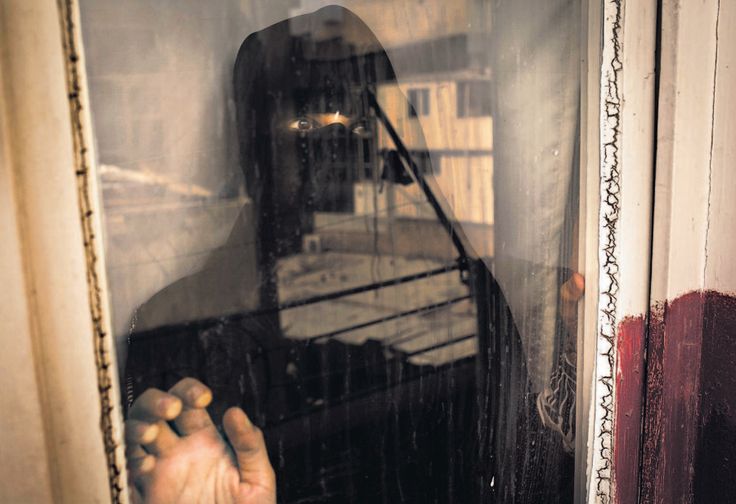
Aws, 25, was a member of the Islamic State’s morality police in Raqqa, Syria. She and two other women fled to Turkey this year. (Tara Tordras-Whitehill for The New York Times)
By Azadeh Moaveni
SOUTHERN TURKEY — Dua had only been working for two months with the Khansaa Brigade, the all-female morality police of the Islamic State, when her friends were brought to the station to be whipped.
The police had hauled in two women she had known since childhood, a mother and her teenage daughter, both distraught. Their abayas, flowing black robes, had been deemed too form-fitting.
When the mother saw Dua, she rushed over and begged her to intercede. The room felt stuffy as Dua weighed what to do.
“Their abayas really were very tight. I told her it was their own fault; they had come out wearing the wrong thing,” she said. “They were unhappy with that.”
Dua sat back down and watched as the other officers took the women into a back room to be whipped. When they removed their face-concealing niqabs, her friends were also found to be wearing makeup. It was 20 lashes for the abaya offense, five for the makeup, and another five for not being meek enough when detained.
Their cries began ringing out, and Dua stared hard at the ceiling, a lump building in her throat.
In the short time since she had joined the Khansaa Brigade in her hometown, Raqqa, in northern Syria, the morality force had grown more harsh. Mandatory abayas and niqabs were still new for many women in the weeks after the jihadists of the Islamic State had purged the city of competing militants and taken over. At first, the brigade was told to give the community a chance to adapt, and clothing offenses brought small fines.
After too many young women became repeat offenders, however, paying the fines without changing their behavior, the soft approach was out. Now it was whipping — and now it was her friends being punished.
The mother and daughter came to Dua’s parents’ house afterward, furious with her and venting their anger at the Islamic State.
“They said they hated it and wished it had never come to Raqqa,” Dua said. She pleaded with them, explaining that as a young and new member of the Khansaa Brigade, there was nothing she could have done.
But a lifelong friendship, with shared holiday gatherings and birthday parties, was suddenly broken. “After that day, they hated me, too,” she said. “They never came to our house again.”
Dua’s second cousin Aws also worked for the brigade. Not long after Dua’s friends were whipped, Aws saw fighters brutally lashing a man in Muhammad Square. The man, about 70, frail and with white hair, had been heard cursing God. As a crowd gathered, the fighters dragged him into the public square and whipped him after he fell to his knees.
“He cried the whole time,” Aws said. “It was lucky for him that he had cursed Allah, because Allah shows mercy. If he’d cursed the Prophet, they would have killed him.”
Today, Aws, 25, and Dua, 20, are living in a small city in southern Turkey after fleeing Raqqa and its jihadist rulers. They met up here with Asma, 22, another defector from the Khansaa Brigade, and found shelter in the city’s large community of Syrian refugees.
Raqqa is widely known now as the capital of the Islamic State’s self-declared caliphate and as the focus of heavy airstrikes by a growing number of countries seeking revenge for the group’s recent terrorist attacks. But the city in which the three women came to adulthood used to be quite different. Identified here by nicknames, the women spoke for many hours over the course of two visits this fall, recalling their experiences under Islamic State rule and how the jihadists had utterly changed life in Raqqa.
All three described themselves as fairly typical young women of Raqqa. Aws was more into Hollywood, Dua into Bollywood. Aws’s family was middle-class, and she studied English literature at a branch of Euphrates University, a three-hour bus ride away in Hasaka. She devoured novels: some by Agatha Christie, and especially Dan Brown books. “Digital Fortress” is her favorite.
Dua’s father is a farmer, and money was tighter. But her social life was closely intertwined with Aws’s, and the cousins loved their charming city. There were long walks to Qalat Jabr, the 11th-century fort on Lake Assad; coffee at Al Rasheed Park; and Raqqa Bridge, where you could see the city lights at night. In the gardens and amusement park in the town center, there was ice cream and communal shisha pipes to gather around.
“In the summer, everyone went out at night and stayed out late, because it was so hot during the day,” Dua said.
The women keep pictures of their old lives in Raqqa on their cellphones, scenes from parties and countryside outings. Aws’s gallery includes days on the lakeshore, her friends in bathing suits, dancing in the water.
Asma, with a bright gaze, was another outward-looking young woman, studying business at Euphrates University. Her mother was a native of Damascus, the capital, and Asma spent some of her teenage years there seeing friends, swimming at pool parties, going to cafes. She is also an avid reader, fond of Ernest Hemingway and Victor Hugo, and she speaks some English.
All three belonged to a generation of Syrian women who were leading more independent lives than ever before. They mixed freely with young men, socializing and studying together in a religiously diverse city with relatively relaxed mores.
Many young women dressed in what they called sport style, baring their knees and arms in the summer and wearing makeup. And while Raqqa’s more conservative residents wore abayas and veils, women were going to college in greater numbers and getting married later. Most men and women chose their own spouses.
When the uprising against the government of President Bashar al-Assad began rippling across Syria in 2011, it seemed distant from Raqqa. As news of fighting and massacres started filtering in, it was mostly from faraway cities in the country’s west, like Homs. Even as displaced people began appearing in Raqqa and the city’s young men started to sign up with anti-Assad groups in the area, including the Nusra Front and what is now the Islamic State, the fabric of life seemed intact.
At the start of 2014, everything changed. The Islamic State wrested full control of Raqqa and made the city its command center, violently consolidating its authority. Those who resisted, or whose family or friends had the wrong connections, were detained, tortured or killed.
The Islamic State has come to be known around the world by names like ISIS and ISIL. But in Raqqa, residents began calling it Al Tanzeem: the Organization. And it quickly became clear that every spot in the social order, and any chance for a family to survive, was utterly dependent on the group.
Not only had Raqqa residents become subjects of the Organization’s mostly Iraqi leadership, but their place in society fell even further overnight. As foreign fighters and other volunteers began streaming into town, answering the call to jihad, they became the leading lights of the shaken-up community. In Raqqa, the Syrians had become second-class citizens — at best.
Dua, Aws and Asma were among the lucky: The choice to join was available to them. And each chose to barter her life, through work and marriage, to the Organization.
None of them subscribed to its extreme ideology, and even after fleeing their homes and going into hiding, they still struggle to explain how they changed from modern young women into Islamic State morality enforcers.
In the moment, each choice seemed like the right one, a way to keep life tolerable: marrying fighters to assuage the Organization and keep their families in favor; joining the Khansaa Brigade to win some freedom of movement and an income in a city where women had been stripped of self-determination.
But every concession turned to horror before long, and the women came to deplore how they were pitted against their neighbors, part of a force tearing apart the community they loved. Only months in, widowed and abandoned and forced to marry strangers again, would they see how they were being used as temporary salves to foreign fighters whose only dedication was to violence and an unrecognizable God.
Each of them was driven to the conviction that escape was a last chance at life. And each joined the flow of Syrians abandoning their country, leaving a void to be filled by the foreigners who held nothing of Syria in their hearts.
The Betrothals
The day Abu Muhammad, a Turkish fighter for the Islamic State, walked through Aws’s front door to seek marriage, she made her first concession to the Organization.
Her father and grandfather met with Abu Muhammad in the living room, telling Aws that she could see him at a second meeting if he offered a suitable dowry. But Aws was too much of a romantic, and had seen too many Leonardo DiCaprio films, to agree to marry a man whose face she had not seen.
When she knelt down behind the living room door to leave the thimbles of coffee she had prepared, she peered in for a moment and caught a glimpse of him. He had winged eyebrows, light eyes and a deep voice. As she waited for the discussion to conclude, she tried to imagine what their life together might be like. By the time her father called her in, she had already nervously decided to say yes, for her family’s sake.
After their wedding, she was surprised to find that the marriage felt real — even affectionate. Abu Muhammad liked to trace the two moles that made a constellation on her left cheek; he gently teased her about her accent when she tried to pronounce Turkish words.
But he often did not come home at night, and was sometimes gone for three- or four-day stretches to fight for the Islamic State. Aws hated being left alone and would pout about it when he finally came home; he answered with silly jokes, cajoling her into forgiveness.
She tried to keep busy by socializing with other fighters’ wives. Among them, she felt fortunate. Some were married to men who were abusive.
Everyone had heard of Fatima, who had killed herself by slitting her wrists after being forced to marry a fighter, and there was the Tunisian girl next door who burst into tears every time someone mentioned her husband’s name. And even they were considered luckier than the captured women from the Yazidi minority, who were being smuggled into town as slaves for other fighters.
Mostly, though, Aws’s days became an intolerable void. Sociable and lively, with long, curly black hair and a gamine face, she was bored and thoroughly unhappy. She finished her housework quickly, but there was nowhere to go. New books were nearly impossible to find after the jihadists banned almost all fiction, purging the bookshops and local cultural center.
The Organization also cast a long shadow over her marriage. Though Aws had always wanted a baby, Abu Muhammad asked her to take birth control pills, still available at Raqqa’s pharmacies. When she pressed him, he said his commanders had advised fighters to avoid getting their wives pregnant. New fathers would be less inclined to volunteer to carry out suicide missions.
This was one of the early, devastating moments when Aws saw that there would be no normalcy or choice; the Islamic State was a third partner in her marriage, there in the bedroom. “At first, I used to keep bringing it up, but it really upset him, so I stopped,” she said.
For Dua’s family, money had always been an issue. Her father was still farming, but many lawyers and doctors who had lost their jobs when the jihadists took over had also started selling fruits and vegetables to get by, creating new competition. The Organization imposed taxes, which cut further into the family’s income. When a Saudi fighter came to ask to marry Dua, in February 2014, her father pushed her to accept.
The Saudi, Abu Soheil Jizrawi, came from a wealthy construction family in Riyadh and promised to transform Dua’s life. She deliberated and eventually agreed. She met him for the first time on their wedding day, when he arrived bearing gold for her family. She liked what she saw: Abu Soheil was light-skinned with a soft black beard, tall and lanky, with charisma and an easy way of making her laugh.
He set her up in a spacious apartment with new European kitchen appliances and air-conditioning units in each room — almost unheard-of in Raqqa. She eagerly showed off her new home to friends and relatives. Her kitchen became the place where the other fighter’s wife in the building — a Syrian who, like Aws, had married a Turkish recruit — stopped in for coffee. Each morning, Abu Soheil’s servant shopped for them and left bags of meat and produce outside the door.
In the evenings, the couple lingered over dinner, and he complimented her cooking, especially when she made his favorite, kabsa, a spiced rice dish with meat and eggplant. Abu Soheil did not even mind the little rose tattoo on her hand, though permanent tattoos are forbidden in strict interpretations of Islam.
“He changed my life completely,” Dua said. “He persuaded me to love him.”
Filling Empty Hours
While a little light, at least, had come into the lives of Aws and Dua, Asma’s living room in Raqqa was perpetually dark and stifling. She kept the curtains drawn and windows closed so that no one would know she had her television on inside. Television, music, the radio — everything was kept at the lowest volume she could hear.
Even that escape was becoming scarce for Asma as electricity in Raqqa dwindled to two, sometimes four, hours a day. She certainly could no longer go to the salon to fill the time.
The Organization decreed that the Internet could be used only for critical work, like that of the painstaking recruiters who went online to woo new fighters and foreign women to Syria. Asma, who had previously been on her laptop a few hours each day, found herself disconnected from the world.
“But it was O.K. for them, contacting all those girls to bring them in,” Aws recalled later, as the three women sat together here in Turkey. They all rolled their eyes. “That was work.”
In February 2014, two months into her marriage and unable to persuade Abu Muhammad to let her get pregnant, Aws decided to join the Khansaa Brigade. Dua joined around the same time, and they started their compulsory military and religious training together.
The cousins had their misgivings about joining. But they had already married fighters, choosing to survive the occupation of Raqqa by aligning with the Organization. Working with the brigade was a chance to do more than just subsist, and it paralleled their husbands’ work. And the full extent of the brigade’s oppressiveness would only emerge with time.
A number of Asma’s relatives had already started working for the Islamic State in various ways, and she deliberated carefully before joining in January 2014. With her family already enmeshed with the Organization, it seemed the most logical choice.
“For me, it was about power and money, mostly power,” Asma said, switching to English to describe those motivations. “Since my relatives had all joined, it didn’t change a great deal to join. I just had more authority.”
Though the women tried to rationalize their enlistment, there was no way to avoid seeing the Organization as the wanton killing machine it was. But all of Syria, it seemed, had become about death.
At night, Aws and Dua heard attempts at self-justification from the husbands they had waited up for and would go to bed with. They had to be savage when taking a town to minimize casualties later, the men insisted. Mr. Assad’s forces were targeting civilians, sweeping into homes in the middle of the night and brutalizing men in front of their wives; the fighters had no choice but to respond with equal brutality, they said.
All three women attended the training required for those joining the Khansaa Brigade. Roughly 50 women took the 15-day weapons course at once; during eight-hour days, they learned how to load, clean and fire pistols. But the foreign women who had come to Syria to join the Islamic State were rumored to be training on “russis,” slang for Kalashnikov assault rifles.
Religion classes, taught mainly by Moroccans and Algerians, focused on the laws and principles of Islam. Dua, for one, was pleased; she felt she had not known enough about Islam before the Organization took over.
By March 2014, Aws and Dua were out every day on the brigade’s street patrols, moving about the city in small gray Kia vans with “Al Khansaa” on the sides. There were women from across the world in the brigade: British, Tunisian, Saudi, French.
But both within their unit and more broadly across Raqqa, the Organization had issued a strict decree: No mingling between natives and foreigners. The occupiers thought gossip was dangerous. Salaries and accommodations might be compared, hypocrisies exposed.
Status within Raqqa — how it was derived and how it was expressed — was becoming a grievance. Dua explained openly, with a modest but satisfied expression, that she had enjoyed more status than most because of her wealthy Saudi husband, who was said to be high up in the Organization.
“As women, our status depended on his status,” Aws said, referring to husbands in general. Among the male fighters, this had been clear from the beginning: Salaries, cars, neighborhoods and housing were allocated in large part by nationality.
It soon became clear that the foreign women had more freedom of movement, more disposable income and small perks: jumping to the front of the bread line, not having to pay at the hospital. Some seemed to have unfettered Internet access, including multiple Twitter profiles.
“The foreign women got to do whatever they wanted,” Asma complained. “They could go wherever they wanted.”
“They were spoiled,” Aws said. “Even the ones that were younger than us had more power.”
“Maybe it’s because they had to leave their countries to come here — it was felt they should be treated more specially,” Dua said, as usual more reluctant to criticize.
“We couldn’t even say anything,” Aws said. “We couldn’t even question why.”
The Organization had no outlet for grievances. It seemed to operate by stealth, and being married to its fighters offered no real information about its operations and ambitions. Senior figures like the caliph himself, Abu Bakr al-Baghdadi, were never seen in public. Even within Raqqa, he remained a shadow, the women said.
Asma’s role in the Khansaa Brigade involved meeting foreign women at the border with Turkey, 50 miles north, and accompanying them into Raqqa at night. With her smattering of English and cosmopolitan air, she was well suited to the task. She would receive a slip of paper with names, and the crew — two or three brigade women, an interpreter and a driver — would start up the highway.
Many women were arriving from Europe. One spring night this year, Asma and her crew received three British girls, dressed in Western clothes but with their hair covered. “They were so young, tiny, and so happy to have arrived, laughing and smiling,” she recalled.
She accompanied them to a hostel and helped them get settled. As with most of the foreigners she escorted, she did not see them again. It was only later that she saw their faces plastered across the Internet, identified as schoolgirls from Bethnal Green in London, migrating by choice to join the Islamic State.
Asma was bewildered by their decision to so cheerfully embrace a life that was sapping her every single day.
Before, Asma had a boyfriend from college. Their relationship was complicated: He had urged her to start wearing a head scarf and to dress more conservatively even before the Islamic State took control of Raqqa, but she refused to have her worth judged by the amount of skin she had covered. After the takeover, he moved to Jordan to finish his studies.
Now, she wore her hijab all day and enforced it for other women. But at night, she listened to the rock group Evanescence on her phone and mourned.
One spring day in 2014, the women in Dua’s police unit went to one of the city’s main squares to watch the stoning of two local women, supposedly for adultery. Dua refused to go. She did not like how the militants prized spectacle over correct implementation of Shariah law. “In Islam, you need four witnesses to the act to carry out such a punishment,” she said.
Within hours, word spread that one of the women had not been involved with a man at all. She was said to have shown up outside the city’s Police Headquarters holding a sign that read, “Tasqoot al-Tanzeem.” Down With the Organization.
By the time the trees blossomed that spring, it was common to see the heads of captured soldiers and people accused of treason hanging in the main square near the clock tower. But most who had stayed in Raqqa were either too afraid to rebel or had no desire to.
Horrified, the cousins kept trying to cope, soothing themselves with the thought that, though they had joined the Organization, at least they were not personally killing anyone.
“We saw many heads being cut off,” Dua recalled.
“You saw the heads — it was just the heads you saw,” Aws corrected her.
“Well, it is forbidden in Islam to mutilate bodies.”
“I saw bodies that lay in the street for a whole week.”
Asma, unsettled at the turn in the conversation, tuned out and started looking at Facebook on her phone. Of the three women, she was the only one who read Western news coverage online: She knew the world considered the Islamic State grotesque, and she was haunted by how she had tainted herself at the very outset of her adult life.
Within the brigade, women had started using their authority to settle petty quarrels or exact revenge. “Girls who were fighting would go to the Organization and accuse their enemies of some infraction,” Aws recalled. “Even if they had done nothing wrong, they would be brought into headquarters.”
Their job, inflicting fear on their neighbors, was agony. That everyone was probably two-faced was the only reliable assumption.
“Many times, I saw women I knew smiling at me when they saw I’d joined,” Aws said. “But I knew inside they felt differently. I knew because before I joined myself, when I saw a girl I knew had started working with ISIS, I resented it.”
Wives of Martyrs
As with Aws’s husband, Dua’s, Abu Soheil, did not want children. But Dua was not in a rush, and she did not press him.
One week in July 2014, he did not return for three nights. On the fourth day, a group of fighters knocked on her door. They told her that Abu Soheil had blown himself up in a battle against the Syrian Army at Tal Abyad, on the border with Turkey.
Dua was devastated, especially when the commander told her Abu Soheil had requested a suicide mission. He had never told her about such a plan, and she broke down, shaking and sobbing, at the men’s feet.
She tried to console herself with the thought that it was honorable to be a martyr’s wife. But days later, she learned a fact that made things even harder to bear: Abu Soheil had killed himself in an operation not against the hated Syrian Army, but against a competing rebel group that the Islamic State was trying to wipe out.
“I cried for days,” she said. “He died fighting other Muslims.”
Just 10 days later, another man from her husband’s unit came to the house. He told Dua she could not stay home alone and would need to marry again, immediately.
Under nearly universal interpretations of Islam, a widow must wait four months and 10 days before remarrying, mainly to establish the paternity of any child that might have been conceived. But the Islamic State had twisted the law for its own purposes, and the women expected only a three-month waiting period, customary for divorced women.
The waiting period, called idaa, is not only required but is a woman’s right, to allow her to grieve. But even in the realm of divine law, the Islamic State was reformulating everything.
“I told him that I still couldn’t stop crying,” Dua said. “I said: ‘I’m heartbroken. I want to wait the whole three months.’ ” But the commander told her she was different from a normal widow. “You shouldn’t be mourning and sad,” he said. “He asked for martyrdom himself, and you are the wife of a martyr. You should be happy.”
That was the moment that broke her.
The Organization had made her a widow and wanted to do so again and again, turning her into a perpetual temporary distraction for suicidal fighters. There was no choice left, no dignity, just the service demanded by the Islamic State’s need to feed men to its front lines.
“I had a good marriage to a good man, and I didn’t want to end up in a bad one,” Dua said. “I knew it would be painful for me to marry someone only to lose him when he goes on a martyrdom mission. It’s only natural to have feelings and grow attached.”
She knew she had to escape, even though it would mean leaving the house that should have been her inheritance.
The news came for Aws not long after it did for Dua. Abu Muhammad had also killed himself in a suicide operation. There was no funeral to attend and no in-laws to grieve with. She was devastated.
She had no time to recover before the Organization came knocking. “They told me that he was a martyr now, obviously he didn’t need a wife anymore, but that there was another fighter who did,” Aws said. “They said this fighter had been my husband’s friend, and wanted to protect and take care of me on his behalf.”
She agreed reluctantly, despite being one month short of her three-month waiting period. But things did not click with this new husband, an Egyptian who turned up at home even less than Abu Muhammad had. Everything about him — his personality, his looks, their sexual relations — she shrugged off with a sour expression and a single word: “aadi.” Regular.
When he ran off with his salary two months later, without even a goodbye, Aws was left abandoned, denied even the status of widow. Back at her parents’ house, she wandered from room to room, grieving for the life she had had before and stunned by how far away it seemed from where she had fallen.
Departure
To the outside world, the territory controlled by the Islamic State might seem to be a hermetically sealed land governed by the harshest laws of the seventh century. But until relatively recently, the routes into and out of Raqqa were mostly open. Traders would come and go, supplying the Organization’s needs and wants — including cigarettes, which some fighters smoked despite the fact that they were banned for Raqqa residents.
Dua, unable to bear another forced marriage, left first. Her brother made calls to Syrian friends in southern Turkey who could meet her on the other side, and the siblings boarded a small minibus for the two-hour ride to the Tal Abyad crossing early this year. The flow of refugees into Turkey was still heavy then, and the two passed through without being stopped.
When Aws decided to leave four months later, it was harder to cross the border because Turkey had started tightening security. She contacted Dua and was put in touch with the man who had helped Dua get out.
The man is part of a network in southern Turkey that has made a cottage industry of extricating people from Islamic State territory. When Aws got to the border crossing, one of the man’s colleagues was waiting with a fake identity card that showed her to be his sister if she should be questioned.
Her heart was in her throat, but when the moment of crossing came, the men at the checkpoint never asked her to show identification, much less to remove her veil.
By early last spring, Asma was agonizing about whether to flee as well.
Raqqa had been transformed. Before, she would see someone she knew every 20 paces; the city felt small. But those who could afford to had fled. On the job in public, she was surrounded by strange faces and foreign accents.
The Organization disapproved of young women’s remaining unmarried, and Asma’s situation had grown complicated. She became deeply depressed, her days stretching before her aridly.
“You couldn’t go to the doctor without your father or brother. You couldn’t go out to just take a walk,” she said. “I just couldn’t bear it anymore.”
She felt her identity was being extinguished. “Before, I was like you,” she told a reporter, waving her arms up and down. “I had a boyfriend, I went to the beach, I wore a bikini. Even in Syria, we wore short skirts and tank tops, and all of this was normal. Even my brothers didn’t care — I had no trouble from anyone.”
When she and a cousin plotted their escape, they told no one, not even their families, and took nothing but their handbags. A friend inside the Organization agreed to get them out, and fear for him made the night journey even more terrifying. The friend guided them through three checkpoints, and finally, just after 1 a.m., they arrived at the border crossing. They showed their ID cards and murmured goodbye.
“The guy at the checkpoint, I was convinced he knew we were trying to escape. I was so nervous and scared,” Asma recalled. “But then I realized it only looked suspicious in my head, because I was so scared.”
The car meeting them on the other side looked gray in the moonlight. They got in and drove away from the Islamic State, from what was left of Syria.
Little Syria
The Turkish city the three women now live in sits on a dry grass plain, its outskirts dotted with almond and plum groves, pine and olive trees. Low-slung apartment blocks were put up during a housing boom a few years ago, providing the cheap accommodation that has made it possible for many Syrian refugees to rebuild lives here.
There are scruffy Syrian children begging and selling tissues in the street, just as in Istanbul or Beirut, Lebanon. But there are opportunities for work, and the rent for a two-bedroom apartment is not staggeringly out of reach.
There are, by now, enough Syrians that the city center has its own Syrian restaurants and baklava shops. The merchants in the bazaar are now practiced in saying, in Arabic, “This price is just for your sake.”
But not all of the city’s Syrian émigrés were Islamic State collaborators, and Aws, Dua and Asma tightly guard their secret. They are stateless and dislocated, hiding pasts that could hurt them.
All three are taking English and Turkish classes, hoping that will someday help them chart a future elsewhere, perhaps in a more cosmopolitan part of Turkey. They live with Syrian families who are more established, whom they know from home or who had connections there. The families cover much of their living costs, and what they brought from home is enough for their language courses and daily expenses.
Aws wakes up and listens to the Lebanese singer Fayrouz as she makes her morning coffee. She is cagey about her social life, but she shows part of a new cellphone gallery that seems to echo her old life in Raqqa, before the Organization took over: handsome friends, endless shisha cafes. She speaks with her family by voice chat a couple of times a month over WhatsApp.
She wants to find a way to finish her university studies, and to feel normal. “But here, walking on the street, they never let you forget that you’ve had to leave your country,” she said. “Once, someone told a friend of mine, ‘If you were a real man, you wouldn’t have left your country.’ It killed me when I heard this.”
Asma is more fearful and rarely goes out within the town. She has severed contact with her family, worried that the militants will punish them for her escape. Once a week, she emails and calls a friend in Raqqa to complain that her family has spurned her. It is untrue, but she hopes that if she says it often enough, it will spread and perhaps even be heard by Islamic State intelligence, and that she will protect her family from any consequences of her departure.
After years of shame and disappointment, none of the three said they could imagine ever going back, even if the Islamic State falls. The Raqqa that was their home only exists in their memories.
“Who knows when the fighting will stop?” Asma said. “Syria will become like Palestine; every year, people think: ‘Next year, it will end. We will be free.’ And decades pass. Syria is a jungle now.”
“Even if one day things are all right, I will never return to Raqqa,” Aws said. “Too much blood has been spilled on all sides — I’m not talking just about ISIS, but among everyone.”
By David D. Kirkpatrick
SURT, Libya — The Islamic State has established more than a foothold in this Mediterranean port. Its fighters dominate the city center so thoroughly that a Libyan brigade sent to dislodge the group remains camped on the outskirts, visibly afraid to enter and allowing the extremists to come and go as they please.
“We are going to allow them to slip out, because the less people we have to fight, the better,” said Mohamed Omar el-Hassan, a 28-year-old former crane operator who leads the brigade from a prefabricated shed on a highway ringing the city.
“Why make the city suffer?” he said, trying to explain his delay more than 16 days after the brigade arrived in Surt.
Nearly four years after the ouster of Col. Muammar el-Qaddafi, Libya’s warring cities and towns have become so entangled in internal conflicts over money and power that they have opened a door for the Islamic State to expand into the country’s oil-rich deserts and sprawling coastline. Libya has become a new frontier for the radical group as it comes under increasing pressure from American-led airstrikes on its original strongholds in Iraq and Syria.
While other extremists organizations may have sought only to capitalize on the Islamic State’s fearsome name, the contingent here in Surt has not only taken over a major Libyan city but also demonstrated clear coordination with the parent organization, also known as ISIS or ISIL and based in Syria.
A recent video depicting the beheadings of Egyptian Christians kidnapped from Surt appeared to have been taped on the Libyan shoreline, but it also featured the parent group’s signature audiovisual sophistication, orange jumpsuits and ceremonial knives. It was publicized in the main group’s online magazine, then released under its media logo.
That close cooperation so far sets the Islamic State group in Surt apart from the wave of other militants who have pledged allegiance to ISIS from Afghanistan, Algeria, Nigeria and Egypt, or even in Libya’s southern and eastern provinces.
But even after the international uproar over the video, no Libyan authority has been able to take any effective action against the group. Two warring coalitions of militias have divided the country, and each — including the one that sent Mr. Hassan and his fighters, known as Brigade 166 — appears more intent on fighting the other than on thwarting the Islamic State. What is more, the battles have crippled Libya’s oil exports so severely that there is now a risk that the country’s currency and economy will soon collapse.
“A currency collapse is less than two years away,” Musbah Alkari, manager of the reserves department at the Central Bank of Libya, said in an interview at the bank’s headquarters in Tripoli.
Western governments are keeping a watchful eye. Fighters with Mr. Hassan’s brigade at the edge of Surt pointed to what appeared to be a white surveillance drone or airplane circling overhead — a daily visitor, they said.
His fighters used extreme caution when circling the city. Escorting a Western journalist on a brief visit, they were careful not to enter the city itself. To reach one point on the outskirts, Mr. Hassan brought a half-dozen trucks for protection, some mounted with artillery, and his fighters kept their guns elevated on constant alert.
His brigade had established control of the airport, Mr. Hassan said. But there were no signs that the fighters had set up checkpoints, even at critical spots like the coastal road entering the city or the main road to the airport. “See the jihad,” read graffiti on a wall along the main road outside the city.
The Islamic State controls the local radio station; during the recent visit, all four stations on the dial were transmitting Islamic sermons. “They use the radio stations to broadcast, and they are attracting a lot of people to join them,” Mr. Hassan said wearily.
He and other local militia leaders, citing informants inside Surt, said they believed that the Islamic State fighters in the city numbered about 200 or fewer, while Mr. Hassan’s brigade can command hundreds. He insisted he needed no reinforcements. But the Islamic State fighters were deeply entrenched and stronger than expected, Mr. Hassan said.
“We came here with orders to go in and take over the city, but we were surprised by the numbers that joined them,” he said.
Since arriving, his brigade had found time to apprehend some foreign workers without visas trying to move through the area, Mr. Hassan said.
But militants suspected of links to the Islamic State had nonetheless carried out several successful attacks on nonoperational oil fields south of the city, reportedly killing several Libyan guards and abducting nine foreigners. No one has claimed responsibility for those attacks.
The rival militia coalition, based in the eastern cities of Tobruk and Bayda and under the loose command of Gen. Khalifa Hifter, describes itself as fighting to rescue Libya from Islamic extremists, including the Islamic State fighters. “Libya was becoming the funding house, and they were going to export terrorism around the world,” said Saqr al-Jaroushi, the air force chief under General Hifter.
But the coalition’s leaders often characterize all of its opponents as extremists, including regional militias like Mr. Hassan’s. Brigade 166 fighters displayed some evidence that General Hifter’s coalition had been bombing their positions outside the city, even though in this case Mr. Hassan’s brigade is on a mission against the same extremists.
In a pasture near the coast, the brigade fighters showed a journalist an unexploded cluster bomb, identified from photographs as a Soviet-made RBK series, near one of their positions. Similar munitions had evidently exploded nearby in recent days and left fragments of shrapnel in cup-size holes blasted into the dirt. Such weapons are banned under international law because of their indiscriminate nature.
Frederic Wehrey, a researcher for the Carnegie Endowment for International Peace, has said he saw evidence that General Hifter’s planes had dropped cluster bombs on a bank and other civilian targets during fighting in the coastal town of Bin Jawad as well.
The coalition that sent Mr. Hassan, which is known as Libya Dawn and opposes General Hifter, includes some Islamic extremist groups in the eastern cities of Benghazi, Darnah and possibly elsewhere. Its supporters often try to argue that the Islamic State fighters in Surt are merely a front for Qaddafi loyalists or supporters of General Hifter.
“A lot of people who have joined this group we call the Islamic State are actually remnants of the previous regime we fought in 2011,” Omar al-Hassi, prime minister of a provisional government set up by the Libya Dawn coalition in Tripoli, said in an interview here. Mr. Hassi dismissed the images of beheadings in Surt as “a fabricated Hollywood-like video” concocted to stir trouble with Egypt.
Like many in his coalition, he mentioned a television interview with an influential Qaddafi cousin outside Libya, Ahmed Qaddaf al-Dam, who at times applauded the Islamic State from an Arab nationalist perspective for seeking to erase the border between Syria and Iraq. But Mr. Dam also denounced the group’s medieval Islamist ideology, saying it “shows the psychological state they are in and that they need mental health treatment.”
Surt, near Colonel Qaddafi’s birthplace, was the site of his last stand in 2011, when rebels from the city of Misurata joined a battle that destroyed much of the city. They ultimately captured Colonel Qaddafi and killed him.
Mr. Hassan of Brigade 166, which comes primarily from Misurata, said that history was one reason that his forces hesitated to move in. He said he feared that aggressive military action against the Islamic State could increase its support from local tribes who still resent Misurata’s militias for the destruction of their city in 2011.
“If we went in with both guns blazing, we would have a backlash,” Mr. Hassan said.
He and other militia leaders also acknowledged, though, that the core of the Islamic State in Surt was from Misurata — a connection that could test the loyalties of other Misuratan militiamen, who are typically reluctant to fight against their neighbors or cousins.
After Misuratan brigades moved into Surt in 2011, Mr. Hassan and others acknowledged, some continued to occupy the city and eventually turned into an extremist group, Ansar al-Shariah of Surt, a parallel to organizations of the same name in Benghazi and Derna.
More than two months ago, Mr. Hassan and others said, Ansar al-Shariah of Surt split up in a dispute over pledging allegiance to the Islamic State, and those who chose to ally with it emerged as the dominant faction. “They are the nucleus,” Mr. Hassan said.
“You can say that the leaders are from Misurata,” Mr. Hassan said, although he insisted that would not deter his brigade. “I am not here as a Misuratan.”
A fighter named Suliman Ali Mousa, 58, raised the theory that the Islamic State had become merely a “banner” for criminals or Qaddafi loyalists.
But Mr. Hassan said that hardly mattered. “If they are raising the black flag of the Islamic State and preaching Islamic State ideas,” he said, “then they are the Islamic State.”
Suliman Ali Zway contributed reporting from Surt, and C. J. Chivers from New York.
Piercing Together a Young American’s Path to Jihad, and to Syria
By Scott Shane
MINNEAPOLIS — Reading back over Abdi Nur’s Twitter feed, his chilling progression from the basketball courts of South Minneapolis to the battlefields of Syria is clear.
Early last year, he began posting stern religious pronouncements and snippets of scripture. By April 2, a day after turning 20, he hailed Islamic fighters: “If the sky would be proud of the existence of the stars, the land should be proud of the existence of the Mujahideen.”
On May 29, the day he disappeared, he posted, “I Thank Allah For Everything No Matter What!” Soon he was in Turkey, rebuffing his mother’s and sister’s anguished pleas to come home. In late July, he declared, “What A Beautiful Day in Raqqa,” the de facto capital of the Islamic State in Syria. Last Aug. 7, he posted a picture of himself online with his finger on the trigger of a Kalashnikov.
Mr. Nur had become one of a small number of Americans enticed by the apocalyptic religious promise of the self-described Islamic State, which has seized large sections of Syria and Iraq and claims to be building a caliphate.
A slightly built man with an easy smile, he is a rare example of an American fighting for the terror group whose story can be pieced together from online postings, interviews and public records. His case suggests that the Islamic State may rely on recruiters inside the United States and shows how hard it is to predict who will be swept away by ideological fervor.
Mr. Nur was enrolled in community college outside Minneapolis and spoke of becoming a lawyer. Then he started visiting a new mosque and dressing in more traditional garb. He plotted his getaway with a friend, Abdullahi Yusuf, 18, but their fates starkly diverged. Mr. Yusuf was stopped as he tried to leave the country and is now in a Minneapolis halfway house, part of a closely watched experiment to spare him a long prison term and give him a role dissuading others attracted to terrorism.
The number of Americans drawn to the Islamic State remains modest, especially by comparison with the 3,000 or so who have joined the group from Europe. More than two dozen men and women have been stopped by the F.B.I. and charged before they could fly away. Social media posts and court records suggest that perhaps another two dozen have made it to the group in Syria, though even intelligence agencies do not have an exact count. At least four Americans have died fighting for the Islamic State, also known as ISIS or ISIL.
With no clear pattern among recruits, law enforcement officials have scrambled to identify people attracted to the terror group in time to intervene — blocking their travel or potentially stopping a plot at home.
Most of the American ISIS volunteers display an earnest religious zeal, usually newfound. In an incongruous touch, several have visited malls to buy athletic gear before leaving for jihad — Mr. Nur, for instance, went to Macy’s for Nike apparel, the F.B.I. discovered.
The majority of the Islamic State recruits are men, but there are quite a few women. The volunteers include teenagers too young to drive and middle-aged adults with families and careers; petty criminals and diligent students. A substantial minority are converts to Islam, while others are the children of immigrants with roots in 10 Muslim countries.
The only cluster in the country is in Minneapolis, where two dozen young men with Somali roots departed in recent years to fight with the Shabab, the affiliate of Al Qaeda in Somalia. Now, to the distress of Somali elders, more than a dozen others have left or have tried to leave to join ISIS.
But the trickle of volunteers has come from across the country. On Tuesday, a 47-year-old Air Force veteran with a checkered work history was charged in Brooklyn with trying to join the Islamic State. Two weeks earlier, a computer-savvy 17-year-old boy in Virginia was charged with helping a man a few years older make contact with the terrorist group and get to Syria.
The cases raise a pressing question: Is the slick online propaganda that ISIS has mastered enough to lure recruits, or is face-to-face persuasion needed? A federal grand jury in Minneapolis is investigating whether an Islamic State recruiter gave Mr. Nur and Mr. Yusuf cash to buy plane tickets.
“No young person gets up one day and says, ‘I’m going to join ISIS,’ ” said Abdirizak Bihi, 50, a Somali activist who has worked against radicalization since his nephew left Minnesota in 2008 and was killed fighting for the Shabab.
“There has to be someone on the ground to listen to your problems and channel your anger,” Mr. Bihi said. “Online is like graduate studies.”
Travel Guide for Jihadists
Biographies are most complete on those caught at airports trying to leave the United States. Michael Todd Wolfe, 23, a convert to Islam from Texas with a record of assault and theft charges, for example, was stopped at the Houston airport. He had agonized over whether he would fit better with the Islamic State or the Nusra Front, an Al Qaeda affiliate.
F.B.I. agents were waiting at the Denver airport for Shannon Conley, a 19-year-old who thought she could use her skills as a nurse’s aide to help ISIS fighters. She hoped to marry a Tunisian recruiter for the Islamic State whom she had met online.
Mohammed Hamzah Khan, 19, took his younger brother and sister with him to O’Hare airport in Chicago, where agents intercepted them. He left his parents a long letter saying he could not stay in the United States because his taxes might be used to kill Muslims overseas.
Recruits have a remarkable ISIS travel guide to draw on, called “Hijrah to the Islamic State” — hijrah meaning “emigration” or “journey.” Distributed on the web since February, the 50-page book mixes Fodor’s-style advice on electrical plugs and packing — “I also advise a backpack with many small pockets” — with more tailored counsel, including the Twitter accounts of 15 men and three women with ISIS in Syria who offer guidance.
“Use a software to ‘hide’ all jihadi material you might be bringing,” the book warns, in flawed English. It advises travelers on what to tell suspicious officials in Turkey, the usual transit country. It comically alters a Turkish visa form to add a new checkbox for “purpose of trip”: “Commit jihad in Syria.” It advises travelers to check “tourism” instead.
For the most part, the Americans who have reached ISIS can be glimpsed only through their occasional online appearances, hidden behind screen names. Anat Agron, who studies the online trails of English-speaking foreign fighters in Syria for the Middle East Media Research Institute, said she had tracked six men and three women who credibly claimed to be Americans now with ISIS.
Ms. Agron also found a young woman who calls herself Chloe, a Muslim convert from San Francisco who appears to have married a Welsh fighter who joined the Nusra Front. Both posted pictures of their cat on Twitter, along with expressions of marital devotion. Chloe’s posts are mostly religious exclamations or lighthearted remarks about her life in Syria, including the niqab, or face veil.
“At the market being hugged by every little kid with a niqabi mother lol #niqabproblems #notyomama,” she tweeted on March 8. Another woman calling herself “Umm Jihad” posted a picture of an American passport, along with the passports of three other Western women. “Bonfire soon,” she wrote on Twitter, “no need for these anymore.”
A man posting online as Bandar al-Californi documented his preparations for hijrah in a long-running Twitter series. “I have much to do yet. Learn Arabic, save money, plan my course,” he wrote last November, adding that he was giving himself six months to leave.
“What an honor,” he tweeted to a self-described Islamic State fighter. “I hope to be in Sham soon,” he added, using a name for greater Syria. His Twitter account was suspended late last year, making it hard to say if he had succeeded.
Then there are those who encountered the violence of the Islamic State and the brutal war it is fighting. One American from Pennsylvania and three from Minnesota have died in combat with the group. Last month, when masked militants beheaded 21 Egyptian Christians on a Libyan beach, their leader spoke to the video camera in American-accented English, leading to speculation that he might have lived in the United States.
On March 2, ISIS-linked Twitter accounts claimed that a suicide truck bombing outside the Iraqi city of Samarra was carried out by “Abu Dawoud al-Amriki,” a nom de guerre that indicated he was an American. Officials say they have not been able to determine the bomber’s identity.
‘Who Brain Washed You?’
Because Mr. Nur, the Minneapolis man, is active on social media and has been charged in absentia with supporting ISIS, his story is easier to follow than most. His family declined to be interviewed. “They are devastated,” said Omar Jamal, a Somali-American activist in Minneapolis who spoke to family members. “They are afraid.” They are worried that anything they say might somehow endanger their son in Syria or relatives in Somalia, he said, in addition to attracting a hostile reaction from neighbors and co-workers.
Mr. Nur’s immigrant parents most likely did not see that by late March of last year, he was posting a quote from Anwar al-Awlaki, the late American recruiter for Al Qaeda: “We are fighting for truth and justice and you (americans/westerners) are fighting for oppression and worldly gain.”
Somehow “you” had become his fellow Americans. “We” were the jihadists. It was a few weeks after Mr. Nur and Mr. Yusuf had begun visiting a new mosque in Bloomington, outside Minneapolis. It was there that they became interested in ISIS, which was not yet associated with the videotaped beheadings of Westerners that would come later.
A passport specialist, suspicious when Mr. Yusuf applied for an expedited passport and seemed vague about its purpose, alerted the F.B.I. On May 28, agents intercepted Mr. Yusuf at the Minneapolis airport and kept him from boarding. They found that the blue Volkswagen Jetta that had dropped him off belonged to the boyfriend of Mr. Nur’s sister. But when they searched for Mr. Nur late on May 29, they learned he had left the country hours earlier.
Word that he was missing was a blow for the city’s large Somali community. “It went out like wildfire that he had left and nobody knew where he had gone,” said Abdirizak Warsame, a friend and, like Mr. Nur, a 2013 high school graduate. They had played basketball together just a few days earlier. “I had no clue,” he said.
The next day, May 30, Mr. Nur’s older sister, Ifrah, walked to the police station near the family’s apartment to report his disappearance. Over the next day or so, she managed to reach him in Turkey via messages on Facebook and an app called Kik. Their exchanges are recorded in court papers.
She challenged him, saying that their father “went into shock” and telling him that “going to kill poor people is not the answer.” She made an emotional appeal: “respond to me I love u and can’t live knowing this.” He gently put her off, saying that “if I didn’t care I wouldn’t have left but I want jannah” — paradise — “for all of us.”
During his early months in Syria, Mr. Nur was upbeat and posted frequently online. He was teaching English (“Got a Full Class”), trading tips on handguns and pistols, expressing excitement about fighting Kurdish forces (“Never Felt So Hyped”) and praising the “amazing brothers” with him. On Aug. 7, he answered questions on the website Ask.fm, including some from angry friends in Minneapolis.
“Who brain washed you?” one asked.
Mr. Nur was unfazed. “The Words of Allah, The Quran, that’s what brain washed me,” he wrote.
But there were hints of homesickness — multiple messages about the mothers of jihadists — and his posts fell off. “Oh Mother Be Patient,” he wrote, suggesting that they would be reunited in the afterlife.
Experiment in Rehabilitation
Since then, two related dramas have unfolded in Minneapolis. The federal grand jury investigating recruitment has called many young Somalis as witnesses. According to people who have talked to him, Mr. Yusuf said he received $1,500 for his plane ticket to Turkey from a young acquaintance who claimed he got it from a local man.
Meanwhile, leaders of the Bloomington mosque, Al Farooq Youth and Family Center, have publicly accused Amir Meshal, a 31-year-old mosque volunteer, of encouraging militancy among the teens there.
“When they learned in June that this particular individual was spreading radical views, they had him banned from the premises,” said Jordan Kushner, a lawyer for the mosque. A complaint filed with the police speaks of “concerns about Meshal interacting with our youth.” Officials at a second local mosque made a similar complaint about Mr. Meshal in local media.
Mr. Meshal, an American citizen originally from New Jersey who has been involved in a long-running lawsuit against the federal government, said in a statement, “I would never suggest that anyone join ISIS or any other group that kills innocent people, nor would I provide money to do so.”
In his 2009 civil rights lawsuit, Mr. Meshal accused F.B.I. agents and other American officials of threatening him while he was imprisoned secretly for four months in 2007 in Kenya, Somalia and Ethiopia. By his account, he was studying Islam in Somalia when fighting broke out; the government claims he got weapons training and helped translate for leaders of the Shabab.
His lawsuit was dismissed last year, though the judge called his treatment “appalling.” The case is now on appeal.
Mr. Yusuf, Mr. Nur’s co-defendant, has pleaded guilty to conspiring to provide material support for terrorism and faces a maximum sentence of 15 years. But in an experiment being watched nationally, Judge Michael J. Davis of Federal District Court agreed to a presentence plan to divert Mr. Yusuf to a halfway house with the support of Heartland Democracy, an education nonprofit in Minneapolis. He worked at Best Buy and attended community college until late November, when he was jailed for a time in connection with his attempt to travel to Syria. His supporters are now working with the court to get him back in classes and eventually back in a job.
The idea, said Mary McKinley, executive director of Heartland Democracy, is to gradually reintegrate Mr. Yusuf into the community, and possibly give him a role in countering the radicalization of young people.
“Ideally, Abdullahi will be able to tell his story in a way that is useful to young people who are frustrated and disengaged,” Ms. McKinley said. His lawyer, Jean M. Brandl, said her client was not prepared to speak publicly.
Federal prosecutors opposed giving Mr. Yusuf a break, noting that he had lied to F.B.I. agents at the airport. But Judge Davis, who knows the Somali community well enough to ask about clans and sub-clans, went along with the plan, intended to reduce the chasm between Somalis and law enforcement officials. Parents and friends concerned about a young person drawn to the Islamic State are more likely to call the police, advocates say, if they believe there is an alternative to a long prison sentence.
Meanwhile, in Syria, Mr. Nur, or someone using his account, still occasionally posts on Twitter. If he has regrets, he does not acknowledge them. In January, he praised the two gunmen who attacked a satirical newspaper in Paris: “Well well well done Iqwah,” or brothers, he wrote. On March 2, he posted a photograph of Beretta handguns, adding: “How Sweet Does That Look.”
His most recent post came on March 8. “All Warfare,” he wrote, “Is Based on Deception.”
Kitty Bennett contributed research.
But No Single Missed Key to Group’s Terrifying and Complex Puzzle
By Ian Fisher
By the time the United States withdrew from its long bloody encounter with Iraq in 2011, it thought it had declawed a once fearsome enemy: the Islamic State, which had many names and incarnations but at the time was neither fearsome nor a state.
Beaten back by the American troop surge and Sunni tribal fighters, it was considered such a diminished threat that the bounty the United States put on one of its leaders had dropped from $5 million to $100,000. The group’s new chief was just 38 years old, a nearsighted cleric, not even a fighter, with little of the muscle of his predecessor, Abu Musab al-Zarqawi, the godfather of Iraq’s insurgency, killed by the American military five years earlier after a relentless hunt.
“Where is the Islamic State of Iraq you are talking about?” the Yemeni wife of one leader demanded, according to Iraqi police testimony. “We’re living in the desert!”
Yet now, four years later, the Islamic State is on a very different trajectory. It has wiped clean a 100-year-old colonial border in the Middle East, controlling millions of people in Iraq and Syria. It has overcome its former partner and eventual rival, Al Qaeda, first in battle, then as the world’s pre-eminent jihadist group in reach and recruitment.
It traces its origins both to the terrorist training grounds of Osama bin Laden’s Afghanistan and to America’s invasion of Iraq in 2003, and it achieved its resurgence through two single-minded means: control of territory and, by design, unspeakable cruelty.
Its emblems are the black flag and the severed head.
Since last spring the group, also known as ISIS or ISIL, has been expanding beyond its local struggle to international terrorism. In the last two weeks, it did that in a spectacular way, first claiming responsibility for downing a Russian planeload of 224 people, then sending squads of killers who ended the lives of 43 people in Beirut and 129 in Paris. As the world scrambles to respond, the questions pile up like the dead: Who are they? What do they want? Were signals missed that could have stopped the Islamic State before it became so deadly?
And there were, in fact, more than hints of the group’s plans and potential. A 2012 report by the United States Defense Intelligence Agency was direct: The growing chaos in Syria’s civil war was giving Islamic militants there and in Iraq the space to spread and flourish. The group, it said, could “declare an Islamic state through its union with other terrorist organizations in Iraq and Syria.”
“This particular report, this was one of those nobody wanted to see,” said Lt. Gen. Michael T. Flynn, who ran the defense agency at the time.
“It was disregarded by the White House,” he said. “It was disregarded by other elements in the intelligence community as a one-off report. Frankly, at the White House, it didn’t meet the narrative.”
No report or event can stand in hindsight as the single missed key to the now terrifyingly complex puzzle of the Islamic State. And assigning blame has been part of the political discourse in the United States and beyond: The decision by President George W. Bush and allies to marginalize Iraq’s political and military elite angered and disenfranchised some who formed the heart of the Islamic State. More recently, President Obama and his allies have been criticized as not taking seriously enough the Islamic State’s rise.
Having declared itself a caliphate — the successor to past Islamic empires, ending with the Ottomans — the Islamic State has made Syria and Iraq the central arena for global conflict.
American warplanes and soldiers are once again engaged in the region, along with some from its allies. In an echo of the Cold War, Russia has committed its own planes and missiles, a challenge to the West’s perceived indecision and inaction. Wider struggles in the Middle East, between Iran and Saudi Arabia, between Shiite and Sunni, are also playing out. And fleeing the war and poverty of Syria and Iraq has been a continuous flow of migrants.
“There was a strong belief that brutal insurgencies fail,” said William McCants of the Brookings Institution and a leading expert on the Islamic State, explaining the seeming indifference of American officials to the group’s rise. “The concept was that if you just leave the Islamic State alone, it would destroy itself, and so you didn’t need to do much.”
A Belief in Brutality
There is no evidence that the two central figures in the Islamic State’s ascendance ever met, but a faith in brutality — as a strategy unto itself — was a shared belief. Both came from Iraq, seemingly a key to top leadership in the Islamic State. Otherwise, they could not be more different.
The first, Mr. Zarqawi, a onetime thief, was a tattooed Jordanian and a reformed drinker of extreme personal violence whose own mother had proclaimed him not very smart. The full details of the second, an Iraqi now known as Abu Bakr al-Baghdadi, the group’s current and reclusive leader, are incomplete, but he is known more as a quiet Sunni cleric, likely with an advanced degree in Islamic studies, whose tribe traces its lineage to the Prophet Muhammad himself. He likes soccer.
Each was shaped by the larger forces of the Islamic world, in particular religious zeal, Al Qaeda and America’s war with Iraq. Each rejected the secular culture of the West, which many say was the target of the attacks in Paris.
As difficult as it might be for Americans after the Sept. 11 terrorist attacks and more than a decade of thinking of Bin Laden as the basest terrorist planner, Mr. Zarqawi was perhaps more violent and more apocalyptic in his outlook than the Qaeda leader. He grew up poor in the industrial Jordanian city of Zarqa, in a two-story concrete house, with seven sisters and two brothers.
His youth was spent as a petty criminal, but after adopting a strict form of Islam he turned to jihad and traveled to Pakistan and Afghanistan, where he actually met with Bin Laden. Al Qaeda, though, was hesitant about letting him join — an early sign of a rivalry that would fester into a final split years later.
While he had a reputation as a thug, Mr. Zarqawi demonstrated keen instincts for strategic thinking. He clearly saw that the United States would invade Iraq, slipping into the country in 2003, by some accounts setting up sleeper cells to attack the invaders. Later, he took full advantage of America’s marginalization of Saddam Hussein’s ruthless Baathist soldiers and bureaucracy.
Stoking both attacks against American soldiers and tensions with Shiites, he built an insurgency responsible for keystone moments of the early war: assaults on the United Nations headquarters in Baghdad, the Shiite Imam Ali Mosque and others large and small.
The United States raised the bounty on him to $25 million, equal to that of Bin Laden. But the videoed decapitations and wanton sectarian killings of Muslim civilians — along with his desire to proclaim an Islamic state — also provoked an unusual rebuke in 2005 from Bin Laden’s No. 2, Ayman al-Zawahri (now the top leader of Al Qaeda).
Beheadings, Mr. Zawahri wrote, may stir the passions of “zealous young men” but ordinary Muslims “will never find them palatable.”
An American airstrike finally killed Mr. Zarqawi in June 2006. Four months later, his successors declared the founding of the Islamic State of Iraq. It was one of scores of Sunni groups fighting mostly in northern Iraq, and accounts differ about how effective or distinct it was. Still, Rod Coffey, in March 2008 an American lieutenant colonel, recalls vividly finding the Islamic State’s black, gold-fringed banner some 50 miles north of Baghdad.
“These were people who, unlike Bin Laden, said, ‘We are going to control ground now, create a government, create a society, run this place on a steppingstone to creating a caliphate,’” Mr. Coffey, now 54 and retired, recalled.
Near the flag, he found a mass grave of 30 bodies, executed.
‘Jihadi University’
Mr. McCants, the Brookings scholar, has done deep research into the origins of Mr. Baghdadi, the current leader of the Islamic State, but much remains unclear. In his book “The ISIS Apocalypse,” he traces the rise of a lower-middle class man born in 1971 in the hard-line Sunni city of Samarra, Iraq. His family ties to Saddam Hussein’s army were strong. His own bad eyesight would prevent him from active duty.
Apart from his piety, one fact is not in dispute: Mr. Baghdadi is a former inmate of Camp Bucca, the American prison in southern Iraq now widely agreed to have been crucial in the formation of Iraqi jihadists, housed in proximity behind blast walls and spools of razor wire. It earned names like “the Academy” or the “Jihadi University,” where the United States would unintentionally create the conditions ripe for training a new generation of insurgents.
In “ISIS: Inside the Army of Terror,” the authors Michael Weiss and Hassan Hassan quote Maj. Gen. Douglas Stone, a prison commander in Iraq: “If you were looking to build an army, prison is the perfect place to do it. We gave them health care, dental, fed them, and most importantly, we kept them from being killed in combat.”
One who spent time there was Hajji Bakr, a former Iraqi colonel nicknamed the “Prince of the Shadows,” who later became Mr. Baghdadi’s second in command. He was killed in 2014 while setting up Islamic State operations in Syria. Mr. Baghdadi himself was imprisoned for 10 months in 2004. He was remembered not as an agitator but as calm and deeply religious, an organizer, good at settling disputes and bringing inmates together.
‘It Grew Quite a Bit’
Looking back this week, John O. Brennan, the C.I.A. director, recounted in a speech to a Washington think tank that the Islamic State was “pretty much decimated when U.S. forces were there in Iraq.”
“It had maybe 700 or so adherents left,” Mr. Brennan said. “And then it grew quite a bit.”
There is little dispute about that initial success. The American military and Sunni tribesmen, banded together in what became known as the Awakening, left Al Qaeda, the Islamic State and other Sunni jihadists in disarray by 2010. In June of that year, Gen. Ray Odierno, leader of the American troops in Iraq, said that “over the last 90 days or so we’ve either picked up or killed 34 of the top 42 Al Qaeda in Iraq leaders,” using one early name for the Islamic State.
Americans wanted to believe that the Iraq war had ended in triumph, and the troops were soon withdrawn. But almost immediately tensions began rising between the Sunnis and the Shiite-dominated government of Prime Minister Nuri al-Maliki — supported by the United States and Iran, the Shiite giant to the east. Salaries and jobs promised to cooperating tribes were not paid. There seemed little room for Sunnis in the new Iraq. The old Sunni insurgents began to look appealing again.
“The Sunnis were just trying to survive,” recalled Col. Kurt Pinkerton, who was an American battalion commander in Iraq at the time. “It was more about survival and assimilation.”
Mr. Baghdadi was named head of the Islamic State in 2010, and his group seemed particularly adept at exploiting these fears. Mr. McCants recounts how they entered a period of concentrated “reflection,” developing a detailed, militarily precise plan for resurrection in 2009.
The document, parts of which are translated in Mr. McCants’s book, is strikingly self-critical, acknowledging that the Islamic State had lost some of its aggressiveness and did not control territory. It advised adopting the American tactic of co-opting the Sunni tribes, conceding that recruiting “the tribes to eliminate the mujahadis was a clever, bold idea.”
The document also makes clear the need for a media strategy — a recommendation the group went on to follow with great success, exploiting social media to spread its message and to attract recruits, many in the more technologically savvy West.
A Promising New Front
Then a civil war broke out in Syria — a new and promising front for the Islamic State’s ambitions.
Protests erupted against the government of Syria’s president, Bashar al-Assad, in 2011 amid the wider Arab Spring in Tunisia, Egypt, Libya and elsewhere. The world struggled with how to help — with a weary America unenthusiastic about engaging anymore — and after a brutal crackdown by government forces, Syrian protest groups morphed into fighters. At first many were army defectors and locals, focused on defending their communities and overthrowing Mr. Assad. But because foreign fighters, some steeped in extremist ideologies, often proved to be the best organized and funded, they gained momentum on the battlefield.
One distinguishing trait of the Islamic State, as opposed to other groups like the Nusra Front and the smaller, more secular groups calling themselves the Free Syrian Army, was its focus on establishing the structures and trappings of a state and giving that priority over battling Syrian government forces. (This has led to widespread belief of a secret truce between Mr. Assad and the Islamic State, given credence recently when the group was left off the list of first targets when Russia intervened to shore up Mr. Assad.)
As the Islamic State established itself – at first not just in Raqqa and eastern Aleppo Province and much of Deir al-Zour, but also in villages and outposts scattered in Idlib and western Aleppo — its fighters drew curiosity, attention and sometimes ridicule for their presumption. They put up road signs at the beginnings of territory they held saying, “Welcome to the Islamic State.”
Early on, the Islamic State’s rivals underestimated it, only to face deadly attacks from the group later. They were not the only ones — Mr. Obama likened the group to the “J.V. team.” And the Islamic State fighters often did seem like buffoons, especially the foreign ones, who came from across the Middle East, Central Asia and Europe. Many could not speak Arabic. And some barely knew anything of Islamic theology. They posted on social media pictures of themselves mugging for the camera as they swam in the Euphrates River, or complaining that it was difficult to find Nutella in the shops.
But some were serious, determined and ideologically motivated. “I have chosen the state,” one man who identified himself as a Saudi fighter said in an online interview, explaining that his interest was less in overthrowing Mr. Assad than in striving for a caliphate, “because I support its method of unification and implementation of the Shariah of God.”
The Islamic State did, in fact, succeed in building the semblance of a state, providing services as well as imposing the harshest of rules. It worked to self-finance, through oil, trade in priceless antiquities and, many say, simple criminal enterprises like kidnapping and extortion.
And, as it always promised, the Islamic State was brutal, frightening fellow groups and the wider world with practices like sexual slavery, immolations, crucifixions and beheadings. Those included well-produced killings on video, and spread through social media, of the journalist James Foley and others, ending often with a shot of a bloody severed head.
A Caliphate Declared
The climax of the Islamic State’s rise came in June 2014, when it routed the Iraqi military police and captured Mosul, Iraq’s second-largest city, erasing the century-old border between Iraq and Syria established after World War I. The caliphate had been declared the month before, but soon after Mosul’s capture, Mr. Bagdhadi, in a black S.U.V., arrived at the Nuri Mosque in Mosul in a rare appearance to make that state formal.
Wearing a black turban signifying his descent from Muhammad, he said: “God, blessed and exalted, has bestowed victory and conquest upon your mujahid brothers.”
“They rushed to announce the caliphate and appoint a leader,” he said. “This is a duty incumbent on Muslims, which had been absent for centuries and lost from the face of the earth.”
There was another victory, which had played out behind the scenes in bitter missives between Al Qaeda central, the Islamic State and its Qaeda-sponsored affiliate, the Nusra Front. Mr. Baghdadi rejected demands from Mr. Zawahri, leader of Al Qaeda after Bin Laden’s death, that he step in line under his rule. No, Mr. Baghdadi said: The Islamic State was supreme and separate. Al Qaeda central had become, in some sense, the cautious, increasingly irrelevant uncle. Paris was the proof of that.
Experts Divided
The carnage of the French capital — young Parisians gunned down by suicide commandos — has intensified the fears and soul-searching of the West.
What was missed, and what can be done?
America has been bombing the Islamic State for over a year. Russia has joined the fight, for its own murky reasons. France has begun a new round of airstrikes of uncertain effectiveness.
At United States Central Command — the military headquarters based in Tampa, Fla., that is in charge of the American air campaign — intelligence analysts have long bristled at what they see as deliberate attempts by their bosses to paint an overly optimistic picture of the war’s progress.
A group of seasoned Iraq analysts saw the conflict as basically a stalemate, and became enraged when they believed that senior military officers were changing their conclusions in official Central Command estimates in order to emphasize that the bombing campaign was having positive effects. The group of analysts brought their concerns to the Defense Department’s inspector general, who began an investigation into the complaints.
Similar worries were echoed outside the military. “The Americans have been bombing targets in Syria for 14 months and that didn’t stop the horrible attacks in Paris,” said Robert S. Ford, a former American ambassador to Syria and now a senior fellow at the Middle East Institute. “I’m not saying bombing attacks are useless, and they probably have some limited value. But we have to know this is not a long-term solution.”
Only a political solution that finally incorporates Sunnis into Iraq, he said, will work.
Even in the weeks before the Paris attacks, intelligence analysts were also deeply divided over the future of the Islamic State’s terrorism campaign. Some believed that the group was content to keep a local focus — consolidating the “caliphate” in Iraq and Syria, urging followers around the world to launch small-scale attacks, but eschewing the centrally planned “spectacular” attacks that had long been Al Qaeda’s strategy.
But other intelligence analysts were less certain, arguing that it was only a matter of time before the Islamic State turned to attacks against Europe or the United States that would grab headlines and sow fear in Western capitals.
Last Friday, it seems, the answer to this debate revealed itself, though to what end is unknown. Some experts wonder if the Islamic State has moved to complete its apocalyptic vision in a final battle with the forces of what it calls Rome, or the West.
A Move Too Far?
The question for the Islamic State, after years of expansion and success on its terms, even evidence of using mustard agent, is whether Paris proved one move too far — a brutality the world will not tolerate.
The group has already been under pressure from several angles: Aerial attacks have in fact damaged its moneymaking oil infrastructure.
After losing the symbolic prize of Kobani last year in northeastern Syria, and the Iraqi city of Tikrit in the spring, it has more recently lost large stretches of crucial Syrian territory along the Turkish border to Kurdish fighters backed by American airstrikes.
The organization has lately shown signs of strain, according to residents of Raqqa and family members who have fled the area but keep in contact with them. It is trying to press-gang boys as young as 15 or 16 into fighting the Kurds. It is shutting down more and more Internet cafes, seeking to control the flow of information. It has even resorted to hectoring, plaintive advertisements on social media, showing pictures of Syrian refugees packed into boats bound for Europe and excoriating them for fleeing to the lands of “the infidels.”
And while many of those refugees are fleeing the government’s and other combatants, many others have indeed come from “the state” — and are voting against life there with their feet, a powerful indictment of the caliphate’s promise to create utopia for Muslims from around the world. Though here again, there seems evidence that the Islamic State may be taking perverse advantage, perhaps sending trained fighters back into Europe with the innocents.
Like any organization that expands quickly then faces setbacks, it has internal tensions.
Some complain that it is controlled by Iraqis who see Syria as a convenient province. There are reports of dozens of executions and imprisonments of Islamic State fighters trying to flee the group. There are complaints about salaries and living conditions, disputes over money and business opportunities, allegations that commanders have absconded with looted cash and other resources.
And there is growing anecdotal evidence that even some members of the group — particularly locals who may have joined out of opportunism or a sense that it was the best way to survive — have become disgusted, like the larger world, by its extreme violence.
“I still feel sick,” Abu Khadija, a Syrian fighter for the Islamic State, said recently after witnessing the beheadings of dozens of war prisoners near the Syrian-Iraqi border.
“I can’t eat, I feel I want to throw up,” he said. “ I hate myself.”
Ian Fisher covered Iraq regularly in 2003 and 2004 and returned on reporting trips several times thereafter.
Reporting was contributed by Anne Barnard and Hwaida Saad from Beirut, Lebanon; Richard A. Oppel Jr., Stephen Farrell and Nicholas Kulish from New York; Matthew Rosenberg, Mark Mazzetti, Matt Apuzzo and Eric Schmitt from Washington; and C. J. Chivers.