Finalist: The Wall Street Journal, by Tom Wright, Bradley Hope, Simon Clark, Mia Lamar and James Hookway
Nominated Work
By Tom Wright
KUALA LUMPUR, Malaysia — A state investment fund is at the center of a burgeoning political and financial controversy that is roiling markets and leading to calls for the ouster of Malaysia’s prime minister.
The fund, 1Malaysia Development Bhd., or 1MDB, was set up to spur economic growth in Malaysia. But it has rolled up more than $11 billion of debt that it now struggles to repay, and has invested in such projects as power plants in foreign countries and an oil venture abroad that yielded no oil.
Another fund initiative: Amid a close election, it indirectly supported Prime Minister Najib Razak’s campaign, according to an examination by The Wall Street Journal.
The fund paid what appeared to be an inflated price for assets acquired from a Malaysian company; the company then contributed to a Najib-led charity that announced projects, such as aid to schools, that Mr. Najib was able to tout as he campaigned.
Concerns over 1MDB’s high debts and limited transparency have triggered four government investigations. The concerns also have set up a confrontation between Mr. Najib and his mentor, Mahathir Mohamad, who led Malaysia for 22 years.
Mr. Mahathir says 1MDB’s assets are too meager for its huge debts. “What happened to that money?” Mr. Mahathir said in an interview. “They can’t explain.” He has publicly called on Mr. Najib to resign, as have other former allies from the ruling party and opposition politicians.
Were the prime minister to heed such calls, the result could be a setback for U.S. interests in Southeast Asia. Under Mr. Najib, relations with the U.S. have improved as Washington tries to build up its alliances in the region to counter China’s rise.
Mr. Najib, who is chairman of 1MDB’s board of advisers, has said he did nothing wrong and has urged critics to wait for the results of the investigations. His office didn’t respond to specific questions about the fund’s activities, including about any role in election-related spending.
“Unfortunately, the prime minister’s political opponents, unwilling to accept his record or the facts, continue to try to undermine him with baseless smears and rumors for pure political gain,” his office said.
Debt levels
Though wholly owned by the government, 1MDB isn’t government-funded, except for a small initial amount; it has to raise money in the debt markets for its projects. In an “F.A.Q.” section of a news release in December, 1MDB said there was no reason to be concerned about its debt level.
Still, the fund has at times rescheduled its debt repayments. And in May, 1MDB got a $1 billion capital injection from a state fund in Abu Dhabi — a close ally of Malaysia — to help meet a looming loan repayment. Interest costs ate up half the fund’s revenue in the year ended March 31, 2014, the last for which the fund has filed a financial report.
Arul Kanda, 1MDB’s president and group executive director, said the fund hopes to repay debt by selling assets, which he said are worth more than its borrowings. In an emailed response to questions, he said the government has guaranteed only 14% of 1MDB’s total debt, limiting its exposure.
Mr. Arul, who was appointed in January, also said that “1MDB’s financial
decisions are driven by the best interests of the business, not political considerations.”
Worries about 1MDB’s debt have helped make Malaysia’s markets among the worst performers in the world in recent months, according to investors. Malaysia’s
currency, the ringgit, has fallen 6% against the U.S. dollar this year, to its weakest in almost a decade. Though credit-rating agencies consider Malaysia’s debt safe, government bond prices have fallen, and foreign investors are pulling cash out of the country’s markets at an accelerating rate.
Some investors are betting the Malaysian government will end up bailing 1MDB out. Moody’s Investors Service has estimated such a rescue could cost as much as 1.4% of the country’s annual economic output. Meanwhile, Malaysia is facing low prices for its major exports: oil, natural gas, palm oil and rubber.
“At the end of the day, this entire entity is owned by the Ministry of Finance,” said Dhiraj Bajaj, a fund manager with Swiss bank Lombard Odier Darier Hentsch & Cie., who bought more 1MDB debt after recent declines, betting the government will step in with a bailout if needed.
Prime Minister Najib faced political problems almost immediately after he took office in 2009.
His party, the United Malays National Organization, had only narrowly retained power a year earlier. UMNO has headed every government since Malaysia gained independence from Britain in 1957. It has been losing the financial backing of the country’s ethnic Chinese minority, who dominate the economy but have been growing frustrated with government programs that favor ethnic Malays. The ebbing support, according to party insiders, forced Mr. Najib to look for other sources of financing.
Mr. Najib formed 1MDB in 2009, saying the fund would develop lucrative industries and create a new financial district in Kuala Lumpur that later was named after his father, the country’s second prime minister. Besides its development efforts at home, the fund has poured money into investments such as power-plant purchases abroad and a since-liquidated venture with a Saudi oil company. The fund has said it made money on the oil venture but hasn’t disclosed details.
Paying a high price
In one power-plant deal, the seller was Genting Group, which calls itself Malaysia’s leading corporation. The sprawling real-estate, plantation, hospitality and casino company owns New York City’s only casino and just broke ground on a $4 billion Chinese-theme casino in Las Vegas. The 1MDB fund in October 2012 acquired a Genting unit that owned a 75% stake in a 720-megawatt coal-fired power plant near Kuala Lumpur. The price, which was equivalent to about $740 million at the time, came to 2.3 billion Malaysian ringgit. Genting later reported it had a 1.9 billion-ringgit extraordinary gain on this sale, implying a value for its stake in the power plant of just 400 million ringgit — or less than one-fifth what 1MDB paid for it.
In a second sign that 1MDB paid a high price, the fund’s financial statement for the fiscal year ended in March 2013 said the power unit’s property, plant and equipment were worth a little under 500 million ringgit at the time of acquisition.
The fund cited 1.7 billion ringgit of “intangible assets,” which were the value of the plant’s agreement to sell power to a stateowned entity. But this valuation appeared to be contingent on Genting obtaining a renewal of its power-sale agreement, which was running out in 2016.
Genting announced the terms of the sale to 1MDB in August. Equity analysts at the time noted the size of the deal was positive for Genting given its contract to sell power was ending. In early October, Malaysia’s Energy Commission, an independent body which regulates the energy sector, announced Genting had won a 10-year extension to sell power through 2026. A few days later, Genting and 1MDB finalized the sale.
Soon after the purchase, 1MDB appeared to recognize that it had overpaid for
power assets. In its financial accounts for fiscal 2013, the fund took an “impairment” charge of 1.2 billion ringgit, writing down part of the premium
it had paid to acquire power assets from Genting and another Malaysian company.
The 1MDB fund said the premium it paid reflected the experience of the staff of the Genting unit. Mr. Arul, 1MDB’s president, said in a December news release that the valuation was “commensurate with their existing and future potential” at the time.
A few months after the sale, a unit of Genting called Genting Plantations Bhd. made a donation of about $10 million to a Najib-linked charity, according to a spokesman for Genting Plantations. The charity, Yayasan Rakyat 1Malaysia, lists Mr. Najib as chairman on its website. Stock analysts at the time said the surprise donation reduced the company’s net profit in the first quarter of 2013, and said they didn’t expect it to be repeated.
Though set up to help underprivileged Malaysians through education and sport, this charity soon got involved in spending that appeared designed to help Mr. Najib retain power in a May 2013 election.
It and other charities linked to the government spent millions of dollars before the voting in Penang, a northern state that was an important election battleground. Mr. Najib visited Penang during the campaign and announced that Yayasan Rakyat 1Malaysia would donate two million ringgit (about $660,000 at the time) to two local schools. These schools serve Chinese communities that are not a poor demographic, but whose support would be crucial to win voting in the area.
Mr. Arul, 1MDB’s president, referred questions about the matter to Genting and to the charity.
A Genting spokeswoman declined to comment on the charitable donation or the valuation of the plant sold to 1MDB.
The charity, too, declined to comment. Regulators say the charity has failed to file required financial statements since its inception in early 2013.
Before the election
Also active in Penang just before the May 2013 election was 1MDB itself. The fund purchased land in the state days before the voting.
Mr. Najib, campaigning in Penang, promised to build lowcost housing on the land.
Critics said 1MDB’s spending amounted to the use of state funds for electioneering. “They’ve shown they’ve got lots of cash to throw,” said Lim Guan Eng, Penang’s chief minister and a member of the opposition Democratic Action Party.
Mr. Arul of 1MDB declined to comment on the fund’s land purchase. He referred questions to Mr. Najib, whose office didn’t address such specifics in its response.
Opposition politicians also have criticized 1MDB for raising billions of dollars just weeks before the 2013 election. In March 2013, the fund sold $3 billion in bonds.
Goldman Sachs Group Inc. arranged the bond sale and took on extra risk to get the deal done quickly at 1MDB’s request, according to a person familiar with the matter, earning unusually high profits as a result. Goldman, which also was 1MDB’s financial adviser on the purchase of assets from Genting, declined to comment. The 1MDB fund, when asked about criticisms of the fund-raising, pointed to a past statement it had made in defense of the $3 billion bond, which said it was issued at a typical discount.
The results of the May 2013 election turned out to be the worst yet for UMNO’s ruling coalition. It not only didn’t prevail in Penang but didn’t win a majority of the national vote, either.
Mr. Najib remained in power only because of electoral rules that give more parliamentary seats to candidates from UMNO’s rural heartlands.
Last month, in an election to fill a vacant seat in parliament, 1MDB used the Twitter feed of its foundation to promote the government’s candidate. A 1MDB spokesman declined to comment.
The financial situation appears to be deteriorating for 1MDB.
The fund has shelved plans for an initial public offering of its power plants, a move it had hoped would raise $3 billion. The government recently stepped in with a $260 million emergency line of credit after 1MDB had to renegotiate a loan payment to a consortium of banks.
“Like many companies, we examine our financial arrangements and restructure these from time to time in order to ensure that the company is receiving the best possible terms,” said 1MDB’s president, Mr. Arul.
The 1MDB fund recently sold some land to another state fund, one that invests money for Malaysians who want to make a pilgrimage to Mecca. Mr. Arul denied suggestions from critics that a sale to another government fund amounted to a partial bailout. The pilgrimage fund’s chairman said he expects to
make a profit on the deal.
Malyasia’s police, auditor general and a parliamentary committee are investigating the fund’s investment activities. This month came word of a fourth probe, as Malaysia’s central bank launched an investigation of 1MDB’s offshore borrowings and foreign investments.
Celine Fernandez contributed to this article.
By Tom Wright and Simon Clark
KUALA LUMPUR, Malaysia — Malaysian investigators scrutinizing a controversial government investment fund have traced nearly $700 million of deposits into what investigators believe are the personal bank accounts of Malaysia’s prime minister, Najib Razak, according to documents from a government probe.
The investigation documents mark the first time Mr. Najib has been directly connected to the probes into state investment fund 1Malaysia Development Bhd., or 1MDB.
Mr. Najib, who founded 1MDB and heads its board of advisers, has been under growing political pressure over the fund, which amassed $11 billion in debt it is struggling to repay.
The government probe documents what investigators believe to be the movement of cash among government agencies, banks and companies linked to 1MDB before it ended up in Mr. Najib’s personal accounts. Documents reviewed by The Wall Street Journal include bank transfer forms and flow charts put together by government investigators that reflect their understanding of the path of the cash.
The original source of the money is unclear and the government investigation doesn’t detail what happened to the money that went into Mr. Najib’s personal accounts.
“The prime minister has not taken any funds for personal use,” said a Malaysian government spokesman. “The prime minister’s political opponents, unwilling to accept his record or the facts, continue to try to undermine him with baseless smears and rumors for pure political gain.”
Mr. Najib has previously denied wrongdoing in relation to 1MDB and has urged critics to wait for the conclusion of four official investigations that are ongoing into 1MDB’s activities.
Investigators have identified five separate deposits into Mr. Najib’s accounts that came from two sources, according to the documents viewed by the Journal.
By far the largest transactions were two deposits of $620 million and $61 million in March 2013, during a heated election campaign in Malaysia, the documents show. The cash came from a company registered in the British Virgin Islands via a Swiss bank owned by an Abu Dhabi state fund. The fund, International Petroleum Investment Co., or IPIC, has guaranteed billions of dollars of 1MDB’s bonds and in May injected $1 billion in capital into the fund to help meet looming debt repayments. A spokeswoman for IPIC couldn’t be reached for comment. The British Virgin Islands company, Tanore Finance Corp., couldn’t be reached.
Another set of transfers, totaling 42 million ringgit ($11.1 million), originated within the Malaysian government, according to the investigation. Investigators believe the money came from an entity known as SRC International Sdn. Bhd., an energy company that originally was controlled by 1MDB but was transferred to the Finance Ministry in 2012. Mr. Najib also is the finance minister.
The money moved through another company owned by SRC International and then to a company that works exclusively for 1MDB, and finally to Mr. Najib’s
personal accounts in three separate deposits, the government documents show.
Nik Faisal Ariff Kamil, a director of SRC International, declined to comment. Mr. Kamil had power of attorney over Mr. Najib’s accounts, according to
documents that were part of the government investigation.
A 1MDB spokesman said, referring to the transfers into Mr. Najib’s account: “1MDB is not aware of any such transactions, nor has it seen any documents
to this effect.” The spokesman cautioned that doctored documents have been used in the past to discredit 1MDB and the government. For months, concerns about 1MDB’s debt and lack of transparency have dominated political discussion in Malaysia.
When he founded 1MDB in 2009, Mr. Najib promised it would turn Kuala Lumpur into a financial center. Instead, the fund bought power plants overseas and invested in energy joint ventures that failed to get off the ground. The fund this year has rescheduled debt payments.
The Journal last month detailed how 1MDB had been used to indirectly help Mr. Najib’s election campaign in 2013. The fund appeared to overpay for a power plant from a Malaysian company. The company then donated money to a Najib-linked charity that made donations, which Mr. Najib was able to tout.
“We only acquire assets when we are convinced that they represent long-term value, and to suggest that any of our acquisitions were driven by political considerations is simply false,” 1MDB said last month.
The four probes into 1MDB are being conducted by the nation’s central bank, a parliamentary committee, the auditor general and police. A spokeswoman for Bank Negara Malaysia, the central bank, declined to comment. Malaysia’s police chief and a member of the parliamentary committee also had no comment. The auditor general said this week it had completed an interim report on 1MDB’s accounts and would hand it to the parliament on July 9.
The $11.1 million of transfers to Mr. Najib’s bank account occurred at the end of 2014 and the beginning of 2015, according to the government investigation. Among the firms that investigators say it passed through was Ihsan Perdana Sdn. Bhd., which provides corporate social-responsibility programs for 1MDB’s charitable foundation, according to company registration documents. Attempts to reach the managing director of Ihsan Perdana weren’t successful.
In another transaction, Tanore Finance transferred $681 million in two tranches to an account at a Kuala Lumpur branch of AmIslamic Bank, according to the documents. The government probe said the account was owned by Mr. Najib, according to the documents. A spokesman for AmIslamic Bank declined to comment.
The transfers came from an account held by Tanore Finance at a Singapore branch of Falcon Private Bank, a Swiss bank that is owned by IPIC, the Abu Dhabi fund, according to the documents. A spokesman for Falcon declined to comment.
With Goldman’s help, Malaysian prime minister built development vehicle now at center of probes
By Tom Wright and Bradley Hope
In early 2013 at the glitzy World Economic Forum in Davos, Switzerland, Malaysia’s prime minister approached the country’s longtime financial adviser Goldman Sachs with an urgent assignment.
A government investment fund the prime minister oversaw wanted Goldman to help it raise $3 billion quickly and quietly, according to people close to the bank.
The fund, 1Malaysia Development Bhd., or 1MDB, was Prime Minister Najib Razak’s signature initiative, envisioned as helping transform Malaysia into a modern Muslim democracy fueled by new industries. It burnished his credentials as a new type of liberal, Western-friendly leader, embraced by the U.S. as a counterbalance to China.
Its projects also stood to polish Mr. Najib’s standing with Malaysians who would soon be voting in an election. Goldman was told the fund wanted the money quickly so it could hold a public unveiling of a major investment in a planned high-profile financial center in Kuala Lumpur.
That development stalled, though the money was raised. Today, 1MDB has come to represent a different side of Malaysia — and of Mr. Najib. Even as he was courting Goldman officials in the Alps, opposition politicians were raising questions about 1MDB and how the billions it was raising were being used.
This year, the fund has become the center of a political scandal that has engulfed Malaysia’s government. The fund is mired in debts of over $11 billion. It is a subject of a raft of local and international investigations, including, in Malaysia, by the central bank, auditor general, anticorruption agency and a parliament committee. It has faced accusations that billions of dollars are missing and that money was misused for political purposes or siphoned off in corruption by individuals.
Center of storm
At the center of the storm stands Mr. Najib, a dapper 62-year-old Anglophile, the founder and chairman of 1MDB’s board of advisers.
Mr. Najib declined multiple interview requests. He has denied any wrongdoing. Supporters say the accusations are a political plot to unseat him. They also have said that though head of the fund’s advisory board, Mr. Najib wasn’t intimately involved in its operations or management.
Investigative documents reviewed by The Wall Street Journal show Mr. Najib playing an important role at 1MDB at key moments over several years. Among other things, he authorized several of its investments, according to documents that form part of Malaysia’s official investigation of the fund.
He played a leading role in raising billions of dollars in financing for the fund, people familiar with the matter said, and Mr. Najib’s cabinet approved the $3 billion bond deal he enlisted Goldman to arrange in early 2013. That deal included a fee to the bank of nearly $300 million, said people close to the bank, far above the $1 million to several million typical if a bank doesn’t have to take on the risk involved in getting it done fast.
Mr. Najib personally ordered the removal of the 1MDB fund’s auditors when they wouldn’t sign off on its books, the government investigation found. He authorized the fund to make investments of millions of dollars although some board members had raised concerns about them, documents in the auditor general report show.
Malaysian investigators, the Journal reported in July, have traced deposits of almost $700 million into the prime minister’s alleged personal accounts via agencies, banks and companies linked to 1MDB. The original source of the funds was unclear, and the government investigation didn’t detail what happened to the money that allegedly went into Mr. Najib’s accounts.
Malaysia’s anticorruption agency has said the money was a donation from the Middle East but hasn’t named the donor. Investigations continue. Mr. Najib has denied taking any money for personal gain.
The Journal reported earlier this year on how 1MDB appeared to overpay for certain assets, with the seller later donating to a Najib-led charity that disbursed money on projects, such as schools, Mr. Najib could cite as he campaigned. The fund has said its decisions are driven by what is best for business and not political considerations.
The scandal is taking a toll on Malaysia and dividing Mr. Najib’s party, the United Malays National Organization, which has ruled Malaysia since its independence from Britain in 1957. Malaysia’s ringgit currency is one of the worst performers this year.
The affair also is proving an embarrassment to Goldman Sachs. As part of a broad probe into allegations of money laundering and corruption, investigators at the Federal Bureau of Investigation and the Justice Department have begun examining Goldman’s role in transactions involving 1MDB, the Journal reported this week. The inquiries are at the information-gathering stage, and there is no suggestion of wrongdoing by the bank, people familiar with the matter said.
Malaysian investigators have also been looking at the financial affairs of Mr. Najib’s wife, Rosmah Mansor, according to government investigation documents. Ordinary Malaysians have criticized her public displays of wealth, including appearances with Birkin bags that can cost tens of thousands of dollars.
Around half a million dollars was deposited into the private account of Ms. Rosmah between February and April by a personal assistant in the prime minister’s office, according to documents recently reviewed by the Journal that are part of a Malaysian government investigation.
Efforts to reach Ms. Rosmah, who hasn’t been accused of wrongdoing, were unsuccessful. She has denied going on spending sprees. After media reports on the bank account earlier this year, her lawyers denied their client had done anything wrong. The account was private and unrelated to 1MDB, the lawyers said in a statement carried by local media.
An anti-Najib demonstration in August drew tens of thousands of supporters. A political faction headed by Mahathir Mohamad, a prominent former prime minister, is trying to unseat him.
Mr. Najib is digging in, attacking Western influences he once courted. After pressure from Western leaders to address graft in July, he lashed out in a Malay-language speech. “If an outsider, a white person, a foreigner is going to decide who should lead the country, I and the party cannot accept it,” Mr. Najib said. “What right have they? We must be united in this.”
In recent weeks, the prime minister suspended the publishing license of an independent media group — a move later overruled by a court — and removed from office a deputy prime minister and the attorney general who questioned the government’s handling of the affair.
Police detained a former party member who said he had been planning to hand over evidence to the FBI, as well as the man’s lawyer. An anti-sedition law that criminalizes discourse critical of the government, which Mr. Najib had said he would rescind, is instead being used to silence critics, human rights groups say. The government says retaining the law is necessary to ensure
stability.
“I believe he genuinely wanted to change Malaysia,” said John Malott, a former U.S. ambassador to Malaysia, but “he doesn’t have the guts to carry out his own policies.”
Mr. Najib, who wears bespoke suits and has a trim salt-and-pepper mustache, was born into a political dynasty in 1953. His father and an uncle were prime ministers.
He spent much of his youth studying in England, where he became an Anglophile, he said during a visit to his former boarding school this year.
At the event, he talked of his penchant for British television, including the sitcom “Yes, Minister.” He thanked the school for teaching him “decency, discipline and perseverance.” A politician needs at least two of these to win elections, he quipped to laughter.
When he became prime minister in 2009, Mr. Najib shocked the establishment by taking steps to unwind a system of preferential treatment for ethnic Malays, established by his father after race riots in the late 1960s. Critics of the system say it became a font for corruption, used to dole out patronage and tighten the party’s grip.
Mr. Najib reduced the minimum Malays must hold in many companies to 12.5% from 30% and allowed greater foreign investment. He wanted to win back urban voters, especially Malaysians of Chinese and Indians ancestry disillusioned by graft, said a former political secretary of his.
“We must resolve to eradicate money politics right down to the roots,” Mr. Najib told a party gathering before he became prime minister. “If not, we will all be collectively responsible for the demise of this beloved party of ours.”
He also pledged to rebuild relations with the West, which suffered under Mr. Mahathir, who claimed Jews ruled the world.
The U.S. embraced Mr. Najib as it looked for Asian allies to counterbalance China. In April 2014, Barack Obama became the first U.S. president to visit Malaysia since the 1960s. Last Christmas, he and Mr. Najib golfed together.
Promising a new economic model, Mr. Najib set up 1MDB, saying it would help race relations by involving all groups in contracts. One of its main projects was the financial center in Kuala Lumpur.
Mr. Najib announced 1MDB in July 2009 during a trip to Abu Dhabi, where he asked crown prince Sheikh Mohammed bin Zayed Al Nahyan to invest. The men met in Abu Dhabi’s sumptuous Emirates Palace, with marble hallways and a cafe with cappuccinos sprinkled with gold flakes. The prince agreed to invest $1 billion, Malaysian media reported.
The fund was put under Malaysia’s finance ministry, which Mr. Najib heads.
Policies backfire
Other policies of his backfired almost immediately. Malay politicians in the ruling party, fearful of losing their perquisites, were furious. A hard-line Malay nationalist group protested plans for an equal-opportunity commission, and it was shelved.
The backlash taught Mr. Najib he needed to do more to bolster support among party chiefs, say people who know him. He unveiled plans for the state oil company to hand Malay businesses around $6 billion annually in contracts.
The dealings of 1MDB, meanwhile, grew murkier.
There is no indication in financial statements the $1 billion Abu Dhabi investment ever materialized. A spokesman for the United Arab Emirates, of which Abu Dhabi is a part, declined to comment.
By 2011, the 1MDB fund was facing questions from opposition politicians about its growing debt and its decisions, which included pouring money into a joint venture with a Saudi oil company that produced no oil. The fund’s board approved a transfer of $1 billion into the venture with PetroSaudi International Ltd., which is owned by a Saudi prince, according to a draft copy of a report by Malaysia’s Auditor General on the fund’s activities.
But hundreds of millions of dollars of the money went to another account, the Auditor General’s draft report said. The account’s ownership and location remain unclear.
In anger over that money, two senior Malaysian business figures on the fund’s board resigned around the beginning of 2010. Attempts to reach them weren’t successful.
Mr. Najib later authorized 1MDB to lend money to the Saudi company, including $125 million in October 2011, according to the report.
The reason is unclear. According to a 1MDB document signed by Mr. Najib that is now part of investigation materials, increased exposure to the company made sense “in consideration of the government relationship between the Kingdom of Saudi Arabia and Malaysia.”
A statement from PetroSaudi didn’t go into details of the situation but said its relationship with 1MDB resulted in a profit for the fund. The fund has called it profitable and has denied any wrongdoing.
The fund attracted attention from Wall Street banks because of its intention to issue bonds to further finance operations. Goldman and others pitched for the business. Goldman’s top banker in Southeast Asia had deep relationships in Malaysia and was close to Mr. Najib, say people familiar with the matter. The bank won the role of underwriting $3.5 billion in bonds in 2012. Goldman initially put the whole issue on its own books, later selling pieces in private placements.
Rather than invest the money in new industries, the stated purpose of the
1MDB fund, it used some of the money in 2012 for purchases of power plants. Some it bought from Ananda Krishnan, a politically connected Malaysian tycoon, and one from Genting Group, a plantation company with ties to the ruling party.
Analysts said the price 1MDB paid for Genting’s plant was unusually high, since its operating license was running out. The 1MDB fund later wrote down about $285 million of the price it paid for all the plants. It has defended the purchase price as commensurate with the value of the plants.
Mr. Najib was facing the first test of his rule at the ballot box in those months of early 2013. Support was surging for the opposition, worrying the prime minister, say people who know him.
A Genting unit made a donation of about $10 million to a Najib-linked charity, the Journal reported earlier this year. The charity and 1MDB spent heavily in Penang, a state with a large ethnic Chinese population, ahead of the voting. Genting and the charity declined to comment. Mr. Krishnan didn’t respond to requests for comment.
It was several months before the election that Mr. Najib spoke at Davos to a Goldman executive about another bond issue. As before, Goldman initially bought the entire issue, a speedy process that put the proceeds in the fund’s hands rapidly, but also entailed risk for the bank and thus resulted in a higher fee.
The 1MDB fund said it needed the $3 billion quickly as its share of a plan to jointly invest $6 billion with Abu Dhabi’s sovereign-wealth fund in projects including the planned Kuala Lumpur financial center, according to people close to the bank.
Abu Dhabi’s Sheikh Mohammed went to Malaysia that month, March 2013, for a signing ceremony with Mr. Najib.
But Abu Dhabi never invested its share. And 1MDB put half of the $3 billion it had raised into overseas portfolio investments, according to the fund’s financial reports.
Though a 70-acre Kuala Lumpur site was cleared for the financial center, little construction began.
The ruling party won just a third of the vote. Its coalition remained in power because of an electoral system that gives more parliamentary seats to Malay rural areas.
Investigations of 1MDB continue. The FBI and Justice Department are looking at assets connected to Mr. Najib, say people familiar with the matter.
Officials in Singapore and Switzerland are probing money flows related to 1MDB. The fund has said it would cooperate with all investigations.
Mr. Najib is going about business as usual. In September, he gave a speech at a meeting of world leaders in New York chaired by Mr. Obama. Next month, Mr. Najib will host the president in Malaysia during a meeting of Southeast Asian nations.
While in the U.S., Mr. Najib also met investment-fund managers. The 1MDB allegations, he told them, were just “noise.”
Celine Fernandez contributed to this article.
How Millions Went Missing
By Tynan Debold, Ken Brown, Tom Wright, Oliver Osborne, Tom Di Fonzo and Paolo Bosonin
By Bradley Hope and Tom Wright
The corruption scandal around an economic-development fund in Malaysia is spilling beyond the country’s borders, as officials at a United Arab Emirates state investment vehicle raise questions about more than a billion dollars in money that they said is missing.
Abu Dhabi has long been a source of support for the fund, 1Malaysia Development Bhd., which was set up six years ago by Malaysian Prime Minister Najib Razak to develop new industries in the Southeast Asian country. Now, as 1MDB tries to fend off a cash crunch, its backers in Abu Dhabi are asking what happened to a $1.4 billion payment the fund said it made but which they never received, two people familiar with the matter said.
The dispute comes as Mr. Najib is battling a separate scandal linked to 1MDB. Malaysian investigators are examining the transfer of hundreds of millions of dollars into the prime minister’s alleged private bank accounts through entities linked to 1MDB. The disclosures have sparked a political crisis and set off a handful of investigations around the world, destabilizing the government and damaging confidence in Malaysia’s economy.
Mr. Najib has denied wrongdoing and said he didn’t take money for personal gain.
The U.A.E. is trying to sever its ties to the fund and restructure the entity that provided it with financial support, the people said.
The disputed payments are related to the purchase of power plants around the world by the Malaysian fund in 2012. A state investment fund in Abu Dhabi, the International Petroleum Investment Co., or IPIC, guaranteed the $3.5 billion in bonds that 1MDB issued to finance the purchase, according to the bond offering documents.
In return, IPIC was to receive options to buy a 49% stake in the power plants as well as collateral for the bond.
According to 1MDB’s financial statements, the Malaysian fund made a collateral payment of $1.4 billion. A draft report into 1MDB’s activities by Malaysia’s auditor general, reviewed by The Wall Street Journal, said the payment went to a subsidiary of IPIC called Aabar Investments PJS.
IPIC’s consolidated financial statements, however, contain no reference to the receipt of the payment. Two people familiar with the matter said IPIC and Aabar never received the money. It isn’t clear what happened to the funds. 1MDB didn’t respond to requests for comment.
The dealings between the two countries shines a rare light on the workings of sovereign-wealth funds, which have increased significantly in size and are backed by wealthy governments but often lack transparency. The interactions between the two funds also are attracting scrutiny in Malaysia.
“This relationship is beyond a normal business relationship,” said Tony Pua, a member of the Malaysian opposition Democratic Action Party who sits on a parliamentary committee that also is investigating 1MDB.
Ibrahim Al Abed, a spokesman for the U.A.E., declined to comment, as did the country’s ambassador to the U.S. The office of Mr. Najib, who also is chairman of 1MDB’s board of advisers, didn’t respond to questions. IPIC and Aabar didn’t respond to requests for comment on the transfers.
The U.A.E.’s focus on its dealings with 1MDB is the latest in a series of inquiries into the Malaysian fund.
A Malaysian government probe found that nearly $700 million moved through banks, agencies and companies linked to 1MDB before being deposited into Mr. Najib’s alleged private bank accounts ahead of a close election in 2013, the Journal reported in July.
The source of the money is unclear, and the government investigation hasn’t detailed what happened to the funds that allegedly went into Mr. Najib’s personal accounts.
Malaysia’s anticorruption body in August said the funds were a donation from the Middle East. The donor wasn’t specified.
The allegations drew 25,000 yellow-clad protesters into the streets of the capital last month. Malaysia’s currency, the ringgit has fallen to a 17-year low in part due to concerns over the fund.
The 1MDB fund was created to spur economic development by investing in lucrative industries and attracting foreign partners to help finance projects. The fund has rolled up over $11 billion in debt to fund purchases of assets, largely made up of power plants and real estate in Malaysia, Bangladesh, Pakistan, Egypt, Sri Lanka and the U.A.E.
The 1MDB fund’s assets have failed to generate enough cash, and at times it has rescheduled debt payments.
1MDB said it hopes to repay the debt by selling assets, which the fund’s management has said are valued at more than its borrowings. The U.A.E.’s rulers in April dismissed IPIC’s managing director for a number of reasons, including issues related to 1MDB, according to the people familiar with the matter, and replaced him with the emirate’s energy minister.
The new management team is investigating the previous managers’ actions and relationship with 1MDB, according to the people. They also are in the early stages of crafting a restructuring plan for IPIC, which itself has become heavily indebted, they added.
To help shore up the Malaysian fund, IPIC’s new managers this year cut a deal with Malaysia’s finance ministry to inject $1 billion into 1MDB to cover a maturing bank loan and agreed to take over the $3.5 billion in power-plant bonds it had guaranteed. In return, the Malaysian government will transfer an equal value of assets to IPIC.
Malaysia’s auditor general plans to issue a full report on 1MDB later this year. The central bank last month said it had completed another report into 1MDB, but details haven’t been made public.
The Malaysian Anti-Corruption Commission also is probing allegations that cash flowed into Mr. Najib’s alleged accounts.
Two of the transfers into Mr. Najib’s alleged bank accounts totaling $681 million came from unknown sources via an account held by a British Virgin Islands-based company at Falcon Private Bank, a Swiss bank owned by Aabar, the U.A.E. fund, according to Malaysian investigation documents reviewed by the Journal. Falcon Bank declined to comment.
Swiss authorities said in August that they have opened a criminal probe into what they called suspicious transactions between Switzerland’s banking system and 1MDB. On Sept. 2, they said they had frozen funds valued at tens of millions of dollars in Swiss bank accounts linked to the fund on suspicions of corruption and money laundering.
Simon Clark contributed to this article.
Goldman Sachs Group Inc.’s role as adviser to a politically connected Malaysia development fund resulted in years of lucrative business. It also brought exposure to an expanding scandal.
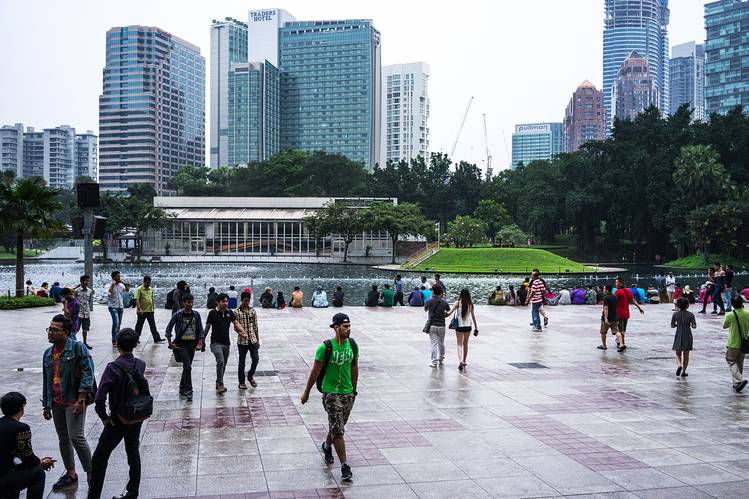
The central business district in Kuala Lumpur. Malaysia was an early area of success for Goldman.
By Mia Lamar in Hong Kong and Bradley Hope & Justin Baer in New York
As part of a broad probe into allegations of money laundering and corruption, investigators at the Federal Bureau of Investigation and the Justice Department have begun examining Goldman Sachs’s role in a series of transactions at 1Malaysia Development Bhd., people familiar with the matter said.
The inquiries are at the information-gathering stage, and there is no suggestion of wrongdoing by the bank, the people said. Investigators “have yet to determine if the matter will become a focus of any investigations into the 1MDB scandal,” a spokeswoman for the FBI said.
The widening scandal — investigators in five countries are now looking into 1MDB — highlights the sometimes risky path that Goldman has cut in emerging markets in search of faster growth.
A few years before the Malaysia deals, Goldman did a series of controversial transactions with the Libyan Investment Authority that also brought unwelcome attention. The Libyan sovereign-wealth fund claimed in a lawsuit filed in 2014 in London that the bank took advantage of its unsophisticated executives to sell them complicated and ultimately money-losing investments.
Goldman has said the claims are without merit. A trial in the suit is scheduled to begin next year.
The bank earned $350 million for executing nine trades for Libya, according to the investment authority. It earned far more from the Malaysian fund. The bank was consulted during 1MDB’s inception, advised it on three acquisitions and arranged the sale of $6.5 billion in bonds that alone brought in close to $600 million in fees, according to people close to the bank.
1MDB is now entangled in accusations of billions of dollars of missing money, putting it at the center of a political crisis for Malaysian Prime Minister Najib Razak, who oversees the fund. Malaysian government investigators earlier this year traced $700 million into Mr. Najib’s alleged bank accounts through agencies, banks and companies linked to 1MDB, The Wall Street Journal reported in July. Malaysia’s anticorruption agency later said the funds came from an unspecified Middle East donor.
The government investigation hasn’t detailed what happened to the funds that went into the prime minister’s alleged personal accounts. Transactions around the fund are under investigation by the FBI and Justice Department, as well as authorities in Malaysia, Singapore, Hong Kong and Switzerland.
1MDB and Mr. Najib didn’t reply to requests for comment. Mr. Najib has denied any wrongdoing or taking money for personal gain. 1MDB has said money was paid out properly to fulfill the fund’s financial obligations and that it would cooperate with any investigations.
Goldman Chief Executive Lloyd Blankfein has pushed the Wall Street bank to expand aggressively into emerging markets. In a presentation to investors five years ago, he outlined a strategy “to be Goldman Sachs in more places” and noted that 31% of the firm’s new hires in 2010 occurred in growth markets, compared with just 8% five years earlier.
“I believe we have less effective competition in a lot of these places,” Mr. Blankfein said at the time.
Malaysia was an early area of success for Goldman, which had strong relationships in the country. Tim Leissner, Goldman’s top banker in Southeast Asia who was close to Mr. Najib, according to people familiar with the matter, and Roger Ng, a Malaysian sales executive who has since left the bank, did deals for the government and companies throughout the last decade.
In 2009, when the sultan of the state of Terengganu, also Malaysia’s king at the time, was launching a fund to invest its oil wealth, Mr. Leissner was called to the royal palace to pitch the king for the business, according to people close to the bank.
Goldman won the bidding to advise the fund, which would soon be taken over by the national government and named 1Malaysia Development Bhd.
A key arranger of the financing for 1MDB was Andrea Vella, an Italian-born senior Goldman banker, people familiar with the transactions said. He was also involved in structuring the Libyan deals, according to people familiar with the matter. This spring, Mr. Vella, 42 years old, was promoted to co-head of investment banking in Asia excluding Japan.
Mr. Vella led the new markets business in the bank’s London-based financing group at the time of the Libyan transactions.
He provided a statement defending Goldman’s actions in response to a lawsuit brought by the Libyan fund, which referenced what the plaintiffs said were some of his emails.
In a Jan. 18, 2008, email to colleagues, Mr. Vella wrote that a Goldman executive who worked with the Libyan fund “has a very impressive grip on these people,” according to a copy included in the lawsuit.
“I reckon that with some guidance we can channel the energy into creating less entropy and more added value,” he wrote. The plaintiffs pointed to the comments as evidence of their argument that Goldman had influence over the fund’s managers, an allegation Goldman denies.
In Malaysia, one of Goldman’s big assignments came in 2012, when it advised 1MDB on the acquisition of Malaysian conglomerate Genting Bhd.’s domestic power-generation business. The deal quickly turned into a loser for 1MDB, which paid 2.3 billion ringgit for the business, about $740 million at the time.
In its financial statements for the year, 1MDB booked an impairment charge of 1.2 billion ringgit, writing down part of the premium for the power assets it had bought from Genting and another Malaysian company. Genting, meanwhile, recorded in its financial statements a gain on the sale of 1.9 billion ringgit.
Genting didn’t respond to requests for comment. 1MDB has said the premium it paid reflected the experience of the staff of the Genting unit.
Goldman also helped 1MDB raise $1.75 billion in bonds to finance the deal with Genting. The Malaysian fund wanted to move quickly with the issuance and decided to do a private placement,instead of a public offering, people familiar with the matter said.
Mr. Vella, who had moved to Asia in 2010 to help build the bank’s debt and structured-finance business in the region, arranged to do the financing via Goldman’s Principal Funding and Investment desk, a group that uses the bank’s own money to provide financing to clients. Goldman essentially wrote a check to 1MDB, took the bonds onto its balance sheet, hedged and sold over time for a profit, these people said.
The maneuver foreshadowed Goldman’s biggest transaction with the Malaysian fund: a $3 billion bond sale in early 2013 that the fund later said was to finance a huge real-estate project aimed at turning Malaysia’s capital into a global financial hub.
Goldman’s bankers presented 1MDB with options, including a plain vanilla public bond or loan, people familiar with the matter said. Instead, the people said, the fund chose a more expensive option similar to that of the earlier power-plant bond. Within two months, Goldman had underwritten the entire offering, essentially cutting a $3 billion check to meet its client’s demands for speed. The scale of Goldman’s fees on the deal, which came to nearly $300 million, was controversial even within the bank, people familiar with the matter said. Goldman took the unusual step of alerting the fund to its expected payday ahead of time to head off any recriminations, the people said.
“As you can imagine, a trading desk like ours would like to keep its pricing close to its chest,” a former Goldman executive familiar with the trade said. “But given the size of the [profits], the determination was made.”
The bank said the fees were necessary to compensate it for the risk it took on to carry out the transactions. 1MDB has said the organization “considered all of its options” in raising debt and chose the Goldman-led structure to “ensure the timely completion of this economic initiative.”
The real-estate project, meanwhile, is stalled. The fund said half of the proceeds of the bond went into “various investment portfolios” and the remainder was used for working capital and debt repayment.
U.S. opens money-laundering investigation amid international 1MDB probe; Malaysia police arrest critic of prime minister
By Bradley Hope
U.S. opens money-laundering investigation amid international 1MDB probe; Malaysia police arrest critic of prime minister
The FBI has opened an investigation into allegations of money-laundering
related to a Malaysian state investment fund, a person familiar with the matter said.
The scope of the investigation wasn’t known. It is the latest in a series of international investigations related to the fund that have been revealed in the past several weeks.
The international investigations center on entities related to 1Malaysia Development Bhd., which was set up by Prime Minister Najib Razak in 2009 to help drive the economy. The fund is having difficulty repaying more than $11 billion of debt and is at the center of investigations that are destabilizing the government.
A Malaysian government probe found that nearly $700 million moved through banks, agencies and companies linked to 1MDB before being deposited into Mr. Najib’s alleged private bank accounts ahead of a close election in 2013, the Journal reported in July.
The source of the money is unclear, and the government investigation hasn’t detailed what happened to the funds that allegedly went into Mr. Najib’s personal accounts. Malaysia’s anticorruption body in August said the funds were a donation from the Middle East. The donor wasn’t specified.
Mr. Najib has denied wrongdoing and denied taking money for personal gain.
Late Friday, a former member of Malaysia’s ruling party who had raised questions about money transfers to the Malaysian prime minister was arrested on charges of attempting to undermine democracy, his lawyer Matthias Chang said.
The arrest of Khairuddin Abu Hassan, who remained in custody on Saturday, prevented him from traveling to New York where he planned to urge U.S. authorities to investigate the transfers, Mr. Chang said.
A spokeswoman for the FBI’s New York office said that no agent in the office had arranged to speak with Mr. Khairuddin or had any previous contact with him.
Two of the transfers were made through the Singapore branch of a Swiss private bank and routed via Wells Fargo & Co. Wells Fargo declined to comment.
The Swiss attorney general’s office has opened criminal proceedings against two unidentified executives of 1MDB on suspicion of corruption and money-laundering. It has frozen tens of millions of dollars in Swiss bank accounts, officials said in August.
Last week, 1MDB said none of its executives or board members were the subject of criminal proceedings by the Swiss attorney general’s office, and that none of its accounts were frozen there.
Authorities in Singapore also have frozen accounts linked to 1MDB and are investigating allegations related to the fund. 1MDB said none of its accounts were frozen and that it was ready to assist any investigations subject to advice from the appropriate Malaysian authorities.
Celine Fernandez contributed to this article.
By Tom Wright and Bradley Hope
KUALA LUMPUR, Malaysia — Malaysian Prime Minister Najib Razak was fighting for his political life this summer after revelations that almost $700 million from an undisclosed source had entered his personal bank accounts.
Under pressure within his party to resign, he called together a group of senior leaders in July to remind them everyone had benefited from the money.
The funds, Mr. Najib said, weren’t used for his personal enrichment. Instead, they were channeled to politicians or into spending on projects aimed at helping the ruling party win elections in 2013, he said, according to a cabinet minister who was present.
“I took the money to spend for us,” the minister quoted Mr. Najib as saying.
It still isn’t clear where the $700 million came from or where it went. But a six-month Wall Street Journal examination revealed that public entities spent hundreds of millions of dollars on a massive patronage machine to help ensure Mr. Najib’s United Malays National Organization stayed in power. The payments, while legal, represented a new milestone in Malaysia’s freewheeling
electoral system, according to ruling-party officials.
The UMNO has led every Malaysian government since the country’s independence from Britain in 1957, making it one of the world’s longest-ruling political parties. Its extraordinary grip on power has delivered economically for Malaysia, boosting living standards and establishing the country as a fast-growing emerging market and U.S. ally in Asia.
But its dominance of the vote, its critics contend, has prevented Malaysia’s democracy from maturing in a similar fashion, instead leaving a system riven by patronage and vote-buying that analysts say has consistently skewed results in UMNO’s favor.
The Journal examination, which included interviews with ruling coalition politicians and former government employees as well as a review of documents related to a state-investment fund Mr. Najib set up, found hundreds of millions of dollars in unreported political spending. Much of it flowed from public sources or programs set up for other purposes.
The effort relied heavily on the state investment fund Mr. Najib controlled, 1Malaysia Development Bhd., according to minutes from 1MDB board meetings seen by The Wall Street Journal and interviews with people who worked there.
The prime minister, who is chairman of 1MDB’s board of advisers, promised repeatedly that the fund would boost Malaysia’s economy by attracting foreign capital. It rolled up more than $11 billion in debt without luring major investments.
Charity projects
Yet Mr. Najib used the fund to funnel at least $140 million to charity projects such as schools and low-cost housing in ways that boosted UMNO’s election chances, the Journal investigation found.
The minutes portray a fund that repeatedly prioritized political spending, even when 1MDB’s cash flow was insufficient to cover its debt payments.
Board members wondered aloud if they would get in trouble. In a meeting on Dec. 20, 2014, they discussed what to do about police who came to investigate allegations of financial irregularities, according to the minutes.
The 1MDB fund also transferred hundreds of millions of dollars to politicians through Ihsan Perdana Bhd., a company formed in 2011 to carry out 1MDB’s corporate social responsibility programs, said a person involved with setting up the fund.
Ihsan Perdana is exempt from filing financial statements, according to Malaysian company records.
Malaysian investigators believe the cash that ended up in Mr. Najib’s personal accounts moved through government agencies, banks and companies linked to 1MDB. At least $14 million flowed into his accounts via Ihsan Perdana, according to documents from a Malaysian government investigation.
The source of that $14 million was SRC International Bhd., a company controlled by Malaysia’s finance ministry, which Mr. Najib also heads, the documents show.
The prime minister signed checks from his personal accounts to lawmakers, who used the money as they saw fit, according to the Malaysian cabinet member interviewed by the Journal and another lawmaker who said he accepted the money.
Mr. Najib declined multiple interview requests. He has denied wrongdoing or taking money for personal gain, while defending 1MDB spending as good for Malaysia. He hasn’t explained where the $700 million in his accounts came from or how it was used.
Senior UMNO politicians have said the money was a political donation from an unnamed Middle East donor. Malaysia’s anticorruption agency has defended Mr. Najib’s right to use personal accounts for political transfers, which isn’t illegal under Malaysian law.
The 1MDB fund is the focus of probes in at least six countries, including in Malaysia by the nation’s anticorruption body, central bank, auditor general and a parliamentary committee.
Executives at 1MDB declined interview requests. The fund denies its business decisions were driven by politics and has pledged to cooperate with investigations. It said in a statement: “We note with surprise that The Wall Street Journal continues its campaign to malign 1MDB, a campaign based on old and recycled allegations.”
A spokesman for UMNO, whose financial reports aren’t required to be publicly disclosed, didn’t respond to requests for comment.
A U.S. Federal Bureau of Investigation probe into 1MDB is looking at assets owned by Mr. Najib and his family, including luxury real estate in New York and Los Angeles, according to people familiar with the matter. These people said the agency is also is looking at the funding of a film-production company, Red Granite Pictures, which was set up by Mr. Najib’s stepson and produced The Wolf of Wall Street starring Leonardo DiCaprio.
These inquiries are at an information-gathering stage and neither Mr. Najib nor any of his family members have been accused of wrongdoing. Red Granite Pictures, in a statement to the Journal, said that neither the stepson nor the company engaged in any “inappropriate” business activities.
Tens of thousands of protesters took to Kuala Lumpur’s streets in August to call for Mr. Najib’s ouster over his handling of the economy and management of 1MDB. Some lawmakers are still calling for him to resign.
Activities like the use of personal bank accounts to fund electionspending don’t happen in “most decent democracies with an element of accountability,” said Lily Zubaidah Rahim, a University of Sydney professor who is involved with the Electoral Integrity Project, a survey of voting standards with Harvard University.
Mr. Najib’s UMNO party, founded in the 1940s to represent ethnic Malays, has ruled for decades in coalitions with parties drawing support from ethnic Chinese and Indian minorities.
UMNO benefited from an affirmative-action program it set up in the 1970s that reserves an outsize proportion of state jobs, school places and government contracts for Malays, who make up just over half of Malaysia’s 30 million people.
Opposition critics say UMNO doled out contracts to Malay companies in return for donations to fund election spending. Ruling coalition politicians confirmed the practice in interviews but emphasized it is legal.
There are no laws in Malaysia on how much a company or individual can give to a party or politician, and neither is required to report who donated. Candidates are limited to spending $47,000 during election periods, but there are no caps on what a party can disburse. There are no laws against tapping state resources for campaigns.
Disbursing money or other favors to sway an election, known as vote buying, is prohibited but widespread, politicians say. Malaysia’s election watchdog has no legal power to investigate complaints.
After 2008 elections in which the ruling coalition lost its two-thirds majority in parliament, the UMNO ditched its leader and elevated Mr. Najib, then deputy prime minister. He pledged to end corruption and improve transparency. He promised a Malaysia in which all citizens benefited, dubbing the effort “1Malaysia.”
He also talked about the need to break UMNO free from dependence on corporate donations, said people who interacted closely with him. Yet Mr. Najib knew he needed funding sources, they said.
An opportunity presented itself when Jho Low, a Malaysian financier then in his late 20s, appeared.
Hailing from the Malaysian state of Penang, Mr. Low studied in England and befriended Mr. Najib’s stepson in London, according to people who know him. He later attended the University of Pennsylvania’s Wharton School.
In Malaysia, he helped set up an investment fund for the oil-rich Terengganu state, he told a Malaysian newspaper in 2010. Mr. Najib turned the fund into a federal entity and 1MDB was born.
Mr. Low, whose full name is Low Taek Jho, would later help direct election-related spending, despite not holding a formal title within UMNO, said a former Malaysian ruling coalition politician interviewed by the Journal.
Mr. Najib and 1MDB executives said the fund was supposed to attract investment in energy, real estate and tourism, with no mention of charity spending.
In early 2010, Mr. Najib authorized creating a 1MDB charity arm that gave $140 million for corporate social responsibility spending up until the 2013 elections, the fund’s board minutes show. None of it was required to be reported in 1MDB financial accounts, though some projects were publicized in fund promotional materials.
The prime minister’s office viewed 1MDB as a way to finance projects aimed at boosting UMNO’s popularity, said Oh Ei Sun, who at the time was Mr. Najib’s political secretary. Money from 1MDB was available for projects drawn up by staff in the prime minister’s office, he said.
“If we thought it could help the incumbent government pull in some votes, we could propose that,” said Mr. Oh. He said he helped give scholarships to ethnic Chinese students, but said he later quit, citing his concern about lack of transparency in the government.
1MDB’s management proposed the spending should only happen when the fund made profits, but asked for a waiver of the rule to allow immediate spending on schools, the minutes say.
In July 2010, the prime minister traveled to Sarawak, a rainforest-covered
Malaysian state on Borneo island whose voters include members of indigenous tribes. Ahead of the visit, 1MDB’s board of directors approved around $540,000 in financial aid to build shelters for tribal people, among other uses.
The board’s chairman “noted that it is vital for the company to win the support of Sarawakians, particularly the natives,” the minutes said.
There was wasteful spending. Malaysia’s government in 2010 sold prime land in Kuala Lumpur to 1MDB at below-market rates to develop a financial center, in a joint venture with a subsidiary of an Abu Dhabi sovereign-wealth fund.
After spending almost $2 million to organize a launch party, 1MDB ditched the event when the Gulf emirate’s crown prince decided not to attend, according to board minutes. Local media began criticizing the fund.
“The company is perceived as a secretive cloak-and-dagger setup with sinister motives to benefit cronies and not the Malaysian people,” read a plan submitted to the board in October 2010 by 1MDB’s management to improve the fund’s image.
The solution was a media blitz to promote 1MDB’s focus on “new sources of growth,” the plan said. Mr. Najib, in other minutes, ordered the board to better promote 1MDB education scholarships.
To book profits, the fund took the land it bought cheaply from the government and marked it up to market prices. In the financial year ended March 31, 2011, the fund revalued the land by 426%, even though it had neither sold nor developed it.
The fund also borrowed heavily. Goldman Sachs Group helped it raise $6.5 billion in bond issuances in 2012 and 2013. Some money was used to buy power plants.
Project stalled
A $3 billion bond two months before the 2013 elections was supposed to fund development of the Kuala Lumpur financial center, according to offering documents. The project stalled and the money was used for other purposes, including working capital, according to a 1MDB financial statement.
A Goldman spokesman declined to comment.
As elections approached in 2013, the fund began transferring hundreds of millions of dollars to politicians to spend on their campaigns, said the person who helped set up the fund.
Mr. Najib began pushing out checks from his accounts to politicians, according to a lawmaker quoted in local media and the cabinet minister interviewed by the Journal. Shahrir Abdul Samad, a UMNO parliament member, was quoted saying he was given over $300,000.
“To whom else can I ask for financial assistance for administration expenses if not from the party president himself,” Mr. Shahrir said in an interview with an official website run by the ruling coalition. “That explains the money the party president received is for party use,” not Mr. Najib’s enrichment, he said.
Mr. Shahrir didn’t respond to requests for comment.
Mr. Najib announced projects like hospitals and low-cost housing across the country.
The 1MDB fund financed free trips to Mecca for more than 1,000 village headmen. Letters to the recipients came from the prime minister’s office.
Mr. Najib has said such projects show that 1MDB is beneficial to Malaysians.
Perhaps the biggest UMNO effort to win back votes was in Penang, a historic trading entrepot won by the opposition in 2008.
Mr. Low, the financier, returned home to Penang before the May election and acted as a senior strategist, according to the former ruling-coalition leader in the state.
Coalition candidates were told by Mr. Low they could request money for their campaigns and he would deliver it, the politician said. Candidates asked for money to paint voters’ houses and give out free food and other favors, the politician said.
‘Flowing like hell’
The source of the money, which didn’t flow through official UMNO channels, and its total size were unclear, ruling-coalition politicians said.
Another former coalition lawmaker said he assumed the funds came from corporate donors. “The money was flowing like hell,” he said.
A school friend of Mr. Low’s, Geh Choh Hun, organized a group called 1Malaysia Penang Welfare Club, which hired a hotel ballroom and handed out checks for hundreds of thousands of dollars to nongovernment groups, according to people who attended. It is unclear where the money came from. Mr. Geh declined to comment.
Loh Cheng Kooi, executive director of the Women’s Center for Change, a female-empowerment organization, said she got almost $70,000 from the welfare club.
She said she assumed the government was financing the event because of “1Malaysia” slogans at the ballroom.
UMNO lost the popular vote and failed to win Penang. But its coalition won enough votes to hold on to power nationally.
After the victory, 1MDB had only about $20 million in cash compared with liabilities of over $10 billion, board minutes show. 1MDB says the value of its assets covers the fund’s debt.
Deloitte Touche Tohmatsu Ltd., the fund’s current auditor, told 1MDB’s board in February 2014 it had received emails and letters alleging “financial reporting fraud” in connection with the PetroSaudi deal, the changing of auditors and alleged overpayment for power-plant assets, the board minutes show.
The auditor said there was no evidence of wrongdoing, according to the minutes, and signed off on 1MDB’s accounts.
The fund reported a net loss of around $200 million in the year to March 31, 2014, the last available results. Deloitte declined to comment.
The fund is now trying to wind down operations by selling assets to pay down debt.
The prime minister told parliament in November there was nothing unusual about government-controlled companies donating money to political parties.
But he has vowed to change the system, setting up a bipartisan parliamentary panel to look at election reform.
“There is an urgent need to regulate political financing to ensure accountability and transparency,” Mr. Najib said. He promised new laws would come into effect before the next elections, in 2018.
By Jason Ng
KUALA LUMPUR, Malaysia — Prime Minister Najib Razak shook up his cabinet and removed his deputy, who had publicly raised questions over the government’s closure of newspapers and delays in the investigation into state-investment fund 1Malaysia Development Bhd.
Mr. Najib appointed Ahmad Zahid Hamidi as his deputy to succeed Muhyiddin Yassin, who had been considered an heir apparent in the government led by the United Malays National Organization, and dropped four other ministers and a deputy minister.
A statement from his office cited Mr. Najib as saying the changes would ensure “strength and unity” amid “the challenges we currently face.”
The shake-up also elevated four members from a bipartisan parliamentary committee currently probing 1MDB into deputy ministerial positions in the cabinet, meaning they can no longer stay on the panel. The committee said that all proceedings would be halted until new members are appointed in October.
Mr. Muhyiddin’s removal follows recent comments over the handling of debt-laden 1MDB. Though he stopped short of direct criticism, Mr. Muhyiddin publicly broke ranks with the government at a party meeting Sunday, raising questions over the suspension of the Edge newspaper for its reporting and asking Mr. Najib to step down from 1MDB.
“Members of the cabinet should not air their differences in an open forum that can affect public opinion against the government and Malaysia,” Mr. Najib said.
When it comes to 1MDB issues, “I have principles and my own stand in defending the rights of the people, the party’s good name and national interest,” Mr. Muhyiddin said in a Facebook post after his removal. “If my stand in this issue caused me to be dropped from the cabinet, I accept it.”
On July 2, The Wall Street Journal reported that investigators believe nearly $700 million was deposited in Mr. Najib’s personal bank accounts after the movement of cash among agencies, banks and companies linked to 1MDB. The original source of the money is unclear and the government investigation doesn’t detail what happened to the money that allegedly went into Mr. Najib’s personal accounts.
Mr. Najib has denied taking any money for “personal gain” but hasn’t addressed the alleged fund transfer into his accounts.
By Jason Ng
KUALA LUMPUR, Malaysia — The government ordered on Friday the suspension of two publications that have been reporting on the troubles faced by the debt-laden 1Malaysia Development Bhd., a state investment fund, also known as 1MDB, that is closely linked to Prime Minister Najib Razak.
The Edge Weekly and the Edge Financial Daily, both owned by the Edge Media Group, which has about 350 staff in Malaysia, will be suspended for three months beginning Monday.
“Failure to stop publication for three months will result in the withdrawal of the publishing permits,” Edge Media said in a statement.
The publications’ extensive reporting on 1MDB was deemed to be “prejudicial or likely to be prejudicial to public order, security or likely to alarm public opinion or is likely to be prejudicial to public and national interest,” Edge Media said, citing a letter from the Home Ministry.
A Home Ministry official confirmed the suspension. Some of the publications’ reports have “implication on the public,” the official said without further elaboration.
The suspension follows an earlier move by the Southeast Asian country’s communication regulator to block a website highly critical of Mr. Najib and his government. In late 2013, authorities suspended another weekly newspaper that reported on travel spending by Mr. Najib and the use of a government jet by his wife. The report was based on disclosures in Parliament.
“This is nothing more than a move to shut us down in order to shut us up,” Ho Kay Tat, publisher and chief executive of the Edge Media Group, said in the statement. The company said it intends to challenge the suspension in court.
The closure follows a long history of restrictions on Malaysia’s
media by the government and follows months of controversy over Mr. Najib’s relationship to 1MDB.
There are four official Malaysian government investigations into the fund’s activities. Mr. Najib hasn’t been accused of wrongdoing.
On July 2, The Wall Street Journal reported that investigators believe nearly $700 million was deposited in Mr. Najib’s personal bank accounts following the movement of cash among agencies, banks and companies linked to 1MDB. Mr. Najib founded 1MDB and heads its board of advisers. The original source of the money is unclear and the government investigation doesn’t detail what
happened to the money that allegedly went into Mr. Najib’s personal accounts.
Mr. Najib has denied taking any money for “personal gain” but hasn’t addressed the alleged fund transfer into his accounts.
The Malaysian Anti-Corruption Commission has so far detained three people to assist the investigation into 1MDB, which has racked up more than $11 billion in borrowings while facing a cash crunch. The people haven’t been identified or charged.
The central bank is also seeking two former 1MDB directors, Casey Tang and Jasmine Loo, to assist in an investigation, Bank Negara Malaysia said in a notice. Efforts to reach Mr. Tang and Ms. Loo weren’t successful, while 1MDB didn’t respond to requests for comment.
The Centre for Independent Journalism, a Malaysia-based nonprofit group, condemned the latest move and called for the suspension to be lifted immediately.
“For the government to censor a newspaper in this manner is an extremely heavy-handed measure and a breach of freedom of expression and media freedom in particular,” said the group Friday.
In recent years, Malaysia had loosened some long-standing restrictions on publications, including scrapping a requirement that publications renew their print licenses each year. Authorities had also taken a more hands-off approach to online news portals, where criticism of the government has grown.
But government critics charge that state-backed media — including the country’s most circulated English language newspaper the Star, owned by an arm of Mr. Najib’s ruling coalition — frequently publish the government’s position and leave little room for dissenting voices.
The Edge is privately owned by media tycoon Tong Kooi Ong, who serves as its executive chairman. Apart from daily and weekly newspapers focusing on investment and business news, the Edge also publishes magazines and operates the Malaysian Insider news portal.