The Wall Street Journal, by Bret Stephens
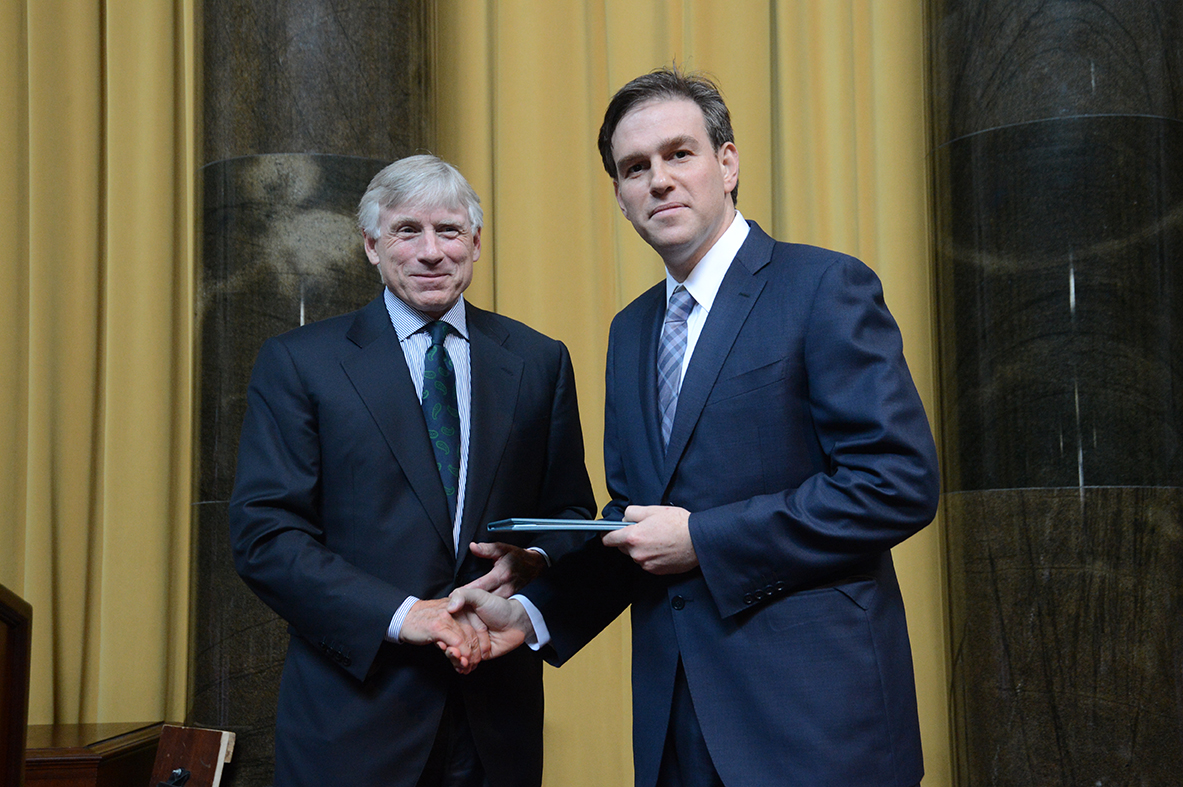
Lee C. Bollinger, President of Columbia University (left), presents the 2013 Commentary prize to Bret Stephens of The Wall Street Journal.
Winning Work
By Bret Stephens
Let's just say right now what voters will be saying in November, once Barack Obama has been re-elected: Republicans deserve to lose.
It doesn’t matter that Mr. Obama can’t get the economy out of second gear. It doesn’t matter that he cynically betrayed his core promise as a candidate to be a unifying president. It doesn’t matter that he keeps blaming Bush. It doesn’t matter that he thinks ATMs are weapons of employment destruction. It doesn’t matter that Tim Geithner remains secretary of Treasury. It doesn’t matter that the result of his “reset” with Russia is Moscow selling fighter jets to Damascus. It doesn’t matter that the Obama name is synonymous with the most unpopular law in memory. It doesn’t matter that his wife thinks America doesn’t deserve him. It doesn’t matter that the Evel Knievel theory of fiscal stimulus isn’t going to make it over the Snake River Canyon of debt.
Above all, it doesn’t matter that Americans are generally eager to send Mr. Obama packing. All they need is to be reasonably sure that the alternative won’t be another fiasco. But they can’t be reasonably sure, so it’s going to be four more years of the disappointment you already know.
As for the current GOP field, it’s like confronting a terminal diagnosis. There may be an apparent range of treatments: conventional (Romney), experimental (Gingrich), homeopathic (Paul) or prayerful (Santorum). But none will avail you in the end. Just try to exit laughing.
That’s my theory for why South Carolina gave Newt Gingrich his big primary win on Saturday: Voters instinctively prefer the idea of an entertaining Newt-Obama contest — the aspiring Caesar versus the failed Redeemer — over a dreary Mitt-Obama one. The problem is that voters also know that Gaius Gingrich is liable to deliver his prime-time speeches in purple toga while holding tight to darling Messalina’s — sorry, Callista’s — bejeweled fingers. A primary ballot for Mr. Gingrich is a vote for an entertaining election, not a Republican in the White House.
Then there is Mitt Romney, even now the presumptive nominee. If Mr. Gingrich demonstrated his unfitness to be a serious Republican nominee with his destructive attacks on private equity (a prime legacy of the Reagan years), Mr. Romney has demonstrated his unfitness by — where to start?
Oh, yes, the moment in last week’s debate when Mr. Romney equivocated about releasing his tax returns. The former Massachusetts governor is nothing if not a scripted politician, and the least one can ask of such people is that they should know their lines by heart. Did nobody in Mr. Romney’s expensive campaign shop tell him that this question was sure to come, and that a decision had to be made, in advance, as to what the answer would be? Great CEOs don’t just surround themselves with consultants and advance men. They also hire contrarians, alter egos and at least someone who isn’t afraid to poke a finger in their chest. On the evidence of his campaign, Mr. Romney is a lousy CEO.
But it’s worse than that. The usual rap on Mr. Romney is that he’s robotic, but the real reason he can’t gain traction with voters is that they suspect he’s concealing some unnameable private doubt. Al Gore and George Bush Sr. were like that, too, and not just because they were all to the proverbial manor born. It’s that they were basically hollow men.
Thus the core difference between Mr. Romney and Mr. Obama: For the governor, the convictions are the veneer. For the president, the pragmatism is. Voters always see through this. They usually prefer the man who stands for something.
What about Rick Santorum and Ron Paul? They are owed some respect, especially for the contrast between their willingness to take a stand for principle against the front-runners’ willingness to say anything. But Messrs. Santorum and Paul are two tedious men, deep in conversation with some country that’s not quite America, appealing to a devoted base but not beyond it. Sorry, gentlemen: You’re not going anywhere.
Finally, there are the men not in the field: Mitch Daniels, Paul Ryan, Chris Christie, Jeb Bush, Haley Barbour. This was the GOP A-Team, the guys who should have showed up to the first debate but didn’t because running for president is hard and the spouses were reluctant. Nothing commends them for it. If this election is as important as they all say it is, they had a duty to step up. Abraham Lincoln did not shy from the contest of 1860 because of Mary Todd. If Mr. Obama wins in November — or, rather, when he does — the failure will lie as heavily on their shoulders as it will with the nominee.
What should readers who despair of a second Obama term make of all this? Hope ObamaCare is repealed by the High Court, the Iranian bomb is repealed by the Israeli Air Force, and the Senate switches hands, giving America a healthy spell of Hippocratic government.
All perfectly plausible. And the U.S. will surely survive four more years. Who knows? By then maybe Republicans will have figured out that if they don’t want to lose, they shouldn’t run with losers.
By Bret Stephens
Most Chinese today already get their news from Weibo (Chinese Twitter), eroding party control over the flow of information. American Idol-type singing contests are engendering a taste for democracy. And multiplying acts of cultural subversion are gradually making it impossible for the party to impose its categories of thought, even if it can still impose proscriptions on action.
Americans will get their first close look this week at Xi Jinping, the man who’s expected to replace Hu Jintao later this year as China’s paramount leader. Mr. Xi is one of the Communist Party’s original princelings — his father was a top Mao lieutenant until he was purged in the early 1960s — and press accounts of his life are stuffed with details about the rough years he spent as a farm hand during the Cultural Revolution.
The purpose of Mr. Xi’s image-making — helped along by some credulous Western reporting — is to present him as someone who took his knocks in life and understands what it’s like to be dirt poor even as he has risen up the party hierarchy.
This, comrades, is baloney.
Thanks to a WikiLeaked State Department cable from 2009, we know more about Mr. Xi than he would probably be willing to volunteer. Among other interesting details: Mr. Xi “chose to survive [the Cultural Revolution] by becoming redder than red”; his first degree “was not a ‘real’ university education but instead a three-year degree in applied Marxism”; he was “considered of only average intelligence”; and “the most permanent influences shaping [his] worldview were his princeling pedigree,” not his sojourn in the countryside.
Now let’s turn to another truth about China.
Shortly after the massacre at Tiananmen Square in 1989, a jailed Chinese dissident wrote a poem to the shy woman who would later become his wife: When you tell it to the dolls
Avoid the truth
Just use the names
But leave out
The facts
That dissident was Liu Xiaobo, who, while serving another prison sentence, would be awarded a Nobel Peace Prize in 2010. His wife is Liu Xia, a poet and photographer who has been held under house arrest in Beijing for over a year. What can they tell us about China?
Plenty, as it turns out — at least if you happen to be in New York City this month and can make time to visit the Italian Academy at Columbia University, where 26 of Ms. Liu’s photographs are on exhibit. Most of Ms. Liu’s photographs — all of them taken with an old Russian camera; most of them taken in her apartment — are of “ugly kids” dolls that a friend brought her years ago from Brazil. There is nothing political per se in any of these pictures: These are, after all, mere dolls.
But of course they are entirely political. To look at them is to understand at a glance that Ms. Liu’s theme is the reality of modern China as experienced by anyone who refuses to accept the party line: alienation, confinement, repression, mental and spiritual suffocation. This is the essence of the totalitarian state: It makes claims not only on how you may act but on what you may think. Like Soviet-era jokes whose very absurdity brought home the truth about the system, the power of Ms. Liu’s photographs lies in their ability to elicit, even involuntarily, an act of subversion by anyone with the simple wit to recognize what they are about.
That’s why the Chinese Foreign Ministry couldn’t quite register a formal protest — although it did voice its displeasure — when the photos were first exhibited last fall in France: To do so would be to admit that the government understood as well as anyone what these ugly dolls were saying about modern China. It’s also why the regime probably understands that it has more to fear from Ms. Liu than it does even from her husband.
When I saw the exhibit on Sunday morning I had as my guide the French polymath Guy Sorman. Mr. Sorman is a friend of Ms. Liu’s; he’s also responsible for getting the prints out of China one at a time, on the theory that any single confiscation wouldn’t compromise the whole lot. Mr. Sorman believes that change is coming to China, but not by way of economic progress (if “progress” is the right word for the increasingly statist tilt of Chinese policy makers) or of the kind of political pamphleteering that landed Mr. Liu in prison.
Instead, Mr. Sorman is convinced that the change will “occur where you least expect it.” Most Chinese today already get their news from Weibo (Chinese Twitter), eroding party control over the flow of information. American Idol-type singing contests are engendering a taste for democracy. And multiplying acts of cultural subversion are gradually making it impossible for the party to impose its categories of thought, even if it can still impose proscriptions on action.
How will Mr. Xi handle this new China? It’s too soon to say. But no Chinese leader will be able to depend on the controls their predecessors enjoyed — technology simply won’t allow it, and neither will evolving public expectations about what is permitted. Renewed attempts to impose ideological conformity will be met only by the kind of cunning subversion that Ms. Liu has helped pioneer.
Just consider: Ms. Liu doesn’t even know her work is being exhibited abroad. But as a poem she wrote in 1998 suggests, even that barrier may not matter much when it comes to telling the truth about China:
Living together with the dolls
Surrounded by the power of silence,
The world open around us,
We communicate in gestures.
By Bret Stephens
In 1977, anti-apartheid activist Steve Biko was arrested by South African police, clubbed to within an inch of his life, chained, stripped, manacled, denied care and ultimately left to die in a car. More appalling was the apartheid regime’s response to his murder: denial, followed by coverup, followed by professions of indifference to Biko’s suffering.
For the generation of Westerners that came politically of age in anti-apartheid rallies — Barack Obama’s generation — Biko’s name became a byword for everything they were fighting against. So it is with most revolutionary movements. It’s not sufficient to have the example of great heroes in the mold of a Walesa or Suu Kyi or Mandela. They also require great victims: Men and women who, in the manner of their dying, demonstrate why it is their victimizers who must perish instead.
Last year, the Arab world found its Biko in Tunisian street vendor Mohamed Bouazizi. Now Russia may find its own Biko in the memory of Sergei Magnitsky, a mild-mannered, middle-class tax attorney from Moscow who spent the last of his 37 years in a filthy Russian prison before dying in November 2009 of medical neglect and physical torture.
Magnitsky’s case is remarkable in many respects, not least because neither the victims nor the perpetrators are prepared to let it go. Last month, a Russian court put Magnitsky posthumously on trial on preposterous charges of tax evasion. In that crass species of cruelty in which Russian officialdom has always specialized, Magnitsky’s bereaved mother was required to sit in her son’s place.
The Kremlin’s show trial comes in response to mounting calls in Europe and the U.S. — including Senate legislation proposed by Maryland Democrat Ben Cardin — to see justice done by slapping travel bans and asset freezes on the officials implicated in Magnitsky’s death. The Obama administration doesn’t like Mr. Cardin’s legislation because it threatens its precious “reset” with the Kremlin. The Kremlin likes it even less because it exposes, both to a foreign and domestic audience, the Comrade Criminal regime that Russia remains under Vladimir Putin.
Consider the details: In June 2007, Russian interior ministry agents raided the offices of Hermitage Capital, which had once been the largest foreign investor in Russia until its founder, William Browder, was declared persona non grata in 2006 for exposing corporate skulduggery among Kremlin-favored companies.
It was a strange raid. By 2007, Hermitage had sold its assets in Russia and paid $230 million in capital gains taxes. Yet the documents confiscated in the raid were then used to re-register Hermitage’s by-then defunct companies in the name of three petty criminals. These “new” companies then claimed the $230 million had been paid in error and that they were owed a full refund. It took exactly one day for the Russian government to approve it.
Magnitsky was the man who uncovered the scheme. In October 2008 he testified to an investigative committee, during which he named the interior ministry officers he believed had perpetrated the fraud. In November, the interior ministry appointed the same officers to investigate the case. Magnitsky went to jail.
The conditions in which Russian prisoners are kept remain nearly as great a scandal today as they were in the days of Solzhenitsyn: freezing and overcrowded cells, grotesque sanitation, larvae-infested food. Magnitsky developed a case of acute pancreatitis that was left untreated. On the day of his death he was transferred to a prison with medical facilities, presumably to be treated. Instead he was beaten to death.
“The main conclusion that can be drawn is that . . . the patient in serious condition was left for one hour and 18 minutes to die in an isolation cell,” went the doctor’s report of his last hours. “I was shocked to find the patient not in a hospital room, but in a regular cell, on the floor dead.”
Last July, an organization called the President’s Human Rights Council presented a damning report on the Magnitsky case to Dmitry Medvedev. “To all appearances, indeed some crimes were committed,” the president acknowledged. He also ordered an investigation. But his interior ministry has dismissed the Council’s findings. In August, it announced Magnitsky’s “guilt has been proven.”
What does all of this amount to? Under most circumstances it would be just another death in Russia. The difference is that Mr. Browder, deep-pocketed and well-connected, has decided to make Magnitsky’s memory the cause of his life. A search of Yandex.ru — the Russian Google — yields 19,000 articles on Magnitsky. It suggests that middle-class Russians, whom Magnitsky typified, finally realize they are no longer immune to the everyday official thuggery routinely meted to Russians outside the privileged belts of Moscow and St. Petersburg.
So far, Mr. Browder has had some success persuading elected officials like Sen. Cardin to act. He’s had less success with the Obama administration. In its zeal to smooth relations with Mr. Putin, it’s been keen to look away from the Magnitsky case, and everything it tells us about Russia’s present leaders. Getting along with Moscow, after all, is a vital U.S. interest. They used to say the same about Pretoria, too.
By Bret Stephens
Did you loathe and detest the Bush administration? If so, you’d probably say its ideas were horrible and their execution worse. Did you not loathe and detest the Bush administration? In that case, you might say its ideas were pretty good — only the execution often left something to be desired.
Now the person who did much of the executing tops a list of names to be Mitt Romney’s running mate. A mid-April CNN poll finds that former Secretary of State Condoleezza Rice has unmatched name recognition and a favorable rating of 80% among GOP voters. She’s also the person Republicans would most like to see on the ticket, with 26% to runner-up Rick Santorum’s 21%. New Jersey Gov. Chris Christie and Florida Sen. Marco Rubio tie for third place at 14%.
The political appeal of Romney-Rice is obvious. Here are two seasoned and reassuring presences who seem to complement each other in all the right ways. He’s the business whiz; she’s the foreign-policy wonk. His government experience is in the statehouse; hers in Washington and foreign capitals. He’s the un-Obama; she’s the un-Palin. He’s the world’s whitest white man; she isn’t. That could even count for something if President Obama decides to dump Joe Biden for Hillary Clinton.
There’s only one problem. Ms. Rice was a bad national security adviser and a bad secretary of state. She was on the wrong side of some of the administration’s biggest internal policy fights. She had a tendency to flip-flop when it came to the president’s core priorities and her political misjudgment more than once cost Mr. Bush dearly. She was a muddler of differences at the national security council. Her tenure at State was notable mainly for the degree to which the bureaucracy ran her, not the other way around.
Take the surge. In her memoir “No Higher Honor,” Ms. Rice recalls some of the events leading up to Mr. Bush’s best and bravest decision. She starts by noting that, in early 2006, she had endorsed the idea of creating the blue-ribbon bipartisan Iraq Study Group, which wound up calling for a diplomatic, but not military, surge. She then adds that “it was a bitter pill to swallow that many commentators subsequently depicted the commission as a gathering of wise men from the administration of George H.W. Bush, who would teach his prodigal son a thing or two about realism and competence in foreign policy.”
Well, yes, that’s how it was seen, and one wonders why Ms. Rice couldn’t have seen it coming. Nor does Ms. Rice cover herself in glory by describing her ambivalence about every option on the table in the run-up to the surge — the surge itself; a mini-surge; some form of retreat; or her own preferred option to have Iraqis “kill one another for a while before they get the point.”
At length she admits to being scolded by the president:
"So what’s your plan, Condi? We’ll just let them kill each other, and we’ll stand by and try to pick up the pieces?"
Ms. Rice recalls bridling at having her feelings hurt.
It’s true that the surge was a hard call, or at least it seemed so at the time. Harder to forgive was Ms. Rice’s performance on North Korea. In October 2006, Kim Jong Il tested one of his nuclear bombs. Ms. Rice’s response to this flagrant challenge to the Bush Doctrine was to reward Pyongyang with an engagement policy that would ultimately lead to the lifting of key sanctions — in exchange for exactly nothing.
“Two and a half months [after the nuclear test],” recalls Dick Cheney in his memoir, “with Secretary Rice’s approval, Assistant Secretary [Chris] Hill and the American delegation held a bilateral meeting with the North Korean delegation in Berlin. On the evening of January 16, 2007, the Americans provided a lavish meal, supplied large amounts of liquor and A tempting but unwise choice for Romney’s vice president. proposed friendly toasts. . . . The North Koreans had crossed one of the brightest of bright lines — they had tested a nuclear weapon — and we were hosting them at a banquet.”
Ms. Rice’s North Korean misadventures are worth pondering for what they say about her instincts and judgment: her readiness to put hope before experience, reward bad behavior with concessions, allow her subordinates to flout the explicit instructions of the president and — if Mr. Cheney’s account is to be believed — more or less baldly lie to the president about the terms of the supposed deal the U.S. and the North had struck. The shame is that Mr. Bush blessed all this when he ought to have reprimanded Ms. Rice, if not fired her outright.
What about the rest of Ms. Rice’s tenure? By her own admission, she flubbed the handling of the notorious 16 words on Iraq’s WMD, giving life to the narrative that Mr. Bush lied about the intelligence. She hired Flynt Leverett for a top job at NSC; he’s since gone on to become the Beltway’s go-to apologist for Bashar al-Assad and Mahmoud Ahmadinejad. She arranged a premature ceasefire between Israel and Lebanon that allowed Hezbollah to declare victory. She opposed a U.S. attack on the nuclear reactor North Korea had built in Syria, leaving Israel to do the job.
It’s probably a testament to Ms. Rice’s inspiring story and winning persona that this blemished record has largely gone down the memory hole. The temptation for Mr. Romney to ask her to join the ticket must be great.
Still it must be said: If the presumptive Republican nominee is going to choose his running mate with an eye toward governing the country and not just winning the election, he can do better than Ms. Rice. Choosing her would simply be evidence that he doesn’t have much faith in his own November chances.
By Bret Stephens
Democracy is the worst form of government, except for all those other forms that have been tried from time to time. Everyone knows who said this, and everyone thinks it’s true. But is it, really?
After last weekend I’ve begun to have my doubts. In Egypt, the ruling military junta reacted to the apparent victory of Muslim Brotherhood presidential candidate Mohammed Morsi by stripping the presidential office of its powers. That came just days after Egypt’s top court dissolved the Islamist-dominated parliament, which had been freely elected only a few months ago.
How arbitrary. What an affront to the Egyptian people. Now let’s hope it works.
Then there’s Greece, which also had an election over the weekend. The Greeks are supposed to have made the “responsible” choice in the person of Antonis Samaras, the Amherst- and Harvard-educated leader of the center-right New Democracy party. Responsible in this case means trying to stay in the euro zone by again renegotiating the terms of a bailout that Greeks cannot possibly repay and will not likely honor.
Yet the more depressing fact about the election is that Mr. Samaras didn’t even get 30% of the vote. The rest was divided among the radical-left Syriza (27%), the socialist Pasok (12.3%), the anti-German Independent Greeks (7.5%), the neo-Nazi Golden Dawn (7%), the center-left Democratic Left (6.2%) and, finally, the good old Communist Party (4.5%).
In other words, the Greeks gave a solid 46% of their vote to parties that are evil, crazy or both, even while erring on the side of “sanity” with parties that are merely foolish and discredited. Imagine that in 1980 Jimmy Carter had eked out a slim victory over a Gus Hall-Lyndon LaRouche ticket, and you have the American equivalent to what just happened in Greece.
Should anyone be surprised that democracy is having such a hard time in the land of Pericles? Probably not — and not just because Greece is also the land of Alcibiades. Despite its storied past, modern Greek democracy, like much of modern European democracy, is of a post-liberal variety. Post-liberalism seeks to replace the classical liberalism of individual liberty, limited government, property rights and democratic sovereignty with a new liberalism that favors social rights, social goods, intrusive government and transnational law.
In practice, post-liberalism is a giant wealth redistribution scheme. It bankrupted Greece and will soon bankrupt the rest of Europe. What happens to bankrupt democracies? Think Weimar Germany, Peron’s Argentina, and, more recently, Yeltsin’s Russia.
Now take Egypt. There, instead of post-liberal democracy, you have the energetic stirrings of pre-liberal democracy.
What is pre-liberal democracy? It is democracy shorn of the values Westerners typically associate it with: free speech, religious liberty, social tolerance, equality between the sexes and so on. Not only in Egypt, but in Tunisia, Turkey and Gaza, popular majorities have made a democratic choice for parties that put faith before freedom and substituted the word of God for the rule of law.
Apologists for this sort of democracy argue that it still beats the alternatives, not just the coarse authoritarianism typified by Hosni Mubarak but also the progressive-autocratic model that used to prevail in Turkey. They also argue that democracy has a way of taming ideologically extreme political leaders by tethering them to the needs and wishes of the people, just as a talented cowboy will rope and halter an unruly horse.
But there’s a problem with this analogy: In pre-liberal societies, it is the people who are the horse and the lead- ers who do the roping, not the other way around. An Egypt ruled by the Muslim Brotherhood will respect democratic procedure only to the extent that it does not infringe on the Brotherhood’s overarching goals: “Restoring Islam in its allencompassing conception; subjugating people to God; instituting the religion of God; the Islamization of life,” according to Khairat Al Shater, the Brotherhood’s de facto leader.
That’s the kind of democracy we can soon expect from Egypt unless the military somehow gets the upper hand politically. Don’t bet on it. If post-liberal democracy is unsustainable (“They always run out of other people’s money,” as Margaret Thatcher quipped), pre-liberal democracy is irresistible. The objections of an aged and ambivalent junta will not long stand in the way of millions of Egyptians demanding their right to choose unfreedom freely.
The good news is that Egyptians may have a wider conception of freedom in 30 years or so, about the same amount of time it took Khomeinism to lose the masses in Iran. In 30 years, too, the Greeks may have a better appreciation of the notion of responsibility, both personal and political. As for what remains of the liberal democratic world, maybe the weekend elections will be a reminder of another famous political maxim: “A republic — if you can keep it.”
By Bret Stephens
Last year I wrote a foreword to a short book by Alex Grobman about the history of the Protocols of the Elders of Zion. “Oscar Wilde,” I began, “once said that homosexuality is ‘the love that dare not speak its name.’ Today, anti-Semitism is the hate that dare not speak its name.”
A few weeks ago, while going through my father’s effects, I found an issue of Commentary from the 1980s with a cover story by Norman Podhoretz. The title: “The Hate That Dare Not Speak Its Name.”
I had no conscious memory of the article at the time I wrote the foreword. But the turn of phrase had obviously planted itself in a corner of my brain where I had forgotten it wasn’t my own. Anyway, sorry, Norman: It was an honest mistake. And it’s still a great line.
Pundits who spend their days reading and reading and writing and writing will likely have made mistakes similar to mine. That’s all the more reason to take additional precautions against every form of plagiarism, which can as easily happen inadvertently as it does deliberately. It’s also a reason to apply strict standards of attribution, though these can vary widely across different publications and forms of media. Footnotes, for instance, do not work well on TV.
Then again, I hope my anecdote shows there are degrees of plagiarism, only some of which (such as the recent case of science writer Jonah Lehrer) deserve to be treated as professional capital offenses. Which brings me to the case of Fareed Zakaria, the star pundit who writes columns for Time and the Washington Post, hosts an eponymous show on CNN, and has written a couple of bestselling books.
Last week Mr. Zakaria apologized “unreservedly” to New Yorker writer Jill Lepore after a blogger noticed that a paragraph in his Time column was all-but identical to something Ms. Lepore had written. Mr. Zakaria has now been given a month’s suspension by his employers pending further review of his work.
We’ll see if there are other shoes to drop. Among the more mystifying aspects of this story is that plagiarism in the age of Google is an offense hiding in plain sight, especially when the kind of people who read Mr. Zakaria’s columns are the same kind of people who read the New Yorker. Why couldn’t he have added the words, “As the New Yorker’s Jill Lepore wrote . . .”? What could he possibly have been thinking?
My guess is he wasn’t thinking. That’s never a good thing, but it’s something that might happen to an overcommitted journalist so constantly in the public eye that he forgets he’s there. The proper response is the full apology he has already made, and maybe a reconsideration of whether the current dimensions of Fareed Zakaria Inc. are sustainable. Otherwise, end of story.
But that’s not how Mr. Zakaria is being treated. To some of his critics, nothing less than the Prague Defenestration will do.
Here, for instance, is Jim Sleeper in the Huffington Post — a publication that earns much of its keep piggybacking on the work of others. “Zakaria is a trustee of Yale,” notes Mr. Sleeper. “If the Yale Corporation were to apply to itself the standards it expects its faculty and students to meet, Zakaria would have to take a leave or resign.”
Mr. Sleeper, a one-time tabloid columnist, goes on to impugn Mr. Zakaria for various offenses, such as dissing people Mr. Sleeper obviously likes and commanding speaking fees Mr. Sleeper seems to think are too high. If Mr. Sleeper has ever been offered $75,000 to deliver deep thoughts to a corporate board and turned the money down, it would be interesting to see the evidence. Otherwise, his is the most vulgar voice of envy.
Also gloating are the people who detest Mr. Zakaria for his views. In a recent column in Reason magazine, Ira Stoll — who often insinuates that this editorial page gets all its good ideas from him — more or less gives Mr. Zakaria a plagiarism pass, then lights into him for holding incorrect views on tax rates and the Middle East. Who knew that disagreeing with Ira Stoll was one of the world’s greatest journalistic offenses?
I’m an occasional guest on Mr. Zakaria’s show, for which I get no pay and not much glory. Mr. Zakaria and I have an amicable relationship but have never socialized. And my political views are considerably to the right of his, to say the least.
But I will give Mr. Zakaria this: He anchors one of the few shows that treats foreign policy seriously, that aims for an honest balance of views, and that doesn’t treat its panelists as props for an egomaniacal host. He’s also one of the few prominent liberals I know who’s capable of treating an opposing point of view as something other than a slur on human decency.
In my book, that makes him a good man who’s made a mistake. No similar compliment can be paid to the schadenfreude brigades now calling for his head.
By Bret Stephens
"Hasa Diga Eebowai" is the hit number in Broadway’s hit musical “The Book of Mormon,” which won nine Tony awards last year. What does the phrase mean? I can’t tell you, because it’s unprintable in a family newspaper.
On the other hand, if you can afford to shell out several hundred bucks for a seat, then you can watch a Mormon missionary get his holy book stuffed — well, I can’t tell you about that, either. Let’s just say it has New York City audiences roaring with laughter.
The “Book of Mormon” — a performance of which Hillary Clinton attended last year, without registering a complaint — comes to mind as the administration falls over itself denouncing “Innocence of Muslims.” This is a film that may or may not exist; whose makers are likely not who they say they are; whose actors claim to have known neither the plot nor purpose of the film; and which has never been seen by any member of the public except as a video clip on the Internet.
No matter. The film, the administration says, is “hateful and offensive” (Susan Rice), “reprehensible and disgusting” (Jay Carney) and, in a twist, “disgusting and reprehensible” (Hillary Clinton). Mr. Carney, the White House spokesman, also lays sole blame on the film for inciting the riots that have swept the Muslim world and claimed the lives of Ambassador Chris Stevens and three of his staff in Libya.
So let’s get this straight: In the consensus view of modern American liberalism, it is hilarious to mock Mormons and Mormonism but outrageous to mock Muslims and Islam. Why? Maybe it’s because nobody has ever been harmed, much less killed, making fun of Mormons.
Here’s what else we learned this week about the emerging liberal consensus: That it’s okay to denounce a movie you haven’t seen, which is like trashing a book you haven’t read. That it’s okay to give perp-walk treatment to the alleged — and no doubt terrified — maker of the film on legally flimsy and politically motivated grounds of parole violation. That it’s okay for the federal government publicly to call on Google to pull the video clip from YouTube in an attempt to mollify rampaging Islamists. That it’s okay to concede the fundamentalist premise that religious belief ought to be entitled to the highest possible degree of social deference — except when Mormons and sundry Christian rubes are concerned.
And, finally, this: That the most “progressive” administration in recent U.S. history will make no principled defense of free speech to a Muslim world that could stand hearing such a defense. After the debut of “The Book of Mormon” musical, the Church of Jesus Christ of Latter-day Saints responded with this statement: “The production may attempt to entertain audiences for an evening but the Book of Mormon as a volume of scripture will change people’s lives forever by bringing them closer to Christ.”
That was it. The People’s Front for the Liberation of Provo will not be gunning for a theater near you. Is it asking too much of religious and political leaders in Muslim communities to adopt a similar attitude?
It needn’t be. A principled defense of free speech could start by quoting the Quran: “And it has already come down to you in the Book that when you hear the verses of Allah [recited], they are denied [by them] and ridiculed; so do not sit with them until they enter into another conversation.” In this light, the true test of religious conviction is indifference, not susceptibility, to mockery.
The defense could add that a great religion surely cannot be goaded into frenetic mob violence on the slimmest provocation. Yet to watch the images coming out of Benghazi, Cairo, Tunis and Sana’a is to witness some significant portion of a civilization being transformed into Travis Bickle, the character Robert De Niro made unforgettable in Taxi Driver. “You talkin’ to me?”
A defense would also point out that an Islamic world that insists on a measure of religious respect needs also to offer that respect in turn. When Sheikh Yusuf Qaradawi — the closest thing Sunni Islam has to a pope — praises Hitler for exacting “divine punishment” on the Jews, that respect isn’t exactly apparent. Nor has it been especially apparent in the waves of Islamist-instigated pogroms that have swept Egypt’s Coptic community in recent years.
Finally, it need be said that the whole purpose of free speech is to protect unpopular, heretical, vulgar and stupid views. So far, the Obama administration’s approach to free speech is that it’s fine so long as it’s cheap and exacts no political price. This is free speech as pizza.
President Obama came to office promising that he would start a new conversation with the Muslim world, one that lectured less and listened more. After nearly four years of listening, we can now hear more clearly where the U.S. stands in the estimation of that world: equally despised but considerably less feared. Just imagine what four more years of instinctive deference will do.
On the bright side, dear liberals, you’ll still be able to mock Mormons. They tend not to punch back, which is part of what makes so many of them so successful in life.
By Bret Stephens
And though I have my anxieties about the president’s next term, I also have a hunch the GOP dodged a bullet with Mr. Romney’s loss.
In January I was rebuked by some readers for predicting that the GOP would lose, and for saying it deserved to lose, too.
“It doesn’t matter that Americans are generally eager to send Mr. Obama packing,” I wrote. “All they need is to be reasonably sure that the alternative won’t be another fiasco. But they can’t be reasonably sure, so it’s going to be four more years of the disappointment you already know.”
I quote these lines less to boast about my prescience than to establish some credibility for what I’m about to say.
Fellow conservatives, please stop obsessing about what other adults might be doing in their bedrooms, so long as it’s lawful and consensual and doesn’t impinge in some obvious way on you. This obsession is socially uncouth, politically counterproductive and, too often, unwittingly revealing. Also, if gay people wish to lead conventionally bourgeois lives by getting married, that may be lunacy on their part but it’s a credit to our values. Channeling passions that cannot be repressed toward socially productive ends is the genius of the American way. The alternative is the tapped foot and the wide stance.
Also, please tone down the abortion extremism. Supporting so-called partial-birth abortions, as too many liberals do, is abortion extremism. But so is opposing abortion in cases of rape and incest, to say nothing of the life of the mother. Democrats did better with a president who wanted abortion to be “safe, legal and rare”; Republicans would have done better by adopting former Indiana Gov. Mitch Daniels’s call for a “truce” on social issues.
By the way, what’s so awful about Spanish? It’s a fine European language with an outstanding literary tradition — Cervantes, Borges, Paz, Vargas Llosa — and it would do you no harm to learn it. Bilingualism is an intellectual virtue, not a deviant sexual practice.
Which reminds me: Can we, as the GOP base, demand an IQ exam as well as a test of basic knowledge from our congressional and presidential candidates? This is not a flippant suggestion: There were at least five Senate seats in this election cycle that might have been occupied by a Republican come January had not the invincible stupidity of the candidate stood in the way.
On the subject of idiocy, can someone explain where’s the political gold in demonizing Latin American immigrants? California’s Prop 187, passed in 1994, helped destroy the GOP in a once-reliable state. Yet Republicans have been trying to replicate that fiasco on a national scale ever since.
If the argument is that illegal immigrants are overtaxing the welfare state, then that’s an argument for paring back the welfare state, not deporting 12 million people. If the argument is that these immigrants “steal” jobs, then that’s an argument by someone who either doesn’t understand the free market or aspires for his children to become busboys and chambermaids.
And if the argument is that these immigrants don’t share our values, then religiosity, hard work, personal stoicism and the sense of family obligation expressed through billions of dollars in remittances aren’t American values.
Here’s another suggestion: Running for president should be undertaken only by those with a reasonable chance of winning a general election. It should not be seen as an opportunity to redeem a political reputation or audition for a gig on Fox News. Mitt Romney won the nomination for the simple reason that every other contender was utterly beyond the pale of national acceptability, except Michele Bachmann.
Just kidding.
Though conservatives put themselves through the paces of trying to like Mr. Romney, he was never a natural standard bearer for the GOP. He was, instead, a consensus politician in the mold of Jerry Ford and George H.W. Bush; a technocrat who loved to “wallow in data”; a plutocrat with a fatal touch of class guilt. His campaign was a study in missed opportunities, punctuated by 90 brilliant minutes in Denver. Like a certain Massachusetts governor who preceded him, he staked his presidential claims on “competence.” But Americans want inspiration from their presidents.
Mr. Romney was never likely to deliver on that score. And though I have my anxieties about the president’s next term, I also have a hunch the GOP dodged a bullet with Mr. Romney’s loss.
It dodged a bullet because a Romney victory would have obscured deeper trends in American politics the GOP must take into account. A Romney administration would also have been politically cautious and ideologically defensive in a way that rarely serves the party well.
Finally, the GOP dodged ownership of the second great recession, which will inevitably hit when the Federal Reserve can no longer float the economy in pools of free money. When that happens, Barack Obama won’t have George W. Bush to kick around.
So get a grip, Republicans: Our republican experiment in self-government didn’t die last week. But a useful message has been sent to a party that spent too much of the past four years listening intently to echoes of itself. Change the channel for a little while.
By Bret Stephens
Long before became a household name thanks to her part in the Benghazi fiasco, she was building a career from the ruins of other African fiascoes.
To some of these she merely contributed. Others were of her own making. Ms. Rice’s misadventures in Africa began nearly two decades ago when, as a 28 year-old McKinsey consultant with an Oxford Ph.D. (her dissertation was on Zimbabwe), she joined Bill Clinton’s National Security Council. The president, who had been badly burned by the Black Hawk Down episode in October 1993, was eager to avoid further African entanglements.
So when a genocide began in Rwanda the following April, the administration went to great lengths to avoid any involvement — beginning with the refusal to use the word “genocide” at all. Giving voice to that sentiment was none other than Ms. Rice:
“At an interagency teleconference in late April [1994],” writes Samantha Power in her book “A Problem From Hell,” Ms. Rice “stunned a few officials present when she asked, ‘If we use the word “genocide” and are seen as doing nothing, what will the effect be on the November [congressional] election?’ Lieutenant Colonel [Tony] Marley remembers the incredulity of his colleagues at the State Department. ‘We could believe that people would wonder that,’ he says, ‘but not that they would actually voice it.’”
Ms. Rice has said she can’t remember making the remark, but regrets doing so “if I said it.” Some accounts say she was so burned by the Rwanda debacle that she became determined to make amends upon becoming assistant secretary for Africa policy in 1997. To judge by the record, she didn’t quite succeed.
The best account of Ms. Rice’s time in that office comes from a 2002 article in Current History by Peter Rosenblum of Columbia University. Ms. Rice was the architect of a policy that invested heavily in a new crop of African leaders — Meles Zenawi in Ethiopia; Isaias Afewerki in Eritrea; Yoweri Museveni in Uganda; Paul Kagame in Rwanda — presumed to be more progressive-minded than their predecessors.
In May 1998, Ms. Rice had an opportunity to prove her diplomatic mettle when she was sent to mediate a peace plan between warring Ethiopia and Eritrea.
“What is publicly known,” notes Mr. Rosenblum, “is that Rice announced the terms of a plan agreed to by Ethiopia, suggesting that Eritrea would have to accept it, before Isaias had given his approval. He responded angrily, rejecting the plan and heaping abuse on Rice. Soon afterward, Ethiopia bombed the capital of Eritrea, and Eritrea dropped cluster bombs on Ethiopia. . . .
“Susan Rice was summoned back to Washington in early June after the negotiations collapsed. Insiders agree that the secretary of state [Madeleine Albright] was furious. According to one, Rice was essentially ‘put on probation,’ kept in Washington where the secretary could keep an eye on her. ‘Susan had misread the situation completely,’ according to one State Department insider who observed the conflict with Albright. ‘She came in like a scoutmaster, lecturing them on how to behave and having a public tantrum when they didn’t act the way she wanted.”
An estimated 100,000 people would perish in the war that Ms. Rice so ineptly failed to end. And the leaders in whom she invested her faith would all become typical African strongmen, with human-rights records to match. Yet that didn’t keep Ms. Rice from delivering a heartfelt eulogy for Meles at his funeral three months ago, in which she praised him as “uncommonly wise,” “a rare visionary,” and a “true friend to me.”
A 2011 State Department report offers a different perspective on Meles. It cites his “government’s arrest of more than 100 opposition political figures, activists, journalists and bloggers,” along with “torture, beating, abuse, and mistreatment of detainees by security forces.”
Then there is the Congo. Human-rights groups have long accused the Clinton administration of acquiescing in the efforts by Rwanda and Uganda to topple the Congolese government of Laurent Kabila in 1998, which by some estimates wound up taking more than five million lives. In congressional testimony, Ms. Rice angrily denied any U.S. role in condoning or supporting the intervention.
But Ms. Rice may not have been completely forthcoming. “Museveni and Kagame agree that the basic problem in the Great Lakes is the danger of a resurgence of genocide and they know how to deal with that,” Ms. Rice is said to have remarked confidentially after a visit to the region, according to reporter Howard French of the New York Times. “The only thing we [the United States] have to do is look the other way.”
Which is what the U.S. did. There is more to be said about Ms. Rice’s skills as a diplomat, particularly during her tenure at the U.N. For now, let’s give Prof. Rosenblum the last word on the person who might yet be the next secretary of state: “Rice proved herself brilliant, over time, in working the machinery of government. But along the way she burned bridges liberally, alienating and often antagonizing many potential allies. . . . Susan Rice seems not to have convinced colleagues that her real interest was Africa, or even foreign policy.”
By Bret Stephens
The trouble with a newspaper column lies in the word limit. Last week, I wrote about some of Susan Rice’s diplomatic misadventures in Africa during her years in the Clinton administration: Rwanda, Ethiopia, the Democratic Republic of Congo. But there wasn’t enough space to get to them all.
And Sierra Leone deserves a column of its own.
On June 8, 1999, before the Senate Foreign Relations Committee, Ms. Rice, then the assistant secretary of state for African affairs, delivered testimony on a range of issues, and little Sierra Leone was high on the list. An elected civilian government led by a former British barrister named Ahmad Kabbah had been under siege for years by a rebel group known as the Revolutionary United Front, led by a Libyantrained guerrilla named Foday Sankoh. Events were coming to a head.
Even by the standards of Africa in the 1990s, the RUF set a high bar for brutality. Its soldiers were mostly children, abducted from their parents, fed on a diet of cocaine and speed. Its funding came from blood diamonds. It was internationally famous for chopping off the limbs of its victims. Its military campaigns bore such names as “Operation No Living Thing.”
In January 1999, six months before Ms. Rice’s Senate testimony, the RUF laid siege to the capital city of Freetown. “The RUF burned down houses with their occupants still inside, hacked off limbs, gouged out eyes with knives, raped children, and gunned down scores of people in the street,” wrote Ryan Lizza in the New Republic. “In three weeks, the RUF killed some 6,000 people, mostly civilians.”
What to do with a group like this? The Clinton administration had an idea. Initiate a peace process.
It didn’t seem to matter that Sankoh was demonstrably evil and probably psychotic. It didn’t seem to matter, either, that he had violated previous agreements to end the war. “If you treat Sankoh like a statesman, he’ll be one,” was the operative theory at the State Department, according to one congressional staffer cited by Mr. Lizza. Instead of treating Sankoh as part of the problem, if not the problem itself, State would treat him as part of the solution. An RUF representative was invited to Washington for talks. Jesse Jackson was appointed to the position of President Clinton’s special envoy.
It would be tempting to blame Rev. Jackson for the debacle that would soon follow. But as Ms. Rice was keen to insist in her Senate testimony that June, it was the Africa hands at the State Department who were doing most of the heavy lifting.
“It’s been through active U.S. diplomacy behind the scenes,” she explained. “It hasn’t gotten a great deal of press coverage, that we and others saw the rebels and the government of Sierra Leone come to the negotiating table just a couple of weeks ago, in the context of a negotiated cease-fire, in which the United States played an important role.”
A month later, Ms. Rice got her wish with the signing of the Lomé Peace Accord. It was an extraordinary document. In the name of reconciliation, RUF fighters were given amnesty. Sankoh was made Sierra Leone’s vice president. To sweeten the deal, he was also put in charge of the commission overseeing the country’s diamond trade. All this was foisted on President Kabbah.
In September 1999, Ms. Rice praised the “hands-on efforts” of Rev. Jackson, U.S. Ambassador Joe Melrose “and many others” for helping bring about the Lomé agreement.
For months thereafter, Ms. Rice cheered the accords at How to embrace psychotic murderers and alienate a continent. every opportunity. Rev. Jackson, she said, had “played a particularly valuable role,” as had Howard Jeter, her deputy at State. In a Feb. 16, 2000, Q&A session with African journalists, she defended Sankoh’s participation in the government, noting that “there are many instances where peace agreements around the world have contemplated rebel movements converting themselves into political parties.”
What was more, the U.S. was even prepared to lend Sankoh a helping hand, provided he behaved himself. “Among the institutions of government that we are prepared to assist,” she said, “is of course the Commission on Resources which Mr. Sankoh heads.”
Of course.
Three months later, the RUF took 500 U.N. peacekeepers as hostages and was again threatening Freetown. Lomé had become a dead letter. The State Department sought to send Rev. Jackson again to the region, but he was so detested that his trip had to be canceled. The U.N.’s Kofi Annan begged for Britain’s help. Tony Blair obliged him.
“Over a number of weeks,” Mr. Blair recalls in his memoirs, British troops “did indeed sort out the RUF. . . . The RUF leader Foday Sankoh was arrested, and during the following months there was a buildup of the international presence, a collapse of the rebels and over time a program of comprehensive disarmament. . . . The country’s democracy was saved.”
Today Mr. Blair is a national hero in Sierra Leone. As for Ms. Rice and the administration she represented, history will deliver its own verdict.
To the Judges:
Bret Stephens, the Wall Street Journal’s Global View columnist, is a conservative thinker with a contrarian bent. Though his main focus is foreign policy, he wanders far and wide with an eclectic mind that is impossible to stereotype and forces readers to think.
Millions of column inches were published on the 2012 election, yet readers could have saved themselves much time and effort if they had read only Bret’s bookend pieces in January and November. “The GOP Deserves to Lose” on Jan. 24 lamented the state of the Republican presidential field, including front-runner Mitt Romney: “Thus the core difference between Mr. Romney and Mr. Obama: For the governor, the convictions are the veneer. For the president, the pragmatism is. Voters always see through this. They usually prefer the man who stands for something.” After the election he could claim vindication, and he did, in a lacerating column that upset many Journal readers but has contributed to some Republican rethinking on immigration and gay marriage.
In 2012, Bret also dared to challenge the conventional applause for Condoleezza Rice as a potential vice presidential candidate, and he defended his liberal competitor, Fareed Zakaria, against conservatives who wanted to run him out of journalism for a plagiarism slip. In an age when many ideological combatants relish and celebrate the mistakes of their competitors, Bret’s generosity was notable and a contribution to civil discourse.
His column on “Muslims, Mormons and Liberals” (Sept. 18) highlighted the hypocrisy of people who have no problem mocking one religious group in a Broadway musical but become indignant about other crude religious satires. “It need be said that the whole purpose of free speech is to protect unpopular, heretical, vulgar and stupid views,” Stephens wrote about the administration’s condemnation of the YouTube video on Mohammed. “So far, the Obama administration’s approach to free speech is that it’s fine so long as it’s cheap and exacts no political price. This is free speech as pizza.”
Bret has a particular talent for bringing humanity into his writing about geopolitics. That talent came through movingly in his columns about Sergei Magnitsky in “Russia’s Steve Biko” (March 27) and Chinese dissident Liu Xiaobo in “Who Will Tell the Truth About China?” (Feb. 14).
Bret’s columns are among the most popular at the Journal, and my own reporting suggests they are also among the most influential. That influence showed in his two December columns on Susan Rice, which helped to focus opposition to her possible choice as the next Secretary of State. The pieces were not welcome at the White House but they helped to convince Ms. Rice and President Obama that she would face a withering confirmation fight, and she withdrew from consideration.
As for his prose, my own view is that Mr. Stephens writes as well as any columnist in America. I can’t think of a columnist who had a better year.
Sincerely,
Paul A. Gigot
Biography

Bret Stephens is the deputy editorial page editor responsible for the international opinion pages of The Wall Street Journal. He continues to write "Global View," the paper’s weekly foreign-affairs column. He is also a member of the Journal’s editorial board and a regular panelist on The Journal Editorial Report, a weekly political talk show carried by Fox News Channel.
Mr. Stephens joined the Journal in 1998 as an op-ed editor and moved to Brussels the following year, where he wrote editorials and edited a column on the European Union. He left Dow Jones in January 2002 to become editor-in-chief of The Jerusalem Post, where he was responsible for the paper's news, editorial, international and electronic editions. He oversaw the paper's most extensive redesign in its then 70-year history and also wrote a weekly column.
Mr. Stephens returned to the Journal in late 2004. In January 2005, he was named a Young Global Leader by the World Economic Forum. In 2006 Mr. Stephens was recognized by the South Asian Journalists Association for his "outstanding coverage" of the 2005 earthquake in Kashmir. In 2008 he received the Frank Knox Media Award for his writings on national defense. His "Global View" columns ranging from the World Bank to Iran to global warming won him the Eric Breindel award in 2008. In 2010 he was awarded the Bastiat Prize for Journalism for his writings on economic issues.
Mr. Stephens was raised in Mexico City. He has an undergraduate degree from The University of Chicago and a Master's from The London School of Economics. He lives in New York City with his wife and three children.