The Washington Post, by Kathleen Parker
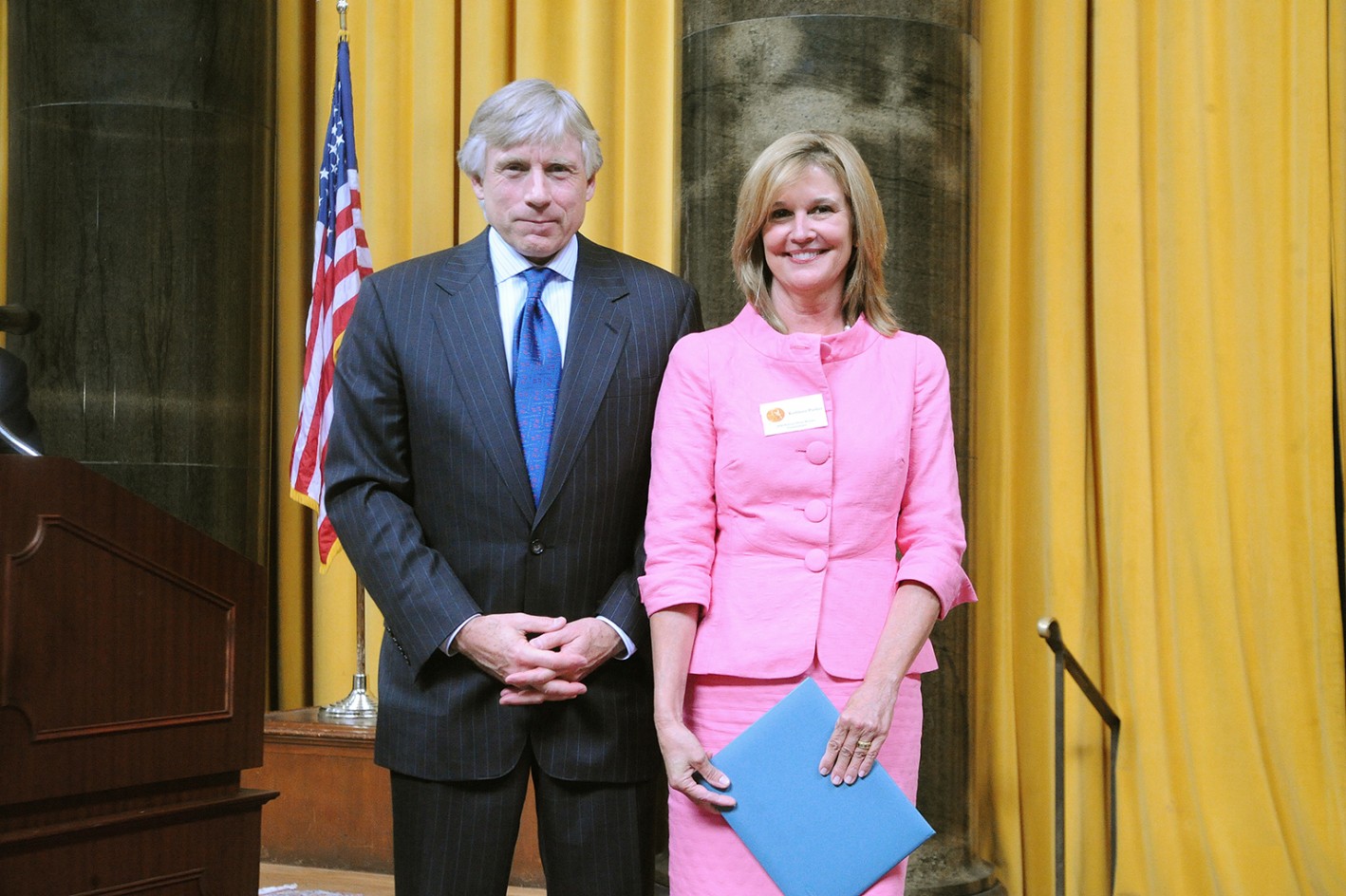
Lee C. Bollinger, President of Columbia University, presents the 2010 Commentary prize to Kathleen Parker of The Washington Post.
Winning Work
By Kathleen Parker
Here on planet "What About Me," principled people are so rare as to be oddities. Thus, it was a head-swiveling moment Monday when Mary Ann Glendon, the former U.S. ambassador to the Vatican, quietly declined Notre Dame's Laetare Medal.
Glendon -- a Harvard University law professor and a respected author on bioethics and human rights -- rejected the honor in part because Barack Obama was invited to be commencement speaker and to receive an honorary degree.
In a letter to Notre Dame's president, the Rev. John I. Jenkins, Glendon wrote of her dismay that Obama was to receive the degree in disregard of the U.S. bishops' position that Catholic institutions "should not honor those who act in defiance of our fundamental moral principles."
But the more compelling reason seems to have been Glendon's sense that she was being used to deflect criticism. As a mutual friend put it, "Father Jenkins thought he could use Mary Ann Glendon as a fig leaf."
In her letter, Glendon cited "talking points" issued by Notre Dame following criticism of the decision to honor Obama, including that:
(1) "President Obama won't be doing all the talking. Mary Ann Glendon, the former U.S. ambassador to the Vatican, will be speaking as the recipient of the Laetare Medal."
(2) "We think having the president come to Notre Dame, see our graduates, meet our leaders, and hear a talk from Mary Ann Glendon is a good thing for the president and for the causes we care about."
Glendon, who is no mortal's pawn, decided she couldn't accept the award.
To non-Catholics, Glendon's act may seem of little importance, yet another feud within the church. Abortion, after all, is settled law, and Obama is the duly elected president. Clearly, the American people have moved on.
Or have they? And should we? Is there really ever a time when we should be comfortable with the ratification of abortion? It has always seemed to me that the truest form of feminism, as in the earliest days of suffrage, would be to hold abhorrent the state-sanctioned destruction of women's unique life-bearing gifts. Out of material expedience, we've somehow managed to convince ourselves that life is a mistake.
While one may prefer to preserve the legality of individual discretion (my own reluctant, if withering, position), it is nonetheless consoling that there are still those who relentlessly defend life's sanctity. The alternative, after all, is far less comforting.
Increasingly, however, even Catholic institutions can't be relied upon to hold the fraying line between our humanity and materialism. Another Laetare recipient, the novelist and physician Walker Percy, told the 1989 graduating class:
"It is a disaster when only one kind of truth prevails at the expense of another. If only one kind of truth prevails -- the abstract and technical truth of science -- then nothing stands in the way of a demeaning of and a destruction of human life for what appear to be reasonable, short-term goals.
"It's no accident, I think, that German science, great as it was, ended in the destruction of a Holocaust. The novelist likes to irritate people by pointing this out."
One needn't be a dedicated pro-lifer to understand the consternation Obama's invitation has caused. He is more radical than all previous presidents on the life issue, with his loosening of federal funding for abortion and embryonic stem cell research, as well as his campaign promise to pass the Freedom of Choice Act.
To his credit, Obama has left some Bush-era restrictions in place on embryonic stem cell research. Under new guidelines, federal funding may be used for research only on surplus embryos from fertility clinics, not on cells or embryos created just for research.
Nevertheless, his abortion stance is in direct conflict with Catholic teaching. And no place symbolizes Catholics in America quite the way Notre Dame does.
Offering this backdrop and extending the school's imprimatur to Obama constitutes a wink and a nod to abortion. Why not throw a pig roast in Mecca? That was Glendon's point. By her symbolic gesture of self-denial, she demonstrates that faith is an act, not a motto.
Obama might consider following Glendon's lead. Although he supports choice, the president also recognizes the moral complexity of those decisions. Out of respect for pro-life Catholics and their beloved institution, he should politely bow out.
© 2009, The Washington Post
By Kathleen Parker
A wise man once said that love is the triumph of imagination over intelligence.
No one who managed to get through the torture of South Carolina Gov. Mark Sanford's news conference admitting to an affair would disagree.
Yes, I know, shocking. Another Republican affair. Next thing you know, we'll learn that a Democrat hasn't paid his taxes. There does seem to be a pattern of failure in those matters about which people purport to care most.
If we were feeling charitable, we might say something about man's fallen nature and his attempt to repair himself through public works. Thus, Republicans touting family values can't seem to stay zipped. Democrats raising taxes can't seem to spare the change come April.
We might conclude that public espousals carry certain risks of self-incrimination.
Before charity exhausts its welcome, let's give Sanford this much: He has a flair for the dramatic in what otherwise would have been merely banal. Nothing like vanishing for a few days amid lies, mystery and frenzied speculation to get that "whole sparking thing" going, as Sanford ickily described his affair.
That was but one of many bits of information the governor might have spared the world -- and especially his family. His news conference felt like a combination AA meeting-tent revival, filled with self-recrimination and flagellation, absent only the sackcloth, ashes and Oprah. Although his agony seemed sincere enough to make me want to offer the man a cigarette, his apparent need to drag everyone else along his Via Dolorosa was both personally embarrassing and politically disastrous.
The man would not stop talking. But first he wouldn't start. Even though most cable news channels covered the spectacle live -- and the room was fairly bursting with media and equipment -- Sanford began with a wistful recounting of his adventurous youth, when he loved to hike the Appalachian Trail. What? He spoke for five minutes about those good ol' days before moving, finally, to the point: Where did he go, with whom, and why?
One sensed that the governor was afraid to put a period at the end of the sentence, whereupon his own sentence would begin. As long as he talked, he could entertain an illusion of control over his life.
People generally will forgive human frailty, especially in matters of the flesh. After too many such public trials, our schadenfreude begins to feel as unseemly as the original sin.
But Sanford's foray into iniquity has potential repercussions beyond what he and his wife ultimately resolve. He did disappear for several days, five of which he confessed to having spent "crying in Argentina." What is it about that place?
And, there's no nice way to put this, he lied -- by omission, if not commission.
He lied by not telling his staff where he was going or how to reach him. He deceived his staff by allowing them to believe and report to the media that he was hiking in the Appalachians. And most important to his political future, he failed to make arrangements for his state's uninterrupted governance.
To his credit, Sanford acknowledged all these failings, but he seemed less interested in discussing his shirking of executive duty than in making rending statements about the condition of his heart. Not only did we learn Sanford's philosophy of moral absolutes, but we were led through the meaning and purpose of God's laws. The governor even lectured on the definition of sin.
Spiritually, Sanford may have succeeded in checking off several acts of contrition. But politically, he did everything wrong -- invoking religion, apologizing endlessly and acknowledging friends in a sort of reverse intervention.
Meanwhile, the questions that matter remain essentially unaddressed. Can a governor lie about his whereabouts and leave the country while his state is untended? Were taxpayer funds ever used in the pursuit of his personal gratification? Exactly a year ago, Sanford went on a South Carolina trade and investment trip to Brazil and Argentina. Yesterday, he admitted visiting his "friend" while on that excursion and is reimbursing the state for that part of the trip. Undoubtedly, other receipts will be closely examined.
If not for Sanford's appalling judgment in disappearing, his personal travails might never have come to public light. That alone suggests that he is a man unmoored from reality and, just possibly, unfit for public office.
Sanford ended his tearful remarks by saying he was committed to getting his heart right. It might serve him better to think about getting his head right.
© 2009, The Washington Post
By Kathleen Parker
Doubtless thousands of other women's ears perked up when Sen. Charles Schumer, introducing Sonia Sotomayor at Monday's confirmation hearing, mentioned the Latina jurist's girlhood affection for Nancy Drew books.
The smart, plucky girl-detective was a role model for many women who recognized themselves in Nancy -- including Hillary Clinton, Oprah Winfrey, Sandra Day O'Connor and Laura Bush, to name a few.
Add yours truly to the list.
My father introduced to me to Nancy Drew when I was in the fifth grade. He and I sat side by side on the living room couch to read the first book together, taking turns reading aloud. Thus began my long love affair with reading, encouraged by the fact that television viewing wasn't allowed on weekdays and book reading was the only exemption from hard labor, a.k.a. "chores."
By the end of the school year, I had completed the entire collection, a victory of art over temperament. I often became so excited by plot twists that I couldn't sit still and would run laps through the downstairs rooms until I calmed down enough to focus on another paragraph.
Nancy Drew was a natural fit for me. She and I both were raised primarily by our lawyer-fathers. Both of our mothers had died when we were 3. Favorite titles corresponded to my own experience (the early rumblings of empathy?) and home, names such as "The Mystery at the Moss-Covered Mansion," "The Hidden Staircase," "The Secret in the Old Attic."
We didn't live in a mansion, but our house was old and spooky -- a Spanish colonial revival-style stucco situated among moss-draped oaks, with a tile roof and a curious cupola perched over the living room, a broad front porch with a stone balustrade, and a secret staircase adjacent to my room that led to a cavernous cedar closet in which dwelled an evil spirit. Or so I was convinced.
How clever were the writers of these books, who understood the secret yearnings of little girls in love with mystery and hidden things. Other words sprinkled among the titles were baited fields to the ripe imagination -- phantom, ghost, witch, haunted, mysterious, charm. It didn't hurt that Nancy Drew had a spiffy roadster and could throw on a summer frock faster than you could say "hiya."
Nancy could do anything, and a generation of girls who lived vicariously through her heroic adventures assumed they could, too. But Nancy didn't so much inspire as reflect girls' blossoming self-image and the spirit of the times. Thus, girls as diverse as Oprah, Sotomayor and a certain WASP from down South could see themselves in the same absurdly talented, teenage sleuth.
The importance of this identification with an accomplished member of one's own sex can't be overestimated. The same applies to boys as well, but that is a subject for a separate column. Actually, I wrote a book -- "Save the Males."
But when Sotomayor and I were girls, there were few girl-oriented books and fewer female professional role models. On my weekly visit to the public library, I checked out as many women's biographies as I could find, searching for someone with whom I could identify.
These recollections are recounted to illustrate that we are all products of our life experiences. The empathy I feel for motherless children is boundless. My understanding of the world, having grown up a minority in an all-male household, feeling outside the mainstream of whole families, is different from those who had both a mother and a father.
And though I never requested nor wanted special consideration, my sense of the world as I navigated the testosterone-rich environment of America's old newsrooms as one of relatively few women is not the same as that of my male counterparts.
If I were a judge, I would bring to the bench all those experiences and the accumulated wisdom derived from them. I do not think that would make me a less-fair or less-objective jurist than the men on either side of me. I am certain, however, that my intellectual makeup does not exist independently of the emotions that helped form me.
As a Latina from a Bronx housing project reared by a single mother, Sotomayor knows things the other justices on the Supreme Court can't possibly know. She may be the wrong choice for other reasons, but not because she recognizes that the law, properly applied, requires both brains and heart.
If it were otherwise, a robot would do.
© 2009, The Washington Post
By Kathleen Parker
Southern writer Walker Percy liked to poke fun at Ohioans in his novels, just to even things out a bit.
"Usually Mississippians and Georgians are getting it from everybody, and Alabamians," he once explained to an interviewer. "So, what's wrong with making smart-aleck remarks about Ohio? Nobody puts Ohio down. Why shouldn't I put Ohio down?"
Percy, the genial genius, laughed at his own remark.
Now, apparently, it's the Buckeye State's turn to poke back. In a fusillade of pique, Ohio Sen. George Voinovich charged that Southerners are what's wrong with the Republican Party.
"We got too many Jim DeMints and Tom Coburns," he told an interviewer with the Columbus Dispatch, referring to GOP senators from South Carolina and Oklahoma. "It's the Southerners. They get on TV and go 'errrr, errrrr.' People hear them and say, 'These people, they're Southerners. The party's being taken over by Southerners. What the hell they got to do with Ohio?' "
Down South, people are trying to figure out what "errrr, errrrr" means. Jack Bass, author of eight books about social and political change in the South, speculated in an e-mail that Voinovich really meant grrrr, grrrrr, as in "growling canines whose bark scares more than do Obama's purrs, especially with the Dow at a nine-month high."
Whatever Voinovich's sound effects were intended to convey, his meaning was clear enough: Those ignorant, right-wing, Bible-thumping rednecks are ruining the party.
Alas, Voinovich was not entirely wrong.
Not all Southern Republicans are wing nuts. Nor does the GOP have a monopoly on ignorance or racism. And, the South, for all its sins, is also lush with beauty, grace and mystery. Nevertheless, it is true that the GOP is fast becoming regionalized below the Mason-Dixon line and increasingly associated with some of the South's worst ideas.
It is not helpful (or surprising) that "birthers" -- conspiracy theorists who have convinced themselves that Barack Obama is not a native son -- have assumed kudzu qualities among Republicans in the South. In a poll commissioned by the liberal blog Daily Kos, participants were asked: "Do you believe that Barack Obama was born in the United States of America or not?"
Hefty majorities in the Northeast, the Midwest and the West believe Obama was born in the United States. But in the land of cotton, where old times are not by God forgotten, only 47 percent believe Obama was born in America and 30 percent aren't sure.
Southern Republicans, it seems, have seceded from sanity.
Though Voinovich's views may be shared by others in the party, it's a tad late -- not to mention ungrateful -- to indict the South. Republicans have been harvesting Southern votes for decades from seeds strategically planted during the civil rights era. When Lyndon B. Johnson predicted in 1965 that the Voting Rights Act meant the South would go Republican for the next 50 years, he wasn't just whistling Dixie.
A telling anecdote recounted by Pat Buchanan to New Yorker writer George Packer last year captures the dark spirit that still hovers around the GOP. In 1966 Buchanan and Richard Nixon were at the Wade Hampton Hotel in Columbia, S.C., where Nixon worked a crowd into a frenzy: "Buchanan recalls that the room was full of sweat, cigar smoke, and rage; the rhetoric, which was about patriotism and law and order, 'burned the paint off the walls.' As they left the hotel, Nixon said, 'This is the future of this Party, right here in the South.' "
That same rage was on display again in the fall of 2008, but this time the frenzy was stimulated by a pretty gal with a mocking little wink. Sarah Palin may not have realized what she was doing, but Southerners weaned on Harper Lee heard the dog whistle.
The curious Republican campaign of 2008 may have galvanized a conservative Southern base -- including many who were mostly concerned with the direction Democrats would take the country -- but it also repelled others who simply bolted and ran the other way. Whatever legitimate concerns the GOP may historically have represented were suddenly overshadowed by a sense of a resurgent Old South and all the attendant pathologies of festering hate and fear.
What the GOP is experiencing now, one hopes, are the death throes of that 50-year spell that Johnson foretold. But before the party of the Great Emancipator can rise again, Republicans will have to face their inner Voinovich and drive a stake through the heart of old Dixie.
© 2009, The Washington Post
By Kathleen Parker
For those whose lives revolve primarily around real people in real time and real space, hurry, go hide.
Here's what you missed in the social networking universe the past few days: the twittered miscarriage.
The banality of twittery just out-twitted itself.
Yes, the tweet that gave even the virtual world pause came from one Penelope Trunk, 42-year-old chief executive of a blog called Brazen Careerist, where women can find advice about balancing work and family.
Trunk tweeted while in a board meeting late last month that she was having a miscarriage -- and how great is that? Beats the abortion she was planning to have, which would have meant missing two days of work since she would have had to go all the way to Chicago. Apparently, there's a waiting list in Wisconsin, where Trunk lives.
Her tweet, as tweets must be, was succinct:
"I'm in a board meeting. Having a miscarriage. Thank goodness, because there's a f----- -up 3-week hoop-jump to have an abortion in Wisconsin."
Where, oh, where is Flannery O'Connor when we need her? If she were still roaming around Milledgeville, we can be fairly certain she wouldn't be tweeting. But one might hope that O'Connor would put pen to paper and expose today's sideshow for what it is. Once asked why the grotesque is so alive in the South, the author said it's because Southerners can still recognize a freak.
Is there anything much more grotesque or freakish than a woman essentially celebrating her miscarriage in a public venue? Or, as another blogger phrased the question: "Tweeting Your Miscarriage or Abortion: Good for Women?"
It is somewhat reassuring that many of those responding were less than approving, if short on condemnation. There seems to be a reluctance among young social networkers to be judgmental. So parental. As in, it's not my thing, but to each her own. TMI (too much information) was a common remark. Many correctly observed that tweeting, given its 140-character limit, trivializes something as serious as miscarriage or abortion.
In an interview with CNN's Rick Sanchez, Trunk demurred. Like it or not, abortion is a right, she said, and women should feel comfortable talking about it. Her tweet, to the extent that it is now driving a conversation about how some states are trying to limit abortion, constitutes a public service announcement, she said.
Perhaps some women do need more information about miscarriage, though it seems probable that those following twitterers and blogs know how to mine the Internet for information. Or, you know, they could talk to their doctor/mother/grandmother/aunt. Pick up the phone?
In conversation with a real person, rather than speaking to oneself in the virtual mirror, one might hear about the loss and grief many women and couples experience following miscarriage. When a happily pregnant woman loses her pregnancy, she says she has lost her baby. Casting that painful episode as of no greater consequence than missing a lunch date should repel any beating heart.
One might wish that Trunk were an anomaly, but one would be disappointed. To those for whom abortion is a correction, miscarriage is just a messier month. When Sanchez asked, "Do you have no shame?" Trunk replied: "Why are you asking?"
Well, as George Will would say.
Women certainly needn't feel shame for a miscarriage. Abortion, which is in an entirely different category, deserves a different conversation. It's worth noting for the sake of irony, however, that the principal argument for the legalization of abortion was privacy.
Whither that?
Regardless of one's moral position, it can't be convincingly argued that abortion and miscarriage are mere medical conditions like any other, as Trunk asserts. They both can involve medical procedures, but there's a life force at work that no woman who aims to give birth will deny.
Grappling with that force, its absence or overbearance, has prompted men and women through soul-searching centuries to find just the right words to exalt or rue the incomprehensible. That's why tweeting a miscarriage is so offensive. It's too little for too much.
A longer, more-reflective article examining the moral and legal pitfalls of a woman navigating miscarriage while at work might have been a valuable contribution to a necessary discussion. A teachable moment, if we must.
Instead, Trunk reduced the entire argument to an ineffable instant of adolescent prurience, trivializing not only the miscarriage but what little remains of our humanity. On a higher note, as Trunk noted on her blog, she did have a good hair day on CNN.
And you say there's no God.
© 2009, The Washington Post
By Kathleen Parker
As if President Obama didn't have enough on his plate with health care and Afghanistan, he's now faced with the problem that can't be solved: Women.
Sorry, Mr. President, but we coulda toldja.
But no, Barack Obama courted the girls, promised them equality in all things, and now has excluded them from an all-male game of basketball.
Sorry, ladies, but we coulda toldja.
Not all women are upset, of course. Some on his estrogen-rich staff have shrugged off the faux-scandal about the now-infamous game and point to Obama's inclusion of women where it matters most.
Senior adviser Valerie Jarrett noted the several high-level female appointments, including Secretary of State Hillary Clinton and Supreme Court Justice Sonia Sotomayor. Also, the administration boasts a 50-50 gender split among White House employees.
Basketball is a contact sport. Wouldn't we find a presidential body brush with a congresswoman at least equally problematic?
But a few women find the president's preference for guy company in his extracurricular life problematic. Basketball in this instance isn't only about shooting hoops; it's about access to the president. As the powder-room buzz goes, Obama may as well have tacked a sign over the clubhouse door: "No girls allowed."
Just as soon as I finish this yawn, I'm going to rustle up some righteous indignation. Here goes: How dare he!
On the other hand, how dare he otherwise? Basketball is a contact sport. Wouldn't we find a presidential body brush with a congresswoman at least equally problematic? How about the likelihood that few women in the White House or Congress could play well enough to make it fun for the president? Or should we have Obama play down for the girls? Should he simply not get to play ball as president?
Life is complicated . . . but not really. Obama likes to play basketball, and one can only amuse oneself alone with a ball and a hoop for so long. It is natural that he would summon a few guys to play with him. Must even a president's recreational time be politically correct?
Smack dab on center court is the elephant no one wants to acknowledge: that men and women are different; that sometimes even heterosexuals prefer same-sex company; and that, as a rule, women and men are unequal in matters physical. With rare exceptions, the gender-neutrality trope that drives much of the Democratic Party agenda is, was and ever shall be -- false.
Sad. Depressing. Frustrating. Maddening. Call it what you wish, but it is still true.
Obama's basketball game, thus, has become a convenient metaphor for an inconvenient truth. Generally speaking, guys prefer to play ball with other guys, just as women prefer to form book clubs with other women. That's not because women don't like men (and vice versa) but because when relaxing, women mostly want to drink wine together. And talk about men. I don't know what men do on the basketball court that is so compelling, but they apparently need it, and I don't.
That skittering sound you hear is the scurrying of a thousand stilettos as women scramble to blog their protest. Wait, wait, I feel another yawn coming on. Is there anything more exhausting than trying to explain the obvious?
None of what's true or obvious precludes rational approaches to fair practices or tweaks to make life more workable and pleasant. But, though we celebrate female athletes, absolute equality isn't likely until we alter the hormonal composition of the universe.
Or desirable?
Honest women will have to admit that they helped Obama become president not only because of the policies he promised but also because they rather fancied him. That famed jocularity he shares with men more than women may be cause for criticism in the Halls of Harrumph, but it's called nectar in the jungle. His guyness is his jump shot.
Not to suggest that men ever do or say anything right, but women peeved by the president's perceived masculine insularity might benefit from my father's advice when, as a young girl, I complained about life's unfairness. "Don't complain about the game," he said. "Learn the game and play it better." There's more than one way to score a point, in other words, and history has never suggested women are unclever.
If absolute parity of access to the president is essential to women's sense of well-being, perhaps they should create a bowling league of their own and invite the president to play. I hear he has a bowling alley in his house. And, if memory serves, women may expect to prevail.
© 2009, The Washington Post
By Kathleen Parker
One of the few incontrovertible assertions one can reasonably make is that no one supports forced abortion.
Yet, coerced abortions, as well as involuntary sterilizations, are commonplace in China, Beijing's protestations notwithstanding. While the Chinese Communist Party insists that abortions are voluntary under the nation's one-child policy, electronic documentation recently smuggled out of the country tells a different story.
Congressional members of the Tom Lantos Human Rights Commission heard some of that story Tuesday, two days before President Obama was slated to leave for Asia, including China, to discuss economic issues. Among evidence provided by two human rights organizations, ChinaAid and Women's Rights Without Frontiers, were tales of pregnant women essentially being hunted down and forced to submit to surgery or induced labor.
Reggie Littlejohn, founder and president of the Frontiers group, told the commission that China's one-child policy "causes more violence against women and girls than any other official policy on Earth."
I met Littlejohn for breakfast the day before the hearing. A petite wife and mother -- as well as a Yale-educated lawyer -- Littlejohn gave up her intellectual property practice in San Francisco after a life-altering illness to become a full-time activist for Chinese women. She is remarkably buoyant, considering the knowledge she has absorbed. Action, she says, is her way of coping with the unconscionable.
Here's the question Littlejohn insists we consider: What really happens to a woman who doesn't have a "birth permit" and has an "out of plan" pregnancy?
The answer is simple and brutal: A woman pregnant without permission has to surrender her unborn child to government enforcers, no matter what the stage of fetal development.
Late-term abortions are problematic, but the Chinese are nothing if not efficient. On one Web site for Chinese obstetricians and gynecologists, doctors recently traded tips in a dispassionate discussion titled: "What if the infant is still alive after induced labor?" ChinaAid provided a translation of a thread regarding an eight-month-old fetus that survived the procedure.
"Xuexia" wrote: "Actually, you should have punctured the fetus' skull." Another poster, "Damohuyang," wrote that most late-term infants died during induced labor, some lived and "would be left in trash cans. Some of them could still live for one to two days."
To be clear, some of the doctors online expressed concern for the rights of the child. Others, however, worried only about potential legal ramifications. Technically, it is illegal in China to kill a baby, one is relieved to learn, but family-planning imperatives sometimes prevail. According to a 2009 State Department report, monetary incentives and penalties are attached to population targets, creating what amounts to bounties on the unborn.
As recently as July, officials of China's National Population and Family Planning Commission said that the one-child policy "will be strictly enforced as a means of controlling births for decades to come," according to Xinhua, the state-run news agency.
The violence of these procedures doesn't only kill the child in some instances. In two of the cases described in a document leaked this past August, the mothers died, too. Those who dissent, meanwhile, are persecuted.
Such has been the fate of activist Chen Guangcheng, who is serving a four-year sentence after exposing 130,000 forced abortions and sterilizations in Linyi County, Shandong province, in 2005. Named by Time magazine as one of 2006's top 100 people "who shape our world," Guangcheng, who is blind, was severely beaten and denied medical care the following year, according to an Amnesty International report.
The one-child policy has created other problems that threaten women and girls. The traditional preference for boys has meant sex-selected abortions resulting in a gender imbalance. Today, men in China outnumber women by 37 million, a disparity that has become a driving force behind sex slavery in Asia. Exacerbating the imbalance, about 500 women a day commit suicide in China -- the highest rate in the world, which Littlejohn attributes in part to coercive family planning.
Obviously, the United States is in an awkward position with China, our second-largest trading partner and the largest holder of our government debt. But Littlejohn hopes Obama will "truly represent American values, including our strong commitment to human rights." She is also calling on Planned Parenthood and NARAL to speak up for reproductive choice in China.
On this much, both sides of the abortion issue can agree: Forced abortion is not a choice. Averting our gaze from China's horrific abuse of women is.
© 2009, The Washington Post
By Kathleen Parker
COLUMBIA, S.C. -- In town to give a talk on civility, I was surrounded by women who wondered what I thought of Sarah Palin's Newsweek cover.
"Why aren't women coming to her defense?" they asked.
"Why are the media being so rough on Sarah?"
Having been enjoying a self-imposed moratorium on all things Palin, declining numerous interviews to discuss her latest self-promotional tour, I was surprised by the questions. My thoughts lately have drifted toward the sense that, though Palin is very much a celebrity, she's no longer running for public office, at least officially. Ergo, radar gets a rest.
As for her book . . . right after I finish "Ulysses."
But the questions -- and the passion with which they were proffered -- intrigued me. Are the media treating her unfairly? Are they "bashing" Palin, as her supporters describe any criticism? Was the Newsweek cover sexist?
Call me a guy but give me a break. Sarah Palin is the luckiest woman on the planet.
Hats off to the girl from Wasilla who, slightly more than a year ago, was virtually unknown and is now on the cover of Newsweek, hawking a book for which she was paid a few million dollars, drawing huge crowds and getting the kind of free publicity most celebrities have to jump on Oprah's couch to get.
Oh, and yes, she got to sit on Oprah's set as well. And we're supposed to defend/feel sorry for/protect Sarah from . . . what? Wild success, popularity and riches? You must be joking.
I don't doubt the sincerity of those who feel compelled to defend Palin. Women, especially, feel personally diminished when a female candidate is treated unfairly. Some of the commentary aimed at Palin during the presidential campaign was clearly over the top -- vile and vicious in some cases -- though I would challenge the common assertion that noting her lack of familiarity with national policies and issues constitutes "bashing."
Vile and vicious is standard fare for anyone in the public eye these days. That's no justification for it, ever, but Palin's experience, if higher-profile than most, is not unique. Hence the acute interest in civility.
Palin, meanwhile, is no one's dummy when it comes to political strategy. She knows exactly how to animate her base, and demonizing the media is the most powerful quill in her quiver. That is, by picking fights with the media, she mobilizes her fans against a monolithic enemy -- "them" -- while getting "them" to give her more ink and airtime.
It's a plan, and it works. Americans, however much they may protest to the contrary, have a soft spot for damsels in distress, no matter how faux the foe.
So, Palin doesn't like her Newsweek cover. It's sexist. It's out of context. If you've somehow missed it, the photo shows Palin in black shorts, a red, long-sleeved top and running shoes. She has one elbow propped on the back of a chair draped in an American flag and is clutching two BlackBerrys in her hand. She is smiling.
Originally taken for Runner's World magazine to go with a profile of the former governor, an avid runner, the picture couldn't be any more flattering or wholesomely all-American if Norman Rockwell had painted it. In a word, the photo is fantastic.
It is perhaps sexy, depending on the beholder's eyes, but it couldn't be construed as sexual. Sexist? Would we show a man similarly posed? Only if he positioned himself that way -- and looked as good. We've seen dozens of far-less flattering photos of George W. Bush in various athletic pursuits. And who can forget the photo of Barack Obama striding shirtless through the Hawaiian surf?
Yet, Palin called Newsweek's selection of the photo "unfortunate." On her Facebook page, she wrote, "When it comes to Sarah Palin, this 'news' magazine has relished focusing on the irrelevant rather than the relevant. . . .
"The out-of-context Newsweek approach is sexist and oh-so-expected by now. If anyone can learn anything from it: It shows why you shouldn't judge a book by its cover, gender or color of skin. The media will do anything to draw attention -- even if out of context."
Point taken. Indeed, if anyone can learn anything from this, it shows that one shouldn't judge a book -- or a candidate -- by its cover.
Radar off.
© 2009, The Washington Post
By Kathleen Parker
Some people can't stand prosperity, my father used to say. Today, he might be talking about Republicans, who, in the midst of declining support for President Obama's hope-and-change agenda, are considering a "purity" pledge to weed out undesirables from their ever-shrinking party.
Just when independents and moderates were considering revisiting the GOP tent.
Just when a near-perfect storm of unpopular Democratic ideas -- from massive health-care reform to terrorist show trials, not to mention global-warming hype -- is coagulating over 1600 Pennsylvania Ave.
Just when the GOP was gaining traction after gubernatorial victories in Virginia and New Jersey . . . Republicans perform a rain dance at their own garden party.
Things were just going too well.
Thus, some conservative members of the party have come up with a list of principles they want future candidates to agree to or forfeit backing by the Republican National Committee.
The so-called purity test is a 10-point checklist -- a suicide pact, really -- of alleged Republican positions. Anyone hoping to play on Team GOP would have to sign off on eight of the 10 -- through their voting records, public statements or a questionnaire. The test will be put up for consideration before the Republican National Committee when it meets early next year in Hawaii.
The list apparently evolved in response to the Republican loss in the recent congressional race in Upstate New York, when liberal Republican Dede Scozzafava withdrew from the race under pressure from conservatives and endorsed Democrat Bill Owens, who won. Republicans had held that seat for more than a century.
James Bopp Jr., chief sponsor of the resolution and a committee member from Indiana, has said that "the problem is that many conservatives have lost trust in the conservative credentials of the Republican Party."
Actually, no, the problem is that many conservatives have lost faith in the ability of Republican leaders to think. The resolutions aren't so much statements of principle as dogmatic responses to complex issues that may, occasionally, require more than a Sharpie check in a little square.
It's too bad that "elite" and "nuance" have become bad words in the Republican lexicon. Elites are viewed in Republican circles as "those people" who are out of touch with "real Americans." And "nuance," the definition of which suggests a sophisticated approach to understanding (as opposed to "Because I said so, case closed") has come to be viewed as a Frenchified word Republicans successfully hung on presidential candidate John Kerry in 2004. His flip-floppery on issues became associated with nuance, a.k.a. lack of decisiveness. Ergo, a lack of leadership skills.
It was superb message manipulation, if you go for that sort of thing. But it was also pandering to America's inner simpleton. Not to defend Kerry, specifically, but heaven forbid anyone should ever consider shades of meaning or new developments and change his mind. As Kerry said during a 2008 Associated Press interview, "Decisiveness wrongly applied can create a lot of pain." This nation was, after all, for slavery before it was against it.
Most of us know that decisiveness isn't always a virtue, yet those pushing the purity test seem to view nuance as an enemy of conservatism. The old elite corps of the conservative movement, men such as William F. Buckley and Russell Kirk, undoubtedly would find this attitude both dangerous and bizarre. When did thinking go out of style?
In fact, the 10-point checklist proffered by Bopp and others is the antithesis of conservatism. As Kirk wrote in his own "Ten Conservative Principles," conservatism "possesses no Holy Writ and no Das Kapital to provide dogmata . . . conservatism is the negation of ideology: it is a state of mind, a type of character, a way of looking at the civil social order."
Each of Bopp's bullets is so overly broad and general that no thoughtful person could endorse it in good conscience. Some are so simplistic as to be meaningless. As just one example: "We support victory in Iraq and Afghanistan by supporting military-recommended troop surges." What does that mean? Do we support all troop surges no matter what other considerations might be taken into account? Do we take nothing else into account? Does disagreement mean one doesn't support victory?
Whatever the intent of the authors, the message is clear: Thinking people need not apply. The formerly elite party of nuanced conservatism might do well to revisit its nonideological roots.
Otherwise, might we bother Mr. Kirk to beam us up?
© 2009, The Washington Post
By Kathleen Parker
After Barack Obama's Nobel Peace Prize speech, anyone still questioning whether he is really a Christian, rather than a Muslim aligned with fanaticism, needs to seek therapy forthwith.
Anyone still unconvinced that Obama is really an American committed to his nation's values, rather than an impostor who doesn't pledge allegiance to his critics' satisfaction, should probably surrender to the asylum.
Obama's speech, an artful balance of realism and idealism, was both a Judeo-Christian epistle, conceding the moral necessity of war, and a meditation on American exceptionalism. He was, in other words, the unapologetic president of the United States and not some errant global villager seeking affirmation.
The speech was a signal moment in the evolution and maturation of Obama from ambivalent aspirant to reluctant leader.
Rising to the occasion, he managed to redeem himself at a low point in his popularity by reminding Americans of what is best about themselves.
Paying homage to champions of nonviolence, Martin Luther King Jr. and Mahatma Gandhi, he nonetheless acknowledged that as commander in chief charged with protecting a nation, he couldn't follow their examples alone.
"For make no mistake: Evil does exist in the world. A non-violent movement could not have halted Hitler's armies. Negotiations cannot convince al-Qaeda's leaders to lay down their arms. To say that force may sometimes be necessary is not a call to cynicism -- it is a recognition of history, the imperfections of man and the limits of reason."
With those words, Obama aligned himself with conservatives, who believe in the fallibility of human nature and in an enduring moral order. At the same time, he left room for moral conundrum: the difficulty of reconciling two seemingly irreconcilable truths -- "that war is sometimes necessary, and war at some level is an expression of human folly."
Obama didn't mention his favorite philosopher, Reinhold Niebuhr, but Niebuhr's thoughts were woven throughout. In one example, Obama said, "We must begin by acknowledging the hard truth: We will not eradicate violent conflict in our lifetimes." Niebuhr said, "Nothing that is worth doing can be achieved in our lifetime."
Like Niebuhr, who during World War II abandoned his pacifist-liberal roots to become an advocate for war, Obama has left the comfortable world of consensus-building to become a war president, recently agonizing and deciding to send 30,000 more troops to Afghanistan. His journey undoubtedly has been painful as he arrived at this unfamiliar destination: "Some will kill. Some will be killed."
No presidential candidate can ever fully anticipate the burden of the office he seeks until he sends his first troops to battle. Obama has joined the procession of others who have suffered in advance of the coming death toll. The moral conflict he expressed in words soon enough will find expression in his face.
Though the Oslo speech follows others that have inspired even his critics, this was Obama's most presidential. It marked the moment when Obama became a leader, defined as an individual who chooses the hard road because he believes it is the right one.
Some of the machinations of Obama's justifications were evident. He made a point, for example, of implying that his Afghanistan war is more justified than George W. Bush's Iraq war. Speaking of the two engagements, he said: "One of these wars is winding down. The other is a conflict that America did not seek."
He took pains to note that other wars, especially "holy wars," are never justified. And finally, "war itself is never glorious, and we must never trumpet it as such."
And so the reluctant warrior, who set out to save the world from pestilence, plague and global warming, now must also wage war against both an ideological foe as well as his own temperament. Leadership is not for cowards.
Of the 4,000 or so words Obama uttered, those most soothing to American ears, if not so much to those sitting closer, were Obama's paean to the sacrifices and gifts of his countrymen. He reminded the world that, whatever mistakes we've made, the United States has shed its blood and spent its treasure to enable democracy and to promote peace and prosperity around the world.
There is much about Obama's administration to criticize. But at certain moments, the president articulates our problems in ways that elevate us beyond our pettier differences. His Nobel Prize may have been all the things critics have listed, but Obama's response was a triumphant expression of American values and character.
© 2009, The Washington Post
Biography
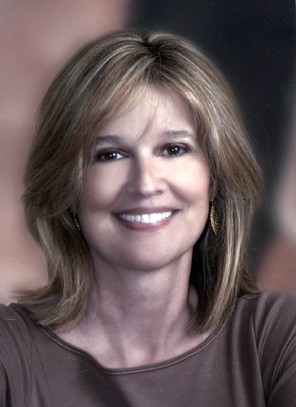
Kathleen Parker has been syndicated by the Washington Post Writers Group since 2006.
Parker started her column in 1987, when she was a staff writer for the Orlando Sentinel, and it became nationally syndicated in 1995. Her columns have been praised for “attacking ignorance and stupidity with vividness and originality” by the judges of the H.L. Mencken Writing Award, which she won in 1993. She has also contributed articles to the Weekly Standard, Time, Town & Country, Cosmopolitan and Fortune Small Business, and she serves on USA Today’s Board of Contributors and writes for that newspaper’s op-ed page. Parker is a regular guest on “The Chris Matthews Show” on NBC. Her book “Save the Males: Why Men Matter, Why Women Should Care” was published in 2008 by Random House.
As an undergraduate, Parker studied in both the United States and abroad, including the University of Valencia in Spain. She holds a master’s degree in Spanish from Florida State University and is writer in residence at the Buckley School of Public Speaking in Camden, S.C.
Parker is married and has three sons. She divides her time between Camden and Washington, D.C.