The Atlanta Journal-Constitution, by Cynthia Tucker
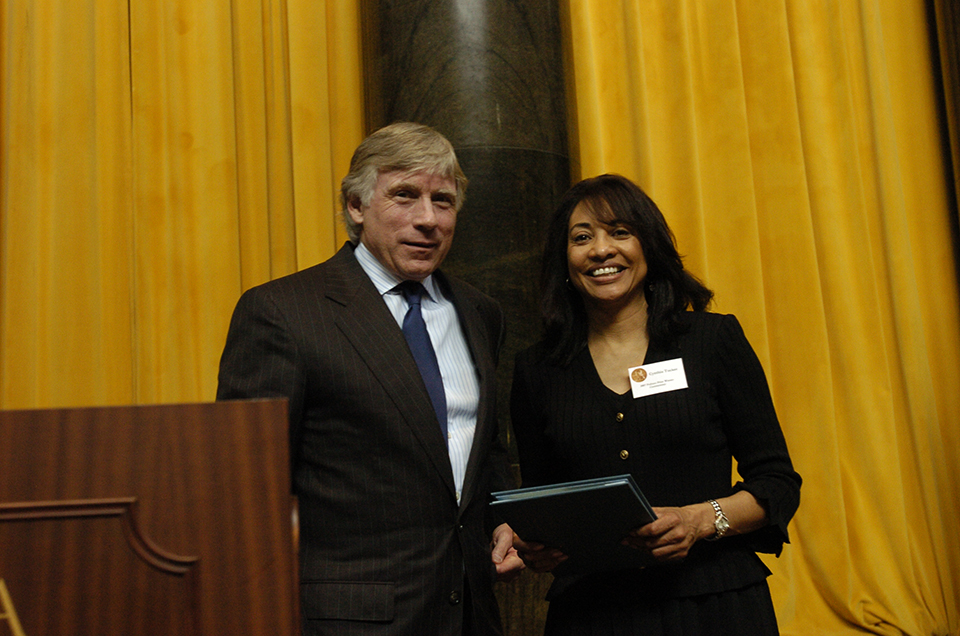
Columbia University President Lee C. Bollinger presents Cynthia Tucker with the 2007 Pulitzer Prize in Commentary.
Winning Work
By Cynthia Tucker
I still like the better advice Atticus gave Scout: Don't use the word.
Only one thing is certain about use of the n-word, a lasting truth that was uttered by the courageous Atticus Finch, hero of "To Kill a Mockingbird."
"Do you defend niggers, Atticus?" his daughter Scout asks him. Finch answers with a pearl of wisdom:
"Of course I do. Don't say 'nigger,' Scout. That's common."
Finch's words --- actually, the words are those of my hometown heroine, Harper Lee, who wrote the book in the late 1950s --- retain a simple profundity. All you can know for certain about those who use that epithet is that they are a little too comfortable with crudeness. How could it be otherwise, when the term is used by racists to demean and by black rappers and comedians to entertain?
Yet for the last few weeks, the campaign for the U.S. Senate in Virginia has been dominated by questions, revelations and accusations over use of the n-word. After Republican incumbent George Allen used a different racial slur to insult a young man of Indian background, a trickle of witnesses emerged, charging that in private conversations, Allen often uses the n-word as well.
Allen's supporters have flung the charge right back, alleging that his Democratic opponent, James Webb, has also used the term. As a result, campaign platforms and position papers have been cast aside while journalists pursue any report that either man may have uttered the word.
The obsession with that highly charged epithet suggests the continuing difficulty we have in publicly discussing racism, which is still alive and well in America but increasingly difficult to define and identify. Political and social arbiters who can't agree on much else do agree on one easy rule: Use of the n-word is prima facie evidence of vicious bigotry.
Except it isn't --- at least not the sort of malicious racism that matters. The use of demeaning racial and ethnic epithets might instead be evidence of arrogance, ignorance, immaturity or some ruinous combination of the three. In the case of Allen and Webb, mere use of the n-word tells voters little about the man or his morality. Context is everything.
If you live in a dark skin, as I do, you have probably developed pretty good instincts for discerning friend from foe. But many black Americans are easily distracted by the n-word, especially if it is used by whites.
I've known black parents to protest classroom instruction of Mark Twain's "Huckleberry Finn" and even "Mockingbird," simply because the n-word turns up in dialogue. Those parents show a troubling inability to make critical judgments about the motives and intentions of some of American literature's best-known characters. Yet they often allow their children to consume the raunchiest rap music, full of violence, misogyny and liberal use of a certain epithet.
Campaign reporters will probably continue to search out old acquaintances and teammates of Allen and Webb, but most Virginia voters already have the crucial information they need to assess the men. What matters most is not what happened in the 1970s or '80s, but what happened two months ago.
Speaking at an August rally in southwest Virginia, Allen pointed out a brown-skinned Indian-American, S.R. Sidarth, who was videotaping Allen's remarks as a representative of Webb's campaign. (That's a common tactic on the campaign trail.) Allen twice called Sidarth a "macaca" --- a species of monkey --- ending his tirade with "Let's give a welcome to Macaca, here. Welcome to America and the real world of Virginia."
While Allen first claimed he had made up the word, it is a common racial slur among whites in northern Africa; since Allen's mother grew up in Tunisia, he had undoubtedly heard the term. Equally telling, he "welcomed" Sidarth to America.
As it happens, Sidarth was born in Virginia, and is just as American as Allen. But Allen, blinded by bigotry and xenophobia, is unable to see it that way. In a nation that claims to be a "melting pot," that is unacceptable in a political leader.
As for the n-word, Harvard law school professor Randall Kennedy explored its awful power in a scholarly book called "Nigger: The Strange Career of a Troublesome Word."
"There is much to be gained by allowing people of all backgrounds to yank (the word) away from white supremacists, to subvert its ugliest denotation." Kennedy writes.
I respectfully disagree. I still like the better advice Atticus gave Scout: Don't use the word.
© 2006 The Atlanta Journal-Constitution
By Cynthia Tucker
The Georgia law might have kept as many as 300,000 law-abiding citizens from voting, simply because they don't have driver's licenses.
Perhaps most of us have forgotten our high school civics classes, but there is one lesson so fundamental to the ideals of this democratic republic that it deserves to be encoded in our civic DNA: Voting is a right.
It is not reserved for the rich or the powerful, those who are tall or those who are pretty, the intellectually gifted or the musically inclined. It is a fundamental right of every American citizen 18 and older. The U.S. Constitution says so. Several times.
Every time I write a column on the contentious issue of voter IDs, I get letters and e-mails from readers insisting that voting is "a privilege," and if Americans want to vote badly enough, they ought to trouble themselves to get a government-sponsored photo ID, such as a driver's license. Well, according to the nation's founding document, that's not the way it works.
Voting is not like driving a car or boarding an airplane or renting a DVD. Governments may impose severe limitations on airline passengers and motorists; several speeding tickets can get your driver's license suspended. Blockbuster, a commercial enterprise, gets to decide whether it will allow you to rent its movies and video games; photo IDs and credit cards are usually required to qualify.
But since the last great battle to expand the franchise --- the Voting Rights Act of 1965 --- federal courts have rarely tolerated obstacles to the ballot box. Judges have blocked several recent legislative attempts to make it more difficult for some people to vote, including an onerous voter ID requirement passed by the GOP-dominated Georgia Legislature. Earlier this month, a federal court in Arizona blocked a burdensome voter ID bill passed in that state.
The Georgia law might have kept as many as 300,000 law-abiding citizens from voting, simply because they don't have driver's licenses. Many elderly and impoverished voters in rural areas of the state don't drive, don't fly and don't rent movies. Many don't even have checking accounts. But they are nevertheless regular voters. (While the state of Georgia is expected to file an appeal of a ruling striking down the voter ID law, the new requirements will not be in effect for the Nov. 7 elections.)
The idea of universal suffrage has long been controversial. Indeed, it took this country nearly two centuries to extend the franchise to all citizens. Women didn't get the right to vote until 1920; eighteen-year-olds finally got the franchise in 1971. Voters have the power to shift the political consensus in their favor, so it's a radical proposition to believe that every citizen --- regardless of race, creed or color, income, education or ZIP code --- should be able to cast a ballot. It is a testament to the vitality of this nation's democratic ideals that the franchise is now universally applied.
Recently, however, a new wave of rebellion against that egalitarian ideal has cropped up; a new generation of politicians, mostly Republicans, is determined to snatch the franchise away from some Americans. Just a month ago, the GOP-dominated House passed a bill that would require government-issued photo IDs to vote in federal elections. And several Republican-led state legislatures have either passed stringent voter ID rules or imposed onerous regulations for voter registration.
Republican leaders have strained mightily to convince the courts that they are just protecting the franchise from voter fraud. Consider the widespread threat of illegal immigrants sneaking into the polls to vote, just as they sneaked into our country to work. Or those Dumpster-diving impostors who steal someone's light bill out of the trash and then use it as ID to cast a fraudulent ballot. Come on. I've heard 7-year-olds spin more convincing yarns.
According to USA Today, a preliminary report commissioned by the U.S. Election Commission has found little evidence of the sort of fraud that the burdensome new regulations purport to prevent. The bipartisan report found that "there is little polling-place fraud, or at least much less than is claimed, including voter impersonation, 'dead' voters, noncitizen voting and felon voters," the newspaper wrote. (USA Today was able to obtain a copy of the study, which has not been released. Wonder why?)
Here's what the Republicans are really up to: They want to shave off a small group of voters who tend to cast their ballots for Democrats, including the poor and people of color.
With the nation cleaved by fierce partisanship, statewide contests are increasingly decided by very small margins. If the GOP can block just a small percentage of likely Democratic supporters, they figure they'll increase their chances for victory.
That's not exactly what you learned back in ninth-grade civics, is it?
By Cynthia Tucker
"Life is beautiful, the world is marvelous, and I love everyone!!!!!!"
My 7-year-old niece -- seven-and-a-half, she insists -- e-mailed me that message a few weeks back, a reflection of the boundless enthusiasm only a small child can muster.
At the time, I hardly shared her cheeriness. Listening as the rhetoric surrounding immigration grew coarser --- with unmistakable signals of an unwholesome nativism, if not outright racism, seeping in from the fringes --- I worried that her future wouldn't be as bright as I had hoped. You see, my niece, Maria Irene Vazquez, is a multiethnic child, a "black-xican," as I call her. My sister is married to a man who was born in Mexico.
My e-mail box had been crammed with messages describing illegal workers from south of the border as "criminals" who bring down property values in respectable neighborhoods, grifters who exploit social services that rightfully belong to taxpaying citizens and gatecrashers who refuse to learn our language or customs. One of my e-mail correspondents includes the word "wetback" every time he writes me on immigration. Others sprinkle enough uses of they and them and those people in their missives to remind me of the rhetoric used by white Southerners who resisted desegregation in the 1960s. I wondered if Irene's multiethnic heritage would only expose her to multiple demeaning stereotypes.
There are clearly legitimate worries about the burdens of illegal immigration. Communities with a huge influx of newcomers have struggled to accommodate schoolchildren who speak little English, to provide health care to uninsured pregnant women and to enforce housing codes in areas where undocumented workers crowd together in tight quarters.
But those legitimate concerns can be drowned out by the bigoted messages of xenophobes such as D.A. King, a Cobb County man who has emerged as one of the loudest local critics of illegal immigrants. Though he insists he supports legal immigration, he rails against cultural change.
A frequent contributor to a right-wing, invective-filled Web site called VDARE.com, King once wrote in a column, after attending a rally supporting illegal immigrants as a "counterprotester": "I got the sense that I had left the country of my birth and been transported to some Mexican village, completely taken over by an angry, barely-restrained mob. . . . My first act on a safe return home was to take a shower."
King could easily be speaking that dismissively of Irene's family; her paternal heritage includes a history of illegal labor and immigration rules flexed and bent, if not shattered. Her grandfather entered this country on a tourist visa in 1983 but stayed on after the visa expired and worked in construction.
Though his English is less-than-fluent, he is now an American citizen. He works hard; he loves baseball; he frequents Home Depot. What could be more American?
Repeating the pattern of earlier immigrants --- Irish, Italian, Polish, Chinese and others --- his children and grandchildren have taken to this country and adopted its values. One grown son is a high-school-educated construction worker. A grown daughter --- a mother with three children, one in college --- is a teacher's assistant who hopes eventually to complete her own college degree. Another son, my brother-in-law, Jose, graduated summa cum laude in engineering from the University of Houston, later earning a doctorate. He is the newly minted CEO of a small naval architecture consulting firm in New Orleans.
Little Irene, meanwhile, is much like any other indulged child of the American middle class. She attends a trendy private school; she competes in chess tournaments and takes gymnastics classes; she has Crocs, a portable DVD player and a passport. Call me biased, but I don't get the impression she and her paternal kin are ruining the country.
As it turns out, neither do most other Americans. A newly released New York Times/CBS poll shows that most of my fellow citizens reject the exclusionary rhetoric of the D.A. Kings, along with the harsh sanctions proposed by hardline Republicans in the U.S. House, who would make illegal border crossings a felony. Sixty-one percent of poll respondents said illegal immigrants who have been in the United States at least two years should be given the chance to apply for legal status; 66 percent oppose building a fence along the southern border.
I was heartened by those views. Irene may yet grow up in a world that embraces her mixed heritage, that encourages her bilingualism, that endorses her unique contributions to America --- a world as marvelous as she believes it to be.
© 2006 The Atlanta Journal-Constitution
By Cynthia Tucker
There is a lot of bad news in black America.
After a decade of rising affluence, poverty (among blacks and whites) is on the upswing. Marriage is out of fashion, but diabetes, hypertension and heart failure are not. We die sooner than whites. And black men remain disproportionately shut out of the mainstream -- unemployed, on drugs, in prison.
So if black activists and political leaders are looking for matters crying out for redress or reform or fairness, I could give them a list. Cynthia McKinney's complaints would not be on it.
If you're going to call a press conference and muster such prominent supporters as Harry Belafonte and Danny Glover, you ought to be sure the issue is important enough to command national attention. You should save that sort of clarion call for the most serious matters --- renewing the Voting Rights Act or raising the minimum wage so that more black men can support their children. The precious spotlight of national news coverage should not be wasted on a spoiled and demanding congresswoman who thinks she's the Soul Queen of Capitol Hill.
Nor should the Abrams tank of political warfare -- the charge of "racism" -- be rolled out to fight every minor battle. Racism is a shadow of its former self, but it lives yet. You see it in the high rates of harsh discipline meted out to black boys in public schools. You can also see it in the disproportionate numbers of black men sent to prison for crimes they didn't commit.
Certainly, the legacy of racism is alive and well. You can see it in the self-destructive behavior of so many young black men -- the internecine violence, the distorted self-esteem, the worship of thug culture. You can see the legacy of racism in the enduring rates of poverty and poor health among black citizens.
But McKinney's trumped-up charge of racism merely cheapens the term, so that it's less effective when it's needed to discuss genuine discrimination.
Immediately after the episode, McKinney -- uncharacteristically, to be sure -- issued a statement of regret, saying, "I know that Capitol Hill Police are securing our safety, and I appreciate the work that they do." But within hours, her stance had changed as she rallied supporters to her side to defend her against the depredations of a racist white police state.
(Now, I can understand McKinney's frustration over the fact that she is often unrecognized. I share that frustration. More times than I can count, I've been mistaken for McKinney, criticized for things she said or given advice about my braids. In fact, while McKinney wore braids until recently, I haven't worn them since sixth grade. Still, I've never slapped or slugged anyone who confused me with her. But if this keeps up, that could change.)
Last month, The New York Times ran a front-page story outlining the dire social and economic prospects for young black men. According to a number of recent academic studies, black men, despite the obvious successes of a few, are falling further and further behind, locked in place as a permanent underclass. "Especially in the country's inner cities, the studies show, finishing high school is the exception, legal work is scarcer than ever and prison is almost routine, with incarceration rates climbing for blacks even as urban crime rates have declined," the article said.
I waited for somebody to call a press conference. I waited for Jesse and Al to take to the streets demanding public policies that would bring black men into the mainstream. I looked for responses from the usual suspects -- the NAACP, the Urban League and the Southern Christian Leadership Conference. I heard nothing.
But a misunderstanding between a second-rate member of Congress and a Capitol Hill police officer has apparently become a full-blown crisis. So maybe I'm wrong about all of this. Perhaps I just need to adjust my perspective.
Perhaps the fact that one-third of young black men have police records is not a problem. Maybe the fact that 70 percent of black children are born outside the bonds of marriage is no big deal, and a 72 percent unemployment rate among black male high school drop-outs in their 20s does not signal a crisis. Maybe the serious decline in the marriage rate among black adults does not suggest the demise of a community.
No, indeed. The biggest problem facing black America involves a white cop who wouldn't give a black woman her props.
© 2006 The Atlanta Journal-Constitution
By Cynthia Tucker
In a few precincts of American politics, voters still applaud the utterly futile gesture of defiance, the confrontational rhetoric that pleases only true believers, the fist shaken in the face of an opponent who neither notices nor cares. Apparently, such empty gestures -- signs of impotence, really -- have come to be seen as "speaking truth to power."
That helps to explain the remaining, if faltering, appeal of U.S. Rep. Cynthia McKinney (D-Ga.), whose supporters are nothing if not naive. They have turned Theodore Roosevelt's maxim -- "Speak softly and carry a big stick" -- upside down.
McKinney speaks loudly but has accomplished little in her 12 years in Congress. That's because her outrageous rhetoric and loopy antics distance her not only from the Republican majority, but even from many of her Democratic colleagues. She has few allies.
That number grew yet smaller after her most recent controversy, a very public imbroglio prompted by a March skirmish with a Capitol police officer. He says he didn't recognize her; she was wearing a new hairstyle but was without the lapel pin usually worn by members of Congress. When he stopped her, the officer said, she slugged him with her cellphone. She denounced him for alleged racial profiling and "the inappropriate touching and stopping of me -- a female, black congresswoman."
While the regrettable episode further endeared her to that dwindling population which sees such incidents as proof of her cojones, it reminded many colleagues -- and constituents -- that she is a public official who tends more toward cheap theatrics than common sense. It's no wonder she finds herself struggling to retain her 4th District seat, consigned to an Aug. 8 runoff with former DeKalb County Commissioner Hank Johnson.
Elected as the first black congresswoman from Georgia in 1992, the so-called year of the woman, she started out well enough. She picked her battles wisely, attended to the needs of her district and took up a long-neglected cause or two, including working-class Georgians who had been exploited by the kaolin industry.
But she frittered away her promise, recklessly playing the race card and picking fights not only with opponents but also with those who should have been allies. In 1997, when she was challenged by John Mitnick, a Jewish Republican, she allowed her father, a spokesman for her campaign, to engage in blatant anti-Semitism. In 2000, her Web site posted her inflammatory analysis of Al Gore as having a low "Negro tolerance level."
But it was in the aftermath of the terrorist atrocities of Sept. 11 that she gained national prominence with reckless and paranoid pronouncements. She suggested that President Bush had known in advance about the Sept. 11 attacks but did nothing to stop them so his friends could profit from the ensuing war. That proved too much for her constituents, who dumped her for Denise Majette, a former judge. McKinney won the seat back two years ago, after Majette chose not to seek re-election but to try for the U.S. Senate, instead.
In the July 18 Democratic primary, she couldn't rouse enough support to win 50 percent outright against two opponents -- a poor showing indeed for any incumbent. While political observers believe most whites will support her black opponent in the run-off, a lot of her middle-class black constituents are tired of her, too.
McKinney still has her supporters. Last week, former U.N. Ambassador Andy Young (who ought to know better) endorsed her. A week earlier, a McKinney fan sent an e-mail broadside protesting my criticism of the congresswoman: "You guys [are] against someone who is vocal against injustice in all forms everywhere! You all have been co-opted by the stinking system."
But what changes to the "stinking system" has McKinney wrought? She doesn't have the prestige or power to pass a resolution in support of sweetened ice tea.
By contrast, her colleague, U.S. Rep. John Lewis, who represents Georgia's 5th District, has the moral authority to get things done. He, too, is a vocal critic of the invasion of Iraq. He, too, has frequently disagreed with the policies of President Bush. He, too, is a Democrat -- a member of the minority party. But when Lewis threw his determined efforts behind extension of the Voting Rights Act, it passed.
It's the difference between infamy and influence.
© 2006 The Atlanta Journal-Constitution
By Cynthia Tucker
Ruth White finally has her passport, so she doesn't have to worry about Georgia's highly restrictive new rules for voting. But it was no simple task. Since White doesn't have a birth certificate, she didn't come by a passport easily.
White, 84, was born at home in Asheville, N.C. She says she wrote the state's Bureau of Vital Statistics several times to get a copy of her birth certificate, but the office finally told her there was no record of her birth. She then called the school records office in Washington, D.C., where she spent her childhood.
"Fortunately, the person who answered just happened to be the daughter of a very good friend of mine. So she sent the school records, which show my birth date," White said.
With that -- and $97 -- she was able to get her passport through an expedited process last November.
White was highly motivated. Her grandson was getting married in Jamaica, and she wanted to be able to attend. Besides, her daughter, Atlanta Mayor Shirley Franklin, was on the ballot for re-election on Nov. 8, and she wanted to vote for her.
But White was annoyed by the hassle, she said. At the post office where she filled out her passport application, she vented her frustration loudly enough for others to hear.
"I said, 'I was born in this country, I have been a citizen for 84 years, I have voted since I was old enough, and here they are worrying me to death about some ID in this state of Georgia.' Some people laughed, but, you know, at my age, sometimes you just let loose."
If White, a retired schoolteacher, were less educated or less persistent, she may never have acquired the documents that allow her to vote under Georgia's new law. While Gov. Sonny Perdue and his GOP colleagues recently passed a new version of the bill that they expect to pass court muster -- it makes the photo IDs free of charge -- it doesn't make the process any simpler for many elderly Georgians. (The GOP-dominated Legislature passed a very similar voter ID law last year, but a federal judge ruled that the law likely constitutes an unconstitutional poll tax.)
That's no doubt what the backers of the bill intended -- to discourage voters who would likely cast ballots for Democrats. Perdue and his Republican allies insist the law is merely an effort to prevent voter fraud, but that claim is laughable. As Atlanta Journal-Constitution reporter Alan Judd recently pointed out in a detailed story, most allegations of voting irregularities involve absentee ballots. And the new law makes it easier to cheat using an absentee ballot.
In fact, Georgia's voter ID bill, the most restrictive in the nation, is part of a national GOP effort to shave off small percentages of Democratic voters -- enough to make a difference in close races. In a prescient article in The New Yorker two years ago, legal analyst Jeffrey Toobin outlined a host of now-familiar episodes in which Republicans intimidated voters of color. These included eyewitness testimony that the late Supreme Court Chief Justice William Rehnquist harassed black and Latino voters at Arizona polls in the early 1960s, when he was a local GOP activist. Toobin also tracked the rise of a former Fulton County GOP regular named Hans A. von Spakovsky, who, in 1997, wrote a piece for the Georgia Public Policy Foundation, a conservative research group, calling for a campaign to purge rolls of unqualified voters. That led to the notorious purge in Florida in 2000, which mistakenly disenfranchised thousands of voters, many of them black, most of them Democrats. George W. Bush's narrow and disputed win was helped considerably by that purge.
Von Spakovsky's role in Bush's victory led him to a high-ranking post in the Justice Department's Voting Rights Section. There, he was able last year to overrule career lawyers who believed the new Georgia ID law should be not be approved. (Recently, Bush gave von Spakovsky a recess appointment to the Federal Elections Commission, where he can continue his campaign to suppress the minority vote.)
This year, the Legislature has put some lipstick and a little rouge on its pig of a voter ID law, hoping to sneak it past the courts. But the strategy behind the law remains the same: keep those from voting who don't look like us and don't think like us. That's definitely unconstitutional. And un-American, too.
© 2006, The Atlanta Journal-Constitution
By Cynthia Tucker
In a clever ad for Sprint, a middle-aged executive sits behind his desk, touting the advantages of his new cellular phone plan to a younger assistant. "It's my little way of sticking it to the man," the executive says.
"But you are the man," notes the younger assistant.
Something about that commercial makes me think of former Atlanta Mayor Bill Campbell, whose trial on corruption charges began this week with jury selection. During his tenure, Campbell was combative with critics -- flying into a rage, denouncing his enemies, calling for retribution.
But his oddest defense was to portray himself as a downtrodden black man being persecuted by powerful white forces --- another Kunta Kinte. Lashing out at federal investigators nearly six years ago, Campbell said, "The FBI has never been a friend of the African-American community, and they're not a friend now . . . . I don't know that Africans-Americans have ever had any confidence in the FBI."
There is nothing downtrodden about Campbell. He is polished, sophisticated and well-educated, a graduate of Vanderbilt University and the School of Law at Duke University. He is currently a partner at the Stuart, Fla., law firm of Willie Gary, renowned as a plaintiff's attorney.
Before he was elected mayor, he was a federal prosecutor, then an attorney in private practice. He was also elected to the Atlanta City Council, where he was floor leader for former Mayor Maynard Jackson.
In Atlanta, Campbell lived in a middle-class, predominantly white neighborhood, Inman Park, and sent his children to a trendy (and expensive) private school, Paideia. Because of security protocols, police officers were often posted just outside his home. His lifestyle was redolent of success.
Campbell was the man.
But, like so many high-profile criminal defendants before him, Campbell wants observers to believe he is the innocent victim of racist, overzealous prosecutors who won't tolerate successful black men. That defense is almost as dated as wide ties and leisure suits. It doesn't even work for Marion Barry anymore.
It was a spectacular failure for former state Sen. Charles Walker, who was convicted last summer on 127 counts of fraud and corruption. He had long claimed that any accusations against him were merely an attempt by a cabal of white Republicans to bring down an influential black Democrat. A racially mixed jury didn't think so.
There is a good reason the oppressed-black-man defense doesn't work the magic that it once did: Times have changed. The federal investigation into Campbell's activities began before former President Bill Clinton left office. At the time, Richard Deane, who is black, was the U.S. attorney in Atlanta, and Theodore Jackson, who is also black, headed the FBI's Atlanta office. They were unlikely figures in any scheme to target black politicians.
Besides, there are countless successful black men (and women) in this country -- from politicians to professional athletes to prominent business executives -- many of whom have accomplished much more than Campbell ever did. Nobody is out to get them.
(The persecuted-black-man defense does have a recent success to its credit. Richard Scrushy, the founder of Birmingham-based HealthSouth, a rehabilitation services company, masqueraded as an innocent black man being hounded by a wicked government to escape conviction on several counts of fraud last year. Strangely, Scrushy is white.)
There is a much more plausible reason for the feds' interest in Campbell than government persecution: He ran the most corrupt City Hall in modern Atlanta history. So far, the City Hall investigation has led to convictions or guilty pleas for a dozen people, including several top city officials. They include Herbert McCall, who headed the Department of Administrative Services; Larry Wallace, former chief operating officer and longtime personal friend of Campbell's; and Joseph Reid, former deputy chief operating officer.
Like all Americans, black or white, Campbell is entitled to a presumption of innocence. And, like all well-heeled Americans, black or white, he can afford a high-priced team of lawyers who will do all they can to create reasonable doubt in the jurors. But he is not entitled to any special consideration just because he's black.
© 2006 The Atlanta Journal-Constitution
By Cynthia Tucker
For black women of my mother's generation, Coretta Scott King was like Jacqueline Bouvier Kennedy. Following the assassination of her husband, during days of very public mourning, Mrs. King was a portrait of dignity and quiet strength. At a time when every black American was judged by the behavior of a very few, Mrs. King's grace under pressure made black Americans -- but especially black women -- very proud.
So did her efforts to promote the legacy of the Rev. Martin Luther King Jr., the mission to which she dedicated the rest of her life. While rearing four children (the youngest, Bernice, was only 5 years old when her father died), Mrs. King raised millions to build the facility down on Auburn Avenue. She called it the Martin Luther King Jr. Center for Non-Violent Social Change.
But Mrs. King's greatest triumph was the holiday. She campaigned for it tirelessly, along with Rep. John Conyers, (D-Mich.), who introduced the bill for a holiday commemorating King a mere four days after his assassination. Fifteen years later, with Coretta Scott King standing next to him, President Ronald Reagan signed the law designating the third Monday of every January, near King's Jan. 15 birthday, a federal holiday. By 2000, it was also a state holiday in all 50 states.
It's easy enough now to take the annual commemoration for granted, but there was nothing preordained about the passage of state and federal laws, nothing routine about the expectation that the nation would pay homage to the man who had insisted that it live up to its promise of equality for all.
My mother remembers that the segregated Alabama school where she taught planned a commemorative service shortly after Martin Luther King Jr.'s death. One of a handful of white teachers -- considered progressives, since they had volunteered to teach at an all-black school -- objected. "She said she was not going to honor somebody who had stirred up all that trouble," my mother recalled.
Mrs. King met similar objections in many quarters. Some members of Congress denounced King as a Communist; they were incensed not only by his demands on the American social conscience but also by his opposition to the Vietnam War. Others used cost as an excuse. Some objected to a holiday celebrating a man who had never held any public office, much less the presidency. But Mrs. King used the public stage well, never giving up.
My mother's generation of women also respected that about her: She stepped ably into the spotlight when it counted. Like so many young widows of her time and place, women groomed to be wives and mothers, she needed to call on deep reserves of fortitude and faith to make it through. And she did.
She made her share of mistakes along the way. While she was a savvy fund-raiser, she wasn't an equally shrewd manager. As president of the King Center, she was often disorganized, allowing promising programs to lapse, never developing the institution as the premier center for the study of nonviolence. And she could never let go of the center long enough to allow a professional manager to develop it, either. (Even now, the facility needs repairs that will cost millions, and it doesn't have the money.)
She allowed her children -- whom I have fiercely criticized -- to profit from their father's legacy. And she was not above squeezing every dollar she could out of news organizations or other groups wanting to use passages from her husband's sermons and speeches. She was blind to the inherent conflict in her logic: If her husband is a public treasure (and he is) whose legacy should be commemorated with a national holiday, then his speeches and sermons should be public property, too.
Still, she continued to stand for social justice -- adopting an expansive vision that many other civil rights activists were unable or unwilling to share. She didn't just support Nelson Mandela; she also supported Corazon Aquino. She gave Bono, the Irish rock star, an award for his anti-poverty work in the developing world. And, when many older civil rights leaders were mired in their own homophobia, she spoke out against anti-gay bigotry.
Two years ago, at a commemorative dinner during the King holiday weekend, I approached Mrs. King as she sat taking pictures with admirers. I had long wanted to tell her that I was impressed by her courageous denunciations of homophobia. One of her aides -- having read my columns criticizing King family antics that had left me unimpressed -- couldn't resist the irony: He suggested I have my picture taken with her, too.
My mother likes that photo. So do I.
© 2006 The Atlanta Journal-Constitution
By Cynthia Tucker
Is the voter ID law racist or merely partisan? It's unlikely that Republicans would have passed it if black Georgians were faithful GOP voters.
In the 41 years since Congress passed the Voting Rights Act, this nation has undergone a dramatic political transformation. From California to New York, from Virginia to Florida, black men and women have won election to political offices, including prestigious statewide posts.
Given that progress, some politicians and social observers say, the Voting Rights Act has outlived its usefulness. It's time to let it die, they say.
Many of their arguments are rational and persuasive. They point out that Democrats and Republicans have both misused the VRA to protect incumbents. Southern legislatures draw political boundaries that pack voters of color into awkwardly designed districts. Given the continuing tendency of voters to favor their own ethnic or racial group, that process usually ensures the election of a black candidate, almost always a Democrat. The same process leaves nearby districts overwhelmingly white, ensuring the election of a white Republican.
Others argue it's unfair to pick on the Deep South because of discriminatory practices they say ended long ago. They are especially incensed by Section 5, which requires several Southern states to get permission from the Justice Department before they change any voting process.
Last week, two Republican congressmen from Georgia, Lynn Westmoreland and Charlie Norwood, used arguments about unfairness to persuade their GOP colleagues to put off a vote on extending the act; parts of it will expire next year without congressional action. "Singling out certain states for special scrutiny no longer makes sense," Westmoreland said.
I wish I could side with Westmoreland. I'd like to believe that this country has made enough racial progress to drop special protections for voters of color.
I'd readily trade the Voting Rights Act for a system wherein an independent commission --- rather the reigning political party --- draws districts, so they aren't shaped like balloon animals on acid. Many voting rights scholars say the VRA does not currently permit, however, sanely shaped districts because it practically requires that black voters be lumped together to increase their political strength. Unfortunately, such districts also promote highly partisan, extremist politics.
But a year ago, the GOP-dominated Georgia Legislature reminded me why the VRA remains a necessary protection for voters of color. Georgia Republicans rammed through a divisive requirement for state-issued photo ID at the polls, the most restrictive voting law in the nation. While Republicans claimed they wanted only to protect against voter fraud, that contention wears not one stitch of credibility. There is much more fraud in the use of absentee ballots, but the Legislature loosened the laws governing those.
What Georgia Republicans really wanted to do was bar a small group of voters who tend to be rural, isolated, poor and predominantly black. According to many studies, those voters are less likely to own a car and, therefore, less likely to have a driver's license. They are also more likely to vote for Democrats. They may be a small group, but they'd make a difference in close races. For years, Republicans have used similar strategies around the country, trying to bar voting by small numbers of Latinos, blacks and native Americans, all of whom are more likely to support Democrats.
(Section 5 didn't protect Georgia's black voters from this bit of harassment; President Bush's highly partisan Justice Department approved the state's restrictive voter ID law. But Section 5 is still one necessary tool among many, including the federal courts. It might be more fairly used by a future Justice Department.)
Is the voter ID law racist or merely partisan? It's unlikely that Republicans would have passed it if black Georgians were faithful GOP voters. But that hardly matters. In a new book, "Stealing Democracy: The New Politics of Voter Suppression," George Washington University law professor Spencer Overton writes:
"The different voting patterns of many people of color give politicians the motive to suppress their votes, and the unique physical and socioeconomic traits that characterize people of color make them particularly vulnerable." In other words, a race-conscious remedy is still needed.
Perhaps in another 25 years, voters of color will no longer be vulnerable to attempts to limit their franchise. Or, even better, perhaps all politicians will reject un-American tactics that try to keep certain voters from the ballot box.
But that day has not yet arrived. So Congress must extend the Voting Rights Act.
© 2006 The Atlanta Journal-Constitution
By Cynthia Tucker
Unlikely though it may seem, Andrew Young, the embattled ambassador for social justice, is in a unique position to push forward a candid, searching conversation about race in America. Two weeks ago, when he inexplicably meandered into the territory of vile ethnic stereotypes, he revealed what we all know but rarely acknowledge: Bigotry is not the exclusive domain of any race or religion or region. Most of us -- a few saints excluded -- harbor ugly prejudices, unfortunate biases and harsh preconceptions.
Black Americans, too. Civil rights leaders, too. Preachers, too. Good Christians, especially. Knowing that doesn't lessen my disappointment in Young. Still naive enough to have heroes, I wanted to believe that he would know better than to wallow in the cheapest of the old canards about urban shopkeepers. But in one incomprehensible moment, he managed to insult Jewish, Korean and Arab merchants, claiming they have greedily exploited poor, black consumers.
A paid representative of Wal-Mart, Young was asked by a California newspaper about the huge retailer's tendency to force out smaller shops. His response was startling in its wrongheadedness:
"But you see, those are the people who have been overcharging us -- selling us stale bread and bad meat and wilted vegetables. . . .
"I think they've ripped off our communities enough. First it was Jews, then it was Koreans, and now it's Arabs. Very few black people own these stores."
After the comments were published in the Los Angeles Sentinel, he quit as chairman of Working Families for Wal-Mart, and he has been apologizing ever since.
Young's long career in civil rights is just one reason his crude bigotry is so surprising. His upbringing was an unlikely incubator for that sort of prejudice. Young didn't grow up poor; his parents were not limited to shops that served low-wage consumers.
The son of a New Orleans dentist, Young grew up in a racially integrated neighborhood. In his memoir, "An Easy Burden," he described it as "a real jambalaya" of races and ethnicities.
And, as a lifelong member and, later, ordained minister of the United Church of Christ, he had opportunities to mingle with whites that weren't afforded to most black Americans of his generation. Not only did he attend the predominantly white Hartford Theological Seminary, but he also traveled to Europe as a young seminarian.
As a lieutenant in the civil rights movement, Young met many progressive whites -- college students, priests, rabbis -- who contributed money, planned strategy and marched alongside black activists, putting their lives on the line. He has no excuse for narrow-mindedness.
The worst thing about Young's offensive utterances was that they have given other black Americans, ordinary folk without his credibility or influence, an excuse to embrace bigotry. "I ask you, if you're over 30 years of age and lived in any urban area in this country and are black, does [Young's statement] not have the ring of our reality?" wrote James Welcome, publisher of Newsmakers, a black-interest Web site.
(I'm black and over 30, and this is what I've noticed: The poor are not well-served by any merchants. In down-at-the-heels neighborhoods, I've walked into large, chain-owned groceries with filthy floors and spoiled fruit.)
While black Americans are perfectly capable of harboring a host of prejudices, there has long been an especially obnoxious strain of anti-Semitism among us. The Rev. Martin Luther King Jr. was forceful in attacking it.
"The segregationists and racists make no fine distinction between the Negro and the Jew," he said. And in a letter to Jewish leaders, he denounced anti-Semitism among blacks, saying, "I will continue to oppose it, because it is immoral and self-destructive."
But there are very few among the current generation of black activists who expose and criticize the prejudices that proliferate in black America --- from anti-Semitism to hostility toward Latino immigrants. We sometimes behave as if the frailties that plague every other group of human beings, including bigotry, have somehow passed over us.
Not so, as Young's transgressions have shown. So it's time to have a conversation in which we -- who have benefited when others acknowledged their prejudices toward us -- acknowledge our own. When he's finished apologizing, maybe Young will start that conversation.
© 2006 The Atlanta Journal-Constitution
Biography
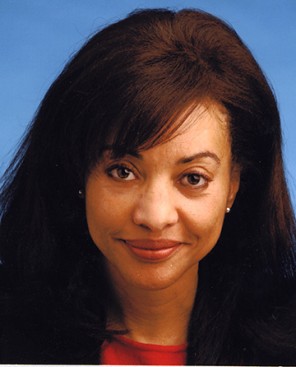
Cynthia Tucker is editorial page editor of The Atlanta Journal- Constitution and a syndicated columnist whose commentary appears in newspapers across the country. She is also a frequent commentator on television news shows. As editorial page editor, Tucker is responsible for guiding the development of the newspaper's opinion on everything from foreign policy to local school board races.
A native of Monroeville, AL, she is a graduate of Auburn University. She joined The Atlanta Journal as a reporter in 1976, left to work as a reporter for The Philadelphia Inquirer and returned as an editorial writer and columnist for the Atlanta newspaper. After a Nieman Fellowship at Harvard University in 1988-89, she was named editorial page editor of The Atlanta Constitution in 1992.
Last year, Tucker was honored with NABJ's Journalist of the Year award. She was a two-time finalist for the Pulitzer Prize for commentary. In 2000, she won the American Society of Newspaper Editors' Distinguished Writing Award, also for commentary. Tucker is a four-time Cox Newspapers award winner in column-writing.