The Washington Post, by Steven Pearlstein
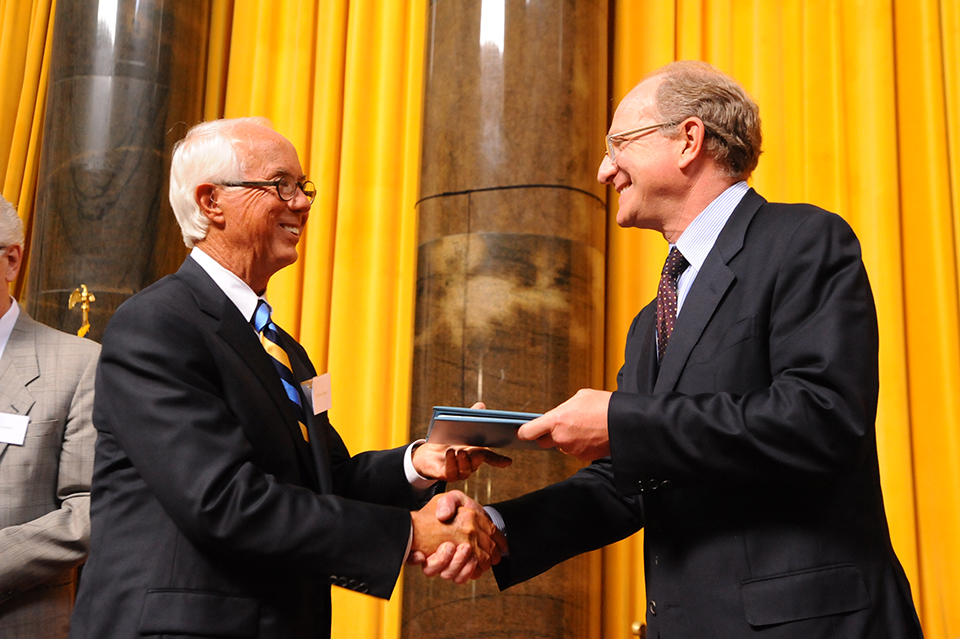
Richard Oppel, Pulitzer Board co-chair (left), presents the 2008 Pulitzer Prize in Commentary to Steven Pearlstein of The Washington Post.
Winning Work
By Steven Pearlstein
It's been a wonderful ride for the U.S. and global economies, and particularly for Wall Street financiers. And sooner or later it had to end.
Yesterday at 3 p.m., these were the top headlines running on Bloomberg's news service:
- Stocks in U.S. Drop Most Since 2003.
- Treasury Yields Decline to Lowest Since December.
- Orders for Durable Goods in U.S. Tumble 7.8 Percent.
- Freddie Mac Will Tighten Standards on Its Purchases of Subprime Mortgages.
- Yen Advances as Investors Unwind Bets on a Drop in the Japanese Currency.
- Residential Real Estate Loan Delinquencies Reach Four-Year High, Fed Says.
And finally, my personal favorite:
- Texas Pacific's Bonderman Predicts Another Record Year for Buyout Firms.
It's all one story, folks. Years of dirt-cheap debt have spawned bubbles across a wide range of asset classes, from U.S. home mortgages and commercial real estate to Chinese stocks to Indian office buildings. It's been a wonderful ride for the U.S. and global economies, and particularly for Wall Street financiers. And sooner or later it had to end.
It's not possible to know yet whether this is the beginning of that unwinding process. If history is any guide, markets today are as likely as not to bounce back strongly as some big players decide this is a "buying opportunity." But whatever happens, we now have a good indication of exactly how the Japan "carry trade" and "credit-derivative swaps" and the default rates on subprime mortgages are all related -- and how they all relate to sales of Coach handbags.
No doubt they were burning the midnight oil at the Treasury and the Federal Reserve, and burning the phone lines to Beijing, Tokyo and London to ensure that this doesn't turn into a global meltdown.
At this point, it's a confidence game that has little to do with the underlying economic fundamentals, which obviously didn't change that much between Monday night and Tuesday afternoon. In the past couple of weeks, the financial press has been full of stories acknowledging how nervous people were in financial markets about the high prices for certain assets, how narrow the spreads had become between the interest rates on supposedly risky investments and U.S. Treasury bonds, the deterioration of credit quality, and the degree of leverage (debt) in the financial system. And it is at that moment that things get dangerous -- when just about any piece of bad news can start a stampede toward the exits, when unvarnished greed gives way to unadulterated fear.
And make no mistake: This is herd behavior, as irrational on the way down as it was on the way up.
It was a bit of bad luck that yesterday was the day Robert Steel, the undersecretary of the Treasury for domestic finance, chose to lay out the Bush administration's case that the best protection against a market meltdown -- "systemic risk," as it is politely called in policy circles -- is not more regulation, but allowing markets to discipline themselves.
"Sophisticated financial firms have both the direct financial incentives and expertise to provide for effective market discipline," Steel told regulators and financial industry executives gathered in the Treasury's majestic Cash Room. "We believe that the collective decisions of self-interested and informed counterparties, reviewed by regulators, provide the very best protection against financial risk." Steel's goal was to head off calls for direct regulation of the hedge and private-equity funds that have come to dominate financial markets.
Steel's model is a fetching one. Banks deciding on their own to upgrade their "risk-management systems" to make sure that they do not have too much exposure to any one borrower or asset class or trading strategy. Pension funds and other institutions stepping up their due diligence before making investments, and insisting that hedge and private-equity funds provide them with background checks on fund managers and more timely information about strategies and performance. Funds themselves changing their cowboy trading cultures to embrace rules and procedures and reporting requirements that will prevent anyone from taking on undue or unauthorized risks.
It's a lovely theory, but it doesn't square very well with recent history -- the junk bond craze of the late '80s, the commercial real estate bubble of the early '90s, the Asian financial boom and the tech and telecom bubbles of the late '90s. For it is at times like these, when markets are at their most frothy and in need of discipline, that lenders and investors and the highflying fund managers tend to get the sloppiest.
This is when mortgage bankers, having already refinanced every house in America at least twice, start making home loans to people with poor credit histories requiring little or no money down and an option to skip monthly payments whenever they are short on cash, as they did in 2005 and 2006.
It is at these times that banks, eager to continue delivering double-digit earnings growth, compete furiously to finance mergers and acquisitions, allowing borrowers to put less of their own money into deals and forgoing the usual conditions that would allow the loan to be called if business begins to sour. In many cases, they are even putting their own equity into the deal.
And now is when pension funds and college endowments that have held back from investing in hedge or private-equity funds finally decide to jump on the bandwagon -- hardly the time to expect them to make demands about greater transparency or internal controls.
In other words, this is precisely when markets need good regulators, and good regulations, to make these financial intermediaries behave in the "rational" way that the Bush administration says they are supposed to. To leave it to "voluntary" codes of conduct and "market discipline" is both naive and dangerous.
To be fair, the Bush administration is moving belatedly to significantly step up surveillance of bank lending. The comptroller of the currency has issued tougher guidelines on mortgage and commercial real estate lending, and now has in his sights the loosey-goosey "leveraged loans" that have been used to finance corporate buyouts.
And under the aggressive leadership of Tim Geithner, the president of the Federal Reserve Bank of New York, the Fed is requiring the big money-center banks to upgrade their risk-management systems and subject their portfolios to "stress tests" to see if they would withstand a financial crisis in which credit dries up and everyone tries to unwind their positions at the same time.
Unregulated and highly competitive financial markets are wonderful at lots of things -- allocating capital efficiently, coming up with innovative products, pricing and spreading risk. But, as we were reminded yesterday, one thing they are not good at is controlling their own excesses.
© 2007 The Washington Post Company
By Steven Pearlstein
Today's pop quiz involves some potentially exciting new products that mortgage bankers have come up with to make homeownership a reality for cash-strapped first-time buyers.
Here goes: Which of these products do you think makes sense?
(a) The "balloon mortgage," in which the borrower pays only interest for 10 years before a big lump-sum payment is due.
(b) The "liar loan," in which the borrower is asked merely to state his annual income, without presenting any documentation.
(c) The "option ARM" loan, in which the borrower can pay less than the agreed-upon interest and principal payment, simply by adding to the outstanding balance of the loan.
(d) The "piggyback loan," in which a combination of a first and second mortgage eliminates the need for any down payment.
(e) The "teaser loan," which qualifies a borrower for a loan based on an artificially low initial interest rate, even though he or she doesn't have sufficient income to make the monthly payments when the interest rate is reset in two years.
(f) The "stretch loan," in which the borrower has to commit more than 50 percent of gross income to make the monthly payments.
(g) All of the above.
If you answered (g), congratulations! Not only do you qualify for a job as a mortgage banker, but you may also have a future as a Wall Street investment banker and a bank regulator.
No, folks, I'm not making this up. Not only has the industry embraced these "innovations," but it has also begun to combine various features into a single loan and offer it to high-risk borrowers. One cheeky lender went so far as to advertise what it dubbed its "NINJA" loan -- NINJA standing for "No Income, No Job and No Assets."
In fact, these innovative products are now so commonplace, they have been the driving force in the boom in the housing industry at least since 2005. They are a big reason why homeownership has increased from 65 percent of households to a record 69 percent. They help explain why outstanding mortgage debt has increased by $9.5 trillion in the past four years. And they are, unquestionably, a big factor behind the incredible run-up in home prices.
Now they are also a major reason the subprime mortgage market is melting down, why 1.5 million Americans may lose their homes to foreclosure and why hundreds of thousands of homes could be dumped on an already glutted market. They also represent a huge cloud hanging over Wall Street investment houses, which packaged and sold these mortgages to investors around the world.
How did we get to this point?
It began years ago when Lewis Ranieri, an investment banker at the old Salomon Brothers, dreamed up the idea of buying mortgages from bank lenders, bundling them and issuing bonds with the bundles as collateral. The monthly payments from homeowners were used to pay interest on the bonds, and principal was repaid once all the mortgages had been paid down or refinanced.
Thanks to Ranieri and his successors, almost anyone can originate a mortgage loan -- not just banks and big mortgage lenders, but any mortgage broker with a Web site and a phone. Some banks still keep the mortgages they write. But most other originators sell them to investment banks that package and "securitize" them. And because the originators make their money from fees and from selling the loans, they don't have much at risk if borrowers can't keep up with their payments.
And therein lies the problem: an incentive structure that encourages originators to write risky loans, collect the big fees and let someone else suffer the consequences.
This "moral hazard," as economists call it, has been magnified by another innovation in the capital markets. Instead of packaging entire mortgages, Wall Street came up with the idea of dividing them into "tranches." The safest tranche, which offers investors a relatively low interest rate, will be the first to be paid off if too many borrowers default and their houses are sold at foreclosure auction. The owners of the riskiest tranche, in contrast, will be the last to be paid, and thus have the biggest risk if too many houses are auctioned for less than the value of their loans. In return for this risk, their bonds offer the highest yield.
It was this ability to chop packages of mortgages into different risk tranches that really enabled the mortgage industry to rush headlong into all those new products and new markets -- in particular, the subprime market for borrowers with sketchy credit histories. Selling the safe tranches was easy, while the riskiest tranches appealed to the booming hedge-fund industry and other investors like pension funds desperate for anything offering a higher yield. So eager were global investors for these securities that when the housing market began to slow, they practically invited the mortgage bankers to keep generating new loans even if it meant they were riskier. The mortgage bankers were only too happy to oblige.
By the spring of 2005, the deterioration of lending standards was pretty clear. They were the subject of numerous eye-popping articles in The Post by my colleague Kirstin Downey. Regulators began to warn publicly of the problem, among them Fed Chairman Alan Greenspan. Several members of Congress called for a clampdown. Mortgage insurers and numerous independent analysts warned of a gathering crisis.
But it wasn't until December 2005 that the four bank regulatory agencies were able to hash out their differences and offer for public comment some "guidance" for what they politely called "nontraditional mortgages." Months ensued as the mortgage bankers fought the proposed rules with all the usual bogus arguments, accusing the agencies of "regulatory overreach," "stifling innovation" and substituting the judgment of bureaucrats for the collective wisdom of thousands of experienced lenders and millions of sophisticated investors. And they warned that any tightening of standards would trigger a credit crunch and burst the housing bubble that their loosey-goosey lending had helped spawn.
The industry campaign didn't sway the regulators, but it did delay final implementation of the guidance until September 2006, both by federal and many state regulators. And even now, with the market for subprime mortgages collapsing around them, the mortgage bankers and their highly paid enablers on Wall Street continue to deny there is a serious problem, or that they have any responsibility for it. In substance and tone, they sound almost exactly like the accounting firms and investment banks back when Enron and WorldCom were crashing around them.
What we have here is a failure of common sense. With occasional exceptions, bankers shouldn't make -- or be allowed to make -- mortgage loans that require no money down and no documentation of income to people who won't be able to afford the monthly payments if interest rates rise, house prices fall or the roof springs a leak. It's not a whole lot more complicated than that.
© 2007 The Washington Post Company
By Steven Pearlstein
What we're about to see is not a replay of the 2000 market bubble so much as it is of 1987, when another credit bubble triggered an earlier mania in corporate takeovers.
So the Blackstone Group, which grew rich preaching the advantages of being private, now wants to go public. If you needed any proof that the market has peaked, that the bubbles in private equity, hedge funds, real estate and credit derivatives are about to burst, this is surely it.
Don't fall for all those explanations about how Blackstone needs to raise capital or find a way to allow its visionary founders to cash out. Blackstone has a proven record of being able to raise all the private capital it needs. Pension plans and wealthy investors would line up around the block to purchase a piece of the firm.
No, the reason Blackstone is considering going public is simple: It's at market tops like this that dumb money will overpay. The smart money is getting out while it can.
What we're about to see is not a replay of the 2000 market bubble so much as it is of 1987, when another credit bubble triggered an earlier mania in corporate takeovers. Back then it was junk bonds, Drexel Burnham Lambert and Mike Milken's annual "predators' ball" in Beverly Hills. This time it is leveraged loans and credit default swaps, private equity and hedge funds, and Blackstone founder Steve Schwarzman's 60th birthday bash at the Park Avenue armory with Rod Stewart and Patti LaBelle.
In both cases, a small number of clever people used other people's money and creative financing to earn ridiculous sums relative to the risks they took and the real economic value they created. Eventually, they push things one step too far and the whole thing collapses. As in most cases where things look too good to last, they usually don't.
Don't take it from me. The smartest deal guy I know is Bill Conway, one of the founders of the Carlyle Group, Washington's own private-equity giant. And here's what he wrote in a Jan. 31 memo to Carlyle's dealmakers:
"[T]he fabulous profits that we have been able to generate for our limited partners are not solely a function of our investment genius, but have resulted in large part from a great market and the availability of enormous amounts of cheap debt.... Frankly, there is so much liquidity in the world financial system, that lenders (even 'our' lenders) are making very risky credit decisions. This debt has enabled us to do transactions that were previously unimaginable."
He continues: "I know that this liquidity environment cannot go on forever. I know that the longer it lasts the more money our investors (and we) will make... And I know that the longer it lasts, the worse it will be when it ends."
Somehow I doubt that Conway's warning, or anything like it, is going to be part of Blackstone's road-show presentation when it starts to market its stock offering.
Buying public shares in an outfit like Blackstone is not the same as being a limited partner in one of its funds, like those pension funds, university endowments and rich families that have done so well in recent years. Under federal securities rules, those partnerships can be sold privately only to "sophisticated" investors. What can be offered to shareholders, on the other hand, is a stake in the company that manages the funds and earns fees and a share of profits.
The risks and rewards of being a limited partner, however, aren't likely to be much different than the risks and rewards of owning shares of the management companies. All of which calls into question the stepped-up efforts now being made by the Securities and Exchange Commission to ensure that unsophisticated investors are protected from the risks of hedge-fund and private-equity investing. In the real world of the marketplace, the distinctions between all these different types of investment vehicles are quickly blurring.
As I see it, the problem here isn't that an unwitting Joe Q. Public will put his entire 401(k) into Blackstone and lose everything. It's that by taking on public shareholders, funds like Blackstone and Fortress Investment Group will find themselves owing allegiance and loyalty to two sets of investors whose interests may not be well aligned -- may, indeed, directly conflict.
Investors will have very little insight into these potential conflicts. They will involve subtle decisions about which deals are done by which funds, how fees and performance bonuses are structured, or how much fund managers are allowed to invest in individual deals. Conflicts in tax-avoidance strategies are sure to crop up.
So far, the view taken by the SEC is that these conflicts can be managed by fully disclosing the risks to both sets of investors, along with enforcement of general fraud statutes. And as long as everyone continues to make lots of money, all that may be fine.
But the test will come when the market finally turns and deals begin to blow up. At that point, you can be pretty sure that fund managers will do everything they can to protect themselves and the interests of their limited partners and let the saps who are public shareholders take it on the chin.
So when Steve Schwarzman comes calling with an offer to sell you part of his stake in Blackstone Group, ask yourself: Are you being offered the chance to bet alongside him, or are you being suckered into betting against him?
© 2007 The Washington Post Company
By Steven Pearlstein
Hardly a day goes by that you don't read another account of sleazy business practices among subprime mortgage bankers or student loan companies or the private health plans under Medicare.
You know, the stories about mortgage companies that pressured appraisers to approve loans for amounts in excess of house values, and Wall Street investment banks that demanded more and more mortgages to package even if it meant lowering underwriting standards.
Or the ones about student loan companies that pay what look like thinly disguised kickbacks to win a spot on the "preferred lender" lists at college financial aid offices, or use loopholes in the federal student loan program to qualify for millions of dollars in subsidies they don't deserve.
And then there are the more recent accounts of supposedly respectable health insurers that hire brokers to lure low-income seniors away from traditional Medicare into private "Medicare Advantage" plans. Some turn out to require higher co-payments for services or don't permit people to go to any doctor they choose -- and certainly don't do much of anything to lower the cost or improve the quality of care.
As with the scandals of an earlier era, the industry responses to these embarrassing revelations have a certain predictable rhythm to them.
First comes the denial that these practices are going on, followed shortly by the explanation that they are the work of a handful of rotten apples.
Then, when it turns out the practices are widespread, lawyers are trotted out to declare that it's all legal and proper. This is usually followed by a quickie study that purports to show how these practices benefit consumers, or the poor or the economy at large.
When all that fails, the desperate industry is forced to go negative, questioning the motives of critics and regulators who are accused of overreacting or cynically pursuing some political or ideological agenda.
It rarely works. In the end, the industry winds up taking it on the chin. Companies fail. Executives lose their jobs. Fines are paid. New regulations are imposed or government funding is curtailed.
If all this is so predictable, and the consequences so costly, you have to ask why industries haven't learned that they'd be better off stopping questionable practices before they become widespread.
Surely when established mortgage lenders first felt the competitive pressure from upstart brokers and began offering high-risk borrowers interest-only loans with no money down, some grown-up in the room realized this was going to end badly.
And as far back as 2003, the financial arrangements between colleges and lenders raised enough ethical red flags that the National Association of Student Financial Aid Administrators considered asking the government to require lenders to publicly report gifts of more than $50. Under industry pressure, the board of directors rejected the idea by one vote.
Then there are the health insurers, who spent years convincing Congress they could save money and improve quality by aggressively managing the medical care of seniors with serious or chronic illnesses. So how could they not see the threat to the entire Medicare Advantage program when competitors began showing up with un-managed care plans peddled by fly-by-night independent brokers?
As it happens, a vehicle exists for restraining bad actors and preventing unethical practices from taking hold in an industry. It's called the industry association. Most of them are right here in Washington. Most make a pretense of maintaining industry standards and promulgating codes of conduct. And most are led by experienced executives who are paid big money to keep their industries out of trouble.
Unfortunately, too many associations have come to believe it's not their place to police the behavior of their dues-paying members. After all, what looks to some members like unethical behavior looks to others like product innovation or aggressive marketing. And for the heads of these associations, stirring up division within the ranks hardly seems like a strategy for hanging on to a cushy job.
Except, of course, when it is. Perhaps nobody understood that better than Jack Valenti, who died last month after decades of representing the big Hollywood studios in Washington. Jack took a back seat to nobody when it came to aggressively defending the interests of his clients. And nobody was better at keeping himself in the good graces of his members.
But when the studios found themselves in a competitive race to the bottom in the smuttiness and violence of their movies, Jack was clever enough to foresee the likely political and regulatory backlash, and convincing enough to persuade his members to accept a movie rating system that has, in effect, become a form of industry self-regulation.
Mortgage brokers, student lenders and health insurers are only now realizing what Jack Valenti learned long ago: The purpose of a trade association is not simply to protect its members from government, but to protect its members from themselves.
© 2007 The Washington Post Company
By Steven Pearlstein
To understand why there's a credit bubble, how it's inflating the price of stocks and what it will mean for you when it bursts, let's consider the acquisition of Avaya, a large telecommunications equipment maker, announced last week by two private-equity firms, Texas Pacific Group and Silver Lake Partners.
Avaya is expected to post revenue of about $5.4 billion this year. It has virtually no debt and has $825 million in the bank. Operating earnings -- profit before counting things like interest payments, taxes, depreciation and amortization -- are expected to reach $700 million. And if that's correct, it means the price being paid for Avaya, $8.2 billion, is 12 times operating profit, making it one of this season's richest deals.
What's driving such high valuations is cheap debt, and plenty of it. We don't know yet how the all-cash purchase of Avaya will be financed, but if it follows the pattern of other recent buyouts, the new owners will take on at least $6 billion in debt. Given the junk-bond rating that has already been assigned to the deal, that is likely to work out to an average interest rate of about 8 percent, along with the obligation to pay back 1 percent of principal every year. Add it all together, and the new, improved Avaya will have to pay about $540 million more a year in debt service than it does now.
Can the company handle that? Well, consider that only three years ago, Standard & Poor's calculated that operating profits for companies involved in leveraged buyouts were typically 3.4 times debt service. Last year, the number fell to 2.4. So far this year, it is 1.7.
And the Avaya deal? It's 1.3 to 1, which, if you think about it, isn't much of a cushion if revenue suddenly falls or expenses rise more than expected. Nor would there be much cash left over for the company to increase its investment in research or pay for new plant and equipment.
In other words, a deal like this would never get financed in normal times. Bank lenders and bondholders would demand that the new owners use more of their own money and take on less debt. Or they would demand interest rates so high that the company, as presently configured, wouldn't be able to generate enough cash to cover debt service. Either way, the buyers would never have agreed to pay $8.2 billion.
But these are not normal times, and overpriced and over-leveraged deals like Avaya have been getting financed in record numbers. Back in 2004, about $275 billion in loans were issued for such highly leveraged transactions. By last year, that had risen to $490 billion. And in just the first five months of 2007, that record was broken.
At some point sanity will be restored, triggered by any number of events. A high-profile acquisition could collapse because the new owners could not secure financing. Or a deal could blow up after it is discovered that there's really not enough cash to meet the debt payments. Or interest rates could suddenly rise from their current low level, threatening the viability of recently acquired companies and making it unlikely that the new owners will be able to sell for anything close to what they paid.
In fact, over the past several weeks, all those things have begun to happen.
On the bond market, yields on the benchmark 10-year Treasury bill have increased from just under 4.5 percent to more than 5.25 percent -- a three-quarters-of-a-point jump without any action by the Federal Reserve.
And just last week, William Gross, one of the country's leading bond investors, recanted on his prediction that interest rates were headed down, warning instead that yields on 10-year Treasurys could reach 6.5 percent over the next several years.
Syndicated loans used to finance the recent purchases of the Minneapolis Star Tribune, Linens 'n Things and Freescale, a semiconductor maker, are trading at significant discounts only months after the deals were closed, after the companies reported disappointing earnings or cash flow.
Meanwhile, the Wall Street Journal reported that after a period in which lenders were throwing money at leveraged buyouts with few if any conditions, several private-equity buyers are having more trouble financing their deals. Those include KKR's $26 billion acquisition of First Data and Texas Pacific's purchase of JVC, the struggling consumer electronics giant.
It is impossible to predict when the magic moment will be reached and everyone finally realizes that the prices being paid for these companies, and the debt taken on to support the acquisitions, are unsustainable. When that happens, it won't be pretty. Across the board, stock prices and company valuations will fall. Banks will announce painful write-offs, some hedge funds will close their doors, and private-equity funds will report disappointing returns. Some companies will be forced into bankruptcy or restructuring.
But the damage won't be limited to Wall Street and its investors. For if we've learned one thing in the past 20 years, it is that what happens on financial markets, in booms and in busts, can have a big impact on the rest of the economy.
Without the billions of dollars flowing each year to financiers and corporate executives, there will be less money to trickle down to car salesmen, yacht makers, real estate agents, third-home builders and busboys at luxury resorts.
Falling stock prices will cause companies to reduce their hiring and capital spending while governments will be forced to raise taxes or reduce services, as revenue from capital gains taxes declines.
And the combination of reduced wealth and higher interest rates will finally cause consumers to pull back on their debt-financed consumption.
It happened after the junk-bond and savings-and-loan collapses of the late 1980s. It happened after the tech and telecom bust of the late '90s. And it will happen this time.
The recent decline in home prices and the meltdown in the market for subprime mortgages are the first signs that the air is coming out of the credit bubble. Already, those factors have shaved half a percentage point off the economic growth rate. And you can be sure that there will be a much larger impact on jobs and incomes from a broad decline in stock and bond prices, a sharp tightening of credit and the turmoil that both of those will create in the murky derivatives markets.
© 2007 The Washington Post Company
By Steven Pearlstein
The fundamentals of the economy remain strong.
The problems are largely confined to subprime mortgages.
A great buying opportunity.
It's hard to know whether the people peddling this optimistic blather are trying to delude themselves or us. Either way, it's dangerously wrongheaded.
Yes, the U.S. economy looks pretty strong. Why wouldn't it? We're borrowing the equivalent of 6 percent of our national income each year and using it for consumption and to bid up real estate, stocks and other assets to prices that make us feel richer than we really are.
Broad economic factors are not driving the markets right now. At the same time, what's going on in the markets could significantly affect the real economy. The mortgage mess is already shaving as much as a percentage point off economic growth. And now that other forms of credit have become more expensive -- anywhere from a quarter of a percentage point for the best corporate borrowers to several percentage points for the riskiest -- the economy could find itself fighting strong financial head winds.
The higher cost and tighter availability of credit is being felt worldwide, with impacts on Australian hedge funds, German banks, Russian oil companies, commodity prices in Africa and the government budget in Argentina.
As this so-called repricing of risk unfolds, don't pay too much attention to the stock market. Stock prices are collateral damage. The real action is in credit markets where bonds, bank loans, financial futures and all sorts of newfangled derivative instruments are traded.
Market bulls are quick to point out that default rates on these loans are still at historic lows. Have they forgotten that bonds tied to subprime mortgages fell even before the foreclosures began? And is there any reason to think the same thing won't happen with the credit extended to hedge funds for their speculative investments and to private-equity funds for their overpriced acquisitions?
One reason that default and bankruptcy rates have been so low is that borrowers could easily cover the problems by getting new loans to pay off old loans that may have been going sour. As Warren Buffett quipped recently: "A rolling loan gathers no loss."
What concerns people like Buffett is how much leverage there is in credit markets -- how much debt is being used to buy other debt.
In the simple model of yesteryear, a bank would essentially borrow money from its depositors and lend it to households or businesses that needed loans. For every dollar it lent out, however, the bank was required to set aside some of its own money in reserve to cover losses it might suffer if some loans were not repaid.
But all that went out with deregulation and the rise of financial engineering. Big banks now borrow most of the money they lend by selling bonds to investors. And most of the loans they make do not remain on their books, but are immediately packaged with other loans and sold to buyers such as hedge funds.
Unlike banks, hedge funds are under no obligation to maintain minimal levels of equity, so they can buy these instruments (that is, make loans) with as much borrowed money as anyone is willing to lend them. And because they don't have to disclose their investments, no regulator knows how much debt is in the system or where it is concentrated.
By one estimate, for example, more than half the loans used to finance corporate takeovers are now packaged with other loans and sold as "collateralized debt obligations." And among the big buyers of CDOs are investment banks that package them with other CDOs and sell them again. Those are called CDOs-squared.
One advantage of this packaging and repackaging of loans is that it spreads risk so widely among investors that any default by a borrower will have negligible impact on any one lender or investors. Over the past five years, this has added a good deal of stability to the financial system. And with stability has come lower interest rates.
But at the same time, this financial engineering has encouraged debt to be piled on debt, making the system more susceptible to a meltdown if credit suddenly becomes more expensive or unavailable. And that's precisely what's been developing over the past several weeks.
The official name for this problem is contagion, which has two basic components.
The first is psychological: When investors and lenders, for example, realized the true risks with the subprime mortgages underlying the bets they've made, they began to wonder whether the same shoddy lending and underwriting practices would soon be discovered in corporate buyouts.
The second component of contagion has to do with forced selling. As it turns out, the hedge funds that have been big buyers of mortgage-backed securities are also big buyers of many other forms of credit, including leveraged loans and junk bonds to finance corporate buyouts. Once the hedge funds began to get in trouble with mortgages, investors started demanding some of their money back while lenders began calling in loans. To raise the necessary cash, they had to sell something. And with nobody wanting to buy mortgages or mortgage-backed securities, they were forced to sell their leveraged loans and junk bonds, creating a selling panic in those markets as well.
You might ask at this point why clever and well-paid investment bankers and hedge fund managers would jeopardize their jobs, their fortunes and their reputations by taking on excessive risks. The short answer is that they were encouraged to by the incentives imbedded in their compensation.
Investment bankers, for example, get their big bonuses shortly after the corporate takeovers are completed, the bonds issued and the loans syndicated, no matter how things turn out in the long run.
And each year, hedge fund managers get a fee of 2 percent of all the money they are managing, plus 20 to 40 percent of the increase in the paper value of the fund's holdings at year-end. Add that up over four or five years of 30 percent returns (not uncommon for the better-performing funds) and managers of a $5 billion hedge fund can easily earn $2 billion before the market turns and the consequences of their risk-taking are apparent.
As this credit-market drama unfolds, the big banks and Wall Street investment houses will move to center stage. According to the asset managers at Barings, these institutions have committed themselves to $500 billion in "bridge" loans to finance corporate buyouts, with the expectation that they could quickly resell these loans at a profit. But several recent offerings have had to be pulled because of a lack of buyers, and there is a good chance that the banks will either be forced to sell many of these loans at a discount or hold them on their own books and write down their value.
The extent of such writedowns won't become apparent until the third week in October, when the banks and brokerages report their third-quarter earnings. But if the market for takeover debt doesn't rebound by then, these blue-chip institutions could be looking at losses in the tens of billions of dollars.
That's real money, even by Wall Street standards.
© 2007 The Washington Post Company
By Steven Pearlstein
Hint to White House economic team: You might not want to have had the president repeat that numbskull prediction about a "soft landing" for housing at precisely the moment central banks were pumping $150 billion into the financial system to prevent a market meltdown over anxieties about mortgage-backed securities. Brings back memories of "Mission Accomplished."
Seriously, folks, we all need to get used to days like yesterday because there are going to be a lot more of them. In a world in which trillions of dollars have been bet on the premise that low interest rates and record-low default rates would continue forever, "repricing of risk," as the administration likes to call it, is not some minor technical event. It's more like a tectonic shift going on beneath the surface of the economy.
Think about it. In the space of just several months, we've moved from an environment in which fly-by-night brokers were peddling low-interest mortgages to bad credit risks with no documentation and no money down, to one in which the largest banks are raising rates and tightening terms for their best borrowers.
In the space of several weeks, we've moved from an environment in which 25 percent of corporate takeovers could be financed with the junkiest of C-rate bonds, to a world in which the market for C-bonds has completely evaporated.
In just the past few days, problems in the U.S. housing and mortgage markets have come to pose serious challenges for Australian hedge funds, French insurers and mid-market German banks.
And in the course of several hours, a financial system that was seemingly awash in liquidity suddenly didn't have enough.
As it all unfolds, we are learning several painful truths about the new global financial system, which until recently was widely lauded for its ability to price and spread financial risk to investors willing to accept it.
One lesson is that the sophisticated strategies employed by bank and investment funds to "hedge" risk may not be as reliable as had been thought.
In recent years, for example, banks and hedge funds created elaborate investment strategies built around the presumption that Bond A would always go up when the price of Bond B went down, effectively limiting potential losses. But in recent weeks, many such strategies began to go awry as markets for mortgage securities dried up and fund managers began selling whatever they could to raise cash to pay lenders. As a result, Bond A and Bond B began moving in the same direction, creating losses on both.
Another popular way for sophisticated investors to hedge their bets is to buy insurance against the possibility that a particular company or set of mortgage holders will default on their loans. But in some cases, this insurance policy, known as a credit swap, has been issued by hedge funds that themselves had taken on similar risks. If things go bad, a hedge fund may not have the money to uphold its side of the insurance bargain.
It is in the nature of the new financial order that it's hard to figure out exactly what everyone's role is. All the borrowers are lenders and all the lenders turn out to be borrowers, so nobody -- including regulators -- can quite figure out where the ultimate risks really lie.
Yesterday's turmoil, for example, started when BNP Paribas, France's largest bank, announced that it was halting withdrawals from three of its hedge funds. So is BNP Paribas a bank or a hedge fund? Well, it's both.
The bank part has surely made lots of loans to hedge funds, including its own. And the BNP hedge funds surely used those loans to buy other loans and bonds, perhaps even those originated by BNP's bank or underwritten by BNP's investment bank.
These complex and synergic relationships have created a system that is more stable in the face of a mild economic downturn, a string of bankruptcies, or the failure of a hedge fund or two. But as Tim Geithner, the president of the New York Fed has warned, when the financial system comes under extreme stress, those same complex relationships could have just the opposite effect, creating a "domino effect" that increases the risk of a system-wide failure. That fear was very much present in the markets yesterday.
One concern is that rather than spreading risk among millions of investors, the current system has reconcentrated risk on the books of a dozen global broker-dealers who lend most of the money to fund managers so they can buy all those credit instruments. And it is many of the same firms -- Goldman Sachs, Bear Stearns, Deutsche Bank, Citicorp -- that have also underwritten hundreds of billions of dollars in corporate takeover loans that, suddenly, they cannot sell as they had planned. It's no coincidence that the shares of such firms have taken a beating in the past few months as rumors swirl around Wall Street that one or another is facing major losses.
We may be discovering, in fact, that the new financial order is not all it is cracked up to be.
Although it has provided ingenious new mechanisms to finance the legitimate needs of businesses and householders and new ways for investors to hedge risks, it has also created opportunities for potentially destabilizing speculation. It is now common for the aggregate value of "derivative" instruments to be many times the volume of the stocks, bonds or commodities on which they are supposedly based. And often it is the trading on derivatives markets that now drives the trading on "real" markets, rather than the other way around.
Australian analyst Satyajit Das makes the point that the main achievement of the new financial architecture has not been to spread risk so much as it has been to expand risk by vastly increasing the amount of borrowed money. Making loans to buy bonds secured by packages of other loans makes for big fees and exciting work for bankers. But as Das predicted last year in his book, "Traders, Guns & Money" -- and as we all discovered yesterday -- if the supply of credit suddenly dries up anywhere in the system, the elaborate new structure they've created can come crashing down on itself.
© 2007 The Washington Post Company
By Steven Pearlstein
Richard Fairbank, the founder and chief executive of McLean's Capital One Financial, is one shrewd operator. He also hates to lose. So his decision this week to close his newly acquired GreenPoint Mortgage division, write off $860 million of his shareholders' money and run like hell from the wholesale end of the mortgage business may be telling us something important about the future of credit markets.
GreenPoint came to Capital One as part of last year's $13 billion acquisition of North Fork Bank, based in New York. GreenPoint's business was making mortgage loans through independent brokers and selling them almost immediately to Wall Street investment bankers. These underwriters, in turn, packaged them as collateral for mortgage-backed bonds that were sold to investors, including pension funds, hedge funds and university endowments.
GreenPoint's specialty was "nonconforming" loans -- loans that could not be sold to Fannie Mae or Freddie Mac. For the most part, these weren't subprime loans or loans to people with sketchy credit histories. Some were jumbo loans, above the $417,000 limit set by Congress. Others were "option ARMs," adjustable-rate mortgages that essentially allowed borrowers to decide how they would pay each month. Then there were the famous low-documentation loans, which dispensed with such things as home appraisals and income verification.
Back in March 2006, when Capital One struck its deal for North Fork, these types of loans were hot products in the financial world and GreenPoint was a major source of profit for its parent. Now, of course, such loans are in such bad odor that nobody on Wall Street wants to touch them. And Fairbank has concluded that the market is unlikely to turn favorable anytime soon.
But here's the thing: Capital One is not getting out of the mortgage business. Rather, with the acquisitions of North Fork and Hibernia National Bank, based in Louisiana, it is getting into the banking business -- a business that provides a reliable source of funds (checking accounts, savings accounts, certificates of deposits) that its employees can use to make a wide range of consumer loans (home, auto, home equity, credit cards) to customers it knows in communities it understands through a network of bank branches.
Savings deposits? Bank branches? Know your customer? Sounds like back to the future, doesn't it?
Indeed, only a short time ago, some were ready to write off the old-fashioned banking business completely. In the brave new world, investors would manage their money from home, transferring funds by computer and using the Internet to find the best deal on a mortgage or the highest interest rate for their savings. Rather than banks serving as the key link between savers and borrowers, credit would be "intermediated" by global credit markets using complex new securities capable of hedging and pricing any risk -- credit risk, interest rate risk, currency risk, even political risk.
To a large degree, Capital One is a product of this new world of securitized lending. Its model has been to raise much of its initial capital by issuing stock and bonds, using the proceeds from those bonds to finance credit card balances and loans of various sorts, and then replenishing its money supply by selling the loans to Wall Street for packaging and sale to investors.
But now, along with the rest of us, Capital One has discovered something important about these credit markets.
On the plus side, we have learned that these markets are generally so much more efficient at "intermediation" that they have not only lowered the cost of capital but generated fees and spreads along the way that old-fashioned bankers could only have dreamed of.
At the same time, we have learned that these markets are not good at evaluating credit risk. Lack of knowledge about the borrower is one part of it. The perverse incentives created by the fee structure are another. In time, so many bad loans get made that investors start to have doubts. At first, the doubts can be limited to one category of loan or one type of security. But quickly, these doubts give rise to wider doubts about other types of loans that are originated, securitized and rated in the same way. Because they can't distinguish the good from the bad, they begin to shun it all, selling what they have and refusing to buy more.
Don't get me wrong: Banks can get themselves in similar fixes. Loan officers are not that different from investment bankers when it comes to herd behavior. The sudden refusal by investors to have anything to do with asset-backed securities is the modern equivalent of an old-fashioned bank run by depositors.
At least within the banking system, we've come up with mechanisms for dealing with these problems. More regulations and regulators restrain the bad lending once it gets started. And a central bank and deposit insurance help prevent bank runs. Most importantly, bankers are better able to distinguish the good loans from the bad -- and to renegotiate the terms of the bad ones when problems arise.
In addition to these structural differences, however, there are important cultural differences between a banking system and the securities markets.
Say what you will about stodgy bankers, theirs is basically a lending culture that is aimed at generating loyal customers, earning a decent spread and making sure loans are repaid. It is a competitively cozy culture that places a higher premium on avoiding mistakes than making a big score.
By contrast, the securities markets are dominated by a trading culture that is fiercely competitive and focused on quick transactions rather than long-term relationships. It is about probabilities more than certainties, driven more by fees than by spreads. Fundamentally, the goal isn't to make good loans or avoid making bad loans but to make as many loans as possible -- and sell them off before anyone is the wiser.
Obviously, we're not going back to a world where banks play the dominant role in finance. Even the banks themselves have been seduced by the trading culture and the higher profits they can earn as gatekeepers to the credit markets.
At the same time, old-fashioned banking may not be the dinosaur of finance. As the current credit crisis plays itself out, savers and borrowers may come to appreciate the safety and reliability of a well-regulated, well-capitalized banking system.
As Richard Fairbank has figured out at Capital One, the winners may turn out to be those intermediaries who figure out how to combine the efficiency and creativity of securities markets with the judgment and steadfastness of a bank.
© 2007 The Washington Post Company
By Steven Pearlstein
Vince Kaminski has seen firsthand how sophisticated companies systematically underestimate and ignore the financial risks they take on until it's too late.
He was at Salomon Brothers when a rogue trader used false bids at Treasury auctions to corner the market in some government bonds, a scandal from which the venerable investment bank never really recovered.
At Enron he was one of the few who tried to warn top management of the financial house of cards created by Andy Fastow's off-book partnerships and the inadequate capital the energy company had to support its extensive trading operations.
So I was curious about what Kaminski might have to say about the unfolding credit crisis engulfing Wall Street's banks and investment houses.
"Let's just say that all the demons of Enron have not been exorcised," Kaminski said from his home in Houston, where he is writing a book and teaching part time at Rice University. "In many ways, it is the same story all over again."
Kaminski hardly fits the mold of the corporate gadfly. He is a careful man with a Ph.D. in economics, an MBA and a nearly completed degree in mathematics. His expertise is in the relatively new field of risk management, in which sophisticated quantitative techniques are used to measure and model a business's risks and what would happen under various unpleasant scenarios. It is this "science" of risk management that supposedly gives management the ability to foresee and prevent the kind of things that brought down Enron and that now befall Citi, Merrill, HSBC and the rest. And it is this "science" that regulators rely on to protect the health of the banking system.
So why doesn't it work?
As Kaminski sees it, the first problem is that the models these systems are based on, while potentially useful, have serious limitations that are too often ignored.
The data that go into them, he says, are so aggregated and "averaged" that they disregard outliers and abnormalities that turn out to be important. There are also risks -- like risk to reputation -- that are ignored because there is no data set by which to quantify them.
Moreover, by relying heavily on past patterns of behavior, they are often useless in dealing with the new products and new markets that are most often the source of the trouble.
Most importantly, Kaminski says, the models have been unable to capture the cascading effect as problems spread, confidence is undermined and people start to act irrationally.
"You cannot model behavior of humans under conditions of extreme stress," Kaminski says.
Kaminski offers the example of the flood walls in New Orleans. When they were constructed, he says, hundreds of soil samples were taken and then averaged together before the experts concluded they could support the walls. But when the big one finally hit, it turned out that there was one point at which the configuration of clay and swampy black soil was so different as to allow the water to seep down and push out the wall. And that was it -- one point of weakness and the whole structure collapsed.
But even if the models were better able to predict such calamities, risk management would probably fail, Kaminski says, because risk managers are routinely ignored or overruled.
"Many times I have been sitting across the table from an energy trader and I would say, 'Your portfolio will implode if this specific situation happens.' And the trader would start yelling at me and telling me I'm an idiot, that such a situation would never happen," he says. "The problem is that, on one side, you have a rainmaker who is making lots of money for the company and is treated like a superstar, and on the other side you have an introverted nerd. So who do you think wins?"
As Kaminski sees it, you didn't need elaborate models to see that there was a housing bubble, and a credit bubble, and that things would someday end badly. Indeed, any number of top Wall Street executives conceded as much in the months leading up to the current debacle.
But under pressure to increase earnings, keep up with the competition and retain top talent, these same executives found it almost impossible to pull back from a product or strategy that might be risky but was generating big profit, big bonuses and a rising stock price.
"When the music stops in terms of liquidity, things will be complicated," Chuck Prince, chief executive of Citigroup, told the Financial Times back in July when asked about the flood of cheap credit that was fueling the buyout boom. "But as long as the music is playing, you've got to get up and dance."
Now, of course, Prince has hung up his dancing shoes while his bank, because of its enthusiastic tango with newfangled CDOs and SIVs, has to sell a 4.9 percent stake to the government of Abu Dhabi to raise $7.5 billion in badly needed capital.
Prince and other executives surely understood the risks they were taking by lowering underwriting standards for mortgages and loans of all types. But like the others, he figured he'd be able to get out of the dance hall before too much damage was done.
It's a mind-set Kaminski has seen many times before.
"What matters in terms of managing risk," Kaminski says, "isn't the model -- it's the intuition, judgment and experience to spot the risks as they are developing, and the character to be able to stand up to very aggressive and successful commercial people and say, 'Enough is enough.'"
Risk management is an art, not a science.
And its latest failure is turning out to be an expensive learning experience, not only for Wall Street, but for the rest of us as well.
Certainly it is a failure on the part of executives whose jobs, reputations and fortunes are on the line.
But it is also a failure on the part of bank regulators who have placed excessive faith in risk-management systems, not only to ensure that no individual bank will fail but also to protect against a broader meltdown in the banking system. For years now, I've listened as top regulators have explained to me that it is no longer their role to question banks about certain practices or products or individual loans -- that all that matters is whether the bank has an adequate risk-management system in place. Now that a minor problem with subprime mortgages has led to a full-blown housing crisis and credit crunch that threaten to drag the entire economy into a recession, the shortcomings of that regulatory approach should be obvious.
© 2007 The Washington Post Company
By Steven Pearlstein
It was Charles Mackay, the 19th-century Scottish journalist, who observed that men go mad in herds but only come to their senses one by one.
We are only at the beginning of the financial world coming to its senses after the bursting of the biggest credit bubble the world has seen. Everyone seems to acknowledge now that there will be lots of mortgage foreclosures and that house prices will fall nationally for the first time since the Great Depression. Some lenders and hedge funds have failed, while some banks have taken painful write-offs and fired executives. There's even a growing recognition that a recession is over the horizon.
But let me assure you, you ain't seen nothing, yet.
What's important to understand is that, contrary to what you heard from President Bush yesterday, this isn't just a mortgage or housing crisis. The financial giants that originated, packaged, rated and insured all those subprime mortgages were the same ones, run by the same executives, with the same fee incentives, using the same financial technologies and risk-management systems, who originated, packaged, rated and insured home-equity loans, commercial real estate loans, credit card loans and loans to finance corporate buyouts.
It is highly unlikely that these organizations did a significantly better job with those other lines of business than they did with mortgages. But the extent of those misjudgments will be revealed only once the economy has slowed, as it surely will.
At the center of this still-unfolding disaster is the Collateralized Debt Obligation, or CDO. CDOs are not new -- they were at the center of a boom and bust in manufacturing housing loans in the early 2000s. But in the past several years, the CDO market has exploded, fueling not only a mortgage boom but expansion of all manner of credit. By one estimate, the face value of outstanding CDOs is nearly $2 trillion.
But let's begin with the mortgage-backed CDO.
By now, almost everyone knows that most mortgages are no longer held by banks until they are paid off: They are packaged with other mortgages and sold to investors much like a bond.
In the simple version, each investor owned a small percentage of the entire package and got the same yield as all the other investors. Then someone figured out that you could do a bigger business by selling them off in tranches corresponding to different levels of credit risk. Under this arrangement, if any of the mortgages in the pool defaulted, the riskiest tranche would absorb all the losses until its entire investment was wiped out, followed by the next riskiest and the next.
With these tranches, mortgage debt could be divided among classes of investors. The riskiest tranches -- those with the lowest credit ratings -- were sold to hedge funds and junk bond funds whose investors wanted the higher yields that went with the higher risk. The safest ones, offering lower yields and Treasury-like AAA ratings, were snapped up by risk-averse pension funds and money market funds. The least sought-after tranches were those in the middle, the "mezzanine" tranches, which offered middling yields for supposedly moderate risks.
Stick with me now, because this is where it gets interesting. For it is at this point that the banks got the bright idea of buying up a bunch of mezzanine tranches from various pools. Then, using fancy computer models, they convinced themselves and the rating agencies that by repeating the same "tranching" process, they could use these mezzanine-rated assets to create a new set of securities -- some of them junk, some mezzanine, but the bulk of them with the AAA ratings more investors desired.
It was a marvelous piece of financial alchemy, one that made Wall Street banks and the ratings agencies billions of dollars in fees. And because so much borrowed money was used -- in buying the original mortgages, buying the tranches for the CDOs and then in buying the tranches of the CDOs -- the whole thing was so highly leveraged that the returns, at least on paper, were very attractive. No wonder they were snatched up by British hedge funds, German savings banks, oil-rich Norwegian villages and Florida pension funds.
What we know now, of course, is that the investment banks and ratings agencies underestimated the risk that mortgage defaults would rise so dramatically that even AAA investments could lose their value.
One analysis, by Eidesis Capital, a fund specializing in CDOs, estimates that, of the CDOs issued during the peak years of 2006 and 2007, investors in all but the AAA tranches will lose all their money, and even those will suffer losses of 6 to 31 percent.
And looking across the sector, J.P. Morgan's CDO analysts estimate that there will be at least $300 billion in eventual credit losses, the bulk of which is still hidden from public view. That includes at least $30 billion in additional write-downs at major banks and investment houses, and much more at hedge funds that, for the most part, remain in a state of denial.
As part of the unwinding process, the rating agencies are in the midst of a massive and embarrassing downgrading process that will force many banks, pension funds and money market funds to sell their CDO holdings into a market so bereft of buyers that, in one recent transaction, a desperate E-Trade was able to get only 27 cents on the dollar for its highly rated portfolio.
Meanwhile, banks that are forced to hold on to their CDO assets will be required to set aside much more of their own capital as a financial cushion. That will sharply reduce the money they have available for making new loans.
And it doesn't stop there. CDO losses now threaten the AAA ratings of a number of insurance companies that bought CDO paper or insured against CDO losses. And because some of those insurers also have provided insurance to investors in tax-exempt bonds, states and municipalities have decided to pull back on new bond offerings because investors have become skittish.
If all this sounds like a financial house of cards, that's because it is. And it is about to come crashing down, with serious consequences not only for banks and investors but for the economy as a whole.
That's not just my opinion. It's why banks are husbanding their cash and why the outstanding stock of bank loans and commercial paper is shrinking dramatically.
It is why Treasury officials are working overtime on schemes to stem the tide of mortgage foreclosures and provide a new vehicle to buy up CDO assets.
It's why state and federal budget officials are anticipating sharp decreases in tax revenue next year.
And it is why the Federal Reserve is now willing to toss aside concerns about inflation, the dollar and bailing out Wall Street, and move aggressively to cut interest rates and pump additional funds directly into the banking system.
This may not be 1929. But it's a good bet that it's way more serious than the junk bond crisis of 1987, the S&L crisis of 1990 or the bursting of the tech bubble in 2001.
© 2007 The Washington Post Company
Biography
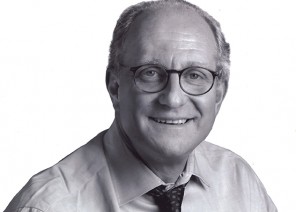
Steve Pearlstein started out in journalism in 1973 right out Trinity College in Hartford, Connecticut, where he was editor of the school newspaper. His first job was at Foster's Daily Democrat in Dover, N.H., an afternoon daily that is last newspaper in America to still bear the name of its owners (the Fosters were northern Democrats during the civil war). Six months later, he jumped to the Concord Monitor to cover local and federal court, but occasionally dipping into business and politics. One story caught the eye of John Durkin, the newly elected U.S. senator, who invited Steve to Washington to join his staff. For the next two years, Steve served as Durkin's press secretary and administrative assistant before jumping to the House side, where he served as administrative assistant to Rep. Michael Harrington in his Washington and Massachusetts office. Harrington retired in 1978.
Boston public television at that time had a wonderful nightly news program at that time. On a lark, Steve telephoned the anchorman, Chris Lydon, and asked if he needed any help, and the next day he started a brief television career behind and in front of the camera. One day a fellow reporter, Janet Wu, and Steve were at a diner near the studio when a woman came up to say that she was a faithful viewer and loved Wu's reporting. Wu was kind enough to introduce Steve to her fan, but her fan allowed how she had never heard of Steve. It was at that point he realized it was time to get back into print. The Boston Observer, which Steve launched in 1982, was a monthly journal of liberal opinion for which he held the official title as editor and publisher but unofficially was also the ad salesman, circulation director and typesetter. The Observer was a critical success but not a financial one, and closed its doors, not coincidentally, on the day his first child was born.
Inc. magazine, the business monthly, rescued Steve from unemployment, where he worked happily as a senior editor for two years until an acquaintance from The Washington Post called to say the paper was looking for a deputy business editor. He got the job, did it well enough, but after three years returned to the typewriter as a defense industry reporter, Canadian correspondent and economics correspondent. In 2003, Steve was named the Post's business columnist, from which perch he has been offering edgy and unpredictable opinions three times a week on local, national and international topics. Steve grew up in Brookline, Massachusetts, where he attended public schools. Later, while working in Boston, he lived in the small town of West Newbury, where he served two terms as the elected town moderator, He now lives in Washington, D.C. with his wife, Wendy Gray. His daughter, Laura, works in advertising in New York, and his son Eli is a student at the University of Southern California.