Chicago Tribune, by Mary Schmich
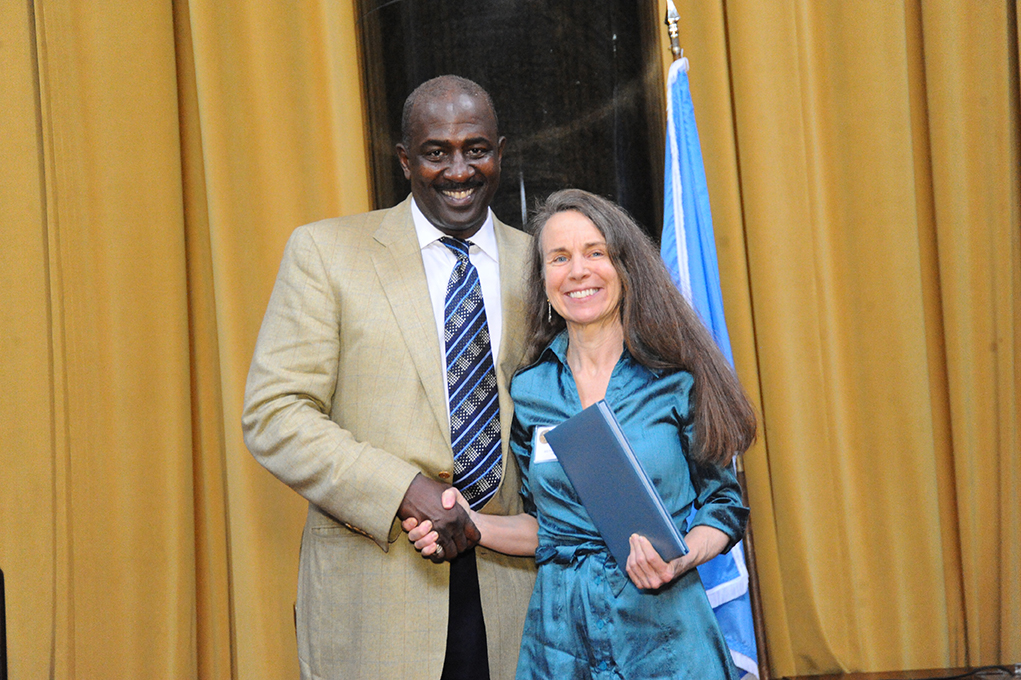
Gregory Moore, co-chair of The Pulitzer Prize Board, presents the 2012 Commentary Prize to Mary Schmich of the Chicago Tribune.
Winning Work
By Mary Schmich
My sister Gina received her first cellphone as a birthday gift a few days ago.
Until recently, Gina had insisted that a cellphone was too complicated for her, a plausible statement given how many things she finds hard.
For years, she found bathing complicated, so she rarely stepped into a tub or shower. Brushing her teeth felt complicated, so her teeth went bad. Cleaning her room felt like climbing a mountain, so her room devolved into a jungle of junk with a skinny path to the unmade bed. In the final weeks of her old cat’s life, she found it too complicated to pick up the cat feces on the carpet, so she neatly laid a paper towel over each set of droppings.
When Gina was little, doctors said she had an IQ of 34, and though they were far wrong, the right diagnosis has never been clear. Mild autism. Borderline personality disorder. The verdict seems to have changed almost as often as her medications.
What is clear is that Gina is different, so she always lived with our mother and our mother lived with the question: What will happen to Gina when I die?
Gina worried too. As Mama grew frail, Gina often climbed in her bed in the middle of the night to weep.
“Honey,” my mother would soothe her, “you’ll be OK,” and my siblings and I, unconvinced, told our mother we’d make sure she was.
In the months leading up to my mother’s death, Gina began to change. She calmed down, some. She took pride in making Mother’s morning coffee. When one of my brothers or I bathed our mother, Gina held the towels. When we’d lift Mother off the portable commode next to the sofa where she slept, Gina was quick to say, “I’ll empty it.”
But after Mama died, we braced for Gina’s familiar rages. We talked about how to handle her when she burst into shrieks at the memorial.
On the morning of the service, she found me while I washed my face.
“Do you think,” she began. “Do you think it would be OK if don’t go? I just. I just think the best way for me to honor Mom today is to take a shower and brush my teeth and go out on the bus.”
And that’s what she did.
With clean hair, in new brown capris and shinhigh socks from Target, she rode the bus from store to store that day, along a route she rides for hours almost every day just for fun. She visited with clerks and pharmacists she considers her best friends, telling them her mom was gone.
“Mom would be proud of me for being independent,” she said when she got back.
In the year since, Gina has lived alone, next to one of our brothers. She has given up soft drinks, after years of a dozen a day. She has gone to the dentist, and her teeth, minus several that had to be pulled, are white again.
She showers. And now, thanks to two brothers, she is a modern woman with a cellphone.
I called her on it last week. “I’m doing a lot of things I never thought I’d be doing,” she said with a big laugh. “Living alone! And a cellphone!”
I try to understand my sister’s transformation, to trust that it will last. It’s one of the most mysterious and beautiful things I’ve ever witnessed, though maybe it’s no more complex than this:
When your greatest fear comes to pass and you survive, you discover who you really are.
By Mary Schmich
The Harris family’s life began to unravel around dawn on the last day of August.
R.J. Harris, who is 77, was in bed when a noise jolted him awake.
Bam. What was that?
Bam. It sounded like an explosion.
Bam. The front door swung open and officers in masks swarmed inside, pointing rifles.
Police! Hands up! Police!
Harris’ wife, an aunt, a son, a grandson, a granddaughter, a great-grandson and a cousin all bolted awake. From the floor above, where one of the Harris daughters lives with her family, came the blast and stench of smoke bombs.
Mr. Harris, standing in the middle of the house that he bought 41 years ago, that has lodged his large family through the neighborhood’s gentrification, kept thinking: All you had to do was knock.
Outside on Sheffield Avenue, more officers gathered, shooing away neighbors. One neighbor described the scene on her blog.
“I felt like I was on ‘The Wire!’ Fantastic,” she wrote. “... The neighbors hung out near our fence, trying to appear as nonchalant as possible, you know, as if this sort of thing happens every day in Lincoln Park. I watch ‘Breaking Bad,’ yo, I know about meth. I bet they were totally cooking in there.”
No meth was found inside the Harris home.
The police did arrest two family members on animal-related misdemeanors, and took away four dogs. But they found no evidence of the crimes some neighbors had suspected, the kind that typically call for 40 officers.
No drugs. No guns. No dogfighting.
The 40 officers on the scene — from the Chicago Police Department Animal Crimes Unit, two SWAT teams and the Cook County Sheriff’s Department — left.
The raid was over.
For the Harris family, however, the shocks had just begun.
As the smoke cleared, a building inspector arrived. The Harrises knew that their house was rundown. In a neighborhood of new mansions, it stood out, with its bedraggled American flag, the window fan, the brown wooden steps that sloped straight to the sidewalk.
But they had never been issued a building code violation.
Now the inspector wrote down dozens of infractions and made another list for an adjacent home where two of the Harris daughters live. Bad wiring, clogged gutters, torn siding, broken plaster, rotting window sashes, unsanitary living conditions.
An emergency order to vacate was issued.
And just like that, out of the blue of a summer morning, the Harrises lost their home.
“I never seen so much hate build up in one minute,” Mr. Harris says. “For what?”
Now as they pack to leave this week, not sure where to go, that’s the question that burns in them and some of their neighbors: For what?
What did they do that merited this kind of force and such harsh, swift punishment?
When R.J. Harris bought two houses on Chicago’s North Side in 1970 — $65,000 for the pair — the neighborhood was not yet one of Chicago’s most coveted.
The shopping empire that would eventually rise on nearby Clybourn Avenue — Whole Foods, Patagonia, Bed Bath & Beyond — was years away. The residents were Puerto Ricans, Italians and Germans, but most, like the Harrises, were black.
The neighborhood had its troubles, but it was better than the Wentworth Gardens public housing project, where Mr. and Mrs. Harris started out raising their seven children.
“We had a dear friend said, ‘You don’t need to be in the projects with these children,’ “ Mrs. Harris says. “ ‘I have a house I’m going to sell you.’ “
R.J. and Josephine, who married in 1954, met in St. Louis after Mr. Harris, who grew up picking cotton on an Alabama farm, had come north at 14 to look for work that paid.
Through the years, he found it: dumping rocks, loading ice, piling huge water jugs on skids. For 25 years he worked as a custodian for the Chicago Housing Authority and left on disability only after he blew a disk in his back carrying a 55-gallon garbage container. Mrs. Harris worked as a file clerk.
From the beginning, friends and relations were in and out of the Harris house on Sheffield. Mr. Harris masterminded the community garden. Friends sat out front talking, drinking and playing checkers, customs the family maintained through the decades, sometimes to the consternation of new neighbors who conducted their social lives in the privacy of back patios and decks.
As new, mostly white people moved in, and almost all the other black families moved out, the Harrises sometimes felt marginalized. Still, when developers knocked, they said: Not for sale.
Houses weren’t just real estate. They were homes.
Besides, it was safe here, and the men of the family could find odd jobs with the new neighbors, shoveling snow, mowing lawns, fixing cars.
Some of the Harrises’ offspring got in trouble, from the minor to the major. More than once, Mr. Harris ejected his son Michael — who has been in and out of prison for such crimes as burglary and shoplifting — but he always let him come back because that’s what families do.
He fretted over his kids who didn’t work, but felt good that most did and that as his grandkids grew up, most made it to college. He and his wife were proud that in a time of fractured families and hard finances, they kept their family together.
And then came that August dawn.
Here’s how the police see it.
In July, Ald. Scott Waguespack’s aides contacted the Chicago Alternative Policing Strategy office for the 18th District. The alderman’s email noted that some neighbors had complained about unleashed dogs and drugs in tiny Privet Playlot Park. The playground is separated from the Harris home only by a vacant lot.
While the alderman himself says that he had not focused on the Harrises as a major problem — he was more concerned about nearby empty lots and vacant houses — his office also forwarded to CAPS a complaint letter that had arrived with a photo. In the photo, a little girl stands in the playground staring down at drug paraphernalia.
The CAPS office told the beat officers to be on alert. Soon afterward, at a beat community meeting, some neighbors expressed similar concerns.
A few days later, an anonymous caller to 911 reported an ailing dog on the sidewalk. The man with the dog was the elder Harrises’ son Michael. According to the police, Michael took the dog to the vet that day, but it was malnourished and had suffered heatstroke and it died; the vet gave his report to a police officer.
From there, the case went to the Animal Crimes Unit, which, after surveillance, felt there was sufficient cause to enter the Harris home and to do it with enough force to protect its officers.
After the raid, a news release about it appeared on the 18th District CAPS website.
The release, noting that citizens had complained of animal cruelty and “gang/drug sales,” concluded with the statement: “This is an excellent example of the police and citizens working together.”
What the release did not note, however, was that no one was charged with “gang/drug” sales.
It did not note that Michael Harris was arrested only for the largely unknown misdemeanor of being a felon in possession of non-neutered dogs. After he got out of jail, he collected money from neighbors to have one of the dogs, Kiki, spayed and returned to the family.
Meanwhile, the case against one of the Harrises’ grandsons, Andrew, 21, remains in court. According to the misdemeanor charges, his two pit bulls were malnourished and mistreated. According to the family, they were fed and watered daily and never used to fight.
As for the dog that died in Michael’s care, the family insists there was a misunderstanding. Kiki was treated in July for heatstroke and survived. Around the same time, the family’s old dog, Snow, died. They buried her in the side yard.
In the days after the raid, unsubstantiated rumors bubbled through the neighborhood. Tales of Harris pit bulls attacking neighbors’ dogs, of dogfighting, Gangster Disciples filling the house, children who didn’t go to school.
Strangers, family members say, drove by and shouted curses, perhaps fueled by a radio news report that had mentioned dogfighting and neglected to report the raid’s outcome.
Neighbors who have known the Harrises for a long time were aghast.
“I’ve petted a couple of those pit bulls,” says Wendi Taylor Nations, who is active in animal-rescue causes and whose front window looks out on the tot lot and the Harris homes. “I’ve never seen abuse. Had there been, I would have been ahead of the police. We’re just heartbroken for them.”
“They’re good people,” says neighbor Chris Swindells. “I’m just so sad.”
Some neighbors feel the Harrises are the target of a small, unhappy group, but even the family’s supporters understand why others might be perturbed. The family’s young men hang out in the gangway. Their friends visit. They can be loud. And not every neighbor sees the same things.
“It’s not an easy time in this city,” says Dorothy Collin, a Harris neighbor and former Tribune reporter distressed by their treatment. “Every time you turn on television you see things about shootings and crime. I also understand people are worried about their property values. What you’ve got is a different way of life, an old Southern way, or the old South Side of Chicago way. Now it’s surrounded by the new way of life. It’s a real collision of cultures.”
Shortly after the raid, one of the Harrises’ daughters, Yvonne, stood up at a CAPS meeting.
“I said: ‘If you all had a problem with us, all you had to do was knock on the door. Let me know. I will address it.’ “
She recalled the meeting as she sat in her parents’ living room last week, surrounded by packing boxes.
“We’re not the cream of the crops here,” she said. “We didn’t have the money to fix up the property like other people fixed up theirs. We living. We try to maintain here as a family, keep our parents comfortable.”
At the CAPS meeting that night, several people who had complained about the family were in the audience. None of them said a thing.
‘Sometimes,” said Mr. Harris, with a weak smile, “you just have to move on.”
“I’d move on,” said his wife. “But I just don’t know why. Why? And we got nowhere to go.”
It was a gray morning. In the mess of clothes and boxes, Mrs. Harris, who is 80, slowly folded a pair of pants.
They could come back to the house if they fixed it up in the next nine months. They have no cash to do it. They’re sitting on a fortune in land, but the million or more they might eventually make by selling doesn’t pay a rental deposit this week.
Maybe a new place wouldn’t be so bad, somewhere fresh with a garage, a garden. But they can’t buy before they sell.
And no amount of money will erase the humiliation.
“Do you know how bad you feel when you come out and everybody’s laughing at you?” Mr. Harris said.
The family doesn’t blame the police. They have nothing bad to say about their neighbors.
Mostly, they’re hurt and mystified and convinced, as some of their supporters are, that they are up against forces of development too big to fight.
Mrs. Harris propped her head on one of the boxes. She gazed out the window, silent, toward the playground, where on Sunday several neighbors will throw them a farewell party.
“It’s not the dogs,” she finally said. “It’s not us. They just want this property.”
The facts in this case can be argued. So can what they mean.
But what happened to the Harrises should not have happened, not this way. To banish a family from its longtime home, so abruptly, without mercy and without help and with no proof of great crime, is simply wrong. It divides a divided city even more. Chicago is better than that.
By Mary Schmich
Dear Rod,
You just got handed an opportunity.
It can’t have felt like opportunity to you Monday, sitting in the courtroom in the avalanche of that verdict.
Guilty, guilty, guilty, guilty, guilty, guilty, guilty, guilty, guilty, guilty, guilty, guilty, guilty, guilty, guilty, guilty, guilty.
Seventeen counts of guilty, and each time the jury foreman uttered the word, it was like another boulder rumbling toward the defendant’s table. The defeat was crushing.
No wonder your wife cried. No wonder she said she just wanted to go home.
But you came down to the courthouse lobby anyway and waded into the media mob.
“I, frankly, am stunned,” you said.
Even people who think you’re a liar can believe that. Of course you were stunned. Defeat, for the hopeful, is a kind of death, and like death, it takes awhile to process.
You’re a Winston Churchill fan, so maybe you’ve heard this quote: “Once in a while you will stumble upon the truth but most of us manage to pick ourselves up and hurry along as if nothing had happened.”
And after all these years of pleading innocence, of making your case on talk shows and sidewalks, of turning yourself into a well-dressed clown on a crusade to persuade, you may have come to believe you’d done nothing wrong.
Lies are mutants. The lies we tell others have a way of morphing into truth in our minds. Self-delusion begins as a kind of survival instinct, then turns out to be a self-ingested poison.
So the opportunity the jury gave you Monday is this: to tell yourself the truth. Short of a miracle — i.e., a mistrial — your fight is over. Now you have the chance to look hard at what you did. Look at it from the angle of the law. Look at it from the angle of the people who elected you.
Maybe you really did think that your wheeling and dealing was just how the game was played. You once said that everything’s a deal. You’re right.
And you’re right to think that you were hardly the only political wheeler-dealer in Illinois, others of whom are still illicitly glad-handing and strongarming their way through power. You’d even be right to think that your downfall came with a whiff of mob mentality.
But those truths aren’t the point now. A jury — one that weighed the charges long and hard — just found you stepped out of the legal bounds 17 times.
You’ve been handed opportunities all your life. Parents who helped you. Allies and in-laws who boosted you. You were endowed with a certain charm.
With these gifts, you had an extraordinary shot at power and at using it well. You blew it.
There are people who revel in your disgrace. I heard some yell “boo” as you left the courthouse. One yelled “crook.” When the verdict was read, I saw a few smirk.
But there are others who take no pleasure in your fall. A lot are sad to see your family suffer.
Now you have the chance to think how you blew it and how you might make amends, especially to the people who matter most to you. Your wife, your kids, your brother. Honesty is the only place to start.
You’re a Winston Churchill fan, so maybe you’ve heard this quote: “Once in a while you will stumble upon the truth but most of us manage to pick ourselves up and hurry along as if nothing had happened.”
You’re not likely to hurry far from a prison cell for a while, but you’ll have the opportunity to linger over the truth of what happened, to understand your part in it. If you can do that, you’ll come closer to being the man you wanted to be and might have been.
By Mary Schmich
The woman answered my knock by opening the door a crack. She was neatly dressed in blue jeans and a blue shirt.
Was this Dvonte Sykes’ home? Was there someone I could talk to about what happened Saturday night?
“I’m his mother,” she said, warily.
It was Friday, midday, not quite a week since Tonia Rush’s son was arrested. He and four other teenage boys were charged with mugging five people in an affluent, touristed part of downtown Chicago. She didn’t want to talk, but said she would, outside, on the stoop of her two-story graystone duplex.
Had Dvonte been in trouble before?
“No. Never. He’s a pretty good kid.”
She reached absent-mindedly into her mailbox, pulled out several envelopes.
She said Dvonte had planned on going to summer school to earn credits to complete his junior year of high school.
Instead, at 17, he has been charged as an adult with robbing a Thai tourist and participating in a “mob action” in which a group of teenagers tried to steal another man’s scooter.
“Now we’re going to throw the book at him,” she said, “going to use him as an example.”
What he’s accused of doing is really bad, right? When I asked, she didn’t hesitate.
“Yes. It is. Absolutely. If he did it, he needs to be punished. But how it’s blown up is not making it any better.”
Nearby, the Englewood neighborhood was humming with young men. They clustered at the bus stop, next to cars, outside Stewart’s Cut Rate Liquors. A couple of guys played a game of quarters, tossing coins on the sidewalk, aiming at the cracks.
But Rush’s block, which has houses on only one side, facing elevated Metra tracks, was quiet except when a train roared by.
She said that since she moved here from Hyde Park because it was all she could afford, the neighborhood has gotten worse.
“I can walk to the bus stop and hear gunshots. People getting murdered, drive-bys every day.”
After her son’s bond hearing, she told a reporter that his $250,000 bail wouldn’t have been so high if he’d committed crimes on the South or West sides. Her remark ignited outrage. She holds to her opinion.
“Politics, money, race,” she said when I asked why she thought this case was so big. “Pick any one of them. New police chief. New mayor. They’re going to make sure they’re setting an example for everybody.”
Rush was polite, but short on details. She said she works part time. She said she’d never heard of the two other teenagers charged as adults with her son. She said his father had seen him since the arrest.
What would she like to say to Dvonte in jail?
“That I got his back 100 percent. I’m here for my son. I’m not here for the media, nor anybody else.”
Then from her handful of mail, she picked up a postcard. She flipped it over, flipped it back.
“How did they get this address?” she said.
She passed it to me. The card, handwritten to her son, used a racial slur: “You and the other (expletive) don’t seem to be able to quit acting like (expletive). Hopefully, they will now put all you (expletive) away.”
“I have no comment on this,” she said.
Her voice stayed level. She walked back inside and closed the door.
The marauders who beat five people in downtown Chicago last Saturday did something very bad. They hurt those individuals, and they hurt the city. But let’s save some righteous anger for the unseen assaults that happen in Chicago every day.
By Mary Schmich
The woman walks toward the wall.
She presses a fingertip into the shiny, dark stone, traces it down the wall, left to right, left to right, name after carved name, a roster of the dead palpable against her skin.
Jim Zwit is about to leave when he catches sight of the woman. He has been on the Washington, D.C., mall with two old Army buddies for several hours on this sunny April day, the 40th anniversary of the 1971 firefight that killed eight of his fellow soldiers. He has cried a little, reminisced and prayed, talked to the kids who arrive by the busload to see the memorial and learn what the Vietnam War was really like. He’s ready to go home.
The woman bends, her eyes scan lower. Zwit, noting that she is middle-age and black, thinks: It can’t be. Can it?
Zwit knows this stretch of wall as well as he knows his scars, the pink welts that run from below his navel to his right nipple, the sinkhole of puckered skin where he once had ribs.
This is Panel 4W. The names of the eight men who died the night he earned his scars begin close to the bottom, at Line 123.
Robert. Jerry. Charles. Terry. Ronald. Rex. Paul. William.
Over the past four decades, Zwit has dedicated himself to finding their families so he could tell their mothers or fathers, their brothers or sisters or cousins, how they fought, how they died, and that they weren’t alone.
He has tracked down relatives of all the men. All except one. William. William Ward. No matter how he searched, every clue went cold.
The woman drops onto a knee. Zwit walks over, kneels down next to her, rests a hand on her shoulder. He feels the rustle of a dormant hope.
“Can I help you find something?” he says.
In April 1971, Jim Zwit, the second in a family of nine children from Chicago’s South Side, trekked with his infantry company down into the A Shau Valley and up onto an enemy ridge to retrieve the body of a soldier killed two days before.
Like the other 77 men known as the Delta Raiders, he carried 80 pounds in his rucksack. His M60 machine gun weighed 28 pounds more. He had just turned 20 years old.
At dusk on the second day, the men trudged up a trail littered with trees toppled by American bombs, swatting machetes at the suffocating jungle. They could sense, but couldn’t see, the underground tunnels and bunkers of the North Vietnamese soldiers who had lured them deeper into danger by moving the body they came to get.
Shortly before 7 p.m., in the dying light, the quiet jungle erupted.
Explosions, the pop of machine guns, shouts and screams, bullets, blood, shrapnel, the stench of sweat and burnt gunpowder.
Then silence.
From up the trail, in the kill zone, a voice floated back toward the men hunkered behind a felled tree.
I’m hurt. I need a medic.
Zwit recognized the voice. It belonged to Paul McKenzie, the only black lieutenant in the company, a guy who never put you in danger without standing next to you.
Zwit was big and blond in those days, a wrestler and a hockey player whose Chicago friends called him a Pollock even though his parents were of Slovakian and German stock. He’d also been called hyperactive. Outgoing. Life of the party.
Now he jumped over the protective log and darted up the trail.
From the brush, he heard Vietnamese chatter. Spying the entry to a camouflaged bunker, he walked over, aimed his gun into the hole and fired.
Forty years later, in his La Grange Park kitchen, he will close his eyes and squeeze his crossed arms tight across his scarred chest when he recounts how the bunker suddenly went quiet. He had never killed before.
Zwit lugged McKenzie over his right shoulder and was halfway down the trail when the second mad minute — that’s what the soldiers called the bursts of violence — struck.
McKenzie died almost instantly, hurled to the ground, riddled with metal fragments and looking Jim Zwit in the eye.
Without the shield of McKenzie’s body, Zwit may have been killed too. As it was, he was just bloodied and broken. When the rescue helicopter finally arrived, it couldn’t land, so Zwit was reeled up, slamming from tree to tree as the chopper lurched to avoid gunfire from the ground.
This is how Zwit remembers it. Others who were there that night tell a similar story. There are a few hard documents that testify to what happened, like the handwritten military report for April 15, 1971, that noted Zwit’s condition when he arrived at the hospital:
“Multiple frag wounds to chest ... Doctors do not believe he will live.”
He lived.
He lost his right kidney, a piece of his liver and four ribs. He would spend the rest of his life with shrapnel in his abdomen. But he did what eight men he fought beside that night weren’t allowed to do. He lived.
After a couple of years of surgeries, he got a job as a Chicago cop. He married, had two kids, divorced, remarried in 1987, would soon have two more kids. He left the police force to go into business as a process server who also did investigations for law firms.
And through it all, he kept thinking about the promise he’d made to Bob Hein.
Hein was one of the men who’d carried him over the log to safety the night of the firefight. In the hours before the rescue helicopter came, Hein dashed back repeatedly from the combat to bring Zwit water, until, at some point, he didn’t come back.
Months earlier, the two had made a pact: If only one of us gets out, the survivor has to find the family of the other guy and tell them how it happened.
Somewhere between Vietnam and home, Zwit lost Hein’s address, and in those days, it was hard to find people. There was no Internet, no Facebook, no email. War documents were classified. Nothing was digitized.
Zwit remembered Hein was from Sacramento, though, and once a friend visiting California ripped the “Hein” pages from the Sacramento phone book. Zwit called every one. No luck.
When he heard about a Sacramento TV anchor involved in a California memorial for Vietnam vets, he wrote and asked for help. The anchor sent his letter to the commission handling the memorial. One of the men on the commission was a vet and a property appraiser; he scoured property tax records. No luck.
Finally, in 1988, a chain of coincidence led Zwit to Hein’s mother. She still lived in Sacramento, but she’d remarried and changed her last name.
The day he called her, she told him that Bob had received a posthumous medal for carrying one of his comrades to safety.
“Mrs. Hein,” Zwit remembers saying, “I’m the guy he carried back.” After that, Zwit went, in his words, a little bonkers. He vowed to find the families of the other seven dead soldiers.
He made call after call to the National Archives in pursuit of leads. He phoned newspapers in tiny towns, searching for obituaries. He narrowed one search with the help of a private investigator buddy who had access to a credit-check company.
One by one, he found the dead men’s relatives. In West Virginia. Oklahoma. New York. One by one, they thanked him, for giving them more details than what came in the curt government notification, for bringing what was lost briefly alive again.
“We got no personal belongings of Terry’s back,” one mother wrote him in a shaky hand, from Nashville, N.C. “Not even his glasses. He had worn them since 2nd grade and wore them all the time except when sleeping or bathing. I’m sure he died with them on his face ... I am sending a picture of Terry that I have cherished for years.”
Only once did Zwit feel that his overture was unwelcome, and he understood.
And only one family’s whereabouts eluded him. William Ward’s.
‘Can I help you find something?” the man asks.
But Lois Daniels has just seen the one name, the one out of the more than 58,000 names on the black wall, that she’s looking for.
“William Ward,” she murmurs.
She points her camera.
The gleaming stone reflects the image of the big guy in blue jeans, with wispy faded blond hair, who has appeared beside her.
“Did I hear you right?” the man says. “Did you say, ‘William Ward?’ “
Does he say it before she stands up? After? When they tell it later, they won’t remember it exactly the same.
But he has heard her right.
She says she grew up in the North Carolina countryside near Ward’s family, is married to his cousin. She says Ward’s mom and six younger siblings are still alive, though no longer on the North Carolina farm.
Two men who have come to the wall with Zwit today join them. One is the helicopter pilot who pulled Zwit out after the firefight. The other is Bob Gervasi, a platoon buddy who carried Ward’s body away.
Soon, they’re all hugging and, as Gervasi will say later, a little wet behind the eyeballs. “It’s great you came for the anniversary,” Zwit tells Daniels.
She says, “What anniversary?”
She doesn’t realize that April 15, 2011, is the 40th anniversary of Ward’s death. She’s here only because it’s grandparents day at her grandkids’ school. Her daughter in nearby Maryland has invited her to join them on a drive to D.C. It is her first visit to the wall. “It was,” she’ll say afterward, “a divine appointment.”
A month later, in May 2011, the Ward family held a reunion.
Among other events, they gathered to watch a video Jim Zwit sent of the slim, young guy they called Spooky.
For years, Ward’s family didn’t talk about his death, though year after year, on the anniversary, his mother placed a photo of him, in uniform, in the local paper.
They knew little about how Ward died, nothing about his comrades. They are grateful for what Zwit has told them, especially for the reassurance that, unlike so many other men, he went fast and didn’t suffer.
“It feels good to know the full story,” said his sister, Ethel Carter. “Maybe that’s why I couldn’t talk about it. I didn’t know what I was talking about. Now I know.”
When they played the video at the reunion, several people whooped in delight.
Look. Spooky, in Vietnam, down by some water, in his green uniform. Smiling, just like he did the day he left for the airport and said, “I’ll see you all.”
But then someone noticed Ward’s mom. The video had upset her.
They cut it off.
Later, several of William Ward’s siblings made plans to go to the wall this Memorial Day, for the first time in many years, for which they thank Jim Zwit.
Remembering is a mixed blessing.
Some people like to remember what’s difficult as a way to preserve life or to understand it. Others try to forget.
Jim Zwit has wanted the knowledge he has shared with the families of eight dead soldiers to give them a choice about what and how they remember.
And he has, no doubt, wanted something for himself, too, something to do with his own memories, even if he’s not sure what.
By Mary Schmich
I was thinking about Thanksgiving recently when a memory snapped into view as unexpectedly as a computer pop-up window.
In the memory, it was summer, not November. I was 10 years old, wearing shorts, flip-flops and a sleeveless button-up blouse. The day was sticky hot, and from somewhere outside came the bell of the ice cream man.
My 10-year-old self hurried to the porch to watch as kids from up and down the street flew out of their front doors toward the truck, hungry for Eskimo Pies and Nutty Buddies.
A couple of my brothers were in the jostling crowd, which puzzled me since I knew we had no money for the ice cream man. All I could figure was that they were selling handmade Bugler cigarettes, the cheap kind we rolled for our parents, to the neighbor boys.
Suddenly, from my porch vista, I wanted a Nutty Buddy like I’d never wanted a Nutty Buddy before, like I’d never wanted anything. I deserved a Nutty Buddy. I would demand a Nutty Buddy.
My father was sitting in a rocking chair downstairs. He looked odd, at home in the middle of the day, no cuff links or tie, watching TV. He was out of work and had nowhere to go. I gathered my courage the way you might hug a thin coat to your chest in an icy wind.
“Can I have some money for the ice cream man?”
In my memory, just before he says no, my father looks as sad as I ever saw him. I knew we were broke, whatever that meant, though I didn’t know then that his business had gone bankrupt. The desire for that Nutty Buddy swelled within me anyway, and words that I had never consciously formed burst into the room with the ferocity of bulls.
“I hate being poor!”
There were things you weren’t allowed to do in my father’s house. Curse. Lie. Leave lights on in empty rooms or dirty dishes in the sink. Of all the sins, the greatest was talking back, so I spun on my flip-flopped heel to get out of there, and fast.
“Mary Theresa.”
He used his children’s middle names only when trouble loomed. I turned back toward him, the metal boot of dread stomping on my heart.
“You never ask for anything,” he said.
He was standing up, fishing in his pants pocket. He pulled out some change, counted it in his palm, pressed it into one of mine. “Buy something for your brothers too.”
I was scurrying away, elated and mystified, afraid the ice cream man would escape before this miracle came to fruition, when he spoke again.
“Mary Theresa.”
Again, I turned around.
“Yes, sir?”
“We don’t have money. But we are not poor. Poverty is a state of mind.”
Off and on for years since then, the vision of my father giving me money that was hard to spare has come back to me. I think that’s why the memory surfaced when I was thinking about Thanksgiving.
This week begins the official giving season, a season that also comes with wishing, expecting, demanding. There’s a temptation to feel that what we get, or what we give, is never quite enough.
I don’t agree that poverty is entirely a state of mind, but I know what my father meant. And part of what he meant is that no matter how little you think you have, there’s always enough to give some away, and no matter how little you think you’ve gotten, you may understand later that it was huge.
By Mary Schmich
It should be good news that a giant statue of a woman rose over one of Chicago’s most conspicuous public spaces this week.
Chicago, a city that has almost as many statues as it has potholes, is notoriously short on statues of women. Mile after magnificent mile, our city teems with large reproductions of presidents, philosophers, sports stars, warriors and saints, almost every one a man.
Finally, we get a highly visible statue of a woman. Twenty-six-feet tall. Looming next to North Michigan Avenue at the Chicago River. As obvious as a skyscraper.
And as tawdry as a peep show.
“Relax,” an inner voice chided the other day when I wandered out of Tribune Tower and immediately ran into workers installing what appeared to be a humongous Marilyn Monroe.
Her famous white skirt swooped toward the heavens. Her underwear was in full view. Her head remained a mystery, wrapped in plastic with a cord at the throat, unpleasantly, if unintentionally, adding to the pornographic feel.
“It’s just a tourist attraction,” the inner voice clucked when I cringed. “Walk on.”
So what that men were standing dwarfed between the giant legs of the fake Marilyn, shooting photos of her crotch while one stuck out his tongue to mime a lick? So what if there were guys leering at her underpants and her exposed backside? Hey. Whatever makes people happy. Women were there laughing too.
“Chill, Hon,” said my inner voice. “If you don’t think this is fun, you must be getting old.”
So it was with relief that a while later I stumbled on an item by ChicagoNow blogger Abraham Ritchie, who had the guts to sum up the sculpture in four perfect words: “Downright creepy and sexist.”
The statue, whose head will be unveiled Friday, could prove to be someone besides Marilyn Monroe. Maybe the head will look like Barack Obama’s. Or John Boehner’s.
No matter whose head it is, though, the rest is Monroe, clearly derived from a scene in the 1955 movie, “The Seven Year Itch,” in which a gust from a sidewalk subway grate blows her full skirt skyward.
Photos of the scene, shot in Manhattan, have been wildly popular for decades. In the best-known of those photos, Monroe hugs her knees together as she presses her skirt down. The billowing cloth offers just a glimpse of underwear.
The original image is coy. Marilyn on the Mag Mile is crude.
“This work is totally objectifying,” said Ritchie when I called him Thursday, curious about his perspective as a young male art critic. “It’s not even the subtle eroticism of a pinup of the 1950s or of the original photo. It’s a stiff representation of sexual voyeurism.”
The Monroe statue is the work of J. Seward Johnson, an artist who isn’t from Chicago or based here but who is a favorite of Chicago’s Zeller Realty Group, which has put other of his giant sculptures in Pioneer Court. The one before this was a huge reproduction of the farm couple from the painting “American Gothic.” Art critics often refer to his work as kitsch.
Kitsch is in the eye of the beholder, and there’s a place for kitsch in this world. There’s also a place for art that makes you think about sex and the human body. There’s a place for all of that in public.
But this sculpture doesn’t merit its primo place in Chicago. Its only distinguishing feature is its size, which brings to mind some 1950s B movie about giant women. What’s most disturbing about the sculpture, though, is not that it’s mediocre. It’s the fact that Marilyn Monroe was real. She wasn’t a sci-fi amazon. She was more than an image. She was a real woman who died at the age of 36 of a drug overdose, perhaps by suicide. Inviting people to leer at her giant underpants is just icky.
The next time someone wants to fill a public space with art, why not find a Chicago artist? Or a Chicago theme? Or a great piece of art from somewhere else that makes the point that Chicago is a city where great artists show their work?
How about a statue of a woman that focuses on something besides her underwear?
By Mary Schmich
“Fight it,” he said. “Fight it. I’m not fighting it to be angry. I keep raging to make sure I can keep doing things.”
The day David Foote had to admit that words were leaving him, he was standing at a blackboard at Lake Forest High School, lecturing on “Romeo and Juliet.”
Mercutio. Montague. Lady Capulet.
He knew the characters as well as he knew his bow ties, but now, poised to explain the play to a room full of teenagers, every one of those Shakespearean names escaped him.
His wife had already noticed changes in his speech. He’d started scrambling pronouns. “I” exited his mouth as “they.” Nouns vanished.
His wife knew it was odd that he had anything less than perfect control of his basic tools. An English teacher who confuses words is like a carpenter who mixes up nails and screws.
“I’m fine,” he’d say when she’d bring it up. “I’m fine.” That day at the blackboard he had to admit he wasn’t.
* * *
Foote was only 58 when he discovered he had a little-known form of dementia known as primary progressive aphasia. PPA, for short.
Alzheimer’s, the dementia we all know, steals memory. PPA begins by destroying nerve cells in a part of the brain that controls language. In other words, it steals words.
“I can find the real world,” Foote said Friday. He paused, revised. “Word. I can find words, but sometimes through circuitous routes.”
He was sitting in his Wilmette living room with his wife, Cathy Donnelly. They agreed to be interviewed because a big conference on PPA is coming to Chicago this week, and though they haven’t discussed his condition even with some of their friends, they believe it’s important to help others understand the disease.
“It’s my coming out, I guess,” Foote said.
Now 66, Foote still looks like a parent’s reassuring dream of an English teacher. His full gray hair is as neat as his sweater vest. His smile and gentlemanly humor are intact.
But listen.
He says “toy” when he means “treat.” “Prominent” when he means “permanent.” Sometimes he’s as articulate as you’d expect of a man who taught English for 22 years at Evanston Township High School and another 15 at Lake Forest. Other times, he’s lost in a verbal maze.
“My life has been talking,” he said. “And teaching. And helping kids learn to write. And telling stories. I felt there was. I knew. I felt. I guess.”
You could almost hear his mind. Scanning. Searching. Shuffling. Waiting. Finally, the words: “I felt parts of me were falling off.”
Reading is one part that has fallen off. If he reads now, he has to do it out loud.
And spelling. “Come on, I can do this,” he told himself when letters started going haywire. But he couldn’t.
And numbers.
“Here’s my watch.” He held up a wrist and on it, a watch made for the blind. He punched a button on the side. The watch announced: “The time is 11:32 a.m.”
A few minutes later, his wife asked if he could read the hour. He gazed at the round dial.
“It’s 10. No. It’s 11.”
He looked up. “I don’t know.”
* * *
Because PPA creeps into a mind earlier than most dementias, it often goes unrecognized. Foote was lucky enough to find his way to Northwestern’s Cognitive Neurology and Alzheimer’s Disease Center, the sponsor of the upcoming conference, where he was diagnosed.
At Northwestern, he learned the bad news: There is no cure. Unlike stroke victims, people with PPA can’t recover speech through therapy. Eventually, memory goes too.
At the same time, he learned that people with PPA often develop skills that don’t demand much talk. Some garden. Or build things. He has taken up watercolors. He also hangs on to his job as a docent at the Loyola University Museum of Art.
Some days he goes to a support group at Northwestern. It’s a place where people who have trouble talking feel safe talking to each other.
“I used to be able to,” he said. “To. Be able. Help.”
“Help other people,” Cathy said.
She finishes a lot of his sentences. She pays the bills now too. The numbers were too much for him. But he cleans and cooks, and if his trouble with measurements results in some strange dishes, she doesn’t mind.
“For a while there,” he said, “I was, I was driving in the evening and there was a little...” He waved his hands, smiled, let the unspoken words drift off.
* * *
To prepare for our interview, Foote scribbled two lines of a Dylan Thomas poem on a small yellow sheet of paper. He picked it up to read.
“Do not go dentle,” he said. Paused. “Do not go gentle.” Pause. “Into there.”
The lines as he had written them were this:
Do not go gentle into that good night,
Rage, rage against the dying of the light.
“Fight it,” he said. “Fight it. I’m not fighting it to be angry. I keep raging to make sure I can keep doing things.”
Cathy reached out, clasped his wrist, blinked back tears.
“He’s the most upbeat, enthusiastic, joyful man,” she said. “But there’s going to come a time.”
Her words, too, drifted into silence.
By Mary Schmich
And now it’s goodbye
To the Rich Daley reign
The fun and the glory
The pleasure, the pain.
For more than two decades
He ruled like a king
And answered his critics:
“Put dis up your thing!”
They called him “Boss Junior”
A nod to his dad
Who also was mayor
For good and for bad.
But Richard M. Daley
Was not Richard J.
He made his own city
He had his own way.
He said, “I will make
Dis old town like Paree!
Tres chic and tres global!”
His minions cried, “Oui!”
The sky filled with towers
The parks with cute chairs:
A glitzy new look
For da city of Bears.
The streets sprouted tulips
And wrought-iron rails
(And meanwhile his cronies
Were hauled off to jails.)
He knew every alley
Each corner and wall
(But nary a thing
About rot in the Hall ...)
He moved out of Bridgeport
His old Irish spot
As downtown went upscale
And condos got hot.
He biked and he peddled
His countless grand schemes:
“Let’s plant on the rooftops!
Let’s dream the big dreams!
Let’s get the Olympics!
Let’s court the Chinese!
Let’s name streets for Oprah!
I’ll do what I please!”
He took over schools,
And in cover of dark
He bulldozed Meigs Field
To make way for a park.
He tore down the projects
His father had built
But poor is still poor
In Chicago’s new gilt.
No, all was not gold
In the Kingdom of Rich
The people got angry
They often did (express their grievances impolitely).
He chewed up the language
He barked at the press
And, yes, he sure bungled
That parking-box mess.
The budget’s a wreck
And recycling still stinks
(At least we can still
Eat foie gras with our drinks.)
And yet in the end
Richard Daley was great
A leader, a thinker
Who guided our fate.
In Uptown and Pilsen
Along Lake Shore Drive
Chicago was changed
By that big Man on Five.
For all he did wrong,
He did good with his clout
He made this town better
And loved it full out.
So now he retires
To be with his wife
Chicago’s next chapter
Will start his new life.
Yes, time marches forward
And Rahm marches in
A new gang’s in power
The new games begin.
But in this last moment
Let’s make a brief stop
To say we were lucky
With Daley on top.
By Mary Schmich
We can all agree that certain kinds of people are unfit to be mayor of Chicago.
Crooks. Wimps. Anyone who can’t at least pretend to love baseball.
And how about people who went to high school on the North Shore?
When the rivals to replace Mayor Richard Daley met for a debate Thursday, Gery Chico suggested that Rahm Emanuel doesn’t pass mayoral muster because of where he’s from.
“He comes from the wealthy North Shore, I come from the Back of the Yards,” Chico said, talking with the media after the debate. “If you come from the South Side, you think of Chicago like a South Sider. He’s North Shore wealth, entitlement and privilege.”
Chico pointed out that Emanuel attended “the wealthiest high school in the state of Illinois.” That’s New Trier in Winnetka.
“If you come from Wilmette, Winnetka, Lake Forest, that’s what you think like,” Chico said. “I didn’t go to some elite high school. I went to Kelly High School.”
Chico is partly right. The North Shore is different from Chicago.
The city is fast, vast, rich, poor, bleak, gorgeous, multicolored. The lakeshore towns to the north are small, clean, green, serene; if you lived there and never ventured out, you might have trouble fathoming Chicago.
Emanuel, of course, has ventured beyond the North Shore. He was born in Chicago, moved back as an adult, and from 2003 until 2009, when he went to Washington as President Barack Obama’s chief of staff, represented a varied swath of the city in the U.S. Congress.
But Chico is right about another thing: He and Emanuel are different kinds of Chicagoans. Chico was bred in the city, in a time when neighborhood identities were even stronger than they are today.
When he questions Emanuel’s city cred, he’s appealing to a certain Chicago tribalism, the belief, held especially by some longtime natives, that only those who rise from Chicago’s grit can understand or claim the city. He’s also tapping into the fear that anyone who grew up rich can’t care about the rest of us.
But I’m guessing that Chico is doing more than just playing the politics of class and place. Though he’s a wealthy lawyer now, he’s still a guy from the Back of the Yards. When he talks about Emanuel, he’s talking about something personal.
I grew up as the daughter of a struggling house painter. If you grow up without monied privilege, you’ll always see life through the lens of that upbringing, even if your circumstances change. You’ll always sense that people who grew up with money have a different lens.
So, yes, Gery Chico undoubtedly understands some things about Chicago that Rahm Emanuel doesn’t.
But that doesn’t indicate who can best manage this city. Governing a city requires seeing it on many levels, and sometimes an outsider’s eye is the clearest one.
Emanuel, insider and outsider, is the front-runner in the mayor’s race. Chico is his closest rival. They’d both, probably, make decent mayors.
And Chico’s right about another thing. Social class does matter in Chicago, just not in the way he suggests. The city remains deeply segregated, racially and economically. Its mansions and skyscrapers are surrounded by neighborhoods where jobs are scarce, guns are abundant, schools are chaotic and it’s hard to buy a fresh vegetable.
The candidate who sees those divisions clearly, and has the best plan for repairs, is the one to vote for, regardless of where he or she went to high school.
Biography

Mary Schmich grew up in Georgia in a family of 10. She went to high school in Phoenix and attended Pomona College in California, where she co-edited the college newspaper. She still remembers the smell of rubber cement. After graduation, she worked for three years as a Pomona admissions officer, then studied in France for a year on a Rotary fellowship. In 1980, as a student in the Stanford University master’s journalism program, she interned at the Los Angeles Times. She remembers the clatter of the newsroom’s typewriters. In August 1980, she got a job at the Peninsula Times-Tribune in Palo Alto, Calif. It had computers. In 1983, she moved to the Orlando Sentinel, and in 1985 to the Chicago Tribune. Briefly a features writer, she then spent five years as a national correspondent based in Atlanta. She has written a column since 1992. She writes three times a week mostly about Chicago but also about life at large. She has been a Nieman Fellow at Harvard and a Pulitzer finalist for both features and commentary. From 1985 through 2010 she wrote the Brenda Starr comic strip.