The New York Times, by David Leonhardt
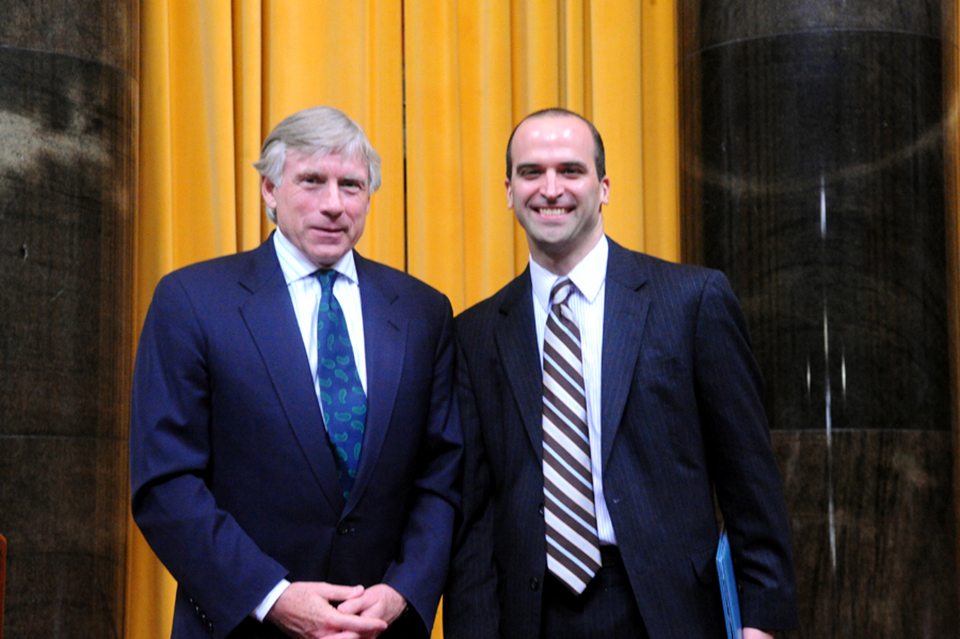
Lee C. Bollinger, President of Columbia University (left), presents the 2011 Commentary prize to David Leonhardt of The New York Times.
Winning Work
By David Leonhardt
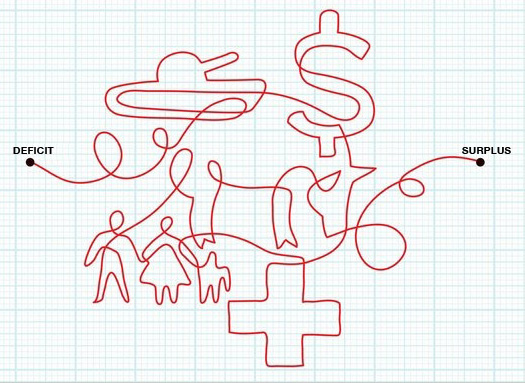
Imagine that Democrats and Republicans somehow came together and agreed on a grand bargain to cut the deficit.
They decided to cut the pay of federal workers over the next several years, close military bases, reduce foreign aid, eliminate earmarks, expand the payroll tax and cut Social Security benefits for high earners, as the chairmen of a bipartisan commission recommended last week.
Democrats also accepted the plan from John Boehner, the presumptive House speaker, to make large cuts to social programs. Republicans accepted President Obama’s proposal to let the Bush tax cuts expire on income above $250,000.
If the two parties managed to do all of this, how much of the country’s long-term deficit would they eliminate?
About one-third of it.
The looming federal deficits are so large that they are likely to occupy much of Washington’s attention for years. Arguably, this new deficit obsession — what some are calling the Age of Austerity — began this month. The midterm elections ushered in a Republican House majority pledging to shrink government, and on Wednesday the leaders of the bipartisan panel released the outline of a deficit-cutting plan for the panel’s members to debate.
Like that panel, The New York Times has conducted its own analysis of the federal budget, but with a different final product. Rather than making recommendations, we are laying out a menu of major options, so that readers can come up with their own plan. We have received help along the way from the deficit panel, from Congressional and White House aides and from liberal, conservative and centrist budget analysts. The deficit puzzle on The Times’s Web site is the result.
The ultimate goal is to help you judge the deficit proposals that are now emerging. Do you think they cut spending too much and should raise taxes more? Or the reverse? Are they too aggressive or too meek on military spending? How will they affect income inequality? How might they help or hurt economic growth?
As a starting point, it is worth thinking about the deficit as being two different deficits. The first is the medium-term deficit, which was created by the Iraq and Afghanistan wars, the 2003 Medicare drug plan, the Bush tax cuts, the recession and the government’s responses, like the stimulus.
Assuming that current policies are continued — for instance, that all the Bush tax cuts become permanent — the deficit in 2015 will be about $400 billion larger than the level that economists consider sustainable. (Countries can run small deficits forever, because one year’s economic growth effectively pays for the previous year’s budget shortfall.)
And $400 billion is a significant sum. It will be equal to more than 2 percent of the country’s economic output in 2015 — half of the Pentagon’s annual budget and more than half of Medicare’s. Yet it is still much smaller, as a share of the economy, than the deficits that have hobbled Greece and Ireland. It is also smaller than the deficit this country ran from 1990 to 1994.
The 2015 deficit does not need to be closed immediately, when the economy remains weak. The deficit panel’s chairmen, Erskine B. Bowles and Alan K. Simpson, called for a phased-in program of modestly higher taxes and cuts to social programs and the military. Some conservatives have criticized that plan for raising taxes at all, and some liberals dislike its emphasis on spending cuts and eliminating middle-class tax breaks.
However it is closed, the medium-term deficit does not appear to pose a huge threat to the American economy. Maya MacGuineas of the New America Foundation points out that simply letting all of the Bush tax cuts expire, not just those benefiting the affluent, would nearly do the job.
The long-term deficit is a wholly different beast.
It comes from the projected growth of Medicare, Medicaid and, to a lesser extent, Social Security. It is the result of baby boomers’ having paid far less in taxes than they will draw in benefits. “The reason we find ourselves in this situation,” said Mr. Bowles, the former chief of staff for President Bill Clinton, “is that we’ve made promises we can’t keep.”
The deficit puzzle focuses on the year 2030 because it is far enough away that the boomers’ retirement will weigh heavily on the budget but near enough that reasonable budget estimates exist. By 2030, the needed deficit cut will equal about 5.5 percent of annual economic output.
By comparison, domestic discretionary spending — all of it, including Head Start, college financial aid, the F.B.I., medical research and airline safety — will add up to about 3 percent of economic output, according to Congressional Budget Office projections. Military spending will equal about 4 percent.
So the solution will have to revolve around tax increases and changes to health care and Social Security. And the country cannot wait until 2030 to implement most of the changes, notes Alan Auerbach, an economics professor at the University of California at Berkeley. If it did, the interest on the national debt could become crushingly large. Deficit cutting will probably be a regular part of politics for the next couple of decades.
One obvious debate will be taxes versus spending. But relying exclusively on one would be extremely difficult. An approach based only on spending would mean deep cuts to programs that many Americans consider to be the essence of government: Medicare, Social Security and the military, among others. Closing the entire deficit through taxes would require enormous tax increases, mostly because Medicare spending is expected to continue growing much faster than income. To keep up, tax rates would have to keep rising.
The real issues, then, are how much taxes should rise, how much spending should be cut — and what kinds of each change should take place.
You could choose to raise taxes mainly on the rich, because their tax rates have fallen steeply over the last few decades while their pretax income has soared. Or, knowing that many of the rich still have higher tax rates than anyone else, you could start the exercise by saying goodbye to the Bush tax cuts on income below $250,000.
No matter what you pick, keep in mind the potential effects on economic growth. Arguably, economic growth is the most important yardstick for any plan, because growth can do much to reduce the deficit, as it did after World War II and in the 1990s.
This helps explain why many economists favor a version of tax reform that would lower marginal rates and close loopholes. Ordinary tax cuts have a mixed record on helping the economy; growth after the Bush tax cuts was mediocre, for example. But tax reform could save households and businesses from changing their behavior, often inefficiently, to qualify for tax breaks. The Bowles-Simpson plan suggests several reforms that would raise more tax revenue than today’s code and help close the deficit.
Of course, when economists say loopholes, they are including the deduction on home mortgage interest and other popular items. That’s the problem with deficit cutting: it involves painful choices, like the ones you see here and the ones in the Bowles-Simpson plan that led to last week’s outcries.
The government has not yet solved the deficit problem, the economist William Gale of the Brookings Institution says, because voters have not yet demanded it. They have rewarded politicians who say they are worried about the budget much more than politicians willing to make specific benefit cuts and tax increases. All of us would prefer generous benefits and low taxes.
“Whatever the eventual solution is,” Mr. Gale said, "it will probably be something that is not politically feasible now."
Budget Puzzle: You Fix the Budget - Interactive Graphic on The New York Times Website
or download the pdf
© The New York Times
By David Leonhardt
$60 Billion: The approximate amount that extending the Bush tax cuts on income above $250,000 a year — which Congress seems on the verge of doing — will cost a year, in inflation-adjusted terms. On average, the affluent households that benefit from these cuts will save $25,000 annually. What else might that $60 billion a year buy?
•As much deficit reduction as the elimination of earmarks, President Obama’s proposed federal pay freeze, a 10 percent cut in the federal work force and a 50 percent cut in foreign aid — combined.
•A tripling of federal funding for medical research.
•Universal preschool for 3- and 4-year-olds, with relatively small class sizes.
•A much larger troop surge in Afghanistan, raising spending by 60 percent from current levels.
•A national infrastructure program to repair and upgrade roads, bridges, mass transit, water systems and levees.
•A 15 percent cut in corporate taxes.
•Twice as much money for clean-energy research as suggested by a recent bipartisan plan.
•Free college, including room and board, for about half of all full-time students, at both four- and two-year colleges.
•A $500 tax cut for all households.
© The New York Times
By David Leonhardt
So what should happen with health reform now?
The stunning victory of Scott Brown, the Massachusetts Republican who will have Ted Kennedy’s old Senate seat, suggests that public opinion has turned against the proposal. It’s hard to know exactly how Democrats will respond. But given the sudden uncertainty over health reform’s fate, this does seem to be an important time to boil down its substance.
For that matter, they’re more conservative than Richard Nixon’s 1971 plan, which would have had the federal government provide insurance to people who didn’t get it through their job.
Here’s my attempt: The bills before Congress are politically partisan and substantively bipartisan.
What does that mean? The first part is obvious. All 60 Senate Democrats and independents voted for the bill, and all 40 Republicans voted against it. The second part is the counterintuitive one. Yet it’s true.
The current versions of health reform are the product of decades of debate between Republicans and Democrats. The bills are more conservative than Bill Clinton’s 1993 proposal. For that matter, they’re more conservative than Richard Nixon’s 1971 plan, which would have had the federal government provide insurance to people who didn’t get it through their job.
Today’s Congressional Republicans have made the strategically reasonable decision to describe President Obama’s health care plan, like almost every other part of his agenda, as radical and left wing. And the message seems to be at least partly working, based on polls and the Massachusetts surprise. But a smart political strategy isn’t the same thing as accurate policy analysis.
The better way to describe the Obama agenda, I think, is that it’s ambitious (even radical) in its scope and sharply different in direction from the Reagan-Bush era, but mostly moderate in terms of how far it goes on any single issue.
Mr. Obama wants to undo George W. Bush’s high-income tax cuts, but would keep the basic Reagan tax structure intact. The administration is trying to re-regulate financial markets, but has rejected the sweeping ideas favored by the former Federal Reserve chairman Paul Volcker, British regulators and many liberals. The pattern is especially clear on Afghanistan and Iraq.
Now, a centrist approach isn’t necessarily the best one — no matter how good it may sound to call yourself a centrist. Sometimes, Republicans are right about an issue (whether the welfare system was broken) and sometimes Democrats are (whether to respond to an economic crisis with fiscal stimulus or a Hooverite approach).
Maybe the country would be better off with a big-government health care plan, like a Medicare for all. Or maybe we’d be better off with a free-market version, in which people shopped for their own plans in an open marketplace. Those are interesting enough arguments. They also make it clear that the bills before Congress are not particularly radical.
A little history is useful here. The first modern attempt at health reform, as you’ve probably heard, came from Harry Truman. After World War II, he proposed a government insurance plan that would cover everyone. Republicans and the American Medical Association labeled the plan “socialistic” — which, in some ways, it was.
Opponents instead called for expanding the private insurance system. Nixon, then a young California representative, and others suggested government subsidies for people who couldn’t afford insurance, as Paul Starr explains in his Pulitzer Prize-winning book, “The Social Transformation of American Medicine.” But the socialism critique was strong enough to defeat Truman’s plan without need for compromise.
The next push came from John F. Kennedy and Lyndon B. Johnson, who tried to cover only the elderly. Critics cried socialism about Medicare, too. “Behind it will come other federal programs that will invade every area of freedom as we have known it in this country,” as Reagan, who was then working as the American Medical Association’s spokesman, said in a widely circulated speech. This time, though, big Congressional majorities and sympathy for the elderly let the Democrats prevail.
Once Nixon was president, the focus switched from expanding access to controlling costs, as you might expect with a Republican. He favored giving doctors incentives to set up prepaid group practices, which had the potential to provide better, cheaper care than the fee-for-service system. Ted Kennedy often said he regretted not making a deal with Nixon on health reform.
The current bills, for better and worse, are akin to a negotiated settlement to this six-decade debate. It would try to end our status as the only rich country with tens of millions of uninsured people, as liberals have long urged. And it would do so using private insurers and government subsidies, as conservatives prefer. (I realize that some liberals argue that a more liberal bill would have fared better, but the history of the health reform — not to mention this country’s conservative instincts — offers reason for doubt.)
On cost control, the bill is similarly centrist. In 1993, Mr. Clinton pushed for putting a cap on the growth of insurance premiums — an idea similar to having a national health budget, which conservative governments in other countries have done. Today’s Democrats saw that move as too radical. Instead, they have borrowed Nixon’s old push for prepaid group practices, which are now called accountable care organizations.
Together, the cost-control measures are serious enough that the Congressional Budget Office estimates they would save the government $1 trillion in the next 20 years, over and above the cost of covering the uninsured. Some experts remain doubtful of these projections. Others, though, think the budget office is underestimating the savings, as it has with past Medicare changes.
The one big conservative idea that’s largely missing is malpractice reform. But the White House said several times that it was willing to negotiate on this issue. And think about it: Rahm Emanuel, the Obama chief of staff, likes to say the only thing that’s not negotiable is success. Don’t you think Mr. Obama would have gladly taken some heat from trial lawyers in exchange for passing health reform with bipartisan support and making himself look like a transformational leader?
The obvious question, then, is how the current bill could have inspired such skepticism from voters.
The unified Republican message is part of the answer. So is the fact that Mr. Obama never found a strong, consistent way to sell the bill. That said, health reform was never going to be easy.
Something like 90 percent of voters already have insurance. Many imagine that they will never lose it. Many people even believe they don’t pay for their insurance, because the money comes out of their paycheck before they see it. (They do pay in lost income.) Polls also show that Americans are more aware of our medical system’s strengths than its weaknesses (like needlessly high error rates). As for Medicare being on course to break the bank — voters rarely get excited about future fiscal problems.
So health reform was probably destined to inspire more fear than hope. It’s been that way since Truman.
In the wake of Mr. Brown’s victory, the decision facing Democrats is not whether to start with a blank slate and try to write a bill based on both liberal health care ideas and conservative ones. They’ve already tried that.
The decision is whether to expand insurance and try to control costs, despite the political risks, or whether that project will once again be put off until another day.
© The New York Times
By David Leonhardt
For all the political and economic uncertainties about health reform, at least one thing seems clear: The bill that President Obama signed on Tuesday is the federal government’s biggest attack on economic inequality since inequality began rising more than three decades ago.
Over most of that period, government policy and market forces have been moving in the same direction, both increasing inequality. The pretax incomes of the wealthy have soared since the late 1970s, while their tax rates have fallen more than rates for the middle class and poor.
Nearly every major aspect of the health bill pushes in the other direction. This fact helps explain why Mr. Obama was willing to spend so much political capital on the issue, even though it did not appear to be his top priority as a presidential candidate. Beyond the health reform’s effect on the medical system, it is the centerpiece of his deliberate effort to end what historians have called the age of Reagan.
Speaking to an ebullient audience of Democratic legislators and White House aides at the bill-signing ceremony on Tuesday, Mr. Obama claimed that health reform would “mark a new season in America.” He added, “We have now just enshrined, as soon as I sign this bill, the core principle that everybody should have some basic security when it comes to their health care.”
The bill is the most sweeping piece of federal legislation since Medicare was passed in 1965. It aims to smooth out one of the roughest edges in American society — the inability of many people to afford medical care after they lose a job or get sick. And it would do so in large measure by taxing the rich.
A big chunk of the money to pay for the bill comes from lifting payroll taxes on households making more than $250,000. On average, the annual tax bill for households making more than $1 million a year will rise by $46,000 in 2013, according to the Tax Policy Center, a Washington research group. Another major piece of financing would cut Medicare subsidies for private insurers, ultimately affecting their executives and shareholders.
The benefits, meanwhile, flow mostly to households making less than four times the poverty level — $88,200 for a family of four people. Those without insurance in this group will become eligible to receive subsidies or to join Medicaid. (Many of the poor are already covered by Medicaid.) Insurance costs are also likely to drop for higher-income workers at small companies.
Finally, the bill will also reduce a different kind of inequality. In the broadest sense, insurance is meant to spread the costs of an individual’s misfortune — illness, death, fire, flood — across society. Since the late 1970s, though, the share of Americans with health insurance has shrunk. As a result, the gap between the economic well-being of the sick and the healthy has been growing, at virtually every level of the income distribution.
The health reform bill will reverse that trend. By 2019, 95 percent of people are projected to be covered, up from 85 percent today (and about 90 percent in the late 1970s). Even affluent families ineligible for subsidies will benefit if they lose their insurance, by being able to buy a plan that can no longer charge more for pre-existing conditions. In effect, healthy families will be picking up most of the bill — and their insurance will be somewhat more expensive than it otherwise would have been.
Much about health reform remains unknown. Maybe it will deliver Congress to the Republicans this fall, or maybe it will help the Democrats keep power. Maybe the bill’s attempts to hold down the recent growth of medical costs will prove a big success, or maybe the results will be modest and inadequate. But the ways in which the bill attacks the inequality of the Reagan era — whether you love them or hate them — will probably be around for a long time.
“Legislative majorities come and go,” David Frum, a former speechwriter for President George W. Bush, lamented on Sunday. “This health care bill is forever.”
Since Mr. Obama began his presidential campaign in 2007, he has had a complicated relationship with the Reagan legacy. He has been more willing than many other Democrats to praise President Reagan. “Reagan’s central insight — that the liberal welfare state had grown complacent and overly bureaucratic,” Mr. Obama wrote in his second book, “contained a good deal of truth.” Most notably, he praised Mr. Reagan as a president who “changed the trajectory of America.”
But Mr. Obama also argued that the Reagan administration had gone too far, and that if elected, he would try to put the country on a new trajectory. “The project of the next president,” he said in an interview during the campaign, “is figuring out how you create bottom-up economic growth, as opposed to the trickle-down economic growth.”
Since 1980, median real household income has risen less than 15 percent. The only period of strong middle-class income growth during this time came in the mid- and late 1990s, which by coincidence was also the one time when taxes on the affluent were rising.
For most of the last three decades, tax rates for the wealthy have been falling, while their pretax pay has been rising rapidly. Real incomes at the 99.99th percentile have jumped more than 300 percent since 1980. At the 99th percentile — about $300,000 today — real pay has roughly doubled.
The laissez-faire revolution that Mr. Reagan started did not cause these trends. But its policies — tax cuts, light regulation, a patchwork safety net — have contributed to them.
Health reform hardly solves all of the American economy’s problems. Economic growth over the last decade was slower than in any decade since World War II. The tax cuts of the last 30 years, the two current wars, the Great Recession, the stimulus program and the looming retirement of the baby boomers have created huge deficits. Educational gains have slowed, and the planet is getting hotter.
Above all, the central question that both the Reagan and Obama administrations have tried to answer — what is the proper balance between the market and the government? — remains unresolved. But the bill signed on Tuesday certainly shifts our place on that spectrum.
Before he became Mr. Obama’s top economic adviser, Lawrence Summers told me a story about helping his daughter study for her Advanced Placement exam in American history. While doing so, Mr. Summers realized that the federal government had not passed major social legislation in decades. There was the frenzy of the New Deal, followed by the G.I. Bill, the Interstate Highway System, civil rights and Medicare — and then nothing worth its own section in the history books.
Now there is.
© The New York Times
By David Leonhardt
It’s time to start talking about a tax cut.
The economy is struggling mightily. Some 15 million people remain unemployed. The Federal Reserve has been slow to act and still is not doing much. The Senate has been unable to find the 60 votes needed to pass anything but minor bills.
The best hope for a short-term economic plan that can win bipartisan support is a tax cut — and not the permanent extension of George W. Bush’s tax cuts, which have been dominating the debate lately. Such an extension is unlikely to win many Democratic votes. Republicans, meanwhile, are unlikely to support more spending, like the national infrastructure project President Obama has been mentioning.
A well-devised tax cut could be different. Cutting taxes has been the heart of the Republican economic program for 30 years, and last year’s stimulus bill showed that Mr. Obama was open to tax cuts.
The question, then, is what kind of cut can put people back to work quickly.
The last 30 years offer some pretty good answers. For one thing, a permanent reduction in tax rates focused on the affluent — along the lines of those 2001 Bush tax cuts — does little to lift growth in the short term. An across-the-board, one-time cut — like the one that Mr. Bush signed in 2008 or that Mr. Obama signed last year — does more.
But the most effective tax cut for putting people back to work quickly is one that businesses and households get only if they spend money. Last year’s cash-for-clunkers program was an example. So was a recent bipartisan tax credit for businesses that hired workers who had been unemployed for months. Perhaps the broadest example is a temporary cut in the payroll tax for businesses, which reduces the cost of employing people.
Any of these steps would increase the budget deficit, obviously. But relative to the multitrillion-dollar, Medicare-driven, long-term deficit, a temporary tax cut costing a couple of hundred billion dollars isn’t significant. The more pressing problem today, by far, is the weak economy.
The great historical lesson of financial crises is that governments are usually not aggressive enough in responding. That was Japan’s mistake in 1990s, Herbert Hoover’s in the early 1930s and even Franklin Roosevelt’s in the mid-1930s.
In 2008 and 2009, political leaders looked as if they had learned this lesson. In 2010, they seem to have forgotten it.
Sometime in the next four months, Congress will have to decide what to do about Mr. Bush’s original tax cuts, because they are set to expire Dec. 31. Most Democrats favor extending the cuts for households making less than $250,000 a year. Republicans want to make all the cuts permanent, including those for households making more than $250,000.
Republicans argue that a permanent cut in tax rates is the best form of stimulus. Allowing any of the Bush cuts to expire, John Boehner, the top House Republican, said in a speech last week laying out the party’s economic agenda, is “a recipe for disaster.”
As theories go, this isn’t a bad one. You can certainly imagine how a tax increase on the affluent could hurt the economy or how a tax cut for them would lift growth. Theories aside, though, consider what has actually happened in the last three decades.
Mr. Bush signed his original tax cut in June 2001, when the economy had been losing jobs for four months. It then shed jobs for two more years. In the decade that followed the tax cut, economic growth was slower than in any decade since World War II.
If the goal is short-term stimulus, even Ronald Reagan’s much-lauded 1981 tax cut doesn’t appear to have worked. After he signed it, the economy lost jobs for 16 straight months. It didn’t start gaining jobs until after he had raised taxes, to reduce the deficit, in late 1982.
What explains this pattern? Tax rates matter, but people don’t make most decisions based primarily on their marginal tax rates. Mr. Bush’s and Mr. Reagan’s tax cuts were just not powerful enough to overcome the economic headwinds at the time.
Consumers and executives didn’t rush out to spend more money in part because they understood their tax rate would still be lower months or years later. That the Reagan and Bush tax cuts went disproportionately to high-income households, which save more of their income, did not help, either.
In fact, simply sending rebate checks to most households seems to have more punch. If you look at this chart, you can see that consumer spending bounced back in both the second quarter of 2008 (temporarily) and the third quarter of 2009. Those happen to be the quarters when the Treasury Department finished sending the one-time cuts from Bush and Obama.
Based partly on this history, Moody’s Analytics estimates that a new rebate would have about three times as large an effect on growth next year as would making all the 2001 tax cuts permanent.
Yet a rebate still isn’t the best solution, according to the Moody’s analysis or, for that matter, common sense. Some households will surely put their rebate into a savings account or use it to pay down debt.
That is why the ideal solution tries to leverage government dollars with private dollars. The cash-for-clunkers program did precisely this last year, causing a jump in vehicle sales. So did a 2009 tax break for corporate investment, leading to an end-of-year spike in spending.
The tension with such tax cuts is between targeting and simplicity. Targeted ones can avoid showering too much money on households and businesses that were going to spend anyway.
One possibility is an expanded tax credit for new clean energy projects, which is favored by the White House and by at least two Republican senators, Orrin Hatch and Richard Lugar. Another is an expansion of the tax credit for businesses that increase their work force, like the one sponsored by Mr. Hatch and Charles Schumer, the New York Democrat. This time, though, it would not have to be restricted to companies hiring the long-term unemployed.
The disadvantage of these programs is that people have to figure out if they’re eligible and then fill out forms. A simpler approach — but a less targeted one — would temporarily cut the payroll tax, which finances Social Security and Medicare and is paid by both businesses and workers. By suspending the part that applies to businesses for a few months, Washington could lower the cost of keeping or hiring workers.
Either way, a couple of tax cuts along these lines could make good additions to a bill extending the Bush tax cuts for households making less than $250,000 a year. Economically, the extra cuts would have a bigger impact than an extension of all the Bush cuts. Politically, this kind of bill would force opponents to explain why they instead wanted smaller tax cuts for middle-class families and businesses and a bigger one for the affluent.
Of course, no temporary tax cut will solve the economy’s long-run problems. That’s a harder project, one that involves upgrading the skills of the work force, slowing the growth of health costs, reducing the deficit, lifting exports, restarting healthy wage growth and, yes, simplifying the tax code.
But we won’t make any of those tasks easier by falling into a double-dip recession or enduring months more of halting growth. The aftermath of a financial crisis is usually difficult. It’s not yet time to declare victory.
© The New York Times
By David Leonhardt
Forty-seven percent.
That’s the portion of American households that owe no income tax for 2009. The number is up from 38 percent in 2007, and it has become a popular talking point on cable television and talk radio. With Tax Day coming on Thursday, 47 percent has become shorthand for the notion that the wealthy face a much higher tax burden than they once did while growing numbers of Americans are effectively on the dole.
Neither one of those ideas is true. They rely on a cleverly selective reading of the facts. So does the 47 percent number.
Given that taxes are likely to be one of the big political issues of the next few years — and maybe the biggest one — it’s worth understanding who really pays what in taxes. Once you do, you can get a sense for our country’s fiscal options. How, in other words, will we be able to close the huge looming gap between the taxes we are scheduled to pay and the services we are scheduled to receive?
The answer is that tax rates almost certainly have to rise more on the affluent than on other groups. Over the last 30 years, rates have fallen more for the wealthy, and especially the very wealthy, than for any other group. At the same time, their incomes have soared, and the incomes of most workers have grown only moderately faster than inflation.
So a much greater share of income is now concentrated at the top of distribution, while each dollar there is taxed less than it once was. It’s true that raising taxes on the rich alone can’t come close to solving the long-term budget problem. The deficit is simply too big. But if taxes are not increased for the wealthy, the country will be left with two options.
It will have to raise taxes even more than it otherwise would on everybody else. Or it will have to find deep cuts in Medicare, Social Security, military spending and the other large (generally popular) federal programs.
All the attention being showered on “47 percent” is ultimately a distraction from that reality.
The 47 percent number is not wrong. The stimulus programs of the last two years — the first one signed by President George W. Bush, the second and larger one by President Obama — have increased the number of households that receive enough of a tax credit to wipe out their federal income tax liability.
But the modifiers here — federal and income — are important. Income taxes aren’t the only kind of federal taxes that people pay. There are also payroll taxes and investment taxes, among others. And, of course, people pay state and local taxes, too.
Even if the discussion is restricted to federal taxes (for which the statistics are better), a vast majority of households end up paying federal taxes. Congressional Budget Office data suggests that, at most, about 10 percent of all households pay no net federal taxes. The number 10 is obviously a lot smaller than 47.
The reason is that poor families generally pay more in payroll taxes than they receive through benefits like the Earned Income Tax Credit. It’s not just poor families for whom the payroll tax is a big deal, either. About three-quarters of all American households pay more in payroll taxes, which go toward Medicare and Social Security, than in income taxes.
Focusing on the statistical middle class — the middle 20 percent of households, as ranked by income — underlines this point. Households in this group made $35,400 to $52,100 in 2006, the last year for which the Congressional Budget Office has released data. That would describe a household with one full-time worker earning about $17 to $25 an hour. Such hourly pay is typical for firefighters, preschool teachers, computer support specialists, farmers, members of the clergy, mail carriers, secretaries and truck drivers, according to the Bureau of Labor Statistics.
Taking into account both taxes and tax credits, the average household in this group paid a total income tax rate of just 3 percent. A good number of people, in fact, paid no net income taxes. They are among the alleged free riders.
But the picture starts to change when you look not just at income taxes but at all taxes. This average household would have paid 0.8 percent of its income in corporate taxes (through the stocks it owned), 0.9 percent in gas and other federal excise taxes, and 9.5 percent in payroll taxes. Add these up, and the family’s total federal tax rate was 14.2 percent.
I realize that it’s possible to argue that payroll taxes should be excluded from the discussion because they pay for benefits — Social Security and Medicare — that people receive on the back end. But that argument doesn’t seem very persuasive.
Why? People do not receive benefits equal to the payroll taxes they paid. Those who die at age 70 will receive much less in Social Security and Medicare than they paid in taxes. Those who die at 95 will probably get much more.
The different kinds of federal taxes are really just accounting categories. At the end of the day, the government has to cover the cost of all its operations with revenue from all its taxes. We can’t wish our deficit away by saying that it’s mostly a Medicare and Social Security deficit.
If anything, the government numbers I’m using here exaggerate how much of the tax burden falls on the wealthy. These numbers fail to account for the income that is hidden from tax collectors — a practice, research shows, that is more common among affluent families. “Because higher-income people are understating their income,” Joel Slemrod, a tax scholar at the University of Michigan, says, “We’ve been overstating their average tax rates.”
State and local taxes, meanwhile, may actually be regressive. That is, middle-class and poor families may face higher tax rates than the wealthy. As Kim Rueben of the Tax Policy Center notes, state and local income taxes and property taxes are less progressive than federal taxes, while sales taxes end up being regressive. The typical family pays a lot of state and local taxes, too — almost half as much as in federal taxes.
There is no question that the wealthy pay a higher overall tax rate than any other group. That is an American tradition. But there is also no question that their tax rates have fallen more than any other group’s over the last three decades. The only reason they are paying more taxes than in the past is that their pretax incomes have risen so rapidly — which hardly seems a great rationale for a further tax cut.
So why are those radio and television talk show hosts spending so much time arguing that today’s wealthy are unfairly burdened? Well, it’s hard not to notice that the talk show hosts themselves tend to be among the very wealthy.
No doubt, like the rest of us, they don’t particularly enjoy paying taxes. They are happy with the tax cuts they have received lately. They would prefer if other people had to pick up the bill for Medicare, Social Security and the military — people like, say, firefighters, preschool teachers, computer support specialists, farmers, members of the clergy, mail carriers, secretaries and truck drivers.
© The New York Times
By David Leonhardt
How much do your kindergarten teacher and classmates affect the rest of your life?
Economists have generally thought that the answer was not much. Great teachers and early childhood programs can have a big short-term effect. But the impact tends to fade. By junior high and high school, children who had excellent early schooling do little better on tests than similar children who did not — which raises the demoralizing question of how much of a difference schools and teachers can make.
There has always been one major caveat, however, to the research on the fade-out effect. It was based mainly on test scores, not on a broader set of measures, like a child’s health or eventual earnings. As Raj Chetty, a Harvard economist, says: “We don’t really care about test scores. We care about adult outcomes.”
Early this year, Mr. Chetty and five other researchers set out to fill this void. They examined the life paths of almost 12,000 children who had been part of a well-known education experiment in Tennessee in the 1980s. The children are now about 30, well started on their adult lives.
On Tuesday, Mr. Chetty presented the findings — not yet peer-reviewed — at an academic conference in Cambridge, Mass. They’re fairly explosive.
Just as in other studies, the Tennessee experiment found that some teachers were able to help students learn vastly more than other teachers. And just as in other studies, the effect largely disappeared by junior high, based on test scores. Yet when Mr. Chetty and his colleagues took another look at the students in adulthood, they discovered that the legacy of kindergarten had re-emerged.
Students who had learned much more in kindergarten were more likely to go to college than students with otherwise similar backgrounds. Students who learned more were also less likely to become single parents. As adults, they were more likely to be saving for retirement. Perhaps most striking, they were earning more.
All else equal, they were making about an extra $100 a year at age 27 for every percentile they had moved up the test-score distribution over the course of kindergarten. A student who went from average to the 60th percentile — a typical jump for a 5-year-old with a good teacher — could expect to make about $1,000 more a year at age 27 than a student who remained at the average. Over time, the effect seems to grow, too.
The economists don’t pretend to know the exact causes. But it’s not hard to come up with plausible guesses. Good early education can impart skills that last a lifetime — patience, discipline, manners, perseverance. The tests that 5-year-olds take may pick up these skills, even if later multiple-choice tests do not.
Now happens to be a particularly good time for a study like this. With the economy still terribly weak, many people are understandably unsure about the value of education. They see that even college graduates have lost their jobs in the recession.
Barely a week seems to go by without a newspaper or television station running a report suggesting that education is overrated. These stories quote liberal groups, like the Economic Policy Institute, that argue that an education can’t protect workers in today’s global economy. Or they quote conservatives, like Charles Murray and Ramesh Ponnuru, who suggest that people who haven’t graduated from college aren’t smart enough to do so.
But the anti-education case usually relies on a combination of anecdotes and selective facts. In truth, the gap between the pay of college graduates and everyone else grew to a record last year, according to the Labor Department, and unemployment has risen far more for the less educated.
This is not simply because smart people — people who would do well no matter what — tend to graduate from college. Education itself can make a difference. A long line of economic research, by Julie Berry Cullen, James Heckman, Philip Oreopoulos and many others, has found as much. The study by Mr. Chetty and his colleagues is the latest piece of evidence.
The crucial problem the study had to solve was the old causation-correlation problem. Are children who do well on kindergarten tests destined to do better in life, based on who they are? Or are their teacher and classmates changing them?
The Tennessee experiment, known as Project Star, offered a chance to answer these questions because it randomly assigned students to a kindergarten class. As a result, the classes had fairly similar socioeconomic mixes of students and could be expected to perform similarly on the tests given at the end of kindergarten.
Yet they didn’t. Some classes did far better than others. The differences were too big to be explained by randomness. (Similarly, when the researchers looked at entering and exiting test scores in first, second and third grades, they found that some classes made much more progress than others.)
Class size — which was the impetus of Project Star — evidently played some role. Classes with 13 to 17 students did better than classes with 22 to 25. Peers also seem to matter. In classes with a somewhat higher average socioeconomic status, all the students tended to do a little better.
But neither of these factors came close to explaining the variation in class performance. So another cause seemed to be the explanation: teachers.
Some are highly effective. Some are not. And the differences can affect students for years to come.
When I asked Douglas Staiger, a Dartmouth economist who studies education, what he thought of the new paper, he called it fascinating and potentially important. “The worry has been that education didn’t translate into earnings,” Mr. Staiger said. “But this is telling us that it does and that the fade-out effect is misleading in some sense.”
Mr. Chetty and his colleagues — one of whom, Emmanuel Saez, recently won the prize for the top research economist under the age of 40 — estimate that a standout kindergarten teacher is worth about $320,000 a year. That’s the present value of the additional money that a full class of students can expect to earn over their careers. This estimate doesn’t take into account social gains, like better health and less crime.
Obviously, great kindergarten teachers are not going to start making $320,000 anytime soon. Still, school administrators can do more than they’re doing.
They can pay their best teachers more, as Pittsburgh soon will, and give them the support they deserve. Administrators can fire more of their worst teachers, as Michelle Rhee, the Washington schools chancellor, did last week. Schools can also make sure standardized tests are measuring real student skills and teacher quality, as teachers’ unions have urged.
Given today’s budget pressures, finding the money for any new programs will be difficult. But that’s all the more reason to focus our scarce resources on investments whose benefits won’t simply fade away.
© The New York Times
By David Leonhardt
Consider what it would be like to have a health insurance plan that capped annual benefits at $2,000. For any medical care costing more than that, you would have to pay out of pocket.
Examples of care that costs more than $2,000 — and often a lot more — include virtually any cancer treatment, any heart surgery, a year’s worth of diabetes treatment and care for many broken bones. Even a single M.R.I. exam can cost more than $2,000. A typical hospital stay runs thousands of dollars more.
So does this insurance plan sound like part of the solution for the country’s health care system — or part of the problem?
A $2,000 plan happens to be one of the main plans that McDonald’s offers its employees. It became big news last week, when The Wall Street Journal reported that the company was worried the plan would run afoul of a provision in the new health care law. In response to the provision, McDonald’s threatened to drop the coverage altogether, until the Obama administration signaled it would grant some exemptions.
This episode was only the latest disruption that the health law seems to be causing. Also last week, the Principal Financial Group said it was getting out of the health insurance business, while other insurers have said they might stop offering certain types of coverage. With each new disruption come loud claims — some from insurance executives — that the health overhaul is damaging American health care.
On the surface, these claims can sound credible. But when you dig a little deeper, you often discover the same lesson that the McDonald’s case provides: the real problem was the status quo.
American families spend almost twice as much on health care — through premiums, paycheck deductions and out-of-pocket expenses — as families in any other country. In exchange, we receive top-notch specialty care in many areas. Yet on the whole, we do not get much better care than countries that spend far less.
We don’t live as long as people in Canada, Japan, most of Western Europe or even relatively poor Jordan. Misdiagnosis is common. Medical errors occur more often than in some other countries. Unique to the developed world, millions of people have no health insurance, and millions more, like many fast-food workers, are underinsured.
In choosing their health reform plan, President Obama and the Democrats eschewed radical changes, for better or worse, and instead tried to minimize the disruptions to the current system. Sometimes, Mr. Obama went so far as to suggest there would be no disruptions, saying that people could keep their current plan if they liked it. But that’s not quite right. It is not possible to change a system as huge, and as hugely flawed, as ours without some disruptions.
McDonald’s offers its hourly workers two different health care plans, which are known as “mini-med” plans. In one, workers can pay about $730 a year for benefits of up to $2,000. In the other, they can pay about $1,660 a year for benefits of up to $10,000, The Journal reported.
In a memo to federal regulators, McDonald’s executives argued that their version of health insurance “positively impacts” the almost 30,000 workers who are covered. And that’s true. A plan with a $2,000 or $10,000 cap can cover some modest health problems and is better than being uninsured.
But should the litmus test for American health care really be better than nothing?
Mini-med plans force people to drain their savings accounts for dozens of common medical problems. They also force hospitals to let some bills go unpaid, which drives up costs for everyone else.
Senator Charles Grassley, Republican of Iowa, has previously criticized AARP for marketing similarly limited plans to its members. “It’s not better than nothing,” Mr. Grassley argued, “to encourage people to buy something described as ‘health security’ when there’s no basic protection against high medical costs.”
Dr. Aaron Carroll, an Indiana University pediatrics professor who studies health policy, says of mini-med plans: “They’re great if you’re healthy, because you feel like you’re covered. But if you ever need them, they’re so skimpy, they provide very little.” Gary Claxton of the Kaiser Family Foundation adds, “They really just shouldn’t be considered health insurance.”
The plans’ skimpiness is the main reason they ran into legal jeopardy. Under the new law, most plans must spend at least 85 percent of their revenue on medical care, rather than administrative overhead. The McDonald’s plans aren’t generous enough to clear the hurdle.
At the same time, it’s probably unrealistic to expect McDonald’s to give workers decent health insurance. Many of those workers make less than $20,000 a year. A typical family insurance plan would raise their total compensation by more than half, destroying the McDonald’s business model.
The workers, for their part, cannot afford to buy insurance in the so-called individual market. Plans are even more expensive in that market, because it is dominated by people who desperately need insurance — which is to say, sick people.
This is where health reform comes in. It tried to solve the problem by creating what policy experts call a three-legged stool.
First, people will be required to buy insurance, to spread costs among the sick and the healthy. Second, insurers will be prohibited from cherry-picking only the healthiest customers, again to spread costs. Finally, the government will give subsidies to people, like McDonald’s workers, who can’t afford insurance on their own.
Germany, the Netherlands and Switzerland all use a system along these lines to cover everyone, largely through the private sector, for less money per person than this country spends.
The recent disruptions in our health insurance market are partly a result of the fact that the stool’s three legs were not built on the same timetable. Some of the insurance regulations, like the one on overhead costs, are starting to take effect. But the new markets for health insurance, known as exchanges, won’t be up and running until 2014. This timetable has its problems, and the Obama administration will probably need to grant some more temporary exemptions.
In 2014, however, the choice for McDonald’s workers will no longer be between a bad policy and no policy. Through the exchanges, they will be able to buy a real health insurance plan — one that covers cancer, heart attacks, surgeries, M.R.I.’s and hospital stays. Dr. Carroll notes that many families will end up paying less than they are now paying out of pocket and will get more access to care, too.
For insurance companies, these changes won’t be quite so positive. They will no longer be able to sell plans that devote 30 percent of revenue to salaries for their workers. They will not be allowed to compete over which company can come up with the most ingenious ways to say no to the sick. Their benefits and prices will become more public, thanks to the exchanges.
The health care overhaul that passed Congress is far from ideal, as I have written many times in this space. But it does represent progress.
The fact that it is beginning to disrupt the status quo — that some insurance policies will eventually be eliminated and some inefficient insurers will have to leave the market altogether — is all the proof we need.
© The New York Times
By David Leonhardt
The classic way for lobbyists to defend their client’s interest is to insist that they are not actually defending their client’s interest. Really, they say, they are just looking out for ordinary Americans.
Tobacco lobbyists spent years fighting regulation by claiming to be defending individual freedom, not the profits of tobacco companies. Detroit’s lobbyists did much the same to push back against seat belt and pollution laws. Wall Street has spent months opposing the financial regulation bill in the name of families and small businesses.
The latest example comes from Coca-Cola, PepsiCo and the rest of the soda industry, which is trying to defeat a soda tax now before the District of Columbia Council. The industry has succeeded recently in beating back similar taxes in New York and Philadelphia, and in keeping one out of the federal health overhaul bill. But the Washington Council seems to be seriously considering a penny-per-ounce tax on nondiet sodas, energy drinks and artificial juices. Council members are set to vote on the issue next week.
This soda debate is probably going to be around for some time. Cities and counties, desperate to find money to pay for schools and roads, are starting to see a soda tax as a way to raise revenue. The tax also appears to be one of the most promising ways to attack obesity, given the huge role sugary drinks play in the epidemic.
“It’s wrong for the government to stand idle in the face of an epidemic of obesity that’s hurting the quality of life and the health of our residents,” says Mary Cheh, the Council member who has proposed the tax, “when we have policy choices in front of us that can materially affect the problem.”
The soda industry, of course, is fighting back with newspaper and radio advertisements, among other things. It says a tax would most hurt “hard-working, low- and middle-income families, elderly residents and those living on fixed incomes” and would destroy jobs. Ellen Valentino, an industry official, recently told The Washington Post that companies would spend “whatever it takes” to make their case.
The argument for a soda tax is the same as the argument for a tax on tobacco, pollution or, for that matter, banks that take big, expensive risks. When an activity imposes costs on society, economists have long said that the activity should be taxed. Doing so accomplishes two goals: it discourages the activity, and it raises money to help pay society’s costs.
In the case of soda, those costs come in the form of medical bills for diabetes, heart disease and other side effects of obesity. We’re all paying these bills, via Medicare, Medicaid and private insurance premiums. Obesity has become a significant cause of our swelling long-term budget deficit.
And soda is a huge reason the country is so much more obese. The typical American consumes almost three times as many calories from sugary drinks as in the late 1970s. This increase accounts for about half the total per-capita rise in calorie consumption over the same period. Remember, many of these drinks have zero nutritional benefit — unlike meat, cheese or juice.
As Kelly Brownell, a Yale researcher, says, the link between obesity and soda is scientifically stronger than the link between obesity and any other type of food or beverage.
We’re drinking more soda for several reasons. Above all, the inflation-adjusted price has fallen 34 percent since the late 1970s, largely because it can be manufactured more cheaply than in the past. Meanwhile, the average real cost of fruits and vegetables has risen more than 30 percent, according to the Bureau of Labor Statistics.
Coincidentally, Ms. Cheh’s proposed tax would roughly reverse the drop in the price of soda over the last three decades, at least for the popular 12-pack of cans. An extra penny per ounce on a 12-pack would add $1.44 — or about 30 percent — to the current typical $4.75 price. (The tax rate would be lower for single-serve bottles and higher for bulk purchases.)
Most of the revenue would then be used to improve the miserable quality of many school lunches in Washington. One blog, Better D.C. School Food, has taken to documenting these lunches, with a series of photographs of bland bread, processed cheese and reconstituted beef.
So what about Coke’s and Pepsi’s arguments against the tax?
They are certainly right that less soda consumption could cost the soda industry some jobs. But it would eliminate jobs from the overall economy only if people put the money they had been spending on soda into their savings accounts. That’s highly unlikely. Instead, people will probably spend more on other food and drinks or, say, go to the movies more often — and create jobs in those industries.
The argument that the tax will hurt the poor is a little more serious. The average American now drinks almost a gallon of sweetened beverages each week. If the tax passes, any Washington resident who continued to do so would have to pay about $1.20 each week in soda taxes.
Yet even that number overstates the cost, because the tax would surely affect how much soda many people drank. One of the lessons of the recent rise in cigarette taxes is that big price changes can lead to big behavior changes, even with an addictive product like tobacco. Teenagers, the biggest soda drinkers of all, are especially price sensitive. People who cut their soda drinking from a gallon a week to merely three-quarters of a gallon — that’s still 96 ounces, more than twice the consumption level of the late 1970s — would be spending no more on soda than they are now.
I suspect that some Washington Council members, in the face of opposition from the soda makers and distributors, may be tempted to support a weakened version of the tax. One option would simply be to extend the normal 6 percent sales tax to sweetened beverages. Like food, they are currently exempt.
But here’s the problem with that idea: small tax changes don’t always change behavior, as a recent study by the RAND Corporation found. So a small soda tax could actually have a worse impact on some families’ budgets than a substantial one — by raising the price of soda without affecting consumption. No wonder the American Heart Association supports the penny-per-ounce proposal.
Such a tax would certainly raise the cost of living for some heavy soda drinkers, just as cigarette taxes have stretched the budgets of some smokers and mandatory seat belts have added costs to car production. But consider the benefits from those other public health initiatives. They have vastly outweighed the costs.
Someday, we will probably look back on our gallon-a-week soda habit the way we now look back on allowing children to ride without seat belts or listening to doctors who endorsed Camel cigarettes. We will wonder what we were thinking.
Coke and Pepsi, unfortunately, seem willing to do whatever it takes to delay that day.
© The New York Times
By David Leonhardt
The last three men nominated to the Supreme Court have all been married and, among them, have seven children. The last three women — Elena Kagan, Sonia Sotomayor and Harriet Miers (who withdrew) — have all been single and without children.
This little pattern makes the court a good symbol of the American job market. Women and men with similar qualifications — age, education, experience — are much more likely to be treated similarly today than in the past. The pay gap between them, while still not zero, has shrunk to just a few percentage points.
Yet once you look beyond the tidy comparisons of supposedly identical men and women, the picture is much less sunny. There are still only 15 Fortune 500 companies with a female chief executive. Men dominate the next rungs of management in most fields, too. Over all, full-time female workers make a whopping 23 percent less on average than full-time male workers.
What’s going on? Men and women are not identical, of course. Many more women take time off from work. Many more women work part time at some point in their careers. Many more women can’t get to work early or stay late.
And our economy exacts a terribly steep price for any time away from work — in both pay and promotions. People often cannot just pick up where they have left off. Entire career paths are closed off. The hit to earnings is permanent.
The fact that the job market has evolved in this way is no accident. It’s a result of policy choices. As Jane Waldfogel, a Columbia University professor who studies families and work, says, “American feminists made a conscious choice to emphasize equal rights and equal opportunities, but not to talk about policies that would address family responsibilities.”
In many ways, the choice was shrewd. The feminist movement has been fabulously successful fighting for antidiscrimination laws that require men and women to be treated equally. These laws have not eliminated the blatant sexism of past decades — think “Mad Men” — but they have beaten back much of it.
As a result, outright sexism is no longer the main barrier to gender equality. The main barrier is the harsh price most workers pay for pursuing anything other than the old-fashioned career path.
“Women do almost as well as men today,” Ms. Waldfogel said, “as long as they don’t have children.”
The data make this case. So does the disproportionate number of prominent women who do not have children — Ms. Kagan, Ms. Sotomayor, Janet Napolitano and Condoleezza Rice, among others. Obviously, many other successful women (including Justice Ruth Bader Ginsburg) have children. Through a combination of talent, hard work and good fortune, they have managed to beat the odds.
But that is indeed what they are doing: beating odds stacked against them. Most parents are simply not able to have it all, regardless of where they are on the income spectrum.
A recent study of business school graduates from the University of Chicago found that in the early years after graduating, men and women had “nearly identical labor incomes and weekly hours worked.” Men and women also paid a similar career price for taking off or working part time. Women, however, were vastly more likely to do so.
As a result, 15 years after graduation, the men were making about 75 percent more than the women. The study — done by Marianne Bertrand, Claudia Goldin and Lawrence Katz — did find one subgroup of women whose careers resembled those of men: women who had no children and never took time off.
On the other end of the spectrum, low-income women generally do not have a choice between career and family. Many are single parents. Their chances of escaping poverty are hurt by the long-term costs of taking time off after childbirth and having little flexibility in their schedules.
Taking the next step toward workplace equality probably has to start with an acknowledgment that most parents can’t have it all — at least as long as part-time work, flexible schedules and long leaves do so much career damage.
A growing number of parents already seem to have come to this conclusion. That’s one reason for the rise in the number of mothers who have dropped out of the labor force. Lacking good part-time job options, more are choosing full-time parenting.
Last year, 40.2 percent of married women with children under 3 years old were outside the labor force, up from a low of 38.6 percent in 1998. The increase, according to a Bureau of Labor Statistics analysis, “occurred across all educational levels and, for most groups, by about the same magnitude.” By contrast, women without children at home have continued to join the work force in growing numbers.
Unfortunately, this problem isn’t one that lends itself to a sweeping policy solution.
There are steps that can help. Universal preschool programs — like the statewide one in Oklahoma — would make life easier for many working parents. Paid parental leave policies, like California’s modest version, would make a difference, too. With Australia’s recent passage of paid leave, the United States has become the only rich country without such a policy. (Giving parents here a full year of leave for each child would cost about $25 billion a year, or less than 0.2 percent of gross domestic product, Ms. Waldfogel says.)
Given fiscal realities, a more realistic immediate idea may be the recent British law giving workers the right to request a switch to a part-time or flexible schedule. Employers can still say no, but the establishment of a formal right seems to have made a difference. So far, about 90 percent of requests have been approved.
Yet policies like these are not enough. In the European countries with much more generous parental leave laws, women remain far behind men on career ladders.
The best hope for making progress against today’s gender inequality probably involves some combination of legal and cultural changes, which happens to be the same combination that beat back the old sexism. We’ll have to get beyond the Mommy Wars and instead create rewarding career paths even for parents — fathers, too — who take months or years off. We’ll have to get more creative about part-time and flexible work, too.
If you want a preview, you can look at the few professions in which large numbers of highly skilled women have been able to force change. Obstetrics used to be a field that required doctors to be on duty at all hours. Today, group practices allow obstetricians to share the 3 a.m. deliveries and, in the process, have a life outside of work. Optometry and veterinary medicine have their own versions of this story.
With both government and corporate budgets tight, it’s easy to be pessimistic, but I think history argues for optimism. This country doesn’t always move quickly or evenly toward equality. Yet it does tend to move in one broad direction.
For almost 200 years, the Supreme Court did not have a single woman on its bench. Sometime later this week, it is likely to have three.
© The New York Times
Biography

David Leonhardt writes "Economic Scene," a weekly economics column, for The New York Times business section, looking at both the broad American economy and the economics of everyday life. Many of his recent columns have focused on the economic downturn, the budget deficit or health care.
Mr. Leonhardt is also a staff writer for The New York Times Magazine and founded the Times's Economix blog. He has also conceived and helped create two ofThe Times's most popular interactive features, the budget-deficit calculators and rent-vs.-buy housing calculator. In 2005, Mr. Leonhardt was one of the reporters who produced "Class Matters," The Times's series on social class in the United States. In 2004, he founded an analytical sports column, "Keeping Score."
Before joining The Times in 1999, he worked for Business Week magazine and The Washington Post.
Mr. Leonhardt won the Gerald Loeb Award for magazine writing in 2009 for aTimes Magazine article, "Obamanomics." He was a winner of the Society of American Business Editors and Writers Best in Business Journalism Contest for his Times column in 2009 and 2007. In 2010, he was a finalist for the Pulitzer Prize in Commentary for his economic columns. In 2003, he was part of a team of Times reporters whose coverage of corporate scandals was a finalist for the Pulitzer Prize. In 1998, he won a Peter Lisagor Award, from the Chicago Headline Club, for a Business Week story on problems at McDonald's.
Born in New York on Jan. 1, 1973, Mr. Leonhardt studied applied mathematics at Yale. He is a third-generation native of New York.