The New York Times Staff
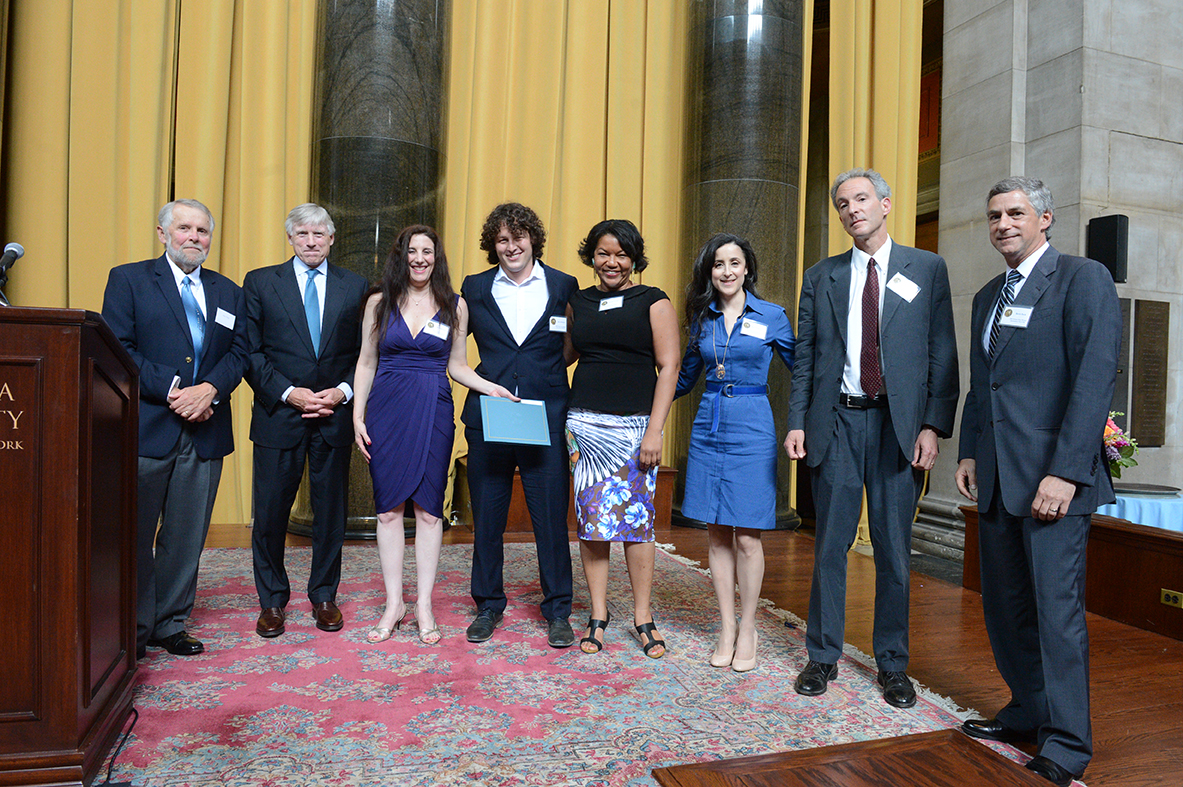
Mike Pride, Pulitzer Prize Administrator (left), and Lee C. Bollinger, President of Columbia University (second from left), present the 2015 International Reporting Prize to Pam Belluck, Ben Solomon, Helene Cooper, Sheri Fink, Adam Nossiter and Kevin Sack (left to right) of The New York Times Staff.
Winning Work
By Adam Nossiter
KOLO BENGOU, Guinea — Eight youths, some armed with slingshots and machetes, stood warily alongside a rutted dirt road at an opening in the high reeds, the path to the village of Kolo Bengou. The deadly Ebola virus is believed to have infected several people in the village, and the youths were blocking the path to prevent health workers from entering.
“We don’t want any visitors,” said their leader, Faya Iroundouno, 17, president of Kolo Bengou’s youth league. “We don’t want any contact with anyone.” The others nodded in agreement and fiddled with their slingshots.
Singling out the international aid group Doctors Without Borders, Mr. Iroundouno continued, “Wherever those people have passed, the communities have been hit by illness.”
Health workers here say they are now battling two enemies: the unprecedented Ebola epidemic, which has killed more than 660 people in four countries since it was first detected in March, and fear, which has produced growing hostility toward outside help. On Friday alone, health authorities in Guinea confirmed 14 new cases of the disease.
Workers and officials, blamed by panicked populations for spreading the virus, have been threatened with knives, stones and machetes, their vehicles sometimes surrounded by hostile mobs. Log barriers across narrow dirt roads block medical teams from reaching villages where the virus is suspected. Sick and dead villagers, cut off from help, are infecting others.
“This is very unusual, that we are not trusted,” said Marc Poncin, the emergency coordinator in Guinea for Doctors Without Borders, the main group fighting the disease here. “We’re not stopping the epidemic.”
Efforts to monitor it are grinding to a halt because of “intimidation,” he said. People appear to have more confidence in witch doctors.
Health officials say the epidemic is out of control, moving back and forth across the porous borders of Guinea and neighboring Sierra Leone and Liberia — often on the backs of the cheap motorcycles that ply the roads of this region of green hills and dense forest — infiltrating the lively open-air markets, overwhelming weak health facilities and decimating villages.
It was in this rural area, 400 miles over bad roads from Guinea’s capital, Conakry, where the outbreak was first spotted, and where it has hit hardest. More than 80 percent of those infected have died in this region, and Guinea has recorded more than twice as many deaths as the other countries.
In Koundony, more than one-eighth of the population, including the headman, are dead; many others have fled.
There is no known cure for the virus, which causes raging fever, vomiting, diarrhea and uncontrolled bleeding in about half the cases and up to 90 percent of the time, rapid death. Merely touching an infected person, or the body of a victim, is dangerous; coming into contact with blood, vomit or feces can be deadly.
Now the fear of aid workers, principally from Doctors Without Borders and the Red Cross, is helping to spread the disease, health officials say, creating a secondary crisis.
Villagers flee at the sight of a Red Cross truck. When a Westerner passes, villagers cry out, “Ebola, Ebola!” and run away.
This month, Doctors Without Borders classified 12 villages in Guinea as “red,” meaning they might harbor Ebola but were inaccessible for safety reasons.
As recently as April, the epidemic seemed to be under control. But in the past two weeks, its center appeared to have shifted across the border to Sierra Leone, where most of the new dead were being recorded. The sick are being hidden and the dead buried, without any protection.
Last week, the Sierra Leone Health Ministry reported that its lead doctor fighting Ebola had contracted the disease, and the virus had spread to a fourth country, with a confirmed fatality in Nigeria. Over the weekend, an aid organization working in Liberia, Samaritan’s Purse, said that two Americans, a doctor who was treating Ebola patients and an aid worker on a case management team, had tested positive for the virus. And the Liberian government said Sunday that one of its most high-profile doctors had died of Ebola, according to The Associated Press.
Back in Guinea, in the village of Wabengou, residents placed a tree in the road to block outsiders. They also attacked an official delegation from Conakry, rushing its cars, banging on the vehicles and brandishing machetes, according to Doctors Without Borders.
“We don’t want them in there at all,” said Wabengou’s chief, Marcel Dambadounou. “We don’t accept their presence at all. They are the transporters of the virus in these communities.”
“We are absolutely afraid, and that’s why we are avoiding contact with everybody,” he said, “the whole world.”
Doctors Without Borders has set up an emergency treatment center in the regional capital, Guéckédou, but a nurse there said the center had diminishing appeal.
“Here, if the people come in, they don’t leave alive,” said the nurse, Fadima Diawara.
It may not help win confidence that the medical teams wear top-to-toe suits and masks, burning much of the outfit after helping a patient.
The wariness against outside intervention has deep roots. This part of Guinea, known as the Forest Region, where more than 200 people have already died of the disease, is known for its strong belief in traditional religion. The dictator who ruled Guinea with an iron fist for decades, Ahmed Sékou Touré, was only partly successful in a 1960s campaign to stamp out these beliefs, despite mass burnings of fetishes.
Addressing villagers this month in Bawa, where a woman had just died, the regional prefect from Guéckédou, Mohammed Cinq Keita, warned: “There is no root, no leaf, no animal that can cure you. Don’t be fooled.”
Near the border with Sierra Leone this month, Doctors Without Borders discovered an Ebola patient who had been privately “treated” in the village of Teldou and then returned to his relatives in another village, possibly infecting untold others.
“Extremely, extremely concerning,” said Sylvie Jonckheere, the charity’s doctor on the scene. A colleague in full gear lectured the villagers of Teldou as the rain started, but was met with indifference or hostile stares; some turned their backs on him.
As the aid workers drove off, the private nurse who administered a shot to the Ebola patient defended his treatment. “I couldn’t say that he had the illness,” said the nurse, Eduard Leno. “His body was hot, that’s all.”
Asked why the patient had not been sent to the clinic in Guéckédou, he said angrily: “We are in the bush here. You can’t just send someone away. How will society view you?”
Local officials have begun a campaign to open the closed villages — there have even been some recent arrests in Kolo Bengou — but in tiny Koundony, fear is palpable.
On a recent day, a Red Cross truck drove up to the cemetery to deliver the body of Marie Condé, 14, wrapped in plastic sheeting.
As the body was carried off the truck, a high-pitched wail pierced the country stillness. “There is no cure!” a woman cried. “There is no cure!”
The gravedigger, Marie’s half brother Famhan Condé, 26, was sweating as he heaved shovels of dirt. The grave, he said, would be the 26th he had dug since the epidemic began.
“We’re all scared here,” he said. “There’s no solution. We can do nothing. Only God can save us.”
By Helene Cooper
MONROVIA, Liberia — It is hard enough to push away family and friends, shunning an embrace or even a shake of the hand to protect yourself from Ebola.
But imagine trying not to touch your 2-year-old daughter when she is feverish, vomiting blood and in pain.
Precious Diggs, a 33-year-old contractor for a rubber company, had heard all the warnings from the legions of public health workers here in Liberia. She had seen the signs that dot the road from Harbel, where she works, to the capital, Monrovia, some 35 miles away: “Ebola is Here and Real!” they say. “Stop the Denial!”
But when her toddler, Rebecca, started “toileting and vomiting,” there was no way her mother was not going to pick her up.
“Na mind, baby,” Ms. Diggs whispered in her baby’s ear. “I beg you, na mind.”
Here in the heart of the worst Ebola outbreak in history, the question of whether to touch a stranger has only one answer: You don’t. But even in more intimate circles, in families and among lifelong friends, Liberians are starting to pull away from one another, straining against generations of a culture in which closeness is expressed through physical contact.
Liberia — from the elite doyennes who spend their days sending houseboys to the market to fetch oranges for them, all the way to the young boys on Tubman Boulevard who run up to cars hawking plastic bags of ice — used to be a tactile place. Everybody kissed friends, strangers and cousins, regardless of whether people met every day or had not seen one another in 20 years.
In a version of the genteel affectations that freed American slaves brought with them two centuries ago when they came here, the double-cheek kiss, for decades, was the standard greeting.
People often held hands while singing hymns at First United Methodist Church on Ashmun Street on Sundays, and after services sometimes took up to an hour to disperse, going systematically from cheek to cheek.
At parties in Monrovia, new arrivals went from person to person around a room, taking the hand of each seated guest as they bent down to kiss and chat. Sometimes it could take 15 to 20 minutes to make the rounds at a house party of just 10 people. When it was time to leave, the ritual began again.
That’s all gone now. Ebola is spread through bodily fluids: vomit, blood, feces, tears, saliva and sweat. Close contact has become taboo.
The Liberian government has decreed that taxis — which used to cram in six, seven, eight people, and in a recent case, four goats even — are allowed to take just three people in the back seat: fewer riders to touch one another.
Sylvester Vagn, 40, who was a corporate driver with a tech company before he was laid off a few months ago, said Thursday that even with only two people sharing the taxi with him, he still now jams his body against the door. Whichever arm is closest to his fellow passengers, he places it across his body and practically out the window.
“I sit so, with my head so,” he said, demonstrating how he leans his head as far away as possible. “And I bring jacket.”
Clara K. Mallah, 27, wears long sleeves, pulling them over her hands whenever her 3-year-old niece comes running up to her. Ms. Mallah, a national translator with an international organization in Monrovia, makes an exception only for her 52-year-old mother, a diabetic amputee who never leaves the house. Even so, Ms. Mallah has trepidation.
“If my mom could walk,” she said, “I wouldn’t touch her.”
Those close family ties expose the fragility of the belief that you can completely protect yourself from Ebola by keeping your hands to yourself. Can you really not touch an ailing mother?
Ephraim Dunbar couldn’t. When Mr. Dunbar, 37, got a phone call in late August that his mother had taken ill, he rushed to her house in Dolos Town, the enclave near Harbel where dozens of people have succumbed to Ebola. He found her in bed, vomiting blood.
His mind went immediately to the precautions against the virus. He did his best not to touch her. But as she grew worse, unable to keep anything down, he gave her milk, and tried to soothe her. His skin touched hers.
His mother died the next day.
Just after his mother’s funeral, Mr. Dunbar’s own forehead got hot with fever. For 15 days, he stayed at John F. Kennedy Hospital in Monrovia, fighting the disease. It was a fight he eventually won. But when he got out of the hospital, he found out that four of his sisters, his brother, his father, his aunt, his uncle and his two nephews had died. His entire family, wiped out in days.
On Friday, Mr. Dunbar said he would do nothing different. “That’s my ma,” he said, “that she the one born me.”
Levy Zeopuegar’s Achilles’ heel was his oldest sister, Neconie — “one father, one mother,” he described her in the Liberian way of distinguishing the special bond of full siblings in a country where half brothers or half sisters are common.
When Neconie got sick, her brother chartered a private car to take her to the hospital and climbed in with her. When the driver pointed out that blood was pooling from her nose, Mr. Zeopuegar turned to her with a towel.
Neconie died. Her husband, also in the car, died. Mr. Zeopuegar almost died as well, spending 19 days in the Ebola treatment unit in Harbel. For days, he hiccupped blood, feeling each day was his last, until finally, one morning, he woke up and knew he would live.
“You have to understand,” he tried to explain. “This Ebola thing. You will see your son or daughter sick in bed and say, ‘I not touching her?’ That is impossible.”
And yet, that is what Liberians must do to combat the virus. On the streets of Monrovia, it sometimes seems impossible. Children still run around in local markets pushing and playing. People in wheelchairs still roll up to cars at red lights, palms outstretched. Boys still push their way through the densely crowded West Point neighborhood.
Many people say they have not felt the warmth of human skin in months. Many do not shake hands or kiss any more. No caressing. No hugging.
But some still do. Sister Barbara Brillant, dean of Mother Patern College of Health Sciences at St. Theresa’s Convent, last week was driving down the street when she saw a young couple holding hands.
“Stop holding hands!” she yelled out the car window.
“They looked at me like I was crazy,” Sister Barbara said later.
So when 2-year-old Rebecca got sick, Precious Diggs picked her baby up. Rebecca did not make it, and died days later.
She passed Ebola on to her mother.
Weeks later, Ms. Diggs was released from a treatment unit. She sat in front of the discharge tent with a row of eight people, all recovered from the disease, all waiting to walk out into new and starkly different lives.
By Ben C. Solomon
By Adam Nossiter and Ben C. Solomon
KENEMA, Sierra Leone — The best defense against despair was to keep working. Many times, that choice was far from obvious: Josephine Finda Sellu lost 15 of her nurses to Ebola in rapid succession and thought about quitting herself.
She did not. Ms. Sellu, the deputy nurse matron, is a rare survivor who never stopped toiling at the government hospital here, Sierra Leone’s biggest death trap for the virus during the dark months of June and July. Hers is a select club, consisting of perhaps three women on the original Ebola nursing staff who did not become infected, who watched their colleagues die, and who are still carrying on.
“There is a need for me to be around,” said Ms. Sellu, 42, who oversees the Ebola nurses. “I am a senior. All the junior nurses look up to me.” If she left, she said, “the whole thing would collapse.”
The other nurses call her Mummy, and she resembles a field marshal in light brown medical scrubs, charging forward, exhorting nurses to return to duty, inspecting food for patients, doing a dance for once-infected co-workers who live — “nurse survivors,” she called them enthusiastically — and barking orders from the head-to-toe suit that protects her from her patients.
In the campaign against the Ebola virus, which is sweeping across parts of West Africa in an epidemic worse than all previous outbreaks of the disease combined, the front line is stitched together by people like Ms. Sellu: doctors and nurses who give their lives to treat patients who will probably die; janitors who clean up lethal pools of vomit and waste so that beleaguered health centers can stay open; drivers who venture into villages overcome by illness to retrieve patients; body handlers charged with the dangerous task of keeping highly infectious corpses from sickening others.
Their sacrifices are evident from the statistics alone. At least 129 health workers have died fighting the disease, according to the World Health Organization. But while many workers have fled, leaving already shaky health systems in shambles, many new recruits have signed up willingly — often for little or no pay, and sometimes giving up their homes, communities and even families in the process.
“If I don’t volunteer, who can do this work?” asked Kandeh Kamara, one of about 20 young men doing one of the dirtiest jobs in the campaign: finding and burying corpses across eastern Sierra Leone.
When the outbreak started months ago, Mr. Kamara, 21, went to the health center in Kailahun and offered to help. When officials there said they could not pay him, he accepted anyway.
“There are no other people to do it, so we decided to do it just to help save our country,” he said of himself and the other young men. They call themselves “the burial boys.”
Doctors Without Borders trained them to wear protective equipment and to safely clear out dead bodies potentially infected with Ebola. They travel across backbreaking dirt roads for up to nine hours a day.
In doing their jobs, the burial boys have become pariahs. Many have been cast out of their communities because of fear that they will bring the virus home with them. Some families refuse to let them return.
After Mr. Kamara started working, his family said, he was no longer welcome in his village. His uncle, the family patriarch, told him never to come back. At first, he stayed with a friend, but the man’s wife was afraid and kicked him out, too. With no pay for months, he sometimes begged on the street after work to get enough money for food. Recently, he talked the owner of a small shop into clearing out enough space in a back room for him to sleep there.
He is finally getting paid, about $6 a day, and he hopes to find a room to rent, probably at an inflated price. Some of the other burial boys have tried to rent apartments but have been refused.
“If I have a long life, I can go back to my people,” Mr. Kamara said. “I can talk to them: ‘I’m doing this job for you.’ Maybe they can understand me.”
At the government hospital a few hours away in Kenema, photographs of the dead nurses are still plastered on the crumbling walls. Notes to young women suddenly cut down, like Elizabeth Lengie Koroma — “Lengie We All Love U But God Loves U” — offer visual reminders of the pain that remains.
“Today three, tomorrow four — it was just like that, rapid,” Ms. Sellu recalled, her cheery demeanor quickly dropping. “We said, ‘What is happening?’ ”
She added, “You are asking, ‘Who is next?’ ” In all, some 22 workers at the hospital died.
The nurses and doctors here had banked on their experience treating Lassa fever, another deadly disease that causes bleeding. But Ebola is of a different order, and they had never seen it before.
With the first cases, the nurses simply used their Lassa goggles. Ebola demands a far more protective face shield. They also used “light gloves,” Ms. Sellu said. Now, she puts on two layers of heavy-duty rubber gloves. The inadequate initial precautions had fatal consequences, even for the revered young doctor who headed the Lassa unit, Dr. Sheik Umar Khan.
“Such a careful man, always saying, ‘Don’t do this, don’t do that,’ ” Ms. Sellu said. “That is the mystery.” Dr. Khan died on July 29, a huge blow to the nation.
Ms. Sellu also spoke about the nurses she had lost to Ebola. Usually so keen on projecting strength to her subordinates, she began to cry.
“It has been a nightmare for me,” she said, her features contorting. “Since the whole thing started, I have cried a lot.” She added: “It came to a time when I was thinking of quitting this job. It was too much for me.”
But the lesson she drew appeared inevitable to her. “You have no options. You have to go and save others,” Ms. Sellu said. “You are seeing your colleagues dying, and you still go and work.”
At the height of the deaths last month, her two teenage children and her family in the capital, Freetown, urged her to stop. The remaining nurses at the hospital staged a revolt. One morning, 40 of them appeared outside the door of her home in Kenema, yelling, “If one of us dies again, prepare yourself to die!”
Frightened, her children warned her. “ ‘They have come for you! Mummy, don’t go there again!’ ” she recalled. “And my relations in Freetown were saying, ‘Don’t go there again!’ ”
Ms. Sellu disobeyed all of them. “I was sneaking in at the end of the day,” she said.
With precision, she recalled the day the nightmare at the hospital began: May 25. In neighboring Guinea, where the epidemic started, the crisis had appeared, falsely, to be abating. In Kenema, a patient was bleeding profusely.
“The nurses were curious; they called me,” she said. “Dr. Khan said, ‘Do the test.’ ” It was positive for Ebola.
“The whole hospital went haywire,” Ms. Sellu said. “All the nurses were put into quarantine.”
But it was the second case, in the hospital’s private annex for V.I.P.s, “that put the calamity on us,” she said. The patient was a local chief suffering from severe diarrhea and vomiting. He infected three nurses and a porter. The porter and one nurse died. The dying nurse was pregnant and miscarried, infecting all four nurses who aided in the delivery. All four died.
“There are times when I say, ‘Oh my God, I should have chosen secretarial,’ ” Ms. Sellu said. But her job as a healer, she said, “is the calling of God.”
The Kenema hospital is a different place now. In the last several weeks, with international help, a more rigorous system for screening, filtering and holding Ebola patients has been instituted. Confidence among the nurses has been restored.
Outside the hospital, they continue to face stigma. Some of Ms. Sellu’s staff spoke of husbands abandoning them and neighbors shunning them. One nurse told of returning home to find her belongings in suitcases on the sidewalk, and her spouse warning her to stay away. Another nurse, seeking lodgings, lied to the landlord, telling him she was a student.
“If you meet with them, they will balance this way and that not to touch you,” said Veronica Tucker, a nurse who survived an Ebola infection, doing a little jig to demonstrate her experience on the streets of Kenema.
The epidemic goes on. International aid workers say the official figures — an estimated 2,615 cases and 1,427 deaths in Guinea, Liberia, Nigeria and Sierra Leone — are almost certainly much lower than the real number of infections and deaths.
Ms. Sellu finds some reason for optimism, though. She has seen the flood of Ebola patients diminish. And she and her nurses are no longer alone in the fight.
“Some went, but we stayed,” said a nurse, Nancy Yoko. “We have kept coming. We never left.”
Ms. Sellu then shooed away her visitors, put on her suit and prepared for work.
“By the grace of God, it will end,” she said.
By Norimitsu Onishi
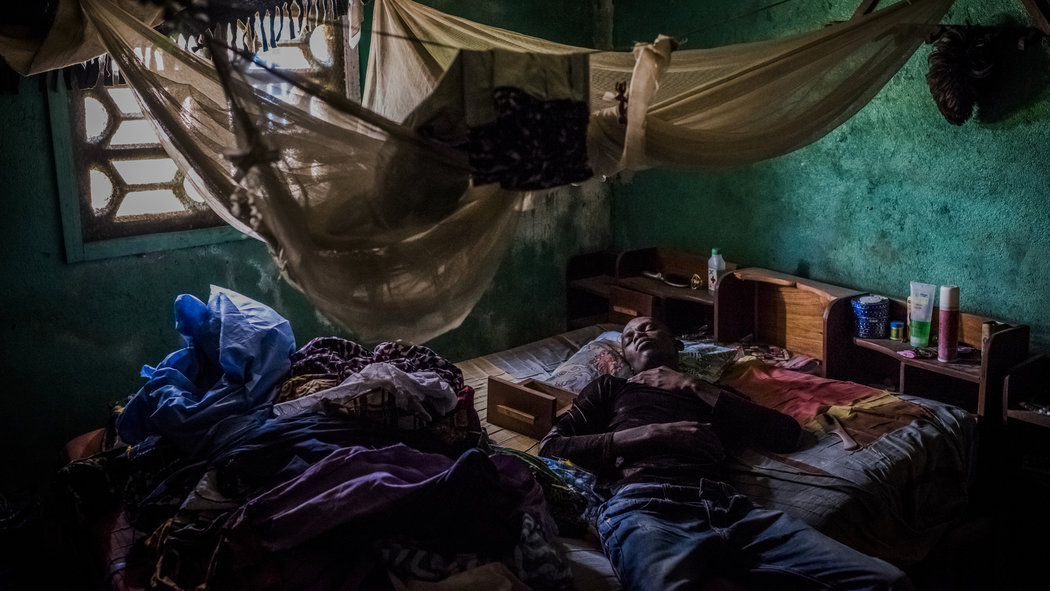
Daniel Berehulak for The New York Times
MONROVIA, Liberia — Days after Kaizer Dour died of Ebola at the edge of a mangrove swamp, strangers carried his rotting corpse in a dugout canoe for a secret burial. Out on an uninhabited, bush-covered island, far from the national basketball court where Kaizer won acclaim as one of Liberia’s most valuable players last season, the strangers fulfilled one of the most important duties of a Liberian family — burying the young man.
One of the men stood knee-deep in a shallow grave, shoveling sand over Kaizer’s 6-foot-2-inch body. The other, having steeled himself with swigs of a local gin called Manpower, gave a speech to bid Kaizer farewell in the absence of mourners.
“Your whole entire family, no one is here to represent you,” the man intones, his words captured in a cellphone video. “Your mother gave a rose that we should bury with you to remember her. She tried her best, but she was alone.”
The burial, one of countless unlisted deaths in the deadliest Ebola outbreak in history, was an anonymous end for a middle-class young man on the cusp of celebrity. A rising star in Liberia’s top basketball league, Kaizer, 22, had dreamed of making it to the Los Angeles Lakers, the home of his idol and fellow shooting guard, Kobe Bryant. His Facebook profile, updated just three weeks before his death on Aug. 9, shows him spinning a basketball, an overhead light beaming down on a face bearing a young man’s self-assuredness.
A proper burial surely would have drawn hundreds of people — teammates, friends, fans and members of his large family, for whom Kaizer was an enduring point of pride. But this strange, horrific disease called Ebola, new to this part of Africa, had already started dismantling his unusually tight family, bringing fear, anger and ultimately death to the people who cherished him.
Ebola is a family disease, Liberians are reminded continually in Sunday sermons. The more families pull together to fight the virus, the more they seem to fall apart.
Kaizer’s extensive family had survived Liberia’s 14-year civil war, growing stronger as it united against poverty, rapacious rulers and indifferent governments. So when Kaizer got sick, his mother, Mamie Doryen, did what the Doryens had always done, turning to her family to help with her ailing son.
Kaizer, infected by his father, soon passed the virus to two aunts. In all, seven members from three generations died in quick succession. His mother, the family’s dominant figure, survived. But blamed for the calamity, she went into hiding, a pariah in her family’s hour of greatest need. The family’s center could not hold.
“Ebola was like a bomb,” one of Kaizer’s uncles said.
This destruction of families is the central tragedy of the epidemic. On a continent with many weak states, the extended family is Africa’s most important institution by far. That is especially true in the nations ravaged by the disease — Liberia, Sierra Leone and Guinea — three of Africa’s poorest and most fragile countries. Ebola’s effects on the region, in undermining the very institution that has kept its societies together, could be long-term and far-reaching.
Even today, as help increases from the United States and other nations, many victims in the region are still being treated within the family, a place of succor — and a font of contagion.
“They were together, a strong family, but this Ebola broke the entire family apart,” said the Rev. James Narmah, a Pentecostal minister who knows Kaizer’s family. “That’s what’s happening right now. Ebola is bringing a lot of divisions, a lot of hatred, inside families and inside communities, everywhere.”
A Battle-Tested Family
Kaizer’s maternal grandparents, Joseph and Martha Doryen, had five sons and five daughters. All survived Liberia’s civil war from 1989 to 2003, a brutal one even by the standards of African wars of that era.
Before the fighting started, when rebels tried to oust the military dictatorship, Joseph Doryen worked as a driver at the agriculture ministry and then for a rich Ghanaian businessman. After the businessman fled the war, Joseph Doryen began growing potato greens in his Monrovia neighborhood, Capitol Hill. The children helped, and his wife sold the crop at a local market.
Until Joseph Doryen died three years ago, the old couple could often be seen strolling or sitting together under the mango tree behind their home. Their 10 children were all “same father, same mother,” a rarity in a large family of that generation.
They were also comparatively fortunate, escaping the rockets that frequently rained on Capitol Hill, destroying houses and killing residents.
Like its American model in Washington, the neighborhood derives its name from the nearby Capitol Building — one of the many ties between the United States and Liberia, a country founded by freed American slaves in 1822. But being next to Liberia’s seat of government made the neighborhood a frequent target.
Not even the war, however, was as bad as Ebola, the family said.
“Even when we were fighting war at that time, you know the safe place to go,” said Anthony Doryen, 39, the second-oldest son. “This one, you can’t even know where to go.”
“Ebola is a disease that eliminates families,” he added. “It makes you afraid because when you get around your family, apparently you get in contact with it. It makes you go far away from your family.”
Today, Capitol Hill’s dirt paths snake around houses with corrugated roofs held down by heavy rocks. To the east, the Temple of Justice peeks above the palm trees. The president’s Executive Mansion is a quick walk to the south. The Liberian flag outside government buildings — red and white stripes, with a white star in a blue box — can easily be mistaken for the American flag.
For the Doryens, postwar Liberia led to better lives. Like most residents, they still got their water from aging, unsanitary wells. But because they had property in Capitol Hill, they were better off than most, with steady jobs as gas station attendants, government cafeteria workers, cellphone-card salesmen and market traders.
Just as they had during wartime, the Doryens pulled together during peacetime. The children built separate houses near their parents and tore down the flimsy old family home, pooling their savings to build an eight-room concrete dwelling. It offered stability, cohesion — and a refuge for an ailing Kaizer.
A Father on Ebola’s Front Line
For most West Africans infected during the outbreak, the virus was transmitted quietly, through tender acts of love and kindness, at home where the sick were taken care of, or at a funeral where the dead were tended to.
But for Kaizer’s father, Edwin Dour, Ebola came violently on the night of June 25 after a gravely ill man — Patient Zero to the Doryen family — was brought to the beleaguered government-run clinic where Kaizer’s father was the chief administrator.
Six of 29 employees at the clinic died within a month of Ebola’s arrival. Kaizer’s father, known for never turning away patients, became infected, too, passing the virus to his son in a pattern seen across the city. The sick brought Ebola to defenseless health centers that in turn often helped spread the virus.
Despite the money that the United States and other governments had funneled into Liberia’s health care system in recent years, health centers quickly crumpled. The 16-year-old girl who had brought the disease from Sierra Leone to Monrovia died in the state-run Redemption Hospital on May 25. A doctor and five nurses there, working without gloves or the basics of infection control, died in rapid succession.
Though Redemption often did not have running water, it was one of the biggest medical centers in Liberia. So after it was closed in a panic in June, the sick scattered to nearby clinics, including the one managed by Kaizer’s father. They were even less prepared to deal with Ebola’s onslaught.
On June 25, a yellow taxi dropped off a young man in front of the clinic’s gate. The patient, a church caretaker, had apparently become infected when an old woman with Ebola was brought in for prayers. By the time the caretaker showed up at Kaizer’s father’s clinic, he was exhibiting the full-blown symptoms of late-stage Ebola: vomiting, diarrhea and — a peculiar sign of Ebola — uncontrollable hiccups.
Around 10 p.m., the sick man became violent and confused. “He was fighting — unstable — he was just going up and down, coming down on the bed, turning this way, that way,” said the physician assistant on duty, Moses Safa.
The guard held the man down. “Then he gave up the ghost,” Mr. Safa said.
The guard himself would soon die of Ebola, though not before transmitting it to Kaizer’s father. The clinic’s medical staff, terrified by the deaths at the state hospital, offered the ailing guard minimal care. Kaizer’s father was not authorized to provide care, but he volunteered to put the guard on an intravenous drip — and was infected in the process.
Kaizer’s father tested positive for Ebola, but the government did not tell his family. In theory, workers are supposed to inform families of test results; in practice, few tests have been carried out and the results rarely provided — another systematic failure that has contributed to Ebola’s spread.
Kaizer’s father, who was in his mid-40s, died July 23. Because his parents had separated years before, Kaizer helped tend to his dying father. But as has been the case for thousands who have died during this epidemic, the natural inclination to care for a loved one would prove his undoing.
On Aug. 9, Kaizer’s father was laid to rest at Good Shepherd Funeral Home in a closed coffin. Though the funeral hall could hold 100 people, only about 20 came, mostly workers from the clinic and friends from the father’s days as a soldier in the Liberian Army.
No family member came.
Shared Denial and Death
Overwhelmed by Kaizer’s illness, Mamie Doryen had brought him by taxi to her family in Capitol Hill. As day broke, the neighbors learned that an ailing Kaizer had been carried in overnight.
Fear spread quickly. The neighbors, who knew that Kaizer’s father had died, lived in close quarters and shared a well with the Doryens.
It was early August, and the government, reeling from the deaths at Redemption and other health facilities, was paralyzed. Many Liberians remained deeply skeptical of Ebola’s very existence, suspicious of government corruption. The government slogan — “Ebola Is Real,” written on billboards and posters — merely reinforced the popular belief that it was not.
Still, enough deaths had occurred in the capital that, for many, any illness immediately caused suspicion of Ebola.
“We, who had family around there, were getting afraid,” said Teddy Dowee, 21, a friend of Kaizer’s and the Doryen clan. “I was afraid.”
It is perhaps a peculiarity of the psychological response to Ebola that people outside an affected family, like the Doryens’ neighbors, were often better able to grasp the reality around them.
Those inside the family often wrapped themselves in layers of denial, as impermeable as the protective suits worn by health care workers. They denied Ebola’s presence in the family to avoid being ostracized — and to convince themselves that they could tend to a sick loved one.
They often had no choice: Throughout the Ebola hot zone, the chronic lack of treatment beds for months forced families to care for the sick at home.
And so Mamie denied that Ebola had killed her former husband, Edwin Dour, and sickened Kaizer. Instead, they had both been poisoned, she insisted, telling her family of a mysterious woman in black terrorizing Kaizer in his sleep.
Some of those closest to Mamie accepted the poisoning story, a widespread belief in Liberia. They had reason to put faith in her. She was the family anchor, a woman of about 40 whose real name was Yah but was always called Mamie because she acted like a mother to her younger siblings.
So the family allowed Kaizer to stay, sharing one room with three family members — all of whom would die.
As Kaizer remained inside, the neighbors demanded that the Doryens take him away, threatening to call the authorities. But the poisoning story gave the psychological room for his relatives — caught between their love for him and the fear of Ebola — to take care of him.
One morning, Tina Doryen, an aunt tending to Kaizer, took a bath using a bucket in which he had previously vomited. “If that Ebola want to kill me, let it kill me,” she said, Mr. Dowee recalled.
With Kaizer’s condition worsening, the Doryens finally took him outside — to a nearby church that was holding a two-week revival.
It was already dark and the reverend, Mr. Narmah, was wrapping up a sermon on hope when the double doors of the church opened suddenly. Kaizer staggered in, his large frame supported on either side by his two favorite aunts — Tina, 20, and Edwina, 24. With Ebola in mind, the reverend instructed the aunts, both members of his church, to stay at the back with Kaizer.
“He had no strength,” Mr. Narmah said. “He couldn’t talk.”
The congregation gathered around Kaizer for a prayer. Mr. Narmah poured anointing oil on Kaizer’s head. He told the members to stretch their arms toward Kaizer but to not touch him.
Kaizer’s family took no such precautions. To Martha Doryen, 29, another aunt, Kaizer was the kid nephew who had always asked her for a treat or pocket money. This year, seeing Kaizer play basketball for the first time — and play so well that a fan handed him $50 after the game — Martha realized with pride that he was “no small player.”
“They were afraid of Ebola,” Martha said of the church members. “It was my sister’s only son. How can I be afraid? I can’t lie. I touched him.”
The Doryens’ neighbors stepped up demands that Kaizer leave Capitol Hill as soon as possible. The Doryens acquiesced, telling Mamie to take her son.
‘There Was No Family’
Kaizer died the next morning in his mother’s home next to the swamp. No one from the family, except his grandmother, went there to help.
“We were angry and also afraid,” said Kaizer’s uncle, Abraham Keita.
Mamie continued to insist that Kaizer did not have Ebola. Perhaps because of her assurances, five church members joined around her son’s deathbed. As Kaizer lay dying, he said he saw the woman in black who had been beckoning to him in his troubled dreams. He could no longer hide from her, she told him, as those gathered around him prayed loudly in tongues.
Abruptly, Kaizer reached for his neck.
“He said he saw the woman, the spirit, standing over him, choking him,” said Rose Mombo, a church member there. “He was fighting.”
Kaizer, his eyes wide open, burst into tears, spat out something and died.
It happened just as his own father was being laid to rest. During the funeral service for Kaizer’s father, the scattered attendees learned that Kaizer had died as well.
The government was still incapable of responding in the most basic ways, including collecting the highly infectious bodies of the Ebola dead. So two days after Kaizer’s death, the stench of his corpse seeping out toward her neighbors, his mother asked one of them, Jerome Mombo, to bury her son.
Mr. Mombo took precautions against Ebola, adding $15 of his own money to the $55 in American currency Kaizer’s mother had given him. He paid fishermen $60 and spent the rest on chlorine, a spray gun, six empty rice bags to sew together as a burial shroud and bottles of Manpower.
The men drank the gin before entering the room, then again inside.
“Otherwise, I couldn’t do it,” said Mr. Mombo, who later delivered the brief farewell for Kaizer. “I had to drink something to give me more power.”
Heavy rain allowed the fishermen to paddle all the way to a flooded area behind the home of Kaizer’s mother. Tony Kaba, 22, a basketball player and friend of Kaizer’s, stood at a distance and watched the men take the body away.
“There was no family,” he said.
It took half an hour down the Mesurado River to reach Kpoto Island, one of many uninhabited islands up a channel called Creek No. 2. With soft, sandy soil, Kpoto has long been used by the poor to bury their dead. Now, freshly dug graves are obvious in the thick bush.
Many relatives of Ebola victims are believed to have carried out secret burials across the region because bodies are simply not picked up in time, or the families do not want to surrender relatives for mass incinerations. Such burials are believed to contribute to a significant undercount of the Ebola dead in Liberia, Sierra Leone and Guinea.
For Kaizer’s team, the Timberwolves, his death upturned the future. It had planned to build the franchise around Kaizer, who seemed destined to become the top player in the Liberia Basketball Federation, said Jairus Harris, the team’s vice president.
Kaizer was fast, shot well and fearlessly challenged any opponent. Over the years, two Liberians had come close to playing in the National Basketball Association in the United States, a source of pride for Liberian basketball.
“Kaizer would have made it in the N.B.A.,” Mr. Harris said. “I’m sure.”
Instead, his mother returned alone to Capitol Hill, seeking the comfort that the Doryens had always provided one another. But things were different this time. The consequences of the family’s rallying around Kaizer were quickly becoming clear.
Kaizer’s two favorite aunts, the ones who had held him up in church, died on the same day, Aug. 27, less than three weeks after he did. Kaizer’s grandmother and a cousin were visibly sick, too. Some of Kaizer’s uncles had fled Capitol Hill. The remaining Doryens gathered in a daze.
“It was a scene to behold,” said the Rev. Alvin Attah, who has known the family for decades. At the pastor’s urging, Kaizer’s grandmother boarded an ambulance to a treatment center.
Blamed for bringing Ebola to Capitol Hill, Kaizer’s mother could not return to her family home. She wandered toward her church half a mile away and knocked on the homes of congregation members, searching for a place to spend the night.
“But they refused to let her in,” said Felicia Koneh, a family friend. “Everybody was afraid. No one knows where she went after that.”
“It’s pathetic, you know, to see a family just fall apart,” she said.
Distance and Guilt
Ebola is an insidious disease. It turns compassion into a danger. It turns survival into a haunting source of guilt.
Kaizer’s cousin, Esther, 5, the daughter of his beloved Aunt Tina, was clearly sick. On the day Tina died, Esther’s father faced the anguish of going to see his ailing daughter in Capitol Hill — but being too afraid to get close enough to comfort her.
“She tried to get to me, but I stood at a distance,” said her father, Lester Morris, 27, who had separated from Tina this year. “I told her to go to her Auntie Julie.”
The guilt and pain of trying to protect himself was wrapped in a tight knot inside him, a feeling shared by many other survivors.
“To see a loved one separated from you, you talk on the telephone and say, ‘I’m dying,’ and you cannot go — it’s more painful than the war,” said Lester’s father, Joseph Morris.
It is a comparison heard often, one that may seem extreme. The war killed perhaps a quarter-million Liberians, Ebola only 2,800 officially in this country so far. The war’s destruction of Monrovia can still be seen in its broken roads, schools and buildings. Ebola has left no physical scar.
But to many Liberians, the pain of Ebola is greater. Often, the only sure way to survive is to abandon one’s family.
Esther’s father and uncle begged the government for help. The family repeatedly called its Ebola hotline to get her out of Capitol Hill, but received only empty promises.
It was late August, and the government was panicking. It had deployed soldiers to quarantine Monrovia’s largest slum, setting off deadly riots. The cost of paralysis by the international community was continuing to mount.
The Doryens worried that Esther would infect them, as Kaizer had. On Aug. 31, one of the remaining aunts, Julie Doryen, guided the girl with a stick to the main road outside Capitol Hill. Esther collapsed on the sidewalk.
A large, angry crowd watched from across the street, drawing the police and, finally, an ambulance. Esther, who had appeared dead, stirred to life. Her father, Lester, arrived minutes after she was put inside the ambulance.
She was taken to an Ebola treatment center. Her father and uncle visited and thought she was doing better.
Before visiting again, Lester looked wistfully at a Christmas card from last year. In it, wearing a red dress with a big white ribbon, Esther stands against an idealized American backdrop of a colonial house, a green lawn and a white picket fence.
Overnight, her uncle received a call from a friend inside the center. Esther had died. He did not tell Lester. On the taxi ride there, Lester began to suspect his brother was hiding something. By the time they arrived in front of the center at 10:30 a.m., Lester was yelling at his brother. Lester paced back and forth, his eyes reddening.
“He’s weeping,” said a man nearby.
“Maybe somebody dying?” said another.
“Brother, you gotta be a man,” a taxi driver said. “Be a man, yeah? Don’t be crying.”
Lester did not cry inside the center when told about his daughter’s death. He said nothing. His brother asked for the body for a proper funeral, or at least a photograph. Neither was possible.
The brothers went to Capitol Hill to inform the Doryens. The remaining family gathered outside. Martha Doryen, Kaizer’s aunt, started wailing, throwing her hands in the air. There were no tears, but the sound echoed throughout Capitol Hill.
With no body to bury, Lester could not meet his traditional duties. Suddenly, he started crying, uncontrollably, tears streaming down his face. The women, and his brother, looked away.
Coming to Grips
Within hours of the death of Kaizer’s Aunt Tina, the other aunt who had held him up in church, Edwina Doryen, died as well. Two weeks later, her husband, Mark Jerry, sat slumped outside an Ebola treatment center. Their daughter Princess sat to his right, resting her forehead against the wall. Both were too weak even to drink water.
For days, Mark had maintained his denials about the family illnesses. He was sick, too, but told friends he had typhoid and switched off his cellphone. After Princess fell ill, things changed.
“I’m convinced it was Ebola,” Mark said.
It was mid-September, and Liberia stood on a precipice. Monrovia had become the focal point of the outbreak in West Africa. Infections were doubling every two to three weeks.
Mark and Princess were lucky to receive treatment at all. But while Mark, 27, improved, Princess, 9, did not. She died within days.
After being discharged with a letter that he was “no longer infectious,” Mark began working for Doctors Without Borders. Once a denier of Ebola, he became an evangelist.
Mark, a money changer, and Kaizer’s Aunt Edwina, a restaurant worker, had spent years saving $900 to build their home, a simple structure steps away from the Doryen house. He had suspected that Kaizer had Ebola. The unease felt by the Doryens’ neighbors in Capitol Hill had unsettled him.
But he had blocked out those doubts when Edwina got sick. What else could he do but take care of her?
“Edwina and I were like one person,” he said. “I would bathe her. She was toileting all day. I would clean her, and then after two, three minutes, she would toilet. I would clean her again.”
He took her to a local clinic, where they were told that she had a chest cold. Finally, with Edwina unable to walk and bleeding from the mouth, Mark carried her on his back and put her in a taxi to the hospital. Turned away for lack of beds, she was taken to an Ebola holding center. She died there the next day, on a brown mattress on a filthy floor, surrounded by body fluids.
A rage built within him. All the suffering — all the pointless deaths in the family — stemmed from a betrayal, he said: Mamie’s refusal to admit what was wrong with Kaizer.
She had at least suspected the truth, Mark said. Once Edwina became symptomatic, Kaizer’s mother, the progenitor of the poisoning narrative, offered a suspicious warning.
“She said, ‘Mark, the way you’re taking care of Edwina, you got to get chlorine water on the side, and when you finish taking care of her, you wash your hands,’ ” he recalled.
“She acted very bad, my sister-in-law; she knew that her son had the virus and she never educated us,” Mark said. “To me, she was wicked. I don’t call that ignorance. I call that wickedness.”
Adrift in Anger
The disappearance of Kaizer’s mother quickly set the Doryens adrift, leaving them to endure one loss after another without their central figure.
Four of Kaizer’s aunts and cousins died in a month. Kaizer’s grandmother died, too, on Aug. 31. But the Doryens did not even find out about her death for nearly two weeks. Mamie, as the head of the family, gave her cellphone as a contact number when the ambulance took away the grandmother. When Mamie disappeared, health officials were unable to contact the Doryens.
Mamie’s absence stirred fierce disagreement, another source of division in the family. Some saw it as proof of her deception. Others, like her brother, Anthony Doryen, imagined her grief.
“Everybody is angry with her,” he said. But “she herself lose her mother, she lose her son, she lose two sisters.”
As word of the family deaths in Capitol Hill spread to Mamie’s neighbors near the swamp, they grew alarmed. Mr. Mombo, who buried Kaizer, reached Mamie by phone after many attempts.
“Why you running from place to place?” Mr. Mombo asked her. “But since then, her phone is switched off.”
Mamie insisted in a brief phone interview that Kaizer was poisoned and died after the woman in black told him he was “finished.”
“Everybody is carrying my name around,” Mamie said. “I didn’t do anything.”
“Nobody should blame me,” she added. “The devil is very busy. The Capitol Hill people saying I’m the one carrying Ebola there. All my family dying.”
Forgiveness and Hope
By late September, after the death of Kaizer and six of his close relatives, the sickness seemed at bay. Twenty-three days had passed since the last sick family member was taken out of Capitol Hill, two days beyond Ebola’s maximum incubation period.
“It’s good to stay alive,” said Abraham Keita, Kaizer’s uncle.
He smiled, stretched and brought out a DVD, “Monrovia on Fire,” a local martial arts film in which he had a supporting role. He hoped for a bigger part in a sequel. Mr. Keita, a furniture maker and taekwondo master, was planning for the future.
One of the Doryen brothers had returned to Capitol Hill, though he still kept his wife and children away. Mr. Keita hoped the other Doryens would follow, including Mamie.
“Before, yes, I was angry,” he said. “Everybody was angry with her.” He laughed. “Now I can forgive her. That’s what God says.”
“Maybe after one month, two months, she will come back, because we are the same family.”
In Liberia, too, the mood has begun to shift. New Ebola cases have dropped significantly, leading some international and local health officials to say they are making headway against the disease. On Thursday, President Ellen Johnson Sirleaf lifted the state of emergency imposed on the country, saying “we can all be proud of the progress.”
Weeks earlier, Martha Doryen, Kaizer’s aunt, stood outside her house. A cellphone number and “Yah” — Mamie’s real name — were scribbled on the front wall with charcoal.
Mamie’s new cellphone number?
Instead, Martha looked at her 13-year-old daughter, who had just celebrated receiving her first cellphone by writing the number on the house. Her name is also Yah. Thirteen years ago, Martha asked her big sister, Mamie, to name her firstborn. Mamie named the girl after herself, Yah, a new generation’s hour come round at last.
Then, almost as an afterthought, Martha mentioned that Mamie had called that morning, the first time since she was forced from Capitol Hill a month earlier. Martha was sitting on her porch making dry rice with fish. An unknown number had flashed on her cellphone.
“She says she’s fine,” Martha said. “She’s just telling us to wash our hands, stay away from people and be with ourselves. Because herself, she is O.K., taking the same advice she gave us.”
Clair MacDougall contributed reporting.
By Adam Nossiter
MAKENI, Sierra Leone — “Where’s the corpse?” the burial-team worker shouted, kicking open the door of the isolation ward at the government hospital here. The body was right in front of him, a solidly built young man sprawled out on the floor all night, his right hand twisted in an awkward clench.
The other patients, normally padlocked inside, were too sick to look up as the body was hauled away. Nurses, some not wearing gloves and others in street clothes, clustered by the door as pools of the patients’ bodily fluids spread to the threshold. A worker kicked another man on the floor to see if he was still alive. The man’s foot moved and the team kept going. It was 1:30 in the afternoon.
In the next ward, a 4-year-old girl lay on the floor in urine, motionless, bleeding from her mouth, her eyes open. A corpse lay in the corner — a young woman, legs akimbo, who had died overnight. A small child stood on a cot watching as the team took the body away, stepping around a little boy lying immobile next to black buckets of vomit. They sprayed the body, and the little girl on the floor, with chlorine as they left.
As the Ebola epidemic intensifies across parts of West Africa, nations and aid agencies are pledging to respond with increasing force. But the disease has already raced far ahead of the promises, sweeping into areas that had been largely spared the onslaught and are not in the least prepared for it.
The consequences in places like Makeni, one of Sierra Leone’s largest cities, have been devastating.
“The whole country has been hit by something for which it was not ready,” said Dr. Amara Jambai, director of prevention and control at Sierra Leone’s health ministry.
Bombali, the district that includes this city, went from one confirmed case on Aug. 15 to more than 190 this weekend, with dozens more suspected. In a sign of how quickly the disease has spread, at least six dozen new cases have been confirmed in the district in the past few days alone, health officials said. The government put this district, 120 miles northeast of the capital, Freetown, under quarantine late last week, making official what was already established on the ground. Ebola patients are dying under trees at holding centers or in foul-smelling hospital wards surrounded by pools of infectious waste, cared for as best they can by lightly trained and minimally protected nurses, some wearing merely bluejeans.
“There’s no training for the staff here,” said Dr. Mohammed Bah, the director of the government hospital here. “The training is just PowerPoint. It is very difficult to manage Ebola here.”
In recent weeks, the world has vowed to step up its response to the epidemic, which has been spreading for more than six months. The United States has sent a military team to neighboring Liberia with plans to build 18 treatment centers to prop up the broken health system. The British have promised to build field hospitals in four urban areas in Sierra Leone, including this one. The French are setting up a treatment center and a laboratory in Guinea. The Chinese have sent scores of medical personnel to the region and have converted a hospital they built outside Freetown into a holding center for Ebola patients. The Cubans have pledged to send more than 400 doctors to help battle the disease in the region.
But little of that help has reached this city. The dead, the gravely ill, those who are vomiting or have diarrhea, are placed among patients who have not yet been confirmed as Ebola victims — there is not even a laboratory here to test them. At one of the three holding centers in Makeni, dazed Ebola patients linger outside, close to health workers and soldiers guarding them. The risk of infection is high, the precautions minimal. Patients are kept at the holding centers, receiving a minimum of care, until space opens up at a distant treatment center.
“We encourage them not to have contact with body fluids,” said the district medical officer, Dr. Tom Sesay.
There is no Ebola treatment center here and the patients, some of them critically ill, must be taken eight hours over bad dirt roads to the one operated by Doctors Without Borders in Kailahun — that is, when space is available there. Some die on the way. At least 90 people already have died in the district, health officials say — a figure far in excess of what the government in the capital has reported for Bombali. Yet the World Health Organization and others are still relying on Sierra Leone government statistics that appear to seriously undercount the number of victims.
Outside the district medical officer’s headquarters at the edge of Makeni — a mining hub in better days — ambulances race off constantly for new bodies. Reports of new cases poured in all weekend.
“We’re fighting to see how we can control it,” Dr. Sesay said. “But we’re not being helped by the fact that we have nowhere to take our patients.”
The survival rate in Bombali district is “low,” Dr. Sesay noted.
Indeed, the holding centers appear to be little more than stiflingly hot places to die. At one of the three in Makeni, known as the “Arab Hospital” because it was built with money from Gulf states, five had died overnight and into the morning one day last week; four more were expected to go by that night.
One of them, a small boy, lay curled up under a wooden bed frame, and a nurse explained that he was “in the last stage, vomiting blood.” Outside the building, a boy of around 10 propped himself up as best he could against a wall, blood around his eyes, defecating.
“A lot of babies are dying here,” said Mohammed Kamara, a soldier guarding the facility.
Three patients lay prostrate under a mango tree in the dirt courtyard, one of them motionless with his arms and legs fully extended, crosslike.
“When they start bleeding, they go inside, and they will not come back out,” said Evelyn Bangura, the nurse running the holding center. Close to 30 have died since the center opened on Sept. 20.
“I don’t want them to be outside,” Ms. Bangura complained. “We want to minimize the spread.” But some of the healthier patients are aggressive and have tried to break out of the facility; Mr. Kamara, the soldier, had to cock his gun, he said. Indeed, three men shouted from one end of the courtyard, demanding to be released: “So healthy for us!”
Some patients who ultimately tested negative for Ebola have been let out of the holding centers, prompting a large crowd to pour into the streets to celebrate this week, thinking it meant that Ebola had been defeated. The government quickly issued a statement saying that, to the contrary, the disease “is still with us and spreading fast.”
For many patients, the prognosis is bleak. “They are deteriorating day by day; even to swallow for them is a problem,” Ms. Bangura said, adding that the constant flow of bodies, and the hospital’s inability to help, were taking a toll on the beleaguered staff.
“To watch people like this deteriorating, deteriorating, it is like a psychological trauma for us,” she said. “Very painful for us.”
The nurses do what they can, dispensing anti-malarial medication, deworming the patients, giving them analgesics. But virtually all of those not already comatose appeared glassy-eyed and listless.
Down the road, an ambulance pulled up, delivering eight new patients to the third holding center; two were too far advanced to walk into the low-rise concrete facility at the edge of Makeni.
“The problem we are having is the little children,” said the chief health officer there, Unisa Kanu.
Unicef said Tuesday that the Ebola epidemic had orphaned at least 3,700 children in the region.
“Their mothers are already dead; we have seven orphans now,” Mr. Kanu said. “That is the problem we are having now.”
By Adam Nossiter
FREETOWN, Sierra Leone — It has been sitting idly on the docks for nearly two months: a shipping container packed with protective gowns, gloves, stretchers, mattresses and other medical supplies needed to help fight Sierra Leone’s exploding Ebola epidemic.
There are 100 bags and boxes of hospital linens, 100 cases of protective suits, 80 cases of face masks and other items — in all, more than $140,000 worth of medical equipment locked inside a dented container at the port since Aug. 9.
Hundreds of people have died of Ebola in Sierra Leone since then, and health workers have endured grave shortages of lifesaving supplies, putting them at even greater risk in a country reeling from the virus.
“We are still just hoping (!!!) — which sounds like BEGGING — that this container should be cleared,” one government official wrote in a frantic email to his superiors, weeks after the container arrived.
“It’s a mess,” said one foreign official working alongside the Sierra Leone government agency set up to deal with the crisis. The official, who spoke on condition of anonymity to maintain vital relations with the government, said that nobody appeared to be in charge at the agency, known as the “emergency operations center,” and that different factions made decisions independently.
“It’s the only body responsible,” the official said. “What is it doing?”
In the case of the shipping container, the desperately needed supplies seem to have been caught, at least in part, in a trap that is common the world over: politics, money and power.
The supplies were donated by individuals and institutions in the United States, according to Chernoh Alpha Bah, who organized the shipment. But Mr. Bah wears another hat, as well. He is an opposition politician from President Ernest Bai Koroma’s hometown, Makeni — a place that clearly showed the government’s inability to contain Ebola.
A recent surge of cases there quickly overwhelmed health workers, with protective gear so lacking that some nurses have worked around the deadly virus in their street clothes.
More than 80 health care workers in Sierra Leone have died in the outbreak, and even in the capital, Freetown, some burial crews wear protective gowns with gaping holes in them, a clear indication of the urgent need for more supplies.
The government official who pleaded for the shipment to come in said that the political tensions may have contributed to the delay, to prevent the opposition from trumpeting the donations.
Mr. Bah said he thought the equipment would be welcomed by the struggling authorities, and he said he expected the shipping fee of $6,500 would be a small detail for Sierra Leone. According to the official, the government has already received well over $40 million in cash from international donors to fight Ebola.
The shipping company, as a good-will gesture in a moment of crisis, had agreed to send the goods without being paid first, Mr. Bah said. But no more. Three other containers of similar value await shipment from the United States, he said, halted by the government’s long refusal to pay.
“We will appreciate if the payment is made quickly so that the medical supplies will be sent directly to the affected or targeted areas,” Mr. Bah wrote to the government on Aug. 16.
Instead, top government officials argued over the fee, said that the proper procedures had not been followed, and finally brushed aside the official urging that the supplies be let in, saying they wanted to hear nothing more about it.
“They are blaming us for shipping in without authorization,” Mr. Bah said. “It appears all they are interested in is cash donations. And all we have are supplies.”
At one point, a senior official close to the president, Sylvia Olayinka Blyden, acknowledged in an email that the items listed in Mr. Bah’s container were “very impressive.” But she said “future shipments” should follow procedure. That was on Sept. 1, and she has since left her post. The goods are still inside the container on the dock here.
“He should have contacted the ministry and discussed it with the ministry,” Yayah A. Conteh, an official at the health ministry, said of Mr. Bah, adding that the medical supplies would be cleared “very soon.”
In times of crisis, when needs are great and officials are overburdened, trickles of uncoordinated donations can be a distraction, some aid workers say, requiring a lot of attention without solving the biggest problems.
But some Sierra Leoneans say that the government’s resistance has discouraged other potential donors in the diaspora.
Ibrahim Kamara, a Sierra Leonean in Canada who has put together what he says is a $55,000 container of medical supplies, said that he was now encountering the same problems with the government — an unwillingness to pay the $5,000 shipping fee.
“There is no positive response, no feedback, no anything,” Mr. Kamara said. “It’s been over a month now.”
The emergency operations center was established to manage the urgent but confusing patchwork of agencies and international aid groups trying to battle the virus. The health ministry itself has been rocked by corruption and mismanagement scandals in recent years, further weakening efforts in a country that, even before the Ebola epidemic, suffered from some of the world’s worst health statistics after a brutal 10-year civil war.
Twenty-nine of the country’s top health officials were indicted last year in connection with the misappropriation of a half-million dollars in vaccination funds. The leaders were all acquitted. A free health care program set up by foreign donors has been damaged by corruption problems, with nurses illegally selling drugs and doctors charging for services. In 2010, a former health minister was convicted on corruption charges. This year, the health minister was pushed aside during the Ebola crisis amid questions over her competence.
At a recent meeting at the emergency operations center, local politicians discussed at length how they might be able to use the government’s recent three-day national lockdown — in which volunteers went door-to-door to educate people about Ebola — for their own political benefit.
Meanwhile, reported cases of Ebola are doubling every 30 to 40 days, according to the United States Centers for Disease Control and Prevention. More than 620 deaths have been recorded, with the real number almost certainly much higher.
The government official who pleaded for the supplies to be let in argued that the epidemic, “like the war we experienced between 1991 and 2002,” had exposed the extent of government corruption.
The more urgent the pleas, the official said, the more it “elicited only disdain from some people in authority.”
By Sheri Fink
With treatment centers overflowing, and alarmingly little being done to stop Ebola from sweeping through West African villages and towns, Dr. Joanne Liu, the president of Doctors Without Borders, knew that the epidemic had spun out of control.
The only person she could think of with the authority to intensify the global effort was Dr. Margaret Chan, the director general of the World Health Organization, which has a long history of fighting outbreaks. If the W.H.O., the main United Nations health agency, could not quickly muster an army of experts and health workers to combat an outbreak overtaking some of the world’s poorest countries, then what entity in the world would do it?
“I wish I could do that,” Dr. Chan said when the two met at the W.H.O.'s headquarters in Geneva this summer, months after the outbreak burgeoned in a Guinean rain forest and spilled into packed capital cities. The W.H.O. simply did not have the staffing or ability to flood the Ebola zone with help, said Dr. Chan, who recounted the conversation. It was a fantasy, she argued, to think of the W.H.O. as a first responder ready to lead the fight against deadly outbreaks around the world.
The Ebola epidemic has exposed gaping holes in the ability to tackle outbreaks in an increasingly interconnected world, where diseases can quickly spread from remote villages to cities housing millions of people.
The W.H.O., the United Nations agency assigned in its constitution to direct international health efforts, tackle epidemics and help in emergencies, has been badly weakened by budget cuts in recent years, hobbling its ability to respond in parts of the world that need it most. Its outbreak and emergency response units have been slashed, veterans who led previous fights against Ebola and other diseases have left, and scores of positions have been eliminated — precisely the kind of people and efforts that might have helped blunt the outbreak in West Africa before it ballooned into the worst Ebola epidemic ever recorded.
Unlike the SARS crisis of 2003, which struck countries in Asia and elsewhere that had strong governments and ample money to spring to action, the Ebola outbreak has waylaid nations that often lack basic health care, much less the ability to mount big campaigns to stamp out epidemics.
The disease spread for months before being detected because much of the work of spotting outbreaks was left to desperately poor countries ill prepared for the task. Once the W.H.O. learned of the outbreak, its efforts to help track and contain it were poorly led and limited, according to some doctors who participated, contributing to a sense that the problem was not as bad as it actually was. Then, as the extent of the epidemic became obvious, critics say the agency was slow to declare its severity and come up with plans, and has still not marshaled the people and supplies needed to help defeat the disease and treat its victims.
“There’s no doubt we’ve not been as quick and as powerful as we might have been,” said Dr. Marie-Paule Kieny, a W.H.O. assistant director general.
Another W.H.O. leader agreed. “Of course in retrospect I really wish that we had jumped much higher much earlier,” said Dr. Keiji Fukuda, the assistant director general in charge of outbreak response. “Of course I wish we’d poured in more and more earlier.” But, he added, “if this outbreak had been a typical outbreak, nobody would be saying we did too little, too late.”
The outbreak began close to the borders of three neighboring countries — Guinea, Sierra Leone and Liberia — and spread surprisingly fast. Since then, the W.H.O. has engaged more than 400 people to work on the outbreak, including employees of other agencies in its network, and in August the agency declared the epidemic an international emergency, hoping to stop it from crossing more borders. Dr. Chan has met with presidents in the region, and last week the W.H.O. announced what it called a road map for a “massively scaled” international response.
The current outbreak has killed more than 1,900 people and spread to the point that the W.H.O. warns that more than 20,000 people could become infected. Sick people are dying on the street. Some feel the entire model the world uses to fight outbreaks needs to be rethought, so that an agency like the W.H.O. has the structure and mandate to take command.
But Dr. Chan said that governments have the primary responsibility “to take care of their people,” calling the W.H.O. a technical agency that provides advice and support. Still, she noted that her organization, like many governments and agencies, was not prepared.
“Hindsight is always better,” Dr. Chan said. “All the agencies I talked to — including the governments — all of us underestimated this unprecedented, unusual outbreak.”
A Shift in Emphasis
The W.H.O., founded in 1948, is responsible for taking on a wide range of global health issues, from obesity to primary health care. But since the world’s health needs far outstrip the financial contributions of the W.H.O.'s 194 member nations, those priorities compete.
The threat of emergent infectious diseases jumped high onto that list 20 years ago, when an outbreak of plague in India created a panic, sending about 200,000 people fleeing. The next year in Zaire, now the Democratic Republic of Congo, Ebola killed about 245 people. With fears of cross-border infections high, a new urgency arose: improving the world’s ability to stop outbreaks.
The W.H.O. took the lead, at the request of its member nations. A crew of passionate outbreak veterans assembled a unique department, using an early form of electronic crowdsourcing to detect outbreaks and dispatching experts to the field. Three years after the effort solidified, the W.H.O. played a big role in responding to a cluster of deadly pneumonia cases in Asia. The new virus became known as SARS, and it was contained within the year, with most cases occurring in China.
To aid the fight, wealthy individuals offered the W.H.O. “literally hundreds of millions because their businesses were affected,” said Dr. Jim Yong Kim, president of the World Bank and a former director at the W.H.O. “But as SARS burned out, those guys disappeared, and we forgot very quickly.”
Soon, the global financial crisis struck. The W.H.O. had to cut nearly $1 billion from its proposed two-year budget, which today stands at $3.98 billion. (By contrast, the budget of the Centers for Disease Control and Prevention for 2013 alone was about $6 billion.) The cuts forced difficult choices. More emphasis was placed on efforts like fighting chronic global ailments, including heart disease and diabetes. The whims of donor countries, foundations and individuals also greatly influenced the W.H.O.'s agenda, with gifts, often to advance specific causes, far surpassing dues from member nations, which account for only 20 percent of its budget.
At the agency’s Geneva headquarters, outbreak and emergency response, which was never especially well funded, suffered particularly deep losses, leaving offices that look, one consultant said, like a ghost town. The W.H.O.'s epidemic and pandemic response department — including a network of anthropologists to help overcome cultural differences during outbreaks — was dissolved, its duties split among other departments. Some of the main outbreak pioneers moved on.
“That shaping of the budget did affect the area of responding to big outbreaks and pandemics,” said Dr. Fukuda, who estimated that he now had 35 percent fewer employees than during the 2009 H1N1 flu pandemic — more than double the cuts for the organization as a whole.
“You have to wonder are we making the right strategic choices?” he said. “Are we ready for what’s coming down the pike?”
The entire W.H.O. unit devoted to the science of pandemic and epidemic diseases — responsible for more than a dozen killers, including flu, cholera, yellow fever and bubonic plague — has only 52 regular employees, including secretaries, according to its director, Dr. Sylvie Briand, who said that could be increased during outbreaks. Before the Ebola epidemic, her department had just one technical expert on Ebola and other hemorrhagic diseases.
Across Africa, the ranks of the agency’s regional emergency outbreak experts, veterans in fighting Ebola, were cut from more than a dozen to three. “How can you immediately respond to an outbreak?” said Dr. Francis C. Kasolo, a W.H.O. director. “It did affect us.”
And a separate section of the W.H.O. responsible for emergency response was whittled “to the bone” during the budget cuts — to 34 staff members from about 94 — according to Dr. Bruce Aylward, its assistant director general.
“You can’t make a cut that big, that deep, and it’s not going to have an effect on your operational capacity,” he said.
His group, charged with responding to wars, disasters and resurgent polio, was asked in August to assist with Ebola, too. “At no time that I can think of in the recent past have we been dealing with such a scale of human misery over such a broad geography due to such a range of hazards,” he said, including enormous population displacements in Syria, Iraq, the Central African Republic and South Sudan. But, officials warn, multiple, overlapping challenges may well be a feature of the future.
The W.H.O. hoped to balance its budget cuts by strengthening the ability of countries to respond to public health threats on their own. It put out new regulations for nations to follow to help contain outbreaks. But by 2012, the deadline it set, only 20 percent of nations had enacted them all. In Africa, fewer than a third of countries had programs to detect and stop infectious diseases at their borders. The W.H.O.'s strategy was often more theory than reality.
“There never were the resources to put those things in place in many parts of the world,” said Dr. Scott F. Dowell, a specialist formerly with the C.D.C.
A Disease Finds Its Opening
The Ebola virus took full advantage of these poorly prepared nations and the holes at the W.H.O.
Given the weakness in surveillance, the outbreak was not identified until March, in Guinea, roughly three months after a villager was believed to have contracted the virus from an animal, possibly a fruit bat. The delay allowed dozens of cases to spread through villages and even to Conakry, a capital of more than one and a half million people. Right away, Doctors Without Borders declared the outbreak unprecedented in its reach, the only group to do so.
Hastening the spread, hospitals lacked basic infection-control essentials like running water, protective gowns and gloves. Many doctors and nurses caught the virus from their patients, passed it to others, and died. The vulnerability and collapse of medical facilities revealed how far there is to go in achieving the W.H.O.'s top priority — ensuring basic global health care.
“This kind of outbreak would not have developed in an area with stronger health systems,” Dr. Fukuda said.
In the crucial weeks after the discovery, daily meetings brought together national authorities and foreign responders at the W.H.O. office in Conakry. But an absence of strong leadership and professionalism was notable from the beginning, participants said.
“It’s purely improvisation,” said Marc Poncin, the emergency coordinator for Doctors Without Borders in Conakry. “There is no one to take responsibility, absolutely no one, since the beginning of the crisis.”
Stopping previous Ebola outbreaks had required meticulous tracking: monitoring people who had close contact with infected individuals and isolating them if they developed symptoms. Previously, “if we missed a case,” said Dr. Simon Mardel, a British emergency doctor deployed by the W.H.O. to help with the effort, “it was like a failure.”
This time, the number of contacts being followed was disastrously low from the beginning, only 8 percent in the epicenter of Guéckédou, Guinea, in early April, according to another doctor sent by the W.H.O. That meant the disease was silently spreading. Dr. Mardel said he thought the more experienced W.H.O. leaders who had left the agency “would have been very vocal, and they would have sought to put it right quickly, as a matter of urgency.” A single person who traveled and became sick could touch off a conflagration.
It was not that responders were not trying. Victims’ contacts were spread across a wide area, hours away on bad roads. The payment of local workers had somehow been overlooked, so they stopped doing vital, risky jobs. Essential protective equipment was not delivered to many who needed it. Bottles of bleach were given out without buckets. The W.H.O. lacked relationships with some longstanding organizations with large networks of health workers in the region.
Traditions that contributed to Ebola’s spread, including funerals where mourners came into contact with corpses, were not fully recognized or confronted, said Dr. Pierre Rollin, an outbreak specialist at the Centers for Disease Control and Prevention who worked within the W.H.O. umbrella.
Some villagers blocked roads with tree trunks and drove Ebola workers away with stones, accusing them of bringing in the disease. Adding to the tension, only bare-bones clinical care was provided to try to treat patients, reducing the chances of yielding survivors who could act as ambassadors for the cause. Some doctors deployed by the W.H.O. said it should have given them more tools to care for patients.
Institutional and personal tensions flared. “Everyone’s working at a fevered pace,” Dr. Dowell said. “There’s confusion and chaos. It argues for a system that’s organized as much as possible ahead of time so people know their roles.”
One consultant thought it strange that the W.H.O. would not send Twitter messages with links to the C.D.C.'s Ebola prevention information, part of a policy not to promote material from other agencies. Various offices within the W.H.O.'s balkanized hierarchy also jockeyed for position.
The difficulties in tracking cases and gaining access to villages led many to think the outbreak was burning out. “I came home sort of thinking, with a little luck, that’s wrapped up,” said Dr. Daniel Bausch, an Ebola outbreak veteran from Tulane University, who returned in May from a W.H.O. mission in Guinea.
The outbreak was not gone, just hidden. An herbalist in Sierra Leone contracted the virus treating Guinean patients. More than a dozen mourners at her funeral fell ill and seeded Sierra Leone. Some of them traveled back to Guinea and rekindled the outbreak there. After a lull of several weeks, cases re-emerged in Liberia, too, and reached the capital, Monrovia.
Dr. Bausch flew to Sierra Leone in July. “I was like, ‘where is everybody?’ ” referring to the shortage of health workers fighting the disease. “We all recognized we were really understaffed. We needed more people in the field.”
In some treatment centers, two or three doctors, wearing stifling gowns and masks in the heat, were caring for up to 90 patients. With the only W.H.O. logistician in the country working elsewhere, Dr. Bausch did not have anyone to accompany him and manage supplies of protective equipment, he said.
Dr. Bausch worked in Kenema, Sierra Leone, where he had helped set up a research program for another hemorrhagic fever, Lassa, which was common in the region. He knew some of the nearly two dozen health workers there who died after Ebola hit.
“It would be a logical question to ask, since Lassa was there, why was it so hard to switch gears” to Ebola?, Dr. Bausch said. But research institutes provided money for science, he said, not for disease surveillance and treatment. Those tasks had been left to the government of Sierra Leone, “one of the poorest countries on earth,” he said. “I always felt bad about this.”
In late July in Liberia, two Americans working at a missionary hospital fell sick and were soon evacuated home. A Liberian-American brought the virus by plane to Nigeria, Africa’s most populous nation. Suddenly, the world seemed to understand the threat.
The question now, experts wonder, is whether the leaner, retooled W.H.O. — heavy on technical know-how, light on logistical muscle — can surge in a way that will help lead the world in bringing one of the most challenging health crises in recent history to a close. W.H.O.'s road map calls for $490 million from donors, and thousands of foreign and local health workers to contain the outbreak. Yet few foreign medical teams have answered the call so far.
“It is incumbent on the international community to really respond now,” said Dr. Kasolo, a W.H.O. director in Africa. “Otherwise history will judge us badly.”
Correction: September 6, 2014
An article on Thursday about how the World Health Organization’s response to the Ebola crisis has been hampered by budget cutbacks referred imprecisely to the W.H.O. donors whose desire to advance specific causes influenced the organization’s agenda. They include governments and foundations, as well as private individuals.
By Ben C. Solomon
By Kevin Sack, Sheri Fink, Pam Belluck and Adam Nossiter
On the flight back to Atlanta, Dr. Pierre Rollin snoozed in Seat 26C in his usual imperturbable way, arms folded, head bobbing, oblivious to loudspeaker announcements and the periodic passing of the galley cart.
This routine had become part of his lore. During each viral outbreak, Dr. Rollin, the top Ebola expert at the Centers for Disease Control and Prevention, would outlast his younger colleagues in the hotel lobby, staying awake until 3 or 4 a.m. to plug new cases into a database. He managed to do this at 61 because he possessed an uncanny ability to sleep anywhere anytime, whether on the hardwood floor of a staff house in Zaire (Ebola, 1995) or in a back seat lurching down a cratered road in Madagascar (Rift Valley fever, 2008).
On this trip home from Guinea on May 7, Dr. Rollin (pronounced Ro-LAHN in his native French) found himself at particular peace. His five-and-a-half-week stay as the C.D.C.'s team leader in the opening days of Guinea’s effort to control Ebola had gone about as well as one could have hoped.
The number of Ebola cases reported each week had been declining steadily for a month. It had been more than 10 days since doctors had seen a new patient in Conakry, the capital, where Dr. Rollin worked alongside other early responders from the World Health Organization and Doctors Without Borders.
New patients had slowed to a trickle in the Forest Region of southeastern Guinea, the center of the outbreak, and there had not been a report across the border in Liberia for four weeks. Sierra Leone, although surrounded by Guinea and Liberia, had not discovered a single confirmed case.
Like the 10 Ebola crises he had handled before, in Uganda and Sudan and the Democratic Republic of Congo, this first substantial outbreak in West Africa seemed to be burning itself out after a few months and a few hundred infections.
“This is close to over,” Dr. Rollin told himself, a view common among the virus hunters. “That’s it for this outbreak.”
Or so he thought. In fact, Dr. Rollin and other well-intentioned veterans of past Ebola campaigns had tragically underestimated this outbreak, overlooking clues that now seem apparent. Viewing the West Africa epidemic through the prism of nearly two dozen previous outbreaks across the continent, they failed to appreciate that the 2014 version would be unique in catastrophic ways.
After more than 20,000 cases and 7,800 deaths, it can be hard to recall that there was a moment in the spring when the longest and deadliest Ebola outbreak in history might have been stopped. But without a robust and coordinated response, an invisible epidemic was allowed to thrive alongside the one assumed to be contained.
Although conditions were ideal for the virus to go underground, some of the world’s most experienced Ebola fighters convinced themselves that the sharp decline in newly reported cases in April and May was real.
Tracing those exposed to Ebola and checking them for symptoms, the key to containing any outbreak, had been lacking in many areas. Health workers had been chased out of fearful neighborhoods. Ebola treatment centers had gained such reputations as deathtraps that even desperately ill patients devoted their waning strength to avoiding them.
With the affected countries often lacking the most basic medical infrastructure, the health care challenges proved staggering. But the most tragically missed opportunities stemmed from the poor flow of information about who was infected and whom they might have exposed.
A two-month investigation by The New York Times into this largely unexamined period discovered that the W.H.O. and the Guinean health ministry documented in March that a handful of people had recently died or been sick with Ebola-like symptoms across the border in Sierra Leone. But information about two of those possible infections never reached senior health officials and the team investigating suspected cases in Sierra Leone.
As a result, it was not until late May, after more than two months of unchecked contagion, that Sierra Leone recorded its first confirmed cases. The chain of illnesses and deaths links those cases directly to the two cases that were never followed up in March. Sierra Leone has since tallied about 9,400 reported Ebola infections, more than any other country. The same missed cases are linked to Liberia’s vast second-wave outbreak, identified in late May, with almost 8,000 reported infections to date.
The leaders of the initial response agree that they did not deploy nearly enough people to the region, and that they withdrew too soon. There was managerial confusion in the W.H.O., which was already stretched by budget cuts and competing demands. Some in the W.H.O. along with Guinean officials played down the threat, leading to overconfidence and inattention. Other international and nongovernment groups devised public-education campaigns that in some instances did more harm than good.
Dr. Peter Piot, who helped discover Ebola in 1976, and Jeremy Farrar, a British infectious disease specialist, called the West Africa outbreak “an avoidable crisis” in an editorial published online in September in The New England Journal of Medicine. In the same issue, W.H.O. officials said of the March to July period that “modest further intervention efforts at that point could have achieved control.”
Like all who followed them, the early responders demonstrated remarkable courage and dedication. But those qualities did not guarantee an understanding of how geography and culture would make this outbreak so distinctive.
Most previous outbreaks had started in remote villages in Central and East Africa, where the virus could be surrounded and isolated. All told, they had killed 1,590 people over four decades, only a fifth of the toll of the epidemic still unfolding across West Africa.
In some of the worst luck in epidemiological history, this outbreak occurred at the bustling intersection of three of the world’s poorest and least developed countries. Doctors in the region were rarer than paved roads — Liberia, for instance, had fewer than 250 physicians for four million people — and clinics and hospitals, where they existed, often lacked essentials like running water, hand soap and gloves.
International health groups had largely pulled out of West Africa during the civil wars that devastated Liberia and Sierra Leone during the 1990s. When the Ebola outbreak began, the C.D.C.'s staff in the region consisted of one malaria researcher in Guinea.
Complicating matters, the same ethnic group — the Kissi — inhabited the forested region across all three nations, and extended families moved easily on foot and by dugout canoe across a pinwheel of disregarded national borders. Although roads were unpaved and bumpy, they were passable enough for villagers to ride motorcycles into dense capital cities, carrying the virus on board.
Distrust of government ran so high after decades of civil war and corruption that many West Africans had to be convinced Ebola was real and not a plot to attract foreign aid. They reacted with indignation to outsiders who demanded they stop providing hands-on care to the sick, considered a sacred obligation by many West Africans, whether Muslim, Christian or traditionalist.
Governments attempted to broadcast the message that Ebola was spread through contact with vomit, feces and blood, and that bodies remained highly contagious after death. But communities often continued to wash the bodies of the dead, a step considered essential to a dignified burial and a contented afterlife. The arrival of moon-suited health workers in convoys of white trucks, armed with chlorine sprayers and thermometers, bred resistance and secrecy.
“Old disease in new context will bring you surprises,” Dr. Margaret Chan, the director-general of the W.H.O., said in an interview in December in her office in Geneva.
On conference calls before leaving Guinea last May, Dr. Rollin advised his supervisors in Atlanta that the situation seemed stable enough that the C.D.C. could probably pull out after another month. Having stayed beyond the standard four-week tour, he looked toward reuniting with his wife, Dominique, a C.D.C. microbiologist he met in high school, and to seeing what their three young grandchildren had learned in his absence.
But not long after his return, Dr. Rollin noticed disturbing trends in the reports landing in his inbox. First, an uptick in cases in southeastern Guinea. Then the first confirmed infections in neighboring Sierra Leone. Then a death at a hospital in Monrovia, Liberia’s capital, and the first case in Conakry in a month.
After a deceptive lull, the virus was back, with ruthless force.
"Damn," the old Ebola hand thought, “we missed it."
***
GUINEA: A Lagging, Mixed Reaction
When Dr. Rollin arrived in Guinea on March 31, the outbreak was already three months old. In Meliandou, a leafy village in the hills of southern Guinea, a year-old boy named Emile had taken ill in late December with fever, vomiting and bloody stool. He died Dec. 28, and a W.H.O. investigation would later conclude he was probably the first Ebola casualty. Members of his family, a nurse, doctor and other health workers soon died also.
“We thought it was a mysterious disease,” said Dr. Kalissa N’fansoumane, the director of the nearby Guéckédou Hospital.
Local health officials accompanied by a Doctors Without Borders logistician investigated the cluster of deaths in January. They concluded that a cholera-like diarrhea had been the cause. Unaware of signs like persistent hiccups, health workers made faulty assumptions, and some paid with their lives.
Remarkably, it would take 12 weeks to diagnose the ravaging virus. Ebola was all but unknown in West Africa — there had been a single nonfatal case in Ivory Coast in 1994 — and its symptoms were similar to those of endemic diseases like malaria, cholera and Lassa fever.
At W.H.O. headquarters in Geneva on the morning of March 21, Dr. Robert Fowler sensed the buzz as soon as he walked into the Strategic Health Operations Center, where epidemiologists seated around a blond, horseshoe-shaped table were monitoring new reports. There had been suspicions for several days about hemorrhagic fever in West Africa.
At 2:13 a.m., an email from Sylvain Baize, an infectious disease specialist at the Pasteur Institute, had announced that initial testing on blood samples flown from Guinea by Doctors Without Borders revealed a filovirus, which can cause hemorrhagic fevers like Ebola and Marburg.
There were already 49 suspected cases and 29 deaths.
The researchers hovered intensely over their laptops as others talked in clusters beneath the digital world clocks. At 7:06 p.m., Dr. Baize sent another email: “Les résultats confirment la présence du virus Ebola.”
“Oh, God,” thought Dr. Fowler, a critical care physician from Canada who was spending a year helping the W.H.O. respond to crises around the world.
The timing could not have been worse. Created by the United Nations in 1948 to coordinate international health efforts, the W.H.O. had been hobbled by recessionary cutbacks and was strained to its limits by concurrent emergencies and outbreaks: the MERS virus in Saudi Arabia, a new avian influenza A strain in China, polio in war-torn Syria, conflicts in the Central African Republic and South Sudan. Now add Ebola.
“It’s like if a plane crashes in the Hudson in the morning, and there’s a snowstorm in the afternoon and floods in the subways in the evening,” Dr. Fowler said. “And then you have two planes hit the World Trade Center in the middle of the night.”
But a lack of resources was not the W.H.O.'s only problem. Its clunky governance structure and overlapping power bases invited political meddling and sowed confusion on the ground.
In addition to its headquarters staff in Geneva, the W.H.O. has largely autonomous offices in each of six regions. The powerful African regional director — Dr. Luis G. Sambo, an Angolan, who finishes his 10 years in the post next month — is nominated not by Geneva, but by the health ministers of the region’s 47 countries. His office, in Brazzaville, Republic of Congo, then proposes representatives in each country, with approval from headquarters.
Dr. Chan and her staff in Europe sent aid and experts, but largely delegated leadership of the early response to W.H.O. regional representatives on the ground.
The paucity of health care in West Africa meant that the W.H.O.'s central coordinating role would be critical. But its capacity had shrunk. In recent years, its epidemic response department, including a network of anthropologists to help overcome cultural differences, had dissolved, with duties parceled out to other branches.
The African region’s budget for epidemic preparedness and response had been more than halved over five years to $11 million for 2014-15, from $26 million in 2010-11, according to Dr. Sambo. Nine of 12 emergency response specialists had been laid off, said Dr. Francis C. Kasolo, the region’s director of disease prevention and control.
The W.H.O. country representatives were, in the view of many who worked with them, earnest but overmatched. Recent W.H.O. audits had found alarming accounting deficiencies in the offices in Guinea, Liberia and Sierra Leone, as well as in the regional office.
Dr. Nils Daulaire, who until February sat on the W.H.O. executive board as the assistant secretary for global affairs at the United States Department of Health and Human Services, said the Africa office had long been seen as “a place where politics often trumps substance” and where key appointees “often are not the cream of the crop.”
Dr. Sambo wrote in response to emailed questions that such criticism “is not fair at all,” adding that “W.H.O. is not a political organization.”
The disconnect between the W.H.O.'s offices in Geneva and in Brazzaville revealed itself almost immediately in the agency’s dealings with the C.D.C., which was accustomed to being brought into outbreaks quickly and given a primary role. It perturbed the C.D.C.'s director, Dr. Thomas R. Frieden, to hear in late March that the team headed by Dr. Rollin, which was being dispatched at the W.H.O.'s request, had been held up by bureaucratic demands.
He got in touch with Dr. Keiji Fukuda, the W.H.O. assistant director-general for health security in Geneva. “They are asking to see résumés of our staff, they are asking if they are qualified to go,” Dr. Frieden said he had complained. He had been told by a high-level W.H.O. official that the regional staff in Africa wanted to prove they could handle this one without help, he said.
“People shouldn’t die because someone’s embarrassed that they can’t do it themselves,” Dr. Frieden said. Dr. Fukuda fixed the problem.
Similarly, Dr. Pierre Formenty, the W.H.O.'s top Ebola authority, said that when he arrived in April, he was passed over as team coordinator in favor of a W.H.O. official in the Guinea office who had never been involved in an Ebola outbreak.
“Obviously,” said Dr. Formenty, 54, who had worked on 17 outbreaks, it was “only because I was coming from Geneva.”
Which part of the W.H.O. was in charge? “It was not clear to us,” Dr. Frieden said.
The virus quickly jumped Guinea’s Forest Region, and by the end of March, cases had been confirmed in densely populated Conakry, and across the border in northwest Liberia.
Along with Dr. Rollin, the seen-it-all veterans parachuted into Conakry, joining forces with in-country staff from Unicef, the Red Cross and other aid groups. The virus hunters revived the camaraderie of past campaigns with bear hugs in the lobby of the Palm Camayenne Hotel, while casting wary eyes at potential competitors for groundbreaking research.
The affable Dr. Rollin, born in colonial Morocco to French parents (he is white but refers to himself impishly as an African-American), was well-suited for deployment to French-speaking Guinea. He developed an instant rapport with the country’s president, Alpha Condé, and convinced him it would be counterproductive to close borders and schools, a decision later reversed.
He stood repeatedly before gatherings of government officials and health workers, his hair wispy white, a slight paunch overhanging his belt, and explained the science of Ebola. He was known for his ability to demystify the disease for any audience, and his recorded remarks were converted into public-service announcements.
As the team leader, he set his four colleagues about the tasks of debugging new software to track the virus and establishing a process to trace anyone who had been exposed. After long and wearying days, they typically continued working over dinners in the hotel restaurant with their laptops open next to their meals.
As the coordinating agency, the W.H.O. took a decidedly anti-alarmist approach. In March, the organization’s offices placed 38 people in Guinea: epidemiologists, logisticians, data managers and others, most from the Africa region. By comparison, there are 338 W.H.O. personnel in West Africa now.
On March 23, the day the outbreak was announced, the W.H.O. spokesman Gregory Härtl took to Twitter from Geneva to stress that “there has never been an #Ebola outbreak larger than a couple of hundred cases.” He doubled down two days later when the agency classified the outbreak a Level 2 emergency out of three. “Ebola has always remained a very localised event,” he posted.
Not everyone saw it that way. Doctors Without Borders, which received the Nobel Peace Prize in 1999 for its humanitarian work, had a longstanding malaria project in Guéckédou in the Forest Region. Within 10 days of the initial diagnosis, it had opened an Ebola isolation ward there, as well as in the nearby town of Macenta and in a hospital in Conakry. The private charity dispatched 60 health care workers and flew in 40 tons of equipment.
“We are facing an epidemic of a magnitude never before seen in terms of the distribution of cases in the country,” Mariano Lugli, the coordinator of the group’s Conakry clinic, said in a March 31 news release.
A three-day Twitter war ensued.
“No need to overblow something which is already bad enough,” Mr. Härtl wrote.
GUINEA: Failure to Track
Closer to the action, some early responders suspected that subduing the outbreak would be complicated. There were so few beds and so little staff to treat or isolate Ebola patients that doctors found themselves stepping over the dying and the dead in hospital corridors.
What alarmed Dr. Kamalini Kalahe-Lokuge, a Doctors Without Borders epidemiologist working in Conakry, was that the patients were coming from all across the city, many from unrelated chains of viral transmission. That meant they had probably infected others who had not been found. In April in the staff tent at Donka Hospital, she unfolded a giant city map she had dotted with red, blue and green ink to track cases.
“This is just the tip of the iceberg,” she told her colleagues. “This is going to blow up.”
Guinea’s government worked to paint a rosier picture. In morning meetings in April, Dr. Aboubacar Sidiki Diakité, the health official in charge of the early response, spoke about the need for “positive communication” so as not to scare away airlines and mining companies, according to several people present.
Dr. Diakité insisted that only test-confirmed cases — a third to half of all known potential cases at that point — be reported to the local news media, said Dr. Formenty of the W.H.O. and Dr. Rollin of the C.D.C.
Underreporting of all kinds hampered the crucial process of locating those with possible exposure, isolating them if needed and monitoring them daily. When the C.D.C. team began working in Conakry on April 2, they found a single pair of W.H.O. trackers ping-ponging across town, managing to see fewer than half of the 71 registered contacts, said Andrea McCollum, an epidemiologist on Dr. Rollin’s crew. When she arrived in the Forest Region two weeks later, only 67 of 390 contacts were being seen, she said.
There had been little effort to recruit volunteers, and there were problems making even nominal payments of $4.25 a day to contact tracers. “It’s really not clear to me why more wasn’t being done,” Dr. McCollum said.
Cross-border cooperation was sporadic. In the early weeks, the W.H.O. hosted daily teleconferences involving officials from West Africa. But it did not set up a regional coordinating center in Guinea until July, and two earlier meetings in border towns were devoted to generic updates rather than an exchange of data on chains of transmission, according to several people present. Many officials met their counterparts from neighboring countries for the first time and exchanged phone numbers.
“In French, we call it ‘un grand mess,'” said Michel Van Herp, an Ebola expert with Doctors Without Borders who was in Guinea
Denial and stigma had always posed obstacles to containing Ebola outbreaks. But the early responders in West Africa arrived with little understanding of the long-exploited region’s deeply rooted suspicions of outsiders and government.
From the 16th century to the 19th, its inhabitants were captured by slave raiders and shipped to Europe and the Americas. During the era when Guinea was a French colony, the people of the Forest Region were forced to build roads and tap rubber, up to the 1940s. After independence, Guinea’s authoritarian ruler sought to suppress their indigenous culture and ancestral beliefs, while conscripting much of their harvests of rice, coffee and palm oil.
It did not take long for resistance in the villages to grow aggressive. Relief workers confronted accusations that they had brought Ebola to Guinea themselves. They heard assertions that the disease was a curse, or a scheme to sell body parts.
On April 4 in Macenta, a seething crowd chased a surveillance team from a neighborhood and sacked the Doctors Without Borders treatment center, forcing it to close for a week.
Around the same time, Dr. Fowler of the W.H.O. and an Argentine colleague from Doctors Without Borders, Dr. Fernanda Méndez Baggi, set out to find a woman in an impoverished neighborhood in Conakry. The woman’s husband and another wife of his had died of Ebola at Donka Hospital, and health workers had been tipped that she was symptomatic. They hoped to bring her in for treatment.
It was midafternoon when the doctors left in a Toyota Pathfinder. By the time they crawled through Conakry’s traffic, found the unmarked house and negotiated their way in with family members, the light was vanishing. They were conscious of the time because they did not want to risk a precarious return trip in the dark with a sick patient. They found the woman near sundown on a mat on the floor, too weak to move or to consent to hospitalization.
As Dr. Méndez Baggi assessed her by flashlight, dozens of family members and neighbors began agitating outside. Word had spread that patients who went to Ebola treatment centers rarely came back. “I won’t let her go,” someone yelled. The shouts grew louder and more menacing.
“Fernanda, time to go,” Dr. Fowler said.
She looked at him, shocked that he would consider leaving the patient and exposing even more people.
“Fernanda, listen.”
She stopped for a second, then nodded. After counseling the woman’s family, they returned empty-handed to the hospital, where another W.H.O. clinician, Dr. Tom Fletcher, chided Dr. Fowler. “Your job is to go out and get this patient,” he said, “and we failed.”
But the next day, Dr. Fletcher also tried and was rebuffed by an agitated crowd. Finally, days later, the family dropped the woman at the treatment center, near death. Remarkably, with intensive treatment, she recovered. But dozens of additional people had been exposed by the delay.
“She had an enormous amount of contacts, made worse by the number of days that she remained very symptomatic,” Dr. Fowler said. “It took weeks and weeks to sort through.”
The challenges of caring for such patients could be hard to anticipate for doctors like Tim Jagatic, a 33-year-old family practitioner from Canada who had enlisted with Doctors Without Borders. He arrived at Donka on March 29 with some training in infectious diseases but no experience with Ebola.
He found it difficult to wear an impermeable protective suit in tropical heat for even the 45- to 60-minute maximum stretches recommended by Doctors Without Borders. Some of the sick were dying in narrow toilet stalls, making it a challenge to remove the bodies safely. He learned from his own exposure to a nurse who tested positive with only a low-grade fever that prevailing guidelines for symptoms were not absolute.
As health workers fell sick, it became frighteningly clear that rigorous adherence to precautions might not be enough.
“No place is safe,” he realized. “I was like, ‘Wait a minute, these were not the rules we agreed to.'”
Once, while moving a patient in a bed, Dr. Jagatic felt his mask filling with condensation, could not catch his breath and collapsed to his knees. He knew he needed to get out, and fast, but he first had to be sprayed down with chlorine and then had to meticulously remove his gear. “Don’t cut corners,” he coached himself, before finally lifting the mask and taking three gulping breaths.
By mid-April, the C.D.C. and other groups had enlisted hundreds of community volunteers for contact tracing. While falling well short of 100 percent, the coverage began to improve. Resistance in some communities gradually softened as the death toll rose.
Based on the patterns of previous outbreaks, it seemed to make sense that the number of newly reported cases was falling. While 29 new confirmed and suspected infections had been recorded in a three-day stretch in mid-April, there were only five from May 3 to May 7.
President Condé traveled to Geneva on April 30 for consultations with the W.H.O., and sounded more confident than cautious. “For the moment,” he told reporters, “the situation is well in hand. And we touch wood that there won’t be any more cases.”
***
LIBERIA: Struggle to Educate the Public
Even before Ebola was officially identified, the virus traveled to Liberia by motorbike along a rough dirt road where children at play rolled bicycle wheels with sticks. It arrived in mid-March when Tewa Joseph picked up her ailing sister, Finda Tamba, in Guinea and took her to Liberia’s Foya-Borma Hospital.
The physician who examined her, Dr. Raphael Shamavu, was from the Democratic Republic of Congo, and thought he recognized her symptoms as those of a virus that had ravaged remote pockets of his country, hospital workers said. Others on staff did not know what Ebola was until somebody looked it up online.
Ms. Tamba died at the hospital, a modest complex of pavilions under corrugated roofs, on March 20, according to the assistant medical director, Philip Azumah. Soon others, including her sister Ms. Joseph, became sick.
When Ms. Joseph showed up at the hospital on March 26 after Ebola had been identified in neighboring Guinea, Mr. Azumah said he could not admit her because he had no protective clothing for his frightened staff. He sent her home with medications for fever, and checked on her daily. Several days later, he learned that she had taken a taxi some 12 hours into Monrovia, a capital city of nearly one million people, and scrambled to find her.
It fell to the Liberian health ministry, Unicef and nongovernmental organizations to devise public-education campaigns that would warn a diverse population about Ebola. Fewer than half of adults were literate, according to the World Bank.
Ill-conceived early efforts might have helped drive the outbreak into the shadows. Many fliers, posters and radio advertisements inadvertently reinforced a hopeless message that Ebola had no cure, deepening people’s fears that they would be cut off from dying relatives if they took them to health centers.
“It spreads quickly and kills!” read a handout with a message from the United Nations Mission in Liberia and the Ministry of Health. It was distributed by blue-shirted workers from Samaritan’s Purse, a Christian aid organization, whose leaders said they tried for weeks to persuade health ministry officials to revise their messages.
One poster warned that “most of the people who catch it will die.” Many early posters used English that was more technical than the colloquial words used in the affected areas.
A flier focused disproportionately on avoiding the wild animals that are thought to be original carriers of Ebola, diluting messages about preventing human-to-human transmission. “Do not play with Monkeys and Baboons,” it said. “Do not eat bush meat. Do not eat plums eaten by bats.”
Radio advertisements and jingles produced for the national response urged family members to speed the sick to hospitals “quick-quick,” contrary to a safer protocol of calling trained ambulance teams.
Even well-crafted messages often found an unreceptive audience. “People were accustomed to a certain way of life,” Liberia’s president, Ellen Johnson Sirleaf, said in an interview in a palava hut on the grounds of the presidential mansion. “The messages about don’t touch the dead, wash your hands, if somebody is sick, leave them — these were all strange things, completely contrary to our tradition and culture.”
After rounds of meetings, the ad campaigns were eventually altered, removing references to bush meat and advising those with symptoms to stay put and call a health worker. “You can survive Ebola!” one of the new posters declared.
The country dug in for a long fight. But unlike in Guinea, where patients still trickled in to treatment centers, reports of new infections dried up quickly in Liberia. The last of 12 cases had been isolated by April 9, only 10 days after discovery of the first. By the end of the month, Liberia had made it through 21 days, the virus’s maximum incubation period. If another 21 passed, the outbreak would officially be considered defeated.
Watching enviously from Guinea, Dr. Rollin figured the response in Liberia, where the C.D.C. had placed only two people, had been “either good or very lucky.”
On May 6, Samaritan’s Purse ended the operation of its disaster response team in Liberia. It had moved six beds for Ebola patients into the chapel of the Monrovia hospital it supported, but they had never been filled.
“We felt that things were contained,” said Kendell Kauffeldt, the group’s Liberia director.
By mid-May, Doctors Without Borders had withdrawn its staff and redeployed to Guinea. Things looked so upbeat two weeks later that its workers decontaminated the treatment center in Conakry and the group made plans, literally, to fold up tents. “We can only congratulate ourselves collectively,” Marc Poncin, the group’s emergency director in Guinea, wrote to Dr. Diakité, in the health ministry.
After a meeting in mid-May, the C.D.C.'s David Blaney mentioned to Dr. Bernice Dahn, the Liberian health ministry’s response coordinator, that he and a colleague were about to cycle out. She told him she hoped they would be replaced.
The agency “couldn’t justify it,” he reported back, “because it really isn’t an active outbreak anymore.” He said the team in neighboring Guinea would be available in case of emergency, but by May 28 the C.D.C. had pulled out of there as well.
The W.H.O., which sent 59 people to Liberia and Guinea in April, posted only 29 in May. One of its periodic reports, on May 18, anticipated that just a few days later, on May 22, the 42-day mark would pass and the outbreak in Liberia “could be declared over.”
The group’s leaders turned their attention to the annual World Health Assembly, which opened on May 19 in Geneva, where Dr. Chan gave a speech and mentioned Ebola just once in passing.
When the 22nd arrived, Dr. Dahn marked the milestone at the morning meeting at the health ministry, unfurling her words slowly and methodically. No one dared declare “mission accomplished,” not with active cases in Guinea, but victory was in the air.
“We were all happy,” Dr. Dahn said. “We thought it was something we could manage. We were not actually expecting Ebola to come back and overwhelm us.”
SIERRA LEONE: Missed Chances
While Liberia battled Ebola, the government of Sierra Leone did not even realize it had an outbreak.
On March 14, a team of six scientists and two drivers had set out from Guinea’s capital with orders to document the mysterious fever that had killed eight people along the border. The team, which included epidemiologists and a lab specialist, had been drafted by the W.H.O.'s Guinea office and Guinea’s Ministry of Health to take blood samples and collect case histories.
They traveled across the Forest Region, interviewing health officials and following leads to the families of the dead. People told recurring stories of relatives dying months earlier with similar symptoms, including little Emile, according to the 17-page report they produced.
On the fifth day of the mission, the team spoke with villagers near Guéckédou and learned of a woman named Sia Wanda Koniono, 37, who had died March 3 after suffering from fever, vomiting, diarrhea and bleeding. Ms. Koniono, the investigators noted in their report, lived not in Guinea but in a nearby village in Sierra Leone. Now another young woman in Sierra Leone was fighting similar symptoms, the villagers said. It was Ms. Koniono’s daughter.
While the investigators dutifully recorded these suspected cases along with dozens of others in Guinea, the information never reached the government team doing surveillance across the border in Sierra Leone, three team members and other health officials said in interviews. Instead, the virus spread silently, fueling Sierra Leone’s outbreak and later rekindling Liberia’s.
Dr. Emmanuel Heleze, an epidemiologist on the Guinea team who helped write its report, said he gave a presentation that alerted the W.H.O. and the health ministry in Guinea to the possibility of crossover to Sierra Leone, but he could not say why the cases were not pursued. Guinea’s director of disease control, Dr. Sakoba Keita, said he received the report but did not read it, and relied on the W.H.O. for information sharing. “They were the liaison between us, Sierra Leone and Liberia because of the language barriers,” he said.
The W.H.O.'s Guinea representative at the time, Dr. René Zitsamelé-Coddy, declined to comment. His Sierra Leone counterpart, Dr. Jacob Mufunda, and Sierra Leone’s director of disease prevention and control, Dr. Amara Jambai, said they did not recall receiving information about Ms. Koniono and her daughter. “We would have followed up,” Dr. Jambai said.
Until late May, the W.H.O. continued to report that there were no confirmed infections in Sierra Leone and acknowledged that it did not station anyone on the Sierra Leone side of the border until June 15, after more than 50 cases had appeared in a few days’ time.
In the interim, the health officers of Sierra Leone’s Kailahun district, with its $10,500 budget for epidemic response, were left to prepare for Ebola’s arrival along with scientists at a single laboratory hours away. They staged awareness campaigns with support from aid groups and received occasional visits from W.H.O. trainers, but they could do little to prepare hospitals and clinics, where protective gear was sparse.
Although health officials would never piece together the links, Ms. Koniono’s contacts in her village and others nearby began to fall ill and die, relatives and survivors said in interviews. One of her in-laws, Kumba Yaya, died in a hospital in Sierra Leone on March 19, according to her husband, Fayia Yaya Thomas.
Ms. Yaya was visited throughout her illness by a close friend, Finda Nyuma. It seemed everyone in the area knew Ms. Nyuma, a tall, slender grandmother who was a traditional healer of some repute. She plucked herbs from the forest, drying and pulverizing them into curative powders or mashing them into juices to soothe the stomach.
The people in the village of Kpondu believed she could speak for the dead, and came to her with messages for lost loved ones. They often found her beneath a bamboo palm, reading the future by throwing “jagay,” small white cowrie shells.
Ms. Nyuma became ill at the end of March — vomiting, headache, diarrhea — and retreated to the bedroom of her mud brick house, where her sisters, grandchildren and neighbors gathered around her bed. She died around April 8, according to her half sister, Finda Focko, and James Keppeh, a community health worker.
Now it would be up to Ms. Nyuma’s descendants and friends to ensure that her path to the afterlife was a peaceful one, that she would become an ancestor who, in exchange for tribute and respect, might intervene with the spirits on their behalf.
The mourners came to her room the night she died. It was typical to pull back the covers and touch the body to say farewell, according to friends, relatives and neighbors who were present. A woman removed the many rings from Ms. Nyuma’s fingers that were thought to impart powers. The next morning, four friends washed her body using soap and a towel.
Later, she would be washed again by four women from her family, according to local Muslim tradition. They removed her clothing. A cousin tied her hair tightly. Cupping tepid water in their hands, they doused her mouth, and nose and ears, then her feet, and bound her in a white cotton shroud. With hundreds of mourners watching, a group of men carried her body 100 yards into the bush to a freshly dug grave. Relatives then stayed several days in Ms. Nyuma’s contaminated room.
Ms. Nyuma’s husband died soon after, as did a grandson, several women who had prepared her body and others exposed to them. The W.H.O. estimates that at least 20 percent of the Ebola deaths in West Africa have stemmed from unsafe burial practices. The percentage was probably much higher at times.
Among the villagers, the cause of Ms. Nyuma’s illness was assumed to be supernatural, more payback than pandemic. When Mohamed Lamin, a health surveillance officer, arrived in late May after the unexplained deaths, they told him that she and her husband died because he had disregarded her warning to never open a blue painted trunk that contained her belongings. When he did, they said, he was confronted by a large snake.
Mr. Lamin said he listened to the story and tried to set the villagers straight. “The snake you are talking about is Ebola,” he told them.
Denial bred transmission. A relative who washed Ms. Nyuma’s body fell ill and died, passing the sickness to her mother, who then infected her daughter-in-law, Mamie Lebbie, a mother of two young children, according to Ms. Lebbie and other relatives.
Sulaiman Kanneh Saidu, who oversaw the small health center in the town of Koindu where Ms. Lebbie sought care, initially suspected cholera, but he sent an alert to a district surveillance team. On May 24, Ms. Lebbie’s blood was drawn and a surveillance officer accompanied the sample over bad roads in the rain to the country’s only laboratory equipped for Ebola testing, in Kenema. She was positive and became Sierra Leone’s first confirmed Ebola case, lab professionals involved in the testing said.
Using genomic sequencing, scientists later found connections among a dozen Ebola patients, all women, who were thought to have been at the funeral, according to their study, published in August in the journal Science.
However the scientists were baffled to discover two slightly different versions of the virus circulating among the women. “It never made sense to us,” said Dr. Pardis Sabeti of the Broad Institute in Cambridge, Mass., one of the study’s authors.
The researchers did not know that villagers in Sierra Leone had already been falling sick and dying for more than two months before the women were tested. It has been widely reported that Ms. Nyuma’s death had set off the country’s outbreak, though hers was probably only one link in multiple chains. “That is fascinating, and it helps explain missing pieces from our sequence analysis,” Dr. Sabeti said.
Eventually, the hidden outbreak in Sierra Leone revived the epidemic in Liberia. In late May, Harrison Sakilla, the principal of a mission school in a Liberia village near the border, walked two hours on a dirt path into Sierra Leone to visit his ailing mother in Kpondu, the same village where the healer died. He did not have to show a passport, he said. It was what people called a “common border.”
Finding his mother depleted by diarrhea and vomiting, he set off for a medicine store. He walked for a mile along a path bordered by tall elephant grass, crossed a stream on a log and hopped a canoe across the Makona River into Guinea. He had touched foot in three countries in a matter of hours. After treating his mother for three days, and seeing that she was close to death, he walked to Liberia to buy the woven mats she would be wrapped in for burial, then returned.
After the funeral, he spent three more days visiting with family and other mourners. On the fourth day, as he walked back to Liberia, his body felt hot and his joints weak. He stopped and had diarrhea in the bushes. A walk that normally took two hours lasted four.
Mr. Sakilla survived Ebola to share his account. But his mother’s sickness led to the deaths of family members in Liberia, Sierra Leone and Guinea. Simultaneously, another line of transmission in the Gbembo family, which was also linked to Ms. Koniono, the suspected case in Sierra Leone that was missed months earlier, crept across Liberia’s borders and reached a Monrovia slum, according to family members and documentation from Doctors Without Borders. After an absence of two months, and the departure of experts from the W.H.O., the C.D.C., and Doctors Without Borders, Ebola was back.
***
An Emergency ‘of International Concern’
The bad news then came like a fusillade. By June 21, Doctors Without Borders had pronounced the epidemic “out of control.”
Yet the W.H.O. waited until Aug. 8 to declare the epidemic “a public health emergency of international concern,” its top threat level. That was two weeks after two American aid workers were infected in Liberia and a man sick with Ebola flew from Liberia to Nigeria. Soon after, President Sirleaf of Liberia took temporary charge of her country’s response; President Condé of Guinea found a replacement for Dr. Diakité.
By September, the W.H.O.'s Geneva leadership and the United Nations had asserted control over the response. At Dr. Chan’s instigation, the country representatives in Guinea, Liberia and Sierra Leone were reassigned in favor of experienced crisis specialists.
Today, even as infection rates are starting to decline in some areas, there can be more reports of new cases in just two days than were recorded in the first two months of the outbreak.
The governments and organizations that led the response now appear chastened. Many readily acknowledge that they did not devote enough people or resources to the early fight, and that they prematurely lowered their guard.
“Sure, in hindsight, I wish we’d had more staff on the ground,” said Dr. Frieden of the C.D.C., which has since devoted more resources to this outbreak than to any other outbreak of any kind in its history. “I don’t think any of our organizations would look back and say we did everything right.”
Even as they continue to battle Ebola across West Africa, the virus hunters find themselves soul-searching about how many lives might have been saved had there been a bigger, more effective initial response. If the epidemic in West Africa has demonstrated anything, it is that a foe as remorseless as Ebola must be met with a killer instinct that is just as unrelenting.
“There is no room for optimism as long as you are dealing with an Ebola virus,” said Dr. Bruce Aylward, who now leads the W.H.O. response. “It’s not about low numbers. It’s about zero. We have got to get to zero.”
Dr. Rollin of the C.D.C. accepts a share of responsibility. He and other leaders should have recognized how distinct West African culture was, he said. He should have better appreciated how lax the tracing had been, and that the virus’s disappearance from view did not mean that it was gone.
But he also argues that scientists can act only on the facts as they know them, and that much of what happened in West Africa could not have been foreseen, at least not in the fog of an emerging crisis.
“It was an unprecedented outbreak; it never happened before,” he said. “There were a lot of things we didn’t know at that time. No one could have imagined that it would be what we have now.”
As the death counts rose, the C.D.C. sent Dr. Rollin back to Guinea in mid-June. The beds that sat empty in May were now filling. The hopeful mood of a month before had given way to defeat. As he looked at the rampaging caseloads across the border in Liberia and Sierra Leone, he could tell those countries were too overwhelmed to track the chain of transmission.
“They were just counting the dead,” he said.
Before year’s end, Dr. Rollin would be dispatched to Liberia, by then flooded with Ebola cases; to Dallas, where a Liberian man, Thomas Eric Duncan, was deathly ill with the virus; to New York, where an American, Dr. Craig Spencer, developed symptoms after returning from Guinea; and to Mali, which reported its first cases this fall.
It would be awhile before he would get a full night’s sleep.
Kevin Sack reported from Atlanta; Sheri Fink from Liberia, Sierra Leone, Geneva and New York; Pam Belluck from New York; and Adam Nossiter from Guinea. The article was written principally by Mr. Sack with contributions from Ms. Fink.
The New York Times was the first American newspaper to report from the afflicted Ebola region, sending a reporter, Adam Nossiter, via bush plane into remote forests of West Africa in July. He traveled to the contagion’s epicenter on rutted dirt roads toward places where panicked villagers had attacked outsiders with slingshots and machetes. He stopped when he heard a woman wailing in ritual singsong, keening the words, “Marie is dead.” He followed her to her stricken village.
Before Nossiter’s front-page article from Guinea, little was known about how the Ebola epidemic was swinging its mortal scythe among some of the poorest, most neglected people on earth.
How many were dying? How many were already dead? How fast was it spreading? The answers were hard to get. The sick were hidden in their hovels; roads were blockaded to keep outsiders away. Villagers preferred the potions of witch doctors to medical science.
Nossiter’s article exemplifies the commitment by The Times to follow this dreadful story, no matter what it took. Three more front-page articles appeared before the World Health Organization declared the outbreak an emergency. The coverage was unstinting and sustained. In all, The Times ran more than 400 Ebola articles last year, more than 75 on the front page. Rarely has a newspaper poured more resources into a single crisis.
The reporting required boots on the ground — constantly disinfected boots at that. The work was dangerous beyond measure. The reporters wore no special protective gear; they tried not to touch people and things; they repeatedly sprayed themselves with chlorine. At the end of each day, they were left to wonder: What have I touched? Where have I stepped? What bit of my clothing was exposed?
The Times’s coverage was foreign reporting at its pinnacle: informative, courageous, lyrical, probing, consequential. Several articles led to immediate policy changes, as shown in the Supplementary section of this entry: for instance, the freeing of vital medical supplies sitting idly for months on a dock in Sierra Leone, and the reversal of a counterproductive quarantine that had created chaos in Liberia’s biggest city.
Dozens of Times journalists contributed, but the essential ones were part of an all-star team that met this challenge uniquely prepared: Adam Nossiter and Norimitsu Onishi are foreign correspondents who combined nine years of experience in West Africa; Ben Solomon is a videographer who knows the region so well he speaks one of Sierra Leone’s tribal dialects; Sheri Fink, a Pulitzer Prize-winning physician, is so highly regarded that the doctors she covered let her embed for weeks in an Ebola treatment unit, the only reporter to do so. And, not least, Helene Cooper, a Liberian-American who ordinarily covers the Pentagon.
Returning to her homeland, Cooper wrote with a pathos that left some readers in tears. Close physical contact is endemic to Liberian culture, she explained, but now the simple act of touching placed a person in mortal peril. A mother could not hold her dying child.
Cooper felt the pain of these restraints deep in her bones. She fretted she herself had become infected with Ebola during her reporting. She could not embrace her sisters. “No, don’t touch me,” she said sharply, rebuffing a hug from her 9-year-old niece.
The Ebola epidemic had overwhelmed three woebegone nations: Liberia, Sierra Leone and Guinea. The Times is the only American newspaper that still maintains a West Africa bureau. Nossiter is bureau chief; Onishi held the job from 1998 to 2002. Their seasoned understanding revealed itself in reporting that was cleareyed, authoritative and heartbreaking.
When Onishi flew back into this impoverished region, he well knew that family was its only formidable institution. Now Ebola was destroying even that. He spent a month watching and reconstructing how the virus had dismantled the family of a young basketball star. Onishi raced against time on that story, fearful Ebola was about to kill the surviving relatives he needed to interview.
The contagion rendered story after story of immense sorrow. One of the most vivid was written by Nossiter and Solomon in August, describing the “front line” against Ebola: the doctors and nurses soldiering on even as colleagues contracted the virus and died, the janitors who cleaned up lethal pools of vomit, the burial squads whose handling of infected corpses made their own families treat them like pariahs.
The Ebola tragedy was overpowering in Solomon’s riveting and appalling videos. He observed a dying man, writhing and groaning, turned away by the overwhelmed staff at Monrovia’s largest hospital. He spent days with a heroic ambulance crew whose work was so risky they were shunned by their kin. One of Solomon’s extraordinary videos was played during an emergency Congressional hearing in October. How could this happen? The world had been caught flat-footed by the emergency, and Fink’s early investigation into its tardy response explained exactly why. There was ample reason for regret.
Gaping holes had opened in the international community’s medical defenses. And throughout the crisis The Times used social media, including Twitter and Facebook, to combat myths and distribute accurate information, as shown in the Supplementary portion of this entry.
The Ebola coverage culminated in late December with a definitive narrative that explained how a single case in a remote village spawned an epidemic. The article began with the leap from a diseased bat to a 2-year-old Guinean boy and tracked the rampaging virus. Last spring, early in the epidemic, victory was presumed prematurely — and well-intentioned epidemiologists made catastrophic decisions, failing to fathom the magnitude of the crisis.
The New York Times has gone to extraordinary lengths to chronicle the Ebola tragedy. The suffering goes beyond words, but we are proud to have given it our best. We are immensely honored to nominate this coverage for the Pulitzer Prize for International Reporting.