Finalist: Jay Hancock and Elizabeth Lucas of Kaiser Health News
Nominated Work
Over six years, the state institution filed 36,000 lawsuits against patients seeking a total of more than $106 million in unpaid bills, a KHN analysis finds.
By Jay Hancock and Elizabeth Lucas
Heather Waldron and John Hawley are losing their four-bedroom house in the hills above Blacksburg, Va. A teenage daughter, one of their five children, sold her clothes for spending money. They worried about paying the electric bill. Financial disaster, they say, contributed to their divorce, finalized in April.
Their money problems began when the University of Virginia Health System pursued the couple with a lawsuit and a lien on their home to recoup $164,000 in charges for Waldron’s emergency surgery in 2017.
The family has lots of company: Over six years ending in June 2018, the health system and its doctors filed 36,000 lawsuits against patients seeking a total of more than $106 million, seizing wages and bank accounts, putting liens on property and homes and forcing families into bankruptcy, a Kaiser Health News analysis has found.
Unpaid hospital bills are a leading cause of personal debt and bankruptcy across the nation, with hospitals from Memphis to Baltimore criticized for their role in pushing families over the financial edge. But UVA stands out for the scope of its collection efforts and how persistently it seeks payment, pursuing poor as well as middle-class patients for almost all they’re worth.
KHN’s findings, based on court records, documents and interviews with hospital officials and dozens of patients, show UVA:
- Sued patients for as much as $1 million and as little as $13.91, and garnished thousands of paychecks, largely from workers at lower-pay employers such as Walmart, where UVA took wages more than 800 times.
- Seized $22 million over six years in state tax refunds owed to patients with outstanding bills, most of it without court judgments, under a program intended to help state and local governments collect debts.
- Sued about 100 patients every year who also happened to be UVA Health System employees and filed thousands of property liens over the years, from Albemarle County all the way to Georgia.
- Dunned some former patients an additional 15% for legal costs, plus 6% interest on their unpaid bills, which over years can add up to more than the original bill.
- Has the most restrictive eligibility guidelines for patient financial assistance of any major hospital system in Virginia. Savings of only $4,000 in a retirement account can disqualify a family from aid, even if its income is barely above the poverty level.
The hospital ranked No. 1 in Virginia by U.S. News & World Report is taxpayer-supported and state-funded, not a company with profit motives and shareholder demands. Like other nonprofit hospitals, it pays no federal, state or local taxes on the presumption it offers charity care and other community benefits worth at least as much as those breaks. Democratic Gov. Ralph Northam, a pediatric neurologist, oversees its board.
UVA defended the institution’s practices as legally required and necessary “to generate positive operating income” to invest in medical education, new facilities, research and the latest technology. They point to the Virginia Debt Collection Act of 1988, which requires state agencies to “aggressively collect” money owed.
“Sending unpaid bills to a collection agency or pursuing a civil claim is a last resort,” said UVA Health System spokesman Eric Swensen. Two years ago, he said, the health system limited lawsuits to cases in which patients owe more than $1,000. “For the vast majority of patients, we are able to agree upon workable payment plans without filing a legal claim,” he said.
In addition, UVA is “making a comprehensive review” of its charity care rules and “considering policies to provide additional financial assistance to low-income patients not covered by our existing charity care policies,” he said.
Swensen declined to discuss individual cases, saying the hospital was bound by patient confidentiality. UVA Health CEO Pamela Sutton-Wallace declined an interview request. A spokeswoman for Northam did not respond to repeated requests for comment.
Though there is no national data on hospital debt collection, UVA’s pursuit of patients goes beyond that of a number of institutions. Johns Hopkins Hospital in Baltimore has sued patients 240 times a year on average, according to a May report in The Baltimore Sun. UVA, by comparison, often sues that many former patients in a week and averages more than 6,000 cases annually, court data show.
Private, nonprofit Yale New Haven Health System files liens only if a bill is over $10,000 and then only if the property is worth at least $300,000, a spokesman said. Falls Church, Va.-based Inova Health says it does not file liens on patient homes or garnish wages.
Tenet Healthcare, a national, for-profit chain whose stock trades on Wall Street, says it does not sue uninsured patients who are unemployed or who lack significant assets other than their house.
Industry standards are few and vague. The American Hospital Association says its members follow Internal Revenue Service guidelines, which merely require hospitals to have a financial assistance policy and to make “reasonable efforts” to determine whether a patient qualifies for help before initiating collections.
Patients find themselves unable to pay UVA bills for many reasons: They are uninsured or sometimes have short-term coverage that does not pay for treatment of preexisting illnesses. Or they are out-of-network, or have a “high-deductible” plan — increasingly common coverage that can require patients to pay more than $6,000 before insurance kicks in. Virginia’s Medicaid expansion, effective this year, covers families with low income but is still projected to leave hundreds of thousands uninsured.
Patients also have trouble because, like many U.S. hospitals, UVA bills people lacking coverage at rates far higher than what insurance companies pay on behalf of members. In addition, experts say such bills often have little connection to the cost of care. Insurers obtain huge discounts off hospital sticker prices — 70% on average in UVA’s case, according to documents it files with Medicare.
UVA offers uninsured patients 20% off to start and an additional 15% to 20% if they pay promptly, Swensen said. Few are able to do that. Patients are subject to collections and lawsuits if they do not pay or arrange to do so within four months, he said.
The $164,000 billed to Heather Waldron for intestinal surgery was more than twice what a commercial insurer would have paid for her care, according to benefits firm WellRithms, which analyzed bills for Kaiser Health News using cost reports UVA files with the government. Charges on her bill included $2,000 for a $20 feeding tube.
UVA would not disclose basic information about patient lawsuits, liens and garnishments. Reporters reconstructed the hospital’s practices by talking directly with patients, analyzing court documents and hospital bills and observing the legal process in court. They gathered records in Charlottesville, where the UVA Health System is located, to supplement a courts database compiled by the nonprofit Code for Hampton Roads, which works to improve government technology.
The picture that emerges is of a trusted institution whose practices violate its stated public mission, with little accountability or redress for its patients.
Waldron, 38, an insurance agent and former nurse, appreciates the treatment she received for an intestinal malformation that almost killed her. But, she said, “UVA has ruined us.”
‘Here For A Hospital Case?’
UVA sues so many patients that District Court Judge William Barkley doesn’t announce the cases as he takes the bench each Thursday in the historic brick courthouse in Charlottesville. On this day, he waves a thick stack of litigation at defendants, asking, “Is anybody here for a hospital case?” Nobody needs to ask which hospital.
A recent NPR report noted that nonprofit Mary Washington Healthcare, in Fredericksburg, Va., had 300 cases in court in one month. (Following that report the hospital announced that it would suspend the practice of suing patients for unpaid bills.)
Barkley’s court often handles 300 UVA suits in a week, data shows.
The court often operates like a UVA billing office. UVA sends collections representatives, not lawyers, who sit near the judge’s bench. They give patients two weeks to commit to an interest-free payment plan, according to courtroom meetings witnessed by a reporter. Otherwise, “we’re already going to be reviewing it for garnishment,” a UVA official tells a car accident victim. With bills often in the tens of thousands of dollars, even the five-year, interest-free plans are unaffordable, patients said.
Swensen said patients in court would have already received “four to five” bills over several months and notifications about potential financial assistance.
Zann Nelson — who is 70, lives in Reva, Va., and was sued by UVA for $23,849 a few years ago — is a rare patient who fought back. Admitted with a newly diagnosed uterine cancer, she was bleeding and in pain when she signed an open-ended payment agreement. In court, she argued it was so vague as to be unenforceable. (C-Ville Weekly, a local paper, wrote about her case in 2014.)
She lost. The judge, according to court records, said that Nelson had “the ability to decline the surgery” if she didn’t like the terms of the deal. She lived with a lien on her farm until she managed to pay off the debt.
‘Can’t Afford To Go Back’
UVA Medical Center, the flagship of UVA Health System, earned $554 million in profit over the six years ending in June 2018 and holds stocks, bonds and other investments worth $1 billion, according to financial statements. CEO Sutton-Wallace earns a salary of $750,000, with bonus incentives that could push her annual pay close to $1 million, according to a copy of her employment contract, obtained under public information law.
Yet UVA offers financial assistance that’s more limited than any other major health system in Virginia, according to an analysis of policies at organizations including Inova, Sentara Healthcare, Riverside Health and Carilion Clinic.
To qualify for help, UVA patients must earn less than 200% of federal poverty guidelines ($34,000 for a couple) and own less than about $3,000 in assets, not counting a house, according to the hospital’s website and guidelines UVA files with the state.
Carilion Clinic, by contrast, provides aid to families with income up to 400% of poverty guidelines and assets of less than $100,000, other than a house. If bills at Riverside Health exceed household income over 12 months, the hospital forgives the whole amount.
Sentara slashed lawsuit volume by using software to rule out patients who were unlikely to pay, said spokesman Dale Gauding. “We write off a lot of bad debt rather than put someone through a judgment they can’t pay and an additional black mark on their credit,” he said.
The only other policy in Virginia similar to UVA’s is that of VCU Health, a sister state hospital system with the same income and asset guidelines. In July, VCU started offering help to some patients with “catastrophic” and “prohibitively expensive” bills who don’t otherwise qualify, a spokesman said.
“We are considering those updates,” Swensen said of VCU’s changes. He noted that for the most recent fiscal year UVA approved almost 10,000 applications for charity care. Most of the patients who qualify pay nothing beyond a $6 copay, he said.
UVA sued Carolyn Davis, 55, of Halifax County, for $7,448 to pay for nerve injections to treat back pain that she hadn’t realized would be out-of-network.
Her husband is a cook at Hardee’s, taking home $500 to $600 a week, she said. UVA refused their application for financial assistance because his Hardee’s 401(k) balance of $6,000 makes them too well-off, she said.
“We don’t have that kind of money,” Davis said. The hospital insisted on a monthly payment of $75. She was meeting it by charging it to her credit card at 22% interest.
Charges for Davis’ treatment were about twice what a commercial insurer would have paid, according to an estimate by WellRithms.
Sometimes patients who are prepared to pay cash for UVA treatment find they can’t afford the charges. Wayne Williams, 43, of Charlottesville, is a custodian at a community college. He was uninsured but feared he had strep throat last year.
“I thought they were going to give me some antibiotics,” he said.
Instead, UVA’s emergency department gave him a CT scan, a bill for $6,931 and, when he didn’t pay, a lawsuit. UVA did give him a 30% discount based on his financial circumstances, he said — meaning the sore throat would cost about $4,800.
WellRithms calculated that a commercial insurance company would have paid $992 for the care Williams received, which would have covered costs and generated a profit.
Leigh Ann Beach, 37, of Palmyra, experienced how differently hospitals treat those who cannot pay after hurting her ankle in a bike accident.
Rising premiums left her uninsured when she fell off a bike and hurt her ankle last year. Her husband works in construction to provide for their family with seven children. A rainy 2018 washed out working days and his income. They couldn’t afford their $667 monthly insurance premium.
Sentara Martha Jefferson Hospital, which first treated her, canceled the entire $4,650 bill in light of her family’s income, her paperwork shows. UVA, where she got surgery and metal implants, sued her for $9,505 and rejected her request for financial help.
A UVA representative said she could sell some acreage from her small rural home to pay the bill, she said. She limps and is in pain, but “I can’t afford to go back,” she said.
Resorting To Bankruptcy
When Jesse Lynn, 42, of Orange County, bought short-term coverage as a bridge between policies, he and wife Renee didn’t realize the plan considered Jesse’s old back problems a preexisting illness, and therefore would not pay for treatment.
After back surgery at Culpeper Medical Center, a UVA affiliate, he came out with a bill for about $230,000, Renee Lynn said.
The surgeon reduced his portion of the charges — from $32,000 to $4,500, which they thought was reasonable. They asked for a similar break or a payment delay from UVA. “We are not a lending institution,” the billing office told her, she said.
The Lynns decided bankruptcy was their only option.
“I probably see at least a couple a month,” said Marshall Slayton, a Charlottesville bankruptcy lawyer, holding up a new file. “This is the third case this week.”
UVA said it doesn’t foreclose on primary residences. But often a UVA lawsuit leads to home loss because patients’ credit is downgraded and they cannot keep up with hospital payment plans and mortgages.
Property liens do give UVA a claim on the equity in patients’ homes.
“We see a lot of them,” said Tina Merritt, a partner with True North Title in Blacksburg. “And a lot of people don’t even know until they go to sell the property.”
It took Priti Chati, 62, of Roanoke six years to pay a $44,000 UVA bill for brain surgery and have a home lien removed last year, court records show. She had had a pre-Obamacare policy that did not cover preexisting illness. The health system seized bank funds intended for her daughters’ college costs, she said. She sold jewelry and borrowed from friends, eventually paying more than $70,000 including interest, she said.
Paul Baker, 41, of Madison County ran a small lawn service and with his wife owes more than $500,000 for treatment after their truck rolled over. He is grateful to UVA “for saving my life,” he said. But he is “frustrated they are ultimately taking my farm” when he sells or dies, a result of UVA’s lawsuit.
Indigent Care
Swensen said the medical center gave $322 million in financial assistance and charity care in fiscal 2018. But legal and finance experts said that’s not a reliable estimate.
The $322 million “merely indicates the amount they would have charged arbitrarily” before negotiated insurer discounts, said Ge Bai, an accounting and health policy associate professor at the Johns Hopkins Carey Business School.
The figure is “based on customary reporting standards used by hospitals across the U.S.,” Swensen said.
Insurers would have paid UVA only $88 million for that care, according to an accounting of unpaid bills presented in September 2018 to the UVA Health board. Even that unpaid figure did not come out of UVA’s purse since federal and state governments provided “funding earmarked to cover indigent care” for almost all of it — $83.7 million, according to Bai.
The real, “unfunded” cost of UVA indigent care: $4.3 million, or 1.3% of what it claims, according to the document.
“That’s nothing,” given how much money UVA makes, Bai said. “Nonprofit hospitals advance their charitable mission primarily through providing indigent care.”
The hospital recorded an additional $109 million in uncollectible debts not considered indigent care, the document shows.
Nacy Sexton, who is in his 30s and lives outside Richmond, hoped he might get a break on his medical bills as a student enrolled at Virginia. He was close to graduation in 2015 when he was hospitalized for lupus. After he was unable to cover the reduced bill offered by the hospital, the university blocked his enrollment, a notice he received from student financial services shows.
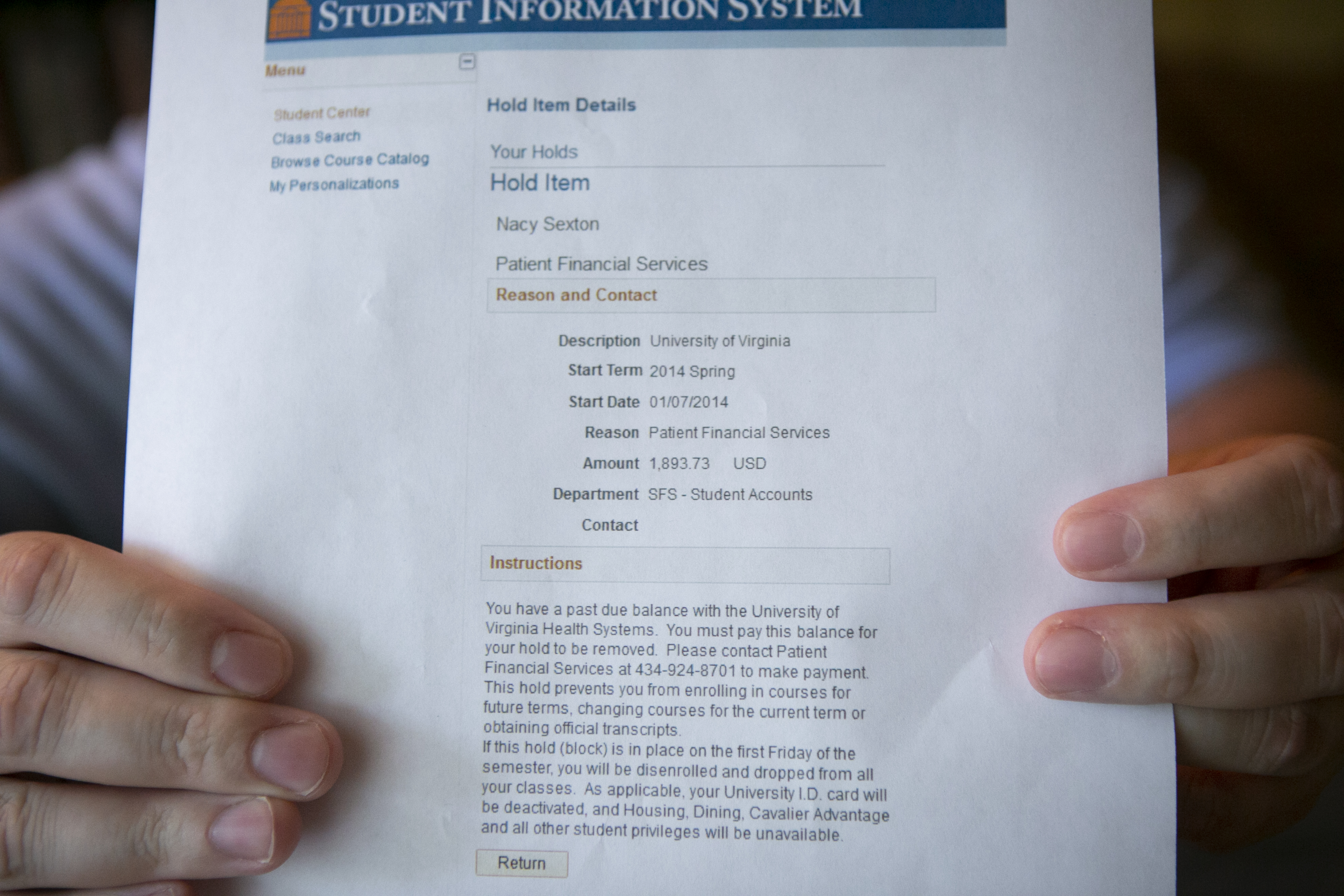
“The university places enrollment holds on student accounts for many reasons, including unpaid tuition and medical bills,” said university spokesman Wesley Hester. This semester the university has “active holds” on 20 students because of unpaid medical center bills, which might or might not block their attendance depending on when the hold was placed, he said.
Sexton still has about $4,000 to go on a bill that he said was more than $30,000 before UVA’s discount, a fundraising campaign and other payments. He hopes to re-enroll and finish his degree in education next year.
“When you get sick, why should it affect your education?” he asked.
Shirley Perry was a registered nurse at the medical center who was “so proud of working at UVA,” said her mother, Vera Perry. She became chronically ill, lost her job and insurance, and then needed treatment from her former employer. UVA sued her for $218,730 plus $32,809 in legal fees. She died last year at age 51, with a UVA lien on her townhouse. It was auctioned off on Aug. 7 at the Albemarle County Courthouse.
For Heather Waldron, the path from “having everything and being able to buy things and feeling pretty good” to “devastation” began when she learned after her UVA hospitalization that a computer error involving a policy bought on healthcare.gov had led to a lapse in her insurance.
She is now on food stamps and talking to bankruptcy lawyers. A bank began foreclosure proceedings in August on the Blacksburg house she shared with her family. The home will be sold to pay off the mortgage.
She expects UVA to take whatever is left.
Methodology
KHN analyzed Virginia civil case records from both the district and circuit courts from July 2012 through June 2018, based on the date a case was filed. These case records were acquired from Ben Schoenfeld, a volunteer for Code for America, a nonprofit focused on improving government technology. Schoenfeld compiles court records that are available directly from Virginia’s court system (from both circuit and district courts) and posts them on the website VirginiaCourtData.org.
The Circuit Courts of Alexandria and Fairfax do not use the statewide case management system and are not included in this analysis.
The online circuit court cases do not include the amount for which the plaintiff sued. KHN went to the Albemarle Circuit Court (where most of the UVA circuit cases were filed) and looked up each of over 900 cases by hand to obtain the dollar amount, which totaled over $60 million.
The online district court cases do include a principal amount sought in a “Warrant in Debt” case. However, if the case is settled or dismissed, the principal amount is zero. Therefore, KHN’s reporting of the total for which UVA has sued its patients during this period is likely a low estimate.
KHN focused on district cases that were “Warrant in Debt” cases and circuit cases that were “Complaint — Catch-all” or “Contract Action.” UVA sues to recover patient debt from all three categories. For cases brought by the University of Virginia, the plaintiff names (as entered by the court) vary widely: “University of Virginia,” “Rectors and Visitors of UVA” or just “UVA” are some examples. We included cases that mentioned the UVA Physicians Group and Health Services Foundation (although these were much less prevalent). In some cases, the UVA Medical Center was named specifically; in others, it was not. KHN analyzed cases brought by the university whether or not the case specifically mentioned the medical center, knowing that some cases omit this detail. We took a random sample of 30 “Warrant in Debt” cases from the Albemarle District Court in 2017 that were filed by “Rectors and Visitors” but did not specify the medical center. We looked up the original records at the courthouse; each one was related to the medical center.
KHN also found several 2012 cases filed in the Albemarle Circuit Court by UVA that were not in the public data available online, which suggests that the data is not necessarily complete.
KHN contacted UVA directly on multiple occasions. We filed several public records requests for the number of cases involving medical debt and the total amount sought, as well as the total amount recovered. Each time our request was deni
By Jay Hancock and Elizabeth Lucas
Gov. Ralph Northam and the president of the University of Virginia committed to changing UVA Health System’s collections practices a day after Kaiser Health News detailed its aggressive and widespread pursuit of former patients for unpaid medical bills.
At the same time, the health system announced the departure of CEO Pamela Sutton-Wallace, who will leave in November to join New York-Presbyterian Hospital as a senior vice president.
Her exit “is in no way related” to the billing and collections problems, James Ryan, UVA’s president, said in a message to employees Tuesday.
UVA sued former patients for unpaid bills more than 36,000 times over six years, seeking repayment of over $106 million and often pushing families into onerous payment plans or bankruptcy, according to KHN’s investigation, published with The Washington Post.
Both Ryan and Northam expressed ignorance about UVA practices that were an open secret in Charlottesville, with hundreds of medical lawsuits often filed in a week.
Northam “was only just made aware of these practices,” said spokeswoman Alena Yarmosky, adding that he “is not involved” in day-to-day university operations.
Northam, a pediatric neurologist who oversees UVA’s board and often speaks about the need for affordable health care, said he is “absolutely concerned” about what the health system has been doing.
“I am glad to hear that UVA Health System is in the process of changing their policies and practices,” Northam said Tuesday in a prepared statement. He declined to offer remedies or agree to an interview.
Ryan said in a tweet late Monday that he had asked Sutton-Wallace last month to look into collection and litigation practices. KHN informed UVA of its findings Aug. 1.
Fixing the problem “is complicated,” in part because “we are legally obligated as a state agency to collect debts,” he said. “But we have discretion within those legal constraints to make our system more generous and more humane.”
Ryan and Sutton-Wallace also declined interview requests through spokesmen.
The health system is making a “comprehensive review” of its indigent care and financial assistance policies and will announce changes by the end of the week, said spokesman Eric Swensen.
“I learned about our aggressive billing and collection practices within the medical center a little over a month ago,” Ryan said in his tweet. “Part of striving to be both a great and good university is honestly facing problems you encounter and doing what you can to address them.”
The departure of Sutton-Wallace, named CEO five years ago, leaves the prestigious medical system with two top vacancies. Richard Shannon, executive vice president for health affairs, left in May.
UVA Health System, which is taxpayer-supported and state-funded, is the latest medical center to face withering scrutiny over patient collections as insurance coverage continues to leave consumers financially vulnerable — despite passage of the Affordable Care Act in 2010.
High-deductible health plans, unaffordable premiums, short-term insurance that doesn’t cover preexisting illness and narrow provider networks all expose patients to unexpected bills of thousands or hundreds of thousands of dollars.
In recent months, journalists and academics have exposed collections practices in Baltimore, Memphis and New Mexico and at another Virginia hospital. A top federal health care regulator made a pointed reference to the coverage in a speech to hospital executives Tuesday.
“We are learning the lengths to which certain not-for-profit hospitals go to collect the full list price from uninsured patients,” Medicare administrator Seema Verma said in a speech before members of the American Hospital Association. “These hospitals are referring patients to debt collectors, garnishing wages, placing liens on property and even suing patients into bankruptcy.”
Phil Galewitz and Emmarie Huetteman contributed to this report.
By Jay Hancock and Elizabeth Lucas
UVA Health System, which sues thousands of patients each year, seizing wages and home equity to collect on overdue medical bills, said Friday it would increase financial assistance, give bigger discounts to the uninsured and “reduce our reliance on the legal system.”
“This will have a huge impact on patients to the good,” Doug Lischke, the health system’s chief financial officer, said in an interview. The changes will “positively, drastically reduce the legal process” of lawsuits, garnishments and property liens.
“We believe this is much more generous than what we’re doing now.”
Lischke called the new policy “a first step” that could later include financial assistance beyond what was announced Friday. UVA also plans to ask the Virginia General Assembly to change a state law requiring state agencies, including health systems, to “aggressively collect” unpaid bills and charge 6% interest on the balance, he said.
But independent experts said the new UVA policy, which comes on the heels of a Kaiser Health News investigation detailing UVA’s aggressive collection practices, still leaves numerous patients exposed to lawsuits and crippling bills. KHN found that UVA sued patients more than 36,000 times over six years for more than $106 million, sending many families into bankruptcy. And it routinely billed uninsured patients for far more than what a typical insurance company would have paid.
By leaving family assets vulnerable and not fully discounting sticker-price charges, the new UVA guidelines remain “very tough on the poor and near-poor who have managed to amass anything of value that will help them with the daily costs of life,” said Sara Rosenbaum, a health policy professor at George Washington University.
The amended policy loosens qualifications for financial assistance, awarding aid to families with income of up to 400% of the federal poverty level, or $103,000 for a family of four. Until now, families making more than half that much were ineligible for assistance — the most restrictive rules of any major hospital system in Virginia, KHN found. Except in “unusual circumstances,” UVA won’t sue patients unless balances are more than $1,000 and families make more than 400% of the poverty guidelines, the health system said in a written statement.
“While these changes represent a step in the right direction, it’s unfortunate that UVA, a public institution, insists on still suing patients,” said Dr. Marty Makary, a surgeon and researcher at Johns Hopkins Medicine who studies hospital debt collection. “In my conversations with UVA surgeons, they are appalled by the practice of their center in suing patients and want it to stop.”
The changes take effect Jan. 1 but a UVA statement said the health system is “committed to working with anyone who currently has an outstanding balance or debt that they are struggling to pay.”
UVA has not decided what to do about patient lawsuits in the pipeline, Lischke said. Online court records show there are hearings scheduled for hundreds of UVA Medical Center cases over the next few weeks.
Mary Washington Healthcare of Fredericksburg, criticized earlier this summer for a far smaller number of lawsuits, said it would suspend suing patients and try to eliminate current garnishments. Methodist Le Bonheur Healthcare in Memphis, another on a growing list of hospitals called out for aggressive collections, said it would suspend all court activity for a month.
UVA will apply the new financial assistance and charging policies to patients treated in July 2017 or later, Lischke said. That means patients on current payment plans or with judgments against them could have bills eliminated or adjusted. But there will be no refunds of payments already made, he said.
The policies also apply to patients treated after July 2017 with judgments against them but no payment plan, he said. But there will be no refunds of payments already made, he said.
Taken together the changes will cost UVA “millions to tens of millions,” he said declining to give a more precise figure.
UVA Medical Center, the core of UVA Health, made an $87 million operating profit on revenue of $1.7 billion in the fiscal year ending in June and held stocks, bonds and other investments worth about $1 billion.
UVA began revising its billing and collections policies after being informed of KHN’s findings in August. It examined policies of neighboring hospitals such as Mary Washington as well as other major academic medical centers, Lischke said.
Previously just $4,000 in a retirement account could bar UVA patients from financial help, no matter how low their income. Now patients can have at least $50,000 in savings beyond the value of their home and car and still get assistance as long as they meet the income test, UVA said.
The nonprofit health system, a taxpayer-supported state agency, also said it would grant discounts of 40% to the uninsured to better reflect lower rates negotiated and paid by insurance companies. Previously, uninsured patients got only 20% off the sticker price plus another 10% to 15% if they paid promptly, which few could.
Shaving 40% from “chargemaster” prices used as a starting point for insurer negotiations puts bills to the uninsured in line with what a commercial health plan would pay, Lischke said.
That’s not enough, Rosenbaum said. She recommended they be lowered further to Medicare levels, which can be 75% off or more. The total of UVA’s cash revenue from all health plans and government programs is 70% below chargemaster, financial forms filed with the Department of Health and Human Services show.
“Even a 40% write-off of charges remains a brutal exposure” for the uninsured, she said. “How could they possibly remain tied to their chargemaster and keep a straight face?”
As part of its ongoing review of billing and collections, UVA will consider further lowering charges to the uninsured — perhaps to Medicare levels, Lischke said.
The new policy also does nothing for those who were sued and garnished for treatment before July 2017.
So far the health system’s announcement doesn’t help the 20 UVA students reported by KHN to have “active holds” on their enrollment this semester because they owe money to the UVA Medical Center. UVA treats unpaid hospital bills the same as unpaid tuition.
UVA has not approached legislators yet about changing billing laws but hoped to have next year’s General Assembly consider it.
“I am hopeful that we are able to influence a change to not only the Debt Collection Act” requiring aggressive collection “but also the state indigent care guidelines,” Lischke said.
Gov. Ralph Northam, a physician who is close to Dr. L.D. Britt, a Norfolk surgeon and professor who is chairman of the health system’s board, has said nothing publicly beyond his Monday statement that “I am glad to hear the UVA Health System is in the process of changing their policies and practices.”
By Jay Hancock and Elizabeth Lucas
VCU Health, the major Richmond medical system that includes the state’s largest teaching hospital, said it will no longer file lawsuits against its patients, ending a practice that has affected tens of thousands of people over the years.
VCU’s in-house physician group filed more than 56,000 lawsuits against patients for $81 million over the seven years ending in 2018, according to a Kaiser Health News analysis of district court data. Those suits will end and VCU will increase financial assistance for lower-income families treated at the $2.16 billion system, according to Melinda Hancock, VCU’s chief administrative and financial officer.
Kaiser Health News recently reported that UVA Health, the University of Virginia system, had filed more than 36,000 suits over six years against patients who could not pay their bills. That revelation, published last month in The Washington Post, led UVA to pledge to “positively, drastically” reduce patient lawsuits.
VCU’s new stance on lawsuits goes beyond UVA’s, which promised to stop suing only patients whose income is below 400% of poverty guidelines. UVA officials did not respond to requests for comment.
VCU’s flagship hospital, VCU Medical Center, hasn’t filed patient suits in at least seven years, Hancock said in an interview this week. But its in-house physician group continued to sue patients and families for overdue bills.
That approach stopped as of last month, she said. VCU Health, a state-operated system including Richmond’s VCU School of Medicine and Community Memorial Hospital in South Hill, Va., will stop suing patients “as part of normal debt collection,” she said. It is also ending garnishment of patient wages and attaching liens to patient homes, she said.
Hancock said VCU has been considering changing its policies since last year but recent revelations about UVA “expedited” the decision. Starting in June, KHN had requested comment from VCU officials about the health system’s financial assistance and lawsuits.
“We don’t want to be part of that,” she said about patient lawsuits, which are a standard tool for many hospitals seeking to maximize revenue. “We feel that taking care of the patient’s financial health is taking care of their holistic health.”
The system, affiliated with Virginia Commonwealth University, is also considering “how we should address pending lawsuits and retrospective cases,” said spokeswoman Laura Rossacher.
VCU Health will continue to send unpaid debts to collections and report patients with overdue bills to credit agencies.
“We still need to get our bills paid,” Hancock said. “We do need to deploy reasonable collection efforts.”
Policy scholars said the new guidelines, which would make VCU’s collection and billing practices among the most liberal for Virginia hospitals, would still leave many patients vulnerable to credit downgrades, financial hardship and bankruptcy.
“This certainly seems like progress,” said Sara Rosenbaum, a health law professor at George Washington University. But even if no lawsuit is filed, “being an apparent deadbeat on a bill written off as bad debt has terrible and enduring consequences on folks.”
Negative credit reports from a hospital, even without a court case, can send families into a downward spiral, said Gerard Anderson, director of the Johns Hopkins Center for Hospital Finance and Management.
“If they send you to a collection agency, you’re not able to borrow any money because that’s going to put you in such a poor credit rating,” he said. “You cannot expect somebody to pay a $10,000 or $20,000 bill if they don’t have insurance.”
Analysts also criticized as inadequate VCU’s new discounts to the uninsured. Last year, the system started reducing list prices by 45% for those lacking coverage. The previous discount was 25%. Almost nobody pays list charges, which hospitals typically use as a starting point for negotiations with insurers.
But VCU’s average cost of care is 77% below list charges, according to 2017 government filings. That means the uninsured are still paying a big markup under the new policy.
“Most uninsured have very little income, and asking them to pay twice as much as it costs to deliver care is not appropriate,” Anderson said. “It is no wonder why so many cannot pay the bills.”
Uninsured patients paying promptly can receive discounts of up to 55%, Rossacher said. But few are able to do that.
Like UVA, VCU is raising the income threshold for patients seeking financial assistance ― in its case, awarding aid to families with income up to 300% above the federal poverty level, or $77,000 for a family of four. For most patients, the previous cutoff was 200%, or $52,000, for a family of four.
That aid threshold takes effect in November. VCU officials declined to give an estimate of what the new policies would cost the system.
KHN analyzed lawsuits filed by VCU and other hospitals using civil court data collected by Code for Hampton Roads, a nonprofit focusing on improving government technology.
“VCU Health System and its affiliated physicians are making important policy changes that are long overdue,” said Jill Hanken, a health care attorney for the Virginia Poverty Law Center. She urged “further and ongoing oversight” from lawmakers to ensure appropriate indigent care policies.
Virginia Gov. Ralph Northam, a physician, has said little publicly about the state hospitals and doctors under his leadership that often pursue patients for all they are worth.
“No one should go bankrupt because they get sick,” said Northam spokeswoman Alena Yarmosky. “Gov. Northam is glad to see health systems taking real steps to put Virginians first and address aggressive bill collection practices.”
VCU will continue reviewing its collections and assistance policies, Hancock said. “This is an ongoing process,” she said. “It doesn’t’ stop here.”
One impetus to dropping lawsuits was an increasing number of patients with health insurance who still have trouble paying, she said.
“With the rise of high-deductible plans,” in which patients pay thousands before insurance kicks in, she said, “we just felt that there are other collection efforts that were more suitable now.”
Methodology
KHN analyzed civil case records from the Virginia district courts from 2012 to 2018, based on the date the case was filed. The case records were part of a dataset KHN acquired from Ben Schoenfeld, a volunteer for Code for Hampton Roads, a nonprofit focused on improving government technology. Schoenfeld compiled court records available directly from Virginia’s court system (from both circuit and district courts) and posted them on the website VirginiaCourtData.org. The analysis included all “warrant in debt” cases where the plaintiff was listed as MCV Physicians.
By Elizabeth Lucas
In response to a Kaiser Health News investigation into the University of Virginia Health System’s aggressive collection practices, Senate Finance Committee Chairman Chuck Grassley (R-Iowa) sent a letter Thursday demanding answers to questions about UVA’s billing practices, financial assistance policies and even its prices.
The Finance Committee oversees federal tax laws, and Grassley wrote that it is “my job to make sure that entities exempt from tax are fulfilling their tax-exempt purposes.”
The KHN investigation found that UVA Health System, a taxpayer-supported and state-funded entity, filed 36,000 lawsuits for more than $106 million in six years.
“Unfortunately, I have seen a variety of news reports lately discussing what appear to be relentless debt-collection efforts by tax-exempt hospitals, including UVA Health System,” Grassley wrote. “I am also concerned about how patients’ hospital bills get so high in the first place.”
Even though the letter questions only UVA Health System, whose practices were pegged in the investigation as particularly aggressive, it sends a signal that the Senate will be paying attention to an issue that affects all state-run and nonprofit health systems. Many medical providers pursue patients for unpaid bills, sometimes forcing them into bankruptcy. Several news stories have highlighted similar collections practices at other nonprofit hospitals.
Nonprofit hospitals get big tax breaks in exchange for providing “charity care and community benefit,” though there is no clear standard about what that should mean. Experts have questioned whether those breaks are deserved, given hospitals’ pricing, billing and collections practices.
In the seven-page letter, Grassley asks 19 detailed questions on various topics, including the system’s charity care (free or discounted care provided to low-income patients), debt collection policies, and its rationale for the litigation threshold of $1,000, enacted in 2017. Grassley asks specific questions about UVA’s list of standard prices for procedures and equipment, commonly known as the “chargemaster,” which is posted on its website.
The letter was addressed to CEO Pamela Sutton-Wallace, who will depart UVA Health System for NewYork-Presbyterian Hospital next month. UVA Health System has until Nov. 19 to respond.
“UVA is committed to assisting indigent and uninsured patients and making sure they receive all necessary care,” UVA Health System spokesman Eric Swensen said in an email to KHN. “We will review the letter, and look forward to working with Sen. Grassley to respond to his questions and share with him the policy changes we have announced and started implementing over the past month to better serve our patients.”
In response to KHN’s investigation, UVA Health System swiftly vowed to change its policies to increase financial assistance, give bigger discounts to the uninsured and reduce its use of the legal system. However, KHN reported that some critics do not think the new policies go far enough.
By Jay Hancock
Kitt Klein and Mike Miller lost thousands of dollars in hard-won savings more than a decade ago after UVA Health put a lien on their home for a hospital bill they couldn’t pay.
They can’t believe they’re at risk of losing a second home today.
“Can they do this twice?” said Klein, who lives with her husband, a house painter, in her late mother’s house in Virginia’s Shenandoah Valley.
The couple was hit with a $129,133 court judgment in 2017 after UVA sued them and won in a case involving unpaid bills for out-of-network treatment of Miller’s lung cancer the year before, court documents show.
Last month, UVA said it would scale back such activity after a Kaiser Health News investigation found the medical system had filed 36,000 patient lawsuits for more than $100 million over six years, sending many families into hardship and bankruptcy. Its pursuit of former patients included putting thousands of liens on homes.
The prestigious medical system, affiliated with the University of Virginia in Charlottesville, said it is suspending current lawsuits, expanding financial assistance and even reconsidering old cases and applying aid retroactively. The new policies apply to people treated in July 2017 or later, according to Doug Lischke, UVA Health’s chief financial officer.
But that means people such as Miller, who received hundreds of thousands of dollars in financial assistance from his local hospital but not from UVA, won’t benefit from the changes. Thousands of former patients owing old bills, many with court judgments against them and wages being garnished or liens on their homes, will continue to suffer under the previous rules.
“There’s so many people that I’m talking to that are so relieved, saying thank God people are finally getting some justice,” said former patient Denise Nunez, 45.
But she’s still paying off a UVA bill of about $1,500 dating to 2014, legal papers show. It never came to her house because a clerk transposed the address number, she said. The new policies don’t stand to benefit her, either.
At the same time, patients treated more recently said they are struggling to obtain information on the changed rules and uncertain whether they’ll be helped. Unlike VCU Health in Richmond, which halted all routine patient lawsuits in the wake of KHN’s inquiry, UVA says it will continue to sue patients with incomes above a certain level.
It has also said repeatedly that changes announced last month are “a first step.”
“It seems like they’re still sorting out details of exactly what their new policy looks like,” said Elaine Poon, managing attorney at the Legal Aid Justice Center in Charlottesville, which represents some lower-income UVA patients. “We want UVA to hold off — to suspend collections until they have a new policy.”
UVA has said little publicly about its new policies almost two months since it announced them, beyond posting a webpage referring to federal poverty guidelines and directing patients to a phone number with an intricate voice menu asking for a “guarantor account number.” Some patients said they didn’t understand what that means.
The website says nothing about reopening old cases for those already hit with garnished wages, court judgments or even UVA liens on their homes.
“I haven’t heard from UVA,” said Paul Baker, 41, a former yard maintenance worker who along with his wife owes the system more than $500,000 for treatment after a devastating truck accident in 2018.
Under the new rules, Baker’s stated income of about $24,000 might qualify him for relief.
UVA is updating its website and stocking clinics with cards in English and Spanish with contact information for patients having trouble with bills, said health system spokesman Eric Swensen. For patients meeting the new rules, it is halting or reversing the seizure of Virginia’s special tax refund of up to $220, being issued this fall, he said.
UVA has granted easier payment terms to hundreds of patients, stopped renewing wage garnishments for patients who qualify and suspended or dismissed more than 500 lawsuits since Sept. 12, Swensen said.
For now, however, that doesn’t help Robert Turkiewicz, who lost a case the day before, on Sept. 11, and faces a UVA judgment for $96,779 and attorney fees of $14,517, court documents show. Given his experience with the UVA billing office, he’s not sure it ever will.
A carpenter and construction worker who lives in Luray, Va., Turkiewicz, 44, accidentally shot himself in the leg a year ago while taking a pistol out of a truck to kill chickens. He and his wife make about $22,000 a year, he said. That’s well within UVA’s new income guidelines for erasing his entire bill.
But his stated income falls within UVA’s old guidelines for at least partial financial assistance ― and he never obtained it. A UVA billing clerk kept asking for copies of pay stubs that didn’t exist because he had been badly wounded and couldn’t work, he said.
“I knew I couldn’t afford it and I told them I couldn’t afford it,” he said. “And they said, ‘Well, you’ll get the charity care.’ And I never did get it.”
On paper, UVA’s amended policy makes it easier to qualify for financial assistance, awarding aid to families with incomes of up 400% of federal poverty guidelines, or about $100,000 for a family of four with less than $50,000 in assets, besides a home.
A family of four with income below about $50,000 would qualify for a full write-off under the new rules. UVA also has said it won’t usually sue families earning less than 400% of poverty guidelines, and will increase the discount off hospital list charges for all uninsured patients from 20% to at least 40%. It has said it will not refund money already collected.
The health system is appointing a “billing and collections advisory council” of medical and community leaders to consider further changes, leaving open the possibility it could increase discounts for the uninsured or reduce balances for people treated before the July 2017 cutoff.
The system’s collections policies have included canceling enrollment for University of Virginia students who owe medical bills. UVA has hinted it would reconsider this.
But “I’m still blocked,” said Nacy Sexton, whose UVA education was interrupted in 2014 by a hospital bill that he is still paying off. “UVA has not reached out to me.”
Even closed cases can leave families heavily indebted or stripped of savings.
“I paid every penny to them, but I still owe $25,000 to a friend of mine,” said Priti Chati, 51, who lives in Roanoke. UVA sued Chati, whose case KHN described in a previous story, for treatment of a brain tumor in 2011.
Those with old bills and legal judgments say they hope the advisory council will urge UVA to make the new policies effective further back than July 2017.
UVA is dunning money from Nunez for a five-year-old bill, taking $602 from her Virginia tax refund in April, a letter the state sent her shows.
Klein and Miller’s experience with big UVA Health bills began in the early 2000s after he hurt his wrist badly in a lawnmower accident. Multiple surgeries drove up the bills, which their daughter eventually paid with her money.
They deeded their house to her in 2012 for a few dollars to pay her back, Klein said, with UVA effectively taking their home equity. Then they moved into her mother’s house, built in the 1870s, near Quicksburg.
Since 2012, Miller has been fighting lung cancer and has tumors on his bladder and kidney. His insurance has paid more than $100,000 for treatment at Sentara RMH Medical Center in Harrisonburg, with the hospital awarding more than $400,000 in financial assistance based on his income, said Sentara spokesman Neil Mowbray.
But in 2016, doctors said he needed radiation therapy available only at UVA Health, which was out of network. The plan still paid UVA at least $64,000, insurance documents show. But UVA billed and sued the couple for $129,133. They’re paying $100 a month.
They make about $25,000 a year, said Klein, adding that UVA denied their previous financial assistance application. Their income is within the new UVA guidelines for patients to be considered for a full write-off of the bill.
But because the treatment was in 2016, before the July 2017 cutoff, she fears UVA will have a claim on her Quicksburg home, the one she grew up in, with her mother now buried nearby.
“I was furious,” she said. “Here we are going through this again, and this is our family homeplace. That’s all Mom wanted — she wanted it left with the family.”
By Jay Hancock
Prominent doctors at UVA Health System are expressing public outrage at their employer’s practices to collect unpaid medical debt from its patients.
A Kaiser Health News report in September that showed UVA sued 36,000 patients over six years for more than $100 million, seizing wages and savings and even pushing families into bankruptcy.
Like many physicians who work at U.S. medical centers, the UVA doctors said they had little idea how aggressively the hospital where they practice was billing and pursuing their patients for payment.
Although the health system has announced some interim measures to scale back collections practices, some of the system’s most senior physicians are now calling for UVA to stop suing its patients altogether. And they are urging the pursuit of an “immediate solution” to address the national epidemic of health care debt.
“We were appalled by the revelations of the aggressive, pitiless billing and collections practices” at UVA, Dr. Scott Heysell and two other senior staff members wrote in a letter to KHN published Saturday. “We felt betrayed,” they wrote, “and we had, by extension, betrayed those who had relied on us.”
Heysell, an infectious-disease specialist and associate professor at UVA School of Medicine, and his co-authors echoed other UVA researchers and clinicians contacted by a reporter who said they were surprised and dismayed by the health system’s practices.
UVA initially defended its practices, pointing to the Virginia Debt Collection Act of 1988, which requires state agencies to “aggressively collect” money owed. But within days of the KHN report, UVA said it would reduce its use of the courts and make it easier for patients to qualify for financial assistance.
That’s not enough, said the letter’s authors, who include Dr. Rebecca Dillingham, director of UVA’s Center for Global Health, and Dr. Michael Williams, director of the UVA Center for Health Policy.
They ask “why UVA cannot join other public hospitals that have effectively stopped suing patients altogether?”
Other University of Virginia faculty said the system’s practices undermined their efforts to improve care for middle- and lower-income families and was not in keeping with an ethos of putting patients first.
KHN’s findings “made me feel utterly hypocritical about my work and efforts to promote health equity,” Rajesh Balkrishnan, a UVA public health professor who researches cancer treatment in Appalachia, said in an interview.
“This is a public university with one of the richest endowments in the country,” he said. “At least take care of the immediate community you serve.”
In September, UVA Health said it would “reduce our reliance on the legal system,” suing patients only if their household income is more than 400% of the federal poverty level, or $103,000 for a family of four. It also pledged to increase discounts for the uninsured and upgrade its financial assistance for patients.
Those measures are “a first step,” it said. On Oct. 28, it named an advisory council of community leaders, patient advocates and UVA students and staff to consider further changes.
“We are continuing to thoughtfully review our billing and collection practices to find additional ways to better serve our patient as well as improve fairness and transparency,” said UVA Health spokesman Eric Swensen. “We are looking at all options to achieve these goals.”
Virginia Gov. Ralph Northam, who oversees the state’s university system and public hospitals, is a pediatric neurologist.
“As a doctor himself, Gov. Northam agrees with the doctors who have taken a stand against unfair and aggressive medical billing practices,” his spokeswoman said. “Much more can and should be done to address this issue.”
KHN’s report prompted discussions across the campus in Charlottesville about how to treat uninsured patients or those with coverage who still struggle with thousands of dollars in out-of-pocket expenses, doctors and faculty said.
“No physician wants to be responsible for bankrupting a patient — not one physician, not one patient,” said Dr. Mohan Nadkarni, UVA’s chief of general internal medicine. He is the only physician on the advisory council.
“UVA physicians were completely taken aback by the scale and magnitude of the collections practices,” Nadkarni said. Discussion at the council’s first meeting reflected “lots of pent-up dissatisfaction from community leaders” about UVA’s practices, he said.
But many knew the health system was suing patients, they said. Some had firsthand experience with aggressive tactics from the billing office.
At one “town meeting” of health system employees, held at UVA’s Leonard Sandridge Auditorium in response to KHN’s report, somebody took the mic and asked, “Who in this room has been taken to collections by UVA?” said Matthew Gillikin, a speech therapist who was there. A quarter to a third of the people raised their hands, he said.
Court data analyzed by KHN showed that UVA Health was suing about 100 of its employees every year.
Also at the town meetings, “we heard many agonizing stories of patients and employees having been sued or having wages garnished,” Nadkarni said. “We heard loud and clear from many physicians that they heavily supported significant liberalization” of UVA Health’s financial assistance policies.
Family physician Dr. Alex Salomon, who worked at UVA for seven years and now is with Augusta Health in Fishersville, Va., had “a lot of patients” with UVA bill and lawsuit problems, many who had insurance but could not make out-of-pocket payments, he said. Still, he added, “I didn’t realize UVA was so much worse” than other hospitals.
As part of the University of Virginia, UVA Health is a state institution that is not subject to taxation. UVA Medical Center, the system’s flagship hospital, made a $91 million operating profit on revenue of $1.8 billion in the fiscal year ending in June and held stocks, bonds and other investments worth about $1 billion.
Doctors are realizing that financial barriers to treatment and budget squeezes from bills can be as harmful to patients as disease, said Dr. Marty Makary, a surgeon and researcher at Johns Hopkins Medicine who studies hospital debt collection and is urging UVA alumni to press for further change.
“I have not talked to a single patient or student of UVA or faculty member or alumni who thinks it is reasonable for the hospital to sue patients who cannot afford their bill,” he said.
News of UVA collections practices served as a teaching moment for at least one class.
“Many of the students in my class work for the UVA Health System, so the recent media coverage about UVA’s billing practices has been painful for them as nurses who care deeply about the patients and families they serve,” Kimberly Acquaviva, a professor who teaches health policy at UVA’s nursing school, tweeted in September. “As a class, we talked about the power that nurses have to shape the lives of the patients and families” by advocating for system change, she said.
She declined a request for an interview, as did five other doctors or professors. Several referred a reporter to UVA spokesman Swensen. About 20 others did not respond to interview requests.
Dr. Chris Ghaemmaghami, an emergency and internal medicine doctor, became UVA Health’s acting CEO after Pamela Sutton-Wallace announced her resignation in September. Her departure was unrelated to KHN’s revelations, UVA said at the time.
“I understand the disappointment some fellow physicians felt when our historic billing and collection practices came to light,” he said in an email responding to questions from KHN.
Heysell, Williams and Dillingham, the doctors who wrote the letter, go further.
“To be clear, we are outraged,” they write. “We stand with those that have been financially injured, whose bank accounts have been looted, whose homes have been swallowed as if they were built on quicksand, whose credit scores were ruined, and whose mental health and energy were spent in a courtroom or in anxious conversations with lawyers — all as a result of having sought our care.”
By Jay Hancock
The American Hospital Association, the biggest hospital trade group, says it promotes “best practices” among medical systems to treat patients more effectively and improve community health.
But the powerful association has stayed largely silent about hospitals suing thousands of patients for overdue bills, seizing homes or wages and even forcing families into bankruptcy.
Atlantic Health System, whose CEO is the AHA’s chairman, Brian Gragnolati, has sued patients for unpaid bills thousands of times this year, court records show, including a family struggling to pay bills for three children with cystic fibrosis.
AHA, which represents nearly 5,000, mostly nonprofit hospitals and medical systems, has issued few guidelines on such aggressive practices or the limited financial assistance policies that often trigger them.
In a year when multiple health systems have come under fire for suing patients, from giants UVA Health System and VCU Health to community hospitals in Oklahoma, it has made no concrete move to develop an industry standard.
“There could be a broader message coming out of hospital leadership” about harsh collections, said Erin Fuse Brown, a law professor at Georgia State University who studies hospital billing. “It seems unconscionable if they are claiming to serve the community and then saddling patients with these financial obligations that are ruinous.”
Nonprofit hospitals are required to provide “community benefit,” including charity care in return for billions of dollars in government subsidies they get through tax exemptions. But the rules are lax and vague, experts say, especially for bill forgiveness and collections.
The Affordable Care Act requires nonprofit hospitals to have a financial assistance policy for needy patients but offers no guidance about its terms.
“There is no requirement” for minimum hospital charity under federal law, said Ge Bai a health policy professor at Johns Hopkins. “You design your own policy. And you can make it extremely hard to qualify.”
Practices vary sharply, a review of hospital policies and data from IRS filings show. Some hospitals write off the entire bill for a patient from a family of four making up to $77,000 a year. Others give free care only if that family makes less than $26,000.
The law does not substantially limit harsh collections, either. IRS regulations require only that nonprofit hospitals make “reasonable efforts” to determine if patients qualify for financial assistance before suing them, garnishing their wages and putting liens on their homes.
Gaping differences in both collections and financial assistance show up in the policies of health systems represented on AHA’s board of trustees.
This year, AHA board chairman Gragnolati’s Atlantic Health System, in northern New Jersey, sued patients for unpaid bills more than 8,000 times, court records show.
Atlantic Health sued Robert and Tricia Mechan of Maywood, N.J., to recover $7,982 in unpaid bills for treatment of their son Jonathan at the system’s Morristown Medical Center.
Three of the Mechans’ four children have cystic fibrosis, a chronic lung disease, including Jonathan, 18. Tricia Mechan works two jobs — full time as a manager at Gary’s Wine & Marketplace and part time at Lowe’s — to try to pay doctor and hospital bills that pile up even with insurance.
“I have bill collectors call me all the time,” Tricia Mechan said. “You’re asking me for more, and all I’m doing is trying to get the best care for my children. I didn’t ask to have sick children.”
She closed a savings account and borrowed money to settle Jonathan’s bill for $6,000. Another son with cystic fibrosis, Matthew, owes Atlantic Health $4,200 and is paying it off at $25 a month, she said.
Marna Borgstrom, CEO of Yale New Haven Health, also sits on AHA’s board. Yale almost never sues families like the Mechans.
“I have not signed off on a legal action since 2015” against a patient, Patrick McCabe, the system’s senior vice president of finance, said in an interview. “People are coming to us when they are at their most vulnerable, and we truly believe we need to work with them and not create any additional stress that can be avoided.”
Yale has treated Nicholas Ruschmeyer, 30, a Vermont ski mountain manager, for recurring cancer. He has been careful to maintain insurance, but a few years ago the hospital performed a $12,000 genetic test that wasn’t covered.
“Yale completely absorbed the cost,” said his mother, Sherrie Ruschmeyer. Yale is “wonderful to work with, not at all aggressive,” she said.
Atlantic Health bars families from receiving financial assistance if they have more than $15,000 in savings or other assets. Yale never asks about savings. Even families who own homes without a mortgage qualify if their income is low enough.
Atlantic Health’s policies including seizing patient wages and bank accounts through court orders to recoup overdue bills. Yale says it does not do this.
In some ways, Atlantic Health’s policies are more generous than those of other systems.
It forgives bills exceeding 30% of a family’s income in many cases, the kind of “catastrophic” assistance some hospitals lack. It also bills many uninsured patients only slightly more than Medicare rates. That’s far less than rates charged by other hospitals in the same situation that are substantially higher than the cost of treatment.
“Atlantic Health System’s billing policy complies with all state and federal guidelines,” said spokesman Luke Margolis. “While we are willing to assist patients no matter their financial situation, those who can pay should do so.”
After a reporter inquired about its practices, Atlantic Health said it “is actively engaged in refining our policies to reflect our patients’ realities.”
AHA also is considering changing its position on billing in the wake of recent reports on aggressive and ruinous hospital practices.
Previously AHA said billing offices should “assist patients who cannot pay,” without giving specifics, and treat them with “dignity and respect.” Queried this month, association CEO Rick Pollack said, “We are reevaluating the guidelines [for collections and financial assistance] to ensure they best serve the needs of patients.”
Kaiser Health News found that the University of Virginia Health System sued patients 36,000 times over six years, taking tax refunds, wages and property and billing the uninsured at rates far higher than the cost of care. Richmond-based VCU Health’s physicians group sued patients 56,000 times over seven years, KHN also found.
In Memphis, Methodist Le Bonheur Healthcare sued patients for unpaid bills more than 8,000 times over five years, ProPublica reported. In South Carolina, hospitals have been taking millions in tax refunds from patients and their families, an examination by The Post and Courier showed.
In response, VCU pledged to stop suing all patients. UVA promised to “drastically” reduce lawsuits, increase financial assistance and consider further steps. Methodist erased debt for 6,500 patients and said it would overhaul its collections rules.
Yale’s less aggressive policies also came in response to journalism — a 2003 Wall Street Journal report on how the system hounded one family. Yale still sends overdue bills to collections, McCabe said. But it balks at the last, drastic step of asking a court to approve seizing income and assets.
For patients with unpaid bills, he said, “if you’re willing to play a game of chicken, you will win.”
Hospitals say they see more and more patients who can’t pay, even with insurance, as medical costs rise, family incomes plateau and out-of-pocket health expenses increase. In particular, they blame widespread high-deductible coverage, which requires patients to pay thousands before the insurance takes over.
“More consumers pay far more with fewer benefits,” Pollack said.
Some states go beyond federal rules for charity care and collections. In California, patients with an income of less than $90,000 for a family of four must be eligible for free or discounted care. New Jersey requires Atlantic Health and other systems to give free care to patients from families of four with income less than $51,000.
The National Consumer Law Center, a nonprofit advocacy group, suggests all states adopt that standard for large medical facilities. Its model medical debt law also would require substantial discounts for families of four with income below $103,000 and relief for patients with even higher incomes facing catastrophic bills.
The AHA should consider similar changes in its own guidelines, NCLC attorney Jenifer Bosco said.
“I would be interested in seeing them taking a more active role in creating some standard for hospitals about what’s too much,” she said. “What’s going too far? Given that this is a helping profession, what would be some appropriate industry standards?”
KHN senior correspondent Jordan Rau contributed to this report.
Biography

Jay Hancock, Senior Correspondent, joined KHN in 2012 from The Baltimore Sun, where he wrote a column on business and finance. Previously he covered the State Department and the economics beat for The Sun and health care for The Virginian-Pilot of Norfolk and the Daily Press of Newport News. He has a bachelor’s degree from Colgate University and a master’s in journalism from Northwestern University.

Elizabeth Lucas, Data Editor, specializes in data analysis and reporting for the KHN enterprise team. She came from Investigative Reporters and Editors (IRE), where she spent four years training and supporting data journalists around the world as the NICAR Data Library director. Previously she worked as a data reporter on health and the environment for the Center for Public Integrity. She has a master’s degree from the Missouri School of Journalism.