The New York Times, by David Kocieniewski
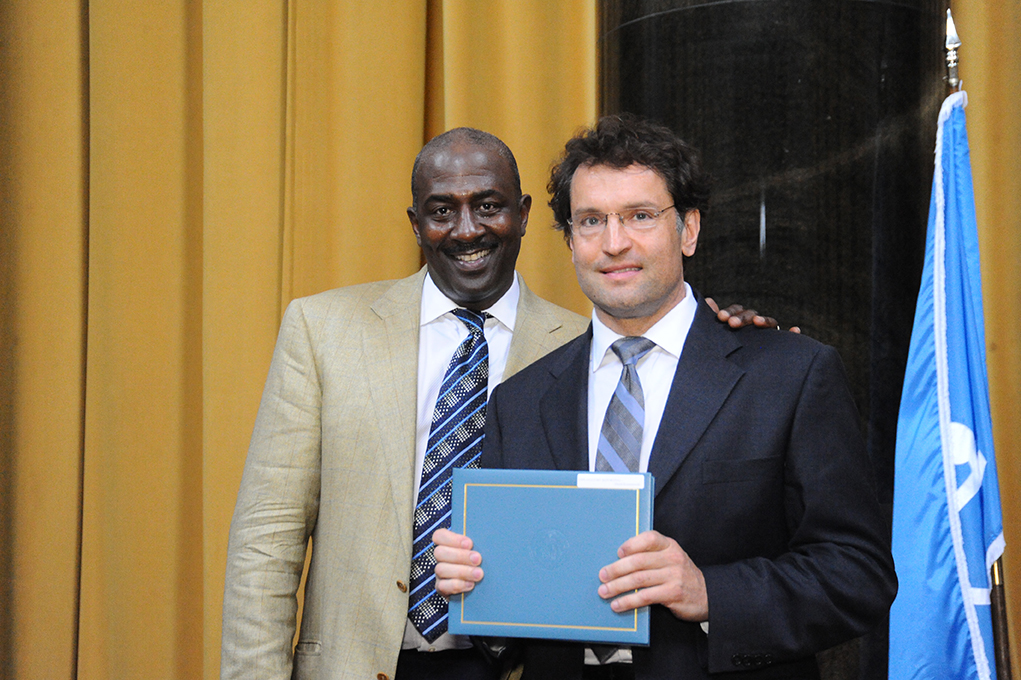
Gregory Moore (left), co-chair of The Pulitzer Prize Board, presents the 2012 Explanatory Reporting Prize to David Kocieniewski of The New York Times.
Winning Work
By David Kocieniewski
General Electric, the nation's largest corporation, had a very good year in 2010.
The company reported worldwide profits of $14.2 billion,and said $5.1 billion of the total came from its operations in the United States.
Its American tax bill? None. In fact, G.E. claimed a tax benefit of $3.2 billion.
That may be hard to fathom for the millions of American business owners and households now preparing their own returns, but low taxes are nothing new for G.E. The company has been cutting the percentage of its American profits paid to the Internal Revenue Service for years, resulting in a far lower rate than at most multinational companies.
Its extraordinary success is based on an aggressive strategy that mixes fierce lobbyingfor tax breaks and innovative accounting that enables it to concentrate its profits offshore. G.E.'s giant tax department, led by a bow-tied former Treasury official named John Samuels, is often referred to as the world's best tax law firm. Indeed, the company's slogan ''Imagination at Work'' fits this department well. The team includes former officials not just from the Treasury, but also from the I.R.S. and virtually all the tax-writing committees in Congress.
While General Electric is one of the most skilled at reducing its tax burden, many other companies have become better at this as well. Although the top corporate tax rate in the United States is 35 percent, one of the highest in the world, companies have been increasingly using a maze of shelters, tax credits and subsidies to pay far less.
In a regulatory filing just a week before the Japanese disaster put a spotlight on the company's nuclear reactor business, G.E. reported that its tax burden was 7.4 percent of its American profits, about a third of the average reported by other American multinationals. Even those figures are overstated,because they include taxes that will be paid only if the company brings its overseas profits back to the United States. With those profits still offshore, G.E. is effectively getting money back.
Such strategies, as well as changes in tax laws that encouraged some businesses and professionals to file as individuals, have pushed down the corporate share of the nation's tax receipts -- from 30 percent of all federal revenue in the mid-1950s to 6.6 percent in 2009.
Yet many companies say the current level is so high it hobbles them in competing with foreign rivals. Even as the government faces amounting budget deficit, the talk in Washington is about lower rates. President Obama has said he is considering an overhaul of the corporate tax system, with an eye to lowering the top rate, ending some tax subsidies and loopholes and generating the same amount of revenue. He has designated G.E.'s chief executive, Jeffrey R. Immelt, as his liaison to the business community and as the chairman of the President's Council on Jobs and Competitiveness, and it is expected to discuss corporate taxes.
''He understands what it takes for America to compete in the global economy,'' Mr. Obama said of Mr. Immelt, on his appointment in January, after touring a G.E. factory in upstate New York that makes turbines and generators for sale around the world.
A review of company filings and Congressional records shows that one of the most striking advantages of General Electric is its ability to lobby for, win and take advantage of tax breaks.
Over the last decade, G.E. has spent tens of millions of dollars to push for changes in tax law, from more generous depreciation schedules on jet engines to ''green energy'' credits for its wind turbines. But the most lucrative of these measures allows G.E. to operate a vast leasing and lending business abroad with profits that face little foreign taxes and no American taxes as long as the money remains overseas.
Company officials say that these measures are necessary for G.E. to compete against global rivals and that they are acting as responsible citizens. ''G.E. is committed to acting with integrity in relation to our tax obligations,'' said Anne Eisele, a spokeswoman. ''We are committed to complying with tax rules and paying all legally obliged taxes. At the same time, we have a responsibility to our shareholders to legally minimize our costs.''
The assortment of tax breaks G.E. has won in Washington has provided a significant short-term gain for the company's executives and shareholders. While the financial crisis led G.E. to post a loss in theUnited States in 2009, regulatory filings show that in the last five years, G.E. has accumulated $26 billion in American profits, and received a net tax benefit from the I.R.S. of $4.1 billion.
But critics say the use of so many shelters amounts to corporate welfare, allowing G.E. not just to avoid taxes on profitable overseas lend ing but also to amass tax credits and write-offs that can be used toreduce taxes on billions of dollars of profit from domestic manufacturing. They say that the assertive tax avoidance of multinationals like G.E. not only shortchanges the Treasury, but also harms the economy by discouraging investment and hiring in the United States.
''In a rational system, a corporation's tax department would be there to make sure a company complied with the law,'' said Len Burman, a former Treasury official who now is a scholar at the nonpartisan Tax Policy Center. ''But in our system, there are corporations that view their tax departments as a profit center, and the effects on public policy can be negative.''
The shelters are so crucial to G.E.'s bottom line that when Congress threatened to let the most lucrative one expire in 2008, the company came out in full force. G.E. officials worked with dozens of financial companies to send letters to Congress and hired a bevy of outside lobbyists.
The head of its tax team, Mr. Samuels, met with Representative Charles B. Rangel, then chairman of the Ways and Means Committee, which would decide the fate of the tax break. As he sat with the committee's staff members outside Mr. Rangel's office, Mr. Samuels dropped to his knee and pretended to beg for the provision to be extended -- a flourish made in jest, he said through a spokeswoman.
That day, Mr. Rangel reversed his opposition to the tax break, according to other Democrats on the committee.
The following month, Mr. Rangel and Mr. Immelt stood together at St. Nicholas Park in Harlem as G.E. announced that its foundation had awarded $30 million to New York City schools, including $11 million to benefit various schools in Mr. Rangel's district. Joel I. Klein, then the schools chancellor, and Mayor MichaelR. Bloomberg, who presided, said it was the largest gift ever to the city's schools.
G.E. officials say the donation was granted solely on the merit of the project. ''The foundation goes to great lengths to ensure grant decisions are not influenced by company government relations or lobbying priorities,'' Ms. Eisele said.
Mr. Rangel, who was censured by Congress last year for soliciting donations from corporations and executives with business before his committee, said this month that the donation was unrelated to his official actions.
Defying Reagan's Legacy
General Electric has been a household name for generations, with light bulbs, electric fans, refrigerators and other appliances in millions of American homes. But today the consumer appliance division accounts for less than 6 percent of revenue, while lending accounts for more than 30 percent. Industrial, commercial and medical equipment like power plant turbines and jet engines account for about 50 percent. Its industrial work includes everything from wind farms to nuclear energy projects like the troubled plant in Japan, built in the 1970s.
Because its lending division, GE Capital, has provided more than half of the company's profit in some recent years, many Wall Street analysts view G.E. not as a manufacturer but as an unregulated lender that also makes dishwashers and M.R.I. machines.
As it has evolved, the company has used, and in some cases pioneered, aggressive strategies to lower its tax bill. In the mid-1980s, President Ronald Reagan overhauled the tax system after learning that G.E. -- a company for which he had once worked as a commercial pitchman -- was among dozens of corporations that had used accounting gamesmanship to avoid paying any taxes.
''I didn't realize things had gotten that far out of line,'' Mr. Reagan told the Treasury secretary, Donald T. Regan, according to Mr. Regan's 1988 memoir. The president supported a change that closed loopholes and required G.E. to pay a far higher effective rate, up to 32.5 percent.
That pendulum began to swing back in the late 1990s. G.E. and other financial services firms won a change in tax law that would allow multinationals to avoid taxes on some kinds of banking and insurance income. The change meant that if G.E. financed the sale of a jet engine or generator in Ireland, for example, the company would no longer have to pay American tax on the interest income as long as the profits remained offshore.
Known as active financing, the tax break proved to be beneficial for investment banks, brokerage firms, auto and farm equipment companies, and lenders like GE Capital. This tax break allowed G.E. to avoid taxes on lending income from abroad, and permitted the company to amass tax credits, write-offs and depreciation. Those benefits are then used to offset taxes on its American manufacturing profits.
G.E. subsequently ramped up its lending business.
As the company expanded abroad, the portion of its profits booked in low-tax countries such as Ireland and Singapore grew far faster. From 1996 through 1998, its profits and revenue in the United States were in sync -- 73 percent of the company's total. Over the last three years, though, 46 percent of the company's revenue was in the United States, but just 18 percent of its profits.
Martin A. Sullivan, a tax economist for the trade publication Tax Analysts, said that booking such a large percentage of its profits in low-tax countries has ''allowed G.E. to bring its U.S. effective tax rate to rock-bottom levels.''
G.E. officials say the disparity between American revenue and American profit is the result of ordinary business factors, such as investment in overseas markets and heavy lending losses in the United States recently. The company also says the nation's workers benefit when G.E. profits overseas.
''We believe that winning in markets outside the United States increases U.S. exports and jobs,'' Mr. Samuels said through a spokeswoman. ''If U.S. companies aren't competitive outside of their home market, it will mean fewer, not more, jobs in the United States, as the business will go to a non-U.S. competitor.''
The company does not specify how much of its global tax savings derive from active financing, but called it ''significant'' in its annual report. Stock analysts estimate the tax benefit to G.E. to be hundreds of millions of dollars a year.
''Cracking down on offshore profit-shifting by financial companies like G.E. was one of the important achievements of President Reagan's 1986 Tax Reform Act,'' said Robert S. McIntyre, director of the liberal group Citizens for Tax Justice, who played a key role in those changes. ''The fact that Congress was snookered into undermining that reform at the behest of companies like G.E. is an insult not just to Reagan, but to all the ordinary American taxpayers who have to foot the bill for G.E.'s rampant tax sheltering.''
A Full-Court Press
Minimizing taxes is so important at G.E. that Mr. Samuels has placed tax strategists in decision-making positions in many major manufacturing facilities and businesses around the globe. Mr. Samuels, a graduate of Vanderbilt University and the University of Chicago Law School, declined to be interviewed for this article. Company officials acknowledged that the tax department had expanded since he joined the company in 1988, and said it now had 975 employees.
At a tax symposium in 2007, a G.E. tax official said the department's ''mission statement'' consisted of 19 rules and urged employees to divide their time evenly between ensuring compliance with the law and ''looking to exploit opportunities to reduce tax.''
Transforming the most creative strategies of the tax team into law is another extensive operation. G.E. spends heavily on lobbying: more than $200 million over the last decade, according to the Center for Responsive Politics. Records filed with election officials show a significant portion of that money was devoted to tax legislation. G.E. has even turned setbacks into successes with Congressional help. After the World Trade Organization forced the United States to halt $5 billion a year in export subsidies to G.E. and other manufacturers, the company's lawyers and lobbyists became deeply involved in rewriting a portion of the corporate tax code, according to news reports after the 2002 decision and a Congressional staff member.
By the time the measure -- the American Jobs Creation Act -- was signed into law by President George W. Bush in 2004, it contained more than $13 billion a year in tax breaks for corporations, many very beneficial to G.E. One provision allowed companies to defer taxes on overseas profits from leasing planes to airlines. It was so generous -- and so tailored to G.E. and a handful of other companies -- that staff members on the House Ways and Means Committee publicly complained that G.E. would reap ''an overwhelming percentage'' of the estimated $100 million in annual tax savings.
According to its 2007 regulatory filing, the company saved more than $1 billion in American taxes because of that law in the three years after it was enacted.
By 2008, however, concern over the growing cost of overseas tax loopholes put G.E. and other corporations on the defensive. With Democrats in control of both houses of Congress, momentum was building to let the active financing exception expire. Mr. Rangel of the Ways and Means Committee indicated that he favored letting it end and directing the new revenue -- an estimated $4 billion a year -- to other priorities
G.E. pushed back. In addition to the $18 million allocated to its in-house lobbying department, the company spent more than $3 million in 2008 on lobbying firms assigned to the task
Mr. Rangel dropped his opposition to the tax break. Representative Joseph Crowley, Democrat of New York, said he had helped sway Mr. Rangel by arguing that the tax break would help Citigroup, a major employer in Mr. Crowley's district.
G.E. officials say that neither Mr. Samuels nor any lobbyists working on behalf of the company discussed the possibility of a charitable donation with Mr. Rangel. The only contact was made in late 2007, a company spokesman said, when Mr. Immelt called to inform Mr. Rangel that the foundation was giving money to schools in his district.
But in 2008, when Mr. Rangel was criticized for using Congressional stationery to solicit donations for a City College of New York school being built in his honor, Mr. Rangel said he had appealed to G.E. executives to make the $30 million donation to New York City schools.
G.E. had nothing to do with the City College project, he said at a July 2008 news conference in Washington. ''And I didn't send them any letter,'' Mr. Rangel said, adding that he ''leaned on them to help us out in the city of New York as they have throughout the country. But my point there was that I do know that the C.E.O. there is connected with the foundation.''
In an interview this month, Mr. Rangel offered a different version of events -- saying he didn't remember ever discussing it with Mr. Immelt and was unaware of the foundation's donation until the mayor's office called him in June, before the announcement and after Mr. Rangel had dropped his opposition to the tax break
Asked to explain the discrepancies between his accounts, Mr. Rangel replied, ''I have no idea.''
Value to Americans?
While G.E.'s declining tax rates have bolstered profits and helped the company continue paying dividends to shareholders during the economic downturn, some tax experts question what taxpayers are getting in return. Since 2002, the company has eliminated a fifth of its work force in the United States while increasing overseas employment. In that time, G.E.'s accumulated offshore profits have risen to $92 billion from $15 billion.
''That G.E. can almost set its own tax rate shows how very much we need reform,'' said Representative Lloyd Doggett, Democrat of Texas, who has proposed closing many corporate tax shelters. ''Our tax system should encourage job creation and investment in America and end these tax incentives for exporting jobs and dodging responsibility for the cost of securing our country.''
As the Obama administration and leaders in Congress consider proposals to revamp the corporate tax code, G.E. is well prepared to defend its interests. The company spent $4.1 million on outside lobbyists last year, including four boutique firms that specialize in tax policy.
''We are a diverse company, so there are a lot of issues that the government considers, that Congress considers, that affect our shareholders,'' said Gary Sheffer, a G.E. spokesman. ''So we want to be sure our voice is heard.''
But Nobody Pays That: Articles in this series will examine efforts by businesses to lower their taxes and the debate over how to improve the tax system.
By David Kocieniewski
The United States may soon wind up with a distinction that makes business leaders cringe — the highest corporate tax rate in the world.
Topping out at 35 percent, America’s official corporate income tax rate trails that of only Japan, at 39.5 percent, which has said it plans to lower its rate. It is nearly triple Ireland’s and 10 percentage points higher than in Denmark, Austria or China. To help companies here stay competitive, many executives say, Congress should lower it.
But by taking advantage of myriad breaks and loopholes that other countries generally do not offer, United States corporations pay only slightly more on average than their counterparts in other industrial countries. And some American corporations use aggressive strategies to pay less — often far less — than their competitors abroad and at home. A Government Accountability Office study released in 2008 found that 55 percent of United States companies paid no federal income taxes during at least one year in a seven-year period it studied.
The paradox of the United States tax code — high rates with a bounty of subsidies, shelters and special breaks — has made American multinationals “world leaders in tax avoidance,” according to Edward D. Kleinbard, a professor at the University of Southern California who was head of the Congressional joint committee on taxes. This has profound implications for businesses, the economy and the federal budget.
As Congress wrestles with how to get the deficit under control, one big point of contention is whether spending cuts will need to be accompanied by an increase in taxes on some individuals or businesses. Facing a full-court press from business leaders who say the tax system is outdated and onerous, President Obama, Congress and business leaders have been warily negotiating various proposals, though mostly about whether to cut the top corporate rate and to tighten tax laws and not about whether to increase revenue.
The United States is virtually alone in trying to tax its multinational corporations on their foreign earnings, but it allows companies to avoid those taxes indefinitely by keeping profits overseas. That encourages companies to use accounting maneuvers to shift profits to low-tax countries and to invest profits offshore, says David S. Miller, a partner at Cadwalader, Wickersham & Taft in New York.
Honeywell International, the New Jersey company that makes things as diverse as aerospace components and First Alert smoke detectors, reported in regulatory filings that in the last five years, it paid cash income taxes in the United States and abroad equal to 15 percent of its profits. On Friday, a Honeywell spokeswoman pointed out that the company had since made a large pension contribution, which effectively cut its profits and made its tax rate closer to 22 percent.
A major domestic competitor, United Technologies, reported an average of 24 percent over that time. A German rival, Siemens, reported 29 percent of its total profit.
In addition to being complex and uneven, the United States corporate tax code is inefficient and has become a diminishing source of revenue. Corporate taxes accounted for about 9 percent of all federal revenue in 2010. At $191 billion, they were equal to 1.3 percent of the nation’s gross domestic product. Most industrial countries collect more from companies, about 2.5 percent of output. Only a portion of that disparity can be explained by the many types of businesses in the United States that elect to be taxed at an individual rate.
“Whether the test is fairness or efficiency, the U.S. system gets really low marks,” said Michelle Hanlon, an M.I.T. professor who says the country needs to completely revamp the way it taxes corporations.
Not all American companies are willing or able to reduce their taxes drastically. Taxes vary more by industry here than abroad, according to a study released in February by Kevin S. Markle of Dartmouth and Douglas A. Shackelford of the University of North Carolina. At the high end, American retailers paid 31 percent in total income taxes, construction 30 percent and manufacturers 26 percent. Financial services companies paid an average of 20 percent, real estate 19 percent and mining 6 percent.
(Measuring taxes paid by companies is imprecise because tax filings remain private. In many cases, the estimates reported in a company’s financial filings with regulators overstate taxes paid in a year because they include deferred taxes. Nonetheless, academics, economists and elected officials use the estimates for comparative purposes.)
Because some companies are so effective at minimizing taxes, the average works out to far less than the official rate. United States companies pay about a quarter of their profits in federal income taxes, a few percentage points higher than the rate paid by companies in most other major industrial countries, according to a number of studies and tax experts.
Assorted proposals being discussed in Washington call for the rate to be lowered officially to about 25 percent and some tax breaks to be eliminated so that revenue remains unchanged.
But some prominent business leaders, including the chief executive of Procter & Gamble, are pushing for the rate to be reduced without reining in tax shelters. That would make the United States virtually the only country to change corporate taxes in recent years in a way that ended up adding to its deficit.
“One fact we know is that in all of the countries that have lowered their corporate rates in recent years, they still collected the same amount in revenues or more,” said Reuven S. Avi-Yonah, an international tax lawyer who teaches at the University of Michigan. “This means that they were broadening the base of the profits that corporations were actually taxed on.”
Procter & Gamble, whose products include Tide detergent and Crest toothpaste, paid an average of 24 percent of its profits in worldwide income taxes over the last three years, according to regulatory filings. That is nearly the same rate reported by two big European rivals, Unilever and Henkel.
Yet Robert A. McDonald, P.& G.’s top executive, testified before a Congressional committee this year about the need to cut the United States tax rate without ending tax breaks and shelters. “We need a tax system that addresses today’s hypercompetitive global marketplace,” Mr. McDonald said, arguing that the playing field was tilted away from American businesses.
Many liberal groups counter that ending the breaks, subsidies and shelters in the corporate tax code could provide enough money to lower the rate several percentage points and still increase revenue.
Furthermore, some business owners complain that the American system unfairly rewards disingenuous bookkeeping rather than innovation. It forces companies to compete “based not on product quality and services, but on accounting gymnastics,” said Paul Egerman, former chairman and chief executive of eScription, a medical transcription service in Boston.
No one is certain how much creative accounting costs the federal government in lost revenue, but most estimates say it easily exceeds $50 billion a year. Targeted tax preferences, which Congress created to intentionally benefit specific companies or industries, cost an estimated $100 billion more a year.
Many tax analysts are skeptical that Congress, business leaders and the Obama administration will be able to reach a deal before the 2012 election.
“It’s human nature that people are going to fight harder to preserve a benefit they already have than to get some new benefit,” said Clint Stretch, a principal at Deloitte Tax and a former counsel to the Congressional Joint Committee on Taxation. “The only way tax reform makes everyone happy is if everyone wins. And with the federal budget where it is today, that’s not possible.”
BRINGING PROFITS HOME
A Previous Measure, in 2005, Yielded Little in Job Creation
By David Kocieniewski
Some of the nation’s largest corporations have amassed vast profits outside the country and are pressing Congress and the Obama administration for a tax break to bring the money home.
Apple has $12 billion waiting offshore, Google has $17 billion and Microsoft, $29 billion.
Under the proposal, known as a repatriation holiday, the federal income tax owed on such profits returned to the United States would fall to 5.25 percent for one year, from 35 percent. In the short term, the measure could generate tens of billions in tax revenues as companies transfer money that would otherwise remain abroad, and it could help ease the huge budget deficit.
Corporations and their lobbyists say the tax break could resuscitate the gasping recovery by inducing multinational corporations to inject $1 trillion or more into the economy, and they promoted the proposal as “the next stimulus” at a conference last Wednesday in Washington.
“For every billion dollars that we invest, that creates 15,000 to 20,000 jobs either directly or indirectly,” Jim Rogers, the chief of Duke Energy, said at the conference. Duke has $1.3 billion in profits overseas.
But that’s not how it worked last time. Congress and the Bush administration offered companies a similar tax incentive, in 2005, in hopes of spurring domestic hiring and investment, and 800 took advantage.
Though the tax break lured them into bringing $312 billion back to the United States, 92 percent of that money was returned to shareholders in the form of dividends and stock buybacks, according to a study by the nonpartisan National Bureau of Economic Research.
This money comes from overseas operations and in some cases accounting maneuvers that shift domestic profits to low-tax countries. The study concluded that the program “did not increase domestic investment, employment or research and development.”
Indeed, 60 percent of the benefits went to just 15 of the largest United States multinational companies — many of which laid off domestic workers, closed plants and shifted even more of their profits and resources abroad in hopes of cashing in on the next repatriation holiday.
Merck, the pharmaceutical giant based in Whitehouse Station, N.J., was one of those big winners. The company brought home $15.9 billion, second overall to Pfizer’s $37 billion. It used the money for “U.S.-based research and development spending, capital investments in U.S. plants, and salaries and wages for the U.S.,” a Merck spokesman, Steven Campanini, said last week.
According to regulatory filings, though, the company cut its work force and capital spending in this country in the three years that followed.
Merck used the cash infusion to continue paying dividends and buying back stock for the benefit of shareholders and executives — even as it was rocked by more than $8 billion in costs to settle a variety of disputes after executive missteps. Merck had to pay billions in back taxes to the I.R.S.; billions more to consumers suing because of the dangerous side effects of the painkiller Vioxx, and hundreds of millions to the Justice Department, which had accused the company of defrauding Medicare.
The tax break, part of the American Jobs Creation Act, lacked safeguards to ensure the companies used the money for investment and job creation in the United States, as Congress intended. “There were no direct tracing requirements,” said Jay B. Schwartz, head of Merck’s international tax unit until 2006. “So once the money came home, it gave you great flexibility.”
Finding Work-Arounds
Although the law forbade the use of repatriated funds directly for executive compensation or stock buybacks, companies found plenty of ways around it. “Fungibility is one of my favorite words,” Mr. Schwartz said.
As Congress was debating the tax cut in 2004, senior executives at Merck anxiously followed the battle through Congress. Some company officials were worried that the costs of the Vioxx lawsuits might top $10 billion and push the company to the brink of bankruptcy, Mr. Schwartz said. When the measure was finally signed into law by President George W. Bush in October 2004, “there was a lot of excitement, a lot of cheering,” among senior management, he said. Merck executives declined to comment.
Merck brought back $15.9 billion in October 2005. The next month, it unveiled a restructuring plan to cut 7,000 jobs. Over the next three years, about half those cuts were made in the United States, where the company’s employment fell to 28,800 jobs, from 31,500.
How big the job cuts would have been without the tax break is unknown, though Mr. Schwartz said contingency plans called for painful reductions throughout the company.
That restructuring was harsh in places like Albany, Ga., one of the nation’s poorest communities, where Merck closed its Flint River manufacturing plant and shed more than 400 workers.
“It was like going through a sudden divorce,” said Connie McKissack, now 45, who had worked at the company for a dozen years as a systems analyst.
While it is impossible to pinpoint where its repatriated dollars went, Merck devoted much more money in the next few years to closing plants and dismissing workers. For the three years that ended in 2008, those outlays jumped to $455 million annually, from $107 million in 2004. (Merck officials declined to respond to detailed questions about how the repatriated money figured into its cash flow.)
Meanwhile, the company accelerated payments on its debt, kept its dividend steady and continued to buy back more than a billion dollars a year in its own stock — cushioning the blow of immense legal costs to its shareholders and executives.
Drug companies benefited greatly from the tax break, but many companies in other industries did, too. Ford, Pepsi and Honeywell took advantage. Like Merck and Pfizer, Hewlett-Packard repatriated money, $14.5 billion, and soon after it announced it was eliminating jobs, 14,000.
The WIN America coalition, a multimillion-dollar campaign underwritten by dozens of global businesses, counters that many companies like Cisco Systems, Adobe and Qualcomm used some of the repatriated money to hire thousands of workers.
The group says another tax holiday would bring even more jobs now. Doug Thornell, an adviser to WIN America, cites a 2008 study commissioned by the corporations suggesting that it could spur 450,000 new jobs.
“This is about creating jobs, expanding U.S. businesses and strengthening American companies,” said Representative Kevin Brady, a Republican from Texas, who has introduced such a bill.
Yet the author of the corporate study, Allen L. Sinai, has since cooled on the idea. His research was conducted during the financial crisis in late 2008. Then, corporations could not easily raise capital, Mr. Sinai, an economist at Decision Economics, explained in an interview last month. They were reluctant to hire workers or spend in other ways.
Rethinking the Plan
Today, credit is readily available. In fact, many of those pushing hardest for the break are sitting on billions in cash in the United States that they could use to hire if they chose.
The break would make sense, Mr. Sinai now says, only if Congress carefully restricted the proceeds to increases in domestic hiring and investment.
“Many who want this policy try to advocate it as a jobs-creation program, but that is not what I found,” he said. “What I found was that it would shore up the corporate balance sheets during the depths of the financial crisis and create some jobs. But the balance sheets are already so good that I don’t think there’s a rationale any longer that simply rebuilding the companies’ finances will lead to hiring.”
Supporters of the measure had also promoted the tax law as good for investment in plants and research. An academic study, published in the National Tax Journal last December, said companies reported investing as much as $75 billion of the money in equipment and facilities.
For Merck, it was nearly a wash. In the three years beginning with the repatriation, the company increased its spending on research and development domestically by several billion dollars, according to regulatory filings. But its capital spending actually declined in that time.
Much the same happened elsewhere, according to a review of taxpayer data by the National Bureau of Economic Research. “For every dollar that was brought back, there were zero cents used for additional capital expenditures, research and development, or hiring and employees wages,” said Kristin J. Forbes, a professor of economics at the Massachusetts Institute of Technology’s Sloan School of Management who was a member of President Bush’s council of economic advisers and who led the study. A Short-Lived Boost
The break did provide the Treasury with a quick shot in the arm. When Merck brought its $15.9 billion back, it paid $731 million to the I.R.S. All told, companies brought back $312 billion in 2005 and paid $16 billion in taxes.
The numbers would presumably be much bigger now. Technology companies, in particular, have been holding more profits abroad. Companies based in the United States have increased their holdings offshore to more than $1.5 trillion, meaning the tax break could generate $50 billion in tax revenue the first year.
The budget aid could be short-lived, however. Because companies would be encouraged to bring back profits in one year, tax revenues would be smaller in future years. Furthermore, companies might park future profits offshore in hopes of another holiday. The Joint Committee on Taxation, the nonpartisan Congressional office, estimated the program’s cost at $79 billion in lost revenues over 10 years.
Supporters of the proposal say that estimate is too high and predict that the repatriation holiday would pay for itself by encouraging hiring and other economic activity. Others say it is a reasonable price for economic aid from the private sector.
The Obama administration has been uncharacteristically harsh in its criticism of the idea. President Obama and Treasury Secretary Timothy F. Geithner have said they will support it only if it is part of a corporate tax overhaul that results in no decline in federal revenues.
The prospect of profitable corporations getting a break as social programs are being cut has aroused tax protesters and labor organizations like the Service Employees International Union, which say it would reward companies for moving jobs and investment overseas.
US Uncut, a group that protests corporate tax avoidance, has criticized Apple for seeking tax breaks even as it racks up enormous growth and profits. The group has held dance-ins at Apple stores, demonstrated outside a company conference and released a video spoofing an iPod commercial, declaring “I love my iPod, but iHate the tax cheat.”
But the break could still be part of a budget compromise. With the economy languishing, unemployment high and Congressional Republicans opposed to additional stimulus, the idea has gained some unlikely allies, including some Democrats, the organization Third Way and the onetime union leader Andy Stern.
“Even if it costs the government $80 billion in the long haul, it would be worth it to try to put people to work now,” said Mr. Stern, the former president of the S.E.I.U., who suggests dedicating the tax revenue to an infrastructure bank that would support public works projects. “Having it overseas doesn’t help. And we have to do something.”
TECH VALUE QUESTIONED
Subsidies on Research Tapped to Develop a Firm's Big Hit
By David Kocieniewski

E.A.'s area at the Electronic Entertainment Expo in June. (Jonathan Alcorn/Bloomberg News)
The United States government offers tax incentives to companies pursuing medical breakthroughs, urban redevelopment and alternatives to fossil fuels.
It also provides tax breaks for a company whose hit video game this year was the gory Dead Space 2, which challenges players to advance through an apocalyptic battlefield by killing space zombies.
Those tax incentives — a collection of deductions, write-offs and credits mostly devised for other industries in other eras — now make video game production one of the most highly subsidized businesses in the United States, says Calvin H. Johnson, who has worked at the Treasury Department and is now a tax professor at the University of Texas at Austin.
Because video game makers straddle the lines between software development, the entertainment industry and online retailing, they can combine tax breaks in ways that companies like Netflix and Adobe cannot. Video game developers receive such a rich assortment of incentives that even oil companies have questioned why the government should subsidize such a mature and profitable industry whose main contribution is to create amusing and sometimes antisocial entertainment.
For example, Electronic Arts of Redwood City, Calif., shipped more than two million copies of Dead Space 2 in the game’s first week on the market this year. It shows a total of $1.2 billion in global profits the last five years using an accounting method that management says captures its operating profits.
But largely because of deferred revenue, deductions for executive stock options and a variety of accounting requirements, the company officially reports a net loss for the period. And the company reports that it paid out $98 million in cash for taxes worldwide in those years.
Neither corporations nor the government make tax returns public, and the information most companies disclose in their regulatory filings is insufficient to determine how much they pay in federal taxes and how that compares to the official United States corporate rate of 35 percent.
All told, the federal government gave $123 billion in tax incentives to corporations in 2010, according to the Joint Committee on Taxation, with breaks for groups and people as diverse as Nascar track owners, mohair producers, hedge fund managers, chicken farmers, automakers and oil companies.
Many tax policy analysts say the breaks for the video game industry — whose domestic sales of $15 billion a year now exceed those of the music business — are a vivid example of a tax system that defies common sense. Most times, subsidies begin as a way to nurture a fledgling industry that will not be profitable for years or to encourage a business activity deemed to have a broad benefit to society, like reducing pollution or improving public health.
But it’s a lot easier to create a tax break than to eliminate it. That leaves a generous assortment of tax incentives available to all types of companies, like Electronic Arts, with skilled accounting departments.
Electronic Arts has also lobbied successfully for more tax assistance. The architect of the company’s strategies in recent years was Glen A. Kohl, a tax lawyer colorful enough to publicly compare himself to Bruce Springsteen and to joke in the pages of The Wall Street Journal that his dog, Rubin, shared the name of the Treasury secretary under whom he served (Robert E. Rubin).
After working in the Treasury Department during the Clinton administration, Mr. Kohl entered the private sector and became head of E.A.’s tax department in 2004, leading the company as it aggressively lobbied for a federal tax break on domestic production and set up a matrix of offshore subsidiaries, many in low-tax countries.
As a result, the company with the defiant sales slogan, “Your Mom Hates Dead Space 2,” in effect gets financial help from moms and other United States taxpayers to reduce its federal tax bill.
Company officials say they have no qualms about taking all the tax breaks legally available to them. To do otherwise would be like a consumer “insisting on paying full price during a store sale,” wrote Jeff Brown, a company spokesman. Even E.A.’s competitors acknowledge that its tax strategies aren’t particularly aggressive compared with others in the industry.
Furthermore, Electronic Arts officials say that in recent years the company has paid a substantial portion of its profits in taxes, but declined to discuss details of its financial reports.
Several tax experts noted that one of the company’s biggest tax advantages is a tool available to all companies, a deduction related to the stock gains on options exercised by its executives. (Tax practitioners also said that the company’s losses, under generally accepted accounting principles, provided the most meaningful picture and reflected the standard approach used by other companies.)
Industry advocates say that without these incentives the United States would forfeit its technological edge — and the 32,000 direct jobs in the gaming industry — to countries like Canada, which offers video game developers even greater tax subsidies.
“Software and high-tech industries are the brain trust of the U.S.,” said Shane T. Frank, chief operating officer of Alliantgroup, a consulting firm that helps video game companies and other businesses take advantage of the tax credit for research and development. “We can’t afford to lose that knowledge and those high-paying jobs to India or anywhere else.”
Trying to Lure Jobs
One reason Electronic Arts and other video game companies have a bounty of tax incentives that other industries envy is that elected officials from across the political spectrum find it hard to resist offering incentives to encourage technological research — and jobs.
When the tax code was rewritten in 1954 — nearly 20 years before the first commercially successful video game was released — Congress included a new break allowing companies to deduct all laboratory-based research and experimentation costs immediately. Part of the intention was to simplify the tax code. But with the cold war and nuclear arms race making Americans fearful that the country’s technological edge was eroding, Daniel Reed, chairman of the House Ways and Means committee, also promised the tax break would indirectly bolster national security by stimulating “the search for new products and new inventions upon which the future economic and military strength of our nation depends.”
In 1969, the I.R.S. expanded that tax break to allow companies to deduct the cost of software development, which was a small part of a business that was then dominated by bulky mainframe computers. When the video game industry sprouted in the early 1970s, game developers reaped substantial tax savings because most of their costs were for software development.
Electronic Arts, founded in 1982, has since become one of the world’s dominant video game companies — producing popular titles like SimCity, FIFA soccer, Harry Potter and Madden NFL — and has benefited mightily from that tax incentive.
The company’s software development costs — including salaries for the designers — have totaled nearly $6 billion over the last five years, and the company says it deducted all but a small amount of those expenses immediately. Companies that produce movies or compact discs, by contrast, face tighter restrictions which often require them to spread out the deduction on most production costs over a number of years. While video game makers have often compared themselves to movie companies when seeking tax incentives, the game developers’ ability to write off the vast majority of their development costs immediately gives them a substantial financial advantage over other entertainment companies in taxes and cash flow.
Video game companies also get other research-related breaks. In 1981, as Americans worried that Japan’s growing dominance in the auto business would be followed by a decline of the high-tech industry in the United States, Congress added another research and development credit, this time specifically for companies that increased their R.& D. spending from the previous year. The hope was that by encouraging companies to invest more in research, the private sector might create the next Bell Laboratories and inspire the kind of technological breakthroughs that benefit society as a whole.
Within a few years, the credit was being claimed by businesses with little technological background — fast-food restaurants, hair stylists and fashion designers. So Congress tried to restrict what research would qualify. The credit was denied for social science research and marketing. The narrowest definition, proposed by the Clinton administration, was to allow the credit only for research that produced an actual innovation, but that measure met determined opposition from business lobbyists. By the time the Treasury Department ruled in 2002, an appointee of President George W. Bush decided to drop it.
“It seemed as though it would be impossible to enforce,” said Pamela F. Olson, then the assistant secretary for tax policy, and now a tax lawyer at Skadden, Arps, Slate, Meagher & Flom. “Because you couldn’t be certain that someone wouldn’t come back later and challenge things, by saying that what seemed like an innovation at the time had actually been discovered before.”
The failed attempts to restrict the R.& D. credit to basic research have been a boon for video game companies. Even when companies are merely creating new versions of existing games — conducting research that would have little value to anyone but themselves — their development processes usually involve enough experimental uncertainty to qualify for the tax break.
During the last five years, Electronic Arts has claimed tens of millions in tax savings from research and development credits for its various games, according to the company’s regulatory filings. (Company officials declined to specify how much of that total came from the federal government.)
At the same time, the I.R.S. and the United States Tax Court have denied the credit for some projects that would have benefited the community as well as the companies receiving it. In 2009, for instance, the federal tax court denied Union Carbide’s attempt to claim a research and development credit for its project to reduce the pollutants released from the smokestacks of a refinery in Louisiana. Union Carbide failed to meet the experimental threshold for the credit, though video game makers often seem to have little trouble meeting the requirement.
Video game industry officials say that by improving technology, they are indirectly helping society at large.
Dean Zerbe, national managing director at Alliantgroup, said that the military had used some video game technology to train soldiers and pilots. Electronic Arts said it donated some games to the military, schools and charities.
Even those who support subsidies for technological research complain that the current research and development credit is woefully designed — favoring big companies over start-ups and often subsidizing businesses for research they would have done anyway.
Michael D. Rashkin, author of “Practical Guide to Research and Development Tax Incentives,” said that the video game industry had failed to name a technological breakthrough that had helped anyone beyond its shareholders, employees or customers.
“The research credit benefits the wrong companies and encourages the wrong kind of research,” said Mr. Rashkin, a tax expert and executive at Marvell Technology, a company based in Santa Clara, Calif. “By diverting funding and attention from where it could be most useful, the credit is hobbling American innovation.”
Yet, given the sharp decline in American manufacturing jobs over the last half century, subsidies for research and development still have wide support. The Obama administration has proposed making the research and development tax credit permanent (it has been renewed every two years since 1981), and expanding it, at a cost of more than $100 billion over the next decade.
Looking for More
Electronic Arts has not been content to merely collect the many benefits from existing tax breaks. Mr. Kohl, who had an extensive background in mergers and acquisitions law, arrived at the company in 2004, the same year Congress passed a domestic production deduction that was intended to cut taxes on companies that export. When President George W. Bush signed the law in October, it listed an assortment of industries eligible for the break, including sound recordings and computer software, but did not specify video games.
Electronic Arts paid $60,000 early the next year to hire a prominent Washington tax lobbying firm. Soon after the law was signed, its lobbyist, Jonathan Talisman of Capitol Tax Partners, was granted a meeting with the Treasury Department’s deputy assistant secretary of tax policy — the same office Mr. Kohl once held — to ask that the deduction be extended to video game companies and the revenues they earned from online subscriptions. When the I.R.S. issued its final regulations, video games and their online revenues were specifically cited as qualifying for the deduction. That deduction last year equaled 9 percent of its production costs, offering E.A. significant tax savings.
Company officials point out that the deduction is available to a wide range of industries. “The credit is not specific to video games,” said Mr. Brown, the spokesman. “It’s designed to encourage any domestic manufacturing in the United States — from soft drinks to steel, to movies, music and newspapers.” During Mr. Kohl’s seven years at the company, Electronic Arts also became more aggressive about assigning its intellectual property offshore, a move that often reduces a company’s tax bill. Mr. Kohl, who declined to be interviewed, is now running the tax department at Amazon, which is leading the legal battle by Internet retailers who want to avoid collecting state sales taxes from customers.
In 2003, before joining Electronic Arts, Mr. Kohl co-authored a widely-cited proposal urging the federal government to crack down on corporate tax avoidance, warning that “the tax shelter problem is simply too detrimental to the tax system not to act.” As head of tax at Electronic Arts, he became a noted expert in using foreign subsidiaries to legally, and sharply, cut a corporation’s United States tax bill. As a co-chairman of the Silicon Valley Tax Directors Group, he also moderated a seminar in 2010 that showed technology companies how to use offshore subsidiaries to reassign the licensing of their intellectual property and, in some cases, reduce their effective federal tax rate substantially from 35 percent.
Electronic Arts has more than 50 overseas subsidiaries, according to its recent regulatory filings, many in low-tax countries like Bermuda, Singapore and Mauritius. The company has also accumulated more than $1.3 billion in profits offshore, where it will not be taxed by the United States unless it is brought back into the country.
Company officials say its overseas activities are not an attempt to avoid United States taxes and instead reflect how much of its business takes place in other countries. “E.A. is a global company with a majority of our customers and roughly 50 percent of our revenue generated outside of the United States,” Mr. Brown said. “Naturally we hire, build facilities, copyright our trademarks, invest and pay taxes in countries outside of the U.S.”
Jockeying for Developers
As Congress and the Obama administration wrestle with the next round of budget cuts this fall, and a possible overhaul of the tax code, they will determine whether the types of subsidies offered to E.A. and other corporations are worth the billions in forgone revenue annually to the Treasury. While Britain and some nations in the European Union have been paring back their tax subsidies for game developers, Canada has been trying to lure them and their jobs from below the border. In 2008, Ontario paid one game company a subsidy of more than $321,000 for each job to relocate from the United States. More recently, Montreal persuaded the game company THQ to relocate 800 production jobs there, closing studios in New York and Phoenix, with a rich package of incentives.
E.A. has 750 employees in Montreal, where all video game companies receive a tax credit equal to 37.5 percent of their payroll, and has announced plans to hire more there. Over all, 4,500 of Electronic Arts’ 7,600 employees are in the United States.
There are signs that more tax breaks may be in store for game manufacturers. States have been offering an escalating collection of incentives to try to attract the companies — more than 20 states now offer video game developers tax breaks to cover their wages, development and manufacturing costs.
Several recent studies have raised doubts about the effectiveness of subsidies offered by state and local governments, and Michigan this year reduced its breaks for game developers. But Texas officials say its tax breaks for game developers are more beneficial than those given other businesses, in part because the average salaries in the industry exceed $80,000 a year.
Game developers are pushing for more. John S. Riccitiello, the chief executive of Electronic Arts, was among the business leaders who successfully lobbied the City of San Francisco to drop its payroll tax last year to help retain social media companies like Zynga, maker of FarmVille and other games. The video game industry’s trade group, the Entertainment Software Association, this year recruited 39 members of Congress to form the E-caucus, which will advocate for legislation to benefit game developers. Representative Kevin Brady, a Republican from Texas who sits on the tax-writing Ways and Means Committee, said that the caucus has not asked for tax breaks.
But industry officials say they eventually hope to persuade Congress to make video game companies eligible for the federal tax breaks now available to film and television producers. Michael D. Gallagher, chief executive of the software group, said that the industry would not push for the breaks now, given the nation’s budget problems, but might do so later.
“It certainly is a worthwhile policy goal,” Mr. Gallagher said.
Estee Lauder's Tax Stategies Typify Advantages for the Wealthy
By David Kocieniewski
As he stood in the opulent marble foyer of a Fifth Avenue mansion late last month, greeting the coterie of prominent guests arriving at his private art gallery, Ronald S. Lauder was doing more than just being a gracious host.
To celebrate the 10th anniversary of the Neue Galerie, Mr. Lauder’s museum of Austrian and German art, he exhibited many of the treasures of a personal collection valued at more than $1 billion, including works by Van Gogh, Cézanne and Matisse, and a Klimt portrait he bought five years ago for $135 million.
Yet for Mr. Lauder, an heir to the Estée Lauder fortune whose net worth is estimated at more than $3.1 billion, the evening went beyond social and cultural significance. As is often the case with his activities, just beneath the surface was a shrewd use of the United States tax code. By donating his art to his private foundation, Mr. Lauder has qualified for deductions worth tens of millions of dollars in federal income taxes over the years, savings that help defray the hundreds of millions he has spent creating one of New York City’s cultural gems.
The charitable deductions generated by Mr. Lauder — whose donations have aided causes as varied as hospitals and efforts to rebuild Jewish identity in Eastern Europe — are just one facet of a sophisticated tax strategy used to preserve a fortune that Forbes magazine says makes him the world’s 362nd wealthiest person. From offshore havens to a tax-sheltering stock deal so audacious that Congress later enacted a law forbidding the tactic, Mr. Lauder has for decades aggressively taken advantage of tax breaks that are useful only for the most affluent.
The debate over whether to reduce tax shelters and preferences for the rich is one of the most volatile in Washington and will move to the presidential campaign, now that repeated attempts in Congress to strike a grand bargain over spending cuts and an overhaul of the tax code have failed.
A handful of billionaires like Warren E. Buffett and Bill Gates have joined Democrats in calling for an elimination of the breaks, saying that the current system adds to the budget deficit, contributes to the widening income gap between the richest and the rest of society, and shifts the tax burden onto small businesses and the middle class. Republicans have resisted, saying the tax increases on the wealthy would harm the economy and cost jobs.
An examination of public documents involving Mr. Lauder’s companies, investments and charities offers a glimpse of the wide array of legal options for the world’s wealthiest citizens to avoid taxes both at home and abroad.
His vast holdings — which include hundreds of millions in stock, one of the world’s largest private collections of medieval armor, homes in Washington, D.C., and on Park Avenue as well as oceanfront mansions in Palm Beach and the Hamptons — are organized in a labyrinth of trusts, limited liability corporations and holding companies, some of which his lawyers acknowledge are intended for tax purposes. The cable television network he built in Central Europe, CME Enterprises, maintains an official headquarters in the tax haven of Bermuda, where it does not operate any stations.
And earlier this year, Mr. Lauder used his stake in the family business, Estée Lauder Companies, to create a tax shelter to avoid as much as $10 million in federal income tax for years. In June, regulatory filings show, Mr. Lauder entered into a sophisticated contract to sell $72 million of stock to an investment bank in 2014 at a price of about 75 percent of its current value in exchange for cash now. The transaction, known as a variable prepaid forward, minimizes potential losses for shareholders and gives them access to cash. But because the I.R.S. does not classify this as a sale, it allows investors like Mr. Lauder to defer paying taxes for years.
It was a common tax reduction strategy for chief executives and wealthy shareholders a decade ago, but in 2006 the I.R.S. said it appeared to be an abusive tax shelter and issued tighter restrictions to regulate the practice. That ruling was enough to persuade most wealthy taxpayers to abandon the technique, according to tax lawyers and records at the Securities and Exchange Commission.
Advisers to Mr. Lauder maintain that his deal “was made in compliance with published I.R.S. guidance on these types of transactions and was fully reported as required by S.E.C. rules,” said his spokesman, Gary Lewi.
In theory, Mr. Lauder is scheduled to pay taxes on the $72 million when the shares are actually delivered in 2014. But tax experts say wealthy taxpayers can use other accounting techniques to further defer their payment.
The tax burden on the nation’s superelite has steadily declined in recent decades, according to a sliver of data released annually by the I.R.S. The effective federal income tax rate for the 400 wealthiest taxpayers, representing the top 0.000258 percent, fell from about 30 percent in 1995 to 18 percent in 2008, the most recent data available.
When Mr. Lauder ran unsuccessfully for the Republican nomination for mayor of New York and released his tax return to the public, he reported paying 30 percent in total federal, state and city taxes on about $30 million in income in 1988. At the time, his net worth was estimated at nearly a quarter of a billion dollars.
Mr. Lauder’s more recent tax returns remain private, and he declined to make them available for this article.
The Family Fortune
Mr. Lauder, now 67, was born into a storied American fortune. His mother, Estée Lauder, the daughter of Eastern European immigrants, began selling homemade beauty creams at a few New York City hair salons in the 1940s and built her product line into a multibillion-dollar global empire.
As the son of a fabulously wealthy fashion icon, Mr. Lauder developed aristocratic tastes — and grand aspirations — at an early age. He summered in Vienna as a boy, developing a passion for Austrian art and medieval armor. At age 13, he bought his first Schiele with money from his bar mitzvah. Mr. Lauder grew so enthralled by politics as a young man that he told friends he dreamed of becoming the first Jewish president of the United States.
After studying in Brussels and Paris and at the Wharton School at the University of Pennsylvania, he joined the family business in 1964 and served in a variety of limited roles. While his older brother Leonard rose to become Estée Lauder’s chief executive, Ronald engaged in a variety of pursuits: becoming a major Republican fund-raiser; serving a rocky tenure as ambassador to Austria; running for mayor, an unsuccessful bid in which he spent $363 for each vote he received; and starting an assortment of business ventures in Eastern Europe, one of which went bankrupt during the technology bubble.
While the family’s wealth was created by hard work and ingenuity, it was bolstered by aggressive tax planning, a skill that has become Ronald Lauder’s specialty. When Mr. Lauder’s father, Joseph, died in 1983, family members fought the I.R.S. for more than a decade to reduce their estate tax. The dispute involved a block of shares bequeathed to the family — the estate valued it at $29 million, while the I.R.S. placed it at $89.5 million. A panel of judges ultimately decided on $50 million, a decision that saved the estate more than $20 million in taxes.
Estée Lauder Companies went public in 1995, and Ronald Lauder and his mother cashed in hundreds of millions of dollars in stock but managed to sidestep paying tens of millions in federal capital gains taxes by using a hedging technique known as shorting against the box.
Together, Mr. Lauder and his mother borrowed 13.8 million shares of company stock from relatives and sold them to the public during the offering at $26 a share. Selling borrowed shares in this way is referred to as a short position. Since the Lauders retained their own shares, the maneuver allowed them to have a neutral position in the stock, not subject to price swings. Under I.R.S. rules at the time, they avoided paying as much as $95 million in capital gains taxes that might otherwise have been due had they sold their own shares.
Such transactions allowed investors to cash in their shareholdings without paying taxes. But the Lauders’ use of the technique was so aggressive that Congress enacted a law afterward that limited the length of the tax deferral. And the Lauders eventually paid tens of millions in stock from the transaction.
Still, the family’s tax planning was effective enough that after Estée Lauder died in 2004, she passed down nearly $4 billion to her heirs, according to tax experts who studied the case and estimated that the estate was taxed at an effective rate of 16 percent — about a third of the top estate tax rate at the time.
Ronald Lauder has not been a director of the company since 2009, but he still serves as the president of its Clinique Laboratories subdivision. He also sublets a full floor of office space from Estée Lauder, on the 42nd story of the General Motors Building in Manhattan, which serves as the hub for the matrix of foundations, investment funds, partnerships and trusts used to control his businesses and personal finances.
His stake in Estée Lauder Companies, according to regulatory filings, is valued at more than $600 million. Nearly $400 million of that stock is pledged to secure various lines of credit. Many financial planners consider it imprudent for principal shareholders in a company to borrow against their stock. But it remains a popular way for wealthy taxpayers to get cash out of their holdings without selling and paying taxes.
There is a certain irony that Mr. Lauder has used $72 million worth of his Estée Lauder shares to carry out his latest state-of-the-art tax reduction tactic. These contracts emerged as a popular tool about a decade ago and were developed by accountants and tax planners after Congress closed down the loophole on the Estée Lauder public offering. The I.R.S. began cracking down on these contracts in 2008, and has pursued a prominent case against the billionaire Philip Anschutz, who used one to avoid more than $140 million in federal taxes.
Whether or not the I.R.S. agrees with Mr. Lauder’s contention that his contract is legitimate, some tax policy experts say the deal illustrates how the wealthy take advantage of the system.
“There’s real truth to the idea that the tax code for the 1 percent is different from the tax code for the 99 percent,” said Victor Fleischer, a law professor at the University of Colorado. “Any taxpayer lucky enough to have appreciated property is usually put to a choice: cash out and pay some tax, or hold the property and risk the vagaries of the market. Only the truly rich can use derivatives to get the best of both worlds — lots of cash and very little risk.”
While Mr. Lauder’s stock holdings in publicly traded companies show some of his tactics, much of his wealth is harder to examine because it is controlled by a maze of privately held trusts and companies. Court documents, S.E.C. filings and property tax records spotlight a few of the more ordinary tax breaks used by affluent people.
Significant portions of his inherited stock are held in family trusts, which reduce the ultimate estate tax. Mr. Lauder and his wife have also established their own family trusts, allowing them to bequeath their wealth to their heirs with minimal taxes.
Other trusts and partnerships control his real estate properties in Palm Beach and the Hamptons and at 740 Park Avenue, a building that was once home to John D. Rockefeller, and is known as one of the world’s wealthiest apartment buildings.
United States tax law allows taxpayers to deduct mortgage interest on one’s homes up to $1.1 million in debt. Households with more than $1 million in income claimed more than $27 billion in such deductions from 2006 to ’09, according to a report this month by Senator Tom Coburn of Oklahoma, who said some wealthy taxpayers even deducted mortgage interest on their yachts.
And there is no limit on the amount of property taxes that can be deducted from federal income. So Mr. Lauder is entitled to deduct the $400,000 he pays annually on his Palm Beach mansion as well as what he pays on his home on Park Avenue and his holdings in the Hamptons.
“This welfare for the well-off — costing billions of dollars a year — is being paid for with the taxes of the less fortunate, many who are working two jobs just to make ends meet, and i.o.u.’s to be paid off by future generations,” said Senator Coburn, a Republican, who has called for limits on tax breaks for high earners.
Mr. Lauder deducts property taxes on all of his holdings, his spokesman said. Mr. Lauder declined to say how much that reduced his federal taxes, but said he did not receive tax benefits in some years because of the alternative minimum tax and other limits.
Charity and Tax Breaks
A week before the opening at the Neue Galerie last month, Mr. Lauder appeared at another gala, 40 blocks south, at the New York Public Library, to receive the Carnegie Foundation’s Medal of Philanthropy.
The program honored people who have given profusely to charities, including Mr. Lauder’s brother Leonard and his wife, Evelyn (who died Nov. 12), whose causes include the Whitney Museum and the pink ribbon campaign for breast cancer awareness.
Ronald Lauder and his wife, Jo Carole, were honored for a variety of contributions: the work of their joint foundation supporting hospitals, rebuilding monuments and refurbishing American embassies around the world — more than a quarter of a billion dollars over the last five years, according to his spokesman.
The Ronald S. Lauder Foundation has donated tens of millions of dollars to rebuild Jewish communities devastated by the Holocaust and communist rule. Mr. Lauder has also given to a variety of Jewish and Israeli organizations, including the World Jewish Congress, where he has served as president since 2007. Richard Parsons, the former Time Warner chairman, presented the award, calling Mr. Lauder and his wife two of “the nation’s pre-eminent supporters of the arts and civic causes.”
Mr. Lauder said his life was changed 25 years ago when he visited a kindergarten in Austria and met a classroom full of Jewish children who were refugees from Russia. Still, he said he found it odd to be referred to as a philanthropist.
“I did what I wanted to do,” he said. “What I thought was right.”
A Passion for Art
In the United States, Mr. Lauder has focused on what he calls his greatest passion — art.
In 1976, at age 32, his generous donations helped him become the youngest trustee of the Metropolitan Museum of Art. He later served as chairman of the Museum of Modern Art and remains an honorary chairman. He has donated and lent artwork to an assortment of museums. Part of his collection of lavishly decorated ceremonial armor is on display at the Met, in a gallery named for him.
As all art collectors may, Mr. Lauder is entitled to deduct the full market value of artworks donated to museums. (For years, Mr. Lauder availed himself of a quirk in the tax code that allowed donors to take a deduction for donating a portion of an artwork, without actually turning over the art. That break, known as fractional donation, was eliminated in 2006.)
Unlike some wealthy collectors who are criticized for using tax breaks to underwrite private collections that offer little access to the public, Mr. Lauder is widely praised for making his artwork a community asset.
The Neue Galerie, created by Mr. Lauder and Serge Sabarsky, who died in 1996, in a mansion once owned by Grace Wilson Vanderbilt, the widow of Cornelius Vanderbilt III, offers public viewing of an exquisite collection, worth more than $200 million even before Mr. Lauder added dozens of pieces for its 10th anniversary.
Sheldon Cohen, a former I.R.S. commissioner, said that when used as intended, the tax code’s breaks for art collectors balance private interests with the public good.
“If an art collector makes significant contributions, and the public actually gets access to the works they are donating, then the major thing the collector gets is prestige and social status,” said Mr. Cohen, now a lawyer in Washington.
At times, Mr. Lauder’s efforts to enhance his art collection have coincided with tax avoidance techniques.
In 2006, three months after he agreed to pay $135 million, a record at the time, for the Klimt painting “Adele Bloch-Bauer I,” Mr. Lauder sold a $190 million stake in his broadcast network CME.
When asked about the sale, Mr. Lauder’s spokesman said the proceeds were taxable in the United States at the full capital gains rate. Even then, though, CME’s complex corporate structure — it operates in Central Europe, is organized as a Netherlands holding company, keeps its headquarters in Bermuda and routed the $190 million sale through two Cayman Island companies — allowed Mr. Lauder to minimize taxes in countries outside the United States where it does business.
Some tax reform advocates say that it is unfair that the wealthiest can subsidize their lifestyles using myriad offshore maneuvers and complex accounting strategies.
“It’s admirable when people back their charitable impulses up with donations,” said Scott Klinger, tax policy director of the group Business for Shared Prosperity. “But the tax code shouldn’t allow the wealthy the kind of loopholes that let them, essentially, force other taxpayers to underwrite donations to their pet causes.”
Correction: December 9, 2011
An article on Nov. 26 about the tax strategies used by the businessman and philanthropist Ronald S. Lauder referred imprecisely to the tax treatment of art in commercial settings. While the purchase of decorative art or lease payments on rented art may be deducted or depreciated as a business expense, the cost of acquiring fine art like the examples in Mr. Lauder’s collection is generally not deductible. The article also misidentified the previous owner of the Fifth Avenue mansion that is now the Neue Galerie. It was owned by Grace Wilson Vanderbilt, the widow of Cornelius Vanderbilt III, not by Cornelia Vanderbilt. Also, a picture with an earlier version of this article was published in error. It showed a house owned by Leonard A. Lauder in Palm Beach, Fla., not the one owned by Ronald S. Lauder.
A Popular Form of Executive Compensation Could Yield Billions in Write-Offs
By David Kocieniewski
The stock market’s rebound from the financial crisis three years ago has created a potential windfall for hundreds of executives who were granted unusually large packages of stock options shortly after the market collapsed.
Now, the corporations that gave those generous awards are beginning to benefit, too, in the form of tax savings.
Thanks to a quirk in tax law, companies can claim a tax deduction in future years that is much bigger than the value of the stock options when they were granted to executives. This tax break will deprive the federal government of tens of billions of dollars in revenue over the next decade. And it is one of the many obscure provisions buried in the tax code that together enable most American companies to pay far less than the top corporate tax rate of 35 percent — in some cases, virtually nothing even in very profitable years.
In Washington, where executive pay and taxes are highly charged issues, some critics in Congress have long sought to eliminate this tax benefit, saying it is bad policy to let companies claim such large deductions for stock options without having to make any cash outlay. Moreover, they say, the policy essentially forces taxpayers to subsidize executive pay, which has soared in recent decades. Those drawbacks have been magnified, they say, now that executives — and companies — are reaping inordinate benefits by taking advantage of once depressed stock prices.
A stock option entitles its owner to buy a share of company stock at a set price over a specified period. The corporate tax savings stem from the fact that executives typically cash in stock options at a much higher price than the initial value that companies report to shareholders when they are granted.
But companies are then allowed a tax deduction for that higher price.
For example, in the dark days of June 2009, Mel Karmazin, chief executive of Sirius XM Radio, was granted options to buy the company stock at 43 cents a share. At today’s price of about $1.80 a share, the value of those options has risen to $165 million from the $35 million reported by the company as a compensation expense on its financial books when they were issued.
If he exercises and sells at that price, Mr. Karmazin would of course owe taxes on the $165 million as ordinary income. The company, meanwhile, would be entitled to deduct the full $165 million as compensation on its tax return, as if it had paid that amount in cash. That could reduce its federal tax bill by an estimated $57 million, at the top corporate tax rate.
SiriusXM did not respond to repeated requests for comment.
Dozens of other major corporations doled out unusually large grants of stock options in late 2008 and 2009 — including Ford, General Electric, Goldman Sachs, Google and Starbucks — and soon may be eligible for corresponding tax breaks.
Executive compensation experts say that barring another market collapse, the payouts to executives — and tax benefits for the companies — will run well into the billions of dollars in the coming years. Indeed, of the billions of shares worth of options issued after the crisis, only about 11 million have thus far been exercised, according to data compiled by InsiderScore, a consulting firm that compiles regulatory filings on insider stock sales.
“These options gave executives a highly leveraged bet that stock prices would rebound from their 2008 and 2009 lows, and are now rewarding them for rising tides rather than performance,” said Robert J. Jackson Jr., an associate professor of law at Columbia who worked as an adviser to the office that oversaw compensation of executives at companies receiving federal bailout money. “The tax code does nothing to ensure that these rewards go only to executives who have created sustainable long-term value.”
For some companies, awarding stock options can seem like a tempting bargain, since there is no cash outlay and the tax benefits can exceed the original cost.
Under standard accounting rules, companies calculate the fair market value of the options on the date they are granted and report that value as an expense, disclosed in regulatory filings. But the Internal Revenue Service allows companies to claim a tax deduction for any increase in value when those options are exercised, usually years later at a much higher price. The tax savings are listed in regulatory filings as “excess tax benefits from stock-based compensation.”
For most companies, the primary advantage of using options is that options allow them to award large bonuses without actually depleting their cash, said Alan J. Straus, a New York tax lawyer and accountant. “But the tax treatment is a nice bonus,” he said. “It’s the only form of compensation where a company can get a deduction without having to come up with cash.”
Some corporate watchdog groups, and a few members of Congress, call the corporate tax deduction an expensive loophole.
Many tax lawyers and accountants counter that the tax deduction is justifiable because the options represent a real cost to the company. And because the executives who exercise their options are taxed at high individual rates, the companies say that a change would result in an unfair form of double taxation.
Yet even those who support the existing tax policy say it was opportunistic for executives to avail themselves of big increases in stock options — which are supposed to be a performance-based reward — when a marketwide collapse meant that most companies’ stock price seemed destined to go up.
The increases in the value of options granted during the financial crisis would not just cost the Treasury. Shareholder advocates and corporate governance experts say they come at the expense of other investors, too, whose stake in the company is diluted.
Well before the market downturn, hundreds of American corporations reduced their tax bills by billions of dollars a year through their shrewd use of stock options. A decade ago, companies like Cisco and Microsoft were widely criticized because their stock options created such big deductions that, in some years, they paid no federal taxes at all. When shareholders and regulators complained about the excessive use of stock options, Microsoft temporarily stopped issuing them in 2003.
From 2005 to 2008, Apple reported that the options exercised by its employees cut its federal income tax bill by more than $1.6 billion. Stock options reduced Goldman Sachs’s federal income tax bill by $1.8 billion during that period, and Hewlett-Packard’s by nearly $850 million, according to filings by the companies.
Companies say the tax treatment is justified because they are deducting the cost of paying an employee, just as they would if they paid a salary in cash.
Senator Carl Levin, a Michigan Democrat, has tried for nearly a decade to eliminate the tax break, which affects the most commonly granted stock options. He has introduced a bill that would limit a company’s tax deduction for options to the same amount declared on its financial books. His proposal would also count options toward the maximum of $1 million that companies can deduct for an executive’s pay each year (outside of performance-based bonuses).
The bipartisan Joint Committee on Taxation has estimated that if the senator’s proposal were enacted, it would add $25 billion to the Treasury over the next decade.
Stock options became a popular reward for top executives in the 1990s after Congress imposed the $1 million cap. They lost a little of their appeal after accounting changes in 2005 forced companies to start counting the value of the options as an expense. Scandals over the backdating of options also made some companies wary. Restricted stock and other forms of equity sometimes replaced options. Once the stock market dropped in the fall of 2008, however, there was a spike in the number of options granted by companies. According to regulatory filings compiled by Equilar, an executive compensation consulting firm, the number of options issued by companies in the Standard & Poor’s 500 jumped to 2.4 billion in 2009 from 2.1 billion in 2007, though they had been on the decline since 2003.
Goldman Sachs granted 36 million stock options in December 2008, 10 times more than the previous year.
General Electric, which granted 18 million options in 2007 and 25 million options in 2008, granted 159 million in 2009 and 105 million in 2010.
Some companies say that their options awards in 2008 and 2009 were decided before it was clear the stock market would recover. Others say that because share prices had plunged, they had to issue more options to reach the target compensation for their top executives.
General Electric acknowledged that it issued far more options after the market collapse because they offered a cheaper way to pay executives than restricted stock and other forms of compensation. A G.E. spokesman, Andrew Williams, said that tax considerations did not play a role in that decision.
To be sure, some executives whose option values have skyrocketed can point to notable accomplishments. Howard Schultz, chief executive of Starbucks, was granted options valued at $12 million in November 2008 that are today worth more than $100 million. In the years since, Starbucks has laid off thousands of employees, closed hundreds of stores and retooled its business plan. The strategy reversed the company’s slide in earnings. Shares of Starbucks, which traded in the $30s during much of 2008 and fell below $8 after the near collapse, closed Thursday at $46.45.
But other companies whose executives have already cashed in some options issued during the crisis have not performed particularly well compared with their peers. The oil drilling company Halliburton is one.
And some financial services companies that have seen the value of the options they issued after the market collapse rise significantly — including Goldman Sachs and Capital One Financial — were able to weather the crisis, in some part, because of the billions in federal bailout money they received.
“The reason the C.E.O.’s and corporate boards gave all those options during the crisis is because they expected the market to recover — and because the economy is cyclical, everyone knew it would recover,” said Sydney Finkelstein, a professor of management at Dartmouth’s Tuck School of Business. “And the whole game is played with other people’s money — the market’s money and the taxpayers’ money.”
Biography

David Kocieniewski is a business reporter covering the nation’s tax system for The New York Times since 2010. Before that, Mr. Kocieniewski was a reporter on The Times’s Metro desk since 1995 where he focused on law enforcement, corruption and its offshoot, and the New Jersey government.
Mr. Kocieniewski joined The New York Times in 1995. He worked at The Detroit News from 1986 to 1990, and New York Newsday from 1990 to 1995. He has covered criminal justice and politics for most of his career.
While at New York Newsday he wrote a series of articles about N.Y.P.D. police corruption that led to Mollen Commission hearings and won several awards, including from the New York State Bar Association and the National Association of Black Journalists.
Mr. Kocieniewski co-wrote a book, “Two Seconds Under the World,” about the 1993 bombing of the World Trade Center and the F.B.I.’s failure to takes steps that might have prevented it. He also wrote “The Brass Wall,” an exposé about N.Y.P.D. corruption in the Internal Affairs Bureau that nearly cost a hero undercover detective his life; the book was cited as one of the top 10 nonfiction books of 2003.
Mr. Kocieniewski was born in Buffalo, N.Y. He graduated from the State University of New York at Binghamton in 1985, and the Columbia University Graduate School of Journalism in 1986. He has two children and lives in Yardley, Pa.