Los Angeles Times, by Bettina Boxall and Julie Cart

Lee C. Bollinger, President of Columbia University, presents the 2009 Explanatory Reporting prize to Julie Cart (center) and Bettina Boxall of the Los Angeles Times.
Winning Work
Drought. Overgrown forests. Runaway development. Together they're making wildfired in the West 'bigger and badder' and burning through billions in taxpayer dollars.
by Bettina Boxall and Julie Cart
LIVE OAK COMMAND POST — It was Day 42 of the Zaca Fire. A tower of white smoke reached miles into the blue sky above the undulating ridges of Santa Barbara's backcountry.
Helicopters ferried firefighters across the saw-toothed terrain and bombed fiery ridges with water. Long plumes of red retardant trailed from the belly of a DC-10 air tanker. Bulldozers cut defensive lines through pygmy forests of chaparral.
A few miles south, in a camp city of tents and air-conditioned office trailers, commanders pored over computer projections of the fire's likely spread, trying to keep the Zaca bottled up in the wilderness and out of the neighborhoods of Santa Barbara and Montecito.
Platoons of private contractors serviced the bustling encampment, dishing out hundreds of hot meals at a time from a mobile kitchen, scrubbing 500 loads of laundry a day, even changing the linens in sleeping trailers.
On this single day, Aug. 14, fighting the Zaca cost more than $2.5 million. By the time the blaze was out nearly three months later, the bill had reached at least $140 million, making it one of the most expensive wildfire fights ever waged by the U.S. Forest Service.
A century after the government declared war on wildfire, fire is gaining the upper hand. From the canyons of California to the forests of the Rocky Mountains and the grasslands of Texas, fires are growing bigger, fiercer and costlier to put out. And there is no end in sight.
Across the country, flames have blackened an average of 7.24 million acres a year this decade. That's twice the average of the 1990s. Wildfires burned more than 9 million acres last year and are on pace to match that figure in 2008.
At 240,207 acres, the Zaca was the second-biggest wildland blaze in California's modern record. But nationally, it wasn't even the largest of 2007. A conflagration on the Idaho-Nevada border charred more than twice as much land.
In response, firefighting has assumed the scale and sophistication of military operations. Consider the forces massed against the Zaca that sweltering August afternoon: nearly 2,900 federal, state and local firefighters, 122 fire engines, 35 bulldozers and a small air force of 20 helicopters and half a dozen air tankers.
Private contractors are taking on a major role in the nation's wildfire battle, supplying much of the equipment, most of the camp services and even some firefighting crews.
Wildfire costs are busting the Forest Service budget. A decade ago, the agency spent $307 million on fire suppression. Last year, it spent $1.37 billion.
Fire is chewing through so much Forest Service money that Congress is considering a separate federal account to cover the cost of catastrophic blazes.
In California, state wildfire spending has shot up 150% in the last decade, to more than $1 billion a year.
"We've lost control," said Stephen J. Pyne, a professor of life sciences at Arizona State University and the nation's preeminent fire historian.
This "ecological insurgency," as Pyne calls it, has varied causes. Drought is parching vegetation. Rising temperatures associated with climate change are shrinking mountain snowpacks, giving fire seasons a jump-start by drying out forests earlier in the summer. The spread of invasive grasses that burn more readily than native plants is making parts of the West ever more flammable.
The government's long campaign to tame wildfire has, perversely, made the problem worse.
By stamping out most wildland blazes as quickly as possible, the Forest Service has stymied nature's housekeeping -- the frequent, well-behaved fires that once cleaned up the pine forests of the Sierra Nevada and the Southwest. Now, woodlands are tangled with thick growth and dead branches. When fires break out, they often explode.
Firefighters still manage to snuff out the vast majority of wildfires in their early days. But the 2% to 3% that break away are "more aggressive and more difficult to contain and bigger and badder every year," said Dave Bartlett, fire management officer for Sequoia and Kings Canyon National Parks.
Year after year, development relentlessly throws more homes into this combustible mix, escalating property losses and raising the political stakes.
From 1990 to 2000, 61% of the housing built in California, Oregon and Washington -- more than 1 million homes -- rose in or at the edge of fire-prone wildlands, according to a University of Wisconsin study.
Together these trends promise more fire and more high-priced firefights.
"There are three things that are driving it: climate, development, fuel loads.. . . . And they're all unequivocally going in the wrong direction," said Geoffrey Donovan, a Forest Service researcher in Portland, Ore. "I don't see how anybody could think we're anywhere close to being at the worst of this."
Big fire has become big business. Roughly 60% of the Forest Service's wildfire expenditures last year -- including firefighting, training and fuel reduction projects -- went to the private sector.
Contractors large and small provide a wide range of equipment and services on wildfires, including aircraft, ambulances, earthmovers, water trucks, even portable air-traffic-control towers and their operators.
Fire spending is helping prop up rural economies. Whether it's renting California ranchland to stage heavy equipment or paying a dusty roadside cafe in Nevada to slap together hundreds of sack lunches for fire crews, the government is showering the West with fire money.
"Fire is becoming a kind of cash crop," said Preston Wright, 50, a Nevada rancher and former head of the Nevada Cattlemen's Assn. "When the firefighters show up, there are dollars along with them.
"If you talk to townspeople, they'll say it was a good summer. They had a fire. It saved their summer."
When the Charleston Complex fire raced across northeastern Nevada in 2006, the government leased the airstrip on Wright's ranch for a helicopter base, paying him $1,000 a day for five days.
"That's the way it is," Wright said. "It brings this almost wartime funding machine into place."
Spawned by sparks
On the morning of July 4, 2007, ranch hands were fixing a water pipe on private land in a narrow canyon off the road to Zaca Lake, about 15 miles north of Solvang.
The temperature was headed toward 100 degrees. Rainfall the previous winter had been among the lowest on record in Southern California. Sparks from a metal grinder jumped into some dry grass. Soon flames were rushing through the brush toward Zaca Ridge.
By the next day, nearly 1,000 firefighters were trying to box the fire into a small area. But late that afternoon, the Zaca made a run, moving east into Los Padres National Forest. By July 7, Forest Service officials realized they were facing a potential monster.
Los Padres is one of the most forbidding places on the West Coast to battle a wildfire. The terrain is folded and twisted into razorback ridges and steep canyons. Much of it is cloaked in dense chaparral that burns with ferocious intensity.
The Zaca was headed into the national forest's San Rafael Wilderness -- jagged, road-less country that offered few places where firefighters could safely make a stand.
Bordering Los Padres to the south is a coastal stretch with some of the most valuable real estate in the country, something the federal commanders who managed the firefight never forgot.
Crews came close to corralling the Zaca at the end of July. For days, it was docile. Hundreds of firefighters were sent home. Then, on July 28, the fire jumped across a ridge on its southeast flank. Commanders called their troops back.
Single-digit humidity and 100-degree-plus temperatures in August sent whorls of flame more than 100 feet into the air. The brush was so dry "it was dead and didn't know it," said Bill Waterbury, a Forest Service official who oversaw the Zaca battle for three weeks.
Wildfires usually take a nap at night. The Zaca kept going. When it stalled on rocky mountaintops for lack of brush to incinerate, embers would roll into neighboring canyons, igniting more chaparral. Flames like to run uphill. The Zaca sometimes burned downhill against up-canyon winds. "I saw fire behavior I've never seen," said Tom Hatcher, a retired Forest Service official who takes temporary fire assignments and served as a supervisor on the Zaca.
The fire bosses had more on their minds than rough terrain and a stubborn adversary. As more of the West is scorched, wildfires are being fought in a pressure cooker of public and political expectations. "You get the media pressure. The homeowners calling, elected officials calling," said Scott Vail, a retired Forest Service incident commander in California. "Political people have to get in and say, 'We're doing everything we can.' "
On Aug. 3, the Zaca sprinted toward Santa Barbara, pumping out giant clouds of smoke and showers of ash. By coincidence, Gov. Arnold Schwarzenegger flew to the area that day to visit a friend. He took a detour to the Santa Barbara County emergency operations center, arriving just as county supervisors were meeting to declare an emergency.
"The county administrator was reading the proclamation, and somebody came in and whispered to me, 'The governor is in the parking lot,' " Supervisor Brooks Firestone recalled. "While we were having our meeting, he was looking at the big cloud over the hill and talking to his office."
There and then, Schwarzenegger signed a state proclamation of emergency, officially making the Zaca battle a California priority.
The next day, an additional 740 firefighters were on the scene.
By mid-August, the Zaca had burned into its second month and was less than 10 miles from Santa Barbara. Calls to the Forest Service picked up. Residents wanted an end to smoky skies and daily anxiety, and a Montecito woman was ready to do her part.
"She wants this fire to stop and is willing to provide resources ($) to make it happen," reads the entry in a Forest Service phone log. "She doesn't care about the fires across the nation. She feels this area must be protected and the fire put out."
Creature comforts
On Aug. 21, the Zaca army reached a peak of 3,100 firefighters from across the West.
Most of them ate, slept and got their orders in two elaborately equipped camps on either side of Los Padres.
When Lee Belau started out in the 1950s, fire camps were primitive.
"I remember the biggest improvement was when they got tables with chairs so you could sit down to eat," said Belau, a retired Forest Service fire management officer who lives in Porterville.
"The toilets were a slit trench in the ground. . . . You slept on the ground. There were no tents."
There were no showers either. Meals were cooked by inmate crews.
Forest Service financial records from the Zaca fire reveal just how much things have changed.
Not only did firefighters have tents, some of them retired to private berths in sleeping trailers supplied by the Mobile Sleeper Co. of Corona for $1,982 a day each. Each berth had its own temperature controls. Sheets were changed by an attendant.
Fire crews scrubbed down in 12-stall shower trailers that cost $2,100 a day. The gray water was hauled away in $1,667-a-day trucks.
A $400-an-hour mobile laundry washed their sooty clothes.
A mobile kitchen, run by an El Segundo company that caters movie shoots, served scrambled eggs and hot cakes for breakfast, curried chicken and barbecue ribs for dinner. For vegetarians, there was curried tofu or veggie fajitas.
The firm, For Stars Catering, grossed $4.7 million on the Zaca, according to Forest Service records.
A mobile copy center run by Michelle's AAA Equipment Rentals of Riverside spit out tens of thousands of pages of documents every day, including the crew leaders' bible: the "incident action plan" containing assignments, operations maps and safety information.
Fire bosses tracked the Zaca's march across Los Padres with heat maps beamed from an infrared camera mounted on reconnaissance aircraft. They used software that calculated potential building losses if the fire burned unchecked in various directions.
Federal planners, contracting officers and public information specialists set up shop in camp. The Forest Service even sent an "incident business advisor," an accountant whose job was to suggest ways to hold down costs.
They all worked in a "camp in a box" supplied by Western Fire Support Systems for $13,650 a day. It included 10 air-conditioned office trailers with Internet connections, generators, floored tents and a hand-washing unit with 12 sinks and hot water.
Dan Anglin, a former Tehachapi firefighter, runs Western Fire with his wife out of the Lake Isabella area. They got into the fire camp business two decades ago with a portable laundry and now have $1 million worth of equipment. They call themselves "comfort specialists."
Between the Zaca and last fall's Southern California wildfires, 2007 was the company's best year ever. Anglin said he grossed more than $1 million.
As the Zaca dragged on, the Forest Service dispatched buying teams to keep the army of firefighters and its attendant bureaucracy stocked with everything from mouse pads to Kleenex.
Shoppers stayed in motels outside the fire zone, drove rental cars and spread across Santa Barbara and adjacent counties with their federal credit cards, charging more than $2 million worth of supplies at big-box stores and out-of-the way country marts.
At the Sports Authority in Goleta, they loaded up on $527 worth of anti-blister sticks.
At a Vons they bought $650 worth of grapes, pears, plums, nectarines, peaches and organic pluots in a single day.
At the Office Depot and Staples stores in Santa Maria, they piled copy paper, printer toner and canned air into shopping carts. When firefighters complained of being eaten alive by bugs at a riverside camp, the buyers ordered netting from a Sacramento beekeeper.
To protect historic ranch buildings scattered around Los Padres, they ordered 66 rolls of a fire-resistant aluminized wrap for $34,000. Swathed in shining fire shields, the buildings looked like Christmas presents for King Kong.
On the fringes of Los Padres, federal contracting officers fanned out to find ranch and farm land where the Forest Service could -- for a price -- stage equipment and draw water.
Ozena Valley Rock & Sand, a family-owned farm and mining operation on 2,200 acres on the east side of the fire, made $5,000 a day.
Helicopters dipped their buckets into the ranch's spring-fed reservoir, and water trucks filled up around the clock.
The Forest Service set up a refueling station, parked heavy equipment and pitched firefighter tents around the ranch.
Anthony Virgilio, who owns the mining operation with his mother and brother, said they shut the business during the weeks of fire activity, but took in enough money -- $185,000 -- to keep their five full-time employees on the payroll.
In the deeply creviced mountains of Los Padres, much of the firefight itself was waged with private equipment.
Like giant bumblebees gathering pollen, $3,203-an-hour helicopters gulped water from mountain reservoirs and $1,796-a-day portable dip tanks. Smaller choppers costing $1,617 an hour flew supplies and fire crews to remote areas.
Contractors ran $2,461-a-day bulldozers through the chaparral to clear fire lines and chewed up brush with $200-an-hour masticators. To meet air-quality regulations and protect sensitive equipment, they wet the ground with $1,671-a-day water trucks to control dust.
Tom Nason drove down to the Zaca in July from Ventana Wilderness Ranch, his cattle and vineyard operation in Big Sur. He brought along a dozen employees, two 4,000-gallon water trucks and two flatbeds loaded with bulldozers.
Nason and his crew spent more than two months bulldozing fire lines, hauling heavy equipment and doing other work.
They were gone so long that Nason had to hire extra hands back home. He grossed about $250,000 on the Zaca, one of six California wildfires his men worked last summer.
Nason's family, descendants of Big Sur's Esselen Indian Tribe, has been trucking heavy equipment to wildfires since the 1960s. In the last decade, there has been such a surge in demand that Nason is buying another bulldozer and water truck and starting a separate business, Ventana Fire, to handle it.
"I got called 28 times last year. I wasn't able to keep up," he said. Half his income now comes from wildfires.
The Forest Service says it's cheaper in the long run to contract for private equipment on a fire-by-fire basis than to own it and pay for year-round salaries and maintenance.
"I don't know of many businesses that would go out and get something, pay for it just to stand by, when they can readily get it for the times they need it and then let it go," said Sue Prentiss, a Forest Service branch chief who oversees contracting from the National Interagency Fire Center in Boise, Idaho.
"If the commercial sector can provide it, why not?"
A 2005 federal audit found that the Forest Service risked fighting fires with "marginal equipment from substandard vendors" because its emergency rental system lacked competitive pricing and adequate contractor evaluations.
The agency pays fixed rates for much of the equipment and services it uses on fires. Only now, as a result of the audit, is the Forest Service beginning to seek competitive bids.
In early September, when the Zaca fire was on the wane, dispatchers called Josh Smith in Battle Mountain, Nev., and asked him to send a firetruck with a three-man crew to help with mop-up.
Smith, a 32-year-old alfalfa farmer, got his start in wildfires in 1999, when the federal Bureau of Land Management was "pretty much begging just anybody to help" stop brush and grass fires that raged across northern Nevada that summer.
He answered the call with his farm equipment, using tractors and plow discs to cut fire lines. The next year he outfitted a pickup truck with a tank, hose and reel. Soon he was being dispatched to blazes all over the West.
He calls his two-engine enterprise Smokin' 75 and hires college students and handymen as seasonal crews. Smith, who grossed $34,230 on the Zaca, makes more money from fire than from his 200 acres of alfalfa.
"If I wasn't to have the firetruck, I wouldn't be able to afford to farm."
Fighting fire with fire
Ultimately, the Zaca battle was shaped by the threat of a firestorm blasting out of the back- country, down the Santa Ynez Mountains and into a major transmission line and billions of dollars' worth of real estate.
Dozens of engine crews were stationed at the Earl Warren Showgrounds in Santa Barbara, staying in motels on the public tab, ready to defend neighborhoods if flames shot over the mountains.
Commanders ordered defenses built on the steep southern flanks of the blaze -- a series of fire lines cut through thick chaparral.
Bulldozers cleared some of them. Where the roller-coaster terrain was too dangerous for heavy equipment, firefighters attacked the brush with hand tools and chainsaws. Helicopters and air tankers dropped water and retardant to slow the fire's southward progress.
Crews were herding the fire to the east, toward Highway 33, where they hoped to stop it at last.
In the dense wilderness that lay in the Zaca's path, they lighted huge backfires that raged for days, charring tens of thousands of acres. When the main front reached this blackened expanse, it had nowhere to go.
Fire finally conquered the Zaca.
It was declared contained Sept. 2, two months after it began. Pockets continued to burn into November.
In the end, no lives were lost and just one structure -- a shed -- was destroyed.
Rich Hawkins was in charge when the Zaca was halted. One of an elite team of national incident commanders for the Forest Service, he is used to long, tough fights. But the Zaca stood out.
"I've never spent so much taxpayer money," he said months later. "That's what it took to protect the communities."
© 2008, Los Angeles Times
An air tanker swooping toward a wildfire is a reassuring sight, but it's sometimes a needless and expensive exercise to appease politicians. Fire officials call them 'CNN drops.'
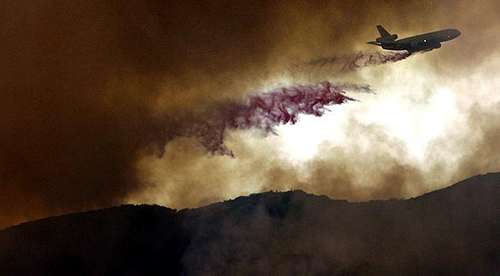
A converted DC-10 jumbo jet drops fire retardant on a brush fire near Corral Canyon in Malibu in November. (Brian Vander Brug/Los Angeles Times)
The deadly 2003 Cedar fire was raging through San Diego County. Rep. Duncan Hunter, whose home in Alpine would burn to the ground, couldn't understand why military aircraft hadn't been called in to fight the blaze. He decided to do something about it.
Hunter phoned Ray Quintanar, regional aviation chief for the U.S. Forest Service, and demanded that giant C-130 cargo planes be mobilized to attack the fire with retardant.
Quintanar explained that winds were too high and visibility too poor for aircraft to operate. Forest Service air tankers had already been grounded. But, as both men recall the episode, Hunter would not be dissuaded. He told Quintanar to call "Mr. Myers" and rattled off a Washington, D.C., phone number.
"Who's he?" Quintanar asked.
"He's the one with all the stars on his chest standing next to Don Rumsfeld," Hunter replied, describing Gen. Richard B. Myers, then chairman of the Joint Chiefs of Staff.
When Quintanar resisted, Hunter called Washington and pleaded his case directly with Myers. Over the next two days, six C-130 Hercules transports were dispatched to Southern California from bases in Wyoming, North Carolina and Colorado. The planes saw action once the weather improved, but in Quintanar's view they contributed little to controlling the fire.
Hunter says he has no regrets about his end run around the chain of command. "California was on fire, I got 'em the planes," he said in a recent interview. "That's my job."
To professional firefighters, though, it was a prime example of a "political air show," the high-profile use of expensive aircraft to appease elected officials.
Fire commanders say they are often pressured to order planes and helicopters into action on major fires even when the aircraft won't do any good. Such pressure has resulted in needless and costly air operations, experienced fire managers said in interviews.
The reason for the interference, they say, is that aerial drops of water and retardant make good television. They're a highly visible way for political leaders to show they're doing everything possible to quell a wildfire, even if it entails overriding the judgment of incident commanders on the ground.
Helicopter bases often must be created from scratch in the backcountry to fight wildfires. Heavy equipment is sometimes brought in to carve roads and clear terrain. Fields are leased from property owners. Afterward, the land must be restored to its original condition.
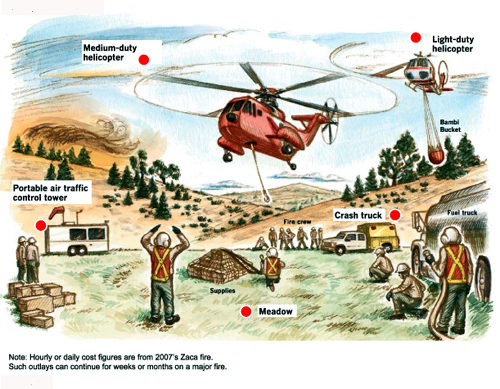
Meadow: Leased to $150 to $500 a day.
Crash truck: Emergency vehicle with crew equipped to treat injured and respond to accidents.
Medium-duty helicopter: Transports crews and supplies and drop water and retardant. Costs $1,100 to $2,600 per flight hour, plus standby and other charges.
Light-duty helicopter: Shown here with a Bambi Bucket for dropping water. Costs $700 to $1,600 per hour of flight time, plus standby and other charges.
Portable air traffic control tower: Costs $4,700 a day for tower and two air traffic specialists.
(Doug Stevens/Los Angeles Times)
Firefighters have developed their own vernacular for such spectacles. They call them "CNN drops."
"A lot of people do a lot of things for publicity and for politics that don't need to be done," said Jim Ziobro, fire aviation chief for the Oregon Department of Forestry.
Increased use of aircraft is helping to drive up the cost of fighting wildfires. The Forest Service spent $296 million on aerial firefighting last year, compared with $171 million in 2004. Aviation costs amount to about one-fifth of the agency's fire-suppression spending.
Nearly all of the nation's firefighting aircraft are owned and operated by private companies under contract with the government. The meter starts running when an incident commander calls aircraft to a fire. It continues whether a plane is in the air dropping retardant or sitting on a remote tarmac, waiting for visibility to improve.
It costs up to $14,000 a day to keep an air tanker on call and as much as $4,200 per hour to put it in the air. Heavy-duty helicopters, the workhorses of aerial firefighting, can cost $32,000 a day on standby, plus $6,300 per hour of flight time.
"When you deal with aviation on a wildland fire, you have a big bank in the sky that opens up and showers money," said Timothy Ingalsbee, a former Forest Service and National Park Service firefighter who has criticized federal firefighting and forest management practices.
Unrealistic expectations
Pressure to use aircraft has grown as wildfires have become larger and more dangerous, and as more subdivisions have sprung up in fire-prone canyons and woodlands. When a column of smoke appears in the distance, frightened homeowners want dramatic action, and an air tanker pouring red retardant on a blazing ridgeline is undeniably dramatic.
As a result, Americans have become conditioned to think officials aren't taking a fire seriously until they unleash a ferocious aerial attack.
"If there's a fire and there's not an air tanker circling in California, people go, 'Oh my God, we're defenseless,' when in fact we're probably not," said Scott Vail, a retired Forest Service incident commander.
Aircraft have an important but limited role in firefighting. In the early stages of a fire, drops of water or retardant can hold the flames in check until ground crews arrive. Aircraft can also douse fires on ridges or in canyons that firefighters can't reach. An all-out aerial attack can save money if it brings a fire under control early.
"You can make or break a fire in one day with the right amount of aviation," said Dennis Hulbert, the Forest Service's aviation chief for California.
But it's a firefighting axiom that "aviation doesn't put out a fire." Only crews and engines on the ground can do that.
What's more, bulky tankers such as C-130s -- designed to carry troops, armored vehicles and other equipment -- are not well-suited to operate in California's steep canyons and mountains or at the low altitudes required for effective delivery of water and retardant.
The Forest Service and other federal agencies have about 450 firefighting planes and helicopters under contract. The planes are mainly older single- and multi-engine crop dusters and surplus military craft retrofitted for firefighting.
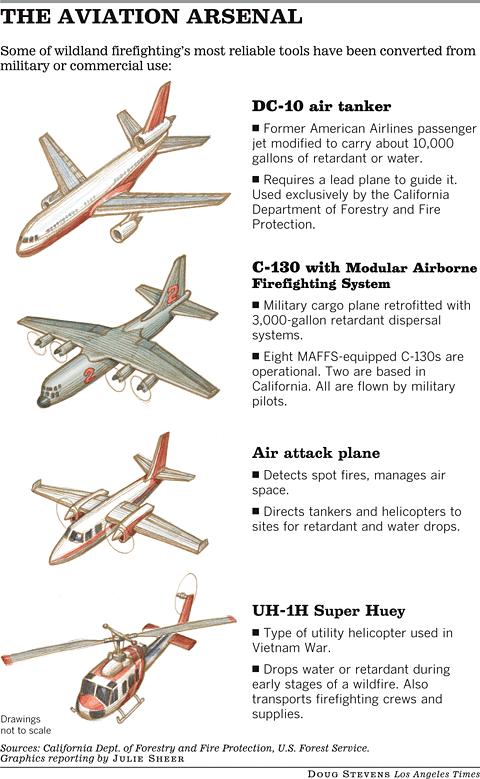
The California Department of Forestry and Fire Protection has its own air force. The fleet includes two dozen tankers, 11 heavy-duty helicopters, 14 twin-engine command-and-control planes and a converted DC-10 jumbo jet on lease.Cal Fire spent more than $34 million on aviation last year, including $7 million for the exclusive use of the DC-10.
The National Interagency Fire Center in Boise, Idaho, is supposed to allocate aircraft based purely on professional judgment. The center, known as NIFC (pronounced nif-see), was created in 1965 to serve as the nation's operational nerve center for wildland firefighting. The idea was to insulate decision-making from political pressure.
In practice, though, politicians still manage to influence when and where planes are deployed.
A resort uses its clout
When a wildfire broke out at the edge of the Sun Valley ski resort near Ketchum, Idaho, last August, locals were dismayed to see no firefighting aircraft overhead.
The planes were busy fighting other fires deemed higher priority by NIFC. So Sun Valley homeowners and businesspeople began working the phones. In short order, they had the state's most powerful politicians pressing their case.
Gov. C.L. "Butch" Otter and U.S. Sen. Michael D. Crapo, both Republicans, called NIFC, the Federal Emergency Management Agency, even the White House.
"People wanted more aircraft. Our office did put pressure on NIFC," said Crapo's press secretary, Lindsay Nothern. "The squeaky wheel gets the grease."
Other elected officials did their part. State Sen. Clint Stennett, a Democrat whose district includes Sun Valley, told federal officials that the fire threatened property valued at $10 billion. He didn't need to remind them that the resort's part-time residents include California Gov. Arnold Schwarzenegger, U.S. Sen. John Kerry, high-powered business executives and movie stars.
"There's a significant amount of political influence in this community, and we don't hesitate to use it," Stennett said.
The lobbying blitz turned a low-priority fire into a high-priority one.
"Once the governor started making noise, well, then the aircraft started moving in our direction," Jeanne Pincha-Tulley, the Forest Service incident commander on the Sun Valley fire, recalled with a laugh. "When you go to the White House like Butch was doing, it's got to have some effect. We started getting stuff. It was the most beautiful air show you have ever seen in your life."
At its peak, the fleet of contract aircraft at Pincha-Tulley's disposal included 19 helicopters and several air tankers. She said she was happy to have the resources and did not consider them excessive. But for much of the time, the aircraft were grounded by 70-mph winds.
The fire was brought under control in about three weeks, with no loss of life or property and at a cost estimated at $39 million. Aerial firefighting accounted for about 24% of the total.
Hulbert, the Forest Service aviation chief and a veteran of California wildfires, nodded in recognition when asked about political meddling. "I'll say this: In this region, there are a lot of political and economic pressures. But you just cannot fly in 20- to 25-mph winds and be effective," he said. "The poor incident commander is stuck in the middle between the cost issue and the political pressure.. . . .
"I've had a case where I got a call -- I won't tell you who it was -- and I was told to put a helicopter in the air. I just couldn't do it."
Calling in the military
Fire commanders say that politicians are especially keen to mobilize military aircraft when wildfires are burning.
Dale Gardner directed federal firefighting on the 2002 Kraft Complex fire, which charred 48,000 acres of North Dakota prairie.
Gov. John Hoeven dispatched two National Guard helicopters "that we had no need for," Gardner recalled. There were sufficient ground forces and civilian aircraft to handle the situation, he said.
"But it was pretty clear he wanted to see those [helicopters] working on our fire," said Gardner, now retired. "We used them. It was obvious the politics of the situation dictated that we better drop some water with those helicopters."
Hoeven's office referred a request for comment to the North Dakota National Guard. Greg Wilz, director of military support operations for the Guard during the fire, said the helicopters were "partially effective."
"Dropping 150 gallons at a few hundred feet on a fire is literally a drop in the bucket," he said, but he added that the helicopters were able to reach parts of the fire that ground crews could not.
Elaine Zieroth, former supervisor of the Apache-Sitgreaves National Forest in Arizona, said she felt similar pressure to use military planes when a big blaze broke out in her domain in June 2004.
Earlier that year, federal officials had grounded private air tankers after a series of accidents, and Arizona politicians arranged for two C-130s to be stationed in the state as a stop-gap.
Rep. Rick Renzi, a Republican from Flagstaff, issued a news release touting the deployment and his role in arranging it: "Today, Arizona stands in a stronger, safer position to fight fires and protect our rural communities."
When the Three Forks fire erupted in the national forest, Zieroth said, the Forest Service's regional office gave her some advice: Whatever you do, call in the C-130s.
"The politicians had lobbied to get these military air tankers," said Zieroth, who retired last year. "We ordered them, but we probably wouldn't have if we hadn't been advised it would be a good political move."
The tankers were too big and flew too high to make accurate drops of retardant in the forest's rough terrain, said Zieroth, who watched the C-130s in action from another plane.
"A lot of the retardant just overshot the fire," she said.
For every two C-130s dispatched to a fire, a third follows to carry equipment and support personnel. The military tankers mobilized for this summer's California wildfires cost nearly $12,000 per hour of flight time, records show. Much of the cost of such missions is billed to the Forest Service.
During the 2003 Cedar fire in San Diego County, commanders had civilian tankers available but couldn't use them because of high winds. Quintanar, a 34-year veteran of wildland fires, said that was why he resisted Rep. Hunter's demand for military aircraft.
"The pilots couldn't see; the windshields were pitted with dirt," recalled Quintanar, now retired from the Forest Service. "It's beyond dangerous."
But because of the severity of the fire, which ultimately killed 15 people and destroyed nearly 5,000 structures, pressure to get more aircraft on the scene was intense.
Once the weather eased, the C-130s dispatched by the Pentagon in response to Hunter's lobbying unleashed 154,000 gallons of retardant. But Quintanar said the drops added little to what civilian aircraft had already accomplished.
"It was a politician trying to play fireman and thinking the answer was air tankers," he said.
Wildfire workhorses
The big money on fires is expended on high-performance helicopters, which fire bosses love for their versatility. They can often fly when wind or weather ground fixed-wing aircraft. Commanders use them to ferry personnel and supplies as well as to drop water and retardant.
On a single day of last year's Zaca fire in Los Padres National Forest, the use of one Sikorsky S-64 heavy-lift helicopter cost taxpayers nearly $65,000 -- $32,760 to keep the machine on standby for 14 hours and $6,370 per hour for five hours of flight time, Forest Service records show. By the end of that week, the bill for the helicopter had reached $368,645. Dozens of helicopters worked the Zaca during the four months it took to put the fire out.
To rein in aviation costs, Forest Service officials have tried to curb unnecessary use of helicopters. Internal memos have taken aim at "heli-mopping" -- using the aircraft to douse remnants of a fire or to perform chores that ground crews could do more effectively.
The leasing of helicopters is only part of their cost. Whereas air tankers fly from established bases, helicopters need bases near a fire, which have to be created ad hoc, often in backcountry lacking roads, utilities and water.
Forest Service contracting officers lease land from property owners. Heavy equipment sometimes has to be brought in to carve roads and clear terrain. Water trucks are hired to keep dust down.
Pilots, mechanics, fueling crews and other support personnel must be transported to the scene and provided with food, water, supplies and a place to sleep. A team of emergency medical personnel is required at all times.
During the Zaca fire, the government paid Tower Tech Inc. of Meadow Vista, Calif., $4,700 a day for a portable air traffic control tower and two air traffic specialists.
ICL Performance Products in Ontario operated a mobile retardant mixing station for a base fee of $3,345 per day, plus $1,000 to $4,000 in daily operating charges. The retardant itself cost an additional $2,095 a ton; water to mix it was delivered by a $1,761-a-day truck.
Such outlays can continue for months on a wildland fire.
One of the busiest companies in aerial firefighting is Aero Union Corp. of Chico. It flies eight fixed-wing P-3 Orion tankers under contract with the Forest Service. The company also produces the pressurized tank system that C-130s use to drop retardant.
Aero Union has been awarded federal fire-suppression contracts totaling at least $169 million since 2000, government records show.
Columbia Helicopters of Aurora, Ore., secured nearly $90 million in fire contracts with the Forest Service over the same period, the records show. The company's heavy-lift helicopters also remove timber from national forests.
Some aviation companies are politically active. Executives and employees of Columbia, for instance, contributed more than $400,000 to federal candidates and election committees in the last 10 years, according to campaign finance records. In its home state, the company made $868,000 in political donations over the same period.
Columbia President Michael A. Fahey said in an e-mail that the contributions "have never been made to create influence. . . . We believe our unrivaled capabilities and exceptional efforts on the fire lines speak entirely for themselves."
Aviation contractors, including many smaller companies, look after their interests in Washington through Helicopter Assn. International. The trade group has reported spending $856,000 lobbying Congress over the last 10 years on a variety of issues, including funding for wildland firefighting.
Skirting the rules
Under firefighting protocols, military aircraft are to be sent to a fire only if no civilian planes are available and only if federal or state officials ask for help. In reality, elected leaders frequently finesse these rules.
Among the most forceful advocates for using military aircraft is Hunter, a former Army Ranger and the ranking Republican on the House Armed Services Committee.
When wildfires swept Southern California last October, Hunter again got on the phone asking for C-130s. This time, he reached Lt. Gen. Steven Blum, head of the National Guard Bureau, in Washington. Blum was willing to send the planes, but there was a hitch. Neither the state of California nor the Forest Service had requested military assistance.
"I said, 'Can you launch the planes?' " Hunter recalled. "He [Blum] thought about it for a minute and said, 'We'll send 'em out, and we'll call it a training mission.' We got the planes."
Nine C-130s were dispatched from bases around the country -- six to fight the fires and three to carry equipment and 150 support personnel, all of whom were put up in hotels at public expense.
In all, the deployment cost taxpayers $5.5 million.
Putting military planes or helicopters in the crowded skies above a fire requires careful coordination between Forest Service and military personnel. Military aircraft use different radio and navigational systems than civilian planes, and their crews use different terminology to communicate in the air.
To promote safety and efficiency, state officials normally insist that a civilian air manager, sometimes called a spotter, accompany each military helicopter flying on a California fire.
The requirement led to delays in getting military helicopters aloft during last fall's wildfires; at one point, there weren't enough spotters to go around.
After heated discussions with elected officials, Cal Fire agreed to assign one spotter for every three military helicopters.
Hunter, who makes no secret of his impatience with the Forest Service bureaucracy, has pushed legislation to speed the process for mobilizing military planes during wildfires. He suggested that fire managers are slow to request military aircraft because they want to give business to private contractors.
Incident commanders say they're reluctant for different reasons: The big military tankers cost a lot and often aren't effective.
L. Dean Clark was fire management officer at the Chiricahua National Monument in southeast Arizona when the 1994 Rattlesnake fire broke out in the Chiricahua Mountains.
Clark recalled standing with a group of ranchers as they watched C-130s release clouds of retardant high above steep canyons and rugged pine forests.
"It was a pointless exercise in humidity-raising," said Clark, now retired. "They couldn't get in close enough to do much good. The feds needed to be showing the citizens they were doing everything they could to put out the fire. . . . It was a laughable example of a waste of federal money."
Long before it reached the ground, the retardant had dissipated into a mist.
Times researchers Maloy Moore and Janet Lundblad contributed to this report.
© 2008, Los Angeles Times
By Julie Cart
The 1995 Sunrise fire on Long Island is considered an extreme example of political interference in firefighting. Military cargo planes, mobilized at the insistence of a powerful U.S. senator, flew hundreds of miles to battle a fire that was almost out by the time they got there.
The fire started Aug. 24, 1995, in Westhampton, N.Y. Driven by wind and dry conditions, it raced through brushland and soon threatened some of Long Island's most valuable real estate.
Harry Doughty, a state forester in Maine with extensive wildfire experience, was brought in to direct the aerial firefighting. He was confident that ground crews and the aircraft already on hand -- six small tankers and 12 helicopters -- were enough to control the fire.
U.S. Sen. Alfonse M. D'Amato and New York Gov. George Pataki thought otherwise. D'Amato, a Republican from Long Island, wanted military C-130s to bomb the fire with water or retardant. Pataki called President Clinton and later told the media that he had received assurances the C-130s were on the way.
D'Amato was leading the Senate investigation into Whitewater, the Arkansas real estate deal that was a focus of GOP attacks on Clinton and his wife, Hillary. The president, who was on a golf vacation in Wyoming, ordered a handful of top aides to Long Island with instructions to placate D'Amato.
James Lee Witt, director of the Federal Emergency Management Agency; Harold Ickes, deputy White House chief of staff; and James R. Lyons, undersecretary of Agriculture, boarded a FEMA plane in Washington in the middle of the night. Lyons went because he oversaw the Forest Service, the lead agency for fighting wildfires.
"D'Amato is there and meets us at the base of the plane in his fire chief's jacket," recalled Lyons, now a lecturer in resource management at Yale University. "Alfonse had it in his head that we needed big planes."
D'Amato, who left the Senate in 1999 after losing his bid for a fourth term, declined to be interviewed for this article. Bill Clinton and Pataki did not respond to requests for comment.
In a makeshift command center near the fire, Doughty briefed the assembled officials and told D'Amato he had sufficient aircraft.
"The commander was the pro. He had sized up the situation and ordered small planes, the right size and right scale," Lyons said. "D'Amato felt slighted that he didn't get his big plane. He began shouting, 'Get me planes, get me planes, get me planes!' "
Doughty stood his ground. Under federal firefighting protocols, only he or the incident commander could order planes or helicopters into action
"I told them we didn't need them," said Doughty, who retired in 2000 after 26 years in Maine's forest service. "I argued against it for a day and a half. It was obvious to the firefighters, but not to the political people."
But Pataki and D'Amato believed they had a commitment from Clinton. Their credibility was at stake too: Both men had told the media that military planes were en route.
"This is where it got kind of silly," Doughty recalled. "Jim Lyons came up to me and said, 'I have a direct order from President Clinton. He wants you to order those aircraft.' My first thought was, 'I'm a state employee. I don't work for Bill Clinton.' But then I thought I'd want to continue my career."
Doughty relented and called the National Interagency Fire Center in Boise, Idaho, to order the C-130s. "They said they had been waiting for my call," he said.
Two C-130s with firefighting tanks were dispatched to New York from an Air National Guard base in North Carolina, along with a plane carrying support personnel.
The C-130s arrived on the morning of Aug. 26. By then, the fire had been contained, just as Doughty predicted.
Fire commanders searched for a still-active area of the fire where the planes could drop their loads. They chose a strip of burning grass beside a highway, with ample room for television trucks.
"We didn't do any fire suppression in the area around the drop," Doughty said. "It would have burned itself out."
As the first C-130 started its run, a warning light came on in the cockpit and the plane had to land. After another delay, the second plane went up. The massive aircraft roared over its tiny target of smoldering grass and unleashed thousands of gallons of water.
"The news media were impressed. Everyone was happy," Doughty said. "In my opinion, it was a waste of money. Think of the manpower to bring those planes in. It was a political thing, and it cost the taxpayers a lot of money."
© 2008, Los Angeles Times
Many Californians live in or near the combustible wild. Santa Barbara County's bucolic Mission Canyon is a prime example. Despite its ample allures, it's a firetrap.
By Bettina Boxall
SANTA BARBARA — Sometimes when Ralph Daniel looks out the huge plate-glass windows of his 1959 ranch house, a bobcat stares back at him from the patio. He delights in the quiet, the bird songs, the expansive view of the Santa Ynez Mountains.
Like millions of other Californians, Daniel, 63, likes to live on nature's edge. He is a 10-minute drive from both downtown Santa Barbara and Los Padres National Forest. But he has no illusions. One day he expects to see a wildfire bolt through the chaparral and down the slopes toward his house on the fringes of Mission Canyon.
"That's where I think it's going to come from," he says, pointing to a ridgeline from a seat on his patio.
When it does, getting out could be a nightmare. Like many rustic communities in the West, Mission Canyon is a maze of narrow, twisting roads, dead-end drives and too few exits.
From the state's earliest days, California's growth has been one endless push into the combustible wild, whether it was Gold Rush-era log cabins in the Sierra foothills, the canyon retreats of the Hollywood elite or new subdivisions sprouting on brushy Riverside County hillsides.
About 40% of the more than 12 million homes in the state are on land with a high to extreme threat of wildfire, according to the California Department of Forestry and Fire Protection. Most of them are not in the boondocks, but in developed areas bordering wildlands -- places like Mission Canyon, Malibu, Sierra Madre, Santa Clarita.
Every year, more houses go up in what is known as the wildland-urban interface, where development meets the flammable wild.
An analysis by U.S. Forest Service and University of Wisconsin researchers found that between 1990 and 2000, 61% of the new housing in California, Oregon and Washington -- more than 1 million homes -- was built in the interface.
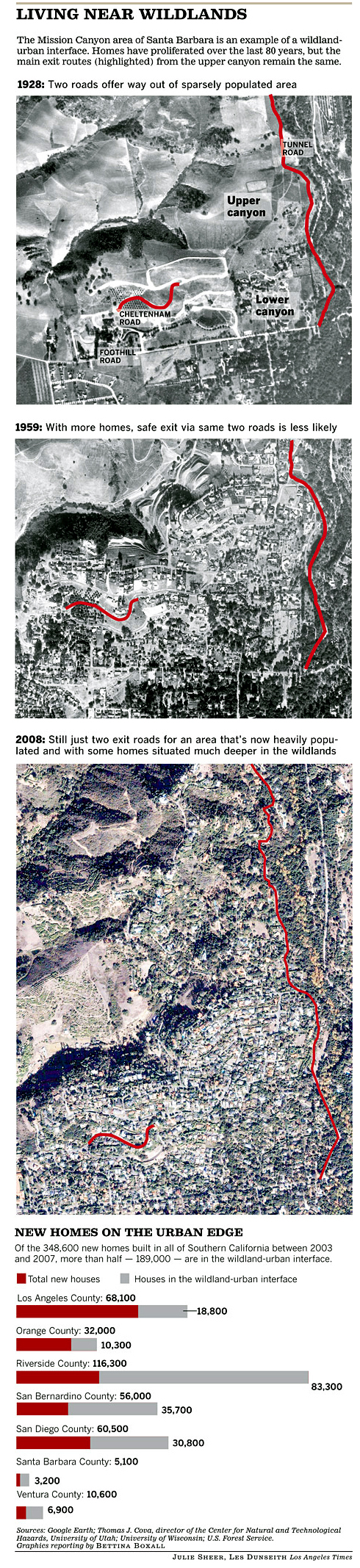
In Southern California alone, the Forest Service estimates that roughly 189,000 homes were constructed in fire-prone areas from 2003 to 2007.
Wildfire losses in California have shot up dramatically as a result of such growth. In the 1960s, an average of 100 structures a year were destroyed by wildfire on lands protected by state firefighters. In the 1990s, the figure topped 300. In this decade, wind-driven firestorms have pushed the average past 1,500.
The toll will only get worse, says Bill Stewart, a former assistant deputy director of Cal Fire. "We haven't seen how bad it can be. . . . We build with wood, and we have hot, dry winds. There's no house you can say has a zero chance of ever burning."
The escalating destruction has sparked new state construction standards as well as a growing recognition of the limits of firefighting.
Some argue it is time for bolder steps: Curb building in areas of high fire danger. Close national forests to the public on days when the Santa Ana winds howl. Bury power lines in the backcountry so they don't topple in fierce winds and spark infernos, as happened last October. Require retrofitting of existing homes to make them more fire-resistant.
"I ultimately think the fire problem in Southern California is not something fire managers will solve. Land managers will solve it. That is the frontier," says Jon Keeley, a research scientist with the U.S. Geological Survey who has studied fire in the region's shrub lands for decades.
Wildfires are not natural disasters, says Tim Duane, an associate professor of planning at UC Berkeley. "They are natural processes that become disasters because of human decisions. . . . Why was the subdivision there? Why was it spread out the way it was?"
No easy way out
Mission Canyon has been a retreat for Santa Barbarans since the Spanish colonial era. The nearby mission dammed its creek for water. Locals hiked and picnicked on its slopes and established a botanical garden. After World War II, hundreds of homes were built there.
Bounded on the north by the Los Padres and on the south by Santa Barbara's city limits, the canyon has remained unincorporated county land, served by a road network established in the 1920s.
Daniel, a psychologist, grew up in the New York area, went to graduate school in the Bay Area and moved to Santa Barbara in 1985, drawn by the ocean and the weather. Five years later, in a foothill neighborhood a few miles west of Mission Canyon, he encountered a less alluring side of Southern California.
Pushed by local winds known as sundowners, the Painted Cave fire raced from the mountains to the 101 Freeway in a couple of hours. It jumped the highway and wiped out more than 600 buildings -- including three homes near his.
Daniel and his then-partner lived on a cul-de-sac next to county parkland. They watched 15-foot flames run through the grass.
"As we were packing the car, all of a sudden the fire was on us, so we got the hell out of there," he said. The streets were clogged with bumper-to-bumper traffic. "Everybody was fleeing and going downhill in all lanes. Nobody could go uphill. No fire engine. And that's what's going to happen here."
Daniel has lived in Mission Canyon since 2000, balancing the dangers against the pleasures of canyon life. "I can't think of too many places I could live without any risk at all -- and those places, I think, would be kind of boring."
In a 2005 research paper, Thomas Cova, an associate geography professor at the University of Utah, posed a question: Should places like Mission Canyon have population limits, just as movie theaters have occupancy limits to ensure everyone can escape in an emergency?
His study, published in the journal Natural Hazards Review, includes two aerial photographs of upper Mission Canyon. One, taken in 1928, shows a scattering of trees, an orchard, four houses and two main routes in and out.
The second, taken decades later, shows abundant landscaping and houses packed together. More than 400 homes were using the same two ways out.
After his research was published, he received e-mails from all over the West. "People's genuine concern is that they moved into a canyon that wasn't too populated 20 years ago and they can't stop the development," Cova says.
Newer subdivisions are required to have wider roads and better access for fire engines than Mission Canyon does.
But Cova says planning regulations around the country pay scant heed to the number of people who will have to use exit roads in a wildfire.
He grew up in the Bay Area. His career has been shaped by the 1991 Oakland Hills fire, which destroyed nearly 3,000 structures and killed 25 people in a matter of hours. Many of them died in or near their cars at the end of a long line of traffic, trying to flee a neighborhood of narrow, winding roads that funneled to four exits, two of which were blocked by the fire.
"It was an ugly thing," Cova says. "I was living a couple of miles from where the people died."
He vividly remembers the wide band of flames roaring through eucalyptus trees, the news accounts of victims: The family that burned to death in their pickup truck. The teenage girl who became disoriented in the smoke.
Later, in graduate school at UC Santa Barbara, Cova chose wildfire evacuations as his thesis topic. Was Oakland an isolated situation? he wondered.
He studied the Santa Barbara area because its mountainous backdrop has a fiery history: the Refugio blaze in 1955, the Coyote in 1964, the Sycamore in 1977, the Painted Cave in 1990.
"Some of these fires were enormous and very violent, but there were no homes in the area where the fire occurred. But now the homes are out there."
This month, the Gap fire threatened Goleta.
The West, Cova found, is studded with scenic firetraps. "There are literally thousands of fire-prone communities. . . . with a static road network and steadily increasing housing stock," he wrote in his 2005 journal article. "In most of these areas the likelihood of an extreme fire is increasing. . . . "
Preparing for the worst
Jenny Cushnie has called Mission Canyon home for more than 30 years. She didn't think about fire when she arrived. "I came here from Switzerland and before that from Scotland. Fire was not an issue," she says. "Mold was."
In 1977, the 805-acre Sycamore fire erupted a few miles away, burning more than 200 buildings. Then at a canyon barbecue about 15 years ago, a Santa Barbara County fire official gave a talk.
He said a wildfire racing through the leafy canyon would sound like a speeding train. It would ignite spot fires a half mile ahead of the main front. It would kill people.
Cushnie went straight home and started hacking down brush near her house. "It was terror," she says with a slight Scottish burr. "Somehow before that, I never got it."
Ever since, she has been on a campaign to increase fire awareness in the canyon. For years she has chaired the fire committee, which promotes brush clearance and emergency readiness.
When the sundowners rage and it's 90 degrees at 11 p.m., Cushnie stays up, watching and sniffing the air. She keeps a fire hose and plastic jugs of retardant in a storage area. When she and her contractor husband built their current house in the early 1980s -- their third home in the canyon -- they did so with fire in mind.
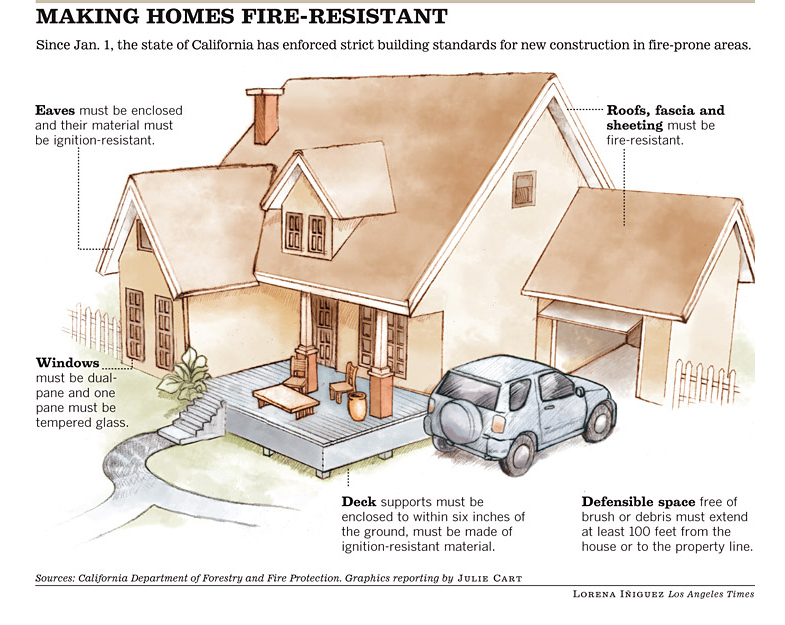
The deck is saltillo tile, the outside walls are stucco and the eaves are enclosed to ward off ignitions.
"We've done a lot. But is it enough?" she asks. "I don't know."
Cushnie doesn't expect to see firemen in her driveway defending her house if the upper canyon turns orange with flame. "It's too dangerous for them," she says matter-of-factly.
She stays in the canyon "because of the people and because of the place."
"It's like a village," she says. "If there's a problem, you can count on each other . . . It's so beautiful -- the birds, seeing deer walking up your steps."
In designing their home, Cushnie and her husband anticipated new state building codes intended to make all of a house's exterior inhospitable to flame and embers. But the standards, which took full effect in January, apply only to new construction in fire hazard zones -- an estimated 35,000 homes a year.
"The larger problem of wildland fire is all the older homes in the state," says Ventura County Fire Chief Bob Roper.
Stewart, the former state forestry department official, says "the next logical step" is to require owners of existing homes to retrofit for fire, at least when they remodel. "People say it's expensive. But so is earthquake insurance."
Homes are fuel. "There is actually more flammable material in a house per square yard than in a forest," says UCLA climate dynamics professor Michael Ghil.
Last summer's Angora fire in South Lake Tahoe underscored the point. Many of the more than 250 buildings that burned caught fire from embers blown from other houses, not from the surrounding woods.
In many California neighborhoods, including parts of Mission Canyon, homes are so close together that a neighbor's bedroom or living room is within the 100-foot perimeter fire officials say should be cleared of flammable material.
Mission Canyon residents have gotten better about removing brush and low-growing trees in recent years, Cushnie says. But it's not hard to spot the makings of a bonfire in many yards.
"Here is a place where you have pepper trees under eucalyptus trees," Ray Smith says disapprovingly as he drives his 1989 VW bus past a house in the lower canyon. "Somebody ought to take them out. This is a disaster."
Smith, a retired UC Santa Barbara geography professor, lives with his wife, an elderly dog and a small flock of caged birds just down the road from Cushnie in a pink adobe-style house surrounded by graceful, long-limbed oaks.
He has cut down three big eucalyptus and two pepper trees on his one-acre lot. He has sawed lower limbs off the oaks to eliminate a natural fire ladder. He typically spends $3,000 to $5,000 a year to have brush cleared from the slopes beneath his house.
He has installed high-pressure faucets for fire hoses, has metal covers to place over his windows in case of fire and is thinking of building a lap pool. "Not because we want a pool so much -- but we want 5,000 gallons of water."
Since studying Mission Canyon, Cova has switched the focus of his research. Barring a wildfire equivalent of Hurricane Katrina, he doesn't think politicians will place a building cap on the West's firetrap canyons.
"Who makes money if a house isn't built?" he asks. "Nobody."
Now he is studying community facilities where people can take shelter -- golf courses, public swimming pools and the like.
If he lived in one of those canyons -- and he concedes they are charming -- Cova says he would construct an underground bunker with water.
"My family and I would not get in our car and try to navigate the smoke and flames with bumper-to-bumper taillights," he says. "We would just calmly open up, just like they do in Tornado Alley -- open the trap door and head downstairs. Wait 20 minutes, maybe less, and come back and extinguish the embers around the home.
"They do it for other hazards. We did it for the Cold War."
Times staff writer Julie Cart contributed to this report.
© 2008, Los Angeles Times
Putting out forest fires without dealing with the fuel buildup "just perpetuates the problem" because "you're not treating the root cause." -- Elaine Zieroth, former Apache-Sitgreaves National Forest supervisor
By Bettina Boxall
SPRINGERVILLE, ARIZ. — A piece of heavy equipment called a hot saw is slicing through a high-country stand of skinny ponderosa pines like a mechanical Paul Bunyan on steroids. Nearby, a computer-programmed log processor is stripping the branches off cut trees as if it were peeling carrots.
Most of the logs are no more than a foot in diameter -- not big enough to properly be called timber. It's a haul Dwayne Walker's grandfather, who skidded fat logs out of Southwestern pine forests with mules and Clydesdales, would have scoffed at.
Not Walker. "We're thinners. We changed our name," says the fourth-generation woodsman.
In Arizona's White Mountains, a U.S. Forest Service project is turning traditional logging on its head in an effort to make the forest less flammable.
Walker's crew isn't touching big, commercially valuable trees. Instead it is aiming the hot saw at slender-waisted ponderosas, the kind of dense young growth that can stoke a wildfire like coal shoveled into a furnace.
A natural cycle of low-intensity fires once kept these small trees in check. But a century of fire suppression in the nation's forests allowed them to grow into highly combustible thickets across tens of millions of acres.
Typically, there's been no market for little trees. The White Mountain Stewardship Project aims to change that by giving wood cutters, mills and other businesses an incentive to turn unwanted growth into wood-stove pellets, paneling and other products.
The project is the brainchild of frustrated locals who watched their traditional logging economy collapse and an iconoclastic forest supervisor.
By the 1990s, environmental lawsuits to protect habitat for the Mexican spotted owl were blocking the heavy logging in the Apache-Sitgreaves National Forest that had helped feed the region's sawmills for decades.
In 1997, community leaders came up with a plan for a demonstration project to cut small trees. Then, in 2002, the Rodeo-Chediski fire burned 468,000 acres of the White Mountains, destroying more than 400 homes.
Much of what burned was dense ponderosa pine stands that used to be logged. In the town of Heber, which borders the national forest, a billboard proclaimed, "Thank you, environMENTALists for making the 2002 fire season all it could be."
"There was a lot of negative energy," recalls Elaine Zieroth, who was appointed Apache-Sitgreaves supervisor after the fire.
Zieroth forged a plan to hire local businesses to thin 150,000 acres of the Apache-Sitgreaves over 10 years. She got environmentalists on board by agreeing to generally limit the thinning to trees no larger than 16 inches in diameter.
Terry Reidhead says that if someone had asked him a decade ago to take small-diameter logs, he would have told them "to go to hell." A flirtation with bankruptcy changed his family's thinking. These days, small logs are mostly what comes through the Reidhead Brothers operation, which manufactures paneling, flooring and siding on the outskirts of Springerville.
The Forest Service gave him a $250,000 grant to install new equipment. He has a handshake agreement with Walker to supply the mill with wood from the White Mountains project. He has found a market for his products in Mexico and has done better than he expected.
Over at Arizona Log and Timberworks, 4-inch-diameter pine logs are stacked like bunches of giant, blond pencils. Here Randy Nicoll and his brother Keith, buoyed by $300,000 in federal grants, use wood from Walker to make fence railings, utility poles, log trusses and decorative posts.
In Show Low, about 40 miles west of Springerville, trees too wispy for Reidhead and Nicoll are chipped and processed into wood heating pellets the size of rabbit food. To the northwest, in Snowflake, a recently built biomass plant is burning wood chips from the project to produce power for Arizona utilities.
Still, the White Mountains project depends on a heavy infusion of federal cash. Walker's W.B. Contracting has received $700,000 from the Forest Service since 2000. His partnership with the pellet company, Forest Energy Corp., pays the Forest Service for trees larger than 12 inches in diameter but receives a federal subsidy, an average of $500 an acre last year, to remove the smaller ones.
The Bush administration has advocated cutting larger, commercially valuable trees on public lands to subsidize small-tree thinning. Zieroth didn't want to do that. "We would be cutting the trees we should be leaving," she said.
The Forest Service has spent roughly $15 million on the White Mountains thinning. The entire 150,000-acre project could cost more than $80 million. Zieroth, who retired in December, says the expense is worth it. Putting out forest fires without dealing with the fuel buildup, she says, "just perpetuates the problem" because "you're not treating the root cause."
© 2008, Los Angeles Times
Grassy invaders are stoking immense wildfires that are wiping out huge swaths of sagebrush, a symbol of the West. Land managers are losing this turf war.
By Bettina Boxall
ELKO, NEV. — Around every bend of the dirt road, Tom Warren recites another name, another date. The Sheep, the Amazon, the Winters, the Suzie. The list goes on and on.
It is a chronicle of loss, of wildfires ravaging one of America's mythic landscapes, the sweeping, lonely sagebrush country of the West.
On mountainside after mountainside here, in valley after valley, the richly textured, muted green of sage has yielded to a monotonous, dried-out sea of dirty-blond cheatgrass.
The annual grass, a tough native of Eurasia, is fueling a devastating cycle of fire that is wiping sage from vast stretches of the Great Basin and, with it, an ancient ecosystem that is home to the pronghorn antelope, strutting sage grouse and other prized wildlife.
The Great Basin, which swallows most of Nevada and reaches into parts of Utah, Idaho, Oregon and California, is the epicenter of a plague of wildfire driven by the spread of nonnative plants. Some of the biggest conflagrations in the nation over the last decade have burned in this cold high-desert region.
"The Winters fire took out that mountain and went on for 20 miles," says Warren, a rehabilitation manager for the U.S. Bureau of Land Management. He is glancing out the window of a government SUV as it bumps across the backcountry of northeastern Nevada.
He points out the 150,000 acres charred by the Sheep fire. It consumed islands of shrub that had survived an earlier blaze. Not even the skeletons of sage are left.
It's like that across much of the 135-million-acre Great Basin.
"If something hasn't burned yet, it's waiting to burn," said Steve Knick, a research ecologist with the U.S. Geological Survey in Idaho. "Just the rapidity with which the landscape has changed is unbelievable."
Grassy aliens carpet the ground. They dry out quickly and burn in an instant. When lightning strikes a bed of dead cheatgrass, it's like dropping a match into a lake of kerosene.
Country that used to burn every few decades -- or once a century -- is burning every few years.
Cheatgrass fed the largest blaze in Utah's recorded history, last year's Milford Flat fire. It galloped at freeway speeds across 363,000 acres of rangeland, incinerating hundreds of cattle.
In the Mojave and Sonoran deserts, where lightning fires historically stayed small and isolated because there wasn't much to burn, flames are following the spread of tassel-headed red brome.
In 2005, after high rainfall produced a luxuriant crop of brome and other exotic grasses, 1 million acres of the Mojave were charred.
Air pollution may be abetting the invaders. Researchers have found that high nitrogen deposits are fertilizing nonnative grasses in parts of Southern California. In southern Nevada, experiments have shown that brome thrives at elevated levels of carbon dioxide expected in the atmosphere by mid-century.
Nowhere is the grim mating of wildfire and invasive grasses more evident than in the huge Elko District of the Bureau of Land Management in northeastern Nevada. This endless country of jagged mountains and gently sloping basins is burning with a regularity that is brutal and on a scale that is staggering.
In 2006, 950,000 acres of the district were scorched -- about the size of Rhode Island and roughly a tenth of all the wildlands that burned in the entire United States that year. Last summer, fire raced across nearly 600,000 acres, an area bigger than Orange County.
The blazes can be traced by color. If the land is tan, it has burned and turned to a thick mat of cheatgrass, ensuring that it will burn some more. Whether cruising down Interstate 80 to Reno or dodging the washboards on a primitive road in the middle of nowhere, it's hard to escape that khaki stain on the landscape.
Since Warren started working in the 11-million-acre Elko District in 1984, it has lost more than a fifth of its sage habitat to fire. Courtship grounds for the sage grouse, crucial winter range for mule deer and browse for pronghorn antelope have all been vaporized.
The Elko District has spent $40 million since 1999 reseeding and rehabilitating the charred lands, with limited success. "It's a system where it's easier to lose things than it is to get them back," Knick said.
Rooted in nostalgia
From Frederic Remington paintings to Gene Autry songs and John Wayne movies, the cultural imagery of the West is steeped in North American sagebrush -- Artemisia tridentata and relatives.
Cowboys bed down in it. Wagon trains roll past it. The sun sets on its rolling expanses.
In "The Call of the Wild," the early 20th century poet Robert Service asks:
Have you wandered in the wilderness, the sagebrush desolation,
The bunch-grass levels where the cattle graze?
Have you whistled bits of ragtime at the end of all creation,
And learned to know the desert's little ways?
Jon Griggs started working as a cowboy on the Maggie Creek Ranch west of Elko 17 years ago. For the last decade, he has been manager.
"My favorite smell is sagebrush after a rain," Griggs says. "It's kind of musky, fresh, almost bitter. . . . It pretty much represents what I love. I love the cattle operation I'm on and the country we're in and the place I get to raise my family."
Lately it is the smell of burning sage that has wafted across Maggie Creek Ranch.
Last year the Redhouse Complex fire hit. The year before, it was the Suzie. "It started on an afternoon about 2 o'clock with several lightning strikes, and by 9 o'clock the next morning it was 30,000 acres," Griggs recalled.
He tried to stop the Redhouse by himself. "I was there with a dozer, when it was 20 or 30 acres. But it moved so fast I couldn't get around it."
Between the two blazes, Griggs estimates, 80% of the ranch's public and private grazing lands has burned in the last two years, inviting more cheatgrass.
A few hours' drive north, just outside of Boise, Idaho, Mike Pellant and his colleagues at the Bureau of Land Management are waging a Sisyphean campaign against fire and cheatgrass in the Snake River Birds of Prey National Conservation Area.
Pellant is coordinator of the Great Basin Restoration Initiative, a government effort launched in 1999 after a chunk of the basin bigger than Delaware burned in 10 days. The program sponsors native plant research and promotes reseeding.
When Pellant started working at Snake River in 1981, the conservation area was mostly sage. Now it's mostly cheatgrass. In the last 15 years, 70% of it has burned at least once.
Near a road, Pellant walks into a remnant patch of Wyoming big sage, the dominant sagebrush of the Great Basin.
The woody gray-green-leafed shrub, about 3 feet tall, provides wildlife with a kitchen and bedroom: food and cover from snow and searing sun. The moss-like crust spreading between the plants acts like a lawn, absorbing moisture and holding the soil in place. The low-growing, high-protein winterfat shrub scattered around the sage offers another level of food and shelter.
In contrast, a cheatgrass landscape is about as ecologically rich as a parking lot. "It's rare to even find lizards," Pellant said. "Talk about a biological desert."
The short-lived annual grass is soft and green for a couple of months in the spring, when animals eat it. But for most of the year, cheatgrass is dead, resembling a parched, scraggly lawn.
In the past, lightning fires probably burned through Wyoming big sage lands in cycles ranging from several decades to more than a century. But in cheatgrass country, the flames return every five to 10 years -- killing whatever baby sage had managed to take hold since the previous blaze.
The exotic species was probably introduced to the West in the late 1800s as a contaminant in wheat seed brought by farmers from Russia and Eastern Europe.
Millions of sheep and cattle then cleared the way for the prolific invader, whose spiky seeds traveled on livestock fur and colonized areas stripped of native grasses by overgrazing. By the 1930s, cheatgrass had settled in. Periodic wet years in recent decades helped it conquer more territory.
As the sage acreage has shrunk in the Snake River raptor area, so has the black-tailed jack rabbit population, the main prey for nesting golden eagles. Their numbers are in turn dropping.
A delicate operation
Trying to reverse the ecological tide is maddeningly difficult.
Sage reseeding "is a crapshoot," Pellant says. If there's not enough moisture or it's too hot, the tiny sage seeds -- the size of specks of ground pepper -- dry out and won't germinate. Freezes can kill infant plants. Another fire will wipe them out.
Simply figuring out the best reseeding techniques has required an inventor's ingenuity. In the 1980s, the first sage reseeding attempts were made from the back of a pickup truck. Then the "Jarbridge sagebrush seeder" was devised. It worked like a big fertilizer spreader pulled behind a truck, followed by a row of rolling tires to press the seeds into the soil.
Aerial drops have been the favored method because they can quickly cover large areas. But they often don't work because the sage seed spreads too lightly on the ground. Federal researchers are working with engineers to modify farm seeding equipment to apply sage with other natives.
In a big fire year, the demand for seed is enormous. Much of it comes from a cavernous BLM warehouse near the Boise airport that is stacked nearly to the ceiling with pallets of bulging bags.
The building can hold 1 million pounds of seed, collected in the wild by commercial operations or cultivated. During a busy fire season, the storehouse will be filled and emptied several times over.
There are redolent sacks of antelope bitterbrush seed, Indian ricegrass, Russian wildrye, squirrel tail, bluebunch wheatgrass and arrowleaf balsamroot. A walk-in cooler that smells like a menthol factory is crammed with bags of sage seed, winterfat and forage kochia, a Eurasian native that is planted in fire-resistant green strips.
The hard-to-collect wild seed can cost as much per pound as porcini mushrooms.
A few hundred miles away, in Provo, Utah, federal research ecologist Susan Meyer is pursuing another tack in the cheatgrass wars.
For the last decade, she has peered through microscopes into Petri dishes at the U.S. Forest Service Shrub Sciences Laboratory, searching for the perfect biological weapon.
She started her hunt after years of native plant restoration work. "I thought, 'You've got to get rid of this weed or this is all an exercise in futility.' "
Meyer is now on her third candidate, a naturally occurring fungal disease she has nicknamed the "black fingers of death." It attacks dormant cheatgrass seeds, injecting a toxin that disrupts cell division and stops germination.
"You know," she says, "if I could actually do something about this, I would be the savior of the West."
She is not very hopeful.
On a hot day last summer, the air smelled like a barbecue and the nearby Wasatch Range was wrapped in a gauzy veil of smoke from the massive Milford Flat fire to the south.
In the lab, Meyer had just made a depressing discovery. The slimy little black fingers of the fungus were growing out of the seeds of wild rye, meaning it can infect not just the hated cheatgrass but desirable plants as well.
Even if she develops the ultimate cheatgrass killer, Meyer doubts society will want to invest the hundreds of millions of dollars it would take to restore the sage country of cowboy lore. "From the Rockies to the Sierra Nevada, it's going to be one giant weed patch."
© 2008, Los Angeles Times
Australians living in the path of bushfires are told to leave early or stay and fight. A family that chose to stick one out endured a daylong test of endurance and determination.
By Julie Cart
ANAKIE, AUSTRALIA — It was brutally hot, 108 degrees, and the wind was howling. Bushfires were raging in the hills, making their way inexorably toward the Baker farmstead at the foot of the Brisbane Ranges.
John and Carlene Baker had moved here to get away from the hurly-burly of the city. They lived with their two children and a cast of orphaned animals on a 60-acre spread they called Foxford.
Now, all of it was threatened. Embers were falling around the house. The animals were growing restless. The Baker property sits deep in a box canyon, a mile from the main road. The couple knew there was little or no chance firefighters would reach them.
Southern Californians might respond to such a predicament by packing the car and evacuating. The thought never entered the Bakers' minds. Instead, they did what they had been trained to do: stay and fight.
Fire is a pervasive danger in Australia, just as in much of the American West. But Australians cope with the threat in a manner difficult to envision in the U.S.
Americans expect firefighters to protect their lives and property. Australians in rural communities view that as their own responsibility.
U.S. authorities are quick to order mass evacuations during wildfires; they prefer to get civilians out of the way so professionals can douse the flames. Australian officials are more likely to hand homeowners shovels and put them to work.
People here live by the principle of "stay or go" during fire season. Residents who can't or won't battle an advancing fire are advised to get out early. Those who stay are expected to defend their homes. It's a policy driven by pragmatism: There simply aren't enough firefighters or firetrucks to protect far-flung rural homesteads.
What's more, researchers here have found that people and houses are more likely to survive a bushfire if they stay together. The reason: Wind-borne embers and the spot fires they cause pose the greatest threat to homes. Residents properly trained and equipped can easily extinguish these small fires.
Fleeing at the last minute is much more dangerous than hunkering down and fighting. Roads are often choked with smoke or blocked by downed trees and utility poles. Late, panicky evacuations account for most wildfire deaths, Australian authorities have found.
The "stay or go" policy, adopted state by state beginning in the mid-1990s, has sharply reduced losses of life and property in wildfires, statistics show. In 1983, a year of widespread conflagrations, 60 Australians lost their lives in bushfires, not including firefighters, researcher Katharine Haynes reported. In the equally severe fire season of 2003, bushfires caused just six deaths.
Only a handful of Australians have died in their homes during wildfires in the last 10 years, and none of them were actively defending their properties, according to researchers at the Bushfire Cooperative Research Center in Melbourne.
There has also been a significant drop in fatalities among people who evacuate during bushfires, evidently because more of them are heeding advice to leave early, researchers say.
The "stay or go" approach so far has found little acceptance in the United States. But as wildfires become more severe and costlier to fight, some U.S. officials say the Australian model deserves a serious look.
"We need to push this concept and push it hard," said Bodie Shaw, wildland fire director for the U.S. Bureau of Indian Affairs, which fights fires on reservations and other public lands. "The onus and responsibility need to shift to you as a property owner."
Shaw is leading a group of federal, state and local fire officials examining how the Australian policy would work in this country. They will submit recommendations in the fall to the National Wildfire Coordinating Group, a Cabinet-level committee that reports to the president.
Rancho Santa Fe in northern San Diego County is one of the few communities outside Australia to adopt elements of "stay or go." The local fire district urges homeowners to follow strict fire-safety standards for buildings and landscaping and stay in their homes during wildfires rather than evacuate in dangerous conditions. The policy stops short of training residents to actively defend their properties -- that's still left to firefighters. Subdivisions totaling 5,000 homes are participating in the voluntary program.
In Australia, sheltering at home does not mean simply waiting the fire out. It means confronting the menace with hose, mop and shovel.
"Let's be honest: It is scary," said John Valcich, captain of a volunteer fire brigade in the rural community of Mansfield. "We're not telling you that you have to stay. But [if you leave] you will lose your house. And don't blame anyone. What's it like to stay? It's like standing at the back of a jet plane when it's revving up. I try to tell people what to expect. But it comes as a hell of a shock when it hits."
Living in a tinderbox
Australians, like Southern Californians, live in one of the world's most combustible landscapes. Their native tree, the eucalyptus, litters the ground with kindling. Its oil-drenched leaves and bark ignite easily.
As in the Western U.S., Australians in growing numbers have been moving from cities and suburbs into picturesque but fire-prone scrublands. Making matters worse, the fire season has been starting earlier and lasting longer, a phenomenon attributed to prolonged drought and climate change.
The Bakers moved to the country 11 years ago from Geelong, a city of 240,000 near Melbourne. John, 45, who makes dental prosthetics, and Carlene, 43, who runs his office, had long dreamed of living in the bush. In Anakie, an hour's drive west of Melbourne, they built a home in a deep valley surrounded by rocky hills and a forest of eucalyptus and wattle trees.
Soon after they arrived, the captain of the local fire brigade paid a visit and explained the philosophy of fire protection in these parts.
"He told us not to expect them to bring trucks up the drive and that we would be on our own," Carlene recalled. "Then he asked us for a donation."
The Bakers armed themselves against the danger. They stocked up on fire-resistant clothing. They bought a small pumper truck with regulation fire hoses and a generator to run water pumps. They set aside a 6,000-gallon water tank for fighting fires. They learned to clear brush regularly to create defensible space around the house. The entire family joined the volunteer fire brigade and received training through the state of Victoria's rural fire service.
Their preparations were put to the test in early 2006, when bushfires marched across the region. The Bakers anxiously tracked the plumes of smoke. By Sunday, Jan. 22, they knew they were in for it. John's parents took the family's three horses to safety on their property near Melbourne. The children, Isaac, then 15, and Molly, 13, were given the option of leaving with them. They chose to stay. After securing the horses, the grandparents returned to help defend Foxford.
John moved tractors, two water trailers and other vehicles close to the house. Carlene, who takes in orphaned animals, made sure her charges were also within the family's defensive perimeter, the rough circle of land they were determined to protect.
She shooed the hen and her newly hatched chicks into the house, where they shared a bathroom with two dogs. The cat, Midnight, spent the firestorm locked in a bedroom. An alpaca, five cows and 22 sheep remained in the barn, which Carlene declared must be defended at all costs.
Everyone was given a job. John and his father, Rodney, 69, repeatedly doused the house and outbuildings with water. Carlene and Isaac helped.
Inside, Molly and her grandmother, Pam, 66, filled the bathtub and sinks with water and soaked mops, towels and washcloths. They stuffed the towels under doors to keep out embers and smoke. They gave the washcloths to those outside to cover their mouths and wash ash and grime from their faces.
At 2 p.m., the Bakers got a call from neighbor Vaughan Stephens, a professional firefighter. Get ready, he told them. The fire is headed your way.
Embers the size of golf balls began to rain down. Each was a bomb that exploded on landing. "Within a minute, the flames were climbing up trees," Carlene said. "We were completely surrounded by fire."
For the next few hours, each family member protected an assigned area, extinguishing small fires with a hose or mop. Molly stuffed aluminum foil in the cracks between the stacked railroad ties that formed the front wall of the house. Carlene moved the pig from his frontyard pen onto the veranda to protect the animal from swirling embers.
By early evening, the ember attack had subsided. The house, barn and other buildings had survived -- so far. In the lull, Carlene noticed wildlife coming in from the bush. Wallabies and kangaroos crawled under the cars and farm equipment. Possums joined the pig on the veranda. The animals were taking shelter. The fire front was about to arrive.
'A continent of fire'
Like those in Southern California, Australian bushfires are driven by wind. Hot, arid blasts out of the northwest rake the nation's desert interior, hurtling toward Victoria's eucalyptus forests and grasslands.
"Here reside the fires that give Australia its special notoriety, not merely as a continent of fire but as a place of vicious, unquenchable conflagrations," American fire historian Stephen J. Pyne has written. "In the fire flume lurk the great, the irresistible fires of Australia."
One of the worst blazes in the country's recorded history occurred in February 1983. One hundred fires started on what came to be known as Ash Wednesday. Eighty-three people were killed, 2,600 injured and more than 2,500 homes destroyed in Victoria and South Australia.
The tragedy shook the nation and prompted governmental and academic inquiries. One study found that occupied houses survived at twice the rate of those left unattended. If the occupants were able-bodied, the survival rate for houses was 90%.
Teams of researchers interviewed survivors and compiled their recollections. A major finding: Most of those killed by the fires were in vehicles or out in the open. In one instance, a group overtaken on the road by a wall of flames huddled in their car as the windows exploded and the seats began to melt. One woman screamed that she couldn't stand it any longer, then climbed out and ran for it. Her body was later found nearby, her rubber thongs fused to the blacktop.
Similar tragedies have occurred in Southern California. Nine people died fleeing the massive Cedar fire in San Diego County in October 2003.
In Australia, Ash Wednesday prompted a rethinking of fire preparedness. Federal researchers pored over more than 100 years of data recorded by rural fire brigades. Their findings dispelled a host of calcified myths, notably the belief that bushfires incinerated homes in a wall of flames. In fact, scientists concluded, more than 90% of the houses lost were never exposed to direct flames or radiant heat. Rather, structures typically were ignited by embers.
"That all instantly clicked with the fundamental observation that when people are around these structures, there's a massive improvement in the statistical survivability of the house," said fire researcher Justin Leonard. "It's small, relatively insignificant ignitions that, in isolation, are relatively simple to put out. But you just have to be there at the time."
Australia already had one of the world's largest volunteer firefighting forces, but more people would need to be trained. Authorities developed community seminars, brochures and DVDs explaining how to maintain defensible space and prepare for an ember attack and then the fire.
A major challenge was persuading homeowners to overcome the primal impulse to flee in the face of fire.
"Where we've suffered the greatest loss of life is when people stay, then at the last minute go hopping in the car and ripping down the road, smashing into a tree at 100 miles an hour," said Jim Darling, a volunteer firefighter who raises sheep and cattle in Strath Creek, 50 miles north of Melbourne.
"Panic is amazing. Put a lot of smoke on it and a dose of panic, and you've got people who drive a road every day of their lives losing their way and driving right off it."
'It sounded like a train'
At 7 p.m., Carlene Baker saw smoke flowing over the hills like lava. It was the leading edge of the fire.
At this stage in a bushfire, homeowners are trained to take shelter in their homes while the front passes over, which usually happens quickly. The couple knew that wouldn't be the case this time.
High winds were whipping the fire around the bowl-shaped canyon. This front would not rush past; it would scour the landscape until there was nothing left to burn. The children and the grandparents were indoors, but Carlene and John would have to stay outside and fight.
A spot fire started behind the house. They rushed toward it before stopping short. They would have to drag hoses across a long stretch of burning ground, and dared not risk it.
A huge gum tree caught fire and exploded, then fell with a crash. A line of fire burst out of the debris and raced up the lawn, toward the house. Carlene and John made a stand, dousing the blaze with their fire hoses.
For four hours, they were in constant motion, dragging hoses from one fire to another. "Every direction was burning," Carlene said. "You felt like you were melting."
The wind picked up a wooden aviary, fluttering with colorful, fat budgerigars, and dashed it against the ground. Towering eucalyptus trees erupted in showers of sparks.
When John and Carlene had a chance, they banged on the front door. Molly would hand them wet washcloths and drinks, then snap the door shut. The heat was intense. So was the noise. "It sounded like a train going through," Carlene said. When she needed to tell her husband something, she had to grab him by the shoulder to get his attention.
John had been racing around the compound putting out fires for hours. Near exhaustion, he told Carlene they should concentrate on saving the house and let everything else go. Carlene shouted: "No! We're saving the animals."
The couple laid down a misting rain in the barn to quell embers and smoke. Rosie, the Hereford cow, was terrified. "All I could see were the whites of her eyes," Carlene said. "I stayed with her and patted her for a while."
By 11 p.m., the front had moved on. The house had withstood the siege. Carlene and John kept an eye on embers that were glittering everywhere, but they knew they had taken the worst of it. They went inside to call neighbors and check in. They couldn't: The phone line had melted.
The family members slept in shifts and patrolled the house and yard in pairs. Carlene and Molly, too wired to sleep, took the first shift. Sitting on the front veranda with the pig and possums, mother and daughter were treated to a spectacular show.
"In the pitch black, you could see the red glow everywhere," Carlene said. "After all the roar of the fire, now there was no sound. It felt like you were the last people in the world."
About 2 a.m., two dots of light appeared in the long driveway, distant and improbable. A truck skidded to a halt in the frontyard, and a man jumped out. It was their neighbor, Vaughan Stephens. He was crying.
He had come to check on the family and had found the front gates to the property lying charred on the ground. He'd continued up the driveway, telling himself: "Someone has to identify the bodies." To his relief, they were all safe.
No regrets
Later that morning, they opened the front doors and the dogs bounded out of the house. Midnight the cat burned his paw digging in the still-hot ground. It was six months before he stepped outside again.
John and his parents went to work. Carlene and the children fashioned a makeshift corral for the animals; all the fences had burned. Neighbors and friends began to pour in. Carlene got a ride to a store to buy water and food and use the phone. On the way, she got her first good look at what the fire had done to Foxford's rolling green hills.
"It was total devastation," she said. "There were dead kangaroos everywhere, dead possums everywhere. I saw a lot of lumps that I couldn't tell what they were. Turned out to be koalas."
Still, the family counted itself lucky. Some neighbors and friends had lost everything.
Carlene kept reliving the choice she, John and the children had made to stay and fight. Had she known what it would be like, she might have evacuated. But having lived through the ordeal, Carlene said, she would do it again.
"We built that house ourselves. This is our home," she said. "We'll defend it again."
© 2008, Los Angeles Times
Biography

Experience
Los Angeles Times; staff writer, Metro 1992-present, Cover natural resources and environmental issues in California and the West. Previous assignments include state roving position, gay rights issues and AIDS.
1987-92: Southeast/Long Beach bureau, covered regional news and Long Beach City government.
The Record (Hackensack, NJ); 1982-87, staff writer
Covered regional environmental issues, Passaic County criminal and civil courts and municipal news.
The Bennington (VT) Banner; 1978-82, staff writer
Covered the Vermont Legislature and regional environmental issues. Photographer.
The San Marcos (Texas) Daily Record; 1976-77, staff photographer
Education
University of Maine, Orono. B.A. journalism, 1974.
Personal
Born Feb. 7, 1952, Washington, D.C.

Experience
Los Angeles Times; Reporter, Metro section, Los Angeles 2002-present, national correspondent, Denver bureau chief, 1998-2002, sports writer, 1983-97
Pasadena Star News; Freelance reporter, 1982
United Press International; General assignment reporter, Metro section, 1978-1980
Education
Arizona State University, B.S. journalism.
Caribbean Institute of Mass Communications at University of the West Indies, Kingston, Jamaica, Postgraduate Diploma
Awards
Society for Environmental Journalists, Kevin Carmody Award for Outstanding Investigative Reporting, second place, 2005
John B. Oakes Award for Distinguished Environmental Journalism, Columbia Graduate School of Journalism, honorable mention, 2006
Associated Press Sports Editors award, investigative reporting, third place, 1983; enterprise reporting, honorable mention, 1990; enterprise reporting, fifth place, 1992; enterprise reporting, second place, 1995
Women's Sports Foundation Award, 1993
Greater Los Angeles Press Club, best sports story, 1987
Greater Los Angeles Press Club, best news story, 1984
UPI-California Nevada Assn, best sports story, 1984