The Boston Globe, by Gareth Cook
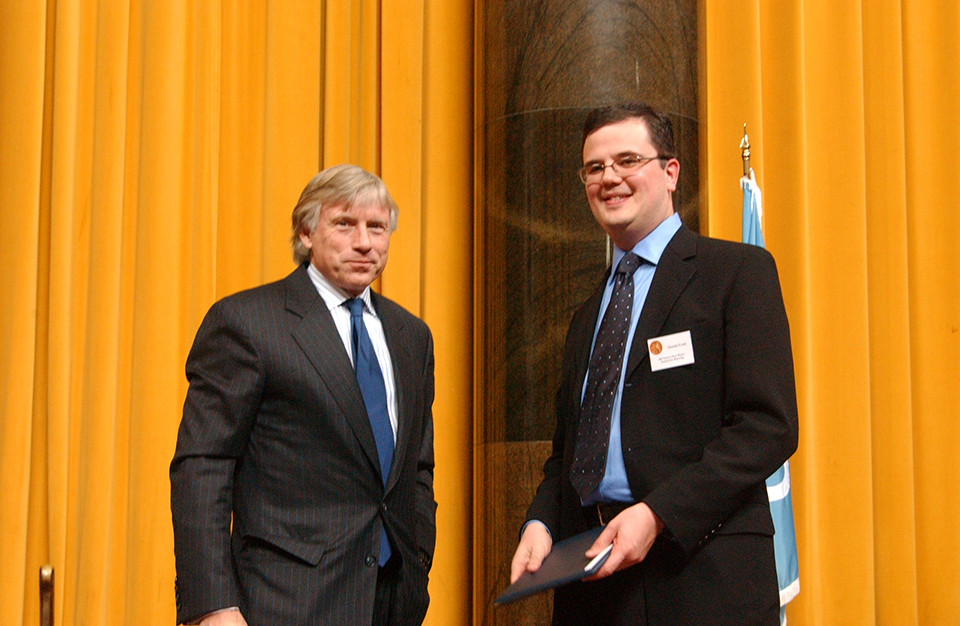
Columbia University President Lee C. Bollinger (left) presents Gareth Cook with the 2005 Pulitzer Prize in Explanatory Reporting.
Winning Work
By Gareth Cook
WEYMOUTH -- When the letter arrived last spring at this gray-shingled house by the water, it was a reminder of some of the most joyous moments, and some of the most heartsick, that Marie Dooley had ever known.
The letter was from Boston IVF, the clinic that had helped Dooley and her husband, Tom, conceive two children after an emotionally wrenching struggle with infertility. Just seeing the logo on the envelope was a surprise, because she never expected to hear from the clinic again. As she tore the envelope open in her kitchen, she worried it was bad news. What it said was more complicated than she had imagined.
"Our current inventory of cryopreserved embryos shows that you have a total of 4 embryos," the letter began.
It had been three years since the clinic had created a set of in vitro embryos to help the Dooleys bear children. Her insurance would no longer pay to keep the unused embryos in the freezer. What, the letter asked, did she want to do with them?
"I felt sick over it," she recalled. "Am I going to give these embryos a life?"
And so, on that spring day, Dooley unexpectedly found herself in the quiet center of one of the most difficult ethical debates of our time. Unneeded embryos like the Dooleys' are the foundation of an entirely new field of science.
Every experiment using embryonic stem cells -- and every argument about their morality -- ultimately begins with one of these embryos, about the size of the dot of an "i," conceived for a couple trying to build a family. About 400,000 sit in freezers around the country, awaiting a decision.
It was a decision that Dooley, who is Catholic, did not begin to know how to make. She had thought she was done having children, but now she began to wonder whether she should use the embryos to try for more. She could have the embryos thrown away by a lab technician, or she could donate them to research. Under these last two choices, an embryo's potential to become a child would be extinguished.
In political debates, the argument about embryonic stem cells often falls into easy certainties: An unwanted embryo is either a ball of cells useful for medical research or a human life deserving of legal protection.
But for the parents who created it, an embryo is not a simple thing. When Marie Dooley, 37, received her letter, she had long since stopped thinking about her leftover embryos. But she knew they were far more than balls of cells. Two embryos from that clinic had become her children -- a 5-year-old daughter, Ava, who went out in a blue-and-silver Cinderella dress last Halloween, and a 3-year-old son, Harry, who gets into new mishaps daily.
Marie's husband, Tom, suggested that they pay the $500 to keep them frozen for another year. But Marie knew that was just a way to delay an inevitable choice. It felt a little wrong to make such a decision at all, she said, but it felt more wrong to shirk the responsibility.
"I had the power to decide whether to bring a child into the world," Dooley said. "It was a huge burden."
Stem cell work at Harvard
Just 13 miles away from the Dooley home, in a cramped basement laboratory on the campus of Harvard University, scientists were taking in human embryos, growing them, and trying to pluck out the powerful embryonic stem cells contained inside.
One of several universities conducting this research, Harvard has pushed ahead despite federal restrictions. In 2001, President Bush stopped federal funding for any experiment involving new embryonic stem cells. Later this month, Harvard will publicly launch what could be a $100 million initiative to perform the research without government money.
Harvard scientists would be unable to create new lines of embryonic stem cells without donated embryos supplied by Boston IVF. To interested couples, Boston IVF sends a four-page consent form, which outlines "a research project to establish human embryonic stem cell (hES) lines."
There would be no way to know it from that spare, clinical description, but the scientist in charge of Harvard's embryonic cell research, Douglas Melton, is driven by personal reasons. A little more than a decade ago, Melton was a highly successful biologist exploring early frog development when his 6-month-old son, Sam, was diagnosed with type-1 diabetes. So Melton decided to shift all his research into a singular goal: finding a cure for diabetes. To succeed, Melton became convinced he would need stem cells from human embryos.
If anything in science can be considered magical, it is these cells, formed a few days after conception. Over the course of nine months, they will generate every living cell in the body. By studying this mysterious process, Melton and other researchers hope to be able to grow cells that produce insulin for Sam and other diabetics, or find ways to cure any number of other diseases.
Four years ago, at a friend's barbecue in Lexington, Melton ran into Douglas Powers, Boston IVF's scientific director, and began talking excitedly about the rapid progress he and another researcher, Harvard's Andrew McMahon, were making using stem cells from mice. Melton asked Powers whether he would be interested in collaborating on future experiments. Boston IVF, he knew, had many patients who would never use the embryos they had frozen.
After consulting with ethicists, Boston IVF agreed to join the project. Up to then, couples at Boston IVF could either discard their leftover embryos or try to bring them all to term. Now they had another option.
When does life begin? Answering the question about whether these embryos are human lives is beyond the realm of science, at least for now. From the moment of conception, a fertilized egg has the potential to be a child. Yet there is no clear, scientifically agreed upon moment at which a human life can be said to begin.
Legally, the rights to an embryo belong to the couple who created it -- and whose feelings about it have been shaped by the dark journey through infertility.
Marie Dooley's journey began in 1996. The youngest of five children, she always knew she wanted a family. But she was diagnosed with a disease called polycystic ovarian syndrome, and doctors told her it would be difficult to have children without medical help.
As she and her husband began trying to have children, she watched friends and sisters get pregnant, seemingly effortlessly, while month after month, she could not. She thought of all the teen mothers who have children and don't want them. To her, it didn't seem fair. Every time she got a phone call from her doctor's office, she would go into mourning, she said. For days after, she fell into fits of uncontrollable crying. Tom couldn't console her.
"It's me," Marie recalls telling him. As much as she loved her husband, she could not help but feel that her body, at some physical level, was rejecting him, and their love.
To create the embryos, Marie had to endure regular shots to increase her egg production, and Tom had to learn how to give them, using oranges to practice his technique. The night before she was scheduled to have some of her eggs removed, the two of them had to wake in the middle of the night to prepare an injection delivered at precisely 2 a.m. Three times they went through that routine.
Under such procedures, once the eggs are removed and fertilized with the husband's sperm, each resulting embryo is remarkably delicate. To keep embryos growing outside the womb, Boston IVF lab technicians place them in a dish filled with nutrients, and then store them in a wall of humming incubators that maintain a steady temperature and constant levels of oxygen and carbon dioxide. The lights in the laboratory are even kept low, creating an environment as similar to the womb as possible.
A few days later, several of the developing embryos are placed back in the woman, in the hopes that one will take. Dooley remembers the drive home in 1997, a few days after Christmas. She had just had embryos implanted and worried about every bump.
"I know it sounds pathetic, but I was worried they would fall out," Dooley said. Nine months later, she had Ava.
In another two years, she and Tom went through much the same ordeal to have Harry. This time there were several good embryos left over.
Whether to expand family The vast majority of the country's excess embryos are discarded: removed from their freezer, dropped into an orange biohazard bag with the day's used pipettes and Petri dishes, and thrown out with the day's medical waste.
For Marie Dooley, that was never an option with her embryos. She thought of all the work that went into creating them -- her own ups and downs, the "humiliation" of her husband going into a room with adult magazines, even the hours her father spent waiting for her in the parking lot for clinic visits.
"It just seemed like such a waste to throw them away," Dooley said.
Dooley opposes abortion but believes it should be the woman's choice. One option advocated by antiabortion groups -- offering the embryos for adoption -- is surrounded by difficult legal questions in Massachusetts, and felt impossible to Dooley to pursue. "I was looking at my children and thinking, `that is like giving you away to a stranger,' " she said.
The choice that really weighed on her was whether to have more children. For a week she struggled with this. If she did try to get pregnant again, it would be emotionally difficult. Even if the embryos were implanted, there was no guarantee they would lead to a pregnancy, a hard lesson she had learned from previous failures.
Statistics show that fewer than one in four implanted frozen embryos leads to a full-term pregnancy. On the other hand, there was the new life that her children had brought her and her husband. In addition to the two children she has from IVF, Ava and Harry, she has a 18-month-old daughter, Lila, conceived naturally.
"You go and look at your children and say, `What would my life be without you?' " she said.
Then there were the practical considerations, such as whether the house had enough room for a fourth child -- or a fifth, too, because twins are common in IVF patients.
Tom manages properties for Chestnut Hill Realty, which allows Marie to stay home and care for the children. She worried a lot about the cost of schools. They hope to send all their children to the private high school Tom attended, and of course there is college. That, she said, is was what drove her decision. "As gross as it sounds, it was the price of education," Dooley said.
Last May, about a week after the first letter arrived, Tom signed the release form, "Consent to Donate Human Embryos and Embryonic Cells for Research." He headed off to work. After thinking about it a little more, Marie signed it quickly and put it in the mail, eager to move on with her life.
When patients' embryos are used for the Harvard project, a scientist removes the plastic vials containing the embryos from the main storage containers. She carefully thaws the embryos and places them in petri dishes. She then puts these inside a portable incubator, a silver box about the size of a car battery, and drives them to Melton's Cambridge lab in her navy Subaru Outback.
Last month, Melton announced that his laboratory, using 344 donated embryos, had managed to create 17 new lines of embryonic stem cells. In the small, highly charged world of stem-cell science, it was the most successful effort to date, doubling the number of lines that researchers around the world have to work with. Melton plans to give the samples free to any scientist who wants them.
Melton's announcement marked a tiny step toward his goal of curing diabetes, and now the stakes are even higher for him: a few years ago, his daughter Emma, now 17, was also diagnosed with the disease.
Marie Dooley cannot know the fate of her own embryos. The experiment in Melton's lab was set up so that the cells can't be identified with the donors. The embryos may have died when they were thawed or failed to develop into a healthy blastocyst. They may have survived to become one of the world's few healthy lines of embryonic stem cells. They may remain at the clinic, frozen in a separate tank, awaiting a new experiment.
A year after getting the letter from Boston IVF, Dooley says she feels happy with her decision. Dooley voted for President Bush in the last election, and she plans on voting for him again, despite his opposition to the work Melton is doing. The embryos don't have a heartbeat, she says, and deciding what to do with them was an intensely personal choice.
As she has watched the political battle over stem cell research unfold, she has sometimes thought of sending the president pictures of her family.
"Science gave me a gift," she said, as her children circled around the dining room table. "I felt I should give back."
© 2004, Globe Newspaper Co.
Without aid, work moving overseas
By Gareth Cook
He rushed to work, down a cracked blacktop walkway and past a sagging barbed-wire fence. Then Dvorak, 48, peered through a microscope and saw what had triggered the call: He and his team had isolated a new line of human embryonic stem cells.
"We were so happy," said Dvorak, who is a member of the Czech Academy of Sciences. "I couldn't sleep for a week."
Although the first human embryonic stem cell line was created in the United States, a Globe survey has found that the majority of new embryonic cell lines -- colonies of potent cells with the ability to create any type of tissue in the human body -- are now being created overseas, a concrete sign that American science is losing its preeminence in a key field of 21st-century research.
Nearly three years ago, the Bush administration prohibited the use of federal money to work with any embryonic cell lines created after Aug. 9, 2001, because of moral concerns over the destruction of human embryos. At the time, the president said there would be more than 60 lines of these cells available. But today there are only 19 usable lines created before that date, and that number is never likely to rise above 23, according to the National Institutes of Health.
However, the number of cell lines available to the world's researchers, but off-limits to US government-funded researchers, is now much higher: at least 51, according to the survey. It could rise to more than 100 over the coming year. There are three new lines in Dvorak's lab, with four more in progress. And there are also new lines in Sweden, Israel, Finland, and South Korea. Last week, the world's first public bank of embryonic stem cells opened in the United Kingdom, a country where there are at least five new lines and more on the way.
"Science is like a stream of water, because it finds its way," said Susan Fisher, a professor at the University of California at San Francisco. "And now it has found its way outside the United States."
At a time when reports show the United States is losing its dominance in other areas of science, Fisher and many other researchers say they are increasingly worried that America is not building a competitive foundation in one of the most active areas of biological discovery. Many scientists believe that embryonic stem-cell research has the potential to yield profound insights into a range of afflictions, including Parkinson's disease and diabetes, which affect millions of Americans. By restricting American use of these cells, they say, the government is effectively keeping them out of the hands of many top scientists -- both slowing the pace of research that could lead to cures, and potentially putting the country behind in technologies that could be major business opportunities in the new century.
Included on the list of off-limits cell lines created since 2001 are some cells that are easier to use and would be safer for patients than the Bush-approved lines. Others are tailored for the study of particular diseases.
Each cell line is a colony of cells derived from a single embryo, which share the same DNA. One of the new cell lines has the common genetic mutation underlying cystic fibrosis. This cell line, developed overseas and not yet described in a scientific journal, could reveal the biological underpinnings of a debilitating disease that affects some 30,000 Americans. The US government will not pay for scientists to grow or study these cells because they were created recently.
The ballooning list of forbidden cell lines could add energy to a rebellion over stem cell policy within the president's own Republican Party. Thirty-six Republicans were among the 206 members of the House of Representatives who signed a letter asking the president to reconsider the ban. And two weeks ago, Nancy Reagan delivered an impassioned plea for research that might one day prevent the horror of diseases like Alzheimer's, which she said has taken former president Ronald Reagan "to a distant place where I can no longer reach him."
For most diseases, embryonic stem cell research is likely many years from offering any help to patients. But it is becoming increasingly apparent that if researchers begin to make medical progress, the US government -- which funds the vast majority of basic science research in this country -- will be able to take little credit.
For many foreign scientists, the restrictions imposed on the world's leading biomedical power represent an opportunity. Dvorak once used old rum bottles as flasks in his underfunded lab. Now he is talking to a professor at Harvard Medical School, Dr. Ole Isacson, about collaborating on research.
"He is swimming," said Isacson, whose lab at McLean Hospital is famous for its research on Parkinson's disease. "But for us, it is like trying to swim on dry land."
* * *
When human embryonic stem cells were first isolated, the breakthrough happened in an American lab.
In November 1998, a team of researchers lead by biologist James Thomson of the University of Wisconsin-Madison announced it had isolated human embryonic stem cells and could grow them in a dish. Embryonic stem cells, taken from a microscopic embryo in its first few days of development, are in a sense the most primordial and powerful human cells, and can develop into any part of the body.
The announcement created a sensation. It was clear these cells would be an important new tool for studying human biology, and they also raised the prospect that a wide range of diseases might be treated someday by replacing a patient's damaged cells. Yet the work is also ethically controversial, because growing stem cells requires destroying a human embryo. This led critics to charge the practice amounted to taking human lives and could not be justified no matter how great the potential benefits.
In 2001, President Bush attempted to broker a compromise: In a nationally televised speech, he said that federally funded research would be limited to cell lines already in existence. He said that the more than 60 lines already derived would be enough for researchers to continue their work without using government money to destroy more embryos.
Although much basic biological research remains to be done on the cell lines created before Aug. 9, 2001, it has become clear to American scientists that the Bush policy has put them at a disadvantage compared with many of their colleagues overseas. Human embryonic stem cells are notoriously difficult to handle, and deriving each new line gives the team in the laboratory a deeper understanding of stem-cell biology and essential practical skills. Abroad, this work is exploding, while in the United States only a handful of labs are able to do it.
"A lot of stem cell biology is like gardening," said Stephen Minger, who isolated the cystic fibrosis cell line and is an American scientist who now works at King's College London. "Some people can grow orchids, and some can't grow tomatoes."
Governments around the world are stepping into the gap, and a number are emerging as powerhouses in the field.
In the United Kingdom, as in the United States, there has been contentious public debate over embryonic cell research, but the government has designed a system of strict oversight. With the opening last week of the new UK Stem Cell Bank north of London, funded by the government at $4.6 million over three years, that country is taking the kind of international leadership role which in other fields has fallen to the United States. The bank will accept cell lines that meet a set of ethical standards, carefully study and grow them to ensure they are scientifically useful, and then make them available to researchers.
"We see this as a truly international effort," said Glyn Stacey, the new bank's director.
In Australia, the government is funding research and helping to set up a national stem cell center. In the Czech Republic, Dvorak's lab at the Mendel University of Agriculture and Forestry is part of a Centre for Cell Therapy and Tissue Repair, supported by the government. South Korea has derived almost as many new lines of human embryonic stem cells as the United States, according to the Globe survey, and researchers there were the first to create stem cells from a cloned human embryo -- a scientific milestone that American researchers grumble should have happened in the United States.
* * *
This rush of work overseas is yielding other important advances, such as technology that could be key in turning the science of embryonic stem cells into usable therapies. All of the cell lines on the US government approved list are grown on a layer of mouse cells. These mouse cells, called a "feeder layer," sustain the human cells, but could also transmit mouse-borne viruses, making them potentially dangerous for use in humans.
Dvorak's laboratory has just begun working with human feeder cells instead, a technique that could yield cells safe to transplant back into humans. Already, laboratories in Singapore, Israel, Sweden, and Finland have isolated lines of stem cells that don't need mouse feeder cells. Only one American lab has done so: Susan Fisher's California lab, which is barred from receiving federal funding and is supported in part by the California-based biotech Geron Corp.
None of these lines, including Fisher's, can be used by government-funded scientists in America. The result is that American scientists with private funding are making advances that they can share freely with scientists overseas, but which they cannot share with colleagues in their own departments.
As much as the Bush rules have limited embryonic stem cell research, they have prompted a substantial private effort to keep the research moving forward. Harvard announced last month that it is building a privately funded effort to do the work, and it has a fund-raising goal of $100 million. The University of California, San Francisco is already underway with a similar effort, started with a $5 million gift from Intel's Andy Grove, as are a number of other academic institutions. Earlier this month, the governor of New Jersey signed an agreement opening the nation's first state-funded stem cell institute.
Thanks partly to this effort, none of the researchers contacted by the Globe said they had seen signs of a scientific "brain drain" that some critics predicted. But still they worry about the more subtle side effects of the Bush policy. Many of the world's top disease specialists work at universities in the United States, yet they are largely unable to work on embryonic stem cells, and the universities are likely to have more trouble recruiting talented foreign scientists interested in embryonic stem cells.
At the same time, top American researchers who might otherwise jump into the field are avoiding it because of the risks, scientists said. And some worry that younger stem cell scientists, who don't have an established lab to keep them in the United States, will move abroad, and perhaps stay there.
"That is really something to keep an eye on," said John Gearhart, one of the field's founders and a professor at Johns Hopkins Medicine. Gearhart said that many of the younger scientists in his lab are interested in pursuing further training abroad.
Yet there could be changes coming. Last weekend, the NIH issued a letter hinting the White House may be open to changing its policy at some point. The letter, written by NIH director Dr. Elias A. Zerhouni, was a response to a letter signed by 206 members of the House of Representatives. In it, he acknowledges that "from a purely scientific perspective more cell lines may well speed some areas of human embryonic stem cell research."
US Representative Michael N. Castle, a Deleware Republican who helped organize the House letter, said that it seems to represent a softening of the White House stance. In Congress, he said, support for stem cell research is increasing, and he added that he has been struck by the degree to which some people change their minds when they meet with patients who are suffering. "There doesn't seem to be a lot of gray area," Castle said. "They become real advocates."
In the meantime, many scientists abroad are nearly giddy with the possibilities the field now presents them. Dvorak and a colleague, Ales Hampl, are preparing to come to Boston for a major conference next month, organized by the International Society for Stem Cell Researchers. While he is in Boston, Dvorak is going to make a presentation of his work at Isacson's lab.
Because of federal restrictions in the United States, Isacson said that he has been increasingly looking abroad for collaborators who are more free, and Dvorak is one possibility.
Sitting in his modest Czech office, next to a fax machine that doubles as his phone, Dvorak said that he is nervous about presenting at Harvard, and has already had nightmares. After many years of laboring in obscurity, a collaboration with Harvard would be a vindication for him, but he struggles to find the words in English.
"It would be like being in heaven," suggested Hampl.
"Yes," said Dvorak, "like being in heaven."
© 2004, Globe Newspaper Co.
By Gareth Cook
SUTTON -- Many children have dreams about flying -- soaring on wings, maybe, or zooming around like Superman. James Rossetti, a blue-eyed 15-year-old, says he doesn't have any of those. He dreams about walking.
James, who has his father Ray's dark hair, was a bustling toddler. He kicked around, Flintstones-style, in a bright yellow-and-red Little Tikes car. He loved baseball, just like his dad, and even with a fat Wiffle ball bat, Ray said, the kid had a beautiful swing.
But when James was 5, Ray and his wife, Karen, began to notice problems: an awkwardness to his gait, trouble walking on the stairs, occasional complaints of "sore legs." They took James to the doctor for tests. The next day, Karen called Ray at work. She was sobbing so hard she could barely speak.
A nurse had just called, she said, and told her James had muscular dystrophy, a disease that destroys the muscles. First the legs go, then the upper body sags, and eventually, the lungs and heart stop working. There is no cure: Parents are left to watch as their children slowly fall apart, and hope -- against the odds -- that they make it past 25.
"It is just so unfair," said Ray, choking up. "I kept thinking of all the things I have been able to experience that he will never get to do. I felt totally helpless."
Then, last year, with James in a wheelchair and getting worse, the Rossettis discovered what seemed an answer to many nights of praying.
The couple had been hearing about the fantastic promise of stem-cell research, about cells that might grow new hearts, rebuild wasted bodies, and lift suffering patients from the brink of death. They had also been listening to the increasing complaints about President Bush's restrictions on funding for embryonic stem-cell research in the United States. Ray and Karen, furious at the president, had vowed to go anywhere in the world to get help. "If it's Mongolia, then it's Mongolia," said Ray.
One day at lunch, a Polish friend of Karen's told her that she had been hearing about a clinic in Ukraine, called EmCell, that was giving "embryonic stem-cell" treatments to boys with muscular dystrophy. That night the couple looked through the clinic's website. It had a long discussion of the power of embryonic stem cells. It cited a number of scientific publications by the clinic's researchers. A single treatment cost an astonishing $15,000, but the results listed for muscular dystrophy were also astonishing.
"After transplantation of embryonic stem cells, patients show increase of muscular strength, improvement or even reappearance of lost reflexes, improvement of functions of internal organs, and improvement of mental and physical activity," the website asserted.
The Rossettis immediately e-mailed EmCell. They were referred to another mother who had recently taken her son to the clinic, and was pleased with his progress. James's doctor warned the family that the clinic sounded suspicious, and that he had never heard of any treatment having the kind of results that EmCell claimed, but one doctor's caution couldn't stop them from chasing the first hopeful news they'd heard in years.
A few months after their first contact with EmCell, on a cold November afternoon last year, the Rossettis -- Ray, Karen, James, and his younger brother Jonathan -- piled into a van and headed to Logan Airport, beginning a journey from their town outside of Worcester to the distant city of Kiev, where the skyline is dotted with golden domes. They were also plunging into a world, fueled by the power of the Internet and by the rhetoric of stem-cell advocates, where the potential cures of the distant future are being peddled as real treatments available today.
A frustrating battle
When James was first diagnosed, Karen and Ray began their quest for treatment conventionally, with muscular dystrophy specialists. But like many parents of children with muscular dystrophy, they soon became angry at the medical profession. In a time of seeming medical miracles -- when renowned cyclist Lance Armstrong could beat cancer and go on to win the Tour de France -- the Rossettis found themselves sitting in meeting after meeting as a doctor told them just how little could be done to help their son.
Despite some $50 million spent in research in the United States last year, and more than 30 years of Jerry Lewis telethons, nothing approaching a cure exists. There are many forms of muscular dystrophy, but Duchenne muscular dystrophy, which affects James and about 15,000 other American children -- almost all of them boys -- is one of the most serious. The disease is caused by a genetic mutation that prevents the body from making a protein that protects muscles. The best treatments available can alleviate some symptoms, but do little or nothing to lengthen a life.
As James got older, Ray recalled, his son's deterioration often surprised him. One year, James was able to keep up with his fellow Cub Scouts on a trip to Battleship Cove in Fall River. The next year, he was not. Ray bought toy bow-and-arrow sets for the brothers, but James could barely pull back the string. And eventually they had to stop playing baseball in the front yard: James couldn't hit the ball very far any more, while Jonathan, 3 years younger, could send it sailing across the street.
One day, when James was 10, the reality of the disease hit especially hard. The family was going to the Emerald Square Mall in North Attleborough, and James fell at the entrance.
"My stupid legs don't work," James screamed through frustrated tears. Shoppers walked through the doors around them, glancing at the boy sprawled on the floor. "My stupid legs!"
The disease subjects the parents to enormous pressure. In interviews, Karen, 48, a special education teacher in Worcester, and Ray, 51, a quality control manager at Fosta-Tek Optics in Leominster, spoke of the guilt they feel about James, even though they know his condition is not their fault. They worry about Jonathan and how he is holding up. They think about friends who don't call any more, and wonder if it is because the friends feel awkward. They imagine what might be on the horizon, but also worry about whether they are doing enough to enjoy the moments they have.
"I remember thinking, 'Either this is going to bring us together, or it is going to break us apart,' " Karen said.
The emotions are like riptides, pulling the couple in different directions. When James was 10, Ray and Karen took him to buy his first motorized wheelchair. Ray remembers how happy he felt to see James scooting around so expertly, with a new independence.
Karen burst into tears at the sight of James and couldn't stop. Her mind filled with thoughts of milestones he will never experience, she recalled. First bike ride. First driver's license.
She looked at James, smiling up at her from his shiny wheelchair, and thought: "No, that is not what I wanted for my son."
Controversy clouds possible cure
What she wanted was a cure, and in embryonic stem cells she and Ray thought they might have found one.
The very idea of stem-cell medicine is an intoxicating one. Stem cells are among the body's most versatile cells, with the power not only to replicate themselves, but also to transform into the more specialized cells that make up the body's blood, tissue, and organs. These rare, potent cells play an essential role in the mystery of development -- the entire human body makes itself from a single cell -- and also play key roles in the body's amazing ability to regenerate.
What, scientists have wondered, if that power could be tapped?
Over the last six years, scientists have become particularly excited about stem cells taken from human embryos just days after conception. First isolated in 1998, human embryonic stem cells have the potential to become any cell in the body. Such cells might one day be used to replace damaged cells, curing degenerative diseases such as Parkinson's or juvenile diabetes.
But unlike many other promising areas of scientific inquiry, human embryonic stem-cell research has erupted into a very public debate. For every new batch, or "line," of the cells, scientists must destroy a human embryo. On Aug. 9, 2001, Bush announced that the government would only fund research on existing lines of human embryonic stem cells, ensuring that the government would not be encouraging the further destruction of embryos.
For anyone listening to the escalating fight over embryonic stem-cell policy, which has become an issue in the presidential campaign as well as the national divide over abortion, it is easy to conclude that the research is on the verge of delivering cures. Opponents of the Bush restriction -- including former first lady Nancy Reagan -- have pleaded for a change on behalf of loved ones. Even the president, in announcing the restrictions, spoke of the cells' power to help with Alzheimer's disease, Parkinson's disease, juvenile diabetes, and spinal cord injuries.
Yet the gap between the potential -- the young field could revolutionize medicine -- and the reality for patients is vast. Researchers can isolate the cells, but they do not know how to coax them to become many of the cells in the body. It is possible that the study of embryonic stem cells will yield knowledge that will lead to new drugs, but that is a long road, too. Today there is simply no embryonic stem-cell medicine.
But for patients and their families, these caveats can sound like an excess of caution.
"Because of all the hype, it makes stem cells seem like a secret that is not available to you," said Pat Furlong, executive director of Parent Project Muscular Dystrophy, an advocacy group.
Ray and Karen recall going to a talk by a Children's Hospital Boston stem-cell researcher. At one point, a parent asked how long it would be before his ideas might be ready for testing in patients. The answer: years, perhaps a decade.
Driving home, Ray and Karen felt disappointed and angry. "Why was he wasting our time?" Karen recalled thinking.
The Rossettis and other parents of children with Duchenne muscular dystrophy describe inaction as a toxin that threatens their sanity. Every day, they feel that there must be something more they can do. They feel the world does not understand the urgency of their situation. And these feelings, combined with the claims for stem cell's promise, make for a powerful concoction.
EmCell, the clinic that attracted the Rossettis' attention, is just one of many clinics that have emerged around the world offering to bridge the wide chasm between stem cell hopes and today's proven medicine. The Globe found nine such clinics, including EmCell, all charging substantial sums of money. On patient-interest websites, there are rumors of many more.
EmCell, with its elaborate website, is one of the most sophisticated. The story it tells, of biological genius emerging from behind the fallen Iron Curtain, is one of the most compelling.
And this is how Karen and Ray came to board a plane with their sons, heading for a country they never dreamed of visiting, so a doctor they had never met could slide a needle into James and begin a series of injections. As their flight began to make its way over the Atlantic, the sun setting quickly behind it, Ray said he felt a little nervous, but also deeply relieved: Finally, he thought, I am doing something to fight the disease.
In Kiev, hopes rise
When the car ferrying the Rossettis pulled up to EmCell, in a mostly residential section of Kiev, they were met with a disturbing spectacle.
The clinic was located in one of the city's public hospitals, and the building looked abandoned. At the entrance drive, paint peeled from a white sign emblazoned with red Cyrillic letters. One of the Rossettis' family snapshots shows thick streaks of grime covering the aqua-and-cream colored exterior.
At a battered blue steel door, the Rossetti family was met by a man in a suit who pushed James into a dimly lit building. Inside, steel gurneys, decades old, lined the hallway. They followed the man around a corner and onto a slow, creaky elevator covered with posters of Orthodox religious figures and an ad for Orbit gum.
But then they stepped out on the seventh floor, passed through a gold-colored security gate, and felt they had arrived at another place entirely. The EmCell clinic was clean and well lit. In the waiting room there were flowers and an Iranian rug hanging from one wall. They were served tea, on saucers with doilies, Karen said.
They were greeted by the clinic's founder and director, Dr. Alexander Smikodub, who told them that the "embryonic stem-cell" treatment would help their son -- perhaps a great deal -- but that it would not cure him.
Over three days of treatment, for several hours each day, James lay on a bed with bright white sheets, and the nurses treated him with a gentleness the Rossettis had never seen before, "like he was a crystal that could break," Ray said. On the first day, James received injections of a liquid suspension -- the Rossettis never got a close look at it -- in his arm. On two other days, he received injections in his abdomen.
Even before they left the clinic, Karen and Ray said that James seemed more flexible: He was able to move his legs and arms further than before without struggling. And there was something about James that just looked different.
"It was like he was glowing," said Karen. "His skin looked like a baby's."
When they returned home to Sutton, James said that he felt like he could think more clearly, an improvement Smikodub had told them they could expect. James said that he continued to feel this mental sharpness, but that the improved flexibility wore off. Smikodub had also told them to expect this, that to feel the full benefits, James would need at least three treatments at the clinic. The price of a second treatment was $10,000, and Karen and Ray were encouraged enough that they went back in April.
To pay for these treatments, the Rossettis were helped by friends, relatives, and strangers. A columnist for the Worcester Telegram & Gazette wrote about James's plight, and readers sent money. His classmates at the Sutton Middle School organized a fund-raising dance.
After the second visit, when the Rossettis returned from Kiev, they watched James closely and pondered whether to go again. Everyone asked how James was doing. Except EmCell: The clinic did not contact them.
Mixed reports on treatment
Since first interviewing the Rossettis in late June, the Globe found 12 other patients who have visited EmCell with a variety of ailments.
Most of the families said their EmCell experiences were similar to the Rossettis'. Small improvements, at most, to begin with, and then their disease resumed its course.
Three of the patients have died of their disease since they were treated. Two reported lasting improvement.
One of them was the person to whom the clinic referred Karen when she first e-mailed: Maria Brodka, who has a son with Duchenne muscular dystrophy. Brodka said that her son grew stronger after one treatment, and then showed no improvement after a second treatment -- but no deterioration either. (She has not taken her son for a third treatment.) Another Duchenne parent located by the Globe said that her child, who has had two treatments, seemed to be getting better, but is now getting worse. A third Duchenne parent said the one treatment their son was given had no effect.
Of the nine patients with other conditions, seven said it provided no benefit. One said that the treatment helped his multiple sclerosis, but he has also been undergoing other treatments. Another said that his condition has continued to get worse, but that he believes the EmCell treatment has slowed its course.
It is hard to draw medical conclusions from these reports because EmCell does not conduct any scientific testing of its patients that would unambiguously show whether its treatment helps. None of the patients interviewed by the Globe said that EmCell regularly contacts them to chart their progress.
After more than a month of phone calls and e-mails, EmCell's director agreed to an interview with the Globe.
Smikodub's office sits at the end of the clinic's long central hallway. To American eyes, the room has a distinctly 1980s look -- dark, shiny furniture, gray carpet streaked with little diamonds of color-- combined with Eastern European touches, like a set of gold-gilt crystal goblets on display. Near the door is a large bust of Smikodub, draped in a handful of badges from scientific conferences. Two tiny chandeliers hang from the ceiling.
Smikodub, 55, has white hair, brown eyes, and dark eyebrows. He wears a white doctor's coat over a white Reebok shirt. The clinic's work, he said, began a decade ago with research he was doing into the properties of cells taken from aborted fetuses.
Smikodub, who said he is a physician and has a PhD, began injecting these cells into desperately ill people and seeing improvements.
"We started to notice tremendous effects," said Smikodub, speaking through a translator.
In a four-hour interview, he described the clinic's work and the more than 1,000 patients he has treated for dozens of conditions. He spoke with evident passion, conveying the sense that he believes he is helping his patients.
But when the discussion turned to the science underlying his treatments, his answers were amalgams of well-established principles and theories that wildly contradict scientific work in the rest of the world.
Several American scientists, experts in muscular dystrophy and stem cells, reviewed EmCell's claims for the Globe and said they found fundamental problems. Scientists said they would not consider implanting embryonic stem cells directly into a human because these cells are likely to develop into cancerous tumors. Diseases on EmCell's list -- diabetes, cancer, "aging" -- have causes and symptoms so different that it seemed impossible that a single clinic or technique could address them all, they said. And in the case of muscular dystrophy, any therapy based on injected cells would need to ensure the cells actually migrated from the bloodstream and helped create healthy tissue where they were needed -- posing a set of obstacles that have frustrated the field's top scientists for more than a decade.
In his interview and in follow-up e-mails, Smikodub offered answers to these problems that did not convince the experts contacted by the Globe.
The cells used by the clinic are taken from the blood and other tissues of aborted fetuses between 2 and 8 weeks after conception, he said. Thus they are not, as the clinic claims, "embryonic stem cells," which have only been found well before the end of the second week of development and before the embryo implants in the wall of the uterus and develops. Smikodub said he has not conducted any experiments that prove the cells can migrate from the blood, through the scars in a Duchenne patient's muscles, and then transform themselves into living, functioning muscle.
To this and other questions, he said the proof was not in scientific studies, but in the patients who improve and return for more treatment. He said he has treated more than 1,000 patients, but provided about 3,000 treatments.
"We think that many of the things we are doing will be explained by science in the very near future," said Smikodub. "My method of research is the clinical method, and it is impossible to explain many of these things."
But other scientists had harsh words. They said EmCell is a poorly documented operation that appears to be capitalizing on the excitement surrounding stem cells at the expense of desperate families.
"This is entrepreneurship at its very worst," said Dr. Jeffrey D. Rothstein, a professor of neurology and neuroscience at Johns Hopkins Medicine, and one of several scientists who reviewed EmCell's claims for the Globe. "These are very expensive cure-alls."
For the Rossettis and others, the improvements brought by EmCell's treatments may not be illusory, but also may not be the long-term cures they most desperately want. Specialists said that the mere fact of believing in a treatment can have a powerful impact and lead patients to feel and even be better, at least for a while.
James says now that while he did feel a little better after the treatments, the long airplane ride was uncomfortable, and, if it were up to him, he wouldn't go back for another session.
Furlong, of Parent Project Muscular Dystrophy, said she would discourage anyone from considering EmCell, but understands the emotions that would send a family there. She lost two sons to muscular dystrophy, one at age 17, one just 15.
"I would have sold my soul for five more minutes," Furlong said.
Determination despite doubts
Twice a year, the Rossettis bring James to the Fegan building of Children's Hospital Boston for an evaluation. These are dispiriting visits, no matter how much they steel themselves. They serve as reminders that there is little the doctors can do.
Even seemingly little things are jarring, like the way the doctors talk about Duchenne muscular dystrophy patients, collectively, as "the boys." The boys sometimes stay the same between visits, but usually they get worse. The boys usually need a wheelchair by age 10 or 11. The boys eventually need a ventilator.
After a visit this month, Karen and Ray sat at a table in the hospital's main lobby, across from a fountain filled with coins. James had taken a test that day that showed his breathing was no worse than before his two visits to EmCell, which was good news of a sort. But they had let themselves hope that he would show some improvement. He had not.
Sometimes, Karen said, she looks at other couples and thinks that she should have a life more like theirs. Yet, she said, she is also profoundly thankful to be blessed with such a strong marriage. And, she said, having a son with muscular dystrophy has changed her perspective in ways she treasures. Once she dreamed of "material things" -- the colonial house in the suburbs, the perfectly manicured lawn.
"I have left that world," Karen said.
Eight thousand dollars, which is what EmCell has asked for a third treatment for James, is a lot of money for this family. But in another sense, she said, it is nothing.
Karen and Ray were not happy to hear what the Globe uncovered about EmCell -- that scientists say the clinic's claims contradict what is known about stem-cell science, that the clinic has not shown its treatment can help, and that despite the hope, embryonic stem-cell treatments simply do not yet exist.
But Karen and Ray said they have not heard of any better alternatives. They will go for another treatment in November, during the children's Thanksgiving break. To help save money, the family skipped their vacation this summer.
"I just don't know how we could live with ourselves knowing that we had this opportunity to try something and we didn't take it," Ray said.
They know some people will not understand this decision, they said. When they had told their doctor earlier that day how much they were paying, he had shaken his head.
Hands on the table, Karen looked over her shoulder to make sure James, who was off with his brother Jonathan, was out of earshot.
At EmCell, Karen said, she met a quiet woman from Montenegro who watched her brother die of muscular dystrophy at age 16, only a year older than James. Now the woman's son has the disease.
Even through tears and the veil of broken English, Karen said, she and this woman shared a moment of sudden mutual understanding that made the world seem smaller and maybe a little less lonely. Three of "the boys," traveling the same rutted path. Two families, hoping for a way out.
Ray leaned a little closer to Karen as she spoke; strollers and wheelchairs slid across the hospital lobby.
"We're going to keep looking," Ray said.
Note on the sources: This article was reported through more than two months of interviews with the Rossetti family this summer, after the family had visited the EmCell clinic twice, plus a reporter's visit in August to Kiev and e-mail and telephone interviews with scientists and other EmCell patients. The description of the family's early experience with James and muscular dystrophy is based on interviews with Karen and Ray Rossetti. The description of the family's trip to Kiev, the clinic, and the treatment they received is based on the recollections of the Rossettis as well as the Globe's reporting in Kiev.
© 2004, Globe Newspaper Co.
By Gareth Cook
KIEV, Ukraine-- Is EmCell selling effective treatments? It can be difficult to assess claims for therapies not regulated by the US Food and Drug Administration, but here is what the Globe discovered.
The clinic takes its name from the embryonic stem cell, and its website says it delivers embryonic stem-cell therapy. The actual cells it claims to use, however, are not embryonic stem cells by any conventional definition. An embryonic stem cell comes from an artificially inseminated embryo, typically about 5 days old, and EmCell obtains its cells from aborted fetuses between 2 and 8 weeks old. EmCell's director, Dr. Alexander Smikodub, who said he helped develop the treatments, initially said in an interview that the cells he uses, like embryonic stem cells, are "pluripotent," or able to transform into any cell in the body. But on closer questioning, he said that cells taken from different parts of the fetus are able to become different types of adult cells, but that none of the cells is pluripotent.
Behind Smikodub's desk hang more than a dozen patents granted to EmCell, most of them by the government of Ukraine. EmCell has two US patents, which describe using cells from aborted fetuses to treat AIDS, but not the many other diseases that the clinic lists on its website.
A patent, moreover, is no indication that a technique actually works, said Janis Fraser, who reviewed EmCell's patents for the Globe and is a principal in the Boston office of the law firm Fish & Richardson. A patent is a claim of invention, and the patent office's main function is to verify that an invention is original. It does not test effectiveness. In the United States, the FDA is charged with evaluating whether a treatment is safe and effective. An FDA spokesperson said that the agency has no information on EmCell.
The EmCell website contains numerous scientific reports, which it calls "publications." But none have been published in a journal reviewed by other scientists, meaning that they hold no more weight than an advertisement. Smikodub said that he would like to publish his results in peer-reviewed research journals. He said he submitted one report, on his AIDS therapy, to a journal, but it was rejected without explanation.
The rest of the website is filled with claims, but lacks the kinds of basic information needed to persuade other doctors and scientists that a procedure is worthwhile one of the clinic's main goals, Smikodub said.
There is no detailed description of what cells are used in the treatment. There is no discussion of how these cells are purified or tested. There is no discussion of how, precisely, the cells function in the body, or whether any experiments have been done to analyze this. There is no discussion of what the cells do, biologically, to help with any of the many diseases EmCell treats. The data the clinic provides on its experience with humans are so vague that the doctors who reviewed the material for the Globe said they couldn't draw any conclusions about its work.
The ALS Therapy Development Foundation, a Cambridge-based nonprofit organization, investigates potential cures for ALS (also known as Lou Gehrig's disease). After hearing that patients with amyotrophic lateral sclerosis were traveling to EmCell for treatment, the foundation interviewed Smikodub and sent him more questions by e-mail. Smikodub was evasive on many points, according to a report on the foundation's website. The report warns ALS patients that there was no evidence the therapy works, and there are many reasons to be suspicious.
During his interview with the Globe, Smikodub repeatedly emphasized that he uses what he called "the clinical method." He might not know all of the detailed biology of the cells, he explained, but he is sure that they help. He has not tested this procedure on animals. What this means is that he is experimenting on humans.
Smikodub does not seem to be taking even basic steps to discover what effect the treatment has on the more than 1,000 patients he claims to have treated. According to the EmCell patients interviewed by the Globe, the clinic makes no effort to question its patients at regular intervals, which would be necessary to understand what happens in the months and years after an injection.
© 2004, Globe Newspaper Co.
By Gareth Cook
Two separate teams of Harvard scientists are preparing to produce cloned embryos for disease research, and one has officially applied for permission from the university's ethical review board.
If granted permission, the Harvard scientists could be the first to clone human cells in the United States. Worldwide, only one team of scientists in South Korea has successfully grown cloned human cells.
The cloning experiments proposed at Harvard represent the next step in the evolution of embryonic stem-cell research, a controversial field that has emerged as an issue in the US presidential campaign. The two teams want to use cloning to produce embryonic stem cells that precisely match the genetic material of patients with juvenile diabetes, Parkinson's disease, and a range of other maladies.
Researchers believe that comparing the development of these cloned cells with healthy cells will give them a powerful new tool to study disease and possibly suggest new avenues for treatment.
Both teams are part of the recently formed Harvard Stem Cell Institute, set up by the university earlier this year to fund embryonic and other types of stem-cell research.
"This is exactly the kind of work that we envisioned for the Harvard Stem Cell Institute," said Harvard biologist Douglas Melton, the senior researcher on one of the teams. "We want new ways to study and hopefully cure diseases."
Cloning is legal in the United States, but the experiments cannot proceed without first passing through an institutional review process, which could take months or longer to complete, according to Melton. The other team is based at Children's Hospital and has not yet applied for the hospital's permission.
The proposals will probably add to the national debate around research using stem cells taken from embryos.
The tiny cells, grown in only a handful of laboratories, have already proved a divisive point between President Bush, who believes that life begins at conception and that harvesting stem cells from embryos can be seen as taking a human life, and Senator John Kerry, who does not agree that embryos constitute lives and believes that the potential for cures outweighs the cost.
Even the death this week of actor Christopher Reeve, who lobbied for more stem-cell research to treat spinal cord injuries, has become a part of the debate.
None of the proposed experiments involves "reproductive cloning" or attempts to produce a cloned person. Such experiments are illegal in many countries, though not in the United States, and would be considered both irresponsible and scientifically worthless by most disease researchers.
However, even cloning strictly for research raises more ethical questions than the embryonic stem-cell research currently conducted in the United States. To gather embryonic stem cells, scientist must pull apart an embryo that is several days old, a step that critics have argued is equivalent to taking a life.
Typically scientists have used frozen embryos, left over from fertility treatments, that would otherwise be discarded.
For cloning, however, scientists insert the nuclear material from a donated cell into an egg, producing an embryo from which they gather the embryonic stem cells.
"This crosses the line of creating life in the laboratory solely to destroy it," said Richard Doerflinger, deputy director of the Secretariat for Pro-Life Activities at the US Conference of Catholic Bishops. "This is the ultimate reduction of human life as an object for others to use."
The Harvard scientists, however, say that animal experiments show that most embryos produced this way are not capable of forming a life and that the work could open important new scientific vistas.
The team at Children's Hospital, which includes Dr. George Q. Daley and Dr. Leonard Zon, is particularly interested in studying diseases of the blood, such as sickle cell anemia and immune deficiencies.
For example, researchers might be able to clone a cell from a sick child and then produce a line of embryonic stem cells that are genetically identical to the child. The genetic problem that causes the disease could be corrected, and the cells could be directed to grow into blood cells, providing a replacement for the patient's faulty cells.
All of these steps have been shown to work in mice, in an experiment Daley's team performed.
"This is a fresh approach," Daley said. "But obviously there are many steps between where we are and clinical applications."
In scientific circles, cloning is called nuclear transfer. The nucleus of a donor cell, which contains its genetic material, is transferred into an egg cell that has had its own nucleus removed. Researchers then prompt the egg to grow for several days, until it forms a ball called a blastocyst, typically a few hundred cells. From this blastocyst, scientists can then extract embryonic stem cells, which have the ability to become any cell in the body.
To date, only a team in South Korea has successfully performed nuclear transfer with human cells. In the United Kingdom, one team of scientists has been granted permission to conduct the experiments, and another has applied for permission.
At Children's, Zon and Daley said they are interested in doing nuclear transfer experiments, but have not yet worked out all the issues they need to in order to apply for permission, Zon said
Melton and Harvard biologist Kevin Eggan have formally applied to the stem-cell research committee at Harvard for permission to do nuclear transfer work. The team is specifically interested in juvenile diabetes and neurodegenerative diseases such as Parkinson's, Melton said.
Harvard provost Dr. Steven E. Hyman said the university is considering all of the ethical and other issues that such experiments raise.
"We are being extremely careful about this," Hyman said.
Hyman said that he did not know when the university would reach a decision on the Melton experiments and that he could not speak for the situation at Children's Hospital
Though based at Children's, Zon and Daley both hold faculty appointments at Harvard Medical School, and both are members of the Harvard Stem Cell Institute.
No federal funds would be used in the work, according to the scientists. Under federal policy, laid out by President Bush on August 9, 2001, the government will not fund research that produces new lines of human embryonic stem cells, because this involves the destruction of human embryos.
Melton, who is the codirector of the Harvard Stem Cell Institute, said he was generally reluctant to discuss publicly experiments that he has yet to perform, but described his plans because of the public interest in the issue.
"This is cutting-edge research," Melton said. "Nobody can know if it will be successful, but my intuition is that it will be important."
© 2004, Globe Newspaper Co.
Hope, frustration surround research
By Gareth Cook
David Prentice, a senior fellow with the Family Research Council, appeared before a Senate committee this fall to share some good news about stem cells.
Around the world scientists are pouring into the field, because human embryonic stem cells have the power to become any cell in the body, offering the promise of dramatic scientific and medical advances. The work, however, requires destroying days-old human embryos, which critics say is tantamount to taking lives. Whether the government should fund this research has become the focus of a bitter political standoff, and a key issue in the presidential campaign.
Yet when Prentice went before the senators, he offered a dramatic solution to the dilemma. There have been "a wealth of scientific papers published over the last few years" showing that adult stem cells, which can be obtained without destroying an embryo, have virtually the same qualities as embryonic stem cells, he testified. The important science can go forward, he said, but without the need for either embryonic stem cells or the controversy.
This has become a key assertion -- in editorials, in debates, on antiabortion websites -- of opponents of embryo research, but most stem cell specialists say it is simply wrong. A wave of recent experiments has cast grave doubts on the ability of adult stem cells to become a wide range of cells.
The most impressive and often-cited example is a set of adult stem cell experiments conducted in Minnesota that are surrounded by questions because, two years later, other scientists have not been able to replicate the work. The scientist who did that work, Dr. Catherine Verfaillie of the University of Minnesota, said she has not found a replacement for embryonic stem cells and is frustrated with the increasing politicization of the issue.
"My research is being misused depending on the point someone wants to get across," Verfaillie said. "They have put words in my mouth."
Her experiment is perhaps the starkest example, but in the national stem cell debate, both sides have distorted the science. Democratic presidential candidate John F. Kerry has repeatedly assailed President Bush for a ban on stem cell research, even though the president supports stem cell research and his restrictions apply only to federal money for one type of cell, human embryonic stem cells, and only those created after August 9, 2001. Kerry supports expanding federal funding for human embryonic stem cell research and opposes limiting the research to old batches of the cells.
The distortions are fueled, in part, by the sheer complexity of the topic. Yet scientists say that the deepest source of public confusion is the fact that the political debate is being waged long before scientists know the answers to many of the most basic questions in stem cell biology, much less which avenues will result in actual treatments.
The great promise of stem cell research is that it will lead to cures for degenerative diseases, such as Parkinson's or juvenile diabetes, that affect many millions of Americans. Yet the science is just too new to say what diseases might be helped more by adult or embryonic stem cell research or by neither.
For decades, doctors have been transplanting bone marrow, which contains adult stem cells that form the cells in the blood, to treat certain cancers and other immune and blood-related diseases, such as sickle cell anemia. But scientists are far from showing that adult stem cells can treat a wide range of other diseases.
Embryonic stem cells, by contrast, have the natural ability to become any type of cell in the body and offer a unique tool for understanding human development. But scientists have only just begun to experiment with human embryonic stem cells, which were discovered in 1998. Embryonic stem cells are not currently used to treat anything, and there are many fundamental technical hurdles that lie between today's science and the potential medicine of tomorrow.
Prentice, a former biology professor at Indiana State University, defended his Senate testimony, saying that he was delivering facts about research that has been obscured by the attention given to embryonic stem cells. And most stem cell specialists agree that adult stem cells are a vital area of research, underappreciated by the public, that could lead to a wealth of new treatments.
"We need both" kinds of research, said Dr. Leonard Zon, a researcher at Children's Hospital Boston and president of the International Society for Stem Cell Research. "Advances in one field help the other."
The public, understandably, wants to hear about cures for the scourge of degenerative diseases. Scientists would like nothing more than to find these cures. But, Zon and other scientists said, the history of medical research is very clear on one point: Nobody can say today whether any particular advance is the first step toward revolutionary treatments or an alluring dead end.
Hope, then frustration
Verfaillie can remember the thrill that came over her in her laboratory as she realized that she might have a spectacular discovery on her hands, the kind of huge, surprising leap forward that can lead to a Nobel Prize.
It was 1998, and Verfaillie's research team had apparently stumbled across an entirely unexpected kind of stem cell. Taken from bone marrow, in the soft core of bones, it was an adult stem cell that seemed to hold the potential to develop into virtually any tissue in the body, a power that scientists previously believed could be found only in stem cells harvested from human embryos.
In 2002, when the results became public, they caused a sensation. If verified, these new cells might give doctors the ability to repair a wide variety of tissues without the ethical questions that bedevil embryonic work. Other scientists have since made similar assertions, but Verfaillie's work is the most scientifically established.
What has amazed researchers about Verfaillie's stem cells, which she has dubbed the multipotent adult progenitor cell, is that they seem to contradict longstanding principles of developmental biology. Beginning with a batch of stem cells thought to make only tissues such as bone, cartilage, and fat, Verfaillie was able to coax some of the cells, the MAPCs, into becoming surprising tissues, such as brain and liver.
Scientists believe that the cells of the body form a kind of family tree, with the embryonic stem cell at the trunk and most of the multitude of cells that make up the body at the tips of the branches. In the very beginning, when a human embryo is just days old, the body begins its development as a formless mass of cells that are called pluripotent, because they have the potential to become any cell. When these cells are removed from an embyro and grown in a laboratory dish, they are referred to as embryonic stem cells.
Then, as the embryo develops, different cells start to travel down different branches in the family of cells, becoming more specialized, and less flexible, in a process called commitment. Stem cells that are partway down one of these branches are called adult stem cells, because they are destined to become specific types of tissue in the adult and are thought to have lost the full potential of embryonic stem cells.
Thus, there are many kinds of adult stem cells, each capable of repairing only the tissue they are destined to become. However, researchers have isolated only a limited number of types of adult stem cells, and some organs may lose all of their adult stem cells by the time they have finished developing, meaning that adult stem cells could not be used to treat those organs.
Around the time that Verfaillie was doing her initial research, other scientists began publishing papers that challenged this paradigm, arguing instead that seemingly committed adult stem cells could naturally transform themselves into types of cells in distant parts of the cellular family tree, giving the body a hitherto unrecognized power to regenerate.
But more recent experiments, in some cases by the same scientists, have reversed most of these findings. In 2001, for example, a stunning paper in the journal Nature indicated that bone marrow cells could transform into heart muscle, offering hope for treating heart disease. But this spring, two papers in the same journal suggested that the original research was wrong. Similar claims for bone marrow cells transforming into brain cells, liver cells, and others have also been reversed.
"To be frank, I really wanted it to be true," said Dr. Irving Weissman of Stanford University, one of the founding fathers of stem-cell science and cofounder of two companies that work with adult stem cells. "But everywhere we have looked, [the claims] just fell apart."
Verfaillie's work is different from many of these claims, however, because she heavily processes her cells for many weeks before she does her experiments. She begins with cells from the bone marrow, but then puts them in lab dishes where the cells can grow and multiply. Then, for more than a month, she repeatedly transfers the cells from one lab dish to another to prevent the cells from growing too densely.
This process seems to slowly kill off most kinds of cells, but leaves behind a population of the special cells she wants, something like burning down a haystack to find the needle. Yet, even in the hands of her team, Verfaillie said, the method works less than half of the time.
Only a handful of other laboratories have been able to get the method to work and only after intensive consultation with Verfaillie, including lengthy onsite visits. And no outside laboratory has been able to replicate one of the most impressive experiments she described in 2002, in which one of the cells was injected into a mouse embryo and then was shown to have yielded cells in many of the animal's tissues. Weissman and other scientists said that Verfaillie's research could be very important and may even lead to new medical cures, but that the failure of other laboratories to replicate the work raises questions, and makes it difficult to understand what the cells are, and what they are capable of.
Verfaillie said that she shares these concerns, and she has been working hard to help other laboratories with the cells. Weissman's lab has been trying to replicate the work, so far without success.
Although Verfaillie's work has received more attention, there are other sources of adult stem cells that some scientists suspect may have more potential to form a variety of cells than previously thought, such as blood from a newborn's umbilical cord, or even stem cells from a fetus that circulate in the mother's body, which were identified by Dr. Diana Bianchi, who is the vice chairwoman for pediatric research at the Floating Hospital for Children at Tufts-New England Medical Center.
None of these cells has been shown to be as versatile or as easy to work with in a laboratory as embryonic stem cells, and none has been shown to make all types of tissue, whereas 20 years of research in mice has proved this is true for embryonic stem cells, according to Dr. George Q. Daley, who is the author of several prominent scientific papers on stem cell research and is an associate professor at Harvard Medical School and Children's Hospital.
But in the pitched battle over the future of embryonic stem cell research, these distinctions are blurred.
Before the President's Council on Bioethics issued a report on stem cells in January, there were tense fights among council members over how to present the differences between adult and embryonic stem cells, said Elizabeth H. Blackburn, a prominent cell biologist who was later fired from the council. The report's treatment of the science seemed confusing by design, Blackburn said, and treated well-established facts about embryonic stem cells on an equal footing with Verfaillie's research and other less substantiated, and even more controversial, claims.
"You could read this chapter and have no idea why scientists are making such a fuss" about human embryonic stem cells, said Blackburn, a professor at the University of California at San Francisco, who said many of her suggestions to clarify the text were ignored.
Last month, the United States Conference of Catholic Bishops launched a nationwide, two-week print ad campaign promoting adult stem cell research over embryonic stem cell research, which the organization opposes on moral grounds. One of the ads declares that "adult stem cells have helped thousands of people, including patients with Parkinson's disease, spinal cord injury, sickle-cell anemia, heart damage and many other conditions."
Scientists interviewed by the Globe said this statement is misleading because it implies that adult stem cells are proven treatments for all of these conditions. Initial studies in humans have shown some promise with using bone marrow to treat the heart and its circulation. But, while there is potential for the future, there have been no published, controlled human studies showing bone marrow or any adult stem cell can help with Parkinson's, spinal cord injury, or any other neurological disorders, said Dr. Jeffrey D. Macklis, an adult stem cell researcher who is the director of the Massachusetts General Hospital-Harvard Medical School Center for Nervous System Repair.
Richard Doerflinger, deputy director of the Secretariat for Pro-Life Activities at the US Conference of Catholic Bishops, said the ad is not misleading and refers to one Parkinson's patient treated in California and a limited number of spinal cord injury patients treated in Portugal.
But Dr. Michel Levesque, a neurosurgeon based at the Cedars-Sinai Medical Center in Los Angeles who treated the Parkinson's patient referred to by Doerflinger, said that though his solitary patient has improved, the ad is misleading because he is only now putting together a comprehensive study of the procedure and has not proven it is an effective treatment.
Both sides of the debate have tried to earn political advantage by implying that research is closer to generating cures than it is. Proponents of embryonic stem cell research often say that 100 million or more Americans might be helped, though nobody can say what the work will yield or when.
For Verfaillie and many other scientists, it has been a difficult spectacle to behold. Embryonic stem cell research raises deep ethical questions, but on purely scientific grounds most researchers agree that both adult and embryonic stem cell research are promising, and they cringe to see one played off against the other.
Sitting in her 14th-floor office with a view of the Minnesota Metrodome in the distance, Verfaillie said that the last several years have been both exhilarating and maddening. Her lab has doubled in size, with federal funding, and she has found fascinating new biological territory to explore.
"I have also learned," said Verfaillie, "that politics can't be influenced by scientific facts very much."
© 2004, Globe Newspaper Co.
By Gareth Cook
With the nation deadlocked over the morality of using human embryos for research, a member of the President's Council on Bioethics is quietly promoting a proposal that might allow scientists to create the equivalent of embryonic stem cells without destroying embryos, offering a potential path out of the controversy.
Dr. William Hurlbut, a Stanford bioethicist and staunch opponent of research on human embryos, has traveled the country developing and winning support for the idea in consultation with a small circle of scientists and conservative ethicists. The procedure, called altered nuclear transfer, would engineer a human egg that could generate cells with the full potential of embryonic stem cells, but without ever forming an actual embryo.
The technique has not been attempted with human cells, but biologists consider it feasible with today's technology. The larger question is whether the technique could overcome the strong ethical and religious opposition that has led to sharp limits on federal funding for embryonic stem-cell experiments and turned embryonic stem-cell research into a flashpoint in American politics.
So far, three critics of current methods for creating embryonic stem cells -- Archbishop William J. Levada of San Francisco, Robert George, a member of the president's bioethics council, and Nigel M. de S. Cameron, a leading intellectual in the evangelical movement -- have seen Hurlbut's proposal and said they believe it could offer a way around their moral objections. Hurlbut will present his idea to the bioethics council early next month.
A proposal acceptable to moral conservatives would mark the first major shift in the debate over human embryonic stem cells since President Bush issued his policy Aug. 9, 2001, barring federal funding for research on embryonic stem cells created after that date. Many scientists see the cells, which can become any tissue in the body, as a uniquely powerful tool for medical research and possibly curing diseases. But religious conservatives have staunchly opposed the work because it involves destroying 5-day-old embryos.
In a debate that has come to resemble the seemingly irreconcilable American divide over abortion, Hurlbut's proposal offers the tantalizing hope of a middle ground.
"In this country, it is almost as if we would rather argue than find a solution," Hurlbut said. "It would be so much better if we could find a way to produce these cells with a genuine social consensus behind them."
Hurlbut's proposal would use biological tools and current cloning technology to create powerful embryonic-type stem cells without creating an embryo. As with cloning -- which produces embryos genetically identical to a cell donor -- scientists would implant DNA from a donor's cell into a human egg cell that has had its nucleus removed, and then induce the egg to begin dividing. The egg would produce embryonic-type stem cells. But by altering the donor cell's DNA first, Hurlbut suggests, the researchers can prevent the cells of the egg from organizing into a human embryo.
If the procedure works, and if critics of today's embryo research accept Hurlbut's ethical arguments, it could provide an avenue for scientists to create new human embryonic stem cells with government funding. If Bush, in consultation with his advisers, were to conclude that altered nuclear transfer does not use human embryos, he could allow federal funding of the work, according to Dr. James F. Battey, chairman of the stem-cell task force at the National Institutes of Health.
Though other biologists and ethicists have suggested that human embryonic stem cells could be created without destroying an embryo, Hurlbut's proposal is the most comprehensive and politically potent. It weaves together a specific scientific approach and a sophisticated ethical argument developed with conservative ethicists and Christian leaders. In a highly politicized environment, many said Hurlbut's public record as an opponent of embryo research could be key to bridging the gap between the two sides.
"Just given who is saying this, one of the best informed and most respected thinkers on the conservative side, this is something I take seriously," said Cameron, who runs a bioethics think tank in Illinois and has discussed the proposal with Hurlbut. "I think it has enormous promise."
Even if Hurlbut's proposal failed, its warm reception from religious conservatives offers a glimpse of how increasingly powerful biological tools might allow scientists not just to raise ethical dilemmas, but to solve them.
Idea with a twist
The germ of the proposal, Hurlbut said, grew out of discussions on the president's council in 2002 about the morality of using cloning techniques to create human embryonic stem cells. Many biologists see research cloning -- which creates an embryo but not a human child -- as key to realizing the full potential of human embryonic stem cells because it can create genetically customized cells with the power to develop into any cell of the body. The current technique takes DNA from the cell of an adult and implants it into an egg, which is then induced to develop into an embryo that has several hundred cells. The work is controversial because the procedure means creating an embryo -- which some consider a human life -- and then destroying it purely for the purpose of harvesting its stem cells.
Inspired by the debate over whether such a laboratory creation is truly human, Hurlbut said he began to wonder whether it might be possible to change the cloning process so that all parties to the debate would agree that nothing like a human life was ever created. If that were possible, he reasoned, then scientists might have a morally acceptable way to create embryonic stem cells.
His idea was a twist on the current technique for research cloning. Before implanting the DNA from a skin cell into an egg, scientists would turn off a gene that helps direct the formation of the trophectoderm, an outer layer of cells that is crucial in the first stages of development and which eventually forms the placenta. With this gene silenced, the trophectoderm does not form properly. All the cells eventually die, but scientists can still harvest embryonic-type stem cells from the mass, according to Dr. Felix Beck, a professor at the University of Leicester and one of the authors of a scientific paper in May that described how the gene affects the trophectoderm in mice.
"The embryo is forming," Hurlbut said. "And unless it forms itself properly, it is not an embryo."
Hurlbut and others involved in the initial discussion concede the idea faces two sets of hurdles before it can offer a workable compromise in the human embryo research debate.
First, there are several technical issues that still need to be settled in the lab. Some of the necessary steps have been demonstrated in mice, but not with human cells. Unlike the mouse work, where the key gene was removed, researchers will have to show they can turn the gene entirely off, preventing the formation of an embryo, and then turn it back on in the resulting stem cells, so that the cells are not flawed. Cloning human cells is still so difficult that only one research team in the world has successfully attempted it, though others are planning to work on it.
The other hurdle is the challenge -- scientific, ethical, and political -- of establishing a broad consensus that the mass of cells is not a human embryo.
In the past, scientists have suggested ways to ensure a healthy embryo does not develop such as silencing a gene needed to form the nervous system. But if the egg develops into something that might be considered a life -- even if it is genetically flawed and doomed to die while still microscopic -- then many ethicists will say that destroying it for research still amounts to killing. From a moral standpoint, creating and then destroying a damaged embryo is no different from creating and destroying a healthy embryo.
"At one extreme you have the case of the headless frog," Cameron said. "It is still a frog."
This question -- how to distinguish between a damaged embryo and something that can not be considered an embryo at all -- has been at the center of Hurlbut's project and his quiet campaign.
Hurlbut, 59, is a firm opponent of destroying embryos for human embryonic stem-cell research, but calls himself a passionate advocate for science and its possibilities. He graduated with a degree in biology from Stanford University and from the medical school there. A Christian who said he does not identify with any particular denomination, Hurlbut did three years of post-doctoral study in theology and medical ethics at Stanford. He said he has long been interested in "life's deeper questions."
The deeper question behind abortion and embryonic cells is: When does life begin? For all practical purposes, it is proving unresolvable: When some people look at a 5-day-old embryo, a ball of several hundred cells, they see a life. Others do not.
Hurlbut's idea would shift the terms of the debate to a narrower question that scientists should be able to answer: What is an embryo? To answer this question properly, Hurlbut said, means forcing not only science but also ethics into untested waters.
Biologists know that the formation of an embryo requires that all the cells establish an intricate web of communication, in the form of chemical signals. If this web of communication fails, then the cells cannot organize themselves and start the long path of specialization that eventually creates a baby.
In normal development, the appearance of an outer sheath, the trophectoderm, is the first sign that a fertilized egg has developed into more than one type of cell. In Hurlbut's technique, however, the trophectoderm would not form properly, and the normal flow of signals would stop. Thus, Hurlbut argues, the vital web of communication within the ball of cells is never able to establish itself fully, and the entity cannot be called an embryo.
He points to a parallel in natural biology: Sometimes an egg cell will begin dividing wildly on its own and turn into a tumor that can grow into virtually any type of tissue -- even hair and teeth. Catholic theologians and others have studied these tumors, called teratomas and have agreed that they are not embryos because they lack a coherent structure, or "integrated organization."
"If you don't have that, you may have organic material, but you don't have an organism," said Stephen Pope, an associate professor of social ethics at Boston College.
George, a professor of jurisprudence at Princeton University, said that the proposal meets what he considers to be three key ethical benchmarks: The entity should not have integrated organization, it must not have "the self-directed active disposition to become the next mature stage," and crucially, he said, the genetic alteration must be made "ab initio" -- or from the beginning -- so it cannot be argued that the procedure merely creates a disabled embryo.
George said that he was initially skeptical when Hurlbut started discussing the idea of altered nuclear transfer with him. But after long discussions, he said that he became convinced that, if scientific experiments in animals show that the procedure works and does not create an embryo, the proposal could meet the three central ethical considerations.
The analogy with a teratoma is powerful, George said, and he is eager to see the proposal proceed.
"It looks to be very persuasive," he said. "I think animal experiments would make it pretty clear."
Quiet campaign Because of the uncertainty in both science and ethics, Hurlbut has mostly worked on altered nuclear transfer behind the scenes. Hurlbut described the rough outlines of the idea in a statement attached to the council's report on cloning in 2002, but said he had shied away from actively promoting the idea until he saw that the science was feasible and worked through the ethical issues.
Since then, he has held long conversations with some of the country's top biologists, including Dr. Rudolf Jaenisch of the Massachusetts Institute of Technology, Dr. Irving Weissman of Stanford, and Douglas Melton of Harvard University. He also discussed his idea with Archbishop Levada of San Francisco. Levada cautioned Hurlbut that he could not speak for the Catholic Church, but was sufficiently impressed that in August he wrote a letter to Bush declaring his belief that the idea could end the controversy.
"As Chairman of the United States Conference of Catholic Bishops' Committee on Doctrine, I want to assure you of our interest in and encouragement of Dr. Hurlbut's proposal," Levada wrote. "We support his efforts and encourage you and your advisors advisers to share with us in this support."
Now, watching the deepening political divide on the issue, Hurlbut said he feels the project is not just important, but urgent. "It seems to me that the impasse is just getting intolerable," Hurlbut said.
Hurlbut has prepared a six-page paper that outlines the proposal, and next month he will present it to the President's Council on Bioethics. The council, which advises the president, has not taken any position on the idea, Hurlbut emphasized. But the council's high-profile deliberations can help shape public opinion.
Already, one leading stem-cell biologist has said he is interested in pursuing some of the scientific work suggested by the Hurlbut proposal, and is considering applying for money from California's new Institute for Regenerative Medicine, which is being formed after a ballot initiative there. The scientist, Dr. Evan Snyder, said that there are many genes that might accomplish what Hurlbut has in mind, and that he would envision beginning by searching the scientific literature for possibilities and testing the effects of silencing each gene in mice.
As much as Hurlbut hopes he will start a new conversation between science and ethics, he cautioned that it would begin with suspicion on all sides. A number of ethicists interviewed said that they worry that many stem-cell scientists are not interested in a serious moral discussion. And a number of the stem-cell scientists said that they doubt anything they do would satisfy opponents of the work, and that a scientifically complex proposal could only divert attention and money from current research.
Some foresee that even if Hurlbut's idea can shift the debate, it will not go away. Beneath the fine points of theology and ethics, many people say they feel a deep unease about what biologists are doing as well as a sense that mankind is "playing God," said John Evans, an associate professor of sociology at the University of California at San Diego. If the question of embryo destruction were resolved, Evans said, some opponents could simply articulate new objections.
"In a sense, this could be calling their bluff," said Evans, who is working on a book about the attitudes of religious people towards reproductive technologies.
But Hurlbut said that the potential of stem-cell research is too great, and the social divisions too poisonous, to not search for a solution, even if it has to be done one person at a time.
Snyder, a professor and director of the stem-cell and regeneration program at the Burnham Institute in La Jolla, Calif., said that after long discussions with Hurlbut, he considers the conservative ethicist a good friend. "I think many people think of science as the problem," Snyder said. "But I think we both believe that science might also give us the solutions."
© 2004, Globe Newspaper Co.
Scientists ID foe in war on cancer
By Gareth Cook
"We have agents that will treat almost every cancer," said Dr. Gary Gilliland, who directs the leukemia program at the Dana-Farber Cancer Institute and is leading Harvard's new cancer stem cell effort. "But with a few notable exceptions, we don't cure these cancers."
Stem cells have become famous for their ability to heal, spurring hopes that they might one day cure Parkinson's disease, spinal cord injuries, and a wide variety of ailments. But now a growing number of researchers are concluding that stem cells are also the hidden force behind one of nature's most feared killers: cancer.
Within each tumor, they believe, lurks a small population of elusive, highly potent cells that drive the tumor's growth. Under a microscope they appear identical to other cancer cells, but these cancer stem cells hold the power to produce cancerous tumors in much the same way that normal stem cells can regenerate the body's healthy tissues. They also seem to resist traditional cancer drugs, explaining why patients can be seemingly cured of some cancers only to see the disease return.
In the past two years, cancer stem cells have gone from a theory on the fringes of biology to an idea that is attracting money and talent in cancer research. Last year a scientist at the University of Michigan announced the discovery of stem cells in breast tumors. In the past few months, a form of leukemia and two types of brain cancer were both linked to cancer stem cells, and scientists familiar with unpublished studies said more cancers are likely to follow. The first test in patients of a therapy targeting these stem cells is now getting underway.
The discovery of cancer stem cells provides a promising new target for the war on cancer, and it could also force a profound change in cancer research, say the theory's growing number of advocates.
Most treatments today are judged by their ability to shrink tumors, but the new results suggest the size of the tumor is all but irrelevant: If doctors can kill the stem cells, the tumor is doomed, but if the stem cells survive it will be back.
"It is mind-blowing," said Robert A. Weinberg, an MIT scientist who is one of the world's leading cancer biologists. "The entire mindset of people must now be refocused onto these stem cells."
Scientists caution that the path ahead will be challenging. Simply finding cancer stem cells is difficult, requiring laborious trial-and-error experiments in which biologists analyze similar-looking cancer cells for the chemical signatures of a stem cell. They then attempt to sift out those cells and see if they cause new cancers to grow. But there are lingering obstacles: Even for many healthy tissues, for instance, there is not yet a definitive test to distinguish stem cells.
The research community is amassing its forces to attack the problem. Harvard University, Harvard Medical School, and the Harvard-affiliated hospitals are organizing a cancer stem-cell program as a part of the recently formed Harvard Stem Cell Institute. This year, the National Cancer Institute has identified cancer stem cells as one of the most important new ideas in cancer research; next year it plans to announce a stem-cell initiative, according to R. Allan Mufson, who is chief of the Cancer Immunology/Hematology Branch at the institute.
In part, the excitement surrounding the idea has come from the growing realization that there are deep connections between the biology of cancer -- perhaps the top target of biomedical research over the last three decades -- and the rapidly expanding science of stem cells. Researchers say progress in understanding the origins of cancer may also give them tools to unleash the potential of stem cells for healing.
The idea also exerts a powerful emotional pull on doctors who specialize in cancer treatment because it relates directly to one of the cruelest aspects of the disease. Patients can endure surgery, radiation, and near-lethal drugs to fight their tumors, only to watch helplessly as the cancer comes raging back.
"We have agents that will treat almost every cancer," said Dr. Gary Gilliland, who directs the leukemia program at the Dana-Farber Cancer Institute and is leading Harvard's new cancer stem cell effort. "But with a few notable exceptions, we don't cure these cancers."
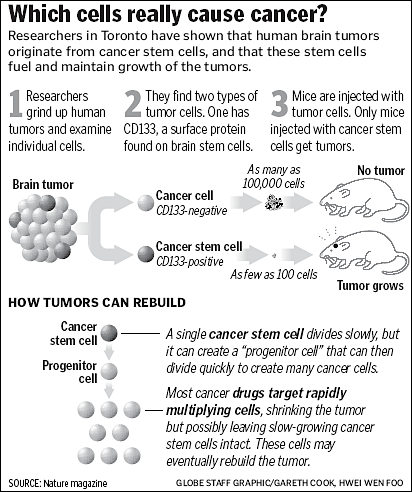
Scientists have suspected a link between stem cells and cancer cells for decades. Stem cells, which appear in many tissues in the adult body -- from the skin to the blood to the brain -- are unique because they have the ability to create large numbers of other cells. Scientists also sometimes refer to stem cells as "immortal" for their unique ability to renew their own ranks, seemingly indefinitely. Cancer cells seem to share some of these qualities, only they are riddled with genetic defects that make them grow into dangerous, uncontrolled masses.
A stem cell "has all the things that we ascribe to a very aggressive cancer," said John E. Dick, a professor at the University of Toronto.
In 1994, Dick became the first scientist to prove the existence of a cancer stem cell, which combines the profound genetic damage of a cancer cell with the self-renewing capacity of a normal stem cell. In studying a common form of blood cancer called acute myelogenous leukemia, he found that only a small proportion of the leukemia cells were capable of actually causing the cancer. And these cells, he showed, had the same chemical markers as the stem cells found in healthy blood.
But that idea remained an isolated finding until last year, when Dr. Michael Clarke, a professor at the University of Michigan, announced he had found a stem cell in human breast tumors -- suddenly suggesting that stem cells could be driving solid tumors as well. In August, a paper in the New England Journal of Medicine linked another form of leukemia to cancer stem cells, and last month, a paper in the prestigious journal Nature showed that two common forms of brain tumors are driven by stem cells.
The brain research, led by Dr. Peter B. Dirks of the University of Toronto and the Hospital for Sick Children in Toronto, looked at cells taken from human brain tumors and identified possible cancer stem cells among them. Dirks showed that as few as 100 of these cells could create an aggressive brain cancer in a mouse. But without these stem cells, even a massive dose of up to 100,000 cancer cells didn't spark a cancer, according to the paper.
Clarke said last week that in unpublished work he has identified stem cells for another cancer, and believes he has found stem cells for two more types of cancer
With other cancer scientists now starting to direct their research toward stem cells and new findings bolstering the idea, Clarke said he now receives almost daily invitations to give presentations around the country.
"When I first published this, nobody believed me," Clarke said. "At this point, I think I am going to die if I take one more plane trip."
Although the field has only begun to yield useful findings, scientists are already looking for ways to use this knowledge to treat cancer. They believe the key is to home in on the ways in which stem cells differ from normal cells. Radiation and traditional chemotherapy drugs tend to target cells that are dividing quickly and creating large numbers of new cells. Because this rapid division is the trademark of an active cancer, these treatments are generally effective at shrinking the size of tumors -- the traditional measure of effectiveness.
Stem cells, by contrast, are usually slow to divide. When a stem cell does divide, it can create long-lived copies of itself -- thus ensuring its "immortality." But a stem cell can also create cells known as progenitor cells that have the power to create a group of new cells that quickly expand in number. Cancer therapies that kill only these quickly dividing cells may appear successful in the short term, but leave the more important stem cells unharmed.
The search for drugs that would specifically target cancer stem cells is underway. Craig T. Jordan, a scientist at the University of Rochester School of Medicine and Dentistry, has been working for years with the cancer stem cells identified in 1994, looking for ways to kill them without hurting normal cells. Two years ago, while still a researcher at the University of Kentucky, he identified a pair of drugs that targeted leukemia stem cells. Recruiting began last month for a trial in Kentucky for people who have relapsed, which is very common, and for other patients who can't handle the toxicity of the traditional treatment.
Jordan said that in unpublished work he has identified another promising drug treatment, based on a natural plant compound called parthenolide, though he cautioned that any clinical trial of this drug would be at least a year away.
Clarke, Dirks, and other scientists involved in the research said that they are especially interested in developing treatments that can disrupt the ability of the cancer stem cells to replicate themselves. If scientists can find a drug that interferes with this power, then without the "immortal" stem cells, the tumor would simply die.
Dr. Harley I. Kornblum, a leading figure in brain cancer stem cells research, is working on a project to screen large numbers of potential drugs to stop cancer stem cells from replicating indefinitely. Kornblum is director of the neural stem cell research center at the University of California, Los Angeles, and a researcher at the Jonsson Comprehensive Cancer Center there.
Drugs that target cancer stem cells, scientists said, could be used in combination with traditional chemotherapies to heighten their effect. They might also be used in combination with drugs designed to disrupt the ability of tumors to attract the new blood vessels they need to survive, a process called angiogenesis.
Researchers are also actively looking for drugs that might disrupt the ability of cancer cells to leave the primary tumor and start growing elsewhere in the body, a process called metastasis.
Although many aspects of cancer stem cells are still poorly understood -- and only a few types have been identified -- it may not be necessary to understand them well to tame them, said Dr. Todd R. Golub, director of the cancer program at the Broad Institute and an oncologist at Dana-Farber Cancer Institute.
For example, he said, if a therapy can efficiently destroy all of the direct offspring of the stem cells, then the cancer can be held in check, making it a manageable chronic disease rather than an unpredictable killer.
Newer approaches to cancer drug development may yield drugs that kill cancer stem cells even if scientists have not been able to identify the stem cells.
These drugs, such as Gleevec, are designed to attack very specific aspects of a cancer cell, though some patients treated with Gleevec have begun to suffer relapses.
Cancer has proven an ingenious and frustrating opponent, but even with all the difficult work that now lies ahead, one longtime researcher said that the discovery of cancer stem cells has been like pulling back a great veil.
"Finally," said Weinberg, "we have come to see the true face of the enemy."
© 2004, Globe Newspaper Co.
Biography
Gareth Cook has covered science for the Boston Globe since 2000. He graduated in 1991 with two bachelor's degrees from Brown University: International Relations and Mathematical Physics. He was named to the Sigma Xi and Phi Beta Kappa honor societies.
After graduating, Cook passed the Foreign Service written and oral examinations but then decided on a career in journalism. He worked as an assistant editor at Foreign Policy magazine until 1993. From 1993 to 1994, he worked as a reporter at U.S. News & World Report, focussing mainly on national politics. In 1995, he moved to a job as an editor at the Washington Monthly. Cook then left Washington to be the news editor of the Boston Phoenix. He recruited a new staff, and his staff won numerous awards from the New England Press Association.
In 1999, he came to the Globe's city desk, where he started as the New England Editor. In the fall of that year, he was named the Sunday Metro Editor, responsible for editing local and regional stories for the Sunday paper. The next year, Cook moved to a job covering science -- a lifelong passion.
He was born in Ann Arbor, Michigan, and now lives in Jamaica Plain, Massachusetts, with his wife, Amanda, and his son, Aidan.