The Wall Street Journal, by Kevin Helliker and Thomas M. Burton
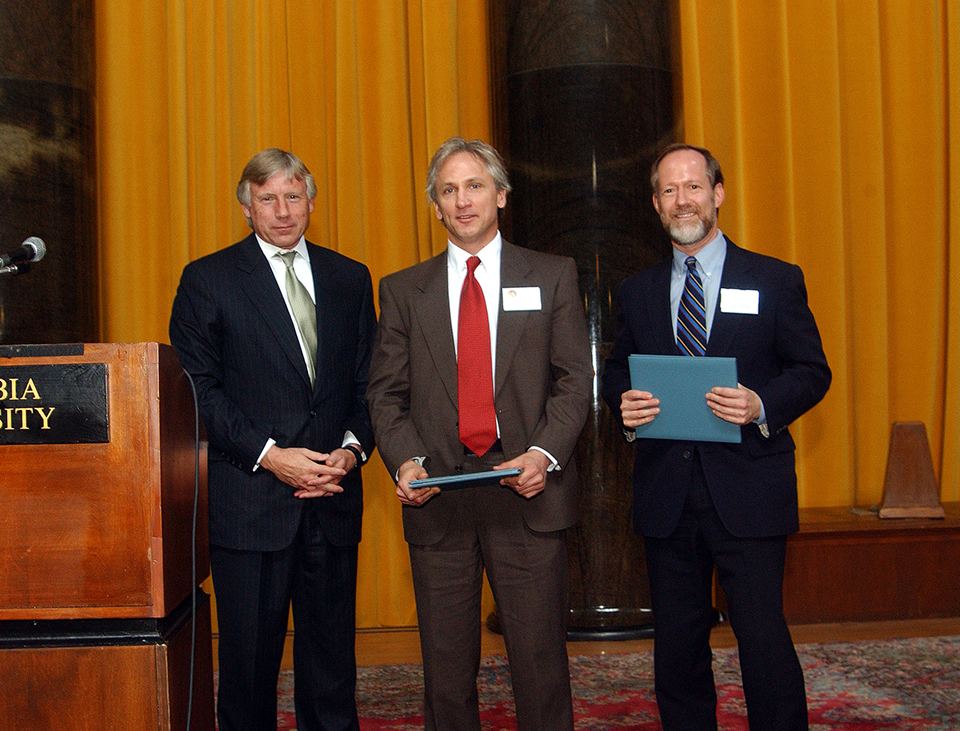
Columbia University President Lee C. Bollinger (left) presents Kevin Helliker (center) and Thomas M. Burton with the 2004 Pulitzer Prize in Explanatory Reporting.
Winning Work
Aneurysm Tests Could Save A Lot of Lives, if Performed
Flaw Is Fixable if Found And Often a Killer if Not
By Thomas M. Burton
Journal Staff Reporter
Jo-Anne Coe took every medical test recommended by doctors and was determined to stay healthy. At 69 years old, she was working as an aide to former Sen. Bob Dole while remodeling a Virginia farmhouse.
But on Sept. 27, while shopping for kitchen cabinets, Ms. Coe felt an intense pain in her back and went to an emergency room. Unlike chest pain, back pain often isn't regarded as urgent, so she waited 90 minutes to see a doctor. After finding that blood was pouring into her body from a leaking aneurysm -- a ballooned section of a blood vessel -- alarmed doctors rushed her into surgery. During the operation, on her torn aorta, she died.
The popular impression is that aneurysms are like lightning: striking rarely, suddenly and unpredictably. In fact, the most lethal aneurysms, those on the aorta, develop slowly, are often easy to diagnose with an inexpensive ultrasound test, and can usually be treated.
But most are never diagnosed, with the result that bursting aneurysms in the abdomen and chest kill an estimated 18,000 Americans a year -- more than AIDS or brain cancer, and four times as many as cervical cancer. Based partly on estimates from doctors, deaths from all types of aneurysms, including cerebral, equal prostate cancer's toll and approach that of breast cancer.
Neglected Disease
For all this, there is no national effort to find aneurysms before they rupture. Doctors almost never inquire about a family history of aneurysms, even though they have a strong familial link. They draw minuscule research funding. And while vast medical industries have grown up to detect ills such as prostate cancer and diabetes -- with doctors routinely ordering tests and insurers routinely paying -- doctors hardly ever suggest that a well patient take a simple test that could detect countless repairable aortic aneurysms. It costs as little as $40 at some centers.
"These deaths are basically preventable if people just got themselves screened," says M. David Tilson, who has treated and researched aneurysms for more than a quarter-century and now holds an endowed chair in surgery at Columbia University. "Aneurysm disease is one of the most neglected diseases in American history."
Why this anomaly? An important reason is that aneurysms produce no large group of patients motivated to raise awareness and funding. Most people with an aneurysm never have symptoms and don't know about it. If it bursts, they're usually dead or disabled. In a third scenario, where the aneurysm is found and surgically repaired, patients aren't likely to become activists. Most are essentially cured, unlike the many people who live for years fighting cancer, AIDS or heart disease.
A rare exception is Bill Maples, who launched a support group and Web site out of his home after having an aneurysm found and fixed. "We have no funding whatsoever," says Dr. Maples, a retired college biology professor in Carrollton, Ga.
A different obstacle prevents screening tests from becoming common and covered by insurance. Many insurers take their cue from Medicare, which doesn't cover aneurysm screening. Now, however, a debate is stirring in medicine over whether some groups of people with no symptoms should be screened for aneurysms.
K. Craig Kent, chief of vascular surgery at New York Presbyterian Hospital-Cornell, did an economic analysis concluding that ultrasound screening for abdominal aneurysms would be more economical, in terms of life-years saved, than mammography. In an article last August in the journal Surgery, Dr. Kent recommended that all men over 60 be offered a quick ultrasound exam of the stomach. He also urges the test for all women over 60 who have a family history of aneurysms.
'Social Dilemma'
What such a policy might add to the country's surging medical bill is unknown. The cost would include not only the screening but also monitoring of aneurysms found, and surgery for some of them. To Rodney White, a surgery professor at UCLA, "It's a social dilemma because you can't afford to screen everybody. But the argument for screening is stronger now [and] a lot of professional groups are advocates for screening."
Aneurysms arise when a thinning, weakening section of an artery wall balloons out. Such spots are considered aneurysms when they reach twice the artery's normal diameter. The deadliest occur in the aorta, the big vessel stretching from the heart to the abdomen.
They usually produce no symptoms. The majority never burst. But when they do, the patient dies about 90% of the time, often never reaching a hospital. By contrast, when a large aortic aneurysm is found and operated on, the survival rate is typically 95% or better, depending on the hospital and where on the aorta the aneurysm is.
Most deaths from aortic aneurysms involve the abdomen, where they can be detected by the inexpensive, and very accurate, ultrasound test. The rest of aortic-aneurysm deaths -- an estimated 2,500 a year in the U.S. -- occur where the vessel runs through the chest. Spotting these usually requires a CT scan, which can cost as much as $800.
Cerebral aneurysms present a more complicated case, because detecting them costs more and it's not so clear which ones need surgery. But these, too, can be deadly. They kill roughly 14,000 Americans a year, estimates Gary Steinberg, chief of neurosurgery at Stanford University Medical Center.
The aneurysm toll actually may be much higher. In the absence of autopsies, coroners tend to attribute sudden deaths to cardiac failure. Each year in the U.S., about 450,000 sudden deaths, most of them unautopsied, are ascribed to cardiac events. Dr. Kent says it's likely a substantial portion actually are due to burst aortic aneurysms.
High blood pressure raises the risk, both that an aneurysm will develop and that it will someday burst. Yet while doctors routinely check blood pressure, and warn about heart risk, they rarely mention aneurysms.
Meanwhile, doctors and fitness experts are increasingly preaching the benefits of weightlifting, including for the elderly. But "heavy weightlifting and heavy straining could worsen aneurysms," says Christopher K. Zarins, chief of vascular surgery at Stanford University Medical Center. He suggests that people with aneurysms use only light weights.
The National Institutes of Health will spend $2.77 billion for research on AIDS this year, along with $732 million on breast cancer and $408.3 million on prostate cancer. The amount for abdominal aneurysms is just over $6 million.
Some doctors say cerebral aneurysms, in particular, warrant more study. It is difficult to know which ones are likely to burst, and it takes a $1,500 magnetic-resonance or CT scan to find them. Despite the uncertainty, experts recommend the exams in a number of cases, such as persistent severe headaches and vision problems.
Devastated
Lois Porteous might have benefited. Suffering from severe headaches and a loss of peripheral vision on one side, she was given headache medicine but no scan. Last Jan. 30, the 58-year-old in Zebulon, N.C., collapsed in her kitchen after an aneurysm behind her eye burst. She survived but needs 24-hour care. "It just devastated her," says a son, Michael.
Screening for aneurysms on the aorta would be simpler, because these appear in more-distinct patterns. For instance, 80% occur in men, and the odds rise with hypertension, smoking and arteriosclerosis.
In addition, when this type of aneurysm is spotted, it's easier to know if surgery is needed, because the risk of rupture increases with size. Normal aortas range between 1.6 and 2.8 centimeters wide. Doctors say any sections wider than four centimeters generally need to be watched closely. Many are stable, but when they start growing, alarms go off. If a spot gets as wide as 5.5 centimeters, the risk of rupture may be high enough to call for surgery. The death rate in surgery isn't negligible but is much lower than that from burst aneurysms.
U.S. surgeons repair about 50,000 abdominal aneurysms each year, typically replacing the puffed-out area with a plastic or fabric tube. Some now use a less-invasive procedure that threads a tubular device called a stent-graft into the bubble.
Over two decades, the number of intact aortic aneurysms diagnosed in the U.S. has tripled to about 200,000 a year. The surge appears partly to reflect the greatly increased use of CTs, MRIs and the like, to check for tumors or other conditions. Relatively few scans are done simply to hunt for aneurysms.
Would insurers pay if tests to detect aneurysms were done to screen symptomless patients, rather than to diagnose symptoms in individual cases? So far, insurers haven't faced the issue. When asked, some point to the added costs that would result from monitoring and surgery, and say they haven't been convinced that screening would be broadly effective.
Some doctors also are reluctant to endorse widespread testing. Robert Zwolak, a vascular surgeon at Dartmouth Medical School, says, "We think we can identify a risk group for whom aortic aneurysm screening is appropriate, but we need more substantiation."
A huge British study provided some last fall. After following 61,000 men aged 65 to 74 for an average of four years, it found a 42% drop in risk of death from abdominal aortic aneurysm among those who had been screened. Their aneurysm death risk was 1.9 per 1,000, vs. 3.3 in the others. "Screening can significantly reduce mortality rates associated with abdominal aortic aneurysms," concluded the study, published Nov. 17 in The Lancet, the British medical journal.
A large new study is being organized in the U.S. by the medical schools of Dartmouth, the University of Pennsylvania and the University of Pittsburgh. Initially it will measure the prevalence of aneurysms; a later phase will check for a mortality benefit from screening.
"There is reasonable emerging evidence suggesting that it's reasonable to screen men over 60" for abdominal aortic aneurysm, "particularly if they have a history of smoking, and anyone with a first-degree relative with an aneurysm," says Jack L. Cronenwett, a study organizer and chief of vascular surgery at Dartmouth. That would have included Ms. Coe in Virginia: Her mother, too, had an aortic aneurysm.
© 2003, Dow Jones & Company
By Kevin Helliker
Journal Staff Reporter
As a fitness trainer and health fanatic, Michael Logan knew that weight lifting could strengthen his bones and protect his heart.
What he didn't know was that it could be lethal. Mr. Logan had a bulge in his primary artery, the aorta. Knowledge of that bulge, or aneurysm, would have prompted doctors to allow only light-weight lifting. But like the vast majority of people with aneurysms, Mr. Logan didn't know he had one.
So he continued heavy-weight lifting -- until an aortic aneurysm killed him last June at age 46. "It's very surprising that something he did for his health might have hurt him," says Mike Logan, the late Chicago trainer's son.
In a nation obsessed with looks and fitness, weight lifting is the latest workout craze. Recent studies have shown that lifting can lower blood pressure, combat diabetes and strengthen bones. Bookstore shelves are teeming with new fitness tomes touting weight lifting. Over the three years ended in 2001, participation in weight lifting in the U.S. has risen 12% -- while aerobic exercise declined 2%, according to American Sports Data Inc.
Now, however, a small but growing number of researchers are raising concerns about the safety of lifting heavy weights. Such lifting can trigger strokes and aneurysms, and perhaps even cause a highly fatal arterial disease called dissection, believe doctors at prominent health centers such as Yale University School of Medicine and the Stanford University Medical Center.
Aneurysms alone kill 32,000 Americans a year, making them as big a killer as prostate cancer, and a more common killer than brain cancer or AIDS. Especially vulnerable to aneurysm and other arterial conditions are senior citizens -- a group that has been urged to take advantage of the bone-strengthening effects of weight lifting.
Aneurysm experts express little concern about moderate to light-weight lifting. Some define light as an amount that can be lifted 60 times, in four sets of 15. A leading aneurysm research and surgeon, John Elefteriades of the Yale University School of Medicine, recommends that people over 40 years old bench-press no more than half their body weight. Equally important is breathing regularly during exercise to minimize spikes in blood pressure.
Aneurysms aren't the only concern for heavy-weight lifters. Vascular experts say it can induce stroke, as well as dissection, in which the inner lining of the aortic artery separates from the outer walls.
Heavy-weight lifting can spike blood pressure to dangerous heights. In maximum-effort lifting, which pits a participant against the most weight he can hoist one time, studies have shown that blood pressure rises to as high as 370/360 from a resting rate of 130/80. Conventional blood-pressure monitors can't even measure levels above 300. "At that level, nobody would be surprised if you had a stroke," says Franz Messerli, a hypertension specialist at the Ochsner Clinic Foundation in New Orleans.
John Robertson witnessed just such an event one day when he was lifting weights as a medical student. Lifting beside Dr. Robertson was a fellow medical student who suddenly keeled over backward. A vessel in his brain had ruptured. He was rushed to the hospital, and survived. "During the time that you're lifting, the pressure on the artery wall is intense," says Dr. Robertson, chief of thoracic and cardiovascular surgery at St. John's Health Center in Santa Monica, Calif.
Doctors have long suspected that the steep blood-pressure spikes arising from heavy-weight lifting could trigger ruptures of already weakened vessels. Now, suspicion is growing that such lifting can damage healthy vessels. Yale's Dr. Elefteriades has shown in a lab experiment that intense pressure can induce dissection, often requiring emergency open-heart surgery.
Dissection typically occurs in older adults, or those who have a family history or who suffer from a syndrome called Marfan's disease. Yet Dr. Elefteriades has treated two young dissection victims who had none of the traditional risk factors, but who were heavy-weight lifters. Similarly, a study conducted at Los Angeles County Harbor-UCLA Medical Center profiled four young men who entered the emergency room suffering dissection -- all heavy-weight lifters. Steriod use may increase the risk.
One option for anyone over 60 or with a family history of aneurysms or dissection is to get scanned before starting a lifting program. Most aneurysms and dissections can be detected by CT scans. Also, an inexpensive ultrasound test can detect the abdominal aortic aneurysm, which ranks as the nation's 13th-leading cause of death.
The latest trend in resistance training is called slow lifting, in which the participant takes 10 seconds to raise a light to moderate amount of weight and 10 seconds to lower it. Proponents tout it as a safer and more effective alternative to both regular lifting and aerobic exercise.
But the authors of two books on slow lifting concede they haven't measured its blood-pressure spikes, which is arguably the most crucial safety issue. The two authors, Adam Zickerman and Michael Eades, say that slow lifting produces smaller spikes than regular lifting.
Other doctors and fitness experts disagree. They say that one cause of blood-pressure spikes during weight lifting is the contraction of the effected muscle. During slow lifting, a muscle may be contracted for more than 60 seconds compared with two or three seconds in regular speed lifting. For anyone concerned about stroke, aneurysm or dissection, or for the vast number of Americans with uncontrolled hypertension, "I would not recommend slow lifting," says Wayne Westcott, a slow-lifting proponent who is director of research at the South Shore YMCA in Quincy, Mass.
© 2003, Dow Jones & Company
Discovering you have an aortic aneurysm could save your life.
But first you have to figure out what to do with the information.
By Kevin Helliker
Journal Staff Reporter
In September I learned I have an aneurysm in my aortic artery just above the heart. This stunned me, in part because I felt great. At 43, I was thin and fit, and ate well. Not a drink since age 22, or a smoke since 28. Only two weeks before getting this diagnosis I set a personal record in the Olympic-distance triathlon (two hours, 28 minutes), finishing ahead of most competitors half my age.
What surprised me most, however, was the diagnosis itself. I hadn't realized a living person could actually have an aneurysm. I thought they struck out of the blue, quicker than you could say goodbye, and with lethal force. Everybody I'd ever heard about having an aneurysm was dead.
Others I've talked to since then have had the same impression: An aneurysm is an arterial bulge that you find out about when it kills you. A few people, upon hearing about mine, have argued that I couldn't technically have an aneurysm, because that would mean I was dead.
Eager (and afraid) to discover what this diagnosis meant, I searched for newspaper and magazine articles, and in doing so came to see why aneurysms are so greatly feared and so little understood. If you want to know how to prevent or manage heart disease, cancer, diabetes or AIDS, the popular press is teeming with information. So is the Internet, with official medical Web sites devoted to diseases much less common than aneurysms. But a search for information on aneurysms tends to yield a very particular kind of article: the obituary.
Feeling Ambushed
As someone who had paid close attention to matters of health, I felt ambushed. This wasn't a disease or condition I'd ever known to look out for. I understood that seemingly healthy people die every day of ailments I'd never heard about, but aneurysms aren't rare or exotic. The abdominal aortic aneurysm alone is the nation's 13th-leading cause of death. Combined, aortic and cerebral aneurysms kill 32,000 Americans a year, more than the toll from prostate cancer, AIDS or brain cancer. Moreover, aneurysm experts consider the number a gross understatement. That's because aneurysms strike quickly and usually in people middle-aged and older, who rarely get autopsied. Found dead on the floor, these people are called "cardiac event" victims and carted off to the morgue. The actual number of aneurysm deaths could be twice the official tally.
So if aneurysms are so common, why don't we hear more about them? Why don't we screen for them? Why don't warnings about hypertension mention aneurysms as a possible consequence, along with heart attack and stroke? Why don't the warning labels on cigarettes note the association between smoking and aneurysms?
The medical community's silence on aneurysms isn't anything sinister. In the battle for medical attention and dollars, this condition -- despite its prevalence -- never gained priority status for understandable reasons: Seemingly healthy one minute, aneurysm victims are dead the next. No suffering, no victims' support group demanding action, no exorbitant medical costs that could be reduced with new treatments or technology. No great incentive -- empathetic, political or financial -- to prevent these deaths.
But starting about 20 years ago, a change occurred. Increased use of ultrasound combined with new-technology images from CT scans and magnetic resonance imaging machines started turning up the aneurysms that no doctor had ever sought to find. The Feb. 1 Harvard Health Letter featured a typical case -- a patient asking what it meant that his gallstone search accidentally turned up a section of aorta 3.8 centimeters in diameter, compared with a normal size of 2.6. It meant he had an aneurysm, and in just this way, aortic-aneurysm diagnosis has tripled over the past two decades.
Tough Answer
Like most of us found to harbor these symptomless killers, the Harvard Health Letter patient asked what he could do to keep his aneurysm from growing. In aortic aneurysms -- the most common kind -- risk of rupture increases with size. The editor of the Harvard Health Letter, Thomas Lee, answered that there is no proven way to keep aneurysms from growing. But he advised the patient not to smoke and to get regular scans and to monitor the status of his aneurysm. If it grows to 5.5 centimeters, Dr. Lee said, surgery would be recommended. "But you don't want to get surgery unless you absolutely have to," Dr. Lee said, warning that mortality rates from the surgery range from 4% to 8%.
In other words: There's nothing you can do to keep it from growing. But if it grows, be afraid. Be very afraid.
After six months of researching the implications of my own condition, I've come to the conclusion that those of us with known aneurysms should feel grateful. Very grateful. An accident of technology has identified for us a problem no doctor ever sought to find or warn about. Even the risk of death associated with the aortic-aneurysm removal procedure is a godsend compared with the estimated 90% mortality rate when an aortic aneurysm ruptures or dissects (dissection being the shearing off of an artery's inner lining from the outer wall). You wouldn't know it from the vast majority of doctors you might consult about aortic aneurysms, but being diagnosed with one means that your chance of surviving it is very good.
The popular perception that aneurysms are as unpredictable as lightning persists largely because doctors offer no warnings to known high-risk groups. People whose first-degree relatives died of aneurysms are at higher risk but generally aren't being screened. Hypertension literature teems with warnings about stroke and heart attack, but rarely mentions aneurysms. Aneurysm experts say screening for abdominal aortic aneurysms -- the most common kind -- ought to be routine for men over 65, especially smokers. A very high-risk group of people are those with Marfan's syndrome, a genetic disorder whose victims often have weak or diseased arterial tissue.
Still, a significant percentage of aneurysms strike people outside any known risk group. I've yet to lose any first-degree relatives (parents or siblings); my grandfathers died of cancer, and my grandmothers lived past 90. My blood pressure is fine, I haven't smoked in 15 years and I don't have Marfan's. My diet is low in animal fats and high in fruits and vegetables, and I exercise an hour a day or more.
Smugness and Fear
In fact, it was with an attitude of smugness that I entered the Princeton Longevity Center one morning last September. I went as a journalist, intrigued by this new clinic's proposition that not everyone born the same year is the same age. After a daylong battery of exams and deep analysis of your family history, diet and lifestyle, the center promises to tell you your "biological age," versus your chronological age.
One of the procedures is a CT scan, meant to examine the coronary arteries. A buildup of calcium or plaque in these arteries, which feed blood into the heart, is a warning sign of heart disease. I climbed into the electron-beam tomography machine -- an advanced CT scanner -- thinking I'd ace this test, and I did. "Ninety-nine percent of subjects of your age and gender have a higher calcium score, and 0% have a lower score," said the computerized summary.
But there was a problem elsewhere. The scan happened to catch a good glimpse of my aortic artery, which ascends from the heart, then curves downward through the stomach to the legs, supplying blood throughout the body. At a point just above the heart, this artery was enlarged. "It's generous," said Harvey Hecht, the center's cardiologist. It sounded like a good thing. But it wasn't. In most locations in most people, Dr. Hecht explained, the aorta measures 2.6 centimeters in diameter. The scan showed mine, at this point just above the heart, to be 4.6 centimeters. When I asked what this meant, Dr. Hecht mentioned the A-word. Aneurysm. Dr. Hecht told me that if mine grew to five or 5.5 centimeters, surgery would be recommended to remove it. Then he gave me the most serious look I've ever received from a physician. "You do not want to have that surgery," he said.
At the end of the day, I had a consultation with Dr. David Fein, chief executive of the Princeton Longevity Center. He's a brilliant doctor with a reassuring manner. But when he told me that afternoon that this diagnosis didn't call for panic, and that overall I'd proved to be four years younger than my actual age, I hardly heard him. I walked out feeling as if I'd received a death sentence.
False Hopes
Within hours I conjured up two hopes. First, that the diagnosis wasn't as serious as Dr. Hecht had suggested. That weekend, my girlfriend and I were having dinner with her aunt and uncle, both prominent radiologists. My girlfriend broached the subject lightly, saying she was certain I was overreacting to some recent medical news. As I offered the details, however, her aunt and uncle grew visibly concerned. They advised me to take this news immediately to my own doctor, back in Chicago. An awkward silence hung over the dinner table.
My second hope: that the scan was wrong. CT scans are prone to finding abnormalities that turn out to be nothing -- false positives. But it turns out that aneurysms on a scan are much less ambiguous than, say, tumors. Aneurysms grow slowly and show up well on screens. Indeed, if the roughly 16,000 Americans who made up last year's official aortic-aneurysm death count had been screened, virtually all of their bulges would have been found. Probably most of those aneurysm would have met the standard for preventive surgery, and more than 92% of those undergoing surgery would have survived. The bulk of those 16,000 would still be alive -- but the medical system would be creaking under the cost of screening millions of people to find those aneurysms.
In early October, I visited a hospital in Chicago hoping to prove the CT scan wrong. But a finer technological eye -- the magnetic resonance-angiogram with contrast -- looked inside me and confirmed the existence of the aneurysm, though at reduced dimensions. The MRA showed that my problem was 4.1 centimeters in diameter, not 4.6. That felt like a big step back from the edge.
It isn't easy to find doctors who have a deep understanding of aneurysms. When my younger brother asked his primary-care physician whether my diagnosis meant he ought to be screened (it does), the man looked at my brother's neck and said no -- that he wasn't at risk because his veins weren't visible. No expert I consulted knows of any association between vein visibility and aneurysms.
What a primary-care physician typically would do is refer such an inquiry to a specialist. Had my coronary arteries shown a worrisome amount of calcium, for instance, my internist might have referred me to a cardiologist. But until recently there has been no vascular equivalent of the cardiologist, no specialist devoted to the care of your arteries and veins. Only now is such a specialty developing -- the vascular-medicine specialist, and they number only about 300. That's about 15,000 fewer than the number of U.S. podiatrists devoted to the care of your feet.
Not a Primary Concern
So research, monitoring and treatment of aneurysms has fallen to that category of physician charged with the grim duty of treating them when they rupture or dissect -- the surgeon. Yet the aneurysm belongs exclusively to no surgical group. An aortic aneurysm in the stomach is the vascular surgeon's business; in the chest, it's the cardiac surgeon's. The brain, meanwhile, is the province of neurologists and neurosurgeons.
This division of responsibility according to location in the body means that aneurysms aren't a primary concern for most of the surgeons who treat them. But there are a few who have made aneurysms their bread and butter. Finding them isn't easy, although aneurysm patients share some valuable tips on a Web site (at www.westga.edu) run by Bill Maples, a retired college biologist in Georgia.
Before talking to some cardiac surgeons devoted almost exclusively to thoracic aneurysms, I heard various doctors express the idea that the discovery of an aneurysm as small as mine could turn out to be disadvantageous. Some doctors doubt that all aneurysms grow, and suggest that I might spend years taking tests and feeling nervous about a condition that would never really threaten me. But from the tiny scattering of physicians who have made aneurysm research and treatment their mission, I did not hear this kind of talk. Their data, much of it too new to have spread beyond their circle, suggest that aortic aneurysms virtually always grow, and that the bigger they get the greater the risk of rupture or dissection. The unanimous view of these experts is that the discovery of any aneurysm is fortunate.
Another thing the experts tell you is that the chest pains that commenced the instant you got the diagnosis almost certainly are imaginary, because aneurysms typically aren't symptomatic until they rupture or dissect, and then the pain is intense. If you have a thoracic aneurysm, they will tell you that you may have been born with it, may have inherited it and may have passed it on. A conversation with Dianna M Milewicz, the director of medical genetics at the University of Texas Health Sciences Center/Houston, convinced me that my son should undergo periodic screenings, starting now at age 9. First-degree relatives of aneurysm patients have died of ruptures at ages as young as 11.
What Now?
But the experts don't have the information you really want -- how to keep this bubble from growing and bursting. They agree that smoking, heavy weight lifting, contact sports and ultraendurance aerobic events are proscribed (no more triathlons for me). Intense aerobic exercise is discouraged until a treadmill test is taken to make sure your blood pressure doesn't spike unacceptably (mine rose only to 165/75). Hypertension is such a concern that some experts recommend beta blockers even for patients whose blood pressure is normal, but other experts disagree. All of these recommendations and proscriptions are based more on intelligent assumptions than on evidence.
The bottom line is that no doctor knows how to keep aneurysms from growing. The best information on growth rate and risk of rupture comes from John Elefteriades, a professor of cardiothoracic surgery at Yale University Medical Center, whose data show that aortic aneurysms of the chest grow about one-tenth of a centimeter a year. His and other experts' data show that the risk of rupture or dissection exceeds the risk of surgery when an aneurysm in the ascending aorta reaches 5.5 centimeters. To account for various body sizes, Dr. D. Craig Miller, a professor of cardiovascular surgery at Stanford University Medical Center, deems an aneurysm to be ripe for removal when it is twice the normal size at that particular location in that particular person.
If my 4.1-centimeter aneurysm grew at a rate of one-tenth a centimeter a year, it wouldn't reach the surgical standard for more than a decade. Or maybe it will never reach that standard. Or maybe it will reach that standard and grow beyond it without ever rupturing or dissecting. Maybe I should leave it alone.
The surgery, after all, is serious. It is a form of open-heart surgery that is called aneurysmectomy or aortic-replacement surgery. It takes about eight hours. During the most crucial point -- a period lasting as long as 45 minutes -- the patient is clinically dead: No pulse. No breath. No brain waves. His head is packed in ice, his body temperature lowered to about 65 degrees. This is when the surgeon clips off the diseased section of artery and replaces it with a piece of Dacron hose.
The eyes of nonsurgeons tend to widen at any mention of this procedure. When Jim Butler learned he had an aortic aneurysm, his cardiologist at the time told him, "You'd rather get in a motorcycle wreck than have to have that surgery," recalls Mr. Butler, a retired software executive in Orange County, Calif.
This tendency of the medical profession to warn more loudly about aneurysm surgery than about the ruptures or dissections it prevents may date back to when the surgery, in its infancy, had a mortality rate of nearly 50%. But today, at the highest-volume centers -- such as New York's Mount Sinai Hospital, Houston's Texas Medical Center and the hospitals attached to Stanford and Yale universities -- the rate of survival without complications is better than 95%. In the large majority of cases, surviving surgery signals the end of the patient's aneurysm troubles. "It was really no big deal," says Kristin Fast, a 33-year-old Southern California mother of two who went home four days after Stanford's Dr. Miller removed her aneurysm in February.
Mr. Butler, another patient of Dr. Miller's, says he recovered more quickly from aortic-replacement surgery than he did from a coronary-bypass and valve-replacement procedure four years earlier.
Avoiding an Emergency
As a result, some surgeons who perform these operations are quicker to dismiss the concerns other doctors have about the procedure. During a consultation with Dr. Miller, I noted that if a hose in my car were found to contain a bubble, and if a mechanic said that the bubble might last 50,000 miles or burst 10 miles down the road, I would order the hose replaced, whatever the cost. Peace of mind.
"That's a good analogy," Dr. Miller said, "except make it a King Air."
"What?"
"Make it an airplane. Then the implications are similar.''
Some might call that scaremongering. But it's hard for patients who feel healthy and who are experiencing absolutely no symptoms to willingly undergo major surgery. When those patients later experience what aneurysm experts call catastrophic events -- dissection or rupture -- it is cardiac surgeons such as Drs. Miller and Elefteriades who are roused from sleep and rushed to emergency rooms. "The survival rate at that point is awful," says Dr. Miller.
In rare cases, rupture and dissection occur in aneurysms of my current size. To me, the danger of rupture or dissection is scariest of all. I'm not required to wait until my aneurysm reaches the surgical standard of 5.5 centimeters to get on the operating table, and I don't intend to. I'm doing it at 5.
© 2003, Dow Jones & Company
New Research Boosts Value of Procedure, But Families Rarely Choose to Request
By Kevin Helliker
Journal Staff Reporter
After her 29 year old son dropped dead, Jeanann Ward refused to have him autopsied. She couldn't bear the thought.
Four years later, that decision haunts her. Whatever struck down the seemingly healthy young man may be lurking in other family members, and an autopsy could have provided a warning. "Big mistake," she says of her decision.
One of the most important medical exams you can obtain these days involves somebody else's body -- that of a parent, sibling, child or even an elderly grandparent. As genetics are found to play a deeper role in a wider range of conditions than previously imagined -- everything from aneurisms to Alzheimer's disease -- your long-term survival could depend on knowing a family member's cause of death.
The most reliable source of that information is the autopsy. But while the value of the procedure is climbing, its frequency is plummeting. Once performed on more than half of American corpses, autopsies today are reserved mostly for cases involving suspected foul play. Most hospitals have discontinued the once common procedure in an effort to cut costs. And doctors, reluctant to have their diagnoses second guessed, don't often encourage it. Consequently, fewer than 10% of U.S. corpses these days are autopsied.
Yet, it's increasingly easy to order up an autopsy from numerous private companies that perform them. The cost is substantial -- usually between $1,000 and $3,000 -- and insurance won't cover it. But many medical experts believe it's money well spent. "You need to know what your relatives died of," says Catherine DeAngelis, editor in chief of the Journal of the American Medical Association.
Even when the cause of death seems apparent, an autopsy can provide critical information for survivors. It can uncover an erroneous diagnosis. A recent federal report showed that autopsies overturned the official cause of death in U.S. hospitals in as many as 23% of cases in the year 2000. A person who dies in an automotive accident, for instance, may be found during autopsy to have had a cancerous tumor of the sort that runs in families.
Most often, it can provide important additional details about the precise cause of death, allowing surviving relatives to get critical medical screening tests and make appropriate lifestyle changes.
Doctors, for example, often cite simply "heart disease" or a "cardiac event" as a cause of death. But new evidence is emerging almost daily showing that it's extremely important to know whether an immediate relative died of a heart attack, pulmonary embolism or thoracic aortic aneurysm -- three distinct conditions that are increasingly understood to bear a strong genetic component.
If the cause of death was a heart attack, the surviving offspring and siblings should watch their diet and cholesterol, and perhaps get their coronary arteries scanned. If it was a pulmonary embolism (a blood clot in the lung), they should be screened for a susceptibility to that and perhaps placed on blood thinners. If it was a thoracic aortic aneurysm (a bulge in the body's largest artery), then a CT scan or echocardiogram ought to be used to examine their aortas.
To survivors of the just deceased, an autopsy sounds gruesome. And it is, with the chest, abdomen and skull opened for purposes of removing and examining the heart, lungs, liver, brain and other organs. But the patient, of course, feels no pain, and the corpse is sewn up so well that open casket viewing remains an option.
Taking a Guess
In the case of Russell Ward, his mother's aversion to an autopsy prompted the New York City medical examiner's office merely to conduct a toxicology test, which ruled out drugs. The office then took a guess and cited heart disease as the cause of death for the big, young investment banker, who until the moment of his death had seemed robustly healthy.
After consulting with medical specialists, Mrs. Ward, a nurse by training, came to suspect her son suffered not from heart disease but from a syndrome called Marfan's whose victims are prone to thoracic aortic aneurysms. Such aneurysms have enormous familial implications. An article to be published this summer in the journal Circulation profiles a Midwestern family whose members young and old have been decimated by thoracic aortic aneurysms.
New tests such as CT scans can find these arterial bulges before they burst. Aneurysm experts recommend that all parents, siblings and children of thoracic aortic aneurysm victims get tested, regardless of age. "If we'd had an autopsy, we'd know for sure whether other family members need to be screened for this," says Mrs. Ward, of Randolph, N.J.
(Autopsies can be performed on embalmed and buried corpses, but the cost is exorbitant and the results less precise.)
Reluctant Doctors
Of those patients determined in autopsies to have been misdiagnosed by their doctors, as many as 8% may have been harmed by the medical treatment they were receiving, according to a recent federal government report. Little wonder that doctors don't encourage autopsies.
"The low rate of autopsies has generated a collective sense of cockiness in the medical community about how accurate our diagnoses are," says Richard Devereux, professor of medicine at Weil Cornell Medical College in New York. For patients' families, he adds, "Having an autopsy is always a good idea."
Hospitals used to perform autopsies routinely on patients who died within their corridors, in part because doing so was necessary to the retention of their accreditation. But that requirement has been diminished or abolished, and now few hospitals will perform them. One exception is teaching facilities such as Chicago's Northwestern Memorial Hospital, which performs about 10 free-of-charge autopsies a month.
All rights to a body belong to the next of kin except when the local medical examiner demands an investigation -- in which case autopsies are performed courtesy of taxpayers. Such investigations are relatively rare, however, even in big cities with large medical examiner offices. In New York City, the office of the medical examiner autopsies only about 5,000 of the 75,000 or so who die there each year.
Public medical examiners generally conduct autopsies in two types of cases: when foul play is suspected, and when people below a certain, unpublicized age die of unknown causes. ("We don't want murderers to know that dead people over the age of X get less of a look at," says Edmund Donoghue, chief medical examiner for Chicago and Cook County, Ill.)
Most likely, no hospital or governmental official will perform an autopsy on your loved one. So it may be necessary to hire a private pathologist. A funeral home -- if it is local rather than part of a national chain such as Service Corp. International -- should be able to offer a referral. Sometimes, pathologists on staff at the county morgue or at a local hospital will perform autopsies after hours, perhaps at the funeral home.
Some cities boast private companies such as Chicago Area Autopsy Service, a 12 year old firm that performs about 1,300 autopsies a year at a basic cost of about $950 each (with extra fees added for testing for paternity, toxicology, asbestos exposure and such). In Los Angeles, 1-800-AUTOPSY performs about 700 procedures a year at about $2,000 each, often on bodies flown in from elsewhere.
Problems can arise, however, when relatives don't agree on the need for an autopsy. When his mother died, Dwight K. Oxley, a pathologist in Wichita, Kan., wanted an autopsy to determine whether she had Alzheimer's, a condition with a strong genetic link. But the procedure wasn't performed because his brother was opposed.
Getting Families to Agree
"If the next of kin can't agree on it, then we don't do it," says Zack Qualls, vice president of Chicago Area Autopsy Service.
The solution for families might be to discuss the rational arguments in favor of autopsies before death strikes. "The trouble is that you're presented with the decision about an autopsy at a time when you're overwhelmed with grief and not thinking straight," says Dr. Donoghue, the Cook County medical examiner. "Many people who think they don't want an autopsy later regret it."
Navigating an Autopsy
Why they're important and where to get them:
· Always get an autopsy when a relative who seems healthy dies suddenly -- regardless of their age. Share the results with your primary care physician.
· If the death occurred in the hospital, request that the institution's own pathologists perform the autopsy -- for free. Argue that the hospital has a moral and intellectual obligation to determine definitively why its patient has died.
· If the hospital refuses to do it for free, ask how much the procedure would cost. Then check with the county morgue or seek a pathologist referral from a funeral home.
· If you have reason to believe that your relative received poor care in the hospital or nursing home, seek an autopsy from a pathologist who doesn't work for that facility.
· If litigation seems likely, the need may arise for a second autopsy. So consider burying rather than cremating the corpse.
· Request not only the preliminary report citing cause of death but the full report that typically emerges a month or so later. This more-detailed analysis sometimes tells of incipient diseases or conditions that the deceased never knew he had.
© 2003, Dow Jones & Company
A Simple, Seldom-Used Test Can Detect Lethal Aneurysms
By Kevin Helliker
Journal Staff Reporter
The death of John Rosnow last summer illustrates one of modern medicine's most preventable failings. A retired plant manager in Clintonville, Wis., Mr. Rosnow collapsed after a daily exercise regime that included riding his bike seven miles. Until then, "he was a fitness fanatic," says his widow, Joan Rosnow.
Yet the death of Mr. Rosnow, 70, was hardly inevitable. The aortic aneurysm that killed him had been growing for years, not days. Had he spent $40 to $150 on a noninvasive ultrasound test, his arterial bulge almost certainly would have been found. Then he could have undergone an insured surgical procedure that is 90% successful at repairing aneurysms.
Aneurysms -- bulges in weakened artery walls that are almost always fatal when ruptured -- may be the most preventable common killer that doctors rarely warn about. They account for more deaths in the U.S. than brain cancer or AIDS. And by all accounts, aneurysm deaths are underreported because sudden, unexplained deaths are often simply labeled "cardiac events." Yet despite the growing accuracy of screening technology, the medical community has never made much effort to detect aneurysms, and most general practitioners never advise patients to get tested.
That may be slowly starting to change. A federal health panel is considering whether to recommend routine screening for abdominal aortic aneurysms, one common form. And health insurers -- which have rarely paid for aneurysm screenings -- are starting to do so for patients with a family history of the condition.
The key to surviving an aneurysm is knowing about it before it ruptures. About 90% of ruptured aneurysms result in death. But about 90% of those fatalities could be prevented if the arterial bulge were detected in advance.
The advent of CT, MRI and ultrasound technology has produced an estimated 200% increase in the diagnosis of aortic aneurysms -- the most common variety. But nearly all these discoveries have occurred in patients who were being tested for something else. A radiologist scrutinizing film for gall stones can't help noticing if an aorta, typically the diameter of a garden hose, measures as large as a soda can.
So while radio advertisements boast that preventive CT and MRI scans can identify early-stage cancer and heart disease, another argument for getting a preventive scan may be to detect aneurysms. Though scans often fail to find cancer or heart disease -- or register false positives for those conditions -- they are brilliant at finding asymptomatic aneurysms. "There's no ambiguity with a CT scan in terms of aneurysms," says Michael Dake, chief of cardiovascular and interventional radiology at Stanford University Hospital.
Moreover, the value of a scan for aneurysms is longer lasting than that for other diseases, such as cancer. Aneurysms generally take years to develop, compared with certain cancers that can grow almost overnight. Adults at risk of aneurysms could undergo scans as infrequently as every five years.
Who Is at Risk
Research into aneurysm deaths has identified several groups at risk. All men over 50 who smoke -- or who once smoked for years -- should consider getting screened for abdominal aortic aneurysms, aneurysm experts say. All men over 65, even healthy nonsmokers, should get such a test, according to a recent study published in the British medical journal Lancet. People under 50 who should be screened include heavy smokers, those with family histories and those with recurring sharp pain in the head, stomach or back.
Perhaps the biggest high-risk group consists of the relatives of aneurysm victims. Research showing that people with aneurysms tend to share a genetic weakness in the walls of their arteries is relatively new but profound. At least 20% of aneurysm victims have a first-degree relative -- a parent, sibling or child -- with an aneurysm. Sufferers of a familial condition called Marfan's are especially at early risk of the condition.
But widespread awareness of this research has failed to penetrate the medical community, in part because few specialists focus specifically on veins and arteries. After a scan taken to investigate a heart murmur found an aortic aneurysm near his heart, Paul McGinley visited a geneticist and cardiologist, among other doctors. A sales representative for a large pharmaceutical company, Mr. McGinley had extraordinary access to medical experts. But nobody told him that his siblings -- including a sister who also has a heart murmer -- should be screened.
"It's absolutely crucial that close relatives get screened," says Carl Vaughan, assistant professor of medicine at Weill Cornell Medical College in New York, who has studied the family connection.
Most aneurysm victims are middle aged or older, creating a false impression among doctors that the condition never strikes the young. When the 19-year-old son of a middle-age aortic-aneurysm victim began experiencing chest pains, he was twice turned away from the emergency room on the mistaken belief that he was too young to have an aneurysm. He died, and other young members of his extended family have been found to have thoracic aortic aneurysms, says Dianna Milewicz, director of medical genetics at the University of Texas Health Sciences Center.
What to Request
Anyone obtaining a preventive scan should tell the radiologist or technician studying it to look out for aortic aneurysms, because attention tends to focus on organs rather than the artery supplying blood to all of them.
For smaller and harder-to-see cerebral aneurysms, it is best to skip the CT scan and get an MRI. Cerebral aneurysms are less predictable than aortic, whose chance of rupture grows with size. But the value of cerebral scans for identifying the need for surgery is great and growing, says Hunt Batjer, chairman of neurosurgery at Chicago's Northwestern Memorial Hospital.
Last month, Kevin Napolitano, a 40-year-old Maine father and construction manager, fell over dead from an unknown cerebral aneurysm. Dr. Batjer says the chances are "very good" Mr. Napolitano would be alive and well if he had had a scan.
Patients found to harbor aneurysms should demand to see a specialist, although this isn't as simple as it sounds. Which specialist to visit depends on the location of the bulge. Cardiologists and cardiac surgeons follow aortic aneurysms in the chest, while vascular surgeons treat those that appear elsewhere -- except in the head, where neurologists and neurosurgeons take over. Within these specialties, it is important to find individual doctors with deep aneurysm experience; many cardiologists, for example, know little about the condition.
Sometimes aneurysms rupture before reaching the recommended size for surgical repair. But even in such cases, victims who have had scans and are aware of their condition face better odds. That is because emergency-room doctors misdiagnose rupturing aneurysms about 30% of the time, studies show, often resulting in death. By contrast, the patient who enters the emergency room knowing he or she has an aneurysm can go straight to surgery.
One reason doctors have paid so little attention to aneurysms is that virtually nobody is sick with them. They are asymptomatic, and then they kill.
© 2003, Dow Jones & Company
When you know you have a potentially fatal condition, how does it change the way you live?
By Kevin Helliker
Journal Staff Reporter
The accidental discovery last year of an aneurysm in my aortic artery was fortuitous. This is what doctors tell me, anyway, and I mostly believe it. Knowledge of the aneurysm means I can keep an eye on it and have it surgically removed before it reaches a size where rupture is a serious danger.
But knowledge of its existence also makes me hypersensitive to every twinge in my chest and leaves me constantly wondering: Am I about to die? This unending state of alert could wind up killing me. The biggest danger for anyone with an aortic aneurysm is high blood pressure -- and my blood pressure started climbing the instant I learned about this aneurysm.
Researchers have learned a lot in recent years about the role of various factors -- genes, gender, medication -- in the development of all sorts of illnesses. More people than ever know they're at higher risk for cancer, or heart disease, or diabetes. But what about the risk of knowledge?
From Triathlete to Code Blue
Discovering that your largest artery contains a bulge that any moment could burst and kill you changes the way you think about yourself. News of my aneurysm slayed the self-perception I'd had -- that of a superhealthy 43-year-old triathlete. Suddenly, I was a Code Blue just waiting to happen. A view of one's self as unhealthy can become self-fulfilling, many doctors say.
n part, that's because knowledge can change behavior for the worse. Although this aneurysm means I should be even more careful about my health, it has had the opposite effect. I no longer impose upon myself a Draconian diet. I've stopped taking vitamins inexplicably, gained a little weight and resumed my old love affair with caffeine, which I'd given up years ago in an effort to keep down my blood pressure (which I now suppress with pills). I exercise more vigorously than some aneurysm specialists believe I should.
The point is, I'm now less bent on reaching old age than on enjoying my present age. As a friend of mine said upon hearing about the aneurysm: "If this can happen to you, we should all eat whatever we want."
The importance of knowledge as a factor in medical outcomes is large, growing -- and little understood. Advances in medical genetics, for instance, are enabling doctors to identify the genes that predispose us to certain cancers. Similarly, until the recent advent of CT and MRI scans, aortic aneurysms (which don't show up well on X-rays) remained undetected until they ruptured or dissected, which is an often-fatal tear in the inner lining of the arterial wall. But now, scores of scans taken to look for gallstones or coronary calcium are accidentally catching something more serious -- asymptomatic aortic aneurysms.
A Prophecy Fulfilled
In theory, such knowledge can enable us to act pre-emptively. But 2,500 years before the invention of the CT scan, Sophocles wrote about how such pre-emptive action can backfire. His drama Oedipus Rex illustrated vividly the danger of receiving knowledge of one's fate. Told by an oracle that he is doomed to slay his father and marry his mother, Oedipus flees the kingdom of his parents -- unaware that they adopted him. Arriving then in the land of his biological parents, Oedipus unintentionally fulfills the awful prophecy.
Like the oracle Oedipus received, CT scans of asymptomatic aneurysms in some cases have set in motion tragic chains of events. Some people, consumed by this perhaps fatal flaw near their heart, opt for serious surgery -- and die from the operation. They've, in effect, killed themselves by seeking to eliminate an aneurysm that might never have burst.
As someone whose aorta is about 1.5 centimeters too large to be normal and a centimeter short of the current surgical standard, I've come to accept that the only certainty about aneurysms is danger. You're in danger if you act. You're in danger if you don't.
So you begin by trying to forget about it. This is what my swimming pal does. He is a cardiac surgeon who happens to have an aortic aneurysm, and when I first learned about mine he was very reassuring. He shrugged it off, said he and I just have big aortas, that we'd monitor them and have surgery if they got bigger. No big deal. It gave me tremendous comfort to see that his aneurysm didn't worry him. Then one day at the pool he told me that a sudden swoon had sent him recently to the emergency room. "I thought I was dissecting," he said. It turned out to be nothing, but the episode had the disappointing effect of revealing my hero to be only human.
It also confirmed what I already knew: You can "forget about it" only so much. After learning about my aneurysm I started experiencing a sensation of tightness in the left side of my chest. I assumed this was psychosomatic, because I'd never noticed it before, and also because the physicians I consulted shrugged it off, saying this happened to everyone who got diagnosed with an asymptomatic aneurysm. But it was clear to me that they didn't really know whether an enlarged aorta might be painful, and it also occurred to me that swollen body parts are usually sore. Then I interviewed an aortic expert -- a chief of cardiovascular surgery at a top academic hospital -- who said he is convinced small aneurysms do cause pain. Now every sensation in my chest feels dangerous.
Dreaming of John Ritter
A few days after the death from aortic dissection last month of Hollywood star John Ritter, I had a dream that I was sharing a house with two women who were only my roommates. The dream puzzled me until I remembered that this was the role that John Ritter had played in his most famous sitcom, "Three's Company." Suddenly the dreadful meaning was clear: I had become John Ritter. Becoming John Ritter is now the fear of everyone with a known aortic aneurysm.
And so, I can't forget. The aneurysm won't let me. It is a constant reminder that I am going to die, preventing me from engaging in the daily denial of death that psychiatrists say shores us up. This is why some people demand surgery the instant their aneurysm is diagnosed, no matter how small it is, no matter how unlikely it is to kill them; they will do anything to allow them to deny death once again.
In my case I suspect that denial was stronger than average, because of the triathlons I completed. The allure of triathlons is the illusion you get of invincibility. Following the Sept. 11 terrorist attacks, I wasn't the only triathlete to gulp hard at the revelation that some extremely accomplished triathletes failed to escape the top floors of the Twin Towers, our irrational assumption being that completing an Ironman race prepares you for anything.
Yet that gulp was nothing compared with the news of my aneurysm. Last April when I wrote in these pages of the shock of learning about this condition (A Time Bomb Near My Heart), I received hundreds of sympathetic letters. But the one I remember best was from a reader who said, "I have bad news for you and all the other health nuts. One of these days you are going to die." That, it seems to me, is the message of my aneurysm, and there's no escaping it.
Betrayal and Freedom
But to live daily with the knowledge of death is not all bad.
It has shown me that some of what I did in the name of prevention was actually a form of cowardice, of not facing my mortality. I'd made a kind of unconscious pact that if I scored a perfect grade on those tests that ask how well you take care of yourself, I'd live a very long time. Then along came the aneurysm, and I felt betrayed -- and freed. With the pact broken, I no longer had to be perfect. And amid the constant threat of death, I no longer saw the point of it. Eating only "good fats" does indeed improve your chances against heart disease, but it guarantees you nothing. Avoiding butter is no discipline if what you're really avoiding is the truth. It's true that staying healthy and fit improves the quality of life regardless of longevity, but I believe I went too far: Prevention was a religion for me until the aneurysm put a spotlight on its substantial limitations.
In the past year I've been reminded of my childhood fascination with the Sioux, and specifically their cultural distaste for fear of death. When death was imminent, their custom wasn't to scream or run. They sang. Let's face it: To let fear of death rule you is cowardly. I can't escape death, but I can show it -- with a pat of butter or harder swim than is recommended for me now -- that it no longer has me running.
© 2003, Dow Jones & Company
Many Doctors Don't Realize Aneurysms Are Treatable; A Paucity of Specialists
By Kevin Helliker and Thomas M. Burton
Journal Staff Reporters
After aortic aneurysms struck her ex-husband and his brother, Debra McMillan learned that the often-fatal condition can be hereditary. So last autumn, when pain suddenly ripped through the chest of her 19-year-old son, she rushed him to an emergency room in Omaha, Neb., and told the doctor about the family's medical history.
But she says the ER doctor at Nebraska Methodist Hospital dismissed her talk of aneurysms, which are bulges that can lead to lethal ruptures in the aorta, the body's largest artery. Instead, the doctor diagnosed Ms. McMillan's son, Tyler Kahle, with a minor lung infection and sent him home, she says. In following days, the young man and his mother visited their family physician and returned to Nebraska Methodist. During each visit, she asked whether her son's continuing chest pain could be connected to the family history of aneurysms. Each doctor answered no -- but without ever examining Mr. Kahle's aorta, she says.
Eight days after his symptoms began, the young man died of a ruptured aorta. Ms. McMillan has filed a malpractice suit against Nebraska Methodist in state court in Douglas County, Neb. The hospital has denied any liability, saying it provided adequate care.
The Kahle case illustrates a deadly discrepancy between the available medical knowledge about aortic aneurysms and the ignorance of many front-line physicians. The discrepancy contributes to what may be thousands of unnecessary deaths each year.
A common misconception among physicians is that aortic disease is rare, when in fact it kills an estimated 25,000 Americans a year. That is a larger toll than that of AIDS and most kinds of cancer. Another misconception is that little can be done about aortic aneurysms. The reality is that improvements in diagnostic-scanning methods introduced since the 1980s, and greater experience with aortic surgery, have vastly enhanced the ability to detect and repair aneurysms.
Behind these misconceptions is an anomaly in the medical profession's structure: There is no medical specialty devoted to treating or educating others about the aorta.
Aortic disease "falls squarely between about four different specialties," says Eric Isselbacher, a cardiologist at Harvard Medical School. "There's an education gap among physicians about aortic disease, and this gap isn't small. It's huge."
The depth of medical unfamiliarity with this illness became clear in September, following the sudden death of Hollywood star John Ritter, 54. He suffered an aortic dissection, a tear in the weakened wall of an aneurysm. Although dissection kills quickly by disrupting blood flow to major organs, the aneurysm that typically causes this event takes years to grow, during which time it can be detected and removed. Yet in media interviews after Mr. Ritter's death, doctor after doctor described dissection as rare and undetectable.
Such comments disheartened aortic experts. "I've been distressed by the series of physicians getting on the screen and calling this kind of death unpreventable," says Dianna Milewicz, director of medical genetics at the University of Texas Health Sciences Center in Houston. "The message should have been that John Ritter's children should be screened for this," adds John Elefteriades, chief of cardiovascular surgery at Yale-New Haven Medical Center. It hasn't been disclosed whether Mr. Ritter ever was checked for aortic problems.
Despite the diagnostic and surgical breakthroughs, recent academic studies suggest that there has been little or no improvement in a longstanding misdiagnosis rate of about 35% for aortic dissections, compared with about 5% for heart attack. Even with rupturing abdominal aortic aneurysms -- a variety that tends to strike a highly identifiable group, men over 60 with a history of smoking and arteriosclerosis -- studies have found a misdiagnosis rate of about 30%. The in-hospital mortality rate from aortic dissection hasn't declined in decades.
"No physician can diagnose a condition he never thinks about," observes Michael DeBakey, an inventor of aortic aneurysm-replacement surgery in the 1950s and, at 95, still on staff at Methodist Hospital of Houston.
Medical News
This isn't the first time doctors have been slow to absorb news of medical advances. Hungarian physician Ignac Semmelweis discovered in 1847 that merely by washing their hands, physicians could avoid spreading infection. But medical leaders resisted his teachings, and hand-washing didn't gain wide acceptance for years. In the 1840s, rudimentary communication slowed the spread of knowledge. Today, many physicians complain they are so swamped by information -- from journals, drug and device companies, and continuing-education courses -- that they can't absorb all of the latest news.
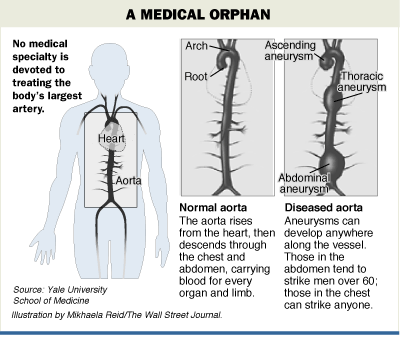
In the case of aortic disease, this problem is heightened by the lack of blood-vessel specialists dedicated to getting out the word about aneurysms. Every other significant body part -- brain, heart, lungs, bones and so on -- boasts its own specialty association. Fifteen-thousand podiatrists in the U.S. focus on feet.
The aorta is the River Nile of blood vessels. It rises from the heart nearly to the neck, then descends through the chest and abdomen, carrying blood for every organ and limb. But only about 300 nonsurgical doctors in the U.S. specialize in blood vessels. Cardiologists are responsible for the cardiovascular system, and typically are very knowledgeable about the tiny coronary arteries that channel blood from the aorta back into the heart. But their training leaves many of them in the dark about aortic disease.
A small corps of aortic experts from various specialties are beginning to focus more attention on aneurysms. But there is a long way to go, especially in medical schools, where the experts say aortic problems typically receive inadequate study.
During eight years as a medical student and resident at West Virginia University, obstetrician Devin Ciliberti says he rarely heard any mention of aortic illness. "If it ever came up, it was like, 'This goes at the bottom of your list' " of possible diagnoses, says the physician, who finished his residency in 2001. In particular, research suggesting that pregnancy heightens the risk of dissection never came up, Dr. Ciliberti adds.
This all became relevant when 25-year-old Julie Neal Lee came to The Women's Hospital of Greensboro, N.C., last November. She was 37 weeks pregnant and in extreme distress, but clearly not in labor, Dr. Ciliberti says. He says he ordered tests for kidney stones, a pregnancy-related high-blood-pressure condition called pre-eclampsia and anything else he could think of. All proved negative. Hours passed, and the young woman was frantic with pain.
Finally, Dr. Ciliberti ordered a computerized-tomography, or CT, scan of Ms. Lee. "Even then, I wasn't thinking about aortic dissection," he says. The scan, taken more than seven hours after she arrived, showed an aortic dissection. Dr. Ciliberti performed an emergency Caesarean, saving the baby. But Ms. Lee died after aortic-repair surgery by another doctor.
Her parents, Harold and Robin Lee, say they blame Dr. Ciliberti for failing to diagnose the problem sooner, but they haven't gone to court. Dr. Ciliberti says, "I don't think a quicker diagnosis would have saved her, but I don't know for sure." He attended Ms. Lee's wake and funeral and says he has spent much of the past year learning about aortic dissection. Women's Hospital declines to comment.
Driving Progress
Specialists drive most medical progress, educating generalists and promoting prevention. Twenty years ago, few Americans had heard of prostate cancer, but urologists have spurred screening and awareness campaigns, and U.S. deaths from that disease fell 21% between 1990 to 2000.
With no comparable campaign, unfamiliarity with aneurysms prevails in many emergency rooms and physicians' offices. Michael Giusti, 44, entered the ER at Methodist Medical Center in Peoria, Ill., one night in June 1998, complaining of chest pain and asking whether his aorta should be scanned, says his wife, Kathy Schwindenhammer, who accompanied him. For 13 years, he had been undergoing scans to monitor an aortic aneurysm that previously hadn't caused any symptoms and only now was approaching a dangerous size, she says. In the ER, two residents picked up a textbook and began flipping pages before concurring with the primary physician on duty that a scan wasn't needed, she says.
In fact, aortic experts say that any person with an aneurysm who experiences significant chest pain ought to have a scan done. But the doctors at Methodist Medical diagnosed Mr. Giusti with a pulled chest muscle and sent him home, his wife says. He died there that day of an aortic dissection.
The hospital has denied any negligence. But in 2002 it agreed to pay Ms. Schwindenhammer $850,000 to settle a suit she had filed, Illinois state-court records show.
Twenty years ago, diagnosing aneurysms was extremely difficult, and surgery to repair the condition had a high mortality rate. The fatalism that surrounded the ailment -- which can stretch a vessel normally the diameter of a garden hose to that of a soda can -- was captured by a comment a century ago by medical pioneer William Osler: "There is no condition more conducive to clinical humility than aneurysm of the aorta."
Today, this shouldn't be true. Aortic aneurysms don't show up well on X-rays. But the advent of high-tech scans -- such as CT; abdominal ultrasound; magnetic-resonance imaging, or MRI; and echocardiogram -- have made aneurysms relatively easy to catch. (The scans cost from $40 to $2,000, depending on the aneurysm's location.) Medical geneticists have identified high-risk groups in whom the condition ought to be suspected. And with experience, surgeons have improved to roughly 90% the success rate of replacing damaged sections of aorta with Dacron hose.
One obstacle to disseminating information on the aorta is corporate profit. Medical-device and drug companies, which are playing an increasingly large role in shaping continuing-education seminars, tend to focus on products they sell, such as coronary stents, which are used to prop open clogged coronary arteries. Industry hasn't developed a comparable product for repairing aneurysms that is inexpensive or effective enough to replace most surgery. For cardiologists trying to keep up with their field, "pharmaceutical and device development for the coronary arteries is where the money and glamour are," says Harvard's Dr. Isselbacher.
Some heart doctors don't even realize that action can be taken. When an echocardiogram -- a scan of the heart and surrounding vessels -- found a large aneurysm in the chest of Donald Kehe four years ago, his cardiologist in Las Vegas called a private meeting with Mr. Kehe's wife. "He took my hands in his hands, looked me in the eyes and said there was no hope -- that Donald should tell his loved ones goodbye," says Rowena Kehe.
After a friend pointed Mr. Kehe, then 69, toward Cedars-Sinai Medical Center in Los Angeles, Sharo Raissi, that hospital's top cardiovascular surgeon, removed the aneurysm. A few months later, instead of telling his family goodbye, Mr. Kehe treated them to a Hawaiian vacation. Mr. Kehe, now 71, is alive and well today.
Classic Symptom
In some aneurysm cases, the knowledge gap is especially clear because multiple cardiac doctors miss danger signs. Daniel Slaughter, a 37-year-old father of four, entered Methodist Hospital of Indianapolis in May 2001, experiencing chest pain radiating into his neck. That is a typical symptom of aortic dissection. He was bleeding into the sac around the heart, a common consequence of aortic dissection. And an echocardiogram found that his aorta was 50% larger than normal, according to a hospital report.
Yet the cardiologist who signed the echocardiogram report noted in it that the heart and aorta looked normal. A second cardiologist and a cardiac surgeon never looked at the echocardiogram, according to subsequent written statements they made in administrative proceedings. A week after entering Methodist, Mr. Slaughter died. After learning in the autopsy room that the cause of death was aortic dissection, the cardiac surgeon called Mr. Slaughter's widow. "He said, 'This probably won't help you now, but I could have saved him,' " says Paige Slaughter. She has named the hospital and three doctors in a proceeding that Indiana requires before the filing of a malpractice suit. Methodist Hospital denies any negligence.
Dr. Elefteriades, the top aortic surgeon at Yale-New Haven, and Craig Miller, his counterpart at Stanford Medical Center, say they are each asked about twice a month by lawyers for plaintiffs and defendants to review cases alleging malpractice related to aortic disease. In only about half are the doctors' or hospitals' actions legally defensible, say the doctors, who are paid for their opinions but typically don't testify in court. Both physicians say that doctors' performance in heart-attack cases they review is defensible far more often.
Banding Together
At some hospitals, including Massachusetts General in Boston, cardiologists, surgeons and other physicians are banding together to form aortic centers that draw on a range of specialties. In June, the American Heart Association published in its journal, Circulation, an article on heredity and aortic aneurysms. Still, AHA President Augustus Grant says, "I don't think aortic dissection is analyzed with the frequency it should be" at cardiac conferences.
Aortic disease generally strikes two types of victims. The first are men typified by James Whitehead, a University of Arkansas professor who at 67 had a long history of smoking and high blood pressure. This August, he experienced sudden, intense pressure in his chest, radiating into his jaw. At Washington Regional Medical Center in Fayetteville, Ark., he tested negative for a heart attack but remained stricken by pain so intense that morphine failed to numb it, his family says. Eight hours after his arrival, doctors did the CT scan that revealed he had an aortic dissection, and by then, it was too late, his family says. He died before reaching the operating room. Washington Regional declines to comment.
The second type of aneurysm victims are young, fit people cursed with a genetic predisposition for aortic problems. Most people in this category don't know they have an aneurysm, although family history can provide a clue.
So can body type. Aortic experts say that especially tall, lanky people entering an emergency room suffering sudden and intense chest or back pain ought to be considered possible aneurysm victims. People with strikingly long limbs may have Marfan's syndrome, a connective-tissue disorder, and Marfan's sufferers statistically have a much-greater-than-average risk of dissection.
Eric Eshleman, 28 years old, 6-foot-8 and 190 pounds, entered Atlanta's Northside Hospital in September 2000 suffering sudden, severe back pain. His wife, Britt Eshleman, says it was the first time she had ever seen him cry. Neglecting to scan his aorta, the hospital prescribed painkillers and sent him home, his wife says. Seven days later, he died of an aortic dissection. The county autopsy report describes him as "marfanoid appearing."
Ms. Eshleman has sued Northside for malpractice in state court in Fulton County, Ga., alleging that based on her husband's body type, among other factors, the hospital should have tested more aggressively for aortic dissection. The hospital says the suit "is without merit."
The seriousness of aortic dissection is lost on many doctors. Sandy Morris, 13, arrived in July 1998 in the emergency room at Ohio's Columbus Children's Hospital, complaining of intense chest pains. Her parents knew their daughter had Marfan's, and they say they knew the pain might indicate an aortic dissection. They even knew enough to request an echocardiogram. But doctors failed to do one, testing Sandy instead for heart attack, the Morrises say. That test came back negative, because Sandy was having an aortic dissection, the parents say. Court records show that doctors scheduled an MRI scan but for the following morning, about eight hours after Sandy had arrived at 11 p.m. She didn't live that long. "Why don't they do something, Daddy?" were the last words Andrew Morris says he heard his daughter speak.
Children's Hospital has settled a malpractice suit filed by the parents in state court in Columbus on terms that weren't disclosed. The hospital declines to discuss the case. In 2000, Children's Hospital and the Ohio State University Medical Center, which share faculty, opened a Cardiovascular Connective Tissue Disorders Clinic. That unit serves patients with Marfan's and others who have a genetic predisposition to develop aortic disease.
Extreme Pain
Aortic dissection is one of few conditions that causes pain so severe it often isn't relieved by morphine, experts say. Even so, after doctors rule out heart attack, they sometimes neglect to test patients experiencing this level of chest or back pain for aortic problems.
Christopher Cole, 39, a manufacturing executive in Elyria, Ohio, once broke his leg in six places in an amateur motorcycle race. His foot ended up pointing backward, he says. On another occasion, the South Africa native was hit by shrapnel while serving in that country's military in the 1980s. The pain from his aortic dissection 14 months ago was far worse than from either of those injuries, he says. "When my heart would beat, it felt as if my skin was tearing," he says.
But it took doctors an alarmingly long time to conclude that anything was wrong with his aorta. When he arrived at Elyria Memorial Hospital, near Cleveland, in August 2002, doctors and nurses ran various tests, but not a scan that would have shown the dissection, he says. Mr. Cole stayed overnight at the hospital, and the next morning a cardiologist told him they couldn't find anything wrong and he could go home. Mr. Cole did, but his pain grew worse. It took two more visits to the ER the next day before doctors finally gave him a CT scan. When that showed a dissection, he was flown immediately by helicopter to the Cleveland Clinic. Lars G. Svensson, the clinic's chief aortic surgeon, performed successful emergency surgery.
Dr. Svensson says Mr. Cole probably wouldn't have survived more than another two hours without it. The surgeon estimates that every second or third aneurysm case he gets was originally misdiagnosed. An Elyria Hospital spokesman declines to comment.
Aortic dissection and rupture are fatal far more often than heart attack. As a result, some doctors are aggressive about testing for aortic disease. When Howard Carney entered St. Luke's Hospital in Kansas City, Mo., last year, complaining of sudden, intense chest pain, Dr. Lance Waldo immediately ordered a CT scan that showed an aortic dissection. Mr. Carney, 36, underwent emergency surgery and today is fine. "I'm paid to be a pessimist," says Dr. Waldo.
Not every case of aortic rupture or dissection can be diagnosed. Composer Jonathan Larson died of an aortic dissection in 1996 after two New York City hospitals misdiagnosed him. The 35-year-old's death drew widespread attention because it came after the final dress rehearsal of his show "Rent," the rock opera that went on to huge success. Yet Diane Sixsmith, one of the physicians charged by New York state medical authorities with investigating the case, concluded no negligence occurred. Mr. Larson had complained only of flu-like symptoms, and it would have been a huge leap to guess that he had a disintegrating aorta, says Dr. Sixsmith, chairman of emergency medicine at New York Hospital Queens Medical Center and a leader in efforts to educate physicians about aortic disease.
Pregnant Patient
Many aortic dissections and ruptures involve aneurysms that doctors spot but fail to treat. An echocardiogram picked up Lori Irving's aortic aneurysm in 1998, her mother, Patty Irving, says. But her cardiologist, who was employed by Kaiser Permanente, said nothing about it, the mother adds. The younger Ms. Irving, a psychology professor at Washington State University in Vancouver, Wash., was then 35. In mid-2000, she became pregnant. Aortic experts say that any woman of child-bearing age who has an aneurysm should be warned that pregnancy severely compounds the dangers. "We'd never have gotten pregnant if we'd known about the risk factor," says Mike Morgan, Lori's husband.
When intense chest pain sent Ms. Irving to the emergency room at Southwest Medical Center, a Kaiser Permanente hospital in Vancouver, during the last month of her pregnancy in April of 2001, she had no way of knowing the cause. Doctors didn't take an echocardiogram, her mother says. They diagnosed the 38-year-old patient with indigestion and sent her home, her mother says. That same day, Lori Irving and the unborn baby died.
Kaiser declines to comment, citing a settlement and confidentiality agreement with Lori Irving's husband.
Father and Son
Some physicians hope that the story of Tyler Kahle's family could help educate the profession about the dangers of aneurysms. An article scheduled to appear in the winter issue of the Annals of Emergency Medicine describes the failure of three sets of medical personnel in Omaha to scan the aorta of Mr. Kahle, the 19-year-old whose mother rushed him to the emergency room and told doctors about the family's medical history. "Scanning him very likely would have saved his life," says Dr. Milewicz, the University of Texas genetics expert who co-wrote the journal article.
In August 2001, about a year before Tyler's death, his uncle, Tom Kahle, had entered St. Luke's Hospital in Cedar Rapids, Iowa, complaining of chest pain. He told doctors about his family's history of aneurysm, relatives say. But the hospital discharged him without scanning his aorta, the relatives add. Two days later, Tom Kahle, 37, died of an aortic dissection. His family has filed a negligence suit against St. Luke's in state court in Linn County, Iowa. The hospital has denied any liability.
Terry Kahle, Tom's brother and Tyler's father, survived a dissection in 1998. After attending Tyler's funeral in Omaha last year, Terry Kahle returned to his home in Atlanta with his older son, Marcus, 23. Almost immediately, Marcus started complaining of chest pains. "I figured it was the power of suggestion, but I wasn't taking any chances," the father says.
Rushing his son to the emergency room at St. Joseph's Hospital in Atlanta, Mr. Kahle says he requested a scan of the young man's aorta -- only to be told that aortic disease didn't strike people that young. Mr. Kahle, an auto technician who says he had never stood up to a doctor before, did so then.
"There were tears in my eyes," he says. "I said, 'Listen, I just buried my 19-year-old son last week, and I buried my brother last year -- both of them aortic aneurysms. We're not leaving here until you scan my son.' "
After getting scanned, Marcus Kahle underwent emergency surgery to repair an aortic aneurysm. Today, he is alive and well in Atlanta.
MISSING THE SIGNS
The high death rate from aortic disease is partly due to physicians' unfamiliarity with the symptoms, the groups that face high risks, and available diagnostic and surgical procedures.
Julie Neal Lee, 25, died November 2002, Greensboro, N.C.: Pregnancy is a huge risk factor for women with aortic disease. But her obstetrician says his medical training barely touched on the condition.
Eric Eshleman, 28, died September 2000, Atlanta: He entered the ER with sudden back pain. His lanky appearance signaled he might have Marfan's, a condition that makes the aorta prone to dissect.
Sandy Morris, 13, died July 1998, Columbus, Ohio: When her parents took her to the ER with severe chest pain, they knew enough to request a high-tech scan. But the hospital didn't scan her aorta; four hours later, she died.
Daniel Slaughter, 37, died May 2001, Indianapolis: He entered the hospital with symptoms of dissection and a classic consequence: blood in the sac around his heart. Yet he went undiagnosed for a week.
© 2003, Dow Jones & Company
By Kevin Helliker
Journal Staff Reporter
A series of scans taken last autumn of my aortic artery concluded that I faced either grave danger -- or none at all. Aneurysm! Warning! A whopper! concluded the first test I took, a CT scan. Chill out -- there's no aneurysm, concluded the second scan, an echocardiogram.
You're both wrong, said the third, an MRI with contrast: There IS an aneurysm -- but it's not a whopper.
This debate would have been fascinating to witness if the artery in question hadn't belonged to me. Or if the artery had been a minor vessel -- say, the one that carries blood to my little toe. But this was my aorta -- carrier of blood to every organ in the body -- meaning that this battle of the scans bore life-and-death implications. Watching the scans bounce my prognosis from grim to great and back, I was bewildered.
This experience wasn't unusual. The great news is that aortic aneurysms -- an often-fatal condition that never showed up well on X-ray -- are captured easily on new scans such as CT, MRI and echocardiogram. The not-so-great news is that these scans aren't perfect at determining size -- and size is paramount when it comes to aortic aneurysms. Worse yet, human error can render any of these scans useless.
"What this underscores is that as a consumer, you're building a case," says Michael Dake, chief of interventional radiology at Stanford University School of Medicine. Building a solid case may require more than one scan and more than one radiologist.
The first scan I received was just a snapshot of my heart, taken to search for calcium in the coronary arteries. It found none of that, but caught a glimpse of the nearby aortic artery -- and what a whopper it appeared to be: 4.6 centimeters, or nearly two centimeters too large. Meaning: I had an aneurysm nearly large enough to be in danger of bursting. Yikes!
Except my internist wasn't convinced. To make sure, he ordered up a second scan, this one an echocardiogram. When this test came back negative -- No aneurysm at all! -- I did a little dance. Prematurely, as it turned out. Echocardiogram, it seems, is highly operator dependent. In the right hands, it can be more accurate than CT or MRI, and it has the added advantage of emitting no radiation. In the wrong hands, however, it's worthless.
Fortunately, my internist knew this, and he ordered up a third test -- an MRI. This differed from the original CT in that it involved 90 minutes of image-taking, instead of just a snapshot. In addition, I had contrast, or dye, inserted into my veins -- a factor that bolsters reliability.
The MRI confirmed the presence of an aneurysm but at 4.1 centimeters. A subsequent echocardiogram (this time administered by a pro) validated this finding, as did a second MRI.
So I'm proof that newfangled scans can detect a condition that not so long ago was undetectable, and that is more common than most doctors realize, killing more Americans each year than does AIDS and most kinds of cancer. For me, the drill now is to keep an eye on the aneurysm through twice-annual scans, looking in particular for growth. If the bulge reaches a certain size -- say, five centimeters -- then the risk of rupture will be greater than the risk of open-chest surgery to repair the aneurysm.
But can I rest assured that it isn't five centimeters now? Often, people who undergo aneurysm-repair surgery are told afterward that the bulge was much larger than any scan had shown. But Stanford's Dr. Dake is skeptical about some of these tales. Quoting a former radiological mentor, he says, "There's no such crude diagnostic instrument as the surgeon's hand and eye."
© 2003, Dow Jones & Company
By Kevin Helliker
Journal Staff Reporter
In part this failure to diagnose reflects the absence of a simple screening test. But when a fashion executive on a home computer makes a diagnosis that New York City's finest pediatric professionals missed, clearly physician cluelessness is part of the problem too.
A child born with a rare ailment can only hope for a mother as persistent as Karen Murray. The instant her son was born she noticed he seemed different. Her doctors shrugged, saying he was fine. But something was wrong, and it took her five years to get the answer.
It's a condition five times more common than cystic fibrosis and similarly fatal.
Whereas doctors offer pregnant women screening for multiple conditions such as CF, this one gets almost no attention, for the scariest of reasons: The average doctor knows next to nothing about it.
This wouldn't matter if the condition were untreatable. But early diagnosis of this condition boosts life expectancy to nearly 70 years from about 40. Indeed, this condition is significantly more treatable than many ailments doctors regularly seek to find. But most doctors aren't looking for this one, and don't recognize it when they see it.
Ms. Murray's son had a litany of puzzling symptoms. Newborns' hands usually are balled into fists. But his hands were open -- his fingers bent backward. He had a dislocated hip. Why, she asked. It means nothing, the doctors said. Just keep him in a harness for a while.
His name was Michael and she wanted him to be perfect. But Ms. Murray, 35 at the time, hadn't risen to the top ranks of Liz Claiborne Inc. by ignoring imperfections, and she wasn't about to start with her child.
"He was floppy," she says. As a toddler, he couldn't sit straight in a high chair. His limbs and fingers were extraordinarily long and bendable, as if made of rubber. His chest was deeply indented. He was dramatically taller than other children. Yet unlike his father, her broad-shouldered husband, Michael was thin, even flimsy. Also, his lungs became infected every time he caught a cold.
A college-educated New Yorker with deep professional and personal resources, Ms. Murray sought out and visited the city's top pediatric specialists. She took Michael to see an orthopedist, an orthopedic surgeon, an occupational therapist, a joint-disease specialist, even a neurosurgeon. Not to mention his regular doctor, "the best pediatrician at Mount Sinai," says Ms. Murray.
Michael was diagnosed as "hypotonic." This meant her now four-year-old had low muscle tone. Since it shed no light on why he had low muscle tone, the diagnosis was meaningless but benign. Why not stop worrying? She heard this from her husband, her doctors, her friends.
Only her own mother believed her. Once, in the pediatrician's office, Ms. Murray's mother asked whether excessive height could indicate trouble. The pediatrician's response: "Worry if your child doesn't grow."
The breakthrough came on Michael's fifth birthday. His mother bought him an Apple computer, and with it came a CD called Family Doctor. Instead of sleeping that night, Ms. Murray sat in his dark room, scrolling down a list of unusual disorders.
When she came to Marfan's Syndrome, the description floored her. "I can still recite it: A connective-tissue disorder. Fingers contracted backwards at birth. Taller than their peers. Arms and legs disproportionately long. Indentation in chest bone. Weak lung tissue."
Then came this news: The aorta, the body's largest artery, can grow weak, enlarge and rupture, causing sudden death.
That morning Ms. Murray took Michael to Mount Sinai Hospital. After measuring his arms and legs, doctors agreed he had Marfanoid characteristics. They suggested that he return in three weeks for an echocardiogram of his aorta. Ms. Murray demanded it now. "I was crying hysterically," she says.
When the doctors emerged from the scanning room, "they were white as a ghost," she says. They told her she had been right to seek an immediate scan. Michael's aorta was twice normal size. He was immediately prohibited from engaging in strenuous activity. He was also placed on beta blockers to lower his blood pressure and reduce strain on his aorta.
The treatments seem to be working, since the artery hasn't grown in seven years. In most Marfan's patients the enlarged section of aorta eventually needs to be replaced with synthetic hose, but in children the hope is to forestall that very serious surgery until adulthood, says Harry Dietz, a geneticist at Johns Hopkins University Hospital in Baltimore who now is Michael's doctor.
In its classic presentation, Marfan's is a series of symptomatic non-life-threatening conditions that collectively point to a treatable fatal problem that will exhibit no symptoms until too late. Marfan's afflicts about 200,000 Americans, compared with about 30,000 with cystic fibrosis. But fewer than half of Marfanoid Americans know they have it, estimates Reed Pyeritz, chief of medical genetics at the hospital of the University of Pennsylvania. Many of these cases won't be diagnosed until the victims die young and suddenly of an aortic weakness that could have been repaired.
In part this failure to diagnose reflects the absence of a simple screening test. But when a fashion executive on a home computer makes a diagnosis that New York City's finest pediatric professionals missed, clearly physician cluelessness is part of the problem too. That cluelessness extends beyond Marfan's to all aortic disease, which kills more Americans each year than do AIDS and most kinds of cancer. Many of those deaths are attributable to a failure to diagnose.
Which diseases get medical attention is partly a matter of fashion. Marfan's has never been fashionable. But Ms. Murray, president of menswear for Liz Claiborne, is changing that. Each year in the company's designer showroom, she hosts a star-studded fund-raiser for the National Marfan Foundation, each event raising more attention and money than the last. For more information, contact the foundation at 1-800-8-Marfan, or www.Marfan.org.
© 2003, Dow Jones & Company
Vascular Procedure Carries Greater Risks When Done By General Surgeons
By Thomas M. Burton
Journal Staff Reporter
Thousands of Americans are at risk of dying needlessly each year because general surgeons are being allowed to perform an especially precarious type of surgery. The surgery in question involves replacing a weakened and enlarged section of aorta, the body's largest and most vital artery, with synthetic tubing.
A growing body of medical literature suggests that only highly trained vascular surgeons should, in the majority of cases, be allowed to perform the surgery. Because it requires the surgeon to close down a section of the aorta -- akin to replacing a fuel hose in a plane at 30,000 feet -- it has a relatively high mortality rate.
But despite a growing cry by vascular specialists to limit general surgeons' ability to perform the abdominal aortic aneurysm surgeries, no such potentially life-saving restrictions are planned in the short-term.
Vascular specialists want the American Board of Medical Specialties, an influential professional group, to make vascular surgery a separate specialty, with its own certificate of expertise. Doctors say this would lead most hospitals to decide that only vascular surgeons should perform nonemergency vascular procedures, just as only neurosurgeons can do surgery on brain aneurysms, and only cardiac surgeons can operate on the heart.
The issue has been heating up in recent months. Last year, a committee that has significant representation from the ABMS rejected a request by the vascular surgeons to create the new specialty, a decision the vascular surgeons later appealed. Letters and memoranda from both sides have been pouring into the ABMS offices in Evanston, Ill.
The overall mortality rate from abdominal aortic aneurysm surgeries averages about 5%. But when general surgeons perform the surgery, the mortality rate is 76% higher than when vascular surgeons do it, according to a recent University of Michigan/Johns Hopkins study of 3,912 cases. Other studies have reached similar findings.
Despite this gap, general surgeons perform about 30% of the 60,000 abdominal aortic aneurysm surgeries each year in the U.S. While generalists also do a variety of other surgeries, research in those areas hasn't suggested such a disparity of results between the generalists and the specialists. With abdominal aortic aneurysm surgery, the public is largely unaware of the differing success rates.
Vascular surgeons argue that the reason they have met opposition from the ABMS board is cronyism. A change in policy could take hundreds of millions of dollars a year from the pockets of general surgeons, who exert considerable influence inside the specialties board.
The Medical Specialties board "is an old-boys' club in which professional self-interest, not patient care, [is] the overriding consideration," says Frank J. Veith, vice chairman of surgery at Albert Einstein College of Medicine in New York, and himself a vascular surgeon. "Better results are achieved by those who specialize in vascular surgery."
The American Board of Medical Specialties, one of medicine's least-known and most-powerful organizations, declines to comment on the vascular-surgery issue.
A change in policy, of course, would also be a business windfall to the vascular surgeons, but they insist the motivation is successful medical outcomes, not profit.
Abdominal aortic aneurysm surgery, most common in men over 60, is performed to stop a swelling within the aorta that, if unaddressed, can eventually cause it to rupture fatally. The procedure has gained steam in recent years because of the advent of new imaging tests such as ultrasound and CT that can glimpse the arteries and foresee events such as ruptured aneurysms, which once were considered unpredictable forces of nature.
Many general surgeons, of course, are highly competent, and some have done extensive aneurysm repair operations, gaining significant expertise in the process. Dr. Veith and others say such surgeons should be eligible to qualify for a full vascular certificate if one is created.
But studies show that many general surgeons who do vascular operations only periodically, and with inferior results, continue to do them. (Cost isn't an issue, because most aortic-aneurysm repairs are done on Medicare patients, and Medicare sets the same rate for all surgeons.) Physicians on both sides of the issue concede that the patients of general surgeons generally aren't aware of the studies associating better outcomes with vascular surgeons.
Certainly Daisy Storry wasn't. After an ultrasound test discovered an aneurysm in the abdominal portion of her aorta, she went to a general surgeon in Brainerd, Minn., for elective repair in December 2001. Medical records show that the 74-year-old woman's blood pressure plummeted during surgery. Her relatives, who say the surgeon told them that her prognosis was poor and that he had done everything he could, insisted she be helicoptered to a Minneapolis hospital 130 miles away. There, records show, doctors found "a huge amount of blood present" and "blood poured out in a very large quantity" from veins and arteries near where the Dacron tubing was sewed in. Mrs. Storry died.
Her son, Robert Storry, says the family had questioned the doctor prior to surgery whether he could handle it and had been told the operation would be "a piece of cake."
There is no guarantee Mrs. Storry would have lived had a vascular surgeon performed the procedure. But "obviously, we would have gone to a vascular surgeon had we known the difference," says Mr. Storry, whose family has filed suit. The surgeon, James J. Dehen, didn't respond to calls for comment. Dr. Dehen's attorney, Barbara Zurek, said: "Having an elective aneurysm repair carries a statistical risk of mortality in the range of 5%, and Dr. Dehen's statistics are better than that."
Speaking about the broader debate, David H. Nahrwold, president of the ABMS, declined to discuss the vascular surgeons' campaign. But he says that, generally speaking, one downside of limiting certain medical therapies to specialists is doctors' availability for patients.
Leading vascular surgeons argue that there are enough vascular specialists to do the necessary operations. Currently, there are about 2,100 vascular surgeons in the U.S. Moreover, they say, if vascular surgery becomes an independent specialty, it could lure more medical residents into the field.
The findings of the University of Michigan/Johns Hopkins study have been supported by other evidence. The Wall Street Journal looked at Pennsylvania's uniquely extensive database of medical records compiled by its Health Care Cost Containment Council, which produces public reports on the quality of medical care. The Journal worked with Michael Pine & Associates, which helps Pennsylvania evaluate its hospitals. The research took into account the medical severity of each case.
The finding: In 5,128 abdominal aortic aneurysm operations in Pennsylvania over three years, general surgeons had a 73% higher mortality rate than did vascular surgeons.
© 2003, Dow Jones & Company
Biography
Kevin Helliker is bureau chief in the Chicago bureau of The Wall Street Journal.
Mr. Helliker began his journalism career in 1982 as a reporter in the Houston bureau of the Journal. The following year he joined the Kansas City Times as a reporter, and in 1985, he became assistant editor at Corporate Report Kansas City magazine. In 1986, he moved to Arizona TrendM magazine as a writer and later became managing editor. He left the magazine in 1989 to pursue a yearlong writing fellowship at Duke University.
In August 1990, Mr. Helliker rejoined the Journal as a reporter in Dallas. He moved to New York in November 1992 as a special writer on the paper's page-one desk, and in June 1993, he transferred to the Journal's London bureau. He was named Dallas bureau chief in May 1994 and Chicago bureau chief in May 1996.
A native of Kansas City, Kansas, Mr. Helliker earned a bachelor's degree in English literature from the University of Kansas.
Tom Burton is a reporter in The Wall Street Journal's Chicago bureau. He covers the medical care, pharmaceutical and medical device industries.
Mr. Burton joined the Journal in January 1990 as a general assignment reporter based in Chicago. He has covered his current beat since 1991.
During his last year in law school, Mr. Burton was a Washington, DC-based reporter for the Dallas Times Heraldbefore going to work at the paper's main office in Dallas and also spent time in the paper's Dallas bureau. In 1975, he became an investigative and associate counsel with the New York State Assembly's Office of Legislative Oversight and Investigation, based in New York City.
Mr. Burton returned to journalism in 1976 as a reporter with the Baltimore Sun. From 1978 to 1990, he was an investigative reporter first for the Philadelphia Bulletin (1978-1981), and later for the Chicago Sun Times(1981-1985) and the Chicago Tribune (1985-1989).
He won a 1993 Peter Lisagor award in the business journalism category from the Chicago Headline Club for this coverage of Baxter International, and in 1995, he won a Peter Lisagor award for feature writing in the business/wire service category. Along with two other Journal reporters, he won a 1996 Gerald Loeb Award for Distinguished Business and Financial Journalism in the large newspaper category for their stories examining allegations of price-fixing and other illegalities at Archer-Daniels-Midland Company, the world's leading grain processor. The same team also won first place in the special projects category from the National Association of Agricultural Journalists in 1996 for their Archer-Daniels Midland coverage.
Mr. Burton is a member of Investigative Reporters & Editors Inc.
A native of South Bend, Indiana, Mr. Burton earned a bachelor's degree in history from Dartmouth College and a doctor of laws degree from Georgetown University Law Center.