The New York Times, by Staff
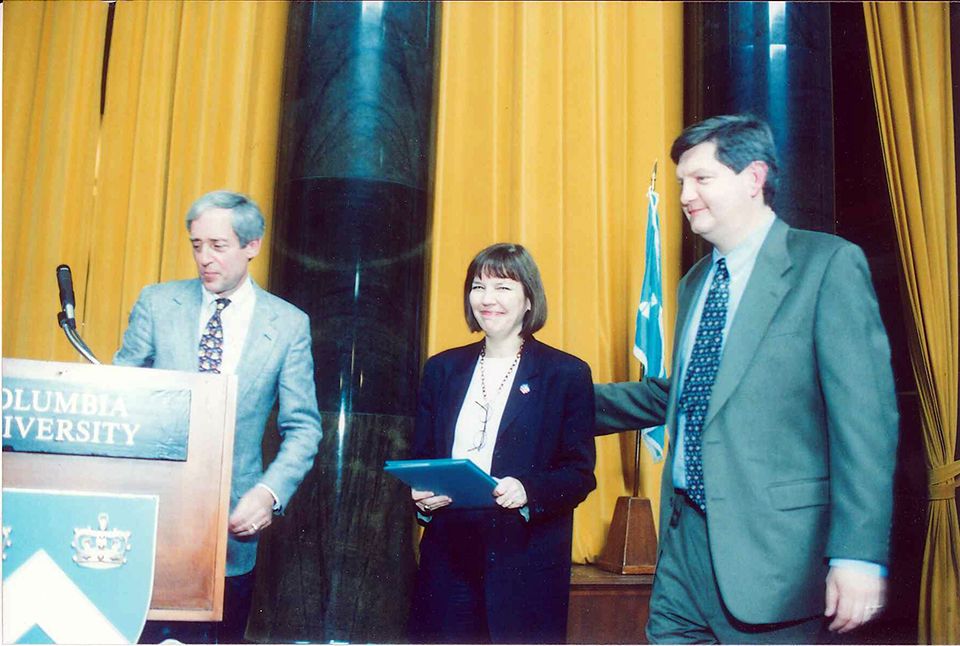
Columbia University President George Rupp (left) presents Judith Miller and Jim Risen of The New York Times, with the 2002 Pulitzer Prize for Explanatory Reporting.
Winning Work
Reporting by Craig Pyes, Judith Miller and Stephen Engelberg and written by Mr. Engelberg
In 1987, several years after he began training Arab volunteers to oust Soviet forces from Afghanistan, Osama bin Laden had a vision. The time had come, he told friends, to start a global jihad, or Islamic holy war, against the corrupt secular governments of the Muslim Middle East and the Western powers that supported them.
Mr. bin Laden, the Saudi millionaire, would use his camps in Afghanistan to take holy warriors from around the world -- who had always pursued local goals -- and shape them into an international network that would fight to bring all Muslims under a militant version of Islamic law.
Some of his comrades in arms warned him that the goal was unattainable.
"I talked to Osama one day and asked him what was he doing," recalled Abdullah Anas, an Algerian who was fighting in Afghanistan at the time and provided a rare personal narrative of the formation of Mr. bin Laden's organization. " 'Imagine after five years a guy from Malaysia goes back to his country. How can he remember you are his leader? He will get married, have children, engage in work in his country. How can you establish one camp for jihad in the world?'"
But he and other doubters watched as Mr. bin Laden, who is now America's most wanted terror suspect, set about doing just that. Mr. Anas's account and those of other witnesses, along with intelligence from United States, the Middle East and Europe, draw a vivid and newly detailed portrait of the birth of a modern jihad movement. What began as a holy war against the Soviet Union took on a new dimension, Mr. Anas said, when Mr. bin Laden broke away and established a new corps of militant Muslims whose ambitions reached far beyond the borders of Afghanistan.
From his Afghan camps, Mr. bin Laden created a kind of clearinghouse for Islamic terrorism, which American officials say not only conducts its own operations but trains and underwrites local militants, connecting home-grown plots to a global crusade.
His strategy is aptly captured by one of his many code names: The Contractor. The group he founded 13 years ago, Al Qaeda, Arabic for The Base, is led by masterful opportunists who tailor their roles to the moment, sometimes teaching the fine points of explosives, sometimes sending in their own operatives, sometimes simply supplying inspiration.
The group has become a beacon for Muslim Malaysians, Algerians, Filipinos, Palestinians, Egyptians, even Americans who have come to view the United States as their enemy, an imperial power propping up corrupt and godless governments. Mr. bin Laden has tried to bridge divisions in a movement long plagued by doctrinal, ethnic and geographic differences. "Local politics drives what they're doing, but it's much more visionary," said Robert Blitzer, a former F.B.I. counterterrorism official. "This is worldwide. This is, 'We want to be somewhere in a hundred years.' "
According to a recent Central Intelligence Agency analysis, Al Qaeda operates about a dozen Afghan camps that have trained as many as 5,000 militants, who in turn have created cells in 50 countries. Intelligence officials say the group is experimenting with chemical weapons, including nerve gas, at one of its camps.
Mr. bin Laden and his supporters use centuries-old interpretations of the Koran to justify violence in the name of God against fellow Muslims or bystanders -- a vision on the farthest extremes of one of the world's largest religions. But their operations are thoroughly modern -- encrypted e-mail, bomb-making recipes stored on CD-ROM's, cell phones and satellite communications.
The group plans attacks months or years in advance, investigators say. A former United States Army sergeant, Ali A. Mohamed -- who worked for Mr. bin Laden and is now a government witness -- has told prosecutors that Al Qaeda trains "sleeper" agents, or "submarines," to live undetected among local populations.
Mr. bin Laden has not achieved his more ambitious goals. He has not brought more Muslims under the rule of Islamic law, toppled any of the Arab governments he took aim at, or driven the United States out of the Middle East. His violence has repulsed many believers and prompted severe crackdowns in Arab states that already have limited political freedoms.
Nonetheless, he and his small inner circle have preoccupied American officials, paralyzing embassies, thwarting military exercises and making Americans abroad feel anxious and vulnerable. Earlier this month, the United States closed its Rome embassy for nearly two days after intelligence officials warned of a possible attack.
American officials have charged Mr. bin Laden with masterminding the 1998 bombings of two embassies in Africa that killed more than 200 people, and suspect him of involvement in the October bombing of the destroyer Cole in Yemen, which killed 17 sailors. Four men went on trial this month in lower Manhattan in the African bombings.
American authorities are also examining Al Qaeda's role in three plots timed to millennium celebrations in 1999 -- attacks directed at another American ship, a so-far unknown target in the United States, and tourist sites and a hotel in Jordan.
Mr. bin Laden's group has recently attempted operations against Israel -- a significant departure, American and Middle Eastern officials say. They acknowledge that he has ensured his organization's survival, in the event of his capture or death, by designating a successor: his longtime aide, Abdulaziz abu Sitta, an Egyptian known as Muhammad Atef or Abu Hoffs al-Masri. Last week, according to Al Jazeera, an Arab satellite channel, his son married Mr. Masri's daughter in Kandahar, Afghanistan.
"His arrest, which we dearly hope for, is only one step along the road of the many things we need to do to eliminate the network of organizations," said Richard A. Clarke, the top White House counterterrorism official.
The Cause: Afghan War Draws Young Arab Fighters
Al Qaeda grew out of the jihad inspired by Muslim scholars to combat the Soviet Union's 1979 invasion of Afghanistan. They issued religious rulings, known as fatwas, which exhorted Muslims everywhere to defend the Islamic land of Afghanistan from infidels. Over the next few years, several thousand young Arab men joined the Afghan resistance.
One of the first to answer the call was a young Algerian named Boujema Bounouar, who went by the nom de guerre Abdullah Anas. In recent interviews in London, where he now lives, Mr. Anas recounted how Mr. bin Laden went to Afghanistan to fight the Soviets and was drawn to a group of Egyptians who wanted to start a global jihad.
Mr. Anas, who is now a leader of an Algerian Islamic political party, is not a dispassionate observer. He acknowledges that he opposed Mr. bin Laden, whose program of terrorism, he says, has tarred the reputations of thousands of Arabs who fought honorably for the Afghan cause. But his firsthand account, which conforms with Western intelligence analysis, provides one of few portraits of Mr. bin Laden's evolution as a militant leader.
The two men were defined by many of the same forces. Mr. Anas said his journey from teacher of the Koran to holy warrior began in 1984, when he was 25 and living with his family in Western Algeria. Visiting the local library, he read in a news weekly about a religious ruling that waging war against the Soviets was every Muslim's duty.
"After a few days, everyone heard about this fatwa and started talking," he recalled. " 'here is this Afghanistan? Which people are they? How can we go there? How much is the ticket?'"
That year, Mr. Anas was among the million Muslims who participated in the hajj, the annual pilgrimage to Mecca, Saudi Arabia. "You feel very holy," he said. "People from all over the world. From Zimbabwe to New Delhi. Everyone is wearing just two pieces of white cotton. Everybody. You can't describe who is the minister, who is the president. No jewelry. No good suit."
In Mecca, he said, prayer leaders spoke emotionally about the jihad in Afghanistan.
He was standing in the marble expanse of the Great Mosque with 50,000 others when, he said, a friend pointed out a radical Palestinian scholar who was organizing the Arab support for the Afghans. His name was
Abdullah Azzam, and his writings, which would help spur the revival of the jihad movement in the 20th century, were just becoming widely known.
Mr. Anas introduced himself and asked whether the magazine article he had seen in the library was correct. Had the religious leaders agreed that fighting in Afghanistan was a duty of all Muslims?
"He said, 'Yes, it's true.' "
" 'O.K.,' I said. 'If I want to go to Afghanistan, what do I do now?' "
Mr. Azzam gave him a business card with a telephone number in Islamabad, Pakistan, where he was a university professor. A week later, Mr. Anas was on a flight from Saudi Arabia to Pakistan.
He had no idea where he was going, or what he would do. He dialed the only phone number he knew in Pakistan, reaching Mr. Azzam, who offered him a place to stay in his own house, a bustling salon frequented by students and scholars.
It was there that he first caught sight of Mr. Azzam's youngest daughter, whom he would marry five years later. And Mr. Azzam introduced him to a Saudi visitor identified in the traditional Arabic way, as Abu Abdullah, the father of his eldest son, Abdullah. The visitor was Osama bin Laden.
The two men exchanged pleasantries. Mr. bin Laden's name was well known. He was said to be the youngest of 24 brothers in a family that ran one of the largest construction companies in the Arab world.
Mr. bin Laden seemed no different from the other Arab volunteers who were starting to arrive in Pakistan, Mr. Anas recalled. The conversation turned to how the volunteers could help the Afghans win their jihad, and teach them more about Islam.
The Soviet forces had a considerable advantage in the Afghan conflict. Their helicopter gunships controlled the air, and their troops held the main roads. But the rebels had powerful friends. The United States and Saudi Arabia were spending millions funneling arms to the Afghans through Pakistan's intelligence service.
Mr. Anas began by teaching the Koran to the Afghan rebels, who did not speak Arabic and learned the verses by rote. He also led prayers at a "guest house" set up in Pakistan for Arab volunteers. At the time, he said, there were no more than a few dozen Arabs in the country, working with the rebels. None spoke the Afghan languages.
After a few months, Mr. Anas said, he trekked into Afghanistan to join a combat unit, one of three Arabs traveling with a caravan of 600 Afghan soldiers. He learned Farsi and took on the role of mediator, traveling among the feuding rebel camps. He spent most of each year inside Afghanistan.
Mr. Anas became a top aide to Commander Ahmed Shah Massoud, whose troops controlled northern Afghanistan and are now fighting the Taliban rulers -- who support Mr. bin Laden.
Like many Muslims who joined the rebels, Mr. Anas expected to die in the Afghan jihad and earn the special status designated in the Koran for martyrs, which includes forgiveness of sins and the enjoyment in Paradise of beautiful virgins. "It's not the main idea to be a shahid," or martyr, he said. "But it's part of my plan."
In the mid-1980's, American and Middle Eastern intelligence officials say, Mr. bin Laden moved to Peshawar, a Pakistani city near the border with Afghanistan. The city was a staging ground for the war against the Soviets; American, French and Pakistani intelligence officers intrigued and competed there to manipulate the Afghan cause to their countries' advantage.
Mr. bin Laden's fortune of several hundred million dollars gained him immediate popularity. "He was one of the guys who came to jihad in Afghanistan," Mr. Anas said. "But unlike the others, what he had was a lot of money. He's not very sophisticated politically or organizationally. But he's an activist with great imagination. He ate very little. He slept very little. Very generous. He'd give you his clothes. He'd give you his money."
Mr. Anas, who returned annually to Pakistan from the Afghan battlefields to visit with Mr. Azzam, said Mr. bin Laden at first slept in the guest house in Peshawar on a cushion on the floor. He recalled that Mr. Azzam liked to say: "You see, this man has everything in his country. You see he lives with all the poor people in this room."
At about this time, in 1984, Mr. Azzam set up the organization that would play a pivotal role in the global jihad over the next decade. It was called the Makhtab al Khadimat, the Office of Services, and its goal was to recruit and train Muslim volunteers for the Afghan fronts. Mr. Azzam raised money for the organization in countries overseas including the United States and gave impassioned speeches promoting the Afghan cause. Mr. bin Laden embraced the idea from its inception and became Mr. Azzam's partner, providing financial support and handling military affairs.
Mr. bin Laden worked best with small groups, Mr. Anas said. "When you sit with Osama, you don't want to leave the meeting," he said. "You wish to continue talking to him because he is very calm, very fluent."
A main goal of the Office of Services, Mr. Anas said, was to prevent the increasing number of outside volunteers from taking sides in the rebels' factional struggles. "We are in Afghanistan to help the jihad and all the Afghan people," Mr. Azzam told him.
But there was increasing frustration from many of the disaffected young Muslims over Mr. Azzam's insistence that the Office of Services support only the Afghan cause -- when many were agitated about the plight of their own homelands. Some approached Mr. bin Laden.
"They told him: 'You shouldn't be staying with Abdullah Azzam. He doesn't do anything about the regimes -- Saudi, Egyptian, Algerian. He's just talking about Afghanistan,' " Mr. Anas said.
"These people are always saying to Osama: 'You should establish something. Have a clear idea to use these people after Afghanistan for other wars.' "
Among those most ardently courting Mr. bin Laden was a group of Egyptian radicals called the Egyptian Islamic Jihad, which helped assassinate President Anwar el-Sadat in 1981.
The Egyptian group advocated the overthrow of governments by terrorism and violence, and one of its key figures, Ayman al- Zawahiri, had taken shelter in Afghanistan. Mr. Anas said -- and Western intelligence agencies agree -- that Dr. Zawahiri was a commanding early influence on Mr. bin Laden. Today he is part of Al Qaeda's leadership, according to intelligence officials.
But Mr. Azzam quarreled bitterly with the Egyptians.
Mr. Anas said he once witnessed a heated argument between Mr. Azzam and Sheik Omar Abdel Rahman, a radical religious scholar, who argued that the flouting of Islamic law had turned Presidents Mohammed Zia ul-Haq of Pakistan and Hosni Mubarak of Egypt into infidels who could therefore be killed. Sheik Abdel Rahman later moved to Brooklyn, where he was associated with an Office of Services branch. In 1995 he was convicted of plotting to blow up New York landmarks.
In 1986, according to Mr. Anas and Middle Eastern intelligence officials, Mr. bin Laden began to chart a separate course. He established his own training camp for Persian Gulf Arabs, a group of about 50 who lived in tents set apart from the other Afghan fighters. He called the camp Al Masadah -- The Lion's Den.
Within little more than a year the movement divided, as Mr. bin Laden and the Egyptians founded Al Qaeda -- the "base" for what they hoped would be a global crusade.
Mr. Anas said Mr. Azzam confided to him that Egyptian ideologues had wooed Mr. bin Laden away, gaining access to his money. "He told me one time: 'I'm very upset about Osama. This heaven-sent man, like an angel. I am worried about his future if he stays with these people.' "
The differences between Mr. Azzam and Mr. bin Laden were largely tactical, Mr. Anas said, noting that the two men remained friends.
A committed enemy of Israel, Mr. Azzam believed the Arab warriors should focus on creating an Islamic state in Afghanistan, a process that could take decades. Mr. bin Laden, according to Mr. Anas, came to believe that such a war could be fought in many countries simultaneously.
"The arguments were very secret," Mr. Anas said. "Only three to four people knew about them at the time." Mr. Azzam saw little difference between the United States and the Soviet Union, contending in his articles and speeches that both were hostile to Islam. But Mr. Azzam opposed terrorism against the West, Mr. Anas said.
By the late 1980's, Peshawar had become a magnet for disaffected young Muslims who shared Mr. bin Laden's views. "Ten people would open a guest house and start issuing fatwas," Mr. Anas recalled. " 'We are going to make revolution in Jordan, in Egypt, in Syria.' And they haven't got any contact with the real jihad in Afghanistan."
The tide of the Afghan war was turning. Stinger missiles, provided through the American covert program, had forced Soviet aircraft to fly far above the battlefields. Afghanistan had become Moscow's Vietnam. By February 1989, the Soviets had withdrawn.
A C.I.A. official said that the agency, aware of the changing nature of the jihad, had taken some steps he would not specify to counter the threat. But Milt Bearden, the former C.I.A. station chief in Islamabad, who coordinated the agency's anti-Soviet effort in Afghanistan, disagreed.
"The Soviet Union, armed to the teeth, was falling apart," he said. "A shooting war then erupted in the Persian Gulf. Afghanistan was off the front burner."
When the war ended, he said, "we got the hell out of there."
The Afghan rebels' war continued, first against the Soviet-backed government and then within their own ranks. On Nov. 24, 1989, Mr. Azzam and two sons were killed by a car bomb in Peshawar as they drove to Friday Prayers. The murders were never solved
Mr. Anas said he tried to take over leadership of the Office of Services. According to the C.I.A., the group split; the extremist faction took control, siding with Mr. bin Laden.
"They loved the ideas of Osama and the person of Abdullah Azzam," Mr. Anas said wistfully. "They don't love me."
The Base: From Many Lands, Under One Banner
Fired by their triumph over the Soviets, the Arabs who had fought in Afghanistan returned home, eager to apply the principles of jihad to their native lands.
The Koran sets strict limits on when and how holy war is to be undertaken. But Gilles Kepel, a leading French scholar of contemporary Islam, said the Afghan veterans were guided by their own radical interpretation of sacred Muslim texts. "Intoxicated by the Muslim victory in Afghanistan," he said, "they believed that it could be replicated elsewhere -- that the whole world was ripe for jihad, which is contrary to Islamic tradition."
They called themselves the Arab Afghans.
In Jordan some founded a group, Jaish Muhammad, that officials say took aim at King Hussein, whose family claims descent from the Prophet Muhammad.
In Algeria, the Arab Afghans were among the founders of the Armed Islamic Group, the most radical to emerge after the military government canceled the 1991 elections. Known by its French initials, G.I.A, it began by blowing up military targets and escalated to wholesale massacres of Algerians who did not believe in the jihad.
According to Mr. Anas, one of its founding members was an Algerian who had initially fought with him in Afghanistan but joined Al Qaeda in the late 1980's. Mr. Anas says he has been told that Mr. bin Laden provided some of the seed money for the G.I.A.
The early 1990's proved difficult for Mr. bin Laden. He was enraged by King Fahd's decision to let American troops wage the Persian Gulf war from Saudi Arabia, site of the two holiest shrines in Islam. He began to focus his wrath on the United States and the Saudi government. After the conflict ended, he moved to Afghanistan.
But his stay was brief. Within months he fled, telling associates that Saudi Arabia had hired the Pakistani intelligence service to kill him. There is no confirmation that such a plot existed. Nonetheless, in 1991, Mr. bin Laden moved to Sudan, where a militantly Islamic government had taken power.
Over the next five years, Mr. bin Laden built a group that combined legitimate business with support for world holy war.
He also set out to accomplish his overriding goal of gathering the leading Islamic extremist groups under one banner. According to Middle Eastern officials, Mr. bin Laden and his envoys met with radicals from Pakistan and Egypt to propose an international Islamic front, led by Afghan veterans, that would fight Americans and Jews.
Al Qaeda began training its own operatives. Ali Mohamed, the government witness, who has said he arranged Mr. bin Laden's move to Sudan, told investigators that he taught group members about weapons, explosives, kidnapping, urban fighting, counterintelligence and other tactics at camps in Afghanistan and Sudan. He said he showed some of the trainees how to set up cells "that could be used in operations."
The dispatch of American troops to Somalia in late 1992 and 1993 as part of a United Nations mission was another affront to Mr. bin Laden. The Bush administration presented it as a relief operation.
American officials say a defector from Al Qaeda told them it viewed the deployment as a dangerous expansion of American influence in the region and a step toward undermining the Islamic government of Sudan.
Al Qaeda privately issued fatwas that directed members to attack American soldiers in Saudi Arabia, Yemen and the Horn of Africa, according to American prosecutors. They said he also sent his military chief, an Egyptian who had been with him at the formation of Al Qaeda, to find the vulnerabilities of United Nations forces in Africa.
Al Qaeda created a cell in Kenya as a "gateway" to its operations in Somalia, the prosecutors assert. Members of the group blended into Kenyan society, opening legitimate businesses that sold fish and dealt in diamonds, and operating an Islamic charity.
Federal prosecutors say at least five group members crossed the border to Somalia, where they trained some of the fighters involved in an Oct. 3, 1993, battle with United States special forces that left 18 Americans and several hundred Somalis dead.
The battle, one of the most widely publicized setbacks for American forces in recent memory, cast a shadow over every subsequent Clinton administration debate on the possible uses of ground troops. American intelligence did not learn of Al Qaeda's role in the ambush until several years later.
Prosecutors say the group also considered attacking Americans in Kenya to retaliate for the Somalia mission. Mr. Mohamed testified that Mr. bin Laden sent him to Nairobi in late 1993 to look over possible American, French, British and Israeli targets for a bomb attack, including the American Embassy. He said he took photos, drew diagrams and wrote a report, which he delivered to his boss in Khartoum. "Bin Laden looked at the picture of the American Embassy and pointed to where a truck could go as a suicide bomber," he said.
American prosecutors say Al Qaeda had more grandiose plans: a leading member, an Iraqi who Mr. Anas said had first gravitated to Mr. bin Laden in Afghanistan, tried to buy enriched uranium in Europe.
The Iraqi, Mahdouh Mahmud Salim, forged links between Mr. bin Laden's group and others supported by Iran. Mr. Salim met with an Iranian religious official in Khartoum, and soon afterward, the prosecutors say, Al Qaeda members got training from Hezbollah, the Iranian-backed Shiite group in Lebanon skilled in making car bombs. American officials said this alliance was notable because it marked the first time radicals from the minority Shiite branch of Islam collaborated with extremists from the dominant Sunni branch.
Mr. bin Laden's business ventures in Sudan -- including a tannery, a transportation company and a construction concern -- raised money and served as cover for the travels of Mr. Salim and others, according to American officials. They said that his companies cornered Sudan's exports of gum, sunflower and sesame products -- and that he invested $50 million of his family money in a new Islamic bank in Khartoum.
The Network: As in Afghanistan, So in the World
The new jihad movement was fueled by the civil war that consumed Afghanistan in the early 1990's. The training camps that had once schooled soldiers to battle the Soviet enemy now attracted militants more interested in fomenting holy war back home -- in America, Europe or the Middle East -- than in the struggle for control of Afghanistan.
The Office of Services, the Pakistan-based group founded in the 1980's by Mr. Azzam to recruit soldiers for the anti-Soviet cause, arranged the travels of some of these new jihadists, according to European and American officials.
Many of those associated with the office, Mr. Anas said, shared Mr. bin Laden's vision of a global movement. American officials suspect they were acting under his instructions, though this remains a subject of debate among intelligence analysts.
American investigators stumbled across the first signs of the new global phenomenon in 1993, when they began to examine the bombing at the World Trade Center.
They discovered that the four men who carried out the attack, which killed 6 and wounded more than 1,000, had ties to Sheik Omar Abdel Rahman, whom they charged with leading a worldwide "jihad organization" that had begun plotting to kill Americans as early as 1989.
Mr. Abdel Rahman was later convicted of conspiring to blow up New York landmarks, including the United Nations. But in the years since, American intelligence officials have come to believe that he and the World Trade Center bombers had ties to Al Qaeda.
The evidence is suggestive, but not conclusive. Several of those convicted in the World Trade Center case were associated with the Brooklyn refugee center that was a branch of the Office of Services, the Pakistan-based organization that Mr. bin Laden helped finance and lead. The Brooklyn center was headed for a time by Mustafa Shalabi, an Egyptian murdered in 1991 in a case that remains unsolved. Federal prosecutors recently disclosed that it was Mr. Shalabi whom Mr. bin Laden called in 1991 when he needed help moving to Sudan, according to Mr. Mohamed, the federal witness.
One of the men convicted of bombing the World Trade Center, Ahmad M. Ajaj, spent four months in Pakistan in 1992, returning to the United States with a bomb manual later seized by the United States government. An English translation of the document, entered into evidence in the World Trade Center trial, said that the manual was dated 1982, that it had been published in Amman, Jordan, and that it carried a heading on the front and succeeding pages: The Basic Rule.
Those appear to be errors. Two separate translations of the document, one done at the request of The New York Times, show that the heading said Al Qaeda -- which translates as The Base, the name of Mr. bin Laden's group. In addition, the document lists a publication date of 1989, a year after Mr. bin Laden founded his organization. And the place of publication is Afghanistan, not Jordan.
Steven Emerson, a terrorism expert who first pointed out the errors, said they deprived investigators of a subtle early clue to the existence of Mr. bin Laden's group.
While the trade center trial ended in 1994, federal prosecutors did not open their grand jury investigation of Mr. bin Laden and Al Qaeda until 1996.
"Had the government correctly translated the material," Mr. Emerson said, "it might have understood that the men who blew up the World Trade Center and Mr. bin Laden's group were linked."
Asked about the mistranslation, an official in the United States Attorney's office, who declined to be identified, said only that Mr. Ajaj had been carrying "voluminous material printed by various organizations." He added that their titles referred to international conspiracy, commando operations and engineering of explosives.
The jihad movement also took root in Europe. In August 1994, three young French Muslims of North African descent, wearing hoods and brandishing machine pistols, opened fire on tourists in a hotel lobby in Marrakesh, Morocco, killing two Spaniards and wounding a third. The French police investigating the attack learned that it had been planned by two Moroccan veterans of the Afghan war, who had recruited commandos for the attack in Paris and Orléans and sent more than a dozen of them to Afghanistan for training.
The indoctrination of the young Muslims began with religion, according to French court papers and testimony. An Orléans mathematics professor and interpreter of the Koran, Mohamed Zinédine, gathered around him a group of men from the slums of Orléans who wanted to learn how to pray. Later, French court papers say, he instructed them in the concept of waging jihad against corrupt governments, saying it was a higher stage of Islamic observance.
One young Moroccan testified that Mr. Zinédine -- who is now a fugitive -- showed him a videotape of Muslim victims of "torture in Bosnia, of babies with their throats cut, of pregnant women disemboweled, and fingernails torn off." The young man added, "He told me there was a way of helping them and that I must help them." Prayers for people like the Muslims in Bosnia, he quoted Mr. Zinédine as saying, were not enough. He must become an "armed humanitarian."
European investigators tracing the Afghan network in France, Belgium and Germany found records of phone calls between local extremists and the Office of Services in Pakistan. In March 1995, Belgian investigators came across another clue: A CD-ROM in the car of another Algerian, who had been trained in Afghanistan in 1992 and was part of the G.I.A. cell in Brussels. The CD was initially ignored, Belgian officials say.
Months later, the Belgians began translating its contents and discovered several different versions of a manual for terrorism that had begun circulating among Islamic militants in the early 1990's. The voluminous manual covered diverse subjects, from "psychological war in Islam" to "the organizational structure of Israeli intelligence" to "recruiting according to the American method."
The manual also offered detailed recipes for making bombs, including instructions on when to shake the chemicals and how to use a wristwatch as a detonator. In addition there were instructions on how to kill with toxins, gases and drugs. The preface included a dedication to the new hero of the holy war: Osama bin Laden. Versions of the manual circulated widely and were seized by the police all over Europe.
Reuel Gerecht, a former C.I.A. official, said he was told that the agency did not obtain its own copy of the manual before the end of 1999. "The truth is," he said, "they missed for years the largest terrorist guide ever written." The omission, he asserted, reflects the agency's reluctance to scrutinize the fallout from its support of the anti-Soviet jihad.
A C.I.A. official said that the agency had had "access to versions" of the manual since the late 1980's. "It's not the Holy Grail that Gerecht reports it to be," he said, adding that the terrorist-related parts were fairly recent additions.
By the mid-1990's, American officials had begun to focus on Mr. bin Laden and his entourage in Sudan. They saw him as the embodiment of a dangerous new development: a stateless sponsor of terrorism who was using his personal fortune -- which one Middle Eastern official estimated at $270 million -- to bankroll extremist causes.
American officials pressed Sudan to eject Mr. bin Laden, and in 1996 they succeeded, forcing him into exile. It was a diplomatic triumph, but one that many American officials would come to rue. Mr. bin Laden made his way back to Afghanistan, where a new group of young Islamic militants, the Taliban, was taking control.
American and Middle Eastern officials said some of the cash that the Taliban used to buy off local warlords came from Mr. bin Laden. Soon the new, hard-line rulers of Afghanistan allowed him to use their country to pursue his goal of creating "one jihad camp for the world," as Mr. Anas put it.
The Edict: A Sacred Muslim Duty to Kill All Foes
Two years after he arrived in Afghanistan, in February 1998, Mr. bin Laden publicly announced his intentions. At a camp in Khost, in eastern Afghanistan, he and several other leaders of militant groups declared that they had founded the International Islamic Front for Jihad Against Jews and Crusaders, an umbrella entity that included Al Qaeda and groups from Egypt, Pakistan and Bangladesh, among others.
The front issued the following fatwa: "To kill Americans and their allies, both civil and military, is an individual duty of every Muslim who is able, in any country where this is possible."
On Aug. 7, 1998, eight years to the day after the first American troops set foot in Saudi Arabia, Mr. bin Laden delivered on the threat, American prosecutors say. Bombs exploded hours apart at the American Embassies in Kenya and Tanzania.
The plot, as described by federal prosecutors, was truly international. Prosecutors assert that the attacks were carried out by Muslims from Tanzania, Saudi Arabia and Jordan, most of whom were trained in Afghanistan. The Kenyan plotters, they say, spoke directly with Mr. bin Laden by satellite telephone as they developed their plans.
The attacks were costly for Al Qaeda. Less than two weeks after the embassy bombings, the United States conducted air strikes against Mr. bin Laden's camps in Afghanistan. Over the next two years, police and intelligence agencies around the world, many prodded by the United States, arrested more than 100 militants in some 20 countries.
Almost every month, authorities detain or question people with ties to Al Qaeda. Late last year, in what American officials described as one of the more alarming cases, the Kuwaiti police arrested a local man, an Afghan veteran, who said he was associated with Mr. bin Laden's group and planning to bomb American and Kuwaiti targets. American officials say he ultimately led the police to a weapons cache of almost 300 pounds of explosives and more than 1,400 detonators.
And in addition to the two-day closure of the American Embassy in Rome, officials say, recent warnings of a possible Al Qaeda attack prompted the United States to divert an entire carrier battle group scheduled to dock in Naples.
American officials acknowledge that Al Qaeda and Mr. bin Laden have proven resourceful, resilient adversaries. Much of his personal wealth has now been spent, or is in bank accounts that are now frozen. But officials say he is raising money through a network of charities and businesses. His group reconstitutes its networks in many countries as quickly as they are disrupted.
And failure can breed success. In late 1999, American officials say, a group of Yemenis botched an attempt to blow up an American ship, The Sullivans, as it passed through Yemen. Their boat, loaded with explosives, sank a few feet off shore.
This year, American officials say, a Saudi operative of Mr. bin Laden's who helped organize that attack worked with some of the same people on the bombing of the Cole in Yemen.
Internal crackdowns on Muslim militants, like the Algerian government's largely successful attempts to stamp out the G.I.A. in the mid- 1990's, have in several instances fueled the international jihad.
American officials said the most radical Algerians were now collaborating with Mr. bin Laden. In 1999, Algerians were for the first time implicated in plots against the United States, when Ahmed Ressam was arrested crossing the border from Canada with a carload of explosives. Mr. Ressam goes on trial later this year in Los Angeles.
American and Middle Eastern officials say Al Qaeda has now expanded its jihad to include Israel, which until recently had regarded Mr. bin Laden as an American problem. The officials say Al Qaeda has financed and trained an anti-Israel group, Asbat al Ansar, that operates from a Palestinian refugee camp in Lebanon.
Last June, Israel charged in a sealed indictment that a Hamas member who was plotting to attack targets within Israel, including settlers and the army, had been trained in one of Mr. bin Laden's Afghan camps. "Al Qaeda wants in on the action -- the new intifada against Israel," said one American official.
Olivier Roy, a French scholar who follows Islamic activities, says Al Qaeda's biggest asset is the thousands of jihadists around the world who no longer see their struggle in strictly local or even national terms, which makes them impervious to normal political or military pressure.
Mr. bin Laden's actions, he said, are "not the continuation of politics by other means."
"Osama bin Laden doesn't want to negotiate."
© 2001, The New York Times Company
By Judith Miller
After weeks of advanced training in explosives at one of Osama bin Laden's Afghan camps, Raed Hijazi, a onetime Boston cab driver, was ready for his mission. The chemicals for the explosives were stockpiled. The targets were selected, the homemade detonators wired.
Western officials say Mr. Hijazi, an American citizen of Palestinian origin who has since been arrested, recently described for Jordanian investigators the moment that followed: his induction by one of Mr. bin Laden's chief lieutenants into Al Qaeda, the group that Mr. bin Laden, a Saudi-born multimillionaire, founded 13 years ago to wage jihad, or holy war, throughout the world.
Mr. Hijazi told investigators that he had been given a piece of paper and had recited the words on it: "In the name of God the Merciful, the Compassionate. I promise to ally myself to Osama bin Laden for the sake of God."
It was late November 1999, and Mr. Hijazi was about to go from Afghanistan to Jordan where, Jordanian investigators say, he was planning to carry out what would be a devastating terrorist act: the killing of hundreds of Americans, Israelis and others who were visiting Jordan to celebrate the dawn of the millennium. Initial targets, Jordanian officials say, included the fully booked 400-room Radisson Hotel in downtown Amman, two Christian holy sites and two border crossings into Israel.
Under the plan, a second wave of attacks would follow.
Mr. Hijazi never reached Jordan. The Jordanians say they foiled the plot, arresting more than a dozen local militants. One by one, prosecutors said, the detainees described a conspiracy that had been years in the making and, until the bin Laden group's help in its late stages, mostly home-grown.
Jordanian and American officials say what nearly happened in Jordan is a case study of how Osama bin Laden and his deputies, isolated in Afghanistan, greatly extend their reach by aiding locally initiated terrorism.
The Jordanian plotters dreamed of striking a blow for Islam, and they financed their local cell, the authorities said, through the sale of forged documents, robberies and Mr. Hijazi's savings in Boston. Jordanian officials said the men had traveled to Lebanon and Syria to buy weapons, get military training and stockpile chemicals for explosives.
But according to Jordanian and American officials, their plans gained powerful support from Mr. bin Laden's Al Qaeda, which trained Mr. Hijazi in explosives, approved the targets chosen by the local cell, set the timing and blessed the operation as its own.
"If you want to understand the modern face of global Islamic terrorism and how it functions, look at Jordan," said Richard A. Clarke, the White House's senior counterterrorism official. "The Jordan plot is the template."
During the Jordanian trial last year, the defendants protested their innocence and said they had been tortured into confessing, an assertion that Jordan vehemently denies. In September a military court convicted 22 of the 28 men charged, sentencing 6 to death, including Mr. Hijazi, who was then still at large, and the man the Jordanians say inducted him into Al Qaeda.
In October, Mr. Hijazi was arrested in Syria and sent to Jordan, where this month he is to be retried on the same charges. His lawyer, Jalal Darwish, said Mr. Hijazi was not guilty and would be proven so in the new trial.
But Jordanian and American officials said Mr. Hijazi had given them new information about the plot and about its ties to Al Qaeda, including the account of his initiation, some of which came from Western officials familiar with his statements.
The American authorities, who get significant amounts of intelligence about Arab militants from Jordan, say they are persuaded that the Jordanians' account of a deadly plot is accurate.
A portrait of modern terrorism emerges in unusual detail from the confessions of those charged; the prosecutors' statement in court; and interviews in Jordan with investigators, two of the defendants, their families, friends and foreign officials.
The version offered by prosecutors and the court record has inconsistencies. Some of the defendants' statements are contradictory or vague. But the record suggests that the Jordanians were eager to join forces with Mr. bin Laden's group, which shared their vision of replacing secular governments with, as they define it, truly Islamic states.
Mr. Hijazi appreciated the mutual advantages of such assistance. When the attacks were completed, he boasted to the other plotters, according to accounts of their confessions, "there won't be enough body bags in all of Jordan to hold the dead."
The Plot: A Long Trail in Several Countries
Jordanian prosecutors trace the plot's origins to May 1996, when Mr. Hijazi met Khadar abu Hoshar, a longtime foe of the Jordanian government, at a Palestinian refugee camp in Syria.
The two Palestinians were natural allies despite their different backgrounds. Mr. abu Hoshar, now 36, had fought with the Afghan rebels against Soviet forces in the late 1980's. Seared by the experience, he had returned home with a passion for Islamic fundamentalism and the conviction that even superpowers could be defeated by true believers.
"When I arrived back in Jordan, the intifada was at its peak," Mr. abu Hoshar said in an interview in prison late last fall. "The thinking about the fighting in both places was the same: Everyone in the world thought that powers like Russia which occupy Muslim land can only be removed from the land through force."
Mr. Hijazi, now 32, shared that conviction. Born in California to relative privilege, he had grown up mostly in Saudi Arabia and Jordan. He told prosecutors that he had been converted to the Islamic cause while studying business at California State University in Sacramento. Mr. Hijazi began attending a mosque and cultural group in Sacramento called the Islamic Assistance Organization. It was there, he told Jordanian investigators, that he met a Muslim from the Fiji Islands who schooled him in radical Islamic philososophy and persuaded him to go to Afghanistan.
The mosque, he told investigators, helped arrange his training at the Khaldan camp near Khost in eastern Afghanistan. Mr. Hijazi proved an excellent student, especially with mortars, a favorite weapon of the Afghans. He became known by his noms de guerre, Abu Ahmed the Mortarman and Abu Ahmed the American, according to Mr. abu Hoshar's statement to the prosecutors.
When the two men met in 1996 at the Yarmuk Palestinian refugee camp, a state-controlled camp in Syria, prosecutors say, Mr. abu Hoshar was trying to found a Jordan-based group of militants.
Mr. Hijazi had his own ideas about how to bring the jihad home. A burly, intensely suspicious man, Mr. Hijazi revealed little about himself. Accompanied at the refugee camp by his younger brother, Saad, prosecutors say, he was introduced to Mr. abu Hoshar only by his noms de guerre.
Although the two worked together closely during the next three years, Mr. abu Hoshar told investigators that he had never learned his associate's true name, and had not known that the younger man accompanying him that day in Syria was his brother.
According to the prosecutor, Mr. abu Hoshar and the Hijazi brothers discussed "the issue of jihad while agreeing on the necessity of training on rifles and explosives." Their intent, the prosecutor's statement continues, was "to carry out terrorist attacks against the Jews and American interests in Jordan."
Their plans suffered an early setback at the end of 1996, when the Jordanian authorities arrested Mr. abu Hoshar as he entered his homeland from Syria. He was jailed for 18 months.
In early 1997, Mr. Hijazi moved to Boston, where he had a friend from his years in Afghanistan. He has told Jordanian interrogators that he took a job driving a taxi to raise money for his military activities back home. He got a taxi license, records show, and drove for the Boston Cab Company. Prosecutors say he sent a total of $13,000 to his cell in Jordan.
The plot, Jordanian prosecutors say, appears to have resumed in earnest in 1998, soon after Mr. abu Hoshar's release from prison. According to the prosecutors, he and Mr. Hijazi, who traveled between Jordan, Boston, Turkey, Syria and many other places, recruited at least 10 others.
It was at this point, prosecutors say, that they made a crucial connection.
Mr. abu Hoshar asked an Algerian member of his group, Hussein Turi, if he knew anyone in Al Qaeda who could arrange training in Afghanistan for his cell. Mr. Turi told investigators that he had sent a message through an intermediary to Abu Zubaydah, the bin Laden aide responsible for contacts with Islamic militant groups around the world.
Abu Zubaydah was the nom de guerre for Zein al-Abideen Muhammad Hassan, a 27-year-old Palestinian and former Afghanistan veteran who had risen quickly in Al Qaeda's ranks. Middle Eastern and American officials describe him as a pivotal figure in the bin Laden network, a trusted militant who assigned candidates screened at his Peshawar, Pakistan, guest house to the dozen or so Afghan camps financed and run by Mr. bin Laden.
According to Col. Mahmoud Obeidat, the Jordanian chief prosecutor, Abu Zubaydah was a crucial link between local initiative and central command.
Abu Zubaydah sent back a fax to Mr. abu Hoshar, setting the rules for his dealings with the Jordanian cell, Mr. Turi said. Contacts with him must always be made through one person, who must vouch for those sent to be trained. No one should be coerced into a mission. And those sent to Afghanistan through Pakistan must never call him from the airport or their hotel. The cell readily agreed to the conditions.
With the training arranged, the plotters began to focus on the most difficult aspect of their mission: securing the explosives and detonators for their bombs.
In late 1998, Mr. Hijazi abruptly left Boston, leaving unclaimed his $150 deposit on his cab, a spokesman for the Boston Cab Company said. Using his American passport, he went to London and bought five Al Bico two-way radios at an electronics shop on Edgewater Road. The radios can be converted into remote-control detonators, investigators said.
Traveling to Jordan via Israel, prosecutors said, Mr. Hijazi chose a route through the Arava crossing, which allowed him to look over the border post there as a possible target.
He then began buying the acids and agricultural chemicals needed to produce powerful explosives. Using a forged Jordanian gold dealer's license, prosecutors said, he gradually accumulated sulfuric acid and 5,200 pounds of nitric acid, a substance that cannot be bought in Jordan without such a permit. When properly mixed, the chemicals can produce an explosive more powerful than TNT.
The group also rented a house in Marka, a poor suburb of Amman, and one of its members, skilled in construction, dug a large hole in the basement to hide the chemicals. The concealed chamber was more than 9 feet deep and 45 feet wide, bigger than the house's foundation. The chamber took two months to build, according to a statement from the cell member who built it, a Jordanian who had befriended Mr. Hijazi in Afghanistan in the early 1990's.
The group began experimenting with explosives. Following instructions on a computer disk that contained a 10-volume, 5,000-page guerrilla manual, the Encyclopedia of Afghan Jihad, Mr. Hijazi prepared samples on his family's farm about an hour's drive from Amman, his brother Saad told the police.
In June 1999, Mr. abu Hoshar told the police, he called Abu Zubaydah in Pakistan, using a cell phone as instructed, and said he was sending Mr. Hijazi and three others to Afghanistan for training.
The four men traveled to Turkey, each by a different route, to avoid detection. Then, together, they went on to Pakistan and into neighboring Afghanistan. Mr. Hijazi has told Jordanian prosecutors that he went to a camp operated by Mr. bin Laden that specializes in advanced explosives training. He also visited Kabul, where, he said, he met other members of Al Qaeda.
When his training was over in late November, Mr. Hijazi told investigators, Abu Zubaydah met with him privately to give him the oath of allegiance. Abu Zubaydah told him that from then on, he was authorized to act in Mr. bin Laden's name "anywhere in jihad territories."
He then traveled to Syria. Prosecutors say he planned to enter Jordan on Dec. 6, accompanied by three suicide bombers who would attack the border crossings and a Christian baptism site. The prosecutors said the plotters knew that the sites would be thronged "in light of the approaching millennium festivals."
It was also a religiously propitious moment for such an attack. Ramadan, the Muslim holy month of dawn-to-dusk fasting, began on Dec. 9. Under Islamic tradition, anyone martyred during that time is promised a prominent place in paradise.
In the early morning of Nov. 30, Abu Zubaydah called Mr. abu Hoshar. "The training is over," he said, according to Mr. abu Hoshar's statement.
The Investigation: Preventing a Disaster in Millennium Day
The phone call came as no surprise to Jordanian officials. A year earlier, in 1998, Jordan's intelligence service had picked up a vague but menacing tip that Mr. bin Laden's group might be planning an operation somewhere in the region, perhaps Israel, perhaps Jordan.
The Jordanians now suspect that Mr. bin Laden's group might have gotten involved in the plot as part of its determination to retaliate for the worldwide crackdowns that followed the 1998 bombings of two American Embassies in Africa.
By the summer of 1999, investigators had determined that the plot was in fact aimed at Jordan. They began watching suspects, some of whom they knew only by sight.
The Jordanians were listening on Nov. 30 as Abu Zubaydah gave the orders to begin carrying out the plot, which he referred to as "al yom alfieh," or the day of the millennium. "We knew we could wait no longer," said Colonel Obeidat, the Jordanian chief prosecutor.
At 2 a.m. on Nov. 30, police squads raided several houses they had put under surveillance, arresting 16 people, among them Mr. abu Hoshar. He said later that he was on the phone with Abu Zubaydah when the raid began.
The Jordanian authorities said they had immediately began to question the suspects. Among the first to talk was Hussein Turi, the Algerian, who had a French passport.
Mr. Turi eventually disclosed that he was Algerian and that his passport was forged, the prosecutors said. He also told them that he had hidden material for the plot in his home in the Weidhat refugee camp in Amman.
Another suspect, Osama Sumar, who had built the underground storage chamber, disclosed the existence and location of a second safe house. On Dec. 5 at 2 a.m., the police raided the building, No. 24, a nondescript two-story house on a quiet street in the Marka neighborhood. In a convertible sofa in a small room on the first floor, the police said, they found fake Saudi passports and a book in English that they later learned Mr. Hijazi had brought with him from the United States. It was a how-to manual on disguises and altering one's appearance.
When they picked up a stereo and shook it, they heard a strange rattle. Inside were the five remote-control devices that Mr. Hijazi had bought in London.
On the far side of the room, the police said, was a freshly plastered strip of wall that appeared to cover what had been a long crack. But they could not find the storage chamber or any trace of the explosives that Mr. Sumar had described.
Two hours later, the police returned to the house, this time accompanied by Mr. Sumar, whom they had roused from his prison bed. "He took us in and pointed to a section of the floor," one policeman recalled. Four square cinder blocks had been perfectly cast to resemble the rest of the blocks on the floor, but they covered an iron hatch. Attached to its far side was a ladder leading into a basement chamber.
"When we opened the hatch, we couldn't believe it," said Kamel al-Naj, an explosives expert who accompanied the police that night and testified at the trial. "The smell was so foul we could hardly breathe. It burned my esophagus."
The chamber, its walls covered with thick plastic sheets, contained 71 large containers of acid, some dark green and some white. The dark green plastic containers held nitric acid; the white containers were filled with sulfuric acid. Several were leaking. The floor of the hidden chamber was two inches deep in flammable liquid.
"Only an hour before," Mr. Naj exclaimed, "we had all been walking around the house smoking! The house could have blown sky high had one of us dropped a match."
Attorneys for the defendants said the acids were intended to make fertilizer for the Hijazi family farm, but Mr. Naj disputed that assertion. He said he saw only one practical purpose for chemicals of that kind: to make explosives. And he estimated that the plotters had enough explosive ingredients to make the equivalent of 16 tons of TNT, which would flatten not only the Radisson but entire neighborhoods.
Other defendants, learning that Mr. Turi and another plotter had begun talking, also began to confess. Investigators found out that the group had planned a second wave of bombings against landmarks in Amman, including an airport in Marka and the Citadel, the popular tourist site that includes the Temple of Hercules, the Omayyad Palace and a celebrated Byzantine church.
Colonel Obeidat, the military prosecutor, said the attack would have been "the worst terrorist incident ever in Jordanian history."
Mr. Hijazi's lawyer said the convictions would be overturned. The defendants, he noted, were all acquitted of charges of belonging to Al Qaeda under a law that requires prosecutors to show that the group has a formal structure and membership on Jordanian soil.
Mr. Hijazi's father, Muhammad, said in an interview in Amman late last fall that both his sons were innocent. Interviewed by telephone last week, Mr. Hijazi asserted that Raed had been tortured into confessing.
Raed, Mr. Hijazi said, had gone to America to begin a new life that his wife and three children in Amman would some day join.
"What kind of anti-American terrorist," he said, "wants to move his wife and children to the United States?"
© 2001, The New York Times Company
By Judith Miller
PANJSHIR VALLEY, Afghanistan -- Muhammad Khaled Mihraban, a polite, soft-spoken 26-year-old Pakistani, thinks he has already killed at least 100 people. Maybe more; he isn't really sure.
"My goal was not to kill," he said. "But I had a line to follow, an Islamic ideal. I knew that Muslims needed their own country, a real Islamic country."
Mr. Mihraban found that country when he came to Afghanistan in 1992. Having decided "to consecrate my life to jihad" while studying Islamic law at Punjab University in Lahore, he said, he joined a Pakistani militant group that was fighting India in the disputed province of Kashmir. His training took place in Afghanistan.
"We learned how to plant mines, how to make bombs using dynamite and how to kill someone quietly," he recalled.
A gifted student, he was soon asked to train others in group camps near Khost. "But I wanted to act, not teach," he explained. So after a stint waging war in Kashmir, he returned to Kabul to fight alongside the Taliban forces that control most of the country.
Mr. Mihraban, who was captured by the rebels fighting the Taliban in northern Afghanistan, said in an interview in a bleak prison that if he were released, he would "stay right here and fight again for Kabul." If he were asked to do so, he said, he would go to London, Paris or New York and blow up women and children for Islam. "Yes, I would do it," he said quietly, without hesitation.
If the international terrorism that has haunted Americans for the last decade has a home, it is Afghanistan, the place that comes closest to the extremists' ideal of a state ruled by the strict code of Islamic law.
Afghanistan is an inspiration, an essential base of operations, a reservoir of potential suicide bombers and a battle front where crucial ties are forged. It is also, American officials say, where Osama bin Laden is experimenting with chemical weapons.
Participants in nearly every plot against the United States and its allies during the last decade have learned the arts of war and explosives in Afghan camps, authorities say, including the defendants in the 1998 bombings of two American Embassies in East Africa.
The Central Intelligence Agency estimates that as many as 50,000 to 70,000 militants from 55 countries have trained here in recent years. The agency says the Taliban permit a wide range of groups to operate in Afghan territory, from the Pakistani militants who trained Mr. Mihraban to Mr. bin Laden's organization Al Qaeda (Arabic for The Base). Middle East officials said that as many as 5,000 recruits have passed through Mr. bin Laden's camps.
American and Middle Eastern intelligence officials believe that Mr. bin Laden maintains a network of a dozen camps in Afghanistan that offer training in small arms and in explosives and logistics for terrorist attacks. The officials said the embassy bombings, which killed more than 200 people, were rehearsed on a model built to scale at one of Mr. bin Laden's Afghan camps.
One camp, according to those officials, is educating a new generation of recruits in the uses of chemicals, poisons and toxins.
Within the last year, trainees at the camp, which is called Abu Khabab, have experimented on dogs, rabbits and other animals with nerve gases, the officials said. Recruits have also fashioned bombs made from commercially available chemicals and poisons, which have been tried out on animals tethered to outdoor posts on the camp test range, according to surveillance photographs and informers' reports.
"The role of Afghanistan is now absolutely clear," said Michael A. Sheehan, the former coordinator of the State Department's Office of Counterterrorism, who in late December became assistant secretary general for peacekeeping operations for the United Nations. "Every Islamic militant we've looked at goes scurrying back there for sanctuary. Afghanistan, and to a lesser extent Iran, are the only major sanctuaries left."
The Training: Where Recruits Study Tactics and Explosives
Middle Eastern officials estimate that in the last six months, more than 100 men recruited by Mr. bin Laden's and affiliated groups have been trained at the camp, which is named after the Egyptian militant who runs it, Midhat Mursi -- whose nom de guerre is Abu Khabab.
The camp is part of a large complex of such training sites known as Darunta, about eight miles from Jalalabad, an Afghan eastern provincial capital, down a dusty road that runs atop an old stone dam of the same name. According to Western and Middle Eastern officials, a cache of chemicals is stored in the reinforced caves of nearby mountains and naturally protected underground tunnels.
Abu Khabab's graduates in the last year include Raed Hijazi, the Jordanian-American whom Jordan has convicted in absentia as a ringleader of the failed plot to attack tourists in Amman during the millennium celebrations.
Mr. Hijazi, whom the Syrians arrested in October and sent back to Jordan, has described his advanced training on explosives to Jordanian investigators, according to Western officials. He has told investigators that a key lieutenant of Mr. bin Laden helped arrange his trip to Afghanistan.
A rare reference to the explosives training at the Abu Khabab camp appears in the sealed indictment of Nabil abu Aukel, a Palestinian arrested last June by Israel.
Israel has accused Mr. Aukel of collaborating with Hamas, or Islamic Resistance Movement, the militant Palestinian organization, and several Arab-Israelis on plots aimed at military and civilian targets inside Israel. The indictment, a copy of which was provided by Steven Emerson, an American expert on Islamic terrorism, states that Mr. Aukel, a Palestinian, received advanced training in explosives using chemicals at the Abu Khabab camp in March 1998.
The camp leader warned Mr. Aukel "never to discuss the nature of the training," the indictment says. Israeli officials said Mr. Aukel's arrest marked first time Israel had uncovered an Al Qaeda cell inside its borders.
At the urging of the United States and Russia, which also sees a threat from Afghan training camps, the United Nations recently imposed the harshest economic sanctions on Afghanistan to press the Taliban not only to evict Mr. bin Laden and his senior entourage, but also to close down all the militant camps to foreigners.
The Taliban, or "students of Islam," who rule all but a sliver of Afghanistan, deny that they harbor terrorists or those who train them. Wakil Ahmad Mutawakil, the Taliban foreign minister, said the pressure to expel Mr. bin Laden was both "insulting and useless." Mr. Mutawakil denied in an interview in November that Mr. bin Laden was financing the Taliban, saying he had become a "very poor man." Mr. bin Laden, the foreign minister said, could not possibly be planning terrorist operations since his activities were "closely supervised by Afghan guards."
Mr. Mutawakil recently invited a New York Times reporter to visit any location in Afghanistan identified by Western officials as part of Mr. bin Laden's network.
But Taliban officials in Afghanistan ultimately barred the reporter from visiting any of the locations. At Darunta, the reporter was stopped several miles from the gates of the complex. After five days in Kabul, Jalalabad and environs, the reporter and her Afghan-American interpreter were politely escorted to the border and told to leave Afghanistan.
The Inspiration: Afghanistan's Appeal as a War Zone
The Afghan cause has inspired several generations of young men determined to wage holy war. Thousands came here in the 1980's to fight the Soviet forces in response to a fatwa, or religious order, from leading Islamic scholars. Thousands more have come since then to help the Taliban expand their power, or to be trained for jihads elsewhere.
Taliban officials boast that they have imposed true Islamic rule, cleansing Afghan society of Western influence. Since their capture of Kabul in 1996, they have among other things banned education for girls and most work for women, and instituted harsh punishments for blasphemy, playing cards, watching television, listening to music and trimming one's beard.
Mr. bin Laden arrived in Afghanistan in 1996 after he was expelled from Sudan. American officials and Afghan opponents of the Taliban say their loyalty to him has been well earned. The officials say Mr. bin Laden provided the Taliban with some of the cash they used to buy off local warlords in their march to power.
His financial support of the Taliban is said to continue. Several diplomats and aid workers in Afghanistan estimated that he had put up millions of dollars -- one diplomat's estimate was $40 million -- to rebuild roads destroyed in the war against the Soviets and the ensuing civil war.
Mr. bin Laden is also said to be providing the Taliban with military help.
Ahmed Shah Massoud, commander of a group of rebels in northern Afghanistan, said in an interview at his headquarters that he was fighting a unit of soldiers specially trained by Mr. bin Laden, the 55th Brigade, which includes some 700 Arabs and other militant Muslims. Mr. Massoud said he had captured brigade members, whom he called the most seasoned fighters.
Despite financial aid and weapons from Iran and Russia, Mr. Massoud's alliance lost ground to the Taliban last year. His forces are now confined largely to the northern region's impregnable Panjshir Valley with its soaring, snow-tipped mountains and dazzling vistas.
Mr. Massoud said his soldiers were holding some 1,200 Taliban prisoners, 122 of them foreign Muslims. There are Pakistanis, an immigrant to Pakistan from the Burmese province of Arakan, Yemenis, Britons and Chinese Uigurs, among others. Interviews with several of them illustrate the attraction that Afghanistan still has for militants around the world.
Mr. Mihraban, the young Pakistani, comes from the town of Chaghi, in the province of Baluchistan. His gentle eyes and polite manner gave no hint of the fervor that had led him to this stark prison in the harsh, craggy mountains of the Hindu Kush.
His trip to Afghanistan began when he joined Harakat ul Mujahedeen, a group whose dedication to unlocking India's grip on Kashmir has landed it on the State Department's list of terror groups. He trained first in 1992 at the Salman i Farsi camp in Baktiah, Afghanistan, which was run by Harakat. He said he also fought in Tajikistan.
Obeida Rahman, 21, a Yemeni from Sana from a poor family of 10 children, had his living and training expenses in Afghanistan paid for by the teachers at his madrassa, or religious academy. They had urged him to fight in Afghanistan against his family's wishes, he said. He had relished his training. "When you have a gun, you're free," he said. "You feel as if you can do anything."
Abdul Jalil, 21, from Kashgar in Xinjiang Province, China, said that despite his capture, he was glad that he had come and fought in Afghanistan on the $1,000 his father, a farmer, gave him to study. "I still want to create an Islamic state all over the world, God willing," he said. When he is released, he said, "I will go fight a jihad in China.''
The goal of returning home to continue the jihad is common among the prisoners. Julie Sirrs, a former Defense Intelligence Agency analyst who has interviewed many of the non-Afghan prisoners held by Mr. Massoud, said nearly half belonged to groups that the State Department has designated as terrorist. None had ever met Mr. bin Laden, they said, but he was their hero. Ms. Sirrs, now an independent consultant, financed her own studies of the prisoners.
In an interview at one of his camps in the Panjshir Valley in late summer, Mr. Massoud said his prisoners had been deluded into believing that they were fighting a jihad in Afghanistan by helping the Taliban.
The prisoners, he said, are in fact "sinners" for conducting terrorism and violating Islam's injunction against fomenting division within Muslim ranks. "My message to those fighting in Afghanistan now is that they will never get God's blessing for what they are doing in my country," he declared.
The Enablers: How Islamic Schools Urge Students On
American officials acknowledge that they have limited influence over the Taliban, who they say have a powerful regional ally in Pakistan.
Relief officials and Afghans said they saw soldiers in Pakistan Army uniforms fighting for the Taliban last summer and fall. The witnesses reported that Pakistani Army buses with blackened windows and burlap-covered trucks filled with weapons and supplies routinely crossed into Afghanistan heading for the front near Taliqan, a northern town that the government captured last fall.
Mr. Massoud and relief officials in Afghanistan said the Taliban were finding it ever harder to recruit fighters for the civil war and had even encountered armed resistance to their recruitment missions in different towns and villages. The Taliban forces, he asserted, are increasingly dependent on Pakistani soldiers and students sent to the front to fight for the Islamic cause.
Pakistan denies that it has sent soldiers to fight alongside the Taliban. But diplomats, relief workers and Afghans interviewed in Kabul and Jalalabad insist that Pakistan has provided not only weapons, logistical and other assistance, but soldiers as well.
"Some soldiers apparently came to fight; others for just a look-see at real fighting," said a United Nations official who visited areas near the front during the offensive. "The Taliban were doing quite badly at first. But there is no doubt that Pakistani support gradually turned the tide."
There are also suggestions that Pakistani authorities have pressed students to fight for the Taliban. One relief worker who visited the Indira Gandhi Children's Hospital in Kabul in late June said that all of its 400 beds were filled by Pakistanis wounded at the front, some as young as 15. Several patients said that they had been sent to fight by their religious academies, many of which closed for the summer battle season, leaving impoverished students with no place else to go. A doctor at the hospital said Chechens, Yemenis and Saudis were among the patients.
American officials say they have little leverage over Pakistan. The United States cut off military aid in 1990 to Pakistan because it suspected Pakistan of developing nuclear weapons.
With no ally in the region to help, the Clinton administration has mounted a wide-ranging diplomatic campaign to isolate the Taliban militia from the world community. The effort bore fruit late last year when the United Nations, prodded by the United States and Russia, expanded economic sanctions on Afghanistan -- a change that will take effect on Jan. 19.
Senior American officials said that for all their concern about the threat of terrorism, the administration never explicitly offered the Taliban what they most want: formal diplomatic recognition. In its dealing with the Taliban, officials said, the administration promised only that relations would dramatically improve if they expelled Mr. bin Laden and Al Qaeda's leaders and barred foreigners from the camps.
Officials said they decided against directly offering recognition, because, they said, the administration had profound reservations about the Taliban's abuses of human rights, particularly of women.
Senior officials also felt that they could not trust the Taliban to deliver on their promises, citing what they called repeated "lies" from the Afghan leadership about Mr. bin Laden's status.
In late December, President Clinton's top national security advisers gathered in Washington to consider the next steps against the Taliban, including possible military action.
A senior C.I.A. official told the group that the bombing of the destroyer Cole in Yemen in October 2000 appeared to have been organized by Muhammad Omar al-Harazi, a longtime member of Al Qaeda also involved in an earlier attempt to destroy an American warship, The Sullivans, as it passed through Aden in January 2000. Mr. Harazi founded the first Al Qaeda cell in Saudi Arabia and was arrested in 1997, accused oftrying to smuggle antitank missiles into the kingdom. Between the failed attack on The Sullivans and the bombing of the Cole, officials said, Mr. Harazi fled to an Al Qaeda guest house in Kandahar, a Taliban stronghold. The C.I.A. said this evidence did not conclusively establish that the group ordered the attack.
Several officials at the meeting opposed military action on the ground that it would achieve little and would make Americans targets of further terrorist attacks. And officials said a military strike could even be counterproductive, enhancing Mr. bin Laden's public standing among militants. "Making him a hero is the last thing we want to do," said one senior American official.
© 2001, The New York Times Company
By James Risen
INTELLIGENCE
WASHINGTON, Sept. 29 -- The Central Intelligence Agency secretly began to send teams of American officers to northern Afghanistan about three years ago in an attempt to persuade the leader of the anti- Taliban Afghan opposition to capture and perhaps kill Osama bin Laden, according to American intelligence officials.
The covert effort, which has not been previously disclosed, was based on an attempt to work with Ahmed Shah Massoud, who was then the military leader of the largest anti- Taliban group in the northern mountains of Afghanistan, and to have his forces go after Mr. bin Laden. Mr. Massoud was himself fatally wounded only two days before the attacks on the Pentagon and the World Trade Center, and the C.I.A. believes that he was assassinated by members of Mr. bin Laden's organization.
The C.I.A.'s clandestine efforts to deal with Mr. Massoud were among the most sensitive and highly classified elements of a broader long-term campaign, continuing unsuccessfully through the end of the Clinton administration and into the Bush administration, to destroy Mr. bin Laden's terrorist network. The American campaign against Mr. bin Laden intensified after the August 1998 bombings of two United States Embassies in East Africa, which transformed the Saudi-born exile into America's most wanted terrorist.
Today, the hunt for Osama bin Laden and his lieutenants in Al Qaeda, the terrorist network he leads from his sanctuary in Afghanistan, has escalated to wartime levels. The Bush administration is considering a full range of overt and covert military and intelligence proposals that Washington policy makers would have considered too risky or unworkable before the attacks on the World Trade Center and the Pentagon.
But according to current and former intelligence officials and other policy makers, the United States has been trying to kill bin Laden and destroy Al Qaeda for years, as the terrorist organization has become more ruthless and ambitious in its efforts to attack American interests around the world.
Clinton administration lawyers determined that the United States could legitimately seek to kill Mr. bin Laden and his lieutenants despite the presidential ban on assassinations, according to current and former American officials. The lawyers concluded that efforts to hunt and kill Mr. bin Laden were defensible either as acts of war or as national self defense, legitimate under both American and international law. As a result, President Clinton did not waive the executive order banning assassinations.
There have been an array of unsuccessful attempts to target Mr. bin Laden and disrupt or destroy Al Qaeda, American officials say. The Clinton administration even considered mounting a secret effort to steal millions of dollars from the bin Laden terrorist network by siphoning it out of the international financial system, but discarded the scheme because of objections from the United States Treasury about the implications for world finance.
The United States launched cruise missiles against a meeting Mr. bin Laden was believed to be attending, encouraged Mr. Massoud and other Afghan leaders to try to capture him, and received a secret report from one Afghan group last year about its failed attempt to assassinate Mr. bin Laden.
The United States also led an international effort to shut down Afghanistan's airline, which American intelligence officials believed was being used by Al Qaeda to ship money and personnel around the world, while also pressuring other nations to arrest and disrupt Al Qaeda cells.
"This was a top priority for us over the past several years, and not a day went by when we didn't press as hard as we could," said Samuel R. Berger, national security adviser in the Clinton administration. "But this is a tough, tough problem. I think we were pushing it as hard as we could. And I think the Bush administration is handling it in a smart way."
But until the devastating attacks on New York and Washington, the American-led efforts to hunt Mr. bin Laden lacked the sense of urgency that prevails today. American intelligence and law enforcement officials grew complacent about the threat of a domestic attack by Al Qaeda, failed by their own admission to share information adequately or coordinate their efforts, and were caught by surprise on Sept. 11.
Washington did not build a strong international coalition to focus on defeating Al Qaeda, which was seen by other nations largely as an American problem. Banks in Europe and the Middle East repeatedly balked at American pressure to cut off Al Qaeda financing, while wealthy individuals in Persian Gulf states -- sometimes in the guise of donating to Islamic charities -- continued to provide financial support to Al Qaeda.
At the same time, Al Qaeda was rapidly evolving into a larger and more complex terrorist threat, making it difficult for the United States to keep up with its scope and abilities. Mr. bin Laden's great achievement within the terrorist world has been to forge alliances with other Islamic extremist groups under the umbrella of Al Qaeda, providing them financing, training and a sanctuary in Afghanistan, while encouraging coordinated action.
The United States had only a hazy understanding of Mr. bin Laden's growing significance before 1996, when an Al Qaeda insider, Jamal Ahmed Al-Fadl, defected to the United States and began to describe the extent of Mr. bin Laden's plans and objectives. Based largely on Mr. al- Fadl's information, a federal grand jury indicted Mr. bin Laden on terrorist conspiracy charges in June 1998, just two months before the twin bombings of the American Embassies in Kenya and Tanzania.
The embassy bombings forced Washington to recognize that Mr. bin Laden had become a major national security threat. Sometime after the bombings, the C.I.A. began its efforts to work with Mr. Massoud against Mr. bin Laden, American officials said.
The officials declined to provide many details of the effort. But officials say that C.I.A. officers secretly traveled to Mr. Massoud's mountain stronghold in northern Afghanistan and opened talks in an effort to fashion an anti-bin Laden alliance.
Current and former officials said that Mr. Massoud was promised large sums of money if he and his rebel fighters could find a way to get to Mr. bin Laden. Short of capturing the terrorist leader, Mr. Massoud was asked by the C.I.A. to provide intelligence from inside Afghanistan about Mr. bin Laden and his organization, officials said.
It remains unclear even today whether Mr. Massoud -- more interested in toppling the Taliban -- ever made a serious effort to go after Mr. bin Laden. He would have faced enormous obstacles in doing so, considering that Mr. bin Laden was based in territory controlled by the Taliban and its military forces.
The effort to work with Mr. Massoud followed the most direct and open American effort to kill Mr. bin Laden. It came on Aug. 20, 1998, two weeks after the embassy attacks in East Africa. President Clinton ordered cruise missile strikes on a complex near Khost, Afghanistan, where the C.I.A. had learned that Mr. bin Laden was scheduled to be meeting with 200 to 300 other members of Al Qaeda.
The sea-launched cruise missiles slammed into the camp only about an hour or so after Mr. bin Laden left the conference, American officials believe. According to former senior Clinton administration officials, some 20 to 30 Al Qaeda members were killed, temporarily disrupting the organization.
But the attack failed in its unstated but clear objective, which was to kill Mr. bin Laden.
One consequence was that Mr. bin Laden drastically improved his own security measures. Realizing that the United States had collected solid intelligence about his physical movements, he cut back on his use of electronic communications. American officials say he now tends to talk to subordinates only in person, and they then pass on his messages to others in the organization.
"He has become more sophisticated by becoming less sophisticated," said one former senior American official.
In addition, he moves frequently, traveling between Kandahar, the Taliban stronghold in southern Afghanistan, and the rugged Afghan countryside farther north, American officials say. "He became much more secure in his communications, and the only way to track him was to have people on the ground," said one former senior American official.
The Clinton administration has been criticized for not following up on its first missile attack with an all- out effort to get Mr. bin Laden. But former officials said that they lacked the "actionable intelligence," or precise information about Mr. bin Laden's whereabouts, to launch another attack.
"The main focus was location, location, location," said one former administration official. "We had intensive intelligence gathering efforts to track him."
In addition, the logistics of launching an attack by special forces in one of the most remote regions of the world also presented formidable obstacles. "We had a number of contingency plans, but logistically it was a nightmare," said a former senior Clinton administration official.
Still, another Afghan group, not connected with Mr. Massoud, did report to the C.I.A. last year that it had attempted to assassinate Mr. bin Laden, American officials said. The group, which the officials declined to identify, reported that it had attempted to kill Mr. bin Laden by assaulting a convoy in which he was thought to be traveling. They reported that it turned out that Mr. bin Laden was not in the convoy.
The reported assassination attempt was not approved or planned with C.I.A. assistance, American officials said. But the officials did say that the group had carried out the attack knowing that Washington had a great interest in either capturing Mr. bin Laden or having him killed.
Washington has also attempted to target Mr. bin Laden's finances. One idea briefly considered by the Clinton administration called for a clandestine effort to drain money out of bank accounts that could be tied to Al Qaeda. But former Clinton administration officials said that Treasury Department officials opposed the idea, fearing that it might damage the integrity of the financial system.
"Treasury was not enamored of the idea," noted one former Clinton administration official. Another former administration official said that the idea was flawed because stealing money from a bank account would in most instances leave the bank liable to make up the loss to the individual, thus hurting the bank rather than depriving Al Qaeda of money.
But the United States did mount an international effort to curb Mr. bin Laden's access to the financial system. In 1998, President Clinton invoked emergency economic powers against Mr. bin Laden and Al Qaeda, giving the United States the power to freeze assets of any individuals or institutions working with or assisting the terrorist group. In 1999, the Taliban was added to the list, and American officials were surprised to find that the Taliban had actually left large sums of money in banks in the United States, mostly in older Afghan government accounts. Eventually, American and international pressure led to United Nations sanctions, and effectively shut down international flights by Ariana Airlines, the Afghan government's air carrier, which American intelligence had concluded was being used by Al Qaeda as its conduit to the Persian Gulf and the rest of the world.
In 1999, officials from the White House and the Treasury Department traveled to the Persian Gulf to try to pressure governments to shut down Al Qaeda's banking relationships. But they achieved only mixed results.
"Where we didn't have success was when other countries delayed or denied that there was a problem," said one former official. "Sometimes it was because of a lack of political will, sometimes because those countries didn't have the legal or regulatory frameworks they needed to really know what was going on in their financial institutions."
Former Clinton administration officials say they sympathize with their successors in the Bush administration who now confront Mr. bin Laden, and defend their own efforts as the best possible in a world that lacked the current sense of urgency about Al Qaeda.
"It was something that we focused on on a daily basis, and pursued with vigor, and I think we accomplished quite a lot," said former Secretary of State Madeleine K. Albright. "I think we took it as far as was possible to go at the time, and I think what we did has provided the basis for things the Bush administration is trying to do now."
© 2001, The New York Times Company
By James Risen and Stephen Engelberg
The Central Intelligence Agency intercepted a cryptic but chilling message last year from a member of Al Qaeda, who boasted that Osama bin Laden was planning to carry out a "Hiroshima" against America, according to government officials.
The mention of "Hiroshima" by a group that had repeatedly struck United States interests around the world since 1998 set off an immediate but fruitless search for further evidence. But intelligence officials now acknowledge that they never imagined that Mr. bin Laden's organization had the ability to kill thousands of people in coordinated attacks on the American homeland.
Looking back through the prism of Sept. 11, officials now say that the intercepted message was a telling sign of a drastic shift in the ambitions and global reach of Al Qaeda during the last three years. Clearly, the officials agree, the United States failed to grasp the organization's transformation from an obscure group of Islamic extremists into the world's most dangerous terrorists.
Most significant, the extent of Al Qaeda's operations in this country has stunned the F.B.I., which had assured the White House late last year that it had a "handle" on the group's operatives in the United States, a senior Clinton administration official said. And Mr. bin Laden's plan to take the war inside the United States was likewise unknown to American intelligence officials.
What was perhaps most important to Mr. bin Laden's growth and development as a major threat was his decision to act as a franchiser of terrorism, providing crucial financial and logistical assistance to locally sponsored plots brought to his organization by Islamic extremists. This new approach gave his group a much broader range of possible targets.
Indeed, American officials are now actively examining the possibility that the Sept. 11 attacks were primarily the initiative of the man now believed to have been their local coordinator, Mohamed Atta, a 34- year-old Egyptian with no known previous ties to Egyptian-based terrorism.
American officials say that it is possible that Mr. Atta took his plan to Al Qaeda representatives and that Mr. bin Laden then approved the plan and provided the funds, logistics and planning support through his lieutenants. As officials trace Mr. Atta's movements through the United States and Europe, investigators have tentatively concluded that he was the primary link among the 19 hijackers.
As they scour the history of Al Qaeda for clues about its future, American officials say they are increasingly persuaded that the group gained its new operational abilities and ruthlessness in 1998, when it merged with other Islamic radical organizations, including the Armed Vanguards of Conquest, a little- known cell of Egyptian extremists who had fled their own country after a government crackdown.
Its leader, Dr. Ayman al-Zawahiri, who had been involved in the assassination of President Anwar el-Sadat of Egypt in 1981, long had ties to Mr. bin Laden. But government officials believe that his prominence within the leadership of Al Qaeda marked the beginning of a new global strategy of terror by the group.
American officials said the Sept. 11 hijackings, accomplished with box cutters and the brute strength of 19 men, did not represent a technological leap forward for the group. Instead, the ingredients for success came from the audacity to execute a plan that was certain to spur retaliation and the ability to bring "sleeper" agents into the United States undetected.
"We would understand it better if we had someone sitting on the pillows in Kandahar with him," one official said.
It was the 1998 bombings of two United States Embassies in East Africa a few months after the declaration of a jihad that began the new phase of Al Qaeda's development: a relentless campaign aimed at the indiscriminate killing of Americans wherever they could be found.
Between 1999 and 2001, American intelligence officials say, the group or its followers were planning attacks on the World Trade Center and Pentagon and on an American destroyer in Yemen, and a series of bombings in the United States and Jordan timed to the millennium celebrations in December 1999.
Planning Began 2 Years Ago
American officials believe the planning for the Sept. 11 attacks probably began two years ago. The timing suggests to American officials that Al Qaeda has both the organizational abilities and the internal security to prepare several large operations at the same time while keeping the existence of each plot secret from those involved in others.
Mr. bin Laden's training camps in Afghanistan have been a key tool in expanding the group's power and reach, attracting 15,000 to 20,000 radicals from Muslim countries around the world, according to United States intelligence estimates.
While most of the extremists who train in Al Qaeda camps eventually return home to fight their own indigenous wars, the flow of radicals through the camps has helped the group scout for willing recruits and has also helped Mr. bin Laden forge alliances across the spectrum of Islamic terrorism.
Algerian extremists who have joined Al Qaeda from the Islamic Group, an Algerian extremist organization that had been driven out by the Algerian military government, have been among the most valuable to Al Qaeda, officials said.
The emergence of sleeper cells of Algerians in Canada and Europe in connection with the millennium bombing plot caught American intelligence officials off guard. They now acknowledge that they were fortunate that operatives involved in that plan were caught trying to enter the United States before they could carry out their attack.
American officials continue to believe that last month's attacks were ultimately coordinated by Mr. bin Laden's three top lieutenants, Dr. Zawahiri, Muhammad Atef and Abu Zubaydah. Analysts at the C.I.A. who pored over the videotape released by Mr. bin Laden last weekend have tentatively concluded that one of the meanings of the tape was that Dr. Zawahiri is now Mr. bin Laden's highest-ranking deputy and his hand- picked successor.
Officials said, however, that none of the three top lieutenants are known to have traveled to the United States or Europe to coordinate the operations on the scene, and that they believe that their communications with Mr. Atta and the hijackers were carried out through a series of intermediaries.
American officials remain uncertain about many aspects of the plot. "Part of what is so hard is that so many of the key players are dead," one senior official said. "With the embassy bombings, there were key arrests. They made confessions, named names. We don't have anything like that."
The Qaeda network had its origins in the jihad, or holy war, stirred by Muslim religious leaders to drive the Soviet Union out of Afghanistan after the 1979 invasion.
"We are young, we don't know anything: let's go, it's an adventure," recalled L'Houssaine Kherchtou, a member of Al Qaeda from Morocco who later became a federal witness. The first wave of holy warriors included a wealthy young Saudi named Osama bin Laden, who arrived in the mid-1980's and took up residence in one of the many guest houses set up to receive the volunteers. His multimillion-dollar fortune -- estimates range from $25 million to several hundred million dollars -- made him immediately popular.
The Rise of bin Laden
Mr. bin Laden soon allied himself with Abdullah Azzam, a charismatic Palestinian who gained prominence among the foreign Muslims who came to join the Afghan resistance. Mr. Azzam founded an organization known as the Office of Services, to coordinate the flow of Arab volunteers and money into Afghanistan. Mr. bin Laden provided money and took a hand in military planning.
By the late 1980's, the Arab Afghans, as they came to be called, were bitterly divided. Some, particularly the Egyptians, objected to Mr. Azzam's single-minded focus on the Afghan cause and pushed Mr. bin Laden to form a group that would bring Islamic rule to their homelands. One of the most vocal advocates of taking the jihad back to the Middle East was Dr. Zawahiri, the Egyptian militant. By 1989, Mr. bin Laden had founded his own network of training camps, which he called Al Qaeda, Arabic for "the base."
Jamal Ahmed al-Fadl, an Al Qaeda insider who defected to the United States, testified this year that Mr. bin Laden began with a loftier goal: the creation of an empire of all the world's one billion Muslims ruled by a single leader.
After the Soviets withdrew from Afghanistan in 1989, Mr. bin Laden began looking for opportunities elsewhere. Two years later, Al Qaeda accepted an offer from the fundamentalist rulers of Sudan to take up residence in their country.
Al Qaeda enjoyed direct support from the government of Sudan, which provided it with passports for travel of its members and allowed its training camps to flourish.
One of its earliest operations involved a November 1991 attempt to assassinate the exiled King of Afghanistan, Mohammad Zahir Shah. An assailant posing as a Portuguese journalist stabbed the king at his home in northern Rome, and American investigators later concluded that the attacker had ties to Al Qaeda, a finding that has not been previously disclosed.
The Persian Gulf War in 1991 and its aftermath gave the group a new focus. Mr. bin Laden was infuriated by the stationing of American troops in Saudi Arabia. "We cannot let the American Army stay in the gulf area and take our oil, take our money," he told associates, according to Mr. Fadl.
After Gulf War, a New Focus
Al Qaeda found a new target in 1993, when American troops led the United Nations mission to Somalia. Federal prosecutors say that Al Qaeda members offered military training to some of the Somalis who later attacked a group of American special forces, killing 18.
The arrest in 1993 of Sheik Omar Abdel Rahman, a blind Egyptian cleric who was living in the United States, prompted Mr. Atef to propose an attack on the American Embassy in Riyadh, Saudi Arabia. Other members of the group opposed the operation because innocents would be killed, Mr. Fadl testified. The attack never took place, and more than a dozen Egyptian militants quit the group, he said.
Under pressure from the United States in 1996, Sudan threw Al Qaeda out of the country. Mr. bin Laden returned to Afghanistan, where he ingratiated himself with the Taliban leaders, building roads and supplying tens of millions of dollars in financing. He announced his goal of driving "heretics" from the Arabian peninsula by attacking the American "enemy." Dr. Zawahiri and the Egyptian wing of the group became more influential with Mr. bin Laden as Al Qaeda re-established itself in Afghanistan, according to Mr. Kherchtou, the Moroccan defector.
In February 1998, Mr. bin Laden defiantly announced his group's new strategy, declaring that he had formed the World Islamic Front, an amalgam of militant groups that included Al Qaeda and its partner, Dr. Zawahiri's Armed Vanguards of Conquest. Any qualms about the killing of innocents had been put aside, and Mr. bin Laden said Muslims should kill Americans, including civilians, anywhere they could be found.
Dr. Zawahiri's group also issued a statement that echoed Mr. bin Laden's declaration, but in a sign of the Egyptian influence over strategy, it also counseled cold calculation and careful planning, saying that "addressing problems without finding suitable solutions is liable to lead eventually to bad results."
Six months later, two American Embassies in Africa were in ruins. Soon after, American officials believe, the planning began for the attacks on the World Trade Center and the Pentagon.
© 2001, The New York Times Company
By James Risen and Judith Miller
WASHINGTON, Oct. 28 -- The intelligence service of Pakistan, a crucial American ally in the war on terrorism, has had an indirect but longstanding relationship with Al Qaeda, turning a blind eye for years to the growing ties between Osama bin Laden and the Taliban, according to American officials.
The intelligence service even used Al Qaeda camps in Afghanistan to train covert operatives for use in a war of terror against India, the Americans say.
The intelligence service, known as Inter-Services Intelligence, or I.S.I., also maintained direct links to guerrillas fighting in the disputed territory of Kashmir on Pakistan's border with India, the officials said.
American fears over the agency's dealings with Kashmiri militant groups and with the Taliban government of Afghanistan became so great last year that the Secret Service adamantly opposed a planned trip by President Clinton to Pakistan out of concern for his safety, former senior American officials said.
The fear was that Pakistani security forces were so badly penetrated by terrorists that extremist groups, possibly including Mr. bin Laden's network, Al Qaeda, would learn of the president's travel route from sympathizers within the I.S.I. and try to shoot down his plane.
Mr. Clinton overruled the Secret Service and went ahead with the trip, prompting his security detail to take extraordinary precautions. An empty Air Force One was flown into the country, and the president made the trip in a small unmarked plane. Later, his motorcade stopped under an overpass and Mr. Clinton changed cars, the former officials said.
The Kashmiri fighters, labeled a terrorist group by the State Department, are part of Pakistan's continuing efforts to put pressure on India in the Kashmir conflict. The I.S.I.'s reliance on Mr. bin Laden's camps for training came to light in August 1998, when the United States launched a cruise missile attack against Al Qaeda terrorist camps near Khost, Afghanistan, in response to the bombings of two American Embassies in East Africa. The casualties included several members of a Kashmiri militant group supported by Pakistan who were believed to be training in the Qaeda camps, American officials said.
Since the attacks on the World Trade Center and the Pentagon on Sept. 11, the Pakistani government, led by Gen. Pervez Musharraf, has turned against the Taliban and Al Qaeda in favor of the United States.
One element in that shift was General Musharraf's decision to oust the chief of the intelligence service, Lt. Gen. Mahmood Ahmed, who may have been reluctant to join an American-led coalition against the Taliban government that his organization helped bring to power.
Still, American officials said the depth of support within elements of the I.S.I. for a war on the Taliban and Al Qaeda remained uncertain, and a former chief of the agency has become one of the most vocal critics of American policy in Pakistan.
The former director general, Hameed Gul, complained in an interview with a Pakistani newspaper that the Bush administration was demanding that the agency be placed at the disposal of the Americans, as if it were a mercenary force.
"The I.S.I. is a national intelligence agency, whose potential and ouput should not be shared or rented out to other countries," Mr. Gul said.
American officials acknowledged that recent American policies toward Pakistan had fueled such attitudes. In the 1990's the Central Intelligence Agency failed to maintain the close ties it had developed with the I.S.I. in the American agency's covert action program to support the Afghan rebels fighting the Soviet army of occupation in the 1980's.
The close personal relationships that had developed between C.I.A. and I.S.I. officials -- General Gul among them -- during the war against the Soviets withered away.
"After the Soviets were forced out of Afghanistan," said Shamshad Ahmad, Pakistan's ambassador to the United Nations and a former foreign secretary, "you left us in the lurch with all the problems stemming from the war: an influx of refugees, the drug and gun running, a Kalashnikov culture."
In recent years, in fact, American officials said, the United States offered few incentives to the Pakistanis to end their relationship with the Taliban. Washington gave other issues, including continuing concerns about Pakistan's nuclear weapons program and its human rights record, much greater emphasis than the fight against terrorism.
Those priorities were illustrated by the apathetic reaction within the United States government to a secret memorandum by the State Department's chief of counterterrorism in 1999 that called for a new approach to containing Mr. bin Laden.
Written in the the wake of the bombings of two embassies in East Africa in 1998, the memorandum from Michael A. Sheehan, the State Department's counterterrorism coordinator, urged the Clinton administration to step up efforts to persuade Afghanistan and its neighbors to cut off financing to Mr. bin Laden and end the sanctuary and support being offered to Al Qaeda.
Mr. Sheehan's memo outlined a series of actions the United States could take toward Pakistan, Afghanistan, Saudi Arabia, the United Arab Emirates and Yemen to persuade them to help isolate Al Qaeda.
The document called Pakistan the key, and it suggested that the administration make terrorism the central issue in relations between Washington and Islamabad. The document also urged the administration to find ways to work with the countries to curb terrorist money laundering, and it recommended that the United States go public if any of the governments failed to cooperate.
Mr. Sheehan's plan "landed with a resounding thud," one former official recalled. "He couldn't get anyone interested." As the threat from Al Qaeda and Mr. bin Laden grew and the United States began to press Pakistan harder to break its ties to the Taliban, the Pakistanis feigned cooperation but did little, current and former American officials say.
One former official said the C.I.A. "fell for" what amounted to a stalling tactic aimed at fending off political pressure. The C.I.A. equipped and financed a special commando unit that Pakistan had offered to create to capture Mr. bin Laden. "But this was going nowhere," the former official said. "The I.S.I. never intended to go after bin Laden. We got completely snookered."
The C.I.A. declined to comment on its relationship with the Pakistani agency, saying it did not discuss its ties with foreign intelligence services. But a former senior Clinton administration official disagreed with the idea that the United States had had unrelaistic expectations about the commando proposal.
"There were some concerns about the penetration of the I.S.I., and a lot of uncertainty about whether it would work," the official said. "But all of us, including the intelligence community, thought it was worth doing. What was there to lose?"
What is most remarkable about the tensions that have grown in recent years between the United States and Pakistan's security service is that it was one of the C.I.A.'s closest allies just over a decade ago.
In the 1980's, when the C.I.A. mounted the largest covert action program in its history to support Afghan rebels against the Soviets, the Pakistani agency served as the critical link between the C.I.A. and the rebels at the front lines.
While the C.I.A. supplied money and weapons, it was the I.S.I. that moved them into Afghanistan. The Americans relied almost entirely on the Pakistani service to allocate the weapons to the rebel leaders, and the senior C.I.A. officials involved developed close relations with their counterparts.
But when the Soviet Army finally pulled out of Afghanistan in 1989, the C.I.A. ended its support for the Afghan rebels, the agency's relationship with the Pakistani agency was neglected and Washington began to complain more openly about the Pakistan's nuclear weapons program.
By the early 1990's, officials of the Pakistani agency became resentful over the change in American policy. In 1990, just one year after the Soviets pulled out of Afghanistan, Congress imposed sanctions on Pakistan for its nuclear program.
Faced with turmoil in post-Soviet Afghanistan -- which the United States had no interest in addressing in the early 1990's -- Pakistan moved in to support the Pashtun ethnic group in southern Afghanistan as it created the Taliban movement.
With Pakistani support, the Taliban gradually took control of most of the country. By 1996, Mr. bin Laden, who had been in Afghanistan in the 1980's, helping to pay for Arab fighters to battle the Soviets, returned and quickly forged a close alliance with the Taliban.
American officials do not believe that the I.S.I. was ever directly involved with Mr. bin Laden and Al Qaeda in terrorist activites against the United States. But the Pakistani agency used Afghan terrorist training camps for its Kashmiri operations, and the Pakistani leadership failed to act as it watched the the relationship between Al Qaeda and the Taliban grow ever closer.
The I.S.I. did cooperate with the C.I.A. and the F.B.I. on several counterterrorism operations in the 1990's. Most notably, the Pakistanis were instrumental in the capture in Islamabad in 1995 of Ramzi Yousef, the mastermind of the first World Trade Center bombing in 1993, and the arrest in Pakistan in 1997 of Mir Aimal Kansi, who killed two C.I.A. employees on a shooting rampage outside C.I.A. headquarters in 1993.
American officials now believe that the Pakistanis were finally starting to become alarmed in the last year or two by the extent to which the Taliban had been co-opted by Mr. bin Laden. Still, the I.S.I. did little to extricate itself from its relationship with the Taliban -- until Sept. 11.
"I think the Pakistanis realized as time went on that they had made a bad deal," one State Department official said. "But they couldn't find an easy way out of it."
© 2001, The New York Times Company
Hijackers' Meticulous Strategy of Brains, Muscle and Practice
By Don Van Natta, Jr. and Kate Zernike
The hijackers made a true technophile's use of the Internet, online chat rooms and e-mail. But when it came to their most crucial communications, they did what Al Qaeda's manual on terrorist operations instructs: they met in person.
American Airlines Flight 11 was in line for takeoff from Logan International Airport, the passengers already reminded to turn off personal electronic devices, when Mohamed Atta, in seat 8D in business class, dialed his cellphone for the last time.
The call rang aboard another sparsely occupied jetliner a bit farther back on the same tarmac, on a cellphone belonging to Marwan al- Shehhi, in seat 6C on United Airlines Flight 175.
The conversation between the two men, so close that they called each other cousin, lasted less than one minute -- just long enough, investigators say, to signal that the plot was on. That simple communication was the culmination of months of meticulous planning and coordination that by 10 o'clock on the morning of Sept. 11 would become the worst terrorist attack in history.
With all the suspects dead and no conclusive evidence, as yet, of any accomplices, investigators have been left to recreate the architecture and orchestration of the plot largely from the recorded minutiae of the hijackers' brief American lives: their cellphone calls, credit card charges, Internet communications and automated teller machine withdrawals.
What has emerged, nearly two months into the investigation, is a picture in which the roles of the 19 hijackers are so well defined as to be almost corporate in their organization and coordination.
Investigators now divide the 19 into three distinct groups:
Mr. Atta, considered the mastermind, and three other leaders who chose the dates for the attack and flew the planes; a support staff of three who helped with the logistics of renting apartments, securing driver's licenses and distributing cash to the teams that would take the four planes; and beneath them, 12 soldiers, or "muscle," whose main responsibility seems to have been restraining the flight attendants and passengers while the leaders took over the jets' controls.
The leaders had researched their plans so well that they knew just when each of the four cross-country flights would reach its cruising altitude -- the moment, investigators say, when the hijackers stormed the cockpits to confront the pilots with box cutters. The coordination was so thorough that each of the four hijacking teams had its own bank account, and each team's A.T.M. cards used a single PIN. The slightest misstep could trigger intense frustration: more than once last summer in Florida, when money transfers from abroad had not arrived on the expected dates, security cameras captured several hijackers glaring impatiently into A.T.M. screens.
The hijackers made a true technophile's use of the Internet, online chat rooms and e-mail. But when it came to their most crucial communications, they did what Al Qaeda's manual on terrorist operations instructs: they met in person. They chose as their meeting place the same locale where generations of American conventioneers have met to exchange information about their crafts: Las Vegas, where investigators say the most crucial planning in the United States occurred.
But unlike traditional conventioneers who cluster in casino hotels that replicate the Pyramids or the New York City skyline, the leaders and their logistics men stayed at the seediest end of the famous Las Vegas Strip, next to the "Home of the $5 Lap Dance," at a cheap motel guaranteed not to have surveillance cameras. They stayed briefly, only as long as it took to exchange important information, and apparently did not visit the casinos or any of the other purveyors of easy vice in America's City of Sin.
Most of the 19 hijackers, perhaps all of them, spent time in Osama bin Laden's Afghan training camps, investigators now say. Some of the Sept. 11 soldiers appear to have met there. And like Mr. Atta and the other pilots, the muscle did not seem to fit the profile of suicide bombers as desperate and impoverished young men. With the exception of one, they were all Saudis, relatively well off and well educated. While the leaders seemed to be Islamic zealots, the muscle did not, indulging often in pornography and liquor.
There is still much that investigators do not know. While they contend, for instance, that the plot cost nearly $500,000, they have been able to trace only half of it back to a suspected Al Qaeda source. They know where the leaders met, but not what information they exchanged -- among hundreds of e-mail messages seized from computers in Florida and Las Vegas, there is no "smoking gun" or reference to the Sept. 11 attacks, a senior investigator said
The investigators say they are unsure how the soldiers were recruited. And they do not know how those men thought the story was going to end -- if they were aware that they had signed on to die. "This went totally by the book," one senior government official said. "It has all the earmarks of Al Qaeda. It was well organized, far from a half-baked operation. They had good coordination, excellent communication that is hard to track, and a good, simple plan. Somebody did their homework."
Following the Manual
Investigators say their best theory is that Sept. 11 was a franchise operation, and that the leaders hewed closely to the dictates of Al Qaeda's terror manual.
The plot was first pieced together, they say, at least two years ago, in Hamburg, Germany, where three of the men who would later be leaders and pilots -- Mr. Atta, Mr. Shehhi and Ziad Jarrah -- were part of a terrorist cell. Three other suspected members of that cell fled in early September and are being sought as accomplices.
Senior law enforcement officials say the Hamburg plotters received the blessing -- and, crucially, cash -- from Al Qaeda, although investigators say they do not know who in Osama bin Laden's organization approved the operation. Several officials say they suspect it was Mr. bin Laden himself, and investigators have also said his top three associates were involved in the planning. "They met with somebody else who was calling the shots" in Germany, one official said. "But we don't know who that person is.'`
Mr. Shehhi and Mr. Atta received visas to enter the United States in January 2000, and Mr. Jarrah arrived in June of that year. Another pilot, Hani Hanjour, had been living in Southern California since 1996, and two of the logistics men, Nawaq Alhazmi and Khalid al-Midhar, had moved to San Diego in 1999.
Investigators are not certain how the Hamburg and California groups came together, but evidence suggests it was through Al Qaeda channels. Investigators say they have linked Mr. Midhar to the attack on the American destroyer Cole and perhaps to the 1998 bombings of American Embassies in East Africa.
The money for the operation began arriving at branches of the SunTrust Bank and Century Bank in Florida, in the summer of 2000. Mr. Atta received slightly more than $100,000, Mr. Shehhi just less than that amount. About half of the $500,000 used to pay for the operation, senior Federal Bureau of Investigation officials say, was wired by an important bin Laden operative, Mustafa Ahmad, from the United Arab Emirates, and much of the rest from Germany. However, one official said the authorities suspected the money trail began in Pakistan. Travel records show each of the men making several trips in and out of the United States in 2000 and early 2001 -- to Spain, Prague, Bangkok and Saudi Arabia. Mr. Atta took seven international trips; Mr. Shehhi took five. In this country, they all had begun taking flying lessons, in Phoenix, San Diego and South Florida.
By spring 2001, the 12 men whom investigators call the muscle had begun to arrive from Saudi Arabia. The Saudi government, stung by reports that most of the hijackers had visas from their country, initially said that the hijackers used fake identities stolen from innocent citizens. But the F.B.I. says that it has confirmed the identities of all 19 of the hijackers, and that 15 were Saudis.
While the Saudi government has restricted the F.B.I. and reporters from interviewing the families of the men, the families of some of the foot soldiers have told Arab newspapers that their sons left within the last 18 months, variously saying they were going to seek religious counseling, on pilgrimage or on jihad in Chechnya. An investigator said there was evidence that these men spent at least a year in Al Qaeda training camps.
The family of one, Mohand Alshehri, said he had studied at Imam Muhammed Ibn Saud Islamic University in Abha, Saudi Arabia, for one semester. The father of two others, Wail and Waleed Alshehri, said they had studied to become teachers. Another, Ahmed Alnami, had studied law in Abha. The man the F.B.I. identifies as the third logistics man, Majed Moqed, studied at King Saud University in Riyadh, in the faculty of administration and economics, according to Arab newspapers.
Most hailed from poor villages where fundamentalism thrives. But their families appeared to be on the upper rungs; their fathers were religious leaders, school principals, shopkeepers and businessmen.
None had visited the United States before, and several appeared to speak little or no English. Once they arrived, the logistics men helped them fade into American life.
Hani Hanjour helped some rent an apartment in Paterson, N.J. Others cycled through one apartment in Delray Beach, Fla. Mr. Midhar helped some obtain illegal driver's licenses and photo ID's in Virginia.
The leaders and logistics men seemed to "buddy up" with their junior partners. When Ahmed Alhaznawi had an ulcerated leg, Mr. Jarrah took him to Holy Cross Hospital in Palm Beach County, Fla. At first, Mr. Atta and Mr. Shehhi lived together in Florida; Mr. Shehhi then moved in with Fayez Ahmed , and Mr. Atta with Abdulaziz Alomari, the last hijacker to arrive.
Most of the 19 obtained Social Security numbers, which allowed them to open bank accounts and obtain credit cards. They seemed, the F.B.I. says, to remain self-contained, with little or no help from a support network in the United States. Investigators suspect the help came from money men in the United Arab Emirates and several important lieutenants in Germany and Afghanistan.
Research and Planning
Al Qaeda's manual, which prosecutors say was used in the embassy bombings, outlines three stages of any operation: research, planning and execution.
"In order to discover any unexpected element detrimental to the operation," it says, "it is necessary, prior to execution of the operation, to rehearse it in a place similar to that of the real operation."
So beginning in May, the leaders and logistics men began taking trial flights on cross-country routes, though they never took the exact flights that they would later hijack.
After each flight to the West Coast, they flew to Las Vegas. And each time, they flew first class -- as most of the 19 would on Sept. 11. Although they traveled first class, their accommodations were distinctly low- rent, at an Econo Lodge on the faded end of the Strip.
Although several of the hijackers are believed to have had numerous meetings in South Florida and Paterson, senior investigators say they are convinced that the most important American planning occurred in that dingy hotel room.
Investigators say they can confirm only one overlapping visit to Las Vegas, on Aug. 13 and 14, although they say the picture may not be complete. An Algerian who is believed to have helped train the pilots, Lotfi Raissi, drove from Phoenix to Las Vegas at least once last summer, and hijackers may have done the same.
Mr. Alhazmi and Mr. Hanjour arrived together and appear to have spent most of their time together; Mr. Atta spent most of his time alone, disappearing into the dark cavern of Cyberzone, an Internet cafe where young men slouch in front of a half-dozen brightly lighted computer terminals, surfing the Web.
Investigators are not sure why the plotters chose Las Vegas. "Perhaps they figured it would be easy to blend in," one senior official said. The men were most likely following the manual's protocol: meet at a place that offers good cover.
It is not unusual for criminals to launder money in Las Vegas casinos, but surveillance tapes show no trace of the hijackers. Based on that and on interviews, the F.B.I. says it believes the hijackers did not gamble. Nor have investigators found any local terrorist cells there.
There was one curious disruption in their pattern, on the last trip east from Las Vegas. For the flights in May, June and July, the hijackers booked nonstop, round-trip tickets. But on that final flight, they bought one-way tickets to different destinations, with layovers, and they flew coach, not first class.
Investigators speculate that with their test flights completed, the hijackers now wanted to save money. They may also have wanted to see if they could buy one-way tickets without attracting attention -- which is what they did over the next two weeks as they purchased tickets for Sept. 11.
Carrying Out the Mission
Those return flights put the men in position to execute the plot. Mr. Hanjour and Mr. Alhazmi flew to Baltimore, where they would soon join their soldiers in nearby Laurel, Md. From there, on the morning of Sept. 11, they would leave for Dulles International Airport and American Airlines Flight 77.
Mr. Atta flew from Las Vegas to Fort Lauderdale, Fla., near where much of the muscle was living.
Investigators see a spike in the number of cellphone calls between the 19 in those final weeks. The hijackers bought plane tickets, each team choosing almost exactly the same seats on the planes. The Florida group moved north to Boston; the New Jersey group moved out of the Paterson apartment. Three hijackers wired money back to Mr. Ahmad in the United Arab Emirates.
On Sept. 10, Mr. Atta and his charge, Mr. Alomari, drove from Boston to Portland, Me.
Why Portland? Again, it may have been protocol: the manual warns against traveling in large groups and suggests boarding "at a secondary station" to deflect notice.
The next morning, they almost missed their connecting flight at Logan Airport in Boston, making it with minutes to spare.
As the hijackers may have anticipated from test runs, the planes hit cruising altitude after about 40 minutes. The hijackers, who had cared so little about learning to take off and land a plane, began their work.
Four of the five men on American Flight 77, the jet that plowed into the Pentagon, had helped with the logistics or are considered by investigators to have been leaders. It is assumed that several of the logistics people, including Mr. Midhar, also carried box cutters and served as muscle.
That plane, apparently flown by Mr. Hanjour, began to jerk wildly in the air. There may have been a struggle with the pilots, but investigators say it was more likely a result of Mr. Hanjour's poor skills -- his flying school teachers would later say he had been a sorry student.
Based on one cellphone call from one of the planes, the F.B.I. now contends that the muscle began to herd passengers into the back of the planes, and forced the pilots from the cockpit by telling them it was a traditional hijacking, one where, if demands were met, the passengers and crew would be released without harm.
As the planes accelerated toward their targets, the muscle men, too, may have believed the same thing. This question remains the subject of debate within the F.B.I. Some investigators note that in surveillance photographs taken at a Portland A.T.M. the previous night, Mr. Alomari appears to be grinning, an expression more befitting a petty thief about to go on a stealing spree.
One F.B.I. official said the prayers found at the crash sites seemed to exhort the foot soldiers to be strong in prison -- unlike the four-page set of instructions and prayers found in Mr. Atta's luggage, which made it clear he believed he was going to his eternal paradise.
Investigators in this country and abroad note that this would be in keeping with terrorist patterns.
As Al Qaeda's manual instructs, "The operation members should not all be told about the operation until shortly before executing it, in order to avoid leaking of its news."
© 2001, The New York Times Company
By Douglas Jehl
RIYADH, Saudi Arabia, Dec. 21 -- In the last decade, as thousands of young Saudis left their country to wage Islamic holy war, Saudi leaders let them go, aware of the danger they might pose to the United States, but more focused on the danger they would pose at home.
At least four times in the last six years, Saudis who were trained or recruited in Afghanistan, Chechnya, Kosovo or Bosnia have been among the terrorists who carried out bombings of American targets -- in Saudi Arabia, Kenya, Tanzania and Yemen. But not until October, after the American military campaign in Afghanistan began, did Saudi Arabia detain young men trying to join that fight.
Until then, the Saudi royal family performed a diplomatic and political balancing act. Choosing accommodation over confrontation, the government shied away from a crackdown on militant clerics or their followers, a move that would have inflamed the religious right, the disaffected returnees from other wars and a growing number of unemployed.
It appears to have been a miscalculation of global proportions, Western diplomats now say. As they look back to examine the roots of the Sept. 11 attacks, officials in Saudi Arabia, Europe and the United States describe a similar pattern. In country after country, Al Qaeda's networks took hold, often with the knowledge of local intelligence and security agencies. But on the rare occasions that countries did address the terrorist threat, they chose to deal with it as a local issue rather than an interlocking global network.
The result: for Osama bin Laden's most audacious strike against the United States, Europe was his forward base, Saudi Arabia his pool of recruits, the United States a vulnerable target.
In interviews here, former senior Saudi officials said they had recognized the exodus of warriors as a source for concern, for the kingdom and its American ally. But they insisted that they thought the danger could be contained.
Only after Sept. 11 did Saudi Arabia cut diplomatic ties to the Taliban government of Afghanistan, which was spreading a fundamentalist form of Sunni Islam dear to the Saudis even as it forged ever closer ties with Al Qaeda. The Taliban were recognized by just three countries.
The severing of ties appears to have been belated. In the waning days of the Taliban and Al Qaeda in Afghanistan, a former Saudi official estimated this month that the number of Saudis there, as combatants, prisoners or casualties, probably numbered between 600 and 700, and possibly as many as 1,000.
As many as 25,000 Saudis received military training or experience abroad since 1979, according to estimates by royal Saudi intelligence.
Rather than prevent young Saudis from enlisting in military ventures abroad or silence the sheiks encouraging them, some officials say Saudi Arabia has mostly tried to deflect the problem outside its borders.
"The Saudis' policies made the world safer for Saudi Arabia and the Saudi regime," said Martin Indyk, an assistant secretary of state for Middle East policy during the Clinton administration, who has become a prominent critic of the Saudi strategy. "I don't think it was their intention to make it unsafe for the United States. But that was the actual, if unintended, consequence of buying off the opposition, and exporting both the troublemakers and their extremist ideology."
Saudi officials say that an aggressive effort to stop the flow of holy warriors or halt financial transfers to militant groups or address the sources of a drift toward radicalism might have only inflamed the sentiment of extremists who saw both the Saudi government and the United States as their targets.
"There was absolutely no way and no reason to stop them from going," said one former senior Saudi official. He said that his government had "of course" seen the jihadis, or holy warriors, as a major problem, and had tried to monitor their travels with help from foreign governments. But he insisted that the young Saudis would have found a way around any barriers that were imposed.
Although a blanket ban on travel is clearly not enforceable, Western officials say that the Saudi government could have made a greater effort to identify potential terrorists or jihadis and disrupted their travel plans. Since Sept. 11, for example, the Saudi government has discouraged travel -- especially those under suspicion -- to countries like Afghanistan.
Among 15 Saudi hijackers who helped to carry out the Sept. 11 attacks, American officials say, some came from this new generation of jihadis, apparently recruited while traveling. Others were apparently recruited in Saudi Arabia itself. But none appeared on any Saudi watchlist, an American official said.
A former American ambassador to Saudi Arabia said that the problems posed by an exodus that exposed young Saudis to further extremism and to members of Mr. bin Laden's Al Qaeda organization should have meant that the issue was addressed directly. But he said the United States had never pressed for Saudi action.
"Alarm bells should have rung," said Wyche Fowler Jr., the former ambassador, who served in Riyadh until the beginning of this year. "Someone should have said, wait a minute, we can't have people marching off to choose their own jihad, without examining the foreign policy and security repercussions."
Through its history, Saudi Arabia has always tried to balance contradictory goals, preserving ties to the United States and the West, its defender in the Persian Gulf war, while accommodating what most analysts view as a deeply conservative majority that sees those ties as alien and potentially harmful to Islamic interests.
The United States, meanwhile, has tried to balance its heavy dependence on Saudi oil -- it imports about 18 percent of its oil from the kingdom -- with concerns about radicalism within the country. It has been wary of undermining or questioning the Saudi royal family. On both sides of a crucial alliance, hesitation and caution long prevailed over the confrontation of difficult issues.
Until Sept. 11, the Saudi balancing act seemed to be acceptable. The participation of its citizens in the earlier attacks had not received much attention in the West. At home, an internal terrorist threat that had flared in 1995 and 1996 seemed to have been shut down.
But with the attacks of Sept. 11, American and some Saudi officials say, shortcomings in the Saudi approach have become clearer.
In one of two 90-minute interviews for this article, a former senior Saudi official acknowledged that his government might have underestimated the extent of the problem, but he said the full dimensions of the problem had become apparent only with hindsight.
"That there were people calling for jihad against America, well, bin Laden had been calling for that for the last three years," said the former Saudi official, who spoke on the condition of anonymity. "The call had been there, the declaration had been there. But the fact that we had people who were willing not only to heed that call, but to go against everything Islamic, that was unimaginable."
A Sheik's Influence: Young Saudis Intent on Becoming Martyrs
In a cramped office at the rear of Princess Zohra Mosque, Sheik Saleh al-Sadlaan is dispensing judgments that carry enormous weight. On this night, his callers in person and by phone line up for his rulings on countless matters Islamic, from divorce to fasting and prayer.
The hardest questions, he says, include some that have become among the most frequent. Is it time, young Saudis want to know, to wage jihad in the defense of the Muslims, whose suffering appears nightly on their television screens, from places like Chechnya and the Middle East.
"If he says go, we will go, because he is our sheik," declared a prayer caller, Abdul Hadi, 24. In fact, Sheik Sadlaan said he had spent years trying to persuade his best young Saudis to stay home. But his advice seems tinged with ambivalence.
"If he truly wants to defend Islam, that is one thing," he said. "If he just wants to be brave, that is something else." In the last few years, he said, young men have come to him "more often than I can say," ready to leave their lives as students behind, having set their sights on martyrdom.
A half-blind man of 61, Sheik Sadlaan is a professor at the kingdom's leading Islamic university and a religious adviser to a senior member of the royal family. What he says carries the weight of the ulemaa, Saudi Arabia's official religious establishment, and what he says, carefully, is that the king is his imam, and the king does not currently advise young men to march off to holy war.
But asked about other scholars, like Sheik Hamoud al-Shuaibi, who since Sept. 11 and the American retaliation have openly called for jihad against the United States, Sheik Sadlaan stops short of condemnation.
"He made a mistake, but it was not a major one, and it does not detract from his reputation," he said of Sheik Shuaibi, a former teacher.
Even the Saudi government is not known to have taken action against Sheik Shuaibi, despite his statements that those who support infidels, or unbelievers, should be considered unbelievers themselves, a statement that would seem perilously close to treason in Saudi Arabia, still home to more than 5,000 American troops.
Out of roughly 10,000 religious scholars in the kingdom, perhaps just 150 embrace such a radical view, according to American estimates. But among this group, only a handful is known to have been detained by Saudi authorities since Sept. 11, and in the videotape recently broadcast in the United States, Mr. bin Laden was eager to know how Saudi scholars had interpreted his actions.
"What is the stand of the mosques there?" Mr. bin Laden was heard to ask.
"Honestly, they are very positive," answered the visitor, identified by a senior Saudi official as Khaled al-Harbi, a veteran of conflicts in Afghanistan, Chechnya and Bosnia, who named several Saudi scholars as having spoken out in favor of Mr. bin Laden's campaign.
Even if only a small fraction of Saudi religious scholars are sympathetic to such causes, Sheik Sadlaan acknowledged that some Saudis saw their rulings as more credible than his own, because of his close ties to the government and the royal family. (The mosque is named for the mother of his patron, Prince Abdelaziz bin Fahd, a minister of state and the son of the king.)
In 9 cases in 10, the sheik estimated, juggling a visitor's questions with the demands of an insistent phone, he had persuaded young Saudis to set aside their dreams of jihad. But he wondered how often his advice made a real difference.
"If they don't like what I have to say," he said, "they'll go to some other scholar, who will tell them what they want to hear."
Bin Laden's Rise: An Early Glimpse of Militant Forces
Shortly after Iraqi forces invaded Kuwait in 1990, Osama bin Laden approached Prince Sultan bin Abdelaziz al-Saud, the Saudi defense minister, with an unusual proposition. Mr. bin Laden had recently returned from Afghanistan, heady with victory in the drive, backed by Saudi Arabia and the United States, to expel the Soviet occupiers.
As recounted by Prince Turki bin Faisal, then the Saudi intelligence chief, and by another Saudi official, the episode foreshadowed a worrying turn. Victorious in Afghanistan, Mr. bin Laden clearly craved more battles, and he no longer saw the United States as a partner, but as a threat and potential enemy to Islam.
Arriving with maps and many diagrams, Mr. bin Laden told Prince Sultan that the kingdom could avoid the indignity of allowing an army of American unbelievers to enter the kingdom, to repel Iraq from Kuwait. He could lead the fight himself, he said, at the head of an group of former mujahedeen that he said could number 100,000 men.
Prince Sultan had received Mr. bin Laden warmly, but he reminded him that the Iraqis had 4,000 tanks, according to one account.
"There are no caves in Kuwait," the prince is said to have noted. "You cannot fight them from the mountains and caves. What will you do when he lobs the missiles at you with chemical and biological weapons?"
Mr. bin Laden replied, "We fight him with faith."
The conversation ended soon afterward, and the proposal was left to rest. But Saudi officials now say that the episode offered an early glimpse of several of the forces the kingdom would spend the rest of the decade trying to contain.
One such force was represented by Saudi veterans of the Afghan war, at least 15,000 men who had helped to drive the Soviets from Afghanistan in the name of Islam. Many returned to ordinary lives, but others did not.
Some remained in exile abroad, enlisting in other conflicts, in places like Bosnia. Others were jailed by the Saudi government.
In one sign of concern, a person knowledgeable about the kingdom said, the Saudi interior ministry conducted extensive psychological profiling of 2,500 veterans in an effort to identify those who were a potential security threat.
A second force was Mr. bin Laden himself, who soon returned to Pakistan. As early as 1992, Prince Turki said, "We started receiving information that he was active in recruiting Saudis to go there, and that he was in cahoots, so to speak, with some very unsavory characters, from Egyptian Al Jihad to Algerian groups, people who espouse terror as a means to carry out political ends."
A third was anti-Americanism, which gave further ammunition to Mr. bin Laden's cause, particularly when American troops stayed behind in Saudi Arabia after the Persian Gulf war. Mr. bin Laden was only one among the critics who said that the presence of "infidel" forces, for the protection of the kingdom, showed that the ruling al-Saud family was no longer legitimate, since its responsibilities included the protection of Islam's holiest sites at Mecca and Medina.
At the same time, Saudi officials concede, the problem of internal discontent was intensifying for other reasons: a surging population, stagnant revenues that sent per capita income plunging and growing unemployment.
Some of that disenchantment prompted direct criticism of the Saudi government. Royal profligacy and corruption were increasingly seen as indefensible.
The response was evasive. For decades, a former senior Saudi official said, the Saudi approach has been "to argue, and then to co- opt, in a way, and to act as if crimes weren't committed unless there were actual calls for an uprising against the government."
In the case of Mr. bin Laden, who by 1992 had in fact called for a toppling of the government, the Saudis moved slowly. They stripped him of his citizenship in 1994. But their attitude still betrayed uncertainty: for several years they relied on emissaries from Mr. bin Laden's family in the hope they could persuade him to change, officials said.
Among a series of shocks that brought extremism to the kingdom, the first came in November 1995, with a bombing in Riyadh that killed 5 Americans and wounded 37. Within months, four Saudis had confessed to the crime, including one who had served in Afghanistan, saying they had been inspired by Mr. bin Laden's calls to oust the nonbelieving forces from the kingdom.
Then in June of 1996 came a second attack. The bombing of an air base in the eastern city of Al Khobar, killed 19 American airmen and wounded hundreds more. Mr. bin Laden was long suspected of involvement, but Saudi and American investigators ultimately discounted that theory, blaming Saudi Shiite Muslims with ties to Iran.
Mr. bin Laden declared war against the United States in 1996, and two years later, he announced the forging of his "Coalition Against Crusaders, Christians and Jews." Yet it was not until June 1998 that the Saudis sought his arrest.
On a trip to Afghanistan, Prince Turki won what he said had been agreement from Mullah Muhammad Omar to surrender Mr. bin Laden. Three months later, after the August 1998 bombings of the American embassies in Kenya and Tanzania, Mullah Omar reneged.
"We didn't leave any stone unturned," Prince Turki said in an interview of the effort to secure Mr. bin Laden's arrest. He said his government had maintained relations with the Taliban even afterward, despite the fact that Mr. bin Laden's group had been implicated in the August attacks, in order to "leave a door open" for a Taliban change of heart. In fact, it seems clear that Saudi ambivalence toward a movement close to its own Wahhabi interpretation of Islam persisted.
Some American experts did question whether the Saudi government was prepared to bring Mr. bin Laden back home, and face a potential backlash from his admirers. "I think there was a conscious idea among the Saudis that they would rather have Osama in the Hindu Kush than anywhere else," said F. Gregory Gause III, an expert on Saudi Arabia at the University of Vermont.
In the Kenya attack, the terrorists included Mohamed Rashed Daoud al-'Owhali, a Saudi who later confessed to being recruited in Afghanistan. In the next major terrorist attack, the bombing in Yemen of the destroyer Cole in October 2000, another Saudi, Tawfiq al-Atash, who lost a leg in Afghanistan, has been identified by American officials as a likely leader.
In response to these events, the Saudis stepped up their supply of intelligence to the United States on Mr. bin Laden and his Al Qaeda network, officials from both countries said.
George J. Tenet, the director of central intelligence, traveled four times to Saudi Arabia between 1996 and 2000; Mr. Fowler, the ambassador, worked closely but secretly with Bakr bin Laden, the dissident's elder brother, to shut down sources of Al Qaeda's financing.
At the same time, the Saudis stepped up their oversight of money transfers. But one problem persisted: the charities whose funds sometimes found their way into the hands of extremists included prominent members of the royal family on their boards.
With more conflicts involving Muslims breaking out in Bosnia, Chechnya and elsewhere, many Saudis reached deep into their wallet. Since 1992, one Saudi charity, the Al Haramin Foundation, has increased twentyfold in size, distributing hundreds of millions of dollars over those years to schools and refugee camps in what officials of the group say are strictly humanitarian missions.
American officials say this largesse has been prone to significant "leakage," with money channeled to extremist causes and terrorist groups.
"The Saudi government never intentionally funded terrorism; that's nonsense," argued a former State Department official with long service in the region. "But what you had was a really serious command and control problem."
Sharing Intelligence: Cautious Cooperation but Strained Ties
Almost every day since Sept. 11, an F.B.I. official based at United States Embassy in Riyadh has met with Saudi counterparts to discuss the investigation, regular, face-to- face encounters that both sides regard as a major development in intelligence-sharing between the two countries.
But the two sides still walk on eggshells, the Americans careful in their questions, and the Saudis guarded in their answers, American officials said. Even in the post-Sept. 11 meetings, one senior Bush administration official said, the Saudis "dribble out a morsel of insignificant information one day at a time."
There are reasons for such caution, Saudi and American officials say. The very idea of close ties between the home of Islam's holy sites and the West remains alien to many Saudis. Since the Persian Gulf war of 1991, the partnership has come under increasing strain, because of differences over Israel and Iraq, over the American troop presence, and over terrorism, on which American requests for cooperation have often been perceived as insensitive to Saudi sovereignty.
"The United States sometimes expects Saudi Arabia to do publicly what they are willing to do only privately," said David Mack, a former deputy assistant secretary of state who served during the early 1990's as the top American diplomat in Riyadh. "They do not by inclination like to talk about what they're doing, whether it's good or bad."
Still, some American officials say the United States has leaned much too far in the direction of deference, thus failing to avert terrorist attacks.
In the mid-1990's, one administration official recalled, the Saudis would not acknowledge the existence of a Shiite Muslim group called Saudi Hezbollah, which was later acknowledged by the Saudis to have been among those responsible for the 1996 bombing in Al Khobar. "They would take our request and promise to get back to us and never did," the official said.
On the issue of Saudis heading off to holy war, Mr. Fowler, the former ambassador, said: "I'm willing to acknowledge up front that we missed it. It's the kind of thing that with hindsight, I wish I had thought to raise."
Even on terrorist financing, Secretary of Defense Donald H. Rumsfeld said during a visit to the kingdom in September that he had not asked the Saudis to freeze the assets of people and groups linked to Mr. bin Laden, even though the United States had asked all countries to do so. He said at a news conference that such matters were being handled by others.
"We understand that each country is different," he said, "each country lives in a different neighborhood, has a different perspective and has different sensitivities and different practices, and we do not expect every nation on the face of the earth to be publicly engaged in every single activity the United States is.
Not infrequently, Saudi and American officials say, the tiptoeing results in miscommunication. This month, a delegation led by a senior State Department official arrived in Riyadh, the Saudi capital, to discuss the issue of terrorist financing, only to find that the kingdom's most senior princes were already in or on their way to Jidda, for their annual retreat in the last 10 days of Ramadan.
For their part, Saudi officials say they were angry that the United States has not shared in advance some of its investigative findings, including the recent videotape showing Mr. bin Laden and a Saudi visitor.
Scrambling to respond, some Saudi officials mistakenly identified the visitor as a Saudi cleric who, it turned out, was still in the kingdom.
A former Central Intelligence Agency official said that American deference and other constraints, including efforts by the Saudis to discourage efforts by American diplomats to mingle with ordinary people, had left the United States dangerously dependent on the Saudis for information that could affect American as well as Saudi security.
"It's not that there are divisions within the intelligence community about Saudi Arabia," said the official, Kenneth M. Pollack, who served on the National Security Council staff in the Clinton administration. "It's that the intelligence community doesn't know."
Undetected Danger: Hijackers Remain Mystery to Saudis
Saudi officials have revealed next to nothing about the Sept. 11 hijackers. The official position is that even the theory that Saudi citizens were involved remains unproven. But in private, Saudi and American officials say the real mystery to the Saudi government is not whether Saudi citizens took part, but how so many of them were able to evade detection by the Saudi authorities.
"All names that have been mentioned in the incident," Prince Nayef, the interior minister, said in an interview, when asked what his government had learned about the Saudis named by the Americans as hijackers, "they do not have the capability to act in a professional way." The statement amounted to yet another denial of Saudi involvement in the Sept. 11 attacks.
To the Saudis, American officials say, the fact that the Saudis involved in the assaults were unknown to them was almost as startling as the attacks themselves.
In recent years, the mubahith, the Saudi equivalent of the Federal Bureau of Investigation, infiltrated Al Qaeda cells within the kingdom, while the monitoring of the Saudis fighting abroad was thought to have kept a handle on potential troublemakers.
American officials say it is now clear that Al Qaeda networks were more deeply entrenched in Saudi Arabia than either the United States or Saudi Arabia understood. But they also say the Saudis may have missed clues left by young men like Hani Hanjour, a reclusive, religious young Saudi who told his family that he was working as a pilot in the United Arab Emirates from 1997 to 2000, but never left a phone number, and is now suspected of having been in Afghanistan at least part of that time.
Among the Saudi hijackers, only two, including Khalid al-Midhar, ever turned up on the State Department's antiterrorist watchlists, American officials say, and not until after they entered the United States. They had been identified as suspicious, not by the Saudi authorities, but because they stopped in Malaysia to meet with Mr. Atash, the suspect in the Cole attack.
Some American officials say that the Saudis placed a higher premium on hounding potential troublemakers out of the kingdom than keeping tabs once they left.
"Isn't it better that they go off and fight a foreign jihad, rather than hang around the mosques without a job and cause trouble in Saudi Arabia?" said one such official, who spoke on the condition of anonymity in summing up what he called the Saudi view. "They've radicalized a group that wouldn't have been so radical had they stayed home."
At the Zohra mosque in Riyadh, Sheik Sadlaan said the end of Ramadan seemed like a good time for reflection. The news from Afghanistan had been disturbing, with the names of young Saudis killed in battle beginning to circulate around the kingdom, posted on Web sites but never mentioned in Saudi newspapers, which operate under close government supervision.
The dead included young men like Badr Muhammad al-Shubaneh, whose tearful relatives were telling callers that they still could not explain why the 22-year-old college freshman, a social studies student at King Fahd University in Riyadh, had abruptly left the kingdom a year ago, to end up killed in Afghanistan in the first week of December.
"It's a big problem," Sheik Sadlaan said of the zeal for jihad. "It will create problems for the country and beyond."
But with Muslims seen as under siege in so many places, he said, he could not imagine the militancy ending any time soon. "It's not just the Saudis," he said. "The strong desire to help and defend and fight for the Muslims -- it's felt all over the Arab world."
© 2001, The New York Times Company
By Steven Erlanger and Chris Hedges
"The problem was bigger than we thought," a senior British official said.
PARIS -- Late last July in Afghanistan, after months of terrorist training, Jamal Beghal, an Algerian-born Frenchman, was summoned to the home of a senior aide to Osama bin Laden.
The time for action had come, said the aide, Abu Zubeida. Mr. Beghal was instructed to return to France via Morocco and Spain and orchestrate a suicide bombing of the American Embassy in Paris. According to a senior French intelligence official, Mr. Beghal shaved his beard, put on Western clothing, and, before leaving, was given three gifts from Mr. bin Laden -- a toothpick, prayer beads and a flask of incense.
On July 28 -- six weeks before Sept. 11 -- in the Dubai airport transit lounge, Mr. Beghal's plan fell apart. With his name on a watch list, he was arrested for a forged visa extension. His lawyer said that he was tossed into a darkened cell, handcuffed to a chair, blindfolded and beaten and that his family was threatened. After some weeks he talked and out poured a wealth of information. Agents in half a dozen countries went to work.
It was a real intelligence break, later recounted in detail by senior French intelligence officials, but it would prove too late to stop the World Trade Center plot. Enough time and work could have led investigators from Mr. Beghal to an address in Hamburg where Mohamed Atta and his cohorts had developed and planned the Sept. 11 attacks. But the hijackers had already slipped into the United States and were within days of carrying out their mission.Those missed opportunities and the case of Mr. Beghal tell a great deal about the world of Muslim militancy that took root in Europe in the 1990's, its shifting focus and varied structure, as well as the failure, many intelligence officials now acknowledge, of most European governments to understand its gravity, danger and depth.
Terrorist cells formed, carried out specialized tasks, dissolved and then re-formed elsewhere, careful to maintain isolation and disguise their identities.
Mr. Beghal, who lived on the margins of French society and wandered across Europe finding others like himself, typifies the immigrant Muslims who fell under the sway of Al Qaeda in the 1990's.
The mission he was leading was one of three known bin Laden plots being hatched last summer in Europe, including the World Trade Center attack and the assassination of the anti-Taliban leader of the Afghan Northern Alliance, Ahmed Shah Massoud. Mr. Beghal's path crossed that of activists of the other two plots; the way they made plans and built cells explains why Europe became the forward operating base for Islamic terror over the last decade.
European officials now ruefully admit that they were not paying enough attention to these Islamic networks in their midst. Their focus was largely domestic -- the British worried about the militants in Northern Ireland, the Spanish about the Basques, the French about the Algerians. There was not enough cooperation.
Different countries had different political and legal cultures, different traditions of police power, different levels of concern for individual rights to privacy and protection from the state. The reach and sophistication of Al Qaeda was underestimated.
"The problem was bigger than we thought," a senior British official said.
In Britain and Germany, security and immigration laws are now being changed and toughened, and traditional protections for religion-based communities, including those that preach hatred, are being diluted.
But these laws amount to a belated reaction. By following the path of Mr. Beghal from the time he first came to the attention of French authorities eight years ago until his confession, a picture emerges that helps explain how the tranquillity of the United States was shattered three-and-a-half months ago.
A Radical's Journey: After Immigration, Jihad Offers Meaning
Mr. Beghal's journey is typical of that followed by thousands of Islamic radicals in Europe, who find meaning in jihad after lives of alienation. Born in 1965 in Algeria, Mr. Beghal was brought to a gritty suburb of Paris as a child.
He grew up there in the public housing projects of Corbeil-Essonnes, where his name, until October, was still on the intercom of the first-floor apartment of building C-5. In some ways, Mr. Beghal integrated well. He married a French woman, Sylvie, with whom he has three boys. He speaks flawless French.
But like many immigrants he was stuck on the bottom, drifting between menial jobs in grimy food stalls in an outdoor market near Paris. For a man with intelligence, charisma and a penchant for leadership, it was a frustrating existence.
According to intelligence officials, he began to frequent the mosques in the projects, where he was exhorted to build the new Islamic society and where he heard Western society excoriated for its decadence, selfishness and godlessness.
He learned about Muslims in Bosnia, Chechnya, the West Bank and Gaza Strip and Iraq. As an Algerian he was also painfully aware of the annulment of the Algerian elections in 1991 when Islamic parties swept to victory only to be denied power. France played a pivotal role in backing the military government that broke the Islamic insurgency.
"In the suburbs many people belong to the Algerian network although they are French nationals," said Judge Jean-Louis Bruguière, the French magistrate-prosecutor who specializes in investigating terrorist organizations. "They have no job. They have no information, no hope for the future. One day they meet a guy who is interesting, who has good knowledge of Islam. They tell him, `I can give you something, a task for you, for the future.' They explain Islam. They bring a global conception of their life, teach them a skill and they say, `We have a goal for you in the future.' They say, `You can continue to deceive, continue to forge papers, but now you do it as a sign of the measure of God, for Allah.' "
In 1994, Mr. Beghal was picked up in a police sweep of Algerian Islamic radicals who were waging a terrorist campaign inside France. It is not clear whether he was imprisoned.
Many Islamic radicals in France have prison records. The French refuse to release figures on those of North African descent in the prison system, but social workers estimate that it runs as high as 70 percent. The prisons have become more efficient recruiting grounds than the mosques.
"Prison is a good indoctrination center for the Islamic radicals, much better than the outside," said a French Interior Ministry official. "There are about 300 Islamic radicals in prisons in Paris, and they spend a lot of time converting the criminals to Islam."
After his first encounter with the French police, Mr. Beghal threw himself into work on behalf of militant Islam. He began to speak in small storefront mosques and Islamic centers. He raised money for Muslims fighting in Chechnya and Bosnia. Then, one night in 1997, he packed his wife and children in a car and left for London.
A Terrorist Vortex: Radicals' Plots Hatched in London
It was a trajectory similar to that of several leaders of Islamic networks in Europe. London is filled with Arab dissident groups, many of which fled there from Beirut during the 1975-1991 civil war in Lebanon. Others had fled the repression in countries like Egypt and Saudi Arabia.
Many of the Muslim terrorist plots that have plagued Europe and the United States have had crucial ties with clerics in Britain. The perpetrators of three plots -- the failed attempt to blow up the American Embassy in Paris, the World Trade Center attack and the assassination of Mr. Massoud -- all had London in common. Several of the people involved had met there, forging ties that would be cemented in Afghan camps.
In London, Mr. Beghal met another French child of immigrants, Zacarias Moussaoui, according to British intelligence officials and members of two London mosques. While there is no evidence that Mr. Beghal had any direct ties with the September attacks, Mr. Moussaoui had a connection to the Hamburg cell of Mr. Atta.
Now under arrest in the United States, Mr. Moussaoui is believed by investigators to have been selected to be the 20th hijacker.
It was from London that Mr. Beghal made frequent trips to Europe, including Spain, the Netherlands, Belgium and France. He built up a coterie of followers, several of whom would go with him to Afghanistan to train. While he was in France in 1999, French authorities picked him up and questioned him about his activities.
When he was in Britain, the French received reports from British intelligence about his activities. Mr. Beghal, like Mr. Moussaoui, frequented the mosque of Abu Qatada, a 41-year-old Palestinian from Jordan, sentenced to life imprisonment there for involvement in bombings. The cleric fought in Afghanistan and was granted political asylum in Britain in 1994.
Abu Qatada, born Omar Mohamed Othman, is described as Al Qaeda's "spiritual guide." Videotapes of some of his sermons were found in Mr. Atta's apartment.
Mr. Beghal and Mr. Moussaoui also attended the Finsbury Park mosque, in north London, where Sheik Abu Hamza al-Masri preaches jihad and the overthrow of the impure governments of Islamic states like Saudi Arabia, whose leaders they view as betrayers of Islam because they have allowed American troops to be stationed on Saudi soil.
Mr. Beghal was often seen with Abu Walid, the right-hand man of Mr. Qatada, intelligence officials said. He became part of a circle with Mr. Moussaoui and Kamel Daoudi, another Algerian-born Frenchman whom Mr. Beghal later recruited for his plot to blow up the American Embassy in Paris.
Mr. Beghal and Mr. Daoudi were friends with Jerome Courtailler, a French convert to Islam, who lived in London as Mr. Moussaoui's roommate. Another friend of Mr. Moussaoui, Xavier Djaffo, another French Arab, died fighting in Chechnya in 1998.
Borderless Rebels: Autonomous Cells Re-Form With Ease
The capture of Mr. Beghal in July was no accident. He had been under surveillance for two years. The French intelligence services, after a wave of bombings and attacks by Islamic radicals in France in the early 1990's, were better equipped than most to follow potential terrorists like Mr. Beghal. Their prosecuting judges have enormous authority to order surveillance on suspects. While American agencies have too few Arabic speakers to translate intercepted conversations, the French have separate translating units for the 20 Algerian dialects alone.
But even as the French broke the Algerians terrorist groups, they and officials in other countries began to face a far deadlier, multinational terrorist mutation.
As efforts in the 1980's and early 1990's to overthrow the governments in Algeria, Egypt, Syria and Saudi Arabia stumbled, the focus of many Islamic rebel groups shifted away from their home countries toward a transnational war against the West, especially the United States.
Pan-Islamists groups gravitated toward each other. They were inspired by the Soviet defeat in Afghanistan to the mujahedeen or Islamic holy warriors. They were also encouraged by the Islamic revolution in Iran. Meanwhile, Western economic sanctions against Iraq, the Russian war in Chechnya and the growing acceptance and power of Israel fueled their anger.
But no longer did they meet only in mosques or Islamic centers or stay within structured groups, all habits that made them easier to track and destroy. Rather, they broke into autonomous cells that, to mask their activities, did not show outward signs of traditional Muslim piety and had only loose connections to one another.
Many even adopted the outward habits of the West, drinking and dating in the belief that jihad required such deception. The new terrorist cells became a huge intelligence headache, since many carried out one attack, dissolved and re-formed with new members across the porous European borders.
"For these groups, there are no borders," said Judge Bruguière. "They may consider it better or easier to have explosive materials in some countries and support bases in other countries, electronic matters in others, and financial support -- forged papers, or forged credit cards and so on -- in still others."
Most of those in the European cells were equipped with European passports, some of them false, making movement between states easy. Various responsibilities were divided among different parts of Europe, with many cells specializing in narrow and specific tasks, French and Spanish intelligence officials said.
The centers for forged documents were in Spain and Belgium. Spain also seemed to be a frequent meeting point for operatives and a source of funds through petty crime and credit card fraud. (In apartment raids, equipment was seized that is used to alter the magnetic strips on the cards.)
A card stolen anywhere in Europe could be shipped overnight, copied 10 times and given to members who could run up several thousand dollars in bills before the number was reported stolen, intelligence officials said. Usually the men bought electronic gear or gasoline, which could be resold for cash.
The leader of the Al Qaeda cell arrested in Madrid in November, Eddin Barakat Yarkas, known as Abu Dahdah, was said by Spanish authorities to be the chief bin Laden aide in Europe. He was known to have made dozens of trips across the continent, including 20 to London. His number was found in Mr. Atta's papers and in the diary of Said Bahaji, one of his Hamburg roommates.
Phone conversations to Abu Dahdah had been taped, including one on Aug. 27 that picked up a phrase used by a North African named Shakur. He said, "In our lessons we have entered the field of aviation and we have cut the bird's throat." The police believe now that this was a reference to the World Trade Center plot. Other clues found among the Madrid cell's apartments were videotapes on airplanes and a CD-ROM on the infrastructure of an American airport.
Britain was generally used as a way station for those sent to Afghanistan. France was more often the home of the foot soldiers who carried out the attacks.
A cell uncovered in Milan, where Italian authorities recorded conversations by a Tunisian, Essid Sami Ben Khemais who trained in Afghanistan, showed that some operatives were little more than Osama bin Laden hopefuls, aspiring radicals who had never had direct contact with Al Qaeda but who reached out to fight on its behalf anyway. They contacted radical groups in Germany, Britain and Spain in the hope of being brought into the network. Mr. Khemais was arrested in April.
The cells also mutated, changing their style frequently, intelligence officials say.
"We may have a grasp of some cells, what they did, but we can't use this knowledge for the future," Judge Bruguière said. "Everything changes. If you have good knowledge of the network today, it's not operational tomorrow. I compare these networks to AIDS. It's a virus. It's a moving shape. It's impossible to grasp it and to destroy it."
Certainly, Germany missed some important clues. Mr. Atta, a leader of the Sept. 11 plot was registered in Germany with three different passports and no one noticed.
With no global ambitions outside Europe and careful of their own business interests in the Middle East, the Germans tended to be more worried about domestic terrorism and neo-Nazis. Given Germany's Nazi past and its strict laws protecting privacy, the German prosecutor was more meticulous than his French counterpart about requiring substantial evidence before authorizing arrests and investigations.
The German police, in 2000, did smash a terrorist cell in Frankfurt plotting an attack on Strasbourg, France. But officials earlier that same year dropped an inquiry into the group in Hamburg that was busy planning the Sept. 11 attacks. The federal prosecutor felt there was insufficient evidence to continue surveillance on the apartment where Mr. Atta and at least four other plotters lived. Mr. Moussaoui was apparently not on any American watch list; nor was Mr. Atta.
A Transnational Mix: Sleeper Cells Bond and Wait to Strike
In November 2000, Mr. Beghal left London for Afghanistan, intelligence officials said, shortly after Al Qaeda operatives bombed the destroyer Cole off the Yemeni coast, killing 17 American sailors. The 1998 attacks on the American Embassies in Kenya and Tanzania were considered resounding successes and the American responses tepid.
Mr. Beghal was already the leader of an eclectic group of followers, most of whom appeared to move easily in European society. The transnational mix included French converts to Islam nicknamed the "Gauls" or "the white moors," along with students, petty criminals, computer specialists. All looked to Mr. Beghal. He would soon be anointed to lead what would have been an audacious strike in the heart of Paris.
"He oversaw a group of mixed nationalities, although there were a fair number of Tunisians, who are some of the most zealous militants," said the French Interior Ministry official. "These people had time in Afghanistan to get to know each other and plan activities. They ate the same food. They lived in the same conditions. It is like the bonding that comes from military service. Once these groups return to Europe their loyalty is to the cell, even if members come from different countries. They forget their past, their origins."
After he departed for Afghanistan, French intelligence officials lost track of Mr. Beghal. They put out a watch for him, but while they wanted him stopped, they did not want him arrested because they hoped to follow him.
As it turned out, he headed last July to Morocco, where he was to pick up $50,000 to carry out the Paris attack, and move on through Spain. But the Central Intelligence Agency, which had put out a warning of a possible terrorist attack against American interests a month before, insisted he be held and questioned.
Mr. Beghal's lawyer, Fabrice Dubest, said that after his arrest in Dubai, he was repeatedly interrogated about strikes against American targets.
According to French intelligence transcripts of his interrogation, Mr. Beghal said he planned to buy a van at the Salon de l'Auto car fair in Paris. A former soccer player, Nizar Trabelsi, born in Tunisia and living in Brussels, would drive the van into the embassy compound and blow it up in a suicide mission.
Operatives in Brussels had already begun to collect chemicals for transport to Paris, French intelligence officials said. In the final weeks before the planned attack, Mr. Beghal intended to rent a house, start a business as a cover for the activities of the group and open a small cybercafe so he could communicate in code with Mr. bin Laden's operatives in Afghanistan. Most codes, French intelligence officials said, were hidden in pictures transmitted over the Internet. The final approval to strike, they said, was to come from Afghanistan.
"Beghal did not give us the names of the other Islamic terrorists in Europe he was working with, but he gave us addresses and physical descriptions," said a French official. "All of them used pseudonyms."
Mr. Beghal was known as Abu Hamza and Mr. Trabelsi was known as "le Noir," French intelligence officials said.
"We checked our files and matched his descriptions to those we suspected of involvement in terrorist activities," said a French intelligence official. "It was a perfect fit. Then we began to follow everyone."
On Sept. 23, shortly before he was turned over to the French, Mr. Beghal signed 32 documents in Arabic with 16 questions that summarized his confessions. Once in France, Mr. Beghal retracted his confession, telling his lawyer that he was forced to sign the papers, which he had not been allowed to read, after being tortured.
Some European officials say that after the arrests in Europe and the collapse of Al Qaeda in Afghanistan, the group has been crippled for now. A Spanish police commander estimated recently that "probably 50" members of Al Qaeda had been jailed in the European sweeps. He expressed confidence that many others "fled and are now fearful because of the information we have." He is convinced, he said, that "the hard core has been jailed, and I don't believe there are other cells."
But others say they are bracing for a new wave of attacks. The nature of sleeper cells -- people apparently integrated into society -- makes it hard to know.
French officials estimate that as many as 100 French Muslims of North African descent were fighting alongside Mr. bin Laden. They say that after escaping to Pakistan they are working their way back to France.
"These fighters did not cross into Pakistan and head for the mosques," said a senior French intelligence official. "They are headed back here to set off bombs."
© 2001, The New York Times Company
By Judith Miller
Inside the White House situation room on the morning terrorism transformed America, Franklin C. Miller, the director for defense policy, was suddenly gripped by a staggering fear: "The White House could be hit. We could be going down."
The reports and rumors came in a torrent: A car bomb had exploded at the State Department. The Mall was in flames. The Pentagon had been destroyed. Planes were bearing down on the capital.
The White House was evacuated, leaving the national security team alone, trying to control a nation suddenly under siege and wondering if they were next. Mr. Miller had an aide send out the names of those present by e-mail "so that when and if we died, someone would know who was in there."
Somewhere in the havoc of the moment, Richard A. Clarke, then the White House counterterrorism chief, recalled the long drumbeat of warnings about terrorists striking on American soil, many of them delivered and debated in that very room. After a third hijacked jet had sliced into the Pentagon, others heard Mr. Clarke say it first: "This is Al Qaeda."
An extensive review of the nation's antiterrorism efforts shows that for years before Sept. 11, terror experts throughout the government understood the apocalyptic designs of Osama bin Laden. But the top leaders never reacted as if they believed the country was as vulnerable as it proved to be that morning.
Dozens of interviews with current and former officials demonstrate that even as the threat of terrorism mounted through eight years of the Clinton administration and eight months of President Bush, the government did not marshal its full forces against it.
The defensive work of tightening the borders and airport security was studied but never quite completed. And though the White House undertook a covert campaign to kill Mr. bin Laden, the government never mustered the critical mass of political will and on-the-ground intelligence for the kind of offensive against Al Qaeda it unleashed this fall.
The rising threat of the Islamic jihad movement was first detected by United States investigators after the 1993 bombing of the World Trade Center. The inquiry into that attack revealed a weakness in the immigration system used by one of the terrorists, but that hole was never plugged, and it was exploited by one of the Sept. 11 hijackers.
In 1996, a State Department dossier spelled out Mr. bin Laden's operation and his anti-American intentions. And President Bill Clinton's own pollster told him the public would rally behind a war on terrorism. But none was declared.
By 1997, the threat of an Islamic attack on America was so well recognized that an F.B.I. agent warned of it in a public speech. But that same year, a strategy for tightening airline security, proposed by a vice- presidential panel, was largely ignored.
In 2000, after an Algerian was caught coming into the country with explosives, a secret White House review recommended a crackdown on "potential sleeper cells in the United States." That review warned that "the threat of attack remains high" and laid out a plan for fighting terrorism. But most of that plan remained undone.
Last spring, when new threats surfaced, the Bush administration devised a new strategy, which officials said included a striking departure from previous policy -- an extensive C.I.A. program to arm the Northern Alliance and other anti-Taliban forces in Afghanistan. That new proposal had wound its way to the desk of the national security adviser, Condoleezza Rice, and was ready to be delivered to the president for final approval on Monday, Sept. 10.
The government's fight against terrorism always seemed to fall short.
The Sept. 11 attack "was a systematic failure of the way this country protects itself," said James Woolsey, a former director of central intelligence. "It's aviation security delegated to the airlines, who did a lousy job. It's a fighter aircraft deployment failure. It's a foreign intelligence collection failure. It's a domestic detection failure. It's a visa and immigration policy failure."
The Clinton administration intensified efforts against Al Qaeda after two United States Embassies in Africa were bombed in 1998. But by then, the terror network had gone global -- "Al Qaeda became Starbucks," said Charles Duelfer, a former State Department official -- with cells across Europe, Africa and beyond.
Even so, according to the interviews and documents, the government response to terrorism remained measured, even halting, reflecting the competing interests and judgments involved in fighting an ill-defined foe.
The main weapon in President Clinton's campaign to kill Mr. bin Laden and his lieutenants was cruise missiles, which are fired from thousands of miles away. While that made it difficult to hit Mr. bin Laden as he moved around Afghanistan, the president was reluctant to put American lives at risk.
But a basic problem throughout the fight against terrorism has been the lack of inside information. The C.I.A. was surprised repeatedly by Mr. bin Laden, not so much because it failed to pay attention, but because it lacked sources inside Al Qaeda. There were no precise warnings of impending attacks, and the C.I.A. could not provide an exact location for Mr. bin Laden, which was essential to the objective of killing him.
At the F.B.I., it was not until last year that all field offices were ordered to get engaged in the war on terrorism and develop sources. Inside the bureau, the seminars and other activities that accompanied these orders were nicknamed "Terrorism for Dummies," a stark acknowledgment of how far the agency had not come in the seven years since the first trade center attack.
"I get upset when I hear complaints from Congress that the F.B.I. is not sharing its intelligence," said a former senior law enforcement official in the Clinton and Bush administrations. "The problem is that there isn't any to share. There is very little. And the stuff we can share is not worth sharing."
Officials at the Federal Bureau of Investigation and the Central Intelligence Agency said that they had some success in foiling Al Qaeda plots, but that the structure of the group made it difficult to penetrate. "It is understandable, but unrealistic, especially given our authorities and resources, to expect us to be perfect," said Bill Harlow, a C.I.A. spokesman.
The reasons the government was not more single-minded in attacking Al Qaeda will be examined exhaustively and from every angle by Congress and others in the years ahead.
In an era of opulence and invincibility, the threat of terrorism never took root as a dominant political issue. Mr. bin Laden's boldest attack on American property before Sept. 11 -- the embassy bombings -- came in the same summer that the Monica Lewinsky scandal was engulfing President Clinton. A full fight against terrorism might have meant the sacrifice of money, individual liberties and, perhaps, lives -- and even then without any guarantee of success.
Mr. Clarke, until recently the White House director of counterterrorism, warned of the threat for years and reached this conclusion: "Democracies don't prepare well for things that have never happened before."
The First Warning: A Horrible Surprise At the Trade Center
On Feb. 26, 1993 -- a month after Bill Clinton took office, having vowed to focus on strengthening the domestic economy "like a laser" -- the World Trade Center was bombed by Islamic extremists operating from Brooklyn and New Jersey. Six people were killed, and hundreds injured.
Today, American experts see that attack as the first of many missed warnings. "In retrospect, the wake-up call should have been the 1993 World Trade Center bombing," said Michael Sheehan, counterterrorism coordinator at the State Department in the last years of the Clinton presidency.
The implications of the F.B.I.'s investigation were disturbingly clear: A dangerous phenomenon had taken root. Young Muslims who had fought with the Afghan rebels against the Soviet Union in the 1980's had taken their jihad to American shores.
The F.B.I. was "caught almost totally unaware that these guys were in here," recalled Robert M. Blitzer, a former senior counterterrorism official in the bureau's headquarters. "It was alarming to us that these guys had been coming and going since 1985 and we didn't know."
One of the names that surfaced in the bombing case was that of a Saudi exile named Osama bin Laden, F.B.I. officials say. Mr. bin Laden, they learned, was financing the Office of Services, a Pakistan-based group involved in organizing the new jihad. And it turned out that the mastermind of the trade center attack, Ramzi Yousef, had stayed for several months in a Pakistani guest house supported by Mr. bin Laden.
But if the first World Trade Center bombing raised the consciousness of some at the F.B.I., it had little lasting resonance for the White House. Mr. Clinton, who would prove gifted at leading the nation through sorrowful occasions, never visited the site. Congress tightened immigration laws, but the concern about porous borders quickly dissipated and the new rules were never put in effect.
Leon E. Panetta, the former congressman who was budget director and later chief of staff during Mr. Clinton's first term, said senior aides viewed terrorism as just one of many pressing global problems.
"Clinton was aware of the threat and sometimes he would mention it," Mr. Panetta said. But the "big issues" in the president's first term, he said, were "Russia, Eastern bloc, Middle East peace, human rights, rogue nations and then terrorism."
When it came to terrorism, Clinton administration officials continued the policy of their predecessors, who had viewed it primarily as a crime to be solved and prosecuted by law enforcement agencies. That approach, which called for grand jury indictments, created its own problems.
The trade center investigation produced promising leads that pointed overseas. But Mr. Woolsey said in an interview that this material was not shared with the C.I.A. because of rules governing grand jury secrecy.
The C.I.A. faced its own obstacles, former agency officials say. In the wake of the Soviet Union's withdrawal from Afghanistan in 1989, the agency virtually abandoned the region, leaving it with few sources of information about the rising radical threat.
Looking back, George Stephanopoulos, the president's adviser for policy and strategy in his first term, said he believed the 1993 attack did not gain more attention because, in the end, it "wasn't a successful bombing."
He added: "It wasn't the kind of thing where you walked into a staff meeting and people asked, what are we doing today in the war against terrorism?"
Two years later, however, terrorism moved to the forefront of the national agenda when a truck bomb tore into the Alfred P. Murrah Federal Building in Oklahoma City on April 19, 1995, killing 168 people.
President Clinton visited Oklahoma City for a memorial service, signaling the political import of the event. "We're going to have to be very, very tough in dealing with this," he declared in an interview.
Mr. Panetta said that plans to reorganize the government's counterterrorism efforts were quickly revived. Senior officials recognized that the United States remained vulnerable to terrorism. The bombing proved to be the work of two Americans, both former soldiers, but if Oklahoma City could be hit, an attack by terrorists of any stripe could "happen at the White House," Mr. Panetta said.
Two months after the bombing, Mr. Clinton ordered the government to intensify the fight against terrorism. The order did not give agencies involved in the fight more money, nor did it end the bureaucratic turf battles among them.
But it did put Mr. bin Laden, who had set up operations in Sudan after leaving Afghanistan in 1991, front and center.
Diplomacy and Politics: A Growing Effort Against bin Laden
As Mr. Clinton prepared his re-election bid in 1996, the administration made several crucial decisions. Recognizing the growing significance of Mr. bin Laden, the C.I.A. created a virtual station, code-named Alex, to track his activities around the world.
In the Middle East, American diplomats pressed the hard-line Islamic regime of Sudan to expel Mr. bin Laden, even if that pushed him back into Afghanistan.
To build support for this effort among Middle Eastern governments, the State Department circulated a dossier that accused Mr. bin Laden of financing radical Islamic causes around the world.
The document implicated him in several attacks on Americans, including the 1992 bombing of a hotel in Aden, Yemen, where American troops had stayed on their way to Somalia. It also said Mr. bin Laden's associates had trained the Somalis who killed 18 American servicemen in Mogadishu in 1993.
Sudanese officials met with their C.I.A. and State Department counterparts and signaled that they might turn Mr. bin Laden over to another country. Saudi Arabia and Egypt were possibilities.
State Department and C.I.A. officials urged both Egypt and Saudi Arabia to accept him, according to former Clinton officials. "But both were afraid of the domestic reaction and refused," one recalled.
Critics of the administration's effort said this was an early missed opportunity to destroy Al Qaeda. Mr. Clinton himself would have had to lean hard on the Saudi and Egyptian governments. The White House believed no amount of pressure would change the outcome, and Mr. Clinton risked spending valuable capital on a losing cause. "We were not about to have the president make a call and be told no," one official explained.
Sudan obliquely hinted that it might turn Mr. bin Laden over to the United States, a former official said. But the Justice Department reviewed the case and concluded in the spring of 1996 that it did not have enough evidence to charge him with the attacks on American troops in Yemen and Somalia.
In May 1996, Sudan expelled Mr. bin Laden, confiscating some of his substantial fortune. He moved his organization to Afghanistan, just as an obscure group known as the Taliban was taking control of the country.
Clinton administration officials counted it as a positive step. Mr. bin Laden was on the run, deprived of the tacit state sponsorship he had enjoyed in Sudan.
"He lost his base and momentum," said Samuel R. Berger, Mr. Clinton's national security adviser in his second term.
In July 1996, shortly after Mr. bin Laden left Sudan, Mr. Clinton met at the White House with Dick Morris, his political adviser, to hone themes for his re-election campaign.
The previous month, a suicide bomber had detonated a truck bomb at a military barracks in Saudi Arabia, killing 19 American servicemen. Days later, T.W.A. Flight 800 had exploded off Long Island, leaving 230 people dead in a crash that was immediately viewed as terrorism.
Mr. Morris said he had devised an attack advertisement of the sort that Senator Bob Dole, the Republican candidate, might use against Mr. Clinton and had shown it to a sampling of voters. Seven percent of those who saw it said they would switch from Mr. Clinton to Mr. Dole.
"Out of control. Two airline disasters. One linked to terrorism," the advertisement said. "F.A.A. asleep at the switch. Terror in Saudi Arabia." Mr. Morris said he told Mr. Clinton that he could neutralize such a line of attack by adopting tougher policies on terrorism and airport security. He said his polls had found support for tightening security and confronting terrorists. Voters favored military action against suspected terrorist installations in other countries. They backed a federal takeover of airport screening and even supported deployment of the military inside the United States to fight terrorism.
Mr. Morris said he tried and failed to persuade the president to undertake a broader war on terrorism.
Mr. Clinton declined repeated requests for an interview, but a spokeswoman, Julia Payne, said: "Terrorism was always a top priority in the Clinton administration. The president chose to get his foreign policy advice from the likes of Sandy Berger and Madeleine Albright and not Dick Morris."
On July 25, Mr. Clinton announced that he had put Vice President Al Gore at the head of a commission on aviation safety and security. Within weeks, the panel had drafted more than two dozen recommendations. Its final report, in February 1997, added dozens more.
Among the most important, commission members said, was a proposal that the F.B.I. and C.I.A. share information about suspected terrorists for the databases maintained by each airline. If a suspected terrorist bought a ticket, both the airline and the government would find out.
Progress was slow, particularly after federal investigators determined that the crash of T.W.A. Flight 800 resulted from a mechanical flaw, not terrorism. The commission's recommendation languished -- until Sept. 11, when two people already identified by the government as suspected terrorists boarded separate American Airlines flights from Boston using their own names.
That morning, no alarms went off. The system proposed by the Gore commission was still not in place. The government is now moving to share more information with the airlines about suspected terrorists.
"Unfortunately, it takes a dramatic event to focus the government's and public's attention, especially on an issue as amorphous as terrorism," said Gerry Kauvar, staff director of the commission and now a senior policy analyst at the RAND Corporation.
Focusing on Al Qaeda: A Clearer Picture, A Disjointed Fight
As Mr. Clinton began his second term, American intelligence agencies were assembling a clearer picture of the threat posed by Mr. bin Laden and Al Qaeda, which was making substantial headway in Afghanistan.
A few months earlier, the first significant defector from Al Qaeda had walked into an American Embassy in Africa and provided a detailed account of the organization's operations and ultimate objectives.
The defector, Jamal Ahmed al-Fadl, told American officials that Mr. bin Laden had taken aim at the United States and other Western governments, broadening his initial goal of overthrowing Saudi Arabia and other "infidel" Middle Eastern governments.
He said that Al Qaeda was trying to buy a nuclear bomb and other unconventional weapons. Mr. bin Laden was also trying to form an anti-American terrorist front that would unite radical groups. But Mr. Fadl's statements were not widely circulated within the government. A senior official said their significance was not fully understood by Mr. Clinton's top advisers until his public testimony in 2000.
The war against Al Qaeda remained disjointed. While the State Department listed Mr. bin Laden as a financier of terror in its 1996 survey of terrorism, Al Qaeda was not included on the list of terrorist organizations subject to various sanctions released by the United States in 1997.
The F.B.I.'s counterterrorism experts, who were privy to Mr. Fadl's debriefings, were growing increasingly concerned about Islamic terrorism. "Almost all of the groups today, if they chose, have the ability to strike us in the United States," John P. O'Neill, a senior F.B.I. official involved in counterterrorism, warned in a June 1997 speech.
The task, Mr. O'Neill said, was to "nick away" at terrorists' ability to operate in the United States. (Mr. O'Neill left the F.B.I. this year for a job as chief of security at the World Trade Center, where he died on Sept. 11.)
As Mr. O'Neill spoke in Chicago, the F.B.I. and C.I.A. was homing in on a Qaeda cell in Nairobi, Kenya.
The National Security Agency began eavesdropping on telephone lines used by Al Qaeda members in the country. On several occasions, calls to Mr. bin Laden's satellite phone in Afghanistan were overheard. The F.B.I. and C.I.A. searched a house in Kenya, seizing a computer and questioning Wadih El-Hage, an American citizen working as Mr. bin Laden's personal secretary.
American officials counted the operations as a success and believed they had disrupted a potentially dangerous terrorist cell. They were proved wrong on Aug. 7, 1998, when truck bombs were detonated outside the United States embassies in Nairobi and Dar es Salaam, Tanzania, killing 224 people, including 12 Americans, and injuring more than 5,000.
Stunned by the plot's ambition and precision, Mr. Clinton vowed to punish the perpetrators, who were quickly identified as Al Qaeda adherents. "No matter how long it takes or where it takes us," the president said, "we will pursue terrorists until the cases are solved and justice is done."
The political calculus, however, had changed markedly since the president's triumph in the fall of 1996, and Mr. Clinton was in no position to mount a sustained war against terrorism.
His administration was weighed down by a scandal over his relationship with a White House intern. Mr. Clinton was about to acknowledge to a grand jury that his public and private denials of the affair had been misleading. Republicans depicted every foreign policy decision as an attempt to distract voters.
Thirteen days after the embassy bombings, President Clinton nonetheless ordered cruise missile strikes on a Qaeda camp in Afghanistan and a pharmaceutical plant in Sudan that officials said was linked to Mr. bin Laden and chemical weapons.
But the volley of cruise missiles proved a setback for American counterterrorism efforts. The C.I.A. had been told that Mr. bin Laden and his entourage were meeting at the camp, but the missiles struck just a few hours after he left. And the owner of the pharmaceutical factory came forward to claim that it had nothing to do with chemical weapons, raising questions about whether the Sudan strike had been in error.
The Clinton administration stood by its actions, but several former officials said the criticism had an effect on the pursuit of Al Qaeda: Mr. Clinton became even more cautious about using force against terrorists.
Unfortunately, the quarry was becoming more dangerous. In the two years since leaving Sudan, Mr. bin Laden had built a formidable base in Afghanistan. He lavished millions of dollars on the impoverished Taliban regime and in exchange was allowed to operate a network of training camps that attracted Islamic militants from all over the world. In early 1998, just as he declared war on Americans everywhere in the world, he cemented an alliance with Egyptian Islamic Jihad, a ruthless and effective group whose leader, Ayman al-Zawahiri, was known for his operational skills.
The Battle Intensifies: Struggling to Track 'Enemy No. 1'
In the years after the embassy bombings, the Clinton administration significantly stepped up its efforts to destroy Al Qaeda, tracking its finances, plotting military strikes to wipe out its leadership and prosecuting its members for the bombings and other crimes. "From August 1998, bin Laden was Enemy No. 1," Mr. Berger said.
The campaign had the support of President Clinton and his senior aides. But former administration officials acknowledge that it never became the government's top priority.
When it came to Pakistan, for example, American diplomats continued to weigh the war on terrorism against other pressing issues, including the need to enlist Islamabad's help in averting a nuclear exchange with India.
Similarly, a proposal to vastly enhance the Treasury Department's ability to track global flows of terrorist money languished until after Sept. 11. And American officials were reluctant to press the oil-rich Saudis to crack down on charities linked to radical causes.
Still, the fight against Al Qaeda gained new, high-level attention after the embassy attacks, present and former officials say. Between 1998 and 2000, the "Small Group" of the Cabinet-rank principals involved in national security met almost every week on terrorism, and the Counterterrorism Security Group, led by Mr. Clarke, met two or three times a week, officials said.
The United States disrupted some Qaeda cells, and persuaded friendly intelligence services to arrange the arrest and transfer of Al Qaeda members without formal extradition or legal proceedings. Dozens were quietly sent to Egypt and other countries to stand trial.
President Clinton also ordered a more aggressive program of covert action, signing an intelligence order that allowed him to use lethal force against Mr. bin Laden. Later, this was expanded to include as many as a dozen of his top lieutenants, officials said.
On at least four occasions, Mr. Clinton sent the C.I.A. a secret "memorandum of notification," authorizing the government to kill or capture Mr. bin Laden and, later, other senior operatives. The C.I.A. then briefed members of Congress about those plans.
The C.I.A. redoubled its efforts to track Mr. bin Laden's movements, stationing submarines in the Indian Ocean to await the president's launch order. To hit Mr. bin Laden, the military said it needed to know where he would be 6 to 10 hours later -- enough time to review the decision in Washington and program the cruise missiles.
That search proved frustrating. Officials said the C.I.A. did have some spies within Afghanistan. On at least three occasions between 1998 and 2000, the C.I.A. told the White House it had learned where Mr. bin Laden was and where he might soon be.
Each time, Mr. Clinton approved the strike. Each time, George Tenet, the director of central intelligence, called the president to say that the information was not reliable enough to be used in an attack, a former senior Clinton administration official said.
In late 1998, according to former officials, intelligence agents reported that Abu Hafs, a Mauritanian and an important figure in Al Qaeda, was staying in Room 13 at the Dana Hotel in Khartoum.
With such specific information in hand, White House officials wanted Abu Hafs either killed or, preferably, captured and transferred out of Sudan to a friendly state where he could be interrogated, the former officials said.
The agency initially questioned whether it could accomplish such a mission in a hostile, risky environment like Sudan, putting it in the "too hard to do box," one former official said. An intelligence official disputed this account, saying the C.I.A. made "a full-tilt effort in a very dangerous environment."
Eventually, the C.I.A. enlisted another government to help seize Abu Hafs, a former official said, but by then it was too late. The target had disappeared.
Officials said the White House pushed the Joint Chiefs of Staff to develop plans for a commando raid to capture or kill Mr. bin Laden. But the chairman, Gen. Henry H. Shelton, and other senior Pentagon officers told Mr. Clinton's top national security aides that they would need to know Mr. bin Laden's whereabouts 12 to 24 hours in advance.
Pentagon planners also considered a White House request to send a hunter team of commandos, small enough to avoid detection, the officer said. General Shelton discounted this option as naïve, the officer said.
White House officials were frustrated that the Pentagon could not produce plans that involved a modest number of troops. Military planners insisted that an attack on Al Qaeda required thousands of troops invading Afghanistan. "When you said this is what it would take, no one was interested," a senior officer said.
A former administration official recently defended the decision not to employ a commando strike. "It would have been an assault without the kind of war we've seen over the last three months to support it," the official said. "And it would have been very unlikely to succeed."
Clinton administration officials also began trying to choke off Al Qaeda's financial network. Shortly after the embassy bombings, the United States began threatening states and financial institutions with sanctions if they failed to cut off assistance to those who did business with Al Qaeda and the Taliban.
In 1999 and early 2000, some $255 million of Taliban-controlled assets was blocked in United States accounts, according to William F. Wechsler, a former White House official.
Mr. Wechsler said the search for Al Qaeda's assets was often stymied by poor cooperation from Middle Eastern and South Asian states.
The United States, too, he added, had problems. "Few intelligence officials who understand the nuances of the global banking system" were fluent in Arabic. While the C.I.A. had done a "reasonably good job" analyzing Al Qaeda, he wrote, it was "poor" at developing sources within Mr. bin Laden's financial network. The F.B.I., he argued, had similar shortcomings.
Senior officials were frustrated by the C.I.A.'s inability to find hard facts about Al Qaeda's financial operations.
Intelligence officials said the C.I.A. had amassed considerable detail about the group's finances, and that information was used in the broad efforts to freeze its accounts after Sept. 11.
At the State Department, officials reacted sharply to the assault on the embassies. Michael Sheehan, the department's former counterterrorism coordinator, said that after the bombings, Secretary of State Madeleine K. Albright met with her embassy security director every morning and became increasingly focused on efforts to protect her employees and installations.
But to Mr. Sheehan, the response was inadequate. He believed that terrorism could be contained only if Washington devised a "comprehensive political strategy to pressure Pakistan and other neighbors and allies into isolating not only Mr. bin Laden and Al Qaeda, but the Taliban and others who provide them sanctuary," he said, and that did not happen. There were competing priorities. "Our reaction was responsive, almost never proactive," he said.
'We Were Flying Blind': An Arrest, a Review And New Obstacles
The arrest of Ahmed Ressam was the clearest sign that Osama bin Laden was trying to bring the jihad to the United States.
Mr. Ressam was arrested when he tried to enter the United States in Port Angeles, Wash., on Dec. 14, 1999. Inside his rental car, agents found 130 pounds of bomb-making chemicals and detonator components.
His arrest helped reveal what intelligence officials later concluded was a Qaeda plot to unleash attacks during the millennium celebrations, aimed at an American ship in Yemen, tourist sites and a hotel in Jordan, and unknown targets in the United States.
"That was a wake-up call," a senior law enforcement officer said, "not for law enforcement and intelligence, but for policy makers." Just as the embassy bombings had exposed the threat of Al Qaeda overseas, the millennium plot revealed gaping vulnerabilities at home.
"If you understood Al Qaeda, you knew something was going to happen," said Robert M. Bryant, who was the deputy director of the F.B.I. when he retired in 1999. "You knew they were going to hit us, but you didn't know where. It just made me sick on Sept. 11. I cried when those towers came down."
A White House review of American defenses in March 2000 found significant shortcomings in nearly a decade of government efforts to improve defenses against terrorists at home. The F.B.I. and the Immigration and Naturalization Service, it said, should begin "high tempo, ongoing operations to arrest, detain and deport potential sleeper cells in the United States."
The review called for the government to greatly expand its antiterrorism efforts inside the United States, creating an additional dozen joint federal-local task forces like the one that had been set up in New York.
The review identified particular weaknesses in the nation's immigration controls, officials said. The government remained unable to track foreigners in the United States on student visas, despite a 1996 law passed after the first World Trade Center bombing that required it to do so.
In June 2000, after the millennium plot was revealed, the National Commission on Terrorism recommended that the immigration service set up a system to keep tabs on foreign students. Academic institutions opposed the recommendation, fearing that a strict reporting requirement might alienate prospective foreign students, according to government officials. Nothing changed.
As the commission was completing its work, the Sept. 11 hijackers began entering the United States. One of the 19 hijackers, Hani Hanjour, who had traveled on a student visa, failed to show up for school and remained in the country illegally.
The F.B.I. had some problems of its own. It had no intelligence warning of an attack on Los Angeles International Airport, which investigators eventually learned was Mr. Ressam's intended target.
Beginning in 1997, senior officials at the bureau had begun to rethink their approach to terrorism, viewing it now as a crime to be prevented rather than solved. But it was the millennium plot that revealed how ill equipped the bureau was to radically shift its culture, former officials say.
It lacked informers within terrorist groups. It did not have the computer and analytical capacity for integrating disparate pieces of information.
"We did not have any actionable intelligence," one senior official said. "We were flying blind."
In March 2000, Dale L. Watson, the F.B.I.'s assistant director for counterterrorism, started a series of seminars with agents who headed the bureau's 56 field offices. Each field office was required to establish a joint terrorism task force with local police departments, modeled after the arrangement begun in New York in the mid-1980's. Field office chiefs were also told to hire more Arabic translators and develop better sources of information.
Mr. Watson said that the meetings were a centerpiece of efforts to shore up the bureau's counterterrorism work that had begun several years earlier. The meetings, he said, were "designed to bring every office, no matter how small, to the same top terrorism capacities resident in our larger offices like New York."
The F.B.I. renewed its push on Capitol Hill for money to create a computer system that would allow various field offices to share and analyze information collected by agents. Until late last year, Congress had refused to pay for the project.
Without the analytical aid of a computer system, Mr. Bryant said, the bureau's counterterrorism program would be hobbled, particularly if the goal was to avert a crime. "We didn't know what we had," he said. "We didn't know what we knew."
Overseas, the Clinton administration searched for new ways to obtain the intelligence needed to attack Mr. bin Laden. In September 2000, an unarmed, unmanned spy plane called the Predator flew test flights over Afghanistan, providing what several administration officials called incomparably detailed real-time video and photographs of the movements of what appeared to be Mr. bin Laden and his aides.
The White House pressed ahead with a program to arm the Predator with a missile, but the effort was slowed by bureaucratic infighting between the Pentagon and the C.I.A. over who would pay for the craft and who would have ultimate authority over its use. The dispute, officials said, was not resolved until after Sept. 11.
On Oct. 12, an explosive-laden dinghy piloted by two suicide bombers exploded next to the American destroyer Cole in Yemen, killing 17 sailors. Intelligence analysts linked the bombing to Al Qaeda, but at a series of Cabinet-level meetings, Mr. Tenet of the C.I.A. and senior F.B.I. officials said the case was not conclusive.
Mr. Clarke, the White House counterterrorism director, had no doubts about whom to punish. In late October, officials said, he put on the table an idea he had been pushing for some time: bombing Mr. bin Laden's largest training camps in Afghanistan.
With the administration locked in a fevered effort to broker a peace settlement in Israel, an election imminent and the two- term Clinton administration coming to a close, the recommendation went nowhere. Terrorism was not raised as an issue by either Vice President Al Gore or George W. Bush in the 2000 presidential campaign.
In October 2000, the administration took another shot at killing Mr. bin Laden. When Mr. Berger called the president to tell him the effort had failed, he recalled, Mr. Clinton cursed. "Just keep trying," he said.
The New Team: Seeing the Threat But Moving Slowly
As he prepared to leave office last January, Mr. Berger met with his successor, Condoleezza Rice, and gave her a warning.
According to both of them, he said that terrorism -- and particularly Mr. bin Laden's brand of it -- would consume far more of her time than she had ever imagined.
A month later, with the administration still getting organized, Mr. Tenet, whom President Bush had asked to stay on at the C.I.A., warned the Senate Intelligence Committee that Mr. bin Laden and Al Qaeda remained "the most immediate and serious threat" to security. But until Sept. 11, the people at the top levels of the Bush administration may, if anything, have been less preoccupied by terrorism than the Clinton aides.
At the C.I.A., according to former Clinton administration officials, Mr. Tenet's actions did not match his words. For example, one intelligence official said, the C.I.A. station in Pakistan remained understaffed and underfinanced, though the C.I.A. denied that.
In March, the White House's Counterterrorism Security Group began drafting its own strategy for combating Al Qaeda. Mr. Clarke was still nominally in charge, but Bush aides were on the way to approving Mr. Clarke's recommendation that his group be divided into several new offices.
Mr. Bush's principals did not formally meet to discuss terrorism in late spring when intercepts from Afghanistan warned that Al Qaeda was planning to attack an American target in late June or perhaps over the July 4 holiday.
They did not meet even after intelligence analysts overheard conversations from a Qaeda cell in Milan suggesting that Mr. bin Laden's agents might be plotting to kill Mr. Bush at the European summit meeting in Genoa, Italy, in late July.
Administration officials say the president was concerned about the growing threat and frustrated by the halfhearted efforts to thwart Al Qaeda. In July, Ms. Rice said, Mr. Bush likened the response to the Qaeda threat to "swatting at flies." He said he wanted a plan to "bring this guy down."
The administration's draft plan for fighting Al Qaeda included a $200 million C.I.A. program that, among other things, would arm the Taliban's enemies. Clinton administration officials had refused to provide significant money and arms to the Northern Alliance, which was composed mostly of ethnic minorities. Officials feared that large-scale support for the rebels would involve the United States too deeply in a civil war and anger Pakistan.
President Bush's national security advisers approved the plan on Sept. 4, a senior administration official said, and it was to be presented to the president on Sept. 10. (However, the leader of the Northern Alliance was assassinated by Qaeda agents on Sept. 9.) Mr. Bush was traveling on Sept. 10 and did not receive it.
The next day his senior national security aides gathered shortly before 9 a.m. for a staff meeting. At roughly the same moment, a hijacked Boeing 767 was plowing into the north tower of the World Trade Center.
This article was reported by Judith Miller, Jeff Gerth and Don Van Natta Jr. and written by Ms. Miller.
© 2001, The New York Times Company